Tag: Perspective

  • What Helps Me Put Things in Perspective

    What Helps Me Put Things in Perspective

    “The fact that we live at the bottom of a deep gravity well, on the surface of a gas covered planet going around a nuclear fireball 90 million miles away and think this to be normal is obviously some indication of how skewed our perspective tends to be.” ~Douglas Adams

    The Buddha famously said that life is full of suffering. While I acknowledge there is much suffering in the world, for my privileged life in the West, I like to think of it more as life being full of challenges. You see, sometimes the suffering part is optional.

    Now again, I’m not talking about war, famine, trauma or other life-threatening or intolerable living situations. I’m talking about your regular developed world problems.

    The hot water stopped working.
    The subway is over-crowded.
    Your child has the flu.
    You didn’t get the job we thought we deserved.
    Your friend isn’t talking to you.
    You can’t afford a new car.

    Those regular sort of problems that we encounter on a regular basis that interrupt our well-being. We get annoyed by them, ruminate about them, and make them bigger than they need to be. Our minds tend to go straight to the negative, and that is usually to beat ourselves up in some way or predict the worst-case scenario.

    Suddenly our temporary irritation becomes a BIG problem.

    I’ll never find a plumber who is reliable.
    I hate this subway ride—I can’t keep doing this.
    How am I going to keep my job if I have to keep taking days off? What if it is something more serious?
    I’ll never find a good job.
    I’m a terrible friend / they’re a terrible friend.
    I need more money.

    Our brains are incredibly unhelpful. We have this negative bias that is designed to keep us safe, a useful characteristic for our ancestors, but not so functional in these modern times. We don’t need our minds to play out to the worst possible outcome and we certainly don’t need it to keep reminding us of our perceived inadequacies.

    I was reminded of this recently when I had a falling out with my youngest child. I kept replaying it over and over in my head.

    What if we never sort this out?
    What if she doesn’t want a close relationship with me anymore?
    Where did I go wrong in my parenting that she could behave like this?
    She hates me!
    I am a bad mother.

    Yep. Over and over again in my head either going to worst case scenario or beating myself up.

    And all the while making the situation much worse than it needed to be.

    And then I remembered: A problem is only a problem when we decide it’s a problem. 

    We could also decide it’s not a big deal.

    It was time to get some perspective.

    I made a choice to get out my own head and take a step back. And then I asked myself the following questions:

    What would my best friend tell me about this situation?
    She would tell me that my daughter is stressed and tends to get emotional when she is stressed. She would tell me not to take it personally.

    What would I tell my best friend if they were going through this?
    I would tell her that her daughter is a teenager behaving like a teenager and we don’t have to go to every argument we are invited to. I would reassure her that this is a small issue that will be resolved quickly.

    What would someone you admire say about this?
    This too shall pass…

    What would a judge and a jury tell you?
    You have a good relationship and this is just a small matter.

    Is this going to matter in five minutes, five days, five months, five years from now?
    Yes, no, no, no.

    Suddenly I felt much better. Putting it into perspective and getting outside views on the situation is so helpful in getting our minds back to the real issues. And removing ourselves from the situation has a way of really allowing us to see what is important and what it not.

    And it allows us to reduce the size of the problem significantly.

    However, to me, that only goes so far.

    I like to keep moving further and further back.

    And I remind myself of the following reality:

    We live on a little blue planet literally in the middle of nowhere. I don’t know how we got here but whatever your beliefs, it is some kind of miracle.

    We are the perfect distance from the sun to have temperatures that we can not only survive but thrive in.

    And this planet we get to live on is truly magnificent. If someone asked me to create a planet for humans to live on that was not only life -sustaining but also the most beautiful planet imaginable, I could not create something more magnificent than Earth.

    If that weren’t enough, we get to live in the 21st century. Imagine how much more difficult life would have been for us if we had been born 100 years earlier? 200 years earlier? It’s difficult to fathom the hardships we would have had to go through just to survive.

    And if you’re still not convinced that that is enough, think about this:  If you are reading this you have access to a computer and the internet, something most of the world does not.

    You are probably living in a somewhat developed country where clean water, fresh food and shelter are all in abundant supply.  You also probably don’t have to worry about war, famine or natural disasters on a regular basis.

    In other words, you have won the lottery. The only lottery that really matters, anyway.

    And the opportunities that come with that privilege are mind-blowing. 

    We can do anything we want in this life.

    We are free to choose any life we can imagine.

    I don’t know how we got here or why we are here, but one thing is for sure, I’m going to hang on and enjoy the ride.

    Suddenly the petty distractions of life become even pettier.

    Do I really want to be arguing with my daughter?

    Do I really need to make a big deal out of this?

    And the bigger question: Do we really want to waste this life worrying about things that don’t really matter?

    I know what my answer will always be…
  • Why I’m Grateful for Accidents, Pain, and Loss

    Why I’m Grateful for Accidents, Pain, and Loss

    “If you have nothing to be grateful for, check your pulse.” ~Unknown

    I couldn’t feel my legs.

    There wasn’t any pain, just this odd “sameness” of non-sensation.

    My body was frozen as I turned my eyes downward to scan down my nineteen-year-old body. Below my knees, my legs were splayed out in a very peculiar way. I was halfway underneath my car, pinned down to the dirt and gravel of the road by the back right tire.

    The tire had caught my long, curly hair and the puffy left sleeve of my new white peasant blouse, miraculously missing my face.

    Blessing Number 1:

    In the distance, I could hear my two best friends shouting for help; as passengers, they were fast asleep when I fell asleep driving, hitting a tree and rolling the car. Thankfully, they escaped unscathed.

    Blessing Number 2:

    My vehicle was lifted off my broken body, and I was carefully hoisted into the ambulance. Without warning, pain seared through me like nothing I’d ever experienced. I remember worrying about my parents and how upset they would be that I’d crashed the car.

    The blur of the ER swirled around me, and I was quickly positioned on an ice-cold steel table.

    I could hear the ripping sound of my clothes as they were cut off my body. I was aware enough to be embarrassed when they got to my underwear. With no time for pain medication, the doctors yanked my left leg straight. Both of my femurs were badly broken and had to immediately be put in traction.

    When it came time for leg number two, the attending doctor told me it was okay to scream, so I did—loudly.

    I can still see my mother standing in the doorway of the ER. I will never forget the look of fear and horror on her beautiful face. Not wanting her to suffer, I looked up and said, “Mommy, I’m okay.”

    It’s been nearly four decades since my accident, and my eyes still well up as I share this part of my story. Not because of what transpired over the next extremely difficult year, but for the pain it caused my parents. It seems that while I woke up physically under the car, I had also woken up in spirit.

    Blessing Number 3:

    Before the accident that was to define my life, I was a carefree, hippie-type, artsy teen. Nothing bothered me; I went with the flow, was basically happy, and, like all teenagers, believed I was invincible. Traction, a body cast, a blood clot in my lungs, and a wheelchair would teach me that nothing was further from the truth.

    The details of the next twelve months don’t really matter, although they certainly did at the time. All I know is that facing my mortality at such a young age was the greatest gift of my life. Everything that I had taken for granted was gone—I lost everything during that time, from walking to finishing college to using the bathroom and everything in-between.

    Blessings Number 4, 5, 6… infinite:

    Over the course of the next year, I graduated from traction to a full body cast, into a wheelchair, onto crutches with a leg brace that wrapped around my hip, and eventually to a cane. Just before my twentieth birthday, I was set free, finally able to walk on my own again.

    Walking is something almost all of us completely take for granted, but not me, and never again. With each literal “step” back into life, I became more and more grateful. It wasn’t just the joy of advancing from a bedpan to a toilet, but to live in a place that had a toilet. To live in a country where insurance paid my staggering medical bills. To live!

    I was grateful to have a family that stayed by my side, day in and out over the course of that year, through multiple surgeries and life-threatening situations. A mother that drove the hour back and forth daily for the three-plus months that the hospital was my home. A father and brother who pressed their hands into my ribcage for an entire night to alleviate the pain of a blood clot that had traveled the distance from my right calf to my right lung.

    I was grateful for my older sister, who brought her toddler every week to sit on my stomach while my two legs were in traction. I was grateful to experience life in a wheelchair, being looked at with pity and wanting to scream, “I’m going to walk again!” to total strangers. Grateful for two legs that were still the same length. Grateful to be alive, and so much wiser than my peers.

    As soon as I could walk, I returned to college, finished my art degree, and went out into the world. At twenty-seven, I fell madly in love with a crazy comedian, who became my husband and the father of my children.

    During our thirteen years together, we traveled the corners of the earth, living a life of love and laughter. Until we didn’t. The loss of my marriage is another story, but I will say this: It was as dramatic and painful as breaking both of my legs and not walking for a year.

    There was no money; I lost my home and was forced into bankruptcy.

    The word “accident” is defined as “an unfortunate incident that happens unexpectedly and unintentionally, typically resulting in damage or injury,” or “an event that happens by chance or that is without apparent or deliberate cause.”

    Losing everything was completely unexpected, extremely unfortunate, and most definitely damaging.

    While the signs leading up to the demise of my marriage had been there all along, I had spent years pushing them down to a place where they couldn’t hurt me—at least not then. But I was much wiser this round: I knew that, in order to survive, I had better look for the blessings.

    Being broke meant my two sons and I staying home, making cardboard box forts and lots of brownies, which was actually my preference!

    The animals we rescued, that my ex-husband never wanted, were to love us for the next fifteen-plus years.

    Losing my marriage revealed who my friends really were.

    Having no money pushed me into single, working-mom mode, earning me a badge of courage that I proudly still wear today.

    My boys learned too: Losing our home made all of us appreciate our tiny rented condo and everything we shared in that beautiful, intimate space. Thousands of art projects, play dates, and burnt Eggo waffles later, my children and I became closer than I ever could have imagined.

    To navigate and process my pain, I became a “seeker,” which led me to incredible teachers, a lifelong meditation practice, becoming an author, lots of art, and a master’s degree in art therapy.

    Over time, I understood the true meaning of forgiveness and self-love, which fully opened my heart and my life. I understood that compassion was the answer to almost everything, and embarked on a path of helping others overcome hardship. This has become the most gratifying part of my life.

    I learned the beauty and blessings of the present moment, and how to stay there. I learned that loving someone with all of my heart did not mean sacrificing my own dreams.

    In the end, losing everything led directly to me finding myself.

    Both accidents taught me this: It’s easy to find things to be grateful for when life is wonderful. The key is finding things to be grateful about during and in challenge, so we feel good more of the time.

    Here’s how I did it: I learned to look at just about every situation and ask this question: “What’s good about that?”

    This was no easy feat, and I’m not at all saying that when life gets hard or tragedy strikes, we should immediately be expected to feel grateful. I certainly didn’t. Gratitude is a path and practice, and finding blessings-in-disguise can take years, even a lifetime.

    I believe that genuine gratitude is simply about finding good things in less time, whatever that is for you, and however you need to get there.

    Knowing all I know now, am I grateful enough to say I am glad it all happened? My accidents made me who I am, and I’m not sure how I would have gotten here without the hardship. So, in that sense, I can honestly say that I wouldn’t change a thing.

    I am most thankful for my abiding trust in the knowledge that looking for what’s good in hardship is a transformative way to live, and it both humbles and amazes me. The present moment is all we have, so we may as well find peace in it.

    I have absolute faith that by looking at all areas of life—emotional, social, physical, spiritual, familial, and vocational—and asking, “What’s good about that?” I will always have something to be grateful for, even if it’s simply using the bathroom again.

  • 3 Thoughts That Bring Me Hope, Perspective, Peace, and Strength

    3 Thoughts That Bring Me Hope, Perspective, Peace, and Strength

    “Wake up today knowing that whatever happens, you can handle it.” ~Unknown

    Tears filled my eyes, and an angry wave of despair washed over me. I just wanted to wear the jeans I had worn for a couple years. The cute ones with the jewels and deep pockets.

    I’m guessing many of you can relate; clothes don’t always fit the way we want them to.

    Four years ago, a doctor told me I was dying because of anorexia. It’s been a long journey, a story for another day, but I am here and I am alive.

    This past year, I finally reached the weight that doctors had been urging me to reach for four years. I dug in, worked with a life coach, and I did it! I finally healed. But wait, shouldn’t the healing process feel great? Shouldn’t I feel proud instead of pudgy?

    I should be proud, and I am; yet I still find myself battling with the voice that whispers, “You’re not good enough. You’ll never be enough.” And perhaps that’s what frustrates me the most about my negative attitude some days. Everyone would be proud if they knew why I put on twenty pounds this year, but I am neither eager nor vaguely willing to disclose everything.

    It would be convenient if everything were permanently sunshine and roses after we reach a goal, but this is just not the case oftentimes. We reach a goal, and then more challenges arise. That’s okay. That’s life.

    In my moments of shame, when I want to crawl under my bed and hide from the world, there are three thoughts that pull me out and help me find hope and perspective. The more I live, the more I am convinced that living fully is a just a matter of perspective. It’s not about taking certain actions or reaching specific results; it’s about experiencing life through an open and positive perspective.

    You are a fighter. Whatever you’re going through, may these three thoughts bring you peace and help you find strength.

    1. This is temporary.

    My mom always told me, “You will not always feel this way.” And she was right. Happiness, sadness, anger—it all passes.

    In my own battle with body image and feeling discouraged by my bigger jeans or curvier figure, this thought gives me so much hope. As real as discouraging feelings feel, they are only part of the picture.

    At other moments, I could care less about what my jeans look like, much less the number on the tag (which no one sees by the way). I’m too caught up in enjoying the sunshine outside, hiking on the weekends with friends, focusing on my job, and planning lessons for my students.

    There are moments when I feel comfortable in my skin, when I feel at peace. These moments give me hope that any temporary feeling, no matter how strong and painful, will pass. That feeling will pass. Afterall, after a good workout, or a refreshing night’s sleep, or a good shower, don’t you feel like a new creature?

    Everything is temporary. Every hard week at work, every hellish project, or stressful trip to the in-laws, it will pass. You are resilient, and you can ride this wave knowing it will wash on shore to the sandy beach eventually.

    2. Expect good things.

    This thought has changed my mornings. I wake up and tell myself to expect good things for the day. Maybe this seems like a no-brainer, but it’s a far stretch from how I formerly approached life—expecting the worst and battling with anxiety and fear about going to work or accomplishing everything.

    Repeating “Expect good things” to myself has helped me notice the good things in my life.

    I think awareness is powerful. If we remind ourselves to “expect good things,” we’re more apt to consciously look for them (for example, the sunshine, the flowers blooming, that stranger who held the door open).

    Beyond noticing good things, we’re more likely to create them when we expect them to happen. The expectation makes us braver, more compassionate, and more love-filled.

    If you don’t believe me, try it. I’ve found that it takes a certain pressure off my day when I trust that good things will happen. I feel more space for love, for creativity.

    As a teacher, I tell myself to “expect good things” in the classroom. It helps me create more authentic dialogue, to trust that my students will be engaged and have valuable ideas to offer.

    Finally, expect a healthy relationship between your mind and body. Maybe you’re asking, how? Sure, you can wish you were a different weight. A different jean size. Naturally hourglass-shaped. Whatever your ideal shape is.

    But what if you expected to have a good relationship with your body and an enjoyable life right now, not after you’ve reached a certain size or diet? You get to pick the kind of attitude you cultivate with yourself, much like you cultivate a certain relationship with the people you love.

    I can fight myself for gaining weight to be at my body’s natural set point, or I can “expect good things” at this (or any healthy) weight. More love. More adventures. More mental energy to do the things that I truly care about: learning, teaching, laughing, spending time with those I love.

    We get to choose. Expect good things.

    3. Find something to be excited about every day.

    Sometimes, when I’ve been told to focus on gratitude, I feel guilty. Wow, I have an amazing partner, family, job… yet, I feel so ungrateful or unappreciative. When I focus on the things that excite me, however, I feel less guilty and just plain happier.

    When I focus on what brings me joy, I’m able to focus less on my body and more on what I value. Again, learning, teaching, experiencing the community I’m in, spending time with the people I love. Memories that will last longer than jeans.

    Maybe you’re excited about an upcoming vacation. Maybe you know you can go home and walk your dog. Maybe your children bring you joy. Maybe it’s a beautiful day and you can see the flowers blooming. There’s something that excites you in life. Focus on these things and you’ll likely feel less weighed down by your struggles.

    I know that’s been true for me. Though I sometimes fixate on my size, what I really want isn’t to fit into those jeans. I want to feel strong and confident, and to have a perspective that embraces life and shares joy with others.

    I don’t know what your story is, but I promise you’re not alone. You can face whatever you’re going through. It doesn’t have to be pretty or perfect. You don’t have to feel like a superhero. In my experience, the healing process is messy. It doesn’t have an uplifting soundtrack like in the movies. But you can do it. I promise. Anchor yourself in hope. You will not always feel this way. Expect good things. And think about what excites you.

  • We Get to Define Our Experiences and Decide What We Take from Them

    We Get to Define Our Experiences and Decide What We Take from Them

    “When something bad happens you have three choices. You can let it define you, let it destroy you, or you can let it strengthen you.” ~Unknown

    It’s massively important how we define our world and the experiences we have in it. Fortunately, I had the opportunity to learn that early in my life.

    When I was twelve, my stepfather was a homicidal-leaning, violent alcoholic. I believe my mother must have suffered a Stockholm Syndrome kind of relationship with him. They were together for thirteen years even though they separated several times.

    He tried to kill us all on more than one occasion. Car … double-barreled shotgun … with his bare hands.

    Bill died of suicide some years after their divorce. “I’ll show you!” he said to his wife just before he jumped out in front of a speeding car on the highway. I felt sorry for the woman driving the car.

    I learned a specific lesson about defining an experience one fall day. We lived in Florida. It was drizzling rain on this particular Sunday. We were traveling from where we lived near the Atlantic coast in Cocoa, to visit Bill’s mother in Orlando.

    Bill had been drinking as he usually did on weekends. And, of course, when he drank, he often got belligerent and argumentative.

    We had to drive through a long stretch of swampy land, then we came out on open ranch land where Brahman cattle grazed.

    Bill and Mother argued. The four of us children sat quietly, afraid to move or say anything with the tension building in the car. Things could get ugly if he turned his attention to one of us.

    All of a sudden, the car swerved. It started to spin sideways in one direction, then all the way around in the opposite direction. It spun completely around three times, continuing down the highway, before it finally came to a stop.

    But when it stopped, we could feel the car teetering, rocking back and forth. We were precariously balanced on a culvert on the side of the road over a small creek.

    If the balance tipped forward it would flip the car over, putting us upside down in two feet of water.

    I sat there with my heart beating like a hummingbird’s for several seconds. A conglomeration of emotions exploded through my being. I couldn’t keep up with them. Each one was more intense than any feeling I’d ever experienced up until then.

    I knew that I dared not move. None of us could, or it could put us all in grave danger, maybe even drown us.

    Everybody in the car fell silent. All you could hear was the water trickling in the creek.

    The car continued to teeter.

    The emotions welling up inside me built to a crescendo. It was going to be impossible for me to contain them anymore. Something was going to express.

    But I was afraid. If Bill had a hysterical kid screaming behind him, in his present state, he just might literally beat me to death.

    Reason seemed to peel away the hysteria a little here and there until it all came down to two fundamental choices. I had to express something even if it meant flipping into the water.

    My choices were to let it fly and scream out—crying uncontrollably—or to burst out laughing.

    In that moment, I had an epiphany about life in general. I did have a choice. The emotions didn’t dictate my experience of life. I could make my choice deliberately. It had 100% to do with how I defined the experience. The experience itself was neither good nor bad. It just was. What was important was how I defined it. 

    And so, I made my decision. I relinquished all control and burst out laughing! I consciously chose to identify it as an exciting thrill that we’d all survived, rather than identifying it as the sheer horror I could have called it.

    My mom turned around, eyes wide in fear, not sure of how Bill would react. Apparently, I was the only one in the car who identified it as anything but terror.

    Bill turned around and stared for a second, then set about determining how we could all get out safely.

    That afternoon was sixty years ago, but I remember every detail of it. I’ve referred to it many times in my life.

    We have a choice in how we define our experiences. That decision changed the way I saw the rest of my life. I get to choose how I define the events in my life. We all do.

    Years later that experience led me to see other parts of my life from a healthier perspective.

    Growing up, I resented Bill for what he put us through. No kid should have to endure that kind of psychological and physical abuse. It ate at my heart.

    When adult friends discovered some of the things I experienced as a kid, they expressed indignation too. That reinforced my sense of misfortune.

    But I remember telling my wife about the spin-out experience one day and I had another insight. I listened to myself saying that I had a choice of how I defined my experiences. My perspective on my entire childhood changed in that moment. I had been defining it in a way that didn’t serve me. But I could change that, just by changing how I identified it. 

    Had it been scary staring down the wrong end of a double-barreled shotgun at age six?  You bet it was! Had it been hard grabbing my pillow, a change of socks and underwear and sneaking out the window to meet my mother and siblings at the car—on several different occasions—growing up? Only to wake up the next morning four states away where I knew no one? Sure.

    Most people would say I had a terrible childhood. But they don’t get to define it for me. I do.

    I learned how to be flexible, because I had to be. My life changed unpredictably. But I chose not to let that make me bitter and resentful.

    I learned how to keep my thoughts to myself when I need to. It came from a survival need and developed into a skill of diplomacy.

    I learned how to make friends easily, because I never knew when I would have to leave old friends and establish new friendships. So, I just became a friendly person with everybody around me.

    I learned how to adapt and learn new things. It was more productive than trying in vain to hold onto things that may not be possible to keep with me. I learned how to let go. I learned how to embrace new things in life.

    I learned how to appreciate people when they offer me help and appreciate my ability to help other people when I can.

    I learned how to love people and allow them to love me.

    I learned that negatives in life aren’t necessarily negatives.  How we choose to identify them makes things negative or positive.

    I learned that everybody has challenges that are hard for them. We can endure a lot if we choose.

    We get to decide what all that means. Life is simply what it is. We determine what we want it to mean.

    So, I urge you, the next time you’re scared or angry or worried, the next time life seems to be dishing out unpleasantries; the next time you feel like life has treated you unfairly; ask yourself, is there another way I can define this? A way that works better for me? A way that can serve me better in the future?

    It’s always your choice.

  • To Reduce Stress, Stop Globalizing and Put Things in Perspective

    To Reduce Stress, Stop Globalizing and Put Things in Perspective

    “I’ve had a lot of worries in my life, most of which never happened.” ~Mark Twain

    Life happens. And sometimes when life happens, we can get pretty stressed out. I’ve found that the way we view situations can either reduce our stress or make it worse. Here is just one way we aggravate situations, possibly unnecessarily, and how we can adjust our perspective to keep stress in check.

    A colleague of mine claims that he is “calendar-challenged.” He is often unable to attend meetings at the last minute or shows up late. I am, by contrast, a planner. I live by my calendar and know what I am doing months in advance. The different approach that my colleague and I take in the way we plan—or don’t plan—can cause friction.

    I could interpret my colleague’s behavior as merely irresponsible and chalk it up to a fairly ingrained part of his personality. That situation is irritating at worst. Or, I could take his lackadaisical approach personally by assuming that he doesn’t value me or my time. That’s somewhat stressful. I could even interpret his behavior as intentional and assume that he takes delight in making me angry. That is really going to stress me out.

    Do you see how my interpretation of the behavior can be as benign as “he’s not a planner” and it can escalate all the way to a vengeful person determined to sabotage my career?

    When we draw conclusions about a situation without checking the facts first, we can escalate it into a full-blown crisis in our minds. In other words, our negative thinking can spiral out of control, rapidly increasing our anxiety, unnecessarily.

    That’s called globalizing. How we think about our circumstances can make all the difference in the level of stress we feel.

    Many of us have experienced a workplace where budget cuts or a bad economy results in layoffs. The pall that can settle over an organization going through a period of like this can cause a great deal of stress, even for those employees still employed.

    Enter globalizing. I have what I call “straight to bag lady” syndrome. I can become convinced that if I lose my job I will never find another one, I will become homeless, and then I will be forced to live on the street.

    During the downturn of 2008 when many organizations were shedding employees like leaves in the fall, I occasionally went into this spiral in my mind. My good friend and colleague, however, did not. When I would ask her if she was stressed out by the loss of colleagues around us, she would say, “Yeah, I’m not going to worry about it. Even if they let me go, I assume I can just find another job.”

    Wow. What I wouldn’t give to have her attitude.

    She wasn’t oblivious to the fact that there was a good chance she might lose her job. However, instead of globalizing and assuming everything would just get worse and worse, she was able to stick to the facts in her mind and not globalize. She knew she still had a job. She knew there was a good chance she might lose her job. If that came to pass, she had a plan in mind. Being a bag lady was not part of her plan.

    About a year into our firm’s layoffs, my colleague really did lose her job and she put her backup plan in place. She started her own business, something she had always wanted to do. Most importantly, throughout the year of layoffs, a legitimately stressful time in her life, she didn’t drive herself crazy with worry along the way by imagining the worst.

    I’ve heard that our bodies and brains respond to an imaginary worry in the same way they would if the imagined situation was actually happening to us. Why put ourselves through the stress of something that just isn’t as bad as we think?

    Globalizing places a very negative filter over our perception, causing stress and anxiety to feed on itself. We are, then, far more likely to interpret every situation as disastrous and to give the least benefit of the doubt to every person we encounter.

    The loss of a job is made worse by globalizing that we will never find another job again. The loss of a partner is made worse by globalizing that we will never find anybody else with whom to share our life—or that every member of our pool of potential candidates is horrible. The loss of a marriage is made worse by globalizing that we are not loveable.

    The best way to reduce anxiety is to look at the facts rather than our subjective interpretation of them. It is all the more important to doublecheck facts if we have come from anxious environments, where the people around us were globalizing up a storm.

    Digging into our own background to make sure we have not applied a negative filter to everyone we encounter is an important step. Doing so will cause us to lose the opportunities presenting themselves in times of perceived crisis or to miss out on all the people who would never dream of acting in a negative way toward us.

    Is my colleague’s calendar issue just an irritating quirk, is it part of an overall pattern of behavior that evidences one’s disrespect for another’s time, or is it evidence of something worse, such as intentional sabotage? Is my fear of going “straight to bag lady” based in reality in any way?

    One way I bring my perspective back to an objective one is by whipping out a pen and some paper and making a list that separates the facts from my fears.

    I can list the times that my colleague’s lack of organization affected me. Then I can all of the ways my colleague is respectful of me. When I step back and look at both lists, I will have a better picture of what that calendar quirk of his really means, if anything.

    My lists may show his calendar challenges as an anomaly compared to a long list of behaviors in which he is respectful and supportive of me. In that case, I can chalk up poor planning skills to an irritating and innocent habit, find a workaround to the problem, and be thankful I work with such a good guy. No one is perfect.

    On the other hand, if I see that there is a pattern of behavior in which my colleague seems to genuinely devalue me and my time, or the list reveals someone who is intent on sabotage and it is directed squarely at me, then I have clearly defined the problem at hand. Regardless of the results, they will bring my perspective much closer to reality instead of the anxiety-provoked interpretation that may be in my head.

    In gauging my risk of becoming a bag lady, I can write down all of the factors I have working in my favor. If I have solid work experience, a good education, and a good network of contacts, is there a reasonable expectation that I will find work, even in a poor economy?

    I can also list the backup plans available in case it takes a while to find another job. Perhaps I have savings, supportive friends and family, or an available line of credit at the bank. Since someone is always hiring even in the worst economies, I may need to start exploring other geographic areas or industries with opportunities.

    Reigning in our brains from globalizing a situation—even if it reveals that a problem does exist—still relieves our stress significantly. It defines the problem and it clarifies the extent of it, which enables us to respond appropriately. A problem accurately defined is already partially solved.

    Keeping globalization in check also means that we reduce the stress of the people around us. If we are constantly overreacting to others, assuming they have done something intentionally when their behavior is well intentioned—though perhaps imperfect—we are creating conflict that need not exist. People around us will distance themselves from us, since no one feels they can trust an overly sensitive, over-reactive, and accusatory colleague.

    If I freak out every time another of my colleagues is laid off, then the people around me will also keep their distance. They are focused on keeping their own anxieties in check and a frenetic worrisome person in their midst only makes it harder. Anxiety is contagious, but fortunately, so is calm.

    Are you inadvertently making a difficult situation even worse? Unfortunately, it is human nature to globalize about how badly things might be. It is our ego’s misguided attempt to gain control over an unknown. If we think about the worst-case scenario, then we will be prepared if it turns out to be true, right? Wrong. Globalizing just leads to the escalation of a situation.

    Regaining an objective perspective prevents us from floundering in negativity and enables us to move forward into a resolution that accurately addresses the situation.

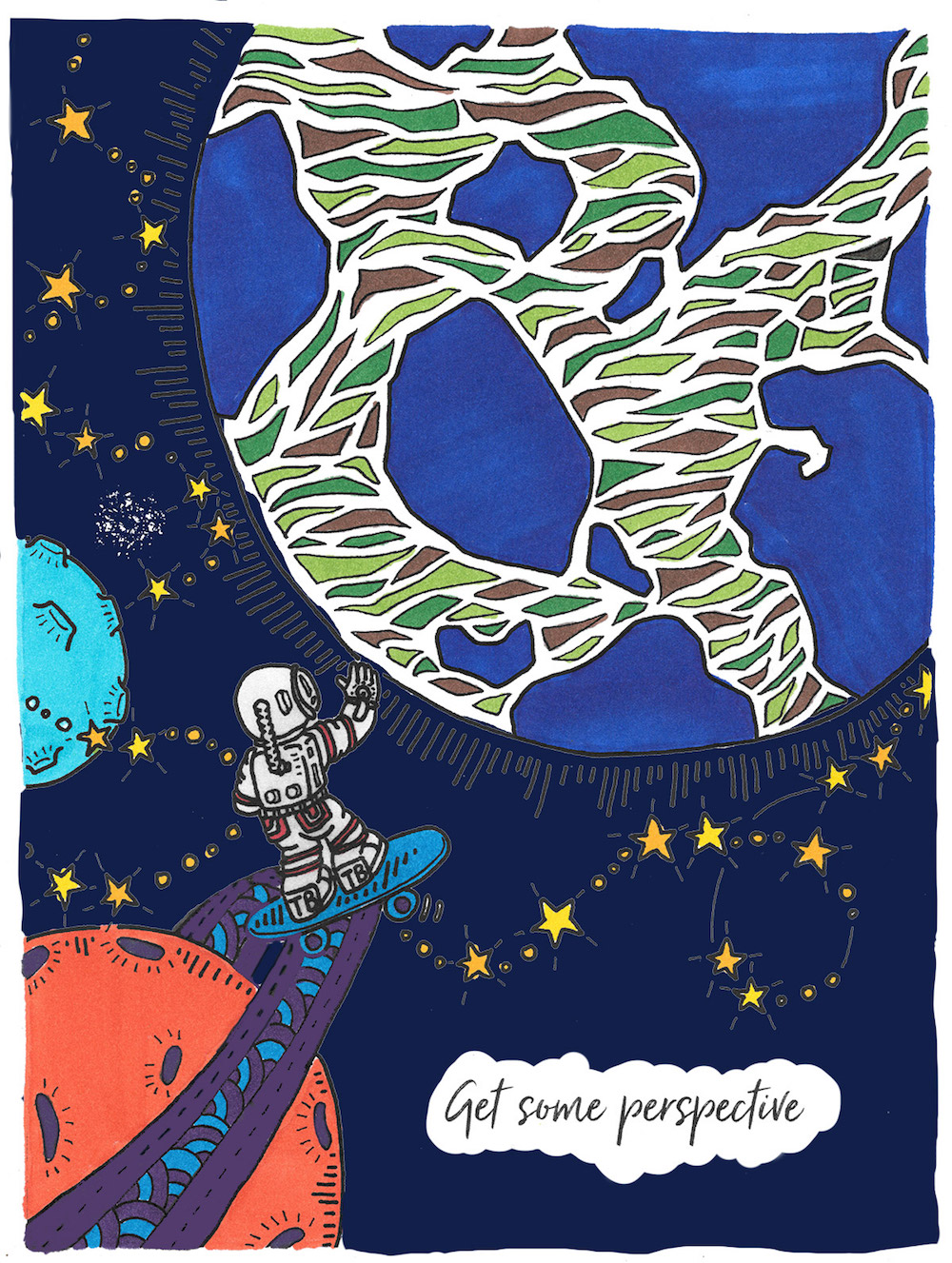
  • Perspective Coloring Page from Tiny Buddha’s Worry Journal

    Perspective Coloring Page from Tiny Buddha’s Worry Journal

    Hi friends! We’re now less than two weeks away from the launch date for Tiny Buddha’s Worry Journal. As you may have noticed, I’ve been sharing some of the coloring pages over the past few weeks, all colored by yours truly, to give you a sense of what the journal has to offer. So far I’ve shared:

    In addition to coloring pages, the journal includes questions, written prompts, and doodle prompts to help you reframe your worries and minimize anxiety in your daily life.

    Really, it all comes down to perspective. Everything seems more difficult and overwhelming when we’re wading through the muck of a disappointment, crisis, or tragedy, knee-deep in our messy emotions. But oftentimes when we step back and view things in a different light, life suddenly seems more manageable, and sometimes the painful seems not only tolerable but also useful.

    There’s a Taoist fable that I’ve found particularly powerful because it reminds me not to panic when things go “wrong.” You’ve quite possibly read it before, but perhaps it’s something you need to read again today:

    A farmer had only one horse. One day, his horse ran away.

    His neighbors said, “I’m so sorry. This is such bad news. You must be so upset.”

    The man just said, “We’ll see.”

    A few days later, his horse came back with twenty wild horses following. The man and his son corralled all twenty-one horses.

    His neighbors said, “Congratulations! This is such good news. You must be so happy!”

    The man just said, “We’ll see.”

    One of the wild horses kicked the man’s only son, breaking both his legs.

    His neighbors said, “I’m so sorry. This is such bad news. You must be so upset.”

    The man just said, “We’ll see.”

    The country went to war, and every able-bodied young man was drafted to fight. The war was terrible and killed every young man, but the farmer’s son was spared, since his broken legs prevented him from being drafted.

    His neighbors said, “Congratulations! This is such good news. You must be so happy!”

    The man just said, “We’ll see.”

    You can’t see the whole picture from where you’re standing, so take a deep breath and remind yourself that things likely aren’t as bad as they seem. And even if the worst thing happened, you could handle it and maybe even grow and gain in ways you can’t possibly predict.

    From now until June 26th, you’ll get three bonus gifts, including a guided meditation series on letting go, when you pre-order Tiny Buddha’s Worry Journal. All you need to do is order a copy here and forward your purchase confirmation email to worryjournal@tinybuddha.com.

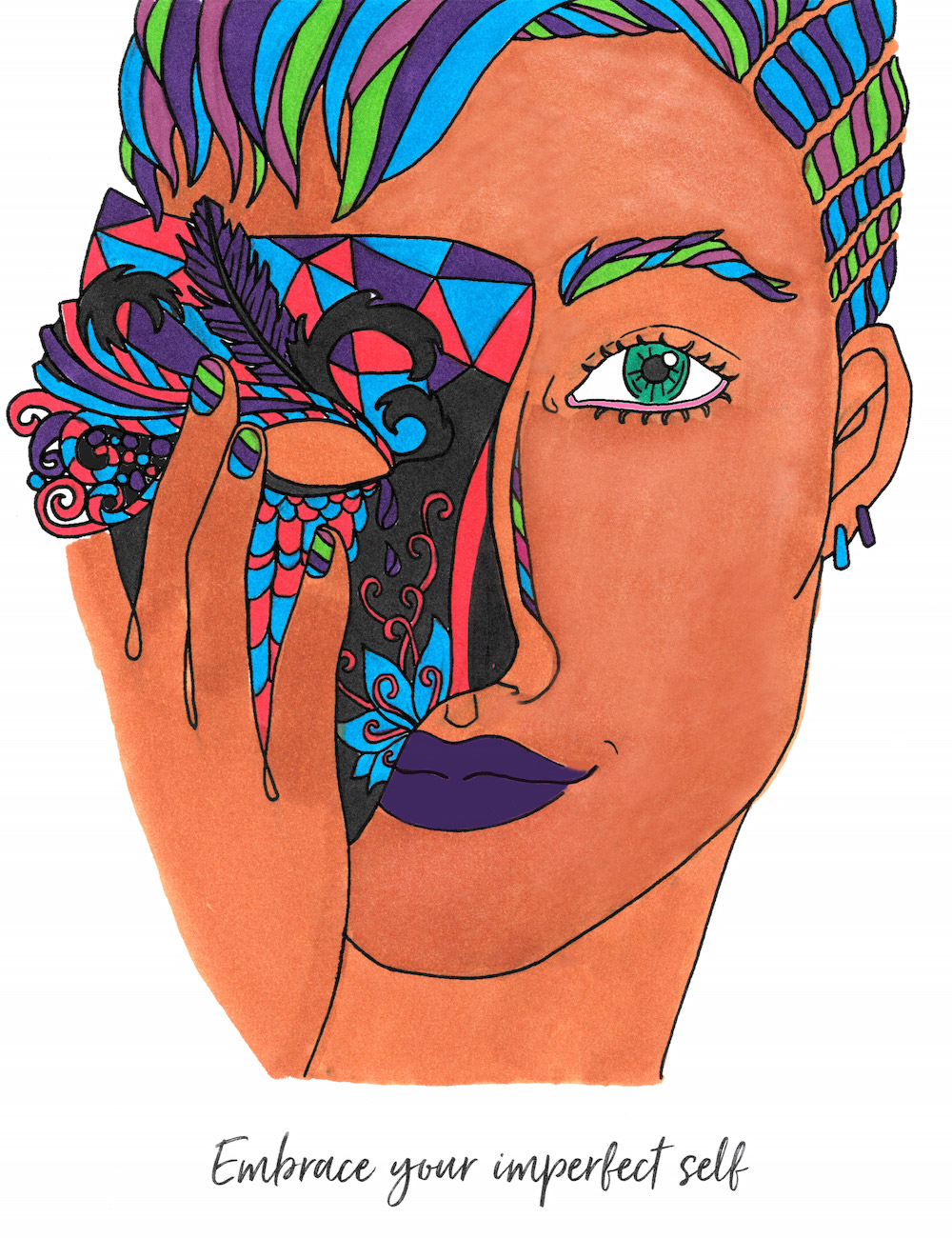
  • Accept Yourself Coloring Page from Tiny Buddha’s Worry Journal

    Accept Yourself Coloring Page from Tiny Buddha’s Worry Journal

    Hi friends! If you’re a regular reader, you know I’ve recently been sharing some of the coloring pages from Tiny Buddha’s Worry Journal, which includes questions, written prompts, and doodle prompts to help you work through worries and minimize anxiety in your daily.

    So far I’ve shared:

    Today’s page is one of my favorites, and not just because I love Rose Hwang’s beautiful illustration and enjoyed using so many bright colors.

    I love this page because it reminds me that imperfection is all about perception. What you consider a flaw someone else might consider a strength. What you feel tempted to hide someone else might perceive as beautiful.

    There’s a Japanese term, Kintsugi, that refers to the art of repairing broken pottery with lacquer mixed with powdered gold or other precious metals. This practice began in the 15th century when Japanese military commander Ashikaga Yoshimasa wanted to repair a broken tea bowl in a visually pleasing way. Kintsugi has come to be known as way to honor an object’s history, rather than attempting to hide the damage.

    I think about this sometimes when I look at my left leg. I have a series of scars toward the top, remnants from a time when I channeled my depression and shame into self-harm. For a while I was too insecure to wear shorts or a bathing suit because I worried that someone might see them and judge me. Now when I look at them, I try to visualize the faded lines in gold.

    Then I remember those lines are like a map that led me directly here. Every other scar, physical or emotional, is a testament to my strength, not my weakness. And every idiosyncrasy, from my introversion to my sensitivity, is a gift, not a curse, that has enabled me to make a difference in the world.

    The same is true for all us: our scars, our quirks, our imperfections—these aren’t things we need to hide. We are who we are because of them, not in spite of them. And every colorful piece of our past and personality is part of what us makes us beautiful.

    From now until June 26th, you’ll get three bonus gifts, including a guided meditation series on letting go, when you pre-order Tiny Buddha’s Worry Journal. All you need to do is order a copy here and forward your purchase confirmation email to worryjournal@tinybuddha.com.

  • How To Be Open-Minded When Others See the World Differently

    How To Be Open-Minded When Others See the World Differently

    “Most disagreements are caused by different perceptions that created different realities.” ~Unknown

    When I was thirteen, I experienced a monumental change in my young life.

    It wasn’t a big move, no one close to me died, and although puberty was rocking my world in the worst way, it was something else altogether that shook me to the core:

    The movie Titanic came out.

    I know, I know, it’s just a movie, and I was just another swooning teenager wishing that I was the one Jack never wanted to let go of, but it hit me hard. Truth, love, the pain of loss: a woman following her heart and risking it all for true love. I relished every second of its three hours and fifteen minute run time.

    So much that I saw it multiple times over winter break at school—usually with my equally enamored mom, sometimes with my best friend, always with a lump in my throat. I held back tears as I saw Jack’s face disappearing into the icy waters, always wondering why Rose couldn’t make room for him on the raft, each time imagining myself in the situation: falling in love, making tough choices, persevering through loss.

    (Spoiler alert: the ship sinks.)

    Returning to school a few weeks later, I knew I’d been changed. Titanic was helping me to sort out the girl I was from the woman I was becoming, and I figured it was having an equal effect on those around me. I was pleasantly surprised when I walked into class on the first day back at school and read an obviously related quote on the white board:

    “’Tis better to have loved and lost than never to have loved at all.” ~Tennyson

    I smiled inside, realizing that my eighth grade teacher must have seen Titanic too, feeling a kindred recognition of just how important this epic film was. After all, it was a sweeping success across the country, breaking records and hearts and box office sales.

    As I settled into my seat and he began to lecture, I prepared to listen to what his thoughts were about the film: maybe he had a historical critique, or an interpretation of the film’s depiction of the human condition?

    Oh, how wrong I was.

    It turns out that the local football team had gone to the super bowl during this same break, and while I was losing it over Jack and Rose, many others were losing it over this team’s big loss.

    As my teacher began to lecture and joke with classmates about “the value of making it to the super bowl at all” I hung my head in frustration and confusion. There was a life-changing movie in theatres, cataloguing one of the worst catastrophes in history. Why didn’t anyone care about this? Isn’t this quote on the board far more applicable to a love story than to a football team?

    Doesn’t everyone feel the way that I do??

    In retrospect, my Titanic example is funny (and somewhat ridiculous). Of course not everyone felt the same soul shaking connection to a movie, and of course not everyone had the newly awakened hormones of a teenage girl. (Say Leeeeoooo with some longing in a whispery voice, and you’ve got my thirteen-year-old daydreams pegged pretty well.)

    When we’re that young it’s easy to make major mistakes in our perception of others, but within this comical event are the seeds of an issue that would continue to show up, both in my life and others.

    There’s Imperfection in Perception

    My misinterpretation of a teacher’s quote on the board is an early mistake in “encoding” and “decoding.” Those two words are just fancy talk for the complicated interaction that is communication, and how they’re related to something called the “confirmation bias.”

    See, when I read those words on the white board, they confirmed something that I (unconsciously) assumed to be true: everyone cared about this thing that I did (ahem, Titanic, cough) and of course this quote about love must relate to it. The words on the board spoke to me in a way that I thought was universal: my thirteen-year-old brain knew exactly what they meant.

    When words are spoken, however (or written on a white board in eighth grade), the intention of the communicator can get lost in the understanding. When I say something to you, I’m “encoding” information that I want to communicate; I’m trying to get you to understand me.

    The trouble comes when we forget that each person understands (or “decodes”) information differently—we hear what we know, we hear what we want, and we hear what makes sense based on our life thus far.

    See, this variability in perception happens because each of us views the world through a slightly different lens. What the word “love” means to me could be different than what it means to you; for example, what has the word “love” meant in the past? Has it been controlling or unconditional, loaded with expectations or adoration?

    The actual words we use are simply a jumping off place, and then they’re strung together in beads of sentences that can appear a different color to each person listening. The “colors” (or meaning) we assign to words vary because all of us do; and because our minds are expert categorizers, we often understand things in a way that already makes sense with our existent worldview.

    It’s for this reason that two people can read the same news article and come away with different interpretations, or feel entirely different about the events going on in the world: We tend to pay attention to information that confirms what we already believe to be true, and disregard the rest of what we see. It’s not due to callousness either; it’s the way that we’re wired.

    Our brains are really good at simplifying and organizing. In order to cognitively make sense of a complicated and busy world, we have to become expert categorizers. This is adaptive, and it helps our overworked brains make sense of things.

    The hiccups only come when we forget that the way we’ve organized the world is different than the way that others have; when we assume that each person interprets the world and its events the way that we do.

    So, what do we do? If everyone could mean something different when they say “I love you” or “let’s go get some ice cream” then how on earth are we ever supposed to understand each other? Is all social coherence lost?

    The answer is simple, but not easy: We must keep an open (and present) mind.

    Open-mindedness

    Keeping an open mind is realizing that we all perceive the world that we live in differently. It’s remembering that when we read (or listen) we are “decoding” at the same time—trying to understand and make sense of information, all through our unique and limited worldview.

    It’s being patient when we feel misunderstood, and allowing for the possibility that we’re also misunderstanding others.

    Open-mindedness is being forgiving of people who hold different opinions and reminding ourselves that we’ve really only ever been one person; we don’t necessarily know what the world is like for others.

    Being open-minded is another form of mindfulness, really. It’s pausing before responding, and asking ourselves: What do I already believe to be true about this person, this event, this political party? What in my past is causing me to feel agitated, or generous, or suspicious? What does the person speaking to me actually mean?

    Even if we don’t always have the answers, simply allowing the questions to percolate our perception can open us up to the world around us.

    Not having answers also gives us the chance to ask questions; if we don’t know what someone means by a statement, we can ask them to clarify. If that’s not an option (because who likes to feed trolls on the internet, right?) then can we at least hold space for a worldview that varies from ours?

    Even if we don’t agree with it, even if it makes our blood boil, can we pause while we try to understand it? Slow down our categorizing minds and realize that the world looks different from varying angles?

    It’s difficult to pause when we’re agitated, but it’s definitely possible. Practicing mindfulness in communication (whether it’s with a loved one or a stranger on the internet) can give us space to ask these questions, extend our understanding, and allow for differences.

    Listening to an idea with an open mind is letting go of all the reasons it’s wrong, or right, and allowing the person (or words) to be what they are. It’s digesting things with the knowledge that we’re bringing our own “stuff” to the table; keeping in mind that our history colors each and every interaction we have.

    It’s a complicated world that we navigate, and there are benefits to the assumptions we jump to minute by minute. But in order to sift through assumptions we’ve first got to be aware of them, and that involves being vigilant of our monkey minds as often as possible. It involves pausing, taking a breath, and asking ourselves: Is this person talking about Titanic, or football?

  • The Power of Perspective: A Simple Way to Ease Anxiety

    The Power of Perspective: A Simple Way to Ease Anxiety

    “The primary cause of unhappiness is never the situation but your thoughts about it. Be aware of the thoughts you are thinking.” ~Eckhart Tolle

    One of the first ideas I learned in law school was “the reasonable third person,” a legal fiction created to help figure out if someone has acted unreasonably. There’s no clear-cut definition, so I spent a lot of energy arguing what a reasonable person would do. This hypothetical person haunted my law school exams, and later, my career.

    But I realized the reasonable third person could teach me something beyond the courtroom. I could apply that perspective to ease anxiety in my own life.

    At my law firm, I was so busy that I could barely make meetings in time. It would always be a mad scramble to get everything ready. The senior lawyer would always be annoyed and stressed, and the partner would barely acknowledge my presence.

    I’d have too much coffee and be nervous. I’d try to be casual, but I’d either fidget too much or sit too still, trying not to attract attention. I was always so nervous I’d get asked a question and not know what to say.

    Mostly, I just sat silently in meetings. Occasionally I’d make a comment, but I’m sure no one noticed because I was so unhelpful. I always felt like an idiot.

    Then I realized how personal and subjective my interpretation was. By changing my perspective, I could compose a new, more useful narrative of events. My interpretation—my thinking—could relieve my distress.

    I felt like I was always running late, but I made it to meetings, didn’t I? So “I could barely make meetings in time” became “he arrived in time for the meeting to start.”

    “I’d always have too much coffee and be nervous” became “Joseph drank coffee.” “I’m sure no one noticed because I was so unhelpful” became “he was pretty quiet during the meeting.”

    This narrative removed the self-centered thinking. It focused on what actually happened, not what I felt about what happened.

    Afterward, I was less overwhelmed by my thoughts and feelings. I had a broader perspective, like that of a third party. My feelings weren’t bound so tightly to events.

    Third Person Thinking

    I began to call this third person thinking. It’s the idea of observing your experience from a distance instead of identifying with how you felt about it. I could rise above my own viewpoint of an event.

    It’s like the judge deciding whether someone acted like a reasonable person under the circumstances. It’s irrelevant what they subjectively experienced. Focusing on the cold hard facts might overlook the emotional impact of events, but it also allows you to change that emotional impact.

    Okay, so this sounds nice in the abstract, but does it actually work? Researchers have examined this skill (called “self-distancing” in the study) in situations that provoke anxiety or anger in real life, like public speaking. The results are encouraging: The studies presented clear improvements from third person thinking.

    Benefits

    Third person thinking improves your reaction to a stressful event. You’ll feel less pain, anxiety, and “maladaptive post-event processing,” in the unwieldy language of the studies. Post-event processing—your perspective on what happened—improves, becoming more useful.

    You’ll also better manage future situations, as you can “appraise future stressors in more challenging and less threatening terms.” Translation: You’ll feel less worried about stuff that usually worries you.

    Third person thinking also improves performance during the event itself. Study participants with social anxiety gave better public speaking performances when they engaged in self-distancing. Athletes also perform better when they engage when they manage their self-talk in the same way.

    The theory looks good. But are we just fooling ourselves? After all, the objective situation hasn’t changed.

    Maybe it seems that way, like trying to convince yourself you’re happy when you feel like crying. But what you think affects how you act and feel. It’s a cycle. Each stage—thoughts, feelings, actions—affects the others.

    Thinking Like a Third Person

    So, how do you actually do it?

    First, consciously observe how you’re talking to yourself. What are you telling yourself—are you saying, “I really screwed that up,” or “I’m sure I sounded like an idiot just then”? Just slowing down like this breaks the automatic chain of reaction, preventing a cascade of emotional reflexes.

    Second, write it down. This forces you to slow down even further. It makes the distancing more real, and it’s important to create that muscle memory of practice, just like meditation.

    Third, replace personal pronouns like “I” and “me” with third person pronouns in the story you’re telling yourself. Use your name. “I had to give a speech” becomes “Joseph gave a speech” and “she spoke for ten minutes.”

    Finally, focus on the events themselves, not the narrative you tell yourself about them. You might be biased to focus on your inner monologue. But try to keep your assessment objective: not “I did a terrible job and I’m about to get fired” but “Her boss told her to redo one section of the assignment.”

    Tips

    First, make sure you’re being friendly to yourself. Third person thinking isn’t going to do much good if you’re still judging yourself but camouflaging that judgment by changing a few words. Instead, talk to yourself as if you’re talking to a friend who went through the same situation.

    At the same time, stay objective. A true friend is supportive but honest; you know your friend will tell you the truth. Being kind, but objective, is the most supportive thing you can do.

    Second, third person thinking isn’t about avoidance. Don’t use it to withdraw from how you feel or what you think. You’re still engaging with the event, only from a healthier place.

    Finally, just do it. For me, third party thinking felt (very) silly at first. It was also difficult because I was so used to being wrapped up in the events around me.

    But just try it out. There’s really nothing to lose, and it just might help you feel calmer and less overpowered by what occurs in your life. It certainly did for me.

  • It Could Always Be Worse: The Power of Gratitude and Perspective

    It Could Always Be Worse: The Power of Gratitude and Perspective

    “When you arise in the morning, think of what a precious privilege it is to be alive—to breathe, to think, to enjoy, to love.” ~Marcus Aurelius

    So, yesterday wasn’t the best day. I backed up into my husband’s car in the dark, on my way to a meeting. I didn’t see it in the mirrors. It was dark. (Did I mention that?) Well, it left a healthy size dent in the front, and needless to say, the tension began.

    I felt bad. I honestly didn’t see it. Whenever I put my car into reverse, the mirrors automatically adjust and seem to point down, which makes it difficult to see out of them. Then, I have to look on this little screen when I back up, and in the dark, it’s hard to distinguish obstacles in the way. I just can’t get used to it.

    So I tried. I put the car in reverse, slowly backed up, and then… crunch. I heard it. Ouch.

    Afraid of the destruction I had caused, I reluctantly opened the door, looked back, and assessed the damage. Instantly, I knew he wouldn’t be happy.

    I imagined steam pouring out of his ears after I gently broke the news to him.

    Throughout the rest of the evening, a giant rift began forming between us. Worries about finding money for the deductible, battling higher insurance rates, and paying for repairs spiraled into distress. We went to bed without speaking, which sent me into a fit of self-pity accompanied by tears of guilt and sorrow.

    How much worse can things get? First the septic problems, then the furnace, then the electric problem, now the car. Wow, when it rains, it pours. Why can’t things just be easy for us for once? Is that too much to ask?

    Our thoughts are powerful things. They can instantly set off a chain reaction of overflowing, overwhelming emotions.

    And then this morning, I learned of a friend—a dear woman, wife, and mother in our community—whose young adult child had just passed away in a car accident.

    Rapidly, all my worries about denting the car seemed ridiculous.

    Perspective came rushing back to me in a moment’s notice, bringing me back to reality.

    I had been there. I had been that mom whose child died. I had made that dreaded phone call, as I lay helpless in our mangled and demolished car.

    It has been eight years now since she was flown from the accident scene to the trauma center, and I, transported in an ambulance, was rushed to a local hospital. The last day we had hugged, talked, and touched each other. Sometimes, it seems just like yesterday.

    My eyes welled up with tears, as I knew exactly how this newly bereaved mother was feeling. I swallowed that forming lump in my throat as memories of the accident with my children came surging back, bringing me back to that life-altering day.

    After a few moments, I caught myself holding my breath as I abruptly stopped in my tracks to say a prayer for her and her family.

    To be told your beloved child has died is the worst pain. It’s a paralyzing and debilitating state that leaves you feeling like you are suffocating, making you scream in terror and disbelief.

    And this can last for months, even years, as you desperately try to wake up from such a horrifying dream.

    My heart is heavy. It’s not fair, this arduous, frightening journey that was forced upon this mother this snowy winter morning.

    Today it was her child, tomorrow it will be someone else’s father, mother, brother, sister, son, or daughter.

    It knows no discrimination. No one is exempt. Loss. Grief. They will find us at some point in our lives when we least expect it, pulling us into an abyss of heartbreak and despair. And then what?

    My point: Among the daily stress, tension, and challenges of life, stop and search for gratitude. What a gift it is to even be alive.

    For that car that is broken, give thanks that you have a car to fix.

    For that necessary and expensive home repair, give thanks and realize what a gift it is to even have a home.

    For that taxing job, give thanks that it pays the bills.

    For that exhausting child, give thanks for their strong personality and recall how wonderful it was the day they were born.

    Find perspective. Embrace it. Look with eyes of wonder and hope for tomorrow.

    Take time to enjoy the rainbow of colors in that sunset; appreciate being able to hear those birds singing or see the wildlife out your window. Smile with joy when you’re able to build that snowman with your child.

    Unfortunately, many of us are clouded in our judgment until we experience a rock bottom tragedy. Our daily challenges can be upsetting, but we’re fortunate to not be standing where someone else is standing right now. Someone who is grieving, for they have lost a part of themselves and are struggling with a gaping hole deep in their soul. An unforgettable void that can never be filled, nor replaced.

    So try it with me.

    Stop what you’re doing. Take a step back and try to imagine walking in someone else’s shoes. Someone you may know who has suffered the loss of a loved one. While you may not understand, acknowledge their loss and the road of profound sorrow they must now travel. It’s not easy.

    Inhale deeply, absorb some sunshine, and remember, there are many others who would be incredibly thankful to be where you are today. Despite it all, you are blessed.

    Let us all find perspective when facing struggles that are minuscule in the grand scheme of things and recognize the gifts we have been given. Let’s not take this beautiful life for granted.

  • 5 Steps to Change Your Perspective and Overcome Your Challenges

    5 Steps to Change Your Perspective and Overcome Your Challenges

    Astronaut in Space

    “Look again at that dot. That’s here. That’s home. That’s us. On it everyone you love, everyone you know, everyone you ever heard of, every human being who ever was, lived out their lives.” ~Carl Sagan

    I’m there with a hundred other people. The lights fade to a whisper then vanish, leaving us in darkness. Stars appear. Thousands of them, projected onto the dome screen above.

    In the center of the screen is Earth with its emerald and amber lands and sapphire oceans frosted by clouds. We watch the planet’s rotation, and then we’re flying backward through space, and the Earth becomes small, tiny, nothing more than Carl Sagan’s pale blue dot…

    It’s only a planetarium show. One of many that lays the whole universe bare at this museum. By this time, I’ve seen it almost a hundred times.

    I was the guy in back who ran the shows. A couple touches on the screen and you sent the audience to space. Easy. For now.

    My job at the museum was nearly stress free. I was finishing up my undergrad, and it worked well with my schedule.

    Then I graduated and got promoted. My position completely changed to involve heavier guest relations. I didn’t think I would enjoy it, but I let the money, benefits, and coworkers sway me to it.

    The next six months were some of the most stressful in my life.

    Every day I left work exhausted, overwhelmed by the amount of guests I helped on a daily basis—on one particularly busy day the computer told me I had helped over 1,000 guests in an eight-hour period.

    I was meditating and exercising regularly, and couldn’t keep up with the stress. I rarely had enough energy to go out after work, and I stopped seeing friends; I was too tired to be around anyone but my girlfriend.

    I looked for ways to change the situation: I made suggestions to try and improve the positions, spoke to supervisors about what I could do to use my strengths in more effective ways, and even brought up the idea of creating a new position for me.

    Between personnel departures and red tape, it didn’t go anywhere. I became more and more frustrated, and worse, just pulling up to the building in the morning or checking my email from home called up waves of anxiety.

    I didn’t know what to do.

    I was stuck in my thinking. I just didn’t realize it.

    My anxiety and stress levels got so high, I almost got into a fistfight with a guest over a misunderstanding while on a break.

    I’ve never punched at anyone outside of a martial arts class, and I was about to snap and throw the first one. With my whole body shaking like an airport massage chair, I walked away and left for the day.

    What I should’ve done instead was walked into the planetarium for some new perspective.

    There’s something called the “Overview Effect.” This happens to astronauts when they go into space, all the way out to the moon, and see the pale blue dot that is Earth in all of its entirety.

    No borders. No conflicts. Just the beautiful rock hurtling through space that we all live on.

    Anousheh Ansari, a space tourist who went to the international space station said, “If people can see Earth from up here, see it without those borders, see it without any differences in race or religion, they would have a completely different perspective. Because when you see it from that angle, you cannot think of your home or your country. All you can see is one Earth….”

    If you’re anything like me, you probably can’t afford to be a space tourist, and you’re probably not working on a homemade rocket in your backyard to shoot yourself into orbit (always a bad idea!)

    So how can we use this experience to get new perspective and relieve stress? Like Mr. Rogers helped me do as a kid, we can imagine it (or visualize it, for all the adults out there).

    1. What challenge are you facing?

    As much as we sometimes want to skip to the end, we have to start somewhere.

    What’s the situation that’s challenging you? Was it a stressful event earlier in the day? Maybe it’s something that happened in the past that still upset you. Or maybe it’s something you’re in the thick of, like my stressful museum job.

    Picture yourself in the situation. Don’t just see it, but hear it and feel it as well. Bring in all the details you can to make it more real.

    2. Blast off.

    The problem with our own perspective is that it’s limited. Time to expand it.

    Imagine yourself leaving your body. Your homemade rocket could be taking off, or maybe you’re gently floating out of yourself into the air.

    Before leaving the atmosphere, look down with a bird’s-eye view. See yourself all the way down there. See everyone else involved, and see the challenge or situation in its entirety.

    What do you see that you didn’t before? How does your perspective change from way up here?

    Feel free to see how your perspective changes in relation to yourself, each person, and the challenge as a whole.

    3. Leave Earth behind.

    When you’re ready, it’s time to continue on your journey. Leave Earth behind, and head out into space until you can see the whole thing.

    Ask yourself the same questions from #2 and any other that come to mind.

    From way out here, what do you notice that’s new about your situation? What changes do you notice in your stress level?

    4. Come on back.

    If you need to, you can always go farther out, until Earth is just that tiny blue dot. But just like astronauts we can’t (yet) stay out there forever. If you’re ready, time to come on back.

    But don’t float back into your own body. Instead, with your new, all-encompassing viewpoint, imagine yourself floating into the bodies of the other people first. See the situation with their viewpoint as well.

    What do you learn?

    This may be tough, especially if you’re feeling ill-will toward them. But often, the larger, total-Earth view helps with that.

    When you’re ready, come on back to yourself. From your own eyes, check one more time. What do you see that you didn’t before? How has the situation changed for you?

    5. Take action.

    So you have a newfound perspective. What do you want to do with it?

    What action can you take to improve the situation or do things differently? We usually can’t change other people, but we can change what we do and how we react to others.

    Sometimes it might be something big—for me, since I couldn’t change my job, I left it. It took me awhile, and took a shift in my stuck thinking.

    If I had used this exercise at the time, I might’ve left much earlier. Instead, it came down to my girlfriend seeing me stressed out, day after day, and telling me, “It’s not worth it.”

    Picturing it now from high above, I can see how right she was. My work meant me no harm; in fact, the people there wanted the best for me.

    I committed to a job and outgrew it. It was time to move on to bigger and better things, but I kept myself stuck out of fear of what would happen if I left.

    From out here in space, the fear seems a little bit funny, but there are no harsh judgments. I see why I did it, so there’s compassion for both myself and for my managers and coworkers stuck in the same situation.

    Up here, there’s no borders, no conflict. Just feeling present in the moment with love for a pale blue dot and its people hurtling through the universe.

    Astronaut in space image via Shutterstock

  • What to Do When Things Go Wrong and You Feel Sorry for Yourself

    What to Do When Things Go Wrong and You Feel Sorry for Yourself

    Sad Woman

    “We can always choose to perceive things differently. We can focus on what’s wrong in our life, or we can focus on what’s right.” ~Marianne Williamson

    I was down in the dumps the other day and was feeling sorry for myself.

    For some reason everything was just off. You know when you have one of those days when nothing seems to go right? And you get easily irritated and extra sensitive with everything?

    It all began the night before. I was expecting a call from a guy who I’ve been getting to know. He said he was going to call but never did. I woke up the next morning feeling disgruntled.

    My day proceeded with me stubbing my toe against the bed post, burning my toast, and then receiving a call from the bank to inform me that my debit card had been tampered with and someone had withdrawn over $1,000 from my account. (Luckily, my bank will be filing a fraud claim and I’ll get my money back, which is a blessing!)

    After breakfast, I went to check out a health shop owned by a friend of a friend. We were introduced to each other via Facebook. On the way, I ran into every single red light possible, making me late.

    When I got there I was enthusiastic to pass on a heartfelt hug from my friend, but it seemed her friend was surprised and a bit taken aback, as she leaned in for a lukewarm hug.

    From there things felt awkward to me. Perhaps it was because I’d envisioned a different type of reception and expected my friend’s friend to be equally warm and enthusiastic. Instead, I felt like I was in an intense interview.

    My ego started to stir, criticizing me because I was not prepared to respond to what seemed like 21 questions.

    Feeling flustered over the visit, I was looking forward to meeting up with a friend whom I hadn’t seen in a long time for a catch up. To my dismay, I received a text saying she had to cancel and reschedule because something came up, but she promised she would make it up to me.

    I then got lost in myself. The voices in my head got louder, debating about my worthiness. I felt like a loser that day, and my ego felt deflated. 

    My emotions got the best of me over the most trivial things. And as much as I’d like to blame it on my hormones being out of whack because of jetlag, the truth is I was acting like a child. I was focused on all the “wrong” things that were happening to me, and I was consumed with myself.

    I knew I needed to purge what was on my mind, so I opened my laptop and started to type away. After about fifteen minutes, I felt better. My inner critic stopped and was under control.

    I decided then to check my Facebook page with a strict intention to find an inspirational post or article.

    Soon, I saw a post from a friend of mine who is one of the happiest people I know. She’s on a mission to make people smile and to change the world, one hug at a time.

    In her Facebook post, she revealed that she recently learned she has a rare form of cancer. And although she was shaken by the news, she realized it’s just an unfortunate part of her life’s journey.

    Instead of letting the news get her down, she is choosing not to feel sorry for herself, but to accept it and make the best of it. Or as she wrote, “laugh with cancer.” Because why live in misery, if she knows her time may be up soon? She might as well have fun and go out with a bang.

    Reading her post brought me to tears. It made me realize how self-absorbed I was that day, and how I wasn’t able to appreciate the good things around me because of it. I also realized I’d closed my mind to different ways of seeing things. It was all about me. My expectations.

    When my unspoken expectations weren’t met, I made up stories of what had happened, which led me to my self-pity party.

    It was a great reminder for me to:

    • Not sweat the small stuff
    • Pivot my thoughts to what feels good
    • Change my perspective on the things that happen
    • Refocus my energy on what can I do to serve others instead of being consumed with my own thoughts and feelings

    Once I shifted my attention, the world expanded. I stopped feeling sorry for myself. 

    I realized everything that happened to me within the last twenty-four hours was not just about me. There is more than what meets the eye, and it’s important to not be so quick to judge and form a conclusion about a situation.

    Often the stories we create in our mind are just figments of our imagination, and they do not represent a holistic picture of reality.

    For example, my friend’s friend was probably asking me a lot of questions because she was interested in getting to know me. But for some reason, because I was emotionally off that day, I interpreted her curiosity as interrogation.

    So the next time you are feeling sorry for yourself, turn your focus away from yourself, put yourself in someone else’s shoes, or look at the situation from a third person’s perspective.

    You’ll be amazed by how changing your focus and your thoughts will help soothe your mind and get you to a better feeling place.

    Sad woman silhouette via Shutterstock

  • Change How You Feel by Changing Your Perspective

    Change How You Feel by Changing Your Perspective

    Woman Looking Out Window

    “Instead of complaining that the rose bush is full of thorns, be happy the thorn bush has roses.” ~Proverb

    While I was a going through what I considered the worst divorce in history, I remember waking up every day thinking throughout the day what a horrible thing divorce was. I wondered how other people had gone through it and come out with their sanity, and not marred with cynicism about love and life.

    For a year, all I saw was the negative in everything, including my ex-husband, my life circumstances, and most of all myself.

    My husband was fighting for me to pay him alimony, I was supporting three kids on one income, my mother had sided with ex-husband, and I found out my best friend was a heroin addict. I had bills upon bills to pay, was struggling to make ends meet, and it seemed like every check I wrote bounced.

    I could not wrap my mind around why all of this was happening at one time, and I felt like giving up on most days because there was no good in the world.

    Depression came and wrapped me up, and I could not break free from seeing the worst in every situation and imagining that more of the worst would happen.

    Then one day I realized that, as miserable as I was and as much as I wanted my situation to change, it was not going to, at least not in the moment I wanted it to.

    I realized that there was only one thing I could change, and that was my perspective and how I looked at everything.

    I decided that I could look at my life in one of two ways: either I was destined to be punished eternally and live a miserable life full of pain, hurt, and guilt; or I was going through all of this because the Universe knew I was strong enough to bear it and I would come out stronger, better, and happier than if I did not go through it.

    I choose the latter.

    When I decided to change my perspective, I felt comforted to know that all that I was going through had a purpose, even if I did not understand it. I found a peace in knowing that I could change my mood in an instant by changing my perspective.

    We all go through tough times, but how we view what we are going through is completely up to us.

    Even after I realized the importance of perspective, I still had moments when I let the negative invade. When that happened, I thought of the following to shift my mind back to a place of peace.

    Nothing lasts forever.

    There is no emotion or situation that will last forever. Life ebbs and flows, and the good and bad in life will come and go, eternally.

    This world is a dual world.

    The physical world and what we see and feel is not all there is. There is a world of spirit and purpose underneath it, and no matter what it looks like on the outside, there is much more going on beneath the circumstances we perceive as negative.

    If I can remember that and tap into the deeper meaning behind what I am experiencing, then I can accept what I am going through with greater ease.

    We have a choice in how we view things.

    Today, I look back on all that I have been through in the past year and instead of feeling angry, bitter, or consumed by it, I feel that so much has come from it.

    I started a second job to help with the bills and consequently I have found my passion in teaching, something I have always had a desire to do.

    I have built wonderful relationships with the friends that supported me through the tough times and I know that I can go through tough times and not break.

    Somewhere along the way, I was able to find the silver lining in my rainbow, and you can too.

    Take a look at your life and think of the many tough times you have endured and the many blessings that have arisen from them.

    You have a chance to find the bright side to your situation, no matter how tough it seems, by only changing your view and identifying the positive of every experience. There is a lesson in the pain and there is a beautiful rose in your thorn bush.

    Remember, changing your perspective is like changing the window through which you view the world. When you change how you view the world, you change how you feel about it.

    Woman looking out window image via Shutterstock

  • 5 Practices to Help You Let Go and Embrace Change

    5 Practices to Help You Let Go and Embrace Change

    Embrace Change

    “Letting go isn’t the end of the world; it’s the beginning of a new life.” ~Unknown

    The summer I turned twenty, I worked as a camp counselor at an educational camp with strict rules. As one of my responsibilities, I escorted groups of fifteen to twenty students, ranging in age from middle school to high school, to and from their classes and activities across a large urban campus.

    I was in charge of a group of spoiled, rebellious sixteen and seventeen-year-olds who would rather be spending their summer anywhere but at an academic camp.

    Because I was only a few years older than them, I had some difficulty controlling their behavior—camp rules required that I confiscate cell phones, discourage talking during class, and deal with a shoplifting incident at the campus store.

    After a few weeks on the job, I was feeling overwhelmed. The older students would sabotage us by making us late for every class. They’d goof around, stall by pretending to tie their shoes, or stand in traffic.

    My tactics—telling them repeatedly to hurry up, calling out to them that we’d be late as they lagged far behind crossing streets, and listing the reasons we had to walk faster—weren’t doing me any good. I was sick of repeating myself, I was losing my voice, and my approach wasn’t getting the results I wanted.

    So one day, out of desperation, I tried the opposite of what I had been doing. Instead of putting so much energy into trying to control them and be on time, I let go.

    I continued walking with the younger kids and let the older ones walk behind us at whatever pace they wanted. I pretended to ignore them (while still keeping an eye on them since I was solely responsible for their safety). By letting go, something strange happened: we all arrived at the class faster than ever.

    Giving them a little space and taking my attention off them probably made them feel more mature and independent, like they were walking on their own. Instead of leading by micromanaging, I stepped back and tried to care less in order to get the results I wanted.

    If you find yourself up against a wall, maybe you’re trying to force things. Paradoxically, letting go and loosening your control can pave the way for you to achieve what you desire.

    It’s not about un-attaching yourself from the outcome you want. I still wanted compliance and respect from the campers, but I decided to go about achieving that in a different way. This shifting mindset is like a tiny gear changing, but it can make a profound difference.

    When was the last time you hit a wall and tried shifting your perspective to reach a solution? How can you cultivate and encourage such a mindset in your daily life to think differently? Here are five small practices to help you learn to embrace change and harness your creativity.

    1. Mix up your routines.

    You may be stuck in ruts you don’t even realize. Brush your teeth with your non-dominant hand. (It’s surprisingly difficult, and it enhances creativity by building new neural pathways in the brain.) If you’re right-handed, try using your left hand to move your mouse cursor for an afternoon.

    Shift the arrangement of the apps on your phone, or change up the order and organization of the files on your computer desktop. It can be very disorienting at first, but just try something new and getting over your initial resistance is the hardest part.

    2. Experiment with new tastes.

    At the start of each month, make a list of foods (guava, figs, buffalo jerky) that you’ve never tasted. It can be as simple as sampling a new kind of cheese.

    It’s reassuring and comforting to hold on to our old, trusted standbys, but you never know what could become your new favorite food. I didn’t try mango or pomegranate seeds until last year, but now they’re two of my all-time favorite fruits.

    3. Add playfulness to your day.

    The next time you’re at a coffee shop or restaurant, why not order with a British or Indian accent (if you’re not British or Indian)? Stick to your accent the whole time, or switch it up in mid conversation and try to keep a straight face.

    Or, if you’re shopping for clothes, pick one item to try on that’s something you’d never wear. You’ll (hopefully) at least get a laugh, but being playful can also open you up to considering new ways of doing routine tasks, helping to gently expand your perspective as you see more possibilities than the obvious, logical ones.

    4. Reach out to others.

    Let go of any inclination to be too inwardly focused by observing and commenting on your surroundings. Compliment a stranger on a piece of jewelry he or she is wearing, or ask a stranger for directions somewhere.

    If you seek out interactions each day or each week that you wouldn’t otherwise have had, you may be surprised by the cumulative effect they can have on your creativity. It can also open you up to more opportunities that you otherwise would have missed if you hadn’t stepped out of your own headspace.

    5. Clear out old stuff.

    For twelve years, I had an alarm clock that was a comforting presence since it was the first thing I saw each morning. I realized I no longer needed it, but I didn’t want to abruptly let go of it.

    So, I took baby steps by first just unplugging the alarm clock. Then, I moved it down on the floor. After a few days, I put it in a brown bag so it was out of sight. A few days after that, I put the bag by the door, and then the next day I donated the alarm clock.

    If we resist the little changes in our lives, we have a much harder time dealing with the big changes. When a certain method isn’t working for you, take a step back, clarify what you want to accomplish, and open yourself up to approaching the problem in a different way. Letting go can feel scary, but it can also bring you to something better.

    Man with arms outstretched image via Shutterstock

  • The Power of Words

    The Power of Words

    When I first saw this video, I thought it was about the title—the power of words. Then it occurred to me that it might be about the other part of the title (shared on the YouTube page, but not here): you should see this.

    Perhaps it’s not so much about saying the same thing in a different way; maybe it’s more about the gift of the second message and how that naturally inspired others to give back.

    It’s a powerful reminder, a truth we often forget. It’s a beautiful day. Can you see it?

  • Become Open-Minded: The Benefits of Embracing New People and Ideas

    Become Open-Minded: The Benefits of Embracing New People and Ideas

    Clearheaded

    “You have your way. I have my way. As for the right way, the correct way, and the only way, it does not exist.” ~Friedrich Nietzsche

    Toward the end of last spring I was feeling a little restless in Los Angeles, so I decided to take some time in the summer to live on a yoga retreat in Hawaii. I was set on recharging and finding comfort in like-minded people who valued slowing down and mindfulness.

    Learning was not at the top of my list; I was there to unwind from a tough semester and recharge for the semester ahead of me.

    I was in for a big surprise. 

    When I got there, I was greeted by the expected tanned-skin and white smiles of mostly 20-something-year olds in yoga pants. They shared more than yoga tips; there seemed to be an underlying philosophy they shared that, honestly, made me very uncomfortable at the time.

    You see, even though I am really into yoga, slowing down, and the like, I am also a very political person. And by political, I don’t just mean involvement and interest in what is going on around me in the world; I mean that I feel active in my existence on earth and cherish my ability to create.

    This is why I found myself being annoyed by the constant sayings around the dinner table like, “I can’t wait what tomorrow has in store for me” and this talk about going with the flow and letting go.

    The emphasis placed on receptiveness, passivity, and ease seemed antithetical to what I stood for at the time.

    So I left the retreat early. I thought I would feel better surrounded by people who thought like me, and were interested in outrospection versus constant introspection. I wanted to be around people that were a little less hedonistic and self-indulgent—or so I thought.

    When I got back, I got sick. Just a few months back in Los Angeles, I received six biopsies that confirmed I had Celiac’s disease. This explained the incurable anemia, constant nausea, and incredible exhaustion.

    My friends and family here could hardly relate, and they urged me to get back “on track” as soon as I could, to join in the projects I was a part of with them, at my university and at work.

    The “get over it” attitude made me feel so lonely and objectified, and really started making me think, what am I going to do now?

    The pressure to get myself back on that productive momentum was straining me, and made me reconsider my previous judgment about the power of letting go.

    Although I realized that embracing this philosophy would mean I would be contradicting what I previously asserted for myself, it was a small shift in my mindset that would gradually set up a path for my personal enlightenment.

    After pensive thoughts about who I should start surrounding myself with, I realized I should focus on that less and start putting my energy into the kind of person I wanted to be.

    I asked myself, “Will my values continue to be deep-rooted in constructivism, politics, and action, or will I be like the bohemian girls I met on the retreat?”

    The truth is, neither of these perspectives truly satisfied me. After swinging from one extreme to another, I realized I felt more comfortable picking and choosing my philosophies as opportunities and experiences unraveled themselves over time.

    I shifted my mindset to discard my dreams of finding a one-size-fits all philosophy, and settled for middle ground.

    This new perspective has influenced my own work in the field of political psychology; it has shaped way I approach politics; I now analyze it from a bottom-to-top perspective versus a top-to-bottom paradigm.

    I have decided I feel better when I am nonpartisan, and simply support platforms based on how they fit with my values at the moment.

    I am learning to trust myself, because I am learning that with new experiences, values can shift, and that is okay.

    I am going back to this yoga retreat this summer, and hope to go in with a better attitude and more openness so that I get more out of the experience. The whole approach of going in with my mind made up with “who I am” and “what others should be like” has not worked for me.

    This is not to say that I am giving up on reasoned judgment, but that I will place more emphasis on learning and being receptive to change, since it is inevitable anyway.

    So in retrospect, when I went to this retreat in Hawaii last summer, I didn’t think I would learn valuable skills that would serve me in sickness. That’s the beautiful thing about traveling—trying on different perspectives that make you into a more multilayered, understanding person.

    I realize that we may not all get the opportunities to travel, and it can be easy to get so immersed in our own perspective and way of being that we fail to grow from the contrast that travel can provide.

    As Alexis de Tocquevilleonce said, “Without comparisons, the mind does not know how to proceed.”

    I hold the belief that without regular checkpoints and contrast in life, we may develop tunnel vision, which can influence us to think and behave in ways that limit us. Here is some insight and advice I have gathered to bring some perspective:

    Embrace fear in your life.

    Yes, expanding your mind and challenging what you firmly held onto before can be scary. However, know that embracing the unknown can open you up to new experiences, people, wisdom, and insights.

    Keep your priorities clear.

    This means to remember that if you are trying to gain perspective, to keep your mind open no matter what. Place learning at the top of your list of things to do so that receptiveness, openness, and controlled passivity will naturally follow.

    Don’t forget to share!

    Chances are, if you are traveling or even planning on broadening your perspective at home, others can learn from yours as well. In my experience, there is nothing more profound than sharing perspectives and having both parties walk away with an enriched view of life.

    Photo by ePi.Longo

  • Get Some Perspective: 4 Ways to See Yourself and the World Differently

    Get Some Perspective: 4 Ways to See Yourself and the World Differently

    Self Reflection

    “Your outlook on life is a direct reflection on how much you like yourself.” ~Lululemon

    Several months ago I wrote an article that sat for months without being published. A few weeks ago the editor emailed me to say how pleased she was with it and that it would post the following week.

    Since I hadn’t thought about it in a while (and she’d sent me the preview link), I figured I’d check out her edits and re-read the post. As I sat back and took in what I wrote, I was genuinely astonished at how well done it was. I wrote that? It was amazing!

    I remember being nervous at the time to send it in. Then, not hearing back for a while made me even more anxious. But after taking a few months away from it, I could see that yes, I was a very talented writer.

    Sometimes it takes getting farther away from something to see it for what it really is. It’s that whole forest-for-the-trees thing. The same is true when it comes to how we see ourselves.

    Sometimes we need a little distance to help us see things as they really are. (Because really, you’re wonderful.)

    This got me thinking: How do you get farther away from yourself? As I’ve journaled and worked through my days, that question has been answered for me.

    Cultivate patience.

    Doesn’t this seem like it’s the answer to everything? It does for me these days. Any problem I have seems to be solved by patience, and getting some distance is no exception.

    My ego is usually the part of me that doesn’t want me to take risks and see myself for the star that I am. It wants to keep me from submitting my writing or taking that rock climbing class because if I fail, how embarrassing and horrible would that be?

    Not all that terrible, it turns out. But only if you’re willing to sit around and wait for the response. It can be painful to hear other people’s criticisms, no matter how constructive, and sometimes, even compliments make us uneasy, but it’s even worse sitting around and waiting for it. My ego just wants to run the other way.

    By practicing patience I am able to make it less about me and more about the task, which (surprise!) isn’t really about me at all. An article, a photo, a presentation, even cooking dinner can become an extension of myself if I’m not careful to sit within myself.

    This helps me to understand that those are simply creations that have happened through my body, my vessel. With patience I am able to see those things for what they really are and appreciate them with detachment. It also makes criticism a heck of a lot easier too.

    Help others.

    When I get into service mode, I really learn how to see my life as it truly is. It’s about a change in perspective. After I served homeless families Christmas dinners for a few years, the petty problems my family had didn’t seem to matter.

    It also made me see how great my family dinners actually are. We’ve got a roof over our heads. We can take a nap on the couch if we ate too much. Life is beautiful and simple.

    But this doesn’t just happen with big gestures. It’s all the tiny things too. My friend was filling up her tank the other day and I knew she wouldn’t take my cash, so I snuck it into her purse.

    I imagined her later opening up her wallet. Maybe she’d notice it, or maybe it wouldn’t even register. That part didn’t matter. It was about me seeing through her eyes. And that change of perspective helps me to see a part of myself that wasn’t in focus before.

    When we extend a hand, no matter how big or small, it offers us the chance to step outside ourselves for a minute and understand more of the big picture. And when we can do that, we see our role in it more clearly and are able to appreciate that (and ourselves) more readily.

    Embrace other points of view.

    Much like helping other people, seeing a different side to a story can help you see yourself more clearly. I remember speaking with a close friend about suicide when I was younger. I was lamenting how terrible and selfish it was when she spoke up that perhaps that soul just wasn’t ready for this world.

    Instead of immediately discarding her point, I was struck by how it had never occurred to me. While I marinated on it for the next few days I really got a chance to consider myself from a different angle. Was I compassionate toward myself and give myself permission to have differing, sometimes even contradicting opinions? Did I encourage myself to open up like my friend did?

    I could see that yes, sometimes I did, and I congratulated myself for that in a way that I couldn’t have done before. But beyond seeing myself in a different light, it also opened me up to the fact that I can have more than one feeling about something and that that was okay.

    In fact, it showed me that it’s important to honor all parts of myself. I felt more whole and free after that.

    We can all benefit from listening and considering other points of view. Even if we don’t agree, it can give us a chance to consider if we’re honoring all parts of ourselves. And that is truly a blessing.

    Live in the moment.

    This sort of seemed like a contradiction to me at first. If we’re living in the moment, in our bodies, how on earth can we see ourselves more clearly? How exactly are we getting farther away? I realized, however, that when I’m truly present with what I’m doing and in my body, that I am much more connected to the world and those around me than when I’m multitasking and running around like a headless chicken.

    For instance, the other day I was listening to a class and trying to do some home improvement at the same time. I dropped what I was trying to hang on the wall and started feeling sorry for myself. Now I had to stop and fix everything and replay the part of the class I missed. I was so completely stuck in my own world that I couldn’t see that I was getting in my own way.

    On the other hand, I was raking the yard last weekend and was making an attempt to be in the moment. When I realized that I needed to water the trees and flowers as well, I stopped. I told myself I could do that after I finished putting the leaves in the compost because they’d get wet if I didn’t. Because I was present in my body, I could see what was around me and was able to make better decisions.

    When we’re not present, we’re on autopilot. We make choices without even realizing we’re affecting our futures. If you can try to stay present, you’re able to see those choices you’re about to make and slow them down. This helps you see yourself differently.

    That autopilot choice to pull into the fast food joint: Is that really what my body wants or am I choosing what has been put in front of me? That mindless judgment you’ve made about someone in line at the coffee shop: Is this really how you feel or are you masking emotions like jealousy or anger?

    Most of us struggle with seeing things from a different perspective. And many of us have to really work to view ourselves in a new light or give ourselves positive feedback. I know I do.

    I hope that considering a few of these tactics will make it easier for you to pat yourself on the back and widen your horizons. It certainly has for me.

    Photo by Justin Scott Campbell

  • Direct Your Emotional Memory to Feel Good Now

    Direct Your Emotional Memory to Feel Good Now

    “When everything seems to be going against you, remember that the airplane takes off against the wind, not with it.” ~Henry Ford 

    You’re stuck at work and you dream of something better.

    This dreaming usually starts off great. You imagine yourself sitting at a desk working on a million dollar project or teaching underprivileged kids how to multiply seven times three.

    Whatever your vision is, it’s good to daydream about this, but what usually happens is that we snap out of it, and reality smacks us in the face. We’re answering phones, running errands, and hating our lives.

    I’ve been there, most of Gen Y is currently there, and everyone else was also there at some point in their early careers. Through the years I’ve interviewed hundreds of people about their careers. Each one always talks about one tool that they use over and over again.

    Selective Memory

    I noticed that most of the older people look back on their early careers in fondness. They forget about the pain and remember the good times. A lot of times they even look back on the pain in fondness.

    They see how their superpowers had developed over the years. They know that each struggle was a part of their career growth and happiness.

    My father, a small business owner, an electrical contractor, struggled in his early years. He had to run around hunting down jobs. No one knew who he was, so the jobs didn’t fall on his lap. He had to schmooze with old and new contacts.

    I remember him coming home dejected, tired, and grumpy. I could have gotten free meals from the school, but my parents were too proud. I brown bagged my lunch 99.9% of the time. We couldn’t afford $.75 for a school lunch.

    Now my father looks back on that time in fondness. He’s proud of my family’s fortitude. It got them to where they are now. Let’s put it this way, they can go on vacation anytime they want even though my father still works. He works because he enjoys what he does and doesn’t want to give this up.

    If only he could have seen the magic in what he was creating when he created it. He would have saved himself a lot of worry. It’s this process that we can all use to help us to bring happiness to our struggles. (more…)