Tag: control

  • One Thing We Need to Survive Crisis, Loss, and Trauma

    One Thing We Need to Survive Crisis, Loss, and Trauma

    “What man actually needs is not a tensionless state but rather the striving and struggling for a worthwhile goal, a freely chosen task.” ~Viktor Frankl

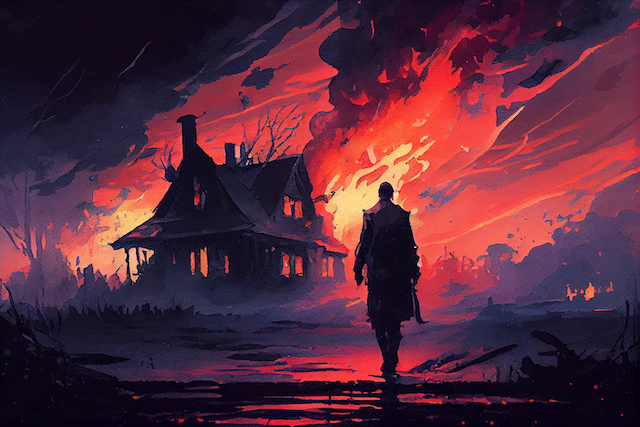
    A couple of years ago, I was sitting in my little mountain cottage, writing away on a new novel. It was a cold and dark February afternoon. So, first, I felt pleasantly surprised when I saw something bright lighting up behind me: I thought it was the sun coming out. But when I turned around, I noticed that my porch was on fire!

    Before I knew what was happening, I was standing out in the snow in my slippers, looking back at the entrance and facade completely engulfed by flames.

    It was like a near-death experience. My mind quickly took an inventory of all the things that were inside the cottage now burning down—pretty much all of my personal belongings. However, in that moment, I realized that nothing else mattered but the manuscript I’d been working on.

    Hours later, after the fire-brigade had left and I took one last look at the charcoaled ruins of what used to be my home, I finally got into the car with Marius, my border collie. (The car key survived by nothing short of a miracle.)

    I was on my way to my mother’s house, nearly 100 miles away, where I would, or so I thought, crash, cry, get drunk, whatever. Any sort of self-care—bathing in chocolate or drugs, massive allowance for self-pity— seemed justified under these circumstances.

    Luckily, it occurred to me that some meditation and self-hypnosis may be a good idea also. And as I tried, I immediately received some deeper intuition about what to do.

    A voice of inner wisdom (or Higher Self, if you want to call it, that has access to cosmic intelligence) gave me some rules to follow in order to remain in a high state of mind, despite the misfortune that had happened.

    These were the rules given to me:

    • Do not, under any circumstances, drink alcohol.
    • Eat a vegan, fresh fruits and vegetables-based diet. Cut all sugar. Your system is under shock and won’t be able to eliminate the toxins without further damage.
    • Go to the gym every day and work out for an hour, vigorously. That will flush out the stress hormones and make you stronger.
    • For now, forget about the house. Live as simply as you can and concentrate on the project that carries the highest energy and greatest hope for the future; i.e., writing your novel. Make it your highest priority, give it regular time and attention, and protect the space in which it is happening.

    For sure, these were words of tough love. Wouldn’t it be, in moments of a great crisis, loss, or trauma, only natural to seek comfort and distraction? However, I’ll remain forever grateful to have received this different kind of inspiration at the right time. Otherwise, it would have been too easy to fall into a dark pit of self-pity, victimhood, and destructive patterns.

    In Andersen’s fairy tale The Little Match Girl, the orphaned child is trying to make a livelihood by selling matches on the street. It’s winter and she’s suffering from the freezing cold, so eventually gives in to the temptation to light one of those matches to warm her hands.

    In the moment of ignition, she feels like being back in her late grandmother’s living room, cozy with a fireplace, roast dinner, and a luminous Christmas tree. Her short-term escape, however, has a price. She gets addicted to lighting the matches; eventually, she wastes all her merchandise and dies. So can we, if we give in to temporary temptations of relief, live up all our resources, and slowly waste away.

    There is, however, a high path out of a crisis. Etymologically, the word crisis goes back to the Ancient Greek κρίσις, which means decision. In moments of great danger, loss, or threat, we are forced to focus our attention and see what really matters

    To me, it was in the moment when I stood there out in the snow, watching my house burn, that I realized what was the most important thing. Even before that, I took writing seriously, but only in the crisis did I learn to prioritize my soul’s calling against all odds.

    The essential question of decision that arises from the crisis is:

    Do we let our lives be determined by the trauma of the past, or do we have a future vision strong enough to pull us forward?

    Once I was at a conference on consciousness where a very interesting idea was brought forward.

    Many of us have heard of entropy: the tendency of closed physical systems to move forward in time, toward increased levels of chaos. (For example, an ice cube being heated up to liquid water (increased entropy as molecules are freer to move) and then brought to a boil (as the molecules in the vapor move around even more randomly.)

    It is, however, less often discussed that—following from the mathematical equations—there also must be a counterforce to it.

    This counterforce is called syntropy. Being the symmetrical law, it moves backward in time toward increased levels of harmony.

    It has been suggested that if entropy governs physical (non-living) systems, syntropy must be true for consciousness (life), which hence, in some strange and mysterious way, must be (retro-) caused by the future.

    Although intriguing, first, this sounded very much like science-fiction to me…

    However, when I began to think about it deeper, I realized how much practical truth there was in this. Psychologically, the future indeed can have a tremendous harmonizing and organizing effect on our present lives.

    Think, for instance, of an athlete who spends several hours a day swimming up and down the pool. When you ask them why they do that, they say because they are training for the Olympics. The Olympics is in the future, but it causes the swimmer in the present to follow an organized and structured training regime instead of just fooling around all day long.

    The life-saving effect of having a worthwhile future goal has been documented ever since the early days of psychology.

    World famous psychotherapist Viktor Frankl observed his fellow sufferers while incarcerated in Nazi concentration camps. Later, he taught that those who had a purpose to keep on living (e.g., a study or manuscript to complete or a relationship to rekindle) were also the ones most likely to survive even under those horrendous circumstances.

    Having worked for years with battered women, I made similar observations. In hypnotherapy we have a set of techniques under the umbrella of future life progressions, which gives the subconscious mind a chance to explore alternative futures. In one exercise, the women were asked to just imagine that overnight a miracle happened, and they were now waking up in their best possible future.

    Shockingly, the individuals most resistant to change were the ones who could not imagine any future day different from their current reality. As it turned out, even more important than healing the trauma of their past, was to teach their brains to imagine a new future

    If we want to take the high path out of a crisis, we must learn that—to imagine our future in the best possible way. It begins by focusing not on the trauma, the pain, and the past, but on the single thing that feels most valuable and worthwhile to pursue in our lives. Once we have found that, our worthwhile goal will serve as a light tower for us to safely sail into the future, no matter how obscure our present circumstances are.

    And what is my most worthwhile goal, you may ask. Ultimately, as Viktor Frankl also said, that is not something we must ask, rather realize that in life it is we who are being asked: “In a word, each man is questioned by life; and he can only answer to life by answering for his own life; to life he can only respond by being responsible.”

    What will your best response be?
  • 3 Life-Changing Insights for Control Freaks (Lessons from an Ant Infestation)

    3 Life-Changing Insights for Control Freaks (Lessons from an Ant Infestation)

    “Freedom is what you do with what’s been done to you.”  ~Jean-Paul Sartre

    “So did you figure out what your shadow totem is?”

    This was the first thing out of my husband’s friend’s mouth as I sat down to dinner at a local downtown restaurant, across from my husband and a couple friends we were meeting up with.

    I laughed at the choice of question but then paused with wide eyes and replied, “YES, I DID! Oh my gosh. It’s an ant!”

    The backstory is that we had previously had a conversation about animal symbolism, and how figuring out what we identify with (spirit animal) or most fear (shadow totem) can help us gain deep insights into ourselves. I had no trouble with identifying my spirit animal—an eagle—but could not for the life of me pin down my shadow totem.

    As he asked that question that evening, a light bulb in my head went off. I had been battling a multi-week-long ant infestation in my home and it had become the bane of my existence. Every time I saw one of those suckers, I got triggered all over again. It ruined many days. So this made perfect sense! Ants are my shadow totem. But why??

    Upon reflection about this realization, I mulled over the meaning of this and was able to come away with some pretty incredible nuggets. Put simply, the ants struck me at my weakest point: my need for control.

    I know I’m not alone in this quirk—“control issues,” as a lot of us jokingly refer to them. But the truth is, if you’re saddled with this deep urge then you know you live your life on a high wire, trying to balance everything and keep it perfectly just so. And when you are thrown off, you take a pretty deep dive into mental chaos until you right the ship again. Okay, too many metaphors, but the point is, it sucks.

    Back to the ants. Days after the dinner I took time to think about the true meaning of them as my shadow totem. The insights I had about my control issues were not only helpful to me, but I bet will be the same for you!

    I was even able to identify three mindset adjustments as an accompaniment. I noticed they tend toward the Buddhist way of thinking but are just truly solid ways to approach life. So here we go!

    1. The ants were coming out of nowhere. And FROM ANYWHERE. It drove me nuts since I couldn’t identify the source of the problem.

    Insight:

    Upon reflection, I connected this to how I often feel like a sitting duck in life, just waiting for the next blow to come. The unpredictable nature of things feels like a constant threat. Also, I notice I often doggedly search for the “why” of things, but sadly am not always able to come up with an answer.

    I’ve felt this sentiment in many situations, ranging from the trivial to the most profound, with the latter being when I had a miscarriage. It was (as many of them are) not possible to tie to a definitive reason. In this case, my only true course of action (one easier said than done) was to accept and move forward.

    Mindset adjustment:

    Acceptance, though not a sexy response to the above, is really the best one. You’re gonna get ants in your house (especially when it’s in a green community built in 1936!).

    In life, you’re gonna get surprises. And not always happy ones. I once heard that if you can expect the unexpected, when it comes, you will accept it as an “old friend.” Sounds much better than treating life’s downs (the “ups” are more easily handled, right?!) as a monster under the bed.

    2. The dang ants were ruining my days. What a waste! But true.

    I felt silly with my outbursts, exclaiming expletives each time I came across one of those evil little things. My poor husband (who has the patience of a saint, zen master, and probably Jesus, combined!) hearing me from the next room. I didn’t want this for me (or him).

    Insight:

    Just like in my larger life, small things going wrong can really mess me up. The feeling of having a bad day rather than just keeping it a bad moment is one I am familiar with, unfortunately.

    Mindset adjustment:

    Enter mindfulness. This handy strategy allows for a sort of compartmentalization so we can fully be in the reality that is in front of us in the present moment. The truth is, the ants were really only in a couple rooms of the house, and I only encountered them for maybe a couple minutes out of my day. But MAN, you wouldn’t have known it!

    Attaching to our day being or staying a specific way is certain death. Okay, that’s extreme, but it’s cause for certain anxiety. And that’s no way to live this short life. Key principle: impermanence. Funnily enough, I have that word tattooed on me! In permanent ink… but is it “permanent”? I digress.

    3. I chose a treatment option for the ants, but still I walked around in a huff about it. I had done all I could do—why couldn’t I let it go?

    Insight:

    I frequently find myself ruminating on other things in life long after I had chosen a course of action. Sounds like a waste of mental, emotional, and even physical (if you’re pacing!) energy to me.

    Like when I made the decision to switch careers from business to education. Questions lingered, swirling in my head for quite some time after: “Is this a mistake?” “What if I want to change my mind again?” “Did I just waste my bachelor’s degree?” This made the path forward foggy and uncertain when what I needed was clarity and smooth sailing—which would have been afforded to me had I had self-trust at the time.

    Mindset adjustment:

    Hard as it is, the practice—keyword, PRACTICE—must be letting go with the knowledge that you can only do so much. There are so many sources of inspiration for this concept. Take your pick: The famous quote “Let go and let God” or  “Let it goooo” a la Frozen (any other parents in the house?). You get the idea.

    Also, add to the mantra list that nature will always win. This is true with the ants (spoiler alert, they came back) and with life in general, the universe on a broader scale. Think entropy. It’s everywhere in all ways. The sooner we align ourselves with the concept, the better!

    I felt oddly grateful to the ants for the opportunity to reflect. It gave me a chance to gain insights that I (and maybe you!) otherwise would not have had. If you’re worried about us forgetting this wisdom, don’t be. Those little reminders (aka the ants) are always around the corner.

    Post-writing edit: Funny thing is, right after writing this, I walked into my bathroom and saw an ant making its way up the side of my mirror! Poetic, huh?

  • I Don’t Know Who I Am: How I’m Finding Myself Again After the Abuse

    I Don’t Know Who I Am: How I’m Finding Myself Again After the Abuse

    “When you turn the corner / And you run into yourself / Then you know that you have turned / All the corners that are left.” ~Langston Hughes

    Nearly two years ago I left a long-term controlling and abusive relationship.

    I didn’t know that I was in one. I just knew that I was desperate.

    Abusers take everything away from you. I don’t just mean your money or your home or your children, although they take those as well. I mean everything, including your sense of self.

    Toward the end of the relationship, I wrote in my journal: “I have nothing. Nothing. No future. No family. No home. Nothing. I don’t know what to do any more. There seems to be no hope.”

    When I first left I had nowhere to go. I stayed in a hotel for a while and then moved to a pay-by-the week residence. I genuinely could not see any future for myself at that time.

    When you read about leaving an abusive relationship, there is a lot of information about how hard it is to leave. It takes someone, on average, seven attempts.

    It also can be dangerous to leave. Abusers escalate their behavior when they fear that they are losing their control over you. These are important things to be aware of.

    What nobody seems to talk about, and perhaps there are good reasons why, is how hard it is to recover once all the dust has settled.

    I have spoken to the police and been to court and had some excellent support from a domestic abuse charity. I have been to support groups. I feel like I’ve processed a lot of the abuse and that I am now able to move on from that trauma.

    I have a truly amazing therapist, who recognized the situation I was in even when I was trying to hide it from myself. He helped me escape. I credit him with saving my life.

    I have my own flat now that feels safe. I live in a nice area. I’ve made new friends and I am starting to feel part of the local community.

    But two years on from this relationship, I still don’t know who I am.

    Someone recently asked me what I like to watch on TV. I have no idea. I surrendered all TV-watching decision-making to my ex-partner because he had a tantrum if I put something on that he didn’t like.

    I don’t know what I want to do for a job. Up until recently, I worked in my ex-partner’s field, even though it is a field I know little and care less about, because that’s what he wanted me to do. I don’t know what I care about.

    Why am I telling you this? Because I am certain that I am not alone, but sometimes I feel very alone. And if you out there reading this also feel this terrible confusion about who you are and what you want to do, and you also feel alone, I want to tell you something…

    You are not alone.

    This is normal. This is okay. Not okay in the sense that it’s enjoyable or good, but okay in the sense that it is an understandable consequence of your journey.

    You don’t have to feel like there is something especially wrong with you that you aren’t now skipping through the fields gleefully enjoying your freedom. Hooray! I can do whatever I want!

    This is, I think, what people expect a domestic abuse survivor to do once they’ve gotten away from their partner. It’s what I wanted to do. The idea of finally having the freedom to do what I wanted was so exciting.

    It fell down pretty quickly when I realized I didn’t know what I wanted.

    Other than pancakes. I love making and eating pancakes. Hot pancakes with fresh lemon juice and sugar.

    And therein lies an anchor that you can use to start rebuilding yourself and your life.

    Start with something small.

    When you are rebuilding yourself, it feels like this should be profound. You should find out what your values are. What your aspirations and dreams are.

    This is like running a marathon without having done any training. You can’t start with the massive things. Start with the small things.

    What do you like to eat for breakfast?

    Even that is a big question for me because my ex-partner controlled my eating. I wasn’t always allowed to have breakfast. He didn’t do mornings, and if I woke him up making breakfast, he’d start screaming and threatening suicide.

    One day I discovered by pure chance that I like pancakes. And I am sure of this. This is something small but something solid and real.

    I can use this with other things in my life, to find out whether I like them or not. Do I feel about this the way I feel about pancakes? It sounds ridiculous but it works for me.

    It’s okay to change your mind.

    This is a big one. When your life has been unstable because you’ve been constantly gaslit, and subject to the shifting and changing rules that a controlling person indulges in, you want stability.

    You want things to stay the same. And you think that who you are and what you want should stay the same.

    Pro tip: It doesn’t. Not even for “normal” people. And your mind has been infected with the thoughts and ideas of another person.

    When you ask yourself what you want, sometimes it’s not your voice that replies. You may not recognize this at first. Later, you think, wait, that doesn’t feel right anymore.

    You can change your mind. It’s okay. It’s normal.

    I desperately wanted a cat for months. I bored everyone to tears telling them how much I wanted a cat. I looked up pictures of cats and mooned over cats and planned out names for my cats.

    Now I don’t want a cat. Not that I don’t like cats, I just don’t feel ready to take on the commitment of a pet. And that’s okay.

    Try stuff out.

    Do you really like chocolate, or is it that your ex-partner liked chocolate? How do you know?
    Try it out.

    Do you like to sing? Try that out.

    Maybe you find that you love to sing and you hate chocolate. Great. You’ve learned something about yourself.

    I like pancakes, chocolate, and singing. I do not like marmalade.

    Give yourself time.

    I am eternally thankful that a lady in one of my support groups said, “It took me about six years to start feeling like myself again.” At that point I was about nine months out of the relationship and convinced I was a failure because I still felt completely unstable.

    At this two-year point I catch myself feeling frustrated with myself for not having made more progress. Come on, Lily. Why don’t you know what you want to do with your life yet?

    I don’t know because someone emptied out my mind and filled it with their ideas. And made the consequences for thinking differently from them completely catastrophic. I am still scared to hold the “wrong” opinion, even though these days nobody is going to throw heavy objects if I do.

    My brain was rewired over a long period of time and it’s going to take time for me to fix that. This is okay. It’s not fun. It’s hard work. But it’s okay.

    In the meantime, I am going to sing, make pancakes, and eat chocolate.

  • How I’m Overcoming Perfectionism and Why I’m No Longer Scared to Fail

    How I’m Overcoming Perfectionism and Why I’m No Longer Scared to Fail

    “Perfectionism is a self-destructive belief system. It’s a way of thinking that says: ‘If I look perfect, live perfect, and work perfect, I can avoid or minimize criticism and blame.’” ~Brené Brown

    I struggled with trying new things in my past. I learned growing up that failure was bad. I used to be a gifted child, slightly ahead of my peers. As I got older, everything went downhill.

    Whenever I tried out a new activity, I would quit if I wasn’t instantly perfect at it. If there was the slightest imperfection, I would get extremely frustrated and upset. I would obsess over the same mistakes in my past over and over.

    This made me procrastinate and avoid trying new things, fearing failure. I would simply tell my friends “I’m not interested” when they tried to get me to grow outside my comfort zone.

    I tried out various passion projects, solely focused on the results. Sketching was a fun hobby of mine, but I was slowly losing steam. “All the drawings I’m doing aren’t good enough! Argh!”

    I attempted public speaking competitions. “I didn’t get any prize? This is such a waste.”

    And even stopped having an interest in sports when I was dominated in a match by my friends.

    I didn’t know it at that time, but this was a clear case of unhealthy perfectionism.

    Growing up, I thought I was good at everything. I embodied this identity with pride. But when I did something that contradicted this identity, like failing at something, I did everything I could to not feel that pain again. Even if it meant I didn’t pursue my passions and feared failure my whole life.

    Now that I’ve grown internally more, I’ve realized that perfectionism is really about control—trying to control how people see you. Perfectionism is, at its core, about earning approval and acceptance.

    “Perfectionism isn’t striving to be our best or working towards excellence. Healthy striving is internally driven, perfectionism is externally driven with a simple, all-consuming question: ‘What will people think of me?’” ~Brené Brown

    Studies show that perfectionism actually hampers the path to success and leads to anxiety and depression. Achieving mastery is fueled by curiosity and viewing failures as opportunities for learning. Perfectionism kills curiosity.

    When I was struggling to reach my own high standards, I learned that it’s better to move on and figure out how to thoughtfully bridge the gap between where I was and where I wanted to be over time, rather than spinning my wheels and being stuck in place in an effort to get everything perfect today.

    Curing my unhealthy perfectionism and letting in authenticity, I believe, mainly came down to grace.

    I gave myself the acceptance and grace to be where I was that day, and to enjoy the process rather than the result. I allowed myself to make mistakes, be curious, and experiment. This was a major turning point in my life. I didn’t want to live with fear anymore, so I vowed to live authentically and be free.

    I stopped putting pressure on myself and let my childlike curiosity out. I became adventurous and started trying new things. Every time I did something outside my comfort zone (and a little scary), I wanted to jump with excitement. I felt truly alive and present.

    This is what it means to be successful—growing from failures and enjoying the journey instead of trying to do everything perfectly.

    I practiced mindfulness, self-love, and gratitude to further improve my mental state. I realized that I badly craved approval from the outside world, even though I used to deny it and have this “I don’t care what others think of me” attitude. I used to be wary of how others would judge me, so I focused on developing my relationship with myself and loving myself exactly as I was.

    But of course, the change wasn’t immediate, and it took me some time to fully cure my perfectionism. I started slowly changing my thought patterns by speaking kindly to myself, as if I was my younger self. I imagined myself as a young child who just needed love and acceptance. I forgave myself when I made mistakes, let go of the past, and moved on.

    I encouraged myself to keep improving and I continued to work on my passion projects—showing up every day. Now, it has led me here, where I can share my guidance and love with those who need it. I am more fulfilled and happier than ever.

    And I now know that failing doesn’t mean I’m a failure. It means I’m someone who’s brave enough to try new things, and that’s the identity I now embody with pride.

  • How I’m Overcoming Codependency and the Need to Prove My Worth

    How I’m Overcoming Codependency and the Need to Prove My Worth

    Everywhere you go, there you are.” ~Unknown

    I have heard this quote many times throughout life, but that was it. I heard it, thought hmm, and moved on. Well, here I am at the age of thirty-nine, and I am really starting to see and understand it.

    I first started noticing this idea showing up over and over again recently, at a time of a change in my career. I went from an ER nurse to an RN in the transfer center. So bedside nursing to office work.

    I noticed one day, as I was sitting in my new, quiet office area looking at the board of the ER in epic (which shows how many patients are currently in the emergency room), there were about ninety-eight patients in a forty-four-bed unit. I felt as if I was actually in the ER. I felt horrible on the inside, and felt sorry for the patients, nurses, doctors, etc.

    Then I thought, What the hell am I doing? I am in an office; I am not down in the ER. If I am going to experience the same feelings in this office as I would have in the ER, then why did I change jobs?

    It was at that moment that I was like Katie, you got to heal this wound. Whatever it is, you got to heal it.

    I took a deep breath and consciously chose not to feel that way. I decided to acknowledge that there were long wait times, that workers were overwhelmed, and that patients may not get the care they needed due to the hospital being saturated.

    In that moment I chose to be thankful that I was not one of them. I chose to feel better. I chose to celebrate that I had stepped out of an environment that was unhealthy for me.

    Another time it happened was when we were working on a stroke transfer. Everyone was rush, rush, rush.

    I felt my face get flushed; my chest tightened. The fear and worry were taking over. I thought to myself, What the hell, Katie. You are doing it again. You are feeling as if you are in an emergency room at the bedside. Calm down. Remember, if you are going to feel the feelings you felt in the ER, you should have just stayed in the ER.

    Once again, I took a deep breath. I reminded myself that I am only one person. I was doing all that I could do, as fast as I could, and that was enough. I reminded myself that I don’t have a magic wand and can’t teleport anyone in an instant. I felt better but was really starting to have an awareness of “Everywhere you go, there you are.”

    This happened again on a day of consistent work in the transfer center. I did try to be creative, do some swapping of patients, but, ultimately, all my work led nowhere.

    As I was sending out my email that shows transfers that were complete, it read “zero.” I had thoughts like Omg, they are going to think I did not do anything today. I did not help the ER at all. They have thirty-three admits, and I got no one moved from the hospital.

    The truth is I did my best. There were things out of my control that inhibited the movement.

    At that moment of frustration, I heard in my head, once again, “Everywhere you go, there you are.”

    I started talking about how I was feeling with one of my friends and coworkers. He asked me if I was familiar with codependency, I’m guessing because he could see the signs in me.

    It made me laugh because codependency is definitely something I am working on overcoming. Everywhere I go, there you are, codependency. It does not just show up in relationships; it shows up in all areas of my life.

    In my work, it showed in how I looked to validate my importance by the number of transfers out of the hospital I made, even though there are so many factors involved in transfers, most of them out of my control.

    In my personal relationships, it showed in how I aimed to please everyone but myself, ultimately to feel worthy based on their approval.

    According to Psychology Today, codependency is “a dysfunctional relationship dynamic where one person assumes the role of the giver, sacrificing their own needs for the sake of others.”

    This, in my opinion, is what’s happening in healthcare. So many healthcare providers give, give, give but only receive a paycheck. That is not sustainable, not satisfying to the individual or their spirit.

    Do you find that you often feel responsible and overly invested in the lives of others, abandoning your feelings, thoughts, and identity; feel guilty for asking for a break or just sitting for a minute; have poor boundaries or no boundaries with your friends, family, coworkers, and clients? If so, it might be a good idea to take the time to reflect and see if you are codependent.

    Self-awareness and understanding what role you play in feeling burned out or dissatisfied can lead to a much more fulfilling life and career.

    Pay attention to your thoughts, emotions, and feelings. They are powerful messengers. Take the time to be curious about your reactions and your triggers. When you replace judgment with curiosity, you create space in your brain to learn.

    As I reflect on my nursing career, I have a feeling that many people, especially in healthcare, struggle with codependency. I think perhaps we create most of our problems from unhealthy patterns developed in childhood.  For example, I learned young to neglect my needs, please other people instead of speaking up for myself, and suppress and deny how I felt.

    So, what was I really feeling in that moment—the moment when I felt guilty that there were no transfers? I was feeling like a letdown. I was feeling like I wasn’t good enough, and why? Old habits are hard to break, but I am thankful now because I have awareness. With awareness I can do better, create new habits, and break old patterns. I can pay attention to what follows me everywhere I go.

    Tomorrow is my last day as an RN. I am stepping out on faith and wanting to create a new life and career for myself.

    I am not expecting all rainbows and sunshine. I am aware now that as I embark on this journey there are going to be thoughts, feelings, and emotions that are going to follow me everywhere I go.

    I am going to have to remind myself not to make choices based on the need for validation. I might get insecure when I get just one like on something I posted on social media, or I might worry that my son won’t like me if I don’t buy him everything he wants.

    But I have to remind myself not to allow views and likes to determine my worth, and I also have to remember it’s more important to set a good example for my kid than to win his approval.

    It all starts with questioning my thoughts and trying to get to the root of my behavior.

    With awareness I can grow, heal, and become the person I am destined to be. Perfectly imperfect.

  • If You Stuff Your Emotions Down: You Gotta Feel It to Heal It

    If You Stuff Your Emotions Down: You Gotta Feel It to Heal It

    “Sit with it. Sit with it. Sit with it. Sit with it. Even though you want to run. Even when it’s heavy and difficult. Even though you’re not quite sure of the way through. Healing happens by feeling.” ~Dr. Rebecca Ray

    I’ve spent much of my life resisting my true feelings.

    Anger made me feel wrong. Sadness made me feel weak. Neediness made me feel “girly.” Love made me feel scared.

    I became an expert at hiding when I was feeling any of the above.

    Some people numb their feelings with alcohol, drugs, shopping, or sex. I numb with control. Being in control. Exerting control. Maintaining iron-will control over everything in my life, including my emotions.

    The thing about the  illusion of being in control is that it really only works for so long before emotions bubble up to the surface, erupt like a dormant volcano, and explode onto someone or something unintended. And trust me when I tell you, that ain’t pretty.

    One of the most famous quotes of every twelve-step program is: “You gotta feel it to heal it.” As someone who absolutely hated feeling anything that made me uncomfortable, this was the best advice I’d ever heard and the single most important tool I started using over the years to heal from anything in my life that was hard.

    It was in that twelve-step program for an eating disorder I had many years ago where I learned that all my ‘self-control’ tactics were an illusion.  If I would just allow myself to feel “it,” whatever “it” was, I could make peace with a lot of things, including myself.

    My mom was the role model I grew up with. Strong. Resilient. Positive and always in control. I strived to be like her. Positive and happy no matter what life threw my way.

    We were raised to not be weak, negative, or ungrateful because (we were told) somebody out there had it worse than us. The way through life was to remain positive. I mean, if she could do it, why couldn’t I?

    But I was different. More sensitive. Overly sensitive. A tad too empathetic. A chronic people-pleaser who didn’t like to rock the boat or risk anyone not liking me. When I had big feelings, I thought it best to push those feelings right down.

    Anger got me into trouble and cost me my childhood best friend. Sadness and tears (especially if, God forbid, they happened in the workplace) were “unprofessional,” I was told. And being anything but positive cramped my Supergirl vibe because people had gushed to me my entire life how “strong and resilient” I was, and I wanted to live up to their perception of me.

    But pushing down my feelings led to things that, for periods of time, wrecked my life: Depression. Anxiety. Secrets. Migraines. Illness. Chronic fatigue. Binging. Purging. Lies. And ultimately, not feeling I could be who I truly was and still be loved.

    And like every human being that walks this earth, I wanted to be able to be me and still be loved.

    So I started to do work on myself. And that work, let me tell you, was hard. But as one of my very favorite authors, Glennon Doyle, likes to say, “We can do hard things.”

    The hard thing for me was surrendering to the discomfort, the judgment of others, the judgments I had about myself, and owning the truth of who I was and how I actually felt about things.

    So I went to therapy. I signed up for yoga/meditation retreats. I dove deep into spirituality. I prayed and sat in silence for hours listening for God and then writing what I heard Him say.

    I traveled to Peru and then Costa Rica, where I was introduced to sacred plant medicine, and purged out all the feelings I didn’t realize I had been carrying for years in ceremonies that literally changed my life. Wisdom and visions guided me to make changes I don’t think I would have had the courage to make on my own.

    If you’re brave enough to step outside your comfort zone and try different things to open your heart and hold a mirror up to yourself, you’ll uncover one simple truth: You’ve got to feel whatever it is you’re running from to heal that thing for good.

    For those people who think I have it all together all the time, I want to set the record straight…

    None of us has it together all of the time. And to believe that you should, that there is anybody in this world who has “it”—whatever “it” is—together all the time, well that’s the very thing that’s causing any of us to feel sad, angry, overwhelmed, depressed, anxious, (fill in the blank with whatever emotion you think you shouldn’t be feeling today).

    I have it together most days. And others I’m completely overwhelmed.

    I’m sometimes sad for no reason at all.  But still, I allow myself to cry.

    I feel sorry for myself some days, knowing that somebody out there has it worse than me. But I no longer try to shut that feeling down. I let it come. Feel it. Let it pass.

    We all have something in our lives that makes us feel sorry for ourselves. Let’s stop declaring to the world “I’m fine” when we really aren’t and, instead, accept it’s just a feeling—and feeling anything other than fine is not admitting we’re weak or pathetic, but human.

    I get angry. And when I do, I  don’t make myself out to be a villain because of that anger. I just ask it what it’s trying to show me about myself or someone else and then I listen to it. I approach it with compassion instead of judgment. Maybe I have a right to be angry. Maybe someone is doing something hurtful, and the anger is inviting me to stand up for myself, or walk away, or learn how to set a boundary.

    Every feeling we have is trying to teach us something. I’ve learned to listen to the teacher and ask, “What are you trying to show me?”

    I’ve been through loss. Betrayal. Divorce. Depression. An eating disorder. All things that others have been through. We all have our things we need to heal from. Mine aren’t any harder or less hard than yours.

    But you can heal. You can be happy even if you’ve been through something sad. You can be you and still be loved. But you’ve gotta feel it to heal it if you want to get there.

    I’m grateful for all of my life. Not just the good stuff.

    I’m grateful for the hard things. The hard things are what have shown me who I am, what I’m made of, and pushed me to create the best life possible for myself and my children. The hard things pushed me to heal things that needed to be healed for decades.

    If sharing my story encourages just one person to find the courage to do the hard things to help them heal… well then, the hard things, in my opinion, have been totally worth it.

  • I’m Kelly and I’m a Heroine Addict: Why I Get My Fix from Fixing People

    I’m Kelly and I’m a Heroine Addict: Why I Get My Fix from Fixing People

    “Self-will means believing that you alone have all the answers. Letting go of self-will means becoming willing to hold still, be open, and wait for guidance for yourself.”―Robin Norwood, Author of Women Who Love Too Much

    My drug of choice is not the kind of heroin one shoots in their veins. My drug is the kind of heroine that ends with an e—the feminine version of hero.

    When I help someone, and they are grateful for the gifts I offer, my brain fizzes with a cocktail of oxytocin, serotonin, and dopamine, resulting in a “helper’s high” I ride through town like a homecoming queen on a float, waving a gloved hand, blowing air kisses at admiring fans.

    There is no accident these two words, heroin and heroine, look and sound so much alike because they strangely have more in common than you might think: They are both highly addictive, both more destructive than the user realizes, and both leave a trail of collateral damage.

    According to the twelve steps, we stand a chance at recovery only if we can admit we are powerless over our addiction and that our lives have thus become unmanageable… so this is my coming out party. I figure by making this public declaration, I won’t be as tempted to sneak back to my old ways.

    My painful revelation was delivered to me on a cinematic silver platter, while driving with someone incredibly close to me—let’s call her Chloe. She was desperate to find a place to live… that is until I’d swooped in on my noble steed, found her a hidden gem of an apartment, vouched for her, and landed her the deal of the century.

    Instead of being met with the gratitude I expected (and secretly craved), I was devastated by her volcanic rage. She spewed, causing me to nearly drive off the road.

    What crime did I commit, you ask? The week earlier, she had called me, and I had the audacity not to hear my phone ring. In fury, she screamed about how I had set her up to need me, depend on me, and think of me as her savior. And then, when she needed me most, my phone’s ringer was off, leaving her alone to flail in pain, cursing the water I once walked upon.

    In my defense, I never (consciously) promised Chloe I’d be her forever rescuer. Little acts of service became the gateway drug to more elaborate feats that took immense effort and a toll on my own life. I somehow imagined one day I’d receive a smiling postcard from her, telling me my services were no longer required because of how brilliantly her life turned out (thanks to me)… but that hasn’t happened (yet).

    How did I co-create such an epic fail?

    Hitting rock bottom with my “disease to please” sent me on a search-and-rescue mission of my past to discover the genesis of my addiction. My detective work led me, surprise, back to childhood.

    As the eldest of five, I was awarded points from my well-meaning parents for doing big-sisterly things, such as treating my siblings like they were my babies, teaching them to tie their shoes, showing them how to swing a softball bat, and how to combat bullies.

    I was raised believing it was my job to take care of them, and I proudly accepted that mantle. It empowered me; it made me feel important.

    But what I didn’t realize was that while I was getting puffed up like the Goodyear blimp with praise, soaring higher with every pat on my back, some of the victims of my heroism were becoming progressively weakened. It was as if my efforts sent the unconscious message that they were broken and crippled and, without me, incompetent.

    As I struggled to more deeply understand my heroine addiction, I sought the counsel of a friend who said, “Your struggle is a microcosm of a global issue. For example, the US has funneled over 500 billion dollars to Sub-Saharan Africa (to mitigate starvation and famine), only to make the situation worse when they pulled out.” He continued, “In spite of good intentions, if the giving is a handout, not a hand up (giving fish instead of teaching how to fish), it’s unsustainable, exacerbating—not curing—the problem it set out to fix.”

    Even though I extended my support without conscious strategy or agenda, I hurt people more than I helped.

    So, what is the solution?

    It isn’t as simple as no longer helping people. It’s like being an overeater who can’t just swear off food. If I had an actual heroin addiction, my job would be to cease injecting the drug in my arm. But even Abraham Maslow taught that service is near the top of his hierarchy of needs, and I’ve certainly been a grateful receiver of people’s kindnesses.

    This is clearly one of life’s “can’t live with it, can’t live without it” conundrums. Perhaps I just have to figure out how to do “service” differently.

    So, as a newly sober heroine addict (an energy vampire cloaked behind a superhero cape), convulsing in withdrawals as I seek to live on the razor’s edge between serving and savior-ing, here are my marching orders, thus far. Just for today (and hopefully every day after), I will:

    1. Fire myself from the job I unwittingly accepted (too enthusiastically) as a little girl: to be everyone’s big sister.

    2. Admit I have a problem and that I am powerless over saving, fixing, and controlling people.

    3. Give up the belief that I know best on how others should live their lives.

    4. Refrain from getting my fix by fixing people, searching for God in all the wrong places.

    5. Make ruthless compassion my replacement addiction, in the way heroin addicts safely detox using methadone or suboxone.

    Ruthless compassion, by the way, is the unwillingness to see another as broken or inadequate, but instead as innately whole and complete, regardless of what they’ve been through or what they believe to be true about themselves.

    6. Practice “For Fun and For Free”—this twelve-step motto is about only giving to others from surplus bandwidth (time, money, and energy) unless it’s a true emergency.

    7. Tattoo my brain with my new personal prayer (a mashup of The Serenity Prayer and the lyrics to Kenny Roger’s “The Gambler”):

    God grant me the serenity…
    to know when to hold ‘em,
    when to fold ‘em,
    when to walk away
    and when to run.

    If you relate to my story, I hope this will help you with your hero or heroine addiction. But if it doesn’t, that’s okay. Because, through the lens of my new Ruthless Compassion sunglasses, I see you are more than capable of finding your own answers, thankfully without any excess do-gooding from me.

  • Eating Too Much While Working from Home? How to Solve Emotional Snacking

    Eating Too Much While Working from Home? How to Solve Emotional Snacking

    “We eat the way we eat because we are afraid to feel what we feel.” ~Geneen Roth

    Sometimes I feel like asking me, a recovering overeater, to work from home is as unreasonable as hoping a sex addict will pen a report from the lobby of a brothel.

    Snarky email? Feel annoyed. Get Penguin bar from cupboard.

    Meeting over? Feel relief at no longer being on camera. Eat Wagon Wheel from cupboard.

    Worked hard today? Need a reward. Wait, who ate all the kids’ lunchbox treats? Never mind, people, all good: I found the cheese.

    This was me when my desk moved from an office full of doctoral researchers to the corner of my living room.

    Some people would say I was emotional eating, or “stress eating.”

    But I didn’t recognize myself in that description.

    Where was the stress? I worked for a university: plenty of holidays, flexible hours.

    And although I hated the way I ate, I didn’t feel anything dramatic about work.

    Looking back, yeah, I had the odd frustrating collaboration, a smidge of self-doubt, a bit of trying to make myself do a spreadsheet while believing “I’m not a spreadsheet person.”

    I treated these low-level doubts and insecurities as insignificant because, like we all are, I was a professional at ignoring them.

    What I couldn’t ignore, though, was a twenty pound weight gain.

    So I tried to eat better food.

    For instance, I banned chocolate from the house, put the kids on school lunches, and got the bread machine making wholemeal bread.

    Unfortunately, the problem didn’t vanish: After working my way through a whole fresh baked loaf with butter one rainy Zoomtastic Wednesday in November, I just felt gross and out of control.

    Then came the self-criticism. “I’m weak. I can’t stop.” That made me want to eat even more.

    I was stuck in a vicious circle. But my vicious circle was like a half-moon: I could only see the half that involved stuffing my face.

    Then one day, something happened in my work life that woke me up to what was really going on when I was eating.

    At my work, we had to complete an annual professional development review. It was like a form I had to fill out about my strengths, weaknesses, and progress goals that my line manager and I both signed off on.

    I put it off. For days, I ate dry granola standing up in the kitchen. I invented a weird mousse, made of creme fraiche stirred with tons of cocoa powder, honey, and lemon essence. I mixed and ate it multiple times a day.

    When I finally tried to fill the form out, I fell apart. I felt my weaknesses were so glaring, and that I was such a productivity lost cause, that I cried and cried.

    The unavoidable issue was, although I got results by throwing creativity and enthusiasm at my job, I was hopeless with time management and focus.

    I phoned my line manager and told him everything (except the food part) in one outpouring.

    He was a total star. Kind, receptive, unfazed.

    He proposed a new daily practice…

    Planning.

    Urgh!

    The idea was to plan my time every twenty-four hours, in my calendar.

    It was a complete disaster. Every day, I’d veer wildly off-plan.

    For instance, I’d aim to spend two hours producing slides for a presentation but end up reading research papers. Then I’d do my best work for the half hour before school pick up and arrive to the school gate late again.

    Luckily, writing on my daily schedule became my new favorite procrastination tool: Even if I’d done nothing, at least I could evaluate why.

    So I started noting, alongside my schedule, what I actually ended up spending my time on.

    And I didn’t just write down the activity, either; I went further. I wrote my rationale for getting sidetracked.

    Total. Game. Changer.

    For each sidetrack, I wrote down the exact words I’d been inwardly telling myself, to make whatever had overtaken the priority seem so important in that moment. (My manager never saw this part, so I could be really honest with myself).

    And there they were, in black and white! All the visits to the kitchen. All the thoughts and feelings behind the eating, made visible.

    Since this was about time management, it gave me some objectivity on the eating issue.

    This time-tracking activity was surfacing data about my eating behaviors, but unlike other attempts to track my eating, this time it wasn’t about my body, my weight, or my self-worth. Cold, hard info neutralized my outrageous, shameful eating habits just enough for me to be intrigued by what the hell was going on in my head.

    That information led me to these learnings that I’m about to share with you.

    Insights that completely revolutionized my emotional eating. I’m going to show you a perspective shift, an understanding, a tool, and a strategy.

    These four things completely took me by surprise but had been under my nose all along.

    Tools that help me to continue to unlearn my emotional eating as it relates to work.

    Simple techniques that have helped me get healthier and more productive, and waste less of my energy hating myself for having snacked randomly all day.

    So, if you’re feeling like food is calling you from the kitchen all day long, and you fear you’re just someone who needs to be in an office to function, think again.

    These discoveries are going to help you let go of your urges and make all working environments an option.

    Seriously, if working at the kitchen table can be safe and doable for me, it can be for you too.

    1. A perspective shift: People don’t make you feel things; your thoughts do.

    Some days, I blamed my boss for my eating.

    For instance, she’d pick holes in my idea… I’d feel discouraged… Damn, now I’d polished off half a loaf of banana bread.

    But she didn’t make me feel bad; my thoughts did.

    I was making her criticism mean something about me: “I’m useless at my job and I’ll never get recognition.”

    Until I wrote them down, those sentences ran all day beneath my awareness, so of course I felt inadequate and cheesed off!

    We don’t notice our thoughts until we externalize them by speaking them out loud, or writing them down.

    We swim around in them all day. It’s like being a fish that doesn’t know it’s in water.

    2. An understanding: Feelings are physical.

    When I felt tempted to go to the kitchen, it felt like a physical compulsion to walk there.

    Like my body was a puppet, and the food was a puppet master.

    I realized that feelings like urgency and self-doubt make my body especially restless. Jittery, insecure.

    With a feeling coursing through me, my body literally did not want to stay seated at my desk. It wanted me to walk, move, shake off the crawling feeling.

    That’s when the penny dropped that all emotions are bodily experiences.

    Not just the extreme emotions: butterflies in your tummy, needing the bathroom before appearing on stage, or feeling like you’ve had a double espresso when you’re in love.

    But also, low-level challenging emotions that normally reverberate in our bodies but are somewhat under our radar: boredom, confusion, slight overwhelm.

    3. A tool: Change your thoughts on paper.

    So now that I was noting my justifications for going to the fridge, I could see that my body’s restlessness was ramped up and my eating was given the go-ahead by the exact sentences I was running in my head.

    Let me show you an example.

    Thoughts about the task: “I don’t know where to start.” “This communications plan is just a formality; nobody will read it.” Feelings: Daunted. Hopeless. Draggy low energy. Justification for eating dark chocolate: “I’m tired, this’ll wake me up.”

    With this understanding, I was able to make changes before the urge to eat even arose.

    Instead of thinking downer thoughts and then believing food would pick me up, I could purposely say more encouraging sentences to myself to create motivated and confident feelings.

    Except how? How could I think a new thought? Um, just think it?

    Since writing things down was working for me, that’s what I kept doing.

    I remembered revising for exams, when writing things over and over was my go-to revision method.

    “Getting this done now will make my future life simpler.”

    “I’m phenomenal at coping with my workload.”

    Try writing it down right now!

    “My work is a valuable contribution to the world.”

    Imagine believing that was true.

    When I discovered that, I was like: Mwah ha ha ha! I have the power to control my feelings!

    4. A strategy: Surf your urges.

    Journaling helped me nip some of my triggers in the bud.

    But what about when I was already in the kitchen, or boiling the kettle, and the urge to browse the cupboard was already upon me?

    Once an urge had hit me, I felt like eating was the only way to quiet it.

    But now I had a new perspective on emotions as being physical, and I realized that urges are the same. Urges are just emotional desire. Restless desire in the body.

    I also realized that I already let urges and desires come and go every day without acting on them.

    For instance, I hadn’t acted on the urge to send a sweary, irate email to management for making me repeat an onerous online training I had done twelve months earlier. No brainer: Being rude would cost me my livelihood.

    I just composed it in my head, had a rant to my husband, and then it passed. My body was inflamed with it for a bit, but after a while the sensation subsided.

    So I wondered: What’s the equivalent for the urge to eat?

    I noticed: When I have the urge to eat, my neck feels tight. I feel unsettled. Graspy.

    It’s laughable really. When I feel compelled to satisfy an urge to go eat peanut butter on toast, I really just want to dissipate a fleeting tension in my neck?

    Try it. Two minutes.

    The even better news is, after a few days of letting urges come and go, they stopped coming so thick and fast.

    So, friend, you don’t need to go back to the office to escape your compulsions.

    And there’s nothing wrong with you for having them.

    Our brains form habits to help us get through the day. They are just learned ways of coping with the emotional terrain of working life, and if I can learn better ways of coping, guaranteed you can too.

    We put a lot of ourselves into our work lives, and work requires more of us emotionally than we give ourselves credit for.

    It takes intentionality to not use food, Netflix, checking Facebook, and anything else that’s easy and mind-numbing to take the edge off the tougher feelings, and there’s nothing wrong with that.

    It takes a willingness to feel our feelings bodily, which is a skill we can cultivate.

    So please go easy on your lovely, hard-working soul. Be patient. You’re doing a great job of being you.

    And next time you’re staring vacantly into the cupboard while the kettle boils, remember you’re not alone. I’m learning this too.

  • How I Knew It Was Emotional Abuse: The Subtle Signs I Almost Missed

    How I Knew It Was Emotional Abuse: The Subtle Signs I Almost Missed

    “I hope you find love, but more importantly, I hope you’re strong enough to walk away from what love isn’t.” ~Tiffany Tomiko

    A few weeks after breaking up from what I thought was a loving relationship that in reality was sliding into an emotionally abusive one, I had a dream.

    In it, I was hiding from a group of dangerous people, but could see the footsteps of one of them coming toward me. Suddenly they saw me, and I pleaded to them, “Please, don’t kill me,” and they turned and left. When I emerged, I could see the victims all around me suffering from a fate I had been spared.

    I believe dreams relay information from our unconscious to our conscious mind, and that they hold huge significance in the processing that occurs while we sleep. I have no doubt at all that this dream signified the narrow escape I had from a man who was being emotionally abusive.

    The Cognitive Dissonance of Emotional Abuse

    I don’t use the term “emotional abuse” lightly, and I have struggled to apply it to the man I shared so much love with. Yet, one of the resources I used to understand what had been happening in my relationship was a podcast called “Love and Abuse,” which sums it all up so perfectly.

    Emotional abuse is a cycle that flips between loving moments and abusive ones, sending you on a rollercoaster ride toward a place you never wanted to end up. A result of the constant highs and lows is a state of mind that is unbalanced, ungrounded, and permanently confused. In this state, it becomes very hard to understand what’s happening.

    You’re caught between wanting to appease the person whose behavior is so hard to read and staying true to yourself. There is no part of you that wants to connect with your intuition; you only want to fix things and make them go back to the loving part.

    My relationship became a fog of confusion, as my brain struggled to understand how one moment it was loving and another it was abusive. This is a state of mind called “cognitive dissonance.” In the immediate aftermath of the relationship I read something that perfectly resonated with me—cognitive dissonance is when your heart needs time to catch up to what the mind already knows.

    Once I surfaced from the relationship, I could finally see the abusive part, as subtle as it was, and understand that it wasn’t healthy, without my heart getting in the way.

    The Moment I Knew It Was Emotional Abuse

    The realization that something was very wrong in my relationship dawned on me in the most fortunate way. We had been watching a program on Netflix called Maid. The series was about a young woman, isolated with a child and an emotionally abusive partner.

    You never see him hit her, yet the controlling behavior and shouting are there. Even though she doesn’t know that he’s abusive, she knows she needs to leave.

    As we watched, I could feel something shifting in my subconscious. I was seeing something playing out on screen that ran parallel to my life. I wasn’t with someone who was breaking things or yelling in my face, yet I was right on the edge of the cliff and he was about to lead me over the ledge.

    I just know, intuitively, that if I hadn’t gotten out of there, I would have slid downward to a place that would have been much harder to leave.

    The other lucky thing that happened to me was meeting someone who picked up the pieces of what I told her and showed me all the red flags. I had dismissed them before, not wanting to judge him for his choices, yet they were all there.

    He didn’t have any friends, he wasn’t close with his parents, he didn’t like me making plans without him, he got tense and silent, he would raise his voice at me, he was moody, he questioned my beliefs, he spoke badly about my family… all the signs were there.

    The Trauma Bond

    The trouble is, when you’re deep in it with someone, when they’ve love-bombed you so hard and fast that you’ve barely had time to breathe, when they’ve called you their soulmate and moved you in within months of dating and declare they want to marry you, you just can’t see the wood through the trees.

    Being loved feels so good, and that’s dangerous because love can blind you. Worse than that, when you’re in a cycle of love and abuse, whether or not the abuse is emotional or physical, the chemicals in your brain become severely dysregulated. This is called a trauma bond.

    The trauma bond is a chemical concoction made up from the abusive cycle—the bonding phase, where you’re showered with love, promises, and romance; the stress during the abuse; and the making up period afterward.

    It’s why making up feels so good after they’ve been angry or given you the silent treatment, and it’s why leaving someone hurts so very much. You’ve gone into withdrawal from your dopamine fix, and it’s horrific. You’re also stuck in that foggy state of confusion where you’re trying to align the messages you’re getting from your heart and your brain.

    The trouble is, they don’t match, and in this state of cognitive dissonance, which feels so deeply uncomfortable, you reach for the easiest, simplest, and safest answer—you listen to your heart. After all, what the heart wants, it gets.

    It’s this trauma bond that keeps people going back to an abusive partner. To add to this confusing chemistry, the emotional abuser will do everything to win you back, from bombarding you with messages and emails proclaiming their love and inability to live without you, to hurling their hurt and anger at you, guilt-tripping you right back into their arms.

    For someone whose self-esteem has been slowly whittled down in a relationship, this behavior is like a balm to your fragile soul. You feel so loved and needed that you fall right back into their trap. They say you’re their soulmate and you believe them, but after a period of making up, they can then continue the cycle of abuse right where they left off.

    They know you’re fragile, they know what you want to hear, and they are masters of manipulation. They pull at your heartstrings in every way they can, so be ready for it, and stay strong.

    Waking Up and Leaving

    I had no idea that it was emotional abuse, or what emotional abuse even was, until I started sharing my experience and reading about what others had been through. I think I was extremely lucky, because after seven intense months I gradually began to wake up to the spell I’d been under.

    It hasn’t been easy, and the feelings are still fresh and raw, which is why I wanted to write them down so quickly, as it’s powering my resolve to stay away from him.

    I also want to share the red flags that were there right under my nose that I couldn’t bring myself to examine at the time. I still have trouble believing that what transpired in our relationship wasn’t normal or healthy, which I think is all part of the process when leaving someone abusive. Recovery is starting to trust yourself rather than the person who was the source of your pain.

    Of course, I doubt myself and think I misunderstood it all. Part of me still thinks I’m exaggerating and making a fuss. A part of me also thinks about ways I could have responded to the abuse differently and what might have happened if I had. I also still miss him. Love doesn’t just switch off, but I know that’s my altered brain chemistry rather than true love.

    Then I remember the list I made of all the red flags—all the little incidents that happened, all the uneasy feelings of confusion, sadness, and wariness I felt—and I know I made the right decision to leave.

    Alarm Bells and Red Flags

    One of the main alarm bells that began to ring was how wary I was of what I said. I didn’t know what mood he would be in, so I was always trying to read the signals. If there was a tense silence, I knew it wasn’t good and tried to make myself as inconspicuous as possible to avoid triggering him and making his mood worse.

    I also noticed that I was tiptoeing around on eggshells and making myself small and quiet, appeasing him and putting his happiness before mine. Putting someone first through fear of making them angry or upset isn’t love.

    I also began to tune into my mood, which was beginning to feel flat and joyless. At times, I thought I could be immune to his moods, but they affected me whether I was aware of it or not.

    I remember crying as he stormed out of the house, wondering what had gone so wrong. I remember feeling deeply confused when he picked a fight about something that made no sense to me. I remember feeling sad when he would turn from being gentle and loving to short-tempered and passive-aggressive in the flick of a switch.

    Controlling Behavior

    Another sign that slowly crept up on me were signs of control.

    I once told him about an appointment I’d made for the following day, and he became angry because I hadn’t told him sooner. One time, I was meeting a male friend who wanted to give me an acupressure treatment, and he said he felt uncomfortable having another man’s hands on me. He once mentioned how he didn’t like waiting to receive a reply to his messages, so I became nervous to always message him back as soon as possible.

    It got to the point where I felt scared to mention plans to see friends or see my family, and this is very wrong.

    The examples go on and on and, as you can see, they are small things, but added together they make up a very clear picture. We should all have the freedom to see who we choose, when we want, yet he wanted to spend every evening together, as that, in his opinion, was what a ‘proper relationship’ was about. It seemed he wanted me to feel guilty for needing my space.

    The last red flag was speaking badly of my family, who I am very close to. He used my need for independence from my family as a driving wedge between us. When my parents asked me to house-sit, he got angry, said they were using me, and made very subtle putdowns against them.

    Even I noticed how my behavior was changing and how I was spending less and less time seeing my family, a warning sign if ever there was one.

    Making the Decision to Leave

    Whether all his actions were conscious or unconscious, I know I made the right decision to leave. I thought I loved him, but I love myself far too much to ever put myself in a position like that again.

    I have a huge amount of empathy for him and remember the parts of him that are kind and loving, so I feel no anger, just sadness that he’s pushed love away through no fault but his own. I am not here to save or heal anyone, and if anyone places that responsibility on my shoulders or wants me to feel guilty that I am not helping them, then I am walking away.

    So my advice for you is this: If you feel like something isn’t right, it isn’t. This is your intuition talking to you, and it may save your life.

    You need to get away from the emotionally abusive person as soon as you can and surround yourself with friends and family. This gives you time and space to lift the fog that has been clouding your judgment, and to sever the trauma bond.

    Your relationship doesn’t need to contain every sign of emotional abuse for it to be so. Just knowing how you feel—wary, confused, scared, tearful, and all those other emotions—is enough. No one should feel fearful or trapped in a relationship.

    There is nothing more powerful in a situation like this than an outside perspective. In an emotionally abusive relationship, you are on a rollercoaster ride of chemicals, emotions, stress, love, and pain. There is very little chance you’re going to be able to decipher this on your own, so speak out, whether it’s to a friend, family member, therapist, or anyone at all—just speak to someone.

    As soon as you start to share how you’ve been feeling and what you’ve been experiencing, you will start to see the signs of emotional abuse in your relationship, like I did in mine, and hopefully will get away as fast as you can.

  • I Cheated on Him with My Higher Self (and We’re Still Going Strong)

    I Cheated on Him with My Higher Self (and We’re Still Going Strong)

    “It’s okay to let go of those who couldn’t love you. Those who didn’t know how to. Those who failed to even try. It’s okay to outgrow them, because that means you filled the empty space in you with self-love instead. You’re outgrowing them because you’re growing into you. And that’s more than okay, that’s something to celebrate.” ~Angelica Moone

    “How could you do this to me? It’s obvious you’re with someone else.”

    That was the third and final message I received from my partner of nearly three years, several weeks after we had finally decided to break up. I say “we” because initially it seemed that the decision was mutual, although it would later be revealed that it was me who wanted out.

    He was right, by the way. I had left him for someone else.

    No, not the lover that he had conjured up for me in his own mind. In fact, what had pulled me away was much more powerful and seductive than that. I had cheated on him with my higher self. And she had been trying to win me over for quite some time.

    My higher self: AKA my intuition, AKA my inner badass that will never be ignored. Yep, she’s the one I had left him for.

    Much like when I was nearing the end of my marriage, she had started off with a gentle nudge, a tap on the shoulder every now and again. I’ve noticed throughout my life that if I don’t stop what I’m doing, these attempts to get my attention will become more consistent, until what was once a whisper finally becomes a roar.

    Such was the case three years ago when she decided that I should shave my head. At that point, I had invested a lot of money turning my naturally dark brown hair into a platinum blond mane. This was before the pandemic, when I couldn’t imagine anything coming between me and my monthly visits to the salon.

    As with most suggestions that come from my higher self, my ego was not impressed.

    If the two of them had been sitting across from one another, the conversation would have gone something like . .

    “You want to do whaaaat??”

    “Shave it.”

    “Excuse me?”

    “Take it all off.”

    “All of it?”

    “All. Of. It.”

    So I attempted a compromise by shaving a bit off the side. I knew I was kidding myself when I thought that would be the end, but at least it was a start. Over the course of the next twelve months, I felt equal parts admiration and jealousy whenever I caught a glimpse of someone with a shaved head. This peculiar mix was familiar to me, and it signaled what was destined to happen next.

    When I had finally made the decision, it was a random Tuesday morning, and it made absolutely no sense to my logical mind. Unlike the ego that thrives on being booked and busy, the higher self loves white space. When we give ourselves the opportunity to tune out and tune in, our deepest desires have a funny way of being revealed.

    That fateful day I had decided to take an extra long walk with my dog through one of the parks here in Barcelona. There’s nothing like nature, movement, and a bit of solitude to help you cut through the noise and get to the heart of what you really want. Instead of returning to my apartment, we headed to the salon.

    As I took a seat at my hairdresser’s station and looked at myself in the mirror, my ego had a full-blown tantrum while my higher self popped open the proverbial champagne.

    In those moments of feeling the clippers pass over my scalp, watching my shoulder-length hair fall to the floor, I finally felt free. Whether it’s our hair, our jobs, or a relationship we’ve long outgrown, the higher self seeks our liberation, no matter what the cost.

    That day when I told my then partner what I had done, the conversation didn’t go as I had hoped but exactly like I had imagined.

    “You’re bald.”

    While this was indeed a fact, the tone made it feel like a personal attack. He asked me why someone so beautiful would intentionally make herself so ugly. For once in my life, being “pretty” hadn’t been the deciding factor. I wasn’t so concerned with how I wanted to look but rather how I wanted to feel. As I’ve come to learn since, life really changes when this perspective starts to shift.

    If his thoughts and feelings were any indication, I was no longer much to look at when it came to the male gaze. Ironically, all he could see was “a weirdo” while the person I saw with my own eyes was a queen. 

    While my ex couldn’t get past my shaved head, I couldn’t get over the luminosity and the brilliance that could fully shine through. As he continued to fixate on what I had lost, I knew the truth of what I had gained: freedom, courage, and beauty on my own terms.

    Perhaps I always knew that he would leave me over a haircut. No one likes to think that the future of their relationship comes down to the length of their hair, but he had told me from the beginning that shaving my head was the one thing I should never do. Funny the rules we’ll follow in an attempt to belong to other people while we strategically abandon ourselves.

    I had spent nearly four decades of my life searching for safety in the fulfillment of everyone’s expectations. I used to be an expert at figuring out what they wanted and becoming exactly that. Until one cold, cloudy morning in February 2021, when I decided I was done. Done with the pretending. Done with the pleasing. Done with the denial of what I knew to be true.

    I was finally ready for a different kind of love. And this time it was all my own.

    You could say that I cheated on my ex with my higher self, or maybe she was the one I was meant for all along. Either way, I’ve chosen to be faithful to my inner wisdom. And from what I can tell, we’re still going strong.

  • How Releasing Control Opened Me Up to a Limitless Life

    How Releasing Control Opened Me Up to a Limitless Life

    “What the caterpillar calls the end of the world, the master calls a butterfly.” ~Richard Bach

    I have always wanted to create a family.

    As a child, I lovingly cared for my dolls and fell head over heels for my college boyfriend. Kneeling before me with a ring, he said, “I want you to be the mother of our children.” I swooned as we walked down the aisle at the tender age of twenty-two, convinced I was set for life. I had the husband, and I would have the family.

    I entered into our marriage with the expectation and security of certainty. We had vowed to be together for life, so I believed that was the truth.

    But I had another love besides my husband.

    I was in love with performing.

    After a childhood of classes in the arts, I was accepted into the BFA Musical Theater Program’s inaugural year at Penn State University. I soaked every minute up and graduated with summer work already booked and the plan to move to New York City with my new husband and dive into my career.

    Creating a family could wait. Broadway was calling.

    Except I found myself hitting a ceiling. Despite working consistently as a professional, Broadway eluded me. With the exception of two Broadway shows that closed before I would have joined them, I would choke when I was invited back for a second or third audition, and never make it any further.

    I was a true triple threat, strong in my singing, dancing, and acting, but I didn’t know how to deal with the loud and critical voice in my head. When I needed to deliver my best at these big moments, the critic would become deafening and my voice would crack or I would spontaneously “forget” which leg to step forward on while I was dancing. In those moments, it was as if all my training went out the window.

    Over time I was losing confidence. I literally worked at every level except Broadway. I worked off-Broadway, regionally, did national tours and commercials, and kept auditioning in hopes my break would come.

    And then I found myself at the age of thirty-seven staring into my husband’s eyes as he told me, “I don’t think I love you anymore. I don’t think I want to be married anymore. I don’t think I want to have children.”

    The security and certainty I had clung to in my twenties evaporated in smoke. I lost my marriage and the ability to create the family I had desired for the last fifteen years.

    In the face of my divorce, I felt a great urgency arise. It fueled me to heal emotionally, spiritually, and mentally from my heartbreak and to seek the right support to guide me as a single woman. I worked with love coaches and therapists and joined women’s groups to help me make sense of how to find a life partner.

    And then four and a half years later, I went on a first date with a kind blue-eyed man who took me to the Brooklyn Botanical Gardens and gently opened an umbrella over my head as rain began to fall. In all the dates I had been on, I had never felt like this before, and we quickly fell in love.

    Before I became exclusive with him, I asked how he felt about creating a family and was thrilled when he shared that was his biggest desire as well. We were married a year and a half later and began to try naturally to get pregnant.

    Creating a family was now. There was no more waiting. I had the husband and the security. Certainty had returned to my life again.

    Except after a year of trying, nothing had happened. So, we entered into IVF as I had frozen my eggs after my divorce for this very reason. We followed all the steps, and I was convinced this was going to work. With the number of fertilized eggs, I imagined we had two tries and I was completely open to twins. But on the day of the transfer, only one egg was ready, and the other three became unusable.

    The pressure was unmanageable. I was experiencing migraine headaches from the synthetic hormones and was terrified it wouldn’t work. Which it didn’t.

    I vowed I was done with the drugs and our family was either going to happen through natural causes or through adoption.

    A year later, I found myself staring at a positive pregnancy test.

    My husband and I were giddy beyond belief, and began to read children stories to the growing life inside me.

    Creating a family was now. There was no more waiting.

    Except just before my eleventh week, I stared at an ultrasound with no heartbeat. The white light that had fluttered with such ferocity at seven weeks was now a static white dot.

    While we went back to trying, my heart was broken. Nothing was happening, so we entered into the process of adoption.

    Within two months we were matched with a birth mother, and I wept when we got the call. The birth mother had just entered her second trimester, so we had several months to wait.

    Now we could prepare! I dived into podcasts, books, and workshops, learning everything I could about adoption, about being a trauma-informed parent, and what products felt most aligned with our values. I created a registry, and we both planned to take time off work.

    Everything was set.

    Creating our family was now. There was no more waiting.

    And then a month before the baby’s due date, the birth mother changed her mind. In adoption, they call this a disruption, and that is exactly how it felt.

    I found myself reliving every pillar of my journey. Choosing Broadway over family. The divorce. The failed IVF. The miscarriage. And now the disruption. I wasn’t just mourning the recent loss; I was mourning decades of a desire that had burned in my womb.

    I thought it was the end of the world. End of certainty.

    I found myself feeling completely disoriented. I had planned maternity leave from my business and set up an elaborate schedule for my approaching book launch all around the adoption. I had a nursery filled with a stroller, changing table, clothes, and a glider. I had thought of everything.

    I had planned it all out, because I wanted to believe it was going to happen. I wanted to believe there was no more waiting. I wanted to believe in certainty.

    I pulled an Oracle card from Alana Fairchild that read, “This comes with special guidance for you. More love is rushing towards you like a great cosmic tsunami. You will struggle with this blessing to the extent that you will attempt to hold onto what has been. So don’t. Let go. You’ll perhaps get some water up your nose, but nothing will come to you that you cannot handle. Instead, you’ll have no idea what is going on. Oh, how the tsunami will deliver you into your divine destiny!”

    So I did something new. I surrendered. I surrendered all my plans.

    I started coaching my clients again. We went back to being active again with the adoption agency. I started my book marketing tasks again.

    But none of this had any certainty or definitive timeline. After decades of knowing the exact day and time things were going to happen, I embraced not knowing.

    I embraced waiting. Because it seemed there was nothing else to do.

    It felt like a part of me was dying, the part that had planned my family with such ferocity and certainty.

    In my grief, I turned to the Oracle deck’s guidebook and saw Robert Brach’s quote. As soon as I read it, I began to weep in resonance.

    How I had strived to stay the caterpillar.

    The caterpillar of certainty. The caterpillar of timelines. The caterpillar of planning.

    But the caterpillar couldn’t transform with these values. It needed to be washed up on the waves of love, and finally enter the cocoon to grow into a sacred butterfly.

    Robert’s words speak to that profound moment when we recognize that the way we’ve been living our life doesn’t work anymore. If we want to grow, we have to let go of our clinging, specifically our clinging to certainty.

    Because the truth is, our greatest power comes in the acceptance of not knowing.

    If you “don’t know” then you are actually opening yourself to a limitless life, one that is led by divine timing, instead of what your ego wants to believe is “right.”

    What if experiencing the same thing over and over is actually a divine tap on the shoulder to try something new?

    What if being disoriented and not knowing when your desire will arrive is the softly spun silk surrounding your most vital soul?

    For me, the tsunami washed me up on the shore with sacred wisdom. No longer holding onto a timeline was actually a deep relief. Going through the cycle of trying to control every aspect of creating my family had been so taxing and exhausting.

    I had formed a castle of certainty with bricks and stones, only to discover it was actually made of sand. And when the waves crashed through, I saw it was never meant to last. It was always meant to wash away.

    Now I’m opening to something far more powerful than certainty. I’m opening to trust.

    I don’t know when my family will come. I have no idea how my desire is going to manifest. Perhaps my life has actually been working out beautifully, creating a divine path I may not have “planned” but one that has sparked a vital inner transformation.

    One that has opened me to the possibility of my life unfolding in a new direction. And with that, I can let go of crawling on the ground in vain as the caterpillar. Now I can just open my wings and fly.

    Now I can simply receive.

  • The 5 Happiness Zappers and What Helps Me Cope with Them

    The 5 Happiness Zappers and What Helps Me Cope with Them

    “Emotion in itself is not unhappiness. Only emotion plus an unhappy story is unhappiness.” ~Eckhart Tolle

    When my mother told me, “Honey, you don’t understand; you can’t,” initially I felt like she was being condescending.

    It was Mother’s Day and, unbeknownst to me, the last time I’d see her before her final hospital visit.

    We’d spent that Saturday updating her computer, watching waves at the beach, and picking up seashells, then eating dinner at a popular local restaurant frequented by travelers, including famous musicians on tour buses because of its location off of the interstate.

    By early evening, we were lying on her bed talking mostly about nothing important. However, when she mentioned that she was organizing all her pictures in zip lock bags for her two sisters, my brother, and me, it sounded strange yet significant.

    “Why?” I asked.

    “I’m not going to live forever,” she said.

    “But you’re doing fine right now,” I responded referring to her health at the moment. Her health challenges in the past few years had made it necessary for her to move to live closer to her older sister.

    The conversation segued to how much she missed her mother, my nanny, who’d passed away twenty-two years earlier. The emotional angst in her voice caught me off guard. I was close to my nanny and missed her too but could tell that my mom missed her at a deeper emotional level than I understood.

    I asked questions, trying to understand exactly what she missed. Did she miss talking to her? Her cooking? Her laugh? But she didn’t or couldn’t answer. Instead, she looked into my eyes with one of those motherly looks that said, “enough of the questions.” Then she said, “Honey, you don’t understand. You can’t.”

    I knew it was time to change the subject, so we watched TV and continued chatting about lighthearted nothings before going to sleep.

    Although the conversation felt unsettling, I did what most of us do when something rattles our gut—I ignored it.

    Three months later, I received a call from my aunt telling me that my brother and I needed to get there quickly because my mom was in the hospital. After two surgeries and almost three weeks in ICU on a ventilator, she passed.

    That’s when the journey started and I’d finally be able to understand the meaning of my mother’s haunting words.

    It’s been almost eighteen years since she passed. Even now, there are moments when grief shows up and her loss feels as painful as the day she left. When that happens, I replay the conversation we had on Mother’s Day in my head and realize how right she was. Then I cry more because I want to tell her how right she was but can’t.

    There are some things you can’t really understand until you experience them. You can imagine how you’d feel in a situation, how you’d react to it. That’s empathy. Or you can just know the experience would feel awful. That’s sympathy. However, you can’t really understand until you experience it.

    As the founder of the Society of Happy People, I’ve spent a lot of time understanding happiness. I even identified thirty-one types of happiness because I wanted people to recognize all of the happiness that they might not notice or take for granted.

    However, after losing my mom, I also realized what is really obvious yet not always acknowledged—all unhappiness isn’t the same. There’s a huge difference in grieving a loss and being stressed because you’re late for a lunch date due to traffic annoyances.

    Although both cause you to feel bad or unhappy in the moment, their lingering effects are vastly different. All experiences that make us feel unhappy are not equal. Yet we’ve been taught to think if we aren’t happy, we’re simply unhappy. It’s an oversimplification of our emotional experiences.

    I started thinking of experiences that took me away from feeling good as Happiness Zappers.

    Then I started categorizing them: unhappiness, stress, fear, chaos, and annoyances.

    Then, depending on the type of Happiness Zapper, I’d decide how to manage it. Some zappers simply didn’t have the same effects as others. However, in all cases if I didn’t acknowledge the zapper, it would manage me instead of me managing it.

    Each day, every single human being on the planet will experience different Happiness Zappers. How we choose to manage them significantly impacts how long they impact us and our lack of happiness.

    The five types of Happiness Zappers are:

    1. Unhappiness

    Unhappiness is most often connected to loss when we must create a new normal over time.

    Obviously, the death of someone or a pet we love is the ultimate loss.

    Yet other losses redefine our lives, too: unwanted career changes, health challenges, friend or family estrangements, and other normal, expected, or even unexpected life changes such as aging, empty-nesting, caretaking, or retiring.

    Unhappiness results from experiences that we rarely have control over and probably didn’t want to happen yet have to learn to live with. It takes time to adjust to life with the missing piece or changes we have to make due to circumstances beyond our control. And there may always be moments even after we think we’ve adjusted or healed from a loss when the void is triggered, and it can shoot a pang in our heart that makes us feel sad again.

    While the ongoing pangs of pain from loss usually reduce over time, the scars they leave can flare up without notice and we feel the sad, hurt, and loss all over again.

    2. Stress

    Stress is when we feel pressure or tension from things that require a response from us that can impact us mentally, emotionally, physically, and spiritually.

    Most of us feel stressed more than once most days. Although everyone has different stressors, some common ones include having too many tasks, facing too much uncertainty, making decisions, coping with difficult situations, or dealing with difficult people/events.

    Whatever the source of our stress, it’s important that we learn to manage it because it adversely impacts our overall health when we don’t. Of course, managing stress is different for everyone and every situation. Sometimes, a situation needs to change. Other times, it’s about utilizing tools that soothe our hearts, minds, and souls, such as meditation, exercise, aromatherapy, a thinking walk, a hot bath, or any fun activity.

    The situations that create stress are fluid—which means once one is gone, another one shows up. That’s why it’s important to understand your stress triggers and the tools that help you manage your stressors.

    3. Fear

    Fear creates a physiological change that influences our behavior when we are threatened by a dangerous situation or we believe something may threaten our physical or emotional safety in the future.

    While some fears are real—your home is in the path of a hurricane landing, or you’re being abused, for example—the majority of our fears pertain to “what could happen,” and they’re usually worst-case instead of best-case scenarios.

    When we don’t manage the fears in our mind, they often lead to regret. They stop us from trying new things, meeting new people, and doing things we’ve dreamed about. As Henry Wadsworth Longfellow said, “A man’s life is the history of his fears.”

    Sometimes, simply doing something that triggers a fear—like eating at a restaurant alone, applying for a job, or going to a party where you don’t know many people—regardless of the outcome, is our success. And successful is one of the Society of Happy People’s thirty-one types of happiness.

    4. Chaos

    Chaos happens when things are in disarray, unorganized, and confusing.

    Chaos could be anything from your alarm going off late, an unexpected guest showing up, or your boss changing your day’s to-do list, to dealing with an act of mother nature in your neighborhood.

    It’s in those moments when you really aren’t in control that you simply have to move into a triage mode of tasks and priorities based on the current situation.

    The best thing to remember when in the middle of a chaotic situation is that the actual chaotic moments are usually temporary. The chaos will subside. There may be lingering stressors after the actual chaos, but the heightened emotionally charged moments end.

    5. Annoyances

    Annoyances are when someone or something irritates or bothers us to the point that our mood is adversely affected.

    What annoys you one day may not annoy you another day. Annoyances are subjective to what’s going on around you at any given moment.

    However, they have a common theme—you probably won’t remember them a year from now. So you need to ask yourself, “Is this really worth taking away from my happiness now?”

    My mom’s death taught me many things. One of the most important lessons was that unhappiness isn’t everything that makes you feel bad. There are varying degrees of feeling bad. Real unhappiness is usually centered around loss and grieving, and not only deaths.

    Acknowledging loss and grief empowers us to manage it. It gives us permission to feel our myriad of feelings when our grief is triggered. It gives us permission to cry, to be angry, to feel numb, to mourn. Although unhappiness feels lonely, in most cases there are others who’ve been in similar places who can help us navigate our experience if we reach out.

    Our other happiness zapping experiences—stress, fear, chaos, and annoyances—rarely have lingering pains. In most cases we get to manage these Happiness Zappers and to a degree determine how long we will allow them to zap our happiness.

    Unhappiness comes from experiences that most likely changed us and our lives in a way we didn’t want changed. Then it becomes part of us and will revisit our heart from time to time. The more we understand what unhappiness actually is and how it works in our lives, the better we can manage it.

  • Addiction Is Messy, But These Things Help Me Stay Clean

    Addiction Is Messy, But These Things Help Me Stay Clean

    “Staying sober really was the most important thing in my life now and had given me direction when I thought I had none.” ~Bradley Cooper

    I remember that exact feeling of shame that washed over me when I was filling Yeti water bottles with 100 proof vodka instead of water. Then I chugged it, all while knowing it was the worst idea. Yet, I couldn’t stop.

    Addiction is messy.

    My social outings were with the wealthiest in the town, always with plenty of other alcoholics in my midst. I surrounded myself with people who drank like me because why on earth would I want to associate with someone who doesn’t drink? It looked like I was living the life when, in reality, I was dead inside.

    The truth is, sometimes your soul has to die before you decide to actually be alive. My soul died, but my body continued living, and I wore a shield, defending myself from people. I wanted them to see the person I was projecting; the person I wanted to be.  

    I wanted to be all of the things that I was showing them, but I was truly depressed, anxious, troubled, and lost.

    My addiction started with a boy. I was addicted to him, to love, to the idea of love, and eventually, to his drugs. He became my dealer, my controller, my manipulator, and my life.

    He introduced me to hard drugs, and I immediately latched on. He completely stripped me of any sort of normal life.

    But I would do anything for him. The occasional use turned into daily use.

    At the time, I was in college, and I was still managing to do well. However, he got a job offer in another city thousands of miles away. He said if I didn’t come with him, we were done.

    I went into a depression I had never known before. I remember sleeping for days in my parents’ basement. The thought of being apart from this boy completely broke me.

    So I moved with him. My messy addiction was getting worse.

    It wasn’t long before he found someone in our new city who knew a dealer. I got excited knowing there was something else to try, so I dove right in. These drugs led to complete destruction. 

    I was now failing school. Me, a straight-A honor student. My mom came out to visit for my twenty-first birthday. She could tell something was off, but I had been lying for so long.

    I wasn’t ready to tell anyone.

    I knew I was only in the relationship because he got me drugs. I was scared to leave because he was my first love, and I didn’t know anything else. My life was a mess.

    I dropped out of college, claiming an “emotional breakdown.” I didn’t have a job. I had no idea what I was doing with myself.

    I was completely lost.

    A few months after my birthday, I called my mom and told her I needed to come home. Of course, the next morning I regretted it, but it was too late. My parents were on their way to get me.

    My soul finally completely died because of the mess I was in.

    I broke up with the boy.

    I quit drugs cold turkey. Looking back, I have no idea how I did this; I don’t remember withdrawals or cravings. I was determined to start cleaning up my life, but addiction is messy, cunning, baffling, and powerful. So I replaced drugs with alcohol.

    I always drank to get drunk. I felt that I had missed out on college life, and I needed to make up for it. I had been controlled for too long; I was finally free.

    I did what I thought was normal for someone in her early twenties. I drank every day, starting at 5 p.m. That’s what adults do, right?

    I didn’t think I had a problem until I realized how much more alcohol I needed compared to my friends. Every time we went out, they were completely hammered, and I barely had a buzz. I started bringing my own shooters in my purse so that I could have extra on hand.

    I would pour vodka into mini shampoo bottles so that it wasn’t evident that it was alcohol. I’d buy 100 proof to get the job done quicker.

    I thought it was fun. It was my secret, and I liked hiding it. It was like a game.

    When people saw me drink three glasses of wine, they had no idea about the water bottles filled with vodka that I had chugged earlier. I’d gauge how much I was drinking by counting the number of gulps I took or by seeing how many shampoo bottles were empty.

    I hid how much I was drinking very well. I was a functioning alcoholic. I had a great husband, amazing friends, and a stable job. 

    In my mind, there was no way I was an alcoholic because I had all of these things.

    There were several incidents that should have been the end, but I was never ready. It took years of looking at myself in the mirror, thinking, Ellen, this has to stop. You can’t continue drinking like this. So, I would try drinking a different way.

    Only wine during the week.  Vodka on weekends. Svedka instead of 100 proof Smirnoff.

    Anything.

    The only thing that stayed consistent was that I never allowed anyone to see how much I was truly drinking. I knew it deep down in my dead soul that I would either die drinking or that I would have to admit out loud that I had a problem.

    The day finally came, the day I had been putting off for years because I was so scared. My last drink.

    I learned later that my last day drinking was one of my “yets.” The things that make you convince yourself that you are not an alcoholic. “I haven’t gotten a DUI… yet.” Or “I haven’t lost my job… yet.” Mine was “I’ve never brought alcohol into work… yet.”

    My last drink was really a continuation of several days of drinking. I had finished everything that was hidden in the closet by 6 a.m. before heading to work.

    I took my lunch break early (like 9:15 early) and drove to the first liquor store. It didn’t open until 10:00. I thought to myself “only an alcoholic would be caught waiting for a liquor store to open; I can’t do that.”

    So I went to another one nearby. Yes! It was open!

    I went in and got my usual. The cashier rang me up and said, “Why are you here so early today?” I was so embarrassed.

    Little did he know I needed this to calm my shakes, feel better, and make it through the morning.

    I had basically woken up still drunk and was just continuing the drunk in order to feel okay. I was completely wasted by lunch.

    I knew I would be fired if anyone noticed. I had to get out of the building.

    I called my husband. I knew he’d be upset, but I have the most supportive and compassionate husband. He picked me up from work.

    He was scared, confused, and completely sad. Why was I wasted at work on a Thursday by noon? On the drive home before passing out, I finally knew that something needed to change.

    I knew that I was the only person who could make that change. I didn’t want to live this way anymore.

    For me. The only way getting sober works is when you realize you have to do it for yourself.  No one else can do it for you.

    And that was it. I started my journey in recovery that day.

    My sober life is amazing. Yes, I still have regular life problems, but everything is so much more manageable without the haze. I can do things now that I never did before, and everything makes a little more sense.

    I’m back to being Ellen.

    I have amazing things in my life that keep me clean and sober. Addiction is messy, but we do recover. First and foremost, I have a strong program of recovery.

    It wasn’t until I went to a rehab center that I learned that people in this world could teach me how to live a sober life and develop healthy coping mechanisms. I know how to soothe myself without substances and how to navigate this world without numbing myself.

    I work a recovery program that includes meetings, steps, and constant interaction with like-minded people. I have mostly sober friends and have cultivated lifelong relationships that matter.

    Secondly, I was able to get pregnant and start a family once sober; I have twins! I believe that the Universe had all of this lined up for me. I could never have done any of these things in any different order.

    Finally, I have good relationships with loved ones and peers. I am not lying to them every day, hurting them, and treating them terribly. I know I am loved, and I am not alone.

    Everything is perfectly in place the way it is supposed to be according to my journey. And now I can actually see that clearly.

    Addiction is messy, but it made me who I am today. Without this mess, I would not have this life. Now that I am clean, my soul has been brought back to life.

  • How I Stopped Carrying the Weight of the World and Started Enjoying Life

    How I Stopped Carrying the Weight of the World and Started Enjoying Life

    “These mountains that you are carrying, you were only supposed to climb.” ~Najwa Zebian

    During a personal development course, one of my first assignments was to reach out to three friends and ask them to list my top three qualities. It was to help me see myself the way others saw me.

    At the time, my confidence was low and I couldn’t truly see myself. I didn’t remember who I was or what I wanted. The assignment was a way to rebuild my self-esteem and see myself from a broader perspective.

    As I vulnerably asked and then received the responses, I immediately felt disappointed. All three lists shared commonalties, specifically around responsibility. The problem was, I didn’t see responsibility as a positive trait. In fact, I didn’t want to be responsible; I wanted to be light, fun, and joyful.

    Though I understood that my loved ones shared this trait in a positive light—as in I was trustworthy and caring—intuitively, I knew responsibility was my armor. I used it to protect and control while, deep down, I wanted to be free and true to myself.

    I didn’t trust life. I found myself unable to let go out of fear of what may or may not happen to myself and others. I let my imagination run loose in dark places and believed if I thought my way out of every bad scenario or was on guard, I could somehow be prepared to meet the challenges that arose.

    I thought that if I oversaw everything, it would get taken care of correctly and then I’d be safe from the pain of life. The pain in life was not only my own, but my family’s, the local community’s, and the world’s. I wanted to plan and plot a way to fix everything so that everything would be perfect.

    I saw myself as a doer—a person that takes actions and makes stuff happen. I relied heavily on pushing myself and coming up with solutions and, at times, took pride in my ability to work hard, multi-task, and be clever. With time, however, I felt resentful and exhausted.

    Over the years it became too heavy a burden. My shoulders could no longer carry the weight of the world, and I was incapable of juggling so many balls. I had to let go.

    There were so many things that were out of my control, including situations that had nothing to do with me, and yet there were so many people I loved and so many dangerous possibilities.

    Living in a state of constant responsibility meant I had to be alert; I had to be on guard. I was never present and thus unable to have fun. I didn’t understand how to enjoy life while being responsible. I saw these as competing desires and ended up avoiding joy totally.

    I believed I could save joy for a vacation or that wedding coming up next month. I always postponed joy until later so that I could resume being responsible.

    However, being a doer and taking responsibility for things that were not in my direct control had consequences. I was unhappy and drained, constantly wondering why I couldn’t just relax and enjoy life.

    Even when I went away on a vacation, I was unable to calm my mind and have fun. I told myself once x,y,z was taken care of, then I’d feel calm, but then something new would come up and I’d be thinking about that instead of enjoying my trip.

    This left me with a powerful realization: I felt safer feeling anxious and tense than I did feeling happy.

    In some twisted way, it served me. At the time, being happy was too vulnerable, while being on guard for the next catastrophe felt safer. This was not how I wanted to continue living life.

    I wanted to remove the armor. I wanted to trust and enjoy life, and I wanted to believe that whether or not I was on top of everything, things would work out.

    I knew that I could be responsible without carrying the weight of the world on my shoulders. That I could be dependable and caring without being stressed or serious. Those were expectations I had falsely placed on myself, and it was up to me to remove them.

    Once I realized that solving the world’s problems was harming my health and that I was choosing fear over joy out of a false sense of security, I decided to give myself permission to feel the discomfort and vulnerability of happiness. In doing so I found the courage to let go, trust, play, and love life.

    I began setting boundaries with myself. The person that had placed the badge of responsibility on my shoulders was me, and I had chosen to do it out of fear, not love. I had to let go of knowing everything that was going on in other people’s lives and the world and take space from social media, friends, and family to make space for me.

    I began to cultivate joy by practicing presence daily and taking the time to do things I enjoyed doing.

    I took yoga classes, watched comedy shows, went to the beach, and continued personal development courses.

    I learned that although I was great at multi-tasking and pushing through, it wasn’t what I wanted. I wanted to courageously follow my dreams and enjoy my precious life.

    That meant that I had to feel the uncertainty, sadness, and danger of life’s circumstances without jumping in to fix anything. I had to take a step back and bring awareness to my thoughts so I wouldn’t unconsciously join the merry-go-round of solving problems.

    I was a beginner at all these things, but the more I practiced, the more joy I experienced, and this spread onto others. Surprisingly, friends would tell me how I inspired and helped them—not by solving their problems but by being bold enough to enjoy my life.

    If you want to enjoy your life but stress yourself out trying to save everyone from pain, begin to set boundaries with yourself. Stay in your lane and focus on the areas you have direct control over—your attitude, your daily activities, and your perspectives.

    Try slowing down, investing time and energy into activities that light you up. You can’t protect anyone from what’s coming in the future, but you can enjoy your present by letting go and opening up to joy.

  • How to Release the Fear That Holds You Back and Keeps You Small

    How to Release the Fear That Holds You Back and Keeps You Small

    “The purpose of fear is to raise your awareness, not to stop your progress.” ~Steve Maraboli

    I used to hate my fear because it scared me. It terrified me that when fear arose, it often felt like it was driving me at full speed toward the edge of a cliff.

    And if I were driven off a cliff, I would lose all control, all function, perhaps I would collapse, perhaps I would shatter into a million pieces. I was never totally clear on the details of what would happen if I let the fear get out of control. That’s because I spent most of my life trying to control it.

    It’s why, when things don’t go according to plan, when I am running late or things change at the last minute, I can get snappy and sound angry. I feel rage when people come along and do things that seem to amplify my fear—like my husband using the bathroom three minutes before the train is leaving, or not locking the front door at night with all its three locks.

    Oh, I had so much judgment around this fear. I hated it, but I hated even more that I seemed to be an overly fearful person. I felt disgusted and full of shame for not wanting to do things that other people seemed to find easy, like flying, or for freaking out when I was sick, thinking I was dying.

    I carried the shame of fear around with me, hoping I didn’t have to reveal it, and if I did, if I had to show people how terrified life made me, I would be horribly self-deprecating.

    Because I had this sense that I shouldn’t be like this. It wasn’t normal. So I blamed it on myself as a character default.

    That’s why I wouldn’t want to walk toward scary things. That’s why I avoided things that brought up the fear because if I didn’t, it would have driven me off the cliff so freaking quickly, and I’d think, how stupid could I have been to allow it?

    I see now that my fear lived at such a low-level frequency in my body that I didn’t notice it was there. It was on a low buzz all the time, like a refrigerator noise—not really in my awareness but controlling how I made decisions.

    I know this because, when I was really paying attention, I realized I was always trying to pick the least scary option. But when I kept choosing the least scary option, the least challenging to me, my life got smaller and smaller.

    I was not even really aware that I was doing this. It just felt like I was being sensible.

    But sometimes I would get this glimmer of another world where I did the most interesting and exciting things, like exploring alone somewhere new or taking a belly dancing class. Where I lived unleashed and unbounded by fear. I said what I meant, I did what I wanted, and I didn’t worry all the time about terrible things happening to my loved ones.

    Living a life immersed in fear felt like being bound with invisible rope that no one could see. And because people couldn’t see this rope, they would ask me to do things that I couldn’t possibly say yes to.

    Things started to change when I didn’t just ask how I could get the fear to stop, but I started to learn why there was so much fear in my body, where it came from, and how it was affecting how I experience life. So much of my fear came from a lack of emotional safety, and sometimes physical safety, as a child and young woman.

    When I learned to start being curious about the fear that confined me and not judge it as a character defect, I started unraveling it. This, along with some powerful emotional processing and nervous system regulation, transformed how I now experienced fear in my life.

    Here’s the thing: We don’t intentionally create bodies that can’t handle emotions like fear. We don’t intentionally create nervous systems that are jumpy and hyper-vigilant. We don’t create sensations of immense doom for pleasure.

    How we were taught to be with emotions, how we were taught to allow or not allow them, how we were cared for when we were in the midst of emotions—this all informs how we now deal with fear.

    It makes sense that fear feels too much for our bodies to handle when we have lived with too much fear; when we haven’t had enough emotional support of someone helping us hold that fear; when we’ve had experiences that have terrified us down to our very bones, that have stayed trapped in our bodies; when our lives have been rocked by tragedy; when sudden life-changing events shake any sense of stability from us; when fear has just been too much for too long.

    We need to learn how to provide deep emotional support, a sense of safety, love, empathy, and validation, to our bodies that have held so much pain and discomfort. We need to learn how to tend to and meet our needs.

    Emotions need to be seen, felt, and heard. When we haven’t learned how to do that, how to hold emotions and really be with them, we get pushed into a part of our brains where things feel deeply overwhelming and urgent—our survival reactions.

    It’s a part of our brain that uses primal methods for dealing with emotion—meant to be utilized in emergencies and when our survival is under threat, but too commonly used to discharge uncomfortable emotions. And none of these survival reactions feel good.

    When we are in our survival reactivity, we can feel doomed and trapped; we can feel like there are no options; we can feel the red mists of rage or a deep-freezing panic. We can go into overdrive doing too much, or sometimes we just slow down and shut off. Everything feels like too much.

    That’s why we feel we could go over the edge. That’s why we don’t feel safe. That’s why we desperately try to stay in control. Because we have this sense of an unknown, dark, and terrifying force in our bodies that feels like something beyond what we can handle.

    We don’t know how to deal with this part of our brain, these survival reactions, so we spend our lives attempting to control our fear, hoping that it won’t rear up and push us over the cliff edge.

    But there is another way. And it’s not by feeling the fear and doing it anyway. I couldn’t dislike that piece of advice more because of how wildly misunderstood it is. You can only feel the fear and do it anyway if you have a comfortable relationship with fear and it doesn’t push your nervous system into overwhelm and survival reactivity—where you feel like you are actually fearing for your life.

    If you are in survival mode, you don’t want to be pushing through anything.

    In fact, quite the opposite.

    You want to be doing everything to reassure yourself that you are physically safe, that there is no emergency, that all is well.

    And that is step number one. That’s the first place I go to when I feel the escalating sensations of fear.

    It’s learning to look after yourself and meet your needs in ways that maybe you have never done before. You learn to build your own safety, and to repair all the damage that has been done to that solid feeling of protection that others seem to have but you sense you deeply lack.

    There are several things you can do for this..

    1. Stop the overwhelm.

    My first suggestion is an exercise you can do when you feel you have entered that survival mode of things feeling like way too much—when you are overwhelmed, feeling doomed or trapped. This is an exercise called regulating breath. The aim is to activate your parasympathetic nervous system, which is where you are “resting and digesting.”

    It’s super simple—short, quick inhale, long exhale. Then repeat this until you are moving away from that deep overwhelm. It’s a signal to the brain that you aren’t unsafe; this isn’t an emergency; you are safe to move out of survival mode and back into your body. I use this breath daily to keep my nervous system regulated and feel a sense of physical safety.

    2. Be curious about why the fear is here.

    The fear didn’t just show up unannounced today. If the fear feels like too much, there is definitely a history that you can trace back. And when you know your history, it can help you drop a lot of the judgment that you feel about it.

    Ask your fear: Where have you been showing up in my life, and how far does this go back?

    3. Ask your fear what it needs.

    Uncomfortable emotions like fear are expressions of needs that have been unmet perhaps for all of your life. Needs like clarity, structure, peace, or consistency. When you can learn to really connect with your emotions and hear what they have to tell you, you can then start meeting those needs.

    I love to talk to my fear. I ask it questions on a regular basis. I ask my fear: What do you need? Why are you here? What are you trying to tell me?

    When I am able to really sit with the fear and hold it in my body, it will tell me things like: I’m just trying to keep you safe. I just want you to be protected. I don’t want you to do unsafe things!

    When I know that the fear just wants to keep me safe, I can then reassure it, and myself, that I can provide the safety that I need. That I know how to make good choices; I know, as an adult, how to look after myself.

    4. Offer empathy and validation.

    Give yourself the deeply nourishing support of validation and empathy. Fear is a normal emotion that manifests as physical reactions in the body because of how we’ve learned to be with emotion, or due to the limited support we have received around big, challenging experiences.

    When you recognize this, you can start to not judge your reactions. You can say to yourself: It makes sense that you feel like this. It’s okay, I’ll stay with you. I will support you through this. 

    You can give yourself the tender validation and empathy you would offer to someone you deeply love—your child, a friend, your partner. You can treat yourself as someone deserving of being wrapped in beautiful, loving empathy.

    When you do things like double-check the locks at night or keep checking your phone to see if your teenager has messaged, when you are asked to take a trip to a place you haven’t been to before, instead of getting lost in the fear or loading yourself down with shame about it, offer empathy and validation instead.

    “You know what? This is bringing up a lot of fear. And it’s understandable that I have fear around this; it’s completely okay. So I am going to support myself through this feeling. I am going to tend to my needs around this feeling. And I am only going to do what feels best for me. What feels right for my body right now.”

    By meeting the needs your emotions are expressing we start to change our relationship with the emotions we find most uncomfortable. When we try to white-knuckle through, we often end up more rattled, more exhausted, more overwhelmed, and sometimes with more trauma than if we had actually taken tender, gentle care of ourselves.

    And by taking loving care of ourselves, by showing up and giving our feelings—and our sense of overwhelm—attention, we can end up naturally starting to want to do those things that maybe we were too scared to do before.

    By giving ourselves the empathy that our emotions so yearn for, we create a much deeper, more loving and trusting connection with ourselves. When we know how to emotionally support ourselves then we can learn how to emotionally support other people.

    My relationship with fear is a work in progress. Sometimes it slips out of my grasp and escalates before I have the chance to process it. But I know now that I can always bring myself back from that edge. I can always bring my nervous system back into regulation, even when it feels a bit messy.

    When we know that we can handle any emotion that comes our way, we have so much more freedom in our lives to make the choices we want to make instead of just choosing the least scary thing.

    Fear is a normal part of life. It’s there to help us stay safe and protected and make good choices. But sometimes, when we have had experiences that have intensified our fear, we can end up keeping ourselves small. Changing how we take care of ourselves to support ourselves in these big emotions is a great first step to living a more exciting, fulfilling life. I hope these tips have been helpful.

  • FREE 30-Day Take Your Power Back Challenge

    FREE 30-Day Take Your Power Back Challenge

    Do you ever feel like you’re stuck in a pattern of waiting?

    Waiting on things to change or people to change.

    Waiting for closure or clarity or certainty.

    Waiting for life to get easier. Waiting for your heart to feel better.

    Waiting for an opportunity or a relationship or something you think you need to finally feel happy and at peace.

    I suspect most of us spend years and even decades waiting, feeling powerless over some, if not all, aspects of our lives.

    I know I’ve been there before. This is when I was the most depressed. When I felt completely helpless, like I couldn’t change my life if I wanted, so why even bother trying?

    It made sense that I felt this way as a kid, when I literally wasn’t in control. Maybe you felt this way too. But as adults we have far more power than we may realize. We don’t have to accept things that hurt us or hurt ourselves through our actions and reactions.

    We just have to recognize where we’ve given our power away and start taking it back, one small step at a time.

    One thought at a time. One change at a time. One boundary at a time. One need at a time.

    With this in mind, I recently created a 30-Day Take Your Power Back Challenge—the latest tool in a collection of companions to my new Inner Strength Journal.

    They’re all steps we can take to create change in our lives—many of them minor things that can have a massive impact. I know when I do any of these things, I feel far less anxious and a lot more in control.

    You can find the challenge here, along with the following other free resources:

    • 15 Things You Don’t Have to Do Anymore
    • Take Your Power Back Worksheet
    • 10 Things to Tell Yourself When You’re Going Through a Hard Time
    • Your Daily Support Plan Worksheet
    • 15 Things You Can’t Control (and What You Can Control Instead)
    • Letting Go of Control Worksheet

    I hope they’re all helpful to you! If you’d like to learn more about my new Inner Strength Journal, which was recently a #1 bestseller on Amazon, you can read more here.

  • 5 Simple Yet Essential Self-Care Tips That Can Change Your Life

    5 Simple Yet Essential Self-Care Tips That Can Change Your Life

    “Never be ashamed to say, ‘I’m worn out. I’ve had enough. I need some time for myself.’ That isn’t being selfish. That isn’t being weak. That’s being human.” ~Topher Kearby

    Years ago, my extended family, who I am very close with, migrated from Vietnam to America as permanent residents. Four separate families had a couple of kids in each family. They are nice, kind, and loving people, and their kids were super cute and respectful.

    My relationship with my extended family has taught me a lot of lessons throughout my life so far, but this was one of the most impactful ones to date.

    Throughout the first few years of their residency here in the USA, they struggled with the language barrier and navigating an unfamiliar setting. As with most people who choose to migrate to another country, it was challenging for them to learn how to adapt to their new normal here in the United States.

    I couldn’t bear seeing them struggle, so I decided to step in to help them through this huge transition they were facing. I took them to most of their doctor’s appointments, brought them to work on time, helped them out with school conferences for their kids, and supported them in the completion of other tasks that they weren’t able to do on their own.

    I didn’t see this as a burden at all. In fact, I was having fun helping them because I love them so much.

    If you’re like me, you will understand this. When I am helping people that I care about, I tend to forget about taking care of myself. Slowly, this began to be the case.      

    The love I have for my family fueled my energy, which made me overlook the importance of caring for myself. Sure enough, after a while of supporting and caring for my family through their transition, I started to feel emotionally depressed and physically drained.

    I couldn’t find an explanation for why I was feeling this way, so I decided to check in with my doctor. My doctor explained that I had nothing to worry about regarding my physical health.

    After determining that I was healthy, I realized that there must have been a deeper explanation for why I was feeling that way. That’s when I knew my exhaustion was coming from overly helping and caring for my family. After all, I was taking on responsibility for everything in their lives from the little things to the important things.

    At this point, there was a little voice inside my head saying that it was time to sit down with myself and re-evaluate how I was spending my time and energy. Deep down I knew that this would be the only way for me to feel healthier and happier.

    For the sake of my well-being, I decided to implement positive change in my life, Once I did, I was amazed at how my physical and emotional well-being began to improve.

    I didn’t want to leave my family hanging, so I made sure that I took the time to show their kids what they needed to know so that they could help their parents and themselves. I knew that they had other family members that were willing to step in when they needed assistance with tasks.

    It took me a while to make this decision because I didn’t want to leave them without ensuring that they would be cared for. Thankfully, their children were confident taking over some of the tasks and helping their parents and their own families with the transitions that they were making.

    Sometimes, setting healthy boundaries with the people you care about also comes with setting a boundary with yourself.

    You cannot control how other people will react to your choices, no matter how badly you would like to be able to. With that said, it will bring you comfort knowing that you are doing what is best for you.

    In my case, I knew I needed to take better care of myself. I also took comfort in knowing that the choices I made for myself wouldn’t bring harm to anyone else. In time, I hope that my family will come to understand; but if they don’t, that’s okay too.

    I will always be wishing the best for them and sending them the brightest blessings in their life, regardless of if it is from a distance or up close.

    It was through this experience that I learned that the best way to care for others is to begin with caring for yourself. This may seem selfish or unnatural at first. However, with time, you will find that you are more capable of adequately caring for others when you are well cared for yourself.

    Once you master the art of self-care, you will find that you have more time and positive energy to put toward caring for those around you. Here are a few tips on where to begin on your journey toward self-care.

    1. Stay in touch with your feelings.

    If you’re honest with yourself about how you feel, you’ll be better able to meet your needs. It can be a challenge to be truthful with yourself and others about your feelings, but if you don’t, you’ll end up burnt out and resentful. This was my first step toward taking care of myself: telling my family I was feeling depleted.

    Ask yourself: How do I feel about how I currently spend my time? Am I honoring my needs and priorities? How do I feel about how much I give in my relationships? Am I overextending myself or giving more than I receive?

    2. Spend time with others.

    You can’t spend all of your time alone and remain emotionally healthy. Part of self-care is surrounding yourself with people who uplift, encourage, and support you.

    The ideal amount of human contact varies greatly from one person to another. No matter how much of a loner you might be, though, spending time with others matters because human connection brings happiness, joy, and belonging.

    When I realized I needed more time for reciprocal relationships, I set out a schedule to hang out with some of my closest friends.

    Call some of your friend or relatives to catch up, and ask them to get together. You’ll feel more connected, and if you open up about what’s going on in your life, you’ll be able to receive support instead of always being the one who gives it.

    3. Spend quality time alone.

    When you spend time alone, you’re able to get in touch with yourself on a deeper level. You get to reflect, introspect, and make a plan for anything that needs to change in your life. This will help you accomplish your goals, and you’ll feel more grounded as a person.

    Again, how much time you need to spend alone is an individual preference. It can be hard to refuse requests or say no to gatherings, but if you find the right balance for you, you can stay connected to other people while keeping up with your personal goals.

    4. Exercise regularly.

    When I decided to prioritize myself, I committed to keeping myself active and in shape. I personally enjoy weight training, pilates, dancing, and taking long walks by the lake. Not only do I feel physically stronger, I have more energy and get a boost of feel-good chemicals every time I exercise.

    Any physical activity is better than nothing, but you’ll feel a lot better if you can devote thirty minutes each day to movement, whether you play a sport, dance, or participate in a group exercise class. Your body is designed to move, so when it’s not using its potential, it creates stagnation.

    5. Manage stress.

    Take frequent breaks throughout the day to relieve tension and restore your energy before tackling your next task. Check in with yourself regularly to look for signs of stress, including physical exhaustion, getting irritated easily, having a lack of focus, and mindlessly eating junk food.

    When you notice your stress level rising, practice deep breathing or utilize any other relaxation methods that work for you.

    I generally like to get a massage, go for a walk, meditate, and journal. I like to write out all the stress on paper and burn it away.

    Another stress relief practice that I often do is chanting. It’s a healing method to help you clear any worries, stress, fears. When I chant for a period of time, my energy always shifts, bringing me back to a more grounded state.

    If you take on other people’s energy, you may want to practice energy cord cutting. This can be as simple as visualizing yourself detaching a cord connecting you to someone who drains you.

    Practicing forgiveness for yourself and others is also a powerful stress-release method. I highly recommend the Ho’opononopo practice; if you’re not familiar with it, you can go on YouTube and look it up.

    The quality of your self-care is a great barometer of your overall well-being, and it can keep you firing on all cylinders. If you’re feeling down and out, give extra attention to your self-care. You deserve the time and attention. A regular self-care practice also demonstrates that you truly recognize your own worth.

  • How I Lighten My Mood by Making a Bargain with the Universe

    How I Lighten My Mood by Making a Bargain with the Universe

    “Pain is what the world does to you; suffering is what you do yourself.” ~Gautama Buddha

    I don’t expect things to be a steady state of bliss.

    In fact, I agree with the Buddha that suffering is pretty much part of the human condition. Our expectations just get in the way of our experiences. I’m talking about your garden-variety suffering here, not the kind that comes with traumatic events that take you out at the knees or devastating clinical depression.

    I see the now-and-then emergence of lethargy or melancholy as part of the whole emotional spectrum. And, like stepping in water in your stocking feet, bound to happen from time to time for most of us. Plus, for me anyway, I think recognizing the difficult days enables me to better savor the wonderful and even the tremendously ordinary ones.

    Still, knowing that the spinning wheel is going to land on grey sometimes does not mean those days aren’t tough. For me, that greyness means my mood, my gait, even my ability to recognize the full bounty that is mine just feels heavier and more arduous. Sort of like moving through muck that slows your pace and clings to your boots.

    Just as I think those emotions are due to sometimes arrive, I also know they will leave—I just want to accelerate that departure. And I’ve found a way that works for me. I make a deal with the Universe.

    I speak this pact out loud—“I’ll try if you try.”

    I commit to trying to pull my boot out the mud by first focusing on my senses.

    Under the header of controlling what I can control, I might actively focus on taking in the smell of fresh coffee—holding the cup in my hands, without expectation, and just experiencing it. The rich smell, the playful bubbles, the warm solace held in a favorite mug. I try to let that singular moment envelope me, seeking nothing specific in return.

    Or I might stand at a window until I can feel the sun’s warmth on my face. I will then imagine my breath carrying that warmth down my neck to my collar bones, down to my fingers and into my belly. I’m not looking to be instantly “fixed,” just to prime the pump to receive and interpret information differently by bringing my senses and my nervous system into the equation.

    The Yoga Sutras, a text from perhaps as early as 500 BCE that codified yogic theory and practice (yoga with  “big Y,” way more than just the poses) reinforce the role of the nervous system in expanded consciousness. We take what we experience to be the truth, but as the theory goes, if you change what you feel/believe you experience, your conception of the truth changes.

    It’s like the ancient parable of the blind men and the elephant—you build your definitions of what is based on what you experience. My rationale proceeds then that if I alter my perceived inputs, the narrative that my nervous system spits out can also be altered.

    So that’s my part of the bargain—to widen the sense aperture and find a better experience. For the Universe’s part, I imagine it sending little gifts in return for my efforts—a great parking spot, the wave and smile of a colleague down the hall, a new local tour date for a favorite band.

    I don’t actually think the Universe is moving cars or colleagues or tour schedules to accommodate me. It’s simply me noticing. That doesn’t keep me from imagining a sort of an equal and opposite reaction in play that generates goodness in response to my attempts to notice goodness.

    I think of this noticing as a reframing of the “Toyota principle.” Long ago when my husband and I got a real car, we got a Toyota. Once we had the Toyota, we suddenly noticed all the other Toyotas on the road and wondered where they’d come from. They hadn’t suddenly flooded the market. It was more about moving the metaphorical antenna to recalibrate the signal—ah, I see things now.

    Actively being open to the light and marveling at its forms still doesn’t serve up a twenty-minute fix. It does remind me of all the good standing in wait for me and reinforces that “this too shall pass.” In fact, someone wise once told me “If you want to change something, you’ve got to change something.” These are my somethings.

    And so I commit to engaging my senses and being open to the beauty and love in my cup (even if my experience meter feels set to “low”). I believe that if I can do my part, I’ll again come into alignment faster with a Universe that offers no promises, but provides plenty of opportunity and wonder.

  • The Truth About Mr. S.: The Sexual Predator from My High School Band

    The Truth About Mr. S.: The Sexual Predator from My High School Band

    TRIGGER WARNING: This post deals with accounts of sexual harassment and assault and may be triggering to some people.

    “There can be a deep loneliness that comes from not having a family that has your back. I hope you can find supportive people who show up for you.” ~Laura Mohai

    I feel and have felt extreme sadness, anger, isolation, and fear over several sexual harassments and assaults in my life.

    The first time I was sexually assaulted I was seven. I was at a friend’s birthday pool party. My friend’s dad put his hand down my swimsuit and grabbed my undeveloped chest, then said that once “these” grow, I’d be irresistible and a hot f*ck. I was seven.

    After that, my stepfather bought the first pair of “sexy” underwear I ever had, when I was ten, and made me model them for him, among other things.

    From these early formative experiences, I wanted to hide from the world.

    My mom was cruel and never protected me. She knew my stepdad would leer after me and that I hid in my closet. She just sneered and told me that I wasn’t special or that pretty. As a result, I learned from a young age that I didn’t matter, that I wasn’t going to be protected, and that I wasn’t special. This backward thinking allowed me to be prey to other men, one of whom was a teacher.

    I was sexually harassed and assaulted numerous times by a “valued” community member. Mr. S was my band director during my junior and senior years of high school. His behavior with me during my years as a student was completely inappropriate. He should be in jail. Yes, jail. I am certain I am not the only female who experienced his advances.

    Mr. S, as the students called him, preyed on the fact that I was very naïve and beaten down, came from a single-parent household, didn’t have much of a relationship with my father, and wanted to be a professional musician.

    My senior year of high school, I had early release but didn’t have a car. My mom worked, so I often had to stay very late after school to wait to be picked up. I would go to the band hall to practice during early release. Every single day, Mr. S would hide my clarinet somewhere so I’d have to come and ask him where it was. It was his way of making sure he got to see me, to control and harass me.

    He would leave lengthy typed “love” letters and lifesavers in my case every day. I was appalled. I told him to please stop. I never reciprocated and did not want this kind of attention. I just wanted to practice my clarinet, and he knew this, but preferred to toy with me.

    Before he would “allow” me to take my clarinet from him and go practice, he would make me sit with him in his office. He would pull his chair up to me and sniff my hair, telling me to never change my use of Finesse shampoo, as he associated me with that “lovely” smell.

    He would ask me if I read his love letters, and then he’d pester me as to why I never replied or reciprocated. I was very shy and didn’t say anything. I was scared. I felt ashamed, though I didn’t do anything wrong. I was embarrassed and knew many kids noticed that he gave me “special” attention, and I hated it.

    He controlled when I could leave his office. He knew I had no transportation of my own, so if I tried to leave to go to a practice room or to the library, he would tell me that I couldn’t because I still had lots of time to be with him.

    He would sometimes help me with my music, as it appeared that I was just in his office for that purpose. It wasn’t. He was obsessed with me. I am now closing in on middle age, and until last night, I had never told anyone that he used to come to my Spanish class and pull me out to take me places. How this was allowed, I will never know.

    Mr. S would tell my Spanish teacher that I had Drum Major duties, and that it was urgent, and then she would allow him to whisk me away. I hated it.

    He would often take me to Lake Lewisville, where he and his wife owned a sailboat. He would make me get in the boat, and then he would tell me how he wanted to sail the world with me. Again, I was silent. I was afraid.

    He would force me to sit leg-to-leg with him and would kiss my cheek, putting his arm around me. I would sit there like a statue, then I would try to pull away, but he would forcefully pull me back and tell me that it was mean to deny his advances and affection.

    Typing this now makes me want to vomit. It’s repugnant. The woman I have grown to be would never allow this behavior. However, I was sixteen and had no guidance and not much self-esteem.

    Looking back, I cannot understand how a man who had a wife and three daughters could be so disgusting, cross so many boundaries, and be so creepy.

    The time he crossed the line in the most extreme way was when he pulled me to him, held me next to his body, and forced a mouth-to-mouth kiss on me, while pressing his hard-on into my stomach, in San Antonio at All State. I was terrified, and pulled myself away from him, ran back to the hotel, and cried the entire night.

    I wanted someone to rescue me from his nastiness. “Can’t everyone tell he’s a creep and I’m miserable?” I would think to myself.

    You are probably thinking, “Why didn’t you tell someone?” I was afraid. He brainwashed me into thinking that if I told anyone, he wouldn’t write any recommendation letters for me and no one would believe me (I know this is not true now). And he would remind me that I didn’t want to stress out my mom, who already worked a lot. He guilt-tripped me and shamed me.

    It wasn’t until college that I eventually told someone, a childhood friend who attended the same school I went to. I showed him the letters Mr. S had written and told him about it. My friend was livid and then threw all the letters away. (I now wish I had kept the disgusting letters so that I could have them published.)

    Mr. S would call me at college and tell me he missed me. I told him to never call me again, but he continued until I stopped picking up the phone.

    Mr. S was a child predator who never should have taught children. He tried to Facebook friend me several years ago. I immediately shut that down. The gall, the nerve. No shame, no conscience. I am tired of being silent. I will not spare his peace to keep this quiet any longer. I can only imagine how many other teenagers and young girls were forced to be at the mercy of his sickness. I will be silent no more.

    The above abuses and others caused my judgment to be clouded and for me to take routes that weren’t always best for me. For example, I turned down a full scholarship from Baylor University to attend Eastman because I was terrified of my stepfather and Mr. S. I wanted to get as far away as possible from them. I jeopardized my financial future by taking out loans to pay for flights and college in order to escape Texas.

    I have beat myself up too many times over some of my poor decisions and my methods of survival. I won’t continue to vilify myself for finding ways, good or bad, to try to be and feel safe. I did the best I could, and I can now see that I am proud of myself for surviving. As a child and as a young adult, I should have been protected, cherished, loved, and guided, but I received none of those necessities.

    To those who have experienced abuse, who were not protected, who were not valued or cherished, you should have been. You matter. Find your truth. Abusers gaslight to disorient you. You are smart, you are brave, and you can proceed with life.

    I give myself kindness and love now. You deserve that too. You should have had those things before, but now you must give them to yourself. Be your own biggest cheerleader and know you are not alone.