Tag: yes

  • What Happened When I Stopped Saying Yes to Everything

    What Happened When I Stopped Saying Yes to Everything

    “Daring to set boundaries is about having the courage to love ourselves, even when we risk disappointing others.” ~Brené Brown 

    I used to believe that if someone was in need and I had the ability to help, it was my duty to step in. Whether it was managing caregiving responsibilities for family, fielding crisis calls from friends, or stepping up at work when no one else would, I said yes without hesitation. For me, helping seemed to be the measure of a “good person.”

    But what I didn’t realize is that many of us confuse obligation with responsibility.

    Obligation feels like it’s inherently ours to do, regardless of choice. Responsibility feels like something we voluntarily take on—sometimes because of what we believe is expected or what others have convinced us is ours to carry. The distinction between the two is subtle, but the effects of misunderstanding them are profound.

    The truth is, we’re taught early on that helping others is the right thing to do. And for women, in particular, the world emphasizes that stepping up for others is what defines us as strong, capable, and valuable. So I did. I said yes to nearly every pull on my time, energy, and peace—until my body stopped me.

    The Wake-Up Call: The Day My Body Stopped Me

    You don’t realize how much you’ve given—how much you’ve carried—until your body asks you to stop.

    For me, that wake-up call came in the form of an ulcer. At the time, I couldn’t fathom why my body was failing me. I ate healthily, exercised, and generally lived a balanced lifestyle—or so I thought.

    But what I hadn’t realized—what so many of us fail to see—is that ulcers, burnout, and other stress-related conditions don’t come from what we eat. They come from what’s eating away at us.

    What had been quietly eating away at me were all the pulls on my time and spirit, pulls I had allowed to continue because of my inability to recognize the damage and deliver an emphatic no. Caregiving, crisis management, being the go-to problem solver—these were the things that slowly consumed me as I ignored the whispers of my body and spirit, telling me to pause.

    The ulcer wasn’t just a physical issue—it was a wake-up call. It forced me to confront the weight of my yeses and how they came at the cost of my peace and wellbeing.

    The Power of the Pause: How I Learned to Reassess My Yes

    Healing took time, and it wasn’t just about recovering physically. It was about rebuilding my habits and, more importantly, my mindset.

    I began to understand that every pull on my energy—a friend’s distress signal, a family member’s caregiving need, or even an opportunity at work—wasn’t necessarily mine to answer. I needed to stop operating on autopilot and start responding with awareness. I called this practice the pause.

    Before I gave my yes, I learned to pause and ask myself:

    1. Is this truly mine to do?
    2. What will this cost me in time, energy, and peace?
    3. What is motivating me to say yes—guilt, duty, or an honest desire to help?

    The pause gave me clarity. Sometimes, the answer was obvious:

    • “I’ll think about it and let you know.”
    • “I can help with this part, but I won’t be able to take on the rest.”
    • “No, I can’t. You should ask around to find someone else.”

    Other times, the pause forced me to confront patterns I’d ignored—like over-helping to avoid discomfort or defaulting to yes because I thought no would disappoint someone. Each time I paused, I learned something new about why I was saying yes, and each answer helped me protect my energy more thoughtfully.

    The Pull of Expectations: How Societal Conditioning Shapes Our Yes

    One of the hardest parts of reassessing my yeses was confronting the power of societal expectations.

    Helping others is often framed as the ultimate virtue—that “good people” step up, solve problems, and make sacrifices when others can’t or won’t. For women, this idea takes on an even sharper edge. We’re taught that caregiving and emotional labor come naturally to us, that putting others first is what makes us valuable.

    The world celebrates women who “do it all,” often without asking what it’s costing them.

    As I reflected on my incessant yeses, I realized how much of this cultural messaging I’d internalized.

    I thought of my younger self, watching the women in my life extend themselves without pause—my mother, my grandmother, my mentors. They juggled caregiving, work, and family without ever asking whether it was sustainable. I thought of the messages I’d absorbed as a child, like the idea that refusing to help when you’re able is selfish, or that good people sacrifice no matter the cost.

    These beliefs shaped how I approached every ask. It wasn’t guilt that pulled me toward yes—it was the weight of these expectations, handed down through generations without question.

    But here’s what I’ve learned: these expectations might shape us, but they don’t have to define us. Balance isn’t selfish—it’s necessary. Redefining responsibility isn’t about rejecting others but about making sure the cycle of overextension stops with us.

    Reassessing and Reconnecting: How Thoughtful Yeses Changed Everything

    Pausing didn’t just help me recover physically—it reconnected me to what mattered most.

    By becoming intentional about my yeses, I was able to show up fully for the people I love without losing myself in the process. Instead of saying yes to everything, I started saying yes to what aligned with my values, what honored my peace, and what made my energy sustainable.

    Thoughtful yeses gave me something I hadn’t had in years—balance. And with that balance came clarity, purpose, and freedom. I let go of obligations that weren’t truly mine, found strength in saying no, and started living in a way that felt authentic rather than automatic.

    It wasn’t just my time and energy that transformed—it was me.

    Closing Reflection: Your Own Litmus Test for Balance

    If you’ve ever felt the pull to say yes without pausing first, I want to encourage you to stop—just for a moment. Ask yourself:

    • Is this truly mine to do?
    • What will saying yes cost me?
    • What is motivating this choice, and does it align with what I value most?

    We’re often told that saying yes is the ultimate virtue. But the truth is, balance is the measure of alignment. It’s not about doing everything; it’s about doing what truly serves both who you are and what the situation requires.

    With every pause, you ask the most important question of all: Does this honor the person I’m becoming?  And from that space of clarity, your yes—when you give it—becomes not just an answer but a gift.

  • For the First Time in a Long Time, She Says Yes to Herself

    For the First Time in a Long Time, She Says Yes to Herself

    “You owe yourself one hour a day of self-maintenance. It can include reading, writing, yoga, exercise, dancing, meditation, painting, or whatever, but you owe it to yourself. One hour, 1/24 of your day. That is less than 5%. It matters, it really does. Make it count.” ~Sarah Brassard

    The alarm rings at 5:45 a.m. She’s been awake for half an hour already, her mind running through everything she has to get done. Her son’s project is due today, her daughter has a well-visit appointment, and her inbox is bursting with urgent requests from work. She’s exhausted, but there’s no time to dwell on that.

    She quietly slips out of bed and heads to the kitchen, careful not to wake her husband. The house is still, but her thoughts are already spiraling—her own silent storm.

    She starts the coffee, opens her laptop, and immediately sees the email she’s been dreading. There’s another crisis at work that needs to be taken care of today. She checks her phone—texts from her mom asking for help with groceries, messages from her kids’ teachers about volunteering. She types “Sure, I’ll take care of it” without a second thought.

    By 7:00 a.m., the house is alive with noise. Her son is whining about breakfast, her daughter can’t find her shoes, and the dog is barking. She rushes to keep everything moving while her coffee grows cold on the counter. “Mom, can you…” echoes through the air from all sides. Yes, she responds—yes to every request, every demand, as if she’s on autopilot. Of course she’ll help. Of course she’ll handle it.

    In the car on the way to school, she’s ticking off her mental list: drop off the kids, hit the grocery store, squeeze in a work call before the dentist. Her hands grip the steering wheel a little too tight. She turns on the radio to drown out the rising panic.

    At work, the day is a blur. Meetings she can barely focus on, emails she drafts with one eye on the clock. Every time her phone buzzes, her stomach tightens. Another person needing something. Yes, she types, even as her neck cramps from tension, even as the headache starts to pulse behind her eyes.

    It’s 3:30 p.m. when she’s back in the school pickup line. Her phone vibrates again. Another work email, another urgent ask. Her heart sinks. She hasn’t eaten since breakfast. Her head feels heavy, like it’s too full, about to spill over. She’s scrolling through her phone when her son climbs into the backseat. “Mom, can we stop by Rocco’s house? I promised him I’d come over.”

    “Yes, sure,” she says again.

    Later, at home, it’s dinner time. Her husband’s late from work, her kids are fighting, and she’s trying to cook while answering another email on her phone. Her chest feels tight, like she’s barely holding it together, but she pushes through, as always. She has to keep saying yes. What happens if she doesn’t?

    It’s 9 p.m. now. The kids are in bed. The house is quiet again. She sits on the couch, her laptop open, staring at the screen. Another request. Another task to be done. She hovers over the keyboard, about to type another yes, but she hesitates. Her hands are trembling, her body pleading for rest, but she’s forgotten how to give it to herself.

    And then it hits her: she’s drowning. Not in work, not in tasks, but in all the times she’s said yes when her body, her mind, and her heart were begging her to say no.

    She feels the sting of tears. She’s been running on empty for so long, she’s forgotten what it feels like to be full. She’s spent so much time saying yes to everyone else that she’s never left space to say yes to herself.

    Her breath catches in her throat as she leans back, eyes closed, and lets the weight of the day sink in. For once, she lets herself feel it. The exhaustion, the resentment, the guilt that’s been her constant companion. And in that moment, she realizes something: It doesn’t have to be like this.

    She closes her laptop. She picks up her phone and texts her team, “I’ll get to it tomorrow, but tonight I need to rest.” Send.

    Her hands are still shaking, but now there’s a feeling of relief. She walks upstairs, past the pile of laundry she hasn’t touched, past the emails waiting in her inbox. She peeks in on her kids, watching them sleep, her heart full but finally light. Then, she does something she hasn’t done in years: she runs herself a bath.

    For the first time in a long time, she says yes—to herself.

    She is me. Is this you too? And is it time you said yes to yourself?

  • Say Yes to What Excites You and Make This the Year You Really Live

    Say Yes to What Excites You and Make This the Year You Really Live

    “I imagine that Yes is the only living thing.” ~e.e. cummings

    During the fall of 2017 I began openly dating, four years after my separation and divorce of a twenty-plus year relationship. It was scary. And I was clear—I didn’t want a commitment, I just wanted the experience and some fun.

    My third round of online dating, I finally went out with some younger men who I assumed lined up with my non-commitment goal. It was different and fun, but also not quite what I wanted.

    In December of that year, my friend, who was interested in getting to know me more and had been asking me to lunch for months, called me out on my non-commitment. I always had the perfect excuse as to why I couldn’t go. But none of them were as valid as the truth: I was scared.

    What if I enjoyed my time with him? What if he liked me and I had to let him down because I wanted nothing to do with a real relationship? My biggest fear is hurting other people, so I didn’t want to even consider that option. Until he said, “Why don’t you stop avoiding and commit to lunch.”

    I really dislike being called out, especially when it’s right. So I went.

    And you know what happened? What I feared. I enjoyed myself—for four hours. It was filled with great conversation and great company. We closed down the restaurant with our lengthy stay. For someone who listens to people all day long as a professional counselor, I thoroughly enjoyed being listened to and heard. It was wonderful.

    And from that moment, my goal for 2018 was born. The Year of Yes.

    For the entire year I would commit to saying yes to opportunities that scared me. Ones that made me squirmy and uncomfortable and that promised to teach me something every step of the way.

    In 2018, I created podcasts, which I had been avoiding. It scared me to put my work out there and expose myself. As I created them I discovered I loved them. They inspired me to continue doing the work I’m passionate about and still do.

    I also opened myself up to doing a number of interviews that completely took me out of my comfort zone. If someone contacted me or an opportunity arose that made my heart beat fast, I said yes without thinking.

    When my voice of inspiration popped up and guided me to write and post, I did. When I felt the pull to take financial risks that made me question my stability, I took them. If it felt scary but exciting, I said yes. And didn’t look back.

    When the days were sunny and I had a ton of work to do, but a fun option presented itself, I chose the fun. Not an ounce of regret.

    I said yes to adventure. I traveled more readily and confidently in 2018 than any other year of my life. I’m an anxious flyer and I jumped on a tiny plane up the coast and large planes across the country. I explored. I stayed open. I was scared, but I did it anyway, and loved it.

    I also said yes to a new relationship—sloooowly. Very, very slowly.

    In that relationship I noticed things in myself I could not have seen on my own. How quickly I want to bail if I’m uncomfortable. How hard it is for me to receive kindness and love and allow it to be a comfortable part of my life. How much I clam up when I want to run and how easy it is for me to shut down, all while teaching others how to do the complete opposite. Which meant I too, had to practice what I preached.

    I learned to communicate like a champ. I shared my feelings when I would normally close them off. I let myself get close to people when I’d rather stay much, much further away.

    I chose to say yes. I said yes to myself. I said yes to my life.

    And I lived.

    I lived in a way I’d been wanting to. I let the yeses guide me to the next step and the next place to grow and enjoy myself. I proved to myself over and over again that the rewards far outweighed the risks of what I thought it would take to be enjoying—truly enjoying—my life.

    I reaffirmed what I believed to be true: When I follow my heart, my intuition, my knowing, life has a way of working itself out. Not without some level of discomfort. Not without experiences of pain. Not without changing some tough habits to shake. But all with a value that lasts and creates experiences I’ve desired all along.

    I learned that my fear was also my thrill. My shaking and restlessness were also my courage. My pause was my inhale before the exhale to true joy.

    We are trained to fear, to hold back and question all the things that can go wrong. We are masterful at saying no to living, to taking chances and being uncomfortable.

    We want proof we will be okay. I know I do. And luckily, it already exists.

    We have years of being afraid of worst-case scenarios that never played out.

    We have memories of taking risks and things turning out even better than we expected.

    There may also have been times when things didn’t work out better than expected, or even close. But when we didn’t get what we wanted, we usually got what we needed—we learned, we grew, and we opened ourselves up to new connections and possibilities.

    From all our assorted adventures, there were pains that helped us grow stronger and triumphs that helped us feel braver.

    We have proof that when we follow what feels right, we’re always on the right path for us.

    We have a life that lovingly and courageously wants to be lived.

    What would happen if you started saying yes? What would your life look like if you let yourself live? If you pushed through your fears and excuses and let your curiosity and excitement lead the way?

    You have all the reasons you can’t. But you also have the reasons you can.

    What will you choose?

  • The Art of Saying No: Lessons from a Caregiver

    The Art of Saying No: Lessons from a Caregiver

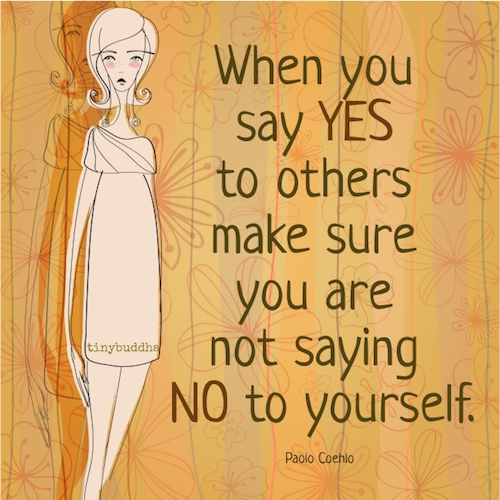
    “When you say yes to others, make sure you are not saying no to yourself.” ~Paulo Coelho

    There it is again. Another person asks me for help. There’s a sharp pull inside of me to stop what I am doing and give.

    And the internal struggle comes up.

    I should just say yes and help them. What’s it take to write out a few text lines? An extra phone call? It’s not so bad, I tell myself. You are, after all, a caregiver.

    My internal voice is so strong. It has been with me for a long time, this voice.

    Then I feel my shoulders tense. I feel my breath begin to shorten. And a lightheaded feeling takes over. These are my early warning signs that I am taking on too much.

    It has taken me some time to realize that this is what happens when I take on a lot and say yes—and that there is a significant cost to me. It stops me from getting my work done. I am not engaged and present when I am playing with my children. I am short with my husband. It derails my priorities. And it stops me from looking after myself.

    If the above sounds familiar, then you can probably relate to being a natural caregiver. Perhaps you are someone who seeks approval from other people. Maybe you are a people pleaser. You might even describe yourself as a “do-er.” You do for others, but sometimes, or maybe always, you forget to just be.

    You put the needs of others ahead of your own at the cost of yourself. You thrive on caring for others. You love to give. In fact, you probably hold yourself to high standards, and one of those standards is that you give to others.

    Before my first child was born, and even in the first year or so of his life, I continued to give and say yes to others. I was the person that would tell others, “What do you need? I’ll make it happen!” or “Tell me what you have in mind for that day, I’ll be there.” Or if someone needed something, help with anything, I would quickly say yes. I would give up my own thoughts, feelings, and needs in hopes of ensuring the other person was happy. To ensure that “we” were happy, and “we” were “good.”

    And then it started to hit me in the fall days of long walks with my newborn child—the second child to join our family. With the wind swirling around me, the crunch of the leaves beneath my feet and stroller wheels, and the brightness of the leaf colors, I realized that I was giving so much to others to fill up my self-worth. I was defining who I am, and what I am worth, by what I give to others and what I can do for others.

    Give more. Be more present for others. Be there for them. This was my mantra.

    It’s not an unfamiliar role. I’m a clinical psychologist, after all. It is what I spend my day doing—caring for others.

    My older sister recalls me being this way since my early formative years. She will tell the story of coming to me with her problems, and I would explore ways to solve them or cope. I loved watching others and trying to understand their thoughts and feelings, and their behaviors behind them.

    It didn’t take much to find my “calling”—my sharp perception for relationships, how I use my sensitivity and empathy. I find it meaningful to spend my days helping others change, process hard and difficult experiences, and live a life that is filled with meaning and authenticity.

    But I’ve noticed the impact of caring for others all the time. It’s a cost. And it was a cost to my own self-worth. I held myself to rigid standards—“If I don’t give then I’m not a good friend.” And yet I spend hours working with clients to help them develop more adaptive ways of viewing themselves. I wasn’t upholding this to myself. Would I think this of my friends? Absolutely not. They are “good,” just as they are, but not me.

    I know I am not alone in this challenge. Most of us struggle with communicating our needs and setting healthy boundaries. And many of us need to explore the role of caregiving, what it does for us, and how we can find other ways to build our sense of self.

    So, here’s the thing. Gaining insight into this pattern, this behavior, this desire to be in this role, is the first step. I had to understand what it was that I was doing, and what it was providing me. If you are reading this post, you likely identified with the challenge of saying no, and being a caregiver. So here are my eight tips to help you say no.

    1. Tune in to when you are feeling overwhelmed.

    These signs might be like mine where you experience increased physiological arousal. Or maybe they are emotional (feelings of being frustrated, anxious, hurt), cognitive (holding rigid thoughts; telling yourself you’re not enough), or even changes in your relationship (decreased sex; increased arguing). Identifying your emotional experience will help you identify when you need to change.

    2. Acknowledge that you have different thoughts, feelings, and opinions from other people.

    You have your own internal experience. And your partner/friend/parent/coworker has their separate internal experience. You are a separate individual from the other person in your relationship. It is not for you to change their internal world, and it is not for them to change your thoughts or feelings, or desires and wishes.

    You are responsible, however, for communicating your needs to the other person. If you need to take space for yourself because you have too much on your plate, or perhaps you simply do not want to do a requested task, it is your job to communicate this, with respect, to the other person. More on how to do this in the next step.

    3. Start saying no.

    You have the right to say no. You do not have the right to be aggressive to someone or to criticize them. “How could you ask me to do that when you know I have so much going on?” That’s critical. You have the right to say no—and you do not have to explain your no.

    You can provide empathy for the difficulties that the other person is in. “I see you’re having a hard time right now.” You can also express what can happen next time. “Next time, perhaps we can find a way through this together.” And you can express your feelings. “I’m feeling overwhelmed and I am not able to do that.”

    Note that sharing feelings starts with “I.” But remember, saying, “I feel like you don’t understand” is not a feeling. Feelings are sad, happy, mad, fearful.

    4. If saying no is difficult, try giving yourself the twenty-four-hour rule.

    So often we respond with emotion, and this leads us to taking on too much. If saying no in the moment is really hard, let the other person know that you will get back to them in twenty-four hours. Or, if the request comes through an email and it’s not urgent, allow yourself a day to reflect on what it is that the request entails and how this would impact you professionally and personally. Remember, we often overestimate what we can get done in a day, or even a year.

    5. Maintain your boundary.

    If you start to assert yourself and begin to say no and then you change your mind, others learn to not take your no seriously. This isn’t anyone’s fault. We all do this at times—we all have our own motivation for asking for help.

    A boss asking you to stay overtime to help with a project? Or asking you to take on more work? A partner wanting you to complete a task in the home? Helping a friend? Saying no and being a broken record, “Unfortunately I am not able to at this time,” over and over again can help you hold that boundary.

    6. Challenge the internal dialogue or bring acceptance to it.

    If you hold yourself to a standard that you need to help others, try finding other ways of viewing your no. Does being a good friend mean that you have to always give? This would be what cognitive therapists view as all or nothing thinking. Can you try living in the grey?

    Shift perspectives—what would you tell a friend if they were struggling to say no? Or maybe you are using emotional reasoning—you feel bad, so you tell yourself you are bad. What other ways do you show up as a significant other?

    Challenge that old dialogue. And if you continue to struggle, perhaps try bringing a stance of acceptance to this old internal dialogue. I bet it has been with you for a long time. And I challenge you to ask others if they have the same dialogue!

    7. Give yourself permission to struggle.

    This will not change overnight. You will feel guilty. And it will be hard.

    The best way to address guilt is to do exactly what it is that you feel guilty about. Feeling guilty for saying no? Say no! If you continue to avoid feeling guilty, guilt will continue to knock on your door. And the way others respond to your new stance of saying no will not change overnight. In fact, I can predict that if you have been in this role for quite some time, the other person will not know what to do at first, and will try to revert back to old patterns.

    8. Ask for help.

    This is a tough one, especially for someone who always keeps helping others. Often, we are so busy giving help and responding to others that we minimize our needs, and they are not aware that we, too, need help in some way.

    Help might come in all forms. Perhaps you start by setting thirty-minutes of you time during the week away from the family. Or you share a task with someone. You could also try letting others know how you are feeling.

    Learning to say no has helped me re-focus my priorities. It doesn’t mean that I always say no, but rather I allow myself to be flexible.

    There are times when I can give and times when I cannot. Instead of feeling tied to giving as a symbol of self-worth, I shifted my focus to living a life that is connected to what is important to me and to being my authentic self. And when we can be authentic with ourselves and those around us, we feel the most connected between our mind and body.

  • How I Healed My FOMO and Started Saying No

    How I Healed My FOMO and Started Saying No

    “When you say ‘yes’ to others, make sure you are not saying ‘no’ to yourself.” ~Paulo Coelho

    My sister-in-law returned to Montreal after spending three months in Portugal. She told me that the biggest adjustment to being back was spending twenty minutes in the pharmacy aisle deciding which shampoo brand to get because the options were endless. She missed life in Portugal, where she only had one brand to choose from.

    Ah, the paradox of choice.

    I am a recovering indecisive person. I used to stand in line at restaurant counters, telling people to go ahead of me with their orders because I couldn’t make up my mind.

    What if I got the poached eggs on cod cakes but the French toast with apple butter was really the way to go? At least with brunch menus you can order both and split it with a friend, but it gets a little trickier when you’re talking about plans where you can’t be in two places at once, but you still try to be.

    When I was invited to four different Halloween Parties in my twenties, I attempted to go to all of them! I didn’t want to have FOMO (fear of missing out), so I spread myself thin trying to do it all by making an appearance at each party—always with one foot out the door.

    The downside to saying yes to each of my friends was that I wasn’t able to be fully present for just one person. I felt scattered and rushed to get on to the next party, and I left each of my friends feeling like they weren’t important enough to commit to.

    The other thing indecisive people like me used to say is, “I’ll try and make it.”

    Really? You’re going to try? We both know that probably means you’re a no show. Why don’t you just say yes or no? To quote Yoda from Star Wars, “Try not. Do or do not. There is no try.”

    I used to rush to say “YES!” to every offer that sounded good at the time. “Yes, I’ll be part of the book club,” “Yes, I’ll help you write that grant,” “Yes, I’ll launch a rooftop garden project,” “Yes, I’ll help you move,” “Yes, I’ll do a full day workshop for free and not get to talk about my business.”

    I said yes so many times I felt like I was spinning plates. Running around like a crazy person trying to please everyone, I wondered, “How did I get stuck with so many commitments?” (Ahem…well, Myrite, you did say yes to all those commitments).

    It was as if I didn’t know any other option but saying yes. That was until one day I met with a fellow coach to see if she was interested in co-creating a program with me. I ran the idea by her expecting her to say yes right away (as I would have!). But when we finished the meeting she said, “Do you mind if I sit with this and see if it’s a yes?”

    What? Say that again? These were new words to my ears. I had never heard of that option! I didn’t know that you could say that! It opened up worlds of possibilities.

    First of all, I respected her more for saying she’d have to think about it than if she rushed to please me with a yes. And it also taught me that I could give myself the time and space to sit with a choice to see if it was a genuine heartfelt yes or if I was saying yes out of guilt or obligation. Just so you know, saying yes out of guilt is a definite no-no.

    I also used to be so afraid of what would happen if I said no. I didn’t want to disappoint anyone, but what I realized is that when you say yes to other people at the expense of yourself, the hardest person to disappoint is really you!

    If you’re so concerned with what other people might think if you say no, then ask yourself whether you’re making other people’s needs more important than your own. Just like kids who throw a tantrum when they don’t get what they want, you can expect that when you start to bravely and gracefully stand your ground and say what you want instead of what others might expect of you, you’ll get some pushback. But that is part of living a brave life. .

    So here are some suggestions from my recovering people pleaser heart to yours, whether you’re indecisive, have FOMO, or rush to say yes.

    1. Learn how to be okay with disappointing some people.

    As Oprah so eloquently taught me, “In order to live a brave life you have to be okay with disappointing some people.”

    When you say no to someone else, you are saying yes to yourself. Instead of worrying about other people’s needs, take care of your own. As Brené Brown shares, one minute of discomfort while telling someone no is better than a few years of resentment after saying yes to something you didn’t want to do but feel obligated to.

    2. Create space before responding.

    When someone makes you an offer, before you say yes, try slowing it down. Take the time to check in with yourself and say “let me get back to you.” Or, “Sounds good! Let me sit with it and ill let you know by…” Or “Let me check my calendar/check in with my partner and get back to you.” Then make a choice: yes or no. Don’t sit in the in between or try and do both. On that note…

    3. You are not a magician.

    (Unless your name is Merlin, in which case I apologize). But if you can be in two places at once, that is a miracle. If you can be fully present in both places, that is a double rainbow miracle.

    The thing is, when you try and be in two places at once, you are setting yourself up for feeling split, torn and neither here nor there.

    Stop splitting and start choosing. Choose to be pulled by the loving choice that makes you feel like your best possible future self—the choice that makes you feel lighter, more expanded, more of the you that you want to show up as if you were living your brave life full out.

    4. Trade your “I will try” to “I will.”

    What are you really saying when you say “I’ll try?” Is it a way to get yourself off the hook, so you don’t have to be responsible for committing to anything? Trying only works when there is conviction behind it. When you mean it with commitment and effort. But when you use “I’ll try” as a scapegoat for “I wasn’t planning on showing up,” that’s when you get into trouble. You’re trying to use the easy button and replace “try” for the scarier “no.”

    So here’s my advice: Don’t say try when you really mean no. Start by practicing saying “no thank you.” And if it is a yes, then commit by saying “I will.”

    5. Realize there is no wrong choice.

    I have to keep telling myself this over and over when I’m torn between topics for which programs to launch next. Every time I am torn between choices. I am learning to just choose one. Start with that.

    Whether it’s a brunch order or Saturday night plans or a job offer. Choose one and stick to it. If you really don’t like it, you can leave, quit, or try something else, but at least start by choosing somewhere to focus your energy for now.

    Give yourself permission to choose and know that there is no wrong choice. What If whichever experience you will have is exactly the one you are meant to be having in that moment?

    Some choices will lead to positive outcomes; others will lead to more painful lessons. But not choosing will mean living in regret. Let not choosing no longer be the acceptable default choice, my dear, and see what kind of magic you create.

  • How a Pause Can Help You Say No and Avoid Regret

    How a Pause Can Help You Say No and Avoid Regret

    Say No

    No is a full sentence.” – Unknown

    I like to help. I like to be kind. I like to join in.

    Usually, these things happen as a result of saying yes. Generally it makes me feel good inside. Better about myself.

    But what happens when helping, kindness, and joining in ends up being a burden with too many negative repercussions? Do we continue on the same path? Should we continue to say yes?

    Throughout my life, I have had a good relationship with the word yes. Yes has led me to unexpected, beautiful, memorable experiences. Yes has brought me to my beautiful partner and family. Yes has allowed me to approach life with open intention and a limitless heart.

    But the light and wonder of the word yes also has a darker side.

    Yes has led me to regret, yes has led me to boring and bitter moments, and yes has had me suffering.

    Many people I know (me included) burn out in the process of agreeing to things that maybe we shouldn’t. We nurture, we soothe, and we offer companionship—oftentimes to others before ourselves because we say yes.

    We are often quick to say yes and dive into tasks, parties, and relationships when sometimes we should be saying no.

    This is no mean feat for a person conditioned to play certain roles to please. The transition to kindly, firmly, and confidently say no has been a long time coming for me.

    Having experienced one too many moments agreeing to things that deep down I didn’t really want to do, I found it helpful to practice saying no. That tiny word with so much power. That tiny word that has mostly liberated me from the clutches of others’ approval.

    It was hard at first. Often I would say no, followed by a long line of excuses, and then I would even offer an alternative arrangement, for fear of offending the other person.

    Sometimes I would ruminate about saying no for a long time after the event, beating myself up about it and wondering if the person might ever speak to me again.

    Then as I got older I guess, or finally had enough, or maybe it was a natural transition, I started a tentative relationship with the word no.

    I danced with the word by creating more space between requests and answers and stopping to feel whether yes felt right. I listened to what I really wanted to do.

    There is a beautiful tale told by Clarissa Pinkola Estés about intuition.

    In a nutshell, a mother is dying and she wants to ensure her daughter learns to trust her own intuition after she is gone. She hands her daughter a miniature doll, which looks much like the little daughter.

    The dying mother tells her daughter to keep the doll in her pocket at all times, feed it, and listen to it whenever she is lost or unsure. These are the last words the mother speaks and the little girl is left holding her doll—a miniature version of herself.

    The tale goes on to follow the little orphan as she navigates her way through a difficult time. Every corner she turns, she touches the doll in her pocket and listens for the answers.

    Of course the little doll is not actually giving her the answers. The little doll is her. And through the process, she reaches deep within, to listen to her true self and guide her to safety and to love.

    According to Estés, the doll represents the inner consciousness of all of us.

    If we were to pause momentarily every time we are faced with a difficult decision, we might actually hear the answer from within. Intuition, like many things, needs to be practiced and developed.

    Therefore, the best practice for strengthening my relationship with the word no is to pause and feel in that moment. The present. Listening to the doll in my pocket.

    It has been liberating to create space between. These days we are really quick to formulate responses in conversation, write hurried emails back to people, voice our opposition to something… It’s jarring and sometimes leads to regrettable outcomes.

    In building a better relationship with the word no, space can be created. Stillness. The space between feeling okay and not feeling okay.

    All these years, I jumped to yes automatically. I jumped to yes because I was brought up to say yes first. I said yes because I was (and still am in many ways) eager for approval.

    Please don’t get me wrong—I am not breaking up with the word yes for good. That is not healthy either. But yes and I are making a ‘conscious uncoupling’ for a while, in order for me to find my inner voice.

    I am doing this to hopefully have a better long-term, balanced relationship with the word no, and ultimately those around me. I value both words and the opportunities they bring (and release) for me, and I hope to support my child to learn to do the same.

    Life feels so much lighter when we practice finding the space to stop, feel, and listen to the doll in our pocket.

    Woman saying no image via Shutterstock

  • Saying Yes When We Mean No: How to Break the Habit

    Saying Yes When We Mean No: How to Break the Habit

    No

    “Half of the troubles of this life can be traced to saying yes too quickly and not saying no soon enough.” ~Josh Billings

    Have you ever encountered a situation where you found yourself agreeing to do something that you had no interest in actually doing?

    When we find ourselves saying yes when we mean no, we are essentially saying no to ourselves and giving our personal power away. The classic archetype of the People Pleaser.

    So why do we do it?

    I believe it is learned behavior. I have yet to see a toddler hold themselves back from the brink of a temper tantrum and tell themselves, “You know what, mum is really tired today. She doesn’t need another one of my meltdowns. The diaper aisle in Target is not the right place for this type of behavior.”

    It simply doesn’t happen. Children tend to express their emotions as they feel them, which is why they are generally such emotional-baggage-free zones. They typically express those emotions freely and with complete abandon, regardless of who’s looking at them.

    Throughout the course of our early life, when our mother, father, or parental figure approves of what we do, it feels good. Therefore, we learn to keep doing things that will meet their approval to keep feeling good.

    The problem is that every time we continue on this pleasing path, we are ultimately taking ourselves off our own path. We are closing down from what we want, focusing on what others want from us, and effectively handing them the reins to our lives.

    One analogy I like to make for this type of behavior is renting a car in a new city with a GPS device.

    You are entirely reliant on that device getting you to where you need to be. All well and good, but what if the device isn’t given the correct instructions or doesn’t take into account the new one-way system recently implemented in the city?

    When you relinquish control and hand your power over to someone or something outside yourself, you are cutting yourself off from you.

    But what if you also had a map of the new city and worked out your correct location and intended destination?

    You’d start to get a sense of where you are and a feel for the direction you need to be headed in.

    The GPS system is a shorter route to get there and a very useful aid, but in handing over your power completely, you are at the whims of the GPS and at risk of driving the wrong way down a one-way street.

    I learned from an early age that life would be simpler if I just did what I was told. In turn, people started to expect that nice behavior from me. But what about the situations where I wasn’t feeling like being nice? What if being nice felt the polar opposite of the emotion that I wanted to express?

    By choosing people pleasing behavior, I was giving everyone else what they wanted and in turn, denying myself.

    I was stuffing down my emotions and instead, learning to say what was expected of me. After a while, this behavior starts to feel normal and you no longer even question why you behave a certain way; it becomes ingrained, a habit.

    So how do we break the habit?

    The first step is simply awareness.

    Notice when you start to engage in people pleasing behavior.

    There is no need to beat yourself up when you notice this. You are essentially starting to retrain the neural pathways in your brain. It may take some time. Go easy on yourself and be forgiving. But don’t stop paying attention.

    By becoming aware, we can no longer stay in denial about our behavior; we know exactly what we are doing.

    The next step is to ask, “Why am I doing this?”

    Once we are aware of our behavior, we can start to question it. One of my people pleasing habits is just to give the other person what they want so I don’t have to feel any emotional discomfort. This is called avoidance.

    For example, a friend invites me to dinner and asks if we could go to a fondue restaurant she loves. I hate fondue. The idea of soaking pieces of bread into a vat of swirling melted cheese makes me feel slightly nauseous.

    Yet, instead of just telling my friend this, I hear myself saying, “Sure, sounds great.” Fast-forward a few days and there I am, stuffing melted cheese into my mouth and plastering a grin over my face to try and conceal my disgust.

    I asked myself, why am I doing this? The answer was clear. I would rather put myself through a few hours of discomfort and line my intestines with a cheese glaze rather than tell my friend I wasn’t into it.

    As I looked back on this experience I realized that the only person suffering in that experience was me. I willingly put myself into a situation I didn’t want to be in rather than being honest.

    After becoming aware of our behavior and figuring out why we’re doing it, we can then address the problem.

    The last step is to set emotional boundaries.

    Setting new boundaries with the people you love is never easy, and it takes time. The key is to take a deep breath and step back when you find yourself entering the people-pleasing zone.

    Saying “I’m not sure yet, can I get back to you?” is a step in the right direction. This gives you time to think the issue through so you don’t feel pressured into making a decision.

    Ask yourself what you want, not what the other person wants from you.

    If you don’t want to do what is being asked of you, it’s okay. You can be loving and kind about it but remain firm.

    Creating boundaries provides an emotional comfort zone for yourself. When we are clear on what we will and wont accept, people respect us for it.

    At the end of the day, we all want to be loved and accepted by those closest to us. But it’s important to know that loving someone doesn’t mean doing everything in your power to please them. This is called being a doormat.

    By shifting focus and starting to love yourself first, you learn to step into your authentic self and conduct your relationships from a place of equal footing.

    We begin to reaffirm to ourselves that we have the right to live our lives on our own terms.

    Stand tall in your own skin and be who you are meant to be, not what somebody else expects you to be.

    No blackboard image via Shutterstock

  • How to Set Strong Boundaries and Overcome The Need to Say “Yes”

    How to Set Strong Boundaries and Overcome The Need to Say “Yes”

    “We must never forget that it is through our actions, words, and thoughts that we have a choice.” ~Sogyal Rinpoche

    Just a few short years ago, I would have relished in being called a “yes person.”

    I loved that label. I thought it made me approachable, helpful, and charitable, and I loved being “top of mind” for so many people and wonderful opportunities.

    Big project at work? I was there. A shoulder to cry on? You bet. A shopping buddy? Sure, I’m available! An exercise partner, a counselor, an interior designer, a cook, a cleaner, a proofreader, a tour guide—I was the go-to girl for anything and everything.

    And for a very long time, I said a big, resounding “yes, please!” to all of it.

    Yes to the design work, yes to the extra projects, yes to the friends who needed me. I was an advice-giver, a support network, a teacher, a healer.

    But during the throes of helping what seemed like a million different people, my “yes person” mentality started to drain me—and rapidly at that.

    Sure enough, I was helping everyone but myself.

    It was only when I started to read spiritual texts and personal development websites that I began to realize how exhausted I actually was. And worse, that it was most likely my need to say “yes” all the time (a trait I had previously cherished), that was burning me out.

    Here I was saying “yes” to every offer, invitation, and request under the sun, yet I’d wind up sick, alone, and hacking my lungs out more often than I’d like to admit.

    I knew I had to overcome my incessant need to say “yes” all the time and start prioritizing self-care, so I went about setting strong boundaries for myself to start restoring my energy.

    Below are the steps I took to set my strong boundaries and overcome my need to say “yes” all the time.

    1. Speak up.

    I knew I had to start small, so I gradually began to let people know how depleted I was feeling.

    As it turned out, people weren’t annoyed at me for talking about how tired I was; in fact, they supported me and encouraged me to take time out and rest. It gave me the confidence I needed to start saying “no” once in a while. It wasn’t a sign of weakness that I was speaking out; it was a sign of strength.

    Another good reason to start speaking up about your fatigue, particularly if you’re a “yes” person, is to pre-emptively ward off peoples’ requests. When I authentically talked about how tired or busy I was, I found that people didn’t call on me as much as they used to, because they were already aware of how I burnt out I was feeling.

    2. Make self-care non-negotiable.

    You know that big meeting at work you literally can’t miss? Or the way you lock in the weekly screening of your favorite TV show? Make your self-care routine as rigid as that—make it non-negotiable.

    When you start making self-care a priority (and enact strong boundaries around your routine), you’re able to fill your cup more fully, and work on being as healthy and happy as possible.

    Here are some examples from my self-care routine:

    •  I schedule a massage once a month, and I make sure I budget for it in advance, too.
    • I turn off all technology by 9:30pm. Not only do I sleep better for it, but also I find that I’m reading more books instead of just mindlessly scrolling on yet another social media site.
    • I now only check my email twice a day; I find I’m less overwhelmed from implementing this practice and am no longer a slave to my inbox.
    • I move my body every day. Whether it’s a work out at the gym, a few stretches in my hotel room, or a long walk if I’m on the road, moving my body every day is an essential part of my self-care routine and helps keep my energy levels high.
    • I eat vegetables at every meal—a green smoothie or juice with breakfast, a big salad at lunch, and a huge serving of vegetables at dinner. Vegetables (in particular, green vegetables) are my must-have staple item. They keep my head clear and my body energized.
    • I forgo my morning routine if necessary. Some days, a full-on morning routine calls me, but when I genuinely need to sleep in and recover, I surrender and give myself permission to do so. It’s about knowing the difference between “laziness” and genuine “rest.” One feels icky (laziness) and one feels like relief (rest).

    After enacting these strong boundaries around my self-care and energy use, my health started to return to its optimum state. It was only then that I was able to start saying “yes” again—but this time, only to projects and people that really lit me up.

    3. Hold strong when others test your boundaries.

    Even now after having rock-solid boundaries for years, others test them. I have to consciously remind myself to hold strong.

    When others test your boundaries, choose to think of it as your chance to prove to the universe that you can keep your own promises.

    For example, if you’re the kind of person who needs sunshine but you work in an office where nobody takes their lunch break, stick to your guns.

    If people shake their heads every time you head out to get your Vitamin D hit, stick to your boundaries and hold your ground—explain to your boss why you need to get out of the office or even draw their attention to the working hours policy in your area. Better yet, use your work to prove that your productivity is higher due to your lunch breaks!

    When you use strategies to help you say “no,” sticking to your boundaries when others test them makes the whole process a lot easier.

    4. Learn how to say “no.”

    Perhaps the hardest lesson when you’re setting strong boundaries is learning how to say “no.” After all, when you’ve been a “yes person” your whole life, it can be very difficult to turn that habit around, but it’s important to master if you want to have strong boundaries.

    Here are some strategies to help you say no:

    • Practice saying it in a mirror.
    • Have some polite, pre-scripted text messages and emails on hand so you you’re not stuck trying to find the words to say “no.”
    • Try saying “not right now” instead of a flat out “no.” (Often, the request will disappear!)
    • Let your friends and family know that you need some space (pre-empt the need for them to call on you).

    Saying no can be difficult—by nature, we humans want to be helpful and kind—but ultimately, you need to be helpful and kind to yourself, first and foremost. And saying “no” does get easier with practice, I promise.

  • How to Stop Saying Yes When You Want to Say No

    How to Stop Saying Yes When You Want to Say No

    “Live your life for you not for anyone else. Don’t let the fear of being judged, rejected or disliked stop you from being yourself” ~Sonya Parker

    I am a sucker for saying yes.

    Sometimes I even find myself thinking, “No, no, no, no” and then I blurt out, “Yes.”

    Why is it so difficult to say the word “no”? It’s just a word, right?

    After feeling trapped for some time by my excessive urge to be agreeable, it got me thinking.

    I asked myself why it was so important for me to please everyone, to the point that I would feel resentful and stressed because of it.

    I realized I was afraid of saying no because my biggest fear is rejection. I was afraid that every time I did this, I would disappoint someone, make them angry, hurt their feelings, or appear unkind or rude.

    Having people think negatively of me is the ultimate rejection. Whether they say what they think of me, out loud or not, does not matter to me. It is the thought that they look down on me.

    And so I realized exactly why I found it so difficult to say no.

    I realize this is not just a challenge that I face but one that many people go through every day. It’s a heavy burden to carry because with the urge to say yes also comes a lack of self-confidence and self-value.

    If, like me, you’re having trouble saying no, this may help.

    Saying No Doesn’t Mean You’re a Bad Person

    Saying no doesn’t mean that you are being rude, selfish, or unkind. These are all unhelpful beliefs that make it hard to say no.

    Learning where these beliefs have come from is a great way to learn to let go of them.

    Did you ever wonder why it was so easy to say no when you were a little kid and why it has become so difficult now? What happened?

    Well, as children, we learned that saying no was impolite or inappropriate.

    If you said no to your mom, dad, teacher, uncle, grandparents, and so on, you were most certainly considered to be being rude, and you would have probably been told off for it.

    Saying no was off limits, and yes was the polite and likable thing to say.

    Now that we are all adults, we are more mature and capable of making our own choices, as well as knowing the difference between wrong and right. Therefore, no shouldn’t be an off-limits word but rather something that we decide on ourselves, based on our own discretion.

    But sadly, we hold onto our childhood beliefs, and we continue to associate no with being dislikeable, bad-mannered, unkind, or selfish. We worry that if we say no, we will feel humiliated, guilty, or ashamed and will end up being alone, rejected, or abandoned.

    Knowing Your Value

    The second step to learning to say no is realizing that you are valuable and choosing your own opinion about yourself over others.

    I have learned that if you live your life depending on other people’s approval, you will never feel free and truly happy.

    If you depend on other people’s approval, what you are basically saying is, “Their opinion of me is more important than my opinion about myself.”

    If your opinion of yourself is actually quite low, remember that:

    • Your problems do not define you.
    • It’s okay to make mistakes—nobody is perfect, and everybody does things that they regret; this is what makes us human.
    • What makes a person great is not their looks or achievements, but their willingness to love others, be humble, and grow as a person.
    • You are unique, valuable, and important. No one else in this world can offer what you can.

    Is It Really Worth It?

    The third step to learning to say no is deciding if saying yes is really worth it.

    After committing to something, doubt eventually sets in, and you may begin to think of ways you can get out of it.

    And if you don’t have any good excuses, you then have to decide if you are going to tell the truth or come up with a lie.

    Think about the anguish, stress, and resentment that saying yes has caused you. Wouldn’t it be so much easier and straightforward to just say no in the first place?

    I remember this one time that I said yes to something and then later felt so bad about it that I ended up lying my way out of it. I still feel bad that I lied.

    My boss called me one day and asked if I could work the following Saturday. As usual, I blurted out a polite “Yes, of course, that’s no problem at all.” I actually had plans with my boyfriend, which I was really looking forward to.

    Later, I found myself feeling absolutely terrible about having said yes, and I wished that I had just had the guts to say no from the beginning.

    Dreading the idea of having to work that day, I called my boss back with the best excuse I could think of. I told her that I had completely forgotten that it was my dad’s birthday that Saturday and that we had a family get-together (which was certainly not the case).

    Looking back, I realize that it really isn’t worth it to say yes when you don’t want to. I have a right to say no and shouldn’t be afraid of letting other people down at the cost of my own happiness.

    If you have also decided that it’s worth it to you and want to learn to say no, try these simple yet effective tips for doing so with confidence.

    Helpful Tips for Saying No

    • Be direct, such as “no, I can’t” or “no, I don’t want to.”
    • Don’t apologize and give all sorts of reasons.
    • Don’t lie. Lying will most likely lead to guilt—and remember, this is what you are trying to avoid feeling.
    • Remember that it is better to say no now than be resentful later.
    • Be polite, for example, saying, “Thanks for asking.”
    • Practice saying no. Imagine a scenario and then practice saying no either by yourself or with a friend. This will get you feeling a lot more comfortable with saying no.
    • Don’t say, “I’ll think about it” if you don’t want to do it. This will just prolong the situation and make you feel even more stressed.
    • Remember that your self-worth does not depend on how much you do for other people.

    Learning to say no has been one of the best things I have done for myself. Not only has it challenged me to overcome my fear of rejection, it has helped me feel in control.

    I don’t feel trapped, resentful, or guilty anymore. Instead, I feel empowered and free.

    If you want that same feeling of freedom and empowerment, then take control, challenge yourself, and learn to say no.

  • 4 Questions to Help You Know When to Say No

    4 Questions to Help You Know When to Say No

    “It is not enough to be busy; so are the ants. The question is: what are we busy about?” ~Henry David Thoreau

    A couple of years ago my friends and I went on a weekend retreat to honor our dear friend’s fortieth birthday. It was supposed to be a relaxing weekend filled with yoga and meditation at an ashram in the mountains.

    But I had a serious problem with the retreat: I actually brought work with me! As an educator, it seems I am perpetually behind with my grading. And so I brought a whole stack of midterm exams with me to grade in my “free time.”

    There I sat, alone in the cabin, while everyone else was hiking or chanting or taking a yoga class.

    After grading just a few exams, it hit me just how wrong the whole scenario was. I was at an ashram in the mountains, for goodness sake, and here I was working.

    I had so many obligations connected with my job and my children and my community that I felt my only option was to keep going.

    And then I broke down. I started to cry as I thought about what I might be doing to myself. Can I go any further living like this, I asked myself.

    I started to doubt my ability to handle the life I had created for myself.

    I continued to cry until my friend Karen came back to the cabin. I confided in her that I was at a loss about what to do. I was extremely stressed out and saw no way out.

    She asked me about what I had going on. Well, one issue was I had committed to attend a meeting months before I knew that my daughter’s band concert was the same night. And I felt obligated to go to the meeting.

    Karen asked me what I was doing at the meeting: Was I running it? Was I speaking at it? Would it fall apart without me? Well, no, I admitted. I was just supposed to attend.

    And what would happen if you canceled, she asked next. I thought for a moment and realized that nothing would happen.

    So when I got back from the weekend, I emailed the meeting organizer and told her I had to go to my daughter’s concert. And guess what? It was fine; she said she completely understood.

    Then I started really getting into the saying “no” mood. Next, I declined to take on a project I was asked to work on. I stopped myself from agreeing to be on a church committee.

    I was going “no” crazy. But it felt wonderful. My stress level dropped dramatically and I felt free.

    I still have a lot on my plate. But I’ve gotten to the point where I can differentiate between what I must do, what I really and truly want to do, and what I don’t need or want to do.

    Another way of saying this is that I have learned to prioritize my time.

    So if you tend to over commit like I did, slow down for a minute and ask yourself the same kinds of questions Karen asked me:

    1. Do you absolutely have to do whatever it is you are contemplating taking on?

    We do have to do many things… for our families, our friends, our jobs. But a lot of times we just think we have to do something because of a sense of obligation or because we’ve always done it that way.

    To gain a different perspective on the situation, try taking a step back from the automatic thinking of “I have to do this” and ask yourself a few questions:

    What would happen if I didn’t do it? Would everything fall apart? Or could things go on without my help?

    2. Do you really and truly want to do it?

    Sometimes we don’t even know the answer to this question. What do we really want out of life?

    In order to prioritize our time, we need to know ourselves well enough to know what matters. And getting to know ourselves takes time, but a good starting place is again asking some key questions:

    What kinds of activities make you happiest or relaxed, free, focused, content, connected, alive?

    It helps me to think about the big picture of my life: What do I want to be able say I did with my life? This is kind of like my vision statement for my life. And then I can ask myself how individual activities fit into that overall plan.

    3. What will you get out of it?

    This doesn’t have to be a financial benefit or a plus for your career; it could be helping out the community or learning something new or spending time with your family.

    But whatever you might get out of it, just make sure that it is really important to you.

    It can be difficult to sort out when to put your priorities first over obligations to others. Sacrificing our time and our own wants for others is a part of life.

    But if you sacrifice too much of yourself for others, there is nothing left over for you. And pretty soon you have nothing left to give others.

    A balance between doing for yourself and doing for others is necessary. You can gauge if you are striking this balance by paying attention to your stress levels and how often you allow yourself to do something just for you.

    4. How much time do you have to devote to something new?

    The flip side of this question is: What will you have to give up to spend time on this new endeavor?

    In the end, the very bottom line is whether or not it is a priority for you. Think about what you want to do with your life, how you want to spend your time, and what would make you happiest.

    Discover that saying “no” to some things is absolutely liberating. It frees you up to focus on the things that are most important and really mean something to you.

    Don’t follow my lead by getting so overwhelmed with commitments that you break down and see no way out. Follow my lead with my new approach and prioritize your commitments.

    And don’t be afraid to say “no” even after you’ve said “yes.” Things happen; people change their mind; schedules change. That’s life, and most people understand that.

    Asking yourself a few key questions about priorities will start you on the path to more freedom and more time for the things you really want to do with your life.

  • Living in the “Yes” of Life

    Living in the “Yes” of Life

    In chaos there is fertility.” ~Anais Nin

    The word fertility formerly had a one-dimensional meaning for me, but I’ve come to broaden its definition.

    In my time living in Seoul, Korea, it has played a big part in defining my experience. You see, my husband and I have been trying to conceive since 2009 and have not been lucky.

    There’s a long story behind this that includes testing and monitoring and modifying our diets and trying acupuncture. And, for about a year, I became that person I did not want to become—swallowed up by the pain and stress surrounding this issue.

    In the meantime, we’ve taken on forging new paths in our professional lives. Having been a teacher for 15 years (10 of those international), I finally heeded a different call.

    It started out as a whisper and then grew in volume until I could no longer ignore it. I was burnt out on education and came to see my love for creating spaces and interiors. This was a natural consequence of making “home” in several countries.

    After some soul searching, I enrolled in an online interior design program while still working as a teacher. It was the step I needed to feel creatively challenged and to envision a wider future.

    Yet, as this happened, my desire to start a family intensified. It has been a very difficult place to be emotionally. What’s more, is figuring out how to deal with the negative form of the word: infertility. It feels large, empty, and desperately sad.

    People, having the best intentions, offered advice:

    “Just relax. Have fun with the process of trying.”

    “Try not to focus on it. I know someone who, once they stopped trying, got pregnant.”

    “What about some fertility treatments, or adoption?”

    These words sounded hollow to me. They didn’t resonate with my core being. (more…)

  • How the Word No Can Help You Achieve Your Goals

    How the Word No Can Help You Achieve Your Goals

    “If you lose today, win tomorrow.” ~Daisaku Ikeda

    From the moment we learn to walk and touch things, we hear the word no far more than we will ever hear the word yes.

    “No, don’t touch that.” “No, that’s not for you.” “No, you shouldn’t eat paint chips.” OK, maybe that last one was just me, but you get the picture.

    We are told no so much more than we are ever told yes during the course of growing up, so why is it as adults that hearing the word no can be so devastating? Shouldn’t we be used to it by now?

    As a rookie salesmen every time I heard the word no I got discouraged and thought I must be doing something wrong. I would constantly beat myself up.

    “What am I doing wrong?” “What can I do different?”

    These were great questions to ask myself; however, it’s the answers I supplied myself that turned out to be misleading.

    I figured that if people were saying no, it was because the process was failing me. How wrong I was.

    With sales, as in many aspects of life, there is a process—a start and a finish. Whether it’s setting and achieving goals, getting dressed, or cooking dinner, everything has a process, whether we consciously think about it or not.

    Like a naïve cocky rookie, I decided to abandon the process and started to do things my own way. Much to my surprise, I now heard no twice as many times.

    I just could not understand what was going on, so I got even harder on myself. (more…)

  • The Halfhearted Yes: Why We Don’t Say No and How to Start

    The Halfhearted Yes: Why We Don’t Say No and How to Start

    I'm Free

    “A ‘No’ uttered from the deepest conviction is better than a ‘Yes’ merely uttered to please, or worse, to avoid trouble.”  ~Gandhi

    I was having dinner with a friend of mine a couple weeks ago when I asked her about a group she was considering joining. I wanted to know how it was going and what she decided.

    “You know,” she said, “I realized after the first group that I’m not that passionate about it. So, I’m not going to do it. I’d rather make my time available for something that matters more to me.”

    Aside from this being a healthy choice, it was also a very conscious and deliberate choice. She chose in the direction of her passion.

    How many of us take what is handed to us, follow what is put in front of us, or say yes to things that don’t really align with who we are or what we want in our lives?

    I’m a huge fan of the word yes. (more…)