Tag: wrong

  • What You Need to Know If Decisions Stress You Out

    What You Need to Know If Decisions Stress You Out

    “There are no right or wrong decisions, only choices.” ~Sanhita Baruah

    When I was younger, everything felt simple. Not necessarily easy, but simple in the sense that there was always a next step. A clear direction. A right way to do things.

    If I studied, I’d pass the test. If I practiced, I’d get better at my sport. If I followed the rules, I’d stay on track. Life moved forward in a straight line, like climbing the rungs of a ladder—one foot after the other, up and up and up.

    I didn’t question this structure because it was all I knew. And honestly? It was comforting. The certainty of it all. The feeling that as long as I did what I was supposed to, things would work out. Teachers handed out syllabi at the start of the year, neatly mapping out what was coming. Coaches had game plans. Parents had advice. Even when things got hard, there was always a framework. A way forward.

    I think about how movies portray childhood memories—colors cranked up to impossible brightness, the world rich and saturated, full of warmth. Because when you’re a kid, things feel solid. The rules make sense. The paths are laid out. You don’t realize how much of your life is being decided for you, and in a strange way, that makes things feel safe.

    Then, at some point, it all disappears. The structure. The guideposts. The sense of certainty. And suddenly, life stretches out in front of you like a blank map, and you’re holding the pen, unsure of what to draw.

    That moment—the moment you realize no one is handing you the next step anymore—is terrifying. Because if there’s no clear “right” choice, what’s stopping you from making the wrong one?

    There wasn’t a single moment when it all changed. It happened gradually, like the end of a song fading out until you realize there’s no music playing anymore.

    At first, I kept waiting for the structure to return. I thought maybe adulthood had its own version of lesson plans and progress reports, that someone—anyone—would step in and hand me a checklist of what to do next. But that never happened. Instead, I was met with an unsettling quiet.

    No more automatic next steps. No more guarantees.

    And with that silence came an unexpected weight.

    I started second-guessing everything. Not just the big, obvious life decisions, but the small, everyday ones too.

    Was I supposed to stay where I was or move? Take this job or hold out for something better? Was I wasting time? Making the wrong choices? Shouldn’t I know what to do?

    I realized then that I had spent years assuming every decision had a right answer. That life was a series of multiple-choice questions, and if I just looked hard enough, I’d find the correct one. But now, it felt like I was staring at a blank page, trying to write in pen, afraid of messing it up.

    No one told me how heavy uncertainty could be.

    And the worst part? I started believing that not knowing meant I was failing. That if I wasn’t moving in a clear direction, I must be doing something wrong. I looked around at other people—some who seemed so sure of their path—and wondered why I couldn’t feel that same clarity.

    But then I asked myself: What if they’re just as unsure as I am?

    What if we’re all just making it up as we go?

    For so long, I thought the goal was to figure out the right path. To make the right choices. To avoid the wrong ones at all costs. But lately, I’ve started wondering: What if there isn’t a right choice? What if there’s just… a choice?

    That question should feel freeing, but for a long time, it paralyzed me.

    I became so obsessed with making the “right” move that I stopped moving altogether. Every option felt like a risk. If I picked wrong, I’d waste time, waste effort, maybe even waste years. What if I chased the wrong career? Moved to the wrong city? Invested in something that wouldn’t pay off? Every path had its unknowns, and instead of picking one, I stood still, overthinking every possibility.

    And the longer I stood still, the harder it became to take any action at all.

    I convinced myself that not deciding was better than making the wrong decision. That staying in place was safer than stepping in the wrong direction. But that’s the thing about waiting—nothing changes. The fear doesn’t go away. The answers don’t magically appear. You just sit in the same uncertainty, hoping for clarity that never fully comes.

    At some point, I had to ask myself: What if the only way forward is to move, even if I’m not sure? What if the worst outcome isn’t choosing wrong, but never choosing at all?

    So maybe the next thing isn’t the “right” thing. Maybe it’s just something. A step. A choice. A movement.

    And maybe that’s enough.

    At some point, I realized that life wasn’t black and white—but it also wasn’t gray. Gray implies balance, a predictable mix of extremes. Something stable. But that’s not what life feels like. Life is more like an off-white—uncertain, shifting, something that looks different depending on the light.

    I used to think uncertainty was something to fix. A problem to solve. But what if uncertainty isn’t the enemy? What if it’s just part of being alive?

    The truth is, I don’t know if I’ll ever feel 100% certain about anything. And maybe that’s okay. Maybe I don’t need to know. Maybe the point isn’t to eliminate doubt but to learn how to exist alongside it. To accept that I can move forward without having every answer.

    Some days, that’s easier said than done. On those days, I remind myself:

    • Not knowing doesn’t mean I’m lost. Just because I don’t see the full path doesn’t mean I’m not on one.
    • No decision is final. Even if something doesn’t work out, I can pivot. I can start over. I can change my mind.
    • Other people don’t have it all figured out either. Some just got better at pretending.
    • Waiting for clarity won’t bring clarity. The only way to figure out what works is to try something. Anything.

    I used to think confidence meant being sure of everything. Now, I think it means being okay with uncertainty.

    Life is never going to be neat or obvious. It’s never going to fit into clear categories of right and wrong. But maybe that’s the beauty of it—maybe life is meant to be lived in the off-white.

    I think back to all the times I agonized over a decision, convinced that one wrong move would ruin everything. I stressed, I overanalyzed, I played out every worst-case scenario in my head. And yet, when I look back now, most of those choices—whether they turned out “right” or not—don’t carry the same weight they once did.

    Some of the things I worried about didn’t matter at all. Other things didn’t go how I expected, but they still led me somewhere meaningful. And the most surprising part? Some of my so-called “mistakes” ended up being the best things that ever happened to me.

    At the time, I didn’t see it that way. At the time, I was convinced I had taken a wrong turn. But looking back, I can see that every decision—good, bad, uncertain—shaped me.

    The job I took because I thought I had to? It taught me what I didn’t want.

    The opportunity I turned down out of fear? It made me realize I needed to be braver.

    What I once saw as missteps were actually just steps—part of the path, part of the process.

    I wonder what choices I’m agonizing over right now that, in a few years, I’ll see differently. I wonder if I’ll laugh at how much I overthought things, how I was so afraid of getting it wrong when, in the end, everything was just unfolding the way it needed to.

    It makes me think: If I’m going to look back someday and see that everything worked out one way or another, then why not trust that now? Why not let go of some of the pressure?

    Maybe I don’t need to know if I’m making the perfect decision. Maybe I just need to make a decision and trust that I’ll figure the rest out along the way.

    I used to believe that one day, I’d wake up and just know. That clarity would arrive like a neatly wrapped package—here’s your answer, here’s your direction, here’s the certainty you’ve been waiting for.

    But that day never came.

    And I don’t think it ever will.

    Because life doesn’t work like that. There’s no singular moment where everything clicks into place. No guarantee that the path we’re on is the one we were “meant” to take. No cosmic confirmation that we’re doing this whole life thing correctly.

    And maybe that’s not a bad thing.

    Maybe the goal isn’t to have everything figured out. Maybe the goal is to get comfortable not knowing. To make peace with the ambiguity instead of fighting it. To stop treating life like a problem to solve and start seeing it as something to experience.

    So what if I don’t know what’s next? So what if I don’t have a perfect plan? I’m still here. I’m still moving. I’m still learning.

    And maybe that’s enough. Maybe I’m enough. Right now. In the middle of the uncertainty. In the middle of the mess. In the middle of the off-white.
  • How I Stopped Feeling Like There Was Something Wrong with Me

    How I Stopped Feeling Like There Was Something Wrong with Me

    “A flower does not think of competing with the flower next to it. It just blooms.” – Zen Shin

    In the past, I often felt like I didn’t belong in groups of women.

    Sometimes I felt like something was wrong with me, like I was othered in one way or another: too sporty, too quiet, too serious, too emotional, too dumb, too smart, too wild, too normal, too sexual, too prude.

    Other times, I felt like something was wrong with all of them. Girls’ nights and bachelorette parties? The screeching voices, the loud laughs, the mundane conversations about makeup, skin care routines, and lip injections? No thank you.

    I wanted so badly to belong but didn’t see a place for myself. I felt like I wasn’t doing the whole woman thing the right way. I found it easier to hang with the guys.

    But now? I have learned that nothing is wrong with me (or you), and hanging out with a group of women makes me feel all warm and fuzzy inside. 🙂

    What shifted?

    First, I stopped comparing myself to others.

    Those “toos” I mentioned above, and that so many of us feel, are usually a product of that ever so insidious trap of comparison. It’s a trap because we get stuck in a negative thought loop, smothered by jealousy, anxiety, and self-criticism, which ultimately causes a fissure of separation, between ourselves and others.

    If we use other people and external standards as a barometer, we will always find ourselves being “too” something, which makes for a very disruptive and tumultuous internal experience. For me, it means that I have spent many years feeling insecure and ungrounded in who I am. It means I often acted as a chameleon and changed my energy based on who I was around, so I could “fit in.”

    But now, I don’t do that. (Okay, I still do it sometimes, but way less often.) I have learned that there is no “right” way to be a woman, or a human. We are each unique individuals with our own personalities, desires, fears, and preferences, and the uniqueness of all of us makes the world so much more interesting and beautiful.

    Second, I shifted away from judgment and toward curiosity.

    During my young adult years, I was very judgmental. I went from thinking that something was wrong with me to thinking that I was better than all the other women. I thought women talked too much about surface level things and people. My ego started to create stories of separateness: me over here wanting to ponder existential questions and talk about emotions, and them over there who wanted to gossip, laugh too loudly, and talk about makeup and boys.

    Now, instead of judging the “surface level” conversations (which still occur), I am curious about them.

    Why do women spend so much time discussing our weight, clothing, waxing habits, and skin care rituals? Because we have been force-fed the belief that we are inadequate the way we are. We are told that we have to buy this or that product if we want to be beautiful. We are told we have to be thin if we want to be loved. So it’s no wonder we spend so much time thinking and talking about matters of physical appearance.

    By switching from judgment to curiosity, I have realized that such discussions are actually not surface level at all. They are reflective of deep desires to belong, to be loved, and to be accepted.

    Third, I demoted my ego.

    My ego told me that I was the only woman that felt othered. That I was unique in my feeling like I didn’t belong. That I was special in some way because I wanted to have “deeper” conversations. That is such BS!

    I have now learned that I was in no way unique in feeling like I didn’t belong. Most women, and people, yearn to peel back the layers and connect with one another in a  deep, rich way, but we find ourselves stuck in a performative role, trying to show up how society has told us to.

    Many of us have erected walls around our hearts, minds, and bodies to protect the vulnerable, raw, sensitive parts of us. To protect the parts of us that we learned weren’t safe to express or were unlikeable. But we want to let others in.

    Lastly, I also started listening to the sage advice from philosophers, religious leaders, and laypeople across centuries.

    I started heeding their wisdom, which can be summed up as: you have everything you need within you.

    I started to deepen my connection to myself, knowing that the problem I was experiencing, namely the feeling of being othered and not belonging, could only be solved by first turning inward. I’ve deepened my connection to myself through dance, breathwork, journaling, meditating, and playing. I have started to uncover who I am and who I want to be, versus trying to fit into a mold of what I think a woman, or a human, is supposed to be.

    In my journey of releasing comparison, igniting curiosity, demoting my ego, and turning inward, I have also learned that:

    You are not too anything.

    This does not mean that you are perfect, or that you have no opportunities to grow and expand. But it does mean that there is no “right” way to be, except the way that is true and safe for you.

    Often when people say you are “too ___,” it is a reflection of their own insecurities.

    “You are too emotional” might mean, “I have not learned to express my emotions, and your vulnerability makes me uncomfortable.” “You are too loud” might mean, “I am not fully expressing myself, and I am jealous of your ability to express yourself confidently.”

    You are not alone in your desire to belong.

    It is likely that what you are feeling, others have felt at some point. When you remember this, you are reminded that you are not alone. The journey of self-discovery eventually leads to a feeling of oneness, because we absolve the illusion of self and separateness and begin to see our connectedness, our shared fears and desires. You know how it goes, we’re all made of stardust, baby!

    When you start to express the truest parts of yourself, it’s an act of leadership.

    Because in doing so, you provide a permission slip for others to do the same. This doesn’t mean you expect everyone to express themselves in the same way as you, but rather that we all start to express the weird, unique, quirky, true parts of ourselves. And that is what the world needs more of.

    So, here’s to less judgment, more curiosity; less separateness, more connectedness; less fear, more love.

  • If You Think There’s Something Wrong with You…

    If You Think There’s Something Wrong with You…

    The root cause of suffering for many of us is believing that there’s something wrong with us. Psychiatrists’ and therapists’ offices are filled with people who are carrying this false belief, most often stemming from traumatic or painful childhood experiences, or even people telling us this directly.

    Sometimes we inferred this idea because we were treated badly as children and/or we didn’t get our physical or emotional needs met. Perhaps we were called selfish or bad because we “asked for too much,” or we were told we couldn’t have what we wanted because we didn’t “earn or deserve it.”

    Maybe we blamed ourselves for our parents’ fighting and/or divorce or issues that were going on in our family because we believed they were our fault.

    Our little minds drew conclusions, and for some of us, self-abandonment became the solution. We did this because we thought there was something wrong with us—welcome suppression, people-pleasing, and “good little boy or girl.”

    Without conscious awareness, we tried to be and do what others wanted us to be and do so they’d love and accept us. By doing this, we hid our truth. We also concluded that it wasn’t okay to feel how we were feeling, so we made sure we suppressed our emotions, especially those that seemed forbidden, like anger or sadness.

    All this disconnected us from our authenticity. Many of us live our whole lives according to how others told us we needed to be, and we’re never truly happy. 

    Because we believed it was wrong for us to be ourselves, some of us created symptoms like addictions, depression, eating disorders, anxiety, or even illness in the body.

    Now, we have more reasons to believe we’re “bad” or “wrong” because we may think that having these symptoms proves it. Welcome more self-hatred—now we’re living with a big inner debate. It becomes a no-win situation, and we frantically turn to escapism and/or we create numbing/survival mechanisms.

    We think, “I can only show the good me”—“good” according to the rules of our family and society—and “I can’t show the bad me,” which are just parts of ourselves that weren’t acceptable to our family or society. By doing this we never really experience inner peace; instead, we become fragmented beings.

    Welcome shame and shadow “hiding.” What’s that? Shadow hiding is denying or disowning parts of ourselves that were not allowed to be seen; we pushed them down in our shadows and put them in our “forbidden cage.”

    Most people think our shadows carry our deep hurt and pain, and that may be, but in our shadows also reside our authenticity, our lovability, our natural gifts, talents, and abilities, our creativity, and our greatest qualities.

    So, how does the idea that something’s wrong with us affect our lives? If we have this as our core belief, we may create symptoms like self-sabotage, anxiety, helplessness, hopelessness, and the other symptoms I mentioned above. 

    We filter our perceptions and points of view through the ways we feel about ourselves, and we let that feeling create our reality.

    We may deny our true desires and what really makes us happy. Sometimes we do this unconsciously; however, it shows up as procrastinating and/or self-sabotaging or saying we don’t know what we like or how to have fun and play—because we believe doing so isn’t okay.

    We may have a hard time speaking our truth and asking for what we need in relationships; we’ve become people-pleasing beings because we learned we needed to abandon ourselves in order to be accepted and be a good person.

    We may try to suppress, deny, or run away from any negative, sad, or unacceptable feelings because we were told that we were bad or wrong for feeling what we felt.

    If shame is running in our system, we’ll never feel like a good enough person. We may even feel like a failure, or we may overcompensate, trying to prove we’re good enough through success, fame, and accumulation, but deep inside we’re empty and not happy.  

    Just an FYI, there’s nothing wrong with these things; it’s the energy behind what we’re doing that we need to pay attention to.

    There are many ways this false idea plays out, especially in the energy of fear and doubt.

    So, here’s a bit of what it was like for me, having this false idea that there was something wrong with me. This belief was created from the messages I received and inferred when I was a little being, constantly being told that I was wrong, fat, ugly, stupid, selfish, and that I asked for too much.

    From my earliest memory I ate a lot; food comforted and soothed me. It gave me a way to focus my energy, numb my painful feelings, and keep me safe in an environment in which I was not accepted.

    Then at age thirteen my doctor told me to go on a diet, and at age fifteen I was anorexic, which made me feel even more wrong and bad.

    The anorexia was a symptom stemming from the feeling and belief that I was undeserving, bad, and wrong and that I needed to deprive myself in order to be accepted and loved. Kinda screwy, eh?

    What most people don’t understand is that anorexia isn’t just about starving our body; we’re starving ourselves from living. It’s self-denial, self-abandonment, and self-abuse, the opposite of self-honoring and self-loving.

    I took on the ways my parents treated me, and I became my own mean parent. I beat myself up daily with negative self-talk, cutting my wrists and face, bingeing, starving myself, and exercising compulsively. I was also depressed and anxious and took sleeping pills to sleep through the day.

    I was a slave to this way of being, stemming from the belief that there was something wrong with me and, going even deeper, that I was bad and wrong.

    I deprived myself of everything, not just food. I didn’t allow myself to get close to others or buy myself anything; I basically lived in lack, limitation, and fear daily. If I made money, it had to go into the bank, and I overworked myself to prove I was a “good girl.” I put myself in dangerous situations, like walking alone in bad areas at night, and stayed in abusive relationships because I didn’t value myself or my life.

    I was living in a trance, and no one was able to help me change. Even after going in and out of numerous hospitals and treatment centers and seeing therapists for over twenty-three years, I still lived with an internal war. I held on tight to the harmful ways I was living, because I believed I deserved to be treated that way; it was how I learned to cope and survive.

    So, how did things finally change? How did I get to where I am today? I finally took my healing into my own hands and found myself on a spiritual path. It wasn’t until everyone gave up on me and my body starting really deteriorating that I decided to learn self-acceptance, self-honoring, and self-loving.

    It was a process. I read many self-help books, but most of them only worked on the conscious level. It was like I was fighting against my own biology, consciously trying to change, but my energy patterning was saying, “No way.”

    I didn’t start feeling comfortable being true to myself and living in my body until I went to the root cause—until I understood why I was carrying this energy internally.

    By going to the root cause—what happened when I was younger—I made contact with my inner child, who was really hurting and crying out for love.

    Sweet little Debra was so afraid, and she didn’t feel safe because no one had ever comforted her or let her know that she was okay. She wanted and needed to know that she wasn’t bad or wrong, and that it was okay for her to come out and play; that she was now loved, accepted, appreciated, and safe.

    She was very hurt and angry, and it took a while for her to trust me. However, I stayed with it, and bit by bit I started feeling at peace internally through self-love and self-acceptance.

    What if instead of giving medication to someone who doesn’t truly need it, we gave them the prescription that there’s nothing wrong with them?

    What if we helped them peel away the layers of conditioning, helped them heal their traumas and unresolved issues, and gave them permission to love and honor themselves and embrace their authenticity?

    What if we stopped judging ourselves and making ourselves bad or wrong for who we are and instead loved and accepted ourselves unconditionally—especially those parts that weren’t/aren’t accepted by our family and/or society?

    What if we saw our shame, insecurities, and fear of being seen as parts of ourselves asking for compassion, forgiveness, unconditional acceptance, and love?

    What if we saw our “flaws” as beautiful and valuable aspects of ourselves, and we started finding approval for those parts of ourselves that were unaccepted by society?

    What if we moved from self-judging into self-compassion and self-loving and we allowed ourselves to feel however we’re feeling?

    What if we made friends with ourselves so that we felt at ease throughout the day? So we no longer tried so hard to be someone acceptable, and instead we flowed with our heart and soul?

    What if we changed things about ourselves and our lives because it’s an act of self-love—we improved because we want to, not because we need to in order to be accepted and loved by others?

    If we put in the work, there hopefully comes a time when we see that we no longer need to “fix” ourselves to be a certain way so that we’ll be accepted by others. And instead, we allow ourselves to be who we are, we love and accept ourselves unconditionally, and we change only if we want to, not because we think there’s something wrong with us. Because there isn’t. And there never was.

  • We Can Choose Different Ways Without One of Us Being Wrong

    We Can Choose Different Ways Without One of Us Being Wrong

    “You have your way. I have my way. As for the right way, the correct way, and the only way, it does not exist.” ~Friedrich Wilhelm Nietzsche

    Many of us are committed to a journey of change and personal growth. While these are traits to be admired and celebrated, they can also have a darker side. We can become a little militant and dogmatic when we’re on our journeys.

    As we focus on our attempts to make changes in our own lives, our views can start to narrow and become very black and white. We become so tuned into what we are doing that we forget there’s more than one way to do just about anything.

    We seek out others that agree with us to back up ‘our views.’ This may be part of our primal wiring to be part of a collective. We seek a tribe.

    Being part of a tribe can be intoxicating. Being with people that share our passion is exciting. It’s great to have a common goal or view and be able to talk about our passions with others that really get it. We’re all in this together.

    Being in a tribe can also distort our perspective. Only seeing and hearing a biased view. Ironically, we can lose objectivity as we seek clarity. Becoming more rigid as we search for methods and hacks.

    Or maybe we enjoy citing this study or that to ‘prove’ our point. Using science (bad science oftentimes) as our weapon of choice to make ourselves feel and sound knowledgeable.

    Both these traits can lead to us becoming dogmatic, thinking our way is the only way.

    A Personal Example or Two

    I notice this habit of falling back on dogma for a good reason—I do it myself.

    An example would be my approach to exercise.

    I choose to keep myself strong with my own bodyweight (calisthenics). The ability to use one’s own body through space is impressive to me and I feel it’s the ultimate expression of strength. Not everyone shares this view of course. Many others enjoy hoisting large amounts of iron or swinging a kettlebell.

    As I have deepened my own practice of bodyweight training and enjoyed the benefits it brings, I have also found myself judging the way others exercise at times. Shaking my head at people in the gym I perceive to be doing something silly or dangerous.

    Another favorite, quoting from a famous fitness authority or studies to hammer home a point, perhaps how repeated loading of the spine with weights can have negative connotations. Or how balancing on a bosu ball has little carryover to anything other than balancing on a bosu ball.

    Why do I do this? I’ve chosen my route, why do I feel the need to judge the way others choose to exercise? I’m certainly no expert.

    Another example would be my journey into simplicity and applying 80/20 principles to my life. Several years ago I realized I was accumulating more in my life. More things that didn’t really matter to me or speak to me on a spiritual level. Life felt more complicated than I wanted it to be.

    In response, I started to make some changes. It’s a journey I’ve documented previously on Tiny Buddha. The upshot of these changes has been that the quality of my own life has improved significantly. There is more focus and clarity in my life.

    Along the way, as I’ve traveled further down the rabbit hole of simplicity, I find myself casting a weary eye at others oftentimes. Judging them for complicating things, or not grasping the power in simple, or for not saying no to commitments they have no capacity to keep.

    None of this is useful to them, none of it is useful for my internal energy. Yet, still I have to fight this pull to judge. Justifying it somehow as me now knowing better. How arrogant and self-righteous this all sounds as I write the words, and for good reason—it is.

    Your Journey is Your Journey

    No need to complicate things. Personal journeys should be personal. Let’s be clear, we’re not in competition and even if we are, it’s with ourselves.

    You can call yourself a minimalist if you like, but owning less than your neighbor doesn’t automatically make you a better person.

    You can call yourself a mindfulness advocate and commit to daily meditation, but not everyone needs a formal meditative practice to be mindful. Equally, not everyone with a daily meditative practice is mindful.

    You can choose to strengthen your body by lifting your own body if you like, but it’s fine if someone else chooses to push weights or rocks instead.

    You can choose to follow a Paleo diet without bashing vegans, or vice versa. People can, and do, thrive on many diets as the Blue Zones around the world already prove.

    You can choose to follow a religion that calls to you, but you can do that without damning someone else who follows a different faith.

    You can choose to do all of this quietly in your own way. Or you can choose to share what you are doing with others in the hope of inspiring them to join you, or support you on your journey. If you share, let’s drop any degree of superiority or smugness. No need to hide behind dogma or use it as a weapon to fire at others.

    Follow your passions in life, embrace them, and really enjoy them, but be aware that others are just as passionate about their passions. Leave the dogma behind and remember, there are many routes to the top of any mountain.

    Note: This post is as much a reminder to myself as it is to you. I hope to rid myself of this affliction to hide behind dogma at times. If you notice me doing it, please feel free to remind me of these words. 😉

  • How Our Egos Create Drama in Our Relationships (And How to Avoid It)

    How Our Egos Create Drama in Our Relationships (And How to Avoid It)

    “The ego is the false self-born out of fear and defensiveness.” ~John O’Donohue

    I started a new relationship in December 2015, then moved countries to be with my Swedish partner in August, 2016.

    The last year has been life changing in the best possible ways. I’ve learned so much about myself, things I didn’t have the courage to acknowledge before.

    But it hasn’t all been a bed of roses—some of the insights I’ve gleaned haven’t been that comfortable to see.

    We met on an intensive spiritual retreat in India. We’ve both spent many years working on ourselves and our issues, so it’s fair to say we’re both awake and aware. But this has not guaranteed an easy ride or a challenge-free relationship.

    We both still have to work hard on the problems that come up, affecting us both individually and as a couple.

    When our disagreements or arguments erupt, it is often over the smallest things, which seem so important at the time. A prime example is when my partner asks me to do something without saying “please” (something that’s common in Sweden.)

    Such a minor failing has the power to seriously irritate me, causing our argument to blow up out of all proportion—sending one or either of us into fits of temper tantrums that can end with one or both of us brooding and not speaking to the other.

    Although we’re both aware how childishly we’re behaving and can see our over-reactions, we are nevertheless at a loss to stop or change this process. Why? Because of our egos!

    For the first time in my life I am seeing, experiencing, and understanding the ego play that takes place in every conflict I have. These insights are allowing me to unravel the true nature of my ego and its workings.

    If I were to describe my ego, I would compare it to an irritable, barely containable caged monster on the one hand and an irate, screaming five-year-old on the other. And just like a child that doesn’t get her own way, she’s constantly throwing tantrums.

    These tantrums take the form of anger, hurt, fear, defensiveness, exaggeration, frustration, self-preservation, insecurity, self-pity, and tears—all mixed with large quantities of drama.

    In the heat of an argument, my five-year-old ego is very quick to feel hurt, so she reacts by jumping, stamping her feet, cursing, and defending herself. Then, just as quickly, the caged monster surfaces, rearing up like an angry giant, sword and shield in hand, ready to inflict hurt in return.

    I literally see my ego self rising up like a dark shadowy character, looming menacingly above my head.

    Of course I know this ego play doesn’t solve anything—it only serves to trigger my partner’s own ego defense games. Suddenly we’re both wounded five-year-olds, shouting and throwing ugly insults back and forth at each other.

    Then, invariably, we have to argue about who started it and which one of us is right.

    As you can imagine, these ego battles take up a lot of energy and are very stressful, not to mention emotionally draining.

    I notice that when I’m in this heightened state of drama, my ability for logical thinking goes out of the window. I lose all connection to my grown-up self and I feel the adult receding, regressing me back to an insecure child.

    I see myself adopting the same body language and survival strategies I used when I got into disputes with my mother during childhood.

    Looking back, it’s obvious to me that my current over-reactions have a lot to do with how I was brought up. My mother was a strict matriarch with black and white views—grey areas didn’t exist in her world. She was always right and everyone else wrong, and there was no room for argument.

    If I ever dared to argue, I would be quickly silenced with a barrage of cutting words or physical blows that would leave me hurt, feeling powerless and seething for hours. My voice was quashed, my will controlled, and I felt small and stifled.

    As a child, I didn’t have the awareness to recognize the surge of my ego during these altercations with my mother, when my very existence felt under threat. But of course, every part of me screamed silently in protest, including my ego.

    Now, as a so-called mature fifty-year-old adult, it’s quite disconcerting to visibly witness my conditioned responses popping to the surface during heated conflicts, especially when some part of me feels threatened.

    These responses haven’t altered or evolved at all since my childhood. Sometimes it feels like I’ve never really grown up.

    I still discover myself seething in the same helpless way to emotional triggers and feeling the same powerlessness when my will is challenged or when I feel controlled, as I often do during conflicts with my partner.

    My ego rears up in anger and defense in exactly the way it did when I was a child.

    And yet, even in the most extreme spells of ego drama, I’m sometimes able to take a step back from my hurt, stealing a momentary pause from the heat of my frustration.

    These short breaks allow my anger to calm, giving space for my ego to stand down. Then I’m able to recognize the reasons for my exaggerated reactions, understanding that a part of me was feeling threatened.

    I’ve observed that my biggest over-reactions occur when my partner threatens what I deem important; for example, the time and money I spend on my spiritual activities.

    In these brief moments of lucidity, the ego is fully exposed with technicolor clarity. In this instant, the cause of our argument, which seemed so important just a few minutes before, completely loses its power and dissolves, rendering the whole situation funny and somewhat ridiculous.

    My ego’s true nature is laid bare during these points of pure seeing.

    It’s utterly clear to me that my ego simply functions to protect the parts of myself I feel I must defend, secure, or guard, like my will, my way of expression, my beliefs and moral values.

    My ego jumps up in defense of these values because of the importance I’ve given them, effectively giving my ego permission to react whenever these values feel challenged.

    Amazingly, the truth is, these morals can only exert power over me if I allow them to. I can equally decide not to give them any power at all, which should gradually stop my ego’s need to defend them.

    I know it will take time to break this pattern of over-reactions to emotional triggers, since my conditioned responses are almost automatic now. However, in conflict situations, if in one time out of ten I don’t react, it will certainly make a difference to my life and relationships, won’t it?

    What a liberation that will be!

    For years I’ve unknowingly been trapped in the same ego cycle of trigger/reaction, trigger/reaction that developed when I was a child.

    Now, with the benefit of being able to witness my ego play in action, I no longer feel a prisoner of its games. For the first time in life, I am learning to choose whether or not to react.

    These other insights around my ego are helping to improve my partner relationship, as well as the relationships with family and friends.

    The ego wants to blame others.

    We have all become so accustomed to blaming other people and circumstances that we are often not even conscious that we’re doing it.

    On the surface, it’s much easier to blame others, because it removes the burden of accountability from us and places it firmly at the feet of the other. However, although blaming others appears to be a quick-fix solution, in all honesty, it isn’t.

    Believe it or not, blaming others takes away our control of the situation and passes it onto the other. It prevents us from seeing the whole truth of the issue and blocks us from fully understanding ourselves, which can keep us stuck in the same obstructive patterns of behavior.

    For years I blamed my mother for everything that was wrong in my life. I blamed her for not being there for me, for not supporting my dreams, and for not being the parent I expected her to be. Spending so much time and energy blaming her, I wasn’t able to see my own part in the situation.

    When I finally had the courage to stop blaming my mother, it came as quite a shock to me to realize that I was equally responsible for the things I was unhappy with.

    It’s clear to me that my ego’s fear of admitting culpability kept me in blame mode.

    I naturally progressed onto blaming my partner, because my ego makes it difficult for me to accept my part in a conflict that I am at least partly responsible for. So it’s no surprise our arguments escalate as they do.

    Ultimately, we must all strive to accept responsibility for every action we take, even the ones we’re ashamed of. The more we’re able to do this, the stronger we become and the weaker our egos will be, gradually loosening the grip they have on us.

    The ego covers up.

    Another thing I can say about the ego is that it will do anything to cover up its mistakes, especially when it sees it’s wrong. Its attempts to cover up increase when caught red-handed, behaving just like a child caught with his hand in the cookie jar.

    I remember when I was a child, even when I was caught in the act, I would do everything I could to cover up my mistake, trying my best to deny the blatant truth.

    Maybe my actions as a child could be excused, but sadly, my behavior as an adult hasn’t improved—I still find myself fighting to deny the truth when I’m unexpectedly caught off guard. Like when my partner surprises me, by correctly guessing the trivial cause of my upset.

    My ego hates being so easily called out, so it must cover up and defend.

    One of the hardest things for any of us to do is to admit we are wrong, because when we own up to being wrong, it automatically makes the other right.

    And being wrong is something our egos cannot bear. As a result, we find it difficult to say sorry or to ask for forgiveness, which exacerbates our conflicts.

    I’m also recognizing that our inability to admit our wrongdoing keeps us stuck in our defensive positions, which allows our egos to fool us into fighting, justifying, and defending every point of view—a complete drain of our energy.

    I’ve noticed, however, that when I see the truth and can openly admit it to my partner, surprisingly, rather than separating us, the admission brings us closer together, healing some of the hurt we created during our conflict.

    So admitting that we are wrong need not be a negative experience, but can instead empower us, lessening some of the control our egos have on us.

    The ego wants to hurt back.

    For me, one of the worst things in the world is the pain of feeling hurt, as I imagine is true for most of us.

    Sometimes, the hurt we feel paralyzes us and we’re unable to fight back, but at other times, the only thing we can think of is how we can hurt the other person back.

    Our egos trick us into believing that hurting the other will alleviate the pain we’re feeling.

    I’ve realized that in all conflict situations, it is actually our egos that feel hurt. Again because some value or aspect of the image we have internally built up of ourselves is being challenged, threatened, or undermined in one way or another.

    I’m ashamed to say that on many occasions, both in my childhood and adulthood, my ego has wanted nothing more than to inflict as much pain on others as possible, as a way of lessening some of the hurt it was feeling.

    But retaliation is not the answer; it only adds more fuel to the fires of our egos.

    Maybe I can be forgiven for saying that in my childhood, hurting others was an unconscious reaction to my own feelings of hurt. And in the recent past when I was still unawake, hurting someone who hurt me was my natural course of action. But now, with my increasing awareness, knowingly hurting another is not something I can condone.

    In the heat of ego fights between me and my partner, when my ego rears up ready to defend itself, it’s hard, but I am becoming more and more able to check myself before I go over the line with insults I know will cause my partner pain. Even when I feel he has crossed the line with me, I can still consciously stop myself from going too far.

    I consider this a huge triumph over my ego, and something I’m proud of.

    Every time I can stop myself from blindly over-reacting to a perceived threat to my values and can become an observer of my ego and its games, I know I’m taking a step in the right direction.

    The more conscious we can all become of our ego play in action, the more freedom we will gain from our egos. Then, over time and with consistent effort, positive changes to our life journeys and relationships are inevitable.

    Artwork by artbymanjiri, CC 2.0

  • 3 Things We Can All Do to Create Stronger, Happier Relationships

    3 Things We Can All Do to Create Stronger, Happier Relationships

    “Love is the absence of judgment.” ~Dalai Lama

    I used to be one of those moms.

    Let me explain.

    I was a single mom for literally my daughter’s entire childhood. That’s okay—I was a control freak, so it really suited me. I got to make all the decisions. Perfect!

    And it was… for me. Not so much for my daughter, but then in those days I was only focused on getting through the day and paying the bills.

    We coped. I made the rules, set the boundaries, and expected her to tow the line.

    Which she mostly did, although sometimes begrudgingly. But then, that’s normal behavior for kids, isn’t it?

    Well, I thought so.

    It’ll come as no great shock, then, I’m sure, when I tell you that she was very eager to escape the clutches of my control-freak-ness and be independent.

    And so post-studies she eagerly shifted into her new role of a young adult seeking employment. This was a milestone. The start of her new career—woohoo!

    The job market was tough, but we remained cautiously optimistic.

    Something would come up. Wouldn’t it? Eventually?

    And then she dyed her hair purple.

    Yup. Purple.

    Being one of “those moms,” my reaction was, with hindsight, completely predictable.

    “HOW WILL YOU FIND A JOB WITH PURPLE HAIR?!” I shrieked, as we moms do.

    She calmly looked me in the eye and said, “This is me expressing who I am, and if any potential employer has a problem with that, then I don’t want to work for them!”

    What could I say. She had a point

    And in fact, she went on to get the very first job that she interviewed for.

    At one of the oldest and most respected academic institutions in our country.

    In one of the most conservative departments.

    After being interviewed by a panel of five academics.

    With her purple hair.

    Now, I’m not too big to admit that I learned a lot from this particular event. Maybe not immediately, but it was one of those times (and there were many) when the parent/child role most definitely reversed.

    And I couldn’t be more grateful.

    Here’s what I learned:

    1. Recognize and identify your filters.

    We view life through the filters we’ve accrued from our life experience. Sadly, this often dulls or taints our experience of life.

    In this case, I saw my daughter as a child, someone incapable of knowing what was best for her. Viewed through this filter, she needed my guidance and opinion, as I believed all children did. After all, as the wise and experienced parent, don’t we always know better?

    Apparently not.

    We see what we want to see, what we’re used to seeing, what we choose to see, not necessarily what is actually in front of us.

    I currently live in a country where there’s a large third world element. And with that comes a lot of roadside hawkers. And I mean a lot!

    Growing up, I was cautioned to avoid them, told they were dangerous, made to look the other way.

    They were pushy, loud, and not to be trusted. So I was told.

    Who was I to argue? Surely my parents knew better.

    And so, for a long time, I avoided them, labeled them as bad, and pretended they weren’t there.

    As I grew older (and wiser), I started to notice them in a different way.

    These people are excited about their wares, enthusiastically trying to entice passers-by, and happy to negotiate very vociferously!

    They are energetic and eager. Friendly and interesting.

    And mostly, they were simply fellow humans trying to make a living.

    A different perspective. A different filter.

    2. Stop judging. Find freedom in being neutral.

    It’s human nature to charge every event in our lives as positive or negative.

    Something is always right or wrong, isn’t it?

    So surely having purple hair when your seeking employment in a tight marketplace is wrong, then. Right?

    Have you ever tried to observe an event as simply neutral? It’s as easy as acknowledging that it simply is what it is—no judgment needed.

    No emotional attachment. No expectation.

    And you get to appreciate the value of the event.

    Being neutral allows you to find how the event can work for you. It allows us to see a bigger perspective. And opportunity.

    I often wonder how different my daughter and my relationship would have been in her younger years if I’d had the awareness then that I have now.

    I remember once in her teenage years when she wanted to share some frustration she felt about a specific teacher with me. I listened with my “mom/adult” filter firmly in place, then decided she was wrong (naturally) and proceeded to deliver my (assumed) much needed opinion on the topic. That’s what she wanted, wasn’t it?

    No, it wasn’t, not at all.

    Not surprisingly, she didn’t share much with me after that.

    She wasn’t looking for judgment. Or my opinion. She was simply looking for someone to hear her.

    If I’d listened with neutrality I could have been that someone.

    3. Get curious about others.

    What’s right for me may be wrong for you. That’s a fact and its part of being human.

    I had a specific idea of what my daughter’s life should be—how it should unfold, where her path should lead—entirely from my perspective.

    I had never really been curious about what she liked, enjoyed, or found interesting.

    Surely if she just followed my lead, life would unfold easily for her. Wouldn’t it?

    She’d shown interest in music, other cultures, and cooking. I noticed, but that’s not the same as being really curious.

    Many moons ago I had a friend who cultivated medical marijuana oil for use with horses.

    I know, I also had wide eyes when she told me, along with a whole lot of judgment. I mean, marijuana is illegal (in our country)! How could she?!

    I somewhat reluctantly listened to her explanation/justification, full of judgment initially.

    And then I noticed how passionately she spoke about her love of horses.

    I noticed her conviction to helping them as naturally as possible.

    Then I thought about the risk she was taking by cultivating this oil. There was no financial gain for her—it was simply an act of love.

    It wasn’t for me to condone or criticize her actions. That’s not my business.

    Yet by being curious, I now understand her actions and see the beauty in her passion and love for her horses, whatever that may lead to.

    Embracing and respecting each other’s choices fosters tolerance and understanding.

    Not only that, but if we really observe those around us with curiosity instead of scorn, we expand our own experience. And isn’t that what life is really about?

    My daughter is now a few years into her career at the same institution.

    And she’s evolved. Her hair is now a medley of colors. (My own rainbow child!)

    And it’s beautiful.

    She’s happy. I’m happy.

    We understand each other. And respect each other. I listen to her with immense curiosity regarding her opinions, even though mine often differ.

    We don’t need to be right. We need to be happy.

    When we drop our resistance, our happiness emerges.

    It’s always there. No exceptions.

  • When Things Go Wrong: 5 Tips for Navigating Your “Why Me” Moments

    When Things Go Wrong: 5 Tips for Navigating Your “Why Me” Moments

    Frustrated man

    “Getting over a painful experience is much like crossing monkey bars. You have to let go at some point in order to move forward.” ~C.S. Lewis

    Have you ever been cruising down the highway of life only to unexpectedly hit a major pothole that completely threw you off? Maybe you lost a job, ended a relationship, or were betrayed by a friend.

    It’s easy to wonder “why did this happen to me?” and stay buried in the pothole. It’s up to us to break free and regain our cruising speed on our life journey. Easier said than done, right?

    I hit a major pothole in my professional life that blindsided me and left me feeling alone and unsure of what to do. Through this experience, I learned a lot about getting out of the pothole and getting back to living my fullest life. Let me start by telling you a little about my journey to the pothole.

    The Rise

    I grew up very much an academic, excelling in school all the way through the ranks of getting a Ph.D. in Operations Research (which is essentially applied math).

    After that final graduation, I went off into the work force to put all of my newly learned skills, tools, and techniques to work. I worked as an analyst directly for two US federal agencies and also at a federally funded research and development center (FFRDC).

    While at the FFRDC, I began talking to two colleagues/ friends, and we decided that we should strike out on our own. We started an analytical consulting company and began pursuing federal contracts. We were very successful.

    As with most businesses, we had our ups and downs, but overall life was good. As owners, our skill sets complemented each other very well, but we did have some differences in our business philosophies that in the back of my mind I always viewed as a ticking time bomb.

    The Fall

    Fast-forward six years. All of sudden I found myself at real odds with my business partners and everything began to unravel. My partners gave me an ultimatum that was crushing, and I was forced to move on.

    It was unexpected, and I was deeply hurt. I didn’t know where to turn. I had devoted everything to this company and partnership over the last six years…what was I going to do now? Why me?!?!

    Pulling it together after this blow was definitely a challenge professionally and personally, and I learned some valuable lessons about getting through the “why me” moments in life.

    The Lessons

    1. Don’t get caught up in your story.

    When bad things happen, it’s very easy to get caught up in the drama. We can get a lot of things from repeating our story to others such as sympathy, support, and encouragement. But wallowing in that story keeps you living in the past and not focused on being present to what’s in front of you right now.

    Initially, I would go into all of the gory details of the “break up” when people asked me why I wasn’t in the business anymore, but pretty soon I grew tired of living in and repeating that story. Although people still asked me what happened, my response was just that I had irreconcilable differences with my partners. No bells, no whistles…simply, I’ve moved on. This kept me out of my story.

    2. Don’t consume yourself in placing blame.

    It’s easy to focus on placing blame on yourself and/or others when difficulties arise. What could I have done differently? Why did they do this to me? Why didn’t I try harder?

    Focusing on all these “what ifs” won’t change the situation or ease your pain and sorrow. Focus your energy on what you can do right here, right now, to move forward.

    3. Accept where you are. 

    As hard as it may be, you have to accept what happened. You can try not to, but it will only bring you more pain. Accepting your present circumstance is the first step to moving forward. 

    We have a natural tendency to judge and analyze the things that occur in our lives and label them as right or wrong, good or bad. Once we decide something is wrong or bad, we often spend a lot of time and energy complaining about it, feeling sorry for ourselves, pondering on how it could have gone differently, and/or trying to ‘fix’ it.

    Shifting from that place of judgment and ‘fixing’ to a state of acceptance frees up that energy to explore new possibilities available from our current reality.

    That doesn’t mean you have to like your current situation, but you do need to accept that you are where you are. It will clear your mind to take action to move to a better place.

    4. Find the lesson.

    This can be really hard because most potholes appear to be nothing but trouble when you hit them. But over time, you’ll likely realize that the pothole was actually there to teach or show you something.

    Perhaps a job loss is setting you up to pursue something you’ll enjoy more. Maybe ending your relationship with your significant other frees you to meet the true love of your life. It may not be apparent immediately, but there is a lesson to be learned and an opportunity to grow.

    For me, the end of my partnership freed me to advise other small business owners. During my time in the partnership, I learned how to run a small business and picked up several skills directly from my partners. I’m grateful because all of this prepared me to do what I do now which is extremely gratifying.

    5. Focus on your vision.

    Instead of holding a pity party, take the time to think about what you really want. Developing a vision of what you do want in your life (instead of focusing on your current situation and what you don’t want) is very powerful.

    If you pile all of your energy into thinking about what happened and how it could have gone differently, you’ll stay stuck. Create a new vision for yourself so you can move forward. Focus on the positive things you want to see in your life and set the intention to pursue them.

    This may require some rework of your previous plans, but that’s okay. Change can be good and may lead to things better than you could have imagined.

    Life can definitely blindside you at times. Those unexpected circumstances or events can make or break you depending on how you recover. You may not have had control over what happened, but you do have a choice in how you respond.

    Accept your current reality, but don’t let it define you. Keep your eyes open for the lessons to be learned and create a clear vision of what you want moving forward. Set your intention on your vision and allow it to unfold.

  • No Matter What You Tell Yourself, There Is Nothing Wrong with You

    No Matter What You Tell Yourself, There Is Nothing Wrong with You

    “I wish I’d had the courage to live a life true to myself, not the life others expected of me.” ~Bronnie Ware from Top Five Regrets of the Dying.

    I wish I could remember the exact moment I mis-learned that being myself wasn’t going to cut it.

    It happened early. Maybe kindergarten. I didn’t do it consciously, but at some undetectable moment, I put my real self in a box and created someone else. This new me was so much better—always happy, very accommodating, super quick and witty, and an expert at everything.

    This new me was almost impossible to maintain. She required constant observations, self-sacrifices, and living in fear of being found out. But I knew she was necessary. The real me was not an option.

    Why? Because something was wrong with me. Even in elementary school, I had come to an unfortunate conclusion: Everyone is better than me. I can never let anyone see that.

    There was evidence. I had the only divorced parents in a conservative suburb. I had stringy hair that never congealed into the halo formation I desired no matter how much spray I applied. (It was the eighties!) I didn’t own any brand names. And, worst of all, my father was gay.

    My dad never told me he was gay. He just was gay one day when I was ten. The problem was, he left my mom for a man when I was three. That left seven years of deception in between.

    I went to gay parades with him because he “had some gay friends.” I slept over at the house he shared with his “roommate.” So when my mom finally sat me down to tell me the truth, I was shocked. And betrayed. They’d both been putting on a show for seven years. Why?

    My ten-year-old brain assumed they must have hidden it because it was supposed to be hidden. In a time before Ellen or even an inkling of gay marriage talk, I figured this was a secret so shameful that nobody should know about it.

    I wasn’t against my father or against homosexuality. I was against being different. Flawed. Weird. I was surely the only girl in elementary school who had seen assless chaps at a street fair. I wish I had owned it and flaunted a rainbow flag backpack, but I couldn’t then. I was too obsessed with being ‘the same.’

    I decided not to tell anyone. Not my friends. Not my teachers. No one.

    But a story has all the power when the only place it’s allowed to live is inside you.

    Keeping up a constant lie is exhausting. The anxiety alone about being found out can overtake your body. It controls the way you speak, the way you breathe, what you choose to share with friends. The latter kept all my friends at an arm’s distance. I craved so badly to feel closer to them. Connected. But connection was too scary.

    Six years after I found out about my father’s true self, he fell into one of his many deep depressions and took his own life.

    I had just gotten my driver’s license. His phone was off the hook, and I drove against my mom’s rules to see him. His apartment was a den of depression and his 6’5” body thinner than I’d ever seen. I gave him a hug, and when I drove away, I had no idea it would be our very last hug.

    At sixteen, there were few conclusions for me to make besides: See! Something is seriously wrong with me. My dad didn’t even want to stay to see me grow up.

    Outwardly, I pretended it was no big deal. I cried alone in my room, in my car, places where nobody could see. I wanted to rewind it all. I wanted to change everything. I wanted to go to sleep for years and wake up a happy adult with it all figured out.

    I jumped further into people pleasing. That guy needs a date to something? Let’s go. My teacher is handing out extra credit? I’ll do double. Smile. Smile. SMILE! I got my grade point average to 4.5 and was crowned homecoming queen. (Kids, take notes! You too can become homecoming queen if you simply accommodate every single person who is not you.)

    I went to college far away to get away from myself, but my self followed. My fear. My pretense. My anxiety followed. And as I compared my family to an even broader spectrum of strangers, it got worse.

    The only time I would talk about my personal life was when I was drunk and making jokes. Once a salesman told me to buy a present for my father. I laughed and said, “My father is in the ground!” Then I walked out of the store laughing as if it was the funniest thing I’d ever said.

    Years after college, I met a girl in a writing class. She was the tiniest person I’d ever met and had a voice to match. It happened that our leases ended at the same time, and we had a frank conversation about becoming roommates.

    “I am a loner,” I told her.

    “Me too. We can close our doors and we’ll know that it’s not a good time. Let’s do it.”

    We moved into a two-bedroom apartment in Los Angeles, and one month after combining our silverware, this girl washed the dishes I’d left in the sink. I didn’t get it. She wasn’t my mom. She didn’t have to. I could not grasp the concept of someone else actually wanting to do something for me without being forced or wanting something in return.

    She also insisted on driving me to the airport or paying for dinner or seeing if I needed anything from the store. She simply wanted the best for me. She was offering me the connection I’d craved, and I didn’t know how to handle it.

    We would lie on the carpet at night and stare at the popcorn ceiling. I tried to be vague when she asked me about my life. I was used to short answers, accustomed to my motto: Get done with the talking fast so the group can move on to someone better. But she wouldn’t let me off the hook.

    She reached for me. She held my hand. I’d never experienced such intimacy with a friend. I recoiled at first, but she persisted. It’s like she knew the terror inside my head—the terror to be close, to be discovered, to be guilty. She knew, and she was guiding me through.

    And so I told her my truth. I let it out. And she told me hers. And we cried and we laughed and we didn’t stop until our lives made a pile on the living room floor. She didn’t hate me. She didn’t abandon me. She didn’t tell me I was weird or different or wrong. She just held me and said it was all okay.

    At twenty-eight, she was my first real friend. At twenty-eight, I finally grieved openly for my father.

    This first friend of mine began to unravel the mask I had spent years sewing. She pulled the first thread, and then I began to write, which untied me even more. I posted an essay about my father on my blog and was met with solidarity and hugs. And love.

    Being real felt suffocating at first. I had to get used to awkward pauses when I’d say the word ‘suicide.’ I had to learn to relax and not be on constant alert during conversations in order to say the wittiest response first. I had to admit when I was wrong or didn’t know. I had to be willing to show others my imperfection.

    I’m still working on it all. Every day. But since I came clean, my world is completely different. I drink less alcohol because I don’t need to hide from my own terror-filled brain. I have a set of friends with whom I can share every tiny detail about myself. I feel fulfilled. I feel honest. I sleep well.

    And most of all, my story has lost its power. Once I began saying it out loud, I realized that every single person has felt shame at some point. No one thinks she or her family is perfect. But it takes sharing to find that out.

    I felt such a relief from letting go of my secret that it became my mission to spread the word.

    I started a show in Hollywood called Taboo Tales. I help people take their secrets and make them into emotional comedy pieces they tell on stage to a big crowd of strangers. It’s a mini version of what I’ve experienced over the last seven years. People get to tell their story, feel a relief from letting go, and then find immediate solidarity from the audience.

    Brene Brown says, “When we deny the story, it defines us. When we own the story, we can write a brave new ending.”

    It is the absolute truth. I have seen it firsthand countless times on stage. And I experience brave new endings every day. I have an entirely new life after learning to become vulnerable. To tell it all. To own what’s made me who I am. To be proud of my cool, gay, leather-wearing dad!

    Sure, I’m still working on figuring out who I am after faking it for so long. But I know for sure I’m doing my best. And I’m not following in my father’s footsteps. He let his shame simmer inside of him until it was too much. Not me. Vulnerability saved my life.

    If you’d like to taste some vulnerability, you can start with a tool I use in my Taboo Tales workshops. Set a five-minute timer and write a list of all the things you would never share with anyone else. The timer makes you keep going, and you’ll be surprised at what comes up.

    Take one of those things on your list—the scariest one— and write about it. You can burn everything later, but just getting the story out from inside where it festers is a necessary step. See where that takes you. Maybe read what you wrote to one person if you can.

    If not, start with small truths. Post an honest picture on social media instead of something posed and perfect. Let someone see your messy house or car when you may have made an excuse in the past. Respond with anything other than ‘fine’ when someone asks you how you’re doing. And something I really value in my own life: tell the truth when it’s time to break plans.

    “I’m really too depressed to hang out today” is actually what a good friend would want to hear instead of “I can’t make it.” Your honesty could open that friendship up to new and more intimate conversations.

    Friends are really important in your path to vulnerability. Could you tell any of those items on your list to a friend or two? If you feel like they would all judge you, maybe you could use a new, cozier friend. They’re out there, I promise.

    And one last tip: participate less in gossip. One thing that keeps us holding ourselves back is the fear of being judged. So I challenge you to not be a part of judging on the other side either. Once you begin letting go of your own judgments against others, the idea of being judged yourself becomes less scary.

    Tips or no tips, the goal is to tell your story, whether it’s big and taboo or not. Start small and work up to letting it out in whatever ways you can. Hey, if you want to start below, let’s make this comment section a judgment-free space where everyone’s allowed to share whatever it is they can. That can happen on the Internet, right?

  • Relinquishing Control of Others: 5 Ways It Serves You

    Relinquishing Control of Others: 5 Ways It Serves You

    Letting Go

    “Selfishness is not living your life as you wish to live it. Selfishness is wanting others to live their lives as you wish them to.” ~Oscar Wilde

    My mother is a huge control freak. I am told she got it from my grandmother, who basically ran everyone’s life.

    Regardless, growing up, I noticed that she really struggled with relinquishing control of what we were all doing with our lives.

    It was partly out of love because she just wanted what was best for us, and partly because she feels a sense of panic when she doesn’t know what’s going to happen if the person chooses to go in a different direction than she envisions as the “right” one.

    I inherited my own need to be in control of everything and everyone from her. It took me a long time to learn how to surrender to what was and let go. Not just of the things happening in my own life, but what others close to me were doing.

    I know that when I am outside of somebody else’s personal situation I have much more perspective because I’m not emotionally invested in their drama the way they are. At least, I think I’m not.

    See, that’s the big fallacy! I have come to realize that I do actually get emotionally invested, and I hold onto an expectation that the person will take my advice and do what I so clearly think is the right thing for them.

    Let’s be real—do we really know what the right thing to do is for another person?

    I recently had a great conversation with a close friend of mine who is incredibly advanced on his spiritual path. We were discussing a mutual friend of ours who is currently in a relationship with a woman we know is absolutely wrong for him.

    We have pointed out all the warning signs we see. He has also admitted that he sees them himself and senses them, but still he cannot walk away from the relationship.

    I was expressing my sadness and frustration over my friend not taking my advice or hearing me. I said, “What else can I say to him so he gets that this is a huge mistake?”

    My friend calmly replied, “You’ve said everything you need to. Now you need to relinquish control over the situation and allow his soul to have the experience it wants to have. Maybe his soul needs to have a horrible, destructive relationship to get him to the next level of his learning.”

    Wow. Why hadn’t I seen that?

    It is true that we don’t know the journey that each person is on. And we need to allow the people in our lives to make choices that feel right to them—because what is right for us may not be right for another person.

    When I started to relinquish control over what everyone in my life was doing, I started to feel a huge shift in my energy.

    I realized that by just “holding space” for people, which, according to Heather Plett, means “being willing to walk alongside another person in whatever journey they’re on without judging them or trying to impact the outcome,” I was able to be of better service to them, and in turn allow them to follow their own path.

    Letting go of others’ decisions and any expectations we have of them has a number other benefits. Some of the ones I found were great motivators for me.

    1. You have more energy to focus on yourself.

    What a difference I felt when I stopped obsessing and worrying over every single friend’s problem and trying to figure out how to fix it for them.

    I didn’t realize how draining it was for me to take on everyone else’s “stuff.” When I started to let go of what other people were doing to fix their own problems, I found I had way more energy to focus on me.

    2. It can be more empowering to just listen rather than “fix.”

    People don’t always need us to “fix” things. What they need when they come to talk to us is to feel heard. Nobody likes to be told what to do.

    Releasing control of what the people in my own life decided to do enabled me to be a better listener since I was spending less time thinking of ways to “fix” their problem.

    3. We develop trust.

    When we can surrender to what is, allow things to unfold, and realize that every experience serves a purpose, we start to trust that whatever happens may really be for the best.

    Relinquishing control and allowing things to play out without our interference can reveal some surprising outcomes that we never could have planned and ultimately be the best for everyone involved.

    4. It strengthens our relationships with others.

    When my mother started to release her tight grip on everything I did, we became closer. I understood how difficult this was for her to do, and I had a lot of respect for her.

    By not telling people what to do all the time, we are essentially saying to them, “I trust you to make the best decision for you.” This really strengthens our relationships with them when they believe there is a mutual trust and respect for their judgment and choices.

    5. We learn something new when we watch how others do things.

    I always thought I had all the answers. Clearly not since my life has been in shambles many times over. There is so much we can learn from others when we observe the way they do things. The next time we find ourselves in a similar situation, we may find that their way was the better way.

    When we reflect on all of the reasons it serves us to let go of controlling others, it’s a great excuse to allow the people in our live to follow their own path. Whether it’s the right path or the wrong path is not for us to decide. It’s simply their path.

    Letting go image via Shutterstock

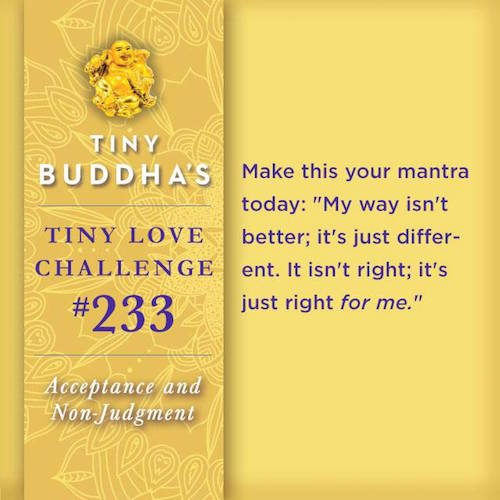
  • Love Challenge #233: My Way Isn’t Right

    Love Challenge #233: My Way Isn’t Right

    Love Challenge #233

    We’d all be so much happier, and we’d get along a lot better, if we accepted that everyone does things differently!

    (This challenge comes from the upcoming book Tiny Buddha’s 365 Tiny Love Challenges. Pre-order before October 6th and get $300+ in free bonus gifts!)

  • There’s More Right in the World Than You Might Think

    There’s More Right in the World Than You Might Think

    Good News

    “When you turn on the television … you run the risk of ingesting harmful things, such as violence, despair, or fear.” ~Thich Nhat Hanh

    I passed the rack of newspapers on my way into story time at the library, ignoring the latest headlines. Murder, mayhem, war, disaster—it all calls like a siren at sea. My pace picks up as I turn the other direction.

    My two-year old charge, whom I affectionately call Little Man P, is captivated by the animated librarian. She impresses me with her liveliness and ease in handling a room full of kiddos. It is clear she loves her work and those that come to story time.

    After everyone else left, she lingered to talk with me and Little Man P. He’s shy and bashful, but loves attention. Since he insists in going out in his superman outfit, he certainly gets noticed.

    I’ve enjoyed caregiving most for Little Man P because he has reminded me how to have fun and use my imagination.

    There’s hardly a moment he isn’t asking me to tell him a story. He’s more interested in elephants that can climb trees and fire hydrants that can talk than he is in anything else. I tell the librarian how my imagination has come alive since I’ve been babysitting him.

    With this comment, she seizes the opportunity to plug a special kids program coming up that weekend at the library. Unfortunately, I wasn’t going to be available to attend. I explained I would be spending a few nights staying with an elderly woman at risk of falling whose husband had to be out of town for a funeral.

    I shared with her what I consider to be the greatest downside to working with the older end of the age spectrum. Many, if not all, of my clients are really into the news. I can pretty much count on a newspaper at the table and the television turned on.

    Rather than participating in a fun and imaginative weekend program, Id be stuck listening to CNN running 24/7 in the background. I complained about this with my new librarian friend, commenting how difficult it is to hear all the bad news in the world.

    She shook her head sympathetically and muttered an agreement. I went on to express my frustration with the news media for mainly reporting what’s wrong in the world. I asked her, “Don’t you think there are just as many good things going on in the world?”

    She agreed, but then said: “Yes, but it seems things are getting worse every day.”

    I felt the familiar flare of passion rise up when a topic really pushes one of my buttons.

    I passionately exclaimed, “People only think that because that’s all they hear about on the news! Isn’t it just as likely there are an equal amount of miracles happening every day, or good Samaritans doing heroic deeds that we don’t hear about?”

    I think my enthusiasm must have turned her off, as she made a rapid exit after my outburst. Our conversation, however, reminded me of why I have such a ban against reading or watching the news. My desire to know what’s right in the world instead was ignited.

    Although not everyone agrees with the belief that we focus on is what we create, chances are if you’ve ever thought about buying a certain kind of car, you’ve experienced suddenly seeing that kind of car everywhere.

    This phenomena is referred to as frequency illusion. Our minds sift out all the other data we are receiving and starts to see more of something we have just noticed or learned. It is amazing how we will begin seeing things previously unnoticed based on where our thoughts and focus are directed.

    I’ll concede, simply watching or hearing about murder, terrorism, or the bad economy isn’t necessarily going to mean we see more of those things as we go about our day to day lives. However, it does increase the likelihood we start living a more fearful life.

    As such, we might notice the unusual looking man at the grocery store. Then, when he pulls out behind us in the parking lot, we worry he is following us. Or perhaps we become suspicious of the neighbors who just moved next door because of their race or religious orientation.

    Similar to “frequency illusion” is the experience of “selective attention.”

    Numerous studies demonstrate when our attention is occupied with one thing, we often fail to notice other things right before our eyes. In one study, few people noticed a woman with an umbrella cross the field while they were counting how many times a football got passed from one player to another.

    Likewise, if we are preoccupied with the strange looking man in aisle two of the grocery store, we might not notice the cashier pull money out of her own pocket to help the customer in front of us who didn’t have enough to pay for their groceries. Or see the young man help the elderly woman carry her groceries to the car.

    Constant bombardment of all the horrible things happening in our world can only lead to greater and greater distress and mistrust.

    What we need instead is more hope, faith, and love. In an information age where what happens on the other side of the world is known immediately everywhere, why does the media report mostly on what’s going wrong?

    Imagine a primary news channel devoted predominately to the announcement of miracles or to reporting various good deeds.

    What if we were constantly seeing pictures of people helping each other, babies being saved by the latest in modern medicine, or politicians shaking hands in agreement over important issues?

    What if we were to hear stories about the rising inner peace movement, or new and innovative programs to assist the elderly, sick or disabled?

    Is it possible we would all smile a bit broader and greet strangers with a warm hello?

    Perhaps we would feel encouraged to do our own generous act of kindness or join an existing worthy cause.

    Would not knowing about some of the things we hear about on the daily news make a huge difference to us in our day-to-day lives?

    How can we possibly know if things are getting better or worse when we aren’t given even a 50/50 accounting?

    Steven Pinker, in his 2011 book, The Better Angels of Our Nature: Why Violence Has Declined, argues things actually are getting better. He asserts violence has been in decline, despite the ceaseless news about war, crime, and terrorism.

    We just can’t see it because no one is focused on what’s right it the world.

    Since I’ve stopped watching the news and reading the paper, my life is happier and more fulfilling.

    If there is something really important happening in the world, I will hear about it elsewhere. If there is some action I can take to make things better, I will do it. But most the time, I’m quite content to live in my bubble, smiling at people and extending kindness to strangers.

    Good news image via Shutterstock

  • 7 Habits That Keep You Strong (Even When Things Go Wrong)

    7 Habits That Keep You Strong (Even When Things Go Wrong)

    “I’m stronger because of the hard times, wiser because of my mistakes, and happier because I have known sadness.” ~Unknown

    It’s happened to most of us.

    Despite our best intentions, something goes dreadfully wrong.

    You suffer a heartbreaking loss, make a terrible mistake, or get blindsided by an injury.

    In disbelief your mind cries, “Wait. What?”

    And then, “No, no, no, this can’t be happening.”

    After the initial shock, when the surge of stress hormones has subsided, you realize that yes, this is happening.

    And you can’t help thinking: “But how could this happen? It’s not fair. I can’t bear it. Why me? Why now? How will I ever get through this?”

    Your mind is reeling. You feel anxious and dejected.

    Well, something like this just happened to me too.

    After eight days away and a grueling fifteen-hour return trip, my husband and I were relieved to finally arrive home at 1:00AM on a Wednesday.

    But as soon as I opened the front door, I knew something was terribly wrong. My beloved cat Tiffany had come to greet me, but she wasn’t purring in her usual comforting way.

    She was yowling in distress in a way I had never, ever heard before.

    “Wait. What? What’s wrong, what’s wrong?”

    And then somehow, I just knew. I ran further into the house and discovered evidence that confirmed one of my worst nightmares.

    My trustworthy, longtime pet sitter had not been in to care for Tiffany.

    My sweet, sixteen-year-old cat had been home alone with no food, water, or heart medication for eight days. How was she even still alive?

    As a devoted animal lover, witnessing Tiffany’s trauma and subsequent physical and mental decline has been heartbreaking for me.

    I’ve had plenty of negative, angry, and despairing thoughts vying for my attention over this. And I definitely felt weakened by the experience.

    But as soon as I could, I consciously returned to the habits I’ve created over time that keep me strong no matter what shows up in my life.

    1. Use your power of choice.

    No matter what your circumstances, you have the power to choose your direction and how to use your energy. You can choose to use your energy in positive, productive ways or in negative, destructive ways. Either way, the choices you make now determine your future.

    As soon as I opened my front door and saw Tiffany’s suffering, I had some choices to make. I could choose to stay devastated, distraught, and depressed. Or I could choose to embrace the miracle that my cat was still alive and empower myself to give her the loving attention she deserved.

    Practice choosing to focus your energy in positive directions until it becomes a habit. Once it does, you will be more empowered and experience less trouble in your life. You will feel like you are living on purpose, taking charge of your direction rather than viewing life as something that just happens to you.

    2. Accept what is, no matter what.

    Practice not mentally labeling what happens as good or bad; just let it be.

    Accepting what is, instead of judging it, puts you in a state of inner non-resistance. You can still want to change things, but you have a calmer attitude, and any action you take to improve your situation is more effective.

    I rated my Tiffany’s circumstances as terrible at first. But by quickly accepting the situation instead of raging against it, all my mental and intuitive energy was available to discern what she needed most so that I could help her right away.

    Allow things to be as they are rather than resisting them. Once this becomes a habit, you’ll find yourself calmly thinking of effective solutions for problems that used to be overwhelming.

    3. Be grateful.

    Besides enhancing your everyday life, finding things to be grateful for can help you cope during hard times by giving you a wider perspective that helps you feel less overwhelmed by difficult circumstances.

    An eight-pound, sixteen-year-old cat with a heart condition could easily have died from such a trauma. So I had three things to be grateful for that night.

    First, Tiffany was still alive. Second, I got home just in time to rescue her. And third, I was grateful that my pet sitter had taught me to leave extra water out when going on a trip. This is probably what saved Tiffany’s life.

    Practice focusing on what’s going right. Notice things to be grateful for every day. Soon, finding something to be grateful for will become your automatic response to anything that happens. And eventually you’ll find that your gratitude habit brings more joy into your life.

    4. Neutralize the negative.

    Sometimes our thinking is directed by our inner critic, who can say some harsh things. But when you pay attention, you can recognize unhealthy thoughts and change them to more positive statements.

    My inner mean girl spoke up that night. “Tiffany counts on you to keep her safe. How could you let this happen?”

    I immediately cut this off by replacing the unhelpful thoughts with words I often say out loud to my sweet cat: “I love you, Miss Tiffany.”

    Always question your negative thoughts, and practice changing them to positive, helpful statements. Once this becomes a habit, you’ll find that negative thoughts lose their power to upset you. Over time, you will be able to more easily let them go, and your mind will become more peaceful.

    5. Return to the present moment.

    As human beings, one of our favorite mental activities is to get lost in thinking about the past or the future.

    Remembering to bring your attention back to “now” sweeps the debris from your mind and returns you to a state of simplicity.

    Throughout that long night, I did my best not to get lost in thoughts of how this could have happened or what Tiffany’s health would be like from then on. I just kept bringing myself back to the present moment with, “I love you, Miss Tiffany.”

    As you go about your daily activities, keep your full attention on whatever is happening here and now rather than getting lost in thought. Once this becomes a habit, you will be more connected to your inner wisdom. You will notice that decisions are easier to make, and life begins to flow more smoothly.

    6. Trust yourself.

    It’s better to trust in your own feelings and intuition—even if you make mistakes along the way—than to look outside yourself for guidance.

    Even though this felt like an urgent crisis, I took my time considering the options.

    I could put Tiffany in the pet carrier and go for a forty-five-minute drive to the emergency veterinary hospital. Or I could quietly care for her myself for a few more hours until my local vet’s office opened.

    It was the middle of the night, and she had already been through so much. My intuition said that keeping her home would be less stressful, so that’s what we did.

    Remember to always tune in to your inner wisdom for help. Once you make this a habit, you will feel less stressed and more positive. You will have a sense of inner security and self-contained confidence that is not based on the approval of others.

    7. Forgive.

    True forgiveness means that you accept the reality of what happened without an emotional charge. You recognize the healing and growth you have achieved from working through the upsetting experience, and you wish healing and growth for the other person.

    My pet sitter was distraught by her scheduling mistake and begged me to forgive her. I knew she would never intentionally cause harm to any living thing. I also knew how devastated I would be if I was the one who had made such a mistake.

    And so I did. I forgave her.

    Practice forgiving others and releasing the toxic resentment that hurts your heart. Forgive yourself too; we all make mistakes at one time or another. Making a habit of forgiveness frees you to move on with your life and experience higher levels of inner peace.

    You: Calm, Clear, and Confident

    Life’s hard when things go wrong.

    Feeling shocked, anxious, and dejected is no fun.

    But practicing these habits when times are fairly good will enhance your life and help you stay strong during the hard times.

    Imagine being in the middle of a disappointment or a crisis and being able to move swiftly through the shock and stress rather than getting stuck there.

    Imagine feeling calm, clear, and confident during difficult circumstances instead of confused and overwhelmed.

    Imagine even reaching a state of inner peace as you take action to make things right again.

    Some of these concepts are easier to turn into habits than others, and they all take time to master.

    But if you will pick even one and start practicing, you will become stronger, wiser, and more resilient no matter what life throws at you.

    If I can do it, you can too.

  • How to Help Yourself by Owning Your “Bad” Qualities

    How to Help Yourself by Owning Your “Bad” Qualities

    Good and Bad Scale

    “Nothing is either good or bad, but thinking makes it so.” ~William Shakespeare

    Like many women, I feared my own voice.

    I feared what would happen if I acknowledged my feelings and I feared what would happen if I expressed them.

    Above all, I feared that people would leave me if I ever communicated as my true self.

    In my family and culture, feelings are things that are best when denied. I was taught they are a liability that, if embraced, would lead to fights, pain, and loneliness. I was encouraged to ignore, avoid, and push them down into the recesses of my mind.

    Not surprisingly, by thirteen I developed severe depression, resulting in poor coping mechanisms, a reliance on medication, and a suicide attempt.

    The need to express myself was natural and necessary, but my belief that it was wrong prevented me from ever owning my voice. Instead, I communicated in unhealthy ways:

    • I had angry outbursts.
    • I played the martyr.

    And while I tried to suppress and control this side of me, it came out in waves of anger and hurt. Through decades of transformation, I now understand that many of my behaviors were based on my belief that things are either all good or all bad.

    So how did I unlearn this belief and learn to express my true voice?

    By learning how I played the game of black and white.

    When we’re young, we’re taught that certain aspects of our personality are bad or wrong, while others are good and useful. And like most things we learned as kids, we need to unlearn them.

    In order to fit in, feel loved, and gain acceptance we disown the “bad” qualities we believe we have and try to express ones that are seen as “good.”

    This polarized thinking forces us to see the world in terms of black and white, right and wrong, or good and evil. And in this game of black and white, the only rule is that white must always win.

    Unfortunately, the world isn’t that simple. Most things exist on a frustrating spectrum of grey.
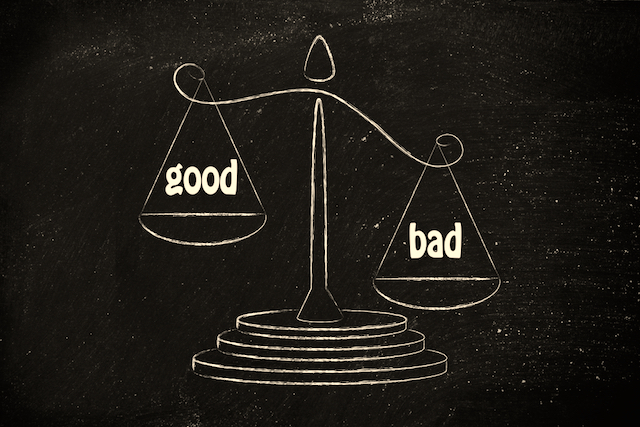
    Fortunately, we can learn to re-own these repressed qualities and transform them into qualities that benefit us and others.

    For example:

    • Owning our anger can lead to self-love, if this enables us to set boundaries to take better care of ourselves.
    • Owning our self-expression can lead to genuine connection, if this enables us to get in touch with and communicate our true wants and needs.
    • Owning our apathy can lead us to a passionate career, if this enables us to redirect our energy and quiet our fear of failure.

    Here’s How:

    The first step to seeing how you play the game of black and white is to determine which traits you’ve put into each category.

    What qualities in others make you angry? Often the aspects of others that trigger us are the things we don’t like about ourselves. These are frequently the areas that we need to work on the most.

    For example, when other people stated their boundaries, I previously felt threatened because I wasn’t comfortable setting my own. This taught me that I needed to address this issue in my own life in order to feel whole and attract other people with healthy boundaries.

    To begin, list several “bad” qualities. These are the traits that go in your “black” pile (i.e.: lazy, late, disorganized, loud).

    What qualities do you think of as good, desirable, and appropriate? These are the qualities that we are praised for or that we value in ourselves or others. List several “positive” qualities. These are the traits that go in your “white” pile (i.e.: honest, flexible, driven).

    Next, determine how the game manifests in your life.

    In what ways do you play the game so that “white” must win? What have been the consequences? For example, in believing that silencing my voice is good, I’ve been in unhealthy relationships, had angry outbursts, and felt depressed.

    If you were to give the disowned trait a voice, what would it say? For example: mine would tell me that it’s safe to be the real me.

    Finally, embrace the trait as neither good, nor bad, simply a part of you.

    If you were to re-own that trait, how could it benefit you? Often, qualities we view as “bad” are harsh criticisms or expressions of our own fears.

    For example, I often find that I am frustrated when I perceive someone to be lazy. This, however, is merely triggering my own fear that I am not doing enough. Owning this trait allows me to see that there are times when I should relax.

    Owning it taught me that I don’t need to overwork in order to prove that I am worthy. Owning my lazy side would allow me to live a more balanced life and cultivate self-love.

    Creating awareness around how you play the game of black and white will give you the freedom to consciously choose your behaviors instead of going on autopilot.

    It will allow you to stop stumbling through life and begin navigating it on your own terms. You don’t need to accept your false beliefs when you have the power to change them.

    Isn’t it time you mastered your life?

    Good and bad image via Shutterstock