Tag: worries

  • How I’m Learning to Live with Anxiety, Not Against It

    How I’m Learning to Live with Anxiety, Not Against It

    “Your anger? It’s telling you where you feel powerless. Your anxiety? It’s telling you that something in your life is off balance. Your fear? It’s telling you what you care about. Your apathy? It’s telling you where you’re overextended and burnt out. Your feelings aren’t random, they are messengers. And if you want to get anywhere, you need to be able to let them speak to you and tell you what you really need.” ~Brianna Wiest

    For half of my life, anxiety has been my constant companion. I went from a confident, fiery, and fearless girl to a woman plagued by self-doubt and paralyzed by fear.

    My struggle with anxiety began in college. A sudden shift in my living situation flipped a switch in my brain, leaving me unrecognizable to myself. I found myself living in a toxic environment with roommates who caused so much chaos that I no longer felt safe in my own home.

    This constant state of unease triggered the anxiety that would follow me for years. Instead of acknowledging it, I tried to outrun it. I looked outward for solutions, turning to the law of attraction and other quick-fix spiritual practices, but they only made me feel worse about myself.

    Chronic stress and anxiety wreaked havoc on my body. I experienced severe digestive pain, tingling in my hands and feet, dizziness, nausea, and a myriad of other symptoms. I sought help from doctors, naturopaths, and specialists, but no one could find anything wrong with me.

    Deep down, I couldn’t accept that anxiety might be the cause. I convinced myself that there had to be something seriously wrong with my health. Because I didn’t acknowledge that anxiety was behind it all, the symptoms only intensified.

    I would go months without symptoms, only to be hit by a new wave of terrifying sensations. The anxiety always returned, stronger than before. It felt like a never-ending cycle.

    Then, COVID-19 hit, a perfect storm for my anxiety. Not only was I navigating a global pandemic with a young child, but we were also in the middle of building a new home—a process delayed by the pandemic. We were moving to a completely different city, living out of boxes in a rental house while waiting for our new home to be completed.

    My anxiety surged as I dealt with virtual school for our six-year-old. And then came the most devastating news: My mother was diagnosed with bladder cancer.

    My parents moved into the rental house with us because their house had flooded. Watching my mom deteriorate from cancer only intensified my anxiety. My mother’s diagnosis wasn’t the only encounter I had with cancer; it started to feel like it was everywhere. The constant presence of illness and death heightened my anxiety, making me hyper-aware of every ache and pain.

    Insomnia became my nightly companion, lasting nearly a year. Some nights, I wouldn’t sleep at all.

    Anxiety about not sleeping became as overwhelming as my general anxiety. As bedtime approached, my chest grew heavy with dread. I cried all night, feeling utterly alone. When the world sleeps and you’re wide awake, the loneliness is crushing. It was just me and my millions of thoughts.

    Desperate to shut off my brain, I turned to a nightly glass of wine. I tried various supplements, but they only wreaked havoc on my body, causing my liver enzymes to rise and bringing a host of other health issues.

    Anxiety didn’t just change me; it affected every part of my life, especially my marriage. My husband, who was always calm and patient, started to become stressed and short-tempered because of my constant worry and fear.

    My anxiety created tension between us, and we were no longer the carefree couple we once were. Our conversations often revolved around my fears, and I could see how much it was weighing on him.

    As a mother, my anxiety took away the joy of being with my son. Instead of enjoying time with him, I found myself snapping at him, my patience worn thin by the constant state of unease I was in.

    I spent every day researching, desperate to find a magic cure. I tried cognitive behavioral therapy, tapping, and affirmations. But nothing worked. Though CBT has helped many, it wasn’t right for me.

    Trying to replace my negative thoughts with positive ones felt like plastering over cracks in a crumbling wall. The positive thoughts didn’t feel genuine; they felt like a temporary mask.

    Then I discovered Jon Kabat-Zinn. His books became my lifeline, introducing me to mindfulness and meditation. Slowly, these practices became a part of my daily life. I learned to befriend my emotions instead of running from them or burying them deep inside.

    I invited my anxiety to tea and listened to her worries. I hugged my fear and told her she’s not weak. I asked my anger what she’s holding onto and allowed her to scream and cry. I wrote letters to each of my emotions, and they wrote back.

    We cried together, and for the first time, my emotions felt seen and heard. I was no longer afraid of them; they became a part of me—a part of what makes me human.

    For the past five years, meditation and mindfulness have been my anchors. No, they haven’t cured my anxiety, but they’ve changed my relationship with it. Anxiety no longer controls my life. Instead of spiraling into panic, I ask myself, “What am I feeling? Where in my body do I feel this emotion?”

    These simple questions ground me, bringing me back to the present moment. By labeling the feeling, I strip away much of its power. I tell myself, “I’m feeling anxious, and that’s okay.” I repeat this until I feel calm.

    Sometimes, I even picture my anxiety as a physical presence—a person who needs love, patience, and understanding. I ask this person, “What do you need at this moment?” More often than not, the answer is simple: love.

    My anxiety, like all emotions, wants to be recognized, to be heard without judgment. Sometimes, it just needs a moment to be, to exist without being pushed away.

    Another tool that has been incredibly helpful for me is the STOP method by Jon Kabat-Zinn. Whenever I feel anxiety creeping in, I pause and STOP: Stop what I’m doing, Take a deep breath, Observe what’s happening inside and around me, and then Proceed with awareness. This simple technique helps break the cycle of anxious thoughts, grounding me in the present moment.

    I believe all our emotions seek acknowledgment and understanding. They want to be recognized without judgment. Sometimes they just need a moment to breathe, to exist in a safe space where they can shift from overwhelming to understood. They want to know you won’t abandon them but rather guide them gently toward clarity.

    Looking back, I realize that anxiety has changed me in ways I never expected. It has made me more empathetic toward others who are struggling with their own battles. I’ve learned that everyone is carrying something heavy, even if they don’t show it on the outside.

    My anxiety has also taught me the importance of self-compassion. I used to be my own harshest critic, but now I’m learning to be kinder to myself, to give myself the grace to be imperfect.

    Even though I’ve learned tools to manage my anxiety, it’s still a part of my life. There are days when the anxiety feels overwhelming, and the old fears creep back in. On those days, I remind myself that healing isn’t a straight line—it’s okay to have setbacks.

    When I feel the familiar wave of anxiety, I turn to the practices that I’ve learned. Mindfulness, the STOP method, and self-compassion. I let myself feel what I’m feeling without judgment, and I focus on small, actionable steps to bring myself back to the present moment.

    What keeps me motivated is knowing that I’ve come this far. Every setback is a chance to practice the tools I’ve learned, and each time I do, I’m reminded of my strength and resilience. My journey with anxiety is ongoing, but with each day, I grow more capable of handling whatever comes my way.

    Your emotions don’t define you—they are a part of you. A sign that you are alive and deeply human. Embracing them, rather than battling them, has brought me peace, and I hope it can do the same for you.

  • How to Deal with Worries

    How to Deal with Worries

    “A lot of what weighs you down isn’t yours to carry.” ~Unknown

    What are you worried about right now? No matter how hard we try to not worry, and even when we know that stress is terrible for our health, worry inevitably seeps into our boundaries for one reason or another. Chronic stress causes wear and tear on our bodies, potentially leading to a number of health ailments.

    This terrifies me as a person with many stress points in her life, and as a widowed only parent of three young children. I want to live a long, healthy life so I can be there for my family as long as possible and also enjoy my life. For me, the stakes are high, and I know that I need to work on how I respond to stress.

    Dealing with our worries is a journey of learning when to let go and when to hang on in the wild rollercoaster ride of being alive.

    My school district gave out almost 300 pink slips this year. These are legal notifications that your job is in danger of being eliminated. I was one of the teachers who received one, even though I had been teaching for twenty years.

    You expect to receive them as a new teacher. The last one I received was six years into my career. However, receiving a pink slip at this point was a huge shock to me and a lot of my veteran colleagues, because we had reached the peak of our career mountain when we were supposed to be staring down the final descent toward retirement, not going back out into the job market.

    Worry existed on steroids at my school. I have a leadership position, and one of the most difficult parts of the experience was watching grown adults have breakdowns, perseverating over worst-case scenarios and riddled with anxiety about the future.

    After the initial shock wore off, they cycled through feelings of anger, sadness, and fear. Many of them did not know how they would pay their bills. The toxicity of everyone’s moods hung like a dark cloud over all of us, and I found it difficult to cope with my own emotions while submerged in this environment of despair.

    I found myself turning to my Buddhist practice during this time. The first of the Four Noble Truths in Buddhism is dukkha, which is suffering. Suffering is a fact of life. It exists on a spectrum ranging from minor annoyances to major tragedies, usually a matter of life or death.

    Another way of thinking about suffering is life not going as expected, or not getting what you want. Suffering, or the fear of suffering, causes worry.

    I had gotten comfortable in life and was caught off-guard about my job. It didn’t even cross my mind that this kind of suffering could exist, but of course it was always there. I worried about not finding a similar position, and I worried about putting myself out there in interviews and hustling to market myself as a professional.

    Realizing that attachment causes suffering is Noble Truth #2. Letting those attachments go to stop suffering is Noble Truth #3, and the truth of the path forward is Noble Truth #4. These are designed to help us accept reality as it is and to live in the best possible way for our individual journey.

    Once the initial shock of my pink slip wore off, I started imagining various scenarios and how I would respond. I realized there was a path forward no matter what happened, even if I couldn’t fully conceptualize what mine would look like.

    I had a colleague who said something profound during the crisis. He isn’t usually the type to stay calm during times of adversity, but he said, “I’ve lost a lot of positions in my life, and I always land somewhere better.”

    Those words stuck with me. No matter what happens, you’ll likely grow and learn from the experience and maybe end up somewhere even better than before.

    Part of learning to accept reality is to understand and embrace the concept of impermanence. Impermanence means that nothing stays the same.

    The bad news is that the good aspects of your life will not remain forever. You will not always have your favorite people in your life. The brand-new car you bought will get scratched and eventually have a lot of miles on it.

    However, the good news is that the bad things in your life also will not stay the same. Quarrels blow over. Elections come and go. Recessions eventually disappear into the rearview mirror.

    We eventually adjust to changes in our circumstances, even the ones we didn’t want.

    I know the education budget crisis will eventually pass. I know this because in 2012 I was out on the streets waving signs and advocating and wearing pink to show solidarity, and that feels like a lifetime ago. Now we’re wearing “red for ed” and back on the streets fighting for education funding in 2024.

    For the past twelve years, I haven’t had to think about the budget. I survived the recession and kept my job.

    It will get better.

    And it will get worse.

    It will also look different.

    This is all part of the journey.

    Embracing the concept of non-self is important in addressing our worries. It is necessary to separate who you are from your problems. I think we have a tendency to merge the two.

    I hear people make self-deprecating comments like “I’m a terrible speaker.” This is not a fixed character trait.

    The way to become a better speaker is to keep speaking. To practice. Trial and error.

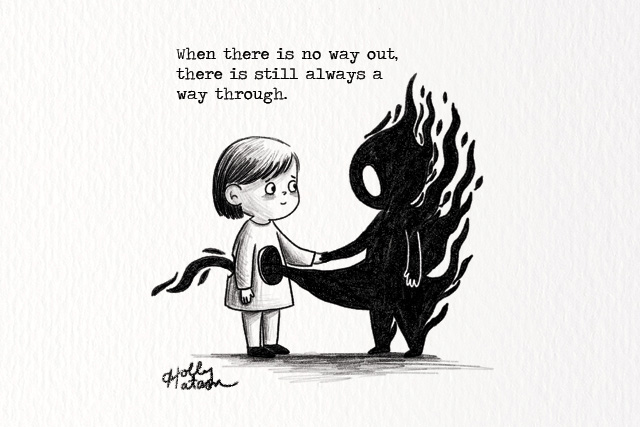
    The only way out is through. You’ve got to do the thing. I think a lot of our worry comes from boxing ourselves into labels that are not real. This can blind us to the fact that we can change our situation at any given moment, even if it is only our perspective and attitude about it.

    I am a teacher, but that is not who I am. I teach at a particular school in a particular department, teaching particular courses, but those details are not who I am either.

    It’s easy to cling to those labels and call them an identity when those aspects of our lives feel important and familiar. However, everything will inevitably end at some point anyway, and we will still be the same person, with or without the details we clung so tightly to.

    We have to work on becoming less self-attached. Our foolish selves naturally gravitate toward thinking about me, me, me. We are inclined toward self-centeredness. We wallow in our personal circumstances and cannot see past our little bubble, and it obscures the big picture.

    Finally, working on non-attachment is a way to alleviate worry. We are attached to so many things, and this is what causes us to suffer.

    As a teacher, I see my students attached to getting into a specific college, or getting a certain grade, or winning a game, and the list goes on and on. It doesn’t get better in adulthood. Adults may be attached to projecting a specific image or having a certain amount of money. A parent may be attached to what they think their kids should play for sports or how they expect them to perform in school.

    Let these expectations go. Stop being attached to one version of life. Be open to other variations, and you might have a few less things to worry about. This requires trust in the innumerable paths life has to offer us.

    In the end, my school district rescinded all of our pink slips. Nothing happened to my job, at least not for next year.

    One may view this experience as a waste of emotions, but I see it as a wake-up call. I know I’ll come out of this experience stronger, more resilient, and better prepared for whatever is around the corner.

    Suffering is important and it can actually make us better humans. Thich Nhat Hanh said that “suffering is essential for happiness. We have to know the suffering of being too cold to enjoy and appreciate being warm.”

    One way to think about what worries us is to accept the worst-case scenarios and be willing to look for the lessons. This changes how we view suffering. It shifts it from being the boogeyman who we are scared of to a firm but impactful teacher who helps us become comfortable with the uncomfortable.

    It is important to remember that the present moment is not always going to be rainbows and unicorns. Sometimes it will be losing a job, someone breaking up with us, our loved one dying, the refrigerator breaking, getting sick, and a lot of other potential unwanted scenarios.

    Whatever is happening, we need to be able to sit with it, know that it will not last because of impermanence, and also remember that it is teaching us something that is making us better versions of who we were.

    Maybe half the battle of worry is normalizing failure—to adjust our reality. Not internalizing failure but recognizing that it is a normal part of the growing process. It is not something that defines who we are. It is not something to hold on tight to, but rather something to reflect on and let go so you can make space in your life and have the energy to try again.

    When you feel worried about something, remember that the best way out is always going to be through. Trust the process.

  • Why Codependents Don’t Trust Themselves to Make Decisions and How to Start

    Why Codependents Don’t Trust Themselves to Make Decisions and How to Start

    “Slow, soulful living is all about coming back to your truth, the only guidance you’ll ever need. When you rush, you have the tendency to follow others. When you bring in mindfulness, you have the power to align with yourself.” ~Kris Franken

    Codependency previously created a lot of pain and agony in my life. One of the ways it manifested was in my inability to trust myself. I would overthink decisions to death, fearful that I would choose the “wrong one” or upset someone if they didn’t agree or were disappointed by my choice.

    I was terrified of “making a mistake,” and I exhausted myself trying to collect everyone’s opinion (to ensure they would be pleased with me) before finally settling on a choice.

    As annoying as it was, for me and everyone around me, I couldn’t seem to stand firm in my decisions. I longed to be more confident in my choices but couldn’t understand why it was so hard for me.

    Growing up with an authoritative, controlling parent, I didn’t have the opportunity and support I needed to feel my feelings and let my intuition guide my choices. I didn’t get to learn from my mistakes. When I made a mistake, it felt like death. I was often blamed, shamed, and criticized, all too much for my empathetic system to bear.

    I learned that if I placated and pleased, others were happy. And because I became so others-focused from such an early age, I never learned how to build my muscle for good decision-making.

    Feelings and emotions were not welcome in my world, so my only way through was to disconnect from feeling at all—though I felt responsible for others’ mood swings and feelings. I learned that sharing my needs or opinions was triggering for others, and I didn’t have the skills to navigate the weight of that. All this combined felt mentally paralyzing, so I began to look outside of myself to others for advice and guidance eventually.

    When you’re reliant on other people’s opinions and guidance, you’re much like a feather in the wind—susceptible to any small or big gust that comes along. You aren’t in control of your life, and you give others way too much power over how you feel.

    One of the best ways to begin to build self-trust and heal from codependency is to begin feeling your feelings again, living from the neck down as I like to say. Moving from our cognitive thinking brain (because I know you know making decisions shouldn’t be this hard) to the wisdom of our bodies.

    I believe that in order for us to really build this self-trust muscle, we have to learn how to trust our feelings. And that requires us to build a sense of awareness around why we might be codependent in the first place.

    Perhaps, like me, you were programmed from an early age not to trust your inner knowing, or intuition. This results in low self-worth. And this happens for a number of reasons.

    • You were abused or neglected (physically and/or emotionally).
    • Your feelings and needs were minimized.
    • You were judged, shamed, or mocked for your feelings, maybe even being called “too sensitive.”
    • Your feelings and needs weren’t as important as other people’s.
    • You didn’t have at least one parent or caregiver validating your feelings and sense of worth. You didn’t have someone mirroring back to you your value.

    If you experienced any amount of neglect, or had emotionally unavailable parents, like me, you probably learned to suppress your feelings in order to survive. And what we resist persists, so those feelings that we try to shove down only intensify.

    3 Tools to Build Self-Trust

    These three tips might help you learn to trust your inner wisdom so you can make decisions from an empowered place.

    TOOL #1: Do a daily check-in of your feelings.

    When we check in with our feelings regularly so we can meet our needs, we learn to trust in our ability to do what’s best for ourselves.

    When I first started doing this, I would set four alarms on my phone. When the alarm went off, I would do a quick check-in by asking myself, “What am I feeling? What am I experiencing right now?”

    Often, we run through life, not checking in to see how we are doing and feeling (especially if we struggle with people-pleasing and codependency). We do a lot of things every day, all day—go to work, make decisions, parent our kids—but we often don’t check in with ourselves and ask if we need to shift something.

    This is a big part of self-love, checking in and asking, before I have this conversation with my child, my partner, my boss, or customer service rep for my computer, what’s going on with me? Oh, I’m feeling ornery or hungry; here’s how I can address that before I have this conversation.

    You can also do this by journaling. Keeping track of your feelings in a journal can be a beautiful way to understand, process, and look back on your experiences.

    Here are some journaling questions to help you get started:

    • What do I need to hear from myself?
    • What do I need to do for myself to feel my best?
    • What do I love about my life right now?
    • Today I woke up feeling (fill in the blank).
    • Am I living a life aligned with my values?

    TOOL #2: Reparent your inner child.

    Reparenting your inner child is a beautiful way of giving your inner little one the things that he or she needed and never received in childhood. You become the parent you needed when you were a child. And, by giving to yourself what you didn’t receive then, you free yourself from the past.

    So much of reparenting yourself is about making choices every day in your own best interest. It’s becoming aware of your patterns and behaviors, understanding why you do what you do, and carving out time to give yourself what you really need. When you give yourself what you need, you start worrying less about other people abandoning you because you know you won’t abandon yourself.

    One of my favorite ways to reparent myself is to give myself the words I never got to hear as a small young child.  Words like:

    • I love you.
    • I hear you.
    • You are perfect and complete.
    • You didn’t deserve that.
    • I see that really hurt you.
    • What do you need right now?
    • That must have been very difficult for you.
    • I’m so sorry that happened to you.
    • You are smart.
    • You did your best.

    TOOL #3: Practice creating safety within.

    Because we, as codependents, were raised by either emotionally unavailable or narcissistic caregivers/parents, we developed what I refer to as “a hole in the soul.”

    Our parents’ responsibility is to mirror back to us our worth and value, but when they fail to do that, we will look to someone or something outside of ourselves to show us our worth and, in essence, feel safe.

    It’s an endless battle of trying to fill that hole. Low self-worth, self-value, self-esteem, and self-regard are typical for codependents. We look outside of ourselves for safety and approval, becoming dependent on that next hit or rush. That safety might last for five minutes, five hours, and if we’re lucky, a whole day.

    One of my trusted and reliable systems for safety was shopping. I would spend frivolously, buying things we didn’t need with money we didn’t necessarily have. This created a lot of stress and conflict between my husband and me, and further decreased my self-trust.

    He couldn’t understand why I had this insatiable push to spend, and I didn’t either. I just knew that my system felt safe and relaxed once I made my purchases—until the excitement wore off, which usually happened quite quickly, and I was back in the store, searching and spending, trying to get my next fix.

    I had a lot of stress and guilt because I knew what I was doing wasn’t healthy. Yet it was compulsive. I couldn’t stop.

    I longed for the connection and safety that I never received as a child but didn’t know how to get it in healthy ways. So I suppressed my needs in relationships and tried to fill that hole with shopping.

    It didn’t happen overnight, but once I learned how to create that feeling of safety within myself (with lots of support through trauma-informed coaching, therapy, breathwork, meditation, and proper nutrition, and after learning to speak up for myself), my codependent strategies (shopping, relationship addiction) slowly seemed to disappear.

    I no longer needed to rely on my old strategies because I knew how to trust myself and offer myself what I truly needed.

    I invite you to try this: Close your eyes and imagine something that makes you feel at ease, calm, and safe (maybe your favorite forest or beach, perhaps a little cabin nestled in the woods). Notice where the sensation of ease lives in your body. Be with it for a moment—just sit with and experience it. That feeling you just created was created by you. It is yours.

    Every time you do this exercise you release the belief that you can’t create this feeling alone. That you can’t be trusted, and that you must rely on things outside of you to create safety.

    When I first started this practice, I had to implement it every time I entered a store. I took a few moments while I sat in my car and created that feeling of safety within. That way, I felt a sense of calm and ease as I was shopping, keeping my prefrontal cortex online so that I could make rational purchases that I felt confident and good about.

    I started to build evidence that I could, in fact, trust myself to make healthy decisions. It was incredibly empowering and freeing to walk into a shop and simply admire the textures, patterns, scents, and products without feeling an overwhelming compulsion to put things in my cart that I simply didn’t need.

    Every time we connect with ourselves this way, we prove to ourselves that we can create safety within. And every time we make healthy choices from that place of internal safety, we deepen our trust in our ability to discern and do what’s best for us.

  • How I Overcame My Psychic Addiction and Stopped Giving My Power Away

    How I Overcame My Psychic Addiction and Stopped Giving My Power Away

    “If you’re looking for a sign from the universe, and you don’t see one, consider it a sign that what you really need is to look inside yourself.” ~Lori Deschene

    I used to have no idea what I should do. About anything. I would go from friend to friend running polls:

    Should I be a solo singer or in a group?

    Is this guy the one?

    Should I do this job or that job?

    Should I stay in LA or move to Vancouver?

    Should I get bangs?

    On and on it went. It wasn’t that I wanted validation. It was that I had no clue what I should do. Or, if I did know, I would quickly override it with endless doubt. I’d loop:

    “Maybe that isn’t the right decision. What if you’re wrong. Maybe it’s better if you do this.”

    It didn’t stop, and I couldn’t get it right. If only someone would just help a girl out. Surely, they’d know what’s best for me.

    There was a period of time (okay, years) when I had a serious psychic addiction. I would go from tarot reader to intuitive to tea reader to whatever else held the key to my life and purpose. Numerology, astrology, palm reader, random aliens, or angels—you name it, I doled out cash for it. It was my favorite hobby.

    Years back, I went through a breakup, and I had very important questions like, “When is he coming back?”

    I made some serious rounds through the LA tarot circuit. I found one reader that I bonded with at the now-closed Bodhi Tree (still grieving the loss…way longer than that ex). I liked her a lot, and because her readings gave me the kernel of hope I needed, she was the one, and I was hooked. It was like her cards magically tapped into my ex! In the first reading. She said, “Looks like you will be seeing him very soon.”

    Then I saw him on Melrose.

    What?

    Ding, ding, ding. She was the direct line, and I needed more. She just did it so well, tuning into my future.

    Every time I saw her, I knew I would get exactly what I needed. A hit, a bump—I could relax, knowing all was well with my existence. My future was all figured out. The love would return, fame was destined, and money would soon pour in. So I started going more and more. She only worked a few times a week, but I often made sure my name was on that appointment list.

    Then one day, it happened. It was the wake-up call that I needed but hadn’t prepared for.

    I got to the Bodhi Tree before her shift (I knew her schedule, of course), and since they weren’t yet open, I hung out on the sidewalk waiting. I needed to get to her first.

    My heart sped up with excitement when I saw her gliding down the sidewalk. The Tarot Queen, the one who held my future in her hands, walked toward me, obviously flanked with fairies and magic dust.

    Though we were the only two people on the sidewalk, she took a few moments to see me. I smiled, waved with enthusiasm, and walked toward her.

    Her gaze met mine, and we locked eyes. And for just a quick moment, she held my gaze. And then it happened. Her face kind of contorted, and she jumped back a bit. She was surprised or worse, scared when she saw me.

    She was scared to see me.

    Not the “OMG, I didn’t see you, and you startled me” kind but an “Oh no, this person is stalking me” look. She had panicked eyes. She was one thousand percent making a judgment call, and it was that I had gone way too far with the readings, and she was worried, perhaps for herself.

    She had become my drug, and I had come for my fix—she was doling out oracles for a reality that did not currently exist. The future. She played it off that day (oh yes, I got my reading), but it was a sight I couldn’t unsee.

    You know when someone you’re paying rejects you that something is off. It’s like those stories about drug dealers cutting their clients off in the hopes they go to rehab. You almost can’t believe it and assume it’s a myth until you get a first-hand account of one of these unicorn scenarios.

    Of course, an addiction to the need to know isn’t going to land me a DUI, but it wasn’t leading me to self-confidence and rock-solid intuition. Besides, wake-up calls come in all different “hello, notice me” alerts.

    Sometimes you just need a giant slap in the face with a deck of goddess cards to get you back on track.

    Now just to be fully transparent, that was not the end of my psychic run. It was the end of my time with her because I hate to look bad, but it didn’t stop me from getting advice from wherever I could. However, it did make an impression.

    And just to further drive the transparency home, when I was over that guy, there was another. And another that I sought advice for “out there,” whether it was with a Love Tarot deck or a friend that I thought somehow knew something I didn’t. Here’s what I didn’t know…

    No one outside of yourself knows what your answers are.

    No one.

    Not a one.

    Things just take the time they need to take, and we need to learn what we’re meant to learn. It’s the healing and completion that matter, not the time required.

    My overthinking, obsessive mind and love of all things spiritual led me to an amazing teacher that helped me shift to my inner knowing instead of needing constant outside approval.

    She was strongly opposed to psychics. She had spent many years as one but quit when she had the realization that people stopped living when they were told something about their potential future.

    If someone hears “Your soulmate is a blond man with an accent,” they then cease giving anyone else the time of day and might miss an amazing dark-haired guy in the process. That blond could be coming, but he may not. Psychics are sometimes accurate, but they are not perfect. No one is.

    Aren’t we all just swinging in the dark?

    And things change. A clairvoyant might have seen a glimmer of something that you might quickly grow out of or change course from. Nothing is permanent, and we can change our current path in a moment.

    My spiritual teacher used the term “corner store drug dealers” when describing psychics. They provide an easy-to-find, quick fix of the most addictive and popular drug (the who, what, where, when, and why) that comes in the form of your juicy future. One hit at a time.

    After many busy years in that business, she didn’t want to co-sign it anymore. So she walked away because it removed people from their present moment. She wanted to encourage people to tap into their own intuition—something she believed only came from life experience in the “now.” She rarely ever told me something I couldn’t feel for myself, and she did her best to guide me toward my true instinct.

    It was a gift I could never repay. Something I could never have gotten from a reading.

    Does this mean I’m psychic-free? No, I’m not, but I get them for entertainment now. I like to get a reading on my birthday most years. I got one in New Orleans (isn’t that rite of passage?), and I’ll never turn down a tarot party. I’ll get one, but I don’t shift my life to fit the prediction.

    Readings are also helpful when used as a real-life pendulum. Like, “Did I like what she just said? Do I want it to be true”? Great, then move in that direction regardless of any outcome. It’s just a clue to what feels right and good.

    However, despite all this “look at how I’ve changed” wisdom, I recently fell prey to my old ways. This past August I went to a sought-after channeler to celebrate my birthday. As much as I wanted to just toss her expensive words into the fun psychic basket with the rest, I found myself in that all too familiar feeling of my past.

    Maybe it was because it was hard to score an appointment, or because she has a high accuracy rate, or perhaps because I was feeling directionless in general. Regardless of why, when she told me that Nashville was where I’d be by Christmas, I just couldn’t shake her prediction.

    Here’s the catch, my husband didn’t want to go, and he wasn’t budging. But, but, but…I needed to get there. After months of Zillow shopping and spinning out of any intuition I had left, I came up with a genius idea.

    Go back for another reading. Say nothing and see if she still sees Nashville. She was, after all, in a trance, so she would never remember. When a spot opened on her waiting list, I jumped at the chance.

    Drumroll. This session did not include Nashville in the near future.

    I was so relieved. Not because I will or will not eventually live in Nashville. Or Milan or London or anywhere else in the world. But because the choice was mine again. It always was, but I had given my power away to someone else. She’s a lovely person too, by the way—this was all on me. We create our own destiny. We create our futures. No one else.

    Only we truly know our own answers. And we can change our minds whenever we want.

    Even my psychic relapse bestowed a gift. I am even clearer about what feels right for me now. I just needed a reminder that I am the only one making decisions for my life. So any future readings will be a fun check-point for my intuition. And believe me, I’d be thrilled if something came true, but no prediction ever has…

    Well, I did see that ex on Melrose that one time. But other than that, nothing. Not a thing.

  • 4 Ways to Save Your Sanity When Life Gets Hard and Overwhelming

    4 Ways to Save Your Sanity When Life Gets Hard and Overwhelming

    “You can’t stop the waves, but you can learn to surf.” ~Jon Kabat Zinn

    In December of 2020, we noticed Mom’s speech seemed difficult. Like she had stuffed cotton balls in her mouth, and someone was restraining her jaw from moving. We asked her about it, she said it was nothing.

    We hadn’t seen each other since we got together over the holidays. On New Year’s Day 2020, we clinked glasses filled with sparkling wine and shared bold predictions about how this was going to be our best year yet (spoiler alert, it wasn’t).

    With every passing week and conversation, it got worse. We brought it up many times, my sister and I. We pleaded with her to see a doctor. We were separated by thousands of miles and a closed border. My sister in Virginia, me in California, Mom in Canada.

    She said no, it wasn’t a big deal, it was getting better (spoiler alert again, it also wasn’t). She insisted she was fine. She could eat, drink, work, and speak. It was all good. She repeated this message as our worries grew. We felt powerless to help, especially in the face of her denial and refusal to get care.

    In March of 2021, I got an odd message on Facebook messenger. It was from a woman who said she worked with my mother, asking me to call her. She had taken my mother to the hospital the night before, where she was admitted for extreme dehydration and exhaustion.

    Her symptoms made no sense to them either, so she endured a battery of tests. Ultimately, it was revealed that what ailed her was amyotrophic lateral sclerosis, also known as ALS or Lou Gehrig’s disease. A horrible progressive nervous system disease that causes loss of muscle control. It is always fatal, with no known cure.

    Her disease first attacked her ability to speak and swallow, an unusual first set of symptoms. When she was hospitalized, she finally admitted she hadn’t eaten a real meal in thirty days and had been able to drink less and less.

    My sister and I are both career women with young families. I work for a tech company. The work is fast moving, complex, and nuanced. I used to pride myself on my “meeting endurance.” I often tackled days with ten to fourteen meetings, with enough energy left to crank out work deliverables, do an intense workout, and spend time with my six-year-old twins.

    With my mother’s diagnosis and the new responsibilities of caregiving during a pandemic, I had to revisit many of my previous beliefs and assumptions. Here’s what I learned. I hope it helps you too.

    Lesson 1: Out with stretch goals, in with baseline goals.

    I’m a (sometimes) recovering overachiever. I have a history of establishing huge stretch goals and basking in satisfaction when I smash them. For years I was motivated by the striving to do more, be better.

    Until I wasn’t.

    With my mother’s diagnosis and the challenges of parenting and working in a pandemic, overwhelm swallowed me whole. It felt like I was surrounded by fuzzy darkness. Like I was moving through molasses.

    I wasn’t alone, of course; mental health issues skyrocketed globally. Rates of depression and anxiety are rising. The term “languishing” was introduced to express the lack of thriving many more experienced.

    I had to rethink my relationship to accomplishment.

    I have given myself a break from stretch goals. I now set what I call baseline goals. Baseline goals are super small, completely achievable objectives. They are daily or weekly practices that have compounding impact when practiced consistently over years. Simply put, baseline goals are the smallest possible thing you can commit to that will support your well-being.

    Instead of an overwhelming big picture, you create a concrete short-term focus.

    Instead of a lengthy, high-intensity fitness routine or a stretch goal (let’s train for a marathon!), the baseline goal is fifteen minutes or more of movement six days a week. Walking counts. Slow yoga counts. Dancing in the living room definitely counts. I can do fifteen minutes.

    Instead of kicking off a complex transformation project (let’s reinvent how we interact with our customers!), the baseline goal is each morning to determine the biggest priority for the day, and the absolute minimum action that needs to be taken. Then do that thing first. I can figure out one priority. I can do one thing.

    It turns out that when you’re super clear on your minimums, it frees up a lot of the capacity used up by trying to do it all. It releases the guilt from impossibly high standards.

    Lesson 2: Separate your future problems from your current problems.

    It has become almost a mantra for me to say, “That’s not a problem I need to solve today.” There are SO. MANY. PROBLEMS. So many decisions to make.

    I had to learn to be discerning about which problems I needed to tackle now and acknowledge that there were many I didn’t have enough information to figure out, so it made no difference to think about them.

    When my sister and I moved my mother into an assisted living community, our minds were invaded by the “what ifs,” and “what will we do when?”.

    “What if she needs more care than they can give?”, “What if we can’t support the costs?”, “What if we need to move her again?”, “What if they close the borders?”, “What if they disallow visitors?”.

    We started asking ourselves, “What problems do we need to solve right now?”.

    The only problem we needed to solve was immediate care and needs. We didn’t need to know the future. We could respond to new needs as they emerged.

    It’s clearly not a healthy long-term behavior to ignore the future, but in crisis, clarifying where action and decisions are needed has been helpful in deescalating anxiety.

    Lesson 3: Self-compassion is the new black.

    There are many days when I feel like I’m failing in every dimension. No matter where I am or what I’m doing, I am racked with guilt and self-criticism because I’m not somewhere else, doing more.

    Self-compassion is when we give ourselves the same kindness we’d extend to a good friend. When the guilt comes (and I haven’t yet figured out how to keep it at bay), and the self-critical talk starts, I pretend I’m talking to a dear friend. I’m doing my best. That’s all I can do.

    Lesson 4: Embrace the suck.

    It’s easy to become overwhelmed. To let my thoughts spiral into fear, worrying about the future in anticipation of what’s to come. I’ve now come to realize that when I do this, I am borrowing problems from the future. I am suffering in anticipation of things that may or may not come to pass.

    All I have to do is be here, now. That’s all. I don’t need to live the future yet; I just need to live the present.

    Jon Kabat-Zinn said, “Give yourself permission to allow this moment to be exactly as it is, and allow yourself to be exactly as you are.”

    And right now, there are many moments that are difficult and painful. And I am often sad, depleted, and upset. That’s okay.

    I can’t skip the hard parts; I have to experience them. And only by experiencing the most excruciating parts can I also fully experience the joyful moments.

    You only ever have to deal with the moment you’re in right now. We can do hard things.

  • How Overthinking Ruined my Relationships and How I Overcame It

    How Overthinking Ruined my Relationships and How I Overcame It

    “Overthinking ruins you. It ruins the situation. And it twists things around. It makes you worry. Plus, it just makes everything worse than it actually is.” ~Karen Salmansohn

    I grew up with parents who believed a kid shouldn’t have friends and should be indoors always. Because of that, I never had real friends in my childhood, except those I met in school and church.

    Since my early teenage years, loneliness has been my forte, and I have learned to pay too much attention to details. When people talk, I look at them, how they react, their facial expressions, etc. I try to draw out details from the tiniest cues and put a lot of thought in them.

    Conversations, of course, are meant to be enjoyed; however, for me, that isn’t the case. During a discussion, I think of a million ways it could go wrong. I wonder what I’ll say next after I get a reply. And a slight change in a listener’s facial expressions makes me think I’m bothering them—they dislike me, I’m boring, I need to stop talking.

    Having real friends has been difficult for me. I find it challenging to maintain a friendship for long. When I meet with someone for the first time and we both “connect,” I start fantasizing about how we might become everyday gist mates, lifetime buddies, and even in a romantic relationship (for ladies).

    Sometimes, I get tired and want to stop overthinking, but it always seems impossible. The tiniest of details always want to be thought of and processed. And instead of taking action on what I think, I continue thinking about it.

    So many opportunities have slipped through my fingers, making me not confident enough to take action. Except this one time I wanted to enroll in a writing competition. I tried every possible way to discourage myself from applying. I reminded myself of harsh critics and writing rejections I’ve faced in the past, but I never gave in to the voice. I tried to shut it up and applied for the competition—and I won.

    I don’t think I’ll ever fully stop overthinking. I’ve accepted it as a part of me I have to live with, but I’ve also made great progress in getting past it.

    If overthinking has affected your confidence and held you back as well, perhaps some of my techniques will help.

    1. Acknowledge that you’re overthinking.

    When overthinking starts ruining your mood or stops you from taking action, acknowledge it. Don’t beat yourself up or hate yourself for it.

    If you’re anxious to do something because you’ve been obsessing about it, acknowledge that you’re afraid. When we acknowledge something, our brain has a way of providing solutions for us.

    In fact, I started making real progress when I accepted myself as a big overthinker and this helped me love and accept myself instead of hating myself.

    2. Declutter your mind regularly.

    Decluttering your brain is the key to having a settled mind. You could speak to someone—it helps—or write down every thought running through your mind (my favorite technique to calm my mind).

    If, for instance, someone offends you and you can’t get it off your mind, talk to them about it. If you’re obsessing about an interaction with someone you can’t talk to, journal about it. The goal is always to take action whenever possible instead of ruminating on things that are bothering or worrying you.

    3. Don’t expect too much from people.

    The truth is, people will disappoint you. And this will hurt you even more when you place high hopes on them.

    To be on the safer side, don’t place so many expectations on people. People change; things happen, and people go back on their words.

    If you expect that people will disappoint you sometimes, you’ll be less likely to overthink things when they do. Instead of wondering why it happened and if you did anything to contribute to the situation, or if you should have done something differently, you’ll simply accept that people often don’t keep their promises, and you don’t need to take it personally.

    4. Work on developing self-confidence.

    Most times, overthinking is caused by a lack of self-confidence.

    There were times when I found it hard to connect with people. I believed I was a boring conversationalist, so whenever I was talking with someone, I’d always try hard to prove my belief wrong—sometimes unnaturally—to keep a pointless conversation going when I could end it.

    If you aren’t confident in what you bring to the table, you will always overthink your way into believing it’s always your fault if a conversation or something doesn’t go as expected. So instead of telling yourself that you’re lacking in some way, work on believing in your worth, and this will help you question yourself less in difficult situations.

    5. Know when to take a break.

    During a stressful day, it’s normal to have a lot running through your mind.

    Whenever you start worrying about mistakes you’ve made with other people or find the thoughts in your head feel overwhelming, take a break. Take nap, take a walk, practice deep breathing, or do an activity you enjoy to help you get out of your head.

    6. Resist the urge to impress people.

    Most overthinkers have a strong urge to impress and please other people. When in a conversation, they may carefully pick their words, and then obsess about whether they’ve said anything stupid or wrong.

    That said, a friendship based on trying to impress or please another person will be one-sided and may not last.

    People don’t want to feel like they’re being worshipped in a friendship. They want to know the real you—both the exciting and boring parts of you—so it turns them off when you make a conversation about them alone.

    When talking with people, say what you mean in the way you want to say it and trust that the right people won’t pick apart everything you say and will actually appreciate you for being you.

    7. Accept that you can’t be friends with everyone.

    Even as you try to make friends, you should know that not everyone will like you.

    You may try hard to make someone acknowledge you and be friends, but you won’t click with everyone, and you don’t have to overthink it.

    You aren’t meant for everyone, so if someone disrespects or ignores you, it isn’t your fault. You have to find people who like you and let go of the ones who don’t.

    8. Enjoy the moment and try not to think about tomorrow.

    In all you do, make sure you’re present in it. You can’t be in two places at the same time. In the same way, you can’t expect to enjoy the present if you worry too much about the past and future.

    Make it a rule to always be in the moment, focusing on the people right in front of you. If you let yourself be fully in the moment with them, you’ll worry a lot less about what they’re thinking of you (and about everything else, for that matter).

    Ever since I started practicing all I mentioned above, I’ve been happier in life than ever before. Making friends with people and holding conversations has become much easier for me.

    I failed many times when trying to rewire my brain, but I never gave in. I made the end goal, to make good friends and enjoy life as much as possible, my mantra. Now I overthink a lot less and connect with people more, and I believe you can do it, too!

  • To the Expectant Mom with a Million Questions and Worries

    To the Expectant Mom with a Million Questions and Worries

    “Have a little faith in your ability to handle whatever’s coming down the road. Believe that you have the strength and resourcefulness required to tackle whatever challenges come your way. And know that you always have the capacity to make the best of anything. Even if you didn’t want it or ask for it, even if seems scary or hard or unfair, you can make something good of any loss or hardship. You can learn from it, grow from it, help others through it, and maybe even thrive because of it. The future is unknown, but you can know this for sure: Whatever’s coming, you got this.” ~Lori Deschene

    As an obstetrician in Manhattan, I see the following scene often…

    A woman who is newly pregnant walks into my office, her eyes wide, her fingers clutched around her phone or a notebook and pen.

    She has just come from her first ultrasound and is now looking at me in total fear and anxiety. Not because she was told she has had a miscarriage—there is a beautiful heartbeat noted. Not because she has been told something looks abnormal with the baby—the baby looks healthy, like a little jumping peanut, as they all do early in pregnancy. Not because she has medical complications that make her pregnancy extremely high risk.

    Instead of taking a deep breath and feeling relief that the ultrasound showed a healthy pregnancy, her mind immediately goes to the million things she needs to get right and understand and process to ensure that she does everything right. To ensure that she receives an A+ in pregnancy and growing a healthy baby.

    Her look is a reflection of her inner emotions related to the unpredictable nature of pregnancy. She is scared to death because she realizes that she is no longer in control. She can do everything perfectly and still something bad may happen.

    This may be the first time in her life she has ever felt this way. So she desperately wants to control every bit of the process and soak in every detail she can in regards to statistics, testing, the effects of her diet, exercise, stress, work environment, and household and dietary toxins.

    She is clinging to any bit of power she has, to make everything turn out alright. To make sure she has a good pregnancy, an uneventful birth, and goes home with a healthy baby that will flourish and go to the top schools and become a happy and successful person.

    She also wants to maintain control of herself, the self she has cultivated for years and involves her career that she has worked hard for, her body that she has meticulously cared for, and her ability to work hard and be successful in everything she does.

    Now that all medical records and patient notes are available for the patients to see, a colleague of mine has coined a code word to add to such patient’s notes so that everyone who sees them understands they will need double the standard time for these appointments to answer the long list of questions that will inevitably arise.

    They should be prepared for questions on everything from birth plans to whether or not they should do invasive testing for Down’s syndrome even if the very sensitive screening tests return normal to what their chances are of getting gestational diabetes to whether it is safe to paint their nails and color their hair.

    They often bring a bag full of the supplements they have been taking and the makeup and skin products they have been using and ask the doctor to review and comment on each and every one and the safety and risks and benefits of each in pregnancy. If we do not have a good enough answer based on the available data, they want to know what we personally would do, as uncertainty and lack of direction is not an option.

    These moms require a little extra gentleness and support from their doctors; however, it can be difficult, as often no matter how many questions I answer and how well I try to ease their fears, I know that they may never be fully satisfied with my responses.

    The information I give them involves many responses that reflect a lack of a complete knowledge of all of the answers to their questions.

    I cannot definitively tell them how the face cream they used before knowing they were pregnant may affect their growing baby. I may not know how likely their fibroid is to cause preterm contraction or pain compared to women who have fibroids in other locations or of different sizes

    I can try to reassure them that even if they can only tolerate bread due to extreme nausea, their baby will get the nutrients they need; however, they may never fully believe me and feel that they have already done something wrong that is causing irrevocable harm.

    What I want to tell them, but often don’t due to my concern for their response and thinking that I do not take them seriously or provide the level of support and intensity they need, is this:

    Pregnancy is scary because most things that happen are beyond our control. Life, and everything about life, is also beyond our control; however, pregnancy is often the first time we come face to face with the fact that we really just have to let it be and accept what comes. 

    This is terrifying. We want to feel that we can influence the outcomes—the harder we work, the healthier we are, the better we follow all of the rules, the better our outcome will be. But just as someone can eat healthy, exercise every day, and get hit by a car crossing the street, a mom can follow every rule and recommendation and end up with a baby with a heart defect or have cervical insufficiency and lose the pregnancy. 

    The more we can accept the unpredictable nature of life and death, the more we can just be during the pregnancy and not live in perpetual fear of possible negative outcomes. 

    The truth is, worrying about it does not lessen the pain if a bad outcome occurs. So spending our time worrying about what may be is not helping us in any way and is actively preventing us from fully living in the present.

    This is the first lesson of being a parent, and an important lesson for everyone in life, no matter if you desire to be a parent or not: You cannot control your children; you can only do your best to be present and conscious and support them so they can flourish and grow into their own authentic selves. 

    Do the same for yourself during pregnancy and in life in general. Try to be present in the moment instead of focused on all of the ways that things could go wrong. Be conscious of how you treat your body. Provide yourself with nourishment, rest, exercise, and self-care so you can thrive during the pregnancy and beyond.

    Oftentimes pregnancy provides a window of time when women will actually focus on themselves more instead of on taking care of everyone else, as they understand that their well-being inextricably affects the well-being of the baby growing inside of them.

    If you notice yourself becoming very anxious or stressed, take some quiet time to sit with these emotions. You may intuitively discover what is causing them, and often it will be your lack of control and the uncertainty that is inevitable during pregnancy.

    Try meditation, yoga, or other mindfulness activities to re-center and get into the present moment. Be grateful for how your body is supporting you and your growing baby. Journaling and talking to a therapist, alone or with your partner if you have one in this pregnancy, may also help uncover the underlying programming and conditioning that lead to your current emotional state.

    Oftentimes there are roots going back to our own childhood and feelings of inadequacy, low self-worth, or invalidation that make us feel we will somehow mess up or not be a good enough parent. We become very anxious or worried that we will either make the same mistakes our own parents did, or that we cannot live up to the standards we have set for ourselves if we have placed our own parent(s) on a pedestal.

    We may have become a perfectionist at a young age to emotionally cope with the dynamics in our own families. We may even have avoided risks or failure during our adult life so that we never had to deal with the sense of not being good enough.

    Pregnancy brings all of these emotions and more into focus. It can become a time where we are either forced to turn inward and address our personality traits that developed in our own childhood or risk becoming very anxious, stressed, and depressed.

    During my own pregnancy I went to an extreme. I detached from my pregnancy, as the thoughts of all of the negative outcomes I have seen in my professional experience were too much to bear.

    I did not have the proper tools or self-awareness to explore it and heal myself. Rather than face the crippling anxiety and work through it, I dissociated from the pregnancy and did not allow myself to connect or bond with my daughter until she was born.

    I always was very relaxed and nonchalant at my own obstetric visits and sonogram appointments because I had forced the emotions so deep inside that no one could even see them. I eventually developed severe postpartum anxiety and depression that stemmed from this lack of confronting my true feelings and understanding where they came from so that I could heal them.

    I was completely unaware that I was even suffering from severe anxiety and depression for almost two years after the birth of my daughter. This was how deep the schism was between my emotional response to pregnancy and having a baby was and my ability to process and understand these emotions.

    Not everyone who is anxious or depressed during pregnancy or postpartum has similar feelings to my own. However, I have noticed that women who come into the pregnancy already very anxious and worried are more likely to develop worsening of these symptoms during pregnancy and postpartum.

    It may be related to the fact that initially the concern is over having a normal healthy pregnancy, but as birth looms closer they realize that the birth is also out of their control, and then as going home with the baby looms closer they realize that breastfeeding, soothing the baby, and the temperament and health of their baby is also out of their control.

    We go from facing a finite period—we just have to get through this pregnancy—to an infinite period,  parenthood, in which the older our child gets the less control we have. This is terrifying to someone who is naturally a perfectionist, type A, someone who has learned through life that the more they do and the harder they work, the better the outcome will be.

    Instead of struggling and succumbing to the toxic, negative emotions and fears, we have to learn to acknowledge them and then let them go. We must learn to just be. To sit with the uncomfortable nature of the unknown. 

    This does not mean you should not ask questions. This does not mean that you will never worry or feel anxious. But it means that you can also let in moments of calm and relaxation. Moments where you trust your body to do what it innately knows how to do without our conscious interference.

    Your doctor or midwife cannot and will not be able to fully reassure you and hold your hand and tell you everything will be okay. We will do our best to answer all of your questions and support you in a nonjudgmental and compassionate way; however, no matter how many notes you take we cannot release you from the anxiety that comes from a feeling of lack of control. Only you can do that.

    I recommend trying to avoid the triggers that will make it worse, avoiding pregnancy apps where other women write comments that are often not based in science, and limiting the amount of books and classes you digest during your pregnancy and parenthood.

    There are whole industries created that exist and profit off of our desires and needs to feel perfect and in control. The truth is that perfection does not exist, and the future is never predictable.

    Instead of allowing fear and anxiety to control me and close me off from all of the wonderful, deep emotions that come from embracing vulnerability and the unknown, I now choose every day to consciously work to uncover my anxieties when they appear.

    I thank my inner self for showing me I still have work to do, and then bring myself back into the present moment and back to the gratitude for what I have right now, no matter how messy or imperfect it may be.

  • How Shifting Your Attention Can Be the Cure for Anxiety

    How Shifting Your Attention Can Be the Cure for Anxiety

    “Anxiety was born in the very same moment as mankind. And since we will never be able to master it, we will have to learn to live with it—just as we have learned to live with storms.” ~Paulo Coelho

    “Am I focusing too much on my anxiety?”

    This very question weighed heavily on my mind as I found myself in yet another bout of anxiety. I was playing professional baseball at the time, and I just couldn’t seem to free myself from the constant and unending worrisome thoughts racing through my head.

    A lot of these thoughts centered around how I would perform the next game. What my teammates were thinking of me, whether they saw me as a valuable part of the team. I often thought about why I was playing baseball and if I was wasting my time.

    All of these worries did nothing but lead to further thoughts, centering around much of the same, leading to a terrible cycle.

    This was not the first time I realized the presence of anxiety in my life. It has been something I’ve dealt with for as long as I can remember.

    In college, I even worked with a sport psychologist who taught me coping mechanisms to alleviate the anxiety I felt surrounding baseball.

    We addressed my self-talk, with him generating a routine I could use the night before games. He also focused heavily on process goals. As focusing on the process, rather than the outcome, is a major way to reduce anxious thinking.

    After completing a master’s in psychology and beginning work as a mental performance coach, I felt as though I had a solid understanding of how to cope with anxiety. Why was it then that I once again found myself in its grasp?

    Well, the truth is, no matter how strong you build your mind and how much work you put in, anxiety will still find its way into your life. Some time or another, those pesky worrisome thoughts will enter your head.

    What matters is how long you allow those thoughts to stick around. And what’s interesting is, sometimes the more we try to rid ourselves of anxiety, the more we invite it to stay.

    That is the mistake I made, and why, after all my years of work and learning, I found myself faced with great difficulty.

    Energy Flows Where Attention Goes

    Have you ever heard this saying before?

    I’ve heard different interpretations of its meaning, but one I really resonate with is, wherever we place our attention will be amplified.

    This means the more we focus on our anxiety, the greater the strength we give it.

    So if we want to not feel anxious, one of the worst things we can do is try to not feel anxious.

    When I recognized I was giving my anxiety too much attention, I realized what needed to happen instead. The decision I made involved the same techniques I’m going to show you later in the article.

    For now, I want to address just a little bit about why we focus so much on anxiety in the first place.

    Can’t I Just Will It Away?

    I’m the first to admit to having fallen into this type of thinking in the past.

    Whenever I would grow overly anxious before a game or experience anxiety in my daily life (which was all too often), my natural response was to try and force the anxiety out.

    But that only worsened the problem. I remember feeling the anxiety actually grow within the more I tried to get it out.

    So why do we continue to believe we can rid ourselves of anxiety through focusing on it?

    The main reason is due to the fact we are anxious people in the first place. Do you know how hard it is to stop thinking about something? Especially when that which has captured your attention is as powerful an emotion as anxiety.

    So, one, the easiest option is to grow anxious over the anxiety, thus focusing on trying to will it away. Two, anxiety is a scary feeling. Having uncontrollable thoughts that lead to a dizzying feeling of dread is not fun.

    As a result, we try to get rid of it as quickly as we can. Removing our attention from the anxiety and trusting in some other technique does not feel as safe as simply focusing on how terribly we feel and hoping the anxiety will go away.

    But as I already said, giving too much attention to our anxiety only makes it worse. So, what can we do instead? The answer lies in attention, the shifting of attention that is.

    The Power of Shifting Your Attention

    Since we know where we place our attention is where our energy will be directed, a shift in focus can drastically improve our mental state.

    When I questioned whether I was focusing too much on my anxiety, it became clear to me that I was obsessing over why I experienced it, where it came from, and how I could get rid of it.

    So, I decided to make a switch and instead, give my attention to how I wanted to feel. This meant focusing on ways to feel confident, relaxed, and so on.

    Do you see the major difference? Understanding that everything is heightened based on how much attention we give it, you realize it’s only hurting you further to focus on what you don’t want.

    Once you accept the anxiety you feel, it’s now time to turn your attention onto how you wish to feel instead. Always focus on things in the affirmative rather than the negative. Pay attention to how you want to feel, not how you don’t want to feel.

    To become more relaxed and confident I employed the use of meditation and visualization.

    Using Meditation and Visualization to Train Focus

    I sit for mindfulness meditation twice a day and just relish in the moment.

    I have found the practice so powerful in training my mind to focus on the present moment. Not only has it taught me to give attention to feeling relaxed and calm, but the more present I am, the less anxiety I feel.

    That’s because anxiety, by definition, is a child of the future. To feel anxious means you are worried about what may happen or something not happening the way you wish.

    To practice mindfulness meditation, simply follow these steps:

    1. Get into a comfortable position with your back straight. I prefer sitting on my knees, but feel free to sit in a chair if that’s more comfortable.

    2. Set your timer. You do not want to be wondering if you’ve meditated long enough. Give yourself five to ten minutes if you’re a beginner. Choose a calming alarm, as you don’t want to be startled out of your mindful state.

    3. Close your eyes and begin breathing deeply and rhythmically. Focus on your breath and as your mind wanders, simply return your focus, without judgment. Thoughts will keep coming. The goal isn’t to stop them. It’s to allow and observe them, then let them pass.

    I also use mindfulness is during the day. Whenever I feel anxious, I’ll pause and take a few breaths to center myself in the present.

    I usually add some count breathing into this—breathing in for a count of five and out for ten.

    Visualization has been an equally powerful tool in training my mind to manage worrisome thoughts.

    After my meditation is complete and I’m relaxed, I visualize myself full of confidence, calm, and relaxed in different scenarios where I typically feel anxious.

    Once again, I am not seeing myself as not anxious, but rather as the way I wish to be.

    Usually, I’ll decide on one situation each day and visualize it in detail—what’s going on in my environment, who’s around me, what they’re doing. This allows me to mentally practice facing these situations with ease.

    Throughout the day, whenever I feel anxious, I bring this image back into my mind, reminding myself to operate off my ideal vision of myself rather than my past conditioning.

    These techniques have been tremendously helpful in shifting my attention off anxiety. And the less attention I give to feeling anxious, the less hold anxiety has on my life.

    If you are struggling with anxiety, I encourage you to ask yourself the same question I did, “Am I focusing too much on my anxiety?” You might be surprised by how your anxiety eases when you stop giving it so much attention.

  • 3 Reasons to Stop Worrying About Your Negative Thoughts

    3 Reasons to Stop Worrying About Your Negative Thoughts

    Negative Thoughts

    “Whatever you fight, you strengthen, and what you resist, persists.” ~Eckhart Tolle

    Do you ever catch yourself being critical, judgmental, or full of fear and worry? And do you ever worry about how many negative thoughts you have? If you do, this post is for you.
    We’re taught that negative thoughts are bad, that they’re “toxic,” they “lower your vibration,” keep you stuck, and so on.

    We’re taught that in order to feel self-assured and confident, we should banish negative thoughts from our lives. Kind of like, goodbye, negative thoughts; hello, higher vibration, better boyfriend, nicer car, inner peace, and so on.

    So what do you do with all that negative junk in your head? How do you make it stop? And is trying to jam a positive thought over a negative one really the best way to manage the situation?

    The reason I’m thinking about this today is that it’s 7:30am and for the past three hours I’ve been watching Mad Men. Yep. Instead of setting myself up for the day with a restful sleep, I’ve been watching T.V. for half the night.

    To be fair, it’s an unusual thing for me to do, but still, you should hear the rubbish my mind is telling me:

    You’re such a lazy little missy. 

    You’re going to have a bad day.

    You’re not going to get anywhere like this. 

    Yikes.

    People often advise you to trade a negative thought for a positive one using techniques like affirmations. Quick, quell those negative thoughts! But is this really the best way forward?

    Most people misunderstand this whole negative thinking debacle because they misunderstand what thoughts are in the first place.

    Happiness doesn’t depend on how few negative thoughts you have, but on what you do with the ones you have.

    This brings me to the first piece of good news: (more…)

  • 10 Things to Do When You Feel Sad, Hopeless, and Defeated

    10 Things to Do When You Feel Sad, Hopeless, and Defeated

    “Rock bottom became the solid foundation on which I rebuilt my life.” ~J.K. Rowling

    I’m no stranger to feeling hopeless and defeated. After many failed relationships, physical, sexual and emotional abuse my entire life, two bankruptcies, and the recent loss of my online business (October 2020), you could say I’ve been through enough to last two lifetimes.

    I’ll admit, there were many times I wanted it all to end. There were many days I just didn’t know how much more I could handle. My recent loss has devastated me beyond words. Everything I’ve worked so hard for in the last three years has completely been obliterated. I’m numb and feel defeated almost every day.

    At fifty-eight years old, starting over doesn’t interest me, but I have no choice. I know what to expect. I’ve been here before. It’s ugly, messy, frustrating, stressful, and exhausting. Every day I wake up I don’t really feel like getting to the computer to work.

    I don’t really feel like doing anything, to be honest, but lay in bed and cry. I go through serious waves of anxiety throughout the day. They hit me fast, hard, and without warning. I want to throw up. I want to curl up in a ball and die. I want someone to tell me this is all a bad dream and tomorrow things will be back to normal.

    None of that happens. And I force myself to get to work and start a new day.

    Your Struggles and Pain Are Real

    Pain is pain, chaos is chaos. No matter what it looks like to you. Never let anyone tell you your feelings are ridiculous. Don’t ever think that you’re overreacting. What your feeling is real, and you need to honor your emotions, feel all the feels. Just don’t stay there. The longer you stay down, the harder it is to get back up.

    Here are ten things to do when you are feeling defeated, hopeless, helpless, and sad—all things that have helped me, that I hope help you too.

    1. Cry your eyes out.

    Too many of us hold back our tears because we think it’s a sign of weakness. It is absolutely not, and it’s almost mandatory to get those tears out. Go back to the last time you had a good cry fest and try to remember how you felt afterward. I’m guessing you felt like a ton of bricks was just lifted off your shoulders.

    Crying is very therapeutic. Do it. As often as you have to. Scream and cry into a pillow if you have to but get those tears out.

    2. Call a friend.

    While this almost sounds too simple, most don’t even think about doing this either because they don’t want to burden their friends, or because they’re too stuck on their problems to consider talking about something else.

    Pick one person you absolutely love talking to and just chat your cute little face off. You can talk about your problem if you think it will help, or you can use this as an opportunity to get your mind off of things. Just talk!! About anything, everything, silly things and nothing.

    I remember the day my business crashed, and I was so angry and upset but also embarrassed because I didn’t want anyone to know what happened to me and that my business was gone. After a week I decided to call one of my dear friends, and not only was he great at comforting me but also reassuring me that things were going to be okay. It was such a huge relief to get this confirmation from a friend.

    Sometimes we need to hear comforting words!

    3. Volunteer.

    I tell everyone this. If you’re sad, go volunteer. Like right now. You can’t even imagine the power behind helping someone or something (aka furry critters) in need. Your heart fills up and then explodes, you cry happy tears, and it honestly just gives you so much joy.

    Find an organization that resonates with you and call them. Go spend an hour a week there. This will soon become your happy place and something you will look forward to every week.

    4. Write yourself a love letter.

    I’ll be honest, I haven’t written one in a while, but I think it’s time.

    A love letter to yourself is so powerful and therapeutic. In this letter you tell yourself all the amazing and awesome things about yourself. You list all the reasons you shouldn’t feel like a loser. You tell yourself to brush off your bum and pick yourself back up again.

    You can go on and on about how wonderfully amazing you are. Write out all the things you love about yourself and all your radiant and redeeming qualities.

    Now before you say, “Oh, I don’t love anything about myself,” stop right there.

    Go look in the mirror right now. I bet you have the most beautiful eyes and the most sweet smile ever. Or maybe you are a feisty, determined person. Or maybe you have a heart of gold! I bet there are a million awesome things about you. Find them and write about them.
    5. Put on some loud music and sing and dance.

    Oh yeah. Choose the loudest, thrashiest music you have (and love) and crank up the stereo. Or maybe you love country or jazz or whatever! Turn it up and rip off the knob. Dance, sing, jump around your house like a silly fool.

    Sometimes when I’m feeling down, I put on the saddest music with the hardest hitting lyrics, sing loud, cry my heart out, and remarkably afterward I feel a million times better!!

    Let loose and lose all your cares and woes in your favorite music. You’re gonna feel amazing, you’ll even get a little workout in, and your adrenaline will be pumped up a wee bit, so you’ll maybe even feel unstoppable! Go you!

    6. Go for a walk.

    Another simple thing to do that we often overlook. For many of us, when we’re feeling really sad, we don’t want to get dressed and go out. We want to stay inside and cry and eat junk food (more on that later), but you can’t stay there forever.

    You have to get yourself out of your dark place. You have to take action steps (pardon the pun) to move forward and be happy again.

    Get your shoes on and get outside. You never know who you’re going to run into or what kind of super cool things can happen to you. Be open to surprises and chance meetings. Or maybe you’ll just find and see little things that bring a smile to your face.

    7. Watch funny movies and eat junk food.

    Yes, I said it. Eat junk food, aka comfort food. They call it comfort food for a reason. Because that’s exactly what it does. And yes, I get that we may have a teeny sore belly in the morning, all depending on how much comfort food you consumed the night before, but really, chocolate and chips and donuts and cake really do the soul good.

    A small word of warning here, though: Only do this if you can let yourself enjoy eating and aren’t mindlessly binging to numb your feelings, and please don’t make this a daily habit. We all know eating junk food is bad for us. It’s a nice quick fix on a really sad day but not something you should do all the time. Remember, life is all about balance too. That includes your eating habits.

    So find your fave movies—I usually opt for funny ones or super action thrillers—and lose yourself in it. Forget your cares and woes even if only for two hours or so and let yourself indulge a little.

    8. Write a truth letter.

    Yes, I love writing letters. It’s the best therapy out there, I swear! Much like a love letter to yourself, a truth letter is a letter you will write to someone or something that is causing you grief and sorrow.

    This is where you get to write out all your anger, all your hurt; every damn emotion you feel about this person/thing, get it all out! I know some people who have written truth letters that were thirty pages long. You write until you can’t write anymore!

    This is something you can do every time you have hateful or angry thoughts about this person or thing. Eventually the thoughts won’t show up so often.

    9. Set a timer.

    We already know we can’t stay in this sad dark place for too long, or it will consume us. After a few weeks of feeling like this set a timer for fifteen minutes, twice a day. In this time slot, feel angry, sad, cry, scream, or do whatever else you have to do, but when the timer is up try to compose yourself and shift your attention elsewhere—on your work, a hobby, helping a friend, anything other than your own problems.

    Negative thoughts will arise outside of your time slot. But remember, you can choose whether or not to engage with them. You always have a choice to let your thoughts pass without getting caught up in your mental stories. That’s up to you to do.

    Yes, this is hard to do, but the benefit is that you are allowing yourself time to grieve without allowing your grief to totally consume you and dominate your days.

    10. Have a ‘me’ day.

    Even if you can’t take the whole day, try to take at least a few hours to pamper yourself. Get a manicure or pedicure or do one for yourself at home. Get your hair done, take yourself out on a date. Do something you enjoy, something that gets you into a state of flow.

    Whatever it is that you do, do it in honor of yourself and how amazing you are. Take this time to love yourself, as hard as that may be, and just be present with you and only you.
    As I go through my difficult time, I keep telling myself that this is temporary, I’m gonna be okay, and to keep the faith. I believe everything always works out in the end, exactly the way it’s supposed to, whether we understand it or not, and this brings me comfort.

    But don’t deny your emotions.

    I think the most important thing to remember is that you must honor and feel your feelings, but you can’t stay there. It’s important to take steps to get back to your ‘normal,’ whatever that looks like for you, or to accept that it’s time to create a new normal.

    Baby steps are better than no steps at all. Do one or two little things every day and before you know it, you’ll be smiling and feeling better about yourself and life again.

    You got this, babe!

  • Easing Anxiety: How Painting Helps Me Stop Worrying

    Easing Anxiety: How Painting Helps Me Stop Worrying

    “Our anxiety does not come from thinking about the future, but from wanting to control it.” ~Kahlil Gibran

    Anxiety has followed me around like a lost dog looking for a bone for years now.

    I feel it the most acutely when I’m worried about my health or my daughter’s health. I notice a strange rash or feel an unusual sensation and all of a sudden: panic!

    My worries are not limited to health concerns though, and my ruminations go in the direction of dread about the future of the world, worries about my finances, and fears that I’m not good enough.

    Is my anxiety warranted? My mind tells me it is.

    “Remember how you had that bad reaction to a medication? It could happen again!”

    “You know how your daughter had that febrile seizure two years ago? You never know what could happen next!”

    “Think back to that time you and your family had a slow winter and were extremely worried about money. That could be just around the corner!”

    And on and on my mind goes. I know I shouldn’t believe what it tells me, but sometimes I get sucked under and can’t help it.

    I don’t think I was anxious like this when I was a kid. I think these underpinnings of nervousness started when I was older, probably my late twenties. I suppose by then I’d lived enough life to know that things can and do go wrong.

    I don’t like feeling anxious. I don’t like the way my body feels jangly and my mind races. I don’t like it when I can’t focus on the thing I’m supposed to be doing.

    But this is not a sad story, it’s a story of tiny improvements and little steps forward. It’s a journey of finding peace in the middle of a storm.

    For me that peace began with painting.

    Let me go back a few decades, back to when anxiety wasn’t part of my life. When I was a child, I loved art. I drew, I colored, I took extra art classes on the weekends because that’s what I enjoyed.

    I went to college to become an art teacher, switching to a graphic design track later. When I finished school in May of 2001, I had a part-time design job, and after the events of September 2001, I knew I needed to travel, to get out of the safe life I was living in my hometown.

    That’s when my creative practices fell by the wayside. I would never give up those years of travel and camping and working random jobs, but when I look back, I see this is where I stopped making art.

    Luckily, after the birth of my daughter in 2014, the desire to create came roaring back. At first, I was using a tiny corner of a bedroom in our small mountaintop rental house to paint. Eventually we bought a house, and I had the space to spread out, to keep my supplies on top of my desk, ready to paint whenever the urge struck.

    That’s when I started noticing something important: Painting stilled me in a way that nothing else did. It eased my fears and anxieties in a way other practices (deep breathing, meditating) did not, at least not as consistently.

    Painting is my peaceful place. Painting brings me directly into the moment, quickly and easily. You know how you’re supposed to stay mindful and present? That’s what painting does for me, no tips or tricks or timers or mantras needed.

    Yes, I use other methods to quell my anxiety, but painting is my absolute favorite. I get to bring forth something new. I get to flow with wherever the brush takes me. I get to be still inside while the rest of the world drops away, all while allowing something beautiful to emerge.

    When anxious thoughts start to swirl, I know what to do. I head into my studio, grab some materials, and start creating. Soon enough, the spiraling worries are gone and instead my mind is quiet.

    Even if you aren’t artistic, even if you don’t have a creative bone in your body, I still think you can achieve the stillness I achieve when painting. You might not have a brush in your hand, though!

    First things first: If you struggle with anxiety, you should seek the help of a licensed professional. As helpful as painting is, I also see a counselor, and the tools she’s given me are absolutely priceless.

    Now that we’ve gotten that out of the way, here are the other ways I think stillness and peace can be found, even if you’re not meditating or breathing deeply while counting to ten.

    Think back to what brought you joy and the feeling of flow when you were a child. Maybe for you it was playing sports or a musical instrument; writing your own sketches or training your dog to roll over. Whatever it was, look for ways to add more of it back into your life now.

    Start paying attention to your life as an adult and what activities make you forget about the time. When are you fully immersed? When do you fully let go? Maybe it’s during a yoga or meditation class, but maybe it’s when you’re preparing a meal for your family or writing up a budget for work.

    Still your mind any time you remember. I do this now, especially when I’m not painting. I know that a still mind releases my anxiety, and I also know I can’t paint all hours of the day. Simply noticing the feeling of my body on the chair below me or listening to the sounds in the room around me helps my mind to quiet.

    I think the reason painting is so helpful for my anxiety is that, in order for me to be anxious, I have to be worrying about the future and what it holds. When I’m doing an activity that requires my full concentration, I have to be in the moment; there is no other choice.

    All of the practices that we can use to find calm, whether it’s changing our thoughts, following our breath, repeating a prayer or mantra, they all rely on the same thing: bringing our presence to the now.

    What activity brings you into the now? What makes you feel fully alive and entwined with the moment? It doesn’t matter if you’re artistic. It doesn’t matter if you like making things. The only thing that matters is finding a way to be here, in the now, instead of in the unknowable future.

    **Artwork by the author, Jen Picicci

  • The Healing Power of Nature: How Walking in the Rain Saved My Life

    The Healing Power of Nature: How Walking in the Rain Saved My Life

    All truly great thoughts are conceived by walking.” ~Nietzsche

    A recent study by the National Academy of Sciences found that a ninety-minute walk in nature slows our worried, troublesome thoughts about ourselves and our lives. Even better, it reduces the neural activity in parts of the brain linked to mental illness.

    On the other hand, if you spend your time walking down city sidewalks, don’t expect much. The science says you’ll have no change whatsoever in your neural activity. Or even in your thoughts about yourself.

    This means that if you’re inclined to be anxious, depressed, grieving, or harried, go find the nearest nature trail.

    But I could have told you that.

    I road tested this concept at the very worst moment in my life, in the year following the sudden death of my daughter. At the time my life had fallen apart completely. Not only had my daughter just dropped dead from a medically unexplainable cardiac arrest, but a few months earlier I lost my relationship and the home that came with it.

    I’d also recently closed a successful business that had pushed me to the point of burnout. So not only did I need to grieve, I needed everything to grind to a halt. Then I needed to do a radical reboot of my entire life.

    Unable to fathom how to even begin, I found my way north to the country. Once there, I moved in with a friend.

    A nearby park with rambling blackberry lined paths beckoned to me—even in the rain soaked northern California winter. Unable to even keep two thoughts in my head at the time, the only thing I could do was to walk.

    Every day, I would pull on my rain gear and my big rubber rain boots and walk along the park’s muddy trails for hours. It was a rough and tumble place, but it was beautiful, as well. More importantly, I was alone out there as I slowly memorized every dormant blackberry bush, every rain puddle rut, and every sweeping field of grizzled grape vines.

    Sometimes I sobbed as I walked. Sometimes I smiled at the pileup of bittersweet memories that poured through my body. Sometimes unexpected ideas would pop up for things I wanted to write, or places I wanted to go. Sometimes I’d remember lost wisps of memory from my childhood, things once said to me or stories I’d been told.

    These walks became nothing less than a time of reckoning.

    Most of the time, I just needed the active motion of my legs pumping and my feet moving through the mud. I needed to feel my feet on the ground in order to somehow get a grip—and to be reminded, perhaps, that everything would eventually be okay.

    By the time summer came, I knew every path, every rock, and every tree. Gradually, my grief began to lift as my walks in nature gradually worked their magic.

    I felt held out there by something bigger than myself. More importantly, I reveled in the sheer predictability of my surroundings. It was important that I walked in this park, at this time, down these paths every day. In the absence of a job, walking these trails and letting my thoughts and feelings pour through me became my work.

    Turns out there is science behind my random decision to hike in the rain.

    Stanford University researchers have found that walking of any kind—outdoors or on a treadmill—increases our ability to hatch creative ideas. Yet, they’ve also found walking in nature actually produces the most high-quality, unique ideas. Not only that, the effect lasts when you sit down to do your work afterwards.

    I happened to have proof for this as well. Because as I walked, ideas would descend on me. I’d stew over things that bothered me. But then I found myself plumbing those experiences for some sort of meaning or lesson learned. As I uncovered these insights, I realized I needed to share them. So I began to unravel the mystery of what was to come next.

    Each day as I came back to our house, renewed and rain-soaked, I would I sit down at my computer. Then I’d write through what I’d discovered. By the following fall, I was working again in earnest. The ideas that had drifted into my consciousness as I walked now fomented into something real and tangible. So, slowly, I began again.

    These days I live in a city, though I still walk several times a week. But researchers say that’s okay, too.

    Just a stroll in a nearby park will help to clear your head. Yet, if you can’t get to the park, views of green space can also help. Simply gazing out a window at nature has been proven to yield better memory,

    This could be why the first thing I did every morning during that bleak period was to spend several moments just looking at the meadow behind my friend’s house. In the winter, a natural pond would pop up, becoming home to all manner of visiting birds.

    The scene was simple and serene, and it was so beautiful to see a white snow goose come flying in and land to take a drink. Little did I know my neurons were appreciating this as well.

    The NAS study suggests that having access to nature may become increasingly critical to our mental health as the years go on. All I know is that I now rely on a regular walk to carry me through my day. And not just any walk.

    I walk where there is natural beauty, even if it’s the small lake in the middle of my city. I’ve found it to be nothing short of a healing miracle. This truly is one that anyone can enjoy.

  • 3 Questions That Help Me Stop Worrying About Things I’ve Said and Done

    3 Questions That Help Me Stop Worrying About Things I’ve Said and Done

    “If you have fear of some pain or suffering, you should examine whether there is anything you can do about it. If you can, there is no need to worry about it; if you cannot do anything, then there is also no need to worry.” ~Dalai Lama

    Another sleepless night had passed, with me worrying about whether I’d said the wrong thing to my colleague yesterday or if the tone of my email I’d sent was too critical.

    They were not the only things that kept me awake.

    I would go out to dinner with friends and say some ‘bad’ jokes—bad because nobody laughed. Was I wrong? Do people not like me? They looked unhappy.

    I prided myself on being the funny guy. The entertainer.

    The list of worries and fears continued. It used to be endless.

    I had a cure for overcoming my fears. I would talk to anybody I could find who was willing to hear about my problems. I was desperately seeking to hear “Poor you, Kieran” from someone. Anybody. 

    Then everything would be okay. The problem would go away.

    Strangely enough, the problem would go away. It was never as bad as I had feared. Yet the behavior—how I dealt with my fears and anxieties as they arose—continued.

    I continued to feel anxious, fearful, and nervous in a wide variety of situations.

    Then one day, it all came to a head.

    A few years ago, I was working in a stressful corporate environment. I had a one-on-one meeting with my manager. In this meeting, he informed me that I was depressed.

    It was a strange thing to say. Bizarre. I thought he was joking and rejected the comment.

    I couldn’t shake this comment out of my head. I continued to think about that meeting over the next few days.

    I began to realize that I had spent a lot of energy protecting myself, fearful that others might perceive any negative perceptions I had about myself and then would judge me.

    As soon as somebody confronted me directly and pierced through the protective bubble I had placed around myself, I felt a sudden need to make changes.

    Looking back, I suspect that I knew deep down that I was able to influence how I perceived these situations. Feeling fearful had become part of my identity, though. Like a drug, I was addicted to feeling this way and refused to believe that it was possible to change my perceptions.

    I started reading countless self-help books. Some of the advice in these books I have either plainly ignored or considered too hard to implement.

    However, what I noticed in all or most of these books is the need to explore and question why you feel the way you do and challenge this on a regular basis.

    So I did. And after a while, I began to form my own questions to attempt to deal with all challenges and anxieties that arose in my life.

    Now, whenever a fear arises, I sit down in a quiet space and write the answers to the following three questions:

    What do I actually fear about this?

    In other words, what is the worst thing that can happen? Maybe they won’t talk to me again if they were offended by something I said. They might end the relationship I have with them. I might lose my job. Perhaps all of this is okay. Perhaps all of this is a great learning experience. Whatever it is, I write it down.

    Do I have the ability to change this?

    Next, I look at what I fear. Can I change this situation?

    If the answer is yes, I write down how I can and what steps I need to take.

    If the answer is no, I tell myself to let it go. This is hard, but it gets easier with time.

    If this happened to somebody I love, what would I tell him or her?

    It is important to reflect on this. Most of us are great at giving other people advice but terrible at following it ourselves. I find that by asking this question, not only does my self-respect and self-love increase, I feel more understanding and compassionate toward others who hold similar fears and anxieties.

    I have answered these questions many times.

    One situation that immediately comes to mind was when, at the end of a workday, I sent an email to a client, including some confidential information about his manager. This was clearly an accident, but it was sloppy on my part.

    I felt sick. What made this worse was that this day happened to be my birthday.

    I took a deep breath. I got a pen and some paper and started answering the three questions.

    What was my fear?

    I thought the person would think I was stupid for sending this to them. I was worried that my boss might think I was ineffective, incompetent

    As I began writing the answers to this question, I started to question whether I even valued my abilities and worth as a human being.

    I put this down. It was hard. I realized that I’d had a negative impression of myself. It was difficult to ponder this, but it was such an invaluable experience that I used it to springboard into improving other areas of my life.

    Did I have the ability to change this?

    No. The email was sent. The workday had finished. I was celebrating my birthday that evening. Yet the fear kept coming up.

    I couldn’t change what had happened, but the fear remained. How could I change that? I wrote down a solution when I returned home, one that would benefit me and hopefully the other person.

    I acknowledged it was a mistake. I told myself that I would take care and be diligent before pressing the send button in future. I turned the negative into a positive.

    Lesson learned. The fear subsided.

    And onto the last question: If this happened to somebody I love, what would I tell him or her?

    This is the easy bit, as it is no longer about me. I would tell them, “These things happen. We all make mistakes. Everything will be okay. This is one event that will likely seem insignificant when weighed against the many things that will happen to you over the course of your life.”

    I went to bed that night feeling much better and got some sleep.

    So, what happened?

    The next day, the moment I sat down at my desk, I rang the person to whom I sent the email and explained the situation. I asked him to delete the email, and he said he would.

    That was the end of the saga. No further communication came my way. From anyone.

    Did he look at the information in the email? I don’t know. Does it matter? No. Because I could not revoke what happened in the past.

    Answering the three questions helped me feel better about myself. It still does.

    Since I have implemented this into my life, most of these troubling events have started to disappear. Well, maybe they didn’t disappear, but my perception of them as being problems, which causes anxiety, has disappeared.

    In the past, I had conditioned myself to feel bad all the time. It was who I was. Today, referring back to this list whenever I have a problem or anxiety is immensely therapeutic.

    It does take time to make this a habit, and it is certainly not a quick fix to eliminating all anxieties and fears. It is also confronting, initially, to spend time exploring how your fears manifest.

    However, the rewards, in my case, have been very satisfying. I have developed a sense of love toward myself, which had never existed before, and more importantly, I feel more love toward others.

    What do I fear most now? That I might revert back to the “old Kieran” and start worrying about every little thing. Oh, great, now I’ve identified this fear, I need to ask myself the three questions again!

  • 40 Ways to Create Peace of Mind

    40 Ways to Create Peace of Mind

    “Set peace of mind as your highest goal, and organize your life around it.” ~Brian Tracy

    There was a time when I thought peace was a destination, in much the same way I imagined I’d eventually arrive at happiness or success.

    It seemed like something I needed to chase or find—definitely not something I could experience without dramatically changing my life.

    I needed to work less, relax more, and generally revamp my circumstances and relationships in order to be a peaceful person.

    Despite seeing peace as an endpoint, I also saw it as something passive; after all, that’s why I was so stressed: I had so much to do.

    I’ve since realized that peace is always available, and like any desirable state of mind, it requires effort, even if that effort entails consciously choosing to be still.

    Sure, our circumstances affect our mental state, but they don’t have to control them, not if we make tiny choices for our well-being.

    Admittedly, it’s not easy to choose peace when we’re going through tough times. I still go through periods when I get caught up in worries and stresses, and it can feel like that’s the only available response to things that have happened.

    But it’s not. There are countless things we can do to create peace of mind, both in response to events in our lives, and proactively, everyday.

    If you’d also like to develop a greater sense of peace, you may find these suggestions helpful: (more…)

  • 7 Crucial Steps to Minimize Drama in Your Life

    7 Crucial Steps to Minimize Drama in Your Life

    “When you are not honoring the present moment by allowing it to be, you are creating drama.” ~Eckhart Tolle

    Well into my twenties, all of my friendships with women looked a lot like junior high.

    One day, we’d be codependent and attached at the hip, sending incessant play-by-play emails throughout the workday like one too many notes in class.

    The next day, we’d be dragging each other by the hair into a heap of combined emotional issues, complete with nasty suspicions, unfounded accusations, and a dramatic reconciliation that would inevitably be short-lived.

    Shortly after one toxic friendship eroded, I found a new one, like a mythological creature that regenerates its head immediately after it’s cut off. Things weren’t much different with the men I dated.

    For a long time, I lamented all the damaging relationships I’d been in, as if I was some kind of victim who always got the short end of the stick.

    Then one day I realized there was a reason I always found myself in dramatic relationships: I was attracted to drama like a moth to a flame.

    Chaos was the status quo for the majority of my life, and when it wasn’t there, I panicked. I didn’t feel comfortable unless I was fighting someone or, at the very least, fighting myself.

    The things I said and did contradicted each other because it was easier to blame the world and stay the same than it would be to really see myself and make a change.

    You might not be a recovering drama queen like me, but you’ve probably encountered your share of relationship histrionics.

    Maybe your close friend has as many catastrophes as there are days of the week. Maybe you’re the person everyone calls with their problems. Or maybe you unknowingly turn small issues into major crises, and you’d like to stop feeling so overwhelmed.

    Whatever the case, you probably have at least a little drama in your life that you’d like to minimize.

    With this in mind, I recently asked on the Tiny Buddha Facebook page: How do you minimize drama in your life? I took a sampling of the 183 responses and formulated this guide to defusing drama: (more…)

  • How to Stop Dwelling: A Simple Practice to Let Go of Anxious Thoughts

    How to Stop Dwelling: A Simple Practice to Let Go of Anxious Thoughts

    “Change your thoughts and you change the world.” ~Norman Vincent Peale

    We all encounter times in life when someone says or does something that offends us. After the fact, no matter how hard we try to let go of feelings of hurt or resentment, we might find it hard to move on.

    I know, I’ve been there before myself, mostly when I wished I’d told people how I really felt in certain encounters, or when I doubted what I’d said or done and then replayed past events over again in my mind.

    I am a reformed people pleaser, and as a result, I haven’t always expressed my honest feelings to others.

    More times that I can count, I felt self-conscious and anxious while approaching certain people and situations in life.

    Was I funny enough? Did I seem unintelligent? Did I unknowingly offend someone? These kinds of questions would creep into my mind and take over my mood on a daily basis.

    My self-doubt and fear of confrontation not only affected how I represented myself in social settings, it also caused a lot of unnecessary worry and tension in my relationships.

    There was a turning point when I was fed up with avoiding conflict and tired of feeling hurt. I realized that in order to change how I felt, I needed to perceive the world through a different lens.

    “You will be free the moment you stop worrying about what other people think of you.” ~Unknown

    In college, I remember one of my professors asking each person in the classroom what they wanted to accomplish at the end of their academic career. The first thing that came to mind was “I don’t want to take things personally any longer.”

    I didn’t realize it at the time, but at that very moment my journey had begun.

    While completing my degree, I worked closely with people who had been abused and neglected. They had been completely and utterly unseen by the people they trusted most. Not only did my heart ache for what they had lived through, my eyes slowly started to open. These amazing individuals were enough, even if no one ever led them to believe that they were.

    And I was enough. I didn’t have to second-guess the things that I did, or allow self-doubt to get in the way of my happiness.

    I could simply exist in the world without my anxiety defining me.

    Shortly after this discovery I met a kind Buddhist mentor, and through deep daily mindfulness practices, I learned how to tame the anxious, unproductive thoughts that came into my mind and not get swept away by them.

    As I continued my inner work, I was kinder and more patient with others and myself.

    In time, I realized that struggle is universal, and that we all share these encounters in some form at some point in our lives.

    How we relate to our pain is what shapes the outcome.

    We can either crumble under life’s pressures or embrace them and become more evolved versions of ourselves. Our true nature is who we are underneath our struggles and stories, and accessing that nature is the key to feeling at peace.

    Our disposition and family of origin greatly affect how we observe and react to the world around us. But we are not powerless; we can change how we respond to life’s difficulties.

    Have you ever admired someone who came out of the other end of adversity stronger, wiser, and better equipped for the road ahead? You do not have to admire that person; you can be them.

    Take a brief moment and think back to a time when someone said or did something that troubled you. Did negative thoughts take over your mind? Was your heart pounding? Did you find it hard to concentrate? Did this moment feel like it would never end?

    I know from personal experience that stress can sometimes feel like an out-of-body experience. Our thoughts can quickly take over and we can get caught up in our heads. Over time we can start relying on that comfortable place of simply reacting without thinking, or we can push our feelings away and disconnect from situations completely, like I did.

    For this reason, I have adapted my own go-to mindfulness exercise, inspired by Tara Brach’s RAIN practice, that I have used time and time again and referred to others. This method can help you to develop deep awareness of your thoughts, as you’re facing difficult moments or shortly after, while offering yourself words of compassion and kindness.

    One of the first times I put this technique into practice, it helped me move into a more accepting, healing place.

    A few years back I was at a meet for new mothers. It was my first time there, and all the conversations made it difficult to hear.

    I had asked someone in the crowd to repeat their child’s name, which was, “Wren,” a pretty name, like the bird. Another mother overheard me and loudly mentioned to another person that people from the city weren’t worldly and had little knowledge of nature.

    I wondered what I possibly could have done to offend this woman. My thoughts spread like a wildfire.

    I felt deeply angered by her comment. I proceeded to doubt myself, questioning if there was something I had said to the group that day which seemed silly or unintelligent. My next course of action was to start thinking of things to say to counteract her verbal attack, a way of proving my knowledge.

    While all of these ideas bubbled up in my mind, I was completely silent. I felt a burning sensation brewing in my stomach and chest.

    I tried to make the best of the meet after that, but couldn’t help but feel irritated. I gave this person the cold shoulder the rest of the day and was upset with her. I was also angry with myself for not rising above the pettiness by choosing to snub her.

    Later that evening, I kept thinking about what she had said and why she chose me as her target.

    Once again I had fallen into the trap of avoiding conflict at the expense of my well-being.

    I proceeded to break down what I was feeling and what needed my attention most, and this brought me much needed internal comfort.

    O P E N to Your True Nature

    The next time you find yourself over-thinking past situations or feeling overwhelmed by life’s stresses, try this exercise to offer yourself some compassion and bring yourself back into the present moment.

    Observe

    Close your eyes and take a breath. Notice how your body feels—tension in the stomach or heaviness in the shoulders, for example. Then notice the thoughts you’re thinking in the moment or are dwelling on from the past, and name them, such as, worrying, fearing, replaying, or planning.

    When you observe your thoughts, you’re able to choose which to believe and which to let pass. You can choose not to believe that someone else meant to hurt you, that you did something wrong, or you deserve to be judged. You can see these thoughts as nothing more than knee-jerk reactions to a perceived offense, and not reflections of reality or ideas you need to let influence your state of mind.

    Peace

    When you are ready, bring peace to your mind and body by saying, “I am deeply hurt and it is okay to feel the way that I do.” (Use comforting words to ease your distress about a specific situation.)

    Some other thoughts that may bring you peace: “Even if other people judge me, I don’t have to judge myself.” “What other people say and do is about them, not me.”

    Enjoy

    Take a deep breath and take a moment to sit in the calmness of mind and body.

    Nature

    Say to yourself: “The moment has passed and now I am at peace. This is my true nature.”

    More times than not, the present moment is an anchor, solace in the midst of chaos. You can always come back to the present moment.

    Observing my thoughts and accepting the situation for what it was not only enabled me to make peace with what happened, but also helped me foster compassion for the woman who offended me. I realized that her bias might have come from a vulnerable and wounded place.

    Being a new mom isn’t easy and I can identify with that; perhaps she was feeling insecure that day and displaced the judgment she had of herself onto me.

    Had I not have taken a step back to assess my own thoughts I may not have been able to feel compassion for her.

    As I continue to practice OPEN, it allows me to feel and examine the full gamut of my emotions, and in turn this allows me to feel deeper connection and concern for others.

    I am no longer as self-conscious and I don’t take things personally as often.

    The lesson I learned in all of this was that worrying about what others think of me does not change anything, and life is unpredictable and out of my control. This discovery was actually pretty liberating for me.

    I think we could all benefit from learning to tap into awareness and calm our mind. We can learn to forgive and be kind to ourselves, and to the people around us. And we can create space between ourselves and our anxious thoughts so that they don’t define us or throw us off our center.

    The next time you feel anxiety rising, remember that our thoughts can hold us back or deeply restore us. However, we do have a choice to listen to the thoughts that encourage us so we can open to our true peaceful (or balanced or noble) nature.

  • May You Have Many Worries

    May You Have Many Worries

    Woman at Sunset

    “I vow to let go of all worries and anxiety in order to be light and free.” ~Thich Nhat Hanh

    My mother was what you might call a “professional worrier.” She worried with skill, power, and acumen.

    She could incisively hone in on the most seemingly benign situation and find within it some kernel of trouble to worry about. Money. Health. Household. Children. Travel. Work. You name it, she worried about it. A lot.

    That is until my father was diagnosed with cancer.

    When my father became ill, my mother changed radically, and apparently overnight. Faced with the potential of the greatest loss of her life, she found that she was suddenly free of the many worries that had plagued her for all those many years.

    In the wake of the most terrible news imaginable, the many troubles that had been burdening her suddenly fell away, like a heavy winter coat on an unexpectedly warm day. So, strangely and without warning, in the midst of a terrifying life-threatening crisis, my mother became a more light-hearted person.

    (more…)

  • 10 Ways To Declutter Your Mind For Clarity, Focus, Peace, and Balance

    10 Ways To Declutter Your Mind For Clarity, Focus, Peace, and Balance

    Man Meditating

    “Life is as simple or complicated as we make it.” Donna Smallin

    The dreaded “C” word. Clutter.

    We all deal with it. In some part of our world, we face it: be it in our closets, in our offices, or even in our bodies. But the most distracting and debilitating cluttered space is in our heads.

    You know the feeling. Driving on autopilot to work. Forgetting important dates. Leaving the water running or the stove on. Stumbling over words, unable to make a point.

    When we’re caught up in our heads, distracted by worry or fear, we’re not present or clear-headed. And when we’re not clear-headed, we lose the connection to ourselves, our environment, and our lives.

    Mental clutter pulls us off center, disrupting our balance. It can get so jumbled and disorderly up there that we end up lost in la la land.

    Clearing Clutter At The Root

    Fortunately for me, I grew up in a big, loving family. However, a big family tends to hold all sorts of clutter. Raised with four siblings sharing one bathroom, one TV, and one telephone, let’s just say it got ugly. Probably didn’t help that Mom was a shopaholic and Dad was a packrat.

    The claustrophobia of my childhood left me wanting to live clutter-free.

    It wasn’t until my college years away from home that I started noticing how my mind was the cause of any clutter I carried with me; nothing and no one else was to blame.

    After a huge quarter-life crisis, I saw how I was compromising my own clarity and life balance with my own head-trash—the junk I kept upstairs.

    I then made a conscious choice to declutter my life, starting at the root of it all—my mind.

    But how do you begin to clear away the clutter you can’t see?

    Decluttering the mind requires us to become intentional on where we place our attention and how we spend our time and energy.

    Here are some tips to help you do that.

    1. Keep a gratitude log.

    Gratitude is appreciating what you have. It’s saying that what you have is enough. Taking time every day to consider your blessings will help bring balance to your life. It’s hard to be grateful and angry at the same time.

    Spend five minutes every day to note at least five things you’re grateful for. Some ideas: time with a friend, an award at school, your seatbelt, your breath, the colors in the park, and even the nourishing beauty of a rainy day.

    2. Journal.

    Whether digitally or with paper, journaling is a wonderful release of pent-up thought. By writing down your thoughts, worries, hopes, and experiences, you are finding respite from the chatter inside your head.

    Even though you’re still thinking of these things as you write, it’s like you’re observing the situation from ten feet away, no longer completely absorbed in the emotionality of it.

    Try to journal every day for however long it takes to feel peace on a topic. The more you do it, the faster the peace comes. Like in therapy, simply letting it out is healing because we’re relieved of the burden of keeping it all inside.

    3. Laugh.

    Laughter has been proven to be the best medicine for relieving stress. It eases defensiveness, lightens your emotional load, and lifts stress off your shoulders. It brings balance to your psyche because laughter is presence.

    Practice not taking yourself so seriously and laugh more often. Really laugh. A deep, hearty, Santa laugh. Watch comedies, hang out with funny friends, go to a comedy club, read the Sunday comic strips, or play with your kids or your dog. With so many options, stress doesn’t stand a chance.

    4. Zone out.

    Take time to rest your mind every day. Let your mind shut off from having to process, apply, or interpret information. This means no TV, no conversation, no reading, and no problem solving.

    Take a break from the chores, from the duties of the day. Let the breath come and go naturally, and the eyes roam wherever they want.

    Look at the trees sway, the clouds float, the stars shimmer. Afterward, when it comes time to work, you’ll find focus more easily than before your mini-retreat.

    5. Control your media intake.

    Watching or listening to anything and everything just because it’s on doesn’t bode well for your psyche. Subtle opinions, biases, and judgments creep into your mind and embed thought structures. Oblivious, you then form opinions that aren’t your own, simply because you heard it on the radio.

    Start really paying attention to the noise that you let seep into your eyes and ears. Ask, Is this benefitting my life in any way?

    6. Get creative.

    As often as possible, connect with your inner child by exploring your imagination. Let curiosity lead. When it comes to opportunities to get creative, there are plenty! A few of my faves: puzzles, coloring, drawing, singing, dancing, and even making a meal from scratch.

    The point is to get lost in awe and wonder like you did at five years old. When you achieve that feeling from a certain activity, keep doing it!

    7. Exercise.

    Move. Sweat. Stretch. Get active and get your endorphins going! Exercise helps control your weight, prevent illness, boost energy, and improve your mood. It helps you sleep better, feel better, and focus better.

    Find an activity that inspires you to raise your heart rate—dance, yoga, martial arts, running, walking, whatever. If maintain some level of frequent activity, it will serve your health and well-being for years to come.

    8. Get clear on your priorities.

    To figure out your top priorities, list your goals, your motivations, and those relationships that matter most to you. Then rank them in order of importance to your well-being. These are the things, respectively, that you’ll want to spend the most time on.

    Evaluate anything that comes between you and your priorities—is it worth you compromising on what matters most?

    9. Do something kind for another person.

    The late Zig Ziglar said, “You’ll get everything you want if you help others get what they want.” Whatever we feel is lacking in a situation is something we’re not giving. And anytime we feel lack or longing, we’re out of balance.

    Sounds counterintuitive, but if you want to see more of something in your life, start giving that thing away—be it love, money, or attention.

    Make it a point every day to be kind with your actions, your words, and especially your thoughts.

    If you don’t feel genuinely moved to lend a helping hand or pass along a compliment, simply smile instead. That act alone is enough to improve your mood and clear the mental blockage between you and compassion.

    10. Let go.

    Since when does worrying get you anywhere? Release those useless, negative thoughts of worry. When we do this regularly, we drastically reduce the amount of “stuff” that needs our attention and depletes our energy.

    Drawers and cabinets are not the only areas that need tidying. Our minds are full of thoughts in the form of judgments, expectations, and fears that blind us from the truth. Try monitoring your mind and replacing negative thoughts with positive ones. You’ll soon notice a change in your entire outlook on life.

    Maintaining A Balanced Life

    Life’s full of surprises. We control how we respond to them, and the best way to strike a balance is to roll with the punches and go with the flow. Life’s unpredictable course is our opportunity to meet surprises with acceptance and grace.

    It helps to have an open mind.

    Your turn: What are some ways you find clarity, focus, and balance in life?

    Meditating man image via Shutterstock

  • Connecting with Your Peaceful Self to Overcome Fears and Worries

    Connecting with Your Peaceful Self to Overcome Fears and Worries

    Man with palm tree

    “Fear: False Evidence Appearing Real.” ~Unknown

    It was an ordinary school morning in a busy European city. I seem to recall it was spring, as my memories store the feeling of awakening after a long winter.

    I was seventeen and getting ready to go to school. Following my standard morning routine, which included eating my meticulously assembled breakfast, I walked to the tram station.

    The city I lived in at the time was situated in a beautiful valley, and the tram ride offered a trip to the hub of the city. My high school was downtown in the historical part of the town.

    I loved walking to the tram and even more, I enjoyed walking from my final tram station to school.

    There was something different about walking in the middle of old buildings that always gave me the feel of spaciousness, grace, and often mystery. It was such a striking contrast from the modern and mundane apartment buildings in the newly built subdivision where I lived!

    The city transport experienced some chaos that morning, as the typical short wait time between trams turned into almost a half hour.

    My tram station was really crowded, and I felt lucky I got in. As I stood in the tram that spring morning, looking outside the windows and barely noticing the grey high-rise buildings, little did I realize what this morning would bring for me.

    It seemed like an unusually busy day, and because of the delay, every tram stop had a huge crowd waiting at the platform.

    After five or six stops, the tram was packed like a can of sardines. I watched people at the stops nervously looking toward us, “the lucky ones inside,” as they likely contemplated how late they would be for school or work today.

    I really wished this ride would be over soon.

    The tram started moving toward the downtown area. It is quite a steep hill downward into the valley. This stretch of the ride was the most fascinating for me, as the green area framing my view just zoomed by like a wide line painted by a massive paintbrush.

    I felt lucky to be by the window and having breathing space in front of me instead being squeezed in the middle of the crowd.

    The green space, however, moved incredibly fast this morning, as if it was just flying by. Then I registered a sudden jolt.

    After that, it was very quiet. In the midst of this silence, all of sudden I heard a voice asking for help. It sounded quite frightened as it repeatedly asked, “Please help.” Who is saying this? I wondered.

    If you ever experienced no connection to the concept of time, this was it. After I heard the same voice a few more times, I came to a surprising realization. It was mine.

    This voice was coming from my body, yet I felt I was a completely peaceful self, compassionately watching someone who was frightened.

    Later on I realized the tram derailed and flipped sideways. I was saved and physically unharmed because I was on the “lucky” side of the tram.

    I continued the journey called life, but something unlocked inside me. In fact, I was “haunted” for years by the experience of my “peaceful self,” which had listened to my scared physical self.

    Needless to say, I continued to live my life for a few decades very often identified with my scared physical self but always wondering about my peaceful self.

    Who am I really? Who was the part of me that heard my voice?

    Fast forward many years, I encountered the presence of my peaceful self once again. Luckily, this time it wasn’t in an accident.

    After years of hard work establishing myself as an immigrant, learning a new language, and creating financial stability, I decided to end my job and step into unknown and uncertainty. I didn’t know how I was going to earn money; I just knew what I did before wasn’t part of my life’s purpose.

    My body shriveled with fear. My mind was racing with thoughts about my bleak future and losing everything I had ever worked for. Not only that, but this could have meant I wouldn’t be able to help family members that I had previously helped out financially.

    I remember it was a bright sunny day and I was in the office with my boss. The glass windows in the corner of the building surrounded us and lit up the space.

    I felt I was bathing in light. I was literally not able to speak. My mind kept saying: You can’t do this! And then it happened again. I heard a shaky voice saying: I decided to quit.

    Have you ever felt your chest opening up? In this moment, I felt as if a cave opened inside my heart. A wave of calm spread through my body. My peaceful self was there, watching and observing my scared self. I cried tears of relief.

    These days, I don’t even question my peaceful self. I just trust it’s with me everywhere, holding its arm around my shoulders and whispering: Trust. You are going to be okay

    And as I embarked on a life time journey of meditation reconnecting with that peaceful part of myself, I repeatedly remind myself that I am simply able to watch my frightened physical self.

    And so can you.

    Whenever you feel stuck in life and full of fear or desperation, remember that the big, real part of you is simply the peaceful observer that can watch the physical self. It can watch the fear, sadness, or anything that arises inside you. And it will watch it with love and compassion.

    We often experience pain when we associate with our thoughts and believe that we are our mind and our emotions.

    Do you have a thought that frightens or worries you right now? Simply say to yourself that you are noticing that thought. Say it at least five times until it feels more and more distant. Now you are coming much closer to being your peaceful self.

    My reconnection with my peaceful self brought so much more freedom to my life, and I believe it will bring freedom to your life too. Visualize it holding its arm around your shoulders and telling you: Trust. You are going to be okay.

    Man with palm tree image via Shutterstock