Tag: war

  • From Bombs to Bliss: Peeling Off the Layers of Childhood Trauma

    From Bombs to Bliss: Peeling Off the Layers of Childhood Trauma

    TRIGGER WARNING: This post mentions bombs and executions and may be triggering to some people.

    “Into your darkest corner, you are safe in my love, you are protected. I am the openness you seek, I am your doorway. Come sit in the circular temple of my heart, and let yourself be calm.” ~Agapi Stassinopoulos

    I was six years old. My mother and I entered the bus to head home from downtown. Suddenly the sirens went off.

    I felt a knot in my stomach. People started running around. A cloud of dust formed in the air. I could taste the panic. Sirens meant that it was time to seek shelter. They were the very loud sound of the thin veil between life and death. A moment in time where our brief existence on earth felt palatable.

    My father and twelve other family members had been in one of the worst political prisons for almost five years. Ever since his arrest and as far as I can remember, the bitter taste of fear and distrust has never left my side.

    I caught a breath when my mother squeezed my hand. I could feel my little heart racing in my chest. When we finally got home, I saw my grandmother running through the yard. Tears were rolling down her face.

    “I was worried sick,” she said.

    We weren’t sure they had made it either. We all felt temporary relief. We had survived.

    It’s hard to think about life without smartphones in the eighties. You never knew if someone was going to make it back home alive. Not until they physically walked through the door.

    For the years to come, the government ordered the execution of all political prisoners. My father miraculously survived while his family was executed. The war ended when I was eight years old. The sound of the sirens and terrifying moments passed. As a young girl, I witnessed a lot of physical beatings, oppression, and abuse of young people by the religious guard in my country.

    Experiencing war and turmoil in Iran as a child shaped my adult life in so many ways. The feeling of not being safe never left my body, and I continued to live in survival mode as my body carried years of trauma like a heavy weight.

    Living in survival mode meant that I was in a constant state of fight, flight, or fawn. I was angry. I lashed out at people very easily. When things got tough, I either fought or froze.

    For years, I had a tough time getting out of bed in the morning. I also had a tough time with my identity. I didn’t know who I was. I was a people-pleaser. I did anything to keep the peace around me, and when it got chaotic, I got angry and threw whatever I could get my hands on at the wall.

    Suffering was the only thing that made me feel alive. It was the only thing that made sense.

    We immigrated to Germany when I was fourteen years old. A whole lot had happened to me up until that point, but now there also was the added pressure of surviving in a new culture. Two worlds collided. German kids weren’t very nice to the foreign girl from Iran. Once again, I was in complete survival mode.

    Years passed. My family immigrated to the United States, and I met my American husband (a male wounded version of myself) as a twenty-five-year-old exchange student in Arizona. We instantly connected over our childhood traumas.

    Six years into the marriage I got pregnant. I didn’t know it back then, but becoming a mother was the best thing that ever happened to me.

    The birth of my daughters became the turning point in my life. Symbolically speaking, I gave birth to a new me. The process was physically and mentally difficult, and when my first birth didn’t go as planned, I struggled with my post-partum recovery and suffered from depression.

    Experiencing a difficult time meant that I was feeling all my emotions including the anger that already lived within me. And as my anger got louder, I realized that I had given birth to a child who now was depending on me to survive. I saw love for myself through the eyes of that child, and for the first time I saw the possibility of a new life.

    The possibility of a life where I would find the real me underneath all the layers of trauma. The possibility of a life where I could see my childhood in a new light: A light of appreciation. A light of love for who I had become. A celebration of my strength and perseverance.

    I didn’t have to hate myself anymore. “It is safe for me to be me,” I declared to myself.

    Becoming a mother gave me the strength to push through everything from my past that was holding me hostage for so many years. I was determined to break free the cycle of suffering for my daughter. It wasn’t just about me anymore. Healing doesn’t happen overnight, but life conspired to make it happen for me.

    While I was pregnant with my second child, tired from many sleepless nights with my first baby, and stuck in a stressful job in finance, the climate at my corporate job took a turn for the worst. I got rejected from a promotion I was more than qualified for because I was pregnant (or at least that was my perception at the time).

    At the same time, my husband received an incredible out-of-town job opportunity. It was an easy decision. I quit my job, and we packed up and moved.

    Not knowing what I wanted to do with my life, I got my real estate license in hopes for a new career that would allow me to have a more flexible work schedule. This was the beginning of my healing journey.

    Although real estate and healing have nothing seemingly obvious in common, what led to my new journey was the fact that for the first time ever, I was depending fully on myself. 

    I wasn’t going to have a consistent paycheck, PTO, and personal days. I was the only one in charge of what my days looked like. I was in charge of my own mind. If I didn’t wake myself up in the morning, aside from my children, no one else would.

    On the day of my orientation at my new real estate office, the company owner played a motivational video for the class. I remember thinking, wow, this makes me feel good on the inside.

    I felt a fire burning in me that I had never felt before.

    YouTube became my best friend after that. I consumed every motivational video compilation that I could find. I felt alive. Possibly for the first time ever. What came after this time, aside from my childhood, turned out to be some of the hardest but most rewarding times of my life.

    As I learned about how my thoughts and emotions create my reality, I became more self-aware. I was able to distinguish between what was my trauma and what was truly me by observing how certain situations and people made me feel

    I understood that what triggers me comes from a subconscious part of me that needs to be heard and seen. I started to take radical responsibility for my own feelings and emotions.

    For example, if my daughter did something that triggered anger in me, I would explore what within me was unhealed to cause such a reaction. Was it because I wasn’t heard or seen as a child? Was it because I didn’t feel safe to process my anger in a healthy way?

    I would sit with these thoughts and give myself permission to feel my anger, my fears, and my sadness. It was all going to be okay. I am safe. I am loved. I am supported. These became my new daily mantras.

    Underneath the weight of anger, there was that little six-year-old. I could finally see her with new eyes and wrap her in a soft blanket of pure love. I started to appreciate my childhood for making me the person that I am today. Brave. Strong. And worthy of a happy life!

    This work isn’t over yet. It probably never will be. If you have experienced trauma like I did and you have embarked on a healing journey, know that it takes time to become whole again. And that is okay.

    This work is ongoing because the subconscious mind has many layers, and there are always opportunities to explore what is deep within them.

    Just as the layers start peeling off, just as you hear, see, and hold your wounded inner child, you will start to see yourself and your life more clearly and feel safe in your body. By bringing those dark aspects of yourself to the light, you’ll start recognizing and addressing your triggers so you won’t feel so emotionally charged all the time.

    As you try to visualize a different life for yourself—one less limited and defined by your trauma—you will see what emotions pop up to the surface. You will need you to sit with those emotions so you can identify the harmful self-beliefs that aren’t yours. Beliefs about your worth, your capabilities, your potential. Ideas that are hidden deeply in your subconscious mind that you only adopted as your own because of what you endured in the past.

    The more you up level your life and the bigger your dreams get, the more you will unpack. You will unpack all the lies that were fed to you to hold you small, and you will start finding the strength and confidence required to become the person you want to be.

    Healing is a journey, don’t rush it. Trust the process and take time to sit with your emotions to feel them fully. And if things get tough just keep going. One foot in front of the other. One moment at a time. The past is behind you, and it made you who you are today. Love yourself and honor your journey. You can overcome the darkness and see the light. If I did it, so can you!
  • How to Stop the War in Your Head and Find Peace

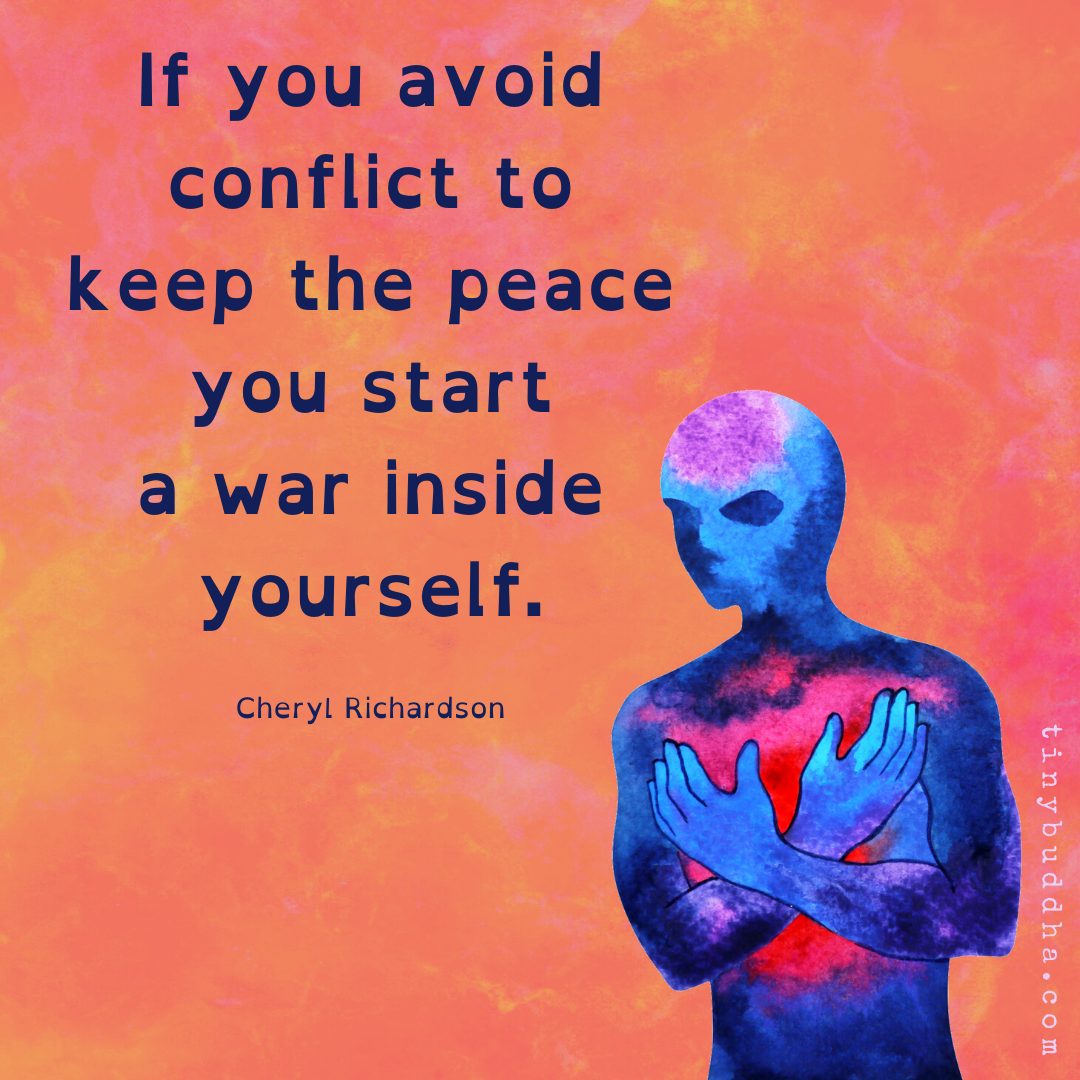
    How to Stop the War in Your Head and Find Peace

    “A mind at peace does not engender wars.” ~Sophocles

    There’s a classic Buddhist story about two monks who come upon a woman at the edge of a river. One of the monks carries her across and they continue on their way. Several miles on, the other monk turns to the first and says, “How could you do that? We have made vows never to touch a woman!” The first looks serenely at him. “Are you still carrying her? I set her down at the edge of the river.”

    This is exactly what our minds do, if we aren’t careful: We carry our upsets with us long after the original cause is over. (We also pick up imaginary burdens from a future that may never come.) It’s what I call “the war in your head.”

    You know what it feels like. On the surface, you are going about your day—at work, driving, shopping, watching TV. But in your mind you’re going over, maybe for the hundredth time, what your boss or neighbor or ex-spouse said last week. Or what they might say or do next week.

    Only a sliver of your attention is on what is happening now. The rest of you is in the future or the past, reliving an old battle or imagining a future one.

    I say the war in your head, but you will inevitably feel its effects in your body as well. Maybe your throat or your chest is tight, your breathing is shallow, and your stomach feels a bit nauseous. As far as your body’s concerned, you might as well be experiencing the scene in reality: the stress hormones flow just as surely, doing their damage.

    When the war is in your head, you are the loser, every time. It doesn’t matter how often you re-fight the battle (or fight it in advance)—you have ceded your peace of mind, and anything else that might be available to you in the present moment. You can wear yourself out, even boxing with shadows.

    I learned this the hard way, during and after my divorce. I spent hours, days, weeks, and months with a full-scale war raging in my head. I sleepwalked through the rest of my life to the accompaniment of a continuous background rumble of outrage, pain, and anger.

    Most of my energy and attention were sucked up in imaginary arguments with my ex-husband, his lawyer, and the judge. I would go over and over the same ground, inwardly reciting my grievances, telling them off, or spinning down the rabbit holes of innumerable “what if” scenarios. None of it did me any good—the war in my head only added to my suffering.

    Eventually I realized what I was doing to myself and laid down my arms in sheer exhaustion. The quiet in my mind was almost eerie, like a battlefield after the ceasefire is called.

    Although my divorce continued along much the same lines it had been, I refused to give up my entire life and energy to the fight. I consulted with my lawyer, did what was necessary when it was necessary, and slowly became aware of the life that had been flowing around me, unnoticed and unlived, while I fought my inner war.

    The truth is, the war in our heads harms no one but ourselves, and even a small-scale war can have major consequences. How often has someone cut you off in traffic, or made a rude remark that you ruminated on for the rest of the day? How often have you spent anxious hours worrying about a possible outcome that never occurred?

    Our mental real estate is too precious to give over to war and strife. Our bodies are too vulnerable to collateral damage. 

    Luckily, it is possible to stop the war in your head. The first—and most important—step is to simply recognize when it’s happening and what it’s doing to you. Most of us are so used to the war that we become essentially unconscious of it. It just feels normal.

    In the beginning, it will probably take a full-scale battle to get your attention, but eventually you’ll learn to recognize even a minor skirmish. When you do, the next step is to take a metaphorical “step back” from it.

    Put yourself in the role of a war correspondent, who is there to simply observe, not participate. You can’t stop the war through resistance—that will only fan the flames. You stop the war by removing the fuel it runs on, which is your unconscious participation.

    Imagine a dial that lets you turn down the volume on your thoughts, as if you were viewing a battle scene from a distance.

    Take some deep breaths, and let yourself be gently aware of any sensations in your body. You don’t have to do anything about them—just notice them and let them be. Becoming familiar with the negative effects of your mental war will help you to recognize it faster, and also give you the motivation to end it!

    If you’re a visual person, try imagining a breeze that blows through your mind, gently clearing away the thoughts… or perhaps waves crashing on a beach, leaving the sand smooth and empty. Then say to yourself: “I choose not to have a war in my head.”

    It really can be as simple as that. The war thrives on our unconscious participation. Once you become conscious of it, and make the choice to reclaim your mental real estate, the episodes of war will become both less frequent and less intense.

    When this happens, you actually become more effective at solving any actual problems you might have, because your thinking is not clouded by drama and noise. This kind of thinking—without the violent emotions and resistance attached—also doesn’t impact your body the way a mental war does.

    If you are tired of the war that rages in your head, join me in declaring a “no-war zone” in your mind and be vigilant in keeping it that way. There will always be events and situations in life that bring up resistance, anger, worry, and upset, but we can choose to be like the first monk and simply set them down rather than carrying them endlessly along with us.

  • Your Happiness Can Make a Difference in the World

    Your Happiness Can Make a Difference in the World

    “Don’t worry about what the world needs. Ask what makes you come alive and do that, because what the world needs is people who have come alive.” ~Howard Thurman

    When I was eight years old I saw a news report on a war. A wounded woman was crying on a stretcher, and soldiers were carrying guns running around her. Up until that point I had thought war was like dragons or knights in armor. It was fictional or happened a long, long time ago. I couldn’t believe it was real.

    At that realization, my experience of life changed. It felt like it was no longer okay to just be; I had to do something. There was something wrong with the world, and I had to do something to fix it.

    This stayed with me into adulthood and, while it gave me a sense of purpose, it also gave me a constant feeling of hopelessness. The problems seemed huge and insurmountable, and everything I did seemed so inconsequential.

    Coming Alive

    I have learned that one of the best indicators of a good path is feeling good, and hopelessness wasn’t feeling good. I felt burned out and unsure of myself. I didn’t feel alive.

    I felt this battle in me. I wanted to be free to make my choices based on inspiration rather than fear, but how can I feel that everything is okay when children are starving, water is poisoned, and we are killing each other and the planet? Clearly that is not okay, right?

    I didn’t want to rise up out of the realities of our world and pretend for the sake of my peace of mind that this wasn’t happening. I wanted to be present and meet our world’s problems, as well as my fear and pain, with compassion, and then to make a choice that feels good—because the last thing the world needs is another hopeless human.

    What brought me to life was allowing myself to feel connected to the rest of the world. Letting myself feel the suffering without trying to fix it and letting myself feel the joy and love without feeling guilty. (more…)

  • The Freedom of Not Needing To Be Right

    The Freedom of Not Needing To Be Right

    “You have your way. I have my way. As for the right way, the correct way, and the only way, it does not exist.” ~Friedrich Nietzsche

    Yesterday I drove my mother and father to the VA hospital in Albuquerque for a doctor’s appointment. I had never been to a VA hospital before. I guess I should have expected the numbers of crutches and canes, armless and legless veterans, young and weathered faces alike.

    I was personally witnessing the costs endured when humans war against each other.

    “Isn’t it odd,” I said to my mother, “that human beings war with each other?”

    Why in the world do we do that?

    Then I considered the ways in which we war on an interpersonal level. We humans war to varying degrees with our partners, our friends, our bosses, our co-workers, our siblings, our parents—pretty much all in the name of our need to be “right” or the need not to be wrong.

    We war over ideas and beliefs that we often have never questioned. These include ideas from our upbringings, our religions, our scars and wounds, and our existential need to identify ourselves in some way.

    How early did we lose our childlike wonder? When did we lose that innocent state in which we did not judge others, nor need to be “right”—when we saw the best in everything and everyone, and when it did not matter that someone was Christian, Muslim, Buddhist, atheist, republican, democrat, omnivorous, vegetarian, gay, or of a different race?

    When I observe my ten-year-old grandson, he appears to have no tendency to judge other people, not yet anyway. He has no need to diminish others, nor does he feel threatened by them.

    Would we, as children, have told lies about someone just because we wanted to win an election? Would we have been dismissive or even cruel to someone because they were of another race or religion? I don’t think so.

    As little children we only cared that we were loved. And we were still curious about everything.

    Somewhere along the way we lose our innocence and start to judge others. This becomes a primary source of our social anxiety and the undermining of our self-esteem, because if we are judging others, we fear that we are also being judged. (more…)