Tag: want

  • The Joy of Not Getting What We Want

    The Joy of Not Getting What We Want

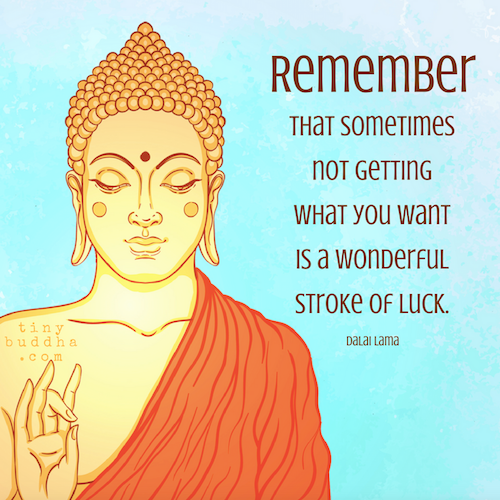
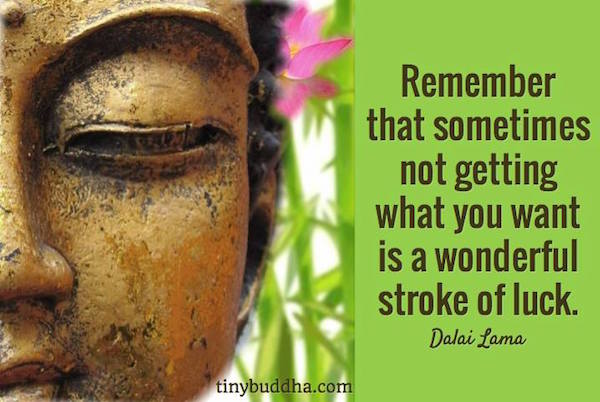
    “Remember that not getting what you want Is sometimes a wonderful stroke of luck.” ~Dalai Lama

    Let me tell you a story. I first read it in a book on Taoism, but I’ve seen it in at least a dozen other places since then, each with its own variation. Here’s the gist:

    There’s this farmer. His favorite horse runs away. Everyone tells him that this is a terrible turn of events and that they are sorry for him. He says, “We’ll see.”

    The horse comes back a few days later, and it brings an entire herd of wild horses with it. Everyone tells him that this is a wonderful turn of events and that they’re happy for him. He says, “We’ll see.”

    The farmer’s son is trying to break one of the new horses, it throws him, and he breaks his leg. Everyone tells the farmer that this is a terrible turn of events and that they’re sorry for him. He says, “We’ll see.”

    The army comes through the village. The country is at war and they are conscripting people to go fight. They leave the farmer’s son alone because he has a broken leg. Everyone tells him that this is a wonderful turn of events and that they’re happy for him.

    The farmer says, “We’ll see.”

    Now let me tell you who I was when I first heard that story. I was twenty-three or twenty-four, trying to get off of drugs and stop drinking and turn my life around in general. I had recently rolled my car out into a field, lost my wife and most of my friends, and had moved to West Texas to start over.

    I was smart enough to know something had to change, but I wasn’t quite smart enough to know how, so I tried to do what I thought smart people did—I started going to the library.

    I initially got into a bunch of weird stuff like alternate theories about the history of the world, cryptozoology, and things like that. Not really the change I needed.

    One day I went to the library looking for a book about the Mothman, but Stephen Hawking’s A Brief History of Time was sitting in its place. I didn’t know anything about this book or the things it talked about, but the title was cool, and libraries are free, so I checked it out.

    It’s hard to exaggerate how much this book revolutionized my view of the universe and my place in it. It was thrilling to recognize how much there was out there that I didn’t know. Atlantis and Bigfoot were replaced by quantum mechanics and string theory.

    I eventually stumbled onto The Dancing Wu Li Masters by Gary Zukav, rearranging my worldview again. Having grown up in a pretty strict evangelical home, any sort of eastern philosophy was completely outside my frame of reference. This led me to begin studying Taoism and Buddhism, most specifically Zen Buddhism, and to the story I started this post with.

    I started to recognize that I had a mind, but I was not my mind. Meditation showed me how this mind was always grasping and wanting and reaching out for different things. It was a craving and aversion machine.

    It wasn’t long before I realized that it wanted these things solely for the sake of having them, and that none of them were all that important. I just wanted what I wanted because I wanted it.

    This changed everything.

    I had spent the previous fifteen years running from one thing to another in order to avoid anxiety, fear, anger, and depression. I did this through drugs and alcohol and taking crazy risks with my life. These things have consequences.

    These consequences came as car wrecks, jail time, hospitalizations, and a long string of destroyed relationships. I was so captivated by my wants that I was running through life with my eyes closed, blindly chasing them, with predictable results.

    Realizing that I was not my mind gave me a sense of objectivity about the things I wanted and the things I did not want. It taught me that I didn’t have to be so attached to having or avoiding things. This let me stop running.

    I learned that getting our way is overrated. Once we recognize this, we are much less susceptible to the whims of a flimsy, fragile, and fickle mind.

    Why We Have No Business Getting What We Want

    There are three primary reasons we need to be careful about being too invested in getting what we want:

    • We are emotional creatures, driven by things like hunger and a bad night’s sleep.
    • To a great extent we’re wired for short-term thinking. Immediate benefit often outweighs long-term consequences.
    • We experience time in a linear fashion, so the future is completely unknown to us.

    Let’s take a look at these.

    Hungry, Angry, Lonely, Tired

    I often encourage people to memorize the acronym HALTS to use when making decisions. It stands for hungry, happy, angry, lonely, tired, stressed, and sad.

    These are all common emotional states, and they are all terrible times to make a decision. We’ve all heard the advice not to go shopping while we’re hungry, and there’s a reason for that—it’s good advice. You will buy more food than you need, all based on how you feel in that moment.

    I’m not sure I’ve ever seen good decisions come from these emotional states, unless luck intervened and let the person off the hook. It all makes sense when we think about it.

    Anger shuts down the best parts of out brain. Situations go from bad to worse and from worse to unfixable when we decide to address something in a moment of anger.

    When we are sad the entire world seems bleak and it feels like it will never change. This is okay, unless we make long-term decisions based on the idea of an ominous, crushing world.

    Stress makes even the smallest things feel overwhelming. We cannot make good decisions when making our bed or going grocery shopping sound like monumental tasks.

    When we’re lonely we’re likely to let the wrong people into our lives just because we need someone. This opens us up to toxic, manipulative, and malicious people.

    Our brains are slow and sluggish when we are tired, and our decisions are, unfortunately, rarely our best.

    Even the so-called positive emotions aren’t safe. I know I have overcommitted to things on days when I was happy and feeling a little bit better than normal.

    When you take all of this together, it helps us to see that the things we want are flimsy and that they change depending on our mood. The things we want become a lot less important when we realize that we might only want them because we had a bad night’s sleep, or we skipped lunch.

    Short-Term Planning

    Our immediate responses are rarely oriented to the long term. This makes sense, since most of the things our body needs are immediate—food, sleep, protection, sex, using the bathroom, etc.

    The problem arises when we focus on meeting these needs to the exclusion of the things that are good for us long term. I wasn’t stupid—I’d always known that the drinking and drugs were a problem. The problem was that rational James was usually outvoted by crazy James.

    I had good intentions, and they held so long as I wasn’t around any of my temptations. My long-term planning was solid until short-term fun was in front of me. It was infuriating to watch my resolve and dreams go out the window over and over again.

    As I mentioned above, our wants are flimsy when we begin to explore them. Why do you want chocolate? Why do you want a beer? Why do you want to go on a walk? Why do you want to go to Disney World?

    We have all sorts of answers for these questions:

    Because I deserve it.

    Because I need to relax.

    Because it’s a nice day outside.

    Because Disney World is the happiest place on earth.

    These don’t really hold up when we examine them though.

    Why do you deserve it?

    What does it mean to relax?

    What makes it a nice day?

    What makes Disney World the happiest place on earth?

    If we keep going, we always arrive at the realization that we just want to feel good one way or another. We want to feel good for the sake of feeling good. While there’s definitely nothing wrong with this, it is ultimately baseless, and we cannot let it drive our lives.

    Not feeling good is a part of the human experience. You’re going to get sick, you’re going to have days that are not as good as other days, you’re going to have a headache sometimes. These things are unavoidable.

    The things we want right here and right now are rarely the best things for us long term. Because of this, long-term planning requires intentionality and energy. It may be inconvenient but it’s true.

    We Can’t Predict the Future

    As a kid, I remember thinking it was weird that we couldn’t remember the future. If I could remember what happened yesterday, why couldn’t my brain go the other direction?

    This is one of the primary limitations of our species, and the most important reason that we shouldn’t hold the things we want too tightly. We don’t know how anything is going to turn out, including what will happen if we get what we want.

    I used to drive through Lubbock, Texas, once or twice a year to go skiing. Lubbock is a city out in the desert, and while I have come to love it here, I don’t think anyone would describe it as beautiful.

    Lubbock has some dubious honors. We have been voted most boring city in America, worst weather in the world, and I recently read that we have the worst diet in the United States. Our poverty and violent crime rates are roughly double the national average, and we score high on things like child abuse and teen pregnancy.

    I always swore I’d never live in a place like Lubbock when I would pass through here, but moving here twenty years ago saved my life. The place that I loved, Austin, I brought me to rock bottom. it was only a matter of time before I was dead or in prison.

    On the other hand, the place that I swore I’d never live has given me a college education, a family, and a successful business—all things that I thought only existed for other people. I honestly shudder when I think what my life would have looked like had I not moved.

    There have been smaller examples along the way. I was working at a CD store and loved it, but one Sunday corporate came in and said they were shutting the place down. They gave me a two-week paycheck to help them pack the store up and move it out. It was that abrupt.

    It sucked, but this led me to working at hotels, where I was able to get paid to do all my homework and still have time to read for fun. I burned through all the Russian classics, made all A’s, and got to spend a lot of time with my son when he was little. I will always be grateful for that.

    Before opening my practice, I was working at a private university. For someone with sixty-plus jobs in their life (my wife and I made a list), working on a college campus was amazing—it was the first place I saw as a “forever” job.

    When things went bad, they went all bad and it was obvious it was time to leave, but I was comfortable. I ignored some problems I should not have been ignoring, and it caught up with me. By the time I left I was burned out and sick all the time.

    This catapulted me into opening my own business because I didn’t really see any other options. I’d never seen myself as being responsible enough to do this, and people told me I didn’t have the head for it.

    Six years later, my business has been super successful and afforded me more freedom than I could ever imagine, but even this wasn’t the end. I recently closed my office to stay home with my kids, another twist I couldn’t have seen coming.

    We are trapped in linear time, so we don’t know what’s coming right around the corner. Holding on to one thing or another as the right thing or the thing we “should’ have often causes us to miss the amazing things right in front of us.

    Accepting What We Get

    My life has been a series of hard lessons brought about by my self-absorbed, entitled, and foolish choices. They have all, in one way or another, taught me one thing: I don’t know what’s best, so a majority of the time I don’t have any business getting what I want.

    Things like someone shelving a library book in the wrong place, corporate closing the place I worked, and moving to a city I actively disliked have brought about the best things in my life. I would not have chosen any of these if I’d been given the choice.

    We are emotional, shortsighted creatures who have no access to the future. Learning to cultivate acceptance for the things outside of our control often opens up amazing paths for us. I know it has for me.

  • How to Audit Your Life by Asking the Right Questions

    How to Audit Your Life by Asking the Right Questions

    “Don’t let your fear paralyze you. The scariest paths often lead to the most exciting places.” ~Lori Deschene

    I first learned about the concept of focus creating reality in 2004 when I was given William Whitecloud’s book The Magician’s Way.

    The first chapter is about the main character having a magic golf lesson. He learns that when people play golf, most of them think about how to hold the golf club, how to stand, and how to move the club. He calls this the “swing circle” and recounts how golfers often get caught there, rather than just focusing on where they want the ball to go. By shifting their focus, they could shift their results.

    What’s wonderful is that the process is entirely replicable for us all in any situation.

    At the time, I was two years into being an investment property consultant and part of a team of fifteen consultants throughout Australia. I was driving all over the place seeing clients in their homes—mostly evenings—earning just enough to get by, but I certainly wasn’t thriving.

    In fact, I was considered one of the poorest performers. I was working long hours and working hard, and while I believed in what we were doing, I wasn’t really enjoying it that much. So, having read The Magician’s Way, I started to use the ideas to improve my work life.

    I visualized having better meetings with my clients; I imagined my clients going ahead with property solutions I proposed; and my results started to improve.

    But I thought, there has to be more to this. I felt a very strong pull to study these ideas further. So, I decided to attend a course facilitated by The Magicians Way graduates where they taught clients to realize their dreams by connecting with their authentic selves and innate creative spirit.

    One of the things I learned was that we are all intuitive beings. When we tune into our intuitive selves, we become powerful and expansive.

    I discovered that when we give ourselves space to tap into our intuition about what we want, it comes through us from our higher selves. By shifting our focus to what would improve our lives and by using our intuition, we are infinitely more powerful and can create a life we love.

    For the first time, I was truly creating space to see what I wanted in my life from my unlimited self. I realized that I could choose the direction of my future. That I was the creator of my life.

    With this knowledge in hand, for the first time ever, I looked critically at all the different areas of my life to see where I was limiting myself and where I could change the story I had running through my head. I categorized my life into the following areas:

    • Career & Business
    • Finances
    • Relationships
    • Health & Well-being
    • Home
    • Possessions
    • Travel & Adventures
    • Social life
    • Spirituality
    • Giving Back

    To create change, we first need to be aware of our starting point. In order to move forward we must be honest with ourselves about where we are and face into our current situation.

    When I assessed my life I found that, other than my social life, none of the areas were in the shape I wanted them to be.

    Usually, we don’t create change without a reason. Change typically takes place when dissatisfaction arises or when we become aware of wanting a solution to our current problem. Being really clear about what we want to change and understanding where we are in relation to that is crucial.

    So how do we do that? How can we be objective about our current circumstances?

    Most people don’t regularly evaluate all areas of their life and give themselves a reality check. It can be hard to own up to the mediocrity or negativity. But this kind of ‘life audit’ is vital to understanding your current situation so you can then assess how far you are from what it is you desire.

    By creating space to see where each area of your life is, you are creating a starting point for change, for expansion and growth. You are allowing yourself to see what’s working, what isn’t working, and what could be improved.

    This may be confronting to begin with, but the more you allow yourself to go through this process, the more you will create reason and momentum to move forward in creating the life you love.

    A really powerful way to work through this process is to section off the different areas of your life and give yourself a rating out of ten for each—ten being amazing, you couldn’t get any better, and zero meaning that it is nonexistent or lacking.

    Here is an opportunity to go deeper with each area of your life and give those areas an honest rating so you will have a starting point for change.

    Relationships

    Let’s use an example. You might have given your romantic relationship a low rating. Start with what you feel is lacking from your relationship and partner.

    Some examples could be:

    • We fight too much
    • The passion is gone
    • We don’t spend enough time together
    • They don’t respect me
    • I feel like I am being controlled
    • We don’t have fun together

    Then flip it around. What are you, or aren’t you, contributing to the relationship?

    • I lose my patience with them
    • I don’t give them respect
    • I get angry with them
    • I feel like I want to control them
    • I don’t instigate quality time together

    The more you can analyze how and if you value your relationship, the more you can take responsibility. So, the more you own up to where you are, the more you are able to create change. Focus on yourself first: How am I behaving? How am I responding? Then ask yourself: What can I do differently to help create the kind of relationship I want?

    And since there are two people in your relationship, you’ll also need to ask yourself: What would I like my partner to do differently? How can I communicate that without attacking?

    Finances

    How do you rate your finances? Most of us have blocks around money and money flow, usually because of the beliefs our parents have instilled in us. Unless we are clear on where our finances currently are, how can we change it?

    Ask yourself why you rated your finances as you did:

    • Do I have enough money?
    • Do I just make ends meet?
    • I am in debt?
    • Do I fight about money with my partner?

    Knowing your numbers is crucial. Most people don’t have any idea what their financial position is. Remember, it’s impossible to move forward without knowing where you are right now. I review my full financial position three times a year—at the beginning of the calendar year, the end of financial year, and when I do my taxes.

    After you get clear on your numbers, ask yourself the following questions to ascertain how you can improve your financial situation:

    • Am I living beyond my means?
    • Am I trying to fill an emotional void through buying things?
    • What can I scale back on in order to save more money?
    • How can I increase my earning potential, if not immediately, in the future?

    Health & Well-Being

    List out the reasons you rated your health and well-being as you did.

    Maybe you are telling yourself:

    • I’m unfit
    • I feel overweight
    • I am not exercising enough
    • I eat junk food
    • I drink too much

    You might bring awareness to what you’re consuming each day. Are you conscious of what’s going into your body or are you unconsciously consuming food and drink? Now it’s time to consider your movement. Do you take regular walks? Are you going to the gym or participating in sports?

    Career or Business

    How do you rate this area of your life?

    Consider these questions:

    • Do you love what you do? If so, why? If not, why not?
    • If you do love what you do, what areas are there for improvement?
    • Are you clear on why you do what you do?
    • What is the why?
    • Do you feel energized by what you do, or does it deplete you of energy?
    • Does your work align with your values?
    • Do you enjoy working with your colleagues?
    • Are you happy with your marketing and reach?
    • How is your time management?

    Most of our waking hours are at work, regardless of whether we work for someone else or ourselves. So, if you are not enjoying what you do, that means you are spending most of your waking hours doing what you don’t want to do.

    Of course, it isn’t easy to change careers, but the first step is acknowledging your dissatisfaction and getting clear on what might be more fulfilling, and why.

    Knowledge & Learning

    Are you expanding? Are you learning new things and trying out new experiences?

    Ask yourself:

    • Am I closed off to new ideas?
    • Do I have an open mind, or am I relying on what I already know?
    • Do I proactively seek new knowledge for my career or business, or do I only seek new knowledge for fun?
    • When was the last time I actively sought out a situation where I could learn something new and expand my horizons?

    Travel & Adventures

    Ask yourself:

    • Am I giving myself space to travel, to see new things, and to have adventures?
    • Do I even know what’s out there?
    • When did I last go somewhere on a whim?
    • If I can’t afford to travel, how could I be more adventurous in my daily live?
    • How can I be a “tourist” in my own area—what could I see, do, and explore?

    Home

    Ask yourself:

    • Do I love where I live?
    • Is my house a home?
    • Do I feel comfortable, safe, and happy in my home?
    • Is my home a sanctuary?
    • Do I love the city, the suburb, or even the country I live in?
    • Do I enjoy inviting people to my home, or am I embarrassed by it?
    • Do my friends and family feel comfortable in my home?

    If you don’t love where you live, you may be able to change that easily, or you may need to work toward the long-term goal of moving somewhere new. But it might just be a matter of making changes in your environment—decluttering, infusing your home with your personality, or keeping work out of certain areas to make your home more relaxing.

    Spirituality

    How do you rate this part of your life? Did you even give it a rating? It’s an area that is often neglected. I know when I started my personal growth journey, I considered my spirituality non-existent.

    Spirituality doesn’t necessarily mean organized religion—it’s whatever it means for you. Simply take time to consider how your spirituality is being nurtured—or not—and what it could mean for you if you positively changed this aspect of your life. Ask yourself:

    • Am I part of a spiritual community, and if not, would I like to be?
    • Do I allow myself time to connect with nature?
    • Do I make time for spiritual practices that renew my spirit?
    • What does spiritual self-care mean to me?

    Giving Back

    Giving back isn’t just giving gifts or donating money or time, it’s also about how much you give yourself; how much you give in service to others, your community, or the environment. It’s also about how well you think of others, your community, or the environment as well as our actions.

    Ask yourself:

    • Do I give as much to myself as I give to others?
    • Is there a balance of giving and receiving in my life?
    • How am I serving my loved ones, my community, and the planet?
    • How do I want to give back, and why?

    Final Thoughts

    Now that you’ve reviewed your current reality you might feel a little uncomfortable. This is a good thing and should be embraced. As I said, facing into where you are is so important, as it represents the starting point from which you can grow. It’s this truth that will set you free. Well done for going there.

    You may also feel a little overwhelmed if you’ve recognized you’re dissatisfied with multiple areas of your life. That’s okay. You don’t need to change everything all at once, or even any time soon. You can start with the one area that feels most pressing and identify one tiny step to create positive change. Then from there, you can take another step. And another until you feel more satisfied in that area of your life and ready to focus on another.

    When I first did this exercise, I realized I didn’t want to continue the way I was living and I wanted things to look different. I knew then that I had a choice. We are at choice all the time.

    By owning up to where you are, you’re already moving forward into your vision. You can now begin to really shift your focus on what you want to change—and then start taking action.

  • How to Reach Your Goal (And Why Three People Showing Up Isn’t Failure)

    How to Reach Your Goal (And Why Three People Showing Up Isn’t Failure)

    “If you believe it will work out, you’ll see opportunities. If you believe it won’t, you will see obstacles.” ~Wayne Dyer

    I’ve been part of a social meet-up group for the past few years, one that’s helped me through tricky times like quitting my job, dealing with anxiety, and having my first baby. When I first joined the group, there were three people who attended the events. (Yes, you read that correctly—three people!)

    There were lots of people in the group itself, but only three of us would regularly attend monthly events. It meant that if one of us couldn’t make the meet-up, we would have to cancel the whole thing (or it would be a rather intimate evening).

    And yet, in the last year, the monthly attendance has quadrupled. (Admittedly, that only takes us to twelve people… but that’s still a 300% increase!)

    Not bad in a year (and anyone who’s organized an event knows how hard it can be to get people to actually show up). And we’re talking twelve “regulars”—people who love the meet-ups, and who come back time and time again, enthusiastic and inspired.

    Plus, our attendance is still growing, and interest is mounting. Who knows where we’ll be in a year’s time!

    As we tested out ways to increase our numbers, I realized that the lessons I was learning could be applied to life—not just to meet-up groups. I started using them in my own life, with great benefit.

    I realized that anyone going after a goal or project could use these strategies (and most of us are going after a goal, in some form or other).

    So here are five lessons I learned about getting what you want, as taught to me by our small (but ambitious) meet-up group:

    1. Be patient; play the long game.

    When we set out to increase numbers, we didn’t get disheartened if we didn’t see results straight away. We knew the long game was the most important thing. The first meet-up had four attendees. The next one had five. Then we went down to four again. It took a year for us to get more than ten regular members, and to really notice how the group had changed.

    A year can sometimes seem like a long time when you’re pursuing a goal or dream. But the time will pass anyway! Why not spend it doing something you love or are really passionate about?

    2. Do things that scare you every now and then.

    One of the ways we increased attendance was by messaging every single member of the group—to say hi, tell them about the monthly events, and to ask if there were specific reasons why they hadn’t attended in the past.

    At first, this felt scary. Are we bothering them? Will they tell us to go away? Or will we hear something bad about the events? It’s daunting reaching out to people you don’t know, and putting yourself out there.

    And yet, more often than not, it’s the best thing we can do! Let’s face it, if the things you’re doing currently aren’t working, then you might as well change it up. Try something new. What have you got to lose?

    Pressing “send” on that email, or saying yes to that call might feel scary for a few minutes, but imagine how great it would feel if you got the thing(s) you wanted. Are a few minutes of discomfort worth it for long-term progress or growth? I’d say so.

    3. Remember that things grow exponentially (one thing leads to another).

    The best thing about taking action is the snowball effect: your action sets off another action, which sets off another. And before you know it, you’re storming ahead.

    With our group, as more members attended, we could post more photos of our events (that didn’t show the same three people hanging out!) And as more people saw our photos and started coming to events, they told friends about it and invited them too.

    It’s the same with goals or projects. You might nervously share a few of your blog posts and think nothing is happening; you’re not gaining any traction. But you never know what’s happening out in the ether. Perhaps one of your posts resonated with a local professor, who shares it with her colleagues, who share it with their friends…

    The fact is, you never know what’s going on behind the scenes. So take an action step, and then another, and let the momentum build!

    4. Ask for help.

    No one does anything worthwhile alone. There’s always a team involved.

    The three of us emailed group members, posted on our Facebook wall, and spread the word however we could. We contacted friends. We held brainstorming sessions for ideas. We sought advice from peers and local event leaders.

    The best thing about asking for help is that most people want to help. In fact, they love it! Think about the times that you’re asked for advice. Do you get annoyed by it, or does your chest puff out ever so slightly?!

    Use the resources around you. Don’t be afraid to do so—because when the tables are turned, you may well be able to help in return.

    5. Be passionate about it.

    I’ve left this one till last because it’s the most important one, in my opinion. Be passionate about what you’re doing.

    The three of us in the group really believe in what we’re doing. We love holding the events. We love the sense of community we’ve created. And we’re so passionate about what we’re doing that we work on it—willingly—in our spare time.

    If you’re working on a goal or project and not feeling passion toward it at all, why are you doing it? Are you doing it for someone else, or to look good?

    Things are so much easier when we enjoy doing them. So choose wisely. Choose things you’re passionate about. And then during the tough times or dips (which do happen) you’ll be more likely to keep going, and you’ll feel even more committed when you come out the other side.

  • How Lowering Our Expectations Helps Us Do What We Really Want to Do

    How Lowering Our Expectations Helps Us Do What We Really Want to Do

    “Human beings can alter their lives by altering their attitudes of mind.” ~William James

    Despite being the sort of person who’s constantly generating self-improvement to-do lists, I’ve never been big into making New Year’s resolutions. If I make any at all, they usually occur as an afterthought, frequently after the fact, and without much in the way of any real resolution.

    However, this January I suddenly decided my resolution for 2019 should be to lower my expectations.

    My whole life I’ve been an overachieving, Type A perfectionist. The sort of person who obsessively stresses about getting work in on time, yet also compulsively turns in assignments a week ahead of their due date.

    While my discipline and work ethic are certainly qualities I’ve come to appreciate, they haven’t always served me well. My relentless drive toward perfectionism and often mile-high expectations have actually held me back from doing many of the things I’ve wanted to do.

    Having moved around a lot during 2018, I found myself in the new year without a yoga studio or routine practice for the first time in over a decade. After regularly getting on my mat for nearly half my life (in sickness and in health, for richer or for poorer) I was shocked and dismayed, and a little scared, by how easily I had fallen off the wagon. Even worse was how hard I was finding it to get back into the swing of things.

    I decided to sign up for a one-week free trial of a popular yoga app hoping the accessibility of classes and convenience of being able to practice whenever and wherever I wanted would inspire me to get back into it. However, the trial came and went and I still hadn’t logged onto the app or gotten on my yoga mat.

    Now officially a paying member, wracked with guilt and headlong into a shame spiral, I decided the least I could do was open the app. If only to keep from feeling any worse than I already did. As I scrolled through the classes I noticed most of them were only twenty or thirty minutes long; I certainly had twenty minutes to spare, might as well…

    Twenty minutes later, after having completed my first yoga class in months, I had an ah-ha moment.

    During the video, the instructor focused on letting go of needing to be in a certain place mentally and/or physically in order to begin to practice.

    Seated on my mat, I thought about why I had stopped practicing in the first place.

    I was used to practicing yoga in a specific way—taking a seventy-five or ninety-minute class in a traditional studio setting—and I kept waiting to have the time or energy or desire to find a studio and go take class. But none of those things ever seemed to align.

    After falling out of my routine I felt so badly about myself that I didn’t even want to think about yoga because every time I did it reminded me of how I should be practicing. And that’s what kept me from starting up again.

    The expectation that when I did yoga, it should be in a certain place and for a certain length of time kept me from seeing other options and ways of continuing to do something that was good for me and I felt good doing.

    In the spirit of taking action, and the belief that practicing for twenty minutes was obviously better than not practicing at all, I decided to try lowering my expectations. I had to figure out what felt doable to me. I still wanted to try and fit yoga into my week at least three times, but a practice of twenty to thirty minutes each felt like a more realistic goal, and one I knew was well within my reach.

    Lower expectations initially ran counter to everything I believed to be true about self-improvement (if you’re not crying or bleeding you’re obviously not trying hard enough!). According to science, however, low expectations might be the secret to success when it comes to creating positive change and building healthy habits.

    Because of what’s called the self-enhancement bias, people prefer to see themselves in a positive light. Though, this preference often and unfortunately gets in the way of real self-improvement when we overestimate things like how quickly and easily we can enact change, or how much change we’re capable of.

    When we set our expectations high and then can’t quite reach them, it feels like we’ve failed, discouragement sets in, and we tend to give up.

    Recent studies show that if we expect less, it’s more likely an outcome will exceed our expectations and have a positive impact on happiness. This is important because the happiness we feel when we exceed our expectations creates an intrinsic reward, which is a major component in building healthy habits that stick.

    Interestingly, after I got over the initial hump of doing less, it didn’t feel like I was lowering my expectations at all. I felt like I was simply breaking things up into bite-sized pieces and also being more realistic about how much I could accomplish given the amount of time, energy, and willpower I had. I found, in general, I got overwhelmed a lot less and ended up feeling better about myself overall.

    Another takeaway was the awareness that almost anything can become doable if you break it down into a process.

    I used to look at all of the big things I wanted to do in life and immediately become overwhelmed. Now when I look at those same things, take each individual goal, and format it as a step-by-step process, I realize I can achieve pretty much anything. It’s simply a matter of being reasonable about how long something is going to take, as well as getting real about how much I actually want to do a given thing.

    Lowering my expectations has equally helped me learn to prioritize my goals and itemize my time and energy, looking at what matters to me a lot, what matters to me a little, and what I really don’t care about at all.

    If you’re feeling frustrated about all the things you’re not doing—especially big, time-consuming activities—ask yourself if you really want to do this or just think you should. If it is something you want, try lowering your expectations of yourself and doing only what feels manageable, and see if that helps you get going. Like me, you may find that taking the pressure off makes it a lot easier to get and stay motivated.

  • How Recovering People-Pleasers Can Discover What They Really Want

    How Recovering People-Pleasers Can Discover What They Really Want

    “When you say ‘yes’ to others, make sure you’re not saying ‘no’ to yourself.” ~Paulo Coelho

    People-pleasers regularly subvert their own needs for the needs of others. We spend years saying “yes” when we mean “no,” signing up for commitments we’d rather avoid, and occupying our minds with others’ desires.

    When we finally clear out the clutter to put ourselves first, we look around at the empty space, bewildered, with endless questions. What do we want? What does true happiness look like for us? What would a life lived on our own terms be like?

    For me, these questions once provoked anxiety. I’d spent a lifetime catering to my parents, friends, colleagues, and lovers—anyone but myself. By asking what I really wanted, I was looking my fear straight in the eye: my fear of being responsible for my own happiness. My fear of not getting what I wish for.

    These fears are both potent and entirely surmountable—if we’re brave enough to connect with our innermost desires.

    When we’re strongly connected to our dreams and desires, we begin to set boundaries with other people so we can reach them, and we slowly start finding the confidence to speak our truth. Our dreams and desires remind us how communicating authentically will change our lives, and the lives of our loved ones, for the better.

    For this reason, we recovering people-pleasers need to reclaim our familiarity with our inner voice and innermost needs. We cannot communicate authentically with others if we can’t communicate authentically with our inner selves.

    In my journey to overcome people pleasing, I’ve learned a few helpful tricks to connect with my innermost self and uncover what I really want in all areas of my life. Perhaps one (or more) of these methods may help you do the same.

    1. Label your feelings.

    As I mention in my post on setting boundaries, many of us have become so attuned to the feelings of others that our own feelings are elusive strangers, entirely unrecognizable to us.

    Our feelings are critical guideposts as we learn to prioritize our own needs—if we’re able to identify and own them. We can rebuild our connection to our feelings by noticing their presence in our bodies and hearts.

    First, we must learn to give ourselves permission to be excited, inspired, and desirous. I often notice these feelings when they appear as fluttering in my chest or tingling down my spine. These feelings signal that I’m moving toward something that excites me.

    If, like me, you’ve spent a lifetime motivated by guilt and anxiety, your positive emotions can starkly illuminate the activities and relationships that bring you pure joy.

    We can also learn from feelings that are challenging or unpleasant, once we’re able to identify them. Instead of glossing over anxiety, overwhelm, and anger, we can notice these feelings as pits in our stomachs, pressure in our chests, and tightness in our throats. Those feelings might be signals that something isn’t right for us, or that we need to set boundaries with others.

    2. Leave the system.

    Sometimes our deepest desires are buried under layers of fear, particularly the fear of seeming selfish or the fear of disappointing others. One way to dig beneath the fear is to mentally remove ourselves from the systems of which we’re a part.

    Begin by considering one of your social systems: your romantic relationship, your workplace, your church, your family. Then, ask yourself: “What would I do differently if I weren’t a part of this system?”

    Previously unacknowledged desires emerge when you extricate yourself from the pressures and influences of your system.

    Years ago, when I first did this exercise, I wrote in my journal, “What would I do differently if I weren’t in a relationship with my partner?” I was amazed as my hand flew across the page, scribbling: “Sign up for a dance class! Go out with friends more! Sleep in on Sundays!”

    My answers helped me realize that I was suffocating my own desires out of fear of my partner’s reactions. What I really wanted was right there on the page. Having this list enabled me to consider how I might carve out more space for my own desires within my relationship.

    3. Make a wish.

    The first time I saw a life coach, she began our session with the simplest of questions: “If you were granted three wishes, what would you wish for?”

    At first I thought her question was contrived, but when I answered, two of my responses were illuminating: I wished for a healthier relationship with my family, and I wished to become fully self-employed in the career of my dreams.

    Then she looked me in the eye: “You want these two things very much?”

    I nodded.

    “More than anything else in the world?”

    I nodded again.

    She grinned. “Then what have you been waiting for?”

    I was speechless. I’d never given myself permission to suspend reality, if only for a moment, to dream big. Making a wish allowed me to dive into my dreams without stopping myself with “What if?”s  “How?”s and “I could never do that.” Once I spoke my desires aloud, I could no longer ignore their truth. I begin strategizing how to get there.

    Practice suspending reality to discover what you crave. Imagine that you could make a wish that would be instantly granted, or imagine that you could walk through a door and your ideal life waited on the other side. What do you notice about these dreams? What desires do they demonstrate?

    4. Weave a web of impact.

    One of people-pleasers’ greatest challenges is the fear of being perceived as selfish or uncaring. I know this was true for me. Many of us believe that our worth comes from meeting others’ needs. Sometimes we forget that speaking our truth positively impacts other people.

    Take a moment to ask yourself the question: “If I spoke my truth and set firm boundaries, who else would benefit, and how?” Consider your partner, your friends, your colleagues, your children, passersby on the street. Consider who you might serve as a role model. Who might benefit from witnessing your strength and independence?

    You will quickly realize that speaking your truth has far-reaching benefits. Keep your list visible to remind yourself of the web of impact your new habits will have.

    5. Start small.

    If you’ve been in a habit of people-pleasing for a long time, it may be challenging to immediately identify your own big dreams. You may feel that you truly don’t know what you want right now, and that is totally normal. Living your truth and communicating authentically are muscles; when you exercise them regularly, they become stronger over time.

    Give yourself permission to start small. For example, you might not yet know what you want out of your career, but you do know you love strolling around the lake in the morning and winding down your nights with chamomile tea. You may not yet know which city you want to relocate to, but you do know you’d like to take a mid-afternoon power nap and buy thermal socks.

    These wants are sacred whispers from your innermost self. Give your innermost self time to surface. By pursuing these small desires, you learn to trust yourself. You begin to realize that you are fully capable of being your own advocate and building the life you want.

    Pay special attention to how it feels to meet your needs. Be patient. With the passage of time, bigger dreams make themselves known in your heart.

    Authentic communication is a two-way street; we must speak truthfully to ourselves before we can speak truthfully to others. Once we become familiar with what we really want, we can imagine a world where we replace old habits, like people-pleasing, with new visions for a brighter future.

  • How I’m Freeing Myself from the Trap of Stuff I Don’t Need

    How I’m Freeing Myself from the Trap of Stuff I Don’t Need

    “In the marketing society, we seek fulfillment but settle for abundance. Prisoners of plenty, we have the freedom to consume instead of the freedom to find our place in the world.” ~Clive Hamilton, Growth Fetish

    I come from a time where passbook savings accounts were the norm.

    I can recall skipping along to the bank, aged eight, with one pudgy hand enveloped in my dad’s and the other clutching a little booklet.

    I’d wait my turn in line with butterflies in my belly. The teller was always so far away. But once I got to her, it was magical. She’d open a hidden drawer, extract the exact notes, and scribble the remaining balance into my passbook. Et voilà—cash in hand!

    Everything about this performance was concrete and transparent: Whenever I withdrew money, I immediately saw my bank balance decline. And without the risk of it nosediving into overdraft, it’s how I understood money was a finite entity. It’s how my parents taught me to not spend beyond my means, to only buy stuff I needed or had saved up for.

    Having a passbook savings account in my childhood and adolescence protected me from buying stuff carelessly.

    Fast-forward to 2018, now living in Australia—which equates to residing in opulence for those living in developing nations—I’m not only thirty-six years apart from my eight-year-old self, but also thirty-six worlds away. In this world my eight-year-old self would throw a tantrum if she didn’t get the Barbie doll she wanted. I blame credit cards for that.

    What also saw me come out on top all those years ago was the absence of the advertising glut that now penetrates an eight-year-old’s sphere.

    In 1982 Fiji, TV did not exist. I played outside. I read Enid Blyton. I didn’t read the newspaper. And I can’t bring to mind any specific billboards of that time, even though I’m sure there were a few in the city, where I did not live.

    Today, at forty-four years of age living in the era of affluenza and having a disposable income, advertisers know my attention is priceless. Yet, they get it on the cheap. This is despite my creating an anti-advertising bubble to cushion me: In 2014, I deleted my Facebook account. In 2017, my Twitter account. While I have Instagram, I do not use it. And I rarely watch commercial TV.

    The ads for stuff don’t just infiltrate this bubble—they gush in. Into my inbox, even when I didn’t sign up for the next celebrity’s latest self-help book because I am something to be fixed. On my phone, when I receive a text promoting a sale of 15% off TVs all day today (and today only!). On trams, trains, buses, buildings, freeways…

    The humble bus shelter does not escape from being turned into a billboard either. When I walk my dogs, I pass one that is currently telling me I can “drive away in a Polo Urban for only $16,990.” (Do I need a new car? After all my current one is nine years old, although it is running smoothly. Hmmm…) The posters on this shelter change weekly. It does not allow me the grace to become immune.

    Even if I could construct an impenetrable bubble, it’d be pointless. The Internet and its cookies would see to that.

    These cookies know—and remember with unfailing memory—what I desire (printed yoga leggings!). And they flaunt my desires by dangling carrots in front of me, whether I’m reading an online article, watching a video on YouTube, or searching on Google.

    And if the Internet tempts with its cookies, then it decidedly seduces with its availability. I can now stare at the blue light on my ever-ready smartphone and make decisions to buy yoga leggings whenever I want.

    The perfect time to do just that is before I flop into bed, after a long day’s hard work, cooking dinner, washing dishes, and watching an episode or two of my favorite show on Netflix. I should feel elated when I hit the buy button, but I find myself getting into bed not only with my husband, but also with guilt and a larger credit card debt.

    The grab for my attention and time under the guise of convenience and a better life is, however, simply the tip of the iceberg. What no one can see is that I am waging a war against myself—with the monkey-mind chatter that jumps from one justifying thought to another, convincing me that something is a need not a want. This is an example of what the Buddhists call suffering.

    About two years ago, my husband and I moved into the new house we built. It’s much bigger than one we’ve ever lived in. And as we prepared to move into it months beforehand, the justifications began:

    We need new furniture to match the modern feel of the house. (Danish style, as we had been subconsciously brainwashed by Instagram with everything that was hip in interior design.) And we need a bigger TV for the bigger living space. A new fridge because our old one won’t neatly slide into its allocated spot of the spacious kitchen. And more paintings, since we now have more walls…

    Not only did we ‘need’ all this stuff, but we also had to choose stuff that was ‘us.’ And it all had to look ‘just so’ when put together. So we researched online. Visited furniture, home, and electrical stores each weekend. Read reviews. Let the cookies take our minds into a rabbit hole of stuff we didn’t realize we needed.

    Just thinking about all the time, money, and energy we invested to get it ‘right’ sets my heart aflutter and raises a sweat. It was gruelling—the number of choices, the number of decisions (Did you know that an eight-year-old now has hundreds of different Barbie dolls to choose from?). Luckily my husband and I have similar tastes; otherwise, I’m afraid, adding a number of arguments into the mix might have broken us entirely.

    The evidence continues to pile up in favor of stuff even after the purchases have been made. After decking out our new house, I soon learned that not only did I possess things, but they also possessed me.

    I worried about scuffing the freshly painted walls, staining the white kitchen benchtop with turmeric while making a curry, and my nephews scratching the wooden dining table by racing their toy cars on it. (What’s that saying? Is it “Stuff is meant to be used and people loved”?)

    If I didn’t feel the compulsion to fill in the space, to make everything perfect, simply because the world presents me with the choices and pressures to do so, what would—what could—I do with all that extra time and energy, not to mention money? Read, write, hang out with my mum? See another part of the world? And, more importantly, who would I be? A happier, more relaxed person? The irony.

    So, with the odds stacked completely against me, how do I even stand a chance of coming out on top of all this stuff? (How does anyone?)

    I don’t believe the answer is to cut up my credit cards and get a passbook savings account, or to become a Luddite. The answer lies in cultivating awareness. By becoming aware of my thoughts and feelings, I can regain my power. Asking questions is paramount:

    Will it give my life meaning? Make my life easier, better? Why do I really want it? Is it only because I am chasing a feeling? Or because I want to squelch one? What would happen if I didn’t buy it?

    Failing this, I can always remind myself that almost everything material is optional.

  • How to Ask for What You Want and Need (No, It’s Not Selfish)

    How to Ask for What You Want and Need (No, It’s Not Selfish)

    “It’s not selfish to put yourself first—it’s self-full.” ~Iyanla Vanzant

    I’ve always thought of myself as individualistic. When I was a teenager, I often felt the desire to go against the grain, dressing alternatively and shunning bands my peers liked because I felt they were too popular. So it came as a huge surprise to me when my therapist called me a people pleaser the other day.

    I recently started cognitive behavioral therapy for insomnia, and during the first session my therapist identified that I put other people’s needs and wants ahead of my own.

    He’d asked me to give an example of a situation that is currently making me anxious (since anxiety is both a cause and symptom of insomnia), and I told him a landscaper made a mistake in my yard and I was feeling bad asking him to fix it.

    I’d hired the landscaper to build a fence and incorporate a parking pad into my backyard space. While the fence turned out awesome, the landscaper brought too much loam and turned the parking pad area into a hill that sloped down from the fence to the garage. When I asked him to level it, he got angry and said he had already spent man-hours on the project and would be losing money.

    I started to feel bad. Was his business doing okay? Did he have kids?

    “The job you agreed upon was for him to level it,” my therapist said. “It has to be level.”

    “But what if he is losing money?”

    “That’s none of your business. You wanted it level. It has to be level.”

    It took him repeating that sentence to me a few more times before the concept clicked, and I knew he was right. I was putting someone else’s wants and needs above my own. I do it all the time.

    “Why don’t I put myself first?” I asked him. “It’s like I think I don’t deserve to be treated as well as other people.”

    I expected my therapist to say I have low self-esteem and needed to work on that, but instead he said, “Because you’re framing it wrong.”

    Then he asked, “What’s your favorite ice cream?”

    Thrown off by the change in topic, I stammered something about Maple Walnut.

    “And is there an ice cream flavor you dislike?”

    “Tiger.”

    “So when you go to an ice cream store, do you ask yourself whether you deserve Maple Walnut or if you should just accept Tiger?”

    “Of course not.”

    “There you go. It isn’t about whether you deserve to have something, it’s that you want it. Plain and simple.”

    It was simple. Suddenly I felt like I’d been let in on the secret all the confident, take-no-crap, boundary-setting people in my life have known forever. If they want something, they go for it. They don’t stand around questioning whether or not they deserve to have it.

    In my case, I wanted the parking pad incorporated into my yard so that I could enjoy the added space. Therefore, the backyard has to be level.

    “Now that you know your position, the next step is to communicate it correctly,” my therapist continued. “Do not ask, ‘Can you please make this level?’ Simply say, ‘We agreed it would be level, so it has to be level.’”

    We ran through hypothetical life situations where I could apply this technique, and each time I made the mistake of asking the other person to “please” grant my wishes instead of communicating my wants and needs. Every time I smiled sheepishly at the mistake, it hammered home how I unconsciously present myself to other people.

    While trying to be polite and accommodate everyone else, I might actually be telling people I’m a doormat. Of course people are going to walk all over me because I haven’t given them guidance on where they can and cannot step!

    At the end of the appointment, I resolved to start setting boundaries and ask for what I want in life, and I saw results immediately. When I told the landscaper the yard had to be level, he fixed it. By no longer questioning whether or not I “deserved” the same treatment as everyone else and simply asking for it, I gained self-confidence.

    Granted, not all situations in life are as clear-cut as standing up for yourself with a landscaper. There are times to stand your ground and times to compromise, and the trick is to learn to tell the difference.

    Sometimes our wants and needs can directly affect other people, or their wants and needs can be in conflict with our own. In this case, it’s important to remember to balance healthy self-assertion with consideration and respect for others.

    For someone who habitually puts other people’s wants and needs ahead of her own, putting myself first simply means treating myself the same way I treat them—not trampling on everyone else!

    The ice cream story has changed my perception on putting myself first. It’s not selfish—it’s self-full. Sometimes I slip back into old habits and wonder if I deserve something, but then I remind myself I wouldn’t accept Tiger when I want Maple Walnut.

    Here are a few simple steps to setting boundaries and asking for what you want and need in life:

    1. Know your position.

    The most important step in setting boundaries is to know your position—what you want—and to stick with it. That way when someone comes back at you trying to change your mind, you can simply go back to your position.

    Imagine you’re at a dealership and you tell the salespeople that your budget is 10K. If they respond, “We have a newer model with leather seats and a sunroof for 13K,” your response should be, “My budget is 10K.” If they tell you only rust buckets go for 10K, tell them your budget is 10K and then walk away.

    Don’t forget what you want or need. It’s easier not to be bullied or walked on when you are confident in your position.

    2. Communicate your position.

    Communicate your position properly is just as important. When you ask someone to honor your wishes or approve of your position, you’re asking them to make you happy. But when you tell them what you want or need, you’re making yourself happy.

    If a friend asks you to go to a party with them but you don’t want a late night, you can choose to say no or agree to go on your own terms. Rather than asking if it’s okay if you leave early, tell them that you will go with them for a bit but you want to get a good sleep.

    If a friend is having an elaborate and expensive birthday and you can’t afford to attend multiple events, tell them. You do not have to apologize. Simply communicate what you can and cannot do.

    People don’t necessarily aim to walk on you, but if you don’t communicate what you want and expect, there is a greater chance it will happen. Have you ever felt taken advantage of but didn’t communicate your feelings, and the frustration built up inside of you until you finally snapped? Or worse: snapped at the wrong person? I’ve definitely been guilty of that.

    If you set boundaries and communicate them, everyone will know where they stand, and it will prevent future blowups.

    3. Stop asking if you “deserve” what you want.

    In my opinion, this is the most important principle. Do not question whether or not you deserve things in life. Simply know what you want and go for it.

    People who don’t set boundaries often don’t feel they “deserve” to set boundaries, and they feel that way because they’re used to always putting other people first. Their low self-esteem has been reinforced by their own inability to state what they want. It’s a vicious cycle.

    We can’t always get what we want in life, but we definitely won’t get it if we don’t ask. By focusing on what you want or need in life, rather than questioning whether you’re worthy to receive, you will help guide your own success and self-confidence will follow!

  • Why Letting Go of What We Want Enables Us to Get What We Need

    Why Letting Go of What We Want Enables Us to Get What We Need

    Seated woman

    “The most exquisite paradox: as soon as you give it all up, you can have it all. As long as you want power, you can’t have it. The minute you don’t want power, you’ll have more than you ever dreamed possible.” ~Ram Dass

    The first time I felt this paradox was in the middle of savasana after a challenging yoga class. I always say that yoga is a metaphor for life, and this is exactly why.

    Savasana is the final resting pose in which you lay flat on your back, close your eyes, and do nothing. A super yummy savasana is just so due after your work throughout the class.

    The more you are challenged throughout the yoga flow, the more likely you are to be pushed to a place of brokenness. You gave your all, and now you are spent. Dizzy and exhausted, you settle into savasana and release your entire body into the earth.

    Lying on the cold, hard ground never felt so good. You lie in silence, let your thoughts and breath go, and completely release. You feel deliciously blissful. And you might actually be feeling emotions for the first time all day, or maybe even all week.

    A slight smile spreads across your face as the sweat beads drip from your forehead. Or tears quietly stream from your eyes as you feel absolute joy and gratefulness. By the end of that savasana, you feel incredible. You feel like yourself again. You know you are whole.

    And it’s a good thing they have you do savasana at end of class, because you need the build up of tension during your yoga flow in order to allow yourself to really let go and just be.

    Could you imagine doing savasana at the beginning of class? Mind buzzing from a long, stressful day, thoughts racing. It’s possible, but much harder to do.

    This was how I came to understand the paradox of letting go in order to become whole. And trust me, it took many years of therapy, meditation, reading, seeking, and savasana to get there.

    We often cling to our desires and fight for them because we think we’ll be happy if we get what we want. But when we let go and accept what is, what shows up for us are often the things we need.

    These things tend to be the ones that really count, creating true happiness and meaning in our lives.

    But let’s face it, letting go on some issues is easier said than done. When it comes to deeper issues and matters of the heart, letting go can feel downright impossible. And on some issues, letting go may never happen. Some burdens may be too important not to bear. That is okay.

    However, even on the more difficult issues you may be facing, there still may be places in which you can soften your grip.

    I have had a strained relationship with my father since birth. From about four years old, I knew that he did not love me.

    All throughout my childhood, my father was both physically and emotionally abusive. My mother was loving, but also put in a position of trying to appease her husband, while at the same time protecting my siblings and me. This inevitably led to a lot of confusion and chaos in the household.

    Things finally came to a head when I was about ten. I was severely depressed, expressing passive thoughts of suicide, and displaying classic behaviors and symptoms of trauma.

    After a couple years of therapy and attempting to repair things in the home, my mother decided to divorce my father.

    Due to the history with my father, the court granted my siblings and me the opportunity to decide for ourselves whether or not we would like to visit him. Perfect timing too; my twelfth birthday was right around the corner as the divorce was being finalized.

    So, it was at the age of twelve when I decided to no longer participate in weekly visitation with my father. I would still see him occasionally for family events and holidays, but I kept my distance and he kept his.

    In my mid-twenties, I had little to no contact with my father, only seeing him about once a year for the holidays. However, I confronted him via email, defending my younger sister on an issue she was dealing with.

    She was only sixteen at the time, and was devastated when my father packed up all her belongings from his home and dropped them off on my mother’s doorstep without any warning. Apparently, she was no longer welcome in his home, and their relationship, too, was ending.

    In my father’s correspondence to me, he verbally confirmed what I had know all along, and stated outright that he did not love me and did not need me in his life.

    I was devastated and inconsolable. Although I had known and felt this since I was a small child, I had not actually heard these words before. Something about those words broke me wide open.

    I spun out of control and began a turbulent phase in my life in which I became severely depressed and anxious.

    I immediately began doing work in therapy, finally addressing the years of trauma that I had experienced, coming to terms with my broken relationship with my father. It was here that I began the long process of healing.

    Ten years later, I am significantly stronger. However, trauma is stored in our bodies, in our tissues, and in our brain chemistry, reminding me at times that it’s still there, but a mere shadow of what it used to be. Like an onion, the layers of trauma must be pulled back one at time.

    Looking back on my recovery process, the most challenging part for me had to do with my clinging to questions of what happened.

    I couldn’t understand why this had happened to me. I couldn’t let go of the fact that I was unloved by my father. I needed to have answers. I had been wrestling with these questions my entire life, and was bruised and broken time and time again, with no end in sight. This deep need and clinging only lead to more pain and hurt.

    Through therapy and yoga, I have come to let go of this ideal. I now know that I may never have the answers to my questions. I likely will never fully understand why this happened, why I had to experience this, or why my father behaved in this way.

    Now, instead of wrestling, I stand beside my questions, I cradle them in my arms, I offer them support, and I show them kindness. The questions, the injustice, the memories of hurt can be there, and I lovingly accept them into my life.

    More than this, I know that I am loved, that I am deserving, that I am kind, that I am a survivor, and I am whole. I always have been.

    In order to find acceptance and wholeness in my life, I had to release my death grip on my ideal relationship with my father.

    Whatever ideal outcome you’re clinging to, could you be open to the possibility of releasing it so that you can breathe, yield, and expand into something that is bigger? Could you give yourself time and create space so that you can become concise and clear about your being?

    If you can do these things, you will get what you need.

    Not unlike that challenging yoga flow I spoke of earlier, the real work comes when your body, mind, and spirit has been fully broken, your heart has been ripped wide open, and there is nothing left to do.

    And, no this is not easy. It will be hard.

    Letting go will make you question your identity, leaving you wondering if you give this one thing up, who will you be? What will you stand for? Will all your stress, worry, pain, hurt, sadness, be in vain? If you let go, who will believe your story? What will others think of you? What else will you have to let go of? What will you do next?”

    And here is where the paradox begins!

    “What will I do next?” is a tough question that can be scary to even consider. But it is here that change happens, and you do have a choice. Wholeness is knocking at your door, and you know what they say, “When one door closes, another door opens.”

    All that is required is to let go of the past and step boldly and bravely into your true self, your beautiful, loving, compassionate, deserving self. It is from this place of being that you may know wholeness.

  • How Getting What You Want Can Sabotage You

    How Getting What You Want Can Sabotage You

    Winning the Race

    You can’t win enough. You can’t have enough money. You can’t succeed enough. The only thing that can satiate that existential thirst is love. I just remember that day I made that shift from wanting to be a winner to wanting to have the most powerful, deep, and beautiful relationships I could possibly have.” ~Will Smith

    About a year ago, I made the decision to start seriously working out with weights for the first time in my life. I’ve always been an athlete and in decent shape, but I wanted to test my body and see how much of its physical potential I could realize.

    Besides, I was approaching thirty and wasn’t exactly looking like the same pillar of youth I used to look like.

    Well, needless to say, it worked. Within six months, I got into the best shape of my life I had ever been in. I went from a very unhealthy 170 pounds down to a very healthy, lean, and toned 160 pounds. I felt so incredible, both physically and mentally.

    But then something strange happened.

    I started to slack off, until eventually, I just up and stopped. I lost the desire and motivation to keep going and keep exercising. As a consequence, within a few months, I fell back into the same shape I was in before I started.

    I got exactly what I wanted. I started lifting weights to get into the best shape of my life, which I did. I wanted to get really healthy and fit, which I did.

    So then why did I stop? Why did I slow down? What happened to my desire and motivation to keep going?

    I just couldn’t understand what happened.

    I wanted to find the answer to these questions, so I started doing some exploring, both internally and externally.

    The fact is I was duped. Actually, we’ve all been duped.

    In the modern era, we’ve become an overwhelmingly results-based society. It’s all about the destination. It’s all about goals. It’s all about the achievements, the rewards, the prizes, the medals, the trophies, the paycheck, and the big shiny things we can acquire and stuff into the big shiny house.

    The only problem is this: Nobody ever told us what would happen once we actually got those things.

    If a person sets out to lift weights and exercise for the sole purpose of reaching a weight goal, then where is the desire and motivation to continue lifting weights and exercising going to come from once that goal is reached?

    Some might say, “Well, then you have to set a new weight goal and go after that one!”

    So I’m supposed to just constantly be held hostage by results? I’m supposed to just keep chasing one goal after another, like a cat chasing a string? I’m supposed to become permanently attached at the hip to hitting targets?

    That sounded really monotonous, tedious, and lifeless. No thanks!

    The answer to my questions came to me when I was watching an interview with a man named Elliot Hulse, a gym owner and passionate fitness coach:

    “When we go to the gym with a goal in mind and we just go through the motions robotically, it robs us of the experience of the actual workout. Think about going to the gym just for the workout and not for the goal; not just so that you can put a check mark next to the reps and the sets that you did, but so that you can really become engaged with what your body wants to express.” 

    Like most people, I decided to start lifting weights and exercising to get into great shape. I did it for the sole purpose of achieving an outcome; of getting an end result. The problem with that is, since that was my main source of desire and motivation to work out, I lost that source of desire and motivation once I reached my goal.

    Getting into great shape and becoming fit was an awful source of desire and motivation. My reasons for starting to work out in the first place were bad ones.

    Lifting weights and exercising was nothing more than a means to an end for me. I didn’t do it because I actually wanted to do it. I didn’t do it because I loved the activity itself. I did it for superficial reasons.

    As a consequence, once I got what I wanted, I didn’t care to do it anymore. I no longer had the desire or motivation to keep working out.

    Instead of lifting weights and exercising for the sole purpose of getting into great shape, I should have started lifting weights and exercising for the sole purpose of loving the activity itself; of loving the physical challenge it presented to me as a way to test myself.

    Boom! That was it. That was the answer I was looking for. That was the answer to my questions, and was exactly what I was looking for.

    So, I started over. This time, however, my reasons for working out and exercising changed.

    With my newfound outlook, I completely stopped setting goals. No targets, no projections, and no objectives. I simply told myself this, and reminded myself of it every single day:

    “Love working out. Love lifting weights. Love the challenge of pushing myself to my physical maximum. Love the process. Enjoy it!”

    Not only did I get back into great shape, I felt much better along the way. I didn’t feel any pressure to achieve any arbitrary goals or targets. Working out didn’t become this monotonous task that I felt like I had to do in order to justify an expectation.

    I actually loved working out. I became engaged with it. It became really fun. I became much better at it, and even performed better.

    And the best part? My desire and motivation to work out has never been greater. It’s never faded off. Not even in the slightest bit. It will never run out. Why? Because my desire and motivation for working out comes from an infinite source: The love of the activity and the process itself.

    I transferred this outlook over to my work life as well. I have zero goals in my career. I don’t have a single objective or target set. Instead, I tell myself this, every single day:

    “Love your work. Enjoy working. Be the absolute best you can at what you do. Provide as much value to every single person you work with as possible.”

    To this day, I’ve never been more successful, happy, and fulfilled in my career. I’ve progressed much further than I ever did before since adopting this new outlook. I feel liberated and unshackled, like I’ve lifted a huge mental weight off my shoulders.

    Results are always the biggest imposter. Goals are always the biggest distraction. They’re a trap. If you do things for the sole purpose of achieving results and goals, then you’re robbing yourself of the opportunity to really become fully enthralled, intimate, and engaged with the process and journey itself.

    You’ll sabotage yourself.

    You don’t have to set goals to get results. Results are simply a natural consequence of enjoying something and doing it well. Results are things that come to you. They’re not things you can get.

    By prioritizing the process itself as opposed to what you can get from it, you create an endless source of desire and motivation. You liberate and unshackle yourself from the traps of results-oriented thinking. You’re able to do what you love with less pressure, less tension, and less stress.

    Not to mention, you’ll still get the results you want. Often times, you’ll get even better results than before.

    You might be thinking, “What if I don’t enjoy the process I’m doing?” Well, perhaps it’s time to move on. Quit. If something doesn’t make you happy, or makes you miserable, is it worth it to continue that process in the long run?

    Or, you can simply change things up a bit. If lifting weights is a process you don’t enjoy, try bodyweight exercises. Try resistance training, like kayaking or swimming. Keep changing things up until you do find something you can truly love and enjoy taking part in.

    Besides, if you find yourself truly unhappy doing something, there’s a good chance that whatever goals you aim to achieve won’t actually satisfy you anyways, or make it feel like the price you paid was worth doing something that made you feel miserable the entire time.

    The process is the most important thing. It’s the journey itself that yields the greatest rewards; that makes you feel awake, present, engaged, and alive.

    “Happiness is in the doing, not getting what you want.” ~Jesse Wallace

    Winning the race image via Shutterstock

  • Courage Is Doing What You Really Want to Do, Even When You’re Scared

    Courage Is Doing What You Really Want to Do, Even When You’re Scared

    All Our Dreams Can Come True

    “Courage is not the absence of fear, but rather the judgment that something else is more important than fear.” ~Ambrose Redmoon

    It’s only 9:25am on a Saturday morning and I feel myself welling up already.

    I know this is difficult. This might just be some of the hardest stuff he’s ever had to do.

    I’m there. On the sidelines, watching him.

    I know him so well by now and all of his little “giveaways.” His eyes looking for mine. Fidgeting.

    We’ve agreed that he’ll give it a chance because he really wants to do this. REALLY, REALLY. There’s no doubt about that.

    But in order to get what he wants, he needs to show up. He needs to:

    • Be present
    • Get out of his comfort zone
    • Feel the insecurity, the nervousness, and all this new stuff

    It’s not my job to ensure that he’s always inside his comfort zone and let him stay there forever.

    It’s my job to be by his side every single time he exits his comfort zone, his safe place where everything is familiar, easy, and nice.

    And then the tears come. A mix of being (oh-so!) proud and me seeing myself in him.

    Phew! I take a deep, deep breath.

    He’s running toward me. Throwing himself in my arms and cuddling up for a deep hug.

    “Mom, I’m actually a bit scared. There’s so much noise and I don’t even know all of these other kids.”

    He hugs me a bit harder. We sit like this for a few minutes until I feel him relaxing.

    “All right, out you go. Just do another five minutes,” I tell him, cheering him on. “You can always come back for another hug, but we’ll stay here until the game finishes, so get out there and play.”

    We had five lovely hugs in two hours and when we got in the car to go home, he was a very (very!) proud five-year-old boy.

    “Mom! Did you see my goal??”

    “I sure did, sweetheart!”

    Let’s wind back time seven days to when I was on a plane to London, feeling:

    • Excited
    • Anxious
    • Nervous
    • A knot in my stomach
    • Curious

    I was on my way to a big conference with a whole lot of people I didn’t know.

    “Ohhhh, Mads, I almost don’t even want to go. Why does it have to be like this every time I do something new?” 

    I said this to my husband all snuggled up in a big hug before we got in the car for them to drop me off at the train station.

    “It’s part of the game, baby. You know that. And Maj, remember that you feel this way every single time, and you go through with it and feel awesome. You feel proud for going through with it, for being brave and for learning all this new stuff.”

    I know.

    My husband is a very wise man.

    My point:

    Whether you’re five years old and about to play your first indoor football match, feeling super nervous but really wanting to learn how to play football, or you’re thirty-seven years and going to a big conference in London, about to meet some of the world’s leading teachers and have a private dinner with them, it takes courage.

    Don’t let it fool you, though!

    Courage is not the same as an absence of fear.

    In no way.

    Courage is doing what you really want to do, even if it scares you to death.

    Like this… me writing this blog post to you, telling you (very openly and honestly) about my own vulnerability; telling you how I feel when I have to do something I haven’t done before.

    Courage is taking teeny, tiny steps in the right direction even though, sometimes, that really is freaking terrifying to do.

    And sometimes you need to go back for another hug and just soak up a little bit more of that security before you make room for another tiny little step.

    The courage that makes you an inch closer to where you want to be.

    The courage that makes you, in one year, closer to the goal you visualized than you are today.

    Courage is also required when you’re being honest in a relationship.

    It’s being brave enough to say what your heart knows is right but you know might upset your partner.

    Being brave enough to say what you’re missing the most even though you’re afraid that your partner might see this as criticism and might snap at you.

    Saying the one thing that makes you so vulnerable and gives your partner the possibility of hurting you.

    Being brave enough to taking that step in that direction that enables you (and you as a couple) to, in one week, one month, one year, be even closer to the relationship you long for and the relationship you know, deep down in your heart, is right.

    Courage is doing something you wouldn’t normally do despite the fact that you’d much prefer to do what you usually do.

    It’s courageous to be brave enough to pursue something better.

    It’s brave to put in a hardcore effort to get closer to your goal.

    Whether it’s indoor football for juniors, a conference in London, a better relationship, a better job, or the courage to be bold enough to work on getting more quality into your life in general, it all requires courage.

    And it requires you to be brave and that you act.

    Just one step at the time. Teeny, tiny steps in the right direction.

    You know what the next step for you is, right now. Take that step.

    Yes, it’s a challenge. Be courageous!

    Dreams come true image via Shutterstock

  • You Don’t Need Anyone’s Permission to Do What You Want to Do

    You Don’t Need Anyone’s Permission to Do What You Want to Do

    “Your time is limited, so don’t waste it living someone else’s life. Don’t be trapped by dogma – which is living with the results of other people’s thinking. Don’t let the noise of others’ opinions drown out your own inner voice. And most important, have the courage to follow your heart and intuition.” ~Steve Jobs

    Two weeks ago, I pulled a muscle in my back. It was really scary in the moment, and initially I thought I was much more badly hurt—though it ended up healing miraculously quickly, after a couple days of intense pain and a couple more of moderate pain.

    The morning that it happened, I sobbed on the bed as I laid motionless, telling my husband I couldn’t believe I’d hurt myself and that I maybe had a herniated disk or whatever it is people talk about, and I’d probably need surgery or at the very least, weeks of physical therapy, and how the hell was I supposed to drive to work that day, and then oh my God, the medical bills?!

    After a little while, I calmed down after I realized I could move a little, as long as I didn’t move or rotate my spine, and my husband said it sounded like a pulled muscle rather than something skeletal.

    After a little while, I drove in to work, in a lot of pain, and apologized to my co-workers in advance about the whining.

    That night, sleeping on it made the pain even worse, and the next morning I bemoaned, “I can’t belieeeeeve I’m going to work. I’m in so much pain, how am I supposed to be present with a client? But I have to go.”

    Normally, I’d have stayed home without too much of a fuss, but we were flying out to Texas that night to visit my family, and I hated the thought of missing an extra day when I was going on vacation for the next three workdays.

    It also meant that I might not get to say goodbye to one of my clients who was discharging, which I felt sad and guilty about.

    My husband has learned better than to tell me what to do, so he encouraged me to do what I thought I needed to. What I was subconsciously thinking in that moment was that I wanted him to give me permission to stay home, dammit, so I wouldn’t have to feel guilty about it!

    I started driving into work and then called one of my colleagues (my Work Wife) and told her what was going on.

    She thought of another solution where I may still be able to see the discharging client, and told me in no uncertain terms that I should stay home. I immediately turned around and drove home.

    She had given me permission. I was relieved.

    When I got home and my husband seemed surprised to see me, I got angry. He went about his regular day (as a teacher, he’s home for the summer) while I fumed on the couch, silent and in pain.

    Finally, I broke the silence: “I’m upset because I wanted you to give me permission to stay home, and you didn’t, and then when I came home you looked surprised, which makes me feel like you think I should be at work even though I’m in a lot of pain, and it makes me think you don’t think it’s that painful, and IT IS!”

    Of course, he did the patient husband thing where he says no, that’s not what he was thinking, and of course I’m in a lot of pain but he doesn’t want to tell me what to do.

    So I continued to sit, slowly cooling down (it so helps me to articulate the story in my head like that) reflecting on this issue of “permission.”

    It happened again today on a conference call with a couple peers in my industry, when I told them about a training I thought I needed to do to.

    In talking it out with them, it became clear to me that I was just dealing with classic Imposter Syndrome, and was looking at an expensive and unnecessary training to try to alleviate that by making me “more legitimate.”

    They gave me permission.

    I was able to acknowledge that’s what I had been looking for, even though I hadn’t consciously realized it at first, and we laughed about it on the call.

    One of the other women—further along in her business than me, with a booming, successful practice—shared that even with where she is in her business, she still struggles with this stuff, too, and still wants permission until she eventually circles around and realizes that it needs to come from herself.

    I never would have thought of permission as something I struggle with, because I don’t hesitate for a moment to give myself permission for dessert or a new shirt or book. But it shows up in other ways—subtly, quietly, and then all the sudden I look up and it’s waving its arms going, “You’d better pay attention to me!”

    The biggest is the permission to let myself slow down. To not be “productive” all the time. (And, news flash, this actually ends up working against me, because it turns out when you try to work on fifteen things at once, not much gets done!)

    I am grateful for the people in my life who have given me permission when I was not in a place to give it to myself, and to other people who remind me that giving it to myself is possible, too.

    If you’re like me, sometimes you need life to put an issue right smack in the middle of your path a few times before you really take notice.

    The signs I got, courtesy of my injury and obsessing over feeling “legitimate,” helped me to see that I was struggling with an issue I didn’t even think I struggled with!

    So if anything in my story resonated with you, consider this your sign: Whatever that thing is that you feel pulled to do, try, quit, or let go of, you don’t have to wait for permission from someone else.

  • How a Pause Can Help You Say No and Avoid Regret

    How a Pause Can Help You Say No and Avoid Regret

    Say No

    No is a full sentence.” – Unknown

    I like to help. I like to be kind. I like to join in.

    Usually, these things happen as a result of saying yes. Generally it makes me feel good inside. Better about myself.

    But what happens when helping, kindness, and joining in ends up being a burden with too many negative repercussions? Do we continue on the same path? Should we continue to say yes?

    Throughout my life, I have had a good relationship with the word yes. Yes has led me to unexpected, beautiful, memorable experiences. Yes has brought me to my beautiful partner and family. Yes has allowed me to approach life with open intention and a limitless heart.

    But the light and wonder of the word yes also has a darker side.

    Yes has led me to regret, yes has led me to boring and bitter moments, and yes has had me suffering.

    Many people I know (me included) burn out in the process of agreeing to things that maybe we shouldn’t. We nurture, we soothe, and we offer companionship—oftentimes to others before ourselves because we say yes.

    We are often quick to say yes and dive into tasks, parties, and relationships when sometimes we should be saying no.

    This is no mean feat for a person conditioned to play certain roles to please. The transition to kindly, firmly, and confidently say no has been a long time coming for me.
    Having experienced one too many moments agreeing to things that deep down I didn’t really want to do, I found it helpful to practice saying no. That tiny word with so much power. That tiny word that has mostly liberated me from the clutches of others’ approval.

    It was hard at first. Often I would say no, followed by a long line of excuses, and then I would even offer an alternative arrangement, for fear of offending the other person.

    Sometimes I would ruminate about saying no for a long time after the event, beating myself up about it and wondering if the person might ever speak to me again.

    Then as I got older I guess, or finally had enough, or maybe it was a natural transition, I started a tentative relationship with the word no.

    I danced with the word by creating more space between requests and answers and stopping to feel whether yes felt right. I listened to what I really wanted to do.

    There is a beautiful tale told by Clarissa Pinkola Estés about intuition.

    In a nutshell, a mother is dying and she wants to ensure her daughter learns to trust her own intuition after she is gone. She hands her daughter a miniature doll, which looks much like the little daughter.

    The dying mother tells her daughter to keep the doll in her pocket at all times, feed it, and listen to it whenever she is lost or unsure. These are the last words the mother speaks and the little girl is left holding her doll—a miniature version of herself.

    The tale goes on to follow the little orphan as she navigates her way through a difficult time. Every corner she turns, she touches the doll in her pocket and listens for the answers.

    Of course the little doll is not actually giving her the answers. The little doll is her. And through the process, she reaches deep within, to listen to her true self and guide her to safety and to love.

    According to Estés, the doll represents the inner consciousness of all of us.

    If we were to pause momentarily every time we are faced with a difficult decision, we might actually hear the answer from within. Intuition, like many things, needs to be practiced and developed.

    Therefore, the best practice for strengthening my relationship with the word no is to pause and feel in that moment. The present. Listening to the doll in my pocket.

    It has been liberating to create space between. These days we are really quick to formulate responses in conversation, write hurried emails back to people, voice our opposition to something… It’s jarring and sometimes leads to regrettable outcomes.

    In building a better relationship with the word no, space can be created. Stillness. The space between feeling okay and not feeling okay.

    All these years, I jumped to yes automatically. I jumped to yes because I was brought up to say yes first. I said yes because I was (and still am in many ways) eager for approval.

    Please don’t get me wrong—I am not breaking up with the word yes for good. That is not healthy either. But yes and I are making a ‘conscious uncoupling’ for a while, in order for me to find my inner voice.

    I am doing this to hopefully have a better long-term, balanced relationship with the word no, and ultimately those around me. I value both words and the opportunities they bring (and release) for me, and I hope to support my child to learn to do the same.

    Life feels so much lighter when we practice finding the space to stop, feel, and listen to the doll in our pocket.

    Woman saying no image via Shutterstock

  • What You Think You Want Might Not Be What You Need

    What You Think You Want Might Not Be What You Need

    Woman Daydreaming

    “The more you love your decisions, the less you need others to love them.” ~Unknown

    I got on that twelve-hour flight thinking I was ready. Yet during the travel from my house to the airport to Belgium, my feelings were suspiciously neutral.

    I neither hated where I was nor felt strong emotional attachment. Less than two weeks later, those emotions came out, full force. Ten days into graduate school in Belgium, I realized that this wasn’t what I wanted.

    Everyone told me to stay, to tough it out. I didn’t realize then that their advice was for them—that my peers wanted to stay in school, and my friends wanted to have a life in some exotic land like Europe.

    That’s when I realized that everyone comes from a different place—everyone has different values and desires—and their opinions should not dictate how we feel about our choices.

    When I decided to quit school, everyone was against it. One peer clutched my arm tightly, as if I’d just told her that today was the end of the world. Some even got angry.

    At first I was affected by the overflow of emotions, until I realized that what I did had no permanent effect on their lives, regardless of how they reacted.

    Wants vs. Needs

    I was an overstrung, high achiever in both high school and college. I played by the rules and did what I was told. And I was addicted to status.

    Advisors and teachers told me that I should apply for the Fulbright scholarship, that I should join Peacecorps—it’d be wonderful, it’d be life-changing. I did what others deemed best for me, and it made me reliant on them and ignorant of my own instincts and desires.

    After graduating from college I needed a rest from it all, but used to going full-steam ahead, I kept pushing. I hoped I could start graduate school in Germany or France, leaving myself only a two-month break after years of schooling.

    But every school I applied to rejected me. Though I cried after received those long-awaited letters, I now realize this was a blessing in disguise.

    That year, I went “nowhere.” I felt unhappy, stuck, and lost. But I kept applying, hoping for an adventure for the following year.

    During that time, I decided to distract myself. I wrote more. I exercised more. I tried to laugh a little bit more. I fell in love with krav maga and found a community of people who I rejoiced in seeing almost every day.

    Then I was accepted into a masters program in Belgium for the following year.

    Life was going to be okay because I finally got what I wanted; I was going to Belgium in six months!

    During the countdown, though, as I trained more and had more time to myself, I began wavering.

    Gone were the moments of nervousness, fear, and apprehension that were so constant post-graduation. I found myself living in the moment more often. My skin was clearing up I was shedding stress-induced weight; I was going out more. I stopped dreaming about being away.

    After a particularly grueling session in class, my krav maga instructor came over to me with a smile and said, “Once you’ve traveled the world and seen everything you want, come back here, where you belong.”

    I laughed at first and said, “Sure,” thinking in my head that I’d probably be gone forever.

    Guess who was right in the end?

    Fear vs. Lack of Desire

    People always told me to “try it,” and “just do it,” and that seemed like a good life motto. Never let fear hold you back. But what I was experiencing before leaving for Belgium wasn’t fear; it was a lack of desire.

    My first time studying abroad in Taiwan was nerve wracking but brimming with anticipation. I cried over late documents and panicked over lost plane tickets, but no matter what, the final destination was Taiwan.

    I broke off a long-term relationship, I studied hard into the night, but I knew that it was well worth it.

    The night before I left, I began wondering if I was doing the right thing, if I could leave home for the first time for a whole year. That thought passed as quickly as it had appeared. I departed, and am glad I did, because I knew that it was the right thing for me to do. How did I know? I felt passionate.

    Fast-forward three years later: going to Belgium wasn’t what I wanted. I just couldn’t admit that. I didn’t print my plane ticket until twelve hours before my flight. I didn’t pack until a day before I left. I just didn’t care to go to Belgium anymore.

    Apathy is said to be worse than love or hate. I was entirely apathetic about my “next adventure.”

    I’ve learned that fear is different than a lack of desire, and even if we don’t listen to our instincts right away, we can always tune in and honor what we hear. Accept what happened, accept that your desires have changed, and listen more closely to what you really want and need.

    Our instincts not only keep us safe but can help guide us through life.

    Woman daydreaming image via Shutterstock

  • What to Do When You Know What You Want but Feel Stuck

    What to Do When You Know What You Want but Feel Stuck

    Stuck

    “What is the meaning of life? To be happy and useful.” ~Dalai Lama

    Five years ago I had a brilliant idea. Since I was pretty good with social media, I decided to start my own business helping companies develop their online presence.

    My goal was to work for myself, and the plan was that I’d quit my job, travel the world, create my own schedule, and earn a living doing something I’d seen others have a great deal of success doing.

    After spending weeks brainstorming I came up with the perfect name for my company. I wrote my mission statement, designed a logo, and purchased business cards. I took as many courses as I could in social media marketing and signed up for every newsletter available on the topic.

    At the time I thought my goals were clear. But after spending hundreds of dollars setting up the company and countless hours reading articles and taking trainings, I felt completely stuck.

    Every time I’d try to talk about my mission, I felt like a fraud. Every time I’d try to reach out to potential clients, something would stop me. I couldn’t even blog about social media marketing because my mind would go completely blank.

    After several months I decided to step away from the business and spend time volunteering in Brazil. It didn’t take long to gain clarity about what the issues were.

    For starters, just because I understand how social media marketing works doesn’t mean it’s something I should be dedicating my life and time to doing.

    I also realized that my reasons for starting this particular business had very little to do with bringing value to others, or even with my personal goals.

    I felt like a fraud because I wasn’t being authentic, and as long as I felt that way, I knew I’d continue seeking outside of myself for answers from trainings, articles, and books.

    It became clear that social media marketing was not what I truly wanted to do. It could potentially be a means to an end—an easy way to make money to facilitate the life I wanted—but that was missing the point completely.

    Yes, I wanted the freedom to create my own schedule and travel the world, but more importantly I wanted to feel fulfilled and contribute to something outside of myself.

    So let’s say you have a goal and know what you want. This can be a personal or professional goal. You wrote a mission statement and got together all the necessary “stuff” you think you need, but for some reason you can’t seem to move forward.

    Take a step back and ask yourself what’s really going on. Externally, you may have everything you need, but internally something probably isn’t adding up. Here are six steps to help you move forward:

    1. Be clear.

    Most people think they know what they want, but when they close their eyes they can’t visualize what that really looks like. Oftentimes, they can’t even verbalize what they want in a way that makes sense.

    If your “mission statement” contains a lot of fluff and jargon, this is a sign that you aren’t clear.

    If all you see are logos, titles, mission statements, and web designs, it’s time to dig a little deeper. How do you want to feel when you accomplish this goal, and what will the result look like once it’s completed? What value will this bring to you and those around you?

    2. Understand your “why.”

    “Why” is your reason for wanting to work toward this specific goal. It’s your motivation for starting on this journey, and it will continue to be the factor that pushes you through the moments when things become difficult or scary.

    Without a clear “why,” it becomes easy to lose focus, make excuses, and become stuck.

    What painful problem will accomplishing this goal solve for you, and “why” is that important?

    When I decided to start my own business, I was working in a job where I could no longer grow and felt completely unsupported and underutilized. My real “why” for wanting to start my own business was that I wanted to contribute to something outside of myself and bring value to others.

    3. Focus.

    Once you’re clear about what you want and the “why” behind it, it’s important to focus 100% of your attention on it. All aspects of your life are intertwined, and every decision you make is either in alignment with that vision or not. So even small and seemingly unrelated decisions will have an impact on your goal.

    Yes, your exercise habits impact your work performance, your personal relationships impact your sleep, and your decision to have a cup of coffee in the morning impacts your ability to focus on your mission.

    If something you’re doing isn’t in alignment with your greater vision, you need to be clear with why you’re doing it.

    4. Be willing to have difficult conversation and make difficult decisions.

    Difficult isn’t “bad.” In fact, when you’re clear about what you’re working toward, these “difficult” situations become purpose driven because they’re in service of a higher purpose.

    “Difficult” is often synonymous with “scary.” Embrace “scary” because it often means you’re at a breakthrough point. You’re stepping into the unknown, surrendering to something outside of yourself, and trusting in something greater.

    Walking away from my stable job was scary. Walking away from the business I’d started was even scarier. These were “difficult” yet necessary decisions to help me gain clarity on my real life goals.

    5. Let go of “Plan B.”

    While having a backup plan (or multiple) can be tempting, and even seem “responsible,” it’s often nothing more than a safety net. “Plan B” is your first loser, your second place option. But why have a goal if you’re willing to settle for second best?

    Having a “Plan B” will remove some of your urgency toward “Plan A.” It also means that you have to split some of your efforts away from your primary goal to ensure that your backup plan remains in tact.

    But if you really believe in what you’re doing, any energy that’s not being used in direct support of that primary mission is energy not well spent.

    When I decided to start my own business, I also decided to leave my job. While this was a scary decision, by not having that stable job to fall back on, I was pushed to get creative and find other ways to maintain my lifestyle while I gained clarity. This is how I ended up as a volunteer in Brazil.

    6. Show up and do the work.

    Words have power, so stop referring to yourself as “stuck,” “lost,” “unmotivated,” and as a “procrastinator.”

    Do the work to gain clarity on your goal and your why, then focus. Spend time visualizing what the outcome of your hard work will look and feel like, then use your words and actions to demonstrate your intention, belief in, and commitment to your purpose.

    Instead of calling yourself “stuck,” “lost,” “unmotivated,” and a “procrastinator,” start referring to yourself as focused, driven, motivated, and excited. If you’re going to do something, really do it—or don’t. But don’t live somewhere in between.

    Spending time working in Brazil was a huge eye opener. By volunteering, I was contributing to something outside of myself and as a result felt more fulfilled and purpose-driven.

    As it turns out, it doesn’t matter if you have a website, logo, or business cards; if you want to live a meaningful life, you have to learn from your personal experiences, show up, and provide real value.

    Stuck image via Shutterstock

  • When You Don’t Know What You Want Anymore

    When You Don’t Know What You Want Anymore

    Man Thinking

    “We learn more by looking for the answer to a question and not finding it than we do from learning the answer itself.” ~Lloyd Alexander

    There was a time when I looked at the world without hope. My future felt dark because I didn’t know what I wanted to do.

    I felt like I was a random player in a chaotic game. I didn’t like it, and I didn’t like life.

    Luckily, I stumbled onto resources, ideas, and practices that helped me reconnect to my wisdom, my heart, and my interests.

    I applied what I learned, and clarity emerged.

    I’ll share what happened and how I gained clarity, but in order to do that, let’s start at the beginning.

    The Problem

    The problem wasn’t that I didnt know what I wanted to do. It was thinking that I should know what I want.

    When I think I should know, I put pressure on myself. I feel stressed out, and I feel like I’m not good enough because I haven’t got life figured out.

    When I accept the present moment as it is, it frees up a tremendous amount of energy. When I stop resisting, I can start living.

    When I look back at the darkest moments in my life, not only do I see their purpose, but I also see that, deep down, I always knew what step to take next.

    But at the time I couldn’t see this because my vision was clouded by my fears.

    The Solution

    The solution was to see through what held me back from connecting to my heart, and to my desires.

    I did this by becoming mindful of how I was letting my fears dictate my life. I began to deliberately challenge my fears by taking action.

    I took tiny steps forward. I listened to my heart as best as I could.

    Instead of shrinking away from my fears, I wondered, “What would happen if I took a step forward anyway?”

    By doing this, I discovered that most of my fears were false. They weren’t real. They didn’t come to pass, even though it felt like they would.

    I realized that acting on what I was interested in right now was enough to start the ball rolling. With time, I could sense what was right for me.

    Today, I feel like I have cat whiskers on my body, and I navigate through feeling.

    Our desires can never be put out. They can be dampened and dismissed, but never extinguished.

    3 Steps to Uncovering What You Want

    So the question then becomes: How do we reconnect to our desires?

    Well, I’m not going to tell you what to do, because there’s no real formula. And I’m not the expert on you. You are.

    So what I’m going to do is share a few examples from my life. That way, you can pick what resonates with you and apply it to your life.

    Don’t take what I say for granted. Instead, test it out.

    1. Become quiet.

    Whenever I feel confused and don’t know what to do, I take it as a sign to calm down. During those times, I notice that my mind is speeding along, trying to figure everything out.

    I often lie down on my bed and just breathe. Sometimes I take a walk, and sometimes I watch a movie.

    I don’t have a set routine. I listen to my heart. I notice what I feel pulled to do. I trust my body and my inner wisdom to know what is right for me at that moment.

    But there are times when I don’t know what’s right. I just feel confused. When that happens, I become quiet and I focus my attention on my heart area.

    My mind often tries to pull me back up, but I gently re-focus on my heart.

    I ask my heart: What is important right now? And I wait. I don’t always get an answer, but I try to listen every day.

    I’ve noticed that whenever I’m stressed, it’s not because life is stressful; it’s because I’m entertaining stressful thoughts.

    Becoming quiet and reconnecting to my heart helps, especially when I don’t know what to do.

    2. Explore through writing.

    Something else that I’ve found immensely useful is writing.

    I don’t use prompts. I don’t have a structure. I open up a notebook and start writing what’s on my mind.

    I clear my mind by dumping it all on paper. This seems to give me better access to my heart. So I begin by writing what’s on my mind, and I end up writing what’s in my heart.

    Some call this journaling. Some call it freewriting. Julia Cameron calls it writing your “Morning Pages.”

    The label isn’t important. What’s important is the result.

    After writing for ten to fifteen minutes, after getting all the craziness from my mind on paper, clarity emerges. I can feel my heart becoming warmer.

    I sometimes ask my heart questions. I don’t always get great answers, but sometimes I do. Sometimes I feel like I’m connecting to an intelligence greater than me. And who knows, maybe I am?
    The bottom line is that it works.

    3. Take micro steps.

    Once I reconnect to my heart, and clear some of the mind chatter, I begin asking myself: What tiny step can I take to reconnect with my desires?

    You may want to rephrase this question. If you do, make sure you keep the focus on ridiculously tiny steps.

    Sometimes the tiny step is to lie down. Relax and recharge. Stop trying to figure everything out. Stop stressing about the imagined future.

    Micro steps are not only useful in reconnecting with your desires. I use them in everything I do.

    The reason they work so well is that they bring you back to the present moment. Micro steps help you focus on what you can do with what you have.

    You can’t predict the future. You can’t control outcomes. But you can do the best you can, right here, right now. When this realization sinks in, you relax and life becomes brighter.

    The biggest mistake I make over and over again, even though I know all this, is getting stuck in my own thinking.

    I notice my thinking trying to figure it all out. But all my thoughts are assumptions about life. They aren’t reality. Just thoughts.

    This doesn’t mean we should condemn thoughts. It means we need to take our thoughts less seriously.

    Because what if you let go of the story that you didn’t know what you want? You would simply enjoy what’s right here, right now. And if you felt drawn to do something, you’d do it.

    When I watch my son play, he doesn’t know what he wants. He’s completely in the present moment, enjoying life. He’s almost three years old as I write this, yet he’s showing me how to live and enjoy life.

    You see, I’ve noticed that I tend to take life too seriously. I take my thoughts, my fears, and my future seriously.

    Yet what I’ve realized is that I’m always experiencing my life through my thoughts. I don’t feel the outside world. I feel my thoughts.

    So when I help people find and follow their passion, even when they don’t know what they want, I discover that the spark never went out. It simply got obscured by their thinking.

    I’m not going to tell you to make a radical change in your life. I’m going to tell you to take the tiniest step, and to bring your attention back into this very moment.

    You only need to notice a tiny thing you enjoy doing, and follow it. This isn’t about picking the right thing.

    Right now, it’s about simply learning to follow your interests, and reconnecting to your heart and joy.

    Thinking man image via Shutterstock

  • Let Go of “I Can’t…” and Go After What You Want

    Let Go of “I Can’t…” and Go After What You Want

    Happy and Free

    “It always seems impossible until it’s done.” ~Nelson Mandela

    Do you wish your circumstances in life were different? Have you reconciled yourself to accept that you can’t achieve your goals? Do you think it would be nice to travel, but you don’t think you can afford it?

    It’s time to change your mindset and learn how to take control of your own life.

    Think Like a Child

    Children don’t like to accept “no” for an answer. They question every refusal. “But why not?” they ask.

    “Because we can’t afford it” is not an acceptable answer to a child. That has no real meaning to him.

    A couple of years ago, my son set his heart on a gaming computer. That’s a souped-up, fancy, faster, better, very expensive desktop PC. The price on these things start at over $1,000.

    I explained it was out of the question, not in the realm of possibility for us at my income level. But he wouldn’t let it go. He wouldn’t accept that we couldn’t afford one. He had to find a way. He kept coming up with ideas and “what ifs.”

    What if his grandparents and everyone we know who buys him birthday and Christmas presents put all their money together to buy the gaming computer?

    Well, that still wouldn’t be enough money, but the more intelligent his suggestions became, the more I started to take them seriously. Maybe he’s onto something here. We sat down to brainstorm and write down ideas of how we could actually make this happen.

    And we did make it happen! We asked my ex if he would contribute to the new computer, and he agreed to help. My son asked for cash only from family members for his birthday and Christmas. The ex found a friend who could build a computer for our son, and we ordered the parts from Amazon.

    We ended up getting a sleek and beautiful, powerful gaming computer worth about $1,500, but it only cost me $400.

    A few months later, my daughter shared her monumental dream of going to Paris. Having just learned the above lesson from my son, I refrained from saying, “No possible way! We can’t afford it.”

    Instead of dismissing the idea as unrealistic or out of the question, I thought about it seriously and came up with a plan to save from my tax refund over the next several years. My daughter will be asking grandparents for cash gifts for her coming birthdays during that time span as well.

    We began this plan right after she turned thirteen, and our goal is to visit Paris by the time she is seventeen.

    Develop a Plan 

    What do you want out of life? Is there something you want to achieve that you think is out of your reach?

    First, change your mindset. Instead of dismissing your dream as unrealistic or too big, ask yourself what it would take to accomplish it. Don’t dismiss your dreams; think how you can make them happen!

    Brainstorm with friends or family. Sometimes they will have different ideas you may not have thought of. Anyone who is not helpful or tries to tell you that you can’t achieve your goal does not get to play!

    Develop a plan for achieving what you want in small, do-able steps. Make each step relatively easy to accomplish so you achieve success right away. That feeling of success in achieving each goal will motivate you to reach the next one.

    Too often, people fail in achieving their goals simply because they don’t develop a do-able plan like this to help them succeed.

    Do you want to earn a degree, lose twenty pounds, move to a nicer place, or organize your house? Develop your plan to begin your process of getting there!

    For example, instead of the vague idea of losing twenty pounds, come up with a plan to set several smaller steps that you can reach easily.

    You could start with the first step something like committing to exercise for twenty minutes while watching your favorite TV shows only three days a week. Or walk the dog ten minutes longer each day. Something that makes sense for you with your own lifestyle that will be easy for you to succeed.

    Then when you get that step down, go to your next step which could be eating a healthy salad for lunch three days a week or drink a glass of water before each meal or whatever you know will work for you to accomplish another step closer toward your ultimate goal.

    You will stay motivated as you achieve each step, and the process will be much more painless than attempting a strict diet or exercise regimen all at once.

    When New Year’s resolutions fail, it is usually because a whole lifestyle change is much more difficult to stick to than one easy positive change at a time. Be patient. Those small positive changes will lead you to achieve big goals!

    In the scenario of organizing the house, increase your chance of success by developing your plan of small, do-able steps, and then accomplish the first one. You could start with a hall closet one weekend. Your child’s left-side dresser drawers. A section of the garage.
    As you mark off each small goal successfully accomplished, you move closer toward your ultimate goal of the whole house. You’ll be much more likely to keep motivated because you will not feel too overwhelmed with those small tasks you can accomplish quickly.

    After you develop your plan and divide your goal into small, do-able steps, take that first step. Now you’ve actually started! Reach your first easy goal, and then ride on that feeling of success to accomplish the next one. You’re unstoppable! Be patient and persevere. You’ll get where you want to be!

    What dream can you make your reality by developing your plan to make it happen?

    Photo by Kara Harms

  • Why We Don’t Always Get What We Want

    Why We Don’t Always Get What We Want

    Lonely Man

    “Remember that sometimes not getting what you want is a wonderful stroke of luck.” ~Dalai Lama

    It’s probably happened to you. In all likelihood, it has happened multiple times in your life thus far.

    You don’t understand why it happens. And when it does, it can throw you into the deepest valleys of despair.

    Perhaps you cry out to a higher power to make things better. Maybe you just stare into the cosmos, wondering what the meaning of life is and why things get tough.

    I’ve been there. Many times. For all sorts of reasons.

    Breakups, career problems, dealing with a death, financial issues, there are a million things that can put you into this frame of mind.

    You know what you want more than anything, but no matter what you do, the universe just doesn’t seem to give it to you. Why? Why can’t things just be easier, simpler? Why can’t things get better?

    Why can’t we get what we want?

    A few years ago I was going through an extremely difficult time in my life. My fiancé of four years had broken up with me. Over the phone.

    No visit. No long talk about how we could maybe work it out. She just told me she couldn’t do it anymore.

    And just like that, I was thrown into that valley.

    I spent the next few months searching for answers. I read through different religious texts, self-help sites, and scientific books. I prayed, I meditated, and I even tried to visualize the thing that I wanted the most. 

    I just wanted my fiancé back.

    My work suffered at my job, though I didn’t notice. It took an old friend, one of my bosses, calling me into his office and having an honest conversation for me to realize that I was basically coasting through the weeks.

    In the evenings, I was plagued by dreams of my ex. In them, we were happy and together. Everything had worked out.

    Of course, I always woke up in the middle of the night, sweating and crying. Yeah, I woke up crying.

    I was raised to believe in a higher power. But during those nights of torture, I found myself pounding my pillow and begging him/her to make everything better.

    Nothing ever got better, though.

    Talks with friends yielded no good counsel. As a student of the psychological sciences, and a counselor myself, their cliché words only served to frustrate me.

    “There’s a reason for everything.” “If it’s meant to be.” “Time heals all wounds.” The more I heard their fortune cookie advice, the angrier I became. 

    And the whole time, I continued to beg the higher power to fix everything.

    One day at my job, I was talking to one of the teachers I worked with. She was a huge fan of Native American history and had an interesting perspective on my predicament.

    She suggested that I go on a vision quest.

    I’d done one of these when I was in graduate school as part of an assignment. We had studied the ancient technique the natives used when they were searching for answers, so I was pretty familiar with the process.

    If you don’t know what a vision quest is, you go out to a place where all you can do is observe the world around you and focus intensely on the thoughts that come as a result.

    This time, though, the stakes were much higher than on my previous quest.

    I decided to do it on a weekend and woke up the following Saturday morning with one mission in mind: to find answers. 

    The former capital of the Cherokee nation was only twenty minutes from my house, now set aside as a state park. I figured what better place to do a vision quest than where the Native Americans used to live?

    It was a chilly morning, and the forests surrounding the historical site were thick with fog as I began my walk.

    I stopped at various points along the way to meditate and pray. There was one spot next to a gentle brook where I watched the birds and squirrels scurrying about their day, mirroring the many thoughts and feelings rushing around in my head.

    While nature was peaceful around me, a storm still raged in my heart centering around a single question: Why can’t I have what I want?

    I continued the walk, writing down every thought and emotion that came to my mind. Minutes turned into hours and, as I neared the fourth hour of my quest, I decided it was getting close to time for me to leave. Empty handed.

    I neared the top of a ridge at the edge of the sacred land and looked up into the leafy canopy of the forest. Poplar, oak, and maple leaves hung silently above me.

    “I just want to know why you won’t fix this for me,” I said out loud, bitterly.

    Suddenly, my mind was whisked back to the school where I work to a point a few weeks before and a conversation I’d had with one of my students. I’d walked into the computer classroom to see what everyone was working on that day and he’d gotten my attention.

    “Hey, can you fix my grade in this class so I can pass?”

    The question caught me off guard and I laughed. “Yeah, I can do that,” I surprised him with my answer. As a school counselor, I have access to that kind of stuff.

    His face became hopeful. “You can?”

    I went on to explain to him that I could do that, but I wouldn’t.

    He asked why.

    I told him it was because if I fixed everything for him like that, he would never learn anything.

    My brain zipped back to the moment, standing on the forest trail. The realization punched me in the face like Mike Tyson in his prime.

    A smile crept onto my face. Then I began to laugh and looked back up into the treetops.  A robust breeze rolled in, waving the high branches around dramatically.

    I continued to smile as I spun around staring dizzily into the rustling leaves.

    That was it. If someone or something always fixed everything for me all the time, I would never learn anything. More than that, I would never be able to do anything for myself in life. I would always be dependent on someone or something else to make things better for me. 

    I would never be able to learn another language, live in a foreign environment, try new foods or activities, or grow as a person in any way.

    Sometimes in life things happen that can be difficult, and often they can be extremely painful. We must push through those moments where all seems lost. When we do, we can find a new us on the other side that is wiser and more beautiful than we ever imagined.

    By working through these difficult changes in life, we grow into something new, better, stronger.

    To paraphrase what the Rolling Stones said: You can’t always get what you want. But you get what you need.

    Photo by Zigg-E