Tag: vulnerability

  • Why I Never Let Anyone Support Me Until the Day I Almost Died

    Why I Never Let Anyone Support Me Until the Day I Almost Died

    “Why don’t you get up and make the coffee, while I stay in my sleeping bag and plan our ascent route?” I half-heartedly ask my climbing partner Hank.

    He just looks at me with that unassuming, “give-me-a-break Val Jon” look of his. It’s three o’clock in the morning, cold, dark, and damp, and neither of us wants to leave the comfort of our tent. But we’re committed to this climb, so we don our parkas and gloves and confront the bitter cold.

    In silence, Hank and I gather up our gear and join the rest of our climb team assembled at base camp, which is located at eleven thousand feet.

    Thirty-three climbers in all have come together for this extraordinary ice climb to the summit of Mount Shasta in Northern California. During our team meeting, we decide to make our ascent via “Avalanche Gulch,” a treacherous glacier route up a steep icy slope. This particular route is shorter than others, but it’s also notorious for its deep crevasses and unstable blue fractures, so one wrong move could mean sudden death.

    Ice climbing requires crampons for the boots and ice axes for leverage and braking. Ropes, carabiners, and belays are reserved for near-vertical climbs, which we may or may not need for this particular ascent route.

    For those unfamiliar with ice climbing, braking is used when a climber loses their footing on steep slopes. It’s done by grabbing the ax with both hands, flipping onto one’s side, and plunging the sharp metal tong into the ice.

    A firmly planted ax serves as an anchor and stabilizes the fallen climber’s position until they can regain their footing. Everyone on the team has practiced the braking procedure many times over along with other vital safety and life-saving protocols.

    As the full moon casts a bluish glow over the ice, we begin our ascent to the summit. At about twelve thousand feet, we come upon a massive fissure running horizontally across the steep glacier face. We traverse around its left edge and cross back about thirty feet above it. Climbing to the slope’s center, we zig-zag our way up to gain altitude and distance from the crevasse.

    Traversing around crevasses is a treacherous activity. If one climber slips, the entire group could be pulled into the abyss. For this reason, we are untethered and climbing independently. We are, however, organized into small teams of six to provide each other support if needed.

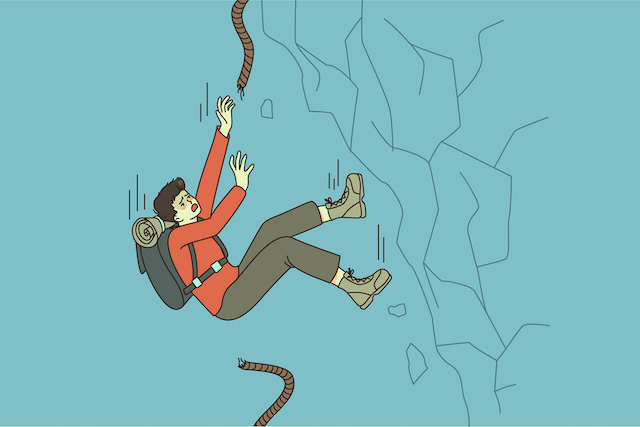
    All goes well as we gain altitude above the crevasse, until one fateful moment when the crampon on my left boot suddenly pops loose and I lose my footing.

    Tumbling headfirst downhill, I instinctively grab my ice ax with both hands and prepare to stop. Landing hard on my back, however, my ax bounces loose from my hands and I slide uncontrollably down the steep slope towards the crevasse.

    In a moment of frozen terror, my life flashes before my eyes and I am going to die! Then suddenly my flailing body slams into something solid, knocking the wind out of me.

    Stunned and disoriented on my back with my head pointed downhill, I’m unable to get a bearing on how close to the edge I’ve come and how close to death I am.

    Looking up, I see a blur of movement and shifting dark images. Clearing the snow and ice off my glacier glasses, I realize Hank and my fellow climbers have formed a human net, catching me just a few yards before I careened over the edge of the crevasse!

    I’m in shock, numb, and completely speechless. I’m also totally embarrassed and feeling extremely vulnerable. I’ve spent years being a strong and independent man, priding myself on not needing the help of anyone. Needing help always seemed like a sign of weakness to me, so this emergency situation is deeply disturbing.

    “We’ve got you, VJ! Hold on buddy, we’re not gonna let you fall!” I fidget around trying to stand myself up and respond, “Thanks guys, I can take it from here.” “Lay still, you’re pushing us back towards the edge!” Hank barks at me. “No, really, I’m okay guys, I’ve got this.” There was no way I was going to be the weakest link in this chain! This time, however, a number of my team members replied, “No you don’t have it VJ, you need to stop right now or you’re going to kill us all!”

    That message got in. The reality of killing my fellow climbers so I can stay in control is just too much for me to bear. The humbling realization shatters my macho control mechanism and I suddenly relax into letting them help me.

    As they reattach my gear, stand me up and reassure me with pats on the back, I realize it’s nearly impossible for anyone to support me. Experiencing them caring for me this way is both wonderful and wrenching.

    My chest tightens and tears come to my eyes as I realize how many times in my life I’ve not let others help or support me. I would always say, “No problem, I can do it myself.” I didn’t want to burden anyone or put anyone out.

    The deeper truth, however, is that if I let someone support me, I would be obligated to them in the future. The result might be that they could then somehow control me the way my father controlled me as a child.

    Looking into the caring faces of my fellow climbers, I suddenly see superimposed images of my mother, sister, and little brother, my friends, and exes who I’ve shunned and alienated with my stubborn macho independence

    I reflect on the pain and frustration that not being able to help me must have caused all these people in my life. So many opportunities I have had to accept the support of those who love and care for me, but no, I have to be strong and independent.

    How selfish and arrogant of me to rob them of the opportunity to contribute to my life! And how easy it would be for me to slide into humiliation over this display of narcissism.

    Standing here among those who just risked their lives to save mine, I realize I have a choice; I can dramatize my humiliation and hide behind my rugged individualism, or I can humbly open myself to their care and support.

    I choose to set humiliation aside and open with humility, and as I do, a wave of emotion fills me. For the first time in my life, as far back as I can remember, I’m able to see that accepting help from others is not a sign of weakness, it’s an act of humility.

    I also realize that rather than being a burden to people when I’m in need, it allows them to feel useful and to make a difference by offering their support and care. There’s no doubt that my fellow climbers are ecstatic about having just saved my life; I can see the joy and exhilaration on their faces.

    Still surrounded by a human net of care, I thank each member of my team for saving my life, and I apologize for placing them in additional danger. Each one of them nods in recognition, and nearly everyone assures me that having the chance to help save my life was far more important to them than blaming me for being a bit heedless.

    As I allow myself to be vulnerable and let their care in, my defensive armor melts, then drops away. We resume our ascent, and tears fill my glacier glasses as I reflect on the experience of my life being saved by this remarkable group of friends.

    How strange and new this is for me. I don’t need to see out of my glasses because I have the full support of those behind me as well as those in front to help me along if I need it.

    I’ve always been the one to give support to others, but now I can receive support as well. I breathe into this new awareness and suddenly have a profound realization that has remained with me for years.

    As I exhale, it’s synonymous with the movement of giving support, and as I inhale, it’s synonymous with the movement of receiving support. Engaging in both inhaling and exhaling doesn’t mean I’m weak, it means I’m human.

    Without further incident, we all ascend to the 14,179-foot summit of Mt. Shasta where a crystalline blue sky embraces the curve of the earth. The summit perch looks like a small crater and is no more than about twenty feet in diameter. Its outer rim is composed of a ring of rocky crags with one high point that signifies the very pinnacle of the mountain.

    Shining, sunburned faces grinning from ear to ear sit together in a blissful exchange of laughter and tears.

    After celebrating our joint accomplishment, we begin the ritual of reading and signing the register book stowed atop most climbable mountains in the world. The one at the summit of Mt. Shasta is contained inside a green metal canister under the Western crag.

    Each member of the team, like those before us, takes the opportunity with the book. After finishing, Hank hands it to me. As the last to see the register, I flip through its yellowed pages and my eyes fall on a passage written by a climber on October 23rd, 1972. I’ll never forget the inscription:

    “Father, I dedicate this climb to you. I’m standing at the top of Mount Shasta today because of the love, support, and encouragement you gave me as I was growing up. It’s because of your commitment and love that I was able to make it to the summit today. And although you lost your legs in the Korean War and have never been able to stand beside me. Father, I want you to know that today I stand on the top of this mountain for both of us. I love you with all my heart and all my soul, your son John.”

    How beautiful this dedication is! I take in the grandeur of the Earth’s curve from this high summit, close the book, and clutch it firmly to my chest. A wave of inspiration fills me, and I feel deep abiding compassion for all the world’s fathers, sons, mothers, and daughters . . . and I am challenged to act upon the humility that was moving so deeply within me.

    You see, up until this very moment I’ve coveted a deep wound in my psyche. As a boy, I was violently abused by my father, and as a result, I cut myself off from him in my early twenties vowing to never speak with him again.

    But now I am faced with a choice . . . should I maintain my position and continue to empower all the reasons why I should not reach out to him? Or should I humble myself and take a chance by reconnecting after all these years? It is here, within these deeply challenging life choices, that we both test the authenticity of our inspirations and discover what we are truly devoted to.

    I made my choice, and not only did I resurrect my relationship with my father, I affirmed that there is nothing more important to me than living with an open heart and honoring the humility I was gifted with high atop the summit of humility.
  • How Overthinking Ruined my Relationships and How I Overcame It

    How Overthinking Ruined my Relationships and How I Overcame It

    “Overthinking ruins you. It ruins the situation. And it twists things around. It makes you worry. Plus, it just makes everything worse than it actually is.” ~Karen Salmansohn

    I grew up with parents who believed a kid shouldn’t have friends and should be indoors always. Because of that, I never had real friends in my childhood, except those I met in school and church.

    Since my early teenage years, loneliness has been my forte, and I have learned to pay too much attention to details. When people talk, I look at them, how they react, their facial expressions, etc. I try to draw out details from the tiniest cues and put a lot of thought in them.

    Conversations, of course, are meant to be enjoyed; however, for me, that isn’t the case. During a discussion, I think of a million ways it could go wrong. I wonder what I’ll say next after I get a reply. And a slight change in a listener’s facial expressions makes me think I’m bothering them—they dislike me, I’m boring, I need to stop talking.

    Having real friends has been difficult for me. I find it challenging to maintain a friendship for long. When I meet with someone for the first time and we both “connect,” I start fantasizing about how we might become everyday gist mates, lifetime buddies, and even in a romantic relationship (for ladies).

    Sometimes, I get tired and want to stop overthinking, but it always seems impossible. The tiniest of details always want to be thought of and processed. And instead of taking action on what I think, I continue thinking about it.

    So many opportunities have slipped through my fingers, making me not confident enough to take action. Except this one time I wanted to enroll in a writing competition. I tried every possible way to discourage myself from applying. I reminded myself of harsh critics and writing rejections I’ve faced in the past, but I never gave in to the voice. I tried to shut it up and applied for the competition—and I won.

    I don’t think I’ll ever fully stop overthinking. I’ve accepted it as a part of me I have to live with, but I’ve also made great progress in getting past it.

    If overthinking has affected your confidence and held you back as well, perhaps some of my techniques will help.

    1. Acknowledge that you’re overthinking.

    When overthinking starts ruining your mood or stops you from taking action, acknowledge it. Don’t beat yourself up or hate yourself for it.

    If you’re anxious to do something because you’ve been obsessing about it, acknowledge that you’re afraid. When we acknowledge something, our brain has a way of providing solutions for us.

    In fact, I started making real progress when I accepted myself as a big overthinker and this helped me love and accept myself instead of hating myself.

    2. Declutter your mind regularly.

    Decluttering your brain is the key to having a settled mind. You could speak to someone—it helps—or write down every thought running through your mind (my favorite technique to calm my mind).

    If, for instance, someone offends you and you can’t get it off your mind, talk to them about it. If you’re obsessing about an interaction with someone you can’t talk to, journal about it. The goal is always to take action whenever possible instead of ruminating on things that are bothering or worrying you.

    3. Don’t expect too much from people.

    The truth is, people will disappoint you. And this will hurt you even more when you place high hopes on them.

    To be on the safer side, don’t place so many expectations on people. People change; things happen, and people go back on their words.

    If you expect that people will disappoint you sometimes, you’ll be less likely to overthink things when they do. Instead of wondering why it happened and if you did anything to contribute to the situation, or if you should have done something differently, you’ll simply accept that people often don’t keep their promises, and you don’t need to take it personally.

    4. Work on developing self-confidence.

    Most times, overthinking is caused by a lack of self-confidence.

    There were times when I found it hard to connect with people. I believed I was a boring conversationalist, so whenever I was talking with someone, I’d always try hard to prove my belief wrong—sometimes unnaturally—to keep a pointless conversation going when I could end it.

    If you aren’t confident in what you bring to the table, you will always overthink your way into believing it’s always your fault if a conversation or something doesn’t go as expected. So instead of telling yourself that you’re lacking in some way, work on believing in your worth, and this will help you question yourself less in difficult situations.

    5. Know when to take a break.

    During a stressful day, it’s normal to have a lot running through your mind.

    Whenever you start worrying about mistakes you’ve made with other people or find the thoughts in your head feel overwhelming, take a break. Take nap, take a walk, practice deep breathing, or do an activity you enjoy to help you get out of your head.

    6. Resist the urge to impress people.

    Most overthinkers have a strong urge to impress and please other people. When in a conversation, they may carefully pick their words, and then obsess about whether they’ve said anything stupid or wrong.

    That said, a friendship based on trying to impress or please another person will be one-sided and may not last.

    People don’t want to feel like they’re being worshipped in a friendship. They want to know the real you—both the exciting and boring parts of you—so it turns them off when you make a conversation about them alone.

    When talking with people, say what you mean in the way you want to say it and trust that the right people won’t pick apart everything you say and will actually appreciate you for being you.

    7. Accept that you can’t be friends with everyone.

    Even as you try to make friends, you should know that not everyone will like you.

    You may try hard to make someone acknowledge you and be friends, but you won’t click with everyone, and you don’t have to overthink it.

    You aren’t meant for everyone, so if someone disrespects or ignores you, it isn’t your fault. You have to find people who like you and let go of the ones who don’t.

    8. Enjoy the moment and try not to think about tomorrow.

    In all you do, make sure you’re present in it. You can’t be in two places at the same time. In the same way, you can’t expect to enjoy the present if you worry too much about the past and future.

    Make it a rule to always be in the moment, focusing on the people right in front of you. If you let yourself be fully in the moment with them, you’ll worry a lot less about what they’re thinking of you (and about everything else, for that matter).

    Ever since I started practicing all I mentioned above, I’ve been happier in life than ever before. Making friends with people and holding conversations has become much easier for me.

    I failed many times when trying to rewire my brain, but I never gave in. I made the end goal, to make good friends and enjoy life as much as possible, my mantra. Now I overthink a lot less and connect with people more, and I believe you can do it, too!

  • Why We’re Afraid of Real Connection and Why We Need Deeper Conversations Now

    Why We’re Afraid of Real Connection and Why We Need Deeper Conversations Now

    “It’s one of the great paradoxes of the human condition—we ask some variation of the question ‘How are you feeling?’ over and over, which would lead one to assume that we attach some importance to it.  And yet we never expect or desire—or provide—an honest answer.” ~Mark Brackett, Ph.D., Permission to Feel

    I used to feel so satisfied if I had made them cry.

    Not in a twisted, sadistic way.

    I just knew once things went quiet and they felt safe, we could peel back enough layers, the tears would flow, and we could finally get to the truth. The truth of how they were really feeling, what their real struggles were, and what they really believed about themselves.

    I did not like seeing their pain, but I did know how to hold space for it.

    This was not achieved in a psychologist’s office or in some sort of support group for mental health. I carried this out in a workplace… for employees.

    You see, I have never been a surface level communicator. Most days, I would rather stick pins in my eyes than chitchat about the weather with someone, knowing there is so much more going on beneath the surface of that person. I get frustrated with the façade, pretending we are all okay, when everyone, on some level, is struggling.

    Product of Conditioning

    I know it is not how most of us are conditioned to operate in society. For many, cultural norms dictate that we be polite, keep emotions to a minimum, and keep conversational topics within acceptable boundaries.

    Why are our conversations this way when our fundamental need for connection and belonging is as strong as eating and sleeping?

    We have enough solid evidence to confirm that we feel more connected and happier when we take our conversations just a little deeper, yet we don’t. We even have a chemical in our brain called tachykinin that’s released when we feel lonely. It’s the brain’s way of making us feel uncomfortable, so we search out others and connect.

    It’s obvious we’re wired for connection. So then why is it so difficult to have meaningful connections that go beyond shallow pleasantries?

    Our Beautiful, Messy Complexity

    Well, as with most human behavior, I believe the answer is an intriguing confluence of reasons.

    I say this based on my academic studies and professional consulting experience. But a more honest answer would be to admit that my response is predominantly coming from my own childhood experiences going back decades, and even some personal experiences from as little as a few years ago.

    Since we see the world through our own filters and perceptions, we tend to focus on what we unconsciously decide is important. And I think for me, being able to sense the greater depths of other human being stems from my own childhood of no one acknowledging my own.

    I am aware I am not Robinson Crusoe, as all of us, to some degree, had some need that was not met in our smaller years, and I am sure Freud could have a field day here.

    The point being my dedication to creating more connection and belonging (primarily in a workplace context) with people, is mostly due to my past experiences. And thankfully for my past, I totally understand why people do not want to connect on a more meaningful level, even though it is so good for our psychological and physical health.

    Our Aversion to Deeper Connection

    There are many reasons why people find it challenging to have more meaningful, connected conversations with one another, and I feel the list would be even longer if we put this in a work context.

    However, here are my top five:

    1. We make emotions binary.

    Emotions are not “good” or “bad.” They’re simply data, giving us signs and clues. We have not been taught to be with and embrace all of our emotions, so we judge and suppress many of them. We are comfortable around someone who is happy but feel very uncomfortable if someone is sad.

    2. We hide our vulnerability.
    When we experience uncomfortable emotions like sadness, guilt, shame, or fear it can be scary and vulnerable to share these emotions with someone else. Naturally, we want to protect ourselves from this type of exposure.

    Yet sharing these deep parts of ourselves with someone we trust can provide us with a deep sense of connection, as well as a sense of acceptance and belonging (not to mention a cascade of feel-good brain chemicals).

    3. We don’t want to risk being ousted.

    The need to belong to a group is hardwired into our brains, so if we experience social exclusion, it actually registers in the brain as physical pain (true story). So, it would make sense that we would forgo our own needs, not take risks such as expressing our opinion or sharing deeper parts of ourselves in conversations, if it meant we get to stay and be part of a group. I think we have all seen plenty of this play out at work

    4. We get triggered.

    Any conversation that goes below the depths of surface level chitchat always runs the risk of an emotion making a guest appearance at some stage. With heightened emotions comes the gamble of getting triggered and moving into a threat response, which can be distressing and traumatic for some people. It is in this space we often see old patterns, defense mechanisms, childhood conditioning, and other unconscious behavior playing out.

    5. We hold ourselves back because our emotions were met poorly as children.

    When we were growing up, if any of our strong emotions like fear, sadness, or anger were met with negative consequences, we may have learned to shut down that part of ourselves. The narrative then became “it is not safe to show how I really feel.” This coping mechanism can make it difficult to connect with anyone on a deep level as an adult.

    Where There is Connection There is Light

    Even though this list may act as encouragement to keep our emotions and vulnerability to a minimum, doing so would not allow us to feel the full, beautiful, rich experience of being human.

    Thankfully, Covid has provided us with some benefits. All this disruption we have been experiencing the last couple of years has made us acutely aware of how we need to make connection a priority. Loneliness now becoming a public health concern.

    I’ve even noticed an increase in my own introversion and a strange apprehension to connect with others at the moment. Even though I specialize in connection and know all the benefits that come with it, I have had to give myself a bit of a push to get out and about and be with others (insert face palm here).

    But what I know for sure, is that sharing our vulnerability and struggles connects us. This is where we find commonality, where we do not feel alone. Where we get to see that we are all the same, trying to do the best we can with the tools we have. Where our hearts can soften, so that we have more compassion with not only those around us, but also with ourselves.

    Moments of real connection make for a real rich life. So go on, get out there….

  • Rethinking Masculinity: Why I Want More Than Bachelor Parties and Football

    Rethinking Masculinity: Why I Want More Than Bachelor Parties and Football

    “Patriarchy is the expression of the immature masculine. It is the expression of Boy psychology, and, in part, the shadow—or crazy—side of masculinity. It expresses the stunted masculine, fixated at immature levels.” ~ Robert Moore & Doug Gillette

    Seventy eggs, packs of bacon, and multiple types of beer filled the fridge. On the counter lay handles of liquor and energy drinks. The dining table was lined with snacks galore: chips, Cheese-its, popcorn, Oreos, Doritos, and dozens of Fireball nips.

    I’ve been to many bachelor parties, and it’s not surprising that health is never a priority. Yet this time, things felt different, or at least they should have. Most of the men present were fathers approaching forty. Everyone was married, had highly respectable careers, and lived in nice homes across the US.

    It was clear that this weekend wouldn’t be a free-for-all of strip clubs. We no longer had the beer guzzling metabolism of our twenties or the naivete of our youth. But if not late-night revelry, what would it be? Accepting that we were older and in a much different place in life seemed to be in tension with what this weekend was supposed to be all about.

    The expectations, unspoken and unexamined, were looming over each of us. We were supposed to act as if we were decades younger back in college. The story we were unconsciously telling ourselves was that honoring a man’s last single days was to be full of drinking and debauchery.

    We didn’t come here to be emotionally vulnerable and eat salads. We came together to get rowdy.

    The question on my mind is whether there is space in our current paradigm of masculinity to do both?

    * As grown men, do we have to revert to childish ways of interacting?

    * Do we have to reduce ourselves to the lowest common denominator of health and wellness to have fun together?

    * Are there not other ways of being together that better fit our present realities as mature, adults?

    Still more questions drifted through my mind:

    * Can we take a responsible approach to caring for our body and still make room to party?

    * Can we find a balance between celebrating our friend’s last days of being single without making marriage out to be a ball and chain?

    * Can we eat salads together and still be “manly enough”?

    I believe we can do all of these things, but first we need to unravel some deeply held social norms about how men are supposed to interact together in groups.

    The Undiscussed Rules of Bachelor Parties

    The unspoken rule of bachelor parties is that there are no rules. Go wild. Get f*cked up. Have as much fun as possible because you’re about to lose all your freedom. Or at least that’s how the story goes.

    But where did this story come from?

    How did all of us guys end up with this template of bachelor parties as a drug-fueled escape from responsibility?

    What’s more, how did we end up with this notion of marriage as impending shackles or the stereotype of men running away from long-term relationships?

    Movies?

    Media?

    Watching older generations go through their failed marriages and broken relationships?

    Probably all of the above and more.

    The stereotypes of men acting like boys is a sad reflection of our present reality. We have strayed from the mythic stories of men as responsible, powerful actors in the world and settled on a version of manhood that seems woefully incomplete. 
    Perhaps the most noteworthy archetype framing masculinity is that of a hero’s journey. It is the quintessential growing-up quest where men discover their strength through adventure and adversity. Endless movies from Star Wars to Harry Potter rift upon this classic template of human development.
    Yet what is notably missing from all these sagas is the hero as a family man, caring for himself and his world responsibly as an adult. We are obsessed with heroic journeys and completely unenthusiastic about domestic life.

    I get one makes for a much better motion picture, but it is this void in our present mythology that leaves men hanging on boyish and incomplete ideas of what it means to be a mature man. How does the hero turned father integrate into society, build a family, connect with other men, and take responsibility for doing good in the world?

    If the hero’s journey is the fundamental process by which a boy becomes a man, the question of how to actually enact manhood remains.

    This void is exacerbated when groups of men come together. The expectation is that of unhealthy behavior. The bachelor party is just one manifestation of this—groups of men acting like teenage boys… hedonistic, rebellious, and immature.

    Yet the world doesn’t need more rowdy teenagers. It needs strong, healthy men. Men, it’s time we grow the f*ck up. The problem as I see it, is that we don’t know how.

    No Models, No Vision, No Manhood

    When I look around for good templates on how to spend time together, all I see is sports, fraternities, and bachelor parties. There is nothing inherently wrong with any of these, but as the only models for men to exist together, they leave a lot to be desired.

    Sports teams and bachelor parties may be suitable for the single twenty-something, but where are the role models for men trying to be a good husband or trying to make ends meet?

    I want more meaning and depth than our current cultural templates afford. I want to hang out with other men in a way that calls upon our higher qualities, not our lower ones.

    Yet I fear that the little boy in me so badly wants to be accepted by the other guys that I will continue to squeeze myself into outdated beliefs and unhealthy ideals that have me ripping shots of fireball just feel accepted—the policing of the proverbial “man box.”

    As men we must deconstruct this box and give ourselves permission to act differently. This includes

    * Learning to have drink without being irresponsible to our body, our friends, or our partners.

    * Learning to talk about our feelings as much as we talk about football.

    * Allowing ourselves to strive professionally without feeling like our self-worth is dependent on our ability to provide.

    * Feeling comfortable sharing our struggles with other men, so we don’t unconsciously accept that suffering alone is an inevitable part of being a man.

    Creating New Templates for Men to Be Together

    Loneliness is an epidemic. And for men, the feeling that you’ve got to “man up” and deal with all of life’s challenges on your own is a legacy of patriarchy that needs to be released.

    We need each other. More importantly, we need to learn how to be together in a relationship without feeling like beer and sports are the only way.

    Can you imagine a world where men hang out and actually come out stronger, healthier, and more sound in mind and body?

    I can. It’s not only possible, it is necessary.

    I can imagine the eye rolling among some guys. “That’s why there’s men’s groups. Don’t take away my bachelor parties or Sunday football.”

    To be clear, I’m not at all against bachelor parties. The “wild and free” mindset makes sense as a time-bounded final hurrah.

    I’m not advocating for less fun. I’m advocating for more opportunities for men (and women) to gather in a way that challenges the scripts and roles that have kept us prisoners to immature ways of interacting. 

    The current social pressure not only makes it difficult for men to be emotionally available, it also squashes so many of the joyful parts of our inner child—the playfulness, adventure, and energy of boyhood. It’s keeping us from our embodied selves.

    But we need to grow and integrate that into new rites of passage that allow men to avoid blindly accepting patriarchal norms.

    I don’t want to have to hide my softer, more vulnerable parts. I believe we can discuss how our social conditioning as men impacts our body and mind alongside discussing our fantasy picks and favorite cars. There’s room for it all if we can let go of outdated notions about how men can spend time together.

    If we can help each other evolve into a more integrated expression of what it means to be a healthy man, everyone will benefit—the boys who are coming of age, the men who are struggling to find their place in the world, and the partners who deserve men that are nurturing and generative, not hostile and destructive.

    Learning to be a better man, together.

  • How Boys Learn to Repress Their Feelings and How We Can Do Better as Men

    How Boys Learn to Repress Their Feelings and How We Can Do Better as Men

    “Shoutout to all the men going through a lot, with no one to turn to, because this world wrongly taught our males to mask their emotions and that strong means silent.” ~Alex Myles

    He is close to tears. He is not physically hurt. No ankle has been twisted, no knee has been scraped, nobody needs their asthma inhaler.

    The other boys are making fun of his size.

    Most of the time he pretends it doesn’t bother him. But I’m the coach, and it’s pretty hard to miss.

    I have watched him smile and try to shake it off. Sometimes he will parry with a comment of his own—something about them that they’re sensitive of…

    I know this thing that they are doing. I call this “emotional arm punching.” It’s a rite of passage boys use to desensitize themselves to emotions, just like when they punch each other repeatedly in the bicep and try not to show how much it hurts

    For about two months out of the year I am entrusted with seeing some of the real feelings these kids have. The reason why I get to see them is because they haven’t yet been taught not to allow themselves to feel them. They haven’t been taught that emotions are a weakness. But I can tell you this, it is definitely beginning, and this emotional arm punching, especially with boys, is the sign of it.

    This term I’ve coined—emotional arm punching—you see it all the time on playgrounds, middle and high school sports, probably even in the Boy Scouts. Maybe you remember it from when you were younger? It’s the tiny emotional jabs you take at your friends about things that you know they’re sensitive about that hurt their feelings.

    I know this well from my own experience. I was called stupid and berated by my coaches because, try as I might, I could never remember the plays.

    The other players would use the coach’s opinion of my play to deflect the attention from their own failings by coming after me relentlessly for my inability to remember plays, or, even worse, if I let down my guard and told my teammates how the coach’s remarks made me feel.

    Ultimately, I found myself deflecting my emotional hurt, hurling my own insults or digs back on my teammates about their performance.

    Now, if you asked most people, they would say this is a rite of passage in our society. You’re learning how to “be a man.” You’re learning to not let emotions affect you.
    Unfortunately, I can tell you this firsthand: it doesn’t teach kids not to have emotions. What it teaches them is to not tell or show anybody what they are feeling and to repress their emotions, just like I learned to do.

    With no one to help me actually work through my feelings, I found myself stuffing down my embarrassment and shame until those emotions became a roaring anger. That anger would ultimately become disproportionately intense. However, with no place to go, it would erupt from me when I least expected it—often on my friends or my mom.

    Kids are being called short, fat, ugly, or any unacceptable thing that their friends (or even those who aren’t their friends) say about them—under the flag of jest of course.

    What is the result? You get a bunch of kids that start to learn that they are not supposed to react. They pretend emotions don’t bother them. But in reality? They hurt doubly worse because they can’t get any support or acknowledgment for what they’re feeling.

    Why does this matter? Because those circles you see on the sports fields, in the schools, or even the Boy Scouts, you’re going to see when you’re grown up and go to the holiday party, bowling team, or men’s club. It’s the same people.

    They grew up and their emotions are so repressed that they come out in much more unhealthy or even lethal ways. Think excessive drinking, angry outbursts, isolation, domestic violence.

    Adults who learned to repress their emotions as children end up resorting to finding ways to numb those emotions that are seeping out because they didn’t learn the tools to process them.

    And then there’s blame!

    Blame is when our ‘uncomfortable emotions’ cup runneth over inside of us. When we give emotions like fear, anxiety, and anger a nice, comfortable home outside of us by spilling them all over someone else in the form of blame.

    in her Ted Talk, The Power of Vulnerability, internationally renowned speaker, storyteller, and researcher Brené Brown said that blame is described in research as a way to discharge pain and discomfort.

    Blame is acting out your anger instead of dealing with your emotions and the problem that’s in front of you. I had this a lot!  Eventually, however, I recognized the pain my actions and outburst of anger caused my friends and loved ones ultimately silenced me and, for a long time, kept me from making real connections in my life.

    If we want men to be more aware of and able to identify how they feel so that they have choices instead of reactions—choice of the challenges they will pursue in their lives, the relationships they will create, the work that will satisfy them, and the kind of father they want to be—we’re going about it all wrong.

    One of the best tools I’ve learned when dealing with my feelings is what I call “emotionally testifying.”  This starts with developing a practice of becoming familiar with all of your emotions, not just the ones that we as men find socially acceptable.

    Recognize what your emotions feel like in your body. Then, have the courage to express them to trusted friends and family, describing how you are feeling and why you think you’re feeling that way.
    This familiarity with uncomfortable emotions allows you to start to trust yourself with expressing them. They’re not foreign to you, or something to be afraid or ashamed of.

    As you become confident at identifying and expressing your emotions with people you trust, you’ll be able to respond differently when you later find yourself with a group of other guys, and that emotional arm punching begins.

    Instead of perpetuating this socially accepted, but emotionally unhealthy norm, you will have the skills to express how you feel about what’s being said in a way that is authentic to you without harming anyone else.

    I believe it is more masculine to identify and understand your emotions and to acknowledge and accept when you hurt someone else’s feelings. Just because somebody said something to you that hurt you doesn’t give you the right to go off and put those hard feelings out on someone else. That is not a sign of strength.

    Strength is knowing how you really want to feel and interacting with your friends from a place of honesty and empathy.

    If you want to learn to trust yourself and your emotions, tell your friends how you feel. If they give you a hard time, you will recover and be healthier for it. And you never know, they might follow your lead and give you an emotionally honest response back. Either way, it’ll save a lot of emotional bruising.

  • How to Overcome Ultra-Independence and Receive Love and Support

    How to Overcome Ultra-Independence and Receive Love and Support

    “Ultra independence is a coping mechanism we develop when we’ve learned it’s not safe to trust love or when we are terrified to lose ourselves in another. We aren’t meant to go it alone. We are wounded in relationship and we heal in relationship.” ~Rising Woman

    Do you feel like you have to do everything on your own?

    Is it difficult for you to ask for and receive help in fear of being let down?

    Have you ever heard the expression “Ultra-independence may be a trauma response”?

    If this is you, I get it; that was me too.

    Please know there isn’t anything wrong with you. I lived most of my life this way. This way of being was a survival strategy that kept me safe, but it was also very lonely. I lived in a constant state of anxiety, and it wore me out physically because I thought I had to do everything myself.

    We often become ultra-independent because we don’t trust others and/or we may not feel worthy of being loved and supported. Or, we may believe that by denying support from others and doing things ourselves we’ll gain love and acceptance, because we’re not being a burden.

    Maintaining connections and receiving support from others are basic human needs. If we’re saying we don’t need anybody, that’s often coming from a part of ourselves that wants to protect us from hurt, abuse, criticism, disappointment, or rejection.

    If we even consider the possibility of wanting, needing, and/or receiving support from other people, something in us may say, “No way, it’s not safe,” so we keep these thoughts at bay.

    We may think that if we ask for anything then we’re weak or being too needy, and that’s codependency. But we’re not meant to do everything on our own; there is such a thing as healthy codependency.

    Ultra-independence may also be an extreme unspoken boundary, so, what may be important is to learn how to set healthy boundaries so we can feel safe in situations where we thought we’d lose ourselves.

    Sometimes we feel the need to be ultra-independent because we don’t feel safe being vulnerable and letting people in, because if we do, they may see our flaws and insecurities, or they may trigger our unresolved traumas and wounds.

    We may be carrying deep shame, and we don’t want to feel it or have others see it, so we stay away from connecting with and receiving support from other human beings.

    One of the hardest things to fathom is that, although we’ve been hurt in relationships, in supportive relationships we can experience healing and a sense of safety. 

    That didn’t make sense to me, because in my relationships I often experienced criticism, hurt, rejection, and being screamed at for having natural human feelings and needs.

    A part of me wanted support and connections, but another part of me was afraid, because as a child it made my father angry when I asked  for anything. It was hard living in a world where I felt all alone, believing I had to do everything on my own while watching everyone else receive support and connect with their family and friends.

    For me, being ultra-independent eventually led to denying and suppressing my needs and feelings because it got too overwhelming to try to do everything on my own, especially at such a young age.

    At age fifteen I became anorexic, and I struggled with depression, anxiety, and self-harm for over twenty-three years.

    In the midst of that, at age twenty, I let my guard down and got a boyfriend, who I thought loved me because he bought me anything I wanted, but there were strings attached. If I didn’t do what he wanted he would take back the gifts. He became obsessed with me, waited outside of my house when I wouldn’t talk to him, and would draw me in again with gifts and words of seduction.

    This left me confused. “Do I only receive support and things when I’m a slave to somebody?” I wondered. After I finally broke up with him, I made a vow to myself that I would never receive anything from anyone again. 

    I got the opportunity to heal that vow later in my life when I went to Palm Springs with a friend. We were playing the slot machines and he put in $20. I told him “It’s your money if we win.” We won $200 on the first spin, and he told me, “Cash out, you won.”

    When I cashed out, I chased him around the casino, trying to put the money in his pocket. I didn’t want to receive from him because I thought, “Then I owe him, and he owns me.”

    Thankfully, he’s someone I can share anything with, and we talked about it. He told me he knew my struggle, that he didn’t want anything in return, and that it makes him happy to give to his friends and family. This experience helped me see things differently.

    My healing journey really began at age forty when I started learning how to reconnect with myself, my needs, and my feelings and started healing the trauma I was carrying. I also learned how to ask for support, which wasn’t easy at the beginning; some people got mad at me, and some people were happy to fulfill my requests and needs.

    Instead of blaming and shaming myself for believing I had to do everything on my own, I made peace with the part of me that felt it didn’t need anybody. By listening to its fears I started understanding why it thought I needed protecting.

    It revealed to me the pain it felt of being rejected, hurt, and screamed at for having human feelings and needs, and that it didn’t want to experience that pain again.

    As I listened to this part of myself with compassion, I acknowledged and validated the fear and pain it experienced, thanked it for doing what it was doing, and let it know it was now loved and safe.

    I asked it what it really wanted, and it said, “I want to have true connections. I want to feel safe with and receive support from others, but I’m afraid.”

    This younger part of me was stuck in perspective from my childhood wounding and the experience with the guy I was dating. By giving this part of me a chance to speak and tell me its intentions, I was able to help it/me have a new understanding and feel loved and safe.

    I also began to have a more realistic view of who is and who isn’t safe, instead of seeing no one as safe based on outdated neuro programming stemming from my past traumas, hurts, and pains.

    Being ultra-independent did help me heal from all those years of struggling with anorexia, depression, and anxiety. Even after twenty-three years of going in and out of hospitals and treatment centers and doing traditional therapy and nothing working, I finally took my healing into my own hands, and yes, I did most of it on my own.

    However, even doing it on my own, I found it was also helpful to be in a loving and supportive environment with people who didn’t try to fix, control, or save me.

    We’re not meant to be or do life alone, but being alone can be comforting if we fear being hurt by others. 

    This doesn’t mean we should force ourselves to ask for and receive support from others, especially if we’re afraid; it means we need to create a loving and caring relationship with ourselves and understand where the need to be ultra-independent is coming from as a first step toward letting people in.

    A great question to ask yourself is “Why is it not okay for me to receive support?” Be with that part of you, allow it to show you what it believes, and take time to listen with compassion. Then ask it what it really wants and needs.

    Receiving support isn’t about being totally dependent on others, that’s just a setup for frustration and disappointment; it’s also important to learn how to be independent and meet our needs. This isn’t either/or, it’s both.

    Learning how to connect with our feelings and needs and how to communicate them and make requests is also important.

    For instance, if you’re going through a challenge and you would like support from someone, you can say, “I’m having a hard time right now, and I would really like someone who I can talk to, someone who will just listen without trying to change me or my situation. Is that something you would be willing to do?”

    If this feels impossible for you, it might help to repeat some affirmations related to letting people in and receiving support. If some of these don’t resonate yet, instead of using “I am” start with “I like the idea of…”

    I am worthy of being supported and loved.

    I am worthy of having heartfelt connections.

    It’s safe for me to have this experience.

    I am worthy of being seen, heard, and accepted,

    I am worthy of being loved and cared for by myself and others.

    I am worthy of shining authentically,

    I am worthy of receiving help and support.

    There isn’t anything you need to earn or prove. You are worthy because you are beautiful and amazing you.

    If you’re shutting people out because of your past traumas, as I once did, know that you don’t need to do everything on your own just because you were hurt in the past. Some people may let you down, but there are plenty of good people out there who want to love and support you—you just have to let them in.

  • Why I’d Rather Be Vulnerable with People Than Pretend I’m Perfect

    Why I’d Rather Be Vulnerable with People Than Pretend I’m Perfect

    “Give up being perfect, for being authentic. Give up the need to be perfect, for the opportunity to be authentic. Be who you are. Love who you are. Others will too.” ~Hal Elrod

    I’m not perfect. Not that this would come as any kind of surprise to anyone who knows me. But I often feel pushed in the direction of trying to represent myself as someone who has it all together. Especially because of the nature of my work as a coach and facilitator. What about you? Do you ever feel like you’re putting on a show for others?

    The more I find myself trying to represent a perfectly put-together person, the less confident I feel in who I am because I know I am being inauthentic. It’s a big part of what took me off social media a few years ago.

    I don’t like that social media has the ability to mold what you think about yourself by way of comparison and encourage posturing. It’s a slippery slope, as we’re hardwired to yearn for love and connection as part of our survival. For me, it didn’t feel like the kinda place I wanted my love and connection to come from.

    Having the ability to talk about our flaws, what’s going wrong in our lives and where we’re getting stuck, is a huge part of human evolution that we often forget about. If we don’t have an environment to talk about our vulnerabilities, the wounds never get a chance to heal.

    Before getting into therapy, my life was a bloody mess because I pretended like these wounds didn’t exist.

    I don’t remember a period in my life without depression. Even as a teen it followed me around like a shadow.

    I believed the world would be better without me. I felt worthless—like I shouldn’t even have a seat at the table with other humans. I should have been in an alley eating scraps of food with sewer rats. No matter what I did or how hard I tried, the shadow mocked me for dreaming of a better future. My unwillingness to unpack those thoughts meant the infection spread to all areas of my life.

    I grew up in the nineties, when no one was talking about mental health. You struggled in silence.

    I battled demons in high school. I only lasted till eleventh grade before dropping out. I couldn’t stand the thought of spending another day being somewhere that made my life hell—but really, hell was inside me.

    The voice inside my head was (and still is at times) vicious. Every day it was like the Vikings raided and settled into my thoughts to destroy my existence. Those thoughts have left scars that would look like battle wounds of lobbed-off arms if you could see them.

    The voice inside my head was a reminder that I sure as hell would never do anything my parents would be proud of. It was easier to do nothing so that nothing was expected of me. I didn’t feel stupid if I didn’t try, so it made my reality an easier pill to swallow.

    I did graduate and made my way to university, but my life became increasingly dysfunctional. My love for being black-out drunk on Sailor Jerry rum became the perfect way to cope with a chaotic mind I didn’t understand.

    This comes back to not treating open wounds. Everything I resisted continue to persist.

    I had next to no insight into what I was going through because I wasn’t willing to share that I was struggling.

    At the time, my problems took on the weight of the world because I didn’t let people stand by my side to support me. I burned through relationships like a brushfire. I had no idea how to be in an open and communicative relationship because I barely had a relationship with myself.

    Once the wounds became visible through therapy, I could stop the infection from poisoning my ability to think and function. Vulnerability saved my life. I have no doubt that if I didn’t get that support, I would not be here today.

    We forget that our survival depends on being vulnerable. Author Brad Stulberg talks about this in his book, The Practice of Groundedness. He writes, “Our ancestors who survived weren’t those who were the strongest by traditional measures, but those who were most effectively able to share their weaknesses with one another and work together to overcome them.”

    If I didn’t share what I’ve been through, would you still be reading this? Probably not. It would be just another fluff piece on embracing your vulnerability.

    Without openness, there is no love and connection.

    Without openness, you and I wouldn’t be sharing this moment.

    Without openness, you and I can’t heal and grow together.

    The idea of being vulnerable scares the sh*t out of most of us. No one wants to be perceived as weak or admit they have flaws. We’re afraid that the lions of the world will sense our weaknesses and pick us off one by one.

    Except I’ve never actually been mauled by a wild animal when I’ve asked for help, or taken responsibility for a mistake. It’s actually had the opposite effect. Through my writing and vulnerability, I’ve connected with people on every continent of earth.

    It becomes impossible for me to pretend my vulnerabilities are mine alone if people from all over the world have said I’ve captured what they’re struggling with.

    This idea is backed up by research from The University of Mannheim, in Germany, that Stulberg references in his book.

    He writes, “They repeatedly found that the individual doing the sharing felt that their vulnerability would be perceived as weak, as a negative. But the person on the other end of the conversation, the listener, felt the exact opposite: the more vulnerable the sharer was, the more courageous they perceived him or her to be. The listener viewed vulnerability as an unambiguously positive trait.”

    And I think this is why a lot of us continue to feel stuck. We’re so damn wrapped up in worrying about what others will think of us when we open up that we miss the chance to connect.

    When we feel we need to be perfect, it becomes impossible to grow because we’re not being honest with ourselves about how we’re struggling and what would help. My life couldn’t move forward if I refused to see the reality that partying, substance abuse, and pleasure chasing was an attempt to escape depression.

    When you choose the illusion of perfection over vulnerability, you become a stunted version of who you’re capable of becoming.

    The first place you get to take the armor off is when you’re staring at the reflection you see in the mirror.

    Are you willing to be vulnerable with the person staring back at you?

    Are you willing to admit that life is not going the way you want it to?

    Are you willing to put aside judgment so you can get the help and support you need?

    We all want changes, but are we willing to make the choices that give us that change?

    These questions have the potential to shake the core of your foundation free from all the bullsh*t that accumulates over the years. It’s bloody liberating to let go of stories that no longer serve you—stories about who you need to be and what you need to do or have in order to be happy and loved.

    I didn’t need to achieve a promotion or drive a sports car to receive love from my parents. I didn’t have to do anything to show the world that I mattered. I needed to ground myself in vulnerability, rather than an image of perfection, so I could show up as my authentic self and make a difference for other people by being the real, imperfect me.

    Pretending to be somebody you’re not is exhausting work. Not to mention it does the complete opposite of what you want it to do. If vulnerability gives you the power to connect, lead, and grow, that means the inverse is also true. A lack of vulnerability means you end up feeling disconnected, a fraud, forever stuck with a fragile version of what you’re capable of because your ego is afraid of getting hurt.

    Putting a name to what you’re facing puts the power back in your hands. So recognize that you too may be pretending to be perfect to avoid admitting you’re struggling and feeling vulnerable. That single choice to embrace vulnerability could be the most important decision you ever make in your life. And it just may give you the confidence to know you can face anything and rise above it.

  • Who Are You Protecting? Why Telling Your Story Is Powerful

    Who Are You Protecting? Why Telling Your Story Is Powerful

    “There is no greater agony than bearing an untold story inside you.” ~Maya Angelou

    Throughout my childhood experiences I did what every child does and rejected parts of myself. It makes sense because kids depend on adults for survival, so I was in no position to reject my parents. But as an adult I feel it is now my job to reclaim those parts of myself.

    While I had two parents that loved me and what I’d describe as a normal childhood, nonetheless I became hyper-attuned to others, over-sensitive to criticism, and a perfectionist, particularly under stress. It led to all sorts of pain within relationships and, upon becoming parent, I could see I needed to address some things. I had little sense of self and had to learn about having and holding healthy boundaries.

    I have been fortunate not to have been directly subjected to any of the more readily recognized trauma (sometimes known as big-T trauma), like addiction, violence, or sexual abuse. But my childhood was dominated by the kind of trauma that descends from the big stuff.

    The aspects of my dysfunctional persona I mention above come under the heading of developmental trauma. I think it’s important to expose these aspects of who we become in the world as they have been getting perpetuated subtly throughout families all over the world for generations and they prohibit our collective growth.

    Yet, for all the personal experiences I have shared, one I have never spoken of until recently is probably the one that shaped me more than anything else. Simply put, I had a mother who did not cope well when looking after us kids on her own. I learned to think ten steps ahead and project into the future in order to avoid any major meltdown. It drove perfectionist behavior in me, and I learned to choose my words carefully.

    Why have I never spoken about it? I suspect this is multifaceted and ranges from things like not wanting to air dirty laundry, so to speak, to knowing that both my parents (like most parents) did the best they could with what they knew and the resources they had available to them at the time. Yet these were my experiences, for better or worse they shaped me, and if I tell my story it might help someone else.

    To be more specific, mum used to often drop into this hyper tense state when she was alone with my brother and me; something I now readily recognize as a trauma state. She would say she was “up to high doh” (an old Scots expression) with our behavior, then snap at us, scream and yell, and chunter on afterward for a period of time somewhere else in the house.

    When she would yell at me or chunter afterward, I now know it was most likely a deflection of her own pain. As my bedroom was above the kitchen I could hear the aggressive slights about me “being a bitch” or a “slut” or “a selfish cow” even though I was only a child.

    When my father got home she would immediately approach him using a baby voice, another thing I could hear from my bedroom, conveying just how stressed she was (we kids usually being at fault). In the evenings Mum would then sit in front of the TV sucking her thumb, which I suspect were signs that she was likely regressing into her child self.

    Watching this cycle, at the time, made me feel disgust and anger on top of the fear I already felt in being under her watch each day. My nervous system was under constant alert not knowing what aspect of her would show up.

    Everything was our fault because we had broken the rules. With hindsight, and far more knowledge of children’s development, I now know we were just going through the normal growth and development cycles that kids go through rather than being bad kids.

    Because it was probably a dissociative state that emerged when my mother was in flight-or-fight mode, it is possible (especially since Mum never did any meditation or therapy around this) that she had no clear memory of acting like that, or the frequency with which it occurred. I expect she was too identified with the thoughts of how bad we were and how bad it made her feel.

    Dr. Gabor Maté’s words ring true: “It is often not our children’s behavior, but our inability to tolerate their negative responses that creates difficulties. The only thing the parent needs to gain control over is our own anxiety and lack of self-control.”

    My mother was not able to do that, and nor are most people to be fair. It is far easier to blame people or circumstances than take a good hard look at ourselves and have a willingness to explore the hidden depths that we are held hostage to.

    All this was unspoken with my mum. It is like it never happened, as if my brother and I somehow lived in a parallel universe.

    Likely looking after young kids on her own was overwhelming and activated the trauma stored within her, perhaps in response to her own father’s violence and/or possibly the disgust at my grandmother’s passivity about it, or her own guilt in not doing something more (even although she was incredibly young at the time and couldn’t possibly have intervened).

    However, when she was diagnosed with cancer my mum did say, “You know how I like to stick my head in the ground” when I tried to share with her the metaphysical possibilities related to the disease. Since my mother was most often too open with her opinions and usually gave us direct answers to questions we asked, sticking her head in the proverbial sand wasn’t something I immediately associated with her.

    But now in retrospect I wonder whether, on some level, she may have been acknowledging her dissociative behavior when bringing us up, and the effects it may have had on us kids. Certainly it wasn’t something she ever directly acknowledged.

    Though she did not readily share details during her life, she was simply what I would have called very dark on her father and her eldest brother. Just before she died I discovered her father was an abusive alcoholic. I also knew her eldest brother, a half sibling, abandoned the family as his father before him had abandoned him.

    My mum, like a lot of people, never saw any value in revisiting those childhood experiences; she couldn’t fathom why anyone would partake in coaching never mind counseling, perhaps because she felt herself adequate enough and externalized her feelings. She certainly did not believe she was in any way held hostage to her experiences, which is what most of us would like to believe I expect.

    As a result, I felt very alone and invalidated. My parents had each other, whereas my brother and I were left to deal with our emotions alone. Certainly it often felt our needs were not important (which was the predominant theme of the “do as I say and do not argue/we know best” approach to childrearing that had gone on for centuries).

    While, like anyone, I could express many more things in my childhood that have stuck with me, experiencing my mother’s own trauma when we were alone with her, which was for significant amounts of our early life, elicited a feeling of constantly being on edge.

    As I grew I spoke up more, unwilling to accept the emotional load being put on me, which resulted in a lot of raging arguments in my teenage years.

    No one except my brother would have much of an appreciation for this, because around others my mother was quite different. In fact, around others, especially my father, she would have felt safer and, therefore, calmer. This Jekyll and Hyde behavior obviously made it very difficult for me to bond with a mum who, for all that I knew loved me, because my internal shields were well and truly up.

    While I did not have the words for any of this back then, having caught myself descending into this chuntering state with both my partner and our own kids at times was a red flag for me. I knew I had to address my own reactions to break the cycle.

    All that said, I feel blessed with my experiences because they helped shape me and to relate to others’ struggles and other dysfunctional behavior. I feel strongly that I have come into this life to shine a light on this more insidious type of trauma, one that lives in all of us in various guises, and help break the chain of pain that is occurring in pretty much every home across the planet. So in this sense, um was the perfect mother for me.

    I also recognize that this was but one facet of my mum, one I have come to see with compassion, and she had many more that were far more positive. As a grandparent she was generous and loving, as a friend she was insightful and loyal, and as my parent she was all those things too; I always knew I was wanted and loved, it just did not always feel that way, especially when she was “up to high doh.”

    It seems to me that through shame, guilt, and pain very few of us talk about our experiences, not realizing the person next to us is living their own twisted version of the same. The systemic issues we face in society today are all fed by the ongoing cycles of trauma within us and can only be solved by bringing them into the light. 

    We don’t all have to share our stories publicly. Even just opening up to a trusted friend or therapist can help us understand what we experienced, chip away at our shame, and break the cycle of pain so we don’t unknowingly repeat the same patterns.

    So who are you protecting? What trauma shaped you? Is it time to tell your own story? Maybe sharing is the key to your healing, or helping heal someone else.

  • Forbidden Emotions: The Feelings We Suppress and Why They’re Not Bad

    Forbidden Emotions: The Feelings We Suppress and Why They’re Not Bad

    “The truth is that there is no such thing as a negative emotion. Emotions only become ‘bad’ and have a negative effect on us when they are suppressed, denied, or unexpressed.” ~Colin Tipping

    Emotions are constantly and powerfully guiding our lives, even when we are not aware of them, even when we do not feel them or are convinced that we can exclude them from our experiences.

    Emotions give us precious, sometimes indispensable information about what is best for us, about the best choices we can make, about how to behave. They give us information that we often do not listen to because we devalue them or simply because we have not learned to identify or understand them.

    In many families, however, some emotions are forbidden.

    Without even realizing it, some parents naturally teach their children not to feel certain emotions. Growing up, were you told “Don’t be angry!”, “Don’t cry!”, or “You are just a child, you shouldn’t feel sad”? Or you were criticized after expressing a certain emotion?

    If so, you learned from your childhood that the specific emotion—the forbidden emotion—was dangerous, inappropriate, and disapproved of.

    As you grew up, you perfected the art of excluding it from your emotional repertoire to the extent that today you might be referred to, for example, as someone who never gets angry or never cries, and so on. Parents can massively influence their children’s mindset, and if trauma from childhood is not healed, we carry it with us into adulthood. We are like children wearing adult suits.

    If you think about how you feel when you get triggered, do you recognize that your reactions might be similar to how you used to react when you were a child? I recognized it in myself, especially since making the decision to finally listen to my emotions years ago.

    I grew up having my emotions dismissed on a daily basis. Feeling sad, anxious, or angry was forbidden in my family life. But those feelings didn’t go away, they kept piling up until I couldn’t take it anymore.

    I remember one time when I was a child, I had a difficult day at school because my usual bully was mean to me. When I went home, I wanted to vent about what had happened to my parents, as I was feeling sad and anxious. I wanted to be heard and understood, but most of all I wanted to be able to express my feelings freely so that I could find some level of comfort.

    The words I was told in that very moment were “Don’t worry about it, it’s not that bad,” “Stop feeling anxious,” and ‘You will be fine.” Not being heard as a child, especially on that occasion, instilled the belief in me that I wasn’t worthy of being listened to, and unfortunately the feeling of anxiety stayed with me over the years that followed.

    As I got older, I felt guilty every time I felt sad or anxious and tried to suppress those feelings, like I was taught. For example, in my early twenties, one of my dearest friends decided to end her life. She was young, and there had been no apparent signs of her deep unhappiness and the desire to not be in this world anymore.

    When I heard the news, I was in shock. Sadness and anxiety came up, but I had this paralyzing feeling telling me that I couldn’t be sad, I couldn’t be anxious, I couldn’t cry, I had to let it go straight away because it was the ‘right’ thing to do. Unfortunately, as a result, I didn’t grieve her death, and it took me many years before I finally accepted her loss.

    It was only after I made the decision to consciously embrace and face my emotions and improve my life that I started to feel better.

    My parents are lovely people, but they were (and still are) hurt from their own childhood trauma, and they instilled in me their own beliefs, emotions, and behavior, whether it was positive or negative. Whether they did it intentionally or unintentionally, they did the best they could.

    I spent years being angry at them until I made the decision to forgive them, also readying myself for when I have children, so that they’ll learn to embrace and manage the forbidden emotions I mentioned earlier.

    There is nothing we can do about how our parents raised us, but our well-being is our responsibility to sort out.

    Just as there are forbidden emotions or categories of emotions in every family, there are also encouraged ones. Having learned to suppress awareness of certain emotions, a child will find compensation in expressing what has been allowed instead.

    In one family, for example, anger might be forbidden but sadness is allowed and encouraged. The child in this family will learn that sadness will receive attention, whereas anger will be punished, criticized, or ignored.

    Over time, the child may replace sadness with anger and manifest it indiscriminately, for example, when following a loss, when it is natural to feel sad.

    Regaining possession of the forbidden emotions then becomes a necessity. One can finally make sense of confused and apparently inappropriate and misplaced feelings. And they can start making better decisions, since authentic emotions guide authentic choices, providing a sense of fulfilment and reducing the possibility of feeling empty, frustrated, and insecure.

    Being free to feel means being free to choose how to act, rather than feeling overwhelmed by others and events and powerless in situations in our work, love, and family lives.

    Identify Your Forbidden Emotions

    Were you not allowed to experience a certain emotion as a child? What is your forbidden emotion?

    I will leave you with two hints that may help you identify it:

    What emotion do you struggle to understand or embrace when you see it in others?

    What emotion do you tend to criticize or minimize when someone else expresses it?

    Reflecting on this can be complicated, but it can also help you make sense of a discomfort that probably depends on a prohibition that you made your own and believed to be true and legitimate for a long time.

    A prohibition that you can now, if you wish, transform into permission.

  • The Most Important Questions to Ask Yourself If You Want to Be More Authentic

    The Most Important Questions to Ask Yourself If You Want to Be More Authentic

    “Authenticity is the daily practice of letting go of who we think we’re supposed to be and embracing who we are.” ~Brené Brown

    Have you ever just wanted to relax, let go, and let yourself be?

    Why is this so challenging for so many? Why don’t we just live naturally and allow our authenticity to be felt, expressed, and seen?

    Well, when many of us were little, being authentic was not okay, so we focused on trying to do things the “right way” according to what others had to say, because our survival was at stake. The more we did this, the more we disconnected from our true essence.

    We’re not bad or wrong, we needed to do this in order to be loved and accepted instead of rejected, because to a child, being rejected is like death.

    The more we were shamed for how we were feeling, what we were doing, or how we were being, the more we learned that being true to ourselves was not okay. This was the beginning of self-abandoning—disconnecting from our authenticity and believing that there was something wrong with us.

    When I was growing up, if I did or said anything that my parents didn’t like, they would punish me, scream at me, or give me the silent treatment; that was the worst one to me.

    I used food to comfort myself because no one validated my feelings or comforted me. This was the consistent trauma I experienced as a child—not being seen, heard, or acknowledged for how I was feeling. This was especially hard when I was afraid or crying.

    I would often hide in my closet and under my bed with food. Eating was how I self-soothed and how I created my own safety.

    Eventually I would have to come out and interact with my family and society, which made me anxious and afraid because I was always trying to figure out the “right things” to do and say.

    And even when I thought I was doing and saying the right things, my father often screamed at me and said, “Damn it, Deb, you never do anything right.”

    Soon enough I became so afraid of speaking, sharing how I was feeling, and asking for what I wanted or needed that I suppressed that energy and turned into a people-pleaser. Then, when I was thirteen my doctor told me to go on a diet, and at age fifteen I became a full-blown anorexic, living in severe deprivation.

    I created a shield around me to protect myself. And no matter how much I tried to let go of the anorexic behaviors of depriving and denying myself of everything that was nourishing—even after twenty-three years of going to therapy and being in hospitals and treatment centers—I still held on tightly, or maybe “it” held onto me for survival and safety.

    This is what happens with our coping mechanisms, they serve at a time but then keep us in a bind; we want to let go but something inside says no.

    How did it keep me in a bind? I judged myself and got mad at myself for doing the eating/starving/exercising routine, and then I judged myself and got mad at myself for not being able to stop, which created even more self-hatred and feelings of hopelessness.

    I also had severe anxiety and depression because I was suppressing my true feelings. I wasn’t allowed to be me; instead, I had to be how everyone else wanted me to be. I resisted this internally and then needed relief from all that conflict, which the eating/starving/exercising routine gave me.

    Eventually I got so tired of fighting against my own biology and not being allowed to be me that I became suicidal. I thought that if I took my life, I would finally be free, but all those attempts just made my family even more mad at me, and they put me in another hospital for “not behaving.”

    I felt so lost, lonely, and confused; trying to fit into a mold of other people’s opinions, putting all my attention on trying to be the right person, which created fear in my system and a sense of separation from my true essence; my authentic expression.

    Being authentic in a world where social consequences are at stake if we don’t behave according to what others say isn’t easy; it takes a lot of courage, strength, and feeling comfortable with who we are.

    Being authentic is being vulnerable and real, sharing how we truly feel. Some of us don’t even know what that may be, because we’ve spent our lives numbing, protecting, or projecting, and/or telling ourselves we shouldn’t be feeling how we’re feeling—just as our parents may have done.

    When people ask me, “Debra, what did you want to be when you were growing up?” I always reply with “I just wanted to be me,” but I didn’t even know who “me” was, I was so disconnected from my true essence.

    It’s been a process to get to where I am today, living in a more authentic way; however, it wasn’t easy. I experienced rejection, pain, and people getting mad and leaving me for not meeting their expectations.

    At the beginning it was challenging to honor and take loving care of myself because it went against my family’s rules and the ways I was used to being. It was challenging to share so openly and honestly, realizing not everyone will agree or like me; however, being authentic is one of the greatest blessings I’ve ever experienced on my life journey.

    It’s helped free me from the eating disorders, self-harming, and depression, and it’s helped me find ease with my anxiety because I no longer hide how I‘m truly feeling—my fears, pain, shame, and insecurities. By embracing them, I started feeling more at peace with myself.

    I’ve “come out of the closet” in many ways. I’ve embraced that I’m gay. I’ve uncovered and am still discovering some of my natural talents, gifts, and abilities. I share openly and honestly about how I’m feeling and about my life journey—the things I’ve learned along the way, the things I’m still learning today. And I flow in my natural, authentic way. In “essence” I’ve come back home to myself.

    If you’re struggling with any type of addiction, an eating disorder, depression, anxiety, or self-harming, please be kind and gentle with yourself. Those symptoms are often responses to our childhood traumas. Those symptoms are not the problem, and neither are you.

    The real trauma isn’t what happened to us; it was a disconnection from our true essence, our authentic expression, and the stories we concluded about ourselves and our life experience that may still be running the show.

    In order to heal and feel at ease internally, so we can shine authentically, we need to heal the trauma and shame we’ve been carrying. We need to make peace with ourselves and what we’re experiencing. And we need to embrace all parts of our being with the understanding that everything we do is meeting a need. Finding healthy ways instead of unhealthy ways to get those needs met is key.

    If you’re like me, you may be afraid of noticing and feeling your deep shame; however, it was in my shame that I uncovered some of my greatest qualities that make me uniquely me—qualities I once needed to hide so I would feel loved, accepted, and safe.

    This was where the healer in me lived. This was where the poet in me lived. This was where the author, writer, artist, speaker, singer, and dancer in me lived. This was where my inspiring, fun, creative, wild and free spirit lived. This was where the honest explorer and curious part of me lived, where the one who knows how to be compassionate and loving with myself and others lived

    This was where I met my authentic self—by going into my shadows and embracing those fearful and tender parts that had been hurting and hiding. By making them feel safe by embracing, understanding, hearing, loving, and seeing them, and giving them permission to express themselves naturally.

    We need to forgive ourselves for abandoning ourselves to be loved and accepted by others. We did what we needed to do at the time, and now we can give ourselves permission to flow with our authentic rhyme—by discovering/uncovering our unique ways of expressing and learning how to meet our needs, physically, mentally, emotionally, and spiritually.

    To be authentic is to be vulnerable, and to be vulnerable is to soften our heart, to let down the walls of armor and protection and allow ourselves to feel, process, and express how we’re truly feeling; this allows us to have truer and deeper connections with ourselves and others.

    To be authentic is to connect with our inner child. They hold the keys to our talents, gifts, true joy, creativity, and natural ways of being and expressing. This is healing, allowing our true revealing, feeling safe in our bodies and allowing ourselves to fully be ourselves again, blooming from the inside out.

    I love this quote from Jim Carrey: “We have a choice to take a chance on being loved or hated for who we really are.” I would add, or we can suppress who we truly are and just add to our wounds and scars, and never get to experience the sincerity and divine greatness of who we can be.

    When we start to live authentically, we can enjoy life in the present moment because our mind is no longer trying to figure out how we “need to be” or trying to protect us from our pain, shame, vulnerabilities, and insecurities. By embracing them we feel more at ease, and we don’t have a need to numb or suppress with coping strategies that may not be healthy

    Here are a few questions you can ask yourself to help you identify what’s standing in the way of your authenticity:

    • What were you rewarded for as a child?
    • What did you get punished for as a child?
    • How did your parents want you to look, dress, wear your hair, etc.?
    • What were you told that success looks like?
    • What were you judged and criticized for?
    • What were you told not to be like? For example, “Don’t be loud, don’t cry, don’t get angry, don’t do or say or feel…, etc.”
    • What were you told was wrong or bad about you? For example, “You’re too sensitive, you’re too needy, you never do anything right, you ask for too much, you’re not good enough, etc.”

    Here are a few questions you can ask yourself to help you find your authentic expression:

    • What comes easy and natural for me?
    • Who am I when no one is looking?
    • What do I value?
    • What am I inspired to do but my head tells me not to?
    • What did I love to do as a child?
    • What do I truly enjoy doing now?
    • What is real about me, regardless of whether I judge it as good or bad?
    • What are my best qualities? “I’m caring, I’m loving, I’m empathetic, etc.”

    Here are some questions for self-inquiry:

    • Am I enjoying what I’m doing, or am I doing what I think I “should” be doing?
    • Do I always try to find the right things to say, or do I say how I truly feel?
    • Do I pretend to not be bothered when I really am?
    • Do I try to look good to others and create a false self-image, so I’ll be loved and accepted?
    • How do I feel about myself? Do I feel like I’m being true to who I know myself to be?
    • How do I relate to myself when I’m happy?
    • How do I relate to myself when I’m feeling sad or angry?

    Here’s the simple truth I know about beautiful and amazing you: You are inherently good, you’re naturally valuable and lovable, your uniqueness is a gift, you are divinity perfect. You’re worth taking up space, you’re an important part of this human race, you matter. This isn’t about striving for perfection, it’s about embracing your authentic expression.

  • The World Is Not My Enemy – Why I’m Trying to Let My Guard Down

    The World Is Not My Enemy – Why I’m Trying to Let My Guard Down

    “Vulnerability is the core, the heart, the centre of meaningful human experiences” ~Brené Brown

    From a young age I learned that the world is not a safe place—that there are bullies out there that want to harm me and that I have to watch my back. I developed defense mechanisms in order to protect myself, or perhaps those mechanisms had been there all along, programmed into my psychology by millions of years of evolution.

    Maybe these mechanisms served me in certain situations as they did my ancestors; telling me when to fight and when to run away. But as I got older, I began to see how these mechanisms would often kick into gear when I didn’t want or need them to. Sometimes I would fight when there was no need to fight. Other times I would be afraid and hide when I wasn’t really in danger. Sometimes, I still do.

    This isn’t just my story; it is the story of all of us. Just pay attention to how people behave on the roads—especially when they’re stuck in traffic—or how they behave in comment threads on social media. Pay attention to how people behave in work situations, especially when their skills, capabilities, or ideas are being questioned. We walk around with psychological armor, and we use a lot of energy trying to prevent even the slightest kink in that armor.

    Some of us are also armed and will go off like an automatic rifle at the slightest touch of the trigger, leaving bullet-ridden relationships in our trail.

    Although these defense mechanisms are meant to protect us, they also cut us off from each other. Basically, most interactions are just egos interacting with other egos. Moments of real connection between people don’t happen every day, because that would require us to put down our armor and be vulnerable. But a couple of days ago, I had one such a moment…

    My kids stay with me over the weekends, and I usually pick them up at a golf course where their mom works and my oldest son plays golf. Before I can gain access, the guard at the gate has to scan the license disc of my car.

    As if 2020 wasn’t crazy enough, this year has already thrown a couple of curve balls my way. This particular Friday was just one of those days; I had a lot on my mind, and I wasn’t paying attention. So, while the guard was scanning my license disc, I took my foot off the break for just a second and rolled my car over his unsuspecting foot… crunch…

    Needless to say, he wasn’t happy. I felt like an idiot and could immediately feel my defenses going up—not just because of his reaction but because I’m programmed to get defensive, and this affects how I interpret situations, even when the other person hasn’t done anything wrong.

    “Why was his foot under my wheel?” I thought. “It was only an accident. I have a lot on my mind, okay.” At the same time, I realized that I had messed up, so I apologized profusely and drove off to pick up my kids.

    When I left, I felt compelled to stop at the gate and ask him if he was okay and whether he needed a doctor. He was limping a bit, but he said that he was okay. I gave him my business card anyway and told him to call me if he needed medical attention.

    Great, I thought as I drove away, this is the last thing I need, another potential bill to worry about. And what if he tries to take advantage me? What if he tries to sue me or something? Now I have made myself vulnerable to attack by giving him my details. But fortunately for me, the next few days came and went without any calls from a doctor’s billing department, or a lawyer.

    The next Friday I once again found myself at the gate to the golf course to pick up my kids, and I had to face the guy whose foot I potentially crushed. But I was relieved to see that he was no longer limping.

    I asked him how he was doing, and he assured me that he was okay. I expressed that I was really happy to hear that and before I could drive off, he stopped me. He told me that most people would have gotten defensive and just left it, and as you’ll remember, I almost did. But then he said that I came back and showed him support, which meant a lot to him, so he wanted to thank me.

    I was a bit surprised to be honest, because the last thing I expected was a thank you. But I felt good about this interaction. Not only was I happy that his foot was okay, but I was happy that we could part ways with good vibes between us. I appreciate how cool he was about it.

    An incident that could easily have turned ugly turned out pretty good. Somehow, we had both managed to drop our armor, and this allowed us to show compassion for one another. It was beautiful.

    The honest truth is that I still struggle with this all the time. I would be lying if I said that I have this stuff fully figured out and that I never get defensive or go on the attack. I am still learning, and what this incident taught me is that the world is not my enemy. Sometimes we can be vulnerable and drop our defenses. And most of the time, people will love us for it.

    Seeing the world as something we have to defend ourselves against or hide from cuts us off from those around us. But when we allow ourselves to be vulnerable and authentic, we allow for greater connection. This takes courage and sometimes we do get hurt. But when we start treating the world like a friendlier place, somehow, it starts feeling like one.

  • How My Son Taught Me That Crying Can Boost My Mental Health

    How My Son Taught Me That Crying Can Boost My Mental Health

    “And some days life is just hard. And some days are just rough. And some days you just gotta cry before you move forward. And all of that is okay.” ~Unknown

    Over the years I’ve built myself a bit of a reputation as “the emotional one.”

    I was always the first to cry at weddings, and that included my own. At that one I barely stopped throughout the ceremony! And as soon as I’m beyond the half-way point of any good holiday, it’s inevitable that a pretty epic sob is waiting in the wings.

    At this point I should probably mention that I’m a forty-three-year-old male. I also live in the UK, a country that’s proud of its “Bulldog spirit” and “stiff upper lip.” What this really means is that we’re a country where many people are uncomfortable with their own emotions, and shockingly bad at processing them.

    That brings me on to the point of this post—and it’s a happy post. I’m delighted to report that in the past few years I’ve come to see the true value in being able to cry, and being unashamed to do so.

    This doesn’t mean I’m somebody who has frequent public meltdowns that make people uncomfortable! In fact, it’s quite the opposite. I’ve reached the point where I’ve learned to recognize my own internal pressure valve. I know when it needs releasing, and know how to do it in a private, dignified, and healthy way.

    Human beings are the only animals with the ability to cry. It clearly has a purpose, and it doesn’t take much research to discover it has serious benefits, both mentally and physiologically. Crying is thought to reduces stress hormones and relax the nervous system.

    There are alternatives to crying, and we see them all the time: unhealthy behaviors, addictions, outbursts of anger and violence, and patterns of arguments and disharmony.

    That takes me back to the whole “stiff upper lip” thing. Emotions have to come out somewhere, and in my experience it’s the people who are fixated on being “strong” and “manly” who live lives cluttered with arguments and hangovers.

    On balance, I’d much rather have the ability to cry, and no shame in doing so. Recently, I feel I’ve learned to take it further than that to the point that I can use crying as an extremely useful tool in my mental health armoury.

    So, what got me to that point? The answer is simple: fatherhood.

    My oldest son has just turned seven years old. And he’s very much like me. It’s a much-misused word, but he’s a “sensitive” lad. He’s hugely empathetic, and a wonderful gentle soul. He’s also very sentimental and—again like me—as likely to be touched by joy as by sadness.

    Like everyone else in the world, we’ve had a challenging time since the pandemic began. One of the hardest parts has been navigating the children through it. This means dealing with their lockdown loneliness, but also constantly working out what to tell them so they’re as protected as possible without us insulting their intelligence.

    Another part of this is recognizing when it’s all getting a bit much for them.

    I can pretty accurately predict when a “meltdown” is incoming for my son. And I always ensure that I’m there ready for him when he wants to let the tears out. I encourage him to take as long as he needs. I cringe when I see parents saying, “that’s enough now,” or worse.

    None of this means I’m trying to raise a child who’s constantly in tears! But I am trying to raise a child who knows that having a good howl is a wiser and more evolved way of releasing emotion than punching somebody in the playground or having an undignified argument.

    While I’ve been teaching him this, I’ve been learning myself. Just as I’ve learned to predict when he may soon need to “let it all out,” I’ve become much more attuned to when I need to too.

    I have some mental health issues. Anxiety is the main one, with a generous scattering of OCD and some periodic depression as the cherries on top.

    One thing that indicates my mental health is in trouble is when I can’t cry. Depression is often misunderstood. For me, when it’s at its worst, it manifests as being emotionally empty and numb.

    In fact, “the big cry” often marks the turning point in a spell of depression. It means I’ve started to feel again. I’ve learned the pattern over many years, and it’s now got to the point where I can say “I need to cry.”

    And that’s a really powerful thing. I know what I need to do, so that empowers me to consciously try to do it nowadays.

    As we’ve already established, crying can release stress hormones and calm the nervous system. Who wouldn’t want to do that, especially during a spell of poor mental health?

    The trouble is, far too many people are conditioned to feel ashamed of showing emotion. But it’s not like I phone all my mates and say, “I’ve been feeling a bit low, so I’m setting aside an hour today to go in the bedroom with a bunch of sad songs and some tissues.”

    This last happened just a few days ago, and I did tell my wife my intentions. That in itself involved a little embarrassment and vulnerability. But when I re-emerged a little later, she said that I looked like a different person—with a bounce in my step and colour back in my cheeks.

    That’s why I’ve written this. It is deeply personal, because nobody’s ever proud of having a good cry. I can’t help wondering whether that should change.

    I am proud that my children don’t have to live in a house where there are needless arguments. A home where we process emotions in a healthy way—a way that humans alone have access to.

    So get that “crying tunes” playlist ready. Learn which old photos set you off, or which films are certain to “hit you in the feels.” And don’t be afraid to tuck yourself away for a while and use the power of emotion to enhance your mental health.

    To be clear, this isn’t a weapon I have to deploy frequently or publicly, but it’s one I’ve come to love having at my disposal. It’s there for you too, so don’t be scared or embarrassed to make use of it. The alternatives may be more popular with the “stiff upper lip” crowd, but they don’t benefit them, or the people around them.

    Let it out.

  • How I Stopped Putting Everyone Else’s Needs Above My Own

    How I Stopped Putting Everyone Else’s Needs Above My Own

    “Never feel sorry for choosing yourself.” ~Unknown

    I was eleven years old, possibly twelve, the day I first discovered my mother’s betrayal. I assume she didn’t hear me when I walked in the door after school. The distant voices in the finished basement room of our home drew me in. My mother’s voice was soft as she spoke to her friend. What was she hiding that she didn’t want me to hear?

    I leaned in a little bit closer to the opening of the stairs… She was talking about a man she’d met. Her voice changed when she spoke of him. The tone of dreamy wonder when you discover something that makes your heart race. She talked about the way they touched and how she felt being with him.

    I felt my body go weak. I could not tell if it was sorrow or rage. All I knew was, she had lied to me.

    Several months prior, my parents had announced their divorce. My mother told me the decision was my father’s choice. She told me he was the one breaking up our family. She told me she wanted nothing more than to stay with us and be together.

    And now I heard her revealing that was not true. She wanted to leave. She was not choosing me. She was choosing him.

    Since I was nine months old, my mother had been in and out of doctor’s offices, hospitals, psychiatrist’s and therapist’s offices trying to find the cure of her mental and emotional instability.

    When I was a young child, she began to share her frustrations and sorrows with me. I became her support and the keeper of her pain. She had nicknamed me her “little psychiatrist.” It was my job to help her. I had to. I needed her stable so I could survive.

    I don’t remember when or if she told us that she was seeing someone. I just remember she was gone a lot after that day. She spent her time with her new boyfriend out of the house. As the parentified child who she had inadvertently made her caretaker, it felt like she was betraying me. She left me for him.

    I was no longer the chosen one—he was.

    I hated him for it. When my mother moved in with him, I refused to meet him. I didn’t want to get to know or like this man she left me for.

    I saw them one day in the parking lot outside of a shopping plaza. I watched them walking together and hid behind a large concrete pillar so they wouldn’t see me. The friend I was with asked if I wanted to say hello. I scowled at the thought. I despised him.

    Within the same year, his own compromised mental health spiraled, and they broke up. He moved out of their apartment. I didn’t know why or what happened. I only knew my mother was sad. Shortly after their breakup, he took his own life. From what we heard, he had done so in a disturbingly torturous way. It was clear his self-loathing and pain was deep.

    My mother was devastated. She mourned the loss of her love and the traumatic way he exited. She stopped taking her medication, and her own mental health began to spiral. My father received a phone call that her car had been abandoned several states away. I’m unsure what she was doing there, but she had some issues and took a taxi back home.

    He later received a call stating that my mother had been arrested for playing her music too loud in her apartment. Perhaps to drown out the voices in her head. She was later taken to the hospital without her consent and was admitted due to her mental instability.

    After several days of attempting to rebalance her brain chemistry with medication, my mother began to sound grounded again. The family decided she would move in with her parents a few states away from us and live with them until she was stable again.

    A few days after Christmas she called me to tell me how sad she was. She grieved her dead boyfriend. I was short with her. I was still angry for her betrayal. I didn’t want to continue being used as her therapist. The imbalance in our relationship was significant, and my resentment was huge.

    I loved her, but I could not fall back into the role of being her support without any support back. It was life-sucking. And I didn’t care that he was dead. She chose him over me. I was fine with him being gone.

    I don’t recall feeling any guilt when I got off the phone that day. I felt good that I had chosen myself and put a boundary in place to not get sucked into her sorrow. I was fourteen years old, less than a week shy of fifteen. I just wanted to be a kid.

    The next day, my mother chose to make more decisions for me and for herself. These were more final. She told her parents she was taking a nap and intentionally overdosed on the medication meant to save her. She died quietly to relieve herself from her pain and left me forever.

    That choice—my own and hers—would change the course of my life.

    The day my mother freed herself from this world was the same day I learned to become imprisoned in mine. I was imprinted with a fear that would dictate my life. I became quietly terrified of hurting other people. I feared their discomfort and feeling it was my fault. From that day forward I would live with the silent fear of choosing myself.

    My rational mind told me it was not my fault. I did not open the bottle. I did not force her to swallow the pills. I did not end her life. But I also did not save it.

    I learned that day that creating a boundary to preserve myself not only was unsafe, it was dangerous. When I chose me, people not only could or would abandon me, they could die.

    Of course, I never saw this in my teenage mind. Nor did I see it in my twenties, thirties or the beginning of my forties. I only saw my big, loving heart give myself away over and over again at the cost of myself.

    I felt my body tighten up when I feared someone would be mad at me. I heard myself use words to make things okay in situations that were not okay. I said yes far too many times when my heart screamed no. All because I was afraid to choose myself.

    The pattern and fear only strengthened with time. I learned to squirm my way out of hurting others and discovered passive-aggressive and deceptive approaches to get my needs met. My body shook in situations where conflict seemed imminent, and I learned to avoid that too.

    What I didn’t see was that this avoidance had a high price. I was living a life where I was scared to be myself.

    On the outside I played the part. The woman who had it all together. Vocal, passionate, confident, and ambitious. But on the inside, I held in more secrets than I knew what to do with. I wasn’t living as me. My fear of being judged and rejected or not having my needs met was silently ruling my life.

    So many have developed this fear over time. Starting with our own insecurities of not feeling good enough and then having multiple experiences that solidified this belief. The experiences and memories differ, but the feelings accompanying them are very much the same.

    The fear of choosing ourselves, our desires, our truths, all deeply hidden under the masks of “I’m fine. It’s fine.” When in reality, we learn to give way more than we receive and wonder why we live unsatisfied, resentful, and with chronic disappointment. Nothing ever feels enough, and if it does, it’s short-lived.

    The memories and feelings become imprints in our bodies and in our minds that convince us we can’t trust ourselves. That we can’t trust others. That we must stay in control in order to keep us safe. We learn to manipulate situations and people to save ourselves from the opinions and judgments outside of us. We learn to protect ourselves by giving in, in order to not feel the pain of being left out.

    We shelter ourselves with lies that we are indifferent or it’s not a big deal in order to shield ourselves from the truth that we want more. We crave more, but we are too scared to ask for it. The repercussions feel too risky. The fear of loneliness too great.

    In the end, our fear of choosing ourselves even convinces us we can live with less. That we are meant to live with less, and we need to be grateful for whatever that is.

    Do we? Why?

    What if we learned to own our fear? What if we accepted that we were scared, and it was reasonable? What would happen if we acknowledged to our partners, families, friends, and even strangers that we, too, were scared of not being good enough? Of being discarded, rejected, and left behind.

    What would it be like if we shared our stories and exposed our insecurities to free them instead of locking them up to be hidden in the dark shadows of ourselves?

    I’m so curious.

    Where in your past can you see that choosing yourself left a mark? What silenced you, shamed you, discouraged you from choosing your needs over another’s? When were you rejected for not doing what someone else wanted you to do? And how has that fear dictated your life?

    Choosing ourselves starts with awareness. Looking at the ways you keep quiet out of fear or don’t make choices that include your needs. Seeing where this fear shows up in your life gives you the opportunity to change it. The more you see it, the more you can make another choice.

    Start with looking at the areas of life where you hold on to the most resentment and anger. Who or what situations frustrate you? Anger often indicates where imbalances lie or when a boundary has been crossed. It shows us where we feel powerless.

    Make a list of the situations that annoy you and then ask yourself, what’s in your control and what’s not? What can you directly address or ask for help with?

    Note the ways you may be manipulating others to get your needs met in those situations and how that feels. Note also what you may be avoiding and why.

    How would it feel to be more direct and assertive? What feelings or fears come up for you?

    Then start with one small thing you could do differently. Include who you could ask for help with this step, if anyone.

    As for me, I have found myself in situations where I lied or remained silent to avoid being judged, in an attempt to manipulate how others see me. I have felt my body cringe with sadness and shame each time. It doesn’t matter how big or small the lie, it assaults my body the same.

    I have learned that speaking my truth, no matter how seemingly small or insignificant, saves my body from feeling abused by the secrets it must keep. Choosing me is choosing self-honesty; identifying what is true for me and what is not based on the way my body responds. I am not in control of others’ judgments of me, but I am in control of the way I continue to set myself up to judge myself.

    I have also found myself agreeing to do things I didn’t want to do in order to win the approval of others, then becoming resentful toward them because I refused to speak up for myself.

    Choosing me in these scenarios is honoring the fact that I will still be scared to ask for what I need, as my fears are real and valid, but asking anyway, even when the stakes feel high. It’s scary to feel that someone may abandon us if we choose ourselves, but it’s scarier to lose ourselves to earn a love built on a brittle foundation of fear.

    l cannot control the past where I have left myself behind, but I can control today, the way I forgive myself for falling victim to my human fear, and the way I choose to love myself moving forward. When I choose me, I have more love to give to others. Today I can take a small step toward change.

    Taking these small steps and building on them will help us to show ourselves that we can make progress in bite size amounts and prove to ourselves we are going to be okay. The small bites are digestible and give us proof that we can do it. This helps us build our ability to do more over time, while also decreasing our fear.

    If we look at our past, we will see the majority of our big fears do not come to fruition, and if they did, we survived them and gained knowledge or strength in the process.

    It’s not the action holding us back, but the memory of the discomfort we still live with. The more we move through these fears, the more that discomfort will decrease, and the more we will trust that we will be okay no matter what.

  • The Only Way to Form Meaningful Relationships with People Who Get You

    The Only Way to Form Meaningful Relationships with People Who Get You

    “A friend is someone who gives you total freedom to be yourself.” ~Jim Morrison

    When I left my full-time position at an ad agency and ventured out on my own, I had a clear goal in mind—to connect with like-minded people who align with my highest good. As far as how I was going to do that, I had little clue.

    My life was full of relationships built from forced, sometimes toxic circumstances where we found each other out of need or convenience. I am grateful for each of those people because they were there when I needed them most, but there was always a part of me that felt unknown or misunderstood. They did not speak my language.

    After a couple of decades of those experiences, it became natural to think that no one understood who I was, and no one ever would.

    Being an idealist, I’ve always believed in true heart-to-heart connections with other human beings as the most fundamental component of strong relationships, above cultural backgrounds, titles, properties, or romance.

    Most of the people around me, however, seem to pursue relationships to either avoid being alone or to create financial security, without the desire to form a deeper connection with others. Perhaps they don’t believe in the type of connection I know exists and think of it as a fantasy. In the past, I was often criticized as being naive and impractical.

    My idealistic nature often shows up in work environments, too, unguarded and without an agenda, while I watch others focus only on their own goals.

    I’ve always cared about coworkers as well as clients, and I’ve been enthusiastic about creating great designs to help them succeed. Those efforts were often seen as an agenda to get promoted, even perceived as a threat at times by supervisors fearing I was after their job. So, I finally gave into conformity and kept these idealisms to myself and pretended I had the same drives as everyone else.

    I wanted to be perceived as professional, to have friends, and to live every day drama-free, so I showed the world just enough of me in order to fit in comfortably.

    It is no wonder, in hindsight, I never met anyone who truly got me, because no one really knew about the existence of that part of me. And if I ever mustered enough courage to share those deep thoughts and visions, the slightest pause in our conversation or a split-second blank stare would scare me back into my shell all over again.

    Interestingly enough, after my “release” into the ocean (as I like to call it) from the corporate pond, and since taking full advantage of my freedom to work with whomever I choose, I find myself attracting more and more like-minded people. Whenever I marvel at the miraculous synchronicities, I begin to realize more and more why that is…

    I unknowingly started to come out of my shell and show the world all that I am.

    I was no longer met with judging eyes, passive-aggressive statements, and indirect criticisms that conditioned me to refrain from expressing myself in ways that I wanted to. Without having to deal with constant judgment and negativity, I naturally opened up and let my walls down.

    I spent the three-month grace period I granted myself following the leave nurturing feelings of self-appreciation and comfort and self-reflecting. What kind of relationships did I want moving forward? And what type of professional relationships would I want to build for my long-term success? The answer from deep within brought tears to my eyes—whatever business endeavors awaited, I always wanted to be as happy as I was right then.

    This morning, on an introductory Zoom call with a client who came to us for marketing and PR services, I had déjà vu listening to her echoing my own recent experiences.

    She is a veteran in her industry, well-educated across all subjects, has a rich cultural background, and is already a highly successful entrepreneur; yet she expressed discomfort in telling her personal story because she felt she would be seen as weird and unrelatable, at the same time wondering how her unique perspective and her desire to better the world could come across to the right clients.

    I immediately felt my pulse a little stronger, blood flowing, and wasted no time in sharing what I had just gone through.

    I gave her the following advice in hopes she would be encouraged to share all that she is with the world and build the clientele she truly desires. I got my confirmation immediately when her eyes lit up and her wonderfully mischievous childhood stories began to flow out naturally and comfortably… (Joy!)

    Your “weirdness” is your uniqueness.

    Since I’ve allowed myself to be more authentic, I’ve crossed paths with many people who share the same fear of being seen as “weird.”

    Many of us carry this heavy weight, the shame we felt perhaps from a young age of being judged, reprimanded, or made fun of, just for being ourselves. We then spent decades trying to fit in, prove we were “normal,” and worthy of love and respect. We diminished all the amazing qualities that make up exactly who we are as unique individuals.

    If you ever feel the need to hide your history, struggles, or emotions to appear “normal” to the rest of the world, consider this: You are actually depriving the world of getting to know you.

    What if the world needs your unique personality? What if the world is waiting to hear your personal story? Every single one of your qualities, even those some may consider “weird,” is a contribution to who you have become and what you have to offer the world.

    If you have read this far, you most likely have a desire to be known, to be acknowledged, and you are likely already sharing pieces of yourself with others, at least on a surface level. I encourage you to gently peel off another layer and share a deeper part of yourself. Because not doing so will keep you wondering and feeling caged.

    Like-minded people are trying to find you, too.

    Finding people who click with you can seem like a challenge, even if you lead a dynamic and interesting life and/or have a rich inner world.

    As I get older, I value deep connections more and more because I enjoy getting into a state of flow over effortless, meaningful conversations. I spent many frustrating years trying to figure out how exactly to meet the right kind of people, but it had never occurred to me they were looking for me, too. And I hadn’t made it easy for them to connect with me.

    When I met new people, I stuck with superficial conversations because, again, I didn’t want to be perceived as “weird” and be rejected. When I formed a friendship, I tried to maintain it the same way I had earned it, by not being who I truly am. Needless to say, those relationships were unfulfilling and short-lived.

    Sharing who you are authentically in each present moment not only helps connect you to those similar to you but also filters the relationships that are incompatible from the get-go. By bringing your inner world to light, you acknowledge your own uniqueness and allow others to fully see you, thereby making a connection with you.

    The more you let other people in, the deeper the connections you will form.

    The levels of connection you can create with another person can be exhilarating but also a little intimidating. Relationships can form from a fun-loving, surface-level interaction into something that touches the most intimate parts of your souls. But you have to be willing to risk discomfort and rejection in order to find the right people.

    If you are tired of superficial relationships that bear little fulfillment and want deeper connections you can build on, then your only option is to be brave, open up about your inner world, and let other people in.

    How deep the connections are will depend on how vulnerable you allow yourself to become and whether or not others reciprocate. Not everyone will, and that’s okay. It’s worth opening up to people who’ll reject you to find the one who won’t.

    Conversely, you need to be prepared to reciprocate just the same when someone else trusts you enough to show you their inner world. While this may take some courage to build up to, it’s also well worth the risk.

  • How I Stopped Feeling Unworthy of Love (And Finally Learned to Receive It)

    How I Stopped Feeling Unworthy of Love (And Finally Learned to Receive It)

    “I hope you find love, but more importantly, I hope you’re strong enough to walk away from what love isn’t.” ~Tiffany Tomiko

    When I was in my early thirties, I briefly dated someone right after my divorce.

    It was one of those fast and furious things that had no label and left me wondering if I made most of it up in my head.

    It wasn’t the first time and it wouldn’t be the last. How many times had I ended up feeling rejected and abandoned? I was trying so hard to impress a partner, but no matter what I did, I only seemed to push them away.

    Tearfully, I shared my pain with a spiritual advisor and psychic and asked for her guidance.

    She suggested I consider the joy that might come out of pleasurable and easeful partnerships. She asked me, “Briana, why don’t you shift your energy and focus to that aim?”

    But it wasn’t so easy. I was attached and hung up on this guy. Why didn’t he love me like I loved him?

    Another thought popped into my head, which I hadn’t realized was there before.

    Before I could voice it out loud, she said, “Oooohhhh, Briana. I can hear you already. You think if you’re not in pain, then your art and other creative works won’t be any good.”

    I burst out into another round of sobs.

    Because it was true. I did think that way.

    I thought I performed at my best when I was at my most miserable, and if you took away my misery, I would not only be common, but worse yet… mediocre. I would truly be the bad artist I always thought I was.

    Every aspect of creative expression would become cliched, trite, and uninteresting. There wouldn’t be anything special about me.

    And so I would become unlovable.

    The drama proved my worth, one way or the other; the drama of performing well enough to earn love. 

    It wasn’t until four years after that conversation that I finally stopped clinging to my pain.

    Because I realized that pain didn’t make something (love) more authentic—it just made it more difficult.

    Maybe you know where I’m coming from. Maybe you feel that you, too, need to “chase” a relationship and suffer for it to really matter. For you to really matter.

    That’s just not true. There is a far better way to build relationships, and that’s what I would previously have called “boring” and “too easy,” but actually is about respecting your own, authentic self and opening up to love.

    Here’s what I’ve learned about letting go of feeling unworthy of love and finally learning how to receive it.

    1. Take off your mask.

    Like me, you might believe that to attract a lover and be worthy of love, you have to pretend to be a perfect partner, through things like making them feel wanted and desired, looking beautiful, and being funny, witty, smart, and interesting all the time.

    All of these tactics might very well appeal to a potential partner. Certainly, it might make them interested enough to get to know you better, and maybe even date you for a while.

    But none of that means it will soften their heart and make them fall into a soul-shaking relationship with you.

    In fact, while I used to think that I needed to pretend that I was something I wasn’t so that I’d be worthy of love, I just kept deterring the other person.

    Why?

    Because while the glitz and glamour are appealing, it also, on a deeper level, left me completely unavailable.

    In the same way, you are pushing away a partner by performing all the time.

    You see, your partner is going to feel as if they have to perform just as well, and while that may be exciting in the beginning, unless the mask comes off, it also gets exhausting very quickly.

    A loving partner will be less concerned about how many degrees you hold or how much you make at your job and more concerned that you’re passionate about what you’re doing.

    A loving partner doesn’t care how many facts you can recite. They may enjoy your company if you’re a great conversationalist, but that won’t necessarily make them feel something for you.

    The way to a partner’s heart is to make them feel safe enough to explore and experience their own authentic self.

    You do that by feeling safe enough to express yourself—without someone else’s permission.

    Because if you don’t communicate that you’re comfortable in your own skin, this partner won’t feel comfortable or safe opening up to you, either.

    And if a person can’t open up to you, warts and all, they can’t fall in love with you. It’s as simple as that.

    When you put on a performance instead of taking off your mask, you unconsciously communicate a fantasy of reality, because that feels safer than vulnerability. And then you energetically and non-verbally tell your partner that you can’t handle their vulnerability, either.

    And isn’t it freeing? You, in all your vulnerability, are the person they want and need in order to be their own, true self.

    2. Get in touch with your own feelings.

    What many of us do when we feel unworthy of love is numb our emotions and pretend we feel something other than we actually do.

    But a loving partner wants to know you’re angry when you’re angry and why you’re angry.

    Guess what happens if you’re acting one way, while feeling something else? That’s right, drama.

    If they think you’re angry, but they are not sure, because you’re trying hard to plaster a smile on your face, say, “I’m fine,” and stuff it down, you’re not really fooling anyone, just confusing them.

    Your energy and your verbal expressions are going to contradict one another, and that is the seed of dramatic conflict.

    And this type of drama is so annoying because you are effectively keeping a partner at bay, and refusing to connect with them, for fear that they wouldn’t like the “real” you.

    But because they can’t access “the real” you, there’s no real glue holding them there, and they wind up leaving you anyway.

    So show them what you feel, while letting go of the fear that they will reject you for doing so. By reconnecting with your emotions, you show up as your authentic self and make it safe for them to love you.

    3. Be open to meeting someone with the same level of consciousness.

    Around the end of August last year, I started dating someone. He wasn’t originally what I would have imagined for myself, but he turned out to be exactly what I need.

    Right from the get-go, things went really well; we talked for hours on end, and I felt an instant connection.

    There were butterflies, yes, but not the kind of gut-twisting, obsessive sensations I have had in the past, which usually means I should run.

    This was more like, “Ah, you fit nicely… and kinda feel like home. What took you so long?”

    He shows up with fresh flowers, texts me “good morning,” and sees the humor in situations like that time my cat got jealous and bit him when he tried to kiss me.

    While before, I would have instantly dismissed this type of relationship as being too easy (and the lack of drama would have shown me that it wasn’t real love), I now see it for what it is:

    A relationship in which partners join together from a place of inspiration, as opposed to a fear-based need to be filled up with the other.

    This is a partner who already has a higher level of consciousness and is looking for purposeful building. There’s no drama, there’s no chasing, and there are no games or acts.

    This is the key to feeling worthy of and receiving love—finding a partner who is open to the same. The criterion for attracting such a partner, however, is that you are ready to meet them.

    I wasn’t ready four years ago. It took me that long to go from believing that relationships had to be a rollercoaster of emotions to opening up to a loving partnership.

    Ultimately, it’s about you finding your authentic self and realizing that this version of you (the real version) is so worthy of love and should be loved. That’s the premise for a relationship that, instead of being soul-sucking and anxiety-ridden, is the perfect space for self-growth and joy.

  • Feel Hurt in Your Relationship? How to Get Your Needs Met and Feel Closer

    Feel Hurt in Your Relationship? How to Get Your Needs Met and Feel Closer

    “The less you open your heart to others, the more your heart suffers.” ~Deepak Chopra

    I used to handle hurtful situations in relationships the same way. I’d get angry, shut down, get irritated, or just give my partner the silent treatment. This just led to more of what I didn’t want—separation, loneliness, and frustration.

    So one day I made up my mind. I was going to change my approach and try something different. Cause we’ve all heard that famous saying from Albert Einstein: “The definition of insanity is doing the same thing over and over again and expecting different results.”

    I was tired of not getting the level of intimacy in my relationships that I longed for. I was tired of feeling alone, frustrated, and separated from my partner, especially during the moments when I felt most hurt.

    It all turned around in one single moment.

    People think that change happens incrementally over time, but in my experience it’s often a defining moment in time where you make a new decision that changes everything.

    Turning Separation into Intimacy

    Let me take you back to this moment… I was upset, lying in bed next to my partner. Earlier that evening we had attended a birthday party, and my partner’s ex was there. Truth to be told, it made me jealous.

    Looking back, I had no real reason to be jealous, but that’s the innate nature of jealousy—it’s never rational, it’s emotional. On instinct, I handled the situation as I always did when I felt jealous, inferior, or threatened. I shut down, got irritated and cold, and gave him the silent treatment.

    “What’s the matter?” my boyfriend asked for probably the hundredth time that evening. (Have you ever been in a situation where your partner asks you the same question over and over again, and you repeat the same answer over and over again, secretly wishing that he’d read your mind?)

    “It’s nothing,” I replied with a cold tone, and turned my back on him. That’s where I started to ask myself what was really going on. What I realized was this: At the core, I was not really angry, upset, or irritated. I was hurt and afraid. I felt exposed and rejected.

    So I made a new choice there and then. I told him what the situation was really about: me not feeling pretty enough, not lovable enough, scared that he would choose someone else and leave me. And believe me, it was extremely scary to be vulnerable and expose myself in that way. I was way outside of my comfort zone, but it was truly worth it.

    When I dared to communicate honestly from my heart, I received what I needed: love, connection, and confirmation. This shift that I made during the conflict changed everything and made us, as a couple, closer than ever before. It opened up the door to a new level of communication and intimacy.

    Today, instead of pointing fingers at each other, we always try to take responsibility for our own thoughts, actions, and emotions. To stay honest and vulnerable, even when the stormy weather of negative emotions desperately tries to separate us and impose conflict.

    Assuming you’re in a healthy relationship with someone who would never intentionally hurt you, you too can turn conflict into deeper intimacy and not only feel closer to your partner, but also better meet your needs. Here’s the process that I follow to turn hurtful situations into intimacy:

    1. Stop and notice your emotions.

    The first step is to become aware of your emotions. Just stop and catch yourself when you feel hurt, angry, disappointed, jealous, irritated, lonely, etc. Don’t beat yourself up for having those emotions. To become aware of them is the first vital step in the process.

    For me, it was feelings of jealousy, irritation, anger, and separation that came over me.

    2. Ask yourself what story you’re telling yourself about the situation.

    What thoughts and beliefs do you have? It’s often very helpful to write down your story. The story in your head generates the emotions in your body, and it’s therefore crucial to become aware of your specific story.

    In my case, the story was the following: “My boyfriend still has feelings for his ex. He’s mean and doesn’t respect me. I don’t want to be close to him. I want to punish him and make him suffer. Also, I knew it; I can’t trust people, they always leave and hurt me.”

    3. Scrutinize your story.

    The stories that we play in our minds are often influenced by past memories and experiences. And they tend to trigger strong emotions, which makes us blindfolded; we aren’t capable of acting or thinking rationally.

    So, what we need to do is to scrutinize and question our story. Is this really true? Do I know for sure that this is the way it is? What are guesses, assumptions, and projections, and what are the actual facts?

    In my case, I had very few facts. My boyfriend had not left me, nor had he said or done anything that implied that he had feelings for his ex. When I scrutinized my negative and destructive story, I realized that there was little evidence to support it.

    4. Identify the root cause.

    Ask yourself what it’s really about. What are you not willing to see or feel that needs to be seen or felt?

    In my case, the root cause was me not feeling pretty enough, not lovable enough, and scared that he would choose someone else and leave me.

    This can be a tough one, but give yourself some love and credit for being brave enough to acknowledge your shadow. It’s key to be kind toward yourself, because this stage requires vulnerability. Trust me, the reward of doing so is immense!

    5. Reveal your true needs.

    When you know the root cause, ask yourself: “What is the underlying need that is not being met right now?” Is it to be loved? To feel connection? To feel special and significant? To feel safe? To tell what your heart is experiencing?

    Also, separate the needs that stem from fear and the needs that stem from love.

    Instinctively, I would have answered that I needed space and some time alone to think and reflect. That may sound rational and sound, but that was only my ego trying to avoid facing the real issue and pain. That only increased the distance and separation between me and my partner. To help you navigate this and to find the real, underlying need, ask yourself, “Is this need based on love or fear?”

    For me, the underlying needs were love and connection. I needed to feel my boyfriend’s love and presence. What I desperately longed for was a hug from him. A sincere hug that made me feel safe and seen. A loving hug that ultimately made me feel loved, significant. and special.

    6. Dare to be vulnerable with the other person.

    “Vulnerability is not winning or losing; it’s having the courage to show up and be seen when we have no control over the outcome. Vulnerability is not weakness; it’s our greatest measure of courage.” ~Brené Brown

    If this is a person that you truly want in your life, that you like a lot or love, then you have to take the risk of being vulnerable. You have to open up and tell the other person what you really feel. But really take time and contemplate this one. Not everyone deserves your vulnerable communication.

    I know that this can be very scary. The first time I did it, I stumbled on my words and I wasn’t able to look my partner in the eye. That’s how scared I was. But I did it anyway. And the reward was huge.

    So take a deep breath and speak your truth, tell the other person how you’re experiencing the situation right now, and dare to express your real underlying need(s).

    7. Take responsibility and own your thoughts and feelings.

    See the situation as an opportunity to acknowledge what you need to work on in life. See it as an opportunity to get closer to yourself and other people. Most importantly, don’t expect others to fix you.

    On my side, I realized that I have a hard time loving myself. But that was not my partner’s problem to fix. At the end of the day, I had to find a way to love myself, with or without his love.

    Next time you are in a situation where you feel hurt, stop and reflect. Use the steps outlined above to move from separation to intimacy with the people you love.

    And remember to be loving and kind to yourself while you do it. No one is perfect, and you show courage by even wanting to look at the situation from a new angle. So stay curious and compassionate toward yourself and others. You got this!

  • The Signs of a Strong Friendship (and an Unhealthy One)

    The Signs of a Strong Friendship (and an Unhealthy One)

    “Lots of people want to ride with you in the limo, but what you want is someone who will take the bus with you when the limo breaks down.” ~Oprah Winfrey

    “How on earth am I supposed to survive? I have no friends whatsoever!”

    These were the thoughts that ran through my mind then when I first set foot in London five years ago. I felt raw and vulnerable in the beautiful new city that I had to make my new home, alone, with my two kids, while my husband was overseas. I wondered how I was supposed to do it all.

    Well, I had J, a friend I’d met on my honeymoon in Bali, but we had only kept in touch occasionally, so I didn’t expect much from her. I couldn’t really call her my friend, maybe a pleasant acquaintance, but surprisingly she turned out to be my much-needed rock-solid support system and guardian angel.

    Every Saturday after work, she came over to my place, and we hung out. Sometimes we would walk to the park. Other times she would encourage me to drive (something I resisted). She visited my daughter when she fell and was in a cast and made my four-year-old daughter’s birthday memorable. She even helped me put up my garden table and chair. To say that I was grateful for her kindness would be an understatement.

    I was grateful—one, because the help and friendship she offered was unexpected. Secondly, because she did it with a great and open heart. And lastly, because she accepted me for who I was and what I could offer at that point.

    For the first time in my life, I was a ‘receiver’ in a friendship. Until then, I was always the giver.

    But with J, things were different. Her generosity touched me so much, so I thanked her often and told her how much I truly appreciated the trouble she took. But she always shrugged it off. One day as I was thanking her for the millionth time, she said, “Lana, the friendship goes both ways. I too appreciate hanging out with you and your little kids. They add a lot of joy to my life also!”

    She then proceeded to tell me that she lost two of her friends to cancer in the last few years, and the sudden losses left her feeling devastated. She said spending time with us helped her through that. I was shocked to hear it but was also pleased to know that my kids and I could fill that void for her in our imperfect selves.

    Her honesty and generosity taught me some essential lessons on friendship and helped me differentiate between a healthy and unhealthy one. So, let’s unpack them.

    The Tell-Tale Signs of Healthy Friendship

    1. There is an equal amount of give and take in the relationship. Both people’s needs are considered essential, and the friendship doesn’t feel lopsided.

    2. You’re both honest and transparent with each other. When J honestly opened up to me, it cemented our friendship because it made me feel equally important. Till then, I thought I was the vulnerable person in need of her, and I was surprised to know that she needed me as well.

    3. You’re both kind and compassionate, and you completely accept each other. Whenever J arrived, she was always considerate of how overwhelmed I was. She was happy to have an overwhelmed, scared, and disoriented friend and accepted me for who I was.

    4. Good friends don’t try to control, dictate, or tell you how to live your life. Though I was new to many things, she didn’t try to control me. She offered suggestions and sometimes pushed me out of my comfort zone but never crossed any boundaries. She gave me the space I needed.

    5. Good friends are generous—with their time, resources, or whatever they have to give. J was generous with her time and company and took me to various places. I was happy to have another adult with me as I visited new locations with my girls.

    6. Good friends appreciate each other and don’t try to take advantage of each other’s vulnerabilities.

    7. Good friends don’t try to manipulate the other for personal gain. They may help each other, but they don’t use each other. They spend time together because they care for each other and enjoy each other’s company, not because they want something from each other.

    Whenever there is an equal amount of give-and-take in a relationship, honesty, respect, and empathy for one another, you can be sure it is a keeper.

    Through J, I learned that friendship is a two-way street. Before that, I had no standards and welcomed anyone and everyone in my life as friends. Even the ones who walked all over me and took advantage. J upped the bar for me.

    So, what are the signs of an unhealthy friendship?

    1. It feels one-sided. The other person dominates the friendship and prioritizes their needs and wants over yours.

    2. They’re insensitive to your needs—they don’t consider them essential, or they trivialize them as unnecessary, either by joking or making your needs sound insignificant.

    3. They subtly undermine you, implying that you aren’t good enough, can’t do what you want to do, or shouldn’t bother pursuing your wants, needs, and interests.

    4. They see you as a means to an end, meaning you are useful for some specific purpose. Maybe you can help them move forward with their career, or you’re a bridge to connecting with someone else.

    5. They do not respect you—they ignore your boundaries, talk to you in a condescending tone, and/or treat you like you’re not a priority.

    6. They don’t respect or appreciate your time or effort.

    7. They’re demanding and think everything rotates around them.

    8. They have numerous issues that they can never sort out on their own. They never ask about you; you’re only there to listen to their problems and service their needs.

    9. They’re always competing with you, and everything is a game where they want to be the winner.

    10. They don’t want to know about you—your past, your feelings, or your interests.

    11. They repeatedly bail on you unexpectedly, as if they don’t value your time together.

    Walter Winchell says that “A real friend is one who walks in when the rest of the world walks out.” Here’s hoping you find that real friend who understands you, lifts you, and brings out the best in you!

  • Learning to Honor My Grief When the World Has Become Desensitized to Loss

    Learning to Honor My Grief When the World Has Become Desensitized to Loss

    “The answer to the pain of grief is not how to get yourself out of it, but how to support yourself inside it.” ~Unknown 

    Since losing my husband Matt over eight months ago to cancer at the age of just thirty-nine, I have noticed so many changes happening within me, and one of those changes is a fierce sense of protectiveness that I have over my grief.

    We are living in a unique time in history. The world has turned upside down due to the coronavirus pandemic, and at the time of writing this the UK had just passed 100,000 Covid-related deaths with many more not involving Covid.

    That is an obscene amount of grieving people, and when I also consider the fact that not all loss is related to death, I suspect that everyone in the country is experiencing grief on some level right now.

    But I worry that this universal loss has become so entrenched within our daily lives that it is now considered the norm to be traumatized.

    The news of more deaths no longer seems to shock us. We’ve become detached from each other in order to survive and preserve ourselves, and this is being reinforced daily with messages of staying home and socially distancing.

    Our human need for closeness and connection has become secondary to the very real threat to life we are facing, and so we willingly obey to these new rules—we wear masks and keep away from each other, we retreat, and we don’t complain about the psychological wounds we are facing as a result of this because the alternative is even worse.

    There is a collective sense of numbness, which is a well-known coping mechanism for extreme levels of stress, and I cannot help but tune into this from my own fear response.

    I also feel numb sometimes, and I can certainly see the rationale for adopting this defense mechanism, but this is why my grief feels like a gift to me now: I am thankful that I can connect with and embrace my feelings of pain and anguish. This is my healing; this is me moving through life as I know I was intended to do.

    We weren’t made to deny or repress our emotions, we were made to learn and grow through them, because emotions are energy and energy needs to move. When I refuse to allow my emotions space to be present within me, they become trapped inside. 

    I know this because it has happened to me before. Grief is strange, it is the most painful and intense experience I have ever had, and yet it is also recognizable to me. I know that I have felt it before but in a different form and at a different time.

    Deep down I also have an inner knowing that I am meant to feel it. In the past, I was scared of the enormity and intensity of my emotions, and so was everyone I was close to. They would recoil when I expressed them, so I would repress them instead and do everything I could to push them down.

    The result? Years of suffering with anxiety, depression, and unexplained physical illness and ailments, which I now understand to be a manifestation of my trapped trauma.

    Bessel Van der Kolk defines trauma as “not being seen or known.” To be truly seen is to risk vulnerability, but we are continuously shamed for being truly vulnerable in our society, a society which rewards busyness and productivity above our human needs.

    Unfortunately, this mutual denial can prevent us from healing. In our culture there is a lack of tolerance for the emotional vulnerability that traumatized people experience. Little time is allotted for the working through of emotional events. We are routinely pressured into adjusting too quickly in the aftermath of an overwhelming situation.

    So, we have a problem. At a time when more of us than ever need to embrace vulnerability to avoid retraumatizing ourselves with a lack of connection to others, we are simultaneously battling with a sense of internalized capitalism. Which do we choose? Authenticity or attachment?

    I believe that we need both, but I also believe that it must start with authenticity, and here’s why.

    My grief feels sacred to me, like it’s the last bit of my love for Matt that I have left, and for that reason I refuse to let it pass me by without really experiencing and cherishing it.

    I recognize that the authentic, broken me is just as important as the joyful, whole me, and that I cannot expect to experience one without the other.

    I do not wish to drift into a false identity where I am always “okay” or “fine” or “not too bad” when anybody asks because really that is all I am permitted to say in those moments. I cannot speak the truth because the truth is unspeakable. There is an unspoken rule that we must never expose our pain in too much depth, we must keep it contained within a quick text message or a five-minute chat in order to help keep up the illusion that we have time for compassion within our culture.

    But we all know that’s not the truth if you live as we are subliminally told to live—with a full-time, demanding, and challenging career and a mortgage to pay, with a family to look after and a social life to uphold, with a strict routine that includes time for exercise, meal planning, and keeping your appearance aligned with what is currently deemed socially attractive, and with just enough spare time to mindlessly consume the latest Netflix drama.

    It really leaves little to no time or the emotional energy it would take to fully witness another person’s pain. So, we turn away from it instead, because we know that if we dare to look a grieving person in the eye, we can locate the universal phenomenon of grief within ourselves and find some affinity to it. And that throws up all sorts of questions that go against our busy lifestyles we are grappling to keep hold of.

    When I have too many superficial exchanges, however well-meaning they are, I end up feeling more disconnected and lonelier than if I hadn’t had an exchange at all, so I choose solitude instead. 

    Some pain cannot be spoken of, it can only be felt, and for me, that can only happen when I have the space and time to intentionally tune into the feelings, without having to cognitively bypass them at every opportunity. However, without a witness to my pain, I never truly feel seen or known either.

    The more time that passes, the harder it is to bring Matt up in the brief conversations I am still able to have or to express my true feelings.

    I’m aware that with time my grief becomes less relevant as more and more people are experiencing their own losses. But I have barely even begun to process Matt’s death. He died during the pandemic, and I am still living in that same pandemic eight months on. I have been locked away for my own safety and for the safety of others, so the true effects of my loss and the trauma attached to it won’t be fully felt until the threat has lifted.

    My brain has been wired for survival for almost a year now—what must the effects be of that?

    I am afraid that the rawness of my pain has a time limit to it, and if I do not fit into the cultural narrative of grief, then I will be rejected, and it’s that fear of rejection that continues to pull me away from sitting with my pain. I have become hypersensitive to other people’s reactions, and I can sense when my pain is too raw and uncomfortable for them, so I avoid the loudest and most consuming part of me to enter the conversation in order to make them more comfortable

    But… I’ve noticed a pattern happening when I prioritize others’ comfort over my authenticity.

    I begin to suffer. I experience emotions like fear, anger, and guilt, and these pull me away from the pure-ness that is my grief. Pain and suffering are not the same thing. Pain is a necessary component to healing and growth, but suffering is a bypassing of the raw pain underneath.

    I believe that the key to healing is to embrace the sorrow of loss throughout life. Loss happens continuously, but we often forget to experience it because we glorify the illusion of always being strong, mentally healthy, and resilient. 

    Fear is a block to healing. It activates our survival brain and keeps us there. Never feeling safe enough to process our emotions, we continue to suffer instead.

    Alice Miller, the renowned swiss psychologist, coined the phrase “enlightened witness” to refer to somebody who is able to recognize and hold your pain, and this becomes a cycle. Once you have had your authentic pain validated and witnessed, this frees up space for you to become an enlightened witness to another.

    That is why I believe there are so many people needlessly suffering right now. We are all afraid to confront the human condition of pain because we are afraid to lose our attachments to others, so we mask it and avoid it and deny it at any cost.

    I am terrified of losing my attachments to others too. I am terrified of ending up alone, and I am terrified of never being loved again. But I am more terrified of having to sacrifice my true self in order to gain that love.

    So, I vow not to put my grief on hold, and I welcome you to join me. However deep the pain becomes, I encourage you to sit with it and honor it as being a true reflection of the magnificent intensity of being human.

  • Why Curiosity Is My Love Language and How It Makes Me Feel Seen

    Why Curiosity Is My Love Language and How It Makes Me Feel Seen

    “Being heard is so close to being loved that for the average person, they are almost indistinguishable.” ~David W. Augsburger

    The five love languages—a framework for how we give and receive affection created by psychologist Gary Chapman in 1992⁠—include quality time, gifts, acts of service, words of affirmation, and physical touch.

    As much as I love receiving all five demonstrations of care, I’ve always felt that my truest love language was missing from this list.

    My love language is curiosity. I show others I care for them by asking questions, learning their experiences, and being hungry for the essence of them beneath the small talk and the pleasantries. I want to see them for who they are and know what makes them tick. And I, too, want to be loved this way.

    Like many recovering people-pleasers, I spent most of my life over-attuned to others’ moods and needs, accustomed to relationships in which I did all of the seeing but rarely felt seen.

    While I know that people-pleasing is usually an outdated coping mechanism from childhood, I also know that my ability to get curious about others is my superpower. Regardless of its origin, it is just as much a part of me as my eye color or my heritage.

    This desire to deeply understand others is a quality about myself that I love, something that I do just as much in service to myself as in service to others.

    For years, my curiosity often led me to play the role of confidante and cheerleader in my relationships. Friends, partners, and acquaintances said I was an “exceptional listener.” And while I appreciated their praise, I often felt that folks cherished my companionship the way they would cherish a finely polished mirror—a smooth surface in which they could admire their own reflection.

    As I’ve gotten older, I’ve determined that I’m no longer willing to be a part of one-sided relationships in which I know others inside and out, but they regard me as a foreign language. I want a person who can put their ego aside and get curious. I want someone who maps my terrain eagerly, who crests the peaks and sprints into the jagged valleys of my tales, who overturns stones for what lies hidden beneath.

    As someone who spent much of her life feeling unseen, I notice when someone really makes an effort to see me.

    I notice when people look directly into my eyes and ask, “But really⁠—how are you feeling today?”

    I notice when people share a story and then pause to ask, “Have you ever experienced anything like that before?”

    I notice when others seem just as comfortable holding space as they do taking up space.

    I notice when folks treat conversations like opportunities for co-creation instead of pedestals from which to preach.

    I also notice when people ask perfunctory questions and, moments later, check their phones or stare off into space.

    I notice when others use my stories as springboards to leap into their own experiences.

    I notice when I’m interrupted repeatedly by someone who is so eager to speak that they can’t fathom making room for anyone else.

    I notice when people use me as a sounding board or a therapist with no reciprocity in sight.

    With time, I have learned to leave these relationships behind. They drain me energetically and, by participating in them, I teach myself that I am not worthy of more.

    I distinctly remember a friendship where, after every afternoon spent together, my body craved a two-hour nap. I remember other connections that left me feeling hallowed out and sunken, like a withered plant that hadn’t seen a glimpse of sun in weeks.

    Ultimately, it was my responsibility to shift this pattern and make space in my life for healthier connections. I could continue to feel victimized by one-sided relationships, or I could leave them behind and trust that I deserved better⁠—and that better existed.

    We co-create these healthier, reciprocal connections by communicating, clearly, what we need in order to feel seen. The love language framework is so valuable because it gives us a simple, casual way to do so. After all, we can’t expect others to read our minds and know automatically what’s best for us.

    This is why I’ve learned to say to friends and prospective partners early on, “My love language is curiosity. I feel most loved when others ask questions and want to understand me.” By offering this simple truth, we give others the information they need to love us well. Whether they choose to act on that information is up to them.

    If we find ourselves in relationships that are one-sided, we need to be willing to let them go, and embrace the initial loneliness that comes from leaving the old while awaiting the new. We need to learn to trust that we are interesting, that our experiences are valuable, and that our words are just as worthy of space as anyone else’s.

    With every new relationship that makes space for the essence of us, the more believable these truths become.

  • How to Make Vulnerability Your New Superpower

    How to Make Vulnerability Your New Superpower

    “Ring the bells that still can ring. Forget your perfect offering. There is a crack, a crack in everything. That’s how the light gets in.” ~Leonard Cohen

    We human beings are social creatures. For the most part, we like to be with people, and we want people to like to be with us. The trouble is that we get all tied up in trying to communicate a version of ourselves that we think people will find attractive.

    We want to appear successful, interesting, in control—and a winner! To keep up this image, we work hard to hide away the parts of ourselves that we are not sure about, or we feel don’t work so well. The last thing we want to do is appear weak or somehow insufficient. So, we project some kind of perfect version of ourselves that will ensure that we are loved and wanted.

    The truth is that it’s impossible to keep this act together. Inevitably a moment comes when something gets to us so strongly that we can’t pretend any longer. We appear as we actually are—flawed, brave, struggling, and absolutely human.

    This is the moment when we can experience vulnerability as a superpower. When we allow ourselves to be vulnerable, we are not pretending, we are not hiding—we are simply present with whatever is going on inside us. Ironically, it is this very feeling of authenticity that draws people to us, not the brittle effort of perfectionism.

    Zero Tolerance for Vulnerability

    For many of us, our upbringing did not teach us how to be vulnerable; we’ve had to learn as we’ve faced the challenges life’s put in our way.

    My mother was an Ulster Protestant from a large, working-class family with no patience for emotional frills. Her family was loving but tough, and she brought me up in the same way. I was her first child—emotional, sensitive, curious—and had to bear the brunt of everything she missed about Ireland when she decided to marry an Englishman and settle in London.

    From my early years, I can remember my mother urging me to hide my feelings from other people and never, ever let them see when I was hurting or in pain. She warned me that if I did, then I would be seen as showing weakness, and then I would be fair game to be taken advantage of, and ultimately, made a fool of.

    She was my mother, and she was trying to protect me by instilling in me the values she herself had grown up with. It took me years—and sometimes I still fall back—to realize that the voice in my head urging me not to make a fool of myself, to keep my distance, was my childhood internalization of my mother’s fears.

    The idea of finding strength in allowing myself to be vulnerable was a remote flicker on the edge of my consciousness.

    Shame as Vulnerability’s Implacable Enemy

    Brené Brown is a leading researcher into shame and vulnerability. She defines shame as “the intensely painful feeling or experience of believing that we are flawed and therefore unworthy of love and belonging.”

    Kristen Neff, a well-known self-compassion researcher, tells us that shame was the evolutionary way of hiding our defects from others so that they would include us in the group. Being kicked out of the tribe meant certain death.

    For shame to exist, it needs secrecy, silence, and a sense of judgment. It’s very hard for us to speak out about the things we are ashamed of. So, when we make a mistake, it’s more automatic to try and cover it up or blame someone else than to admit that we got something wrong—because then we’d be showing that we are vulnerable.

    My Own Story of Shame and Vulnerability

    There came a moment in my life when it became clear that I was unable to have children. I had always wanted a large family, and the idea of having no children at all was devastating.

    Of course, there was a tremendous grief to deal with, but what took me unawares was the intense feeling of shame. My younger sisters were starting families, as were several of my friends, and I felt excluded from an important female rite of passage. My parents’ disappointment was palpable—never mind that other areas of my life were going well; I was not going to be a mother.

    I remember how drawn I was to babies and young children, viewing them as if from the other side of a huge divide. One awful day I found myself walking around the baby department of a large department store, looking at all the tiny outfits and toys. I realized how nervous I was, guiltily looking over my shoulder to see if anyone was watching me.

    There was a voice in my head saying, “You are not a proper woman. Don’t hang around in here; they will be on to you and throw you out. You have no right to be here!”

    It was so insidious that I left the store.

    Instead of caring for my sorrow and accepting my feelings of vulnerability, I felt inadequate and ashamed. It seemed I was the worst person on the planet, someone who had no right to even think of being a mother. Eventually I was fortunate enough to find an excellent counselor at a woman’s center who helped me work it through and accept my situation without shame.

    Recognizing Another Person’s Vulnerability Helps You Accept Your Own

    I remember feeling so ashamed of not being able to have children that I forgot all the other people who discover that they are infertile for one reason or another. My feeling was that I was the lowest of the low and that nobody could be as pathetic as I was. Many years later, while having radiotherapy treatment, a very different perspective opened up for me.

    Anyone who has had cancer and undergone a period of radiotherapy knows that it involves a daily visit to the hospital, five days a week, for a number of weeks. You show up to the same place every day and meet the same hospital staff—you become a regular.

    The thing you don’t tend to think about so much is that just as you are turning up every day, so are a whole bunch of other people. You get to recognize some of them; you maybe even get to talk a bit. Most of the time, people come with a partner, a family member, or a friend.

    You can always tell which person is sick—they have an air of vulnerability about them. You can see their friend doing their best to care for them. There was a deep sense of care and even love in the waiting area.

    I remember an elderly woman who had obviously already been through chemotherapy. She was wearing a wig, but it did not fit so well. I saw her husband gently straighten it on her head with such tenderness. It brought home to me that vulnerability is part of the human condition.

    We all have to face stuff that challenges us and frightens us. No one is immune to suffering and pain. As human beings we are all in the same boat, doing our best to navigate our way through whatever life puts in our way.

    Seeing other people as vulnerable helped me to accept my own vulnerability. Allowing myself to be vulnerable was a tremendous relief, a starting place for some kind of self-awareness.

    Observing all these people facing their fears and anxieties with patience, and quiet dignity, brought home to me that it’s when we allow ourselves to be vulnerable that we can find our deepest courage and strength.

    The Japanese art of Kintsugi

    I came across this art form almost by accident. Broken pottery is mended with lacquer mixed with powdered gold, silver, or platinum. Instead of trying to mend the pieces invisibly, hiding the fact that they were ever broken, the cracks are transformed into decorations. The pieces become more valuable because of their flaws.

    For me, this is the perfect symbol of vulnerability as a superpower. We move from trying to hide it to accepting that it is there and arrive at a place where we can transform the lessons we have learned into wisdom and understanding.