Tag: vision

  • What I See Clearly Now That I Can’t See Clearly

    What I See Clearly Now That I Can’t See Clearly

    “The most beautiful things in the world cannot be seen… they must be felt with the heart.” ~Helen Keller

    I didn’t want to admit it—not to myself, not to anyone. But I am slowly going blind.

    That truth is difficult to write, harder still to live. I’m seventy years old. I’ve survived war zones, illness, caregiving, and creative risks. I’ve worked as a documentary filmmaker, teacher, and mentor. But this—this quiet, gradual vanishing of sight—feels like the loneliest struggle of all.

    I have moderate to advanced macular degeneration in both eyes. My right eye is nearly gone, and my left is fading. Every two weeks, I receive injections to try to preserve what vision remains. It’s a routine I now live with—and one I dread.

    Living in a Vision-Centric World

    We live in a world that privileges sight above all other senses.

    From billboards to smartphones, from flashy design to social cues, vision is the dominant sense in American culture. If you can’t see clearly, you fall behind. You’re overlooked. The world stops making space for you.

    Is one sense truly more valuable than another? Philosophically, no. But socially, yes. In this culture, blindness is feared, pitied, or ignored—not understood. And so are most disabilities.

    Accessibility is often an afterthought. Accommodation, a burden. To live in a disabled body in this world is to be reminded—again and again—that your needs are inconvenient.

    I think of people in other countries—millions without access to care or even diagnosis. I thank the deities, ancestors, and forces of compassion that I don’t have something worse. And I remind myself: as painful as this is, I am lucky.

    But it is still bleak and painful to coexist with the physical world when it no longer sees you clearly—and when you can no longer see it.

    How a Filmmaker Faces Blindness

    As my sight fades, one question haunts me: How can I be a filmmaker, writer, and teacher without the eyes I once depended on?

    I often think of Beethoven. He lost his hearing gradually, as I’m losing my sight. A composer who could no longer hear—but still created. Still transmitted music. Still found beauty in silence.

    I understand his despair—and his devotion. No, I’m not Beethoven. But I am someone whose life has been shaped by visual storytelling. And now I must learn to shape it by feel, by memory, by trust.

    I rely on accessibility tools. I listen to every word I write. I use audio cues, screen readers, and my own internal voice. I still write in flow when I can—but more slowly, word by word. I revise by sound. I rebuild by sense. I write proprioceptively—feeling the shape of a sentence in my fingers and breath before it lands on the screen.

    It’s not efficient. But it’s alive. And in some ways, it’s more honest than before.

    Try ordering groceries with low vision. Tiny gray text on a white background. Menus with no labels. Buttons you can’t find. After ten minutes, I give up—not just on the website, but on dinner, on the day.

    This is what disability looks like in the digital age: Not darkness, but exclusion. Not silence, but indifference.

    Even with tools, even with technology, it’s exhausting. The internet—a space with so much potential to empower—too often becomes a maze for those who can’t see clearly. It is bleak to live in a world that offers solutions in theory, but not in practice.

    I still teach. I still mentor. But the way I teach has changed.

    I no longer rely on visual feedback. I ask students to describe their work aloud. I listen closely—for meaning, for emotion, for clarity of purpose. I guide not by looking, but by sensing.

    This isn’t less than—it’s different. Sometimes richer. Teaching has become more relational, more intentional. Not about being the expert, but about being present.

    And still, I miss what I had. Every task takes more time. Every email is a mountain. But I carry on—not out of stubbornness, but because this is who I am. A teacher. A creator. A witness.

    Buddhism, Impermanence, and Grief

    So where do I put this pain?

    Buddhism helps. It teaches that all forms are impermanent. Sight fades. Bodies change. Clinging brings suffering. But letting go—softly, attentively—can bring peace.

    That doesn’t mean I bypass grief. I live with it. I breathe with it.

    There’s a Zen story of a man who lost an arm. Someone asked him how he was coping. He replied, “It is as if I lost a jewel. But the moon still shines.”

    I think of that often.

    I have lost a jewel. But I still see the moon. Sometimes not with my eyes, but with memory, with feeling, with breath.

    The Wisdom of Slowness

    My writing is slow now. Not because I’ve lost my voice, but because I must hear it differently.

    I still experience flow—but not in the old way. I write word by word. Then I listen. Then I rewrite. I move like someone walking across a dark room, hands outstretched—not afraid, but attentive.

    This is how I create now. Deliberately. Tenderly. With presence.

    And in this slow, difficult process, I’ve found something unexpected: a deeper connection to my own language. A deeper longing to make others feel something true.

    Even as I fade from the visual world, I am finding a new way to see.

    What I Still Offer

    If there’s one thing I can offer—through blindness, grief, and slowness—it’s this: We don’t lose ourselves when we lose abilities or roles. We’re not disappearing. We’re still here. Just doing things differently—more slowly, more attentively, and perhaps with a deeper sense of meaning.

    One day, I may not be able to see the screen at all. But I will still be a writer. Still be a teacher. Still be someone who sees, in the ways that matter most.

    Even if the light goes out in my eyes, it does not have to go out in my voice.

    And if you’re reading this, then the effort was worth it.

  • What Happened When I Let Go of My Big Plan

    What Happened When I Let Go of My Big Plan

    “Surrender to what is. Let go of what was. Have faith in what will be.” ~Sonia Ricotti

    Turning fifty felt like a milestone worth celebrating—a time to honor myself, reflect on my five decades of life, and embrace the journey ahead.

    For someone who had never believed I was worth the fuss of a big celebration, choosing to honor myself in this way felt like a profound shift. I wanted this celebration to affirm that I am worth the effort and expense.

    The way I envisioned this milestone? Hosting a retreat for women like me, who were born in 1975 and at a similar life stage. But what began as an exciting idea turned into a chance for surrender, growth, and unexpected self-discovery.

    The Vision: A Retreat for Reflection, Celebration, and Pampering

    The idea hit me all at once, clear and undeniable. Why not create a customized birthday retreat experience to mark the milestone? The retreat would be intimate, luxurious, and restorative—a space where women could reflect and celebrate together.

    I spent weeks researching, contacting venues, and considering every detail meticulously:

    • A stunning eco-conscious venue blending luxury with nature
    • A top-rated plant-based chef to nourish us
    • Thoughtfully designed activities that honor our individual and collective needs, including a group birthday celebration and opportunities for deep introspective work

    The host venue I found was a gem, exceeding my list of must-haves, but it was meeting the owner of the venue that felt truly serendipitous.

    From our first conversation, we shared a kindred energy that was both grounding and inspiring, and I knew I was meant to find her. Our connection felt like a sign—one that I wouldn’t fully understand until much later.

    I joyfully secured the dates with a deposit, brimming with excitement to share this beautiful offering with others.

    Every Project Has Its Challenges, Right?

    Despite my enthusiasm, something didn’t feel quite right. The response from my friends and acquaintances was lukewarm. Cost and personal preferences were barriers for some, and others simply didn’t resonate with the idea.

    From others, I received unsolicited advice that the retreat just wasn’t compelling. My ego bristled at their comments, interpreting them as doubts in my capability and vision.

    Adding to this, I encountered bureaucratic issues and had to navigate compliance with the retreat regulating body in my province, bringing unexpected stress and layers of complexity I hadn’t anticipated. If this piece wasn’t sorted, the retreat would put me in the red beyond what made sense.

    I believed in my vision, though, or at least, I believed in that strong feeling of alignment I had whenever I spoke with the retreat venue owner.

    After perseverance and more hours of work, I was able to solve the compliance issue. I also revised the retreat to reduce the cost to attendees and broaden the audience to include women born in 1974 and 1976, editing all of the marketing materials and recosting everything.

    After my modifications, I informally launched to my circle again, and this time… drum roll please… more crickets.

    A Moment of Truth: To Let Go or Double Down?

    I knew that the retreat would be magical for the right women, but I considered calling it off anyway. Anyone who’s marketed a retreat knows it’s no small feat. To make it happen, I’d need to pour in more time, energy, and finances—yet something in me just didn’t want to.

    When I really tuned in, the idea of letting go and surrendering to the quiet message my heart was sending brought an unexpected sense of relief.

    My ego whispered reasons to keep pushing forward: proving the doubters wrong, justifying the time and money I’d already invested, and showing myself I could make it work. But my heart’s quiet, persistent voice urged me to release it.

    The Gift of Letting Go

    After weeks of introspection, I made the decision to cancel the retreat. It wasn’t easy—old patterns of shame and fear of failure surfaced, and I had to really sit with them. But over time, I found peace with my choice.

    Since I had planned so far ahead, I was able to redirect my deposit toward attending a retreat at the same venue—this time, for myself.

    And THAT decision changed everything.

    The retreat opened up a new path in my healing journey, guiding me toward a piece of the puzzle I’d been trying to figure out but hadn’t yet understood. The deep connection that I felt with the retreat host made sense in a new way. She was meant to be one of my guides, and I would be returning to retreat with her many more times in my future.

    A Powerful Learning

    My experience also highlighted an area of growth asking for my attention. In my professional life, giving of myself is at the heart of what I do. I continually work on myself to strengthen my capacity to hold space for others to do their work.

    I love this calling deeply, and I receive so much in return for my giving—but I’ve realized that I still struggle outside of this context with receiving. That is, receiving without feeling the need to give something back. I also find it hard to surrender to others caring for me and holding space for me to be my messy, human self.

    The truth is, my intention behind planning the retreat was misguided. I convinced myself I was finally allowing myself to deserve a celebration, but I still felt I had to earn it by planning something for others. Yes, I would enjoy it, but I would be receiving through giving—which is beautiful, but not the same.

    By trusting my intuition and listening to the message from my heart—that I didn’t need to pursue this—I gave myself permission to let it go. And in doing so, I recognized a deep need to learn how to truly receive.

    What better way to mark the transition into my fiftieth year than by learning this essential self-care skill?

    My Takeaways from a Lesson in Letting Go

    1. Find the value.

    Letting go can feel like you’ve wasted your time, money, or energy when you don’t ‘achieve’ the outcome you set out to create, but if every experience carries value, then it’s not a waste. In my case, I gained impactful insights into the women I serve, learned how to navigate retreat regulations in my province, and met a pivotal person on my path to healing.

    2. Trust your intuition.

    Letting go of control created space for something unexpected: a profound healing experience and invaluable clarity and guidance that wouldn’t have happened otherwise. My decision to cancel wasn’t analytical—it was intuitive. But leaning into that inner voice led me to something far more meaningful than the original plan. I got what my heart knew I needed, not what my thinking self thought that I needed.

    3. Honor the balance of giving and receiving.

    Letting myself receive requires surrender. And while offering space for others to receive is deeply fulfilling, allowing myself to be cared for fills a far-reaching need I hadn’t fully acknowledged. As I enter this milestone year, I realize that true wholeness comes from honoring both sides of the equation.

    Trusting my heart and letting go is an ongoing practice for me, as it is for many women who have been socialized in a ‘fixing’ and ‘doing’ culture such as what is typical of North America.

    The gift of remembering to trust was a deeper understanding of what I truly need in my next phase. Sometimes, the most powerful way to meet our needs is to stop striving and simply allow ourselves to receive—both from others and from the wisdom of our own intuition.

  • How to Draw Your Way to a Life You’ll Love

    How to Draw Your Way to a Life You’ll Love

    “Imagination is more important than knowledge.” ~Albert Einstein

    We all know the basic script we are encouraged to follow in life—work hard at school, then go to university or get a good job. Conform and fit in and everything will be fine.

    I did well at the first part; however, by my early twenties, the “everything will be fine” bit wasn’t happening for me. Far from it. I had been prepared for a “basic script” life, but I wasn’t happy by any means, and I couldn’t figure out what was wrong.

    When I left school in the UK, before going to university, I drove an old Bedford van with some friends from London to Turkey. It was a pretty wild trip. We met others on the road who were returning from Afghanistan, India, and Asia. I was enthralled by the stories they shared and remember thinking to myself, “That sounds like living. That’s what I want to do.”

    I returned to the UK and started university in Edinburgh; however, a burning desire to complete the travel that I dreamed of developed. Some friends and I bought an old Land Rover and spent every spare minute refurbishing it in a friend’s garage. We made a pact to spend a year driving overland from the UK to Australia, despite the voiced opposition from well-meaning parents. As soon as we graduated, and after a year of work to earn enough money, we hit the road.

    I was fascinated by the people we met and the variety of cultures and spiritual traditions we encountered as we traveled across Europe, the Middle East, India and Nepal, Asia, and then Australia. It sparked a lifelong interest and study of people, history, religion, and the gnostic wisdom that sits behind every religion.

    I met a kindred spirit In Australia, who became my life partner, and we both had a similar longing to live life on our own terms.

    We decided to embark on a journey of self-development together. We traveled extensively, studied yoga in Sri Lanka, and learned to meditate with Tibetan monks. We read countless books and attended every self-development workshop we could. It was an amazing time in our lives.

    I realized that, although I understood the principles of the physical world from my engineering degree, I was clueless about the unseen, metaphysical world. The inner realm of thoughts, emotions, values, and beliefs were a complete mystery to me. As was the world of quantum physics and the consciousness of the universe.

    No one taught me any of that at school, and I’m pretty sure it is the same for you. I tackled this gap in my knowledge by applying my analytical engineering skills to the study of metaphysics, which is how I became known as a metaphysical engineer—someone who makes the complex unseen world easy to understand and navigate.

    We settled in Australia and started a family, so I began to build a career in the corporate world. As a senior manager in the oil and gas then the computer industries, I was challenged with managing teams of people of whom peak performance was expected, with zero training budget.

    Out of sheer necessity, I began to coach my teams using the self-development principles I had learned to see if they could help us achieve our business goals. It worked and, in fact, we far exceeded our targets many times over. Other managers approached me to train their teams once they saw the success we were having.

    I realized then that empowering people was my real passion. I loved coaching people, and I was good at it. I made the decision to quit corporate life and build my own mentoring and coaching business.

    While upskilling for this new chapter in my life, I attended a course where the facilitator recounted an experience she’d had while running a workshop on the long-term future of Australia’s Barrier Reef.

    There were many vested interests represented in the room, many arguments, and no agreements. Then an Aboriginal Elder walked quietly to the front of the room and drew a picture that linked the various interests into one vision. The facilitator recalled that the ensuing energy in the room was incredible as the group began to discuss how the vision could be achieved.

    Something clicked for me that day. I had heard the phrase “a picture paints a thousand words,” but I had never thought about a life or business in terms of a graphical vision.

    I returned home and drew my vision for my life—a map of the world for my new mentoring and coaching business, as I envisioned it as a global business. I stared at my vision every day and drew on my knowledge of physical and metaphysical principles to make my vision a reality.

    Over the next twenty-eight years, I was invited to work in thirty countries across five continents in hundreds of organizations, empowering thousands of people. My simple drawing became a reality.

    In my study of metaphysics, I had learned that a vision has an energetic pulling power that attracts the events, people, and coincidences that bring the vision into the physical world. The key skill of developing a graphical vision of future success became a hallmark of my workshops in business and government.

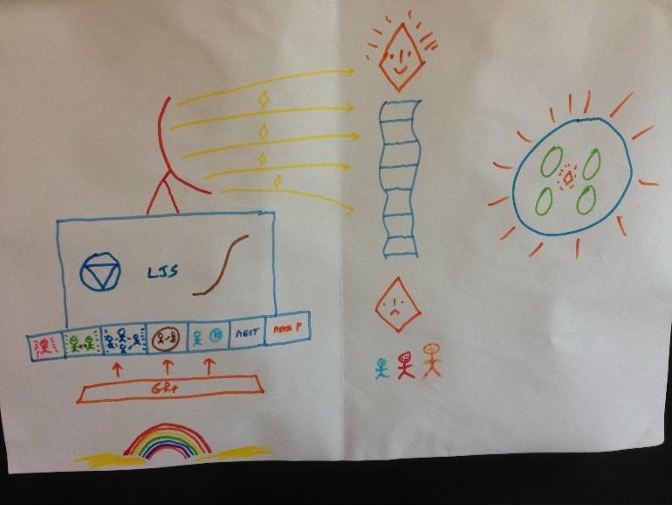
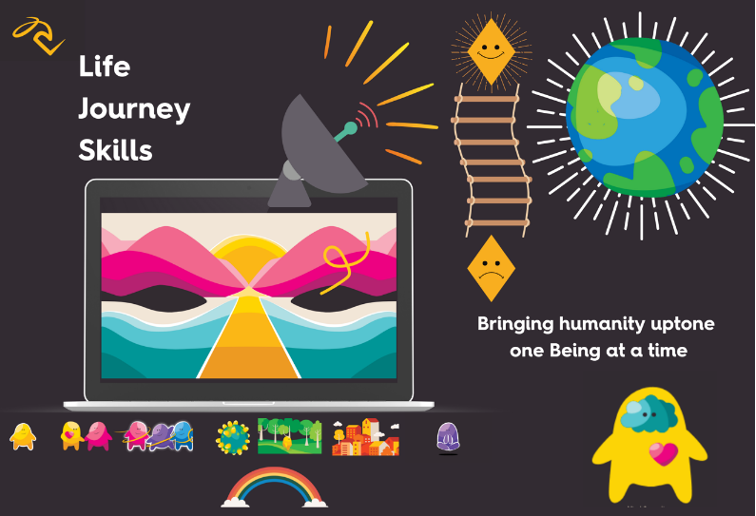
    In 2017, I decided to condense my learnings into a toolkit that anyone could access globally. I drew this vision below of empowering people around the world with an online program.

    As you can see, you don’t need to be Picasso; a simple drawing of your vision will do. The second image of my vision was created by a colleague using Canva. So you don’t need to be a graphic design expert either to create a vision!

    The key is to place your vision where you’ll see it every day as a visual reminder. It will motivate you like nothing else can. I am astounded at the people, events, and circumstances that continue to show up to help bring my Life Journey Skills program vision into reality.

    That’s not to say everything has come easily to me. This isn’t a magic bullet. We still need to put in the work. We’ll still face obstacles. We’ll still need to push through phases of difficulty and uncertainty. But a graphical life vision can help us believe in our vision and stay committed to the path of bringing it to life.

    My uncle was a keen sailor, and my mother suffered from seasickness. He said to me when I was young, “David, if we are out sailing in rough water and you feel queasy, don’t look at the bottom of the boat or at the waves. That makes you feel worse. Just look at the horizon. Why? Because it’s your stable reference point.”

    When the waves of life are getting a bit rough and we’re feeling queasy about life, a stable reference point can steady us and give us the strength to go on. It can keep us less focused on what we don’t want—all the struggles we’re currently facing and all the worst-case scenarios we imagine for the future—and more focused on what we do want. And that’s the key to staying the course so that we bring our vision to life.

    My advice to you is to have a go at creating a graphical life vision. Block out the ”shoulds,” rewrite the script, and live your life the way you want to live it.

    Be bold, be brave, and go for it!

    Click here to access David’s FREE mini course, Win at Life. In this short program, David draws on the laws of physics and metaphysics to help you navigate challenges and find your way to a more fulfilling life.

    Thank you to Golden Thread Media, this month’s site sponsor, for this wonderful free offer!

  • New Year’s Resolutions Simplified: It’s as Easy as 1, 2, 3

    New Year’s Resolutions Simplified: It’s as Easy as 1, 2, 3

    You and I will probably come across a hundred articles about New Year’s resolutions in 2023 … again. And, if you and I are like the majority—the well-intentioned, regular people who genuinely want change—we will aspire to big things and later get frustrated and give up on the list we made … again.

    But what if we kept it really simple this time? What if we didn’t have to make an endless list and be reminded, by looking at it, of all the things we may fail at again?

    What if we made it as easy as one, two, three?

    Let us do that instead, shall we?!

    1. Make “one” your magic number. Count to one each day, starting now, not from January 1st—NOW! What is the one thing you want and will do today?

    One email or paragraph you will write, or one chapter you will read, or one person you’ll reach out to. Who is the one lucky person you will text or call to tell them how you miss or appreciate them? Or how encouraged you feel by knowing them or how you want to ask forgiveness from them? Who is the one person you can write to or call to laugh about that one fun memory that you only share with them?

    I personally made a commitment to write or call or pray for a person whenever they cross my mind, that same day; I do not wait. There is a reason, I believe, we are reminded of people, and life is so fragile. I don’t want to miss an opportunity and regret not uplifting someone who could have been encouraged, or speaking kindness to someone who could have benefited from it.

    What’s one thing you will do today to move toward a healthier and happier you?

    Maybe it’s just one set of squats while you are washing the dishes; one jump rope you will order and one minute of jumping you’ll do when it arrives; one glass of beer or coke or a sweet drink you’ll replace with water or tea or decaf coffee just once today. Which one item will you change in your menu today for something that is better for your body?

    What is the one happy song you will listen to in the car or on a quick walk that you will take today? What is the one shop you will drive to, parking really far away, so you can get extra steps walking back and forth?

    2. Remember that there are two significant ways that your brilliant mind registers and remembers everything: through words and images.

    Paint clear, vivid, beautiful pictures for your mind of what it is that you want. Think backward; create an image of what your completed accomplishment looks like to you and make it as detailed and as exciting as you possibly can.

    See yourself having arrived at the healthy weight you want, you fitting into an outfit of your desires, hearing your friends and strangers complimenting you on how radiant and healthy and great you look, thinking about how you love taking care of your body inside and out.

    See yourself having completed your degree, project, letter, book, task, whatever. See yourself walking across the stage, people wanting to buy your product, welcoming your project, asking you to give your presentation again, asking you about and enjoying the summary of what you read or learned.

    Imagine yourself buying that house you have painted in your mind and furnishing it and having friends over and laughing and resting in your comfortable space every day!

    See yourself in a relationship you just repaired or found and are enjoying. See how good it is for you and the other person; see and hear the uplifting conversations you are having and the fun activities you are enjoying together. Dream in pictures!

    When talking to yourself, use words that are kind, uplifting, life-giving, generous—not the opposite. Speak in the same way you would to someone you love and care about; someone whose success would make you as happy as your own; someone you want to see happy, encouraged, loved. Talk to yourself in your mind and out loud like that each day and see what happens.

    3. Imagine yourself as a triangle.

    One side is your mind, connected to the second, your heart, connected to the third, your amazing body, with the entire space inside filled with who you really and most profoundly are—your spirit.

    All of you needs to be cared for, attended to, and nurtured. Pay attention to what each part needs and requires. How is it lacking? What is it missing? What one thing can you do today to nurture each part?

    I nourish my spirit through prayer and silence daily, which fills me with focus, strength, and insight, and I always pray for at least one person outside of my family as well. Walking is what helps care for my body during this season of life.

    So there you have it: one, two, three.

    When you get to the end of your day today, be sure to congratulate yourself on that one thing you did, that step you took, and look forward to doing it again tomorrow. Be your cheerleader and encourager and then, over time, you’ll see that change you’ve been looking for.

  • When You’re Ready for Change: You Need to Believe in Your Future Self

    When You’re Ready for Change: You Need to Believe in Your Future Self

    “Growth is uncomfortable because you’ve never been here before. You’ve never seen this version of you. So give yourself a little grace and breathe through it.” ~Kristin Lohr

    I was kinda sorta showing up.

    To the outside world, it looked like I was doing all of the things. I was smiling. I was talking about exercise and eating well. I was posting happy, positive vibe quotes, but I wasn’t really showing up for myself.

    I had experienced a miscarriage at thirteen weeks. This was supposed to be the safe zone. I had told family and friends. My husband and I even had names ready to go. This was baby number four, so I thought I was a pro.

    I was in a toxic work environment, but I kept going. Even after my miscarriage, I felt I had to be back there quickly so others didn’t need to deal with my responsibilities.

    After experiencing this loss, I spent quite a long time kinda sorta being serious about my well-being. But let’s be honest, I pretended for years. I was hearing “Take care of YOU!” on repeat. It was well intentioned, but I had absolutely no clue how to do that. Nobody told me how to take care of myself.

    I knew all of the shoulds and suppose-tos. But I was overwhelmed by those concepts as I added them all to my to-do list. I knew I should eat healthy and move my body, but what was I going to do about these negative thoughts of not being good enough floating through my brain every single day? The guilt was overflowing, but I just smiled.

    I took on more responsibility and wore so many different hats that it looked like I was able to do it all. In reality, I was so stressed that it was coming out physically through an annoying eye tick.

    I made an excuse of being tired when people noticed it. I defended that excuse because I needed to believe it. I wasn’t sleeping well. I was eating junk in between the occasional healthy meals kick. I was moving, but not on a regular basis. I continued to smile, make excuses, and pretend all was good.

    One morning, I realized that I couldn’t keep doing this. I opened my eyes and accepted that I was only kinda sorta showing up for myself and that I couldn’t keep sustaining this lifestyle without causing irreversible damage to those I loved and to myself. So I said the scariest words: “No, sorry. I can’t.”

    Admittedly, I only whispered these words to myself at first. Then something powerful happened: I started to say them out loud to other people.

    First, it was only to my inner circle, and then it started spilling out everywhere. I was talking about taking my power back. I was talking about an exit strategy from my toxic work environment. I was talking about how my miscarriage did, in fact, hit me hard. It rocked me to my core.

    I was open about my feelings. I was letting myself experience all of my emotions. I was shifting. I was becoming a new woman—a similar version to the happy and healthy woman I once was. I was emotional. It was scary. It was worth it. It took a lot of work and guidance. It’s still evolving. In many ways, I expect to always be growing and shifting.

    I told myself: Believe in your future self. That sounds like it should be easy to do, but it’s tough for most people. Chances are you are afraid of change. We all are. And it might be hard on your ego to admit you need to do something different.

    As humans, we want to be right. We don’t want to admit a choice we made was the wrong one. We may have second thoughts and see lots of red flags going up all over the place, but we still hate to admit we made the wrong decision. So we stick with what we’re doing even if it feels wrong.

    I have a little secret to tell you: The most successful people are the ones who push through the fear of change and do it anyway—even if it’s hard on their pride. It can be done. It will be messy in the middle, but you’ll get through it. When self-doubt creeps in, you need to follow two steps to make a change.

    1. A mindset shift

    You absolutely must believe that you can and will be successful to become successful. No matter what the goal is, you must believe in yourself and see the success as a real possibility.

    For example, if you want to move your muscles more through exercise, start your morning off with the mantra of “I am making my health a priority. I will move my muscles today.” Start acting like someone who exercises. Make decisions like a person who moves on a regular basis. Schedule it in. Talk about it.

    If you want to be happier and healthier, use these I am statements to help get you there: “I am enough.” “I am worthy of happiness every day!” Many people say they want to feel happier but don’t believe they deserve it, so they end up sabotaging themselves. Say those statements out loud. Write them down. Get to the root of any traumas or past conditioning that prevent you from believing them.

    Once you shift your mindset, your choices and path will align with the new you. You will reach your goals, or at least make progress toward them. You may experience imposter syndrome along the way. Keep going. That is a part of the mindset shift process. Talk back. If you believe you can do the things you want to do, you will.

    2. A strategy

    The second part of your success journey is the roadmap to move you forward. You cannot just wish and hope for things to happen. You must do the work.

    If you’ve shifted your mindset, now you need to travel the miles to get where you want to go. How do you do this? Set realistic goals. Make a plan. Follow the plan and stay consistent. You’ll need guidance along the way. Surround yourself with people who are doing what you’d like to do. Listen to the advice of those who have traveled this road before you. Ask for help to stay accountable.

    Do not assume that this will be an easy path to travel. Most things worth having require a good bit of work. Expect roadblocks and push past them.

    Know that not everyone in your current circle will be ready for you to shift. Change is scary on a personal level. When others change around you, it’s frightening if you aren’t shifting alongside them. In some cases, your change will create positive ripple effects for those closest to you, but it will happen for them once the timing is correct.

    Your future self is waiting to meet you—you just need to get moving. The path will not be all sunshine and rainbows, but you can travel it. You can make a change, even a great big one.

    Once you are on the other side, you’ll wonder why it took you so long to get there. You’ll be happier. You’ll be healthier. Other people will ask you how you did it! Take that first step and keep going. I promise you it’s better on the other side.

  • Want to Change Your Life? Draw the “You” You Want to Be

    Want to Change Your Life? Draw the “You” You Want to Be

    “You are not too old and it is not too late.” ~Unknown

    In less than a month, I’ll be hitting a major “milestone” birthday. I quit my full-time job six months ago, ending a twenty-plus year career in education, and have spent time thinking about what I want the next chapter of my life to look like. I found myself thinking back to a drawing exercise I did a few years ago that has made such an impact on my being willing to make major changes in my life.

    Entering my mid-forties, I had come to a point where something just felt “off.” I wasn’t sleeping well, often waking at 3am with anxiety about real or imagined catastrophes. I was often stressed and short-tempered. I was gaining weight and my health wasn’t in the top-notch condition the way it had always been. I felt directionless and unmotivated, but wasn’t sure what I would rather be doing.

    I recalled a TED talk I had seen in which Patti Dobrowolski discussed the power of “drawing your future.” While the concept seemed a little silly to me at first, I decided to give it a go one evening while journaling.

    The end result is a poorly drawn stick figure of myself in lotus position (which I can’t actually do) and a few notes in the margins. My goal was to draw and describe myself nine years in the future. What kind of “older woman” did I want to be? What were my activities? Had I conquered anything that currently plagued me?

    The stick figure I drew has salt-and-pepper hair, as she no longer feels any need to waste her time and money trying to look younger. She instead proudly wears her silvers as a testament to her experience.

    She is a vegetarian…maybe even vegan. She practices yoga and meditation daily…possibly is a yoga instructor. She rarely, if ever, drinks alcohol. She owns her own business, makes a six-figure salary, and has a healthy nest egg for retirement.

    Most importantly, she is completely at peace with herself and her place in the world.

    That fifty-five-year-old stick figure was so far removed from the forty-six-year-old me who drew her.

    I was still spending exorbitant amounts of money every eight weeks coloring my hair. I was an omnivore though eating meat disgusted me more than I cared to admit. I practiced yoga every now and then, but not seriously, and I never meditated. While I never identified as an “alcoholic,” my drinking went far beyond the recommended single four-ounce glass of wine per day. I did not own my own business, but rather was in a job that wasn’t going anywhere.

    Here’s what I found amazing. Within weeks of drawing that picture, I stopped eating meat. Within just a few months, I had cut out dairy and eggs as well. Six months later, I dyed my hair for the last time. I do at least a few sun salutations every morning. Most recently, I stopped drinking alcohol and said “good-bye” to that dead-end job.

    The biggest change was the confidence to make all of these decisions and to realize there is a thrilling and fulfilling future awaiting me.

    I still haven’t accomplished everything that stick figure has. My nest egg is growing, but I still have a way to go before I consider myself comfortably “financially independent.” I don’t yet own my own business, and I’m still working on trying to meditate more regularly. But having this vision of the future has helped me to set manageable goals about what’s important to me.

    None of this has been done easily. It has required vast amounts of reading, educating myself, learning new recipes, and discovering that kombucha or a shrub in a fancy glass makes me just as happy (actually more so) than a glass of champagne.

    I’m blown away by how inspiring that little stick figure has been and how the simple exercise of drawing my future helped me to get clarity about what I want out of life.

    Research shows that the odds of anyone making a change in their life are nine to one. If you want to beat those odds, according to Dobrowolski, you need to see your ideal future, believe it’s possible, and then ask and train your brain to help you bring it to life.

    That’s why a picture can be so powerful. When we draw, we utilize our creativity and imagination. This gets us away from our inner critic which often runs the show and tries to keep us safe from harm.

    Once we have our picture, we’re able to close our eyes and connect the dots from the present to the future, factoring in all our life experiences and imagining the steps that would help us get from A to B.

    If you’re struggling to picture your next steps in life, consider watching Dobrowolski’s video. She encourages you to first draw your current state—with complete honesty— and your desired new reality. Add color to the new vision to make it pop. Make it something that draws you in and gets you excited. Then outline steps to take that will make your new reality possible. You may be surprised at the clarity that transpires! Draw the “you” you want to be.

  • How to Keep Going When Your Dream Seems Far Off

    How to Keep Going When Your Dream Seems Far Off

    “Do what you have to do until you can do what you want to do.” ~Oprah Winfrey

    I needed a bit of extra cash last month, so I took on a temporary events role working at a local design exhibition.

    I’ve worked in events before, so I didn’t think much about it.

    I just knew that I needed some money, I liked doing events, and a short contract had presented itself.

    It seemed perfect!

    So off I went to my first shift, feeling pretty good about myself and about life.

    The first event was at a studio in a deserted industrial park. Even at 5:30pm, when it was still light, I felt uncomfortable walking the ten minutes from the bus stop.

    When I got there, I quickly realized that the role wasn’t going to be as fun as I thought it would be: standing shivering outside in the cold, wearing an exhibition t-shirt, registering attendees, most of whom weren’t on the guest list but were expecting to be on the list.

    So they got shirty.

    And the line up grew longer.

    So they got even more shirty.

    Two hours later, and I was starting to wonder why I’d taken on the role. (And don’t get me wrong—I know there are worse jobs, and that I’d signed up for it myself. I’m not looking for pity.)

    I started talking to the other girls who were working there. They were students, and it turns out they were a lot younger than me—nineteen and twenty-four. (I’m thirty-five.)

    Now, I know that age doesn’t make a difference, and I’m generally pretty comfortable with my age. (Getting older is better than the alternative!) But in that moment, I felt pretty crappy.

    So as I stood in the cold, with two girls ten to fifteen years younger than me, working for a near minimum wage job, I started to feel down.

    I started feeling sorry for myself.

    And at the end of the night, as I waited for the bus in the cold, dark bus depot, feeling pretty low, I texted a friend who I knew would understand.

    My text read:

    What the hell am I doing?! I’m thirty-five years old, and I just worked a minimum wage job in a dodgy part of town, with a nineteen year old, and now I’m waiting for the hour-long bus journey to take me home.

     My other friends are doctors or lawyers, own houses, and drive their (nice) cars to their places of work. 

    Ever feel like you’ve missed the boat somewhere?!”

    My friend was sympathetic (she’s temping and traveling around Europe while most of her peers are buying houses, having kids, and generally “doing very well.”)

    And then she said something that really stuck with me. Something that brought it all home:

    She simply said:

    “Think of your long-term vision.”

    This is how she explained it to me:

    Yes, you’re doing a minimum wage role (temporarily). And yes, you’re working with people much younger than you. And taking the bus to work.

    But you’re doing all this for a reason.

    You’re doing this so you can set up your business. You’re doing this so you can create a new life for yourself—a life to really be proud of.

    You’re doing this for the end goal.

    So yes, it is sucky right now. But think of your long-term vision.”

    I couldn’t have asked for a better reminder.

    Because that was exactly it: I was working the job to earn extra money while I set up a business I’m passionate about.

    I was temporarily in a murky patch so I could get to a better place in the future.

    And I had forgotten my long-term vision. I had gotten caught up in the short-term

    And this is so easy to do.

    So I’d like to share my experience with you, to remind you of this powerful idea: Keep your long-term perspective in mind.

    Don’t get caught up in what is happening now, only.

    Think of the bigger picture: your big plans, your long-term goals.

    If you’re setting up your business and feel like you’re not getting anywhere, think of the long-term vision.

    You might not get anywhere in the first few months, but what about the next year or two? How far could you get if you kept going and putting in the effort?

    If you’re working two jobs in order to go traveling after grad school, keep that vision in mind.

    Think of setting off on that plane with your passport in hand, sipping an espresso in a village in Italy, or seeing the Eiffel Tower for the first time.

    Keep your long-term vision in mind.

    If you’re writing a book and you’ve rewritten the first chapter ten times, think of your long-term vision: being an author.

    Picture having your first book published and seeing it on sale in your local bookstore.

    If you’re training for a half marathon and you busted your knee running, rest up, and think of your long-term goal: crossing that finish line.

    Don’t worry about the things happening now. The crappy jobs you take… the revisions you’re making… the demo tapes you’re sending off with no replies… the manuscript rejections. These are all temporary.

    But the long-term, if you keep taking action and putting one foot in front of the other, could be very different.

    If you let it.

    If you keep going.

    If you keep your goal in mind, and keep it clear.

    See, I had forgotten my reason for taking on this temporary events role.

    It wasn’t to work in the cold while annoyed guests took their impatience out on me.

    (Funnily enough!)

    It was to earn money so I can keep working on my business.

    To keep afloat while I follow my dream—my passion.

    Something that makes me feel excited and proud and hopeful and exhilarated.

    But, hang on, I know what you’re thinking:

    Sounds easy, but how do you do it in practice?

    How do you focus on the long-term, while you’re dealing with the difficulties of the short-term?

    So here’s how I did it. I hope these points are helpful for you too:

    1. Get clear on your goal, and display it somewhere prominent.

    Post it on your wall. Set it as your phone backdrop. Make it your computer wallpaper.

    Anything. Just make it visible. So you have a reminder, day in, day out, of what you’re working toward.

    2. Know how your short-term plans are feeding into your long-term goal.

    Get clear on how your actions are contributing to it.

    E.g.: I am putting up posters in the rain at eight o’clock at night so that people know about my business and I can eventually help people with my successful and inspiring series of retreats.

    I am taking the bus to this business event two hours from my hometown so I can meet people who might be able to help me get a job in my desired industry, or give me tips on how I can make it in this competitive market.

    3. Team up with someone doing something similar.

    Texting my friend was the best thing I could have done because she understood. She sympathized. I didn’t feel judged, or stupid.

    So find someone in a similar situation to you. It doesn’t have to be in person—go online and seek out supportive websites, Facebook groups, whatever it is that helps you realize you’re not alone.

    4. Know that everyone goes through this.

    The people you see at the top of their game didn’t start there. They sweated, and toiled, and kept going when the end seemed unrealistic, or even impossible at times.

    No one promised them they would get to the top. So they used their belief to keep them going.

    Think of anyone you admire, in any field…

    Did they work hard to get there, or did they have it handed to them magically on a plate? Did they take time to get to where they are now, or did it happen overnight?

    5. Appreciate where you are now.

    See the positives as well as the negatives. Your blog only has four readers? Great—think of all the mistakes you can make without anyone knowing or making harsh comments!

    Working a boring job while you pay your way through school? Then sign up with a friend, and make it fun!

    Because—without sounding negative—you will still have issues and problems when you get to where you want to be. They’ll just be different problems and issues. So enjoy the problems you have now.

    I might have moaned about my long bus journey home at night, but if I’m traveling for business in the future, there could still be times where my flight is delayed and I’m hailing a cab in the pouring rain at one in the morning.

    Appreciate where you are on your journey—it is all important.

    So there we go. Five ways to keep going when your short-term reality doesn’t match your long-term vision.

    Because we all have to do things we don’t necessarily want to do to get to where we truly want to be.

    Most people don’t want to put themselves through this.

    They don’t want to go through the tough times, the yucky stuff, to emerge out the other side, stronger and clearer on where they’re headed.

    It’s easier to stay in the easy, safe zone.

    Do the things you gotta do to get to where you want to be.

    Because we only have this one life. So why not live it pursuing the things you love—your big goals and dreams?

    Why not go after those dreams and adventures rather than moaning that nothing good ever comes your way? (Hint: it’s because you have to go out and get it.)

    And now, over to you:

    What are you working on now to fulfill your long-term vision?

    What are you going through now, in order to create a brighter future for yourself?

    What have you learned along the way?

    Let me know in the comments. I’d love to hear!