Tag: victim

  • How Complaining Keeps Us Stuck in Relationships That Don’t Work

    How Complaining Keeps Us Stuck in Relationships That Don’t Work

    Couple in Prison

    “As I began to love myself I found that anguish and emotional suffering are only warning signs that I was living against my own truth.” ~Charlie Chaplin

    When I was eight years old my father burst into my room in the middle of the night, high on drugs, and threw my dresser drawers all over the place.

    “Stop your crying!” he screamed. “Stop your crying!”

    There was a crazy man in my room and I was terrified.

    “Now clean up this mess!”

    I was shaking. What on earth could I have possibly done to deserve this? With a slam of the door he was gone.

    For years my father annihilated me like this. He shamed me in public and raged at me behind closed doors. He was emotionally abusive and sometimes physical too.

    He taught me to believe that everyone was out to get me and that everything was my fault. He taught me to believe that I was a worthless piece of you-know-what and that I didn’t deserve any better. Seriously, how else is an eight-year-old supposed to interpret this kind of adult behavior?

    Raise of the hand, excuse me, Dad, but what you’re doing is messing me up for the long run. I was a kid. I assumed I was getting the parenting and love I deserved.

    Growing up I took what my father taught me out into the world and perfected it. The first girlfriend I ever had cheated on me with another man, yet I stayed with her because I thought I didn’t deserve any better.

    My best thinking (at the time) told me that nobody else would ever love me, so I stayed and allowed her to treat me badly.

    I lived in a one-bedroom apartment for four years even though every time I needed something fixed the landlord would yell at me. She would yell at me as if I was the problem, yet I stayed and paid my rent each and every month on time. I had no self to esteem and allowed her to treat me poorly.

    See my pattern? I stay in and return to painful, destructive relationships. In fact, I’m in one right now.

    I have stayed in the same painful relationship for the past thirteen years. It’s a relationship that no longer works for me, yet I keep going back to it as if one day, magically, things will change. Shake of the head, things never change.

    I have been yelled at, threatened, and taken advantage of. I’m undervalued, underappreciated, and constantly miserable. Take, take, take, that’s all the other side does.

    Each day leaves me emotionally drained, mentally distraught, and in a fowl mood. It’s obviously an unhealthy relationship, yet I stay because my stinking thinking tells me I don’t deserve anything better. I’m talking about my job.

    I hate my job. Okay, maybe hate is a little over the top. Let’s just say I don’t like my job.

    Yet each day I get up, shower, put on my uniform, and return. Voluntarily, mind you. And that makes me sad.

    Sad because by staying, I’m allowing myself to be that scared little eight-year-old all over again. By staying, I’m telling myself that I’m not good enough and that I don’t deserve anything better. I’m ‘parenting’ myself the same way I was parented by my father.

    I should’ve left my first girlfriend when she cheated on me, but I didn’t know how to take care of myself then, so I stayed. A healthy person with healthy boundaries would’ve been out of there. I wasn’t healthy.

    I should’ve told my landlord that it wasn’t okay to yell at me, but I didn’t and I stayed. I didn’t have the tools to stand up for myself and therefore allowed her to bully me.

    We do this, don’t we? We stay in and or return to painful destructive relationships when we deserve so much more. We do this with family members, boyfriends/girlfriends, friends, and yes, we even do this with jobs.

    But why? What’s the payoff for staying? (Trust me, there’s always a payoff.)

    For me, it’s about sympathy, which fuels my low self-esteem. If I complain loudly enough someone will ultimately sympathize with me, which in return validates my pain. Look at me, I’m a victim! 

    Trust me when I tell you, I complain a lot. I complain at the bank, while driving in my car, at work, at the movies, at home, on vacation, at the grocery store, and so on. All so I can validate my childhood belief that I don’t deserve any better.

    In the process I’ve created a reality that coincides with my thoughts. A reality that looks a lot like my childhood. Argh.

    Deep sigh. I’m tired of being a victim. It’s exhausting and it’s gotten me nowhere.

    Folks, this isnt about my job or a past girlfriend or landlord, this is about me. It’s about me not being a victim anymore and learning to love myself in return. When my emotional suffering goes away, I’ll have the strength to walk away from things that aren’t serving me instead of complaining.

    If I stop complaining, what am I left with? Me, just me.

    And that right there is the gift! Getting a chance to be with just me. To love and affirm me.

    Talk about an amazing opportunity for growth. If I’m working at being the best me I can possibly be, I’m doing myself a disservice by wasting time complaining. We all are.

    Complaining doesn’t change anything. It just keeps us stuck, victimized, repeating old patterns and unable to change them. The alternative? Take responsibility for our part, forgive ourselves for the patterns we’ve perpetuated, treat ourselves with the love and respect we know we deserve, and begin to make positive changes in our lives.

    So what’s my next right action? Well, just for today I’m going to see if I can go twenty-four hours without complaining and at the very least stop/catch myself if I start to. I’m also going to be grateful for what I have in my life, which is a lot.

    Gratitude list here I come! I deserve the good stuff. We all do.

    Couple in prison image via Shutterstock

  • The Keys to Finding Happiness After a Traumatic Childhood

    The Keys to Finding Happiness After a Traumatic Childhood

    Sad Child

    It is never to late to have a happy childhood.” ~Tom Robbins

    A few days ago, when my older brother and I were sorting through old family photos, we found a picture of us from when we were about five and six years old. We were smiling. Just two kids full of life with no idea of what was to come.

    This was before the start of all the rage—before all the pain and an unfortunate series of events.

    My childhood was rough. I know some people may wish to return to those young innocent years of playing outside and going about our way without a worry in the world. However, if I had a choice to return to my childhood, I would hesitate at the gate.

    At the tender age of eleven, I was snatched from my home. I didn’t know why, all I knew was that my mother had done something bad and that my siblings and I had to be removed for our safety.

    When I was old enough to understand what had happened, I learned that my mother had gone to a mental institution to receive help and counseling for her anger.

    I used to think, “Well, everyone gets angry,” but this was different.

    Her words were a bit too harsh, her actions a bit too unpredictable, her impact a bit too negative. I remember sitting in the bathroom crying and wondering why I just couldn’t live a simple, happy life like the children in movies.

    Recovering from a traumatic childhood can be extremely difficult, especially when taking into consideration how valuable our childhoods are when preparing for adulthood. As of today, although my mother is generally in a more stable mindset, I can still hear the sound of her voice shouting threats I wouldn’t wish on my worst enemy.

    When attempting to deal with a traumatic childhood, I feel the first solution that comes to mind is to forget it. However, trying to pretend that something did not happen doesn’t fix the negativity it has already enforced.

    When I first entered college, I saw it as an opportunity to get away from home and interact with others. With this in mind, I left my family home, but brought all the effects of my childhood with me.

    Throughout my high school years, I had become agoraphobic. I barely left my house and it pained me to attend school. When I entered college the same pattern persisted.

    I was scarred and I blamed my mother.

    She was the reason I was so negative, vain, and alone. I finally came to the conclusion that I no longer wanted to dwell on the past, allowing it to devour me inside out. So I eventually had to learn to let go, which proved more difficult than I first perceived.

    The first step to recovering from a childhood of physical, emotional, or mental abuse would be to attack it at the source. I mean standing head to head with what happened and not running away. We must accept that it happened and admit that it has affected us.

    When I attempted to dispose of my issue by running off to college, I forgot that it was still the reason behind my negative attitude. I would try so hard to disguise the fact that something was wrong and that I was unhappy.

    I thought it made me look weak and defeated. However, accepting that something is wrong takes even more strength than trying to pretend that everything is all right.

    It also allows you to take control of your life and put yourself on the path to healing.

    After determining that I was indeed affected by my mother’s explosive fits of rage, which led to other events throughout my childhood, I needed clarification as to why all of these things had occurred.

    I wanted to get to the bottom and dig up the roots of this issue in order to seek closure. So I sat and spoke with my mother, something I had never done. She explained to me that anger disorders had always been prominent in her family.

    She informed me of the time my grandmother killed a puppy trapped under her barn because the noise kept her up at night.

    She also told me how my grandfather went into explosive fits of rage after coming home from a night of drinking. At one point he even attempted to hit her with an axe. I then realized that my mother’s behavior did not come from her genuinely despising me, but was a direct reflection of what she’d experienced during her childhood.

    With this, I knew that I had to change because I did not want to continue to spread this lineage of anger.

    When we ask questions and gain clarification, we begin to achieve a sense of peace or relief that we finally have the answers and can learn to move on. When we choose to run away from our problems, we never get the clarification we need to move forward.

    Another important step on the journey to recovery is learning to define our happiness by ourselves. Quite often, we tend to dwell on the challenges of our childhood and blame them on one particular person, or blame them for our current unhappiness.

    Not to say that our traumatic childhoods had no effect of our adult lives, but rather the reason we are still unhappy is because we’ve chosen not to recognize these effects and properly address them so that we may move forward.

    If you choose to remain in a state of unhappiness due to the challenges faced during childhood, you will never be able to find peace.

    During my high school years, I would always blame my mother for my childhood experiences, and I concluded that my childhood experiences were the reason I could not be successful or accomplish the things I wanted to accomplish.

    I felt my childhood had made me a victim, and thought that was the reason behind my unhappiness and overall instability.

    What I came to understand was that I was still unhappy because of the fact that I viewed myself as a victim. I was still unhappy because I held on to my childhood. To me, it was a valid explanation for all the things I felt I could not do.

    I became a happier person when I began taking responsibility for my own happiness. I stopped blaming my mother for every horrible thing that had ever happened to me and I stopped blaming my childhood for my failure.

    One of the most common mistakes we make when referencing our traumatic childhoods is comparing them to others with “normal” childhood experiences. When we compare ourselves, we are taking away from the essence of who we are. Our childhoods, traumatic or not, are a part of who we are and what makes us, us.

    Take a look around and think of where you are now. You may have a beautiful family and the career you’ve always wanted. As for me, had I not had such a traumatic childhood I wouldn’t be able to write this post and help someone else by sharing my story.

    Think of all the good things that have come from your experience and you might just begin to be thankful you had it.

    One of the major lessons I’ve learned throughout my entire journey is that sometimes you just have to let go and trust that everything will turn out okay. Moving on from the past is stressful, especially when we feel as if we have an obligation to fix something that can no longer be fixed.

    We also tend to look to the past for answers to current situations. By doing this we are unintentionally taking away from present moment. Holding on to my traumatic childhood prevented me from moving forward with the rest of my life.

    It wasn’t my childhood preventing me from accomplishing things; it was my negative perception of myself. When I finally decided enough was enough, I began to look at things from a different angle.

    Maybe it wasn’t my fault or anyone’s fault for that matter—it doesn’t matter. What does matter is finding happiness once again and being content with what happened in my past without allowing it to become a burden.

    We sometimes get this clouded illusion of how life is supposed to be, but truth be told, you have to fight through some bad days, to earn the best days of your life.

    Sad child image via Shutterstock

  • How to Make Peace with the Past and Stop Being a Victim

    How to Make Peace with the Past and Stop Being a Victim

    “Never allow yourself to be made a victim. Accept no one’s definition of your life; define yourself.” ~Harvey Fienstein

    Do you usually feel as if everything bad that can happen will happen, and it will happen to you?

    You must be the unluckiest person on the face of the planet. Opportunities never work out. Doors that should open close in your face. Friends let you down. Bosses don’t see your value. There seems to be a universal conspiracy to keep you stuck right where you are now.

    You feel like your life is always going to be like this.

    You feel like a failure as a person.

    You worry that you’re never going to be happy.

    You stress that you have no control to change any of it.

    And it’s all so unfair, right? Why does this bad stuff always happen to you? How come other people get all the breaks, and you never do?

    If this sounds familiar, you’re probably still affected by past events that left you feeling helpless, scared, or inadequate—and you’re going to keep re-experiencing these feelings until you do something to change them.

    My Experience with Self-Sabotage

    Why do I get how this works? It’s no big mystery. I’ve been there myself. In fact, at one time, I was the queen of self-sabotage.

    I went from being a straight-A student to dropping out of school a year before my finals. From being a loved and spoiled child to losing touch with my family. From being confident and self-assured to needy and codependent.

    What happened? I stopped thinking of myself in a positive way in response to events outside of my control. I’d always taken pride in myself, and I felt someone had taken that pride away from me.

    All of these dramatic changes came from something very small—a change in my home circumstances that stopped me feeling like part of the family. Because someone in my life constantly criticized me, I lost confidence in my ability. Because I lost my security, I became chronically insecure.

    Instead of feeling that I was a person of worth, with good prospects, I started thinking of myself as rejected, unwanted, and somehow less-than.

    As a teenager, I was in no way equipped to deal with that. So I rebelled. And from there, my life went very rapidly downhill.

    I sabotaged my jobs; I couldn’t stick anything beyond a few months. I sabotaged my first degree by dropping out. And as for relationships, I attracted every narcissistic guy around, all with the agenda of keeping myself a victim.

    So What Changed—and How Do You Change It?

    I hit rock bottom. My last bad relationship had come to a nasty end, I’d dropped out of University, and I had absolutely nothing in my life to keep me going.

    When you hit rock bottom, you have two choices: You give up, or you say, “enough is enough.” And you start changing the way you’re thinking about things and do something to radically improve your life.

    I took the second option, and my life turned around. From nothing, I went to a happy marriage, motherhood, a lovely home, and a fantastic career. And I promise you, if I can do it, from where I was at that time, so can you.

    The following are some of the things that helped me overcome my negative programming and self-confidence issues. If you feel you were born to be a victim, and to live a life filled with anger and frustration, these steps could work for you too.

    Why “Just Let Go” Is Not the Best Advice

    I hear this advice all the time. People come to me saying they’ve been told to put the past behind them and start over, but they have real problems doing that. If only everything in life were that simple.

    This stuff happened, and it happened to you. You’d need to be some sort of superhuman, or a machine, to think that it’s had no effect on who you are. And letting go, like it never happened, is denying its influence.

    People who try to deny the effect of past experiences use a strategy called repressive coping, and these things have a nasty habit of coming back to bite you when you least expect it.

    Accept what happened, understand how it’s affected you, but make sure you place it where it belongs—in the past. The fact that it’s there doesn’t mean you have to keep playing the same situations over in your life. You can make different choices, think in different ways, and keep moving forward.

    Being Peaceful or Being Strong?

    Of course we’d all like to be peaceful and calm, but sometimes that’s just not possible, especially when you’ve been through traumatic events. Lacking a magic wand, we can’t just make it all vanish. So following on from acknowledging it, we then move to what it gave us—and although it may be hard to see sometimes, it gave us strength.

    There are people in the world who’ve never had to deal with the stuff that you’ve been through. You’ve dealt with things they can’t even imagine. That gives you reason to be proud of yourself, and a whole different perspective on what “tough” really is.

    Losing my family and my identity may have been the cause of my initial problems, but it also provided me with the strength to overcome challenges I encountered in my life, and played a great part in giving me the confidence and ability to achieve my management career goals.

    Accept Who You Are—But Who Are You?

    So following on from the point above, who are you now and how do you see yourself?

    You may have been a victim in the past, but you’re still here, in spite of everything that the world’s thrown at you. In my opinion, that makes you a survivor. You may not feel it, but you’re strong.

    You can take the strength and be proud of the person who survived the challenges. You can choose how you see yourself. Do you want to see yourself as a helpless victim of circumstance, or as someone who is still standing, still fighting, still growing, still on a journey to make your life better and not give in?

    Sure, the insecure stepdaughter is still somewhere inside me. And she’s now also the person who has achieved a really good life and has the security and success she always wanted.

    As We Forgive Those…

    Another piece of common advice that people are given: forgive what was done to you. Unfortunately, some things are harder to forgive than others, so the brain will fight that.

    If someone has maliciously caused you harm and you have to live with the consequences, forgiving what’s unacceptable may seem to keep you in victim mode—as if, once again, you’ve just had to take it.

    Of course, the truth is, by staying angry and bitter, you’re still hurting yourself. It’s irrelevant that they may deserve your bitterness. They aren’t suffering from it; you are.

    So, I don’t advise you to force forgiveness. Instead, accept what happened, acknowledge how you feel about it, then put it behind you. You can’t change the past, but you can change the future, and dwelling and brooding on these feelings will not help you move forward.

    Count Your (Amended) Blessings

    However positively you can spin the past, your life has still been negatively affected. You may have a worse life than you would have done if this thing had never happened, and it’s hard to feel gratitude for something awful! So how can you be grateful for what you do have now?

    Be glad for the person who has come through this—the survivor, even though you may not feel like one.

    Be glad for what you’ve managed to achieve, in spite of everything that’s been done to stop you. You may feel like you haven’t achieved much, but as a person who is reading this and trying to change your life, you’ve achieved the power to make decisions and refuse to give up, which some people never do.

    Be glad for the extra lessons you learned: the ones that made you tough, make new problems minimal compared to past challenges, and put you in a position to be able to help others who’ve been through the same things.

    These are the things that are going to empower you to go out and change your world.

    Playing with the cards stacked against you is just plain unfair. It’s time for you to even the odds.

    Your past is always going to be something that happened to you, but that doesn’t mean it needs to define you, restrict you, and dictate your future life.

    How would your life change if you were only taking what was positive from the past? If you could see yourself as someone who overcame it, who chose to reject the negative self-concepts that were forced on you, who was a survivor, and not a victim?

    You can do this. You, and only you, have the power. And that’s why you’re not a victim. The only person who can control this is you.

    Work through all of the points above. Find out where your blocks are. Deal with them. Move on. You’ve been through enough already. It’s time for things to get better.

    You’ve got this.

  • 7 Things Everyone Should Learn Before They Die

    7 Things Everyone Should Learn Before They Die

    Woman reading book

    “I would rather die of passion than of boredom.” ~Vincent Van Gogh

    I attended an interesting event a few nights ago. It featured ten speakers who spoke for ten minutes each on ten things you should know before you die.

    The speakers included TV and film stars, CEOs, cover-shooting photojournalists, traveling journalists covering natural disasters, and HIV survivors. As you can imagine, there was a wide spectrum of perspectives shared.

    Here are a few of the lessons that stuck out for me. A lot of these can profoundly change your mindset, how you view the world, and how you choose to react to things. You just need to take a step back and put things into perspective, which leads us into our first one.

    1. Maintain perspective.

    A journalist told a story of how he traveled to Haiti after the devastating earthquake that hit them a few years back. In the capital of Port-au-Prince many of the homes had fallen apart, and people who already had nothing were now living in small plots of land in public squares in the city.

    The separations between each family’s plot were drawn in by hand, with tents and tarps set up overhead.
    In one particular plot was for a seven-year-old girl and a one-year-old boy.

    The speaker spoke a bit of Creole French and asked the people in neighboring tents which family these children were with. They replied, “That is the family.”

    The seven-year-old girl and one-year-old boy’s parents and older siblings had been killed. She was now responsible for this baby.

    This is where the notion of perspective comes in. The next time you’re upset at traffic, or someone is taking too long in the checkout line, or someone hasn’t texted you back quickly enough, take a step back and ask yourself, in the grand scheme of things, is this really worth being upset about?

    The book Unbroken drove this point home for me. Reading what this man went through quickly made me realize, if I were privileged to be born into a first world country (Canada) in the current peaceful time, I have absolutely nothing to complain about. A reminder to myself the next time Netflix is slow to load something…

    2. Take care of your health.

    Health is the gateway to happiness. If you are not living with your fullest energy and vibrancy, how can you expect to get the most from life?

    This was the main message from a middle-aged woman and entrepreneur who broke the status quo and went her own way in life, much to the dismay of her parents. She dropped out of school and traveled the world, falling into a few rough crowds on the journey and eventually settling in Toronto.

    There, she visited a local fresh juice place that ended up changing her life. She fell in love with how the juices made her feel and the energy they gave her, and ended up opening her own juice place called “Juice for Life” (which her Jewish parents hilariously thought was called “Jews for Life” at first). She’s now the founder and CEO of Fresh Restaurants chain in Toronto.

    Anyone who knows me knows health is massively important to me as well. I always pose the question: Is it not a bit crazy to think that people will spend more money on their car, their fashion, and accessories than they would on their body?

    Ask anyone with a serious illness what would they rather have; they all would give up everything they own to get healthy and undo the damage that was done.

    3. Be true to yourself and your calling.

    If you are living and doing something that doesn’t align with you, how can you ever be truly happy and enlightened?

    This was the main message from the founder of Yuk Yuk’s comedy club, a popular spot in Toronto.

    You can imagine the reaction he got from his friends and family when he told them he wanted to enter the comedy business. This was his passion, however, and he knew from experience that if he was doing something different, he would rarely be at peace or be inspired.

    When you find something that aligns and resonates with you, you will know it from the energy it gives you.

    The Vincent Van Gogh quotes sums the message here up quite nicely: Would you rather die of passion or of boredom?

    4. Don’t be afraid to stand out.

    When you go your own way and make your own path, you alone write your legacy.

    This was the motto of a female photojournalist who spoke to us. She joined the world of journalism in the sixties and seventies, when it was completely dominated by men. She was different from what was considered the norm and despite ridicule, sexist remarks, and being seen as lower, she used it to her advantage.

    Being shorter than the male photographers, she was always in front of the pack, allowing her to capture some of the closest, most personal photos. She became one of the first females to have their photos published on the cover of multiple well know magazines, and went on to be the prime journalist covering Terry Fox’s run across Canada.

    It is your inherent right to challenge the status quo. Never be afraid to forge your own destiny due to the thoughts of others. People may laugh at you because you are different. You could pack up and quit here, or you could feel sorry for them because they are all the same.

    As well, never be afraid to challenge why things are the way they are. After all, this is the very question that has forged almost all innovation mankind has ever done.

    5. Don’t play the victim.

    As I mentioned earlier, one of the speakers was a girl born with HIV. She was abandoned by her parents and adopted by a supporting family with nine other adopted children.

    Her new family took her in with love and put her through school like a normal child. But when the other children’s parents found out she had HIV, it was no longer normal. They refused to invite her over to birthday parties and sleepovers and forbade their children from being friends with her.

    She could have closed up and felt angry at the world, but instead she took a position of power and action. Now in her late teens, she has spoken globally, on major TV networks and YouTube, to educate the world on HIV and how ridiculous it is to “ban” your kids from socializing with someone who has it.

    Many people constantly place blame on everything and everyone and make themselves a victim. Why did this happen to me? Why can’t I make more money? Why am I stuck at this job?

    The world doesn’t owe you anything; you were not born a victim. Yet when you look around how many people do you find complaining about their situation but not taking any action or effort to improve it?

    The world gives you so much to work with if you work with it and put in the effort.

    6. Re-direct your energy.

    An actress told her story of failed audition after failed audition while witnessing other people’s success. She knew she could have gotten caught in the negative energy of envy and blame—upset that others were getting roles, getting paid more, or traveling more.

    She didn’t go this way, though; she knew envy can be channeled into focus and motivation.

    The lesson in here is quite simple. Instead of wasting energy being angry, envious, or jealous of those with more success, redirect that energy and ask, “What can I learn from this person to improve my own life?”

    As a result of doing this, she re-auditioned for a part she hadn’t received and was so motivated she ended up blowing them away and getting the role on the spot.

    7. Give your attention.

    One of the speakers began his talk with a severe stutter. The energetic crowd grew quiet, not knowing how to react. He then switched to a more fluent voice and told the audience he suffered with this stutter for the first twenty years of his life.

    When he was a young teen, he worked at one of Vidal Sassoon’s salons, doing odd behind the scenes jobs where he didn’t need to speak, like sweeping and tidying up after customers. Most people didn’t give him the time of day or would mock his difficulty in speaking.

    One day it was announced that Vidal Sassoon himself, the CEO, was coming to visit their Salon. Vidal made a point to meet with everyone, from the highest manager to the ones attending to the cut hair on the floor.

    When he approached the young boy, he asked what his name was. The boy tried to respond but was too nervous, and his stutter was so severe that he just could not get his name out. Vidal smiled, crouched down in front of him, and said “It’s okay, son, I have all the time in the world.”

    The greatest gift you can give someone is your attention. Never allow yourself to get in the mindset that people are “below you,” because even the smallest conversation can make someone’s day. People will forget many things, but they will always remember how others made them feel.

    Imagine a world where everyone learned the lessons above from a young age. It’s possible, but starts with each of us.

    Woman reading image via Shutterstock
  • We Are Victors, Not Victims

    We Are Victors, Not Victims

    Victor

    TRIGGER WARNING: This post deals with an account of assault and may be triggering to some people. 

    “You are not a victim. No matter what you have been through, you’re still here. You may have been challenged, hurt, betrayed, beaten, and discouraged, but nothing has defeated you. You are still here! You have been delayed but not denied. You are not a victim, you are a victor. You have a history of victory.” ~Steve Maraboli

    I was about twenty years old. It was a beautiful summer day, and I decided to walk to my parents’ house.

    I usually called them first to let them know I’d be coming, but that day I wanted it to be a surprise. It was a twenty-minute walk there, and I had two bridges to cross, then a small trail close to the woods to walk through and I’d be there.

    I started feeling followed crossing the second bridge, but hey, anyone can take a walk on such a beautiful day, right? So, I continued on and entered the path close to the woods. I was almost there!

    When trees were hiding us from all the passing cars on the road, I felt that the boy following me was getting closer and closer.

    Suddenly, as a cat hunting a mouse, he jumped on me from behind and tackled me to the ground. He started kissing and groping me, and I tried to fight him and fidget my way out to no avail. He was much stronger than I was, even if he looked a bit younger than me.

    I didn’t scream at all; I was subdued! I started to talk to him, plead with him to stop doing this to me. I lied and told him that my parents were waiting for me and would be worried if I didn’t show up soon, and they’d come find me. No reaction.

    He kept abusing me and trying to take my clothes off while pinning me down. He didn’t speak a word. He never looked me in the eye.

    Then, I thought I could talk him out of it by using the psychology I’d learned in college. I started telling him that he must be a good person inside, and that he would feel ashamed if he continued like this.

    I told him that there was no reason to do this since he could certainly have the “real” thing with a consenting woman, and it would be so much more pleasurable than this ugly one-sided aggression.

    Well, I’m not sure what worked. Was it the psychology stunt I pulled or did he just get bored of this stupid young woman who just wouldn’t shut up? He just got up, left me lying there dazed and confused, and ran off never to be seen again.

    I picked myself up, tried to get the dirt off me as much as possible, and walked shakily to my parents’ house.

    Google defines a victim as a person harmed, injured, or killed as a result of a crime, accident, or other event or action. Obviously, the casualties are the only victims that do not have to learn to live with the aftermath of the traumatic event. The others, however, are marked either physically or psychologically by what happened to them.

    The six o’clock news is filled with stories of tragedies, big and small. These can take on so many different forms, but the end result is always the same: victims. They can be victims of Mother Nature’s wrath, victims of a horrific crime or injustice, or victims of some kind of accident.

    So many people feel stuck in their lives after having lived through a traumatic experience. They are paralyzed for months, years, and even decades by the shock, hurt, and fear associated with what they’ve endured.

    Some people have to live with physical reminders of this tragic event, and others have psychological repercussions that limit their ability to live a normal life.

    After my aggression, I felt soiled, tainted. I remember taking shower after shower trying to get my aggressor’s smell off of me. But even when I was sure I was clean of any traces of him, my brain was stuck in the event.

    How can one evolve from being a victim to being a survivor? Doesn’t the term “survivor” give more hope in tomorrow than “victim”? Seems to me that “victim” suggests ongoing pain and suffering, whereas “survivor” is someone who was able to leave the pain and suffering behind him and start living again.

    “I am not what happened to me. I am what I choose to become.” ~Carl Jung

    So the first step is to acknowledge that yes, you were a victim, but who you are and what happened to you are two very different things. You have to learn to establish a separation between the two if you ever wish to distance yourself from the victim you once were.

    I was able to graduate from victim to survivor when I acknowledged that I had been violated—that I had been a victim. I had to work through the guilt of thinking I must have done something to deserve this. I kept re-living the scene over and over again in my mind, wondering where I went wrong and how I could have reacted differently.

    I also felt guilty about the way I had resolved the situation. Why hadn’t I screamed, hit him, hurt him? The very questions that the policemen asked me when I reported the aggression.

    Now I realize that the way I handled the situation (although it didn’t please the policemen) was my way of resolving this. I shouldn’t feel guilty since, in the end, it worked. When policemen are placed in difficult situations, they get to choose how they react. I had to do the same.

    The next step is forgiveness—forgiving the person who hurt you or accepting the fact that nature acts up sometimes and people get stuck in the middle of it. In some instances, people just have to accept that accidents happen; there isn’t always someone to blame or lash out at.

    “Forgiving someone doesn’t mean condoning their behavior. It doesn’t mean forgetting how they hurt you or giving that person room to hurt you again. Forgiving someone means making peace with what happened. It means acknowledging your wound, giving yourself permission to feel the pain, and recognizing why that pain no longer serves you. It means letting go of the hurt and resentment so that you can heal and move on.” ~Daniell Koepke

    Obviously, this is easier said than done.

    In my case, forgiving my aggressor was easier than letting go of my feelings of guilt. Even during the aggression, I felt that this boy was not well. It was clear to me that he was acting this way because he felt alone and unloved.

    He decided that he was going to fill his need for contact and love even if it was in an inappropriate way; his need was just too strong. I’m not saying he was right to do what he did; I’m just saying that I understand and can forgive him.

    But forgiving doesn’t mean forgetting. I believe that surviving a traumatic event changes you forever. You will not react to life the same way that you would have reacted before having lived through this.

    I am more careful now of where I walk when I’m alone, and much less relaxed when being followed by someone.

    Sometimes a situation can trigger me and transport me right back to that very moment to relive the whole thing yet again. Usually this happens when someone playfully restrains me with his hands to tickle me, touch me, or kiss me.

    I will never be the naive and carefree girl that I was before my attack. I have my scars. They are not physical but psychological, yet they are very real.

    However, I have learned not to let this event define me. I have decided that this is but one event among so many others (good and bad) that have helped shape me into the woman that I am today. I am now a “victor.” I have won!

    I can live, I can smile, I can laugh. I can walk, I can run, I can soar. I am stronger than whatever happens to me. And so are you.

    Free woman silhouette via Shutterstock

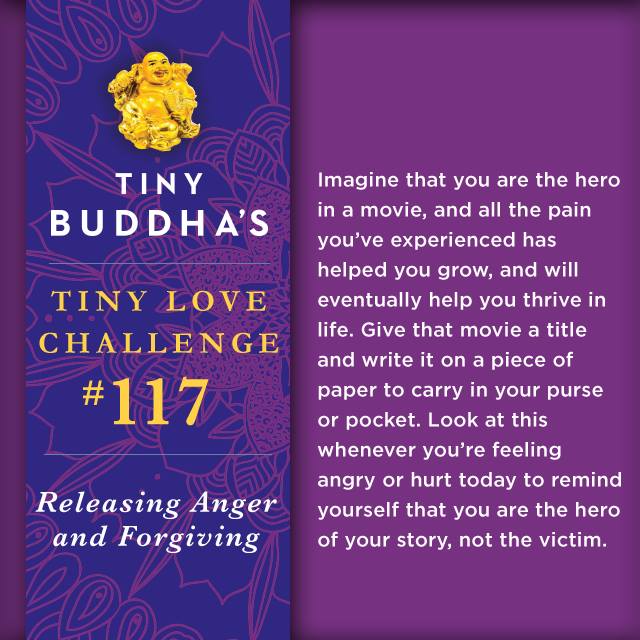
  • Love Challenge #117: If Your Life Were a Movie, What Would the Title Be?

    Love Challenge #117: If Your Life Were a Movie, What Would the Title Be?

    Hero of Your Story

    If your life were a movie, and you were the hero, not the victim, what would the title be?

    (This challenge comes from the upcoming book Tiny Buddha’s 365 Tiny Love Challenges. Pre-order before October 6th and get $300+ in free bonus gifts!)

  • Why You Might Feel Like You’re Always the Victim in Relationships

    Why You Might Feel Like You’re Always the Victim in Relationships

    Angry Couple

    “Your relationship to yourself is and always will be directly reflected in all your relationships with others.” ~Vironika Tugaleva

    Have you ever heard someone say, “I don’t know why this is happening to me?” or, “My ex is really crazy”? I have said myself, “It’s not my fault he’s a jerk.”

    It can be so easy to play the victim. Surely some of us are indeed victimized, but being a victim is a whole new ball game. Pointing the finger was an art for me. Thing is, one finger was pointing at you and three were pointing back at me.

    I wasn’t aware that all the things in my life were about me. Any friend, relationship, or job I landed was a direct result of how I viewed myself.

    How I interacted with others and the dynamics of my romantic encounters were directly correlated to the deep wounds I developed in childhood. All my core beliefs were distorted, and I had no idea.

    I believed that being in a relationship, no matter how painful, made me connected, alive, and whole.

    I believed I had little self-worth and value, because my father taught me I just didn’t matter. I thought my sole purpose in life was having a man to love—showering him with admiration and adoration.  

    I didn’t love myself. I lacked a sense of self and I had no purpose or meaning outside of a cure-all relationship.

    I subconsciously attracted into my life exactly what I believed I deserved. I didn’t know I was picking what I was picking.

    I had a fear of abandonment, so I attracted a man who would leave me because the belief that I’d be abandoned had to be confirmed.

    I believed I was in charge and all knowing, so I attracted friends who I could dominate and teach.

    I thought men were not trustworthy and abusive, so I found jobs where my direct managers were men who were unjust and tyrannical.

    I assumed my value, love, and worth were tied into someone else loving me, so I attracted someone who felt the same way about himself, and a toxic dance ensued. Neither of us met our own needs, but looked to the other to mask the wound.

    I had no sense of self, so I enmeshed with you, and I adopted your life so I didn’t have to build my own.

    These old beliefs were extremely difficult to unravel and rebuild. I suffered greatly in so doing.

    The only way up and out was to shatter my old self, work to change distorted beliefs, and to begin living life in the darkness.

    I felt like a child locked in a dark hallway, and all doors leading out were shut. I stood there all alone and threw temper tantrums, not knowing how to unlock the door. Slowly, gradually, the door began to creek open.

    What I projected was simple. I projected all my feelings about myself onto you. I attracted into my life whatever I believed about myself, and because I suffered great internal pain growing up, I drew in painful relationships and circumstances as an adult.

    We don’t have to suffer and stay in unhealthy relationships. There is a way out.

    After recognizing my unhealthy cycle, I contacted a well known cognitive behavioral therapist that a dear mentor recommended to me and made an appointment.

    Through our work together and my willingness to get better, I began to change behaviors and old distorted beliefs. I extricated myself from that tumultuous relationship, but not before embarking on another one. They both ended in 2013.

    A bottom came, and the real work began. Learning to be with myself and not attaching to someone who would love me was the key to beginning to heal. Processing my childhood was also an integral part of my growth.

    Today, I have a new sense of self. I have value and self-worth. I have a relationship with myself.

    Nothing outside of me is filling the hole. I am meeting all my own needs. I am not living out of codependence and fear. I don’t believe today that I can be abandoned. Children can be abandoned, but adults can take care of themselves.

    I know now that some men are trustworthy and have my best interests in mind.

    I am creative and learning to build a life of my own around my likes and interests. Some days are difficult still, but I try to remember that anyone I picked to make me happy in the past had the opposite effect. I wasn’t happy to begin with, so I didn’t pick partners who could contribute to my happiness.

    As adults, we choose people and relationships that are familiar, in that they reflect our experience within our family of origin.

    The people and events in your life bring with them lessons. My greatest lessons involved great pain. But my darkest days have brought me the brightest light. My soul mates were not men I was meant to marry or have children with, but were men who helped me see how I had to change.

    No matter how many men cheated on me, left me, or somehow wronged me, I played a part. Sometimes it was simply participating in the dance.

    As I changed my inner self, developed new beliefs, and found courage to stand on my own, I discovered that without these experiences that brought me to my knees, I wouldn’t be where I am today. I am better; I am more whole and more aware of what I want simply by experiencing what I don’t want.

    If you too have found yourself in a pattern of dysfunctional, unhealthy relationships, ask yourself: What’s my part? Why am I drawn to these same relationships over and over again? What’s the lesson? And how can I use these experiences to heal and make myself whole?

    Angry couple image via Shutterstock

  • 5 Helpful Things to Do When You Think Life Sucks

    5 Helpful Things to Do When You Think Life Sucks

    “It isn’t what happens to us that causes us to suffer; it’s what we say to ourselves about what happens.” ~Pema Chodron

    You know that foreboding fear we all have—that something will go terribly wrong and life will never be the same again?

    Mine is that something will happen to our daughter. She is our only child. We battled infertility for years before conceiving her. I keep telling myself that it’s just an irrational fear and that every parent probably has it to some extent, but it’s a constant companion that stealthily follows me around everywhere I go.

    So, on a Saturday evening, when we returned from an evening out to pick her up from the playcare and were greeted by the sight of blood on her face and the sound of inconsolable weeping, my heart just stopped.

    She had fallen off a playscape headfirst. It had happened minutes before we arrived. All the caretakers could tell us was that a tooth was knocked off. We rushed her to the emergency room.

    After what seemed like hours, they gave the all-clear—no head trauma or fractures—and sent us home with a prescription of painkillers and instructions to rest.

    She spent the next twenty-four hours in pain and throwing up. She couldn’t even hold water down.

    I tortured myself with fears that it must be a devastating head injury that the emergency room staff had failed to catch. She felt better the next day, so I brushed my fears away.

    The next week was a whirlwind of visits to the dentist to extract fragmented and loose teeth. During one of the visits, the dentist noticed that her jaw was misaligned. We rushed to an oral surgeon.

    The emergency room staff had failed to catch it—her jaw had broken. And now it was too late. The bone had already started to set in a crooked manner.

    She’d need major surgery to reverse it. She was too young to do the surgery yet, but by the time she turns eighteen the misaligned jaw will likely bother her so much that surgery will be unavoidable.

    A couple of weeks later, as the dust started to settle, I took her to the park to let some steam off. As luck would have it, she had another fall, and this time she broke her arm.

    We hadn’t had any major trauma in her entire life. And now we had two sets of broken bones in as many weeks.

    Waiting for the orthopedic to put the cast on, I couldn’t help but think, “Right now, our life sucks.”

    And this wasn’t the first time I’d thought that.

    A few years back, I’d felt much worse when my husband was in the emergency room, I waited outside with her, and the doctors had no answers for us.

    And before that at work when a colleague was bent on making my life a living hell.

    And when my best friend was lost to depression and wouldn’t take my calls.

    And when I broke up with my first boyfriend.

    And a million other times.

    Every single one of us has these moments. It’s just the way life is. It’s what we do in those moments that matters.

    For the better part of my life, I’ve felt flustered and incapable of handling these moments. Over time, I feel like I’ve figured out a few things that I can start doing to bounce back.

    I’m sharing these with the hopes that some of you will find them as useful as I do.

    1. Replace “Why me?” with “What next?”

    It’s natural; when things go wrong, one of our first thoughts is likely to be “Why me?”

    Here’s the thing though: “Why me?” is a weakening phrase. It only serves to increase our feeling of victimhood and makes us feel incapable of dealing with the situation.

    By intentionally catching ourselves thinking “Why me?” and replacing it with “What next?” we not only gain back a feeling of control, but also figure out what we can actually do.

    Anytime my daughter had a mini accident after that, she would panic. I’d put on my calmest voice, even when I felt like screaming “Why us? Can we please catch a break?” and say, “Aww, poor baby. Are you hurt? Accidents happen. Do you think a boo-boo pad might help?” And yes, a boo-boo pad always helped.

    Ever so slowly, we were back to being resilient in the face of mini accidents again.

    2. Force yourself to practice gratitude.

    It is hard to feel grateful when you are dealt a blow, no matter how big or small it is.

    I was devastated by my daughter’s jaw fracture verdict. I had to practically force myself to practice gratitude.

    Every time I talked to someone, I’d say, “Well, we’re lucky it wasn’t a head injury.” After repeating it a few times, I actually started to believe it and started to feel the gratitude. And that eventually helped deal with the news of the misaligned jaw.

    No matter what you are dealing with, there is always, always something to be grateful for. Force yourself to say it out loud a few times. Your heart and your mind will soon catch up.

    3. Quit blaming.

    When you’re hurt, it is equally natural to look for someone to blame.

    In my case, I was tempted to blame myself, the caregivers at the playcare, the doctors at the emergency room, and so on.

    But blame only serves to prolong the hurt. It makes it harder to let things go. It makes us angry and corrodes us from the inside. It brings negativity into our life.

    So just stop.

    If something is meant to be, it will happen. That’s it. Deal with it and move on.

    4. Don’t give in to fear and despair.

    This is a tough one. It’s so much easier to just give in and surrender to the fear and grief. But we need to stand tall, even when we feel two feet too short.

    It was very hard for me to mask my worries from my daughter and project confidence. But I’m so glad I did.

    Back then, for a while, I’d actually started to wonder if something was wrong. The foreboding fear that was my constant companion kept telling me that something bad was going on.

    But slowly, she gained from my projected confidence and grew more confident herself. And got back to her monkey business. And didn’t having any more accidents.

    And my worries started to fizzle.

    When it comes to fear and despair, you have to fake it till you make it. And, sooner or later, you will make it.

    5. Never give up.

    We didn’t like the jaw surgery verdict. We sought out another opinion even though it seemed pointless.

    The new oral surgeon was old school. She suggested physical therapy. We set alarms on the phone, and my daughter diligently did her exercises (bless her soul, she’s just a wee little kid, but such a sport).

    After a month, the jaw was starting to get aligned again. Things are beginning to look good. Maybe we won’t need that surgery after all. We can only hope for the best.

    No matter where you’re at or what you’re going through, don’t give up. Try just one more thing; maybe it’s just the thing that will resolve it for you.

    It ain’t over, until it’s over.

    As I type this article, I hear my daughter biking around the house.

    And then I hear a loud thud. I catch my breath and wait. And there it comes: “I’m okay,” she calls out.

    Yes. I think we’re indeed okay.

  • When You Feel Down or Stuck: How to Effectively Be What You’re Not

    When You Feel Down or Stuck: How to Effectively Be What You’re Not

    Sad Man

    “Success is achieved by developing our strengths, not eliminating our weaknesses.” ~Marilyn vos Savant

    I often hear the words “be yourself.” I love those words, and I truly believe that everyone should strive to be the truest version of who they are. There’s nothing more attractive than a person who is just so utterly themselves, even when society tries to push them the other way.

    Strong willed people are some of my favorite types. They can be righteous. They can be overly moral. However, they know what they want, they know who they are, and they know that nobody else determines their definitions of themselves.

    They stand up for what they believe in. And most importantly, they stand up for others when it matters.

    As somebody who is quite strong willed myself, I appreciate the beauty in the statement “be yourself.” However, I have also come to appreciate the softer side of letting go.

    This includes being wrong sometimes and even admitting it. This also includes opening my mind to the possibility of all possibilities; seeing the positive in the negative, understanding the behavior of those who may seem morally corrupt (to me), taking benefit from the other side of a passionate debate, and learning information when I want to reject it.

    As somebody who preaches the importance of being yourself, I admit I have a trick up my sleeve that has something to do with pretending to be who you’re not. Yup! I feel deliciously devious even just saying that.

    This trick is well known in the world of Positive Psychology, a term coined by Martin Seligman, Ph.D. in psychology.

    So what is this trick? Well, when you find yourself feeling down and depressed, it can help tremendously to ask yourself:

    “What would the happy version of me do at this moment?”

    Not only does this get you into a goal-oriented state, but it also takes a load off the negativity that you might be feeling. It takes your mind state from “oh woe is me” to imagining what will actually make you happier. It’s proactive.

    When you can imagine yourself being something greater than what you feel at the moment, you actually flip on a little switch in your brain that will attempt to propel you toward that image.

    This can work not only when feeling down, but with any goal you may have in mind.

    “What would the healthy version of me do?”

    “What would the brave version of me do?”

    “What would the successful version of me do?”

    You’re not shaming yourself in any way; you’re only gently shifting your mind set into one that is proactive and ready to take charge of your life.

    When I was struggling with feeling low, oftentimes I’d lie in my bed in the morning and not want to get out of it. It felt like there was no point.

    I was given a beautiful child at the age of twenty-three, and even though she has been the light of my life, at the time my identity felt as though it had been ripped from my very soul.

    The relationship I was in at the time was manipulative and emotionally abusive, probably on both sides. I didn’t feel like myself and I felt very restricted. My carefree spirit turned into a negative, depressed, shriveled up little hole inside my heart.

    Now, this might sound odd to some, but I have always been impressed with warrior-type women. I believe that I possess some warrior qualities within myself (we all do), and when I think of them, I feel strong, like I could take on anything!

    One day it just clicked. As I was lying in bed, not wanting to get out of it, I thought to myself, “What would the warrior in me do?”

    Out of bed I jumped! I continued to use that saying in many different ways and for many months. Now it has become a part of me.

    I am that warrior woman.

    I am strong enough. I am not a victim of life’s circumstances. I create my life and everything in it. I don’t react to life. I make life what I want it to be.

    To me, a warrior is not a victim. A warrior makes her life what it is; she creates it herself.

    When I shift my mind into this realm, I realize that other people do not control me; I control myself. Nobody is in charge of how I get to feel.

    In my relationship, I had been putting that control into somebody else’s hands, and when I decided to take back control over my life is when I finally realized the relationship was not going to work either way. Unfortunately, we had to part ways, but lessons were learned and I was finally able sit back and breathe.

    Try this tool out for yourself, and see how it changes your perspective the next time you’re feeling stuck.

    Who knew that pretending to be who you’re not (in a positive way) could strengthen the qualities that you never knew were inside of you?

    Photo by Ohfooy

  • Owning Our Stories: Overcoming The Fears That Make Us Play Small

    Owning Our Stories: Overcoming The Fears That Make Us Play Small

    Oh So Free

    “I now see how owning our story and loving ourselves through that process is the bravest thing that we will ever do.” ~Brené Brown

    It’s taken me a long time to figure out my story.

    I kept thinking, “Nothing particularly dramatic has happened to me, so how can I have a story?”

    Yet recently, after years of personal growth work, that’s shifted. I see the golden thread that weaves through my story and what that means for how I show up and what I bring to the world.

    I now see that this whole thing about owning your story isn’t about drama. It’s not about having a story that you feel is significant and worthy enough to share. 

    In many ways, it’s a metaphor. If I own my story, then I put my name to it. I become the author and with that I take the role of protagonist.

    It also makes me ask the question, “If I’m not owning my story and authoring it, then who is?”

    My story is one of learning to accept that I am enough, just as I am, and that what’s in my heart matters.

    For most of my life I’ve strived to be enough without consciously being aware of it. It seemed to be what everyone did in the corporate world to get along. Reach. Stretch. Push. Always seeking more. 

    I can’t say it felt exhausting, because with every new goal I’d have a ton of energy to push through. I would think, “If I get that promotion, then I’ll feel happy.” Or, “If I get that Masters Degree, then I’ll be credible and heard.”

    No, it didn’t feel exhausting. It did feel relentlessly unfulfilling.

    It was as if I kept promising myself it would all be better when—even though I knew on some deep level it wouldn’t.

    I felt so stuck. I knew I had all this powerful energy, but it was locked inside me. It would show up in bursts, but so often I would hold it back.

    I was blaming others for my circumstances. I was arguing for how I had no choice; I had a mortgage to pay and kids to support. I was angrily frustrated and I found it hard to contain. 

    I would start my day at work believing “I can change things and make a meaningful contribution,” yet, I’d keep being met by the story of the organizational culture: “It’s not the right time,” or, “it’s not the way we do things around here,” or, “we just care about the numbers.”

    I was so frustrated that I would come home and complain to my husband about how awful it was and how I should be doing something different but I couldn’t because we needed the money.

    I blamed him on some level. I also blamed myself for not having enough courage to really change my circumstances.

    People kept telling me how lucky I was to work part time while the kids were little, but it felt like such a trade off. Almost as if I could have part-time work but I couldn’t expect it to be meaningful.

    For me to really look inside and discover what I wanted to do, it took a coach to point out that I was being a victim in my current story. 

    I remember when he said it I cried, and, truth be known, I felt embarrassed that I was crying on the phone to a guy when I was supposed to be professional!

    Yet it was a painful release of the truth of how I felt. It was as if in some way he had just lanced a boil. I was being a victim. I had given my power away because I was scared.

    I had lost touch with who I was, what was in my heart, and what I wanted.

    From that moment on, I made a commitment to myself to get to the heart of who I was and what I bring to the world. 

    I wanted to become the protagonist in my story. I made the decision to quit my job and follow my heart.

    It felt completely counterintuitive. My head was going wild with sabotaging thoughts, but somewhere deep inside me I trusted that I could handle what showed up.

    I talked to my boss about what was happening in the organization and how the role wasn’t turning out as we had anticipated. We talked openly about this and I asked for what I wanted. We agreed to negotiate a severance package.

    From there I started to notice opportunities and invest in myself so I could pursue my dream of running my own business.

    I decided I had to manage my fears and made a conscious choice to let courage trump them.  I would say things to myself like, “Seriously, what’s the worst that can happen?” The answer would be “I go and get another job.” More often than not I would say, “You’ve got this. You can do this.”

    I clarified my minimum-squeak-by and dream income amounts and worked out a simple business plan based on these.

    Most importantly, I kept going. I had a mantra that was based on how we learn to walk as babies. I would say to myself when it was tough, “Just one foot in front of the other, Vanessa.” And I would do the next small thing, even though I had a tendency to focus on the big vision.

    That was nearly four years ago now and I’ve been on such a rollercoaster ride of adventure.  Of course it has had ups and downs, and I wouldn’t change it for anything, because I have grown so much and I now know what it means to be fully responsible and at choice.

    I have discovered the golden thread in my story: that my deepest fear is that I am not enough and I need to be more than I am to thrive.

    That thread sabotages me when I believe it, because it makes me try really hard to perfect myself, procrastinate, and play small. It also has me seek approval and validation and hold back my truth.

    Being aware of it helps me consciously work the muscle of radical self-acceptance and self-empowerment. It enables me to learn to practice compassion, kindness, self-love, and enough-ness.

    It helps me to let go of old defensive ways of playing small like people pleasing, avoidance, and perfection.

    It also helps me create connection. When I stand in the story of I am enough, just as I am, I’m great at helping people grow and find their soul truth. I’m perfect at showing up just as I am and every time I fail or show up trying to be something other than who I am, it serves as a wonderful opportunity to help me grow.

    I had two fears when I started to own this story: 

    1. What would people think about me? How could I openly stand up and say, “I practice radical self-acceptance,” because my wound is that I fear I am not enough as I am?
    2. I would come across as egotistical if I fully owned what I’m good at.

    Interestingly, they form a double bind, with being not enough at one end and at the other, being too much. Underneath them is a fear of your opinion of me.

    The key to unlocking my ability to stand in my story and fully own it has been learning to make my opinion the one that counts (at least where I’m concerned).

    Making my opinion count is a practice for me. It requires me to ground my energy and often to slow down, take a step back, and quiet my inner critic.

    In this place, I can connect to my inner wise woman and hear her truth. Then my only job is to trust it. It’s why my word for the year is trust.

    Trust that I know what I know and that I am enough.

    Trust that my heart can lead.

    Trust that I am the protagonist in my story and it’s a worthy story.

    Trust that the fear inside that you might judge my story is part of the old story of not being enough as I am.

    Trust that when you and I stand fully in the center of our stories, we come from love.

    Photo by ByLaauraa

  • 5 Ways to Seize the Moment and Live Without Regrets

    5 Ways to Seize the Moment and Live Without Regrets

    The Jubilant Man

    “Accept your past without regret, handle your present with confidence, and face your future without fear.” ~Unknown

    Samara is my colleague at work. She is one of the most pleasant ladies I know. She always has a smile and an encouraging word to give.

    She really is the kind of woman you want to speak to on the days you feel like life has dealt you a bad hand, because she always has something comforting to say. As we got closer, I confided more and more in her about the challenges I was going through in my life.

    I envisioned that her life must be perfect since she has such inner strength.

    But I was wrong.

    One day I noticed she had a sad countenance. That was strange because Samara was like sunshine itself. However, her sad countenance did not last, and before long she had her signature smile back on.

    But I was not deceived. I knew that deep inside her, she was experiencing some pain, so I asked her what was wrong.

    At first, she smiled and said that all was well. But I insisted that she confide in me. She looked me in the eyes, thanked me for caring, and then dropped the bombshell.

    “My six-year-old daughter has been in a critical condition for the past six months because of my carelessness. I saw her yesterday and her situation seems to have worsened. I think she is going to die.”

    For a second, I could not speak. I was in shock.

    “I am so sorry,” I managed to stammer, trying not to let her see how shaken I was by the shocking statement I had just heard.

    She explained to me that six months ago, she had stopped at a supermarket to get a few things. And because she was in a hurry, she had left her daughter in the car with the engine running. Her daughter had managed to engage the gear and the car had sped into the road, right into an oncoming trailer, and she had been seriously injured.

    The tears rolled down my face as she narrated this horrific story to me.

    She assured me that she had managed to forgive herself and had replaced regrets with gratitude for the six years she spent with her daughter.

    I recalled with a sense of embarrassment all the fuss I sometimes make over little things that, in light of what I’d just heard from Samara, now seem really insignificant.

    My marriage was not working out the way I wanted it to and everyday I lived with regret that I married my husband. I made a career change, which has turned out to be a very poor decision, and I have not been able to forgive myself.

    I realized that I spend too much of my time dwelling on all the mistakes I have made in the past. I spend too much time regretting things that I have no power to change. I spend too much time wishing things were different. I spend too much time beating myself up over what I’ve done.

    Over the years after that encounter, I determined to live a more positive life, free of regrets. Here are five ways I’ve learned to do that:

    1. Live your life with purpose.

    I realized that my career was doing badly because I did not have a career plan. I just drifted through my days without something to look forward to, so my life lacked momentum.

    Determine to live a life of focus. Today, take a stand on one thing you want to achieve in your life and draw up a plan to accomplish it.

    2. Stop making excuses.

    I blamed everybody else for the way my life turned out. I blamed my husband for the failure of my marriage and I blamed my boss for not promoting me.

    I am responsible for my life and not anybody else. Instead of making excuses, I need to take responsibility.

    It doesn’t matter what the obstacles in your life are. You can achieve almost anything if you put your mind to it. Helen Keller and Jon Morrow are examples of people who achieved excellence despite physical disabilities.

    Look within yourself. There is something waiting to be birthed. Find what that something is and do it, without excuses.

    3. Choose not to be a victim.

    At a point, I thought I had made such a mess of my life that there was no point trying to put things right. So I gave up trying. I mulled over my mistakes every day and went deeper into regrets.

    None of this helped me. I only started making progress when I embraced my mistakes, determined not to make them again, and resumed chasing my dreams.

    Life is not fair for any one of us. There will be storms and you will make mistakes. But be determined to get up as many times as life pushes you down. Forgive yourself, learn the lessons, and go on working toward your goals.

    The more time you spend feeling sorry for yourself, the less time you have to pursue the life of your dreams.

    4. Stop comparing yourself to others.

    I could not stop comparing myself to others. Everybody seemed to be happier than me, their marriages seemed to be faring better, and I seemed to be the only person with a less than fulfilling career.

    This made me feel even worse. I wondered what others were doing that I was not. Their progress in life seemed to dampen my spirit.

    Over time, I realized that comparing yourself with others is one of the greatest mistakes anybody can make. No matter who you are or where you find yourself in life, always remember that you have your own unique path to walk.

    Never compare yourself, your struggles, and your journey to anyone else, for that would only distract you from your own.

    We are all different. Forget about others and focus on fulfilling your own life dreams.

    5. Take action now.

    After I drew up a career plan for myself, I still lacked the courage to follow my plan. I wasted a lot of time because I was afraid that I would fail and I did not have to courage to start. So I continued to push things off.

    It’s funny how so many people seem to think that tomorrow is better than today for getting things done. We put off those things that are important to us and we lie to ourselves by saying that we will do them later.

    Whatever you need to do, do it now! Today is the tomorrow you planned for yesterday, so start today.

    My chat with Samara that day was a wake up call. I promised myself that day that I would not waste any more precious moments of my life regretting. I have been able to do that and have discovered inner peace in the process.

    So I urge you to do the same. Don’t waste any more time on regrets. Learn the lesson and move on. There’s still a lot of life in you. Go out there and live it!

    Photo by Benson Kua

  • 4 Steps to Let Go of Blame in Your Relationship

    4 Steps to Let Go of Blame in Your Relationship

    “When you blame others, you give up your power to change.” ~Dr. Robert Anthony

    After living alone for five years, I moved in with my girlfriend just eight months ago. I knew that I would have to make some adjustments, but I had no idea what they might be.

    I expected most of the changes to be around the dynamics of our relationship and spending too much time together. I didn’t foresee any personal growth coming out of it.

    But that’s exactly what happened. I grew, and I evolved.

    What Sparks a Fight

    For both me and my girlfriend, cleaning our apartment is a big issue.

    Neither one of us wants to do it. And even when we do clean, we want credit for it. Or at least I do.

    I remember one time I had just finished cleaning our bathroom, and I felt like I had made a significant contribution to our apartment. My girlfriend—let’s just call her Mary—thanked me, but I felt like she wasn’t contributing as much to our apartment.

    I accused her.

    Mary hadn’t cleaned anything in a week, and I didn’t want to do all the cleaning by myself. Now it was her turn.  And she should know about it.

    She didn’t take it so well.

    She said that she had cleaned the bathroom the last two times, in addition to the kitchen and parts of the bedroom. I told her that I had cooked the last few meals, and that she’s the one who keeps dirtying the bathroom and bedroom anyway. Why should I clean her mess?

    Things Get Ugly

    Before I knew it, we had escalated into a full-blown fight as we got more and more upset at each other. We were blaming each other back and forth for what the other person had or hadn’t done.

    We were playing the “blame game.”

    And this wasn’t the first time either.

    We had played the blame game many times before, and every time we did, it would damage our relationship in a new way. Sometimes there would still be ripple effects days later.

    We would get mad at each other. We would accuse each other. We would look for reasons why one of us was right and the other was wrong.

    It was a downward spiral.

    Blame Awareness and The Gift of Pain

    Usually before I can make any significant change in my life, I need to have a high level of awareness about it. I can’t change without first knowing what change I need to make. And usually, the big alarm that tells me when something isn’t working is this:

    I feel pain.

    It can be sadness, anger, unhappiness—basically, any emotion that feels bad is my warning sign that something’s wrong. And this time, it was my girlfriend and I being intensely angry at each other.

    Pain is a gift.

    Why?

    Pain is a gift because it tells us that something is not right, that something isn’t working and needs to be changed. Without feeling this pain, we might never know that we need to change.

    This painful experience is what brought our blame game to my awareness.

    I was now empowered to change.

    Taking 100% Responsibility

    I read somewhere that most successful people take 100% responsibility for their lives.

    Hmm.

    I thought I’d try an experiment.

    What if I were to take 100% responsibility for everything in our apartment, in our relationship, in our lives?

    Even though a relationship is really a 50-50 partnership, I figured I’d bite the bullet and take all the blame and responsibility—for everything—and just see what happens. (Note: If you’re in an unhealthy relationship, and your partner regularly mistreats or takes advantage of you, I would not recommend this.)

    I deliberately became more aware of my tendency to blame. I was denying responsibility for things I could change.

    Blame is a victim mindset, not an empowered one.

    I would catch myself after I had just blamed Mary. I would catch myself while I was accusing her, or right before I was about to.

    I would catch myself merely thinking the thought—that it’s her fault for such-and-such. And right before I was about to blame her for something, I’d just sit in awareness of it, as if I were a Buddhist monk.

    Letting go of the blame, I would instead take full responsibility for it.

    Talking About It

    Accusing her and blaming her only made our relationship worse. So I was taking 100% responsibility for our relationship, and I wasn’t going to blame her for anything. Even if I felt certain it really was her fault.

    At first, I didn’t tell Mary what I was doing.

    Eventually, though, I told her everything. We had been blaming each other a lot, and it was making our relationship not so good, and I was making an effort to stop. I was happy when she said that she would make an effort too.

    She soon stopped blaming me.

    Even when she hadn’t cleaned up the mess on our table, and it was clearly her mess and her “fault,” I took responsibility for it.

    Sounds crazy. Sounds dis-empowering, right?

    But maybe, I had created the circumstances to allow her to leave the mess. Maybe I hadn’t communicated clearly to her that I don’t like clutter on our table. Maybe I hadn’t done anything to encourage us to both clean up together, as a team.

    Total responsibility.

    In the end, I didn’t become a victim either. If Mary was going to take advantage of me, this strategy would have backfired and I’d be her scapegoat. But because we’re in a healthy relationship, she didn’t mistreat me.

    Eliminating Blame in Your Relationship

    You’ll notice from my experience with Mary that I took specific steps to eliminate blame in our relationship. Here are the steps you can take to do the same:

    Pain

    The first step is just to notice if it’s an issue in your relationship. Are you fighting, getting angry with each other, playing the blame game?

    Awareness

    Get super-aware of when you’re blaming or faulting or accusing, even if you’re doing it in your head. If you can catch yourself sooner, you can let it go and preempt sparking a fight.

    Take Responsibility

    This is the hardest part, because it’s easier to find fault in others than in ourselves. We want to be right. So just do an experiment, and see if you can take complete responsibility for your life, including your relationship. See what happens. Remember, this advice applies to anyone who’s in a healthy relationship. This doesn’t mean you need to take responsibility for someone else mistreating you.

    Communicate

    Tell your partner what’s been going on, how you feel about it, and the effort you’re going to make. (And if something’s really bothering you, communicate your feelings without blaming.) This will bond you together, and get you on the same team. Once you’re both making an effort, you’re well on your way.

    Photo by Bjorn Soderqvist

  • Make It a Great Day or Not, the Choice is Yours

    Make It a Great Day or Not, the Choice is Yours

    “The tragedy of life is not that it ends so soon, but that we wait so long to begin it.” ~W.M. Lewis

    Throughout my high school career, I kind of wandered around the school, trying to figure out who I was and who I wanted to be afterward.

    I was that kid you’d see walking as fast as humanly possible through the hallways with my books under my arms, trying to avoid all human contact, but I tried to stay active anyhow.

    I did this through playing tennis and bowling, participating in student council, performing in school productions, and perhaps the most widely social of them all, reading the morning announcements.

    While most would think doing the announcements in the office, alone, behind a desk where no one could see me was rather simple and straightforward, I begged to differ. Everyone in the school heard my voice every day and made a connection with me. Needless to say, this didn’t bode well for my attempts at being reclusive.

    While I loved doing the announcements and the feeling of connecting to others, it came with some downsides.

    My peers always made fun of me. The whole school heard me every day of the year, and I had a high and rushed voice, like an excited schoolgirl—except I’m male. And I made my share of mistakes in reading.

    I didn’t take being made fun of with the lightest of hearts, and it didn’t help matters that I had a tough family upbringing (at least, that’s what I thought back then).

    I grew up in a single parent home after my parents got divorced when I was around four. My sister and I were split between them, her with my mom and me with my dad, after she made some poor decisions in her teenage years, ending up in juvenile detention center and never finishing high school.

    After that, my father had high expectations for me to “not turn out like the rest of the family.” (more…)

  • How to Stop Being a Victim and Start Creating Your Life

    How to Stop Being a Victim and Start Creating Your Life

    “In the long run, we shape our lives, and we shape ourselves. The process never ends until we die.  And the choices we make are ultimately our own responsibility.”  ~Eleanor Roosevelt

    “They” say things happen at the “right” time. For me hearing a presentation, live, by Jack Canfield, came at the perfect time.

    I was in San Diego, the traveling babysitter for my precious 5-month old granddaughter, while my daughter attended a nutrition conference. It was an all around win-win situation—a new place to sightsee and of course spend quality (alone) time with baby Rachel and daughter Penina.

    When I found out Jack Canfield was the final key speaker, I jumped at the chance to attend. And the topic certainly resonated with me—“getting from where you are to where you want to be.” Now how’s that for someone in transition working to carve out a new path!

    There were a lot of takeaways, fabulous ideas to hold onto; so much so that I’ve been carrying around his book, The Success Principles, and studying it since I got home.

    One thing that really speaks to me is this idea of taking 100% responsibility for one’s life.

    As a society, we are so quick to assign blame and pull out all the excuses as to why something did or did not happen.

    All the “He made me, she made me….” finger pointing. There’s a reason why “the dog ate it” became such a classic excuse.

    We relinquish all power when we go there. Where are we in this? I know that by nature many of us are passive recipients of life and are at the mercy of what befalls us.

    In my workshops with parents on teaching responsibility, many are stuck or love acting in their role as helicopter parents, swooping down to save, rescue, and do all for their kids—all under the guise of, “The more I do for my child, the better parent I am.”

    And therefore what are we teaching our kids when they come in to class and tell the teacher, “My mom forgot to pack my lunch”?

    Then there’s the parent who comes ranting to school, “Don’t suspend my little Stevie for calling Andy names and hitting him in the playground; his sister does that to him at home, it’s no big deal.”

    We are facilitating the perpetuation of an entitled breed of human beings.

    In my practice as a therapist, clients would talk for years about being stuck because of what their dysfunctional nuclear families did to them.  “My mother did this, my father that…”

    And then of course there’s me. What comes all too naturally for me is my quick ability to find fault with others, to pass judgment and criticize.

    Who is to blame—why, my mother of course, queen of “judgmentalism.” I fight against these tendencies constantly.  But they do rear their ugly head often enough.  I guess it’s in my bloodstream. I’m aware of it; I work at it. I know where it comes from; therefore that explains it but it certainly does not excuse it.

    This is my problem, my issue. What matters is how I handle it and work to respond differently—to catch myself while it’s doing its internal dance before it parts from my lips.  (more…)

  • 9 Ways to Cope When Bad Things Happen

    9 Ways to Cope When Bad Things Happen

    Light Rain

    “We all have problems. The way we solve them is what makes us different.” ~Unknown

    Have you ever experienced times when you go through just one bad thing after another? When it seems like the world is out to get you? When things go wrong no matter what you do?

    You are not alone. Bad things happen to all of us too, including me. I experienced a small set back recently which I want to share with you.

    Not too long ago, I was working on my upcoming eBook. It was my #1 priority project at that time and I had been working on it tirelessly, day and night. After lots of hard work, I was 90% done. At that time, it was 630 pages. (The final book was almost 800 pages.)

    I was happy with the progress. Cover done, foreword written, articles in place, right order, formatting done, layout completed—it was on track to launch in a week’s time. (more…)