Tag: validation

  • Why I Couldn’t Find Love and What Helped Me (That Might Help You Too)

    Why I Couldn’t Find Love and What Helped Me (That Might Help You Too)

    “You can’t go back and change the beginning, but you can start from where you are and change the end.” ~C.S. Lewis 

    It was a dark January day in 2008 when my auntie called with the news “He did it.”

    I felt so confused. “Did he try? Or did he succeed?” I asked as my body moved into shock.

    “He succeeded,” she said. And in that moment my whole life changed.

    This was a moment I often wished for—my dad was gone.

    Dad had taken his life on January 8th, 2008, two days after my twenty-sixth birthday. He had even told me of his plans, I just didn’t believe him. I thought he was far too selfish to ever kill himself. 

    How wrong I was. I was consumed by guilt, but I felt like maybe my life would get easier now that he was gone.

    My mum had left him after twenty-six years of marriage, just months before his suicide, after reaching the brink of a breakdown. She couldn’t handle his behavior anymore. The putdowns. The nasty comments. Not just to her but to her children too.

    She stayed all those years for us. And we stayed for her. To protect her from him, as he could be a really mean drunk. We kept telling each other he didn’t hit us, so it wasn’t that bad.

    I had gotten used to holding my breath around him, not knowing what I would do to set him off.

    Maybe I didn’t shut the door. Maybe I wasn’t working hard enough for him. Or sometimes I was just in the room where he would lose his temper.

    I grew up walking on eggshells since I was a little girl. I thought that was normal. Living in constant fear of an outburst.

    I learned from a young age to do whatever he wanted so that he would not shout. I lived to please him. I did the studies he wanted. Was on track to find a groom he would like. Literally everything I did was to please this man.

    And just like that, one day he took his life.

    As a young girl I would fantasize about the moment when it would be just me, my mum, and my brother. It would be quiet, it would be calm, and there would be no shouting. I got my wish, but I was wrong that life would get easier without him.

    I had literally lost my reason for living.

    Unconsciously, I had lived to please my dad, and without him I became so very lost. I was numb to the core, and I wouldn’t allow myself to grieve him. After all, he had caused me so much pain right until the end.

    As I moved into my thirties things got much worse. I was the world’s biggest people-pleaser after years of perfecting this skill with my dad. I was always seeking outside approval and validation but was full of self-loathing.

    He may have been gone, but it was his voice I heard inside my head. You’re too fat. You’re ugly. No one will want you. 

    I was desperate for love and affection, yet I looked in all the wrong places, often chasing men who didn’t show me love back. I was always single but would obsess over unavailable men.

    Maybe he was in an unhappy relationship or had issues with drugs and alcohol or depression. These men were my drug! I found them every time and tried my best to fix them with my endless love and kindness, getting very little back.

    I took any small crumb of love someone would give me and then hated myself for it. Sometimes I even wished I could die.

    I didn’t just do this with men, I also did this with friendships, spending so much time trying to save others and resenting it. I felt worthless and like I was here for everyone else and just a spectator of other people’s happiness.

    I felt unfixable. Like I was some broken human. And I loathed myself for feeling that way.

    Everyone around me was getting married and having children, and I was just stuck. Obsessing about some guy, losing weight and then putting it back on, in this constant cycle of unhappiness. I’d numb the pain with my fantasies, food, people-pleasing, and wine, keeping myself stuck in it all.

    I felt so trapped in my own pain.

    One day I read somewhere that self-love was sexy, and that was the way to get the man you loved to leave their relationship. So I bought The Miracle of Self-Love by Barbel Mohr and Manfred Mohr and began to do some of the exercises in the book—affirmations and asking myself questions like “What do I enjoy?” I soon discovered I had no idea who I was, what I liked, or what I needed.

    This kicked off my journey of healing, self-discovery, and learning how to love myself.  

    I discovered that I was super co-dependent and began to attend CODA (co-dependents anonymous) meetings. I tried to stop pleasing-people, learn to say no, and have boundaries.

    At the beginning this would cause a full-on panic attack. Turns out years of living in fear with my dad had given me complex PTSD.

    I discovered Melody Beattie’s books on codependency and began doing all the exercises so I could stop self-medicating with addictive behaviors and make real changes. I learned how to incorporate daily self-care including rituals like affirmations, meditation, and grounding my feet to the earth.

    The shock was I didn’t think I had ever been abused. But I soon learned, by working with various therapists and healers, that I had suffered emotional abuse, gaslighting. and some narcissistic abuse.

    The way I felt wasn’t my fault. I wasn’t a broken human. I was a traumatized child in a grown-up body.

    Living in a home where my dad abused my mum had pushed me into a caretaker role. I was always protecting her. It was like I was trying to save both my parents in some way.

    Such a heavy weight I had carried my whole life.

    Their example made me terrified of relationships, which is why I unconsciously sought love from unavailable men—I was afraid of how toxic relationships were. That was all I knew. So I found relationships that wouldn’t go anywhere. To keep myself safe.

    I chased their love like I did with own dad. My first unavailable love. 

    I began to recover from the codependency, love addiction, and disordered eating by investing my time, money, and energy in myself. I was so good at showering others with love but didn’t ever show it for myself. So I worked hard to change this and began to shine that light within.

    I connected with my inner child through self-healing and reparenting practices, and this was life-changing for me.

    I found it hard to love and accept adult-me, but the little girl in my childhood pictures, I could love her. I put pictures of her everywhere and talked to her daily, telling her that I loved her.

    I would do inner child meditations and write letters to her. Someway, somehow, I began to build a connection to my younger self, and through that my self-love grew. I found a way back to myself.

    I became fiercely protective of the little girl within me. No more unavailable men for her. My little girl deserved the best. 

    Before finding romantic love, though, I needed to find love and forgiveness for myself regarding my dad and his suicide. I had to allow myself to grieve him. When I did, I realized how much I truly loved him. I was heartbroken without him. His darkness was only one side of him; there was so much love he gave me too. He was such a Jekyll and Hyde.

    To learn to forgive him and all the awful things he had done to me, I began to connect to his inner child and the trauma he had faced. I realized that unhealed trauma had been repeating for generations.

    My dad too was traumatized by his parents, and he survived by projecting that pain onto others. I had learned to please to survive, and he had learnt to fight. His dad was physically abusive and an alcoholic. Even my mum was repeating patterns in her own family by allowing herself to suffer domestic abuse.

    Learning about intergenerational trauma helped me to forgive and understand those who caused me pain. They were just repeating patterns and behaviors, but I decided to change them and heal.

    Slowly, relationships got easier as I became more conscious of my relationship with my dad and the impact he’d had on me. I found love with a healthy man who has my dad’s best qualities, is 100% available and no drama. I didn’t even know love like this existed. Just like that, I was no longer attracted to unavailable men.

    For those of you who struggle in relationships with others and yourself, the magic ingredient is connecting to your inner child and reparenting them. Give them all the things they need. The validation. The love. The comfort. Learn to emotionally regulate so you can teach them how to self-soothe. Be the parent you longed for.

    Be honest with yourself about the behavior that keeps you stuck and causes you pain. Then invest your energy in yourself to slowly change these behaviors and heal the wounds beneath them.

    Just sit there and listen to your feelings and your pain. Give yourself what you need. Validate yourself.

    You’ll soon find the power within and learn that anything is possible.

    As C.S Lewis wrote, “You can’t go back and change the beginning, but you can start from where you are and change the end.” That is what reparenting your inner child does.

    You learn to give yourself the life your little one deserves—a life that is safe and full of joy, where their voice can be heard, allowing them to be their authentic self.

    Choose different than the generations before you and the repeating patterns of unhealed trauma. Choose to let love and light in.

    My dad let the darkness ruin his life. He sabotaged his family life and his relationships by projecting his pain onto us, using alcohol to push it down, and then it exploded in his suicide.

    I hope his story and mine inspire you to keep going and to find love for the child within you so you can find your own heart’s happiness.
  • How to Trust Yourself After the Trauma of Being Dismissed and Invalidated

    How to Trust Yourself After the Trauma of Being Dismissed and Invalidated

    “Have the courage to follow your heart and intuition. They somehow already know what you truly want to become.” ~Steve Jobs

    I was a sensitive child growing up, and I felt everything deeply. Unfortunately, my childhood home was dominated by chronic tension, fear, and anger—not an ideal environment for anyone, let alone a perceptive and empathic child.

    My father was rather authoritative and controlling, and he disciplined us harshly. I was raised to obey without questioning and punished for mistakes or not falling in line.

    Love was only assumed but never shared, and so I grew up feeling alone, unsupported, and like I was never enough. Craving my parents’ love and attention, I became the good girl, the overachiever, the people pleaser, the caretaker—the chameleon who knew how to morph herself to fit the environment in order to feel accepted. Over the years, I lost a sense of who I was, never really feeling like I belonged.

    Instead, I felt like I had no voice. My feelings were chronically dismissed or invalidated—there was no room for what I wanted, felt, or needed.

    I grew up thinking others knew what was good for me better than I did myself. I grew up seeking their approval, attention, and affection. I grew up disconnected from my own feelings and instead hyper-attuned to what others needed from me. Disconnected from my emotions and judgments, I second-guessed myself, never quite trusting my instincts about what was healthy and what was not.

    Loyal to a fault, I tolerated toxic relationships, unable to leave people who gave me just enough attention to keep me around but not enough for me to feel fulfilled. I ended up chasing people who were unavailable, invalidating, and unsupportive; love entangled with pain was all I knew.

    I became a caretaker who forgot she has needs too. I compromised my values, kept giving chances to people who’d take me for granted, eventually erecting walls to protect myself from the world that just didn’t get me, didn’t value me—a world that didn’t care.

    Isolated, lost, and depressed, I finally realized that the hurt inside me was hurting the people I love the most—my own children. I didn’t want to pass my trauma and my parents’ trauma down to the next generation, so I made a promise to myself to heal as best I could.

    This was the first step on my journey back to myself. It took me years, but I eventually came home.

    Trauma Leaves an Imprint on the Body, Mind, Heart, and Soul

    Adverse experiences in childhood leave a mark on a developing brain, personality, and a sense of self, especially if we did not receive adequate support and nurturing through the crisis. Worse yet if the trauma was chronic.

    The reality is that trauma during childhood affects us to the core and rattles our sense of self. Not receiving the love, care, support and validation we need at our most vulnerable time leaves us feeling less than, undeserving, abandoned, and broken.

    We often grow up internalizing fear, anger, guilt, shame, helplessness and a feeling of being unsafe in the world. Overwhelmed, we push the pain away and put on masks in order to survive. This isolates us and disconnects us from ourselves and the world around us, keeping us small, scared, and unfulfilled.

    Growing up in an unstable or abusive home means we often become hypersensitive to stress, emotionally reactive, and unable to assert ourselves or go after what we want in life. We’re ridden with self-doubt, anxiety, and chronic overwhelm.

    We lose our sense of agency and safety. We stop trusting our own judgment and trusting in the flow of life.

    We become overly controlling, perfecting, pleasing, and performing. Desperately trying to mask our shame and the feeling like we don’t belong, we become a warped version of ourselves, stuck in a cycle of fight-and-flight, push and pull, constantly negotiating between states of avoiding and reacting.

    This affects us on physical, mental, emotional, and energetic levels. We get cut off from our intuition, our authenticity, and our higher self. We lose sight of who we are and what makes us happy.

    Childhood Trauma Destroys Trust

    When those who are supposed to love and protect us harm or neglect us instead, trust is broken. When our caregivers don’t reflect our worth back to us, we never learn to internalize it. We grow up believing that we don’t deserve love, care, and attention.

    If our feelings and emotions are not validated growing up, we begin to believe that they are invalid, that we shouldn’t feel them, that they are wrong. We begin to doubt ourselves and how we feel. Our sense of trust in our own experience is shaken.

    Instead of listening to our inner voice, we let the outside world dictate how to live, feel, and behave. We lose a sense of who we are, what we want, and how we feel. This disconnect from our innermost self means that we end up living a life that isn’t really ours—it’s perhaps a successful life by modern standards, but not an authentic and fulfilling life.

    This was my experience—until I learned to tune into my intuition.

    Your Intuition is Your Superpower

    Our intuition is the bridge connecting our body, mind, and soul. This is not the loud voice of our ego, but the quiet yet steady one underneath our judgments, assumptions, and interpretations.

    Just as our body communicates through our senses, our spirit speaks to us through insights, hunches, dreams, and gut feelings—our intuition. Listening to that inner wisdom and allowing it to guide us toward what is best for us in the moment—and then following that intuitive knowing—opens the doorways for higher knowledge to enter our consciousness.

    Aligning with the higher self this way doesn’t remove challenges and difficulties from our lives, but it fortifies our strength and courage and helps us find a path toward fulfillment.

    Rebuilding Self-Trust

    Trust is the foundation of any relationship, and that includes the one we have with ourselves. Without being able to trust ourselves, we’re unable to make decisions, we lack confidence, and we feel like we have no control over our own lives. Instead, we are plagued with confusion, fear, and self-doubt.

    Fortunately, self-trust can be nurtured and strengthened. Here’s what helped me learn to trust my emotions, intuition, and judgment after the trauma of being dismissed and invalidated as a kid.

    Spend time alone and reconnect with yourself.

    Carve out some time in the day to just be and enjoy yourself—without any distractions. This may mean sitting in silence in your garden, meditating, or just listening to nature. Maybe you best connect with yourself on long walks. Or maybe you best hear yourself by writing your thoughts out—journaling about what matters to you, the lessons you learned from the past, or dreams you have for the future.

    Whatever you choose, daily alone time will help you reset and renew, reconnect with who you are, and realign you with your true nature. The goal is to silence your mind and create space so that insight can come into your awareness.

    Practice mindfulness.

    Slow down and check in with yourself throughout the day. Sense into your body. How does it feel right now? What sensations are you noticing? What emotions are coming up? What wants to be heard? Fully tune into your inner experience in the moment. Consciously observe what is happening internally and take in any messages that you are receiving.

    For example, you may find that you need to put up a boundary with a friend or a loved one. Perhaps you need to say no to an expectation in order to protect your mental health. Maybe you need to speak your truth or let something go if it no longer serves you. Follow these internal cues—they are your guides to what you want and don’t want in your life.

    By tuning in and listening to your inner voice, you stay true to yourself. Instead of reacting habitually out of fear—saying yes out of a sense of obligation, staying quiet in order to keep the peace, or choosing others over yourself—you learn to respond from your inner wisdom and become more aligned with your wants and needs. You learn to have your own back.

    Process stuck energies.

    Take the time to feel any pain and trauma you’re still holding onto instead of repressing your feelings and distracting yourself with work, mindless scrolling, or substances. Gently and lovingly, acknowledge what happened and allow the hurt to come up, whether through physical sensations, feelings, or thoughts.

    Sit with the discomfort watching it ebb and flow through your body. Observe it, embrace it, and surround it with kindness. Extend compassion to yourself for going through that experience alone. Give yourself the love and nurturing you needed but never received. Finally, consciously release it as if it’s just a cloud in the sky passing through, imagining feeling lighter and lighter.

    Allowing the stuck energies to move through your physical body dissolves their power so that you’re no longer controlled by your past conditioning, painful experiences, and knee-jerk reactions. The trick is learning to surrender and allow the process to complete, one breath at a time.

    The more painful the experience, the more time it takes to heal it. Be patient with yourself. You may have to sit with your pain again and again, but each time you will get closer to releasing its grip and finding peace.

    Put yourself first.

    This isn’t selfish—it’s taking ownership. And it’s empowering. Nurture your body, mind, and heart, prioritizing your own needs before you give to anyone else.

    Create boundaries to protect your energy. Love yourself enough to keep commitments to yourself, your healing journey, and your growth—by showing up to do the work no matter how hard it gets.

    Have your own back and stand up for yourself. Encourage yourself through hard times and celebrate your successes. Practice kindness, not perfection. Become your best friend and your loudest supporter. Be authentically you!

    When I started putting myself first, my whole energy shifted. Instead of looking to others for validation and approval, I reached within. Instead of waiting for them to fulfill me, I started giving myself the love, care, and attention I craved. By focusing on meeting my own needs first, I was able to give to others from a place of love instead of obligation.

    I used to feel anxious, burnt out, resentful, and taken for granted. Now I was showing others how I wanted to be treated.

    By prioritizing myself, I was sending a message that my needs are just as important, and I deserve love and care too. The more I showed up for myself, the more I trusted that I was worth showing up for. As I drew boundaries, released the need to hold onto toxic or one-sided relationships, and started building the life I wanted to have, I found inner peace. I found my worth. I came home to myself.

    Reclaiming your sense of self and the ability to trust your feelings and intuition is not only paramount to healing but also creating a fulfilling life.

    By reconnecting with myself, practicing mindfulness, processing stuck energies, and putting myself first, I’ve learned to access and trust my intuition about what I need and what’s best for me. I reclaimed my worth and rebuilt a strong sense of self. As a result, I no longer attract or accept toxic relationships or situations. I trust that I deserve better—and I know you do too.

  • How Meeting and Re-Parenting My Inner Child Helped Me Love Myself

    How Meeting and Re-Parenting My Inner Child Helped Me Love Myself

    “To love oneself is the beginning of a lifelong romance.” ~Oscar Wilde

    The journey to meeting, loving, and re-parenting my inner child was a long time coming.

    In 2018, I went through a devastating breakup. I’d been through breakups before. They suck, they hurt, some of them left me in deep abysses of sadness for a long time, but this one was something different.

    I can honestly say I felt levels of pain I did not know were survivable for a human being. Many days, I did not want to survive; I couldn’t imagine continuing to be in that level of pain for another moment. It is indeed a miracle I survived and came out on the other side thriving!

    So, what was the cause of so much pain?

    Well, it wasn’t him, I’ll tell you that much. While I loved that man more deeply than I previously knew possible to love someone, and so it made sense for it to be more painful, it didn’t make sense for me to be crying non-stop for months. I felt like I was being ripped to shreds from the inside out. The pain was relentless and wasn’t lifting even a tiny bit as time went on.

    So, I sought help to get to the root issue. The real cause of my pain was the tremendous amount of unresolved trauma I was carrying, a complete inability to love myself—in fact, I had no real understanding of what it meant to love oneself—and a massively wounded and scared little girl running the show at my core.

    To sum up: I had a great amount of sexual trauma, abandonment trauma, complex PTSD, and low self-worth, and I only understood validation as coming from outside of me. This breakup unearthed all these issues in one violent movement, like ripping a Band-Aid off a scab.

    All this ugly, unhealed stuff was exposed and shot into my awareness like a volcanic eruption, and I had no means of escape. All I could do was deal and heal. So that’s what I did.

    There were a lot of things I did, and still do, to facilitate this healing. Therapies, somatic healing modalities, and spiritual methods. None are necessarily better than the other. They all worked together to weave a rich tapestry of healing approaches to choose from at any moment.

    But since this is about inner child work, that’s what I am going to talk about.

    I believe many of us have wounded inner children running the show. Everyone we meet has an inner child expressing themselves through adult bodies. To what degree that inner child is wounded ranges on a wide spectrum, mostly based on how well their needs were met by their caregivers.

    My therapist suggested I purchase The Abandonment Recovery Workbook by Susan Anderson and begin working through it on my own in between our sessions. I furiously raced through the chapters, hoping that once I finished, I could date and find someone to hopefully mitigate the unrelenting pain. However, as I worked through and neared the end of the book, it became clear to me that I was in no way ready for someone else yet.

    The workbook contains several exercises, but there were a few dedicated specifically to identifying, visualizing, or meeting your inner child—a younger, more tender, innocent version of yourself that just needed to be seen, heard, and accepted for who they are.

    It helped for me to find photographs of myself from three to five years of age to aid in visualizing this child. Looking at that little girl and imagining she still lived inside me, deep inside my being.

    Once adult me was able to see her, I had to learn how to hear her and how to communicate with her. Via meditation, I’d visualize her and ask her questions:

    What does she need right now?

    How can I make things better for her right now?

    What is she feeling about this situation?

    I’d have to sit until I received an answer from her. This came as a thought or a feeling, sometimes a visual image or memory. Oftentimes, all she wanted was to be held, so I’d visualize my adult-self holding this small girl and giving her the comfort and compassion she desperately needed.

    This is the re-parenting. The part where we respond to ourselves in the ways that we would have wanted or needed when we were small children. To be seen and heard, rather than molded to act or behave a certain way. To be truly responded to, based on the needs we were expressing.

    The dialogue exercises with my little girl continued daily, sometimes multiple times in a day. It just depended on how intensely my inner child needed something from me that day, or how intently I was listening at the time.

    Sometime after I’d begun this dialogue, I was at work and delivered a small thank-you token to a colleague for doing a quick project for my office. He kissed me on the forehead in return. It made me very uncomfortable, and I quickly exited his workspace.

    I walked out to the street to run an errand, and within me, my little girl was raging. It felt like there was an inferno of anger brewing within my gut. I recognized in that moment I was not listening to my inner child, and she wasn’t having it, now that we had begun communicating with each other.

    So, I stopped. I tuned in. I asked her what she needed.

    She told me this man had violated her space and she felt unsafe, and I’d promised, capital “P” promised, she said, stomping her feet as young children often do, that I would take care of her from now on, and I hadn’t when I allowed someone to violate my physical space without saying something. She would not be appeased until the matter was resolved.

    The inferno continued to rage inside my belly until I walked back down the street, back into his office, and told him, “I do not want to be kissed by my coworkers. I’m sure others may not be bothered by it, but this is a boundary for me.”

    Of course, he apologized profusely, and we have never had any inappropriate run-ins again. But more importantly, immediately upon taking care of myself and my little girl, the inferno subsided.

    I took care of her and made her feel safe and secure. I continue to do so in my day-to-day life now.

    The above example was an extreme one. She is not always so easily heard. Sometimes I ask her what she needs, and it’s just to move the body, go for a walk. Other times it’s a cookie she wants. Often, it’s just to be acknowledged. Validated. To be told, “I hear you, I see you, your feelings matter.”

    As with any relationship, the needs, communication, and dynamics are ever-evolving.

    But I can say without a doubt, the connection between my adult-self and my inner child is the most valuable relationship I have, and today the amount of love I have for myself, due to inner child work, is above and beyond anything I could have ever imagined.

    I used to feel, most of the time, that I was not enough. Since doing this healing work, I now know I am enough, in all situations and places.

    Where there was typically a sense of impending doom and danger, there is now a lightness and delight and a true, deep happiness that has nothing to do with outside circumstances—just the pure joy of an inner wholeness I never even could have dreamed of.

    That’s what happens when we truly see and hear our inner child and respond to their needs without judgment. We feel love and safety like we’ve never known, and we finally realize we deserve nothing less.

  • How I Stopped Putting Everyone Else’s Needs Above My Own

    How I Stopped Putting Everyone Else’s Needs Above My Own

    “Never feel sorry for choosing yourself.” ~Unknown

    I was eleven years old, possibly twelve, the day I first discovered my mother’s betrayal. I assume she didn’t hear me when I walked in the door after school. The distant voices in the finished basement room of our home drew me in. My mother’s voice was soft as she spoke to her friend. What was she hiding that she didn’t want me to hear?

    I leaned in a little bit closer to the opening of the stairs… She was talking about a man she’d met. Her voice changed when she spoke of him. The tone of dreamy wonder when you discover something that makes your heart race. She talked about the way they touched and how she felt being with him.

    I felt my body go weak. I could not tell if it was sorrow or rage. All I knew was, she had lied to me.

    Several months prior, my parents had announced their divorce. My mother told me the decision was my father’s choice. She told me he was the one breaking up our family. She told me she wanted nothing more than to stay with us and be together.

    And now I heard her revealing that was not true. She wanted to leave. She was not choosing me. She was choosing him.

    Since I was nine months old, my mother had been in and out of doctor’s offices, hospitals, psychiatrist’s and therapist’s offices trying to find the cure of her mental and emotional instability.

    When I was a young child, she began to share her frustrations and sorrows with me. I became her support and the keeper of her pain. She had nicknamed me her “little psychiatrist.” It was my job to help her. I had to. I needed her stable so I could survive.

    I don’t remember when or if she told us that she was seeing someone. I just remember she was gone a lot after that day. She spent her time with her new boyfriend out of the house. As the parentified child who she had inadvertently made her caretaker, it felt like she was betraying me. She left me for him.

    I was no longer the chosen one—he was.

    I hated him for it. When my mother moved in with him, I refused to meet him. I didn’t want to get to know or like this man she left me for.

    I saw them one day in the parking lot outside of a shopping plaza. I watched them walking together and hid behind a large concrete pillar so they wouldn’t see me. The friend I was with asked if I wanted to say hello. I scowled at the thought. I despised him.

    Within the same year, his own compromised mental health spiraled, and they broke up. He moved out of their apartment. I didn’t know why or what happened. I only knew my mother was sad. Shortly after their breakup, he took his own life. From what we heard, he had done so in a disturbingly torturous way. It was clear his self-loathing and pain was deep.

    My mother was devastated. She mourned the loss of her love and the traumatic way he exited. She stopped taking her medication, and her own mental health began to spiral. My father received a phone call that her car had been abandoned several states away. I’m unsure what she was doing there, but she had some issues and took a taxi back home.

    He later received a call stating that my mother had been arrested for playing her music too loud in her apartment. Perhaps to drown out the voices in her head. She was later taken to the hospital without her consent and was admitted due to her mental instability.

    After several days of attempting to rebalance her brain chemistry with medication, my mother began to sound grounded again. The family decided she would move in with her parents a few states away from us and live with them until she was stable again.

    A few days after Christmas she called me to tell me how sad she was. She grieved her dead boyfriend. I was short with her. I was still angry for her betrayal. I didn’t want to continue being used as her therapist. The imbalance in our relationship was significant, and my resentment was huge.

    I loved her, but I could not fall back into the role of being her support without any support back. It was life-sucking. And I didn’t care that he was dead. She chose him over me. I was fine with him being gone.

    I don’t recall feeling any guilt when I got off the phone that day. I felt good that I had chosen myself and put a boundary in place to not get sucked into her sorrow. I was fourteen years old, less than a week shy of fifteen. I just wanted to be a kid.

    The next day, my mother chose to make more decisions for me and for herself. These were more final. She told her parents she was taking a nap and intentionally overdosed on the medication meant to save her. She died quietly to relieve herself from her pain and left me forever.

    That choice—my own and hers—would change the course of my life.

    The day my mother freed herself from this world was the same day I learned to become imprisoned in mine. I was imprinted with a fear that would dictate my life. I became quietly terrified of hurting other people. I feared their discomfort and feeling it was my fault. From that day forward I would live with the silent fear of choosing myself.

    My rational mind told me it was not my fault. I did not open the bottle. I did not force her to swallow the pills. I did not end her life. But I also did not save it.

    I learned that day that creating a boundary to preserve myself not only was unsafe, it was dangerous. When I chose me, people not only could or would abandon me, they could die.

    Of course, I never saw this in my teenage mind. Nor did I see it in my twenties, thirties or the beginning of my forties. I only saw my big, loving heart give myself away over and over again at the cost of myself.

    I felt my body tighten up when I feared someone would be mad at me. I heard myself use words to make things okay in situations that were not okay. I said yes far too many times when my heart screamed no. All because I was afraid to choose myself.

    The pattern and fear only strengthened with time. I learned to squirm my way out of hurting others and discovered passive-aggressive and deceptive approaches to get my needs met. My body shook in situations where conflict seemed imminent, and I learned to avoid that too.

    What I didn’t see was that this avoidance had a high price. I was living a life where I was scared to be myself.

    On the outside I played the part. The woman who had it all together. Vocal, passionate, confident, and ambitious. But on the inside, I held in more secrets than I knew what to do with. I wasn’t living as me. My fear of being judged and rejected or not having my needs met was silently ruling my life.

    So many have developed this fear over time. Starting with our own insecurities of not feeling good enough and then having multiple experiences that solidified this belief. The experiences and memories differ, but the feelings accompanying them are very much the same.

    The fear of choosing ourselves, our desires, our truths, all deeply hidden under the masks of “I’m fine. It’s fine.” When in reality, we learn to give way more than we receive and wonder why we live unsatisfied, resentful, and with chronic disappointment. Nothing ever feels enough, and if it does, it’s short-lived.

    The memories and feelings become imprints in our bodies and in our minds that convince us we can’t trust ourselves. That we can’t trust others. That we must stay in control in order to keep us safe. We learn to manipulate situations and people to save ourselves from the opinions and judgments outside of us. We learn to protect ourselves by giving in, in order to not feel the pain of being left out.

    We shelter ourselves with lies that we are indifferent or it’s not a big deal in order to shield ourselves from the truth that we want more. We crave more, but we are too scared to ask for it. The repercussions feel too risky. The fear of loneliness too great.

    In the end, our fear of choosing ourselves even convinces us we can live with less. That we are meant to live with less, and we need to be grateful for whatever that is.

    Do we? Why?

    What if we learned to own our fear? What if we accepted that we were scared, and it was reasonable? What would happen if we acknowledged to our partners, families, friends, and even strangers that we, too, were scared of not being good enough? Of being discarded, rejected, and left behind.

    What would it be like if we shared our stories and exposed our insecurities to free them instead of locking them up to be hidden in the dark shadows of ourselves?

    I’m so curious.

    Where in your past can you see that choosing yourself left a mark? What silenced you, shamed you, discouraged you from choosing your needs over another’s? When were you rejected for not doing what someone else wanted you to do? And how has that fear dictated your life?

    Choosing ourselves starts with awareness. Looking at the ways you keep quiet out of fear or don’t make choices that include your needs. Seeing where this fear shows up in your life gives you the opportunity to change it. The more you see it, the more you can make another choice.

    Start with looking at the areas of life where you hold on to the most resentment and anger. Who or what situations frustrate you? Anger often indicates where imbalances lie or when a boundary has been crossed. It shows us where we feel powerless.

    Make a list of the situations that annoy you and then ask yourself, what’s in your control and what’s not? What can you directly address or ask for help with?

    Note the ways you may be manipulating others to get your needs met in those situations and how that feels. Note also what you may be avoiding and why.

    How would it feel to be more direct and assertive? What feelings or fears come up for you?

    Then start with one small thing you could do differently. Include who you could ask for help with this step, if anyone.

    As for me, I have found myself in situations where I lied or remained silent to avoid being judged, in an attempt to manipulate how others see me. I have felt my body cringe with sadness and shame each time. It doesn’t matter how big or small the lie, it assaults my body the same.

    I have learned that speaking my truth, no matter how seemingly small or insignificant, saves my body from feeling abused by the secrets it must keep. Choosing me is choosing self-honesty; identifying what is true for me and what is not based on the way my body responds. I am not in control of others’ judgments of me, but I am in control of the way I continue to set myself up to judge myself.

    I have also found myself agreeing to do things I didn’t want to do in order to win the approval of others, then becoming resentful toward them because I refused to speak up for myself.

    Choosing me in these scenarios is honoring the fact that I will still be scared to ask for what I need, as my fears are real and valid, but asking anyway, even when the stakes feel high. It’s scary to feel that someone may abandon us if we choose ourselves, but it’s scarier to lose ourselves to earn a love built on a brittle foundation of fear.

    l cannot control the past where I have left myself behind, but I can control today, the way I forgive myself for falling victim to my human fear, and the way I choose to love myself moving forward. When I choose me, I have more love to give to others. Today I can take a small step toward change.

    Taking these small steps and building on them will help us to show ourselves that we can make progress in bite size amounts and prove to ourselves we are going to be okay. The small bites are digestible and give us proof that we can do it. This helps us build our ability to do more over time, while also decreasing our fear.

    If we look at our past, we will see the majority of our big fears do not come to fruition, and if they did, we survived them and gained knowledge or strength in the process.

    It’s not the action holding us back, but the memory of the discomfort we still live with. The more we move through these fears, the more that discomfort will decrease, and the more we will trust that we will be okay no matter what.

  • If You’re Trapped Under a Pile of “Should” and Tired of Feeling Unhappy

    If You’re Trapped Under a Pile of “Should” and Tired of Feeling Unhappy

    “Stop shoulding on yourself.” ~Albert Ellis

    I was buried under a pile of shoulds for the first thirty-two years of my life. Some of those shoulds were put on me by the adults in my life, some were heaped on because I am a middle child, but most were self-imposed thanks to cultural and peer influence.

    “You should get straight A’s, Jill.”

    “You shouldn’t worry so much, Jill.”

    “You should be married by now, Jill.”

    “You should get your Master’s degree.”

    I could go on forever. The pile was high, and I was slowly suffocating from the crushing weight on my soul.

    What’s so significant about age thirty-two? It’s when I decided to divorce my husband of eighteen months (after a big ole Catholic wedding) and ask my parents for money to pay the attorney’s retainer. This is a gal with a great childhood, MBA, and a darned good catch for a husband.

    From the outside, our life looked charmed and full of potential. We’d just purchased our first home, were trying to start a family (despite suffering two miscarriages) and were building our careers. What no one else saw was the debilitating mountain of consumer debt, manipulative behavior, and my intuition’s activated alarm system… sounding off in reaction to the life I’d built and was, for all intents and purposes, stuck in.

    My intuition was done with the low-level warnings. She was sick and tired of being ignored, so she sounded the big one—an alarm that demanded action instead of lip service. I still tried challenging her; what she had presented me with was asinine.

    “But I can’t divorce him. We just got married. What will everyone think? I’m so embarrassed. I should have made better choices. How did I end up here? I did everything right, right? I should suck it up and stick it out; that’s what good Catholics do. This is kind of what life is, I guess… kinda sad, but it seems to work for most everyone else. Ugh, I wanted this… now I’m, what, changing my mind?”

    The alarm was not going to shut off until I sat long enough with those notions to yield honest answers. That was some tough sh*t to sit in. And even tougher to plod through. But it was better than being buried under it.

    This was my first lesson in “There’s only one way out of this mess.” There’s no express lane, no backroad, no direct flight. This ride resembled the covered wagon kind. Bumpy, hot, dirty, and uncomfortable as hell.

    I relented, listened, and tapped into the hidden reserve of courage I didn’t know existed within me.

    The time had come to quit living according to the “should standard” everyone else around me had subscribed to. The time had come to accept this curated life was not the one that would yield happiness for me. The time had come to turn up the volume on this newfound voice and assert to myself (and everyone else) that I was cutting my losses and trusting my inner compass.  

    The time had come to stop shoulding myself.

    Shoulds were my grocery list, my roadmap for life. How was I going to do this adult thing without my instructions???

    I’d already managed to clear a huge should—hello, divorce—and after that, with every should I challenged, another paradigm crumbled. I began to notice shoulds all over the place. After that, my awareness of intention got keener, and I could sniff out the subtle shoulds like a bloodhound.

    SHOULD: When are you having kids?

    CHOICE:  I do not want to have children. (Remember I miscarried twice with my first husband. I was checking boxes on my adulting grocery list. Honesty yielded clarity.)

    SHOULD: He’s too old for you and he has four boys of his own.

    CHOICE:  He is my person. His sons deserve to see their father in a healthy, happy relationship. I can show them love in a new, different way.

    SHOULD: You’re making great money in your job. Why walk away from your amazing 401(k) and great benefits to risk starting your own business?

    CHOICE:  I want to build a life I’m not desperate to take a vacation from. I want to live, serve others, and know when I’m at the end of my life that I chose it and made the most of it.

    Deleting the word “should” is a big first leap in taking ownership of your life. By altering your vocabulary in a simple way, you naturally become mindful of the words you put in its place. Instead of “I should….” substitute with “I choose to….” Instead of “You should…” try “Have you considered…?”

    Keep track of every time you say or hear “should” in a day. Then spend time with each one and get toddler with yourself. Ask why. Ask it again.

    Who says you have to get married or have kids or work a job you hate that looks good on paper? Who says you have to look a certain way or do certain things with your free time that don’t appeal to you? Why are you restless in your life? What idea keeps popping up, begging for your attention? Are you living your truth? What’s in the way? What pile of shoulds are you buried under?

    I get it. We’ve been programmed by our culture and our family traditions to follow the path, stay on course, climb the ladder to success! It’s the only way to be happy, they say. It’s the only way we’ll be proud of you, they insinuate.

    We’ve been indoctrinated with this thought pattern and belief system, and it seems impossible that we have the power to choose otherwise. We have the opportunity, the autonomy, the choice to rewire our iOS and make it what is ideal for ourselves.

    Overwhelm is natural; the antidote is to start small. Find one piece of low-hanging fruit, take a bite, and taste how sweet it is. For example, say no to an invite if you’d rather spend your time doing something else. Allow yourself to do nothing instead of telling yourself you should be doing something productive. Or let yourself feel whatever you feel instead of telling yourself you should be positive.

    Feel how nourishing it is to choose yourself. Experience satiety in your soul. Release restlessness and replace it with intention guided by your intuition.

    Do that and you’ll never should again. Or maybe you will—who says you should be perfect? At the very least you’ll think twice before letting should control you, and you’ll be a lot happier as a result!

  • Why It No Longer Matters to Me If My Job Impresses People

    Why It No Longer Matters to Me If My Job Impresses People

    “Do not let the roles you play in life make you forget who you are.” ~Roy T. Bennett

    Wherever I go and meet new people, they ask me, “What do you do?”

    I love talking about what I do because I love what I do, but It’s not what I’ve always done, and it certainly isn’t all of who I am. It’s part of who I am, but there is so much more.

    When we’re young, we’re asked to decide on a career. You know, the question, “What do you want to be when you grow up?” The problem is, does anyone in high school truly know what they want to do for the rest of their lives? I’d venture to say that many high school kids don’t even know who they really are yet.

    When I was growing up, I was a straight-A student, a star athlete, a perfectionist, and an overachiever. I learned at a young age that performing well was my ticket to feeling good about myself. My accomplishments garnered the praise and admiration of many and gave me what I needed to feel good.

    Validation.

    As a senior in high school, it was natural that I chose to go to college for aerospace engineering. I was interested in aviation, but more importantly, when I told other people what I had decided on, they nodded their heads in approval. A smart girl should choose a “smart career,” right?

    Validation and approval drove me forward.

    When I got out of college with a BS in aerospace engineering from the University of Minnesota, I went to work for The Boeing Company in Seattle, Washington. I didn’t love it. Part of it may have been homesickness, or the dreary Seattle weather, but a huge part of it was that the corporate cubicle life was not for me.

    I thought there was something wrong with me. After all, I had worked so hard to reach this point in my life. I should love it, right? Hadn’t I finally arrived?

    I struggled with it so much because on one hand, I dreaded going to work. On the other hand, when I told people what I did for a living, they leaned in and listened a little harder. Even my own father was proud to talk about my engineering career and the fact that I worked for one of the top aerospace companies in the world, but I’ve since moved to less impressive pursuits, he has never once asked me about those endeavors.

    My career looked awesome and interesting and impressive on paper, but I was quietly dying inside.

    My husband and I ended up moving all the way across the country to Savannah, Georgia, where I worked for another top aerospace company—Gulfstream Aerospace. I didn’t really feel any different about my position there, until I transferred into a group called Sales Engineering.

    In this area, I was able to interact and collaborate with sales and marketing to create the technical data they would use to pitch Gulfstream’s fleet to potential customers. I enjoyed the challenge, but I really enjoyed the collaboration with other people that weren’t buried in their computers all day. It was here that I first got a glimpse that I loved connecting with other people.

    When my first child was born, I left the aerospace industry. We had just moved cross-country again to Los Angeles, and it made more sense for me to be a full-time mom since I wasn’t the family breadwinner, and we didn’t absolutely need a second income. Plus, I wasn’t enamored with the whole engineering gig either, so in a sense, it was a way out.

    Quitting the career that I didn’t love was, on one hand, so freeing. But on the other hand, without that thick layer of validation that kept getting piled on every time someone asked me “What do you do for a living?”, I felt naked. I felt inferior. I felt like I was a failure who couldn’t hack it in the real world.

    My identity was wrapped up in my career that looked so good on paper but didn’t feel good in my soul.

    My ex-husband is an attorney, and we’d attend events with lots of other attorneys and highly educated people. At these events, I dreaded the question “So, Kortney, what do you do?”

    My response was always a little timid, almost apologetic.

    “I stay at home with our son.”

    There was typically a slow nod, with a bit of feigned interest, as if they weren’t really sure what more to say about the occupation stay-at-home mom.

    Because I also had a side-gig photography business, I’d quickly add, “and I’m also a photographer.”

    That tended to garner a bit more interest.

    “But I used to be an aerospace engineer,” I’d tack on, in a final effort to gain the nod of approval I so desperately sought.

    Bingo. Alarm bells sounded. The crowd cheered. People were reeled back into something more exciting.

    That good, old familiar friend, validation was back.

    I struggled for a long time to find my identity without all the “stuff” on the outside. It wasn’t until I got divorced and had to figure out how I would financially support myself after my spousal support ran out that I even scratched the surface of “Who am I, really?”

    Who am I without my career, the accomplishments, the external validation?

    All those years, I lived with one foot in the world of wanting to love myself for who I am rather than what I did and one foot in the world of doing more, doing better, doing it ALL.

    I lived in between the worlds of self-validation and external validation. 

    I knew I wanted the former, yet I craved the latter.

    In doing the work of figuring out who I really am, learning to love myself fully, and being able to validate myself without any help from the outside, I realized that I was asking myself the wrong questions all along.

    As a society, we ask the wrong questions.

    Instead of asking our kids, “What do you want to be when you grow up?”, I think we should be asking them, “Who do you want to be?

    I asked my eleven-year-old daughter this, and she looked at me in her quizzical mom-why-are-you-asking-me-such-a-weird-question way and said, “Umm, I just want to be me?”

    Yes!

    Shouldn’t we all just want to be who we are? 

    Instead of pursuing goals that are impressive because they bring us accolades and attention, what if we were to pursue our goals because they lit us up and we were truly passionate about them?

    What if we started asking our kids questions about what lights them up? How do they want to feel? What things do they like to do that make them feel that way?

    Even as adults, we can ask ourselves these questions.

    If you’re in a job that doesn’t feel right, you can ask yourself, “How do I want to feel?

    What’s authentic to you? How do you want to show up in the world? What jobs or careers would allow you to show up that way?

    This is the work I did after my divorce. I’m in a completely different career now, and believe me, as much as I fought going back to a job in the engineering industry, I had to do a lot of work on my thinking about not having a “smart job” like being an engineer. The validation I craved and was so used to was like a drug.

    Through this work, I learned how I want to feel in my life and that guides everything.

    I discovered that I want to feel freedom, ease, joy, and meaning in my life. 

    Going to a cubicle every day didn’t allow me to create those feelings. I want to show up in the world authentically—I want to be able to be a human being who makes mistakes and can share myself with other people. Corporate life didn’t allow me to be that authentic person that I now so deeply love.

    Some of you reading this may have corporate jobs and love them. You may be able to create the feelings you want to feel and show up authentically with that type of career. That’s awesome!

    The goal is to be able to feel the way you want to feel. The goal is to be able to show up in the world in a way that is true to who you are. 

    Because how you show up to do the things you do in the world is what really matters.

  • Why I Never Fit in Anywhere and the One Realization That’s Changed Everything

    Why I Never Fit in Anywhere and the One Realization That’s Changed Everything

    “Don’t force yourself to fit where you don’t belong.” ~Unknown

    When I was young, I was a real daddy’s girl. He was so proud of me and took me everywhere with him.

    When my parents got divorced and my dad moved away to start a new life with a new family, I didn’t understand why he left, as I was still a child. I thought that he didn’t love me anymore. I felt abandoned and rejected. Perhaps if I’d been better behaved, prettier, cleverer then he wouldn’t have left me?

    Until recently, I didn’t realize the impact that this has had on my adult relationships.

    Because I fear abandonment and rejection, I’ve struggled to fit in and make friends.

    I had a relationship with an older man who was very similar to my dad. I hoped that he would provide me with the love and affection that I didn’t get from my father and would heal my wounds. However, while things started off great and I thought I had found the one, since the relationship felt like home and was so familiar, he was actually emotionally unavailable, just like my dad, and unable to commit.

    When he started to pull away, this triggered my insecurity. This caused me to pursue him more, as I desperately wanted this relationship work.

    I tried to change myself into what I thought he wanted. I became clingy and jealous, which only drove him further away. When the relationship finally ended and he found someone else, I couldn’t understand why he could love her but not me. What was wrong with me? It confirmed my greatest fear, that I was unlovable and unwanted.

    This pattern continued to follow me in my relationships, which left me feeling more unloved and rejected.

    So I threw myself into my career. I had done well academically, however, I struggled to fit in and make friends there too.

    I was good at my job, but I didn’t feel valued or appreciated and I was often ignored, excluded, and ostracized by my fellow team members. My workplace became a toxic environment. I was bullied, which led to anxiety and depression, and I couldn’t face going into work. Eventually I was let go, as they said I could no longer do my job.

    Since my identity was tied up with being a successful career woman, when I no longer had a career, I didn’t know who I was. What was my purpose in life now? I was at the halfway stage of my life with no family of my own and no job. I took everything that other people had said and done to me very personally.

    I shut myself away at home. I didn’t go out or socialize. I was on medication for anxiety and depression, and I just wanted to stay in bed. What was the point of getting up? I was worthless, I had no value, no one wanted me, I didn’t fit in anywhere. I couldn’t love myself, as others didn’t love me. I had no self-esteem and no confidence to try to start again.

    I had therapy, read lots of self-help books and articles, and did guided meditations. Although I could relate to everything, I struggled to apply the things I had learned to myself.

    As I spent time alone, listening to relaxing music, I had a lightbulb moment. I couldn’t see straight before then because I was so emotional. However, I am naturally a very logical and analytical person, and good at solving problems, which is why I was good at my job.

    The idea came to me that if I took the emotions out of my issues, then I could see them in a logical and rational way and try to solve them like any other puzzle.

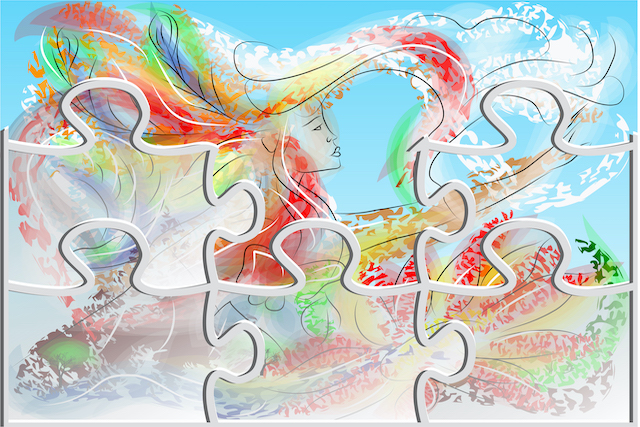
    And then I thought, what if I saw my whole life as a jigsaw puzzle? It’s a perfect analogy, really, since my lifelong struggle has been fitting in.

    Visualizing Our Lives as Jigsaw Puzzles

    Each of us start with just one piece—ourselves.

    When we start the puzzle at birth, it is easiest to join the first two pieces together—ourselves and our family.

    As we grow up, we try to find other pieces that fit—friends, romantic relationships, jobs. We may be lucky and find other pieces that fit perfectly straight away, but more often than not we struggle to find the right pieces, and in our frustration, we may even try to force two pieces together that don’t actually fit. However, if we do this, we find over time that none of the other pieces seem to work together.

    No matter how much time we have already invested in this ill-fitting piece—be it an unhealthy relationship or a job that doesn’t align with our purpose and values—we will eventually realize that we have to accept reality and remove the piece that we tried to force to work. This is the only way to make room for a new piece that will fit perfectly into place. A piece we won’t even try to find if we’re too attached to the one that doesn’t fit.

    This doesn’t mean there’s something wrong with us, or the other piece we tried to force to fit, which means we don’t need to blame ourselves or them. We simply need to recognize we don’t fit together, and then learn the lessons we need to learn to stop repeating the same patterns.

    This also doesn’t mean that we made a mistake with the ill-fitting piece. Every time we try to make the “wrong” things fit, we learn the value of taking our time to find the right piece.

    Sometimes we learn that we need to focus on another area of the puzzle first—if, for example, we realize we need to take a break from relationships so we can build up our self-esteem and learn to love ourselves first.

    And sometimes when we’re having difficulty with one section of the puzzle, like love, we recognize that we need to focus on a different area instead, where it might be easier to find the right pieces—like our career or social life, for example.

    When we connect with like-minded people who have similar hobbies or interests and enjoy our company, we feel better about ourselves and start to realize how great we truly are.

    If we change jobs to something we love, that shows off our strengths and enables us to succeed, this improves our confidence and helps us realize that we’re good enough and we do add value.

    Once we become happier with ourselves and other areas of our life, we’ll send out more positive vibes into the world and attract the right kind of people. And we’ll have enough self-worth to recognize people who are not right for us and not waste our time.

    If we don’t do these things, we may complete the puzzle, with all the elements of our life neatly in place and find that we have a piece left over. That piece is you or me, and it doesn’t fit because it was in the wrong box and never meant for this puzzle.

    That was why we struggled to fit in—we chose things in all areas of our lives that were never right for us. So the problem wasn’t us, it was where we trying to force ourselves to fit.

    It may feel daunting to start over, but when we find the right puzzle we belong to, everything stops feeling like a struggle because we slot easily into place. We will end up with a different picture than we originally imagined, but it will feel much better, because our piece will finally fit.

    Where Am I Now?

    After spending half my life struggling to fit in and complete my jigsaw puzzle, I have realized that I am the piece left over, and it’s now time to start again and find the right puzzle that I belong to. This time, I’m starting with the most foundational pieces first—self-love, self-confidence, self-worth.

    There was never anything wrong with me. I just needed to recognize my patterns so I could stop trying to force things that weren’t right. I know my pieces are out there. And so long as I let go of the wrong ones, I know, in time, I’ll find them.

  • The 6 Personalities of People-Pleasing and How I Overcame Them

    The 6 Personalities of People-Pleasing and How I Overcame Them

    “The truth is, you’re never going to be able to please everybody, so stop trying. Remember, the sun is going to continue shining even if some people get annoyed by its light shining in their eyes. You have full permission to shine on.” ~Unknown

    I used to be a rebel. I was the girl at the party who would waltz into a room and have everyone in awe, their attention and curiosity caught by my presence. I felt it, they felt it, it was magnetic. I loved it—I had become the girl I wanted to be.

    That was until one night at a party, while I was making a batch of popcorn in the kitchen, someone came up to me and asked, “Why do you need to prove yourself all the time?”

    This question caught me so off guard. I was instantly confused. I was staring into space trying to figure out how I was proving myself all the time. So, I asked exactly how I was doing this.

    It turned out that when someone shared a story about themselves, I would share one of my own, and it came across as bigger and better. This person went on to tell me, “Actually, no one likes it, and it’s totally not necessary to win over your friends.”

    Holy moly. My blood started pumping faster through my veins, my face was burning up, my gut was wrenching at the thought of these people who I called friends not liking me. I thought I had finally found my community of like-minded souls.

    In this exact moment, I made the biggest decision of my life.

    It was time to squash down who I was, again. You see, I was in my mid-twenties, and I finally felt free from my childhood patterns. I was confident. I had friends. I could finally be me—who I was without the filter.

    They needed a toned-down version of me.

    So, I began to hide.

    I would sit in the corner or behind someone else. I wouldn’t share stories of my life adventures. I stopped dressing to impress. I apologized for silly things, and I watched every move I made around these people. It was exhausting, but the fear of them not liking me was crippling.

    Over the years I perfected these new behaviors of how to not be “too much” for the people around me. I went from being a wild, carefree soul to someone who was filled with anxiety in every social scenario.

    These new patterns overflowed into my work, family, relationships, and friendships. I became oversensitive, reactive, and uncomfortable to be around.

    After a decade of self-punishment, I was on a call with someone who I was working with, and they called me out for apologizing for not getting something right, even though it was the first time I had tried what they were teaching.

    Then the words that flew out of my mouth were: I did it again.

    Seriously, here I was, thinking I had it all figured out. I had adapted my behaviors, beliefs, patterns, and values to get through life, all in order to please other people. This was the slap on the face that I needed.

    So, I went on a deep soul journey that involved journaling daily. I took a real good look at myself and what I had created in my life. I began evaluating friendships, my work, the people in my day-to-day life, my family, and my environment.

    I had created a reality where I was no longer happy.

    My life revolved around everyone else’s needs, and I placed them before my own. I had become so aware of people’s energy, reactions, body language, and tone that I felt like I was suffocating.

    And for what?

    To not have friends, to not have people like me, to sacrifice my life for others.

    From that moment forward, I chose me.

    In order to do that, I needed to recognize how I’d formerly denied myself and my feelings so I could become aware of when I was tempted to fall into old patterns.

    Let me share with you the six personality types I lived through for a decade, how they play out in our daily lives, and how I overcame them.

    The Six People-Pleasing Personality Types

    The Approval Seeker

    When I was living in approval-seeking mode, my actions were geared toward praise. I would do anything to be the best employee in my jobs, from working overtime to taking on extra responsibility. I would play by the rules when it came to my family. I would make an effort to be noticed by my friends, all while chasing that sense of belonging.

    Praise was the fuel that kept me going. It reinforced the things I was doing right.

    The remedy to being an approval seeker is self trust, owning my values and my beliefs instead of looking for external validation. I simply started by questioning my motives in my actions.

    If I suspected I was doing something solely or primarily to receive approval, I asked myself, “Would I make this choice if I were being true and fair to myself?”

    The Busy Bee

    As a busy mumma of two, wife, business owner, sister, daughter, and friend, there was a time when I thought I had to keep it all together for everyone around me. I was the person who organized all the parties, Christmas dinners, birthday celebrations, family get-togethers, kids’ school activities, groceries, holidays, and anything else you can think of.

    The people around me saw me as dependable and organized, and they knew that I would do any task to help out. Of course without any fuss because I was being of service to the ones I loved.

    After I spotted a yoga class I really wanted to attend and realized I needed to make time in my schedule, I started to review my weekly routine. I realized I didn’t have to be everything for everyone at all times, which was hard to accept since “acts of service” is one of my love languages. But I knew being less busy was an act of kindness and love for myself.

    The Conflict Avoider

    When people raise their voice or assert their authority to me, I tend to crumble. It looks like I am still standing there, but in my mind, I’m in the fetal position on the floor.

    Speaking up for what I believe in is sometimes easy when I am fueled by passion for topics I love, but there are a few people in my life who turn me back into the conflict avoider in a second.

    In tense situations with these people, I often observe what is about to play out and create an exit strategy. I ask myself, “What do I need to do? Who do I need to be? What do I need to say to get me out of here?”

    When I recognize I’m doing this, I now take a few breaths to ground myself before leaning into the discomfort I’m feeling. I consider how I can stay true to my values and respond in a way that opens the space for discussion.

    The Self-Sacrificer

    This is the most common form of people-pleasing because it’s driven by love. It happens with our nearest and dearest.

    I once had a boyfriend who was into punk music, and slowly, over time, while dating him, I turned into a punk chic. I listened to his music, I wore all black, I tore up my clothes, and I went from blonde to black hair. I would have done anything for his love.

    Self-sacrificing is when we put others’ needs ahead of our own, fitting in with their agendas and adapting to them, yet in this process we lose small pieces of ourselves.

    It’s a personal crime when this happens because it takes years to rediscover all the things we once loved.

    Experimenting is the cure to finding that feeling of pure happiness we once held. I took belly dancing and various yoga classes, went for walks in different places, and challenged myself to try new and old things to see if they lit me up. I also reminded myself that I don’t need to sacrifice my interests and needs for anyone else because, if they truly love me, they’ll want me to honor those things.

    The Apologizer

    Sorry! Oops, sorry. Oh yes, I would apologize for everything from accidentally bumping into someone at the grocery store to taking a long time getting drinks at a bar.

    I eventually realized I apologized all the time because I believed I was at fault in each situation—not just super observant and sensitive to other people, as I’d formerly believed. I blamed myself for all kinds of things, from meeting my needs to taking up space.

    One day I decided to walk the busy city streets with my head held high, no more side-stepping to get out of other people’s way or apologizing for almost bumping into them. I bit my tongue and simply reminded myself that it is okay to have my own agenda, I am not to blame for things that are out of my control, and I have a voice.

    The Sensitive Soul

    Often, I would guard myself against the world, even though I wanted to trust it, because I had a hard time creating emotional boundaries. The word “should” always hung over my head—I should always be available, I should be able to listen whenever someone needs me. But this took a huge toll.

    Everyone would come to me to share their story, offload their junk, and then move on, leaving me with a negative energy load. I would push down my feelings and pretend everything was okay. Also, I felt like I couldn’t share my story with others because they were in a bad mood, feeling sad, or the timing wasn’t right. I was a doormat.

    I needed to address my conditioning in order to stop taking on other people’s problems. Why did my feelings come second to others’? Why were their stories more important than mine? I discovered that I had been putting others on a pedestal and that I needed to dig deep into the “shoulds” and start tackling them one at a time until I was able to speak up and set limits.

    I started people-pleasing because someone told me I was always trying to prove myself, but ironically, that’s what people-pleasing is—trying to prove you’re a good person by doing all the right things so no one will be upset or disappointed. Ultimately, though, we end up disappointing ourselves.

    Since I’ve started challenging these personalities, I’ve slowly offset my need to please. It hasn’t been easy, but I’m now a lot closer to the person I used to be—someone who likes who she is and has nothing to prove to anyone.

    Do any of these personalities sound familiar to you? And how are you going to tackle it?

  • My Secret to Overcoming the Painful Trap of Perfectionism

    My Secret to Overcoming the Painful Trap of Perfectionism

    “A meaningful life is not being rich, being popular, or being perfect. It’s about being real, being humble, being able to share ourselves and touch the lives of others.” ~Unknown

    Hello, I’m Kortney, and I’m a recovering perfectionist.

    Like so many of us, I spent the greater part of my life believing that unless something was perfect, it wasn’t good at all. There was really no in-between. If it wasn’t perfect, it was a failure.

    One of the problems with perfectionism is that it’s common to believe it’s a positive thing. In our society, people tend to value it. If you’re someone that aims for perfection, you must be accomplished. Driven. Smart.

    Have you ever had a sense of pride over being called a perfectionist?

    I have.

    Have you ever thought about why?

    Speaking for my own experience, when someone called me a perfectionist, I felt like even though I didn’t believe I was perfect, it meant that they were perceiving me as being perfect. They saw me as being one of the best, or as someone who was talented. It was validation that I was seen as someone who was good at things.

    My rabid thirst for this sort of validation fed the perfectionist machine for years.

    If you’re wondering what it means to be a perfectionist, here are a few traits:

    • Perfectionists obsess over mistakes, even when it’s not likely that anyone else even noticed.
    • Their self-confidence depends on being perfect.
    • They think in black and white—things are either good or bad. Perfect or failure.
    • They have unrealistic expectations and crazy-high standards for themselves and beat themselves up when they don’t meet them.
    • They put up a front that everything is perfect, even when it’s not, because the thought of someone else seeing their imperfection is unbearable.
    • Despite their quest for perfection, they don’t feel anywhere close to perfect.
    • They can’t accept being second-best at something. That’s failure.
    • They spend excessive time on projects because they’re always perfecting one last thing.
    • They spend a lot of time searching for external approval.
    • No matter what they do, they don’t feel good enough.

    At one point in my life, all of those bullet points described me well. I wasted so much time worrying about approval and validation so that I could feel like I was awesome. But I never felt even close to awesome. I never felt good enough at anything.

    Sure, there were times when I felt like I was good at something, but then I had to raise the bar. Just being good at something wasn’t enough. There was always another level to reach. The bar kept getting higher and higher, which isn’t necessarily a bad thing for people who are striving to make improvements in a healthy way, but for a perfectionist whose self-worth hinges on reaching the bar every time it’s raised, it’s not a positive.

    It was exhausting.

    After a lot of struggle in my life, I knew I needed to explore my perfectionist ways and find a way to be more compassionate toward myself. Perfectionism was holding me back from loving my life. And to be honest, I don’t think I intentionally set out to rid myself of the perfectionist mentality specifically. It came as a byproduct of a great deal of other personal work.

    I began to realize that I had many beliefs that were etched into my brain that weren’t helpful. Beliefs that I never thought to question. These beliefs also severely hindered my ability to be happy and to live the life I wanted to live.

    We all have belief systems that we don’t really think to question. We’ve grown up with them. We’ve learned them from the media, culture and society. But if we actually take a step back to notice that these thought patterns that inhibit our ability to grow and progress are there, we can start to question them.

    Some common limiting beliefs that keep people stuck in perfectionism are:

    • People reward me for having high standards. They are impressed and I gain approval.
    • The only time I get positive attention is when I am striving for big things or achieving.
    • If I make a mistake, I’m a failure.
    • If only I can make so-and-so proud with my achievements, he/she will love me, and I’ll be happy.
    • If I fail, I am worthless. Failing is not okay.
    • If I don’t check over everything multiple times, I’ll miss something and look like an idiot.
    • My accomplishments are worthless if they’re not perfect (i.e.: receiving a “B” instead of an “A” in a class is a failure),
    • If others see my flaws, I won’t be accepted. They won’t like me.

    The good news is that thoughts like these are examples of faulty thinking—faulty belief systems that keep you stuck in perfectionism. By identifying the specific thoughts and beliefs that keep you stuck in perfectionism, you can start to build new, more helpful thought patterns and belief systems.

    I also stumbled upon another secret for overcoming perfectionism.

    The secret is that I became okay with being average. I worked to embrace average.

    If you’re a perfectionist, you know that being called average feels like the end of the world. It’s a terrible word to hear. My inner critic was not having it. “How dare you even think average is okay?” it hissed.

    As a teenager, a twenty-something, and even a thirty-something, my world would have come to an end if I had accepted being average.

    But sometimes life has a way of making you better.

    Life has a way of putting things into your path and it presents opportunities for you to grow. Everyone has these opportunities at one point or another, but you have to notice them and choose to take advantage of them.

    There was a time not too long ago when I went through a really difficult time and had to rebuild my life.

    Looking back, I can see that the situation was an abrupt “lane-changer”—a push in a new direction to make a change. I was not living my best life and I wasn’t meant to stay stuck in that lane. I struggled with depression and anxiety, much of which was triggered by perfectionism.

    By working on thoughts like the ones I listed above, and working to accept lowering my standards—the ones that told me that achievement and success were the only way I would be worth anything—I gradually learned to replace my old standards with this one:

    Just be happy.

    Learning to make this my standard led me to a place where I am okay with being average. Eek! I said it. Average.

    Today, I can honestly say that I’m pretty happy with being average. Do I like to do well? Sure. But it doesn’t define my self-worth. While it’s created more space for me to fail, at the same time it’s created the space for me to succeed.

    The difference is that my self-worth isn’t tied to whether I succeed or fail.

    Here’s how I look at it:

    I’m really good at some things, but I’m not very good at other things. You are really good at some things.  And you aren’t very good at other things too. The good and the not-so-good all average out.

    At the end of the day, we are all just average humans. We are all the same. We’re humans trying to live the best life we can. We are more similar than we are different.

    Don’t you think that if we all ditched our quest to be perfect, or better than everyone else, we’d feel a little happier? Don’t you feel like we’d all be a little more connected?

    If you struggle with perfectionism, I invite you to take a look at the list of limiting beliefs above and see what resonates for you. What evidence can you find that can disprove these limiting beliefs? What would you like to believe instead? Try on those new beliefs and build them up with new evidence to support them.

    And along the way, work on accepting that you are enough, even if you’re average.

  • My Powerful Personal Code for a Limitless Life

    My Powerful Personal Code for a Limitless Life

    “There is nothing outside of yourself that can ever enable you to get better, stronger, richer, quicker, or smarter. Everything is within. Everything exists. Seek nothing outside of yourself.” ~Miyamoto Musashi

    This post is about a code of life. There isn’t a single code, and everyone must choose their own truth. I’ve been searching for my truth in the face of many books and since I haven’t founnd it anywhere I decided to write it myself.

    What is the Limitless Life?

    When I was young, my father told me, “Son, all limits exist only in your head.”

    These words stuck with me throughout my life, and I saw endless proof of their truthfulness. Things that I considered impossible, too awkward, out of common sense, someone else just did. I felt unbearable feelings around what these people did, but these feelings were unbearable to me, not to them.

    As a little boy I was told I was a smart boy, a capable boy, I could do things others couldn’t, I was special, I did only good, I was exemplary. And I believed all this. I took this in as my own truth and started living it.

    I believe that the people who taught me these notions were trying to boost my confidence and my abilities and give me a good head start in life. But, later in my life, these boosters turned out to be boundaries, or limits.

    If I’m smart, I thought, I can’t do things that make me look not smart; If I’m capable, I can’t do things that make me look incapable; if I’m exemplary, I can’t do the wrong thing, I can’t make someone upset, I can’t get angry, I can’t make a mistake. Not really boosters, are they?

    I don’t know what the meaning of life is. Most probably, there is no single meaning, and everyone decides what it is for themselves. We tend to search our whole lives, looking for The Answer, but in truth we are the ones that need to coin it. This article will not give you your answer. It will only show you mine, and it might help you find yours.

    The answer I reached was that I wanted to live a limitless life, to be free.

    But how? The first question I needed to answer was: What are my limits?

    When I hear the word “limits,” the first thing that comes to my mind is fear. I am afraid to do many things and to not do other things.

    In our current society we are expected to go to school, get a degree, respect everyone, get a job, get married, have kids, listen to the news,  vote, know about the world’s history, know science, know many arbitrary facts, have friends and be social, etc.—you name it. Not doing some of the requirements raises fear, and doing something outside of them does the same.

    So, we are living in limits both for our actions and inactions. But why? Why are we afraid to cross the boundaries? The answer is punishment and reward.

    If we do the wrong things we get punished, we get disapproval, we get rejected and avoided, and if we do the right things, we get awards, praise, attention, approval, and support. In other words, if we play our cards right, we get love, and if we mess up we are deprived of love.

    So the answer to the big question of what is limiting us is our desire for love.

    We spend our whole lives trying to be rich, be famous, please everyone around us, do something extraordinary, be someone exceptional, create a masterpiece, contribute to the world; we want to matter, all in the name of love.

    All we do is seek love. But no matter what we do, we never seem to get enough, we never seem to be enough. We do something good, the world gives us love; we do something bad, the world takes the love back. And no matter what we do, the love the world gives us will always be conditional.

    You might say, “My family and friends give me unconditional love.” But do they? You get a marriage but do the wrong thing and you get a divorce. You get best friends but do the wrong thing, and the next thing you know you’re not invited to the last party everyone is talking about. Some bonds are tighter and harder to break, but there is a condition anyway. And if there is a condition, there is a limit.

    You might say, “Maybe the limits aren’t a bad thing after all. If they are keeping the families and friends together, if they are making you support society, why not live with them?”

    Well, I can give you a better answer, but I’ll start with the simplest one I’ve found for myself: Limits suffocate me.

    Every day there are thousands of things I shouldn’t do, or I could mess up. I must be so many things and I have to avoid being so many things that it feels like constantly walking on a rope. And all I get is a round of applause at certain moments, and then the struggle goes on.

    Limits might keep us with our families, but they also keep us miserable, keep us from doing the things we would like to do that might upset our families. Limits might make us contribute to society, but because of them we often contribute much less than we could.

    Our desire is to live a life full of love, joy, and happiness. But how can this happen when we are struggling each and every day to get a pinch of love by doing all the things that are required and being careful to not do something wrong?

    The answer is rather simple actually. We need to get the love from a more reliable source.

    If we fulfill the need for love in some other way, then all the limits we have will be gone. And if you have read enough self-help books and listen to modern gurus and leaders, you probably have guessed by now that this love cannot come from outside of yourself. You cannot control your life, you cannot control others, you cannot control reality. What you can control is yourself and your own thoughts.

    The question is, is it enough if I love myself? Don’t I need the love of others as well?

    Let’s think about what happens when we mess up something and get disapproval. What happens in our minds? We start to agree with the others, we give ourselves disapproval as well. What’s more, we start beating ourselves up more rigorously than anyone else would ever do.

    And when we get approval and admiration from others by achieving a big goal, what happens inside is that we give approval to ourselves, we give love to ourselves, and this makes us feel good. As you can see, everything we do is actually to earn our own love and acknowledgement. It was never about the others.

    Whatever you do in life, no matter how many people approve of you, you will have twice as many that disapprove. But when you hear the approval of the first group of people, and you give approval to yourself, you no longer care about the countless people that don’t like you. This only confirms that the love every one of us needs is the love we give ourselves.

    The code of life I’ve reached to is the following:

    Be there for yourself! Love yourself if you get rich, love yourself if you can’t afford to even buy food. Love yourself when you succeed, love yourself when you fail. Support yourself when you try, show compassion when you don’t. Don’t beat yourself up for not doing something or for doing something wrong.

    Nothing in this world matters if you are not by your side. Be your best friend, be your own brother or sister, be your own biggest fan. Give yourself unconditional and endless love and be ready to live a limitless life.

  • Why I’m Done Fishing for ‘Likes’ on Social Media

    Why I’m Done Fishing for ‘Likes’ on Social Media

    “There is nothing noble in being superior to your fellow man; true nobility is being superior to your former self.” ~Ernest Hemingway

    Recently I was invited to listen to a recorded presentation about humility, and it literally rocked my world.

    As I listened intently, the words “complete and whole” popped into my head. And then came the light bulb moment: “Yes!” I thought. “When one feels whole and complete, they’re more humble.”

    As the presenter talked about the “look at me” culture of selfies and social media I felt my toes begin to curl and my stomach tighten.

    Oh look, there’s you posting with your plate of food. And the next day, there’s you posting a picture of you on the beach. And then the next day, there’s you posting a picture of you and someone you just met. Has your face changed from one day to the next? Because if not, I promise I haven’t forgotten what you look like.”

    Those examples were funny at first, until I realized I haven’t always been that humble, whole person that I’ve aspired to be. The most recent example of my own “look at me” behavior, the one posted to all of my social media apps, paraded itself in front of me: a before and after side-by-side of me now and forty-five pounds heavier.

    Now, don’t get me wrong; I’m not trying to diminish that accomplishment in any way, or suggest it’s wrong to share our successes. I’m super proud, but the issue is why I took to social media:

    I needed that external validation that I’d done some good work. I needed that external “stuff” to help me feel whole and complete. I wanted those “thumbs up” and the “You look amazing!” comments to make me feel good.

    Did it?

    For a moment it did, but it wasn’t long lasting. What I was looking for needed to come from something and somewhere much deeper and more important than the number of likes or comments received.

    The Lesson in My “Look at Me” Behavior

    As I replayed the presenter’s words days later it all started to make sense. The lack of humility, for me, equated to the lack of wholeness and completeness I’ve sometimes felt.

    But here was the real lesson…

    If I can’t be my own cake (whole and complete), compliments and likes, which are really just icing, don’t have anywhere to sit. Which means their impact is going to be fleeting and short-lived.

    And whether the comments are good, bad, or indifferent, not being whole and complete within myself is most likely going to lead to more “look at me” behavior. It has the potential of becoming a perpetually draining loop that I want no part of.

    Using Humility to Be the Best Version of Me

    Humility has now become my gauge and my trigger. If I’m not being humble, that’s my “nod” that I need to do some inner “tweaking.”

    So, to leverage my own humility, here is what I’ve been doing. As a result of these changes, I’ve compared myself to others less, I’ve felt more grounded, and the best result, I’ve felt more whole and complete with who I am and what I do.

    Feeling my worth, not proving it

    I don’t have to prove my worth to anyone, ever! I have to own it by being proud of the things I do and the person I am and sitting with those feelings and enjoying them.

    As an example, if I give to a person in need, I can sit with the awesome feelings that giving produces without taking to social media and posting about it. (e.g.: Today, I gave money to this homeless man in the picture so he could buy some lunch.)

    Humbly celebrating success

    I’m a big fan of celebrating successes because a) it feels good and b) it builds up “I can do it” evidence for future projects and goals. When it comes to celebrating success, however, I’m reminded of this quote from Criss Jami, “The biggest challenge after success is shutting up about it.”

    So, I take to my journal and write down my successes instead of posting about them. That way I can re-read them any time I need a little boost.

    Some of the coolest people I know are the ones who own their successes without flaunting them. And they use their successes not as a “look at me” device but to inspire others and help them succeed as well.

    Reining in the old ego

    I’ve turned the word “ego” into an acronym that stands for:

    E = Edging

    G = Goodness

    O = Out

    Basically, when I’m disconnected from whatever grounds me, makes me feel good, and keeps me centered I’m more prone to lack, fear, and “look at me” behavior, which all come from the ego. So, anytime I am depleted, that is when I’m more apt to look outward, like to social media, for ways to make me feel good about myself.

    One of the best ways to rein in the old ego is to do something self-care related. For example, I’ll meditate, take some deep breaths, or soak in a hot bath. This always recharges me, leaving me less susceptible to “look at me” behavior.

    Now It’s Your Turn

    At the end of the day, humility is awesome! It enables us to create a sense of wholeness from within instead of constantly seeking validation from other people. It helps us create a connection with ourselves and others. And it prevents us from draining ourselves and the people we care about with attention-seeking behavior..

    So, my friends, I just have one simple question to ask you: How are you going to engage your own humility to feel more whole and complete?

  • I Hear You: A Must-Read Book for Stronger, Happier Relationships

    I Hear You: A Must-Read Book for Stronger, Happier Relationships

    Have you ever felt like someone was listening to you but not really hearing you—or worse, not even fully listening?

    Maybe they were more looking through you than at you, just kind of zoning out, all the while nodding, as if taking in what you were saying, but not. Or even worse still, maybe they weren’t giving you any signs of engagement, but rather alternating between glances up at you and glimpses down at their phone.

    It’s rare these days to get someone’s full attention, and even more difficult to end a conversation feeling truly heard and understood—as if the other person not only got what you were saying but also empathized with your feelings.

    These are the kinds of conversations that fuel us, soothe us, and build stronger bonds, and yet they’re not easy to come by.

    To some degree it’s because we all have a tendency to get wrapped up in our own problems and caught up in our own emotions. But it’s also because this is a skill we’re never taught.

    In all our years of formal education, no one ever explores the art and power of listening, understanding, and validating other people.

    And no one outlines what it looks, sounds, and feels like to communicate with focus and empathy so we can create the kind of deeply fulfilling connections that make everything in life feel more manageable.

    I believe these are the kind of conversations that can change and even save lives.

    When we feel heard and understood, we feel calmer, more confident, and more comfortable with our own feelings—which means we’re less apt to fall into self-destructive patterns as a means to escape them.

    We also feel closer to the people who are validating us, since we know we can trust them and truly let them in to our complex inner workings.

    That’s why I’m excited to share with you Michael Sorensen’s powerful new book I Hear You: The Surprisingly Simple Skill Behind Extraordinary Relationships.

    I consider myself a highly empathetic person, who naturally seeks to understand and validate others, and yet I still found this book to be tremendously valuable.

    In just 137 pages, Michael has outlined everything we need to know to communicate empathetically, both in personal and professional relationships, which will enable us to:

    • Strengthen our connections
    • Minimize conflict and unnecessary drama
    • Provide support and encouragement when we don’t know how to fix other people’s problems
    • Help more than we could by offering unsolicited advice
    • Create relief in conversations that may have otherwise felt tense
    • Help others feel safe and loved
    • Become the kind of person everyone wants in their life

    As a sleep-deprived new mother navigating the consuming world of parenthood with an equally exhausted partner, I’ve had plenty of recent experience communicating poorly.

    If you’re a parent, you’re perhaps familiar with the frustration and resentment that can quickly build up as you’re establishing how you and your partner will carry this joyful-yet-heavy new load together.

    It’s easy to fall into blame mode when you’re juggling more than feels manageable and sifting through a range of messy emotions, with only brief windows of relief.

    I’ve ended many a conversation feeling both annoyed and guilty, and consequently, less connected to my partner than usual—at a time when I’d rather be basking in shared bliss.

    But Michael’s book helped me see how he and I were invalidating each other, which kept us both stuck in frustration and defensiveness.

    The crazy thing is that we both had good intentions and had no idea what we were doing to so consistently inflame each other. Our hearts were in the right place, but we constantly felt like we were saying the wrong things and just getting each other more upset.

    Michael’s four-step validation method may be simple, but it’s powerful because it enables us to provide to the people we love the one thing we all want most: the comfort of understanding.

    It won’t solve all of our problems or give us the power to solve everyone else’s, but it will help us create relief instead of adding to a growing sense of tension.

    It won’t eliminate differences of opinion, but it can help us learn to hold another’s without invalidating our own.

    I especially appreciate that Michael peppered the book with real-world examples to help us apply this formula in varied situations. It’s easy to understand something intellectually but far more difficult to put it into practice, especially when emotions are running high. In tandem, the steps and examples shared in the book can serve as a wonderful blueprint for avoiding and defusing difficult conversations, even when navigating overwhelming feelings.

    I don’t read many books these days because my time has become far more limited, but I’m glad I added I Hear You to my reading list. It’s a quick read that I know will have a long-lasting impact on my relationships and my life, and I suspect it can do the same for you.

    If you’re interested in grabbing a copy, you can get one on Amazon here.

    **Though this is a sponsored post, with an affiliate link, you can trust that I only promote products and services I truly believe in. As my review conveys, I Hear You fits the bill!

  • The Best Thing to Say to Someone Who Won’t Understand You

    The Best Thing to Say to Someone Who Won’t Understand You

    “True love is born from understanding.” ~Buddha

    I believe one of our strongest desires in life is to feel understood.

    We want to know that people see our good intentions and not only get where we’re coming from but get us.

    We want to know they see us. They recognize the thoughts, feelings, and struggles that underlie our choices, and they not only empathize but maybe even relate. And maybe they’d do the same thing if they were in our shoes.

    Maybe, if they’d been where we’ve been, if they’d seen what we’ve seen, they’d stand right where we are now, in the same circumstances, with the same beliefs, making the same choices.

    Underneath all these maybes is the desire to feel validated.

    We’re social creatures, and we thrive when feel a sense of belonging. That requires a certain sense of safety, which hinges upon feeling valued and accepted. But those feelings don’t always come easily.

    There was a time when one of my relationships felt incredibly unsafe. I never felt understood or validated, and worse, I often got the sense the other person didn’t care to understand me.

    When you’re the one withholding the comfort of understanding, it can imbue you with a sense of power. And it also creates a sense of separation, which, for some, feels safer than closeness.

    This person often assumed the worst of me—that I was selfish and weak—and interpreted things I did through this lens.

    They would belittle my beliefs and opinions, as if they warranted neither consideration nor respect.

    And they would even make fun of me when I tried to share my thoughts and feelings, minimizing not only my perspective but also my personhood. Like I had no value. Like I wasn’t worth hearing out. Like I didn’t deserve respect.

    It hurts.

    It hurts to feel like someone doesn’t care to see where you’re coming from or hear what you have to say.

    It hurts to feel like someone is more committed to misunderstanding you than developing any sense of common ground.

    It hurts to feel invalidated.

    We often take that pain and churn into anger. Or at least that’s what I did.

    I fought. I screamed. I cried. I tried to force them to see my basic goodness and view the world from my vantage point.

    I tried to impose my will upon them—the will to be valued and heard—regardless of whether they were willing or capable of giving me those courtesies. And I caused myself a lot of pain, all the while justifying this madness with an indignant sense of righteousness.

    Because people should try to understand. People should treat each other with respect. People should be kind and loving and open. Because that would make the world feel safe.

    But here’s the thing I’ve learned: Should is always a trap. Things will never be exactly as we think they should be, and resisting this only causes us pain.

    But more importantly, there’s something more empowering than trying to force other people to be who we think they should be—and that’s being that person ourselves.

    In this case, I realized, that meant understanding the person who wouldn’t or maybe couldn’t understand me.

    Remember what I wrote about separation feeling safer for some than closeness?

    This was actually a huge insight for me. That perhaps when someone seems unwilling to embrace me with understanding, it’s more that they’re unable to let me in, for reasons I might not ever know.

    I actually did a lot digging to try to understand what would make someone—and specifically, this someone—closed off to understanding. What pain could have hardened their heart so dramatically? As often happens when you dig, I found a lot to explain it.

    I found unresolved traumas that likely led to deep feelings of shame and vulnerability—which likely cemented into a need to always be and appear strong. Impenetrable. And when you’re impenetrable, not much can get in. Not new ideas, and definitely not attempts at deep connection. Which is really sad when you think about.

    Sure, it hurts to feel someone doesn’t understand you. But can you imagine the pain of rarely understanding anyone because letting someone into your heart actually hurts? Can you imagine living life so guarded, so scared, constantly hiding—and possibly without even realizing it?

    I’ve come to believe that when someone won’t make any effort to understand us, this is usually what it comes down: deep pain that’s blocking them from love.

    They might be shut down to everyone. Or specific ideas that trigger something from their past. Or maybe we, ourselves, are the trigger.

    Maybe we remind them of something they want to forget. Maybe our very presence forces them to come face to face with something they’d rather avoid.

    I remember reading an article once about the contentious relationship women often have with their mothers-in-law. The author used, as an example, a mother-in-law who always complained about her daughter-in-law’s couch, and then wrote, “You never know. She may have been raped on a couch that looked just like yours.”

    This hit me hard. The thought that everyone has secret pains, sequestered in shame, that often manifest in hurtful behaviors.

    I know I’ve been there before. Though I’m not proud to admit it, I’ve shut people out or shut them down because they’ve triggered something painful in me. Knowing this, I understand how pain can bring out the worst in us.

    Considering this doesn’t justify disrespect or mistreatment of any kind. It doesn’t condone abuse. But if we really want understanding, maybe the key is to choose understanding.

    Maybe the secret is to broaden our perspective beyond what would make us feel safe in a moment so we can do our part to help create a greater sense of safety for everyone we encounter.

    Maybe by choosing to offer understanding, we can influence the people around us to heal their pains so they can one day open their heart a little wider. When they’re ready. When they feel safe.

    So what’s the best thing to say to someone who doesn’t understand you? I think it’s, “I understand that you can’t understand.”

    I think it’s accepting the other person where they are, even if you have no idea where they’ve come from or what’s driving them.

    Because even if we don’t know the specifics, we can know there’s some explanation—some complex web of past events and psychological factors that make them who and how they are.

    This isn’t easy to do.

    It often requires us to create boundaries, whether that means avoiding specific conversations or even creating physical distance in that relationship.

    It requires us to pause and connect with our deepest intentions before reacting impulsively, defensively, in anger.

    And it also requires us to mourn and let go of the relationship we hoped to have, knowing we’re offering the kind of compassion and consideration to someone else that they may never be able to give us back.

    I take comfort in knowing this is the higher road, not because I feel superior on higher ground but because it’s less painful there—for me, and for everyone I encounter in my life.

    When I choose to be the change I wish to see, it’s less important to me that everyone else sees me, values me, gets me, and understands my good intentions—because I do. Because I know I am coming from a place of love, kindness, and integrity.

    And this is a strong foundation for navigating a world full of hurt people who aren’t ready or able to love.

  • How I Prioritize and Take Care of Myself Without Feeling Selfish

    How I Prioritize and Take Care of Myself Without Feeling Selfish

    “I am worthy of the best things in life, and I now lovingly allow myself to accept it.” ~Louise Hay

    Looking back on my life, I see that for a long time I struggled to take care of my own wants and needs and didn’t make them a priority. I used to find that very uncomfortable, and sometimes even selfish. I was a master of giving, but I faced serious obstacles to receiving.

    By nature, I am a nurturer. I find tremendous joy and fulfillment in giving, so the old me used to offer plenty of time and energy to everyone else (my family, friends, and employers). I was always doing my best to please others and make them happy. I still believe there’s nothing wrong about that, and that my only mistake was treating myself as unimportant.

    Several years ago, while I was working for an international corporation in Shanghai, I was assigned to organize a major team-building event for the organization. I decided to go for a Chinese food cooking class. It all went beautifully, and everyone had much fun. People were cooking, laughing, and taking pictures, while I was supervising and making sure everything went impeccably.

    After the cooking class, it was time for dinner, time to eat that delicious food and enjoy a relaxing evening together. I had spent hours setting the tables, preparing different team games, and making sure this event was going to be a party to remember. And so it was, especially for me.

    I will never forget that day. It was transformational; a wake-up call that shook me to the bones. My colleagues asked where I was going to sit and have dinner, and I couldn’t answer. I had been so focused on making everything perfect for everyone else that I had completely forgotten about myself.

    Everyone had their seats and was ready to enjoy a nice meal, except for me. I was planning to grab some food at the end, if anything was left. I’d entertain everyone and play the master of ceremonies, even if no one had ever asked me to do that.

    I was the only one responsible for that unfortunate decision to please everyone but me.

    My first reaction was to blame myself. How could I have done such a thing? How could I have been so stupid? Deep inside, I felt angry with myself, and upset with my mother, as well.

    Since an early age, I watched her dedicate herself to us, her family, day and night: never tired (that’s what we thought), always available and willing to help. I watched her taking care of the household and working full time, including night shifts.

    I would have wanted her to teach me differently, to tell me about healthy boundaries and self-care. But that was the best she knew, and she did the best she could. Her mother had done the same thing, and so had her grandmother.

    Today, I feel thankful for that precious gift. My mother taught me how to serve, nourish, and nurture from the heart. However, there was one more thing for me to learn as a grown-up woman: that self-care was not selfish, but fair. Like everyone else, I am also a person, worthy of love, care, and attention.

    Today I know I needed that experience, to understand how old, inherited patterns of behavior didn’t serve me well. We can only change what we are aware of and accept to be true about ourselves, and staying in denial is a trap.

    So here’s what worked well for me and helped me take much better care of myself:

    1. Do more things for my heart and soul.

    If I can’t find time for myself in my busy agenda, I make it. We all have twenty-four hours a day, and my wants and needs are important.

    I have started to spend a higher number of hours all by myself. It doesn’t mean I’m not a social person or I don’t love the people around me. That’s how I reconnect with myself and get grounded, reflect, and recharge.

    I take breaks between working hours; I am not a robot. Sometimes, I go out for a nice walk in nature. I watch a good movie or read a good book. I listen to relaxing recordings, with my eyes closed. I sometimes treat myself to a massage. I use the beautiful bed sheets and the nice towels instead of saving them for the guests, because I’m worth it.

    2. Take good care of my body.

    I know my body is the temple of my soul, and the only one I’ve got, so I make sure I give it nutritious foods and plenty of water. I schedule those much-needed doctor appointments and yearly health checks. I take a nap when I need rest; put my phone on silent and disconnect from the outer world for a while. Surprisingly, the world does not collapse.

    3. Set healthy boundaries with the outer world.

    One of the most difficult things I had to learn was how to say no to things I didn’t really want to do, without feeling selfish, guilty, or overly worried that I might hurt or upset someone else.

    I struggled with this in my personal relationships (like when I saw a movie in town on a Sunday because a good friend had asked, even though my body only wanted to sleep and recharge), but not only in this area of my life.

    This was a challenge at work, as well, whether I was saying yes to tasks that were not part of my job profile or volunteering to take on new projects when I already had a lot on my plate.

    But one day, I decided to speak up for myself and see what happened. Surprisingly, everything was just fine when I started telling people what I needed.

    To me, setting healthy boundaries was a learned practice, and here’s where I am today:

    If it sounds like a “should,” I don’t do it. I have learned how to say no to things I don’t really want to do without fearing I might disappoint others.

    Saying no doesn’t mean I dislike or reject the other person. I know I can’t disappoint anyone. People disappoint themselves with the expectations they set for whom they want me to be and what they expect me to do. It’s always about them, and it has zero to do with me. If they truly love me, they would understand.

    It’s not my job to please others, and I don’t feel like I owe anyone any explanations or apologies for the way I am spending my precious time, and with whom. We always choose how much we give.

    Setting boundaries in a relationship might look selfish to the outer world. In reality, it is a form of self-respect, self-love, and self-care.

    4. Stop fighting for perfection.

    Years ago, I almost got burnt out at work. I was working ten hours a day as a rule, plus weekends. I couldn’t sleep well, and I generally spent my weekend time recovering from stress through overeating.

    One day, I collapsed. I often saw my colleagues leaving the office after the normal working hours, while I was doing overtime on a regular basis. I blamed myself for being less intelligent than my peers, thinking that my brain couldn’t handle my assignments at the same speed. In other words, I thought I was stupid.

    I had a chat with my manager about my workload, and that was transformational. I told him it felt too hard to handle. I will never forget that manager’s words:

    “Sara, I do appreciate your hard work, and I’m very pleased to have you on my team. However, I want you to know that I only expect you to run the daily business. I have never asked you for perfection, but for good enough.”

    That was mind blowing. For the first time ever, I came to understand that “good enough” had never been part of my repertoire. I couldn’t define what that was. I wanted things to do everything perfectly so no one could hurt me or blame anything on my performance. I was an overachiever, identifying my human worth through my professional results and achievements.

    I was raising the bar so high that my body couldn’t cope with the expectations I had set for myself any longer. Nobody else was responsible for my situation, but me.

    So here’s what I’ve learned from that experience: The need for perfection is energy consuming, and it can be exhausting for both body and soul. If this sounds familiar to you, please know that you will never get rid of perfectionism till you learn how to be okay with good enough.

    Today I do the best I know and be the best I can be in every situation, and I aim for progress instead of perfection. I have learned to embrace my mistakes as much-needed opportunities for growth. I know am not a Superwoman, and that we all have good and bad days.

    5. Let go of the “do it all” mentality.

    In a society that values human worth through how well we do things in life (based on individual results, goals, and achievements), most of us have forgotten just to be. Everyone is in a hurry, doing something or running somewhere. Many of us have even started to feel guilty for doing nothing.

    But here’s what I believe: Doing nothing doesn’t necessary mean I’m lazy. As long as it comes from an empowering place of choice—my own choosing—doing nothing is an action!

    6. Love and approve of myself, as I am.

    I’ll be brutally honest with this one: I often used to put other people’s needs above my own not because I genuinely wanted to help others. In many cases, I did it because I wanted people to like me. I wanted to be seen as someone who could handle everything in my private life and career so that people would perceive me as invincible, irreplaceable, and strong. Especially at work, I wanted to feel important, valuable, and needed.

    This came along with a very strong need for control, as I thought that would allow me to trust that I’d always be included in my group of friends, safe and never abandoned. According to Maslow’s pyramid of human needs, we all have a basic need to feel a sense of belonging to a group or community. However, if the cost is living behind a mask and having a hidden agenda, our relationships can become inauthentic, unhealthy, and even toxic.

    Looking back on my past, I realize that I often used others as an instrument of self-validation. I spent so much of my precious time trying to please others that I didn’t have any energy to focus on myself and what I truly wanted.

    I needed others to fill my void and help me avoid myself. Focusing on other people was a way for me to escape my own flaws and limitations. I used to associate this behavior with the extroverted side of my personality, but today I know that was a lie.

    Once I learned to approve of myself unconditionally and treat myself as if I were my own best friend, I didn’t need others to validate me. Though I still need to be loved and appreciated, I am not needy for approval any longer. And I no longer try to control how people perceive me, as I know they’ll always see me filtered through their own lenses.

    Once I began to take care of myself—body, mind, and soul—I started to feel happier and more balanced, energized, and alive. Investing in my self-care was the best decision I could ever make, and a life changing one.

    And now, I would like to hear from you. Have you ever felt like taking care of yourself and prioritizing your heart’s desires was selfish? Do you also tend to put other people’s wants and needs before your own? And why do you think that is?

  • Seeking Outside Approval Is Giving Our Power Away

    Seeking Outside Approval Is Giving Our Power Away

    Oil Painting Texture

    “When you do not seek or need approval, you are at your most powerful.” ~Caroline Myss

    Back in the winter of 2012, I was devastated by a sudden near-deaf experience (90% hearing loss), which led me to a dead end in my IT career.

    “You’ve been overworked. Rest is the only way to recuperate,” said every single doctor.

    Leaving my corporate sales job left me feeling like a total failure.

    I felt lost, confused, and frustrated as darkness swallowed my self-esteem.

    “Why did you have to work so hard and not get the credit you deserved?!” 

    “Is deafness all you got in return for striving toward excellence all these years?!”

    “You are worthless!” 

    As an overachiever and a perfectionist, I felt overwhelmed by a shame storm.

    I was caught up in bitterness and a sense of injustice until one day I realized that I was battling with myself, and the self-loathing quotient went off the chart.

    “What do you want, Universe? Don’t you see that I’m suffering?” I ranted out loud like a mad victim.

    Even though spirituality wasn’t my thing at that point in time, I literally “heard” a clear voice: “Own it. Take stock of your life now, Jen.” This triggered me to start asking why in heaven I had gotten myself into this mud hole.

    Connecting with My Younger Self

    With my eyes closed I saw a seven-year-old girl, the little me. She was taught to be very self-disciplined academically, as she was told to excel and work hard.

    Her sole goal was for her parents to put her on a pedestal for being good and intelligent.

    Since she came from a family where praise was like a foreign language, validating children for trying hard hadn’t been the parenting style in the house. Instead, there was often an attitude that the children could do better—they could work harder to achieve more.

    Hearing her parents give random compliments to other kids at the same age irritated her. She could only draw this conclusion: “Doing my best is not good enough, so I need to try even harder, or else I won’t be worthy of love and attention.”

    From then on, she constantly craved compliments and approval.

    “Jen, great job, keep up the good work!” Those simple comments were like water to her thirsty soul.

    Years later, she became masterful at overachieving, perfecting, and competing, which helped her gain “confidence” through compliments from other people.

    If she ever heard a negative comment, it could ruin her whole day. She’d go home discouraged and mentally lash herself for not doing well enough.

    She didn’t know what to say without first checking other people’s facial expressions. She lived on their compliments as the life stream of her self-worth. Until one day, she realized she’d lost it all. Her physical and emotional wellbeing had gone bankrupt, but worse her authenticity had gone down the drain.

    Even now, I can still feel her pain, the insecurity, the fear of rejection, and the strong need to be loved wrapped underneath a people-pleasing mask.

    Path of Returning to the Truth

    Deep down in my core, I knew that my mother and father, just like many other typical Asian parents, wanted their children to have better lives, and they believed that would come from in excelling in school so they could get better jobs, make more money, and be prosperous.

    I still thought that they should’ve done better, because they weren’t mindful enough to give me the emotional support I needed in my childhood. I got stirred up about it, and I even wanted to confront my parents with a letter to tell them what I thought after all those years.

    Just before I was about to take action, I heard something from inside saying, “They did you wrong, didn’t they? They didn’t give you what you needed, did they?”

    “They sure did!” I replied.

    Then the voice asked, “How do you think you would’ve done if you would’ve been in their shoes, with three kids to raise, with a business to run, with aging parents to take care of, and with a load of family chaos to be sorted out?”

    This conversation changed my perspective. I realized that my parents had done the best they could with what they had. They couldn’t give me what they didn’t even have themselves. I began to feel ashamed of my immaturity and selfishness.
    This time, the shame level was way stronger than it was when I left my corporate job involuntarily and felt worthless.

    Blaming is like putting a Band-Aid on a bullet wound; it never works. I realized that I was the one not letting anybody off the hook while busy swimming in the pool of victimhood.

    Lessons Learned

    Regaining my hearing after two months was a divine miracle, but I’m grateful that the silence taught me the following lessons about understanding others and releasing the need for approval.

    1. Stop seeking validation from others.

    It’s great when people believe in us, cheer us on, and make us feel valuable. We love when our partners compliment us or a friend is there to give encouragement.

    But you cannot become so dependent on people that you derive your worth and value from how they treat you. It’s easy to become addicted to compliments, addicted to encouragement, addicted to them cheering you on.

    But if other people change their minds and stop giving you the compliments you crave, then you’ll feel devalued. If they don’t meet all your expectations, you’ll get discouraged and feel inferior. You’ll start working overtime, people-pleasing to win their approval.

    At some point, like a mother weans a baby off a bottle, you have to break your need for external validation.

    You no longer need people complimenting you to keep you encouraged. Praise is nice to hear, but you can develop self-sufficiency.

    2. Have compassion for others.

    The truth is, our friends and family members have their own problems. They are not responsible for keeping us happy and making us feel good about ourselves. Don’t put that extra pressure on them. It’s unfair to the people who are in our lives.

    Moreover, sometimes when people don’t give us what we need, it’s because they don’t have it, because nobody gave it to them. If they weren’t raised showing affection to people, and we keep trying to get it from them, we’ll likely end up frustrated.

    Maybe they did the best they could. They may have made a decision that we don’t understand, and we may feel like it has put us at a disadvantage, but at least we didn’t have to walk in their shoes.

    3. Start approving of yourself.

    What people do, or don’t do, doesn’t determine our worth. Our value doesn’t come from another person; it comes from ourselves.

    People may not encourage us, but we can encourage ourselves. People may not make us feel special, but we can make ourselves feel special. We’ll have better relationships if we start validating ourselves instead of becoming needy and waiting for other people to give us our approval fix.

    Learn how to compliment and validate yourself. Practice affirming: I am strong. I am healthy. I am highly favored. I am beautiful. I am lucky. (Be creative!)

    4. Don’t give your power away.

    When a person walks away, wrongs us, or even makes hurtful comments, we need to learn to shake off that disrespect.

    Don’t believe the lies that we are not talented enough, attractive enough, or good enough. They don’t determine our value. They can’t lessen our self-worth. The only power people have over us is the power we give to them.

    We don’t have to play up to people to try to win their favor. If they don’t want to be in our lives, it’s actually their loss, not ours.

    If you learn this principle of not relying on people for your worth and start generating your own approval and acknowledgment, you won’t feel crushed when somebody doesn’t give you what you expect.

    The less we depend on people for validation, the stronger we’ll become and the higher we will go.

  • Confessions and Lessons from a Former Approval Addict

    Confessions and Lessons from a Former Approval Addict

    “It’s not your job to like me. It’s mine.” ~Byron Katie

    I’m short. I’m stumpy. My nose looks like a pig’s. My inner thighs touch when I walk. My gums show too much when I talk. I have to change the way I look. Maybe then you’ll like me.

    I obsess. I overanalyze. I get caught up in my head. I dwell on things I should let go. I can never simply go with the flow. I have to learn to be laid back. Maybe then you’ll like me. 

    I’m shy. I’m anxious. I’m dependent on reassurance. I ask for advice way too much. I look for validation as a crutch. I have to be more confident. Maybe then you’ll like me.

    Day in, day out, plotting away—that’s how I spent my life. I didn’t like who I was, so I hoped you’d do it for me.

    If only you’d tell me I was okay. If only you’d confirm that I didn’t have to change. If only you’d give me permission to be myself. Maybe then I’d like me.

    It’s what led to more than a decade of self-torture.

    I’d cut myself to feel relief and create a physical representation of the pain I feared no one else could see.

    I’d stuff myself with food to the point of bursting, then hide myself away to purge it, up to thirteen times day.

    I’d curl up in my bed and cry for hours, hoping maybe my tears would wash away the most offensive parts of me.

    I remember once, when I was in a residential treatment center for bulimia, an art therapist asked me to draw a self-portrait.

    I drew a bag of vomit with me curled up inside. That was how I saw myself.

    I know why I grew into this needy, insecure person. I can trace the moments that, bit by bit, eroded my self-esteem and caused me to question my worth.

    But it doesn’t really matter why I learned to feel so small and insignificant. What matters is how I learned to tame the fears that once imprisoned me.

    Notice I wrote tame, not destroy. For some of us, the fearful thinking never fully goes away.

    I have never seen myself as a before and after picture, because it’s never felt black and white to me.

    There wasn’t a distinct turning point when my life went from painfully dark to light.

    It’s been a slow but steady process of cleaning layers of grime from the lens through which I view myself—and sometimes, just after chipping away a massive piece of dirt, I catch a splash of mud in the spot that was briefly pristine.

    I live, day in and day out, in a messy mind that, despite my best efforts, has never been fully polished.

    But it’s far clearer now than it once was, and I have the tools to clean it a little every day—and to accept the times when I simply must embrace that it’s still dirty.

    Perhaps you can relate to the lost, lonely younger me, desperately seeking approval. Or perhaps you’ve come a long way, but you still struggle with confidence every now and then.

    Maybe you sometimes feel like a fraud because you’re human and imperfect.

    Maybe you still want to fit in and belong—who doesn’t? We’re social creatures, and wired to seek community.

    But there’s a difference between looking for connection and looking for permission to be.

    There’s a difference between depending on people for support and depending on them for self-esteem.

    Here’s what’s helped me shift from seeking praise and approval to knowing I deserve love and support.

    Become aware of the layers of grime on your lens.

    You may see yourself as someone else once saw you, years ago when you were too young and impressionable to realize they weren’t viewing you clearly.

    Or perhaps your grime built up later in life, when people close to you projected their own issues onto you and convinced you that you were somehow lacking.

    Most likely, a combination of both led you to form a harsh, critical view of yourself, backed up by caked on beliefs, reinforced through consistent self-critical thoughts.

    Understand that, much like those other people, you are not seeing yourself clearly—or fairly.

    You may see small mistakes as evidence that you’re unworthy. You may interpret your challenges as proof that you’re incompetent. Neither of these things is true, and you don’t have to believe them.

    Learn how to clean your lens daily.

    While I wish I could say I know how to power wash that lens, I’ve yet to discover such a process. But I can tell you how I’ve slowly chipped away at the mud:

    Change your beliefs.

    Once you identify a limiting belief—such as I’m not lovable—you can start to change it by looking for evidence to support the opposite belief.

    Once upon a time I believed I was ugly. I truly believed my face was offensive when not covered in makeup, because I have light features.

    I know where this belief came from—when I was a kid, someone told me light-skinned blonds are homely. And because this person valued physical appearance, and I desperately wanted them to accept me, I started caking on layers of paint.

    Over the years I’ve met people with varied looks who I found to be incredibly beautiful, and it had nothing to do with the color of their skin, eyebrows, or eyes.

    It had to do with the light in their eyes and the joy behind their smile.

    I, too, possess the capacity to shine from within and exude joy. More importantly, I feel good about myself when I access my inner spark, and how I feel about myself matters far more than what I look like.

    Challenge your thoughts.

    While you can identify evidence to support a new belief, it’s likely you’ll get stuck in engrained thought patterns from time to time. It’s a process, not a one-time choice.

    My mind will occasionally formulate reasons I am not good enough.

    You aren’t where you should be professionally.
    You didn’t respond to that conflict wisely.
    You reacted too emotionally.  

    As often as I can, I catch these thoughts and challenge them with compassion:

    There’s nowhere you should be professionally—and you’ve done a lot more than you give yourself credit for.
    You could have responded better to that conflict, but that’s okay; this is an opportunity for growth.
    You reacted emotionally, but that’s okay too—you’re not a robot. And at least you’re self-aware enough to recognize when there’s room for improvement.

    You may not catch every self-critical thought, but over time you’ll catch more and more, and tiny bits of progress add up.

    Slow your thoughts. 

    It’s all well and good to challenge thoughts, but if they’re coming at you like baseballs from a pitching machine, you’ll probably end up feeling too overwhelmed to be effective.

    I’ve come up with a list of mindfulness practices that help me find relief from my loud, persistent inner monologue. These are the ones I’ve found most effective:

    • Five minutes of traditional meditation or deep breathing
    • A five to ten minute walk, focusing on my senses and the experience of being in nature
    • A yoga class or five to ten minutes of deep stretching, synced with my breath
    • Listening to music (on YouTube) with subliminal messages for confidence
    • A repetitive creative outlet, like crocheting
    • Anything that gets me into a state of flow, like dancing

    Take a little time every day to clear your thoughts, and it will be a lot easier to tame the fear-based voice that makes you feel bad about yourself.

    Change for the right reasons.

    With all this talk about accepting yourself and taming the voice that makes you feel unworthy and dependent on approval, you may assume you should never again strive to change.

    When I considered that possibility, I came up against a lot of internal resistance. But it wasn’t because I felt I needed to become someone else to be lovable. It was because I realized growth provides me with a sense of possibility and purpose.

    In much the same way I wouldn’t berate my child, if I had one, for having more to learn, I didn’t have to motivate change from a place of self-disgust; instead, I could encourage myself to continually grow into a stronger, wiser version of myself.

    I could regularly identify areas for improvement without concluding I needed to change because I was intrinsically flawed.

    If you’re not sure how to tell the difference between change rooted in shame and change rooted in self-love, ask yourself: Do I want to make this change because I know I deserve the results, or because I fear I’m not good enough unless I do this?

    Take power back from others.

    I still want you to like me. I do. I want you to think I’m witty, and funny, and wise, and interesting, and worthy of your attention.

    But these days I focus a little more on you and a little less on your approval. I think back to times when you were witty, and funny, and wise, and interesting, and I’m grateful that I get to give you my attention.

    And if you don’t feel the same about me, well, it can hurt. On days when I’m at my strongest, I’ll acknowledge the pain and let it run through me.

    Then I’ll remind myself that I can like me even if you don’t. Because that’s what happens when you learn to view yourself through a clearer, more compassionate lens: You start seeing how lovable and wonderful you really are.

    I am imperfect in so many ways. I’ve made more mistakes than I can remember or count. I have struggles that I sometimes think I should have completely overcome.

    But I’ve been through a lot. I’ve been beaten down. And I’ve risen up every time. I’ve kept playing my hand when it would have been easier to fold. I’ve learned and grown when it would have been easier to stagnate.

    I am no longer ashamed of where I’ve been; I’m proud of the journey through it.

    I am no longer ashamed of being imperfect; I’m proud that I’m brave enough to own it, and humble enough to continually grow.

    That shift in perception has helped me accept that you may or may not accept me.

    I’m going to show you who I am, in every moment when I find the strength and courage to be authentic. Maybe then you’ll like me. And if you don’t, it might hurt, but that’s okay. Because I’m going to love myself through it.

  • A Powerful Guide for People-Pleasers (and a Giveaway!)

    A Powerful Guide for People-Pleasers (and a Giveaway!)

    You Can't Please Everyone

    Update: The winners for this giveaway are Galit Erez and Granny Nate.

    I’ve often wondered if I suppressed my tears when I was born, in fear of upsetting the doctor and my parents.

    I wouldn’t be surprised to learn this about myself, as many of my childhood memories involve a fear of causing trouble, and an even greater fear of the consequences.

    As I grew older, I began to shape-shift to please the people around me. It was exhausting, but I frequently tried to control their perception of me so I could feel confident I was likely to receive their approval.

    I was always hyper-vigilant in a group dynamic, monitoring the room for signs that someone may be angry, annoyed, or otherwise bothered by me.

    Since I was highly empathetic, and paranoid—and I couldn’t read people’s minds—I often recognized emotions in others and attributed them to something I said or did “wrong.”

    Thus began the draining dance of trying to win them over again. But because they were likely feeling something that had nothing to do with me, I’d ultimately feel even worse after trying to earn some type of validation and failing.

    Very few people knew the real me—and I wasn’t sure I did, either—which meant I felt incredibly alone.

    It’s taken me years to understand the roots of my people-pleasing instincts, and to challenge them so I can form authentic relationships based not on fear and need, but rather love and mutual respect.

    Since I still struggle with this from time to time, I was eager to read Micki Fine’s book The Need to Please: Mindfulness Skills to Gain Freedom from People Pleasing and Approval Seeking.

    A certified mindfulness teacher, Micki Fine has written an insightful book that delves into the causes of people-pleasing, and offers tools to overcome it with non-judgment and self-compassion.

    If you’re tired of worrying about what people think of you, and beating yourself up when you fear you’ve lost their approval, The Need to Please could be life-changing for you.

    I’m grateful that Micki took the time to answer some questions about her book and people-pleasing, and that she’s offered two free copies to Tiny Buddha readers.

    The Need to Please

    The Giveaway

    To enter to win one of two free copies of The Need to Please:

    • Leave a comment below
    • For an extra entry, tweet: Enter the @tinybuddha giveaway to win a free copy of The Need to Please http://bit.ly/1CQUh66

    You can enter until midnight, PST, on Friday, July 24th. 

    The Interview

    1. Tell us a little bit about yourself and what inspired you to write this book.

    My childhood taught me in many ways to be a people pleaser, and I lived it unconsciously for a long time.

    In my mid-thirties a series of events helped me wake up a bit. As a result, I decided to follow my own path and went back to school to become a psychotherapist after being a CPA for many years. I also started meditating.

    In 1994, when I saw Jon Kabat-Zinn on the PBS series, Healing and the Mind, I had a deep sense of knowing that I wanted to teach mindfulness and eventually became a certified MBSR teacher.

    The idea for the book came during meditation. I ignored that idea for some time but at a certain point I simply had to pay attention.

    2. What causes some people to become people-pleasers and others to feel less dependent on external validation?

    When our parents reflect our goodness back to us appropriately and accept us as we are, we can grow to trust our own experience and feel worthwhile. The greater the love and acceptance, the less we feel the need to look outside ourselves.

    When love and acceptance is inadequately shown, our hearts are wounded. (We all share some level of this wounding.) Because of this treatment, we can grow up feeling insignificant, unworthy, and fearful and then look to others for the love and acceptance we didn’t get enough of as children.

    The experience of abuse, neglect, and abandonment are obvious indicators that we have not been treasured as children. Other experiences affect us too: having parents make all decisions for us as if we don’t matter, being told we need to be different than we are, and having love withheld if certain conditions are not met.

    3. How can mindfulness help us overcome the need to please?

    Mindfulness is the awareness that arises when you bring open-hearted, non-judgmental awareness to the present moment. Mindfulness helps you wake up to life.

    When you know you have only this moment to live, you might be moved to live life as if it matters. This helps you get off autopilot, like when you’re in the shower but thinking about someone’s opinion of you.

    If you decide to be present, you might catch your mind wandering to worry and intentionally decide to experience the pleasant sensations of the shower.

    Mindfulness can be practiced at any time, whether you set time aside from your daily activities to meditate or intentionally experience the present moment as it is.

    Through mindfulness practice we come home to ourselves after having our focus on others and what we think they want from us. We gain an intimacy with the body, our thoughts, and emotions instead of running away from ourselves.

    As we come to know ourselves better, mindfulness asks us to let go of judgment and allow things to be as they are, instead of struggling to make things different.

    This attitude helps us to relate to life and ourselves with kindness and compassion, making it possible to befriend our lives. We develop the capacity to relate to things in a radically different way: less reactivity and more lovingly.

    A wondrous thing that can happen through this allowing, kind-hearted, present-moment attention is that we come home to our inner loveliness through which we begin to trust ourselves instead of relying on others.

    Mindfulness and loving-kindness meditation can help us value ourselves after spending years thinking we are not okay. When we know our true nature of love we can truly feel at home.

    4. What do you think is the key difference between generosity and unhealthy self-sacrifice?

    I think a big difference is whether a caretaker behavior is motivated out of love or fear. Of course there can be a mix of motivations; our lives are complex. With mindfulness we can help discern more skillfully our feelings and motivations.

    I think it’s important to say that sometimes we do have to and want to make sacrifices for others. But, once again, is the behavior motivated out of love or fear?

    5. What are some of the most common people-pleasing behaviors, and how do these negatively impact our lives?

    The main behavior is doing whatever others want you to do even to the detriment of your well-being. In addition to the behavior, there is constant worry and hyper-vigilance to determine others’ imagined needs and what we should do.

    Another behavior is the inability to say no when you want or need to. A particularly sad behavior is not following your own path.

    The people pleasing cycle fuels feelings of anxiety, shame, and resentment. It is exhausting, as we focus almost completely outside ourselves, making it difficult to know our inner loveliness and wisdom, which in turn keeps us from valuing and trusting ourselves in order to act of our own volition. It is a self- perpetuating cycle.

    There are two important ideas here.

    One is that people pleasing is, at its core, an attempt to find love and to be free. To remind ourselves of that deep loving intention when we get caught up in people pleasing can help us to have compassion for ourselves and not be so self-critical.

    Another important thing is that our attempts to please others can never yield the experience of unconditional love precisely because our effort involves doing something to earn love. But since it is a self perpetuating cycle we keep trying in vain to earn love.

    6. I found the section on “the unspoken contract,” in Chapter 4, particularly eye-opening. Can you tell us a little about this and how people-pleasing creates an imbalance in relationships?

    One might think that being the partner on the receiving end of people pleasing would be great. You get everything done for you! However, the “unspoken contract” is that the receiver of all the caretaking is obliged to love the people pleaser unconditionally and never abandon him or her in return for all the caretaking.

    This is an impossible task because both partners have human hearts that are wounded and thus rarely capable of giving and receiving perfect love. Not only is this contract unspoken but it is unconscious and creates resentment, anger and disappointment for both partners due to the untenable expectations.

    7. In Chapter 6, there’s a heading that reads, “It’s not the thoughts that drive us crazy.” Can you expand on this?

    Two things come to mind. One is that a thought is simply an event in the mind (even the one that tells you it’s not). As we meditate we begin to find that thoughts simply come and go without our bidding and most of them are not true. The mind simply has a mind of its own. In other words, thoughts are not our fault.

    The other idea is that what we resist persists. We struggle with our thoughts, either trying to think “good” or “happy” thoughts or get rid of difficult thoughts. This can elicit a fair amount of discontent because the mind is like a two-year old who is having a tantrum.

    The harder you try to control the child having the tantrum, the more he or she kicks and screams.

    Taking our thoughts personally and struggling with them only serves to make the mind more agitated. So it is not the thought itself that makes us suffer, but how we relate to the thought.

    Through the active process of mindfulness, we practice kind, accepting observation of our thoughts so we can see thought as events in the mind that are not you.

    8. What’s one simple thing we can do to ground ourselves and get out of our head when we feel overwhelmed by people-pleasing thoughts?

    When you feel overwhelmed with thoughts, give yourself a chance to regroup by grounding your awareness in sensate experiences. Precisely notice your moment-to-moment physical experience.

    For example, if you’re taking a sip of water, notice your arm muscles moving as you reach for the glass, the feel of the glass as you touch it, the temperature of the glass on your lips, the feel of the water in your mouth, and the sensations of swallowing and the water flowing down your esophagus.

    Notice how you feel afterward. You may be more grounded and able to access a more independent perspective.

    9. In the chapter on befriending your emotions, you shared a helpful acronym, RAIN, from mindfulness teacher Michele McDonald. Can you share a little about this and how it can help us deal with difficult feelings?

    RAIN is a non-linear process of Recognizing, Allowing, Investigating, and Non-Identifying.

    To work skillfully with our emotions we first need to release ourselves from autopilot by taking a conscious breath and bringing awareness to the present-moment experience of the emotion.

    We recognize the emotion is present perhaps by silently saying “anxiety is here.” Allowing the emotion means that we let go of struggling with the emotion. Most of the time we try to make difficult emotions go away and hang on to the pleasant ones. Instead we cultivate a kind, friendly attitude toward the emotion.

    Then we investigate the emotion by dropping into the body to explore the sensations with compassionate curiosity. We non-identify when we remember that everyone suffers and that we are not alone. This can help us feel comforted because it helps us take the emotion less personally.

    Practiced together we can bring a friendlier attitude toward our emotions.

    It is important to practice RAIN with patience, kindness, and non-striving. For example, sometimes it is not possible to allow an emotion to be present, but we can allow the resistance. We need to be charitable with ourselves.

    10. What’s one thing we can do daily to develop self-compassion so we can give ourselves the approval we’ve so desperately sought from others?

    Offering ourselves compassion can be a beautiful thing. It can interrupt the harshness with which we treat ourselves and provide an opportunity to choose more wisely what comes next.

    For those of us experiencing people pleasing difficulties, it is important to do things that focus us inward, recognize perfectionism at work, and give kind understanding and compassion to our humanity.

    Here is one such practice. When you notice a people pleasing or other stressful moment, stop and take a breath. Then speak to yourself in a way that recognizes the moment as being difficult and also offers kind words toward you.

    Using a pet name that reminds you of your goodness can add a touch of kindness. Also, adding a physical gesture such has putting your hand on your heart or cheek can help foster gentleness.

    For example, with hand on heart, you could tell yourself “Dearest, this is really hard. How can I take care of you now?” My book has many suggestions about self-compassion.

    You can learn more about The Need to Please on Amazon here.

    FTC Disclosure: I receive complimentary books for reviews and interviews on tinybuddha.com, but I am not compensated for writing or obligated to write anything specific. I am an Amazon affiliate, meaning I earn a percentage of all books purchased through the links I provide on this site. 

  • Why You Shouldn’t Wait For Others to Validate Your Decisions

    Why You Shouldn’t Wait For Others to Validate Your Decisions

    Decisions

    “Do not let another day go by where your dedication to other people’s opinions is greater than your dedication to your own emotions!” ~ Steve Maraboli

    One thing I’m great at is procrastinating. Another thing, overanalyzing every decision I make.

    I can even question and try to reason which route I should take to walk the dog. It is truly outrageous, when I think about it.

    This leads to paralysis through analysis, and inevitably a fear to commit to change. This is how I got stuck.

    A few years ago I was feeling immobile and underwhelmed in my life. I had a good career, a house, and a car that I purchased all on my own, and I’d traveled the world. Still, I felt stuck to the life I was living and thought something needed to change, but I couldn’t quite figure out what I wanted to do.

    So I did what every successful and independent women would do: I broke it down, made lists, and asked my friends and family what they thought I should do. Smart, right? Wrong.

    The problem was, I was turning to others to validate my feelings and my intuition. How could I ask other people to validate how I was feeling? As a savvy businesswoman who makes smart decisions all the time, I sure missed the boat on that one.

    It’s like asking a stranger what they think you want for lunch.

    That was one of the biggest life lessons that I learned during my life transition. Stop waiting for others to validate my decisions.

    As much as they loved and cared for me, they didn’t know me. I mean, of course they knew me, but they didn’t truly know what was at the core of my decision. They weren’t in my head and my thoughts, and they couldn’t feel my soul and my longing. Besides that, they couldn’t understand it.

    Why would they understand it, and more importantly, why should they?

    I am speaking about my parents, whose generation was all about dedication, loyalty, and of course, security. To give up a secure, high paying career that I had worked so hard for was completely incomprehensible to them.

    Some of my friends had settled down into a contented family life and were enjoying motherhood. To them, having a family was their true calling, so they couldn’t understand why I would start to focus my energy on starting my own business as opposed to finding a spouse.

    My other friends were at ease working nine to five and had never thought about the possibility of questioning or changing it. They would be fine to continue on that path, without making a change. Why mess with a good thing?

    After having these conversations for more than a few years, I realized that I no longer needed to wait for others to validate my decisions. Not only that, but I may never get their validation, and I wasn’t about to wait another minute to live my life for me.

    I was looking for their approval not because it was something I truly needed to move forward, but because I feared failure and hoped that I could hear that someone believed in me.

    I concluded that it didn’t matter if they did because I believed in me, and that’s worth so much more.

    I realized that no one else needed to understand what I wanted or where I was going because no two people are on the same path in this life.

    I was living the life that that everyone else wanted for me and no longer doing what I wanted nor what I was passionate about. I was getting deeper and deeper down the rabbit hole, and I needed to dig myself out once and for all and be true to myself.

    So I did it. I took the first step and enrolled in my first course, I spoke to my boss at work to explain what I was doing, and changed my position and reduced my hours (and my salary) in order to pursue my passion.

    I was terrified, but I did it anyway. Nothing was going to change in my life until I decided to change it.

    And then the most interesting thing happened. I finally got the validation that I was seeking for all those years and confirmation from the people around me that I was making the right choice.

    At the end of the day, though, I realized that it was more important to ask myself what I was projecting in those moments.

    Those people, the naysayers, they were showing up for me for a specific reason and triggering a specific pain point for me. That was my true challenge. That was what I needed to work through.

    There will always be naysayers, those that think your choices are unrealistic, ridiculous, or won’t ever work. They are most likely projecting some of their own fears and doubts.

    I like to think of them as challengers to test your true commitment.

    When they show up for you, ask yourself why you need their validation. What are you missing in your own confidence to move forward?

    And I’ll also add, the naysayers are probably going to be the first to congratulate you at the finish line. Since I found the courage to move forward, mine are my biggest cheerleaders.

    The more you believe in your own decisions, the less you need others to. Go out and live the life you dreamed of. You’re so worth it!

    Yes or no image via Shutterstock

  • 6 Tips to Love and Support Yourself and Become a Happier You

    6 Tips to Love and Support Yourself and Become a Happier You

    Closeup of Smiling Woman

    “Awaken; return to yourself” ~Marcus Aurelius

    Darkness. Resentment. Detachment. Extreme discomfort.

    Those are the words I would use to describe my internal experience during my adolescent years up to young adulthood.

    Depression was something I was all too familiar with. Fear was running my life and I was exhausted. I now understand that a lot of it had to do with the dysfunctional family I grew up in and the pain that ensued.

    Determined to break this unhealthy way of being, I’ve been on a road of healing and self-growth over the past few years.

    However, my transition into a stronger relationship with myself really kicked into gear after my heart got broken for the first time. But it didn’t just get broken—it got completely shredded. Little did I know this would be the best thing that had ever happened to me.

    As I was deep into the break-up process, I was awakened by the fact that I had completely abandoned myself in the relationship. My confidence was low, I had no self-worth, and I relied on the one I loved to save me and carry me.

    I became delusional about the reality of my relationship and the man I was in love with.

    Harsh realization to come to terms with, but that was my starting point.

    Eventually, I was able to slowly put myself back out into the world. I kept running into situations that led me to discover all of these core values I was lacking in the relationship.

    After a few months of insightful encounters, I came to understand the path I was on: building a stronger, healthier relationship with myself.

    Even though I was going through heartbreak, I felt lighter, different. It was weird. After a while everything seemed to have “clicked” and kept progressing.

    From that point on I became devoted to myself. I was determined to rely on myself for the things I was constantly depending on other people/outside sources for. Below are the steps that helped me move toward myself.

    1. Practice self-compassion.

    Get to know this. Make it your new religion. This is the core for a stronger relationship with yourself because it creates a gentler tone within you.

    Self-compassion helps you acknowledge when you’re going through a hard time and release judgments toward yourself, which then opens you up to self-love.

    Even though it was hard, I practiced this during my break-up. I would put my hand on my heart and say things such as, “You poor thing, this is such an incredible amount of pain to deal with. This hurts so bad.” And I’d stay with that pain for a moment.

    I’d then finish off by reminding myself that I’m doing the best I can right now and I’m actually handling the situation really well.

    Doing this gave me the courage to ease into intense emotions and feel them fully, which helped me heal. It also empowered me as it made me feel not as codependent.

    Realizing that I was able to take care of myself during this incredibly painful time was a huge moment for me. Ultimately, it restored all of this self-love in me that I never knew existed.

    I suggest reading Kristin Neff’s book on self-compassion. I was able to grasp the concept just from this book. However, as someone who has been extremely hard on myself my whole life, it was difficult to be open to the idea at first and took a lot of practice.

    2. Get in touch with your feelings and body.

    I spent a lifetime repressing feelings not even understanding what they were. I now realize this is not okay.

    Our bodies are constantly filling us up with sensations trying to let us know what they feel and need. I’ve found that the more I try to identify my feelings, the closer I become to my intuition.

    Recently, I had to choose a new roommate and met with a ton of people. As I tried to get to know everyone, I made sure I became aware of the feeling that filled up inside me. I would notice warm yet powerful sensations, tightness, or nothing at all. After a while I began to trust those feelings and based my decisions off of them.

    It has also made me treat my heart and body with more respect, so I take better care of them.

    One time when I was working a lot I felt an illness coming on. After I came home that day, I listened very carefully to what my body needed to feel better. I ate whatever sounded good (sweet corn sounded like heaven, oddly enough), drank lots of water, took a bath, gave myself a ton of self-love, and went to bed super early.

    I felt amazing the next day.

    Meditation is also a great exercise for this that will heighten your awareness of any feelings that arise.

    3. Discover your values.

    We all have values, but do we ever really analyze what they are and why we choose some over others?

    I went through a list of values one day that I found online and highlighted the ones that spoke to me the most. I became so much closer to myself after establishing this.

    I discovered that I deeply value my physical and mental health, kindness, authentic connection with myself and others, and efficiency.

    It felt like I was rediscovering my identity. I simply allowed myself to embrace my authenticity and it felt amazing.

    4. Understand your needs and boundaries.

    Identifying my values led me to recognize what my needs are.

    Since I value my physical and mental health, taking care of my mind and body has become my number one need. I’ve come to learn that my mind and body are very sensitive, so I need to nurture them in order to maintain a healthy level of comfort.

    With that understanding, I essentially created a boundary for myself. I made sure I did my best to honor that need in most situations. Whether it meant missing a night out with friends to catch up on good sleep, avoiding pushing myself too hard at the gym, or taking a moment for myself to release any built up emotions.

    Once my needs were established, I had a better idea of what my boundaries are in work, in relationships, and with myself. Ultimately, it created an awareness of when my sense of identity was being challenged or reinforced.

    5. Avoid relying on external validation.

    This one takes practice and is where a lot of the steps I just listed get put to the test.

    We have such quick, easy access to external validation nowadays (Facebook, Instagram, anything with a “like” button). We often become confused on where the most important source of validation should come from.

    Lately, I’ve been making an effort to become conscious of when I get caught up in the desire for someone’s approval. I see it as an opportunity to check in with the status of my self-love. If I’m happy with who I am and am confident behind my decisions, I remind myself that I don’t need someone else’s approval.

    It’s a very empowering process.

    There are times, however, when I struggle with it, which is okay because it’s part of the human experience. I just try to be understanding and explore those insecurities.

    6. Recognize where the pain is coming from.

    This is one of the hardest steps. Take it slow. Be gentle. Start by being honest with yourself to see if you notice a behavior pattern that comes off in an unhealthy way (such as relying heavily on external validation). Try to identify the deeper reasons behind it and explore them.

    Once I understood that the way I was viewing my love interests was not healthy, I eventually realized it stemmed from a deep pain of neglect from my parents. From there, I began the process of breaking this pattern.

    Intense emotions will come up, but if you welcome them with open, loving arms (aka self-compassion!) you can ease into this process with a sense of safety.

    You might need help from another source such as a self-help book, therapist, or friend to identify the unhealthy habits.

    Building a stronger relationship with yourself is an incredibly fulfilling and liberating process. It takes time, patience, and understanding. Try to go into it with an excitement and curiosity rather than an expectation.

    I’ve come to find that when you have a better sense of your identity, you become empowered. When you become empowered, you gain self-esteem. When you gain self-esteem, you are more driven to take better care of yourself. One thing always leads to another. 

    Most importantly, however, love and support from myself creates a happier me.

    Closeup of smiling woman image via Shutterstock

  • Overcoming Approval Addiction: Stop Worrying About What People Think

    Overcoming Approval Addiction: Stop Worrying About What People Think

    “What other people think of me is none of my business.” ~Wayne Dyer

    Do you ever worry about what people think about you?

    Have you ever felt rejected and gotten defensive if someone criticized something you did?

    Are there times where you hold back on doing something you know would benefit yourself and even others because you’re scared about how some people may react?

    If so, consider yourself normal. The desire for connection and to fit in is one of the six basic human needs, according to the research of Tony Robbins and Cloe Madanes. Psychologically, to be rejected by “the tribe” represents a threat to your survival.

    This begs the question: If wanting people’s approval is natural and healthy, is it always a good thing?

    Imagine for a moment what life would be like if you didn’t care about other people’s opinions. Would you be self-centered and egotistical, or would you be set free to live a life fulfilling your true purpose without being held back by a fear of rejection?

    For my entire life I’ve wrestled with caring about other people’s opinions.

    I thought this made me selfless and considerate. While caring about the opinion of others helped me put myself into other people’s shoes, I discovered that my desire, or more specifically my attachment to wanting approval, had the potential to be one of my most selfish and destructive qualities.

    Why Approval Addiction Makes Everyone Miserable

    If wanting the approval of others is a natural desire, how can it be a problem? The problem is that, like any drug, the high you get from getting approval eventually wears off. If having the approval of others is the only way you know how to feel happy, then you’re going to be miserable until you get your next “fix.”

    What this means is that simply wanting approval isn’t the problem. The real issue is being too attached to getting approval from others as the only way to feel fulfilled. To put it simply, addiction to approval puts your happiness under the control of others.

    Because their happiness depends on others, approval addicts can be the most easily manipulated. I often see this with unhealthy or even abusive relationships. All an abuser has to do is threaten to make the approval addict feel rejected or like they’re being selfish, and they’ll stay under the abuser’s spell.

    Approval addiction leads to a lack of boundaries and ultimately resentment. Many times I felt resentment toward others because they crossed my boundaries, and yet I would remain silent. I didn’t want to come across as rude for speaking up about how someone upset me.

    The problem is this would lead to pent up resentment over time, because there’s a constant feeling that people should just “know better.” When I took an honest look at the situation, though, I had to consider whose fault it was if resentment built up because my boundaries were crossed.

    Is it the fault of the person who unknowingly crossed those boundaries, or the person who failed to enforce boundaries out of fear of rejection?

    Looking at my own life, I actually appreciate when someone I care about lets me know I’ve gone too far. It gives me a chance to make things right. If I don’t let others know how they’ve hurt me because of fear of rejection, aren’t I actually robbing them of the opportunity to seek my forgiveness and do better?

    This leads me to my final point, approval addiction leads to being selfish. The deception is that the selfishness is often disguised and justified as selflessness.

    As a writer, I’m exposed to critics. If I don’t overcome a desire for wanting approval from everyone, then their opinions can stop me from sharing something incredibly helpful with those who’d benefit from my work.

    Approval addiction is a surefire way to rob the world of your gifts. How selfish is it to withhold what I have to offer to others all because I’m thinking too much about what some people may think of me?

    As strange as it sounds, doing things for others can be selfish. On an airplane, they say to put the oxygen mask on yourself before putting it on a child. This is because if the adult passes out trying to help the child, both are in trouble.

    In much the same way, approval addiction can lead a person to martyr themselves to the point that everyone involved suffers.

    For instance, if a person spends so much time helping others that they neglect their own health, then in the long run, it may be everyone else who has to take care of them when they get sick, causing an unnecessary burden.

    Selfless acts, done at the expense of one’s greater priorities, can be just as egotistical and destructive as selfish acts.

    How to Overcome Approval Addiction

    The first way to overcome approval addiction is to be gentle with yourself. Wanting to feel connected with others is normal. It’s only an issue when it’s imbalanced with other priorities like having boundaries.

    What approval addicts are often missing is self-approval. We all have an inner critic that says things like, “You’re not good enough. You’re nothing compared to these people around you. If you give yourself approval, you’re being selfish.”

    You can’t get rid of this voice. What you can do is choose whether or not to buy into it or something greater.

    You also have a part of yourself that says, “You’re worthy. You’re good enough. You’re just as valuable as anyone else.” The question becomes: “Which voice do I choose to align to?”

    This often means asking yourself questions like, “Can I give myself some approval right now? What is something I appreciate about myself?” The next step is to then be willing to actually allow yourself to receive that approval.

    To break approval addiction, remember to treat yourself the way you want others to treat you.

    In much the same way, you can overcome approval addiction by equally valuing other important things, such as your need for significance and control. While wanting to control things can be taken too far just like wanting approval, it is the Yang to approval-seeking’s Yin. Both are necessary for balance.

    Questions that typically help me are: “Do I want other people’s opinions to have power over me? Would I rather let this person control me or maintain control over my own life?”

    Finally, there is the ultimate key to overcoming approval addiction. It’s by using the greatest motivator— unconditional love.

    Worrying about what other people think masquerades as love. In reality, when you really love someone, you’re willing to have their disapproval.

    Imagine a parent with a child. If the parent is too concerned about the child’s opinion of them, they might not discipline their child for fear of the child disliking them. Have you ever seen a parent who lets their child get away with anything because they don’t want to be the “bad guy?” Is this truly loving?

    To break approval addiction, I realized I had to ask one of the most challenging questions anyone could ask themselves: Am I willing to love this person enough to have them hate me?

    If you really care for someone, telling them, “You’re screwing up your life” and having them feel the pain of that statement might be the most loving thing you can do.

    This comes with the very real possibility they will reject you for pointing out the truth. However, if you love someone, wouldn’t you rather have them go through a little short-term pain in order to save them a lot of pain down the road?

    On the upside, many people will eventually come to appreciate you more in the long term if you’re willing to be honest with them and prioritize your love for them over your desire for their approval.

    If you have to share a harsh truth, a mentor, Andy Benjamin, taught me that you can make this easier by first asking, “Can I be a true friend?” to let them know what you’re about to say is coming from a place of love.

    I’ve found that everything, including the desire for approval, can serve or enslave you depending on how you respond to it.

    Do you use your desire for approval as a force to help you see things from other people’s perspective, or do you use it as a crutch on which you base your happiness?

    Do you use your desire for approval as a reminder to give yourself approval, or do you use it as an excuse to be miserable when others don’t give you approval?

    Finally, are you willing show the ultimate demonstration of genuine love—sacrificing your desire for approval in order to serve another?