Tag: validate

  • I Hear You: A Must-Read Book for Stronger, Happier Relationships

    I Hear You: A Must-Read Book for Stronger, Happier Relationships

    Have you ever felt like someone was listening to you but not really hearing you—or worse, not even fully listening?

    Maybe they were more looking through you than at you, just kind of zoning out, all the while nodding, as if taking in what you were saying, but not. Or even worse still, maybe they weren’t giving you any signs of engagement, but rather alternating between glances up at you and glimpses down at their phone.

    It’s rare these days to get someone’s full attention, and even more difficult to end a conversation feeling truly heard and understood—as if the other person not only got what you were saying but also empathized with your feelings.

    These are the kinds of conversations that fuel us, soothe us, and build stronger bonds, and yet they’re not easy to come by.

    To some degree it’s because we all have a tendency to get wrapped up in our own problems and caught up in our own emotions. But it’s also because this is a skill we’re never taught.

    In all our years of formal education, no one ever explores the art and power of listening, understanding, and validating other people.

    And no one outlines what it looks, sounds, and feels like to communicate with focus and empathy so we can create the kind of deeply fulfilling connections that make everything in life feel more manageable.

    I believe these are the kind of conversations that can change and even save lives.

    When we feel heard and understood, we feel calmer, more confident, and more comfortable with our own feelings—which means we’re less apt to fall into self-destructive patterns as a means to escape them.

    We also feel closer to the people who are validating us, since we know we can trust them and truly let them in to our complex inner workings.

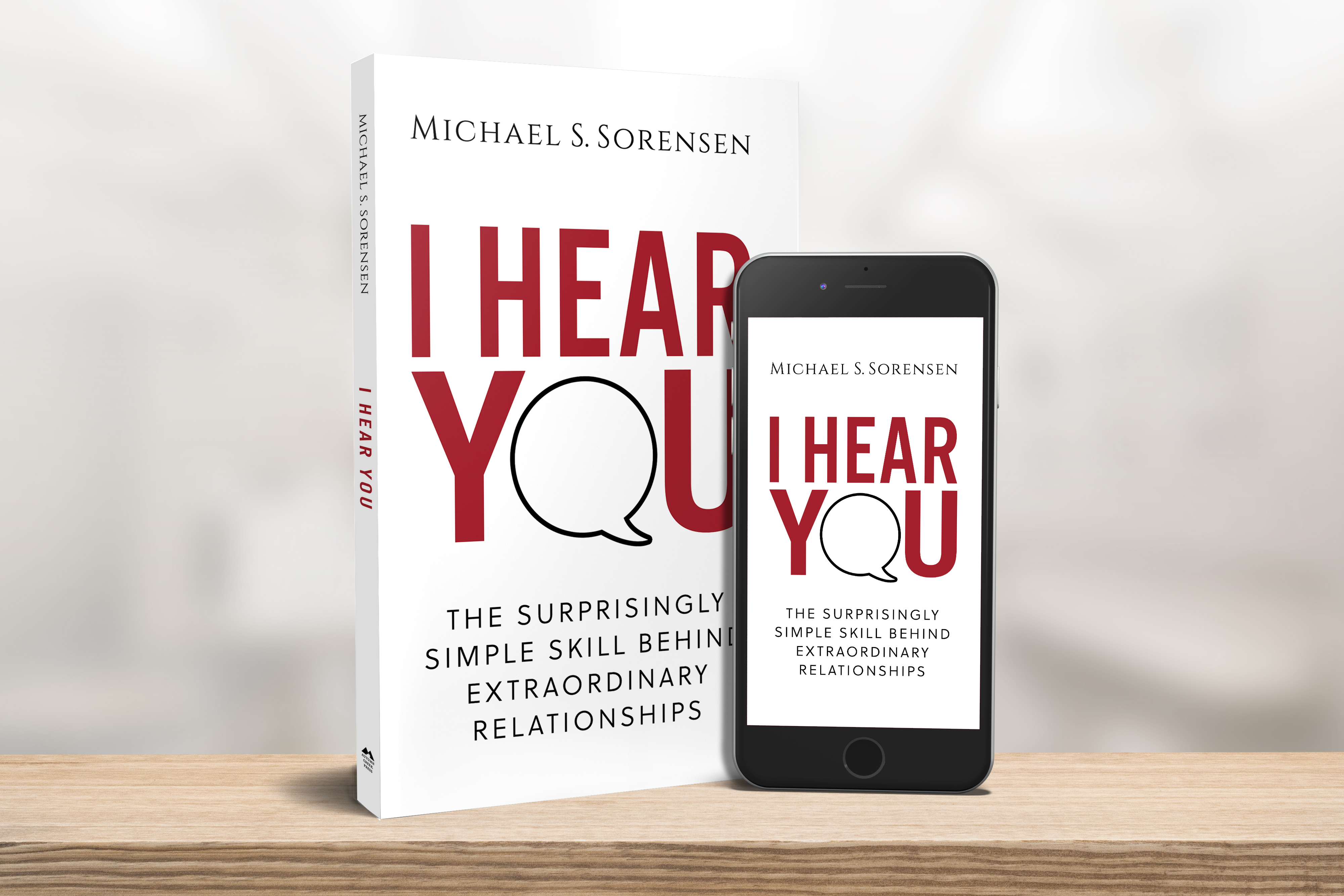
    That’s why I’m excited to share with you Michael Sorensen’s powerful new book I Hear You: The Surprisingly Simple Skill Behind Extraordinary Relationships.

    I consider myself a highly empathetic person, who naturally seeks to understand and validate others, and yet I still found this book to be tremendously valuable.

    In just 137 pages, Michael has outlined everything we need to know to communicate empathetically, both in personal and professional relationships, which will enable us to:

    • Strengthen our connections
    • Minimize conflict and unnecessary drama
    • Provide support and encouragement when we don’t know how to fix other people’s problems
    • Help more than we could by offering unsolicited advice
    • Create relief in conversations that may have otherwise felt tense
    • Help others feel safe and loved
    • Become the kind of person everyone wants in their life

    As a sleep-deprived new mother navigating the consuming world of parenthood with an equally exhausted partner, I’ve had plenty of recent experience communicating poorly.

    If you’re a parent, you’re perhaps familiar with the frustration and resentment that can quickly build up as you’re establishing how you and your partner will carry this joyful-yet-heavy new load together.

    It’s easy to fall into blame mode when you’re juggling more than feels manageable and sifting through a range of messy emotions, with only brief windows of relief.

    I’ve ended many a conversation feeling both annoyed and guilty, and consequently, less connected to my partner than usual—at a time when I’d rather be basking in shared bliss.

    But Michael’s book helped me see how he and I were invalidating each other, which kept us both stuck in frustration and defensiveness.

    The crazy thing is that we both had good intentions and had no idea what we were doing to so consistently inflame each other. Our hearts were in the right place, but we constantly felt like we were saying the wrong things and just getting each other more upset.

    Michael’s four-step validation method may be simple, but it’s powerful because it enables us to provide to the people we love the one thing we all want most: the comfort of understanding.

    It won’t solve all of our problems or give us the power to solve everyone else’s, but it will help us create relief instead of adding to a growing sense of tension.

    It won’t eliminate differences of opinion, but it can help us learn to hold another’s without invalidating our own.

    I especially appreciate that Michael peppered the book with real-world examples to help us apply this formula in varied situations. It’s easy to understand something intellectually but far more difficult to put it into practice, especially when emotions are running high. In tandem, the steps and examples shared in the book can serve as a wonderful blueprint for avoiding and defusing difficult conversations, even when navigating overwhelming feelings.

    I don’t read many books these days because my time has become far more limited, but I’m glad I added I Hear You to my reading list. It’s a quick read that I know will have a long-lasting impact on my relationships and my life, and I suspect it can do the same for you.

    If you’re interested in grabbing a copy, you can get one on Amazon here.

    **Though this is a sponsored post, with an affiliate link, you can trust that I only promote products and services I truly believe in. As my review conveys, I Hear You fits the bill!

  • Why You Shouldn’t Wait For Others to Validate Your Decisions

    Why You Shouldn’t Wait For Others to Validate Your Decisions

    Decisions

    “Do not let another day go by where your dedication to other people’s opinions is greater than your dedication to your own emotions!” ~ Steve Maraboli

    One thing I’m great at is procrastinating. Another thing, overanalyzing every decision I make.

    I can even question and try to reason which route I should take to walk the dog. It is truly outrageous, when I think about it.

    This leads to paralysis through analysis, and inevitably a fear to commit to change. This is how I got stuck.

    A few years ago I was feeling immobile and underwhelmed in my life. I had a good career, a house, and a car that I purchased all on my own, and I’d traveled the world. Still, I felt stuck to the life I was living and thought something needed to change, but I couldn’t quite figure out what I wanted to do.

    So I did what every successful and independent women would do: I broke it down, made lists, and asked my friends and family what they thought I should do. Smart, right? Wrong.

    The problem was, I was turning to others to validate my feelings and my intuition. How could I ask other people to validate how I was feeling? As a savvy businesswoman who makes smart decisions all the time, I sure missed the boat on that one.

    It’s like asking a stranger what they think you want for lunch.

    That was one of the biggest life lessons that I learned during my life transition. Stop waiting for others to validate my decisions.

    As much as they loved and cared for me, they didn’t know me. I mean, of course they knew me, but they didn’t truly know what was at the core of my decision. They weren’t in my head and my thoughts, and they couldn’t feel my soul and my longing. Besides that, they couldn’t understand it.

    Why would they understand it, and more importantly, why should they?

    I am speaking about my parents, whose generation was all about dedication, loyalty, and of course, security. To give up a secure, high paying career that I had worked so hard for was completely incomprehensible to them.

    Some of my friends had settled down into a contented family life and were enjoying motherhood. To them, having a family was their true calling, so they couldn’t understand why I would start to focus my energy on starting my own business as opposed to finding a spouse.

    My other friends were at ease working nine to five and had never thought about the possibility of questioning or changing it. They would be fine to continue on that path, without making a change. Why mess with a good thing?

    After having these conversations for more than a few years, I realized that I no longer needed to wait for others to validate my decisions. Not only that, but I may never get their validation, and I wasn’t about to wait another minute to live my life for me.

    I was looking for their approval not because it was something I truly needed to move forward, but because I feared failure and hoped that I could hear that someone believed in me.

    I concluded that it didn’t matter if they did because I believed in me, and that’s worth so much more.

    I realized that no one else needed to understand what I wanted or where I was going because no two people are on the same path in this life.

    I was living the life that that everyone else wanted for me and no longer doing what I wanted nor what I was passionate about. I was getting deeper and deeper down the rabbit hole, and I needed to dig myself out once and for all and be true to myself.

    So I did it. I took the first step and enrolled in my first course, I spoke to my boss at work to explain what I was doing, and changed my position and reduced my hours (and my salary) in order to pursue my passion.

    I was terrified, but I did it anyway. Nothing was going to change in my life until I decided to change it.

    And then the most interesting thing happened. I finally got the validation that I was seeking for all those years and confirmation from the people around me that I was making the right choice.

    At the end of the day, though, I realized that it was more important to ask myself what I was projecting in those moments.

    Those people, the naysayers, they were showing up for me for a specific reason and triggering a specific pain point for me. That was my true challenge. That was what I needed to work through.

    There will always be naysayers, those that think your choices are unrealistic, ridiculous, or won’t ever work. They are most likely projecting some of their own fears and doubts.

    I like to think of them as challengers to test your true commitment.

    When they show up for you, ask yourself why you need their validation. What are you missing in your own confidence to move forward?

    And I’ll also add, the naysayers are probably going to be the first to congratulate you at the finish line. Since I found the courage to move forward, mine are my biggest cheerleaders.

    The more you believe in your own decisions, the less you need others to. Go out and live the life you dreamed of. You’re so worth it!

    Yes or no image via Shutterstock

  • You Don’t Need Other People to Validate Your Feelings

    You Don’t Need Other People to Validate Your Feelings

    “When you give another person the power to define you, then you also give them the power to control you.” ~Leslie Vernick

    It’s coming up on the anniversary of when I left a relationship that was both my unhealthiest and my greatest catalyst for growth.

    While I’m able to see that he was a spiritual assignment I needed in order to evolve, I can’t help but feel resentful. But what surprises me isn’t my anger at him; it’s my anger at myself. Let me explain.

    Disastrous relationships are nothing new for me. My past is riddled with complicated, codependent, and crazy encounters. To cope, I’ve blamed my partners, I’ve blamed myself, and for a brief period of time, I thought I found the answer in couples therapy. Never before have I been more wrong.

    Like any self-help junkie, I made it my business to learn everything I could about the philosophy behind what I hoped would save my relationship. I attended a lecture by Harville Hendrix, founder of Imago Therapy. He spoke on how we can change the world by changing our relationships.

    That sounded interesting, so I kept listening.

    He went on to explain how we strive to connect with others in order to experience a taste of the joy and love we once received from our primary caregivers. This connection is our deepest desire and losing it is our greatest fear.

    And then it hit me. It’s counter-intuitive to look to relationships to fix wounds from our past. Did I really want to continue that pattern?

    The belief that I might find joy in a relationship because it might temporarily quell a deeper abandonment issue is the exact reason I remained codependent for most of my life. I’d been searching for a Band-Aid to cover a hemorrhage.

    Like most people, I crave the feeling of safety. Whether through touch or through words, validation that I’m worthy was like a drug. And boy, was I an addict!

    So it was no surprise in couples therapy, when our therapist explained to my then boyfriend that he needed to say that he “heard” me and that my feelings were “legitimate” and “made sense” that I felt like I had finally won.

    But that victory was brief. In fact, it depressed me even more. Because none of it was real.

    Why? Because in the midst of a heated battle about whether he was actually going to follow through on a promise he made, a light bulb went off:

    I really don’t need him to validate that my feelings are okay. The fact that I need him to tell me I have a right to feel this way is exactly what’s keeping me in a relationship that’s wrong for both of us. Whether or not another person sees it, I have a right to feel the way I feel.

    It turns out there is a fine line between wanting your partner to understand you and wanting your partner to validate your feelings. For years, I wanted others to confirm that my feelings were okay to have.

    And ultimately, the belief that feelings need to be validated to be valid was the cause of my codependency.

    Here’s what it comes down to: If you don’t believe your feelings are genuine, real, and legitimate, nothing your partner says will make a difference. Whether or not your partner gets you is secondary to honoring your own feelings.

    And while I loved pathologizing what was wrong with my ex, what you give your attention to only grows.

    Taking inventory and focusing on your partner’s inability to understand you will only create a deeper void to fill. All that negativity creates anxiety, blocking your inner guidance, strength, and resilience.

    After all, your partner isn’t going to fix your old wounds. You are.

    For the record, I’m not saying couples therapy is bad or that it wasn’t helpful for me. One just needs a strong sense of self and a clear picture of what they want to achieve.

    So here’s the solution: Give it to yourself. Heal your core fears and wounds and stop thinking that someone else will fix it for you. You can spend the rest of your life craving a connection with others when what you’re really searching for is a connection with yourself.

  • You are Enough: A Tiny Manual for Being Your True Self

    You Are Enough

    “Waking up to who you are requires letting go of who you imagine yourself to be.” ~Alan Watts

    When I was in third grade, I loved to hang upside down on the monkey bars on the playground of my all-girls school in Philadelphia.

    I would lock my little pale knees over the gray steel rods and then carefully let my hands go to swing upside down, like a pendulum in a pleated skirt.

    This meant I had to bravely trust that my normally feeble strength would be sufficient to suspend me.

    It was always a victorious feeling when the backs of my knees started to burn. This meant it was time to carefully return to earth on own my terms.

    Alix – 1, Gravity – 0!

    One day, a clump of dead grass attached itself to the sole of my Stride Rite. As I was flipping off the bars, it dropped into my mouth. I hit the ground gagging and spewing, completely grossed out.

    Doubled-over and hacking out the grass was not a little noisy. I made quite the scene; however, it failed to attract the attention of my teachers.

    They didn’t rush to my side to see why I was, for all intents and purposes, throwing up.

    “Throwing up” was a golden ticket to go home from school and I wanted to cash in.

    This is because I spent the first third of my life believing that in order to be validated, something needed to be physically wrong with me.

    The only attention I felt worthy of was sympathy. I thought ailments made me interesting.

    I was the kid who wanted a sprained ankle so I could get crutches. Do you know what the attention-getting street value of crutches is in kid world? It’s like friggin’ crack!

    And a broken leg? Think of the signatures!

    I wanted poison ivy so I could have bandages, “to keep from scratching.”

    The concerned questions were like gold: “Oh no! Are you okay?”

    I wasn’t going to let the fact that I am not allergic to poison ivy stop me from tapping into this potential cache of boo-boo love.

    One summer evening with the aid of red and orange magic markers, I drew a mock rash on my arm.

    Then I test-drove it with my family, who didn’t buy it. Thankfully, this ridiculous bit never made it out of R&D.

    To be clear, I got plenty of positive reinforcement at home. I was supported from dawn ‘til dusk by my loving family, for which I am intensely grateful. But I never felt like it really counted. In my kid’s mind, I reasoned that they had signed on to love me, and were biased.

    Plus, I was just one of those souls who required validation from the outside world.

    I felt that once I left the confines of my nest, that unless I was limping or retching, I was otherwise invisible. I needed to be a victim of something in order to matter.

    That day on the playground when my teachers ignored my blatant—and legitimate!—dead grass upset, I felt even more unseen which I didn’t even think was possible.

    Aren’t these paid-professional grown-ups supposed to acknowledge me when I’m in distress?

    Since I no doubt possessed a Chicken Little-esque flair for drama, they had probably grown immune to my antics by this juncture.

    I would cling to any and all ideas of pain in order to get the symp-attention that I craved.

    When I look back at this period in my childhood I just have to laugh at myself. Not only was I highly theatrical, but my level of insecurity was semie-staggering.

    Clearly, I did not think I was enough. In fact, it’s taken me the better part of three decades to make peace with the idea that I am not only enough, but that I am exactly who I am supposed to be.

    Growing up in the seventies and eighties I had all of these notions, largely fed by TV, pop culture, and my peers, about who I was supposed to be:

    The Breck Girl, a Charlie’s Angel, Wonder Woman (but I’d be happy to be Lynda Carter), and a career-bound (not a stay-at-home) Barbie.

    As I matured into my teens, I began to shed this billboard perception about life.

    My head was turned less by action-hero ladies with perfect hair and more by, well, if I’m being completely honest, cute boys who listened to the “right” music and wore Polo cologne.

    Now eager for their approval, I shaped myself into who I thought they wanted me to be: The girl in The Smiths’ “How Soon Is Now?” video.

    This only got me so far.

    When I graduated from high school, I moved to New York to model for a large agency. This was a dream come true.

    Before long, I was trying to figure out who the modeling industry wanted me to be: Edgy? Sexy? Wholesome? Commercial? Editorial? There were so many options and would never be a clear answer.

    Having looked at my life from the outside in for so many years was a hard habit to break.

    I was like a junkie for other people’s approval, permission, information, and maps.

    I thought everyone except me was issued a handbook about life.

    They seemed to “get it” while I was constantly scrambling to find my place in their world.

    Of course, I was laboring under a massive illusion that I was the only one who felt this way.

    Again, I have to look back and laugh.

    One day during my early twenties, the universe let me look under the hood and I was let in on a cosmic secret: tons of other people feel like they’re living without a manual. Lots of us are winging it, and being a little lost is how we actually come to find ourselves.

    This epiphany was such a relief that I stopped trying to be what I thought others wanted and started getting really good at being me.

    I would love to say that this powerful shift happened overnight, but no.

    The “just being me” remained a nuanced confidence-building process for a few more years (ten?) until I was able fully step into who I am in the world today.

    The wonder of it all—and another cosmic gut-buster—is that the more I align with my whole self, the more the world rushes into to meet me where I am.

    I venture that if there actually were a handbook issued at birth, it might go a little like this:

    1. You are a miracle. Never forget this fact. Just the science alone is mind blowing.

    2. You are unique. No one will ever be as good at being you as you are. Seriously.

    3. You are enough. Always. Never doubt this. There is nothing to add, but feel free to expand.

    4. There is always more to learn, but that is not failure; it’s a gift. It can be fun too.

    5. Every obstacle is an opportunity to fall further into the miracle that is you.

    6. Commit to being the best version of you every day. Recalibrate definition of “best” as needed.

    7. Leave room for others when they fall off the wagon of their own miracle.

    8. Forgive. Forgive. Forgive. Forgive every which way. Forgive him. Forgive her. Forgive you.

    9. Compassion is the key to forgiveness. Compassion means you feel the humanity in others.

    10.The more you forgive, the more you’ll enjoy being you, because the lighter your load will be.

    11. In the end, as in the beginning: You. Are. Amazing.

    Photo by Emilian Robert Vicol

  • 5 Ways to Validate Yourself: Be Part of Your Support System

    5 Ways to Validate Yourself: Be Part of Your Support System

    “You have been criticizing yourself for years, and it hasn’t worked. Try approving of yourself and see what happens.” ~Louise L. Hay

    We all have techniques we depend on to lift our spirits when we’re feeling down about ourselves or our lives.

    A while back I realized something about the ones I’d found most effective when struggling to forgive or accept myself: Many of them involved seeking validation from other people.

    Some of my most effective mood-boosters included:

    • Reading emails from readers who’d benefitted from my writing
    • Calling loved ones and reminding myself of how much they valued me
    • Sharing my experiences and recognizing, through the resultant conversations, that I wasn’t alone with my feelings and struggles

    These are all perfectly valid approaches to feeling better, but they all hinge on praise and external support.

    Getting help from others is only one part of the equation. We also need to be able to validate, support, and help ourselves.

    With this in mind, I’ve come up with a few ideas to create a little more balance in my support system, making myself a more central part of it.

    If you’re also looking to increase your capacity for self-soothing so you can depend less on validation from others, you may find these ideas helpful:  (more…)