Tag: unkind

  • Why People Are Rude and Unkind (and Why It’s Not About You)

    Why People Are Rude and Unkind (and Why It’s Not About You)

    “How people treat other people is a direct reflection of how they feel about themselves.” ~Paulo Coelho

    By nature, I am a happy, optimistic, idealistic person. I have always been one to look on the bright side and see the good in people. My usual philosophy in life is that the world is full of brightness, love, and possibilities to seize.

    Recently, though, my philosophy began to fade in the face of a mild depression.

    I began to cry a lot and retreat into myself rather than being social and opening up, which only furthered the problem. I felt alone, miserable, and, try as I might, I could not regain that feeling of the world being beautiful.

    I felt like something had crawled into my brain and flipped all the positive switches off and the negative ones on. I felt hopeless, like it was more of a disease than a feeling.

    Before the depression, I was a kind, gentle, and compassionate person. Sometimes I was even too gentle, afraid to bring up anything that might offend someone else or damage our relationship.

    I didn’t understand how other people could be mean, rude, or offensive toward strangers or friends. I took it personally when people affronted me or were curt with me, believing they were truly out to get me for something I’d done.

    When people were mean, I figured it was a personal choice, that it was a conscious decision to stop caring about other people’s feelings and opinions.

    When I became depressed, though, my temper shortened and I felt far more irritable.

    I had little patience for anything, and I lived in a constant state of anxiety about social interactions. Whenever I engaged in conversation with someone else, I assumed they found me boring, annoying, or self-obsessed, and it sent me even further into my sadness.

    I started to become rude and unkind myself. I lashed out at people, or, more commonly, gave them passive aggressive excuses for distancing myself from them.

    I even became prone to insulting people as a way of protecting myself if they didn’t like me.

    I didn’t make a conscious decision to be mean. I didn’t wake up in the morning and think, “Today, I am going to hurt someone’s feelings.” It just happened in the moment when I was feeling especially down on myself.

    Most of the people I was rude to were actually friends of mine, people I liked and had nothing against.

    This is no excuse for rudeness, offensive behavior, or being unkind to other individuals. I am not proud of the way I’ve acted, and I’m not suggesting you follow in my footsteps, but it did give me a new perspective on other people I come across who are less than kind.

    When someone is rude for no reason, especially a stranger, it’s rarely a personal assault, even if you accidentally did something to irritate them.

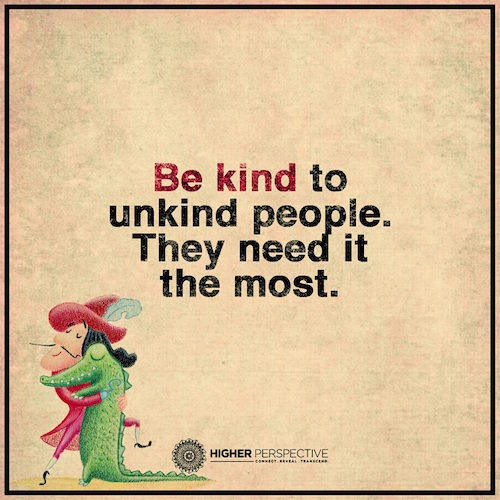
    People aren’t mean for the sport of it, or because they are against you; people are mean to cope.

    Being unkind, more often than not, is a reaction to anger with ourselves or our perceived inadequacy. When I was rude to other people, it was because I was afraid they wouldn’t like the nice me. I didn’t mind if they were angry at the fake, unkind me, because it really wasn’t me.

    I felt unlovable, undesirable, and antisocial, and I needed a way to cope with these feelings by giving myself an alter ego that deserved to be disliked for reasons I could understand.

    When you find that people are being rude to you in your everyday life, they are really being mean to themselves.

    They have likely convinced themselves that they are unworthy of love, and that is the biggest tragedy of all.

    You don’t have to tolerate it when others are not nice, but it’s not something to take personally.

    You don’t have to internalize the meanness as a fault of your own. You can simply recognize that the person being rude is struggling with their own problems, and needs a way to cope with them.

    You cannot control the actions and behaviors of others, only your personal reactions to them.

    If you yourself are the one who has been unkind, it is time for self-reflection. Why do you attack people? What are you trying to protect yourself from?

    In my case, I got depressed because I felt socially awkward and I began losing friends. After that, I shied away from social gatherings, only augmenting the problem.

    I constantly thought negative things, such as “Nobody likes you,” “Who would want to be your friend?” and “You are not worthy of the friends you have.” I created a toxic environment inside my own head, and it wasn’t based in reality.

    I knew I had to change my outlook, so I pushed myself to see the good in myself and the reasons why I’m likable; as a result, I began to see the good in others again too.

    It’s not an easy process, and for many, it requires therapy and months of time. However, you can begin your journey back to kindness by being kinder to yourself.

    Listen closely to your destructive, self-critical thoughts. Are they based in reality, or are you fabricating them?

    If you criticize yourself because you feel guilty about things you did in the past, work on nurturing self-forgiveness, just as you’d forgive a loved one for those same mistakes.

    If you criticize yourself because you were raised to believe you were a bad person, recognize this isn’t true, and know that you can choose to heal and challenge this belief as an adult.

    Try to look at yourself from an outside perspective and remind yourself of all the unique and beautiful qualities you possess and have the ability to share with the world.

    With enough time and effort, you will begin to see the pattern in your unkind behavior and its link to your own anger at yourself.

    Once you can hone in on your feelings about yourself, you can begin to make conscious decisions to be kind to others instead of lashing out as a coping mechanism.

    I have always unfalteringly held the belief that people are inherently good, and only do bad things in reaction to bad situations.

    The most important thing to remember, whether you are receiving or giving unkindness, is that you are inherently good, too, and deserve to be loved, no matter what you or someone else tells you.
  • Choose to Be Kind When It’s Easier to Be Snarky

    Choose to Be Kind When It’s Easier to Be Snarky

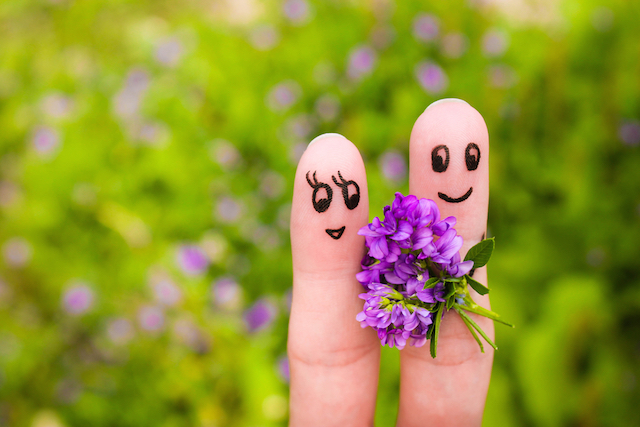
    Finger Art Couple

    “Tart words make no friends; a spoonful of honey will catch more flies than a gallon of vinegar.” ~Ben Franklin

    While I was pregnant, a friend told me to prioritize, in this order: self, marriage, kids.

    My priorities tend to be backward: kids above all else, maybe a date night once in a while, and self-care only when there’s an important meeting at work, so momma finally makes a point of grooming her eyebrows.

    So far, I appreciate the wisdom to try and shift priorities whenever I can. I feel mildly successful at putting marriage first, and it seems to be having rewards.

    My hubby and I tenderly call our survival plan “Kind Words and Old Fashioneds.”

    Making fancy cocktails isn’t a regular occurrence, and it usually looks more like a splash of bourbon or glass of wine only half drank before dragging ourselves exhaustedly to bed, after putting the baby to sleep.

    Parenting is tough on both of us, and methods of relaxation are essential by any means possible. But we try to make kind words a more regular occurrence.

    We came up with this simple phrase after I returned to work because I often got frustrated and lashed out at my husband over small things, and ended up feeling guilty.

    He could do nine out of ten things right, plus some bonus items I didn’t ask him to do (like paperwork—I detest filling out forms, and it turns out parenting comes with a lot of them), and I would fume about the one thing he didn’t get to.

    We can’t take out our stress on our children, our pets, our co-workers, or our in-laws; so oftentimes, the brunt of it falls on our partner.

    I would get agitated and do the dishes “for the umpteenth time this week” or be the “only person in this house” to fill the cat’s water bowl.

    In uttering snarky words, I may have vented some frustration in the middle of a long week, but I usually felt guilty after seeing my husband’s wounded look when my words got too unkind.

    One time, when I was apologizing, I realized I would rather be saying kind words out of appreciation for the amazing partner and wonderful father he has turned out to be. So, that turned into my New Year’s resolution: kill the snark and choose kind words whenever possible!

    It’s a tough thing to practice, but it embodies most of what I envision a healthy marriage to be.

    After years of attempting to play the piano, I know practice doesn’t make perfect, but perseverance and persistence sure do help.

    Seeing my husband smile makes me smile. Kind words make that happen more than mean ones. That can seem like an obvious statement, but the proof is in the pudding.

    We have to work on being the best versions of ourselves, and that can be tough when juggling so many competing priorities.

    We have to measure our work in inch pebbles rather than milestones, and that can seem less motivating.

    We have to practice the things most vital to our survival, and sometimes that means digging deep to find that last kernel of patience. We have to choose kindness over wrath, warmth over brusqueness, love over stress. That and Old Fashioneds seem to make for a happier marriage. At least, that’s what I’m learning as a new parent.

    In the midst of all this, I got my husband to paint our powder room. I chose lime green and he put it on the walls. It’s a little bit hideous, but I love it.

    A family member gave us a large canvas that covers a part of one of the walls, and it fits perfectly in this brightly colored little nook of our house. On it, gold sparkles spell out the words we sang at our wedding, “All you need is love.”

    Perhaps it’s a quaint notion, but it’s a great reminder to choose kindness.

    Finger art couple image via Shutterstock

  • 3 Tips to Help You Stop Saying Things You Regret

    3 Tips to Help You Stop Saying Things You Regret

    Woman with hand over her mouth

    “If you propose to speak, always ask yourself, is it true, is it necessary, is it kind.” ~Buddha

    I initially saw this quote and, in true ego-first fashion, thought of my kids: this’ll be perfect for them. I’ll put it up in the kitchen as a regular reminder to stop pestering each other.

    But then, something a bit deeper poked me gently. Riiight, just for the kids, is it? You’ve got this mastered, then. I guess my true self is not afraid to use sarcasm when it needs to.

    My true self was right (as it always is). When I began to think about those small regrets that plague my running thoughts, so many of them came about because I didn’t adhere to the Buddha’s sage advice.

    Here are a few examples that spring to mind:

    The times I’ve blurted and blathered random nonsense to other parents while waiting for my kids to appear at the school gate.

    The times I’ve made a negative comment about someone.

    The words I’ve chosen when pestering my kids to get things done.

    All my many miserable rants about the usual annoyances in life.

    When I thought about it, I decided there are common themes to the things I say which I later regret. They usually fit into one of three categories:

    • I speak to avoid the discomfort of silence.
    • I speak to unload an ego-driven thought.
    • I speak with negative emotion like frustration or anger.

    Let’s drill down to see where each of these breaks one of the precepts of speaking only good words.

    I speak to remove the discomfort of silence.

    So many times I’ve been in the presence of people when there is an uncomfortable silence and I am desperate to break it. But why? And is it really uncomfortable, or is that just me?

    Inevitably, I end up speaking things that may well be true and kind, but are certainly not necessary. And I end up feeling like a blathering fool.

    Speaking just for the sake of speaking doesn’t help. And sometimes it can hurt, if I’m speaking in a rush, without thinking. So, the next time I’m standing with someone and conversation isn’t flowing, I will always stop myself and ask: is this necessary?

    I speak to unload an ego-driven thought.

    By ego-driven, I mean a thought that makes my self-image feel bigger and better. Gossip fits well into this category. Or bragging. Complaining about a negative situation is another. (Because in the complaining, I’m pointing out what everyone else is doing wrong.)

    If I speak these thoughts aloud, I usually do so with someone I can trust, like my husband, but that does not make it better. Vocalizing something negative about someone else always makes me feel worse, even if I can trust the person I’m sharing it with. It’s just not worth it.

    I speak with frustration or anger.

    This one’s a bit more nuanced, and often comes down to tone. Even if the words themselves are true and necessary (such as: “because you dilly dallied over breakfast, we’re now going to be late for school”), they are not kind. The unkindness often comes through in the tone, if not the words themselves.

    As usual, sage advice seems so simple but is not at all easy to put into practice!

    Here are some strategies to try:

    1. Breathe.

    Take a moment for a conscious breath before speaking. It’s an imperceptible pause, but it allows you the space to consider your comment before it is spoken. Not only does it give you space for second thought, it can somehow magically reframe the situation.

    I’ve found that noticing the simple miracle of breath can cause me to see the current situation in a completely different light.

    2. Respond; don’t react.

    There is a huge difference between a thoughtful response and a knee-jerk reaction. Often, the knee-jerk reaction is fueled by subconscious anxieties.

    Enabling yourself (via #1) to have a thoughtful response means taking control of the situation and not letting your subconscious run your life.

    3. Reflect.

    Use the lapses in judgment when you’ve said something regrettable to consider why you responded the way you did.

    The trigger is usually only half of the problem. It’s worth considering what in ourselves, deep down, was irritated enough to strike back. Being aware of these personal vulnerabilities is what contributes to tremendous personal growth over the long run.

    Ideally the transformation would occur at the level of thought, so words would never have to be checked at the door, as it were. Oh, to have only true, kind and necessary thoughts!

    Until then, this quote is going up on our fridge as a regular reminder for me to tick all three boxes before speaking. I’ll take it one day at a time. (Heck, one hour at a time!) If it rubs off on the kids, all the better.

    Woman holding mouth image via Shutterstock

  • The Greatest Lesson We Learn When Someone Is Unkind

    The Greatest Lesson We Learn When Someone Is Unkind

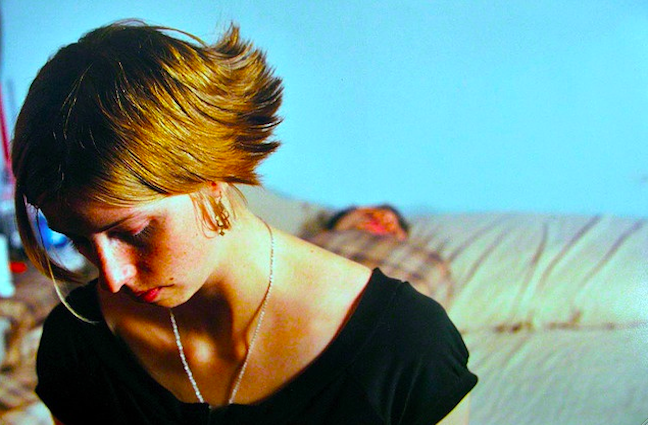
    Lonely Girl

    “I have learned silence from the talkative, toleration from the intolerant, and kindness from the unkind.” ~Khalil Gibran

    I recently travelled to Malaysia for a friend’s wedding where I spent four delicious days communing with wild monkeys and feasting on sticky rice. The people were kind and warm, the culture rich, the trip magical.

    On my last day in Kuala Lumpur, I was headed out to buy souvenirs for family and friends when I stumbled across the most beautiful temple—filled with ornate gold and red statues, air thick with sweet-smelling smoke.

    I wandered around, overcome with majesty, trying to breathe it all in. I was still under the temple’s spell when someone spoke to me.

    “Your dress is ugly.”

    I looked to my right where the voice had come from. A woman was sitting on a bench, not looking in my direction.

    “Sorry?”  I said, thinking I must have misheard. She waved me off.

    I stood there for a moment, trying to decide on a course of action. She was American, the first and only other American I’d met during my trip.

    Had she really just said my dress was ugly? It was a simple blue affair, uncomplicated and perfect for traveling. Maybe she said my dress was pretty, I thought. I must have misunderstood.

    The hurt and confusion was rising to a crescendo in my head. But if I’ve learned anything over the last few years, it’s that we all have a choice of how we choose to respond to what we are given. I chose to engage.

    “Did you just say my dress is ugly?” I asked.

    “Yeah,” she said. “I did.”

    I took a deep breath and replied, calmly, “Why would you say that to me?”

    “I’m entitled to my opinion,” she said. “Your dress is ugly; I can tell it’s not well made. Your purse is dirty. I am free to voice my thoughts and those are my thoughts about you.” 

    To say it felt like getting slapped in the face would be an understatement; it was more of a punch to the gut. My blood boiled, my heart raced, and still I kept my voice at an even keel.

    “You are entitled to your own opinion,” I said. “But we also live in congress with other human beings. Why would you say something so aggressive and unkind?”

    At which point she reiterated her insults. Her words sliced coolly into the way I looked and the clothes I wore. That’s when I said the one thing I regret saying.

    “I wish there were fewer Americans like you traveling abroad,” I told her. “You give the rest of us a bad name.”

    I turned and walked away, and she yelled one more barb at my back as I walked out of the temple. I didn’t turn around.

    My hands were shaking as I walked down the street. I felt a strange knot of emotions in my chest: hurt, anger, fear.

    I was irrationally terrified that I would run into her again, that she would be sitting in the seat next to me on my flight home and I would be subjected to seventeen hours of her cruelty, unable to escape.

    But most of all I felt baffled. Why did this woman choose to attack me? Why had she said what she said?

    I couldn’t call my boyfriend, who was back in our sunny home in California, or my best friend in DC—both of whom were sound asleep halfway across the world. So I was left to process what had happened on my own, in a foreign country, without my normal triumvirate of “healthy coping mechanisms”: yoga, conversation, tea.

    And here’s what it all came down to: kindness.

    I had just read the wonderful convocation address given by George Saunders to the Syracuse class of 2013. George talks about something he calls a “failure of kindness,” and those three words were very much on my mind.

    Yes, you could say I had suffered from a failure of kindness. But what I realized was that I, too, had been unkind.

    I wish I hadn’t said what I said to her. That came from a place of being wounded, of feeling the need to fight back. I wish I had said: “I hope the people you meet are kind.”

    Because I do hope that for her. I hope that she is bathed in loving-kindness, that she is inundated with so much that she cannot help but share it with the world.

    While it’s true that kindness engenders kindness, the lack of it can be a powerful teacher.

    For my remaining hours in Kuala Lumpur, I was abundantly kind to everyone I met. I complimented a girl on her joyful spirit, told shop owners how beautiful their merchandise was, smiled widely and genuinely. I made a point to be kind to these warm, generous people who had so kindly shared their country with me.

    And every time I was shown kindness, no matter how small, I felt immeasurably grateful.

    That woman gave me a great gift. She reminded me that we all have a choice to be kind, and we are presented with that choice many times a day.

    Say a kind word to someone you don’t know.

    It doesn’t have to be an eloquent oration—a simple compliment can make someone’s day. If you like a man’s tie or a woman’s necklace, tell them so. And if you are struck by someone’s personality or spirit, thank them for it.

    Write a note to someone you appreciate.

    Tell a co-worker, family member, or friend what you appreciate about them. Don’t hold back. These are the sorts of gifts people treasure, often keeping that little slip of paper (or Facebook post) for many years to come.

    Tip someone who doesn’t normally get tips.

    This was easy in Malaysia, where tipping is rare—one young woman was so happy she went dancing down the hall. Tipping can be a great way to show people you are grateful for their service. I still remember the night I gave $10 to a tired young man at a Taco Bell drive-thru. His eyes lit up like fireflies.

    We’ve all committed failures of kindness when we are hurt, angry, or tired. But each of us holds within us the power to achieve triumphs of kindness every day.

    Photo by Robert Vitulano