Tag: unhealthy

  • Escaping a Toxic Relationship: My Intuition Was Right All Along

    Escaping a Toxic Relationship: My Intuition Was Right All Along

    “Owning our story can be hard but not nearly as difficult as spending our lives running from it.” ~Brené Brown

    What is the exact point when you realize you are in a toxic relationship? For me, it was a process that took almost a year. I thought I was mindful and “awake.” I did have an internal dialogue with myself, but I had a thick layer of deception around me. Today, I call it a fog because I’m on the other side, and I see much more clearly.

    Looking back, I see that my inner voice was guiding me, but I saw it as self-sabotage then because a part of me wanted to prove that I was right, that I was worthy, that I was a good and kind person who only wanted love and family. Unfortunately, the more I looked to get love from the outside world, the further I was from the source.

    Today, I can confidently say that I can sense the difference between my intuition and the distracting voice of my ego, who wants to be right. Now I can finally hear what my inner guide is telling me. But it wasn’t always this way.

    As a result of the separation from the toxic relationship, I lost everything. I had to give up my old lifestyle to save my soul. I had to let go of my home and all my belongings, escaping with just one bag of clothes and my laptop.

    I lost money in a property settlement and had no car or place to live. I found a refuge in a women’s shelter with my eight-month-old baby and started my new life from a humble place. But I found something through all this—a connection to my inner voice, a connection that gave me the strength to accept the loss, own my story, and say goodbye to the old version of myself. And I’d like to share with you the process.

    September 2021

    Me: Wow, this is beautiful! I’ve always wanted to try new things. I can get used to this kind of life. I feel this thrill in my tummy. It’s fun, it’s exciting, it’s new! What is this? Love?

    My inner self (very quietly): This is a carousel.

    Me: Well, I don’t know what you’re talking about. This is fun. He already said he loves me. I told him it’s too early to say that; we barely know each other. So, I asked him why he’s in love with me. And do you know what he said? “Because you are you.” He gets me; finally, someone who loves me for who I truly am. No doubt, no proving. I’m so lucky.

    My inner self (very quietly): Watch out—it’s too good to be true.

    Me: I don’t know what you’re talking about. I’m finally alive again. This is it. I think I’m in love with him too. He already wants to move in together and have a child. He chose me, and I’m so excited. So please stop being so negative and let me lead.

    Six months quiet

    Me: He’s what I wanted. He’s spiritual and he meditates. He looks after himself, and he’s so assertive and ambitious. He listens to me when I talk. But then when I ask for something, he says, “I think you should check your energy before you speak to me.” It’s really confusing. There are ups and downs, but I guess every relationship is like this… (very quietly): Isn’t it?

    My inner self (very quietly): No.

    Me: What do you know? You haven’t even had a healthy relationship before, so how would you know?

    My inner self (lovingly): Neither have you, sweetheart.

    Me: Well, to be honest, I feel like I can’t get a word in sometimes. It’s never a good time to mention things that are important to me, or he just dismisses the topic quickly, and I don’t know how to introduce it again.

    I guess I just have to get better at communicating. Let’s do some courses for that. I always get this feeling in my stomach—massive pain, like a black hole, when I sense I’m losing him, and I fear that I’ll die not having him in my life. I can only calm down when I know things are good between us and when he hugs me again.

    I’ll just lean in with more love and kindness, and I’ll figure it out. He’ll see how much I love him even though he’s stressed and doesn’t have time for me anymore. He’ll see that I’m here for him through good and bad, and then he’ll be here for me when I need it. I’m sure we just hit a rough patch, and all will be good again soon.

    Actually, stop being so negative. I have everything I’ve always wanted. Now, with the baby on the way, we’ll make such a wonderful family, and I’ll see what a great father he’ll be and how much fun we’ll have.

    Six months later

    Me: It’s still kind of up and down, isn’t it? Some days things go well and we’re happy, but then comes a big fall. One day he says that I’m the best partner he’s ever had because all his exes are crazy. Other days, he comments really hurtfully on what I say or who my friends are. And it goes round and round.

    My inner self (very quietly): Like on that wheel?

    Me: What wheel? The Power and Control Wheel I saw? Nah, not like that. I wouldn’t do that to myself. I was already in an emotionally abusive relationship, and I wouldn’t be so stupid as to repeat it.

    Things are fine. I just need to be nicer to him. It’s kind of my fault. It must be my hormones. It will pass after the birth. He’ll be with us at home, and we’ll restore the peace and calm. Easy. I feel so much love for him. I won’t ruin this relationship by being too sensitive. I’ve got this. I’ll do more visualizations and affirmations.

    Three months later

    Me: Hello, are you there? I’m so confused. I think I’m losing my mind.

    My inner self (very quietly): I know, honey.

    Me: What’s going on? My life is a mess. I don’t know what to do. I don’t know why I’m ruining everything all the time. I used to be fun, happy, and confident… Now all I feel is disoriented and dizzy.

    My inner self: A bit like on a carousel?

    Me: No, I’m not. I told you—he’s helping me. He’s the best. I want him. I don’t have anyone else. And I love him so much I can’t imagine my life without him. It’s impossible. He’s got all the money, he’s signed on the lease, the car is under his name, and I’m not even employed…

    My inner self (patiently): Alright, honey. Go again. I’ll be here when you need me.

    Two months later

    Me: I don’t recognize my life or myself anymore. Everything is kind of fuzzy. I’ve had this headache for the last week or so. I can’t feel or think clearly; I can’t feel my body. I’m unwell.

    My inner self: I know, my dear.

    Me: What’s going on? Please help me, someone.

    My inner self (very quietly): You are on a carousel.

    Me: Why do you keep repeating that? I told you he’s helping. Well, sometimes. He’s just a bit stressed, but it’s also my fault because I’m not as much fun as I used to be. I don’t know why I feel so numb or why I can’t just laugh anymore.

    He’s the only person left. I don’t see anyone else anymore. I’m scared to speak to anyone; no one would believe me anyway. My life is so extreme compared to last year, with court cases and police and debts and signing documents I don’t understand. What am I doing wrong? Why is this happening to me?

    My inner self (barely loud enough to hear): Have you noticed the same things happening over and over?

    Me: Yes. But I’d die not having him. Stop telling me he’s the problem when I know I’m the problem.

    One month later

    Me: Are you there?

    My inner self: Of course.

    Me: The same things are happening over and over again. I thought he was helping and that I was crying every night because I’m depressed and I have so much drama in my life, but I don’t bring up any of that. He always talks and talks until I feel like the worst person in the world.

    The other day he came to me with an idea to have children with other women because he wants more kids than I can give him since I’m turning forty this year. He claims it’s because more women should have children with such fantastic genetic material. This is too much for me, and it’s not getting better but harder and faster. But how do I get out? Please help!

    My inner self: Are you ready?

    Me: I think so.

    My inner self: Then jump.

    Me: Where?

    My inner self: Off the carousel, sweetie.

    Me: Can you slow it down, please!? This is going to hurt.

    My inner self (most lovingly): It will, honey, but you are not alone. I’m here. I will guide you and help you heal.

    And so I did.

    Four Takeaways from Those Conversations with My Intuition

    First: Intuition is usually quiet, gentle, and subtle. I recommend going back in your memory and noticing when you heard your intuition. What was the quality and the tone? What else can you notice and learn about it?

    Second: Intuition doesn’t argue. It often disappears when you disbelieve or argue back. It’s very sensitive to criticism and attitude, meaning what seems to be right or more logical or more convenient. If you want to be guided by intuition, you have to let go of thinking that you ‘know.’

    Third: It grows stronger if you connect with it like your life depends on it. If you surrender and quiet your overthinking, you will be surprised by how quickly your intuition can guide you to where you need to go.

    Fourth: Your relationship with your intuition is like any other relationship; it needs time, care, and attention to build it solid. But once you do, you’ll have an invaluable asset for life.
  • The Friend I Couldn’t Fix: A Story of Love, Loss and Letting Go

    The Friend I Couldn’t Fix: A Story of Love, Loss and Letting Go

    TRIGGER WARNING: This post deals with an account of domestic violence and may be triggering to some.

    “You can’t heal the people you love. You can’t make choices for them. You can’t rescue them.” ~Unknown

    Every story starts at the beginning. But how far back should I go? Birth?

    I was born at Our Lady of Lourdes Hospital in Camden, New Jersey, in May of 1972…just after three in the morning.

    No, wait. That’s not morning. It’s still dark outside.

    Forgive me. That’s an inside joke.

    You see, just a few years ago a friend of thirty years came to live with me. A down-on-his-luck, unemployed alcoholic that recently battled Stage four cirrhosis, we agreed he could stay with me, rent-free, for six to eight weeks as he sorted himself out.

    Just typing that sentence makes me cringe. How did I ever think he’d sort himself out?

    I believed that with enough love and support people could overcome their troubles. However, it never occurred to me that they had to WANT to overcome their troubles.

    Within a few days of moving into my apartment, he blew the job opportunity that he (and I) counted on by insulting his future boss. Six to eight weeks evolved into eleven and a half months. Sorting himself out morphed into sleeping all day, drinking all night and abusing me in the time in between.

    Which brings me back to the inside joke.

    Don’t Engage

    I woke one day before dawn. “Good morning,” I yawned as I flipped the coffee on.

    Fortified behind a barricade of empties, he launched his daily verbal assault. “Are you really that stupid? It’s not morning; it’s still dark. F*cking moron.”

    “Don’t engage,” I said to myself. Not engaging pissed him off because he wanted to fight, but engaging was so much worse.

    Engaging led to things being slammed. Thrown. Shattered. Time spent searching for every shard of glass and worrying about the eight tiny paws that scampered around my apartment. I didn’t have it in me to see any more of my belongings broken. Any more of my spirit broken.

    His attacks began months prior and consisted of only words at first—a slew of insults he hurled at me as though playing a game of merciless Mad Libs. I was stupid, a moron, a fat blob, ugly, pathetic.

    Then began the screaming, throwing, slamming, backing me into corners, pushing me into walls, grabbing my throat, and finally punching me in the face.

    It’s Not That Simple

    Prior to living with him, I never thought too much about domestic violence. I’d never witnessed it, and to be honest, it never occurred to me that domestic violence could exist in this type of relationship. You see, he wasn’t my father, my husband, or my boyfriend. He was a friend.

    Moreover, and I’m ashamed to admit it, I unfairly thought people in abusive relationships were weak. And I am not weak. I’m strong and independent. I realize now abuse is not that simple.

    It began so slowly I didn’t see it for what it was, nor did I want to. I wanted to see the best in him. Only with the gift of hindsight do I clearly see the picture three decades of brushstrokes formed. For thirty years I loved his potential, not who he really was. Looking back, I see that he had been narcissistic, manipulative, and emotionally abusive since day one.

    The Perfect Storm

    When he first came to live with me, I was his “angel” and could do no wrong. I won’t lie to you—being an “angel” felt wonderful.

    You see, as far back as I can remember I have felt useless and unworthy—the ugliest girl in the room that no one wanted. It’s a paralyzing state of mind that led me to a place of constant giving at my own expense. Of people-pleasing. Doing anything and everything to make those around me happy so they wouldn’t abandon me. So they’d need me. So they’d love me.

    And here was my friend who needed help as desperately as I desired to offer it. My friend whose spiral of mental illness and alcoholism was as destructive as my non-existent boundaries and acute need for acknowledgement. We were a perfect storm.

    The Last Day

    The last morning we ever spoke, he was in the midst of what I can only describe as a reality break. He spewed such nonsense that I secretly recorded his rage on my smartphone in case I needed proof of what was happening. He verbally berated me and threw a heavy pair of headphones across the room, missing my head by inches. The straw finally broke the proverbial camel’s back.

    I kicked him out of my home…out of my life. This man who for so long I loved and admired. This man who in reality lived his life like a forty-six-year-old toddler. Choosing to kick him out was more difficult than living with him. I loved him. But I chose me.

    I had to choose me.

    The Path to Recovery

    Not long after kicking him out, I found myself standing in front of a wall full of light bulbs in Home Depot—with no idea how I got there. I was sinking fast.

    I reached out to my primary care physician, as I realized I was in a situation I was ill equipped to handle. I was diagnosed with compounded trauma, placed on medication for depression, and instructed to seek talk therapy.

    Talk therapy enabled me to unpack the root of the issue of why I’d “allowed” this situation to carry on as long as I did.

    I peeled back the layers of an onion that revealed that I had such a deep-seated fear of abandonment and self-loathing that I was willing to sacrifice myself for breadcrumbs of love, affection, and validation. Only by identifying and facing my core wound head on was I able to make significant progress.

    Additionally, I explored eye movement desensitization and reprocessing (EMDR) therapy, which lifted a weight off of me I wasn’t aware I carried. Reprocessing distressing memories using this technique fundamentally changed my relationship with my trauma.

    I devoured books, podcasts, and internet tutorials on emotional abuse, CPTSD, attachment styles, and so much more. I began eating cleaner, exercising consistently, and prioritizing sleep.

    He tore me to my foundation, but as the architect of my future self, I undertook the painstaking process of building myself into who I chose to be. I chose warrior. Well, that’s who I am on my good days. I also have days when I’m a little scared mouse, and that’s okay too.

    Lessons Learned

    It’s been three years since that final day in my apartment. In that time, I’ve accepted there is a difference between showing someone grace and sacrificing oneself for someone who cares only for themselves.

    I’ve made peace with the realization that I can’t heal or change anyone—that they need to do that work on their own.

    Can I provide love? Yes. Will I hold space? Absolutely. Am I capable of fixing anyone? No. Will I forfeit my sanity and safety? Never again.

    My love could not help my friend. I could not fix him. At the end of the day, only he had the ability to fix his problems, and he was either unwilling or incapable of doing the work.

    The Actual Last Day

    I kept tabs on him in the weeks following him leaving my place. He bounced from friend to friend, to various seedy motels and finally to emergency rooms for psych evaluations and vomiting copious amounts of blood.

    And then the inevitable.

    Every story also has an end.

    My friend of thirty years died at Our Lady of Lourdes Hospital in Camden, New Jersey, in September of 2020 at 7:13 a.m.

    A time I think even he would consider morning.

  • The Allure of Unhealthy, One-Sided Friendships and How I’ve Let Them Go

    The Allure of Unhealthy, One-Sided Friendships and How I’ve Let Them Go

    “The real test of friendship is can you literally do nothing with the other person? Can you enjoy those moments of life that are utterly simple?” ~Eugene Kennedy 

    I could not. When I was with them, we had to be doing something. That is why I didn’t see it. I kept myself too busy to see or feel what was happening.

    It was the panic attack during a long-distance drive home that should have been the sign that something was very wrong.

    I didn’t see or expect that my choice of friendships was ruining my mental health and, in turn, my business.

    It was so much fun, you see. To be with them both.

    We’d stay up late into the early hours drinking, eating yummy food, or watching our favorite TV series. In the thick of a global pandemic, when you could only meet with limited people and had nowhere to go, this felt like the perfect escape. We also did healthy things like yoga and meditations together.

    How lucky I was.

    Or was I?

    I’ve since come to learn about trauma bonds through inner child work, and I’ve recognized there was something seriously wrong with my seemingly perfect and fun life.

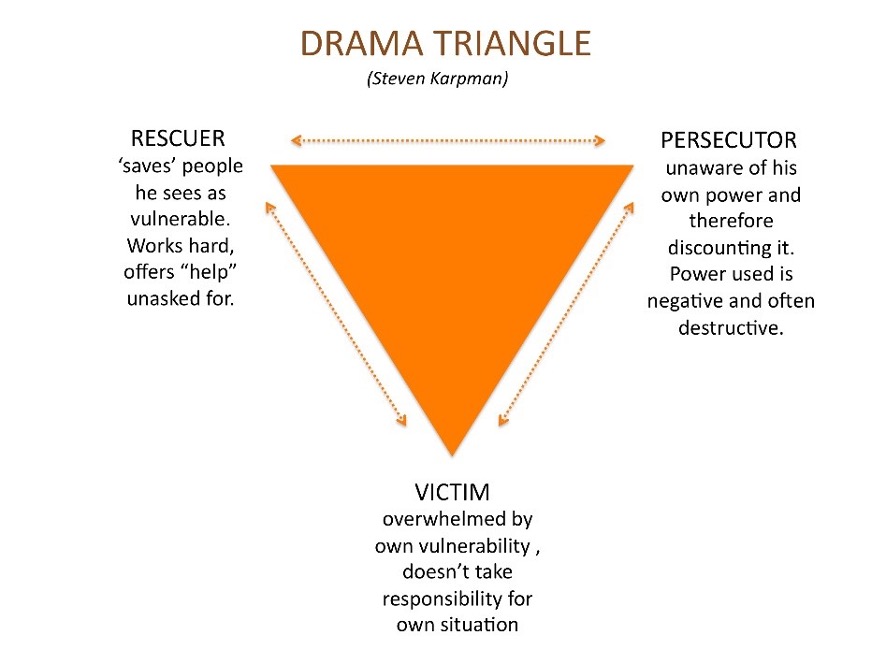
    The Drama Triangle

    From a young age I took on the role of rescuer within my family. My mother suffered from severe depression following my birth, and she needed her children’s love and care.

    Fast forward to 2020, during a global lockdown, I was playing the role of rescuer with my friends, completely unaware of the inauthenticity I was creating within myself and how I was neglecting my own needs.

    What does the rescuer look like?

    Warning Sign Number 1: People-Pleasing

    I was constantly people-pleasing and offering solutions to anyone around me, even though they never asked for help.

    I never considered how my friendships would be if I were not ‘useful’ or ‘fun.’

    I could see the red flags—for example, not speaking up when I felt something wasn’t right and instead working even harder to justify or understand one of my friend’s behaviors, and trying to help and save her even more by doing household chores.

    When we’re people-pleasing to gain someone else’s approval, we chose behaviors that are not true to ourselves. And we act in ways that negatively impair ourselves because in rescuing others, we’re neglecting ourselves.

    Warning Sign Number 2: Numbing Through Binge-Drinking and/or Eating  

    I was constantly binge-drinking with my friends, and it was damaging to my health. As a result, I experienced:

    • Sleep deprivation from the late nights
    • A dysregulated nervous system due to hangovers
    • Weight gain due to eating junk food

    And like a catch-22, the bad feelings I had after these episodes made me want to do it all over again to feel better, leaving me in a vicious cycle.

    I wanted to be with these women, like an obsession or craving, but I was using substances to numb the fact I didn’t feel safe with them. Eventually, this set off my internal radar telling me this wasn’t right.

    If you are in a cycle of unhealthy behavior with certain people and you’re developing self-destructive habits, it could very well be a way to cope/numb deeper feelings that you don’t want to face.

    Warning Sign Number 3: They Are Unavailable

    I began seeing our meet-ups as booty calls, enjoying the thrill and drama of rushing to meet them.

    I would drop everything to be in one friend’s last-minute plan, or I would try to make future plans if I saw her and I didn’t want it to end.

    These friendships felt like a drug—I felt addicted to seeing them, despite knowing it wasn’t good for me or my health. I would eagerly wait for one of my friends to tell me when she was available.

    The thing is, she wasn’t available. She didn’t want to make plans in advance or prioritize us on weekends when she had other plans. So I made myself more available. I’d drop things if she was free and wanted to meet.

    Being someone’s last resort and being okay with that are clear signs that a relationship isn’t healthy.

    I’ve come to realize that I’ve carried a mother/daughter wound my whole life—because my mother wasn’t available due to her mental health challenges—and I was desperate to be seen, wanted, and accepted by people who weren’t available as a result. It was all I knew. It’s how I became programmed.

    I was seeking out women who replicated the relationship I had with my mother as a child. I was befriending those who seemed confident, unattached, and unavailable.

    However, the issue wasn’t what they were doing. The real work was asking myself why I was making the choice to be around people who made me feel unsafe. So unsafe that I was numbing myself with food and alcohol when I was around them.

    Due to my mother’s depression when I was growing up, I didn’t know what it felt like to be in a safe relationship. Since drama and dysfunction were all I knew, that’s all I was seeking out.

    Through trauma coaching I learned how to listen to my physical body and then connect to my inner child. To find and heal that little Rav who was looking for love by people-pleasing.

    Here’s how I connect to my younger self:

    1. I take a moment to pause and feel. I close my eyes and breathe calmly. I scan my body for any aches/tension or obvious pains. After locating the pain, I ask myself when I felt like this as a child, and I explore that.

    2. I FEEL the feeling in all its depth. This might mean crying, shouting into a pillow, or even punching a pillow for the hurt I felt as a child during a specific incident, or for the pain I’m feeling now.

    3. I journal it all out of my mind and ‘re-parent’ my inner Rav: “It’s okay—I got you. That wasn’t very nice. You’re safe now. You don’t need to speak to mum right now. You can play with your toys or cuddle your teddy. Let’s help you feel better.” It can be in the form of an imagined conversation or even acting it out in the now after writing it out.

    The power of this process and being able to recognize those wounds is immense. You really start to understand and sense your own sense of self and your worth. And your current patterns and issues become so much clearer to see.

    The questions I went on to ask myself:

    • Were my friends asking me to rescue them?
    • Did they know I was withholding my honest feelings, too scared to tell them how I really felt?
    • Was it my choice to stay with them when I felt unsafe or to drink and stay up late?

    After I took an honest look at what was really going on, those friendships came to an end, and I still find myself grieving them but far less than when it first happened. It’s not easy. It hurts. However, I now have the tools to feel safe and to come back to my true self.

    Throughout the day I take my right palm to my heart, close my eyes, and remind myself “you are safe.” I repeat this as many times as necessary as I slow my breathing and connect to the present moment.

    It is so worth the struggle and the commitment to healing in order to break free. It’s actually created space for me to welcome more aligned friends into my life.

    It’s a process to adjust to a less dramatic, chaotic life than I had with them, but I am much more content within myself. I don’t need to hustle or the drama. It’s okay to be safe.

  • The Agony of Anxious Attachment and How to Attract Better Relationships

    The Agony of Anxious Attachment and How to Attract Better Relationships

    “If you don’t love yourself, you’ll always be looking for someone else to fill the void inside you, but no one will ever be able to do it.” ~Lori Deschene

    There are four attachment styles including anxious, avoidant, anxious/avoidant, and secure.

    Attachment theory teaches us that the way in which we attach ourselves to our romantic partner mimics the relationship we had with our primary caregivers growing up.

    So, if you were like me and had parents who were not physically or emotionally present, you grew up feeling a void within yourself and always worrying if you were lovable. Because of this void, you feel unlovable and unworthy of love, which causes you to be drawn to partners who are considered avoidant.

    An avoidant partner is someone who believes their independence is more important than being in any relationship. They feel uncomfortable opening up to others. They prefer a casual hook up over an intimate relationship. And the moment they begin to feel vulnerable or like they like you too much, they ghost.

    Suddenly that super cute date you both planned gets canceled or pushed back with no explanation, and you are left questioning your worth and what you possibly did wrong. I know because I have been there before.

    In a way, your subconscious is trying to recreate the experiences you had growing up. If, for example, you told your parents you loved them and tried to hug them, and they responded with “Stop being so touchy” and “Get off of me,” you began to normalize being rejected when you expressed love. So now, your subconscious is drawn to avoidant partners who react in the same way your primary caregivers did.

    Our attachment styles play a huge role in our relationships, and our relationships impact our mental health. If you are a person with an anxious attachment style and you’re subconsciously drawn to avoidant partners, you will go from one toxic relationship to the next.

    If you are someone who is anxious, you tend to:

    • Quickly attach; you go from 0 to 100 when you like someone.
    • Worry constantly if they will stop loving/liking you.
    • Worry they don’t feel as deeply for you as you do for them.
    • Fear if they get to know the real you, they will no longer love you and will leave.
    • Think “I will never ever find anyone else” or “This is as good as it gets” when thinking about your relationship, even though you know deep down inside you’re not getting your needs met.

    Back in 2018, I decided to seek out therapy for the first time. I was a young grad student with a bright academic future ahead of me, but this was also the time I decided I was ready to date—and oh boy, did that open a can of worms.

    I went from being this super cool, calm, and collected young woman to constantly feeling anxious. “Why hasn’t my date texted me yet?” “It’s been four hours since I texted him.” “Does he not like me anymore?” These were just some of the ruminating thoughts that kept echoing in my head. I was losing it.

    I didn’t know it at the time, but I kept attracting men who were avoidant, and the more I felt them trying to put distance between us, the more obsessed I became with closing the gap. I wanted to feel close to them; I wanted them to love me because if they didn’t, it meant something was wrong with me.

    You know how people say, “If they’re not into you, it’s their loss?” To me, it didn’t feel that way. To me, it felt that I had to win their love, and if I didn’t win it, it meant I wasn’t worthy of their time and attention. I began to hyperfocus on every detail of our interactions. I began to notice if they texted me back with a period at the end of a sentence or if they added an emoji.

    I would even time how long it took for them to reply to me. If I was dating someone and they usually responded to my texts within two hours, that meant that I was able to feel safe and relaxed for that first hour, but as soon as it was getting closer to hitting that two-hour mark, I would feel the anxiety creep up.

    I could feel the anxiety in my body, starting with my stomach. It would feel tense and tender, then my shoulders would feel tense and my appetite would disappear. I lost about twenty pounds during this time in my life from the stress and anxiety I couldn’t get under control.

    I even developed a bald spot at the top of my head. I was baffled at the quick deterioration of my mental and physical health. A few months ago, I had been a new grad student, excited about life and building a successful career, and now I was barely holding on and smiling to seem sane.

    I have an anxious attachment style, so I become hypersensitive to the tiniest of shifts within somebody’s tone, body, facial movements, the words they use, etc. If my date said, “I love you” one day and the next “I like you a lot,” that was enough for me to ruminate on for the rest of the week.

    I knew that something was wrong and that I needed to get my emotions back under control, so I began to look for help online. I landed on Tiny Buddha many times, and it was extremely helpful to read other people’s experiences so I could better navigate my situation.

    Since I couldn’t force my romantic partners to meet my needs, I thought, It must be me. I need to chill out and not expect so much from them. I can change. And change, I tried. I read countless articles on how to let go of expectations.

    I convinced myself that I was the problem, that I was expecting too much from a boyfriend. I thought that men were just incapable of meeting my needs and showing up for me the way I did for them. Because up to this point in my life, I had never experienced a man being consistently loving. At one point, I even tried to cleanse myself of my “bad energy” by doing a Limpia (cleansing).

    I really wanted to be the issue, because if I was the issue, I could be in control and fix it. But the harder I tried to change and loosen my expectations, the more deeply I fell into a depression.

    As you can see, the way we attach ourselves to romantic partners can affect our mental health, and if we’re not aware of the type of partners we are attracting, we can fall into a cycle of going from one toxic relationship to the next.

    Going to therapy and seeking help was the best decision I made for myself. I was able to have someone point out to me the toxic cycle I found myself in. If you find yourself in this same toxic cycle and are ready to break out of it, there are a few things you can do.

    1. Admit to yourself that you are ready to break the cycle.

    Be honest with yourself. Identify the ways in which you have betrayed yourself by choosing partners that only hurt you. Be committed to ending this cycle.

    2. Begin to do inner child work.

    When you feel hurt and lonely and want to reach out to those toxic partners, instead, visualize the you that you were at five to seven years old and connect with the little you. Write them a letter. What would you tell little you if you were feeling hurt and lonely? I would tell myself  I love you. You are safe. I will always be here for you.

    3. Write a list of all the negative feelings and emotions your partner triggered within you.

    Write a list of all the reasons why you need to stay away from this person and reference it anytime you feel like you want to reach out to them.

    4. Regulate your nervous system.

    When our sympathetic nervous system becomes activated, our fight-or-flight response turns on and that makes it so hard for us to tolerate the discomfort of separation from the person we’re anxiously attached to. A breakup can feel like imminent danger, so we begin to panic and go back to our comfort zone, staying in a toxic relationship.

    Some simple ways to regulate your nervous system include taking a barefoot walk in nature, doing a moderate to intense workout, practicing breathing exercises, and/or listening to music that soothes you.

    5. Begin to develop a self-love and self-care routine.

    You can begin to journal daily for ten minutes as a way to reconnect with yourself, work through your feelings, and identify thought and behavior patterns. You can make a list of your physical, mental, and emotional needs and identify small ways to meet them each day. You can go on weekly dates with yourself; go out to eat and watch a movie.

    Do whatever it is that will make you feel happy and full. When you feel better about yourself and more comfortable being alone with yourself, you’ll be less apt to turn to another person to fill a void inside yourself.

    You get to create the life and experiences you want to live. And while it may feel like you will never find the right partner for you because of your anxious attachment style, that is simply not true. When you begin to fill yourself up with love, even if you attract an avoidant partner, you will leave at the first sign of trouble rather than staying and trying to fix it.

    Eventually, you will meet a partner who is secure and/or willing to become securely attached to you.

    You will find someone to whom you can voice your anxiety, and instead of them dismissing you and telling you to “stop being so sensitive,” they will respond with “What can I do to ease some of the anxiety you’re feeling?” or “What can I do to help you feel safe?” Remember that you are always in control of creating the reality you want to live in.

  • Children’s Movies are Obsessed with Death, but Don’t Show Healthy Grief

    Children’s Movies are Obsessed with Death, but Don’t Show Healthy Grief

    “Grief is really just love. It’s all the love you want to give, but cannot. All that unspent love gathers up in the corners of your eyes, the lump in your throat, and in that hollow part of your chest. Grief is just love with no place to go.” ~Jamie Anderson

    I knew my son was watching me. We were inhaling fistfuls of popcorn while Frozen 2 played on the screen above. (Spoiler alert…)

    Anna has just realized her sister, Elsa, is dead, frozen solid at the bottom of a river. Anna must carry on life without her.

    My son turned his body and looked directly at me, ignoring the film. He knew what was coming. I began to weep. This is what he expected. He patted my arm with his little hand, which was buttery from popcorn and sticky from sour gummy worms.

    Anna’s body slumps over, and her broken voice begins a haunting song of grief: You’ve gone to a place I cannot find. This grief has a gravity. It pulls me down.

    I’m frozen, too, within memories of the death of my brother Dave by suicide just months earlier. Cartoon Anna and I together mourned our lost siblings. 

    My young son comforted me while I cried. As I think about it, it is such a twisted scene. Can’t we just go to the movies, eat a bunch of crappy food, have a couple of laughs, and call it a night?

    None of us intended for me to have a grief spiral in an animated film with a talking snowman and a plot line featuring a guy who is enmeshed with his reindeer. But the film is all about grief.

    It is about one daughter’s quest to heal intergenerational trauma and right the wrongs of the past. It is about another daughter trying to learn the stories of her lost parents, and in so doing, she enters a space that is unsafe and threatens her life, too.

    I guess it is completely predictable that this story would remind me so much of my own family.

    Six months before Dave killed himself, our dad had died of esophageal cancer. My son certainly saw my tears coming. He’s nine now. He knows that he has a mother who lives in grief. He knows that his mother has a wound where her brother and father once were and that the wound gets reopened from time to time. He’s seen me cry more than I ever imagined he would.

    Have you ever thought about how many children’s films feature the death of a parent or sibling? Here are the ones that come to mind off the top of my head: The Lion King, Frozen, Big Hero 6, The Land Before Time, Finding Nemo, How to Train Your Dragon 2, Bambi, Abominable, Vivo, Batman, the entire Star Wars franchise. This year’s Lightyear. You get the picture.

    Death is so pervasive in children’s films that a team of Canadian researchers looked at the prevalence of death in this genre and concluded that two-thirds of kids’ movies depicted the death of an important character while only half of films for adults did.

    The researchers also found that the main characters in children’s films were two and a half times more likely to die, and three times more likely to be murdered than the main characters in films marketed to adults.

    So, if my kids watched a movie a week, they’d see thirty-four deaths a year—usually the death of a parent or close family member. What is up with that?

    It is an easy plot device. What better way to thrust a character into a scenario in which they heroically redeem a terrible tragedy by going on a journey, taking back the throne, restoring the family name, and so on? The point of the movie becomes the main character rising again in the face of loss. It is the quintessential hero’s journey.

    I don’t have issues with kids being exposed to death. I’ve had lots of open conversations about it with my kids. When children’s films show children thriving after terrible events, there may be some psychological benefit to that, by helping kids know that there is indeed life after death.

    But I am worried about how the pervasiveness of these stories is shaping our expectations about grief.

    It’s an important conversation to have, especially when more than one million Americans have so far died from COVID. The impact on children has been immense. From April 1, 2020 to June 30, 2021, data in Pediatrics estimated more than 140,000 children under age 18 in the U.S. lost a parent, custodial grandparent, or grandparent caregiver.

    Children see death over and over, but there is very little treatment of grief in popular culture. In most instances, a film shows the hero standing with head bowed beside an open grave. The audience may observe a tear or a nod toward a period of sadness, but the character is back in action within sixty seconds, fighting the dragon, building the robot, or saving the world. 

    The other alternative is that prolonged grief drives one to become a villain. If loss is not quickly translated into action, it seems to fester into vengeance and evil. I’m thinking of the Kingpin from Spiderman, Dr. Callaghan from Big Hero 6, Anakin Skywalker (a.k.a. Darth Vader) from Star Wars, Magneto from X-Men, among others.

    These films are telling a story about grief that is a disservice to us all. Our society counts on a bereaved person bouncing back to action almost immediately. And if they don’t, in a prompt, timely manner, the suspicion is that the grief has ruined them.

    These films help craft a society that has no model for the emotion of loss. For the slowness of it. For the darkness of it. Especially in the lives of children.

    During the season of my loved ones’ deaths, my children were twelve, eight, and eight. They were tender and sweet. And young. But also, old enough.

    There was a lot of talk about cancer at our house. The kids knew the science. They shared a house with my dad while he went through his first round of chemo. They knew it was miserable.

    Early on I let them know that this cancer would probably cause Grandpa to die. I explained the size and location of the various tumors. I let them know that our time with him would probably be two or three years.

    I believe in being honest with children in a way they can understand. I didn’t want them to be afraid that Grandpa would die. I wanted to let them in on the secret that Grandpa was going to die. No need to keep anyone in suspense.

    I was with my dad when he died in California. My children were at home in Minnesota. A few minutes after he died, I called them on the phone. My husband, Rob, sat with them, and I told them one by one. I talked to them while Rob held them.

    When my brother died, Rob and I both sat with the children. We told the youngest and the oldest together. They were once again tender and fearful. Surprised. Wide eyed. We held them.

    They didn’t say much. Uncharacteristically, they didn’t ask any questions. They knew that Uncle Dave was mysteriously sick.

    My brother’s death was much more difficult to talk about with my children. They knew that he struggled with alcohol. They knew the word addiction. They knew that he had been in and out of the hospital. The problem with suicide is that there’s no good way to make the logic work for children.

    I can just imagine the torrent of questions: How much sadness is too much sadness? How much pain is too much pain? When the cat dies? When my best friend is mad at me? What makes your heart hurt so much that dying is the logical step? When does one reach that point?

    Psychologically speaking, talking with my children about Dave’s death was so hard because it threatened to dismantle their basic assumptions about the goodness, safety, and predictability of the world.

    In my conversation with my children, I didn’t want their sense of goodness, justice, and safety to be shattered. The world is no longer a predictable, good place when someone kind and loving experiences such darkness and ultimately a horrible, self-inflicted death.

    The world is no longer meaningful when there is no simple, rational explanation for how such a thing happened. The self may no longer be worthy of happiness and joy if someone like Uncle Dave could not find happiness and joy.

    Everything in me is organized against my children understanding this logic. I didn’t want it to enter their minds or their hearts.

    But it has. It will. They will come to know the full story of their soft-spoken uncle with the beautiful blue eyes. They will remember him on our couch and in the park and in the kitchen and at the lake. They will know the truth about him and how he was lost.

    And there is no way around the reality of suicide, the reality that the truth is beyond the careful, thoughtful, simple explanations of their mother. I can’t make it neat or easily digestible for them. It is too messy.

    My children have been up close and personal with grief these past years. They’ve held human ashes in their hands. They anticipate that I will cry during a movie scene in which a character loses a sibling. They know all about cancer. They’ve attended memorials

    It isn’t what I would have chosen for them—to be in a movie theater, comforting Mommy because the cartoon reminds her of her dead brother. That isn’t what I ever pictured when

    I first held their tiny baby bodies in my arms and my heart swore to protect them with every cell in my body. Sometimes I apologize to them in whispers: “I’m sorry that our lives have unfolded like this.”

    There is a way to use the deaths of children’s movies to facilitate conversations about grief and loss.

    A 2021 study in Cognitive Development found that animated films may provide the opportunity for parent-child conversations about death, because parents often watch these films with their children. However, according to researchers, few parents take advantage of this opportunity to talk about death with their children. I encourage parents to take advantage of these teachable moments.

    For my children, who have seen grief up close, my only hope is that they are learning about the reality of grief. They are seeing a more realistic picture than Disney will show them. They’re seeing me go to work, make pancakes, drive the carpool, laugh with my friends. They are seeing me live. And they’re seeing me cry.

    They are also seeing that the duration of grief is not five minutes of screen time but that it is years.

    When they came into my world, I didn’t anticipate that grief would be such a prominent lesson in their childhood. But after watching Dave implode, alongside the loss of our dad, perhaps grief, real grief, is a more essential lesson that I anticipated.

    Perhaps watching me slog through it will help my children navigate out of their own darkness one day. Disney is introducing them to death. It’s my job to show them the reality of grief.

  • 10 Signs You’re in a Toxic, Unhealthy Relationship and How to Help Yourself

    10 Signs You’re in a Toxic, Unhealthy Relationship and How to Help Yourself

    “Love is never any better than the lover. Wicked people love wickedly, violent people love violently, weak people love weakly…the lover alone possesses his gift of love.” ~Toni Morrison

    Not all relationships are created equal. Some rage in like a storm and leave you far weaker than you were before. As you try to process the wreck that is now your reality, you wonder, how did I end up here?

    I found myself in a toxic and addicting relationship in my mid-late twenties. Now that some time has passed and allowed for reflection, I want to pass on some signs from my previous relationship that I should have paid more attention to, in hopes that this may help others who are in a similar situation.

    Signs a Relationship Has Become Unhealthy and Toxic

    1. You are putting in most of the effort, and your needs aren’t being met.

    Emotionally, I felt drained and exhausted. This frequently happened when I tried to communicate my wants and needs to my former partner. Most of the time, it felt like my efforts were in vain.

    2. You constantly feel like you are walking on eggshells.

    I never knew when I would say something that would be too much for my former partner to talk about and he would shut down emotionally. It made me nervous to bring up my concerns about the relationship, as I felt like he had a wall built around him that I just couldn’t knock down.

    3. You hang on because you think that’s what you are supposed to do when you love somebody.

    Blame it on Disney, romantic comedies, or countless love songs, but how many of us stay in unhealthy relationships because we feel like we owe it to that person to be there for them? But what do we owe ourselves?

    Looking back on my past relationship, I stayed in it for far too long because I thought that’s what you do when you love somebody. You stick with them when they are hurting. But what if it’s one-sided and it’s hurting you most of the time? Is that really love, or is it an unhealthy attachment to that person?

    4. You get addicted to the highs of the relationship.

    When things are bad, they are bad. But when they are good, you forget about the bad. The on-and-off-again pattern makes it passionate and addicting, almost like a game. It also makes it incredibly unstable. I felt like I was taking one step forward and two steps backward, constantly preparing for the next big crash.

    5. You are always giving in the relationship.

    I gave most of my time and energy to my previous relationship because I didn’t think I deserved to be on the receiving end of love. Now I know how wrong I was.

    6. You’re trying to solve problems that aren’t yours to solve.

    I tried too hard to solve my ex’s problems and didn’t focus on myself. I was overwhelmed by huge life transitions like moving and starting a new career, so it seemed easier to try to help him even though he didn’t ask me for help.

    This also allowed me to avoid admitting our relationship was deteriorating. It hurt too much to accept that our relationship was over and that I’d given 100% to someone who no longer cared about my feelings or well-being. After all, to admit is to acknowledge, and who wants to become aware that their relationship has become incredibly unhealthy?

    7. You get stonewalled.

    When I would be vulnerable and try to communicate how I felt, my former partner would go silent on me for long periods of time. This was pure mental torture. It was one of the most excruciating things I had ever experienced emotionally.

    Stonewalling was also incredibly confusing and traumatic. I would feel ignored, helpless, abandoned, and disrespected. This in turn would make me want to try to communicate more. Eventually we would start to talk again, and we got into an unhealthy cycle of me becoming anxious and him being avoidant.

    8. You lose a sense of who you are.

    At the end of the relationship, I felt broken and like a doormat that got stomped on incessantly. The person that I’d been before our relationship was no more, and all I was left with was a deep sense of shame for losing myself.

    I felt like I had fallen like Humpty Dumpty. No matter how much I tried, I couldn’t put all my pieces back together.

    It was hard to admit that I’d enabled my ex to treat me disrespectfully over and over again. I’d worried so much about him that I stopped focusing on myself and became entwined in trying to save a relationship that had fallen apart long ago. I didn’t want to accept that after all the years we were together this was the way that it would end.

    9. You feel like you are in limbo and things are out of your control.

    When my ex stonewalled me, I felt like I was waiting on someone else for my future to start. Everything got placed on pause. I gave him all of the power in the relationship, and I felt like I was waiting for answers that I’d likely never receive.

    10. You feel disrespected.

    My former partner stopped caring about my feelings the moment the stonewalling started. I felt so hurt, shocked, and betrayed. I think part of me stayed in the relationship so long because I couldn’t admit that this person who cared about me in the beginning had stopped showing concern for me and treated me without any kind of dignity.

    That loss of love, communication, and affection was really hard to face. His apathy and lack of compassion made me feel like I was a piece of garbage that he threw out. I felt invisible, degraded, and unheard.

    To get a clearer sense of how an unhealthy relationship is impacting you, ask yourself these questions: 

    • Why am I staying in this relationship? Am I staying because I am scared to be alone and deal with my own problems?
    • How much of the time do I initiate communicating? Am I the one putting in all the effort in the relationship?
    • Am I enabling the toxicity in the relationship by continuing to allow this person to treat me in a disrespectful way? Are there boundaries in the relationship for disrespectful and inappropriate behavior?
    • Am I trying to save my partner? Am I constantly worrying more about them than myself?
    • Why do I want to fix things in the relationship so badly? Do I feel like a failure for having the relationship end?
    • Am I trying to control something that has run its course? Do we both want different things?
    • Am I co-dependent? Am I staying in a one-sided relationship to help care for this person even when my needs are not being met?
    • Am I living the life I want to live? Does this relationship make me feel loved and fulfilled?

    Ending and walking away from a relationship that is unhealthy and toxic may be one of the hardest things that you ever do. Know that you are not alone and that you are worthy of being in a loving and healthy relationship. You deserve a relationship full of mutual respect, love, and healthy boundaries.

    Some activities and resources that have helped me on my journey to self-empowerment and growth have been:

    1. Express yourself; find your voice.

    Holding in all of the hurt from a toxic relationship isn’t going to make it go away. Talk openly to trusted loved ones or friends about what you’ve experienced. It may surprise you to hear that others have similar stories. Talking to a counselor, who can give you tools, strategies, and resources to help you navigate this difficult time, may also be helpful.

    Write in a journal or compose a mock letter to the person who hurt you, or to your past or future self. I wrote a letter to myself ten years into the future in hopes of where I wanted my life to be and found it to be inspiring and motivating.

    2. Educate yourself on codependency.

    I was familiar with the term codependency, but I didn’t truly understand what it was until I heard a podcaster mention the book Codependent No More by Melody Beattie. This book put words to everything that I felt during this turbulent relationship.

    It made me realize that I put all of my energy into a relationship that wasn’t mutual or healthy and lost myself on that journey. The book helped reinforce the notion that we only have control over our actions and not others. It motivated me to always be the driver of my life.

    3. Spend time alone.

    After things ended, I didn’t realize how addicted to the relationship I was and how challenging it would be to not reach out to my ex. It felt like I was going through withdrawal. It was intense and frustrating because, rationally, I knew it was for the best, but when I stopped contact, it was a visceral experience.

    I forgot how important it was to be alone, which is also the hardest and scariest thing. The healing truly began when I was able to sit with myself and all of my thoughts. Meditating and participating in yin yoga helped me recenter and decrease my anxiety while also decreasing built-up stress and tension in my body.

    4. Take responsibility for your part.

    I wasn’t just a victim in the relationship; I was also an enabler. I stayed in something that became incredibly unhealthy and allowed my ex to treat me in an inconsiderate and unkind way. I enabled this pattern to continue, which was the hardest thing to admit to myself.

    5. Be gentle with yourself.

    We are all human and are learning. Be patient and kind with yourself.

    When this relationship was finally over, I wanted to rush through all of my grief and uncertainty in order to move on because it hurt too much. It was too real.

    I knew deep down that this would take time to heal, and I wanted to fast-forward through that phase. Give yourself time and grace. Some days will be worse than others. Just know that eventually you will have many more good days than bad days.

    6. Forgive yourself.

    Initially, I wanted to forgive my ex and felt an urgency to do so because I thought it would stop the pain. However, the person that I was most upset with was myself. How did it take me so long to realize this relationship was unhealthy? Why did I allow someone to treat me so poorly emotionally?

    The person that I really needed to forgive was myself for allowing someone to walk all over my feelings for such a long amount of time. Once that process starts, everything gets easier. You may never get closure from your former partner after things end, but you can find it on your own.

    7. Use this experience as a lesson.

    Every relationship is a lesson. Even if it was a difficult time, learn what worked and what didn’t work. What you want and don’t want. Decide what are acceptable and unacceptable boundaries in a relationship so that the cycle doesn’t get repeated in the future.

    8. Take control of your life and be the author of your own story.

    Don’t wait for someone to change to start living your life. Hit the play button and start focusing on your goals and dreams and where you want to be in the future. You may not be able to put all of your broken pieces together in the same way they were before the relationship, but take time to figure out what person you want to become and rebuild yourself.
    9. Love and believe in yourself.

    Take good care of yourself because if you don’t, nobody will. Have high standards for what you deserve in a relationship and don’t accept less. Practice positive affirmations about your worth. How you perceive yourself will impact how others perceive you.

    We might not have control over others’ actions, but we do have control over our own. It’s time to empower ourselves to live the life we want to live.

    If we take time to truly understand why a relationship was unhealthy and toxic, we can vow to break the pattern and not allow it to happen again. We can love in a secure and healthy way and in turn attract partners who do the same. After all, we deserve to be in a healthy, fulfilling, and happy relationship, with ourselves and with others.

  • Discovering Pleasure in Movement Instead of Exercising from Fear

    Discovering Pleasure in Movement Instead of Exercising from Fear

    “The choice that frees or imprisons us is the choice of love or fear. Love liberates. Fear imprisons.” ~Gary Zukav

    I come from a family of runners. When I was a young girl, my father would rouse us out of bed on the weekends to run the three-mile par-course at the local park, competing with my siblings for who could do the most sit-ups at the stations along the route. We would end the event with a bunch of chocolate eclairs from the local 7-11 as a reward.

    As benign as this story may be, it describes a pattern of connection between exercise and food that, by my late teens, became a rigid and dominating force in my life.
    The rules were clear: if you run or swim, you’re allowed to eat ice cream (my favorite treat); if you burn enough calories each day, you are a valuable human being who deserves to be on the planet and feel good about yourself. These beliefs crept in and took hold in my mind and became a kind of religion, complete with rules and a doctrine, as well as self-inflicted emotional punishments for deviation.

    As many of us do, I received messages from the world about needing to control my body and food.

    One family member told me that “making friends with my hunger” was an admirable power I should strive to achieve. Another time a complete stranger hit on me in a bar and when I declined to talk to him further, he said he thought at first I was “fat” (or maybe “phat”?) but now decided I was just “large.” I guess one was a compliment and the other an insult, but I found both mortifying.

    In a strange way, I think becoming bulimic saved me from this rigidity. If I ate too much and didn’t feel like exercising, I had another way to repent of my apostasy: I could always purge. I read somewhere that people with bulimia can be described as “failed anorexics,” and maybe this was true for me.

    By the time I reached my early twenties, I had made great strides in healing my eating disorder through psychotherapy, taking a deep dive into spiritual practices like meditation, and tuning into bodily wisdom and intuition. But my inner critic continued to torture me with demands for intense exercise.

    I gained more weight than I ever had before as I let go of the most dangerous part of the eating disorder—the purging—yet it was more difficult to surrender the last line of defense between me and the fat, ugly, undisciplined mess I was sure I was doomed to become.

    One of my mentors made a gentle suggestion that I give up exercise completely. I thought she was out of her mind! Her suggestion posed a threat to my ego’s fragile illusion of control over my body, so I pretended to entertain the idea but secretly shoved it away.

    Eventually, though, I took a good, raw look at the state of my body and mind. I had chronic shin splints from high school and college sports that had never fully healed; my body was always hurting as a result of developing an autoimmune disorder; I had come to hate exercise; and outside of the ephemeral moments of peace I found during meditation, I was depressed and anxious.

    It was time to put things on the line and test out the radical new approach to self-love, of not exercising.  So I decided that I wouldn’t exercise unless my body asked for it. For-real asked for it, not obeying the dictates of mental compulsion.

    I waited.

    One month passed.

    The first month was the hardest. Lots of self-criticism emerged, as well as fears about gaining weight. I breathed and talked to friends, did manual work cleaning houses (my gig at the time), journaled, meditated, prayed to a feminine divine presence whose wisdom I had begun to trust—if only just a little bit.

    Then the feelings came. Lots of feelings. Crying, memories of things I had forgotten about from a childhood riddled with trauma and loss, fear about the future. Feelings of shame about my eating disorder, my body, my lack of accomplishments despite a higher education.

    The second month.

    I started to notice more pleasant feelings. Pockets of peace and well-being, even moments of joyful laughter began to open like surprise packages from myself. Without exercise, my days became slower, more meandering and unstructured, and I felt free for the first time since I was quite young.

    The third month.

    I became aware of an effervescent feeling inside my legs, a bubbly, tingly sensation. I asked myself—what the heck was that? Then it came to me, my body wanted to move!!

    That day I took the most delicious walk in Golden Gate Park, not having any agenda about where I was going or how long I’d walk for. I found a grove of eucalyptus trees that shrouded me in complete silence, the kind of silence that is a palpable presence against your skin, like a hug, and I sat down in the middle of the grove and wept with joy. In that moment, I knew I was going to be okay.

    In that moment, I didn’t care how big or small my body was. I just wanted more of this moving-for-pleasure, this moving that comes from deep within. Moving because I’m in a body that wants to express itself with joy, grief, play, and all the emotions in between.

    That’s what happens when we stop pushing ourselves from a place of fear—fear of losing control, gaining weight, and not being good enough. We eventually feel pulled by a sense of love—for ourselves, for our bodies, and for the deeply satisfying and invigorating act of moving.

    Did I ever feel “fat” again and try to force myself to run to make the “feeling” go away? Or suffer an attack from my inner critic? Yes, of course.

    But what I discovered was that the journey out of an overexercising pattern doesn’t come from listening to the same old toxic and relentless demand for exercise. I had to rediscover the deep and spontaneous source of my body’s own desire to move in order to begin to heal.

    Once I found that natural aliveness, even though the old fearful and manipulative thoughts preyed on my mind from time to time, they didn’t have as much power as before, and I could hear another, kind and compassionate voice, stemming from deep-body-listening.

    My practice after that was to wait for that tingly bubbly feeling in my legs, which usually happened every four days or so, and use that sensation as a guide. Then I would take my bus pass, put on my running shoes, and walk or run as far or as little as I wanted.

    Sometimes I made it miles to Ocean Beach and sat on the wall meditating, then took the bus back.  Other times I just went to my favorite grove of trees and prayed and cried and felt so incredibly lucky to have listened to the small, quiet voice bubbling up from within.

  • Why It’s Not Your Fault You’re in a Toxic Relationship

    Why It’s Not Your Fault You’re in a Toxic Relationship

    I remember the first time it dawned on me that I was in an unhealthy relationship. Not just one that was difficult and annoying but one that could actually be described as “toxic.”

    It was at a training event for a sexual abuse charity I worked for. I immediately felt like a fraud!

    How could I be working there, helping other women get out of their unhealthy relationships and process their pain and trauma, but not realize how unhealthy my own relationship was?

    How did I not know?

    Typically, as I had always done, I beat myself up over it.

    I should have known, I’m a professional. How could I even call myself that now?’

    Shame.

    It was always there lurking in the background.

    Maybe deep down I had known … consciously, most definitely not.

    And so, while someone talked us through the “cycle of abuse,” I sat there seeing my relationship described to perfection.

    We had a nice time until something felt off. The atmosphere changed, and I could sense the tension building. No matter what I tried, no matter how hard I went into people-pleasing mode, I couldn’t stop it from escalating.

    There was always a huge argument of some sort, and we’d end up talking for hours, going round in circles, never finding any kind of solution.

    Just more distance and disconnection.

    I never felt heard. Just blamed. It didn’t even matter what for. Somehow everything was always my fault. And most of that time, that ‘everything’ was nothing at all. Just made up problems that seemed to serve as an excuse to let off some steam, some difficult feelings.

    We never resolved anything. We just argued for days … and nights. It was exhausting.

    Then came the silence. I knew it well, had experienced it throughout my childhood too.

    “If you don’t give me exactly what I want or say exactly what I need you to say, I’ll take all my ‘love’ away and treat you like you don’t exist or matter to me.”

    Looking back now, that may have been the most honest stage in our relationship because that’s how I felt constantly— insignificant, unloved, and like I didn’t matter.

    But somehow, out of the blue, we made up. We swiped it under the invisible rug that became a breeding ground for chronic disappointment and resentment. It was a very fertile rug.

    I guess it also helped us move into the next stage of the cycle: the calm before the storm … until it all started up again.

    So how come I didn’t realize that I was (and had been!) in an unhealthy relationship?

    Was I stupid? Naive? Uneducated?

    None of those things. I was successful, competent, and a high achiever.

    I was highly educated, had amazing friendships, and made it look like I had the perfect life.
    Because it’s what I wanted to believe. It’s what I needed to believe.

    But most of all, it’s all I knew.

    The relationship I was in was like all the others that had come before.

    I never felt loved or wanted, sometimes not even liked, but that’s just how it was for me. Somehow, my partners would always find something wrong with me.

    My mother too.

    According to them, I was too sensitive, took things too personally, and couldn’t take a joke.

    I said the wrong things, set them off in strange ways, or didn’t really understand them, and was too selfish or stubborn to care deeply enough for them.

    Which is funny because all I did was care.

    I cared too much, did too much, and loved too much, just not myself.

    And so, I stayed. Because it felt normal.

    It’s all I’d ever known.

    I didn’t get hit, well, not in the way that police photos show. And pushing and shoving doesn’t count, right?

    (Neither does that one time I got strangled. My partner at the time was highly stressed at work, and I said the wrong thing, so it definitely didn’t count …).

    Being shouted and sworn at was also not real abuse. It was just “his way.” I knew that and still stayed, so how could I complain?

    See, I paid attention to different signs, the ones portrayed in the media. Not the everyday ones that insidiously feel so very normal when you’ve grown up in a household in which you didn’t matter either.

    The point is that we repeat what we know.

    We accept what feels familiar whether it hurts us or not. It’s like we were trained for this, and now we run the marathon of toxic love every day of our lives completely on autopilot.

    Most of the time we don’t even question it. It just feels so familiar and normal.

    The problem with this is that we stay far too long in situations that hurt us. And so, the first part of leaving is all about educating yourself on what is healthy and what isn’t so that you know.

    Because once you know, you can’t unknow, and you’ll have to start doing something about it.

    And that’s what I did.

    I learned all about unhealthy relationships and how to have healthy ones. This required me to heal my own wounds, let go of beliefs and habits that kept me choosing people that just weren’t good for me, and learn the skills I needed to know to have healthy relationships such as being connected to my feelings, needs, and wants or setting boundaries effectively.

    Relationships are difficult and painful when no one has taught you how to connect in healthy ways that leave you feeling liked, respected, and good about yourself.

    And so, it’s not really our fault when our adult relationships fail or feel like they’re breaking us.

    But we need to put ourselves back in charge and take responsibility for learning how to create the relationships we actually want to be in.

    So let me reassure you and tell you that that is possible.

    I did it, and so I know that you can do it too.

    But it all starts with deciding that you’re done with the painful relationship experiences you are having and that you’re committed to making EPIC LOVE happen.

    A love that leaves you feeling appreciated and satisfied.

    A love that feels safe.

    A love that lets you rise and thrive.

    A love in which you feel better than “good enough.”

    Decide, choose that kind of love and say yes to yourself.

    That’s the first act of real love.

  • The Signs of a Strong Friendship (and an Unhealthy One)

    The Signs of a Strong Friendship (and an Unhealthy One)

    “Lots of people want to ride with you in the limo, but what you want is someone who will take the bus with you when the limo breaks down.” ~Oprah Winfrey

    “How on earth am I supposed to survive? I have no friends whatsoever!”

    These were the thoughts that ran through my mind then when I first set foot in London five years ago. I felt raw and vulnerable in the beautiful new city that I had to make my new home, alone, with my two kids, while my husband was overseas. I wondered how I was supposed to do it all.

    Well, I had J, a friend I’d met on my honeymoon in Bali, but we had only kept in touch occasionally, so I didn’t expect much from her. I couldn’t really call her my friend, maybe a pleasant acquaintance, but surprisingly she turned out to be my much-needed rock-solid support system and guardian angel.

    Every Saturday after work, she came over to my place, and we hung out. Sometimes we would walk to the park. Other times she would encourage me to drive (something I resisted). She visited my daughter when she fell and was in a cast and made my four-year-old daughter’s birthday memorable. She even helped me put up my garden table and chair. To say that I was grateful for her kindness would be an understatement.

    I was grateful—one, because the help and friendship she offered was unexpected. Secondly, because she did it with a great and open heart. And lastly, because she accepted me for who I was and what I could offer at that point.

    For the first time in my life, I was a ‘receiver’ in a friendship. Until then, I was always the giver.

    But with J, things were different. Her generosity touched me so much, so I thanked her often and told her how much I truly appreciated the trouble she took. But she always shrugged it off. One day as I was thanking her for the millionth time, she said, “Lana, the friendship goes both ways. I too appreciate hanging out with you and your little kids. They add a lot of joy to my life also!”

    She then proceeded to tell me that she lost two of her friends to cancer in the last few years, and the sudden losses left her feeling devastated. She said spending time with us helped her through that. I was shocked to hear it but was also pleased to know that my kids and I could fill that void for her in our imperfect selves.

    Her honesty and generosity taught me some essential lessons on friendship and helped me differentiate between a healthy and unhealthy one. So, let’s unpack them.

    The Tell-Tale Signs of Healthy Friendship

    1. There is an equal amount of give and take in the relationship. Both people’s needs are considered essential, and the friendship doesn’t feel lopsided.

    2. You’re both honest and transparent with each other. When J honestly opened up to me, it cemented our friendship because it made me feel equally important. Till then, I thought I was the vulnerable person in need of her, and I was surprised to know that she needed me as well.

    3. You’re both kind and compassionate, and you completely accept each other. Whenever J arrived, she was always considerate of how overwhelmed I was. She was happy to have an overwhelmed, scared, and disoriented friend and accepted me for who I was.

    4. Good friends don’t try to control, dictate, or tell you how to live your life. Though I was new to many things, she didn’t try to control me. She offered suggestions and sometimes pushed me out of my comfort zone but never crossed any boundaries. She gave me the space I needed.
    5. Good friends are generous—with their time, resources, or whatever they have to give. J was generous with her time and company and took me to various places. I was happy to have another adult with me as I visited new locations with my girls.

    6. Good friends appreciate each other and don’t try to take advantage of each other’s vulnerabilities.

    7. Good friends don’t try to manipulate the other for personal gain. They may help each other, but they don’t use each other. They spend time together because they care for each other and enjoy each other’s company, not because they want something from each other.

    Whenever there is an equal amount of give-and-take in a relationship, honesty, respect, and empathy for one another, you can be sure it is a keeper.

    Through J, I learned that friendship is a two-way street. Before that, I had no standards and welcomed anyone and everyone in my life as friends. Even the ones who walked all over me and took advantage. J upped the bar for me.

    So, what are the signs of an unhealthy friendship?

    1. It feels one-sided. The other person dominates the friendship and prioritizes their needs and wants over yours.

    2. They’re insensitive to your needs—they don’t consider them essential, or they trivialize them as unnecessary, either by joking or making your needs sound insignificant.

    3. They subtly undermine you, implying that you aren’t good enough, can’t do what you want to do, or shouldn’t bother pursuing your wants, needs, and interests.

    4. They see you as a means to an end, meaning you are useful for some specific purpose. Maybe you can help them move forward with their career, or you’re a bridge to connecting with someone else.

    5. They do not respect you—they ignore your boundaries, talk to you in a condescending tone, and/or treat you like you’re not a priority.

    6. They don’t respect or appreciate your time or effort.

    7. They’re demanding and think everything rotates around them.

    8. They have numerous issues that they can never sort out on their own. They never ask about you; you’re only there to listen to their problems and service their needs.

    9. They’re always competing with you, and everything is a game where they want to be the winner.

    10. They don’t want to know about you—your past, your feelings, or your interests.

    11. They repeatedly bail on you unexpectedly, as if they don’t value your time together.

    Walter Winchell says that “A real friend is one who walks in when the rest of the world walks out.” Here’s hoping you find that real friend who understands you, lifts you, and brings out the best in you!

  • Freedom from Food – This Time for Good!

    Freedom from Food – This Time for Good!

    “Nonresistance is the key to the greatest power in the universe.” ~Eckhart Tolle

    I cannot say that I didn’t struggle in my life. But there’s one area in which I have overcome the challenges I was facing with hardly an effort: letting go of the eating disorder I was suffering from, getting rid of the extra weight I was carrying, and maintaining the results easily for twenty-eight years.
    How Did I Do That?

    In a minute I’ll tell you exactly how I did that and how you can do it too. But first let me take a moment to explain what exactly I was dealing with.

    As a child I always loved to eat and ate quite a lot, but though I wasn’t skinny I was always thin.

    At around fifteen I developed an eating disorder. I usually say that I suffered from bulimia, but when I read the symptoms, I’ve realized it might have been a binge eating disorder.

    I would eat a huge amount of food one day in a short period of time, and the next day I would start an extreme diet plan that I never managed to maintain for long. On one occasion I managed to maintain such a diet plan for several months until my period stopped and my hair started falling out.

    I would rarely vomit. Firstly, because it took a couple of years until I found out it was possible, and secondly, because it made my eyes red and swollen.

    But I think the exact diagnosis is not that important. In any case, I was suffering. And I’m sure you can relate, because even if you are not diagnosed with an eating disorder, you might still be struggling with endless cycles of dieting and overeating.

    (You may not be calling your eating plan “a diet,” since today it’s fashionable to say “I simply eat healthy” instead. But all those healthy *and strict* eating plans are ultimately diets, and like any diet, they eventually drive us to binge eating.)

    Why Did This Happen to Me?

    Concurrent with the development of my eating disorder I struggled as a teenager with bullying for six years.

    As an adult, when thinking about what happened, I used to say that eating was a distraction from my feelings. This is not entirely wrong; however, over time I’ve realized that this was not the main cause of my problem.

    My mother struggled most of her life with obesity and for years she tried all sorts of diets, without success.

    When I was in the seventh grade, she became concerned that I was eating too much. “If you keep eating so much, you’ll end up being fat like me,” she repeatedly told me.
    As a consequence, I came to believe that I inherited her tendency to be overweight and thus shouldn’t eat certain kinds of food. And because I had a hard time resisting the temptation, I started eating in secret and eventually developed an eating disorder and gained weight.
    The Big Shift

    Toward the age of twenty-three I woke up one morning with the understanding that not only did I think about food all day long, my efforts to overcome my weight problem didn’t get me anywhere.

    That morning I decided I would never diet again, even if it meant being overweight my entire life. I also decided that the foods that made me break my diet time and time again would become an integral part of my menu.

    For instance, from that day on, for many years my breakfast consisted of coffee and cookies (and that wasn’t the only sweet thing I ate that day).

    Once the burden of dieting was removed from my life, I no longer felt the irresistible urge to finish a whole block of chocolate like before. I knew I could eat chocolate today, tomorrow, the day after tomorrow, and so on; and thus, I got to the point where I had chocolate at home and didn’t touch it—something I couldn’t imagine before.

    During the following year my weight has balanced and to this day, twenty-eight years later, I am thin and maintaining a stable body weight.

    I still think quite a lot about food, but not obsessively, only because I enjoy it so much. I also eat quite a lot, by estimation between 1700-2000 calories a day (I don’t count). I love healthy food but also enjoy unhealthy foods, and I never feel guilty for something I ate; in the worst-case scenario I suffer from a stomachache or nausea.

    The Principles That Gained Me My Freedom

    1. No food is the enemy.

    Contrary to popular belief, no food by itself has the power to create addiction, ruin your health (unless you are suffering from a specific medical condition), or make you instantly fat. However, many people have gotten extremely rich by convincing you otherwise.

    Obviously, the main part of your diet should be healthy, yet the bigger problem than eating unhealthy food is stressing, obsessing, and loathing yourself for doing so!

    If you can’t control yourself in front of a certain food, allow yourself to eat it only when you are outside or buy it in small packages.

    2. No food is strictly forbidden.

    When we forbid ourselves from a certain food, we inevitably develop an uncontrollable desire for it, and eventually find ourselves helplessly bingeing it.

    When we allow ourselves to eat whatever we crave, as I did with sweets, the day that we don’t feel like eating the food we couldn’t resist before, or desire it only once in a while, will surely come.

    The reason why this idea seems so unrealistic to most people is due to what I’ll describe next.

    3. Give yourself permission.

    The secret of my success was that I really allowed myself to eat whatever I want for the rest of my life.

    While people sometimes say that they give themselves permission to eat certain foods, they are still driven by fear of these foods and by the belief that they shouldn’t be eating them.

    While “enjoying” their freedom, in their minds they say to themselves, “tomorrow I’ll get back on track.” (Tomorrow, in this context, can mean the next day or “as soon as I can.”)

    And as long as this is their state of mind, they’ll be impelled to eat as much as possible of the forbidden food today.

    4. Stop treating yourself as an emotional eater.

    According to the urban legend about emotional eating, a “normal” person should only eat when they are hungry, only healthy food, never eat for pleasure only, and never reach a sense of fullness.

    Anything but this is emotional eating.

    But this is a complete deception, and if you hold onto it, you’ll forever be dieting and bingeing and will always feel that something is wrong with you.

    I often eat a bit too much or things that are not so healthy. I eat not only according to my needs but also for pleasure. And if I overdo it, nausea, stomachache, and a feeling of heaviness remind me that I need to regain balance.

    I’m not saying that overeating has no emotional motive; I’m just saying that this idea has gone way too far.

    5. Follow your own guidance.

    I can promise you that as long as you eat according to someone else’s plan, or according to any strict plan, over time your efforts will be futile.

    Rules such as “You must eat breakfast,” “three (or six) meals a day,” “Chew each bite thirty times,” “Never eat in front of the TV,” or, “Don’t eat after 7pm,” will only stand between you and your natural instincts and enhance fear and self-judgment.

    I eat fast, mainly in front of the TV, I eat small portions every one to three hours, I eat late at night—and that’s fine for me.

    So listen to yourself and learn through trial and error what works best for your body.

    6. Be honest with yourself.

    Often people say things like, “I’ve forgotten to eat,” “I’m never hungry before 4pm,” or, “one modest meal a day totally satisfies me.”

    They insist so strongly it’s the truth that they manage to deceive even themselves. But only for a while. Eventually their natural hunger and satisfy mechanisms reveal the truth, and again they find themselves bingeing.

    So don’t play games with yourself. It might work in the short term, but it keeps you in the loop of weight fluctuations and obsessive thinking about food in the long term.

    7. Do not waste calories on something you don’t like.

    If you insist on eating something you don’t want to, you’ll find yourself craving what you really desired and eventually eating it in addition to what you already ate.

    8. Be physically active.

    Being physically active boosts your metabolism and immune system and supports your emotional and physical well-being.

    Sometimes, however, people set a trap for themselves when they push themselves too far with exercising, and thus, after a while they can’t endure it anymore and ultimately quit.

    Instead, be as active as you can and in the way that best suits you. That will serve you much better in the long term.

    9. Focus on reaching a balance.

    Your ideal body weight might be a bit higher than the one you desire. But remember, insisting on reaching a certain body weight that is beyond your natural balance will cost you your freedom and keep you in the vicious circle of dieting and bingeing.

    Last but Not Least…

    The concept I’ve offered here won’t make you lose weight overnight. It took me a year to lose the excess twenty-two pounds I was carrying. And if you have more weight to lose it might take a bit longer.

    But if you feed it well, without driving it crazy with constant fluctuations between starvations and overeating, over time your body will relax and balance itself, this time for good.

  • How to Tell If Your Relationship is Codependent (and What to Do About It)

    How to Tell If Your Relationship is Codependent (and What to Do About It)

    “Love rests on two pillars: surrender and autonomy. Our need for togetherness exists alongside our need for separateness.” ~ Esther Perel

    Healthy relationships require a delicate balance of intimacy and autonomy, giving and receiving, self and other.

    As we struggle to walk this delicate tightrope, we might feel less like graceful acrobats and more like pendulums swaying recklessly from side to side. As I reflect on my own romantic journey, I notice a trend: I got very close to past partners, losing myself in them entirely, and then emerged from the codependent haze terrified and self-abandoned.

    “Never again!” I would vow. “I’d rather be alone than lose myself in a relationship!” So I’d spend a few months embracing utter independence —dating sporadically, not getting attached, heart under lock and key—until my loneliness sent me into the arms of another partner.

    So wherein lies the balance? The answer can be found in the idea of interdependence: relationships that rely on mutual intimacy and mutual separateness.

    Licensed professional counselor Jodi Clark explains that “an interdependent person recognizes the value of vulnerability, being able to turn to their partner in meaningful ways to create emotional intimacy. They also value a sense of self that allows them and their partner to be themselves without any need to compromise who they are or their values system” (emphasis added).

    In contrast, codependent relationships exist between partners who rely predominantly on each other for their sense of value or purpose. People in codependent relationships tend to neglect themselves while over-prioritizing their partners’ values, needs, and dreams. The result? A painful and tangible loss of self.

    So how can we walk the tightrope of togetherness and separateness gracefully? After all, attachment to others isn’t wrong—it’s natural and necessary. But how much is too much? How can you tell if your relationship is codependent or interdependent?

    Here are 7 key points that differentiate codependent from interdependent relationships:

    1. Codependent relationships: I use my partner’s love to fill a void of self-love.
    Interdependent relationships: I love myself and my partner at the same time.

    In codependent relationships, it may feel like there’s not enough love to go around —because there’s not. A codependent partner may make up for her own lack of self-love by attempting to fill her empty well strictly with her partner’s love. She may be hyper-vigilant, scouring for scraps of love the way a vulture might.

    That’s how I felt before I entered codependency recovery. My love for myself was so scarce that I felt like a starving castaway, desperate for anything that resembled sustenance. My desperation made me more likely to accept meager substitutes for love. I craved attention—even if it was of the negative variety.

    In interdependent relationships, we replace that scarcity mentality with an abundance mentality. There is plenty of love to go around. We have a wellspring of self-love and—icing on the cake!—love from a partner who cares for us deeply.

    2. Codependent relationships: I under-communicate my own needs in order to prioritize my partner’s needs.
    Interdependent relationships: I’m free to express my needs and I am receptive to my partner’s needs.

    Healthy interdependent relationships do not require partners to shrink, minimize, or subjugate themselves. They allow for free expression by both parties.

    This isn’t to say that everyone’s needs are met 100% of the time. However, both partners understand that they are complex, unique beings with a diverse array of needs and preferences. A difference in opinion doesn’t have to threaten the safety of the relationship.

    As the saying goes: “Any relationship you have that could be ruined by having a conversation about your feelings, standards, or expectations wasn’t really stable enough to begin with.”

    3. Codependent relationships: I use time with my partner to avoid being alone.
    Interdependent relationships: I enjoy alone time and time spent with my partner.

    If we can’t find peace or pleasure in our own company, we’ll place unrealistic burdens on our relationships to be our sole providers of happiness.

    Years ago, the stretch of hours that separated the end of the workday from seeing my partner stretched on like an infinite desert. I felt terribly anxious in my own company and used any numbing agent I could to pass the time: shots of vodka at 4pm, binge-watching Girls, whatever. When I could see my partner, my night finally began in earnest. My then-partner could sense this, of course, and felt justifiably burdened by my absence of a private life.

    Enjoying our own company allows us to enjoy time with our partners without using that time to escape from our own anxiety. It also allows our partners to feel valued for who they are⁠—not for the negative emotions they prevent us from feeling.

    4. Codependent relationships: My relationship is responsible for making me happy.
    Interdependent relationships: I am responsible for my own happiness and love co-creating joy with my partner.

    Can romantic partnerships make us happy? Absolutely.

    Will we be happy if our romantic relationships are our sole source of happiness? Absolutely not.

    Where our happiness or mental health is concerned, we can’t put all of our eggs in one basket. The risks are too great.

    I still remember the days when having a disagreement with my then-partner felt like the end of the world. When we were arguing, everything was wrong. The single spout that distributed my happiness was broken! This was not the recipe for a grounded or balanced life.

    My tunnel-vision meant that I was more likely to be reactive in arguments, less likely to give my partner space when he needed it, and more likely to respond to small differences of opinion as if they were catastrophes —which leads me to Point 5…

    5. Codependent relationships: I cannot tolerate intense emotions. In order to calm down, I need my partner to soothe me.
    Interdependent relationships: I can soothe myself when I’m distressed, and I ask for help when I’d like support.

    Learning how to self-soothe when distressed provides us a powerful foundation of resilience, inner strength, and self-trust.

    When I’m distressed, I follow a personal blueprint. Depending on my mood, I might rest in bed and wait for my nervous system to calm, go for a run to release my energy, or journal. I also have a shortlist of folks I feel comfortable calling that includes a few dear friends, my sponsor, my family, and my partner. My partner is one ofmy sources of self-soothing; he is not the only source.

    If my partner doesn’t have the capacity to soothe me in a given moment, he knows that I can meet that need in other ways. He doesn’t feel like he must neglect his own needs in order to protect my mental or emotional health. When one partner must neglect their own well-being to soothe another, resentment inevitably follows.

    6. Codependent relationships: I prioritize my partner or my partnership at the expense of my own goals and dreams.
    Interdependent relationships: I feel free to pursue my own goals and dreams and can build a life with my partner.

    All relationships require some degree of compromise. However, we can only compromise so much before our sense of self begins to erode. If you find yourself sacrificing the bulk of your dreams and desires to benefit your partnership, you’re probably not truly meeting in the middle.

    Sacrificing our goals can have unintended and disastrous consequences on the very relationships we sacrificed them for. Separated from our dreams, we are divorced from a core component of who we are. We lose the lifeblood, the motivation, and the energy that propel us forward in the world. The unique skills and gifts we possess rust and decay from underuse. Like clockwork, our sense of purpose, value, and self-worth decline.

    If your partnership is totally at odds with your own vision for the future, think carefully. Your partner can simultaneously be a fantastic person and completely misaligned with your goals.

    7. Codependent relationships: I can’t imagine leaving my partner under any circumstances.
    Interdependent relationships: I am deeply invested in my partnership and I know that I can walk away if it becomes toxic or unhealthy.

    Both partners must be willing to leave a relationship should it ever become toxic or unhealthy.

    “But wait,” you might be thinking, “doesn’t that mean that they’re just not really committed to each other?”

    Not at all. Being able to persevere through a period of disagreement, tension, or stagnancy is essentially a prerequisite for a long-term relationship. Subjecting yourself to an unhealthy or toxic dynamic, though, is another thing entirely. Unwillingness to leave a toxic partnership (when otherwise able to do so financially and logistically) demonstrates a profound lack of self-love and self-advocacy.

    Even when deeply unhappy in their partnerships, many codependent folks feel incapable of leaving —or of setting effective boundaries with their partners. This paralysis is often driven by beliefs such as “Life would be meaningless without them,” “I could never find anyone else,” “I’ll be alone forever,” or “It’s better to be unhappily married than single and alone.”

    It’s easy to see how a lack of self-love contributes to this scarcity mentality.

    If you recognize yourself in the above depictions of codependent relationships, don’t be discouraged. I have been in deeply codependent partnerships before and now find myself agreeing with every interdependent statement on this list. With effort and practice, it is possible to outgrow our codependent conditioning and find healthy, interdependent relationships.

    At its core, codependency is a dysfunctional relationship with the self that stems from a lack of self-worth—and is generally the result of being raised in a neglectful or dysfunctional family. When we rediscover our own sense of purpose, value, and self-compassion, we no longer need to rely on our partners for our sole sense of self-worth. We can engage in our relationships in balanced, grounded, other-loving, and self-loving ways.

  • What Hurts Us the Most in Unhealthy and Unloving Relationships

    What Hurts Us the Most in Unhealthy and Unloving Relationships

    “Once we make our relationship choices in an adult way, a prospective partner who is unavailable, nonreciprocal, or not open to processing feelings and issues, becomes, by these very facts, unappealing. Once we love ourselves, people no longer look good to us unless they are good for us.” ~David Ricco

    One thing I particularly love is caring about someone and loving them. Being able to do so gives me a great sense of connection, satisfaction, and purpose. It’s fulfilling, life-enhancing, and simply feels wonderful.

    All my life I’ve chased relationships so that I could get the love I need. But I used to struggle with choosing suitable partners.

    For my dreams to become a reality, I needed to choose partners who also wanted what I wanted. I needed people who also wanted to care and love someone—preferably me—and create a life together.

    Instead, I chose emotionally unavailable people who either did not know how to create emotional connections or who simply didn’t want them.

    And so, my dreams never became reality. What I experienced instead were highly distressing and unhealthy relationship dynamics.

    I felt devastated that I wasn’t loved the way I wanted to be loved. I felt unliked and unwanted.

    I may have been in a relationship, but I was, most certainly, alone. My ultimate nightmare. My deepest fear.

    After way too many years in hopeless relationships, I had a huge insight that completely transformed my life and my experience of relationships.

    And all of a sudden it dawned on me…

    My pain in these relationships didn’t come from them not loving me. It came from me not loving them. It came from me loving them less and less with every unloving experience we had together.

    In the beginning of the relationship, the positive, excited, and loving thoughts and feelings I had about them felt wonderful. I enjoyed imagining all the happy and fun times we’d have together. I was excited in their presence because I anticipated passion and intimacy.

    And then none of that happened.

    I felt crushed and disappointed, and yet, I kept soldiering on, wishing that they would change. I was hoping that I could earn their love and finally get the love I had been craving all my life.

    But it didn’t happen.

    Instead, I was called names, lied to, cheated on, dismissed, invalidated, shamed, rejected, and ignored.

    And, without realizing it at the time because I felt too heartbroken about the way my partners behaved toward me, I stopped loving them. These experiences chipped away at my love, hope, and trust, and eventually, I stopped caring.

    I went numb.

    I lived my life and got by just fine on the outside, but there was a void within me. A quiet and hopeless state of surrender threaded through my days, months, and years.

    Until my insight about where my feelings were coming from, I had always believed that my pain was caused by my uncaring and neglectful partners.

    I hadn’t realized that I wasn’t giving myself an opportunity to care and love for someone the way I wanted to by staying with people who clearly weren’t interested in creating healthy and intimate relationships.

    I was staying with partners for whom I had lost all respect, certainly didn’t love anymore, and also no longer cared for. I used to think that I still cared, but I know now that I mistook guilt for care.

    I was so preoccupied with them not loving me that I didn’t even realize that I no longer loved them. And so I stayed. I stayed while being trapped in my codependent conditioning. And if it hadn’t been for my powerful insight, I probably would have continued that soul-destroying relationship pattern.

    Freeing myself from that pattern has allowed me to figure out what I want and then make appropriate choices that enable me to get it.

    I now know that I need to choose people who make it easy for me to love them, and that doesn’t mean that we need to agree on everything and never have arguments. It means that they value and respect the bond we have. It means that together, we keep it safe so we can continue to love and care freely.

    Since then I have created healthy and fulfilling relationships—not just with others but especially with myself, something I had never even wanted in the past but that has been completely transformational for me, my emotional well-being, and surprisingly, for my relationships too.

    I now share my codependency insights so others can free themselves from their codependent conditioning too by having their own realizations and insights. Because that is the only way to finally get the love you need.

  • 3 Things That Cause Unhealthy Food Cravings and How to Stop Them

    3 Things That Cause Unhealthy Food Cravings and How to Stop Them

    desserts

    “Reminder: food is fuel, not therapy.” ~Unknown

    I learned about food cravings at a young age.

    My parents divorced when I was six years old. My older brother and I ended up living in another city with our grandmother. We used to spend long hours alone, and we learned soon enough how food could help us lift our mood and suppress our real feelings.

    That was when I started having unstoppable food cravings.

    Eating would make me feel good and bring me peace and calm. Trying to avoid my favorite foods would make me nervous and unsettled, and would bring my real feelings back.

    I was overweight until my teenage years, and I hated it every single day. Over the years, I became afraid that giving into cravings was making me lose control over my relationship with food, my weight, and my body.

    In high school, I learned all I could about calories and how eating better could help me lose weight. I put this knowledge into practice and finally dropped some pounds.

    And I promised myself that I would never, ever be overweight again.

    I decided to learn as much as possible about nutrition so I could find my own my way to manage my weight. That’s why I became a nutrition specialist.

    Learning to control my cravings naturally has helped me overcome my fears of gaining weight again. But paying attention only to the numbers on the scale is not enough, and only when you are in control of your weight you can say you made it.

    In this article, I’d like to share the knowledge I’ve gained over the years and show you how you can stop food cravings naturally.

    It’s Essential to Understand the “Whys”

    Have you ever felt an unstoppable food craving that was stronger than you?

    You knew you shouldn’t go for it, but you couldn’t resist.

    This lack of control is very annoying, isn’t it?

    As with many other things in life, weight management related issues are much better approached when you understand what’s going on in your body, why, and the actions you need to take.

    In this post, I will explain the causes of those uncontrollable food cravings and the biological processes behind them, and I will give you easy to apply recommendations on how you can stop food cravings naturally.

    Just imagine how it feels to be in control of your food cravings and what it would mean for your weight!

    But before we dive in, a disclaimer:

    This is not a scientific paper on food cravings that aims to cover every single aspect of the topic, but an effort to explain the main reasons for food cravings and how to practically deal with them, in understandable terms without going too deep into science.

    The goal of this post is to give you enough information to understand the “whys” behind the food cravings and enough practical means for you to be able to stop food cravings naturally.

    What Triggers Food Cravings?

    Although food cravings can be caused by hormone imbalance or nutritional deficiencies, I would like to declare those food cravings off topic here.

    The way to deal with such food cravings is pretty straightforward: Either accept them and let them pass (pregnancy or PMS cravings, for example), or see a doctor if you suspect a nutrition deficiency.

    Instead, I’d like to focus this post on the unhealthy food cravings that you deal with every day.

    If you’re craving celery sticks, go for it! But if it’s donuts, chocolate, cheeseburgers, and similar foods that you can’t keep your hands away from, it’s dangerous for your health in the long run and you have to stop them.

    So what triggers these unhealthy food cravings that make you feel so powerless?

    Three things:

    • Your emotions
    • High-processed food as a product of food engineering
    • Sugar imbalance in your body

    Many authors cover the emotional part of food cravings, not considering food engineering and biology, but I’m sure you’ve noticed that you can crave food even without emotions involved.

    In this post, I’d like to fill this gap and put the spotlight on food engineering and sugar imbalance as triggers of food cravings.

    Let’s look at each trigger in detail.

    Trigger 1: Your emotions

    You see an apple pie and instantly think about a pie your mom used to make. Your mom lives far away, but that pie is right there.

    You feel lonely, but there is no one around. There is, however, chocolate ice cream in the fridge.

    Your boss is being unrealistic, and there’s nothing you can do about it. So you jump into a bag of chips, as you do every time you feel stressed.

    Many feelings are hard to deal with, and food is an easy way to help you handle them… and there is a physiological explanation for it.

    There are areas in your brain responsible for memory and sensing pleasure, which also act as reward centers.

    Specific foods can send signals that reach those brain centers and “make you feel good,” which will of course help you deal with those emotional needs, like calming you down and reducing your desire and anxiety, at that particular moment.

    The way it works is that the brain recognizes those feelings and knows that certain food can help alleviate them, so the body produces appropriate hormones (for example, cortisol) and other biochemical substances, like the neurotransmitter serotonin to make you crave for the “right” food.

    You can read more about biochemistry of food and food cravings here.

    Trigger #2: High-processed food as a product of food engineering.

    Have you noticed how you go for groceries to pick up “just bread and milk,” but once you’re in the store, you suddenly start craving all this food from the colorful packages aligned so nicely on the shelves?

    This would be fine if all this high-processed food was healthy for you.

    Except it’s not. It is delicious, though, and this is exactly the problem.

    The food manufacturing industry makes a conscientious effort to get people hooked on foods that are inexpensive, but yet tasty.

    They hire food engineers and gather tons of data taking an engineering approach to processed food.

    Although food engineering has been there for many years, the power it has over the consumers has not really been acknowledged until the most recent research and work of Michael Moss, the author of the best article on this topic you’ll ever read: The Extraordinary Science of Addictive Junk Food.

    Food engineering is manipulating your taste buds.

    Food engineers work hard on the food’s taste, which is measured by how much craving this particular food will induce.

    With that idea in mind, manufacturers have been adding sugar to many products that didn’t really need it, like tomato sauce, bread, and crackers.

    They look for the exact amount of sugar that will make the product highly attractive and desirable without making you feel overwhelmed by the intense flavor (they call it “the bliss point”).

    Not only will you crave that product again, but you’ll expect it to taste sweet. As a consequence, your taste preferences will change to prefer food that contains more sugar, and you won’t be satisfied with something that has less sugar.

    Food engineering is also turning you into an addict.

    You may be thinking I’m exaggerating, but numerous studies (like this one and this one, for example) indicate that sugar has similar effect on our brain as the drugs of abuse.

    This is why it is so hard to get off sugar and carbs once you are hooked.

    Trigger #3: Sugar imbalance in your body

    You can experience food cravings even if you don’t get emotional or eat high-processed food.

    In this case, your food cravings will be triggered by sugar imbalance in your body that happened because you’ve been eating your sugar and carbs “the wrong way.” (I’ll explain what I mean by this in a minute.)

    Let’s first look at how your body processes sugar and carbs.

    How Your Body Processes Sugar and Carbs

    The first organ that your biology needs to take care of is your brain. If your brain doesn’t work properly, nothing else will.

    The only source of energy that your brain can use is glucose. When your brain can’t find glucose available immediately, it will find a way to get it.

    The fastest, easiest, and most effective way your body can get glucose is by releasing the right hormones to make you crave food that contains a lot of it: simple sugars and carbs that break easily into glucose.

    But high sugar levels in your bloodstream are toxic, so your body needs to lower those levels. For this, it makes the pancreas release insulin to remove glucose.

    This process is called sugar metabolism.

    The higher the glucose levels, the more insulin is released and the faster all the glucose will be processed, leaving no glucose in the system again, which will start the cycle from the beginning.

    What Causes Sugar Imbalance

    As you can see, your sugar metabolism needs equilibrium for you not to get trapped in the vicious cycle of food cravings.

    This equilibrium, however, gets disturbed if you, in simple terms, eat your sugar and carbs “the wrong way.”

    In this case, eating sugar and carbs “the right way” means making sure the quantity, frequency, combination, and quality of your meals are appropriate.

    Quantity: How much sugar and carbs are in your meals?

    When you consume large quantities of simple sugars (glucose) or carbs (more or less complex forms of sugars that are transformed into simple sugars) in the same meal, your sugar metabolism will be activated in the emergency mode, removing all glucose suddenly.

    As a result, no glucose will be left in your bloodstream, and your brain will activate the mechanism to release the hormones that will make you feel hungry and eat more so it gets glucose again.

    Say hi to another food craving!

    Frequency: How often are you consuming sugar and carbs?

    When you are constantly eating food rich on sugars or carbs, not letting enough time pass between meals to let your sugar metabolism rest, it will end up constantly working, creating a circle of constant eating and hunger.

    When you wait enough time between meals (three to four hours), assuming you had a balanced meal, the sugar metabolism gets to rest and does its work properly.

    Combination: What are you mixing your sugar or carbs with?

    When you eat sugars or carbs alone, with no fiber, protein, or fat, the absorption of glucose will be faster.

    You’ll feel hungry sooner, and as a consequence your brain will trigger a food craving.

    Quality: How “good” are the sugars and carbs you’re eating?

    Simple carbs (like white rice, pasta, and bread, for example) and sugars break down into glucose faster, causing it to be absorbed faster as well.

    When you eat complex carbs (like brown rice, whole grain pasta, and whole grain bread, for example), however, glucose is released gradually.

    It means that in case of simple carbs, your blood sugar level will rise faster than if you eat complex carbs.

    To understand how fast a specific food will break into glucose and how much carbs it contains, you should look at its glycemic index (GI) and glycemic load (GL) values.

    Eating high GI & GL carbs will generate a fast rise in sugar and therefore a faster metabolic response, which will give you another food craving.

    How to Stop Food Cravings Naturally

    In the beginning of this post I promised you that I’d show you how to stop food cravings naturally by fighting the cause and not the symptoms.

    Now, when you know what triggers food cravings and what keeps them reoccurring (i.e. you understand the cause), it becomes clear that to beat those food cravings, you need to fight the triggers—deal with your emotions and resist the temptation of food manufacturing industry on one side, and keep the equilibrium of your sugar metabolism on the other side.

    Let’s look at it step-by-step and identify the practical solutions for each trigger.

    Cravings Caused by Emotions: Recognize That Food Doesn’t Change Anything

    If you think about it, that pie, ice cream, chips, or anything else you’re craving won’t change the way you feel about things in the long run.

    The food that you crave is the specific one that will make you feel better immediately. But the moment you finish your food, those “feel better” compounds will disappear again and you’ll be exactly where you were before, and you’ll probably even having the same cravings again.

    You need to realize that satisfying those food cravings helps only for a short period of time, and that this vicious cycle needs to be broken.

    Recognizing that food, even the most delicious one, does not change anything is the first step.

    Think about what brings up those emotions in you. Learn about yourself so you can predict them. Do your job and fight against them instead of just reaching for a piece of cake.

    Don’t give up by thinking there is nothing you can do.

    There are many hormones that you can’t really control, like your hormones during pregnancy. But many others are released as a consequence of your emotions. Once you acknowledge that you can do something about it, you’ll be able to handle them much better.

    Here are some practical tips on how to stop food cravings that are triggered by emotions:

    • Find other ways to reduce stress. For example, get a relaxing massage instead of hating your boyfriend, boss, and waistline, instead of eating ice cream.
    • Look for ways to manage your emotions (talk to a friend, get a pet, go for a walk or to the movie theater).
    • Eat healthy. It will help you maintain your hormones under control.
    • Call your mom or visit her if you miss her instead of eating her pie.

    Cravings Caused by Food Engineering: Don’t Let Them Trick You

    The food industry has many tricks to manipulate you into eating food that you’ll end up crave more and more.

    Food manufacturing companies are powerful, they hire the best food experts in the field, and they are always one step ahead predicting new trends and developing new ways to hook you on their food.

    But you need to be smarter! Learn their game. Don’t let them decide what and how you eat.

    Be the one in charge of what food you like by changing your buds’ taste and start craving for healthy food instead.

    Here’s how to stop food cravings caused by engineered food:

    • Most probably food engineering has got to your food buds already, so now you need to change your taste preferences back to healthy food. Do it slowly, one change at a time. Otherwise it will be harder to succeed.
    • Cook your own meals, which is the best way to know for sure what your meal consists of exactly. You’ll be able to avoid most of the added sugar and many other undesirable ingredients you will usually find in highly processed food.
    • Find out where the sugar, fat, and salt bombs you are more susceptible to are hiding so you can avoid them. Here are a couple of popular examples: potato chips, crackers, Japanese snacks, sesame sticks, etc.
    • Recognize that the attractive packages can make you desire unhealthy food.
    • Understand that the commercials are there just to trick you into thinking that eating certain foods will improve how you feel about yourself.
    • Visualize:
      • How food engineers are designing new food to hook you on it.
      • How food marketers play with you by making the food they want you to eat look irresistible.
      • How processed food is hurting your liver and adding fat to your abdomen.

    Cravings Caused by Sugar Imbalance: Eat Your Sugar and Carbs “the Right Way”

    Keeping your blood sugar levels under control and preventing sugar imbalance in your body is an essential way to stop food cravings naturally.

    To do so, you need to:

    • Eat only as much as your body really needs (quantity)
    • Let enough time pass between your meals (frequency)
    • Combine your meals properly (combination)
    • Stick to foods with low glycemic index and glycemic load (quality)

    This is how you can practically achieve it.

    Quantity: What are healthy portion sizes for carbs?

    You should learn and stick to healthy portion sizes of any food, not only carbs, of course. But it is especially important for foods that contain a lot of sugar (remember, carbs are a complex form of sugar).

    You shouldn’t eat more than a healthy portion size for carbs, which is one cup.

    Frequency: How often should you eat?

    Don’t eat too often so you are not making your sugar and carbs metabolism work all the time.

    You should eat four times a day: breakfast, lunch, and dinner, and a morning or an afternoon snack, depending on when you need it. Ideally, these meals should be three to four hours apart.

    For example, if you have an early breakfast and a late lunch, you need a morning snack. Otherwise you’ll be too hungry at lunch and definitely overeat.

    Combination: How to combine your meals properly?

    Fiber, protein, and fat make sugar absorption slower and less efficient, therefore reducing the risk of food cravings.

    In fact, the right combination of meals will make them healthy yet filling, which will help you with two previous aspects: quantity (you will be able to stick to healthy portion sizes) and frequency (you will stay satiated longer).

    Have every single meal with the healthy portion size of protein and fat, and avoid having meals that consist only of sweets or carbs.

    Quantity: How to choose what to eat?

    Stick to foods with low glycemic load and glycemic index.

    Such foods will release glucose slower and help you manage your sugar levels properly so you don’t have food cravings.

    To summarize, this is how you prevent food cravings triggered by sugar imbalance in your body:

    • Maintain your healthy portion sizes for carbs, which is one cup.
    • Have four meals a day making a break of three to four hours between them.
    • Compose your meals properly and always have fat and protein with your carbs.
    • Choose foods with low glycemic load and glycemic index values.

    Over to you!

    Do you believe me when I say you can stop food craving naturally? Do you think it’s doable? What are your personal challenges when it comes to controlling your food cravings? I would love to hear from you!

  • 7 Clues You’re in an Unhealthy Relationship

    7 Clues You’re in an Unhealthy Relationship

    Broken heart

    “You don’t let go of an unhealthy relationship because you stop caring about them. You let go because you finally start caring about you.” ~Charles Orlando

    Most of us have experienced the pain of being in an unhealthy relationship.

    It took me a long time to admit that I was in one. When I finally took off the rose-tinted glasses, I saw my relationship for what it was: an exhausting, lonely experience, with no real long-term benefits, that sucked the life out of me.

    I recognized that the relationship was causing me to feel worse about myself, not better, resulting in low self-esteem and a lack of personal growth. I thought I needed this other person, but I learned that I needed myself much more.

    Why do we stay in unhealthy relationships that have clearly run their course? Well, first, because it’s better the devil we know that the one we don’t, right? As creatures of habit, we find it difficult to break away from familiarity.

    Low self-esteem is another contributing factor. We feel stuck because we’ve conditioned ourselves to believe that we will never love again, or that nobody else will ever want us.

    For so long I made excuses to stay, even though I knew it was over and wrong for me. I convinced myself that the relationship was normal, and that the dysfunction was just part of the journey of love. Eventually, I realized that it shouldn’t be that hard.

    After I stepped away from the emotional chaos, I realized that I wasn’t being true to myself, doing what I enjoyed, or taking care of myself anymore. So I focused on developing and strengthening the relationship I had with myself.

    Whereas before I’d neglected my well-being, I began prioritizing self-care.

    I practiced meditation on a daily basis and used this as a therapeutic tool to calm my anxiety and help me learn to live in the moment.

    I also made a list of a few simple words that represent my core values and boundaries. I then recognized that my relationship was not in alignment with any of those.

    After deep reflection, this list turned into a gratitude journal. I’d write down everything I still had going for me, including my best qualities, to give myself strength when I felt weak and hope when I felt there was none.

    As a result of making these positive choices for myself, my intuition became stronger and I knew it was time to let go and move on. If I’d ignored my intuition and the clues that my relationship was unhealthy, I’m convinced that the situation would have gotten much worse over time.

    Don’t allow your unhealthy relationship to dictate your future like I did. Make a choice that your future self will thank you for.

    Not sure if you’re in an unhealthy relationship? Here are seven clues.

    1. Everything you do seems wrong.

    No matter what you do, it doesn’t feel right, and the blame always falls on you. Your self-esteem has been knocked so low that you’ve started to believe every negative thing your partner says about you. You may also feel like everything you say and do is wrong. It’s always about them and what they want.

    2. You can’t be yourself.

    You find it hard to speak your mind or express your true self around your partner. You have to become someone you’re not in order to be accepted or loved by them, so you forget about who you really are and what makes you happy.

    3. You always feel drained and exhausted.

    You’re always trying, the one who puts in all the effort with no compromise. As a result, you’re left feeling exhausted and burnt out. They drain your energy, which leaves you feeling empty and alone inside.

    4. You avoid the issues.

    You prefer to keep the peace, so you avoid discussing the underlying issues in your relationship. You make excuses for them to protect the relationship. You pretend you’re okay when you’re not, telling yourself it’s normal. You are scared of seeing the relationship for what it really is, because it hurts.

    5. You struggle with trust and dishonesty.

    Your intuition and that little voice in your head always tell you not to trust them, because they’ve let you down and been dishonest before. The relationship is based on secrecy, and there is no open and honest communication going on.

    6. There’s a lack of communication.

    There isn’t enough or any open and honest communication, or perhaps the communication is hostile, leaving you feeling like you are always the one to blame. Perhaps you feel ashamed to communicate how you feel because you are scared of being ignored or rejected.

    7. You feel resentment.

    You are starting to feel angry or negative toward yourself or your relationship because you can’t let go of the past and everything they’ve put you through. It’s gotten to the stage where an apology just isn’t enough. Too much has happened. As a result, intimacy has stopped and you feel uncomfortable getting close to them.

    If any of these things are true for you, know that it’s far better to be alone than in the wrong company.

    Focus on strengthening the relationship you have with yourself by focusing on your good qualities, your strengths, and everything you still have to be thankful for.

    Get to know yourself better by understanding your values and boundaries, and don’t be afraid to walk away from any relationship that is not in alignment with them. Remain true to yourself, and the right relationships will come in time—one that doesn’t hurt.

  • 3 Ways to Tell If You’re in an Unhealthy Relationship

    3 Ways to Tell If You’re in an Unhealthy Relationship

    Broken Heart

    “The harder you fight to hold onto specific assumptions, the more likely there’s gold in letting them go.” ~John Seely Brown

    It was Christmas night and I was ecstatic. He would be there any minute.

    I touched up my gloss and gave myself a quick once over in the hallway mirror. Despite having had a hearty dinner at my Mum’s, my stomach was flat and my dress fit me like a glove, enveloping my curves perfectly. I was ready and raring to go.

    Glancing at the clock, I wondered where he was. I double checked my phone to see if he’d text, but no—nothing. Oh well, he was only twenty minutes late. It was fine. He had probably just been held up or something.

    I went and sat patiently on the stairs, looking at the front door and willing the doorbell to ring.

    Two hours later he showed up. No apology, no nothing. I didn’t even get a kiss.

    He staggered in, obviously drunk, and asked if there was any food. I led him into the living room and said I would go fix him something. Grunting in response, he made himself comfortable while I headed into the kitchen.

    As disappointed as I was, now was not the time to pick a fight.

    Colin was never reasonable when he’d been drinking, and I didn’t want a repeat of last time; I didn’t want to upset him.

    I suppose I should have been grateful he had decided to come over. After all, he didn’t have to, did he? What was important was that he had, which was good enough.

    He did like me really, but he just had a lot on his plate, and it was up to me to be strong and support him. He didn’t mean to hit me; I just needed to stop being so provocative and expecting too much.

    That was my problem: I was always looking for trouble and couldn’t just be content with what I had.

    Running back into the living room, I lovingly gave him his food and watched him wolf it down, pleased that he was satisfied and enjoying it. It made me happy seeing him happy.

    He put his plate down and looked over at me. My heart started beating faster and I got nervous. He beckoned me over, and I eagerly went and sat on his lap to embrace him.

    It didn’t matter that he had been late; he was here now.

    I nuzzled against his neck and breathed him in. This was all I wanted, to be with him, and it was moments like this that made it worthwhile. All the other details were irrelevant. For as long as he wanted me, I would always be there for him, giving anything and everything I had to make it work.

    Colin was my world, and that was how it would always be.

    Almost ten years on and my eyes are wide open to what that relationship was all about. I was in such need of love from a man that I was willing to take any small amount of breadcrumbs tossed in my direction.

    That was how it was for years. All the men I got involved with were only out for what they could get, and I accepted it because I genuinely believed that was the best I could have. It’s only looking back now that I realize I was the better half, and I shouldn’t have settled for such treatment.

    Matters of the heart are always complicated, but combined with insecurities and fear, they’re often more destructive than anything else.

    I know how easy it is to convince yourself that you are with someone because, deep down, they love you. Manipulators are experts at deceiving people, but we are even better at deceiving ourselves, especially when we long for love with all our hearts.

    3 Non-Negotiable Factors

    I’ve had the worst kind of relationships, but from them, I have gleaned three crucial pointers in identifying a healthy vs. unhealthy one.

    Reciprocation

    Who provides what in the relationship emotionally, physically, financially, etc.? Are you the one making all the effort? Is it balanced, and if not, why?

    Your time and energy is just as precious as anyone else’s. Are you being appreciated in the way you should be?

    Your Feelings

    On a scale of one to ten, how do you feel around this person most of the time?

    In what way do they benefit and enrich your life?

    Can you be yourself when you’re with them?

    Do they make you feel good about yourself and love you for who you truly are?

    While no relationship is perfect, for the most part, they’re meant to be a source of joy and pleasure, and to add value to our lives.

    Hopes and Dreams

    How do you feel about the longevity of this relationship?

    Imagine twenty years from now, if your relationship continues as it’s been; would this future be in alignment with your own goals and plans?

    Does your partner support and share your vision for the future?

    Do they encourage your self-development or hinder it?

    If you cannot picture long-term happiness with this person in your life, you need to question how much you are prepared to sacrifice to be with them.

    Be True To Yourself

    These questions should enable you to obtain some perspective.

    If your partner is worth the emotional investment, that’s wonderful. If, on the other hand, you instinctively know this is a bad set up, the best advice I can give you is to end the relationship as soon as possible.

    It’s similar to removing a Band-Aid; it will hurt, but it’s best done quickly and without delay. Speaking from experience, the reality of them vacating is never as scary as you imagine it will be.

    Stay true to yourself and don’t just accept things for how they are. I was completely intoxicated by all my ex boyfriends, but only because I allowed myself to be, and they took advantage of that. As soon as I decided to cut all ties, they disappeared almost instantaneously.

    Be strong and know that you are worth so much more than you believe. If you lie to yourself that everything is okay, you are prolonging the pain and simply postponing the inevitable.

    Take some control and free yourself from a life of guaranteed hurt and misery. Any short-term pain will be outweighed by the bright future, full of love and light, that is waiting for you. All you need to do is make the choice to allow and receive it.

  • How Complaining Keeps Us Stuck in Relationships That Don’t Work

    How Complaining Keeps Us Stuck in Relationships That Don’t Work

    Couple in Prison

    “As I began to love myself I found that anguish and emotional suffering are only warning signs that I was living against my own truth.” ~Charlie Chaplin

    When I was eight years old my father burst into my room in the middle of the night, high on drugs, and threw my dresser drawers all over the place.

    “Stop your crying!” he screamed. “Stop your crying!”

    There was a crazy man in my room and I was terrified.

    “Now clean up this mess!”

    I was shaking. What on earth could I have possibly done to deserve this? With a slam of the door he was gone.

    For years my father annihilated me like this. He shamed me in public and raged at me behind closed doors. He was emotionally abusive and sometimes physical too.

    He taught me to believe that everyone was out to get me and that everything was my fault. He taught me to believe that I was a worthless piece of you-know-what and that I didn’t deserve any better. Seriously, how else is an eight-year-old supposed to interpret this kind of adult behavior?

    Raise of the hand, excuse me, Dad, but what you’re doing is messing me up for the long run. I was a kid. I assumed I was getting the parenting and love I deserved.

    Growing up I took what my father taught me out into the world and perfected it. The first girlfriend I ever had cheated on me with another man, yet I stayed with her because I thought I didn’t deserve any better.

    My best thinking (at the time) told me that nobody else would ever love me, so I stayed and allowed her to treat me badly.

    I lived in a one-bedroom apartment for four years even though every time I needed something fixed the landlord would yell at me. She would yell at me as if I was the problem, yet I stayed and paid my rent each and every month on time. I had no self to esteem and allowed her to treat me poorly.

    See my pattern? I stay in and return to painful, destructive relationships. In fact, I’m in one right now.

    I have stayed in the same painful relationship for the past thirteen years. It’s a relationship that no longer works for me, yet I keep going back to it as if one day, magically, things will change. Shake of the head, things never change.

    I have been yelled at, threatened, and taken advantage of. I’m undervalued, underappreciated, and constantly miserable. Take, take, take, that’s all the other side does.

    Each day leaves me emotionally drained, mentally distraught, and in a fowl mood. It’s obviously an unhealthy relationship, yet I stay because my stinking thinking tells me I don’t deserve anything better. I’m talking about my job.

    I hate my job. Okay, maybe hate is a little over the top. Let’s just say I don’t like my job.

    Yet each day I get up, shower, put on my uniform, and return. Voluntarily, mind you. And that makes me sad.

    Sad because by staying, I’m allowing myself to be that scared little eight-year-old all over again. By staying, I’m telling myself that I’m not good enough and that I don’t deserve anything better. I’m ‘parenting’ myself the same way I was parented by my father.

    I should’ve left my first girlfriend when she cheated on me, but I didn’t know how to take care of myself then, so I stayed. A healthy person with healthy boundaries would’ve been out of there. I wasn’t healthy.

    I should’ve told my landlord that it wasn’t okay to yell at me, but I didn’t and I stayed. I didn’t have the tools to stand up for myself and therefore allowed her to bully me.

    We do this, don’t we? We stay in and or return to painful destructive relationships when we deserve so much more. We do this with family members, boyfriends/girlfriends, friends, and yes, we even do this with jobs.

    But why? What’s the payoff for staying? (Trust me, there’s always a payoff.)

    For me, it’s about sympathy, which fuels my low self-esteem. If I complain loudly enough someone will ultimately sympathize with me, which in return validates my pain. Look at me, I’m a victim! 

    Trust me when I tell you, I complain a lot. I complain at the bank, while driving in my car, at work, at the movies, at home, on vacation, at the grocery store, and so on. All so I can validate my childhood belief that I don’t deserve any better.

    In the process I’ve created a reality that coincides with my thoughts. A reality that looks a lot like my childhood. Argh.

    Deep sigh. I’m tired of being a victim. It’s exhausting and it’s gotten me nowhere.

    Folks, this isnt about my job or a past girlfriend or landlord, this is about me. It’s about me not being a victim anymore and learning to love myself in return. When my emotional suffering goes away, I’ll have the strength to walk away from things that aren’t serving me instead of complaining.

    If I stop complaining, what am I left with? Me, just me.

    And that right there is the gift! Getting a chance to be with just me. To love and affirm me.

    Talk about an amazing opportunity for growth. If I’m working at being the best me I can possibly be, I’m doing myself a disservice by wasting time complaining. We all are.

    Complaining doesn’t change anything. It just keeps us stuck, victimized, repeating old patterns and unable to change them. The alternative? Take responsibility for our part, forgive ourselves for the patterns we’ve perpetuated, treat ourselves with the love and respect we know we deserve, and begin to make positive changes in our lives.

    So what’s my next right action? Well, just for today I’m going to see if I can go twenty-four hours without complaining and at the very least stop/catch myself if I start to. I’m also going to be grateful for what I have in my life, which is a lot.

    Gratitude list here I come! I deserve the good stuff. We all do.

    Couple in prison image via Shutterstock

  • How to Leave a Toxic Relationship When You’re Still in Love

    How to Leave a Toxic Relationship When You’re Still in Love

    “Sometimes good things fall apart so better things can fall together.” ~Marilyn Monroe

    Why does it have to hurt so badly?

    You’re so in love, but your relationship has become toxic. It simply can’t continue.

    Night after sleepless night, you lie awake replaying the fights in your head.

    You can’t understand why your partner won’t change or how they can simply ignore how you feel. You wonder if they ever truly loved you.

    You’ve tried everything to save your relationship, but nothing’s worked. You know it’s time to end it, yet the thought of being alone petrifies you.

    But still, the pain has become too unbearable. If you don’t end things now, you might completely lose yourself.

    Learning to Let Go

    Letting go of someone you care about is definitely a difficult thing to do.

    I was forced to accept that my relationship with my ex wasn’t meant to be.

    The lies and the cheating became too much to handle. And to make matters worse, he was also physically abusive to me.

    The blows were so unexpected. I never knew if the next argument would put me in the hospital, or maybe worse, be my last.

    I wanted him to stop hurting me. I wanted him to understand that his behavior tore me apart inside.

    I wanted him to change.

    It didn’t matter how much I loved him. It didn’t matter if I was the best woman or friend in the universe; nothing would have worked.

    Was he really worth all of this?

    No, he wasn’t. And I knew I needed to get him out of my life.

    If you’re stuck in a toxic relationship, know that you can find the strength to get yourself out of it and move on.

    Realize That You Deserve Better

    Sometimes, loving someone just isn’t enough if you aren’t receiving the same love in return.

    It’s like putting work into an old, broken-down car. No matter how much sweat and tears you put into it, it will never be the same again.

    The time you waste on the wrong person prevents the right person from coming your way.

    How can they come into your life if you already have that space filled?

    It took me a long time to realize this.

    If you had told me back then that I would have found a man who truly loved and respected me for who I was, I would have never believed you.

    I had to let go.

    Shortly after as I let go of my abusive relationship, I met my husband. He is the reason I believe in true love today.

    I am living proof that you can experience true love if you just believe that something much better is out there for you.

    You may not know who they are, or when they will come, but they are waiting on you to let go so that they can come into your life.

    Stop Waiting for Your Partner to Change

    This is the biggest mistake a person can make when deciding to stay in a relationship in which you’re being mistreated.

    You have to accept that the only person you control in this world is yourself.

    Unless the other person owns up to their mistakes, and shows the desire to get help, they probably won’t change.

    They may promise to change and turn things around for the better.

    They may even be genuine about their intentions at that moment.

    But more than likely, things will stay the same, especially if they made promises in the past that they didn’t fulfill.

    Change has to come from within; it can’t be forced. Only then do things have a chance of working themselves out.

    I thought my ex would change for me. I thought that if I tried hard enough to convince him how much he hurt me, he would have no choice but to change. But I was wrong.

    Sometimes our judgment is clouded. Sometimes we simply want to see the best in someone. Sometimes we’re just so afraid of being alone.

    Regardless of what we tell ourselves, some relationships are just irreparable.

    Accept That It Will Hurt

    There is no easy way of getting around it.

    It’s going to hurt. And it’s going to hurt a lot!

    You’re worried about missing the feeling of being desired and wanted, the intimate and close moments you shared.

    Instead of being just a part of your life, they have become your entire life. You have forgotten how to live for yourself.

    Getting over the initial discomfort of being alone is the hardest part. But once you get past that stage, life becomes a whole lot easier.

    The lessons you learn along the way will allow you to grow and become a better person.

    The pain will not last forever. Time is your best friend.

    When I ended my relationship with my ex, I tried everything I could to distract myself. I figured that if I didn’t think about it, the pain would eventually disappear.

    When that didn’t work, I tried to think of ways to mend our relationship rather than end it. I figured that accepting the disappointment in him was easier to handle than being lonely.

    That was another failed attempt at avoiding heartache.

    At some point, I knew I had to accept that it would never work out, and any route I took to end it wouldn’t be an easy one.

    If you work through the pain, instead of trying to avoid it, you limit the chances of your feelings coming back to haunt you later on.

    Use Crying As a Cure

    The best thing you can do for yourself is to release the pain. Don’t hold it in.

    Sometimes, we are expected to be strong when we’re dealing with tough situations.

    I’ve found that to be ineffective.

    The more I tried to hold in my pain and be strong, the worse I felt, and I eventually stressed myself out.

    So what did I do?

    I cried.

    I cried over and over again, and then I cried some more.

    Yup, you heard me right.

    I cried like a baby!

    I stopped pretending everything was okay. I allowed the tears to keep falling until I felt they couldn’t fall any longer. It lasted a few weeks, but I felt like a new person when it was over.

    The tight feeling in my chest was no longer there. I began to think clearer and notice that things weren’t truly as bad as I thought they were.

    I started smiling again. I started noticing the sun shining and the beautiful clouds in the sky. I was no longer in that dark place. I felt brand new.

    Instead of trying to be strong, crying can help with the healing process.

    Take Some Time Off

    Sometimes, it seems like the end of the world, even though it’s not.

    Your mind attempts to play tricks on you, making you believe that happiness isn’t possible any longer.

    But that isn’t true.

    Often, the best cure for pain is time.

    By resting your heart, mind and soul, you give yourself a chance to heal. This is also the best time to get to know you.

    Maybe there’s a hobby that you love or an activity you enjoy doing.

    For me, it was baking. Even though it didn’t completely take my mind off of things, it allowed me to spend time alone doing something I really enjoyed.

    And I appreciated that.

    Eventually, I began focusing more on myself, and less on my situation.

    It didn’t work immediately, but over time, it helped a lot.

    If you allow it, each day will become a little easier. Time heals.

    And even though my relationship didn’t work out as planned, I realized I could still enjoy my life.

    Happiness is Within Your Control

    Your life isn’t over. Taking back control begins with you.

    Everyone needs help at one time or another. You don’t have to go through this alone.

    If you’re in a toxic relationship, there are people that can help you. Seeking help from your loved ones, a professional or even a clergy member, can help you get back on your feet.

    I am living proof that you can get through this. You can overcome your situation.

    Just imagine finally being happy again and enjoying the things that you used to love. No more worrying about the future. You are finally content with the present.

    The load has been lifted off of your chest. The tears no longer fall.

    You finally realize you deserve better. It may seem unimaginable right now, but it’s definitely possible.

    If you make the choice today, you are one step closer to a happier tomorrow.

    You can do it. I believe in you. Now it’s time for you to believe in yourself.

    Make a declaration that today starts the healing process. From now on, you will work toward living the amazing life you deserve.

    **If you believe you are in a dangerous situation, please seek help. Don’t wait. Contact The National Domestic Violence Hotline for help. You can find additional free resources here.

    Clinging woman image via Shutterstock

  • The Dangers of Being Too Busy and How to Restore Your Health and Sanity

    The Dangers of Being Too Busy and How to Restore Your Health and Sanity

    Busy Schedule

    “Take care of your body. It’s the only place you have to live.” ~Jim Rohn

    Busy doesn’t adequately describe my life over the past few years. Let’s say it was a hurricane of a schedule, with extra storms and a tsunami thrown in. Looking back from my current safe vantage point, I’m not sure how I survived.

    The Stress Of A Busy Schedule

    In 2011 I was working full time for the civil service and working part time trying to start up my own business. Early in the year I had my son, who turned out to be a non-sleeper and a constant crier.

    After nine months of sleeplessness, stress, and upset I went back to the civil service ‘part time’ three days a week, but the reality was I had the same workload, only now I had to sort out childcare and stay awake all night to deal with my son too.

    Over the course of three years we also moved three times. You know how they say moving is the most stressful experience? It is—especially with two jobs and a toddler.

    On top of all this stress I kept getting ill. At my check-up I was told my blood pressure was too high. I couldn’t shift a permanent backache, cold, and headache.

    I cried literally all the time, boosting the crying human total to two in one house. My son outdid me, though, because you’ve got to get on. Being a new mum is hard, but I told myself “Get a grip,” every day.

    The Wake Up Call

    Then my aunt suddenly died at the young age of fifty-nine.

    She was always busy moving, rescuing horses, and looking fabulous. She complained to her doctor about headaches and he sent her away with a “stress” diagnosis. The following week she was taken to the emergency department and she died of cancer a few months later.

    It was a mighty wake-up call for me. Work, stress, and demands had taken the fun out of life—it was miserable.

    Life is too short, so I made a vow to sort myself out. I was ungrateful for my life, too busy to appreciate anything except tea and Kit Kats. I was a horrible person to be around, if anyone actually saw me.

    How I Dealt with the Nightmare Years

    I ate rubbish.

    I don’t eat much meat or dairy, but I ate a lot of processed foods to save time. My son had lovingly prepared home-cooked foods, but me? I ate standing up in the kitchen—usually jam on toast.

    I didn’t exercise.

    I didn’t have time to exercise. If my son was asleep it was time to work on the business, or cook something, or even clean.

    I found time for friends instead of me.

    I sent round robin emails and Facebook updates to stay in touch because I didn’t have time for individual chats, but I went on nights out even when I was too tired to stand up. I felt my social obligations were important. I was still the joker and laughed at anything going, but by god, it was exhausting. 

    I lost touch with my hubby. 

    We argued all the time, trying to outdo each other in the “I’m more exhausted than you” Tiredness Olympics. I won because I fell out of bed one night and didn’t wake up. He didn’t notice.

    I didn’t enjoy my son.

    I feel robbed of his early years, not just because he was a nightmare baby, but because I didn’t have time to appreciate him.

    I cried a lot. 

    I cried every day, usually in the bath at midnight after I fell asleep and dropped my phone in the water.

    So what do you think of my coping strategy? It’s pretty pathetic looking back. Many of us do this in the belief that we’re soldiering on, but in fact we’re destroying our health.

    How I Made it Better

    After discussions with my husband we decided to make some cutbacks so I could give up my civil service job. The thought of us both commuting and juggling a school run with a traffic jam was the deal breaker. I was to concentrate on my home business instead.

    I realize I was fortunate to be able to drop my job and focus on my son and my business, and that not everyone can do that. But I believe everyone can start restoring their health and their sanity by making these choices and lifestyle changes.

    Sleep and more sleep. 

    Skip that TV program and go to bed.

    I started getting ready for bed at 10:00. By the time I was asleep it was 11ish, but this was a lot better than my midnight to 1:00am routine.

    When my son woke in the night, instead of putting him back in his own bed (with an hour of fighting), I just let him in with us. It’s quite cosy, and he’s more relaxed.

    Getting kicked every now and then is worth it in my opinion. A new Korean study has shown we increase our odds of diabetes, stroke, and heart disease if we get less than six hours a night—so damn the parenting magazines.

    I went to the doctor.

    It’s easy to dismiss small symptoms when you don’t have the time to stop.

    When I finally got to the doctor, who went thirty minutes over my allotted ten minute appointment, I left with appointments for a physiotherapist, an ultrasound, and the contraception nurse; a prescription for psoriasis treatment; and instructions to buy a steam inhaler and some iron tablets.

    It turned out that I had a large ovarian cyst, anaemia, sciatica, chronic nasal infections, a bad time on the implant contraceptive, and violent psoriasis all dragging me down—and I was exhausted. The doctor thought I had post-natal depression, but in hindsight I think I was simply tired out.

    Talk about a mess! That’s what can build up when you ignore your health. The solution?

    Exercise.

    Fresh air and walking are tonics like no other. I started walking and talking with my son. I soon realized he was bright and had a real grasp of emotion and how people felt. He told me I was always cross, but he wanted to make me happy (cue crying).

    He’s now at school, so we walk there and back every day to talk about his day and the worries he might have. His behavior is startlingly better and he sleeps well too.

    After drop-off I walk to the supermarket or wherever, just for the exercise. I’ve lost fourteen pounds and my backache is pretty much gone.

    Put the mobile down.

    It’s easy to constantly look at Facebook, Twitter, personal emails, and even work emails when you should be resting.

    Keeping work and home life separate is harder than ever, but it’s more important than ever. Talk to your family, watch mindless TV, or read a book. I stopped reading email or Facebook after 6:00pm and immediately felt more relaxed.

    Drink water, not wine.

    Dehydration is a problem for many people, but they don’t realize it. Your body doesn’t function well without water. A new study claims that millions of us visit the doctor with tiredness symptoms when we’re simply dehydrated.

    I didn’t drink much water in the dark days because it didn’t give me a boost and I resented all the peeing time. As a result, my skin was dull and grey, and yes, I was exhausted.

    I got a pet.

    My rescue cat was the best present ever. He kept me calm with purring, sleepiness, and soft fur. Dave lent me a furry ear and didn’t mind when I complained or cried it out.

    Mindfulness.

    From the outside all was calm, organized, and clean. On the inside I was fire fighting with sugar, caffeine palpitations, and a bad attitude. So I took up mindfulness—the act of present-time-awareness.

    According to The NHS, “Mindfulness, sometimes also called ‘present-centredness,’ can help us enjoy the world more and understand ourselves better.” They aren’t wrong!

    It’s okay to say you need some alone time, or to leave the house messy. I didn’t want people to think badly of me back then, so I put myself under pressure to be an actual Wonder Woman. I found out there’s a reason she’s fictional.

    I stopped eating sugar.

    Processed stuff was my main diet, and it’s horrible for our health.

    I was never fond of meat and dairy, but I was filling up on caffeine and sugar. I upped our family intake of fruit and vegetables, bought soya milk, and caffeine-free teabags to use in every other cup. Bye-bye constipation and headaches.

    No smoking.

    I wasn’t a smoker, but a busy stressful schedule can cause people to start or to smoke more. Goodness knows I was looking for a prop. The effects of smoking on health are devastating—heart disease, cancer, asthma, and susceptibly to colds are just a few. There are no pros.

    Feeling Human

    It’s taken almost a year to feel human again. My dietary changes, exercise, and water intake helped almost immediately, but it took a little longer for the health problems to clear up.

    Now I find myself looking back and wondering how on earth I allowed my busy schedule to harm my health so badly, not to mention my family life and friendships.

    Nothing is more important than your health and well-being, because without it you have no life. Is that overtime really worth it? Can that email wait? Those illness symptoms certainly can’t.

    When we’re on a busy schedule, fitting in some self-care and relaxation time just feels like another chore. However, it’s one that could save your health, life, and relationship. Make it your number one priority—before it’s too late.

    Busy schedule image via Shutterstock

  • When Helping Someone Becomes Unhealthy: Why You Can’t Always Say Yes

    When Helping Someone Becomes Unhealthy: Why You Can’t Always Say Yes

    Helping Hand

    “When you ask for what you need and receive what people and the world have to give, you reduce stress and gain energy.” ~Amanda Owen

    It started out innocently enough. The guy I was dating (let’s call him Eric) was applying to jobs, and I, a writer, could help him with cover letters and applications. I offered to help and thought nothing of it. It seemed like a simple thing to do for someone I cared about.

    A few weeks later, Eric had some car trouble and I lent him my car. He drove it around for a week and returned it with less than a quarter tank of gas. Not really awesome of him, but not worth getting angry over. After all, he just had to pay for car repairs and I knew that money was tight for him.

    Then one night, Eric and I had plans to hang out. I texted him when I was leaving my house to say he could expect me in twenty minutes.

    He replied asking if I could bring two rolls of paper towels with me. Kind of a weird request, but okay…I obliged. When I got to Eric’s apartment and asked why he had me bring paper towels, he shrugged and said that he had run out.

    At this point in the story it is probably worth mentioning that Eric lived across the street from a convenience store, where they sell (wait for it…) paper towels.

    I wish I could say I ended things there, but this pattern continued until Eric had moved into my house, taken over two spare rooms, parked himself permanently in front of the TV playing video games, and relied on me to cook, clean, and buy all food and supplies for the household.

    Eric kept saying he’d pay rent, but never seemed to have the funds, and I knew he made less money than I did so I didn’t press the issue.

    He rarely paid when we went out for dinner or drinks; I usually picked up the tab for both of us because I just wanted to get out of the house. I was frustrated, but trying to be supportive and “help” someone through a hard time.

    Then after a year and a half I finally started to see (and feel) how damaging this relationship dynamic was.

    Eric not only mooched off of me for material things, but he was also draining all of my emotional energy. I’m not sure he was even aware of what he was doing. He was just so bad at managing his own life, coping with hardships, and being an adult that my earnest effort to help him positioned me as his crutch. 

    This situation is not uncommon; I think we all sincerely want to help when our loved ones are struggling. But there has to be a limit. You simply can’t get caught up in giving so much that your own need for support and caring is squeezed out of the relationship entirely.

    The lessons I learned from my experience with Eric can be summed up in four ways:

    1. Don’t brush off the “little” things.

    It’s easy to make excuses for someone, especially if they’re charming and you genuinely care about them. But be aware of how much laxity you’re granting.

    Small things you may be tempted to ignore for the sake of being nice or keeping the peace do have a cumulative effect. If you’re constantly talking yourself into feeling better about someone’s behaviors, it’s time to speak up.

    2. Set boundaries and hold the other person accountable.

    Just because you can help in a situation doesn’t mean you have to. When you let someone take advantage of your kindness or generosity, you’re setting a dangerous precedent. When someone goes too far in asking something of you, tell them how their request makes you feel and explain why you are choosing not to grant it.

    3. Ask for stuff.

    Don’t forget that it is important for the other person to understand and respond to your needs, too. If asking for what you want is difficult, start small. Ask them to change the radio station if you don’t like the song, or ask them to hold your hand in public if you need more affection.

    Practicing with low-stakes requests will help build confidence for when you need to ask someone to meet your larger needs and desires.

    4. Check in with yourself often.

    Avoid the pitfall of making the other person the star of the relationship while you play supporting cast. Make a habit of taking time for yourself, reflecting on how the relationship makes you feel, and noting areas of imbalance you need to address. If being with someone is draining you financially or emotionally, it’s time to make changes.

    Being in the constant role of caregiver is not just a disservice to you, but a detriment to the relationship itself.

    When two people are not on equal footing there’s no room for a real connection to flourish. It’s always a wonderful thing to show kindness and support to a loved one—just be sure to keep a portion of yourself that’s just for you.

    Help vector illustration via Shutterstock