Tag: uncertain

  • How to Make Peace with Uncertainty—One Ritual at a Time

    How to Make Peace with Uncertainty—One Ritual at a Time

    “Rituals are the formulas by which harmony is restored.” ~Terry Tempest Williams

    Life doesn’t come with an instruction manual.

    One day, it’s a relationship you thought would last. Another, it’s a career path that suddenly dissolves. A health scare. A financial setback. Aging parents. A terrifying diagnosis. A global pandemic.

    If you’re lucky, you haven’t experienced all these—yet. But let’s be honest: we are all living in the liminal.

    The space between what was and what will be is where most of life actually happens. Yet we rarely talk about how to be there. We try to optimize or escape, hustle or numb—anything to avoid the discomfort of not knowing.

    But here’s the surprising truth: making peace with uncertainty isn’t about having more control. It’s about learning how to ride the waves instead of being pulled under by them.

    And this is where ritual offers its quiet power.

    Not necessarily the capital-R kind that requires incense and Gregorian chants—though those can work, too. I mean small, intentional actions that create a rhythm for your day, ones that help you feel grounded even when the ground feels shaky.

    Ritual as Refuge

    When my father died unexpectedly, I learned firsthand how ritual can hold you when nothing else makes sense. In the chaos of grief, it was the mourning rituals of our community—the wakes, the casserole meals, the familiar hymns filling the church—that kept us afloat.

    These weren’t grand solutions. They didn’t fix the pain. But they gave it shape. And that shape gave us something to hold onto.

    That’s the gift of ritual.

    Even now, in the most ordinary parts of my life, ritual keeps me tethered when the world is spinning.

    Sometimes it’s lighting candles for a weeknight dinner, and other times it’s stepping outside for a “noticing walk”—just a few minutes spent paying attention to the natural world around me. These rituals might look simple on the surface, but underneath, they’re working hard, stitching meaning into my day and helping me to remember who I am.

    Why Ritual Works When Life Falls Apart

    There’s a reason that rituals have been practiced across every known culture. Some anthropologists even consider ritual to be the cornerstone of civilization. Rituals help us mark time, create order, and tap into meaning—even when the future feels wildly out of reach.

    Unlike habits, which aim for efficiency, or routines, which often become mindless, rituals ask for your presence. They carry emotional weight. And they don’t have to be long or elaborate, but what they do require is intention and reverence.

    That morning walk with your dog? It can become a ritual if you treat it as a moment to breathe, notice the sky, and anchor into the now. Lighting a candle before bed. Saying a blessing before a meal. Writing a three-line journal entry each evening.

    These are not “life hacks.” They’re reminders that even in times of chaos, you still get to choose how you show up. And that choice—however small—is powerful.

    Ritual Isn’t About Perfection—It’s About Presence

    One of the biggest misconceptions about ritual is that it has to be rigid. But rituals can—and should—evolve. They aren’t meant to control life but to help us meet it with steadiness. They can also be fun!

    Rituals gain meaning not just from repetition but from what they’re rooted in. That’s why I encourage people to connect their ritual practice to a personal “North Star”—a set of core values or a vision for who they want to be in the world. When the external world feels chaotic, this internal compass becomes essential. Even the smallest ritual, when aligned with your deepest values, can become a powerful act of coherence.

    I often say, “You don’t need more time. You need more intention.” Just a few minutes of conscious action, aligned with your values, can shift your whole experience of the day.

    Especially when the day is hard.

    That’s the quiet gift of ritual: it won’t remove uncertainty, but it will remind you who you are meant to be in the face of it.

    The Neuroscience Behind Rituals

    There’s also something deeply physiological happening with ritual. When we engage in intentional, values-driven actions—especially those with structure and sensory richness—we begin to rewire our brains.

    Neuroscientists call this neuroplasticity. Repeating actions with emotional meaning strengthens neural pathways and helps us build resilience. Rituals aren’t just symbolic. They are embodied tools for transformation.

    Even the structure itself has benefits. Just a few minutes of focused, positive experience each day can begin to shift how we feel—and how we function.

    How to Begin

    If life feels unpredictable right now (and even if it doesn’t), try this:

    Choose one part of your day you can reclaim—a moment that already exists. Maybe it’s the minute before your morning coffee, the transition between work and dinner, or the final few breaths before sleep.

    Add a layer of intention to it. A breath. A word. A gesture. A prayer. A pause.

    Then go one step further: connect that moment to your core values.

    Ask yourself: What intention do I want to bring to this part of my day? Maybe it’s compassion. Maybe it’s strength. Maybe it’s a simple commitment to being present.

    Let that idea guide how you show up in your ritual. You could even write it down or say it aloud. When your ritual reflects your core values, it becomes more than just a habit—it becomes a practice of alignment.

    Need help identifying those values? Ask:

    • How do I want to show up in this moment?
    • What would my highest self do here?
    • What really matters to me—when all the noise falls away?

    Repeat your ritual every day. Not rigidly, but reliably.

    Then notice what shifts.

    You may still be in the unknown, but you won’t be untethered. You’ll have created a sacred pause. And in that pause, you might find the steadiness you didn’t know you had.

    Ritual as Resistance—and Renewal

    In a culture that values productivity over presence, taking time to ritualize your day can feel radical. But it’s also deeply restorative. Ritual reminds us that we are not machines. We are humans, longing for connection, coherence, and care.

    Whether you’re lighting a candle or taking a breath, whether your ritual is silent or sung, solo or shared—it matters. Not because it will solve every problem, but because it helps you face those problems with clarity and heart.

    In uncertain times, ritual won’t hand you a map.

    But it will remind you where your compass is.

  • How to Develop True Self-Confidence Amid Life’s Uncertainty

    How to Develop True Self-Confidence Amid Life’s Uncertainty

    “Confidence comes not from always being right but from not fearing to be wrong.” ~Peter T. McIntyre

    I used to think of confidence as something external, something that people exuded in their body language, in the way they spoke, or in the certainty of their decisions.

    To me, a confident person had a poker face and a strong, grounded posture. I thought confidence was something you cultivated through endless practice—training yourself to speak with assertiveness and decisiveness, to project certainty even when you didn’t feel it inside.

    But I’ve come to understand that true self-confidence is something that comes from within, and I fully embrace Stephen Batchelor’s definition: “Self-confidence is trust in our capacity to awaken. It is both the courage to face whatever life throws at us without losing our sense of calm and the humility to treat every situation we encounter as one from which we can learn.”

    It is not arrogance or blind faith in one’s abilities; it is a quiet trust in our inner wisdom, an unwavering belief that we can navigate whatever life presents, even when the path ahead is unclear.

    I did not arrive at this understanding easily. It took one of the most difficult periods of my life to uncover the strength that had always been within me, hidden beneath layers of conditioning, fear, and uncertainty.

    In the midst of heartbreak, loss, and what felt like complete falling apart, I learned to sit with my emotions, to hold space for them, and to trust that they were not my enemy but my guide.

    When Everything Falls Apart

    There was a time when everything I thought was certain suddenly crumbled. The foundation I had built my life upon—the plans, the expectations, the identity I had crafted—was gone. I found myself with nothing solid to hold onto except my own ability to endure. And even that felt fragile at times.

    During those days, self-confidence was not something I actively sought. In truth, I was just trying to get through each moment. I took things hour by hour, day by day. I sought support in those around me, who held space for me with compassion. I turned inward, searching for any glimmer of light in the darkness. Sometimes I found it. Other times, it felt like I was shoveling more soil over it, burying it deeper.

    It wasn’t a linear process. Healing never is. Some days, I felt strong and capable; others, I was overwhelmed by grief, sadness, and doubt. But slowly, without realizing it at first, I was building something. I was learning to trust myself. I was learning that even in the most painful moments, I could survive them. And not just survive; I could learn from them, grow through them, and emerge stronger on the other side.
    Sitting with Discomfort: The Pathway to Confidence

    I had been meditating, reading, and reflecting for years, but during this time, my practice took on a different meaning. It was no longer about finding peace, clarity, or becoming a better person; it was about learning to sit with discomfort without trying to fix it. There were times (most!) when my meditation felt anything but calming. Instead of feeling still or at ease, I felt restless, agitated, even more lost.

    But what I didn’t realize then was that I was doing the work. Meditation wasn’t about achieving a state of bliss—it was about cultivating the capacity to be with whatever arose, without running from it or pushing it away. The more I practiced this, the more I realized that the self-confidence I sought wasn’t about having all the answers. It was about trusting that I could handle the unknown.

    I came to understand that uncertainty is the only certainty in life. As Susan Jeffers wrote in Embracing Uncertainty, “The only way to get rid of the fear of doing something is to go out and do it.” What I needed was not certainty about the future, but trust in my ability to meet it with openness and resilience.

    The Confidence That Emerges After Pain

    With time, I realized that confidence isn’t about knowing exactly what will happen next. It’s about knowing that whatever happens, we have the strength and inner resources to face it. And more than that—we have the ability to thrive through it.

    For me, true self-confidence came from understanding impermanence, from recognizing that everything changes, and from knowing that I, too, have the ability to adapt and respond. It came from experiencing suffering and emerging on the other side with greater compassion—for myself and for others. It came from realizing that I didn’t need to have everything figured out to trust myself completely.

    This kind of confidence isn’t loud or showy. It doesn’t seek validation or prove itself to others. It is quiet, deep, and unshakable. It is the trust that we have our own backs, that we can meet life with open arms, and that even in uncertainty, we are always enough.

    Your Inner Light Is Always There

    If you are in the midst of struggle right now, feeling like the ground beneath you is shifting, I want you to know this: There is a powerful light within you. It may feel dim at times (maybe most of the time!), but it is there. It carries the wisdom, strength, and love you need—not only to survive but to live fully, with depth and meaning.

    Concepts like confidence or inner strength may sound foreign now, yet they form, accumulate, and grow in the quiet, unseen ways you keep going, in the small moments you show up for yourself, in the hidden effort you make every day, in the part of you that still hopes.

    True self-confidence is not about never feeling fear or doubt. If anything, these emotions are an essential part of being human. It is only because of fear and doubt that we can truly recognize freedom and inner strength—for what is darkness but the absence of light? By sitting with these emotions, allowing them, and creating space for them as best as you can, you begin to embrace your humanity.

    Self-confidence is about walking forward, holding space for it all, and trusting that your human nature has what it takes to navigate whatever comes, even if you’ve struggled with this in the past. It is about knowing, deep in your bones, that no matter what life brings, there is a light within you that is always lit—you simply need to allow it to shine through.

    And that is how your quiet, inner confidence carries you forward. Every experience is a gift—an opportunity to expand your wisdom, to grow in ways you may not always notice, but that always carry you forward.

  • What You Need to Know If Decisions Stress You Out

    What You Need to Know If Decisions Stress You Out

    “There are no right or wrong decisions, only choices.” ~Sanhita Baruah

    When I was younger, everything felt simple. Not necessarily easy, but simple in the sense that there was always a next step. A clear direction. A right way to do things.

    If I studied, I’d pass the test. If I practiced, I’d get better at my sport. If I followed the rules, I’d stay on track. Life moved forward in a straight line, like climbing the rungs of a ladder—one foot after the other, up and up and up.

    I didn’t question this structure because it was all I knew. And honestly? It was comforting. The certainty of it all. The feeling that as long as I did what I was supposed to, things would work out. Teachers handed out syllabi at the start of the year, neatly mapping out what was coming. Coaches had game plans. Parents had advice. Even when things got hard, there was always a framework. A way forward.

    I think about how movies portray childhood memories—colors cranked up to impossible brightness, the world rich and saturated, full of warmth. Because when you’re a kid, things feel solid. The rules make sense. The paths are laid out. You don’t realize how much of your life is being decided for you, and in a strange way, that makes things feel safe.

    Then, at some point, it all disappears. The structure. The guideposts. The sense of certainty. And suddenly, life stretches out in front of you like a blank map, and you’re holding the pen, unsure of what to draw.

    That moment—the moment you realize no one is handing you the next step anymore—is terrifying. Because if there’s no clear “right” choice, what’s stopping you from making the wrong one?

    There wasn’t a single moment when it all changed. It happened gradually, like the end of a song fading out until you realize there’s no music playing anymore.

    At first, I kept waiting for the structure to return. I thought maybe adulthood had its own version of lesson plans and progress reports, that someone—anyone—would step in and hand me a checklist of what to do next. But that never happened. Instead, I was met with an unsettling quiet.

    No more automatic next steps. No more guarantees.

    And with that silence came an unexpected weight.

    I started second-guessing everything. Not just the big, obvious life decisions, but the small, everyday ones too.

    Was I supposed to stay where I was or move? Take this job or hold out for something better? Was I wasting time? Making the wrong choices? Shouldn’t I know what to do?

    I realized then that I had spent years assuming every decision had a right answer. That life was a series of multiple-choice questions, and if I just looked hard enough, I’d find the correct one. But now, it felt like I was staring at a blank page, trying to write in pen, afraid of messing it up.

    No one told me how heavy uncertainty could be.

    And the worst part? I started believing that not knowing meant I was failing. That if I wasn’t moving in a clear direction, I must be doing something wrong. I looked around at other people—some who seemed so sure of their path—and wondered why I couldn’t feel that same clarity.

    But then I asked myself: What if they’re just as unsure as I am?

    What if we’re all just making it up as we go?

    For so long, I thought the goal was to figure out the right path. To make the right choices. To avoid the wrong ones at all costs. But lately, I’ve started wondering: What if there isn’t a right choice? What if there’s just… a choice?

    That question should feel freeing, but for a long time, it paralyzed me.

    I became so obsessed with making the “right” move that I stopped moving altogether. Every option felt like a risk. If I picked wrong, I’d waste time, waste effort, maybe even waste years. What if I chased the wrong career? Moved to the wrong city? Invested in something that wouldn’t pay off? Every path had its unknowns, and instead of picking one, I stood still, overthinking every possibility.

    And the longer I stood still, the harder it became to take any action at all.

    I convinced myself that not deciding was better than making the wrong decision. That staying in place was safer than stepping in the wrong direction. But that’s the thing about waiting—nothing changes. The fear doesn’t go away. The answers don’t magically appear. You just sit in the same uncertainty, hoping for clarity that never fully comes.

    At some point, I had to ask myself: What if the only way forward is to move, even if I’m not sure? What if the worst outcome isn’t choosing wrong, but never choosing at all?

    So maybe the next thing isn’t the “right” thing. Maybe it’s just something. A step. A choice. A movement.

    And maybe that’s enough.

    At some point, I realized that life wasn’t black and white—but it also wasn’t gray. Gray implies balance, a predictable mix of extremes. Something stable. But that’s not what life feels like. Life is more like an off-white—uncertain, shifting, something that looks different depending on the light.

    I used to think uncertainty was something to fix. A problem to solve. But what if uncertainty isn’t the enemy? What if it’s just part of being alive?

    The truth is, I don’t know if I’ll ever feel 100% certain about anything. And maybe that’s okay. Maybe I don’t need to know. Maybe the point isn’t to eliminate doubt but to learn how to exist alongside it. To accept that I can move forward without having every answer.

    Some days, that’s easier said than done. On those days, I remind myself:

    • Not knowing doesn’t mean I’m lost. Just because I don’t see the full path doesn’t mean I’m not on one.
    • No decision is final. Even if something doesn’t work out, I can pivot. I can start over. I can change my mind.
    • Other people don’t have it all figured out either. Some just got better at pretending.
    • Waiting for clarity won’t bring clarity. The only way to figure out what works is to try something. Anything.

    I used to think confidence meant being sure of everything. Now, I think it means being okay with uncertainty.

    Life is never going to be neat or obvious. It’s never going to fit into clear categories of right and wrong. But maybe that’s the beauty of it—maybe life is meant to be lived in the off-white.

    I think back to all the times I agonized over a decision, convinced that one wrong move would ruin everything. I stressed, I overanalyzed, I played out every worst-case scenario in my head. And yet, when I look back now, most of those choices—whether they turned out “right” or not—don’t carry the same weight they once did.

    Some of the things I worried about didn’t matter at all. Other things didn’t go how I expected, but they still led me somewhere meaningful. And the most surprising part? Some of my so-called “mistakes” ended up being the best things that ever happened to me.

    At the time, I didn’t see it that way. At the time, I was convinced I had taken a wrong turn. But looking back, I can see that every decision—good, bad, uncertain—shaped me.

    The job I took because I thought I had to? It taught me what I didn’t want.

    The opportunity I turned down out of fear? It made me realize I needed to be braver.

    What I once saw as missteps were actually just steps—part of the path, part of the process.

    I wonder what choices I’m agonizing over right now that, in a few years, I’ll see differently. I wonder if I’ll laugh at how much I overthought things, how I was so afraid of getting it wrong when, in the end, everything was just unfolding the way it needed to.

    It makes me think: If I’m going to look back someday and see that everything worked out one way or another, then why not trust that now? Why not let go of some of the pressure?

    Maybe I don’t need to know if I’m making the perfect decision. Maybe I just need to make a decision and trust that I’ll figure the rest out along the way.

    I used to believe that one day, I’d wake up and just know. That clarity would arrive like a neatly wrapped package—here’s your answer, here’s your direction, here’s the certainty you’ve been waiting for.

    But that day never came.

    And I don’t think it ever will.

    Because life doesn’t work like that. There’s no singular moment where everything clicks into place. No guarantee that the path we’re on is the one we were “meant” to take. No cosmic confirmation that we’re doing this whole life thing correctly.

    And maybe that’s not a bad thing.

    Maybe the goal isn’t to have everything figured out. Maybe the goal is to get comfortable not knowing. To make peace with the ambiguity instead of fighting it. To stop treating life like a problem to solve and start seeing it as something to experience.

    So what if I don’t know what’s next? So what if I don’t have a perfect plan? I’m still here. I’m still moving. I’m still learning.

    And maybe that’s enough. Maybe I’m enough. Right now. In the middle of the uncertainty. In the middle of the mess. In the middle of the off-white.

  • Handling Lifequakes: How to Navigate the Storms of Change

    Handling Lifequakes: How to Navigate the Storms of Change

    “How you revise, rethink, and rewrite your personal narrative as things change, lurch, or go wrong in your life matters a great deal.”  ~Bruce Feiler

    It’s happened to all of us.

    Just when life is going smoothly, a big, scary event comes along that threatens to ruin everything.

    A frightening diagnosis, a relationship breakup, the death of a loved one, a job loss, or the COVID-19 pandemic.

    Your life gets turned upside down when you least expect it.

    I don’t know about you, but my life has been full of significant life changes over the last ten years: my husband’s retirement and chronic lymphocytic leukemia diagnosis within a month of each other, the death of a beloved old pet, and my husband’s six months of chemotherapy. This was followed by him breaking his back plus having heart surgery only a few months later.

    After that, we spent a year going through a highly stressful move. And then the pandemic started. Earlier this year, we had to move my parents into assisted living after Mom broke her hip and Dad had to stop driving.

    I’ve come to the realization that learning to master these types of daunting challenges may be the most crucial skill we need, regardless of our age.

    So I’m always on the lookout for helpful advice.

    Navigating Lifequakes

    Bestselling author Bruce Feiler spent five years talking to people about the most significant transitions of their lives. Spurred on by a series of personal crises, he traveled the country, gathering the life stories of hundreds of Americans from every state.

    He then spent a year combing through those stories, unearthing patterns and insights that can help us all handle challenging times more effectively. His efforts culminated in his excellent book Life Is in the Transitions: Mastering Change at Any Age.

    Feiler learned that massive life disruptions, what he calls lifequakes, strike us at the core of our being. We feel scared, overwhelmed, and stuck, leading to a “meaning crisis” (a feeling of meaninglessness). But a transition is what helps us break free and move forward.

    A lifequake can come in different forms—a choice we make, like leaving a bad marriage or starting a new venture, or something that happens beyond our control, such as losing a job or facing illness.

    Regardless of how it comes about, the key is that the transition itself must be voluntary. We must work to turn our fear and anxiety into something positive and life-affirming.

    “As long as we all have to go through these tumultuous periods; as long as we have to experience all this stress and distress, heartrending and heart-mending; as long as we have to readjust our personal narratives; why do we insist on talking about these periods as something dire and defeating? As long as life is going to be full of plot twists, why not spend more time learning to master them?”

    Based on Feiler’s research, here are five tips, with examples from my own life, to make the transitions you experience go more smoothly.

    Use Your Transition Superpower and Get Help with Your Kryptonite

    Feeling all over the place or stuck in one spot during significant changes is normal. But Feiler discovered there’s actually some order to these times.

    Transitions can be broken down into three phases. There’s the long goodbye, where you leave the past behind. There’s the messy middle, where you stumble toward a fresh identity. And there’s the new beginning, where you embrace your new way of being.

    But these phases don’t always happen in a straight line, and the order is different for everyone. Also, they rarely begin and end in a clean way. We go in and out of them in highly unique patterns. And it’s easy to get stuck in one phase for a long time.

    Each person has their own strength in one phase (their transition superpower) and may struggle with another (their transition kryptonite).

    For example, I’ve noticed that my husband’s superpower is the messy middle of things.

    He has trouble with goodbyes and letting go of the past. But when he finally does, he demonstrates tremendous patience and perseverance in dealing with the ongoing chaos of the messy middle.

    For instance, when his leukemia flares up every few years, it requires more frequent visits to the oncologist and treatment for as long as it takes to get back to the desired state of remission. I think he handles the uncertainty and discomfort of this relatively well.

    My husband’s superpower is my kryptonite. The messy middle of things always feels never-ending and draining to me. I am frequently impatient and must work hard to keep my energy up.

    Over time, we’ve learned how to help each other through transitions. I give him extra support with his goodbyes, and he’s a caring cheerleader through my messy middles.

    Accept and Balance Your Emotions

    Feiler asked everyone he interviewed about the most potent emotions they struggled with during their transitions. Fear was the top emotion, with 27% of people feeling that one the most. Sadness and shame were also common reactions.

    People dealt with these emotions in different ways. Some wrote down their feelings, while others threw themselves into new tasks to keep busy.

    But nearly eight out of ten people turned to rituals to cope. They sang, danced, hugged, got tattoos, and skydived. They changed their names and went to sweat lodges.

    These rituals are super effective, especially during the long goodbye phase. They serve as statements to ourselves and others that we’ve gone through a change and are ready for whatever comes next.

    Supporting my elderly parents through their decline and suffering this year has been a new life stage for me. In many ways, the experience reminds me of the demands of parenting. Selflessness, on-the-spot problem-solving, patience, and resilience—all constant requirements.

    And the emotions have been intense. One of the rituals I use is my early-morning journaling practice. Over the last several months, writing my truth about this has helped me reach a state of acceptance, reducing my fear and sadness.

    Let Go of Something

    When we reach the messy middle, we start getting rid of things—like old ways of thinking, bad habits, false beliefs, and even dreams that no longer suit us. It’s like animals shedding their outer layer to grow bigger or prepare for their next life stage.

    When Loretta Parham, a librarian from Atlanta, lost her daughter in a car accident and took on the responsibility of raising her granddaughters, she had to let go of just indulging them and become more of a disciplinarian.

    When I was in the middle of that season of one health scare after another with my husband—it went on for sixteen months—I had to let go of how he used to be.

    He had been hale and hearty, “large and in charge.” Making our life work had been a 50/50 partnership, but he only had maybe 10% to give, so I had to step up and provide 90%.

    This shedding process allows us to do away with what no longer serves us and make space for a new reality.

    Do Something Creative

    Many people Feiler talked to during his interviews found comfort in being creative during times of change. They turned to dancing, cooking, painting, writing poems, thank-you notes, and diary entries.

    When faced with chaos, their response was to create something meaningful.

    After leaving her husband, Khaliqa Baqi set up a sewing room in her home and “started making beautiful creations with fabric.”

    Gayla Paschall started building hand-painted birdhouses after getting caught up in a faculty scandal at Emory and losing her research position. Soon, she was selling her creations at a gallery.

    While accompanying my husband to the cancer center for chemotherapy years ago, I saw the nurses bring out warm, hand-made throw blankets for the patients who were feeling cold. The nurses said the patients loved them and they could always use more.

    So I dusted off my crochet skills and made throws to donate to the center. I enjoy the meditative nature of crocheting and love giving my creations away. Other creative practices that help me through chaotic times are coloring mandalas and nature photography.

    This desire for renewal through creativity has been a part of humanity since the beginning of time. It’s as if we instinctively know we can find a fresh start by creating something new.

    Compose a Fresh Story

    Going through a life transition is like writing a new chapter in our story. We can find meaning in our lifequake and the resulting changes we go through.

    Whether our experience was positive or not, we can choose to end the story with positivity and hope. One of my favorite teachers, author Martha Beck, calls this writing into light.

    I now make sense of lifequakes by viewing them as spiritual practice and asking, “What can I learn from this?”

    We have the power to shape the stories of our transitions. Feiler says that instead of seeing them as tough times we must struggle through, we should view them as healing periods.

    They give us a chance to mend the frightening parts of our lives, helping us move forward in renewal and growth.

    ——

    We all face those moments when our world turns upside down and the road ahead seems uncertain. But it’s during these very times that we discover our inner strength, resilience, and creativity.

    We can embrace change as a chance to rewrite our story, shed what no longer serves us, and dream a new dream.

    May we all have peace of heart as we go.

  • How I’m Accepting the Uncertain Future (with Less Worry and More Joy)

    How I’m Accepting the Uncertain Future (with Less Worry and More Joy)

    “Life moves pretty fast. If you don’t stop and look around once in a while, you could miss it.” ~Ferris Bueller

    For as long as I can remember, my life has consisted of change.

    I grew up moving around the world. I went from Canada to Pakistan, Egypt to Jamaica, Ghana to Ukraine, and then finally China to Australia.

    Moving to new countries and adapting to new cultures is like a cold plunge to your entire system and way of being. I felt I had no choice but to fit in as quickly as possible.

    By the age of six or seven years old, I pre-empted every move by being constantly prepared. I thought about every possible scenario and planned in detail how I would survive. This technique served me well as I bounced around the world, saying goodbye to my best friends and immersing myself in a whole new culture, time and time again.

    However, when I became an adult and had control over my life, I no longer needed to plan and prepare for my next move. I could live where I wanted. I could stay where I wanted. Yet my overthinking and planning continued.

    Even if I had no intention of moving to another country, my body prepared me for it anyway. It served me up a million scenarios; it prepared me for the heartbreaking goodbyes and the awkward hellos.

    I became addicted to thinking, and not the kind of thinking that earns you academic achievements. It was the kind of thinking that was built by years of worry. But the thing about worry is that it feels like productivity when in reality it’s a depleting sense of anxiety.

    It feels like I’m doing the right thing by planning ahead, and for many years I felt like this was a very good, honest way to spend my time. It seemed very normal to plan every little part of my life in infinite detail and would-be scenarios. I mean, doesn’t everyone do that?

    Apparently not. Apparently, some people deal with every situation as it comes. They don’t spend any time preemptively worrying about things before they happen or imagining all the possible scenarios that could unfold.

    Instead, these particular people go about their daily life, and once they encounter a challenge, they deal with it in the moment. They just handle the situation and then move on. I can’t even imagine how calm and pleasant it must feel to have a mind like that.

    Right now, we are in the middle of a crossroads, yet again. We are expats living in a country far away from any family and raising our young daughter on our own.

    We’re debating whether to move closer to my husband’s family or closer to mine. We’re trying to figure out what jobs we could get and how much they could pay and if we need to go back to school. We want to do what’s best for our daughter, but also for us. We want to stick to our values, but we know we can’t have it all. We’re aware we need to compromise and sacrifice something.

    My old self is rearing to plan, prepare, and organize my potential new life. It’s constantly on overdrive waiting to pounce and dive down a rabbit hole of overthinking. It hates living in uncertainty. But with this many potential scenarios, my head will explode if I sit down and think about every single one of them. Not to mention the life I will miss out on now by thinking about the life that awaits me.

    Right now, it’s summer in Australia. The days are long and warm and humid, just the way I like it. As much as I feel like I need to spend every single waking moment planning and worrying, I also want to enjoy my life now.

    The other day I went to the beach with my husband and one-year-old daughter. It was a sunny, hot day, and as we were getting ready to go, I began worrying if we’d ever find parking. “It’s okay. If there’s no parking, then we’ll just go home,” I told myself reassuringly.

    We drove to the beach, and miraculously we found parking extremely close to the water. I found a little, tiny spot under a rock with shade to ensure no one would get burned. My husband took my daughter, and off they went in the water.

    I stood back under the shade with my long-sleeved shirt and responsible hat, taking photos of them as I always do. A cheerful voice inside of me said, “Go swimming. Let’s enjoy the sun!” For the first time in a long time, I decided to go into the water.

    The water was a bit cold; I prefer when it’s very warm, but I paddled around anyway. I disregarded any fear of sharks, any fears of getting burned, and just enjoyed the water.

    My husband wanted to do a few laps, so I took my daughter and sat on the shore with her. Gentle waves crashed at our feet, and she looked up at me and smiled.

    I grabbed a fistful of wet sand, and my daughter stared in amazement as it formed into intricate blobs on my bare legs. I normally hate the feeling of sand on my body, but in that moment I didn’t even notice. She squealed in delight as I started to build little sandcastles on her legs.

    I remembered that I hadn’t put sunscreen on my back, and I’m very pedantic about sunscreen. I wondered if we should move to the little shady spot I found up on dry sand. But we were having so much fun there I didn’t want to leave. I could tell my daughter didn’t either. So we stayed.

    The waves came again and again, washing away the sandcastles we built. My husband came out of the water and joined us. I felt so much love and happiness in that moment. I wanted to run to my purse and get a photo of how happy we were. But instead, I sat there continuing to build sandcastles.

    When we finally got home, my back was burnt. Normally this would really concern me. I have known people who have died of skin cancer, and I do everything I possibly can to avoid a burn. But on this very day, I let myself be sunburnt. I let it be okay.

    I had so much fun at the beach that reflecting on it left me with tears in my eyes. I cannot remember the last time I was so fully present, alive, and engaged.

    So often the voice of anxiety is pulling me away from my life and trying to protect me by forcing me to think about all the things that could go wrong and how best to avoid them. For once, I didn’t let that voice win, and it wasn’t a battle. It was a natural feeling of allowing another voice, the one of calm, to take center stage.

    I know I can’t plan for everything. But I’m trying to take confident strides in the direction of what feels right, moment by moment. Believing that whatever comes, I can handle it. Life happens fast, and I don’t want to miss these many special moments building castles in the sand with my little family.

  • Stop Fearing Uncertainty & Get Excited About Possibilities

    Stop Fearing Uncertainty & Get Excited About Possibilities

    Man Jumping

    “When you become comfortable with uncertainty, infinite possibilities open up in your life.” ~Osho

    Once, during an AmeriCorps leadership retreat, I was asked to create a motto for my life, a mission statement for my future. I was handed a blank piece of paper and I was terrified.

    At the time, my life was filled with uncertainty. My year of national community service was coming to an end. I didn’t know what my next job would be, let alone what my life’s mission statement should be.

    As I sat, panic stricken, staring into my uncertain future and an empty page, I began to think of all the futures I could have.

    It began negatively, but slowly my dreamer mentality kicked in. I imagined hundreds of possible futures for myself, as an artist, a writer, a teacher, a missionary, a mother, and a million other things.

    That was the point when I realized that my uncertainty was my greatest asset. I had infinite paths available to me, not just one. So I wrote the following on that scary blank piece of paper: I vow to live a life of infinite possibility.

    That sounds like a fairly lofty goal, but what it means for my everyday life is that I refuse to allow fear, failure, or insecurities to limit my future.

    That doesn’t mean I don’t feel all of those things all the time. It just means that when I look at a possible future for myself, I don’t automatically turn one down because I am afraid I won’t succeed.

    It’s a hard thing to embrace uncertainty. Sometimes all we can see is the cloud of doubt and question marks. But when the future isn’t set, when we aren’t destined to become just one thing, we can become anything.

    In my life this means that when I face starting over, whether that is looking for a new job, a new apartment, or a new town, I try to ignore the limits that fear and stress want to put on my life.

    In the years since I stared down that blank piece of paper, I have learned a few tricks to see the possible on the other side of a blank page.

    I try to use my imagination and visualization as much as possible.

    Our creative thinking is often the only thing that can help us see through that pesky cloud of question marks. Whether it is creating a story about my awesome future as a best-selling author, or just imagining what I might look like with a new haircut, imagination and visualization help us see beyond what is to what could be.

    I also find it helpful not to rule any future out initially.

    I don’t think I will ever go to medical school and become a doctor, but I don’t want to limit myself too soon. If I tell myself that certain futures are off limits, I don’t ease uncertainty, I simply limit my possibilities.

    I still have trouble at times spinning the uncertainty of life into possibility. No matter how many stories I tell children about my amazing life as a superhero, I haven’t actually managed to become one…yet. I still feel the panic rise when uncertainty starts to loom.

    Recently, as I tried to imagine my life beyond my current graduate program, I hit a wall of questions. More accurately, when presented with a cloud of questions, I created a wall of doubt. I questioned my skill set and I doubted the existence of any future prospects.

    I stopped seeing the possibilities and only saw catastrophe. I would never find a “real” career; I would never be successful. I felt myself descending into a spiral of negativity. I could only imagine one terrible possible outcome—complete failure.

    In the end, none of my hard-learned lessons about possibility could help me. The weight of the uncertain future was too much; it pulled me down. It took the words of a dear friend to pull me out of the limited and terrible future I created for myself.

    As I was lamenting my terrible uncertainty, and the horrible future that would befall me since I still didn’t know what I wanted to be when I grew up, my wise friend said, “I am so jealous, you can go anywhere.” Just like that it clicked. My friend was jealous of the uncertain future that lay ahead of me.

    Suddenly, I remembered the mission statement I wrote on that paper so long ago. I vow to live a life of infinite possibility. Not an easy life, not a certain life, but a life of possibility.

    Many of my possibilities come from being mobile, but most lives of infinite possibility are lived much closer to home.

    My friend, who has a mortgage and a baby, finds her possibilities in online courses that give her new skills and inspirations. We all have a whole host of possibilities available to us, if we can think creatively and positively.

    Still, these infinite possibilities can become their own source of worry and struggle. Ultimately, I had to pick a path for my life post-graduate school. No matter how many choices we are offered, we all have to pick one direction and just start going.

    As I attempted to whittle down the choices that had made my friend so jealous, I found it was helpful to look at areas of past success.

    I often seek the counsel of those nearest and dearest to me, but when I tried to talk to others about all of these overwhelming choices, everyone became overwhelmed. So instead of discussing the multitude of options, we discussed me. I shared my passions; they shared what they saw as my strengths. A pattern began to emerge.

    I began to see places where my strengths, my passions, and my possibilities overlapped. Then I was able to narrow down my list enough to make a decision.

    I decided to apply to yet another graduate school, but this time one that would allow me to live near my family instead of thousands of miles away. I had taken the unknown, turned it into infinite possibilities, and then chosen the possibility that fit me best.

    Maybe for you, possibility lies in the set of paints that you forgot you loved.

    Maybe finding possibilities means letting go of the pressure to find the right possibility, and enjoying whichever one comes your way for now.

    Maybe you embrace possibility by writing your own life motto and seeing where it takes you.

    Happy man jumping image via Shutterstock

  • How To Move Forward When You Feel Paralyzed by Uncertainty

    How To Move Forward When You Feel Paralyzed by Uncertainty

    “When you become comfortable with uncertainty, infinite possibilities open up in your life.” ~Eckhart Tolle

    A woman in a relationship that is breaking her spirit might remain there for fear of what leaving will bring.

    She doesn’t know if she will find another to care for her, and having a warm body is better than having no one. The uncertainty about whether or not she will survive that decision, and be happier for it, keeps her there.

    I know the harsh clutches of uncertainty all too well. It wasn’t long ago that I waffled and wavered about every decision I faced, feeling afraid to make one for fear that some mistakes cannot be undone.

    I resisted relationships because loving led to marriage and then divorce. I resisted starting my business because seven out of every ten businesses fail. I refused to quit the job because it was the only way I thought I could succeed.

    I allowed myself to fall in love only when I was certain that he loved me more and would stay. To ensure that it worked, I planned every detail of the relationship and the wedding.

    Feeling doubtful that this relationship was truly the one I wanted, I was unhappy and silently praying for something to happen to help me out. But I stayed the course because at least I knew what would happen next; I had it all planned.

    My awakening came when my engagement fell apart and there was nothing that I could do about it. I broke into a million pieces. I lost twenty pounds in one week and wept until there were no more tears.

    I had placed a certain level of trust in things working out and was certain that it would. The experience left me paralyzed because “I had it all planned.” What was I supposed to do then?

    I woke up daily gasping for air, knowing I’d go to work where I’d help people and come home to a crumbled life. It was then I knew that if I didn’t move I would die.

    I fought against the emotional pain of the break-up and decided that I would have no more of it. I quit my two jobs, went home, and began packing my bags.

    Two months later I sold my belongings, counted out the little savings I had stashed away for a safety net, and moved back to Jamaica to be with my family.

    I had no fear about what would happen; I had been so fearful for so long and life happened anyway. All I knew was that I needed to have a hand in my own life, to be an intentional co-creator of my reality, to accept uncertainty as a friend.

    So how do you move forward in uncertainty?

    1. Accept that at the root of uncertainty is a fear of failure.

    We’re not afraid that we don’t really know what’s going to happen tomorrow. We’re afraid that what happens tomorrow will be so painful that we won’t survive it. We have already created a worst-case scenario in our minds, and the likelihood of it becoming reality is what really keeps us bound, not uncertainty itself.

    Action Step: Examine your uncertainty. What lies at its root? What emotion comes up when you think about doing the thing that you’re uncertain about?

    2. Understand that failure is a natural part of life, and embracing uncertainty is key to defeating failure.

    Everybody fails, and failure holds the best opportunities for growth. When we succeed without experiencing failure, our account is narrow. A person who can speak to both failure and success has a much more textured life and can help others navigate both waters.

    For every success story that you hear, there are at least ten stories of failure to supplement it.

    Action Step: Talk with someone who you view as successful and ask about the times that they have failed.

    3. Embrace the idea that nothing is completely within your control.

    We saunter into the world daily, ignoring the many risks that we encounter. When we step out the door, we take an enormous leap of faith that we will get to our destination. We trust that other motorists are as diligent as we are. We hope that no one decides to harm us. We assume that we are healthy and nothing will happen to us.

    We hedge our bets with the universe, forgetting that nothing is guaranteed. It is just as likely that you will survive your break-up as it is that you will find another partner. It is just as likely that your business will succeed as it is that it will fail. Life is about taking risks, and without uncertainty, surprises would not exist.

    Action Step: Make note of everything that requires trust in the uncertain. Some of them are automatic, such as driving. Note the times you rely on others to make decisions in your best interest. What are you really in control of?

    4. Be willing to open up to the universe.

    When we release our expectations of what should happen for us, we allow the universe to deliver in ways far beyond our wildest dreams. By dwelling in uncertainty, we limit the space in which the universe has to work.

    Approaching the unknown with openness breeds a multiplicity of experiences that strengthen our resolve and help us grow. I learned my best lessons when I relinquished control.

    I quickly came to understand that in order for me to grow, I had to let go and leap. By choosing to remain paralyzed, I was choosing to rob myself of some of the best experiences of my life, like a new relationship that supports my growth and my beautiful daughter who helps me appreciate life.

    Action Step: Take a situation that you are uncertain about and imagine what could happen if it turns out ten times better than you hope it will. What emotions would you have attached to that experience? How would releasing expectation free you?

    5. “Make the best use of what is in your power and take the rest as it happens.”

    This quote by Epictetus is an excellent piece of advice. It provides a clear path through uncertainty—taking one step at a time. Sometimes we look at the first step as insufficient, but all you need is one step.

    Once you take that step, the next step becomes easier, and so on. Having too definite a path can serve to block opportunities disguised as surprises.

    Action Step: Think back on all the experiences in which you only saw the first step. How did they turn out? Was the second step anything that you could have predicted?

    6. Take your worst-case scenario and dissect it, asking “what if?”

    “What if?” is a powerful question. It primes us for possibilities and allows us to examine the constancy of our reality. If we are fully devoted to the process, asking “what if” can challenge our perceptions of what is possible for us.

    So what if you did quit your job and had no money? Would you be forced to use talents that you have kept hidden? Would you face your fear of asking for favors?

    What if you left the relationship and didn’t find someone right away? Would you sit with yourself getting to know the you that you forgot in that relationship? Is the worst thing that could happen truly that bad?

    Action Step: Complete this activity with a trusted friend and continue until you can’t think of anything worse. Build a scenario of survival and thriving from your rock bottom.

    7. Keep moving forward.

    Nothing beats uncertainty like facing your fears. Moving forward brings you face to face with risk but also with hope.

    Your life is not the same as it was last year, nor will it be the same tomorrow. When you make an intentional choice to embrace uncertainty, you take back your power. Not only will you be at peace with what may come, you will also have released your attachment to things going exactly as planned.

    Action Step: If you are facing a paralyzing fear of the uncertain, your best bet is to take a step forward. Everyone has experienced the negative effects of uncertainty. The majority has thrived. You are not alone and you can do it.

    What steps have you taken when faced with paralyzing uncertainty? How did you move through it?

  • Dealing With Uncertainty: When You Don’t Know What to Do Next

    Dealing With Uncertainty: When You Don’t Know What to Do Next

    “Your mind will answer most questions if you learn to relax and wait for the answer.” ~William S. Burroughs

    There’s a lot of advice out there that tells us when to let go of something and make a change in our lives, as if moving on were as simple as your brain notifying your hand to loosen it’s grip and release a balloon in the air.

    But when it comes to grappling with your heart and soul, it’s not such an easy thing to do. You cannot choose to amputate your feelings on a moment’s notice.

    Maybe you’re sitting in a place of uncertainty for what you should do next. Perhaps you didn’t get closure on what happened in a relationship or you don’t understand what the lesson is that you’re supposed to learn from a situation. Whatever it may be, some part of your life is confusing.

    I too have been going through a period of ambiguity, both personally and professionally, as I have been in a career transition that’s taking much longer than I expected, and I had a heartbreaking romantic relationship abruptly end.

    Having both of these things occurring simultaneously has been intense, and it’s left me questioning my capabilities and how I got myself into these circumstances.

    These are things I’ve gathered from thought leaders, spiritual teachers, books, and friends that have helped me to find some solace in the meantime:

    Surrender the internal battle.

    You probably have a long list of logical reasons for what you should do, or feel, about where you are. In an attempt to make yourself believe this rationale, you repeat them over and over.

    You think, “This person is selfish and immature, so I should dump them.” Or, “This company doesn’t value me, so I should quit.” Yet, for some reason you just can’t make the conviction stick enough to take that next step. Stop fighting with yourself. This a sign that it’s not your truth right now.

    What’s the rush?

    Having doubts is a sign that your heart and mind are in conflict.

    If you’re in a physical or emotionally abusive situation, obviously you need to make a more immediate decision for your well-being. But if your circumstances allow for you to have the option to stay put, you should. Try to stop flicking the problem with questions and more analyzing. Your intellect, creativity, and ability to reason have not failed you.

    Lao Tzu wrote, “Trying to understand is like straining through muddy water. Have the patience to wait! Be still and allow the mud to settle.” We usually feel agitated and unstable when we’re unclear, and if we’re not conscious of it, we can push ourselves to make a rash decision that may not be the best option.

    Drop the judgment.

    Telling yourself you’re “crazy,” “foolish,” or “something is wrong with me” for being indecisive is mean. Punishing your emotions by ridiculing them will not make them go away any faster or help you to hurry up to make a decision.

    When you work to try to change your feelings, you’re going against a natural part of you, which causes more pain and stress. Be kind to yourself. Just honor them as a piece of you that needs loving compassion and allow for them to be there.

    Trust the process.

    Try to have faith that whatever you’re experiencing right now will ultimately be for your highest good, and that whenever you receive the right information, it will be the perfect time.

    The only certainty we have is change. While you may be suffering now, that too will transform. In Kinesiology, it is well-known that when building muscle tissue, for either flexibility or strength, tiny tears occur in the process. So too do our emotions. Sometimes they have to rip apart to grow and expand.

    You’re going to be done when you’re done.

    Just because someone tells you it’s time to move on, that doesn’t mean that you should. Trying to force yourself to let go before you’re ready to could mean you may have some regret later and you’re the only one who would have to live with that, not the other person who’s doling out the advice.

    Find other examples in your past when you’ve known exactly when the right time was to make a change. You’ll have that certainty again.

    Get busy.

    What else do you want in your life? Focus on what you are certain of and start working on it. Whether it’s going to the gym more, cooking healthier meals, or organizing your living space, find a project that will improve another aspect of your vitality.

    By distracting your attention, you’re cultivating positive energy rather than stagnating on something that is beyond your control. The more happiness you create, the more you’ll attract.

    Being in a place of uncertainty can feel like a difficult, scary place to be in, but it’s a sign that you’re going through a transition. And in this odyssey that is life, it’s a normal phase of any journey of inner evolution.

    Let the unfolding happen with the greatest comfort and care that you would with any birth. This is a gestation into your new self.

  • Accepting Uncertainty: We Can Be Happy Without All the Answers

    Accepting Uncertainty: We Can Be Happy Without All the Answers

    “The quality of your life is in direct proportion to the amount of uncertainty you can comfortably deal with.” ~Tony Robbins

    I’ve recently begun to feel as though I am at a crossroads in my career and, as a result, have been feeling very uncomfortable.

    I love what I do, working with clients and mentoring new therapists; however, I’m also a mom to two little ones and am feeling the ache of the impermanence of their childhood. This has left me wanting to spend more time at home with them and, therefore, possibly working less.

    If you would have asked me when I was twenty-five years old, I knew with absolute certainty that I would never want to be a stay-at-home mom.

    In fact, most of my life has been colored by a laser-sharp determination and an absolute knowing of what my next step was going to be. I’m a bit of a perfectionist and a lot of a control freak!

    Today, I’m sitting in a much different place; today, I’m sitting in uncertainty. I don’t know what the next step will be for me.

    There are so many unknowns at this point: do I want to work or do I want to stay home, what other options do I have, where can my practice grow from here, where can I grow from here, and so on. My automatic response to this uncertainty is to obsess endlessly until I figure it out.

    However, what I’ve come to realize is that all of my ideas of “knowing” actually block me from the truth more than they reveal it.

    Uncertainty makes us feel vulnerable and so we try and escape it any way that we can.

    We convince ourselves that we are fortune tellers and can therefore see the future. We make ourselves crazy, spinning our minds through the same handful of scenarios we come up with, over and over again, never feeling any closer to some sort of resolution.

    However, it seems a great paradox of life that it is actually through embracing the uncertainty that we thrive. Our lives are greatly determined by what we do when we get uncertain.

    Without uncertainty, we might never grow because we would never be pushed beyond our comfort zones.

    Many of us have experienced staying in a soul-sucking job or an unhealthy relationship because the uncertainty of leaving those situations created more anxiety than the certainty of staying in those unhappy situations.

    Many people do not end up following their true passions because it is seemingly impractical, or because there is a large degree of perceived uncertainty associated with following that path.

    There are no guarantees when we step into the unknown. But it is in these periods of discomfort that life’s most important adventures can arise.

    Making peace with uncertainty requires courage, faith, and trust that you will in fact be taken care of, that no matter what happens, you’ll find a way through it, that you don’t have to have all of the answers today.

    Contrary to popular ideas, not knowing exactly what will happen next in our lives is okay. In fact, it is actually liberating.

    The ability to let go, not know, and not try to totally control what will happen next is a necessary skill for living happy, joyous, and free.

    Most spiritual practices ask us to consider the possibility that there is a power greater than ourselves at work and, therefore, it is okay to let go of the reins sometimes.

    I have found it easier to let go in many circumstances when I’m able to recognize that I’m not the only force at play, that there are circumstances far beyond my control that are impacting life and what the future holds.

    If we fixate on “solving” problems, we tend to get tunnel-visioned and we walk around with blinders on, failing to see the possibilities.

    We can’t embrace a new uncertain future when we are fully attached to our old lives or an idea of how we think something should be.

    I have found that when I am in that anxious, fearful state, where I’m trying figure it all out on my own, that noise in my head that is trying to control everything will often drown out my intuition.

    When we accept that things are unknown, that we don’t have all of the answers, we can see that teachings are always available if we are paying attention. When we trust, let go, and embrace the uncertainty, that noise in our own minds subsides.

    Ironically, the quietness created by letting go of the need to know then allows contact with our own intuition, and we actually get clearer direction from within our own hearts and we can feel more certain about this direction.   

    I’ve heard it said that the furthest distance in the universe is from the head to the heart, but it is in stillness that we find this path. It is in the quiet space that we can get out of our heads and connect more deeply with ourselves, thereby allowing ourselves to be open to the possibilities when they arrive.

    I have found meditation to be an incredibly useful tool to facilitate this connection. Carving out time in my day specifically for getting quiet and getting still has allowed me to find some peace with the fact that, for today, I don’t have all the answers of what’s going to happen next.

    I’m able to set mindful intentions for myself to remain present and aware throughout my day, within the context that I am proceeding onto a new path in my life. With fearful dialogue in my head quieted, this skill is enhanced and I am open to new possibilities.

    I will continue learning to listen to my heart, which let’s me know that I am okay even though I don’t have all of the answers.

    And you are too.

  • 5 Ways to Thrive When Life Feels Chaotic and Uncertain

    5 Ways to Thrive When Life Feels Chaotic and Uncertain

    Standing in the Storm

    “All great changes are preceded by chaos.” ~Deepak Chopra

    A personal tempest blew through the doors and windows of my life, and I am forever changed. Think major upheaval in every area of your life. Conjure Dorothy Gale, Robinson Crusoe, Job, yeah them.

    In the process, I’ve learned that the disorienting storms of life are not just about survival but of learning to thrive. It is not in spite of daunting circumstances that we grow but because of them.

    For three years, painful and unexpected events descended all at once. My long-term marriage, often filled with anger, hurt, mistrust, and not surprisingly, a lack of intimacy, was imploding. My teenage son, who had been very ill, was hospitalized.

    In the midst of this, my three children and I moved from our family home of twenty years to a new town. When things seemed to quiet down, my eldest daughter was diagnosed with a chronic and life-altering disease. Oh yes, and I was restarting a career.

    Chaos. The utter confusion left in in its wake caused me to stop and reevaluate many of my assumptions about myself and life.

    What made this period even more difficult to endure was a sense of abandonment by some whom I thought would always be there, yet perhaps through a sense of helplessness or their own fears could not. Maybe they thought I was contagious. I started to wonder about that myself.

    The irony of all of this was, through the lens of the outside world, my life had been seemingly idyllic before. Or had it?

    I began to see that my tendency to avoid chaos at all costs lead me right into the belly of it. As humans, we desire harmony and seek order, in our surroundings, our relationships, and in our daily routines. We all crave certainty.

    I found the paradox is that when you cling to the illusion of safety, you chain your ability to change.

    I also discovered several anchors that kept me grounded in the midst of feeling uprooted. In fact, they never failed me.

    Here is what I’ve learned that “worked’ consistently:

    1. Surrender.

    This is a difficult concept to grasp on an emotional level. This is because we are hard wired, evolutionarily, to fight or to flee when experiencing turmoil. This response served us very well when we were being chased by saber tooth tigers. Unfortunately, it creates more conflict internally.

    It takes courage to allow strong uncomfortable feelings, whether grief, anger, or loneliness, to just be instead of trying to force them away. But acceptance brings relief.

    2. Meditate.

    Someone once told me to meditate as if my life depended on it. I do, because it does. Desperation does wonders. My more formal practice consists of twenty minutes in the morning and twenty minutes in the early evening, sitting quietly and focusing on my breathing. If my mind is especially active on any given day, I use my “mantra” (the word joy) as I breathe.

    Throughout the day, I strive to practice mindfulness, which simply means to bring my full presence to all that I do. Conscious attention to each activity and interaction brings a calm to my mind and heart. It brings me back to myself.

    Another meditation technique I found to be extremely helpful during a sea change of hard times is the meditative practice called tonglen.

    Our pain can feel such a heavy burden at times. Tonglen helps by easing the sometimes intense sense of our own suffering by powerfully connecting us with the struggles of others.

    Instead of primarily focusing on our own set of difficulties, we purposefully visualize and take on the suffering of others on the in-breath and release happiness for them on the out breath.

    It may sound counterintuitive, but I found it relieved me of my own sense of isolation and gave me the gift of perspective. It also helps me to develop greater compassion for myself and others.

    3. Observe nature.

    When a storm is coming, they hunker down. They prepare the best they can. Birds’ nests and beavers’ dams are fortified. Food is foraged. They don’t foolishly (read: egotistically) try to soldier on.

    They wait it out. They trust the process.

    When our own personal storms occur, we simply do what we need to do to protect ourselves. For me, that means to stop rushing around accomplishing “one more thing.” I take safety in the shelter of my own home, having stores of healthy and comfort food on hand, books and magazines for fun and for personal growth to read, and the perennial elixir, bath salts, to recharge.

    I do not have to fully understand in the moment why or how the storm came to be or if there is a lesson to be learned from it. I simply have to get out of harm’s way. We can analyze to no avail now knowledge that will come effortlessly to us in retrospect.

    4. Lean on others.

    We all know that family and friends are often a precious salve during times of crisis, change, or loss. Reach out. Stay connected. And realize that if you can’t immediately find someone to give you the kind of support you need, there are those to help you see the situation with new eyes.

    People came into my life during this period, serendipitously so, who were engaging, loving, and continue to help me expand and grow. The universe opens up a host of unexpected resources when you risk being vulnerable.

    5. Keep the insights.

    Some amazing realizations emerge during these times of struggle. We learn what’s truly important and to let the rest go.

    Cliché as it may sound, my health and well-being and those that I love are paramount, and I treat them as such. It’s very difficult to be happy or effect positive changes in the world if you are in some state of dis-ease.

    I’ve discovered the vitality of finding moments and experiences in life’s everyday activities that lift my spirit and make me smile. My morning cup of coffee, the soft fur on my old dog’s face, the bright pink rose bush against the white picket fence out my study window, all perfect in their simple abundance.

    As I practiced healthy behaviors like meditation, exercising, eating well, and other avenues available on the road of loving self-care, I began to heal and see situations improving.

    I also discovered that in order to cultivate this deeper, more meaningful life, I found I must maintain these practices. When things are going well, I tend to relax my vigilance. Some of the old behaviors of mismanaging stress creep in. Complacency has been a stubborn roadblock on the journey.

    There is where change can be my friend. It doesn’t allow me to be complacent. If change is accepted in this spirit, it can be a catalyst for greatness. Buddhist nun Pema Chodron affirms that “to be fully alive, fully human, and completely awake is to be continually thrown out of the nest.” In fact, it is the only way to learn how to fly.

    Looking back on my life before all the chaos, I realized I was chasing status in my work and even my family life, and choosing security (an illusion at best) over listening to my heart.

    Now I listen without jumping to conclusions or searching for quick fix solutions. I enjoy strong and vibrant relationships with my children, knowing I don’t ultimately control outcomes. I am currently in a partnership where we encourage each other to grow and risk and be vulnerable.

    My work is now more like a calling than a job, providing me with rare and wonderful opportunities to engage with people about their own personal journeys and how they make meaning in their life.

    I am amazed by the profound ways my life has “taken off,” unimagined by me, still in mid-flight.

    Photo by Eddi van W

  • Dance Through the Storm of Uncertainty: 5 Tips for Grace and Peace

    Dance Through the Storm of Uncertainty: 5 Tips for Grace and Peace

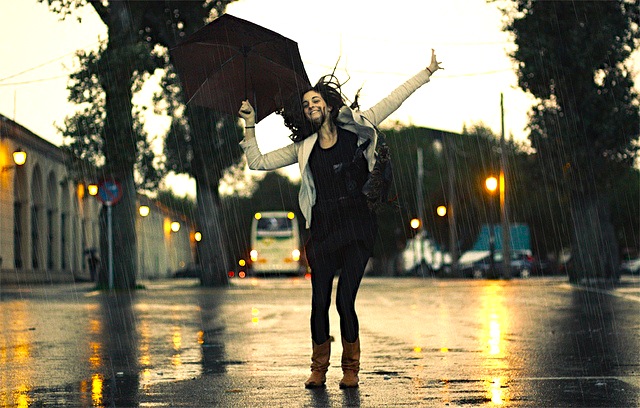
    Dancing in the Rain

    “Make the best use of what is in your power and take the rest as it happens.” ~Epictetus

    I am in an unfamiliar place and I find myself waiting. It is not clear who or what I am waiting for.  I then hear a gentle tapping at the door. I approach the door, but stand before it in silence.

    My pulse quickens as I wait. I make no attempt to answer the knock until a voice whispers, “It is me.”  This is when I open the door. 

    I awoke from this dream feeling a bit unsettled. I couldn’t remember the exact quality of the voice. Whether it was male or female remains a mystery. But I did recognize this dream as a metaphor for all that was happening in this particular period of my life.

    I was faced with a life-altering decision—something I had emphatically said “no” to at an earlier time.  My best childhood friend had offered to be a gestational surrogate for my husband and me after multiple miscarriages and two pre-term birth losses, but I wouldn’t even consider it.

    That is not the way nature intended it, was my initial thought. A child should be created out of love, I had said in response to her offer.

    In time, my perspective began to shift and I recognized that this was truly an act of love. A trusted friend was willing to help me in bringing a desired child into the world. Why would I not accept this beautiful gift? 

    It was easier for my husband to come to this decision than it was for me. I had to replace a long-held dream—the natural childbirth experience I had once imagined.

    This would also be the ultimate lesson in letting go. So much would be beyond my control.

    After months of introspection, research, guidance, and prayer, it then felt right to walk through this new door that had opened up to us.

    Saying yes to this process was creating an opportunity for new life. It was an opening to another experience that the hand of life was extending in my direction.

    Still, there was much uncertainty in daring to venture onto this new path of assisted reproduction. The series of legal and medical steps seemed enormous before we actually experienced them. But each step leading up to the actual procedure went better than expected.

    Now after two unsuccessful outcomes, I have had to again re-adjust to a different reality than the one I had come to embrace. It has been a process—releasing what should have been in order to accept what is.
    “The odds are in your favor,” the doctor had originally said. I knew there were no guarantees, but I hadn’t truly considered this daunting possibility. Why then was I led down this road of uncertainty? 

    I have come to see that at times there is no definite answer to the question “why?” Life is not a straight, newly paved highway where we can clearly see in the distance. Even when we intuitively get a glimpse of what’s ahead, we still have to deal with how best to get to where we hope to be.

    Instead, life appears to be more of a dance with its twists and turns. There is a rhythm and flow to each step, even though we may not yet be comfortable with all the transitions. Each movement leads to a fuller expression of our greatest potential. 

    How do we best learn this dance? Experience is the greatest teacher I know. Still, we need guidance. Life is not a solo act.

    Here are five guiding principles to assist you in your dance with uncertainty:

    1. Practice integrity, intention, and purpose.

    That is the basic choreography. It requires that you pay close attention to your beliefs, thoughts, words, choices, and actions. What lends purpose and meaning to your life? Natural talent matters, but practice is what develops skill.

    Integrity: Be honest in all aspects of your life. Seek to know who you are and who you ultimately want to be.

    Intention: Be clear about what you most desire and take steps in the direction of your dreams.

    Purpose: Know why you want this new reality. Does it add meaning to your life?

    2. Be flexible. 

    See every challenging step as an occasion to stretch. Stand tall as you grow in resilience. Breathe deeply and rise to the occasion when presented with new choreography.

    3. Know when to “freestyle.

    Freestyle is improvisational dance. We are creative beings and while there are necessary steps to be taken, there is still plenty of room for spontaneity and artistic expression.

    Take risks and embrace your unique style. You might step on a few toes, but always remain true to what is essential in you.

    4. Trust your partner.

    Whether you practice a traditional religion or view spirituality in universal terms, trust life to lead the way. Unleash your greatest effort and then relax into the arms of grace.

    Know that there is divine order to this dance we call life. Whatever is meant to happen, will. Whatever is meant to be, will be. Do what is within your power and surrender the rest.

    5. Enjoy the dance.

    Life is meant to be fun. Lighten up and release the need to get it right the first time. Perfection is subjective and trophies collect dust. Laugh at yourself and keep moving. It will all come together. At times, better than you expected.

    Photo by Angela Gonzalez

  • 8 Ways We Block Our Creativity and Keep Ourselves Stuck

    8 Ways We Block Our Creativity and Keep Ourselves Stuck

    “Accept your past without regret, handle your present with confidence, and face your future without fear.” ~Unknown

    I have always considered myself a creative person, and formerly, I didn’t put much attention or energy into where  inspiration came from.

    There was a time when I had just started writing copy, designing, printing, and hand-painting T-shirts. Having worked on a few creative ventures before then, I felt that this time things were different.

    I urgently and passionately worked into the early mornings, designing and putting ideas and concepts on paper, afraid that I would lose the inspiration. Dramatic as it may sound, this was my first brush with raw creative inspiration and the waves of delight and despair it makes you ride.

    Fast-forward many years later, I had gotten myself gradually into a non-creative nine-to-five job. I began wondering why I didn’t feel as inspired to create.

    These last few years have been an attempt to reconnect with creative inspiration. I have always been interested in writing and the power and magic of words. I strongly feel like there is a writer within me who is waiting to unleash his creativity.

    As I turn the clock back, I reflect over how I blocked my own creativity—what thoughts, beliefs, and excuses got in the way. If you’re also feeling stuck, some of these may be holding you back:

    1. I am not an expert and I don’t feel ready.

    This is the most fundamental level at which we block ourselves from using our creative powers. We tell ourselves that we’re not ready, and we believe we need to learn more before we can begin.

    We may never feel completely ready, but we’ll feel a lot better and a lot more confident after we allow ourselves to take action.

    2. I don’t believe in myself.

    Have you ever met someone who was talented but chose to remain a wallflower in their own life because they didn’t believe they were?

    I remember the time I stood in front of fifty students to teach biology. Before the class, I’d looked at myself in the mirror, nervous and unsure if I would be received well. I looked squarely into my eyes and reconnected with a sense of deep belief that I was good enough for the task.

    As a result, I felt authentic and allowed myself to be a vehicle of expression to others.

    Since that day, I’ve incorporated many creative techniques in my teaching methods. Instead of just lecturing, I tell stories, use models, and engage my students in hands-on activities.

    3. It’s not the right time.

    Time is a wonderful excuse to put off that dream project because we always think we’ll be better prepared or have more time later. But every time I’ve asked myself if I could carve out some time for my creative dreams, the answer has been a resounding “yes,” because I know it’s a worthy, fulfilling, and rewarding experience, and that I need to make time.

    4. It’s not perfect: analysis paralysis.

    Perfectionism can kill creativity. You wear yourself thin by assuming something isn’t good enough, and you get stuck in analysis.

    I have endlessly analyzed the merits and demerits of a creative venture, never quite going past that stage—never taking any real action to make it happen.

    We create standards for perfectionism based on our beliefs, and think that we don’t measure up. This becomes a self-limiting experience. When we realize we’re the ones setting the high standards, we have the choice to accept imperfection and become free to express our creativity.

    5. I feel overwhelmed.

    Having too much on your plate can push you into overwhelm mode, and everything feels like a crisis. How can you create if you don’t know where to begin?

    Whenever I feel like this, I take the time to unwind, breathe, and slow down. I clean my space, de-clutter my surroundings, and put things back to where they belong. I allow myself to take a break, relax, and do what I enjoy.

    I’ve realized that we were not designed to be on “go” mode all the time; doing too much makes us feel like hamsters spinning on a wheel. I’ve made the choice to step off. The solution is to take small steps!

    6. I’m afraid of failure.

    As a society, we are mortally afraid of failing and looking bad. Success and the quest for the better life are deeply programmed in us. We don’t always learn to fail, brush off, and move on, and we don’t accept that failure is not only probable, but also inevitable.

    I learned the lesson of failure when I began working in a laboratory setting. In science research, much of what you do on a daily basis fails. These failures become stepping stones for what finally works.

    7. I feel uncertain and don’t know what to do next.

    How many times have you felt uncertain and unwilling to do something new, and therefore became stuck?

    When we realize that uncertainty is just a step in the creative process, we can begin to feel at ease with it and focus on moving forward.

    8. I’m dwelling on the past and blocking my creative energy in the present.

    When I was angry, I told myself stories about how everyone else was to blame for my problems—how I had it difficult and why no one understood or cared.

    Now I realize that by being caught up in my stories, I stunted my creative growth. Instead of using the energy of anger and my stories as an impetus to create more, I just let it waste away.

    When ancient stories and programs bubble up, I do some acceptance and forgiveness work. I allow the emotions to come up and then I thank them and ask what can I learn from them. I then choose to forgive and let go. This frees up my energy to create more in my present.

    What blocks your creativity, and are you ready to get unblocked?

  • Why Be Healthy in the Present When the Future’s Uncertain?

    Why Be Healthy in the Present When the Future’s Uncertain?

    Running

    “The future is completely open, and we are writing it moment to moment.” ~Pema Chodron

    The idea of an open future can be thrilling. What lies before us often feels as though it’s just waiting to be written by a mix of our personal willpower and luck.

    Lately, however, the reality of uncertainty has been frightening me. The lack of anything certain to grab onto has destabilized me in a way it never has before.

    You see, as we move around the calendar year, the day darkening quickly and the temperatures dropping, I am circling back to what was a season of tremendous loss for me last year.

    In a matter of months, I lost four people who were important to me, three of them so suddenly that there was no opportunity to plan, to re-focus my vision of the future without them and grasp onto it.

    These losses, one by one, transformed the meaning of uncertainty from thrilling possibility to a cold, frightening truth.

    For a long while, my only response to this new understanding of uncertainty was fear. I was paralyzed with fear.

    I inevitably started questioning the point of investing in such an ephemeral future:

    Why plug along with my professional life in that goal-oriented, forward-thinking style of mine? Why save money or, conversely, why buy anything?

    And, of extreme importance to a health-conscious person like me, why make so many investments in my health? Why plug along on an exercise machine or chug bottles of expensive green juice or eat raw or sweat or stretch or spend the better portion of my salary on kale and sprouted bread?

    Weren’t these activities just my efforts at grasping, at giving myself the illusion of control over an uncontrollable world?

    By awakening to uncertainty in such a jarring way, I was living both in fear and with a newfound interest in fatalistic indulgence:

    Coffee after dinner? Sure!

    Chips and salsa and ice cream for lunch? You only live once—why not!

    Push-ups? What’s the point if it could end tomorrow. (more…)

  • How to Find Peace When You Feel Scared About What Might Happen

    How to Find Peace When You Feel Scared About What Might Happen

    Uncertainty is the only certainty there is, and knowing how to live with insecurity is the only security.” ~John Allen Paulos

    I was in shock for about ten minutes after hearing the news, afraid while lying on the procedure table, and relieved when it was over.

    Six months ago I had a mammogram. My checkup was supposed to be for a general mammogram—the one you get when you turn forty—but when I got there and told the technician that two days ago I had discovered a small bump in my right breast, the prescription was changed to a diagnostic one.

    After some time waiting, the doctor came back and said that the small bump in my right breast was benign, but she had found calcifications in my left breast, and that another series of mammograms would be needed in six months.

    Earlier this month I went for my six-month follow-up. After several uncomfortable mammograms, I was told that I would need to have a biopsy (sampling of tissue removed) to determine whether the calcifications were benign.

    It turns out that in 20-30% of the population, calcifications are an indication of cancer.

    After the initial shock wore off, I decided I would get a burrito to eat and not worry about it. I knew that this was an opportunity to grow and I was determined not to miss it.

    Instead of using the two weeks before my biopsy as time to worry, I chose peace and serenity. I spent the time in reflection while de-cluttering my home and focusing on gratitude.

    I was at ease in the space of not knowing whether the calcifications were benign.

    I got the biopsy on November 19th. Two days later, at 12:00pm (the day before Thanksgiving), I received a call with the results of a negative report. Not only was I ecstatic about the results, I was also pleased with how I handled the uncertainty of the whole ordeal.

    What this experience taught me was: (more…)

  • How to Choose Peace Instead of Stressing About the Future

    How to Choose Peace Instead of Stressing About the Future

    “If you worry about what might be, and wonder what might have been, you will ignore what is.” ~Unknown

    I was entering a completely new stage in my life. It could have been the beginning of something great, but it was entirely foreign to me. I could handle being productive, I could handle struggling to survive, but what was hard to handle was wading through the unknown.

    After working for six months in Italy and six months in Brazil I was back in the US—floating. I didn’t feel any closer to having a career. I was without a car, job, and permanent housing. My boyfriend still lived in Brazil, and my friends were scattered around the globe.

    I didn’t yet have the answer for who I wanted to be or what I wanted to do.

    I had such high expectations for my return to the US. I had spent the last year working small jobs in Italy and Brazil like teaching English, being a personal assistant, and whatever freelance crumbs I could gather.

    I was sure coming back to my home country would give me the luxury of landing a job I would love with an international company. No such luck.

    So, for the first month I was helping my mom settle in her new apartment, and then I was on the other side of the country for two weeks to give some emotional support to my sister while she finished up her last semester of college.

    I was helping people make it through their daily processes. So far, that’s all the direction and answers I had.

    I was happy to be helpful and supportive of my loved ones, but to my goal-oriented mind, I felt like a failure.

    I was having trouble sleeping at night. I found myself awake in the wee hours of the morning, with thirteen tabs open, trying to research and apply for jobs while emailing contacts and just generally having a panic attack.

    The days were passing rapidly as I sat numbly pecking at my computer from dawn to dusk, without significant results and definitely no peace of mind. I was busy, but not productive.

    My mind was divided between trying to solidify my future and beating myself up for not having made a solid plan sooner. Would I ever be successful? What if I never found a job I liked? How could I live around the world and make money at the same time?

    I didn’t have answers and it was driving me crazy. I was in uncharted waters and I felt totally lost.  (more…)

  • Depending on Yourself in the Uncertain, In-Between Space

    Depending on Yourself in the Uncertain, In-Between Space

    “To get something you never had, you have to do something you never did.” ~Unknown

    Life has been strange the past few days.

    All summer there was a trip or an event to count down to the final move—my brother’s wedding in Sedona, Captiva Island with my boyfriend’s family, Thailand with a girlfriend and, finally, a week in Atlanta.

    I have nine days left before the movers come, and I feel as though I’m existing in a space without anything to hold on to.

    My world here in Florida will soon be a memory, and I have no way of knowing what my life in North Carolina will look like. I fantasize about it, but it’s all conjecture.

    The summer getaways provided a distraction for me, obscuring the view of the unknown that was swiftly approaching. My former relationship acted as a life preserver that I knew would be with me no matter where I floated. Now, both have dissolved into the past.

    Very few people in this world feel an obligation or a desire to plan their lives around you.

    Although I have been gifted with amazing and loyal girlfriends, they have their own lives. It’s my parents and significant others that I have counted on for the heavy labor, when the help I need is neither sexy or fun.

    Although my ex-boyfriend would help me move with kindness in his heart, I don’t want to depend on him for this. It seems like I would be carrying on the illusion that I still have the security of our partnership. And what about my parents? Isn’t that always a loaded question…

    At 29, I am confused about my parents’ role in my life.

    While they offer to do whatever is in their power to make difficult times easier for me, their assistance comes with some strings attached. As I move toward making decisions in my life with less input from them, I am also electing to forgo their help in many ways.

    People with long-time partners or even those who still have a cozy and safe place with their parents can say, “What’ the big deal? You’re a grown woman; you can move by yourself.” (more…)

  • Embracing Uncertainty: The Future is Open, Not Empty

    Embracing Uncertainty: The Future is Open, Not Empty

    “As for the future, your task is not to foresee it but to enable it.” ~Antoine de Saint-Exupéry

    A month ago, I was at a crossroads. I was unhappy with my job, I no longer wanted to be living at home, I was tired of being three states away from my boyfriend, and I was sick of feeling unfulfilled.

    I knew change was coming, but what I did not know was that I was to be the catalyst.

    I had moved back in with my parents after college, as I started the daunting task of job searching. I worked retail for most of the summer, broken only by a two-and-a-half week stint as an editor for a company that sold writing workshops to major corporations.

    I loved the job, but the people turned out to be less than willing to train and accept me, so back home I went.

    I finally found a job at a bank in the fall and set off learning a career in finance for the next year and a half. Acquiring a new skill set was intimidating at first; I was an English major and math had been an enemy of mine since grade school, but I quickly caught on and enjoyed it for a little while.

    Eventually, it became clear that it was not the career for me; sales goals and customer service grew old fast, and I longed for change.

    Along with living at home and working at a job that left me wanting more, my boyfriend was three states away. We met through a mutual friend in college, but attended separate schools. Our relationship had been long distance from the start, but when he graduated, his job took him even farther from me; meeting twice a month if we were lucky was not the relationship I had imagined.

    I felt stuck, wishing for a crossroads to appear so I could take a different path.

    I stood around waiting for change, waiting for the signs to come flashing in my direction, for a contact to call me up with a job offer, for a path to be laid out neatly in front of me.

    I think we all do that sometimes, wait for a decision to drift our way. But what I realized is that we need to come to the decision, not the other way around.

    After staying late at work one Monday, I was driving home and had the overwhelming urge to drive to the beach. I had to be there before the sun set, I had to look at the water, smell the salt and seaweed, see the scattered couples bundled up and holding hands.

    I sat on the boardwalk and just stared. I stared at the ocean far away from me as the tide pulled it out and gave up my worries, just praying that I would find happiness soon. (more…)

  • Letting Go of the Fear of Uncertainty and Embracing Adventure

    Letting Go of the Fear of Uncertainty and Embracing Adventure

    “Each time you stay present with fear and uncertainty, you’re letting go of a habitual way of finding security and comfort.” ~ Pema Chodron

    Being the thought-out planner with a neatly plotted road map—and a compass tightly gripped in one hand, pointing due north—I cringe a bit (okay, a lot actually) at the thought of changing direction, being adventurous, and going off the beaten path.

    I’ve purposefully designed my external life for security—the cushy job, maximizing the 401K, additional streams of income to insulate the extra-super-comfy-security, a large home for a future family, long-time childhood friends, and a solid marriage.

    I am deeply grateful for all of these and, on most days, find pride that my focused, linear thinking has created a surrounding of comforts.

    As I venture further on this journey, though, I realize that anchoring ourselves with an abundance of security can actually become a dangerous habit.

    It can create an attachment that prevents us from being fully awake.

    My straight-path mindset hadn’t really prepared me for an off-roading adventure. I held a belief that if I softened my resistance to allow things to go in a direction other than I had planned, this would be a mini-failure of sorts—a “giving in” to the unknown.

    And the unknown, after all, is deeply rooted in scariness, signifying weakness, giving up, having no direction. It’s not secure, and far, far from safe.

    Or so I had thought.

    Sometimes we can be blindly walking down a path and then an obstacle, a detour, or a sharp turn appears, asking us to expand our mind and heart to see and feel differently.

    This past year, I found myself becoming a security-junky of sorts, as I would not allow for an unforeseen change to enter my life.

    I would stand firmly at the arrival of this unwelcome circumstance with crossed arms and a tremendous amount of resistance. I held tightly onto my compass, my road map pressed against my chest, and didn’t want to let go. (more…)

  • 5 Reasons It’s OK to Not Know What the Future Holds

    5 Reasons It’s OK to Not Know What the Future Holds

    Silhouette

    “The quality of your life is in direct proportion to the amount of uncertainty you can comfortably deal with.” ~Tony Robbins

    We spend a lot of time in life not knowing.

    There are a lot of things that we’re comfortable not knowing. Not knowing a stranger’s name. Not knowing our credit card number or a friend’s address. Not knowing the capital of Vermont.

    We’re comfortable with these things because we know there are answers. Even if we have to get on our smartphones for few minutes to find them, we know these things are all facts that actually exist.

    But there are lots of other things that we really want to know, like if our decision is going to be the right one, or if a job is going to work out, or if we’re about to be laid off.

    What is the best use of my life? What is my mission? These things are unanswerable. There are many things that we simply can’t know.

    And while we think it would be nice to know these things, to know the future, I’m here to tell you it’s really not the case. Even if we could know these things, we’re actually better off not knowing them.

    Last year, I took a new job in sales. It was a big change for me. I’d been in consulting and legal practice the rest of my career, and while part of my past work had been around growing relationships and coming up with ideas for new projects, I’d never taken a job where I was a “sales guy,” where I would be evaluated solely on my “number.”

    When I took the job, I was given a quota that, if I met it, would mean a significant increase in my pay. I was also told that I’d be groomed for greater responsibilities, that I was seen as a likely future member of senior management.

    The company has some cutting edge ways of looking at health care expenses and we help millions of people live better, healthier lives. It was a mission that I enthusiastically signed up for.

    This is what has happened since:

    The company has been through three major restructurings. Several of my peers, including the two people who brought me in for grooming, have either quit or been let go.

    The market has dried up for our services, even as we were able to prove their effectiveness with randomized controlled trials. There have been virtually no new sales. This means that I have taken a substantial pay cut and have had to dip into my savings to meet my expenses.

    The company has made almost no progress on new offerings, and several current clients have left. There is some encouraging talk of new partnerships and capabilities, but these will take months to implement.

    I sold nothing last year and am unlikely to sell much this year. And the most enthusiastic advocates for my development within the organization are gone.

    Now the question is had I known all that, would I have taken the job? And the answer is almost certainly no.

    But that would have been a big mistake—because I’ve learned so much. (more…)

  • How to Let Go and Embrace an Uncertain Future

    How to Let Go and Embrace an Uncertain Future

    “Uncertainty is the only certainty there is, and knowing how to live with insecurity is the only security.” ~John Allen Paulos

    I used to love uncertainty. I wandered my way all around this country with little more than a suitcase and a journal. Committing to anything felt limiting, suffocating even.

    One day I realized it wasn’t enlightenment that pushed me to embrace the unknown; it was a paralyzing fear of creating something certain. You can’t disappoint people when you don’t form relationships with them, and you can’t fail when you never start.

    One day I decided to do the scariest things I could imagine: settle into one place, get a steady job, and start forming real relationships.

    This lasted for a while until the economic meltdown rocked my world. Now I’m back in a place of uncertainty, like so many other people.

    Almost everyone I know has had to make at least a few changes to their life because of the economy. People have lost their jobs, homes, and in some cases, their sense of identity.

    It’s both terrifying and exciting to have a blank page in front of you. Sometimes we need reminders to see it as the latter.

    Here’s how I’m learning to let go without losing what I felt I’ve gained these past few years: (more…)