Tag: trust
-

7 Steps to Overcome Daily Despair and Start Living Again
“If you cannot make a change, change the way you have been thinking. You might find a new solution.” ~Maya Angelou
Have you ever felt really stuck? Like every day was a struggle to get through and you knew in your heart the next day would feel the same?
For the last seven years—since the crash of 2008—I’ve been redefining myself, and it’s been painful.
In 2009 I opened an Internet retail store, knowing nothing about retail, let alone the intricacies of the Internet.
After years of hard work and little to show for it, every day began to feel like total drudgery. Facing daily discouragement and defeat weighed heavily on me.
I began to lose my self-confidence and doubt everything I was doing. I was frozen by the fear of failure.
Every day was torture. Each morning I promised myself I would be productive, but day after day I failed to accomplish even the simplest tasks. Days added up to weeks, and weeks piled up into months of “stuckness,” frustration, and despair. I was literally ensuring my failure. And I knew it.
Despair encompassed every area of my life. I felt like I was thrashing through quicksand. I stopped meditating regularly, couldn’t get enough sleep, and the stress was affecting my digestion and my health. I was in a fog of depression.
Although these issues manifested in my business life, I placed such a focus on making my business succeed that I lost all balance. My personal life suffered greatly. Despair can’t be compartmentalized. It affects all aspects of your life.
Why do we get stuck?
The irony of life is that so many of our problems—the stumbling blocks that hold us back—are often there because we get in our own way. We can create a prison of continued, daily suffering for ourselves. And then all we can do is agonize because we desperately want out.
Each day we wake up in a fog hoping the cloud will lift. We simply can’t see clearly enough to evaluate our problems and realize that each one links back to an action or thought that created it.
If only we could see this, we could untangle the threads and clear up our lives. Knowing the cause can make the problem much easier to fix if we can just get our minds in the right place.
How to Reset Your Mind
Use the following seven steps to overcome daily despair and start living again:
1. Break the pattern.
The first thing to do with any negative pattern is stop what you’re doing. You’ve got to break a pattern to change it. This means emotionally removing yourself from the situation. You’ve got to regroup.
Taking time away is helpful. If that’s not feasible, find a quiet place where you can retreat for alone time during all spare moments. If you have kids, do this while they’re sleeping or safely occupied.
Tell yourself you’re leaving all your worries outside the door and you’ll pick them up later if you decide to. You deserve this time. You need it. Think of it as a gift to yourself.
If you’re open to meditation, this is a perfect time to start a practice or deepen your existing one.
I separated myself from despair during my time alone by admitting that I was torturing myself and not accomplishing anything. I declared that I refused to live like that any longer, and promised I would find a different way.
2. Free your mind.
During your free time, don’t think about problem-solving of any kind. Focus on resting, healing, and gifting yourself with positive, healthy thoughts and experiences.
Change your daily activities from TV and other distractions to calming interests. Take walks outdoors. Read only uplifting things. Catch up on your sleep. Get to bed early when possible.
Clear your mind by practicing silence. Silence does wonders to slow your thoughts and help you to be mindful of the present good moments.
I began to shift my focus to meditation and other down-time activities instead of work. I practiced silence every morning while walking to clear my mind and stay healthy. And I made time for friends and family even when I didn’t feel like I had the time.
I was so relieved that my despair soon began to lift when I stopped focusing all my efforts on work.
3. Collect ideas to kick-start your thinking.
Once you’ve broken your pattern, determine the key issue you’re struggling with and find a high-quality resource to begin collecting ideas.
Are your relationships getting you down? Do you need some spiritual rejuvenation? Is your problem depression? Do you need to learn positive thinking, stress management, or time management?
Plenty of resources to address your problem are at your fingertips on the Internet, in a bookstore or library, at a local group meeting or Meetup, or a seminar. Find something that sparks your interest and has received top recommendations from others, and dive in.
I took an online marketing course to rebrand my business. The instructor planted the thought that I’d be much happier shifting my business into something I was more passionate about.
After listening to me, she suggested that I share what I’ve been doing for years on my yoga path to help others like I was helping myself.
4. Give your situation some preliminary thought.
Armed with fresh ideas and with the new resilience gained from your self-care, begin to gently daydream some possibilities.
This is important. Approach this in a relaxed way—not grasping for answers but allowing them to surface naturally if they do. It’s not even a requirement. This is a creative process.
During this time, I casually ran ideas through my mind to see if sharing my yoga experiences was a possibility. A big part of me wasn’t sure it was right because my practice was so personal. But I loved the idea of turning my passion into my work.
5. Trust the process.
There’s no plug and play solution for transforming despair. Your subconscious, creative, problem-solving mind takes time to process properly.
Be patient. You don’t need all the answers right now—just some starter fluid to get your brain thinking. As with any creative process, the first answers won’t be your best.
Know that the right answers will come in time because you’re feeding your mind and you’ve removed all pressure. If you’re stressing out at all or pushing too hard for answers at any point, back off and resume Step 2.
6. Reset your reality through change.
Once you’ve cleared your mind, absorbed input from a trusted resource, and eased into daydreaming, you can start making some changes in your life.
When promising, unique answers begin to surface, start deciphering the details.
Although the advice you found probably felt uplifting and hopeful, in order to successfully transform your life, you’ll need to put the new ideas into practice. What steps can you take to follow the recommendations?
It took me a full year from the first time I thought about changing my focus to actually doing something about it. The more I daydreamed about what can be accomplished through the ancient yoga teachings, the more it seemed a perfect fit for me to spread the word.
I incorporated my instructor’s advice, and made sharing my yoga journey a main part of my business. This time I consulted respected resources to learn how to do it successfully rather than winging it like I did with the retail store.
Your answer doesn’t have to mean changing your work. My business had to change because it wasn’t working and I was allowing it to cause my despair.
You can change whatever aspect of your life is causing your pain.
7. Trace back to the thoughts or actions that caused your stuck feeling.
Changing the outer aspects of your life is often the best way to uproot despair. But to make the change permanent, it’s important to carefully consider the inner aspects. Identify the thoughts or actions that resulted in your situation to begin with.
For me, my business wasn’t taking off like I expected it to, raising serious issues of self-doubt. Not making it work meant failure. Hadn’t I already failed to hang on to my career in corporate America?
This doubt caused me to spend more time researching what I should do to market the business than actually marketing it. I was always being attracted to the next “best idea.” Fearing it wouldn’t work, I kept searching instead of implementing.
When I finally realized that self-doubt had caused my problem, I was able to start implementing instead of doubting, and complete my healing.
—
No matter how bad life seems, you can find the way out of despair.
We all need time to rejuvenate, so break your pattern. Take time to reflect on what you truly want out of life and what you must do to get back on course.
The answers often are not complex. They’re just hidden because you lost your focus on what’s important.
Take some time to think about the thoughts or actions that may have led to your despair. Once you identify the problem, with a little guidance you can correct it and completely change your life.
The best part? Your answers will often arise on their own once you devote time to yourself to heal and reflect.
Man on mountain image via Shutterstock
-

Set Yourself Free: 5 Things You Gain When You Forgive
“When you hold resentment toward another, you are bound to that person or condition by an emotional link that is stronger than steel. Forgiveness is the only way to dissolve that link and get free.” ~Catherine Ponder
Somewhere in the middle of my freshman year of college, my best friend from high school broke up with me. Out of nowhere, she just stopped talking to me. I tried relentlessly to reconnect, but she stopped responding and never gave me an answer why.
For years it was the most painful heartbreak I had going in my life. It’s still what I consider my worst breakup. And it haunted me until I decided to forgive her.
Forgiveness sounded ludicrous to me at first, but eventually, the pain of carrying the grudge seemed like it might be worse than the pain of setting it down.
I heard a number of people in my life, including one of my yoga teachers, talk about the power of forgiveness. While I didn’t get there right away, I started to marinate on the idea of forgiving my former friend.
I became curious about what acceptance and non-attachment could look like with someone who had really hurt me. It took months after deciding that I wanted to forgive. Until one night, I was ready.
I drafted the email, did a small amount of Internet stalking, and sent it. I apologized for my role in the breakdown of our friendship, offered my forgiveness, and wished her well. I gave her the best last gift I could: to set my grudge down.
What surprised me was what I gained in the process.
1. Space and quiet
Forgiving gives us the space and quiet to invest in new people and nourishing ideas.
Once I let go, I stopped spinning the story in my mind over and over. My mind simply didn’t need to keep hanging on to the old narrative any more. It had space to cover new ground rather than rehashing yesterday’s news.
2. Self-compassion
When I forgave my friend, I was also able to forgive myself for some past mistakes. Forgiveness requires practice, like anything else. It’s like developing a new muscle.
If I could let go of my greatest hurt, I could surely offer that same reprieve to myself. I’m now gentler with myself when I make mistakes. I know that offering myself compassion and then moving on from the situation is not only possible but much more loving.
3. Trust in others
I don’t see friendship through the same lens any more. I have more faith in the people in my life and understand that while friendships end, it’s not the end of the world. I live in my relationships more presently.
I don’t waste an opportunity to tell the people in my life what they mean to me. I trust in my friends. It took me a long time to get there, but forgiveness gave me back that capacity to trust in the people around me. By letting go of bitterness and cynicism, you too will be better able to trust in others again.
4. Perspective
When I created the conditions for forgiveness and resolution, I was able to see our relationship clearly. I could also see the places where I was responsible and can now address those tendencies.
I also could see that the hurt was a relatively small part of our relationship. Most of it was filled with laughter, and being able to see that has been very healing. Forgiveness allows us to appreciate the good, without the lens of resentment over it.
5. Gratitude
I’m personally thankful for the memories and what I learned through that friendship. I’m grateful that I had this experience and for all the joy that our friendship brought me. I’ve grown a lot, and that wouldn’t have been possible without the process I’ve been through.
Forgiveness polished the hurt off my heart, and now all that’s left is gratitude. I also appreciate the preciousness of my new friendships and make a greater effort to actively nurture them.
We always gain something, even if it’s not immediately obvious. Forgiveness gives us the opportunity to recognize and appreciate that.
—
Forgiveness is a delicate thing, and very personal. I would never argue that you should forgive someone. But, if you are interested in exploring what forgiveness might mean in your circumstance, I invite you to get quiet first.
Cultivate a little bit of compassion for yourself, foremost, and meet this undertaking with curiosity (rather than an outcome in mind). What could that forgiveness look like? What might pave the way for forgiveness to be possible?
Before you can forgive others, you may need to forgive yourself for past hurts you’ve inflicted. Forgiveness is really a gift that you’re giving yourself; it’s not about absolution for the other person or excusing anything.
Ultimately, forgiveness takes a lot of non-attachment: to the initial incident, to anger, and to a desired response to this forgiveness. You may not get the answer or outcome you’re looking for, and that’s okay. The process (and it can be a long process) and the act of forgiveness are what matter here.
While I never heard back from this former friend, that felt surprisingly okay. I wasn’t attached to an outcome; I just wanted to stop carrying the load. So I did, and that was that.
Not having to carry that grudge has been a huge gift to me. I’ve learned so much about myself that I would never have otherwise—like knowing that I have the courage to forgive and see what’s on the other side. And that I get to choose to be free. You can too.
-

How to Stop Pushing and Stressing About Your Goals
“You must learn to let go. Release the stress. You were never in control anyway.” ~Steve Maraboli
I’ve encountered many people who live by the belief that in order to be successful, one must “go out and make things happen.” I used to feel the same until I realized that we don’t actually have control over most aspects of our lives.
We can attempt to make things happen, but doing so doesn’t guarantee anything—it only develops yearning, which leads to suffering.
Take my recent job search, for example. I spent nine months looking for a job. I applied to over 200 open positions and took part in more than thirty interviews. After several months I became desperate and out of this desperation, began to become depressed.
It seemed that no matter how hard I tried, my job search wasn’t going anywhere. I needed a different approach.
As I usually do during trying times, I turned to my beliefs for insights. I read Pema Chodron’s When Things Fall Apart, Thich Nhat Hanh’s You Are Here and Dr. Wayne W. Dyer’s Change Your Thoughts – Change Your Life: Living the Wisdom of the Tao.
Dyer interprets the Tao Te Ching to state that our desires can create stress and anxiety, and that happiness comes not from pursuing goals, but by finding joy in everything we encounter.
“Stop pushing yourself,” Dyer writes. “And feel gratitude and awe for what is.”
Once I read this line, I realized that I had much to be thankful for, even during a time of unemployment.
This understanding allowed me to change how I perceived my life. As a result, I began to experience happiness from small experiences, such as walking around the neighborhood or making a cup of coffee.
This shifted my attitude and allowed me to become more receptive to life’s greatness. No longer did I feel depressed because I believed that by letting go of my desire to find a job, I was opening myself up to the plans that would manifest organically.
One may say that I put faith in finding work and believed that the right position would come along at the right time. My new philosophy: let go and let the universe do it.
I continued to apply for jobs and interview, but I knew that I couldn’t force myself into a job offer. I had to go with the flow—to learn to ride the waves instead of trying to change the tide.
This new perspective allowed me to release the stress relating to my job search and to accept that great things would happen at the right time.
During interviews, I no longer felt desperate and nervous. I knew that if it were meant to be, I would receive an offer. This created a more positive environment and one that increased the likelihood of finding work.
Just weeks after I changed my views and let go of negative emotions, I received a job offer.
Looking back, I realize that my desire to find work was not only stressing me out, it was creating a wall that prevented me from achieving my goal of securing a job.
When we’re working toward a goal, we often push ourselves to the point of desperation. We know what we want, and while that’s a good thing, stressing ourselves out to achieve that desire only develops resistance toward that aspiration.
We might feel that if we don’t stress and push ourselves, we’ll be opening ourselves up to bad things that could happen.
For me, this belief led to a feeling that if I didn’t find a job, I was going to be evicted from my apartment and forced to live on the street. I’ve since learned that stressing out doesn’t necessarily prevent negative consequences.
In order to truly experience what the universe has in store for us, we need to let go of the need to control every aspect of our lives and focus instead on showing up and putting our best foot forward. Here are three tips to help put us on the path to achieving our innermost desires.
Set your intention.
Setting your intention is the first step in reaching your goals. When I was job searching, my intention was to find a position that was the next step in my career. No matter your intention, place it in your mind, see it in your mind’s eye, or meditate on it.
Let go of your attachment to the outcome.
Once we set our intention, we have little control over the outcome. Often others are involved, and we can’t force them into helping us achieve our goals. Realize that no matter what happens, you will be okay. And know that adopting this mindset will free you up mentally so you’re able to focus on controlling what you can control—your own choices and actions.
Trust that your efforts will pay off.
Trust is essential in manifesting our goals and desires. Once we realize this, our faith strengthens and we open ourselves up to many new opportunities in the process.
As simple as these steps seem, actually following them is more challenging. It takes practice to learn to let go and trust that great things will happen.
But as Lama Surya Das writes in Make Me One with Everything, “Buddha said that transcendent peace exists in things left just as they are.” Das adds that “I have found that all things are already at rest and at peace, inasmuch as one’s own inner life remains fit, flexible, and attuned.”
We must remain flexible and attuned with life’s changes, as Das states. As soon as I realized this with my job search, beneficial things began to manifest.
We can all benefit by learning that life’s greatness doesn’t require that we “get out and do,” but that we simply accept the wonderful things we already have and then adjust our expectations, while trusting that everything we need either is already within us, available to us, or in our future.
Skipping man image via Shutterstock
-

Stop Looking for Signs and Trust Yourself
“Always try to remember that most of the things that happen in this world aren’t signs. They happen because they happen, and their only real significance lies in normal cause and effect. You’ll drive yourself crazy if you start trying to pry the meaning out of every gust of wind or rainsquall. I’m not denying that there might actually be a few signs that you won’t want to miss. Knowing the difference is the tricky part.” ~David Eddings
A few years ago I took the Buddhist precepts at a Zen monastery in northern California. At the end of the ceremony we were all given the symbolic Kesa to wear around our necks while we meditated.
Afterward, on the drive home, I hit a torrential Sierra snowstorm and pulled into a gas station to fill my tank and make sure everything was running well before I headed into the mountains. When I got home, I realized I had lost my Kesa.
I called the gas station, the only place I had stopped, but they hadn’t seen it. I continued to call them every day for a week certain that dropping my Kesa on the snow-covered ground was akin to spitting in holy water at a Catholic church.
I told myself it was a sign that I’m really a flake. My knowledge of Buddhism was superficial at best.
What right did I have to take the precepts? I obviously wasn’t ready for them. I should have studied harder, meditated longer, been more serious about the whole practice.
About a year later at another retreat I was talking with one of the monks and she said, “I noticed you never wear your Kesa when you come up here. I was just wondering about that.”
I hesitated. Lying to a monk would surely be worse than losing my Kesa, so I told her the story as well as my long litany of reasons as to why I didn’t deserve another Kesa.
When I finished she smiled and said, “All this means is you lost your Kesa.”
She walked with me over to a closet, reached into a box, and handed me another one. “Maybe it means you were a little absentminded, but that’s it. It’s no big deal and it certainly doesn’t mean you are not worthy of being Buddhist.”
I have to admit I’ve spent a disproportionate amount of time looking for signs, when in fact, I was really looking for validation.
Maybe it was to justify a bad decision. And if the signs were negative, like in the case of the Kesa, it just confirmed my feelings of low self-esteem. It was a sign I was really as hopeless as I secretly believed.
Signs and symbols can be powerful tools for exploring our unconscious, but they aren’t going to tell us what to do or who we are. We have to decide that.
I have a friend who told me whenever she sees a blue cornflower it’s a sign her deceased mother is saying hello. That seems to me a very sweet and appropriate way to use signs and symbols.
Of course, she doesn’t literally believe her mother is communicating, but blue flowers have become a symbolic way to remember her love, pause for a moment and appreciate their relationship.
The symbols we dream can be profound and may be a sign of something we need to look at in our lives. And we can find signs in nature that serve as tools of transformation. But we shouldn’t let them rule our lives. Carl Jung said, “Until you make the unconscious conscious, it will direct your life and you will call it fate.”
Do you find yourself looking for signs in nature or the heavens? Here are some thoughts for keeping signs and symbols in perspective.
Even if the universe does send us signs, how we interpret them is purely subjective.
The universe and consciousness are mysterious. For all we know, beings from other dimensions could be sending us signs all the time, but our capacity to understand is still limited by the physical world and the bodies we inhabit. It’s probably best to focus on dimensions we know and understand.
Anything can be a sign if we want it badly enough.
Once I found an arrowhead near my house and convinced myself it was a sign it would be okay to have an affair with the married, albeit separated, medicine man who had been pursuing me ever since I’d gone to his sweat lodge as a guest.
In this case common sense rather than signs won out and I pointed him and his buffalo drum back to his wife. If you find yourself pulled in a direction that you know is probably not good for you, trust your good sense and don’t let signs lead you astray.
Believing too strongly in signs can be disempowering.
As a woman with a history of abuse and bad decision-making, I feel strongly about the rights of empowerment and dignity for all humans of all ages. Allowing yourself to be ruled by signs and portents not only takes away your power of choice, it excuses you from responsibility.
Stepping up to the plate and taking responsibility for your part in things is incredibly empowering.
Focusing too much on signs takes us out of experiencing the moment.
We usually look for signs either as justification of something we’ve done or as portents about what to do in the future. Often, we already know what we should do deep inside and looking for signs can lead to obsession.
Instead, next time you have to make a hard decision, sit quietly for a while. Get practical advice, look at the situation rationally, and then decide. It will probably work out just as well as waiting for a feather to float down and point you in a certain direction.
None of this means you have to give up astrology, runes, or the Tarot, but use them as tools for unlocking what’s already inside you. They are not signals from the universe that you should do one thing or another. You already have all the answers inside. Trust yourself.
Stargazing woman image via Shutterstock
-

You Can Still Trust Even If You’ve Been Deceived
“You may be deceived if you trust too much, but you will live in torment if you don’t trust enough.” ~Frank Crane
“Ah, it is difficult to trust people nowadays!” Heard that one lately?
The implication is that trust is something you receive and that everyone else controls it and can give it. Do you believe that?
Just before Christmas I was hired by a contractor to do a renovation job. The work was in a pharmacy, and we agreed on an hourly rate.
It was not difficult to trust him; after all, it was clearly a working business and I expected to be paid. So I worked one afternoon and the whole following day, eleven hours in fact, constructing a wall, putting up dry wall and finishing it.
On the second day I dislocated my finger while working. Badly. However, I continued to work, thinking it was less severe than I thought.
It was during this day that I started to distrust the contractor, as he was saying I needed to work faster, and that he wanted to change the contract to a fixed price.
I explained that he had a choice to pay me up until that point, or agree on a price for the job. He wanted me to do another wall the following day, and offered me a price to complete the job, basically limiting my hourly rate.
That night I had a swollen finger and was in a lot of pain. I actually had to have my wedding ring cut off my finger at the local hospital.
Since I was severly injured, I was unable to return the following day, and I emailed and texted the contractor. I felt more unease about him, as he did not respond to my messages.
A week later it was time to receive payment. I chased down the contractor, knowing what was due. He did not respond.
Eventually he answered my calls and said he had no intention of paying because he had decided to change the walls.
I explained that was not a reason to not pay for work done, and that I would take him to court. In the end he paid me a pittance for the work, less than the minimum wage, and only one quarter of what I was due.
Surprisingly, it is not difficult for me to continue to trust humanity, though I can’t trust that that particular contractor will pay his workers.
What was difficult was accepting the reality that he did not pay what was due, and considering my options. I decided that karma was best for him to learn, even though I had taken photos of my completed work and would have won in the local small claims court.
I just have better things to do with my time than concentrate on what karma is better able to handle.
Will that experience affect my trust next time I am offered work?
I hope not, because I don’t want to carry my view of that negative experience into the next encounter I have, business or otherwise. But it should and will certainly affect my behavior.
You see, my behavior in assessing how much to trust is within my control, while how the other person behaves is outside my control.
In other words, trust is something I do, and it is not done to me. That bad behavior regarding the renovation is not about my trust; it is about his trustworthiness.
I accept that this one person doesn’t represent humanity as a whole.
I choose not to have it affect my trust in future people that I do not know, but I register dis-trust in that particular person. In some ways I have learned from the experience, patience and forgiveness at least.
I recognize that I played a role in this event.
It always takes two to tango, and clearly he did not want me to have an ongoing relationship, or he would not have acted that way.
Why did he act as he did? Was my work not of sufficient quality? Was it just a short-term need that he could take advantage and then not pay? Or was it that he had intended to pay and ran out of money, cutting me out as the last one hired?
I accept that I could have done things differently.
I did not ask for a signed contract, and I had to finish early because I had dislocated my finger. Perhaps he was unable to trust me—that I indeed had to go to hospital to have it repaired, and hence could not return to do further work.
I think that most of the time we see trust as dependent on someone else. But there will always be untrustworthy behaviors, so if we gauge our trust on what we see out there, we are doomed to live in fear, not trusting anyone.
The famed statesman, poet and writer Johann Wolfgang von Goethe said, “As soon as you trust yourself, you will know how to live.” I would like to add to that: “If you are aware of your own failures to be trustworthy, you will know how to accept others more.”
I do trust myself. And now two months later I have a swollen finger to remind me to be cautious with promises that are made to me, especially when my intuition warns me to access what’s really going on.
Final summary: Don’t assume you can’t trust anyone because one person was untrustworthy. You can’t control what everyone else does—and some people may deceive you—but you can control what you do, who you choose to trust, and what you learn from each experience.
Upset girl image via Shutterstock
-

How to Handle Life: Get Out of Your Critical Head
“Just trust yourself, then you will know how to live.” ~Johann Wolfgang von Goethe
There was a time when I lived almost completely inside myself. I couldn’t handle much of the outside world.
Yes, I am an introvert, but back then, I had such low self-esteem that the only place I felt safe was inside my own head. I had a low tolerance for problems and mistakes. I was life intolerant.
Yet, my inner world wasn’t exactly a peaceful sanctuary; it was a cold, discomforting, and harsh place to be. Mainly because I was fat. Or so I thought. I was obsessed with how I looked. My study time was directed at my legs. I appraised my ankles, I graded my thigh gap. And for those failings, I beat myself up.
What terrible thing could have befallen me for me to have retracted into my shell like that? The answer: nothing major. In fact, my childhood was good and my parents were great.
But there was something, or a series of somethings in my childhood that led me to live inside my critical head.
One was that I wasn’t allowed to do much. If anything, I was kind of spoiled. That didn’t really help me because I unconsciously stamped this message on my psyche: “Unable to perform tasks.”
Second of all, I wasn’t allowed to rectify my mistakes. Just small things—a plate I broke was cleared up before I had a chance to, a garden rake was taken out of my hands because I didn’t know how to weed properly. The underlying takeaway for me was: “Just can’t handle stuff.”
With those mottos, I plodded through life, slightly shy and fearful.
But I’m not like that today. In fact, I’m the opposite. My self-talk now is mostly positive, and I encourage myself. I’m kind to myself, and I look out for me.
How did this come about?
A not-so-great relationship. I met someone, and unsurprisingly, depended on them for my self-esteem.
If they thought I was good enough, then I was good enough. But how tumultuous it is to live on the rough seas of someone else’s appraisal! Somehow, amidst those choppy waters, I saw a lighthouse; and it was therapy. I took myself there, and I found a safe harbor.
I also went to meditation classes.
Those two things slowly worked away at me, chipping away at those walls I’d put up around myself. I became mindful through meditation, and through therapy I came to realize I needed to become my own best friend.
So I did. I changed my self-talk. It was a challenge, but I pushed through.
From there on out, my allergy to living life went away. The relationship ended, but I was equipped with new tools for living. I go out and socialize, I embrace challenges, I live my life with my eyes open—and I can handle it.
These are the tools I learned along my way.
Accept.
Accept what is happening, be it a critical remark or a mistake. When you accept whatever is in front of you, you are allowing yourself to feel discomfort and trusting that you can handle it.
It can feel quite vulnerable to be so open with no defenses and say, “Yes, this is really happening.” But once you start accepting, it gets easier, because you learn that you can cope with it.
It’s not pushing away, or denying, which can feel stressful. It’s a calm response to life. Start with accepting small, inconsequential things like spilling food or sending an email with a typo. This will put you in good place to start accepting the bigger toughies down the road.
Talk kindly to yourself.
When the going gets tough, you need some back up, and the best are self-soothing sentences.
“Everything is okay.” “I am capable.” “I trust that I can handle this.”
They don’t just pop up; you need to work on them daily so that they are there for you when you need them.
This is where mindfulness and meditation come in, because these practices are like sending your concentration muscle to the gym.
Once you become mindful in your day, you become aware of how you are talking to yourself. Making it a daily commitment to change negativity into an upbeat outlook is training yourself for the day when something big goes down. When it does, those self-beliefs will come to your aid.
Allow yourself to be imperfect.
Sometimes you will need to engage with critical people who make judgments on who you are or a public faux pas, and they will demand that you respond.
You have choices in how you do so. It takes time to accurately measure which response is best, so try a few.
You don’t have to be defensive all the time. In fact, you can send your ego on holiday and even agree with some criticism. It can be a huge boost to your self-esteem when you finally allow yourself to not be absolutely perfect, and laugh at yourself instead.
You can choose to own up to a mistake and try again. No big deal, just “Let me start again,” or “That wasn’t right, I’ll come back with it fixed.” No catastrophizing, but solutions instead.
Once you start trusting yourself to find solutions, mega worries become tame, because you have learned that you are someone who can find a way forward.
Finally, you can choose to explain openly what happened, or not. A bit of self-defense is not a bad thing, because you are worth looking out for, after all.
—
From today onward, believe in yourself and practice self-acceptance. May your life be a wonderful journey that you take part in, every step of the way.
Stressed woman image via Shutterstock
-

The Art of Allowing: Let Go of Control and Go with the Flow
“Accepting, allowing, and interacting with your life as though it is exactly as it should be, without making yourself wrong (or right) for what you discover is the way to Self-Realization.” ~Ariel Kane
When you’re confused about what to do next, fully surrendering to the possibilities will help you see a clear path ahead.
It all started the day I had lunch with my university friend Sarah.
Sarah had been traveling since graduation and was full of exotic tales about life in other countries—different languages, foods, and cultures.
What she was experiencing sounded amazing. She told me she had no plans to settle down and was, in fact, preparing to pack her bags again soon and travel to the UK.
Several of our mutual friends were already there, and Sarah extended the invitation to me to travel with her. The idea sounded fantastic and I wanted to jump at the opportunity. I’d always been interested in travel, and this seemed like the perfect chance to have the adventure of a lifetime.
The trouble was that I had recently embarked on my career. I was working for a reputable company on a specific project. This was work I had dreamed of pursuing while obtaining my degree, and it wasn’t an ideal time to pack up and leave.
To compound this, I also had a strong sense of wanting to do the decent thing by my boss and my colleagues, which meant seeing the project through to completion.
On the flipside, I was worried that if I didn’t go traveling with Sarah, I would miss my chance entirely. For weeks I was conflicted—paralyzed by confusion and completely frustrated with myself because I was totally incapable of making a decision.
I was caught in one of those classic scenarios where you have your heart whispering in your left ear and your brain nagging in your right ear, both with opposing views.
While leaving with Sarah sounded very tempting, I could not summon the courage to quit my job. My inner-conflict was all encompassing.
In the end, tired of waiting for me to make up my mind, Sarah left without me.
Over the following weeks, at every opportunity I dawdled around bookshops flipping through travel guides. I finished the work project and, as the assignment came to an end, I discovered that I had enjoyed it immensely even though at times I had been very distracted.
I also discovered that I had a real talent for the work I was doing. As a result of my dedication and commitment, the firm rewarded me with another opportunity—a promotion and a pay rise.
Ultimately, the extra money in my pay packet meant that I could afford to go and visit my friends, and this is eventually what I did. Down the track, I ended up enjoying the best of both opportunities, although at the time I did not know that it was going to work out that way.
What I know now, looking back, is that by actively not making a decision about traveling versus my career, I was practicing the art of allowing.
I sat with the confusion I felt. Even though it felt like I was really stuck, I was in fact, surrendering to the natural ebb and flow of my life and letting the next thing come to me.
These days I try to practice the art of allowing more consciously, especially at times when I feel deeply conflicted and my head and heart are giving me different messages.
When you’re in a state of confusion, resistance can easily set in. This causes anger, fear, panic, tension, and stress. Then, as a consequence of these emotions, we can also feel tempted to force a decision. But it is at exactly these times—when we are most uneasy—that we need to practice the art of allowing.
Sometimes it takes real effort to do nothing and simply be in the experience. Especially because most of us want control, and we feel the need to be in charge of every aspect of our lives, especially at junctures when we perceive that our present circumstances are under the threat of change.
But by practicing the art of allowing, we accept that change is constant. We also accept that control is an illusion. And when we slow down, relax, and simply observe what is happening in our lives, we can also sense how these things make us feel.
We also need to have faith that our instincts (our inner-built compass) will tell us when the time is right to reach out for an opportunity.
When we do this, we’re truly living in the present. And we open up the scope for lasting and transformational change, secure in the knowledge that our journey is as individual as we are and that whatever comes next is meant to be.
Woman with outstretched arms image via Shutterstock
-

We Are All People Who Need People
“But first be a person who needs people. People who need people are the luckiest people in the world.” ~Bob Merrill, lyricist, Barbra Streisand, artist
Act 1: Babs and Me
Barbra Streisand and I could be twins.
For starters, we were born on the same day.
Sure, she got here a couple of decades earlier, but except the part where she’s a rich, famous, writer-director-actress married to James Brolin, and oh, that singing thing, we could have been separated at birth.
We both have blue eyes and chemically enhanced blonde hair. We speak the same language; in Brooklyn or Philly, you say, tuh-may-duh, I say tuh-may-duh.
Our cultural heritages are similarly steeped in neuroses and commandments, thus our identical self-confidence issues. A small sampling of the insecurities we share:
- We are overly concerned with our appearances (but complain about getting dressed and combing our hair.)
- We have stage fright and always will.
- We suffer from PTCSD (post-traumatic-childhood self-worth disorder).
- We only remember our bad reviews.
- We photograph better from the left, we believe.
- We want people to like us, mostly so they don’t hate us.
- We prefer dark rooms filled with people we don’t know to small rooms of people we are supposed to.
- We worry about money, me a little more than she.
- We are people who need people.
“People” was Babs’s first Top 10 hit. When my mom sang along with the “Funny Girl” in the sixties, I thought “People” was a love song. You too?
Lyricist Bob Merrill’s original hook was “one very special person,” because “Funny Girl” is the story of how singer Fanny Brice found the half that made her whole in gambler Nick Arnestein.
Lucky her.
Except, there are two kinds of luck, as Nick learns, and Fanny ends up hungry and thirsty again.
So Merrill put the kibosh on only lovers being very special in favor of, first, an emotional connection with people. Plural. The new focus reflected a key plotline in the movie: the need for people to be vulnerable enough to ask for help and have more than one person to ask.
Barbra gave us a glimpse of Fanny’s vulnerability when she sang “People.”
The audience connected to Fanny when she performed because they saw a real person with self-doubt and sorrows, despite her success. Fanny needed the audience to give her the confidence to come back after she lost everything.
At the time, Barbra told reporters she too connected with the audience by being authentic. Thus, putting on a show made her vulnerable, to her emotions and to criticism, the worst of which came from herself. Her constant internal refrain was:
“What if they don’t like me?”
That’s it, isn’t it? The real feeling deep in our souls? What if they don’t like you?
And we aren’t acting more like children than children.
We crave inclusion so much that admitting we want a connection with another person—not even a lover, a fellow human—is as frightening as a death threat. Grown-up pride can’t hide the need to belong.
So we hid, Babs and me. From the world, for years, for the same reasons, on fraternal twin timelines.
I went underground a little later than Barbra. At thirty-three, I walked away from public office after seven successful years because I couldn’t live in the spotlight. Despite building playgrounds and guarding the treasury to the acclaim of voters and editorial cartoonists, I drew the curtains on 10,000 constituents.
Fast-forward to forty and still single, my remaining confidence was shredded like a New York Times review. “One of these things is not like the others, one of these things does not belong” was my hit song. The words are forever imprinted in my brain.
Stage fright seized Barbra’s confidence at twenty-five, when she forgot the words to a song, in front of 135,000 “voters,” under a literal death threat. Spotlight size is relative, though, so it was essentially the same situation as mine, and so Babs walked away from public performance too.
What’s more, by her early forties, the great and powerful Ms. Streisand shared my Sadie envy. We had similar spinsterly reactions: we blamed ourselves and then spent years and thousands trying to fix ourselves.
Working from home aided and abetted my self-imposed isolation for seven years. Barbra tightly controlled, well, everything, for twenty-seven years.
Lucky her.
While hiding from paying customers, Barbra used her talent to make the world a better place in performances for protecting the environment and civil rights. I try to make the world a better place by protecting animals and writing about single life. I hope I’m talented.
We were happy during that time, B & me. Fear was barely an impediment. Life was a Greta Garbo bio-pic. We were content cocooning. Searching deep in our souls, we discovered we were already whole.
Then we remembered we need people.
Act 2: Babs and Me, Reprise.
And people needed us.
Were we ready for our comebacks? Seems so.
Barbra hit the trail partly because her calendar was open: two films were serendipitously postponed. She also wanted to secure her financial future. Lucky her, she required only two performances to be set for life.
A secure financial future is on my trail too, though right now I need two jobs to be set for the year. That said, I’m just about the age when Babs went public again. Give me another twenty years to achieve international fame and fortune.
Time and money are powerful incentives, but as Barbra declared, “Opening your heart is the goal of the quest.” Ultimately, what brought us both back was the need for connection, with people.
Despite stage fright and a black hole of confidence, we needed to belong, where we belong.
So what did we do?
Like twins, we did the same thing. Babs went back on tour. I went back East.
While I moved home to Philadelphia, Barbra brought her home to the stage. The set for her first comeback concert looked like a living room, albeit Louis XIV’s living room.
On her seven-month tour, Barbra had family on hand. On my return, I stayed with my sister for seven months. Needing people and living with them entail completely different kinds of vulnerability. And restraint.
Barbra managed any word-related worries with Teleprompters. I prompted myself to exchange kind words with neighbors and to meet new friends—no worries.
Babs had something to do with her hands, and visual aids. Me too—a puppy.
She told stories, which is my real talent. Amusing anecdotes are mood-stabilizers for me.
Speaking of drugs, we are both honest about it. Barbra and I benefitted from advances in psychopharmacology. A beta blocker here, an SSRI there, and we can face our mutual under-abundance of confidence.
Medicine aside, maturity helped. By fifty, we understood that some losses are forever; some things cannot be changed. We realized we are each, first, a person who needs people, and that’s okay.
Gambling with our vulnerability continues to pay confidence dividends.
Barbra is able to do public shows whenever she wishes. She re-connects with her audience; she belongs on stage. Going solo in a duo society gives me the confidence to connect with people and to show up, for myself and my friends. This is where I belong.
Barbra still retreats, hiding in Malibu, with James Brolin. I still hide at home, in Philadelphia, with yet another puppy.
What’s really funny, girls and boys, is how many of us think hiding behind the curtain or in our bedrooms is riskier than opening night or opening a door. We might feel safe but we won’t ever feel secure without emotional connections. Poets, playwrights, and psychiatrists agree: people really do need people to survive.
Maybe you have stage fright, and all the world is a stage. Maybe you are shy, or ‘new around here.’ Maybe you made a bad bet at work or love and lost your confidence.
Take it from Fanny, Babs, and me, be vulnerable. Maybe for the first time, let yourself be a person who needs people and your luck will change.
Are you ready for your Act 2?
Man behind curtain image via Shutterstock
-

Learning to Let Go and Trusting That We Will Be Okay
“You must learn to let go. Release the stress. You were never in control anyway.” ~Steve Maraboli
While going through some major life changes, I am finally learning to let go. I am learning to relinquish control. And I am learning that everything will be okay in the end.
I am in the middle of my first pregnancy. I thought I could control my body. I thought I could control my outcome.
Something I regularly preach to anyone who will listen is that we can’t control the outcome of any situation. We can only control our actions.
That means we can aim for a particular outcome, and do everything in our power to achieve it, but we cannot control what actually happens.
We can’t control other people, the weather, bureaucracy, or anything else that is outside of ourselves. Obstacles will always get in our way, and we have no power over them.
I have always considered myself a fairly fit and active person. I’ve competed in many ultramarathons and powerlifting competitions. I like to go hiking in technically challenging and precarious locations. But pregnancy took this all away from me.
Working in the fitness industry, I am bombarded with what perfect fitness professionals look like and do. I see fabulously fit pregnant females lifting weights, running marathons, and doing all the things I enjoy doing. But my body just doesn’t want to cooperate.
I only recently realized that I need to let go.
I thought I could climb one more mountain before my body had enough, so I chose what I thought would be a relatively short and easy mountain to climb.
Unfortunately, I completely forgot that my heart rate is now much higher, so I was getting puffed much earlier and had to walk much slower than usual.
The mountain was very steep toward the top, and I was crawling up on feet and hands, with my awkward belly getting in the way. There were huge fallen trees strewn across my path, and I did my best to climb around, over, or through them.
But 500 meters from the top of the mountain I got stuck. I was too short to climb over one fallen tree, and too big to climb through the gap where it had split.
In ordinary circumstances, I would have climbed through and kept pushing until I reached the top. But this time I sat down and realized that the further up I went, the more difficult and uncomfortable sliding down I’d have to do on the return journey.
My body was no longer the right shape for this sort of activity.
I sat down and realized I no longer have complete control over my body. My body has control over me. I had to let something go.
I let go of control over my body. I let go my ability to cover tough terrain. I let go of challenging adventures in the near future.
I simply let go.
And I realized that letting go is not so bad. Everything would be okay in the end.
Later, I would be able to try these things again. I would try to teach my child about the great outdoors. One way or another, everything would be okay. I would be okay.
I am also in the middle of renovating our house and looking for a new one. Again, I thought I could control the situation and the outcome.
I thought that we would have a new house and have sold our current one by now. I even thought we would have a nursery set up by now.
I have searched for houses, I have helped pack up and de-clutter our house, and my husband has done a lot of renovations. But I did not count on finding multiple faults in our house that need repairing. And I did not count on our dream house not showing up yet.
I have controlled my own actions, and I did my best to control the outcome, but I discovered that I could not.
So I sat down and I realized that it doesn’t matter where we live or when we move. The baby will come when it is ready, whether we are ready or not.
Again, I had to let go. And I was set free. Free of control. Free of being perfect. And free of the future. All I can do is live in the present.
There are so many things in life that we strive to control. We strive to control our future, our finances, our career, our relationships, and our lifestyle.
We get stressed when obstacles prevent our complete control and things don’t work out as planned.
Stress causes unhappiness, and no one wants to be unhappy.
We can only control our actions and be happy and satisfied that our actions have taken us closer to our dream outcome. But in the end, the exact outcome may be slightly different, or not come to us as soon as we’d like.
If we relinquish complete control over everything and everyone, then we can set ourselves free.
We gain the ability to live in the present. And when we live in the present, we are able to think clearly. We can realize that we will be okay no matter what happens.
If we don’t get our desired outcome, we can learn from the experience. We can try something different, and still aim toward a brighter future. There is always hope for us.
I know that I can no longer physically challenge my body as much as I used to. But in a few months, or maybe even a few years, I can try again.
I have also learned that although we have not found our next house yet, we can make do where we are now until we are able to move. It’s not our ideal situation, but we will continue to do what we can to move toward that.
We keep learning, we keep growing, and we can be happy knowing that everything is okay, no matter how our journey pans out. It is quite liberating now knowing that we do not have to stress about losing control of the situation.
We can only control our own actions, and by doing that, we can rest easy, knowing that in the end, we will be just fine. In the end, we will be better off for our experiences. In the end, everything will be okay.
Man jumping image via Shutterstock
-
3 Ways to Let Go Of Control and Relax Into The Flow

“You must learn to let go. Release the stress. You were never in control anyway.” ~Steve Maraboli
Sometimes I try really hard to control things.
I run two businesses so, in many ways, control gives me a sense of peace of mind.
When my team is doing what they are supposed to be doing, I can relax. When business is booming, I can relax. When I am getting what I want, I can relax.
This control freak-ness doesn’t just apply for me in just business. I used to be this way about my body, and I notice these tendencies even pop up in my relationships too.
When I feel like I am in control, I feel free. When I feel like I’m not in control, I feel frustrated, scared, and angry. It rocks my sense of security straight to my core.
It’s tough to admit, but it’s the truth.
I’m getting a lot better at relaxing without needing to be in control, and I’m realizing that the greatest control is in letting go of the need for it.
When I try to control, I get attached to how I think it should play out; I think I know the best way for things to happen. But many examples in my life have shown me that when I trust and let go of thinking I know best, the outcome is better than anything I could have imagined.
Letting go doesn’t mean giving up the desire, it means letting go of the struggle.
It’s exhausting needing to be in control all the time, isn’t it? And the truth really is that any sense of control that we think that we have is false anyway.
Our greatest power is in learning how to trust. When we focus on our desires with a sense of non-attachment to exactly how they unfold, it releases the blocks and opens us up to greater opportunity.
Here are three ways I’ve learned to trust and let go of trying so hard to control.
1. Step away.
Richard Branson has been one of my greatest mentors from afar. He amazes me with his ability to balance business, family, and fun in the perfect way for him. He doesn’t even own a desk, and never has!
I love watching the videos that Virgin posts on their blog about his life, because they remind me that creativity and great ideas come from stepping away from work and letting your mind open up. Richard says he gets some of his best ideas while in the bath, and he kite surfs every day, even if it’s just for fifteen minutes.
While we don’t all have the luxury of our own private island to jet away to (yet), we do have the ability to take a long walk outside in nature, start our morning with even just five minutes of meditation or yoga, or turn the computer off an hour earlier each night.
Taking time to enjoy life will only inspire and rejuvenate your energy for your work.
2. Stop looking around so much.
Compare and despair. Have you ever gone on Facebook to see what your friends are up to, and then twenty minutes later you are down in the dumps because somehow you ended up on a thread or a site comparing yourself to that person and where you think you should be?
The second we get caught up in comparison, it sucks the creativity and energy right out of us. One of the best things I’ve done for myself is cut back on looking around at what everyone else is doing.
I finally got to the point where I realized that, not only am I never going to measure up to them, I never want to!
I want what I want, not what they have. So now I just try to stay in my own little bubble, working on the creative projects that excite me.
Every now and then I do look around to see what others are up to, but I am super conscious to continuously check in with myself and ask, “Is this what I want to create for myself?” versus immediately judging how I measure up to their level of success.
I also remind myself that I am on the right path, because I am on my path.
3. Listen to your body.
The human body is an amazing machine, one that most of us take for granted. We get signals from our body all day long, signals I call inner wisdom or intuition. Oftentimes, we ignore those signals and choose to follow what everybody else is telling us to do instead.
Our body really has a vast amount of information that can help us with making decisions. When I am trying to control, I am totally ignoring my intuition. The more I relax into the flow, the more I rely on my intuition to guide me.
Sometimes my body tells me I need a fifteen-minute nap. Sometimes it tells me that it’s not time to write the blog post right now and instead I should focus on something else. Whatever it is, I really try to listen and override the ego part of me that tells me I must push or force things to happen in order to succeed.
It’s the difference between being solution-oriented versus problem-oriented, or in other words, inspiration-driven versus fear-driven.
As a society, I feel like we need to remind each other often that an unhappy journey does not lead to a happy ending. It’s like we believe that if an achievement doesn’t involve stress or hardship, we don’t deserve it.
We do deserve it, and we deserve a life built around a lot of ease and fun.
What’s one thing you do to let go and release stress?
-
Trying Things That Scare You and Trusting You’ll Be Just Fine
“If you can imagine it, you can achieve it. If you can dream it, you can become it.” ~William Arthur Ward
They say traveling is the one thing you buy that makes you richer, and I couldn’t agree more. When my yoga instructor first told me about the retreat she was planning in Cabo Matapalo, Costa Rica, I just knew I had to go. What I didn’t know, however, was just how much this trip would change my life for the better.
There’s something so magical about going somewhere you’ve never been before, especially when that place happens to be in the heart of the rainforest.
When living “off the grid,” as the locals called it, you’re forced to disconnect from society and reconnect to your soul. With no television, no phone service, and limited Internet access, material items and social media take a back seat to learning new lessons and making new memories.
It would take a novel to fully explain and describe my unforgettable week in paradise, but for the sake of this post, as well as your time, I thought it would be best to recap the top five lessons I learned while exploring the jungles of Costa Rica, with the intention of encouraging you too to turn off your phone every now and then, and turn on your life.
Lesson #1: Be flexible.
In yoga class, we’re often told to “be flexible, on and off the mat,” and that advice never rang more true than during this trip.
Getting a group of fifteen yogis from Newark, NJ, to Cabo Matapalo, Costa Rica, is a challenge in and of itself, but add in the threat of a huge snowstorm coupled with an airplane malfunction and missed connection, and you’ve got enough to throw even the calmest of yogis into a frenzy!
Thankfully, by some force much larger than all of us, we were able to remain calm, laugh at the confusion, and trust in the process. As it turned out, that hurdle in the trip only brought our group of yogis closer together, showing us all that the more flexible we are, the less life can bend us out of shape.
Lesson #2: Ride the waves.
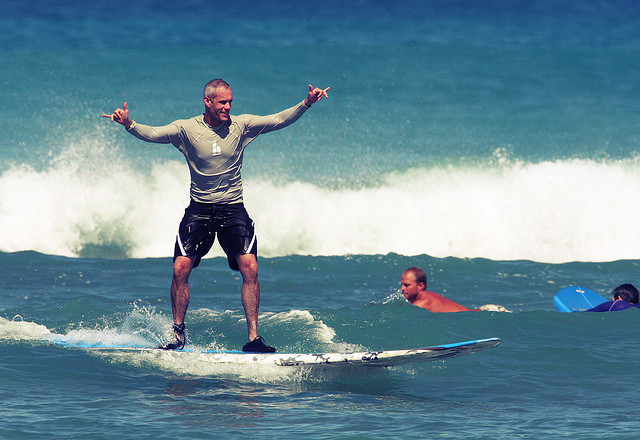
While I love the ocean, I’ve always been more the type to enjoy it from my beach towel rather than a surfboard. I’m not quite sure what happened to that girl, but I think I must have lost her somewhere between Jersey and the Osa Peninsula, because the second someone mentioned surf lessons, I was all in.
Now, I’ll admit I was definitely a bit nervous to try something new, but I’ve learned through my yoga practice that the only way to improve and progress to more challenging poses is to let my nerves fuel my excitement rather than my fear. So that’s what I did, and what do you know? I got up on my first wave, and just about every one after that.
We can’t control the waves of life—their size, their speed, their motion—but we can control how we react to them. We can either choose to watch the waves from a distance, or to face them head on, trusting that they’ll take us to wherever it is we’re supposed to go. For what it’s worth, I highly suggest the latter.
Lesson #3: Climb the trees.
A little word of advice, if you ever happen to find yourself in Matapalo, Costa Rica, and a local biologist offers to take you and your friends on a nature hike through the rain forest, be prepared to climb some serious trees. It’s basic jungle protocol.
As I watched my fellow yogis climb a seventy-foot tree before me, I realized I could help guide them. I could see where they should place their feet, what branch they should grab with their hands, what step they should make next.
However, once it was my turn to conquer the tree, it wasn’t quite that easy. I could no longer see the big picture; I could only see what was right in front of me, and that, I must admit, was rather intimidating.
That’s the thing with life—it’s all about perspective. Sometimes those big obstacles that seem impossible to conquer can simply be overcome by taking your time, trusting yourself, and knowing that others have gone before you.
Even when you can’t see the top, even when you’re not sure where to step next, you have to keep moving because eventually you’ll make it and that view will be amazing. After all, you never know how high you can go unless you’re willing to climb.
Lesson #4: Embrace the fall.
I should also mention that said tour guide will probably harness you in before you climb and then encourage you to swing out of that seventy-foot tree and channel your inner Tarzan, trusting in him and some questionable cable ropes to guide you back down to safety.
As beautiful a view as it was from the top of that tree, I knew I somehow had to get down. Thus is life. We climb these gigantic trees, we overcome these enormous obstacles, and then we wonder where to go next.
As I rang the bell at the top of the tree, I knew I had two choices—close my eyes and hope for the best, or learn to let go and embrace the fall.
How many times are we faced with similar scenarios in life? We manage to make it all the way to the top and then we either let go gracefully, keeping our eyes open to new possibilities, or shut our eyes, afraid to fall, kicking and screaming until our feet hit the ground.
We can choose to fear the fall, but I must say, there’s a certain freedom that comes with embracing it instead. A certain power in knowing that you made it all the way to the top, and that you can and will do it again. For in order to keep growing, you have to keep climbing, even if that means falling every now and then.
Lesson #5: Trust the process.
Each day in Costa Rica was a new adventure filled with new challenges to overcome, new lessons to learn, and new memories to make, all of which would have been impossible to do and enjoy without a sense of faith and trust in the process. See, that’s the key to life— connecting with our mind, body, and soul so much so that we are confident in all we’re capable of achieving.
But at the end of the day, we don’t need to travel internationally to learn and embrace these lessons.
Sometimes all it takes is just a moment to disconnect from society, and re-connect to our souls; to remember to be flexible, to have the courage to ride the waves, to have the strength to climb the trees, to have the wisdom to embrace the falls, and most importantly, to have the confidence to trust ourselves, every step of the way.
Photo by Colin Davis
-

Releasing Negative Beliefs: How Letting Go Sets Us Free
“Man cannot discover new oceans unless he has the courage to lose sight of the shore.” ~Andre Gide
I have walked on water.
The frozen wasteland known as Chicago had kept me inside, wary of the intense cold that was breaking records that particularly frigid winter. But after interminable snow days, I began to feel like a caged animal that needed to break free.
I woke early one morning, overcome with the urgent need to connect to something living, something wild. I wrapped myself in countless layers like the kid in The Christmas Story and ventured out into the urban tundra. I felt compelled to walk to the beach that was a few miles from my house.
An eerie, otherworldly feeling washed over me as I walked, achingly aware of the stark, endless whiteness all around me. The world itself felt as it was hung in frozen suspension and apprehension. Everything seemed to be hushed in reverence.
When I reached the shore, I was hyper aware of the need to maintain a safe distance from the water, but I felt compelled to get as close as possible.
As I moved forward across the frozen sand, I tried to gauge exactly where the land ended by using various items as points of reference—a fence, a wooden bench, a recycling bin. I inched my way toward the lake until there were no more reference points, and then became as still as the land beneath me. Or what I thought was land.
I looked down at my feet and realized I was standing on a frozen wave, not a snow covered sand dune as I originally thought. I had walked out too far. I could both hear and feel the movement of the wave beneath my feet.
I felt a juxtaposition of fear, exhilaration, and an overwhelming sense of weightlessness. My first instinct was to run, but I wasn’t sure of my footing. I was terrified that if I shifted my weight too quickly, I might fall through. I had no idea how deep the water was where I stood.
At that moment I zeroed in on my true purpose for coming to the water. I reached into my pocket and pulled out a little bag filled with small strips of paper like confetti. On each one I had written something I wished to release from my life.
- The fear that I will never find the type of love I want and need.
- The belief that I am unlovable.
- The commitment to being alone.
I opened the bag to the wind, letting the belief-covered papers flutter out over the frozen lake. I did this quickly because I sensed the danger to my body on that unstable surface, and the danger to my heart if I held onto those stories a moment longer.
With my task completed, I gingerly walked back to solid land. I let out a deep breath and knew so much had been released with those papers still floating on the wind.
That moment on a frozen lake taught me a few very important things about surrender.
- Surrender is about vulnerability and receptivity.
- The opposite of surrender is resistance and control.
- And it all comes down to fear and trust.
I realized that my heart had become like that lake. A living thing that is supposed to flow, constricted by a lack of warmth and space into a frozen and dangerous place.
One of the ways we keep our hearts frozen is by holding on to negative beliefs. These beliefs may be seem like they are about others or life in general. Usually, however, they are based on our perceptions. Negative beliefs are born from our wounds and stories.
Eventually, every life experience becomes colored by these beliefs. Everything we see, say, do, and even feel is filtered through these limitations, judgment, patterns, conditionings, and doubt. The sad and scary part is that these beliefs tend to hide themselves in our subconscious, making us think that we are acting from free will.
We may not even be conscious that we are holding on to negative beliefs.
Unconsciously, we begin to nurture our negative beliefs without even being aware that we are doing so. We feed them and help them grow by giving them energy. We affirm them by attracting experiences that validate their existence. This becomes a vicious cycle. Holding on to negative beliefs justifies our need to be right.
Many of us hold on to our grievances and emotional scars with fierce protection. They become like badges of honor.
We think that without our constant vigilance, the memory of our wounds or broken hearts will be forgotten. We believe that we are some how “honoring our personal story” by holding on. If we do not act as the constant “keeper of our wounds,” our suffering will have been in vain.
But spring must come if life is to flourish again.
We must allow our hearts to thaw. We need to frequently evaluate our belief structures and release the stories that no longer serve us.
Releasing our attachment to our personal histories doesn’t invalidate the emotional pain we suffered. It doesn’t mean that the defenses and barriers we erected to protect ourselves weren’t based on a real need for self-preservation at those times. Instead, it means that we assimilate the lessons we have gained from the experience while loosening its ability to control our lives.
Just like the coldness and bareness of winter allows the Earth to rejuvenate, and ultimately makes everything stronger, so too do our personal winters allow us to access our depths. Every wound makes us stronger as we heal it, and gives us greater access to our power.
Letting go of beliefs puts a great responsibility on us. If we connect with our personal power we must give up the illusion that we are victims. We can longer view ourselves as passively vulnerable to the whims of others. We now must take responsibility for how our life unfolds.
This realization is a lot scarier than standing on a frozen lake.
To truly open our hearts, to truly wield our power, we must be willing to participate in life.
This requires both owning our part in situations and allowing experiences to unfold as they will. Accepting others’ actions and emotions without making them fit into some box as a hero or demon. And especially releasing our mental constructs about how life should be, what we should or should not be doing, and how other people should interact with us.
Releasing expectations and resistance is one of the most empowering acts of life. Resisting what is can be emotionally, spiritually, and physically exhausting. We get stuck in patterns that begin to define how we interact with the world. And even though they are painful, because they are familiar and usually hidden, we can stay stuck for years.
I had developed many of my beliefs to protect myself after a series of breakups and broken hearts.
I convinced myself that believing I wasn’t worthy of love was safer than opening myself up to the possibility of love. If I never opened my heart to anyone, I would never be disappointed or have to experience the excruciating pain of heartache.
I was keeping myself lonely and cut off from life. Trying to protect myself from pain, I was actually constantly hurting myself more.
When I finally relaxed enough to let go of my old beliefs, my life began to flow with greater ease and grace.
I walked out onto that frozen water because I needed to have a close encounter with life. I needed to let the primal elements cleanse me of my outmoded ways of being.
I went beyond the fear and conditioning because, finally, being alive mattered more than being comfortable. Now I recognize that I must trust that life will always provide the situations and experiences required for my evolution. And that surrender is the only way to be free.
Photo by Andi_Graf