
Tag: trauma healing

  • How Menopause Exposed the Hidden Trauma I Spent Years Ignoring

    How Menopause Exposed the Hidden Trauma I Spent Years Ignoring

    “There is no way to be whole without first embracing our brokenness. Wounds transform us, if we let them.” ~Sue Monk Kidd

    Menopause flagged up everything unresolved, unmet, and unchallenged and asked me to meet it with grace.

    I’m not saying it was an overnight thing—more like a ten-year process of discovery, rollercoaster style. One of those “strap yourself in, no brakes, no seatbelt, possibly no survival” rides.

    If I’m honest, the process is still unfolding, but with less “aaaaggggghhhhh” and more “oh.”

    Having mentally swapped Nemesis Inferno for It’s a Small World, I can now look back with deep compassion for that younger version of me at the start of perimenopause.  She was the one frantically Googling her way through a vortex of symptoms, never quite able to figure out whether it was a brain tumor or an underactive thyroid gland.

    It all started when I was around thirty-five (for context, I’m now forty-nine). I’d just moved to Brighton from Cheshire to do a degree in songwriting at BIMM and threw myself into it with all the gusto of a twenty-four-year-old; after all, I had it…the gusto, that is.

    That first year was wild, to say the least, but then, the ground beneath me started to fracture.

    My mind would go blank on stage. The keyboard started looking like a fuzzy blob of jelly. My heart would pound through the night for no apparent reason. I gained a spare tire around my middle. I’d walk into town and have a panic attack, clutching the wall of a bank while strangers side-eyed me with pity or concern.

    My libido shot through the roof like a horny teenager. The rage was volcanic, and my poor partner couldn’t even breathe next to me without triggering a tirade (I see the dichotomy too).

    It was a maelstrom of symptoms that even Dr. Google couldn’t unpack, and yeah, neither could my actual doctor, but that’s for another time.

    The real unraveling came when I went on tour with a band at age forty-two.

    It was supposed to be fun-fun-fun, except it wasn’t. It was hell-hell-hell. Ten days, and I slept properly for only one of them. I came home wrecked, assuming that once I returned to my bed and the stability of my beloved, I’d be fine.

    But I wasn’t. That’s when insomnia truly began. I’d ‘learned’ how not to sleep, and now my mind was sabotaging me on a loop.

    In desperation, I booked in with a functional medicine practitioner who ran some lab tests. The results were “low everything,” and that was the first time I heard the word perimenopause.

    I didn’t think much of it at the time—standard denial. But the word lodged itself somewhere.

    Around the same time, I was running a speaker event in Brighton and immersing myself in therapeutic modalities as part of my own healing.

    Music, my first (well, actually second) career, had started to feel more frightening than exhilarating. In my search for calm, I stumbled upon a modality called RTT, a kind of deep subconscious reset done under hypnosis, which changed everything for me and launched me into a new career pathway.

    As I continued learning and applying what I was discovering, a huge lightbulb moment landed:

    “Hang on… A lot of the stories I’m hearing from women in midlife involve more than just symptoms; they involve deep, relational wounds.  I wonder if there’s a link between menopause symptom severity and childhood experiences?”

    So, I turned to Google Scholar to see if anyone else had spotted this link, and sure enough, there it was.

    I came across a 2021 study in Maturitas that found women with higher ACE (Adverse Childhood Experiences) scores were up to 9.6 times more likely to experience severe menopausal symptoms, even when things like anxiety, depression, and HRT were factored in. That blew my mind.

    Another 2023 study from Emory University showed that perimenopausal women with trauma histories demonstrated significantly higher levels of PTSD and depression than those in other hormonal phases. That explained so much of what I was feeling too. 

    And then I found a 2017 paper in the Journal of Clinical Psychiatry showing that women who experienced two or more ACEs were over 2.5 times more likely to have their first major depressive episode during menopause, even if they had no prior history of depression. 

    Finally, a recent 2024 review framed early trauma as a key driver of hormonal sensitivity, especially during life transitions like perimenopause. It helped me see that my struggles weren’t random or my fault; there was something a lot deeper at play.

    But I was still confused. What was the biological mechanism behind all of this?

    Dun dun dah… I found a peer-reviewed paper in Frontiers in Medicine that helped me connect the dots. Take a breath.

    In trauma-exposed women, our GABA receptors become altered. These receptors, which help calm the nervous system, rely on a metabolite of progesterone called allopregnanolone. But trauma can disrupt both our ability to break down progesterone into allopregnanolone and our ability to receive its effects at the cellular level (because the GABA receptors become dysfunctional).

    So basically, that means even if we have enough progesterone, we might not be able to use it properly. The ensuing result is that we become more sensitive to hormonal fluctuations, and we can’t receive the soothing effects we should be getting from progesterone.

    As I began to piece all this together, I was forced to confront something in my own history.

    Because frankly, I thought I had a happy childhood.

    That is, until I came across a concept that stopped me in my tracks. It felt so close to home, I literally clapped the book shut.

    It’s called enmeshment trauma.

    It’s a type of relational trauma that often leads to symptoms of CPTSD (which, just to remind you, tends to flare up during menopause). But the thing is, enmeshment hides in plain sight often under the guise of “closeness.” We prided ourselves on being a close family… too close, in fact.

    I was an only child with nothing to buffer me from the scrutiny of my parents and the emotional load they placed on me. They’d confide in me about each other as if I were their best friend or therapist. I didn’t know it then, but their lack of emotional maturity meant they were leaning on me for unconditional emotional support. I was a good listener and a very tuned-in child.

    I became parentified. Praised and validated for my precociousness, while being robbed of the ability to safely individuate. I was “allowed” to find myself, but the price I paid was emotional withdrawal from my father, equally painful as we’d been so close.

    It was confusing and overwhelming, and I had no one to help me metabolize those feelings. It wired me for hyper-responsibility, anxiety, and guilt. Not exactly the best recipe for a smooth menopause transition, which requires slowness, ease, and softness.

    As a textbook “daddy’s girl,” I unconsciously sought out older men, bosses, teachers, even married guys. Their energy felt familiar. Meanwhile, emotionally available prospects seemed boring, even if they were safer. That attachment chaos added more voltage to the CPTSD pot I had no idea was simmering under the surface of my somewhat narcissistic facade.

    The final ingredient in this complex trauma marinade was a stunted ability to individuate financially. I was still clinging to my parents’ purse strings at age forty-four. The shame, frustration, and despair all came to a head when I dove into the biggest self-sabotaging episode of my life:

    I decided to leave my long-term relationship.

    He was my rock and my stability. But “daddy’s girl” wanted one last encore. And when he refused to take me back, despite my pleading, it was a mess. But, in a twist of grace, my father had taught me grit. How to get out of a hole. And that’s exactly what I did.

    I learned to stand on my own two feet financially. I learned the power of committing to one person and treating them with respect. I learned to set boundaries and become deliciously self-preserving with my energy, because that’s what the menopause transition demanded of me.

    And if it weren’t for those wild hormonal shifts, I’m not sure I’d have learned any of this.

    Through my experience, I’ve come to see that menopause isn’t just a hormonal event. It’s a complete life transition, both inner and outer. A transition deeply influenced by the state of our nervous system and our capacity for resilience and emotional flexibility.

    For those of us with trauma, this resilience and flexibility is often impaired. Hormone therapy can help, yes, but for sensitive systems, it’s only part of the puzzle. And sometimes, it can even make things worse, especially if not dosed correctly.

    As sensitive, trauma-aware women navigating these hormonal shifts, there’s so much we can do to support ourselves outside of the medical model.

    Slowing it all down is one of the most powerful ways we can create space for the ‘busy work’ our bodies are diligently undertaking during this transition. Gentle, nourishing movement. Yoga Nidra. Early nights. Simple, healthy meals. Earthing and grounding in nature. Magnesium baths. Dry body brushing. Castor oil packs. Vaginal steaming. Think: self-care on steroids.

    But perhaps the most radical thing I ever did was to carve out more space in my diary just to S.L.O.W.  D.O.W.N.

    Now, eighteen months post-menopause, I find myself reflecting.

    What did she teach me?

    She flagged up everything unresolved, unmet, and unchallenged.

    She showed me where I was still saying yes to others and no to myself.

    She taught me that I need more space than society finds comfortable.

    She helped me let go of beauty standards and gave me time for rest.

    She absolved me of guilt for not living according to others’ expectations.

    She reframed my symptoms as love letters from my inner child, calling me home to myself.
  • Work Is Not Family: A Lesson I Never Wanted but Need to Share

    Work Is Not Family: A Lesson I Never Wanted but Need to Share

    “The paradox of trauma is that it has both the power to destroy and the power to transform and resurrect.” ~Peter Levine

    I was sitting in the conference room at work with the CEO and my abusive male boss.

    The same boss who had been love-bombing and manipulating me since I started nine months earlier, slowly pushing my nervous system into a constant state of fight-or-flight.

    When I was four months into the job, this boss went on a three-day bender during an overnight work conference at a fancy hotel in Boston.

    He skipped client meetings or showed up smelling like alcohol, wearing yesterday’s clothes.

    When I texted him to ask where he was, he replied, “I f**king hate you.”

    When my CEO found out and called me five minutes after I got home, I told him I trusted him to handle it however he saw fit.

    I really believed he would. But over the next five months, the abuse didn’t stop. I just didn’t know it was abuse yet.

    He was over-the-top obsessed with me. He regularly told me:

    • “You’re going to make so much money here.”
    • “You have the ‘it’ factor.”
    • “You know how I feel about you.”
    • “I’m going to fast-track you.”
    • “You’re such a good culture fit.”
    • “This has been your home all along.”

    He told me everything I wanted to hear.

    I had spent the prior fifteen years in corporate America, wondering where I belonged. Wondering where my work family was.

    At first, I felt like I had finally found it.

    Then the attention escalated. What started as friendly check-ins became constant interruptions. The group Teams chats turned into direct messages. The work texts turned into personal texts—at night and on the weekends.

    He asked to go to dinner with me and my husband. He offered to buy me lunch while ignoring my coworkers. He brought in cookies for the office but made sure I knew they were for me. He singled me out in meetings and asked how I was doing while ignoring everyone else.

    I told myself, “There are worse things than your boss liking you.” But over time…I started to feel unsafe.

    My body started to send signals. I was having panic attacks on Sunday nights. I couldn’t sleep. I found myself using PTO just to get away from him. My fight-or-flight response was fully activated, and I finally had to admit I wasn’t in control anymore.

    Eventually, a coworker reported it to the CEO. Which brings me back to the conference room.

    I sat across from the CEO, body tense, heart racing, but filled with hope. I was ready for resolution. Support. Justice.

    That’s not what happened.

    Whatever the CEO said that day affected me in a way I didn’t expect. I felt minimized. Judged. Dismissed.

    Then my body reacted.

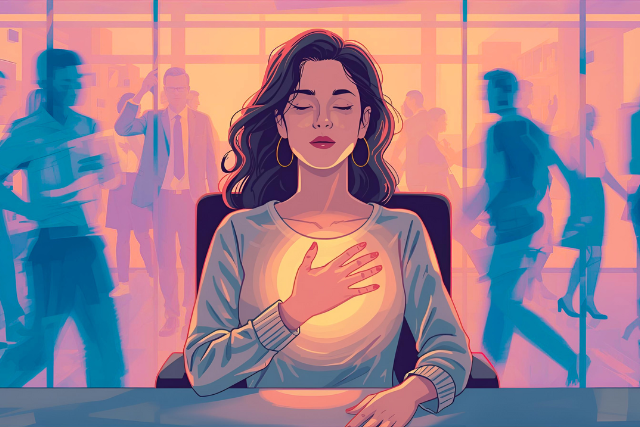
    The pressure in my chest started to build until I couldn’t control it anymore. I started shaking—full-body, uncontrollable shaking. I tried to sit still, tried to pretend nothing was happening, but it was too late.

    There was no hiding it. No escaping it.

    Just a forty-two-year-old corporate woman, uncontrollably shaking in a conference room across from the CEO.

    I excused myself and ran to the restroom.

    I lay on the floor of the public bathroom and cried harder than I ever had. My body was forcing the energy out of me. There was nothing I could do but let it come out.

    Once the tears slowed, I left the building as fast as I could.

    What had just happened to me?
    Why did it feel like a gaping wound had opened in my chest?
    Why did I feel physically damaged?

    It would take almost a year before I understood: that was trauma. That was new trauma layered on top of old trauma.

    Almost exactly twenty years earlier, I had been sexually assaulted by a coworker.

    I reported it to the police, and they didn’t even take a statement. I was sent away. Dismissed. Minimized.

    My brain had filed this memory away. But my body remembered.

    That moment in the conference room—being in a position of vulnerability, being ignored, unheard, unprotected—triggered a trauma response that had been waiting quietly inside of me for decades.

    My brain couldn’t tell the difference between past and present. It just knew I wasn’t safe. So it mobilized. It tried to protect me. And it left me raw, shut down, and checked out from the world—including my own kids—for a long time afterward.

    It was the worst time of my life.

    Several months after the conference room incident, I got a new job.

    It wasn’t easy to leave despite everything that had happened. I liked my job. I was good at it. My coworkers were my friends, and we had been through so much together. But I had become a shell of myself, and leaving seemed like the only way to get myself back.

    Even so, the first six months at my new job were not easy. I remained hypervigilant and emotionally reactive. Standard feedback and performance reviews brought me right back to that conference room, no matter what was said.

    That’s when I learned: trauma doesn’t stay with the toxic job. It comes with you. And this was trauma.

    What I Learned About Trauma

    I needed to learn everything I could, so I enrolled in a trauma-informed coaching program and studied my experience through that lens.

    From a trauma perspective, I learned:

    • The brain constantly scans the environment for safety and danger, a process called neuroception.
    • My brain perceived danger in countless ways during my employment and alerted me through my nervous system.
    • I rationalized those signals away, telling myself I could handle it.
    • But the signals—racing heart, insomnia, panic, emotional reactivity—only got louder until they could no longer be ignored.

    It felt like my body was attacking me. In reality, it was trying to save me.

    Trauma is what happens when your system struggles to cope with overwhelming distress, leaving a wound behind. Those wounds don’t need your permission to exist; they only need a trigger.

    That day in the conference room, multiple unhealed wounds surfaced all at once—sexual trauma, financial trauma, friendship trauma, life purpose trauma, and institutional betrayal trauma.

    The new trauma stacked on the old was simply too much for my system to manage. So my body did what it was designed to do: protect me.

    Learning this allowed me to release the shame I was carrying. It allowed me to have compassion for myself and others.

    It made me stop looking backward and start looking forward.

    What I Learned About Work

    While I was learning about trauma, I started asking bigger questions in my new role as an HR consultant.

    I had never worked in HR before, so I studied every conversation, policy, and process to understand how the system works behind the scenes and to view my own experience through the employer’s lens.

    Who really has the power?
    What rights do employees have?
    What responsibilities do employers have to protect them?

    Here’s what I learned:

    • The employment agreement is simple—employees agree to perform the duties on their job description, and employers agree to compensate them for performing those duties.
    • Both parties can end the agreement at any time.
    • HR and employment attorneys are paid to protect the company from risk. Period.

    That’s it. Anything beyond that is optional, unless required by law.

    Work is a contract. It is not a family. It is a system built for labor, not love.

    And this system is not immune to abuse. It is not immune to trauma.

    Just because it’s a professional setting doesn’t mean it’s a safe one. And just because you’re a high performer doesn’t mean you’re not vulnerable to harm.

    The idea that work is a family, that it should provide belonging, meaning, and loyalty, didn’t come from nowhere—it reflects how work itself has changed over time.

    In the past, belonging came from many places at once: tight-knit communities, extended families, faith traditions, and work that was often woven into local or family life.

    When industrialization pulled people into factories, corporations, and offices, many of those community anchors began to lose influence. To fill the void, workplaces leaned into family language—promising connection and loyalty in exchange for more of people’s time, energy, and devotion.

    For a time, many companies did try to live up to that promise with pensions, long-term employment, and mutual loyalty between employer and employee.

    But as work has become more globalized and transactional, that loyalty has faded. Today, organizations still borrow the language of family, but the commitment is one-sided. When it serves them, they lean on employees’ devotion; when it doesn’t, the illusion disappears.

    That’s how we know work is not family—because families don’t withdraw love, belonging, or loyalty the moment it no longer serves them.

    What Helped Me Heal

    The good news is healing is possible.

    For me, healing meant more than just learning about trauma in a classroom and HR policies in an office. It meant implementing daily practices into my life that rebuilt my sense of safety and helped me trust myself again. This included:

    Monitoring my nervous system and honoring my body’s responses to triggers.

    I started noticing the small cues—a clenched jaw, a racing heart, a stomach that wouldn’t settle. Instead of pushing through, I learned to pause, breathe, and respond with care. These moments of noticing became the foundation of feeling safe in my own body again.

    Exploring my past experiences with compassion instead of judgment.

    For years, I believed I had compassion for myself, but it was shallow—more like telling myself to “let it go” than honoring what I had lived through. It wasn’t until I became aware of the experiences that shaped my patterns and behaviors that I finally understood real self-compassion.

    Recognizing the subconscious behaviors that put me at risk.

    Perfectionism, rationalizing red flags, unhealthy coping strategies—these were patterns I had carried for decades. Becoming aware of them gave me the power to make different choices, rather than repeating the same painful cycles.

    Setting boundaries at work to protect my energy and healing.

    I learned how to say no without guilt, how to step away from people who drain me, and how to handle the frustrations of work without getting emotionally activated. Boundaries have become an act of self-love.

    Honoring the complexity of the human body and lived experience.

    This was the hardest lesson of all. I carry a body, brain, and nervous system that remember everything I’ve been through, even the parts I’ve tried to forget. My responsibility now is to honor that complexity in every environment I step into—including work.

    That doesn’t mean molding myself to whatever the workplace demands. It means protecting my well-being first and remembering that I am more than a role, a paycheck, or the approval of others.

    It took time, but these practices slowly closed the wound that had once left me gasping for air on the floor of that bathroom. The open wound in my chest has now been closed for over a year and has been replaced with peace.

    That day in the conference room broke me. But it also cracked me open. I put myself back together, stronger than ever.

    And you can, too.

  • When Your Body Is Carrying More Pain Than You Realize

    When Your Body Is Carrying More Pain Than You Realize

    If you live with chronic pain, you already know how exhausting it can be. Not just the physical sensations but the constant trying—trying to push through, trying to find answers, trying to explain something that feels invisible to others. The search for relief can become its own full-time job, and it’s easy to feel discouraged or alone.

    Over the years of running this site, I’ve heard from many people who’ve felt trapped in their bodies, like life was happening around them, not with them. I’ve also connected with many people who learned to bury their feelings (a struggle I know all too well) because they were simply too painful or because they never learned how to embrace and process them. For some people, this emotional holding eventually shows up in the body as tension, fatigue, or chronic pain.

    Pushing things down might look like strength from the outside, but it’s the source of immense suffering that only ends when we face and feel what we’ve been avoiding.

    This awareness is what draws me to Nicole Sachs’ work. Nicole is a therapist, author, and teacher who’s spent over twenty years helping people understand the mind-body connection, and how unprocessed emotions can sometimes show up in the body as chronic pain.

    When we understand how our nervous systems try to protect us, we can gently teach our bodies that they no longer need to stay in defense mode.

    In her upcoming online workshop with the Omega Institute, Introduction to Freedom from Chronic Pain, Nicole will introduce you to her approach to releasing stored emotions so you can reconnect with your body instead of battling it.

    In this 90-minute live session, Nicole will offer:

    • Insight into how the brain and nervous system create chronic pain as protection
    • A guided JournalSpeak exercise to support emotional release
    • A sense of hope and understanding, especially if you’ve felt alone in your experience
    • Time for live Q&A to support your specific questions and challenges

    So many people live with chronic pain thinking they just have to endure it. But healing is possible. It won’t happen overnight, but with the right tools, you can greatly improve the quality of your life.

    If you’re ready to release the pain that’s holding you back, you can learn more and register here:

    Introduction to Freedom from Chronic Pain
    Date: Wednesday, November 5, 6:00–7:30 PM ET (3:00–4:30 PM PT)
    Replay: Available on demand until January 4, 2026