Tag: time
-
How to Improve Your Work/Life Balance and Reclaim Your Time
“You will never feel truly satisfied by work until you are satisfied by life.” ~Heather Schuck
When I was two years old, my parents got divorced.
In other words, I’ve never seen my biological parents spending loving time with each other. I never had the chance to experience the small things most children take for granted.
For example…
- I don’t remember my mom and dad ever sharing a loving kiss after a long day at work
- I don’t remember ever having both parents around to tuck me in at night
- And I never overheard simple “how was your day?” conversations between my parents in the kitchen
As a kid who didn’t know any different, I thought this was normal. I’d stay with my mom during the week and visit my dad on the weekends. No big deal, that was that.
Looking back, I’m lucky that even though my biological parents were separated, both my parents loved me unconditionally, and supported me whenever I needed it. (And I’m happy to say they still do!)
But, truthfully, the reason for the divorce still saddens me to this day.
The primary reason my parents divorced is because my father was a workaholic.
Because I’m expecting to be a first-time father myself in a few months, “workaholic” is a word that’s at the top of my mind. I’ve thought deeply about how to avoid being labeled a workaholic, especially in today’s world where being a workaholic is synonymous with success.
The biggest question I’ve asked myself recently is, “Should I spend more time with family or should I focus more on my career?”
But, as I’ve thought about it more, I realized that’s the close-minded, dualistic way of looking at things. My shift in mindset from an “either/or” to a “how can I be creative to incorporate both?” has been the first step.
And, as I’ve continued to grow and reframe my limiting beliefs, there have been a few more realizations about maintaining a work-life balance. Here’s what I’m learning.
Making My Time on This Planet Count the Most
No matter how I slice it, I only have twenty-four hours in my day.
In the past, I’ve naturally gravitated toward being as efficient as possible during work hours and doing everything myself. This approach has been supported by an endless amount of tactics to maximize my productivity during the day—tactics that, if I’m being honest, only marginally approve my efficiency.
Efficiency only carries us so far. Even if we’re the most productive person the world, we have a limit to the energy we can spend and a limit on our output.
As I’ve learned, focusing entirely on efficiency and trying to do everything is the wrong approach.
In reality, the people who have figured out how to integrate their family and professional success have done one thing very well: letting go.
Caring for Ourselves Means Saying No
One of my idols, Warren Buffett once said, “The difference between successful people and really successful people is that really successful people say ‘no’ to almost everything.”
A couple of years ago, I had reached out to a mentor of mine asking him for advice. He was a highly respected, gregarious person and was pivotal in my early career.
And even though we had an established relationship, he told me, “No, I can’t meet then. Evenings are reserved for my wife and daughter.”
I was blown away. It stung a little, but after a bit I realized his “no” made me respect him even more.
Instead of talking in the evening, he had asked me to call him in the morning, or to email my questions and he would get back to me within a couple of hours. He defined his boundaries and “let go” of having to please me (and sacrifice time with his wife and kids).
In another example, Caryn Seidman Becker, the chairman and CEO of CLEAR, said: “You can have it all, but each person needs to define their personal ‘all’ because you can’t have everything.”
For my mentor, having it “all” meant saying “no” so he could have a successful career during the day and cherished family time in the evening. He knows his time is limited, and reduces his obligations to the core of what he wants to accomplish.
“Letting go” Also Means Letting Other People Help
One of my favorite theories is the law of diminishing returns. Sometimes, this shows up when I work more than fifty hours at my day job and seeing my output decline. Other times, when I say “yes” to too many people and can’t spend quality time with my family.
In other words, when I reach a point where the benefit gained is less than the amount of energy invested, it means I’m doing too much.
At a certain point for all of us, we need to stop exerting effort to maintain our balance, health, and important relationships, even if it means we’ll stop short of perfection.
When we understand the law of diminishing returns we favor progress and learning over perfection.
The metric for balance varies too. Sometimes the optimal level of effort is when we’ve achieved “good enough” on a project at work, which allows us to focus our energy on family. Or, other times, it’s achieving “good enough” with family so we can focus more energy on a massive project we’re excited about at work.
And once you know what your “good enough” is, you have the ability to ask others to support you so you can free up time and energy for more important things. Whether it’s hiring someone to help you grow a business, having your laundry done for you, or even getting someone to come change the oil on your car at work so you don’t have to waste time driving around.
It’s important to note the goal isn’t laziness—it’s effectiveness. For example, there might be times when we have to put in extra hours to get the job done. The differentiating factor is recognizing when to do something ourselves, and when to delegate.
The Power of Using Deadlines
Have you ever noticed the power of deadlines?
In college, when I had professors set a project deadline, I knew it had to get done. I could cram all I wanted the night before, but no matter what it needed to be finished on the due date. On the other hand, when I have something I need to do “eventually” it gets pushed off…again…and again…and again.
When we use deadlines strategically, we’re following Parkinson’s Law. Here’s an excerpt from Tim Ferriss’ 4-Hour Body on what the Law means:
“Parkinson’s Law dictates that a task will swell in (perceived) importance and complexity in relation to the time allotted for it’s completion. It is the magic of the imminent deadline. If I give you 24 hours to complete a project, the time pressure forces you to focus on execution, and you have no choice but to do only the bare essentials. I give you a week to complete the same task, it’s six days of making a mountain out of a molehill. If I give you two months, God forbid, it becomes a mental monster. The end product of a shorter deadline is almost inevitably of equal or higher quality due to greater focus.”
In short, Parkinson’s Law pushes us to take action and focus exclusively on the most important items, and nothing is wasted.
And when we use Parkinson’s Law (or ask for help, or say “no”) we’re making sure to spend our energy and time in the places that matter the most to us.
-
The Joy of Doing Less: 3 Ways to Reclaim Your Time
“Edit your life frequently and ruthlessly. It’s your masterpiece after all.” ~Nathan W. Morris
I began 2015 by cleaning out my closet. I sold and donated and trashed the pieces that weren’t serving me anymore. Embarrassingly enough, I purged nearly 100 items. It felt great. Getting rid of stuff and seeing beauty behind the clutter was incredible. But this story isn’t really about my closet.
It’s also not about my desk drawers, my linen closet, or my kitchen, which all came next. As it turns out, getting rid of clutter and extra things was just the tip of the iceberg. In the same way that buying things didn’t make me feel better, getting rid of things wasn’t really the solution, either.
What I initially imagined as an exercise in clothing minimalism has turned into a pursuit of “better, but less” across all areas of my life. So I started thinking about what it was that I valued most, that I wanted more of most. The answer? Time.
I wanted time to finish what I started. I wanted time with my most important people. I wanted time for pleasure and healing. And I wanted time to go slowly. After nearly a year, the result is more joy, more freedom, more space for what matters.
So how can you declutter your schedule and create better priorities? It’s about crafting joy through not just having less, but doing less. Here are some ideas on how to make it happen:
Honestly look at what you’re already committed to.
None of this works if you aren’t honest about what’s already in your schedule. From major work commitments to how much time you’re choosing to be on Facebook, keep a candid journal on where your time goes. Watch this for a little while. Try not to judge yourself, but look at what you’re prioritizing, consciously or unconsciously.
Once you see what you’re committed to and how you’re spending your time, you can start to edit. Does what’s on your schedule line up with your values and goals? Or is it time to make a shift?
I realized that I was committed to far too many projects, and that I wasn’t able to do them all well. I also acknowledged that I needed what I call “integration time”—a buffer where I could process new lessons or emotional events.
Since then, I’ve signed up for fewer classes and scheduled more time for myself to integrate what I’m learning.
I’ve scaled back the number of happy hours I attend in exchange for coffee dates during the day. This leaves me quiet evenings at home for reading, crafting, and relaxing.
I’ve also pared back the number of political causes I’m a part of, choosing to focus on one or two important projects at a time.
Follow the “three thing” rule.
It’s like the old saying: “If everything is a priority, then nothing is.” Choose three things that are the real priorities in your life. Start small. What are the three things you want to accomplish today? Start with those as the skeleton of your day, and build everything else around them.
You might not do those three things first, chronologically, but arrange your day so that you’re sure they’ll happen. Or, you may find that unless you make time for reading, meditation, or exercise before work, that it won’t happen.
I’ve noticed that this “three thing” rule is also a good boundary for understanding when I’ve done “enough.” As someone who has a hard time switching off sometimes, using the three thing rule as a guidepost can help me to know when to call it a day. If I’ve accomplished what I absolutely need to, then maybe I can afford stop work to go for a walk or make a great home-cooked meal.
Honing in on only three things helps us to clear the noise and distractions so that we can focus on what feels most meaningful. You can start to extrapolate, too: what are the three things you want to make sure happen this week? This month? This year? Choosing only three makes sure that we are ruthlessly clear on what matters most.
Start saying no.
This one is pretty simple. If it’s not supporting your values, your priorities, your “three things” or your inner well-being, it has to be a no.
I suggest that for a set period of time (two weeks tends to do the trick), everything that isn’t already on your plate is a no. This gives your brain and schedule a break from more input before you dive in again.
Of course, there are times when it’s not reasonable to drop everything, such as if you’re caring for a child or aging parents. If this is the case, it’s even more important to pare down the nonessential, and maybe even ask for help.
The ability to craft elegant boundaries and a good rubric for new commitments can be a process. But over time, you’ll learn to trust your intuition. In the meantime, get some practice in confidently saying no. People in your life will also learn how to hear your no, and respect it.
If lots of noes seem awkward to you, just remember that you’re actually saying yes to what you really want.
When I was caring for my mom when she was ill a few years ago, I needed a lot of time to recharge in between visits. Some friends were offended when I turned down plans; others actually responded with offers of support.
Just by being honest, and a little vulnerable, with what I needed (time and space to digest), I was able to get it. What a novel concept!
—
I’ve spent the last year rigorously employing these tactics to free myself from overwhelm and commitments that stopped feeling good. This has meant paring back my volunteer commitments and some community classes where I’d been involved. It’s meant saying no to enticing invitations and choosing not to sign up for fascinating opportunities.
This might have been awkward, but I find that most people are familiar with that feeling of overwhelm. They recognize it in themselves. Most people actually respect that I’m choosing to honor my well-being in this way, and that I’m interested in quality over quantity.
The results of scaling back were really surprising to me. Doing less not only gives me more space for my own care, but it actually allows me to make a greater impact. I’m doing less, but I’m doing it with more grace and accountability. I do what I say I’m going to do. I have the time and space to follow through well on my commitments.
By doing less, I’m able to show up more present for the people in my life and be more grounded in the present moment. By focusing on fewer projects, commitments and calendar-clutter, I’m doing less, but I’m doing everything fully—and with far more joy.
Clock and flip flops image via Shutterstock
-

You Can Make a Difference: 7 Ways to Create a Powerful Legacy
“Don’t be afraid of death; be afraid of an unlived life. You don’t have to live forever; you just have to live.” ~Natalie Babbitt
Recently I was searching for information online about a friend of mine who I lost touch with about a decade ago.
Pam and I went to psychology graduate school together in the early nineties and stayed in touch for a few years after that. But in those pre-Facebook days it was easy to lose touch with people, and Pam and I eventually drifted apart.
Curious about what my friend was up to, I typed her name into Google. Imagine my shock when I found her obituary. It turns out that she had died three years ago from colon cancer at the still young age of forty-four.
Even though Pam and I lost touch a long time ago, learning about her death hit me hard. Months later, I’m still shocked that she’s no longer with us.
Pam’s death was also a wake-up call for me. As a gift to future generations, I want to use my life to create a powerful legacy and to make a positive contribution to the world. Yet, up to this point in my life, I haven’t taken intentional actions that will create the type of legacy that I want.
And while I hope to live for at least another forty years, the date of my death is outside of my control. Like my friend, I could die at any time.
But no matter how many or how few years I have left, I absolutely have the ability to positively impact the world and touch lives far into the future. And so do you!
The truth is that we create legacies with every single action that we take. The question we need to ask is whether or not were taking intentional actions to create the type of legacy that we want to create.
After much reflection, I came up with the following seven ideas for how I plan on building a powerful legacy with my life. I hope that they inspire you to do the same and without needing the wake-up call that I received.
1. Decide what legacy you want to create.
In order to create a powerful legacy with your life, you need to decide what contribution you want to make to the world. I suggest spending some time journaling and reflecting on the following questions:
- If you knew with certainty that you only had five more years to live, how would you spend those years, and why?
- What message do you want to send with your life to the world and to those who matter most to you?
- Imagine that you are attending your own funeral. What would you want your family and friends to say about you and how you lived your life?
2. Start creating your legacy today.
We all have a limited time on this planet. And yet, we often live our lives as if our time was unlimited, putting things off, thinking that we’ll always have more time. I’m sure my friend Pam was expecting to live a lot more than forty-four years.
Yet the truth is that none of us knows how long we’ll live. If you want to create a powerful legacy with your life, then you need to stop wasting time and start creating it today.
Look over your answers to the questions from Point 1. Based on your answers to those questions, identify three to five specific goals you can set for creating the legacy that you want. Then, for each goal, figure out the first step you can take and start taking it today!
3. Simplify your life and focus on the essentials.
Another friend of mine, who died a few years ago, created a powerful legacy by simplifying his life and focusing on the essentials. John centered his life around three main things—building powerful connections with others, creating beautiful art, and cultivating his own spiritual growth.
I would guess that most of John’s life energy was devoted to these three activities. John didn’t let himself get distracted by trivial or meaningless pursuits.
Learn from my friend John. Figure out the two to four things that are most important to you and put the bulk of your energy into those activities while letting go of the rest.
4. Treat everyone you meet with kindness.
A powerful legacy can often be created with the simplest actions. Simple acts of kindness have been known to change lives in powerful ways.
And a simple act of kindness can inspire acts of kindness by others—which means that every time you touch someone’s heart with your kindness, you create positive ripples, ripples that will last for a long, long time.
You can even create a kindness ritual. For example, sparked by my friend’s death, I’ve decided to contact one friend a week, and send them a short note letting them know what they mean to me.
5. Serve to the best of your ability.
None of us can do it all and none of us is perfect. And yet we often use those as excuses to do nothing. We do nothing because we can’t do everything or we do nothing because we can’t do what we want perfectly.
My suggestion is to just serve to the best of your ability. Do your part to make the world a better place, and stop worrying about the fact that you can’t do everything or that you can’t do it perfectly. The truth is that we can all do something to serve and doing that something creates a much more powerful legacy than doing nothing.
6. Do the next right thing.
Maybe you don’t know what kind of legacy you want to create with your life. I completely understand that. We live in a complicated, overwhelming world in which our attention is pulled in a thousand different directions.
If that’s how you’re feeling, then I suggest that you focus on doing the next right thing every time you’re faced with a choice or decision. Every time you do the right thing—however you define it—you create a powerful chain of actions which leads directly to a powerful legacy.
7. Remind yourself that you have limited time.
In certain Buddhist traditions, people are taught to imagine a little bird on their shoulder and to ask that bird every day if today is their last day.
Repeatedly using this technique or similar ones reminds us to make good use of our time and that we need to work toward creating our legacy every single day.
—
A few days ago, a friend told me in an email that she didn’t think she had a legacy. The truth though is that we all create legacies with our lives.
The question isn’t whether or not we’re creating a legacy. The question is whether or not we’re actively creating the legacy that we want to. Incorporate some of the suggestions above, begin leading your life deliberately, and I have no doubt that you’ll create a powerful legacy that will last for generations.
Man silhouette via Shutterstock
-
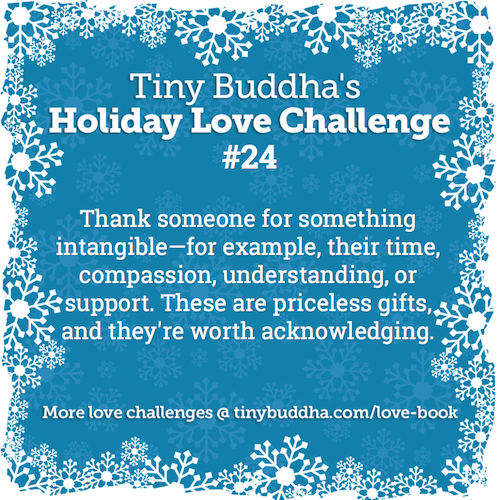
Holiday Love Challenge #24: Thank Someone for an Intangible Gift
Want more ideas to strengthen your relationships? Get Tiny Buddha’s 365 Tiny Love Challenges.
-
Accepting Delays and Appreciating the Gift of Empty Time
“Always say ‘yes’ to the present moment… Surrender to what is. Say ‘yes’ to life and see how life starts suddenly to start working for you rather than against you.” ~Eckhart Tolle
A few weeks ago I had a soccer game about a half-hour away from my house, in the middle of nowhere.
Grumbling about the heat and the length of the game, I walked down to the field where my team was seated under a tent. In truth, I love playing soccer, but for some reason I was annoyed at how big a chunk of my day it took.
“Hey,” someone said to me, “the game’s delayed forty-five minutes. We’re just going to sit and wait it out.”
I walked to the portable bathroom, plunked my soccer bag down, and teared up in frustration. How dare the team, the sport, the world violate my time?
I walked back over to my team, fuming inside. I thought about the homework I still had left, the near hour I could have spent writing or playing guitar or being quiet and meditative. But I was stuck on a dirt patch miles away from home, sitting in my soccer clothes, with nothing to do but wait.
Then I thought of the radio show I’d been listening to in the car on the way there. It was about Taoism and the importance of accepting what exists and the natural order of things. The world, the host declared, is in itself perfect, and when we submit to the circumstances of the world we can find peace.
Sitting there on the field, I forced myself to close my eyes, take a deep breath, and feel the wind settle on my skin. For the first time, I was accepting the unfilled time life had offered me rather than fighting it.
Meditating on the field was incredible. In that moment, I felt more alive and present than I ever have meditating in my own home.
Unlike at home, I was submitting to the natural order of things and my reality. Rather than building time for meditation, I was receiving it.
I don’t know a single person who doesn’t consider themselves busy. We live in a world of technology and mobile devices that allow us to be working constantly. Our biggest rival is time, and our most formidable fear is running out of time before deadlines, projects, and our own eventual demises.
Because of the finite amount of time we have on this planet, I always thought of time as something I had to organize and maximize. I planned my week and activities so I could have large chunks of unstructured time to get things done. I avoided having short periods of empty time like the plague.
The more I structured my time, the more stressed I became. I was frugal with my time like I would be with money.
I was miserable in the face of rescheduling and spontaneous events. Everything the world threw at me threatened to destroy my entire week’s plans. The more I tried to maximize my time, the more I felt like a victim to time itself.
The spontaneity of the world became my enemy. In trying to use every moment to its fullest, I had turned myself against the present moment and the natural order of things.
That day on the soccer field changed me in a profound way. That day, I let go of my schedule, my compulsive need to structure my time, and my hatred of the ever-changing world. I embraced the moment that was given to me and allowed myself to be immersed in the time and space I occupied.
I had never before recognized that I was in a constant battle against time.
I now see this battle playing out every single day in my life. I get stressed whenever I have five minutes to “kill” without my computer or cell phone on which to do my homework.
These empty moments threaten us because we don’t know how to accept the emptiness that life offers us.
In all of our haste to complain about such moments, we miss the opportunity they offer us to tune into the world and submit to its natural perfection. We miss the truth: that every moment, not just the ones we set aside for meditation, can be used to appreciate and revel in the present.
Emptiness is not evil. Emptiness allows us to breathe, feel, and accept the world as it is.
Ironically, I always wanted more time in which to meditate. I felt like I could never find a chunk of free time in which to simply enjoy the present moment. Now, I realize that they are all around me, but I fill them with anxiety instead.
If you’re tired of feeling like time is against you, worn down from all the frustration you’ve felt toward the world and the circumstances taking your time, you must back down from the fight. The world will always win.
Fortunately, if you accept the world and the time you are given rather than rebelling against it, you also win. That is the perfection of the world: we benefit most when we let the world carry us.
That is not to say that making plans and organizing your time are useless endeavors. It is important that, as a society, we continue to put time into our jobs and families. I am not preaching a breakdown of schedule, but an acceptance of change.
Instead of using meditative strategies only in the comfort of your home or nature, find the beauty of the present moment in the time the world gives you to be still.
Feel your weight in the seat of your car and the smoothness of the wheel in your hands when sitting in traffic. Close your eyes and feel your lungs expanding when someone is running late for a meeting.
Spend those interim moments of inaction in your life being at peace with the world rather than grumbling at your watch. Those minutes add up, day by day, into all those minutes you wish you could spend meditating instead of sitting in the office.
Empty time is not forced upon us; it is given to us. Empty time is a gift. Yield to it and accept it, and you will find yourself more in tune with the present moment and more accepting of life and the world.
The present moment is a gift that we are always receiving. Our choice is whether to deny the gift and suffer, or open it and feel the world’s perfection within and around us in the ever-present now.
Time for a break image via Shutterstock
-

How to Make the Most of the Time You Have
“Without giving up hope—that there’s somewhere better to be, that there’s someone better to be—we will never relax with where we are or who we are.” ~Pema Chödrön
There are twenty-four hours in a day. This is true for you, me, Obama, and Oprah. Yet, I often feel like there are things that I would love to do… if I only had enough time.
I used to spend my days in a frenzy.
At my worst, I woke up at around 4:45 to meditate for an hour, then go to the gym, rush off to my twelve-hour law job worried that I would be late for my first meeting, eat at my desk, cancel coffee dates and dinner dates because something urgent came up, take a cab home at 10:00 or so, go to sleep, and do it all again the next day. There was no space.
On the one hand, you could say that I was making the most of my twenty-four hours. After all, I was getting a lot done! But was I really? Each task that I was doing was focused exclusively on getting it done so I could move onto the next one.
It was all about checking off items on the list, and moving forward to some elusive time or place when I would have… time.
Thankfully, I have now changed my relationship with my precious twenty-four hours. Here is what I do to make the most of the time that I do have:
1. Notice the words “I don’t have enough time.” Change the language.
We’ve established that we all have the same amount of time. So why dwell on the obvious? Instead, be honest with yourself. If there is something that you are not doing, you are choosing not to.
When someone asks you to meet up and you say no, when you forego a workout, when you wish you could get a massage but can’t fit it in, recognize that you’ve made a different choice with your time today.
You could say, “I would love to, but I have another commitment.” Be present with that. Notice how it feels to have made that choice. Perhaps, you will make a different choice next time.
2. Know what your priorities are. Stick to them.
Today, I know clearly what my priorities are. And they are so simple.
- Stay healthy—physically, mentally, and spiritually. I make time for about one hour of yoga and meditation daily six days a week.
- Spend time with my friends and family. I’ve foregone promotions so I can work reasonable hours, have dinner with my family every day, and spend time with my husband in the evenings. When I make a commitment to meet a friend for coffee or lunch, I stick to it and say no to other things that come up, with very few exceptions.
- Be kind and helpful to others; be of service. In the hours that I am at work, I try not to procrastinate or complain. I am present with whatever task or person is presented to me, and do my best to help. I give my full attention to what is happening in the moment, and use my skills and talents to assist to the best of my ability.
By knowing my priorities and sticking to them, I know I am making the best of my twenty-four hours. I am consistently doing things that are important to me, and that I feel are making a contribution in some way.
3. Let go of what others think of you. Repeat. Repeat. Repeat.
Sticking to your priorities will involve a whole lot of saying no. No is a complete sentence. You will get better at it. People will respect you for it.
On Monday, I am starting a new job. I am terrified and I have heard that it is a gruelling environment, and people tend to work late at night and on weekends.
I am still planning to work from 8:30-4:30. I have already mentioned this to my new boss, and she agreed. At the same time, I’ve already been copied on e-mails that fly back and forth at 10 pm or 5 am.
The advice I have gotten, that I hope to follow, is to pause before responding to these after-hours e-mails. I will ask myself: Is it really necessary for me to respond right now, or can it wait until the morning? My guess is that 95% of the e-mails can wait.
This approach, if I’m able to stick to it, will likely have a few outcomes:
a. A lot of people will be unhappy that I’m not responding right away. They may not like me
b. Eventually, they will accept it.
c. If I do great work in the hours that I am available, they will learn to respect my choice.
Another possible outcome is that it will be a disaster and I will have to leave and go to another job. That is okay too. My choice to use my twenty-hour hours in a way that supports my priorities of health, human connections, and service is well worth it.
4. Stop worrying about your “purpose.”
I tend to spend a lot of my time worrying about what to do with my time. Is this really the best career for me? Should I go back to school? Am I using my best skills? Is there something else I am meant to be doing? Am I fulfilling my potential? Am I living wholeheartedly and making the world a better place?
This is a huge waste of time for me! When it comes down to it, you live your life how you live your days. If you live your days, your moments, your hours well, you will spend your life well.
So stop worrying about your “life,” and bring your attention to what this day brings. Love all of it. Your purpose is not to change the world, but to experience it fully in all its ambiguity.
5. Enjoy the most mundane tasks. Do them with joy.
There are many activities throughout the day that we may call a “waste” of time. Being squished like a sardine in the subway. Brushing your teeth. Standing in line at the grocery store. Doing the dishes… again.
Yet, let’s return to this concept of the twenty-four hours. They are what they are. However we are spending them, they are of equal value. We can’t waste them; we already have them. We are not “wasting” time; we are forgetting to experience it.
One of the most common difficulties people have in starting a meditation practice is that they don’t have enough time. Yet, these moments of “wasted” time are the perfect activities for meditation!
Next time you are in a “time-wasting” activity, bring your attention to your breath. Settle into whatever it is that you are doing. Notice your feet supported by the earth beneath you. Notice your posture, relax the shoulders, open your heart.
Notice your mind wandering to whatever you have to do next, or whatever didn’t yet get done today. Let the thoughts go and return to your breath. Rest in the preciousness of this very moment. You may just find that you have all the time you need.
Woman with clock image via Shutterstock
-

5 Priceless Gifts You Deserve to Give Yourself
“The greatest gift you can give yourself is a little bit of your own attention.” ~Anthony J. D’Angelo
The other day, when I was out celebrating a friend’s birthday, someone asked about the best gift I’d ever received.
What came to mind was getting my parents’ hand-me-down Corolla when I was sixteen. It was my first taste of being all ‘grown-up.’ I felt like my parents trusted me enough to give me the keys to go out on my own. It gave me a sense of pride and freedom.
Aside from that, nothing else that was tangible came to mind. What stood out were the memories and the moments I shared with the people who celebrated my birthday with me. And the most memorable ones involved traveling or living in a foreign country.
So this got me thinking—the best gifts you can give yourself are things that are priceless. They are a collection of moments and experiences that add depth and value to your life.
Aside from a lifetime of adventures, here is a list of invaluable gifts you deserve to give yourself.
1. Time to learn about yourself.
In Dr. Meg Jay’s TED talk, she offers twenty-somethings a piece of advice—to invest in “identity capital,” something that adds value to who you are and who you want to be.
I feel this point is applicable to people of all ages. One of the best gifts you can give yourself is to learn more about yourself.
Give yourself the permission to explore and really get to know who you are. Discover what you like and don’t like. This will help you set your standards and boundaries, which are hopefully aligned with your values, so that you can create the life you want.
Along the way you might find that things change. And that’s okay. It’s natural. When it does, recognize this and be mindful in your daily actions as you adjust to the person you are becoming.
2. Peace of mind.
Everything is temporary; nothing lasts forever.
When you give yourself permission to befriend what is, instead of what you think it should be, you’ll realize that the best thing you can do is to focus on the present and count your blessings.
There’s no need to worry incessantly, for you can’t control the future, or what others think for that matter. Most of the time people are self-absorbed, going through their own things, not even aware of how their actions and reactions may have come across to you.
Worrying doesn’t accomplish anything; it only takes away today’s peace.
When you are in the moment, just do what you can do. Sometimes it may be nothing, and it’s okay.
Have faith that everything will work out for the best. After all, you have found a way to survive your ‘bad’ choices thus far. So going forward, why not trust yourself? You’ve got the proof that you are capable of more than you know.
3. Time for yourself.
We often put ourselves last on our to-do list.
But it’s important to take care of your well-being and to recharge your batteries first in order to be at your best to give to others.
Find ways to you nurture your body and nourish you mind. Take the rest you need to not burn yourself out. After all, you are the caretaker of your body and life. No one can do this for you.
When you allow yourself to have moments to unwind, de-stress, and reconnect with yourself, you will be more productive, have more energy, and feel happier, which will result in fostering better relationships while reducing your stress levels.
4. A chance.
Give yourself the gift of following your dreams. Do what you love; do what is important for you.
In order for you to live a fulfilled and meaningful life, you have to live it yourself. So don’t wait until it’s too late. Find the courage and willpower to live a life true to yourself, and spend your time doing what counts for you.
I was once depressed and was lucky to find passion for life again.
Through reading self-help books, following sites like Tiny Buddha, getting into yoga, and asking for help, I realized I’d been living someone else’s life . No wonder I was in a slump and unhappy.
When I started to fall in love with life all over again, I was determined to start living on my own terms. And now I am giving myself a chance to do what it is I love, which is to help others whose lights have been dimmed to find purpose and passion again.
As Wayne Dyer famously said, “Don’t die with your music still in you.”
5. Forgiveness.
“Forgive yourself for not knowing what you didn’t know before you learned it.” ~Unknown
We often have a hard time forgiving ourselves for our mistakes. Instead of beating ourselves up, we need to appreciate the lessons we’ve learned from our unwise choices.
Recognize that you did your best with what you understood back then. You are not defined by your past.
The fact that you are upset and holding yourself accountable shows that you care and that you have reflected and grown from the experience. So it’s time to stop berating yourself and judging your actions.
Forgive yourself like you would with a friend or a love one. When you forgive and let go of the guilt and shame, you give yourself the power to change your story.
Last but not least, be your own best friend! Give yourself the gift of being the kind of person you would most like to spend the time with.
When you catch yourself talking negatively, change it to a more positive and supportive voice. Be nice to yourself.
You deserve it.
Gift image via Shutterstock
-

Are You Too Busy to Enjoy Your Life?
“It’s not enough to be busy; so are the ants. The question is: what are we busy about?” ~Henry David Thoreau
I was slipping deeper into a dark spiral after my fortieth birthday, looking for anything to grab onto and pull myself out of the darkness. Some said I was having a midlife crisis, but I believe it was actually the beginning of an awakening for me. For the sake of argument, I’ll call it a midlife awakening.
This by no means meant that I understood the meaning of life and was all of a sudden enlightened and happy—quite the contrary. I was seeing for the first time the “me” that everyone else saw and had no idea who that person was or wanted to be.
Try as I might, I could not remember much about my thirties. I know worked a lot and was raising my daughters as well as coaching; I was staying busy but definitely not living. I became numb to my surroundings: feeling no pain, no happiness, nothing but a big empty hole inside.
Still, the real wakeup call came after returning to school as a forty year old. Working on an assignment for a speech class I watched a video tape of an overweight, sad, negative person.
This led me toward the beginning of my journey and the first challenge was to rid myself of negativity. It was a journey to be positive and learn how to “live” my life as each moment presents itself to me.
Setting out on a quest to find a spiritual balance that was not tied to labels and judgment, the biggest test was still being around people that knew the old me as I continued my transformation. It’s easy to get dragged back into old habits and feelings, so I separated myself from as many “triggers” as I could.
In 2007 after my youngest daughter turned twenty-one, I made the decision to separate and later divorce, since the relationship was a major source of negativity.
I was nineteen when this relationship started, so I never had a chance to know myself and, as selfish as it sounds, I needed to know me. One of the first things I learned was that I did not know how to be alone. As a matter of fact, this was my first time in my life with my own apartment.
There was a lot of reading and soul searching going on and still going on, but little by little I got better at being me.
In the fall of 2009 I met my soul mate, and although I previously said I would never marry again, in June of 2010 I asked and she accepted. We once wondered why we couldn’t have met sooner in our lives, but I know the answer is that we were not the people we are today, so it would not have been the same.
I have never pretended to possess all the answers but I do freely give some advice when the opportunity arises, especially when people bring a child into the world. That is not take one moment for granted and enjoy their child or grandchild every chance they have.
We spend so much time being busy and not enough time just being.
I rarely look at the news, television, or read a newspaper because many times when I do I feel bad, and common sense tells me if something feels bad, don’t do it.
Outside of work I try to surround myself with positive, good hearted people and do activities that help keep me centered.
Exercise and running have become my best centering activities. Trail running particularly meets all of this criteria because it seems to draw these people, and if you run a rocky, root bound, hilly trail you had better be in the moment.
There are moments that I know are gone forever and I can’t go back and try again to live them. I will strive to live every minute I am afforded and try to share what I have learned with anyone who is willing to listen.
My intent is to pass on my love for the beauty and serenity of nature and the satisfaction of learning from everyone we meet along the way.
I would love to tell you that I live in complete peace and harmony all the time now and I have my life in perfect order. But that wouldn’t be true. Still, living is a more positive and open-minded process now and I feel like I am a better person—one who does not have to be faultless.
Also by having a more positive group of friends, I have help on the days when the ego wants the negative side to make an appearance.
As our responsibilities grow it is increasingly easy to retreat into busy mode, overloading our senses, and lose touch with those around us.
Staying busy as a defense mechanism leaves you stagnant; not growing, not solving anything, and not living your life. It is the equivalent of looking the other way and thinking that if you don’t see something it is not real.
I try to remind myself to cherish every moment I am given with my family, friends, and people I care about. I fight the urge to excuse myself from experiences, from this moment, because if I tell someone “I’m just too busy” I will never get that time back.
I read somewhere that if you stick your hand in a river you can never touch the same water twice, because by the time you stick your hand back in the water has moved on. It is like that with time and being busy simply for the sake of being busy; once that moment is gone you can never get it back.
Happy guy image via Shutterstock