Tag: thoughts
-
Whose Mind Is It Anyway? Get Out of Your Head & Into Your Life (Giveaway!)
 Note – This winners for this giveaway have been chosen. They are:
- Stephanie
- Kait Husmann
A few years back, Tiny Buddha contributor Lisa Esile wrote a post about negative thinking that was incredibly eye opening.
Titled 3 Reasons to Stop Worrying About Your Negative Thoughts, her post suggested that instead of trying to suppress negative thoughts or replace them with positive ones—as conventional wisdom suggests—we should observe them, choose not to believe them, and let them naturally pass.
Brilliant, I thought. Don’t feel bad about the thoughts that go through your head (which adds guilt on top of the stress that comes from constant judging, assuming, worrying, plotting, and controlling).
Instead, create space between you and your thoughts. Stop fighting your mind and start understanding it.
Stop struggling to let thoughts go and instead, let them be.
Ah, instant relief.
I know what you might be thinking: If we don’t listen to our thoughts, how will we know what to do? How will we solve problems? How will we figure out what we want and make a plan to get there?
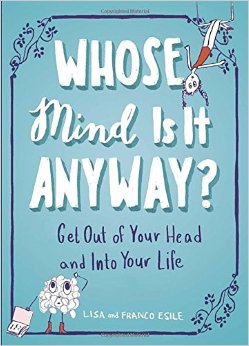
Lisa tackles all of this, and more, in her quirky new illustrated book Whose Mind Is It Anyway? Get Out of Your Head and Get into Your Life.
Co-written by her husband, Franco Esile, Whose Mind Is It Anyway touches upon how our thoughts can drive us crazy, how our beliefs can sabotage us, and how easy it is to find calm—once we stop thinking our way through life.
It’s a quick read, but don’t let that fool you: Within seven short, fun chapters, Lisa and Franco have succinctly explained how we can not only find peace from our thoughts, but also be at peace with ourselves.
I’m a huge fan of Lisa’s work, and I couldn’t be more grateful that she sent me a copy of her book and offered two free copies for Tiny Buddha readers.
Whether you win a copy or choose to grab one today, I recommend keeping it somewhere you’ll see it often and flipping through the pages whenever you’re getting stuck in a web of thoughts.
Start paying attention to how your mind works and you’ll notice this happens a lot!
THE GIVEAWAY
To enter to win one of two free copies of Whose Mind Is It Anyway?:
- Leave a comment below. You don’t need to write anything lengthy—“count me in!” is more than enough!
- For en extra entry, share this post on one of your social media pages and include the link in your comment.
Good luck!
Want to grab a copy now? You can order Whose Mind Is It Anyway: Get Out of Your Head and Get into Your Life on Amazon here.
FTC Disclosure: I receive complimentary books for reviews and interviews on tinybuddha.com, but I am not compensated for writing or obligated to write anything specific. I am an Amazon affiliate, meaning I earn a percentage of all books purchased through the links I provide on this site.
-
How to Create Happiness in Zero Easy Steps
“To experience peace does not mean that your life is always blissful. It means that you are capable of tapping into a blissful state of mind amidst the normal chaos of a hectic life.” ~Jill Bolte Taylor
I was fifteen when I first noticed that I was depressed. That was also when I became seriously interested in happiness.
How can I get my hands on it? Where does it come from? Why does it seem so natural to some people?
I wrestled with those questions for quite a while.
Fast forward to ten years later and things look a lot different for me. Happiness is now a default instead of a rare state. What a relief.
A few key lessons have made a world of difference. I’d like to share the most important one today.
Two Kinds of Happiness
One kind of happiness comes with positive experiences. It’s conditional. It comes when good things happen and leaves when bad things happen.
The other kind doesn’t depend on the occurrence of any particular event. It is sustainable and unconditional. It exists underneath both desirable and undesirable experience. It is the canvas on which other emotions are painted.
It’s also the kind with which most of us are unfamiliar. Why is that?
My theory is that most self-help, personal development, and psychology resources focus on the first kind of happiness.
They tell us how to make changes to our habits and routines that improve our lives. They talk about the role of thought and point out that if we change our thoughts we have a different experience.
There’s nothing wrong with these strategies. I feel fortunate I found them when I did; they got me out of my initial funk and gave me some breathing room.
And yet, my current experience shows me that there’s something even more satisfying on offer:
Happiness that doesn’t require work or practice. Happiness that doesn’t have to be learned or earned. Happiness that emanates from a part of us that is untouched by negative thinking, bad habits, or traumatic events. The kind that is synonymous with peace and follows us around wherever we go.
So…How Do We Get There?
The difference between conditional and unconditional happiness is how we get there.
The path to conditional happiness is self-explanatory: certain conditions must be met. It depends on completing your morning routine. On having situations break in your favor. On achieving success. On thinking positively.
Thinking positive is great, but trying to make it an ongoing habit can be incredibly taxing and neuroticism-inducing. Sometimes positive thinking is as stressful as the negative thinking you’re trying to escape! Controlling thoughts is hard.
Thankfully, in the second approach, we don’t have to.
That’s because unconditional happiness is independent of the type of thoughts you’re having. Tapping into this state involves seeing the way our minds and thoughts work together to create our experience. Positive change comes naturally with insight into this system.
Understanding The System
Here are a few basic observations about the mind:
- It constantly produces thoughts.
- Thoughts come to leave, not to stay.
- We bring thoughts to life with our consciousness. When we believe and latch onto thoughts, they look real, and we live out the experience of those thoughts.
Have you ever been walking on a trail, seen a shape that looks like a snake, and freaked out… until you realized it was a stick? It was a stick the whole time. But your experience changed drastically as your thoughts changed drastically.
The principle in this example is true all the time: We’re living in the feeling of our thinking, not the feeling of the outside world.
That alone could be (and is) the subject of a book.
But it becomes most profound when the goal is change.
Doing Less
When we think negative thoughts, conventional wisdom says we must change or get rid of them. It’s the strategy most of us adopt.
However, if the mind is constantly producing new thoughts, that means thoughts will change on their own. It isn’t our job to change our thoughts.
We often obstruct thoughts from naturally passing in and out of our consciousness. One of the ways we do this is by resisting them; it’s a way of holding on to them. When we allow them to, they pass through on their own, like clouds in the sky.
We don’t have to reprogram old thought patterns or adopt new beliefs.
When consciousness shifts away from the content of what we think and to the fact that we think, we stop being mesmerized by thoughts. We see that they’re arbitrary and meaningless until we believe them.
This allows healthier thought patterns to implant themselves automatically.
With little annoyances and minor distresses, it can be easier to see the transient, arbitrary nature of thought.
It’s hardest to see, however, in the really problematic areas of our lives. Pain from childhood trauma, destructive psychological patterns, unhelpful habits we learned in dysfunctional families.
Although it’s harder to see in those areas, the principle is not any less true. These areas cause the most suffering because we thrash against our painful thoughts about those experiences. We drop out of the level of consciousness where thoughts don’t have inherent meaning, and into the level where they’re real and hellish.
In these areas, the river of our lives becomes whitewater and we fight madly to escape. But even here, the truth remains: Thoughts look real and scary, and cause suffering—until they pass. It will suck for a bit, until we end up in a calmer part of the river. Which we always do.
Remember the scary snake we encountered on the trail earlier? The fear and pain disappear when you see that it’s a stick. This transformation is possible with any of the pain that we experience over and over again.
As we stop latching onto painful thoughts by seeing that they come and go on their own, our consciousness around a certain problem rises. And over time, even the worst of experiences are seen differently, in a way that sets you free. We get through the hardest of times without getting stuck in them.
Back to Happiness
How does this all fit into being happy?
Here’s how it has helped me:
When I remember the way things work—the mind produces thoughts, I experience thoughts as consciousness, which brings them to life, and thoughts float in and out on their own—I get less scared of my experience.
I used to be seriously afraid of emotions like sadness, jealousy, and my personal demon, depression. I would not only feel those emotions, but I’d feel emotions about the emotions. I was nervous about being sad. Sad about being depressed. Judgmental about being angry.
Of course, emotions look scary when we decide there are some we’re not supposed to have.
That second layer of meaning is a way of fighting against myself. What a waste of energy.
When I saw that doing so kept me trapped in pain, I naturally started to do it less. Since I see that it’s coming from thinking—and that it’s not my job to fix my thinking—I can relax. I know that in ten minutes, or tomorrow morning, I might feel different.
The more you see the transient, thought-created nature of our experience, the more a simple happiness wakes up. And since it’s not in opposition to negative experience, it can remain there underneath any emotion on the surface.
This is available to all of us, all the time. It’s just a matter of looking in a new direction, and seeing how our experience is created.
-

A Simple Way to Calm Yourself When Feeling Strong Emotions
“This is the root of Self. You are not your thoughts; you are aware of your thoughts. You are not your emotions; you feel your emotions…. You are the conscious being who is aware that you are aware of all these inner and outer things.” ~Michael Singer
I sat across from my colleague with a growing sense of discomfort. I had accepted an assignment from the boss, but I heard from my colleague an undercurrent of questioning and uncertainty—or so it seemed. It was so subtle that I couldn’t quite tell what was going on.
Did she not believe I could do it? Nobody else was stepping forward to meet the need. Was she saying it’s better to go with nobody than with me?
All I knew for sure was that I wasn’t hearing this outright. I decided to let it go, head on home, think about it tomorrow, and be fully present with my family instead. But the next morning as I pulled into my parking spot in front of the office, a subtle agitation rumbled in my stomach.
I walked into the quiet building and set my things down in the office, distracted by my disquiet and wishing I could focus on my task list. The thoughts prickling at me wouldn’t let go.
I laid my pen down and asked myself, “Okay, what’s going on?”
In my top drawer I keep a deck of “grok” cards that I bought from the folks at the Center for Nonviolent Communication. Each one has the name of a need or value—things like “hope,” “trust,” and “balance” show up in this deck. I frequently use these when I can’t quite put a finger on what’s bothering me.
I flipped through the cards and sorted them as I went. In the “not now” pile went cards like “freedom,” “competence,” and “creativity.” In the next pile, the “Maybe?” pile, went cards like “security,” “meaning/purpose,” and “friendship.”
I went on sorting between just these two piles until I hit one that resonated: “Acknowledgement.” That went into a new pile: “Yes.”
A couple of cards after it I found “Appreciation.” That went into the “Yes” pile too, and then I noticed something really interesting happen: I got angry.
Usually when I sort through these cards, the experience of finding the right word to put on my current needs or values results in feeling more settled, more clear. Frequently my agitation will be replaced by a sense of gratitude, or courage to act in a way that helps me meet my needs.
Typically, that is the value for me in identifying my needs. It helps me find a more straightforward and effective path toward getting those needs met. But it didn’t happen this time.
Instead, the voice in my head just became louder and more insistent.
My coworker should be grateful for my willingness to take on this new project! She wasn’t going to step in and do anything. Why wasn’t she acknowledging that I was making a sacrifice on behalf of the team?
This narrative swept me up. It threatened to pull me under.
Slowly, I started to notice another, quieter voice saying, “Why am I getting so upset? That doesn’t usually happen after I go through the GROK cards. What can I do for myself that won’t be so negative?”
I’m going to admit this was an odd experience for me. I don’t typically have this second, quieter voice. Or, if I’ve had it, I haven’t been able to hear it.
But I did hear it this time, and it called to mind Michael Singer’s book, The Untethered Soul. I read it just about a month before.
“You are not the voice of the mind,” he wrote. “You are the one that hears it.”
He suggests that when we’re bothered by something, we can change what we identify with. Rather than identifying with all of those thoughts and feelings, we can instead identify ourselves as “the observer” or witness of what is being experienced.
As I felt myself getting swept up in defensiveness against my coworker, I decided to try it. What would happen, I wondered? I started up a new voice in my head that said, “I am not all of these thoughts and feelings. I am the observer who is noticing that Amy is having a powerful experience.”
It was almost meditation, but not quite the same as my usual practice. Michael Singer might say I was doing it wrong. A psychiatrist might have a lot of questions for me—I don’t know.
What I do know is what happened inside myself. As I identified myself as “the observer who is noticing that Amy is having a powerful experience,” I relaxed. I let go of the waves of negative thinking.
I realized that I could talk to myself the way I would talk to a dear friend who is feeling unacknowledged and underappreciated. I realized I could give myself compassion.
I imagined telling myself, “I’m sorry you haven’t been appreciated. That’s hard. You are still okay.”
I admit I feel extra vulnerable as I type that out. Part of me doesn’t want to admit that I talk to myself in this way. On the other hand, this was such an amazing experience!
I was able to walk myself through processing my own needs and emotions in ways I’ve never done before. As soon as it happened, I wanted to shout it out to the rest of the world, “Hey, I’ve found a path that looks like it leads somewhere good! Come check it out!”
Do you ever feel the emotional undertow of unpleasant, uncomfortable feelings? Have you tried to resist them without success? Perhaps it would help to identify yourself as the observer.
Accept that the feelings and thoughts are there, but instead of identifying with them, try identifying yourself as the observer or witness who is noticing that this experience is flowing through.
Perhaps you already know this part of the path. Have you tried a practice like this? What works for you?
-

3 Things to Remember When Facing Emotional Pain
“We cannot tell what may happen to us in the strange medley of life. But we can decide what happens in us—how we can take it, what we do with it—and that is what really counts in the end.” ~Joseph Fort Newton
Life is messy. Sometimes it’s so beautiful that I feel blinded by the glory I have the privilege of bearing witness to. Other times, I have felt such deep despair that I thought my tears would never end.
Unfortunately, my husband and I endured the deepest despair we could possibly imagine immediately following what should have been our happiest memory—the birth of our son.
After he was born he could not take his first breath and we almost lost him. Our beautiful little boy that I had nurtured in my belly, prepared for, sang to, and dreamed about for nine months was struggling to hang on to life before our very eyes.
He was resuscitated and could not breathe on his own for a number of hours while we waited with baited breath and mostly in silence, praying that he would be okay. Thanks to the brilliant nurses and our amazing hospital, our little miracle took his first breath on his own.
When the immediate shock was over and he was stable, emotional pain crept in as if it was waiting for the right moment to pounce on us.
In the days following his birth our brains started to process the horror we witnessed that we could not immediately comprehend when it was happening right in front of us, and we felt the deep despair of it all.
I wish I could say that was the only traumatic experience in my life, but of course there are many more. This just happens to be one that I will share on a public forum. I am far from alone in this. We’ll all inevitably feel emotional pain many times throughout our lives, but we are hard-wired for this emotional turbulence.
Yes, that’s what I said. We’re hard-wired and made for this, for any unwelcomed pain and anguish that stumbles on our path. For some reason in today’s society there continues to be a taboo against feeling down, even though it’s a normal and inevitable part of the human experience that we are neurologically prepared for.
In recent years the taboo against feeling down has somewhat improved. Our willingness to accept that things are not always ‘perfect’ has helped many of us face emotional turbulence in a more honest and effective way.
Over the years I gradually accepted that emotional pain will come and go. I can now see that the more I accept emotional pain as a necessary part of life, the more I can handle it with grace when the waves of sadness wash over my heart.
Ironically, the more we accept emotional pain as a natural part of our human-ness, the more emotional freedom we come to find when we are faced with despair.
I am thankful that, at this point in my life, I can acknowledge my pain and sit with it to heal from my tragedies. Many years ago I would feel miserable for feeling miserable. Today, I am likely to think, “I accept myself even though I feel miserable right now and I know I won’t feel miserable forever.”
Throughout my life and by witnessing others go through despair, I have come to learn three ultimate truths about handling emotional pain that have nothing to do with denying its existence.
If you find yourself in emotional pain, keep these truths in mind so that you can navigate the waters of anger, sadness, or hopelessness as peacefully as possible.
1. Memories cannot hurt you.
After something terrible happens to us, we might respond to memories with fear, anxiety, or deep sadness.
Months after my son was born, I still had flashes of the hospital staff rushing in to resuscitate him, and my poor husband had intrusive thoughts about our son turning blue. These memories left us feeling hopeless and fearful, as if it were happening again.
We naturally want to push those thoughts away as quickly as possible or distract ourselves with anything else that takes our mind off of it. However, the more we push away negative memories, the longer we prolong our emotional freedom from it.
It often helps to acknowledge that this is indeed a negative memory; however, it already happened and cannot hurt you any more in the present. Sometimes you actually need to talk your way through it and give yourself reassurance that you are okay right now in this moment.
2. Every emotion is temporary.
Any emotion known to man is a fleeting, impermanent state (even the happy ones). Think of them like waves. Sometimes you can see it coming, other times it catches you by surprise. Some waves are bigger than others; however, by their nature they come and go.
It is hard to imagine how my husband and I were able to sit in the same room and get through the hospital staff resuscitating our baby boy, but we did. The emotions that we felt in that moment did not stay with us. They were a temporary state of being. We will never be fully ‘healed’ from this experience, but the emotional state changes with time.
When you are experiencing despair acknowledge that this, too, is temporary (even if it doesn’t feel like it at the moment) and will inevitably pass or change into a different emotional state.
3. It’s okay to give yourself a ‘time out’ from your feelings and negative thoughts.
Even though our emotions are transient states, sometimes we need to temporarily avoid negative thoughts and feelings to get through something specific (like a meeting at work, grocery shopping, or other necessary parts of life).
After my son was born there was no time to feel sorry for what he went through or for myself to have almost lost him. He had to be fed, changed, held, and loved. When negative thoughts interfered I needed to find ways to stop ruminations quickly (even if only for a few minutes).
There are many ways to temporarily stop negative thinking. Here are a few things I used to help myself cope when negative thoughts and memories crept in:
- Deep Breathing: Counting the breath is very therapeutic. I would breathe and count on the exhale up to ten, and then start over at one again. I recommend doing this two to three times until you have successfully stopped rumination. If negative thoughts interrupt you, notice that it happened, let it go, and continue the practice.
- Soothing Sensations: Comforting sensations such as a hot bath, a warm cup of tea, or a pleasant smell can bring a sense of peace. Focus on this completely to self-soothe and stop negative thoughts.
- Laughter: I often distracted myself from negative thoughts and memories with humor. Watch a funny clip on the Internet or call a friend that always makes you laugh. In a time crunch, you can simply think of something that always helps you laugh or smile.
We are stronger than we give ourselves credit for. It’s amazing that we have the power to handle emotional distress by simply acknowledging its presence and giving ourselves permission to feel our feelings.
At the end of the day, these unwelcomed moments give us rich emotional experience because we couldn’t appreciate the gift of happiness if it were not for moments of despair to compare it to. This is not to say that we should welcome more anguish, but to instead remember the cliché, “no rain, no rainbows.”
Sad boy image via Shutterstock
-

You Don’t Need to Fix the Past in Order to Have a New Future
Note: The winners for this giveaway have been chosen! They are:
- Dianna
- Michael Maher
- Kathleen B
- Yusuf Stoptagginmeanyhow Sulei
- Aparna
“The future is completely open, and we are writing it moment to moment.” ~Pema Chodron
My family recently drove from Michigan to North Carolina—twenty hours roundtrip. To entertain themselves, my five-year-old daughter Willow taught my three-year-old son Miller to play rock-paper-scissors in the backseat.
Miller learned the hand signals and got the overall concept pretty quickly, but he had a hard time with the fast speed of the game. Willow narrated, “Rock-paper-scissors…go! Okay, next round!” But Miller wanted to linger.
When he chose paper and Willow chose scissors, he’d see her scissors and quickly try to change to rock so that he could win the round.
Or if he chose rock and she chose scissors, he’d want to stop and hang out in his win for a while. He’d celebrate, gloat, and become frustrated when she was already on to the next round.
My husband and I tried to explain to Miller that it was a quick game with no time to hold on to what was already done. There’s also no need to hold on—each round brings a brand new chance to win or lose.
While we tried to teach him that it made more sense to leave the past behind and look toward the next round, his let-it-go-and-move-on wasn’t up to par compared to his older sister’s.
Miller turned rock-paper-scissors into a slow, thought-heavy emotional roller coaster, where every move felt important and meaningful. What could have been a fun and easy game was not very fun for him.
It was clear to see how Miller was getting in his own way. And then it hit me that I—and most people I know—do the same thing in our adult lives. We innocently get in our own way as we focus on what we don’t like and try to make it better when it would be far easier to leave the past behind and look toward the “next round.”
Life is always moving through us—nothing is permanent. New thought and emotion flow through us constantly, creating our rotating and fluid experience of life.
Sometimes we stay out of the way and let our experience flow. Willow was staying out of the way as she played rock-paper-scissors (and she was having a great time, I might add). And sometimes we’re more like Miller, innocently blocking the easy flow of life with our opinions, judgments, and disapproval. We don’t pick up and move on as much as we focus on righting what is already over.
In hindsight, I can see how I’ve dammed up my own flow of experience at times in my life, especially when I was struggling with things I wanted to change.
When I was facing a confusing and uncontrollable binge eating habit, for example, I thought what I was supposed to do was to examine it, analyze it, talk about it, and focus on it with a whole lot of emotion and energy until I made it go away.
But more often than not, that created more suffering. It left me even more convinced that my habit was a serious problem that I needed to solve, and it left me feeling hopeless because I didn’t know how to solve it.
Of course, there’s a lot to be said for understanding ourselves and our experiences in a new way and taking action where action is needed. Those are absolutely necessary. But keeping our “problem” under a constant microscope, trying to use our intellect to solve it as if it’s a crossword puzzle, is not the way to freedom.
If new thought, emotion, and insight are always flowing through us like a river, doesn’t it make sense to look upstream at what’s coming next, especially when we’re experiencing something we don’t like? It’s just like we told Miller in rock-paper-scissors: if you don’t like what happened in this round, let it go and look toward the next round.
But we forget this when it comes to the big things in life, don’t we? It seems responsible, necessary, or adult-like to hold the problem tightly until we fix it.
If our moment-to-moment experience of life is like a river rushing through us, our “fix-it” attempts are the equivalent of standing in the middle of the river, filling a bucket with the water that has already flowed past and carrying that bucket with us everywhere we go.
We obstruct the momentum of the river and analyze that old, familiar “problem” water to death, not realizing that if we only turned and looked upstream we’d have an excellent chance of seeing something new and different.
Looking upstream we might see with fresh eyes—looking downstream, we’re just looking at more of what we already know.
With regard to my binge eating habit, I realized that my best chance for change would come from letting go of everything I thought I knew and being open to fresh, new insights and ideas. Not carrying around the past or analyzing the problem; instead, being open and unencumbered.
As I began to see my habit-related thoughts and behaviors as things flowing by me that I didn’t need to grab ahold of, they passed by more easily. Each and every day I found myself less in the way, realizing that I was very separate from those unwanted thoughts and urges.
When my habit-related experience looked more like leaves floating on the surface of the river than like gigantic boulders, life took on a new feeling of ease. I saw that I could gently dodge some of what was coming down the river rather than stop and fight with or fix it. The healthy “me” was more visible than ever.
Not staring at your problems is not ignoring or denying the issue any more than Willow was ignoring or denying the previous rock-paper-scissors round when she easily moved on. Take note of how your experience feels. When life—which really is very game-like—feels like a difficult, not fun, emotional rollercoaster, you’re holding on to something, innocently getting in your own way.
Maybe even the bigger issues in life really aren’t so different than rock-paper-scissors—you get what you get, but you don’t have to stay there and try to change the last round. Let life flow and as you do, the healthy, clear, peaceful version of yourself will be more visible than ever too.
NOTE: Amy has generously offered to give five copies of her new book, The Little Book of Big Change: The No-Willpower Approach to Breaking Any Habit. Leave a comment on the post for a chance to win! You can enter until midnight, PST, on Friday, February 5th.
Past in the sand image via Shutterstock
-

10 Powerful Practices to Take Good Care of Yourself
“You don’t pass or fail at being a person, dear.” ~Neil Gaiman
I discovered my spiritual path early. As a teenager I would read my mother’s self-help books. I spent most of my twenties actively pursuing self-development by studying, attending workshops, and going on retreats all over the world.
At the time, I thought I was searching for happiness and inner peace. I see now that I bought into a rigid idea of what a ‘spiritual person’ was and tried to live up to that.
My inner world was not happy or peaceful. The way I treated myself was far from soulful. In fact, it was down right abusive.
I thought I needed ‘fixing’ because even after all the learning and work I had done, I would still beat myself up whenever I wasn’t perfect. My internal story about myself continued to be judgmental and negative, and I remained fixated on gathering evidence to prove I wasn’t good enough.
Over a decade later, I was married with a child and had gained many qualifications that helped solidify a life without self-abuse. It didn’t occur to me until I had my second child—nine years after my first—that I wasn’t really being nurturing or caring toward myself either.
I knew I was doing something right, because my experience the second time around was completely different; it was a lot more joyful.
I reflected on exactly what the difference was between my two experiences. I came to realize that the answer was me.
I had changed so much—my thoughts, my expectations, my beliefs, the way I responded to emotions and stress, all of which had a flow-on effect that influenced everything else in my life.
Then something so minuscule happened. I would escape the house and my newborn for thirty minutes, once a week to read an inspirational Tiny Buddha article over coffee.
This was enough to keep me ‘topped up’ so I wasn’t completely depleting myself while caring for my family during those first few months. No big revelation really that taking time out for yourself is going to be a good thing.
Yet, this simple act had such a huge impact on me. I really started focusing on self-care. It became an intention.
Instead of forcing myself to exercise and lose weight, I listened to what my body needed (as a result I didn’t beat myself up if exercise wasn’t achieved).
I stopped expecting myself to complete everything on my to-do list.
I questioned certain beliefs (like defining what being a mother, wife, and woman meant to me).
If any unkindness about myself crept into my thoughts, I challenged it. If there was some truth to the thought, I met that with acceptance, which invoked a compassion that wasn’t present before.
I started paying attention to what was different from a good day to a bad day. I explored when I felt pain and suffering trying to locate why it was there (hint: usually when reality was different from what I wanted it to be). All this eventually turned into an inner practice for me.
An inner practice doesn’t tell you what to think, or what to do. It invites you to explore how you think, and why you do something (or don’t do it).
Here are some tips for creating your own inner practice:
1. Connect with yourself.
Self-awareness is being able to explore aspects of yourself with curiosity instead of judgment. Once we develop this ability we can deepen the connection we have with ourselves—not just our mental self, but emotionally, physically, and spiritually.
2. Connect with acceptance.
Acknowledge what’s true about yourself, today, in this moment, exactly as you are—without seeking to immediately change anything. This is acceptance.
Ignoring, rejecting, or refusing to acknowledge any part of yourself will never bring about effective change. Acceptance brings the possibility of transformation. A caterpillar transforms into a butterfly; it doesn’t change into one or become a better caterpillar. When we practice self-care, transformation shows up in our life.
3. Connect with self-kindness.
Offer yourself kindness. You are not any less special from anyone else on the planet, so why would you show others kindness and not yourself? Is abuse toward anyone (including yourself) ever acceptable?
You have a choice whether you meet your inner world with kindness, ambivalence, or meanness. (Tip: life is easier with kindness in it).
4. Connect with self-compassion.
Have compassion for yourself when you aren’t able to achieve kindness. Acknowledge your flaws, faults, and failing by meeting them with compassion.
Either being human and judgment go hand-in-hand, or you align yourself with being human and compassionate. Which would you rather? Only one can exist at a time.
5. Connect with your needs.
Most of us spend our lives caring for others. Sometimes we sacrifice our own needs, but is it really the grand loving gesture we convince ourselves it is? Do you over-give to others so you don’t have to listen to what might be lacking in your life?
What do you need physically, emotionally, mentally, and spiritually? What do you feel deprived of?
We have to decide that our needs are non-negotiable and put boundaries in place to ensure that we receive what is vital for our well-being.
If you asked yourself how your life would be different if your needs were met, the answer would be a positive one. (Although it is important to note that needs and wants are completely different things).
6. Connect with your thoughts.
If we have been unkind to ourselves for a long time, it can take a while to break that habit. Being aware of your thoughts gives you the opportunity to choose whether they are true or not. You should challenge a thought’s truth, kindness, and purpose.
Sometimes we aren’t even aware of how a single thought can ruin a good mood. For example, have you ever looked at a photo of yourself from a few years ago and thought, I was much prettier /slimmer/ happier/more fun, then? Wouldn’t you think it was a bit rude if a friend said those same things to you?
Or, do you place your future self on a pedestal like I used to. Future Belinda had achieved so much more than me; she was way more confident, wiser, more spiritual, happier, and healthier. It’s so unkind (and painful) to compare yourself to a version of you that doesn’t exist.
7. Connect with your beliefs.
Sometimes our feelings don’t match what our logical brain is telling us. When this happens, the answer often to that contradiction lies in our beliefs.
We formed a lot of our beliefs about the world as children. As adults we can still unconditionally continue to believe what a child interpreted as truth.
Self-care is exploring what beliefs you hold—giving yourself the option of whether you wish to continue to believe them or not. Start with your beliefs about self-care—do you think that it’s selfish or self-preservation?
8. Connect with your expectations.
Our expectations can change the way we view everything in our life. I notice that on days I am able to completely disable my expectations, I usually have a really good day because there are no conditions placed upon it.
What happens if you don’t achieve the expectations you place on yourself? Why is the expectation there? Self-care is ensuring that your expectations serve you—not you serving them.
9. Connect with your wants.
There is a gap between how things are now and how we want them to be. Sometimes we fill this gap with worry, pain, and stress.
Explore this gap between what is and what you want. What exactly would you like to be different? What would be useful to help narrow this gap?
10. Connect with your intention.
Intention is behind everything we do. For one day, one week, or one month, make your main intention self-care.
That means that every decision you make is with the conscious intention of doing what is best for you and your health. Do you think that you would make the same choices? How would life be different?
—
We are all perfectly imperfect, so we are going to temporarily fail at some point. The main thing to remember when creating any practice is: begin, continue, and repeat.
Woman meditating image via Shutterstock
-

How to Be Happier Without Making Any Big Life Changes

“The place to be happy is here. The time to be happy is now.” ~Robert G. Ingersoll
In 2014 I changed my whole life.
I quit a horrible job, traveled to Costa Rica and Panama, moved across the country, moved in with my partner, and landed my dream job in an education charity.
Why did I change so much? The answer is simple—happiness.
I had spent three years planning and dreaming of a different future for myself. One where I could travel, have a job I found meaningful, and live with my boyfriend in our own flat. Finally, after one morning too many spent in tears, I built up the courage to quit my job.
I spent the next few months riding on a wave of relief. Everything was going to be all right. I was going to be happy and in love with my life.
The problem was, this didn’t happen.
It soon became clear that I wasn’t experiencing the blissful future that I’d dreamed of. I ended up feeling even worse than I had felt before I changed anything. A sense of dread and helplessness crept over me as I realized that changing your life situation doesn’t automatically make you happier.
There was no pot of gold at the end of the rainbow.
After a month or two of trying to pull myself out of a depression by making plans for a long off future, I started reading what I could about life and happiness. I went back to books I’d started but hadn’t finished and reread old favorites.
As I read and reread these books, I started to notice a pattern. At the heart of all the arguments and instructions in those books were the same two ideas:
1. Be aware of your thoughts so your mind can’t control you.
Learning how to be aware of thoughts rather than letting your mind control you seems to be essential to experiencing lasting happiness. Meditating every day, even just for ten or fifteen minutes, makes it easier to be aware of your thoughts and to learn how to quiet your mind.
For me, being aware of my thoughts has made me more intentional about how I think about things. I now try to look at my life positively and search for solutions to issues rather than worrying about problems that might not even happen.
Being in the present moment also takes the power away from your mind. In the present moment there’s no past to regret and no future to worry about, so you are naturally happier. Though keeping your attention in the present is hard to sustain, it’s simple to try.
Give it a go by focusing what you can see around you right now. What sounds can you hear? What can you smell? What can your body feel? Don’t answer these questions in words, just move your attention to your different senses and acknowledge what they notice.
I’ve now made being aware of my thoughts a daily practice. Instead of reading the news on my phone, I dedicate my ninety-minute commute to meditation and being present.
As I walk to the train station I listen to the birds singing and hear the wind rustling in the trees. On the train I meditate for fifteen minutes before reading a book for the rest of the journey.
How could you incorporate meditation and being present into your daily routine?
*Recommended Reading: The Power of Now, by Eckhart Tolle
2. Fill your life with things you enjoy now.
This step is more straightforward. There’s an easy process you can follow to complete it. First, you need to write a list of all the times you’ve felt truly, deeply happy. What were you doing? Who were you with? Are there any common themes?
After you identify the common themes that brought you so much joy, fill as much of your day-to-day life with them as possible!
Could you take a walk in nature on your lunch break? Or could you listen to your favorite type of music while cooking dinner? Perhaps you could swap TV time for working on a creative project like crafting, drawing, or writing?
I realized that some of my happiest moments happened outdoors when I was surrounded by nature. So now I’m trying to spend most of my free time outside, inviting friends and family along too so I can spend time with them. I’ve noticed that I’m so much more relaxed and I really look forward to my weekend’s adventures!
Now it’s your turn! What changes can you make to fill your life with joy?
*Recommended Reading: Finding Your Own North Star, by Martha Beck
Making these little changes doesn’t mean that you can’t make a big change in your life. They will just help you to be happier in the process and put less pressure on the end result.
Enjoy the journey along the rainbow and it won’t matter so much how much gold is at the end.