Tag: technology

  • What Happened When I Went Off the Social Media Grid

    What Happened When I Went Off the Social Media Grid

    “Remember, being happy doesn’t mean you have it all. It simply means you’re thankful for all you have.” ~Unknown

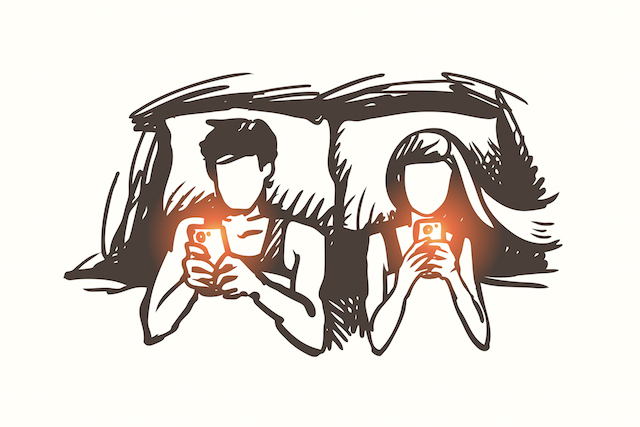
    It was 3 a.m. when I realized I was the only person not in St. Barts. At least that’s what it felt like on Instagram, even though I know it wasn’t true. I wasn’t the only person not dancing on tables to a saxophone in the Caribbean. My fiancé was asleep right next to me.

    For the next three hours, I continued down the rabbit hole.

    Three hostages were released. Trump did more things to avoid bringing up at dinner parties, even in Texas, where I found myself living by accepting a marriage proposal from a Houstonian after a lifetime spent proudly between New York and L.A.

    I was served (and purchased!) an acrylic purse organizer for my closet that makes them stand just so, as if the algorithm had been privy to my frustration when they all fell limp sideways just yesterday. Some friends were pregnant. Even more got skinny—Ozempic. Shockingly, aside from procreators, on Instagram, no one ever gets fat. Which was how I was feeling then, now that I think about it. The fetal position is unbecoming for a midsection.

    By 6 a.m., my eyes were bloodshot from the screen’s glow, and I official felt like the heaviest, least pregnant, most geopolitically confused loser, not in St Barts, with a messy closet—who lived in Texas.

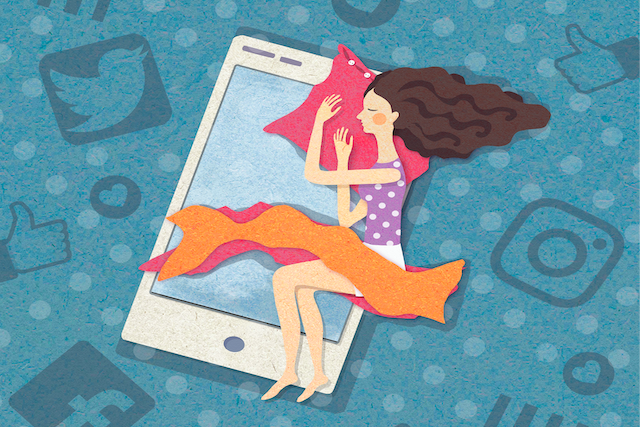
    It went on like this for weeks. Really only since I got to the Lone Star State and became a lone star with no friends, in a place I had considered visiting only if there were engine trouble. Devoid of an actual social life in a new city, I had begun to live vicariously through my old friends by staying in touch with them on Instagram. I’d never been more ‘connected’ or felt more isolated and alone. Still, I scrolled. And if I didn’t stop, I would never again get to sleep.

    I was going cold turkey. Wasser: 1. Zuckerberg: 0.

    When the time came, even my phone was skeptical. “Delete Instagram?” came the pop-up. I knew what I had to do. And so, with a swift ‘click-hold-delete,’ the Instagram app icon shimmied out of existence on my home screen. The joke was on me, though; getting back to bed was not in the cards. I couldn’t wait for my friends to wake up—on both coasts—so I could gloat.

    “Just FYI—if I don’t get back to you on Insta, … I’ve deleted it from my phone,” I’d say with a cool, casual air of someone who’s escaped the matrix of social media, like I was better, completely leaving out the part where I’d become an addicted insomniac crackhead.

    My L.A. friends called me “brave.” My New York friends were nonplussed if not annoyed: “So what? I’m supposed to call you now?”

    While not exactly a Nobel laureate reception, here’s what happened when I had nowhere to hide and forced myself to live IRL. My sleep got better. Packages from China stopped coming as I stopped spending frivolously on clothing that couldn’t make it through a wash. But these were obvious upsides.

    My screen time went down 42%, which, according to the Mayo Clinic, can improve your physical health, derail obesity, and boost your mood. Then, I did the math. By removing Instagram from my phone, I had taken back nearly two weeks of my life—every year.

    I was markedly happier… With my dog and the way she takes over my pillow now that I wasn’t exhausted in the morning. With my fiancé, who is much more fun to be around now that we’re both paying more attention to phone-zombie behavior (mostly when I remind him). Even Texas isn’t that bad.

    When I started looking up versus down at my screen, life in the present got prettier (even with Houston’s lack of zoning laws that puts fine dining establishments next to an AutoZone.)

    And then it hit me. The hardest part of growing up is coming to terms with who you are and, moreover, all of the versions of yourself you’ll never be. As an older millennial, I have had social media tracking my life since I was eighteen. I am now thirty-seven. I have been so many people.

    I’ve had multiple attempts at careers until I found one. I have had dreams I’ve let go of. Dreams that haven’t died. Loves I’ve lost. Men who still looked at my story even though I never wanted to speak to them again. They still bring me right back to being nineteen/twenty-two/twenty-seven every time I see their name.

    Social media connects all my ‘eras.’ Every success, failure, false start, and hair color that comes with adulthood and the people, places, and things that accompanied them. All my past timelines living amongst my present, right in my pocket. No wonder I found it so hard to let any of them go. And even less shocking, I couldn’t make new friends. My dance card—albeit virtual—was full.

    Within weeks without Instagram, I found myself with time on my hands. I was exercising more. The dog and I found walks we like in the neighborhood. I went out and actively looked for community outside my phone screen. It existed. Turns out the adage is true—you are where you put your attention.

    By making eye contact and staying present when out at restaurants, or getting coffee, or at the gym, I’d even made friends. New friends I hosted for dinner. A dinner so large I had to rent a table because there were more coming than my six-person dining table could seat. A table I did have to source online, but not on Instagram—an app I only regretted not having when I wanted to give my friends at home major FOMO and show them what I was up to.

  • When Positive Messages Feel Bad: Why I’m Changing How I Use Social Media

    When Positive Messages Feel Bad: Why I’m Changing How I Use Social Media

    “How wonderful that we have met with a paradox. Now we have some hope of making progress.” ~Niels Bohr

    Social media is indeed a paradox in that it has the power to be both good and evil simultaneously. Ironically, one of the most harmful things about social media is the abundance of “positive” messages.

    You’re probably wondering how something that creates so much comparison, self-doubt, and anxiety can be “too positive.” What I mean is that social media messaging is starting to put a lot of pressure on us to be grateful and optimistic about our life no matter what we’re going through—also known as “toxic positivity.” This seems to especially be applied to mothers.

    Optimism and happiness are of course wonderful when they’re authentic for you. However, if you try to pass over your uncomfortable emotions or ignore what you’re going through, it’s similar to spiritual bypassing, where you try to skip over being a human and struggling through life’s challenging times.

    What feels like toxic positivity to one person can feel completely empowering to another. It depends on where you’re at in this moment and how a specific message lands with you.

    There does seem to be an overall trend, however, of emphasizing how grateful and fulfilled we should be without the counter-messaging that sometimes life just sucks.

    One of the hardest things about social media is staying in tune with ourselves. We go to our phone for comfort, distraction, and entertainment. Once we arrive, our brain gets hijacked by the content, and we have to buckle up for whatever ride the algorithm sends us on. Even with the best intentions going in, we can get turned around by one video or post and find ourselves feeling like we aren’t measuring up.

    When I first became I mother I was obsessed with the idea of gentle parenting. I consumed everything I could find on this parenting style. I gave it my best go, but every day I felt like a complete and worthless failure.

    I was bombarding myself with an idealized version of this parenting style that social media made look so easy. After reading any social post, I felt like I was an idiot for sucking at it.

    How hard is it to just speak in a calm voice and not lose your patience with your one-year-old? He’s literally an innocent baby! One that hits the dog, bites you while breastfeeding, or turns and runs into the street with a mischievous smirk on his face.

    In my frustration I would go straight to social media to flagellate myself with messaging that had a toxic effect on me. I pivoted against my husband who had a more relaxed attitude toward parenting and put more pressure on myself to be a “perfect” mom. This created tension in my marriage and physical and emotional burnout for me.

    Don’t get me wrong here’; I don’t think there is anything inherently wrong with social media. The way it connects us with each other is truly wonderful. The current messaging to parents and mothers sounds so beautiful at first glance.

    “Your babies grow up fast, so you should savor each moment.”

    Motherhood is the most challenging job, but so worthwhile.”

    “Your house is a disaster, but you shouldn’t care about that when you have young children.”

    My issue is that we are using social media as a weapon to inflict self-harm. Instead of taking these messages in the way they are intended—to inspire us—we criticize and judge ourselves against them. 

    We can start to feel bad that we actually care if our house is a giant mess or that we don’t enjoy every moment.

    Or we might feel guilty for not feeling grateful. Or bad about feeling sad. Or frustrated because we can’t just “choose to be happy” when we’re feeling down.

    My solution is not to delete all your social media apps (but go for it if that sounds amazing to you). What I recommend is to start actually noticing how each reel, TikTok, or post feels in your body. It doesn’t matter that it has beautiful music, photos, or a positive message.

    If your brain is twisting that message to be used against you, it is not yours to absorb.

    It is easier to spot the types of messages that we instantly don’t agree with. Any time I see a perfectly put-together mom with three kids in matching, neutral-toned outfits, I mentally reject it. It doesn’t matter what the content is; this is always a pass for me. What messaging bothers you or feels toxic is completely personal.

    Our brain gets conflicted when something seems really positive, but doesn’t feel good to us. Since our brain doesn’t like being confused, we unknowingly spend mental energy trying to make sense of the discordance that we feel. Becoming aware of your emotional reactions helps you quickly accept or reject the messaging coming at you, so you aren’t as negatively affected by it.

    We don’t need to villainize the content creators here either. I don’t think anyone (hopefully) is going out there intentionally using pretty messaging to turn us against ourselves. So much of the messaging we see is meant to be inspiring and helpful.

    A lot of times I feel connected and motivated by the positivity I encounter on social media.  Especially content that is less perfected and less filtered.

    When you come across a “positive” message that makes you feel critical of yourself, I suggest you mentally “pass” on it and move on. 

    I like to compare social media messaging to a food sensitivity. Tomatoes are not inherently bad, but if your body doesn’t react well to them, then they aren’t for you right now. You may heal or grow out of some particular food sensitivities and be fine with them in the future.

    Giving yourself the power to pass on or to accept every message that comes your way gives you complete control over your experience on social media, regardless of what you scroll through.

    You get to decide what “positive” things feel good to absorb and what “positive” things aren’t for you right now. My wish for each of you reading this is that you update your relationship with social media to be one that fully empowers and supports you.

  • The Simple Changes That Reduced My Phone-Induced Anxiety

    The Simple Changes That Reduced My Phone-Induced Anxiety

    “Simple living doesn’t solve all my problems, it just removes distractions.” ~Melissa Camara Wilkins

    At times it’s felt like my phone was my only access to the outside world. A place to connect in the middle of the night. The means to stay in touch with friends and family on the other side of the globe. It was a lifeline.

    Until it wasn’t.

    Improved sleep, reduced stress, and a mindful relationship with technology—they were high on my wellness “should have achieved by now” list.

    I’m not sure which was bothering me more, the actual stress of not having a mindful relationship with technology or the fact that I had not been able to achieve a mindful relationship with my smartphone.

    It was a cycle in my mind I just couldn’t stop. And I was struggling. All the tips and current trends to “digital detox” were not making my life easier. In fact, they were making it much harder.

    Being unable to successfully follow advice for my health made me feel like a failure, especially as it was connected to my mental health. Did that mean I didn’t care about my well-being? Was I a fraud?

    My phone was disrupting my sleep and worsening my anxiety. But all it took was one small change to break my bad habits and create a new, more mindful relationship with technology.

    Where It All Began

    Growing up I was a self-proclaimed night owl. As a child and young adult, I stayed up late reading. In university I would study late into the night.

    As I got older, falling asleep was always a struggle. I decided I was a night person and would use that time to get ahead of my to-do list for the next day. I figured the more I got done the night before, the easier the next day would be.

    When my first child was born, I was introduced to the late-night social media scroll. I was up feeding the baby in the middle of the night, trying not to fall asleep in my chair. And it turned out there was something that would keep me awake and entertained, but not disrupt my son: the blue screen of my phone. I knew it wasn’t ideal, but the thing is, it worked.

    Even after the late-night feedings ended, the screen still kept me awake. I would go to bed with the intention of reading a downloaded book or an article on my phone. It was so convenient to have all in one place!

    But inevitably a notification would distract me. An email. Or an update on social media. A message from my parents.

    To this day I’m a bit ashamed to admit I was guilty of not turning off my work email notifications, even though I was on maternity leave!

    What’s funny in hindsight is that at the time, those notifications annoyed me. It bothered me that I was still getting work emails. But I didn’t turn them off.

    I wondered who would send me a message in the middle of the night. I would check, knowing it was likely from someone in a different time zone, not expecting me to check my messages until the morning. But I looked anyway.

    I found myself often unable to sleep. Remembering the advice I’d received to “get up and do something different” if sleep didn’t come, I figured I’d found a solution: I could take a break from trying to sleep without leaving my bed, by using the endless options available on my phone. Located conveniently next to my bed, charging.

    And there I would be, hours later. Still awake, exhausted, and unable to fall asleep.

    I Needed to Make a Change

    I knew I needed to make a change. The demands of working and having young children were starting to make an impact on my health. I was tired, and not getting the sleep I needed.

    I decided that if my phone was keeping me up, and I was pretty sure it was, then I’d remove it from my room. That’s what the influencers and thought leaders were recommending! Or so it appeared as I researched the topic on my phone, late at night, in bed!

    The irony is not lost on me.

    My Mistake Was Following Influencer Advice

    On the very first night I failed. My son woke up, and I scrambled to find what time it was, but my phone wasn’t next to my bed. I crashed into several things trying to get to his room in the dark because my flashlight was an app on my phone. While this was happening, my son woke up my daughter.

    Insert several curse words that my children probably didn’t need to hear.

    By the time I got them both back to sleep, I was very much awake, alert, and a bit annoyed. Mostly at myself. What was I thinking? Why was I trying to follow this ridiculous Internet advice?

    And then I turned on myself.

    Why couldn’t I follow this ridiculous Internet advice? If it was working for everyone else, why couldn’t I do it? Was I just generally failing at adulting?

    Heading back to bed, the annoyance shifted into worry.

    Would I wake up with my phone alarm in the other room? What if I didn’t wake up to get everyone where they needed to go on time in the morning? Would I hear my alarm from the other room? Wait, the alarm won’t work, the phone’s off!

    Logically, I knew I was being a bit silly. I would get used to having my phone in another room.

    But I was tired. And time poor. And so frustrated. I wanted simplicity, and this was making my life more complicated.

    Why Did I Have So Much Resistance?

    Reading this, you might be thinking, “You could have just…” And yes, you’re right. I could have done several things differently. I could have made it work, having my phone overnight in another room.

    But here’s the thing: For changes to stick, I needed to start by making my situation easier, not harder. Sustainable change was what I was looking for.

    So, the first step couldn’t be too big or too hard. I was making the common mistake of trying to jump from one extreme to another. If I’m already tired, and my goal is to be less tired, then the first step has got to help with that.

    If the barriers are too many, if it’s just too hard, then there will be too much resistance. Then I’m probably not going to stick to it.

    There was a second reason I was not comfortable with having my phone off and in another room at night: We don’t have a landline, which is pretty common here in Australia. My family lives overseas. I want them to be able to reach me. At crazy hours if necessary.

    A solution that involves them not being able to do so will not help me sleep. Not at all.

    At the same time, I agree with the arguments for having digital devices out of the bedroom. And I did feel the phone was impacting my ability to fall and stay asleep. Was there an alternative?

    Sometimes being “best practice” doesn’t mean it’s going to fit into every person’s lifestyle. Nor should it. A healthy lifestyle is about finding the right fit and sticking to it.

    I needed to find an alternative. And I did.

    Focus on the Desired Outcome, Not the Popular Steps to Get There

    Instead of focusing on the rule, or the advice, I decided I needed to be realistic. Forget what the influencers were saying!

    What really was my problem? It wasn’t about the phone. What was I trying to achieve? Less stress and more energy, which meant I needed better sleep. And fewer distractions and interference from digital devices. Including my phone.

    Keeping that in mind, the rules didn’t matter as much. Rules that put me into a success v. failure mindset.

    Focusing on the outcome, or the goal, I didn’t have to engage with rules. Like where specifically the phone needed to be. Instead, I could address the changes I needed to get me where I wanted to be.

    To get there, I needed to change my habits and how I interacted with my phone at night. To get better sleep.

    Once I started thinking about it that way, everything became a lot simpler.

    The Change That Worked Was the One I Could Commit To

    Instead of turning off my phone or putting it in another room, I did something else. I turned it back into a phone, every night. A phone with no Internet access! And a blue light filter set to a timer, which now comes built into many mobile devices.

    Every night at 8:00pm, regardless of where I was or what I was doing, my screen changed to night mode to lessen the blue light interference.

    I considered putting my phone into flight mode. And if this is a possibility for others, I highly recommend it. Flight mode allows access to many frequently used features.

    But it does create the potential issue of completely barring communication. That didn’t work for me, so I made an adjustment. Instead of flight mode, I turned off the WiFi and data instead. A two-click solution.

    And it worked.

    For me, I find the best solutions when I’m realistic about where I’m at. If the barriers are too great, even if they’re perceived barriers, change probably isn’t going to happen. And even if it does, it’s probably not going to stick.

    What can I do instead? Focus on the goal. Create a series of low barrier changes guiding toward that goal. For me, this is the answer to sustainable lifestyle changes.

    The First Step Improved My Sleep, the Second Was for My Mental Health

    Every morning I wait an hour from when I wake up before I reconnect my digital devices. I don’t turn back on WiFi or data for at least an hour. Every morning.

    When I implemented my original habit I found that some days, I forgot to turn the data and WiFi back on. Those mornings were wonderful! I was more present with my children, and I was significantly less stressed about what I had on my to-do list.

    And when I did reconnect, it was my choice. The notifications started rolling in, and it didn’t bother me. Emails didn’t get me feeling overwhelmed. I stopped falling victim to “compareitis” while scrolling social media. My phone stopped impacting my mood.

    At first, I didn’t understand the connection.

    But on the days when I woke up and immediately reconnected, it was the opposite. I was inundated with notifications. And, I usually checked them. It was overwhelming, and I was only barely awake. It made me stressed before I even got out of bed, and it set the tone for my entire day.

    It was hard for me to accept, but my mood was influenced by notifications and what I saw social media. This bothered me because I felt like I should be better than that. As if just by knowing that it could be a negative influence, I should have been able to rise above it.

    Why Does My Morning Habit Matter?

    First thing in the morning I’m a lot less resilient. I’m more likely to react emotionally to what I see, hear, and read. And my early morning choices can set my mindset and mood for the rest of the day.

    So basically, my mood was being set by whatever popped up first on my social media feed. Or whatever was at the top of my inbox. By doing turning to technology immediately, I was handing control of my mood over to my phone.

    By delaying my digital start to the day, I found I was more mindful. And completely in control—of what I did first, what I saw, and how I reacted. I had taken control back of my mindset and how I would approach the day. I stopped allowing my mood to be dictated by whatever happened to pop up first on my mobile phone.

    The Lesson I Learned Was Simple but Powerful

    There are three key actions that help me be more mindful of my relationship with my phone and digital technology.

    My reality is that I don’t want to simply discard my smartphone. It makes my life simpler and allows me to spend more time doing things that matter. But only if I keep my relationship with it balanced in a way that suits me and my lifestyle.

    While I might not always be able to do them all, these are still my goals. In addition to improving my sleep, this strategy had improved my mood and mindset.

    My Top Three Tips for a More Mindful Relationship with Your Phone

    1. Disconnect your phone from the Internet at night, using flight mode or turning off the WiFi and data.
    2. Keep your phone disconnected from the Internet for at least an hour in the morning.
    3. Disconnect periodically during the day when you want to be present and mindfully engaged in an activity.

    The biggest thing I learned is to worry less about the tools and rules, and more about what works for me. The best changes are the ones you can stick to because they’re the only ones that will become habits. Once something becomes a habit, it doesn’t require much thought to keep doing it. There are many different paths to reach the same outcome. Find yours and follow it.

  • Our Odd Culture of Over-Sharing and the Quest to Be Relevant

    Our Odd Culture of Over-Sharing and the Quest to Be Relevant

    “Be yourself. Life is precious as it is. All the elements for your happiness are already here. There is no need to run, strive, search, or struggle. Just be.” ~ Thich Nhat Hanh

    We show off our best moments—another sunshine shot from the beach, big smiles, cocktails and all. We try to be controversial. We ride the wave of the latest trend, showing we’re ‘on point’ and ‘in the know.’ We follow in the slipstream of something clever or enlightened someone else has said, rewording a little as if it’s now ours to own.

    We hit send. We repeat.

    As social creatures we all have a desire to be social, it’s literally built into our DNA. However, this modern-day version of social is a strange beast. We’ve developed an odd culture of over-sharing. For many of us, this version of social has also become something of a strange quest to be relevant.

    The ‘social’ tools that allow us to do this are increasing—Facebook, Twitter, Instagram… the list goes on. They’re getting easier to use. Easier to update. Easier to navigate. Easier to integrate into our day. So much so, they’re becoming a constant part of our days rather than something we use infrequently. They’re no longer seen as something we could be using, but rather something we must be seen to use.

    The pull is strong, and getting ever stronger.

    The transition has been swift and shows no sign of slowing. If anything, it’s likely to accelerate as the tooling becomes ever more addictive. And make no mistake, it is built to be exactly that.

    This culture shift is leading to some peculiar behavior. The young, and not so young, can be found obsessively ‘checking in’ to the online world, while checking out of the place they’re in right now.

    What’s This Really All About?

    Can we no longer just savor the wonderful meal that’s in front of us without taking multiple pictures, sharing, and hashtagging to oblivion?

    Can we not be present in beautiful surroundings without feeling the need to ‘check in’ and let our ‘friends’ know exactly what we’re up to?

    I do it, I’m pretty sure you do it too. The question is, why do we do it?

    Is it a sense of being relevant we seek? If so, can we not find our sense of self and relevance in other, dare I say, more meaningful ways?

    Wouldn’t spending our time and energy invested in meaningful work, trying to solve interesting challenges, give us more of a feeling of relevance than the fleeting endorphin rush of a picture shared on Facebook?

    What about being of service to others? Surely this is an area that offers us many opportunities to feel relevant and like we are making a real difference in some small but meaningful way.

    Is part of the reason we seek the mini-dopamine hit we get when we receive a ‘like’ on our latest picture shared online because we struggle to stay present in what we are doing right now offline? Perhaps that’s an indication we should try to find something else (offline) that does hold our attention, rather than seeking escape in the digital world reflexively. Would this not give us more back?

    Balancing the Tension (A Personal Example)

    In no way do I wish to delude you into thinking I’m immune to the pull of this behavior.

    I have, and continue to, leverage social tools—mainly to publicize my writing and books. I will often share an inspiring quote (from someone else most often) and the odd peak into what I’m up to as well.

    Over the years, I’ve gone through times when I’ve picked up my phone a little too much to share and/or check in. As a direct result, I’ve missed out on the magic of the moment in front of me, and have even been negligent of the people that mean most to me by not giving them my full attention when they needed it.

    I’ve become much more aware of this, and try to fight it, but the pull is still strong.

    Some useful habits that have helped me personally include applying constraints to what I use and how often I allow myself to use it.

    For example, while I have tried pretty much all the social platforms at some point in time, I have now settled on using Twitter almost exclusively for my writing-related updates and Facebook for less frequent social sharing.

    I also use both tools, and Instagram (although I have no account as of writing), to follow some people I admire and appreciate. Not all of these are people I know directly, but all add something to my life through their work and words. They are inspirations. I am very selective in the feeds I do choose to follow.

    I also apply constraints to when I check in. I try to give myself a few small pockets of time through the course of the day or week where I can share a tweet, or check what my feed (of people I follow) is up to. Otherwise, I try to stay out.

    I try to objectively look at what I am sharing and ask myself an important question: Why am I sharing this?

    If it’s to bolster my ego or show off even, maybe I’d be better off not sharing.

    If it’s to be of service in some small way, maybe that’s a good reason to share.

    If it’s to share something I’m excited about, maybe that’s okay as well.

    Maybe it’s even okay to publicize some of my work, as long as that does not slip into heavy-handed sales pitches (we all hate those).

    I find it helps to ask myself if, subconsciously, there’s something deeper I’m seeking by sharing—for example, an emotional connection, the feeling of being seen and valued, the desire to feel special. Sometimes I just feel the very human need to be appreciated.

    What all of this comes down to is trying to be mindful. Thinking intrinsically, and also extrinsically, about why we do what we do and the impact our behavior may have. This of course, is easily said but not so easy to do. It’s how we should be living our lives, with mindfulness.

    Strange Times

    There is a malfunction. Over-sharing is not the best kind of sharing. Sometimes when we try hard to connect with other people we lose our connection to ourselves. And even worse, when we chase an audience (and their ‘likes’), we inevitably end up performing instead of simply being ourselves.

    And then there’s the impact on the people we’re sharing with: Bombarding our friends with our opinions might not be all that friendly when you think about it, especially when it leads to heated debate.

    These are strange times. We have truly wonderful technology at our fingertips that we are choosing to use in some not-so-wonderful ways. We should be more connected than ever, but there is actually a real disconnect brewing.

    Our lazy and misinformed online habits can even slip into our real-world encounters. We talk in text-speak, we look for our platform of relevance, we tell anyone that cares how busy (and, by proxy, important) we are.

    Isn’t this all sliding a little toward the ridiculous?

    Is this any way to live our precious lives?

    A Call to Action

    This isn’t an anti-technology, or even an anti-social media, piece. We can use and enjoy both if we choose to. This is a prod at our obsessive need to be heard, in a world that is only going to get louder and more crowded. A poke at what can only become a race to the bottom.

    We can choose to walk a different path.

    We can be more selective in what we share, how we share it, and whom we share it with. We can think longer and harder before we hit send or ‘check in.’ We can get back in touch with the beauty and purity of being present in this moment, with what and who is actually in front of us.

    Let’s reconnect the dots on what it means to be relevant.

    Does the number of likes online really count for anything meaningful in the grand scheme of things, or are there better measures of a life well lived?

    What about committing to being a better lover, a better friend, a better neighbor? What about trying to leave positive footprints in this world with acts of kindness? What about trying to find our point of highest contribution through our work and the way we act?

    Let’s think and act bigger. Let’s live bigger. Let’s leverage the wonderful technology around us in new, interesting, and useful ways.

    Let us function optimally by sharing appropriately and being happy with our place in the world. Let us be happy and content that we are already relevant enough.

  • The Invisible Effects of Social Media: When It’s Time to Stop Scrolling

    The Invisible Effects of Social Media: When It’s Time to Stop Scrolling

    What you do today is important because you are exchanging a day of your life for it.” ~Unknown

    Is there a more precious commodity than time? It’s the currency of life; the most basic finite resource, and we have a responsibility to spend it wisely. It’s up to us each individually to figure out what that means to us. For me, that means being mindful of the people, activities, and thoughts to which I give my time and energy.

    I am an obsessive reader, and at any one time I have at least fifteen books checked out of the library. I tell myself that I won’t check out any more books until I’ve finished reading the ones I’ve already borrowed, but I never listen and I’m glad for it, because reading is one of the wisest and most enjoyable ways I can spend my time.

    I try to be cognizant of what grows my spirit and what shrinks it, and I aim to use my time accordingly.

    But this is hardly an easy task, especially with the constant lure of technology and smartphones. Unlike with books, the escape these devices offer can quickly lead me down a rabbit hole of anxiety where I feel my inspiration leaking away and self-doubt taking its place.

    Whether this is because I’m feeling guilty for wasting so much time, tired from staring at an electronic screen so long, or because I’m negatively comparing myself to other people, I know that my time can be put to better use.

    I often end these technology binges with a nagging sense of emptiness and, despite the vast array of connection offered by technology, a vague feeling of disconnection as well. I don’t want to scroll my day away, yet sometimes feel compelled to do it.

    We all have a basic need to belong, and social media’s popularity can be boiled down to its ability to tap into that need. However, it’s important to keep in mind that the complexities and imperfections of real life are often glossed over or edited out entirely. To compare your real life to someone else’s crafted digital persona is unfair and unrealistic, and it sets you up for disappointment.

    Social media can also taunt us by bombarding us with the adventures of people better left in our past.

    I didn’t fully appreciate this hurtful effect until my social media usage worsened a recent experience of heartbreak. Like a bullet in the back, my screen suddenly and completely filled with him. And not just him, but his new girlfriend too.

    It wasn’t long before the photo left the confines of the screen and filled my room and my mind; my entire world became consumed with memories of when he held me that way and the accompanying feelings of sorrow, loss, anger, and jealousy.

    I thought strength meant I shouldn’t be affected by something as silly and trivial as Facebook or Instagram, but no matter how much I don’t want to be affected, the truth is that I am. And the effect social media can have on our feelings of self-worth is not trivial.

    Only when I accepted this did I begin to move toward easing the pain of heartbreak. The first step was using my time not for social media obsession, but for reflective writing and poetry, which are activities that provide me with real, sustainable healing.

    When I do use social media, I make sure my feed is filled with posts that I enjoy seeing and that help me grow rather than make me feel smaller. And I share posts that are an expression of my inner feelings or at least can make someone laugh.

    I have also made a commitment to be present with myself and my emotions, without judgment, instead of using social media to distract myself from my feelings. This mindful practice, though difficult, is worth the effort because it allows me to strengthen my ability to treat emotions as valid but fleeting, rather than being in resistance or letting them consume me.

    Heartbreak and pain are part of the human experience. It helps to remind myself that I am not alone and to reach out to loved ones—offline—and let myself be vulnerable enough to express what I’m going through. For me, too much social media actually dampens my sense of connection to others because I tend to retreat when I start believing my life is not as exciting or meaningful as other people’s.

    I’ve learned to limit the time I spend fueling insecurity with social media and to fill that time either with mindful scrolling or something else entirely. I keep in mind that this technology is the new terrain on the landscape of communications, and it can be a fantastic and fun tool if I navigate and utilize it responsibly.

    This article is most likely reaching you via a social media channel, and I’m thankful for the opportunity this provides for sharing work that elevates our awareness and consciousness. Because of social media, I’ve increased my exposure to websites and channels that facilitate personal growth, such as Tiny Buddha, but I’ve had to learn to become more mindful of when it’s okay to unwind online and when it’s harmful.

    Sometimes I need a break, and watching a video of cats that are afraid of cucumbers or hopping from one newsfeed to the next can be a good stress reliever. I also find that pausing occasionally during creative activities gives ideas the necessary time to simmer below the surface until they are ready to come to light, and social media can be a good way to give my mind a break.

    I know I need to stop scrolling when I feel a shift in my emotions; when the lighthearted fun of connecting virtually and the joy of sharing my creative work with people all over the world becomes a self-imposed prison of mindlessness. I don’t want to allow my precious time to tick away in a stream of posts and updates. When I feel this shift, I know it is best to turn off my device, take a few deep breaths, and turn my attention and time to something more enriching.

    I also realize now that it’s more beneficial to be present with my surroundings rather than tuning out into a digital world during every available moment. On walks, commutes, and at the dinner table I enjoy being fully present with the people and things around me, as well as my own sensations and feelings.

    These small moments of togetherness and solitude are fertile with opportunity for self-reflection, presence, and connection, but only if I resist the temptation to compulsively check my smartphone.

    The key here is to become aware of how often we reach for our phones so we can examine how we spend our time and whether we can put some of that time to better use.

    I’ve caught myself multiple times at the beginning of an unproductive scrolling session and made the intention to put my phone down after ten minutes so I don’t get too lost in a cycle of posts and updates. And on other days I could use a good cat vs. cucumber video, and that’s okay too; it’s all about balance and awareness.

    Social media can be a good thing when we use it responsibly. Whether we are scrolling, sipping a cup of tea, or having a conversation, cultivating mindful presence can only enrich our experiences. This, I believe, is how we can wisely utilize the small amount of time we are afforded.

    When I dip into moments of deep, full presence, the only response that springs forth is gratitude, and I can think of no better way to spend my time than in a state of appreciation.

  • How Going Offline for 10 Days Healed My Anxiety

    How Going Offline for 10 Days Healed My Anxiety

    “Almost everything will work again if you unplug it for a while, including you.” ~Anne Lamott

    I wake up anxious a little past 4am. My heart is beating faster than usual, and I’m aware of an unsettled feeling, like life-crushing doom is imminent. For a moment, I wonder if I just felt the first waves of a massive earthquake. Or perhaps those were gunshots I just heard in the distance.

    But no, it’s just another night in my bedroom in the Bay Area, and everything is utterly fine. But somehow, my central nervous system isn’t so sure.

    The problem is the thick swirl of news media, social media, and talk among friends I carry with me every day. It’s a toxic milkshake of speculation, fear, and anger that I consume, and it has me deeply rattled. I absorb this stuff like crazy.

    I suspect I’m not alone.

    I know for a fact that my anxiety isn’t just some vague menopause symptom, but the result of my deep immersion in the current zeitgeist. I know this because recently I left the whole thing behind for ten glorious days. I went to Belize, and left my phone and my laptop sitting on my bureau at home.

    For most of that time, my wife and I lived on a small island thirty miles out to sea with only a bit of generator electricity. We avoided the extremely spotty Wifi like the plague. Instead, we woke with the sunrise, and sat on the deck outside our grass hut, watching manta rays swim in the shallow water below us and pelicans perch nearby. The biggest thing that happened every morning was the osprey that left its nest and circled above us.

    It was life in slow-mo all the way. And it was transformative.

    For ten entire days I didn’t think about politics or how America is devolving into an angry, wild place where public figures regularly get death threats, and social media has become the equivalent of High Noon with guns drawn.

    The toxic interplay of who is right or wrong, or the future of our democracy ceased to exist as we sailed toward that island on our big, well-worn catamaran. In fact, by the time we reached our refuge, those tapes had disappeared altogether.

    Instead, we swam and we rested. We snorkeled. We read. We had some adventures involving caves and kayaks, and we hung out with the other guests. The two Belizian women who cooked for us observed us Americans with our expensive toys, and they took it all with a grain of salt. In their presence, I could suddenly see how silly and overwrought all this intensity has become.

    Ironically, when given the opportunity to present a gift to a school in one of Belize’s small seaside towns, I brought along a laptop and an iPad I no longer used. An elementary school teacher received the gifts with gratitude. Yet, as I gave them to her, I noticed I felt wary.

    I could swear she seemed wary as well.

    What new layer of complexity was I bringing onto these shores? And was it even necessary for life to go on happily and productively?

    When we returned to the so-called civilized world, here’s what I immediately noticed:

    1. I was now leery of all my previously trusted news sources.

    Suddenly I could clearly see the anguished bias all around me, going in all sorts of directions left and right. The newsfeeds I’d previously consumed with abandon now seemed more biased than I’d realized. I was left with one option—either drop out and start reading the classics for entertainment, or proceed with caution.

    2. I had more time to sit alone with nothing in particular to do.

    Before my media fast, that was a bad idea. Hey, I had social media to check and emails to catch up on. The day’s events were going by in a high-speed blur, and I had to keep up. But now life had slowed to the pace of my emotions. I could breathe again. And so, for a while at least, I enjoyed spacing out.

    3. My anxiety disappeared. For a while.

    So did my knockdown ambition, and my desire to overwork. Everything had just … chilled. Enormously. For a while I slept easily. I no longer drove myself to do the impossible, and my to-do list now seemed balanced and reasonable. In turn, I no longer woke up with my heart pounding, nor did I have qualms overcome me during the day. Instead, I got ideas. Inspiration landed on me, and I was energized enough to pursue it.

    4. Life became lighter and more fun.

    Now I found my day-to-day routine to be far more delightful. It simply was, and for no particular reason. I laughed more. I found myself singing while I did chores around the house. Since I wasn’t consuming the same fire hose of media, I now had time to have more fun.

    5. I complained less.

    Now that I was unplugged, I found that I didn’t have to share my opinion on every last political matter happening around me. Nor did I need to engage in fights on social media. In turn, I didn’t lie awake as much, gnashing my teeth.

    6. I thought about things I’d long forgotten.

    Like my childhood. I tapped into long buried feelings sitting in that glorious deck chair of mine, like how it felt to be a vulnerable kid at school, and what joy I found in standing in the water, letting the waves rush my legs. I rediscovered the great internal monologue I have going all the time. It had long been forgotten.

    7. I had more time just to hang with people.

    This was, perhaps, the greatest gift of all. To quietly sit at a table, chatting over empty coffee cups with relative strangers, or perhaps my wife. There we all were, on our island for days on end. So we might as well talk, right? I found people to be fascinating once again.

    In fact, I was discovering JOMO—the Joy of Missing Out. Turns out this is a thing. Those exact words were projected on the screen behind Sundar Pichai, CEO of Google, at a recent developer’s conference. Apparently even the tech people want to turn off their screens.

    So one must ask the question: did all of this good stuff last?

    In a word, no.

    It’s been several months since this experiment ended, and I am, of course, back online. The pull is simply too great to ignore and avoid. Since I actually make my living online, disappearing off the grid is not even an option. And yet, I’ve learned a lot.

    I no longer subscribe to certain reactionary newsfeeds. While I may be more out of touch, this is alarming material, guaranteed to not make me feel better. So no, I no longer read these emails. And I cherry pick what I read in my newsfeeds with care.

    I no longer reach for my phone as soon as I open my eyes every morning. I also try not to check my email on my phone at all, something I often did while waiting in the Bay Area’s many lines. In fact, I’ve learned to leave my phone at home when I go out.

    Instead, I chat with other people while waiting in the line, or I just look around. Or I zone out and enjoy what brain scientists call the “default mode,” the fertile, random, and enjoyable hopscotch the brain does while at rest. I realized now that I’d been missing that hopscotch. Instead, I enjoy the fertile luxury of a good daydream.

    My late daughter Teal would have understood my need to drop out perfectly. Even at age twenty-two, she refused to have a smart phone. She embraced the world, eyes forward and heart engaged, making friends wherever she went. And she did so until her sudden death from a medically unexplainable cardiac arrest in 2012.

    “Life is now,” she liked to say. Usually she reminded me of this as she headed out the door with her travel guitar and her backpack, on a spontaneous decision to busk her way across the other side of the world.

    At the time, I couldn’t begin to fathom what she was talking about. “Too simplistic” I thought, dismissively, as I wrote it off to my daughter’s relentless free spirit. But as it turns out, Teal was right. So now I am left with this very big lesson.

    Not only is life now, life is rich, random and filled with delight. The trick is to unplug long enough to actually experience it.

    Illustration by Kaitlin Roth

  • Why We All Need Time Unplugged

    Why We All Need Time Unplugged

    “Life is what happens while we’re busy worrying about everything we need to change or accomplish. Slow down, get mindful, and try to enjoy the moment. This moment is your life.” ~Lori Deschene

    Technology is everywhere today, integrated into our lives from the moment we wake up and check our email to the twenty minutes we spend checking our Twitter feed before falling asleep.

    From smartphones and tablets to Fitbits and multi-display work computers, it’s hard to use technology mindfully, and most of us spend a great deal of time throughout the day looking at screens.

    Choosing to unplug, disconnect, and put down our devices is a deliberate decision. For me, the decision to unplug came as I was preparing to set off for a year and a half of traveling around New Zealand.

    The Problem

    I had just left a job where I spent most of my day emailing, updating social media, and scouring the Internet for websites that would be useful contacts for my company. I would get home from the office and eat something while simultaneously scrolling through my personal Facebook, Instagram, Twitter, and email accounts. The barrage of information was endless. I would often end the day red-eyed and battling a headache.

    I realized I didn’t actually know how to relax and unplug, and I also realized I didn’t know what a huge toll the excessive screen time was taking on me until I stopped the flow. It took a few weeks, but slowly the constant need to check feeds and update statuses faded, and I spent a great deal more time actually, well, doing things in the world—without posting about it.

    Deciding to Unplug

    Since I was embarking on a new chapter in my life, it seemed like a good time to try something new and try to not let technology take over my life. I was afraid of missing out on the experiences I would have while traveling because I was too busy trying to take the perfect photo or craft the perfect post instead of just being there and enjoying the moment.

    I sold my smartphone, cancelled my cell phone service, deleted my social media accounts, and asked all my friends and family for their mailing addresses so I could send postcards and letters instead of emails and tweets. I went cold turkey and all-in.

    While resistant at first, most people close to me were supportive of this change in the long run, although I did get the occasional, “How will I ever contact you if you’re not on Facebook?!” I figured the people who mattered would find a way to stay in touch, Facebook or no Facebook.

    My partner and I decided that while traveling, we would share one iPad mini we’d use to post monthly blog posts about our travels, and all other devices would stay at home. No phones, no nothing.

    Technology’s Impact on Behavior

    The effects of technology on our thought patterns and behaviors aren’t great. The presence of technology seems to give us a free pass to be rude and unmindful in group situations (i.e. texting during dinner), or to flake out on our friends. It also changes the way we interact with others, including our children, when doing an activity together, like reading.

    “Electronic readers seem to change the types of conversations that parents and children have over a story,” according to KinderCare Learning Centers. “With e-readers, we adults tend to be more prescriptive when talking—push this, swipe that—and less conversational…”

    For all the talk about technology connecting people around the world, it certainly does its share of creating disconnection, too. I strongly believe we would all be happier if we spent more time face-to-face and less time face-to-screen.

    Together but Apart

    I recently moved into a new house, and it took a few weeks for my Internet to get hooked up. There was a very noticeable shift in my behavior and that of my roommates once we were online.

    Before the Internet, we all interacted with each other when we were in common spaces, playing games and talking about our days. With the Internet, we were more likely to be in our own rooms, procrastinating and wasting time.

    Of course we still interacted and still have frequent game nights together, but often the presence of a smartphone or laptop changes the entire vibe of an evening. I long for the days when we were unplugged and connecting more deeply.

    Physical Reasons to Unplug

    In addition to emotional and behavioral patterns, the physical costs of excessive screen time are great. Vision and eye problems like dry eye syndrome can be exacerbated by too much screen time, while headaches and back problems are common among people who sit in front of computers all day. Lack of exercise due to too much sitting in front of computers directly leads to obesity and other health issues.

    Somehow, these ailments don’t seem to stop us. We’d rather end up at rehab camps for tech addicts than set down our devices. Do we really want to be chained to the Internet and at the beck and call of each notification that lights up our smartphone?

    A Different Way

    It’s unrealistic to banish technology from our lives completely. But we can take steps to unplug from certain networks or devices, or to designate a no-tech period in the day that’s screen-free. For me, finding that balance is key.

    Once I returned home from my travels, I found myself wanting to connect to all the social media networks I had abandoned. I wanted to share travel photos and stories and see what friends had been doing while I was gone. I felt torn between this urge to scroll and post and the desire to stick to my commitment of trying to be a more mindful user of technology.

    So I made some compromises. I waited a year before getting back on Facebook (and have since found it significantly less interesting) and I use a flip phone (I know, I know—living in the Stone Age) instead of a smartphone. I know I have to make it easy for myself to not get sucked into the social media/internet vortex.

    One technique I also like to use is list-making. Have you ever gotten online to do one simple thing and then found yourself staring blankly at your computer an hour later, having no idea what you set out to do in the first place? I like to make a specific list of what I need to accomplish online and stick it in front of my laptop where I can see it. That way I’m reminded of my goal and purpose for opening my computer.

    Finding individual solutions is the key to success, whether you need to get outside and completely away from technology, or you simply need some productivity tools to keep you on task so you can be done with your work sooner. Either way, everyone can benefit from unplugging from time to time. Our health depends on it.

  • In Search of the Sacred: Escaping Facebook’s Sticky Web

    In Search of the Sacred: Escaping Facebook’s Sticky Web

    “You leave the present moment every time you check your phone.” ~Deirdre Jayko

    Facebook was driving me to distraction! One late-winter evening, I prepped for a mood-saving hike in the snow. Magic happened on the trails in the moonlight. I decided to check Facebook for a friend’s answer to a message.

    Who knows what caught my attention, but I ended up skipping from post to post. Once I emerged from my Facebook haze, I realized it was too late to walk safely. What had I accomplished in place of my hike? What did I even read about?

    As I put away my warm clothes and went to bed, I promised myself I was going to change my Facebook usage. It was eating away at my life. I was driving myself to distraction.

    Social media usage bothers people for a variety of reasons. Drilling down on those reasons reveals a larger theme of loss of control. In spite of ourselves, we spend way too much time scrolling through mindless content. Seemingly against our best intentions (sometimes, against our will), we waste countless hours on the site.

    My frustration level only escalated once I made the decision to torch my Facebook profile. Getting off the site seemed impossibly complex! What about people I only had contact with through Facebook? What about seeing photos of relatives and friends? What about the writings and photos I loved to share? Each time I planned on hitting “delete,” I would give up and decide it was too complicated.

    Every morning, I would roll out of bed and check Facebook. The silly thing was: I didn’t want to check Facebook. It was a subconscious habit. I didn’t even realize I was doing it.

    A red notification of some type would fuel my addictive response. Someone liked my post. Someone commented on a post. A close friend posted something new or had messaged me! That little red symbol is addicting, especially if your life is stressful. It gives your monkey mind an unsatisfying play date with the inane.

    One of my passions has always been escaping to the woods for a solo hike. One cold, crisp February morning, I chucked my smart phone into the trunk and set off down the trail into the woods. I was the only human on the prowl, and it felt great.

    Clambering along, I took a hard look at my Facebook addiction. I was bothered by the unhealthy anxiety reliever and the gambling-like satisfaction of the red-symbol jackpot. Yet, it seemed something deeper was bothering me about my Facebook use. I wanted to explore this feeling in more detail.

    I sat watching squirrels scampering through the tree heights. I reflected on that slightly sick feeling accompanying social media usage. We become caricatures of ourselves on Facebook. The nature of the beast is such that experiences are condensed into soundbites for public broadcast—an exaggerated and polished version of a moment. My real-time sharing with family and friends was much different than this public sharing.  Online interactions lacked substance and depth. On some level, they are not authentic.

    Thesaurus.com shares some synonyms for caricature: cartoon, parody. distortion… mockery? And (ouch): travesty and sham. Maybe too harsh in some situations, but, honestly, these words reflect my feelings about posting.

    Instead of chilling with my squirrel friends, I would scroll mindlessly as time slipped away, as my life slipped away. I made a pact with myself to delete my Facebook account. I created a statement of intent in my journal, signed and dated it.

    I still didn’t get off of Facebook.

    A few weeks later, I cruised to work, jamming to my favorite Gordon Lightfoot songs. The open road and dreamy music made me feel young, wild, and free. Suddenly, texts from my kids began interrupting the music. I had notifications coming in on Messenger.

    As a result of some of those messages, I began fighting the urge to check my work email before I arrived. I cursed silently that I had not taken the time to learn how to disconnect the damn phone, so I could just hear my music. Constant bombardment of stimuli. Not only irritating but also unsafe.

    I turned my phone off and threw it in the back seat. SILENCE. As I watched the trees and fields skimming by, I thought about my life before all this technology. I was beyond revolted with perpetual connectivity. I drifted back to my resolve to delete Facebook.

    I practice my spirituality in the woods. My nature time is sacred time, my interface with the Great Mystery. As I added gadgets, my secret, unique, sacred relationship with the earth had seemed harder to access. Would I ever feel that connection again? A hypothesis began shaping in my mind. Would I feel more spiritual and be able to access a deeper level of awareness if I got off of Facebook?

    I thought about the sticky web that is Facebook. Not only did I have over 200 “friends” of varying levels of intimacy, I had hundreds of photos and memories all neatly time-lined for my reminiscence. I felt the stress of giving up a potential audience for my creative works.

    I was stuck in an uncomfortable spot for several weeks. I wanted to get off Facebook to test my hypothesis, but I inexplicably felt trapped on the social media. I began to realize how I was being manipulated in an unhealthy way.

    I couldn’t torch my Facebook despite my great desire to plunge deeply into my spirituality. I was hooked. I hate being hooked or controlled by anything. So, I redoubled my efforts.  I developed a plan to get off Facebook in steps.

    In the first step, I deleted people I really didn’t know. I quickly deleted about thirty people. It felt good to finally start on my goal. I focused on being more in tune, being more aware, being more spiritual.

    As I whittled down my friends, the people became more intimate. People that mattered in my “real” life. I started getting confused about who to delete next and how to delete them. Should I send them a note? Would that be strange? Should I make a public post?

    I stalled for another couple of weeks. I was acutely aware that social media traps people and creates a labyrinth of complexities, a maze of prisons. I didn’t like how that made me feel.

    A few weeks later, I opened my journal to write. My signed pact stared back at me, forcing me to address this disturbing phenomenon of being trapped on Facebook.

    That evening, I curled up on the couch with a cup of coffee. My sole intent was to reduce my social media presence. I sent a private message to select people, explaining I was leaving Facebook and providing my contact information.

    A few wrote back, asking, “What’s wrong? Are you okay?” My ego raised up a bit. Wow, they think something has gone wrong in my life. I should stay on Facebook to prove nothing is wrong. I slayed that ego dragon and pressed on with my quest.

    As I mass deleted my friends, Facebook acted like a real creature, bombarding me with more “people I may know” than ever before. It made me wonder if the site is programmed to recognize when someone starts deleting friends. Maybe not…but the new potential friends were very intriguing.

    How did they manage to target my profile with these people? I was tempted to click on some of the new profiles but moved on towards the goal. At times, the process of deleting friends felt great, but mostly I felt a sense of loneliness.

    Eventually, I had no friends. I experienced a mix of relief, sadness, and anxiety.

    Even the shell without friends proved a sticky trap. I belonged to groups that only posted on Facebook. I also had “liked” very entertaining pages. Could I give up Randy Rainbow videos, and adorable pictures of cows and elephants from the Gentle Barn and the Elephant Sanctuary? Yes, I can access their websites when I need a fix. I ‘unliked’ all my awesome pages.

    The hardest sacrifice was abandoning all my kids’ pictures and my life experiences neatly time-ordered. I pressed on because I wanted a deeper, more authentic life.

    I was ready for the final step—deletion! I couldn’t find the deletion button. Deactivation is not the same as deletion. All your info is stored and ready to be resurrected. I didn’t like this privacy issue, and I didn’t want the option to reactivate! I found it easier to google “delete Facebook account” and follow a link from a separate website, than try to find the instructions on Facebook.

    Finally, I found the delete account button and smelled freedom. Like a creepy, ex-partner who decides he isn’t going to be rejected, Facebook notified me deletion would take two weeks, and I could hop back on anytime in that two weeks.

    Thinking back on all the sticky traps of Facebook and the recent media attention on privacy breaches, I thought, “Why do we allow this? Why are we okay with this?” It is not authentic or satisfying to live this way.

    The first afternoon free of Facebook felt super!  A few days later, I felt similar to when I left home for a new job in a new city. Kinda lonely and lost, but ready for a new adventure. I definitely missed my friends back in Facebookland. I wondered if I would ever talk to some of them again.

    I jokingly asked my kids, “Do I still exist?” Sometimes, I caught myself clicking through news sites more often, simply out of habit. I realized some of my clicking provided a method of anxiety relief. The other sites just didn’t have the addictive quality of Facebook, and I eventually quit the mindless clicking.

    As the days move on, I notice subtle differences in my thinking. I feel a soft, calm sensation as I drive to work or create projects. I notice light patterns as the day shifts to dusk. I am more present in my own life. I feel a novel sense of boredom from time to time. Surprisingly, I really like feeling bored. It has stimulated my creativity and my humor. You have to work a little harder when there is nothing to do.

    One morning, I was goofing around with my dogs on the couch, playing with their paws, scratching their ears. I had not really connected with them in that manner in a long time. A kind of bored goofiness came over me that had been destroyed by the constant clicking. I felt like a little kid, lazing on Saturday afternoon. Boredom is not a bad thing.

    I also became really aware when my loved ones were ‘hooked up.’ It seemed weird that they would be so intent on staring at screens. It should seem weird, shouldn’t it? We’ve been deconditioned to this insanity.

    Occasionally I have moments of discomfort about my exodus. What about when my son graduates? Or, I have an article published? Or I travel to an exotic location? What if I take a killer photograph or observe a rare animal in the woods? Who will know?

    I guess I’ll share these experiences, successes, and photographs during lunch with my close friends and around the table with my family. At this point in my life, that feels so right to me. My smoother, more relaxed, unplugged mind is savoring the days I have left.

    I went to the woods today. I walked quietly and softly on the earth. I left my iPhone at home. The perfect scene for a photo and an unexpected animal sighting went uncaptured. With no phone to grab, these snapshots won’t be shared with the masses. How refreshingly beautiful.

    A little squirrel scampered on a tree, chattering to me. It was so quiet, so calm in the woods. I became lost in the moment. I felt that deep, sacred connection with nature that is so precious to me. I transcended into that other world, the world that remains hidden from a noisy mind. A place void of anxiety, of ego, of caricature. A place rich with connectedness, with earthiness, with authenticity.

  • Technology Coloring Page from Tiny Buddha’s Gratitude Journal

    Technology Coloring Page from Tiny Buddha’s Gratitude Journal

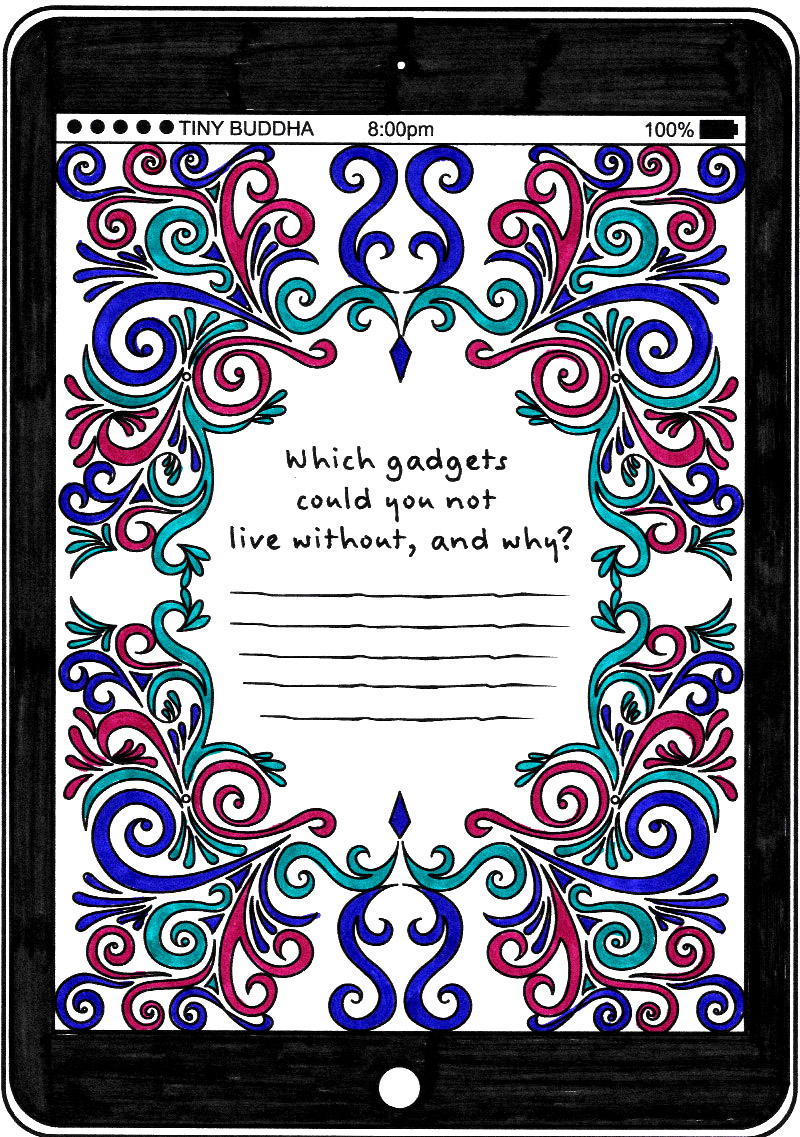
    Hi everyone! This is my third week sharing coloring pages from the soon-to-be-released Tiny Buddha’s Gratitude Journal (available for pre-order now). Previously, I shared the nature coloring page and the vacation coloring page.

    This one’s a no-brainer for me. Though I could live without it (did it for over twenty-five years!), I’m most grateful for my iPhone—which I use most frequently to manage Tiny Buddha’s social media pages and my inboxes on the go, read eBooks, track my steps, and listen to music and guided meditations.

    If you had told me in high school I’d one day own one device that would replace my computer, my alarm clock, my camera, my pedometer, and everything on my book shelf, I would have asked what you were on (and if you had any left).

    Though I was a late iPhone adopter, using a flip phone for an embarrassingly long amount of time, I’ve had one for quite a while now, yet it still blows my mind how much it simplifies my life.

    I’ve had to work at being mindful with technology, as it’s pretty tempting to mindlessly surf when I’m bored, agitated, or feeling anything I’d rather avoid. But even this is a gift, in a way, as every time I check my iPhone, I have a reminder to check in with myself.

    What’s your favorite gadget, and why?

    If you haven’t already, pre-order your copy of Tiny Buddha’s Gratitude Journal here, and you’ll instantly receive three free bonus gifts.

  • The Power of Off: Staying Sane in a Virtual World (Interview & Book Giveaway)

    The Power of Off: Staying Sane in a Virtual World (Interview & Book Giveaway)

    Tech Addiction

    UPDATE: The winners for this giveaway have been chosen. They are: Akshay Bhat and Kaitlyn.

    Have you ever found yourself mindlessly surfing the web, hopping from one site to another, when you didn’t have any specific reason to be online?

    Maybe you were looking at a cute cat video on Facebook, and then you ended up taking a quiz to determine which Westworld character you are. And then, five listicles, four memes, three tweets, two comments, and one hour later, you realized you’d spent a whole lot of time doing a whole lot of nothing.

    Worse, you may have been somewhere surrounded by people, and yet you still felt compelled to seek the kind of stimulation that feels unique to a glowing screen.

    It’s like a tiny world inside your pocket, full of information and opinions and conflict, overflowing with stuff to consider and debate and buy, and it can be incredibly addictive.

    As someone who works online, I have struggled with this myself. I promote and practice mindfulness, and yet I have found myself using technology in a compulsive way, distracting myself with emails, social media, and the pursuit of more information.

    Sometimes I recognize my behavior and am able to disengage. Sometimes I don’t. I know I am not alone.

    We are living in the age of constant connection, and ironically feeling more disconnected than ever—from ourselves, from the people around us, and from the world at large.

    But it doesn’t have to be this way. We can learn to use technology mindfully, for good, with greater awareness and with fewer negative consequences in our lives.

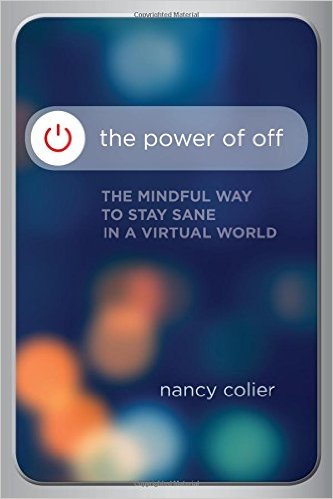
    If, like me, you’ve set this goal for yourself, I highly recommend you check out The Power of Off: The Mindful Way to Stay Sane in a Virtual World.

    Written by psychotherapist Nancy Collier, The Power of Off outlines a process for using technology without compromising our overall well-being, our relationships, or the other things that matter to us in life.

    The book explores:

    • How and why today’s devices push our buttons so effectively, and what you can do to take back control of your life
    • Tips for navigating the increasingly complex ways in which technology is affecting our relationships—with ourselves, others, and our devices themselves
    • Self-evaluation tools for bringing greater awareness to your use of technology
    • Mindfulness practices for helping you interact with your devices in more conscious ways
    • A thirty-day digital detox program to kick-start a new healthier relationship with technology

    I believe this book is a must-read for anyone who owns anything with a screen, or has access to one.

    I’m grateful that Nancy offered two copies of her book for Tiny Buddha readers, and that she’s shared a little about her experience and her book.
    The power of offTHE GIVEAWAY

    To enter to win a copy of The Power of Off:

    • Leave a comment below. You don’t have to write anything specific. “Count me in” is sufficient!
    • For an extra entry, share this interview on one of your social media pages and include the link in your comment. 

    You can enter until midnight PST on Sunday, December 11th.

    *Winners outside the US will receive a digital copy, not a print book.

    THE INTERVIEW

    1. You admit to being addicted to technology. That’s one of the reasons that you wrote this book. Can you give us a sense of your addiction and what it was like for you before you transformed it?

    I was an email addict, checking email far more often than what I was receiving warranted. I experienced a hit of pleasure every time I checked; even just thinking about checking delivered a shot of feel-good chemicals into the reward center of my brain, triggering what I call “lottery brain.”

    Just the possibility that something wonderful might appear in my inbox kept me coming back for more, even if it never delivered.

    I once walked by my own children at the end of a workday, with not much more than a quick hello, to get a fix from my addiction. It was at that moment that I realized that I was not okay with the way I was living, the choices I was making.

    I woke up in that moment to the reality that what I was paying attention to and where I was putting my time and energy was not in alignment with what actually mattered to me.

    It was then that I knew I needed to wake up and start making more mindful choices, to consciously create a handshake between what was most important to me and the way that I was living.

    2. You say that our society has an addiction to technology and that it’s no different than an addiction to food, sex, drugs and alcohol.

    An addiction is a behavior that we act out without awareness, either out of habit or impulse or both. We use technology without consciously deciding if we genuinely want to use, simply because the thought arises to use.

    This is the nature of addiction, and all addictions cause our lives to shrink and eventually deplete our lives as they become more and more about our substance of choice and less about those elements that truly nourish us.

    Technology is no different than any other addiction. It is, however, more like an eating disorder than an alcohol or drug addiction, because we have to find a way to incorporate our substance into our life. We cannot simply do without it, but rather, must find freedom in technology not from technology.

    The only difference between this addiction and other addiction is that we have all drunk the Kool-Aid; we’re all in. This is a condoned addiction.

    Other addictions put you outside the societal norm; they exclude you from being included. Tech addiction offers just the opposite, membership in the club. Tech addiction makes you part of the club, an insider, which makes it that much harder to break. The consequences of tech addiction may prove harder to acknowledge and take seriously.

    3. Can you explain how an addiction to one’s phone is just as serious as a drug or alcohol addiction?

    The negative consequences of a tech addiction are no different than the negative consequences of any other addiction.

    -The addiction keeps you from being present in your life as more and more of your attention goes into getting your fix.

    -The addiction occupies your time and energy, at the expense of other important parts of life (hobbies, activities, friendships, spiritual pursuits) that previously brought satisfaction, enjoyment and nourishment.

    -The addiction causes negative effects on your health, work, social or family life.

    -The addiction causes negative effects on your psychological wellbeing including mood swings, depression, anxiety, aggression, insecurity.

    4. What are signs that one is addicted to technology?

    Ask yourself:

    -Is your reliance on technology increasing?

    -Do you experience withdrawal symptoms when not able to use?

    Are you continuing to use technology despite knowing that its causing impairment in your work, health, social, and/or family life?

    -Is your life increasingly revolving around technology?

    -Have you given up activities you used to enjoy to be able to use technology instead?

    -Are you lying about the extent of your use?

    5. You use the term TWIRED. Tell us what it is and how it feels to be “Twired.”

    To be “twired” is to be simultaneously tired and wired. When we are twired, which most of us now are, we feel exhausted and overwhelmed, spent, and depleted, but also anxious and amped up, over-stimulated and buzzy. The experience of being “twired” is uncomfortable and ungrounded, which is what now is considered normal.

    6. You are not advocating not using technology, but how to have a healthy relationship. How does one go from full force addiction to living a balanced, healthy life along with technology?

    We must shift our relationship with technology so that when the thought or impulse to use arises, rather than just acting on it, we can use it as an opportunity to develop more self-awareness.

    If I am standing in line and the thought arises—Oh, I could check my email, or shoot out a text, or look something up on Wikipedia—instead of obeying the thought out of habit and doing what it tells me to do, I could simply notice the thought itself without acting on it. I could use the thought to point me to the present moment, as in: What is here right now that is making me want to distract myself? Or: What would I have to feel if I didn’t use right now?”

    The appearance of my addictive thought can then turn into a portal to awakening and mindfulness rather than a portal back into my addiction.

    7. Is it true that studies show people would rather give up their friends, wine, even sex for a Wi-Fi connection?

    Yes. One in three of all people would rather give up sex than their phone. Half of millennials would rather give up their sense of smell than their phone. Most millennials would rather give up their pinky finger than their phone. The majority of millennials would rather give up friends, alcohol, exercise, music, movies and TV, going out, and dessert, for a month than their Wi-Fi.

    8. You say that technology is the antithesis of mindfulness, and that our culture’s recent interest in yoga is a result of technology making us feel disconnected. Can you explain?

    We talk a lot about mindfulness these days in our culture, but the way we are living with technology is actually the antithesis of mindfulness. Mindfulness is the act of paying attention on purpose to the present moment, and doing so without judgment.

    Most of us are spending our time staring at a screen, which takes us away from what is happening right in front of us. We are living in the virtual world and missing out on the world that our body is actually inhabiting.

    If we are not staring at our personal screen, we are using our experience to build our personal brand, walking on a country road looking for places to take selfies so we can post on social media and show everyone how we are the kind of person that take country walks.

    If we are not using life to build our personal identity/brand, we are busy taking photos of and capturing our life so we can show everyone the life we are living. We end up then with 64 gigabytes of iPhoto file memories but no direct experience of life lived.

    The cost of this relationship with life, however, as something we can possess or use in service of our identity, is the direct experience of life itself. We end up, therefore, with the concept of mindfulness as something else we use to prove that we are a mindful person, but without the practice of mindfulness, which is living the moment as it is actually happening.

    The way we are using technology is also causing us to become disembodied; that is, entirely identified with our minds and thus controlled by our thoughts, as if we were just little heads floating around in cyber-space.

    Technology offers us a smorgasbord for the mind through data, entertainment, information, and just plain stuff to think about and do. The more technology we ingest, the more disembodied we feel.

    Our fascination with yoga these days is an attempt to get back into and reconnect with our bodies, to feel grounded in our direct, physically-lived experience—to be where we actually are.

    9. You talk about loosing a connection with our “self,” and how our obsession with our “personal brand” is very unhealthy. Can you please explain what you mean?

    We now view our self as a kind of vacuum. Many people experience a sense of dread or terror when left alone with just themselves. We fill our lives with more entertainment, more information, more data, more of everything to avoid ever meeting just ourselves.

    We no longer see ourselves as a destination, a place to inhabit. We fill ourselves up and derive our sense of meaning and worth from external sources, as in, the number of likes and followers we have.

    We no longer process our lives internally. If we stop on the street and open a door for someone struggling with a stroller, rather than spending a few moments thinking about that experience or taking it in, owning and absorbing it, we now immediately post what happened with a #gratitude or #kindness.

    We then wait to find out what the experience should mean and how we should think of it, how we should think of ourselves as a result of the feedback we receive. We ourselves are no longer a place we want to spend time or consider valuable.

    What we care about now is how we are seen by others and how popular we are, not what we think or feel about ourselves. Our own experience has been vacuumed out by the technology that tries to defend it.

    10. How can parents and teachers be of benefit to our children to help them learn to live “with technology” and not “for technology” as you might say?

    We need to set limits with our children and model discernment and moderation. But also, to recognize that young people have no experience with another way of living and that their social, academic, and every other part of life happens online, so separation from their technological life can feel like death or non-existence.

    What we need to do, besides setting clear rules that include periods of abstinence from technology, is to continue pointing our children to remain aware of how they feel in relationship with technology.

    That is, asking our child how she feels after a full day of Snapchatting, Instagramming, and Facebooking, how it is when she’s with a friend who is constantly texting while they’re together, how well she can focus on her homework when simultaneously receiving dozens of notifications on her other devices, how her personality changes when she is asked to give up her phone and how she feels after a a day (or week!) off all technology.

    We need to keep our children awake and tuned into how technology is affecting them so that they don’t lost touch with their own experience and forget that there is another way to feel besides the way that technology induces.

    You can learn more about The Power of Off: The Mindful Way to Stay Sane in a Virtual World, here.

    FTC Disclosure: I receive complimentary books for reviews and interviews on tinybuddha.com, but I am not compensated for writing or obligated to write anything specific. I am an Amazon affiliate, meaning I earn a percentage of all books purchased through the links I provide on this site. 
  • The Technology of Joy: Tools for Happiness (Interview & Book Giveaway)

    The Technology of Joy: Tools for Happiness (Interview & Book Giveaway)

    Woman with cell phone

    Update – The winners for this giveaway are:

    • D. Arturo Gutierrez
    • Preston Cox
    • Kathleen Han

    If you’re anything like me, you may think that technology can be both a blessing and a curse.

    Sometimes I lament that we now live in a world where tiny screens often hinder real-world engagement, and social media can create pressure to entertain an audience our peers by sensationalizing our everyday lives.

    But then I remember that technology is just a tool, and its affects depend on how we use it. Sure, technology can create distance and exacerbate the struggle to be authentic, but it can also do the opposite if we use our gadgets to create deeper, more meaningful connections.

    In much the same way, technology can increase feelings of isolation and depression, or it can contribute to our overall well-being. It all depends on our intention and our choices.

    Since I am always interested in discovering new tools to increase my joy and foster inner peace, I was excited to learn about psychotherapist Jonathan Robinson’s new book The Technology of Joy: The 101 Best Apps, Gadgets, Tools and Supplements for Feeling More Delight in Your Life.

    His book covers a variety of methods to boost your joy, including:

    • Gadgets that can enhance pleasure, deepen relationships, and help you feel gratitude
    • Specific apps that have been shown to make people happier and create more loving relationships
    • Supplements that can induce euphoria, elation, and feelings of connection and peacefulness

    You’ll learn what these tools can do for you, and how and where to get these happiness hacks. In addition, you’ll discover how to know which of these tools are most likely to be the best ones for you.

    I’m grateful that Jonathan took the time to answer some questions about his work and his book, and that he’s provided three free copies for Tiny Buddha readers.

    The technology of joyTHE GIVEAWAY

    To enter to win one of three free copies of The Technology of Joy:

    • Leave a comment below
    • For an extra entry, tweet: Enter the @tinybuddha giveaway to win a free copy of The Technology of Joy http://bit.ly/1qYeSk8

    You can enter until midnight PST on Monday, April 25th.

    THE INTERVIEW

    1. Tell us a little about yourself and what inspired you to write this book.

    I’ve been a psychotherapist for thirty years, as well as someone who has been interested in such things as meditation, hypnosis, and the use of various drugs.   Since I like to feel joy and ecstasy, I’ve always been on the lookout for any simple technique or tool that can safely help me to feel fantastic.

    Over time, I have collected a lot of gadgets, tools, and supplements that can do that. In fact, my friends often come to my house to “get high”—without needing to ingest drugs—by making use of my various tools.

    They eventually wanted to know where to get all these things, so in my book I laid out the best of what I’ve learned and used over the years.

    2. A lot of your work focuses on finding peace and happiness. Why do you think so many of us struggle with depression these days?

    We used to spend more time with nature, or with a caring family or spiritual community. Yet nowadays those things are hard to find. We live in a stressful culture, and yet we are not taught how to let go of the ongoing stress we are subject to.

    Now more than ever it’s important for people to find happiness and peace within themselves. To do this takes practice and the right equipment—just like learning to cook or play tennis. Most people have not invested in learning good practices or finding the right equipment (technologies) for overcoming depression and/or being happy.

    3. You’re a proponent of treating depression without antidepressants. I find that people often get quite upset by the suggestion that they can heal without medication. Why do you think this is such a hot button issue, and do you believe anyone can treat depression through alternative means?

    Studies at Harvard show that antidepressants are no better than placebos for 93% of the people taking them. For the other 7%, I believe (and research shows) that antidepressants can be very helpful.

    The reason I think this is a hot button issue is that people want to blame their depression on a “brain imbalance,” and thereby abdicate that there is anything they can do to help alleviate it. Yet, the research shows that there are many things people can do that are more helpful than taking antidepressants for overcoming depression.

    If people want more information about that, I have a whole website dedicated to it at: www.FromSad2Glad.com

    4. How did you come across the 101 methods you shared in your book?

    I have long had a fascination with methods that are quick, easy, and powerful. For thirty years it has been a “hobby” of mine to research and try out anything that I thought might help myself or others feel more joy and peace.

    Most things out there don’t work very well, but every now and then I would come across a supplement, app, or gadget that really worked extremely well. Such tools have made my life a lot richer, more peaceful, and joyous.

    5. Which of the methods have you found most personally helpful, and why?

    I’ve noticed that different things work for different people, but personally I have really enjoyed certain cognitive enhancing supplements such as Sulbutiamine and CDP Choline—especially when taken together.

    I also love something called “the Tingler,” a neuro-stimulator called “the Thync,” and about a dozen high tech audio soundscapes that I name in the book that help induce feelings of peace, joy, and even ecstasy. If you try enough things out, you soon find things that fit what you really want, and are convenient enough that you really use them.

    6. What did you learn from your interview with the Dalai Lama about these technologies?

    The Dalai Lama was extremely interested in these technologies. In fact, he said, “If it was possible to become free of negative emotions by a riskless implementation of an electrode without impairing intelligence and the critical mind—I would be the first patient.”

    He has long supported research into the brain in order to help facilitate what could be called the “engineering of enlightenment.” I believe that someday soon, we will all be able to more easily reach higher states of consciousness with the aid of various technologies. They have certainly helped me.

    7. You mentioned a bunch of joy-boosting apps. Which were your favorites, and why?

    There are a lot of them out there. I list over thirty of them in my book. Yet the ones I find myself using the most are ones called Happier, Buddhify, Headspace, and Gratitude Journal.

    Many of these have simple and quick guided meditations that make me feel really good, or have ways to help me tap into feelings of gratitude. I also like one called Couple that helps to deepen one’s primary relationship.

    8. You talk about a magical mantra that leads to gratitude. Can you share what that mantra is?

    Many years ago, I went to India to visit a guru who supposedly had a “magical mantra” for feeling gratitude. When I finally got a chance to talk to this guru, he said, “Whenever possible, repeat the following words: the mantra I give you are the words ‘thank you.’”

    Hearing that, I was very disappointed. I looked at him and said, “That’s it?” He responded, “No, ‘that’s it’ is the mantra you have been using, and that mantra makes you feel like you never have enough. My mantra is ‘thank you,’ not ‘that’s it.’ ‘That’s it’ will take you nowhere!”

    Well, to make a long story short, although I was disappointed with this so-called “magical mantra,” since I had journeyed so far to get it, I started to use it.

    Many times a day I’d say “thank you”—from my heart—for life’s many blessings. I’d say “thank you” to God or the Universe for a hot shower, a good meal, a hug from my wife, a greeting from my dog—whatever. Soon, I noticed I was feeling a lot more gratitude in my life. His “mantra” really worked!

    9. What do you think the future of “hacking happiness” will look like?

    Slowly but surely scientists will figure out even better ways to help us let go of stress, negative emotions, and suffering. In addition, new tools and supplements will be developed that help people to tap into the “kingdom of heaven within.”

    Fortunately, that “future” is already here—but most people don’t know about the great tools and supplements that already exist. In the future, these tools and supplements will become more popular, more convenient, and even less expensive.

    10. What is the most important thing you want people to take from your book?

    I want people to get that in order to feel more joy, love, or gratitude in life, there are many tools, gadgets, and supplements that can really help. By investing a little time and money in learning what works for you, your life can become a lot richer and more enjoyable.

    You can learn more about The Technology of Joy on Amazon here.

    FTC Disclosure: I receive complimentary books for reviews and interviews on tinybuddha.com, but I am not compensated for writing or obligated to write anything specific. I am an Amazon affiliate, meaning I earn a percentage of all books purchased through the links I provide on this site. 
    Woman with cell phone image via Shutterstock

  • How Technology Makes It Easy to Flake Out (And How to Stop It)

    How Technology Makes It Easy to Flake Out (And How to Stop It)

    Texting

    “If it is important to you, you will find a way. If not, you’ll find an excuse.” ~Unknown

    How many times have you made plans with friends, only to receive the dreaded, “Sorry, need to reschedule” text just minutes before you were meant to meet?

    Is it any wonder that you get tired of trying, that you struggle to feel secure in relationships?

    But before we get carried away castigating others, let’s take a look at ourselves. We hate it when other people bail at the last minute, but do we do it too?

    As humans, we have an astonishing capacity for denial. People I love and respect tell me how much they despise it when other people text and drive. Then five minutes later, what are they doing? Texting and driving.

    Many of us use our phones and social media accounts to flake out on our people, and it’s messing with our heads.

    That’s why every major world religion emphasizes a version of the Golden Rule: Do unto others as you would have them do unto you. When left to our own devices (pun intended), we are really bad at it.

    Much as I dislike when other people flake out, I’ve done it. I did it to my friend Jozzy a few weeks ago. I’d verbally expressed interest in attending a book group he led, speaking as though I’d be there. In fact, I even put it on my calendar. But when the day arrived, I was feeling exhausted.

    So I messaged Jozzy and told him the truth: I didn’t have the energy. He was gracious and forgiving. It would have been easy to forget about the incident, but I took a closer look. What had happened?

    First, I didn’t take a pause before committing. Instead of realistically assessing my week, I let my enthusiasm take the reigns. You might say, “You couldn’t have known that you’d be exhausted!” But a cursory glance at my calendar told me otherwise.

    Next, I took my own words too lightly. Before messaging Jozzy, I’d spent a few minutes pretending that I hadn’t ‘really promised’ anything. This made it easier for me to go back on my word.

    You could argue, “You just made a casual agreement; it’s no big deal!”

    I understand the lure of this reasoning, but I don’t bite. If we can’t rely on one another to mean what we say, then we don’t have much of a relationship.

    Technology also gets us into trouble by making it easier to renege on our commitments. And if we don’t resist that tendency, it can erode the fabric of our friendships.

    Years ago, if you wanted to cancel an engagement you’d need to speak to the person you were letting down. Now, you can tap a text or change your status with the swipe of a finger.

    As psychologist and author Andrea Bonoir writes in There’s A Modern Affliction Ruining Our Friendships – And We’re All Guilty Of It, “Technology makes it so much easier to flake out … It’s infinitely easier and less awkward than having to talk to someone by phone or, worse, tell them in person.”

    Yes, technology makes it more convenient to flake out and lie. But that doesn’t make it right. So the first and most important thing for us to do is walk the walk.

    As Alex Cornell jokes in Cellphones Are Making People Flaky as #%@*, most people fall into three categories: latecomers, no-shows, and optimizers (that is, people who won’t commit to your plan until they’ve scoped out every other possibility first).

    Cornell says, “… There is potential for a fourth category—those that show up on time, but … this is unlikely.” In other words, people who do what they say they will are rare.

    Be that unlikely person. People will respect you for it.

    But what do you do when you’re on the receiving end of repeated flake-outs? Martha Beck’s paraphrase of the Golden Rule is helpful here: “Never let others do to you what you would never do to others.”

    The next time a friend bails on you yet again, don’t swallow your anger and pretend that it didn’t affect you. Your time and trust matter; when they’re trampled upon, it hurts.

    Emergencies happen, and everyone makes mistakes. I’m not talking about such isolated instances here, but rather a pattern of getting left in the lurch. If that’s what you’re dealing with, say something.

    People only get away with flake-outs because we are too scared to call them out and set the necessary boundaries:

    I care about our friendship, and it’s not okay that you are consistently late. If it happens again, I will leave after [X] minutes. I need to respect my own time.  

    I love you, and I find it so frustrating when you cancel our plans at the last minute. Please either show up when you say you will, or don’t make plans with me at all.

    You are allowed to value your own time. And when you begin to respect this most precious currency, you’ll teach others to do the same.

    Texting image via Shutterstock

  • How I Used My Phone as a Crutch and What I Know Now

    How I Used My Phone as a Crutch and What I Know Now

    “People are lonely because they build walls instead of bridges.” ~Joseph F Newton

    Can you imagine your life without a cell phone?

    It’s hard, right?

    For most of us, we use our phones every day, whether it’s for talking with others, looking up information, or entertaining ourselves during those lulls in the day.

    A short while back, my phone contract expired and I was left without a cell phone. It felt strange at first, since my phone was something that was beside me almost every second of the day.

    But a thought came up: What would my life be like without relying on a cell phone all the time?

    I decided to run an experiment to see how it impacted me. And what I learned surprised me.

    When my eyes weren’t glued to my phone, I was able to look up and notice different things around me. I became more aware of how people used their phones, especially when there weren’t any other electronic devices around to engage them.

    One day, I went to a restaurant for a meal and noticed a family of four sitting beside me. Two adults and two preteen children were seated in a cozy corner, gazing at their menus.

    It looked like they were out having an enjoyable meal as a family. Wasn’t it the perfect time for them to reconnect with one another and share what was happening in their lives?

    But as soon as the orders were given and menus were taken, the dad whipped out his cell phone and began browsing away. The mom followed suit and pulled out her phone as well.

    The little chatter that happened over the table died out, and the two children each pulled out their phones to play with the apps on their phones.

    A while later, the meals arrived.

    Everyone put down their phones to admire their dishes. A few comments were made before digging in. A sip here, a bite there, and soon they went back to staring at their phones again during the meal.

    As the meal progressed the table was silent, save the occasional clink of utensils against plates.

    Ironic, isn’t it? A device that was made to ease communications can end up being a hindrance to talking with others in real life.

    After I left the restaurant, I thought about what happened and couldn’t help but cringe. Not for them, but for its reminder of how I used my phone in the past.

    I would use my phone on the subway, at work, during meals, and almost every other spot in between.

    My phone usage was especially obvious at social gatherings. When the conversation died down and the silence became uncomfortable, it was easy to flip through my phone as a distraction. It was my way of trying to say: “It’s not that I can’t stand the silence—it’s just that I need to check my phone right now.”

    Which, of course, wasn’t true. But it took not having my phone on hand to realize the way I had been using my phone as a crutch. It protected me from uncomfortable situations, from looking bored, and from being unproductive.

    Or so I thought.

    When I didn’t rely on my phone, I shared conversations more easily, became more conscious of my surroundings, and found more meaning in my actions. There are four big realizations I’ve come to about phones—and by extension, a lot of the technology that we rely on today.

    1. You don’t need to be available every second of the day.

    The vast majority of us are in positions that allow us to turn off our phones from time to time. Unless you’re in a job that requires being on call, you can step away and give yourself time off from electronic devices.

    I used to worry that if I didn’t reply to someone’s instant message or email right away, the person would become impatient or I would miss out on an opportunity. I felt myself getting stressed when I forced myself to constantly check for updates.

    But now I know that if I wait to get back to someone, it isn’t the end of the world. It can actually help me develop clarity in how to respond and also gives me peace of mind.

    I’ve learned to appreciate the present moment more now.

    2. Phones are made for communicating with people, not avoiding them.

    Have you ever tried speaking with someone, only for the person to mumble a response while staring at a phone or laptop? Or, maybe you found yourself so preoccupied with your phone that you didn’t notice anyone around you?

    It’s interesting how the urge to fiddle with our phones strikes us when we’re put in a strange situation. Like being in a room with new people. Or running into someone we haven’t seen for a while.

    If you find an urge to use your phone during these situations, stop for a second. Ask yourself, why do you feel more comfortable using your phone at certain moments? Does it have to do with something urgent popping up on your phone, or an effort to avoid feelings of discomfort?

    Not all discomfort is bad. Discomfort can be a sign of growth. It’s an opportunity for you to connect with others and learn something new.

    3. A phone is not a substitute for companionship.

    I have a friend who enjoys spending his time messaging acquaintances and friends that he hasn’t seen for at least several months. When I asked why he didn’t see them even though they lived nearby, he said, “Why should I? I already message them all the time.”

    I admit, I laughed at the response. I believe (and I think you’ll agree) that nothing beats meeting someone in person. Even if we spend months, or years, communicating with someone online or through a phone, we don’t feel like we truly know the person until we’ve met.

    I like to keep a mindful balance between the time I’m using an electronic device and the time that I spend with people. If you’ve been staring at something for most of the day, it’s probably time to put everything down and take a break.

    4. Phones are useful, but use them wisely.

    If you’re thinking about what to do with your phone right now, don’t worry. There’s no need to chuck it in the garbage!

    Phones are great for many things, I can attest to that. They’ve helped me reschedule meetings, get access to information instantly, and choose a wonderful restaurant from time to time.

    Keep in mind, though: phones, laptops, tablets, and other electronics are made to help your life, not consume it. If we set boundaries between technology and our lives, we can use these gadgets to get even more out of our experiences in everyday activities.

    So whatever you choose to do, remember that phones cannot replace the joy of laughing with a loved one, of discovering new places, or the sense of content you feel after making a positive contribution to the world. But if used properly, they can help you get one step closer to achieving those things.

  • There’s No WiFi in the Forest, but You’ll Get a Stronger Connection

    There’s No WiFi in the Forest, but You’ll Get a Stronger Connection

    Woman on a swing

    “The quieter you become the more you can hear.” ~Ram Dass

    We live our lives at such a fast pace. We seem to be working more hours and juggling more tasks both at work and home, with no relenting.

    As part of the technological age, we are connected 24/7, and we find it difficult to switch off.

    It has changed the face of how we live and work. Expectations are higher, the pace of life is quickening, and we’re struggling to keep up.

    In a world that encourages noise and busy-ness, we find it hard to be quiet and still.

    I recently left a stressful job in the corporate world to regain balance in my life. I was so busy making a living that I’d forgotten to make a life, and my health was suffering as a result.

    I am now an advocate for “slowing down to speed up.” Prioritizing relaxation and self-care makes me more alive and more effective, and it allows better decision-making, hence making life easier.

    We have been conditioned by society to maximize every second of the day by doing something. Some people see relaxing as unproductive, wasting time, and even selfish if we’re taking time for ourselves.

    But in this busy world it’s not just individuals that benefit from time out; our bosses, colleagues, friends, and family also reap the benefits when we’re rested and refreshed.

    In the modern age we are overwhelmed by technology. It now dominates our homes and work-life and keeps us in touch with friends, families, and the world around the clock.

    In the days before handheld devices, people could leave the office on Friday and not see their emails again until Monday morning. We would sit on bus and talk to one another rather than being lost in an iPad.

    My former morning routine consisted of eating breakfast while checking Facebook, reading my personal and work emails (even though I was going to be in the office in less than an hour), and then watching the news on TV. A similar kind of routine would play out at the other end of the day over dinner.

    I recently took three months off and spent time living in yoga ashrams and Buddhist temples where there was no TV and Internet.

    Surprisingly, I found I didn’t miss it. It freed up so much of my time each day, time spent enjoying my meal, being present, noticing the birds in the trees, and talking to those around me.

    The most amazing thing was when I returned to civilization and logged on to check the news, Facebook, and emails, I hadn’t really missed anything. But I’d gained so much more.

    I’d experienced what I was doing. I’d not been distracted by petty stories that didn’t matter or that may have impacted my state of mind negatively. Most of all, my mind had become de-cluttered and focused, and I felt a certain clarity I enjoyed.

    As a result of a technology fetish, we are spending more time inside. This is leading to an alarming vitamin D shortage in many developed nations, particularly in the northern hemisphere when we don’t get enough sunlight.

    We no longer live off the land in rural areas. Many of us are confined to cities, living and working in concrete towers. As a result, we have lost touch with our connection with nature, which studies suggest is vital for our health.

    We know how refreshing it feels to take a walk in the park or sit by a lake, and research is now showing it goes much further than that.

    The connection we get from being in nature utilizes all the senses and brings clarity and focus, which is why sometimes when I was struggling for inspiration in the office or couldn’t solve a complex problem, it would help to take a stroll to clear my mind.

    Many offices now use walking meetings as a way of improving health, creativity, and productivity. This is especially powerful in the technological age when emails and phones so often disrupt our concentration and cause breaks in our creativity.

    UK charity Mind suggest that time in nature is beneficial for those with depression, as it enhances mood and self-esteem and reduces anger, confusion, and tension.

    It has also been shown to lower blood pressure, reduce pain, and strengthen the immune system.

    A study done involving patients recovering from gall bladder surgery in a hospital compared a group who had a view of nature outside their window to those without a view of nature.

    This study found that those who looked out onto nature recovered quicker than those who didn’t.

    At the same time as we are suffering from a lack of outdoor sunlight, we also need more exercise. Diseases like obesity and depression are at epidemic proportions, and still worsening. Research suggests that being outside more often could help on both counts.

    According to recent studies, sitting is the new smoking, and hours at desks, in cars, or in front of the TV is damaging our health more than we realize.

    It more than doubles your risk of diabetes and is linked with an increase in heart disease. In fact, inactivity is the fourth biggest killer of adults, according to the World Health Organization.

    I’m not suggesting we should all go and live in caves on the top of a mountain, but I am an advocate for ensuring we have an opportunity to disconnect.

    Maybe turn your work device off over the weekend, have a TV-free night each week, resolve not to check Facebook every day, or even better, take a technology break for a week, maybe when you go on your annual vacation, and see what it does for you.

    Sometimes we need to disconnect so we can reconnect with our real selves and not give way to the many distractions in our lives. This brings the clarity we need to make good decisions and to listen to what we want and how we feel about the things that really matter.

    So I urge you to switch off the TV, turn away from the computer screen, put down your phone, and get outside.

    As the saying goes, there’s no Wi-Fi in the forest, but you’ll get a stronger connection.

    Woman on a swing image via Shutterstock

  • Can We Auto-Correct Humanity?

    Can We Auto-Correct Humanity?

    Such an important message. From the YouTube page: You need not delete your social networks or destroy your cell phones. The message is simple: be balanced, be mindful, be present, be here. 🙂

  • Are You Missing Out on Life While Checking Your Smartphone?

    Are You Missing Out on Life While Checking Your Smartphone?

    Distracted by smartphone

    “The present moment is filled with joy and happiness. If you are attentive, you will see it.” ~Thich Nhat Hanh

    “Yeah…Uh huh…Uh huh…Yeah…No way! Uh huh.”

    This was the response I got when talking to a friend the other day. I could tell he wasn’t really listening, because he was browsing Facebook at the time.

    Why was his smartphone more important than me? It didn’t used to be this way.

    I know I’m at risk of sounding out-of-touch and technophobic. But I really do think this is a much bigger problem than we perceive.

    We’re talking about our lives here. Do we really want to dedicate them to an iPhone?

    Another Smartphone Shocker

    The other day I saw a man on his Blackberry during an entire meal with his family. He was with his wife and young children (although they’ll be adults before long).

    How rare are moments like this? How precious are they?

    Yet, the man let this moment pass him by forever. If only he’d brought his attention to the present moment, he’d have experienced something far more valuable than anything displayed on a three-inch screen.

    And is there any joy in a stroll through the park or along a bustling city street?

    Last year I roughly counted one in five people glued to their phones while walking. And this was on New York’s 5th Avenue—one of the most exciting, alive, beautiful streets I’d ever walked on.

    Was it really so mundane to these people?

    Let me be clear. I’m not suggesting you throw away your smartphone and communicate with telegrams. The smartphone is an extremely useful tool, no question.

    What I’m saying is this: Bring attention to the moments when you reach for your smartphone.

    There are three questions I suggest you ask yourself every time.

    Question 1: What’s the emotion behind this decision?

    I work from home most days, and this wasn’t easy at first.

    I spent a good couple of years completely addicted to my email account. If there was an opportunity to check my inbox, you can bet your best socks I’d have taken it.

    But once I began meditating, I became much more aware of my emotions.

    I soon realized I didn’t check my email to check my email. I checked my email because I wanted fulfillment. I wanted somebody to praise me for good work, send me a dream brief, or tell me something fascinating.

    As you check your smartphone, try to pinpoint the emotion behind your decision.

    Is it anxiety? Boredom? Or are you subconsciously putting off something more important?

    Once you know the emotion, ask yourself: Can this emotion be fulfilled by something else?

    I realized I got the same feeling of fulfillment from writing. So I stopped checking my email first thing in the morning and would write for two hours instead. Since I’m a copywriter, this was doubly beneficial, because it made me better at my job.

    Question 2: What value do I place on this present moment?

    If you show gratitude for the present moment, you might think twice about using your smartphone.

    Riding the bus is a common place to start checking Facebook. The bus is, admittedly, quite boring. You follow the same route every day, and not much seems to happen.

    But what if riding the bus became a wonderful in-the-moment experience? Rather than grab your phone on instinct, notice the passing scenery, the feeling of movement, and the different people who hop on and off.

    This is a moment in your life. Never forget that.

    If you need to check your phone, the bus is a good time to do it. But if you don’t, why not experience the journey?

    Also, remember, if you’re with a friend or relative the present moment has twice as much value. You have someone else to consider.

    Personally, I don’t think it’s ever appropriate to check your phone in someone else’s company. (Unless you have something very serious going on in your life, of course.) Show people how much you value them instead.

    As Thich Nhat Hanh said, “The most precious gift we can offer others is our presence. When mindfulness embraces those we love, they will bloom like flowers.”

    Question 3: Can my smartphone really add value to the present moment?

    Before the smartphone, we had something very precious indeed—the unanswered question.

    Your smartphone can answer any question in a couple of seconds. That’s true. But don’t you find it’s the unanswered questions that spark the most interesting conversations.

    Unanswered questions start debates. They enrich friendships.

    The other day I mentioned that the author Jack Kerouac was Canadian.

    “You’re wrong,” a friend jumped in. “He was American.”

    “Are you sure? I swear he was from Quebec,” I replied.

    “I’ll find the answer,” another friend said, withdrawing their smartphone. Presto! Two seconds later, the conversation was over.

    Another time, at dinner, a group of us wondered who composed the Lord of the Rings score. All sorts of interesting topics popped up along the way—from Hans Zimmer to John Williams to Star Wars and back to Lord of the Rings again.

    “I’ll find the answer,” someone said. And again, it was a smartphone that killed the conversation.

    Unanswered questions are uncomfortable.

    Reaching for your smartphone is understandable. Perhaps it’s even human nature. But it’s important to stop, reflect, and question what might happen when you do.

    I believe mindfulness is more important today than ever before. Unless we take control of ourselves, our gadgets will take control for us.

    Notice the present moment. Understand it. Be grateful for it.

    And if you decide it’s not a good time to use your phone, please resist the urge. You’ll feel much happier.

    Distracted by smartphone image via Shutterstock

  • Look Up

    Look Up

    This powerful spoken word film has already been viewed eighteen million times, but I just saw it for the first time tonight. If you’ve ever felt alone, despite being connected to hundreds online, you need to take five minutes to watch this.

  • How to Avoid Burnout and Take a Digital Break

    How to Avoid Burnout and Take a Digital Break

    “Fear is a natural reaction to moving closer to the truth.” ~Pema Chodron

    By the end of 2011, I was trying my hardest not to see it: burnout.

    I’d been going full steam ahead since I turned my part-time business into a full-time vocational mission, back in 2009. When people remarked that I was doing a lot, I would wave away their comments and say facetiously, “Well, you know—I’m a Sagittarius with three planets in Virgo.”

    Part of the reason I didn’t want to really look at what was going on was that 2011 had been a banner year. After years of hard work, I was (finally!) starting to see the benefits that come with it: increased traffic, more clients, and more requests to collaborate on projects with people I admired.

    But the burnout was obvious: not looking forward to Mondays, not wanting to check email, feeling perpetually tired and overwhelmed, and sometimes, resentful.

    I really wanted to be away from the computer, away from email, and definitely not getting distracted with social media. This thought was always followed by an immediate fear: “I can’t do that! I’ll lose everything I’ve worked for!”

    But as Chodron says, fear is what happens when we move closer to the truth.

    My truth was that I wanted a complete digital break. So finally, from December 15th 2011 through January 15th 2012, I took one.

    Since so many people have asked me “how” I could possibly run a business and take thirty days away from being online, I’ll share what I learned. (more…)

  • Mindful Technology: Simplify Email & Reduce Inbox Stress

    Mindful Technology: Simplify Email & Reduce Inbox Stress

    Happy Girl with Laptop

    Up until recently, I received communication online in ten different places.

    In addition to getting messages through Facebook, Twitter, LinkedIn, and StumbleUpon, I got emails through six different email accounts. I have not always managed this ever-flowing stream of information in the most mindful and productive way.

    Studies show that we actually get a little endorphin rush when something new pops up in the inbox. It’s almost as if an email, direct message, or blog comment confirms that we’re important—that someone somewhere values us and needs our attention, expertise, or approval.

    I’ll admit it: I enjoy seeing there’s a new comment on something I’ve written, and I love when someone sends me an email telling me how deeply Tiny Buddha has impacted them.

    But I’m not a big fan of spending my whole day reacting to things popping up on my screen; not when there are so many more efficient, fulfilling ways to spend my time.

    Recently I’ve been making some changes to create a more mindful online experience, less dictated by other people’s requests and feedback.

    If you also need a little help managing your stream, I recommend the following. (more…)

  • 8 Ways to Stay Present & Focused in a Tech-Driven World

    8 Ways to Stay Present & Focused in a Tech-Driven World

    Buddha on a Computer

    “Be present. It is the only thing that matters.” ~Peaceful Warrior

    Technology pervades our world. From cell phones and laptops to iPods and digital cameras, the average person owns an arsenal of gadgets that, in many ways, simplify life.

    You can increase your productivity, connect with people quickly, and access information instantaneously—while documenting your every move via tweets and photos to upload to Twitpic or Facebook.

    Which begs the question: At what point does technology stop enhancing life and start detracting from it?

    When you feel tied to your phone and enslaved by your email, can you pull away, center, and take a tech-vacay outside the shadow of your laptop?

    Does it stress you out to disconnect in an always-on world where everything moves at the speed of light?

    And lastly, do the people in your life suspend their sense of urgency long enough to allow you a break?

    The technology itself is not to blame; just like guns don’t cause violence, gadgets don’t obliterate our mindfulness. We’re in control of the tools we use. Still, it isn’t easy to stay present and focused in a world that’s always plugged in—and to every available outlet.

    The possibility of mindfulness underlies almost everything we publish at Tiny Buddha in an attempt to harness technology for personal growth and wisdom. With this in mind, I couldn’t be more delighted to learn about the Wisdom 2.0 Conference, which will take place this month in Mountain View, California.

    Soren Gordhamer, who wrote a book also called Wisdom 2.0, has secured some amazing speakers, who each have their own unique perspectives on wisdom in the tech age. Twitter, Facebook, and Google will all have a presence, not to mention Yoga Journal, Whole Foods, and a number of wellness-focused organizations.

    While meeting with Soren last week to discuss the event and my possible involvement, I thought of some ideas to stay present in a world dominated by gadgets. Here’s what I came up with: (more…)