Tag: teacher

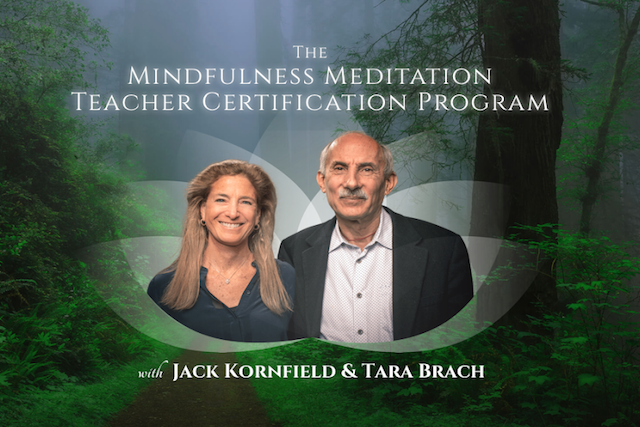
  • Become a Certified Meditation Teacher – Train with Jack Kornfield and Tara Brach

    Become a Certified Meditation Teacher – Train with Jack Kornfield and Tara Brach

    Hi friends!

    Since I know many of you are passionate about mindfulness and meditation and creating a more peaceful world, I’m excited to share that Jack Kornfield and Tara Brach are accepting applications for their next two-year Mindfulness Meditation Teacher Certificate Program.

    Though it’s primarily an online learning experience—which means you can participate from anywhere in the world—you’ll have the option to attend two in-person, three-day workshops in the Washington, DC area. And for those who can’t attend, they’ll be livestreaming the sessions and will also make a replay available.

    Space is limited due to mentorship availability and the live events, and the last certification program sold out quickly, so if you’re interested, you may want to get your application in soon.

    In addition to sessions with special guest teachers including Eckart Tolle, Kristin Neff, Dan Siegel, and many others, the upcoming program brings you a complete curriculum that covers the transformational principles underlying meditation and an exploration of the interface of meditation with Western psychology and cutting-edge science.

    Through this in-depth, groundbreaking program, you will:

    • Learn how to teach meditation with tools for body, heart, mind, and community
    • Receive guidelines on how to establish classes and workshops
    • Gain skills that apply mindfulness and self-compassion to relationships, conflict, trauma, organizational wisdom, and societal change
    • Join a vibrant international community of mindfulness teachers around the world

    With successful completion of this teacher training program, you will receive a certificate from the Awareness Training Institute, and their partner, the Greater Good Science Center at the University of California, Berkeley. This credential will support you in establishing meditation classes, workshops, and trainings in communities, organizations, and institutions throughout the world.

    If you’re excited by the idea of making a living supporting others in their healing and personal growth, click here to learn more. Early admissions applications (for discounted tuition) are due March 23rd, and the program starts on February 18th, 2021.

  • 5 Ways to Find Peace: Life Lessons from an 8th Grade Teacher

    5 Ways to Find Peace: Life Lessons from an 8th Grade Teacher

    Chalkboard meditation drawing

    “Life is a succession of lessons which must be lived to be understood.” ~Ralph Waldo Emerson

    Good Morning, and welcome to 8th grade History with Mr. Bacchus. The first thing I need everyone to do is to take out your class schedule and make sure that it says Mr. Bacchus for this period. Is there anyone who doesn’t have my name on their schedule?

    No? We sure? Great!!

    Now I need each one of you to take a moment and thank whoever you believe in, the powers that be, or even the magic genie that granted you this wish, because you’re one of the few lucky enough to be in my history class this year.

    Why lucky?

    Because there is going to be a day when you don’t feel like getting out of the bed, but you will remember that you have Mr. Bacchus today and you will be up before the alarm goes off.

    One day, your boyfriend or girlfriend will break up with you in the middle of the hallway, and the news will quickly spread via social networking. But when your friend asks you if you’re okay, you’ll simply smile and say,

    “I have Mr. Bacchus today.”

    I couldn’t make this up if I tried. A student fell in gym class and broke his leg one year. It was an awful injury, and he was seriously hurt but refused to go to the hospital. He said it wasn’t that bad. He had Mr. Bacchus next period.

    This has become my first-day-of-school opening monologue as an 8th grade teacher. It’s a nice way to break the ice. I say these words with a sense of confidence. A sense of purpose and joy comes over me the second I begin this inaugural address to my students.

    And it lasts throughout the school year.

    My class has often felt like a beautiful symphony (and I was the highly acclaimed maestro), but in the midst of my father falling back into addiction and my ex-girlfriend moving across the country with her new fiancé, it seemed as if I couldn’t play chopsticks in my personal life.

    My father has always struggled with addiction, but this was the first time I had to face it as an adult. This time around I knew exactly why he wasn’t answering my calls, why he was asking to borrow money, and why he was nowhere to be found for weeks at a time.

    Likewise, it wasn’t the first time my ex and I had called it quits either. But somehow the news of her impending move across the country with her new boyfriend—two months after our most recent breakup—had a sense of finality to it. The curtain was officially closed once I got word of their engagement.

    So I began going to counseling in hopes of finding my way, and one day my counselor asked me if I could “live like I teach.” Could I take some of the things that allow me to be at peace while teaching and apply them to my life?

    This is what I came up with.

    1. Be yourself.

    As a new teacher, you’re told not to crack a smile and to be extremely strict at the beginning of the school year. This will help you “set the tone” for the school year and show your students who is “the boss.”

    The problem is that I smile all the time!

    So as I tried to fight my smile with the students, they often fought against me. Whether it was Ashley throwing pencils at me or Shailia composing an essay titled “Mr. Bacchus, the Worst Teacher Ever,” my students weren’t responding well to the person I was trying to be.

    Once I finally gave up that lousy advice and started smiling, joking, and being myself from the beginning, my relationships with my students began to improve.

    It was a light bulb moment. Improving my relationship with my students made me realize that I have to be my genuine self in real life too. I can’t be who I think I’m supposed to be—I have to just be me.

    2. Don’t hold too tightly to plans.

    The projector isn’t working.

    The video won’t load!

    The copier is down!!

    FIRE!!!!

    These things can happen at any given moment, and the best laid lesson plans need to be adjusted. I plan every week but know that it’s just a blueprint of how I would like things to go.

    Once you arrive to school and realize the wifi isn’t working, you have two choices: You could continue forward with your lesson hoping the wifi genie magically shows up and the website you were going to use will somehow work, or you can change your plans.

    Learning to be fluid with my plans allows my classroom to flow with a certain ease. If I want that same ease in my personal life, then I have to understand that the Universe has a way of turning our plans upside down too. I need to be able to adapt and adjust just like I do when little Johnny throws up in the middle of the classroom during third period.

    3. Don’t get stuck on the negative.

    I planned what I believed would be an awesome lesson incorporating a Nas rap song into our coverage of Ancient African Empires.

    As I could barely contain my excitement, one of my students couldn’t seem to care less. He made unrelated comments, disturbed others, and left me feeling like the lesson was a complete failure.

    Later that afternoon, a group of students were leaving the school singing the song I used in the lesson. I inquired about the song choice, and they said how much they enjoyed it and thought it was cool how I tied it in.

    Here I was basing my perspective on one person while ignoring the reactions of the other thirty students in my classroom. How often in life do we only focus on the negative aspect and fail to notice the good all around us?

    We can always find the bad in our life experiences, or we can choose to find the good. I try and find the good every day. The entries in my daily gratitude log help me to focus on the daily good, like the students that remembered the song, not the one who didn’t.

    4. Each day is new.

    My first two years of teaching inundated my life with stories about something one of my students did, said, etc. I couldn’t wait to run and tell family and friends about my adventures as a teacher.

    As time passed, those stories became less and less unique, and I found myself looking at the days and the students as the same old blur. I had seen it all. The students, lessons, and days were starting to become a haze of gray.

    My friends and family would ask for new stories, and I had nothing. “It’s going” became my simple response to the question “How is teaching?”

    The reality is that each year I get different students, who will do different things, during each day of the year, every period of the day.

    I have to be aware of how much beauty and joy lies in that variety and appreciate the newness of it all, or else I will become like so many teachers who have lost their excitement for what they do.

    I try my best to see the newness of each student and each class every day because I don’t want to lose my passion for teaching.

    I also don’t want to lose my passion for life. I’m now starting to see that I have to find the newness of each moment in each day so that “it’s going” doesn’t become my answer to “How’s life?”

    5. It’s okay to laugh.

    Theodore Roosevelt set up the National Park System so that he could conserve the National Booty of America. Yeah, you read that right. I said National Booty instead of National Beauty. The kids laughed hysterically and I cracked up laughing too.

    The truth is, school is funny.

    There are too many moments that deserve a good laugh during the course of a school day. I can deny it or I can let out one of the few things guaranteed to increase my mood. I have chosen to increase my health and vitality by laughing in school.

    And also in life. Because just like the classroom, there are so many funny things to laugh at in this world! To deny laughter would be to deny one of the basic parts of pleasures in life.

    Three years ago I was blessed to receive the “Teacher as a Hero” award from the National Liberty Museum. I would have never thought the things that made me a “Teacher as a Hero” award winner would also help me to emerge from one of the toughest times in my life a better person.

    All I had to do was start living like I teach.
  • You Don’t Need a Guru; Life is Your Greatest Teacher

    You Don’t Need a Guru; Life is Your Greatest Teacher

    Monk

    “Forget what hurt you, but never forget what taught you.” ~Unknown

    I read a tribute Elizabeth Gilbert wrote for Richard from Texas who features in her book Eat, Pray, Love. It got me thinking that our teachers in life can take many forms and not always an obvious ‘traditional’ teacher.

    In Eat, Pray, Love Liz went looking for a guru in India but learned a whole host of lessons from Richard, who was probably there seeking out the same guru for his own answers.

    We can go through life looking for gurus, trying to learn from the experts, and seeking out those who seemingly have the answers to our questions, but what we often overlook is that the answers are there all along.

    We don’t find the answers when we find the guru; we find them along the way, as part of our journey.

    Sometimes a guru may help us uncover the answers within, but there is also so much more that those we meet and our experiences along the way can teach us about life’s journey.

    The lessons can come from our kids, our partners, our friends, our enemies, and most of all from ourselves.

    We can be our own teachers if we allow ourselves to learn from our mistakes.

    A monk once told me there are no mistakes, only lessons, and we are a product of the lessons we’ve learned. As Thich Nhat Hanh says, “Without the mud there can be no lotus.”

    We grow stronger from our challenges; we learn or to grow from these experiences, and this is what makes us who we are.

    I’ve traveled around the world to various retreat centers, sat on many hill tops, and consulted a few gurus, but the answers I sought I found within me when I arrived home, stopped searching, and sat still long enough to notice them.

    This led me to rebuild my life around my passion and fill it with meaning and purpose. I became a yoga teacher and was thrilled to be doing a job I loved, but in the early days I struggled. Marketing was not my strong point and the numbers for my classes were low, sometimes non existent.

    As I sat in an empty room one night with my lesson plan, feeling defeated, I thought to myself, “What can I learn from this?”

    I try to ask myself this question often, but especially when times get tough. Life is not always easy. Things sometimes don’t go to plan, and often we don’t succeed until we’ve learned a lesson and tried again, failed more, failed better.

    I have learned valuable lessons from people who’ve come in and out of my life (often for only fleeting encounters). I’ve learned both from failed relationships and those that have evolved over different parts of my life to be stronger now than they ever were.

    A friend’s betrayal taught me about forgiveness. A friend’s love has taught me about trust. My nephew taught me the importance of making time for play, and my pets taught me the power of unconditional love.

    Depression taught me that it’s through the cracks the light gets in, and burnout taught me about my real priorities and the value of self-care. A house fire taught me about attachment, and a homeless man taught me to be grateful for the little things I have.

    Success is a product of learning from experiences and failures—a product of our life, our experiences, and the people we meet along the way. This is the stuff that shapes us and builds our world, it comes from within, not from an expert or a guru.

    Yes, we have formal teachers we can learn from—our parents, our schools, our gurus, those we aspire to and admire. But never underestimate the power of the lessons ‘ordinary’ people will teach us, the likes of Richard from Texas and indeed the lessons we learn from ourselves and our experiences as we navigate through life.

    So take a moment and ask yourself what you can learn from your current circumstances and the people in your life. Whatever, or whoever, you’re struggling with could very well be your greatest teacher—and a stepping stone to greater peace, purpose, and happiness.

    Monk image via Shutterstock

  • That Person Who Irritates You Could Be Your Greatest Teacher

    That Person Who Irritates You Could Be Your Greatest Teacher

    Couple Arguing Image via Shutterstock

    “The teacher you need is the person you’re living with.” ~Byron Katie 

    On the bus home from Disney World, my best friend sputtered, “Angela, you are such a huge control freak!”

    First, I went into an angry rage. I accused her, “How dare you call me a control freak! I planned this whole trip.”

    Next, I resorted to pouting and pointing my finger at her, listing every possible way she was the control freak.

    I was in complete victim mode. Classic, right? Little did I know that this incident would be an important self-growth tool for me.

    She returned to her seat and I started to reflect on her comment in silence. I realized that I was indeed a massive control freak. I planned everything. For example, in group projects, I volunteered to do all the work so I would get a good grade instead of trusting my teammates.

    I’ve come to realize that constantly trying to control people is very harmful. They stop believing that you trust them and let you do all the work. I am not superman and people are capable of stepping up. 

    The same goes with life situations. I’ve had a lot of success living in the life I want, because I’m very assertive and control situations. But honestly, it makes me miserable and I would much rather sit and back and let the universe take care of it.

    My mother always told me that what you resist or dislike in someone else can usually be found in yourself. I realized the qualities that I found annoying in other people, especially my father, were his controlling qualities. Then I realized that those qualities were very prominent in myself.

    I know now it had to take someone as close as my best friend to wake me up and realize how much I tried to control situations. She’s a friend who knows everything about me and, therefore, I hold her opinion very highly in mind.

    I could have been a victim and blamed her for being cruel or picking out my greatest faults. Instead, I sincerely appreciate her for opening my eyes into how much self-work I still needed to do. 

    When I look back on my life, I can see how all of my relationships have taught me so many lessons. My ex-boyfriend and I got together like most young couples, looking for someone to fix the other and fill up an empty hole that we could only fill.

    Instead, we ended up being extremely codependent and very unhappy. I did not treat myself well during that period of time, and he reflected that perfectly to me by treating me exactly how I treated myself.

    Now, I try and love myself to the fullest and am more confident than I’ve been in a long time. I am so thankful that he came into my life and demonstrated to me how I treated myself. He was a mirror and the perfect partner I needed at that time in my life.

    I went back even further and examined the difficult relationship I have with my father. We have never been close and since childhood I’ve always been resentful of his, in my opinion, mean-spirited nature and how distant he seemed to me.

    Now, I realize that he has been such a gift in my life. If I had never felt that pain, I probably would have never gone to see my life coach and found my inner light and source. I am so thankful that he brought me to her! What a different way to look at it.

    I’m not saying you should stay in an unhealthy relationship. There are certainly relationships and friendships that are worth avoiding.

    I do believe, though, that people come and go into our lives for certain reasons. And instead of perceiving their existence in our lives as negative, we should learn to see the positive differences they have made.

    I can assure you that holding onto resentment for someone in your past or present really only ends up hurting up you in the long run.

    So what do you do now? You forgive. You forgive yourself. You forgive the people who you believe caused transgressions against you in your life.

    When I realized that I am indeed a control freak; I forgave myself; I didn’t beat myself up. I look forward to letting that quality go in my life, but it served me a great purpose in my past. When I was weaker, it served as a great defense mechanism and made me feel important and in charge.

    Now I know that I am not in charge and can move on and eagerly wait for the next the relationships and friendships in my life to continue to teach me how to constantly improve myself.

    Couple arguing image via Shutterstock

  • Every Imperfect Person Has Something to Teach Us

    Every Imperfect Person Has Something to Teach Us

    Seated Group

    “My experience is that the teachers we need most are the people we’re living with right now.” ~Byron Katie

    I have always been of the opinion that the people around us are our teachers.

    Specifically, I have always seen what I perceive to be negative traits in others as opportunities to develop patience or kindness toward them. I see it as a struggle they are going through, and if I can be patient or kind, then that helps them. It also teaches me how to embody those qualities even when I don’t feel like it.

    If a colleague, friend, or acquaintance is abrasive or aggressive, I try to mentally extend loving thoughts to them.

    I think about what it’s like to be in their shoes and how I can lead by example by being kind to them. I breathe in their perceived negativity and breathe out positivity. I tell myself, this is your opportunity to practice. So I practice.

    And I think without realizing it, sometimes I can be smug about it. Subconsciously, despite all my yogic training, my interest in Buddhism, and my general belief that we are all the same, I inadvertently elevate myself in stature compared to others.

    I am mentally giving myself yogic brownie points—which, in the very nature of yoga, do not exist!

    When you’re on a spiritual path in particular, it can be easy sometimes to fall into the illusion that you’ve made it. You’ve figured it out. You are enlightened and can now teach everybody else how to be just like you.

    One morning recently I had an epiphany about my philosophy that everybody is my teacher. I still believe it to be the case, but I realized that by thinking from my ego, I was always seeing other people as teaching me qualities to help deal with them better. I wasn’t really thinking about how I could be better.

    It was always about being more patient with grumpiness, being more loving toward animosity, opening my heart to a closed one.

    There goes the illusion again, that I have made it—I have learned all I need to learn about my less than desirable qualities, and just need to learn about how to handle other imperfect people. It makes me laugh now as I’m typing it.

    In simple terms, I had basically forgotten that I also had the potential to be quite annoying or difficult too. Just like every other human on the planet. I’m not perfect. And it’s something I have to keep remembering.

    Then I realized in a moment of genuine clarity that one of my greatest teachers is my partner. He will probably scoff when he reads this, as he won’t see himself in this light, but it’s true.

    He loves me for who I am, whether that’s a yogi getting up at 5AM to practice and unwittingly waking him up by chanting quietly in the next room, or someone who proclaims she’s on a vegan diet this week and then sneaks in a bit of cheese in a moment of weakness.

    He patiently (most of the time!) catches spiders for me despite it clearly being an irrational fear that I should probably deal with. He laughs at my jokes even when they aren’t funny, which I shamefully never do for him.

    He forgives and loves people, again and again, in a much more graceful way than I ever have. He knows he is not perfect and that nobody else is. He doesn’t try to attain perfection. He just lives as well as he can in that moment.

    In seeing how he embraces all of me, I realize the goal isn’t merely to learn from other people’s imperfections, but also to accept them—and to accept that I too have room for growth, and that’s perfectly okay. None us will ever have it all figured out, and none of us needs to be perfect.

    Instead of looking at how to deal with qualities in others that I perceive negatively, I now look at how to embrace their positive qualities so I can gradually start to embody them more myself. I still aim to lead by example, but I also strive to follow the many positive examples others set.

    And this is how we can all teach other—by seeing the best in each other and bringing out the best in each other. We are all on equal footing, human and imperfect. Let’s learn and love together.

    Group of meditators image via Shutterstock

  • How to Be Hurt Less by So-Called Evil People

    How to Be Hurt Less by So-Called Evil People

    Protected by Light

    Every sweet has its sour; every evil its good.” ~Ralph Waldo Emerson

    There were monsters in my closet—or so my five-year-old self believed. As soon as my mother kissed me goodnight and flipped the lights off, they would appear.

    See, in my room, the sliding closet doors were kept open, and on the top three shelves, monsters would magically appear in the darkness. Their wide mouths closely resembled folded towels and their eyes looked like the buttons of my sweaters, but I was too scared to notice.

    I could only see evil creatures staring at me, and after a few minutes of terrorizing myself, I would run out of my room and jump in my parents’ bed. Then, one night, I closed the closet doors and the monsters went away.

    Years later, another monster would haunt me in the middle of the night.

    This monster had a name, and one of those facial expressions that made her look as she was perpetually frowning. This monster had had an affair with my husband, and had repeatedly attempted to thwart all of my efforts to forgive and to save my marriage.

    “That woman is evil,” friends of mine who knew her would say. “She’s plain evil.”

    I believed she was evil, and when she assumed the role of a monster in my head, anger and fear settled themselves comfortably in my heart.

    As I did when I was little, I tried to close the doors of my awareness to send this new monster away. When a thought about what had happened came to me, I would push it out of my mind, but the thought would eventually return with renewed intensity.

    Then, one day, as life as I knew it crumbled before my eyes, I started to awaken. I knew that unless I let go of the fear and anger, I wouldn’t be able to move forward into love and happiness. I loved myself too much to remain stuck in this dark place.

    Messages about oneness and compassion seemed to come to me from books, podcasts, live lectures, the Internet, and people I met. Life was calling me back.

    I understood that I had the power to free myself from this “monster” and from all the “evil” people that might try to come into my life. I’d like to share what I learned with you. 

    “Evilness” is a judgment.

    When you label people as “evil” or as “bad,” you block your ability to see that they come from the same source that created you. Removing judgment allows you to extend compassion not only to them, but also to yourself. Through compassion, you can heal.

    You can choose not to give power to so-called evil people.

    You might have given the evildoers starring roles in your life drama, but to them, you might just be someone who got in their way. They pursued their goal without considering the damage caused by their actions.

    They probably rationalized what they did in a way that made them feel they weren’t doing anything wrong, or that they had no option but to do what they did.

    By realizing this, taking the actions of others less personally, and changing your thoughts about these actions, you can choose not to give your power away to other people. You can lessen the negative impact that hurtful actions have on your emotional state.

    “Bad” people can become your greatest teachers.

    My adult-life “monster” taught me to deal with adversity like no one else. Whoever has come into your life has done so for a reason. Ask yourself what lesson you can learn from the negative behavior of other people.

    It’s okay to reject “evil.”

    Once the worst of my situation was over, I learned I had the choice to simply not let myself be bothered by what anyone had done to me.

    When people were verbally attacking him in public, Buddha responded, “If you have a gift to give a friend, but the friend refuses to accept the gift, who then does the gift belong to?”

    Limit your time with those who tend to bring negativity into your life and choose not to place your attention on the detrimental actions of others.

    “Evil” dissolves when you bring light into it.

    If I had just turned on the light in my room when I was little, the monsters in my closet would’ve disappeared.

    Usually, when others attack you, they are subconsciously seeking to bring up negative emotions in you. Their pain needs to feed on your pain to continue existing. If you decide to not give in to the negative emotions, they’ll have less incentive to attack. Light nullifies darkness.

    Bring the light of your love and kindness to everyone around you, and watch the “bad” people in your life retreat or even change their actions.

    “Evil” people don’t know better.

    People who hurt you act out of ignorance. They justify their harmful behavior by thinking they are doing what they need to do given the circumstances in their lives.

    Also, people who harm others are usually in dreadful emotional states. They are under such pain that all they have to give to others is pain. Realizing this truth will help you advance on the road to compassion and forgiveness.

    There are no evil people.

    However, the world is filled with people thinking evil thoughts. If you become prey to anger and hatred, you’ll join the ranks.

    Send love to everyone around you, including those who’ve hurt you. Love will open the door for goodness to come into your life, and will close the door to those evil monsters in the closet who are people just like you and me, doing what they think is best at a certain moment in their lives.

    Photo by Jenny Poole