Tag: survive

  • 5 Life Lessons from a Brain Tumor That Could Have Killed Me

    5 Life Lessons from a Brain Tumor That Could Have Killed Me

    “Life is a balance between what we can control and what we cannot. I am learning to live between effort and surrender.” ~Danielle Orner

    I was slumped against a wall at Oxford Circus Station early one Sunday evening when an irritated male voice suddenly barked, “MOVE!”

    Moments beforehand, I had lost my vision.

    Without conscious thought, I muttered, “RUDE!” and staggered off without clearly seeing where I was going.

    It was only months later, on retracing my steps at Oxford Circus, that I realized I’d been blocking his view of some street art.

    I’d allowed a guy to bully me out of the way while in a vulnerable state so that he could take a picture for social media.

    Lesson 1: Not all disabilities are visible.

    We can never fully know what someone else is experiencing. Mental health, chronic pain, and disabilities are not always apparent. So, when we come from a place of not knowing and are patient with others by default, we open up a window of possibility that exists outside of our judgment.

    Minutes prior, I’d stepped off an underground train and onto an upward escalator. A pain hit my right temple like a bullet. It took my breath away, everything went black, and I felt I might faint.

    Desperately, I clung to the railing. And as the top of the escalator approached, my right foot went floppy, and my vision disappeared. I could see light and color, but the world was blurry, lacking definition.

    I used what little vision I had to follow the distinctive white curve of Regent Street down to a spot where I’d arranged to meet a friend

    Panic finally set in when I realized that my friend was walking toward me, and I could recognize his voice but I could not see his face at all.

    We sat down in a restaurant, and a concerned waitress brought a sugary drink.

    My mind went into overdrive: “Had I cycled too much? Was my blood sugar low? Had I eaten/drank enough? Given myself a stroke? Was I just stressed?”

    Twenty minutes later, my vision slowly returned.

    Relieved but freaked out, I asked my friend if he thought I should go to A&E (ER). He said, “Only if you think you need to.” I felt silly. Scared to take up space. Afraid of being a drama queen. I didn’t trust myself or my experience.

    LESSON 2: Don’t seek external validation.

    The opinions of others are helpful, but only you see and experience life from your own unique perspective. Learning to trust and validate our own experience first and foremost is how we step in our power.

    Later I went back home but couldn’t shake it off.

    The next morning, I visited my doctor, who sent me straight to A&E (ER). The hospital admitted me overnight, concerned it was a mini stroke or aneurysm. But the following morning they discharged me, citing dehydration as the cause.

    One week later, I was back in A&E. More dizziness, more foot numbness, more blurred vision. A doctor described it as “classic Migraine Aura.”

    My gut leapt; that didn’t feel right. “I don’t get headaches,” I protested. “I rarely take painkillers. Why so many all of a sudden?”

    They seemed confident it wasn’t serious, but booked an MRI scan, just to be certain.

    Twenty-five minutes of buzzing, clanking, and humming later, I glided out of an MRI scanner.

    I thanked the technician. “All good?” I asked.

    “It’s very clear,” she replied.

    LESSON 3: Listen to your gut.

    If your gut says that something is off, listen to it. A gut feeling is typically a lurch from your stomach rather than chatter from the mind.

    My gut knew it wasn’t migraines; it told me so, and if I hadn’t strongly advocated for myself, then I may not have got that MRI scan.

    A week later, I was back with my local doctor, experiencing vertigo and earache.

    Did I have an ear infection? Was that the issue all along, some sort of horrible virus affecting my sight and balance?

    The GP opened my records up on his computer and his face immediately dropped.

    “Do you mind if I take a moment to read this?”

    “Of course,” I said.

    He composed himself but his face was ashen.

    “Has anyone spoken to you about your MRI result?” he ventured at last.

    I found myself detaching from reality, like I was watching a movie.

    He told me that they’d found a lesion on my brain and there was a possibility of brain cancer. “I’m so sorry,” he offered finally.

    I left and immediately burst into tears.

    Six days I lived with the idea of having brain cancer.

    Had it spread? How would they treat it? Could they treat it?

    More dizziness, more vertigo ensued, and a wise friend firmly told me to go back to the emergency room and refuse to leave until I got answers.

    Reluctantly, I entered A&E (ER) for the third time.

    After a long wait, a neurologist sprang from nowhere, took me to a room, and showed me my MRI scan. I was shocked by the large white circle in the middle of it.

    “How big is that?” I gasped.

    “About the size of a pea,” the doctor said casually. “I believe it’s a colloid cyst, a rare, benign, non-cancerous tumor. It can be removed by operation, using a minimally invasive, endoscopic camera.”

    Relief flowed through me. “It’s not cancer?”

    After reassuring me it was not, the doctor sent me away, telling me to await further news.

    Outside the hospital I hung around updating loved ones by phone. Suddenly a withheld number rang.

    It was the neurologist: “I’ve spoken with neurosurgeons, and they think you should be admitted to the hospital for emergency surgery. If the cyst bursts you have one to two hours max, or that’s it.”

    “Okay,” I stammered. “I’m actually still at the hospital.”

    “Not this hospital,” he said. “A different one.”

    A taxi ride later, it was 5 p.m., and I was in an emergency room for the second time that day and fourth time that month. Despite the chaos around me, I eventually curled up and got a little sleep.

    Suddenly it was 3.30 a.m. and I was still in A&E. Staff rushed in, grabbed my bed, and hurtled me through corridors. Bright lights from London’s skyscrapers flashed past windows, everything surreal and movie-like again

    The next day, surgeons explained that they wouldn’t be sure that they could reach the tumor until they operated, and there were four different options for surgery, ranging from a minimal endoscopic camera through to opening my skull up with major surgery.

    I hoped and prayed for endoscopy but wouldn’t know the outcome until I woke up.

    The operation was planned for 8 a.m. the following morning. I said an emotional goodnight to my sister. Suddenly a lady interrupted us and said, “I hope you don’t mind me saying, but I saw you earlier and you don’t look sick enough to be on this ward.”

    And there it was—the trigger again, the gift, the insight, the lightbulb moment:

    “Despite how bad I feel on the inside, I don’t look ill enough to have a brain tumor.”

    I didn’t look ill enough to the guy at Oxford Circus taking a selfie.

    I didn’t look ill enough to my friend.

    I didn’t look ill enough to the doctors who turned me away initially.

    And now I didn’t look ill enough for this lady’s expectations of who should be in a head trauma ward.

    I breathed into that pain. Into the feeling of not being seen. Of not being heard.  Of not being validated. Of feeling like a fraud, an imposter. Of not deserving to take up space. Of not trusting my experience.

    And when I found my center, I quietly replied, “Actually, I’m having surgery to remove a brain tumor tomorrow morning.”

    Her face fell, then she wished me luck and moved on.

    LESSON 4: Our triggers are our gifts.

    When we are triggered, it shows us what needs to heal.

    It was me who felt unworthy of taking up space. It was me who felt like a fraud. She was simply my mirror. It’s up to me to heal those aspects within myself and to believe that I’m worthy of taking up space—and to then take it.

    The next morning, my operation got pushed back. It was a major trauma hospital, and bigger emergencies took precedent. I engaged in mindfulness to stay centered.

    I did an hour of breathwork to calm my nervous system. I listened to uplifting music to raise my vibration. I watched emotionally safe movies to collect warm, fuzzy vibes. I drew on my iPad and alchemized my head tumor into a cute pea cartoon character—benign, polite, and cute, not threatening at all.

    A porter arrived at 5.30 p.m. and whisked me away for surgery. After weeks of surrendering to the unknown, it was now time for the ultimate surrender of any illusion of control. I took a deep breath as anesthetic filled my veins.

    LESSON 5: Surrender.

    We can’t always control what happens to us or the outcome. We can only control what happens inside of us and how we choose to show up. We take our power back when we lean into the unknown and surrender. When we resist our current reality, we suffer more.

    I woke up two hours later and got sick.

    My brain was rebalancing after months of increased head pressure. Clutching a blue plastic bag, I looked up to see one of London’s best neurosurgeons waving cheerfully at me. “Your operation is over. We used an endoscope. Minimal invasion. We think we got it all, and it’s not likely to come back.”

    Relief, nausea, and gratitude flowed in abundance.

    I dozed a little while morphine played tricks on my mind. Delicious little dreams filled my head, and I saw the world as one big, animated garden with flowers as cartoon characters.

    I giggled at the thought of plants acting as humans do and imagined an aggressive rose bush declaring war on all of the other plants and throwing bombs. It seemed ridiculous. Humans should be more like flowers, I thought—less ego, just growing, flourishing, blooming.

    I enjoyed this magical trip a little longer, a welcome respite from the hell of the last month, and eventually they wheeled me back to the ward.

    I arrived in time to see the sun setting across London from the twelfth floor.

    It was magnificent. Its beauty, color, and intensity moved my weary body to tears.

    A nurse came to check that I was okay, and I assured her that I was crying happy tears.

    I silently watched the sun as it made its final slip over the horizon, safe in the knowledge that I’d survived another day.
  • Kindness Isn’t Weakness (and We Need It to Survive)

    Kindness Isn’t Weakness (and We Need It to Survive)

    “Too often we underestimate the power of a touch, a smile, a kind word, a listening ear, an honest compliment, or the smallest act of caring, all of which have the potential to turn a life around.” ~Leo Buscaglia

    Many of us are brought up today to look after number one, to go out and get what we want—and the more of it we can have, the better.

    Our society preaches survival of the fittest and often encourages us to succeed at the expense of others.

    I was no different, and while I noticed a tendency to feel sorry for others and want to help, I was too busy lining my own pockets and chasing my own success to act on these impulses. I worried that kindness was me being soft and, therefore, a weakness that may hamper my progress, especially at work as I moved up the ranks.

    It was only when I quit my corporate career, after years of unhappiness, to realign my values and rebuild a life around my passions that I learned the true value of kindness and how it has impacted my life since.

    I volunteered overseas with those less fortunate. I lived in yoga ashrams and spent time with Buddhist nuns and monks across many different countries. I learned how compassion and kindness can be a source of strength, and since then I’ve applied this wisdom, with success, repeatedly into my own life.

    Our natural response to seeing someone in distress is to want to help. We care about the suffering of others and we feel good when that suffering is released. This applies if we do it ourselves, see it in a movie, or witness it in real life. It makes us feel good. Feeling like we’re making a difference in the world and helping those who need it brings us joy; it gives us meaning.

    My grandma was the most giving person I ever knew.

    When her weekly pension arrived she delighted in giving the grandchildren money, even though it meant having little to spend on herself.

    Family members would get upset that they bought her lovely gifts, which she then re-gifted to others, often less fortunate. Over the years I began to understand that it if she gifted it to someone else, it meant that she liked it and thought it was worthy of sharing.

    Knowing the pleasure she got from giving to others and that she wasn’t in the position to buy things herself, I saw it as her getting the gift twice: the pleasure of receiving it but then also the pleasure she got from being able to give it to someone else. The recipients were always grateful and touched by her kindness too.

    Buddhists say, “All the happiness there is in the world comes from us wishing others to be happy.” When we do good deeds for others it makes us feel good.

    James Baraz quotes statistics on why giving is good for you in his book Awakening Joy. “According to the measures of Social Capital Community Benchmark survey, those who gave contributions of time or money were 42% more likely to be happy than those who didn’t.”

    Psychologists even have a term for the state of euphoria reported by those who give. It’s called “helpers high,” and it’s based on the theory that neuroscience is now backing up: Giving produces endorphins in the brain that make us feel good. This activates the same part of the brain as receiving rewards or experiencing pleasure does.

    Practicing kindness also helps train the mind to be more positive and see more good in the world. There’s plenty of it out there; it just doesn’t seem like it because, while the kind acts outnumber the bad, they don’t make as many headlines.

    When I think back to how life was before, I realize that I wasn’t even being kind to myself, so it makes sense that I didn’t value kindness for others. I’ve learned it’s about self-respect first, and from there it’s much easier to respect others. Kindness as a skill taps into our true strength. We can respect ourselves when we are being kind to others and to our planet.

    Friends would warn me I was too soft and that people would walk all over me. Whether I was buying a coffee for a homeless man (he should get a job and buy his own coffee) or letting someone else go in the queue before me (you were here first, don’t let them push in).

    Sometimes I think this comes from fear, or a sense of entitlement and protection of one’s self. I guess that’s the ego at play.

    Most of us are kind. I believe it’s part of our innate nature. It just gets a bit lost sometimes or drowned out by all the noise of a more selfish sense of being—particularly in our consumer-driven society where we’re taught we must have things for ourselves, and the more we can get, the better. Where money is such a force and where we put up fences rather than inviting people to share in what we have.

    In business as a senior manager, I used to think that any signs of kindness would be viewed as weak. I used to dumb down skills like empathy and try to act like the tough business leader I thought the world expected me to be. In more recent years I’ve noticed that having time to be kind builds trust and relationships and garners the sort of respect that leads to strength in a leader.

    Don’t get me wrong, it is not about being lenient, giving in, and not holding people accountable. It’s about being reasonable, fair, open, and trustworthy; supporting others, empathizing with them, recognizing them when they’ve done well, and showing you care. Not by overpaying them or extending their deadlines, but by asking how their weekend was, getting to know what motivates them, how they feel and who they are.

    It’s too easy to justify desire, self-indulgence, and miserliness with the survival of the fittest mentality. We tell ourselves this is based on Darwinian evolution and competition to survive. What we have overlooked is that a fundamental part of our survival is cooperation, working together, looking after each other.

    Humans did not evolve to be big and strong or with big fangs. We survived because we helped each other. Look how ancient tribes lived. They didn’t see competition as a priority but thrived on cooperation. It is the essential nature of living things to cooperate, not dominate. Yes, there’s competition in nature, but the basis is cooperation. In The Descent of Man Darwin did mention survival of the fittest (twice), but he also mentioned love (over ninety times).

    I’m not suggesting we all need to donate our savings to charity or move overseas to rebuild huts in poor villages. There are many small gestures and so many opportunities every day: getting coffee for a coworker who’s struggling, helping a mother with her shopping, holding the door open for someone, smiling at a stranger, or asking the store assistant how their day is going.

    It makes people feel good when they are on the receiving end, but also it makes us feel good because we are being kind and connecting with others on a genuine level. Kindness increases our sense of fulfillment and joy, it helps us build resilience, and it’s also a source of strength, as well as a skill that aids our success.

  • We Can Get Through It, Even If We Think We Can’t

    We Can Get Through It, Even If We Think We Can’t

    Man in the Mountains

    “I am not what happened to me. I am what I choose to become.” ~Carl Gustav

    It used to be my favorite guided meditation. You know the one about the mountain, where you imagine yourself as the mountain? Strong, tall, standing firm in the face of all that comes at it—rain, hail, shine. Letting it all wash off without getting rattled by it.

    One of the reasons I used to love that particular guided meditation was because I could relate to it. I could relate to it because I love mountains. I love trekking and I love mountains. Big mountains. Immovable. Stable. Reliable. Regardless of what was thrown at them.

    Then the mountains moved. I found myself in Nepal at over 4000m above sea level, scrambling to stop my body from sliding down the side of the mighty Himalayas as a 7.8 magnitude earthquake cracked open these mighty mountains and shook them from 18km beneath the ground.

    I can’t even bring myself to listen to that meditation any more.

    I heard it before I felt it. It sounded like a deep guttural scream, the earth itself crying out in pain. No other sounds, no animals, no people, just this sound unlike any sound I’d ever heard before.

    Stillness and quiet followed—for what was probably only seconds—before my life was fundamentally redefined.

    Before boulders the size of cars came hurtling down the mountain, before the narrow path on the steep ridge I was trekking started to literally disappear beneath my feet, before I could hear someone screaming for me to run.

    I remember every detail. Every little detail. I wish I didn’t.

    Sleep was a luxury not afforded to me as aftershocks continued through that first night, forcing the group of us sheltering in what was left of a Tea House out into the snow and below freezing temperatures time and time again.

    Surviving the actual earthquake was only the beginning and it was a challenging and emotional journey as I made my way, through devastated villages, down the mountain. The aftershocks continued for several days, with one in particular carrying almost as much force as the actual earthquake.

    Patchy reports of what had occurred in Kathmandu, Everest Base Camp (where I had been two days before) and other villages were coming through. I was devastated and bewildered.

    As the days went by I continued to make my way down the mountains. The Australian Embassy was advising that until I got myself back to Kathmandu they couldn’t help me. The Australian Defence Force was being deployed to assist. The reports of casualties and devastation became clearer.

    In all, over 9,000 people lost their lives. I personally knew one of those people, but every day I pray for all of them.

    The trauma, destruction, and death I was experiencing and witnessing every day for five days altered my sense of being entirely.

    Visions that would normally bring me to my knees were becoming commonplace.

    Stepping over the bodies of beautiful souls, crudely wrapped in blue tarpaulins far too small for the job, became just something I had to do to get to safety.

    Watching as a fellow trekker’s body burned in a traditional Buddhist cremation, out in the open on the side of a hill. Watching as his friends gathered his ashes in a bucket to take home to his loving family. Watching, but not really seeing… it was like I was outside of my body, looking on.

    Days went by before I found myself standing outside the Australian Embassy in Kathmandu. You would think I could start to feel safe, but Kathmandu was badly damaged, and mourning the massive loss of lives. There continued to be aftershocks. It was not safe.

    Still, the welcome sound of the Aussie accent and the welcome sight of fresh water, food rations, and tents in the Embassy grounds were extremely comforting. More comforting was the next night, taking my seat on a plane to Malaysia, before a plane to Sydney. However the comfort, the relief, was mixed with bewilderment and much sadness. There was a part of me that didn’t want to leave.

    Coming home was bittersweet. I was, of course, extremely joyful to be hugging my family and friends, but the event had taken its toll and I wasn’t remotely who I was when I had left Australia only a month before.

    Shock and trauma had settled in me now that I was out of immediate danger, my body shut down, and my mind shut down. I was a mess.

    A few months on, and I’ve been able to look back at this time. I learned some things through this experience, mostly about myself, and I’d like to share these:

    Without any warning, things can change. You can change.

    I used to see natural disasters in foreign countries on the news and watch as travelers were urged to get to their Embassy and governments rallied to evacuate their citizens. I never thought it would happen to me though, because these things happen to other people. Right? Wrong.

    Things can change regardless of how well you plan. Things changed, and well, I changed—in that split second where I fought for my own life, and the times in the days to follow where I felt it was likely my end, I changed.

    This experience will forever be a part of who I am, and has irreversibly redefined me and my values. I have learned that as much as we like to think we have it all under control, we don’t, and we need to be prepared to change.

    Embrace surrender and acceptance.

    I now have a better understanding of what it means to accept and surrender. It doesn’t mean that I won’t have goals and I won’t plan, but I now understand what I can control and what I can’t control. Consequently, I know now that there really is very little in this life I can control. I’m not perfect at this, but I am getting better, day by day.

    When life does what it does, we can embrace each situation and accept it as it is, or we can demand that life be some other way. In the words of Eckhart Tolle in The Power of Now, “Whenever you are not honoring the present moment by allowing it to be, you are creating drama.” When we have no control of the situation, demanding it be some other way is a drama.

    Your best, at each moment, has to be good enough.

    The trauma and constant stress of living one minute to the next for five days, along with the situations I found myself in, and witnessed, not knowing if I would live that day or die, took its toll on me.

    Everything came back to basics—safety from landslides and aftershocks, a supply of clean water and some shelter and warmth were the key priorities. My ability to think straight, my ability to comprehend what was happening, my capacity to fathom the extent of the destruction and death—all of these were compromised and this affected my thoughts and my behaviors.

    We all just have to do our best, in every moment, because it’s all we have and that has to be good enough. Let’s be gentle on ourselves.

    That which you think you can’t possibly get through, you can.

    If you had asked me if I could get through the experience I went through, before I went through it, I likely would have said no.

    I have learned that we are capable of so much more than we give ourselves credit for. Not only capable of surviving traumatic experiences, but showing compassion, love, and nurturing along the way; taking the gifts, however disguised they may seem at the time; and allowing change and growth to occur within ourselves. Walking right up to it, leaning in to it.

    We can get through it, even when we think we can’t.

    It’s okay to not be okay.

    I hope to listen to the mountain meditation again one day, just as I hope to trek mountains again one day. The mighty Himalayas are still there. In parts, they look a little different and some are even a bit broken. But they remain, standing strong, in the face of the devastation they have had to witness.

    I aspire again to be like that mountain. I’m a bit broken too, but I stand up again and face this life with a gratefulness that I wouldn’t have, had it not been for this experience. At the sound of a helicopter you will find me under the nearest table, and sudden loud noises bring me to my knees.

    I struggle to hold a conversation about my experience without tears streaming down my face. I’ve learned that even though we might not be okay right now, and we might be a bit broken in places, we can keep getting back up, every day. Every single day.

    I recognize the pull in my heart to return to Nepal; I accept that yearning and commit to returning when the time is right. I breathe in my life every second and I endeavor to practice acceptance in a much more authentic way than ever before.

    I have changed—I’m not who I once was. That thing I thought I would never be able to get through, I did, and it has redefined my entire being.

    I tentatively welcome the gifts from this experience each day, while never forgetting to honor my fellow adventurers who didn’t make it home and the beautiful people of Nepal, who lost their lives that day when the mountains moved.

    A beautiful and wise friend who shared this journey with me has always told me that there are gifts in everything if only we look closely enough.

    Whatever it is you’re going through, have faith that you will get to the other side, and when you do, remember to look closely enough to recognize the gifts from your experience, and welcome the personal growth and change in yourself.

    Man in the mountains image via Shutterstock

  • 5 Dos and Don’ts for Surviving a Hard Time

    5 Dos and Don’ts for Surviving a Hard Time

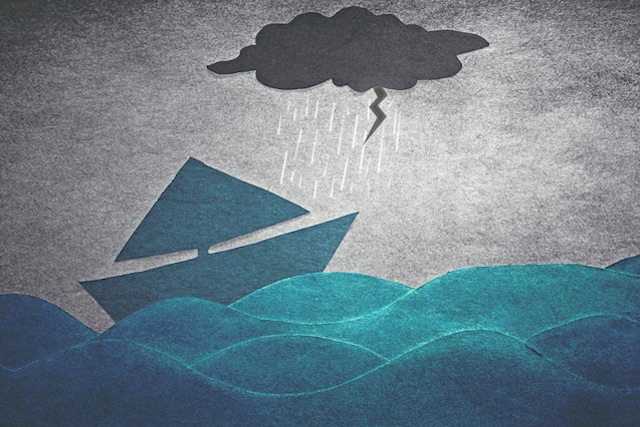
    Boat in a Storm

    “Our ultimate freedom is the right and power to decide how anybody or anything outside ourselves will affect us.” ~Stephen Covey

    My partner was a well-respected bank manager in a small country town. He was rising through the bank hierarchy with good prospects for further promotion. We were thought of as a happy, close-knit family that contributed in every way we could to the local community.

    Unbeknownst to us, the bank was conducting a re-assessment of their country branches. Several of the smaller banks would close and all staff would be dismissed.

    Frightening words were on our lips—redundancy, fear of the unknown, financial difficulties, unexpected change, personal loss.

    Little did we know how much a huge obstacle suddenly dumped in our path would affect us, particularly emotionally. Our hopes and dreams for the future—moving back to the big city to live in a “castle” with a fantastic view—were dashed.

    We started to name and blame bank personnel. We asked lots of questions but the answers remained elusive.

    Our totally negative and blaming attitude kept us stuck in an emotional hole. We couldn’t see how necessary it was to accept the situation emotionally, before we could do the practical stuff required to relocate and rebuild.

    There was a pre-requisite to the rebuild but we missed understanding this, until…

    A close friend started sending us a card every six or so days. In each card was written a quotation, the words of a song, or sentences our friend had read that she thought would be constructively helpful.

    One day when a card arrived, I was feeling very down. I read the words “Could we change our attitude, we should not only see life differently, but life itself would come to be different.” (Katherine Mansfield)

    The word attitude jumped right out. Changing our attitude was the pre-requisite we had missed seeing. What a realization—such a powerful one. It became the catalyst our family needed to accept our situation, stop feeling sorry for ourselves, and start to map out a recovery plan.

    And it all started from a simple, thoughtful act. Our friend had helped us survive.

    How can you, too, be a survivor when loss, health issues, financial challenges, or accidents block your path?

    Not all your problems will be as overwhelming as the one I’ve described. Nevertheless, every problem, including insignificant ones, can be worrying, even numbing. Knowing what to do will ensure that the physical and emotional scars left by your experience will not be very deep.

    Following are my five Dos and Don’ts that I documented from our experience, to help you work through every bump and hump, minor or major.

    This is not your usual list of “five practical steps.”

    Rather, the Dos and Don’ts are what reshaped our attitudes and emotions—a reshaping that was the pre-requisite to solving our practical issues—moving both our location and professional direction.

    5 DOs and DON’Ts to Ensure Your Survival

    1. DON’T bury your feelings.

    Denial, anger, and anxiety are normal feelings that can accompany setbacks. They’re also positive things—stepping stones on the road to acceptance and recovery. It’s natural, too, to feel completely overwhelmed and powerless.

    First, recognize and accept that the situation is real. Allow your feelings to surface and overflow. Have a cry, a yell, and a rave. You’ll empty yourself of the worst of your negative feelings and be quicker to mend and move on.

    We found that taking walks in a nearby park, among trees, provided a peaceful environment for us to clarify our feelings and come to grips with the above emotions.

    2. DON’T act like a victim.

    Things get worse when you focus on yourself and act like a victim.

    Quit blaming yourself, others, or external circumstances for what has happened. Going over and over what you should have done solves nothing. Wallowing in self-pity and beating yourself up takes your power away.

    Believe in yourself and your abilities. Believe that you are awesome enough to push through to a brighter future. Read inspiring books or put sticky notes with motivational quotes around the house. Say them out loud as you walk past. Take back your power over the situation.

    For us, mindfulness was a great tool to help us snap out of the victim mentality. We sat quietly for ten minutes a day and concentrated on our breathing, taking our focus away from our worries. The activity was very calming.

    Being mindful gives your mind a rest. You’ll problem solve more easily with a calm mind. You’ll move from victim mode into action mode, as we did, to hasten the healing process.

    3. DO keep the communication channels open.

    At these difficult times, keep friends and family close by as listeners and supporters. Find someone you can confide in about the challenges you face. Together, brainstorm possible ways to move ahead.

    Talking and sharing helps you see a different perspective so you can come up with creative solutions. It will also help you see that you’re not alone because others have been through equally challenging circumstances.

    I found keeping in touch with my usual contacts on social media helped lighten my load. I enjoyed logging on to sites like Tiny Buddha, where I received encouragement from others in the blogging community.

    4. DO be flexible.

    Accept that ups and downs are an inevitable part of life. Remembering that life moves through cycles of peaks and troughs will help you look forward to the rewarding times that lie ahead.

    These words from Alexander Bell, in one of our cards, gave us both a jolt. “Sometimes we stare so long at a door that is closing that we see too late the one that is open.”

    Be flexible; adjust your thinking and your goals. Becoming paralyzed and inflexible by the reality of your situation might deny you the opportunity to follow a new, exciting direction. Adapt so you can survive and thrive.

    Previously we were choosing to be miserable. Now we started asking empowering questions such as, “What choices do we have here?”

    This form of questioning encouraged flexibility and enabled us to expand our thinking. We found ourselves probing possible alternative— in what employment areas outside banking is financial expertise sought after?

    Being flexible isn’t easy. However, we found it absolutely necessary before we could move forward.

    5. DO focus on the good things in your life.

    Focusing on what you don’t have stops you from seeing all the wonderful things that you do have. Appreciate what you have, and the things that are working out well. You’ll gain a better perspective on life.

    Rejoice in any progress you make. Reward yourself with small treats such as coffee with friends. Each step and celebration provides motivation for the next one. You’ll find relief from the stress that has enveloped you.

    As a family we made a list of things we were thankful for such as good health. We included positive aspects of moving back to the city—more time to spend with our families, wider educational and sporting opportunities.

    Being thankful gave us a more positive outlook. Even the “castle” came back into view.

    We placed the following words where we could see them every day, and that helped too. “If you have nothing to be grateful for, check your pulse.” It’s something to smile about, eh?

    Final Thoughts

    Setbacks, tragedy, loss, and failures are part of life. So the joy and success we find in our daily life depends largely on the way we handle life’s problems—our attitude—as well as on our ability to keep going, no matter what.

    In other words, never give up.

    Setbacks are golden opportunities to learn and grow. It’s up to you to transform the pain into purpose.

    Ship in a storm image via Shutterstock