“The purpose of fear is to raise your awareness, not to stop your progress.” ~Steve Maraboli
I used to hate my fear because it scared me. It terrified me that when fear arose, it often felt like it was driving me at full speed toward the edge of a cliff.
And if I were driven off a cliff, I would lose all control, all function, perhaps I would collapse, perhaps I would shatter into a million pieces. I was never totally clear on the details of what would happen if I let the fear get out of control. That’s because I spent most of my life trying to control it.
It’s why, when things don’t go according to plan, when I am running late or things change at the last minute, I can get snappy and sound angry. I feel rage when people come along and do things that seem to amplify my fear—like my husband using the bathroom three minutes before the train is leaving, or not locking the front door at night with all its three locks.
Oh, I had so much judgment around this fear. I hated it, but I hated even more that I seemed to be an overly fearful person. I felt disgusted and full of shame for not wanting to do things that other people seemed to find easy, like flying, or for freaking out when I was sick, thinking I was dying.
I carried the shame of fear around with me, hoping I didn’t have to reveal it, and if I did, if I had to show people how terrified life made me, I would be horribly self-deprecating.
Because I had this sense that I shouldn’t be like this. It wasn’t normal. So I blamed it on myself as a character default.
That’s why I wouldn’t want to walk toward scary things. That’s why I avoided things that brought up the fear because if I didn’t, it would have driven me off the cliff so freaking quickly, and I’d think, how stupid could I have been to allow it?
I see now that my fear lived at such a low-level frequency in my body that I didn’t notice it was there. It was on a low buzz all the time, like a refrigerator noise—not really in my awareness but controlling how I made decisions.
I know this because, when I was really paying attention, I realized I was always trying to pick the least scary option. But when I kept choosing the least scary option, the least challenging to me, my life got smaller and smaller.
I was not even really aware that I was doing this. It just felt like I was being sensible.
But sometimes I would get this glimmer of another world where I did the most interesting and exciting things, like exploring alone somewhere new or taking a belly dancing class. Where I lived unleashed and unbounded by fear. I said what I meant, I did what I wanted, and I didn’t worry all the time about terrible things happening to my loved ones.
Living a life immersed in fear felt like being bound with invisible rope that no one could see. And because people couldn’t see this rope, they would ask me to do things that I couldn’t possibly say yes to.
Things started to change when I didn’t just ask how I could get the fear to stop, but I started to learn why there was so much fear in my body, where it came from, and how it was affecting how I experience life. So much of my fear came from a lack of emotional safety, and sometimes physical safety, as a child and young woman.
When I learned to start being curious about the fear that confined me and not judge it as a character defect, I started unraveling it. This, along with some powerful emotional processing and nervous system regulation, transformed how I now experienced fear in my life.
Here’s the thing: We don’t intentionally create bodies that can’t handle emotions like fear. We don’t intentionally create nervous systems that are jumpy and hyper-vigilant. We don’t create sensations of immense doom for pleasure.
How we were taught to be with emotions, how we were taught to allow or not allow them, how we were cared for when we were in the midst of emotions—this all informs how we now deal with fear.
It makes sense that fear feels too much for our bodies to handle when we have lived with too much fear; when we haven’t had enough emotional support of someone helping us hold that fear; when we’ve had experiences that have terrified us down to our very bones, that have stayed trapped in our bodies; when our lives have been rocked by tragedy; when sudden life-changing events shake any sense of stability from us; when fear has just been too much for too long.
We need to learn how to provide deep emotional support, a sense of safety, love, empathy, and validation, to our bodies that have held so much pain and discomfort. We need to learn how to tend to and meet our needs.
Emotions need to be seen, felt, and heard. When we haven’t learned how to do that, how to hold emotions and really be with them, we get pushed into a part of our brains where things feel deeply overwhelming and urgent—our survival reactions.
It’s a part of our brain that uses primal methods for dealing with emotion—meant to be utilized in emergencies and when our survival is under threat, but too commonly used to discharge uncomfortable emotions. And none of these survival reactions feel good.
When we are in our survival reactivity, we can feel doomed and trapped; we can feel like there are no options; we can feel the red mists of rage or a deep-freezing panic. We can go into overdrive doing too much, or sometimes we just slow down and shut off. Everything feels like too much.
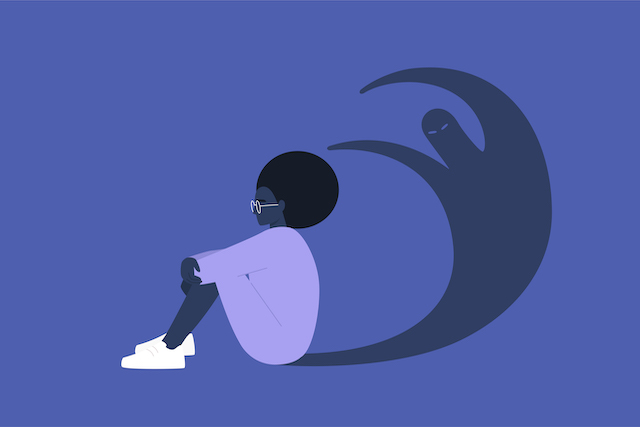
That’s why we feel we could go over the edge. That’s why we don’t feel safe. That’s why we desperately try to stay in control. Because we have this sense of an unknown, dark, and terrifying force in our bodies that feels like something beyond what we can handle.
We don’t know how to deal with this part of our brain, these survival reactions, so we spend our lives attempting to control our fear, hoping that it won’t rear up and push us over the cliff edge.
But there is another way. And it’s not by feeling the fear and doing it anyway. I couldn’t dislike that piece of advice more because of how wildly misunderstood it is. You can only feel the fear and do it anyway if you have a comfortable relationship with fear and it doesn’t push your nervous system into overwhelm and survival reactivity—where you feel like you are actually fearing for your life.
If you are in survival mode, you don’t want to be pushing through anything.
In fact, quite the opposite.
You want to be doing everything to reassure yourself that you are physically safe, that there is no emergency, that all is well.
And that is step number one. That’s the first place I go to when I feel the escalating sensations of fear.
It’s learning to look after yourself and meet your needs in ways that maybe you have never done before. You learn to build your own safety, and to repair all the damage that has been done to that solid feeling of protection that others seem to have but you sense you deeply lack.
There are several things you can do for this..
1. Stop the overwhelm.
My first suggestion is an exercise you can do when you feel you have entered that survival mode of things feeling like way too much—when you are overwhelmed, feeling doomed or trapped. This is an exercise called regulating breath. The aim is to activate your parasympathetic nervous system, which is where you are “resting and digesting.”
It’s super simple—short, quick inhale, long exhale. Then repeat this until you are moving away from that deep overwhelm. It’s a signal to the brain that you aren’t unsafe; this isn’t an emergency; you are safe to move out of survival mode and back into your body. I use this breath daily to keep my nervous system regulated and feel a sense of physical safety.
2. Be curious about why the fear is here.
The fear didn’t just show up unannounced today. If the fear feels like too much, there is definitely a history that you can trace back. And when you know your history, it can help you drop a lot of the judgment that you feel about it.
Ask your fear: Where have you been showing up in my life, and how far does this go back?
3. Ask your fear what it needs.
Uncomfortable emotions like fear are expressions of needs that have been unmet perhaps for all of your life. Needs like clarity, structure, peace, or consistency. When you can learn to really connect with your emotions and hear what they have to tell you, you can then start meeting those needs.
I love to talk to my fear. I ask it questions on a regular basis. I ask my fear: What do you need? Why are you here? What are you trying to tell me?
When I am able to really sit with the fear and hold it in my body, it will tell me things like: I’m just trying to keep you safe. I just want you to be protected. I don’t want you to do unsafe things!
When I know that the fear just wants to keep me safe, I can then reassure it, and myself, that I can provide the safety that I need. That I know how to make good choices; I know, as an adult, how to look after myself.
4. Offer empathy and validation.
Give yourself the deeply nourishing support of validation and empathy. Fear is a normal emotion that manifests as physical reactions in the body because of how we’ve learned to be with emotion, or due to the limited support we have received around big, challenging experiences.
When you recognize this, you can start to not judge your reactions. You can say to yourself: It makes sense that you feel like this. It’s okay, I’ll stay with you. I will support you through this.
You can give yourself the tender validation and empathy you would offer to someone you deeply love—your child, a friend, your partner. You can treat yourself as someone deserving of being wrapped in beautiful, loving empathy.
When you do things like double-check the locks at night or keep checking your phone to see if your teenager has messaged, when you are asked to take a trip to a place you haven’t been to before, instead of getting lost in the fear or loading yourself down with shame about it, offer empathy and validation instead.
“You know what? This is bringing up a lot of fear. And it’s understandable that I have fear around this; it’s completely okay. So I am going to support myself through this feeling. I am going to tend to my needs around this feeling. And I am only going to do what feels best for me. What feels right for my body right now.”
By meeting the needs your emotions are expressing we start to change our relationship with the emotions we find most uncomfortable. When we try to white-knuckle through, we often end up more rattled, more exhausted, more overwhelmed, and sometimes with more trauma than if we had actually taken tender, gentle care of ourselves.
And by taking loving care of ourselves, by showing up and giving our feelings—and our sense of overwhelm—attention, we can end up naturally starting to want to do those things that maybe we were too scared to do before.
By giving ourselves the empathy that our emotions so yearn for, we create a much deeper, more loving and trusting connection with ourselves. When we know how to emotionally support ourselves then we can learn how to emotionally support other people.
My relationship with fear is a work in progress. Sometimes it slips out of my grasp and escalates before I have the chance to process it. But I know now that I can always bring myself back from that edge. I can always bring my nervous system back into regulation, even when it feels a bit messy.
When we know that we can handle any emotion that comes our way, we have so much more freedom in our lives to make the choices we want to make instead of just choosing the least scary thing.
Fear is a normal part of life. It’s there to help us stay safe and protected and make good choices. But sometimes, when we have had experiences that have intensified our fear, we can end up keeping ourselves small. Changing how we take care of ourselves to support ourselves in these big emotions is a great first step to living a more exciting, fulfilling life. I hope these tips have been helpful.