“It’s not what you look at that matters, it’s what you see.” ~Henry David Thoreau
Living in NYC, I have seen some crazy and outrageous things. So, I shouldn’t have been surprised to see an ad in the subway that read, “Overcome Your Bikini Fears. Breast Augmentation Made In NY: $3,900,” or another ad from the same plastic surgery office that showed a picture of a woman looking sad, holding a pair of small tangerines in front of her breasts, and the same woman looking happy holding grapefruits, with the same caption, “Breast Augmentation Made in NY: $3,900.”
Still, I was surprised to see that this plastic surgery office would so overtly play into the insecurities of some women, basically implying, “You’re not good enough as you are; let me make you better.”
I understand that this office is simply trying to make a buck—a big buck, that is—but I couldn’t help but be aghast that this sort of message is allowed to be out there, to be seen on the train by many women, especially young women who might be wracked with a poor self-image already.
The truth is, I get it. I grew up wanting plastic surgery pretty much from third grade into my early twenties.
I was obsessed with looking in the mirror, poking around with my fingers trying to see the “better version” of my face, when it would be somehow reconstructed magically or surgically.
My nose was too flat, my eyes were not big enough or deep-set enough, and my jaw was not defined enough. To top it off, my legs were too short and my torso too long. I was not a girl on a magazine cover.
It broke my heart that I felt ugly and plain, and that I wanted something different from what I was. I actually felt beautiful sometimes, but when I looked at myself in the mirror, it wasn’t a vision of beauty, as I understood it.
The vision of beauty was the girl in a Hollywood movie. The vision of beauty was the girl in a commercial. The vision of beauty had features that I didn’t possess.
I kept wishing that my facial and body features would magically change as I grew up, or that I would one day be able to have plastic surgery. But deep down, I knew that I didn’t want to change my physical appearance in order to feel good about myself.
Over time, through the transformational work I did in the past decade, I was able to dissolve self-hatred and the desire for plastic surgery, and give myself total acceptance for who I am.
Now I feel good in my own skin. I’ve learned that the old adage is true: “Beauty is in the eye of the beholder.” I had appreciated it as a concept for a long time, but now I get it and know that it’s true.
I used to wish that my face and body would change somehow, but in truth, what needed to change was the way I saw myself and how I felt about myself.
My hope is that every person feels beautiful and good in his or her own skin.
Beauty is not a monopoly that only belongs to Miss Universe and the like. We are all beautiful in our own unique ways.
If you’re struggling with a poor self-image like I did, these tips may help.
1. Stop comparing.
My old boyfriend used to tell me that I was beautiful over and over like a broken record, though I didn’t believe him. He said this to me one time and it stayed with me: You can’t compare a rose to a lily; they’re both beautiful and they’re different.
I was constantly comparing myself to others, and I felt inferior because I didn’t measure up to the conventional ideas of beauty.
Since I stopped comparing, I realize that no part of my body is any less beautiful than someone else’s just because it’s shorter, longer, flatter, or bigger. When I stopped seeing with a specific set of beliefs and ideas, my “short” and “crooked” legs stopped being inferior.
You will always be too fat, too skinny, too tall, too this and that, when you compare yourself to others. You will always be “too something” when you play the comparison game. Know that you are exactly what you’re supposed to be—one of a kind and beautiful.
2. Ideas of beauty differ and change all the time.
If you looked into different cultures at different times, you would see that people had (and still have) different ideas of beauty. Some like curvy, some like skinny, some like tall, and some like short.
A lot of times (or maybe all the time), the definition of beauty as we know it is just the opinion of one person or group of people. It’s just so happened that this opinion got popularized.
If you don’t fit their definition of beauty, does it mean you’re any less beautiful? Absolutely not. Don’t let the ever-changing opinions of others affect how you feel about yourself.
Take Sarah Jessica Parker, for example. Some people think she’s the most gorgeous woman on the whole planet, and some quite the opposite. So, who’s right?
The better question to ask would be: Does it really matter? It really doesn’t matter what other people say or think. What matters is how you see yourself and how you feel about yourself.
3. Change the way you see.
Have you had experiences where people you thought were attractive became unattractive in your eyes, and people you thought were unattractive became attractive? I have many times.
When I was nineteen, I met a guy who I thought was “ugly” at first sight. Then I fell madly in love with him two weeks later, and he became the most handsome guy in the whole wide world to me.
Conversely, I met another guy a few years later that I thought had the most gorgeous face. A few interactions later, his face lost all its appeal to me, as I found him to be rather obnoxious.
I’ve had so many of these experiences over the years, and I’ve realized that beauty entails more than just “pretty” features. Whenever I find something lovely about a person, whether it’s their kindness, generosity, or thoughtfulness, their external features seem to start to sparkle with radiance. It’s not that the person changed—my perception did.
Dr. Wayne Dyer often said, “When you change the way you look at things, things you look at change.” I know this to be true because I often experience this in my life.
When I go on my nature walks, I try to observe things without preconceived notions or ideas. I sometimes stop and look at a fly perched on a leaf of a plant, and when I look at it without my preconceived notion (that it’s ugly or disgusting), I can see the exquisite beauty that it is.
Now, I know that you’re not a fly, but the same principle applies. When you remove the gunk—the gunk of beliefs and ideas—from your eyes, you start to see the magnificent beauty of who you are.
4. Change your thoughts.
Recently, when I was video recording myself, I felt rather disturbed by my appearance. I didn’t want to feel this way, but a barrage of negative self-talk dominated my head, and I wanted to just give up on the whole project.
I went for a walk, and when I came back—with a little more space within myself—I realized I had allowed myself to be taken over by the negative voices in my head. I had been totally immersed in them.
Time, space, and a little bit of deep breathing helped me step back from my own drowning thoughts. Then I was able to embrace the other voices that also existed in my head, which were more affirming and kind. And I continued with my project.
How sad it would be if I allowed those negative voices to stop me from offering what I have to give: my knowledge, ideas, voice, gifts, my love, and more. I would be withholding all of those things from people who might need and benefit from them.
If you find yourself in a similar situation where you’re feeling bad about how you look, take a moment to notice what you’re thinking. Step back and take a few deep breaths so you can observe your thoughts instead of being immersed in them.
And remember, you’re more than your skin. You, too, have so much to give (even if you feel like you don’t): your unique gifts, your experience, courage, ingenuity, creativity, and so much more. Don’t let the negative voices stop you from sharing what you have. The world (your neighbors, your friends, your grandma, or whatever your world may be) needs it.
5. Give yourself total acceptance.
I admit, even with all the realizations I’ve had, there are times when I look at myself in the mirror with dismay.
Some of the old, familiar thoughts crop up in my head, telling me I’m plain and ugly. The difference now is that I catch myself falling into my old belief—that looking a certain way makes me undesirable and unlovable.
For most of us, this is the core of the issue: We believe that we would not be desirable, that we would not be loved, if we didn’t look “good.”
The truth is, there will always be someone or some people who will find me undesirable or unlovable, but the world is also full of people who will feel the opposite.
Ultimately, the deeper truth I had to find within myself was this: If no one loves me, will I love myself?
The answer was yes, I will love myself. I will not forsake me. I will not take my love away from me.
That’s the truth I needed for myself, and what I truly needed in order to feel beautiful and good in my own skin.
In those moments when I don’t like what I see in the mirror, I make a choice. I make a choice to give myself total acceptance and love for all that I am: good, ugly, bad, and all.
And that’s how I love myself when I’m too short, too tall, too fat, and too skinny.
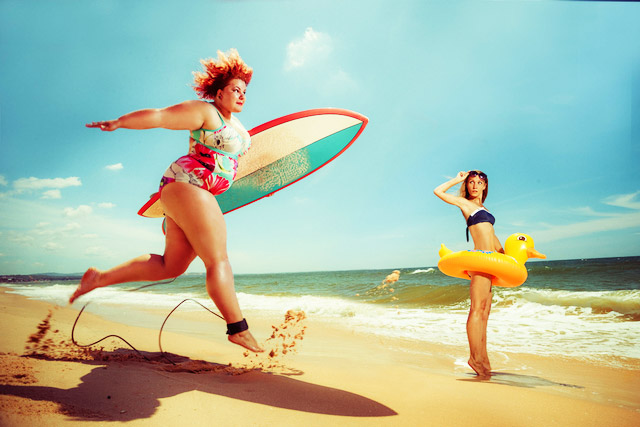
Woman at beach image via Shutterstock