Tag: supportive

  • What It Really Means to Have a Supportive Partner

    What It Really Means to Have a Supportive Partner

    “The best possible thing you can get out of a relationship is that you’re with someone who encourages you to be the best version of yourself every day.” ~Nishan Panwar

    Let me ask you a question. When was the last time you felt supported? When was the last time you felt safe, at home, encouraged, and able to be 100% yourself?

    If your partner creates a safe space for you to do this, then you are truly blessed. If not, have you ever wondered why you don’t feel safe, supported, and loved?

    Two years ago my best friend told me he’d loved me for many years. It was an unforgettable day once I got over my initial shock, because for many years I’d felt the same way about him.

    It took me a while to get my head around how the most beautiful man I knew, not to mention one of my best friends, wanted me over anyone else.

    In the beginning of our relationship I idolized him. I had an image of him in my head as my friend, and it was one of unrealistic perfection, non-stop humor and happiness, and a loving boyfriend who would walk on hot coals for me, just as I’d watched him do for other girls.

    I wanted to support him any way I could and would do anything for him, but when we got together—a difficult and confusing time for me, for many reasons—I was the one who needed supporting.

    When I didn’t get what I thought I deserved, things began to look very different than I had originally imagined. Maybe he wasn’t the guy I thought he was going to be as a partner. Maybe I’d set his pedestal just a little too high.

    Had going from friends to lovers been a terrible idea? But what was actually happening at the time was that I was leaning on him way too much for support, and I hadn’t even stopped to consider that the person I needed to sort out and support, first and foremost, was me.

    You see, when we’re lost and confused, we often look to external influences to make us happy. We’re all guilty of it.

    My experiments in how to find happiness have varied over the years—shoe shopping, drinking, drugs, yoga, meditation, and other people.

    But we can’t solely rely on anything or anyone to make us happy. We have to create the happiness part for ourselves.

    One major thing I realized at the beginning of our relationship was that I was asking for the world from a guy who I was placing way too many expectations and assumptions on.

    I assumed just because he was finally in flow with his career that it meant that our coming together was doomed and that I’d be cast aside in favor of a new job.

    I also assumed that because he wasn’t running around after me and spending every penny he had on me, as he’d done with previous overly demanding girlfriends, that I meant less to him than anyone else that had come before.

    However, had he acted the way I had expected him to when I was at my lowest ebb, I would have quickly labelled him clingy, over-bearing, and annoying, and that would have been the end of that.

    The truth was, he was being everything I needed him to be for where I was at that time.

    I didn’t need someone who would wallow in self-pity and negativity with me, as previous partners of mine had done. I needed someone who would inspire me to be the best person I could be and show me that if I picked myself up, everything would work out just fine.

    I remember him saying to me one night when I was in tears, “I know that you’re going through a lot right now, but get really excited about the future and what’s coming next rather than being fearful of it, because everything is going to be okay.”

    Each time I remember those words, they mean more to me.

    Let me tell you something that I have learned about what it means to have a supportive partner.

    A supportive other half isn’t someone who will hang on your every word, do whatever you want, and follow you to the ends of the earth. That clinginess isn’t the “true love” that you’re searching for.

    When someone truly loves and supports you, they challenge you, stand beside you when you need them, and give you the space you need to roam free and grow as a person.

    They will never judge you or put constraints on your mind, your physical body, or any of your dreams. They will be a cheerleader for your cause without being a groupie. They’ll go to the other side of the world for you when you need them, but they won’t smother you.

    They might not be around all the time, but for the things that really matter, or for when you are sick or in the dark, they’ll be there at your side, without you even needing to ask.

    They might seem like the busiest person in the world or the least affectionate at times, but when it matters, they’ll drop everything for you.

    Most of all, they will see you. This person will see what other people can’t. They’ll see you in all your beauty and grace, as well as your darkness and faults.

    They will see you for the person you are now and the amazing one they know you are truly capable of becoming, even if you can’t quite see this yourself yet.

    And they’ll love you. Unconditionally. And that’s really all that matters in this life.

    Stop expecting things from your partner that they don’t intuitively know how to give you. You will learn and grow together, so long as you continue to communicate assertively and don’t put unreasonable demands on each other.

    But it’s also up to you to become responsible for your own feelings and your own happiness. Put this first and you’ll become more lovable to your other half without even trying.

    Keep supporting each other. Stop worrying that your other half is going to leave you or wrong you or let you down. Have some faith and, in return, they will have faith in you.

    Stay truthful to yourself and they will reflect this beautiful truth straight back to you. And keep showing all of your colors to them—your light and your darkness. Because if they truly love you and value you, as long as you do all of this, they’re not going anywhere.
  • 39 Supportive Things to Say to a Male Survivor of Sexual Assault

    39 Supportive Things to Say to a Male Survivor of Sexual Assault

    One in six men will be sexually assaulted at some point in their life. It doesn’t make us weak or less masculine—nor should it. Rather, we, as men, should encourage other men to speak up, to be courageous, share this burden with others, and to attend therapy and take medication. There is such a thing as healthy masculinity, and we can find that in our fellow men, in comforting those who are having a rough time. Seeking help in a healthy way, wanting to be better, practicing empathy and compassion and caring for each other are ways of practicing healthy masculinity.” ~Anonymous

    Why is it that men are less likely to be supported than female survivors of sexual assault? No matter a person’s gender or sexual orientation, all survivors deserve love and support.

    In 2013, I became an activist for survivors of sexual assault. I was living in New York City, and my method for getting the message out was through chalk art. To reclaim my voice after the NYPD threw out my sexual assault case, I went all over Brooklyn and Manhattan scribbling chalk art messages about consent.

    Since then, I have done thousands of chalk art drawings all over the world, from Europe to South Africa. Using art as a tool of activism has been an extremely powerful way of reaching millions with an important message: It’s time to replace the current rape culture that we live in with a culture of consent.

    It’s a common notion that it’s impossible for a male to be raped. Male survivors who speak up are often met with the response, “How can a boy get raped?” The answer is, if he does not give his consent, it’s rape.

    It doesn’t matter if the rapist was male, female, or any other gender identity. If he denies consent, it’s rape. Any person of any gender can be raped.

    Imagine how hard it is for a woman to speak up and report a rape. That difficulty is doubled for men because the patriarchal concept that “men cannot be raped” ruins any hope for male survivors to get the support they deserve. This concept totally dismisses the real-life experiences of millions of men who actually have been sexually assaulted.

    For fear of not being believed, it’s fair to assume that millions of men hide in silence. Very few heal or recover due to the stigma of male rape.

    Men’s stories matter. Men’s healing is just as important as healing for others. When men heal, the whole world heals, because the world is still run by men.

    Suicide rates are often higher in males because so many of them fail to express their emotions due to the patriarchal concept that crying is a sign of weakness, particularly in men.

    When a man is seen crying, he is often told to “man up.” Due to fear of being called weak, men hold in all their tears instead of releasing them.

    Shaming men and boys out of crying is mental torture for those who truly wish to express themselves. Men who have been raped should be uplifted in their healing, however they see fit. If their healing includes shedding a tear for all the pain they endured, it is their right to do so.

    Here are thirty-nine uplifting messages for male rape survivors.

    1. Your pain is valid.

    2. The person who did this to you is the only person to blame, not yourself.

    3. You are not less of a man for being sexually assaulted.

    4. Being a survivor does not define who you are as a man.

    5. A survivor is anything but weak.

    6. Don’t be afraid to talk about it.

    7. Never blame yourself.

    8. Things will get better.

    9. You are so incredibly strong.

    10. I’m proud of you!

    11. You are not alone.

    12. What you are going through is temporary.

    13. You are loved.

    14. You’ll see the light one day and be happy again, I promise!

    15. You have many people who believe and support you.

    16. You are worthy of love and respect.

    17. You don’t need to feel ashamed.

    18. Talking about it to someone you trust will help.

    19. You are heard.

    20. You are valid.

    21. You don’t have to be strong all the time.

    22. It’s okay to cry.

    23. You’re safe to express your emotions.

    24. Some days may be better than others, but you will get there.

    25. You will grow and survive this current pain.

    26. We support you.

    27. Even if you had an erection, you still weren’t “asking for it.”

    28. Even if you had an orgasm, if you didn’t want it, it was rape.

    29. We applaud you and your courage.

    30. Feel the pain instead of numbing it.

    31. You gotta feel it to heal it.

    32. You’re still manly and I adore you.

    33. Tears are a sign of strength.

    34. The sickness of another is not your burden to bear.

    35. Being a victim is difficult, but in time you will heal.

    36. There are people out there that love you and are willing to listen to you (including me).

    37. Keep staying alive. There is so much to live for.

    38. You are brave for admitting what happened.

    39. We are in this together.

    The idea that men cannot get raped is perpetuated by the false belief that all men want is sex, every hour of the day. While I was doing #StopRapeEducate chalk art in New York City in Union Square one day, a young, Afro-Latino couple stopped to read the message I was writing: “Rape knows no gender.”

    The girl looked puzzled and asked me what it meant. I told her that it means anyone can get raped, whether they are a male or a female.

    She burst into laughter and said, “A guy…. hahaha…get raped?! Ha! How is that even possible? Shit, I’m sure they would love that. That’s every guy’s dream.”

    I gave her the straight-face-emoji-look and said, “Actually, that’s not true. Men who get raped are traumatized just as much as female victims. I’ve met tons of guys who have been raped. It’s a serious problem.” She straightened up quickly.

    Men have freewill to decide if they want to have sex or not. If you are someone who dates men, it’s important to accept that the men in your life may not always be in the mood to do it, and that’s okay.

    Before I understood this, in my younger years, I recall pressuring myself to be readily available for sex with guys. I would even go as far as to pounce on them, thinking that that’s what they wanted. I had seen it a million times in movies as a way of women initiating sex: no questions asked, just pounce.

    One of my friends that I used to hook up with told me once that he was tired of my sexual advances. I felt so ashamed and disgusted with myself because I was caught up in stereotypes about male sexuality that I gave myself to someone that didn’t have interest in me.

    This is why sexual education is so important. It’s unacceptable for us to learn about sex from movies, television, and porn.

    The reality is, men and boys are not sex machines. Nobody is. It’s always okay to say no to sex, and it’s never acceptable to assume that someone wants to do it.

    To create a safer, more loving world for all of us, let us respect and support male survivors of sexual assault rather than reinforcing toxic masculinity rooted in rape culture.

  • Are You Being Too Supportive? (Yes, There is Such a Thing)

    Are You Being Too Supportive? (Yes, There is Such a Thing)

    “We cripple people who are capable of walking because we choose to carry them.” ~Christie Williams

    Years ago, I had a dear friend who needed a lot of support for various reasons. She was working hard to find her way out of a dark period. She had suffered traumas and tragedies—things I wouldn’t wish on anyone.

    Her life really did resemble a roller coaster ride. It was heartbreaking to watch her struggle, exciting when things would be on the upswing, and upsetting again when things would spiral downhill.

    Because I had known her almost my whole life and because I loved her dearly, I tried my best to always be there when she needed me. I am someone who knows and appreciates how important it is to have supportive people around you, offering love and kindness, especially during times of struggle.

    Sometimes being there for her simply meant picking up her call in the middle of the night and talking with her.

    Sometimes it meant dropping what I was doing and driving to meet her to make sure she was okay.

    There were talks, tears, and through that, hard truths were often revealed.

    Of course, it wasn’t all dark and dreary. There were bright moments and memories too. There were movie marathons and game nights. There was laughter to the point of tears. Many a meal was shared and many a bowl of ice cream was devoured.

    What I got in return wasn’t the same type of support. She was not the person I would turn to in a crisis, however minor or major. She just couldn’t handle it. But in turn, this friend showed me gratitude and genuine love.

    I never thought much about the dynamics of our relationship until another crisis erupted in her life, shaking things up once again.

    The downward cycle began and with it came hysterical phone calls, late night drives, drama after drama. And through it all I did what I always did which was listen, help, care, and show love.

    But one day my boyfriend at the time looked at me and said, “You need to stop doing this.”

    I was confused. The idea had never even crossed my mind. Stop? Why?

    He explained more and his perspective was eye opening. He saw her as less of a victim to outside circumstances and more of an adrenaline junkie—addicted to drama and things going wrong. As proof, he listed off several disastrous choices that were just that: her choices.

    He asked how I could help someone who didn’t really want help at all.

    But mostly he felt this friendship was interfering with my own life, well-being, and happiness.

    I had never thought about it like that before. And while a part of me was mad at him—he just didn’t understand, I thought—there was a tiny part of me that agreed with him.

    What was I doing?

    The truth was these late night calls and drives were interfering with my early morning job.

    The truth was the time spent trying to support and help her was taking away from things in my personal life that also needed my attention.

    The truth was I cared so much that I carried her stresses with me much more than I should have. I felt sad and worried, more than I needed to.

    The truth was her out of control life was making me feel out of control in mine.

    Because the thing was this: in being so busy with always checking in on her, I forgot to check in with myself.

    It was the first time I really understood that in order to support others we must remember to support ourselves first.

    After this realization hit me, I spent a great deal of time thinking about our friendship and I started to see things in a different light.

    Yes, this friend had a lot on her plate, but maybe the way she was reacting and handling these situations could be better. Maybe she needed help beyond what I could give her. Maybe she needed to start by wanting to change and help herself.

    I started to see that no matter what I had done for her all those years, how many phone calls I answered or help I offered, nothing had really changed in her life.

    She was having the same type of emergencies and she rated them all at least a nine on her personal-crisis-Richter-scale.

    Once this truth was apparent, I knew a shift needed to take place.

    I started to do only what I felt comfortable doing. I wasn’t there every single time she needed me, but I was still there a great deal.

    This wasn’t enough. Naturally, my friend was upset and hurt. She couldn’t understand why I was withdrawing, even though I did my best to explain. The more I explained, the more hostile she became. The more hostile she became, the more I withdrew.

    Eventually the crack between us turned into a massive fault line, one that couldn’t be repaired.

    Do we have an obligation to do our best by the people we love? Well, yes—to an extent.

    But we have to remember we have an obligation to ourselves first—for our happiness, our health, and our spiritual well-being. If we are not respecting our time, feelings, and energy, no one else will either.

    I hope that friend of mine has figured that out. I hope she’s living life with more highs than lows, more laughter than tears, and more joy than she ever thought possible.

    And I hope she feels it when I send her a blast of love from my little corner in the Universe to hers.

    I hope she understands that’s the best I can do now… the best for both of us.

  • What to Do When Your Partner Disappoints or Frustrates You

    What to Do When Your Partner Disappoints or Frustrates You

    Upset Couple

    “Good relationships don’t just happen. They take time, patience, and two people who truly want to be together.” ~Unknown

    We are wired to seek “the right one,” the ever-supportive partner, and the loving relationship.

    If we get all three, it’s like winning the lottery of life. When we meet someone, we dream of him/her being our soul mate. When we are in a relationship, we hope they’ll love and support us unconditionally, and the relationship will be loving and everlasting.

    That would be the ideal world, and, unfortunately, the ideal world isn’t the one we live in.

    It took me a divorce and a few failed relationships to learn what real love is. Strong, lasting love is not being with “the right one” or being in a relationship that is effortlessly wonderful all the time. That’s a disempowering way of living, just like waiting for life to be perfect.

    I came to understand that true love is a daily commitment to make the relationship great by being loving and attentive in our action and our words.

    With the exception of cases whereby our partner is purposefully being physically/verbally abusive or emotionally manipulative, to love is to commit to being loving even when our partner unintentionally disappoints, frustrates, or hurt us.

    On days when it’s difficult to fulfill this commitment, I apply these five steps and they help me avoid getting caught up in passive-aggressive spirals with my partner.

    1. Get real and see the whole picture.

    When our partner lets us down, it can hurt so bad that we become blinded from everything else that matters.

    In defense of our wounded ego, we overreact by blowing the issue out of proportion and getting argumentative beyond reason. Our logic gets hijacked and we forget to see the whole picture—that in most cases, what we fight about isn’t truly important.

    During times like these, I ask myself, “Is it the end of the world, or the relationship, that this problem happened because of his insensitivity/immaturity/irresponsibility? Or is it a passing storm that ravages, but we can rebuild from there and learn lessons for the future?”

    2. Dig out the “I am loved” list.

    Reason flies out the window of our mind whenever we’re in pain or experiencing rage. Our mind focuses on how we’re being victimized and blacks out the times when our partners acted lovingly toward us.

    Whenever I find myself reacting like this, I dig deep in my “I am loved” list. It’s a list I keep of all the big and small loving things my partner regularly does and recently did for me.

    For instance, I may recall that when I was feeling stressed and exhausted, despite finishing work late himself, he traveled a long way to my place, got me dinner, went grocery shopping, and stocked my fridge with my favorite nourishing food items.

    I’ll also recall the regular acts of love he does, such as texting me first thing after he wakes up and last thing before he goes to bed each day, getting me coffee in bed, giving me massages when I’ve been working long hours, and cheering me up whenever I feel down.

    3. Picture his/her plate and realize how full/heavy it is.

    In the ideal scenario, our partner is loving, caring, attentive, and affectionate 24/7. That said, it’s easy to be so when we are not bounded by life’s stresses, problems, and burdens.

    Whenever my partner is acting in an unloving way, I try to counter my feelings of anger, hurt, and disappointment by putting myself in his shoes and picturing the responsibilities, issues, and worries that are in his life at that point.

    This simple exercise helps me see things from his perspective and enables me to be understanding on days when he isn’t able to act in ways a “good” partner would. Instead of focusing on how he can be loving toward me, this practice gives me the opportunity to identify how I can be loving and supportive of him.

    4. Get aware of how your response perpetuates your partner’s unloving behavior.

    It takes two hands to clap. When our partner isn’t being loving, the ego’s response is to think, “I don’t deserve this, so I’m going to retaliate and claim back my power.” Such a reaction only traps us in a lose-lose cycle.

    We pit ourselves against each other, when deep down all we want is to feel that our partner cherishes us and is on our side as our biggest supporter.

    Whenever I feel tempted to react negatively, I take a deep breath and direct my thoughts to how I can break the vicious cycle. I’ll ask myself, “How can I communicate my boundaries on unacceptable behavior without angry words of blame, judgment, and criticism?”

    The challenge is to swap the unconstructive reflex of finger pointing with the constructive practice of educating our partners on the right way to treat us.

    5. Be loving, but keep healthy expectations and boundaries.

    While it’s important to be the right person in a relationship, rather than wait for one, it’s critical that we maintain firm boundaries. Being loving should not happen at the expense of our sense of self-worth.

    It’s healthy to expect our partners to treat us with respect, to prioritize us, to communicate their feelings to us, and to show appreciation. When our partners start to take us for granted, we need to communicate in a firm but non-confrontational way that we will not accept that behavior.

    How do you respond when your partner is acting in unkind and unloving ways? Do you think these tips could help?

    Upset couple image via Shutterstock

  • 25 Loving, Supportive Things to Tell Yourself Today

    25 Loving, Supportive Things to Tell Yourself Today

    Happy Woman

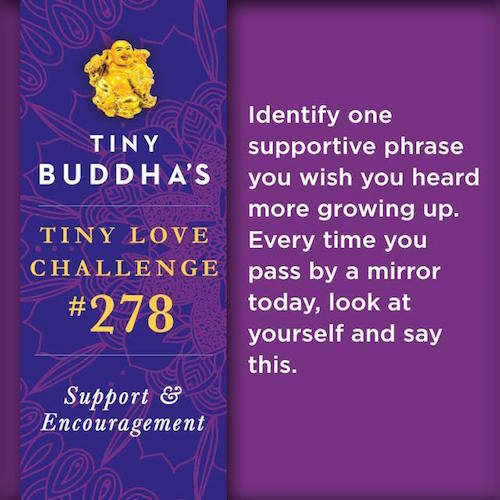
    “Identify one supportive phrase you wish you heard more growing up. Every time you pass by a mirror today, look at yourself and say that.” ~from Tiny Buddha’s 365 Tiny Love Challenges

    When I was a kid, an authority figure once told me, “If I was your age, I wouldn’t be your friend.”

    I tried to act like I didn’t care so I wouldn’t give that person the satisfaction of knowing how deeply they hurt me.

    But it hit me hard, and it stayed with me for years. Someone who was supposed to like me didn’t, so why would anyone else ever love me?

    There was something fundamentally wrong with me. And I wasn’t good enough at anything I did. Even when I did my best, I was never the best, so that meant I was a failure.

    These beliefs guided my childhood and adolescence. When I got to adulthood, I frequently sabotaged relationships thinking, “They won’t want to spend time with me. Why would they? I wouldn’t if I were them.”

    And I regularly overextended myself, only to beat myself up when I inevitably failed at juggling far more than any one person should have to carry.

    The voice in my head was callous and cruel. It took me years to realize it wasn’t even mine.

    Growing up, many of us heard more about what we were doing wrong than what we were doing right (from people who had the same experience growing up). And for a lot of us, there were more punishments than rewards, at home and in school.

    It makes sense, then, that so many of us grew into anxious, insecure adolescents, and then matured into fearful, self-doubting adults.

    But we’re not kids anymore, and we know better now than to believe everything we’re told.

    More importantly, we don’t have to continue hurting and criticizing ourselves. We don’t have to bully ourselves over our perceived shortcomings. We can stop the cycle.

    If you follow Tiny Buddha on Facebook, you’ve likely seen the “love challenge” graphics I’ve been sharing for the last month.

    Each one offers something simple you can do to improve your relationships, open yourself up to new ones, or nurture your relationship with yourself.

    And each one comes from my upcoming book, Tiny Buddha’s 365 Tiny Love Challenges.

    Recently, I posted the challenge below and asked Facebook followers to share what phrase they wished they heard more as kids.

    One Supportive Phrase

    Their responses reminded me that we all have the power, every day, to give ourselves the same kind of love and support we’d want from other people. In fact, it’s a prerequisite to getting love and support from others, because we’re only ever open to receiving what we believe we deserve.

    We all deserve to hear these things—from others and ourselves:

    1. I love you just the way you are.

    2. When you need something to believe in, start with yourself.

    3. I’ll always be here for you. I love you unconditionally.

    4. You deserve to be happy.

    5. You look beautiful.

    6. Don’t be afraid—you are good enough.

    7. I believe you are very capable of taking care of yourself, with or without someone else to take care of you.

    8. Anything you can imagine is possible. The only thing to fear is fear itself.

    9. Everything will be okay. Even if its not, it will be.

    10. You are enough as you are.

    11. You are an individual and are perfect the way you are now.

    12. You can do anything you set your mind to.

    13. It’s okay to make a mistake.

    14. I believe in you.

    15. You tried—that’s good enough.

    16. I’m proud of you.

    17. You don’t need permission from anyone to dream and explore your interests and passions.

    18. You have a beautiful soul.

    19. You are safe.

    20. You’re doing great.

    21. You can do anything.

    22. I want the best for you.

    23. You’re handling it beautifully.

    24. You are awesome, kid.

    25. I love and accept you no matter what.

    Imagine what the world would be like if we all told ourselves these things every day.

    Imagine a world full of people who believe in themselves, encourage themselves, and forgive themselves for their mistakes.

    Imagine a world full of people who speak to themselves kindly and look in the mirror and see nothing but love—and then take the positive, loving energy into their interactions with others.

    I’d like to be part of that world. And I know it starts with me—and you.

    Happy woman image via Shutterstock

  • Love Challenge #278: One Supportive Phrase

    Love Challenge #278: One Supportive Phrase

    One Supportive Phrase

    What supportive phrase do you wish you heard more growing up?

    (This challenge comes from the upcoming book Tiny Buddha’s 365 Tiny Love Challenges. Pre-order before October 6th and get $300+ in free bonus gifts!)

  • 3 Questions to Ask Yourself When You Feel Unsupported in Relationships

    3 Questions to Ask Yourself When You Feel Unsupported in Relationships

    “A community of friends supporting each other can make a world of difference.” ~Unknown

    Many of us feel we’re not getting the support we want or deserve in relationships.

    Maybe we’ve never felt supported by our friends or family. Maybe we don’t feel supported by our peers or co-workers. Maybe we don’t even feel supported by our partner.

    This can leave us feeling drained, tired, and unhappy, like we’re moving through life without much fuel to keep going.

    During my adolescence and early adulthood, this was a huge struggle for me. I rarely found a place or group of friends where I felt like I “belonged” and, therefore, I didn’t feel supported. When I did feel supported by others, it only lasted for a few days or weeks before it dissipated.

    Today, this has shifted. I feel much more supported in my current relationships and don’t feel nearly as drained as I once did.

    There are still moments when I feel like I did growing up, but I’ve realized that opening up to support is a life-long journey. It’s an ongoing process of healing old wounds and allowing ourselves to become something new.

    There are three questions that always help me realize what needs to be healed and how I need to shift my perception. If you don’t feel supported in your relationships, ask yourself:

    1. Is my story preventing me from receiving support?

    Do you tell yourself stories like “Nobody understands me,” “He can’t understand me because he hasn’t experienced what I’ve experienced,” or “I always have to take care of others and nobody can take care of me”?

    Or, do you repeatedly tell yourself, “I am never supported in my relationships”?

    Whatever your specific story is, it blocks you from receiving the support you desire.

    Some other stories that prevent you from receiving support include: “If I tell others about my problems, it will cause them more stress,” “If I share this with others, they will judge me,” “I need to give to others in order to be loved,” and “If I want something from others, I won’t be loved.”

    Formerly, I told myself the story “I will be a burden to others if I seek help and support.”

    I’d think this at work when I needed extra help or a day off, so I’d feel hesitant to communicate this to coworkers. I’d also think this when going through tough times, which made me feel scared to open up to friends, so none of them would know what I was feeling.

    When we acknowledge our stories, we are then able to shift our perception and open ourselves to receiving support from others.

    2. Am I reaching out to others for support?

    Often when we feel like we are not receiving what we desire from others it’s because we are not open to receiving. It’s as if we have a little shop set up for business, but we have all the doors locked!

    Be sure to tell others when you are going through a difficult time. Ask people for help rather than to try to figure it all out on your own.

    By letting people know that we are seeking support, we’re much more likely to receive it.

    3. Am I supporting myself?

    What we experience outside of ourselves is often a reflection of whatever we are experiencing within ourselves. If we are not feeling supported by others, then it is likely true that we may not be supporting ourselves.

    The key to shifting this is to find ways to feel full and supported within ourselves instead of focusing solely on what we want from others.

    This was something I needed to do when dealing with various health issues. For a few years, I failed to address my health problems, which meant others couldn’t support me either.

    I would not stay committed to diet and lifestyle changes that I knew would help me. This meant others didn’t have the opportunity to support me because my actions did not show that improving my health was important to me.

    Ask yourself: Am I supporting my body when it’s sick or tired by letting it rest? Do I support myself by finding time to do the things that I love to do? Do I give myself the things I know I need—like going to doctor’s appointments when I’m sick or finding a therapist when I’m going through a difficult time?

    Then take it a step further and ask yourself: Am I really “myself” when around others? Am I putting myself in relationships with people who truly accept me for who I am? Do I allow myself to share my authentic truth with others?

    If we want to be fully supported in all aspects of ourselves, we need to choose to be in relationships where we feel free to be our authentic selves.

    This might mean letting go of some relationships and releasing expectations that certain people will suddenly change and be supportive. By being in relationships with others who fully accept us, we are supporting ourselves.

    In order to experience the highest degree of love and support in our relationships, we have to really love and support ourselves. So look within and become the master of your own self-care and self-love.