Tag: support

  • 5 Things I Wish I Did When Dating an Addict

    5 Things I Wish I Did When Dating an Addict

    “Don’t let people pull you into their storm. Pull them into your peace.” ~Kimberly Jones

    I was finally in a solid place when I met my now-ex-boyfriend earlier this year. I had created some healthy habits for myself and was fully recovered from the eating disorder that had ruled my life for eight years prior.

    Things had turned around completely for me, as now I was getting my first novel published and had a flourishing greeting card line.

    When I first met my ex, who I’ll call Alex, it was love at first sight. I was completely infatuated with this talented individual from Seattle who made beautiful paintings and music. The art he made truly resonated with my soul, and he could say the same thing about my writing.

    Needless to say, it felt like a match made in heaven. So after our courtship, I was more than willing to move up to Seattle from Los Angeles and live with him.

    I was heartbroken when four months into living together, he revealed he was addicted to meth. He admitted that he’d been addicted the past two and half years and had been using every day up to five times.

    I was blindsided, stunned, and overwhelmed with a twister of emotions. How could I have not known? I scolded myself. He was always hyper and created much more art in such a short time frame than I’d ever seen any other human do.

    Well, they say hindsight is 20/20. I didn’t know he was on meth because I didn’t know what signs to look for, and I’d personally never tried meth myself.

    When Alex admitted this to me, I cried in fear, certain that our lives would change for the worst. I knew this betrayal of trust would be difficult for me to recover from, as I became vigilant at his capacity for dishonesty.

    I also worried that he wouldn’t love me the same after he quit meth and that the only reason that he’d fallen in love with me so easily was because he was high! But I had already invested so much in this relationship, moving states and all. I wasn’t ready to just throw what we had away.

    It was ironic because I remembered feeling so happy that I had met him when I was in a “good place” in my life, but all of that seemed so distant now. We can all morph into the worst versions of ourselves when we become clenched in fear.

    When Alex was in the process of attempting to quit, it became difficult to detach myself from the turmoil he’d ooze every evening.

    Like clockwork, every night around nine, he’d get this vacant look in his eyes and begin to pace around. It was like a dark cloud had come over him and I wasn’t even there anymore. I began to feel that I wasn’t enough for him.

    The love I had for him and the idea of us kept me in that relationship for several months after the revelation about his addiction, and I eventually realized why Alex had admitted his meth use to me. He thought he could rely on me to be the “strong one” in the relationship, since I was sober, but in actuality, I was just as fragile as he was.

    And I felt too awkward setting boundaries for this recovering addict, afraid he’d feel infantilized or patronized every time I questioned him about his drug use or nagged him to stop. I felt like I lost myself again, when just months before I was so certain about my identity.

    Alex continued to relapse for the next six months, never staying sober for more than a few weeks at a time, and I began to feel extremely helpless.

    Those fits of restlessness and angst that overwhelmed him every night felt too close to home, and just like him, I had yet to master how to tolerate those uncomfortable feelings.

    Some evenings I found strength in myself and was able to tolerate the uncomfortable emotions he was experiencing without reacting. Other nights, we’d get into fights when he’d want to go on a “drive” (buy meth).

    This lovely relationship we once had devolved to one of raw, dark emotions that neither of us really knew how to get a grip on. And worst, we both relied on the other person to get it together!

    Eventually, despite the fact that I loved this man with all my heart, I knew I had to set myself free from this relationship. I had enough insight to know that even though I’d recovered from my eating disorder, I still wasn’t strong enough to resist getting pulled into his troubled psyche. I needed to pull back to create my own peace again, because I sure as hell wasn’t going to get it from this guy.

    It’s been about a couple of months since we’ve been officially broken up and I’ve moved back to Los Angeles to live with my family.

    Many days I have guilt and regrets for leaving and not being able to help him out of his addiction. It was like all of the meaningful talks we had, trips to the psychiatrist, and meditative walks in nature were for nothing. In all honesty, I felt pretty useless to his recovery.

    In retrospect, I know I would have done things differently if I knew the things I know now. Here’s what I wish I would have done as soon as I found out I was dating an addict:

    1. Encourage him to get help

    When he first revealed he was addicted to meth, I could have been honest and told him I had no clue what to do and somehow convey the depths of helplessness I felt. Then I would have pointed him to professional support sooner and wouldn’t have taken his relapses so personally, as if I was at fault because I was solely responsible for helping him.

    2. Get support for myself

    I should have attended Al-Anon meetings and attempted to have my own support group in Seattle instead of letting anxiety take such a strong hold over me and then isolating myself from meeting new people.  Supporting an addict can be draining, and no one should have to carry that alone.

    3. Take good care of myself

    I should have made time every day to reconnect with myself in some way, whether it be meditation, exercise, or prayer. I should have taken time every day to reflect on my own journey and the progress I’d made instead of becoming so fixated on helping him with his.

    Relationships often become unbalanced when one person is an addict, but both people need time and space to focus on themselves and their needs.

    4. Set clear boundaries

    I wish I had clearer boundaries for myself going in so that I didn’t stay as long as I did and watch the love we had sour. For instance, it would have been more helpful if I told myself that if I saw him using while we were together, I would have distanced myself from him.

    I could have communicated this to him, as well, by saying something like “I’m all for your recovery and supporting you through your journey. But using drugs while being together is unacceptable to me, and if I find out you are using, I will have to distance myself from you for my sake.”

    Setting boundaries earlier on may have prevented my unintentional enabling, which created behaviors in him that I later resented.

    5. Prioritize my own happiness

    I shouldn’t have let guilt keep me in a relationship that was making me unhappy. Like many others, I felt pretty paralyzed by fear of hurting the other person. I wished I had more strength to leave this person I was in love with because he was self destructing and refusing to really help himself.

    As one can surmise, these are all lessons and wisdom you gain after an experience like this, not before, but perhaps they will be helpful to someone who’s right now standing where I once stood.

    Now I am taking time to find peace in myself every day so that I am better equipped to handle another person’s baggage (because we all have it) the next time I attempt to date.

  • You Don’t Have to Go It Alone: How Asking for Help Brings Us Closer

    You Don’t Have to Go It Alone: How Asking for Help Brings Us Closer

    Friends

    “Asking for help does not mean that we are weak or incompetent. It usually indicates an advanced level of honesty and intelligence.” ~Anne Wilson Schaef

    For most of my life, I’ve exhibited contradicting behaviors.

    On one hand, I believe wholeheartedly in collaboration, and have always been quick to help others out. I do it at work and in my personal life. Helping a stranger parallel park, listening to a friend as they go through a hard time, these are common occurrences for me. Once I even helped a blind man walk over a mile to the nearest church…IN THE RAIN.

    #MotherTeresa

    On the other hand, I’ve had this deeply ingrained sense that I’ve needed to be independent, solve my own problems, and go it alone.

    I struggle to ask people for even simple favors like picking me up at the train station, or eating food out of a friend’s fridge even though we’ve known each other for years. I feel this sense of paranoia that somehow I am asking for too much, and I’ve had these visions of people flipping out, and me feeling humiliated and fearing I’ve created distance between us.

    I know it may sound absurd, but this is how I’ve felt for the majority of my life.

    But still, at first glance this may not seem like a big deal, especially in the light of the perks that come with it.

    In fall 2015, for example, I started an online class about Machine Learning, and within a few months I was already confidently writing code for my company. When I shared my work with a coworker, she said, “You learned all of this by yourself?” But to me, this was no surprise—when you don’t feel like it’s appropriate to ask others for help, you find a way to do it yourself.

    What I’ve come to realize, however, is that I’ve held onto the belief that I have to go it alone and can’t ask for others’ help for a unique reason: it makes me feel safe. What do I mean by this? Well, I realize that asking for others’ help is actually a very vulnerable action, and by never doing this, I never had to be vulnerable.

    This “safety” is truly a consolation prize, however; strong social relationships are a key to happiness, and an attitude of never asking for help blocks opportunities to foster personal connections. I never really felt lonely before the working world, but I was aware that I would keep friends at a distance after a certain point. The wall would come up.

    But since mutual vulnerability is necessary to foster deep connections, however, I was also holding myself back from a lot of joy.

    Of course, being vulnerable with anyone is scary, which makes it easy to forgo. I myself have used a lot of excuses and masked them as care for others. When I’d say, “I wouldn’t want to be a burden to them,” it was really code word for “I’m afraid I might be rejected.”

    If you’ve known me for a while, I hope this is an “aha” moment in understanding me. I don’t mean this in a vain way, but rather that the above paragraph describes me so well, just through writing the description, I myself feel a deep sense of relief, and even laugh a bit. After some personal growth, it seems like such an absurd (and unhelpful) way to view the world.

    So, where did this attitude come from? Well, thanks to Google, I’ve been able to psychoanalyze myself. In all seriousness, though, I think it’s a learned behavior that arose from being the youngest child amongst the three children in my family. There have been articles written on the idea of the “Invisible Child,” and that label resonates with me in a strong way.

    Basically, it describes the child who sees problems within his family, and, desperately wanting to help, remains silent about any his/her needs, wants, or problems in an effort not to burden others.

    Out of respect for my family, I won’t disclose details about our challenges, but let’s just say there was an unhealthy dynamic. As a result, from a young age—even though I was too young to understand what in particular was going on—the body language and palpable tension around me enabled me to surmise that something wasn’t right.

    So, what to do in this situation? If I couldn’t fix the situation, at least I could avoid contributing to the problem, I thought. All I had to do was solve my own problems and ask for very little, and in this way I’d make life easier for others and they wouldn’t have to worry about me.

    “Don’t burden anyone, they’ve got enough going on.” That was the motto.

    Of course, this behavior suggested an unhealthy underlying belief—others’ needs were more important than my own. An attitude counterproductive to my happiness, it meant I was likely to view my normal requests in my relationships as unreasonable, preventing me from getting what I needed and allowing anyone into my intimate world.

    This attitude manifested itself in many ways. For example, I often tried to figure out problems myself, only asking for help in dire times. I put on a mask that suggested everything was good in my life, even when it wasn’t. In addition, I never asked for more than I needed; while my brother would ask for expensive gifts like video games or the newest electronic, I always asked for something modest and often practical, like a backpack.

    As long as it wasn’t too expensive, of course.

    Whatever the reason for my difficulty with asking for help, I’ve recently come to understand that life is much richer when you realize you don’t have to go it alone.

    Thanks in large part to my girlfriend, who goes out of her way to help me through her time and connections and reminds me that we all need others’ help, I realize that life is not only easier but also more enjoyable when you allow others to help you (and, of course, give your help in return at some point down the line).

    Let me give you an example.

    Recently, I was to moving out of my apartment. With too many things to bring home—and not wanting to bring them home—I had to find a way to sell my large items quickly. Though I had put up a few ads on craigslist and Facebook, I needed help. The time crunch and the emotions of the situation left me unable to think clearly.

    Without telling me, my girlfriend also put up posts to sell the furniture, too, understanding that I was shy in asking for her help even though I wanted and needed it. Like magic, this problem that I viewed as overwhelming began to disappear, and replacing my overwhelm was deep feeling of appreciation. One by one all the items I needed to sell got sold.

    She also used her exceptional organizational skills to coordinate borrowing a friend’s truck, saving me the time, energy, and money needed to rent one myself. When I unexpectedly created a gigantic hole in the wall while moving furniture, she had the connections to have it plastered and painted, completely solving a problem that on my own would have seemed like a crisis.

    After this experience, I remember thinking and feeling a few things. First, deep love and gratitude that I have a someone in my life who cares about me so much to go to such lengths to help me out, offering her time, mind, body, and heart. And even more amazingly, she was happy to do so.

    That was the real epiphany—when I thought I’d be creating distance in my relationships by asking for help, these experiences actually brought us closer together.

    Secondly, I learned that collaboration shrinks problems that seem insurmountable to one person alone. Everyone brings a unique set of skills and perspectives to the table, and when you ask others for their help, not only do you enable them to showcase these abilities (filling them with confidence), you’re more likely to overcome the problem at hand.

    If you’re having trouble asking for help, I encourage yourself to push yourself to do so. I encourage you to figure out where that little voice and unhelpful belief is coming from.

    You are probably someone who gives often but asks for little—let me tell you now, you don’t need to be a martyr, it’s okay to ask for help. You won’t find that by doing so you create distance or that others get mad—on the other hand, you’ll find that they want to help you because they love you, and that the whole experience brings you closer together.

    It’s a really beautiful thing.

  • Healing from Depression: It Begins With Asking for Help

    Healing from Depression: It Begins With Asking for Help

    Adult Man Crying

    “I speak of a clinical depression that is the background of your entire life, a background of anguish and anxiety, a sense that nothing goes well, that pleasure is unavailable and all your strategies collapse.” ~Leonard Cohen

    Right before my eighteenth birthday, when I was about to go to university, I was hit by a car and sustained multiple fractures to my right leg. This led to a couple of operations and the best part of ten months with me unable to walk.

    While all of my school friends and peers were having the time of their lives in school, I was silently suffering with depression and anxiety, both of which continued to increase.

    Whether it was the weed I smoked, the bottles of whiskey I drank, or the junk food I ate, I could not find comfort or relief from anywhere. Things just got worse, and I felt absorbed and consumed by the victim mentality that I had let penetrate my identity.

    I dropped out of university after re-doing my first year. Despite passing, I just couldn’t go back. I was so ashamed to be me. I didn’t even tell my future housemates that I wouldn’t be returning.

    About this time I realized there was a problem. In retrospect, it should have been glaringly obvious to me, with the self-medicating that was going on, but of course it’s harder to spot problems in ourselves.

    In two years I had gone from one of the most outgoing people I knew, someone who always liked to do things like play sports or party, to a recluse who needed some sort of alternate state of consciousness to function. I started working and going out again on the weekends with some of my old friends and people I had met through work.

    Naively I thought the problems were dissipating and I was returning to who I used to be. Now I look back on it and I know that the younger me had no idea who I was. Things leveled out for a few years until one day I had a breakdown on the way to work.

    There was now no denying the extent of the problem, but hell, if you are in denial you can dig your heels in pretty firmly, and that’s what I did.

    After a few more years of self-medicating, something happened, and to this day I can’t put my finger on the trigger, but something changed that made me realize enough was enough. A good friend recommended a therapist to me, and I was keen to see him and work through the issues that had been building up for seven years.

    So I met with Peter and it seemed like an expensive chat with a nice guy for the first five or six sessions. Around this time I also had had a regular meditation practice. One day whilst meditating I felt like I gave myself permission to open up at the next session with Peter, but I have no idea from where or by whom this permission had been granted.

    I was finally able to approach the issues with candor and rank honesty. I was able to bare my soul and describe how I had felt.

    It’s weird to think that at the age of twenty-five this was perhaps one of the first times I’d done this, but I’d been so suffocated by depression and anxiety, and numbed by my self-medicating, that I had not once looked under the surface to see what things were really like inside. 

    Therapy began to get in to the nitty gritty of what was causing me to feel how I felt.

    I had a fortunate and mostly happy childhood. My parents always did their best for my brothers and me. I could never doubt that. Interestingly, though, there were some wounds from my formative years that may well have contributed to me making some less than ideal choices in my teenage years.

    Add to this the massive fear of missing out and jealously of my peers when I began university, and it’s a perfect recipe for some kind of psychological disorder, which in my case manifested as depression and anxiety.

    I want to take a moment to describe the feeling of depression and anxiety as I experienced it, because I think too often in many parts of our society they are not described in their full ugliness.

    Imagine waking up and feeling sick. Sometimes you throw up, sometimes you don’t. You then have to think about going to work. These thoughts mainly contain a deep sense of dread—not dread of anything in particular, but dread at the overall sense of having to interact with the world.

    It’s so hard to describe because I wasn’t scared of interacting with people and I had friends, I just didn’t want anybody to know me.

    After the dread comes self-loathing. I wasn’t worth knowing. I wasn’t worthy of any attention or any of the good things in life. How could anybody want to be around me? I didn’t feel deserving of anything really, and I projected this on to my work life, where I never tried anywhere near as hard as I could.

    If it were the weekend, I’d do the only thing I knew that would help me: smoke weed or get drunk. It seems ridiculous now, and it probably is, that despite me being anxious and paranoid about going out, I would smoke weed, which only served to exacerbate this reluctance to leave the house. But it was my crutch; it held me up. (It didn’t, it made things worse.)

    I’m aware of the futility of describing feelings in explicit terms. Nobody else but me will know exactly how I felt.

    It’s like having a weighted vest on your chest that makes doing anything difficult. It’s like having the most negative person you could think of on your shoulder constantly nagging you, deeply instilling a sense of not being good enough and destroying any modicum of self-worth and self-respect that remained.

    Despite this being my personal experience, I now know that I was not alone. Nearly a fifth of people in the UK, where I live, suffer with depression or anxiety at some stage in their lives. This I am okay with, it’s natural. Life has its downs, bad stuff happens, and it is our psyche’s way of dealing with it.

    What I am not okay with is that it’s estimated that 50-80% of people suffering with depression do not receive treatment. 

    The stigma surrounding mental health issues in functional human beings is astounding. Because of our society’s attitude toward mental health, many people suffer in silence, and suffer much longer than they might need to.

    I want people to know that you can talk to people. You can get help. There are support structures in place through healthcare providers that can give you a light at the end of the tunnel.

    I was one of the lucky ones who, through a stroke of luck, found a way to ask for the help I needed. I’m still not sure how that happened, but I know I am forever grateful for it.

    Through therapy, learning to accept myself, and my meditation practice, I am fortunate enough to say I don’t think I will head down that road again. And I know that the people around me will help me. If not, then I can pay to see qualified professionals who will be able to give me the help I need.

    I know we have weeks and campaigns to raise awareness of these issues, but this is something we should always be aware of.

    If you are the one who is suffering, know that there are people out there who can help. If you’re suffering in silence and carrying on, then you have already shown you are brave enough to ask for help.

    If you know somebody who is suffering, remind them that you are there for them, and that there are people who can help.

    With the rate of diagnoses of these types of illnesses increasing over the last half a century or so, it’s more important than ever that we are able to help each other in anyway we can, especially with something as quintessentially human as our feelings.

    There are a few links below to free online resources that can provide support in dealing with your feelings. Of course, you can also discuss how you feel with a trusted friend or family member, or a professional. However you do it, know that taking the first step and asking for help is how it starts to get better.

    Anxiety Forum – Recommendations and a forum to discuss anxiety

    The American Psychological Association – Site includes research on anxiety, getting help, psychology news, and helpful books pertaining to the illness.

    Depression Forums – Offers a caring, safe environment for members to talk to their peers about depression, anxiety, mood disorders, medications, therapy, and recovery.

    Mental Health Forum – Loads of information and a friendly place to discuss mental health issues.

    British Association for Counselling & Psychotherapy – Find a UK therapist.

    For further resources see the Tiny Buddha Helpful Free Resources page

  • How to Speak to Someone About an Unspeakable Loss

    How to Speak to Someone About an Unspeakable Loss

    “It’s not about saying the right things. It’s about doing the right things.” ~Unknown

    Years ago, my family and I moved to a bucolic little town in New Zealand, where we were immediately swept up into a group of ex-pats and locals. We felt deeply connected to this community by the time I gave birth to a beautiful baby boy in the local hospital.

    When our son was three months old, a doctor heard a heart murmur. Twenty-four hours later, he died.

    In the days and weeks that followed, I wandered in my own fog of grief as I went about the necessary tasks of ordinary life: shopping for food, taking our other kids to school, doing the usual mounds of laundry.

    Meanwhile, my new friends kept their distance. I saw them take great care to avoid me: to cross the street, switch supermarket aisles, literally do an about-face when they saw me coming.

    Invitations stopped coming. The phone went silent. My grief was marked by a deeper isolation than I’d ever known.

    Later, many of these people apologized. They told me they were terribly sad and distressed about what had happened, but hadn’t known what to say. My loss was so enormous that words seemed inadequate, even pitiful.

    They said nothing, out of fear that they would say the wrong thing.

    This sort of experience repeats itself in many different forms: a friend gets dumped by the love of her life, a colleague is given notice at a job he’s held for two decades, or a loved one receives the dreaded news that she has inoperable cancer.

    What can you say?

    While it’s not an easy question to answer, one thing is certain: It’s worse to say nothing than to say the wrong thing. Here are five ways to respond helpfully to people who have suffered an enormous loss.

    1. Manage your own feelings first.

    When we learn that disaster has befallen a loved one, we initially feel shock. Our heart rate increases, our thoughts either speed up or slow down, and we may experience nausea or dizziness.

    The anxiety we feel is real and personal. Our instinct, though, is to ignore it, find ways to numb it or minimize it. That’s a mistake.

    If we address our own anxiety first, we’ll be in a much stronger position to respond well to the person most directly affected. Do the things you know how to do to manage stress. A walk in the woods, some meditation or yoga, or talking to a trusted friend can help.

    Make sure your own body and emotions are regulated before you turn to the person in grief.

    2. Now focus on the other person.

    Remember that the isolation they feel is almost as painful as the shock and the sadness of the loss itself. If you avoid them because you don’t know what to say, this avoidance serves only your needs.

    Our friends and other loved ones need our comfort, support, and involvement during times of sorrow.

    Although there isn’t a right thing to say, there are some things to never say. They include the current favorite, “Everything happens for a reason,” or “I know just how you feel.” How do you know there’s a reason, and what difference would it make to a grieving person, anyway? And you don’t know how they feel—only they do.

    3. Admit that you don’t know what to say.

    That’s a good start. Try something simple that breaks the ice and starts a conversation, or at least sends a message to the other person that they’re not alone.

    “I’m so sorry you’re going through this. I wish I could say the perfect thing, but I know there’s nothing to fix it. I just wanted you to know I care and am here with you.”

    4. Listen.

    If the person is willing to talk, listen. It’s the single most vital thing you can do.

    Listen to their story without interrupting. Don’t turn the conversation back to you with statements like, “I know what you’re going through—my dog died last year.”

    Don’t tell them what they will, or should, feel. Simply acknowledge their pain and listen to what it’s like for them.

    We all have different styles of managing shock and distress. Some people are angry, while others seem numb. Still others turn to gallows humor. Your job is not to correct them but to give them space to be the way they need to be.

    5. Rather than saying, ”Let me know if I can do anything,” offer to do something practical and specific.

    Taking on an ordinary task is often most helpful. Offer to shop for groceries, run errands, drive the kids somewhere, or to cook a meal or two. Ask if you can call tomorrow, or if they want to be left alone for a few days.

    When Survey Monkey’s CEO Dave Goldberg died suddenly, his wife, Sheryl Sandberg, wrote the following:

    When I am asked, “How are you?” I stop myself from shouting, “My husband died a month ago, how do you think I am?” When I hear “How are you today?” I realize the person knows that the best I can do right now is to get through each day.

    Today, as I recall the loss of my own infant son, I think about the one person who did truly comfort me. She arrived at my house with a bottle of fine brandy and said, “This is everyone’s worst nightmare. I am so, so sorry this has happened.”

    Then we sat on the lawn and she poured me a drink as she listened to every horrible detail.

    As I look back now, I still feel how much her gesture helped me cope through those early days of pain. She didn’t try to fix me or try to make sense of what happened. She didn’t even try to comfort me. The comfort she gave came through her being in it with me.

    You can’t fix what happened, but you can sit with someone, side by side, so they don’t feel quite so alone. That requires only intention, a willingness to feel awkward, and an open, listening heart. It’s the one gift that can make a difference.

  • What Not to Say to Someone Who’s Going Through a Breakup or Divorce

    What Not to Say to Someone Who’s Going Through a Breakup or Divorce

    Comforting friend

    “Good friends help you to find important things when you have lost them…your smile, your hope and your courage.” ~Doe Zantamata 

    Divorce or the end of a long-term relationship is one of hardest, if the not the hardest, trial you might be faced with in life. Unfortunately, unless you’ve experienced it firsthand, it’s very hard to believe this statement.

    For most of my fifteen-year relationship, I didn’t believe it. Sure, I commiserated with friends who were suffering through breakups, but I did so with a superiority complex, a judgment about how they got themselves into that situation through relationship neglect.

    Thankfully, I kept thoughts such as this one to myself: “Wow, get over it already. It’s been a year, and it’s not like he died!”

    Since separating from my husband (and childhood sweetheart) a year ago, I’ve learned some incredibly humbling lessons about love, people, grief, and healing, and I feel compelled to pass some of this wisdom on, specifically my insight into how to be a good friend to someone who’s relationship is ending.

    Below, I share three hurtful comments that well-meaning friends said to me during my separation, and three things that I was lucky enough to hear from other friends that I still treasure to this day.

    1. Aren’t you over that yet?

    WHAT NOT TO SAY:

    “I thought it was you who ended it, so why are you still moping about?”

    “It’s been six months and you’re still sad. Why don’t you see a therapist and get some pills or something?”

    “You were much more fun before all of this happened.”

    “You’re sobbing quite loudly, and people are looking…”

    I get it. Friends are more fun when they’re not crying into their warm Mimosas at brunch. You naturally want your friends to be happy and to feel better soon, but the timeframe of “soon” is different for everyone.

    Sadness, anger, denial, and depression are all very normal and healthy stages of the grieving process, and healing may take weeks or, more commonly, years.

    We want and need to feel supported and accepted, regardless of our mood. Being around people (especially friends) who are unhappy can be unsettling, but please know that we don’t need you to fix us or even cheer us up. We just want someone to hold our hand now and then.

    The grieving process takes different lengths of time for everyone. Please respect that whatever you consider the right amount of time to be, even if it was right for you, might not be right for me.

    WHAT TO SAY:

    “You’re dear to me whether you mourn for the next ten years or if you get married again tomorrow. Regardless, I’ll be there to share your journey. Here’s a tissue.”

    2. It’s contagious!

    WHAT NOT TO SAY:

    “I can’t imagine being single again at our age.”

    “My partner and I are very secure. We haven’t missed Friday date night in four years.”

    “I didn’t invite you, as it’s only going to be other couples. I don’t want you to feel weird or left out.”

    “Don’t try and put any crazy ideas into my partner’s head. Keep your tantalizing dating tales to yourself please.”

    Divorce/separation can’t be caught like a cold or an STD. This might seem blindingly obvious, but when announcing the end of your relationship to your married/committed friends, their defensive or threatened reactions can make it seem so.

    When we swallow our grief and be vulnerable enough to share with you that our relationships have ended, we are not suggesting that you should do the same. It is not your cue to defend your relationship, or the merits of long-term partnership in general.

    We are not actively seeking new single-friend recruits to hit the club with, and we don’t want you to drink the divorce-spiked Kool-aid. Equally, we are not trying to seduce your significant other and steal him as an oftentimes flabbier and more hygiene-challenged version of our ex.

    Everyone’s relationships are different. Some work and others don’t for an equally innumerable amount of reasons. Your friend needs a shoulder to sob against not one with a chip on it.

    WHAT TO SAY INSTEAD:

    “You’ll never be a third wheel, and regardless of your relationship status, you’re our friend. Let me know how I can best support you.”

    3. The devil is in the details.

    WHAT NOT TO SAY:

    “What went wrong? Tell me everything!”

    “Did he cheat on you? Did you cheat on him???”

    “Are you getting the house, the car, the kids?”

    “I think I saw your ex yesterday at the store; he’s lost weight, hasn’t he? I wondered what he was doing with that beautiful blonde twenty-something…”

    Events as painful as separation can provoke extreme behaviors and reactions. Destruction of property, custody battles, wars over friendships or property, or beloved pets.

    I have been guilty of watching ‘car-crash’ TV too; however, most of us recently separated are not auditioning for the cast of the next Real Housewives!

    We’re not looking to relive the often heart-breaking drama for anyone’s amusement, so please don’t ask for all the gory details or even for an explanation. There’s never just one, easy-to-define reason a relationship ends; there’s rarely a neat single-sentence summary.

    It’s never black and white; instead, it’s grey and messy, and oftentimes the justification and reasoning is not even clear in your own head, let alone trying to justify or explain it to someone else.

    In the same way you wouldn’t hammer a recent widower for all the juicy details, please show a little restrain when talking with the newly separated. 

    WHAT TO SAY INSTEAD:

    “I’m so sorry you are going through this sad time. I can’t imagine how hard this must be for you. If you need a martini and a non-judgmental ear to natter to, I’m here, with no questions asked.”

    A quick note; like me this article is intentionally a little cheeky and exaggerated in parts, but even if you’re guilty of some of the friendship crimes I’ve listed, fear not! This is not intended as persecution.

    As someone who slipped up in the past, I know first-hand that there is very little guidance for those closest to those experiencing the end of a relationship. Know that it’s never too late, though. Reaching out today with the right words can make a real difference.

    The past twelve months have been the most challenging in my life, and I’m very blessed and happy to say that I was (mostly) surrounded with loving and supportive friends.

    There were times when I feared I would never get my mojo back, never feel joy or love again, but I’m starting to laugh more and cry less, and am finally finding my feet again.

    Now, I look forward to being a supportive, caring, and nonjudgmental friend for others experiencing this long and tiring transition.

    For those just starting the process of separation or a little way down this path, know that you will get through this, little by little, day by day. Don’t try and rush your healing. Give yourself the gift of time and respect as you work through the muddy waters of heartache.

    No matter how dark and lost you feel, please take my word that eventually, at the right time for you, you will find happiness again. And the support from your friends along the way will be a reminder of how worthy of love you truly are.

  • Coping with Anxiety When People Aren’t There for You

    Coping with Anxiety When People Aren’t There for You

    Sad girl

    “People aren’t always going to be there for you. That’s why you need to learn to handle things on your own.” ~Unknown

    Anxiety is a box around your mind. It’s the cage in which your deepest worries start to pace, then walk, and gain momentum until they’re out of control.

    Once these worries and scenarios take off and hit the walls of this box, they’re trapped, and tension starts building.

    It can be an exhausting cycle of stress that you might think you have to face alone if you want to avoid opening yourself up to pity or rejection.

    You may think others will judge or stereotype you if they know about your struggle. Or, you might worry that if they do know, they’ll assume you’re either looking for attention or not doing enough to function like everyone else.

    Here’s the kicker: You don’t have to function like everyone else. When you struggle with anxiety, just functioning is something to be proud of.

    The absence of another’s approval or input when progressing can make you feel like you’re not making improvement at all. It’s hard to pull yourself out of an anxiety attack or downturn of emotions, and it can feel lonely when you think you can’t call on anyone, but there are times when self-reliance is your only option.

    Yes, this may happen. It happened to me, and it was my worst-case scenario realized.

    I lost people who I called on too many times for help, and I know I frustrated people by making unhealthy choices solely because I was anxious about the alternative options.

    I felt like a burden on the very people I would help in any way I could, if the situation were reversed.

    Relating to friends became a game of how normal I could act. It’s an extremely difficult way to live.

    Although it can be helpful to open up to someone who can support you, sometimes you need to admit to yourself that, in this moment, you must do it alone.

    Here are a few things that have helped me cope with my anxiety and the disappointments in my relationships.

    1. Recognize that some people won’t be able to be there for you.

    I started out the summer in a close group of my four best friends and ended it with a completely new social group and a long drive to a different country.

    It’s not easy to let go of friends you thought were going to be in your life forever, but it’s often necessary.

    Knowing when to separate is something I struggle with. I constantly think of what I could still have in my life if I had made different choices. But I know I made the right decision for myself. The best friends I look to now understand my struggles and uplift me instead of bringing me down.

    When you grow, the people you surround yourself with may change, but this is the best part of the process. As you meet new people and gain new interests, you’ll find individuals that you’ll connect with on a deeper level than you would simply based on who was in close proximity.

    Allow people to have a temporary presence in your life, and stop weighing yourself down with worry about whether that’s the right choice.

    Trying to maintain relationships that are exhausting or stressful, just because you don’t want to be lonely, will prevent you from finding relationships that provide the support you need.

    2. Forgive yourself.

    Often. Until you’re sure you’ve forgiven every mistake you’ve made and will make in this learning process.

    I often ruminate on possible mistakes I made until they become these catastrophically negative ideas about how others may see me.

    Learning to let go of the past and forgive all of these small slips has had a huge impact on how I am able to deal with daily anxiety. There’s enormous power in realizing that all of these small worries really are just that—small—and very few have an impact on the big picture of your life.

    There are many things I exaggerated in my mind through the past year that I realize, as I regretfully look back, weren’t worth the time I lost being happy.

    Yes, I made mistakes.

    I did things to follow the crowd and swallowed my opinions because I felt too anxious to speak my mind. I held my feelings inside because I worried about upsetting people, and as a result, jeopardized relationships with my family. I jeopardized my health for a few party nights. I called in sick to work because I couldn’t imagine working in such an anxious state.

    I forgave myself for it all.

    Forgiving myself isn’t a way to shirk responsibility for the apologies I should give, but when you’re on your own journey, you can’t depend on others to give you the absolution you’re seeking.

    If you give yourself love, compassion, forgiveness, and support, it will be easier to cope when others don’t offer you these things.

    3. Practice gratitude.

    “Interrupt anxiety with gratitude.”

    This quote has helped me more than any counselor or antidepressant has in the past.

    Anxiety causes the scenarios in my mind to become disaster scenes within moments. I might be thinking about an interview or an event I have to attend, or even simply a friend I have to meet, and instantaneously become worried sick about what could go wrong.

    Once again, starting small helped me work through my daily anxiety without another’s support.

    It really is about the little things in life.

    At first, I was grateful for the fact that the tap water I used to wash my hands wasn’t freezing cold on a winter day. I was grateful for my tea still being hot when I got to school. I was grateful that my hair wasn’t frizzy.

    But soon, it grew into more than that. It became “I’m grateful I have an interview to go to because it’s the possibility of a job.” It was “I’m grateful that I have an event to go to because it means people want me to be there,” and, “I’m glad I have to meet this person because I enjoy their mindset.”

    It healed “I’m worried you don’t love me” into “I’m so grateful that you are in my life.”

    Gratitude for the present moment allows anxiety to fall to the wayside. You choose to honor the positive possibilities rather than obsess over the chance of a negative outcome.

    Through all of the trials anxiety will put you through, remember that your journey is your own. Yes, it’s helpful to have support, and we all deserve it. But you can choose to help yourself whether others do or not. So do it. Function. Happily. Independently. And confidently on your own terms.

  • 3 Times When I Wasn’t a Good Friend & How to Avoid My Mistakes

    3 Times When I Wasn’t a Good Friend & How to Avoid My Mistakes

    Friends forever

    “I’ve learned that people will forget what you said, people will forget what you did, but people will never forget how you made them feel.” ~Maya Angelou

    In this current age of social media, it is easy to have large and wide social circles. I believe that the larger and wider these circles get, the shallower the friendships become.

    I’ve always been a person who is very selective when forging friendships. I think that has mostly stemmed from the fact that I value depth over breadth, and quality over quantity.

    For this reason, I have had a handful of friendships that have lasted through the test of time. But unfortunately, I have also had a few friendships that I have lost through my own thoughtlessness and complacency.

    Over my adult life, I can identify three times when I failed a very good friend. These times have stayed with me over the years, primarily because of the lessons that I learned from them. Sometimes the lesson was learned immediately; other times the lesson took years to have its full effect on me.

    I hope that by sharing these three stories and their related lessons, I may be able to help you avoid the mistakes I made so you won’t run the risk of damaging any of your most valued friendships.

    When I Ignored Her Needs

    When I was in college, my freshman roommate was a friend from high school. We thought it would be best to room with someone we already knew rather than a total stranger.

    By the end of our freshman year, we realized that we had less in common than we had thought and that it would be better to live separately, but still remain friends. As we both changed and grew over the next two years, we decided to live together again as seniors, and it really turned out to be the best rooming experience of all my four college years.

    During our senior year, we attended the wedding of a mutual friend. At that wedding, I met a man (one of the groomsmen, actually) and had a great time with him. He was from out of town, was going home in the morning, and I really didn’t want the evening to end.

    My friend and I had shared a taxi to the wedding and had planned on going home together. My plans, of course, had changed. I left her to her own devices, to flag down a taxi in a big city, in a part of town that she was not familiar with.

    I should also explain that my friend was not the most adventurous or experienced person I knew. That was part of why she made such a good, reliable roommate.

    I knew that she was very uncomfortable in the situation that I had created for her. But I didn’t care. I thought: “If things were reversed, I would understand. Why doesn’t she understand? What is the big deal anyway? It’s just a cab ride.”
    But to her it wasn’t just a cab ride, and I knew it. I just didn’t want to admit that I knew it. I wanted to pretend it wasn’t true because of my own selfish motives.

    In the end our friendship survived, but the long-distance relationship with the groomsman didn’t. He went back to his ex-girlfriend, and the friend that I had dumped for him comforted me through my heartbreak. She was a much better friend to me at that time than I had been to her.

    The lesson: I learned from this situation that it is so easy to be selfish and not even realize that you are doing it. When you are in the heat of the moment, and you don’t take time to step back and think before you act, you run the risk of letting your emotions get the best of your judgment.

    At that moment, all I thought about was my own interests and completely ignored the needs of my friend. I had no empathy for her, even though I was the one who was putting her in an unpleasant situation through my own selfish actions.

    I learned that true empathy involves understanding and respecting how the other person is feeling even if you would not feel the same way if you were in the same situation. Rather than acknowledging how my friend felt, I expected her to see things my way and to feel as I would have if the situation had been reversed.

    When I Gave in to Pressure

    When I was in my early twenties and living in California, a friend with whom I had remained close for more than ten years flew out from Washington DC to visit me.

    It was her first cross-country trip and a big deal to her. We had not seen each other in years and were both very excited about the visit.

    During the last night of her trip, she was watching TV in my living room when the person who shared my apartment picked up his guitar and started to play. She told him to be quiet because she couldn’t hear the TV. When he took his guitar and left the room, I didn’t think anything of it.

    But later that night he insisted that she had to leave because she had been disrespectful to him. I explained that it was her last night and she’d be gone in the morning. He refused to change his mind, and I gave in to his pressure.

    My friend was in shock, to say the least. She wasn’t even given a chance to apologize. I drove her to a nearby hotel and paid for her room.

    The next morning I took her to the airport, and, to her great credit, she didn’t blame me at all for what happened. I, on the other hand, felt terrible about my lack of conviction and inability to stand up for what I knew was right.

    She and I eventually lost touch over the next year. She never said so, but I suspect that event marked the beginning of the end of our friendship.

    The lesson: I learned that one bad decision can quickly ruin a friendship, especially if you don’t address it. Because my friend acted like she was fine, I preferred to just forget what happened. I thought that was easier than discussing it with her and reminding myself how ashamed I felt about my own behavior.

    I took the easy, immature, and selfish option of sweeping it under the rug. I really think that if I had acted differently and taken responsibility for my mistake, our friendship would have survived.

    When I Didn’t Want to Listen

    Last year I was having a conversation with an old friend. We’ve known each other for almost fifteen years and have shared many of the ups and downs of our lives with each other.

    During that conversation, I asked her if things were any better for her, as she’d just gone through a difficult and tumultuous couple of weeks. She said that things were better and she had not had any more thoughts of suicide.

    Her statement took me completely by surprise, so much so that I had no idea how to react to it.

    My immediate thought was that, as a friend, I couldn’t let a statement like that just slide by unaddressed. I had to say something, anything, in response, but I didn’t. I just acted like she hadn’t said anything out of the ordinary, even though she had never, ever said anything remotely close to that before.

    I later thought about why I hadn’t reacted. And the truth was embarrassingly selfish and simple: I simply was not in the mood to listen.

    I had asked her how she was doing out of politeness, not genuine concern or interest. That day, I was preoccupied and distracted with my own petty problems, and not present or engaged in the conversation. That day, I wasn’t a friend to her at all.

    The lesson: I learned that the true meaning of friendship is to be available and supportive even when it is difficult or unpleasant. That is part of the responsibility that comes along with being a friend.

    Anyone who has children knows that there are days when you don’t feel like doing what needs to be done, but you do it anyway. Similarly, as a true friend, you have to be present no matter what. A true friend doesn’t only provide help and support when it is convenient, but provides it every time that it is needed.

    These are the hard lessons that I have learned about friendship. Do you have any friendship lessons that you learned the hard way?

  • Are You Being Too Supportive? (Yes, There is Such a Thing)

    Are You Being Too Supportive? (Yes, There is Such a Thing)

    “We cripple people who are capable of walking because we choose to carry them.” ~Christie Williams

    Years ago, I had a dear friend who needed a lot of support for various reasons. She was working hard to find her way out of a dark period. She had suffered traumas and tragedies—things I wouldn’t wish on anyone.

    Her life really did resemble a roller coaster ride. It was heartbreaking to watch her struggle, exciting when things would be on the upswing, and upsetting again when things would spiral downhill.

    Because I had known her almost my whole life and because I loved her dearly, I tried my best to always be there when she needed me. I am someone who knows and appreciates how important it is to have supportive people around you, offering love and kindness, especially during times of struggle.

    Sometimes being there for her simply meant picking up her call in the middle of the night and talking with her.

    Sometimes it meant dropping what I was doing and driving to meet her to make sure she was okay.

    There were talks, tears, and through that, hard truths were often revealed.

    Of course, it wasn’t all dark and dreary. There were bright moments and memories too. There were movie marathons and game nights. There was laughter to the point of tears. Many a meal was shared and many a bowl of ice cream was devoured.

    What I got in return wasn’t the same type of support. She was not the person I would turn to in a crisis, however minor or major. She just couldn’t handle it. But in turn, this friend showed me gratitude and genuine love.

    I never thought much about the dynamics of our relationship until another crisis erupted in her life, shaking things up once again.

    The downward cycle began and with it came hysterical phone calls, late night drives, drama after drama. And through it all I did what I always did which was listen, help, care, and show love.

    But one day my boyfriend at the time looked at me and said, “You need to stop doing this.”

    I was confused. The idea had never even crossed my mind. Stop? Why?

    He explained more and his perspective was eye opening. He saw her as less of a victim to outside circumstances and more of an adrenaline junkie—addicted to drama and things going wrong. As proof, he listed off several disastrous choices that were just that: her choices.

    He asked how I could help someone who didn’t really want help at all.

    But mostly he felt this friendship was interfering with my own life, well-being, and happiness.

    I had never thought about it like that before. And while a part of me was mad at him—he just didn’t understand, I thought—there was a tiny part of me that agreed with him.

    What was I doing?

    The truth was these late night calls and drives were interfering with my early morning job.

    The truth was the time spent trying to support and help her was taking away from things in my personal life that also needed my attention.

    The truth was I cared so much that I carried her stresses with me much more than I should have. I felt sad and worried, more than I needed to.

    The truth was her out of control life was making me feel out of control in mine.

    Because the thing was this: in being so busy with always checking in on her, I forgot to check in with myself.

    It was the first time I really understood that in order to support others we must remember to support ourselves first.

    After this realization hit me, I spent a great deal of time thinking about our friendship and I started to see things in a different light.

    Yes, this friend had a lot on her plate, but maybe the way she was reacting and handling these situations could be better. Maybe she needed help beyond what I could give her. Maybe she needed to start by wanting to change and help herself.

    I started to see that no matter what I had done for her all those years, how many phone calls I answered or help I offered, nothing had really changed in her life.

    She was having the same type of emergencies and she rated them all at least a nine on her personal-crisis-Richter-scale.

    Once this truth was apparent, I knew a shift needed to take place.

    I started to do only what I felt comfortable doing. I wasn’t there every single time she needed me, but I was still there a great deal.

    This wasn’t enough. Naturally, my friend was upset and hurt. She couldn’t understand why I was withdrawing, even though I did my best to explain. The more I explained, the more hostile she became. The more hostile she became, the more I withdrew.

    Eventually the crack between us turned into a massive fault line, one that couldn’t be repaired.

    Do we have an obligation to do our best by the people we love? Well, yes—to an extent.

    But we have to remember we have an obligation to ourselves first—for our happiness, our health, and our spiritual well-being. If we are not respecting our time, feelings, and energy, no one else will either.

    I hope that friend of mine has figured that out. I hope she’s living life with more highs than lows, more laughter than tears, and more joy than she ever thought possible.

    And I hope she feels it when I send her a blast of love from my little corner in the Universe to hers.

    I hope she understands that’s the best I can do now… the best for both of us.

  • Create a Team to Battle Fears and Loneliness

    Create a Team to Battle Fears and Loneliness

    People Holding Hands

    “When you realize there is nothing lacking, the whole world belongs to you.” ~Lao Tzu

    Five years ago, I found myself rebuilding my life after my fourteen-year marriage ended. During those first months preceding my divorce, crushing feelings of fear and loneliness often consumed me. Thankfully, I began seeing a wonderful therapist named Muriel.

    Each week, I held my breath until it was time for my appointment, when I could curl up on Muriel’s sofa and exhale all my anxieties.

    One week, when I was particularly overwhelmed, Muriel gave me the number of the local Crisis Hotline and insisted that I save it in my mobile phone.

    “I’m not suicidal!” I said, laughing as I dutifully recorded the number.

    A few nights later, I awakened in the middle of the night filled with anxiety and fear. I couldn’t stop crying. I called a good friend, but she didn’t answer. Just as I began to panic, I remembered the number Muriel gave me.

    After pouring my heart out to a complete stranger at the Crisis Hotline Center, an hour later I hung up the phone and promptly fell asleep. (In fact, I felt better from the moment I heard the volunteer’s voice on the end of the line.)

    Having the right resource empowered me to get the help I needed, when I needed it, in an appropriate manner.

    After that night, I realized the value of reaching out to the “right” person to help me through the various challenges I faced.

    In the months that followed, I came to rely upon my attorney to navigate the often rough waters of custody negotiation and property dispersal.

    I called on my accountant to provide me with guidance on my tax return.

    When I became anxious about my financial situation, I tapped the expertise of a financial planner to help me set up long- and short-term goals.

    In my personal life, I knew I could rely on my sisters for parenting tips, and I tapped the wisdom of my (single) friends when I began dating again.

    I also had colleagues with whom I could share ideas about pitching stories, or finding new clients. And I sought out a spiritual community with whom I could study, meditate, and pray.

    After a while, I began to look at every person in my life who helped me with an aspect of my well-being as a member of “Team Brigid.” Soon, my phone was filled with numbers of “experts” who could help me weather any crisis, or celebrate any triumph.

    Celebrities and millionaires have entourages and handlers to take care of their every task and need. But I don’t have to have fame or fortune to put together my own personal concierge service. In fact, having a team doesn’t have to cost me a cent; I only have to identify the people who are most valuable in my life and ask them for help.

    Creating my team roster didn’t take a lot of effort. Most of these people were already helping me in some capacity. But it’s a great source of comfort and confidence to create a list of all the people in various areas of my life who could help me with different tasks.

    For example, the mechanic who changes my car’s oil every 3,000 miles is an incredibly valuable member of my team—if I choose to look at him that way. Same goes for my hair stylist and my dry cleaner and my editor. I can look at each facet of my life—intellectual, physical, and spiritual—and identify people who are already helping me.

    By using the team perspective, I consider everyone who provides me a service as an ally, which makes the world a friendly place.

    The checkout woman at the grocery store who is always so nice to me (and everyone in her lane), and the Zumba instructor at my gym are all members of my team. As I expand my list, I realize how many people contribute to how I get through the day. Sometimes a friendly smile in the checkout lane makes all the difference.

    I don’t have an intimate relationship with every single person on my list. In fact, most of Team Brigid doesn’t know what’s happening in my personal life, let alone that they are on my “team roster,” but I can count on them all to play their part.

    Today, my team is more important than ever. Some days, just remembering that I have a wealth of (paid and unpaid) experts at the ready to support and guide me helps me maintain sanity and perspective when life becomes difficult.

    “Team Brigid” includes: my accountant, financial advisor, therapist, attorney, gynecologist, general practitioner, dentist, spiritual teacher, my neighbors, work colleagues, editors and clients, my car mechanic, hair stylist, 12-Step Sponsor, 12-Step program friends, my sisters and family members, girlfriends, my son, boyfriend, ex-husband*, my son’s teachers, coaches, and school counselors, and my son’s pediatrician.

    (*Yes, my ex is on my team today, as he plays an important role in helping raise our son.)

    Whenever I begin to feel anxious or lonely, I pull out my team roster and call up the appropriate player. For example, if I’m concerned about my son’s math grade, rather than sit and worry, I send an email to his teacher.

    Sharing my team perspective comes in handy when I have a loved one who is struggling with a difficult situation and leaning on me for support. Like my dear friend who (thankfully) slept through my 2am meltdown years ago, sometimes I just can’t be on the end of the phone—or I’m not the appropriate person to provide assistance.

    By helping my loved one develop her own team roster, I’m empowering her with far more help than I could by simply doling out advice based on my limited experience. (Plus, the team approach helps reduce caregiver burn out.)

    Who’s on your team? Spend some time today making a list of all the helpful people in your life who contribute to your well-being. You might find a position or two that needs to be filled. Or you may discover that you’ve “over-hired” in some areas.

    Looking at my life from a team approach helps me be open to the resources that are around me. I don’t have to be completely self-reliant, nor depend on any one person to take care of my needs.

    Ultimately, creating a list of the Most Valuable Players in my life helps me remember that, no matter what comes my way, I am never alone.

    People holding hands image via Shutterstock

  • 25 Loving, Supportive Things to Tell Yourself Today

    25 Loving, Supportive Things to Tell Yourself Today

    Happy Woman

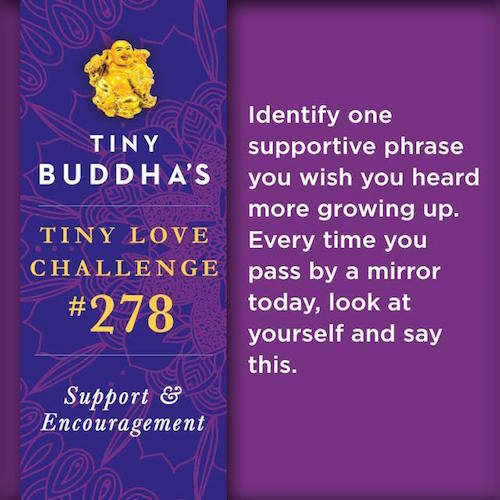
    “Identify one supportive phrase you wish you heard more growing up. Every time you pass by a mirror today, look at yourself and say that.” ~from Tiny Buddha’s 365 Tiny Love Challenges

    When I was a kid, an authority figure once told me, “If I was your age, I wouldn’t be your friend.”

    I tried to act like I didn’t care so I wouldn’t give that person the satisfaction of knowing how deeply they hurt me.

    But it hit me hard, and it stayed with me for years. Someone who was supposed to like me didn’t, so why would anyone else ever love me?

    There was something fundamentally wrong with me. And I wasn’t good enough at anything I did. Even when I did my best, I was never the best, so that meant I was a failure.

    These beliefs guided my childhood and adolescence. When I got to adulthood, I frequently sabotaged relationships thinking, “They won’t want to spend time with me. Why would they? I wouldn’t if I were them.”

    And I regularly overextended myself, only to beat myself up when I inevitably failed at juggling far more than any one person should have to carry.

    The voice in my head was callous and cruel. It took me years to realize it wasn’t even mine.

    Growing up, many of us heard more about what we were doing wrong than what we were doing right (from people who had the same experience growing up). And for a lot of us, there were more punishments than rewards, at home and in school.

    It makes sense, then, that so many of us grew into anxious, insecure adolescents, and then matured into fearful, self-doubting adults.

    But we’re not kids anymore, and we know better now than to believe everything we’re told.

    More importantly, we don’t have to continue hurting and criticizing ourselves. We don’t have to bully ourselves over our perceived shortcomings. We can stop the cycle.

    If you follow Tiny Buddha on Facebook, you’ve likely seen the “love challenge” graphics I’ve been sharing for the last month.

    Each one offers something simple you can do to improve your relationships, open yourself up to new ones, or nurture your relationship with yourself.

    And each one comes from my upcoming book, Tiny Buddha’s 365 Tiny Love Challenges.

    Recently, I posted the challenge below and asked Facebook followers to share what phrase they wished they heard more as kids.

    One Supportive Phrase

    Their responses reminded me that we all have the power, every day, to give ourselves the same kind of love and support we’d want from other people. In fact, it’s a prerequisite to getting love and support from others, because we’re only ever open to receiving what we believe we deserve.

    We all deserve to hear these things—from others and ourselves:

    1. I love you just the way you are.

    2. When you need something to believe in, start with yourself.

    3. I’ll always be here for you. I love you unconditionally.

    4. You deserve to be happy.

    5. You look beautiful.

    6. Don’t be afraid—you are good enough.

    7. I believe you are very capable of taking care of yourself, with or without someone else to take care of you.

    8. Anything you can imagine is possible. The only thing to fear is fear itself.

    9. Everything will be okay. Even if its not, it will be.

    10. You are enough as you are.

    11. You are an individual and are perfect the way you are now.

    12. You can do anything you set your mind to.

    13. It’s okay to make a mistake.

    14. I believe in you.

    15. You tried—that’s good enough.

    16. I’m proud of you.

    17. You don’t need permission from anyone to dream and explore your interests and passions.

    18. You have a beautiful soul.

    19. You are safe.

    20. You’re doing great.

    21. You can do anything.

    22. I want the best for you.

    23. You’re handling it beautifully.

    24. You are awesome, kid.

    25. I love and accept you no matter what.

    Imagine what the world would be like if we all told ourselves these things every day.

    Imagine a world full of people who believe in themselves, encourage themselves, and forgive themselves for their mistakes.

    Imagine a world full of people who speak to themselves kindly and look in the mirror and see nothing but love—and then take the positive, loving energy into their interactions with others.

    I’d like to be part of that world. And I know it starts with me—and you.

    Happy woman image via Shutterstock

  • Love Challenge #278: One Supportive Phrase

    Love Challenge #278: One Supportive Phrase

    One Supportive Phrase

    What supportive phrase do you wish you heard more growing up?

    (This challenge comes from the upcoming book Tiny Buddha’s 365 Tiny Love Challenges. Pre-order before October 6th and get $300+ in free bonus gifts!)

  • 3 Questions to Ask Yourself When You Feel Unsupported in Relationships

    3 Questions to Ask Yourself When You Feel Unsupported in Relationships

    “A community of friends supporting each other can make a world of difference.” ~Unknown

    Many of us feel we’re not getting the support we want or deserve in relationships.

    Maybe we’ve never felt supported by our friends or family. Maybe we don’t feel supported by our peers or co-workers. Maybe we don’t even feel supported by our partner.

    This can leave us feeling drained, tired, and unhappy, like we’re moving through life without much fuel to keep going.

    During my adolescence and early adulthood, this was a huge struggle for me. I rarely found a place or group of friends where I felt like I “belonged” and, therefore, I didn’t feel supported. When I did feel supported by others, it only lasted for a few days or weeks before it dissipated.

    Today, this has shifted. I feel much more supported in my current relationships and don’t feel nearly as drained as I once did.

    There are still moments when I feel like I did growing up, but I’ve realized that opening up to support is a life-long journey. It’s an ongoing process of healing old wounds and allowing ourselves to become something new.

    There are three questions that always help me realize what needs to be healed and how I need to shift my perception. If you don’t feel supported in your relationships, ask yourself:

    1. Is my story preventing me from receiving support?

    Do you tell yourself stories like “Nobody understands me,” “He can’t understand me because he hasn’t experienced what I’ve experienced,” or “I always have to take care of others and nobody can take care of me”?

    Or, do you repeatedly tell yourself, “I am never supported in my relationships”?

    Whatever your specific story is, it blocks you from receiving the support you desire.

    Some other stories that prevent you from receiving support include: “If I tell others about my problems, it will cause them more stress,” “If I share this with others, they will judge me,” “I need to give to others in order to be loved,” and “If I want something from others, I won’t be loved.”

    Formerly, I told myself the story “I will be a burden to others if I seek help and support.”

    I’d think this at work when I needed extra help or a day off, so I’d feel hesitant to communicate this to coworkers. I’d also think this when going through tough times, which made me feel scared to open up to friends, so none of them would know what I was feeling.

    When we acknowledge our stories, we are then able to shift our perception and open ourselves to receiving support from others.

    2. Am I reaching out to others for support?

    Often when we feel like we are not receiving what we desire from others it’s because we are not open to receiving. It’s as if we have a little shop set up for business, but we have all the doors locked!

    Be sure to tell others when you are going through a difficult time. Ask people for help rather than to try to figure it all out on your own.

    By letting people know that we are seeking support, we’re much more likely to receive it.

    3. Am I supporting myself?

    What we experience outside of ourselves is often a reflection of whatever we are experiencing within ourselves. If we are not feeling supported by others, then it is likely true that we may not be supporting ourselves.

    The key to shifting this is to find ways to feel full and supported within ourselves instead of focusing solely on what we want from others.

    This was something I needed to do when dealing with various health issues. For a few years, I failed to address my health problems, which meant others couldn’t support me either.

    I would not stay committed to diet and lifestyle changes that I knew would help me. This meant others didn’t have the opportunity to support me because my actions did not show that improving my health was important to me.

    Ask yourself: Am I supporting my body when it’s sick or tired by letting it rest? Do I support myself by finding time to do the things that I love to do? Do I give myself the things I know I need—like going to doctor’s appointments when I’m sick or finding a therapist when I’m going through a difficult time?

    Then take it a step further and ask yourself: Am I really “myself” when around others? Am I putting myself in relationships with people who truly accept me for who I am? Do I allow myself to share my authentic truth with others?

    If we want to be fully supported in all aspects of ourselves, we need to choose to be in relationships where we feel free to be our authentic selves.

    This might mean letting go of some relationships and releasing expectations that certain people will suddenly change and be supportive. By being in relationships with others who fully accept us, we are supporting ourselves.

    In order to experience the highest degree of love and support in our relationships, we have to really love and support ourselves. So look within and become the master of your own self-care and self-love.

  • Why We Might Feel Lonely and What to Do About It

    Why We Might Feel Lonely and What to Do About It

    Lonely Woman

    “We have all known the long loneliness and we have learned that the only solution is love and that love comes with community.” ~Dorothy Day

    Throughout my life it’s been really hard to admit when I’ve felt lonely.

    I’ve been through intense periods where I have been without others.

    I’ve been surrounded by people yet have felt no real connections.

    The people I have loved have been physically or emotionally absent.

    I’ve simply been alone over weekends, over weeks, over months, over years, and it has been grueling and horrible.

    I found I had to monitor how much I shared with friends and family about how terribly lonely I felt, and that many resisted hearing it.

    I have been through periods when I’ve been successful and periods where my life has fallen into devastation; loneliness has been a part of both.

    In our society to admit loneliness seems like a big admission of failure. It’s uncomfortable to hear. The subtext is that our loneliness is a result of our inability to make connections. It’s all our fault.

    I don’t know about that. I think it’s time that we understood that we are not alone in our loneliness, and it has more to do with the society we live in than anything else.

    Experts are now saying that loneliness is becoming an epidemic, particularly in western societies.

    Governments are just starting to see loneliness as an issue that has serious repercussions on our health and well-being. It’s become obvious to the structures that govern and to those that study us that loneliness is an issue that needs to be addressed.

    Where Did This Epidemic Come From?

    The fact is that humans aren’t used to being so alone. We’ve had literally hundreds of thousands of years of programming for living in groups.

    Groups were important in keeping us alive. Our children were reared by the group. Meal times were a group affair. Groups were crucial in protecting us from predators and finding food.

    Groups played a part in helping us to advance as a species over our distant cousins, the chimpanzees. We were really good at hanging out, chewing the fat, having some intergroup fighting, and making up with group hugs.

    About 250 years ago the industrial revolution changed all that. Machines replaced the things we could do by hand. Stuff could be produced in mass quantities, which meant that we didn’t need to go down to Mrs Grumblebutt’s cottage for butter, or Arg Arg Arg’s corner of the cave for mammoth meat.

    Two hundred and fifty years is not long time if we consider that modern humans hung in groups for at least 100,000 years.

    This short, sharp change started to cause the dissipation of communities, as we no longer needed to rely on each other but on the system to meet our needs. We could live further apart, raise the height of our fences, and function as independent but separated beings.

    So there it is. It’s simple stuff, I know. We all know that it happened, but when we are crying in our houses we just need to remember that this has only just happened. Only just a little over 250 years ago things were different.

    We changed because our mechanism for survival changed from groups to a system, so it’s asking a lot to expect that a species that has had thousands of years of genetic programming for group living should all of a sudden live separately.

    Turning the Tide

    I think we still need groups for survival, maybe not so much anymore for the food in our mouths, but for everything else—for a chat, for help with working through issues, for a shared direction, a shared passion, for a fight or two if that’s what’s needed, for care, and for hugs.

    We don’t talk so much about pestilence or camels or carving sticks anymore, but there’s lots we need to discuss, such as how to fix a tap, climate change, cake recipes, sadness, music, politics—the list goes on.

    The rise of online communities is evidence that we are programmed for group living, but we really do need face-to-face contact, as that’s what we are used to as a species, whether it be through hobbies, friendships, families, or building better societies. We need to revive our tribes!

    So what’s stopping us from being part of a face-to-face group? One of the remedies for loneliness is within our grasp, so why aren’t we doing anything about it?

    Part of it could have to do with the recent rise of the ridiculously busy movement that seems to have appeared in response to loneliness. It’s about filling one’s life up so there’s no time to feel alone, and it has a particular call and response mechanism.

    “How are you?”

    “I’m so super duper busy. How are you?”

    “I’m ridiculously crazy over-the-top busy.”

    Hmmmm. Being ridiculously busy is not a badge of honor but evidence of imbalance. It’s not surprising that our culture has invented it, as there’s such a big gap to fill, but it’s not the way forward.

    It’s logical that ridiculously busy people get worn out and can feel even lonelier in the process.

    If one is rushing around, there’s little time to forge deeper bonds and be there for others. It’s rewarding and stimulating in the short term, but self-defeating in the long run.

    Many of you could argue that you are ridiculously busy as a result of society and its demands, but I would say that busyness is a choice, and we need to ask ourselves why we have made these choices.

    Was it to fill some gaping hole? Is it necessarily your fault that the hole is there as per the discussion above?

    When I think about my friends and family and their resistance to hearing about my feelings of loneliness, I realize there’s a very real possibility they felt this underlying loneliness too.

    Maybe underneath all those layers of busyness there was a gaping hole, and hearing about someone else’s loneliness was too much of a trigger for theirs.

    The problem with the ridiculously busy movement is that there’s no longer any time to hang out. All engagement must be scheduled. We don’t have time to ask of each other what we truly need. We don’t feel we have a right to do so.

    So what’s the answer? How can we feel less lonely?

    We need to reduce the amount of things we are doing, to see the formation of a group or groups as a priority, and to thank the system sincerely for supporting us but to make a firm commitment to working out how we can support each other. We need our tribes.

    Alternatively, if we aren’t busy and feel terribly lonely, then we’ve got plenty of time to get on our sneakers and get out to find the tribes that we’ve lost. We need to honor our programming.

    I know that there will be resistance and fear associated with making any of these moves, as we’ve put up a lot of gates between us over the last couple hundred years, but we’ve got to swallow this fear and go for it.

    Feel comfort from the fact that it’s the path that almost everyone else in our bloodline walked, so we do have some good intuitive backing to help us.

    Building Community with Self

    As well as being fierce about re-establishing our tribes, there’s something else that might help with loneliness.

    Most people in tribal communities had a role. They made shoes, rubbed goat dung on sick people, made swords and crossbows and feather dusters when they were feeling more peaceful.

    I’ve found one of the absolute keys to feeling less lonely is to ask myself, “If I could be anything, what would I be in the village? How would I serve others?”

    The beauty of asking this question is that we are actually asking who am I? We are getting to know ourselves.

    If we tune in to what we really want, we are ultimately not going to have to ignore or run away from our deepest needs.

    Obviously direction or purpose is just part of the puzzle of getting to know ourselves, but it’s a good place to start.

    I’ve found that honoring my calling as a writer has been absolutely fundamental in feeling comfortable with myself, and I’m far more able to handle times of loneliness and rejoice in times of connection.

    All this comes with the big caveat that society is, once again, not particularly encouraging of this type of thinking, and will do lots of things to put up barriers and fears to stop us from doing and being what we want. Society has created a structure, and there’s an incredible amount of pressure to conform to it.

    That said, it’s worth it to be able to sit down with yourself and say, “I’m happy with you. Finally you are doing what I’ve been asking for all along.”

    Let’s call this process self-talk, self-community, building a helpful dialogue in ourselves. The bottom line is that when we are happy with ourselves and are listening to our beautiful inner voice, we feel a lot less lonely.

    Calling in the Tribe

    So there it is. A little exploration into why we are lonely and what to do about it.

    Feeling lonely is not your fault. Our society has thrown us a bit of a curveball and now it’s time to throw that ball right on back, spit on a wall, build a bonfire, and have a super huge hug with ourselves and someone lovely.

    And right now, I’m also sending you that hug across the campfire, ‘cause that’s what tribe members do.

    Lonely woman image via Shutterstock

  • It’s Okay to Need a Little Help

    It’s Okay to Need a Little Help

    We Can Help

    “Don’t look for someone who will solve all your problems. Look for someone who won’t let you face them alone.” ~Unknown

    It’s 2004, and I awake in a student college in Melbourne, Australia. This comes as no surprise, because, at the time, I lived there.

    I groggily stagger to the shared bathroom on my floor, to perform my morning washing routine. There’s nothing unusual about my lavatory procedure, so I’ll omit the details, for all of our benefits.

    So far, so good. Already I’m full of optimism for today.

    As I wash my hands, I glimpse myself in the mirror and notice my majestic, messy bed-head.

    I often sport a disturbing, motley “I’ve just fallen out of bed” look for entire days, as I forget to check in the morning that I look sufficiently acceptable to go outside.

    I usually see myself in a mirror just before I go to bed, and invariably feel retrospectively ashamed that I’ve had tufts of hair beaming in assorted directions since I woke up.

    On this day, however, I notice my unconventional tufty hair and take immediate, drastic action, slapping the top of my head with my wet hands to encourage my mane into an acceptable shape. I stride out of the bathroom, feeling satisfied.

    Universe 0, Neil 1. One triumph already: not appearing for the entire day as if I have just fallen out of bed. What an excellent start to the day.

    Sadly, I only take a few steps before the soapy water I unthinkingly applied to my head pours into my eyes, burning them immediately with painful chemicals.

    Still, no need to panic. I’m an adult, I can handle a little soapy water. I am aware of the process for fixing a foamy intrusion into the eyes. As per the plan, I don’t even break stride, simply rubbing my eyes to remove the water.

    Unfortunately, this only makes things worse. It feels like I dislodged my contact lenses and got the soap in behind them. Now everything really burns.

    Okay. There’s no need for alarm. I simply need a new plan. I’m already most of the way to my bedroom, so I can slip in there, find the sink, wash my eyes out, replace my contacts with chemical-free fresh lenses, and then we’re all sorted. I’m still destined for victory today.

    I take another step toward my bedroom door, eyes screwed tightly shut.

    I fumble for my keys and pull them hurriedly out of my trouser pocket. Sadly, in my haste they slip out of my hand and fly somewhere into the dark void in front of me.

    Uh-oh.

    I squint my eyes open slightly and shut them immediately. I can’t see a thing through the caustic chemical tears. What the hell is in this soap, I probably would wonder if I weren’t so distracted by the agony behind my eyelids.

    Right. Time for a new “new plan.” The corridor is small, so it can’t take long to locate my keys, get into my room, find the sink, wash the soap out of my eyes, replace the contacts, and then—finally—victory!

    No need to cancel the celebratory parade for how awesome today will be. Yet.

    I scrabble on the floor for a moment, then another moment, and then another slightly longer moment.

    I seriously can’t find my keys. In making the “new new plan” I significantly underestimated how much I rely on the ability to see.

    The discomfort of squatting and bungling around is adding to the stinging in my eyes, and I realize my new highest priority needs to be getting rid of this infernal soap. 

    (With hindsight, this should probably have been the priority from the beginning.)

    Taking stock again, I come up with a new “new new plan.”

    I’ll go back to the original shared bathroom and wash my eyes out there. Then, using my regained power of vision, it will be trivial to find my keys. After that, I can let myself into my room, replace my lenses, and finally I can leave for breakfast. Still victorious. Definitely.

    I stand up, face toward the bathroom, and charge ahead at maximum eagerness.

    SMACK!

    I run face first into the wall, having apparently completely lost track of which way I was facing.

    I crumple to the floor, like a sack of idiotic potatoes.

    At this point, I finally admit that I am defeated.

    I have no new plans. No “new new plans.” No plans of any kind whatsoever. My face hurts from hitting the wall with it. My eyes hurt from the chemicals I foolishly rubbed into them. I cannot solve either problem.

    As I lie there, blankly failing to handle the situation, I hear the voice of the pretty girl from down the corridor:

    “Do you… do you need any help?”

    Yes. Yes, I need help.

    And not just with simple things like a morning routine.

    I’ve suffered from anxiety all my life. And the main lesson I’ve learned is that keeping it to myself only makes it worse.

    Yet I’m less willing to ask for help when I need it most because I don’t want to look weak. I’m scared of the judgment it might bring.

    But I’ve found that, in reality, people judge us far less harshly than we do ourselves. Being honest about needing help makes us seem strong, not weak.

    Whether it’s a major problem like daily anxiety, or a silly thing like getting soap in my eyes, I’ve learned that it’s crucial to just be honest about it with someone I trust.

    Whatever you may be suffering through, there are those who would happily suffer through it with you, if only you’d let them. Maybe you know them, maybe you haven’t met them yet.

    But, trust me, you’re better off seeking help than trying to do it all alone.

    We can help image via Shutterstock

  • When You Love an Addict: Stop Enabling and Help Yourself

    When You Love an Addict: Stop Enabling and Help Yourself

    “Some people believe holding on and hanging in there are signs of great strength. However, there are times when it takes much more strength to know when to let go and then do it.” ~Ann Landers

    I fell in love for better or worse. First came the better and then the worst.

    My prince charming, over time, became a raging alcoholic. I watched an amazing man become, well less amazing.

    There are endless books and information you can read about addiction, but I am going to break the rule, skip to the end of those books, and tell you the ending—the solution. Spoiler alert!

    Let go.

    The most complex two words a person can say.

    Odds are, the addictive (insert type of addiction here—can be drugs, sex, gambling; it’s all the same) personality type found you because you are a helper, better known in the addict world as an enabler.

    When my alcoholic fell off the wagon, I read every book, attended AA and Al-Anon meetings, got several counselors, and was an active participant during one of his several trips to rehab. A star student.

    With each fall, I designed and created a plan that would surely fix the problem. I was so well educated on the topic, I could have written a book myself, taught a class, or ran a meeting.

    The problem was it was always my plan, not his.

    When to let go?

    Set boundaries.

    When they are crossed, stick by the consequences you have predetermined. No more, “one more chance” scenarios. The boundaries need to be your boundaries. Some people will have a high level of tolerance, others will not. Set what you can live with and be happy.

    For example, I had set a boundary of no legal issues. When that was crossed in the form of yet another DUI, it was time to file for divorce. Though it will not be easy, be prepared to follow through.

    How do you let go?

    Do the opposite of what comes naturally.

    I was talking to my counselor and she said you are going to have to go against your gut to get this right.

    I thought, you are crazy; I live and die by my gut feelings.

    Then she the said words that would both sting and profoundly change my life. “You make the plans, you write the checks, you do all of it to make yourself feel better.”

    She was right. I didn’t want to feel embarrassed, sick, or upset. I wanted the pain to go away and the healing to begin, and I wanted it to happen fast. Hadn’t we hit rock bottom?

    Let them feel consequences of their actions.

    Have a fine to pay? Pay it yourself.

    You lose your driver’s license? Walk, ride a bus, or bike to where you need to go.

    Need money for an attorney, or need to be bailed out of jail? Figure it out on your own.

    Literally help them with nothing. Support, love, and encouragement are great, but stop there.

    It is the most terrible and effective thing you, as a helper, can do—stop helping. If I had one regret it would be that I enabled him. I allowed him to not feel the consequences and robbed him of the opportunity to build his self-esteem through addressing his mistakes himself.

    Educate yourself.

    Even though you know the ending to the story and the secret has been revealed, there is a lot to be said about the journey.

    I was in an Al-Anon meeting, and I listened as a beautiful, confident woman announced to the group she was going to go home and give her addict a piece of her mind, force him to stop, lay down the law. I thought, well that won’t work.

    Then I realized, I was just like that woman. I had threatened, cried, yelled, and punished. It did not and would never work. I would learn more in those meetings than I ever believed possible.

    So read the books, go to meeting, get that counselor, take the online course; it is worth the investment. One Ah-Ha moment can be life changing. I did the same for my children.

    Build and use your circle of support.

    I kept my addict’s secret. I felt I owed it to him to protect and defend his honor. There was some truth to that, but I was also protecting me.

    Once I opened up about the issue, love, support, and some judgment came flooding in. Take what you need and leave the rest. You live with your decisions. The person giving you the advice does not.

    Find the new you.

    My life, my future everything was built around this man and the beautiful children we had created. When I accepted my reality had changed, I embraced it!

    I began to build a new life, and dusted off some old dreams until they were new and shiny. I learned where the sprinkler control box was, unclogged the garbage disposal, and bought a step stool so I could reach anything I wanted, whenever I wanted. (He is 6’6” and I am 5’4”.) I hired a handyman. I asked for help, it almost killed me but I did ask and it did help. Create a life you can love!

    I have and will always have compassion for addicts. It is my personal belief that it is disease. I often switch the word addict for cancer. You would most likely not be mad that friend of loved one had cancer, but you can be upset that they have opted to not follow any of the doctors orders.

    The addict gets one day at time. So should you. There will be days you go backward and there will be days you make amazing leaps forward. In the end you will prevail.

  • Keep Hope Alive: How To Help Someone Who’s Struggling

    Keep Hope Alive: How To Help Someone Who’s Struggling

    “He who has health has hope and he who has hope has everything.” ~Proverb

    I write this today seemingly healthy.

    My doctors say I’m healthy. I feel healthy. I look healthy. But over the last six months this was not the case.

    In April of this year I was diagnosed with Stage 3 Melanoma. I am thirty-five years old. I am a wife and a mother to a four-year-old and six-year-old. I have my own business. I am busy. I did not have time for cancer.

    But cancer had time for me.

    I’ll never forget the day that I got the call letting me know that not only did I have this “Melanoma,” but it had spread to my lymph nodes as well. More surgery and an immunotherapy called “interferon” would be necessary, and the rate of return even after treatment? Thirty percent.

    The first response inside of me was acceptance. I skipped past all the other emotions because, well, quite frankly, I had so long neglected the mole on my neck that I knew when the whole process started that cancer (and an advanced one at that) was likely.

    But I’m not here to talk about cancer today. I’m here to talk about hope. A hope that springs eternal in the name of community. A rallying around me of family, friends, and even strangers upon this diagnosis. A support system that boldly lifted me and my mindset through every step of the way.

    Dinners, childcare, cards, surprises on my doorstep, texts, calls, long-term visits—this community that I’m so very blessed with rallied in a big way, in a way I never, ever thought possible.

    Even in my darkest and sickest of hours there was always something to be hopeful for because the love that came at me was indescribable.

    It was made of sterner stuff.

    It gave me hope because every time I even remotely started feeling bad, the community would take hold and lift me up in ways that were exactly what I needed right in the moment that I needed it.

    My phone would buzz: “Thinking of you today. Hoping you’re okay. Sending love your way.”

    My email would ding: “You’re amazing through this. Truly.”

    Visitors would stop by: “Let yourself be loved. Let yourself be cared for.”

    This whole cancer thing has taught me, once again, in the beauty of humanity. It has shown me that, even in our darkest hours, others can (and will) lift our spirits. When we are faced with our hardest struggles, it is then that we see the beauty in all that surrounds us.

    Cancer is a bringer of all emotions. It is an un-hinger of all truths and perceptions. Things that once were important are no longer relevant. There is suddenly more beauty in the everyday.

    This I learned not only because I was sick, but because my family, my friends, and perfect strangers showed me how to someday support someone in the same way they supported me.

    So I offer you this: a list of ways to show your support when someone is having a hard time or is going through an illness.

    Make a meal even when they say they don’t need it.

    This was lifesaving for me! Drop it on the doorstep and tell them to freeze it.

    Send texts.

    Little joy buzzes, I like to now call them, sweet messages offering support, jokes, and updates from the outside world.

    Leave a message.

    Hearing the voices of my friends and family as I drifted in and out of consciousness (the treatment I had to endure was five days a week for four weeks, and it was tough) was the most uplifting.

    Drop off trinkets.

    There were times when I was well enough to go outside and sit for a bit in the summer sun. Often, I would find little gifts at my doorstep. I see these now in my office, in my home, in my bedroom, and they make me smile thinking of those who dropped them by.

    Don’t give up quickly.

    Whatever support you would like to offer, know that there may be some “Oh, we couldn’t possibly” or “That’s okay—we’re okay.” People often say this when they could really use the support, so it helps to offer more than once and be clear that you really want to be there for them.

    Help delegate tasks.

    Create a rotating schedule for bringing meals, giving rides, and offering help.

    Admit that it stinks—empathize and then uplift.

    Something from the emotional perspective that I learned during my cancer diagnosis and treatment was that when I told someone about it, they often didn’t know what to say. There was always a silence and then a pause. A loss for words.

    We naturally want to make things “better” and keep it upbeat, which can go a long way in lifting someone’s spirit. That being said, the very first thing I loved hearing from family and friends before the upbeat was “Wow. This sucks.”

    Those words allowed me to connect emotionally with my supporters. Even if they had never had cancer or had never gone through something like this before, the fact that the words were out there anchored me into a place where I could then build up with hope.

    The best response I heard from a friend was this: “This sucks. I don’t like it. It’s going to be hard, but we will get through it and you’re not alone.” So, when in doubt empathize and then offer support.

    Stay long-term if you can.

    If you are able, try and be with your loved ones during the most difficult times. Stay for two days, a week, whatever works. This reprieve is huge.

    Ask yourself: What would I want?

    And then do that very thing.

    Community support can provide a lot of hope, and as the quote says: “He who has hope has everything.”

    As I ride the wave of newfound health, I know deep down that I have a net of support that. If the cancer returns, I’ll still have a battalion of loved ones behind me and they’ll help me keep hope alive.

  • When You Want More Love and Support in Relationships

    When You Want More Love and Support in Relationships

    “You’re imperfect, and you’re wired for struggle, but you are worthy of love and belonging.” ~Brené Brown

    For years, I felt unfulfilled in my relationships. I often felt drained, and as if I was the only one giving and doing things for others.

    I couldn’t quite understand what I was doing wrong and why relationships were so challenging for me. All I wanted to do was to feel loved and supported. Why couldn’t I get that?

    Then, nearly three years ago, after a bad breakup and a ton of other relationship challenges, I reached a breaking point. I knew I had to make some serious changes, so I found myself a therapist, a ton of self-help books, and a few other self-development professionals.

    Through this journey, I’ve learned several lessons that have helped me find and create the fulfilling relationships that I have today. Here are four lessons I learned.

    1. We have to accept people where they are.

    Even though I wanted more depth, intimacy, and support in my relationships, I had to learn to accept that others didn’t always want the same things I did; or, they did want the same things, but they were simply not ready for them at that point in time.

    In learning this lesson, I was able to let go of idealistic dreams that some people would one day change and appreciate those relationships for what they were.

    Many times we are unfulfilled in relationships because we are lying to ourselves. We choose to reject what is while clinging to our own idealistic dream of what could be.

    When we accept relationships as they are, we open the door to connecting with others who are able to give us what we know we deserve.

    2. Love begins on the inside, not the outside.

    One of my all-time favorite passages on love begins, “Love is patient, love is kind. It does not envy, it does not boast, it is not proud.” When I was younger I interpreted this as though I had to find someone who was patient and kind, not jealous or boastful, and so on.

    I thought it was telling me that I had to judge other people according to that criteria to determine if it was truly “love” or not. I thought it was about seeking it in the external world.

    Then, when I heard this verse a couple years ago at a friend’s wedding, I had a huge “ah ha” moment: This verse has nothing to do with looking for these traits in other people. It’s telling us that this is the love that we can find within ourselves. 

    It is the love that makes this universe exist and keep it together. It is a love that we all possess.

    We are not meant to seek love externally in the world but to connect to it within so that we can create even more of that love in the world around us.

    The love that we seek is something that we already have. When we make the conscious effort to tap into that inner love and express it in the world, we can then begin to see all the love around us.

    3. It’s more painful to fear being authentic then to actually be authentic.

    I always held back my inner truth in relationships because I feared rejection. Deep down, I felt that I wasn’t good enough or worthy.

    I feared that others would automatically reject me if I expressed my unique, genuine interests and talents. I felt that by blending in with people, I’d guarantee acceptance.

    The reality, though, is that it took so much more effort, more strain, and more heartache to hold on to this fear.

    As I have gradually learned how to simply express my authentic truth in relationships, it has not only made my relationships better, it has also given me more energy that I can put into more proactive things.

    4. We get what we give.

    Even though I often felt like I was giving a lot in my relationships, what I was giving wasn’t necessarily healthy. I often gave to others in order to be accepted and avoid rejection, because I feared being vulnerable. I was giving out of fear, not from a place of inner love.

    If you want others to be more real and vulnerable, then you have to be more real and vulnerable. If you want others to openly discuss feelings, then you have to openly discuss feelings. This doesn’t guarantee they’ll reciprocate, but it opens the door for the type of relationship you’d like to have.

    Many of us know what we desire in our relationships, but we don’t realize the importance of our part. We have the ability to create the tempo. If we are willing to set the example, others will be more likely to follow and reciprocate.

    The more we realize the power of our own actions and align them to our heart’s true desires, the closer we’ll get to creating relationships filled with love, support, authenticity, and fulfillment.