Tag: support

  • How Grieving My Parents’ Divorce (20 Years Later) Changed Me for the Better

    How Grieving My Parents’ Divorce (20 Years Later) Changed Me for the Better

    “There are years that ask questions and years that answer.” ~Zora Neale Hurston

    At the age of thirteen, my childhood as I knew it came to an end. My parents sat my brother and me down at the kitchen table and told us they were getting a divorce. In that moment, I could acutely feel the pain of losing the only family unit I knew.

    Although my teenage self was devastated by this news, it would take another twenty years for me to realize the full extent of what I had lost. And to acknowledge that I had never fully grieved this loss.

    While divorce is so common in the United States, it is not a benign experience for children or adolescents. In fact, divorce is even considered a type of adverse childhood experience, or childhood trauma, that can have long-term behavioral, health, and income consequences. Children of divorced families have an increased risk of developing psychological disorders, attaining lower levels of education, and experiencing relationship difficulties.

    However, not all divorce is equal and will impact children in the same way. And if the children still feel loved, protected, and supported by the parents following the divorce, this can act as a buffer against long-term harm.

    But in many cases following a divorce, parents are not in an emotional or financial state to continue meeting the children’s needs at the same level as prior to the divorce. In these circumstances, children are less likely to receive the emotional support needed to properly grieve—which is what I personally experienced.

    After receiving news that my parents were planning to divorce, I did begin the grieving process. I was in denial that they would actually go through with it. Then I felt anger that they were uprooting my entire world. And then after the anger settled, I remember pleading with them for weeks to stay together. But I think I got stuck somewhere in the stage of depression, never being able to fully reach acceptance.

    Then, twenty years later, after a series of stressful life events, I realized how much the divorce of my parents still impacted me—and how I still had grieving to do. So, at thirty-two years old, I faced a childhood head-on that I had spent my entire adult life attempting to avoid. And I gave myself everything that the thirteen-year-old me had needed twenty years ago but had never received.

    I gained social support through my husband, friends, and therapist. I showed myself compassion. And after two decades, I finally gave myself permission to grieve the childhood and family of origin that I never had and never will.

    I believe the reason that divorce can be so harmful for children is because there is a prevalent belief that children are resilient and they’ll always bounce back. When provided the right support and care, this may be true. However, children don’t have the emotional maturity to manage their emotions on their own when experiencing such an intense loss. This is particularly true when the divorce precipitates or is accompanied by other types of adverse childhood experiences.

    Since divorce can oftentimes lead to intense upheaval and disruption in the family structure, this makes children more susceptible to other types of trauma. Financial difficulties, abuse from stepparents, or a parent suddenly becoming absent can all amplify an already distressing situation for a child. And since children are programmed to rely on their parents for survival, what may seem like a mildly stressful incident for an adult could feel life-threatening for a child.

    I never fully grieved and accepted my parents’ divorce because I lacked the social support I needed to do so. And since the breakdown of the family also led to a breakdown in parenting, I was focused on survival, not grieving. However, it took me many years to realize that my parents were also focused on survival, which can take precedence over ensuring your children are prepared for adulthood. 

    I know my parents did the best they could with the tools they had at the time. But it has been difficult to understand why a parent wouldn’t do everything in their power to shield their child from trauma.

    I was not old enough to understand that it was mental illness and substance abuse that caused a parent’s partner to go into violent rages. My parents had to pretend everything was normal for their own survival—all while neglecting to consider the long-term impacts of trauma during such formative, developmental years.

    To avoid the instability and chaos of the post-divorce homes, from the age of fourteen, I bounced around living from friend’s house to friend’s house. And by the age of sixteen, I had left school and was working nearly full-time in restaurants.

    I didn’t have any plans for my life, but working gave me a sense of safety and an alternate identity. No one had to know that I was a teenager from a broken home living in a trailer park. They only cared that I came in on time and did the job.

    Looking back, it’s clear that my desire to leave school and work was very much a means to gain some control over my chaotic and troubled home life. I felt as though I had to support and protect myself because I had no one to fall back on. And this has been a consistent feeling throughout my life.

    When I began the process of grieving my parents’ divorce as an adult, I realized how many of my beliefs about the world and myself were connected to the aftermath of this traumatic experience.

    My early years instilled beliefs in me that the world is not a safe place—and that I’m not worthy of safety or protection. And it was through the process of grieving that I realized that the thirteen-year-old girl that feared for her safety was still inside me wanting to be heard and comforted.

    I wanted to tell her that she had nothing to fear. But that wouldn’t be the truth. Because the decade following the divorce would be filled with intense distress and tumult. And she would be expected to endure challenges beyond her years.

    While I couldn’t tell her that she would have nothing to fear, I could tell her that she would get through it with courage. And she would become an adult with the ability to love, and a devotion to the health and preservation of her own marriage. And that she would put herself through college and grad school and have a professional career and travel the world.

    I could tell her that some stressful life experiences in her early thirties would open up wounds that she had kept closed for decades. But that she would be strong enough to constructively deal with her past and accept the loss of a childhood cut too short. And that through this journey, she would learn to forgive and show compassion—to herself and to others.

    Grieving my parents’ divorce changed me. I’m no longer waiting for the other shoe to drop. And I’m no longer blaming myself for a truncated childhood. I’m also learning that the world is not as scary and unpredictable as I’ve spent my entire adult life thinking it was.

    I’ve discovered that while there was a point in my young life when I experienced hardships that exceeded my ability to cope, I now have all the tools I need inside of me. And I know that it is possible to reach a point in life where you are no longer focused on surviving but rather on thriving.
  • 9 Things I Would Tell My Younger Self to Help Her Change Her Life

    9 Things I Would Tell My Younger Self to Help Her Change Her Life

    “You are one decision away from a completely different life.” ~Mel Robbins

    At twenty-six years old, I lost my dad to suicide. I was heartbroken and so angry.

    My dad was not the best. Ever since I was little, he would criticize everything I did. I was never good enough for him, and I was a place he discharged his anger through emotional insults.

    It never stopped, and I was always on high alert around him. Right until the moment he took his life.

    He could also be loving, kind, funny, and warm, but my nervous system could never relax around him. He was a Jekyll and Hyde. I never knew what behavior would set him off.

    Then all of a sudden, he was gone.

    I was angry because he had caused me a lot of pain growing up, and now he had left me.

    I was angry that I loved this man so much and felt such deep pain without him. It made no sense to me. Surely my life should be better now that his constant abuse was over.

    But it was just the beginning of my emotional breakdown. Children love their parents unconditionally, no matter how we are treated. But if our parents project their pain on to us, we end up not loving ourselves.

    Now that the abuse had stopped, it was time to deal with all the emotional wounds he’d inflicted over the years.

    But I resisted this and got stuck. I struggled in romantic relationships, unconsciously dating versions of my dad.

    I was full of self-hate. He may have died, but his criticism was very much alive in my head! And I was the one now persecuting myself for everything.
    I may have loved him, but I had no love for myself, as he had taught me that I wasn’t worth that.

    I felt powerless and in so much pain. I numbed this pain with the tools he had given me—wine, TV, food, and caretaking others. I had the busiest diary so I would never have to feel.

    I had no idea how to stop feeling so awful and like I was doomed for life because of this childhood trauma I had suffered. I was in denial that I had even experienced childhood trauma.

    The man who had caused me the pain had gone, so why did I feel the same, if not worse?

    I would lie in bed at night with this huge ache, longing to be loved by someone but looking for it in all the wrong places.

    I felt trapped in my emotions and like there was no way out.

    I sit in my front room now, over fifteen years later, in a life I didn’t think was possible, in a home that feels safe and peaceful. No longer abusing myself. Doing a job that I love and married to the most amazing man.

    I feel like life is a gift and there is no dream I cannot make a reality. That pain that kept me awake at night is no longer there but replaced with love for myself, and even for my dad.

    If I could go back in time, I would tell myself these nine things to get me moving forward to the life I’ve since created. If you also grew up with an abusive parent, my list may help you too.

    1. It was not your fault.

    We put our parents on a pedestal as children because we have no choice. We need them to survive. When my dad persecuted me for not being quiet enough or not pleasing him, I translated that as “I am not good enough” and that everything was my fault.

    We often take all the blame when our parents mistreat us. But what were their stories? How did they grow up? Did someone teach them how to balance their emotions?

    I see now that my dad was struggling. He was grieving the loss of his parents and a difficult childhood. He was not given any tools to manage his emotions. He was shown how to lash out and project them. He was shown how to drink to numb them out.
    He would come home from a job he felt he had to do, feeling tired and stressed, and blame others to help himself calm down.

    Realizing this helped me let myself off the hook. It has also helped me forgive him, which has brought me peace. I started to understand him and his traumas. He was repeating a pattern of survival that his parents had taught him.

    This is generational trauma, and it wasn’t his fault. But it was his responsibility to keep his children safe, which he didn’t fulfill because he had no idea he was traumatizing them!

    2. Reparent the wounded child within.

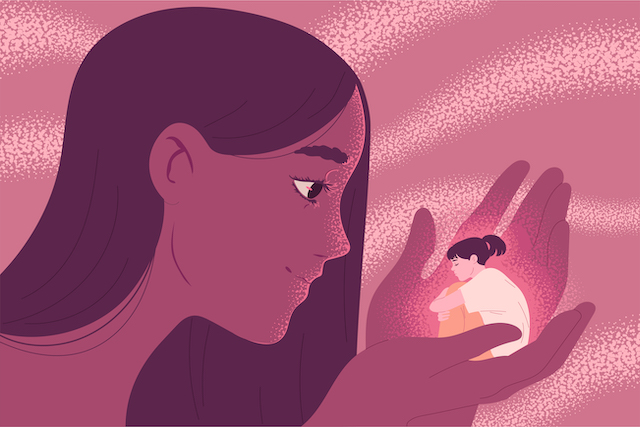
    The versions of me that still hurt and felt this ache to be loved still lived within me, many years later. The seven-year-old who was shouted at for being too loud, the thirteen-year-old who didn’t study enough, and the twenty-five-year-old that wasn’t there for my dad. All these parts of me had unmet needs and were in pain.

    We can’t change the past, but we can go back in time in our imagination and be the parent we needed.

    I have imagined taking baby-me out of the house where I was born to live with adult me. Telling my parents to get some therapy and sort themselves out before they can have the baby back.

    I’ve imagined holding her and telling her how special she is. Over time, this helped that deeper pain to heal.

    3. Work on self-love.

    I was always seeking love and validation outside of myself.

    I was never taught or shown that self-love and self-care are necessities. You have to be able to fill up your own cup in order to love others.

    I would tell my younger self to take a step back from pleasing others and finding a man. I would tell her to focus on giving herself the love she longed for.

    For example, speaking to myself with love and kindness, having quality alone time, buying myself gifts—these were all things I longed for from a man, but I needed to start doing them for myself.

    I needed to spend time every day giving myself love and listening to my needs, not ignoring them. Do I need rest? Water? A healthy meal? To just breathe? To be in nature to calm my anxiety?

    Learning to listen to my own needs and fulfill them took time. It felt unnatural. It was a new behavior I had to repeat every day, and then soon enough it became second nature.

    4. Get to know your shadow.

    We all have parts of us that are dysfunctional and behaviors that are not serving us.

    For me, it was emotional eating, drinking wine, pursuing emotionally unavailable men, and caretaking my family. The last two made me miserable.

    But I blamed the men and my family for being needy. I didn’t take responsibility for my own behavior.

    I felt powerless over how others treated me. I was trapped in this victim state, and then I would numb with food and booze.

    Getting to know my shadow and recognizing my toxic behaviors were the first two steps to change.

    When a man didn’t treat me well, I stopped trying to prove my worth and changed my behavior to move away from the relationship.

    When it hurt, I learned how to love myself instead of chasing someone else’s love.

    Ask yourself: What am I doing that hurts me? Then work on a step-by-step plan to change the behavior. Baby steps are key in this process, as you can get overwhelmed by trying to do too much at once.

    5. Get support.

    It takes time and work to change toxic behavior and heal. I would give my younger self permission to get help when I was struggling with a change. For example, giving up toxic relationships and booze was a real challenge for me. Finding people who had already been through the transformation I was seeking was so valuable.

    Sometimes this would mean listening to a podcast or reading a book, blogs like this one, or posts on social media, and other times it would be investing in working with someone who had already done the work.

    When you work with someone who’s already made the change you’re seeking, they can outline the steps they took, which saves time and energy and makes you feel less alone.

    6. Get in your body.

    I once was a floating head and very disconnected from my body. It didn’t feel safe to feel fear, so I had to be that way to survive my life!

    I would tell my younger self to slow down and notice how her body feels. That it was safe to do that now.

    For example, certain relationships made my heart race out of fear. This was a sign that they weren’t good for me.

    I would also tell her to find ways to bring the body back into balance by discharging the stress and fear.

    For example, breathwork techniques, movement, and Emotional Freedom Technique (EFT) tapping all help us process our emotions rather than running away from them.

    7. It’s safe to speak your truth.

    I have always been incredibly loyal in relationships. Growing up with a dad who was awful meant I had few boundaries and expectations in relationships. This was the only way I could have some form of a relationship with my dad.

    I would let my younger self know it is okay to step back or walk away from relationships that don’t feel good or safe, even family.

    I would let her know that she can always express her truth in relationships and explain when a boundary has been crossed, but that also it’s okay to walk away. Especially in relationships that feel unsafe and abusive.

    8. Celebrate all your progress.

    A journey of healing and transformation takes time! It’s a marathon, not a sprint. It’s so important to celebrate the smallest of wins daily. For example, “I meditated every day this week,” or “I said no to an invite so I could take care of myself when I used to say yes all the time.” Change starts small and grows big.

    At the beginning especially it is so important to track everything because it feels like such a mountain to climb. It will motivate you to carry on. Seeing the little changes shows your efforts are paying off.

    Younger me didn’t have a family that celebrated small wins and growth. They focused on my imperfections and were highly critical. By celebrating myself, I help that little girl feel enough!

    9. Set intentions and dream big.

    Each month, set little goals to improve your life and keep you moving forward. This could be for your personal growth, relationships, physical health, emotional health, money, love, or work.

    Make the goal super small, for example, “In January, I will not text my ex.”

    You may want to set an intention to take better care of yourself. Break this down into daily tasks to repeat for the month. And if you don’t know what you need to work on, maybe your task for the month is to read a book to help you find out.

    With intention you can create the life you dream of. But often we don’t know what our dreams are. Get still and explore what would bring you happiness.

    I think of younger-me who looked out of her bedroom window wishing for a safe home.  I think of that little girl and the life she deserves. A full, fulfilling life, just like I’d want for my own child. This has helped me to dream bigger to create a life that is not only safe but also makes me happy.

    You too deserve an amazing life! Not a life stuck in patterns of surviving and playing it small, but one where you heal and thrive. Your parents treated you the way they did not because you were not enough but because they were wounded. You were always enough, and now you have the power to take daily steps to change your reality so it is not longer tainted by trauma.

    I have the most incredible life now, and it has and continues to be a journey of healing. I wish I would have done these things sooner, but it’s never too late to take the first steps on a new path! There is hope, and I believe in you.

  • I’m Kelly and I’m a Heroine Addict: Why I Get My Fix from Fixing People

    I’m Kelly and I’m a Heroine Addict: Why I Get My Fix from Fixing People

    “Self-will means believing that you alone have all the answers. Letting go of self-will means becoming willing to hold still, be open, and wait for guidance for yourself.”―Robin Norwood, Author of Women Who Love Too Much

    My drug of choice is not the kind of heroin one shoots in their veins. My drug is the kind of heroine that ends with an e—the feminine version of hero.

    When I help someone, and they are grateful for the gifts I offer, my brain fizzes with a cocktail of oxytocin, serotonin, and dopamine, resulting in a “helper’s high” I ride through town like a homecoming queen on a float, waving a gloved hand, blowing air kisses at admiring fans.

    There is no accident these two words, heroin and heroine, look and sound so much alike because they strangely have more in common than you might think: They are both highly addictive, both more destructive than the user realizes, and both leave a trail of collateral damage.

    According to the twelve steps, we stand a chance at recovery only if we can admit we are powerless over our addiction and that our lives have thus become unmanageable… so this is my coming out party. I figure by making this public declaration, I won’t be as tempted to sneak back to my old ways.

    My painful revelation was delivered to me on a cinematic silver platter, while driving with someone incredibly close to me—let’s call her Chloe. She was desperate to find a place to live… that is until I’d swooped in on my noble steed, found her a hidden gem of an apartment, vouched for her, and landed her the deal of the century.

    Instead of being met with the gratitude I expected (and secretly craved), I was devastated by her volcanic rage. She spewed, causing me to nearly drive off the road.

    What crime did I commit, you ask? The week earlier, she had called me, and I had the audacity not to hear my phone ring. In fury, she screamed about how I had set her up to need me, depend on me, and think of me as her savior. And then, when she needed me most, my phone’s ringer was off, leaving her alone to flail in pain, cursing the water I once walked upon.

    In my defense, I never (consciously) promised Chloe I’d be her forever rescuer. Little acts of service became the gateway drug to more elaborate feats that took immense effort and a toll on my own life. I somehow imagined one day I’d receive a smiling postcard from her, telling me my services were no longer required because of how brilliantly her life turned out (thanks to me)… but that hasn’t happened (yet).

    How did I co-create such an epic fail?

    Hitting rock bottom with my “disease to please” sent me on a search-and-rescue mission of my past to discover the genesis of my addiction. My detective work led me, surprise, back to childhood.

    As the eldest of five, I was awarded points from my well-meaning parents for doing big-sisterly things, such as treating my siblings like they were my babies, teaching them to tie their shoes, showing them how to swing a softball bat, and how to combat bullies.

    I was raised believing it was my job to take care of them, and I proudly accepted that mantle. It empowered me; it made me feel important.

    But what I didn’t realize was that while I was getting puffed up like the Goodyear blimp with praise, soaring higher with every pat on my back, some of the victims of my heroism were becoming progressively weakened. It was as if my efforts sent the unconscious message that they were broken and crippled and, without me, incompetent.

    As I struggled to more deeply understand my heroine addiction, I sought the counsel of a friend who said, “Your struggle is a microcosm of a global issue. For example, the US has funneled over 500 billion dollars to Sub-Saharan Africa (to mitigate starvation and famine), only to make the situation worse when they pulled out.” He continued, “In spite of good intentions, if the giving is a handout, not a hand up (giving fish instead of teaching how to fish), it’s unsustainable, exacerbating—not curing—the problem it set out to fix.”

    Even though I extended my support without conscious strategy or agenda, I hurt people more than I helped.

    So, what is the solution?

    It isn’t as simple as no longer helping people. It’s like being an overeater who can’t just swear off food. If I had an actual heroin addiction, my job would be to cease injecting the drug in my arm. But even Abraham Maslow taught that service is near the top of his hierarchy of needs, and I’ve certainly been a grateful receiver of people’s kindnesses.

    This is clearly one of life’s “can’t live with it, can’t live without it” conundrums. Perhaps I just have to figure out how to do “service” differently.

    So, as a newly sober heroine addict (an energy vampire cloaked behind a superhero cape), convulsing in withdrawals as I seek to live on the razor’s edge between serving and savior-ing, here are my marching orders, thus far. Just for today (and hopefully every day after), I will:

    1. Fire myself from the job I unwittingly accepted (too enthusiastically) as a little girl: to be everyone’s big sister.

    2. Admit I have a problem and that I am powerless over saving, fixing, and controlling people.

    3. Give up the belief that I know best on how others should live their lives.

    4. Refrain from getting my fix by fixing people, searching for God in all the wrong places.

    5. Make ruthless compassion my replacement addiction, in the way heroin addicts safely detox using methadone or suboxone.

    Ruthless compassion, by the way, is the unwillingness to see another as broken or inadequate, but instead as innately whole and complete, regardless of what they’ve been through or what they believe to be true about themselves.

    6. Practice “For Fun and For Free”—this twelve-step motto is about only giving to others from surplus bandwidth (time, money, and energy) unless it’s a true emergency.

    7. Tattoo my brain with my new personal prayer (a mashup of The Serenity Prayer and the lyrics to Kenny Roger’s “The Gambler”):

    God grant me the serenity…
    to know when to hold ‘em,
    when to fold ‘em,
    when to walk away
    and when to run.

    If you relate to my story, I hope this will help you with your hero or heroine addiction. But if it doesn’t, that’s okay. Because, through the lens of my new Ruthless Compassion sunglasses, I see you are more than capable of finding your own answers, thankfully without any excess do-gooding from me.

  • If You Really Want to Change the World: 4 Ways to Be Kind

    If You Really Want to Change the World: 4 Ways to Be Kind

    “I’ve learned that people will forget what you said, people will forget what you did, but people will never forget how you made them feel.” ~Maya Angelou

    I’ve now reached the age in my life when every so often, I get an email or text informing me that someone I know has died. Some of the people who have passed away have been former supervisors or teachers from high school. Others have been the parents of friends or elderly members of my church.

    At one time, the news that someone had died was shocking to me. Now it’s nearly a monthly occurrence, and I’ve become accustomed to it.

    Whenever I receive one of these texts or emails, I always go in search of the obituary. This may sound macabre, but I love a good obituary. I like to learn what people chose to do with this one life that they were given. I particularly like the obituaries in which you get a sense of who the person was. Aside from their accomplishments, what was that person really like?

    Because the reality is that your accomplishments aren’t what will have mattered most about your life.  Instead, what matters about your life is how you made people feel, as so aptly put by Maya Angelou. Another way of putting it is this: Were you kind to others?

    Why does kindness matter so much? Because kindness is the only real way to change the world for the better. For example, I can give you $20, and you can use that to buy one meal. Certainly, that is a nice gesture.

    But what if I encourage you? What if I take the time to specifically identify your gifts and talents? What if I explain to you that you have the ability to do great things with your life? Then my kindness potentially has changed your life.

    Kindness is powerful. In fact, being kind is the most important thing that we do in life.

    Below are ways to start incorporating kindness into your daily life. If you make kind acts part of your daily routine, you’ll end up being someone who changes the world in the most beautiful way.

    To Be Kind, Be an Encourager

    We live in a very critical world. Sadly, people are quick to criticize, and they are reluctant to offer praise. Given the harshness of our world, it’s no small wonder that so many people lack confidence in themselves.

    Kind people are our only hope to fight the world’s negativity. That is because kind people encourage others. They are the type of people who go out of their way to comment when someone does something well. And they readily point out others’ gifts and talents.

    But realize that encouraging others is something that we have to intentionally choose to do. For example, often a complimentary thought will float through my head. “Her hair looks great today.” Or “That was a terrific presentation.” But unless I catch myself, that idea will float out of my head just as quickly as it floated in! As a result, I try to make an effort to say those complimentary thoughts out loud whenever I can.

    Realize that being an encourager has to be a conscious choice. Otherwise, those complimentary thoughts will just stay inside our brains. And the other person won’t benefit from those precious words of encouragement.

    So choose to be kind by choosing complimenting over criticizing. Build others up instead of tearing them down. If you do, you’ll make the world a far more pleasant place to be for everyone.

    Be Helpful in the “Right” Way

    Most of us strive to be helpful. After all, that is what good people do—we help others! But the problem is that so often we help others in the wrong way.

    For example, I learned many years ago that to be a good mother, I had to help my daughter in the ways that she wanted help.

    The issue came to the fore one day when her room was messy. I thought I would help her out by tidying it up. Later that day, she returned home from school and wanted help with her homework. However, by that point, I felt worn out because I’d already cleaned up her room. She then said to me, “But Mom, I can clean up my own room. I didn’t ask you to do that for me. What I need help with is my homework.”

    She was right. That moment was a turning point for me. I tend to think that I know what is best for everyone! But after that experience, I came to realize that even if I think I know best, I need to help others in the ways that they want help.

    Because if you help people in the way that you think is best for them, you aren’t respecting them. You effectively are saying, “I know better than you what you really need.” And that attitude diminishes people.

    So part of being kind to others is helping them in a respectful manner. If you want to want to help someone (or give them a gift), find out what that person wants. You aren’t being truly kind and helpful if you simply help them in a paternalistic fashion in which you convey that you know best. Instead, be kind by helping others in the right way.

    To be Kind, Choose Compassion Over Judgment

    Unfortunately, it’s human nature to judge others. After all, how often do we walk by a homeless person and think, “That person needs to get a job!” Or we may have a family member with an alcohol addiction, and we’ll say, “For heaven’s sake, just stop drinking! Pull your life together.” Or we may have a child who is failing math, and we’ll tell the child, “These bad grades are your fault. You need to study more and stop goofing off.”

    But being kind means offering compassion, even when it is oh so easy to judge. I find that the best way to avoid the “judgment trap” is to say this to myself on a regular basis: “But for the grace of God go I.”

    What that means is that some of us get lucky in life. We may have been blessed with a stable upbringing, or with good genetics. Or we may have been born with a gender, skin color, or nationality (or all three!) that simply makes our lives a lot easier than other people’s lives.

    Given that some folks are just dealt a better hand in life than others, it makes sense that we should interact with people who are struggling by coming to them from a place of compassion rather than judgment. Our attitude should be “I’m so sorry that you are suffering. Let’s figure out a way to fix this situation.”

    I’ll concede that it is frustrating when people make big mistakes that negatively affect our lives and the lives of others. Nevertheless, be kind. Remember that to be kind means to be compassionate, even when it is so much easier to judge.

    Value Kindness Over Being Right

    Years ago, I hosted a family gathering in which there was a heated argument about politics. Angry words were said. People insulted each other. And everyone left the gathering feeling terrible.

    What was particularly stupid about the whole thing was that the argument was pointless. Not one of us worked in politics. And not one of us had any sway over politics outside of our one vote in each election. So we didn’t change the world by arguing. We simply damaged our relationships with each other.

    I’ve had a similar experience when it comes to discussions about other hot button topics, like religion. For instance, I happen to go to church. Now, I never try to inflict my religious views on anyone. Rather, I consider religion to be a deeply personal matter.

    Yet, every so often, I’ll receive a snide, insulting remark about my religious faith from people who are atheists or agnostics. I choose not to argue back when I hear those remarks, but I always think to myself, “What was the point of that remark? How did that remark make the world a better place?”

    Realize that problems arise when we are more concerned about being right than we are about being kind. Of course, there are times when we need to voice our concerns. For instance, we should always speak up when we see someone being treated unjustly. But that is different from demanding that others see the world in the exactly same way that we do.

    To treat others with kindness, we have to be willing to agree to disagree. We can’t bully others into our point of view. Instead, we have to value being kind over being right.

    If you really want to change the world, the simplest thing you can do is be kind. Be kind consistently. Strive to be kind, even when you don’t feel like it. Be kind because it is the easiest thing that you can do to make the world a better place.

  • 11 Important Things I’ve Learned in 11 Years of Marriage

    11 Important Things I’ve Learned in 11 Years of Marriage

    “A great marriage is not when the ‘perfect couple’ comes together. It is when an imperfect couple learns to enjoy their differences.” ~Dave Meurer 

    My husband and I will soon be celebrating our eleventh anniversary. By no means do we have the perfect marriage or are we the perfect couple. Over our eleven years of marriage, I’ve recognized a few critical areas needed to build a solid and lasting union as a couple.

    Here are eleven things I’ve learned in eleven years of marriage.

    1. Communicate.

    In the early days of my marriage, I was terrible at communicating my feelings with my husband. Rather than sharing what was bothering me, I suppressed my feelings, hoping he would read my mind.

    Over the years, I’ve learned that my spouse is not a mind reader, and if something is bothering me, I need to talk to him about it so change can occur.

    Both parties must be willing to communicate openly for a marriage to succeed.

    Admit when you both are not aligned with each other. You don’t always have to compromise or give in, as doing this will make only one of you happy. Instead, find common ground by communicating your feelings honestly and looking at things from each other’s perspectives.

    2. Support each other.

    As a couple, we’ve always supported each other’s dreams—big or small.

    Last year, my husband needed to move across three provinces for work.

    While I didn’t see that in our future and wasn’t a fan of moving, I knew what it meant for him.

    He’s always been an enormous support and constantly encourages my growth in business and my personal life. Without a shadow of a doubt, I knew I needed to stand by him and make a move, so we did!

    Even when difficult, we must give each other support to grow.

    3. Apologize to each other.

    I’m not always the best at apologizing, but I’ve improved over the years. I’m mature enough today to say, “I’m sorry” or “I apologize for XYZ.”

    In the past, I was way too proud to say I was sorry or even acknowledge I was wrong, but over the years, I’ve learned to apologize rather than start a small conversation and carry on as usual without owning or acknowledging the argument.

    Saying I’m sorry shows that we validate each other’s feeling and are willing to work through our disagreements.

    Saying I’m sorry also promotes that we are a mistake-making couple, willing to improve ourselves while lifting each other up.

    4. Set boundaries with relatives.

    Relatives love giving their two cents in relationships.

    We had a lot of comments from relatives regarding when we should start a family. The choice to exclusively breastfeed both of our kids also got a lot of criticism (especially with the first one).

    The most recent was when my spouse had to move across the country due to work, his parents suggested he shouldn’t.

    We learned the importance of setting boundaries with family members early as a couple—being brave and bold enough to say, “Thanks for the advice; however, we will make a decision best suited for our season of life and our family.”

    5. Have common goals.

    My spouse and I are total opposites. But I believe that our differences complement each other.

    Not all of our goals are the same. My husband has his personal goals, and so do I. But we, as a couple, have common goals and key areas we agree upon. For example: how we raise our kids, invest our money, spend our time, plan vacations, give gifts, and so forth.

    6. Make time for each other.

    As a couple with two young kids, we are constantly interrupted. That’s the season of life we are in, and we openly embrace that.

    In fact, we enjoy incorporating our kids into almost everything we do, spending as much time as possible with them.

    However, once the kids are asleep, we spend an hour or so every night intentionally chatting and catching up before heading to bed.

    7. Don’t judge or criticize each other.

    After eleven years of marriage, I’ve realized there’s always going to be something he does that irritates me. Likewise, some of my actions will annoy him. It’s an inevitable part of being married.

    I no longer get frustrated when he changes and leaves his PJs on the bed. Instead, I put them in the hamper for him.

    Paying attention to all your spouse’s quirks and quickly getting annoyed will only hinder you from seeing their endless good qualities.

    8. Show interest in learning more about each other.

    When you’ve been with someone a long time, it’s easy to assume you know everything about them, but there’s always more to learn and understand, and curiosity can keep a relationship fresh and exciting.

    Even though we’ve been married for over a decade, there’s still so much to be known.

    I’m always interested in learning more about my spouse, listening attentively to him, and noticing what triggers him when he’s looking at the news, or what is of interest to him when he’s playing a game, watching a movie, or playing with the kids.

    9. Choose not to keep score.

    Tit for tat never works well and is quite unhealthy for any relationship.

    Of course, both people should have time and the ability to nurture their own interests. But if you think you need to find a new adventure as some sort of payback for your partner golfing all afternoon, you’re probably breeding resentment.

    10. Avoid running to your parents or best friend to complain about trivial matters.

    Arguments in marriage are inevitable, and disagreements can be healthy. I believe they provide an opportunity to learn something new about each other.

    The more people you involve in your affairs, the more complicated things get because it’s tempting to let them influence you instead of making the choice that’s right for you and your relationship.

    When spouses sit together and have an honest, open, thoughtful conversation, they can understand each other better.

    11. Be playful.

    Over eleven years of marriage, I’ve recognized the importance of not always talking about mundane activities and things happening worldwide. Our hearts can easily become heavy when we focus on everything that’s going on in the world.

    As a couple, you must take a moment and indulge in life’s light-hearted, playful side. Sometimes, for us, this involves looking at funny TikTok videos together or sending funny text messages to one another.

    This allows us to add joy and bring a much-needed sparkle into our life.

    Marriages are not always easy. We’ve got stats to prove it, right?!

    Today, I feel blessed and thankful to be entering another year of marriage with my husband.

    I’m ready to learn, grow, and aspire to be the best version of myself while supporting him to be the best version of himself.

  • It’s Amazing How a Little Kindness Can Open Someone’s Heart

    It’s Amazing How a Little Kindness Can Open Someone’s Heart

    “We cannot tell the precise moment when friendship is formed. As in filling a vessel drop by drop, there is at last a drop which makes it run over; so in a series of kindnesses there is at last one which makes the heart run over.” ~Ray Bradbury

    I have a weekly ritual of stopping by a small Vietnamese market close to our home. Thursday is delivery day for Lady Finger bananas, which are sweet little bananas from Mexico.

    When I first frequented the shop, the small, dark-haired owner behind the counter would comment rather sternly, “Only bananas, that it!” She would weigh them and stretch out her hand, and I’d dutifully pay, hoping my small purchase would not continue to irritate her.

    After a few months, I asked her name. “Maria,” she answered abruptly. I decided it best not to burden her with mine.

    As the months continued, I always made sure I said, “Hi Maria!” and “Bye Maria!”

    One day there was a younger man behind the counter, and since it was a family-owned business, I assumed it might be one of her sons. When I asked about where his mom might be, he explained she was taking a few days off.

    As we started chatting, he shared how stressful the grocery business can be for her. “But I always tell her, Mom, you have to be nicer to the customers. You can’t yell at them!”

    I decided to continue my quest to make friends with Maria. One day I brought her banana bread made with my little bananas. I handed the small loaf across the counter. She tilted her head and asked, “What this for?” I explained I just wanted to thank her for selling me so many bananas. I think she thanked me but maybe not.

    One cold morning in December, she seemed unusually subdued. When I asked how her day was going, she answered quietly, “My eldest son die.”

    I let her know how very sorry I was, and on my next visit I brought her a card and another loaf of bread. This time she thanked me with a hint of a smile.

    I often felt she didn’t know what to do with my gestures of gratitude and concern, but as the months wore on, she no longer reprimanded me for only buying bananas. One day she made my purchase that much sweeter, when she asked, “Your name?” “Priscilla,” I answered proudly carrying my sack toward the door.

    Winter passed and spring arrived bringing relief to our small Colorado town. As I approached the shop, a sign on the door read, “We will close early today and stay close over weekend.” Her younger son was behind the counter, and I politely asked why they were closing.

    “My dad passed on yesterday.” Once again, I offered my condolences.

    Soon Maria was back, looking thin and tired. As I handed her my bananas to weigh, I said how very sorry I was to hear about her husband. I pulled my credit card from my wallet and saw a green and white Starbucks gift card nestled behind it. I reached across the counter and offered Maria the small gift.

    “Would you buy yourself a big cup of warm tea and know it is from me?” As I turned to leave, I heard her say quietly, “Wait.” She came around the counter and held out her arms for us to hug. We held each other close. After a few years I had made a new friend.

    It’s amazing how a little kindness can open someone’s heart.

  • 5 Ways to Start Healing from the Grief of Betrayal and Domestic Abuse

    5 Ways to Start Healing from the Grief of Betrayal and Domestic Abuse

    “If your heart hurts a little after letting go of someone or something, that’s okay. It just means that your feelings were genuine. No one likes ends. And no one likes pain. But sometimes we have to put things that were once good to an end after they turn toxic to our well-being. Not every new beginning is meant to last forever. And not every person who walks into your life is meant to stay.” ~Najwa Zebian

    It’s hard to describe what betrayal feels like. Unless you’ve experienced it, I mean, in which case you’ll know. You’ll know that moment—the punch to the gut, which in my case, even though I was standing in an empty room all on my own, literally knocked me to the floor. I’d seen something, you see.

    Proof that my partner had been cheating.

    It was a beautiful day, the sun was shining. I think I’d been listening to music, probably something upbeat in the hope it would squash the worry that something wasn’t quite right. Maybe (most likely, knowing me) dancing, to carry some of the nervous energy away. Scrolling on social media, distracting myself with other people’s realities, to stop me thinking about my own.

    And then something—something—made me look. A pull. An inexplicable urge. And so, of course, I did.

    There it was. What I’d known in my gut, but had been told repeatedly couldn’t be true. Labelled as “over-reacting,” “seeing things that aren’t there,” “being too sensitive.” What I now know to be gaslighting, that abuse isn’t always physical (even though in my case it was that too). Tangible evidence for all to see.

    And so here I was, in a heap. Collapsed to the ground like a house of cards that had been caught by a gush of air. But it wasn’t air that had taken my legs from underneath me. It was the end of a relationship.

    To this day, I don’t know how long I was lying there. I can picture it in my head even all these years later.  Like a boat that’s adrift. Wind knocked out of my sails. Listless.

    The night drew in, and with it came this incredible wave of noise. Like I was sitting in a busy café, and someone had turned the music up to try and compensate, but you couldn’t make anything out. Except no one could hear this noise, because it was all happening in my head. Thoughts about “what if?” and “if only,” ironically contributing to the din.

    I wanted a hand to reach out from the darkness and give me the answers. To say “It’s going to be fine.” But it wasn’t fine. It was painful. Distressing. Desperate.

    And then, something. A message. A friend. He had no idea what was going on; I hadn’t told a soul. But he knew. At least, he sensed it. So he had messaged me and gently reminded me that I have a right to be here.

    I look back on this moment in my life now as if it was another person. I’m still me, of course, but different, like we all are when we go through grief. Because grief doesn’t just belong to death. We experience it for anything that mattered to us that’s no longer there.

    A divorce.

    A redundancy.

    Even a child leaving for college.

    Endings mean we go through this process; not in stages, but a journey that takes as long as it takes.

    Here are a few insights and tips that might help if you’re on this journey now.

    1. Grieving is a unique experience.

    It’s raw at first; it can be messy, but it does look different to everyone. Some people feel rage, others feel numb. I felt completely lost for a while. There is no right way to mourn a loss; we just find our own way, hopefully with the support of others who get it. Even then, people need to resist the urge to cheer us up or “silver line” what’s happened.

    We don’t always need to find the “upside” of pain or be told “at least you can always get remarried” (sigh). What helped me that night was the generosity of a friend, a simple act of kindness in the willingness to just hold space with me.

    But of course my journey to recovery didn’t end there. Allowing myself to be open to the idea that I didn’t need “fixing”—that I just needed to go at my own pace, finding healthy ways to cope—was hugely beneficial.

    2. Feel what you feel.

    Sometimes we numb out with booze, food, or mindless scrolling so that we don’t have to feel the pain we’re enduring, and I get it; grief can be gnarly. But the reality is, whether we give our feelings a name or not, they’re there anyway. Sure, we can push them down for a while, but if we keep putting pain on top of pain, eventually it rises up and grabs us metaphorically by the throat.

    Give yourself permission to sit with your emotions when you can, or with someone else if it helps.

    3. Reach out.

    I am so grateful in my case that someone reached in, but in the weeks that followed I went in search of people and services that I knew would be able to help. I got in touch with a therapist to sit with my grief and found a mindfulness teacher—a Buddhist monk as it happens. He trained me to be still with the painful thoughts of rejection and abandonment I was having, and the trauma I had been through.

    I also found agencies who could offer practical help with housing and finances, as I literally had nowhere to go, having been isolated from friends and work, what I know now to be a common sign in these cases.

    If you or someone you know has been affected by domestic abuse or are suffering with difficult thoughts, find what services are available in your local area.

    4. Share what you know.

    I do not see what happened to me as a “lesson.” I didn’t need to experience trauma in order to be a “better” person; I was good enough before all this happened actually.

    Having said that, I did find meaning in these moments. I decided to use what happened to me to help others; I became accredited to work with victims of crime and now volunteer my time in a women’s refuge. I also work as an independent advisor to police authorities to help raise awareness of what helps (and what doesn’t), as well as writing and supporting people in other ways.  When you’re ready, you could use the benefit of your experience to help others too.

    5. Take care of yourself.

    I cannot emphasize enough how important it is that when you’re going through a difficult time, your needs matter too. You’re not saying “me first” to the people in your life; you’re just saying “me included.”

    For me, this meant making sure I was eating, getting enough sleep, and yes, even dancing round my kitchen—it all helps.

    I’ve always believed self-care is in the little things, like changing your bedding, putting out clean towels, and getting fresh air. But it can be other things, like spending time in nature, chatting with a friend, or learning new ways to cope healthily with what life throws at you.

    It doesn’t have to be expensive; in fact, restorative acts of self-care don’t have to cost a penny. I love taking myself off somewhere to enjoy a cup of tea and reading a book. You’re allowed to have and do nice things that can help lift your spirits. Give yourself permission to say no and make sure your tribe includes people that help you rise, not bring you down.

    We deal with endings all the time in life, and some might seem inconsequential, but that doesn’t mean we have to forget or pretend they didn’t happen. We can honor our experiences in helpful ways; we might just need to figure out how to do that for a while.

    Allow yourself time and space to discover what helps you best. This might mean taking time out or just taking a deep breath, revisiting your values to understand what really matters to you, setting new boundaries, or distancing yourself from those who don’t help. As Elizabeth Gilbert once so beautifully said, “We can love everybody, but some we must love from a safe distance.”

  • How to Release the Fear That Holds You Back and Keeps You Small

    How to Release the Fear That Holds You Back and Keeps You Small

    “The purpose of fear is to raise your awareness, not to stop your progress.” ~Steve Maraboli

    I used to hate my fear because it scared me. It terrified me that when fear arose, it often felt like it was driving me at full speed toward the edge of a cliff.

    And if I were driven off a cliff, I would lose all control, all function, perhaps I would collapse, perhaps I would shatter into a million pieces. I was never totally clear on the details of what would happen if I let the fear get out of control. That’s because I spent most of my life trying to control it.

    It’s why, when things don’t go according to plan, when I am running late or things change at the last minute, I can get snappy and sound angry. I feel rage when people come along and do things that seem to amplify my fear—like my husband using the bathroom three minutes before the train is leaving, or not locking the front door at night with all its three locks.

    Oh, I had so much judgment around this fear. I hated it, but I hated even more that I seemed to be an overly fearful person. I felt disgusted and full of shame for not wanting to do things that other people seemed to find easy, like flying, or for freaking out when I was sick, thinking I was dying.

    I carried the shame of fear around with me, hoping I didn’t have to reveal it, and if I did, if I had to show people how terrified life made me, I would be horribly self-deprecating.

    Because I had this sense that I shouldn’t be like this. It wasn’t normal. So I blamed it on myself as a character default.

    That’s why I wouldn’t want to walk toward scary things. That’s why I avoided things that brought up the fear because if I didn’t, it would have driven me off the cliff so freaking quickly, and I’d think, how stupid could I have been to allow it?

    I see now that my fear lived at such a low-level frequency in my body that I didn’t notice it was there. It was on a low buzz all the time, like a refrigerator noise—not really in my awareness but controlling how I made decisions.

    I know this because, when I was really paying attention, I realized I was always trying to pick the least scary option. But when I kept choosing the least scary option, the least challenging to me, my life got smaller and smaller.

    I was not even really aware that I was doing this. It just felt like I was being sensible.

    But sometimes I would get this glimmer of another world where I did the most interesting and exciting things, like exploring alone somewhere new or taking a belly dancing class. Where I lived unleashed and unbounded by fear. I said what I meant, I did what I wanted, and I didn’t worry all the time about terrible things happening to my loved ones.

    Living a life immersed in fear felt like being bound with invisible rope that no one could see. And because people couldn’t see this rope, they would ask me to do things that I couldn’t possibly say yes to.

    Things started to change when I didn’t just ask how I could get the fear to stop, but I started to learn why there was so much fear in my body, where it came from, and how it was affecting how I experience life. So much of my fear came from a lack of emotional safety, and sometimes physical safety, as a child and young woman.

    When I learned to start being curious about the fear that confined me and not judge it as a character defect, I started unraveling it. This, along with some powerful emotional processing and nervous system regulation, transformed how I now experienced fear in my life.

    Here’s the thing: We don’t intentionally create bodies that can’t handle emotions like fear. We don’t intentionally create nervous systems that are jumpy and hyper-vigilant. We don’t create sensations of immense doom for pleasure.

    How we were taught to be with emotions, how we were taught to allow or not allow them, how we were cared for when we were in the midst of emotions—this all informs how we now deal with fear.

    It makes sense that fear feels too much for our bodies to handle when we have lived with too much fear; when we haven’t had enough emotional support of someone helping us hold that fear; when we’ve had experiences that have terrified us down to our very bones, that have stayed trapped in our bodies; when our lives have been rocked by tragedy; when sudden life-changing events shake any sense of stability from us; when fear has just been too much for too long.

    We need to learn how to provide deep emotional support, a sense of safety, love, empathy, and validation, to our bodies that have held so much pain and discomfort. We need to learn how to tend to and meet our needs.

    Emotions need to be seen, felt, and heard. When we haven’t learned how to do that, how to hold emotions and really be with them, we get pushed into a part of our brains where things feel deeply overwhelming and urgent—our survival reactions.

    It’s a part of our brain that uses primal methods for dealing with emotion—meant to be utilized in emergencies and when our survival is under threat, but too commonly used to discharge uncomfortable emotions. And none of these survival reactions feel good.

    When we are in our survival reactivity, we can feel doomed and trapped; we can feel like there are no options; we can feel the red mists of rage or a deep-freezing panic. We can go into overdrive doing too much, or sometimes we just slow down and shut off. Everything feels like too much.

    That’s why we feel we could go over the edge. That’s why we don’t feel safe. That’s why we desperately try to stay in control. Because we have this sense of an unknown, dark, and terrifying force in our bodies that feels like something beyond what we can handle.

    We don’t know how to deal with this part of our brain, these survival reactions, so we spend our lives attempting to control our fear, hoping that it won’t rear up and push us over the cliff edge.

    But there is another way. And it’s not by feeling the fear and doing it anyway. I couldn’t dislike that piece of advice more because of how wildly misunderstood it is. You can only feel the fear and do it anyway if you have a comfortable relationship with fear and it doesn’t push your nervous system into overwhelm and survival reactivity—where you feel like you are actually fearing for your life.

    If you are in survival mode, you don’t want to be pushing through anything.

    In fact, quite the opposite.

    You want to be doing everything to reassure yourself that you are physically safe, that there is no emergency, that all is well.

    And that is step number one. That’s the first place I go to when I feel the escalating sensations of fear.

    It’s learning to look after yourself and meet your needs in ways that maybe you have never done before. You learn to build your own safety, and to repair all the damage that has been done to that solid feeling of protection that others seem to have but you sense you deeply lack.

    There are several things you can do for this..

    1. Stop the overwhelm.

    My first suggestion is an exercise you can do when you feel you have entered that survival mode of things feeling like way too much—when you are overwhelmed, feeling doomed or trapped. This is an exercise called regulating breath. The aim is to activate your parasympathetic nervous system, which is where you are “resting and digesting.”

    It’s super simple—short, quick inhale, long exhale. Then repeat this until you are moving away from that deep overwhelm. It’s a signal to the brain that you aren’t unsafe; this isn’t an emergency; you are safe to move out of survival mode and back into your body. I use this breath daily to keep my nervous system regulated and feel a sense of physical safety.

    2. Be curious about why the fear is here.

    The fear didn’t just show up unannounced today. If the fear feels like too much, there is definitely a history that you can trace back. And when you know your history, it can help you drop a lot of the judgment that you feel about it.

    Ask your fear: Where have you been showing up in my life, and how far does this go back?

    3. Ask your fear what it needs.

    Uncomfortable emotions like fear are expressions of needs that have been unmet perhaps for all of your life. Needs like clarity, structure, peace, or consistency. When you can learn to really connect with your emotions and hear what they have to tell you, you can then start meeting those needs.

    I love to talk to my fear. I ask it questions on a regular basis. I ask my fear: What do you need? Why are you here? What are you trying to tell me?

    When I am able to really sit with the fear and hold it in my body, it will tell me things like: I’m just trying to keep you safe. I just want you to be protected. I don’t want you to do unsafe things!

    When I know that the fear just wants to keep me safe, I can then reassure it, and myself, that I can provide the safety that I need. That I know how to make good choices; I know, as an adult, how to look after myself.

    4. Offer empathy and validation.

    Give yourself the deeply nourishing support of validation and empathy. Fear is a normal emotion that manifests as physical reactions in the body because of how we’ve learned to be with emotion, or due to the limited support we have received around big, challenging experiences.

    When you recognize this, you can start to not judge your reactions. You can say to yourself: It makes sense that you feel like this. It’s okay, I’ll stay with you. I will support you through this. 

    You can give yourself the tender validation and empathy you would offer to someone you deeply love—your child, a friend, your partner. You can treat yourself as someone deserving of being wrapped in beautiful, loving empathy.

    When you do things like double-check the locks at night or keep checking your phone to see if your teenager has messaged, when you are asked to take a trip to a place you haven’t been to before, instead of getting lost in the fear or loading yourself down with shame about it, offer empathy and validation instead.

    “You know what? This is bringing up a lot of fear. And it’s understandable that I have fear around this; it’s completely okay. So I am going to support myself through this feeling. I am going to tend to my needs around this feeling. And I am only going to do what feels best for me. What feels right for my body right now.”

    By meeting the needs your emotions are expressing we start to change our relationship with the emotions we find most uncomfortable. When we try to white-knuckle through, we often end up more rattled, more exhausted, more overwhelmed, and sometimes with more trauma than if we had actually taken tender, gentle care of ourselves.

    And by taking loving care of ourselves, by showing up and giving our feelings—and our sense of overwhelm—attention, we can end up naturally starting to want to do those things that maybe we were too scared to do before.

    By giving ourselves the empathy that our emotions so yearn for, we create a much deeper, more loving and trusting connection with ourselves. When we know how to emotionally support ourselves then we can learn how to emotionally support other people.

    My relationship with fear is a work in progress. Sometimes it slips out of my grasp and escalates before I have the chance to process it. But I know now that I can always bring myself back from that edge. I can always bring my nervous system back into regulation, even when it feels a bit messy.

    When we know that we can handle any emotion that comes our way, we have so much more freedom in our lives to make the choices we want to make instead of just choosing the least scary thing.

    Fear is a normal part of life. It’s there to help us stay safe and protected and make good choices. But sometimes, when we have had experiences that have intensified our fear, we can end up keeping ourselves small. Changing how we take care of ourselves to support ourselves in these big emotions is a great first step to living a more exciting, fulfilling life. I hope these tips have been helpful.

  • My Second Mother: When Someone Steps Up Like Family Never Did

    My Second Mother: When Someone Steps Up Like Family Never Did

    We are all blessed with two birth parents, and if we are lucky one or two of those are positive role models and on board for at least some portion of our lives. If we are really lucky, we may have the good fortune to score another mom or dad figure, someone who appears virtually out of nowhere, as fate or serendipity might have it, and takes us under their propitious wing.

    Such a thing happened to me in the form of a bright, spunky, and emotionally generous woman named Joanie Arnesty, who helped me through the veil of darkness that infiltrated every corner of my being.

    As a child of a German-Jewish Holocaust survivor, my mother’s past of suffering and trauma filled my own life with perpetual sadness, which I found difficult to eviscerate.

    There was scant laughter in our house and constant retellings of what my maternal family had gone through in World War II and how many of them had perished in the Shoah. I yearned for the happy childhood I intuitively felt was my birthright but which evaded me because the spectre of war filled up our entire home.

    Although grateful for my parents, I felt the emotional burden of my mother’s scarred and tattered life to ultimately be too much, and I fled at age nineteen to a coastal California town to begin a college life. I was excited by the prospect of sand and sea at my doorstep and new stories and events that had nothing to do with the Holocaust, which had stolen so much from us.

    Throughout my adulthood I wondered why I had not been given a happy family and a childhood that was punctuated with cheery memories.

    In every photo that was taken of me by my Polish father—who had hoped to become a photographer but instead found himself bitterly working in low-paying factory jobs, never with anyone who appreciated his creative intelligence—I look depressed and off-kilter, as if the vagaries of life have already turned me to the dark side.

    My mother has piled my auburn-colored ringlets high atop my head, in some vague European-influenced do, and I am wearing clothes that are old beyond my years, somber and unflattering, out of step with the fashion of the day.

    In those pictures it looks as if I am always on the brink of tears, under the impress of her reminders that I should not be pouting, or acting “beleidig” (the German word for angry), and should be grateful for my very life when so many had died during World War II. 

    When I was finally able to leave the house of despair that was my family, I felt I had been given a second chance at life, although throwing off the yoke of depression would be a battle I’d fight my entire existence. It still pulls at me with its relentless and intractable force, not stayed or mitigated by a battery of allegedly efficacious anti-anxiety/anti-depressant meds in conjunction with weekly psychotherapy.

    When I look back the years often blur, although I seem to remember with some affection those when I lived in the world of academia.

    I made my way through undergraduate school, a year of graduate school, and finally three years of law school. Not in any of those venues did I ever meet anyone whose parents were Holocaust survivors or who seemed to live daily with the scourge of the remembrances attached to that horrific event.

    I had long ago learned to blend in, to shed the apparent manifestations of an inherited life where pain, not pleasure, always predominated. I chose as my companions those who laughed easily and often, who absorbed the impostor that I always felt I was without any real resistance.

    In my thirties, then settled in Berkeley, California, and working in the legal field, I met someone who would change the architectonics of my life and the notions of family, from the fragmented moorings of a biological one to a new definition of what benefits an intentional family might confer.  

    Joanie Arnesty entered my life, encountered at some now forgotten community event, and became the mother I had always hoped for, full of effusion and contagious laughter and shining hopes.

    The first time we met I recall her saying “Such a beautiful girl you are! That hair! People would die to have that glorious mane of hair. And a law degree? Beautiful and smart! Well, that’s the icing on the cake!”

    Compliments were not the tender my parents traded in, and I yearned inveterately to hear a good word thrown in my direction. With my own son, I have emphasized the importance of being around what I call “encouragers”—those who not only give you emotional support but do it with a fiery and unrelenting vengeance. These are the folks who throw fairy dust on any situation, and you emerge wiser and better.

    Joanie, who was my mom’s age, was the physical embodiment of the epiphany I needed and became the female parent who helped me navigate the sudden storms and vicissitudes of life and celebrate the good times. 

    The turbulences of her own life seemed to have borne no apparent adverse impacts upon her. The product of an out-of-wedlock pregnancy, she lost her own mother, a Jewish woman who worked as a nurse and got involved with a married Irish Catholic man named John Brown, around five years old.

    Raised by her mother’s sister, she inherited her father’s red hair and storied charm and wit but never met or even saw a photo of him.

    After high school, she married a man who, in quick succession, gave her three brilliant daughters, but there were black eyes and beatings, which finally caused her to run with just the clothes on her back and the three children in tow.

    When I think of Joanie, I remember the name of a film, The Unsinkable Molly Brown, which turned out to be a perfect descriptor of her. A single parent, she raised three girls, with never a male in the picture, all embodying her own unshakeable confidence and optimism.

    She watched them eventually attain professional identities, as an optometrist, pediatrician, and university professor. During their childhood she held numerous jobs and worked as a seamstress, baker, cook, and babysitter and lived a lean but happy life, never dwelling on her own misfortunes, which were incontrovertibly substantial.

    As our friendship grew from a chance meeting, I grew comfortable in sharing insecurities and what it meant to have never felt comfortable in the family I was born into.

    When I told my own mother one day that I wanted to be a writer, she yelled at me in German that this was “a stupid idea” and added “you have a lot of those.” I never forgave her for that outburst, and I still feel the sting of what it means to be deeply and disinterestedly misunderstood. 

    I shared my mother’s words one time with Joanie, and this woman, who admittedly was not book-smart and tutored, said energetically to me, “The meaning of life is to find your gift. The purpose of life is to give it away. Pablo Picasso said that. I saw it in a magazine and I cut the words out and put them on the refrigerator.”

    And there they were on her old General Electric fridge, with magnets on each end, their wisdom illuminated in the midst of Safeway coupons and doctors’ business cards.

    “You need to have faith in yourself and to follow your dream. You are a great writer, but you need to first and foremost believe that yourself.”

    I have many failings but do not number among them the inability to listen closely.

    The reality is that we may not have parents that are a good or appropriate match for us, but it is within our power to seek out those who can fulfill these roles. I consciously chose Joanie as a second mother, who encouraged me to feel that I was good and able enough and deserved the fruits of a celebratory life.

    In time she introduced me to my husband, saw me through a difficult pregnancy, and threw a large and amazing baby shower, replete with a ton of baked dishes and desserts, scratch-made by her.

    She seemed able to put her unique and affectionate brand on everything. She loved and worried over my son, who was born with congestive heart failure and an array of other medical conditions.

    She once said to me “you’re my fourth daughter,” and my eyes filled with tears. She was always at my side, bouncy and ebullient, helping to lift me emotionally when I so often foundered.

    My own mother, 800 miles away in Los Angeles, issued regular rebukes and continued her criticism, saying that I had ruined my life, remaining emotionally distant and mired in depression after my father’s passing.

    She could never see my life because hers was always in the way. It was as if she had no happiness to give anyone, including herself, and the role of a biological parent disappeared into the background.

    What I have taken from my own story is this: We don’t all have parents who can offer us the love and encouragement we need, but we can all search for a parent or a mentor to fill in the spaces where support is lacking. It’s not always easy to find a person who can fill that role, but there are lots of good people out there with love to give. We just need to open our eyes and hearts to find them.

    In my case, I required encouragement and someone who was willing to listen closely. I needed laughter because there seemed so little of it in my own familial background.

    I remember seeing another quote on Joanie’s refrigerator that stood out, remarkable because it really captured the essence of who she was. I wrote it down on a yellow post-it and have it to this day:

    “Nothing is worth more than laughter. It is a strength to laugh and to abandon oneself, to be light.”

    The author was Frida Kahlo, a Mexican artist who I was not familiar with at that time. Joanie taught me the importance of rising above what could be the oppressive weight of life, of laughing often and out loud, and embracing a path of positivity.

    The photo of my son and I on her desk shows us both smiling, seemingly recovered from our battles— mine of a life filled with emotional turbulence and his of a successful fight with a life-endangering condition.

    Years later, when I moved to central California, I wrote her a letter and told her that I was writing again, that I had returned to what I characterized as being a “wordsmith.” A week later I received a beautiful card and opened it to see the words imprinted in a careful and deliberate hand: “Always be yourself.  And be grateful for your gift and the ability to share it.”

    I do not know that I am a good writer or that any critical commentary will make such a determination.  But I do know that having a second mother, who stepped in time with me like some ineffable Mary Poppins character, made a difference. Her enthusiasm and encouragement restored to me the idea of what a family who embraces you really feels like.

    In the end it is not the biological bonds that necessarily provide succor and strength and understanding—there are other mothers and fathers to be found, intentionally or not, that can provide those qualities as well.   

    Here is to all the Joanie Arnestys in the world that have rescued the people whose families were emotionally missing in action and gave us the hope to soldier on and create new networks of families to lean into.

    Anf if you haven’t found your own Joanie yet, here’s to you for moving through this sometimes challenging life without the love and support you’ve always deserved.

  • 5 Simple Yet Essential Self-Care Tips That Can Change Your Life

    5 Simple Yet Essential Self-Care Tips That Can Change Your Life

    “Never be ashamed to say, ‘I’m worn out. I’ve had enough. I need some time for myself.’ That isn’t being selfish. That isn’t being weak. That’s being human.” ~Topher Kearby

    Years ago, my extended family, who I am very close with, migrated from Vietnam to America as permanent residents. Four separate families had a couple of kids in each family. They are nice, kind, and loving people, and their kids were super cute and respectful.

    My relationship with my extended family has taught me a lot of lessons throughout my life so far, but this was one of the most impactful ones to date.

    Throughout the first few years of their residency here in the USA, they struggled with the language barrier and navigating an unfamiliar setting. As with most people who choose to migrate to another country, it was challenging for them to learn how to adapt to their new normal here in the United States.

    I couldn’t bear seeing them struggle, so I decided to step in to help them through this huge transition they were facing. I took them to most of their doctor’s appointments, brought them to work on time, helped them out with school conferences for their kids, and supported them in the completion of other tasks that they weren’t able to do on their own.

    I didn’t see this as a burden at all. In fact, I was having fun helping them because I love them so much.

    If you’re like me, you will understand this. When I am helping people that I care about, I tend to forget about taking care of myself. Slowly, this began to be the case.      

    The love I have for my family fueled my energy, which made me overlook the importance of caring for myself. Sure enough, after a while of supporting and caring for my family through their transition, I started to feel emotionally depressed and physically drained.

    I couldn’t find an explanation for why I was feeling this way, so I decided to check in with my doctor. My doctor explained that I had nothing to worry about regarding my physical health.

    After determining that I was healthy, I realized that there must have been a deeper explanation for why I was feeling that way. That’s when I knew my exhaustion was coming from overly helping and caring for my family. After all, I was taking on responsibility for everything in their lives from the little things to the important things.

    At this point, there was a little voice inside my head saying that it was time to sit down with myself and re-evaluate how I was spending my time and energy. Deep down I knew that this would be the only way for me to feel healthier and happier.

    For the sake of my well-being, I decided to implement positive change in my life, Once I did, I was amazed at how my physical and emotional well-being began to improve.

    I didn’t want to leave my family hanging, so I made sure that I took the time to show their kids what they needed to know so that they could help their parents and themselves. I knew that they had other family members that were willing to step in when they needed assistance with tasks.

    It took me a while to make this decision because I didn’t want to leave them without ensuring that they would be cared for. Thankfully, their children were confident taking over some of the tasks and helping their parents and their own families with the transitions that they were making.

    Sometimes, setting healthy boundaries with the people you care about also comes with setting a boundary with yourself.

    You cannot control how other people will react to your choices, no matter how badly you would like to be able to. With that said, it will bring you comfort knowing that you are doing what is best for you.

    In my case, I knew I needed to take better care of myself. I also took comfort in knowing that the choices I made for myself wouldn’t bring harm to anyone else. In time, I hope that my family will come to understand; but if they don’t, that’s okay too.

    I will always be wishing the best for them and sending them the brightest blessings in their life, regardless of if it is from a distance or up close.

    It was through this experience that I learned that the best way to care for others is to begin with caring for yourself. This may seem selfish or unnatural at first. However, with time, you will find that you are more capable of adequately caring for others when you are well cared for yourself.

    Once you master the art of self-care, you will find that you have more time and positive energy to put toward caring for those around you. Here are a few tips on where to begin on your journey toward self-care.

    1. Stay in touch with your feelings.

    If you’re honest with yourself about how you feel, you’ll be better able to meet your needs. It can be a challenge to be truthful with yourself and others about your feelings, but if you don’t, you’ll end up burnt out and resentful. This was my first step toward taking care of myself: telling my family I was feeling depleted.

    Ask yourself: How do I feel about how I currently spend my time? Am I honoring my needs and priorities? How do I feel about how much I give in my relationships? Am I overextending myself or giving more than I receive?

    2. Spend time with others.

    You can’t spend all of your time alone and remain emotionally healthy. Part of self-care is surrounding yourself with people who uplift, encourage, and support you.

    The ideal amount of human contact varies greatly from one person to another. No matter how much of a loner you might be, though, spending time with others matters because human connection brings happiness, joy, and belonging.

    When I realized I needed more time for reciprocal relationships, I set out a schedule to hang out with some of my closest friends.

    Call some of your friend or relatives to catch up, and ask them to get together. You’ll feel more connected, and if you open up about what’s going on in your life, you’ll be able to receive support instead of always being the one who gives it.

    3. Spend quality time alone.

    When you spend time alone, you’re able to get in touch with yourself on a deeper level. You get to reflect, introspect, and make a plan for anything that needs to change in your life. This will help you accomplish your goals, and you’ll feel more grounded as a person.

    Again, how much time you need to spend alone is an individual preference. It can be hard to refuse requests or say no to gatherings, but if you find the right balance for you, you can stay connected to other people while keeping up with your personal goals.

    4. Exercise regularly.

    When I decided to prioritize myself, I committed to keeping myself active and in shape. I personally enjoy weight training, pilates, dancing, and taking long walks by the lake. Not only do I feel physically stronger, I have more energy and get a boost of feel-good chemicals every time I exercise.

    Any physical activity is better than nothing, but you’ll feel a lot better if you can devote thirty minutes each day to movement, whether you play a sport, dance, or participate in a group exercise class. Your body is designed to move, so when it’s not using its potential, it creates stagnation.

    5. Manage stress.

    Take frequent breaks throughout the day to relieve tension and restore your energy before tackling your next task. Check in with yourself regularly to look for signs of stress, including physical exhaustion, getting irritated easily, having a lack of focus, and mindlessly eating junk food.

    When you notice your stress level rising, practice deep breathing or utilize any other relaxation methods that work for you.

    I generally like to get a massage, go for a walk, meditate, and journal. I like to write out all the stress on paper and burn it away.

    Another stress relief practice that I often do is chanting. It’s a healing method to help you clear any worries, stress, fears. When I chant for a period of time, my energy always shifts, bringing me back to a more grounded state.

    If you take on other people’s energy, you may want to practice energy cord cutting. This can be as simple as visualizing yourself detaching a cord connecting you to someone who drains you.

    Practicing forgiveness for yourself and others is also a powerful stress-release method. I highly recommend the Ho’opononopo practice; if you’re not familiar with it, you can go on YouTube and look it up.

    The quality of your self-care is a great barometer of your overall well-being, and it can keep you firing on all cylinders. If you’re feeling down and out, give extra attention to your self-care. You deserve the time and attention. A regular self-care practice also demonstrates that you truly recognize your own worth.

  • How I’m Healing from Abuse After Going in Circles for Years

    How I’m Healing from Abuse After Going in Circles for Years

    TRIGGER WARNING: This post deals with an account of sexual abuse and may be triggering to some people.

    “Recovery is a process. It takes time. It takes patience. It takes everything you’ve got.” ~Unknown

    We are often told in therapy that we need to dig deep and explore our feelings until we find the root of our problem, as though we’ll finally have peace and relief just because we’ve found the “Nugget of Trauma.”

    The problem with long-term childhood trauma is that there was not just one Nugget, or one moment that we were left reeling from. For many of us abused as children, trauma encompassed our entire childhood and adolescent life.

    When I was in my early twenties my memories became a deluge, flooding into my mind all at once. I started with talk therapy, and it seemed like the one recurring question being asked of me was, “What’s the issue or event that you are struggling with?”

    So, thinking that they must know more than me about how to deal with the chaos in my mind, I would focus on one aspect of my childhood to try an work through it with them.

    I had a lot to pick from: beatings, torture, rape, sodomy, abduction, neglect, and the big pulsing mass of guilt and shame.

    I was ashamed that I could not protect my brothers and that, each time I was raped, it was because of something I had done that required punishment, like not wringing out a wash rag tightly enough. All of my abuse and the abuse of my brothers was, according to my father, my fault because I wasn’t good enough.

    Sound familiar? For many of us, the manipulation of how we think about the abuse and ourselves is the most painful and long-lasting trauma, but going into detail about this in therapy is exhausting, mentally and physically, and can cause a spiral into deeper depression.

    I didn’t know all this when I was in my twenties, and I barely understood the concept of talk therapy, which was: You talk about something that happened to you, and then the therapist tells you about the side effects of that experience to help you understand your feelings and behavior.

    It took me a long time to learn that having a realization about a certain event and learning how it’s affecting me in the present doesn’t mean the problems associated with it go away. And, unfortunately, the clinical view that I was making progress with those realizations, or “breakthroughs,” was false.

    For many of us, having a “breakthrough” doesn’t even mean that in two years we’ll remember it, and we may go through the same cycles of dealing with the abuse all over again. Like a big Wheel of Trauma.

    It took me years to recognize I was cycling through the Wheel of Trauma:

    • A deep dive into depression
    • Leading to anger at being depressed and feeling “sick of living with this”
    • Then the realization of how a specific past experience was affecting me
    • Cue the tsunami of relief and giddy hopefulness and a false belief that I was getting better
    • The relief soon wears off
    • A deep dive back into depression where the realization is forgotten

    I may never have recognized it if a friend hadn’t pointed it out to me. To find out I’d been going in circles was devastating.

    After doing some independent research on the neurological damage caused by early childhood trauma, I have begun to wonder if my brain was cycling just so I could have those moments of relief as a way to feel something positive and hopeful. That might be wishful thinking, but this is one example of why it is so important to write things down and keep track of what is going on in your head, especially in dark times.

    Trust me, I know so well how scary it can be to put things down on paper and suddenly find yourself looking at something that your brain put away a long time ago to protect you.

    I’m not going to say it’s easy or fun. I’m not going to say that I haven’t been triggered by writing. I have been, but I also came through it, and the memories I was so afraid of, while painful, aren’t as scary now.

    If you’re like me, your mind protected you when you were too young to process what was happening to you. But you aren’t that child anymore; you’re older, your mind is more mature, and you’re better equipped to deal with those experiences now.

    Be gentle with yourself, but also have faith that you will come out the other side if you have to come face to face with a horrible memory, or what I have dubbed a Nugget of Trauma.

    I’ve also learned that you can grab a Nugget of Trauma and pull it into the light, metaphorically. I don’t mean to take it out and analyze every detail. The goal isn’t to hurt yourself with old trauma; the goal is to learn how to move forward with it, and figure out some basic reactions you may have to that memory Nugget.

    Do you recognize the feelings that memory, or Nugget, has entwined with it?

    Do you behave in a certain way every day based on those feelings?

    Do you avoid certain people or places because they trigger that feeling?

    Do you feel this every day or just in certain situations or around certain people?

    How does it affect how you react to other people?

    How does it get triggered, and does it send you spiraling into depression?

    How do you feel about yourself?

    The goal isn’t to make it go away because it may never go away completely. But you can learn how to take care of yourself with this knowledge in hand and create new habits to counter the poison of the trauma.

    If something happens and you begin to feel a certain way, you will more likely recognize that feeling as something that is not associated with the present, and you can make a plan to take care of yourself in that situation.

    For example, I have come to recognize a sensation I sometimes feel when I’m with one or more people in an enclosed space, like a conference room or office. It is a physical, slimy, crawly feeling that I have to focus on and consciously control until I can make an excuse and leave.

    I’ve learned to recognize it so I can take care of myself in those situations. I leave, usually to a bathroom, and allow time for it to go away so I can feel safe again. If I can’t leave, I will hold a notepad or something in front of my chest as a barrier.

    Other things that may work for you are saying some soothing mantras, making a cup of tea, or taking a break and just writing it out. Smells can be a great way to break through a triggered response. Maybe keep some lotion or something else scented to help calm yourself and bring you back to the present. I love VapoRub for this.

    Your knowledge of yourself is the key to taking care of yourself, lessening past’s hold on you, and breaking the cycles.

    This means being completely honest with yourself and observing things you say and do without judging.

    When you can really see yourself without all the rationalizations, defenses, and excuses you cover your psyche with, you can better recognize your triggers, behavior patterns, and reactions.

    In my case, I am badly triggered by any cinama-graphic representation of rape. I will get up and walk out of the room, usually in a state of high agitation, and get really catty with anyone who tries to touch me or invade my personal space, which at that moment is about 1000 meters wide.

    It’s not a surprising trigger, and it doesn’t require a lot of analysis to figure out why it’s upsetting to me, but that isn’t really the point. The point is to truly be with myself in those moments to keep myself from spiraling down to the depths or physically harming myself.

    I’ve had to learn how to deal with my brain being doused in visual memories of rape and all the skin-crawling feelings that come with them. For me, this is where self-comfort and care has become vital.

    It’s almost like I have to be two people at the same time; while a huge part of me is freaking out, I have to be able to step outside of that, see myself in pain, and comfort myself back to safety and calm. And considering that I perceive most other people as threats when I’m triggered, I really only have myself.

    This was originally a hard lesson because I could listen to advice from friends or doctors or people on TV, but it was hard for me to take those ideas from “yeah, that sounds logical and smart” to actually living with those tools at my disposal and using them when I needed them.

    The first step was learning how to get myself to a mental state where I could use them. When you’re in the dark in your own mind and you can’t see the reality in front of you there is no logic that can break through.

    The damage isn’t logical, so it’s not an issue of logic or understanding; it’s a matter of taking care when your mind is in that painful moment and getting yourself back to the point where you have more control and are able to use those tools.

    It takes a lot of practice, patience, and honesty to develop self-care routines based on self-love and understanding. That understanding can’t always come from other people telling you what’s going on or why you’re reacting in a certain way. It’s best when understanding comes from caring enough about yourself to get your hands dirty and learn what’s really going on in your head.

    Admittedly, I have had long runs of not knowing what to make of the chaos in my mind, sometimes not even knowing what I was feeling, or what was real, or what was an attack from my past. In some moments of terror, not even knowing how old I was. It can be really bad at times, and I totally get that.

    The best course of action is to write as much as you possibly can every day about everything that is going through your mind. This gives you some idea of what your brain is fighting with.

    When you’re done writing, get some sleep or cry or go for a walk or talk to yourself on a voice recorder, or do something that will help calm your thoughts a bit. Later, you can look at what you’ve written and really see what you’re going through.

    This can be harsh at times, so be prepared for what comes out of your head. One of my dark writing sessions showed a seething self-hatred that was quite frightening.

    A lot of people take this journey with a therapist, and that can be a safe way to venture into the sometimes-ugly reality of our thoughts and being, like having someone with a life preserver waiting to pull us out of the muck if we get too deep and can’t get back out. I’ve had hit-or-miss experiences with therapists, but as mental health knowledge around early childhood trauma expands and improves, it is becoming a more viable option for some people.

    If you haven’t tried it yet, do some research and make an appointment. It takes time to build trust with someone, so be patient and remember to be kind to yourself.

    When I went to my last therapist I made a list of boundaries. I had been placed with a male against my noted preference, but I wanted to give it a shot, so I made a list letting him know things that would make sessions more difficult for me, like having him stand between me and the door. Little things to some people, but triggers for me.

    Don’t be ashamed of letting people know how best to help you. And know what helps you might change over time.

    After doing this for so many years I have learned that a method of self-care that worked for me in the past may not work for me today. Or a method that never sounded quite right for me before might now make sense. Allow yourself time and space to learn and grow and regress and progress.

    First priority: be good to yourself.

  • How I Healed from Childhood Trauma and Stopped Sabotaging My Happiness

    How I Healed from Childhood Trauma and Stopped Sabotaging My Happiness

    “We can all make powerful choices. We can all take back control by not blaming chance, fate, or anyone else for our outcome. It’s within our ability to cause everything to change. Rather than letting past hurtful experiences sap our energy and sabotage our success, we can use them to fuel positive, constructive change.” ~Darren Hardy

    I parked my car and began to walk toward the mall while covering my puffy eyes with black sunglasses. I was fresh out of a session with my therapist, where I had hit a breaking point. We both came to the conclusion that I use self-punishment as an approach to almost all of life.

    As I was crossing the parking lot, all I could think of was: “How could I not see it? How could I be so oblivious to my inner dialogue and the actions I take to punish myself? Am I a hidden masochist without any sense of awareness? I should do better than this!”

    Considering that I used self-sabotage as one of my survival behaviors, coming down on myself for not doing better wasn’t the healthiest next step I could take. This time, I was able to recognize it and had one of the biggest epiphanies about how my trauma impacts my life. It was scary and liberating at the same time.

    When we grow up believing that we don’t deserve a lot, or at least not a lot of good stuff, we will subconsciously sabotage anything that creates a vision of a brighter future. Since the subconscious is programmed to validate any limiting beliefs we hold about ourselves, without awareness, our self-sabotaging behavior thrives.

    For the longest time, I couldn’t wrap my head around it. The logical part of my brain understood what was best for me. However, I still chose the self-destructive road of drama, self-judgment, complaining, victimization, and never walking my talk. 

    For example, to walk away from a marriage that mentally drained me would be a healthy thing to do. However, I stayed in a toxic partnership for as long as I could bear until I got so numb that I couldn’t feel anything. Since self-love was a concept I wasn’t familiar with, I found my significance in being disrespected, controlled, and emotionally abused.

    My logic told me to pack my stuff up and run as far as I could, but my survival mode kept me in. Although I was highly uncomfortable and most of the time in pain, at least I was familiar with the discomfort. I knew this place of constant self-sabotage and self-hatred.

    To the outside world, it didn’t make sense. To the left hemisphere of my brain, it didn’t make sense either. But to my trauma wiring, it felt like home. It was all that I knew existed and was available to me.

    When we experience domestic violence, whether as a direct victim or as a witness, our subconscious mind adopts self-destructive beliefs about ourselves and the world. Feelings of unworthiness and self-punishment paralyze us, and therefore keep everything the same.

    Although I kept tolerating situations I didn’t like far more than I felt comfortable admitting, I couldn’t let one question go: “Why do so many of us want to change, but no matter what we do, always end up in the same place with the same drama and same people? Why isn’t logic enough, and what defines true transformation?”

    I set out on a mission and began researching everything about domestic violence and its impact on children. I knew that my childhood wasn’t the best foundation for a happy and healthy life, but this time I decided to go deeper and get to the root of the problem.

    I learned that seeing my mum covered in bruises created feelings of fear, that struggling with her alcohol abuse brought feelings of unworthiness, and that the rough side of my father with his overly disciplined attitude, that lacked empathy, made me believe I wasn’t enough to be loved by him.

    As children, we interpret these experiences differently than adults. For the most part, an adult can step back and reevaluate whether this behavior is about them or the other person. Unfortunately, children don’t have this ability since their brains aren’t fully developed to understand it. Instead, they internalize these experiences and begin to believe that they are unlovable, not enough, and never safe, and they start to hustle for love.

    Since I grew up with these beliefs and didn’t address them for most of my life, I subconsciously sabotaged things I wanted because I didn’t believe I deserved them.

    On the outside, I wanted to build my business and position myself as a coach, while on the inside, I procrastinated because I highly doubted that I could ever make it. Or I would seek toxic relationships full of drama and toxicity. Since I didn’t believe that I was good enough for anything healthy and loving, I would stick around to validate my limiting beliefs of unworthiness. Self-sabotage and self-punishment were my way of life.

    After I began to understand the importance of our brain’s wiring in everything we do and how traumatic experiences define our lives if we let them, I knew that only thinking and understanding wouldn’t cut it. I would need to take serious action if I wanted to stop the self-sabotage and significantly transform my life.

    If you grew up in a household with domestic violence, you’ve experienced trauma of some sort that impacts the healthy development of your brain. You may find yourself in a constant battle between knowing what is good for you and doing the complete opposite.

    Although the trauma’s impact on our well-being is inevitable, so is the healing that takes place if we commit to it and work through it. Here’s how I did just that.

    1. Combining meditation and science to rewire my brain

    I was familiar with the work of Dr. Joe Dispenza for a while. After I read one of his first books, You Are The Placebo, I started to understand the power and importance of rewiring my brain.

    I learned that when we meditate, we lower our brain waves and become present. Once our mind is relaxed, almost half asleep, we can use visualization to bring up emotions such as love or compassion, which promotes healing. Or, we can visualize our desired goals while feeling the excitement and confidence that comes from achieving them.

    Since meditation allows us to go deeper and access the mind on a subconscious level, over time we can change or create new neuropathways, form new habits, and transform our belief system.

    Many scientific studies have shown how meditation improves sleep, reduces stress, and allows us to self-regulate, which is especially useful when working through trauma.

    I started practicing Joe Dispenza’s meditations and set a goal: Every day for the next thirty days, I must do a forty-minute meditation. No excuses, no procrastination. The game was on, and I knew that I had to commit fully to this process.

    It’s been eight months since I started, and I haven’t stopped my meditations since. Occasionally, I skip a day or two, but then I remind myself of the mission I am on and how important it is to stay committed to healing. It’s not a secret that self-discipline is the highest form of self-love.

    2. Getting a therapist

    To understand why I use self-sabotage, I decided to get a therapist. I needed to address my past and use self-awareness as a stepping stone to change.

    From the beginning, we focused on addressing the sexual assault I experienced. The biggest highlight of my therapy was understanding that I subconsciously punish myself and live in deep states of guilt and shame. For the first time, I started learning about my self-destructive tendencies and how to stop them.

    My favorite part of therapy was learning self-soothing techniques. One that I use regularly is wrapping myself into a blanket while drinking peppermint tea and breathing deeply.

    Many of us who have experienced domestic violence or other forms of trauma and abuse don’t know what love or compassion is. Since we hustled for survival and discounted ourselves as worthless and not enough, self-soothing is a foreign concept to us. Although you may find it weird and uncomfortable at first, it will gradually change how you see and take care of yourself.

    3. Practicing self-awareness and challenging myself

    A few months ago, I decided to take a three-day intense self-development course that many of my friends were raving about. I didn’t expect any significant transformation until the second day of the workshop, when everything started to shift.

    I became aware of stories I have created about my parents, who I am as a person, how I see myself, and how I live in a deep place of victimization and inauthenticity.

    Although I grew up with domestic violence, so did my mother and father. It was time to break the generational curse and take full ownership of my triggers, insecurities, desperation, and toxic tendencies that resulted from the abuse. I couldn’t play the victim card anymore since the only person I was playing was myself.

    4. Addressing my shadows

    Befriending parts of my personality that I despised was probably the biggest challenge, and frankly, it’s still in the making. However, I found the courage to look at my self-sabotaging behaviors—how I dislike disrespect and abuse but willingly go for more, and how I manipulate people or fear connections. That’s when I began to defeat the monster of self-sabotage and recognized the opportunity of healing.

    We are so eager to find the light that we forget about the dark side of ourselves that often holds us back. We want to look away and forget about everything traumatic that happened to us since our resilience to face the truth may be weakened at first. However, learning to accept those shameful and hurtful experiences and love who we became as a result of a trauma or abuse provides us an opportunity to grow into the warrior we never thought we could become.

    After two years of intense healing and personal growth, I concluded that the only thing that can save us and truly heal us is to learn how to love ourselves, not in spite of what we’ve been through or who we are but because of it.

    Today I understand that the resilience I had as a child who faced horrific or traumatic experiences is the same resilience that’s available to me now to help me heal and thrive in life. I am learning every day what it means to live from the inside out and how the power and strength I often looked for on the outside has been within me all along.

  • How a Dance Class Brought Me Back to Life When I Was at My Lowest

    How a Dance Class Brought Me Back to Life When I Was at My Lowest

    “When it’s time for something new, you will feel it. You will feel a desire to let go, to shed layers, to move, to re-create. You will know because there will be subtle shifts all around you. You will release the old because you are really clearing the path for what’s ahead. Trust the process.” ~Brianna Wiest

    I landed myself in the ER three days short of my twenty-fifth birthday, due to a mental health crisis.

    It was January, always a difficult month for me. The holiday season tends to be stressful, and I’d recently visited my parents back home, which had led to a resurfacing of depressive and anxious symptoms. It was also a month filled with anniversaries, and the winter weather and early darkness affected my mood in a negative way.

    And of course, my fourth year English literature seminar had left me feeling so overwhelmed, I believed I’d never be able to graduate from university.

    I’ve been caught up in the same pattern for many years. The fallout of my hospitalization had left me not only with a broken heart, but also a deep conviction that everyone I loved would eventually leave me. Roommates asked me to move out; my therapist was discouraged and didn’t know whether she could continue to help me; and I was now unable to complete my course, which meant I had plenty of time on my hands.

    It shouldn’t come as a surprise, then, that I found myself in bed, ruminating about the choices I’d made that had led me to experience symptoms so severe I needed to be hospitalized. I wondered what options were left ahead of me.

    One afternoon, as I was wondering what was the point of being alive, I suddenly sat up in bed and exclaimed, aloud, “F*ck it. I’m signing up for dance lessons.” I had nothing to lose at that point, and I did have fond memories of dancing as a kid.

    It was not easy. First, I needed to find a studio. There was no way I’d show up alone, so I decided to bring a friend along. But the biggest challenge was simply managing the nerves that often fired up whenever I tried something new.

    I wish I could tell you that I found myself suddenly passionate about dance. That I found myself at the studio every day, determined to lose the weight I had gained over the last two years of the pandemic.

    That was not the case.

    But what I had not expected was to find a sense of community. It helped that the classes were open-level, and anybody, regardless of skill or size, could join.

    What I loved the most was showing up early and chatting with the dance teacher, other dancers, and the ladies at the front desk. They made me feel welcomed, and to be completely honest, were a much-needed distraction from the mess that was my life.

    Over the last few months, I’ve attended about a dozen classes, so I’ve been at the studio for about twelve hours total. It’s not a lot, when you consider the number of hours we have per week. But if anything, at least during that time, I allowed myself  to breathe. To relax, and even forget.

    It’s been a bit of an escape, and like I always say, sometimes it’s the small things in life that matter the most. They aren’t small, after all. I do look forward to Friday evenings now, especially because it’s contemporary dance, so the movements feel more natural to me.

    Sometimes I wonder how the people at the studio would feel if they knew the truth. If they knew my personal circumstances, the suffering I have endured this past six months, and the reality of living with chronic conditions that make it hard to enjoy life.

    I just want them to know that a simple hello can make my day, that their enthusiasm is contagious, and that I always leave feeling more at peace.

    In the past week, I’ve even caught myself twirling around in my kitchen, and it feels good to just be.

    Perhaps that’s what I have been looking for all along: the ability to just be, to just let my body take space, and give myself permission to dance and move as I please.

    I don’t have a lot of wisdom to offer, but I do know that showing up was an act of self-care. I know that it’s scary to try new things, especially when you anticipate feeling uncomfortable and perhaps even judged. I know that dancing and singing have been integral parts of my recovery, that a sense of community improves your overall health, and that growth can be painful.

    If there’s something I want people to remember, it’s that letting go is okay. Play, mindfulness, and dance are all gifts that need to be cherished.

    We live in a world that often encourages us to be productive 24/7, that values fast-paced environments and achievements. Sometimes, I get so caught up in my head, I forget I have a body that deserves my attention. I forget that taking time for myself will allow me to be a better youth peer supporter. I forget that we only have this one life, and that tragedy can strike at any moment.

    Mostly, it is easy for me to forget that others care, that my presence is valued, and that emotions aren’t dangerous; they deepen our connection to those around us.

    So, I encourage you to cherish the members of your community. They will hold space for you as you learn to hold space for yourself. Face your fears because you are worthy of bravery. And of course, take a pause. Listen to your body, because it is wise and trying hard to keep you alive.

  • The Joy of Unexpected Kindness and 3 Reasons It’s Hard to Be Kind

    The Joy of Unexpected Kindness and 3 Reasons It’s Hard to Be Kind

    “Small acts, when multiplied by millions of people, can transform the world.” ~Howard Zinn 

    Have you ever experienced an unexpected act of kindness that completely changed your day?

    I have, and I sincerely hope you have too.

    Please pause for a moment and try to remember the last time that happened. How were you feeling before? What happened? And how did the act of kindness impact you?

    If I look back on my own life, I can find countless moments where the suddenness, the unexpectedness of an act of kindness, shook me awake.

    It might sound strange, but this seems to have been especially so when it came from a stranger.

    That’s not to say that the kindness of those close to us isn’t important, because it is. The kindness of our friends, family, and colleagues can keep us going when life throws challenges in our way, and their joy in our happiness makes the good moments radiate even stronger.

    But there is something about an act of kindness from an unexpected source that causes its healing ripples to be especially powerful.

    And most of the time this isn’t some great or inspiring act but just a very small gesture: a smile, a friendly greeting, a sincere question, a few words from someone who genuinely seems to wish you a good day.

    I remember the first time I went backpacking, feeling lost in a city, staring at my map, when a random stranger offered me his help in pointing out the way.

    I remember feeling tired and lost in thought after a long drive, stopping for gas and a quick bite, and the man working behind the counter at the restaurant clearing my mind with the pleasure he took in his work, smiling with a disarming friendliness.

    I remember sitting in a train in Thailand for fourteen hours, anxiously moving toward my first month-long meditation retreat, and suddenly getting a few genuine words of encouragement and advice from a pair sitting across the aisle.

    I remember a woman sitting in her car, rolling down her window to share her joy in seeing my son race down a hill on his bike.

    I remember yesterday, when the cook at our canteen advised me on what to choose, doing her best to prepare my dish with full attention and then sincerely wishing me a good day.

    In all these situations I was not only left with a feeling of joy, but also a sense of connection.

    Kindness can bring a short moment of relaxation in an otherwise busy day, or a complete change from feeling stressed and chagrined to feeling elated, open, and interconnected with the world.

    Kindness is just that powerful.

    And the beautiful thing is that we all have the chance, every single day, to contribute to this kindness in the world.

    So, again, pause for a moment and this time think about the last time when you were the kind stranger. When was that? How did it make you feel?

    To start with the second question, my guess would be that it made you feel good. The first question might be more difficult to answer. Looking at myself, although I would love to say “today,” that just isn’t true.

    Interesting, isn’t it.

    So, kindness is very powerful and important, it helps us and others, it doesn’t cost us anything, yet it still is difficult to give every day.

    I can think of many reasons why it is difficult, but to keep it simple I’ll list three:

    1. You can only give what you have.

    If you want to give somebody money, you must first have money in your bank account. If you want to give kindness, you must first practice being kind to yourself.

    That is why, for example, Buddhist meditation on loving-kindness (mettā) begins by giving loving-kindness to yourself, and only then to others.

    But don’t worry, you don’t have to spend hours each day meditating; just start with a few minutes every morning (or any other time that fits your schedule) by wishing yourself and those close to you happiness and health. Then try to act on this throughout the day by honoring your needs and prioritizing things that bring you peace and joy.

    It’s okay to wish yourself happiness; it’s not selfish. If you are happy you will be able to radiate that happiness outward, making spontaneous acts of kindness easier to do.

    As your ability to do so strengthens, you can always add a few minutes to wish the same to people you know but about whom you do not have a specific feeling, or a neutral feeling. If that gets easier and easier you can even start adding people you dislike, strengthening the power of your kindness further and further.

    2. You have to see the other person.

    If you are anything like me, then you probably live most of your life in a form of zombie state. Moving from place to place, working, talking, acting on what’s happening, checking your smartphone way too often, all without any form of true consciousness or mindfulness.

    You can do the following test to check this for yourself.

    At the end of the day, look into the mirror and ask yourself how often that day you truly noticed how and what you were doing. That’s all.

    Chances are the honest conclusion will be that you just rushed through the day (again).

    If you don’t notice how you are during the day, if you are not mindful of your own state of mind, if you do not see yourself, then how can you truly see another person?

    It all comes down to how much conscious space we have—how open our mind is toward ourselves and those around us.

    Consciousness tends to expand when we harbor wholesome qualities such as patience, energy, calm, and so on, and it tends to narrow when we harbor unwholesome qualities such as anger, desire, envy, and so on.

    Fundamentally, these mental qualities depend strongly on mindfulness, on our ability to see our mind for what it is.

    If you let a goat loose in a field of grass it will just do whatever it pleases and eat wherever it pleases. If you tie the goat to a pole, the goat will only eat the grass within the circumference of the rope and pole.

    Mindfulness is like the rope that binds our mind to ourselves, keeping it within. Keeping the mind within prevents it from creating all kinds of illusions and personal realities that cause the unwholesome aspects of your mind to arise.

    Keeping the mind within helps bring calm and contentment.

    To strengthen your mindfulness, you do not necessarily have to sit down on a meditation cushion as is often suggested. Mindfulness is something you can practice every day, whatever you are doing.

    Just pick a few routines you do every day and cultivate the intention to do them as mindfully as possible. Do only what you are doing, with all your attention, and if you find your mind drifting off bring it back to your task.

    The more you practice this, the more it will become an ingrained aspect of your mind, bringing with it the experience of calm and openness—and the better you’ll be able to really see other people and recognize opportunities for kindness,

    3. You have to practice regularly and be patient with yourself.

    In the end, kindness isn’t different from other skills. Every human possesses the potential to be kind, but you have to practice it in order to bring that potential to fruition.

    Research by the University of Wisconsin showed that compassion can be learned. Just like a muscle can be trained by weightlifting, people can build up their compassion.

    The most direct route I know of is training through meditation—by practicing loving-kindness meditation and the practice of being mindful, as mentioned about, even if it is only for a few minutes every day.

    But don’t go at it with the businessman’s approach most of us grew up with. A businessman’s approach means expecting results relative to the time you invest. Developing the mind, developing kindness, doesn’t work that way.

    We all have our own personal qualities and hindrances, and just as with other skills, to some it comes natural, while others need more time and effort.

    Don’t worry too much about the results; getting on the path to becoming a kinder person is the most important thing. If you keep practicing patiently you will develop the power of kindness within yourself sooner or later. And it will become second nature to offer those small gestures of support, appreciation, and encouragement that can completely change someone’s day.

  • Abuse is Like an Iceberg: The Cruelty and Pain You Never See

    Abuse is Like an Iceberg: The Cruelty and Pain You Never See

    “What we see is only a fractional part of what really is.” ~Unknown

    On the surface, in the public eye, it can seem trivial. It might look like the seemingly harmless teasing of a child or romantic partner, joking about words they have mispronounced or silly mistakes they have made. Inane mistakes like putting on a shirt backward, burning something in the oven, or losing their keys. Mistakes that everyone makes.

    Abuse might sound like judgmental comments that appear to come from a place of compassion. Comments like:

    My daughter doesn’t apply herself; she’s lazy, and I wish she would care about her education so she can make something of herself.
    At the moment she likes girls, but I’m sure she’ll grow out of it because I just want her to be happy and get married and have a family.
    I wish he would make plans and stick to them instead of changing careers every five minutes; he would be so much happier.

    Sometimes on the surface abuse can sound like frustration:

    I wish she would just pick up after herself; it annoys me that I have to live in a pigsty.
    She doesn’t do well in school, which is embarrassing for me because I am a teacher.
    He never has any time for me; he’s so selfish, and all he thinks about is his work.

    Abuse can also sound like statements of compassionate control:

    If she doesn’t do better in school, I’m not going to pay for her cello lessons.
    If he doesn’t help out around the house, I’m not going to make time for him.
    If she doesn’t try to dress nicely, then why would I make time for date night?

    I’m not saying that all teasing or comments expressing frustration necessarily mean that someone is being abused. I am only drawing your attention to them and encouraging you to look closer.

    The victim might give you subtle hints. Hints like:

    My parents really don’t care what I do; my parents only care if I do well in school and that’s all.
    My partner is only happy when I’m doing things for him.
    I don’t get a lot of me-time because me-time is selfish.

    The victim might show you emails or texts the abuser has written. Oftentimes, these emails or texts may seem benign or contain subtleties that can be easily overlooked. They might have a few verbally abusive comments and a handful of demands, or they might even be disguised as messages of concern.

    Sometimes these messages may be written so persuasively you might find yourself siding with the abuser or wondering why the victim is so upset about something so trivial.

    Beneath the teasing, the frustration, and the deprecating comments disguised as compassion lies a world of abuse that you are not looking for.

    Behind closed doors teasing turns into putdowns and verbal abuse:

    You will never amount to anything.
    You are incompetent.
    You are lazy.
    You are fundamentally a failure.
    You will never be able to support yourself.
    You’re a fag.
    How can you be so dumb?

    These harsh words may come with physical violence, but even on their own, they can be devastating.

    Compassionate control that appears on the surface may be an indicator of neglect or financial abuse.

    I have the money for music lessons, but you’re not doing what I want, so I’m not going to support you. I’m not giving you money for shampoo because it wouldn’t change the fact that you look ugly.

    You have not become the person I had hoped you would become, so I’m not going to pay for your educational opportunities.

    Sometimes you might look at abuse victims, like me, and wonder why we don’t wear better clothes, get regular haircuts, or take better care of ourselves. However, many times these simple choices were not within our power to make.

    Victims of abuse often make self-deprecating comments. Comments like:

    It was no big deal; anyone could have done it.
    I’m not good at a lot of things.
    I can’t do anything right.

    Over the years we have been groomed to put ourselves down before you do. We have internalized the abuse narratives to the point where we no longer see our lack of self-esteem, or our talents.

    Victims of abuse often don’t know how to accept a compliment and at times can feel uncomfortable in the spotlight. We’ve learned to make ourselves small and build you up so that we can keep ourselves safe. We downplay the favors we have given to you or the kindness we have shown you because we have learned the needs of others matter much more than our own.

    We become overly anxious when we made a mistake, when we’ve expressed an opinion contrary to yours, or when we think we might have offended you.

    We put your needs first, and we act overly agreeable and easy to please. We don’t mind where we go or what we eat when we are out with you. We don’t tell you if we’re feeling tired or cold, and we hyperfocus on you because we have learned that our needs don’t really matter to anyone.

    Because we have been gaslit and our reality has been denied over and over, we have learned to downplay the abuse and even to deny it. We might say contrary things about our abuser, such as:

    My mother loves me; she just doesn’t know how to express it.
    Yes, that was a nasty thing that he said, but if I had been kinder to him or done a better job, he wouldn’t have felt the need to say that.

    You might occasionally hear us expressing frustration about the way our parents have treated us. You might hear our longing for love and acceptance, but in response you may find yourself saying:

    Your mother really loves you; she just wants what’s best for you.
    I know you’re frustrated with your dad, but you should really try and forgive him.

    You might hear us expressing frustration about our partners and you may find yourself saying:

    You should be grateful for all that they have provided for you and done for your family.
    I don’t believe you; he or she doesn’t seem like the type of person to do a thing like that.

    Your comments leave us feeling invalidated, so we become silent.

    Abuse was always there in plain sight, but like an iceberg you only saw the tip. A tip you could easily normalize, rationalize, and dismiss.

    If you suspect that someone is being abused, here are some small steps you can take to protect them.

    First, realize that the victim may not know that they are being abused or that the way they are being treated is wrong.

    Oftentimes, they have been groomed to believe that they deserve to be treated poorly and that the abuse is somehow their fault. If they do realize that they are being abused, they may not be in a position to do anything about it; therefore, their denial serves as a temporary coping mechanism. The best thing that you can do is to treat them with kindness and compassion.

    Ask questions that encourage the person to get in touch with their feelings or needs. For example, I noticed that your mother makes a lot of negative comments about your abilities. How does this make you feel? Or, last night when we were out your partner said some harsh things about your appearance. How did you feel about this? I notice that you look thirsty. Would you like some water?

    By encouraging them to get in touch with their feelings, you validate their lived experiences and help them recognize that the way they have been treated is not appropriate or healthy. By encouraging them to focus on their needs, you help them to prioritize self-care even if only in a small way. This allows them to take back the power they have lost and helps them realize that they deserve to be treated better.

    Sometimes the simplest compassionate questions can help them take small steps to decrease the amount of abuse they are exposed to and eventually take drastic actions to remove the abusers from their lives entirely.

    If you witness someone being teased or shamed during a social event, firmly tell the perpetrator that their behavior is not kind or appropriate. If the perpetrator does not stop, invite the victim to walk with you to another part of the room or engage in a different activity to give them a break.

    Never join the perpetrator in teasing or criticizing the victim even if you believe that the teasing is just for fun.

    When you join the perpetrator in teasing you are engaging in a benign form of abuse and reinforcing their power and control. You are unknowingly teaching the perpetrator that you are a person they can use against the victim. Additionally, you are affirming and normalizing the perpetrator’s opinions of the victim, making it hard for the victim to break free from toxic narratives and limiting beliefs.

    Never engage in discussions about the victim with the perpetrator. Oftentimes, abusers use people who are close to the victim to convince them to do things they are not comfortable doing. Sometimes these conversations are disguised as concern for the victims, their well-being, or their financial future. If you suspect that you are being used in this manner, make it clear that you are not comfortable engaging in these sorts of conversations. Keep your communications with them brief yet firm.

    Never confront the abuser or tell them that you think their behavior is abusive. This may prompt them to encourage the victim to cut you out of their life. If you need to call the abuser out on their actions, talk specifically about why you do not like their behavior or why it is not appropriate. If you suspect that the victim is in serious physical danger, contact the police, a social worker, or a local women’s shelter for professional advice.

    Abusers tend to isolate their victims in order to maintain control over their lives. Invite them to activities you both enjoy so you can spend quality time together and give them a break from their home life.

    If you have a friend or family member who cancels plans at the last minute or frequently declines invitations, they may not be making this choice of their own free will. It is important not to take this personally or wall the victim out of your life. This is what the abuser wants you to do.

    Instead, continue to call your friend and invite them to social events even if you  think that they will not attend. Knowing that you are in our lives even in some small way can make us feel less isolated.

    Make it clear to your friend or family member that you are always there if they need to talk and frequently remind them of this. If you feel comfortable you can also let them know that they are always welcome to stay at your home if they ever need a safe place to go. You can also offer to help them create a safety plan should they ever feel unsafe.

    By taking these small steps you are choosing to see the abuse that lies beneath the tip of the iceberg and helping your loved one make it safely to the surface.

  • Why I Broke Down Mentally While Striving for Work/Life Balance

    Why I Broke Down Mentally While Striving for Work/Life Balance

    “Maybe it’s time for the fighter to be fought for, the holder to be held, and the lover to be loved.” ~Unknown

    I was breastfeeding my infant son when he bit me. That bite set the stage for a deeper unraveling then I could have ever imagined.

    I unlatched him, handed him to my husband, and got in my car. As I was driving I began to lose the feeling in my hands and feet. My vision started to blur, and my breathing was fast and shallow. I was terrified I was not going to make it back home. I pleaded with the powers that be to allow me to safely pull over to the side of the road.

    I was about a mile away from our house, but that mile felt like eternity. My vision continued to blur and my whole body was starting to tingle.

    When I got home, a miracle not lost on me, I couldn’t shake this fear. I couldn’t be left alone. I was afraid if I was alone, I would take my life.

    I couldn’t reconcile this. How could I so badly want to live and be afraid I’d end my life at the same time? What an interesting, terrifying place to be in: a place where you can no longer trust yourself to keep you safe and alive.

    Turns out what I had in the car was a panic attack, and what I was feeling at home was suicidal ideation.

    My sister and brother-in-law drove down to Southern California in the middle of the night to be with me and insisted I seek help that next morning. I was incredibly reluctant because I had a huge project due at work and didn’t want to let my team down. They didn’t care.

    I went to see a doctor the next day, and that landed me in a treatment center for mental illness. I reluctantly admitted myself into an inpatient program.

    I had to go on medical leave, just three weeks after returning to work from maternity leave. I was so afraid of how that would impact my career. What would people think? Would my boss resent me?  Would I ever be able to get promoted? Even though this was truly a choice of life or death, it was still one of the hardest decisions I’ve ever made. I was terrified of the outcome.

    What I received in treatment, albeit begrudgingly, was more than just mental health support. I also gained a healthy dose of perspective and clarity. This wasn’t just postpartum anxiety. This was trying to balance work and life and leaving myself out of the mix. Not only that, but I didn’t feel worthy of taking time for myself.

    I realized I no longer knew who I was. I had become everything to everyone and there was no space for me. I felt empty and defeated. I had exchanged every last piece of me to fulfill the roles that were prescribed to a woman of my age. 

    This was a shocking realization, as I’m a self-proclaimed feminist. I spent most of my life keenly aware of the loss of identity that mothers often face once they have children. I didn’t want kids for that exact reason. When I met my partner, that piece changed, but I was dead set on making sure I didn’t lose myself in the process.

    It’s funny how that works. You can be acutely aware of what you don’t want in life and still end up smack dab in the middle of the exact situation you swore would never happen to you.

    When I thought of work/life balance I always thought of it as making sure I was showing up as a career woman and mother in the most balanced way possible. But where was the room for me in that?  Where did my needs and desires come into play?

    After treatment, I began working with a life coach in addition to continuing to take care of my mental health (it’s important to note that life coaches are not medical professionals). In working with my coach, I was able to integrate more of myself into my day and reconnect with my needs and desires.

    I was held, supported, and cared for, and that empowered me to care for myself and feel worthy of taking up more space in my life.

    I took the time to reconnect with who I was before I became a parent, and I brought that version of me into the fold.

    I created a list of non-negotiables that I would implement in my daily life. For instance, I go for a walk daily. No matter what. Movement is a literal life saver for my mental wellness. It doesn’t matter what is going on at home. It’s happening. And, I do it guilt-free!

    I also keep a journal by my bedside. Every night, before I lay my head down on the pillow, I write out what I got “right” that day. It’s so easy to focus on all the ways I came up short that day. For me, my mind defaults on the negative, so having to come up with a list of at least three ways I showed up for myself is a powerful way to end my night thinking of the positive.

    Do I think that we can do all of the things all of the time? Absolutely not. I feel work/life balance is a bit misleading. I don’t think we can evenly split work, life, and self-care. One will constantly outweigh the other, even if just by a small margin.

    But what we can do is try our best to fulfill our needs and desires so that we can show up for each aspect of our life as grounded in our authenticity as possible. If we can remain grounded, we can remain fully present. And for me, being fully present is balance.

  • 3 Ways to Help Someone Who’s Recovering from Trauma

    3 Ways to Help Someone Who’s Recovering from Trauma

    “Feeling safe in someone’s energy is a different kind of intimacy. That feeling of peace and protection is really underrated.” ~Vanessa Klas

    I’m now fourteen months into my recovery from complex post-traumatic stress syndrome (c-PTSD aka complex trauma). I’d been in therapy for a number of years before I was diagnosed. I’d been struggling with interpersonal relationships and suffered from severe anxiety and depression, although you wouldn’t have guessed it from looking at me.

    There are so many misconceptions about trauma, and before my diagnosis in 2020 I wasn’t very trauma aware.

    I was your typical millennial thirty-something woman, juggling a successful corporate career with a jet-setting lifestyle. My Instagram feed was filled with carefully curated photos of me adventuring through Europe, eating flashy dinners at Edinburgh Castle or entertaining friends with cocktails in my flat just off the Water of Leith.

    Then 2020 hit. The world was thrust into a global pandemic that saw me lose my job and livelihood, and with it my visa and right to live and work in a place that I had fallen in love with. I went from having a thousand distractions at my fingertips to being confined in a house with nowhere to go and no one to distract me.

    I was facing deportation since I no longer had the right to live in the UK, but wasn’t able to leave, as all flights back to Australia were stopped. I was in purgatory, stuck between where I wanted to be and where I had to go, with no way out

    Everything unraveled. It’s the only way I can describe the slow, torturous unpicking of my carefully pieced together life. Illusions of control disappeared. Choice and freedom were stripped away, and in the prison of isolation I was facing all the shadows I had so carefully avoided.

    In solitary confinement you are forced to face the parts of yourself you can ignore when you have a packed social calendar. We often think of trauma as something that happens if you’ve experienced a sudden violent incident, like a car crash, or if you’ve been assaulted, or if you’ve been in a warzone. Those are all true.

    Trauma can also occur over time with prolonged exposure to incidents and events that dysregulate your nervous system.

    The conflict in my parents’ relationship created the perfect breeding ground for c-PTSD, as my formative years (before I turned seven) were very volatile with a lot of upheaval, travel, and change.

    The stress and anxiety my parents were experiencing, first trying to migrate to Australia from India for five years and eventually going to Canada, resulted in an unfriendly divorce and custody battle. The result: neither parent was available to meet my emotional needs.

    What is Trauma?

    The American Psychological Association describes trauma as an “emotional response to a terrible event such as accident, rape, or natural disaster.” Dr Gabor Mate goes further, describing trauma as “…the invisible force that shapes our lives. It shapes the way we live, the way we love and the way we make sense of the world. It is the root of our deepest wounds.”

    Not everyone who experiences a violent or terrible event will develop PTSD. In fact, only a small portion of the population will develop trauma, even though the majority of people will be exposed to at least one traumatic event during their lifetime.

    What is PTSD?

    Post-traumatic stress disorder is considered to be a “severe reaction to an extreme or frightening traumatic event” and can include flashbacks of the event, intrusive memories and nightmares, avoidance of activities, situations or people that trigger these memories, and hypervigilance and hypersensitivity.

    What is complex-PTSD

    Complex trauma, or complex post-traumatic stress disorder, occurs after repeated and prolonged incidents that disrupt the nervous system’s ability to regulate itself. Complex trauma occurs from events experienced early in childhood development, and it causes problems with memory and the development of a person’s identity and interpersonal relationships.

    Symptoms of complex trauma include negative self-belief, problems maintaining healthy relationships, difficulties expressing emotions, people-pleasing, substance abuse, and ongoing feelings of emptiness.

    My diagnosis of complex trauma in early 2021 felt like coming up for air after being held underwater. It was painful; my lungs burned. But there was also relief.

    At first it felt like I would never be able to fill my lungs with enough oxygen, and then slowly, incrementally, my body started to trust that the oxygen was there, and I could stop gulping, grasping, floundering.

    For years I had been wrapped up in a toxic relationship with a man who was battling his own demons from childhood. For years I never felt like I was doing enough. I was never good enough or smart enough or pretty enough to deserve the relationship, the career, or the life I desired.

    I dipped my toes in the shallows of life; I yearned for community and at the same time I pushed it away. I wanted closeness, but it felt suffocating. I wanted success, but it felt terrifying. Every time life would get good, something would unbalance and everything would crumble, so I would have to pick up the pieces and rebuild.

    I was stuck in a spiral of going one step forward and five steps back in every area of my life. The pandemic only highlighted this as I was forced to move back to Australia, jobless and in debt.

    I didn’t realize it at the time, but this constant spiral of stress and loss was a subconscious play that I kept re-enacting. Subtle, insidious self-sabotaging mechanisms from childhood that had kept me safe now tripped me up and kept me trapped. I kept repeating cycles that triggered familiar responses within my nervous system—ones of unsafety, loneliness, and abandonment.

    Working on my trauma over the last fourteen months with a trauma-informed therapist, rebuilding safety within my nervous system, learning to self-regulate, to reconnect with my body, with myself, has been at times a harrowing process.

    Through it all, it was interesting to see how different people reacted to my pain and loss and grief.

    We’re not taught how to sit with our own uncomfortable feelings, let alone someone else’s. We live in a culture that thinks “positive vibes only” qualifies as a spiritual practice, when in reality, we need to be able to witness and love our shadows in order to fully heal.

    If someone you love is going through a hard time, if you know someone who is struggling, here’s some advice on how to hold space for them, from someone who has been on the receiving end of well-meaning but unhelpful suggestions throughout my recovery.

    Holding space for someone is essentially about being fully present for someone else. This means no agenda, and a judgment-free zone.

    Be Present

    Check in with yourself first. Are you ready, willing, and open to being fully present with this person right now? Are you able to leave your opinions, suggestions, and personal experiences at the door?

    If not, that’s okay. Self-care starts with you, and forcing yourself to be present with someone when you aren’t in the right head space will not help the other person.

    Let them know that you aren’t in the right head space right now and refer them to a helpline or specialist. Check back in with them to make sure they have followed through and have someone to talk to.

    You will be doing both of you a favor. This comes down to co-regulation.

    When you are grounded and fully present with someone who is going through a hard time, you are allowing them to “borrow” your nervous system to down regulate when they are in a heightened state of arousal and activation. If your own nervous system is activated, this will just exacerbate what they are feeling, causing more sensations of dysregulation and unsafety.

    When you are able to sit with someone and be fully present for them, without judging their thoughts or trying to fix things, this can be a profoundly healing experience for the other person.

    Being witnessed in our grief without judgment, pity, or awkwardness removes some of the shame we’re experiencing as we’re processing our difficult emotions.

    Often, those with complex trauma did not have their needs met and didn’t have their feelings validated as children. It’s a deeply healing experience to be with someone who cares about you and to feel seen and validated at your most vulnerable moment.

    Practice Conscious and Reflective Listening

    When we are listening to someone, we’re only half paying attention to what they are saying. Half of our attention is already formulating our response, so we’re rarely ever focused on their words.

    Holding space for someone means being fully present and listening, not only with our ears but with our full attention to what they are saying and how they are saying it. Pay attention to their words, but also observe their body language.

    Allow for pauses. Silence can feel uncomfortable, but when we’re processing difficult emotions, sometimes we need a little silence to gather our thoughts or sit with what we’ve just said. Don’t try to fill the pauses in the conversation straight away.

    Reflect and mirror back what the person has said. This doesn’t have to be verbatim. It could be as simple as “I can see that this situation has really hurt you. I hear that you’re feeling overwhelmed and stressed out because you’ve lost your job. I can image that’s really scary. Can you share more?”

    This allows them to expand and clarify if they want to, or to just feel like they’ve been heard if that’s all they wanted to share.

    Observe Without Judgment

    Be willing to listen without judging what the other person is saying or how they’re interpreting their experience. Those of us with complex trauma grew up being hypervigilant and aware of the emotions of the people around us. This was integral to our survival in childhood.

    This means you need to be aware of your responses, both verbal and non-verbal, to what we are expressing. Listen with empathy and compassion, and stay open to what we are sharing, even if you disagree.

    Even if you think other people have it worse.

    Even if you have a solution.

    You may feel like we are overreacting, but often trauma triggers reactions to something we experienced in the past. When we’re triggered, we’re not only reacting to the situation we are currently facing, but also the unprocessed emotions from the previous situations. We’re dealing with the past and the present simultaneously, and it can feel overwhelming.

    Being witnessed by someone who cares about us without judgment when we’re triggered is a deeply healing experience. Often, those of us with trauma, depression, and anxiety already feel ashamed about our emotions and reactions, so having someone witness us without judgment can be liberating.

  • 3 Painful Consequences to Overgiving and People-Pleasing

    3 Painful Consequences to Overgiving and People-Pleasing

    People-pleasing, overhelping, overgiving—we can give it lots of different names, but the consequences of putting yourself last all the time are generally the same.

    You may have been raised to see giving and helping as virtuous things. And hear me say, they are. I believe wholeheartedly that it’s a beautiful thing to serve, support, and help others. However, people-pleasers don’t always know when to draw the line; they give and give almost as if they have an endless supply of time, energy, and resources.

    Surprisingly, people-pleasing is often about control. It’s rooted in your need to try and boost your own self-esteem, avoid conflict, and manipulate the environment into what you need it to be to feel at ease.

    But I can assure you, there are vast and detrimental consequences to working so hard to please and appease others. I know firsthand. My overgiving, overhelping ways were rooted in my deep need to be seen, supported, and cared for. I’ve experienced fried adrenal glands not once, but twice from pushing so hard to say yes to everything but me.

    Let me share with you some of the costs of overgiving and people-pleasing now.

    Deep Resentment

    The more you try to please those around you, the less time you have for yourself and the things you need and desire, which then leads to feeling resentful.

    If your needs aren’t being met by those around you (because, let’s face it, most people-pleasers aren’t being honest and telling our people what we need), it can cause deep hurt and anger.

    It’s not other people’s job to read our minds. It’s our job to speak our truth and be honest, but often, we fail to do so. So when they don’t intuit or “just know” our needs, we start becoming resentful toward them too. “Arghhh, how can they be so uncaring?”

    Anger then takes hold. Resentment is what happens when we stuff or suppress that anger (common for the people-pleaser—remember, we need to keep the harmony at all costs, so speaking on behalf of our anger is major a taboo!).

    And once resentment kicks in, that’s when the illness of bitterness seeps in and festers. Resentment is what leads to long marriages and relationships of contempt, rolling eyes, and “staying together for the kids.” It leaks out as criticism, defensiveness, and snarky side comments. It explodes in the kitchen at a random comment (that actually isn’t random—it simply pressed on the already existing wound).

    Loss of Identity

    People-pleasers spend a great deal of time editing themselves—so much so that they lose sight of who they really are.

    When you’re always trying to please other people, you often hide yourself or morph into behaving like other people to get what you want. You’re a master chameleon, an expert at being anyone… other than you.

    This was my ammo 100%. I didn’t know who I was because I had spent decades trying to be what I thought others wanted me to be. It was the only way I knew how to keep myself safe. I had spent years feeling like I was unlikable, didn’t fit in, or that I wasn’t smart enough. So I simply bought into the notion that I had to go along to get along.

    This led me straight down a path to never understanding what I enjoyed, liked, disliked, or needed because I rarely made any choices for myself. I didn’t put aside time for myself and explore new things because I had no idea what those things might be. So I just didn’t. I continued in my pattern of pleasing and appeasing to my own detriment.

    Loss of Intimacy/Loss of Relationships

    For a typical people-pleaser, their relationships often look one-sided.

    Let me guess, you’re the one that:

    • Plans outings
    • Is the listening ear
    • Is the shoulder to cry on
    • Everyone calls when they need something
    • Is always “holding space for others”

    This makes you feel needed, wanted, valued, and important. But when you stop to think about it, you realize you’re not getting the same in return.

    It’s not hard to see how this leads to short-lived relationships following a set pattern:

    Joy and fun at first, then you start to feel exhausted, then resentment creeps in, followed by mild confrontation and the inevitable parting of the ways. (And I know because this is a pattern I followed more times than I care to confess).

    There came a point where I had to get honest about the depth of my friendships. Yes, many were fun. But they lacked the support and intimacy that I longed for. No one ever asked about me and what I had going on. No one ever held space for my hurts and frustrations in life. I often felt emptier when I came home from spending an evening together than I did when I left.

    Fear kept me in those relationships long past their expiration dates. I didn’t walk away sooner because I was too scared to be alone.

    I noticed that I held back from being honest and sharing myself with them. I didn’t think I could be intimate or vulnerable, so at some point, the relationship simply expired. Just like a carton of yogurt that gets pushed to the back of the refrigerator, it saw its final date.

    As I was growing and healing, I began to see that the people I had chosen to be in relationships with were no longer healthy for me. My soul was healing, and I was learning to align with relationships that felt honest and authentic.

    Speaking your truth and asking for what you need doesn’t make you a selfish person. It makes you a real person with real needs, and real relationships are only formed when we are willing to be… you guessed it, real.

    It’s okay to want to help and support people. I’m not telling anyone to be a jerk and to never lend a helping hand. However, you need to know where to draw the line; you need to find a balance of helping them and you.

    We all matter. We all have needs that matter. And the only way to get our needs met is to be honest about them—and to set healthy boundaries that honor them.

    Boundaries are not about saying no all the time and demanding things of other people. Boundaries are about knowing where the line is for you and communicating that line in a way that is firm and compassionate so you can flourish and thrive.

    When set correctly, boundaries give both people a choice as to what happens next in the relationship. It’s okay sometimes to walk away. But it’s also okay to stay in the relationship and practice honesty and intimacy if that feels right. When you start to become familiar with boundary-setting, your intuition will guide your next steps.

    Trust yourself. I know from being a recovering people-pleaser that this step alone can be so challenging, as we don’t really know who we are, so how do we trust ourselves? But that small, still voice within has always been there, guiding and leading. The difference is, now you’re listening.