Tag: suicide

  • The Whisper That Saved My Life When I Was Drowning

    The Whisper That Saved My Life When I Was Drowning

    TRIGGER WARNING: This post references rape and suicide attempts, which might be distressing for some readers.

    “Our lives only improve when we are willing to take chances, and the first and most difficult risk we can take is to be honest with ourselves.” ~Walter Anderson

    This was my third psychiatric hospitalization after my suicide attempts.

    On this visit, something shifted. All I knew at that moment was, for the first time, I wasn’t in a hurry to leave.

    There was no window or clock. Just blank, pale walls I’d been staring at for twenty-one days.

    I lay there, shattered and broken in a way that felt beyond repair. It shouldn’t hurt this much just to be alive.

    Then I heard it—a whisper from deep inside me. It was little Jennifer, saying, “There has to be more to my life than this.” I didn’t recognize this voice yet as my inner child, but that whisper marked the beginning of my healing. It was the moment I stopped running and decided to stay with myself.

    I used to be so embarrassed by how my life had unfolded. I never believed I’d share my story with anyone, let alone write about it publicly. Now, I’m ready to tell the world.

    We rarely discuss grueling topics openly—mental health, suicide attempts, codependency, and shame. That silence is killing us one secret at a time.

    If you’re reading this and you’re where I was, I want you to know you’re not alone. No matter how broken you feel, you are worth fighting for.

    Before that hospital stay, I had spent years surviving. Much of that survival was wrapped around someone I loved deeply. I’ll call him Ethan.

    He supported me through surgeries, breakdowns, and diagnoses. Even after we broke up, we stayed entangled in each other’s lives, emotionally dependent and clinging to a connection I didn’t know how to navigate without.

    My world shattered around me when I was raped. Then my rape kit and other records went missing.  That’s when my second suicide attempt happened, landing me in the ICU. I felt violated twice, leaving an internal scar on me.

    I was consumed with rage at the world and myself. I didn’t trust anyone. I pushed everyone away, even the ones trying to love me. Friends and family didn’t feel safe. Nothing did.

    I couldn’t face the reality of my life, so I buried my head in the sand of online shopping, sleeping, and eating. It reached the point where I couldn’t function on a day-to-day basis.

    My nightmares were so intense that I’d wake myself up screaming. Then I’d look down and realize I had ripped my sheets in half while I was sleeping. I was terrified to fall asleep.

    When I was awake, it felt like I was fading. I didn’t even recognize myself anymore. The fear and depression were so heavy, I couldn’t be touched—not even by things that were supposed to feel normal.

    The shower water hitting my skin would make me flinch. The blow dryer made me panic. I had crying spells that came out of nowhere. During flashbacks, I would grind my teeth unconsciously and crack a tooth.

    After the rape, I was unable to remain in the apartment where the assault had occurred. Thankfully, being the kind friend he was, Ethan let me move back into his apartment, which I had previously lived in when we were dating.

    I fell apart in every way. I hadn’t showered in weeks and was still wearing the same Victoria’s Secret flannel pajamas, which had become loose from constant wear over the weeks.

    My hair was a wild lion’s mane, the kind you’d expect from a creature lost in the jungle, only ever softened when Ethan sat me down and brushed it with gentle care. The cold hardwood floors shocked my bare feet during those brief journeys from bed to bathroom or kitchen, my only ventures in a world that had shrunk to the size of his apartment.

    Ethan would leave for work before sunrise and return to a dark apartment. He’d turn on the kitchen light and see chocolate wrappers and tissues scattered across the floor, evidence that I’d been up, if only briefly.

    He gently encouraged me to shower but never made me feel ashamed of myself. He still hugged me every day.

    After two years of caring for me, he reconnected with someone from his past. That night marked the beginning of something new for him and the unraveling of what little stability I had left.

    I remember thinking, “How can he fall in love when I’m dying inside?”

    I stayed curled up under my pink furry blanket as I watched life pass by. Heavy tears slid down my face and soaked into the only thing that still brought me comfort.

    Every time he left the apartment to go out with his new girlfriend, my chest ached with a mix of emotions that flooded me. Jealousy, anger, and confusion bubbled up so fast I couldn’t make sense of it. I felt abandoned, forgotten, and replaced.

    As the hours went by after he left, my mind started to race. I imagined what she looked like, what they were doing, and whether he was happier with her than he ever was with me. The thoughts consumed me and fed my depression, and I started binging on food to numb the pain.

    He was just a human being attempting to continue with his life, but in my broken state, I saw it as evidence that I was unrepairable, that everyone else could heal and move forward except me.

    The problem was that I didn’t have a life to return to. I had no identity outside of him. I didn’t know who I was, what I liked, or how to care for myself emotionally.

    When I no longer felt needed, I lost my sense of worth.

    That whisper lingered with me. I didn’t realize it at the time, but it was my inner child—little Jennifer—asking me not to give up on her again. Healing her became one of the missing pieces I didn’t even know I was searching for.

    For years, I had relied on Ethan to soothe me when I didn’t have the tools to relieve myself. He gave me love when I hated myself, and care when I couldn’t function or forgive who I had become. In many ways, he was mothering the parts of me that I had never learned to nurture.

    It took me over a year to stop my old habits when I got out. I finally deleted all my dating apps and promised myself I wouldn’t use men, shopping, or food to escape anymore. I was choosing myself for the first time.

    I started buying myself flowers and offering the compliments I used to beg someone else to say: “You’re brilliant. You’re beautiful. I’m proud of you.” Now, I was becoming the one who gave myself the love and attention I was always seeking.

    I began going on self-love dates. At first, it was just five minutes of listening to music. Then it became six, and eventually seven. Sitting alone with my thoughts was excruciating for someone like me, who had always escaped with weed, alcohol, or other people’s company.

    I didn’t know how to manage my restlessness, but I kept showing up. I added one more minute each week.

    Eventually, I wore the prettiest dress and took myself to cafes, meditation classes, and movies. I didn’t know what I liked, so I made a list. I wanted to become someone I could count on. Slowly, I began to love my own company. The woman who once couldn’t stand being alone became someone I looked forward to getting to know.

    Those self-love dates didn’t just build my self-esteem—they became the foundation of finding myself.

    Each outing helped me rediscover little pieces of myself. I realized I was funny. I could make myself laugh.

    I no longer needed distractions. I never would’ve known any of this if I hadn’t kept showing up and learning who I was underneath the pain. Looking back, the most life-changing thing I ever did was stop abandoning myself.

    If I had loved and valued myself back then the way I do now, I still would’ve been heartbroken when Ethan moved on, but it wouldn’t have broken me the way it did. I would’ve known I could survive it and still build a life worth living.

    We build our relationship with ourselves just as we do with someone we’re dating.

    Remember when you first met someone and stayed on the phone for hours, even when you were exhausted, because your curiosity about them kept you awake? That same childlike curiosity is what we need to bring to our relationship with ourselves.

    Loving yourself isn’t a luxury. It’s essential. When you build a strong bond with yourself, you don’t fall apart when someone else leaves. You’re no longer waiting to be chosen.

    That’s what I was learning on those self-love dates. I asked myself many questions, explored my thoughts, and gradually began to learn about myself.

    If you’re feeling lost or unsure of who you are without someone else, start with these gentle questions:

    • Is there a book, song, or movie you’ve been wanting to try but haven’t had the chance to yet?
    • Think of a food you loved as a child but haven’t had in years.
    • What would your younger self be sad about that you stopped doing today?
    • What small detail, like an outfit, a scent, or a song, used to make you feel alive?

    The answers don’t need to excite you right now. They’re just starting points, tiny threads to follow when you’ve lost the map to yourself.

    If asking yourself these questions feels overwhelming, start with something smaller. Whisper to yourself: ‘There’s still hope for me.’ Because there is.

    Even in my darkest moments, when I couldn’t imagine ever wanting to live again, hope was waiting quietly beneath all that pain. Sometimes, the tiniest spark of hope is enough to keep you going until you’re ready for the next step.

    Those questions lead to curiosity. Curiosity leads to action. And action becomes the first step in finding your way back to yourself.

    You don’t need to wait for someone else to choose you. You can start by choosing yourself.

    That whisper I heard in the hospital became the roadmap to finding me.

    My biggest regret is not choosing little Jennifer sooner. I kept waiting for someone else to save her, but she’d been waiting for me to bring her home all along.

    If there’s a quiet voice within asking for you to focus on more than just your survival, please listen to it.

    It might feel impossible now, but that whisper holds the truth you’ve searched for everywhere. Your journey back to yourself may not look like mine, but I promise you this: you are worth fighting for.

  • How to Move Forward After Loss: The 3 Phases of Healing

    How to Move Forward After Loss: The 3 Phases of Healing

    “Whatever you’re feeling, it will eventually pass. You won’t feel sad forever. At some point, you will feel happy again. You won’t feel anxious forever. In time, you will feel calm again. You don’t have to fight your feelings or feel guilty for having them. You just have to accept them and be good to yourself while you ride this out. Resisting your emotions and shaming yourself will only cause you more pain, and you don’t deserve that. You deserve your own love, acceptance, and compassion.” ~Lori Deschene

    To this day, I still remember that call. I had just come home after an exhausting day at work, put on my sneakers, and went jogging. I left my phone on the table because I just couldn’t handle any more calls from my clients that day.

    As I was jogging, I was hit with a feeling that something was wrong. I tried to shake it, but I couldn’t. It was very pervasive, like an instinctive ‘knowing’ that something terrible had happened.

    I turned around and rushed home. As I got there, I picked up my phone and saw twenty missed calls from my mother and father. I didn’t even have to call back. I knew what it was.

    I grabbed my car keys and started driving to my mother. As I was driving, I called her, but she was so emotional and upset that she could barely talk. My dad picked up the phone and told me to come quickly. “Your brother…” he said. “Your brother is no longer with us.”

    At only twenty-eight years of age, two years younger than me, my brother had decided that enough was enough. He’d lived a life filled with severe anxiety and depression, which he tried to mitigate with alcohol and, I suspect, stronger substances.

    It wasn’t always that way, of course. He wanted nothing more than to fit in—to find his place in society and live his purpose. Nothing was more important to him than friends and family.

    But time after time, society failed him. First, by trying to push him through a “one-size-fits-all” education system that just wasn’t for him. Then, after he was diagnosed with depression, he wanted to get help and heal himself, but the doctors deemed him too happy and healthy to receive psychological care. He was dumped full of medication, which did nothing but worsen his physical and psychological condition.

    After years of trying to cope with depression and fighting a healthcare system that’s supposed to be among the best in the world here in Finland, he could no longer take it. He saw no other way out of the constant pain and suffering other than to end it all.

    My brother, as I like to remember him, was always outgoing and social. Nothing was more important to him than his friends and family. He was very open about this, and the last thing he would have wanted was to cause any pain or suffering for those closest to him. Or anyone else, for that matter.

    But there we were, our parents and me, trying to get a grasp of what had happened and how to deal with it.

    How Not to Deal with a Loss

    The first couple of days, I was devastated. I couldn’t eat or sleep or do anything other than just lie on my bed and stare at the ceiling. I had daily calls with my parents to make sure they were okay, but they did not know how to deal with it either. They could offer no solace to me, and I couldn’t offer anything to them. I had no idea what to do or how to handle my emotions.

    As days went by, I got back to my routines. My boss was very supportive and told me to take as much time off work as I needed. But I told him I was fine and said I had no intentions of taking any sick leave.

    That was the only way I could handle it: by working and taking my mind off what had happened. My method of dealing with my emotions was not to deal with them at all. I did everything I could so that I wouldn’t have to think about it: I worked, I partied with my friends, and I distracted myself by doing literally anything other than giving some time and thought to what had happened.

    Needless to say, that was not a healthy way to deal with the situation.

    Soon enough, I started to notice a total lack of energy. There were days when I couldn’t even get out of bed. I turned off my phone because I was so anxious that I just couldn’t deal with anything and just stayed in bed all day.

    If I wasn’t happy at my job before, now things seemed even more depressing. I could not find joy in anything and avoided social contact. I was irritable and had no motivation, even toward things that I previously enjoyed

    I thought things would improve with time. Time, they say, is a healer. Not in my case. It felt like things were getting worse by the day. I was checking all the marks of severe depression, and I seriously started to contemplate what would become of my life.

    Then one night, when going to bed, I was feeling so sick of it all. I was depressed and anxious, an empty shell of the joyful extrovert that I had previously been. I sighed, closed my eyes, and quietly asked myself, “What’s the meaning of it all? What am I supposed to do? How am I going to get over this?”

    To my surprise, I received an answer.

    “Help.”

    I don’t want to say that it was a divine intervention or anything like that. It was more like suddenly getting in touch with long-forgotten deep wisdom within myself. My purpose. The driving force behind my every action.

    Whatever it was, I understood at that moment that it would be my way out. The reason I’m not healing with time is that I’m supposed to help myself by learning how to overcome depression and anxiety and then help others do the same. It became very clear to me.

    I also understood the source of my problems. The depression, the anxiety—it was all because of my inability to deal with the emotions related to my brother’s demise. Heavy thoughts and emotions were piling up, thus making my mind and body react negatively.

    I vowed that I would find a way to release the thoughts and emotions related to what had happened to my brother. I decided to be happy again. Happiness and good mental health—those would become my guiding principles in life.

    The process of finding answers was an arduous but rewarding journey. I contemplated and studied, meditated, and sought advice for months, but eventually I found the emotional blockages that were holding me back and methods to release them in a healthy way.

    Now I want to share what helped me with you.

    The intention behind sharing my personal experiences is not to diminish or downplay the unique pain that you may be enduring. Loss affects each of us differently, and there is no one-size-fits-all approach. My aim when sharing this story and the following three phases of letting go is to offer solace or insights to each of you navigating your own paths of healing.

    1. Allow yourself to grieve.

    The first phase, and our first natural reaction to a loss, is grief, and the first mistake I made was not allowing myself to grieve.

    Grief, when allowed to be expressed naturally, is a powerful tool for dealing with loss. It is there to help you let go when you can’t otherwise. It allows you to express and process your emotions, including sadness, anger, and confusion, which are common reactions to bereavement.

    Elisabeth Kübler-Ross identified five distinct stages of the grieving process:

    1. Denial
    2. Anger
    3. Bargaining
    4. Depression
    5. Acceptance

    But, as you probably know, the process is highly individual. I never felt the need to deny what had happened. I wasn’t angry about it and wasn’t trying to bargain my way out of it.

    Instead, I repressed my grief. I used all the non-beneficial coping methods, such as overeating, drinking, working around the clock, and so on, and that led me to the fourth stage, depression, and got me stuck there for a long time.

    Fortunately, grieving is very simple. Just allow it to happen naturally, the way it wants to be expressed.

    If you allow yourself to express your grief, it will go away or at least decrease in intensity. My mother was, unknowingly, an expert at this. She said, “I have cried so much that now there are no more tears to be shed.” She had processed the grief and was done with it much quicker than I was.

    When you express your grief naturally, without trying to repress it or ignore it, you can eventually move through sadness. But if you have learned to repress your grief and not cry, your grief can grow into depression, as it did in my case.

    It can take time to heal and recover from the emotional pain and sadness associated with grief. And even though the situation can seem dark, recovering from loss, depression, and psychosomatic health problems is possible, as my story shows. When I finally allowed myself to grieve, I noticed a significant improvement in my mood. I felt lighter and gained more energy, and suddenly life didn’t seem all that dark anymore.

    2. Accept and forgive.

    The second phase is accepting what has happened and forgiving those involved, including yourself, to reduce anger and resentment and, ultimately, create a sense of peace.

    In essence, forgiveness is a two-fold process:

    First, forgive yourself. We tend to blame ourselves, even when there’s nothing we could have done. Odds are, you did everything you could. But especially if you feel like you made mistakes, forgiveness will be crucial for healing. Step in front of a mirror and look yourself in the eyes. Say, “I forgive you.” It will be uncomfortable and hard at first, but it will get easier and easier if you keep working at it.

    Second, forgive others. I firmly believe that, deep down inside, the people we have lost never wanted us to suffer. Forgive them, and forgive anyone you might be tempted to blame for their pain. You can do this by telling them in person or by closing your eyes, imagining them in front of you, and saying to them, “I forgive you.”

    In the case of my brother, it was easy to see that his actions were not intended to cause distress or grief to others. He acted the way he did because it was the only way he knew how to deal with his pain and depression.

    I could have blamed his actions for my depression, but I understood that he was in constant pain and agony and why he saw no other option.

    It would have also been easy to blame my parents for what had happened. They had their problems— including divorce and depression—which heavily affected my brother and me. But the thought never crossed my mind. I love my parents, and I’m sure they did everything in their power to raise healthy and happy children.

    Forgiving myself was the hardest part. I believed that if only I had visited my brother more, given him more of my time, and just listened to his worries, I could have somehow helped him heal. It took time and deep self-reflection to understand that we cannot change other people’s minds. At best, we can help them change their minds, but we cannot make decisions for them. Each of us walks our own path through life, and our choices are ultimately our own to make.

    There’s nothing I could have done that would have made a difference. I’ve accepted that now and forgiven myself and everyone else.

    3. Move forward with purpose.

    For me, the most crucial part of moving on is finding meaning and purpose in the loss. It can be as simple as reflecting on the positive aspects of the relationship, the lessons learned, or the impact your loved one had on your life.

    In my case, I decided to dedicate my life to teaching what I had learned so that no one would have to suffer the same fate as my brother. It was a deep calling that gave meaning to my brother’s life and a purpose to what I had to go through.

    It is my way of honoring his memory, and it feels like it finally gave the meaning to my brother’s life that he was always seeking. He never found his place in this world, but now he would help others live a happy life filled with purpose through my telling of his story.

    The Beauty of Life Lies in its Ephemeral Nature

    One truth about life is that it will eventually end. Consequently, throughout our lives, we are bound to encounter loss.

    Even though letting go and moving on after a loss is undoubtedly one of the hardest things to do, it’s what we should do. There’s no point in giving up on life just because we lost someone dear to us. We can grieve for as long as we need to, but eventually, acceptance and forgiveness pave the way for moving forward, reclaiming joy, and honoring the memory of those we have lost.

    And please remember: There is always hope, and there are those who wish to help. So dare to ask for support whenever you feel like things are too much for you to handle. You don’t have to go through it alone.

  • How I Started Appreciating My Life Instead of Wanting to End It

    How I Started Appreciating My Life Instead of Wanting to End It

    “When I started counting my blessings, my whole life turned around.” ~Willie Nelson

    Few things have the power to totally transform one’s life as gratitude. Gratitude is the wellspring of happiness and the foundation of love. It is also the anchor of true faith and genuine humility. Without gratitude, the toxic stew of bitterness, jealousy, and regret boils over inside each of us.

    I would know. As a teenager and as a young man, I lived life without gratitude and experienced the terrible pain of doing so.

    Outwardly, I appeared to be a friendly, happy, and gracious person. I could make any person laugh and I was loyal to my friends through thick and thin. However, beneath the surface an intense fire raged within me.

    Despite receiving boundless love and attention from my wonderful family, I was inwardly resentful about my adoption as a child. For many years, three bitter questions ran on repeat in my mind:

    • Why did my birth mother give me up for adoption when I was only months old?
    • Why did I try so desperately hard to win acceptance from others when it was clear that I just didn’t fit in anywhere?
    • Why did I have to experience the pain and confusion of not truly belonging?

    As I allowed these questions to dominate my thoughts, I began to experience a range of negative and unpleasant emotions as a result. Among the worst of these feelings was that I came to see myself as a victim of circumstance. Of course, as I would later realize, this couldn’t have been further from the truth. Far from being a victim of circumstance, I was a blessed recipient of grace. But at the time I couldn’t see that.

    Eventually, my sense of resentment at being adopted contributed to destructive behaviors like heavy drinking.

    Throughout the entirety of my early adulthood, I filled my desperate need for belonging with endless partying and a hedonistic lifestyle. During those years, I found myself in many unhealthy romantic relationships with women, partook in too many destructive nights of drinking to count, and frequently got into brushes with police.

    During that difficult time in my life, I also seriously contemplated suicide. I even got to the point where I meticulously planned how I would carry it out: through overdosing on pills and alcohol. And I even purchased both the bottle of booze and pills for the act.

    Had it not been for the last-second torturous thoughts of inflicting such an emotional toll on my family, I am quite certain that I would have followed through on taking my own life. 

    On into adulthood, my own refusal to put in the long hours on myself and address my adoption led me in a downward spiral. I was fired from several full-time teaching jobs, continued to battle with alcohol abuse, frequently lashed out in fits of anger at others, and I restlessly moved from one place or another every year or two believing that a change in location would somehow translate into my finally finding a semblance of inner peace.

    For the better part of my twenties and early thirties, my mind’s demons continued to get the best of me. This cycle of discontent persisted until a dramatic turning point happened in my life. While on a trip to Maui, Hawaii, with family, I experienced an unforgettable moment of healing while hiking in the transcendent beauty of that mystical island.

    On the third or fourth day of the trip, I found myself wandering alone on a little trail that unexpectedly led to the edge of a breathtaking cliff overlooking the crystal blue ocean. While standing there, I felt so overwhelmed with joy that I instantly tore off all my clothes and let out a great big primal yell! For the first time since childhood, I felt undulating waves of peace wash over me.

    Today, when I reflect on what I truly felt in that moment, I recognize it was gratitude. I felt pure gratitude to be alive. And I felt pure gratitude to finally know that I was a part of something infinitely greater than my mind could ever comprehend. While standing there in awe of the Earth’s glorious wonder, I also experienced overflowing feelings of gratitude for my adoption.

    Suddenly, everything about my adoption made perfect sense.

    It was my destiny to be adopted into the family I was. It was also an incomprehensibly high and selfless act of love for my birth mother to give me up for adoption, knowing that I would have more doors opened to me in America. And of course, it was also an incomprehensibly high and selfless act of love for my adoptive mother to endure horrific physical abuse and an exhausting legal battle just to get me out of Greece.

    In that moment, I feel like I was catapulted into a higher realm of consciousness, where the boundary dissolved between who it was that thought they were the knower and the subject they thought was being known. In that moment, there was no me. There was no birth mother. There was no adoptive mother and father. We were all just one perfect expression of love.

    The point of this somewhat long-winded story is that no spiritual breakthrough for me would have even been possible without the power of gratitude. For it was at the root of that profound glimpse of reality I experienced in that indescribably perfect moment. Since that life-altering day, I have tried to make gratitude the cornerstone of the inner walk that I do on myself.

    Each evening just before going to bed I make it a point to write down at least two things that I was grateful for from that day. The idea of starting a gratitude journal may sound cliché to some, but it has helped me navigate life with more gratitude. Since starting the journal, I also feel like I am starting to have greater appreciation for those blessings that I used to take for granted, like good health and access to clean water, air, and food.

    From my own experience with the adoption, I have come to believe that one of the greatest benefits from starting a gratitude journal is that it helps pull us out of our own egoic way of thinking that sees ourselves as victims of circumstance.

    When we consciously set out to cultivate gratitude in our day-to-day lives, we come to see the ample opportunities for personal growth that emerge out of our trying life experiences.

    Now, whenever I hear someone complain that they are a victim of this or that circumstance, I listen quietly with an open heart to their predicament. But when they finish telling their story and ask me for my thoughts and advice, I reply with the following questions:

    But what are you grateful for? And what are the lessons that you learned through your adversity?

    Gratitude profoundly transforms our relationship with suffering. When we acknowledge the feelings of gratitude within us, we come to re-perceive even the worst events in our lives as grist for the mill.

    It is not at all necessary for you to travel to some faraway paradise like Hawaii to cultivate gratitude. We all have the innate capacity to experience this same profound sense of gratitude where we are now in this moment.

  • How ‘Griefcations’ Helped Me Heal from Loss and How Travel Could Help You Too

    How ‘Griefcations’ Helped Me Heal from Loss and How Travel Could Help You Too

    “To travel is to take a journey into yourself.” ~Danny Kaye

    The brochure read, “Mermaid tail, optional.” What forty-something mom doesn’t have a shimmering fish tail tucked in her closet for just the right occasion? Not me. I live in Minnesota. I’d borrow one when I got there.

    I took a flight from Minneapolis to Panama City, and then a water taxi to a backpackers’ resort. Not the kind with frozen cocktails and bad DJs. The next thing I knew, I was on a sailboat, swinging from an aerial circus hoop suspended over the sparkling Caribbean Sea, dressed as a mermaid.

    I felt free and alive and playful in my body.

    How did I, a grieving daughter, sister, and mother, end up there? That’s what I was asking myself. It’s both a long and short story.

    After a few years marked by death and loss, an “aerial and sail” retreat called to me. It would be a gift to my wounded self. That’s the short take.

    The longer explanation is the most painful, but probably speaks to why so many of us chase adventure or time away from our routines and responsibilities. We’ve got to work on ourselves outside of our regular lives. I certainly did.

    After losing my dad to cancer and my brother to suicide within a span of six months, I then had to say goodbye to the daughter we’d made part of our family for four years. We thought we would adopt her, but she went to live with another family.

    In my grief, I’ve redesigned my approach to life.

    It’s grief that pulls me to say, “Yes, I’ll try that.” Travel. The flying trapeze. Mermaid tails.

    An unexpected gift of grief is being cracked open and feeling the urgency of these opportunities. They are too fleeting and too precious to pass up. I’ve also embraced play and movement and taken up circus arts. The retreat offered some of the best aerial coaches out there.

    But aside from honing a skill, I craved an escape from the underpinnings of my everyday life and the frequent reminders of my missing family.

    Losing loved ones is something we will all experience, no doubt many times over. How each of us grieves is individual, but what I can say from experience—as a trauma psychologist and as someone living in grief—is that taking a journey out of one’s comfort zone can be profoundly healing.

    A “griefcation” won’t cure the pain, but meaningful travels can help us cope, possibly even heal.

    When I last Googled “griefcation,” it appeared just over 400 times on the search engine, with the earliest hits dated from 2017. That’s not a lot when you compare it to “staycation,” which appeared in more than 100 million articles. But I believe that travel is a conscious way to grieve that yanks us out of a funk of isolation and provides an opportunity for relief, insight, healing, peace, and transformation.

    Travel forces us to be in the moment, hyper-aware of new surroundings as we read a map, find a hotel, hail a cab (or look for an uber), and mentally calculate currency exchanges. All of this is a welcome reprieve from the overthinking and overwhelm that comes with grief.

    These days there are “grief cruises” and bereavement boats, with a chaplain on call. If you want to dip your toe into a travel experience, instead of fully diving in, retreats—mini-vacations, if you will—can be a good and less pricey alternative.

    I’m living in grief, but I am also lucky and privileged to work for myself, with flexible time off and enough travel points accumulated from business trips to orbit the planet. For others, your grief vacation might be closer to home or shorter in duration.

    I first sought out a short griefcation in the year after my dad and brother died. I had an urge to be with others who were grieving: those who would just know that I had no words for how I was feeling. I found a “Grief Dancer” retreat in Big Sur with a description that spoke to me: We invite you to a weekend retreat to hold together what should not be held alone.

    I flew to San Francisco and then drove the Pacific Coast Highway to what I affectionately called a “hippie’s paradise,” where primal music, soulful rhythm, and unselfconscious dancing helped me find joy in judgment-free movement.

    Ever since my dad and brother died, I’ve sought out places to travel, sometimes to escape traditions that now trigger me.

    My dad loved the gaudy, over-the-top nature of Christmas celebrations and would string twinkly rainbow lights all over our house in southern California. He collected singing snowmen from Hallmark, too. He had a dozen of them. He’d terrorize us, his grown children, by switching them on all at once so they’d each sing a different Christmas carol, competing for cheery seasonal supremacy.

    My dad died from cancer in November and after an early December memorial, my mom and my surviving brother retreated to our respective corners of the country to grieve alone. I hunkered down with my husband and two boys, hibernating in the dark cold of Minneapolis.

    And just like that, my family stopped gathering for Christmas. In its absence, I’ve worked to build a new holiday tradition for my sons that has a travel experience at its core. We now routinely head to sunny beaches to relax, read books, play together, and create special moments to remember those we’ve lost. No matter where we find ourselves on Christmas Day, we always set a place at the table for my dad and brother.

    I’ve learned that it’s possible to be living in grief, but also experience profound joy. Grief is an invitation to deeply value the moments of your life and find joy where you can, because of a renewed sense of how fleeting they are.

    We can travel to escape our grief, or we can focus on our loss as a significant component of the travel experience, creating activities to honor the lives of those we’ve lost.

    Dr. Karen Wyatt, a hospice physician and the founder of End-of-Life University Blog, has written extensively about the “safe container” that travel can provide to heal grief and loss. She defined six categories of grief travel to consider when making plans. Restorative. Contemplative. Physically active. Commemorative. Informative. Intuitive.

    Before a significant grief anniversary, I took another retreat, this time to Morocco with my husband and other entrepreneurs, to experience “radical self-awareness while leaving our comfort zones in a wild, extraordinary place.” While I wasn’t there to grieve specifically, I am always on that journey. There, my experience—to borrow categories from Wyatt—was contemplative, intuitive, physically active, informative. And commemorative.

    In the Sahara Desert near the border with Algeria, I honored the fourth anniversary of the death of my dad. It was a day of beauty and reflection. The shifting sand was a meditation on the transient nature of life. The stark nature of the landscape was an affirmation that life is never guaranteed to be long, and survival is not assured.

    The stunning beauty of the place, and the company I was with, was an invitation to honor the magic of this one “wild and precious life”—to borrow from poet Mary Oliver. It was both an embodied and soulful experience to dwell in grief. To hold in my body and spirit the importance of Dad’s memory. I grabbed handfuls of his ashes and sand and flung them into the air. Releasing. Weeping. Celebrating.

    You can’t live every day like it’s your last—if I did, I’d be broke, exhausted, and probably in prison—but you can do what makes you truly happy as often as possible.

    Travel, like grief, takes you to different lands, where life seems more precious and urgent. If you’re lucky, you will find joy amid the sadness, as I did. The memories stay with you forever.

  • Children’s Movies are Obsessed with Death, but Don’t Show Healthy Grief

    Children’s Movies are Obsessed with Death, but Don’t Show Healthy Grief

    “Grief is really just love. It’s all the love you want to give, but cannot. All that unspent love gathers up in the corners of your eyes, the lump in your throat, and in that hollow part of your chest. Grief is just love with no place to go.” ~Jamie Anderson

    I knew my son was watching me. We were inhaling fistfuls of popcorn while Frozen 2 played on the screen above. (Spoiler alert…)

    Anna has just realized her sister, Elsa, is dead, frozen solid at the bottom of a river. Anna must carry on life without her.

    My son turned his body and looked directly at me, ignoring the film. He knew what was coming. I began to weep. This is what he expected. He patted my arm with his little hand, which was buttery from popcorn and sticky from sour gummy worms.

    Anna’s body slumps over, and her broken voice begins a haunting song of grief: You’ve gone to a place I cannot find. This grief has a gravity. It pulls me down.

    I’m frozen, too, within memories of the death of my brother Dave by suicide just months earlier. Cartoon Anna and I together mourned our lost siblings. 

    My young son comforted me while I cried. As I think about it, it is such a twisted scene. Can’t we just go to the movies, eat a bunch of crappy food, have a couple of laughs, and call it a night?

    None of us intended for me to have a grief spiral in an animated film with a talking snowman and a plot line featuring a guy who is enmeshed with his reindeer. But the film is all about grief.

    It is about one daughter’s quest to heal intergenerational trauma and right the wrongs of the past. It is about another daughter trying to learn the stories of her lost parents, and in so doing, she enters a space that is unsafe and threatens her life, too.

    I guess it is completely predictable that this story would remind me so much of my own family.

    Six months before Dave killed himself, our dad had died of esophageal cancer. My son certainly saw my tears coming. He’s nine now. He knows that he has a mother who lives in grief. He knows that his mother has a wound where her brother and father once were and that the wound gets reopened from time to time. He’s seen me cry more than I ever imagined he would.

    Have you ever thought about how many children’s films feature the death of a parent or sibling? Here are the ones that come to mind off the top of my head: The Lion King, Frozen, Big Hero 6, The Land Before Time, Finding Nemo, How to Train Your Dragon 2, Bambi, Abominable, Vivo, Batman, the entire Star Wars franchise. This year’s Lightyear. You get the picture.

    Death is so pervasive in children’s films that a team of Canadian researchers looked at the prevalence of death in this genre and concluded that two-thirds of kids’ movies depicted the death of an important character while only half of films for adults did.

    The researchers also found that the main characters in children’s films were two and a half times more likely to die, and three times more likely to be murdered than the main characters in films marketed to adults.

    So, if my kids watched a movie a week, they’d see thirty-four deaths a year—usually the death of a parent or close family member. What is up with that?

    It is an easy plot device. What better way to thrust a character into a scenario in which they heroically redeem a terrible tragedy by going on a journey, taking back the throne, restoring the family name, and so on? The point of the movie becomes the main character rising again in the face of loss. It is the quintessential hero’s journey.

    I don’t have issues with kids being exposed to death. I’ve had lots of open conversations about it with my kids. When children’s films show children thriving after terrible events, there may be some psychological benefit to that, by helping kids know that there is indeed life after death.

    But I am worried about how the pervasiveness of these stories is shaping our expectations about grief.

    It’s an important conversation to have, especially when more than one million Americans have so far died from COVID. The impact on children has been immense. From April 1, 2020 to June 30, 2021, data in Pediatrics estimated more than 140,000 children under age 18 in the U.S. lost a parent, custodial grandparent, or grandparent caregiver.

    Children see death over and over, but there is very little treatment of grief in popular culture. In most instances, a film shows the hero standing with head bowed beside an open grave. The audience may observe a tear or a nod toward a period of sadness, but the character is back in action within sixty seconds, fighting the dragon, building the robot, or saving the world. 

    The other alternative is that prolonged grief drives one to become a villain. If loss is not quickly translated into action, it seems to fester into vengeance and evil. I’m thinking of the Kingpin from Spiderman, Dr. Callaghan from Big Hero 6, Anakin Skywalker (a.k.a. Darth Vader) from Star Wars, Magneto from X-Men, among others.

    These films are telling a story about grief that is a disservice to us all. Our society counts on a bereaved person bouncing back to action almost immediately. And if they don’t, in a prompt, timely manner, the suspicion is that the grief has ruined them.

    These films help craft a society that has no model for the emotion of loss. For the slowness of it. For the darkness of it. Especially in the lives of children.

    During the season of my loved ones’ deaths, my children were twelve, eight, and eight. They were tender and sweet. And young. But also, old enough.

    There was a lot of talk about cancer at our house. The kids knew the science. They shared a house with my dad while he went through his first round of chemo. They knew it was miserable.

    Early on I let them know that this cancer would probably cause Grandpa to die. I explained the size and location of the various tumors. I let them know that our time with him would probably be two or three years.

    I believe in being honest with children in a way they can understand. I didn’t want them to be afraid that Grandpa would die. I wanted to let them in on the secret that Grandpa was going to die. No need to keep anyone in suspense.

    I was with my dad when he died in California. My children were at home in Minnesota. A few minutes after he died, I called them on the phone. My husband, Rob, sat with them, and I told them one by one. I talked to them while Rob held them.

    When my brother died, Rob and I both sat with the children. We told the youngest and the oldest together. They were once again tender and fearful. Surprised. Wide eyed. We held them.

    They didn’t say much. Uncharacteristically, they didn’t ask any questions. They knew that Uncle Dave was mysteriously sick.

    My brother’s death was much more difficult to talk about with my children. They knew that he struggled with alcohol. They knew the word addiction. They knew that he had been in and out of the hospital. The problem with suicide is that there’s no good way to make the logic work for children.

    I can just imagine the torrent of questions: How much sadness is too much sadness? How much pain is too much pain? When the cat dies? When my best friend is mad at me? What makes your heart hurt so much that dying is the logical step? When does one reach that point?

    Psychologically speaking, talking with my children about Dave’s death was so hard because it threatened to dismantle their basic assumptions about the goodness, safety, and predictability of the world.

    In my conversation with my children, I didn’t want their sense of goodness, justice, and safety to be shattered. The world is no longer a predictable, good place when someone kind and loving experiences such darkness and ultimately a horrible, self-inflicted death.

    The world is no longer meaningful when there is no simple, rational explanation for how such a thing happened. The self may no longer be worthy of happiness and joy if someone like Uncle Dave could not find happiness and joy.

    Everything in me is organized against my children understanding this logic. I didn’t want it to enter their minds or their hearts.

    But it has. It will. They will come to know the full story of their soft-spoken uncle with the beautiful blue eyes. They will remember him on our couch and in the park and in the kitchen and at the lake. They will know the truth about him and how he was lost.

    And there is no way around the reality of suicide, the reality that the truth is beyond the careful, thoughtful, simple explanations of their mother. I can’t make it neat or easily digestible for them. It is too messy.

    My children have been up close and personal with grief these past years. They’ve held human ashes in their hands. They anticipate that I will cry during a movie scene in which a character loses a sibling. They know all about cancer. They’ve attended memorials

    It isn’t what I would have chosen for them—to be in a movie theater, comforting Mommy because the cartoon reminds her of her dead brother. That isn’t what I ever pictured when

    I first held their tiny baby bodies in my arms and my heart swore to protect them with every cell in my body. Sometimes I apologize to them in whispers: “I’m sorry that our lives have unfolded like this.”

    There is a way to use the deaths of children’s movies to facilitate conversations about grief and loss.

    A 2021 study in Cognitive Development found that animated films may provide the opportunity for parent-child conversations about death, because parents often watch these films with their children. However, according to researchers, few parents take advantage of this opportunity to talk about death with their children. I encourage parents to take advantage of these teachable moments.

    For my children, who have seen grief up close, my only hope is that they are learning about the reality of grief. They are seeing a more realistic picture than Disney will show them. They’re seeing me go to work, make pancakes, drive the carpool, laugh with my friends. They are seeing me live. And they’re seeing me cry.

    They are also seeing that the duration of grief is not five minutes of screen time but that it is years.

    When they came into my world, I didn’t anticipate that grief would be such a prominent lesson in their childhood. But after watching Dave implode, alongside the loss of our dad, perhaps grief, real grief, is a more essential lesson that I anticipated.

    Perhaps watching me slog through it will help my children navigate out of their own darkness one day. Disney is introducing them to death. It’s my job to show them the reality of grief.

  • How I Kept Going When I Wanted to End My Life

    How I Kept Going When I Wanted to End My Life

    “When you’ve reached rock bottom, there’s only one way to go, and that’s up!” ~Buster Moon, from the movie Sing

    When I first heard this saying, as I was watching the movie Sing on my way to another continent, a small light bulb lit up inside me. As I sat with this sentence, I came to the conclusion that I couldn’t agree more.

    After hitting my own rock bottom a couple of years ago, I know that once you get there, there is no place you can go that is lower. It’s the final breaking point.

    And if there is anything I have learned about the final breaking point, it’s that you have two choices: either give up or start over.

    This theory can apply to many aspects of life, like when you’re in a job or career that is no longer working, so you hit rock bottom in a health crisis or a mental breakdown. You have a choice: Be insane and keep going, when you know deep in your heart and gut that this decision isn’t right, or “give up” and finally pursue the career or job that you have always wanted.

    Sometimes, rock bottom gives us a good reflection point on what is no longer working in our life, as well as the opportunity to change. But what happens when your rock bottom is wanting to end your life?

    I remember it clear as day. It was summer 2020, during the Covid-19 pandemic, and I was working remotely from home, like many others. Nothing was unique about my situation, except the fact that I had ended a very toxic, karmic relationship just three weeks into a global pandemic.

    The things that most people do in order to get over a breakup—like see friends and go out and have fun—were all things the whole world had to put on pause. Oh, and top of that, I was worried about dying from Covid.

    I never realized the effects lockdown could have on my mental health. While I am naturally introverted, there is a significant difference between being forced to stay in and choosing to do so.

    I realized that I had hit rock bottom during a beautiful summer day. I was outside, staring into my backyard, when I realized that I felt nothing. I no longer wanted to live, and I could no longer see the beauty and miracles of everyday life.

    I was disappointed that I woke up every single morning, because that meant another day that I had to muscle through. Another day that I had to survive. While I’ve had bouts of depression my entire life, I never came as low as I did then.

    By the end of the summer, I knew I had two options: I was either going to save my life or end it. But I also came to a humbling moment when I knew I couldn’t do it myself. I needed therapy. No one else could help me through this except a professional that could help me dissect my feelings, trauma, and emotions, as well as myself.

    Starting therapy was a blow to my ego, as I imagine it is for many. It’s sitting there, across from your therapist, when they ask you, “Why are you here?” knowing damn well that you are there so that you don’t die. That you don’t want to suffer anymore. That you are wondering, “Why am I even suffering? Am I just being overdramatic?”

    There are so many hard truths that you learn about yourself through therapy. But also, so many enlightening things, like the fact that it wasn’t your fault you endured abuse, gaslighting, and manipulation in past relationships. Even though you thought it was.

    Or that trauma literally shuts off the frontal cortex of your brain, especially when you are in “fight or flight” mode, because your body is just trying to survive. This is why there are so many memories that, to this day, I cannot remember. They are little black holes in my brain history.

    When you’re in therapy, you don’t notice the gradual changes at first. It’s not until months down the line that you start to notice that little things are bringing you joy once again.

    How the sun, in the cold harsh winter, after days of cloudiness, brought a small smile to your face. Or how you realize that you no longer partake in OCD behaviors that you thought you could never break before starting therapy. Or how your irrational fears are no longer at the forefront of your mind anymore.

    While not everyone will notice these changes, you will. And you will then start to think about how and why you didn’t start therapy sooner. How and why you didn’t choose yourself sooner. Do not berate yourself; this was all part of your journey.

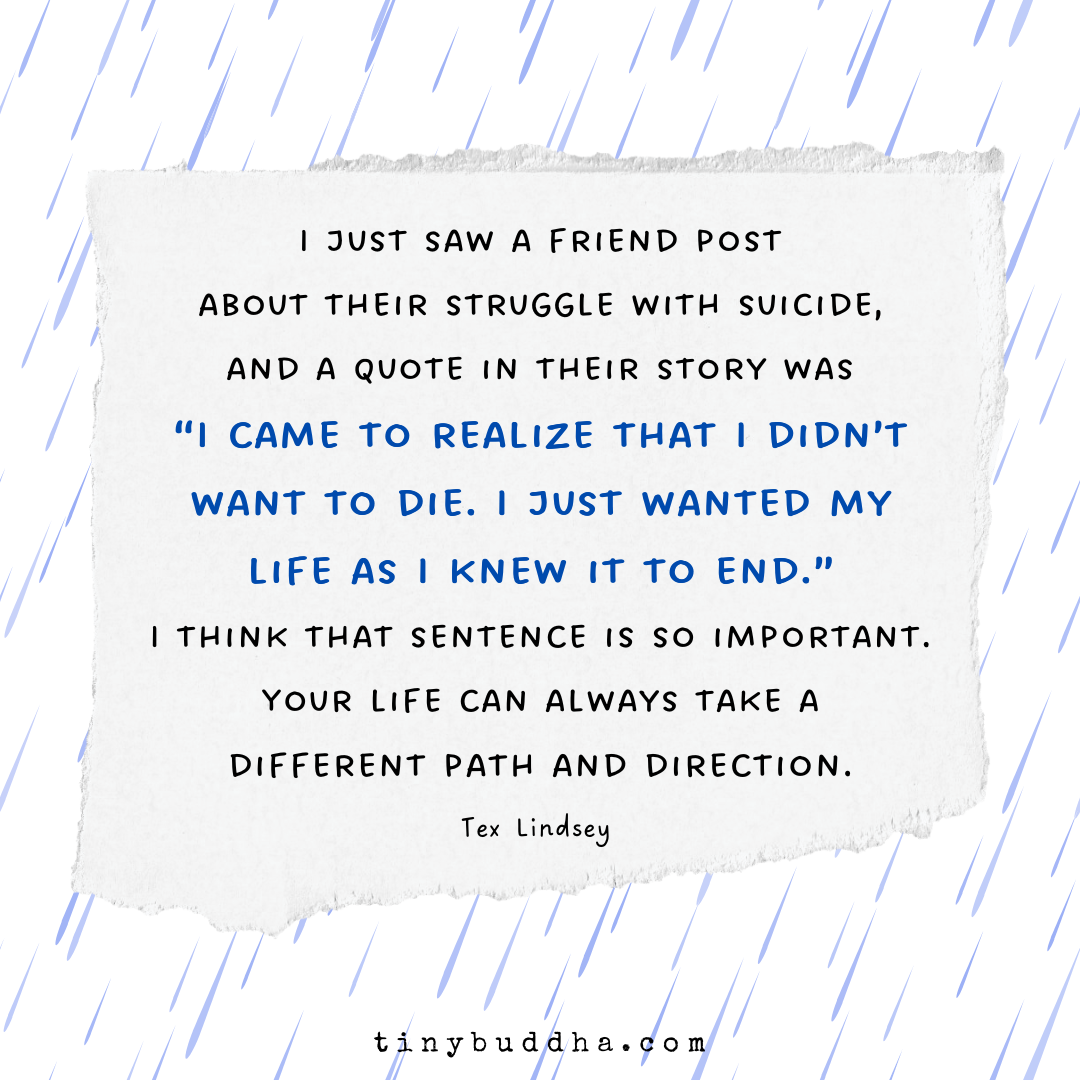
    If there is anything that I have learned by wanting to die, it was that inadvertently, I also wanted to live. I just no longer wanted to live my life through the same suffering and stories. The body, mind, and soul can only sustain pain for so long before it can no longer do it anymore.

    One of the most pivotal things about my life, hands down, was my rock bottom because, as the saying goes, I could only go up from there.

    Up doesn’t mean that you change your life drastically in one day, or even a couple of months.

    Sometimes up is showering after a week of not having the energy to do it. Sometimes up is allowing yourself to feel a slight feeling of joy again, after months and months of darkness. Sometimes up is remembering to eat again, because you never had the appetite to eat when you were at your lowest.

    If you’re struggling right now and can’t get out bed, I’m not telling you that you are wasting your life. You are not. Even in the depths of suffering, this is all a part of your journey.

    But I can tell you this: Living—not merely existing—is a choice made of lots of little choices. Like the choice to get help. The choice to believe things can get better. The choice to do the little things that help you feel better. And the choice to recognize the small wins along the way.

    Other people can support you, but no one can make these choices for you but you.

  • My Dad Died From Depression: This Is How I Coped with His Suicide

    My Dad Died From Depression: This Is How I Coped with His Suicide

    “Grief is really just love. It’s all the love you want to give, but cannot. All that unspent love gathers up in the corners of your eyes, the lump in your throat, and in that hollow part of your chest. Grief is just love with no place to go.” ~Jamie Anderson

    When I was seventeen, my dad died from depression. This is now almost twenty-two years ago.

    The first fifteen years after his death, however, I’d say he died from a disease—which is true, I just didn’t want to say it was a psychological disease. Cancer, people probably assumed.

    I didn’t want to know anything about his “disease.” I ran away from anything that even remotely smelled like mental health issues.

    Instead, I placed him on a pedestal. He was my fallen angel that would stay with me my whole life. It wasn’t his fault he left me. It was the disease’s fault.

    The Great Wall of Jessica

    But no, my dad died by suicide. He chose to leave this life behind. He chose to leave me behind. At least, that’s what I felt whenever the anger took over.

    And boy, was I angry. Sometimes, I’d take a towel, wrap it up in my hands, and just towel-whip the shit out of everything in my room.

    But how can you be angry with a man who is a victim himself? You can’t. So I got angry at the world instead and built a wall ten stories high. I don’t think I let anyone truly inside, even the people closest to me.

    How could I? I didn’t even know what “inside” was. For a long time, my inside was just a deep, dark hole.

    Sure, I was still Jessica. A girl that loved rainbows and glitter. A girl that just wanted to feel joyful.

    And I was. Whenever I was out in nature. I didn’t realize it at the time, but whenever I was on the beach, in a forest, or even in a park, I’d be content and calm.

    Whenever I was inside between four walls, however, I felt restless, lonely, and agitated. This lasted for a very long time. I’d say for about twenty years—which, according to some therapists, is a pretty “normal” timespan for some people to really make peace with the traumatic death of a parent.

    But during that time, alcohol and partying were my only coping mechanisms. I partied my bum off for a few years. I’d drink all night until I puked, and then continue drinking. Couldn’t remember half of the time how I got home or what happened that night.

    Hello Darkness, My Old Friend

    Unfortunately, all that alcohol came with a price. I had the world’s worst hangovers—not only physically but also mentally. At twenty-one, hungover and alone at home, I had my first panic attack. Many more followed, and I developed a panic disorder.

    I became afraid of being afraid. I didn’t tell anyone, because I was scared they would think I was crazy.

    Those periods of anxiety never lasted longer than a few months. But they were usually followed by a sort of winter depression. In my worst moments, I felt like the one and only person that understood me was gone. I felt like nobody loved me, not as much as my dad did. And I did think about death myself. Not that I actually wanted to die, but at times, it seemed like a nice “break” from all the pain.

    Acceptance and Spiritual Healing

    Finally, in my mid-twenties, I went to see a therapist. She helped me tremendously and made me realize that the panic attacks were nothing more than a physical reaction to stress. Yet, it wasn’t until I did a yoga teacher training a few years later that I finally learned how to stop those panic attacks for good.

    Wanting to know more about the mechanisms of the body and mind, I dove into mental and physical well-being, and started researching and writing about mental health.

    I understand now that self-love, or at least self-acceptance, and a solid self-esteem are crucial for our mental health. And I know that people with mental health issues find it so, so hard to ask for help. Their lack of self-love makes them think they are a burden.

    I understand that, at that moment, my dad didn’t see any other solution for his suffering than stepping out of this life. It did not mean that he didn’t love me or my family.

    The pain from losing my dad actually opened the door for me to spiritual healing. It brought me to where I am now. It taught me to live life to the fullest.

    It taught me to follow my heart because life is too precious to be stuck anywhere and feel like crap. And it made me want to help others by sharing my story.

    I have accepted myself as I am now. I know that I’m enough. I’ve learned what stability feels like, and how to stay relaxed, even though my body is wired to stress out about the smallest things due to childhood trauma.

    Let’s Share Our Demons and Kill Them Together

    But honestly, the pain from losing him will stay with me for the rest of my life. And sometimes it’s as present as it was twenty years ago. I don’t feel like covering that up with some positive, “unicorny” endnote.

    I feel like being raw, honest, and open instead. Depression and suicide f@cking suck. What I do want to do, however, is to help open up the conversation about this topic. I want to make it normal to talk about our mental health, as normal as it is to talk about our physical health.

    There are way too many people living in the dark, due to stigmatization and fear. Life is cruel sometimes. And every single human on this planet has to deal with shit. It would be so good if we could be real about it and share our stories so other people can relate and find solace.

    I do hope that my story helps in some way.

  • Why I Broke Down Mentally While Striving for Work/Life Balance

    Why I Broke Down Mentally While Striving for Work/Life Balance

    “Maybe it’s time for the fighter to be fought for, the holder to be held, and the lover to be loved.” ~Unknown

    I was breastfeeding my infant son when he bit me. That bite set the stage for a deeper unraveling then I could have ever imagined.

    I unlatched him, handed him to my husband, and got in my car. As I was driving I began to lose the feeling in my hands and feet. My vision started to blur, and my breathing was fast and shallow. I was terrified I was not going to make it back home. I pleaded with the powers that be to allow me to safely pull over to the side of the road.

    I was about a mile away from our house, but that mile felt like eternity. My vision continued to blur and my whole body was starting to tingle.

    When I got home, a miracle not lost on me, I couldn’t shake this fear. I couldn’t be left alone. I was afraid if I was alone, I would take my life.

    I couldn’t reconcile this. How could I so badly want to live and be afraid I’d end my life at the same time? What an interesting, terrifying place to be in: a place where you can no longer trust yourself to keep you safe and alive.

    Turns out what I had in the car was a panic attack, and what I was feeling at home was suicidal ideation.

    My sister and brother-in-law drove down to Southern California in the middle of the night to be with me and insisted I seek help that next morning. I was incredibly reluctant because I had a huge project due at work and didn’t want to let my team down. They didn’t care.

    I went to see a doctor the next day, and that landed me in a treatment center for mental illness. I reluctantly admitted myself into an inpatient program.

    I had to go on medical leave, just three weeks after returning to work from maternity leave. I was so afraid of how that would impact my career. What would people think? Would my boss resent me?  Would I ever be able to get promoted? Even though this was truly a choice of life or death, it was still one of the hardest decisions I’ve ever made. I was terrified of the outcome.

    What I received in treatment, albeit begrudgingly, was more than just mental health support. I also gained a healthy dose of perspective and clarity. This wasn’t just postpartum anxiety. This was trying to balance work and life and leaving myself out of the mix. Not only that, but I didn’t feel worthy of taking time for myself.

    I realized I no longer knew who I was. I had become everything to everyone and there was no space for me. I felt empty and defeated. I had exchanged every last piece of me to fulfill the roles that were prescribed to a woman of my age. 

    This was a shocking realization, as I’m a self-proclaimed feminist. I spent most of my life keenly aware of the loss of identity that mothers often face once they have children. I didn’t want kids for that exact reason. When I met my partner, that piece changed, but I was dead set on making sure I didn’t lose myself in the process.

    It’s funny how that works. You can be acutely aware of what you don’t want in life and still end up smack dab in the middle of the exact situation you swore would never happen to you.

    When I thought of work/life balance I always thought of it as making sure I was showing up as a career woman and mother in the most balanced way possible. But where was the room for me in that?  Where did my needs and desires come into play?

    After treatment, I began working with a life coach in addition to continuing to take care of my mental health (it’s important to note that life coaches are not medical professionals). In working with my coach, I was able to integrate more of myself into my day and reconnect with my needs and desires.

    I was held, supported, and cared for, and that empowered me to care for myself and feel worthy of taking up more space in my life.

    I took the time to reconnect with who I was before I became a parent, and I brought that version of me into the fold.

    I created a list of non-negotiables that I would implement in my daily life. For instance, I go for a walk daily. No matter what. Movement is a literal life saver for my mental wellness. It doesn’t matter what is going on at home. It’s happening. And, I do it guilt-free!

    I also keep a journal by my bedside. Every night, before I lay my head down on the pillow, I write out what I got “right” that day. It’s so easy to focus on all the ways I came up short that day. For me, my mind defaults on the negative, so having to come up with a list of at least three ways I showed up for myself is a powerful way to end my night thinking of the positive.

    Do I think that we can do all of the things all of the time? Absolutely not. I feel work/life balance is a bit misleading. I don’t think we can evenly split work, life, and self-care. One will constantly outweigh the other, even if just by a small margin.

    But what we can do is try our best to fulfill our needs and desires so that we can show up for each aspect of our life as grounded in our authenticity as possible. If we can remain grounded, we can remain fully present. And for me, being fully present is balance.

  • The Enduring Pain of Losing Someone You Love to Suicide

    The Enduring Pain of Losing Someone You Love to Suicide

    “The reality is that you will grieve forever.” ~Elizabeth Kubler-Ross and David Kessler

    March is always hard for me. Has been since March 21, 2017. That’s the day my eldest son, then twenty-seven, found his father hanging in our basement. I apologize for being so brutal.  But it was.

    What no one tells you about grief, what catches you by surprise, is the fact that you can be five years out and still, when March comes around, you can find yourself in a fetal position on the ceramic floor of your kitchen—howling like a wounded dog because a memory slashed unbidden across your brain and cut you so deep that your legs couldn’t hold your heavy, heavy weight. And you wonder—no, you know—that this will go on for the rest. Of. Your. Life.

    How to describe what it’s like when your heart breaks… It’s something I’ve been trying to do for five years. Not out loud anymore because others tire of it. More so, I try to describe it to myself. Hoping that by describing it I can move forward, categorize it, and store it; put it away, out of sight, out of mind.

    Sure, I’ll go on. Most of us do. Muscle memory accounts for 90% of how you go on, trust me. In those first days I would say the percentage is even higher. Sleep, get up, make food, eat, feed the dog, put clothes in washer, clean the dirty dishes, put out the garbage, sleep, get up, make food…

    Suicide loss, I’ve found, is unlike any other loss. Oh, this is not a contest of feelings. No, every loss of a loved one is felt deeply, profoundly. No contest. Suicide loss, however, results in countless unending ripples of devastation for the survivors every single day of the rest of their lives.

    I think of my sons. Always. The oldest is forever altered. His father was his best friend. Their relationship had just achieved that rewarding maturity of mutual respect. They enjoyed each other’s company. The youngest, twenty-three, was still working out childhood resentments, but I could see the potential for closeness. He was spared seeing his father’s lifeless body.

    We all now live with the special baggage of suicide survivors: guilt (why weren’t we there? I could have prevented it.), shame, anger (how could he?!), rage, trauma, fear (will my sons, will my mother, will my brother…), regret and deep sorrow for yesterday, today, and what will never be. Every anniversary, every milestone, every holiday, every celebration will rip the Band-Aid off again and again.

    Sometimes, the full impact of a loss takes time. For me, the first year was a “roller-coaster of emotions”—a common, but completely accurate phrase.

    To the outside world, I was pretty darn normal: keeping house, inviting people over, laughing, going about my business. Few, if any, noticed the cracks: gradual isolation, bathing only twice a week, forgetting things more than usual, horrible financial decisions, sudden breakdowns, crying in the grocery store, in traffic, in the shower, on the phone, in the middle of a conversation. Five years out and many of those symptoms remain.

    By year two the full weight of not just the loss, but the way of the loss, the reasons for the loss, the eternity of the loss hit me—a full body slam of something too heavy to survive. Or so it seemed.

    I found a therapist. She let me talk and weep. I was prescribed antidepressants. Nothing helped. I moved through days, functioned at a primal level showing the outside world only the version of myself that made them comfortable.

    No one, I don’t care how well-meaning they are, can understand this loss other than another suicide survivor. It’s true. Just as the surviving parents of a lost child know a uniquely singular, searing pain, so, too, does the suicide survivor.

    It’s important to seek out those who understand our pain. I recommend it. And grief counselors. And therapists who are especially trained in PTSD. Seek them out.

    I found a group of suicide survivors that met monthly. Hearing about their losses, especially the loss of sons and daughters, allowed me to appreciate the importance of finding a community of people who understand. In the hollowness of these survivors’ eyes, however, even as we embraced, I could see the singularity of their respective journeys. We may share, but we are alone in our pain.

    Memories do sustain me, as others so helpfully say. Sunny days at the beach are calming (unless the crashing waves remind me of past vacations with my husband and sons years ago).  Drinks and drugs provide a temporary escape (when I can resist the deadly seduction of blissful nothingness). The company of others can keep my mind from the endless cycles of black thoughts. Music can be helpful. Or dangerous.

    “Stay active! Meet new people! Get out and do something! Time to move on! Get over it!” I can hear the words of concerned family and friends.

    People mostly mean well. Time will pass. Things happen. Kids grow. Other cherished loved ones will die. I have come to understand that death is relentless, and that I must bear other cruel deaths as well as this one. 

    My sons are my reasons for living. Period. In my most desperate times the thought of their pain has been the only thing between me and oblivion. I will never do that to them. And they, in turn, know that either one of their deaths would mean my end. I have no doubt that I could not survive that. I need for them to be okay.

    I will, as they say, put one foot in front of the other every single day, if not for myself, for my sons. Even though they are grown. Even though they have their own lives of which I am but an infinitesimally small part. I have to stay alive because they have already suffered enough.  Suicide survivors understand that.

    And so, I hate March. I begin to dread it in January. By February I am coming up with excuses to stay home. And, on any given night in March, I am balled-up on the ceramic tile of my kitchen floor howling like the wounded animal that I am. But I get up the next day and I try again.

  • Why Fibromyalgia Is the Greatest Gift of My Life

    Why Fibromyalgia Is the Greatest Gift of My Life

    “The wound is the place where the light enters you.” ~Rumi

    TRIGGER WARNING: This article contains discussions of difficult topics, including suicidal depression and a fatal car accident.

    I’ve always been an active, athletic person. In my twenties I was huge in tennis, squash, and swimming, and I began every morning with an intense workout that cleared my head and let me confront the day’s challenges with a relaxed, positive attitude. So, when I started experiencing mysterious pains and fatigue that didn’t go away no matter how much sleep I got, my life was turned upside down.

    After two years of doctors’ visits, I finally received the earth-shattering diagnosis: fibromyalgia. My worst nightmare had come true. The doctors told me I would have to stop exercising as all the sports I loved are hard on your joints, and according to them I needed to take it easy. But physical activity was my life, and I quickly found that “taking it easy” was emotionally devastating for me.

    Without my workout routine, my depression and anxiety spiraled out of control. I couldn’t find meaning or purpose in my day-to-day life anymore. The days blurred together, and all the energy I usually released through exercise turned inward, against me, in the form of daily panic attacks.

    Worse than anything was the sense that my body—my best friend and my #1 support system for so many years—had betrayed me. And on top of this, the symptoms of my fibromyalgia were not getting better despite the enormous sacrifice I had made of giving up exercise. In fact, they were getting worse.

    My turning point came several years after my diagnosis, when I was in my early thirties.

    My condition had continued to decline, and I was ready to give up—on my body, on myself, and on life. It’s not something you can really understand unless you’ve experienced it yourself, but I had reached a point where I had no interest and no motivation to go on living. The uphill battle just wasn’t worth it to me anymore.

    I remember the moment like it was yesterday. It was nighttime, pouring rain outside my third-story bedroom. I opened the window, put my head outside, and screamed from the top of my lungs into the howling wind: “Why, God, why do I have to go through this?” Then, overtaken by a sudden urge, I lifted my leg to climb out of the window, to fall to my death and put myself out of this agony.

    At that moment, something happened that I still, to this day, cannot rationally explain. Out of the corner of my eye, I saw a child standing by my side—a child I quickly recognized as the younger version of myself.

    She looked up at me with pleading eyes and begged me to keep going. She told me to go back to my workout, that exercise would be my remedy, and that fibromyalgia, my greatest struggle, would lead me to my destiny.

    I closed my window, feeling like I had just woken up from a dream. That night I made the choice not to give up on my life, somehow knowing my story would not and could not end here. I realized I had more to offer—instead of turning my misery into someone else’s grief, I could turn it into a gift that I could share with the world.

    Although I had promised my friends and family that I would take it easy and not work out anymore, the next day I spent an hour swimming at the public pool. While I was there, I shared my story with a lifeguard who in turn shared some unexpected wisdom with me: “A doctor reads the book, memorizes it, and repeats it to the patient, but the patient knows her body.”

    His words resonated with me. I started doing a mild exercise routine: a few hours a day of swimming, which was easier on my joints than tennis or squash. After a while, I decided to retry some of the other sports I had loved to play before my diagnosis and found that, as long as I was careful, I could enjoy them without too much pain. The trick was knowing my body—learning and recognizing its warning signs, keeping a close eye on how I felt, and not letting myself overdo it.

    The young girl, the one who had stopped me from taking my own life, was right: exercise was my remedy.

    My mental health started to improve, and while I was still experiencing body aches, swollen joints, and all the other joys of my disease, I had a renewed, intentional outlook that made them possible to manage. I couldn’t choose to live my life without pain, but I could choose to live it without suffering.

    I will not lie to you and tell you it was a smooth recovery. I had bad days—days where all I could do was curl up in bed and cry, days spent feeling sorry for myself and angry at the universe. Days where my symptoms got so bad that I forgot all about my positive mindset and the mission I had set for myself, to turn my struggle into something positive and use it to help others.

    I experienced a serious setback when, almost ten years after my diagnosis, I was driving with my best friend and we got into a horrific car accident. I was the one at fault. My friend, who was thrown from the car, ended up being declared brain dead at the hospital; I myself suffered severe injuries that badly worsened my fibromyalgia symptoms, and I was told by doctors that I would likely have to start using a wheelchair if my condition did not improve.

    (Incidentally, while receiving psychiatric treatment for extreme suicidality in the days following my accident, I was also diagnosed with ADHD and dyslexia—a fact that might once have given me consolation or comfort in understanding why I am the way I am, but given the circumstances, only served to depress me further.)

    My physical decline combined with the trauma of causing my friend’s death was more than I could bear, and I again spiraled into hopeless agony. It was one of the darkest periods of my life, even worse than the few years after I was first diagnosed with fibromyalgia. But I did not succumb to misery as I almost had back then. And now, looking back, I see why.

    This disease, and my active and consistent determination to make the best of a bad situation, had given me the best possible tools to deal with whatever hardship came my way.

    I was in worse physical and emotional shape than ever before. But years ago I had made a choice to keep going, and followed through with that choice for many years, and because of this my mind was in perfect shape to keep me from falling apart when I hit rock bottom.

    So I kept going. Through my tears and my pain, I got up each morning and faced the day, whether I wanted to or not. Not only did I continue working out, I became certified as a yoga and Pilates instructor. It was during this time that I got my black belt in Taekwondo, though it took me six years. I even started working as a fitness trainer, finding that my experience with fibromyalgia gave me a unique perspective on physical and mental health that my clients appreciated.

    This realization was the beginning of a much larger realization about the struggles each of us will face in our lives.

    First, setbacks are an inevitable part of any recovery process.

    If you’re not seeing forward progress on a day-to-day basis, that doesn’t mean you’re not still moving forward! I went through long periods of nothing but bad days, but I wasn’t giving up, and that’s what mattered. Continuing to fight is an active choice—you are making progress every day that you choose to stay alive.

    Second, no matter what you’re dealing with, you have the power to turn it into something amazing.

    Fibromyalgia made me a better, more compassionate, and more open person, allowing me to connect with people on a deeper level and help them more than I could before. It opened up opportunities and put me on personal and career paths I would never have followed otherwise. It taught me patience, gratitude, and—more than anything—that I am capable of so much more than I think.

    Fibromyalgia has been the greatest gift of my life, but I need you to understand that it is a gift because I chose to turn it into one. The universe handed me an awful situation, and as you now know, I came close—too close—to letting it destroy me. It was my own decision to turn my pain into the blessing that it has become, for myself and for those around me.

    Life is full of hardships, but the incredible thing about being human is that we have the ability to choose how we respond to them. You can choose to fall apart, or you can choose to turn your pain into a gift.

    What will you choose?

  • Why I Blamed Myself for My Ex’s Suicide (and Why It’s Not My Fault)

    Why I Blamed Myself for My Ex’s Suicide (and Why It’s Not My Fault)

    “No amount of guilt can change the past and no amount of worrying can change the future.” ~Umar Ibn Al Khattab

    I don’t remember the exact day the message came through. It was from my son, Julian, and he needed to talk to me. It sounded pretty serious. He never really needs to talk to me.

    His father was found dead earlier that week. He’d hung himself.

    While this news hardly affected Julian at all, it hit me like a ton of bricks, and I cried.

    Our Marriage

    We met in a taxi thirty-three years ago. He was the driver, I was a drunk passenger. He was super handsome and flirty. He brought me home, and we exchanged numbers and instantly began a relationship.

    Within six months of dating, I found out I was pregnant. Since I didn’t want to be an unwed mother, we were married within a month and began our lives. We both had good jobs. I worked at a bank, he was an HVAC technician. Life was pretty good in the beginning.

    Then his job took us to a different city. We moved and for the first time in my life, I was alone with no friends and no family. I was twenty-six years old. Our marriage was okay, and we got along well.

    About six months after we moved to this new city, he started coming home later and later from work, some nights not until 2am. He always told me he had to work late. I believed him. He was on call a lot. I was home alone a lot.

    A few months later I made the decision to return to our hometown. He was to find a job there, which wouldn’t be hard. I didn’t want to be alone in this big city anymore, and I was just about to give birth. I wanted my family around.

    Life After Our Move

    We stayed at my parents’ house when we returned, and within a month had found our own apartment.

    He found a job almost instantly, and I delivered Julian two days after we got home. Life was going well.

    About a year into our lives with the baby, things started to get bad. He was out “working late” an awful lot. He would come home around two or three in the morning, smelling of alcohol. By the time Julian was eighteen months I had had enough and asked him to leave. This wasn’t the life I wanted for my son.

    He moved out and for the next six months, my life was a living hell. He would come over drunk at night, force sex on me, threaten to take my baby away from me, threaten to kill us both. He threatened me almost daily. Many nights I’d stay at a friend’s house just to feel safe. Many times the police were called.

    He finally moved out of province, and it was years before we heard from him again.

    The Divorce Agreement

    The day had come to file for divorce and put this whole marriage nightmare behind me. I filed for sole custody with no visitation allowed to him. He was unstable, dangerous, and violent, and I was not taking any chances with my son. The fact that he lived far enough away was my saving grace.

    Also stated in the divorce agreement was no child support payments. I wanted to completely cut all ties with this man. So I did just that.

    Twelve Years Later

    It may have been longer, maybe thirteen or fourteen years later, we received a package from him via his brother. It was sent to Julian. A picture of himself and a silver chain with a St. Christopher pendant.

    It meant nothing to Julian. He didn’t even know who this person was. I questioned his gesture. Was he trying to make amends? Was he trying to prove that maybe he’d changed and he wanted to start a relationship with his son?

    I never got the answer to any of those questions. He never reached out again after that.

    When my son moved away to university, he lived only a couple of hours away from his father. He made an attempt through his uncle to maybe meet up with his dad, but his dad wasn’t interested and declined the offer.

    And life simply carried on.

    Every now and then, throughout the years, Julian’s uncle would update us on what his father was doing and how he was doing. It seemed alcohol and depression were major parts of his life.

    I couldn’t help but feel responsible for this.

    Was he depressed because I took his only child away from him? Was this my fault? Whenever we got another update, I just felt guilty. Did I do this to him?

    The Call

    When I got the call, I was in complete shock. I had no idea his depression was that bad. How would I have known? Were there other factors that played a part in his suicide? Or was it just years of anguish knowing he had a son who was never a part of his life… because of me?

    Could this have been prevented if his son had been a part of his life? Did I do this??

    I cried for a week. I had never felt so much sorrow, and guilt. SO much guilt. Was I responsible for someone’s suicide?

    Dealing with My Grief and Guilt

    It took me a while to wrap my head around his suicide. It also took me a while to convince myself I was not responsible for it, nor should I feel guilty about it. I didn’t talk to anyone about this. No one would understand my feelings, and they were hard to explain.

    I realized, though, that he had been battling demons that had nothing to do with me. I made the best choice for my son, and that was the most important thing to me.

    He had made his choices as well. And I had nothing to do with them. Me not allowing him any visitation to his son was a result of his actions and choices. He chose his behavior. Not me. I chose to not have his behavior damage my child.

    I had to talk myself through that. It’s not your fault, Iva. He could have chosen to change his life, improve his life, reach out to his son more often, anything. And he chose not to.

    It’s not your fault, Iva.

    There is a tiny part of me inside that wishes things would have been different. If only he got help for his depression and alcoholism. If only he could have been a part of Julian’s life. If only he could have tried to help himself.

    I’m sorry his life ended so tragically. I’ll always feel sorry for that. But I won’t feel guilty about it anymore.

    It’s Not Our Fault

    It’s so easy to take responsibility for a loved one’s suicide, especially when you set a hard boundary for your own well-being. “If only I had done this or done that” or “if only I would have not done that,” but the reality is, it’s not our fault.

    We are not in control of how people think, act, react, or live their lives. We can only control our own lives. What people do with their own life is out of our hands. We can offer them tools and help, but it’s up to them to accept it and/or use it.

    If they don’t, that’s not our fault either. It’s easy to think that we should have/could have done more, but we did as much as we could. The rest was up to them.

  • Why I Couldn’t Find Love and What Helped Me (That Might Help You Too)

    Why I Couldn’t Find Love and What Helped Me (That Might Help You Too)

    “You can’t go back and change the beginning, but you can start from where you are and change the end.” ~C.S. Lewis 

    It was a dark January day in 2008 when my auntie called with the news “He did it.”

    I felt so confused. “Did he try? Or did he succeed?” I asked as my body moved into shock.

    “He succeeded,” she said. And in that moment my whole life changed.

    This was a moment I often wished for—my dad was gone.

    Dad had taken his life on January 8th, 2008, two days after my twenty-sixth birthday. He had even told me of his plans, I just didn’t believe him. I thought he was far too selfish to ever kill himself. 

    How wrong I was. I was consumed by guilt, but I felt like maybe my life would get easier now that he was gone.

    My mum had left him after twenty-six years of marriage, just months before his suicide, after reaching the brink of a breakdown. She couldn’t handle his behavior anymore. The putdowns. The nasty comments. Not just to her but to her children too.

    She stayed all those years for us. And we stayed for her. To protect her from him, as he could be a really mean drunk. We kept telling each other he didn’t hit us, so it wasn’t that bad.

    I had gotten used to holding my breath around him, not knowing what I would do to set him off.

    Maybe I didn’t shut the door. Maybe I wasn’t working hard enough for him. Or sometimes I was just in the room where he would lose his temper.

    I grew up walking on eggshells since I was a little girl. I thought that was normal. Living in constant fear of an outburst.

    I learned from a young age to do whatever he wanted so that he would not shout. I lived to please him. I did the studies he wanted. Was on track to find a groom he would like. Literally everything I did was to please this man.

    And just like that, one day he took his life.

    As a young girl I would fantasize about the moment when it would be just me, my mum, and my brother. It would be quiet, it would be calm, and there would be no shouting. I got my wish, but I was wrong that life would get easier without him.

    I had literally lost my reason for living.

    Unconsciously, I had lived to please my dad, and without him I became so very lost. I was numb to the core, and I wouldn’t allow myself to grieve him. After all, he had caused me so much pain right until the end.

    As I moved into my thirties things got much worse. I was the world’s biggest people-pleaser after years of perfecting this skill with my dad. I was always seeking outside approval and validation but was full of self-loathing.

    He may have been gone, but it was his voice I heard inside my head. You’re too fat. You’re ugly. No one will want you. 

    I was desperate for love and affection, yet I looked in all the wrong places, often chasing men who didn’t show me love back. I was always single but would obsess over unavailable men.

    Maybe he was in an unhappy relationship or had issues with drugs and alcohol or depression. These men were my drug! I found them every time and tried my best to fix them with my endless love and kindness, getting very little back.

    I took any small crumb of love someone would give me and then hated myself for it. Sometimes I even wished I could die.

    I didn’t just do this with men, I also did this with friendships, spending so much time trying to save others and resenting it. I felt worthless and like I was here for everyone else and just a spectator of other people’s happiness.

    I felt unfixable. Like I was some broken human. And I loathed myself for feeling that way.

    Everyone around me was getting married and having children, and I was just stuck. Obsessing about some guy, losing weight and then putting it back on, in this constant cycle of unhappiness. I’d numb the pain with my fantasies, food, people-pleasing, and wine, keeping myself stuck in it all.

    I felt so trapped in my own pain.

    One day I read somewhere that self-love was sexy, and that was the way to get the man you loved to leave their relationship. So I bought The Miracle of Self-Love by Barbel Mohr and Manfred Mohr and began to do some of the exercises in the book—affirmations and asking myself questions like “What do I enjoy?” I soon discovered I had no idea who I was, what I liked, or what I needed.

    This kicked off my journey of healing, self-discovery, and learning how to love myself.  

    I discovered that I was super co-dependent and began to attend CODA (co-dependents anonymous) meetings. I tried to stop pleasing-people, learn to say no, and have boundaries.

    At the beginning this would cause a full-on panic attack. Turns out years of living in fear with my dad had given me complex PTSD.

    I discovered Melody Beattie’s books on codependency and began doing all the exercises so I could stop self-medicating with addictive behaviors and make real changes. I learned how to incorporate daily self-care including rituals like affirmations, meditation, and grounding my feet to the earth.

    The shock was I didn’t think I had ever been abused. But I soon learned, by working with various therapists and healers, that I had suffered emotional abuse, gaslighting. and some narcissistic abuse.

    The way I felt wasn’t my fault. I wasn’t a broken human. I was a traumatized child in a grown-up body.

    Living in a home where my dad abused my mum had pushed me into a caretaker role. I was always protecting her. It was like I was trying to save both my parents in some way.

    Such a heavy weight I had carried my whole life.

    Their example made me terrified of relationships, which is why I unconsciously sought love from unavailable men—I was afraid of how toxic relationships were. That was all I knew. So I found relationships that wouldn’t go anywhere. To keep myself safe.

    I chased their love like I did with own dad. My first unavailable love. 

    I began to recover from the codependency, love addiction, and disordered eating by investing my time, money, and energy in myself. I was so good at showering others with love but didn’t ever show it for myself. So I worked hard to change this and began to shine that light within.

    I connected with my inner child through self-healing and reparenting practices, and this was life-changing for me.

    I found it hard to love and accept adult-me, but the little girl in my childhood pictures, I could love her. I put pictures of her everywhere and talked to her daily, telling her that I loved her.

    I would do inner child meditations and write letters to her. Someway, somehow, I began to build a connection to my younger self, and through that my self-love grew. I found a way back to myself.

    I became fiercely protective of the little girl within me. No more unavailable men for her. My little girl deserved the best. 

    Before finding romantic love, though, I needed to find love and forgiveness for myself regarding my dad and his suicide. I had to allow myself to grieve him. When I did, I realized how much I truly loved him. I was heartbroken without him. His darkness was only one side of him; there was so much love he gave me too. He was such a Jekyll and Hyde.

    To learn to forgive him and all the awful things he had done to me, I began to connect to his inner child and the trauma he had faced. I realized that unhealed trauma had been repeating for generations.

    My dad too was traumatized by his parents, and he survived by projecting that pain onto others. I had learned to please to survive, and he had learnt to fight. His dad was physically abusive and an alcoholic. Even my mum was repeating patterns in her own family by allowing herself to suffer domestic abuse.

    Learning about intergenerational trauma helped me to forgive and understand those who caused me pain. They were just repeating patterns and behaviors, but I decided to change them and heal.

    Slowly, relationships got easier as I became more conscious of my relationship with my dad and the impact he’d had on me. I found love with a healthy man who has my dad’s best qualities, is 100% available and no drama. I didn’t even know love like this existed. Just like that, I was no longer attracted to unavailable men.

    For those of you who struggle in relationships with others and yourself, the magic ingredient is connecting to your inner child and reparenting them. Give them all the things they need. The validation. The love. The comfort. Learn to emotionally regulate so you can teach them how to self-soothe. Be the parent you longed for.
    Be honest with yourself about the behavior that keeps you stuck and causes you pain. Then invest your energy in yourself to slowly change these behaviors and heal the wounds beneath them.

    Just sit there and listen to your feelings and your pain. Give yourself what you need. Validate yourself.

    You’ll soon find the power within and learn that anything is possible.

    As C.S Lewis wrote, “You can’t go back and change the beginning, but you can start from where you are and change the end.” That is what reparenting your inner child does.

    You learn to give yourself the life your little one deserves—a life that is safe and full of joy, where their voice can be heard, allowing them to be their authentic self.

    Choose different than the generations before you and the repeating patterns of unhealed trauma. Choose to let love and light in.

    My dad let the darkness ruin his life. He sabotaged his family life and his relationships by projecting his pain onto us, using alcohol to push it down, and then it exploded in his suicide.

    I hope his story and mine inspire you to keep going and to find love for the child within you so you can find your own heart’s happiness.

  • When You Lose a Loved One to Suicide: Healing from the Guilt and Trauma

    When You Lose a Loved One to Suicide: Healing from the Guilt and Trauma

    “You will survive, and you will find purpose in the chaos. Moving on doesn’t mean letting go.” ~Mary VanHaute

    I was ten years old when I discovered the truth. He didn’t fall. He wasn’t pushed. It wasn’t an accident.

    He jumped.

    Suicide isn’t a concept easily explained to a six-year-old, much less her younger siblings, so I grew up believing that my father’s drowning was an unfortunate freak accident. It was “just one of those things,” the cruel way of the world, and there was nothing anyone could have done about it.

    This explanation more than satisfied me and, other than a fear of open water and a slight pang of sadness whenever he was mentioned, I suffered no grievous trauma for the rest of my early childhood.

    But at ten years old I learnt the truth—that it wasn’t some divine entity or ill-fated catastrophe that took him from me. He had, in fact, ripped himself from the earth and left everyone he loved behind. Left me behind.

    Was it something I did?

    That’s the first question I asked.

    “Of course not,” my mother said. “He was just sad.”

    The idea that suicide was a simple cure for sadness became the first of many dangerous cognitive distortions I adopted. It would take no more than a dropped ice-cream cone or trivial friendship fall-out for me to declare my sadness overwhelming, to the point where, at the age of eleven, I drank a whole bottle of cough medicine in the belief that it would kill me.

    I was sad, I said, just like him. And if he could do it, why couldn’t I?

    As I grew into my teenage years, the possibility that I was the driving force behind my father’s suicide began to plague me, albeit subconsciously. I reasoned that the bullies at school hated me so, naturally, my father must have hated me too.

    Maybe I wasn’t smart enough or polite enough. Maybe I was unlovable. Maybe everyone I loved would leave me eventually.

    This pattern of thinking would slowly poison my mind, laying the foundations for what would later become borderline personality disorder. I suffered from intense fears of abandonment, codependency, emotional instability, and suicidal ideation, believing that I was an innately horrible person who drove people away.

    I refused to talk about my problems and allowed them to fester, harboring so much anger, guilt, shame, and sadness that eventually it would erupt out of me. It was only in my mid-twenties that I realized just how deeply my father’s suicide had affected me and the course of my whole life.

    I sought help and, slowly, I began to heal.

    Coping with The Stigma

    “Mental illness is nothing to be ashamed of, but stigma and bias shame us all.” ~Bill Clinton.

    Selfishness, cowardice, and damnation are toxic convictions that permeate the topic of suicide, adding to the anger, guilt, shame, and isolation that survivors feel. Growing up, I hid the truth of how my father died under fear of judgment or ridicule, scared that the knowledge would not only tarnish his humanity, but paint me with the same black brush.

    I still remember the words of a girl in high school, “Well, you shouldn’t feel sorry for people who do it, it was their choice after all.”

    Understanding the intricacies of mental illness and just how destructively they can distort the mind allowed me to come to terms with my father’s death. I was able to accept that his suicide was born not out of selfish weakness, but from lengthy suffering and pain, carried out by a mind that was consumed by darkness and void of the ability to think rationally.

    Letting Go of The Need for Answers

    “Why?”

    It is a question that only the person who took their life can answer—but they often leave us without any sense of understanding. In the absence of a detailed note or some definitive explanation we find ourselves trapped in an endless spiral of rumination, speculating, criticizing, and self-blaming, to no avail.

    It becomes a grievance, a desperate yearning for closure that weighs heavily on our hearts. After all, not only did they leave us, but they left us in the dark.

    It is completely natural to want an answer to the question of “why.” We feel as though an answer will provide closure, which in turn will ease our confusion, pain, and guilt. However, because there is usually no singular reason for a suicide attempt, we will always be left with questions that will go unanswered.

    Fully accepting that I was never going to get the answers I craved freed me from the constant rumination of “why.”

    Releasing the Guilt

    To quote Jeffery Jackson, “Human nature subconsciously resists so strongly the idea that we cannot control all the events of our lives that we would rather fault ourselves for a tragic occurrence than accept our inability to prevent it.”

    As survivors, we tend to magnify our contributing role to the suicide, tormenting ourselves with “what if’s,” as though the antidote to their pain lay in our pockets.

    We feel guilty for not seeing the signs, even when there were no signs to see. We feel guilty for not being grateful enough or attentive enough, for not picking up the phone or pushing harder when they said, “I’m fine.” Even as a child I felt an overwhelming guilt, wondering whether I could have prevented my father’s suicide simply by saying please-and-thank-you more often than I had.

    It wasn’t my fault. And it isn’t yours either.

    The truth is that we cannot control the actions of others, nor can we foresee them. Sometimes there are warning signs, sometimes there are not, but it is an act that often defies prediction. It is likely that we did as much as we could with the limited knowledge we had at the time.

    Healing takes acceptance, patience, self-exploration, and a lot of forgiveness as you navigate your way through a whirlwind of emotions. However, there is a light at the end of the tunnel of grief. Although we may never fully move on from the suicide of a loved one, in time we will realize that they were so much more than the way in which they died.

    To quote Darcie Sims, “May love be what you remember most.”

  • What If There’s Beauty on the Other Side of Your Pain?

    What If There’s Beauty on the Other Side of Your Pain?

    “The important thing is not to stop questioning. Curiosity has its own reason for existing.” ~Albert Einstein

    “I don’t want to live anymore. I don’t want to be here. I can’t do this. It hurts too much. It’s too hard.”

    I’m curious how many times I’ve heard these words over my lifetime. From different people, ages, genders, ethnicities, and walks of life. The words the same, the heaviness no different from one to the next. Hopelessness has a specific tone attached to it. Flat, low, and empty.

    Being the child of a parent who committed suicide, there is a familiar inner fear that washes over me when I hear these words. A hyper alertness and tuning in, knowing it’s time to roll up my sleeves.

    As a psychotherapist, there is a checklist that goes through my head to make sure I ask all of the right questions as I assess the level of pain they are experiencing.

    As a human, a warm wave of compassion takes over as I feel around for what this particular soul needs.

    After asking the typical safety questions and determining this person is not at significant risk of ending their life, I ask, “So what is the end goal here? What do you think happens after you die? Where will you go? How will you feel? What will feel different when you’re dead versus how you feel right now?”

    The answers vary from “It will be dark and nothingness, no feeling, no existence” to “I’ll be in heaven and done with this,” but more often than not they say, “I don’t know.”

    I sometimes question, “Well, if you don’t know how can you guarantee it will be better than this? What if it’s worse? What if you have to relive it all again? What if you are stuck in a dark abyss and can’t get out?”

    More times than not they have not thought this through. They are not thinking about what is next, mostly because what they are really saying is “I don’t want to feel like this anymore.”

    I get that. We all have those moments.

    Then I dig in further:

    “How do you know your miracle is not around the corner? How do you know relief will not come tomorrow if you allow the opportunity for one more day? What would it be like to be curious about what’s next instead of assuming it will all be just as miserable?

    Since you have not always felt like this, is it possible you may one day again feel joy and freedom?

    If you look at your past, you’ll see you have had many fears and low moments. Did they stay the same or did they change? Most of your fears did not come to be, and if they did, you survived them—you made it through. You may have even learned something or strengthened your ability to be brave.

    If you turn around, you can see there is a lifetime of proof that your world is always changing and shifting. You’ll see many moments when it may have felt like things were not going the direction you wanted, but you’ll likely see an equal number of moments that led you to exactly what you needed. Use those as evidence that your surprise joy may be just around the corner.

    During these conversations, my own curiosity resurfaces. I often ponder if my mother held out a little longer what her life would have looked like. I wonder if another medication would have helped her. Or if the words of an inspiring book may have offered her the hope to keep holding on. Or if the feeling of the sun on her face would have kissed her long enough for her to want a little bit more.

    What if she held on to the curiosity of what was to come instead of deciding there were no surprises or joy left? Would she have felt the bittersweet moment of watching me graduate from high school? Would she have been there to cheer me on when I earned my master’s degree hoping to help people just like her? Would she have held my daughter, her first grandchild, and wept tears of joy knowing she made it?

    Who knows what her life would have been like if she held on for one more day? I will never know, but I am curious.

    I have sat with countless children and adults while they are deep in their pain. I ache for them, cry for them, and also feel hope for them. I wonder out loud what will happen next that we cannot see.

    I’ve seen pregnancies come when hope had left, new relationships be birthed when the people involved were sure they would never feel loved again, new jobs appear out of nowhere at just the “right” time. I’ve seen illnesses dissipate once people started paying attention to themselves, and moments of joy build in the hearts of those who were certain there was no light left.

    The truth is, we don’t know what will happen next, but we know we have made it this far. How do we know tomorrow won’t be exactly what we’ve been waiting for?

    I believe our baseline feeling as humans is peace. The loving calm that fills us when we are in the presence of those we adore. The kind of whole that we feel when we’ve done something we feel proud of and we reconnect to the love we are made of. The way we feel when we are giving love to others and the way we feel when that love is returned.

    I also believe that the human experience is filled with struggle and hardship and challenge. I don’t think we are getting out of it. I believe we are equipped with the power to lean into our pain to let it move through us. To use our experiences as our strength and our knowledge for the next wave of frustration.

    I don’t believe we are supposed to suffer, but rather learn to thrive in the face of hardship and use hope as the steering wheel to guide us through… knowing even though the light may not be right in front of us, it’s just around the corner.

    And the more we employ this faith and our practices that support us, the quicker we are able to return to the peace that lies underneath.

    In the moments of hardship, what would it be like to allow for curiosity? To not only acknowledge the feeling in front of us—and feel it—but to also allow for the possibility of what is to come.

    All of our experiences come with the free will to choose how we will respond to them. With openness and wonder or dismissal and resistance. It’s also okay to feel it all at once. The feelings will pass. They always do.

    The next time you feel stuck in a feeling, or what feels like a never-ending experience, consider thinking: I wonder what will come of this. I wonder what I will gain. I wonder what strengths I will develop and how I will support myself. I wonder what beauty lies on the other side of this pain. Don’t push through it but surrender into it.

    Then allow for curiosity. Be open. You never know what surprises the day may bring. Maybe today is the day it all changes. Or maybe tomorrow. You may not know the day, but you can be ready and open for it when it arrives.

  • How I Survived Suicidal Thoughts When I Really Wanted to Die

    How I Survived Suicidal Thoughts When I Really Wanted to Die

    **If you are struggling with suicidal thoughts now, please consider speaking with a trained professional through the National Suicide Prevention Lifeline, at 1-800-273-TALK.

    “Sometimes even to live is an act of courage.” ~Lucius Annaeus Seneca

    When I was twenty-four my best friend died suddenly in a car accident. She was like a sister to me, so this plunged me into a deep depression. I had struggled with depression since I was about fourteen, but it became much worse after she passed away.

    At times suicide honestly seemed like the best possible solution to what I felt like I knew was going to be another fifty years of sadness. I wasn’t depressed every day, and there were weeks and months when it seemed like things were getting better. But the depression always seemed to come back and it was wearing me down.

    Despair

    In Andrew Solomon’s book The Noonday Demon, he states that it is easier to convince a schizophrenic person that their delusions aren’t real than it is to convince a depressed and suicidal person that life is worth living.

    “You don’t think in depression that you’ve put on a gray veil and are seeing the world through the haze of a bad mood. You think that the veil has been taken away, the veil of happiness, and that now you’re seeing truly.”

    This sums up exactly how I felt. I needed others to have hope for me when I didn’t have any. I was lucky to have a great support network of family, friends, and professionals. I had a doctor and an amazing therapist who helped a lot.

    I read everything I could on depression and sought out people who were going through similar things. It made me feel less alone to be able to talk openly about the darkness I was experiencing. I craved authenticity. The support I received kept me alive and gradually I started to heal.

    Hope

    As I write this, I haven’t been clinically depressed in two years now. I am blessed with so much love, purpose, and happiness. If I had ended my life back then I would never have met my amazing partner, become a counselor, or seen my nieces grow up.

    I couldn’t skip those painful years, but I wish I knew that things would turn out okay, that I could recover, and that life could be worth living. What I’m saying is, give time a chance to heal you, give life a chance to get better. You will have to fight for it, but it can happen.

    Hope is such a powerful thing, and suicide is the ultimate state of hopelessness. If you can connect with a suicidal person’s hopelessness but also hold and communicate your hope for them, that is a huge gift. They may not thank you at the time, but one day they might. It could be the thing that gets them through that night.

    The Secret We Keep

    Suicide is a lot more common than people realize. One in five people experience thoughts of not wanting to be alive at some point in their lifetime, but it’s not socially acceptable to admit to this. We walk around thinking we’re the only one and must be totally crazy when right next to us someone else might be thinking the same thing.

    It makes sense that when we are suffering our brain looks for ways out, especially if we feel like we are a burden to others because of our suffering. Usually we can dismiss this as a bad idea, an extreme and permanent solution to our problems.

    But what if the suffering doesn’t seem to be ending? What if the pain just goes on and on and you can’t take it anymore?

    The Ones You Leave Behind

    If you are deeply depressed, you may think you are just putting an end to your suffering by ending your life, but you are actually just passing it on to the people who know and love you. It is estimated that fifteen to thirty people are severely affected by each person’s suicide. They are left with questions of “What did I do wrong?” “What did I miss?” “What could I have done?” The people left behind are also at a higher risk of suicide.

    This is painful to hear when you are desperate for an escape. I don’t mean to guilt trip anyone. But instead of passing on this pain to others you could try and channel it into something positive. Even if that is just your own recovery and survival.

    Some of the greatest creatives and altruists are people who have known deep pain. It was their experiences that prepared them and allowed them to create something good in the world. We are all going to die eventually, so if you do nothing else in this life, do your best with all the years life gives you.

    Grief

    I was at a conference recently and the facilitator, a therapist who specializes in working with people bereaved by suicide, told a story. She was walking along the street when a woman almost accidentally stepped out in front of the traffic. The therapist was too far away to grab the lady so instead she yelled out “Don’t leave us!”

    This story brought tears to my eyes. It reminded me of the loss that people feel when they lose someone, especially to suicide. I think of the pain that I felt when my best friend died, the absolute grief, and then I imagine how much worse it would have been if she had died by suicide. I am so glad I did not successfully inflict that on my family.

    Safety Planning

    I suspect many are feeling suicidal right now, given that we’ve all been isolated, some with mental health issues and no support; others trapped with their abusers; others still feeling overwhelmed by financial struggle. If you’ve been feeling suicidal the first thing I would suggest is telling someone. It could be a friend, a family member, a therapist or a helpline.

    I know this can be scary. You might be worried they will think you’re crazy or rush you off to hospital. I can’t say for sure what will happen, but I can say that if you pick someone good, they will most likely ask you some questions and try to come up with a plan to keep you safe while you feel this way.

    Be clear with what you are thinking and feeling. There is a big difference between feeling that you don’t want to be alive sometimes and planning to end your life. It’s all important and it’s okay to talk about it. If the first person doesn’t respond well, that’s okay; tell someone else. There are good people out there.

    Maybe you are reading this and thinking that no one would care if you died, and your family wouldn’t miss you. Well, someone would. Maybe someone you haven’t even met yet. Someone who will never get to meet a person just like you. You are completely unique, and no one can replace you. Please don’t leave us.

    **If you are struggling with suicidal thoughts now, please consider speaking with a trained professional through the National Suicide Prevention Lifeline, at 1-800-273-TALK.

  • Lessons from a Life Lost Too Soon: Don’t Let Your Inner Critic Destroy You

    Lessons from a Life Lost Too Soon: Don’t Let Your Inner Critic Destroy You

    “What you tell yourself every day will lift you up or tear you down. Choose wisely.” ~Unknown

    It was a story I just couldn’t get out of my head. A young teen had died in a town not far from where I live, a town where I used to live. I knew people who had kids who knew this girl.

    I heard she was a swimmer, bright and popular. At first the talk was about how she’d died. I heard someone surmise that she was killed. Someone else said it was a horrible accident, and of course, there were murmurings that maybe she had done it herself. And then, I heard nothing.

    Months passed and I eventually put the whole incident out of my mind, until I came across an article in our major metro newspaper. The girl’s parents had come forward to share the terrible truth about their beautiful teenage daughter who threw herself off an overpass.

    What could make a girl who seemingly had it all make that terrible choice? Her grades were good, she had friends, she was an athlete, and she had mad robotics skills. No one knew the depth of her suffering, and that’s just how she wanted it.

    At one point, the girl vaguely confessed to a teacher that she was stressed, and the teacher immediately shared this information with her parents. They in turn brought her to therapy, but the therapist never learned the truth or depth of this girl’s suffering. No one did, until it was too late. Not surprisingly, the girl’s parents were completely blindsided when they learned what their daughter had done.

    So how did her parents come to understand what led to this terrible tragedy? And what did they hope to achieve by sharing their daughter’s painful story with the reporter? The answer was in the girl’s journal, excerpts of which were featured in the article.

    The parents had not even been aware that their daughter had kept a journal until after her passing. What they learned upon finding her journal was that for one year prior to her suicide she had written a daily diatribe of the worst, most hateful insults directed at herself. This is something she allowed no one to see—not her closest friends, not her parents, not her therapist, no one.

    As I read through the excerpts, one word kept coming to my mind over and over again. The word was “indoctrination.”

    This girl had utterly been indoctrinating herself as if she had joined a cult, hell bent on getting her to feel nothing but utter contempt for herself.

    The reporter even pointed out that one of the many cruel, self-demeaning excerpts was written on a day when the girl and her robotics team had experienced a triumph at a competition, yet not one utterance of this victory was reflected in her writing. She had convinced herself that she was worthless, and she was not going to allow any evidence to the contrary to challenge that perception.

    Why am I telling you this story? First, let me ask you a question. Do you have a voice inside your head that tells you that you are unworthy, undeserving, ugly, stupid, or any number of other similarly hateful messages? I do. It’s harsh and it’s painful and it’s shameful. It’s the voice of self-abuse, and it can prevent us from enjoying life by shaming us for even our most minor imperfections.

    Those of us who live with this voice, tolerate it. While we know it’s not pleasant, we don’t typically see it as deleterious to our health. We don’t challenge it; we endure it. We sometimes try to drown it out with food or sex or alcohol.

    This girl however, took it to another level. She gave that voice power, she wrote down the toxic words in her head every day and drank them in even as they slowly poisoned her mind into believing that she didn’t deserve to live. That thought, that realization, hit me like a sledge hammer.

    It was at that moment that I asked myself a question. If the words she wrote down, reinforcing every ill-conceived, misguided, self-negating thought she had about herself, had the power to kill her, what would the opposite have done?

    What if every day she’d come home and filled her journal with thoughts of self-compassion, self-forgiveness, and unconditional love and respect? Could the power of those words have saved her life? Could they have defeated her cancerous self-hate such that she’d be alive today to share her amazing journey back from hell with the world? I believe the answer to that question is, yes!

    I can’t bear the thought of this precious girl dying in vain, so in a way, I write this article on her behalf even though I never had the pleasure of meeting her. I feel I owe her a debt of gratitude. She helped me understand the immense power we have to either convince ourselves that we are worthy or that we are worthless.

    We can choose to let self-hatred breed and grow in silence, or we can notice it and challenge it. The funny thing is, I agree with her initial action. I believe that writing down or at least saying our self-deprecating thoughts out loud is a necessary first step for exposing the lies we mistake as truths. We can’t stop there though; we then need to move to self-compassion and take on the difficult task of writing a different narrative.

    Let me just say up front that this will not be easy. In fact, this may seem like a Herculean task. It’s essentially forcing a runaway train to change direction. Reflecting on my own experience of trying to turn the train around, I find that I often fall back into old habits, drifting toward the familiar path of self-hate, but I now understand it is imperative that I stay the course and continue my efforts to change. If I don’t, I will ultimately be consumed by my self-destructive inner dialogue.

    Most of us who grapple with our inner critic never choose to end our life physically, but make no mistake when we allow that voice to take over, we are killing ourselves. What this girl’s story did for me, and what I hope it will do for you, is stop the complacency around self-denigrating self-talk.

    While I still hear my negative thoughts, I don’t feed them. Instead, I spend time every day intentionally focusing on the positive, and when life is hard and I don’t do as well as I’d hoped I would, I do my best to meet myself with love and compassion.

    So, what would happen if you committed to indoctrinating yourself daily with nothing but self-love, self-praise, self-compassion, and gratitude? How might your experience, your outlook, your world change? Your words are powerful. Your choices are powerful. Choose self-kindness. After all, you deserve it.

  • How I’ve Learned to Free Myself from Depression When It Hits

    How I’ve Learned to Free Myself from Depression When It Hits

    “No feeling is final.” ~Rainer Maria Rilke

    I’ve battled depression for most of my life. In my younger years, it gripped me pretty frequently. I was first hit with suicidal thoughts at the age of fifteen, and it scared the bejesus out of me. I was young and dumb and had no idea what was happening.

    When I was twenty-five it hit again. This time, however, I understood the cause. I was getting divorced, and my entire life was in turmoil.

    It was at this time that I decided that I was going to do something about it. So, I dove into the world of personal development. I read every book I could get my hands on.

    The following are some realizations I’ve had about depression and what’s helped me break free from it. This may not work for everyone, but perhaps there’s something here that can help you.

    Depression is like a Chinese finger trap: the more you try to get free, the more trapped you become.

    When I was younger, I would try to fight my feelings. I believed in facing my challenges head on. As any young man would do, I would see myself as the hero of my own story and depression as the villain.

    The last time it hit me, however, I wasn’t nearly as brazen. I laid in my bed and the feeling washed over me like a flood. One minute I was okay, and the next I was going haywire.

    All I could think about was killing myself. And the crazy part of that is that I had a great life, and that I didn’t want to actually do it. I just wanted the intensity to end. I wanted to be free from the feelings that penetrated everything I did.

    Depression is like a Chinese finger trap. The more you fight it, the more it gets you in its grasp. And the only way to get out is to do the very thing that you intuitively feel is wrong.

    You only get free from depression when you lean into it.

    I know that goes against every piece of self-help advice that exists. But depression is a different animal. You can’t positive-think your way out of depression because this kind of mental battle is a big part of what causes depression in the first place. Obsessing over your thoughts keeps you stuck in your head.

    It’s a trap of the most frustrating form because your attempts at defeating depression often serve to keep it firmly in place. In other words, your resistance to depression causes it to strengthen its grip on you.

    There is a concept in psychology and cognitive behavior therapy (CBT) called “exposure therapy.” The idea is that the more you expose yourself to the thing you fear, the less intimidating and fearful that thing becomes.

    I was able to get over my fear of snakes in this manner. One summer I made the goal to hike a certain trail near my house. However, the trail constantly had snakes on it, and I was deathly afraid of them.

    I didn’t want to give up on my hiking goals, so I forced myself to walk past the snakes. Eventually I realized that they are relatively harmless and won’t bother you unless you bother them.

    Do you fear your depression? I know I did, especially when it became so bad that suicidal thoughts would creep in. I would spend many a night in bed just lying like a brick, afraid to move because I was scared that I would do something to hurt myself.

    When you lean into your feelings, they dissipate.

    And thus is the wisdom of the Chinese finger trap. The only way out is to lean in. To stop fearing what you feel and start facing what you feel.

    When I started thinking about the things that may have been causing my depression instead of the things I thought could cure it, I got a better understanding of what my depression was.

    I saw that things like negative core beliefs and unhappiness with my career and finances were contributing to my depression, and that I needed to deal with those things. Depression, then, was more of a symptom of the real problem rather than the source.

    You don’t beat this enemy by fighting him. You beat him by standing in front of him and telling him that you are not afraid. And then you deal with the things that make him strong.

    I liken depression to a storm. It will hit you all at once, but it won’t stay around forever. If you wait long enough, the feelings will pass. And what is left after the feelings pass is in your hands.

    You can choose to let the storm of depression keep you in a depressed state even when the actual feelings aren’t there. Or you can pick yourself up, dust yourself off, and keep moving forward.

    Leaning into your feelings releases their power over you, but you still need to wiggle yourself free after you release your feelings.

    This is probably the most important part of dealing with depression.

    It’s not enough to just face your feelings and lean into them. If you’ve ever played with a Chinese finger trap, you eventually realized that to release its grip on your fingers, you had to push them further into the trap. However, to truly get your fingers free, you had to wiggle them back out slowly.

    This is exactly what depression is like. You may not have control over when depression strikes. You may even need medication to deal with it. But you can control what you do when you’re depressed, and you can break free. I am proof of that. I’ve battled this feeling, this inexplicable feeling, for most of my life. But I now know what true joy and true happiness is.

    You can know joy too. You can get past depression when it hits. You don’t have to let it define you any longer.

    How do you wiggle free? I use a process of deep introspection, mindfulness, and work toward a powerful purpose in my life.

    At the root of my depression were the most insecure and sensitive things I thought about myself. This is true for many of us. These beliefs run under the surface of our psyche like a motor. Pay attention to the things that make you emotional and look for the beliefs you have about yourself that are behind them.

    For example, I used to feel shame whenever someone would single me out in front of others. While this is a common feeling for people, I looked for the belief that may have been fueling that. I discovered that underneath it all was an old belief from childhood: “I am bad.”

    Now, when I recognize that this belief is surfacing, I remind myself that it’s human to make mistakes sometimes, and that doesn’t make me a bad person. This prevents me from spiraling into a shame cycle, which can easily lead to a depressed state.

    You have negative beliefs about yourself as well, and, while it’s an extremely emotional process facing them, it’s also cathartic. Find someone you trust and talk to them about these thoughts and feelings. Or journal about them to understand why you formed them and how you can let them go.

    Another powerful tactic for wiggling free from depression is mindfulness. I like to solve puzzles or do something creative to take my mind away from the thoughts that depression causes me to have.

    Note that this isn’t meant as a way to avoid your problems. Depressed thoughts are like a tape that plays automatically in the back of your mind. When you immerse yourself in an activity, you interrupt that tape and break the negative cycle so that you’re no longer fixated on negative thoughts (which is akin to pushing your finger deeper into the trap).

    It’s also helped me to fix my finances. They say that money can’t buy happiness, but that’s not the entire truth. According to this study, our income can actually increase our happiness up to a certain amount, since it’s easier to be happy when we’re not struggling to survive.

    To fix my finances, I stopped wasting money on things that weren’t bringing me joy (such as a cable subscription) and focused on ways to increase my income. I learned pretty quickly that, although being rich doesn’t make you happy, I feel a lot more at ease when I’m not living paycheck to paycheck.

    Lastly, I’ve focused on finding meaningful work. One of the biggest culprits of depression is a feeling of hopelessness and despair. So, finding meaningful work or a deeply personal life purpose will do wonders. For more information on finding meaning, check out Viktor Frankl’s book A Man’s Search for Meaning.

    In my case, I found that the career I was in was making me more depressed. I was an engineer, but the long days sitting in a cubicle were driving me mad. I wanted a career where I felt like I was doing something that mattered.

    So, I went back to school and became certified to teach. I ramped up my writing career and started freelance writing. I did more of the work that I loved to do. When you do more of the work that you love to do, you become more of the person you want to be, which makes you a lot happier with yourself and your life.

    And that leads me to the final point…

    You are not your depression. You are the person who is feeling depressed.

    Until I realized this, I was seeing myself as a depressed person, and I was allowing it to define me.

    You are not your feelings. Stand in front of a mirror and shout that to yourself. Scream it to the world. You are more than that.

    You are whatever you choose to be. See the possibilities of who you can be and move toward those things. Don’t let depression beat you up and keep you trapped. The door is open. All you have to do is walk through it.

    *Disclaimer: Depression can have many different causes, and different people may need to take different approaches to healing. Don’t be afraid to seek professional help if nothing else has worked for you. There’s no shame in needing or accepting support!

  • How to Keep Going When You Want To Give Up on Life

    How to Keep Going When You Want To Give Up on Life

    TRIGGER WARNING: This post references suicidal thoughts and may be triggering to some people.

    Since my first post on Tiny Buddha entitled “Why I Didn’t Kill Myself and Why You Shouldn’t Either,” I’ve been doing amazingly well. I thought I had this suicide stuff in the bag. I thought it lived in the past. I thought it was no longer a part of me.

    I thought I had found my way forward and that I would never feel that way again. I thought my suicidal ideation was a historical part of my existence.

    I was wrong.

    Tonight, I sat in the bath watching the water trickle down from the faucet and all I could think was how easy it would be to watch the blood trickle down my arms into the water instead.

    I thought of how easy it would be to drift away into nothingness. I thought of how easy it would be to not have to get up every morning to face another day of emptiness. I thought of the peace I would have if I were no longer afraid all the time and how wonderful it would be to be free from the prison of my mind.

    Sometimes, I long for this.

    Sometimes, I long for death.

    I do not long for death itself, being cold and distant and immovable.

    But I sometimes long for something other than what I am. I long for a feeling of safety and security. I long to feel loved and cherished, not used and abused.

    I long to feel anything that is something more than the nothing I feel right now.

    What Do You Want?

    I know what you want. I want it too. You want someone to love you, someone to care, someone to tell you everything will be okay.

    You want someone to tell you that even if you aren’t perfect, you’re enough just as you are.

    You want your parents to put your needs ahead of their own, because that’s what loving parents do. You want those adults who abused you to think twice before they steal your innocence and your ability to feel.

    What you want is for the past to never have existed, and what you want is impossible.

    I know what you want.

    You want someone to care, and it seems as if there is no amount of caring that will fill the empty hole in your heart, and no matter how hard you try to fill it up yourself it only goes halfway and then starts slipping back to empty.

    Every day is a struggle to survive. Every day you wake up and wonder, “How much longer can I go on?”

    The emptiness that fills your heart and your soul begins to take over your rationality.

    At some point the things that kept you going have become meaningless. The life you have lived for so many years was just a struggle to survive.

    Today you are at a point where nothing means anything. You aren’t even in pain. You feel nothing. You want to give up. You want to no longer exist. You want to stop being.

    The endless negative thoughts swirl around in your brain compelling you to end everything. The hope for the future subsides to a dulling ache keeping you going every day.

    You stare at the television knowing you are wasting your life, but are incapable to get off the couch and get outside.

    Yet, you keep going. Why is this?

    Why You Shouldn’t Give Up

    I don’t know why I don’t give up sometimes. Most days I want to give up. But the human spirit is powerful. The desire to live is a strongly held need that keeps you in this world.

    There is only one reason I don’t give up.

    There is only one reason I don’t spend all my money, write out my will, and deliberately plan my death.

    There is only one belief that sits in the back of my mind that keeps me going day after day.

    What is that belief you ask?

    Hope.

    There is always something that I hope for. I hope for change. I hope for strength. I hope for love. I hope for caring. I hope that things won’t always be as they have been.
    Hope, my friends, is the only thing keeping me, and probably you, alive.

    What does hope mean? To me hope means not giving up. It means constantly seeking a new way. It means looking deep inside to find what exactly it is that seems lacking.

    What About Now?

    I can’t promise you things will change tomorrow.

    I can’t promise you that your self-serving parents will suddenly see the light and give you what you need.

    I can’t promise you that you will stop choosing the wrong partner or that magically things will be better.

    There are so many days when I believe that all is lost and want to give up, and I don’t know why I feel this way. I feel stupid for not being happy for what I have.

    I want to be enough.

    I want to feel enough.

    I want to thrive, not just survive.

    So, for now I make it through the day. For now, I do the best I can do. I wake up every day and realize I need to change something and I realize that at some point it will change.

    That, my friend, is enough. Believing that something will change is sometimes enough.

    Because, “This too shall pass.”

    Because There Is Always Tomorrow

    How do I know “this too shall pass”? I know because feelings and circumstances always change. Change is the nature of life.

    The day after I wrote this and while I was going through the editing process I called my doctor to see if maybe it’s time to get back on some medication. I was feeling despondent and knew something needed to change. Of course, they couldn’t get me in for another month.

    So, where could I go? What else could I do? My answer to myself: search Google, of course. I started looking up a bunch of topics that I needed to work on that were related to relationships, love, and happiness.

    I came across a relationship coach who seemed to get exactly what it was that I needed at the moment. I watched a series of videos. Although I had heard all the things he spoke of before, for some reason everything resonated more deeply than usual.

    I needed someone who would not just tell me that I am enough (intellectually I know this) but would give me the tools to help me believe that I am enough and keep me from falling back into the abyss of negative thinking that I tend to fall into.

    When we are ready to hear, the message comes.

    I booked a session with him and when we spoke everything became clear. I finally grasped the complex nature of how one can go through life without loving and accepting one’s self and how your fears can limit your existence.

    You may not realize it, but you may actually fear being happy and you may keep thinking negative thoughts as a means to protect yourself. I realized that I had to stop my negative thinking and that no one can make me feel whole and loved and valued if I don’t truly love and value myself.

    I realized I am still looking for someone to save me or for someone to validate me so I can feel whole, and guess what? It stops today.

    I just decided. I decided that it was time to show up for myself fully and completely and stop delegating away my needs for others to fill like an empty vessel.

    If you don’t give up hope and keep looking for help and reaching out to others, you will eventually find the people, tools, and resources that you need to heal.

    I do it over and over and I’ll do it again. If I can do it, so can you.

  • To Be AND Not to Be: Honoring a Life Lost to Suicide

    To Be AND Not to Be: Honoring a Life Lost to Suicide

    “To be, or not to be—that is the question.” ~William Shakespeare

    This Sunday marks one year since my friend took his own life. It both is and isn’t a big deal. It is in the sense that we like to commemorate things: one-year-old, one year at a new job, one year since 9-11, one year sober.

    It isn’t in the sense that my to-do list that day includes “thaw and marinate chicken.”

    When a person takes his own life, it creates a cosmic shift in the universe.

    It also doesn’t.

    The first few days after a person takes his own life are the weirdest. He was here. Now he’s not.

    The disappearance of a human being is beyond comprehension. A whole human vanishes. Six feet one inch tall. One hundred and sixty pounds. Blue eyes. Salty blonde hair. Brilliant veterinarian. Father of two young daughters. Husband. Son. Friend.

    Perhaps the coroner has determined that the cause of death was self-inflicted gunshot wound. But it is equally as believable that he took a last minute trip. He had to go unexpectedly, but he will be back. He is out running errands. His flight was delayed.

    But as time passes and the person doesn’t come walking up the drive and through the door, his favorite hat bee-bopping up and down with steady gait in the yard, deep sadness swells around the supernatural weirdness of it all. The sadness makes it difficult to breath, at times. It is life altering and universe shifting. It is monumental.

    Except that it isn’t. No matter how deep our grief, schools continue to meet. Clients continue to call. Crimes continue to be committed. Babies continue to be born. Cars still need oil changes.

    Neighbors still drive out of their driveways in the mornings. They still look carefully before exiting their driveways into the street. They still stop to check their mail, which keeps coming by the way, even when someone we love is suddenly gone.

    Just as our own serious injuries may frantically send us to the ER, once we are sitting in the waiting area, we look around and realize we are merely one of many. Death is plain.

    The ordinariness of it all can make it seem like our person didn’t mean very much. Sometimes it feels like he never even existed.

    Except that he did. His half-used soap bar remains in the shower. His razor sits on the counter with tiny hairs embedded in its blades. His cell phone rests on the nightstand with three unread text messages. His bills sit an unopened still-life on the kitchen counter. His half eaten banana slowly turns brown.

    His stuff suggests he was real. That he was here despite his sudden disappearance.

    As his loved ones tasked with cleaning up what he left behind begin to eradicate the trail he left of his final days, when the soap has cracked and the fruit has become rotten, it can feel as though all evidence of his existence has vanished.

    Still, even if every shred of evidence of a person’s existence is lit on fire and turned to ash, our memories, or experiences, and our love for people who disappear will live on. Those memories, intangible ghosts in our minds that cannot be touched, seen, or proven, both are and aren’t real.

    For me, the best space within which to honor those we have lost is to live in the in-between, a place where they both did and did not exist. Where they both did and did not die. Where their loss both is and is not extraordinary.

    This Sunday, I plan to commemorate the day by getting what is and is not meaningful: a tattoo. The experience will and will not be important. It will be important in the sense that I am getting a semi-colon tattoo to represent mental illness and suicide awareness in honor of my dear friend. It isn’t in the sense that millions of people get tattoos every day.

    This Sunday, I will be sad. The sadness that comes with suicide doesn’t ever truly disappear. Because it is always there, I suppose the sadness left over after a person takes his own life both is and isn’t important. It is in the sense that it lives down low beneath the joy, laughter, excitement, and other emotions that continue to be felt despite the life altering loss.

    But it isn’t all that extraordinary either. Sadness is not exclusive to me. And despite my sadness, this Sunday will be regular. We will laugh when it makes sense to laugh. We will watch our usual TV shows. We will wash laundry for the week. We will return emails. We will grade papers.

    When someone we love dies, we swear we will never take our lives for granted. Every moment will count; every day will be lived fully. Similarly, we swear we will never take for granted our friends, our spouses, our children. We will keep our eyes on the big picture. We won’t sweat the small stuff. We will stop drinking, stop smoking, stop yelling, start meditating.

    Except when we don’t. And that is okay. Because although we aim to see the death of our loved ones as a monumental turning point in our lives—one that will push us to live our best life—the fact also remains that life is ordinary. Death is common. Our health will fail one way or another. We will yell again. We will take things for granted.

    Because the finite nature of our capacity for understanding pushes us into the realm of “either/or,” we believe that we either appreciate our lives, or we don’t. We are either happy or we are sad. We are either healthy or we are sick. We are either alive or we are dead.

    I suspect that, if we could hear the voices of ghosts, they’d tell us that our finite view causes us much suffering. That Hamlet’s contemplation of his own being when he asks “to be or not to be?” is the wrong question with no real answer. For even when one takes his own life, he does not cease “to be.”

    After all, my friend is gone, but his memory lives on. I can see his sweet spirit in the eyes of his children. I can feel his love for nature as the wind blows through the leaves of trees, dancing alive. He is here, and he is not. His ashes will return to the earthen ground from which he came. Perhaps he will become part of a cloud, a stream. Perhaps his remains will enrich the earth that grows the tea we drink.

    The sooner we accept that the universe is infinite and that our capacity to understand is finite (despite whatever technological advances we believe humans have made), the sooner we will find the peace that can only come from living outside of the duality of either/or.
    For me, I accept that my dear friend died because he took his own life. I also accept that he did not die.

    This sort of wild, fantastical thinking is not the kind one might see in popular culture movies depicting communication with the deceased in the afterlife. It is the kind of thinking that arises from acceptance of the infinitesimal universe that is beyond our own finite understanding. Once we accept this truth, the spirit of those we have lost is freed beyond the grave.