Tag: suffering

  • 6 Ways to Decrease Your Suffering

    6 Ways to Decrease Your Suffering

    “The world is full of suffering. It is also full of overcoming it.” ~Helen Keller

    You’ve probably heard the saying “Pain is inevitable; suffering is optional.”

    For many years, I didn’t understand how pain and suffering were different from each other. They seemed inextricably wrapped up together, and I took it for granted that one was the inevitable consequence of the other.

    However, as I have grown to understand my own capacity to create happiness, I noticed something interesting about the nature of my suffering.

    As I reflect back on painful episodes in my life, I can recall losing people who were dear to me. I remember abrupt changes in jobs, housing, and other opportunities that I believed were the basis of my happiness.

    In each of those experiences the immediate visceral pain was searing, like a hot knife cutting through my heart. Then afterwards came grief, an emotional response to loss that arose quite naturally.

    But closely on the heels of physical pain and emotional grief comes something else, something that I create in my own mind even though it feels quite real. That something else is “suffering.”

    As a friend of mine once said, this is like putting butter on top of whipped cream. Suffering is the “extra” that our mind adds to an already painful situation.

    It is at this very point, when your mind starts to fiddle with the pain and grief, that you have the possibility of doing things differently.

    If you’re in the midst of great pain right now, it might help to know that the old saying really is true: While the pain can’t be avoided—it’s the price of being a human with a heart—there are ways we can reduce this kind of self-generated suffering. (more…)


  • Shifting Suffering into Gratitude: Go Upside Down

    Shifting Suffering into Gratitude: Go Upside Down

    “Instead of complaining that the rose bush is full of thorns, be happy the thorn bush has roses.” ~Proverb

    They sound so cliché, sayings like, “There’s always a silver lining” or “Look on the bright side” or “there’s a positive to every negative.” Whenever struggle or suffering showed up in my life, those key expressions seemed to flow out of the mouths of family and friends.

    That’s not to say they aren’t helpful. Sure, it helps a little to hear my best friend say, “It’s going to be ok,” when I spilled water all over my computer and lost everything—everything! Or my Mom consoles me with, “There is always next time,” when another job interview did not pan out.

    And hey, I’ll admit, I—as a social worker, yoga instructor, friend, daughter, sister, and partner—have used these cliché phrases to encourage others when they’re in a place of sadness and hopelessness. These go-to phrases become the ticket to help a friend, a family member, or a loved one out of a bind.

    But sometimes, those comforting sayings just fall short. The pain, stress, and agony of whatever situation just feel too big for those words.

    Recently, I found myself swimming in a pool of suffering. In the midst of a painful break-up, I was not only ending a loving and supportive relationship but leaving a comfortable and friendly community as well.

    For the past 10 months, my boyfriend and I have been living and working in Costa Rica. And as my contract teaching English ended, planning the next chapter in our lives began.

    Unfortunately, “following your heart” doesn’t guarantee your boyfriend’s heart is going in the same direction.

    Where was the silver lining now? What positive could possibly be around the corner from the negative of losing someone I love? How was everything going to be “ok” since my employment was up and I didn’t have a job secured? Where was the bright side? I couldn’t help but wonder. And stress. And wonder some more.

    Not until I prepared to teach a yoga class did I find some inspiration. (more…)

  • Creating Change by Leveraging the Power of Intention

    Creating Change by Leveraging the Power of Intention

    “Our intention creates our reality.” ~Wayne Dyer

    I got divorced a few years ago. It wasn’t pretty. We started out saying it would all happen amicably.

    But we owned a business together. How much the business was worth at separation, we each contested. It dragged out. We finally got it done with after much pain and suffering.

    And it just confirmed what I believed: Where money is involved, things get ugly.

    I remember while I was living in Spain, it happened then too. I was living with a group of men and women who were working for social justice in a poor community. I was there as a recent graduate from the Jesuit Seminary, helping out at the summer programs for kids.

    We lived simply and ate simple meals. I chipped in where I could for food. I kept offering to give more toward the groceries and other household expenses, but they politely declined.

    After the summer program for kids was over, I set out to backpack around Spain.

    In Toledo, famous for its sword making, I bought my dad his birthday present—a finely made full-size replica the King of Spain used to hold in ceremony. It cost about the equivalent of $100. My father had given me some money to travel with as a graduation present. So, I wanted to bring him back a nice gift from Spain.

    I returned to the little community in Madrid where I was living. As soon as they saw the sword, they wanted to know how much it cost. It was immediately divisive. Their entire attitude toward me shifted.

    They suddenly demanded I pay rent for the entire time I was there, even while I was away backpacking. They told me that the suitcase I left with them was taking up too much space and I should pay rent for that also. The situation was tense.

    I left for a daytrip towards the last days of my stay there and when I returned, they had turned out the lights and locked the door on me. It wasn’t pretty.

    That was 13 years ago. But, like I said, I’d noticed a pattern. Where money is involved, things turn ugly. That’s the reality I told myself. (more…)

  • When Thoughts Cause Stress: Steps on the Path to Mindfulness

    When Thoughts Cause Stress: Steps on the Path to Mindfulness

    “Life is 10% what happens to you and 90% how you react to it.” ~Charles Swindoll

    The notion that how we feel is directly caused by events around us, or directly involving us, is a scourge of our modern times. To believe that the external world and its perceived relationship to us is the major determinative factor in how we feel (“I can’t believe he/she said that to me—that’s so outrageous!”) is disempowering and self-destructive.

    We impose our “shoulds” on what we perceive as “the world out there,” and then when it fails to live up to our arbitrary and abstract standards, we pout, mope, grumble, and complain that it “should” have been different.

    Rather than tweaking our perception, we demand that the thing we perceive should tweak itself!

    When people fail to conform to our whimsy, we often fall into yet another error avoided by the mindful: we replay upsetting events (events that we perceived as upsetting) and our emotional responses to them in our heads over and over, further upsetting ourselves.

    Many people like to imagine how they would have responded differently to an unpleasant scenario—perhaps with some pithy and scathing repartee to put the aggressor in their place, or some supremely composed nonchalance in the face of adversity.

    But these mental rehashings and rehearsals have various detrimental effects. For one, they further worsen your state of mind, which, if sustained, simply serves to draw more people and events to you that correspond to your bad mood.

    The remedy?

    First, we need to drop our “shoulds” in the moment, adopt a more “go with the flow” mindset, and accept that there will always be things that crop up that we won’t necessarily be overjoyed about.

    Believe that that is okay (and that it may ultimately be in your best interest), and, as Niebuhr said, try to cultivate the serenity to accept the things you cannot change.

    Next, we need to learn not to RE-act unconsciously to stimuli, rehashing our established habitual response to some perceived stressor. (“I can’t believe you’re doing this to me again!”)

    Instead, we need to develop a modicum of detachment and learn to observe what is occurring without identifying with it. That goes for both external processes and internal thought processes.

    People forget that no matter what happens, there is always a multitude of angles to view it from, all of them complimentary. Too easily do we adopt the idea that our own personal viewing angle trumps any other. (more…)

  • When Painful Things Happen and You Can’t Stop Obsessing Over Why

    When Painful Things Happen and You Can’t Stop Obsessing Over Why

    We all have problems. The way we solve them is what makes us different.” ~Unknown

    I used to be a “why” person. Why, you ask? Because after receiving my middle daughter Nava’s diagnosis of a neurological condition, I got really hooked into “why me” mode, and it just ate away at every fiber of my core.

    I obsessed over “why.” Why did it happen? I needed to make sense out of a senseless fluke of nature.

    I was devastated and beside myself with the raging emotions of grief—the anger, bitterness, and resentment—and the dance in my head and the ache in my heart kept circling and banging into the graffitied wall of  WHY in big black letters.

    Here is where I remained for a long year of ranting and raving in a therapist’s office.

    I sought out lectures and classes on the famous theme of “why bad things happen to good people.” (As you may know, there’s a book by the same title.) I was totally stuck in this place.

    I felt so unwound and so out of control that I thought being able to wrap my head around a “real” reason would somehow help me in coping.

    I thought if I understood the “why,” I could deal with it better.

    I often say, and truly believe, that if I can understand where someone is coming from, I can more readily and easily accept our differences and disagreements; that this breeds tolerance and respect, and sets the stage to agree to disagree.

    I somehow thought this to be similar in my acutely grief-stricken situation—that if I could understand where this came from and why this happened to my baby, I could accept it more easily and therefore, cope with it.

    I was drowning in this “why me,” in the unfairness of it and the idea of bad things happening to good people.

    Then of course I went down the path of “what did I do wrong,” looking for that dose of self-recrimination.  And oh, I had plenty of arrows with which to shoot myself. We can all become our worst enemy when we look for that scapegoat. I was it for myself. 

    My therapist became my healer.

    He held my pain for months and months until it was able to wash through me and I could actually air it out. I came to understand and grasp the idea that these are the big unanswerables. There were no answers to the “whys.” (more…)

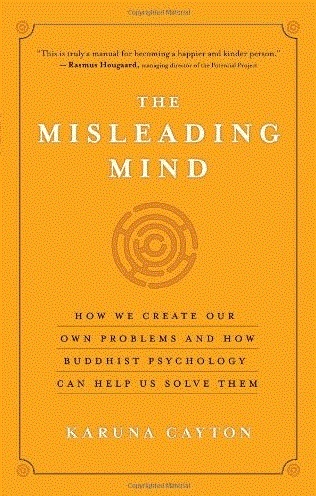
  • Giveaway and Author Interview: The Misleading Mind

    Giveaway and Author Interview: The Misleading Mind

    Note: The winners for this giveaway have already been chosen. Subscribe to Tiny Buddha for free daily or weekly emails and to learn about future giveaways!

    The Winners:

    Have you ever felt like your mind was controlling you, dragging you along for a persistently bumpy ride?

    Research shows the majority of us feel this way, but the good news is that we can do something about—and Karuna Cayton’s book The Misleading Mind teaches us how.

    A psychotherapist and practicing Buddhist, Karuna has written an easily digestible book that offers solutions to the mental anguish we often perpetuate through misguided thinking.

    Its full title is The Misleading Mind: How We Create Our Own Problems and How Buddhist Psychology Can Help Us Solve Them, and it delivers on that promise.

    I’m thrilled to share this long but illuminating interview and offer two free copies as a giveaway!

    The Giveaway

    To enter to win 1 of 2 free copies of The Misleading Mind:

    • Leave a comment below.
    • Tweet: RT @tinybuddha Book GIVEAWAY & Interview: The Misleading Mind http://bit.ly/K8UDcj

    If you don’t have a Twitter account, you can still enter by completing the first step. You can enter until midnight PST on Friday, June 1st. (more…)

  • Whatever You’re Going Through, Hold On

    Whatever You’re Going Through, Hold On

    “The world is full of suffering. It is also filled with overcoming it.” -Helen Keller

    Even though I am just 16, I’ve lived my short life with so much pressure, which I’ve finally realized comes from me.

    During my life, I have lived through more challenges than most teenagers, and at times I didn’t think I could handle it.

    My life has never been easy. My parents broke up when I was two years old because my father was unfaithful to my mother. It was hard. The rancor between two people can last decades. And now, 14 years later, they have overcome some of their differences, but the bitterness is still here, and so, the suffering too.

    For two years in school starting when I was seven, I was battered by my schoolmates. Although I was very young I can remember how hard it was going to school knowing what was waiting to me. Most of the time it was a psychological abuse, and for this reason, it made the effect less obvious.

    After this I spent one year totally alone because everyone disregarded me. They made fun of me all the time and that was hard to deal with. Luckily, I found the strength and courage to tell this to my parents.

    Sometimes the hardest part of dealing with a difficult problem is acknowledging it. When you recognize your problem, you’ve taken a huge step.

    I thought I was on the right track after this, but I still struggled and eventually started suffering with an eating disorder.

    Sometimes, the things we do in life seem completely insignificant, and we don’t think about the consequences of our actions. That’s how it was for me—I thought I was limitless.

    Like other kids my age, I didn’t want to be a conformist.

    Still, I felt I wasn’t good enough, smart enough, beautiful enough, friendly enough, or hard-working enough. So I just didn’t care about myself. I wasn’t important.

    So, what did I have then? Everything, in fact everything. But I was just too busy abusing myself to recognize it.

    During the last year and still now, I am trying to overcome my disease. I am doing this by loving myself and letting others love me too, because if you don’t love yourself, you won’t be able to receive love from anyone else. (more…)

  • Embracing All of Life Instead of Resisting Pain

    Embracing All of Life Instead of Resisting Pain

    “Don’t seek, don’t search, don’t ask, don’t knock, don’t demand – relax. If you relax, it comes. If you relax, it is there. If you relax, you start vibrating with it.” ~Osho

    As far as I can remember, I have always asked myself questions about the nature of my emotional pain. I analyzed and went on long thinking quests to find answers to all of this deliberation. I was convinced that I would find deliverance by coming up with the exact hypothesis, about why I was chosen to have to live with so much trauma and pain in my childhood.

    I felt like a victim of life.

    I did not wonder about the source of my joy; on the contrary I simply accepted these positive emotions.

    I went through a phase of denying the negative emotions I experienced, and I thought that being positive, at all costs, would “chase” away my suffering. At the time, I used the skills best known to me, to defend myself against the pain I felt.

    For many years I attempted to transform a negative emotion into a positive one. Albeit, the pain did not subside, it was still echoing loudly, and eventually manifested itself at full volume. Then not too long ago, someone gave me the permission to embrace my pain. I felt as though I had been given the authority to grieve the entire trauma that I had ever experienced.

    I began this journey of looking at the source of my pain. Yet, I felt drowned by it, and I felt the constant burn of going through the fire. I indulged in this state and felt some form of relief about acknowledging all of this suffering.

    Upon reflecting on the path I had permitted myself to take, to travel to the depths of my past, I uncovered that I had developed an unconscious belief that someone was guilty for inflicting this suffering on me. As a result, I continued the cycle of victimization, where I was seeking to lay blame on someone for my ill feelings, thus not achieving inner peace.

    Following my last break-up, to the man I call one of my soul mates, I fell to pieces, and delved into the tides of emotions that came my way—sadness, loneliness, fear and depression. The pain was louder than anything I have ever experienced, thus far.

    I blamed him for all of the suffering I was experiencing, I made him the source of my turmoil, and then I used hate towards him to manage my pain. I was in victim mode, and I turned him into the cause of my darkness.

    Then it dawned on me, and I recognized that I was fighting against the tide again by not accepting my pain.

    That is when I started to wonder about the following: “If I am able to accept the positive experiences of my life, that bring me joy and happiness, without even questioning their origin or trying to avoid them, what if I did the same for the other emotions I fear so much, such as sadness, pain, fear, anger, and loneliness?” (more…)

  • Why Judging People Makes Us Unhappy

    Why Judging People Makes Us Unhappy

    “It’s not what you look at that matters, it’s what you see.” ~Henry David Thoreau

    A friend of mine likes to joke that dying will be a relief because it will put an end to the “heavy burden of judging,” as she calls it. She envisions herself lying in a hospital bed and, moments before death, noticing the ceiling and thinking, “What a hideous green.”

    Here’s a modest proposal: Vow that for the rest of the day, you won’t judge your friends and you won’t judge any strangers you happen to see. This would include a friend who’s a non-stop talker; it would include a friend who’s always complaining about his life. It would include the strangers you pass on the street or see in a waiting room.

    I call it a modest proposal because I’m not even addressing the issue of self-judgment, let alone BP or Gaddafi. No. I’m just asking you not to judge friends or strangers.

    It’s entirely possible you won’t make it past a few minutes without judging someone!

    So, why not just judge away?

    To answer that, let me start by drawing a distinction between judgment and discernment.

    Discernment means perceiving the way things are, period.

    Judgment is what we add to discernment when we make a comparison (implicit or explicit) between how things or people are and how we think they ought to be. So, in judgment, there’s an element of dissatisfaction with the way things are and a desire to have things be the way we want them to be. (more…)

  • Why You Should Prosper Even Though There’s Suffering in the World

    Why You Should Prosper Even Though There’s Suffering in the World

    World in Hands

    I write a newsletter every week, and last month a subscriber emailed me with a question I thought was worth exploring.

    … I guess what I’m getting at is if everyone had a choice, treating sewage would be the last thing one would want to do. Isn’t it? Well, yes, I’m making that judgment. If everyone was Wayne Dyer or that money guru lady Suze Orman, we’d all be reaching fantasy levels of achievement. That is what they seem to be proposing is possible.

    But someone still has to take out the trash. If we’re all living big, then who’s taking care of the landfills? I guess we could all be having wonderfully luxurious lives but chip in on the dirty stuff sometimes? Like volunteer, or Adopt-A-Highway kind of stuff.

    Then a boy in Iraq gets his arms and legs blown off and I’m supposed to be like “Yahoo, I’m living big???”….. uh? This is my ‘resistance,’ isn’t it?… Anyway, there is a topic here. Anything to help me feel better about living big while others suffer…

    It’s a big question: If there are others suffering in the world, what right do I have to think about myself or my lofty goals? What right do I have to consider more for myself when there are others who can’t even feed themselves, literally or figuratively?

    I’ll begin with a quote from Marianne Williamson who talks in her book The Age of Miracles about the Butterfly Effect (based in Chaos Theory):

    “When a butterfly flaps its wings near the tip of South America, it affects the wind patterns near the North Pole. And the same is true in the realm of consciousness: Every miracle you work in your life is a blessing on life itself.” (more…)