Tag: suffer

  • Awareness and Self-Compassion: Two Powerful Tools for Chronic Pain

    Awareness and Self-Compassion: Two Powerful Tools for Chronic Pain

    “Pain is not wrong. Reacting to pain as wrong initiates the tangle of emotional resistance against what is already happening.” ~Tara Brach

    The wooden meditation hall creaked softly as sixty people shifted in their seats, trying to find comfort in the silence. Outside, winter rain tapped against the windows, a gentle metronome marking time. I sat cross-legged on my black cushion, watching sweat trickle down my temple despite the cool air. My legs burned as if I’d been running for hours, though I hadn’t moved in forty-five minutes.

    It was day three of my first six-day silent meditation retreat, and I was learning my first profound lesson about physical pain—not from my meditation teacher, but from my protesting body. Little did I know that this experience would become a crucial foundation for navigating a far greater challenge that lay ahead.

    The pain started as a whisper in my lower back, a gentle suggestion that perhaps I should adjust my posture. Within minutes it grew to a shout, then a scream. While other practitioners appeared serene, their faces soft and bodies still, I was waging an internal war. Every few minutes, I’d shift my weight slightly, trying to find that elusive comfortable position. The cushion that had felt so perfect during the orientation session now seemed as unyielding as concrete.

    The meditation instructions echoed in my mind: “Just sit and observe your breath.” But my body had other plans. Each inhale brought awareness of new discomfort—a sharp knife in my hip, a dull ache in my shoulders, pins and needles racing down my calves. The physical sensations became my entire world, drowning out any hope of focusing on my breath.

    I tried everything. Different cushions borrowed from the prop closet. Various positions—Burmese, half-lotus, kneeling. I even snuck to the back of the hall to lean against the wall, feeling like a meditation failure as I watched the straight backs of more experienced practitioners ahead of me.

    Then, on day four, something shifted. Perhaps it was exhaustion from fighting my experience, or maybe it was the wisdom of surrender, but I finally heard what my teacher had been saying all along: “Don’t try to change what’s arising; just be with it with kindness.”

    For the first time, I stopped trying to fix my discomfort. Instead, I got curious about it. What did the pain actually feel like? Was it constant, or did it pulse? Where exactly did it begin and end? As I explored these questions with genuine interest rather than resistance, something remarkable happened—while the physical sensations remained, my suffering began to decrease.

    “In the midst of pain is the whole teaching,” Pema Chödrön’s words would become my lifeline two years later, when a back injury transformed my relationship with pain from a periodic challenge into a constant companion. I would join the ranks of millions living with chronic pain—a silent epidemic that affects more than one in five adults globally.

    While medicine can sometimes dull the sharp edges of physical suffering, many of us learn that managing chronic pain requires more than just medication. It demands a complete reimagining of our relationship with our bodies and with pain itself.

    The lessons from that meditation hall now played out in vivid detail through every moment of my daily life. Simple tasks became exercises in mindful movement. Getting out of bed required a careful choreography of breath and motion. Picking up a dropped pen became a practice in patience and body awareness. Each movement called for the same careful attention I’d learned to bring to meditation.

    The physical pain was just the beginning. In the darkness of sleepless nights, lying on my floor because no other position brought relief, my mind raced with endless worries: Would I ever recover? Could I continue counseling my clients in person? How would I pay the mounting medical bills? These thoughts circled like hungry wolves, testing the limits of my newfound practice of acceptance.

    Working as a therapist brought its own unique challenges. I vividly remember sitting across from clients, maintaining my therapeutic presence while searing pain radiated from my tailbone through my entire spine. Each session became a practice in dual awareness—being present for my clients while acknowledging my own experience. Some days, the effort to maintain this balance left me depleted, with barely enough energy to drive home.

    There was also the exhausting social dance of chronic pain. The simple question “How are you?” became complicated. Telling people about the constant pain felt burdensome after a while. No one wants to always be the person who’s suffering. So instead, I’d smile and say, “I’m fine,” swallowing the truth along with the discomfort. These small acts of concealment created their own kind of fatigue, a lonely space between the public face and private reality.

    I invite you to pause and reflect on your own relationship with pain. When discomfort arises, what stories does your mind create about it?

    Notice how your body responds—the subtle tightening, the wish to push away what’s difficult. Consider what it might feel like to create just a little space around your pain, like opening a window in a stuffy room.

    Sometimes I think of pain as an unwanted house guest. We didn’t invite it, we don’t want it to stay, but fighting its presence only creates more tension in our home. Instead, we can acknowledge it’s here, set appropriate boundaries, and continue living our lives around it. Some days we might even discover unexpected gifts in its presence—a deeper appreciation for good moments, increased empathy for others’ struggles, or the discovery of our own resilience.

    Working with pain mindfully reveals that healing happens on multiple levels. When we respond to physical discomfort with gentle awareness, we start noticing how our thoughts create narratives about the pain, how emotions arise in waves, and how our nervous system responds to kind attention. Through this practice, we can learn to expand our attention beyond the pain, discovering that even in difficult moments, there is also the warmth of sunlight on our face, the sound of birds outside our window, the taste of morning coffee.

    Years later, my pain isn’t as severe, but it remains a daily companion. I carry a back pillow everywhere as if it’s an accessory, mindfully choosing which events to attend and for how long. Gardening, once a carefree joy, has become an exercise in presence—each movement an opportunity to listen to my body’s wisdom. Some days still find me lying on the floor, being with whatever my body is expressing in that moment.

    But there’s a profound difference now. Where I once pushed through pain with gritted teeth, I’ve learned to respond to my body’s signals with care and compassion.

    This shift feels especially valuable as I age, knowing that new physical challenges will likely arise. Each twinge and ache is no longer an enemy to vanquish but a reminder to pay attention, to move more slowly, to tend to myself with kindness.

    The clock in that meditation hall taught me about impermanence—how even the most challenging moments eventually pass. My back injury taught me about acceptance and resilience. Together, these experiences showed me that while we can’t always choose what happens to our bodies, we can choose how we meet these experiences with awareness and compassion. In doing so, we discover that peace isn’t found in the absence of pain but in our capacity to be with it skillfully.

  • How to Work Mindfully with Pain and Illness

    How to Work Mindfully with Pain and Illness

    “Can I sit with suffering, both yours and mine, without trying to make it go away? Can I stay present to the ache of loss or disgrace—disappointment in all its many forms—and let it open me? This is the trick.” ~Pema Chödrön

    At forty-seven years of age, I have experienced chronic illness in some form since my mid-to-late twenties. This past year, I’ve also encountered chronic pain on a level I have never experienced before. Part of that is illness-related, and part of it is simply my body getting older, coupled with the effects of repetitive motions from sitting and working with my hands for several years.

    It is worth mentioning that I had a massive spiritual awakening about three years ago. For the first time in my life, I realized that what I believed was no longer true. It was a time that shook me to my core, a period of great emotional healing and discovering who I am.

    The real me, not the curated me constructed by trauma, upbringing, and societal norms. I’m a weirdo to my core, and I now fully embrace that (haha). During that time of navigating my tumultuous awakening, I noticed a subconscious dynamic at play and one that certainly was without ill intent.

    There can be a fine line between ignoring or suppressing pain or chronic illness and focusing on positive thinking and manifesting health.

    While there is merit to both positive thinking and manifesting health, it can feel like society views pain or chronic illness as a sign of doing something wrong, or of being deficient in some way. When there’s a disconnect from what’s happening in the present moment, shame can arise—not just from not meeting ourselves where we are, but for not “manifesting” health or happiness, either.

    I found myself in that stream of thought subconsciously. It wasn’t until I heard a teaching by Tara Brach, in which she spoke about the importance of honoring the reality of what is, that I became aware of it. It was such a light bulb moment! I realized that I was completely ignoring my pain and chronic illness, somehow believing that if I didn’t speak it out loud, it would simply go away.

    When that awareness came, I found that I could accept my reality in each moment, as well as see that my practice was working. I met myself not with shame or judgment but with vast compassion and a willingness to turn toward the suffering.

    What mindfulness teachings and practices encourage is a gentle acceptance of each moment—whatever it may hold, without judgment, and if is judgment there, to include it. When we draw our attention to respond skillfully to pain and illness, rather than reacting out of fear or denial, it fosters inner peace, resilience, and a deeper connection to ourselves.

    It’s powerful to simply name the felt sense of what’s happening when pain and illness come to visit—even if it’s just to yourself. Naming is witnessing, and witnessing brings what is hidden to light. When I practice this, a tender softening and an embodiment of compassion arise.

    Another helpful practice for mindfully meeting pain and illness is a meditation practice known as “titrate and pendulate.” To practice this, the invitation is choosing a neutral spot on the body, such as the top of the head, the forehead, or even the sensation of your hair. After you choose that neutral spot, if it feels supportive, turn your kind attention to the pain or discomfort for a moment or two.

    Acknowledge it, breathing with it, without getting caught up in the story of why it’s there. Then, shift your attention back to the chosen neutral spot. This practice can help to create spaciousness, and you may even notice some ease.

    There are times when great pain and illness make this inaccessible, and that’s completely okay. It’s okay to put your practice to rest for a time, or to practice in ways that create a sense of ease, peace, or happiness within the mind and body.

    This might look like talking to a friend, going for a walk if you’re able to, drinking a comforting tea, watching a beloved show, resting, or sleeping. Mindfulness has no judgment about missed days—or even months.

    For the past three to four months, due to physical pain and work-related busyness, I’ve been unable to maintain my daily seated meditation. My practice lately looks less formal and shorter than it did at the beginning of the year. It might look like a few moments of gratitude, noticing my breath, or doing a mini RAIN practice (Recognize, Accept, Investigate with curioisity, Nurture). The beauty of having a mindfulness practice is that it’s always here for you, in whatever ways feel supportive.

    I deeply appreciate Jack Kornfield’s description of pain and illness as “energies that come to visit.” Pain and illness, especially if chronic, do not define who we are, and they do not remain static, even when it feels that way.

    Before mindfulness became my way of life, I made my chronic illness and its circumstances my identity. In my mind, I was a victim—angry and stuck in that mindset. There was deep-seated hatred toward my body and often a feeling that the universe was against me.

    These past few years of regular practice have completely changed my perspective! I now see myself as more than my body and its abilities. I understand the foundation of impermanence: everything changes, and nothing stays the same—not even pain or illness.

    Though I still have some forms of chronic illness, I’m not where I was. There’s an ebb and flow to everything in life, including this. I’ve cultivated compassion for myself and now see my body as wise and communicative. I listen and meet myself where I’m at.

    At our core, we are conscious, present awareness. We aren’t our names, jobs, or roles. We are so much more. We are light. We are love. We are goodness. No matter our abilities or disabilities, we are inherently worthy. Our worth is 100% NOT determined by our productivity.

    Mindfulness bridges the divide between ignoring pain, shame, and self-hatred. It offers great wisdom: pain and illness are energies that come to visit. There is an ebb and flow. They do not define us.

    They can coexist with peace, joy, gratitude, contentment, and compassion, teaching us to embrace the full spectrum of the human experience with its 10,000 joys and 10,000 sorrows. These experiences, met with mindful compassion, empower us to find meaning and growth in our experiences.

  • Being Grateful for the Peaceful Coexistence of Joy and Pain

    Being Grateful for the Peaceful Coexistence of Joy and Pain

    “It’s a gift to exist, and with existence comes suffering. There’s no escaping that, but if you are grateful for your life, then you must be grateful for all of it.” ~Stephen Colbert

    Life is not a war; you do not conquer it, nor do you overcome it. You simply accept that suffering is an inevitable and necessary rite of passage on our paths throughout life.

    No one is immune to pain; it is only dished out at different levels, and our own internal experience is incomparable. We share similar human experiences—that is the tie that binds us all together—but we cannot compare one’s suffering to the next because we are all individuals.

    We exist in a world filled with duality—light and darkness, good and bad, right and wrong as well as joy and suffering. One cannot survive without the other, so to embrace both wholly and have gratitude for their existence is essential to move forward beyond our hard times to a place of peace.

    The darkness will always be there, but to what degree we allow it to exist is up to us. We decide if it defines us, we decide if it controls our emotions, and we decide whether we peacefully cohabitate with it.

    For years I felt that I had been given an unfair shake in life. I watched and held together the people I love the most when they were broken in pieces on the floor. I gently picked them up and held them together until they healed, often sacrificing myself in the process.

    Some of my life’s challenges have resolved themselves completely, but some struggles will last a lifetime.

    My youngest son was diagnosed with autism at three and a half years old. I am incredibly grateful for his existence. I wouldn’t be who I am without him. The lifelong advocacy, care, and responsibility make you an especially hardy breed of mother.

    I struggled with tremendous guilt for so long when feeling burdened by his diagnosis and the impact it had on our family. Many parents of special needs kids suffer burnout, marriage failures, and depression at a much higher rate than other parents. It has been a constant fight for his education and social services, which created the warrior in me, but the right to exist in a world that doesn’t appreciate diversity shattered my heart.

    I struggled for so long trying to be less resentful and more positive. As much as possible, I fought to keep at bay the deep depression and PTSD I carried silently on my shoulders for years. I kept it hidden, as I never wanted my innocent son to sense my sadness that life wasn’t what I had expected and over how unfair it was to him and to our family.

    One morning, I stumbled upon Anderson Cooper’s podcast. Stephen Colbert was a guest, and Cooper discussed the lasting impact the death of Cooper’s father and brother had had on him at a young age. Cooper went on to ask Colbert about something he had previously said:

    “It’s a gift to exist, and with existence comes suffering. There’s no escaping that, but if you are grateful for your life, then you must be grateful for all of it.”

    As the interview progressed, Cooper started to cry, as this conversation resonated with him deeply. I replayed this conversation many times over and cried even more. It was very apparent that it had moved Cooper emotionally and gave light to a subject that had daunted him (and me) for many years.

    How do we come to be at peace with both the hardships in life, especially when they are continuous, and the better times?

    The interaction between these two men was profound, and it inspired me to embrace my pain as a gift.

    It’s an anointment and a difficult, precious task we must all embrace wholeheartedly. Life becomes far more peaceful when we find a way to be grateful for both the hard moments and the joy in our lives.

    To exist is to live in both realities, and there’s something to be gained from both, so we need to honor and respect both equally. One cannot exist without the other. We would never know love if we never experienced grief; they are intrinsically intertwined.

    It was a significant moment for me when I realized this; and it unravelled years of trying to compartmentalize my darker emotions away from my family and the world.

    Seeing my pain as a gift enabled me to fully embrace it. It wasn’t about suppressing my emotions or pretending the hard things don’t hurt; it was about allowing them to hurt with a new sense of perspective—recognizing that pain serves a purpose, and it means I’m alive.

    I started to realize that I did not have to feel guilty for being overwhelmed some days. That it’s okay to cry and there is no shame in feeling defeated because acknowledging the hard times is just as important as celebrating the triumphs.

    I felt the strength to push past those heavy emotions because of the good in my life. The moments when my son laughs, smiles, or hugs me are so incredibly uplifting. Those times would not feel so sweet if not for the days when I feel physically depleted and mentally lost.

    I’ve also learned to appreciate the many gifts his diagnosis has given me. I would not be the person I am today without suffering to create this unstoppable warrior, leader, mother, and human rights activist that is driven by purpose.

    It has made me an incredibly strong person mentally, as we have overcome so many obstacles as a family. I’ve learned to always forge forward and never go back; that life is many problems that just need solving.

    Nowadays, I don’t have to hide my struggles but embrace them and accept them as a part of the grand scheme of life. Recognizing my pain allowed me to release it instead of burying it in a dark, inaccessible place only to grow by the day.

    The greatest gift I bestowed on myself was realizing that I needed to look at life through a different lens by challenging my current beliefs system. My known coping mechanism, tucking heavy emotions neatly away in the back of my mind, wasn’t working. I was slowly coming apart, and I needed to redirect.

    Listening to the conversation between Colbert and Cooper was the catalyst for change inside me. And with that came rebirth. I started to slowly open up about my struggles and connect with other parents, not as an advocate ready to tackle the next fight but as a person struggling in my daily life with a child with disabilities.

    I felt more authentic in that I didn’t have to hide my grief; it was okay to not be this impenetrable positive fortress 24/7. I felt more connected to other parents in our shared pain, challenges, and celebrating our children’s achievements. Expressing all of it, not just the parts I wanted to project out to the world, helped me to live in my truth.

    There is a particular sense of freedom in accepting that our hardships are necessary parts of our beautiful existence. Our pain strengthens us and, collectively, we are bonded by it. I am now at peace with all life has given me, and I am grateful for every moment.

  • 7 False Beliefs That Will Keep You Trapped in Your Head Forever

    7 False Beliefs That Will Keep You Trapped in Your Head Forever

    “There is only one cause of unhappiness: the false beliefs you have in your head, beliefs so widespread, so commonly held, that it never occurs to you to question them.” ~Anthony de Mello

    When people come to me suffering from anxiety, fear, anger, self-judgment etc., there are five things they invariably believe to be true.

    Let’s take anxiety as an example. Most (if not all) people with anxiety believe that:

    1. It’s bad or wrong to feel anxious.
    2. It shouldn’t be there.
    3. There’s something wrong with me (for being anxious).
    4. My mind should be peaceful.
    5. I can’t experience peace until my anxiety is gone.

    Pretty much everyone nods in agreement as I take them through this list.

    Few people, if any, would question the truth of these statements.

    They are, as the spiritual teacher Anthony de Mello says:

    “Beliefs so widespread, so commonly held, that it never occurs to you to question them.”

    And I’d say that these beliefs alone produce 98% (if not more) of the unnecessary suffering that most people experience.

    Maybe you’ve heard the expression “pain is inevitable, suffering is a choice”?

    Experiencing anxiety is unpleasant. There’s no denying it’s a painful experience.

    But it’s our beliefs and mental commentary about anxiety that cause most of the suffering.

    “Anxiety is awful. I hate it. I can’t go on like this. What’s wrong with me? I shouldn’t be feeling this way. I’m so screwed up. I’ll never be happy again.”

    The mind’s commentary about the anxiety adds fuel to the fire and turns a painful experience into full-blown suffering.

    Lasting peace can never be found on the level of thinking. The mind is restless by nature. It’s not wrong. It’s simply how the mind is.

    To end suffering, we need to change the way we relate to the mind.

    And to do this, we need to see through the false beliefs that hold us captive.

    As long as you believe that certain thoughts are bad or wrong, that they shouldn’t be there, and that there’s something wrong with you for having them, you will continue to suffer… not so much from the thoughts themselves but because of your beliefs about them.

    The solution is so simple that most people overlook it completely.

    Getting to Know the Mind Better

    There’s a quote from Abraham Lincoln I like to use:

     “I don’t like that man. I must get to know him better.”

    Exactly the same logic applies to your anxiety, depression, fear, or critical inner voice.

    If you don’t like your anxious thoughts, resisting them won’t help.

    The answer is to get to know them better.

    The Two Approaches to Becoming Free of the Mind

    There are two approaches we can take to find more inner peace.

    The first is to try to fix or change our thoughts through “working on ourselves.”

    I tried this approach for years and discovered that change comes painfully slowly… if at all.

    After years of effort, I had very little to show for it.

    Then I had a breakthrough.

    On a six-month meditation retreat, I stumbled upon a completely different approach to dealing with the mind—a way that was much easier, much more effective, and far quicker, immediate in fact.

    Through getting to know my thoughts (and feelings and emotions) better, I came to a completely different understanding about myself, my mind… and the path to peace.

    I saw that:

    It’s not your thoughts, feelings, or emotions that cause you to suffer. Suffering is self-created through the way you relate to them.

    See through the false beliefs that hold you captive, and your troublesome thoughts will no longer have the same power to affect your peace.

    Since then, I’ve outlined 7 false beliefs that keep most people trapped in their heads for life.

    The 7 False Beliefs That Will Keep You Trapped in Your Head Forever

    “Demand is born out of duality: ‘I am unhappy and I must be happy.’ In the very demand that I must be happy is unhappiness.”  ~Jiddu Krishnamurti

    The beautiful thing about beliefs is that the moment you see through them, they lose their grip on you. You become liberated in the seeing alone. It requires no time.

    False Belief #1: The mind should be quiet and peaceful; otherwise, there’s something wrong.

    I love the following quote from the Indian spiritual teacher Nisargadatta:

    “There is no such thing as peace of mind. Mind means disturbance; restlessness itself is mind.”

    Restlessness is the nature of the mind. Expecting it to be quiet and peaceful is like expecting water to be dry or expecting the grass to be pink.

    It’s not the restless nature of the mind that disturbs your peace. It’s the belief that there’s something wrong and that it should be different.

    You don’t suffer because the mind is restless. You suffer because you believe it shouldn’t be.

    Expect the mind to be messed up, crazy, confused, and anxious. Don’t be surprised. There’s nothing ‘wrong.’ It’s called being human.

    False Belief #2: Suffering is caused by negative thoughts, feelings, and emotions.

    What if it were possible to feel down, sad, concerned, anxious even—and to remain perfectly at peace throughout?

    Negative thoughts, feelings, and emotions, although unpleasant, are not the primary cause of suffering. We suffer because we reject them, think there’s something wrong, and believe they shouldn’t be there.

    If you don’t mind feeling sad, don’t think there’s anything wrong with it, and don’t think the feeling needs to go for you to be okay, you can be sad and peaceful at the same time.

    Most people confuse peace with feeling good. It’s not the same.

    Our thoughts and emotions are like clouds passing across the sky. It’s inevitable that there will be dark ones as well as light ones.

    The key to ongoing peace is to embrace them all. Even if they don’t feel good.

    And anyway, what makes a thought negative? Another thought that says so.

    False Belief #3: It’s bad/wrong to be anxious, down, and depressed, or feel unworthy.

    This belief definitely falls under the category of “beliefs so widespread, so commonly held, that nobody thinks to question them.”

    Most of us enjoy warm sunny days more than dark cloudy ones.

    But it doesn’t make cloudy days bad or wrong—less pleasant perhaps, but not wrong.

    In the same way, the challenging thoughts and emotions that cloud our inner sky are not inherently good or bad, right or wrong. Like the weather, they are neutral events—part of the human condition.

    The real problem (or only problem, in fact) is the notion that unpleasant = wrong.

    And this belief, in turn, triggers the mental commentary: “It shouldn’t be there, there’s something wrong with me that needs fixing, I’m unacceptable as I am, I can’t be happy until it’s gone,” etc.—in other words, suffering.

    False Belief #4: I can’t experience peace until this/that pattern is resolved.

    I talk to many people who have been waiting for twenty years for their anxiety to be healed so they can start living again.

    And I’ve seen lifelong anxiety sufferers experience deep peace within a minute or two through seeing through certain beliefs.

    I call it the path of understanding, as opposed to the path of self-improvement.

    Peace is your nature. And it’s ever-present, no matter what is going on in the mind.

    People wait, often for years, for the dark clouds of anxiety, sadness, or self-doubt to move on, before they can get back to living life to the full.

    There’s a powerful meditation called the “Noticing Exercise” that I like to share with people who believe they can’t experience peace just as they are.

    Without going into too much detail here, I ask people to bring a difficulty to mind, and then, through directing their attention to what’s happening right here, right now, I guide them to become fully present in the moment.

    When I ask them afterwards how their experience was, they usually use words like “peaceful,” “still,” or “expansive.”

    And when I then ask what happened to their difficulty during the exercise, people invariably say, “Oh, I totally forgot about it.” More evidence that you don’t have to wait for your issues to be healed before you can live fully.

    Peace is available right here, right now—no matter what is going on in your mind or in your life.

    False Belief #5: Engaging with the mind is mandatory.

    If you had told me years ago, when I was a chronic overthinker struggling to find any peace at all, that engaging with the mind is not mandatory, I would have said you were nuts.

    When thinking is unconscious and running on autopilot, as is the case with most people, it feels like it’s something that’s happening to you—as if you are an innocent victim being bombarded by an unrelenting torrent of thoughts, and that you have no choice but to listen.

    You’re not so much thinking as being thunk!

    But here’s the truth. You are the one in charge, and the mind only has as much power as you give it. It may not seem this way, but it’s true.

    As we saw previously in the “Noticing Exercise,” you are free to withdraw your attention from the mind in any moment. Thinking is a choice. It’s not mandatory.

    Mooji, a teacher I like a lot, says that we suffer because we are open for business. If you choose to close up shop, the mind becomes powerless to affect your peace.

    When you learn to step back and watch the mind objectively, you can choose whether to get involved or not. Overthinking is an unconscious habit you can learn to let go of.

    False Belief #6: I’m responsible for the thoughts in my head.

    Try closing your eyes for a moment and, like a cat intently watching a mouse hole, watch to see what your next thought will be.

    You’ll discover that you have no idea what’s going to appear.

    Thoughts are self-arising. You play no part in their appearance.

    Thinking is a different matter.

    For years, I used to judge myself harshly for the thoughts that appeared in my head. I used to think there was something wrong with me for having angry thoughts, jealous thoughts, sad thoughts, etc.

    The mind is a lot like a computer. It spits out thoughts in accordance with your programming—the cultural impressions you picked up as a child and through your unique life experiences.

    Your thoughts are not who you are.

    Which brings us to the final false belief:

    False Belief #7: I am my thoughts.

    For much of my life, I was compulsively preoccupied with the content of my mind. My thoughts were like a tight ski mask glued to my face, and they pretty much filled up my entire inner space.

    Through meditation, I was gradually able to create more and more space between myself and the thoughts and learn to observe them objectively and non-judgmentally—to see the thoughts, not be the thoughts.

    I discovered that there was another dimension of my being that was untouched and unaffected by the passing traffic of thoughts.

    The analogy of the sky and the clouds is often used in meditation practice.

    All types of cloud pass across the sky—dark ones, light ones, big ones, small ones, fast moving clouds, slow moving clouds—but the sky has no preference and always remains the same.

    I discovered that thoughts are not “me” and that, through learning to remain as the witnessing presence, they lost their power to affect my peace.

    When you leave the mind in peace to do its thing, it will leave you in peace to do yours.

    Peace is your nature; not the peace that comes and goes as passing clouds, interspersed with restless thoughts, but the unchanging peace of your true nature.

    You are not your thoughts. And knowing this is real peace.

  • 3 Things That Turned My Suffering into Blissful Peace

    3 Things That Turned My Suffering into Blissful Peace

    “To experience peace does not mean that your life is always blissful. It means that you are capable of tapping into a blissful state of mind amidst the normal chaos of a hectic life.” ~Jill Bolte Taylor

    I’d just spent over six years trapped in my own worst nightmare. Then in a split second, my whole reality shifted to an experience of exquisite peace and bliss. Walking through the streets of my home city, I seemed to be radiating unconditional love out and into everything around me.

    I didn’t know it then, but I’d just tasted the ultimate state of deep peace and presence that most people on the spiritual path long for.

    Pretty cool, right? But before I give you the low-down on what happened, let’s rewind and put this into context with the rest of my life.

    My first eighteen years on this planet led me to a place of depression, self-hatred, anxiety, and self-harm. After another five years of severe stress and struggle, my body just gave up and my life came to a grinding halt.

    I was in my mid-twenties. Having to rely on state benefits and a team of carers due to severe pain and chronic fatigue syndrome was not what I had in mind for myself.

    So I went from one doctor and alternative therapist to another, hoping that they could fix me. I saw small improvements, but not enough that I could live normally.

    I honestly don’t know how I kept going during those dark days, but I was determined to find the key to my freedom. Through many small insights, I came to see that the answers must be within me, not ‘out there.’ But how could I access them?

    Then one day in 2010, my whole life changed again. A friend gave me a copy of the book A New Earth by Eckhart Tolle. The way he spoke about consciousness and presence infused life into the depths of my exhausted soul. Then a miracle happened.

    One morning, I woke up to that state of total bliss. My mind was silent, the pain and fatigue vanished, and all of my suffering stopped for a full five days. I had just experienced what I really was beyond my mind.

    When that experience ended, I was plunged back into illness and suffering. I knew I had to find a way back home to that incredible deep peace and freedom.

    I spent the next five years devouring countless spiritual books, courses, and YouTube videos. There was a lot of fuzzy talk about that experience, but nothing that told me how to get there.

    The search finally ended when I met a group of monks who taught advanced meditation and consciousness theory. I could feel that exact same blissful peace oozing from every cell of their beings. Knowing they could teach me how to get that state back, I went to Spain to study with them.

    If you want to experience that peace too, you need to understand how to go beyond your mind. Many spiritual teachers talk about this. But what does that really mean?

    1. If you want to find peace, stop believing your thoughts.

    Let me begin with something that may surprise you. You don’t have to stop your thoughts in order to find peace.

    Thoughts don’t interrupt your peace when you learn how to watch them pass through your awareness. The suffering starts when you grab onto them and go off into unconscious thinking.

    When this happens, you’re no longer aware of what’s going on around you in the present moment. The stories in your mind have literally become your reality. Let me explain.

    Have you ever walked a route you know well and when you got to your destination, didn’t remember any of the journey? Instead of paying attention to what was going on around you, you were off thinking about another moment. Maybe it was the fight you had with your spouse that morning or the presentation you’re worried about giving tomorrow.

    Here’s the thing—these thoughts only have power over you if you believe them. If you stop believing the scary thoughts about everything that is going to go wrong, your suffering will immediately stop. Those horror stories aren’t actually happening in the present moment!

    So if you want peace, the first thing you must do is to place your attention on what is real right now.

    Tune into your senses to notice what is going on around you. Give that more attention than whatever your mind is doing. It’ll help you break out of the stress and suffering.

    2. Break the cycle of stress and negative emotions.

    Right now, bring to mind something that makes you happy. Let yourself think about it for a moment. Did that feel good? Maybe you got that warm fuzzy feeling and your body felt lighter.

    Now, think about something you don’t like. How do you feel now? Anxious, angry, stressed, heavy, sluggish, or something else?

    You feel what you focus on, so if you think about good things, you’ll feel good. If you think about painful things, you’ll experience more stress and negative emotions.

    Now, back to the unconscious thinking. Can you see how getting lost in stories about life’s dramas fuels stress and negative emotions?

    Next time you notice you feel bad, see it as a signal that you’ve been off thinking about something you don’t like. Come back to the reality of what’s around you.

    Let the remaining sensations of stress and emotion flow through your body. You should start to feel better within a minute or two.

    But there’s much more available to you than ‘just feeling a bit better.’ The truth is, you can experience peace no matter what is happening in your life. You may wish to reread that statement because the implications are huge!

    3. Connect to the permanent source of peace.

    If you want to access the permanent source of peace, you first need to practice coming back to the present moment whenever you’ve been lost in your mind. Only then will you be able to go beyond your mind entirely and experience what you really are.

    Your true self is the source of that exquisite peace, freedom, and bliss. You are pure conscious awareness, the watcher that’s beyond the mind, negative emotions, and suffering.

    You feel what you focus on. Since what you are is always still and peaceful, if you put your attention there, you’ll feel peaceful.

    You don’t need to stop your thoughts or change anything in your life to do that. You just need to give your thoughts and life circumstances less of your attention. Instead, rest more of your awareness on your true self directly.

    How can you do that? You can use the fact that consciousness is vast and spacious. In fact, it’s the peaceful space in which all things in this Universe exist.

    Look around you now. You may notice lots of objects such as a chair, a lamp, or even the building in which you are sitting. But have you ever stopped to notice the space that these things occupy?

    Right now, put as much attention on the space as you can. Notice the space between you and the objects around you. Then, allow yourself to sense the space in the whole room.

    Now imagine that space within you. Wide, open, scattering your obsessive thoughts so far in the distance you can barely hear them. Do you feel more peaceful?

    If I can connect to that ultimate state of deep peace, I know you can too. We all have the power within us to do this.

    It’s really just a case of remembering to choose where you place your attention. If you forget and get lost in your mind, no worries! Just come back to peace when you do remember.

    The more you practice connecting to the space around you and creating space within you, the more peace you’ll invite into your life. Gradually, the stress and struggle will melt away as you learn a new way of being. Over time you’ll find that you just don’t give as much attention to all the mind drama anymore.

    Keep it light by treating it like a game. Play with being aware of the space as you go through your day. Can you notice the space while you’re brushing your teeth? How about during a conversation?

    For me, this practice has been the gateway to ever deeper levels of peace. By committing to playing with this, I’ve trained my brain to stay in that state for longer periods of time. It’s become easier and easier to pull myself out of any drama when life turns upside down.

    It’s not about perfecting life. It’s about the ability to roll with whatever happens. If I need to take action, I do it from a calm and grounded state of mind. It’s in stark contrast to the desperate struggle I used to experience.

    The answers really had been within me all along. It’s true for you too. This tiny but mighty shift in attention has the power to totally transform your life.

    Since I stopped listening to that voice in my head, I’ve experienced deep and permanent healing. I no longer buy into all the self-criticism, fearful thoughts, or stories about how I’m not good enough. Sure, that stuff pops up from time to time, but I choose to smile and let the thoughts go.

    As it turns out, connecting to my true self was also the key to my body healing. Stress and negativity had been depleting my energy and vitality for years. Now that I’m much calmer, my body has been able to use the extra energy to heal.

    I want you to know that this is not a mystical adventure, reserved for a few lucky people. This experience is for everyone. Living in peace and bliss is your birth right!

    So connect to your own source of peace. I’d love to hear how you get on.

  • Learning to Honor My Grief When the World Has Become Desensitized to Loss

    Learning to Honor My Grief When the World Has Become Desensitized to Loss

    “The answer to the pain of grief is not how to get yourself out of it, but how to support yourself inside it.” ~Unknown 

    Since losing my husband Matt over eight months ago to cancer at the age of just thirty-nine, I have noticed so many changes happening within me, and one of those changes is a fierce sense of protectiveness that I have over my grief.

    We are living in a unique time in history. The world has turned upside down due to the coronavirus pandemic, and at the time of writing this the UK had just passed 100,000 Covid-related deaths with many more not involving Covid.

    That is an obscene amount of grieving people, and when I also consider the fact that not all loss is related to death, I suspect that everyone in the country is experiencing grief on some level right now.

    But I worry that this universal loss has become so entrenched within our daily lives that it is now considered the norm to be traumatized.

    The news of more deaths no longer seems to shock us. We’ve become detached from each other in order to survive and preserve ourselves, and this is being reinforced daily with messages of staying home and socially distancing.

    Our human need for closeness and connection has become secondary to the very real threat to life we are facing, and so we willingly obey to these new rules—we wear masks and keep away from each other, we retreat, and we don’t complain about the psychological wounds we are facing as a result of this because the alternative is even worse.

    There is a collective sense of numbness, which is a well-known coping mechanism for extreme levels of stress, and I cannot help but tune into this from my own fear response.

    I also feel numb sometimes, and I can certainly see the rationale for adopting this defense mechanism, but this is why my grief feels like a gift to me now: I am thankful that I can connect with and embrace my feelings of pain and anguish. This is my healing; this is me moving through life as I know I was intended to do.

    We weren’t made to deny or repress our emotions, we were made to learn and grow through them, because emotions are energy and energy needs to move. When I refuse to allow my emotions space to be present within me, they become trapped inside. 

    I know this because it has happened to me before. Grief is strange, it is the most painful and intense experience I have ever had, and yet it is also recognizable to me. I know that I have felt it before but in a different form and at a different time.

    Deep down I also have an inner knowing that I am meant to feel it. In the past, I was scared of the enormity and intensity of my emotions, and so was everyone I was close to. They would recoil when I expressed them, so I would repress them instead and do everything I could to push them down.

    The result? Years of suffering with anxiety, depression, and unexplained physical illness and ailments, which I now understand to be a manifestation of my trapped trauma.

    Bessel Van der Kolk defines trauma as “not being seen or known.” To be truly seen is to risk vulnerability, but we are continuously shamed for being truly vulnerable in our society, a society which rewards busyness and productivity above our human needs.

    Unfortunately, this mutual denial can prevent us from healing. In our culture there is a lack of tolerance for the emotional vulnerability that traumatized people experience. Little time is allotted for the working through of emotional events. We are routinely pressured into adjusting too quickly in the aftermath of an overwhelming situation.

    So, we have a problem. At a time when more of us than ever need to embrace vulnerability to avoid retraumatizing ourselves with a lack of connection to others, we are simultaneously battling with a sense of internalized capitalism. Which do we choose? Authenticity or attachment?

    I believe that we need both, but I also believe that it must start with authenticity, and here’s why.

    My grief feels sacred to me, like it’s the last bit of my love for Matt that I have left, and for that reason I refuse to let it pass me by without really experiencing and cherishing it.

    I recognize that the authentic, broken me is just as important as the joyful, whole me, and that I cannot expect to experience one without the other.

    I do not wish to drift into a false identity where I am always “okay” or “fine” or “not too bad” when anybody asks because really that is all I am permitted to say in those moments. I cannot speak the truth because the truth is unspeakable. There is an unspoken rule that we must never expose our pain in too much depth, we must keep it contained within a quick text message or a five-minute chat in order to help keep up the illusion that we have time for compassion within our culture.

    But we all know that’s not the truth if you live as we are subliminally told to live—with a full-time, demanding, and challenging career and a mortgage to pay, with a family to look after and a social life to uphold, with a strict routine that includes time for exercise, meal planning, and keeping your appearance aligned with what is currently deemed socially attractive, and with just enough spare time to mindlessly consume the latest Netflix drama.

    It really leaves little to no time or the emotional energy it would take to fully witness another person’s pain. So, we turn away from it instead, because we know that if we dare to look a grieving person in the eye, we can locate the universal phenomenon of grief within ourselves and find some affinity to it. And that throws up all sorts of questions that go against our busy lifestyles we are grappling to keep hold of.

    When I have too many superficial exchanges, however well-meaning they are, I end up feeling more disconnected and lonelier than if I hadn’t had an exchange at all, so I choose solitude instead. 

    Some pain cannot be spoken of, it can only be felt, and for me, that can only happen when I have the space and time to intentionally tune into the feelings, without having to cognitively bypass them at every opportunity. However, without a witness to my pain, I never truly feel seen or known either.

    The more time that passes, the harder it is to bring Matt up in the brief conversations I am still able to have or to express my true feelings.

    I’m aware that with time my grief becomes less relevant as more and more people are experiencing their own losses. But I have barely even begun to process Matt’s death. He died during the pandemic, and I am still living in that same pandemic eight months on. I have been locked away for my own safety and for the safety of others, so the true effects of my loss and the trauma attached to it won’t be fully felt until the threat has lifted.

    My brain has been wired for survival for almost a year now—what must the effects be of that?

    I am afraid that the rawness of my pain has a time limit to it, and if I do not fit into the cultural narrative of grief, then I will be rejected, and it’s that fear of rejection that continues to pull me away from sitting with my pain. I have become hypersensitive to other people’s reactions, and I can sense when my pain is too raw and uncomfortable for them, so I avoid the loudest and most consuming part of me to enter the conversation in order to make them more comfortable

    But… I’ve noticed a pattern happening when I prioritize others’ comfort over my authenticity.

    I begin to suffer. I experience emotions like fear, anger, and guilt, and these pull me away from the pure-ness that is my grief. Pain and suffering are not the same thing. Pain is a necessary component to healing and growth, but suffering is a bypassing of the raw pain underneath.

    I believe that the key to healing is to embrace the sorrow of loss throughout life. Loss happens continuously, but we often forget to experience it because we glorify the illusion of always being strong, mentally healthy, and resilient. 

    Fear is a block to healing. It activates our survival brain and keeps us there. Never feeling safe enough to process our emotions, we continue to suffer instead.

    Alice Miller, the renowned swiss psychologist, coined the phrase “enlightened witness” to refer to somebody who is able to recognize and hold your pain, and this becomes a cycle. Once you have had your authentic pain validated and witnessed, this frees up space for you to become an enlightened witness to another.

    That is why I believe there are so many people needlessly suffering right now. We are all afraid to confront the human condition of pain because we are afraid to lose our attachments to others, so we mask it and avoid it and deny it at any cost.

    I am terrified of losing my attachments to others too. I am terrified of ending up alone, and I am terrified of never being loved again. But I am more terrified of having to sacrifice my true self in order to gain that love.

    So, I vow not to put my grief on hold, and I welcome you to join me. However deep the pain becomes, I encourage you to sit with it and honor it as being a true reflection of the magnificent intensity of being human.

  • 5 Meditation “Mistakes” That Increase Our Suffering

    5 Meditation “Mistakes” That Increase Our Suffering

    “If your mind is empty, it is always ready for anything, it is open to everything. In the beginner’s mind there are many possibilities, but in the expert’s mind there are few.” ~Shunryu Suzuki

    So many of us come to meditation through our suffering. Nearly everyone who has come to walk the spiritual path can spin a tale of sorrow, frustration, and often devastation. Through our life struggles and difficulties, we become conditioned into habitual patternings of mind that seem to offer us no escape, and often turn to meditation to find relief.

    I always say that anxiety was my first spiritual teacher and it began teaching me at a very young age.

    I spent a great deal of time and effort attempting to control my experience in order to limit my suffering. I’ve now come to see that the illusion of control is the root of anxiety, as our stresses are exacerbated by our inability to accept “not knowing” what will happen in life.

    In my early forties life handed me a situation that would eventually overpower my ability to control life. Over a seven-year span, my son Mark struggled mightily, suffered deeply, and fought gallantly to try to fend off addiction and mental illness.

    Lost within my own mental struggles, I attempted to meet his difficulties through my habitual need to control life. Anyone who has ever had a loved one suffering with addiction knows that we’re never in control of the situation. Nevertheless, I foolishly pressed forward and selfishly tried to control Mark’s experience.

    I can remember the day Mark was diagnosed with schizophrenia. My inner controller had an “I can’t do this anymore” moment and finally came to the stark realization that there was no way for me to control his situation.

    Something shifted within me, and I felt the “controller” release its grasp on me. There was nothing to control. There was just life moving, and life was just meant to be lived as it comes.

    Tragically Mark lost his fight against addiction in 2017. I’ve come to see that Mark was my spiritual guru the entire time, teaching me about compassion, how to love unconditionally, and how to let go of the need to control life.

    Mark opened the doorway to meditation for me by teaching my how to let go. He opened up my heart to accepting what is, as it is and taught me how to start shedding my mind’s old habitual patterns of conditioning.

    I’ve been formally “sitting” for about four years, and although I feel very good about my practice now, I’ve made my fair share of “mistakes” along the way.

    One of the biggest errors I made was trying to use meditation as a means to an end. I wanted to feel better and thought if I sat “well” enough then I would find peace. I initially failed to realize that this mind that was trying so hard to find relief from suffering was the same mind that had created my suffering.

    I spent a lot of time spinning my wheels trying to find the right formula to quiet my mind. I thought if I concentrated hard enough, if I focused on the breath the right way, if I limited external noises and distractions… then my mind would quiet down and I would find truth. The mind was the one constantly looking for the right formula, the right path, the right insight.

    It took me nearly two years to finally realize that no matter what the mind decided, if the method came from the mind, it would actually prevent me from relaxing into the silence beyond the mind.

    This was just one of the many mistakes I’ve made. Putting too much emphasis on how long I sat in meditation, trying to recreate blissful feelings, trying to determine if I was enlightened or not, all contributed to perpetuating my monkey mind.

    If you’ve had similar frustrations with your practice, don’t be discouraged. Don’t stop. There’s no wrong way to meditate, because all “mistakes” only serve to exacerbate our suffering, and therefore increase our earnestness to come back to try meditation again. Life is very good at putting in fail-safes against our own ineptness.

    If you’ve started meditation and stopped, started and stopped, let years go by, started again and stopped, you’re in good company. Everyone gets frustrated and quits a few times before developing a good practice. In actuality, one must stop “attempting” to meditate before one actually begins to awaken to what meditation is all about.

    So let’s go into a bit more detail on these mistakes we want to avoid…

    1. Trying to quiet the mind

    As I touched on earlier, the number one reason we sit in meditation is we desperately want to silence the inane chatter within our mind. Our monkey mind is quite relentless. It’s like the Terminator: “It can’t be bargained with. It can’t be reasoned with. It doesn’t feel pity, or remorse, or fear. And it absolutely will not stop, ever, until you are…” spiritually awakened.

    So why shouldn’t we try to quiet the mind?

    The best way to answer this is to ask: Who is trying to silence the mind? Take your time and examine this. What you will find is that your mind is trying to quiet the mind. How could that which is the root cause of the problem also be the source of the solution? It can’t. It won’t listen to our desire to be freed. It’s only interested in furthering its continuity and increasing its own significance.

    Our mind wanting to quiet our mind creates additional inner conflict. This inner conflict provides more fuel to the mind, and so our attempt to meditate and quiet the mind has only led to more struggles and frustration.

    In order to circumvent this dilemma, we must “do nothing.” Just sit and observe whatever comes and goes. Patient, passive, non-reactive observation is your superpower. Whatever thoughts arise, let them come. Whatever thoughts go, let them go.

    It might take a bit of time to settle into observer mode, but once we realize it’s possible to sit and observe the mind from a point of neutral awareness, the mind’s reign of terror is coming near to an end.

    2. Sitting too long too soon

    I think many of us sit down in meditation envisioning a transformation into a Zen Master on day one. We’ve heard that an hour of meditation is a really good meditation, so we decide to sit for an hour.

    Within the first minute we’ve relived every embarrassing event in our life from preschool up until this current moment. We sit and wrestle with our thoughts like a chihuahua puppy tied to a firehose on full blast. We’re tossed around like a rag doll in this mental octagon by our own mind. Beaten to a bloody emotional pulp. Our will is broken…

    We quit after five minutes and vow to never sit in meditation ever again.

    Don’t do this to yourself. Start slow! Meditation is no different than lifting weights. If you try to do too much too soon, you will only end up hurting yourself.

    Do one or two minutes for the first week or two. Add a minute or two every week after that and try to slowly work your way up to at least twenty minutes per day.

    This is not a competition. You don’t get any awards for persevering through harsh conditions or adversity. Enjoy the journey. Take your time.

    3. Quitting too soon

    So we’ve worked our way up to twenty minutes a day. We’ve sat for twenty minutes for two days now and we feel… nothing. Everything feels the same. The mind is still wandering. The monkey mind is still in charge, still kicking us around, and we’re getting frustrated.

    The mind is whispering that this is all a really big waste of time and you’ve fallen for it again! How long are you going to listen to that spiritual guru who is unemployed and has no money? Of course he is at peace. He doesn’t ever do anything…

    Don’t give into the mind.

    Meditation is like walking in fog. We don’t notice much of anything going on, and then we realize that we are soaking wet. If the mind begins to pressure us about sitting without seeing any results, then just observe those thoughts as well.

    There is no set time frame for the mind to settle down, but if you are patient you will begin to experience “gaps” of silence in the mind. These small gaps are a good indication that the mind is getting tired of not getting a reaction out of us. So, be patient. Relax. Take up the attitude that you will sit until your last breath, and having no results is not going to deter you.

    4. Trying to recreate meditative phenomena

    The bliss! Give me some more of that bliss. Can never have enough bliss! Anyone who has come to experience the feeling of euphoric bliss in meditation has definitely tried to recreate it. If you say that you haven’t, you’re lying.

    Anything that occurs within the meditation is phenomena. Bliss, lights, colors, auras, sounds, images, dreams, out-of-body experiences, clairvoyance, receiving messages, full-body orgasmic euphoria, alien contact, angels, numbers, time travel, space travel… It’s all just phenomena and it has no real significance in the grand scheme of awakening.

    If you become infatuated with phenomena, this means that the mind has become infatuated with phenomena. The point of meditation is to relax into the awareness of life moving. Awareness of life moving includes awareness of mind moving. If we “fall into” the role of mind trying to recreate our meditative experience, then we’ve most likely fallen out of the neutral witness role.

    A good rule to remember is to relax and allow whatever comes to come and allow whatever goes to go. Nothing needs to be created. Nothing needs to be removed. Just relax with what is.

    5. Holding any expectations about your practice

    It’s natural to begin a meditative practice because we want to feel better. Our mind is giving us trouble. Our relationships never work out. We are overworked, underpaid, and complete balls of stress. We are grieving over loss. We are tired. We sometimes just want to give up. It’s all too much.

    Again, who wants to feel better? Who is holding this expectation that meditation is the cure all that we’ve been waiting for? The mind! The mind is interested in feeling better, so again, we are creating more inner conflict. The mind doesn’t like the way life is moving, it wants to make life better. We are playing tug of war with ourselves…

    Any expectation of getting something out of meditation delays getting anything from meditation. If you don’t want anything, then you will get something. That something is peace of mind.

    Peace of mind arises with the deepening of awareness of what is. When we sit in meditation without expectation, the mind’s inner conflict dissolves. There’s no fuel added to the mind when we don’t expect to get anything. Relaxation without expectation is how the mind begins to quiet down.

    So, to summarize, even though we may make some or all of these five meditation mistakes, life will continue to use our suffering as a way to bring us back to our spiritual practice and back to meditation.

    Don’t try to quiet your mind. Don’t try too much too soon. Don’t quit too soon. Don’t try to recreate a pleasurable meditation session. Don’t hold any expectations.

    Just sit. Relax and be with what is.

  • How to Be There for Others Without Taking on Their Pain

    How to Be There for Others Without Taking on Their Pain

    “Letting go helps us to live in a more peaceful state of mind and helps restore our balance. It allows others to be responsible for themselves and for us to take our hands off situations that do not belong to us. This frees us from unnecessary stress.” ~Melody Beattie

    When our loved ones suffer, it’s hard not to get swept up in their pain. We want so desperately to fix them, to take away their hardship, and to see them flourishing.

    As a control freak, I often find myself going into “fixer mode” when my partner is struggling with work stress, which only makes me more anxious when nothing I suggest works, and him more frustrated when I get so preoccupied with his issues.

    Then, after all my frantic attempts at control, there’s a little voice inside that tells me to stop. To listen. To be there for him without trying to change anything. To witness his pain and sit next to him while he feels it.

    In this way, it’s not my job to fix his problems. It’s my job to be there for him with love as he figures out how to handle his own suffering. I am freed from feeling the responsibility of taking on his pain.

    Here are a few tips for how to not get overwhelmed when others are suffering.

    Realize that being supportive doesn’t mean fixing their problems.

    I often think back to when my mental health was at its worst. I dealt with debilitating panic disorder, agoraphobia, and depression, and I can’t imagine how difficult it must have been for my family to see me suffering so greatly.

    But what I am most grateful for during that time is that my loved ones never tried to fix me. They didn’t become obsessed with finding a solution, and they didn’t rush me to get better. All of that would have increased my anxiety tenfold.

    Instead, they simply supported me. They constantly let me know that they were there for me if I needed them. Just knowing that I had someone to count on if things got hard was incredibly helpful.

    One way we can be supportive of others is to practice listening without the intent to respond with solutions. What would that be like if we simply held space for others without needing to respond?

    I took a yoga workshop recently where we partnered up with a stranger and took turns sharing our struggles. The one not speaking had to simply listen and was not allowed to respond.

    So we practiced listening with our whole bodies, hearts, and minds, released from the need to think of something to say in return. Instead, we got to be a loving witness to this person’s experience.

    Sometimes all that our loved ones need is to be seen and to know that someone is there for them.

    Allow them to find their own way.

    This can be hard. It’s hard to let go of control so much that you allow other people to have their own journeys. If my family or partner had stepped in during my rough patches with panic disorder, I wouldn’t have gone through the trenches of it myself.

    I wouldn’t have learned my own strength. I wouldn’t have been so amazingly transformed, body, mind, and soul, as I am now.

    At that time, I didn’t need someone to take away my pain; I needed someone to be there with love and patience as I experienced my own pain.

    Can we offer loving suggestions? Sure. Can we help them in productive ways? Of course. But at the end of the day, it is their lesson to learn. And we have to practice letting go of the outcome.

    When a relative passed from cancer a couple of years ago, it was horrifying to see her transform from a vibrant woman to a frail, bedridden one, writhing in pain. Those last few days, she lost her vision. She couldn’t eat or drink. All she wanted was for the suffering to end.

    After witnessing this, I automatically wanted to take on that pain. I felt it as my own. I started to suffer the pain she was experiencing.

    Eventually, I had to realize that this was her journey. This was her pain, not mine, and I didn’t have to take that on. It actually doesn’t help anyone or anything for us to carry around pain that isn’t even ours.

    Realize that you’re only responsible for yourself.

    You can’t control other people. You can’t control who suffers and who doesn’t. And what a burden that would be if we felt we needed to safeguard everyone in our lives from pain. That’s too overwhelming.

    You are only responsible for yourself. So how can you take better care of yourself as you care for others?

    If there’s someone in your life who is going through a rough time, you have to respect your own limits. You have to set boundaries in how much you can safely and lovingly give.

    Giving to others when we are depleted ourselves doesn’t serve us, and it doesn’t serve them if they aren’t receiving your help out of love, but out of obligation or fear.

    Instead, find ways you can care for and respect yourself so that you can be available as a support if that feels appropriate and safe for you.

    Practice grounding back into your own body and energy field often.

    When we’re caring for others, we may have a tendency to take on their energy. It’s like when we’re around an angry person. Even if we’re not angry ourselves, we may feel our heart quicken, our breathing become shallow, and our temperature start to rise.

    Practice grounding back into your own body so that you can recognize what’s yours and what is not.

    One way to do this is to get physical, connecting back to your own body through yoga, exercise, and dance.

    Immerse yourself in nature. I love to go hiking when I get overwhelmed with others’ energy and allow the grounding energy of the earth to support me. Spend time alone.

    Anything you can do to bring your attention back to your own body will serve you in grounding your energy.

    It can be very difficult to separate ourselves from others and to let go of needing to take away our loved ones’ pain. It’s something I still struggle with, but I’m learning every day that I am not responsible for anyone else. I can be there with love and kindness, but beyond that is out of my control.

    All I can control is how well I care for myself, so that this love can then ripple out in support of others.

  • How We Suffer When We Judge Other People’s Choices

    How We Suffer When We Judge Other People’s Choices

    “The greatest gift you can give to others is the gift of unconditional love and acceptance.” ~Brian Tracy

    Two months ago I travelled back home to Connecticut to care for a sick parent. My dad was preparing for cancer treatment, trying to figure out the medical system, and packing up to move all at the same time. He was overwhelmed with stress and exhausted from his pain medication. As a caring and health-conscious daughter, I was eager to help.

    I had visions of cooking him meals of steamed greens and healthy soups. And I stocked my suitcase with supplements that would ease the pain and help his body detoxify. Growing up, I suffered from an autoimmune disorder called Celiac disease, which made any food with gluten in it toxic to me, so I deeply understood the link between what we consume and how the body functions.

    It excited me to be able to pass this knowledge on to my dad. We always had a close bond, and in times of illness it’s easy to feel helpless. I figured this could be my contribution.

    I was afraid to see my dad ill. I’d been living in Arizona for the past two years so I didn’t have to see the change in his appearance. The butterflies in my stomach expanded as I drove to his house the first time. Thinking of him being unable to move freely, work, and have a regular life tore me up inside.

    My plan was to visit him every day for three weeks and to do whatever I could to help. Luckily, seeing him in person lifted some of my worry. He seemed motivated to try new things, like trade in his meat for vegetables. And he even listened intently while I showed him what supplements to take and when.

    That set up didn’t last, though. As the days went on I noticed that the bottles of pills and their color-coded instructions didn’t move. I saw that the dirty pans in the kitchen were covered in grease. Once again, my stomach was in knots and I felt panicked.

    The heaviness I felt about my dad’s illness subsided when I thought he was on board with my amateur health plan. And I was only suggesting what seemed like common sense. When he didn’t wholeheartedly take my advice, a feeling of grief took me over. I felt like he wasn’t taking care of himself and that I had wasted my time in coming to see him.

    It felt like he was rejecting me.

    One night about a week into my trip I spoke with my boyfriend on the phone. He was upset about a plumbing issue at the house and that our cat might be sick. Tears started streaming down my face involuntarily.

    “It’s not so easy here, either,” I said with a wilt in my voice. It seemed that the stress my dad felt about his condition melted into me. And the fact that my plan to save him wasn’t working made me feel overextended.

    And then it hit me: I was suffering because I judged the situation.

    In my mind he wasn’t doing what he could to get better, and that was wrong. And by assigning that judgment, I suffered. As soon as I accepted that he could navigate this journey in any way he wished and that was okay, my internal pain disappeared. It was like magic.

    Suddenly I felt my boundaries coming back. It was easier to go to visit him when I felt like it instead of being motivated by fear and obligation. I found a way to precook some meals for him that he could add into his meat dishes. I worked with and respected his choices.

    He appreciated my new attitude. I wasn’t another person telling him what to do. What he really wanted was someone to listen, and I was now capable of doing that.

    This made me more of a comfort and support to him and it gave me back the ability to actually enjoy myself. Before this epiphany I was choosing to stay in, feeling depressed instead of visiting with friends I hadn’t seen in months. Releasing judgment on my father’s situation gave me a multidimensional gift.

    When I thought back to other times when I’ve suffered, I saw that the pattern held up. Addiction is a great example of this.

    I’ve had a few close friends and family members battle drug and alcohol demons, and the feeling in my belly was the same. I felt heavy and sick when I thought about the choices those people were making and how hard their lives must be. But it wasn’t them giving me the feeling; it was my own judgment of their situation.

    I was making their life path wrong.

    There are plenty of things in my past that could have garnered the same judgment. I used to smoke cigarettes, I dropped out of high school and took my GED instead of graduating, I got married young and then got divorced. My life wasn’t picture perfect, but I wouldn’t trade those experiences for anything. They taught me valuable lessons, and without them, I wouldn’t be me.

    The suffering I felt was my creation. It was a choice. And just as easily as the heavy feeling came on, it left as I reminded myself of that. I realized that true compassion can be felt without taking on any negative feeling. Compassion is love and acceptance of where a person is; it should feel good.

    Do you have friends and family members that you feel are making the wrong choices? It’s an easy trap to get into when gossip magazines and shows feel like the cornerstone of our culture. Everyone is supposed to have an opinion on the lives of others. So don’t feel badly if you have taken on that task.

    The next time you feel yourself sinking because of another person’s decisions, remember to pause. Ask yourself if you are taking on this feeling of heaviness because you are judging them. If the answer is yes, then see if you can let it go. You can turn your concern into acceptance and still serve your loved one in the way they most need.

    There may be times when you recognize that someone is inflicting harm on themselves or others, and in this case you need to use your best judgment. Get a professional opinion or call the authorities when the moment warrants it. Trying to help in the best way you know how is also a way to ease suffering. Acting on your observation doesn’t make you the bad guy; it frees you of holding accountability for what’s happening.

    Coming out of judgment allows you to communicate without attacking. You can hold your own boundaries better and decide from an unemotional place if there needs to be any further intervention. And don’t forget to share with your loved one that you care about them. Hearing that someone loves you is often the best medicine.

  • Finding Freedom in Illness: A Guide to Suffering Less When Sick (Interview & Giveaway)

    Finding Freedom in Illness: A Guide to Suffering Less When Sick (Interview & Giveaway)

    Sick

    UPDATE: The winners for this giveaway include:

    • Naomi
    • KC
    • Lisa Pellegrino
    • Caroline Létourneau
    • Viktor Dmitriv
    • Kristin Kollinger
    • Heather S
    • Erica Lombard
    • Christine
    • Bridget Howe

    If you’ve ever been sick for a prolonged period of time, you understand how physically, mentally, and emotionally draining it can be.

    Maybe you don’t know what’s causing your illness, or how to treat it, and you’re tired of searching for answers.

    Maybe you blame yourself for repressing emotions, not exercising, or otherwise potentially causing your condition; or maybe you don’t hold yourself responsible, but fear that others do.

    Maybe you can no longer do the things you love; or maybe you can do them, but it’s much harder, and therefore, far less satisfying.

    While I’ve never struggled with a long-term physical illness, I’ve watched loved ones grapple with serious challenges; I’ve sympathized with their feelings, fears, and frustrations; and I’ve wished I could do something to help.

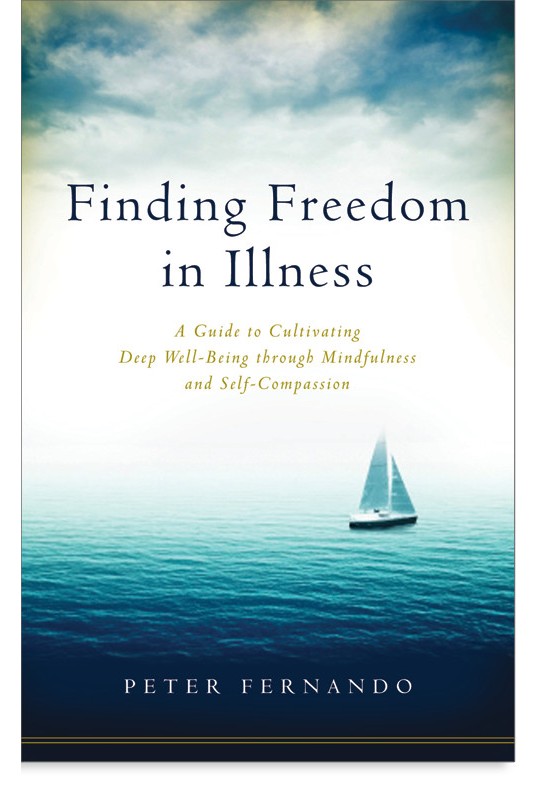
    Going forward, I will point them to Tiny Buddha contributor Peter Fernando’s new book, Finding Freedom in Illness: A Guide to Cultivating Deep Well-Being through Mindfulness and Self-Compassion. 

    Having struggled with various chronic illnesses through the years, Peter knows what it’s like to live a life that’s full of challenges and losses. He’s experienced prolonged periods of darkness, despair, desperation, and discomfort—and yet he still believes he’s lived a wonderful life.

    Why? Because he chooses to see his illnesses as spiritual teachers. And though he admits he would not have chosen them, he’s learned, through them, to free himself from the mental suffering that comes from judging the present.

    Profoundly insightful, Finding Freedom in Illness explores how anyone can free themselves from their suffering and access the liberating power of here-and-now awareness. Though the book is clearly intended for others dealing with physical conditions, anyone can benefit from the teachings related to mindfulness and self-compassion. I know I certainly have.

    I’m grateful that Peter took the time to answer some questions about his book, and that he’s offered ten free copies to Tiny Buddha readers.
    Finding freedom in illnessTHE GIVEAWAY

    To enter to win one of ten free copies of Finding Freedom in Illness:

    • Leave a comment below
    • For an extra entry, share this interview on Twitter or Facebook, and post a second comment with the link

    You can enter until midnight PST on Monday, May 9th.

    *Winners in the US will receive a print copy. Winners outside the US will receive a gift card to order a free digital copy.

    THE INTERVIEW

     1. Tell us a little about yourself and what inspired you to write this book.

    I’m a guy in his late thirties who was a Buddhist monk in his twenties. I’ve been living with various health conditions for most of my life, and bodily challenges have been a huge part of the path for me. I teach meditation in Wellington, NZ with Original Nature Meditation Centre, and run an online course, A Month of Mindfulness.

    The book arose of out conversations I had been having with other folks on the spiritual path, people who also have been living with illness—and a sense of the disorientation, distress, and confusion that can ensue when faced with such challenges and limitations. So, the main inspiration was wanting so share some love!

    On another level, my own situation has highlighted the difficulty in attending retreats or groups on a regular basis, and a need for a home-based practice that is tailored to the specific issues, emotions, and challenges that accompany the experience of being physically unwell.

    For example: When you can’t sit up for long periods of time, how do you meditate?

    When you are exhausted, how do you open your heart and find a real sense of kindness for yourself and others?

    When you are in pain, how do you find a place in yourself that is still okay?

    So I wanted to share some of the practices and perspectives I have developed through trial and error since my twenties, with the hope that they will be useful for folks in similar situations.

    2. I really appreciated your opening chapter, as I think a lot of spiritual people blame themselves for their physical ailments. Can you talk a little bit about the mind/body connection and the difference between taking responsibility for our part in healing and blaming ourselves for being sick?

    This subtle difference has and (continues to be) a central piece of living with illness, for me personally. The bottom line, I think, is don’t beat yourself up for being ill.

    Shame and guilt are so destructive and painful, and yet can easily follow theories of being absolutely responsible for being ill or healthy. Whatever makes you feel ashamed or guilty isn’t going to lead to well-being in the long run.

    From the perspective of the mind that wants to understand our illness (and of course, be as well as we can, on all levels), there is another key piece, for me: any belief is just a belief. It’s not experience.

    So the belief “I’m creating this illness—it’s my fault” is just an idea, right now. The belief “My mind has no bearing on the state of my body” is also just an idea.

    If there are certain mind-body connections that are contributing to our illness, they can only be known by us. Not through a theory, a doctrine, or even trying to mimic someone else’s healing journey. Of course, they are all useful as hypotheses, but not as fixed beliefs about what is going on.

    Awareness practice, on the other hand, takes us right into our own experience, where we begin to know directly what effects certain mind states have on the body, and what effects they don’t have.

    We become curious, and even innocent in our exploration. We don’t have to have a fixed belief in anything, which allows the tendency toward shame or self-blame to relax, and is also where the feeling of freedom begins to emerge. Curiosity and genuine interest in our mind, body, and heart, in this moment, is where the power lies.

    What the process of paying attention reveals about the mind/body connection is different for everyone. There may be one, and there may not be—that’s just how it is.

    Many enlightened teachers have died following long illnesses, such as the teacher of my teachers, Ajahn Chah. Many uptight and stressed out people live physically healthy, outwardly successful lives.

    So the only touchstone for what is real is our own experience, our own body-mind, in the intimacy of awareness. No shoulds, no guilt-trips, and no identity of being a failure. To me, that is what taking responsibility is about.

    3. How does mindfulness help us cope with physical illness, and what’s a simple mindfulness practice anyone can do daily?

    Mindful awareness helps us cope in every way possible! Without being aware of our reactions to pain, loss, social isolation, or fatigue, those reactions will take over.

    When we are aware of what is happening in the present moment, with an embodied awareness, there is a natural inclination to abide in states of being that feel good, and to relax those that don’t.

    If we don’t see them, they take on a life of their own and can become our entire identity, rather than the momentary arising of emotion or perception that they actually were.

    A simple practice I do daily is to stop, close my eyes, and take stock of what’s going on in the mind and heart, for five minutes. No agenda or desire for a specific outcome—just a real curiosity.

    I ask, “What am I doing, right now, in my heart?” And then, “Is this kindness to myself, or is it something else?”

    This is the gateway to authentic mindfulness, in my opinion. To me, an open, kind heart is an essential part of mindful awareness. Attending to its presence or absence goes a long way in tracking the quality of the mind throughout the course of a day.

    4. In chapter 3, you talk about the stories our minds tell us about the present, the past, and the future. Can you elaborate a little on these stories, how they keep us stuck, and how we can start letting them go?

    The word “stories” is a kind of shorthand to refer to the psychological narratives that arise in the mind’s eye, with regard to “Who I am, what others think of me, what I will be, what I was,” and so on.

    They are the first indicator of underlying heart-drives or emotions that are stirring in us. It’s important to say here that the word doesn’t refer to functional stories, which we need to survive. These are useful, when imbued with creativity and wellness of heart.

    Our psychological narratives, on the other hand, are habitual and don’t come from a sense of choice—they are knee-jerk reactions, often with deep historical roots, that take us into some form of stress, suffering, or emotional stuck-ness.

    The habitual, seemingly out-of-control nature of these is their defining characteristic. Starting to let these go is a process that requires sensitivity and patience, in my experience. It’s easy to say, “Just be present,” but to actually do it requires a journey into our own heart. Otherwise, it can become dissociation or avoidance, which doesn’t lead to well-being.

    For me, there are always three stages to the process. The first is mindfulness: seeing what is happening, with objectivity, rather then being caught in it. It’s a kind of stepping back. We realize we can see the mind, not just be caught in it. This is the miracle of mindful awareness, really.

    But seeing a story is one thing. Freeing attention from its grip is another. So the second part of the process is a receptive awareness, feeling how the energy feels in the body.

    This is more than seeing—it’s sensing, which requires a kind of awareness we may not be used to. So we can begin experimenting with it.

    When we feel what’s going on, we can then pan out to recognize that a story is just the branches of a core root feeling.

    For example, the story “I’m going to have a terrible time seeing my friends tomorrow” could just be the root energy of fear. Knowing it as such makes the story seem less personal, and we recognize that these are forces at work in the present, not realities that will happen in the future. It’s all happening now.

    The third stage in the process is relaxation. When we feel the root of a story we can consciously incline toward relaxing around it. Relaxation is another word for letting go. When we relax around an emotion or an energy, it begins to calm. It also has less power to solidify into a full-blown story. We find we can be with instead of be in. Life frees up as a result.

    5. In chapter 4, you wrote, “openness is courage.” Can you expand on this?

    Being open to what is here is perhaps what is most scary for us as humans, I think. Our lives are geared toward distraction, intellect, and ideas—so much so that sitting somewhere without checking our phone, for example, can feel disorienting and uncomfortable.

    It feels uncomfortable and scary because it means being open to what is actually here—including the body and mind and emotions, just as they are. So cultivating that ability is a courageous act.

    When it comes to illness, the stakes are even higher. We’re not just cultivating an openness to “boring life as it is,” but very often to unpleasant sensations, depleted energy, and physical pain.

    Trusting that our own compassionate awareness can meet that, too, is always an act of courage. Sometimes we just can’t, which is okay. And sometimes it’s just not the right thing to do—especially if it heightens the discomfort in the body or the stress in the mind.

    But when we feel resourced enough to rest in awareness, and be with the pure experience of this moment, we gain vistas into new worlds of possibility. If we remain there for a period of time, we may be surprised by a quiet sense of peace and ease that begins to emerge.

    6. In the section on meeting our dark emotions, you wrote that we need to stop judging anger, fear, and despair as “bad.” What do you think is the key to embracing these feelings without getting lost in them?

    Oh, good question! It’s a fine line isn’t it? For me it always comes back to the Buddhist maxim of the “Middle Way”: that poise in the middle of indulging in destructive emotions on the one hand and repressing them on the other.

    My tendency has been more toward the latter, so learning how to actually feel and un-shame them has been a big part of my own journey. However, if one’s tendency is to feed them, get lost in them, and rail against illness, some discernment and wise discrimination can be really useful.

    But most of us have a default setting that judges dark emotions and tries to push them away, to some extent. We believe this is what being “strong” means.

    From the meditative perspective, we are looking for strength in presence, not just strength of will, however. When presence, grounded in the body, meets a force like anger or fear, there is a transformation that can happen. Through not indulging the story, and not trying to push the energy down, we feel what is here, as just so.

    In Buddhist teachings, this is the essence of the third foundation of mindfulness—mindfulness of the heart. Through this poise, the primal energies of dark emotion begin to dissolve, and transfer their energy back to our core presence. They relax and calm without being pushed away. It’s an alchemy of sorts.

    Of course, sometimes we need to push them away temporarily, just to function. The above isn’t an absolute statement about what we should always do.

    But when we gradually train ourselves in the skill of meeting dark emotions as just so, and feel them in the body, we discover a new place in ourselves that can handle their intensity without resorting to self-judgment. This makes living with illness much easier in the long run, in my experience.

    7. Why do you think so many of us deny ourselves rest when we’re drained or unwell, and what mental shift do we need to make to start taking care of ourselves in this way?

    I think it’s something to do with the way we are conditioned to value ourselves. Modern society puts most value on doing, achieving, and “being somebody,” it seems, and very little on “just being.” So we get hooked into it.

    Rest means relaxing an identity of being useful or productive, which can be scary. If our identity is entirely dependent on value-through-doing, then it can feel intolerable to really rest and take care of ourselves. We believe it’s lazy, or self-indulgent, or that we are a failure and there are other people somewhere out there judging us.

    From the perspective of inner well-being and harmonizing with the limitations of our physical condition, however, we can find a different way of viewing conscious rest.

    On the level of the body, it just feels good, so that’s one thing. On the heart level, we realize that it actually reminds us of our real value rather than takes us away from it.

    Our deepest value is just in being us. When we feel that in our hearts, and relax the need to prove ourselves, be approved of, or the opposite sides to that coin, then paradoxically, a new kind of value emerges. It’s one that feels peaceful and meaningful through just being here.

    When we get a sense of that, it becomes much easier to feel confident about consciously resting.

    There’s always a bit of friction involved in changing gears, particularly if our lives are very busy, but it lessens the more we can tune in to the deeper kind of value that comes through letting go of the need to always be someone doing something useful. And weirdly, when we do that, energy to do useful things, within our capacity, often comes back quite naturally.

    8. Can you tell us a little about the difference between pain and suffering, and how we can suffer less?

    Well, that’s a huge topic, with a lot of subtlety involved, I think. For myself, the Buddhist teaching around the difference between painful or unpleasant sensation in itself, on a sensory level, and the existential dis-ease that usually accompanies it, has been very potent.

    Basically, the teaching says that they are two different things. We tend to think they are one in the same, but when we attend carefully and with sensitivity, we begin to notice that while physical pain or discomfort very often conditions suffering in the heart, it doesn’t ultimately have to. So, it’s a freeing teaching.

    It doesn’t mean liking pain, though, or trying to be fit into some kind of equanimous ideal where we never suffer in the face of it. As an ideal, that doesn’t go very far.

    The journey to suffering less around pain involves meeting exactly what is here, including our reactions to it. But by being curious about them, we discover how to relax the heart-contraction around pain.

    Very often, relaxing the contraction (and the stories, judgments, self-images, or predictions that come with it) can lead to more space opening up in our awareness. In this space, physical pain doesn’t have the same hold over the mind. We suffer less.

    9. It’s easy to get down on ourselves when we feel we’re not at our best. What has helped you stay out of this trap?

    Well, it’s a trap I am very familiar with, and definitely not free of! But it’s something I have gradually learned to relate to rather than be completely identified with.

    For myself, self-compassion has been the guiding light in this regard. I first used it as a concept, which, in itself, was very powerful. It’s a radical shift from the default position of inner-tyranny many of us live within. On the conceptual level, it takes a bit of reflection to come alive.

    I remember feeling like it was indulgent or selfish to be compassionate with myself, in the beginning. But it slowly started to make good sense, particularly when I saw directly that it actually increased my ability to relate to others in the same way.

    Then on the heart level, it’s been a cultivation—creating space around the identity of the me who is “wrong” in some way, and really holding that sense with a sense of great warmth and kindness.

    In this space, I began to feel what tyrannical mind actually does in the present moment: it generates pain. Compassion began to arise when I started being aware of this pain in a very direct but tender and patient way.

    It started to teach me. It was like, “Oh, okay. When I hold on to these self-images, this is the result. Wow—that’s really painful. Maybe I could start to relax that?”

    So the heart began to learn, naturally, when I took the time to bring awareness to bear upon what often seemed so real and true that I never questioned it.

    10. What’s the main message you hope readers take from this book?

    I think the main message I would like to communicate is that being physically ill doesn’t mean we can’t have a rich inner life. There are ways of living with the limitations of illness that can open us right into the magic of this existence.

    We don’t need to feel like we’ve failed, we are wrong, or there is no hope. The real treasures are right here underneath the surface—for all of us, healthy or not.

    FTC Disclosure: I receive complimentary books for reviews and interviews on tinybuddha.com, but I am not compensated for writing or obligated to write anything specific. I am an Amazon affiliate, meaning I earn a percentage of all books purchased through the links I provide on this site. 

    You can learn more about Finding Freedom in Illness on Amazon here.

  • Why We Can’t Be Happy All the Time

    Why We Can’t Be Happy All the Time

    Sad Woman

    “Suffering is part of our training program for becoming wise.” ~Ram Dass

    Suffering by definition: the state of undergoing pain, distress, or hardship. As humans we typically strive for what we perceive the opposite of suffering, happiness: the state of being happy. Of course why wouldn’t you? Nobody wants to suffer.

    For many years I looked at the two as separate states of being. I felt if I was happy I would not suffer. Conversely, if I was suffering I could not be happy. It was a simple focus and one I felt was personally achievable. Easy, right? Choose happiness.

    I systematically removed and stepped away from all people and experiences I felt were in some way not happy or causing me suffering. I left jobs and relationships with little notice, under the guise of “sorry, I am just not happy.”

    I spent a great deal of time meditating, being mindful, and expressing gratitude. Not bad things to do but in my case perhaps slightly misguided. Filling my bucket, so to speak, with all things “happy.” I paraded myself and my Zen philosophy around like I was untouchable to suffering.

    I would sit back and receive compliments on my “evolved” thinking and state of being. I would wake up and plan my day of “being happy.” I mindfully embraced my feelings and thoughts of, “This makes me feel unhappy; therefore, I must remove it from my life.” I did so without hesitation or regard.

    This was all very delightful thinking until reality started knocking on my door. Thinking you can avoid suffering is kind of like thinking you control the ocean tide. Just in case you were wondering, you can’t.

    I had several people close to me pass away. I tried, I really tried, to release it with happiness. I was sad though. The more I tried to “happy” through it, the more I suffered.

    I fell in love, but I thought attachment would lead to suffering, so I denied my feelings and missed out on the possibility of a great relationship. The more I tried to “happy” through it, the more I suffered.

    I came under a great deal of professional stress, so I quit everything. Just like that, I chose to “happy” through it. How brave and mindful of me. What happened? The more I tried to “happy” through it, the more I suffered.

    I had created a perception to those around me and myself that I was happy, living in the present. So Zen. *So not Zen.*

    You know those people who go to yoga every day and glide though life with a calm flow, but then you are driving with them one day and someone cuts them off and they lose their mind, waving their fist and swearing? That was me. I had even started to refer to myself as 80% Buddhist and the other 20% of the time was reserved for “other.”

    For all intents and purposes I should have worn a t-shirt that said “happy most often with moments of reactive insanity.” I make light of it today, but it really was an ongoing and uncomfortable feeling of chasing happiness and justifying my unhappiness.

    One day I was sitting having my morning coffee and I thought to myself I don’t get it. I try to be happy; I do all the things that are “supposed” to bring happiness. Why do I feel like I am on a pendulum swinging between happy and suffering?

    Maybe part of happiness is not avoiding suffering? Maybe to experience happiness we actually have to experience everything else, including suffering. Then it hit me: Maybe my avoidance of suffering is actually causing me to continually suffer.

    Maybe I don’t control the tide of the ocean; maybe I am supposed to just go with it.

    What would happen if when I felt like I was suffering (hurt, fearful, or sad) I just went with that and stepped toward it rather than away from it? What if I didn’t dump the feelings and try to exchange them for happiness?

    So that was what I started doing. I didn’t stop doing all the things that bring me happiness. I didn’t stop being a good person, being thoughtful or mindful. I didn’t stop being me. I suppose I started being more me.

    I was learning to accept that suffering isn’t a bad thing, it is just part of life. Sometimes in order to appreciate happiness we have to experience unhappiness. We can’t say we are living if we are only choosing to allow in experiences and feelings that feel safe for us.

    As I write this today, I can’t say that I have mastered some special skill or can even offer some great insight in to happiness. This time last year I probably would have told you I did know the answers to it and could have given you a “top ten” list on how to achieve happiness and avoid suffering.

    I can offer my own experience. Happiness it isn’t a thing, just like suffering isn’t a thing. They are just feelings we experience. We either step toward them or we step away from them.

    I wake up every day and for the most part I would say I am a happy person. I find many things during the day that fill my heart, make me smile and laugh. I also have just as many things that scare me and that make me feel uncomfortable, things that take bravery and make me feel vulnerable. This doesn’t make me anything except human, just like you.

    I once viewed myself as a very unhappy and reactive person. I worked very hard to be an unreactive happy person.

    There is a place in the middle that respects our entire being.

    It is a place where we can be everything and anything.

    It is place where we are gentle with ourselves and brave.

    It is a place where we can embrace it all, with the understanding that each thread is important in weaving our story.

    Rather than chasing happiness or running from suffering there is another place we can go, an action we can take. I almost feel foolish for missing it for so long, as it is simple. It is called being yourself. It is a humble place, a sometimes scary place, a gentle place, and a place full of wonder, love, and opportunity.

    All you have to do is simply be yourself.

    Sad woman image via Shutterstock

  • How Pain Can Lead to Pleasure and Why We Should Embrace It

    How Pain Can Lead to Pleasure and Why We Should Embrace It

    “The pain you feel today will be the strength you feel tomorrow.” ~Unknown

    We all hate to suffer, and avoid suffering at all costs. I’ve gone through great lengths to avoid discomfort, pain, and sorrow.

    I stayed with the wrong people to avoid the suffering of letting go; I indulged in tasty, fatty snacks to avoid the suffering of not eating them; and I smoked a pack of cigarettes a day to avoid the suffering involved with quitting.

    I stayed in bed for longer than I should to avoid the discomfort of waking up when I needed to. I didn’t exercise to avoid the misery of running and doing pull ups, even though being unhealthy causes a lot more pain. And I avoided the aching uncertainty by staying within my comfort zone instead of going into the unknown.

    Oh, yes! I’ve avoided hardship in so many ways; however, this constant avoidance of temporary distress led to a postponed agony and never-ending pain.

    My life was out of my own control because of this constant avoidance of suffering. I found temporary pleasure in cigarettes, alcohol, sleep, chocolate, procrastination, and T.V. And so I tried to constantly numb myself with these external pacifiers to keep myself from doing and thinking.

    I didn’t want to think; I didn’t want to face my inner demons because I knew that would bring an even bigger amount of pain. It was like a Band-Aid that I didn’t want to rip off, and so I was slowly taking it off and putting it back on.

    I was miserable most of the time, even while I smoked a cigarette with a glass of wine, but at least they numbed the pain. They made my time endurable but not enjoyable.

    I had a never-ending list of things, errands, and problems that needed addressing, but that I kept postponing. Procrastination is the mother of instant gratification and long-term suffering.

    My life was far away from what I had hoped for or wished for, and there was no one to blame but myself.

    I needed to suffer. I needed to suffer for the right reasons and in the right direction. I needed a temporary amount of suffering so I could have a more durable amount of happiness.

    I needed to feel tired and get things done, I needed to crave that chocolate and not eat it, I needed the suffering of nicotine withdrawal, and I needed to look deep inside myself and suffer so I could fix what was broken.

    I needed to stop fearing the pain and embrace it as part of the battle to achieve something greater, something better.

    Suffering is not bad if you know what your suffering is worth.

    I remember when I told a swami, “I don’t know how to quit the things and people who are bad for me, because it causes me pain to let them go.”

    He replied, “Yes, it might cause you pain, and so what? You suffer a little bit and you gain so much more in return; you avoid greater suffering in the future from getting lung cancer, becoming an alcoholic, getting treated badly, losing your job, etc. Don’t fear suffering if you’re doing it for the right reasons.”

    Nothing ever gets done without a little bit of pain.

    And this is all right. When I pushed myself to what I thought was my limit, I realized that it is limitless on the other side of pain.

    A wise man once told me “Pain is just part of the process of commitment. Nothing ever gets done without a little bit of pain. And when you see the result the pain is gone.”

    Change Your Perception About Suffering

    Pain, discomfort, and displeasure. They’re negative emotions and feelings we need to avoid, right? Not always. It is this precise perception I had toward suffering that kept me enslaved to many things.

    That painful moment when my alarm clock shouted at me to wake up, with my eyes still closed, my head spinning from the glasses of wine I had drank the previous night, my lungs burning from all the cigarettes I had smoked and my heart empty of satisfaction.

    For those few hours of fun, five, maybe six hours of “pleasure,” I had to endure sixteen hours of pain, and this was just the tip of the iceberg.

    Of course, how could I endure the displeasure of not drinking and partying on a Saturday night? “Who cares about tomorrow?” I would think. This is the clearest example of instant gratification and long-term suffering.

    Sometimes we indulge in things that are bad for us only to experience a short amount of pleasure, overlooking the long-term effect.

    Enduring short-term suffering can bring on a greater amount of long-term happiness and pleasure. When things get done, when I wake up at 5:30 in the morning and meditate, exercising and fitting into my clothes, freeing myself from abusive people, when I wake up with a clear head and no hangover. And so, suffering becomes pleasurable.

    Slowly, with one foot after the other, I push myself to long-term happiness. Sometimes I give a step back but always remembering the sweet pleasure that suffering can bring me if only I decide to ache for the right reasons.

  • We Can Choose to Let Go, Stop Suffering, and Find Peace

    We Can Choose to Let Go, Stop Suffering, and Find Peace

    Peaceful Woman

    “People have a hard time letting go of their suffering. Out of a fear of the unknown, they prefer suffering that is familiar.” ~Thich Nhat Hanh

    I’ve called it my “Epiphany Bubble,” and it might be hard to believe, but it’s my true experience.

    I stood on the lawn of our city’s hospital. The sun was shining down on our group of grieving parents. My belly was big with my third child, but my heart was still heavy with grief from my second.

    Jonathan. I’ve never personally known anyone whose entire life was surrounded by compassion and love, like every minute of his twelve-and-a-half hours in my arms.

    Although the summer of 2000 was a long, painful journey through terminal pregnancy, Jonathan had blessed my life in countless ways. I just hadn’t yet understood that.

    Our hospital had this gathering a couple times a year. Parents who grieved babies would come, enjoy some cookies and punch, and chat with other moms and dads who were coping with loss.  

    At the end, we always did the same thing—write our baby’s name along with dates of birth and death on a white balloon.

    As I wrote “Jonathan 9-21-2000 – 9-22-2000” on my balloon, I smiled a little just at the joy of writing his name. I gave my belly a gentle touch and said a little prayer for my next little boy.

    Then I looked to my left. There were three women standing together, quite distraught in tears, comforting one another. I, of course, knew why they were crying, but I was curious.

    I was curious about the dates. When I looked at their balloons, I saw dates reflecting years prior. Six, seven, eight years earlier. My heart sank. I wondered, “Do I have to be in that much pain years from now? Does this heartbreak never end?”

    And that’s when it happened—my epiphany bubble. I suddenly felt as though I was in my own space, and that the world had ceased to spin. Everything outside of my bubble was blurry, and everyone seemed frozen, when I realized…

    I have choice.

    I stood for a few moments more, and the bubble vanished. But its effect on me did not. Something now stirred within me—a determination to really heal, let go, and be genuinely happy again.

    At home I began to wonder about choosing how to feel about life and how to perceive all that I experience on my journey. I started to seek within.

    Through journaling, praying, and meditating, I felt a shift. I sensed guidance. I glimpsed a bit of inner peace.

    Some of my wonderings were a bit surprising, but I gave space to let them unfold. Rather than judge, I allowed them to come to me without logic. I also resisted the teachings from my childhood, which would have stopped them from showing me a new way to perceive Jonathan’s life.

    I wondered, maybe Jonathan is a guardian angel. Perhaps he will protect and look after his big sister, Sydra, and his little brother who has yet to take his first breath.

    I smiled a bit at imagining my sweet Jonathan, from some other place of being, guiding and loving his siblings.

    I wondered, perhaps Jonathan was meant to leave this life at a very young age, and perhaps this could have happened in a variety of ways.

    Would I choose for his life to be very short, spent in my arms, and surrounded by love and compassion? Or, would I choose to have more time with him, but risk something worse—have him be a child who I’ve heard horrifying stories about, children who are abducted and hurt?

    I felt a bit of trust at realizing that I don’t know how it all works. Life, death, and all the days between and following are a mystery, really. Maybe his life was exactly how it was meant to be, or perhaps it might have been more tragic.

    I wondered, could it be that Jonathan was my son for this short time to teach me?

    I reflected on the months we spent together—when I learned he was terminal, my decision to carry him, the long nights, the quiet moments, the countless tears and prayers, the painful delivery, and the hours I had him in my arms looking into his beautiful eyes three times.

    I relaxed a bit realizing all I had learned. I was a strong woman, someone who was willing to give all I had to another, a woman who remained hopeful and optimistic amidst a very difficult time. I was a woman who sent prayers and love to other pregnant women, asking that they not suffer as I was.

    I wondered, could Jonathan’s life have served purpose beyond me, our family, and my understanding?

    I thought about all the people who had surrounded Jonathan with love and compassion before and during his life. I recalled the many people who came to his memorial service, each saying how deeply he had touched their heart.

    My trust deepened. I knew Jonathan’s life, however brief, served purpose. He was a blessing, a sweet, little blessing, to many people, and I was the lucky woman who was honored to be his mom.

    Grief is nothing to be rushed. Throughout this time, I was gentle and patient with myself, honoring all my emotions, not pushing through them or stuffing them in the secret places of my heart. By doing so, I was better able to deeply heal.

    Grief is also nothing to cling to simply because it’s familiar. Although the journey had many twists and turns, and I needed to allow it to show its way, it is worth the inner work to let go and find peace.

    It is not just grief where we have choice. With all our life experiences—every emotion from anger to joy, from love to fear—we can choose.

    Allowing our heart and mind to wonder, taking time to feel it all without judgment, and seeking within for the path of letting go, this is the way to embrace all of life and peacefully enjoy the now.

    Peaceful woman image via Shutterstock

  • Pacing Yourself When You Want the Pain to Stop

    Pacing Yourself When You Want the Pain to Stop

    Pace Yourself

    “The intensity of the pain depends on the degree of resistance to the present moment.” ~Eckhart Tolle

    I was in pain.

    My legs hurt, I felt nauseated, my heart thumped hard and fast, and I labored for every breath.

    I was halfway up a steep, three-mile hill, and I was so exhausted I could barely keep my bike upright.

    My mind tried desperately to solve this problem: “Should I stop? I should stop. No! I’ve done this hill in the past without stopping—what’s the problem this time? I hate this! Why is this so painful?”

    I glanced over at my riding buddy, Keila. She was pedaling slowly and methodically. I couldn’t hear her breathing at all. Of course, it was hard to hear over my loud gasps.

    I uttered an expletive.

    I kept going. The road stayed the same, but I suffered more and more.

    After twenty more minutes of cardiovascular hell, we reached the top of the hill.

    I unclipped from my pedals and stood over my bike, elbows on the handlebar, head hanging as I tried to regain my breath.

    In the middle of a wheeze I looked over at Keila. She was standing over her bike, too. But she was on her phone texting someone. No sign of struggle there.

    After a few minutes, I was able to stand upright and Keila was done texting. We had climbed this hill together many times. Today had been a bad, bad day for me.

    Still panting, I said to Keila, “That was awful. I wonder why it was so hard this time?”

    A wise and observant young woman, Keila softly replied, “It’s because when you start to suffer, you speed up. And then you get mad.”

    I looked at her for a moment and then, despite my still thudding heart, I laughed.

    She was right.

    An experienced cyclist, Keila acted as my coach when I first started riding. One of the things she always had a hard time getting me to understand was how to pace myself, especially going uphill.

    I had actually become fairly good at it, but today I had forgotten the lesson. Today, when I came to a very steep section of the challenging hill, I tried to speed up to make the pain stop.

    But then I didn’t have enough energy for the rest of the climb and really struggled.

    Out of fuel and suffering, I got angry and swore at the pain and myself.

    After I recovered from the ride, I started thinking about what Keila said:

    When you start to suffer, you speed up. And then you get mad.”

    I began to wonder if this manifested itself in my life off the bike, too.

    It didn’t take long to see the pattern.

    • Averse to being in conflict with anyone, I often sped up during disagreements, either acquiescing to the other person or abruptly cutting them out of my life.
    • Times of confusion or indecision also caused me to speed up such that I would make impulsive choices just so I wouldn’t have to suffer any longer with being unsettled.
    • At the beginning of a long period of deep and heavy grief, I quickly latched onto someone I thought would help me get past the pain only to have that person bring me more heartache and sadness.
    • And, during some of these times of indecision, confusion, conflict, or sadness, I used anger as a motivator to propel me into action, but again, usually in a rash, compulsive manner.

    Inevitably, these “speed up maneuvers” backfired on me. I ended up regretting choices I made, cut off people I would have enjoyed keeping in my life, and lost myself in the process of getting the pain to stop.

    But I also noticed that as I’ve aged and become more conscious of my speed up maneuvers, I’ve learned to pace myself more. To move more slowly and with greater awareness of my actions and their outcomes.

    And I’ve learned that pacing myself doesn’t mean that it doesn’t hurt.

    When I’m on my bike and climbing a hill, I still get to a point that I’m suffering no matter what I do.

    But when I pace myself rather than try to outrace the pain, I have confidence that I can both tolerate the suffering and make it to the top of the hill.

    So now, when I pace myself during life’s struggles, I don’t hold on to illusions that it’s not going to hurt in some way.

    I have confidence in the knowledge that slowing down and moving forward with awareness will allow me to manage the suffering so that I can make it to the top of whatever emotional hill lies in front of me.

    I encourage you to identify your speed up maneuvers.

    What do you do when you’re suffering?

    What are the ways you try to get the pain to stop that only drain your energy and cause you to struggle even more?

    How can you pace yourself so that, even though moving forward may still hurt, you can make it to the top of the hill?

    On our next ride, I told Keila about my insights that sprang from her quiet observation of my cycling struggles.

    She laughed gently and said, “Everything that happens on the bike relates to what happens off the bike, Bobbi.”

    Amen to that, Keila.

    Amen to that.

    Tired man image via Shutterstock

  • Dealing with Life’s Inevitable Pain: 4 Lessons to Help Reduce Your Suffering

    Dealing with Life’s Inevitable Pain: 4 Lessons to Help Reduce Your Suffering

    Sad Woman

    “Suffering is not caused by pain but by resisting pain.” ~Unknown

    Pain is everywhere. Whether through heartbreak or a broken bone, we all struggle with unavoidable hurt at some point in our lives. Often, even the suggestion of suffering is enough to send us running for cover.
    One of our most basic instincts is to avoid being hurt, and for good reason. The world is full of sharp objects and hot frying pans. While our instinctive wiring is helpful when it comes to cooking, it only contributes to our suffering when applied to the pain of relationships and physical discomfort in our lives.

    I have an unusual amount of experience with physical pain. Along with the sprained ankles, broken toes, and pinched fingers of everyday life, I have survived three open-heart surgeries, a bone marrow tap, and hundreds of needles.

    From the slight pinch of a blood-pressure cuff, to the white-hot burn of needles touching bone, to the agony of layers of skin coming off with bandages, I have experienced a thousand degrees of pain.

    I spent years hating every moment of pain I endured. I have fought tooth and nail (and many an unfortunate nurse) to escape the experience. Yet, my resistance and anger did not lessen my pain. If anything, my struggle only increased it.

    Each us will someday face the experience of unavoidable emotional, mental, or physical pain. Whether mild or excruciating, how we approach our physical suffering can change how we approach any discomfort in our lives.

    Here are the four lessons I have learned from pain:

    1. There is only this moment.

    In the midst of pain, there is only the eternal present. The past and future become meaningless when we cannot imagine a time when we will not be consumed with pain. Living in the present moment may be the last thing we wish to do, as we scramble desperately for any distraction from our suffering.

    Yet, we must allow our pain to exist, as no more or less than it is.

    By asking ourselves every moment “Can I bear this right now?” we disengage our minds from creating more suffering through struggling against what is real.

    One breath, one second at a time, we can breathe through any pain, physical or emotional. In attuning to the present, we realize that not only are we strong enough to endure, but that our pain is lessened when we cease to struggle against it.

    2. Resistance creates more pain.

    A tense muscle feels more pain. As we expend more energy to keep our suffering at a distance from ourselves, we increase our distress. Paradoxically, relaxing into the sensation of pain, even by the smallest degree, makes us more resilient.

    By approaching physical distress with curiosity and compassion for ourselves, we may notice small differences in our experiences. We may even discover that the anticipation of pain in our minds is worse than the actual experience.

    Surrendering to suffering allows us to pass beyond it. Mental and emotional pain cannot dissolve until we acknowledge that they exist. By ceasing to struggle against an internal or external force, we leave room for our courage to move through us.

    3. It’s okay to cry.

    The image of the strong, silent warrior is a misleading symbol. Often, we think that holding our breath, stifling our tears and our cries of agony will make us stronger. In fact, the opposite is true.

    Our body releases biochemicals and hormones in response to both physical and emotional pain. Giving voice to our suffering is healthy and allows us to process these chemicals much more quickly.

    Just as vocalizations are used in martial arts to focus the energy of a strike and students of yoga breathe into poses, we can use our voices to channel and release pain. Animals shake, run, and shriek to blow off the intense energy that pain creates. We can do the same by letting our inner creature howl.

    4. A life without pain is impossible.

    While a cushioned life without pain is appealing, it is impossible. Striving for a life free of physical suffering not only takes us away from reality, but also isolates us from the joys of life. Our moments of agony can help us appreciate our times of ecstasy even more.
    Cultivating the idea that pain is only one of many experiences allows us to reframe our suffering. Rather than interpreting is as a punishment, we can choose to see pain as just another bodily sensation. We certainly do not have to enjoy it, but we can strive to accept pain as a part of being human.

    In opening myself to the experience of pain, I have discovered not weakness, but unexpected courage within myself. By striving to remain present in moments of discomfort, we can unearth hidden grace in the most painful situations.

    Photo by Robert Vitulano

  • Letting Go of Your Past Suffering to Feel Peaceful and Free

    Letting Go of Your Past Suffering to Feel Peaceful and Free

    “Letting go give us freedom, and freedom is the only condition for happiness.” ~Thich Nhat Hanh

    I stood alone in what had been my childhood bedroom, staring at the dresser with a familiar discomfort. My fingers clutched at the handle of the second drawer from the top and pulled hard, straining from the weight of its contents.

    I reached in with both hands, the drawer with its quarter inch plywood base teetering dangerously on the edge of the frame, and lifted them out, one by one.

    Unicorns, fairies, rainbows, mystical maidens, all disappeared as I placed the journals into the cardboard box I’d asked my mother to bring to me.
    She watched wordlessly as I carried it through the house and to the front door, then said simply, “I have to say, I’m not sorry to see those go.”

    In that moment, my mother was keenly aware of something that had eluded me for most of my life. And now, at the age of 28, I was ready to let go of something I had always been attached to, something that had caused me so much pain throughout all of the years I had been writing in those journals: my former self.

    Writing has always come naturally to me. As an only child and a classic introvert, I found it far less intimidating to share my thoughts with a blank sheet of paper than with another human being. 

    I began to journal actively at the age of twelve, filling page after page each night with my tales of prepubescent woe.

    I continued this practice until I was halfway through college, dedicating over a dozen spiral-bound volumes to a verbose body of work seeking to prove my hypothesis that my existence was pointless and that nobody loved me.

    My writing habit was far more destructive than therapeutic. It was much easier to validate my own negative emotions than it was to challenge my perceptions, ask others for help, or work to make meaningful changes in my life.

    The more I wrote about my problems, the more I allowed them to consume me. My suffering became my identity, and I didn’t know who I was anymore without it. 

    During high school, I sunk into depression and surrounded myself with other deeply unhappy people. For four years, we alternated between bonding over how miserable we all were and turning against each other in predictable cycles of emotional manipulation and abuse.

    Every night, I sat alone in my room committing all of the day’s events to paper. I chose to not only relive these painful experiences, but to continually remind myself of them.

    Mercifully, high school is designed to end. When it finally did, I cut off connections to my high school friends, but the shame that had allowed me to form those friendships followed me to college.

    It graduated with me, accompanied me to work every morning, and multiplied exponentially after the end of my first long-term relationship at the age of 25.

    It would take three years of therapy and endless support from the loving souls I now choose to surround myself with for me to realize just how much of my own suffering I have caused.

    For the better part of my life, I have chosen to view the world through a negative lens. I have resigned myself to feeling like a victim of my circumstances, instead of applying that energy to changing my perception of them.

    That night, I carried the box of journals home with me, ripped the pages from their bindings, and fed them to my shredder in small digestible stacks. I forced myself to avoid the temptation of rereading what I had written, and returning to the past.

    Watching the brightly colored words slowly disappear between the blades, I felt no remorse, only a deep sense of freedom. Ten years of writing filled four garbage bags, and their last measurable impact on me was the trip I had to take to the dumpster.

    It took me 28 years to release the attachment I felt to my journals, but I’d like to share what I learned from the process:

    Release the judgment you feel toward who you were in the past. 

    I no longer judge the young girl who worked so hard to define herself on the pages of those journals. I wish I could write to her now and tell her that she is loved, and that she does not have to wait for things to get better—that she already has everything she needs to be happy.

    I wish I could show her all that she has to be grateful for, and tell her that I am proud of who she is, and who she will become.

    Know that you are not betraying yourself by moving on.

    I have often been afraid to stop talking or thinking about the past experiences that caused me suffering because I mistakenly believed that they were a part of me. I have to keep reminding myself now that my desire is to live in the present, not the past.

    While those experiences—along with the ones I remember more fondly—have helped to shape who I am today, they are not my identity.

    It is unnecessary for me to feel any more guilt releasing them than I do giving away a shirt that no longer fits me. Remember that you are more than the sum of your thoughts and experiences, and that while you do not need to judge them, these are things that often tie you down from being in the present moment.

    Share the experiences that cause you shame with people you love and trust.

    I have not always found it easy to trust other people, and in the past, when I was not burying my emotions in my journals, I was putting my trust in people who did not treat it with much care or compassion.

    However, I am grateful for those experiences because they allow me to recognize that I am truly fortunate for the loving and compassionate relationships I have today. I have become friends with people who encourage me to share myself with them, who do not judge me for the things I think and feel, and who support me through the process of release.

    In a world where it is all too easy to form superficial connections, I encourage you to take the time to cultivate your real-life relationships. Focus on sharing raw, human emotions with a friend or partner, and on listening to them with all the passion you desire when you are sharing.

    In addition to helping to build trust between you, the courage you show in being open and vulnerable may allow your friend or partner to release one of their own burdens. There are very few things that are more rewarding and life affirming than being present in that way for someone you love.

    Photo by @Rayabi

  • 7 Powerful Realizations That Will Help You Suffer Less

    7 Powerful Realizations That Will Help You Suffer Less

    Peaceful

    “More important than the quest for certainty is the quest for clarity.” ~Francois Gautier

    Pain was my norm; not physical pain, but emotional pain compounded with mental self-torture. I was an introvert without introspection, painfully shy and unable to make eye contact. I caved to all manners of peer pressure.

    I was a doormat and didn’t stand up for myself, although I would fight tooth and nail for someone else. It seemed like others often took advantage of my kindness. I took everything personally and cried a lot. Thoughts of suicide lasted for years.

    After more than a decade of misery, I decided something had to change and was guided to self-acceptance work. 

    Gaining self-acceptance was the best thing I’ve ever done. It opened me up to a new perception of myself and to understanding what I did in the past that contributed to my pain.

    In understanding myself and the motivations behind my behavior, I was more clearly able to understand other people’s behavior.

    What I learned (and wish I knew then):

    1. Our behaviors are driven by our needs.

    Regarding: My kindness was often taken advantage of. I caved to all manners of peer pressure.

    Was it actually kindness? Maybe it was weakness. Or was it people pleasing for the purpose of gaining approval? I came to believe it was the latter.

    Everything I did—whether it was in my best interest or not, whether I wanted to do it or not—I did because it provided me with something I believed I needed.  (more…)

  • Whatever You’re Going Through, Hold On

    Whatever You’re Going Through, Hold On

    “The world is full of suffering. It is also filled with overcoming it.” -Helen Keller

    Even though I am just 16, I’ve lived my short life with so much pressure, which I’ve finally realized comes from me.

    During my life, I have lived through more challenges than most teenagers, and at times I didn’t think I could handle it.

    My life has never been easy. My parents broke up when I was two years old because my father was unfaithful to my mother. It was hard. The rancor between two people can last decades. And now, 14 years later, they have overcome some of their differences, but the bitterness is still here, and so, the suffering too.

    For two years in school starting when I was seven, I was battered by my schoolmates. Although I was very young I can remember how hard it was going to school knowing what was waiting to me. Most of the time it was a psychological abuse, and for this reason, it made the effect less obvious.

    After this I spent one year totally alone because everyone disregarded me. They made fun of me all the time and that was hard to deal with. Luckily, I found the strength and courage to tell this to my parents.

    Sometimes the hardest part of dealing with a difficult problem is acknowledging it. When you recognize your problem, you’ve taken a huge step.

    I thought I was on the right track after this, but I still struggled and eventually started suffering with an eating disorder.

    Sometimes, the things we do in life seem completely insignificant, and we don’t think about the consequences of our actions. That’s how it was for me—I thought I was limitless.

    Like other kids my age, I didn’t want to be a conformist.

    Still, I felt I wasn’t good enough, smart enough, beautiful enough, friendly enough, or hard-working enough. So I just didn’t care about myself. I wasn’t important.

    So, what did I have then? Everything, in fact everything. But I was just too busy abusing myself to recognize it.

    During the last year and still now, I am trying to overcome my disease. I am doing this by loving myself and letting others love me too, because if you don’t love yourself, you won’t be able to receive love from anyone else. (more…)

  • Embracing All of Life Instead of Resisting Pain

    Embracing All of Life Instead of Resisting Pain

    “Don’t seek, don’t search, don’t ask, don’t knock, don’t demand – relax. If you relax, it comes. If you relax, it is there. If you relax, you start vibrating with it.” ~Osho

    As far as I can remember, I have always asked myself questions about the nature of my emotional pain. I analyzed and went on long thinking quests to find answers to all of this deliberation. I was convinced that I would find deliverance by coming up with the exact hypothesis, about why I was chosen to have to live with so much trauma and pain in my childhood.

    I felt like a victim of life.

    I did not wonder about the source of my joy; on the contrary I simply accepted these positive emotions.

    I went through a phase of denying the negative emotions I experienced, and I thought that being positive, at all costs, would “chase” away my suffering. At the time, I used the skills best known to me, to defend myself against the pain I felt.

    For many years I attempted to transform a negative emotion into a positive one. Albeit, the pain did not subside, it was still echoing loudly, and eventually manifested itself at full volume. Then not too long ago, someone gave me the permission to embrace my pain. I felt as though I had been given the authority to grieve the entire trauma that I had ever experienced.

    I began this journey of looking at the source of my pain. Yet, I felt drowned by it, and I felt the constant burn of going through the fire. I indulged in this state and felt some form of relief about acknowledging all of this suffering.

    Upon reflecting on the path I had permitted myself to take, to travel to the depths of my past, I uncovered that I had developed an unconscious belief that someone was guilty for inflicting this suffering on me. As a result, I continued the cycle of victimization, where I was seeking to lay blame on someone for my ill feelings, thus not achieving inner peace.

    Following my last break-up, to the man I call one of my soul mates, I fell to pieces, and delved into the tides of emotions that came my way—sadness, loneliness, fear and depression. The pain was louder than anything I have ever experienced, thus far.

    I blamed him for all of the suffering I was experiencing, I made him the source of my turmoil, and then I used hate towards him to manage my pain. I was in victim mode, and I turned him into the cause of my darkness.

    Then it dawned on me, and I recognized that I was fighting against the tide again by not accepting my pain.

    That is when I started to wonder about the following: “If I am able to accept the positive experiences of my life, that bring me joy and happiness, without even questioning their origin or trying to avoid them, what if I did the same for the other emotions I fear so much, such as sadness, pain, fear, anger, and loneliness?” (more…)