Tag: Success

  • Why I Won’t Let the Fear of Failure Hold Me Back

    Why I Won’t Let the Fear of Failure Hold Me Back

    “Success is not final, failure is not fatal; it is the courage to continue that counts.” ~Winston Churchill

    I am scared of sharks. Often when I’m floating in the ocean on my surfboard, amazed at the vastness before me and my relative smallness in the world, my mind drifts toward what may be lurking below.

    I know that I am more likely to get injured during the car ride to the beach or get struck by lightning when I get there than be attacked by a shark. I also know that, according to the US Consumer Product Safety Commission and the International Shark Attack File, there are more injuries every year from unfortunate encounters with buckets and toilets than sharks (no lie).

    Although at times, I can feel the fear run through my entire body, I have never let that fear drive me from the water. Logically, I know it’s an unfounded fear caused by dark tales, media sensationalism, and the movie Jaws (thanks a lot, Mr. Spielberg). If only it were that easy to talk myself down from my worst fear: failure.

    Sharks I can handle. Failure? Well, that’s something entirely different.

    Fear of failure keeps me up at night and causes anxiety that can lead to chronic pain and depression. I once had a “lump” in my throat for a year. I went to the doctor convinced that I had some sort of mass growing, but no. It turns out it was an anxiety symptom (and a rather common one at that) brought on by my attempts to grow my abstract painting and essay writing business.

    That doctor’s visit was a huge wake up call for me. I mean, working on my art was supposed to be liberating and elating. Instead, I found myself bound up internally, unable to maneuver freely through this new life that I was creating for myself. I was jumpy, irritable, and terrified.

    At first, it was hard for me to identify where all this fear was coming from. I spent months writing about my anxiety and little by little, came to the conclusion that failure is my monster hiding under my bed.

    Self-Induced Pressure is My Worst Enemy

    I put a lot of pressure on myself to be a good mom, a caring and supportive wife, to contribute financially to our household, to be a “success.” I have always felt that I don’t do enough.

    Even though I would wake up early to paint or write, go to my day job, pick up my daughter from school afterward and take her to her extracurricular activities, go home and bake cookies for little league bake sales, cook a nutritious dinner for my family, read to my kiddo before bed time and spend time with my husband after she’s all tucked in… I never felt that I was doing enough.

    When I began focusing on my business full-time, I would get up to write and submit articles and press releases to various media outlets. I would paint daily and document the process for my social media feeds. I applied and was accepted to various art shows. I took online marketing and PR courses. I maintained a blog, built a website, created an art pop up shop, and developed various revenue streams.

    Guess what happened? Not much financially, but I totally exhausted myself, felt like I was getting nowhere, and wondered why I fail at everything I do.

    I realized that the anxiety that I have felt the majority of my life had nothing to do with my circumstances. I’ve struggled with anxiety because I’ve always chased “success” without defining specific goals, and without specified goals, there was no way to measure successes. No matter what I did, it was never good enough.

    I would make a beautiful meal and apologize if it was overcooked just a little. I would sell a painting but be irritated that I didn’t sell three. I would attempt a new painting technique and would determine that it was no good because 200 people didn’t like the photo on social media.

    It became clear to me that no matter what I did, I was going to struggle with this fear of failure, so I knew I had some redefining to do.

    There was absolutely no reason to pursue my art and writing if it was going to turn me into even a larger stress case than I already was. Working for other people was stressful enough, but at least it came with a steady paycheck. So, I made a decision: I had to let go of this incessant thought that nothing I do is ever good enough.

    Learning to Have Faith That I Am Doing the Right Thing

    In the past I’ve questioned whether I’m doing the right things, and this has only fueled my anxiety and fear of failure—because failing would just prove that I should have been doing something else.

    Now, I choose to believe that I am doing what I what I was put on earth to do. That I was given the gift of art and creativity, and it would be irresponsible for me to not pursue it.

    For one thing, I wouldn’t be happy, and I believe that being happy is our first priority as humans. Without happiness, I would likely live a frustrated, unfulfilled life, and that would have a negative effect not only on me but also on the people around me.

    I may not meet my own high standards through my current path, but I must have faith that by paying attention to my gifts and attempting to learn more about them every day, I am always making progress.

    If I am consistently working on the very thing that I was created to do, then there is no failure. In fact, the only way I can fail is to ignore my gift. In becoming an adventurer and diving deeper into myself and my creative life, I have already succeeded. Really, the only way I can fail is if I abandon my creativity.

    Failure Is Part of the Path to Success

    It’s tempting to avoid any decision that might result in failure. But the only way to ascertain what works is to try different things. That means facing uncertainty and risking that things might pay off and they might not.

    You know the saying “When in doubt, don’t”? This may be applicable when thinking about paddling out into fifteen-foot waves or buying a $300 pair of boots, but not in implementing a new marketing tactic or trying a new painting technique. I might fail when I try new things, but if I don’t take chances, I’ll definitely never succeed.

    “Failure” Is Just Another Word for “Learning”

    Earlier, I mentioned that I had created a pop up shop on my website. I thought that if I repurposed my art for throw pillows, tote bags, and canvas prints I would create a brand-new revenue stream, at affordable prices, therefore making my art accessible to more people. Sounds like a good idea, right?

    Well, not only did it not make money, it took valuable time away from my painting and writing, and I learned that creating new manufactured goods is not in alignment with my vision of bringing awareness to ocean cleanups and coastal environmental health.

    At first I was completely bummed. My new idea had failed. But did it really? By creating the shop, I actually learned a lot.

    For one, I learned that my love for the ocean and my care for the environment trump my desire to manufacture products. That’s huge! Sure, I felt embarrassed for all of the live videos that I had posted trying to sell my goods. But whatever! I learned an important lesson about what I don’t want to do with my art.

    I have realized that by even attempting to make a living from my art, I am taking a chance. I may have to get another day job in the future, but I also just may rent out the house and use that income to get in the surf van and take my “artventure” on the road. There are no right or wrong decisions here except the one where I’m constantly beating myself up. I’m getting off that crazy train right here, right now.

    We all have moments where we are paralyzed by the possibility of failure. But by choosing to look at failure as just another way to see deeper into ourselves, we can diffuse that fear.

    My fear of failure will always have one hand on my shoulder, trying to pull me back from the cliff’s edge, telling me that there is no possible way I can leap that far. But the truth is, unless the cliff in front of you is a literal cliff with a fifty-foot drop, falling might not be the worst thing in the world. In fact, the only way to truly fail sometimes is to not take the leap at all.

    I don’t let the unreasonable fear of that great white shark encounter keep me out the water, so why should I let failure keep me from doing what I love to do?

    From this point on, I choose to thank my fear of failure for looking out for me in the past and trying to protect me from the sharks. However, it’s time for me to dive into the unknown with awareness that there will be some stumbling and most likely some falling. But in this infinite journey of art and growth, failure is just a scary shadow lurking beneath me that might turn out to be nothing at all.

    Lighting, buckets, and toilets? Well, that’s another story…

  • How Micro Habits Can Help You Reach Big Goals

    How Micro Habits Can Help You Reach Big Goals

    “A journey of a thousand miles begins with a single step.” ~Lao Tzu

    Many of us have big, grand goals for our lives.

    These goals can be tied to our work, or maybe starting a family, or ideals for a new home with that family, or travel to an exotic location we’ve long dreamed about, or pretty much anything else. Oftentimes these goals can seem a very long way from where we are presently in our lives. In fact, sometimes they can seem so far away that they appear to be totally out of reach.

    As a consequence, too many of us give up even trying to make these things happen. And that’s a real shame, because sometimes all that is required to make them so is putting one foot in front of the other in their general direction.

    The Pressure of Big Steps and Overnight Success

    Part of the reason we give up is that we put ourselves under pressure to make things happen quickly. We try to make grand, sweeping changes in our lives and expect overnight change. If this doesn’t happen, we can quickly become discouraged and quit. We lose sight of any and all progress we may be making toward our goals.

    Perhaps we try to uproot and change all our habits at once, and it doesn’t happen. These habits may have been part of us for a very long time, yet we expect to change them swiftly.

    This cycle can repeat again and again. It can be really disheartening. We try so hard but get nowhere fast.

    What I’ve found, in making significant positive changes stick in my own life, is that often the small steps and habits that underpin them do not get enough attention. In fact, I believe there is an untapped magic in these seemingly small habits. They can support even the largest of goals.

    From a Writer Who Didn’t Write to One Who Writes Lots

    While writing doesn’t pay all my bills, I am most definitely a writer. I think a part of me always has been on some level. It’s something I am incredibly passionate about. It’s something I spend much time and energy on.

    I meet lots of writers and want-to-be writers in my travels who talk of writing their first book or starting their own blogs. Truth be told, I think most of us think there’s a book in us that we will write someday.

    When I dig a little deeper, it never ceases to amaze me how many of these same people haven’t yet developed a regular writing habit. It’s like wanting to run a marathon with their only preparation being walking 800 yards to the shops on a daily basis. The odds of it happening are slim, very slim.

    That’s a shame, as writing a first book, or starting a blog, is a pretty amazing milestone for anyone who has a passion for the written word and sharing their ideas.

    I shouldn’t be surprised this is the case, though. You see, I was one of these people for too many years. I promised to write more than I actually wrote. I thought about the books I was going to write without writing a word. I thought about ideas for articles without committing a single word to the page.

    Thankfully, this has changed in the last several years. In fact, it’s changed to the tune of seven books and counting and hundreds of articles written for my own blog and other blogs. I’ve even been lucky enough to share several articles here with the wonderful Tiny Buddha community (thank you, Lori!).  My words have now been read across the planet in many countries. My books have been purchased from most corners of the world.

    I share this not to brag but to let you know that I have skin in this writing game, and any ideas that follow have been hard won and tested. Most importantly, none of this would have been possible if I had continued to stay in the self-imposed blocks I had put myself in.

    Breaking the Big Goal Down into Smaller Steps (Write One Line)

    When I was starting my writing journey, almost everything I read in terms of advice for the writer included some form of “write so many (500, 1000, etc.) words a day.” Well, this never really worked well for me. I tried it, and I failed regularly.

    With full-time commitments elsewhere (an unrelated job, friends, hobbies, a relationship), the pressure of trying to hit a certain word count just did not fit for me. So, after many failed attempts to force it, I finally gave myself permission to try another route. I broke this down into an even tinier habit. I decided to commit to writing just one line a day.

    Some days that one line turned into many pages of ideas, sometimes it was just one line. That’s okay; the habit and practice proved to be the important part of this process. It was something that worked for me, and I could stick with. It was something that pulled me out of my writing inertia and got me moving in a positive direction.

    Why This Works

    If we make the entry point low enough, we avoid the excuses not to do something. However, if we also make the entry point meaningful, we ingrain a habit that supports regular practical steps to get to done.

    Five hundred words a day may be a more meaningful target for other writers, and it’s a target that is often shared by writers of note. Some writers commit to “two crappy pages a day.” Personally, I like to make the point of entry even lower at one line.

    What I’ve found is that, more often than not, one line turns into many, and just getting started creates momentum. It also allows me to be liberal with how I use my time. I don’t feel pressure to have one big writing block per day; I can find time for multiple opportunities to write instead (a little and often approach sprinkled through the day). For those of us that also have external responsibilities and unrelated jobs, this approach can be especially useful.

    One line is also a low enough entry point that I don’t feel bad if I miss a day completely. And sometimes I do have days where I won’t write a word. Not the trendy advice of the day perhaps, but it works just fine for me. I feel no guilt about missing a day but often find I’m twice as productive the day after a day missed and will get lots of ideas down.

    A seemingly small habit has been the catalyst for much positive change in terms of my writing.

    How We Can Apply This to Other Goals

    My example includes my writing because this is something I’m passionate about. Writing may not be your thing, but the good news is, it doesn’t have to be. This approach travels and works for all sorts of goals. I know because I utilize it regularly for lots of personal goals.

    What I’ve also found is that what appears to be a small habit change and new behavior can start to have a compound effect. We create positive momentum. We set ourselves up for success.

    Tiny steps in the direction of a goal are still steps in that direction. There is a real magic to be found in linking steps together consistently. Big goals are fine as a guiding star, but they need to be supported with smaller steps. Developing these tiny, positive habits can support even the largest of goals. Wishful thinking will not.

    Want to write a book? Get started by developing a regular writing habit. Maybe try my example of one line a day to get that done or try something else that will work for you.

    Want to run a marathon? Commit to packing your kit for the morning as one micro habit. Then link this with other micro habits that support your goal, like committing to increasing your mileage gradually week by week. Don’t expect to run that marathon tomorrow unless you’ve already put lots of work in to get there.

    Whatever your goal is, develop a regular practice to help get you closer to it. Set up simple habits that support this happening and that keep you accountable, while still being achievable. Commit to this, and amazing things can happen.

    Micro Habits—Simple, Not Easy

    This micro habit approach is incredibly simple, and that’s exactly where the power of it is. There are no tricks, hacks, or ninja secrets to concern ourselves with. No sales copy or complex points of entry to worry about. We can set our own rules or have no rules. It’s so simple it can, and will, work for us if we commit to it.

    Simple doesn’t mean easy; this approach still takes work. And that’s a good thing, as our goals will be all the sweeter if we’ve applied ourselves along the way.

    The larger the goal, the longer this process may take and the more habits we may need to stack together. We can, however, commit to embracing the process and journey for its own end, rather than being focused purely on the destination (the where we want to get to).

    Give the micro habits approach a try in earnest. You may be surprised by where it takes you.

  • The Shy Person’s Guide to Making Your Dreams a Reality

    The Shy Person’s Guide to Making Your Dreams a Reality

    “Our deepest fear is not that we are inadequate. Our deepest fear is that we are powerful beyond measure.” ~Marianne Williamson

    Light poured into the studio. We sat in a circle on the hardwood floor. We did some deep breathing and then the facilitator asked us to think about what we really wanted and didn’t have yet. She instructed us to speak it out loud in the present tense, as if it were already happening.

    I was at a co-working space in downtown Toronto, and this was the daily opening where we set our intentions for the day and sometimes did reflective exercises like this one.

    She started, “I own a yoga studio on the beach in Hawaii.” The next woman went. And then it was my turn.

    As I saw my turn was coming, my breath got short. Anxiety coursed through my body. I didn’t feel ready. “Ummmm…. this is really scary,” I said. “I don’t know what to say.”

    For a long time I’ve had difficulty saying what I want. When I was a teenager, I wouldn’t tell anyone when I had a crush on someone. I remember my younger sister would tell anyone who would listen that she had a crush on the boy in the McDonald’s commercial, and I was jealous of her boldness, but still wouldn’t tell a soul about my crushes.

    My best friend in elementary school always had a boyfriend, and I never did. I didn’t date in high school either. I felt ashamed. I thought there was something wrong with me and that nobody liked me.

    I thought that if I told my friends about my crush and then the person didn’t like me back, I would be seen as a failure. So it was better to keep my mouth shut.

    And now, fifteen years later, I’m still scared to ask for what I want.

    I’m thirty-one years old. And this was an incredibly safe space. I was surrounded by sensitive and supportive women, but I was terrified.

    I put my face in my hands and made some high-pitched noise that I’m not even sure how to describe.

    I sat up and looked at everyone. “Okay,” I said. “I’m going to try to say one sentence about what I want.” The butterflies in my stomach started going nuts.

    “Why is this so hard??”

    “Okay, breathe,” I said, then took a deep breath. “I want to have a big life.” I took another breath. “I want to impact a lot of people.”

    The facilitator gently coaxed me, “Can you rephrase that to the present?”

    “I have a big life. I’m impacting a lot of people,” I said, “I’m a healer.” And then I really felt like I was going to vomit.

    Even in a circle of kind quiet women like me, it was incredibly difficult for me to claim my truth.

    When I was growing up I was sensitive and shy, and to be totally honest I still am. When I was twenty-three years old, I landed my dream job working with marginalized youth. And when I was twenty-four, I burnt out from that job.

    I understand what it feels like to want to make the world a better place but to get totally exhausted trying to do it. I want to help other sensitive souls realize it’s okay to rest, and to support them to heal, find their voices, and share their gifts.

    But I had no idea that talking about what I wanted would be so hard. I’ve done a lot of work on myself: years of therapy and I’ve even spoken at conferences in front of large groups of people. And yet, somehow, saying these three sentences in front of six other kind, sensitive women seemed more difficult than everything else.

    And honestly, if the question had been about my darkness, my cruelty, the part of me that hates, I would have no problem going into it. I can speak about my darkness with relative ease.

    But my light? My gifts? Please bring me a trashcan to throw up in first.

    Best selling author and spiritual teacher Marianne Williamson really hit the nail on the head with her quote “Our deepest fear is not that we are inadequate. Our deepest fear is that we are powerful beyond measure.”

    This is me, 110%.

    And although it’s difficult, I also know how incredibly effective it is to claim what you really want. It wasn’t until I went very public about what kind of qualities I wanted in a partner that I met the sweet and passionate guy I’m dating now.

    I was sick of online dating so I actually made an entire webpage about the qualities I wanted in a partner. I posted it on Facebook and asked my friends to help me find the right person—and it took some time but eventually it worked.

    I now know that if I’m not able to speak openly about my goals in life, I’ll never be able to fully go for them. And the same is true for you.

    The good news is, if you’re shy like me and are having a hard time asking for what you really want, there are small steps you can take to start to go for it.

    Here’s the Shy Person’s Guide to Making Your Dreams a Reality:

    1. Notice who you envy, and why.

    Sometimes when we’re shy we don’t even know what we want, because we may have felt too insecure to establish and set goals for ourselves. So the first step to going for what you want is figuring out exactly what that is.

    And, surprisingly, envy can actually be really helpful for this.

    Which famous people do you envy? Which of your friends? Is it your sister? A colleague? A cousin?

    Once you have a list of a few people, ask yourself what you admire about their lives. Is it where they live? Their partner? Their job? Their confidence?

    Now, it’s important to remember that just because you envy someone’s life, that doesn’t mean you want exactly what they have.

    You might envy your friend who works online because she’s her own boss, but if you’re someone who’s happiest being surrounded by people, that lifestyle might not make sense for you. Perhaps in that case what you really envy is freedom—so the question you’d need to answer for yourself is: How can I create more freedom for myself? What choice would best align with my personality and values?

    It’s also important to look beyond the surface when identifying people you envy. Sometimes we envy people who seem to garner a lot of respect and admiration—celebrities, for example. But as Kate Spade’s recent suicide showed, fame and success don’t guarantee happiness.

    The point is to get clear on what might fulfill you, and why. So make notes and start to notice the common themes in those people you envy. As you do this, you’ll start to see the kind of life you really want.

    2. Allow yourself to daydream.

    Now that you have some clues about what you want, allow yourself to dream about it. If you have a journal, write about it. If you’re more visual, make a collage or do a drawing. Or, alternatively, go for a walk and let your mind daydream about it.

    This might sounds totally silly, but I actually made a PowerPoint about what I wanted my business to look like years ago. It wasn’t a public presentation and I only shared it with two or three close friends. But I stumbled upon it the other day and was amazed by how much of what I envisioned had come through.

    So use whatever medium works best for you to envision your dream life!

    3. Talk about your dreams.

    Once you’ve gotten clearer about what they are, tell a good friend or your partner about your dreams. I like to start these kinds of conversations by saying something like, “I’m nervous to tell you about this, and I’m not ready to have any feedback on it yet, but what I really want is…”

    Start small. Just tell one tiny part of your dream. See how it feels. See how your friend reacts. If it feels good, tell them a little bit more.

    The last thing you want when you’re nurturing a new dream is for someone to stomp all over it. So if the friend doesn’t react in a supportive way, don’t say anything else. Find someone else who will be gentle and supportive of your dream.

    Once you’ve practiced talking about it and got some support from friends or family members, it’s time to take it to the next level. Start to bring it up more often.

    I know for us shy-types this can be really difficult, but take it one step, one person, one conversation at a time. And remember, there’s nothing more inspiring at a lunch with friends or family event than to hear about what someone’s really passionate about.

    As you begin to talk about these things more, it will help you to take small steps toward making your dream a reality. You’ll begin to build your confidence and you might even make connections that’ll help you to get there.

    4. Talk about your strengths.

    What are you really good at? What do people always ask you for help with? If you’re anything like me, it’s easy to talk about your darkness, your procrastination, your bad habits, but it’s probably hard for you to talk about what you’re good at.

    So start by journaling about this and then practice telling close friends or family members.

    Does it make you want to vomit? Don’t worry, you’re not alone.

    I’ve started doing this recently, and one thing that really helps me is to tell the person that I’m practicing talking about my strengths. I start by saying something like, “I’m really good at talking about my challenges and have realized that I’m really bad at talking about my strengths. I want to practice, so I’m going to practice saying one good thing about me. Are you okay with that?”

    Once I have my friend’s support, it becomes much easier to say something. And even if I fumble with my words—which, believe me, I do—they’re usually really supportive because they know I’m doing something that’s difficult for me.

    And I promise it’ll get easier with practice. So start by saying one strength to one friend and build from there.

    5. Don’t just talk—take action!

    As you tell people about your goals and strengths, they might introduce you to people who can help you, offer their support, or share helpful resources.

    And even if they don’t, there are small actions you can begin to take. If your dream is to be a painter, buy some paints and do your first painting. If your dream is to live by the beach, book a weekend getaway to one of the beach towns you’re considering and check it out.

    Whatever your dream is, you can take a baby step toward making it a reality, and those steps will lead you to where you want to go.

    And yes, it’ll sometimes be terrifying. I know that it’s not easy to do. So take one small risk at a time and slowly, step-by-step, you’ll move in a new direction.

    The more you’re able to share about your dreams and strengths, the easier it’s going to be for you to get what you want. And even if you don’t get exactly what you think you want, you’ll probably be far more fulfilled just by being on a path that excites you.

    Even as a shy person, you deserve to have a full and beautiful life. So start taking small steps today to get you there.

  • We All Need to Define “Success” for Ourselves

    We All Need to Define “Success” for Ourselves

    “There’s no such thing as what you ‘should’ be doing with your life.” –Lori Deschene

    How often have you thought about what success means to you?

    If you’re anything like my younger self, that would be almost never. It’s not that I didn’t want to be successful. It’s just that it wasn’t something I’d given much thought to. No one ever asked me about it or even encouraged me to think about success. I’d just absorbed it from the people and culture around me, watching how they lived and what was important to them.

    From what I saw around me, I internalized a vague idea of success as looking like a decent job and a house with a dining room and a tidy green lawn. So that’s what I was going to do. I was going to follow that plan for success and live happily ever after. How could there be anything wrong with this plan? Who wouldn’t want these things?

    I was going to make this dream happen. I went to college, got a good corporate job, and waited for happiness to rain down on me. It didn’t. I was miserable in that job and left it to try a different position. And then another different position.

    Along the way, I became a homeowner with a dining room and a tidy green lawn. Okay, happiness—I’m ready for you! But it turned out that I hated the upkeep of a lawn, and the dining room gathered dust because it was hardly used.

    This was not going as I’d planned. I was confused. I’d done all the “right” things, so why wasn’t I feeling better about my life?

    Because I wasn’t really living my life. I was living others’ ideas of how I should live my life.

    That’s a big difference.

    When we’re young, our understanding of who we are and the how the world works comes from what we see around us. For the most part, you don’t question it because it’s your normal. What your normal looks like is defined by your family, friends, community, and culture. Whether it’s told to you explicitly or it’s how you see people behaving, you learn the rules and expectations of your world.

    As a child, your job is to follow the rules, like go to school, finish your homework, do your chores, be good, and do what you’re told. And by following the rules and meeting these expectations, you’re rewarded. You get good grades, praise, maybe a trophy or an allowance.

    It’s expected that you’ll stay on track, hit the education goals you’ve been training for, and make your way in the world as a bona fide adult. Even though the people who steered you on this path meant well, it’s a one-size-fits-all path toward an accepted idea of success that wasn’t questioned.

    And that’s the problem. Because one size does not fit all. That path may be perfect for some people, and that’s great for them. They’re able to take the rules and expectations and run with them.

    But for everyone else, it’s a different story. Does this sound familiar? You did everything just like you were expected, you followed the rules… and yet, you wonder why you’re not happy. You worked hard to get here. Your life looks good on paper, but it doesn’t feel like it looks. Is this what success is supposed to feel like?
    (Hint: No!)

    It’s important to understand that you haven’t done anything wrong. You followed the obvious path that was set before you when you didn’t know any other way. But following someone else’s idea of success is like wearing a toddler’s outfit as an adult: it never fits and it feels really uncomfortable.

    But even at that point, when we’re squirming in the toddler clothing version of our life, sometimes we still go all in on the idea of success we’ve been given. Because what else do you have? You weren’t taught any other way.

    It’s like driving a car into a ditch and stepping on the gas pedal. You put more effort into the thing that isn’t working, pushing yourself further into a rut that seems inescapable. You end up stretched thin, exhausted, working too much, and frustrated that you can’t make this better.

    When the old way isn’t working for you and you’re ready for a change, it’s time to create your own definition of success.

    This means you determine what success looks like for you, on your terms. You stop trudging dutifully along the path that’s not right for you. You uncover what’s important to you and live your life in a way that aligns with your values.

    This is very different from following someone else’s plan for your life. It’s about deliberately and authentically choosing how you want to live and focusing on what means the most to you.

    This doesn’t necessarily mean that you turn your entire life upside down and inside out (though it can). Sometimes small shifts can make a big difference. There’s no right or wrong way—it’s distinctly personal and specific to each of us because we’re crafting our own unique definition. (Like the unused dining room in my house—you may love having a formal space in your home for people to gather.)

    Have you ever asked yourself what you really want? This is a big question. Answering it might take some patience and time.

    And, this might sound a little crazy but you don’t want to think too hard about it. Your mind will likely start yammering about what you “should” do (which will probably look a lot like the old ways you want to change).

    Your deeper wisdom will provide the answers you seek. You’ll feel it in your body—a spark, a sense of freedom, a burst of joy or enthusiasm—as you uncover what’s most important to you.

    Look at the old idea of success you’ve been living. Was the whole idea wrong for you? Or were only parts of it problematic? What parts did you enjoy? Your answers will begin to illuminate your new definition of success.

    Dig deeper into what you value and what you want more of in your life. How do you want to spend your time? Where and with whom? Consider all aspects of your life, not just work, including relationships, intellectual development, spiritual growth, hobbies and leisure, and health and wellness.

    I wish I’d known how to think about success back when I was zigzagging through different careers and dusting the dining room table. But it’s okay, really, because we can always start right from where we are and make choices that move us in a different direction.

    We each have our own journey of discovery. Where we are isn’t who we are; it’s just a step along our path. It’s so important to keep in mind that we’re never too late, too old, or too stuck to change the direction of our lives.

    Sometimes it can feel like the life we want is unattainable, always out of reach, and we’ll never get out of the rut we’re mired in. This is a big fat lie and I urge you to shift “I can’t” to “I can” (or at least “maybe it’s possible”) because you can choose to start doing something different. Even small changes toward your vision of success will start to shift your entire trajectory. It’s a process and a practice. Keep going, one step at a time, in the direction that calls you.

    I now live in a different state, in a house that’s dining room-free and doesn’t have a blade of grass in the yard. It’s a life that’s so right for me. And I know you can find your just-right life too, when you define success for you.

  • What Really Makes Us Feel Successful

    What Really Makes Us Feel Successful

    “Congratulations on becoming successful and best wishes on becoming happy.” ~John Mayer

    I was living the life of my dreams.

    Or so I thought.

    I’ve been very fortunate to have had some very awesome opportunities all over the world.

    I’ve worked to help victims of human trafficking in the shady streets of Thailand, I’ve helped build a positive community with drug traffickers in the extremely violent favelas of Brazil, and I’ve cared for terminally ill patients who were picked up from the streets die with dignity at Mother Theresa’s famous House of the Dying in India.

    I also got involved with the non-profit filmmaking group the Jubilee Project, where I had the opportunity to create films for a good cause. We’ve made films with various celebrities and professional actors, and our work together has received millions of views on YouTube.

    Before all of this, I graduated from pharmacy school in New York City and got a six-figure salary right out of college. I got the nice car, lived in the nice apartment, and went on the fancy vacations.

    I somehow accomplished a big majority of the things I thought I’d always wanted to do, but I still felt miserable.

    And this feeling followed me everywhere.

    It took a lot of these cool trips and achievements to realize I still didn’t have much fulfillment in my life. So I kept on trying to find the next big accomplishment to put under my belt.

    It was a horrible addiction.

    Then one day, I was reading about the famous tennis player Andre Agassi, and I finally came to an eye-opening realization.

    Agassi was arguably one of the best tennis players of all time and he worked his tail off to get there, but there was one huge problem. He hated tennis.

    He candidly shared this in his autobiography, Open: “I play tennis for a living even though I hate tennis, hate it with a dark and secret passion and always have.”

    The reason for this was because he never wanted to play tennis. It was his father who wanted him to. Since an early age, his father pushed him to train for endless hours to continually improve so he could get to the skill level he was at.

    Even when Agassi won his first Grand Slam title at Wimbledon, he called his dad to tell him the great news only to get the discouraging reply, “You had no business losing that fourth set.”

    I saw similar parenting methods to Agassi’s father in the Korean culture I’m from.

    Tiger moms were a real thing.

    Children were pushed to work hard toward a certain path that the parents already had in mind for them. It was usually to become “prestigious” people such as a doctor or a lawyer. These children had to spend much of their leisure time studying so that one day the parents could brag about how “successful” their children were.

    This cultural standard indirectly influenced my life and defined my beliefs of what success looked like. It was very achievement oriented.

    Then the truth finally dawned on me.

    All of my life, I’ve been chasing after other people’s definition of success.

    I tried to become rich, I tried to become respected, and I tried to achieve fame.

    When I dug even deeper in to my own life story, I realized these weren’t the things that mattered to me most to begin with and that’s why no matter what I did to achieve these things, I never felt successful.

    The Truth About Achieving Success

    Simon Sinek, author of Start With Why once shared a very enlightening story.

    “I went to an event for high-performing entrepreneurs and the question was asked of the room, ‘How many of you have achieved your financial goals?’ Amazingly, 80% of the room raised their hand. Then the question was asked, ‘How many of you feel successful?’ and 80% of the hands went down. This example alone shows that there is little to no connection between the standard measurement of success and the feeling of success.”

    When I became a filmmaker and got into screenwriting, I learned that your main character always must have an external goal, but what’s most important is to show clearly what the worthy internal goal is. This is the key element that turns a good story into a great one.

    For example, you may see a hero who wants to save the world, but the movie doesn’t turn as interesting until you learn that maybe he’s trying to save the world in order to find redemption for his past mistakes where many people died.

    If the external goal is something that doesn’t actually help the character achieve his internal goal, then you don’t have a story.

    For most people, there is a severe disconnect between their external goals and their internal goals.

    It took me almost all my life to realize maybe my definition of success was wrong to begin with. Whether it was my parents, my friends, or society, I let others set the standards for me.

    It was never my own goals I was trying to achieve. It was someone else’s, and this was the biggest reason for my unhappiness.

    “’Success’ can only truly occur internally, because it is based on emotion. At the most basic level, success is your relationship with yourself. Most people are living a lie. They purposefully ignore and distract themselves from what they deep down want for themselves.” ~Benjamin P. Hardy

    You can never achieve success, you can only feel it.

    But feelings are hard to tangibly measure, so people tie success to things like money and fame. And these are the types of things people tell you to chase after to solve all your problems.

    Why We Tend to Chase After The Wrong Goals

    I grew up very poor and my father wasn’t the most financially responsible person.

    He once gambled my college savings away. He also threw himself into a ton of debt after multiple business start-up failures. Then when no one would loan him money anymore because of his horrible credit, he started opening up new credit card accounts under my mother’s name. Eventually, he ruined her credit as well.

    This was what led my mother to separate from him.

    I didn’t know it until later, but I realized since a very young age that all I thought about was making money because of these circumstances.

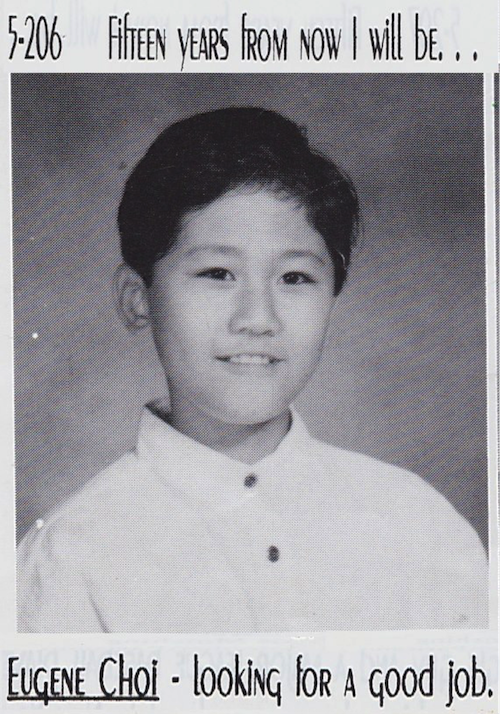
    I remember looking at my fifth grade yearbook and my answer to the question “Fifteen years from now I will be…”

    So I worked a ton growing up. I worked my first job illegally when I was fourteen at the Manhattan mall folding clothes for five dollars an hour. During college, I was juggling my studies and three other jobs.

    I was naive and thought a lack of money was causing the pain that actually came from my parents not getting along.

    When I finally achieved my external goal of making a lot of money, I still had trust issues. I still had the pain from the broken relationships in my life. Things didn’t feel any better.

    I was still hurting from never having a safe space to be myself growing up, and this was when I realized the truth.

    We try to avoid our hurt and pain, and as a result, we often make misguided decisions on what to pursue in order to actually feel successful.

    For example, if you grew up with a father who was mentally abusive and often told you that you wouldn’t amount to anything, your anger might lead you to chase after a well paying job to prove him wrong.

    The unfortunate part is that proving him wrong won’t necessarily make you feel any more successful because what you’re really craving is a supportive father.

    This is why it is so important to be able to develop the skills to be able to accurately assess what is needed to help you truly succeed.

    Ensure That Your External Goals Align With Your Internal Goals

    According to Harvard Professor Daniel Gilbert, known as the happiness expert, data shows one of the biggest reasons for people’s unhappiness is their inability to predict what types of things will make them truly happy.

    He advises us to simply do our research in advance so we can better predict if what we are chasing will make us feel successful or not.

    “If I wanted to know what a certain future would feel like to me I would find someone who is already living that future. If I wonder what it’s like to become a lawyer or marry a busy executive or eat at a particular restaurant my best bet is to find people who have actually done these things and see how happy they are. What we know from studies is not only will this increase the accuracy of your prediction, but nobody wants to do it.” ~Daniel Gilbert, The Truth About Happiness May Surprise You

    My real desire was to have a safe space to be myself and have more authentic connection in my life, but everything I was doing was making the opposite happen.

    Then I started studying and having conversations with people who had what I wanted. I realized the people I’ve met who have great relationships all were continually vulnerable with each other, and when they felt stuck and needed help, they reached out to the right people.

    So to try and build the relationships in my life I so desperately wanted, I started changing my external goals.

    I set a goal to have the courage to be vulnerable when I’m feeling shame.

    I changed my goal for my wife and I to go see a marriage counselor.

    I changed my goal to learning to be more honest with my wife when she hurts me instead of shutting her out and temporarily shunning her.

    These changes made all the difference and I finally started to feel successful.

    I had a skewed perspective on the things I thought would help me succeed. The parable of the Mexican fisherman is a great reminder that we need to define success for ourselves, based on what makes us feel successful, rather than letting someone else define it for us.

    Maybe you don’t feel successful yet because, like me, you’ve been chasing after the wrong things based on what others have told you.

    Take a moment to think about what types of actions will help you attain your internal goals. What might your new success measurements be?

  • My Ordinary Checklist for a Highly Successful Life

    My Ordinary Checklist for a Highly Successful Life

    “In this world, an ordinary life has become synonymous with a meaningless life.” ~Brené Brown 

    As I see it, there are two types of people out there.

    There are those who read goal attainment books and feel inspired, and me.

    The former will read the anecdotes about all those underdogs who beat the odds and managed to achieve wealth and prestige beyond their wildest dreams and will say to themselves, “Wow! That could be me!” They’ll feel enlightened, invigorated, and revved up to make a change.

    And then there’s me.

    While I may initially pick up such a book with genuine interest, my desire to whip my life into shape will invariably do an about-face, leaving me anything but inspired. If I say anything to myself as I read, it’s more likely to be a string of ego-deflating curses than a yearning-filled “one day that’ll be me.”

    I actually discovered my aversion to success books by accident. Charged by work with the task of developing an online course on the topic of goal attainment, I began to do some research.

    At first, it all seemed dandy. To-do lists? I can get behind those. Articulating a vision for the future? Check, check! But then, as I started to delve a bit more, I began to sink into a mire of confusion amid all the contradictory advice:

    Make to-do lists and then prioritize them by urgency. No, not by urgency, by importance, because that’s the way to a meaningful life. Except that to-do lists are actually now passé, so chuck those altogether. It’s the “less is more” mindset that will breed success.

    Just make sure you’re not spending too much time planning your tasks, because that takes you away from working on them. Although most failed projects could have been saved at the planning stages, so planning is crucial before embarking on any project. You would have known all of this had you properly color-coded your task list in the first place!

    The more I delved, the more aware I became of an undercurrent of shame that was slowly simmering inside of me. It was the feeling that something was dreadfully wrong with me if I was not willing to do whatever it takes, like the underdogs in the books.

    Didn’t I have any faith in the universal laws that turned out Oprahs and J.K. Rowlings and an endless stream of other success stories? Why, it might be as simple as manifesting my destiny with positive thinking, or mindfulness, or a cream cheese bagel for all I knew.

    No dice. Guess I’m just not built for success.

    And yet at some point, maybe just for fun, I began to consider an alternative: What if most of the people I know are more like me than them—you know, busy with life, proud of themselves when they hit “good enough,” happy to have work that is more or less satisfying, even if it’s not tremendously lucrative or glamorous?

    What if others don’t view themselves as a rags-to-riches tale waiting to happen and instead walk around with their heads held high simply because they are proud of the ordinary lives they are living?

    It felt subversive, empowering, and indeed nothing short of revolutionary.

    Success doesn’t have to mean a coastal beach house or getting up to speak in front of a crowded audience where everyone knows just who you are, what you do, and how much you’re worth.

    There is a quieter, softer form of success.

    I began crafting my own definitions and principles of success. Things along the lines of:

    * If you have one person in your life you genuinely care about and who genuinely cares about you, you’re successful.

    * If you have one more positive thought today than you had yesterday, you’re successful.

    * If you have just one thing to be proud of, or be grateful for, or to celebrate, even if it’s just the fact that you didn’t rip anyone’s head off even though you had a miserable day, you’re successful.

    Don’t get me wrong; I’m all for setting and achieving goals. I’m also all for striving to become the next one-in-a-million success story, if that’s what floats your boat. But if it isn’t what floats your boat, that’s no indicator of your personal worth, or lack thereof.

    It’s a sad sign of the times that success is measured in extraordinary terms only. It’s as if the benchmarks of ordinary, mundane success have now been rendered obsolete, or worse: something to feel ashamed of.

    It takes heaping amounts of courage to step back from the grandiose expectations of what success books tell you life could be and say that what you already have is enough. Maybe even more than enough. But in truth it is.

    So, if you, like me, are an “unsuccessful” type, the type that reads about the Oprahs of our world with little more by way of reaction than a “that’s nice,” remember that great potential for success lies in your own backyard.

    Success is what you make of it—even if that means simple, boring, ordinary ole everyday life.

  • Failing Doesn’t Make You a Failure (and You Can Still Succeed)

    Failing Doesn’t Make You a Failure (and You Can Still Succeed)

    “Remember that failure is an event, not a person.” ~Zig Ziglar

    Take a second and imagine little you. running around like the little ragamuffin you were. Imagine as far back as you can—back when you were first able to comprehend feedback from parents, teachers, or whatever other authorities were around.

    When considering the cause of low self-esteem, the most obvious answers fall under the umbrella of past abuses or failures: a parent who demanded straight A’s, an abusive spouse, etc. These are common forms of mistreatment that cause some people’s self-esteem to tank.

    But for those who’ve lived fairly easy lives, while surrounded by reasonably supportive people, low self-esteem has no obvious root (I talked about my own experience with this here.) What’s worse is that having an issue we don’t understand can make us feel weak or defective because the problem seemingly has no cause.

    So if you’ve suffered with low self-esteem, even if just occasionally or in certain situations, research is now pointing us in an interesting direction. There’s a surprising link that can help us out, and it has everything to do with effort.

    How Low Self-Esteem Takes Shape

    Are you one of those people who think Sigmund Freud is an absolute dunce? I don’t blame you. But he was right about something, and it’s that what happens to us during childhood shapes us—big time.

    Researchers in the Netherlands discovered that parents who praise their children for innate qualities may actually do more harm than good. According to the study, parents should instead praise children for their hard work and effort.

    So what’s the difference? It’s hardly possible to distinguish between a mom exclaiming, “Oh, you’re such a good reader!” and another who says, “Oh, you worked so hard on your reading assignment!” But this difference is significant.

    Children who were praised for “being” something felt a strange pressure that children who were praised for their work didn’t feel: When they fail, they associate the failure with an innate quality instead of associating it with the amount or quality of work they did.

    As you can imagine, associating your failures with innate flaws instead of just the quality of effort you put in can be damaging to a child’s impressionable self-image. And it can continue to wreak havoc on your adult self.

    Suddenly “I didn’t study enough” becomes “I’m stupid,” or “I need more practice with painting” becomes “I’m a bad artist,” etc. The low value falls on the self, not on the action taken.

    To put it another way, this kind of praise conditions us to think we are supposed to already be something without practice or trial and error. After falling short of this irrational standard a few times, self-esteem can drop quickly.

    The researchers also found that parents were more likely to praise children with low self-esteem for their innate qualities, thinking it would help give them a needed boost. Whoops.

    If you think this sounds like a bunch of BS, I can vouch for it personally.

    For much of my life, I wouldn’t try anything that I felt I wasn’t “innately” good at. I was big on beginner’s luck and anything I knew how to do intuitively, without much effort. Everything else (especially when hand-eye coordination was involved) could suck it as far as I was concerned.

    My parents were not major enforcers of hard work, so their praises were usually directed at innate qualities.

    As I grew up, this subtle distinction wreaked havoc in many areas of my life. I would quit things at the first sign of trouble, becoming extremely discouraged, and sometimes even feeling ashamed at the slightest mistake.

    Basically, how I behaved and my upbringing exemplified the above theory: I had no understanding of commitment and how it was the key to being talented in any area. Instead, I fearfully avoided anything that required practice and stuck to things I felt I had a “knack” for. I believed that what I did was who I was—for better or worse.

    Separating Yourself From Your Effort

    So ask yourself this: What is your relationship with hard work and effort? How about innate talent? How do you see yourself when moving toward a goal?

    If you’ve had self-esteem issues in your life, you may be familiar with quitting or shying away from effort. Maybe you felt bad when you weren’t immediately good at a new task, thinking you just “didn’t have it in you.”

    So you need to begin catching yourself in these thought patterns. A failure of any kind does not reflect that you are a failure. It is simply that your action failed to have the impact you wanted.

    So begin to:

    1. Consciously separate these two things in your mind. Each time you recognize this pattern, remind yourself that a failed attempt at something does not equate to a failed person.

    2. Suspend negative self-talk and replace it with a more neutral belief. For example, if you intensely feel that you’ve failed at something, remind yourself that it is probably a common mistake and getting good at any task requires patience.

    3. Truly begin to understand that failure is necessary for success in anything. View failures (as best you can) as learning opportunities that will propel you to the next stage.

    The book The Talent Code: Greatness Isn’t Born. It’s Grown. Here’s How does a great job of debunking the “innate talent” myth. The author explains where talent and skill actually come from. (Spoiler alert: it’s practice)

    Every expert in every field is the result of around ten thousand hours of committed practice.” ~The Talent Code

    Extraordinary innate talent is sort of a myth, perpetuated by meaningless phrases like “you either have it or you don’t!” Of course, it’s safe to say that we all have propensities for certain things, but that does not bar those who don’t from practicing and developing that skill too.

    So the next time you hold yourself to unrealistic expectations, remember: You are not your effort.

  • How My Drive to Succeed Led to Crippling Anxiety (And How I Got My Life Back)

    How My Drive to Succeed Led to Crippling Anxiety (And How I Got My Life Back)

    “The only way out is through.” ~Robert Frost

    The suffocating pressure from being obsessively focused on achievement and improvement led to escalating stress and anxiety over the years, but I ignored my feelings and kept attacking my goals.

    Over time it became darker and heavier. It became crippling. It forced me to put a stop to almost everything in my life.

    I’m a type A personality driven by a need for accomplishment. When I was in elementary school, I did my homework immediately after getting home even though my mom begged me to take a break. In high school, I regularly stayed up past midnight working on homework and scholarship applications.

    This need to succeed brought many gifts. I succeeded in school, work, and sports. My methods to achieve my goals were consistently reinforced by positive results.

    But this “success” came with a price that took a toll on my mental health. The only way I knew to succeed was through uncompromisingly high expectations and an unrelenting work ethic. When things didn’t go right, I was hard on myself and doubled down on my efforts.

    The journey to reclaim my life from anxiety took six months that felt like six years. Along the way, I learned how to manage my anxiety (there is no defeating it) so that I could live my life again: accept everything as it is, try to succeed without attaching to the outcome, and let thoughts come and go.

    Crippling Anxiety

    Over the years, as I pursued one goal after another with laser focus, the anxiety grew. I didn’t understand what it was. I didn’t want to deal with it.

    I felt ashamed of the emotions my anxiety created. I felt like I shouldn’t be having the thoughts that raced and spiraled through my head.

    I tried to stop them through sheer willpower. That created more anxiety. I didn’t utter a word about anxiety to anyone, even myself.

    About nine months ago, the anxiety I had been pushing down for years exploded like a volcano. It didn’t give me the option to continue ignoring it.

    It forced me to stop almost everything in my life: writing, running errands, hanging out with friends, and taking part in any social activities. During this time, I only left my house to go to work. Commuting to work and making it through the day took up every ounce of energy and willpower I had.

    I worried on a mental loop. I worried about worrying. I couldn’t stop the seemingly endless dark thoughts, fears, and mental distortions that surfaced.

    My mental loops and panic attacks could last for six hours before I got a second of relief. I had an overwhelming fear of losing it all. The anxiety manifested itself physically through shortness of breath and elevated heart rate.

    I twisted and turned in bed for hours because it was so painful. The anxiety came in unrelenting waves. It came with the force of a hurricane.

    Days and weeks were swallowed by an endless loop of anxious and fearful thoughts that felt like they would never release their grip on me. Surviving each day became an all-consuming task.

    Road to Recovery

    Getting better was the toughest challenge of my life, even though I directed my will to succeed and work ethic to healing. Freedom from the prison of anxiety felt so far away that I couldn’t imagine what it would feel like to live my normal life again.

    The recovery was painfully slow for my driven personality. At the beginning of the process, panic attacks and racing thoughts dominated my days. But I kept working at it, regardless of how dark and hopeless I felt.

    I tried my best each day. I took it one day at a time. I went to therapy twice a week, exercised every day, meditated three times a day, and played Mario every day to relax myself and quiet my mind.

    I tried to practice acceptance. I tried to not resist or dive into the dark thoughts. I say “tried” because most of the time I failed at successfully executing these habits.

    I had the highest urgency to improve. My life depended on it. Every action I took was centered around managing and decreasing the anxiety.

    Every day felt like an epic battle with my mind. I learned the hard way that there are no quick fixes for anxiety. There’s no strategy or seven-step program that eliminates anxiety from your life.

    Slowly but surely, I made progress. It felt like three steps forward, two steps back. Yet, most weeks were better than the prior week.

    Over time, I gained tools and skills that helped me cope with the anxiety. I learned new lessons every day about dealing and living with anxiety. I uncovered important truths about what had led me to this painful reality.

    The anxiety forced me to examine my actions, priorities, and values, and where my life was headed. At the time, I wished there were easier ways to learn those lessons. Your greatest teachers are your failures. That’s the way life works.

    I’d like to say it’s been a storybook ending. That I’ve conquered anxiety. That the racing thoughts and fear have vanished from my life. Anxiety doesn’t work that way, though.

    That being said, I’m back to living my normal life. I’ve discovered a new definition of success. I’ve improved my ability to manage the anxiety.

    Mindsets to Manage Anxiety

    Anxiety still shows up unannounced. I can’t control the intensity or nature of my anxiety. However, I can manage it if I’m mindful of how I go about my days and how I react to it when it shows up.

    Everyone’s anxiety is unique. If you’re battling anxiety, you’ll have to experiment to find out what works best for you. But you’re not alone.

    Although people don’t tend to talk about their struggles with anxiety, more people than you can imagine deal with intense anxiety: an estimated 40 million Americans suffer from anxiety disorders.

    Here are behaviors and mindsets that generally decrease my anxiety levels:

    • Accepting everything in my life as it is
    • Not worrying about things I can’t control or change
    • Observing my thoughts from the sidelines instead of engaging with them
    • Questioning thoughts: Do I have to go into this thought? Is this fear-based thought true?
    • Allowing anxiety to spend time with me; riding the wave instead of going against the current and fighting anxiety
    • Being okay with my flaws and weaknesses
    • Letting go of the need to succeed and accepting the outcome of my actions, good or bad

    These behaviors and mindsets cause my anxiety to spike:

    • Replaying past experiences on a mental loop
    • Being hard on myself when I don’t meet my standards
    • Blaming myself for actions or thoughts that caused me more anxiety
    • Resisting fearful thoughts or anxiety
    • Engaging with and reacting to every thought; being in the middle of the storm of my thoughts
    • Trying to deconstruct why I had a thought or feeling
    • Trying to control my thoughts instead of my reactions to them
    • Obsessing over what other people may think about things I did or said
    • Needing to and having to succeed

    Acceptance is the Key Ingredient

    I resisted the concept of acceptance when my therapist introduced it to me. I thought if I practiced acceptance, I would lower my standards and give up my commitment to excellence.

    I thought acceptance represented being okay with mediocre effort and average results. I thought it would lead me to lose the drive to succeed that has been one of the key ingredients to my accomplishments in life.

    I was wrong. Acceptance can (and should) be paired with a drive to succeed. An engine to produce at a high level leads you to put in the hard work that’s necessary to achieve your goals.

    Acceptance allows you to let go of the result once the hard work is complete. It frees you from worrying and being attached to the outcome, because that’s out of your control. Acceptance is living in the world of what is, instead of what should be, what could be, or what you want it to be.

    Acceptance is a simple idea yet it’s difficult to put it into practice for a perfectionist with a tendency to overanalyze. Although it’s been a struggle to increase acceptance in my life, I’ve discovered a few tools that have been effective: meditation and reframing my mindset during and after anxious episodes.

    Meditation has vastly improved my awareness of thoughts, feelings, and emotions. Awareness is crucial for managing anxiety effectively. When I’m anxious, step one of acceptance is to feel and acknowledge my emotions.

    The next step is to ask myself some version of this question: “Is there anything that I’m not accepting in this moment that’s causing or increasing my anxiety?” Once I pinpoint what I’m resisting and choose to accept it, I know the anxiety will subside.

    Many times, I can reframe my mindset in the middle of the anxiety. I can mentally shift from fighting the present circumstances to accepting them as they are. Other times, the anxiety takes over and I have to brace myself until the clouds clear. Once I’m out of the storm, I can dissect that situation and identify the lack of acceptance and the friction that led to the high levels of anxiety.

    For example, an argument with my wife can trigger anxiety because I wish that the disagreement never happened. I can’t accept where I am in that moment until I accept that I didn’t act like my ideal self in that situation, and that I can’t go back to change the past. Once I accept the argument and the anxiety it caused me, the friction disappears and my anxiety levels start to drop almost immediately.

    My performance can also be a trigger. I can get intense anxiety from mentally replaying the mistakes I made on a work project that didn’t go as well as I expected. I also experience anxiety when I fail to accept the way decisions are made in a large corporation. Or I don’t accept that people often behave in ways that are different than what I expect or value.

    If I’m trying to control things that I can’t change or affect, I’m not accepting my current situation. Trying to act outside of my sphere of control is resisting the way the world works. It’s like not accepting that I can’t change the laws of gravity.

    Once I accept my past mistakes or that I can’t control how others act and what their priorities are, I can fully accept my present circumstances. When I accept that I experience high levels of anxiety frequently and that my reactions to anxiety sometimes cause more anxiety, I can live without bracing myself for the next attack.

    I can let go because I’ve accepted that I will have high levels of anxiety again and that I will make mistakes in how I handle the anxiety again. It doesn’t mean I like being anxious. It just means I’ve accepted where I am at this time in my life. I can take action from there instead of where I wish I was. I can take action within my zone of control.

    I’ve experienced the deepest moments of tranquility that I’ve had in my life in the last couple of months. These magical moments happen during the brief windows when I’ve accepted everything in my life as it is.

    My mind quiets because there is no friction or turbulence. I lose myself in the sounds and sights of my environment. I hear the birds chirp. I see all the different colors of the leaves.

    Redefining Success and Anxiety

    I used to be afraid of my anxiety because it felt so intense, emotionally and physically. Although I still experience intense anxiety on a daily basis, I’m now thankful for the anxiety I’ve experienced (sometimes even while I’m caught up in that crushing anxiety).

    This is a perspective that only comes after being through the eye of the storm of anxiety. If you’re in the middle of that storm, your only job is to get through it so you can get to a place where you feel safe.

    I’m thankful for anxiety because it has brought many gifts. Because of it, I quit relentlessly pursuing success at any cost. I started meditating. I began exercising regularly again. I prioritized balance in my life.

    The most important lesson anxiety has taught me is that a successful life isn’t defined by how many achievements I’ve collected. Instead, success is building and nurturing relationships, being present to the little things in life, being grateful for the gift of life, exercising the mind and body, and living the life I want without looking over my shoulder to see what others are chasing.

    I don’t always follow the formula I discovered for my new definition of success. But when I adhere to my success formula, my days are significantly better than when I fall back to my habitual ways.

  • 7 Common Fears That Don’t Have to Control Us

    7 Common Fears That Don’t Have to Control Us

    Love is what we were born with. Fear is what we learned here.” ~Marianne Williamson

    As babies, we know nothing about the world. In the universe of an infant, there are no norms to follow, no rigid rules and regulations; no room for labeling or judging ourselves and others. We don’t yet know to disapprove of ourselves, and we’re curious to play, learn, and grow.

    We are all born free spirits. Then our environment—our families, schools, religions, and political systems—shape the way we think and behave.

    Fear is a learned practice. Children generally are not afraid of trying, failing, and getting up on their feet again. That’s how we learned to walk. When we made our first step, we didn’t call ourselves names or punish ourselves if we fell. We just got up and gave it another try.

    As kids, we weren’t afraid to step outside of our comfort zone and try new experiences.

    So why did we get so fearful as adults? What are we really afraid of?

    1. The fear of imperfection

    I often hear people talking about their need for perfection as a sign of virtue. In a society that generally evaluates human worth through how well we do things in life, some people even feel a sense of pride when they describe themselves as “perfectionists” or “workaholics.”

    To me, perfectionism is a sign of fear. When I know I do everything perfectly, I’m untouchable. There is no room for others to correct me.

    As a child, there were times when I was afraid of punishment after getting bad grades in school. Years later, as an adult, I developed an extreme need for perfection, especially at work. All my assignments had to be executed perfectly so none of my managers would have a reason to criticize my performance. At the time, that fear of authority was still present in my life.

    People who struggle with perfectionism also tend to get overwhelmed because they avoid asking for help. They would rather look invincible and strong than vulnerable and “weak.”

    Showing up in our vulnerability in front of others is a sign of authenticity. Vulnerability is not weakness; it’s a beautiful human attribute, and it takes lots of courage to show what most of us have been taught for years how to hide.

    “Vulnerability is the birthplace of innovation, creativity, and change.“ ~Brené Brown

    2. The fear of failure

    I once read an article about successful people who were intentionally planning for failure. I found that fascinating and strange. Planning to fail? Who likes to fail?

    No one enjoys messing up, but those people were using mistakes as much needed instruments to learn and grow.

    Today I know that each time I am afraid to step outside of my comfort zone and try something new, that’s the fear of failure making decisions for me.

    Each time I find myself stuck and afraid to take risks because I might fail, I ask myself: What’s the worst thing that can happen? Could I cope if it did?

    These questions help me realize that my life would surely go on, and that most mistakes wouldn’t literally kill me.

    “The greatest mistake you can make in life is to be continually fearing you will make one.” ~Elbert Hubbard

    3. The fear of success

    Sometimes, success is scarier than failure. When dreams look too good to be true, we get scared by our own greatness. Deep inside, we don’t see ourselves as enough, and worthy of love and success.

    Whenever I make myself small or put myself down, I am acting on my fear, taking myself for granted, and forgetting to appreciate myself for my achievements. I’m thinking, “Anyone else could have made it” or attributing my accomplishments to faith, luck, or other people who gave me opportunities to shine. I’m focusing on my weaknesses or limitations, without honoring my strengths, gifts, and talents.

    That’s how I operated in the past, for too many years. But here’s what I know to be true today: It wasn’t luck; it was me.

    Sometimes in life, we need to acknowledge there’s been a lot of hard work and efforts behind our “luck.” And if we’re not yet where we’d like to be, we need to believe that we truly are worthy of what we visualize.

    Our deepest fear is not that we are inadequate. Our deepest fear is that we are powerful beyond measure. It is our light, not our darkness that most frightens us. We ask ourselves, ‘Who am I to be brilliant, gorgeous, talented, fabulous?’ Actually, who are you not to be? Your playing small does not serve the world. There is nothing enlightened about shrinking so that other people won’t feel insecure around you. We are all meant to shine, as children do.” ~Marianne Williamson

    4. The fear of being rejected

    Being liked and included and feeling a sense of belonging to a community are basic human needs. We fear being left out and seek approval as a means to ensure this doesn’t happen.

    I can recall many situations in my life when I did things I didn’t really want to do to please others, like going to a movie with someone on a Sunday when my body wanted to stay home and take a good nap.

    I was a master of people pleasing and, to be honest, it wasn’t always because I wanted to make everyone happy. The truth is that I wanted people to like and approve of me. I expected them to give me the things I wasn’t giving myself: love, care, and attention.

    Again, being loved is a human need. However, being needy is something different. I came to understand that people who are taking good care of themselves are less dependent on the approval of others.

    Taking care of our own wants and needs is a necessity. When we make sure to keep our tank full and we treat ourselves kindly, we inspire others to do the same for themselves.

    “I used to be a people-pleaser. Now I love them instead.” ~Cheryl Richardson

    5. The fear of what other people think

    Did you know that the fear of public speaking comes first among all kinds of fears? Even the fear of death comes second! Most people don’t feel brave enough to show up in their vulnerability in front of others because they’re focusing more on what people might think about them than on their performance.

    I can recall quite a few situations in my life when I didn’t dare to ask questions, especially when there was something I didn’t know. I didn’t want to look less intelligent or even stupid.

    Especially at work, I didn’t feel comfortable enough to openly admit that I didn’t hold all the answers and I still had a lot to learn. I wanted people to perceive me as an expert, super smart, invincible, and strong. I now know that every day brings new lessons in the school of life, and it’s more important to stay open to them than it is to be perceived as all-knowing.

    Let’s be honest with this one: I’ve never met anyone who would love to hear they were ugly or stupid. We all need to feel validated. But in the end, all that really matters is that we fully approve of ourselves.

    “When I seek your approval, I don’t approve of the me that’s seeking the approval.” ~Byron Katie

     6. The fear of losing control

    If there were Oscars for control-freaking, I would have surely gotten one! Looking back on my past, I recognize that I always wanted to have full control over everything and everyone. This comes back to the fear of imperfection.

    During my former leadership position with a multinational company, the most difficult things for me to handle were decision-making and delegation—not only with people who were new in their roles and lacked experience, but also with co-workers who were very skilled and competent in their jobs.

    Why did I struggle with delegation? Because I knew I was responsible for my team’s results, and I wasn’t mentally strong enough to bear any sort of failure on my shoulders.

    Making mistakes would have scared me to death; that’s why I always needed a long time to brainstorm all possible scenarios that could go wrong when making important decisions.

    The need to always control situations or other people is a major source of stress. It is tiring, frustrating, energy consuming—and pointless, since we can never control what other people do. Letting go of control is true freedom and a form of self-care.

    “Be willing to stop punishing yourself for your mistakes. Love yourself for your willingness to learn and grow.” ~Louise Hay

     7. The fear of what might happen in the future

    If I spend my precious time overthinking and allowing my mind to create different scenarios about the future, I risk missing out on my life and the only reality that is: the present moment.

    Most of the things we worry about never happen. They are nothing but the illusionary product of our mind.

    It’s true, ‘bad’ things do happen at times, but they’re often blessings in disguise that make us stronger and wiser or show us the right path for us.

    Looking back on my past, I recognize that I had to suffer in love so that I could understand what I wanted from a romantic partner. I had to become unemployed for a while in order to realize what I truly wanted from a profession and what would bring me joy and fulfillment.

    Knowing that my painful experiences were actually gifts, and that I survived them, I’m better able to accept that what will be, will be—and no matter what, I can handle it.

    “The best use of imagination is creativity. The worst use of imagination is worry. “ ~Deepak Chopra

    I have stopped feeling guilty and ashamed of my fears. I’ve learned how to embrace them with self-compassion, as part of the package of being human. I know the primary intention of fear is to protect me from things that could hurt me. But I also know I don’t have to let my fears control me.

    I am aware that I can always get mindful and pay attention to my thoughts and emotions. I make sure that I nourish my mind, knowing that I am the one creating my own world through my feelings, thoughts, and, actions.

    “A miracle is a shift in perception from fear to love.“ ~Marianne Williamson

    And now, I would like to hear from you. What scares you the most? How do you manage your own fears?

  • 5 Ways Failure Can Be a Blessing in Disguise

    5 Ways Failure Can Be a Blessing in Disguise

    “Remember that sometimes not getting what you want is a wonderful stroke of luck.” ~ Dalai Lama

    Recently I received some “bad” news: After years of studying and a nerve-wracking exams procedure, I didn’t make it to the list of the lucky few selected for the upper level public administration job posts.

    Having always tried to keep up with a job that made good use of my law degree, while at the same time pursuing my career as a writer, there were times when I questioned whether a law-related job was actually my true calling.

    At the time, trying for the public administration exams had seemed like a “best of both worlds” scenario. So, having finally made the difficult decision to take a leap of faith and change my career path, the outcome was certainly not what I had hoped for.

    Thus, I was faced with two options: either shrivel up in a corner by the heater, bawling my eyes out for one more shattered dream, or finally establish these new neural pathways I’ve been striving to build this past year of awakening and see the situation for what it really was.

    The expected, rather self-pitying reaction was looking at me with tearful puppy eyes, begging me to indulge in it. But this time I chose the new way.

    After the initial disappointment, I took a deep breath and tried to focus on the truth of things—that I had done my best for this job opening, and the outcome I was about to fret over was out of my control. I recognized then that I could not change what had happened and I had to accept it. Not surrender, but accept.

    As I’ve navigated my recent setback, I’ve pinpointed five ways failure can actually be beneficial.

    1. You come to terms with what you can control and what you cannot.

    In short, you get to have a first-class, one-on-one encounter with your ego. Because it is your ego, not your true self, that demands to control every single outcome of every single plan and effort you make.

    According to Jungian psychology, the ego is made of our own beliefs and ideas about ourselves, whether true or false. That’s why the ego’s very existence depends upon keeping these beliefs intact; it cannot allow them to come crumbling down.

    For example, you might think of yourself as the best at your job; so when you end up fretting for days over a mistake you might have made at work, this is your ego trying to control something that is out of its power.

    In my recent exams’ case, I too could have barricaded myself behind my belief that I normally perform well at academics, and allowed my ego to keep nagging me about my not attaining my goal—but this time I chose perspective, not ego.

    Preparing for a job interview or exam? You can minimize your potential errors by studying thoroughly and keeping yourself in good shape, both physically and mentally. This is what lies within your control: your own choices and attitude.

    Beyond that, there’s only the realm of unforeseen, uncontrollable external variables. Things may not turn out as you hoped they would, and there’s nothing you can do to guarantee they do. You can save yourself a lot of heartache by acting but not expecting.

    By being aware of what lies within your power and what does not and accepting that certain things are out of your control, you also end the self-pitying, self-victimizing cycles. You stop blaming others, the Universe, external variables, and yourself. Which brings us to my next point.

    2. You boost your self-knowledge.

    Take a relationship gone bad, for example. Mourning a bit is, of course, part of the equation, but after a while you’ll find it far more rewarding to focus on what you learned about yourself, thanks to this experience.

    What are your real needs, your true nature even? What can you stand and what can you not? Once you get clear on the lesson, you’ll be able to make wiser decisions going forward.

    When reflecting on my recent professional setback, the major thing I learned about myself was how easily un-grounded and un-mindful I could get whenever the going got tough.

    Trying to discover why this was so, I recognized my second lesson: I had to work on my need to control the outcome of my efforts, in all areas of my life.

    By choosing to focus on the bigger picture when coping with my “failure,” I was able to move on from it more quickly. I even found myself working on my next novel sooner than I would have, had I remained stuck there, crying over spilled milk that might have even proved not to be my cup of tea.

    The greater the impact of a failure, the greater the opportunity to learn about yourself—if you get past the disappointment and, instead of wallowing, spend your time more productively, confronting your weaknesses.

    By that I mean taking responsibility for any choices that contributed to your failure and identifying why you might get so worked up each time things don’t go according to your plans. Is it low self-esteem? That fragile ego again, that has learned to exist and breathe only depending on external milestones of success? If yes, then give it a nice goodbye pat on the back and reclaim your true self.

    3. You have an opportunity to practice living in the moment.

    When you fail at something, you’re reminded that there are no guarantees in the future, and that all that really matters is what you choose to do in the present.

    In this way, failure reinforces the importance of mindfulness, the act of being completely present in whatever you’re experiencing here and now.

    My career choice “gone bad” also taught me that it can make a plan’s failure sting even more if you put all your energy and hopes on it, at the expense of other plans or areas of your life.

    Putting socializing with friends or family on hold, for example, for the sake of devoting yourself to a certain career goal actually deprives you of a very important part of your present. Life happens simultaneously, in all these areas, and we miss out when we focus too intensely on any one specific goal.

    Mindfulness isn’t just about appreciating what is; it also enables us to better accept what will be. When we make the conscious choice to take life moment by moment, we become more grounded, and that helps us better adapt when things don’t go according to plan.

    4. Failure reminds you to focus on the journey.

    I might have sacrificed infinite hours studying Macroeconomics and other subjects entirely outside my area of expertise, in pursuit of the career change I ultimately didn’t manage to achieve; but this arduous procedure has left me with precious and detailed knowledge on subject matters I would have otherwise never acquired. My newly obtained knowledge on economics even helped me with the novel I’m currently writing!

    Also, on this difficult journey I met many co-travelers who shared the same goal and the same struggles, and whom I now regard as my best of friends.

    Do you really regret meeting all the people you met, learning the things you learned, and growing through your journey, even though it didn’t get you where you wanted? Nothing is a waste of time and energy if you gain through the experience.

    5. You open yourself up to something even better down the road.

    Some years ago, I had the unfortunate experience of growing close to someone suffering from covert narcissistic personality disorder. Before then, I knew nothing about this condition and only began learning about it after I’d been gaslighted by this person’s inconsistent behavior long enough.

    The thing is, until that moment of revelation, I’d been beating myself over why I couldn’t make this relationship work, and had considered the whole thing my failure. After that, I realized how this “failure” had protected me from getting deeper involved in something that wasn’t healthy for me, and how it opened me up to a better relationship in the future.

    From this experience, I learned that we shouldn’t spend so much time getting depressed in front of a closed door that we miss the window that has opened for us a few blocks down the road.

    Have you ever spent nights crying over unfulfilled dreams, only to recognize later that, if they had been granted to you when you wanted them, you wouldn’t have set out on the amazing journeys you ended up taking because those dreams didn’t come true?

    Yes, I know you have. And if you’re going through the aftermath of one more “failure” right now, know that amazing journeys are ahead for you now too.

    The good old adage “everything happens for a reason” is good and old for a reason.

  • 3 Causes of Self-Doubt and How to Conquer It for Good

    3 Causes of Self-Doubt and How to Conquer It for Good

    “Each time we face our fear, we gain strength, courage, and confidence in the doing.” ~Unknown

    Self-doubt and I are old friends. We go way back, to early childhood.

    Now, if you ask me, I will honestly tell you that I had quite an idyllic childhood in a loving home.

    My parents raised us—my brother and me—to trust in our abilities and aim for the stars. They held me when I failed or fell flat on my face, which I did quite often, encouraging me to stand up and keep walking again. And yes, self-doubt still made its way into the fabric of my being and cleverly made itself boss, calling the shots at school and among my peers, seeping into my professional life as I grew up and chased my dreams.

    Sure, I chased my dreams. But you know how these things work. A thing like self-doubt has the ability to make you overcompensate. Since it tells you that you are not good enough or it gives you the nagging feeling of “wait-till-they-find-out-I’m-not-good-enough” when you succeed, your psyche is pushed to compensate for the lack in every possible way. The most common way, of course, is to over-achieve.

    I did exactly that. No matter what area of life I was focusing on, I had to be the best. The best student, the best wife, the best mother, the best doctor. And I never stopped to consider what “best” really means. For instance, whose best? How is it defined? It’s taken me years to realize that the prison of self-doubt had always been unlocked. I merely needed to walk out of it.

    In order to overcome any limitation, we have to turn around and face it, study it, and watch it like we would observe exotic animals in a zoo. From my experience, self-doubt is associated with three main processes—comparison, becoming fixated on specific outcomes, and feeling like an imposter.

    Comparing Yourself with Others

    Self-doubt is defined as the lack of confidence in one’s own abilities. When plagued with self-doubt, we believe that we can’t do something, and if we dig a bit deeper, we will invariably find that this belief arises from comparison. We believe we can’t do it the way someone else does it.

    We gauge success and failure by the norm, which is always set by others. Think about this. If you never had the ability to compare yourself with others, would you be plagued either by self-doubt or its opposite, over-confidence?

    Fixation on a Particular Outcome

    Obviously, comparison is not the only fuel source for self-doubt. One of the biggest things that holds us back from forging forward is the fear of failing. When we become fixated on a particular outcome, not only do we become paralyzed by the possibility of failure but we also close ourselves off to all other possibilities.

    For instance, if you’re a writer, you may find yourself reluctant to explore your creativity in your art if you have a particular goal of getting a certain number of readers, accolades, or other outcomes. The joy of writing becomes masked by anxiety if you are not open to failure, however you define it.

    Feeling Like an Imposter

    You’ve probably heard of Imposter Syndrome, which seems to affect women more than men. If you feel like you don’t deserve any of your accomplishments or that you got to where you are by pure fluke, you may be suffering from this condition.

    Here, obviously we are not talking about people that do end up with some successes by sheer luck but about those who underestimate their own achievements. It’s where we might feel like a fraud for being successful.

    And then there are the issues of not wanting to appear aggressive, ambitious, or assertive that make us take a step back from our full potential.

    What Doesn’t Help

    Just from my own familiarity with self-doubt, I can attest to what doesn’t help with alleviating it.

    Things like positive self-talk, affirmations, visualizations, and go-getting strategies don’t get us too far because they don’t get to the root of the issue—the belief that we are lacking. These techniques remain at the surface level of the mind, never touching the energetic power of the belief that becomes intermingled with our very identity.

    How to Face and Conquer Self-Doubt

    Whenever we are plagued by beliefs that limit our ability to live happy and fulfilled lives, it’s an indication to look into them. All of our suffering arises from believing our thoughts about ourselves or the world.

    1. Meditate

    These days we hear so much about meditation that we can often lose perspective about what it can and cannot do.

    Depending on the technique, meditation can certainly help calm our minds and lower stress and blood pressure—very favorable outcomes.

    What it will not do is solve our fundamental problems that arise from limiting beliefs. Instead, meditation creates the space in which we can do the real work of looking within. Most importantly, it helps us cultivate inner silence and the ability to step back from our minds and evaluate our internal processes in a non-judgmental way. If we cannot step back from our beliefs, we cannot work on them!

    2. Journal

    Writing is a powerful tool for cultivating self-awareness. It forces us to pin down our internal process.

    Write without censoring and consider the following questions:

    • What is stopping you from acknowledging your ability to succeed or your past successes?
    • Do you believe that you don’t deserve it? Why not?
    • Do you believe that you should not be aiming higher? Why?
    • What does success look like to you? Where did this definition come from?
    • What would happen if you plunged into your passion and the outcome was different from what you had envisioned?
    • What would happen if you fail?

    Make a list of all your limiting beliefs. Hint: beliefs are thoughts that start with a “should” or “should not,” such as, “I should not appear ambitious.”

    3. Question

    Now that you’ve identified your limiting beliefs, try this. Find fifteen to twenty minutes when you will not be disturbed. Keep your journal close. Sit comfortably and take some deep breaths, giving yourself permission to attend to tasks later. Relax any tense areas of the body.

    Now gently bring up your first belief, for example, the one about appearing ambitious. Who decides how you appear? Can you control what anyone else thinks of you? What if you never had the ability to think this thought?

    Allow each question to sink into silence without allowing the mind to answer. Take as long as you need to feel the effect of this sinking in. It will feel like a whoosh in your body when you suddenly realize that a thought is completely untrue. You don’t have to let go of anything. When you stop believing an untrue thought, it lets go of you. This is freedom.

    4. Feel

    Another powerful way of dealing with our limitations is to feel them in our bodies. Start as above, sitting comfortably and taking a few deep breaths. Relax. Bring up the first belief from your list. Where in your body do you feel it? Belly? Chest? Back? Focus entirely on feeling and not thinking. What does it feel like? Is it a heaviness? Contraction? Discomfort?

    Feel it fully, without trying to change it. Become curious about it. Does it come and go? Does it move anywhere?

    Continue to breathe deeply as the sensations subside. Notice that sensations come and go, but you are here. Our thoughts, beliefs, and sensations are temporary phenomena that become a problem when we hang on to them long after they are gone.

    Once you get comfortable with feeling sensations in your body, try the question exercise. Allow each question to sink in while observing the sensations. The energetic signature of a belief is felt in the body as a sense of contraction or tightness. When the belief dissolves through questioning, the energetic signature relaxes and this is felt deeply in the body.

    5. Act

    Once you’ve become adept at questioning your thoughts and beliefs in a meditative state, it’s time to put it into practice. Any time you feel paralyzed with self-doubt or when the old patterns start acting up, pause. Now you know that this belief is untrue.

    The only way out of this disabling pattern is to surrender to the present moment. Focus entirely on the task and not thoughts about the task, its outcome, or how you feel about it.

    If you need to give a presentation, do that. Keep bringing your attention to the tasks of researching, preparing, and rehearsing. Step into your light. What is your full capacity for each task? Do that. When “what if,” “should,” or “should not” thoughts and beliefs arise, drop into the body and feel the sensations while questioning the truth of these voices.

    The only thing that we ever have control over is our intention for acting. As long as we keep our hearts open, genuinely value ourselves and others, and act in ways that serve more than just ourselves, we are good. Learn to relinquish control over the outcome, which isn’t in your hands anyway.

    As I’ve learned to work with self-doubt, I’ve come face-to-face with the fear of appearing ambitious and of feeling like a fraud for my successes. The more I inquire into this, I realize that these fears lie in my conditioning of how someone like me—a woman in a male-dominated field—is supposed to behave or expect.

    The practice here is to drop into the body and observe the sensations as they arise and subside, noticing that all phenomena including self-doubt, naturally pass. Paradoxically, it is when I allow it to arise fully that it lets go of its death-grip and my actions become spontaneous, light, and joyful.

    Self-doubt lies either in the past as memories or in the future as imaginary projections. It cannot exist in the now. Action lies in the now, where there is neither self-doubt nor self-grandiosity, both of which are thoughts of the past or future.

    In the now, there is only doing what is required. When we learn to ignore our self-doubt and put our best foot forward, it eventually lets go of us. In this newfound freedom, we become fearless, having relinquished the desire for any particular outcome and learned the value of acting for purely the joy of it.

  • One Simple Word That Can Change Your Life (And No, It’s Not “Thanks”)

    One Simple Word That Can Change Your Life (And No, It’s Not “Thanks”)

    “It’s not what happens to you, but how you react to it that matters.” ~Epictetus

    About nine years back I was at the lowest point of my life.

    We had been trying to start a family for close to four years by that point.

    The forty-plus consecutive months of “not pregnant” verdict were starting to take their toll on me. That second line on the pregnancy test strip seemed like it would never appear. Life felt like it was a never-ending cycle of false hope that was always crushed in the end.

    I wouldn’t wish that kind of despair on my worst enemy.

    I am a huge believer in the power of gratitude. I tried hard to look at all that we did have and find contentment in where we were. But anywhere I turned, it seemed like all I could see was pregnant women, or moms with children. And instantly, it would pull my thoughts back to this one thing that was lacking in our life.

    I sincerely believe that “thanks” is one of the most powerful words in any spoken vocabulary. And that gratitude is one of the best antidotes to many of the problems we face.

    In this situation, though, where I was hanging by a thin frayed strand that threatened to snap any minute, there was another word that helped me more in keeping it together.

    And that’s the simple word “yet.”

    Day after day. Month after month. Year after year. I reminded myself:

    I’m not pregnant yet.

    It’s not our time yet.

    Even as I eventually started to make peace with the fact that we would not have kids naturally, I hung on to that one word.

    There’s no need to despair yet.

    It’s not time to give up yet.

    We just haven’t found out a workable option to start our family yet.

    It is perhaps the simplest, most under-rated word in the English language. But the power it can have on transforming our outlook is immense.

    “Yet” makes things less final.

    Whether it is a battle with infertility, a project that isn’t going the way we expected, or a relationship that’s constantly devolving, the simple word “yet” can transform the negative thoughts in our mind into something that feels less final.

    And that opens up the space to breathe. To live. To look for alternatives. To look for solutions. Or simply to get through another day.

    “I failed [at something]” is so final. It feels suffocating. It leaves very little room for us to maneuver.

    I haven’t succeeded yet transforms the exact same event into something that has hope. Something with a better future. Something we can change. Something in our control.

    “Yet” makes learning easier.

    After the four-year struggle with infertility, we were finally blessed with a beautiful daughter.

    You would think that after the experience we had, we would have treated her like a princess and lived happily ever after.

    Things didn’t quite work out like that for us.

    I was at that time in a very stressful job. My daughter had amply inherited the stubbornness genes from both sides of the family tree. I used to be a bit of a control freak.

    Apparently, those things don’t mix well.

    Before I even knew it, my daughter and I were butting heads on a regular basis and we were stuck in daily tantrums and power struggles.

    I used to perpetually feel like a lousy mom.

    Until one day I had the epiphany: I’m not a bad mom. I just haven’t figured out this parenting thing yet.

    Adding that one simple word to the way I thought about the situation opened the doors to learning and to keep trying until we were back on track again. It paved the way for what has been a three-year journey of discovering and embracing the positive parenting philosophy.

    My daughter has blossomed right before my eyes. Our relationship has improved by leaps and bounds.

    All because I now see myself as someone who has yet to learn things, instead of flogging myself when I fail (and fail I do… parenting a strong willed child is not for the weak of heart!)

    “Yet” makes dealing with others easier.

    Over the course of time, yet has become the default lens through with I see others around me as well.

    When my daughter is being difficult I remind myself: She is not trying to get to me. She simply hasn’t learnt how to manage her emotions and behavior yet.

    When a friend makes what I think is a poor choice, I tell myself: It’s not my place to change her. She hasn’t experienced her share of what life has in store for her yet.

    When I’m having a rough time working with someone, I say to myself: She’s new to this. She hasn’t quite got the hang of it yet.

    Just as with difficult situations, the simple word “yet” makes it easier to deal with difficult people as well.

    And discovering this has been a great blessing for all my relationships.

    Beware, though. Watch out for this caveat.

    I would be remiss if I just focused on the positive effects of the power of “yet” and not talked about its negative impact.

    Unlike some other power words like “thanks,” “yet” is not a stand-alone, but rather an amplifier of what we think.

    When used in a negative context, “yet” can make things orders of magnitude worse.

    For instance, when we get stuck thinking poorly of ourselves, even a success might make us think: My regular clumsiness (or ill-luck) hasn’t caught up with me yet.

    We need to watch out for these, and strip them of the power of “yet” as soon as possible.

    The other day my daughter and I were happily coloring together in a parent-child journal I created. She was doing a great job, so I complimented her on it.

    She sat back, looked at it and said with a smile: “It does look good, doesn’t it? I just means I haven’t messed it up yet.”

    She probably meant it as a self-deprecating joke, but I couldn’t let it pass.

    So I replied back with a smile, “No honey. It means you’ve done a great job coloring today!”

    Sometimes, there’s just no place for the word “yet.”

    So now, a question for you: What is the one situation in your life right now that can be transformed by the power of “yet”?

  • The Trap of Thinking You’re Special and Entitled to Success

    The Trap of Thinking You’re Special and Entitled to Success

    Man on a pedestal

    “Life is not designed to give us what we need; life is designed to give us what we deserve.” ~Jim Rohn

    Is there something wrong with being special?

    Short answer: yes.

    But why is that? Being special is… special!

    That’s true, but there’s a downside most people aren’t aware of.

    Before we go any further, let me clarify what I mean by “being special.”

    In short, being special is about thinking that what applies to others doesn’t apply to you, thinking that you’re an exception to the rules of life that others have to follow.

    It has nothing to do with having healthy self-esteem or thinking highly of oneself; in fact, it’s all about ego and self-deception.

    And you could be thinking in such a destructive way without even realizing it.

    The Trap of Being Put on a Pedestal

    Let’s say when you were growing up, people put you on a pedestal for something you did well.

    Maybe you used to get straight A’s, maybe you were a good boy/girl who never broke the rules, maybe you were more physically attractive than most of your peers, and so on.

    In short, you had a privilege that set you apart from your peers, and you may have done nothing or very little to get that advantage.

    Maybe you never had to study hard and didn’t know how you got those awesome grades every time—it just happened!

    Maybe politeness was natural to you and it seemed odd that people gave you so much credit for it.

    You just had an advantage and enjoyed it, but you didn’t know how you got it.

    People around you likely assumed you’d have an awesome future based on your awesome past (which, once again, didn’t require much effort from you).

    Now, this kind of child, with the right set of circumstances, may grow up thinking that he/she is special. And this child might believe that he or she can succeed in anything with little effort. Soon enough, this person will figure out that this isn’t true.

    My Story

    When I was a kid, I used to be the perfect student.

    Not only were my grades good, but also I used to be very polite and I made almost no mistakes.

    My peers would say “Mosab, how do you get such great grades every time? How do you study?”

    The teachers would tell another student to be like me: “Why can’t you be like Mosab?!”

    I even remember that one day, a teacher caught my friend and me playing during the lesson, and I vividly remember that he told my friend something like:

    “He doesn’t need to pay attention because his grades are already good, but you are the one who needs to pay attention.”

    Because of the conditioning everywhere around me, I continued being that little “perfect” kid.

    I ended up going to one of the best high schools in my country, graduating, and then going to one of the best colleges inside my country.

    And don’t get me wrong; I’m grateful for the opportunities of studying in such awesome places and meeting great people throughout my journey.

    But all of my past conditioning made me think that I had some kind of special power, that I was too smart to fail, and that everything I’d do would be a success.

    I never understood how success really works, how real life works, or how to move one step at a time toward your goals. And here’s the most interesting part: I never understood how I could earn something or qualify for it; it was all there for me and I was already qualified.

    For example, when I started my own blog, I assumed that people would love my writing immediately and that I’d have more knowledge than many other self-development bloggers, because I thought things would work the same way they did when I was a kid.

    I assumed people would give me recognition immediately; I wouldn’t have to work hard because I’m so awesome! Of course, that proved to be untrue.

    What About You?

    For you it could be a whole different story, but the outcome may be the same: You were deceived to believe you were an exception, especially if you had a bright past.

    At some point, you may get lazy, assuming that one day you will have a better future just because of your astounding past.

    Unfortunately, it doesn’t work this way. The only way to create a great future is to work for it.

    From my own story, and from many people I’ve seen who think that they’re “too epic to fail,” I can confidently say that “being special” is nothing but a way to escape the discomfort of taking responsibility and changing things. It’s a way to avoid hard work, a self-deception strategy.

    After all, it’s easier to say you’re special, especially if you have the past to back it up, than to jump into the mud and get your hands dirty working on changing your situation.

    The Valuable Lessons You Need To Learn Here

    Ego, especially when you hide it from yourself, is your worst enemy.

    In fact, ego is nothing but a symptom of feeling weak in one area and wanting to cover that up by acting too strong, which never works.

    In order to get something, you need to qualify for it, to earn it, and that requires putting yourself on the line and working hard.

    It also requires facing yourself and admitting that sometimes you’ll fail and struggle, but you still have room to grow.

    I leaned this the hard way, and I’m still learning, but now I can see clearly that I must stop thinking that the world owes me something and start working hard to get what I want.

    Now, I like to think that I’m unique, not special. We’re all unique somehow; we all have unique perspectives and abilities, and we can use our own uniqueness to design our future—if we’re willing to put in the effort.

  • Why Someone Else’s Success Isn’t a Threat to Yours

    Why Someone Else’s Success Isn’t a Threat to Yours

    Envy

    “Stop beating yourself up. You are a work in progress; which means you get there a little at a time, not all at once.” ~Unknown

    I got embarrassed at the gym.

    I sat down at the bench press, ready to hoist up 135 pounds of iron. My goal was eight reps for the first set.

    Before I started my first set, I heard someone huffing to my left. I looked over and saw a young guy benching 315 pounds!

    I counted his reps, and he went all the way up to eight. It was the same number of repetitions that I aimed for, only I was lifting 135 pounds, which is one 45-pound weight on each side (compared to his three on each side).

    How embarrassing!

    In that moment, I felt like I was wasting my time at the gym.

    This young guy beast was leagues ahead of me in terms of physical strength. For the same number of reps, he could lift 180 pounds more than me. That difference is so much that, despite the point I’m making, my pride told me to omit this story.

    Pride isn’t a good thing though, so here’s the story!

    Others’ Success Is Not a Threat to Yours

    I didn’t leave the gym early from discouragement because I realized two things.

    1. I can bench press my bodyweight now (150 pounds), which is something I had wanted to do for a long time.

    2. LA Fitness has mirrors for walls. Peering into a mirror, I noticed how much stronger I looked than ever before.

    In other words, I had a lot of progress to be happy about, and that’s not all that I noticed. Literally one minute before this happened, I saw a man downstairs; he was walking on the treadmill, and he was obese.

    I came full circle and realized that here I was feeling embarrassed for my puny bench press, when someone like the guy downstairs could possibly be jealous of my physical conditioning. It helped me understand why the overweight man, the beast, and I should all ignore each other’s progress.

    Detach Your Progress from Everyone Else

    Unless you’re having a competition with a friendly wager, your personal progress is 100% independent from the world and the people in it.

    So what if the guy next to me can bench press a small car? That doesn’t impact me unless I make it my new standard.

    So what if the guy on the treadmill is out of shape compared to many others at the gym? That doesn’t change what he’s there to do.

    Also, there is a difference between using someone else as a representation of where you want to be and letting their success threaten your sense of satisfaction in the progress you’ve made or are making.

    If you need to clarify your goal, you can then say something like, “I want the physique of Hugh Jackman.” That’s useful because it gives you a clear target (visually) of where you want to end up.

    What I did in the gym did not start with me—it was from the outside in. I saw the guy in the gym, and I interpreted his strength as a strike against the value of my progress and goals.

    I think it’s easy to mix up referencing and enviously comparing, because both involve the desire to improve. One is to clarify an idea while the other is a guilt-ridden, envious focus on who are you not.

    No Pain, Still Gain?

    I think it’s common to be envious of someone’s progress and want to use that as a motivator. But such “negative motivation” is mentally draining and relatively ineffective (guilt and discontentment are short-minded and inferior ways to move forward in life).

    There’s something really important I’ve experienced in the last couple of years: amazing progress doesn’t require emotional pain; it only requires consistent effort. From the story, did you notice what seeing the 315-pound bench presser did to me? It made me hesitate to make progress, which doesn’t make sense.

    Seeing him bench that much decreased my motivation to exercise because my efforts seemed futile in comparison. Of course, we’re human and we will always look around to see what others are doing, but when it comes to our progress, it seems we’re better off disregarding what we see.

    The Permanent Cure for Envy Is Progress

    It’s easier to let go of a disappointing comparison to others when you see and know you’re making progress. Otherwise, a sense of futility and despair can set in (and unfortunately, I know this from experience!) I don’t even expect or care to bench 315 pounds, but I know I can continue to get stronger every week, because I’ve proven it.

    I mentioned earlier that I can bench press my body weight (150 pounds). Well, a couple years ago, I had a close call in the gym: I couldn’t get the barbell back up on my fourth rep (without a spotter), and I had to duck my head out from underneath the bar as it crashed into the bench.

    How do I know it was close? The rough “grip” part of the bar actually scraped my head on the way down! And it was only 115 pounds. I’ve made a ton of progress since then. But if we’re going to make comparisons, let’s go for the extremes.

    Compare my one push-up a day to this guy’s 315-pound bench press. Head-to-head, his achievement makes mine seem less than worthless, and yet, my one push-up a day transformed my life. This is why comparisons are invalid—your progress is only relative to you, not other people.

    Since I started my one push-up a day mini habit two years ago, I’ve gained twenty pounds of mostly muscle because the more progress you make, the more you’ll be willing and able to make.

    Who or What Is Your Most Bothersome Comparison?

    Try this: Think about your version of the 315-pound bench press guy. Does someone else have the fame, power, money, or respect that you crave? Do you know someone who has your dream job?

    Whatever you came up with, admit and internalize that it is irrelevant to your journey and personal progress.

    There will always be someone who is further along the path than you are in every area. Instead of seeing that as a threat to your success, see it as irrelevant to your success, because it is! I can’t think of a single time that I changed my life because I thought I compared unfavorably to another person. Can you?

    It’s great to have other people in life for support, socializing, and new perspectives, but when it comes to your personal progress, it seems best to leave others out of it, and especially so in the early stages of your growth in an area.

    If you’re already world class in running, comparisons to other elite athletes might motivate you to get to the next level (and even in a healthy way). But in that case, you already have the solid foundation to build from. Many people don’t have such a powerful foundation, which is possibly why they want to improve, and so the comparison (to someone well ahead of them) makes them overreact.

    In my case, I might try to lift too much weight and hurt myself or else quit going to the gym because it’d seem trivial by comparison. That’d be a mistake, as what seems to be a little bit of progress in the world’s eyes can compound and completely change your life.

    The only person you have to measure up to is the person you were yesterday. If you can beat that person, trust me, you’re doing very well.

    Envy image via Shutterstock

  • 28 Ways We Sabotage Our Happiness (And How to Stop)

    28 Ways We Sabotage Our Happiness (And How to Stop)

    Happy People

    “The simplest things in life are the most extraordinary.” ~Paul Coelho

    Life can be frustrating. Things don’t always go according to plan.

    People let you down, your loved ones seem insufficiently appreciative, the future seems uncertain, demands pile up, and stress invades your life.

    You start to beat yourself up over mistakes. You might even start to question if you are worthy of love. Life loses its shine.

    You’re not alone. Hundreds of millions of people feel this way. But pause for a little while to consider this story.

    A personable young man approached me at a gathering and introduced himself. I had known his father professionally. Some weeks later, to my surprise, I was invited to participate in a benefit concert for this same young man.

    He had been in a sports accident only weeks after we met. In an instant, he was paralyzed from the neck down. He was flown to a leading center for such severe injuries.

    I was doubly horrified, as a parent, because our own children were not much younger than he was. Such an accident might crush anyone’s spirit, I thought.

    I recalled my own childhood. Sometimes my parents would speak words of appreciation, but more often they would criticize me. For years, I remained eager to win their approval and feel worthy.

    After years of driving myself hard to win accolades, I eventually adopted a more self-assured way of living. This brought me more fulfilment, joy, and peace of mind. But this youngster’s wings were cruelly clipped just as he was on the verge of adulthood.

    I then lost track of him for a few years. One day I opened a glossy magazine and found him smiling out at me, sitting in a wheelchair and looking radiant in his tuxedo. He’s now happily married and a champion of better opportunities for people with disabilities.

    A culture that worships status and wealth can tend to disrespect or patronize people with disabilities. But if abilities, achievements, and wealth are what make us worthy of respect and love, then our own worth remains precarious. That’s why this young man, with his invincible spirit, is such an inspiration.

    His attitudes gave him wings to transcend his predicament, even though he was permanently paralyzed and confined to a wheelchair. My past attitudes had been like a ball and chain to me, weighing me down inwardly despite my outward success. It made me reflect on the importance of our inner attitude.

    Here are twenty-eight unhelpful beliefs and behaviors that hinder happiness. Don’t let them be a ball and chain in your life.

    1. Stop thinking that you have to be just like someone else, or to match their apparent success.

    Instead, recognize that you are unique. Form your own personalized criteria of success.

    2. Stop thinking that wealth, looks, intelligence, talent, and status equate to fulfillment.

    Instead, make room for criteria such as peace of mind, joy, family happiness, love, and self-actualization.

    3. Stop thinking that you need to be perfect in order to be lovable.

    Instead, accept your faults and mistakes but believe they cannot rob you of your intrinsic dignity. Think of a mother pouring all her love into her little baby. That love is not dependent on the baby being perfect. It is a profound, unshakable love based on the baby simply existing.

    Each of us is like that baby, a child of the Universe, fashioned by love and inherently worthy of love. Affirm that to yourself regularly and you will start to rejoice in your humanity, warts and all.

    4. Stop judging yourself harshly.

    Instead, recognize that all human beings stumble. Become a more forgiving and sympathetic friend to yourself; learn from your mistakes but move on.

    5. Stop being hungry for approval.

    Instead, recognize your own power, as a human being, to appreciate, encourage, and build up others.

    Once you accept that you are inherently and unshakably lovable, your hunger for approval will be tamed. This confidence will allow you to look beyond yourself. You will become a dispenser of approval more than a seeker of it.

    6. Stop thinking that your happiness depends on how others feel about you.

    Instead, cultivate your own stable inner source of peace and joy. Take up some absorbing creative activity that fits your talents, pray or meditate, find something that reliably engages you and recharges you.

    7. Stop thinking that achievements are a measure of your worth.

    Don’t chase too many “rabbits” at one time (the many little things that bring more worry than fulfillment). As the proverb says, “Anyone who chases too many rabbits won’t catch any.”

    Instead, focus on the few “elephants” that will contribute most to your personalized criteria of success (the few goals that fit in best with what you value).

    8. Stop rehashing past mistakes or fearing future failures.

    Instead, be more fully present in each moment.

    Don’t burden yourself with trying to work it all out from moment to moment. Set apart planning time regularly, where you can solve problems and translate your cherished values into simple steps. If, for example, peace of mind is important to you, then a simple step might be to practice prayer or meditation for a few minutes each day.

    Throw yourself into your simple next steps, without rumination over the past or worry over the future. That’s how you can build a fulfilling, enjoyable life.

    9. Stop obsessing over outcomes.

    Instead, do whatever needs to be done, with all your heart. You’ll live more calmly, courageously, and vigorously, with outcomes that surprise you.

    Immerse yourself in the process and trust that you’ll be okay whatever happens.

    10. Stop thinking that every small risk will lead to disaster.

    Instead, reach courageously for more fulfillment. Don’t imprison yourself or curb your potential.

    11. Stop thinking that failure in an endeavor means that you’re a failure as a person.

    Instead, congratulate yourself for stretching beyond your comfort zone. Sometimes you win and sometimes you lose; that’s okay.

    12. Stop ruminating about what can’t be changed.

    Whenever discouraged, try to remember people who suffer sudden, permanent paralysis—and still find ways to create a fulfilling life.

    13. Stop pretending that you’re just a machine.

    Instead, make some time regularly to be still, and experience the joy of spirituality. This will enhance your capacity to respect, befriend, and love others.

    14. Stop thinking that being alone means being unhappy.

    Instead, cultivate a richer inner life that can sustain you whether or not you happen to be alone.

    Your leisure time is a good place to start. Devote some of it to developing the life of the mind and soul: read some classics, challenge yourself to learn something new, absorb lessons from great teachers through the ages, open your eyes to the beauty of nature, your ears to the beauty of great music. Find sources of joy and drink deeply.

    15. Stop pretending that other people own your time.

    Instead, live more intentionally—in your work, play, voluntary service, socialization, and relaxation. Allocate your time instead of drifting.

    16. Stop thinking that you have to say “yes” to every request.

    Instead, establish your own policies and be more confidently picky. Just say “I don’t do that,” or simply “No,” whenever required.

    17. Stop acting as if your romantic partner is completely fused with you.

    Instead, nurture your self-respect and individuality. It will help keep the electricity of romance alive.

    18. Stop clinging to resentment.

    It will eat you up inside. Instead, be more eager to understand and forgive.

    Whenever it seems difficult to forgive, remember that our actions and omissions have deep roots. They spring partly from our genes, our upbringing, our opportunities or lack thereof, our successes and failures, our past wounds, and so much more. If we were to exchange places with the offender, who can be sure that we would behave any better?

    19. Stop thinking you can lash out when angry and still get what you want.

    Instead, take time out and speak once you’re calmer. You’ll get more of what you really value.

    20. Stop pretending that you have no self-control.

    Instead, take up regular exercise, work at a skill, or take up some other disciplined yet intrinsically rewarding activity. This will help build your self-control in all areas of life.

    21. Stop thinking it’s a sign of weakness to reach out for help.

    Instead, recognize that vulnerability often elicits compassion, friendship, and support.

    22. Stop mistaking disagreement by others as a sign of them disliking you.

    Instead, cultivate mutual respect and cultivate confidence in your own worth. This can withstand differences of opinion.

    23. Stop acting as if the world will end if you miss a deadline.

    Instead, decline or ignore unrealistic demands. Keep progressing toward important goals, but without sacrificing your well-being.

    24. Stop thinking that you have to navigate office politics on your own.

    If you’re pursuing career goals, try to identify and cultivate a powerful mentor. They can help steer you through minefields.

    25. Stop pretending your current job is your only option.

    Instead, keep an eye open for more fulfilling opportunities. That will help you to avoid being swamped by work.

    26. Stop thinking you’re incapable of creativity.

    When you create anything (an essay, a drawing, a crafted object, music, etc.), you affirm that you can rise above the chaos of life. Instead of being a piece of driftwood in the water, you become, for a while, the surfer who rides the breakers.

    27. Stop pretending you have no time to enjoy healthy meals.

    Make mealtimes pleasant and nourishing so that you can more easily avoid unhealthy snacks. Be good to your brain and body, and they will be good to you.

    28. Stop thinking your education has ended, no matter how old you are.

    Those who keep learning, informally or formally, boost their sense of purpose in life.

    You don’t have to tackle all these things at once. Make a start with whatever speaks the most to you. Life will soon become less frustrating and more fulfilling.

    Remember you are worthy of respect, love, and joy, whatever your shortcomings and mistakes. Choose your thoughts and actions wisely and feel the difference.

    Happy people silhouette via Shutterstock

  • Overcoming Imposter Syndrome So You Can Thrive and Shine

    Overcoming Imposter Syndrome So You Can Thrive and Shine

    Let Yourself Shine

    “We ask ourselves, who am I to be brilliant, gorgeous, handsome, talented and fabulous? Actually, who are you not to be?” ~Marianne Williamson

    I’ve been dreaming about dead bodies again—disposing of dead bodies. Given that I have never actually killed anyone it’s probably a little weird how often this crops up for me. My dream metaphors tend to be blatant and graphic. I think my subconscious mind really wants me to pay attention to them.

    I don’t have recurrent dreams per se, but I do get recurring dream themes. Lately my subconscious has been knocking me over the head with images around hiding things I don’t want others to see (thus the dead bodies) and frantically looking for things that I can’t find.

    Last night three people were impatiently waiting in expectation for me to produce a simple receipt, we all knew exactly where it was supposed to be, but damned if I could find it.

    I used to Google dream interpretations and ask people what they thought it all meant. But I have come to realize that our dreams, and the imagery contained within them, are as individual and personal as we are. And if we really think about it, we know exactly what they are trying to tell us. Sometimes we may not want to know, but the information is always there if we seek it.

    Fears and Doubts

    It’s no coincidence that these images are popping up at a time when I am involved in a new creative project that is beginning to show the light of possible success.

    I know that these dreams are a reflection of my doubts and fears. Fears around exposing myself to judgment, even ridicule, have me spending my nights “burying” aspects of myself. Doubts around losing my creativity have me frantically “searching” for it as I sleep.

    I read the book Fight Club years ago, and it quickly became one of my all time favorites. I love that book. So of course I sought out and read a couple more by the same author. And I hated them. I decided that Chuck Palahniuk only had one good story in him.

    Maybe he has written good books in the meantime—and of course my opinion about it is totally subjective anyway. But for me it reflected, and confirmed, my fears and doubts about my own creativity. That fear cemented in my mind. What if my well of creativity is finite? What if I actually do become successful, and there is nothing left for me to give?

    I don’t really think creativity works that way. It strikes me as more like something that grows and expands the more you use it. Once you take the lid off and let it start flowing, there is no going back. You probably can’t stop it if you tried; it is that powerful a force. (I wish I had discovered that years ago, but apparently I am a very late bloomer.)

    But regardless of our conscious beliefs, our fears can be hard to shake, and often run like gremlins in the background, poking at us from our subconscious, and causing us discomfort.

    Imposter Syndrome

    Many people assume that failure is our biggest fear, and it can look that way. But in reality a bigger fear, for many people, is the fear of success.

    Success is frightening because with it comes expectations, not the least of which is the expectation that that success will continue. We sometimes attribute small successes along the way to being the result of fluke or luck, and fear that we will be “found out” as unable to sustain greater success.

    In both creative and other endeavors, the fear of obtaining a measure of success only to be exposed as unable to maintain whatever it took to get us there, or as unworthy to have obtained it at all, can manifest as imposter syndrome.

    Imposter syndrome—the fear that people will find out that we have been BSing our way through life and really don’t know what the hell we are doing—is, if not universal, at least pervasive.

    Nobel laureate Maya Angelou once said: “I have written eleven books, but each time I think ‘uh oh, they’re going to find out now. I’ve run a game on everybody, and they’re going to find me out.’”

    When I think back to my childhood, I looked up to the “grown ups” as the people who had it all together, who knew it all. As I grew up I kept waiting for that feeling to kick in for me—that feeling of being grown up and competent—but it never did.

    At some point I realized that it never would, and I wondered if everyone around me felt the same way I did: that we are really all those same children, just in a grown up bodies, continuing to stumble our way through life.

    While it is enlightening, and somewhat comforting, to realize that others (even Maya Angelou) experience similar fears, it is also a little frightening.

    Invisibility

    One might think that failure is the opposite of success, but in reality I think it is invisibility. Invisibility is comfortable, and safe, but it’s not particularly challenging or inspiring.

    When we come to a point in a given situation where when comfortable just doesn’t cut it anymore, where the fear of remaining stuck and invisible outweighs our fear of success (or failure, exposure, embarrassment, or whatever else is waiting for us in the unknown) we push past that fear and put ourselves “out there.”

    But still our imposter syndrome fears may be there, lurking in the background. Bringing them into our conscious awareness is key to lessening their power over us.

    For me, that often means paying attention to my dreams, especially those that give rise to uncomfortable feelings (as disposing of dead bodies tends to do). Delving into our uncomfortable feelings can be confronting, but there is power in it.

    Worthiness and Shame

    Imposter syndrome, and fears that arise around success and failure, are often manifestations of deep feelings of unworthiness. So our innate and inherent worth is forgotten, and we can be plagued by vague feelings of shame.

    Is it any wonder that many of us fear success? That we fear the exposure of our shame and unworthiness to the world? We sometimes decide that remaining invisible is the better choice, and self-sabotage our efforts.

    But what we fail to realize is that we are born worthy. There is nothing we have to achieve or prove in order to enjoy that worthiness, even if we have allowed our true worth to become buried under a lifetime of perceived mistakes, failures, and self-recrimination.

    We can start now, in this moment, remembering and reclaiming our inherent worth and value. And we can begin to shine our own unique light on the world.

    Fears, doubts, and limiting beliefs tend to thrive in the darkness. By shining a light on them we begin to loosen their hold on us.

    The simple act of acknowledging our fears to ourselves is the first step to challenging them. Going a step further and acknowledging them here, for the world to see, is even more empowering. There is freedom in that. If we have nothing to hide, then perhaps we have nothing to fear.

    Shining spotlight image via Shutterstock

  • What If Success Was Measured by How Well You’ve Loved?

    What If Success Was Measured by How Well You’ve Loved?

    Heart Hands

    “That man is a success who has lived well, laughed often and loved much.” ~Robert Louis Stevenson

    When I was a child, I learned a lot from my parents and other authority figures. I learned the difference between wrong and right, the value of hard work and perseverance, that one must not mistreat or use people, but be good.

    I learned about love too, for when my loved ones were happy, the same joy always came back to me.

    Making the difficult transition into adulthood, I picked up a whole lot of other things from whatever environment I managed to land in—from school, college, and my workplaces.

    I learned that I had to get a certain rank in class for my intelligence to be considered acceptable. I was questioned and cross questioned repeatedly on why some kid who lived in my building got a better rank than me. Why couldn’t I perform better?

    My future somehow seemed to be in peril due to my underperformance in math, geography, and languages, and my bad handwriting.

    So I learned to be competitive and strive harder. I also learned that no matter what I did, even if I performed better than my last result, it wasn’t good enough because some friend in class or someone in the colony or prior performance by my siblings was always better!

    Soon an epic thirst for ‘success’ kindled in me.

    I learned that success meant doing well in class—getting great marks, getting into a good college, getting epic marks there, as well (you cannot fall lower than a first class), getting an epic job. And it should be in an epic company (brand name) and pay well enough to sound epic and also allow me to spend and save well, to provide sufficiently whenever I find a partner, have kids etc.

    Makes sense, right?

    Oddly enough, I managed to do most of that—get good marks, get a good job in an epic company with an epic package, and make my parents proud.

    I seemed to be at the pinnacle of (my self-defined) success!

    Well, not quite.

    For one, I hated my epic job. The epic company that had hired me (thought they had bought my soul) put me in a department that was a far cry from what they had hired me for.

    They increased the pay of said department a few months down the line (there were many others stuck in the same mess as me). I guess it was supposed to compensate. I also had to move away from home, far from my loved ones.

    After much frustration and in a span of one year, I was packing my bags and returning home. I wasn’t ready to hand over all of my soul, after all!

    What happened after that is a long story best kept for another time. Let’s just say that I returned to what would be, compared to my peers, a relatively mediocre place, both in terms of position and finances.

    I was fast slipping off the success radar!

    Something else also started happening though. While I was busy wallowing in self-pity and licking my wounds, I became more reflective and perhaps, more observant.

    I noticed how happy I was to be with my family.

    With all the glorious dysfunctionality that existed within, of which I am an integral part, I realized that I love them to bits and pieces. I had always taken them for granted, and the time spent away is helping me to treasure the time I spend with them now.

    I discovered joy in little things.

    A neighborhood cat gave birth to a litter of kittens. The mere sight of those tiny babies evoked love and joy in me that I cannot put into words! It was pure bliss feeding them every day, checking on them, and playing with them.

    Most of the litter along with the mom cat dispersed. But two kittens, now nearly year old cats, still linger, and I look forward to going home every single day to feed and cuddle the furballs.

    I took a course in dancing.

    It was one thing I had loved as a child but that I simply wasn’t good at. While I struggled with it through the course, it was a liberating experience. It made me realize that we place a lot of shackles around ourselves as far as our capabilities are concerned.

    I questioned my ultimate ambition in life.

    Do I want to compromise on my health, happiness, and loved ones to achieve ‘success’ like everyone else around me seems to be doing? As a kid I had a lot of other dreams, and now I am revisiting them.

    I realized that in the success I had been chasing for so long, in the rat race that I am still running, there is little room for integrity.

    We are lying every day, be it to get a promotion, to get selected in an interview, or to aggressively sell a product. We are lying so much that it has become part of the fabric we’re made of.

    I realized that power and success as I knew it did not teach love.

    I noticed that people in prominent positions around me were not necessarily using their power with kindness. I have seen people in power abuse those below them, aggressively push them to overwork, look down upon them, and invoke bitterness in them. And I have also seen such behavior being hailed as the hallmark of a performer who could get the job done.

    I realized that it was my responsibility to learn to become a better human being.

    Whether or not I learned to become successful in practical, worldly terms.

    I am not saying I have risen above any of this, only that I am better aware of what I’m doing these days and I reflect on the kind of choices I want to make for the road ahead.

    Just think about it—what if success was measured by how well you’ve loved instead of what you’ve earned or how many people know you?

    What if success was actually how much you’ve loved life itself, filling it with love and giving even more love? And not necessarily what you are wearing, the places you’ve been to, or the phones, cars, and yachts you’ve owned?

    What if success was measured by how much joy you’ve brought to the table and how much better or worse you left the place than when you arrived?

    What if success was measured by how kindly and sincerely you’ve treated those around you?

    What if you actually got negative points every time you treated someone meanly or unfairly or judged someone or looked down on someone?

    How would your success graph look in that case? Would you need to put in more effort to make it better?

    I know I would be in the red.

    These days I make it a point to not take for granted all that I have been blessed with.

    Things like a stable home, concerned parents who love me and care for me in spite of some tremendous difficulties and conflicts, a great education including a post grad degree, loving reassurance whenever I feel I’m not doing well in life, freedom to live life on my own terms. Two cats who let me feed them and give some reluctant hugs for the same—all this and more!

    These days, I have also come to notice many who are working out of love, giving freely, who are true blessings, making this world a better place, in whatever small ways that they are. Quite possibly, you are one of them!

    I’ve learned that one can always appreciate what one has instead of clamoring for more of everything; it’s a good way to feel content. Yes, there are things to be achieved and they will be achieved in due time. Yes, I still lie as much as I am required to and I need a do a lot of work there.

    I accept that I still don’t know exactly where I am headed in life, and that’s okay. I prefer to call it figuring it out instead of failing.

    At the very least, I know that I am editing my definition of success. I am learning a whole new definition in fact, bit by bit, every day!

    Heart hands image via Shutterstock

  • Our Proudest Accomplishments Are Often the Quiet Ones

    Our Proudest Accomplishments Are Often the Quiet Ones

    Your Success and Happiness Lie in You

    “…I kept trying to run away. And I almost did. But it seems that reality compels you to live properly when you live in the real world.” ~Kenzaburō Ōe, A Personal Matter

    Recently I listened to an interview with author Kenzaburō Ōe, who won the 1994 Nobel Prize for literature. Ōe, who is now eighty-one, is a major figure in Japanese contemporary literature as well as playing an active role in the Pacifist and anti-nuclear movements.

    When asked what accomplishment he was most proud of over his long and distinguished career, he answered, without hesitation, that for the past forty years he has been home every night to tuck his mentally disabled son into bed.

    His answer hit me like a physical blow. For a good part of my adult life I was driven by my career.

    Of course, I had a family to support. I had to work. But at times I was so focused that I put my own ambitions ahead of my family.

    My work was in academia, and for more than twenty years I pursued the elusive tenure-track position. Nearly every professional move I made was carefully calculated to bring me closer to fulltime job security.

    I attended conferences, wrote papers, taught overseas, and continually worked on my teaching methods. Then I found it—my dream job teaching English at a small community college in a small town.

    About the same time I achieved what for many in the university world is the crème de la crème: a Fulbright research scholarship.

    For six months I would live in northern India where I would research, write, and work on building a teaching exchange between the university in India and the college where I taught.

    If anything, I thought the Fulbright would help secure my employment.

    It didn’t. In a move I will probably never understand, three weeks before I was scheduled to fly home from India, the college ousted me.

    At an age when most people are starting to think about retiring with some security, my career and financial stability were swept out from under my feet.

    I felt betrayed, angry, devastated, and afraid. My spiritual practice of compassion and acceptance was put to the test. To this day, I have trouble forgiving colleagues who turned on me.

    We humans are amazingly resilient creatures, though, and life has a way of presenting us with the lessons we need to learn. In the process of rebuilding a new career, I learned that my most important accomplishments have nothing to do with my resume.

    What about you? Are your ambitions outside of yourself?

    Job security, a nicer home to live in, good schools for our children are all valid ambitions, but alone they’ll only bring superficial happiness.

    In a moment any one of them can disappear.

    Instead ask yourself:

    It’s not easy to redefine yourself outside of a career. Often the first thing we tell a new acquaintance is what we do. I’m a teacher, an artist, a scientist, an entrepreneur, or clerk at a grocery store. It’s almost as if just being human isn’t enough.

    Eventually, I was able to look back at the job I’d lost more dispassionately. I saw former colleagues burnt out before the semester started and a climate of vicious college politics. At least four different instructors came and went in three years as they tried to fill the position they’d kicked me out of.

    Then I quit paying attention.

    After a short stint with the local newspaper, I moved to a quiet, isolated place on the high desert away from town. An online teaching job at a different college gave me enough money to get by, and I began selling some articles and photographs.

    Sometimes I still struggle with the underlying feeling that I’m not living up to my potential. After all, I spent years and a lot of money to get a Masters degree. Teaching was my career.

    Had I really given it up to live in a dusty little town that looked like it had slipped off the side of the highway?

    Time and a meditation practice helps, and whenever those feelings that I should be doing more arise, I have to admit something else as well. I am far less stressed than I have been in years and creatively I’m flourishing.

    After listening to the interview with Kenzaburō Ōe one summer afternoon when it was too hot to go outside, I began to read some of his work.

    He writes about displacement, about the lies we tell others and the lies we tell ourselves to survive. And he writes about quiet triumphs and living well and with integrity. He writes about the way his mentally disabled son brings unimagined depth to his love.

    Today my accomplishments are quiet ones. I try to live as well as I can, practice forgiveness, especially when it’s hard, and to be there when others need me. I try to love well.

    My life is far from perfect and there are many things I would still like someday: a home by the ocean, a fireplace, a car with a working air conditioner, and a bottle of Shalimar perfume. But I don’t base my happiness on these things, and if I never get any of them, it won’t matter.

    Even though all my work is online, I still sometimes get tired from grading papers or finishing an article at the last minute, but it doesn’t stress me out in the same way it used to because I work on my own schedule.

    We probably all know the maxim it’s the journey, not the destination that matters, and this may be the most important lesson losing my dream job reinforced.

    The meaning of accomplishment has changed. I have less money but more control over my time. And the time I do have, I never feel is wasted even if I’m just sitting and staring out the window.

    There’s beauty in simplicity, and peace can be found when we’re happy with what we have instead of what we want.

    What do you want to accomplish most in life?

    Success and happiness image via Shutterstock