Tag: stuck

  • The Trauma Keeps Talking—But My Voice Is Now Louder

    The Trauma Keeps Talking—But My Voice Is Now Louder

    “Turn down the volume of your negative inner voice and create a nurturing inner voice to take its place.” ~Beverly Engel

    After the abuse ends, people think the pain ends too. But what no one tells you is that sometimes the loudest voice isn’t the abuser’s anymore—it’s the one that settles inside you.

    It whispers:

    “You’re broken.”

    “You’re used.”

    “You don’t deserve better.”

    And over time, that voice doesn’t just whisper. It becomes the rhythm of your thoughts, the lens through which you see yourself.

    That’s what I mean when I say the trauma keeps talking.

    Living with the Echo

    In the months after my assault, I didn’t have words for what I was feeling. I just knew that every choice I made seemed to come from a place of damage.

    I found myself in situations that felt eerily familiar—letting people use me, letting hands roam without question. I wasn’t saying “yes” because I wanted to; I was saying it because a voice inside had already decided I wasn’t worth more.

    And to anyone watching from the outside, it might have looked like I was reckless. But inside, I was just tired. Tired of fighting a voice that seemed louder than mine.

    Why We Stay Stuck

    Trauma has this way of rewriting the script in our heads.

    It convinces us that we’re not the same person anymore, that we’re tainted beyond repair. And because we believe that, we keep choosing situations that prove the voice right.

    It’s not that we want to keep hurting ourselves. It’s that the part of us that knows we deserve better gets buried under layers of pain and self-blame.

    I remember once thinking, “What’s the point of saying no?” I felt like I’d already lost the right to draw boundaries.

    Looking back now, I realize that wasn’t me speaking. That was trauma—still in control.

    The Turning Point

    For me, things didn’t change overnight. There wasn’t a single moment when I woke up healed. But there was a moment when I got tired of losing to that voice.

    I remember looking in the mirror and realizing, “If I keep going like this, the abuse wins forever—even without him here.”

    That realization didn’t silence the trauma, but it gave me a reason to fight back.

    I started doing small, almost invisible things to reclaim myself:

    Saying “no” even when my voice shook.

    Choosing one safe person to tell the truth to.

    Permitting myself to stop—to pause—before walking into another cycle that would hurt me.

    Each of those choices felt impossibly hard at the time. But with every pause, with every “no,” the voice of trauma got quieter.

    Healing Is a Process, Not a Snap

    I used to think healing meant waking up one day and feeling nothing.

    Now I know healing means learning to talk louder than the trauma.

    It means choosing—again and again—to believe a different story about yourself.

    If this is where you are—if the trauma is still talking and you feel powerless to shut it up—I need you to know something:

    You can stop. You can pause. You can turn around.

    Not for anyone else—for you. For your peace. Your sanity. Your healing.

    What I Want You to Remember

    I won’t insult you by saying, “Just snap out of it.” That’s not how this works.

    But I will tell you that one pause, one moment of reclaiming yourself, can change everything.

    It’s not easy, I know. But it’s possible. And it’s worth it.

    You deserve better than pain on repeat. You deserve to be more than what was done to you.

    If you’re reading this and the trauma is still talking, please hear this from someone who’s been there:

    The voice isn’t you. You’re still here. And you’re allowed to fight for a story where the abuse doesn’t win.

    I may not have all the answers, but I know the terrain of this road—the stops, the setbacks, the slow turning around. And I want to walk it with you, one better choice at a time.

    Because healing isn’t out of reach. You just have to start talking louder than the trauma.

  • The Surprising Reason Many People Are Still Stuck

    The Surprising Reason Many People Are Still Stuck

    “Life is a process of becoming, a combination of states we have to go through. Where people fail is that they wish to elect a state and remain in it. This is a kind of death.” ~Anaïs Nin

    I never imagined I’d be fired.

    It wasn’t because I didn’t have the qualifications or experience. In fact, I had built a successful academic and consulting career. I had studied leadership, organizational behavior, and human development. I had read the right books, taken the right classes, built the right résumé. I was, by all appearances, doing all the right things.

    But after ten months in a role I had left my tenured university position to pursue, I was let go. At the time, it felt devastating. I remember sitting in the aftermath of that moment thinking: How did I get here?

    I had always been someone who wanted to become better. That desire had followed me since childhood—where I had a deep yearning to feel loved, connected, and seen. When I was young, I thought getting better at basketball and gaining athletic accolades would bring me that. Later, I thought studying leadership and performance would.

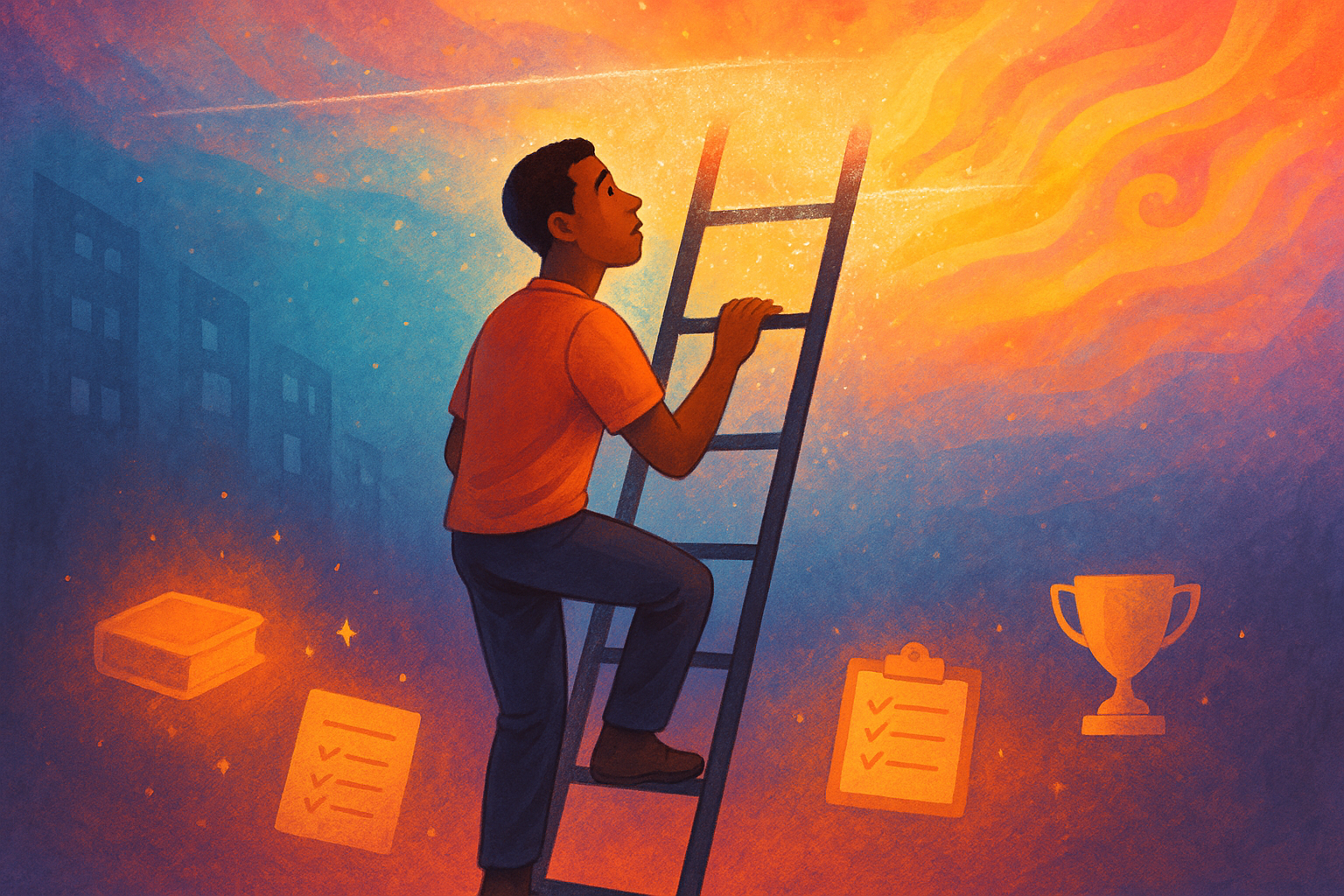
    I pursued excellence like a ladder—one rung at a time. If I could just learn more, do more, prove more, I’d be better. Right?

    Getting fired shattered that illusion.

    The Developmental Path That Most of Us Walk

    Looking back now, I can see that I was following a very common path—the one most of us are taught from the time we’re kids. I call it the Doing Better Development Path.

    This path tells us that if we want to grow, we need to learn more, improve our skills, work harder, set goals, and check more boxes. And to be fair, there’s nothing inherently wrong with this approach. It can absolutely help us improve in incremental ways.

    But the truth I’ve discovered—through my own pain, study, and coaching others—is that the Doing Better path has real limits.

    It doesn’t help us heal the parts of us that self-sabotage. It doesn’t address our fear of failure or our lack of self-trust. It doesn’t quiet the voice in our head that tells us we’re not enough.

    And it doesn’t help us become the person who can courageously show up in difficult moments.

    That was my problem—not a lack of knowledge or competence, but a way of being that was self-protective, hesitant, and reactive. I had the tools. But I wasn’t the kind of person who knew how to use them effectively when it mattered.

    What I needed wasn’t a new skill.

    What I needed was a new relationship with myself.

    The Shift: From Doing Better to Being Better

    In the months that followed being fired, I went through a season of reflection. Not just on what happened—but on how I was being in the world. I realized I had spent so much time trying to appear capable that I had stopped being curious. I had been defensive instead of open, self-protective instead of growth-oriented.

    That’s when I stumbled onto a different developmental path—one I now call the Being Better Development Path. This path doesn’t start with “What do I need to do?” It starts with:

    • Who am I being right now?
    • How am I relating to myself and the world around me?
    • What mindset or inner story is guiding my reactions?

    It was only when I started asking these questions that real transformation began.

    I’m not the same person I was when I got fired. And I don’t mean that in a vague, inspirational sense. I mean that how I experience life, how I respond to challenge, and how I see myself has fundamentally changed.

    And it all started by turning inward—not to fix myself, but to understand myself.

    Three Steps to Start Walking the Being Better Path

    The beautiful thing about the Being Better path is that it doesn’t require a job change, a spiritual awakening, or a year off in Bali. It just requires intentional self-exploration.

    If you feel stuck, or if you’ve been trying to grow but keep hitting a wall, here are the three steps that helped me begin my transformation—and may help you too.

    1. Understand Your Being Side

    Most people think personal growth begins with action—what do I need to do to get better?

    But real, transformational growth begins with awareness—specifically, awareness of your Being Side. Your Being Side is your internal operating system. It’s the invisible system that governs how you see the world, how you interpret what happens to you, and how you respond in any given situation.

    This system isn’t just about thoughts or beliefs—it’s also about how your body regulates itself. Your Being Side controls your ability to feel safe or threatened, connected or isolated, grounded or overwhelmed. In other words, it determines whether you’re operating from a place of trust, compassion, and courage—or from fear, defensiveness, and self-protection.

    Here’s the catch: most of us never stop to consider that we have an internal operating system, let alone evaluate its quality. We assume that how we react or what we believe is just “the way it is.” But it’s not. It’s just the way your Being Side is currently wired.

    When you start to observe your internal operating system—how you regulate emotionally, how you make meaning, how you instinctively react—you take the first step toward real, lasting transformation. You begin to shift from living on autopilot to living with intentional awareness.

    This awareness lays the foundation for the next step: evaluating the quality and altitude of your Being Side, so you can start the process of elevating it.

    2. Evaluate Your Current Being Altitude

    Once you begin to understand and connect with your internal operating system, the next step is to evaluate its quality.

    One powerful way to do this is to ask: Is my internal operating system primarily wired for self-protection or for value creation?

    When we are wired for self-protection, we tend to be:

    • Reactive
    • Defensive
    • Focused on avoiding discomfort, failure, or rejection
    • Concerned with preserving our ego or image in the short term

    When we are wired for value creation, we tend to be:

    • Intentional
    • Open and non-defensive
    • Willing to engage with challenge or discomfort to grow
    • Focused on long-term contribution, connection, and learning

    Here’s a simple example:

    Imagine someone gives you constructive criticism. If your internal operating system is wired for self-protection, you might feel attacked, justify your actions, or get defensive. But if your system is more oriented toward value creation, you’re more likely to receive the feedback with curiosity, reflect on it honestly, and use it to grow.

    Or consider moments of failure:

    A self-protective mindset might spiral into self-blame, shame, or disengagement. A value-creating mindset sees failure as a teacher, not a threat—and leans in with resilience.

    The goal isn’t perfection. We all have moments of self-protection. But the more we become aware of these patterns, the more we can assess where we are on the Being altitude spectrum—and begin to consciously shift upward.

    That’s what the third step is all about: the process of elevating your Being Side so you can experience real transformation.

    3. Elevate Your Being

    Understanding and evaluating your Being Side is essential—but real transformation happens when you begin to elevateyour internal operating system.

    Your way of being is like the software that runs your life. If you want to experience new results—not just in what you do, but in how you feel, connect, and show up—you have to upgrade the programming of that system.

    Elevating your Being isn’t about forcing change from the outside in. It’s about rewiring how you regulate, perceive, and respond from the inside out. And this often requires intentional, layered efforts.

    Here are three levels of development that can help:

    1. Basic Efforts: Strengthening Regulation

    These include practices like meditation, breathwork, mindful movement, or simply spending time in nature. These activities help calm and regulate your nervous system so you can operate with more presence and less reactivity. They’re foundational for building the internal safety needed for deeper growth.

    2. Deeper Efforts: Upgrading Mindsets

    Your mindsets are the lenses through which you interpret the world. When you begin to shift from fixed to growth, from fear to trust, from judgment to compassion, you start processing life in a more value-creating way. This level of work helps you move from reacting out of habit to responding with intention.

    3. Even Deeper Efforts: Healing at the Source

    For many of us, our Being Side is shaped by past experiences—especially painful or overwhelming ones that left an imprint on our nervous system. Practices like trauma therapy, EMDR, or neurofeedback therapy can help us heal, not just cope. They allow us to safely revisit and release the patterns that keep us stuck in self-protection mode.

    None of these approaches are “quick fixes.” But together, they help us shift from surviving to thriving—from being stuck in old programming to becoming someone new, from the inside out.

    The more we elevate our Being, the more we expand our capacity to create value, deepen relationships, lead with integrity, and live with freedom.

    There’s No Finish Line—But the View Keeps Getting Better

    I wish I could tell you that once you step onto the Being Better path, everything becomes easy. It doesn’t. Growth is still hard. Life is still life.

    But your experience of life changes. You become less reactive, more present. You stop chasing success to feel worthy—and instead create from a place of wholeness.

    This has absolutely been true for me.

    Over the past several years, I’ve incorporated all three levels of effort into my life. I meditate regularly to calm my nervous system. I’ve done deep mindset work to shift how I see myself and others. And I’ve engaged in trauma therapy to heal long-standing patterns I didn’t even know were holding me back.

    These efforts haven’t just changed what I do—they’ve changed who I am. I feel more grounded, more open, more aligned with the person I’ve always wanted to be. I’ve become a better partner, parent, friend, and leader. And for the first time, I feel like I’m living from the inside out—not trying to prove something, but simply trying to be someone I respect and trust.

    Ultimately, the Being Better Developmental Path is not about achievement. It’s about healing—healing the mind that spins with doubt, the body that tenses with fear, and the heart that aches for connection.

    And when we begin to heal, we become free.

    Since stepping onto this path, I’ve written books, launched a business, and built a community I care deeply about. But more importantly, I’ve become someone I’m proud to be—someone more resilient, more compassionate, more alive.

    If you’re tired of doing all the right things and still feeling stuck, consider this:

    Maybe the path forward isn’t about doing more.

    Maybe it’s about becoming more.

    Not someone different—but more you than you’ve ever been.

  • The 5 Qualities You Need to Change Your Life

    The 5 Qualities You Need to Change Your Life

    “In any given moment we have two options: to step forward into growth or step back into safety.” ~Abraham Maslow

    Have you ever wondered what true personal development requires? What it truly takes to change your life?

    I have, and it’s a question I have been asking myself for years.

    As someone who was on a journey that could better be described as personal decline than personal development, I felt stuck living a life I hated.

    Around two years later, after having improved or completely changed every aspect of myself that I didn’t like, I can honestly say I am a totally different person.

    My confidence went from not being able to go to my local supermarket to speaking to hundreds of people every day.

    My self-belief went from thinking I’d never leave the job I hated to believing and striving for financial freedom.

    My discipline went from being unable to stick to any exercise routines and diets to being in the best shape of my life.

    I don’t share all this to brag—I share it to inspire anyone who feels stuck to finally become the person they know, deep down, they can be.

    It’s not only from personal experience that this obsession of mine has grown but also from seeing people around me who are always attempting to change for the better but just can’t seem to make it last.

    From my own experience and observations of others, I’ve learned that certain qualities are essential for lasting change.

    Having all five will not guarantee you’ll be successful, but not having all of them guarantees won’t succeed.

    Without further delay, here are five things you’ll need to finally become the person you want to be.

    1. Responsibility

    Without the ability to take responsibility, all other principles are useless.

    By not taking responsibility for your situation, you give all your power to the external factors or people that you blame, leaving yourself helpless.

    If you can’t take responsibility for something, you can’t change it.

    Taking responsibility isn’t blaming yourself; it’s taking accountability for whatever situation you find yourself in now, regardless of how you got there.

    I used to blame my childhood for who I was, but how does this help me in any way? It didn’t. Instead, it kept me the same—a person I wasn’t proud of.

    I didn’t blame myself for it, but I took responsibility for how I was going to deal with it moving forward. This allowed me to finally take action, and my life improved greatly as a result.

    2. Self-belief

    If you don’t believe you can change, are you even going to try?

    That’s why, to grow, you must first believe you’re capable of it, and to do this, you have to take action.

    If you’re anything like I used to be, doubting your ability to break free from your situation and tired of endlessly repeating affirmations to yourself in the mirror, it’s time to get some evidence.

    This teaches the brain that really you are capable of achieving the goals you set. Without evidence, you’ll never truly believe that anything has changed, because without it, what makes this time any different from the last?

    But how do we get that evidence?

    This is all about starting small. It’s setting smaller goals or challenges, ones that you may even doubt you can achieve, and then working diligently until you succeed.

    This could be anything from waking up an hour earlier every day to taking daily cold showers. Whatever it may be, do it until you’ve gained irrefutable evidence that you’ve succeeded at something you didn’t think you could do.

    From here, you set slightly bigger goals, achieve them, and repeat.

    Eventually, you’ll prove yourself wrong so many times, you’ll have no choice but to believe you can do anything.

    3. Discipline

    Personal development is hard, and if you quit when things get hard, you’ll never succeed.

    As I said, my levels of discipline used to let me down constantly. Whenever something got difficult, I’d let the uncomfortable feelings overwhelm me until I’d quit altogether.

    With anything worth pursuing, there will come a time when continuing feels challenging. This is unavoidable. Therefore, being successful with personal development requires the ability to feel uncomfortable but keep going anyway.

    Discipline allows you to do just that; it frees you from the prison of discomfort.

    Just like self-belief, you can build discipline by starting small and working your way up.

    Choose something difficult, something uncomfortable, and do it anyway.

    You can kill two birds with one stone here by using something like a daily cold plunge or exercise to grow your self-belief and build discipline simultaneously.

    Discipline is like a muscle; it can grow, and the bigger it gets, the more it can handle.

    4. Consistency

    Without consistency, your chances of creating meaningful results are slim.

    I used to expect results instantly. I wanted results the moment I began something. This was not only unrealistic but often impossible.

    It was the lack of discipline and the inability to remain consistent that contributed to most of my quitting.

    Over time, I realized it wasn’t the luckiest, smartest, or even most talented people who were the successful ones. The people who showed up every single day and refused to quit were the ones with all the success.

    One single water drop hitting a rock does absolutely nothing, but eventually, it carves and shapes the rock. The same can be said for going to the gym or anything else in life; it’s the consistent effort over time that gets you in shape.

    And so, I applied it to my own life and finally started seeing the results I desired.

    If you want change, you have to trust the process and show up every single day. Once you see the results that consistency gets you, you’ll no longer be relying on faith but on concrete evidence, making it much easier to show up when you least feel like it.

    5. Focus 

    In today’s world, it has become extremely difficult to avoid all the noise. With a pocket full of distractions, remaining focused has never been so hard.

    With social media, endless notifications, and more content than we could ever possibly consume, it’s enough to derail even the most focused among us. This is why it’s essential to ensure your thoughts and actions align with your goals.

    If you’re easily distracted, you’ll find yourself buying into new shiny opportunities over and over again, keeping yourself at the starting line.

    You’ll either be too distracted watching useless content or too easily influenced to stick to one thing at a time—and both will keep you from succeeding.

    The longer I spent doing just that, the more I realized that every path is hard, and for every path come hundreds of differing opinions on which way is best. Only when I stuck to one thing and focused on doing it well did I finally see results.

    So, if you want to finally become the best version of yourself and achieve your goals, you’ll need to limit distractions, stay committed to your journey, and focus on mastering one thing at a time.

    So there you have it, the five fundamentals of personal development. It’s time to go take action and become your best self, one small step at a time.

  • Dancing with Darkness: How to Reclaim Your Whole Self

    Dancing with Darkness: How to Reclaim Your Whole Self

    “Shadow work is the way to illumination. When we become aware of all that is buried within us, that which is lurking beneath the surface no longer has power over us.” ~Aletheia Luna

    For years, I believed healing was about transcending pain. I took the courses, read the books, learned every energy-healing technique I could find, and became a healer myself.

    And for a while, I felt better. I had breakthroughs. My anxiety lessened.

    My depressive episodes became fewer. But they never fully disappeared. Even after all the inner work, there were still days when I felt unbearably low. Days and nights when my thoughts raced, full of fear and doubt.

    I told myself that if I was truly healing, these feelings shouldn’t exist anymore. That if I was really evolving, I wouldn’t feel this way.

    And worst of all, if I was a healer, how could I possibly still struggle?

    Surely, I was doing something wrong.

    I started questioning myself. Maybe I wasn’t “good enough” as a healer. Maybe I wasn’t doing enough inner work. MaybeI just wasn’t meant to be on this path.

    So I doubled down. I meditated longer. Journaled more. Cleared my energy. Did affirmations.

    And yet, the sadness still found me. The anxiety still whispered its fears. No matter how much I tried to fix myself, these emotions refused to leave.

    It wasn’t until I stopped fighting my pain that something shifted. I realized I had spent years treating my emotions as something to get rid of. But healing isn’t about eliminating pain: it’s about becoming intimate with it.

    So instead of suppressing my darkness, I started getting to know it. Instead of running from my emotions, I sat with them—fully present, without trying to fix them.

    I let my sadness speak through poetry.

    I let my anxiety move through dance.

    I let my shadows express themselves through art, writing, and stillness.

    And something unexpected happened. The more I embraced my pain, the less power it had over me. The more I let myself feel without judgment, the more compassion I had for myself.

    I learned that healing isn’t about reaching some perfect, pain-free version of yourself. It’s about integrating every part of you—even the ones you used to reject.

    I realized that being a healer doesn’t mean being free of struggle. It means having the courage to meet yourself exactly as you are—without shame, without resistance, and with deep, unwavering love.

    Because healing isn’t about erasing your darkness.

    It’s about learning to dance with it.

    What is the Shadow Self?

    Our shadow consists of the parts of ourselves that we’ve been taught to hide: our fears, suppressed emotions, unprocessed pain, and even our untapped strengths.

    Maybe you were told as a child that expressing anger was “bad,” so you learned to suppress it.

    Maybe you grew up believing that vulnerability was weakness, so you built walls around your heart.

    The shadow isn’t just made up of things we perceive as negative; it can also include hidden gifts. Some of us hide our power because we were taught it wasn’t safe to shine.

    Some of us suppress our intuition because we fear being wrong. Some of us bury our true desires because we’ve been conditioned to think they’re unrealistic or selfish.

    But here’s the thing: Whatever we suppress doesn’t disappear. It just works against us in unconscious ways.

    Our unhealed wounds can show up as:

    • Feeling stuck in the same painful patterns
    • Emotional triggers that seem to come out of nowhere
    • Self-sabotage, procrastination, or fear of success
    • Overreacting to certain behaviors in others (often mirroring what we reject in ourselves)
    • Feeling disconnected, numb, or unfulfilled despite “doing the work”

    So how do we begin integrating our shadow instead of fearing or avoiding it?

    5 Ways to Begin Shadow Integration

    1. Get curious about your triggers.

    One of the easiest ways to identify our shadow is to pay attention to what triggers us.

    Have you ever felt an irrationally strong reaction to something? Maybe a passing comment made you feel deeply insecure, or someone else’s confidence irritated you.

    Our triggers are messengers. They reveal wounds that are still waiting to be healed and integrated.

    Reflection prompt:

    • Think about the last time something upset or irritated you. What was the deeper emotion beneath it?
    • Does this remind you of a past experience or belief?
    • If this was a message from your inner self, what would it be saying?

    When we can sit with our reactions instead of judging them, we open the door to healing.

    2. Identify what youve been taught to suppress.

    Many of our shadow aspects were created in childhood. We learned that certain emotions, traits, or desires weren’t “acceptable,” so we buried them.

    Ask yourself:

    • What parts of myself did I feel I had to hide growing up?
    • What qualities do I judge in others (and could these be aspects I’ve rejected in myself)?
    • What dreams or desires have I talked myself out of because they feel “unrealistic” or “selfish”?

    For example, if you were taught that being sensitive meant being weak, you might suppress your emotions and struggle with vulnerability. If you were raised in an environment where success was met with jealousy, you might unconsciously fear stepping into your full potential.

    By bringing awareness to these patterns, you can begin to rewrite them.

    3. Practice sitting with uncomfortable emotions.

    Most of us weren’t taught how to sit with our emotions. We were taught how to suppress, avoid, or “fix” them.

    But emotions are not problems. They are messages.

    Instead of pushing away sadness, frustration, or fear, try welcoming them as temporary visitors.

    Try this:

    • When a difficult emotion arises, pause, and say, I see you. I hear you. I am listening.
    • Notice what sensations arise in your body.
    • Breathe deeply and allow yourself to sit with it, without rushing to change it.

    The more you practice this, the less power your emotions will have over you.

    4. Reconnect with your inner child.

    Much of our shadow is rooted in childhood experiences—times when we felt abandoned, unworthy, or unsafe.

    Healing these wounds requires reparenting ourselves with love and compassion.

    A simple inner child exercise:

    • Close your eyes and imagine your younger self standing in front of you.
    • Picture them at an age when they felt most vulnerable.
    • Ask: What do you need to hear right now?
    • Offer them the love, validation, and reassurance they may not have received.

    This simple practice can be incredibly powerful in healing past wounds and integrating your shadow.

    5. Express what youve been holding back.

    Shadow integration isn’t just about recognizing our hidden parts. It’s about allowing ourselves to express them in healthy ways.

    If you’ve suppressed your voice, start speaking up.

    If you’ve buried your creativity, allow yourself to create freely.

    If you’ve been afraid of taking up space, start owning your worth.

    Challenge yourself:

    • Identify one way you’ve been keeping yourself small.
    • Take one small step toward expressing that part of yourself this week.

    When we integrate our shadow, we reclaim the full spectrum of who we are.

    Embracing Your Whole Self

    Healing isn’t about becoming perfect. It’s about becoming whole.

    The parts of us that we once rejected hold immense wisdom, creativity, and strength. When we integrate them, we unlock a new level of self-awareness, freedom, and inner peace.

    So, the next time your shadows appear, instead of running from them, try sitting with them.

    Instead of fighting your fears, try listening to what they have to teach you.

    Instead of rejecting the parts of you that feel unworthy, try offering them love.

    Because healing isn’t about erasing your darkness.

    It’s about learning to dance with it until it, too, becomes light.

    I would love to hear from you: What’s one part of yourself you’re learning to embrace? Drop a comment below.

  • Feeling Stuck? Maybe You Don’t Need to ‘Fix’ It Right Now

    Feeling Stuck? Maybe You Don’t Need to ‘Fix’ It Right Now

    “Growth is painful. Change is painful. But nothing is as painful as staying stuck where you do not belong.” ~N. R. Narayana Murthy

    Anyone who had a Stretch Armstrong as a kid remembers that moment when you and a friend would test the limits of what good ol’ Armstrong could handle. You’d each grab an arm and slowly walk backward, waiting for that pivotal moment when either your strength would give out or Armstrong’s limbs would tear apart like a medieval torture device.

    If you reached your strength limit, an older sibling would eagerly join in—nothing brought them more joy than watching your excitement dissolve into tears as Armstrong’s newly limbless body crossed the point of no return.

    Why do we get stuck? We fail to define stuckness for what it is.

    Feeling stuck does not mean your feet are superglued to the floor.

    Being stuck is an active state that pulls you in opposite directions—just like Armstrong. One part says, “Don’t give up,” while another says, “This isn’t working.” No wonder it’s impossible to move forward. But what if, just for a moment, you didn’t have to choose?

    What if you could just be with this stuckness without needing to solve it right now?

    Maybe even acknowledging it, like, “I’m stuck, and it makes total sense considering all the shit going on in my life.”

    I’m currently dealing with existential angst about my career. While there are so many advantages to working for yourself—no one telling you where to be or what to do and having freedom over your time—the downside is flipping that world upside down: with no one checking in, it’s painfully isolating. There’s no one to lean into or pick up the slack on hard days, and there’s no sense that you’re working toward a common goal. You own everything.

    Warren Buffett’s right-hand man, Charlie Munger, famously stated, “Life is all about making wise choices and dealing with trade-offs. In business and elsewhere, I’ve yet to see a good example of something that’s totally free—there’s always a catch, always a cost.”

    Being happy does not come from avoiding trade-offs but from being clear-eyed about which ones you’re willing to accept.

    This is where I’m stuck. I’m not sure those trade-offs are worth it anymore. After eight-plus years of working solo, I’m hearing the siren call of a life I long for, being a part of a cause bigger than myself.

    But how do you distinguish between times when you should sit with uncertainty and times when you need to take decisive action and stop overthinking?

    Powerful question, eh?

    There’s a real balance between giving something space and taking action; it can be hard to know what is needed.

    This is the clarity that awareness can give us.

    It’s an opportunity to notice the energy behind your desire to act.

    Does action feel like it’s coming from urgency, fear, or the need to escape discomfort?

    That’s a damn good sign action is not the answer.

    Or do you have a sense of clarity, even if it’s not total certainty?

    If the action feels like relief rather than running, that might be a sign it’s time to move.

    When you think about taking action right now, does it feel like relief and alignment? Or does it feel more like panic and pressure?

    I don’t have clarity. I don’t know what I want. I’m flooded with emotions.

    My energy is pulsing with urgency, fear, and a need to escape the discomfort.

    What does that tell me? I’m trying to make a decision from a place that’s not grounded.

    That doesn’t mean I won’t take action—it just means my system needs more space, so I’m not making decisions from a place of fear.

    In a culture that sees action as the only solution, it’s easy to be swept away by thinking movement is how we solve stuckness, but this comes back to failing to see it for what it is: You’re being pulled in opposite directions.

    The faster you race toward answers, the more answers race away.

    I’m no further ahead than you on this adventure. Life is unfolding for both of us, one day at a time.

    Know that I see you.

    Instead of taking action, would it feel supportive to take a small step toward grounding?

    Maybe a deep breath, placing a hand on your heart, or even reminding yourself, “I don’t have to figure this all out right now.”

    Would it feel okay to just acknowledge that for a moment? Letting all parts of you know, “I see the pain, I see the urgency, and I’m not ignoring you. I just want to move from a place of clarity, not fear.”

    You don’t have to rush—just allow yourself to settle before deciding what’s next.

    How does that feel?

    Finding that starting point—where you feel grounded instead of just reacting—is everything.

  • How to Get Out of Your Own Way and Bring Your Dreams to Life

    How to Get Out of Your Own Way and Bring Your Dreams to Life

    We cannot solve our problems with the same thinking we used when we created them.” ~Albert Einstein

    For a long time, I lived under the illusion that I was solving the problems standing between me and my desires.

    Whether it was love, success, or the kind of life I dreamed of, I believed I was taking the necessary steps to create what I wanted. But what I was really doing (without realizing it) was keeping those things forever at arm’s length.

    I was trying to create something from the same conditioning I’d adopted to navigate a difficult childhood, and all it did was reinforce the self-concept I’d walked away with (low self-worth and feeling “unreal” and inferior) and create more circumstances that reflected that self-concept back to me.

    This happened across the board.

    Early on in my business, I’d pour everything into creating an offer—a course, a program, something I deeply believed in.

    I’d work tirelessly, build a sales page, send out an email, and if the response wasn’t immediate, if people didn’t sign up right away, I wouldn’t send another email (or ten) or look at the data and refine accordingly.

    Instead, I would assume that something was wrong with me. That I needed to be better, work harder, explain myself more, train more, throw it all away, and start over.

    What I wasn’t seeing was the most basic thing every successful entrepreneur knows: sales take time, and people need multiple touch points before they buy.

    I couldn’t see that. So I’d abandon ship too soon, leaving money on the table and keeping myself stuck in a cycle of proving, perfecting, and starting from scratch. This lasted YEARS.

    The very same pattern shaped my love life in my twenties.

    I wanted deep, healthy, genuine love more than anything, but…

    I gravitated toward men who were emotionally unavailable and mirrored the same early-life relationships that affirmed my low self-worth.

    And when a relationship was killing me, when they didn’t commit or were inconsistent, withholding, or dismissive, I didn’t think, “Hmmm, maybe they aren’t the right fit for the deep, healthy, genuine love I want, and it’s time to let this go and look for what I want.”

    Instead, I thought, it must be me.

    I was sure if I was better—more lovable, cooler, thinner, more normal, less broken, more aligned with their wants, beliefs, and perspectives—things would change.

    But they didn’t. And I’d leave these relationships with a reinforced sense that I was not enough, and the problem was me, not the kind of men I was picking. Which kept me attracted to men who reflected that back to me.

    It was an unconscious feedback loop.

    The same thing happened with one of my biggest life decisions—moving to Tuscany.

    For years, I knew I wanted this life. I pictured myself in the Italian countryside, building a life that felt expansive, rich, and connected to nature. But I kept telling myself I wasn’t ready. That I hadn’t accomplished enough. That I’d allow myself this when I was somehow “good enough” to deserve doing what I knew I wanted to do.

    But this time I interrupted my pattern.

    I asked myself, “What if I stop trying to make myself good enough for whats already in my heart and just take the steps to make it happen?”

    I’ve been living on this Tuscan hilltop for two and a half years.

    That moment showed me something big:

    The conditioning that tells you to keep fixing yourself, that tells you anything thats not working the way you want it to boils down to a deficit in YOU, stems from deep childhood wounding and is the very thing keeping your desires out of reach.

    The problem isn’t you. When you think you’re the problem, you focus on fixing yourself, which robs you of your power to address the real issue and create the life, love, friendships, business, and bank account you’re already worthy of.

    Back then I wasn’t really finding the right business strategy—I was trying to make myself good enough and hoping my business would do that for me. It didn’t.

    I wasn’t really creating healthy relationships—I was trying to be chosen by men who were incapable of real intimacy. Never lasted more than a couple of years.

    I wasn’t really building the life I wanted—I was trying to become the kind of person I believed was worthy” of it.

    None of this actually moved me forward. It was just a feedback loop that kept me stuck in the same cycle.

    But when I started separating my present desires from my emotional baggage and past distortions of how to get from A to B, everything changed. Life started happening instead of me waiting to be given permission for it to happen. You know what I mean?

    If you find yourself spiraling inside your own feedback loop, I invite you to ask yourself:

    • Am I treating every setback as proof of my inadequacy instead of seeing it as data and feedback that lets me know what I need to adjust to get to where I want to be?
    • Am I trying to be “better” for people who are fundamentally incapable of giving me what I want?
    • Am I waiting to feel “good enough” before I allow myself to take the steps that would get me there?

    Because the problem was never you. And the moment you stop trying to fix yourself for what you want—and start taking the steps to claim it—you’ll finally see just how much was always available to you.

  • How to Reconnect with Your Higher Self for Clarity and Direction

    How to Reconnect with Your Higher Self for Clarity and Direction

    “Listen to the wind, it talks. Listen to the silence, it speaks. Listen to the heart, it knows.” ~Native American Wisdom

    Have you ever felt stuck? Stuck in a business you’ve lost passion for, a job you no longer enjoy, a relationship that no longer fulfills you, or simply stuck in indecision about how to move forward in life?

    That feeling of “stuck-ness” often leads to anxiety, fear, and even shame. I understand these feelings well.

    When the pandemic hit in 2020, my life turned upside down—as it did for many. I was the founder and executive director of a national arts organization, something I had built from the ground up and led for eighteen years.

    Suddenly, overnight, I felt like I could lose it all. My funding partners and sponsors pulled out, I was sinking deeper into my line of credit, and I was responsible for a staff spread across the country.

    The stress was overwhelming. I couldn’t sleep, I became irritable and edgy with my family, snapping at them over the smallest things, and some days it took a tremendous amount of willpower to just get out of bed and face the day. I had never felt so lost, uncertain, or fearful.

    It wasn’t just the fear of losing a business and my paycheck—although that certainly caused a lot of anxiety. The bigger fear was losing my sense of identity. Who was I if I wasn’t the executive director and founder of this organization? Before starting this non-profit, I felt insignificant, like a nobody. I didn’t want to go back to that place. I didn’t want to lose what I had built.

    This fear consumed me, and I asked everyone I knew, “What am I supposed to do?”

    One day, I brought this question to my business coach. She responded with a single question of her own: “What do you typically do when you feel stressed and anxious?”

    “Well, I usually go for a walk in the woods,” I replied.

    “Perfect,” she said. “Here’s what you’re going to do: Every day for the next thirty days, you’re going to go for a walk in the woods and simply look and listen.”

    “What? I can’t do that. I don’t have time for that,” I stammered. In my head, I thought, What kind of business coach tells her clients to go for a walk in the woods? I needed business advice, not nature therapy.

    Somehow, she got a commitment out of me. Every morning at dawn, as this was the only time I felt I could make this daily walk work, I was out the door into the forest behind my house. And every day, I demanded answers from God, the squirrels, and the universe: “What am I supposed to do?”

    Slowly—ever so slowly—something shifted. A sense of calm settled over me. I began to notice the beauty around me: the varying shades of green, the way light filtered through the canopy of leaves, the chorus of birdsong, the creek’s melody as it rushed over rocks, the silky texture of moss-covered bark, the intoxicating scent of spring blossoms—you could almost taste the air.

    And then, I started to feel gratitude. Gratitude for the trees, the air, the stillness. Gratitude for my business coach, who had nudged me toward this practice. This gratitude felt like a swelling of love in my chest for everything that is in this moment.

    And in this calmer state of mind with gratitude in my heart, I asked the question again: “What am I supposed to do?”

    This time, I got an answer.

    “What do you want to do?” a voice bubbled up from within.

    It was my own voice—but like an older, wiser version of me.

    I didn’t miss a beat. “What do you mean, what do I want to do? What am I supposed to do?”

    “No, Anita,” came the steady response. “What do you want to do?”

    “I don’t know. I don’t know.”

    “Yes, you do.”

    That stumped me.

    Later that day, I found myself wandering the spirituality section of a bookstore. A book caught my eye: Conversations with God by Neale Donald Walsch. I picked it up, flipped it open, and one line jumped off the page:

    Frustration and anxiety come from not listening to the soul.”

    My breath caught. I read the words again, letting them sink in. In that moment, I realized a profound truth—I wasn’t listening to my soul.

    I had been here before. This wasn’t the first time I’d been reminded to slow down, go inward, and reconnect with my inner wisdom. But I had gotten so busy, so caught up in my business, my family, and all my responsibilities, that I had forgotten. Not only did I lose my connection to that part of myself, but in many ways, I had lost sight of who I really was and what I truly wanted.

    For nearly five years now, I’ve devoted myself to the study of remembering—of reconnecting with my higher self, God, Source, the Universe (whatever name feels right to you—they are all the same to me). When we connect with our higher self and consistently listen to our soul voice, three truths are revealed:

    • The truth about who we are.
    • The truth about what we really want.
    • And the truth about why it matters.

    When we stop listening to our inner wisdom, we become drowned out by external noise—the voices of others telling us who we should be, the media convincing us we’re not enough, the fearmongering that keeps us feeling small and powerless.

    But when we reconnect with our higher self:

    • Clarity of purpose and direction emerges.
    • Fear and self-doubt loosen their grip.
    • An inner harmony steadies us, no matter how chaotic the world seems.
    • Our capacity for self-love deepens.

    And with that, we become un-stuck. We step into our greatest potential. We create a life filled with meaning, well-being, and joy.

    How Do We Reconnect with Our Higher Self?

    When I first realized I was asking the wrong question and switched to asking, What do I want?”, I skipped an essential step—the inner work that allows you to connect with your higher self and find the answers you seek. Eventually, I figured it out. And it’s really quite simple.

    At its core, reconnecting with your higher self is about slowing down and giving yourself the time and space to cultivate that relationship.

    Here are three key steps to help you do that.

    Step away from the busyness of life.

    Block out time each day to unplug from work, responsibilities, and distractions. Make this a daily non-negotiable. My favorite way to unplug is by walking in nature, which has additional health benefits. I recommend at least twenty minutes of mindful walking daily. Mindful walking is a form of meditation, but simply sitting in meditation is also a great option.

    Speak your gratitude.

    Science has shown that practicing gratitude reduces stress, elevates mood, and improves overall well-being. More importantly, it opens the heart—making it easier to hear the whispers of your soul.

    Engage all your senses in the present moment.

    What do you see, hear, smell, feel, and even taste? When you fully engage with your environment using all your senses, you become present. And presence is the gateway to connecting with your higher self.

    Once you’re grounded in the here and now, that’s when you ask yourself one simple question: “What do I want?” Then, listen.

    Listen with your whole body. Pay attention to ideas that surface, images that appear in your mind’s eye, sensations that arise. Don’t judge any of it. Just be open and curious.

    Nothing may come at first. But keep returning to this practice—getting present, going inward, and asking, What do I want? Soon, you’ll hear the whispers of your soul. And if you learn to listen and act on those whispers, you too will get unstuck and be guided to a most remarkable life.

    Are You Ready to Listen to Your Soul?

    I invite you to embark on your own thirty-day nature challenge. Each day, step outside, breathe deeply, and simply observe. Let nature be your guide as you reconnect with your inner wisdom. Notice what shifts within you—how clarity emerges, how gratitude deepens, how your soul whispers its quiet truths.

    Will you take the challenge? Let me know how your journey unfolds—I’d love to hear what insights arise for you.

    PS: In case you’re wondering what happened next—when I finally tuned in and listened to the whispers of my soul, my life radically changed. I realized that what I truly wanted was to close my business, as I had lost my passion for it years ago, but fear had kept me stuck. The whispers of my soul then guided me to let go of most of my possessions and embrace a nomadic lifestyle.

    This decision has led my husband and me on an extraordinary journey, experiencing many incredible corners of the world. Along the way, I recreated myself as a life and leadership coach, guiding others on their journey to their highest selves. As I continue to listen, life unfolds in the most beautiful and unexpected ways.

  • Getting Unstuck After an Unexpected Life Change

    Getting Unstuck After an Unexpected Life Change

    “If you don’t know where you are going, any road will get you there.” ~Lewis Carroll

    After an unfortunate layoff earlier this year, I found myself feeling stuck, spiritually, physically, and mentally. I had moved from Virginia to Los Angeles for my MBA, and I was working remotely as a product manager for a climate fintech company, which combined a lot of things I enjoyed.

    In the two years I had spent out west, I built a great group of climbing buddies, felt a sense of community, and was involved with local non-profits. Los Angeles wasn’t a perfect match for me, but I had made myself at home, and I was feeling settled.

    When the layoff happened, it was jarring. I felt I was an asset to the company, and I had built solid relationships and finished important work in my tenure there. But I wanted to maintain the go-with-the-flow attitude I aspire to, so I told myself everything was fine.

    After my computer dramatically shut itself off, I pulled out some Post-it notes. Then I added to my wall some goals that I wanted to accomplish in my personal and professional life, with my newfound lack of purpose. I knew a big shift was happening and it felt non-consensual.

    I had been content in my role. And previously, my life changes had been easy to predict. Graduate > get a job > apply to grad school > move near the grad school > get a job > aim for promotion. I had yet to experience a life change where I didn’t know what was next by the time the last chapter ended. I felt like I was in a sort of purgatory, waiting for something to happen to me.

    I started applying to jobs right away to numb that feeling and the discomfort it brought. Initially, I was searching for an exciting opportunity to magically appear and fill my time. 

    I didn’t expect much to change in my life, just the team and the name of the company I worked for. I expected to get hired and go back to what I was doing before—working on something I cared about, living in Los Angeles, and continuing my nice little life I had started to feel comfortable in.

    But I struggled. The market wasn’t great, and I found myself putting in great effort on applications only to be rejected automatically. Or I’d get interviewed, but they’d decide to hire internally instead. Nothing seemed to work out, and I couldn’t figure out why. I was networking, customizing my resume and cover letters, and getting referrals—everything I was supposed to be doing after a layoff. It was demoralizing.

    Eventually, I realized I was struggling because I was resisting the change. I was looking for the same situation I’d had—remote work as a product manager in climate tech. I was trying to resurrect the life I had been living before. But that version of reality was over, and there was no going back. 

    Even if I got a new role in the same industry and function, life would be different; it was a new chapter. And maybe seeking out something that already left my life wasn’t a great idea but was actually a way of clinging to the past.

    So I set out to intentionally figure out what was next. I decided to give myself some space to do that, and I spent time road tripping, climbing, and sleeping outside or in my car, living very simply and introspecting. I looked back at how I’d ended up in the situation I was in. I had always been good at fulfilling the expectations of others and doing what I was “supposed” to do.

    External forces had driven my life. I had always been pushed toward something or pulled by something. I got a job offer, so I took the job; I got admitted, so I matriculated.

    I had never given myself permission to turn down a “safe” opportunity that came my way. I had never taken a next step in life from a point of stillness, only as a result of some irresistible magnetic external force.

    It was time to exist in the stillness and choose which path to go down rather than wait for something to pull me. As a people-pleaser, it felt daunting to sit in the stillness and create my own vision for my future, not driven by an external magnetic force. But I was already unemployed, aka not doing what I was “supposed” to be doing, so I figured I might as well lean into the discomfort and really focus on what I wanted.

    I had to get in touch with my own gut, something I had long silenced. So I evaluated the parts of my life that I liked and the parts that I wanted to adjust. It looked a lot like my annual goal setting, which was full of goals that I wasn’t going to reach this calendar year anymore, including “get promoted to senior product manager,” among other things.

    I evaluated my satisfaction with my life, broken out by category. I looked at how I spent my time within each category and how I felt during that time. These are the categories I used:

    1. Career & Financial

    2. Relationships

    3. Wellness

    4. Fun & Hobbies

    5. Lifestyle

    I was left with a clearer picture of what I valued versus what was in my life due to external forces. I loved climbing; I didn’t love living downtown. I loved working on climate issues; I didn’t love driving in traffic. I started creating a vision for my life with these values in mind and I began to feel more at ease.

    “The direction of your focus is the direction your life will move.” ~Ralph Marston

    One big takeaway I got from the exercise is that I was leaving the city to go climbing (and therefore sleeping in my car) more nights than I was spending in my downtown LA apartment. Plus, I had insomnia when I was staying in LA. When I lived out of my car, I felt at ease. Everything felt simpler and made more sense. I didn’t feel frenetic or stressed, yet only my surroundings had changed.

    That’s how I realized that my downtown apartment had come to represent clinging to the past. I didn’t even like spending time in it—my insomnia was cured whenever I left. It was time to leave that apartment for good. LA wasn’t the problem, but what the apartment itself had come to represent was pointing to the problem—I had been playing it safe trying to please others and ignoring my own gut. It was time to rearrange my life to stay focused on the things that energized me.

    I wanted to live out of my car and just climb for a little while. But that felt like jumping off a cliff. I researched options and talked to friends living the so-called “climbing dirtbag” lifestyle.

    I gave myself permission to embrace the instability and the uncertainty. I canceled my apartment without another living space lined up and moved my things into storage. I knew I would have challenges and inconveniences in my life either way. At least this way I felt in alignment with my gut.

    The move created real momentum in my life. I was no longer waiting to be pulled by the external happenings in my life. I was intentionally creating movement in the direction of something I wanted.

    I was moving even though it was scary, and even though the change may have been small in the eyes of others, I didn’t know how the gaps would be filled in or what would be next.

    The change was an emotional rollercoaster. The planning phase was incredibly stressful, amplified by the questions others asked me, which I did not have answers for. But once I started acting on my move, I felt more relaxed, then elated and grief-stricken all at the same time.

    I was relaxed because I fell into a flow of checking off to-do items. I was elated because opportunities were opening for me. I began to see a vision for a future that was positive and that also looked very different than the past. I was grieving the loss of the job I’d enjoyed and the life I’d had.

    I realized a lot of feelings I had silenced right after the layoff were surfacing during this move. In my effort to “go with the flow,” I hadn’t let myself fully experience the present moment and the discomfort it brought. I resisted rather than surrendering.

    I learned that I have to actually experience the discomfort that is there in my life. I can’t avoid it, or it will keep resurfacing again and again, pushing me to make a change. And if I experience it, it will pass.

    For me, there was so much tied up in the apartment and what it had come to represent. The change was hard, but I felt more authentic. I was in the driver’s seat, and I was starting to feel more comfortable making decisions about the direction I wanted to take.

    Just taking some small decisive action in alignment with my own vision for my future made it possible for me to see good things that might come next—possibilities that felt exciting. It’s a lot easier to exist day to day from a place of playfulness when the uncertain future feels bright.

    If you’re at a crossroads after an unexpected change, like I was, take a pause before jumping into a life that looks a lot like the one you had before. Maybe this is a perfect opportunity to reevaluate your life and consider what would really make you happy. Surrender to the changes, and the flow of life might surprise you.

  • The Hidden Reasons You’re Stuck (And What to Do When Conventional Advice Fails)

    The Hidden Reasons You’re Stuck (And What to Do When Conventional Advice Fails)

    “The truth is that our finest moments are most likely to occur when we are feeling deeply uncomfortable, unhappy, or unfulfilled. For it is only in such moments, propelled by our discomfort, that we are likely to step out of our ruts and start searching for different ways or truer answers.” ~M. Scott Peck

    Have you ever been in a situation or a stage in your life where you’ve felt physically stuck, as if you’ve fallen into some kind of invisible quicksand that you can’t get out of?

    Or maybe it’s felt more like you have a thick, invisible elastic band around your waist, and no matter how hard you push forward, it pulls against you, holding you in place? Or maybe it’s like a sky-high brick wall that you can’t find your way through, around, or over?

    Getting stuck in life can feel frustrating, annoying, upsetting, and confusing. And if you’ve been stuck for too long or at a time when you really need to move forward, you’ve probably found yourself panicking and feeling afraid because if you don’t take action, it may seem like your life will collapse—that you may end up financially destitute, homeless, alone, or a failure.

    The Place Where You Are Stuck is Your Growing Edge

    Everyone gets stuck at times. It tends to occur when you arrive on the threshold of a new direction, taking a risk, doing something new, or needing to leave something behind and launch yourself into the unknown.

    I’ve been stuck many times in my life, sometimes briefly and sometimes for longer periods when I’ve had to accept that I needed to make big changes to my life and along with them, make choices and difficult decisions or learn something deeply and powerfully.

    This place where you are stuck is your growing edge. It is the threshold between the known and the unknown, who you are and who you’re becoming.

    Sometimes you might have no idea why you’re stuck, only that you can’t move forward. It’s a place that you may consciously or unconsciously try to escape by either avoiding your stuckness or trying to get over your edge and out of the discomfort too quickly.

    Sometimes we get stuck unnecessarily for way too long because we keep hitting the edge and avoiding it or keep applying strategies to get unstuck that don’t address the real cause.

    We often think of getting stuck as a problem to solve, but in my experience, it usually holds a bounty of insight, gifts, power to reclaim, and healing. It can even serve the unfolding of your life by keeping you aligned with your destiny and soul’s callings (or greater purpose, if you don’t believe in those things).

    Why Conventional Advice Didn’t Help You Get Unstuck

    Much has been written about how to get unstuck, but I’ve found that a lot of the advice is based on unnamed assumptions about the reasons you are stuck.

    A common assumption is that it is a mindset issue, so a lot of the advice relates to changing your thoughts and conscious beliefs, cultivating different attitudes and positive mindsets, or using willpower to keep going and find the next step.

    If you have followed any of this type of advice but failed to get unstuck, you may feel like something is wrong with you. But I want to lovingly tell you that there isn’t anything wrong with you. The problem is in the solution that simply didn’t address the root of your stuckness.

    My Experience of Being Stuck

    My most recent bout of stuckness was pretty painful and at times frightening in the context of my life. After pushing hard over several days to write a heap of content for my business, I woke up the next morning feeling depleted, empty, and sad. And I couldn’t write again for weeks.

    If I was writing for fun, then maybe I could have just completely surrendered and waited for the words to return, but as a self-employed business owner, writing forms a large part of my work. I write all of my own website, blog, and marketing content. Not being able to write was scary because it put my business at risk.

    Initially, I tried all the usual things: surrender, acceptance, movement, doing something fun, positive self-talk and encouragement, believing in myself, and looking for the next small step I could take. While these things were helpful, especially in terms of alleviating stress, they didn’t help me get unstuck because when I came back to writing, I was still blocked.

    The Real Reasons I Was Stuck and How I Discovered Them

    When the usual things didn’t help me get unstuck, I sat down with my journal to start inquiring in a loving, gentle way about was happening in my experience and inside me.

    To begin, I did some slow, deep belly breathing with one hand on my heart and the other on my belly. This is a polyvagal breathing exercise that helps to bring your nervous system into a state of relaxation and increases your sense of safety.

    Then I sat with my experience of stuckness and the uncomfortable feelings that arose and noticed what was happening inside me. A conversation with my body and soul unfolded that continued on and off over many days.

    This is what I discovered about why I was stuck.

    1. I had become too immersed in masculine energy in my approach to my writing: linear, direct, and factual.

    I had made it a problem to be solved, a task to be completed. While I cared about writing well and my audience, I had disconnected from the deeper voice within me that held the poetry, beauty, and wisdom of what I truly wanted to say. I call this my soul voice. Essentially, I was trying to write from my head and not my heart.

    2. I was trying to write what I thought others wanted to know or read, in a way I thought I should do it, which wasn’t congruent with what my soul wanted to express through me.

    I believed that I had to write in a certain way to connect with people and be liked rather than just write as myself. I was trying to people-please, which is an old trauma response.

    3. Different parts of me were in conflict, and their conflict needed to be listened to and resolved.

    My sensitive parts didn’t like my overly practical approach to writing and were actively pushing against the “let’s get on with it” part that was trying to get it done. You could think of it like my heart pushing back against my head in opposition, saying “this isn’t the way to proceed.”

    4. Less obvious was an inner critic that redirected me to write from my head.

    Its voice was quiet, blended in my thoughts. It was trying to stop me from writing as my true self to protect me from the risk of criticism that a young innocent part of me would find devastating—an old trauma.

    Once I recognized and sat with all of my insights about why I was stuck, I was able to hear my deeper self and find my way back into writing by listening to what my heart and soul wanted to express, while reassuring my anxious parts.

    I shared little chunks of writing on social media that I felt inspired to share, not because I thought I should or wanted to please anyone but myself. This trickle eventually found its way to become a greater river. My writer’s block ceased. My stuckness was gone.

    The Hidden Reasons You’re Stuck

    The reason you’re stuck is not necessarily a result of your mindset, attitude, or willpower, or solely because of your beliefs. The reasons you are stuck are deeper than that.

    They’re often hidden, obscure, or unobvious because they’re hanging out in your unconscious where you haven’t looked or been able to see them. They can be entangled and intertwined.

    We get stuck because of deep inner conflicts between parts of ourselves that we aren’t aware of or listening to, limiting beliefs created and held by young parts of ourselves, and trauma that has been protectively pushed down but may surface.

    We get stuck when we try to ignore or avoid difficult feelings, or when we’re scared of going for the thing that we want or need to do that our nervous system perceives as dangerous, sending us into a fight, flight, freeze or even fawn response to try and make unworkable situations work.

    Your conscious mind might think you want what you say you want, but unconscious parts of you say no.

    You might have inner critical figures meanly berating you or quietly discouraging you in a way that seems helpful or loving but isn’t. You might not have enough inner or outer allies to help you take the step you want to take or cultivate the skills you need to cultivate.

    You can also get stuck when the thing you’re trying to do isn’t aligned with your destiny or soul’s calling and your stuckness is a symptom of higher intervention.

    How to Find the Hidden Reasons You’re Stuck

    1. Offer yourself love and compassion, coupled with gentle curiosity about your stuckness.

    This will help your body relax and feel safe. You won’t discover what you are looking for by being forceful or unfeeling toward yourself.

    2. Befriend it.

    Before you can get out of your stuckness you must be willing to be with it and relate to it. Even if you try to detour your way around it or avoid it, the lessons that lie within it will appear again at another time in your life because you’re here to learn and grow.

    Life lessons we need to learn repeat. What you learn will serve you for the rest of your life.

    3. If you feel stressed and anxious about your situation, try some polyvagal breathing exercises to bring your nervous system into a state of rest and digest so you’ll feel safer.

    It’s hard to think and see clearly if your body is very activated or stressed or even in a freeze or shutdown.

    4. Find time to consciously hang out with your stuckness, breathe with it, and if you are able to, tune into your body.

    Ask, listen, and see what bubbles up and what you notice is going on beneath the surface. For me, meditation and journaling worked, but they’re not for everyone. Maybe intentional walking, dancing, praying, or talking into your phone is better for you.

    Here, you must be kind, gentle, and welcoming. Digging for answers and clues, especially in a forceful or problem-solving way, can make your sensitive inner world and young parts freeze up and not reveal anything because they feel unsafe.

    5. Hang out and breathe with your insights so you feel safe.

    This can often be enough for your stuckness to unfreeze or for you to form insights about your next step.

    Other times you will need to do some work to process emotions, work through inner conflicts and limiting beliefs, and heal your young parts and traumas. You may need therapeutic support for this.

    6. If you’ve tried the above and you’re still stuck, seek the help of a therapeutic practitioner or safe, compassionately honest loved one.

    We all have blind spots where we can’t see things clearly about ourselves. It’s human nature.

    You may have painful experiences kept out of your conscious awareness that need healing.

    Sometimes you just need help and a safe space to discover what you can’t see and to be held safely with your experience and what arises.

  • 4 Things to Try When You Want Change but Don’t Know What to Do

    4 Things to Try When You Want Change but Don’t Know What to Do

    “If you get stuck, draw with a different pen. Change your tools; it may free your thinking.” ~Paul Arden

    For a year and a half, I could feel a career shift coming. I had worked hard to cultivate a career I loved, but I began feeling disconnected from my work. The meaning I had originally felt from it was no longer there. Each time I started a new project, I felt tired and unmotivated.

    At first, I thought it might be burnout. So I took a few weeks off to see if I could reset myself into feeling excited about my work again. But when I returned, I felt the same. The things that I had built my career around, that previously gave me energy and meaning, no longer resonated.

    I thought about the type of work I did daily and couldn’t imagine myself still doing it ten years from now. But what could I imagine myself doing? I had no idea.

    I struggled and strived to figure out what a career shift might look like. I read several books, including Finding Meaning in the Second Half of Life by James Hollis (Ph. D.), but while I resonated with the ideas in several of them, I still felt no closer to an answer.

    I became very intentional about noticing when things gave me energy. At one point, I went to a dinner party where someone brought tarot cards and gave me a reading. It was so energizing! I went home and immediately ordered the same set of tarot cards. I began learning about them and started doing readings with friends and at parties.

    “What does this mean? Should I become a tarot card reader?” I thought. But that didn’t resonate for a variety of reasons.

    By this point, I was telling everyone who would listen that I was “directionless.” It was a new label I used often. When someone asked what I did for work, I would say, “Meh, I’m directionless.”

    Well-meaning friends and acquaintances started offering their opinions of what I should be doing next. I even googled, “How to make a career change.” I felt like I was walking around in a black fog where I could barely make out what was ahead of me. Sometimes I could see a slight shape—a glimmer of something that gave me energy. But what did it mean? And how could I use that information for what was next?

    I went through a cross-country move to a location where I had no friends. Because of this, I had more time to myself than usual. I spent each day going inward and connecting to my body through meditation, simple somatic practices, like stimulating my vagus nerve, and parts work.

    Finally, I realized that the answer was never in my head. It was in my body—wisdom that had been blocked by all the thoughts and old beliefs that had formed, and parts of me that wanted to protect me and keep me safe.

    I found that a part of me didn’t want a career change because it was too scary and unstable. Instead, it wanted to stay with what was known, dependable, and safe. I befriended this part and worked through the fears. As I spent more and more time going inward, the answer appeared clearer and clearer. It had been there all along, and finally, I was able to access it.

    If you’re feeling stuck, here are a few things to try.

    1. Identify parts that may be trying to tell you something.

    If you are feeling stuck, there may be a “part” of you that is keeping you there to protect you. These parts are often created during childhood when we might not have had as many resources as we do now.

    For example, maybe you learned during childhood that being seen by others can be unpredictable and dangerous. So a “part” of you could have been created that helped you make decisions based on that information. Now, as an adult, you likely have more resources, but that information never got to the “part” that was created.

    So, let’s say that you want to write a book and you just can’t seem to move forward. No matter what you do, you’re staying stuck. Why? One reason might be because this “part” knows that if you write a book, you will be seen by others, and based on experience, that can be unpredictable and dangerous. So it prevents you from stepping out and taking risks where you might be seen. You may not even be aware of this part consciously. Yet it could be there, working day and night to protect you.

    2. Meditate.

    Being stuck can sometimes prompt negative thoughts, such as “What if I’m stuck forever?” or “I’m not good enough.” These thoughts can then lead to negative emotions, which can then make us feel even more stuck and overwhelmed. It’s a vicious cycle. Meditation can help you break out of this cycle and receive clarity, which can help you find direction and move forward.

    Set a time each day to meditate. It doesn’t need to be that long—even just ten minutes is enough. If you have trouble sitting silently, you could search for a guided meditation on YouTube.

    Make it part of your routine and do it at the same time each day to keep momentum going. Doing it at the same time each day will help it become part of a habit and make it easier to remember.

    If you start thinking while you’re sitting silently, that’s okay! Just come back to your breath. You don’t need to be perfect. You just need to cultivate some stillness and silence. This practice helps you drop out of your mind and into your body, where so much wisdom lives.

    3. Stimulate your vagus nerve.

    Your vagus nerve regulates your entire nervous system. When your vagus nerve is activated, it helps calm your nervous system, which helps shift you into a more creative, open state of being. It is from this state that you can more easily access wisdom within yourself.

    There are a variety of ways to stimulate your vagus nerve. Because the vagus nerve is connected to your vocal cords, humming or singing is one way to achieve this:

    1. Focus on your breath and notice anything you feel in your body. Maybe you feel pressure on your chest, a pain in your neck, a burning in your throat, etc.
    2. Breathe in deeply.
    3. As you exhale, say “Voo” out loud for the entire length of the exhale.
    4. Sit and notice how your body is feeling now. Is there any difference?
    5. Continue steps two through four until you feel a shift.

    4. Change your environment.

    Have you ever taken a trip to a new place or gone on a great hike and felt a sense of renewed inspiration, clarity, or presence? The reason for this is because we grow when we’re out of our comfort zone.

    Being in a new environment, meeting new people, and having new experiences takes us out of our comfort zone, opens our minds, and provides us with the opportunity to grow and learn more about ourselves. It shakes things up from our normal day-to-day experiences.

    Get out into nature or go on an overnight getaway. It doesn’t need to be something fancy—anything that will get you out of your current space can help shift the stuckness.

    Is there an area of your life where you feel stuck or don’t know what to do? Which of these actions most resonates with you? Or, do you have an action you typically take that works best?

  • Change Made Easy: How to Get Unstuck by Doing What You’re Already Doing

    Change Made Easy: How to Get Unstuck by Doing What You’re Already Doing

    “Don’t wait for your feelings to change to take action. Take action and your feelings will change.” ~Barbara Baron

    You are stuck because you are waiting to want to do the things you know you need to do to get better. You aren’t doing the things you know you need to do because you don’t want to feel bad, but you already feel bad. You are already doing what you don’t want to do. Why not choose to do something that you don’t want to do that will actually move you forward?

    If you are waiting to want to do the things that will create change, you will remain stagnant.

    I was stuck in misery and self-hatred for most of my life. I knew there were things that would help, like diet, exercise, and therapy. I also knew that there were parts of myself that I was afraid to acknowledge or confront. Like how selfish I could be, or how poor my attitude was about almost everything, or how I felt used by men when I too was using them.

    We all have a shadow side; we all have shame and guilt. We are all perfectly imperfect. When I stopped running and trying to hide these parts of myself, from myself and others, it gave me space to heal and nurture myself. It created space for me to take one small step to take control of my mind, which then led to another step, and so on.

    What you need to start doing depends on your level of depression, misery, or disconnection with yourself and spirit.

    If you are at the point where you can’t get out of bed because you hate yourself and your life, then start with mirror work. It’s not easy for most of us to look into our own eyes in the mirror. We have to face ourselves instead of focusing on other people, and this can bring up a lot of self-judgment. But over time, as we say loving words to ourselves, it becomes easier to challenge that judgment.

    Start with something simple. Simply place your hand on your heart and tell yourself, “I am trying to love you.” “I want to learn to love you.” “I love you.” Repeat this over and over.

    If you need a friend to come over to pull you out of the bed, then call and ask a friend.

    It might feel like you’re the only one struggling, and you might fear that asking for help means you’re weak, inferior, or a burden. But no one has it altogether. And people want to help, but we often don’t know how or what to do. It’s okay to ask for help. It’s brave and takes courage to ask for help. Give yourself props for having the courage to ask for help.

    Creating a better life for yourself does not require you to make big changes all at once. Consistently doing small things is what will move you forward. But you might even resist the small things.

    Let’s say a friend suggests you try painting, journaling, going for a walk in nature, meditating, or stretching. More than likely, you’ll say, “I don’t want to.” More than likely, you have received this advice before. I would pick the suggestion you have heard most frequently or the one you feel the most resistant to.

    Let’s use painting, for example. Your knee-jerk reaction might be to say, “I am not an artist” or “I am not creative.” That’s a lie. That is your mind trying to keep you where you are because that’s what the mind does. Even if you are in a bad spot mentally, the status quo feels comfortable to your brain. It is what your mind and body are familiar with.

    We are all creative beings with an unlimited amount of knowledge that resides within us. We have the ability to heal ourselves. To reconnect ourselves to something greater than our mind and our thinking. You have that power within you, but you have to take a different approach to what you are already doing, and that means doing what you don’t want to do.

    Ask yourself: What is the smallest step, the smallest thing that I don’t want to do, that will move me forward?

    For me, it was committing to three minutes of daily meditation, which I knew was an achievable goal. I found that once I got into the practice, I usually ended up spending more than three minutes. In the beginning, I often felt uncomfortable and restless, but after a couple months I started to really enjoy it. Sometimes my heart feels expanded, my mind has only positive thoughts, and it feels like pure bliss.

    I now spend ten to twenty minutes a day in meditation. Once that became a habit, I added to it.

    Meditation has helped me pause and get curious about my thoughts instead of getting carried away with them.

    For example, let’s say I have the thought “OMG, he has not called me in two days. He must not like me. I suck. No one is ever going to choose me. I am so boring. Maybe I should text him. Wait, no, don’t text him…”

    Mediation has given me the ability to hear the first thought—“OMG, he has not called me in two days”—and stop it right there.

    I learned, with consistent practice, to pause and change the course of my thoughts.

    So now my internal dialogue would sound like “He is probably busy, but if he doesn’t like me, that’s okay too because I like me. What is something I can do in this moment that will bring me joy?”

    Mediation has also helped me create space for hidden parts of myself to come forward and for creative ideas to surface. You see, we can only have one thought at a time. If you are constantly ruminating, having negative, judgmental thoughts about yourself or others, there is no space for creative, loving, supportive, healing thoughts to come through.

    I have been on the road to recovery and healing from trauma for years. There were times when I felt frustrated and would spiral back down, but by making things I don’t want to do habits, I’ve changed my life. All by committing to taking simple, small steps.

    Commit to one tiny thing that you don’t want to do, that you can do every day, for a hundred days, and see what happens. Be prepared to have your mind blown.

  • Our Creative Genius Shows Us Possibilities the Rational Mind Can’t See

    Our Creative Genius Shows Us Possibilities the Rational Mind Can’t See

    “There are moments in our lives, there are moments in a day, when we seem to see beyond the usual. Such are the moments of our greatest happiness. Such are the moments of our greatest wisdom.”  ~Robert Henri, The Art Spirit

    In my twenties, I worked for a Fortune 500 company at 401 North Michigan Avenue in downtown Chicago. It was fun to work in the city, and my office overlooked Lake Michigan—I never got tired of the stunning view. Weekends were spent with friends eating at unique ethnic restaurants and visiting comedy clubs, blues bars, art galleries, museums, and theater.

    Chicago is a thriving city with a vibrant cultural life. I had a great time.

    I eventually went on to get a Ph.D. at the University of Chicago, and after I completed the degree, everything in my external world nudged me to “get out there and do great things.” Fellow students were receiving grants, fellowships, and prestigious tenure-track positions at major research universities. My advisor (Mihaly Csikszentmihalyi, the author of Flow) was excited about my dissertation research and wanted me to publish.

    Everywhere I went, freshly minted Ph.D.s were busily writing papers, interviewing, and speaking at important conferences. And if that wasn’t enough incentive, my department was being closed by the University, and administrators, faculty, and students were launching a massive fight to try to keep it open. The centerpiece of their argument was to show how their recent graduates (i.e., me…) were doing amazing, brilliant things in the world. Yikes.

    I pushed myself—secluding myself away at a quiet retreat center for a week to try to focus, write a research article, and finally get serious about my academic career. My writing was stiff, contrived, and boring.

    I was miserable.

    So, instead of launching an illustrious academic career, I moved to the wilderness of northeast Montana.

    Montana enchanted me. Everything was so different. I fell in love with the spectacular natural beauty, but also the people who were so different from anyone else I’d ever known.

    There were backwoods hippies living off the grid, musicians who played on homemade instruments, unique one-of-kind handmade houses, and artists of all kinds.

    I moved in with a longhaired hippy in a teepee. My dog and I could hear the wolves howl at night, and we crossed paths with bears during the day. I immersed myself in the beauty of the wild with its craggy mountains and deep dark winters.

    I was far, far away from the world of exalted professional accomplishments. Here’s what happened instead.

    1. I developed self-reliance.

    One day a bird flew in and got stuck between windowpanes when trying to get out. Another day, a neighbor’s stray dog got his eyelid hooked on barbed wire. (Ouch!)

    In the city, my go-to response was to get the nearest person to help. But here in this remote area, there were no neighbors to be called. I managed to successfully extricate both animals on my own and without harming them further.

    2. I developed a wide skill set.

    In rural and remote areas, by necessity, you become a generalist. I did things I never would have done had I remained in the city.

    I was asked to speak at a church service. I started leading creative writing workshops at the yoga center. I was asked by an artist to write a book about her work and the local paper invited me to participate in a community forum.

    3. I developed openness.

    In the city, I held staunch beliefs about issues such as the need for gun control. Living in the country, I developed a deeper and more fleshed out understanding of diverse views. In rural Montana, churchgoers, new-age hippies, and hunters all mix together at the post office, grocery store, and local cafe.

    My perspectives broadened. I was no longer automatically locked into a particular position. Whereas before I saw the world in stark black-and-white, I now saw shades of gray.

    4. I developed leadership skills.

    In the city, civic organizations can feel large and intimidating. In a rural setting, everyone pitches in.

    I was asked to organize a United Way meeting. I became involved in the Rotary club. The employment agency asked me to lead a staff meeting,

    5. I developed passions for different things.

    I became proficient at river rafting. I spent weekends contra dancing. A band needed a bass guitar player and there was no one else around, so I volunteered to give it a try. (I loved it.)

    I had no idea of the fun to be had in the country.

    6. I discovered a freedom of identity.

    I’d spent my life growing up in a conservative Midwestern family, then following corporate rules as a computer scientist before embarking on a rigorous Ph.D. program.

    In Montana, I let myself break the rules for a while, stepping out of everything I had known and trying on something completely new and different. I discovered what it felt like to be free of roles and expectations.

    A friend of mine, a massage therapist, absolutely loved her work. After several years, she decided she wanted to make more money and she made the rational decision to switch to a career in nursing. Since both professions involve healing work, she naturally believed nursing would be a good choice for her.

    Years and tens of thousands of dollars later, she admits that she hates nursing. Logic doesn’t help us find our next step.

    By the way, I also have a dear friend who loves being a nurse. This is not a story about nursing (or academia). It’s a story about uniqueness.

    What are the unique paths that inspire each of us? What are the unique places, people, and situations that help us grow?

    When we’re stuck, it’s often because our minds are dead-set focused on the direction that seems reasonable. It’s the only direction that our minds can see.

    Our creative genius has a much different approach. It offers us unique, peculiar possibilities that our rational mind can’t see.

    Your creative genius will take you in directions that you don’t expect and can’t predict ahead of time. Directions that aren’t a linear, incremental next step. Instead, they open up entire new worlds that you didn’t know existed.

    Here’s a tip…

    When you’d like to make a change, feel blocked, or frustrated that whatever you’re doing is no longer working, consciously step back and imagine opening space for possibilities you hadn’t considered. This can be a challenge—your mind may have a hard time letting go of the reins.

    You are more than your thinking mind. You have another, non-cognitive creative intelligence operating in your life as well. It’s your creative genius and it’s worth listening to.

    Opening space for it will give it a chance to express itself.

  • A FREE eBook for Women Who Feel Stuck, Dissatisfied, and Restless

    A FREE eBook for Women Who Feel Stuck, Dissatisfied, and Restless

    Hi friends! As you may know, I’m a big fan of Evolving Wisdom, a site that offers virtual courses and workshops, along with countless free resources and audio seminars, to help people create real, lasting change.

    With this in mind, I was excited when the team recently reached out to me to share a free resource from Evolving Wisdom cofounder Claire Zammit, PhD, whose mission is to empower women to fully express their gifts and talents.

    As someone who once felt painfully stuck—confused about what to do with my life and not good enough to try even if I knew—I understand what it’s like to feel dissatisfied, and powerless to change it.

    I know what it feels like to languish in discontent day after day, wanting a sense of passion, purpose, and connection, but not knowing where to start, or how to get out of my own way.

    And I get the soul-sucking sense of despondency that comes from feeling unseen, unheard, and unvalued.

    I also know there are millions of other women out there who feel all these same things—smart, caring, talented women with so much to give the world… if only they could get past the internal blocks that prevent them from living a life of creativity, purpose, love, and impact. (And men too, I know…)

    If you can relate and you’re ready for change, I have a feeling you’ll appreciate Claire’s FREE eBook, The Feminine Power Breakthrough.

    Over the past two decades, Claire has helped millions of women all over the globe create fulfilling, impactful careers and lives.

    In this short but powerful guide to getting unstuck, she shares both stories and exercises to help you break through your inner glass ceiling, access your intuition, and finally do something exciting and meaningful with your life.

    She also provides access to a free companion seminar to help you get the most from the eBook.

    Who Is The Feminine Power Breakthrough For?

    The Feminine Power Breakthrough is for you if you’re eager to feel:

    • Connected to your passion, purpose, and who you are when you feel most like yourself
    • Unshakable self-confidence and the power to bring your dreams to life
    • Magnetic and open to receiving love, support, and appreciation from those around you
    • Connected to your intuition with clarity about your next steps and the pathway forward
    • Fully expressed with your greatest gifts and talents unleashed and recognized and rewarded by others
    • Seen, heard, and fulfilled, with the knowledge you’re making a profound impact on the world at large
    • Secure in the knowledge that you’re living up to your potential and being the best you that you can be

    Studies show that people who have a greater purpose live longer, happier lives. But there’s another compelling reason to prioritize your dreams and create a meaningful life that you love: when you step into your power and use your gifts, you help make the world a better place for all of us.

    That’s one thing that really stuck with me from The Feminine Power Breakthrough—the idea that we can all create tremendous value for the world if we first recognize that we’re valuable. It’s only when we recognize our worth and potential that we’re able to open ourselves up to the opportunities and support that can help us make the mark we want to make.

    If you’d like to download the free eBook and see how it can help you evolve and thrive, you can access it here.

    I hope it’s helpful to you!

    **Sorry for excluding you on this one, guys. I generally aim to be inclusive with everything I write and share, but I enjoyed this eBook too much not to pass it along!

  • Where My Depression Really Came From and What Helped Me Heal

    Where My Depression Really Came From and What Helped Me Heal

    “How you do one thing is how you do everything.” ~Unknown

    One afternoon, during a particularly low slump, I was getting out of the shower. Quickly reaching for something on the sink, I knocked an old glass off the counter, shattering it onto the floor.

    In most cases, one might experience stress, frustration, or sadness upon accidentally breaking an object that belongs to them. They might feel agitation on top of their already poor mood. But in the moment the glass shattered, I felt instant relief.

    It was an old item I’d gotten at a thrift store, and the image on the glass was all but worn off. In the back of my mind, I’d wanted to get rid of the whole glass set, and the shattering of one of its pieces served as a firm confirmation it was time to let go.

    In that unexpected moment of relief, I realized I was holding on to the glasses out of some strange obligation and a fear that I wouldn’t have the money to replace things if I gave them away.

    I marveled at this interesting aspect of my consciousness I had not noticed before, wondering, “What else am I doing this with? How many things in my life are subtle burdens that I tolerate out of some vague sense of obligation? Does it really make me a “good person” to tolerate so much, to hold on to so much unwanted baggage from the past?

    Suddenly, I remembered something I had recently learned from one of my mentors about depression: We must stop clinging to people, places, and things that no longer deliver the joy they once did. Even more importantly, release things that never delivered joy, even when we thought they would.

    This sacred practice is all too underrated. We must cut the dead weight in our lives, even if it is unnerving. Whether it is a negative relationship, a job in which you are disrespected, a habit that is draining your health, or even some unwanted items in your home that are taking up too much space.

    It is our stubborn unwillingness, our fear of letting go, that keeps us in low spirits, day after day. In these instances, we are waiting for the impossible. We are waiting for things to miraculously improve without us having to do anything different.

    Even though I was in a bad mood, I thanked the glass and the sudden shattering for its lesson. The humbling realization was that I was a clinger—someone who stuck with people, places, and things long after they’d proven they were not right for me.

    As the saying goes, “How you do one thing is how you do everything.” The glasses that I didn’t really want any more were a small symbol of how I was an energetic hoarder. I kept things until life forcefully yanked them out of my hands.

    Often, I clung to subpar situations out of fear. I was afraid of being left alone, with nothing, so I’d gotten myself into the habit of anxiously settling. And as we all know, settling is no way to live a satisfying, dignified life.

    When we settle, the parts of us that aspire to grow are denied respect. We subconsciously tell ourselves it is not worth it—we are not worth it.

    My habit of settling had gotten me into more binds than I could count—low-paying jobs, incompatible relationships, boring days, and restless nights wondering what I was supposed to be doing. Why weren’t things better?

    The simple answer was, I didn’t choose anything better. I didn’t know how.

    When we don’t know ourselves, we don’t know what we want and need. And when we doubt our worth or our ability to make things happen, we hold ourselves back from what would make us happy. This is where depression breeds, along with burnout, stress, and apathy.

    So how can this painful spiral be prevented? And if you already find yourself in this predicament, how can you climb out of the hole?

    1. Assess everything in your life.

    What just isn’t working, no matter how hard you try, in work, your relationships, your habits? These are the areas where you need to make a decision. Either let something go or make a change that is significant enough to transform how you feel about the situation.

    2. Find the hope.

    Hopelessness is a huge aspect of lingering depression. The problem is, people often try to talk themselves into being hopeful about something that actually isn’t going to work (e.g.: a relationship that was meant to end). Instead of clinging, let go and seek out new things that feel truly hopeful instead.

    It’s not always easy to let go, especially when it pertains to relationships, and particularly when you’re not hopeful there’s anything better out there for you. Start by asking yourself, “Why do I believe this is the best I can do, or what I deserve?” And then, “What would I need to believe in order to let go of this thing that isn’t good for me and open myself up to something better?”

    3. Change anything.

    When we are stuck in a rut, it usually means things have been the same way for too long. Routine and consistency can be a poison or a cure, depending on the situation. If you’re feeling stuck, look for how doing the same thing every day isn’t working. Sometimes, making any random change is enough to shake you out of that rut.

    This could mean taking a new route to work or doing something creative when you usually binge watch Netflix. Sometimes little changes can give us a surprising level of new insight and self-understanding.

    4. Lastly, admit to what you really want.

    If you won’t risk being hopeful and taking action toward what you really want, you will default to a life of tragic safety. You will shy away from the truth, clinging to all the things that don’t really resonate with you. Ironically, you have to be willing to risk loss to in order to acquire valuable things in life.

    So start by being brave enough to admit what you really want in all aspects of your life, and perhaps more importantly, what you need. What would make you feel fulfilled and excited about life again?

    We often think of depression as a vengeful disease that robs us of our joy and vitality. But when we begin to look at our lives with more honesty, we can see depression for what it really is: a messenger.

    I like to think of depression as the first phase of enlightenment—a reckoning we must endure to come out the other side with clarity. When we stop pushing negative feelings away, we can discover why they exist and what steps will resolve them.

    For me, this meant letting go of how I thought my life should be and embracing how it was. Rather than lamenting about the past or obsessing about the future, I started taking practical steps to improve the present. This included cleaning up my diet, giving up a job that no longer worked for me, and digging into attachment styles to learn how to improve my relationships. The more action I took, the more hopeful and empowered I felt.

    The road to happiness isn’t nearly as direct as we would like it to be, but this gives us the opportunity to access what we truly wanted all along: self-understanding, self-acceptance, and self-empowerment. Depression isn’t a problem, but a road-sign. The question is, will we ignore it, or let ourselves be guided?

  • One Question for Anyone Who’s Stuck in a Rut: What Do You Believe?

    One Question for Anyone Who’s Stuck in a Rut: What Do You Believe?

    “You become what you believe, not what you think or what you want.” ~Oprah Winfrey

    What do you believe? During the forced stillness of the pandemic environment we’re all living in, this is a question I’ve been faced with more intensely than ever. In particular, I’ve come to question what I believe about myself, and how that impacts every element of my life.

    Coming out of years of self-help for social and general anxiety, a long-standing eating disorder, and several dissatisfying personal relationships, I had to come to question what these external realities reflected back to me. For what you believe about not only your life, but more importantly, yourself, will show up again and again, and yes, again, until you’ve finally addressed the root of the problem.

    In my case, my lack of self-value resulted in many dysfunctions and setbacks in my personal and professional world.

    My deteriorating self-image led to my eating obsessions, a lack of confidence exacerbated anxieties, and the low value I placed on myself was most likely written all over me, judging by the way others showed disrespect toward me in personal relationships.

    Not only was I devaluing who I was, but I also operated from a place of being closed off to others, afraid that if I showed my true self I wouldn’t measure up to their expectations.

    This all came to a head when COVID-19 emerged and led to a global lockdown. Going off of numerous negative relationship experiences, I visited a doctor to discover I had a pelvic floor condition called vaginismus, which results in involuntary vaginal muscle tightening that makes sex and physical exams like pap smears either impossible or extremely painful.

    I spent the next four months going through physical therapy to heal my body from this condition, breaking off a new relationship to focus completely on my own journey. It amazed me how the mind and body go hand-in-hand; my muscle tightening felt like a total embodiment of years of being closed off to others and remaining safely isolated from sharing my true self.

    As I mentioned previously, prior to being diagnosed with vaginismus I’d spent years healing my mental health problems and gaining strength in my career experience.

    After high school, I was lost in my career path for a solid period of time, making lukewarm attempts at artistic endeavors such as acting and modeling, never fully prepared to take a leap and fully immerse myself in any one field.

    Again, this would require a bearing of my true self that would frighten me just to think about. Not only that, it would mean that I had the nerve to believe I was worthy of attempting a profession that’s reserved for an elite group of “special” people, a group I never considered myself to be a part of.

    I did muster up enough courage to move to Los Angeles, however, where I felt I could start a new identity. My Northern California roots felt outdated, and along with some family I sought to better myself with a fresh start.

    One of my first steps toward positive changes was a hostessing gig at a bowling alley, which forced me to get out of my shell and be more social for a change. I still felt very self-conscious, but the more I worked on interacting with customers and coworkers, the more I learned how much I loved people.

    This further developed when, following a chance Intro to Journalism course I took at Pasadena City College in Southern California, I found a new joy that I wasn’t expecting.

    I began to love writing, and not only that, my favorite element of this new career path was interviewing—something I never thought I’d be able to conquer with the severity of my social anxiety, which prevented me from going into grocery stores at its peak

    Deep down, I started to believe that something different could be possible for me. Maybe I could break out of my old mindset and turn into the person I’d always felt I was inside: someone who loved people, longed for and accomplished successful interpersonal relationships, and stood in her power, unapologetically.

    By January of 2020, I had gained a local job news writing in my home base of Burbank and felt optimistic about the future. After the pandemic hit, however, I went through a time of feeling down during isolation. This paired with the vaginismus diagnosis made me become initially quite frustrated.

    “Why is this happening to me?” I wondered. I had done a lot to overcome other personal issues, but now having to do months of diligent, and sometimes extremely painful, physical therapy felt like a punishment that I didn’t deserve.

    After a short bit of contemplation, however, I had a real and sudden shift in perspective. I simply thought, “I’ve been through more than this in the past. I’ll get through it.” I believed I could, and from that moment on dedicated myself to healing not only physically, but emotionally as well.

    Within four months I made enough progress to end in-person physical therapy appointments, I started blog writing and continued with news writing in Burbank, earned a journalism scholarship over the summer, which I contributed toward my studies, and now have just started my own independent journalism writing website.

    The more I believed that I could accomplish my goals, and the more I felt I was worthy of such things, the more I saw everything in the universe work for me, and not against me.

    Today I continue to improve my self-image, and I have a long way to go. But overall, I feel healed from where I once was.

    I’m pursuing my passions, now unashamed to show and share who I truly am.

    I demonstrate a great deal of self-respect in personal relationships, no longer tolerating poor treatment from others who don’t consider my worth.

    My diet and exercise habits are healthier, my vaginismus treatment is complete, and, although I still have to maintain physical therapy exercises, I feel grateful for where I’m at in that regard and in every aspect of my life.

    If you had asked me five years ago, prior to all of this self-improvement, what I believed about myself and my life, I probably would have said I had a promising future ahead, although my actions and interactions continuously showed otherwise.

    This is why I feel I’m at a much more positive place in life at this moment.

    Not only do I propose that I believe positive things about myself, but I now show it through my actions.

    I no longer want respect, I demand it.

    I no longer want to pursue my goals wholeheartedly, I now do it as much as I can every day.

    And not only do I dream of expressing the truth of who I am, I embody it.

    So, if you too feel like you’re stuck in a rut in your life, if you feel that the world isn’t treating you fairly, and if you don’t like what the universe is showing you, then I urge you to ask yourself:

    What do you believe? About yourself? Your worth? Your life? Your potential?

    What do you believe about what you deserve, in relationships and in your career, and what you can accomplish if you try?

    How do those beliefs affect how you show up in the world—the decisions you make, the chances you take, the things you tolerate, and the habits you follow each day?

    What would you do differently if you challenged your beliefs and recognized they’re not facts?

    And what can you do differently today to create a different outcome for tomorrow?

    These are the questions that shape our lives because our beliefs drive our choices, which ultimately determine who we become.

  • If You Feel Stuck and Tired of Waiting for Things to Get Better

    If You Feel Stuck and Tired of Waiting for Things to Get Better

    “I am not a product of my circumstances. I am a product of my decisions.” ~Stephen Covey

    In August 2019, I was sitting in my therapist’s office with my head in my hands. I was heartbroken over a recently ended relationship, stuck working a job I wasn’t excited about, and I was living across the country from my closest friends and family. I felt like I couldn’t do much to change my situation because I was about to enter my final year of university, and I needed to stay put.

    “Sometimes, life is a logjam,” my therapist said. I visualized giant, sliced-up oak trees floating on a river, stacked up on top of each other.

    “You’ll be done university by April next year, then you’ll be free to do what you like,” she said. I don’t think my therapist intended for me to interpret her message this way, but at that moment, I dubbed my life the “logjam.” I accepted that life would be hard for me until graduation in April 2020.

    It was easy for me to feel sorry for myself. First thing in the morning, I would roll over to my phone and scroll mindlessly. I started each day by looking at people online: people in happy relationships, traveling freely, eating fancy food at fancy places. I started to notice that this action was causing me to suffer.

    One morning, I decided I wouldn’t start my day like that. Instead, I’d leave the phone where it was and go for a walk. I began my days by heading out for a thirty-minute walk, rain or shine. The boost of exercise endorphins paired with distance from my smartphone felt great.

    As I walked, I fantasized about April 2020—the month when I’d be able to take a trip somewhere to celebrate my graduation, I’d find a new job, I could move to a new city, and without being in school… I’d have time for dating again! The countdown was on. In April, I’d finally be able to enjoy my life again.

    When my university closed down in March due to COVID-19, I thought for sure it would reopen by graduation in April.

    We all know where this is going.

    April 2020 came and went, and the pandemic spread across North America. As Canada implemented more and more restrictions, I realized that I had spent the better part of a year counting down the days until my circumstance would change. I thought that if I could make it to April, all my freedom and happiness would be restored. But April came, I lost my job, I moved back into my mom’s house, and activities like travel and dating were off the table.

    The pandemic has thrown a lot of our lives into a logjam. A lot of us feel stuck. A lot of us have our eyes set on the future, when the logs will begin rolling again. Maybe you’re thinking, “Everything will be back to normal by the winter.” Of course, it might be, and I hope so. But it also very well might not be back to normal by then.

    Take this advice from someone who spent the better part of last year counting down the days until I could enjoy my life: the logjam is in our mind, and it will last as long as we believe it’s there.

    My morning walks are different now. Instead of thinking about all the things I’m going to do in the future, I think about what’s happening right now. How can I be a better daughter, sister, friend? What will I do to take care of myself today? What am I grateful for at this moment?

    Incredible growth comes from learning how to adjust and survive in undesirable conditions. Sometimes life requires us to keep our head down and focus on one foot in front of the other. Life can’t always be pure joy and lots of fun. Life can’t always be a happy relationship, vacations to amazing destinations, or fancy foods at fancy restaurants. Sometimes life is harder than that.

    Many people in the world right now are experiencing much worse than a mental logjam—loss, illness, financial hardship, violence, and discrimination have been the reality for many in 2020. A lot of people are struggling to pay their bills, overwhelmed by work or unemployment, unpredictability of childcare and healthcare, dealing with sick relatives, etc. Maybe you’re one of them.

    But if, like me, you’re blessed enough to have most of your needs met right now, keeping things in perspective can make this slow and sticky time a little more bearable. And it can also help prepare you for times when things are far harder. The better we can cope with moments when we feel stuck, the better equipped we’ll be to deal with life’s most heartbreaking challenges.

    It’s a skill to be able to feel content when things around us look bleak. I’m not going to pretend that living with a parent and losing my job is where I pictured myself this summer. And I won’t pretend that every day has been really easy simply because of a morning walk. But the mindfulness I’ve practiced over the last year has helped me to see the glass as half-full.

    This summer I’ve spent every single day swimming in a lake. I’ve reconnected with childhood friends. I’ve been able to help my mom raise a new puppy. I’ve been able to write articles like this one, without the stress of grades and a timeline. While it isn’t what I imagined my summer looking like after finishing university, it’s wonderful in its own way.

    Instead of criticizing ourselves, our lives, or each other during these unprecedented times, try to take a full-bodied breath, put your feet on the ground, and feel the life that’s still happening all around you. You may have a lot of responsibilities and be facing major challenges, but if your circumstances allow it… I challenge you to start making the best of this unpredictable year.

    Choose to see the logs rolling down the river, untethered by each other, moving forward toward everything that’s coming next.

  • What I’ve Learned Since My Years Feeling Stuck and Unlovable

    What I’ve Learned Since My Years Feeling Stuck and Unlovable

    This writing is in memory of my father, who—without knowing it—helped make me the man I am today.

    When I was a young boy, my father seemed bigger than life, like most fathers seem to young sons. I looked at him in the same way that I imagine my son Jeremiah looked at me at that age—like a superhero, a towering giant who could fix anything, do anything, and make anything seem better than it was. We see what we want to see, until we don’t.

    Life took him away from me very early in my life, so we never got to have the kinds of deep conversations that my son and I have had. We never shared a beer together. We never ran a half marathon together, never traveled the world together, never went camping, never attended baseball or football games together. My memories of him are very few, but I have one that will never fade.

    I was about seven years old, and we were returning home from somewhere. We were laughing when he pulled into the driveway. He was good at making me laugh.

    As we got out, and I looked at him over the roof of the car, all I could see was his head. My superhero dad seemed so small, with only a head and no body. As I chuckled, I slammed the car door shut with my thumb still in the door. Screaming at the top of my lungs, crying for him to fix it, I stood frozen, unable to move. What he did next remains forever etched in my mind.

    Calmly and gently, but firmly, my father said, “JOSEPH—OPEN THE DOOR.”

    At that point in my seven-year life, I had fallen, bumped, smashed, crashed, and broken quite a few objects and body parts. On those occasions when I’d hurt myself, I’d had seen the alarm in his eyes, sometimes panic. This time it was different. His eyes were still, quiet, and wise, as if he knew that he was passing down an important lesson, from a father to his son.

    Life guarantees that things will go wrong and we’ll get hurt. Sometimes in those moments, we freeze or panic. The lesson that my father taught me is, when those things happen, get calm, breathe—and OPEN THE DOOR. 

    My dad reminded me that I have the knowledge, the ability, and the strength to handle the situation. So, I did, I opened the door and I was free.

    Thanks, Dad. 

    But, despite his lesson, I wasn’t always free. For much of my life, I was painfully stuck.

    I was conceived by two people who loved each other enough to deliver my brother and me into the world and create a family. Out of his sons, I was my father’s favorite. As it turned out, he and my mother discovered that they weren’t right for each other and chose separate paths. It’s a very familiar story.

    Some in my family have suggested that my father was not equipped, not in the state of mind to be the best example for me. I’ll never know. He took the divorce very hard and was not allowed to see us after they separated. My last memories of him were watching him sit in his car crying outside of our house.  Without my father, I felt alone.

    We moved every year. My mother struggled to raise two boys in Los Angeles, California, on a secretary’s salary. Most landlords wouldn’t allow us to renew the lease, since most months we were late with rent. My brother and I never knew about that—her way of protecting us.

    Being the new kid meant you were bullied—unless the other kids thought you were crazy, in which case, they’d leave you alone. I learned early on to pick a fight with the biggest kid on the playground on the first day of school, even if I’d get pulverized, which was the case a fair amount of the time.

    I ran away from home a few times. I thought, If I could just find my dad then everything would be alright. I hadn’t yet been told that he was dead. 

    The cause listed on his death certificate I would later find was suicide.

    Alcohol and sleeping pills were apparently somewhat common during that era. I found out three years after he died, when I was in ninth grade—again, my mother’s way of protecting us.

    Although I was a decent student—passing my freshman year with a B+ average—I didn’t feel good enough, ever. When I was fifteen, my mother dropped me off at the local police station. From there, I was sent to juvenile hall and sent to live at a boy’s home for troubled youth, called, at the time, The Pacific Lodge Boys Home.

    Woodland Hills, California was a strange place for a boy’s home. We attended the local public high school, for some sense of normal life. That worked in theory, but kids can be very cruel. We were referred to as “the Lodge Boys” by the other kids and reminded daily that we were not “normal” kids.

    Friends were hard to come by, unless they were from the Lodge. So, most of us just hung out with each other; it created a bond between us. If someone from school messed with a Lodge Boy—and they usually did—we all came running. We called ourselves The Band of Wayward Brothers.

    The daily schedule at the Lodge was designed around individual counseling and occasional family group counseling sessions, with the eventual goal of reuniting each boy into his family unit. I knew I’d never be allowed to return home, that I’d live at the Lodge until I turned eighteen, alone, with no family, no tribe, and no one to belong to—a throw-away child no one wanted.

    One minute you belonged to something—be it healthy or dysfunctional, it’s your tribe, your family—and the next minute, it’s taken away. You’re suddenly, unexpectedly, bewilderedly alone. After losing my dad as a child, I felt alone. Now I truly was lost.

    The multiple-dorm residential facility had several counselors who worked and slept there during their shifts. One of my counselors, Cane, was a social worker. He was a warm, laid-back surfer guy, and was always nice.

    Cane seemed to genuinely care and never judged us. I was horrible to him. Most of us were. We were a group of angry, hurt boys who felt alone in the world, deposited in a home for troubled youth.

    Out of the hundred or so kids at the Lodge that Christmas, only two of us were not welcomed to be with our family for the holiday. My friend Patrick and I wouldn’t be going home, which meant that our counselor Cane, whose shift was that night, had to stay at the dorm with just the two of us, instead being of home for Christmas with his family.

    Little did we know, Cane had asked, and was granted permission, to take Patrick and me off campus for Christmas. We didn’t know what we were getting into, but it was better than being at the Lodge.

    Cane picked us up on Christmas Eve, and off we went on what he called “Cane’s Christmas Present Run,” visiting friends of his to exchange presents and holiday wishes. Not once did any one of them make us feel awkward for being there, even though they knew where we were from.

    The day ended at his mother’s house with a homemade Christmas dinner and all the fixings. It was a real family meal with lots of food and lots of people, none of whom made either of us feel left out or unwelcome.

    Cane and his mother gave presents to Patrick and me—no ugly sweaters or generic or cheap items; genuine gifts they put thought into selecting just for us. I had never known that kind of generosity.  I didn’t understand it. I’ll never forget that day for as long as I live.

    When he brought us back the next day, I asked him why he was being so nice to me.  He said, “My job, Joe, is to love you enough, until the day comes when you are able to love yourself that much.”

    I have never forgotten his words, though I did not know what they meant at that time. Children tend to blame themselves when they’re abandoned, studies have found. The overwhelming feelings of not being worth loving and not having enough value to another can, and do, severely affect a child’s sense of worth and self.

    My life changed that day. That day Cane planted a tiny seed in the back of my mind that maybe, just maybe, I was lovable. That maybe, if I loved myself enough first, someone would love the man I had grown into.

    And there was my father’s lesson again: I just had to open the door and let love in, from others and myself.

    I have had my ups and my downs.

    I’ve been homeless to homeowner. Not an easy task in California.

    Unemployable to a nationally recognized business owner.

    Poor and broke, to not having to worry about being evicted.

    A fifteen-year-old throwaway child to a sitting board member of the San Diego Center for Children I affectionately call The Pacific Lodge Boys Home South.

    A lost boy, to world traveler, knowing now that not all those who wander are lost.

    To the next generation of Wayward Brothers and Sisters, or anybody who feels lost or stuck, here is what I have learned along the way. I hope it helps you.

    1. Good people make bad decisions; that doesn’t make them bad people, it just makes it a bad decision.

    2. Forgive easily and often, others and especially yourself. I enjoy an amazing relationship with my mother today. Refer to rule number 1.

    3. You are not broken, and therefore do not need “fixing.” You are perfect, just the way you are. Just as Cane pointed out, I was worth loving. And so are you!

    4. Life rewards the brave, so be brave. Take a chance, on yourself and others. It would have been extremely easy to sink into a hole and let my life go sideways and blame others for it. Bravery is choosing not to be a victim of your circumstances and instead, proactively create your life.

    5. Love yourself first with all your heart and be your own best friend. Those around you will benefit.

    6. Just because someone says it, doesn’t mean it’s true. They have the right to an opinion, but you also have the right to choose to not believe it. Life told me I was unlovable. Cane proved them wrong.

    7. Happiness is a choice, not a place, thing, moment, or a person. Only you can make you happy.

    8. Everything happens for a reason, so figure out why. There are no mistakes in life, only lessons.

    9. Lastly, and most importantly, OPEN THE DOOR AND SET YOURSELF FREE!
  • How Holding On to Unrequited Love Keeps You Alone and Stuck

    How Holding On to Unrequited Love Keeps You Alone and Stuck

    “Let no one who loves be unhappy, even love unreturned has its rainbow.” ~James M. Barrie

    My first experience with unrequited love took place when I was a little kid at swimming lessons.

    I developed a huge crush on one of the instructors. I don’t remember his name, but I remember the excruciating feeling of absolutely adoring someone who didn’t even know I existed. I wish I could say that this was a one-time experience, but it wasn’t.

    Sadly, this pattern continued for many years. I seemed to have a radar device installed in my heart that would automatically fixate on the man least likely to return my affections and bam, I had to have him. Only it never worked out.

    I once spent many painful years pining away for a man I’d been crushing on, even after he’d moved across the country and married someone else. I simply could not get him out of my head.

    It should be noted that I never had a real relationship with any of these men. I never dated them, kissed them, nothing. I was friends with some of them, but that was it.

    Perhaps you can relate. You’ve finally met someone special after what seems like an eternity. It’s like finding an oasis in a desert of nothingness and you are beyond excited. It just has to work out with this person, so you immediately go into obsession mode.

    You have an agenda for this relationship. You know exactly how you want it to go and it needs to happen ASAP.

    Becoming fixated on someone can be an extremely uncomfortable experience. Insisting on one relationship working out exactly the way you want it to is like trying to put a choke hold on the universe. It simply cannot be done, and trying to do it will only result in frustration.

    If this is happening to you, see the situation for what it is, look inside for what’s really going on, and be open to the many amazing possibilities life holds for you.

    It’s tempting to think that this person holds the key to your happiness, but that simply isn’t true. He or she is a human being with imperfections, and you don’t know them very well yet.

    When you have an intense emotional reaction to someone you don’t know very well, you’re dealing with your own mind, not the other person. When you become infatuated with someone and think that life will be wonderful once you are finally a couple, you place your chances for happiness outside of yourself.

    Another person can never hold the key to your happiness, and when you believe that they do, you’re giving away your power.

    Of course, it’s possible that you’ve known the person for a while. He or she may be a colleague or a friend that you’ve developed intense feelings for.

    Do you infer much more meaning into a simple exchange than is really there out of your own wishful thinking? How much time do you spend analyzing your interactions with this person? Healthy relationships don’t need to be evaluated constantly.

    If you’re spending a considerable amount of time obsessing about your chances of being in a relationship with someone, stop and ask yourself what’s really going on. It can help to confide in a friend, therapist or coach to get some outside perspective. If you hesitate to do this, ask yourself why.

    When you become fixated on someone, it can feel confining for the other person. There’s a level of unease, a possessive desperation that can come off as needy or even creepy.

    You must address the part of you that wants to cling to this person and give it what it needs. That needy part of you has something to teach you, and it’s not about holding on to this relationship. It’s about being at peace with yourself.

    You cannot hide this by simply playing it cool or following dating rules about when to call or text. This needy energy will leak out of you and repel the other person. Don’t berate yourself about it; instead, listen to yourself with compassion and love.

    What is it that you’re not facing? Do you resist the idea that you’re responsible for your own happiness? Are you hoping that a wonderful romance will take the edge off the pain of a less-than-stellar career or boost your confidence?

    What do you hope that this person can give you that you don’t have now? Confidence? Love? The knowledge that you are special?

    What can you do to give yourself what you need? Whatever it is, you’ll never be able to get it from another person. Take care of this within yourself and you’ll feel much better.

    Trust that there is someone else out there for you and you will meet him or her when the time is right. There are so many people in this world. This is not the last eligible person you will ever encounter. If this relationship does not work out the way you’d like it to, trust that things happen for a reason and move on.

    When you’ve gotten stuck on one person, it’s the perfect opportunity to examine what’s happening inside of you. Life has dished you up a generous helping of potential self-discovery, so welcome the lesson as much as possible and learn everything you can. You’ll be so glad you did.

    If you dig in and see the situation for what it is, instead of waiting for your would-be lover to come to his or her senses, you stand a much better chance for happiness.

    All of my heart-wrenching experiences with unrequited love led me to so much growth and self-discovery. I came to see that my fantasy relationships with these men were my way of protecting my heart.

    I was alone, but I was sure that it wasn’t my fault; it was theirs for not wanting me. If only they’d see how great I was, everything would be fine. I was not opening myself to love by insisting that love could only come from one person.

    Once I was able to really see that, and to truly love myself, I never had another experience like that again.

    Every relationship and circumstance can bring you closer to the love you want if you open up and allow yourself to learn as much as possible. Love can come from so many sources. Don’t close yourself off. Be open to life, to alternatives, to possibilities.

  • That Big Life Change Won’t Be Satisfying If…

    That Big Life Change Won’t Be Satisfying If…

    “Nothing changes unless you do.” ~Unknown

    In the fall of September 2017, after one of the longest summers of event planning I could have imagined, I quit my job.

    As I proudly exited the workforce to pursue my creative talents as a writer, I looked confident and excited on the outside. Yet, in that moment and for the years to follow, I was terrified on the inside.

    Even though I’d exited my cubicle walls, head held high, the boundaries, fear, and rules of the office environment followed me around daily for over two and a half years.

    I was now my own boss, but I still had the same anxieties as I did when I was reporting to a superior, such as the fear of getting reprimanded for leaving early to work on my writing. I still got jumpy when I would attend a yoga class during “business hours,” or when I’d work on a passion project past 5:00 P.M.

    Maybe you’ve had something similar happen in your life, where you’ve changed circumstances on the outside, but on the inside something still just doesn’t feel right.

    Sometimes we do this in simple ways. For example, you’ve ever paid off a big credit card bill, then replaced it with the same amount of debt in another form a few months later. Each time I’ve done this, I’ve noticed there was an internal void I was looking to fill, such as buying new clothes to feel better about myself, or the seventh pair of yoga pants to try to fit in at my new studio.

    Or maybe you’ve ditched an unhealthy habit, such as eating ice cream treat every day after dinner, only to pick up another one, like the habit of meticulously counting calories. I’ve even quit watching TV before, just to replace that time with scrolling Instagram and getting caught in a new comparison loop.

    If any of these examples sound familiar to you, there’s a chance you’ve recreated a problem with a new face, likely because you weren’t ready to face the issue hidden underneath it.

    I’ve found that if we make a big external change without giving ourselves space to reflect, we usually don’t change internally. It’s much harder to change deeply ingrained fears and beliefs than it is to change our circumstances.

    I believe it’s not so much change itself we fear, but rather the spacious in-between phases of our lives, when we’re forced to face ourselves. But if we don’t face ourselves, we might not even realize how we’re stuck.

    I assumed I was a proud, independent freelance writer working on her own terms just because I’d finally quit my job and taken the leap.

    I had to learn to sit within the uncomfortable sensation of non-busyness, to gain a bird’s-eye perspective on my life to see this wasn’t the case at all. I was still battling anxieties, fears, and approval metrics that I carried with me from full-time life and likely my entire academic career.

    If you think you might be stuck internally, despite changing your life externally, ask yourself these three questions:

    1. Do you feel the same as you did before?

    If you are experiencing the same emotions day after day, like anxiety, fear, or stagnation, it’s possible your problem is still hanging around in a new format.

    When I left my nine-to-five job, my anxiety and people-pleasing tendencies came with me. With these unresolved issues, I recreated the situations I despised in my old office. I treated every client like a boss whose approval I needed to win over instead of taking ownership of healing my issues and becoming my own boss.

    2. Are you still looking for something external to validate you or make you happy?

    If you’ve jumped from one big life change to another, you may be focusing on externals to avoid the uncomfortable sensations we experience in the gap of change.

    For example, if you’ve just finished yoga teacher training, then promptly decided to become a Pilates instructor (something I’ve done!), it’s possible you are filling your empty spaces with achievements to avoid looking deeper into what’s missing in your life.

    When I went from RYT-200 yoga teacher training, straight into Pilates Mat I, I was hoping to feel like I was advancing in life even when my career was stuck. When I looked within, I realized I needed to work on nurturing a sense of self-pride that didn’t depend on constant advancement.

    Now, when I feel like I’m not good enough, I make a list of things I’ve accomplished to date, and this helps me remember I don’t need to run toward anything else.

    3. Is there a core wound you need to address?

    Healing my need for external validation is an ongoing journey. In fact, I wrote about it for Tiny Buddha in 2013. 

    If the universe is giving you variations of similar problems, it’s so you can discover and move past your underlying issue. Once you’ve acknowledged the wound and what’s driving you, such as the need for approval, you can begin to see your external experiences with new eyes and make the appropriate shifts to move past this pattern for good.

    It’s only when we take the space to fly high above our lives in contemplation, that we can see what we’ve truly been searching to heal this whole time.

    Once I understood that my need for external validation was driving my day-to-day business actions, I was able to take a step back and evaluate why I was running my business.

    After I got super clear on my mission and the way I wanted to show up in the world, I was able to fully step out of the cubicle and into my own power. I no longer handed out permission to other people to dictate how I would run my business or my life.

    I believe there are certain roadblocks and issues that we are destined to overcome, like discovering why we feel the need to check our social media pages on the hour or disappear into Netflix for a weekend, or even keep dating the same person.

    These issues aren’t meant to deter us from our path; rather, they come up again and again to make sure we heal our underlying issues so we can stay on our path.