Tag: stress
-
The Benefits of Meditation: 10 Minutes to Peace, Clarity, and Focus
“Meditation teaches us to cure what need not be endured and endure what cannot be cured.” ~Unknown
Do you feel overwhelmed at times? Or slightly lost? Do you struggle with anger, anxiety, or low self-esteem? Are you left with a mind that doesn’t seem to want to slow down?
If the answer is yes, rest assured that you are not the only one. There are many who feel the same way.
This is exactly how I felt five years ago. I was working hard as a musician, and I felt like I’d hit a brick wall. The harder I pushed with gigging, practicing, and writing, the more I felt my creativity take a dip and my overall happiness decline.
I remember feeling exhausted, and my life feeling heavy and serious. I felt burnt out, and the worst part was that the harder I tried, the more disconnected I felt. It was a classic case of burning the candle at both ends.
I was trying to be more creative and found that the opposite was happening.
Overwhelming, worrisome thoughts and feelings would arise, and I wouldn’t know what to do with them. One after the other, they kept coming.
I was very critical of myself at this time. I felt frustrated, stressed, and often, very low, with fear constantly knocking at the door.
I started wondering, “Am I the only one feeling like this? Why do I feel this way? What’s going on?”
Society had taught me that once I achieved what I wanted, I would be eternally happy. But I met people who had achieved their goals and amassed great wealth, and were still hugely stressed and unhappy. How could this be?
In Our Lowest Moment Lies an Opportunity for Personal Transformation
I recognized then that I was constantly blaming the outside world for things not going the way I wanted. I believed that life should make me happy. I slowly began to see this was far from the truth.
One day, I said, “Enough! Stop blaming other people and circumstances and take a good long look in the mirror.” This was hard at first, as a part of me still wanted to point the finger, but I knew this wasn’t going to serve or help anyone, least of all me.
I started reading a load of books, taking courses, and researching human behavior, covering topics such as psychology, self-help/development, emotional intelligence, spirituality, biology, and more.
After all this research, I realized that in order for me to be happier and more productive and have a better quality of life, I had to take a step back and realize that being busy isn’t cool, it’s a lack of priorities; that being stressed and feeling sorry for myself wasn’t the right path; that happiness is actually closer than I may have thought. The journey had begun…
An Inner Win to a Greater Outer Win
I have discovered that we can overcome our negative thoughts and feelings and deal with all of our challenges with a greater understanding and a sense of ease.
The secret is that first we must feeling centered within (our thoughts, feelings, and emotions), and then we can move to what our outer purpose is. This enables us to deal with challenges from a place of inner calm.
If the mind and body are working together, we have a much greater chance of knowing what we want and how to face it, rather than constantly trying to fill the void within with external gratification. External gratification can be beautiful, but first we need a strong foundation, anchoring our drive so that it can serve us and the people around us in an authentic way.
You deserve to live an amazing life. You deserve to be inspired. You deserve to be free and to live a life on your terms. And you can do all these things.
Transformation starts with ourselves, so in order for us to move into a happier state of being, we first need to be kind to ourselves, and to have a little bit of discipline and the willingness to awaken our greatest selves.
Creating Some Well Deserved Headspace
Imagine you’re watching your favorite play. During the show many different scenes occur; there’s a love scene and moments of anger, tragedy, and betrayal, along with a whole load of excitement.
Now, imagine that during the play, you run onto the stage and cause a load of confrontation because you don’t like one of the scenes and want to stop it.
Once you jumped up there you’d probably feel a little foolish, and might leave with your tail between your legs, feeling baffled and confused after turning and seeing an angry audience now wanting their money back.
Well, what if you viewed the mind in the same way? Let’s say you’re sitting at home, minding your own business, when an angry thought suddenly arises.
It may have a character and there may be a storyline within it—something that happened that bothered you or something someone did that upset you. What do you do? A lot of the time, we get sucked into our negative, angry thoughts and are left feeling worse than we originally felt.
We have metaphorically run onto the stage in our minds, and the angry audience is usually our close family or friends.
Now what if I told you that you don’t even have to go into the angry thought? You can simply watch it and let it play, like you would at the cinema or the theater. You simply see it, with little judgment, and let it pass. The seeing of the thought is the beginning of liberation.
This is one of the first major steps toward a healthier, happier mind. By simply seeing the thought, we begin to disassociate with it, leaving space for it to pass while we continue with our day.
Mindfulness Meditation
Mindfulness is the day-to-day seeing of the mind, called “awareness” in many circles. If we are mindful, we see our thoughts and let them come and go like scenes in a show.
By simply seeing the thought, we are then left with a choice: to let it go or hold onto it. We then need to ask ourselves, do I want to react angrily, or do I want to let it go and deal with the situation constructively?
Meditation is training for situations like these. This can simply be a ten-minute space in your day where you may sit, or a part of the day where your attention is focused entirely on what you are doing.
You may have already had moments like this when you exercise, when you are in an intense state of creativity, or when you’re entranced by a beautiful sunset.
You are focused, present, and not distracted. If we can develop this in our practice, we’ll be better prepared to handle challenges in our everyday life.
Meditation can be seen as a little woo woo. The thought of a bunch of monks in robes come to mind, or maybe lit candles, bells, gongs, and floating off to some eternal bliss. We need to let go of the clichés to realize how much benefit it really has. The value it can add to your life is immense.
Who Is Using It and What Are The Benefits?
Mindfulness and meditation have really taken off in the west, with major businesses, military centers, schools, and celebrities all getting involved. The big question is “why?” Why does a major company like Google have its own meditation rooms and courses?
Let’s dig a little deeper into the health benefits so you can see the potential of just taking ten minutes out of your day for your great self.
10 Ways Meditation Benefits Your Day-to-Day Life, Work, and Relationships
1. It lowers your stress level and improves your focus and attention.
2. It reduces worry, anxiety, and impulsivity.
3. It increases empathy and helps you develop positive relationships.
4. It can improve your information processing and decision-making skills.
5. It increases positive emotions.
6. It improves your memory.
7. It enhances your ability to set aside mental chatter.
8. It decreases feelings of loneliness and helps reduce social isolation.
9. It increases feelings of compassion.
10. It increases grey matter in keys areas of the brain associated with compassion and awareness.
Getting Started
What do I do? Where do I start? What type of meditation do I do?
I asked all these questions when I sat down to do my first meditation. There’s so much information out there, and it can be overwhelming at times, so I want to keep it simple and actionable.
First, find a comfortable place to sit; it can be a chair or the end of your bed. If you can find somewhere that has few distractions, that will be helpful. Next, close your eyes and begin to focus on your breath.
Write on your to-do list when you intend to meditate, or couple it with something you do regularly (i.e.: brushing your teeth, before/after a shower). This will help you make meditation a habit.
3 Tips for Once You Begin Meditating
1. Expectation
Don’t expect the mind to stop. The point of meditation is not to stop your thoughts, but rather to clearly see the mind with clarity and non-judgment.
Think of your thoughts as passing cars on the road or clouds in the sky. Remember, it’s a skill, so at first you may be a little shocked by how many thoughts there are. But don’t worry—this is perfectly normal. The mind will, with time, begin to free up a little and the thoughts will lessen. Ahh, peace!
2. Effort—Finding the Balance
We can’t force our mind to be quiet. Think about when you can’t sleep, so you say to yourself, “I can’t sleep,” and you start to try harder. What happens? Ironically, you struggle to sleep. So the idea is to have a nice amount of attention and focus but an equal balance of relaxation and rest.
3. Unveiling Happiness in the Now
Once we have a healthy balance of expectation and effort, we can then move to the realization of stillness. This is the realization that happiness is already here, in this moment now. This will become clearer once you are into regular exercises.
Rather than trying to create peace within, we simply realize it’s already here. This is one of the first steps toward internal mastery.
When Should You Do It?
I normally recommend you do it first thing in the morning, but that’s only if that works for you. Everyone has different schedules, so choose a time when you know you’ll have ten minutes free.
Common Road Blocks
Watch out for the classic excuses, such as “I don’t have time to do it.” Yes, you do! As Tony Robbins once famously said, “If you don’t have ten minutes, you don’t have a life.” If you want to awaken your greatest self, give yourself that well-deserved mini break, so when you come back to your routine you’re rejuvenated and ready for the rest of the day.
“I’ll do it tomorrow” is another classic, and it never happens. There is no time like the present, so just do it!
And finally, the ultimate excuse: “This all sounds to be good to be true; this will never work for me.” We now have so many scientific studies to back up the benefits, so give it a go, follow it along, and enjoy them.
Whatever the excuse may be, I promise you that slowing yourself down for ten minutes can begin to change your whole world dramatically.
I don’t know anyone who wouldn’t like a bit more peace, focus, and clarity in their life, and it’s all here for us, right here, right now.
-

The Importance of Doing Nothing (and No, You’re Not Too Busy)
“Doing nothing is better than being busy doing nothing.” ~Lao Tzu
Whether it’s chores or children, to-do lists or bucket lists—let alone work—modern life moves at a demanding pace. It’s a hamster wheel and, unlike our beloved family pet, we’ve decided it’s not fun.
But as a society we revel in being busy all the time. We consider those who do nothing on the weekend to be dull or lazy. We don’t have time to chew the cud. If William Henry Davies thought his lot “had no time to stop and stare,” he should turn in his grave and see what’s happened since.
Somewhere along the lines, it’s become more than acceptable to live at an unhealthy pace—it’s become “cool.” Instead of saying, “Very well, thanks,” when people ask how we are, today we roll our eyes and reply proudly, “Hectic!”
Where we live, lots of mothers rock up at school, claiming they’ve had four hours of sleep, have no time to walk the dog, and have already been to the gym at 6am. They set the bar high! I feel inadequate if I’m not still replying to emails at 8pm. My phone stays on all night next to my bed in case someone needs me. Every day. Even on holiday. Especially on holiday.
Our house burned down a few years ago—moments after we’d left with our new baby. The fire started in our bedroom where her cot was at the end of our bed.
A lot of the very important stuff we’d gathered around us was lost—clothes, photos, furniture. We knew our attachment to our losses would cause us pain, despite having walked our spiritual path for years.
Buddhism teaches us that attachment causes suffering, so our lesson here was to let go. Our belief system helped avoid the useless “Why me?” type questions that plague us when things don’t seem fair.
No one was hurt. We dug deep, counted our blessings, and tried to go with the flow of things. And we realized (because it was months before we missed “that pair of shoes” or “my favorite” CD) that most of the things we battle for, in the end, we don’t miss at all.
I also realized that much of what I busy myself with all day does matter, but much of it does not. If I don’t do it, it makes no difference. No one notices! But for me, and many people I know, because our poor addled brains are never allowed to switch off, we are often unable to see which is which.
This way of living is not good for us. Trying to juggle everyone’s balls is not good for me! Coloring with my five year old is—if I’m doing it wholeheartedly, mindfully, rather than keeping half an eye on the clock and the other half on the mobile attached to my side. She can color inside the lines; I can’t because I’m not concentrating.
Cortisol, the stress hormone, is as addictive as adrenaline and long been indicated in serious diseases like cancer and stroke. It keeps you awake at night, depletes the adrenal glands, and leads to chronic fatigue.
My husband, once a gym obsessed high-flyer in the corporate world, collapsed burnt out before he was thirty.
He had to completely reassess the demands he made on his body and mind and dramatically scale back both his work commitments (which saw him constantly flying all over the world) and his fitness regime. He learned to relax, something he was not good at.
It has taken him years of practice to heal, and he still suffers chronic fatigue if faced with long, stressful situations.
A wise man once told us, “The mind is like a bucket of dirty water. The more you stir it, the harder it is to see what is in there. If you stop stirring and let it settle, the muck will fall to the bottom and you will be able to see the clear water.”
But admitting that you want to settle isn’t easy in a society that only respects those who can keep it up 24/7. When everyone else is competing to see who’s the busiest, it’s hard to say, “I’m not doing anything this weekend.” People think we’re rude or that something’s wrong.
But it’s vital to rest your brain and body. So here’s my advice. Start small. Start now. You have five minutes to spare. (Yes, you do). Only five minutes of meditating can help calm your mind so you can comfortably relax and do nothing, without feeling anxious.
Meditating is as simple as breathing. You can do it before breakfast, in the bathroom, in your garage. Focus on the flow of breath in and out of your body, the movement of air, the rise and fall of your chest.
When a thought creeps into your head (and it will), acknowledge it and release it. Bring your focus back to your breath.
The more you practice this technique, the easier it will become and the longer you will go without such thoughts bothering you. At some point they will slow down and the quiet space between them will grow. You can do it anywhere, whenever you sit still for five minutes—on the train, in the bath.
Breathe and watch the muck fall to the bottom of the bucket.
Learning the precious art of being un-busy will calm you. It will give you greater clarity, focus, and concentration for times when you need the energy. It will improve the health of your mind and body, and probably even your bank balance.
So, do you have five minutes?
-
5 Easy, Natural Ways to Reduce Stress
“It’s all about finding the calm in the chaos.” ~Donna Karan
Like my grandfather, I have always been a weather geek. I check the weather news daily and, for as long as I can remember, thunderstorms, warm/cold fronts, and clouds have fascinated me.
Close friends of mine will be the first to tell you that I have the bad habit of stopping someone mid-sentence to point out cirrus clouds, or a storm on the horizon.
But it’s more than just a nerdy interest. Looking at thunderstorms and clouds has always had a calming effect on me.
A few years ago I spent a summer in Edmonton, Canada, on my first extended work assignment abroad. It started well, but after a month I began receiving negative feedback from my client on the quality of work that I was submitting. Looking back, I realize there were power struggles going on in the background, and I was the scapegoat stuck in the middle.
But at the time it caused me a lot of stress, and each negative comment made me feel more and more like a failure.
At the end of one rough day in particular, I received another critical email from my client. On the drive home from the office I could feel my heart accelerating and hammers bashing on my forehead, signaling the onset of a stress-induced migraine.
My apartment sat high on a hill, and when I arrived home I happened to catch a glimpse of the outside view from the corner of my eye.
An enormous thunderstorm dominated the horizon; turbulent masses of air and water billowed high into the sky. The sunset was hitting the tops of the clouds at an angle that made the storm look like it was on fire. Hues of orange, red, and deep gray swirled into each other.
I was intrigued and stepped outside on my balcony to take a better look. I sat down on a chair and stayed there for at least an hour, watching churning clouds climb through the atmosphere and streaks of lightning flash through the flaming vapors.
As I sat there, with my eyes fixed on the spectacle before me, my heart rate and breathing slowed down, and the pounding in my head abated.
I knew that everything I was going through would pass and I felt at peace.
We all experience stress at one point. And because we have busy lives, we don’t always have the time to go running, or do yoga, or watch a funny movie to get rid of it.
Practicing mindfulness can be an effective alternative though. This pulls us into the present moment and can reduce our stress with minimal time and effort. Five ways we can use our surroundings to do this are to:
1. Sit quietly by a body of water.
Since mankind first came into existence, humans have used the calming effects of water to find peace. If you are stressed, find a river, a pond, an ocean—any body of water will do the trick. Try sitting next to the water and notice what your five senses are registering.
Listen to the sounds of the waves or the soft gurgles of the streaming water. Watch how the wind dances across the water, changing its surface into different shades of blue. Feel the wind on your face.
You might find that the cool water is able to carry your problems away with it.
2. Surround yourself with plants.
Another option for us is to spend a quiet moment in a green environment, whether it’s a park, a forest, a field, or our own backyard.
Use your senses and concentrate on how the sun feels on your face, or the ground underneath you. Smell the grass and plants. Listen to the birds and watch the various insects and other creatures go about their daily activities.
Surrounding ourselves with trees and grass can have a positive effect on our well-being by removing us from stressful urban environments. This gives us a chance to take deep breaths, reset our attention, and focus on the most important parts of our lives.
3. Look at the sky.
If you don’t have the time to find trees and water, just look up at the sky, wherever you happen to be. I’ve always loved watching thunderstorms, but the sky offers countless opportunities for us to sit back and take our minds off of our problems.
Spotting funny shapes in clouds is useful for expanding our own creativity. A good sunset, on the other hand, with its wide spectrum of colors, helps us appreciate the beauty of the world, even if we’ve had an awful day.
And at night the sky is lit up with the soft glow of the moon and the stars. These remind us that, in the grand scheme of things, our troubles are often a lot smaller than they feel at that particular moment.
4. Observe the people next to you.
Observing the people around us, however, can also be an effective method to take our minds off of a stressful situation.
I often use this technique in airports. It’s hilarious to watch parents try and corral their small children, who are always on a mission to explore every square inch of the terminal.
Or sometimes I pick a person walking by and create a backstory for them in my head. For example, I might imagine who they are, where they are from, and why they are in the airport at that moment.
It sounds strange, and it’s not the same as being in nature, but at least it can be entertaining and help us to think about something else.
5. Focus on the outside world.
When we are stuck in the office though, sometimes the best method for us is to spend a moment quietly observing the world outside of our windows. If you can see water, or trees, these can offer similar benefits as being in nature.
If you are in a high-rise building, and are surrounded by concrete and glass, try observing whatever is outside. Watch the cars driving by, the flashing lights of the billboards, or the people scurrying to and from work. This gives our brains a break and reminds us that we are not alone in our struggles.
—
Stress can come at inconvenient moments when we are unable to devote much time and energy to mitigate it. Using mindfulness to observe the world around us, even if only for a minute or two, can have immediate positive effects. .
It’s simple and free, so why not give it a try?
-
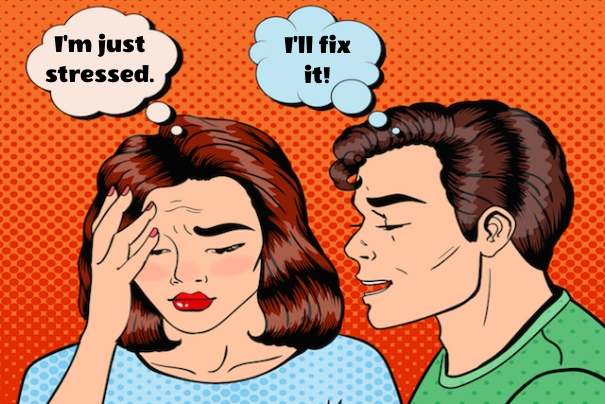
You Are Not Responsible for Anyone Else’s Emotions
“Rather than being your thoughts and emotions, be the awareness behind them.” ~Eckhart Tolle
“I don’t believe you,” I jutted out my chin like a petulant toddler. Collapsing back into the tufted leather loveseat, I conceded, “I want to believe you, but I can’t.”
My therapist had just explained to me that I am not responsible for regulating other people’s emotions. My mind couldn’t process this truth.
There were too many decades of owning the moods of those around me.
In my younger years, if a parent was stressed, I felt it was up to me to calm them down. I prided myself on acting as a mediator between my siblings.
In high school, I drove my boyfriend crazy trying to cheer him up when he was in pain from frequent sports injuries. Later, I would allow other boyfriends to dictate how I was feeling each day, according to their mood.
And here my therapist was pointing out that it wasn’t up to me to help other people regulate their emotions. I had been doing it wrong all these years.
Undoing “Good Daughter” Habits
If you struggle with this, like me, chances are there was some chaos in your early years. I’m not necessarily talking about major trauma (although that may have occurred), but as a child you found yourself trying to compensate for the emotions of those around you.
The good news is that you can break free from this habit.
Trust me. It’s necessary for your mental health and for the well-being of your relationship to let this go.
As my therapist would say, even within a marriage it’s not my job to regulate the emotions of my spouse. I’m responsible for my own emotions. And it turns out that I’m not very good at helping “fix” my husband when he is stressed.
Changing the Dynamic
My first chance to change this pattern came in the form of a Saturday breakfast at a local coffee shop.
You know that feeling you get when you place your order with a trainee, and you have zero confidence that you are going to get what you ordered? It was one of those situations.
Thirty minutes later, our order still hadn’t arrived. My husband was getting agitated, and I could feel my blood pressure rising in response. It suddenly occurred to me that this was my big opportunity to approach things differently.
Step 1: Observe.
I noticed my husband was grumpy. I watched his scowl and listened to him mutter.
I noticed my heart race. I noticed that I wanted to say something to make it better.
I also noticed that I wasn’t upset about our food order. I had my coffee. I was okay to wait.
It was my husband who was upset, not me.
Step 2: Own your emotions.
If I am feeling stressed, I know how to calm myself down: pay attention to my breathing, reframe, and refocus.
But in this situation, if I were by myself I would have been fine. So there was nothing that I needed to do at that moment to deal with my own emotions.
I just needed to fight my urge to take on my husband’s frustration.
Step 3: Give the other person space to regulate themselves.
“Are you mad?” I timidly asked my husband.
“Nope,” he said, “just hungry.”
“Okay. I’m gonna just sip my coffee and read.”
“Thank you for not trying to fix me. I will be better after I eat,” my husband mumbled as he scrolled on his phone.
Ouch. I actually got thanked for leaving him alone. Further reinforcement that I would have been making it worse by taking on his frustration.
Step 4: Relax.
The world is not going to end if my husband is “hangry.”
My brain was trying to tell me that I was in danger, but sometimes our brains give us the wrong information.
My husband is a mild-mannered man. We’ve fought less than five times in fifteen years together—and it was me doing the yelling. I was definitely not in danger.
I was okay. He was going to be okay.
I just needed to let go of my fear that something would go horribly wrong if I didn’t intervene.
And guess what?
Everything was okay.
An Exercise in Humility
It’s hard to let go.
But the key insight in this process is that, even within a committed relationship, each person is responsible for themselves. We must give each other the opportunity to manage our own emotions.
If you are with somebody who doesn’t have the skills to regulate themselves, that’s a separate conversation. Do they want to learn those skills? How would they prefer to learn: a therapist, a book, or a trusted coach? Even so, it’s not your job to force them to acquire those skills.
We can only own our behavior. The world does not rest on our shoulders.
And the irony is, when we step back and let go of control, the fear starts to go away. We feel freer to relax.
Practice Makes Perfect
I encourage you to think of the last time that you tried to compensate for your partner’s frustration or stress. Think about what you could have done differently, now that you are more aware.
Even if you don’t manage to navigate all four steps smoothly, reflect afterward what went wrong and decide what you will do differently next time.
You’ve got this.
-
5 Breathing Techniques to Melt Your Stress Away
“Feelings come and go like clouds in the sky. Conscious breathing is my anchor.” ~Thich Nhat Hanh
Breathing techniques are now such an important part of my daily routine. I couldn’t think of starting a day without doing my breathing exercises.
I usually combine these with my morning meditation, which, through sheer perseverance, I have made into a habit and have been doing for the last few years.
Almost everywhere you look, you can find stress—at work, at home, on the road. It’s hard to avoid it and even harder to not get sucked in.
I used to let stress get the better of me on a daily basis through an incredibly stressful and demanding job. That was until I realized the dangerous effects it was having on my body.
I worked in video production as a producer, where there was a new type of stress every single day.
There were so many cogs that all had to fall perfectly into place for the production to move ahead, not to mention the number of people who would depend and rely on me. The deadlines were tight, and to make sure that every stage of production was complete, I often had to work long hours.
This was an incredibly stress-inducing job, and so often I felt myself getting overtired and angry due to the workload.
Stress can make it near enough impossible to control your emotions. I found the more stressed I became, the more irrational I would become.
Stress is also strongly linked to diseases, and chronic stress can give these conditions the green light to flood your body. Stress has been linked to cancer, lung disease, fatal accidents, suicide, and cirrhosis of the liver.
Not to mention that stress can make you gain weight, look older, and ruin your relationships.
After understanding that I was a very stressed person, often attracting stressful situations into my life, I decided to learn stress-combating techniques.
The best methods I discovered were various breathing techniques. They’re quick to do and have amazing results.
Now, if I ever feel myself getting stressed or am about to enter a stressful situation, I simply stop for a moment and use one of my breathing techniques. This instantly calms me down and has an immediate effect on my state of mind, allowing me to think clearly and rationally.
Breathing is used in meditation as a method to relax the body fully and achieve a clear state of mind. We are extremely lucky that such a powerful tool, like breathing, is something that we can regulate and control ourselves.
Practicing breathing techniques will not only give you beneficial life tools, but they are also a great starting point for your meditation journey.
The techniques I have shared are simple and easy to learn. Some will bring calm and inner peace, while others can be used to kick-start your mental awareness and vital energy.
Abdominal Breathing
Abdominal breathing slows your entire body down; your heart rate and blood pressure reduce with each controlled deep breath you take.
Your aim during this technique is to focus on your diaphragm, not your chest, as you breathe.
To begin, place one hand on the chest and the other on the belly.
Breathe in through your nose enough for your diaphragm to inflate with enough air to produce a stretch in your lungs. Then exhale slowly.
Make sure each breath is deep and steady.
Repeat this technique with seven to ten breaths per minute for ten minutes.
Alternate Nostril Breathing (aka Nadi Shodhana)
This technique will unite both sides of your brain while bringing calm and balance.
To begin, sit in a comfortable meditative pose; this can be on the floor, on a chair, or on a sofa, wherever is most comfortable for you.
Now, hold your right nostril down with your thumb or one of your fingers on your right hand. Breathe in deeply through your left nostril.
When you’re at the peak of inhalation, let go of your right nostril and cover the left. Then, exhale through the right nostril. Continue with this technique for as long as needed until you feel calm and focused.
Because this method connects your brain on a deep level, you shouldn’t practice this technique before going to bed.
Instead, if you need to prepare for a big presentation or a difficult job interview, or you’re in any kind of nervous situation, take a few minutes practicing alternate nostril breathing to calm yourself. Doing this will help quiet your mind so that you can be the best version of yourself without having to worry about the nerves!
Not only will you experience calm and balance, but you will also feel focused and super energized.
Relaxing Breath (aka “4-7-8”)
This technique is used to completely relax the body and nervous system. It can be used in many different scenarios—when you feel internal tension, when something upsetting happens, or simply to help you relax before sleep.
Before you begin this technique, ensure you are sitting comfortably with your back as straight as possible.
Place the tip of your tongue behind your upper front teeth where they meet the gum ridge. You will need to keep your tongue here for the duration of the technique.
Start by exhaling fully. Usually, because of where your tongue is placed, this would make a natural “whoosh” sound.
Inhale quietly for a count of four. Once reached, hold your breath here for a count of seven and then exhale fully for a count of eight. This is one full breath. You should aim to do four or five full breaths each time you practice this technique.
Stillness in Breath
If you are able to focus on your breath for long periods of time, then this technique is for you.
This breathing awareness variation doesn’t involve any counting, merely observing.
To begin, sit comfortably, close your eyes, and begin observing your breathing pattern.
Once you have settled into the process of observing your natural breathing rhythm, turn your awareness to the point at which the breath switches from inhalation to exhalation. Then observe as it changes from exhalation to inhalation. Notice that there is a gap, or still pause, between the breaths.
If you find that your mind wanders during this variation, simply keep guiding your attention back to this still pause between each stage of breath. The more you practice this technique, the more it becomes a continuous experience in which you will find peace.
Stimulating Breath (aka Bellows Breath)
Bellows Breath is used to invigorate your senses and sharpen your mind. If practiced well, you will raise your vital energy and feel an increased level of alertness.
To begin, sit comfortably. You don’t need to be in a certain position or sit anywhere in particular for this technique.
Inhale and exhale rapidly through your nose. Try to keep your mouth shut and as relaxed as possible. Aim to keep your inhales and exhales equal in duration but as reduced as possible.
For beginners, you should start by practicing this technique for a maximum of fifteen seconds. As you become more comfortable, you can increase this time by five seconds each time you practice until you reach a full minute.
Like alternate nostril breathing, this technique connects with your mind on a deep level and shouldn’t be used before you go to sleep.
Next time you feel like you need an energy boost, instead of reaching for caffeine, try this technique and see how invigorated you feel afterwards!
—
By practicing breathing meditation for ten to fifteen minutes a day, you will be able to reduce your stress and anxiety levels significantly. You’ll start to experience calmness of the mind, the turbulence of day-to-day worries will simply fall away, and feelings of happiness and fulfillment will rise from within.
-
How Meditation Can Make You Healthier and Ease Your Pain
“If a person’s basic state of mind is serene and calm, then it is possible for this inner peace to overwhelm a painful physical experience.” ~The Dalai Lama
When I finished graduate school I was a bright-eyed engineer with a fresh diploma in hand, ready to take on the world. I landed a great job at a multinational engineering firm and began my career working with people from all over the world.
So it was a major downer when, not long into my new job, I began to suffer from chronic migraines. Every day I would wake up feeling fine, but within a few minutes I would feel so lightheaded I was convinced my head was going to float away.
It wasn’t because of stress, though, just genetics. My mother, grandfather, and great-grandmother all had experienced similar issues with migraines.
Lights. Noise. Crowds. Computer screens. They made me feel miserable.
I was able to hide my symptoms pretty well from friends and coworkers, but I needed relief. My symptoms were not typical for migraines, so the doctors I saw couldn’t help much, and I didn’t have any luck with homeopathic remedies. My mother suggested I try meditation; it had helped her with her symptoms before.
Being an analytically inclined engineer, I was skeptical. To me, like many of us, meditation was something reserved for monks who wore funny robes and lived in the mountains, far away from the commutes and crowds and endless computer screens of the modern world that give the rest of us of headaches.
But I didn’t have anything to lose.
I started with one minute a day. And then two. And then five.
The more I meditated, the better my symptoms became. There were setbacks, but in general my condition improved. After a couple of years, going to a bar or writing an email didn’t make my head feel like it was going to explode.
I finally felt like my old self again.
I wasn’t sure if the improvement was solely due to meditation, but my analytical mind wanted to know more about it, with the more facts and hard data the better. According to the studies I have come across, meditation can:
1. Improve focus and memory
A 2013 UC Santa Barbara study published in Psychological Science found that mindfulness training, including meditation, can improve our ability to focus on tasks at hand and recall details from memory.
For those of us who have hectic jobs and find that our attention is constantly jumping from our mobile phone, to our desk phone, to our email inbox, to the person standing at our desk, or to the millions of other office distractions, a few minutes of quiet meditation in the morning can positively affect our critical thinking skills.
2. Reduce stress and anxiety
Research at Harvard Medical School found that meditation can physically change the brain’s amygdala, the portion of our brain related to stress and anxiety, and lower our levels of stress.
This one might seem like a no-brainer (pun definitely intended); if we are quiet and still, we will be calmer. But for all of the skeptics out there, like myself, it’s reassuring to know that the anecdotal evidence of meditation reducing our stress levels now has physical changes to the brain as documented evidence to support it.
3. Reduce the risk of cardiovascular disease
A 2012 study published in Circulation: Cardiovascular Quality and Outcomes found that daily meditation can not only reduce stress, but can actually reduce the risk of cardiovascular disease as well.
The patients in the study, all of whom had coronary heart disease, were divided into two groups: a control group, and a group that underwent a transcendental meditation program.
Over the course of the multi-year study, the group that received the meditation training saw reductions in their blood pressures and stress levels, and had lower rates of heart attacks and strokes.
Heart disease continues to be a global problem and could affect many of our lives as we age. But studies like these show that, in addition to the tools of modern medicine, we have one extra weapon in our arsenal to help improve our cardiovascular health.
4. Boost our immune systems
Another great benefit of meditation, at least according to a 2003 study published in Psychosomatic Medicine, is that it can improve our bodies’ ability to fight off disease and illness.
During the study, a control group was compared with another group of participants who received meditation training. Afterward, the meditators were found to have a significantly higher number of antibodies in their blood compared to the control group, which help ward off disease.
That means that regular meditation could help us get sick less often, giving us more time to have fun and be with our loved ones, instead of lying in bed and feeling miserable. Let’s remember that tip the next time flu season rolls around…
5. Reduce physical pain
According to a 2015 study by Wake Forest University published in the Journal of Neuroscience, meditation has the ability to reduce pain sensations in our bodies.
During the study, patients who had undergone meditation and mindfulness training experienced less pain when exposed to hot surfaces than those who did not have similar meditation experience.
This was also true for a group of “meditating” patients who had been given injections to chemically block their bodies’ natural production of opioids (i.e. our own internal painkillers), which kick in once we start to feel pain.
The authors concluded that this has the potential to help mitigate chronic symptoms and reduce dependencies on prescription medicine, and that future work could help to determine the exact mechanism of how meditation alleviates pain.
From my own experiences with daily migraines, I have full faith in the Wake Forest results. For anyone else suffering from pain, a few minutes a day could make all the difference.
—
Meditation is no longer a mystical practice hidden behind the walls of Tibetan monasteries. It is being studied by some of the most respected health organizations in the world, which are now able to use science to validate claims that have been around for thousands of years.
The physical and neurological benefits that meditation can provide make it a valuable accompaniment to modern medicine for curing or alleviating health problems. If you have been suffering from stress, or pain, why not try meditation? It’s natural and free.
A simple way to begin is to first find a comfortable seated position. Keep your eyes and body relaxed, and focus on your breath. Try not to fight all the thoughts and chitter chatter that run through your head. They’re normal.
Just observe them and then focus on your breath again once they have passed. Like me, you can start with one minute and then have longer sessions as you begin to feel more comfortable meditating. The positive effects you start to experience from daily meditation might surprise you.
What is there to lose?
-

4 Steps to Let Go of Stress, Negativity, and Emotional Pain
“It’s not the bite of the snake that kills you, it’s the poison left behind.” ~Tom Callos
Have you ever taken it to heart when someone said or did something mean to you? The likely answer is yes; most people have experienced negativity from another person—and it hurts.
But why did you take it personally? Because, like all of us, you want love. And we often assume when someone is mean to us that it means that we are unlovable.
Now, when a person is mean to me, I choose not to accept what they are offering. Also, I recognize that they are doing it because they are hurting inside and don’t know how to express love.
This was the case for me as child. I was a very sensitive, and I received a fair amount of emotional bullying from my older brother. He repeatedly called me a loser and made fun of me.
I am not entirely sure why he did this, but I know he was hurting inside. He seemed to be unhappy a lot of the time. My mom believes this was due to her and my father expecting a lot from him, being the oldest child.
I looked up to my brother, but the mean things he did hurt me to my core, because I let the emotional poison build up and take me over. It got to the point where it became physically painful.
By age ten, I had put up emotional walls so I could block anyone from hurting me—or so I thought. This turned me into an unloving, uncompassionate, and judgmental person.
I would emotionally bully people, just like my brother had done to me. I would make fun of how certain people would dress, look, or speak. I wound pick apart other people’s insecurities to make myself feel better.
Shortly after that, I began noticing how insecure I was.
I was afraid of being judged by others and doing anything that made me stick out. The fear of judgment was so gut-wrenching that it stopped me from doing things I wanted to do, like join the high school basketball and rugby teams, and ask girls on dates.
In my late teens I realized that I needed to make some changes in my attitude, but I did not know where to start.
Shortly after putting out that intention, I felt drawn to Buddhism. I would read books here and there, but did not commit to making any real changes. I did feel a pull to go to a Buddhist monastery, but I thought to myself, “I don’t have time for that.”
By age twenty my spirit forced me to take action. One night after work, I was walking into the kitchen and dropped a glass. I tried to catch it as it fell, but it smashed and cut my left index finger down to the bone.
I was rushed to the hospital and bandaged up. The next day I had surgery on my finger to reattach the nerve.
Shortly after that, I began having visions of a Buddhist monastery. Now that I couldn’t work and I was on summer break from college, I could go.
I went to Birken Forest Monastery, and my life changed forever. By quieting my mind through seated and walking meditation, I discovered that I was actually creating and feeding all of the hell I was going through.
Compounding the pain, my mental torture created several health issues, because my body could not heal in such a stressed state.
I decided, right there and then, that I was going to let go of the issues that were disturbing me.
If you, too, are causing yourself a lot of pain and suffering by holding on to negative thoughts and feelings, the lessons I learned may help.
1. Don’t take anything personally.
If someone says something mean to you, it is because they are hurting inside and don’t know how to ask for love.
Now, if a person is being mean, I listen to them, look at them with compassion, and choose not to retaliate. This typically helps defuse that person’s pain.
2. Replace negative thoughts with positive action.
As a child I often had negative thoughts about myself and others, which would cause me to feel bad.
Many of my thoughts centered on the fact that I didn’t feel good enough. These thoughts caused me a lot fear and anger, and stopped me from doing things that I felt would bring me joy.
One thing that has helped me overcome this is telling myself, “I love being me,” and following through with the things that I feel guided to do.
For example, I received strong intuitive messages to go to college to become a Doctor of Traditional Chinese Medicine (TCM). Doing this was enriching and life changing for me. I also met the love of my life, my wife, at TCM college.
When you start thinking negative thoughts about yourself or others, tune in to your intuition about what would bring you fulfillment. When you devote your energy to things that bring you joy and satisfaction in life, there’s less energy to devote to negativity.
3. Love yourself unconditionally. Because if you don’t, who will?
Every day I reinforce how much I love myself. Why? Because it feels good, and who doesn’t like to feel good?
One simple way I do this is by telling myself, in my head, with a smile on my face, “I love myself unconditionally.” Then I sit in the feeling of love that arises.
Another thing I will do is ask myself the question, “What can I do today to deepen my self-love?”
My intuition will give me a response in the form of a feeling, thought, or image. For example, I may get a thought or an image of something to do, such as spend time in nature or with a friend.
4. Lastly, forgive.
If you don’t, you’re letting your past control and poison you, and you’re the one who ends up feeling bad.
I felt so bad in my adolescence as a result of having negative feelings toward people that I never want to feel that way again. The more anger I would feel toward someone, the more my life felt miserable and chaotic.
To forgive people, I needed to surrender to the things that had caused me stress. They were in the past, and they were only still bothering me because I was letting them.
As a result of letting them stress me out, similar issues would arise in other relationships until I acknowledged that I had to do something about it.
The way I see it now is, if I had rotting garbage in my home, I would not keep it because it stinks and it’s not good for my health. So why would I hold onto negative feelings that are causing me problems?
In order to let go and forgive, I first got into a calm mindset. I did this by focusing my attention on my breath, which brought me into the present moment.
Next, I thought about the person and said in my head, “I forgive (person’s name) for hurting me, and I release any anger and pain I feel about (person’s name). I send (person’s name) unconditional love.”
Doing this simple exercise helped me clear so much negativity from my life that I felt like a whole different person.
You may have to do this many times before you feel comfortable with it. It can take a while to fully surrender because we often hold a false sense that these negative feelings are serving us.
It helps to remember the first lesson—don’t take anything personally. The person who hurt you was also hurting. It doesn’t condone what they did, but it does make it easier to forgive.
My Future Is Bright
When I think back to how I was then and compare it to how I am now, I can see how far I have come, and I am grateful. Though, I do see that I have more to let go of. Letting go of stress, negativity, and emotional pain excites me because it allows me to focus on love and the things I do want in my life. The same is true for you.
-
How to Instantly Calm Yourself in Stressful Situations
“Between stimulus and response, there is a space. In that space is our power to choose our response. In our response lies our growth and our freedom.” ~Viktor Frankl
There’s a big lie we tell ourselves during stressful times.
It keeps us feeling lost, afraid, and unloved, like we’re being picked up and carried away helplessly by a storm.
Our heads can fill with scary images, words, and stories about the cause and who is to blame for our unwanted pain.
Sound familiar? If it does, you’re not alone. You’re normal. This is how humans biologically respond to stress.
So what’s the big lie?
The big lie is that we have no control over our stress response. Actually, we do. A lot of control.
I’ve struggled the hard way through my fair share of troubling times. I’ve experienced money and job issues, battled with health, and been pushed in challenging relationships.
But that’s not the worst part. The worst part is I grew up a highly sensitive person, who would internally react to almost anything that could be interpreted as negative.
Of the feelings above, I hopelessly sat at the “feel all of them” end of the scale.
That was until a particularly trying relationship caused me so much stress and anxiety that I became sick of my unconscious reactions, and vowed to do everything possible to stop it (or make it easier).
Through research and a lot of experimenting I created a practical way to calm myself down instantly anywhere, anytime, when a meditation cushion or reassuring book was out of reach.
The technique was so simple and powerful that it pulled me through a harrowing experience in that relationship, and has held me together in plenty of experiences since.
It’s easy to remember, has an instant effect on your mind body, and most importantly, is simple enough to be remembered and used when you’re going through the eye of your own stress storms.
How to Calm Yourself In Two Minutes
Take a moment right now to make yourself comfortable and try these four steps yourself:
1. Freeze yourself.
Remember the game you played as a child when you suddenly stopped mid-motion, like you were frozen in ice? Do that now. Halt your body parts, emotions, and thought processes. Think of yourself as a cartoon character that’s been hit with a stun gun. You can even make it a little dramatic if it helps.
2. Focus on your index finger.
(Skip to this if you find the first step difficult). For twenty to sixty seconds, concentrate solely on the back of your index finger. Let your mind and body be consumed by it.
Bring it closer to you. Study the rivets, creases, and those tiny little fingerprint lines. If your situation is noisy, let the sounds around you merge into a single background buzz, and let it fade out of your attention.
3. Take a conscious breath.
Let go of your focus and check back in with your body. Take a deep, conscious breath in, then let it go through your mouth, slowly and calmly, creating a wave of relaxation that starts in your chest and floats out through your being to the surface of your skin.
4. Look around consciously.
As you re-integrate with your surroundings, scan the scene in front of you. Remain as indiscriminate as possible with what you focus on the way you would when waking up in the morning.
Take conscious note of the thoughts that are trying to push back into your head and observe them with an attitude of curiosity.
How do you feel?
You might now feel a little more in touch with your senses, distanced from previous thoughts, and connected with the present moment.
Most importantly, you’ll recognize that the root of your discomfort is your thoughts. Everything else, like emotions, and physical discomfort, and pain, start there.
If you’re having difficulty slowing down the mind at the beginning, try this: If you meditate regularly, spend the last minute of your session focused on the same finger, in the same way. Doing this will associate (or anchor) the feelings of clarity, relaxation, and attachment with the action.
And if you don’t meditate, it’s a great time to start! It will help with your ability to cope with stressful situations generally, and dramatically improve the effects of this technique.
Why This Technique Works
Stress is a mental or physical tension, and both manifest from your relationship to the procession of thoughts in your head.
Mindfulness allows you to step out of the procession and watch it go past, without being carried down the fast-flowing river.
When we get pulled down a heavy stream, our emotions and bodies react as if the danger or pain contained in the thought is real, immediate, and must be dealt with now. That’s why we feel discomfort even when someone reminds us of a stressful situation we were trying to forget.
Reconnecting with the present reminds us that here is the only time there really is.
Focusing on your hands is an ancient Ayurvedic practice that helps to ground the soul and provide stability in the physical body.
Try It for Yourself
The most important reason this technique works is it gives you something back—control.
We may not be able to choose what happens to us in our lives, but as Viktor Frankl says, we can always choose our response.
Give it a go next time you feel yourself panicking (and be sure to let us know how you go in the comments below).
-
Calmness Is Contagious, Even If You’re Faking It
“Peace of mind is not the absence of conflict from life, but the ability to cope with it.” ~Unknown
We had just reached cruising altitude, and my friend and I were settling in for the eight-hour flight from Tokyo to Honolulu. Exhausted after spending the day in the airport, we were excited to finally be in the air with beaches awaiting us at our destination.
Jered and I were on an adventure around the world flying with standby tickets to any destination that had open seats. Even though we had been trying to get a seat to Bangkok, then Sydney, then Seoul, then Frankfurt, and then Paris, all with no luck, we decided to take the only available seats on the last plane of the day.
After getting comfortable we decided to pass the time by racing each other in solving our Rubik’s cubes (what can I say; this is what we did for fun). It turns out this odd hobby was about to help me on the road to improving my inner calmness.
“BANG!” We hit sudden, unexpected turbulence from a winter storm. I only remember two things: my stomach squishing into my throat as we hit an air pocket and a little girl in the aisle flying to the ceiling.
Thankfully, there was a nearby flight attendant who heroically jumped, caught the girl, and curled up on the floor before she got hurt.
The plane was jerking violently in all directions. People were screaming. The pilot was on the intercom saying something, but no one could hear it over the chaos.
Throughout the maelstrom my friend and I stayed focused on our cubes, continuing to spin their sides as we attempted to solve them before the other could. While my exterior seemed calm and focused, in my mind I was screaming.
My hands were clammy and it became harder to keep my hold on the plastic toy in my hands. I was afraid I was going to die.
The worst of it was over in twenty or so minutes, but the flight was still rough for several hours. As the sun started to rise and the flight had been calm for a couple hours, passengers slowly started to liven up again, chatting with the people around them about the experience.
Having spent the time focused on the cube in front of me, I was surprised when the guy sitting next to me said, “Man, I was freaking out. I was about to lose it, but then I looked over and saw you two just playing with those things. You two were so calm that it helped me calm down too.”
This struck me as odd since I felt the same way he did, just internally. But soon other passengers sitting around us around us started chiming in, sharing the same experience. It seems a wave of collective calm slowly rolled over the back of the plane helping to ease some of the tension.
Without being aware of it, I projected calmness to the people around me. They in turn became calmer. And ultimately my internal fear started to fade away as well.
It was a surreal experience, but it became clear to me that calmness was contagious, even if I was only faking it.
In many meditative traditions a calm, clear mind is often said to be like a still pond under a full moon. The smooth surface is transparent, allowing the moonlight to clearly illuminate the bottom of the pond. It is also like a mirror, reflecting back in perfect detail the moon and the night sky.
Unfortunately, however, our minds are not always clear. The surface is full of ripples that make it hard to see the bottom and distort the image of the moon. While these ripples are sometimes created by the wind or the environment, most of them are caused by rocks dropped into the pond; rocks created in our minds.
These rocks are emotions like anger, hatred, or fear. Often without realizing it we are constantly throwing these stones into our ponds, never letting it return to stillness.
Returning to a calm mind is simple. Just stop throwing rocks and let the waves calm down on their own. Despite this, we often try to calm our minds by throwing more rocks into to pond.
Sometimes when I can tell my wife is upset with me, but tells me nothing is wrong, I start to provoke her, “What’s wrong? I know something is wrong! Why won’t you tell me what’s wrong!?”
I genuinely want to calm things down but, as you can imagine, I end up making her feel worse because I continue to throw rocks instead of letting things calm down on their own.
When we do stop throwing rocks, though, the effect can be powerful and lasting. As we are interconnected with others, the stillness of our mind, the refusal to throw rocks, can help others find the same peace.
When people see that your mind is clear it helps them realize that they too can let go.
I still think about that flight from time to time, but mostly when I’m flying. I used to be a fearless flyer, but even today I feel pangs of panic, that squirt of adrenaline down the back of my neck, every time a plane bumps or shakes.
However, as I’ve increased my awareness of my own emotions, I can sense when I’m holding a rock and then I set it down.
Here’s an exercise to try. Next time there’s something or someone causing you distress: stop talking. Pause and take a moment to take a few deep breaths. Begin to watch your thoughts and note the upsetting ones. Don’t ignore them, just notice them. These are your rocks.
As you notice anger or hatred forming in your mind, imagine it as a rock. See yourself holding that rock, poised to toss it into your mind. But instead of throwing it, picture yourself gently setting it down beside you. Take a deep breath. Let it go.
Practice this when you can. Not only does cultivating calmness have tremendous effects on your personal state of mind, you never know how big an effect you may have on the others around you.
Photo by oddsock
-

5 Simple Words That Can Turn A Bad Day Around
“If your heart is beating, if your lungs are breathing, if you are still alive… then it is not too late to do something kind, creative, generous, satisfying, and courageous. Today.” ~Alexandra Franzen
It was one of those days.
You know the ones—when nothing really bad happens, but everything just seems to go wrong. When lots of little annoying things happen and the day seems to spiral from there.
This was one of those days.
I had woken up with a headache and decided to hit the snooze button on my alarm (twice) so I didn’t have to face the day yet, which meant I had to rush to get ready and make it to my first university class of the day.
I ended up getting to class late (and I’m one of those people who hate being late), and as the day went on, things got worse.
In another class, I found out that we had a test that I had completely forgotten about and hadn’t prepared for.
Then, later on, I was meant to be meeting up with a group of people to work on a group assignment, and no one came.
So, by the afternoon I was pretty over it.
“Could this day get any worse?” I dramatically thought.
And then it did.
When I was walking home, I got caught in a rainstorm and discovered that there must have been a hole somewhere in my shoes. I seriously felt like I was in a movie where someone was having a comically bad day.
As I stepped in the door, I decided that the day was ruined and there was no point in trying to do anything now, but I stopped myself in my tracks with one of my favorite mantras by Alexandra Franzen:
“Today is not over yet.”
This mantra shifted my thinking immediately, and I realized there was still time to make the day count.
After all, it was only late afternoon.
So, I had a shower and put on dry clothes. I waited for my boyfriend to get home and we headed into town, where we bought mint raw chocolate and kombucha. We walked around the town and through one of my favorite parks.
We ended up getting burgers for dinner, having a really meaningful conversation, and then going to see a movie.
When I arrived home that night, I realized how profound those five words had been and how they had helped me completely turn my day (and attitude) around.
Earlier in the day I could have chosen to give up on the day, but instead, I made a choice to find a way to make the rest of the day count—to do something that was meaningful for me—all because I reminded myself that the day wasn’t over yet.
My day went from being the worst day of the week to one of my favorite days of the week, even though it wasn’t all good.
This wasn’t just a one-off experience; I’ve used this mantra so many times, with amazing results.
There was the time where I felt like I had wasted an entire Sunday and this mantra inspired me to head outside and go for a walk, where I ended up witnessing one of the most spectacular sunsets I’ve ever seen.
There was the time where I was having trouble getting some writing done, and this mantra convinced me not to retreat to the couch and binge-watch my latest Netflix obsession. As a result, I ended up getting more work done than I wanted to.
There was the time where I felt like everything that could go wrong was going wrong, and I had been in an unhappy mood for days that I just couldn’t shake. This mantra inspired me to spend one hour writing down every single thing that I could think of that I was grateful for, which turned around my day (and mood) completely.
And this is just the beginning. Time and time again I’ve used these five words to turn my day around.
I love using “today is not over yet” as my mantra to turn a not-so-awesome day around because:
1. It is a powerful reminder to find a way to make the day count.
This mantra reminds me that there is still time to make something good happen, no matter what has happened so far in the day. It reminds me that I don’t need to wait for a new day, a new week (or month or year) to decide to turn things around.
2. It reminds me that I have a choice.
And when I’m not having a good day, I can choose what happens from that moment. I can choose to throw the day away, or I can make a different choice and try to find a way to make the day count.
3. It reminds me to do something (or many things) each day that are meaningful to me.
It can be easy to fall into the habit of living each day on autopilot, but this mantra makes me re-evaluate how I’ve been spending my “life-minutes” and reminds me to be intentional about making this day—and each day—count for me.
4. It reminds me to be grateful for each day, no matter what.
As Alice Morse Earle said, “Every day may not be good, but there’s something good in every day.” And this mantra helps me to be intentional at finding and creating the good in each day.
So, no matter what has happened so far in your day, if you want to make the rest of your day count, you can!
To make this day count you might like to:
- Do something kind for yourself. This might look like doing something you love that you don’t usually make time for, giving yourself a five-minute break to breathe and have a cup of tea, or asking yourself, “What do I really need right now?”, then doing it.
- Do something thoughtful and generous for someone else. This might look like helping someone out with something, telling someone that you’re grateful for them and why, or writing someone a note and sending it to them in the mail.
- Do something productive. This might look like doing that thing you’ve been meaning to do for ages but haven’t gotten around to getting it done, making appointments that you’ve been putting off, or cleaning an area in your home.
- Do something you wouldn’t normally do. This might look like going to the movies in the middle of the week, or baking a cake even though it’s no one’s birthday, or going for a walk on a trail you’ve never been to.
- Do something—anything—that is meaningful for you. Something that makes you feel like you’ve made the rest of the day count.
So whatever time you’re reading this, whatever has happened today, know that there is always time to make the day count.
The day doesn’t have to be over yet.
It’s up to you what happens now.
-

Release the Stress: Plan, but Know That Plans Change
“Failed plans should not be interpreted as a failed vision. Visions don’t change, they are only refined. Plans rarely stay the same, and are scrapped or adjusted as needed. Be stubborn about the vision, but flexible with your plan.” ~John C. Maxwell
This year started as a complete mess for me.
After a five-week holiday away from December to January, it was difficult to get back to London and into the swing of things. Not only was I still in holiday mode, but I also came back without a plan.
I am at a point in my life where I am still exploring where in the world I want to be, what I want to be doing, and how.
My background is quite varied and broad. I am half Finnish, half New Zealander, but I grew up in Singapore. I came to London for university, where I studied Geology & Geophysics and then Business Management. I also developed a passion for running, which extended into overall health, fitness, and nutrition, thus I started working as a fitness and running instructor.
I am at quite a fragile point, deciding what path to go down (which field—earth science, business, or fitness; which country—stay in the UK, one of my home countries, somewhere completely new).
It is a decision made harder by having lots of options and a mind that tends to look for the perfect decision. It results in overanalyzing and overthinking, and leads to procrastination. Even small steps and imperfect action would be better than staying still. But I am just so scared to make the “wrong” decision.
I know I want to live life doing what I love. I know what I love—the outdoors and nature, health and fitness, running, travel, and exploration. Therefore, I have a rough idea or vision of the where, what, how—somewhere with amazing nature and sunshine; something that combines the environment, outdoors, and fitness. So a rough idea, but not completely clear, and it feels like a lot of big decisions to make!
At the start of the year, I felt quite lost, really. The lack of plan and knowing made me feel out of control and anxious about the future. Having always harbored perfectionist tendencies and feared the unknown, it was terrifying for me.
So I tried to get back on track by planning. Planning things would make me feel more in control. Having a plan would make me feel less anxious and stressed. A perfect plan would solve everything and help me achieve anything, I thought.
And it did help get back into a routine and on track. But it also did the complete opposite and made me overthink everything, which created a lot of stress and more fear.
During the spring I was actively looking for different opportunities and things to learn, do, experience. It is amazing how much you can find when you really look.
I applied for and asked about many different opportunities including world expedition/exploration jobs and courses, fitness jobs, internships in these fields, startups related to nutrition or fitness, photography, writing, language courses, further education degrees.
At times I got good news and I thought I was in such a great place—lots of opportunities obtained and the whole year set out. I could relax and go with the plan.
But then I got bad news and things seemed to fall apart. For example, because of a foot injury I had to stop running and expedition hiking. And I didn’t get the startup job, which brought me back to square one with no set plans.
Throughout this time, no matter how much I planned, things would change. I felt so out of control and anxious. The whole opposite of what planning was meant to do.
But as time went on, even though the ups and downs kept coming, I started to feel calmer about it all. I don’t know if it was my daily meditation or the fact that I had been thrown out of my comfort zone so many times that I was getting used to it. In any case I was calmer and started to reflect.
I came to realize a few very important things:
1. Plan, but know that plans change.
Having a plan is good because it leads to setting and working toward goals. Hopefully these goals pertain to things that will bring you happiness and a sense of achievement. However, as much as you plan, things change. It is important to be okay with this and flexible. Then re-evaluating and getting going again will be much easier.
2. Overthinking can keep you stuck.
Spending all your time planning, overthinking, and overanalyzing is often procrastination for actually doing something. Usually because of some fear.
3. Doing something is more important than finding the “perfect” opportunity.
It’s important to take action toward any opportunities, even if they don’t seem perfect, as this opens doors for you. It gives you different avenues to explore, new ideas, and even routes to your goal. The open doors are also something you come back to, even when plans change. In the very least, it gives you experience.
4. And finally, in life we go through phases, some that seem good and some that seem bad. But neither lasts forever.
Sometimes you get into a bad phase and feel so stuck and unhappy. It feels like it will never pass. But it does. And then you get into a good phase and are really happy. As awesome as that is, unfortunately, that doesn’t last forever either. But the good news is that a good phase will come again!
I like to think about this as a metaphor about a blue sky and clouds. I got this idea from the mindfulness and meditation app “Headspace” (highly recommend!)
There’s always a blue sky. There may be sun, clouds, or rainy days (representing positive and negative thoughts or phases) and the weather keeps changing. But behind it there is always the calm blue sky, and overall everything is all right.
This idea helps you live more in the present and be calmer. It helps think clearly and make plans or decisions based on your core values. It helps with anxiety in not having everything planned, not having the perfect plan, thoughts of “what if my plan doesn’t work?” It just takes the pressure off and helps you live in the present rather than constantly fearing the future.
It’s great to make plans, to have a direction and vision. This helps you achieve the goals you set for yourself, things you always wanted to do or accomplish, things that could bring you happiness. But we need to accept that plans don’t always go, well, to plan!
Know that when they don’t, you can still achieve your goals and vision, just in a different way—and with a lot more peace of mind.
-

8 Simple Ways to De-Stress and Rejuvenate When You Can’t Take a Vacation
“If you let go a little, you will have a little peace. If you let go a lot, you will have a lot of peace.” ~Ajahn Chah
It’s a common theme—jobs keep piling up, new problems arise, and deadlines are nearing. Taking time out for yourself to de-stress and rejuvenate is so far down the to-do list you don’t even consider it a possibility.
But the long-term effects of putting yourself last are real, especially because they take a while to show. They creep up slowly until one day you’ve burnt out.
When I was in this position, it didn’t end too well. The combination of dealing with long-term insomnia, hairdressing full-time, and studying led me to exhaustion.
I had adrenal fatigue and my body was so tired that everything hurt. My eyes were constantly stinging, head continuously throbbing, and my muscles were always sore from never getting the rest they needed.
I eventually quit hairdressing, because there’s only so long you can function as a zombie with sharp scissors in your hand, but I left to pursue my own business which brought with it even more work.
I had to find a way to recharge constantly throughout the day if I wanted to keep up with such an involved career.
You are your own most valuable asset, and no matter how important another task is, if you don’t dedicate some time to yourself, you’ll burn out. The harder you push, the harder you’ll fall.
I learned how to find time to dedicate to me while working, studying, and sleeping only two hours a night. I’ll show you how you can do it, too.
1. Let go of shoulds.
Let go of telling yourself you should do certain things. If it’s not a necessity, don’t overthink it.
Shoulds are guilt trips disguised as obligations, which add to extra stress and eat up time. Even if you don’t do anything else I mention in this post, let go of telling yourself you should do tasks you don’t need to do, or even want to do.
The ones I constantly struggle with are “I should get up earlier to get more work done, I should do yoga every day, I should spend less time on my phone.” Whenever I catch myself saying these, I smile and simply reword it: “I should do whatever makes me feel good right now. What is that?”
Sure, there are times when we need to push ourselves to make healthy choices. But if you’re too tired to go to the gym and it would make you feel good to take a walk through the park, that gets the job done too.
This one change in perspective will make you feel lighter and happier throughout the entire day.
2. Find a short, relaxing exercise routine.
Whether it’s stretching exercises, yoga, or a moving meditation, a short routine like this is ideal.
You address three things in one go: You give yourself fifteen minutes to yourself, you get your blood flowing to your head and around your body, and you relax and stretch out your tight muscles.
Rather than choosing a fifteen-minute power yoga session to “make it worthwhile,” find something that feels good that allows you to feel centered. Don’t worry about how many calories you’ll burn; this is purely for pleasure.
There are plenty of guided videos on YouTube, so you don’t even need to go to a class to reap the relaxing benefits.
3. Spoil yourself.
No matter how small it is, get out of the house and get something done that makes you feel good.
Haven’t brushed your hair properly in a month? Go to the salon and get a hair treatment. Shoulders are tired and achy? Get some acupuncture or a massage.
Even when the budget doesn’t allow for a indulging, remember that you are fully qualified and capable of looking after yourself!
Try soaking your feet in a tub of hot water with epsom salts while listening to a podcast, relaxing music, or an audiobook. You want this to be an enjoyable timeout so listen to your body and let it tell you what it wants.
4. Get away for a day.
You may genuinely not have time right now to leave for a day, but what about if you committed to going in three weeks’ time? Could you aim to get everything done before then or book the rest in for when you return?
Changing scenery and getting away from your usual routine will do wonders to your mind. Leave everything and decide that on this one specific day nothing else matters.
5. Set yourself a daily routine.
I first learned about efficient daily routines from a book called The Miracle Morning. In a nutshell, this routine consists of completing the six most efficient personal development practices, every single morning.
These include meditation, affirmations, visualization, exercise, reading, and journaling.
I read The Miracle Morning when I had insomnia. Falling asleep before 3am was a “good night,” so the idea of getting up an hour early wasn’t even something I’d consider. But I knew there was something to it.
So instead of mornings, I would find time during the day to complete these, and not always all at once, either. Ten minutes of reading on my lunch break, ten minutes of exercise when I got home, ten minutes of journaling and visualizations before bed, and so on.
If I ever found myself sitting there doing nothing (or worse, mindlessly flicking through social media!) I would try to complete another one.
Though this wasn’t the “correct” way to do it, it introduced me to a world of self-love and forgiveness. I forgave my mind for not falling asleep when I needed it to, I forgave myself for the anger I felt when I was tired and cranky every morning, and I decided to give myself the love I deserved.
By doing these short practices throughout the day you prove to yourself you’re worth this time to serve you. And the best part is that it doesn’t require a big chunk of time to benefit.
“The moment you accept responsibility for EVERYTHING in your life is the moment you gain the power to change ANYTHING in your life.” ~Hal Elrod, The Miracle Morning
6. Find a hobby.
What is something you love to do? Something you’re yearning to do, but don’t?
Can you find a community group that does this on a regular basis? Imagine connecting with likeminded people while doing something you love.
When you reconnect with an activity you enjoy you’ll fall in love with how it makes you feel, which means you’ll make it a priority to do regularly.
Whether it’s an art class or salsa dancing, fulfill this desire you have and it’ll naturally lead to letting go of stress.
7. Leave criticisms and gossip; express gratitude instead.
We’ve all been there, even though we know it makes us feel terrible and accomplishes nothing.
Instead, talk about your latest achievements or something fabulous you noticed someone else doing. Tell your friend that you love what she’s been doing lately, and ask her what she’s learned from it.
Not only might you learn something new, but showing gratitude and appreciation is the quickest and easiest way to feel excited and alive.
Do you ever notice how you light up when you’re pumped about something? How you start talking three times faster and can’t even express in words how happy it makes you?
We could all benefit from raising each other up and celebrating accomplishments and it would lead to building strong, happy, and powerful relationships.
8. Find a song that makes you go places.
You know the ones that give you goose bumps and make you forget about the rest of the world for those few minutes? Keep those songs handy, whether they’re on your phone or saved in YouTube. Then when you need a break all it takes is to plug your earphones in and listen.
You don’t always need to do something to fix a problem; sometimes all it takes is to let go, surrender, and let your problems and stresses melt away.
—
Dedicating time to yourself is essential to de-stress and rejuvenate. And as you can see, these ways are achievable no matter how busy you are.
The aim is to do small, purposeful practices throughout the day to truly make your moments count. Which one will you start on first?
-
Learn to Reduce Stress: Mindfulness eCourse by Thich Nhat Hanh
Stress can be overwhelming, and sometimes crippling.
Not only does stress suck the joy out of our days and keep us awake at night, it can also take a toll on our bodies.
Headaches, chest pain, digestive problems, hair loss—they’re all potential consequences of stress, not to mention serious conditions like heart disease and diabetes.
Then, of course, there are mental consequences. We feel anxious, restless, and irritable, and often scared and discouraged. Like there’s too much to do and we don’t have enough time or skills to do it.
Everything feels urgent, like life is a series of catastrophes to sidestep and fires to put out. It’s an exhausting way to live.
At least, it was for me.
And I knew I was creating a lot of problems for myself—that my stress stemmed not from my circumstances but rather how I chose to respond to them. Life felt like a ticking time bomb, but I was both the bomb squad and the madman holding the detonator.
To cope with this chronic tension, we often turn to quick fixes that actually create more problems than solutions. We shove it down with food, or spew it out with angry outbursts, or numb it with drugs and alcohol.
But it’s still there, bubbling below the surface, just waiting to erupt.
Life is always going to involve situations that we find stressful. We’ll lose jobs, loved ones, and eventually, our health. People will cross our boundaries, push our buttons, and leave us high and dry when we need them.
There will never be a time when life feels simple or easy.
We can choose to live in constant fight-or-flight mode, as if life is a string of crises; we can turn to Band-Aid behaviors to temporarily dull the pain; or we can take responsibility for learning a better way.
What is that better way? Mindfulness.
Mindfulness means maintaining a moment-by-moment awareness of our thoughts, feelings, bodily sensations, and our surrounding environment.
When we’re practicing mindfulness, we’re rooted in the present moment—not dwelling on the past or worrying about the future.
As a result, we’re able to reduce our own suffering and bring more joy and compassion to both ourselves and others.
To say that mindfulness has changed my life would be a massive understatement.
There was a time when I felt powerless to my overactive mind, and worse, I had no idea I was causing myself pain. I thought my response to adversity was the only possible one. I thought I had to be outraged, depressed, and anxious.
I still feel those feelings at times, but I now know how to observe them, learn from them, and release them so that they don’t consume me.
You can do the same, and I know just the course to get you started.
A while back, I connected with someone at Udemy
, a site that currently serves over 11 million students through more than 40,000 online courses.
They introduced me to a number of courses that might interest Tiny Buddha readers, including one entitled Mindfulness Practice for Joy & Compassion by Thich Nhat Hanh
This master Buddhist monk teaches students how to release suffering and heal the body through mindfulness techniques like walking meditation and breathing meditation.
Thích Nhất Hạnh is a Zen master, scholar, poet, and peace activist. He’s written over sixty books and was nominated for the 1967 Nobel Peace Prize by Martin Luther King, Jr.
Hahn’s course will help you learn to:
- Embrace suffering and move through it
- Ease anxiety and relieve tension about the future
- Use suffering to generate love and compassion
- Avoid sickness with mindful consumption
You will walk away from this course knowing how to meditate, reflect, transform, and make a positive impact on your environment.
As you may have gathered through reading the site, I am highly selective with what I choose to promote here. I pride myself on only sharing products, books, and courses I would personally recommend, and this program certainly fits that criteria.
All you need for this course is a computer or mobile device with an Internet connection. You don’t need any prior knowledge of Buddhism or meditation.
And as a bonus, Udemy has offered a 30% discount for Tiny Buddha readers, bringing the cost from $50 down to $35 (from now until July 1st).
If you’re tired of feeling mentally exhausted, Thich Nhat Hanh’s course may be just what you need to find peace. You can learn more about Mindfulness Practice for Joy & Compassion by Thich Nhat Hanh here.
—
Continue your quest for knowledge with Udemy
Disclosure: This post contains affiliate links, which means I earn a percentage of all sales. Posts like these help support the site and keep it going.