Tag: stress

  • 5 Ways to Use Movement (Not Exercise) to Support Your Mental Health

    5 Ways to Use Movement (Not Exercise) to Support Your Mental Health

    “Nothing is more revealing than movement.” ~Martha Graham

    It seems like only yesterday that I was at home with a newborn, a kindergartener, two dogs, and a husband who, just like me, was working from home, when we were thrown into the unthinkable COVID19 pandemic.

    It didn’t take long for the stress and tension to build in my body. The feeling of instability, uncertainty, and fear, not to mention the post-partum anxiety, took its toll on my body as it became more rigid, bound, immobile, and frozen.

    All the ways I had relied on movement as exercise were taken away, adapted to in-home and Zoom learning, which unfortunately did not work for my schedule or home life. It was the first time in a long time that I was not able to incorporate dance into my week.

    It seemed very hard to expand, stretch, even breathe, and that’s when it hit me. A little voice inside said, “You need to practice what you preach!” I needed to redefine movement and focus it on my mental health; connecting to movement for emotional well-being and not just for physical activity.

    When most of us think of movement we think of exercise. While all exercise is movement, not all movement is exercise.

    There are so many ways our bodies move, even involuntarily, that contribute to not only how we feel but what we think. Science tells us that molecules of emotion exist throughout the body, so wouldn’t it make sense that in order to manage those emotions, we need to tap into all the ways to move the body that houses them?

    First, let’s look at what movement is. Movement is anything that allows the body to change position or relocate. This can be something as grandiose as running a marathon, or a resting heartbeat, blood pumping, even breathing. All of these examples involve parts of the body or the whole body shifting its position.

    So, with this in mind, how are you moving right now? Now ask yourself, how is this movement impacting my mood in this moment? Is it supporting a healthy mindset or perpetuating a habit or behavior that contributes to a negative thought pattern?

    In my case, as mentioned above, my movement was very limited, confined, and rigid. It was often impeded by another person, my newborn, who through no fault of his own needed me for survival. I neglected my own body’s needs and it took a toll on my mental health.

    Changing the way you think or even feel actually comes down to changing how you move. So what can be done? Here are five ways you can use movement to support your mental health.

    1. Focus on your movement right now.

    When we focus on our movement in the present moment, we minimize the anticipation of what’s to come, which is often tied to fear or anxiety. We also mitigate dwelling on the past, which can harbor feelings of guilt and doubt.

    Every movement is an opportunity to be in the moment, because every moment is found in movement.

    Bring to mind one part of your body and simply become aware of its shape, how much space it takes up, if it has any rhythm, or even the lack of movement present. Begin to shift this part of the body in small ways and explore how this part moves.

    I began to recognize that my body was closed and tight. So I intentionally made an effort to check in with my posture, giving myself an opportunity to stretch and expand in my body to counter the negative effects I was experiencing.

    2. Cross the midline of your body.

    When we engage in any cross-lateral movement, like walking, marching, or giving ourselves an embrace, we encourage one hemisphere of the brain to talk with the other. This boosts neural activity across the corpus collosum, which increases neuralplasticity, otherwise known as the brain’s ability to change. This allows new pathways to develop which directly corresponds to our emotional resilience, ability to problem solve, and think critically.

    Begin by giving yourself a big hug or simply touching opposite hand to opposite knee. You could also try exercises or yoga poses that require you to cross your midline, like side bends, windmills, or bicycling while lying on your back.

    3. Move your spine.

    When you engage in movement of your spine, you tap into your self-awareness. This vertical plane of the body houses our core; beliefs, identity, moral compass. Bringing attention to the spine and any way it is able to move gives us the opportunity to become more aware of our inner world, how we feel, and what we need.

    Keep in mind that you do not have to be flexible, but gently explore all the ways you are able to move your spine, rib cage, and even hips.

    I like to start my day from the comfort of my bed, lying on my back, bringing my knees into my chest, and hugging my legs. As I tuck my chin, this allows my spine to curve as I attempt to connect head and tail.

    4. Play with timing and space.

    We move in familiar ways because we like comfort, even it that comes at a price for our mental health.

    Our bodies tend to stick to a certain timing, pace, and even shape as we move through our world. When we change up the timing and shape or the space our bodies take up, we begin to challenge our minds by moving out of our comfort zone. This can be uncomfortable, but done in small bouts and with ease, can increase our window of tolerance or ability to manage stress.

    Notice the natural pace of our movement (walk, gesture, etc.) and try speeding it up and/or slowing it down. Same thing with space, can you take up more space? How does that feel?

    5. Move more, not better!

    Increasing all the movements at our disposal makes us more resilient in our minds. When you only move in so many ways, then you can only think in so many ways.

    When we move our bodies more, in new and unfamiliar ways, building a robust movement vocabulary, we increase our ability to transition through life, manage challenges, or at the very least, begin to connect with ourselves in a different way. This can lead toward more self-compassion and empathy.

    When I began moving more throughout my daily life, I had more compassion for myself and my children, who were also struggling to make sense of the world, just like me. I could model my own need for regulation and safety in my body, and as a family we were better for it.

    Your body, and its movement, is your greatest resource for emotional well-being and mental wellness. It often starts with noticing all the ways your body currently moves and inviting in new ways of moving whenever possible.

    There is no wrong way to do this, as it is an individualized practice designed to harness your own mind-body connection. Furthermore, it’s not the movement alone that matters but the execution as well. Being mindful and intentional as you engage in this practice is vital.

    Integrating the aforementioned tips into your lifestyle is a guaranteed way to A.C.E. your mental health. By becoming more AWARE of our movement, we can CHALLENGE our current behaviors and EXPAND our minds in order to live more emotionally regulated lives.
  • 4 Anxiety-Calming Techniques I Wish I Used When I Freaked Out on a Plane

    4 Anxiety-Calming Techniques I Wish I Used When I Freaked Out on a Plane

    “When thinking about life, remember this: No amount of guilt can solve the past, and no amount of anxiety can change the future.” ~Unknown

    I was buckled in on a small, twenty-person airplane, and we were heading toward the runway, when I looked out the window and saw the airplane wheel was wobbling.

    I gathered my courage, unbuckled my seatbelt, and approached the flight attendant, who told me to sit back down.

    “I think there’s something wrong with the wheel,” I said.

    He looked out the window and said, “It’s fine.” But then he radioed the pilot, who turned the plane around.

    They checked it out, and it turns out the wheel was fine.

    In retrospect, I recognize I wasn’t responsible for the pilot turning the plane around. That was his decision, based on the information I’d provided. But the wheel wasn’t, in fact, wobbling. My anxious mind was just playing tricks on me.

    I felt guilty that one passenger, a surgeon, had to miss his scheduled surgery and that others were delayed. And the ironic thing was that I was on the flight to attend the somatic psychotherapy program where I was learning to reduce my anxiety and how to help others.

    I learned a lot from this experience and wanted to share the techniques that have helped me calm my anxiety since then.

    1. Move your body.

    Anxiety is part of the fight-or-flight response, which is designed to keep your body safe. The trigger for the anxiety is external, but you must complete the stress cycle on the nervous system level.

    In her New York Times bestselling book Burnout, Dr. Emily Nagoski shares that the stress cycle has a beginning, a middle, and an end. If you get stuck in the middle, you need to help your body complete the stress cycle.

    In the past, you would be chased by a lion, and then hopefully a neighbor would open the door and you’d run in, slamming the door behind you.

    It may seem like you’d feel better because the lion was gone, but on a scientific level, we now know you’d feel better because you ran and the endorphins helped you complete the stress cycle.

    If you’re feeling anxious, go for a walk around the block or put on your favorite song and dance. Even on the plane I could have pushed my feet into the floor and squeezed the arm rests to process some of my anxiety physically, but I didn’t.

    2. Feel your anxiety

    As best you can, detach from the thoughts and welcome the physical sensations of anxiety into your body. Notice where your anxiety is located in your body and what it feels like. Describe it: “I feel a buzzing in my chest.” “I feel a tightness in my throat.” And as best you can, welcome this vibration into your body. All humans get anxious; nothing has gone wrong, and you can handle this.

    When you believe that anxiety shouldn’t be happening, you actually create more anxiety about your anxiety. Welcoming it in reduces that.

    On the plane, I wasn’t at all aware of what was happening in my body. I was stuck in my mind, worrying about whether or not to say something. And thinking that I’d really regret if I didn’t say something and the plane crashed. I was completely detached from my body and fully overwhelmed by the feeling of panic.

    If I’d noticed where the anxiety was in my body, perhaps I’d have made a different decision. Or maybe I wouldn’t have; it’s hard to know…

    But what I know for sure now is, when I welcome the sensations in physically, I feel better afterward. So try this out.

    3. Voice your anxiety.

    Simply saying “I’m feeling anxious” can help you feel calmer. A recent study showed that putting your feelings into words reduces activity in the amygdala, the part of the brain that regulates emotions and stress.

    On the plane, a classmate had been sitting right behind me but moved so she could have her own row. After the plane landed, she wondered, if I had been able to tell her that I was feeling anxious about the wheels, would that have been enough for me to regulate my nervous system? Again, we can’t know for sure, but according to the research, that’s probably true.

    So if you’re feeling anxious, say out loud to yourself or someone else, “I’m feeling anxious.” This will help you observe and detach from the emotion just a little bit so it’ll feel less overwhelming.

    4. Make physical contact.

    If a child was scared or anxious, you’d instinctively hold their hand or pick them up to soothe the fear. And there’s research that hugging and self-soothing touch, like putting a hand on your heart, can lead to lower cortisol levels after a stressful situation.

    If I’d had a loved one to hold my hand or give me a hug, this would have soothed my anxiety to a degree.

    So hug your friend or your dog. And if you’re alone, put a hand on your heart to assure your nervous system that you’re safe.

    After this incident, I had to process the shame around making this mistake. At first I felt completely terrible, like a total nutcase and an out-of-control loser.

    But now I see it differently. I see myself as someone who experienced trauma in her childhood, who was on her healing journey and genuinely doing her best at that time. I’m proud that I stood up and used my voice and did what I thought was right in the moment.

    And also, I regret the negative impact it had on some of the passengers and crew. The surgeon was understandably upset. And others were probably too, even though they didn’t say anything.

    The pilot was super friendly and talked to me after checking out the wheel to reassure me that everything was fine. And one passenger came up to me at the end of the flight and thanked me for keeping an eye out and being brave, even though in this case everything was fine. His stance was that it’s better to be safe than sorry.

    Life is complex. I now fully forgive myself this even though I do see it as a mistake. I know I was doing my best at the time and I’ve learned from it.

    I still get anxious sometimes, but it’s reduced significantly. The more I get to know my body and the different techniques that help complete the stress cycle, the less my anxiety controls my life.

    I’m happy to report I haven’t turned around any airplanes or cruise ships since applying these techniques, so I wholeheartedly recommend you use them to reduce your anxiety too!!

  • 5 Simple Yet Essential Self-Care Tips That Can Change Your Life

    5 Simple Yet Essential Self-Care Tips That Can Change Your Life

    “Never be ashamed to say, ‘I’m worn out. I’ve had enough. I need some time for myself.’ That isn’t being selfish. That isn’t being weak. That’s being human.” ~Topher Kearby

    Years ago, my extended family, who I am very close with, migrated from Vietnam to America as permanent residents. Four separate families had a couple of kids in each family. They are nice, kind, and loving people, and their kids were super cute and respectful.

    My relationship with my extended family has taught me a lot of lessons throughout my life so far, but this was one of the most impactful ones to date.

    Throughout the first few years of their residency here in the USA, they struggled with the language barrier and navigating an unfamiliar setting. As with most people who choose to migrate to another country, it was challenging for them to learn how to adapt to their new normal here in the United States.

    I couldn’t bear seeing them struggle, so I decided to step in to help them through this huge transition they were facing. I took them to most of their doctor’s appointments, brought them to work on time, helped them out with school conferences for their kids, and supported them in the completion of other tasks that they weren’t able to do on their own.

    I didn’t see this as a burden at all. In fact, I was having fun helping them because I love them so much.

    If you’re like me, you will understand this. When I am helping people that I care about, I tend to forget about taking care of myself. Slowly, this began to be the case.      

    The love I have for my family fueled my energy, which made me overlook the importance of caring for myself. Sure enough, after a while of supporting and caring for my family through their transition, I started to feel emotionally depressed and physically drained.

    I couldn’t find an explanation for why I was feeling this way, so I decided to check in with my doctor. My doctor explained that I had nothing to worry about regarding my physical health.

    After determining that I was healthy, I realized that there must have been a deeper explanation for why I was feeling that way. That’s when I knew my exhaustion was coming from overly helping and caring for my family. After all, I was taking on responsibility for everything in their lives from the little things to the important things.

    At this point, there was a little voice inside my head saying that it was time to sit down with myself and re-evaluate how I was spending my time and energy. Deep down I knew that this would be the only way for me to feel healthier and happier.

    For the sake of my well-being, I decided to implement positive change in my life, Once I did, I was amazed at how my physical and emotional well-being began to improve.

    I didn’t want to leave my family hanging, so I made sure that I took the time to show their kids what they needed to know so that they could help their parents and themselves. I knew that they had other family members that were willing to step in when they needed assistance with tasks.

    It took me a while to make this decision because I didn’t want to leave them without ensuring that they would be cared for. Thankfully, their children were confident taking over some of the tasks and helping their parents and their own families with the transitions that they were making.

    Sometimes, setting healthy boundaries with the people you care about also comes with setting a boundary with yourself.

    You cannot control how other people will react to your choices, no matter how badly you would like to be able to. With that said, it will bring you comfort knowing that you are doing what is best for you.

    In my case, I knew I needed to take better care of myself. I also took comfort in knowing that the choices I made for myself wouldn’t bring harm to anyone else. In time, I hope that my family will come to understand; but if they don’t, that’s okay too.

    I will always be wishing the best for them and sending them the brightest blessings in their life, regardless of if it is from a distance or up close.

    It was through this experience that I learned that the best way to care for others is to begin with caring for yourself. This may seem selfish or unnatural at first. However, with time, you will find that you are more capable of adequately caring for others when you are well cared for yourself.

    Once you master the art of self-care, you will find that you have more time and positive energy to put toward caring for those around you. Here are a few tips on where to begin on your journey toward self-care.

    1. Stay in touch with your feelings.

    If you’re honest with yourself about how you feel, you’ll be better able to meet your needs. It can be a challenge to be truthful with yourself and others about your feelings, but if you don’t, you’ll end up burnt out and resentful. This was my first step toward taking care of myself: telling my family I was feeling depleted.

    Ask yourself: How do I feel about how I currently spend my time? Am I honoring my needs and priorities? How do I feel about how much I give in my relationships? Am I overextending myself or giving more than I receive?

    2. Spend time with others.

    You can’t spend all of your time alone and remain emotionally healthy. Part of self-care is surrounding yourself with people who uplift, encourage, and support you.

    The ideal amount of human contact varies greatly from one person to another. No matter how much of a loner you might be, though, spending time with others matters because human connection brings happiness, joy, and belonging.

    When I realized I needed more time for reciprocal relationships, I set out a schedule to hang out with some of my closest friends.

    Call some of your friend or relatives to catch up, and ask them to get together. You’ll feel more connected, and if you open up about what’s going on in your life, you’ll be able to receive support instead of always being the one who gives it.

    3. Spend quality time alone.

    When you spend time alone, you’re able to get in touch with yourself on a deeper level. You get to reflect, introspect, and make a plan for anything that needs to change in your life. This will help you accomplish your goals, and you’ll feel more grounded as a person.

    Again, how much time you need to spend alone is an individual preference. It can be hard to refuse requests or say no to gatherings, but if you find the right balance for you, you can stay connected to other people while keeping up with your personal goals.

    4. Exercise regularly.

    When I decided to prioritize myself, I committed to keeping myself active and in shape. I personally enjoy weight training, pilates, dancing, and taking long walks by the lake. Not only do I feel physically stronger, I have more energy and get a boost of feel-good chemicals every time I exercise.

    Any physical activity is better than nothing, but you’ll feel a lot better if you can devote thirty minutes each day to movement, whether you play a sport, dance, or participate in a group exercise class. Your body is designed to move, so when it’s not using its potential, it creates stagnation.

    5. Manage stress.

    Take frequent breaks throughout the day to relieve tension and restore your energy before tackling your next task. Check in with yourself regularly to look for signs of stress, including physical exhaustion, getting irritated easily, having a lack of focus, and mindlessly eating junk food.

    When you notice your stress level rising, practice deep breathing or utilize any other relaxation methods that work for you.

    I generally like to get a massage, go for a walk, meditate, and journal. I like to write out all the stress on paper and burn it away.

    Another stress relief practice that I often do is chanting. It’s a healing method to help you clear any worries, stress, fears. When I chant for a period of time, my energy always shifts, bringing me back to a more grounded state.

    If you take on other people’s energy, you may want to practice energy cord cutting. This can be as simple as visualizing yourself detaching a cord connecting you to someone who drains you.

    Practicing forgiveness for yourself and others is also a powerful stress-release method. I highly recommend the Ho’opononopo practice; if you’re not familiar with it, you can go on YouTube and look it up.

    The quality of your self-care is a great barometer of your overall well-being, and it can keep you firing on all cylinders. If you’re feeling down and out, give extra attention to your self-care. You deserve the time and attention. A regular self-care practice also demonstrates that you truly recognize your own worth.

  • My Dad Died From Depression: This Is How I Coped with His Suicide

    My Dad Died From Depression: This Is How I Coped with His Suicide

    “Grief is really just love. It’s all the love you want to give, but cannot. All that unspent love gathers up in the corners of your eyes, the lump in your throat, and in that hollow part of your chest. Grief is just love with no place to go.” ~Jamie Anderson

    When I was seventeen, my dad died from depression. This is now almost twenty-two years ago.

    The first fifteen years after his death, however, I’d say he died from a disease—which is true, I just didn’t want to say it was a psychological disease. Cancer, people probably assumed.

    I didn’t want to know anything about his “disease.” I ran away from anything that even remotely smelled like mental health issues.

    Instead, I placed him on a pedestal. He was my fallen angel that would stay with me my whole life. It wasn’t his fault he left me. It was the disease’s fault.

    The Great Wall of Jessica

    But no, my dad died by suicide. He chose to leave this life behind. He chose to leave me behind. At least, that’s what I felt whenever the anger took over.

    And boy, was I angry. Sometimes, I’d take a towel, wrap it up in my hands, and just towel-whip the shit out of everything in my room.

    But how can you be angry with a man who is a victim himself? You can’t. So I got angry at the world instead and built a wall ten stories high. I don’t think I let anyone truly inside, even the people closest to me.

    How could I? I didn’t even know what “inside” was. For a long time, my inside was just a deep, dark hole.

    Sure, I was still Jessica. A girl that loved rainbows and glitter. A girl that just wanted to feel joyful.

    And I was. Whenever I was out in nature. I didn’t realize it at the time, but whenever I was on the beach, in a forest, or even in a park, I’d be content and calm.

    Whenever I was inside between four walls, however, I felt restless, lonely, and agitated. This lasted for a very long time. I’d say for about twenty years—which, according to some therapists, is a pretty “normal” timespan for some people to really make peace with the traumatic death of a parent.

    But during that time, alcohol and partying were my only coping mechanisms. I partied my bum off for a few years. I’d drink all night until I puked, and then continue drinking. Couldn’t remember half of the time how I got home or what happened that night.

    Hello Darkness, My Old Friend

    Unfortunately, all that alcohol came with a price. I had the world’s worst hangovers—not only physically but also mentally. At twenty-one, hungover and alone at home, I had my first panic attack. Many more followed, and I developed a panic disorder.

    I became afraid of being afraid. I didn’t tell anyone, because I was scared they would think I was crazy.

    Those periods of anxiety never lasted longer than a few months. But they were usually followed by a sort of winter depression. In my worst moments, I felt like the one and only person that understood me was gone. I felt like nobody loved me, not as much as my dad did. And I did think about death myself. Not that I actually wanted to die, but at times, it seemed like a nice “break” from all the pain.

    Acceptance and Spiritual Healing

    Finally, in my mid-twenties, I went to see a therapist. She helped me tremendously and made me realize that the panic attacks were nothing more than a physical reaction to stress. Yet, it wasn’t until I did a yoga teacher training a few years later that I finally learned how to stop those panic attacks for good.

    Wanting to know more about the mechanisms of the body and mind, I dove into mental and physical well-being, and started researching and writing about mental health.

    I understand now that self-love, or at least self-acceptance, and a solid self-esteem are crucial for our mental health. And I know that people with mental health issues find it so, so hard to ask for help. Their lack of self-love makes them think they are a burden.

    I understand that, at that moment, my dad didn’t see any other solution for his suffering than stepping out of this life. It did not mean that he didn’t love me or my family.

    The pain from losing my dad actually opened the door for me to spiritual healing. It brought me to where I am now. It taught me to live life to the fullest.

    It taught me to follow my heart because life is too precious to be stuck anywhere and feel like crap. And it made me want to help others by sharing my story.

    I have accepted myself as I am now. I know that I’m enough. I’ve learned what stability feels like, and how to stay relaxed, even though my body is wired to stress out about the smallest things due to childhood trauma.

    Let’s Share Our Demons and Kill Them Together

    But honestly, the pain from losing him will stay with me for the rest of my life. And sometimes it’s as present as it was twenty years ago. I don’t feel like covering that up with some positive, “unicorny” endnote.

    I feel like being raw, honest, and open instead. Depression and suicide f@cking suck. What I do want to do, however, is to help open up the conversation about this topic. I want to make it normal to talk about our mental health, as normal as it is to talk about our physical health.

    There are way too many people living in the dark, due to stigmatization and fear. Life is cruel sometimes. And every single human on this planet has to deal with shit. It would be so good if we could be real about it and share our stories so other people can relate and find solace.

    I do hope that my story helps in some way.

  • How Mindfulness Made Me an Empowered Introvert (and How It Can Help You)

    How Mindfulness Made Me an Empowered Introvert (and How It Can Help You)

    “Introverts live in two worlds: We visit the world of people, but solitude and the inner world will always be our home.” ~Jenn Granneman, The Secret Lives of Introverts: Inside Our Hidden World

    Never at any point in my life did I think I was an introvert. I always thought I was just a regular kid flowing with life’s experiences just like everyone else, and there was nothing strange about me.

    That was until I started being told I was too quiet, serious-faced, shy, and a nerd. I liked, and still do like, my own space and doing things by myself or with a very close friend. Spending time at home surfing the web, learning new things, and obsessing over the latest technology has always been my thing.

    I never liked the idea of being around groups of people, attending parties, and socializing for long periods of time because I felt weighed down and lacked energy for such activities.

    I would always feel anxious and self-conscious walking outside, and whenever someone approached and started talking to me, things would end up being awkward no matter how hard I tried to keep a steady conversation going.

    Such was my life. As I kept growing, it became so much of a bother that it started affecting how I perceived myself.

    I became more anxious—stressed about socializing and being outside, making friends, and even expressing myself in serious situations like job interviews.

    I also had a bad temper back then, and whenever I got angry, I turned into this ugly and angry bear that could not be calmed down by anyone. After my moments of anger, regret would slowly creep in, and I would chew myself up for all the mean things I’d said and done to others.

    “This is not the kind of life I want to live to my old age,” I thought to myself. Being the introverted nerd I was, I decided to do deep research and look for permanent solutions to change the situation for the better.

    In the research phase I stumbled upon the practice of mindfulness. The idea of training your mind to remain in the present moment and being aware of your thoughts, feelings, and sensations was kind of interesting to me, and I felt it could work for me.

    So, I took up the responsibility of learning about mindfulness and how I could get started and use it to improve upon myself.

    A few years down the line, after immersing myself in the practice and doing it daily, I have seen much improvement in my life and how I do things, and I couldn’t be prouder of myself.

    I have become more empowered and equipped to handle the aspects of my life that I had problems with before, and I’ve seen good results with them.

    5 Ways Mindfulness Empowered Me as an Introvert

    Here are the five ways mindfulness changed and improved my life for the better.

    1. Mindfulness made me feel comfortable in my introvert skin.

    Initially, I thought the only way my life was going to improve was by training myself to be extroverted.

    I had even created a strategy of how I would slowly become more talkative and vulnerable—how I would force myself to attend more social events, talk to as many people as I could, and tell them everything about my life. Then they would feel I’m being open with them and in turn open up to me, and life would become amazing.

    Looking back, that strategy was designed to help me live a lie. It was supposed to teach me to be everything besides myself, and I’m glad I didn’t get to execute the plan because I discovered mindfulness shortly after considering it.

    After practicing mindfulness for a while, I became aware of my nature as an introvert and how I did things in my life. I noticed that while there were many drawbacks to introversion, there were also many advantages.

    And extroverts face problems that spring from their extroversion just as introverts get criticized for their introversion.

    As an introvert, I often appeared to be boring and quiet, so many people disliked me, but a friend told me that because he was an extrovert, he had many fake friends who hurt him.

    That’s when I discovered no side is better than the other. Introversion and extroversion both had advantages and disadvantages.

    With that realization, I became comfortable being the introvert I was, and I thought to myself, “I’m going to hold onto my nature as an introvert. It may not be perfect, but at least I won’t be living a lie by pretending to be someone I’m not.”

    2. Mindfulness made me more confident.

    Self-acceptance is perhaps the best thing I got from mindfulness because it helped me feel comfortable with who I was, and as a result, my confidence increased.

    I no longer believed that it was bad to be an introvert and instead, focused more on the positive side of it. I also came to learn that extroverts envied me just as I envied them.

    While I thought being an extrovert was cool, I remembered that extroverted friends had once told me they wished they were like me. They thought my quietness gave me a mysterious personality, and being comfortable staying alone for long periods also made me powerful and independent. Remembering this added to my overall confidence and self-acceptance.

    I went from “Man, I wish I was more social and talkative!” to “Man, I love how I’m quiet and comfortable being alone!”

    Also, being aware of the anxious and stressful thoughts and feelings I had when I was among people helped me realize that they were baseless, and they were just that—thoughts and feelings. Things that would keep coming and going.

    They were neither the reality nor the truth.

    I had created exaggerated scenarios in my mind, which made me feel anxious and awkward around people. By simply being aware of them, without doing anything, they became powerless and the social anxiety slowly disappeared from my life.

    3. Mindfulness gave me mental clarity and focus.

    By learning to be aware of my thoughts, sensations, and feelings in the present moment, I had fewer thoughts and was also able to have more control over my feelings. Fewer thoughts, especially the anxiety-inducing thoughts, translated to more mental clarity and focus.

    Instead of having negative thoughts about how other people perceived me when I was interacting with them, or about how awkward I felt talking to them, I became more open and aware of the experience of speaking with people, and began going out more without overthinking it.

    That slight change of approach made it possible for me to look people in the eye when talking to them and keep a normal and steady conversation without someone realizing I was once a “socially disabled” introvert.

    On top of that, the reduction of distracting thoughts and the emotional control I got from the practice helped me improve my level of productivity in my education and work.

    It turns out when you have fewer thoughts to explore, your mind can maintain focus for a long period and your attention span increases.

    4. Mindfulness increased my self-awareness.

    By being constantly mindful throughout the day, I was able to understand myself better. I discovered the specific areas in my life I was good at as well as those I needed to work on.

    For instance, I noticed that when speaking to people, I would think before I spoke. This helped me avoid the embarrassment of saying thoughtless words that would make me look like a fool or hurt the person I was conversing with.

    I also realized that while I was strong with my communication, I lacked when it came to taking action. I took many thoughtless actions, which got me into trouble.

    With the tiny observations I made, and through the reflection of better approaches combined with determined and disciplined effort, I was able to improve and became a better person.

    5. Mindfulness brought me peace and inner harmony.

    Within a couple of years, I went from a socially awkward, constantly anxious, self-loathing person to a self-loving, more confident, mentally and emotionally stable person, which helped me feel more peaceful and in sync with myself.

    I didn’t have to pretend or think and do things from an extrovert’s point of view so that I would be accepted. I accepted myself as I was and discovered how other people love my introverted traits, and this brought me a feeling of satisfaction with myself.

    Moreover, I was free to think and act according to my nature, and that has made everything in my life work in harmony.

    How I Made Mindfulness Work in My Life (And How You Can Too)

    After researching and reading articles, watching videos, and listening to podcasts and teachings on mindfulness, I decided to take action.

    I began with mindfulness meditation because it is the easiest and most rewarding first step to mindfulness. It not only helps you learn how mindfulness feels and how to cultivate it but also trains you to be mindful without much effort.

    It is even more rewarding when you use guided meditations for mindfulness meditation. I worked with guided meditations for a couple of months before I could begin meditating on my own, and I saw good results.

    A guided mindfulness meditation will walk you through your whole experience, with the help of an expert who’ll explain how to relax your mind and body so you can have a fulfilling session.

    It’s simply the best place to start building mindfulness in your life.

    I began meditating for one or two minutes and increased the duration to five minutes, then ten, and then twenty as I felt more at ease with the practice.

    After I got comfortable with meditating, I started incorporating mindfulness into my daily life, practicing while eating, listening and speaking, showering, walking, and working.

    These techniques really improved my level of mindfulness and helped me be more aware of myself. The best approach is to begin incorporating these techniques into your life one by one. Begin with the one you feel is easiest to work with and stick to it for a few weeks. Then take up another technique and do the same until you find it natural to do all of them throughout the day.

    The goal is to do the regular activities more mindfully, and as a result, increase your moments of mindfulness through the day.

    I have seen mindfulness turn my life around as an introvert, and if I was able to become that empowered through it, I believe you can too. I invite you to work closely with mindfulness and see how it can spice up your life.

  • How to Enjoy Life Without Buying Lots of Stuff

    How to Enjoy Life Without Buying Lots of Stuff

    “Minimalism isn’t about removing the things you love. It’s about removing the things that distract you from the things you love.” ~Joshua Becker

    Over the recent few years of being a digital nomad, I got a chance to live in Spain, Sri Lanka, Mexico, and Canada for a month or longer. As I didn’t have a home base and only had one medium-sized suitcase with me (still do), I couldn’t really afford to buy new things.

    I mean, I would need to put them somewhere, and my suitcase is already over forty-five pounds while most airlines only allow up to fifty.

    Even when I had to go back to my home country and stay there for almost a year because of the pandemic, I knew I’d be on the road again as soon as possible. So I continued to not buy anything other than essential things.

    I was never a shopaholic before, but I still felt miserable wearing the same few-year-old clothes and watching my friends (not even mentioning social media influencers I follow) regularly enjoy new things.

    I didn’t realize that more often than not we only buy things to fill a void or to relieve stress, not necessarily because we actually need or even want them. As soon as I figured that out, I started looking for alternative ways to fill my days with joy that didn’t involve buying new stuff.

    Today I want to share four things that I’m buying now when I want to feel better, which don’t occupy any space in my suitcase!

    1. Online courses

    Maybe it’s just me, but courses that teach me new skills are my favorite things ever! Even my husband knows that giving me a course as a gift will always make me happy.

    I have a ton of hobbies and things that I’m interested in, and each of them could become a full-time thing if I wanted it to. So there is no lack of information to keep learning.

    For example, last year I was into photography and took a bunch of courses on the subject. I learned mobile photography, then normal photography, and even some videography. I studied lots of related things including photo and video editing and even dipped my toes into stock photography.

    This year I’m learning digital illustration. YouTube and Skillshare are my two best friends right now and would probably be the most visited websites in my free time if I were to track my web activity. It just makes me so happy to ace a new thing I couldn’t imagine creating before!

    Honestly, I could never understand people who get bored staying alone at home and don’t know what to do. I wish I had another twenty-four hours in my day just to fit in all the things I want to learn!

    Besides, investing in yourself is never a bad idea. You never know where your new skills might appear useful on your life journey.

    2. Experiences

    You might say that it’s easy to find new experiences when you are traveling, and that’s true. I often go on walking tours, participate in cooking classes, and find other interesting things that my next country has to offer.

    But if you think I didn’t invest in experiences when I wasn’t a nomad, you are wrong.

    My favorite kind was always visiting an escape room. If you aren’t familiar with the concept, it’s a quest where you go into a room full of hints and puzzles, solving which leads you to the next one, and so on until the final thing gives you a key or something to escape the room. Usually, there is a specific theme for the room, you have one hour to escape, and there can be more than one actual room involved.

    Over the years, with my friends and coworkers, I went to almost every room that existed in my city at the time (which is a lot). Some were very easy; some were so hard that we didn’t get out on time. I remember the one which was absolutely dark and another one where they put chains around your ankles and wrists at the beginning, which you have to get out of.

    The feeling of nailing another quest room can hardly compare to anything else; it’s like actually being in an adventurous book for an hour. If you happen to be a nerd and avid reader like me, you know what I mean.

    Meaningful experiences strengthen your relationships and create memories for years to come. Do you remember every shirt you buy or reminisce about it with friends? I doubt that!

    3. Little gifts for friends

    This one is a bit of a cheat, as you might actually get to buy a physical thing.

    But, instead of it piling up in your closet, you give it away and feel good about it. Your friend is happy, you are happy, and your home doesn’t get cluttered. Not bad, huh?

    Just make sure to only buy things your loved ones actually want so they don’t start hating you for cluttering their home. Especially if your friend happens to be a minimalist.

    Wanna know my approach to always giving really good gifts? I swear by wishlists!

    I have had one for many years, and I made each of my friends and family members make one. Not everyone likes the idea at first, but I promise you, everyone loves getting specific things they want as presents! And don’t worry, it can still be a surprise, especially if their wishlist is long enough.

    To support the idea of having less stuff, encourage your friends to add items to their wishlists that aren’t physical things. About two-thirds of my own wishlist consists of specific online courses I’d love to take, new experiences I wish to try one day, and gift cards for fun things like massages and yoga classes.

    When it comes to hobbies and lifestyle choices, people usually know exactly what they want, and you can never go wrong with a wishlist. Without it, unless you know for sure all the details, it’s easy to gift someone a book they already have or a course that is too beginner-oriented (or too advanced) for their level. If you have doubts, better buy them a gift card to their favorite store or learning platform, so they can choose a specific item themselves.

    If you think you need to wait for a holiday or a birthday to give someone a gift, think again!

    The best presents are unexpected ones. Try surprising your friend with something they want for no particular reason, and just see how excited they get! They will feel loved and valued, which is something we can all benefit from.

    And as for you, the process of finding a perfect gift and seeing your friend genuinely enjoying it releases dopamine and endorphins, which basically make you feel happier. Win-win!

    4. eBooks

    The last thing on the list of things I still buy is eBooks.

    I am the person who used to read 100+ books per year and had a full bookcase at home. Now I travel with my tiny Kindle and am more mindful about what I’m reading.

    With that said, I still love the smell of real books and the feeling of actually turning pages! I still have a few of my favorite bookmarks. But I only buy digital books as it would be impossible to travel with “real” ones. I wish I had Hermione’s handbag with an extension charm on it, but sadly I don’t.

    I know many people these days don’t read books. With so many kinds of easily digestible visual content options we have online now, books became something of an old era. However, the process of reading still has a ton of health benefits: from improving your concentration skills and vocabulary to releasing stress and anxiety that is a constant problem in most of our lives.
    Nothing else can take your mind off your routines and worries quite as an interesting book can. It may only weigh a few kilobytes, but it has a whole world inside.

    These were my four things to buy that won’t ever clutter your life! They might, however, make a big impact on your self-development, make you smarter, improve your skills and mental health, and make you happier. Not a bad deal, is it? Especially for things that don’t take up any space.

    I hope you can agree with me now that it’s possible to live happily without buying new stuff all the time. I am not exactly a minimalist, but I like the idea of surrounding yourself with things that bring you joy instead of cluttering your life with things that only bring you instant gratification and then get forgotten.

    Try to fill your days with fun experiences and learning new skills, as your memories and abilities are things you can always take with you, wherever you go.

  • Why I Broke Down Mentally While Striving for Work/Life Balance

    Why I Broke Down Mentally While Striving for Work/Life Balance

    “Maybe it’s time for the fighter to be fought for, the holder to be held, and the lover to be loved.” ~Unknown

    I was breastfeeding my infant son when he bit me. That bite set the stage for a deeper unraveling then I could have ever imagined.

    I unlatched him, handed him to my husband, and got in my car. As I was driving I began to lose the feeling in my hands and feet. My vision started to blur, and my breathing was fast and shallow. I was terrified I was not going to make it back home. I pleaded with the powers that be to allow me to safely pull over to the side of the road.

    I was about a mile away from our house, but that mile felt like eternity. My vision continued to blur and my whole body was starting to tingle.

    When I got home, a miracle not lost on me, I couldn’t shake this fear. I couldn’t be left alone. I was afraid if I was alone, I would take my life.

    I couldn’t reconcile this. How could I so badly want to live and be afraid I’d end my life at the same time? What an interesting, terrifying place to be in: a place where you can no longer trust yourself to keep you safe and alive.

    Turns out what I had in the car was a panic attack, and what I was feeling at home was suicidal ideation.

    My sister and brother-in-law drove down to Southern California in the middle of the night to be with me and insisted I seek help that next morning. I was incredibly reluctant because I had a huge project due at work and didn’t want to let my team down. They didn’t care.

    I went to see a doctor the next day, and that landed me in a treatment center for mental illness. I reluctantly admitted myself into an inpatient program.

    I had to go on medical leave, just three weeks after returning to work from maternity leave. I was so afraid of how that would impact my career. What would people think? Would my boss resent me?  Would I ever be able to get promoted? Even though this was truly a choice of life or death, it was still one of the hardest decisions I’ve ever made. I was terrified of the outcome.

    What I received in treatment, albeit begrudgingly, was more than just mental health support. I also gained a healthy dose of perspective and clarity. This wasn’t just postpartum anxiety. This was trying to balance work and life and leaving myself out of the mix. Not only that, but I didn’t feel worthy of taking time for myself.

    I realized I no longer knew who I was. I had become everything to everyone and there was no space for me. I felt empty and defeated. I had exchanged every last piece of me to fulfill the roles that were prescribed to a woman of my age. 

    This was a shocking realization, as I’m a self-proclaimed feminist. I spent most of my life keenly aware of the loss of identity that mothers often face once they have children. I didn’t want kids for that exact reason. When I met my partner, that piece changed, but I was dead set on making sure I didn’t lose myself in the process.

    It’s funny how that works. You can be acutely aware of what you don’t want in life and still end up smack dab in the middle of the exact situation you swore would never happen to you.

    When I thought of work/life balance I always thought of it as making sure I was showing up as a career woman and mother in the most balanced way possible. But where was the room for me in that?  Where did my needs and desires come into play?

    After treatment, I began working with a life coach in addition to continuing to take care of my mental health (it’s important to note that life coaches are not medical professionals). In working with my coach, I was able to integrate more of myself into my day and reconnect with my needs and desires.

    I was held, supported, and cared for, and that empowered me to care for myself and feel worthy of taking up more space in my life.

    I took the time to reconnect with who I was before I became a parent, and I brought that version of me into the fold.

    I created a list of non-negotiables that I would implement in my daily life. For instance, I go for a walk daily. No matter what. Movement is a literal life saver for my mental wellness. It doesn’t matter what is going on at home. It’s happening. And, I do it guilt-free!

    I also keep a journal by my bedside. Every night, before I lay my head down on the pillow, I write out what I got “right” that day. It’s so easy to focus on all the ways I came up short that day. For me, my mind defaults on the negative, so having to come up with a list of at least three ways I showed up for myself is a powerful way to end my night thinking of the positive.

    Do I think that we can do all of the things all of the time? Absolutely not. I feel work/life balance is a bit misleading. I don’t think we can evenly split work, life, and self-care. One will constantly outweigh the other, even if just by a small margin.

    But what we can do is try our best to fulfill our needs and desires so that we can show up for each aspect of our life as grounded in our authenticity as possible. If we can remain grounded, we can remain fully present. And for me, being fully present is balance.

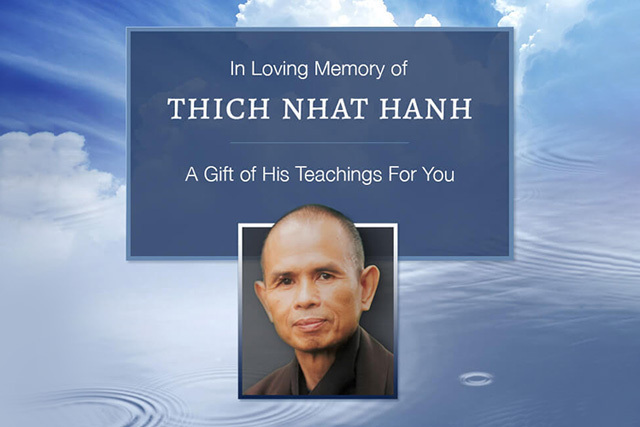
  • Free Thich Nhat Hanh Audio Series: Living Without Stress or Fear

    Free Thich Nhat Hanh Audio Series: Living Without Stress or Fear

    When you think of the teachers who’ve had the greatest impact on your life, who comes to mind?

    For me, it’s the calm, the humble, the patient—the people who not only imparted useful life lessons but also embodied their message with their grace and equanimity. People I was fortunate enough to know personally, like my grandmother, and others I never met that brought me clarity and peace from afar, like the inimitable Thich Nhat Hanh.

    Thay, as his students called him, was a Vietnamese Zen monk, author, poet, peacemaker, and founder of the “engaged Buddhism” movement—the act of leveraging our personal healing to help transform the world.

    Known as the “father of mindfulness,” Thay had a gift for helping others liberate themselves from their afflictions and find joy in the present.

    His message was simple: that mindfulness, practiced in both the ordinary moments and the extraordinarily hard ones, can help us understand the roots of our suffering and transform our pain. And that this is the key to serving others—because we can only help the people around us if we first help ourselves.

    Whether you’re already familiar with Thay’s teachings or you’re looking for new tools to help free your mind, I have a feeling you’ll appreciate this free gift from Sounds True: Living Without Stress or Fear, an audio series of Thich Nhat Hanh dharma talks.

    May his words soothe you, support you, and help you find peace so you can help bring peace to the world.

    I leave you with ten of my favorite Thich Nhat Hanh quotes:

    “Letting go gives us freedom, and freedom is the only condition for happiness. If, in our heart, we still cling to anything—anger, anxiety, or possession—we cannot be free.”

    “I come here empty-handed, and I go empty-handed. My actions are my only true belongings.”

    “Feelings come and go like clouds in a windy sky. Conscious breathing is my anchor.”

    “To be beautiful means to be yourself. You don’t need to be accepted by others. You need to accept yourself.”

    “We have more possibilities available in each moment than we realize.”

    “Our notions about happiness entrap us. We forget that they are just ideas. Our idea of happiness can prevent us from actually being happy. We fail to see the opportunity for joy that is right in front of us when we are caught in a belief that happiness should take a particular form.”

    “Even though things are not as we would like, we can still be content, knowing we are trying our best and will continue to do so.”

    “Hope is important because it can make the present moment less difficult to bear. If we believe that tomorrow will be better, we can bear a hardship today.”

    “There is the mud, and there is the lotus that grows out of the mud. We need the mud in order to make the lotus.”

    “If you take a handful of salt and pour it into a small bowl of water, the water in the bowl will be too salty to drink. But if you pour the same amount of salt into a large river, people will still be able to drink the river’s water. If your heart is small, one unjust word or act will make you suffer. But if your heart is large, if you have understanding and compassion, that word or deed will not have the power to make you suffer.”

  • How to Mindfully Temper Road Rage and Make Driving Less Stressful

    How to Mindfully Temper Road Rage and Make Driving Less Stressful

    “Smile, breathe, and go slowly.” ~Thich Nhat Hanh

    As a Lyft driver, I once spent significant time out on the road—a setting rife with provocations and stressors.

    Driving can feel like a constant challenge to employ mindfulness instead of giving way to destructive emotions like impatience and frustration. Meditation can be difficult to practice when you’re navigating a vehicle (demanding as both activities are of your full attention)—try channeling all your senses into it, and you’ll likely plow over a pedestrian or end with your car in a ditch.

    Navigating the road mindfully, though, doesn’t have to mean closing your eyes or adopting any of the other classic “meditative” stances. I think it involves something simpler: momentary detachment—both from everything that’s happening around you and from your own internal reactions as you watch from an ever so slight distance while they ebb and flow.

    Here’s some of what I’ve learned about maintaining equanimity when out there on the stress-inducing road.

    The importance of keeping in mind that sometimes there’s something we’re not seeing.

    Driving down Market Street through downtown SF, I once noticed a number of pedestrians stopped inside the crosswalk in the middle of the street. They didn’t have the right of way; the light was red for them and green for us drivers who were trying to get through. Cars were honking.

    For maybe a second my impulse was to add to the honk melee. Then I took a closer look and saw what was actually going on: a lady had dropped her bags, causing their contents to spill to the pavement. The people in the street were passersby who had run to help her pick them up.

    Once they were finished, I noticed how they stood and raised their hands in apologetic gestures [to the perturbed honkers] that seemed to say both “Just wait one minute please” and “Sorry, sorry, sorry.”

    Witnessing this got me thinking about how often in this fast-paced world we jump to reactivity before even understanding what’s going on first. We’re especially primed to do this out on the road, I think.

    As Shankar Vedantam said on his podcast Hidden Brain, “This woman didn’t bump into you maliciously; she’s blind. This soldier standing in formation didn’t pass out because he doesn’t have what it takes; he’s diabetic and needs his insulin. This woman isn’t heartless because she didn’t help the elderly person who had fallen; she’s paralyzed from a spinal cord injury.”

    Often in life, crucial pieces of a larger whole are unavailable to us—yet sometimes we act or respond as if under the assumption that we have access to all of them.

    Particularly when a driver in front of me is moving very slowly, or randomly stops, I sometimes feel the impulse to honk. I wonder why they’re being “so inconsiderate.” I ask them, in my head, if they’ve forgotten where the gas pedal is located. My immediate instinct is to cast blame on whoever’s holding me up.

    Yet I have to remind myself that I’m missing information. Maybe the driver in front of me is stopping to let someone cross the street. Maybe there’s a red light in front of us that I can’t see. Maybe… [insert any other number of possibilities here].

    I can’t see any of that though.

    I’ve also been on the receiving end; for instance when I stop to let a baby animal cross the road. Unable to see the road-obstructing animal, the cars behind me get annoyed and honk their disapproval.

    Willingness to admit when I am wrong (similar to the point above).

    Once when driving home across the Richmond Bridge, I thought there were only two lanes, which led me to assume that the guy next to me was cheating by driving along the shoulder.

    In response, my mind wove an entire narrative involving an entitled driver that does whatever he wants—weaves in and out, causing near collisions; uses the shoulder as his own lane, so that he can accelerate past the mass of stopped cars before cheating his way back into the pack once he’s gained a clear edge.

    To the driver he has endangered [through this behavior], who has responded by honking, he says, “Why don’t they just chill out?”

    I pictured the people out there who engage in similar behavior when not in their cars. The ones with blinders on to their own actions, who maybe call out others for “being too sensitive” while refusing to acknowledge their contribution to eliciting this supposedly sensitive response from them.

    Outraged, I honked at the driver—yet he kept driving along the “shoulder.” I shot him a look of disbelief; he didn’t look back. He seemed to not have even registered that my honk was directed toward him.

    That’s when I realized why: the “shoulder” was actually a legitimate lane.

    Remembering I’ve been wrong in the past helps me practice equanimity when I’m tempted to get outraged on the road.

    Practice forgiving mistakes.

    I think about those cars that get stranded in the middle of the intersection during high-traffic hours—usually because the light turned red when they were halfway through it. I think about how the cars around them often unleash an ambush of honks to signal their disapproval.

    I say this to myself when I’m about to become an angry honker: The trapped driver made a mistake. He or she is probably already aware. Your honk won’t teach him something he doesn’t already know.

    I realize that all my honk would have added was more noise to an already overly raucous road, compounding the driver’s shame while maintaining my own stress and self-righteousness.

    On somewhat of a side note, I’ve noticed how at times the most reckless drivers can also be some of the most intolerant of other drivers’ mistakes. One time a man who’d been driving eighty on a commercial street seemed very disgruntled when I changed into his lane (even though my doing this wouldn’t have been a “near miss” to someone who’d been following the speed limit).

    First he slammed the brakes. Then he wove theatrically around me into the lane next to us. From there he proceeded to change lanes three more times in the course of one block, dodging cars like they were opponents in a high-speed chase video game.

    If we can remember we all make mistakes, it will be easier to offer other drivers grace.

    Practice gratitude. When you do have a smooth ride, acknowledge it to yourself. Hold onto that moment and remember how it felt.

    A metaphor comes to mind each time I drive over a trafficless bay bridge (which happens very rarely but when it does, feels magical). Cruising over the smooth pavement without a car in sight conjures a wintery, white Christmas feeling.

    This calming and cleansing sight contrasts starkly with the default state of the freeway: normally a long stretch of cars, constant reminders of overpopulation and limited resources. It feels similar to gliding down a ski slope when the snow is fresh, pristine, newly plowed, and un-scuffed by other skiers.

    I made a note to be grateful for it.

    Even machines like Siri can be recipient to your gratitude. When traffic clogs the freeway, for example, I appreciate how she escorts me onto an alternative route. On one, we drove down bucolic side roads past fields of sunflowers while country music played from my car speakers (and bugs splattered against the windshield). On another, a river gushed a few feet away from us, providing a peaceful backdrop both visually and auditorily.

    Don’t force it, but when a moment that might be worthy of some gratitude does present itself, register it (even if it’s extended toward an inanimate object). Acknowledge it, if only to yourself.

    Humanize the other drivers around you.

    I think part of what exacerbates and heightens road rage is the ease with which we’re able to dehumanize the drivers we’re sharing the road with because we see cars first, people second. Attuning to certain visual cues, though, can reinstate a human component.

    I’ve found that making eye contact with another driver can at times quell any road rage that’s starting to bubble on my end. Other little things, like keeping my corgi stuffed animal visible, also help (when drivers get mad, the sight may calm them).

    One time when driving, I came upon a car stopped in the middle of the road. Just as I was about to get annoyed at the hindrance, a little Latino boy eating an apricot stuck his head out the car window. Juice dribbled down his chin while he waited for his dad to fix their car (which was why they were stopped). The innocent sight instantly calmed me. It was almost Hallmark-card level of sweet and centering.

    Another “tempering” visual cue: when a dog sticks its head out the window to feel the breeze against its face. Irritation was beginning to mount one day when I saw them: those big, brown eyes—opened wide, earnest, and slightly damp—shining above a golden snout in the back window.

    Once again I was calmed, my anxiety diffused by our eye contact—reminded that we’re are all flesh and bone, even when stress pushes us to reduce each other to the metal contraptions we cart ourselves around inside of.

    Take your time, Sir. I’m just going to have a moment with your sweet fur baby in the meantime, if that’s okay…

    In the absence of visual cues, use your imagination.

    Whenever I start to feel impatient with the slow driver in front of me, but I can’t see their face (or no other visual cues are present to temper the impatience), I take a deep breath. Then I gently counsel myself to envision the human inside the car.

    The specifics of whichever person pops into my head don’t really matter. What matters is that I recognize their humanity and extend patience toward whoever does.

    If that doesn’t work, try picturing one of your family members. What if the driver was your uncle, or your kind elderly neighbor, or your mom? Use your imagination to see inside the 2,000 pound metal machine that’s obstructing your path. Draw features onto the faceless foe inside it. De-objectify its operator.

    Driving and traffic can be stressful and draining. During the times when it feels like the surrounding cars and I are basically just crawling to our destination, I feel like I might as well be outside the car, pulling it with a rope—at least that way I’d get some exercise and Vitamin D.

    Sometimes I wish someone would invent a car feature that would allow the driver to switch to “pedal mode.” It’d be a great way to release endorphins through exercise (thereby reducing stress levels) during these inherently stressful situations.

    Until those innovations get brought into existence, though, we can work on controlling our own internal responses to whatever external road frustrations come our way.

  • Feeling Burnt Out? How to Slow Down and Reclaim Your Peace

    Feeling Burnt Out? How to Slow Down and Reclaim Your Peace

    “Burnout is a sign that something needs to change.” ~Sarah Forgrave

    Fifteen years ago, my doctor informed me I was in the early stages of adrenal exhaustion. In no uncertain terms, she warned that if I failed to address the stress I was under, my adrenals might not recover. This was hard to hear, but it forced me to face the fact that eating well, exercising religiously, and keeping up with the latest research on wellness was not enough.

    I had to ask myself a defining question that day: Am I ready to go down with the ship?

    At the time, I was teaching an average of fourteen classes a week at my wellness studio. I had been exceeding my threshold for so long that I had pain in every joint and muscle in my body. I was completely exhausted, physically, mentally, and emotionally, but slowing down or cutting back was just not an option.

    Or so I believed.

    The problem was that every time I would even begin to consider addressing the reality of my situation, my head would instantly fill with all the reasons I couldn’t possibly stop.

    There was the dream for a business I couldn’t imagine giving up. The huge amounts of time and money I had invested in realizing that dream. And most of all, there were the clients I was serving, a community of amazing women I loved working with and didn’t want to let go.

    Meanwhile, my thirty-year marriage to a man struggling with an opioid addiction was falling apart. My kids were distressed. My body was completely breaking down, and my life had become a tangled mess of fears, conflicted feelings, and obligations I just didn’t have the heart for anymore.

    As the growing pressure to do something about my situation increased, my anxiety increased right along with it. Talk about a pressure cooker!

    I couldn’t even imagine the courage I would need to tell my husband I wanted a divorce. And whenever I got anywhere close to that courage, my mind would flood with anxiety over the uncertainty.

    How would he react?

    How would it affect my children?

    Where would I live?

    How would I ever rebuild my life?

    It felt as if I was being buried alive under a growing mountain of complexity with no way out. So, the pain continued to get worse, and I kept trudging forward, blindly hoping against hope that somehow it would all work itself out (without changing anything about the way I was living).

    Growing up, I had learned to take the offensive and power through obstacles. I had always seen myself as someone who could do anything she put her mind to. Now I found myself stuck between the person who thought she was responsible for everyone’s experience but her own and the person I might actually become if I started making self-valuing, authentic choices.

    Then one morning, the dam broke.

    I was walking up to the door of my studio to teach the 6:00 a.m. class, asking myself (like I did every morning) how I was going to get through the day with all the pain I was in.

    As I turned the key in the lock of the business I had dreamed of creating for over a decade—the business I had built out of everything I believed in and everything I knew I wanted to offer to the world—I could see the consequences of my resistance to change about to swallow me whole. I could see that my fear of change was completely blocking my ability to see anything past that.

    And suddenly… everything went quiet. All the reasons for not stopping that typically flooded my mind just fell away.

    The only thought I had in that moment was, The way you stop… is you stop.

    I didn’t just hear these words; I felt an absolute acceptance of them. One minute it was impossible to stop; the next, it felt like the simplest thing in the world.

    In the quiet of this moment, I became so aware of my own breath that I felt it everywhere in my body. For the first time in as long as I could remember, I stopped. And when I did, I found the courage to listen to my aching heart.

    I felt a depth of longing for peace I had never allowed myself to experience before. I stood there breathing and felt an acceptance of the reality of everything that was happening wash over me. The pressure to control it all was gone!

    My mind was clear, and my body felt relaxed even as I faced the same facts of my situation, but without all the usual stories and justifications overwhelming me. It felt like a miracle.

    Suddenly the door to my studio, which I had been walking through for years, felt like the door to an entirely new way. Standing there with my key in my hand, in the profound quiet of that moment, I was flooded with a new sense of possibility.

    As I set up for the 6:00 a.m. class, I stayed focused on my breathing and continued to listen to my body. It became clear to me that when I wasn’t being honest with myself, my body responded by restricting my breath. And I was able to see how all the years of unaddressed tension were expressing themselves as escalating physical pain.

    A New Direction

    That morning, I didn’t just take a first step toward interrupting the old way. I began heading in a new direction.

    But it still took me a year and a half to wind down my commitments and extricate myself from the studio. This was a massive transformation involving every aspect of my life, but it began with just one step—accepting that the old way was broken. Once I accepted this wholeheartedly, I moved to the next step.

    I had a friend who had moved back to town to take care of her aging mother. She was looking for a place to establish her yoga school and had already been teaching a couple of classes a week at my studio while she looked for a more permanent place. On that pivotal morning, after I taught the 6:00 a.m. class, I called my friend and told her that I was stepping down and that she could hold all her classes there.

    I continued to pull back, one step at a time, constantly asking myself, “What can I let go of today?” (One day, the answer to this question was “my hair”!) Eventually my friend bought out my lease and took over completely.

    This is not to say I did not continue to wrestle with self-doubt. But my intention to slow down and to stop ignoring my tension became my guiding compass point.

    In the years that followed, I relied on this compass to dive more deeply into the mind-body connection and what it truly means to take care of myself and be happy. My primary tool was the simple mindfulness practice of paying attention to my posture (whether it was tense or at ease) and my breath (restricted or free). I found strong community for this priority in the study and practice of Qigong, Tai Chi, and Continuum.

    In the process, it became clear to me that to access the wisdom within, the first thing I had to do was slow down and calm down. This priority allowed me to be honest about the pressure I was putting on myself to keep doing things I no longer had the heart for and to recognize the emotional reasons I was hanging onto them.

    We all come to thresholds in our lives, times when we’re faced with tremendous pressure to change (or go down with the ship). When we refuse to change, the only other option is to increase our tolerance for suffering while convincing ourselves that it’s not affecting us as much as it really is. In this fantasy we tell ourselves we’ll make it (somehow) if we just keep powering through.

    I’ve come to realize that it’s not about avoiding stress. It’s about increasing your ability to remain present and functional while stressful events are happening. The calmer you can be in the face of stress, the more resilient you’ll be and the less likely you’ll be to end up teetering on the edge of complete burnout like I was.

    When we practice being present, we’re able to make more accurate moment-to-moment choices. We’re able to slow down and take an honest look at what needs to change. Which isn’t to say that it’s going to change in a minute, or a day, or a week, or even a year. The truth is that lasting change can often be a very gradual process.

    How to Stop

    I was able to stop by establishing new priorities. I made it a point to slow down, calm down, and really be honest about what I could eliminate. My process was essentially as follows:

    1. Stop. (For the moment, anyway.) Acknowledge that before a new way can show itself, you have to find a way to stop the old way.

    2. Acknowledge the pain you are in—emotional and physical.

    3. Ask what you can let go of now and in the near future. (If the answer is “nothing,” then ask again.)

    4. With “something has to give” as your mantra, what can you let go of next?

    • Consider what you are physically and mentally capable of doing right now. (If the answer is “everything, if I push myself,” then ask again.)
    • Consider your life priorities and what you need to make room for.
    • Consider what you no longer have a heart for.
    • Consider that what you are holding on to tightest might be what really needs to go. Letting go of smaller things first often helps to relax your grip on even your strongest (and often unhealthy) attachments.

    5. When the “yes, but…” voice shows up, be aware of it and do your best not to listen or take action based on what this voice says. This is the voice of your attachment to keeping an unsustainable system on life support. It’s fueled by your fear of uncertainty because if you stop what you’re doing, you’re not sure what will happen (and your “yes, but…” voice is certain it will be awful!).

    6. Gather tools to help yourself detach enough from this voice to move toward accepting reality and make the changes needed to live a more authentic and satisfying life. (The Serenity Prayer is a good one.)

    7. Remember that change is a process, not a single event. Start small, then graduate to bigger things that need to go.

    I hope you’ll continue to play with the concept of stopping (the old way) to start (a better way). Every meaningful change hinges on your ability to interrupt the old pattern. You’ll learn to rely on this ability the more you practice using it.

    Also keep in mind that you won’t necessarily know anything about the new way when you stop the old one. Change usually happens very slowly, and patience can be the hardest thing.

    Good luck, and feel free to reach out with questions or comments!

  • 3 Things I Realized When I Stopped People-Pleasing and Let Myself Receive

    3 Things I Realized When I Stopped People-Pleasing and Let Myself Receive

    “Until we can receive with an open heart, we are never really giving with an open heart.” ~Brene Brown

    The honest truth about needing to please is that we do it to make other people happy. We will sacrifice everything and anything to put a smile on another’s face and lighten their load, while ours keeps building.

    The only problem is that while helping others makes us feel good, it’s almost addictive until we are burnt out. And giving and pleasing others starts to come from a place of resentment.

    I’ve been there!

    There was a time when I used to come up with a thousand reasons why I couldn’t leave the house. I was desperate to get to a yoga class and claim an hour away from being a mum, wife, friend, and entrepreneur.

    But instead, I prioritized keeping my kids happy and did everything I could to avoid the onset of a tantrum and also made sure my husband sat down to a delicious, home-cooked meal each night. And when the kids were napping, I would use that time to do a little work.

    The routine started to get boring. I complained daily. I was grumpy and irritable.

    Yet the days kept coming and I started to drag my feet. The tasks were mundane and never-ending, and they started to get on my nerves. I’d lash out at the washing machine or slap together a half-assed attempt at dinner. And I wasn’t just overextended and resentful in my home life. My clients were taking advantage of me, and my friends sucked my energy dry.

    I kept showing up for everyone around me—striving to keep the peace, to keep them happy, while I was worried that I might let them down or wasn’t living up to their expectations. Yet with a whole lot of hindsight, I discovered that I had placed all this pressure on my shoulders myself.

    Denying myself a sixty-minute yin yoga class was the stupidest thing I had ever done. It still sounds ridiculous now. But at the time, I couldn’t see any solutions. I had tunnel vision and it didn’t revolve around me.

    I felt like I didn’t deserve the break.

    I felt responsible for everyone around me.

    I was unsure what would happen if I left our house for an hour and what I would walk back into after leaving my two young kids alone with my husband.

    Each afternoon, I was an emotional wreck by the time my husband came home. Being the problem solver that he is, he encouraged me to go and find a class—as if it was that simple. I thought, “What does he know anyway? He has no idea about all the things I still have to do.”

    But I eventually realized he was right. I needed a break, and I had to get out of my own way and take it.

    Finding a class was easier than I had imagined. There were loads to choose from and all kinds. I settled on a 4:30 p.m. class on a Friday, that was only a five-minute bike ride away.

    I remember walking through those yellow doors to find only me, two other people, and a smiley yoga teacher.

    Ahhh, I relaxed. I rolled out my mat and lay down because it was a yin restorative practice. We lay there for what seemed a lifetime. I spent it fighting with my mind to not think about what might be happening at home, my to-do list, my kids, the grocery list, my work… Thankfully, we finally got moving and I started to tune into the music.

    The class was literally six poses of deep stretching and rest, and it was a challenge to surrender instead of extending each pose.

    My mind focused on how to allow my limbs to soften even in a standing pose that we held for a good five minutes. Not collapsing took every ounce of concentration I had.

    I took big belly breaths, in to fill my lungs and out to gently soften.

    In the final fifteen minutes we had a deep meditation (savasana), with the yoga teacher coming around to us individually, massaging the back of our necks to the bottom of our skulls. She finished it off by pressing her two warm hands down on my shoulders as if she was pushing me back into the ground. Tears began streaming down my face as she walked away.

    I had fully surrendered and left my mind to be in the present moment, and her touch released the stress and burden I was carrying. It was an intense moment, and I felt joyful and at peace. I had literally forgotten that I had to return to my family only minutes later.

    That class changed me as a mother and a wife.

    I went back every week religiously after that. I saw the power of connecting with my breath and myself. Because that one hour reset each week was enough to fill up my cup and change how I was showing up for myself and others.

    My daily chores didn’t bother me anymore. I had more love to give my kids and partner. I had a renewed sense of energy. When someone asked for help, I had the capacity to give because I wanted to instead of seeing it just as another task I had to do.

    Once I learned to receive, which meant surrendering my responsibility and need to control and allowing myself a little love, I discovered that I often denied myself other things, like going out for walk or catching up with friends. And this is where I had to lean in deeper and question what it means to receive. Here is what I realized.

    Accepting Help

    It is not a sign of weakness to ask for help or receive it, and I don’t need to prove myself or my worth through giving.

    I really felt like I was doing life alone, taking on the responsibility of everyone around me and driving myself into the ground. People would make kind gestures to help, but I would often shut them down with an “I’ve got it covered, thanks.”

    The day my husband stepped in to wash the dishes after I shared that I had a looming deadline, he practically threw me out of the kitchen. I felt so guilty, like I should be the one doing them, not him.

    What I thought was a one-time deal has now lasted three years. It has lightened my load, and our relationship has been better because I no longer feel like I’m the one doing all the things.

    Accepting help is receiving an energetic exchange with someone that wants to offer support. So take it.

    Acknowledging Compliments

    Too often, I would deflect when someone would say something nice to me. I found it uncomfortable, and it made me question their ability to see what was really happening.

    I didn’t feel like I deserved a compliment because I didn’t see myself like others did. I didn’t feel worthy of being praised, so I brushed it off with, “No worries, it was nothing,” “I would do it for anyone,” or “This old thing? I bought it on sale five years ago.”

    Learning to receive a compliment showed me that I could be honored and celebrated for who I am and that there was nothing to be ashamed of. I thought that people who received compliments looked nothing like me and were doing more important work than little old me. But I learned that compliments are praise, and we all deserve to feel seen, heard, and acknowledged.

    Realizing I’m Not Responsible for Everything

    Here was my greatest lesson, which was letting go of my need to control all situations. The responsibility I carried, because I felt it was my job to make everyone happy, was costing me my physical and mental health along with my relationships.

    When I released the control, it created space for things to happen without my interference. It provided space for me to see how others could step up and take responsibility, for mutual needs and their own. It gave me permission to invest in my own well-being.

    Instead of over-giving, fixing, and manipulating, I stood back. From here I could see that life is a two-way street where we exchange our energy with one another. This allows us to give from a full, nourished heart, and this is much more satisfying than giving from a sense of fear and obligation.

    Opening our hearts to receive eliminates our tendency to over-give. When we give without our full presence, we are not showing up fully for ourselves or for other people.

    We all love to support the people we care about, but we need to receive just as much as we give, creating a balance that never leaves us feeling drained or that we “should” be doing something.

    Do you find it hard to receive? What helps you let go of control and fill your own cup?

  • Why It’s So Hard to Just Rest and Why We Need to Do It

    Why It’s So Hard to Just Rest and Why We Need to Do It

    “If you don’t give your mind and body a break, you’ll break. Stop pushing yourself through pain and exhaustion and take care of your needs.” ~Lori Deschene

    In November of 2021, my autoimmune issues flared up. My doctor and I are still unsure which of my conditions—rheumatoid arthritis or fibromyalgia—was the culprit, or if they were acting in cahoots, but the overall achiness and debilitating fatigue were a solid indication that something was more active than usual.

    I woke up tired, needed naps, and often ran out of spoons—a phrase familiar to many with chronic conditions, based on a gorgeous essay called “The Spoon Theory” written by Christine Miserandino.

    While I may not know the reason, the one thing that was certain was that my body was demanding rest.

    Do you have any idea how hard it is to just rest?

    I mean it.

    Knowing that I needed rest did not grant me the immediate ability to actually pull it off.

    I would sit down to watch a show and find myself trying to multitask. Or I would attempt to put off a nap like a recalcitrant toddler. Instead of throwing myself on the floor in a tantrum, I was trying to “push through” so I could finish typing an email or move a load of laundry into the dryer.

    Even with a body and brain that were crying out for rest, it was difficult to allow myself to do it. In the end, I had to reparent myself in order to be able to rest, enforcing stopping times and rest periods.

    Those of us in the western world, especially here in the United States where I live, are programmed to be productive. We are told—and we tell ourselves—all of the things that we “should” be doing in order to be busy. Work in all its forms, from job tasks to errands to chores, is what we are “supposed” to do.

    We are conditioned to be productive and to stay busy from the time we are young. We hear people say things like “I’ll rest when I’m dead” and “no rest for the weary.” We are exhorted to “pay our dues” and “put in the work.”

    If we were somehow fortunate enough to avoid the overt messaging about staying busy and working hard, most of us received those messages indirectly by watching the people in our lives.
    We watched our parents come home from work with arms full of grocery bags, only for them to fix dinner while putting groceries away. Or we were asked what we were doing and made to feel wrong if our answer to the question was a child’s honest “nothing.”

    Long after dinner, once everything was cleaned up or tidied and it was “time to relax,” we watched our parents do additional work, both paid and unpaid. Or we watched them knitting, ironing, or puttering around the house.

    We have been told that we have to “work hard” in order to succeed. That “nothing good comes easy.” That we shouldn’t stop when we are tired, but only when we are “done.”

    Sitting down and resting is not prioritized. Those who decide to rest often must justify it: they have to have earned the right to rest.

    Rest doesn’t only mean sleep, although sleep is a large part of it. It also includes sitting comfortably doing not much of anything at all.

    It could mean listening to music or watching TV or meditating. Or perhaps working quietly on a jigsaw puzzle or craft or reading a book or article. Maybe playing solitaire, or looking out the window, or journaling.

    In the fall, as I was struggling with my autoimmune flare, it occurred to me that I should rest more. I was so accustomed to overriding my body’s signals that I hadn’t realized how far I’d pushed myself.

    When I tapped into how my mind and body were truly feeling, I was shocked to find that my mind and body were almost buckling, on the edge of collapse.

    I waited to notice what was happening until I’d reached the point where I was unable to do many tasks in the day at all. A banner day during that time might have involved doing a single load or laundry or cooking dinner for my husband and me.

    I was so fixated on staying busy that I could no longer assess my need for busyness in an honest manner. I had lost the ability to tune into my body to find out if it needed to move and stretch, or even to stretch out and sleep.

    Had I continued to push ahead for much longer, I’m certain that I would have fallen ill. As it was, I was dealing with brain fog, fatigue, and both joint and muscle pain, all of which made life unpleasant.

    It is easy to see now that I should never have allowed things to get to that state, but fatigue and pain and brain fog have a way of teaming up on you so that you can’t clearly assess much of anything. Nevertheless, when I hit the edge of collapse and burnout, I realized that some serious rest was in order.

    I essentially cleared my calendar for at least three weeks. I cleared my work calendar of appointments, scheduled some brief blog posts and emails, and took time off.

    It was torture at first.

    For one thing, my husband was still getting up and heading out into the world to teach tai chi and qigong classes, so he was modeling “proper” work behavior. For another, I discovered that I was incapable of “just resting.”

    I had to relearn how to listen to my body to discover what it needed. 

    I also had to reprogram my thoughts about rest as being an inherent right that we all hold, and not a reward for productivity.

    I also had to learn how to actually do it.

    I did all of the things I listed earlier as forms of rest, from naps to puzzles to sitting quietly. It was ridiculously difficult.

    I had to almost force myself to limit myself to single-tasking, which is doing one task at a time. That was especially hard if the task was mechanically simple, such as watching a television show. My inner monologue would kick up, chastising me for “just sitting there,” urging me to “be productive.”

    In those moments when I decided that rest meant watching a movie on TV, I sometimes sat on my hands to make sure that I didn’t pick up my phone or a crossword puzzle or something else. I often put my phone on silent and deliberately left it in another room, just to reduce temptation.

    Full disclosure: Even with taking affirmative steps to single-task, I didn’t always manage. I did, however, learn through reinforcement that there was nothing likely to arise in an hour or two of time that required me to give up on resting and take immediate action.

    I realized that in many ways, I was retraining my nervous system to allow itself to relax. It was so used to being in a state of alertness that resting and allowing it to have some time off took some getting used to.

    What I learned when I started to budget rest into my days was that I could start to tell more easily what signals my body was sending. It became easier to converse with my brain and body to find out how they were feeling and what they needed.

    It sounds a bit dissociated when put that way, but I have never felt more integrated than I do now. At any given moment, I can pause, tap into what I am feeling (mentally and physically), and act on my own needs in ways that are more nurturing and caring than before.

    When I realize that I am losing focus on a project—perhaps while typing a blog post or planning a workshop—I no longer push through. Instead, thanks to months of practice, I pause and check in with my brain and body. Thanks to practice, I can quickly ascertain whether I need to take a simple break, to get up and walk around for a bit, to take a walk outdoors, or to stop for the day.

    I am learning to embrace the idea that rest is an inherent right, not something that needs to be earned. It is no longer something that occurs only once I have pushed myself until the point of collapse. 

    As it turns out, the more I lean into rest and build it into my days, the more energy I have to actually accomplish all the things I want to get done in life.

    When I add time off or breaks during the day, I find I have better focus when I need to be working on a task. When I include rest in my days, I have the energy to exercise in the morning and also make a good meal for dinner.

    I invite you to join me in adding actual breaks into your day, where you do nothing “productive” at all. No catching up on phone calls or emails or texts—just rest. I’d love to hear if and how it works for you.

  • What Is Stress-Induced Illness? How Trauma Can Cause Physical Pain

    What Is Stress-Induced Illness? How Trauma Can Cause Physical Pain

    “Wisdom is merely the movement from fighting life to embracing it.” ~Rasheed Ogunlaru

    Three years ago, I fell into the blind spot of medicine: America’s unknown epidemic.

    After numerous tests, scans, scopes, and too many doctors to count, modern medicine could not find anything seriously wrong with me. I also consented to have my gallbladder removed. My first and only surgery at age forty, an “experiment” of sorts.

    Six months into the worst nightmare of my life, my spiraling health started to take a huge toll on me physically, mentally, and emotionally. I didn’t want to live anymore, but I was too chicken to take my own life.

    They Cannot See the Forest for the Trees

    If just one doctor had paid closer attention to my backstory and probed it further, the diagnosis would have been obvious and the treatment plan effective. Here’s the problem: My doctors were only focused on my presenting symptoms and not on my whole being.

    Instead, thoughts of the following conditions (in this exact order) became my daily companions: colon cancer, GERD, IBD, IBS, pancreatic cancer, small intestinal bacterial overgrowth, gluten sensitivity, celiac disease, Meniere’s disease, interstitial cystitis, chronic pelvic pain, pelvic floor dysfunction, motor neuron disease, multiple sclerosis, bladder cancer, thoracic outlet syndrome, pudendal neuralgia, peripheral vascular disease, bile reflux, and a few other conditions I’ve surely forgotten. I was one big, hot mess.

    Of the twenty-six symptoms I experienced, the constant bladder pain was the most excruciating and difficult to deal with. Imagine a UTI that never goes away. Nothing could knock it down.

    The pain took me to the edge of wanting to take my life many times. At one point, I told a doctor that I would give him my entire 401k savings if he could make the pain go away.

    It’s Time to Surrender and Trust the Process

    In September 2021, I surrendered to the pain and requested a referral to an academic medical center after fighting it for nearly two years. Somewhere along the way, I made the conscious choice to walk with the pain instead.

    I quickly learned that doctors specializing in pain medicine do not try to cure pain, but they try their best to equip patients with strategies to cope with their pain. Along with the things my pain psychologist taught me, he encouraged me to reacquaint myself with Curable, an app I had actually loaded onto my phone almost a year prior but had quickly dismissed. Stupid mistake on my part.

    Addressing pain at an emotional and psychological level did not make any sense to me. After all, I had a structural problem, not a brain problem—or so I thought.

    Fortunately, during my second round of trying the Curable app, I discovered Howard Schubiner MD and one of his colleagues, Alan Gordon LCSW, a psychotherapist specializing in the treatment of chronic pain through pain reprocessing therapy (PRT).

    Dr. Schubiner is the founder and director of the Mind Body Medicine Program at Providence Hospital in Southfield, Michigan. His program uses the most current research methodologies to treat individuals who suffer from the mind body syndrome (MBS) or tension myositis syndrome (TMS), as described by Dr. John Sarno.

    What is mind body syndrome? I’m going to answer this in a second, but first I need to take this story back to my childhood. This is where the story gets very interesting and revealing.

    The Haunting Effects of a Bad Childhood

    As I started to dig deeper, I was introduced to the landmark 1998 ACE study that, as its abbreviation indicates, explored “adverse childhood experiences.”

    The ACE research concluded that the more adversities a person experienced as a child—whether it be a parental death or incarceration, poverty, neighborhood violence, or abuse—the more likely that person would be to suffer from serious physiological disorders as an adult. I had six childhood adversities: a household with substance misuse, violence, divorce, severe poverty, neglect, and incarceration of a parent, all at or before the age of ten.

    I also discovered a recent meta-analysis showing that individuals with a history of psychological trauma, regardless of the type of trauma, were almost three times more likely to have chronic pain than those who had experienced no trauma.

    Bingo! Just call me Sherlock Holmes.

    Translation: As a child, I was threatened repeatedly—not physically, but emotionally—causing my body to have a stress response. This prepared my body to fight or flee. Because my body stayed in this stress response mode for an extended period of time, crucial neural connections in my developing brain most likely suffered damage, causing me to be hypersensitive to stressful events.

    In other words, my alarm switch is always “on,” unless I can lower the perceived danger in my brain. My divorce was just the tipping point to my spiraling health.

    The Day the SWAT team Visited My Home

    To illustrate how inept society was in the early nineties at addressing emotional trauma, I only need to point to one early morning when the SWAT team jumped my backyard fence and pointed their submachine guns at me while I was feeding our family dog, Smokey. Their target was my dad (he sold drugs), but he was nowhere to be found.

    He had been out partying all night and had yet to return home. I was the only person home at the time. A scared shitless ten-year-old boy. I liked watching the reality show Cops, but this was completely surreal.

    This is the crazy part. The SWAT team left me in the backyard and told me to go to school, like nothing had happened. I never spoke to a counselor or therapist about this frightening event.

    I grew up thinking it was normal to not talk about emotions—or scary things like being stuck in the middle of a drug raid, alone and helpless. I grew up real fast that day.

    Mind Body Syndrome, Anyone?

    Mind body syndrome, or psychophysiologic disorder (PPD), is a certain diagnosis arising the majority of the time in the absence of tissue or structural damage in the body, when nerve pathways become continuously or intermittently activated by past or current life stressors.

    The Psychophysiologic Disorders Association states that the symptoms of PPD are due to altered nerve pathways in the brain that affect the body. Symptoms can include headache, back pain, chest pain, muscle or joint pain, abdominal or pelvic pain, constipation, diarrhea, bloating, nausea, irritable bowel syndrome, discomfort in the bladder or during urination, fibromyalgia, chronic fatigue syndrome, and many other symptoms.

    To illustrate how inept today’s doctor is at diagnosing a psychophysiological disorder, I only need to point to my first-ever encounter with a board-certified gastroenterologist in March 2019. Gastroenterologists are doctors who are highly trained to diagnose and treat problems in the gastrointestinal (GI) tract and liver.

    Basically, they get paid handsomely to look up people’s butts and take pictures all day long. If you ask me, it sounds pretty mundane and not all that creative. The best news you can receive after getting one of their colonoscopies is that you really didn’t need the procedure after all.

    Emotional Tone Deafness

    To help remedy my bowels that had gone haywire (the first of my many symptoms), I anxiously took the slot of the next available doctor at a nearby GI clinic. While on the examination table, I related that I was smack dab in the middle of a horrible divorce and in a lot of emotional distress after being in a dysfunctional marriage for the last ten years.

    The doctor’s response? Nothing. Zip. Nada. You could have heard a pin drop in the room. Instead of acknowledging my unfortunate circumstances, this dimwit doctor went about the rest of his examination and acted like what I had shared with him was the most benign, most boring thing he had ever heard in his life. By my definition, this was a moral injustice.

    News flash: The Holmes-Rahe Stress Scale indicates that divorce is the second highest stressor for humans, second only to the death of a spouse.

    Searching High and Low

    I had secretly wished that my doctor was going to validate my emotional trauma and scars and identify them as the cause of my bowel changes, but his lack of a response only reinforced the fact in my brain that something was structurally wrong with me. And so that’s the path I went down for nearly three years, trying to find something structural to explain one unexplainable symptom after another.

    When I say I turned over every stone, I really did.

    I went as deep as internal pelvic floor therapy to try to cure my bladder pain. That’s right. My physical therapist and I mapped out and explored every nook and cranny of my pelvic floor via my anal canal. As a bonus, I had homework to complete with a funky wand apparatus.

    Remember, I was desperate and willing to try almost anything. Everything except the butt gas. It’s basically ozone therapy gas that is administered into the body. In my case, I would have given it to myself through my butt.

    I can’t help but laugh when I recall the day I was first presented with this option. This is what my life had become. Wacky alternative therapies.

    In my career, I get paid to find solutions and fix problems. Fixing my health was no different, I thought. In my futile attempt to fix my health, I flushed thousands of dollars down the drain in the process and just about lost my sanity.

    Can This Really Be Real?

    At this point, one might ask if PPD symptoms are real or imaginary. The symptoms are real. In fact, the symptoms can be just as severe as those from any other disease. Some patients with PPD are ill enough to be hospitalized.

    Experts like David Clarke MD, a retired gastroenterologist and president of the Psychophysiologic Disorders Association, like to point out that one in six adults and 30–40% of primary care patients suffer from pain symptoms and chronic conditions that are “medically unexplained.” This is America’s unknown epidemic.

    But wait. There is a silver lining that comes with all this unfortunate news. Once PPD is recognized, treatment is available and is often effective in alleviating symptoms. Dr. Schubiner likes to ask: “Why manage your pain when you can cure it?”

    The Best Treatment Around

    So how effective is the mind body syndrome treatment? Dr. Schubiner and his colleagues published an article not too long ago demonstrating that emotion-focused therapy was superior to cognitive behavioral therapy (CBT) for dramatic pain reduction in people with fibromyalgia, many of whom had experienced childhood trauma.

    Dr. Schubiner and Alan Gordon also helped lead the recent study at the University of Colorado–Boulder that showed that not only can chronic back pain be managed, it can be cured using a mind body approach. In their study of 151 total participants, 66% randomized to PRT were pain free or nearly pain free at post treatment.

    Once I heard this, I started to tackle my pain at the emotional and psychological levels. Along with somatic tracking, expressive writing, mindfulness, and reprogramming the brain, my favorite treatment activity has been intensive short-term dynamic psychotherapy (outlined in Dr. Schubiner’s book, Unlearn Your Pain), where deeply buried emotions of anger, resentment, guilt, shame, sadness, and grief are uncovered and released. Healing often occurs rapidly once these emotions are stabilized.

    During this process of intensive short-term dynamic psychotherapy (ISTDP), I have taken several of my most incompetent doctors, and even my dad, behind the proverbial woodshed, and I have given them the worst tongue lashing they’ve surely ever received in their lives. Cursing is highly recommended and encouraged.
    While I couldn’t literally slash the tires of the doctor who appeared earlier in this story, this was the next best thing. And it felt so good.

    You might be wondering what happened to my dad. He eventually turned his life around, and I am so grateful for this.

    Today, while my pain is not completely gone yet, it’s generally at about a two or three instead of a six or seven. I will take this any day.

  • Mindfulness, Creativity, and Nature: A Healing Trifecta for Lasting Peace

    Mindfulness, Creativity, and Nature: A Healing Trifecta for Lasting Peace

    “It is the marriage of the soul with nature that gives birth to imagination.” ~Henry David Thoreau

    Before my accident, before we had kids, after we divorced, after my father died from Covid, before the pandemic…

    We tend to divide our lives into the before and afters that define our world, whether personally or on a grand scale. These divisions offer context, providing a kind of roadmap that supports us in reflecting on the beauty and darkness, the decisions we made, and who we might be if certain things had never occurred.

    I have always believed that the only reason to look back is to learn. Still, I can’t help but wonder: What if, when my marriage ended, I already had mindfulness skills in place? What if I had known the infinite ways nature could soothe my soul? Would my life have been different if I had consciously known that creativity was the safest place to process my emotions?

    Perhaps I would not have been paralyzed in grief and sorrow. Maybe my children would have been spared a terrible custody battle. I suppose there is a chance I would not have gone bankrupt. I wonder if I would have ever gotten divorced at all.

    Here’s the biggest question: Would I change any of it now?

    Not a chance.

    As difficult as it all was, I learned that every tool I needed to survive and thrive was right in front of me, and always will be.

    My journey led me to a path of sharing what I am most passionate about: helping others find their way, through what I called a “spiritual toolbox”—a personal supply of healthy actions and practices to choose from or combine when things become difficult.

    Your spiritual toolbox can hold things like creativity and gratitude practices, exercise, meditation, time in nature, and journaling; a hug, the love of a pet, a hot bath, and even an occasional glass of wine. It’s wonderful to open in the moment, and it’s even better to use as preventative medicine (the toolbox, not the wine).

    My “aha” spiritual-toolbox moment came when I accidently discovered the transformative power of combining three tools specifically, as a trifecta. These were: creativity, meditation, and time in nature. 

    This trifecta insight divided my life into two parts: asleep and awakened.

    The first part is quite literal: at age nineteen, I fell asleep while driving and didn’t walk for nearly a year afterward. My accident was the synopsis and ending of a carefree childhood and adolescence, where I suffered no hardship that would have “awakened” me to anything beyond plans for the next evening.

    However, while I physically woke up pinned under the tire of my car, I also woke up spiritually: I was alive, and my two best friends who were with me, were uninjured. I was officially “awake” on infinite levels, primarily to the deepest sense of gratitude. And, while I metaphorically “went to sleep” later in other areas of my life, the trifecta was always there to support my awakenings.

    From the time I could crawl, my preference was to do it outside. My imagination was my best friend, and my mother could more easily find me digging mud from the creek behind our house rather than playing next door. I made togas from my curtains, spoke in my own language, and told everyone I was “Elizabeth from another land.”

    Obviously, I had no way of knowing about the robust and ever-growing body of research indicating that artmaking and creativity have been shown to increase positive emotions, decrease depression and anxiety, reduce stress, and even boost the immune system. That art therapy could boost the memory of Alzheimer’s patients, or reduce the side-effects of chemotherapy.

    I didn’t know that indulging creatively literally creates a “cascade of endorphins, serotonin and dopamine, the brain chemicals that affect our well-being,” increasing feelings of joy and contentment.

    I hadn’t yet wrapped my head around the fact that everyone is creative, and the benefits have nothing to do with artistic skill. I simply knew that I was happiest when I was being creative, and that artmaking could pull me out of almost any funk.

    I was intuitively awakened to creativity.

    Then, at age forty, my marriage collapsed. I collapsed with it, down a slippery and medicated slope, into what was later diagnosed as “brief psychosis disorder.” I struggled with insomnia, bankruptcy, a custody battle, losing my home, and losing my business, all at once. 

    And, while I am a believer in whatever prescribed medications are necessary and helpful, mine were not properly prescribed, so my body and mind simply gave up.

    Thankfully, I had recently awakened to meditation.

    You can quote me that meditation and mindfulness are the most powerful tools you will ever discover on your path to well-being, in every single aspect of your life. The research on this topic goes back thousands of years.

    But here’s where it gets interesting: The brain responds to meditation and mindfulness in a similar way to how it responds to creativity—in both cases, external stimuli is blocked out, and the front of our brain, the prefrontal cortex, quiets down. The pre-frontal cortex, AKA the “gatekeeper,” is like a control center, and is very much involved in emotional regulation, decision making, planning and attention, and self-monitoring.

    In other words, dialing back the “gatekeeper” can free us up from planning, worry, projecting, and ruminating. Who wouldn’t feel happier as a result? 

    Armed with the foundations for my spiritual toolbox, I soldiered on, raising two boys on my own, supporting myself in various marketing and PR endeavors, discovering my inner advocate through non-profit work, writing two books, and facilitating creativity retreats. My love for the outdoors had evolved, and my first choice of exercise was hiking.

    I did not know that studies had linked time outside to reduced anxiety and depression, or even that nature inspired creativity. I had no context for nature therapy, where nature is literally characterized as a therapeutic environment.

    I hadn’t read the Time Magazine research about how spending time in nature can lower levels of cortisol, improve heart health, promote cancer-fighting cells, help with depression and anxiety, inspire awe, and increase overall well-being. All I knew was that for me, outside was better than inside.

    I had awakened to the healing powers of nature.

    I began meditating outside, tuning into the natural world. I practiced walking meditation and was awestruck by the beauty and felt sense of connectedness. I was present in a way I had never experienced.

    Before long, I began gathering materials from nature and making art with them. I realized that I was more at peace than I had ever been—and there was a definite “carry-over” of calm, peace, and joy into my overall functioning. 

    I can’t recall if I was on top of a rock in Nevada or in a California canyon, but then came the moment: It was the trifecta of nature, creativity, and mindfulness that was changing my life. When I used these tools together, my depression lifted and my fears dissolved. For the first time in a long time, I experienced hope.

    Slowly but surely, my spirit began to heal. I had a safe, accessible, and powerful way to safely process my experience, build resilience, and move forward, joyfully.

    Since that time, I have awakened to many other tools that go inside my spiritual toolbox. For now, as an emerging art therapist, meditation junkie, and nature lover, it is my honor to awaken you to simple practices that support you in the most powerful trifecta I know.

    Creating Peace on Earth

    The peace sign is a powerful symbol that is universally recognized. It connects us, consciously and unconsciously, in something positive. It’s also simple to make, right outside, on the earth, implementing the spiritual toolbox trifecta of creativity, mindfulness, and nature. Here’s how:

    Head outside alone or with a friend or loved one. Kids will also enjoy this practice!

    Breathe deeply and move more slowly than you normally would, taking in the sights, sounds, and sensations of nature. Pause and let this experience sink in.

    Let objects in nature call you: Begin gathering stones, branches, leaves, or wildflowers. Observe how each object looks, feels, and smells as you touch it with your hands. If you are with someone, share your observations with them.

    Find the right spot and create your peace symbol. This could be in your own yard or in a public place, like a park or beach, where other people can see and enjoy it.

    Have fun, indulge, and witness. No one is looking! Sink into your experiences and senses for this brief time. Take a few long, deep breaths, feeling and smelling the earth.

    Reflect on the peace symbol. What does it mean to you? What memories or sensations arise in your body as you reflect on this powerful symbol?

    Set an intention to bring forward any feelings of peace and wellness that you have experienced in this practice.

    Be patient and honor your journey. Wellness and healing are lifelong endeavors. Stepping into intentional self-care is an act of compassion, for yourself and the world.

    Be grateful. By creating “peace on earth,” you are implementing the healing trifecta while sharing a powerful message that others might see and experience on their own nature walk. You are also awakening to peace, within yourself.

  • Obsessed with Healthy Eating? 9 Things I’ve Learned Since Recovering from Orthorexia

    Obsessed with Healthy Eating? 9 Things I’ve Learned Since Recovering from Orthorexia

    “Sending love to everyone who’s doing their best to heal from things they don’t discuss.” ~Unknown

    I used to obsess over healthy eating, and I mean OB-SESSSSS. I spent virtually every waking moment thinking about food. What should I eat today? Is there too much sugar in that? What will I eat when we go out next week? Should I claim that I’m allergic to gluten?

    Although I didn’t know it at the time, I was suffering from orthorexia (that is, an unhealthy obsession with healthy eating). Yes, I fully agree that eating nutritious food is good for you—there’s few who would deny that—but when you are thinking about food non-stop, something has definitely gone awry.

    It all started innocently enough. My daughter (who’s my youngest) was about a year old, and I was ready to “get back in shape” and reclaim my pre-pregnancy weight. However, since I was against the idea of fad diets, I was looking for something else.

    That “something else” turned out to be wellness culture, and I absorbed it all. I followed several influencers who said we must eat in a certain way for ideal health, which often meant organic, gluten-free, dairy-free, and absolutely no sugar. The influencers also used a lot of pseudoscience to support their ideas, and I totally fell for it.

    With the idea of eating in a certain way for optimum health swirling round my brain, I decided to follow a thirty-day kick-starter healthy eating plan. It was all about focusing on health (and not weight loss). Easy enough, hey?

    There was no counting calories, macros, or weighing food. No points. It was just about eating nutritious, wholesome food and having a protein shake for breakfast. What could be the harm in that?

    Well, it was probably the long list of “not allowed” foods that you cut for thirty days (such as sugar, dairy, gluten, and soy)—essentially an elimination diet. The idea being that after thirty days you reintroduce the foods to help you identify your food intolerances. See? It’s all for health! Or so I thought…

    And, as my “clean eating” regime was underway, I started to get a lot of positive feedback.

    You’re so disciplined! How do you eat so healthy? Wow, you look really well.

    It was alluring.

    This was my slippery slope and the beginning of an unhealthy obsession with food.

    Three years in, my life looked something like this: I claimed a gluten and dairy intolerance and was experimenting with being vegan, all for the sake of my health. Unfortunately, there’s not much food left to eat on this kind of restrictive diet.

    Every few months I would follow an elimination diet (again) and would cut out all sugar, alcohol, caffeine, and soy (alongside the dairy and gluten that I was no longer eating). I started avoiding social events because the list of “safe foods” was getting so complicated; it often seemed easier to stay home.

    All of this in the name of “health.” Except that it wasn’t healthy.

    I was missing social events and avoided spending time with friends, my mental health was suffering, and I was developing an extremely disordered relationship with food.

    While orthorexia isn’t classified as an eating disorder according to the Diagnostic and Statistical Manual of Mental Disorders, some healthcare professionals believe that it should be. And, personally speaking, my relationship with food was starting to remind me of the time when I’d suffered from an eating disorder back in my twenties.

    I had a series of aha moments that finally woke me up to the fact that my behavior was not at all healthy and my extreme approach to food was doing me more harm than good.

    It was when I started feeling embarrassed going to someone’s house for dinner and sending a long list of foods I couldn’t eat.

    It was when I started to notice bingeing behavior: I’d binge on five sweet potato brownies because they were supposedly “healthy.” I’m sure that if I’d just had access to a chocolate brownie, I might have only eaten one

    It was when I was doing my elimination diet so frequently, I had to make lots of excuses about why I couldn’t join evenings out.

    Eventually I realized that my old eating disorder had morphed into orthorexia.

    Thankfully, I had the resources to make a quick recovery, and my relationship with food has done a full 180 turn… In hindsight I can see clearly how very disordered my thinking, feelings, and behavior were.

    With that in mind, here are nine lessons I learnt from my brush with orthorexia. My hope is that if you question some of your own food behaviors, you seek help before too much damage is done.

    #1 There is no need to restrict food groups from your diet.

    Unless you have a medical reason to do so (like coeliac disease), restricting food groups from your diet is unnecessary. Nope, you don’t need to be carb free; in fact, research shows that in the long term, a low-carb diet is actually bad for you.

    #2 A flexible approach to eating is best.

    You just don’t need overly rigid food rules. My food rules were too rigid, and I tried to eat perfectly all the time. Perfectly to me was organic, gluten-free, dairy-free, and absolutely no processed sugar. Alongside that, I stopped eating fruit because it has sugar in it. So, for a while, the only fruits I would eat were berries. Bananas, red apples, grapes, and tropical fruits were totally out of the question.

    The problem with rigid rules is that all the fun things in life become stressful, like holidays, eating out, and going to a friend’s house, so flexibility is key.

    #3 If you get overly upset when food rules are broken, something’s wrong.

    I felt compelled to stick to my food rules, and I would feel emotional, distraught, and upset if I broke them. Like I had failed. I remember once crying in a French supermarket on holiday because I couldn’t buy the organic and gluten-free versions of food I wanted. It’s kind of missing the point of a holiday, isn’t it?

    #4 Food is NOT just fuel.

    Have you heard the quote “food is fuel”? It’s bandied around everywhere in the wellness and fitness spheres. But food isn’t just fuel. It’s about so much more, and this kind of thinking limits our potential to enjoy food to its fullest potential.

    Food can be comforting; it can be a time to connect with friends and family. It’s nourishing for our bodies, and also nourishing for our souls; it can be nostalgic or related to our culture. A cup of tea and a biscuit can remind you of your granny, while a single meal can take you back to your childhood.

    #5 All foods can fit in a balanced diet.

    Yes, even sweets, chocolate, and pastries. It’s totally unsustainable to cut out “bad” foods for the rest of your life. I’ve also found that you’re more likely to crave these “bad” foods if you tell yourself you can never eat them again. When all foods fit, the ice cream comes off the pedestal and you can keep it in the house without bingeing. It’s a total revelation.

    #6 It’s worse for your health to stress about sugar in food than to actually eat a damn cookie.

    I used to stress about the sugar in food constantly. I would read every food label when shopping; I would calculate grams of sugar in things like raisins; I would only eat a green apple and not a red apple (too much sugar, apparently). Yup, I was one of those mums who cooked gluten-free, dairy-free, and sugar-free cakes for the kids’ birthdays. Yuk! Poor kids.

    I’ve learned the stress of worrying about food is way worse than just eating the food itself. So relax, and enjoy that cookie.

    #7 “Health” is more than just the food we eat.

    Health is not just about what we eat; it’s way more than that. It’s about your genetics and your access to nutritious food and decent healthcare, which means it’s associated with your income level.

    Also, what you consider “healthy” is different to what I consider “healthy.” Maybe my “health” is about being able to run around after my kids without feeling breathless, or improving my flexibility to keep my body feeling supple.

    Your health might be about improving stamina and strength to run a marathon, or about sleeping seven to eight hours a night.

    #8 Social events shouldn’t be awkward.

    Quite the opposite. Social events should be fun, or relaxing and enjoyable. Not fraught and stressful. I had many an awkward conversation with hosts about things that I couldn’t eat.

    I would avoid events when doing my cleanse, or re-arrange things around these months. And if I did venture out, I would endlessly worry about what I’d eat, sometimes calling the restaurant ahead to see what they had on the menu to fit my rigid rules. Or I would claim allergies so I could work out what was gluten-free and dairy-free. #awkward

    And finally, if you are a parent…

    #9 Your kids are watching you.

    You might not say anything to your kids, but they are watching you. They notice what you do, reading those labels, and how you talk about food. They see when you skip the fun meals or cook something separate for yourself. They see when you are down on yourself and your body.

    They are watching. Everything.

    If I’m truly honest, this was the biggest driver for me to heal my relationship with food. The last thing I wanted to do was pass my disordered eating down to my kids.

    Finding food freedom was the best thing that happened to me. I no longer fall to pieces in a restaurant or on holiday. Eating is no longer a stressful experience. I love food for all the things the eating experience gives us—connection, chats, family, and friends. I hope you can too.

  • How to Prevent Burnout: 15 Simple Self-Care Ideas to Help You Recharge

    How to Prevent Burnout: 15 Simple Self-Care Ideas to Help You Recharge

    “It’s okay if you fall apart sometimes. Tacos fall apart, and we still love them.” ~Unknown

    Do you often find yourself saying, “I just have to get through this week…” and then that turns into every week? I know I do.

    Between work responsibilities, chores, and spending time with family and friends the calendar can start to fill up quickly. Unfortunately, there was a time in my life where I let those activities push self-care off my to-do list, leaving me constantly feeling exhausted and burned out.

    Before this experience, I always thought burnout was predominantly mental, not necessarily physical. But then I experienced a major wake up call.

    Recognizing the Signs of Burnout

    A couple of years ago, I was working long hours and filling my hours after work with hobbies, chores, and time with my significant other. This constant activity started to take a physical toll on my body.

    I felt tired all the time.

    I had gained ten pounds in a short amount of time. I was experiencing constant joint pain and headaches several times a week. Sometimes I would even get chest pain and a fever.

    Naturally, these physical symptoms were alarming, so I went to see my doctor. She thought I may have some kind of serious issue, so she sent me to get some bloodwork.

    As I waited for the results, I felt nervous. The prospect of facing a serious health issue in the midst of all of the other overwhelm I was experiencing felt like more than I could handle.

    When I got the email notifying me that my test results had come in, I took a deep breath and opened it.

    Everything was all clear. At first, I felt confused. How could nothing be wrong when I felt so sick?

    My diagnosis? Stress and burnout.

    After talking it over with my doctor, we determined that my lack of time to relax was causing me to feel so burned out that I was feeling physical symptoms in addition to the mental symptoms. I felt a little stunned. Could stress really cause me to feel that physically sick?

    Overcoming Burnout and Finding Relief Through Self-Care

    I knew then that I needed to change my lifestyle.

    Previously, I often turned to unhealthy ways of coping with stress like treating myself to fast food for dinner… every night.

    I would also have trouble falling asleep because it was difficult to turn my mind off at the end of the day. I wasn’t getting enough sleep and compensating with caffeine throughout the day instead of improving my sleep habits.

    As I started investing more time on self-care, I started to feel more like myself again. I was feeling rested, and those physical symptoms of burnout started to go away.

    If you’re also feeling burned out…

    Take items off your to-do list.

    Because burnout often stems from feeling overwhelmed by our schedule and how much we need to get done, I started by taking non-essential tasks off my to-do list and leaning on my support system. For example, asking my significant other to take care of dinner.

    Downsizing my to-do list allowed me to set a more realistic schedule for myself, so I was able to lower my expectations on how much I should accomplish every day.

    I learned to forgive myself for not completing everything on my to-do list. When feeling burned out, it’s important for us to be gentle with ourselves if the quality and quantity of what we accomplish isn’t up to our usual standards.

    It can be difficult to say no to people at first, but the more we do it the more comfortable we start to feel with letting others know we don’t have the bandwidth to support them right now.

    It’s also important to be realistic about time frames and what needs to be accomplished every day. When creating a to-do list and schedule, also estimate how long it will take to complete each task to avoid agreeing to too much.

    Take time to rest and relax.

    When feeling burned out, it is so important to give ourselves space to rest and recover.

    If we are feeling sick or experiencing physical pain from burnout, we need to take time and care to treat these ailments.

    It’s also important to mentally rest and recover. It can be easy to fall into a habit of coming home from work and watching Netflix on the couch all night. I used to drown out the stressful thoughts of everything I needed to get done by distracting my mind with TV shows and social media.

    Now, instead of binge-watching shows or scrolling, I make sure to spend some quiet time relaxing.

    Sleep is also really important in preventing burnout and exhaustion. If we find ourselves cutting back on sleep to make room for items on our to-do list, that tells us that we might be biting off a little more than we can chew.

    Find the right self-care activities.

    Self-care activities help us mentally decompress from the stressful impact of our daily schedule. Self-care isn’t just about relaxing, it’s about caring for yourself physically, mentally, and emotionally so you feel energized and strong enough to handle whatever the next day throws at you.

    Physical self-care ideas:

    • Do some yoga to stretch your muscles, reduce body aches, and help you get a better night’s sleep.
    • Get a massage to ease muscle tension and relax your body.
    • Hydrate to increase your energy and flush out toxins.
    • Eat a healthy meal to aid your digestion and boost your immunity.
    • Schedule a check-up with your doctor to stay on top of potential health issues.

    Mental self-care ideas:

    • Read a book to get lost in a story and give your mind a break from worries.
    • Take a mental health day to reconnect with yourself.
    • Unplug from technology for a while to find peace and stillness in the present.
    • Do a craft to boost your mood and get into a state of flow (research has shown crafting is a natural antidepressant!)
    • Listen to a podcast for inspiration, education, entertainment, or all three.

    Emotional self-care ideas:

    • Journal to identify and process your emotions.
    • Meditate to create space between your thoughts, emotions, and reactions.
    • Talk to a therapist to work through feelings you find difficult to address on your own.
    • Make a list of five things you are grateful for to boost your hope and optimism.
    • Set healthy boundaries for yourself to ensure you’re not taking on other people’s feelings.

    The key is finding self-care activities that are enjoyable and leave us feeling recharged and refreshed. That means getting clear on what works for you, knowing that may change on a day-to-day basis.

    Don’t choose activities that might be mentally or physically draining when you’re already feeling burned out. Today you might feel like running, tomorrow you might feel like walking, the next day you might feel like napping. Ask yourself what you need right now, then honor what you find, without judgment.

    There Is Hope

    We all feel burned out at times, because we all go through phases when life gets busier than usual. Just know there’s a light at the end of the tunnel if you release your high expectations of yourself, set boundaries around your time, and give yourself permission to put your well-being at the top of your priority list.

  • 4 Ways to Save Your Sanity When Life Gets Hard and Overwhelming

    4 Ways to Save Your Sanity When Life Gets Hard and Overwhelming

    “You can’t stop the waves, but you can learn to surf.” ~Jon Kabat Zinn

    In December of 2020, we noticed Mom’s speech seemed difficult. Like she had stuffed cotton balls in her mouth, and someone was restraining her jaw from moving. We asked her about it, she said it was nothing.

    We hadn’t seen each other since we got together over the holidays. On New Year’s Day 2020, we clinked glasses filled with sparkling wine and shared bold predictions about how this was going to be our best year yet (spoiler alert, it wasn’t).

    With every passing week and conversation, it got worse. We brought it up many times, my sister and I. We pleaded with her to see a doctor. We were separated by thousands of miles and a closed border. My sister in Virginia, me in California, Mom in Canada.

    She said no, it wasn’t a big deal, it was getting better (spoiler alert again, it also wasn’t). She insisted she was fine. She could eat, drink, work, and speak. It was all good. She repeated this message as our worries grew. We felt powerless to help, especially in the face of her denial and refusal to get care.

    In March of 2021, I got an odd message on Facebook messenger. It was from a woman who said she worked with my mother, asking me to call her. She had taken my mother to the hospital the night before, where she was admitted for extreme dehydration and exhaustion.

    Her symptoms made no sense to them either, so she endured a battery of tests. Ultimately, it was revealed that what ailed her was amyotrophic lateral sclerosis, also known as ALS or Lou Gehrig’s disease. A horrible progressive nervous system disease that causes loss of muscle control. It is always fatal, with no known cure.

    Her disease first attacked her ability to speak and swallow, an unusual first set of symptoms. When she was hospitalized, she finally admitted she hadn’t eaten a real meal in thirty days and had been able to drink less and less.

    My sister and I are both career women with young families. I work for a tech company. The work is fast moving, complex, and nuanced. I used to pride myself on my “meeting endurance.” I often tackled days with ten to fourteen meetings, with enough energy left to crank out work deliverables, do an intense workout, and spend time with my six-year-old twins.

    With my mother’s diagnosis and the new responsibilities of caregiving during a pandemic, I had to revisit many of my previous beliefs and assumptions. Here’s what I learned. I hope it helps you too.

    Lesson 1: Out with stretch goals, in with baseline goals.

    I’m a (sometimes) recovering overachiever. I have a history of establishing huge stretch goals and basking in satisfaction when I smash them. For years I was motivated by the striving to do more, be better.

    Until I wasn’t.

    With my mother’s diagnosis and the challenges of parenting and working in a pandemic, overwhelm swallowed me whole. It felt like I was surrounded by fuzzy darkness. Like I was moving through molasses.

    I wasn’t alone, of course; mental health issues skyrocketed globally. Rates of depression and anxiety are rising. The term “languishing” was introduced to express the lack of thriving many more experienced.

    I had to rethink my relationship to accomplishment.

    I have given myself a break from stretch goals. I now set what I call baseline goals. Baseline goals are super small, completely achievable objectives. They are daily or weekly practices that have compounding impact when practiced consistently over years. Simply put, baseline goals are the smallest possible thing you can commit to that will support your well-being.
    Instead of an overwhelming big picture, you create a concrete short-term focus.

    Instead of a lengthy, high-intensity fitness routine or a stretch goal (let’s train for a marathon!), the baseline goal is fifteen minutes or more of movement six days a week. Walking counts. Slow yoga counts. Dancing in the living room definitely counts. I can do fifteen minutes.

    Instead of kicking off a complex transformation project (let’s reinvent how we interact with our customers!), the baseline goal is each morning to determine the biggest priority for the day, and the absolute minimum action that needs to be taken. Then do that thing first. I can figure out one priority. I can do one thing.

    It turns out that when you’re super clear on your minimums, it frees up a lot of the capacity used up by trying to do it all. It releases the guilt from impossibly high standards.
    Lesson 2: Separate your future problems from your current problems.

    It has become almost a mantra for me to say, “That’s not a problem I need to solve today.” There are SO. MANY. PROBLEMS. So many decisions to make.

    I had to learn to be discerning about which problems I needed to tackle now and acknowledge that there were many I didn’t have enough information to figure out, so it made no difference to think about them.

    When my sister and I moved my mother into an assisted living community, our minds were invaded by the “what ifs,” and “what will we do when?”.

    “What if she needs more care than they can give?”, “What if we can’t support the costs?”, “What if we need to move her again?”, “What if they close the borders?”, “What if they disallow visitors?”.

    We started asking ourselves, “What problems do we need to solve right now?”.

    The only problem we needed to solve was immediate care and needs. We didn’t need to know the future. We could respond to new needs as they emerged.

    It’s clearly not a healthy long-term behavior to ignore the future, but in crisis, clarifying where action and decisions are needed has been helpful in deescalating anxiety.

    Lesson 3: Self-compassion is the new black.

    There are many days when I feel like I’m failing in every dimension. No matter where I am or what I’m doing, I am racked with guilt and self-criticism because I’m not somewhere else, doing more.

    Self-compassion is when we give ourselves the same kindness we’d extend to a good friend. When the guilt comes (and I haven’t yet figured out how to keep it at bay), and the self-critical talk starts, I pretend I’m talking to a dear friend. I’m doing my best. That’s all I can do.

    Lesson 4: Embrace the suck.

    It’s easy to become overwhelmed. To let my thoughts spiral into fear, worrying about the future in anticipation of what’s to come. I’ve now come to realize that when I do this, I am borrowing problems from the future. I am suffering in anticipation of things that may or may not come to pass.

    All I have to do is be here, now. That’s all. I don’t need to live the future yet; I just need to live the present.

    Jon Kabat-Zinn said, “Give yourself permission to allow this moment to be exactly as it is, and allow yourself to be exactly as you are.”

    And right now, there are many moments that are difficult and painful. And I am often sad, depleted, and upset. That’s okay.

    I can’t skip the hard parts; I have to experience them. And only by experiencing the most excruciating parts can I also fully experience the joyful moments.

    You only ever have to deal with the moment you’re in right now. We can do hard things.

  • How One Fleeting Mindful Minute Completely Changed My Life

    How One Fleeting Mindful Minute Completely Changed My Life

    “Don’t believe everything you think.” ~Unknown

    I am a self-confessed overthinker. I could spend hours thinking and going down the rabbit hole in my mind trying to find answers to all sorts of situations.

    About ten years ago, I struggled with burnout. I was a nurse for about twenty-two years. All I knew was nursing, and I was defined by it. As they say, “A nurse is always a nurse.”

    This makes leaving nursing something hard to do, even when it’s unhealthy.

    I’ve always worked in high-stress areas like intensive care and trauma emergency rooms, but burnout made it impossible to be there physically and mentally. It is sad to say, but at that point, I had no compassion to give.

    I was physically drained, couldn’t focus, crying all the time, and the anxiety of it all was unbearable. I needed to know why this happened and what I did wrong. Hence, the overthinking that came with it all.

    Before all this, I was a goal-setting planner person. At that time the only thing I could plan was where to sit on the couch to ponder.

    I literally sat around analyzing my life, which only brought more regret, blame, and despair.

    At this point, I also lost my spirituality, which made it much worse.

    The sad part about burnout is you don’t realize you are in it until it’s usually too late, so you tend to go back into jobs you know, and for me that was the high-stress environments. I did what I knew, not what I should do.

    I failed again.

    This was about the fifth job I left because of the burnout, and now money was dwindling. I remember driving over a four-lane bridge from yet another failed opportunity, thinking my bridge to cross was bigger.

    In my case, I couldn’t see the water’s edge or future on the other side.

    What was the point?

    Devastated, I stopped working altogether, using my savings to get by.

    I would sit on the couch “strategizing,” which meant overthink everything for hours.

    Regrets, dreams lost, future uncertain, bad career decisions swirled in my head. Then I would plan my future with unrealistic goals from the comforts of my couch and blanket.

    I even pondered my navel hoping a Divine source would help me.

    Around that time, someone told me I needed to get out of my head and become mindful.

    This is when the amazing minute would soon come in.

    Mindfulness seemed elusive, and of course, it was something I had to analyze.

    I was far from mindful. Watching thoughts meant more things to think about. I was trying to find mindfulness and bring it back to my couch.

    Until one day…

    I finally got off the couch and went for a walk. I sat down by a stream, and before I knew it, I was completely present for about a minute watching this little leaf.

    It turned and twisted as it floated down the stream. It wasn’t struggling like I was. It was letting the flow of the water carry it where it needed to go. If it bumped into a rock, it would twist away. if it got stuck, it would become unstuck by the water’s gentle movement.

    This little leaf had no resistance to what was happening.

    At that moment everything clicked. I felt spaciousness as this sense of peace washed over me.

    This was presence.

    Letting go of the struggle. Letting go of the thoughts that held me in my past.

    This was a powerful experience. For a minute.

    It was fleeting.

    I kept going back and forth between overthinking and being mindful.

    I wasn’t going with the flow; instead, I was fighting it, trying to control the direction of the stream.

    I then realized a few important things…

    I could be grateful for the small moments of mindfulness. Five seconds or a minute were precious.

    I needed to stop trying to hold onto mindfulness. It wasn’t something tangible that I could hold, grab, or pull within me. It was already there, waiting for me to let go of my resistance to it.

    I learned being mindful could happen anytime and anywhere. It didn’t have to be a big thing. I could be mindful of washing my hands, petting my cat, or listening to a car go by.

    These simple things started to take on a greater meaning.

    But it was still fleeting. Until I finally stopped analyzing mindfulness.

    I was trying to create the experience of being mindful, except I was experiencing it from a memory perspective, and then I would look forward to the next experience in my future.

    At that point I realized, fleeting was okay.

    The present moment will always be fleeting as it’s a point of time between the past and the future. To stay in the present is to stay in the now without the worry of before or after.

    I now look at all my thoughts as a stream of consciousness that, like the leaf, I can float upon as I remain in a state of calm. There is no struggle here. No resistance. Just a sense of now.

    Over the next two years, my burnout went away, my overthinking and anxiety decreased, and I was able to go back into nursing.

    This time, I started off slow, working in a small nursing home, doing home care, and then eventually I went back into a hospital setting, albeit a non-stressful environment.

    I finally found peace and contentment in the simple things, and I was able to bring my tiny present moments with my patients and coworkers. I finally enjoyed my career for the first time in a long time.

    Mindfulness is a big part of my life, and I’m grateful for the lessons this situation has given to me. Without it I would have never had my mindful minute that changed my life.

    I now appreciate going with the flow, because I have become that tiny leave who navigates down the stream of life, one mindful minute at a time.

    Fleeting or not, it’s perfect the way it is.

  • 5 Ways to Be Productive with Chronic Illness: How I Built a Business from Bed

    5 Ways to Be Productive with Chronic Illness: How I Built a Business from Bed

    “The master leads by weakening their ambition and toughening their resolve.” ~Tao Te Ching

    How much of productivity advice is ableist? Sure, there are lots of good ideas and concepts in there, but most of it is healthy-body-focused.

    Advice like:

    “Be sure to exercise in the morning.”

    “Get up early before anyone else.”

    “Keep a consistent morning routine of meditation, journaling.”

    “Set aside fixed times in the day to do deep work.”

    “Get dressed and do your hair even if you work from home.”

    “Set goals and stick to them.”

    “Work harder than anyone else around you.”

    I have built a business entirely from bed, entirely from my pajamas, without ever getting up early, without knowing what time my body is willing to get up and function each day, with no schedule at all due to daily changing physical and schedule needs.

    I set goals, but they only get done when they can; I cannot force my body to make anything happen. I might have a few hours a day average of usable time, some days it’s barely usable at all.

    I’m 95-99% bedbound and have been for the last eight years since I started my business. Two of those years I was homeless living in tents, and I spent three more moving from B&B to B&B or hotel to hotel.

    My illness threatens to end everything on a biweekly basis, sending me into a few days of complete inability to function, followed by a trauma shutdown state for a day or two more.

    This is how I have been able to build a successful business in the midst of that, while learning from productivity teachers and adjusting the advice to these circumstances of chronic illness.

    1. Let go of the stress.

    The stress of working is one of the main things that prevents people with serious chronic illness from holding a job or running a business. Having a job that is super flexible has been key to my survival and success. Being able to take on tasks on my own time when I am able, without a deadline, is definitely central.

    But still, it’s been vitally important that I’ve worked on letting go of stress around my work.

    I was very much influenced by a video by Eckhart Tolle on how our thoughts make the situation what it is. It’s the thoughts and engrained associations with those tasks that create stress in the body making some of those tasks more difficult.

    For example, typing a letter to a friend versus typing an easy email for work is technically the same job. Watching a movie that takes concentration versus watching an educational video for work is technically the same job. By remembering this, work-related tasks feel less daunting.

    This is the most difficult item on the list for me, but I’ve made progress. I am still working on it!

    2. Let go of perfectionism.

    Banish this to outer space immediately! This was the best thing I ever did. I don’t have to keep going on a task until it’s done or until it’s perfect. I can keep many moving parts going without needing to do them all perfectly.

    I do focus on excellence in the research and writing for my job, but anything that doesn’t need to be done perfectly, I don’t. If it’s good enough then it’s done.

    You can’t be super productive in very little time and get caught up on anything that isn’t needed.

    3. On that note, let go of any and every task that isn’t necessary.

    This is the only way I have found time to work and is another big thing that can hold someone back.

    Emails that don’t 100% need to be sent or replied to? I don’t do it.

    PMs and messages? I don’t reply to almost all of them.

    Social events (online or even emails) that I can’t make it to, I don’t.

    Keeping up with email newsletters? I don’t.

    Keeping up with the news, nope, can’t do that either.

    Any task that comes my way regarding an account issue, to an order I need to put in, to something I need to clear up or fix with a company or provider, I ask myself if not doing it will not have any consequence. If not, it’s not getting done.

    I have faced the most misunderstanding on the point of not responding to messages. But it’s a matter of survival. I cannot do all of those things and also make enough money to eat and pay my enormous illness-related bills.

    4. Make time in a way that makes sense for you.

    I don’t have very much control over my schedule, but I do have some. I don’t know if my body will function on a given day; I often urgently need to arrange getting medical appointments, medication, or other items needed for survival, and these things can throw off so many of my days.

    But I still arrange my weeks in a way that allows for the best chance of streamlining my schedule and creating time for deep work.

    I ask my caregivers to either come every second day, or at worst, take one day off per week. Some of those off days will coordinate with a “good day” for my body and will result in some time to dig into the larger chunks of work.

    5. Organize tasks by ability.

    I can’t know what my abilities will be like on any given day, so I always have a running tally of at least ten tasks that need to be done that vary in their length, cognitive ability required, concentration ability needed, and stress or annoyance level.

    I usually have about three that are at the top of the list ready to go for good days. My best moments are reserved for deep research and writing, with the smallest tasks reserved for the sickest days, the days with the least amount of concentration ability, or days where I know I will be interrupted a lot.

    I always do something, though, even if it’s just a ten-minute task that day. My entire business success is based on this “just do what I can approach.” But I never choose not to do anything just because it’s a day when I don’t feel great or have good cognitive ability.

    I take some time to think through the tasks at night in the bath and in the morning before I get up from bed.

    Those are my secrets to building a business from bed, and most of these strategies are a far cry from the conventional advice on how you need to schedule your day to be successful.

    A “productive” schedule is one where you can accomplish what you want to in any way or at any speed that you need to.