Tag: stress

  • Let Go of Your Unhelpful Story: Accept, Surrender, and Move On

    Let Go of Your Unhelpful Story: Accept, Surrender, and Move On

    Man in Lotus Position

    “The primary cause of unhappiness is never the situation but your thoughts about it.” ~Eckhart Tolle

    I recently discovered just how powerful our thoughts can be. I learned that it doesn’t take time for us to accept our current situation; it simply takes a shift in our perceptions and a change in the stories we tell ourselves.

    The catalyst for this realization was sent to me, in a small envelope placed under the windscreen wipers of my car. Yes, it came in the form of a parking ticket.

    At first I was shocked and quite disappointed in myself for getting a parking ticket.

    As I drove home, I found myself building a story in my head: It’s so unfair. I didn’t realize it was rear-to-curb parking only. Other people were parked the same way and they didn’t have tickets. Why me?

    I saw the parking ticket as an attack against me personally, as an indicator that I wasn’t good enough. I was beating myself up and couldn’t understand why I had been fined.

    But then I stopped. I dug a little deeper and tried to unravel why I was feeling so upset. I realized I was making something insignificant into a really big deal.

    I was building a story that did not serve me at all. I was too attached to the current situation.

    The parking attendant didn’t know me personally; he was just doing his job. There was no one else that I could blame for the ticket; I had parked incorrectly and it was only fair that I received a ticket for doing so.

    Once I realized this, I was able to take a step back, and I thought to myself, You know what? It doesn’t matter what story I create. I’m still going to have to pay this fine. I may as well accept it and move on.

    There was no need for me to be so upset, and the only way to move past how unhappy I felt was to change my thoughts.

    In the last few years, as I’ve delved into self-study and spiritual enquiry, I’ve read a lot about the power of non-attachment and our ability to create our reality through our thoughts.

    Hundreds of articles, books, presentations, and videos all encouraged me to become aware of my thoughts, and to watch whether the stories in my mind serve me or take me further away from where I want to be.

    But I had never really put it into practice. At least not until the day I received my first parking ticket.

    As I drove home, I paid very little attention to the road in front of me because I was so caught up in my story about how unfair the whole situation was. Then suddenly a switch flicked inside my mind.

    It was probably the first time that I have truly been aware of my thoughts. I felt like an observer, watching my mind race and witnessing the birth of a new story.

    This sense of awareness made me realize how frequently I create stories in my head and how often I take something insignificant and turn it into something huge. I’ve learned how frequently I create drama and complications in my life.

    It’s certainly true that we can’t always control the situations we find ourselves in and we definitely can’t always control what happens to us. But it’s also true that we can control how we react. 

    When I realized just how petty my reaction was, I was able to shift my train of thought completely.

    I learned that we don’t have to waste twenty minutes or a whole day (or longer) creating stories that get us nowhere. We don’t have to turn a minor annoyance into a huge drama.

    Things can be so much simpler. We can accept what happens, even if we don’t like it.

    We can just watch as something happens, without making it into a personal problem that needs to be solved.

    We can be humbled by our errors rather than trying to shift the blame and pass off any consequences.

    We can accept, surrender, and move on. We don’t have to attach our happiness or sense of self to everything that happens in our lives. 

    The next time (and I know there will be a next time) something I don’t like happens, I will do my best to not take it personally.

    I will bring awareness to my thoughts and I will stop myself from creating a useless and unhelpful story. I will accept the situation, as it is, and I will try to keep my reaction cool, calm, and collected.

    I will react in a way that doesn’t cause undue stress or unhappiness.

    You too have the power to control how you react to the situations that unfold around you. You can bring awareness to your thoughts and to the stories your mind creates. And you can uncover a new sense of awareness and non-attachment without first needing to pay a fine.

    Man in lotus position image via Shutterstock

  • How to Stay Calm in Frustrating Situations (Even if You Have Zero Patience)

    How to Stay Calm in Frustrating Situations (Even if You Have Zero Patience)

    No Stress

    “Holding on to anger is like grasping a hot coal with the intent of throwing it at someone else; you are the one who gets burned.” ~Buddha

    Uh-oh, you did it again.

    You fell into the same trap as last week.

    Perhaps someone was driving in front of you going 20 in a 55 mph zone, or maybe you received terrible customer service and couldn’t get your refund.

    So you snapped and lost your temper.

    Whatever the reason for your explosive reaction, you haven’t yet found a way to keep control and remain calm.

    Becoming impatient and losing your temper is sort of like smoking cigarettes. Sure, one or a few hundred won’t kill you.

    But compounded over time it’ll secretly damage you from within by alienating yourself, negatively influencing your kids, and indirectly pushing your spouse or close ones away.

    Despite your situation being a big deal, you may not know where to begin to fix it.

    You feel powerless to control it, so you continue sweeping it under the rug.

    How I Unknowingly Inherited and Cultivated an Unwanted Trait

    For most of my life and practically all stressful encounters, I’d become frustrated and lose my temper. I didn’t realize I was subconsciously “practicing” negativity each time I did that.

    I was acting out an unwanted behavior repeatedly, over and over to the point of mastering pessimism.

    I displayed an objectionable outburst for every resented encounter.

    Practice makes perfect, after all. And ultimately, I perfected being negative.

    Sigh … an unwanted skill so simple to obtain.

    My dad learned it from my grandpa, I learned it from my dad, and I’ve unintentionally passed it on to my two little daughters.

    My impatience infected my family. This endless cycle needed to end.

    For years, my family stuck with me no matter what, and my guilt coaxed me into trying to finally put a stop to it all.

    I tried many things over the years to conquer my impatience—everything from meditation to conscious laughter—and while these methods might help others, they didn’t really work for me.

    So I struggled trying new tactics—until I found what worked.

    Through a lot of trial and error, I’ve finally conquered it with the following techniques:

    1. Curse if you have to.

    We all know cursing is a bad habit to begin with, but we need to start somewhere, especially when reacting to situations that set us off.

    The moment you instinctively curse, take that as your audible cue to immediately inhale deeply. Visualize negative energy purging from your body as you exhale.

    Repeat a few more times to generate a feeling of calm and control.

    It can be hard to quit cursing cold turkey, so allow yourself to curse, notice when you do, and then use breathing exercises to calm yourself down.

    You’re ultimately aiming to replace your expletives with calming breaths the instant a stressful situation arises.

    It’s advisable to curse when alone—not at others or around those who might be offended (such as parents with children).

    2. Do not walk away to cool off.

    Instead of walking away to cool off, do the opposite and face the stress head-on by training your brain to “visualize calm” at the moment the stress occurs.

    I found that walking away is like a pause button. It only delays the inevitable but doesn’t fix the root of the problem. I wasn’t reprogramming my brain to react positively when the stimuli occurred.

    So for me, visualizing calm was my baby daughter sleeping; for others, a waterfall may do.

    When losing our cool, we snap without thinking.

    By forcing yourself to visualize calm the moment the stress takes place, you are essentially diffusing it as a potential trigger.

    You’re nipping it in the bud before it escalates.

    3. Fight stress with more stress.

    Creatively think of another stressful situation that’s ten times bigger than the one you have now, then juxtapose them to realize that your initial stress isn’t such a big deal anymore.

    These two stressors should be related to each other for this to work.

    So what’s worse: being late for a job interview, or getting into a mangled car wreck because you were tailgating?

    4. Learn to love your enemy in less than sixty seconds.

    Instead of becoming irate toward the person you feel has wronged you, visualize a loving family member, a caring friend, or anyone close to you in their place instead.

    Imagine for a moment that you’re driving to work going the speed limit when all of a sudden someone going half your speed abruptly cuts in front of you, prompting you to slam on your brakes.

    If that were a stranger, you would lose your mind in a heartbeat.

    But you can change the whole dynamic. If it were your mother, you would relax in a second and be thankful you didn’t accidentally hurt her.

    You’ll feel an overwhelming sense of peace and accomplishment when you can throw your ego out the window and care about a total stranger.

    And what if the person you’re frustrated by is a family member? For me, this one’s easy. I think of one caring act they have done for me in the past.

    5. Apply the asteroid scenario test.

    Simply put, if an asteroid hit Earth and life as we know it was about to end, you’d have a choice:

    Would you really spend your final days stressing and worrying about something you have absolutely no control over?

    Or would you be happy with your loved ones with whatever time you have left?

    Extreme situation, I know, but you need to decide and move forward.

    Learn to ascertain what you cannot control and acknowledge this with unwavering acceptance. Then focus on positive steps you can control instead.

    6. Accept criticism gracefully.

    By accepting criticism without malice, you are neutralizing any tension and strengthening your poise under pressure. You can think of it as psychological judo by redirecting someone else’s verbal attacks away from you.

    Yes, you will feel hurt and angry, and you’ll feel the sting afterward. That’s completely normal.

    But instead of retaliating impulsively and getting into a heated argument, remember that you can either leave this unstable mess as it is or you can add more fuel to the fire and make it bigger than it already is.

    Choose wisely and pick the lesser of the two evils.

    No matter what situation you face, know this fact:

    You have the power to make a choice. Never, ever give that power away.

    Don’t waste your precious energy on things that accomplish absolutely nothing.

    I’ve Finally Arrived

    It’s quite an achievement: I feel closer to my family than ever.

    I gradually see my daughters “unlearning” how to be impatient. They followed suit without being aware of it.

    It’s a work in progress, but pleasing nonetheless.

    It’s simply amazing how others absorb your warm energy.

    I communicate so much easier with my loving wife too. Of course, we do have minor quibbles here and there, but we don’t have any sarcastic sharp-tongue arguments now!

    Everything feels healthy and balanced.

    Start Small in the Right Direction

    Engaging in stress is a daily ritual all of us fall victim to with absolute ease.

    Make a conscious effort to catch yourself if you falter.

    Wait too long and you risk boiling it over. It’s too late if you’re already worked up.

    And if you’re dead-set on knowing you’ll fail, you will. It’s a self-fulfilling prophecy.

    So take a stand.

    Make an effort to change for the better each instance you feel something simmering from within you.

    Use perseverance as a vehicle to your destination.

    Your family, everyone close to you, and your own happy life are waiting for you.

    No stress image via Shutterstock

  • Get Mindful in May and Pause for a Great Cause

    Get Mindful in May and Pause for a Great Cause

    Mindful in May

    When your mind is scattered, your head full of worries, and your heart full of fears and doubts, the world is a stressful, sometimes terrifying place.

    When you take time to clear your mental space, suddenly everything feels easier. Without the heavy burden of anxiety and rumination, you’re free to simply be—and to see.

    It’s like cleaning a dirty window; all of a sudden, the light comes in, light you didn’t even realize was there.

    What provides this cleaning, clarifying magic? Meditation, and even just ten minutes a day.

    My whole life transformed when I learned that I could free myself from my bully brain, if I made a little time in my daily schedule to be still and silent.

    And that’s not the only benefit of meditation. When practiced regularly, meditation can lead to:

    • Structural changes in the brain associated with enhanced mental performance
    • Reduced stress and its negative impact on the body and mind
    • Improved physical and mental well-being
    • Reduced genetic aging through its protective impact on gene expression and degeneration
    • Increased happiness
    • Enhanced immune function

    If, like me, you want to continually reap these benefits, I highly recommend joining Mindful in May—a one-month campaign starting on May 1, which teaches you to meditate and at the same time helps bring clean water to those in developing countries.

    The Program Includes:

    • Daily guidance with clear, accessible tips on mindfulness meditation
    • Weekly audio meditations
    • Daily motivation and coaching to support your new mindful habit
    • Exclusive interviews with leaders in mindfulness across the globe
    • Your own meditation journal to track your month
    • A one-month curation of inspiring content to nourish your soul and introduce you to world leaders in well-being
    • Healthy, quick recipes to support your wellness and inspire the practice of mindful eating

    If you’d like, you can check out a sample 10-minute meditation here.

    The Cause: Charity Water

    As part of the challenge, you’ll be able to invite friends and family members to sponsor you. One hundred percent of their donations will help bring clean water to the one out of nine people who don’t have access to it.

    As Mindful in May Founder Elise Bialylew wrote:

    In the developed world most of us have our survival needs met, but it’s our minds that can cause so much of our suffering. The World Health Organization predicts that depression will be the second-leading cause of global disability burden by 2020.

    In the developing world, it’s something as basic as a lack of access to clean, safe water that causes so much suffering. Contaminated water is still one of the leading causes of disease and death in the developing world. 

    Last year, participants from twelve counties raised nearly $200,000 for Charity Water, enabling the construction of five wells near Ethiopia and Nepal. This year’s fundraising efforts will bring clean water to Rwanda.

    You can learn more about where your fundraising money goes here.

    Ready to help yourself—and others? Join Mindful and May, tell your friends and family to sponsor you, and help spread this mindful ripple.

  • Release Stress Through Mindfulness: 4 Steps to Emotional Freedom

    Release Stress Through Mindfulness: 4 Steps to Emotional Freedom

    Man Meditating

    “The greatest weapon against stress is our ability to choose one thought over another.” ~William James

    I’ve been meditating for many years, but there are still days when I feel like it’s something I need to tick off my to-do list.

    On some days, particularly when I’m in the middle of a big project, it can feel hard to put even ten minutes aside for meditating. The driven voice in my head tries to convince me that this practice of pausing and connecting with presence is a waste of time.

    It’s a compelling voice, particularly on days when it feels like there are so many urgent things to do. But it’s especially on those days, when I manage to recognize those sabotaging thoughts for what they are, that I find so much benefit from meditating.

    When I sit to meditate on these days, I immediately notice the tightness in my chest and throat and the underlying agitation of my stress. I notice my mind spewing out to-do lists in a way that makes it nearly impossible to resist getting up and just doing it all.

    Then I see what is happening. Ah, agitation is here. By making time for meditation, I get to more consciously connect with myself and my state of being, and I realize that my sense of urgency is actually fuelled from a physical state of tension and stress.

    By the end of my meditation session, my chest open ups, my breath becomes less impeded, my belly softens, and my whole being settles back into a feeling of calm presence.

    I’m grateful that I have this practice that it has taught me how to discern between thoughts that are worth listening to and thoughts that are psychic garbage that needs to be discarded.

    Meditation has taught me how to relate to my thoughts in a completely revolutionary way. I can’t believe this education isn’t mandatory from primary school. I wonder how my life may have been different with this discerning lens on my inner experience.

    Through the practice of meditation, I have come to realize that thoughts can be likened to having a radio on in the background of your mind, and sometimes the channels that you’re tuned into are full of rubbish.

    The difference is that when you’re listening to a radio, if there’s a channel you don’t like, you can easily fix it by changing the station. However, for many of us, when it comes to our thought stream, we sit there tuned in, immersed in a toxic running commentary without changing the station.

    Until I learned the practice of mindfulness meditation I was a prisoner of my own thoughts. When you believe that all your thoughts are truth, your beliefs and stories can limit your possibilities and potential.

    As Gandhi stated:

    “Your beliefs become your thoughts. Your thoughts become your words. Your words become your actions. Your actions become your habits. Your habits become your values. Your values become your destiny.”

    So how do you know which thoughts are valuable and which thoughts you should disregard?

    It’s usually the negative thoughts that have a particular power to affect our destiny. So, next time you are having a thought that feels self-critical, judgmental, worried, or stressed, take a mindful moment, pause, and ask yourself if this thought is supporting you to be the person you want to be, and live in the way you want to live.

    Recognize the emotion below the thought that might be driving that type of thinking. Is there fear, overwhelm, stress, hurt, anxiety, shame, or anger?

    By getting to the root of the emotion behind the thought, you can then make wiser decisions about how to respond to what is triggering that emotion rather than stay captive to unproductive thought loops.

    How to Find Emotional Freedom Through Mindfulness

    1. Be aware.

    Notice when you are thinking something that is negative or creating emotional discomfort. Then ask yourself: is this thought moving me toward or away from what I value and how I want to be living?

    2. Let go.

    If you discover the thought is moving you away from who you want to be and how you want to live, simply let it go. Unhook from the toxic radio station in your mind that is sending you unhelpful messages. Realize that this thought is just a thought and not an authority.

    3. Be gentle with yourself.

    Take a moment to bring compassion to yourself as you recognize and uncover the underlying emotion that is fueling these negative, unhelpful thought streams.

    4. Understand how your mind works.

    Remind yourself that the nature of the mind is to think. It is constantly producing thoughts, some of which are creative and inspired and others that are holding you captive and bringing you down. Realize that you don’t have to believe every thought that comes into your mind.

    Mindfulness, that capacity to be aware of what is happening from moment to moment, helps you guard your own mind so you can carefully choose which thoughts you let influence your choices and life.

    Man meditating at sunset image via Shutterstock

  • Freeing Yourself from Fear: 4 Lessons from Anxiety

    Freeing Yourself from Fear: 4 Lessons from Anxiety

    Peace of Mind

    “The only journey is the one within.” ~Rainer Maria Rilke

    Out of nowhere, my heart starts to speed up. I can’t get a deep breath; it feels like I’m slowly suffocating.

    My throat and chest start to hurt, I suddenly feel weak, and my thoughts race through my mind. A desperate feeling comes over me. I lose control, can’t think straight, and can’t stop shaking. I feel restless and don’t know what to do to feel better. And suddenly, this feeling fades away.

    Afterward, I feel a little depressed, confused, and tired. Sometimes I cry; sometimes I just sit on the side of my bed, staring right in front of me. I may not fully understand why I just went through this, but I know it was an anxiety attack.

    I’ve had anxiety attacks for as long as I can remember. Sometimes I’m pretty sure why they happen (lots of stress, an argument with a family member, or just a bad day); most often I have no idea.

    Sometimes there are some warning signs (I feel touchy or overwhelmed or can’t breathe effortlessly), and sometimes it comes out of nowhere. I know it’s not dangerous, so why does it feel like I’m in danger anyway?

    I know the theory; something happens, and that makes me scared (often, unconsciously). My body prepares the fight-or-flight response, adrenaline comes in my bloodstream, and that causes symptoms like a rapid heartbeat, shortness of breath, and tingling limbs.

    I don’t always recognize those feelings in my body because it often seems like there’s no reason for fear, which confuses me.

    After all these years and after countless anxiety attacks, I’ve learned to live with them as best as I can. Surprisingly, my anxiety attacks have been useful for me. Through them, I’ve learned four important lessons.

    1. Ask the right questions in life.

    When I was younger, I often asked myself why this happened to me. Why did anxiety ruin my life? Why did it make me feel terrible and insecure? Why me? But those questions didn’t really help me. They made me feel vulnerable, insecure, and unsatisfied with my life.

    Through the experience of anxiety, I’ve learned to ask helpful questions instead, such as: What can I learn in this situation? How am I going to grow through what happened? What could be my next step? How am I going to cope with my feelings? What can I do to make it better?

    These questions gave me direction and prevented me from getting stuck in my anxiety. Asking the right questions has helped me get through a lot of tough situations, like being jobless and dealing with relationship issues.

    2. Live in the moment.

    Life became unpredictable with all those anxiety attacks. I had so much to think about: Did it all happen because of something in my past? What would my future look like with all these fears? It didn’t make me feel happy, and caused a lot of stress.

    I realized I had to live in the moment to feel okay, so I decided to live in the here and now. Yoga and deep breathing helped me focus on the present so I was less likely to dwell on the past or worry about the future.

    I learned to enjoy the good moments and get through the bad ones as best I could without making them worse with my thinking.

    3. What’s really important?

    Anxiety attacks take a lot of energy, and often I felt tired afterward, so I had to carefully manage my energy. That brought me to the question: What’s really important in life?

    There were a few things that were important to me, such as spending time with my good friends and my pets, practicing yoga, and playing sports. They gave me energy, lifted me up, and made me happy, so I prioritized these.

    I also moved away from draining people and activities. The friend who always complained about everyone and everything is no longer part of my life. And I’m fine with that.

    4. Believe in yourself.

    My anxiety attacks made me feel insecure. I never felt like I was good enough or able to do simple things, like go out with friends or work in a foreign country. It took some time and therapy, but I started to see possibilities and worked hard to improve my self-confidence.

    Last year I took the step to go to France for a few months, and yes, I had some anxiety attacks. But I did it anyway and I had a great time. You can do so much more than you think if you believe in yourself.

    I always thought anxiety kept me from reaching my goals and living a great life. I now realize it was me. I cried a lot of tears, but kept on fighting and gave myself countless chances to grow and develop.

    There are still times when my heart starts to speed up out of nowhere, but I know how to handle it now. My life is more than just fear. And yours is too.

    Peace of mind image via Shutterstock

  • Stop Feeling Frazzled: A Powerful Guide to Reducing Stress (and a Giveaway!)

    Stop Feeling Frazzled: A Powerful Guide to Reducing Stress (and a Giveaway!)

    The Mindful Way Through StressUpdate – The winners for this giveaway have been chosen:

    In my high school yearbook’s class prophecy, it was predicted that I would one day write and star in a one-woman show about my life called “Stress.”

    I was chronically frazzled—in a constant state of panic about everything I had to do and had already done but may not have done well enough.

    I overextended myself, took very little time to nurture my emotional and mental well-being, and frequently felt like I was about to snap.

    In fact, I even broke a stress ball once from excessive squeezing. It was made for that, but apparently not with the force in my freakishly strong little hand.

    Fortunately, I eventually discovered mindfulness, which was life-changing for me. It helped me step outside of my anxious thoughts so I could respond to life more consciously and calmly.

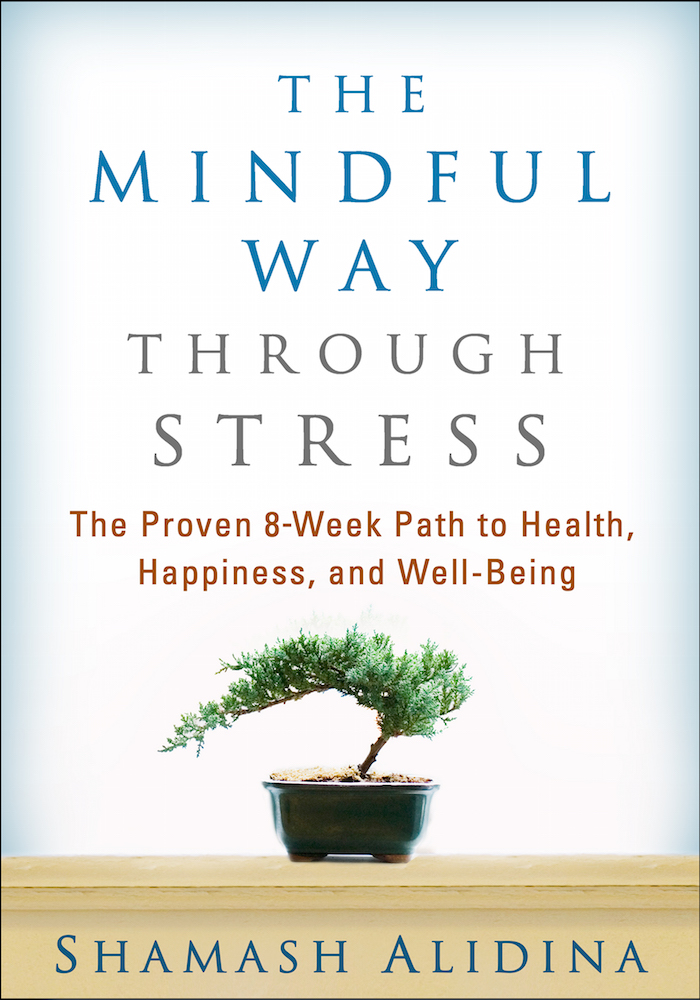
    Since I’ve been more stressed than usual as of late—and I’ve needed a reminder of how to effectively manage my emotions—I was thrilled to receive a copy of Shamash Alidina’s new book, The Mindful Way Through Stress.

    The subtitle promises a proven eight-week path to health, happiness, and well-being—and the book delivers!

    It’s clear that Shamash is not only an expert on mindfulness, but he’s also quite passionate about helping others respond wisely to life’s inevitably stressors instead of getting caught in a frenzy of reaction.

    I highly recommend The Mindful Way Through Stress to anyone who’d like to find more peace within the chaos of daily life.

    It is, hands down, the most helpful guide I’ve read in a long while, and one I will certainly reference whenever I need a little help dealing with life’s inevitable challenges.

    I’m grateful that Shamash took the time to provide some incredibly detailed answers to my questions about stress and mindfulness, and that he’s provided two free copies of The Mindful Way Through Stress for Tiny Buddha readers.

    The Giveaway

    To enter to win one of two free copies of The Mindful Way Through Stress:

    • Leave a comment below
    • For an extra entry, tweet: Enter the @tinybuddha giveaway to win a free copy of The Mindful Way Through Stress http://bit.ly/1M3wBvL

    You can enter until midnight PST on Friday, March 6th.

    The Interview

     1. What brought you to your career as a mindfulness teacher and coach?

    I originally got interested due to stress. The stress for me when I was in college, aged twenty, came from a combination of workload and confusion.

    I didn’t know what to do. I was halfway though a degree that I didn’t enjoy (Chemical Engineering), and working toward a job I knew I didn’t want (working in the Oil Industry).

    Then, my fortunes changed. I came across a class in “practical philosophy” in which the teacher guided a short mindfulness meditation. I was pleasantly shocked!

    Just a short few minutes and I’d gone from feeling frazzled to focused. Wow! Why hadn’t anyone taught me this technique years ago?

    I resolved from that day on to teach mindfulness to as many children and adults that I could.

    I started by teaching in a school for eight years, where all the children had time to practice mindfulness and meditation. And then I moved on to focusing on just teaching adults mindfulness full-time.

    Training mindfulness teachers to embody both awareness and compassion, for themselves and their students, is my passion.

    2. Your book presents a self-help version of mindfulness-based stress reduction. Can you tell us a little about MBSR and how mindfulness helps with stress?

    Mindfulness-based Stress Reduction was developed in the late seventies by Dr. Jon Kabat-Zinn and his colleagues at UMASS Medical School. He asked his colleagues, doctors, to send him their most challenging patients—those that they felt they could no longer help using modern medicine.

    He put together an eight-week course, which comprised of guided meditations, mindful yoga stretches, and group dialogue around managing stress and living life in a mindful way.

    His experiments worked. The groups reported huge reduction not only in stress, but also reductions in anxiety, depression, and chronic pain, and a greater feeling of control of their lives.

    Even more encouragingly, these positive reports of stress reduction from patients continued even three years after they’d done the MBSR program.

    So naturally, MBSR began to spread, first, across the US and now, worldwide. Hundreds of thousands of people have probably done the program now, if not millions.

    Stress is a complex subject, and so the path to relieving it is not straightforward. However, there’s a few key, powerful ways in which mindfulness can reduce stress.

    Mindfulness helps you to switch off your normal, habitual, automatic reactions to the stressors you face.

    If you’re living mindlessly, you don’t even know how stressed you are.

    A friend of mine recently started practicing mindfulness and has discovered his body is riddled in tension and is now slowly beginning to relax. Without mindfulness, he’d still be going around with this chronic tension in his body.

    So with mindfulness you can see if you’re getting excessively stressed early, and step out of that stream. You know how to rest your mind and body. Without mindfulness, you don’t have access to that.

    Mindfulness makes your brain more resilient to stress.

    People who have practiced mindfulness have brains that don’t seem to ruminate so much; they can spot negative, repetitive thinking earlier, and step out of it. Or sometimes, worries just don’t seem to take hold. Sounds good, doesn’t it?

    Mindfulness naturally engages the relaxation response in your body.

    This is a hard-wired system. By combining mindful awareness with a sense of warmth toward different sensations, emotions, or even situations in your life, the stress inevitably eases.

    You make fewer mistakes.

    If you’re rushing around mindlessly, you’re going to bump into a lot of things, both physically and metaphorically. So many of us are running through life, causing more problems as a result. The running is due to fear of missing out, or being imperfect.

    Mindfulness shows you how to access a peace within so you don’t have to run for it everywhere you go. By discovering a different way of operating, which everyone can do step-by-step, you meet life with greater calm, peace, joy, and freedom.

    But remember, stress by itself is not bad. Stress is a problem if it’s sustained for too long and feels like it’s too much for you. See the positive aspects of stress—how it energizes you and gets you going. Seeing stress negatively makes things worse.

    Make friends with stress! Stress is inevitable. Just use mindfulness to take regular breaks from your stress to recharge yourself. Then out you go again!

    3. What are the problems with living on autopilot?

    Living on autopilot is great for planes, but not for human beings.

    When we were babies and young children, we didn’t really live on autopilot. We lived each day fresh, alive, in the moment. That’s a natural way to be.

    But the human brain is clever. To save energy, rather than keeping your conscious, it switches off consciousness for any repeated activity.

    Eventually your whole life is one big autopilot experience. You’re like a robot. And this kind of living reduces your joy and freedom tremendously.

    The thing is, living consciously is so enjoyable once you discover how! The feeling of your own body is beautiful. Just experiencing sitting and breathing can be blissful.

    The present moment really is a wonderful moment once you discover how to penetrate the crust of thoughts that is pasted over everything.

    You can do it. Everyone can do it. You just need to create the right environment, follow the right instructions, and bring the right attitude—patience, kindness, curiosity, and allow the mindfulness and compassion to rise.

    Just as the sun rises in the morning, bringing light and warmth, so your life becomes a joy as mindfulness and compassion grow. By prioritizing mindfulness practice in your life, you can experience this.

    4. With our increasingly busy lives, many of us end up multitasking and feeling stressed as a result. How can we challenge this instinct to multitask without falling behind with everything we need to do?

    The busier you are, the slower you need to go. Watch people like the Dalai Lama—do you see him rushing around in a panic? Yet, he’s constantly teaching, coaching, serving. He’s probably much busier than you or me.

    The urge to multitask is powerful. And if you’re on autopilot, you’ve got no chance to release yourself from the hold of phones, computers, and tablets. In our digital age, mindfulness is essential to prevent you being swept in an ocean of information and people wanting to connect.

    Try small steps like keeping your digital devices out of the bedroom. Or keep them off in the evenings. But try and take a bigger step if you can—leave your phones behind on vacation. Take one day off every week totally free of multi-tasking. A digital detox day!

    Here’s one approach you can take to dealing with an excessively long to-do list:

    • Before going to bed, jot down all the key things you wish to complete the next day.
    • Prioritize them. What’s number 1? What’s number 2? Rewrite the tasks in the correct order. Put mindfulness at the top of the list!
    • The next day, resist the urge to check emails, Facebook messages, Twitter, etc. By resisting this urge, it diminishes. Just because you have a compulsion to check your messages, you don’t need to actually check them—they can wait.
    • Do the task you need to complete, in the order you set out. And write down the time you start and finish each task. Having a written record will help you to see how you’re really using your time. It’s more power than it sounds—do try it out!
    • Between tasks, practice mindfulness. Feel some breaths, go for a mindful walk, slowly and consciously drink a glass of water, or stretch. These breaks with rejuvenate you and make you finish your tasks sooner (so you have more time to meditate every day).

    5. You wrote, “Emotions are not problems to be solved. They are experiences to be felt.” Can you elaborate a little on this?

    This is a very important point to understand. Misunderstanding how to manage emotions is at the root of so much human suffering.

    Let’s take the example of feeling sad. If you’re feeling sad, what do you do? If you’re on autopilot, you try to fix it. You may think, “I must feel better.” So you go off and try and cheer yourself up. You don’t let yourself actually feel the sadness.

    Now, that may work or may not. If it works for you, great. But what if it doesn’t work? What if partying with your friends doesn’t make you feel better? Or calling your sister doesn’t seem to lift the mood?

    Well, your next thought will probably be, “Oh no. I’m still feeling sad. I must try something else. I must try harder.” Eventually, this turns into thoughts like, “What’s wrong with me? I should be happy.’

    All this is hard work. You work harder and harder to fix your mood. But that’s not what your emotion wants.

    Emotions need skillful awareness and care. Just like a young child needs attention and love to grow in a healthy way, so do emotions. So you need to feel the emotion.

    Feel the emotion in your body. Notice its shape, maybe its color or texture. And bring some feeling of care toward the feeling. Place your warm hand on the sensation. Breathe and feel the emotion.

    You can even speak gently to the emotion and ask, “What do want to say to me?”

    One of my students did this the other day, and the response was a clear: “Slow down!” She discovered that she needs to slow down the pace of her life or things will get worse. That’s wisdom in action.

    So emotions don’t need to be fixed or pushed away. They need to be gently felt—then they’ll dissolve and pass away in their own time.

    6. Why do we tend to dwell on the negative, and how can we challenge this instinct to minimize our stress?

    If you had a lovely day all day, but for one minute someone said to you, “You’re a complete idiot! You’re stupid, useless, and a waste of space!” then you’ll remember that. You’ll think about that much more than the thousands of other minutes that were absolutely lovely.

    That’s because our brains are evolved to be like Teflon for positive experiences and Velcro for negative experiences.

    Scientists think this focus on negativity, called negativity bias, is a way to ensure we survive—if you spotted a tiger on the way back to your cave, you need to be able to remember that! If not, next time you could be dinner!

    You’re probably not reading this blog in a jungle. So, you need to re-balance your brain. The solution: find your favorite daily way to focus on what’s going well in your life. This could be combined with your daily meditation practice.

    At the end of the practice, ask yourself, “What’s going well in my life?” Or, “What’s awesome about me?” Or, “How have I been a nice person today/yesterday/this week?”

    Ask yourself positive questions like those above, and they’ll draw positive thoughts and emotions from within you.

     7. What is one simple mindfulness exercise anyone can do whenever they’re feeling stressed?

    This is a powerful one for most people, originally developed by meditation teacher, Ajahn Brahm:

    • Sit comfortably and close your eyes.
    • Imagine you’re holding two heavy suitcases in your hand. The left one represents your past and all your experiences, both positive and the regrets. And the right one represents your future and all your hopes, dreams, worries, and anxieties.
    • Feel the weight of holding these bags around all day. It’s tiring. You need a break from time to time.
    • Lower down the bag in your left hand, onto the ground. Enjoy the feeling of letting go as the weight transfers to the ground.
    • Lower down the bag in your right hand, representing your future.
    • Enjoy staying in between the past and future, in the present moment. What a relief that is!
    • Connect with any present moment experience. Your body, your breath, sounds around you.
    • When you feel you’ve had a rest and ready to resume, you can re-engage in your everyday activities. Ideally with some more mindful awareness and kindness to yourself and those you meet.

    You can learn more about The Mindful Way Through Stress on Amazon here.

    FTC Disclosure: I receive complimentary books for reviews and interviews on tinybuddha.com, but I am not compensated for writing or obligated to write anything specific. I am an Amazon affiliate, meaning I earn a percentage of all books purchased through the links I provide on this site. 

  • Stop Pushing Yourself: 10 Crucial Steps to Avoid Burnout

    Stop Pushing Yourself: 10 Crucial Steps to Avoid Burnout

    “I actually think burnout is the wrong description of it. I think it’s ‘burn up.’ Physiologically, that is what you are doing because of the chronic stress being placed on your body.” ~Richard Boyatzis

    Some years ago, when my mother told me that a friend of hers had experienced burnout, I didn’t really listen. Actually, I didn’t want to hear about it. I even felt irritated because she felt sorry for people who got burned out.

    My opinion was that they were just being ridiculous and exaggerating.

    It was an excuse, supported by a medical certificate from some doctor they knew well, so that they could stay home, plant basil in the garden, drink tea, and read good books in front of the fire. They were simply lazy folks who just couldn’t be bothered working.

    Some lessons are learned the hard way. Others, really hard. A last few change you for life.

    For me, burnout was life-changing; it turned my aggressive skepticism into factual knowledge. Almost annihilated by the beast of burnout, I’ve recovered, humbled and grateful to be alive.

    The other day I sat down and flipped through my journals from the past years. It was overwhelming. I felt so heartbreakingly sad for myself, for what I’ve put myself through.

    There was page after page of me worrying about alarming issues and symptoms I was experiencing, for a period of several years. There were lists of points I raised with my doctor, trying to figure out what was wrong with me. He kept saying the same thing over and over, but it was impossible for me to take it in.

    He said, “Be careful, Mrs. Torneryd. You have all the symptoms of a textbook burnout.” My answer was always the same: “I cannot get burned out. It can’t happen to me; I’m not that type of person.”

    Some of the points from my diary:

    • When in bed, I can’t remember if I’ve brushed my teeth.
    • I feel panic while driving; other cars are getting too close to me.
    • My skin is a mess, and my hair looks dead.
    • I’ve experienced three double-sided pneumonias over the past eleven months.
    • I have constant ringing in my ears.
    • Even when I sleep, I don’t let my head rest on the pillow.
    • I wake up around twenty times per night (cramp, sweat, pee).
    • I feel pressure over my chest, and I can’t breathe properly.
    • My heart is very often offbeat.
    • My intestines are destroyed; I look eight months pregnant ten minutes after every meal. I even pooped myself in the super-market—with no premonition.
    • My gallstones are stuck in the bile duct, requiring surgery.

    I was in a constant state of “I can’t do this anymore,” but there was nothing major I could change for instant relief. It was a combination of circumstances: the aftermath of bad choices, my workload, and my competitive character.

    Every part of me—body, mind, and soul—was desperate to stop the life-drenching feeling of having nothing left in me to give or take from. I was wasted, worn-out, and destroyed.

    Even so, I just kept going, repeating to myself, “When you’re down and out, there’s always 20% of your strength left” (a quote from martial art trainer). And I kept using my remaining strength over and over again.

    People talk about “hitting the wall.” I hit that wall about five years ago—full speed, head first.

    Since then, I’ve been forcing forward through concrete, screws, electric wires, and bricks. Then it happened: I made it through that thick wall, only to realize that on the other side was nothing but a fathomless, evil black hole. I fell until I crash landed, and then there was nothing left of me.

    On the 17th of February 2014, my body collapsed. I had my first full-blown panic attack, immediately followed by a second one.

    At first, it felt like my spine muscle cramped. I tried stretching and rubbing against a door post, in vain. I couldn’t breathe properly.

    My lungs started pumping frenetically, and I could do nothing to stop it. It felt like I was suffocating. I seriously thought that I was having a heart attack and would die. Eventually, I passed out.

    I finally accepted the message my body had been trying to communicate to me for years—I needed to make monumental changes in my situation, then and there, or I would lose my sanity, at the least.

    For the first four weeks of my sick leave, I did nothing but sleep. It was not by choice. I simply collapsed—on the sofa, my bed, and even on the floor. I just couldn’t stay awake.

    After the sleep marathon came sadness. I felt so incredibly sad, alone, and abandoned. I felt betrayed by society and my employer.

    When I didn’t feel any more sadness, I started my healing journey to peace and acceptance and began reading self-help books. Every day I made an effort to rescue myself.

    Eventually, a shift took place. Step-by-step, I built myself a ladder, careful not to go back to the wall I’d fallen out of, and I started to see the light at the top of that horrid black hole.

    You don’t need to push yourself to this point—not if you follow these steps to avoid an imminent burnout:

    1. Accept your limits.

    It is not admirable to push yourself when your body and mind beg you to stop.

    2. Clarify major energy thieves and avoid them.

    Limit your contact with people who drain you, make hurtful comments, and complain. Pay your bills on time. Clean your home so you feel calm there, not stressed and surrounded by chaos. Eat fresh food and spend less time distracting yourself with technology.

    3. Value yourself first.

    Fear of rejection is also self-rejection; stop worrying about others’ opinions.

    4. Get support and perspective.

    Trust someone close with your feelings and challenges.

    5. Ask for help.

    It actually feels quite wonderful to receive.

    6. Make choices that are good for you and make you happier, healthier, and stronger.

    Get enough sleep to keep cortisol (the stress hormone) levels down, and don’t skip breakfast!

    7. Get twenty minutes of sun every day.

    This gives your body the Vitamin D it needs to function properly, though you can also get it from a supplement.

    8. Get low-impact exercise three times per week.

    When we exercise, the brain releases the “happy hormone” endorphin.

    9. Don’t push yourself too far for the sake of progress.

    Strive to improve, but never push yourself if you feel it’s hurting you.

    10. Never ignore your intuition.

    Listen to your body and do all you can to be kind to yourself.

    Obviously, burnout is not some fake thing lazy folks pretend to have so they can stay home from work.

    It is a force that can knock you out completely, making it difficult to deal with the simplest of tasks, like taking a shower or cooking a meal; and almost impossible to handle normal things, like leaving your home, shopping for food, and answering phone calls.

    I officially apologize for all my previously judgmental thoughts on this area.

    You don’t get burned out because you’re too weak. You get burned out because you’ve tried to stay strong for way too long!

  • 3 Things I Did to Relax When I Was Stressing About Reaching My Goals

    3 Things I Did to Relax When I Was Stressing About Reaching My Goals

    “Every day brings a choice: to practice stress or to practice peace.” ~Joan Borysenko

    Stress and my own expectations were killing me. I was taking care of my physical health with exercise four to five days a week, eating right with lots of plants and vegetables, and sleeping enough, but my health was getting bad.

    I had IBS that was getting worse, and I wasn’t sleeping well (even though I spent enough hours in bed). In other words, I was doing everything right, or rather, all the external physical stuff right.

    I was doing something that virtually everyone agreed was going to make me happier: I was building a side business to fund my freedom from my day job.

    Finally, I had taken the plunge to pursue one of my biggest, scariest, most exciting dreams.

    I would fantasize about being able to do what I was passionate about every single day: help people live healthier, happier, more “whole” lives.

    I couldn’t wait to turn in my two weeks notice and wake up every single day early in the morning with the fire and passion to make a difference in people’s lives—and actually get paid to do it! It sounded like a dream come true.

    Fast-forward one year: I still hadn’t quit my job, and I was living in a nightmare.

    Some days I had slight panic attacks because I would tell myself I would quit my job soon, but my passion business wasn’t making enough money for me to quit comfortably without freaking out.

    The expectations I put on myself were crushing me; I thought I would be at a certain benchmark by a certain date, and I hoped I would be somewhere that I currently wasn’t in my business.

    I was being crushed and crumpled under the weight of my own expectations and goals.

    Something that originally woke me up in the morning inspired and ready to roll was now drudgery—something that I constantly associated with pain and failure.

    There weren’t enough clients, there were too many things I was trying to figure out, working twelve or more hours a day was wearing me out, and I was nearing burnout.

    Nothing seemed to be enjoyable anymore. And one night, when I (yet again) couldn’t sleep, I had an “aha” moment.

    “What a horrible irony. I started this side thing, working on my passion every day, with the hope of one day getting compensated for doing something I loved. And now I wake up every day dreading both my job and my ‘passion’ business. How did it get to this point?”

    After sitting down to think about my own goals, my passion, and what was destroying my happiness, I learned a few things:

    1. Remove expectations and find flow.

    So much of the initial stress was self-imposed. Actually, all of the stress I had each day was self-imposed.

    I thought back and realized that I’d stressed myself out with almost every goal: health goals around the New Year, personal finance goals, and now my own business/passion goal.

    How often do we place these expectations on ourselves—“I’m going to lose thirty pounds in sixty days!”—and once we don’t reach them, get crushed and quit?

    The more this happens, the more our self-esteem suffers, and the more we internalize the story that “I’m a failure.”

    Even though I needed money in order to quit my job, I did a test: iInstead of focusing on the bottom line, I focused just on flow.

    I focused purely on the things I enjoyed the most, the things I was most motivated to work on, and I focused on pushing myself forward every single day rather than meeting random goals like “losing thirty pounds in the next two months.”

    2. Focus on growth, not hard deadlines.

    By far, the best thing I ever did for myself was set only one goal: get better each day.

    No other goals and no more deadlines.

    Deadlines always produced massive stress in my life. Did they work? Sure, sometimes.

    But every time they resulted in pressure and discomfort. And often they didn’t work because I didn’t accurately estimate how much time it would take to achieve them, since I was doing things for the first time.

    Whereas every day used to be stressful because I was always measuring how I stacked up against my goals, now every day was enjoyable because I just focused on getting better each day.

    To say this was a major relief would be an understatement!

    3. Forget the timeline and focus on enjoyment.

    There’s an old Tony Robbins saying that goes something like this: “Most people overestimate what they can do in one year but underestimate what they can do in ten years.”

    Almost all the anxiety, panic, lost sleep, and stress occurred because I had an artificial timeline: I wanted to quit my job now. So I wanted to reach XYZ goal by XYZ date—and when I didn’t, it would cause anxiety and panic because I was resisting reality.

    As an experiment, I spent thirty days without any timeline.

    That meant no goals, no benchmarks, nothing.

    It didn’t happen overnight, but over the coming months I slowly regained that passion, love, and zest I had for life. And my “passion” business regained its former “passion,” which had disappeared in the face of my expectations, stress, and anxiety.

    I’m proud to say with these three subtle mental shifts that dramatically simplified my life, removed deadlines and pressure, I was able to focus on self-growth and my sanity returned.

    At the end of the day, the self-imposed stress and anxiety caused by deadlines and setting too many goals were more damaging than the benefit.

    I realized that it was only once I stopped trying to control everything and trusted the process things started to happen.

    When we release expectations and focus on enjoying every day and working our hardest on growth—not madly achieving our goals as quickly as possible—that’s ironically when we reach our goals faster, and with less stress, than ever.

  • 6 Tips to Stay in the Now During Busy Times

    6 Tips to Stay in the Now During Busy Times

    Businessman Meditating

    “If we are not fully ourselves, truly in the present moment, we miss everything.” ~Thich Nhat Hanh

    Have you ever had one of those days where you catch yourself rushing and not paying attention to the present moment?

    I had one of those days a few years ago.

    I had just ordered some coffee at a drive-thru and was waiting for the clerk to open the window.

    While I waited, I began plotting my plan of attack for running several personal errands. My to-do list was long, and I knew I was going to need to be efficient if I wanted to get everything done in the amount of time I had available.

    The clerk opened the window and I paid for my coffee. Then I drove off.

    A moment later, I reached down to my cup holder and realized that I’d driven off without the coffee.

    I swung back around and went through the drive-thru again. I was fortunate there was no line. I laughed and apologized to the clerk for rushing off without the coffee. “No problem,” she said. “It happens all the time!”

    I was surprised. This was the first time I had ever paid for something at a drive-thru and then drove off without it. I guess I wasn’t the only one that had done this.

    In a supercharged world where we are encouraged to multitask, it becomes more difficult than ever to be fully in the moment with what we are doing.

    If we are focused on rushing to the next event and our minds are on the future, it becomes easy to make mistakes in the present.

    In my case, I almost drove off and wasted my hard-earned money because I was paying more attention to my thoughts about my to-do list than what I was doing in the moment.

    Since that time, I have made an effort to bring more of my attention to the present moment. While it is not always easy, the following are six tips that help me stay in the moment during busy times.

    1. Relax your pace.

    After I realized my mistake at the coffee shop, I noticed how tense and anxious I was feeling about all of the things I wanted to do that day. When I paused to think about what I was doing, I realized there was really no need for me to be rushing through my day.

    I was putting pressure on myself to move fast out of habit. There was no deadline I needed to meet. I had generated all of the pressure, internally.

    As I gave myself permission to relax the pace and become more present, I felt relieved. The anxious and tense feelings melted away.

    2. Find some space.

    If you have a tendency to pack your schedule too tightly, try making a conscious effort to build some space in. You will be less likely to spend your time strategizing how you are going to get everything done and more likely to be able to be mindful in the moment.

    After I left the drive-thru coffee shop with my coffee in hand, I realized that I didn’t need to rush and run all of those errands the same day. I could space them out and allow myself a little breathing room in my schedule.

    I felt more at ease and found it easy to enjoy the rest of my day without continuing to obsess over my plans.

    3. Use mistakes as a signal.

    If you make a mistake doing something easy and familiar to you, this may be a signal that you have drifted out of the present moment.

    Go easy on yourself. It happens to most of us. Just observe what happened and gently bring yourself back to the now.

    4. Breathe.

    If you find that you have drifted out of the moment and are focused on the future or the past, try pausing and taking a few deep breaths.

    The simple act of paying attention to your breathing is an easy way to bring your focus back to what is happening in the moment.

    5. Be aware that rushing can be contagious.

    It can be tempting to join in if others are rushing, even when rushing is not in your best interest.

    For example, let’s say you are making a purchase at a retail store. The clerk has a long line and is moving fast to try to serve the customers as quickly as possible. When you reach the front of the line, you are tempted to match the clerk’s pace.

    As you speed up your pace, you lose your focus and forget to ask the clerk a question about the item you are buying. You regret rushing through the transaction later, after you remember that you forgot to get more information about the item before purchasing it.

    Try sticking with a pace that is natural for you. You will be more likely to keep your attention on what is important to you in the moment.

    6. Be compassionate with others.

    If you notice that someone has made a mistake because he or she is rushing and lacks focus on the present, try to be understanding. This can help you reaffirm your own focus on the moment.

    Many times, the person who made the mistake will acknowledge it, slow down, and come back to the present moment, like I did when I returned to the drive-thru coffee shop to claim my coffee.

    I appreciate that the clerk was kind and understanding, and I hope to pay that forward.

    Most of us have been less than fully present at one time or another.

    While being mindful in the moment can be a challenge during busy times, we will all benefit if we can practice mindfulness more often.

    Businessman meditating image via Shutterstock

  • Connecting with Your Peaceful Self to Overcome Fears and Worries

    Connecting with Your Peaceful Self to Overcome Fears and Worries

    Man with palm tree

    “Fear: False Evidence Appearing Real.” ~Unknown

    It was an ordinary school morning in a busy European city. I seem to recall it was spring, as my memories store the feeling of awakening after a long winter.

    I was seventeen and getting ready to go to school. Following my standard morning routine, which included eating my meticulously assembled breakfast, I walked to the tram station.

    The city I lived in at the time was situated in a beautiful valley, and the tram ride offered a trip to the hub of the city. My high school was downtown in the historical part of the town.

    I loved walking to the tram and even more, I enjoyed walking from my final tram station to school.

    There was something different about walking in the middle of old buildings that always gave me the feel of spaciousness, grace, and often mystery. It was such a striking contrast from the modern and mundane apartment buildings in the newly built subdivision where I lived!

    The city transport experienced some chaos that morning, as the typical short wait time between trams turned into almost a half hour.

    My tram station was really crowded, and I felt lucky I got in. As I stood in the tram that spring morning, looking outside the windows and barely noticing the grey high-rise buildings, little did I realize what this morning would bring for me.

    It seemed like an unusually busy day, and because of the delay, every tram stop had a huge crowd waiting at the platform.

    After five or six stops, the tram was packed like a can of sardines. I watched people at the stops nervously looking toward us, “the lucky ones inside,” as they likely contemplated how late they would be for school or work today.

    I really wished this ride would be over soon.

    The tram started moving toward the downtown area. It is quite a steep hill downward into the valley. This stretch of the ride was the most fascinating for me, as the green area framing my view just zoomed by like a wide line painted by a massive paintbrush.

    I felt lucky to be by the window and having breathing space in front of me instead being squeezed in the middle of the crowd.

    The green space, however, moved incredibly fast this morning, as if it was just flying by. Then I registered a sudden jolt.

    After that, it was very quiet. In the midst of this silence, all of sudden I heard a voice asking for help. It sounded quite frightened as it repeatedly asked, “Please help.” Who is saying this? I wondered.

    If you ever experienced no connection to the concept of time, this was it. After I heard the same voice a few more times, I came to a surprising realization. It was mine.

    This voice was coming from my body, yet I felt I was a completely peaceful self, compassionately watching someone who was frightened.

    Later on I realized the tram derailed and flipped sideways. I was saved and physically unharmed because I was on the “lucky” side of the tram.

    I continued the journey called life, but something unlocked inside me. In fact, I was “haunted” for years by the experience of my “peaceful self,” which had listened to my scared physical self.

    Needless to say, I continued to live my life for a few decades very often identified with my scared physical self but always wondering about my peaceful self.

    Who am I really? Who was the part of me that heard my voice?

    Fast forward many years, I encountered the presence of my peaceful self once again. Luckily, this time it wasn’t in an accident.

    After years of hard work establishing myself as an immigrant, learning a new language, and creating financial stability, I decided to end my job and step into unknown and uncertainty. I didn’t know how I was going to earn money; I just knew what I did before wasn’t part of my life’s purpose.

    My body shriveled with fear. My mind was racing with thoughts about my bleak future and losing everything I had ever worked for. Not only that, but this could have meant I wouldn’t be able to help family members that I had previously helped out financially.

    I remember it was a bright sunny day and I was in the office with my boss. The glass windows in the corner of the building surrounded us and lit up the space.

    I felt I was bathing in light. I was literally not able to speak. My mind kept saying: You can’t do this! And then it happened again. I heard a shaky voice saying: I decided to quit.

    Have you ever felt your chest opening up? In this moment, I felt as if a cave opened inside my heart. A wave of calm spread through my body. My peaceful self was there, watching and observing my scared self. I cried tears of relief.

    These days, I don’t even question my peaceful self. I just trust it’s with me everywhere, holding its arm around my shoulders and whispering: Trust. You are going to be okay

    And as I embarked on a life time journey of meditation reconnecting with that peaceful part of myself, I repeatedly remind myself that I am simply able to watch my frightened physical self.

    And so can you.

    Whenever you feel stuck in life and full of fear or desperation, remember that the big, real part of you is simply the peaceful observer that can watch the physical self. It can watch the fear, sadness, or anything that arises inside you. And it will watch it with love and compassion.

    We often experience pain when we associate with our thoughts and believe that we are our mind and our emotions.

    Do you have a thought that frightens or worries you right now? Simply say to yourself that you are noticing that thought. Say it at least five times until it feels more and more distant. Now you are coming much closer to being your peaceful self.

    My reconnection with my peaceful self brought so much more freedom to my life, and I believe it will bring freedom to your life too. Visualize it holding its arm around your shoulders and telling you: Trust. You are going to be okay.

    Man with palm tree image via Shutterstock

  • How to Listen to Your Body (and Become Happy Again)

    How to Listen to Your Body (and Become Happy Again)

    “Keeping your body healthy is an expression of gratitude to the whole cosmos—the trees, the clouds, everything.” ~Thich Nhat Hanh

    It’s embarrassing, isn’t it?

    You don’t want to make a fuss about tiny health annoyances.

    But you feel lethargic for no apparent reason. You get constipated, especially when you travel. You have difficulty sleeping.  And your hormones are all over the place.  You hold onto that niggly five or ten pounds like your life depends on it.

    Sound familiar? I’ve been there too.

    I was working at a dream job and living on the French Riveria. I was paid a lot of money to help Fortune 500 Companies with their IT strategies.

    I worked in cities like Paris, Dublin, London, and Manchester during the week, staying in luxury hotels and flying to my home in Nice on weekends. We partied like rock stars on the beaches, and in exclusive clubs and glamorous villas. At twenty-nine, I was a management-level executive on the cusp of becoming a partner.

    Meanwhile, my body wasnt happy. I was chronically tired. I slept poorly. And despite daily exercise and yoga, I couldnt figure out my weight gain.  

    I tried the radical Master Cleanse—drinking lemon juice and maple syrup for a week. But the extra weight would creep back.

    My hormones went crazy. When I stopped birth control pills, my menstrual cycles stopped. I wasn’t sure if that was the reason for my blotchy skin and depression. And the worst part was my mood. I wasn’t happy, despite all the glitzy outside trappings.

    The One Thing Most People Never Learn To Do

    Then I did something most people never learn to do: I listened.

    I felt great after practicing yoga. I took a baby step: I practiced more yoga and eventually attended teacher training sessions. Fast-forward a couple years….

    I quit my job, packed my belongings, and moved to a yoga retreat center in Thailand. The move felt natural and organic.

    I lived simply in a tiny bungalow and taught yoga retreats to tourists. And my health improved. I was sleeping well. My periods eventually returned. I felt better and better, and my sparkle returned too.

    The first and most important step is to stop and listen. Your body and mind are intimately connected. Listen to your body and you’ll learn a ton. Start with tiny steps and you’ll reach your pot of gold quicker than you’d expect.

    You can do this.

    You’d think doing so would be impossible, but it’s not. I’ll tell you how.

    But first, let’s look at three core principles that could save you.

    Don’t Make This Monumental Mistake

    Most people ignore their small but annoying health issues. Nothing about your health is inconsequential. Everything matters. Your digestion. Your ability to lose belly fat. Your bowel movements.

    You’re not alone if you want to run screaming and bury your head in the sand. How about changing your mindset?

    Rather than categorizing what is wrong with you, notice how your body throws you clues. For example, you aren’t going to the bathroom every day. Usually for a very simple reason—lack of dietary fiber. Try adding an apple and ground flax to your breakfast and see what happens.

    The Alarming Truth About Stress

    It can make or break your healthiest intentions. When we perceive danger, stress is our body’s natural response.

    For cave people, stress came when a lion was about to pounce; we needed to run like lightning.

    Under stress, we optimize our resources for survival and shutdown non-essential functions. Translation? Your digestion grinds to a halt, your sex hormones (estrogen, progesterone, and testosterone) convert to cortisol, and your blood sugar skyrockets.

    This is okay now and then. Are you in a state of constant, low-grade stress? Imagine the havoc and inner turmoil.

    A few condition-linked stresses include IBS, constipation, weight gain, insomnia, high blood sugar, and hormone irregularities—for women, missed or absent periods, severe PMS, and fertility issues. And these are just the tip of the iceberg.

    Your body and mind are like the matrix.

    The Western approach to medicine is to examine each problem separately, so you end up with a different specialist for each malady.

    In Eastern medicines, your body is a united whole rather than a constellation of unrelated parts. Your insomnia may be the result of high stress. Or your constipation and weight gain may be due to a complete absence of fiber in your diet.

    Now let’s talk about what you need to do.

    But first, I must introduce you to your personal, world-class health advocate. And it’s not your doctor, your chiropractor, or even your yoga teacher.

    It’s you.

    1. What silence can teach you about listening.

    Set aside time to listen to your own deepest wishes. I searched for answers outside of myself, looking for rigid rules and diets. I used food to shut off my thoughts. It was hard, but I gradually let my truths surface. I know you can do it too. Decide on a time, and set aside ten minutes each day. Breathe deeply and listen.

    How are you feeling physically, mentally, and emotionally?

    Have a journal nearby to jot down any thoughts. Notice what pops into your head. Bring yourself back to your breath if you start to get lost in thoughts.

    2. What would happen if you followed your passions right now?

    You can do this right now in tiny steps. Make time to do the things you love.

    How do you most want to spend each day? Write a list of your priorities and brainstorm easy solutions.

    Exercise: wake up twenty minutes earlier. Do a series of sit-ups, push-ups, leg lifts, squats, etc.

    Time with your children: say no to superfluous activities—committees, boards, etc.

    More creative time: schedule your time on weekends for writing, painting, or whatever you love.

    Treat it like a priority appointment.

    When I worked at a corporate job, I’d wake early to practice yoga at home before work. I didn’t miss the sleep, and I was much more productive and happier during the day. I couldn’t control the rest of the day, but I relished my sacred morning ritual.

    3. Say goodbye to your job if it makes you unhappy.

    Right now, maybe you need it to support your family. No problem. Make sure you limit your working hours. Make the rest count.

    Turn off your TV and put away your iPhone. Spend engaged time with your family. Thinking about work takes you away from important leisure activities.

    Your people will always be important—your children, parents, siblings, friends, and your tribe. Don’t sweat the little things. Cultures with high longevity emphasize personal relationships, support networks, and family. The elders are the big shots, not the richest in the village.

    4. How to glow from the inside out.

    We are genetically wired to thrive on a whole-foods diet. A rule of thumb: the more processed the food, the less you should eat.

    Most of the diets that actually work—paleo, low-carb, and vegan—all have whole foods at their base. They vary in content, but all encourage vegetables, fruits, and good-quality protein sources.

    Return to those niggly health issues. Take an honest look at your diet. What could you do better? What things would you be willing to change?

    I used to systematically overeat healthy foods. My diet was great, but I used foods, even healthy ones, to quell my inner unhappiness. I hated my job. I felt lonely and isolated.

    Start with one change per month. Not more. Drink a glass of water with your meals and skip sugary drinks.Or eat a salad with your lunch or dinner.

    5. Here’s a little-known secret about your mind.

    How do you feel after eating a plate of fried foods? Or a big meal in a restaurant followed by dessert? I feel fuzzy and sluggish.

    What about after eating a bowl of candy? Like a space cadet? Sugar spikes our blood sugar and makes concentration impossible.

    Want to keep your mind clear and alert? Choose fresh vegetables and fruits, high-quality animal products, legumes like lentils and beans, healthy fats from nuts and seeds, and high-quality cold-pressed oils.

    Why Most People Fail Miserably

    Simply put, they don’t prioritize their own health. Don’t fall down that rabbit hole.

    Your job is not to put everyone else’s health above your own.

    Your job is not to make excuses about what you should be doing but aren’t.

    Your job is to be your most enthusiastic health advocate. You must fight tooth and nail to make stellar choices for your health.

    Your good intentions are worthless if you never take action. I’ve been there too. I’ve ignored my body. It was a mistake.

    Start making tiny changes, like having oatmeal and an apple for breakfast. Notice how much better you feel. You’ll be chomping at the bit to do more.

    Living well makes you feel better and happier. But it requires a little courage and determination.

    Start with one tiny step in the right direction. Take five minutes now and decide what your first step is.

    You know you deserve a healthier life.

    And more happiness.

  • How to Stop Feeling Inadequate and Let Go of Heavy Expectations

    How to Stop Feeling Inadequate and Let Go of Heavy Expectations

    “No one is useless in this world who lightens the burdens of another.” ~Charles Dickens

    When I was seven years old, my parents had me take an IQ test for an application to a private school near our new home.

    I vaguely remember sitting with the proctor, answering question after question about vocabulary and spatial recognition. To seven-year-old me, the test was nothing more than a fun logic puzzle, and I delighted at each question I knew the answer to, bright eyed and enthusiastic.

    While I don’t recall my exact score, the numbers were unusually high—in fact, so high that the proctor expressed her surprise to my parents that I was not suffering from some form of high-functioning autism.

    From age seven on, I was placed in the most gifted classes in both public and private school. I enjoyed the challenge, and the attention I received, until I became a teenager.

    In my transition to adolescence, I became aware of the incredible teenagers around the world writing novels, promoting peace, and inventing the types of machinery and technology that change the world.

    These individuals inspired me, but secretly implanted a deep sense of fear and angst in my mind.

    For as long as I could remember, people had been telling me, “Avery, you are going to do amazing things with your life,” while I spent my life like any other teenager: school, sports practice, homework, food, bed, repeat. I was not accomplishing any great feats.

    I slowly began to feel like I was failing to fulfill my full potential as a human being.

    Being exceptionally gifted, once a joy and privilege, had become a toxin to my emotional well-being. I was all consumed by my ego telling me that I should be more—or I was wasting my intellect.

    This led me to sporadically start novels, blogs, articles, anything to prove myself worthy of my intelligence. I would give up on each one quickly and move on to my next idea, as unsuccessful as the first.

    No matter what I tried, the world still did not know my name—the only thing, I thought, that could make feel adequate.

    About a year ago, it dawned on me that my pattern of self-dissatisfaction and disappointment was unsustainable.

    No matter what I did, no matter how many people knew my name, it made no difference. I always craved more, and anything less than becoming the next Einstein was a personal failure.

    So, with that in mind, I began the arduous process of redefining success in my life. The only way I could do this, I learned, was to help others realize their own goodness.

    I began with my personal mantra:

    “It is better to change one person’s life than to have 1,000 know your name.”

    I stumbled upon this realization somewhat suddenly, after taking a two-week long trip with my grade. I invested myself in helping my friends with sickness and fear, and I came away changed; I finally felt like I’d accomplished something permanent and meaningful.

    Instead of living for recognition from the world, I began to look for satisfaction through my personal relationships. I no longer needed to change the world to be successful; I just needed to know that I had changed someone’s life for the better.

    Surprisingly, this is a relatively easy task to accomplish with discipline. By investing myself in relationships with my friends, acquaintances, and partner, I began to receive incredible feedback.

    People genuinely began to thank me—not for being kind, but for literally changing their lives.

    The key for me was genuinely listening to others, and caring about their needs and opinions. Helping people came naturally to me, and remains the best gift I can give to others; not some profound piece of writing or technological advancement.

    Typically, the people around me who I listened to had similar issues of inadequacy. I was not alone. They too believed themselves to be failures, unable achieve their potential, whether that potential was straight A’s or a sports scholarship or being kind.

    I could see the innate goodness of the people around me shining through, and it pained me to see them suffer from feelings of inadequacy. I knew, deep down, that everyone around me was good and pure and beautiful, as all children of this earth are.

    As a result, I realized through time that if the people around me were all beautiful and good, as all people are, then I must be good too—just the way I am and always will be.

    By loving others, I had already achieved my purpose on this earth: to be the inherently sympathetic and kind creature that all human beings are.

    I now actively seek people around me who need my care, and indulge them when necessary. Love has taken precedence in my life over material accomplishment, as it truly should. I have closer, more meaningful relationships, more acquaintances, and an exponentially higher self esteem.

    The beauty is, people reciprocate genuine love: the people you help will be there for you in your times of need, too. Love is a self-fulfilling prophecy that can only be positive for all parties involved.

    At the end of the day, people simply want to receive love and attention; and through giving others these things, I not only improved their lives but also my own perception of myself.

    I was able to focus on the immediate positive impact my life was making on that of others, and I finally felt purposeful and that I was leading a meaningful life.

    The truth is, not everyone can change the entire world, and not everyone needs to. All we can do is give as much love in our lives as possible, treat ourselves kindly, and leave the world a more positive place than we entered it.

    That is all I can ask of myself, and I try to leave all other expectations of myself behind—the ones of impermanent success that can only bring me dissatisfaction and suffering.

    Maybe thousands do not know your name, but you have the power to completely change the lives of those around you with love; and that, I’ve learned, is far more gratifying and important.

  • One Mind Live: Free Holiday Week of Peace & Customized Meditation Giveaway

    One Mind Live: Free Holiday Week of Peace & Customized Meditation Giveaway

    One Mind Live

    You’ve likely read about the benefits of meditation, and you’ve maybe even experienced them for yourself.

    Meditation can help you:

    • Reduce your stress
    • Increase your focus
    • Enhance your creativity
    • Deepen your sleep
    • Heighten your sense of presence
    • Improve your mood and overall well-being

    And yet knowing all these things, you may find it difficult to maintain a consistent practice. Even if you have the time, it be challenging to shut out distractions, shut off your brain, and simply be. I know I’ve struggled with this.

    It can be even more difficult because it’s usually a solitary pursuit—but it doesn’t have to be.

    Introducing One Mind Live

    My good friend Naomi Janzen, creator of the Remindfulness app and one of the experts featured in my Recreate Your Life Story eCourse, has recently launched a powerful new global online meditation site, with psychotherapist and spiritual teacher Naomi Carling and award winning composer Stephen Fearnley.

    It’s the world’s first and only weekly, live, guided, worldwide online meditation group.

    The site offers fifty-two unique guided meditations throughout the year—and it’s non-denominational, making it accessible to all.

    It’s easier than traditional seated meditation, in that it’s guided; it’s more enjoyable, with soothing music from composer Stephen Fearnley; and it’s more powerful, due to the Maharishi Effect, which essentially means that a large group of people having a spiritual experience together magnify each other’s energies.

    And perhaps most unique, every session starts with ten minutes of EFT Tapping with Naomi Janzen to put you in the ‘zone,’ so you don’t need to be in the mood to meditate when you start.

    Scientifically proven to alter brainwave activity, EFT (or “Emotional Freedom Techniques”) puts you in a state of relaxation, stimulating the release of anti-stress hormones in your body.

    While you can always access an on-demand recording of the weekly guided meditation on the One Mind Live membership site, there are five group replays—meaning six total weekly chances to reap the benefits of global group meditation.

    I’m a huge fan of Naomi’s work; I swear by her iPhone app for daily mindfulness and I’ve benefitted tremendously from EFT tapping with her.

    I couldn’t be more thrilled to share this new online community with you so you too can reap these benefits—and more.

    The Free Holiday Week of Peace

    While One Mind Live offers three membership options—including a monthly one that costs the same for four weeks as a single yoga class in many cities—you can experience all the benefits of membership for free during next week’s special “Holiday Week of Peace” open house.

    From December 24th through January 1st you’ll have free access to a powerful global meditation, with five group replays, so you can find a time that fits within your schedule.

    All you need to do is visit One Mind Live here and provide your email address; then you’ll instantly receive a free gift, and you’ll receive a reminder about the meditation on the 24th.

    The Customized Guided Meditation Giveaway

    If you choose to join One Mind Live after the free week, you’ll be entered into a giveaway for something very rare and special: a free, fully customized thirty-minute guided meditation, made just for you by Naomi, Stephen, and Naomi.

    It will include an original music score, ten minutes of custom, tap-along EFT, and a guided twenty-minute meditation based on the specific goals you have and issues you’d like addressed (after a consultation with the founders).

    You will be able to meditate to this MP3 as often as you like, and you can choose to share it with friends or keep it just for yourself. This is not available anywhere else and would cost thousands of dollars to commission.

    All you need to do to enter this giveaway is forward the membership purchase confirmation email from One Mind Live to OML@tinybuddha.com between now and January 31st at midnight PST.

    Whether you choose to join or not, you can try One Mind Live for free during the Holiday Week of Peace, with no obligation or strings attached (no billing info required), by visiting One Mind Live here.

    I hope you enjoy it as much as I have—and I hope you have a peaceful holiday week!

  • Rekindle Your Joy by Harnessing the Power of Play

    Rekindle Your Joy by Harnessing the Power of Play

    Kids Playing

    “It is a happy talent to know how to play.” ~Ralph Waldo Emerson

    It was one of those weeks that felt like I was dragging my feet through mud. Everything seemed like an effort and nothing seemed to be flowing.

    I was caught up in conflicts from the past—a miscommunication with my boyfriend, which resulted in hurt feelings on both sides, and a professional crisis that plunged me into fear and self-doubt.

    In an attempt to calm my mind and become more present, I meditated and chanted mantras, but the tape of negative self-talk continued to play in my head. It berated me for not handling both situations better and made me feel like I was not measuring up.

    A cloud of depression began to hover at the edges of my psyche, threatening to block me from the sunlight of the spirit. I was a captive to thoughts of inferiority. Self-compassion seemed like a far off destination I would never reach.

    I live in a beautiful part of Mexico, but even the warm tropical air wasn’t enough to bring me out of my mental slump.

    Then, my sister came to visit from the states, having taken a long weekend off from work. It was a great diversion and I knew just the place to take her. We drove to a secluded beach on the Pacific coast to spend the day.

    When we arrived, we saw that the usually calm ocean had been churned up by a distant storm. Waves crashed violently upon the shore and a steady wind whipped against our cheeks.

    I took to the water anyway. I wasn’t brave enough to tackle the hulking waves but waded into the shallow white wash. It swirled around me like a natural Jacuzzi. The changing tides threatened to destabilize my footing, so I crouched down to avoid toppling over like a bowling pin.

    Releasing control, I was moved by the push and pull of the current. At one point, a large wave hit further out, sending the tide rushing in. It spun me around like laundry in a machine. A hearty laugh escaped from my lungs as I tumbled around in nature’s whirlpool, completely present in the moment.

    It washed me up on the shore like a happy seal and I whooped with the simple joy of it. My hair was tangled with sand and salt and my swimsuit twisted around me. My sister sat calmly on the shore and, seeing my dishevelled state, laughed along with me before joining me in the water.

    We giggled heartily as we played in the shallows like children. I bodysurfed the whitewash of the waves with my arms outstretched, allowing the water to carry me like a twig. In that moment, nothing existed except the water and the shrieks of joy that erupted from within me.

    The joy that had eluded me for the last week had been inadvertently tapped into by the power of play.

    Sometimes even the most disciplined spiritual practice is not enough to provide the shift we need, and that’s where play becomes an important part of our lives.

    We need only look at a young child playing in mud or a puppy fetching a stick to recognize the power of play. It is a healing practice that returns us to our innocence and brings us into the present moment; no chanting required.

    As children we relished the power of playfulness and saw life as one big game to participate in. We threw our whole selves into tumbling down grassy hillsides or playing tag rather than spending time in our heads worrying and planning.

    As adults we often forget that play still needs to be part of our lives. No matter how old we are, it is possible to return to that place of pure joy that exists within us.

    It may require some extra effort on our part to make time for play, but it is worth it for the mental and physical benefits.

    Here are five simple ways to harness the power of play in your daily life and rekindle your joy:

    1. Get into the woods.

    The woods make a wonderful playground, and spending time in nature is hugely therapeutic. Stomp through piles of crisp fall leaves and throw them into the air like natural confetti. Climb a tree and re-ignite your child-like wonderment.

    If you really want to access your joy, play a game of “hide and go seek” among the trees with a friend. You will be surprised how much fun this game can be as an adult.

    2. Play ball.

    Play ball, any kind of ball! Whether a game of tennis, soccer, or shooting hoops, the mind-body connection required for ball sports is sure to relieve stress and shift negative thought patterns. Visit your local driving range to hit golf balls. Even if you’ve never golfed before, this can be super fun.

    3. Dance up a storm.

    One of my favorite ways to play is to put on music and dance around my house. Dance in your bedroom, in the kitchen, or in the backyard, with or without other people around. In fact, dancing alone like no one is watching provides a massive release of endorphins which is great for the mind, body and spirit.

    4. Host a game night.

    Next time your friends want to get together, why not host a game night instead of going to a bar or restaurant? Games like charades Pictionary or even the classic Twister bring out the playful side of even the most serious adults.

    5. Visit your local park.

    Visiting your local park is one of the simplest pathways to play. Swing on a swing, slide down a slide, and if there is a grassy hill that takes your interest, roll down it! Just because you are an adult doesn’t mean you have to give up your favorite childhood activities.

    We can all harness the power of play to access the ever-present joy within us. Making time for play in our lives between work, relationships, and other commitments can relieve stress, transform negative thinking into spontaneous laughter, and may just be the greatest gift we ever give ourselves.

    Kids running image via Shutterstock

  • How to KISS Your Way to A Less Stressful, Overwhelming Life

    How to KISS Your Way to A Less Stressful, Overwhelming Life

    Zen Woman

    “Simplicity is about subtracting the obvious and adding the meaningful.” ~John Maeda

    The past few months of my life were a myriad of things, to say the least: busy, chaotic, overwhelming, exhausting, frustrating, and stressful. I felt like my fuel tank was on zero, but I had to get up and do it all over again the next day.

    I wasn’t stopping to take it all in and check in with myself to see how I was doing. It took catching up with a friend in town on a whirlwind trip to give me a big, smack-bang wake-up call. I was filling her in on everything I was currently juggling (which looked like this):

    • Studying twenty hours per week
    • Working two part-time jobs
    • Running my little love bomb of a website
    • Packing our life into boxes as our rental was being sold (and dealing with open houses and constant intrusions to our physical space)
    • Being Mum to a four-year-old and six-year-old and everything that comes with running a family life (when the workweek entails solo parenting, as my hubby works long hours)
    • Having no family support to help with any of the above

    She looked at me like I was crazy, and asked with kindness, concern, and a little bit of disbelief, “How are you managing all that?”

    The fact of the matter was, I wasn’t. I wasn’t at all. And trying to answer her stumped me a little bit, because I hadn’t stopped to ask myself the same thing.

    I was so caught up in doing that I wasn’t being. I felt like I was constantly tired, stressed, and unhappy. And that’s not fun for me or anyone I love.

    I had to stop. Something had to give, and I needed to make the right kind of changes. I needed to start listening to my inner voice—because she was talking loud and clear, giving me all the signs and telling me how she was feeling, but I wasn’t listening.

    So I said “sorry” and poured as much loving compassion and self-kindness as I could into me.

    I started with resigning from the part-time job that I was struggling with the most. The days were long, my kids were finding it hard with a full day of school and daycare around my working hours, and I didn’t have weekends off to spend time with my family.

    I loved the people I worked with, but I knew that I wasn’t going to work a minimum wage job for the rest of my life, because I wanted to dedicate time to my dreams.

    It was scary to take that plunge from safety because I was comfortable. And I felt guilty and bad—like I should just be able to get on with it and make things work—but I had to shut down that mean girl voice stat and crank up the volume on the loving, kind, Oprah’s-got-your-back voice, pronto.

    Once I pressed send on my resignation email—sitting, eyes squeezed shut, and trepidation running through my veins—I checked in with my feelings.

    My authentic feelings, which I started to pluck from the weeds of guilt and doubt, began to surface. This felt good. This felt really good. I knew I was on a winning track and I wanted more.

    One by one, I started to make changes that were more in line with simplifying my life.

    I’d had a taste of authenticity and tuning in to my inner frequency, and it was amazing.

    Some things in life are non-negotiable, but it’s okay to work with the things that are flexible and be kind to ourselves with the things that aren’t as easy to maneuver.

    We have a choice, all the time, in everything we do. Was I choosing to do all of the crazy, hectic nonsense my life was filled with? I sure was. But I needed to make some different choices because they weren’t working out so well for me.

    So began my journey to getting a little extra loving in my life. I got busy KISSing. Anywhere and everywhere I could, I learned to K.I.S.S.

    How do you do that?

    Keep. It. Simple. Sweetheart.

    When things are getting too complicated for you, stop. And K.I.S.S.

    When things are getting out of control and you’re not sure where your head is at or what’s going on where and when and next and OH MY GOD! Just stop. Breathe. And then K.I.S.S.

    When you’re starting to feel like a rag doll being pulled in a million different directions and all your stitches are about to come undone, and your cute, mismatched buttons are ready to pop, just stop. Slow down. Give yourself the most loving, kindest gift of all. And that’s to K.I.S.S.

    We need to start checking in with ourselves more and listening to our inner voice. What is it saying? What does it want? What needs to give/stop/surrender/be put on pause in order to simplify and feel free?

    How are you coping with things, and what is in your power and in your choice to change?

    You have so much more strength and authority than you probably give yourself credit for to make choices that benefit you. And you’re allowed to make those choices.

    When I thought about leaving one of my jobs, I considered what my options were. I would have less income but the trade off for me was also less stress and more time with my family (and doing other things I enjoyed). That, for me, was priceless.

    I still had one job to help pay the bills and had to stick to a tighter budget, but my schedule became more manageable to do this. By far, the most important change was that I felt happier. That was how I really knew it was worth doing.

    It can be daunting at first, but learning how to simplify your life can start by simply being aware of the changes you want to make.

    Practice saying “no” when you feel you are overextending yourself. Start asking for help more often when you feel overwhelmed. Outsource anything someone else is capable of doing for you instead, and downsize or upgrade whatever it is that would make your life less complicated.

    As much as we love everyone in our lives and care about not letting others down, who is going to take care of you in the best way possible? You got it, sweetheart. You.

    You are the most qualified and most entitled to do just that, nobody else. And you can K.I.S.S. away anything you need, whether it’s in your relationships, work, or parenting.

    Where do you need a loving K.I.S.S. right now? Plant those babies everywhere and start feeling more aligned, more in tune, and way more freakin’ happy with what you’re doing in this lovely life of yours.

    Zen woman image via Shutterstock

  • Letting Go of Expectations and Letting Joy Find You

    Letting Go of Expectations and Letting Joy Find You

    Letting Go

    “The best things in life are unexpected, because there were no expectations.” ~Eli Khamarov

    Are there situations in your life where letting go of a desired outcome could potentially improve the outcome?

    I’d been invited to the Stern Grove festival, the free summer concert series, to see Andrew Bird. A friend of mine texted me the night before, letting me know he was setting up a picnic for it.

    I was feeling agitated that evening after spending more than I’d wanted to at a birthday dinner (which I was happy to attend, notwithstanding), and I anticipated wanting to recharge the next day, in solitude. (Pretending to have more money than you do is exhausting.) So I turned him down. “Enjoy it!” I texted.

    “Of course I will—it’s Andrew Bird!” he replied.

    The next morning, I settled into a café to work. But I couldn’t even start. As I stared at my laptop screen, resisting the pull to work on a Sunday and mildly resenting myself for need-choosing to freelance, I found myself Googling the Stern Grove website.
    I clearly wanted to go. So I closed my laptop and got out of there.

    Here’s where non-attachment comes in, because I knew that if I were going to actually haul my butt to that show, I’d have to mind-hack the excursion every step of the way.

    That part of me who resists working on a Sunday? She also resists not working. And going out. And being social. And stress in general, which of course is everywhere, relentlessly. So I do a lot of inner work on her behalf.

    As I walked to my car, I thought, “Well, I’m just going to take a nice Sunday drive to a new part of the city. If I decide at any point to not go, I won’t. I’ll turn it into a joyride around the Bay, which I enjoy doing anyway and would probably be doing later today.”

    That allowed me to relax, and I could take in the views, the landscape, even the traffic—because hey, I wasn’t on any timeline. “If I don’t make this in time, I just won’t go!” Win-win.

    I navigated my way to the park; I’m a Bay Area native but had never been! I was pleased to put the different neighborhoods together for myself.

    I drove past groups of blanket-clad concertgoers carrying coolers and maintained my detached stance toward my rising stress. “If I can’t find parking, I just won’t go. No problem.”

    I drove around for five minutes and parked four blocks away, in a residential goldmine others were pulling into as I walked.

    I arrived, alone and new to the venue. If you’ve never seen it, Stern Grove is gorgeous; you have ocean views as you’re headed there, and once you’re inside it’s as if the city doesn’t exist.

    I breathed in eucalyptus and felt the cool San Francisco air on my skin. I observed the crowds spreading out on the ground level and nesting on tiered ledges facing the wooded stage.

    Not a bad start at all. But I wanted to find my friend.

    Again, the mind-hack: “If I don’t find him, that’s okay. I’m just here to check this place out and watch a show.”

    The thing about all this self-talk is that I really believed it. That’s the rub: you have to sincerely buy it. There’s no gaming the system when it comes to enjoying the unexpected.

    This is a story about a concert, but the concept applies broadly to the more serious, high-stakes parts of life, too.

    What are your expectations in your relationships, for your career, of the world? What are you holding on to that letting go of might ease? (And understand that letting go does not mean giving up.)

    The next time you notice yourself attaching to an expectation, pause and check out how that feels inside. I’ll bet that your mind and body probably don’t like it very much. How can you soften it?

    As I wandered the aisles, scanning for my friend, I ran into an old roommate. We hadn’t seen each other for three years until the week before, at a house party. “Text me if you find your friend,” he told me. “I’m with a big group up front and we have plenty of space and booze and food.”


    Well okay, then! I did find my friend (with another mutual friend who’d come along), and despite some minor stress over hand stamps and ground access, we joined my ex-roommate and his buddies for wine and beer, fruit, deviled eggs, and vegan snacks mere yards from the stage and Andrew Bird’s spinning double-horn speaker.
    I stared at my surroundings in gratitude and awe. A perfectly unexpected Sunday afternoon with lush grove, loving company, and the atmospheric sounds of Andrew Bird and the Hands of Glory to match.

    Letting go can be the key to letting joy find you. Try it out sometime—it’s worth it.

    Man in the sky image via Shutterstock

  • Why Uncertainty Isn’t So Bad and How to Embrace It

    Why Uncertainty Isn’t So Bad and How to Embrace It

    Uncertainty

    “Trust the wait. Embrace the uncertainty. Enjoy the beauty of becoming. When nothing is certain, anything is possible.” ~Mandy Hale

    Sitting in the auditorium during orientation, I listened to various deans, distinguished alumni, and student leaders drone on about the rigors of earning a law degree.

    There were obligatory mentions of not everyone making it to graduation (or even the end of the first week) and of the intense strain on personal relationships.

    But the message I remembered most clearly was about uncertainty.

    “You better get comfortable with gray areas. And fast. Because the legal field is not a place where black and white distinctions often exist. If you’re a person who thrives on certainty and absolutes, you will be an extremely frustrated attorney.”

    Being a comparative religion and psychology double major, I dealt with ambiguity and the unknown a fair amount. But I wouldn’t say I was comfortable with them.

    I mean, is anyone really comfortable with uncertainty?

    And with that superficial examination of my tolerance for uncertainty, I trudged onward to lawyerhood.

    Unfortunately, I was decidedly uncomfortable with uncertainty.

    Although I always wanted to become an attorney, it was a relatively uninformed desire. But it gave me a goal to work toward—a path to freedom and financial independence beyond high school and college.

    Or so I thought.

    I dreaded going to class. I even contemplated dropping out. A lot.

    I worried that I’d lost my academic edge.

    For the first time in my life, I didn’t always have the answers when questioned by professors. I wasn’t engaged by the subject matter either. So I procrastinated, which made everything worse.

    Looking back, it’s clear I was in denial.

    I couldn’t even entertain the idea that law school wasn’t for me, let alone accept that I may be better suited to a different career. You know, admit that I had made a hugely expensive mistake, cut my losses and start over from scratch.

    So I did what any self-respecting high-achiever would do: I threw myself into my studies and made damn sure I landed a job after graduation.

    In other words, I did whatever I could to avoid the appearance of failure.

    Which meant I was a complete and utter control freak. And by control freak, I mean high-strung hypercritical crabby pants.

    (I’m sure I was an absolute delight to behold.)

    It seems crazy to me now that it took three agonizing years of law school, seven miserable years as an attorney, a diagnosis of generalized anxiety disorder, and a two-year battle with infertility to get me to realize that uncertainty is the only true certainty in life.

    Did I really need all that time and heartache to accept this universal truth?

    Apparently, I did. The religion scholar in me shakes her head.

    And even though I was finally able to acknowledge the omnipresence of uncertainty, I wasn’t immediately able to embrace it.

    It took a lot of yoga, meditation, acupuncture, psychiatry, and life coaching for me to see that I hadn’t ever escaped the discomfort of uncertainty. Despite my best efforts.

    I busted my butt in law school and landed a job offer before graduation, which was rescinded when the organization lost funding for my position.

    I planned out future pregnancies assuming I was a fertile myrtle like all the other women in my family, who didn’t have the rare birth defects I had.

    I slogged through my legal career thinking after “paying my dues” and earning six figures I’d finally enjoy my profession, only to feel more and more hopeless every day.

    And those are just some ways uncertainty bested me over the last decade.

    But thanks to the luxury of hindsight, I grew to embrace the inevitability of uncertainty, and the fruitlessness of trying to elude it.

    Yes, I had the rug pulled out from under me when my first job offer fell through. But I found a higher paying job within weeks of graduation, where I met my mentor and some of my dearest friends.

    Yes, I endured the agony of infertility for two years. But after corrective surgeries (that also improved my overall health), I became pregnant with a baby girl who has brought exponentially more sleep-deprivation joy into my life than all the despair caused by those years of infertility.

    And, yes, my childhood “dream” of becoming an attorney turned out to be a nightmare. But like a bad dream, I finally woke up and realized it wasn’t my future.

    Although my current career didn’t exist when I was a kid, I have a feeling that even if it did I wouldn’t have found it by following a structured path.

    Because uncertainty is not only inevitable, it’s necessary.

    If we really were able to control every outcome in our lives, we’d most likely never experience failure. Or be forced outside our comfort zone. Or discover something previously unknown to us (or the world!) by way of happy accidents.

    We’d never truly grow.

    So now when I feel the urge to control all the things, I do what sounds incredibly simple to most, but has always been difficult for me.

    I breathe.

    I realize “breathing” isn’t what most people want to hear. But learning to slow down and focus on my breath has been life changing.

    Plus, it’s science.

    I catch myself holding my breath all the time. When I feel the need to check in with my breath, odds are it’s because my body is tense from oxygen deficit.

    Our brains need oxygen to think clearly. And without sufficient oxygen, the brain goes into fight-or-flight mode. All too often my battlefield is the supermarket or a blog post—situations in which breath is preferable to adrenaline.

    And while I am an advocate for mindful breathing in times of uncertainty, I’m not saying it’s a cure-all for everyone in every situation. But you know what is?

    Again, it’s science. Studies show that regularly expressing gratitude increases feelings of happiness and well-being.

    I admit I was skeptical when I first learned about gratitude practice as a way to boost happiness. Especially since it advocates keeping a gratitude journal.

    I am such a resistant journaler. Which is strange because I’ve gained some incredible insights into my psyche through journaling. (Okay, maybe it’s not so much strange, as it is the very reason I resist journaling. Note to self: Work through fear of journaling…through journaling.)

    Luckily, keeping a gratitude journal is nothing like the feelings poured onto page upon page that I imagined. At least, it doesn’t have to be.

    My only rule is that I need to write down at least five things for which I’m grateful each day. Some days it takes me ten seconds, others it’s more like ten minutes.

    But that’s the point.

    Those days when feeling thankful isn’t easy are the days you need gratitude the most.

    Someday you’ll probably be grateful for the struggle you’re in right now. But until then, maintaining a gratitude practice will ease the discomfort uncertainty brings.

    Even if it does involve a journal.

    I sometimes wonder how my life would be different today if someone at my law school orientation had outlined some practical ways of coping with uncertainty—like basic mindfulness—instead of characterizing an aversion to uncertainty as a personality flaw.

    Maybe I would have embraced the certainty of uncertainty sooner, possibly avoiding countless hours of heartache and anxiety. Perhaps I would’ve had the guts to drop out of law school and avoid a mountain of debt.

    Or maybe everything would have unfolded in exactly the same way.

    And you know what?

    I’m okay with that.

    Man walking image via Shutterstock

  • How to Get Life to Finally Start Going Your Way

    How to Get Life to Finally Start Going Your Way

    Excited Man

    “Whatever the present moment contains, accept it as if you had chosen it. Always work with it, not against it. Make it your friend and ally, not your enemy.” ~Eckhart Tolle

    Have you ever had a big financial expense knock you down?

    I had one of those situations hit me many years ago. I had just gone through a tough breakup, was experiencing regrets about my career choice, and was also struggling to get on my feet financially.

    I was feeling beat down and decided to try to lift myself up by getting my finances in better shape. I was able to cut some expenses and, over the next few months, was able to tuck away some extra money in a savings account.

    I was starting to feel a little giddy about my newfound ability to save.

    Then, my car broke down.

    No! I can’t afford a major expense right now. Why can’t I catch a break?

    I stood up on shaky legs, and that mean old universe kicked me right back down again, like I belonged there or something.

    I started evaluating my options.

    Could I fix my car myself? No.

    Did I have a friend or family member that could help me fix it? No.

    Could I leave the car broken? Yes, but this was not a great option given the distance I lived from work.

    It looked like my best option was to pay a repair shop to fix it for me. I was sad and disappointed, as I saw my savings account balance plummet back down to almost nothing after paying for the repair.

    I was struggling to get enthusiastic about continuing with my savings plan after the setback. Why bother?

    Then, I happened to see a reference to a quote attributed to Albert Einstein, “The most important decision we make is whether we live in a friendly or hostile universe.”

    The universe sure seemed hostile to me at the time. The quote sparked my curiosity. Can we really make a decision about what type of universe we live in?

    What if the universe wasn’t being mean but was being friendly?

    I decided to test out this new way of thinking.

    Instead of acting like everything was happening to hurt me, I shifted my attitude. What if this situation was happening for my benefit?

    I started digging around in my mind, looking for any thoughts about what could be of benefit to me in the situation.

    I was grateful that my car was working again and that I could travel to my job. I was grateful for the job, which was allowing me to pay for my living expenses. I was grateful that I had developed the ability to save.

    I didn’t have to let this one financial setback define my future.

    All of these new thoughts helped me go from thinking that the situation was unfair to something more empowering.

    I now knew, without a doubt, from experience, that it was a good idea to save for a rainy day. This created a burning desire in me to keep saving for future unexpected expenses.

    I resolved to overcome the situation with my depleted savings and try again.

    I started all over with my savings plan. This time was a little different because I also stopped entertaining tempting thoughts about spending my emergency savings on something unnecessary like a wild shopping spree or an expensive trip.

    Looking back, I notice how my view of the situation changed even though the situation itself didn’t change. No one arrived on the scene to rescue me. I still needed to drain my savings account to pay for the car repair.

    What changed was my attitude about the situation.

    Thinking about the universe being friendly helped me stop beating myself up and start treating myself like a friend with my thoughts.       

    The next time you feel like things are happening against you in your life, try the following:

    1. Make friends with the situation.

    My initial negative thoughts about my car repair situation were only serving to cause me to suffer.

    Shifting my attitude and searching for more positive thoughts changed the meaning of the situation.

    Instead of feeling stuck and hopeless, I started seeing opportunities to improve my situation that were within my control. This allowed me to become more optimistic about the permanence of the current situation and also about my future.

    2. Explore gratitude.

    Is there anything about the experience that you can be grateful for?

    Exploring gratitude made me more aware of the things that were beneficial in my life that I was taking for granted. Appreciating what I had in my life helped me to feel more positive about my circumstances.

    3. Look for the lesson.

    When difficult things happen, look for the lesson you are learning and how you might be growing from the experience.

    It has been many years since my experience with my car and savings account, and I realize now that I may have needed that little kick from the universe to help me grow and learn about the benefits of having funds set aside for emergencies.

    One of the best lessons to learn is that it is possible to choose your attitude and shift your thoughts to a more positive track.

    While it may not always be easy, if you treat the universe like it is your friend, you may just find that the universe mirrors your friendship right back to you.

    Happy man image via Shutterstock

  • Surrendering to Things We Can’t Control or Change

    Surrendering to Things We Can’t Control or Change

    Surrender

    “Every day brings a choice: to practice stress or to practice peace.” ~Joan Borysenko

    I’ve always sped through life. I’ve always been ready to take on the next moment, that new place, make a new memory.

    I’m an obsessive planner. I love control. Seriously, I love the feeling of researching and executing a plan flawlessly. It makes me feel like it’s all worth something, or it gives my life meaning. Nothing satisfies me more than being able to check that next “life goal” off the multiple checklists I create.

    This idea of getting to the next place and achieving as much success as possible in minimal amounts of time has taken over my life.

    I can’t tell you when it began. But I can tell you that this idea of getting to the next moment has consumed my life for at least the better half of ten years.

    I have never truly experienced a lasting sense of peace. I have the minimal moments of pure, carefree relief, sometimes while showering, swimming, or working out But these moments fade and I’m back to feeling anxious about what to do next.

    Even deciding what to make for breakfast sends my mind into a whirlwind of ifs and buts. What if I make this egg sandwich and then decided I wanted cereal instead? What if I drink too much water and where I’m headed for the day doesn’t have a lot of bathrooms?

    Seriously, these are concerns I wake up with every day. I feel ridiculous just writing them down, and trust me, only a few people are truly aware of how bad my anxiety really is.

    No, I’m not medicated. Maybe half of you think I should be after reading how outrageous my anxiety and obsessive need for control is.

    But if you met me, you would never know these thoughts race through my mind almost every second of everyday.

    People can appear happy go lucky, carefree, and spontaneous. But you never know what demons they are facing inside the confinement of their own thoughts and mind.

    It’s easier said than done, but in order to truly defeat anxiety and this obsessive need for control, we need to surrender. Just let it be. Don’t give up. Don’t sit in your house sending out messages to the universe that you want more money, a better job, or a bigger house.

    You need to wake up each day, do your best, and then accept that after you have done all you can, it’s up to the universe and not you to take on the rest.

    If you take the time to be present, the universe will reward you.

    1. Be fully involved in whatever you do.

    Put all your thought into whatever minimal task you are doing this very moment. It will help to center yourself and keep negative and outrageous thoughts and scenarios from coming into your mind.

    2. Stop trying to control everything.

    It makes me cringe to say these words. But you are not in control. Honestly, we are not. We create this false sense of control, but it’s not reality. We can only be responsible for our own thoughts and actions, so why not make them good ones?

    3. Look at the bigger picture.

    Is any of this going to matter? Okay, so sometimes that deadline and that big test do matter, but when you’re running five minutes late, is it really life or death? Stop beating yourself up. There is so much more to life.

    4. Be kind.

    And I’m not just saying to other people; be kind to yourself. If I treated any of my friends the way I treated and talked to myself, they would be running for the hills. (To be honest, my closest friends have been trying to run for years and haven’t succeeded—and that, my friends, is true love. Just kidding.)

    You can be your biggest critic or your biggest cheerleader. Always choose the cheerleader

    5. Accept.

    Accept yourself, accept others, and accept that the only way we truly leave a footprint on this world is when we impact and change others’ lives for the better.

    It’s easy to write these things down, and a heck of a lot harder to actually do any of them, but if we take the steps toward finding ourselves and surrendering to what we can’t change or control, I promise life will get a whole lot better.

    Surrender image via Shutterstock