Tag: spirit

  • Why I Relied on My Ego to Survive but Now Need My Soul to Thrive

    Why I Relied on My Ego to Survive but Now Need My Soul to Thrive

    “Create a life that feels good on the inside, not one that just looks good on the outside.” ~ Unknown

    Since childhood I have been a high achiever. As a kid I was a perfectionist, driven to succeed, to be the best at what I did. I wanted to do well so that both my parents would be proud of me and love me, especially after they divorced.

    At school and college I worked hard to get straight A’s. Anything less seemed like a failure to me. I was always top of my class, and I won awards. However, this didn’t do me any favors with my classmates. They teased me for being a teacher’s pet and bullied me to bring me down a peg or two. I found it difficult to make friends, and I was often left out.

    I spent a lot of my time alone reading, drawing, and painting. These things helped me escape into different world. However, my real passion was dance and my dream was to be a dancer, but I knew how difficult it was to be successful enough to make a career at it.

    My egos job was to protect me and make sure my needs for survival, safety, and security were met.

    It told me I needed to be practical, to go to university and get a degree that would help me get a job with good career prospects and income. However, I found my studies difficult, I struggled, and the voice of my ego, my inner critic, told me that I wasn’t clever enough.

    After university, I didn’t have a gap year to go off traveling or to find myself, like a lot of people did. I did what was expected of me—use my degree to get a good job straight away to start earning my way.

    I wanted to do well in my new job and impress people. However, when I was given feedback in an appraisal, if nine things were positive and only one was negative, I only remembered the one negative. My ego did not handle criticism well. I took everything personally and would get upset.

    I continued to progress in my career, but I felt insecure, and my ego needed praise and recognition from others that I was doing a good job.

    I lived by the saying “Dress for the job you want, not for the job you have.” The managers dressed in smart, expensive clothes, which put mine to shame, and I felt inferior and not good enough.

    I wanted to look the part so I’d have the confidence to apply for promotions and new jobs, so I started to dress like them too, even though I couldn’t afford it.

    When I started a new job, I wore my new clothes as armor, to make a good impression, so that I looked like I could do the job, even though on the inside I was worried that I would fail.

    Society and the media judge success on beauty, thinness, qualifications, wealth, status, and popularity. I compared myself to others and felt I was lacking.

    My self-esteem was tied up in external and material things—getting the highest marks, awards, the best career; how many promotions I got, how much money I earned, weight loss, my appearance, romance, what type of car and house I had… I falsely believed that if I had more, I was worth more.

    By listening to the voice of my ego, I had made my life all about being a successful career woman; however, that came at a price. It was very stressful, and the higher up the ladder I went, the less I liked my job. I didn’t have any friends at work to socialize with, so I used to go shopping at lunchtime and buy things to make myself feel better, although that feeling didn’t last long.

    As I reached middle age, younger people were biting at my heels for my job and started to get the promotions I wanted. They ended up overtaking me and became my boss, even though I felt I was better qualified and more experienced for the role, which was humiliating. I got overlooked and became invisible, excluded, ignored, and bullied. I felt devalued, unappreciated, and worthless. This led to anxiety and depression, and I was let go.

    The rug had been pulled out from under me: I suddenly found myself out of a job. Life events had beaten me down, and my ego was bruised. I went into a downward spiral, I lost my self-esteem and self-confidence, and I wasn’t in a good place mentally to be able to look for another job.

    I felt that I had lost my identity, as it had been built around my career. My ego had always presented my best self and best life to others, so that they could see how well I had done and would be impressed.

    Now that I had no job, my ego told me I was a failure, I was useless, I had no value. My life felt meaningless. I was suffering from depression and anxiety and believed everything my inner critic said.

    As I now spent most of my time at home, I knew I needed to use this time wisely, to take stock of my life, to find out what I truly wanted deep down inside—what would make me happy—but I also needed to start looking after myself.

    I now listen to relaxing music and do guided meditations. I enjoy swimming, as it helps me switch off. I take long walks with my dog in nature or along the beach. While walking, I often talk to myself about what’s on my mind or what’s worrying me, and I pay attention to what’s around me.

    The answers to my problems or ideas just pop into my head, or I see a sign that means something to me, or I have a dream that gives me a message or shows me what I should do next. I realize that this is my intuition talking to me.

    Intuition is an innate sense that we are all born with, but often we dont know how to connect with it. It is an ability to understand or know something immediately based on our feelings rather than facts.

    It is the voice of our heart and soul, the voice of truth and love. Since it is quiet, calm, and peaceful, I didn’t used to hear it. I only heard my ego’s loud, dominant, critical voice and believed everything it said. We can often feel our intuition in our stomach area as a “gut instinct.”

    My soul told me I was loveable. I didn’t need to be perfect or prove myself to others, I was valuable and good enough just as I was, and I was necessary to this life. I could never be worthless, because worth is part of my true self, and no one can take that away from me. I just had to start believing in myself.

    I am a logical, analytical person and good at solving problems and coming up with rational solutions, which made me very successful in my career. I never used to pay attention to my intuition, as it didn’t make sense logically.

    So many times, when going for a new job or buying a house or a new car, I have had a gut instinct that this was not right for me, but my ego has ignored that and done it anyway. My ego’s decision was based on what would look most impressive to others and not what was best for me. Most of the time I later regretted it and wished I’d gone with my gut instinct.

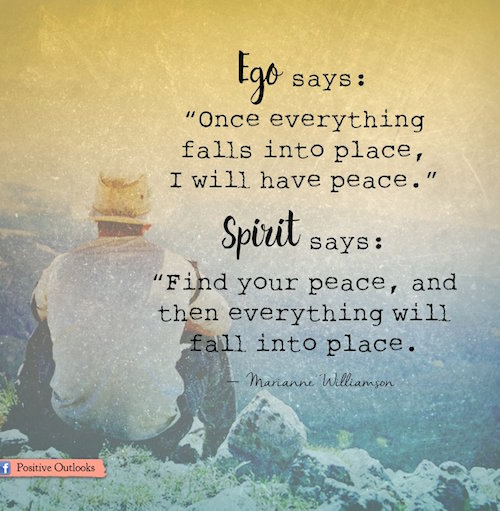
    Problems begin when our soul and our ego are in conflict or out of balance. We feel one thing but do another; we self-sabotage. Our actions are not in line with our true values. We need to align our inner and outer selves to lead an authentic life. Knowing the difference between our soul talk and our ego talk can be the key to finding fulfillment. 

    Our soul knows our true needs before we do. It can clarify what we really want and improve our life. It can point us in the right direction when we don’t know what to do. If we feel off about something, most often that’s our soul telling us it’s not something we should do.

    All we have to do is listen to our intuition and trust it enough to go where it leads. When we are on the right path everything feels effortless and starts to fall into place. The right people, places, and circumstances often turn up just when we need them because we’re putting ourselves in the path of what’s best for us.

    When I first met my husband, he wasn’t my usual type, but I had a good feeling about him. My intuition told me to give him a chance, and I’m so glad I listened to it. He loves me and wants what’s best for me. He is my greatest supporter and is there for me through difficult times, as I am for him.

    Now I just need to work out the other areas of my life.

    I have learned that it’s important when making a decision to base it on logic and facts, but also to listen to my intuition. What is my gut instinct telling me? If all three are aligned, then this is the right decision for me.

    I now recognize when my ego is talking to me, as it is loud, negative, critical, and the voice of doom and gloom, and I try not to pay attention to it. The more I slow down, quiet my mind, and hear and trust my intuition, the stronger and more noticeable it becomes. 

    My intuition told me to start writing as a way to get in touch with my inner most thoughts and feelings, understand myself better, learn from my experiences, and try to make sense of my life, something I hadn’t done before.

    Once I started writing, I couldn’t stop. Words started pouring out of me and triggered strong emotions. I realized that I had unresolved issues from my childhood—fear of abandonment, low self-esteem, and other insecurities—which I had buried and now needed to work on to heal myself.

    I know now that my ego is just my outer self, it is not who I really am. It’s the mask I wear to face the world, to hide my imperfections from others. It’s my position in society, all my titles and roles.

    My soul is my inner self, who I really am behind all of that. It’s my true self. It is something we are all born with; it doesn’t change and it will be with us forever.

    Our soul knows what’s best for us. It is always there for us, to love, protect, and support us, to give us answers and guide us onto the right path, once we learn how to hear and trust it.

    In the first half of my life my ego was in the driver’ seat, and I focused on my outer self. However, it was not a wasted journey, as I learned valuable lessons along the way, and it brought me to where I am today.

    I have now reached a crossroad. It’s time for my ego to take a back seat and for my soul to take over so I can focus on my inner self and begin the journey of finding more meaning in my life.

    I hope whatever journey you are on, you can follow your soul’s wisdom too.
  • The Best Question for Self-Care: What Do You Really Need Today?

    The Best Question for Self-Care: What Do You Really Need Today?

    “Each day is a little life: every waking and rising a little birth, every fresh morning a little youth, every going to rest and sleep a little death.” ~Arthur Schopenhauer

    About a month ago I came back to my daily meditation practice after realizing I’d been pushing myself too hard, and I was amazed at how easy it was to sit, get into that groove, and just be. I expected to sit for ten minutes, but on this day, my body didn’t want to move. I was completely content in the stillness, in silence.

    I have been meditating and practicing yoga for many years, and different variations of different practices feel good at any given point in time. However, this was the first time in thirteen years that I sat down in meditation and didn’t fidget, or move a single millimeter, until the time was over.

    This continued for a few weeks, and I was elated. I felt like I had reached a new level of comfort in my body, of awareness of what is important, of connection to a magical inner peace.

    But life is a constant ebb and flow, and after that sweet three weeks, I was back to discomfort and fidgeting beyond about ten minutes. I felt a bit bummed, somewhat jokingly thinking that my Zen super powers were gone.

    But of course, fluctuations are normal. After not regularly meditating for a few months, my body was deeply craving the softness and stillness of sitting instead of pushing for five more minutes of intensity in Vinyasa flow or five more handstands. But after a few weeks, my needs shifted again. And that was okay.

    Every day, every week, every season of life brings different needs, desires, and requests. To truly care for ourselves, we need to pay attention to honor them.

    The How: Check In All of the Time—Regularly, Actively, and Consistently

    Ask yourself, what do I need right now? What do I desire? What’s true for me today? Only then can we address the shifts inside us and show them the respect they deserve.

    If you feel more tired than usual today, you may need to take a nap or at least take it easy. If you feel emotionally overwhelmed, you may need to carve out time for journaling. If you feel physically sore, you may need some gentle stretching. Or, if you feel disconnected from yourself, you may need a little meditation or some mirror work.

    There are no right or wrong answers when it comes to self-care—only what’s right for you in a given moment based on what you’re feeling and what you need. So, create a judgment-free space for yourself. Be kind, loving, and compassionate to yourself, and honor your varied needs.

    And remember: It’s not lazy to rest or switch an active practice for a gentle one if that’s what your body and mind are craving. In fact, this is the key energizing yourself.

    We are always changing, so what we need tomorrow, next week, and next month will be different. Whether the differences are subtle or obvious, it’s undeniably true. Believing that we are stagnant in life or permanently stuck in what is presenting today serves no value.

    The body, mind, and soul are constantly in flux, in growth, in evolution. When we don’t check in at least once a day about what is different and how our needs and wants have changed, we often do what we have done previously. We stick to our last best routine, and end up giving ourselves something that might have worked two weeks ago or two months ago, but doesn’t necessarily benefit us today.

    When I sat down and meditated so easily and effortlessly, I was finally answering some subconscious call. It made me curious to know for just how many weeks or months prior to starting meditations again my being had been requesting the practice.

    If I had been tuned in then and started meditating again when my body/mind/soul was asking for it, I could have given myself the medicine, the sweetness, that it was requesting and felt healthier and more aligned much sooner, instead of struggling through imbalance.

    For months, I had simply been going too fast and trying too hard to bring the next phase of my life to fruition. I didn’t like how it felt and my intuition gave me clues to stop, but instead of choosing to slow down, I told myself this was just an intense growth season in this chapter of my life and I should keep plowing forward.

    This helped me reach my external goals, but I felt burnt out, stressed, unhappy, and disconnected from myself. By the time I fully realized I needed to surrender and take the time to get still and silent, my being was begging for it. Once I honored that need, the imbalance began to recalibrate and harmony began to take its place.

    Now as a daily practice, upon waking, I ask myself:

    • What does my body need today?
    • What does my mind need today?
    • What does my soul need today?
    • What is my intention keyword for today?

    Finally, I write an empowering statement or affirmation to use as a mantra throughout the day.

    I write down whatever answers come and then figure out how I am going to fit those responses into my schedule.

    For example:

    Today my body wants nurturing and sweetness, which might mean a short morning self-message or a bath with essential oils in the evening.

    Today my mind wants relaxation, which could mean going to sleep thirty minutes earlier than usual, doing a yoga nidra practice, or watching something that makes me laugh.

    Today my soul wants peace and joy, which might mean calling a friend to laugh together or reading a spiritual book that makes me happy.

    My intention keyword today is peace. And, moving with the intention of peace throughout my day means being content with what I have, appreciating all the components of day that, continuing to come back to conscious breathing, and smiling.

    The Key: Follow-Through

    Follow-through is as important as tuning in and asking questions, because only when we give ourselves what we truly desire can we thrive and be the best version of ourselves.

    When we give ourselves exactly what we want and need, it’s surprising just how different our day is. We care for ourselves in a deeper way, we show up for other people and our work with more presence and with a better attitude and kinder heart, and we live on purpose in the truth of what is really important in life.

    Many years ago, my therapist told me “Every day is a little life.”

    I loved that phrase and put it on my mirror. Truthfully every day is a magnificent, magical, grand chance to create our life—a chance to give ourselves exactly what we crave; a chance to choose to be our genuine, raw, bold selves; a chance to be fully alive in our skin.

    Things will shift; change is the only constant. Check in every day. It’s the only way to know if you’re living each day with purpose, intuitive wisdom, and love. Give yourself what you need, what you desire, what you deeply crave. When we honor ourselves, life simply feels better.

  • How to Heal a Broken Heart and Wounded Spirit

    How to Heal a Broken Heart and Wounded Spirit

    “We do not heal the past by dwelling there; we heal the past by living fully in the present.” ~Marianne Williamson

    My life fell apart on a warm August evening a few years ago. It had been a full summer: family visits, plans for a cross-country move, barbecues, and plenty of travel. We were happy, my husband and I.

    Or so I thought.

    On that August night, my husband came home to our cozy New York apartment, sat down, and told me, behind a smother of hands and hunched shoulders, that he’s in love with another woman. Well, not so much in those words—they actually came much later—but to save you a longer story, we’ll keep it at that.

    What was clear was that he would not leave her despite the ten years we’d spent together, despite the love he still felt for me, despite the mistake he knew he was making.

    And so, this man whom I loved with unbridled completeness, ran a sledgehammer through my life.

    As it happens, the reverberations of that blow rippled out, unceremoniously taking down other pillars I had come to rely on for my sense of stability and well-being.

    A week after my husband’s declaration, my spiritual home, the yoga studio I practiced and taught at nearly every day for years, closed with twenty-four-hour notice.

    A week later, I was downsized out of another job. .

    I shuffled through my days. At times I’d get a surge of energy and suit up with determination to do something about my situation. Other times I’d sink into an unmoving bump on the couch.

    After weeks of treading water and binging on my stories of “poor me,” I realized that, despite my best efforts, life just kept coming at me. No matter how much I resisted and whimpered, the sun rose, birds sang, and babies still made me laugh.

    I realized that I had a choice: I could keep shutting it out and wallow in misery, or I could open up and receive it.

    I decided to open, ever so slowly, almost against my will. I started with small things: feeling the comforting weight of blankets piled on top of me as I vegged out on the couch, tasting the bitter sweetness of chocolate chip cookies, seeing the texture and hue of the landscape I stared out into.

    In doing this, I discovered that what was breathing nourishment back into my soul and calling me forward into living again was none other than my senses.

    Without doing anything dramatic, without making lofty resolutions or steeling my willpower, I began to heal. I softened. I even laughed. I relearned joy and ease and the thrill of taking risks.

    Could it be so simple? Could it be so obvious?

    Yes, and yes.

    In opening, despite the pain and miserable facts of my life, a new awareness took hold: our senses are portals to the soul.

    They are our inborn pleasure centers, receiving and transmitting sensory data—pleasure and pain—directly to the soul, where it is translated into information for the soul to use, to learn from, and to grow from.

    Like a salve on a wound, senses can nourish and calm an achy soul and administer cooling bandages to a broken heart.

    The senses tell us, in every single darn moment: Yes, we’re alive (and what a gift!). And, yes, there is pleasure and joy and beauty and so much room to expand into. They tell us, yes, this journey, this life, is worth it.

    All we have to do is open up to what is, even just a tiny bit. The rest will take care of itself.

    Opening, we see the beauty of the leaves in the sunlight.

    Opening, we hear the wind chimes.

    Opening, we feel a friend’s hand on our shoulder.

    We take in the pleasure and the desire of our soul is quelled. We are set at ease. We have space now to rest, and heal.

    So, I made the decision to nurture my senses and give my soul what it desired, even if it meant that my senses brought in pain, or ugly sounds, or smelly feet.

    Because I learned that when my body aches from too many hours at the computer, I can still look to the blue sky and take cool drinks of water.

    Because when I’m wracked with disappointment or the sting of failure, I can still feel warm water on my skin.

    Because when I’m overwhelmed and wrung out from demands and deadlines, I can still breathe in the smell of a hearty stew and hear the kind words of friend.

    For every pain, there is a pleasure. And I suspect that we are capable of pleasures far beyond the reaches of any pain.

    It all starts with one simple move: opening to what is. Opening our sense portals to the deluge of pleasure that surrounds us, and filling our souls with the fullness of ease and nourishment beyond our imagination. This is the space we bathe in that heals wounded souls and broken hearts.

  • The 3 Pieces of Recovery from Addiction or Depression

    The 3 Pieces of Recovery from Addiction or Depression

    Mind Body Spirit

    “I now see how owning our story and loving ourselves through that process is the bravest thing that we will ever do.” ~Brené Brown

    When I started graduate school, it was safe to say that I was running away from things. I’d recently ended a nine-year relationship and I wasn’t planning on dealing with it.

    Upon the birth of my nephew, my father, a long-term addict, had begun rekindling his relationships with his three daughters. I didn’t recognize, though I should have, that this needed dealing with too.

    I began school so that I’d have something to pour my energy and feelings into wholeheartedly. And I did. It worked, at least for a while. I soon began to notice that I was increasingly unhappy in my new student position.

    While I had things I looked forward to, like teaching and program events, I spent my time alone watching television in bed and wishing I could be anywhere else, though I didn’t know where that might be.

    It was the closest I could ever remember feeling to depressed, a word that had long been whispered, though never addressed, in my family.

    There are few perks to being a graduate student, at least on paper, but one of them, for me, was school-funded student health insurance that included mental health care.

    I should mention that, although my family history certainly warrants mental health care, no one had ever sought it. If ongoing drug and alcohol addictions, divorce, and teenage pregnancy apparently didn’t warrant it, perhaps nothing would. But I was feeling pretty bad, and it was free.

    On the day I walked into the counselor’s office, I found two people from my very small program sitting in there.

    It was at first awkward and then comforting—each of us had found ourselves in a similar situation, and something about that Tuesday had summoned us to the office.

    Inside, I met with Krishna, a soft-spoken therapist who identified my family immediately as co-dependent and prone to addiction.

    I felt better already. She recommended that I be around animals and begin practicing yoga. I committed to both and began seeing Krishna every other week.

    Since I was a busy student and unable to commit to a pet, I decided to volunteer at a local animal shelter. Every Friday, I woke up at 6am to walk dogs for an hour before I went to teach. It was inspiring for a few reasons—one, it reminded me that things could be worse, and two, puppies.

    The animal capacity for cuteness and kindness is extraordinary, and I certainly felt better for having been around them.

    It is often said that volunteer work is a selfish task, designed to make the volunteer feel better for having done it. I don’t object to this, nor do I see anything wrong with it. Those dogs got me through graduate school.

    Next, I set out to learn to practice yoga. This was a scary goal because it seemed to showcase many of my fears and insecurities.

    I was self-conscious about my body and asked to put on body hugging clothes. I was uncomfortable being watched, and the eyes of the class would often be on me. Also, I’d never done yoga before and the thought of all of those skinny, stretchy people terrified me.

    With one of the girls I’d run into at the counselor’s office, I searched for a nonthreatening yoga class that I thought would meet my needs.

    Upon the recommendation of a friend, I joined a group with a focus on restorative yoga, mostly stretching, snacks at the end.

    I found a community of like-minded men and women interested in finding a mind/body/spirit balance to treat the various issues we were all dealing with. Is there anything that hurts today, our teacher would ask, mind or body?

    Because I come from a family of somewhat functional alcoholics going back as far as I can remember, I know that these parts of me may just be hidden, dormant for now.

    Yoga has allowed me to channel these possible proclivities into an activity that promotes physical and mental health, an activity that is no longer scary. It’s also my way of acknowledging that there is something outside of me, something larger than me, at work in the universe.

    Yoga is, for me, the acknowledgment of spirit.

    Recovery (from anything, addiction, depression, physical illness) requires the addressing of a triangle in its entirety—mind, body, and spirit. While counseling began to address the mind, yoga and puppies addressed both body and spirit. Learning this felt like my whole body sighing.

    While I’m not an addict, I can see how yoga would be useful there, too. A positive community, a refocus on the body, an attention to self-restraint and awareness that is hard to replicate.

    For me, breaking down the barriers and walls my family had tried so long create was no small feat. In acknowledging my own capacity for mental illness, I was able to begin a road to recovery that improved my health in many ways. That recognition and verbalization of ill feelings was, for me, essential to the healing process.

    In my professional life, I deal with this all the time—men and women struggling with mental disease, often accompanied by addiction, that lack the approval of families to move forward with treatment.

    For me, it was easier to say then to do. Eventually, though, it became a part of myself (this history of mental illness) that I was happy to disclose because it meant that I had begun recovery.

    Then, I suspected that I was alone. Now, I realize that it’s common to fear that acknowledging there’s a problem is failure.

    Be vocal, be active, be spiritual in any way that you find productive. Be alive.

    I have a triangle tattooed on my left foot to remind me that everything that goes to pieces also happens in pieces, even recovery. One, two, three: mind, body, spirit.

    Photo by HartwigHKD

  • The Key to Accomplishing Goals: Moving from Ego to Spirit

    The Key to Accomplishing Goals: Moving from Ego to Spirit

    “Change is inevitable. Growth is intentional.” ~Glenda Cloud

    My life is over.

    That’s what I thought when I got the news that I’d lost my job after fifteen years with two sister companies. I loved this job. I was on the road to becoming everything I thought I wanted to be—a Hollywood studio vice president, well on my way to running a studio someday.

    I was doing something I loved, developing stories. And now it was all over.

    Have you ever had a moment like that? When the end of something in your life felt like the end of your life? You’re not just being overdramatic—when we lose a job or relationship or role, we do experience loss. So how do we pick ourselves up and move on?

    For me, even though my Hollywood job had ended, in a way it was Hollywood that saved me, too. I realized that I needed to shift my perspective. Losing this job wasn’t the end of my story; it was the difficult middle.

    Think of all the movies you’ve seen where, at the midpoint of the story, the hero starts to run into some serious obstacles. It’s at this moment when she starts to see the weakness in her approach to her problems.

    She has to go through an “all is lost moment” before she can reach the “aha” moment when she realizes what she really has to do to achieve her goals.

    In the best stories, this moment represents a shift from ego to spirit.

    For example, in The King’s Speech, it’s not until our hero Bertie’s brother gives up the throne, forcing Bertie to do the thing he fears most—speak in public—that he changes his perspective.

    Instead of focusing on his own ego and his fear of humiliation, he learns to focus on leading his people. When Bertie makes this shift from the ego to the spirit, he realizes how achieving his goal of conquering his stutter is really about serving others. 

    When I looked at losing my job through the lens of story, I realized that I, too, had been too attached to my ego.

    I was so focused on that end goal of running a studio someday that I’d become blind to the way my work was affecting me on a spiritual level.

    I had started doing things that went against my true values. I had stopped listening to my colleagues, because my ego didn’t want to hear anyone else’s ideas. But my story wasn’t over—this was just the difficult middle.

    Changing my perspective would change the story of my life.

    When you hit obstacles in your life story, you may find yourself humbled. But at that moment you have a choice: Will you stick with your old ego-driven perspective, or will you transcend it? Is your story over, or is this just the difficult middle?

    When you experience this kind of loss, putting your ego aside will help you figure out the next chapter in your story. There are three steps involved in making this mental shift:

    • Recognition
    • Action
    • Accomplishment

    Recognizing that we’ve been driven by ego is the first step toward resolving the problem.

    Understanding how my attachment to ego had led to the end of my job helped me pick myself up and redefine my goals. I decided to use my experience to help others achieve their dreams instead of continuing to strive for personal gain. 

    Once you’ve recognized the role of your ego, you need to take action to change the direction of your story.

    Let your spirit guide your actions instead of your ego. Instead of focusing inward and dwelling on your loss, reach outward. Redefine your goals to make them more about connecting and serving others.

    I’ve found that pursuing a goal that’s about connection to others is much more fulfilling than pursuing a goal that’s about glorifying my ego. I believe if you find a spirit-driven goal, you’re more likely to feel like you’re moving toward a happy ending.

    Spirit-guided action will actually make it easier for you to accomplish your goals. When we’re consumed by our own desires, we don’t allow room for other people’s perspectives. We don’t see how our actions might affect others. Other people become obstacles instead of potential partners.

    True communication with yourself and with others will put you in harmony with your spirit and the world around you. Acting out of this harmony will create the momentum you need to achieve your goals.

    Let the obstacles you face prompt you to reevaluate your goals. Is your spirit setting your agenda, or your ego? How will letting go of your ego help you connect to others? How might that connection change the way you define your intentions?

    When we feel connected instead of isolated and detached, we transcend our own small egos. And just like the heroes of our favorite stories, when we transcend our own perspectives, we ultimately find greater fulfillment.

    If you look at your life as a story, you’ll see that obstacles push you toward growth. That loss or change isn’t the end of your story—it’s just the beginning of your new chapter.

    Lori’s Note: I was thrilled to interview Jen Grisanti for my first ever eCourse. Learn more about the course, Recreate Your Life Story: Change the Script and Be the Hero, here.

  • Healing Depression by Taking Care of Your Mind, Body, and Spirit

    Healing Depression by Taking Care of Your Mind, Body, and Spirit

    “Suffering is not caused by pain but by resisting pain.”~Unknown

    Prior to my twenty-second birthday I was spiraling down a self-destructive path, partying at all hours of the morning and drinking excessively to numb my pain. I was a rebel with a cause, as the lure of the nightlife kept me away from my dysfunctional home.

    I was searching for love and happiness in all of the wrong places, but the universe stopped me dead in my tracks, both literally and figuratively, when my brother committed suicide.

    Devastated by the loss of his presence in my life and the close bond we once shared, I felt utterly alone. I couldn’t fathom my life without my beloved brother. His death was not something I anticipated.

    I needed answers and some sort of explanation as to how a happy-go-lucky young man had changed into a moody and depressive person.

    In my grief-stricken state, I went to the public library and retrieved books on suicide and mental illness. I needed to categorize his disease. Was it bipolar, schizophrenia?

    Coincidently, I had a medical appointment with a general practitioner. I was a new patient and had never met this doctor before. But I immediately felt at ease with him, and though I went in for a physical reason, I left his office with a plan for self-healing.

    After a few sessions with the doctor, I learned about depression, dysfunction, abuse, and addiction. Initially I didn’t know what those terms had to do with me and my brother’s death.

    I was completely overwhelmed, and as I excavated my past, I plummeted even deeper in my darkness. I remained stuck in stage four of the grieving process—depression.

    My pain was so unbearable I even contemplated my own death. When the doctor offered antidepressants, I declined.

    I chose talk therapy as opposed to antidepressants, not because of any stigma, but because I envisioned myself in a vegetated state for the rest of my life.

    I already had family members in this predicament and I vowed that it was not going to me. So I was quite aware that I was genetically predisposed to manic or bipolar depression.

    After one year of dealing with my issues, I abandoned my own treatment. I was caught up in a whirlwind romance with my prince charming. We got married and built a life that my girlfriends dreamed of.

    Yet, I was still unhappy and, after a nine-year relationship, I found myself divorced, picking up the pieces of my life, and headed back to the doctor’s office.

    I was severely depressed and diagnosed with bipolar tendencies. Still, I stubbornly refused antidepressants. (more…)