Tag: solitude

  • The Beauty of Being Single: 6 Benefits of Solitude

    The Beauty of Being Single: 6 Benefits of Solitude

    “I never found a companion that was so companionable as solitude.” ~Henry David Thoreau

    Shock. Rage. Sorrow. Excitement. Terror. These are just a handful of the emotions one experiences in the aftermath of a separation or divorce. Emotional rollercoaster? It’s more like being hit with the speed and velocity of a bullet train.

    I should know. After twenty-five years of marriage to a kind and accomplished man, I found myself alone.

    Our decision to divorce was neither acrimonious nor cruel; neither sudden nor impulsive. Rather, our decision to file for divorce was an incremental process.

    We had more disappointment than hope, more unease with each other than affection and contentment. As difficult as it was to recognize the wrong turns we’d made in our two-plus decades together, we both realized that it was time for each of us to draw a new map.

    While my husband remained in the home we had lived in together throughout our marriage and the raising of our daughter, the path on the new atlas of my life led me back to Italy, the country of my birth.

    In retrospect, it was far easier to relocate to somewhere radically different from the place I’d called home for thirty years than it was to sit with the equally radical emotions aroused by separating from the person who knew me best.

    Once the bags were unpacked, the boxes unloaded, and the small apartment I’d rented in the heart of Rome redecorated, I had to contend with the alien feeling of a naked ring finger and a heart full of pain.

    The relief of our separation—no longer would I have to tiptoe around the mounting frustration and disenchantment between us—was short-lived; the rush of excitement at the idea of “a fresh start” evanescent as a shooting star.

    With a job from home, only a shoebox of an apartment to tend to, and no wifely duties, motherly chores, or social commitments, I had only one thing to do and one place to go—and that was inward.

    It was lonely in there. Where, I kept thinking, was that rock-solid husband of mine who was ready to jump onto the roof at a moment’s notice when the gutters overflowed?

    Who would take care of me when I was sick, keep me warm when I was cold, ease me into sleep when I had insomnia? Who would share the beauties of life with me?

    How could I live if I didn’t have a partner to love?

    I was in profound disbelief (it wasn’t really over); angry (how could my husband let me go?); worried (would I end up begging for scraps of food in Piazza Navona?); ashamed (I should have tried harder); resolved (I’d get him back and we’d make it work), and adrift (life was pointless).

    But then resignation arrived, and with it, a certain, glorious freedom. I was divorced, not dead. The questions I had? It was akin to asking a well where I could find a drink of water. And in their absence, new ones arrived: Who were my neighbors in the eternal city? Which interests could I develop? How could I create a routine that nurtured my values? And how could I march in single file?

    As I began navigating life alone, I discovered that, while enormously different, a great deal of solace and satisfaction can be found in solitude. If you’re going through a similar transition, consider the following benefits of flying solo:

    1. Your imagination will soar.

    It’s true: Creativity emerges from quiet and an open agenda. Having long been a writer—but also a wife, mother, homeowner, and full-time corporate executive—I long ago learned to write against distraction.

    In my new space, where the only distractions were those I created, my imagination was provoked in ways that I hadn’t experienced since I was a child. Without time- constraints and working to the tune of a television show I wasn’t watching, I found myself freer on the page, more productive, and thoroughly content daydreaming about a daydream.

    If thinking of a long, unstructured weekend day fills you with the blues, use it to your advantage. Creative expression, whether through writing, drawing, or dancing, often proves to be cathartic for people.

    Paint your way through anger, redecorate a room to lift your mood, or spend an hour imagining the places you have the freedom to explore in your new, unencumbered state.

    2. Your life will become entirely yours.

    Responsibilities have always been a large part of my adult life. From commuting to the office to hosting dinner parties for my husband’s colleagues, rarely did my former schedule allot much time for what I—and I alone—wanted to do.

    In the absence of these duties, I found a surplus of time, energy, and excitement to pursue my passions. A candlelight yoga class? An art-house film on a Tuesday that would have been otherwise dedicated to household chores? Cocktails on a school night? Yes, yes, and yes, please!

    I discovered the deliciousness of creating my own schedule and following what called to me rather than what was expected of me—and you are wholly free to do the same.

    What fell by the wayside during your relationship—friendships, hobbies, unread novels, moving to the city of your dreams—are exactly where you left them. Only now you have the time and devotion to give them the attention and energy they deserve.

    3. You will learn self-reliance.

    While I was the master of my own life, I was also the one solely responsible for making sure that such a life worked.

    Going from a dual income to one was daunting at first—until I recalled the gift I had for budgeting pre-marriage, which allowed me to buy my first apartment before I turned twenty. A leaky faucet, a flat tire, a frustrating day? I bought a toolset and watched YouTube videos, befriended our local mechanic, and learned that Rainer Maria Rilke was entirely right when he said that no feeling is final.

    The more self-reliant I became, the more confident—and happy—I felt.

    Should you find yourself in the same place, start slowly but stay determined. Pick one area of your life where you need to become self-sufficient, whether it’s in balancing your checkbook or learning to cook for one. Once conquered, attack the next…and next, and next, and next, until you find yourself surprised that at one time you depended on anyone else at all.

    4. You will befriend yourself.

    With only myself to please and take care of, I embarked on a new relationship—with myself.

    I was tentative at first, much as one is when they first start dating someone new. Would I like a glass of cabernet out of habit because it’s what my husband often ordered, or did I think a Viognier might be a better fit with this dish? Would I like to stay at home and take a bath, or venture out to a café with a newfound friend?

    The more I began treating myself with the kindness and attentiveness I showed toward my husband and daughter, the more I got to know myself on a deeper, truer level, realizing how much of what I did and what I ate and how I acted was an act of either submission or compromise.

    If you’re in a similar position, listen to your needs, honor your wants (within moderation), and tune in to what your heart is telling you. The more you take care of yourself, the better equipped you will be to deal with the conflicting emotions your newfound single status has likely stirred.

    5. You will learn the art of a healthy inner monologue.

    Marriage and motherhood don’t leave much room for listening to one’s inner voice—there’s enough noise as it is. Alone, I was introduced to a whole cast of inner players I had silenced out of necessity for years. Some of these voices were unkind—judgmental, condescending, or tempting me in unhealthy directions—but with time and practice, I learned to conduct inner dialogues that were loving, beneficial, and illuminating.

    As you set out alone, give yourself the time and space to listen to the voices inside of you. Silencing those that are cold or self-sabotaging will allow you to hear the tenderness and determination of others. And, with time, you will cultivate an ability to listen to what is best for you—and the backbone needed to ignore all the rest.

    6. You will find peace with your past.

    Those first few months alone were ripe with recrimination. If only I’d done this; if only he’d done that. How could I have done this; how could I have done that? I was reprehensible, a failure, destined for a future of take-out alone and two too many cats. But, again, with time (a true salve for most things), I realized that the old adage is true: Everyone we meet comes into our lives for a reason.

    My marriage was not so much a failure as it was a stepping stone on my journey. I had lost, but I had also learned.

    If you’re bearing similar grief, consider compiling a list of what you have gained rather than focusing on what you’ve suffered; what you look forward to rather than what you miss.

    If you’re anything like me, you’ll find that the greatest lesson of all is that the person you were looking for was right where they were supposed to be all along: within.
  • An Ode to Solitude: The Beauty of Just Sitting

    An Ode to Solitude: The Beauty of Just Sitting

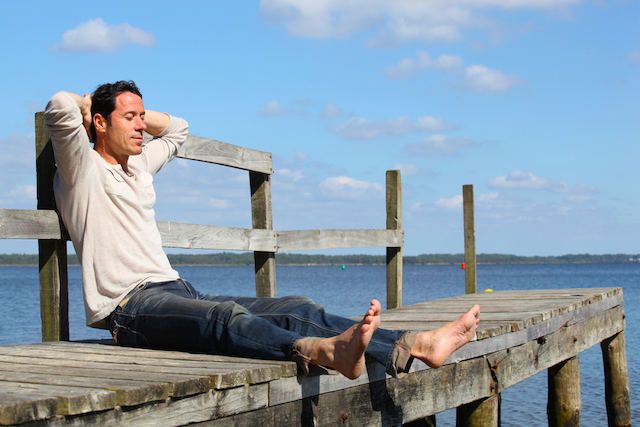
    Man sitting on pier

    “I never found a companion that was so companionable as solitude.” ~Henry David Thoreau

    Meditation makes you realize it’s not so much the silence as it is the not being around people that’s so profound. No human interaction, a human break if you will, is its own simple kind of joy.

    Who knew that as a species who can’t function without the social ties of community, it is solitude that re-charges us and gives us the strength to go out into the big, bad world and interact with that lovely mess I like to call humanity?

    In our hyper connected, overworked, extroverted, always-on-the-go American culture, the very idea of solitude can seem anathema to what we as Americans hold dear. The mere possibility that a person would skip out on social gatherings or not respond to work emails on the weekends because they want some alone time seems downright un-American.

    For most of my life I was (and still am, I admit) a quintessential “busy person.” I pretty much came out of the womb with a list of things on my to-do-list, and as I got older that to-do list became longer… and longer… and longer….

    But that was the way I liked it. Each time I ticked off a box I’d get a sense of satisfaction, a rush not unlike I imagine one feels after doing a line of cocaine or popping some ecstasy tablets. And, as with most drugs, once the satisfaction of accomplishing something on my list wore off, I would work on accomplishing the next thing, chasing that next rush, and so on and so forth, ad infinitum.

    I made the drug comparison purposely, because the constant need to be doing something can feel like an addiction if taken to the extreme. After each line on my to-do-list was checked off I couldn’t wait to add ten more things.

    And, not surprisingly, my incessant busyness was reinforced at every turn. It encouraged me to get good grades and load up on the extra-curriculars in high school, which in turn helped me get into an ivy league school for college, which then helped me get into a highly competitive medical school program… you get the gist.

    But once in medical school I kind of reached a breaking point and realized this treadmill life where I never gave myself a break was not sustainable.

    It was fitting then, that around this time I started to learn about meditation. I find it ironic that in the hyper competitive, fishbowl of an existence that is medical school I found the one thing that advocated the exact opposite.

    Once I started going to meditation classes and getting better at being in the present moment, I began to gain some introspection, which made me rethink this whole busyness thing.

    I actually started to worry a bit about my poor little restless soul and wondered if this is what it was going to be like for the rest of my life. This constant need to fill my days with something—anything—so I wouldn’t have to face the vast emptiness of doing… well, absolutely nothing. It was unfathomable to me.

    Living alone, however, made me change my perspective. As I got older and could afford to live without roommates, this whole world of solitude opened up.

    At first it was terrifying. As busy as I am, even I couldn’t fill every second of my waking days, so the restlessness grew stronger and stronger, until I thought I might explode.

    But once I got past this obsessive need to always be doing something, I loved it. I could just sit, literally. I started to feel like I had all the time in the world.

    Actually, I started to feel like time itself didn’t even exist anymore, and I could just sit there, forever, in my wonderfully empty apartment on my wonderfully empty couch with my wonderful self for company. I noticed that a previously unknown feeling started to make its way into my life. I believe they call this feeling serenity.

    A recent Pew Research Center survey asked: How important is it to you to have times when you are completely alone, away from anyone else? My answer: as important as being around people.

    In all my reverence for solitude, the fundamental truth is that solitude vs. sociability doesn’t have to be an either-or equation. They are both necessary if one wants to be a healthy, functioning adult. It’s just that we as Americans have way more of the sociability than the solitude.

    A wise person once said, “Don’t just do something, sit there.” So take some time out of your busy schedule each day to just be.

    No computer, no phone, no Internet, no TV, no music, no reading, no talking. Just you and your own crazy thoughts.

    Though it may be terrifying at first, you might be surprised at what you find lurking in the deepest corners of your mind. Peace, joy, forgiveness, clarity? There’s only one way to find out.

    Man sitting on pier image via Shutterstock

  • The Key to Loving Yourself, Other People, and Life

    The Key to Loving Yourself, Other People, and Life

    Love

    “Has it ever occurred to you that you can only love when you are alone?” ~Anthony De Mello

    I was sitting in my therapist’s waiting room when I looked over at an assortment of books sitting on the coffee table. One caught my attention right away: The Way to Love, by Anthony de Mello.

    “This looks like something I should read right about now.” I giggled a little with that thought.

    I was, after all, sitting in a psychotherapist’s waiting room because he was the only thing keeping me from a nervous breakdown. My marriage was falling apart and I felt so utterly lost. Perhaps a book about love would help me navigate this painful period of my life.

    I finished my session and hurried home to my iPad. Within seconds, the book came alive on my screen. I perused the chapters at first but stopped dead in my tracks on page 137:

    Has it ever occurred to you that you can only love when you are alone? What does it mean to love? It means to see a person, a thing, a situation, as it really is and not as you imagine it to be, and to give it the response it deserves. You cannot love what you do not even see.

    “This makes no sense at all! How can I love only when I’m alone?” I put the book down.

    I had no idea what De Mello was saying, but that first sentence stayed in my mind and heart.

    Then came some alone time. A lot of it.

    For the next two years, I lived in solitude. My days were filled with meditation, long hikes in nature, writing, introspection, and at times, a deep loneliness.

    I accepted all that life was bringing me. I embraced the hours upon hours of silence and no human contact. In fact, this solitude was self-imposed.

    The disintegration of my marriage had brought some ingrained subconscious patterns to light.

    In the past, whenever life sent something painful my way, I would take refuge in my outer world—friends, bars, alcohol, sex, traveling. They all served as distractions because I was deeply afraid of looking inward. My inner world seemed too complex and dark to even touch.

    Yet, distracting myself with things on the outside hadn’t protected me from pain. In fact, I finally realized the opposite was true: life always mirrors your internal environment back to you.

    If you want to keep your pain, anger, and darkness hidden, life will bring you painful, angry, dark events.

    It’s really that simple. 

    With that realization, I decided to resist the temptations that often follow a break-up, hence my self-imposed solitude.

    I didn’t move to the jungle. I still saw family and some friends. But I made a conscious decision to spend the majority of my days alone, in silence.

    And then one day I got it. I understood what De Mello said in that book. I was living it.

    Solitude had taught me how to love, and with an intensity I never thought possible.

    I learned to love from the inside out. And that love took three forms.

    Love of Myself

    Self-love came first. I had always used people or things outside myself to sustain my dismally fragile self-esteem. Being alone forces you to look inward and see what lies in your inner world.

    Make no mistake: this can be a difficult and painful process.

    But seeing and accepting your inner world is the only way to love the glorious being that dwells beneath all the mental layers.

    This may take some time, and it may bring a swirl of emotions to the surface. That’s okay. Just let them be.

    Let it all see the light of day, without judgment. No matter what lies in your inner world, always remember to put your hand on your heart and tell yourself “I love you.”

    We’re all trying the best we can at any given moment. Cut yourself some slack and let go of the “could have, should have…”

    See your inner world. Accept everything that lies within, without judgment. Through it all, put your hand on your chest and tell yourself “I love you.” That’s it.

    I realize that seeing and accepting our inner world may not be easy at first. For me, the trick was daily meditation.

    This quieted my mind significantly. Since it’s the mind or ego that judges, once the internal chatter calmed down, it became easier to use my awareness to see the beauty of my heart.

    For you it can be different. Perhaps your mind quiets down with exercise or a walk in the park. Just remember: a quiet mind is the foundation for self-love.

    Self-love then becomes an internal light that you shine in all directions as you walk through life. And that is how you end up loving others.

    Love of Others

    Even with all that alone time, I still managed to fall in love again. This time it was different. Because I loved myself, the love I could give another was purer, stronger, and completely unconditional. I loved without attachment. 

    I also felt a different love for my family and friends. I began to love people for who they were. I loved them in freedom.

    Loving people without attachment was a monumental milestone for me. It was the process of self-love that had enabled me to reach this milestone.

    In learning to love myself, I realized I used people as emotional crutches in order to sustain my sense of worth.

    Once I recognized this pattern and sat with the temporary guilt it elicited, I began to feel lighter. The lighter I felt, the more I loved myself. And the more I loved myself, the more I loved others.

    I no longer needed them. I was now standing on my own, without crutches. In this newly found independence, there were no conditions. My happiness no longer depended on what others did or said.

    Without crutches, your hands are free to extend to others. And that’s really what it means to love without attachment.

    Love of Life

    Solitude showed me the beauty of the present moment. I realized how life was glorious, intense, and alive!

    The little moments became memorable. Seeing a bird fly or a flower bloom was a miracle. Because I no longer focused my attention on mental drama, I could experience the fullness of life.

    Experiencing this fullness meant that I trusted life. I knew that what came to me was there for my evolution.

    Loving life meant that I loved everything that came my way.

    Can you learn to love without being physically alone? Yes. Fortunately, solitude can be experienced without running off to a deserted island!

    You can experience solitude in your heart. That is essentially what De Mello was referring to in his quote. In my experience, solitude is a synonym of non-attachment.

    Experiencing solitude in your heart means that you do not depend on anyone or anything in order to bring you happiness or love. You live with the knowing that what you may desire from another is always available to you.

    What you may desire from the outside world is already within.

    This knowing is then naturally reflected in your outer world. You can live solitude in your heart while surrounded by people.

    And it is this solitude that ultimately allows you to genuinely love. Love yourself. Love others. Love life.

    Love image via Shutterstock

  • 6 Compelling Reasons To Spend Some Time Alone

    6 Compelling Reasons To Spend Some Time Alone

    “There are times when alone is the best place to be.” ~Unknown

    Some people think it’s awful to spend time alone—that it means you’re antisocial or no one needs you.

    Some people feel sad and lonely when they don’t have company every evening or weekend.

    But being alone doesn’t mean that no one needs you. And it can actually be quite useful to take some time to yourself.

    I am almost thirty. This is an age when you start to rethink your whole life, trying to understand what you should change or improve, what you should do next, and what specifically you need in your life.

    I felt this way a couple of months ago.

    I thought I’d achieved nothing in my almost thirty years, and I felt I should have changed something but couldn’t figure out what or how.

    I had to cope with my feelings, but the everyday chaos of my life didn’t allow me time to concentrate on myself.

    The decision came like a bolt from the blue—to spend some time completely alone.

    When you’re alone, nothing prevents you from listening to your inner voice, heart, and mind.

    Here are a few other benefits of spending time in solitude.

    1. It’s a great opportunity to recharge.

    We often try to make people around us happy and help them work through their feelings. This can be emotionally draining.

    For example, I have one friend who lives abroad, who comes online to talk to me only when she feels bad and wants to share all her problems with me. It takes a lot of energy and makes me sad and frustrated.

    Time spent alone helped me take a break from constant interaction with other people so I could recharge.

    2. It’s a good time to think and reflect.

    Life moves at a crazy speed. It doesn’t often give us time to stop and reflect. When alone, you have a great opportunity to focus on yourself.

    Thanks to my voluntary solitude, I had a chance to question whether I was moving in the right direction, I’ve realized what I should change in my life, and I’ve finally found time to relax and meditate.

    3. It’s a chance to understand what really makes you happy.

    When you spend time with other people, you often have to make compromises. There’s always a chance that what you want may not coincide with others’ wishes. When you’re alone, it’s only you who decides what to do.

    Do you want to spend the whole day lying on the beach? Go! Do you want to visit that contemporary art exhibition? There’s no reason to skip it. As for me, I’ve finally visited the city of my dreams, Prague. None of my friends ever had the time, money, or desire to go with me, but that no longer mattered.

    4. It makes you more productive.

    It can be fun and exciting to spend time with friends, but it can also distract you from things that are important to you, like exercise, hobbies, a long-delayed book, and unfinished work.

    Spending some time alone can be a good opportunity to make progress toward your personal goals.

    5. It makes you more self-reliant.

    We often seek approval from friends, colleagues, and family members before we take action or make a decision. There are times when it’s necessary to do this, but there are also times when it’s possible to act without consulting others first.

    When you’re alone, you’ll learn how to make decisions without anyone’s help. This was difficult for me at first, but in time I became more self-reliant.

    6. It teaches you to value people who are close to you.

    When you regularly take time for yourself, it becomes even more enjoyable to engage with others, as you’ve given yourself time and space to miss their company.

    Don’t be afraid of being alone. Very often it helps us understand who we are, what we want, and what we can do to become better people.

  • 10 Ways to Be Who You Really Are

    10 Ways to Be Who You Really Are

    Girl Hiding Face

    “It takes courage to grow up and become who you really are.” ~E.E Cummings

    I was a pretty shy and very quiet kid, so going to school for the first time in kindergarten was a terrifying experience for me.

    After a short time, though, life brightened for me in my little elementary school. As it turned out, I loved learning and was a natural student. It was my bliss and often a respite from tumultuous home circumstances, the first place that I spoke out loud with confidence.

    Unfortunately, in the urban neighborhood where I lived, being smart meant being very low on the social hierarchy.

    For years I was oblivious to this, but as I moved in to pre-adolescence, I became acutely aware of how my peers viewed me and felt increasingly embarrassed about standing out as a stellar student.

    In one particularly memorable experience, I left the stage of a successful debate speech humiliated because I spied several of my peers mocking me in the audience during my delivery. This was a turning point.

    Because of an intense desire to win the approval of my peers, I began to actively make decisions to fit in rather than finding my joy by expressing who I really was. Although uncanny to me now, at times, I even would intentionally give the wrong answers on exams to bring my scores down.

    An occasional wrong answer didn’t change who I really was, but each decision I made to choose the approval of others, buried my true self deeper.

    The momentary gratification of being liked or winning approval could have had profound consequences. It certainly left me feeling empty.

    Every time we make small decisions to fit in, whether as a child or as an adult, we are burying a little part of ourselves down deep. This is really serious business, this denying of who we are.

    Make it a habit, and you risk becoming confused about who you really are. Just search online for books on topics like finding your true passion or how to get back to your true self to get a sense of the energy it takes to find pieces that are lost.

    In high school, I made a dramatic internal shift. Because of a newfound faith, I started to think about my future and felt that I had a responsibility to begin living my life in a way that reflected who I really was.

    This, rather than the approval of others became a driving force for me. Small decision by small decision, I began to act with the courage to be me. (more…)

  • Balancing Social Time and Solitude: How to Find Your Golden Ratio

    Balancing Social Time and Solitude: How to Find Your Golden Ratio

    “A wise man makes his own decisions; an ignorant man follows public opinion.” ~Chinese Proverb

    I’d like you to ask yourself a simple question: Do you know if you’re an introvert or an extrovert?

    If you’re uncertain of the answer, you might accidentally be draining your energy with too much time spent socializing, or boring yourself to death with too much time spent in solitude.

    Extroverts get energized by large groups of people and lots of external stimulation, whereas introverts energize themselves when they have time for themselves in low stimulus environments.

    Understanding your social type can make a huge positive impact on the quality of your life.

    My College Years as an Introvert

    Back in the days when I didn’t understand my introverted tendencies, I used to think that there was something wrong with me.

    Attending college in the U.S. was pretty confusing for a typical introvert coming from Finland.

    There was a whole lot more partying and socializing going on that I was used to.

    At times this environment was very exhausting for me since it didn’t fit my personality that well.

    I went to bars and parties just like any other student, but I wasn’t always able to enjoy myself while there.

    I remember one incident when my girlfriend, at the time, got mad at me because I looked miserable at one of the parties we were attending.

    Of course, I wanted to fit in so I tried forcing myself to be more extroverted from there on.

    That never really worked out.

    I found it incredibly tough and draining to try to sell myself as an extrovert. The approach clearly wasn’t working for me.

    It became obvious that something had to change. And since faking extroversion wasn’t really working for me, I began spending more time alone.

    I discovered that taking time for myself was working pretty well, especially after days that had been full of socializing.

    But soon I began realizing the drawbacks of this approach as well. I noticed myself drifting into bad moods after too much time spent in solitude.

    I had moved from one extreme, of accepting all party invitations, to declining the majority of them. Neither extreme worked well for me.

    This is when I first realized that I needed to find a good balance between the two approaches.

    I learned a lot about myself during those years. I’m now able to arrange my ratio better between solitude and my social life. (more…)

  • When Will You Find a Moment for Yourself?

    When Will You Find a Moment for Yourself?

    “Sometimes the most important thing in a whole day is the rest we take between two deep breaths.” ~Etty Hillesum

    For the second time in a week, the gas light comes on in my car. I’m busy, as usual, and so I push it a little farther, run just a few more errands. But I know that I do need to stop and refill before too long, or I will be left on the side of the road. I’ve been stranded before, and have learned my lesson.

    Most of us know that when our cars try to tell us they need something, we had better respond or they won’t get us to our destinations.

    We usually have some respect for red warning lights on the dashboard, and at least check out the problem. Unfortunately, it’s not always so easy to see our own signals.

    Our bodies and minds don’t come with bright red warning lights, but they do give us signals when they’re running low.

    Some of these signals are more obvious than others. When we’re hungry, we might be able to skip a meal occasionally, relying on snacks to get us by, but we all know that at some point, we need to eat real food.

    We might be able to miss a few hours of sleep as well, and make it through the next day, but we can’t simply expect our bodies to keep performing without rest.

    We may be able to survive in a grumpier and lesser performing fashion when we have less than optimal amounts of food and sleep, but we all know that we can’t skip those needs altogether.

    But what about the other needs that aren’t so obvious? Everyone has probably heard about the benefits of spending some time alone just to think and to gather their own thoughts.

    If you work, go to school, have a roommate, spouse or children, this time probably isn’t easy to come by. It’s probably also more important than ever.

    Lately, I’ve noticed just how important this need for solitude is to me. As a writer who works at home, as well as a homeschooling mother, I am blessed with lots of time with my family. What I’m lacking severely is time to myself.

    Between errands, online college classes, a part-time job, volunteering, and meeting the needs of everyone else, I often end up neglecting my own need for a moment to myself to think, breathe, read, write, draw, paint, or do anything that helps me relax. (more…)