Tag: slow
-
How a Simple Object Helped Me Slow Down and Breathe
“Sometimes the smallest things take up the most room in your heart.” ~A.A. Milne
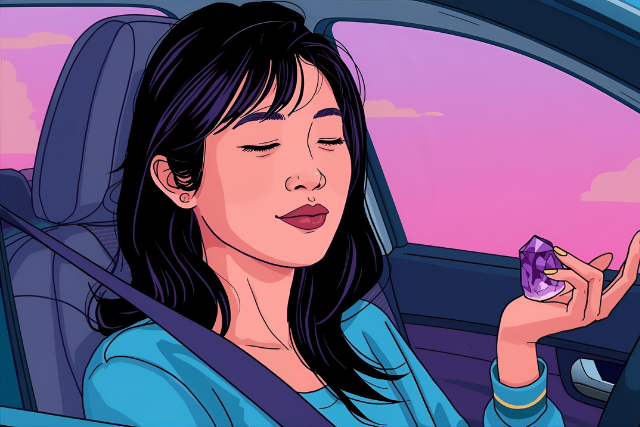
It was a Wednesday afternoon, and I was sitting in my car, too overwhelmed to turn the key in the ignition. My phone had been buzzing all day with work notifications, and the mental list of things I needed to do was growing faster than I could breathe.
Somewhere in the middle of my swirling thoughts, I reached into my coat pocket and felt something smooth and cool. It was a tiny amethyst I’d tucked there weeks ago, almost as an afterthought.
I held it in my palm, noticing its weight, its texture, the faint warmth it picked up from my skin. Slowly, my breath deepened. My shoulders relaxed. For the first time that day, I felt just enough space between myself and the chaos to think clearly.
That moment taught me something I hadn’t realized before: big changes don’t always come from big actions. Sometimes, the smallest things—the ones you can hold in the palm of your hand—can pull you back to yourself.
Why the Small Things Matter
For most of my life, I believed that fixing problems required a full reset—a new job, a big trip, a total life overhaul. If I was stressed, I thought I needed to clear my schedule completely. If I was sad, I thought I had to “solve” the sadness before I could feel better.
But that afternoon in my car changed my perspective. It wasn’t the crystal itself that “fixed” me. It was the way that small, tangible object interrupted my spiral long enough for me to breathe.
That was the first day I started carrying a stone in my pocket—not for magic, but for mindfulness. It became a reminder that no matter where I was or what was happening, I could pause. I could choose a different response.
Over the weeks that followed, I started noticing how these tiny moments of pause changed the course of my days. Holding that stone at my desk before a meeting. Resting it in my hand before bed instead of scrolling my phone. Each time, I felt more grounded, more present, more myself.
I realized it wasn’t just about the crystal. It was about creating a bridge—something physical that pulled me out of my head and into the moment. For someone else, it might be a smooth pebble from the beach, a favorite coin, or even a small piece of fabric.
The power wasn’t in the object itself. The power was in what it represented: a conscious choice to stop, breathe, and reconnect.
Looking back, I can see how much I underestimated the small things. I used to believe they were insignificant compared to “real change.” Now I know they’re the foundation for it.
Because when you can find peace in the smallest of moments—sitting in your car, holding a stone, breathing deeply—you’re not just surviving. You’re building the capacity to handle life with more grace.
A Simple Invitation
If you’re feeling overwhelmed, you don’t have to change everything at once. Start small. Find one object that feels comforting in your hand. Carry it for a week, and whenever your mind starts to race, hold it and take three deep breaths. Notice what shifts.
It may seem too simple to matter, but that’s the point. The smallest things are often the ones we return to again and again. Sometimes, they don’t just take up space in your heart—they help you find your way back to it.
-
A Quiet but Powerful Shift: How Slowing Down Transformed My Life
“Slow down and enjoy life. It’s not only the scenery you miss by going too fast—you also miss the sense of where you are going and why.” ~Eddie Cantor
In today’s hyper-connected and fast-paced world, slowing down isn’t just rare—it feels almost countercultural.
For years, I tied my identity to productivity. My self-worth hinged on how much I could accomplish in a day, how many boxes I could check. The busier I was, the more valuable I believed myself to be. But that constant need to perform left me mentally and emotionally drained, disconnected not only from others but from myself.
The shift didn’t happen overnight. There wasn’t a single moment of clarity, but rather a quiet unraveling of old habits and a tentative embrace of new rhythms.
It started with one simple change: drinking my morning coffee without looking at a screen.
Then came short walks without headphones, evenings spent journaling instead of scrolling. I also began ending each day by writing down three things I was grateful for.
These tiny pauses felt insignificant at first. But gradually, they started to stitch together a new way of being. I noticed my breath more. I felt the texture of sunlight on my skin. I paid attention to the stories I was telling myself—and questioned whether they were even true.
The more I slowed down, the more I began to hear the quiet voice within me that I had long ignored.
Slowing down didn’t mean abandoning ambition. It meant redefining it.
I started asking myself: Is this opportunity aligned with the life I want to create? Am I doing this because it brings me joy or because I feel I should? I said no more often, but with less guilt. I said yes with greater intention.
Creativity, which had felt like a dried-up well, slowly began to flow again. I wrote not for deadlines or approval but to explore my inner world. I painted, even if the results were messy. I read poetry aloud in the quiet of my room. These acts weren’t about achievement—they were about presence.
Relationships changed, too. When I wasn’t preoccupied with the next thing on my to-do list, I could be fully present with the people around me. I listened more deeply. I responded instead of reacting. I laughed more freely, loved more fully, and felt a deeper sense of connection.
I also became more attuned to my body. I noticed when I was tired—and let myself rest. I recognized signs of stress and anxiety and learned not to push through them but to sit with them. I stopped seeing rest as something to earn and began to see it as something essential.
With time, slowing down transformed from an experiment into a lifestyle. It became a guiding principle rather than a temporary fix. And perhaps the most surprising thing? I didn’t lose momentum—I gained clarity. I pursued goals with greater focus and more ease. I didn’t do more, but what I did had more meaning.
Slowing down also helped me develop greater resilience. When life inevitably brought challenges, I didn’t spiral into panic as I once might have. I had built up a foundation of calm, a toolkit of stillness, and an ability to ground myself in the present moment. This made me stronger, not weaker.
I discovered that the richness of life is often found in the pauses—in the moments we allow ourselves to simply be rather than constantly do. The world didn’t fall apart when I slowed down. In fact, it came into sharper focus. I was able to appreciate the subtleties of life: the way a friend smiled, the sound of rain on the roof, the comfort of a quiet evening at home.
My relationship with technology changed as well. I became more intentional with my screen time, setting boundaries around social media and emails. I reclaimed hours of my day and filled them with activities that nourished me instead of drained me. I learned to value solitude not as loneliness but as sacred space for reflection and growth.
Slowing down helped me tune into my intuition. I stopped crowding my mind with noise and distraction, and I started listening—really listening—to what I needed. Sometimes it was rest, other times movement. Sometimes it was connection, and sometimes it was solitude. I began honoring these needs without judgment.
I even noticed changes in how I approached work. Instead of multitasking and burning out, I began focusing on one task at a time. The quality of my work improved, and I found more satisfaction in the process rather than just the outcome. This shift in mindset rippled into every area of my life, bringing more balance and peace.
Slowing down helped me reconnect with the rhythms of nature. I paid attention to the seasons, the moon, the cycles of energy in my own body. I learned to embrace periods of rest as much as periods of growth. I found wisdom in the stillness.
If you’re feeling overwhelmed, anxious, or simply disconnected, I invite you to try your own quiet shift. Start small. Five minutes of silence in the morning. A walk without your phone. One deep breath before opening your laptop. These moments add up.
They’re not about escaping life—they’re about returning to it. You don’t have to escape your life to reconnect with yourself. Sometimes, all it takes is a little stillness. In that space, you might rediscover not just calm—but the truest parts of who you are.
-
How Slowing Down Helped Me Reclaim My Dreams
“For fast acting relief, try slowing down.” ~Lily Tomlin
“Are you the owner?” asks, well, yet another customer at our local Italian eatery.
“Nope—I’m just old!” I reply, all sheepish but pleased.
It’s true. At fifty, I’m not exactly your classic, college-struggling part-timer.
Actually, I’m the oldest employee at our restaurant—the staff “mom,” if you will. I’ve been at this serving gig three years now and haven’t looked back. Which might seem weird considering how I got here in the first place. What a contrast to the world I once lived in.
I co-owned a financial services company with my dad for sixteen years. We had a good thing going. Our clients were well taken care of—we were winning awards, and the money reflected that. At forty-five, I had it all: a full-tilt career, a decent marriage, two kids, and a nice house.
To say that wasn’t enough for me wouldn’t be honest. No, it was more like it was TOO much.
I felt overwhelmed by the life I’d helped build.
I was stuck on the treadmill of Keeping It All Together, running faster and faster with each passing year, terrified I’d fly off the back end in one spectacular “Sam-Style” crash. I longed to slow down enough to examine my choices, my reality, and myself. The pace was killing me. Whoever the “me” was that I’d become.
Couldn’t I just walk for a while?
My running took me to a thirty-three-day meander on the Camino de Santiago in Spain in May of 2019. It was one of those “sort-out-your-shit” mid-life pilgrimages. I walked in, a pile of cynicism and confusion, but walked out with confidence, clutching one very ballsy answer:
“Quit your career.”
For context, it was driving me crazy. I’d crossed a threshold where it didn’t matter how much money I was making because I was miserable. Investing for others never felt like me—artsy-fartsy “Sam” was drowning in portfolio pressures. Uncontrollables like market returns and regulation built on the assumption that all financial advisors could be out to screw their clients had me on edge 24/7.
Looking back, I am grateful for those years that never felt like me. Because they eventually helped inform a more authentic life. That’s the one I’m living now. It’s a more peaceful, more meaningful existence. Even if I am “just serving up pasta.”
See, when you’re stuck on the treadmill and the universe keeps ratcheting up the pace, it’s all you can do to breathe, let alone hold any other aspiration in your head.
You simply can’t. There’s no time for that sort of fluff.
You’ve got clients and deadlines and responsibilities and targets. Your files come home with you. Your conversations with loved ones center around what ridiculous head office battle you had to fight against today, just to keep up with the demands of your job.
Dream?! Snort. This IS the dream… Isn’t it?!
Apparently, it wasn’t MY dream.
Fast forward to a world where I’m out three or four nights a week, doing a literal (and warmly received) tap dance if the kitchen is backed up. I collect tip pools on Wednesdays. I clock in, I clock out. And when I’m home, I am not thinking about work.
This is a far cry from my Sunday night anxiety, when I would lie awake in dread over what fires I’d have to put out the following morning.
As a server, I’m counted on to provide care, kindness, good humor, and advice for tourists and newcomers on our area, along with the obvious meals prepared to their liking. It’s a curated experience that comes with a smile. A can’t-fake-it smile.
The smile is legit, because I’m happy. 🙂
But there’s something else at play here. Taking my foot off the gas—that is to say, making the difficult decision to slow my life down—has allowed me the time and space to dream.
And I am (and always will be) “one of those.” I know, I know, I know; insert eye rolling from my realist peeps in the audience. I am a DREAMER.
I believe our dreams matter.
How can they not? Why else are we here, spinning on this giant rock? Are we meant to come into the world, then run like hell unquestioningly until the day we die? Methinks, no.
The problem most of us have with dreams is threefold: (1) they’re seemingly impractical, (2) they require courage to get started, and (3) they need time to germinate and take off.
The sad fact is most of us are in survival mode just to exist. We don’t have the time to dream.
Dreaming is a bloody freaking luxury! We have more urgent matters to attend to—like mortgage payments and helping our aging parents understand their cell phone plans.
But I think casting our dreams aside despite today’s survival mode reality is already a slow descent to the grave. We may still be alive, but are we really?
Sure, we can pinch ourselves and feel that pain, looking around at the world’s we’ve built and the treadmills we’re running on to keep it all going. Of course we’re alive. We’ve got the tax bill to prove it!
Inside, though? Our soul might be one breath away from lights out. This happens when we shrug off the whispers it quietly sends to us, succumbing to one of our great failings as human beings: we settle.
Uggg, settling.
Some people might think I’ve “settled” in choosing to swap a lucrative occupation for some part-time job waiting tables.
It’s the opposite.
I’d have been settling if I would have stayed the course in my previous career. And I’d probably be dead by now. That may sound dramatic to you, but I was on the cusp of CRACKING at least quarterly. I just assumed this was something I had to suck up.
It was only when my dreams came at me unflinchingly loud that I realized I had to do something. Thanks to that meander on the Camino, all those “shoulds,” “musts,” and societal expectations that otherwise took up head space dissipated, freeing up fertile ground for my dreams to matter. In essence, my dreams became louder than my misery.
But I thought I was nuts. Who would walk away from security and set off for the great unknown?
An insane person would. At least, that’s what I’d thought. And you can’t blame my distorted thinking; remember, I’d been running at warp speed for years.
It would take that far slower pace for me to see things clearly. To see things for myself.
Today, chasing my dream admittedly comes with frustration, exhaustion, and its own version of disillusion.
I have taken my walk across Spain as inspiration to help other women try and slow down so they, too, can sort out their shit and find themselves. It all sounds good in theory. But anyone who has ever started a business before will tell you it is often a lesson in failing forward.
(Then swallowing your pride with each lesson learned—like, who buys 2,000 custom “thank you” bracelets for a company that hasn’t yet launched anything to thank someone for?! Yeah, I did that!)
I know, though, that if this dream of mine matters, I’ve got to continue to find the money, motivation, and stamina to invest in it. These are all ME problems, but I’m dealing and pleased to see the wins when they come.
What’s important here—and this is part of my self-talk when feeling frustrated—is that I’m not ignoring what matters to me.
I’m not shoving it down, beating it into submission, or deluding myself that it doesn’t exist in the first place.
If Slowing Down Is Key—Then How?
My answer here isn’t going to sound like rocket science or some earth-shattering discovery. It’s easy: get out and walk.
I will forever champion the slowed-down art of moving your body, one foot in front of the other, on the cement sidewalk of your urban jungle or the mossy loam of your backyard forest. Walking IS the answer. If we can tear ourselves off that treadmill for twenty to thirty minutes a day, we’ll begin to see a shift.
Stress levels decrease, and this is documented scientifically.
With less of that pesky stress hormone “cortisol” coursing through our veins, we’ll feel better without even trying. You show me a person whose mood isn’t lifted after a walk, and I’ll show you the millions in my bank account. (Ha! There’s no such thing as either!)
Walking has been a time-honored tradition of problem solving, creativity-fueling, and dream-catching for years. Beethoven would set out for long walks, pen and paper in hand, ready to capture those melodies as they came to him.
So, I’m not saying go out and quit your job. I’m just saying, get outside for some deliberate movement. Which brings me to my next point.
The Importance of Conscious Decision-Making
Aiming for a life with no regrets takes decision-making to the next level.
If that means tightening up our purse-strings while I work on my dream, or relying on my husband to carry the bulk of the financial torch, or going out and getting a serving job to help take the pressure off—so be it. I make these choices willingly and with the fortunate support of people who believe in me.
“Conscious” decision-making requires us to weigh the options and think about others in the fallout of our choices. How does my desire to go after this dream impact those I love? What do I need to consider? What’s my downside, and how does that inform any decisions we need to make as a family?
Those Who Are Watching
A by-product of going after our dreams is the message it sends to those who follow. In my case, we want to show our two daughters that their dreams are important. I’d have been selling out completely if I’d never left my career; that “your dreams matter speech” we parents often dish out would have otherwise felt like flavorless gruel. At least for us.
Over the last four years, I’ve seen how my tenacity (read: head-banging, stubborn persistence) has inspired my kids.
My eldest will shoot for the stars with the loftiest expectations. And while talking her off her ledge over NOT being accepted into the most competitive university in North America felt daunting, I secretly loved that she tried.
Because why not shoot for the stars? Her playing large will net a guaranteed number of disappointments, but it also fuels her grit. And on those few occasions when she swings hard and knocks one out of the park—how great does that feel because she took the chance to begin with?
Don’t Aim to Be the Example of Success—Aim to Live the Dream, Failures and All
I judge myself harshly. And those midnight, panic-stricken voice messages I send to my friend Carolyn are proof. Nothing happens quickly. Nothing is easy. Nothing goes the way we think.
But in the end, if we’re breathing life into those dreams of ours, we’ve already won. We aren’t merely going through the motions. We are in the arena, taking chances, learning lessons, failing forward, getting back up, and squeezing the juice out of how we want each moment to feel.
And I’ll keep it even more real for you.
I sometimes feel as though I’ve traded one treadmill for another. It’s in those moments when I back away slowly from my laptop, shove my feet into my hikers, and hit the trails. When I’m feeling overwhelmed and unclear, I literally walk away.
A full-tilt life is exciting (and exhausting), but it’s not always the one best aligned with our souls. We need to slow down—meander, even—so we can recognize when things are spinning out of control. Our walking can even lead us to our dreams, if only we take the time to put one foot in front of the other.
-

How My Old Dog Taught Me New Tricks
“Nature does not hurry, yet everything is accomplished.” ~Lao Tzu
With two rambunctious kids, a stressful job, and a house to maintain, life was hectic. For many years, my children begged for a dog, and I would always say, “When you are older and life slows down a bit.”
Time was ticking by, but life was no less chaotic when my then preteens made yet another pitch. With more than a little trepidation, we brought home a little ball of Golden Doodle fluff who we called Murphy. How much trouble could he be?
In a short time, our cute puppy grew into a hundred-pound goofball. He fit into our lifestyle completely, which is to say, he added more mayhem to the already full and frenetic life we led. We adored him for the love and fun he brought to us, but I wondered when he was going to get over the puppy phase and slow down.
After two years together, he still yanked us along like rag dolls as he chased squirrels on our ‘walks.’ We tried, and failed, obedience training. Each day, he presented us with a newly chewed shoe or freshly gnawed windowsill when left to his own devices.
The final straw was when he unzipped my purse with his snout and ripped up my passport, requiring me to declare to the City Clerk that “the dog ate my passport” in order to replace it. Something had to change.
Instead of considering how Murph’s wild behavior might be a reflection of our own lives operating at warp speed, we settled on an external solution to his destructive antics: We doubled down and naively got a dog for our dog. A year-old Shih Tzu named Teddy Bear joined our merry maelstrom.
The kids called him Ted, a more ‘manly’ handle, and he settled into our house as his own. While things didn’t exactly slow down with his addition, Ted’s entertainment value was immediately apparent.
We would pause to laugh as Murphy and Ted wrestled, both growling and sneezing to indicate it was all playful fun. Murph would pick up Ted by the neck and run around the house. Not to be outdone, and despite being outweighed by his brother sixfold, Ted would stand underneath Murphy’s chest, where he couldn’t be reached, and nip at his forelegs, sniper style.
Ted’s only ‘trick’ was to seek me out when his big brother was getting into trouble, ratting him out for a tasty treat. My ridiculous Poodlehead never held it against his little pal, and I have since surmised that this was a ruse they cooked up to get treats that they could then share at their hapless owner’s expense.
We continued to race through life and its requisite ups and downs, joys and heartbreaks. Ted and Murphy continued to bring us together in laughter. They joyfully passed eleven years together before the Dood became ill and sadly crossed the rainbow bridge.
His friend Ted was a little lost for a time. One day, I tried to soothe him by suggesting we go on a car ride. My son Michael exclaimed, horrified, “Mom, that won’t help. The last time you took his brother for a drive, he never came back.” Ouch, but true.
Still, over time, Ted got used to his place as top dog of the household. At twelve, he had slowed down somewhat from the rambunctious mophead that had enjoyed a good run around the yard in true ‘zoomie’ fashion.
Rather than pulling at the leash like it was a race to the finish, he now trotted along beside me, sniffing every bush, tree, hydrant, and bug encountered along the way. Initially, I was impatient, tugging him after me in a bid to finish and check off ‘walk completed’ in my imagined to-do list. I was frustrated by the slowing; I was used to the go-go-go of my life.
‘What’s the rush?’ Ted’s plaintive eyes would ask when I dragged him away from the latest enticing smell. As I sat in exasperation after one such exchange, I turned to watch Ted quietly sleeping on the couch. His soft snores added a contented rhythm to the silence in the room.
I reflected: The kids were grown and living their own lives. The rush of birthday parties and soccer games was behind me, and life was shifting into a slower gear. Perhaps it was time for me to consciously step back from the former frantic tempo and embrace the spaciousness of a new perspective.
Walks started to take on a more contemplative pace. I let Ted take the lead—to stop and start as suited his mood. As he sniffed through the messages left by his fellow canines, I would look around me to pass the time.
I noticed the buds on the trees and the lilting robin’s song in spring. I took in the heady fragrance of lilacs and lilies of the valley. I was dazzled by the brilliant yellows of marigolds and the purple lavender stalks. I crunched the autumn leaves under my feet, appreciating the natural transition that comes before the barren winter and the promise of new life ahead in the spring.
We added music to our perambulations. Ted enjoyed a good eighties tune and never complained that it was outdated and passe. Eurythmics and The Clash topped his list. He especially liked it when I replaced lyrics and included his name: “There’s a breeze on the bike path. Walk the Teddy. Walk the Teddy.” (You sang that, didn’t you?)
Sometimes we would dance along the sidewalk. Despite his age, Ted could keep the beat. And even though my rhythm might have been slightly out of time, Ted was as oblivious as I was joyous.
While we didn’t break any speed records and my steps did not top ten thousand, we took in our surroundings with meditative awareness. Ted taught me the wonder and awe of the everyday by slowing me down enough to experience it.
Recently, Ted made his way across the rainbow bridge at almost seventeen years young. I miss him every day but know that he will be frolicking with his brother, enjoying a good wrestle and sniping from Murphy’s underbelly.
As for me, I honor our time together by remembering the lessons he left me. I reflect on my younger self and consider how life might have been different had I embraced these learnings when I was younger. How might I have enjoyed more quality time with my kids had I stepped off the lightning speed merry-go-round and simply embraced the moment?
I am privileged to have the time now, in their adult years, to slow down, take note, and appreciate an afternoon of frivolity. I do not take this for granted, and I credit my beautiful Ted for his insight.
I continue to enjoy daily walks with an attitude of gratitude and the spirit of my Zen doggo along for the fun. I stop to smell the flowers and feel the sun on my skin.
The eighties playlist still blasts out its timeless tunes, and I think Ted may have even passed along a few of his cool dance moves. And I’m sure even Annie Lennox would agree with the truth in my off-key replacement lyrics: “Sweet walks put me at ease. Ted preferred to sniff at trees.”
Thank you, my fuzzy friend. May we all find comfort and joy and embrace the beauty of slowing down through the new tricks my old dog taught me.
-
How to Slow Down and Take Care of Yourself
“You are worth the quiet moment. You are worth the deeper breath. You are worth the time it takes to slow dow, be still and rest.” ~Morgan Harper Nichols
“It’s great to see you without three laptops and two phones,” my cardiologist quipped. I nodded, remembering how, a year earlier, I’d sat in the ICU tethered to my to-do list while having a heart attack. Even as the doctors were attaching wires and monitors to me, I couldn’t put my laptop down. I believed that everything would fall apart if I stopped to take care of myself.
It had taken two years—and a lot of work—but I was no longer the same person who’d sat in the ICU, unable to disconnect from work.
“Your EKG looks great,” my doctor announced. “You are perfect!”
“I’m not sure what you are doing, but keep doing it,” he added, after letting me know that my blood pressure was back to its baseline (which, for me, runs lower than average). Not only that, but I could also discontinue several of the medications he’d prescribed after my heart attack.
I’d met him in the emergency room of the local hospital, and thankfully, he recognized that, although I was not clutching my chest and my symptoms were not typical, I was having a heart attack. Just four weeks earlier, I’d gotten cardiac clearance from another cardiologist, so a heart attack hadn’t even crossed my mind.
But come to find out, I had a 90% blockage in my left main artery. A stent was placed, and I dutifully showed up to all my follow-up appointments, though I always hauled my laptops and phones along with me, still unable to disconnect.
As a woman—specifically as a woman of color—I thought I had to carry the world. I had to prove myself. I had to show that I wouldn’t drop any balls, no matter what was going on in my personal life. I always had to be going, doing, striving. I didn’t believe I could just sit, rest, and take time to be.
But with time, and a lot of work, I slowly learned how to take care of myself. I left my corporate career (and a seventy-eight-mile commute) and realized that my priorities needed to shift. Today, I look back at the woman clutching her laptops in the ICU, and I am thankful I am no longer stuck in the place of believing I couldn’t disconnect to take care of myself.
These are the lessons I learned as I healed. If you, too, need to learn how to slow down and take care of yourself, I hope these lessons can help you on your journey.
Sleep
I know that getting at least eight hours of sleep is some of the oldest advice in the book when it comes to taking care of yourself, but it’s also some of the most ignored. How many times have you heard that advice and shrugged it off, thinking, “That’s fine for other people, but it doesn’t apply to me?”
I used to brag about how I could get away with only four or five hours of sleep a night, and while I was technicallygetting away with it, I was doing damage to my body in the process. Sleep is critical.
According to the NIH, “Good sleep improves your brain performance, mood, and health. Not getting enough quality sleep regularly raises the risk of many diseases and disorders. These range from heart disease and stroke to obesity and dementia.” (NIH, April, 2021).
Self-care
It’s taken me a long time to get to a place where I can make time for myself without feeling guilty (as evidenced by the three laptops and two phones I took with me to the ICU), but I’ve finally realized that taking intentional time for myself helps me recharge. That’s nothing to feel guilty about.
Sometimes self-care is as simple as pampering myself with a homemade face mask or taking a relaxing bath with candles. Other times, I splurge on a full spa day. Pushing myself to run on empty doesn’t do anyone any favors—not only is it a quick path to burnout for me, I also am unable to give my best self to my responsibilities if I’m exhausted and drained.
Exercise
I’m not running any marathons, but I’m dedicated to walking daily. Getting my steps in is an easy but effective way to make sure that I’m exercising. I don’t need any special equipment, and I can walk anywhere.
Research shows that even short bursts of walking (like taking the stairs instead of the elevator or choosing to park on the far side of the parking lot) can make a difference. You don’t have to embark on a complicated, time-intensive, or expensive exercise routine to make a difference in your health; just put one foot in front of the other.
New experiences
Life is meant to be enjoyed. Opening yourself up to new experiences changes your perspective. Whether I’m planning a trip to a country I’ve always wanted to visit, or I’m choosing to enjoy a drive on the back roads with an audiobook playing instead of fighting the turnpike, doing something a little out of the ordinary makes me appreciate life more. Next up: I’m planning on taking a cooking class to get out of my comfort zone in the kitchen.
Family time
Whether I’m planning a date night with my husband of twenty-eight years or spending the day with my daughter or my dad, spending time with my family is a crucial part of my well-being. When my mom passed away in June of 2022, the reality that we never know how many days we have left hit me hard. Making the most of the time I have with my family gives my life meaning and purpose.
Learning to meditate
I’d heard about the benefits of meditation for years and had even given it a half-hearted try a few times. But after my heart attack, I knew I needed to figure out a way to clear my thoughts and calm my mind. I gave meditation another shot, and this time, it worked. Now, daily meditation is a key part of my routine, and I’m finally seeing the benefits I’ve heard others talk about for years (like lower blood pressure, better sleep, and less anxiety).
If you feel like you are carrying the weight of the world, like if you stop to take a breath everything will crumble, I’m here to tell you: that’s not true. You can (and should) take time to take care of yourself.
Learn from my lessons before you end up trying to tackle your to-do list from the ICU.
-
Stay in the Right Lane: Let Yourself Slow Down and Enjoy Life
“I don’t want to get to the end of my life and find that I lived just the length of it. I want to have lived the width of it as well.” ~Diane Ackerman
Wow! My last weeks of my career. Though many days and weeks over the last thirty-four years have seemed to last forever, it truly is astonishing how fast time goes. And don’t we often try to make it go even faster?
Our jobs are stressful. We are often under tight time constraints and deadlines. We have clients and associates who want and need things yesterday.
We work in jobs we have very little control over. Add that to our daily responsibilities as parents, spouses, partners, friends, children to aging parents and—not to be forgotten—ourselves. It’s a lot.
Maybe you are like me. When I was younger, I too often:
- wanted to fast-forward to a new day, a new week, or a new season of life
- wished time away
- focused on that vacation that was months away
- couldn’t wait until my kids were older
- had my eye on that next job
- sought to get through tough circumstances I was facing, or
- desired to be where someone else was in life
What did it cost me? Memories and opportunities. I don’t remember many details of when my kids were growing up because I was always thinking ahead. I was not in the moment.
I missed opportunities to learn and grow because I was always focused on that next thing instead of learning what could help me in that next thing.
I missed all the beauty this earth has to offer because I was driving too fast.
It cost me time. I wished away something I can never get back. It cost me the fun of simply living life, my life.
It has taken me sixty-five years on earth to figure out how to make every moment count. And, if I’m honest, it’s something I must work at every day.
“Don’t focus on making each moment perfect, focus on the perfection each moment provides, be it a good one, or not so good one.” ~Jenna Kutcher
Notice that I didn’t say “make every moment happy, productive, or memorable.” Just make it count. Be in it. Live it.
There are many moments that aren’t happy. In fact, they can be downright sorrowful or exhausting. But, at the same time, they help shape you and enable you to grow.
I missed many good moments in my life because I was too focused on making the ending happy or perfect to enjoy what was happening right before my eyes.
A few years ago, my son and I met up with a good friend of mine. We started talking about our kids and what fun it was to go to all of their events when they were younger. I was pounding my chest by bragging about being at all of their events.
My son, to his credit, challenged me. He said I was there physically, but I wasn’t really there. He told my friend I was always on my phone, or otherwise preoccupied. He was right. I was there but I can’t tell you about the goals they scored, the amazing moves they made, or the songs they sang. It was like a dagger went through my heart. But it was true.
My dear friend Doug told me a great way he is trying to live right now. He said, “stay in the right lane.” I love that. We often want to get somewhere fast, so we pull into the left lane and zoom past everything to get to the destination.
I did that most of my life, in all areas of my life. As I start to live in the right lane, I am having an easier time being more in the moment. I am being intentional.
I start my day with a routine of praying, journaling, exercising, and setting my focus to not be on one or two things, but to be awed by the wonder of what I might encounter. I intentionally set aside days where I do not have a set schedule.
As I am more in the moment, I am experiencing all sorts of beauty, joy, amazement, clarity, purposefulness, happiness, and opportunity.
When you look at my photo library, you will see mostly pictures of bugs, birds, flowers, and trees from my walks. My mind has space to be creative and I am finding clarity on the things I want to do in this season of life, for me. My relationships are flourishing because I am actually there, truly experiencing another person.
Being present has also allowed me to see myself for more of who I am. I have often said I never felt I was good enough. I felt I had to do more in order to be enough. Now that I have more clarity on who I am, I want to do more, because I am enough. I realize that no matter what I do from here on out, I am good enough. Because of who I am, not what I do.
Many have asked what I will do in retirement. Like, retirement is the end, so how will you live to the end? I am looking at it more as a transition into the next leg of my journey.
I am going to continue to live in the right lane, enjoy every moment, create and experience new moments, and focus on the journey itself, not the destination. I plan to live as Laurie Santos puts it, “be happy in my life, and with my life.”
“The most dangerous risk of all…is the risk of spending your life not doing what you want, on the bet you can buy yourself the freedom to do it later.” ~Randy Komisar
So how do you do that? It isn’t always easy.
Have good self-awareness (know yourself and trust yourself). Be intentional. Make time for the people and things that matter. Make the time to think about what you really want in life.
And slow yourself down.
-
Slow Down and Relax with ZoneOutTV (100 Free Subscriptions!)
Every now and then you just need to shut off—shut your phone off, shut your brain off, and give yourself a little space to simply be. We all do, especially now.
Let’s face it, it’s been a crazy year, with the pandemic, economic upheaval, and social justice conflicts, not to mention the upcoming election.
It’s always a good idea to create time and space for mindfulness and relaxation, but it’s even more imperative when life gets extra stressful and chaotic.
If you, like me, need a little help unwinding and quieting the voice in your head, I suspect you’ll love ZoneOutTV. I know I do. And I’m grateful the team has offered 100 free annual subscriptions to the Tiny Buddha community.
“ZoneOutTV is what you turn on when you’ve had enough… enough news, enough politics; enough social updates; enough email; enough texts. ZoneOutTV is your refuge from being programmed, sold, directed, educated, informed, and manipulated. When it is time to slow down, relax, and enjoy we are here for your soul.”
About ZoneOutTV

ZoneOutTV is an easy, drug-free escape from anxiety and insomnia with gentle sounds, message-free content, and virtual travel to beautiful places.
The expanding series of simple, beautiful videos with natural sounds features a vast range of hour-long and infinite-loop episodes of beautiful environments, natural habitats, fun critters, and surprising locations.
This subscription-based service—accessible via Roku, FireTV, AppleTV, Xbox, Desktop, laptop and mobile—features content in various categories, including:
- Nature
- Urban
- Animals
- Holidays
- Lifestyle
- Guest Artists
- Sleep
New episodes are published monthly, providing a wide variety of options to calm and soothe your busy mind, along with free monthly sample episodes, available without requiring any personal information.
ZoneOut is nothing like regular TV. You can watch your favorite videos on a loop, for meditation, reading, holiday celebrations, and so forth; you can adjust your settings to play all videos in a given category; or you can choose from the wide variety of sleep episodes, carefully crafted with dark screen visuals and gentle relaxation inducing natural sounds, for a non-drug insomnia solution.
You can use your TV with a timer to help you relax into sleep, use your smartphone with headphones to help calm your mind, or use the web version in a separate browser while you’re working to help create mental quiet and boost your productivity.
Get a Free Year of ZoneOutTV
The first 100 readers to redeem this coupon code will get a free one-year subscription (valued at $49.99):
TINYBUDDHA
This code is valid through August 31, 2020. You can redeem it by clicking here, then clicking on “start free trial” on the top right of the page. From there, click on “monthly” on the left, then enter your info on the right and check the “promo code” box. After you’ve entered your info and promo code, click “Apply.” Then click the big yellow “Redeem now” button below the form and you’ll be all set!
If you’re reading this after all 100 subscriptions have been redeemed, you can still enjoy the service at no cost by signing up for a free 60-day trial, using the code TINYBUDDHA30.
I hope you enjoy ZoneOutTV as much as I have!
**Though this is a sponsored post, you can trust I only promote products and services I love and can easily personally recommend.
-
The Challenge of Doing Less When You’re Used to Doing More
EDITOR’S NOTE: You can find a number of helpful coronavirus resources and all related Tiny Buddha articles here.
“I became an overachiever to get approval from the world.” ~Madonna
I have spent my entire life looking for more. More to do, more to achieve, and more to see.
I have always been a planner—meticulously planning everything from vacations to visits with friends to my life months (or years) ahead.
I plan because I’ve always wanted to fit in as much as possible in the finite time I was allotted. I never wanted to feel like time was wasted or opportunities to do or see something were taken for granted.
When plans went awry, my anxiety would overtake my entire body and make me feel like I had failed—even if the change was completely out of my control. I planned because I saw the space in front of me, and I wanted to fill it as perfectly as possible—with colors, themes, and vibrant things.
I never wanted to risk that this space would go empty or uncolored, and maybe that’s a reflection of how I see myself in some twisted way.
I have always been an overachiever—doing the bare minimum has never been an option for me. I started working part-time at sixteen, joined every club I could, and maintained side hustles in college before side hustles were a thing.
I had to add to my responsibilities constantly because I thought that was the only way I could make myself stand out. And, to be fair, it did. I saw the benefits of busting my butt, but I also lamented the chances I missed to slow down and look at the scene and just breathe rather than climbing the mountain relentlessly.
In every job I held, I would walk in each day and ask myself, “How can I go above and beyond?” I was always looking to improve or to impress.
When this was recognized, it was like being dosed with relief like a Gatorade bucket after a football game. Yes, I mattered. Yes, I was seen. So, I kept going, carrying the pressure of constant achievement. With this came that constant worry of, “Is this enough?” Rather than slowing down to find the answer, I’d add more to my plate “just in case.”
I have always been a romantic—and I have royally messed up my relationships with giving far more than I received. Was I doing enough? Could I be doing more? Always trying to be as compassionate and as giving as possible.
Eventually, I toned this down and tried to “play it cool.” But that meant that inside my mind I was reeling wondering if low-key was working. Of course, I was so hyper-focused on someone else’s happiness that I never noticed mine debilitating time and time again. I was so concerned with being “perfect” that I lost who I was when I wasn’t trying to achieve perfection.
I never stopped to ask whether the other person was meeting me in the middle of giving me what I needed. Instead, I felt the weight of the world to hold relationships together.
If I had tried to do less, then maybe I would’ve given them space to do more. Or, maybe, if I had paused, I could’ve seen what was in front of me and saved myself multiple heartbreaks. I found out too late that true love wasn’t found on a to-do list.
I have always been a dreamer—imagining a life that had more than the one I was in. Of course, there’s a lot of beauty in my endless daydreams and fantasies. Some of them came to be, but, honestly, it meant that I was always living in my head or a few chapters ahead.
I was always writing the next book before I finished reading the one I had already started. I couldn’t enjoy the word, the sentence, or even the page I was on. Even if, for a moment, my life was seemingly coming together from all of the overachieving, planning, and romanticizing. Even if all of that paid off, then I was simply daydreaming about galivanting in a new, different life somewhere else.
It was as if my feet never touched the ground, and I’ve spent years running through time—wondering why I’ve never felt whole.
It wasn’t that I don’t believe in being a dreamer, but gosh I wish I let myself enjoy the dreams that had come true and the life that I had built in front of me instead of feeling the need to stick my head back up in the clouds for more.
I have spent my entire life, almost thirty years of it, doing more for the need to be seen, to be validated, to be worthy. I have spent so much time making “the most” of my time and, ironically, have lost so much time because of it. And now? In this weird world where all we have is time and we’re asked to slow down… it’s like I’m coming to a head-on collision with reality.
I’m finally seeing how tired my soul is from this constant running. Honestly, I’m really struggling with slowing down in a way that feels sustainable. I’m still spending way too many minutes wondering, when will this end? And I’m not spending enough time thinking, how can I make this moment I have—right now—enough?
Now, the world put up a speed limit, and it’s showing me just how much I lived in the fast lane.
It’s challenging to slow down on purpose without feeling like I’m wasting time. But maybe that’s why I needed this. So that I didn’t miss the next thirty years of my life seeking more. Because I am forced to see all that I have acquired between the four walls of my heart and the four walls of my home, and there’s a lot of good in that. Because I’ve never really given myself the opportunity to just be happy with what’s in front of me.
It’s a lesson, ironically, in both humility and pride—being happy with the little things, but also being proud of what I was able to achieve to be here.
I have spent my entire life checking things off of a list and running on empty. Now, I finally have the opportunity to stop and consider—what would make me feel full? What would make me feel whole? And the only thing I need to do right now to answer that question is breathe.
-
Maybe This Forced Pause Is Actually Good for the Planet
EDITOR’S NOTE: You can find a number of helpful coronavirus resources and all related Tiny Buddha articles here.
“The earth is what we all have in common.” ~Wendell Berry
I love the warmth and brightness of sunny days, but I’ve always enjoyed the stillness that comes around as the rain starts to fall, as well.
Creatures retreat to the warmth and dryness of shelters and home spaces. Outdoor work and routines are rethought, sometimes placed on pause. The world, at least as far as the rain clouds stretch, quiets.
In some ways, these current moments in our world feel like one huge rainstorm—one that, instead of only a few miles, spans the entirety of our planet. And while there are moments that feel scary, as we all navigate uncertainty and unchartered territory, there are others during which glimmers of hope and magic seem to be surfacing.
Among the many posts about ways we can all take action to help keep our families and communities safe, there are also statistics emerging about reductions in gases relating to energy and transport, as well as photos of things like clearer canal water and satellite images showing dramatic declines in pollution levels.
While we’re all taking a break from the hustle and bustle of our daily routines—with all of our consumer-based ways in tow—maybe the Earth will have time and space to reset a little, to find a better balance, to heal.
Maybe we’ll have time and space to think more about the things we want and the things we need, and how our lives and our daily activities and patterns affect the world around us.
Maybe the waterways and the air will continue to become cleaner and clearer.
Maybe the dolphins will continue to come closer.
Maybe the levels of atmospheric nitrogen dioxide will continue to decrease.
Maybe the Earth will surprise us with the ways that it is able to make quick changes during only a brief pause in the output of our everyday industry and pollution.
And maybe we all will notice these changes and they will inspire us to make our own.
Patience. Kindness. Compassion. Love.
These are qualities of action and of being that will help us, and the people around us, to move through and around this smoothly. These are also qualities of action and of being that we can extend, in everyday ways, beyond this particular stretch of time, to our planet—as it, too, moves through and around this (and us) smoothly.
Keeping these qualities at the fore, while interacting with others, might look like truly listening while others voice their concerns or struggles. It might look like checking in with older neighbors to see if they need anything before making a trip to the store, making time to connect with friends and family members more frequently through the online world or phone calls, or just, in general, getting creative with how we connect.
And keeping these qualities in mind while interacting with and on behalf of our planet might look like continuing to be resourceful long after this unusual experience is over—really thinking about the things we buy, whether we truly need these things and how long they’ll last before they find a spot in a nearby landfill.
It might look like continuing to plan our trips better, so that we’re driving less—or growing more gardens, so that we’re less dependent on transported, packaged foods.
It might look like resource sharing with our neighbors… and doing whatever we can do to live in a way that is less focused on short-term desires and more focused on what is good for the overall wellness of this world that we all get to be a part of.
Sitting quietly outside, it feels like the wind is whispering, “Are you seeing this?” And I’m wordlessly responding, “Yeah, it’s as if the whole world is simultaneously awake and asleep—as if we’re all suddenly paying more attention and in the process of resting and resetting a little, in ways, as well.”
It is surreal, and strangely beautiful.
-

The Art of Slow Living: How to Reclaim Your Peace and Joy
“In today’s rush, we all think too much, seek too much, want too much and forget about the joy of just being.” ~Eckhart Tolle
We’re going to start with a visualization exercise. Set a timer for one minute, close your eyes, and reflect on your happiest childhood memories…
I was born into a family of wanderers, individuals who held a deeply rooted love of travel, and an even deeper sense of adventure. My happiest childhood memories are the times when we packed up our suitcases and hit the road (or the sky or the sea).
In the quiet stillness of my mind, I float away to a Hawaiian beach. Suddenly, I am once again a young adolescent lying in the sand with the ones I love as we watch the leaves of a large palm tree sway overhead, moving in front of the sun and casting long, warm shadows on the seemingly endless stretches of beach on either side of us. The crash of the waves reverberates through our ears, and a sense of peaceful stillness permeates our entire beings.
Here, we have no responsibilities, and our attention is simply focused on being present with one another.
Maybe for you, the happiest childhood memories that come to mind revolve around a favorite holiday when friends or loved ones laughed together without distractions, or spending time with brothers and sisters talking about everything and nothing, growing closer to one another.
No matter the memories that come to mind, they undoubtedly had one thing in common—in those moments we (and those around us) were free.
That’s the secret to intentional, or slow, living; when we practice patience with ourselves and others, and allow the busyness of our lives to fall away, we can feel the emotion that exists in every moment, and truly connect to the people and things around us.
Childhood is, by its very definition, an opportunity to practice slow living. When we are children we do not have the stress of our jobs, our social status, or providing for others weighing on our shoulders. Not only are our days free from responsibility, they are also free from anxiety and worry.
As we age, we have a tendency to forget the purpose of intentional living, and instead allow our days to be managed and monitored by the incessant beeping or text and email alerts and the allure of amassing social media likes.
We allow our souls to be turned away from spiritual clarity and light, believing instead that the more “stuff” we allow to fill our days, the happier we will be.
But the truth, friends, is that the happiness we so desperately seek on our busiest days is not found in the countless distractions of the world around us, but in the innocence of our hearts—the stillness and presence that has dwelled within us since we were children.
Of course, I’m not recommending that you quit your job tomorrow, forgo all of your responsibilities, and craft some sort of bubble-like lifestyle for your days.
I am suggesting that you evaluate where your priorities lie, and if you find your life has become too fast-paced to truly connect with yourself and others, that you take small action steps toward decluttering your spiritual core—the part of you that knows the answers to life’s greatest mysteries do not lie in the rush, but rather, in the moments of connection.
Living intentionally is an art, and is not something that we can master overnight, but by committing to a practice of cultivation, we can encourage relaxation of our nervous systems, begin to avoid the people and things that take our time and energy without giving us anything in return, and create a life we love—a life that is full of peace and genuine joy. Here’s how to get started:
Evaluate your life.
What do you truly want out of your life? If there were no barriers like money or power, what would you want to do and with whom would you want to do it? Consider the answers to these questions to be your sense of inner wisdom and trust the messages you receive.
Identify the people and activities that you desire to willingly surround yourself with, as well as those to whom you feel obligated, and notice how you feel when you think about these people and tasks, responding to your thoughts without judgment. Then, work on increasing the amount of time you spend doing what you love with those you love.
Little by little, you will find that you are able to take control of your life and live in a way that fulfills you, allowing you to practice intentional presence in all areas.
Understand that busyness does not equal importance.
Answering all the emails in our inboxes while we sit at the dinner table is not going to mean anything to the people who mean the most to us. While many responsibilities are unavoidable, there is something to be said for committing to presence of mind, no matter how much we may struggle with feeling like we’re missing out on something that only our devices can tell us about.
Generations ago, when professionals did not have electronic tools like cell phones or tablets, they somehow managed to complete all of their tasks and were considered by others as having contributed to society.
Somewhere along the way, that understanding became skewed, and now, we have lofty expectations for how quickly we can respond to a summons and the number of commitments we can successfully juggle at one time.
Understand that being busy does not make us successful or important; in fact, often, being too busy serves no purpose other than to detract from our connection with the people that are nearest to us.
Choose a place in your home where you will stow your cell phone and other electronics upon entering the house. When our phones are out of reach, they will almost automatically leave our minds, and we can focus on being present with the people who are physically with us.
If you find that spending all your time at home without your phone is too difficult or not reasonable for your lifestyle, establish small blocks of time (five to ten minutes maximum) that you are allowed to check your phone before re-stowing and returning your attention to the present. Over time, you will find that your need to have these phone breaks becomes less and less frequent.
Find silence.
Our world is noisy—there is no other way to describe it. Yet, we’ve become so accustomed to the din of our environment that we have seemingly become immune to noticing how this constant chaos negatively impacts us physically and spiritually.
When was the last time you spent a moment in silence? It’s probably been quite some time, if you can even remember a moment free from noise at all. Our culture perpetuates trepidation around quiet, wanting to fill every pause with some sort of sound effect or reverie, so it’s important for us, as we pursue a slower lifestyle, to create a space in our lives that is free from distractions.
Find a way to bring calm and quiet into your life whether it comes through a daily practice of meditation, a walk through the silence of nature, or a peaceful moment spent in bed before you close your eyes to rest. Pursuing peace will lead to a regular commitment to quiet and allow you to grow in your understanding of what it means to be truly present.
—
I’m not the little girl on the Hawaiian beach anymore. I have real responsibilities and accountabilities just like you do. But, by committing to a practice of slow living, of practicing intention and presence in my days, I am helping her to continue to grow and thrive.
No matter your age or where you are on your journey, you can reclaim a piece of your innocent joy as well—the childhood version of yourself is still inside you, waiting for you to commit to their well-being.
-
Slow, Imperfect Progress Is Better Than None at All
“When perfectionism is driving, shame is riding shotgun, and fear is that annoying backseat driver.” Brené Brown
Sometimes I feel like the girl who cried film.
I first wrote a blog post introducing Tiny Buddha Productions three years ago, and despite my earnestness, passion, and enthusiasm, I have only one short film to show for myself.
When I was working on this short, which we filmed partly in my apartment—in my bedroom, amid the worn clothes and shoes in my walk-in closet even—I felt more alive and aligned than I’d felt in years.
I was doing something I’d wanted to do since college, in LA, the mecca of filmmaking, with a team of talented people I admired and respected.
I was telling a story that felt deeply personal and authentic to me, sometimes tearing up behind the camera because it was finally happening, after months of planning, failing, and trying again.
It kind of felt like a Jerry Maguire moment. I wasn’t my father’s son again, but I was the old me again—the me who felt most at home amidst lights, costumes, and makeup, even when I was standing back and watching other people shine. The me who felt a sense of belonging in a family of oddball actors and crewmembers who seemed like reflections of myself.
Then we released the short. And it seemed to resonate with people. I was proud of what we’d done. Proud of who I’d become. And I couldn’t wait to write the next. Except I couldn’t.
I couldn’t think of another idea that felt good enough. I’d start brainstorming, judge everything I wrote as cliché and uninspired, then delete it all, like a frustrated kid scribbling over a coloring book page filled outside the lines.
Endless blank pages mocked and pressured me, telling me I was a sad excuse for a screenwriter and I better get it together soon because time was running out.
It was like I was timing myself running a mile, except I was too scared of my potential inadequacy to move my legs. So I just stood there, staring at the finish line in the distance, losing confidence as each second ticked by on the maddeningly loud stopwatch inside my white-knuckle-clenched fist.
It took me a year to finally commit to an idea, one my boyfriend and I had explored years prior, this time for a feature film. This story seemed obviously meant for me to write, given the themes and parallels to my own life experience. And once again, it felt like magic.
That idea swallowed the track whole, the finish line and stopwatch instantly engulfed, surrounding me in the vast open space of inspiration and possibility. And it filled every crevice of my available brain space. Whether I was flossing, folding laundry, of feeding my fish, I was filming it in my head.
Characters, plot points, and symbols came to me with surprising regularity, and though the words didn’t always flow, when they did, it was just them and me. A universe of sparkling ideas I was floating through, weightless, oblivious to the world of stresses and struggles I’d left far below.
It all sounds kind of corny and over-romanticized, I know, but that’s how it was. Life can sometimes feel unbearably serious, overwhelming, and urgent. Like it’s just one fire to put out after another. But when we’re creating, time seems to stand still. The flames freeze, far off in the distance, and all we can see is what we feel in our hearts about what we’re bringing to life.
It took me over a year to write the film, with the help of a talented mentor who taught me things I didn’t know I needed to learn and showed me possibilities I didn’t know to create. But I did it. Draft after draft, I crafted something that felt meaning and beautiful and true.
Then I re-wrote parts after getting a budget to make it more affordable to film.
And then recently, once again, I stalled. To be fair, I’m currently spread a little thin, and pregnant, which, as you may know, can be physically and emotionally exhausting. But I’ve also procrastinated on the action steps to get this made because I’ve felt inadequate and scared.
I’ve questioned whether this is a realistic goal, given that lots of people try to raise money for films and fail.
I’ve doubted my aptitude for producing, reminding myself that I’ve worked in solitude for over a decade and possess the networking skills of a feral cat.
I’ve even considered that maybe I’m actually an untalented hack who misled herself into believing she has something new to offer, when really she’s just a one-note blogger who should stop fantasizing and stay in her lane.
All the while I’ve paralyzed myself with endless comparisons, juxtaposing prolific filmmakers’ portfolios against my embarrassingly vacant IMDB page.
I’ve known for a while I needed to write a pitch for investors, and I’ve had many open windows when I could have begun working on it. But instead I’ve read celebrity gossip. And emailed my sister about inane life events that really don’t need to be rehashed. And scanned my growing stomach for stretch marks while eating small cups of cereal, as if five small cups are somehow better than one average-sized bowl.
But this week, I did something different. This week I made one tiny choice that finally enabled me to get out of my own way: I decided to stop judging and start doing.
I decided to stop judging my work—to suspend my disbelief about whether it’s good enough and act as though I know it is.
I decided to stop judging myself—to stop berating myself for the skills I think I lack and simply focus on the task in front of me.
And I decided to stop judging the process—to consider that maybe every slow, timid step happened exactly how and when it needed to, so there’s really no reason to paralyze myself in shame.
Then I wrote one short section of the pitch. And another the next day. And another the day after that. I wrote what I could, as best I could, in small windows of time that felt manageable, until my energy and focus ran out.
I’m not finished yet, and I have a ways to go, but I have a start. I’m sure I could improve what I have, but at least I have something. And in time, I’ll make it stronger.
This isn’t an easily accessible path for perfectionists. We want to do it all, and perfectly, right now. We don’t want to take it slowly, or allow ourselves to be incompetent while we learn, through practice, how to excel.
We want to speed down the highway of consistent progress toward our goals. We don’t see the speed bumps and detours as valuable because we take them all so personally—as if we could somehow find or create a more smoothly paved path if only we did better. If only we were better. But it’s all valuable.
This is how we grow—all of us. By doing. By allowing ourselves to be where we are until we learn to get beyond it. By learning from every struggle and setback. No one can jump from zero to a hundred. No one can wake up an expert on something new. We simply have to go through the process.
We can use all our energy questioning, doubting, and judging, or we can use it to move forward, one tiny, imperfect step at a time, knowing we’re getting closer to our goals every day.
I’m not gonna lie—this isn’t easy for me to accept. I would rather do only what I know I can do fast and well. I would rather not risk being judged as inadequate. And if I could, I’d spend forever floating in that universe of sparkling ideas instead of hopping my way through an obstacle course of logistics, often feeling blindfolded. But I know this is what it takes to evolve and put myself out there.
It’s messy and confusing and frustrating. It’s hard and scary and uncertain. There are no guarantees as to where it will all lead, or if the time invested will feel worth it in the end. But every great story involves risk and hardship. And every inspiring hero soldiers on, perhaps temporarily disheartened at times, but never down for the count.
In the end, she might not get what she wants, but she usually gets what she needs. She grows into someone stronger and wiser. Someone better able to live, love, and experience life with more passion and less fear.
So maybe I’m not the girl who cried film. Maybe I’m just a human being, like the rest of us, learning to get out of my own way and doing the best I can. My story might be slow and imperfect, but it’s still going. I’m still going. And I know I’ll go a lot further if I choose to stay focused on that.
-
How Practicing Patience Can Relieve Stress and Anxiety
“Patience is not the ability to wait, but the ability to keep a good attitude while waiting.” ~Joyce Meyer
I used to say, “Patience is a virtue I don’t have.” So, of course, that is how I lived my life. Hurried, exasperated, impatient, and stressed out.
Not only was I a creating a world where I was running around like a chicken with my head cut off—because everything had to be done now, and anything that got in the way of that had to be removed immediately—but I was creating this world for those around me.
My children often bore the brunt of my impatience. If they didn’t get dressed fast enough, or show up at the dinner table as soon as I called them, or get into the car when it was time to go, they met my wrath. And, I had a wicked tongue.
I was constantly haranguing them to stop “being lazy,” “quit dawdling,” etc. Somehow, their lack of speed equated into being lazy or “less than.” Where did I pick up such a mentality?
Do you find yourself constantly speeding to work, rushing through the grocery store, and generally snapping at people who can’t keep up? How does this make you feel inside?
For me, it made me feel wound up like a tight ball. I felt a constant sense of anxiety. And, it didn’t make me feel good about myself—certainly my best self was not shining. Mostly, it made me feel chronically stressed out.
Researchers have recently been able to prove through MRI scans of peoples’ brains under stress that stress causes certain areas of the brain to shut off. This means there is less activity in the brain—which leads to a depressed brain. This also leads to an angry brain because there is less neurological activity happening to process things that are going on in your day-to-day life. It’s like a traffic jam in your brain happens because you don’t have enough snowplows to clear the road.
This frustration can lead to a trigger-happy mouth—one that blurts out frustrations and snaps angrily at people. Because, the brain is thinking so hard, it hurts!
This used to be my life: constant impatience and its ensuing anxiety > chronically stressed brain > chronic depression > inner rage and anger.
The thing with not having any patience is it clouds your entire life. You are so busy rushing from one thing to the next, expecting immediate gratification, that you are often not only disappointed but also emotionally and physically depleted.
What happens when you yell at your children to hurry up? You’re met with resistance, that’s what happens. They yell back—more stress. Or, they go even slower!
Does this resolve the issue in the end? No. It only makes matters worse. And, what was the issue in the end? I believe the issue was you had an attitude problem.
The attitude is this: I have so much to do I can’t possibly get everything done in the day. So, I must rush about doing everything so I can make good progress on my to-do list. If someone or something impedes my progress on my to-do list, I get angry because I can’t possibly get everything done.
Sounds like a vicious cycle, doesn’t it? The thing with being impatient is it is intimately tied to the judgmental and critical sides of ourselves. This is because whatever is happening in the moment is deemed not good enough in some way shape or form.
In this case, it’s not happening fast enough. The moment and what’s happening in it has been judged! And it has been criticized.
Once this occurs, suddenly you find yourself trying to control the situation and making it happen faster. When this doesn’t work—for example, if the person in front of you is driving really slowly—you get angry, which causes your cortisol stress levels to rise. And, we all know stress isn’t good for us.
So, how do you stop this vicious cycle and where do you find patience? I was at a loss, myself. I didn’t even realize I had a patience problem, because I was telling myself the story that I didn’t have any patience to begin with. From this point of view, why bother since I didn’t have any?
Well, we believe what we tell ourselves, and if I keep saying I don’t have any patience, well then I won’t.
The first thing I needed to do was look at the story I was telling myself and change it. I began by saying to myself, “Patience is a virtue I practice daily.” It was a way to shift my mindset. Maybe I couldn’t jump straight to “I am the world’s most patient person” immediately. So, I found a middle group that shifted my old thinking into a different kind of habit.
I had to write this down. And, whenever I found myself a) telling myself I am not patient or b) in a situation where I was feeling impatient and starting to get frustrated, I’d repeat the mantra “Patience is a virtue I practice daily.” Thus, I could accept the situation as a learning experience for practicing the virtue of patience.
The other thing about patience is it allows you to slooooow down and actually experience the world. I used to be so concerned about getting to the next wherever I was going—finish a project at work, order off the menu, find a parking spot—that I never actually lived.
I mean, I certainly wasn’t paying attention to where I was in the moment, or even being in the moment. I was too busy focusing on something else. It’s like I was not living at all. I was simply doing.
There is a huge difference between doing and living. Many of us wind up confusing the two. This is especially true in western cultures, where output of an action, product, or thing is given so much value. It seems it is given much more value than say, actually sitting there in the parking lot waiting for the person to pull out and enjoying the moment—like noticing the birds chirping in the trees, or the sun in the sky.
Sometimes we need to realize we have a patience problem and challenge the assumptions that got us there in the first place. Otherwise, we live a lesser life. We live a life in constant stress, we act a diminished version of ourselves, and most importantly, we don’t actually live and enjoy our lives.
Here’s an exercise for you to try:
What is the story you tell yourself about how patient you are? If you realize you say to yourself you’re the most patient person in the world, that’s wonderful! If you realize you often tell yourself you’re not patient at all, then consider a different statement you could be telling yourself instead.
One of the other stories I used to tell myself that was absolutely sabotaging was “I don’t have time for this.” I would think I had to hurry to make the yellow light, because I don’t have time to wait at the red light. So, I’d rush ahead.
I used to say “I don’t have time for this” when a slow person was entering a store, so I’d rudely rush right past them instead of even considering if there was a way I could help them.
Or, I’d say I don’t have time to make small talk with my colleagues in a meeting and would just focus on the work at hand. Needless to say, this didn’t help me develop strong bonds with people if I didn’t have time to talk with them and learn something about their day or what’s going on in their life.
I realized after a while that I had a patience problem. The way I realized this was because I was so stressed and anxious all the time. And, I was constantly angry. This is not an enjoyable way to live your life.
So, one day I did a thought experience on that “I don’t have time for this” story I was always telling myself. When I was sitting at a light saying I don’t have time for this, I replied back to myself “Yes, you do have time for this.” And so it went all day. Every day.
I challenged that story I was telling myself and I rebutted it. You know what happened? One day I found out all that time I was trying to save in a day by rushing around everywhere, maybe added up to ten whole minutes at the of the day.
Was all that angst to get it done so quickly or all that pressure I put on other people worth a whole extra ten minutes? Who even notices an extra ten minutes in the day? Nobody. That’s who. So, what exactly was all this getting me for being so impatient and driving so fast and furious? Nothing. Well, actually it was getting me miserable, that’s what.
Now, when I’m feeling a little impatient I realize I actually do have time for it. And, this makes me calm and relaxed instead.
It’s okay if I didn’t make the light and have to wait at it for a minute. I have time for this. It’s okay if my kids arrive at the dinner table when they get there. I have time for this. It’s okay if I spend some time to connect with my co-workers before we begin the meeting. I have time for this. In fact, I have an embarrassment of riches of time! And so do you.
The last thing I’ll talk about here is a little exercise that I like to do to bring myself off the ledge whenever I am having “a moment.” It’s called count backward from five.
I know most people have heard of just count to ten if you’re upset about something and that will help. I never did find that very helpful. It was like I was just counting up on my frustration! Then, one day I learned the count backward from five technique. Just start counting: five – four – three – two – one.
It has a strange calming effect. It is as if whatever it is that is bothering you is dissipating as you count backward. Usually, when I start counting backward from five I notice even by the time I get to three that something has lifted. I feel a shift in my agitation. By the time I get to one, I’m kind of over it. Try it. You may find it really helps you get through a moment.
In the end, learning how to change your story and your habits when it comes to patience will help you heal from unnecessary anxiety and stress in your life. Will life still be stressful? Sure. But, at least you aren’t inflicting more of it on yourself with a patience problem.
Surprisingly, when I learned to finally create healthy habits around patience, I began to get a lot better at compassion too. That’s because compassion requires patience.
That crying child that you wish would stop? Having patience with that and slooowing down enough, makes you pause just enough to consider this child is in pain or frightened. You’ll realize you were once a child and when you felt pain or were frightened, you wished for comfort.
Maybe instead of scowling at the child wishing they would shut up, you smile at them instead and say, “It will be okay.” In a way, you are also saying this to your inner child in some small fashion. It will be okay and you are okay.
-
The Simplest Way to Make More Time for What Matters
“We’ve all heard the saying, stop and smell the roses. But it would be far better to be the gardener who grows the roses and lives with them constantly.” ~Deepak Chopra
What would it take to befriend time? To see time as an ally, a friend even—an opportunity?
Most of us have a much different relationship with time. One that is based on scarcity. The chorus of “I don’t have enough time” reverberates through conversations, social media channels, and personal mutterings.
Redefining our relationship with time isn’t like flipping a light switch. But it is a bit like pumping gas in your car.
I am one of those people that forget to make time to stop at the gas station as the fuel gauge in my car starts to veer towards the red E. I’ve never run out of gas, but the fuel light comes on more than I’d like to admit.
Why exactly would I ignore this gauge? Because of time. I see that the meter traverses from ½ a tank to ¼ of a tank, and I find myself thinking, “I don’t have time to stop and get gas right now. I’ll stop tomorrow.”
But tomorrow becomes the next day, and then the day after that. And by that point, the taunting orange light has been activated. Even then sometimes I ignore it, believing that I’m in a rush.
Except that something funny happens when eventually I pull into the gas station and stop long enough to fill up. The process of putting gas in my car doesn’t take very much time. Though I haven’t timed it, my guess is that from inserting my credit card to activate the machine to replacing the nozzle when I’m done, less than five minutes have passed.
Five minutes is forever. Minds can be changed in five minutes. Heartbeats can be elevated (or slowed) in five minutes. Smiles can be shared, laughter can fill a belly, and bodies can be hydrated in five minutes.
In fact, it seems to me that filling up my car with gas offers the perfect reminder of why we need to make time an ally. Cars need gas to function. We, like cars, have our own fuel needs to not just survive, but thrive.
Beyond food and water, we need play, we need sleep, we need connection, we need love. But too often, we tell ourselves we don’t have time.
We rush and scramble through the day, moving from one thing to the next, trying to check things off our lists as if productivity is the ultimate indicator of joy. And, more importantly, we tell ourselves that the things we crave will take too much time—time that we do not have.
What if we did have time? What if the things we crave could fill us up, just like gas fills a car, in just a few minutes? What if we could give ourselves permission to savor the unexpected moments instead of just the big, fancy, planned out ones?
Maybe instead of needing an hour long nap or workout, we could find fulfillment in a shorter power nap? Or instead of a trip to the gym for a workout, we could feel strong from mini-bursts of movements throughout the day?
What if we saw time as an opportunity for fulfillment like a friend that invites us to be present rather than using the hours on the clock as mile markers for productivity?
When I think back to the most heart-filling, nourishing moments of the last few months—or even the last few days—they are the ones that I had to allow myself to receive outside the boundaries and constraints of a schedule. The moments where I allowed myself to move slowly, so slowly in fact, that I had the opportunity to notice the dance of life around me.
Like when my heart smiled from pausing before I left my home office to hear my daughter singing out loud in the shower. Or when I made time for a thirty-minute yoga practice one evening and remembered that sometimes all it takes is a simple twist to let go of whatever I was holding on to. Or the evening that instead of making a run for it, trying to avoid the rain, my daughter and skipped and jumped in puddles on our way home.
None of these moments took any great length of time. And yet, had I been rushing, or listening to my thoughts run amok with reminders of how much I had on my to-do list, I would have missed them completely.
In The Big Leap, Gay Hendricks offers the question: “Am I willing to increase the amount of time every day that I feel good inside?”
So many of us use clocks as measures of progress. How long can I meditate? Can I beat my 5k pace? How many clients can I fit into one day? But these measures ignore all the smaller indicators. The goosebumps on your skin from noticing a sign that reminds you of something you love. Or the peaceful scene that you witnessed that reminded you to take a breath.
Instead of worrying about a spillover of gas when we pump those few last gallons in our car, how might the day be different if saw time as a way to top ourselves off with fulfillment?
The Easiest Way to Make Time a Friend Is to Create Space
Think of it like de-cluttering. What can you release to create more moments to see time as an opportunity? Maybe you need to release expectations or assumptions. Or perhaps you could let go of judgments around what it means to be successful or productive.
Amplify Abundance
Just like de-cluttering and release creates space, a focus on what needs to be amplified cultivates abundance. If you are releasing expectations, can you amplify being guided by intuition? Could you amplify stillness by allowing yourself to stop throughout the day to take three breaths? Or six? What might it feel like to amplify nourishment for the mind, body, and soul?
I’ve heard all of it before. Parents who feel like time isn’t on their sides with schedules and carpools. Or individuals who feel like they are at their best when they are trying to beat the clock. I’ve been there. In my early adult years, I often felt like I was most focused when my schedule was packed and had little time for distraction. But now I wonder.
Time and fulfillment seem inextricably connected. And I don’t know about you, but life feels much more delicious when you practice time management with your heart and clarity of purpose instead of a to-do list.
-

What I’ve Learned About Life While Volunteering in a Rwandan Youth Village
“Perhaps travel cannot prevent bigotry, but by demonstrating that all peoples cry, laugh, eat, worry and die, it can introduce the idea that if we try and understand each other, we may even become friends.” ~Maya Angelou
Have you ever been in a situation where your thoughts and beliefs are put to test and you have to reconsider who you are? Do you adapt to a new environment or hold on to the values and cultural norms of your past?
I’m living in Rwanda for the next year, volunteering at a youth village that also serves as a boarding school for over 500 vulnerable youths.
All our students are orphans and they are some of the most vulnerable youth in Rwanda. I chose to volunteer at the village because I wanted to better understand how I could make a sustainable difference for those I saw as less fortunate than myself.
On many levels I went into this year with a somewhat warped aim of what I could accomplish. To start, the idea of “having an impact” can be seen as a very ego-driven perspective. I think the real impact has been on me. Every minute of every day—both the good and bad—plays a role in how I perceive the world and how I behave.
For a fast-paced American, it’s easy to get frustrated in Rwanda. “Africa Time,” the slow-paced lifestyle that many attribute to cultures throughout Africa, is very real, and Rwanda is no exception. Tasks take long, people are less straightforward, and you say “hello”’ to every person you pass on the street. Do you know how many “hellos” that is in a village of 650 people?
People who know me, know I embody a lot of the qualities we associate with a typical American. I speak my mind, I’m hyper-productive, and I prefer to skip the niceties and jump straight into a meeting. Clearly this cultural clash would create a struggle.
Not only that, but life in Rwanda is difficult. I see things and feel things I never have before. As someone who does not like to feel emotions too deeply, this has proved challenging.
My life here is different than what I am used to, and it requires great patience, questioning, and self-awareness. But I have begun to ask myself the question: “Does that make it a bad thing?”
Lately I have been contemplating if my American capitalistic mindset of “go, go, go” and “get, get, get” is actually the best one to have.
While I do not expect any insights I mention here to be unheard of, I do think they are unique when you consider them through the context of the vulnerable Rwandan youth at the village where I work.
Slow down.
The slower pace of life in Rwanda is a gift. It allows me time to be present and concentrate on living in the moment. Every moment I am reminded that life is a gift that I shouldn’t take for granted. If we rush through our day, we miss the chance of really enjoying it. Why do I need to walk at record speed to the dining hall? Why pass someone on the street and decide not to say hello? I have no idea.
Body perception is just that—perception.
The other day a few girls in my Rwandan family told me I have big legs. While this is not revolutionary to me, it still stung a bit.
I told the girls that it’s mean to say that and they replied, “Are you kidding? I want your legs.” Cultural differences anyone? Accepting your body isn’t the lesson here. The lesson, to me, is understanding that the way we think about ourselves is totally dictated by societal norms. And, when you step into a different culture, that norm changes.
While I am still conscientious of being seen as fat, I now give myself a break and embrace that one culture’s obsession with being stick thin is another culture’s version of extreme poverty.
Human touch is a gift.
Typically Americans embrace upon introduction in a formal handshake. Rwandans first greet each other with a warm two-armed hug lasting a good five seconds, followed by a handshake. Then they’ll hold your hand (men and women), sit on your lap, rub your back, etc. And, the benefits of all this touching are real.
I didn’t want to believe it because I am a self-proclaimed “anti-hugger,” but I couldn’t be more wrong on this one. Human contact makes you happier, improves how you feel, changes how you behave toward others, and allows you to express yourself in new ways. I’m an addict now. (Watch out!)
Sharing feels good.
I’m still experimenting with this one. In a communal society (especially within our village), sharing is the go-to way to do pretty much anything.
The other day I had a little donut left. I gave it to one girl in my family and she split it up into six pieces! Every girl got a little tiny piece of this donut instead of the girl just finishing the bite herself. How awesome is that!
I struggle with this one because I do have the scarcity mentality that can exist in Western culture. But, I strive to make small improvements. Yesterday I brought my hot sauce to share at lunch. Seeing the kids get excited when I pulled out the little bottle was pretty great. I guess it’s a muscle I will just need to stretch.
Death—it’s just part of the life cycle.
This insight has been one of the more shocking and harder for me to grasp. Last week I saw a dead body. This week I saw a girl get hit by a car and break both legs. (I pray she is not paralyzed.)
I’ve seen more car accidents in the last four months than in my whole life thus far. Understanding death from the Rwandan culture, where death rates are higher and life risks are so much greater, gives me strength in my ability to just live and not let my fears shatter everything that I can achieve within my life.
And, while these events were deeply upsetting for me, more than anything they have made me realize how truly grateful I should be for the life I have been given, and they’ve reminded me to live life to the fullest. In addition, these experiences have taught me how much I can give to those around me in helping them bring more meaning and happiness into their own lives.
Don’t get me wrong; I still very much believe that some of my best qualities are those I have gained from my American upbringing. But it is so refreshing to stop fighting against those behaviors that separate the Westerners here from Rwandans, and instead embrace them.
Not only does it make it easier to do my job and live here, but just maybe, there will be some long-lasting effects which will improve the quality of life way beyond my experience in Rwanda.
-
Slow Down, Simplify, Clear Your Mind, and You’ll Get Better Results
“The real you, the inner you, is pure, very pure. It understands. It has patience. It will wait forever while your ego trots all over everywhere trying to figure life out.” ~Stuart Wilde
There’s a common myth I think we all fall prey to: If something is important, it has to be complicated.
Surely, if what we want is easy—be it a business venture or a happier life—then everyone would be going for it, wouldn’t they?
Well, yes, in a way. But I’ve found that while the road to success and happiness isn’t always smooth sailing, it’s usually us who overcomplicate matters.
When we learn to get out of our own way, we might actually get the results we want a whole lot faster.
Slowing Down to Speed Up
You see, I’ve been aware of this idea of creating space, slowing down, and simplifying for a long time, but it’s only recently that I’ve fully grasped what it’s all about from a deeper level of understanding.
Growing up I was quite a creative soul, and as I moved into my teenage years, I began to write songs. It was then that I was first introduced to this idea of simplicity of both form and message.
A teacher once told me that it wasn’t the notes you played that made the music special; it was the space between the notes. The beauty was in what you didn’t play.
At the time I kind of understood what he meant, but more on an intellectual level than insightfully.
I always felt I had to learn more, to put more notes and more ideas into the music I made. So I’d layer more guitars, buy new keyboards, put in whatever I could find to make it feel bigger, more accomplished.
What I now know, of course, is that all I was doing was muddying the waters. This perhaps was why my musical career never took off in the way I wanted. Similarly, a few years after, I turned to another passion of mine and started acting. Again, I did okay by and large. I got myself an agent, did some short films, a few plays, a tour.
But again, faced with fear, uncertainty, and doubt, I wobbled. I wrongly thought I needed more techniques—that, if I had more theory at my disposal, I’d never have to deal with the insecurity that came from exposing the real me.
I steadily found myself overcomplicating my craft. One more course, one more book on acting, and I’d become the actor I could be.
I trained and I read and I watched master classes until my head swam with so many different ideas that I eventually forgot the only real important part: to be present and connected with the other actor in front of me.
Releasing Control Doesn’t Mean You Don’t Try
In both these cases I found myself overcomplicating everything so much that it stopped being fun. I was trying to control something that never was meant to be controlled.
The worst part of all this was that, intellectually speaking at least, I knew this. I knew that simplicity was the key to creating anything good in the world.
When something is stripped down, pure and totally authentic, it cannot help but be rich with energy, spirit, and truth.
I knew this, but I think back then I only knew it in my head, not in my heart. I wasn’t confident enough to trust in it. In a way, complicating things felt safer because it tricked me into thinking I was being productive while taking the focus off my own insecurities and vulnerability,
And I think this is where a lot of us can struggle.
We overcomplicate things because doing so takes the attention away from the root of who we are.
We’re scared of sitting quietly with ourselves, so we do everything we can to keep the lights on and the dance floor full.
We worry that if we let go of our habitual, insecure thinking, we might not like what we find in those quiet moments.
Yet these quiet moments are actually the times when we can allow real progress to be made.
When our minds are clear and we’re connected with who we are—before all the thinking and stories and beliefs we’ve piled on top of ourselves since birth—we are more resourceful and resilient than we might ever give ourselves credit for.
We don’t ever need to think ourselves into getting better results; we just need to trust that our innate wisdom is always there if we slow down and connect with it.
As Lao Tzu wrote, we turn clay to make a vessel, but it is in the space where there is nothing that the usefulness of the vessel depends.
I think this is apparent more and more in this modern world, where we all willingly plug ourselves into the matrix.
If we never slow down and get off the hamster wheel, we can avoid the emptiness we expect is waiting for us.
Yet, this is an unfounded fear.
Sure, it might seem that simplifying our lives and our experiences will leave us devoid of fun.
It might appear that surrendering to the present moment will take us further away from the life we want.
We might believe that unless we keep latched on to our thinking, we can’t possibly get to where we’re going.
Yet, in reality, the space we allow to open up when we slow down and simplify actually fills up pretty quickly.
And, instead of that cold, unforgiving abyss, what actually comes flooding in is love and resilience. And with it, a clarity of mind that promotes insight and high performance.
In allowing ourselves this space, we access infinitely better results than if we stayed stuck in our heads, overcomplicating our lives with stressful thinking.
I’m not suggesting we all just tune out of life and bury our heads in the sand. I’m suggesting that when we ground ourselves in the realization that insecure thinking never gets us what we want, we can then move forward with a much stronger footing.
Overcomplicating matters never works well for us, whether writing music, acting, or figuring out what to do next in life.
When we drop out of our thinking and connect to ourselves and the present moment, the answer often shows itself to us. Why? Because we’ve given it the space to appear.
Without that space, all we have is the same old thoughts and ideas cluttering up our heads.
These ideas haven’t served us well in the past, so why do we think we’ll find the answers there now?
As Einstein wrote, the definition of insanity is doing the same thing over and over again and expecting different results.
I used to believe that if I wanted to achieve something, or if I had a problem I had to solve, the only way I’d get there was to go up in my head and think my way to a solution.
But this too was just a symptom of overcomplicating matters—a fear of surrendering to what is.
As I’ve traveled further on my journey of self-awareness, I’ve come to understand the true inside-out nature of how life works. I recognize more and more how the old way of being never helped me, and that when we give ourselves space and clarity of thought, we allow new ideas to form.
Whether we’re stressed, anxious, or trying to work out how best to achieve what we want, the less we have on our mind, the better life gets.
So if we are learning to move away from thinking our way to solutions, what do we do instead?
We slow down. We take away.
The beauty of these concepts is that we don’t have to learn lots of new techniques to get the results we want. It’s not about adding things but simply stripping away all the stuff that inhibits us.
Trust that going up into your head and doing loads of that really, really good thinking only really takes you out of the present moment.
Usually in these moments you’ll be imagining a past that you think is warning you of something or a future event that scares you from moving forward. But the operative word here is “imagining.” These experiences aren’t real. Yes, it’s very easy to think your feelings about them are telling you something. They never are. You are only ever feeling your thinking in the present moment.
When you become fully aware of this, you quickly reconnect with yourself and fall back into reality, where insights can happen and you can take action.
To better help with this understanding and create a space for insight to happen, I find it helps to get away from distractions strategically throughout the day. Go for a walk in nature, book some quiet time with yourself for reflection, and actively disconnect from your emails and phone for an hour or so.
Little acts like this create exponential results when you allow yourself the space and clarity to fully connect with yourself and the world.
When we’re calmer and more relaxed, everything comes a lot more easily. By creating a peaceful, quiet space around us, we allow our innate wisdom and well-being to come to the surface.
This is who you are before the world put all the thoughts and worries and stories on you.
This is you, uncomplicated, unencumbered.
Pure, elegant, resourceful.
Think about it; did you ever really get any great ideas or solve any major problems when you were stressed, stuck in your head, and anxious? Don’t you usually get your best ideas when you’re calm, clear-headed, and relaxed? Perhaps in the shower or when out walking?
Life was never meant to be a struggle.
If I’d known this earlier, maybe I’d have been a more successful songwriter or a better actor. Yet, I wouldn’t change anything about my journey, and with these new insights I have no desire to be anywhere else than where I am: here. In the moment. Connected.
The bottom line is simple: learn to trust that when your head is clear of thoughts, this isn’t you not trying; this is exactly the right condition to allow new insights and ideas to appear.
With this new understanding, you free yourself up to fully connect with who you really are.
You are free to play music, act, or do whatever you see fit, from a place of simplified ease. You surrender any ego-driven desire and enjoy your present reality.
Letting yourself go and really trusting in that stillness will take courage, but when you do, I think you’ll find that life suddenly feels a whole lot richer and less complicated in the best possible way.