Tag: self-worth

  • How Meeting and Re-Parenting My Inner Child Helped Me Love Myself

    How Meeting and Re-Parenting My Inner Child Helped Me Love Myself

    “To love oneself is the beginning of a lifelong romance.” ~Oscar Wilde

    The journey to meeting, loving, and re-parenting my inner child was a long time coming.

    In 2018, I went through a devastating breakup. I’d been through breakups before. They suck, they hurt, some of them left me in deep abysses of sadness for a long time, but this one was something different.

    I can honestly say I felt levels of pain I did not know were survivable for a human being. Many days, I did not want to survive; I couldn’t imagine continuing to be in that level of pain for another moment. It is indeed a miracle I survived and came out on the other side thriving!

    So, what was the cause of so much pain?

    Well, it wasn’t him, I’ll tell you that much. While I loved that man more deeply than I previously knew possible to love someone, and so it made sense for it to be more painful, it didn’t make sense for me to be crying non-stop for months. I felt like I was being ripped to shreds from the inside out. The pain was relentless and wasn’t lifting even a tiny bit as time went on.

    So, I sought help to get to the root issue. The real cause of my pain was the tremendous amount of unresolved trauma I was carrying, a complete inability to love myself—in fact, I had no real understanding of what it meant to love oneself—and a massively wounded and scared little girl running the show at my core.

    To sum up: I had a great amount of sexual trauma, abandonment trauma, complex PTSD, and low self-worth, and I only understood validation as coming from outside of me. This breakup unearthed all these issues in one violent movement, like ripping a Band-Aid off a scab.

    All this ugly, unhealed stuff was exposed and shot into my awareness like a volcanic eruption, and I had no means of escape. All I could do was deal and heal. So that’s what I did.

    There were a lot of things I did, and still do, to facilitate this healing. Therapies, somatic healing modalities, and spiritual methods. None are necessarily better than the other. They all worked together to weave a rich tapestry of healing approaches to choose from at any moment.

    But since this is about inner child work, that’s what I am going to talk about.

    I believe many of us have wounded inner children running the show. Everyone we meet has an inner child expressing themselves through adult bodies. To what degree that inner child is wounded ranges on a wide spectrum, mostly based on how well their needs were met by their caregivers.

    My therapist suggested I purchase The Abandonment Recovery Workbook by Susan Anderson and begin working through it on my own in between our sessions. I furiously raced through the chapters, hoping that once I finished, I could date and find someone to hopefully mitigate the unrelenting pain. However, as I worked through and neared the end of the book, it became clear to me that I was in no way ready for someone else yet.

    The workbook contains several exercises, but there were a few dedicated specifically to identifying, visualizing, or meeting your inner child—a younger, more tender, innocent version of yourself that just needed to be seen, heard, and accepted for who they are.

    It helped for me to find photographs of myself from three to five years of age to aid in visualizing this child. Looking at that little girl and imagining she still lived inside me, deep inside my being.

    Once adult me was able to see her, I had to learn how to hear her and how to communicate with her. Via meditation, I’d visualize her and ask her questions:

    What does she need right now?

    How can I make things better for her right now?

    What is she feeling about this situation?

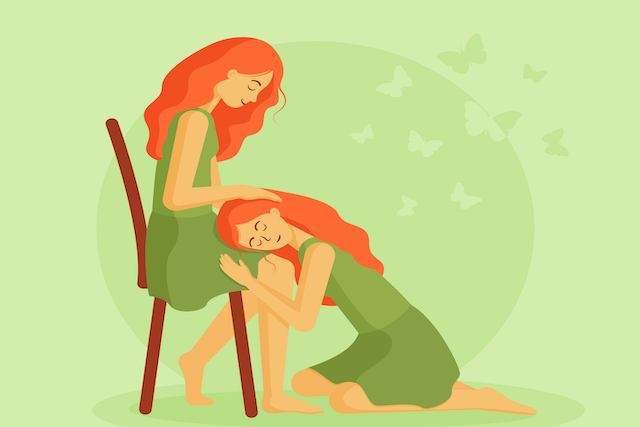
    I’d have to sit until I received an answer from her. This came as a thought or a feeling, sometimes a visual image or memory. Oftentimes, all she wanted was to be held, so I’d visualize my adult-self holding this small girl and giving her the comfort and compassion she desperately needed.

    This is the re-parenting. The part where we respond to ourselves in the ways that we would have wanted or needed when we were small children. To be seen and heard, rather than molded to act or behave a certain way. To be truly responded to, based on the needs we were expressing.

    The dialogue exercises with my little girl continued daily, sometimes multiple times in a day. It just depended on how intensely my inner child needed something from me that day, or how intently I was listening at the time.

    Sometime after I’d begun this dialogue, I was at work and delivered a small thank-you token to a colleague for doing a quick project for my office. He kissed me on the forehead in return. It made me very uncomfortable, and I quickly exited his workspace.

    I walked out to the street to run an errand, and within me, my little girl was raging. It felt like there was an inferno of anger brewing within my gut. I recognized in that moment I was not listening to my inner child, and she wasn’t having it, now that we had begun communicating with each other.

    So, I stopped. I tuned in. I asked her what she needed.

    She told me this man had violated her space and she felt unsafe, and I’d promised, capital “P” promised, she said, stomping her feet as young children often do, that I would take care of her from now on, and I hadn’t when I allowed someone to violate my physical space without saying something. She would not be appeased until the matter was resolved.

    The inferno continued to rage inside my belly until I walked back down the street, back into his office, and told him, “I do not want to be kissed by my coworkers. I’m sure others may not be bothered by it, but this is a boundary for me.”

    Of course, he apologized profusely, and we have never had any inappropriate run-ins again. But more importantly, immediately upon taking care of myself and my little girl, the inferno subsided.

    I took care of her and made her feel safe and secure. I continue to do so in my day-to-day life now.

    The above example was an extreme one. She is not always so easily heard. Sometimes I ask her what she needs, and it’s just to move the body, go for a walk. Other times it’s a cookie she wants. Often, it’s just to be acknowledged. Validated. To be told, “I hear you, I see you, your feelings matter.”

    As with any relationship, the needs, communication, and dynamics are ever-evolving.

    But I can say without a doubt, the connection between my adult-self and my inner child is the most valuable relationship I have, and today the amount of love I have for myself, due to inner child work, is above and beyond anything I could have ever imagined.

    I used to feel, most of the time, that I was not enough. Since doing this healing work, I now know I am enough, in all situations and places.

    Where there was typically a sense of impending doom and danger, there is now a lightness and delight and a true, deep happiness that has nothing to do with outside circumstances—just the pure joy of an inner wholeness I never even could have dreamed of.

    That’s what happens when we truly see and hear our inner child and respond to their needs without judgment. We feel love and safety like we’ve never known, and we finally realize we deserve nothing less.
  • Why We Often Fail When We Set Big Goals and What Actually Works

    Why We Often Fail When We Set Big Goals and What Actually Works

    “You do not rise to the level of your goals, you fall to the level of your systems.” ~James Clear

    If you pull up any popular motivational video today, you’ll probably hear things like “Set big goals!” and “Aim high and don’t stop until you get there!”

    After watching a video like this, you may get inspired and start mapping out your plan to leave the 99% in the dust.

    And typically, because you’re riding a wave of motivation, you’ll write out these monstrous, Mount-Everest-like goals. These goals paint a picture of your life that is so exciting that you can’t wait to wake up and get to work the next morning. But when you roll out of bed and take a look at the goals you set the day before, reality hits you like a truck.

    Instead of being motivated to take action, you feel a massive wall of internal resistance. You want to take action. You know you need to take action. But for some reason you just can’t force yourself to muster up the discipline necessary to make progress.

    So instead, you choose the path of least resistance. You retreat to the comfortable and the familiar, and then decide that you’re going to wait “just one more day.” One day turns into two, two days turn into weeks, and weeks turn into months.

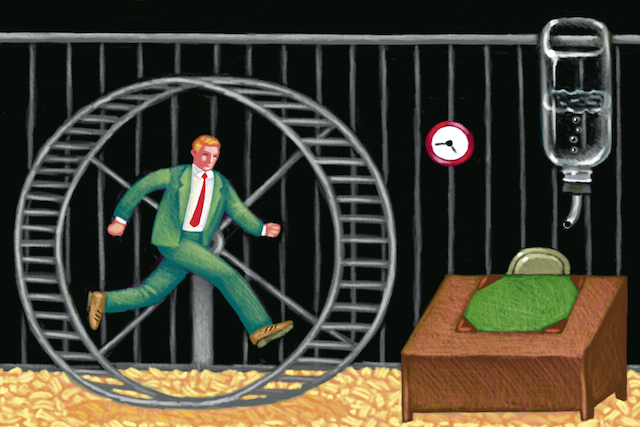
    But luckily, time heals all wounds, and six months later you get another surge of motivation and try it all over again. This is where most people find themselves in life—stuck on the self-improvement hamster wheel.

    How do you stop this vicious cycle? What’s the best way to facilitate lifestyle changes that you actually stick to?

    How Big Goals Ruined My Life

    When I was a sophomore in high school, I had ambitions to become an NBA basketball player. Despite the fact that I was 5 feet 6 inches tall, had below average quickness, and could barely jump over a stack of books, I was determined to prove everyone wrong.

    At this point, I didn’t have my driver’s license yet, so my wonderful mother would get up at 4:30 a.m. and drive me to my school gym early enough to get up shots before class. To make a long story short, I was cut from the team a few months into my sophomore year, and my NBA aspirations died right then and there.

    When I was a freshman in college, my focus had shifted to day trading the stock market. Once again, I had complete confidence that I was going to turn day trading into a full-time income. And once again, I was wrong. The $1,000 I had deposited into my Robinhood account disappeared in about two months, leaving me with no financial flexibility to invest into my dream of becoming a full-time day trader.

    During my sophomore year of college, I made the biggest decision I had ever made in my life up to that point. Despite having good grades, I decided to drop out of school and start my own marketing agency. Let me tell you, that phone call with my parents is undoubtedly the most emotional conversation I’ve ever had in my life.

    I even distinctly remember my own cousin telling me, “I think that you’re going to regret this decision for the rest of your life.” Still, I was unbothered, because I knew in my heart that I needed to give this a shot. A month after telling my parents I wanted to drop out of school, I was on a flight back home to California.

    Yet again, I found myself in a familiar spot—just a kid following his heart with some colossal goals.

    Filled with passion and drive, I set myself a goal to build the agency to $50,000/month in revenue by the following year. To reach that goal, I committed to at least two hours per day of prospecting, and another two hours of educating myself on the real estate marketing industry.

    By now, I think you can see where this is going. For fifteen months, I worked at trying to achieve my goals, but the highest monthly revenue target I was able to achieve was a measly $6,000/month. Despite desperately wanting to taste wealth and success, I had failed yet again.

    It was at this point in my life where I really took a step back and engaged in deep reflection. After all, I had just been following the wisdom that successful people had been preaching for decades—set big goals and don’t stop working until you accomplish them.

    Was it me that was a failure or was it my system? Why is it that so many people including me continually set big goals that they never accomplish? Pondering these questions drove me to explore the world of self-development.

    The Power of Identity

    I had always been passionate about self-improvement, but I had never really delved into the science and research behind what actually facilitates true behavior change. My research eventually led me to reach two life-changing conclusions:

    • Setting big goals does more harm than good for people who want to change their lives.
    • True behavior change occurs when you commit to small, seemingly insignificant shifts in your daily behavior.

    After spending hundreds of hours combing through research on habits, behavior change, and neuroscience, I finally had the “aha” moment that shifted my entire perspective on life. The fatal problem with setting big goals is that they focus on the outcomes we want to achieve as opposed to the type of person we want to become.

    The most powerful force in the human body is the desire to be consistent with who we’ve been in the past. Behavior that is incongruent with the self will not last, which is why big goals are often so hard to accomplish.

    You may have a goal to build a million-dollar business, but if your identity is that of someone who procrastinates on important work, it’s unlikely you’re ever going to hit that goal. You may have a goal to lose weight, but if your identity is consistent with someone who eats fast food regularly and lives a sedentary lifestyle, you’ll continue to be pulled toward actions that sabotage your weight-loss goals.

    You may have some new goals, but you still haven’t changed who you are. I wanted to build a marketing agency even though I was the type of person who procrastinated and refused to get out of my comfort zone. It was the inability to change those underlying beliefs that ultimately led to my failure.

    How to Achieve Your Biggest Goals by Thinking Small

    If big goals aren’t the answer, then what is? The key is to focus on who you want to be as opposed to the outcomes you want to achieve. You need to become the type of person who can reach the standards you have set for yourself.

    Your identity emerges out of your daily habits. You don’t come out of the womb with a preset identity. Whoever you are right now is a direct result of the daily habits that you’ve developed up to this point.

    In order to start forming new beliefs about yourself, you need to start building new habits. The formula for changing your identity is a simple two-step process:

    • Figure out the type of person that you want to become
    • Commit to small changes that align with your ideal self

    First off, you have to decide what kind of person you want to be. When setting goals, most people are guided by the question “What do I want to achieve?” Instead, try asking yourself, “Who is the type of person that can get the kind of outcomes I want?”

    Instead of setting a goal to lose fifty pounds, ask yourself, “Who is the type of person that can lose fifty pounds?” Instead of setting a goal to build a million-dollar business, ask yourself, “Who is the type of person that can build a million-dollar business?”

    The beauty of focusing on identity change is that your success is no longer tied to arbitrary targets. Let’s say that you set a goal to lose fifty pounds in six months. As you pursue this goal, you start walking every day and improve your diet. At the end of six months, you step on the scale and you’ve lost thirty-seven pounds.

    Did you achieve your goal? Nope, you’re thirteen pounds short. However, what if your goal was simply to become a healthy individual? Did you achieve that goal? Absolutely!

    Once you’ve figured out what kind of person you want to become, the next step is to commit to small shifts in your daily behavior. Too often we convince ourselves that massive success requires massive action. This is the principle that guided my life for nineteen years.

    Through constant trial and error, I’ve realized that true behavior change is the product of small, incremental changes compounded over time. We tend to dismiss the effectiveness of small actions because they don’t make an immediate impact.

    If you walk for two minutes per day for a week, you’re not going to see the number on the scale move much. If you meditate for sixty seconds for a few days in a row, you’re not going to turn into the Dalai Lama. However, what you will do is to give your brain concrete evidence that you’re a different person.

    James Clear puts this beautifully when he says, “Every action you take is a vote for the type of person you want to become. No single instance will transform your beliefs, but as the votes build up, so does evidence of your new identity.”

    Once you’ve nailed down your desired identity, come up with a daily habit that you can perform no matter how you feel. When you set big goals, your brain tricks you into thinking that the present level of motivation you feel will carry over to when it’s time to take action. By focusing on shrinking your daily targets, you’re taking motivation and willpower out of the equation.

    Here’s a few practical examples of this concept in action:

    • Meditating for ten minutes per day becomes meditating for sixty seconds per day
    • Walking for thirty minutes per day becomes walking for two minutes per day
    • Reading for thirty minutes per day becomes reading one page
    • Journaling for fifteen minutes every night becomes writing one sentence
    • Writing 1,000 words per day becomes writing fifty words per day

    It really doesn’t matter how successful you are right now, all that matters is that you’re on the right path. Once these small habits are solidified into your daily life, you’ll have mastered the art of showing up and acting in alignment with your desired identity.

    Since your brain now has some new evidence, you’ll be able to stretch yourself and gradually aim higher. That’s the true power of small habits. The same way that money multiplies through compound interest, the positive effects of your habits multiply as they become a part of who you are.

    So, the next time you get motivated to change your life, forget setting huge goals. If you do this, the power of your identity will loom large over you and prevent you from taking action. Harness the power of small, incremental change.

    Have the courage to set the bar low enough and aim at targets that you can actually hit on a daily basis. Solidify this small habit into your life, and then do the same thing with another habit. And then another. And then another.

    Soon enough, you’ll become someone unrecognizable.

  • Where Our Inner Critic Comes from and How to Tame It

    Where Our Inner Critic Comes from and How to Tame It

    “Your inner critic is simply a part of you that needs more self-love.” ~Amy Leigh Mercee

    We all have that critical and judgmental inner voice that tells us we’re not good enough, smart enough, pretty enough, etc.

    It tells us we don’t do anything right. It calls us stupid. It compares us to other people and speaks harshly about ourselves and our bodies. It tells us all the things we did or said “wrong” after communicating or connecting with someone.

    Sometimes it projects criticism outward onto others so we can feel better about ourselves. Other times we try to suppress our inner critic through overachieving, being busy, and accumulating more and more things.

    Sometimes it’s a protective mechanism that’s trying to keep us focused on our self-judgments so we won’t be authentic, because, if we are, we may be rejected and not get the love and acceptance we want.

    But, by doing this, we’re creating even more pain and suffering because we’re disconnecting from and rejecting our own essence.

    Just ignoring the critical voice doesn’t always make it go away. It may initially, but soon enough it will resurface if we haven’t healed/embraced our hurts, traumas, and wounds and shifted our internal patterning, which is where it comes from. 

    Have you ever heard the expression “What we resist persists?” Have you ever told an angry person to “just calm down” or a screaming child to stop crying? Does it work? Not when our energy is in a heightened state.

    Why is someone angry? Why is a child screaming and crying? Because there’s something going on internally that’s creating how they’re behaving. There’s often an unmet need or pain that’s asking for attention.

    Thinking a more positive thought to compensate can sometimes work, but sometimes it just creates an inner debate and mistrust in ourselves because deep inside we don’t believe what we’re saying.

    As children, many of us were taught to suppress those “bad” feelings because if we expressed them, we may have been or were punished. Welcome to the beginning of the critical voice; it’s often a frightened part of us that’s wounded and asking for attention. It wants to be seen, heard, and understood.

    My dad used to get really frustrated with me and constantly told me, “Damn it, Deb, you never do anything right.” Hearing that many times left an imprint in my subconscious. I started living with that interpretation of myself, and the critical voice kept me “in check” with being this way.

    For me, the critical voice was my dad’s voice as well as the deep shame I was feeling for making mistakes and not doing things the “right way.”

    I was holding in suppressed anger, sadness, guilt, unforgiveness, resentment, traumas, and pain that I tried to keep hidden with a smile on my face, but eventually it turned into a shame-based identity.

    My inner voice criticized me whenever I fell short or wasn’t perfect according to society or my family’s expectations.

    Just like when we’re triggered by another person, our critical voice is asking for our attention and guiding us to what needs healing, resolving, forgiving, understanding, compassion, and unconditional love.

    When it comes to the surface, we’re experiencing an automatic regression; it’s a part of us that’s frozen in time. It’s a reflection of our unhealed wounds, which created ideas of not being enough or that something’s wrong with us. Basically, it’s a trance of unworthiness.

    When we’re in a trance of unworthiness, we try to soothe ourselves with addictive behaviors. It’s hard to relax because we think we need to do something to be better and prove ourselves, so not doing anything, resting, isn’t safe.

    When we’re in a trance of unworthiness, it’s hard to be intimate with others. Deep inside we think there’s something wrong with us, so we don’t get close because they may find out and leave. This keeps us from being authentic because we don’t feel okay with who we are.

    Deep down I felt unworthy, unlovable, and undeserving, and the critical voice showed me what I was feeling and believing. I didn’t feel safe in life or in my body. How could I? I was living with so much hurt, pain, and shame inside.

    The critical voice is often stronger for those of us with unhealed wounds and who are hard on ourselves, and it tries to get us with shame and guilt. We’re always looking at ourselves as the “good self” or “bad self,” and if we’re identified with a “bad self,” we’ll act in accordance with that in all areas of our life.

    If we’ve become identified with the critical voice, it’s who we think we are; it just seems normal. And when we start to be more kind and loving, it doesn’t seem right because our identity becomes threatened and our system registers that as danger.

    That happened for me. Eventually I became identified with being a “bad girl” who’s critical and hard on herself, and, even when I started being a little kinder, more compassionate, and more loving, I felt an angst in my body. It wasn’t familiar, and even deeper, it wasn’t okay for me to be this way. My survival was at stake, so I would automatically go back to self-criticizing and judging, without conscious awareness.

    The critical voice didn’t only speak to me harshly; it also told me to do self-abusive things like cutting my wrists and face, starving my body or eating lots of sweets, and exercising for hours like a mad woman to get rid of the food I ate, whether it was a carrot or sweets, because I felt guilty. 

    Even after twenty-three years of going in and out of hospitals and treatment centers, taking medication, and doing traditional therapy, nothing ever changed; the critical voice had a hold on me.

    It was a powerful force, and when I tried to stop it, it would get louder. It thought it was protecting me in a backwards sort of way; if it hurt me first, no one else would be able to do so.

    When people used to say to me, “Debra, you just need to love yourself,” I looked at them like they were crazy. I had no concept of what that even meant because I had no experience of it.

    What I’ve come to see with myself and those I assist in their healing is that the more we keep our deep hurts, traumas, anger, guilt, shame, and pain hidden, the more the critical voice chimes in.

    And, for some, like me, it seems overpowering, so we try to find relief through smoking, drinking, eating, or being busy, and/or we experience severe depression, anxiety, or self-harming.

    When we’re consumed by the critical voice, we’re disconnected from our true essence, and when we’re disconnected from our true essence, the love within, we feel a sense of separation; we don’t feel safe with ourselves or others, and we don’t feel lovable for who we are, as we are.

    This is why many people can change, be happy for a day, but then go back to their critical and/or judgmental ways. Our automatic programming, stemming from our core beliefs, kicks in. It’s just like an addiction, and in a sense it is.

    We can try meditating, deep breathing, and positive thinking, but, unless we address the underlying cause, we’re likely to keep thinking the thoughts our internal patterning dictates. They come from a part of us that doesn’t feel loved or safe.

    So, what do we do when the critical voice comes to visit?

    What do we do when it’s what we’re used to, and it just happens automatically?

    What do we do when we don’t know how to be with ourselves and how we’re feeling in a kind and compassionate way?

    What do we do when we have no concept of what it even means to experience self-love or ease in our bodies?

    First off, please don’t blame yourself for how you’re being. Awareness isn’t about judgment; it’s about kindness, compassion, and love.

    Working with and healing our traumas, where the critical voice was formed, is key in shifting our internal energy patterning. Many people call this inner child healing and/or shadow working. 

    This is a soft and gentle process of moving through the layers of trauma with compassion and love and making peace with our protector parts.

    Through inner child healing, we can shift and transform that “negative” patterning and how the energy is flowing in our body. We can help that part of us that’s frightened, hurting, and maybe feeling separate have a new and true understanding so we can feel loved and safe in our bodies.

    When we pause and take a deep breath when we first hear or sense the critical voice, it allows our nervous systems to reset and helps us come back to the present moment; this allows space for compassion, healing, and investigation.

    Why do I believe that?

    Where did I learn that?

    Is it true?

    How does my higher self see this and me?

    Does the critical voice totally go away? No, it may still chime in; it’s part of being human. But once we realize where it’s coming from and heal/shift that energy pattern, more love can flow through, and we can experience our truth. When we learn how to be our own loving parent and meet the needs our caregivers didn’t meet when we were children, the critical voice often softens.

    Remember, the critical voice is just a scared part of us who really wants attention, love, and a way to feel safe. When we no longer take it personally, when we’re no longer attached to it as our identity, we can offer ourselves compassion, understanding, love, truth, and whatever else we’re needing.

    Life can be messy, and our thoughts can be too. This isn’t about perfection; this is about experiencing a deeper connection with our loving essence.

    There’s a sweet and tender spirit that lives within you. This spirit is your deepest truth. This spirit is the essence of you. You’re naturally lovable, valuable, and worthy. You’re a gift to humanity. So please be kind, gentle, loving, and caring with yourself.

  • How I Developed Self-Worth After Being Sexually Harassed and Fired

    How I Developed Self-Worth After Being Sexually Harassed and Fired

    “Your value doesn’t decrease based on someone’s inability to see your worth.” ~Unknown

    In my early twenties, I was a food and beverage manager at a nice hotel in Portland, Maine. About a month after I started working there, they hired our department director, a man twice my age whom I would report to.

    At the end of his first week, we went out for a “get to know each other” drink at a loud and busy bar. As we drank and chatted, he was physically very close to me. I told myself it was because of the noise.

    His knees were against mine as we chatted facing each other on barstools. It made me uncomfortable, but I didn’t do anything about it. He put his hand on my thigh as we talked. I pretended it didn’t bother me.

    He leaned in very close to my face and ear as he talked about himself and told me how attractive I was. He led me through doorways with his hand gently on the small of my back.

    There was more of this over the next few months. More of him stepping on and just over that invisible line. More of me acting as though I was okay with it and convincing myself that I was.

    A few months after that night, he and I were in a position to fire a male employee who had several complaints against him for not doing his work.

    The morning before the firing, Human Resources pulled me into their office to tell me that this employee had lodged a complaint about my boss and me. He had said that he knew we were going to fire him, and he believed it was because my boss and I were having an affair. His “proof” was that he saw us at the bar that Friday night and saw us “kissing.” There was even a line cook who backed up his story.

    A few days later, both of these employees admitted that they didn’t exactly see us kissing, they just saw us talking very closely together, and it looked intimate.

    HR dropped the complaint but no longer felt comfortable with firing this employee, so he stayed on. A few weeks later after a busy event that went poorly due to being understaffed, I was taken into the CEO’s office, and I was fired.

    The male employee continued working there. My male boss continued working there. The male employee was promoted to take my now vacant position. My male boss was promoted to work at a larger resort at a tropical destination.

    These two events—being accused of having an affair with my married older boss, and subsequently being fired for an event that I wasn’t even in charge of staffing—were the two lowest points of my professional career.

    I honestly rarely think back to this time in my life, but I also recently realized that I never talk about this experience because of my embarrassment that I let this happen without objection.

    What This Story is Really About

    I didn’t think that my boss would hurt me. I wasn’t even worried that I would lose my job if I pushed back. I was afraid that if I acted like someone who was bothered by his comments, I would be seen as a lame, no fun, boring, stuck-up prude.

    I subconsciously believed that my worthiness as a person was determined by people who were cooler than me, more successful than me, smarter than me, or more liked than me.

    I believe that had I told my boss “no,” he would have listened. I’d gotten to know him over several months, and while he was egotistical, dim-witted, and selfish, I think he would have respected my boundaries had I set them. I just never did.

    There are a lot of layers to this story. Far too many to cover in one post.

    But the reason for writing this today is to share what I was so ashamed of. I was ashamed that young, twenty-something me was so insecure and so afraid of rejection that her people-pleasing led to allowing this man to touch her and act inappropriately.

    She was so afraid that if she set a boundary and said “no” she would be seen as too emotional, weak, and a complainer. She would become “less than.”

    I’ll restate that there are a lot of layers to this; from the patriarchal system at this business (and society as a whole), to the abuse of men in power, to mixed messages at high school where girls were not allowed to wear certain clothes because the boys would get distracted, to a lack of examples through the 90s/early 2000’s of what it looks like for a young woman to stand up for herself in a situation like this, and far beyond.

    But the part of the story I want to focus on right now is my insecurity. This is the part of the story that I had the most shame and regret about, because this was not an isolated incident for me.

    Insecurity was a Trend Throughout My Life

    People-pleasing was a huge problem for me in several areas of my life for many years. It’s something that held me back from so much.

    • I didn’t leave a long relationship that I’d dreamt of ending for fear that I would disappoint our families.
    • I let people walk all over me, interrupt me while I spoke, and tell me what I should think.
    • In my late twenties I remember being home alone, again, crying that I had no one who would want to spend time with me or go somewhere with me, feeling sad and lonely, when in reality I was just too scared and embarrassed to pick up the phone and ask, for fear of rejection.

    I wasted so many years and felt a lot of pain, and a whole lot of nothing happened as I was stuck. Stuck feeling worthless, unlikable, and unknowing how to “please” my way out of it.

    I spent years numbing how uncomfortable my insecurity made me feel by smoking a lot of pot. I avoided what I came to realize were my triggers by staying home or finding excuses to leave early if I did go out. I blamed everyone else for how they made me feel. I compared myself to everyone and constantly fell short.

    Until eventually, I realized the cause for all this pain and discomfort was believing my worth was based on what other people thought of me.

    The Emotional Toolbox That Saved Me

    If I could go back in time to give myself one thing, it would be the emotional toolbox that I’ve collected over the years so that I could stop living to please other people, because I know now that I am inherently worthy.

    By my thirties I found myself on a journey to lift the veil of insecurity that hid me from my real self. This wall I’d inadvertently built to protect myself was keeping me from seeing who I really was beneath my fear and anxiety.

    Once I found the courage to start tearing down that wall and opening myself to the vulnerability necessary to truly connect with the real me, I was able to discern between who I am and what I do. I learned to stop judging myself. I learned my true value. And I liked what I saw.

    Finding My Core Values

    I came to realize that it’s hard to feel worthy when you don’t really like yourself. And it’s even harder to genuinely like yourself if you don’t truly know yourself. Figuring out my core values was a crucial part of the puzzle.

    Core values are the beliefs, principles, ideals, and traits that are most important to you. They represent what you stand for, what you’re committed to, and how you want to operate in the world.

    Knowing your core values is like having a brighter flashlight to get through the woods at night. It shines a light on the path ahead—a path that aligns with your true self—so that you can show up in the world and to challenging situations as the person you want to be.

    It helps you decide in any given scenario if you want to be funny or compassionate, direct or easy-going, decisive or open-minded. These aren’t easy decisions to make, but knowing how you want to be in this world helps you make the decisions that best align with your authentic self.

    And when you truly know yourself and act intentionally and authentically in tune with your values (as best as you can) a magical thing happens: You connect with your own inherent worthiness.

    For me, I came to realize that I am a compassionate, kind, courageous, funny, well-balanced woman constantly in pursuit of purposeful growth. I like that person. She’s cool. I’d hang out with her.

    More importantly, I believe she is a good person deserving of respect. Which means I don’t need to accept situations that cross my boundaries. I have a right to speak up when something makes me uncomfortable.

    So how do you want to be? Which of your principles and qualities matter most to you? And what would you do or change if you chose to let those principles and qualities guide you?

    Connecting With Others About My Shame

    Shame breeds in the darkness. We don’t normally speak up about the things that we feel embarrassed about. And that leads to us feeling isolated and alone with how we feel.

    Whether it’s reading stories online, talking with friends, joining a support group, going to therapy, or working with a coach, share and listen. A vital component of self-compassion is learning to connect over our shared experiences. And it takes self-compassion to respect and believe in our own self-worth, especially when confronted with our inner critic.

    By sharing my feelings of insecurity, I learned that a beautiful friend of mine also felt ugly. I thought, “Wow, if someone that gorgeous could think of herself as anything less than, my thinking might be wrong too.” I found out that even talented celebrities from Lady Gaga to Arianna Huffington to Maya Angelou have all felt insecure about their abilities. That somehow gave me permission to feel the way that I did, which was the first step in letting it go.

    Who can you connect with? If you’re not sure, or you aren’t at a place yet in your journey to feel comfortable doing that, perhaps start by reading stories online.

    Coaching Myself Through Insecurity

    Alas, I am only human. Therefore, I still fall victim to moments of insecurity and feel tempted to let other people dictate my worth. Knowing that purposeful growth is important to me, I know that the work continues, and I’m willing to do it.

    So I coach myself through those challenging times when I say something stupid and worry about being judged or I come across someone who is similar to me, but more successful and fear that means I’m not good enough. I’ll ask myself questions as a way of stepping out of self-judgment mode, and into an open and curious mindset. These are questions like:

    • If my good friend was experiencing this, how would I motivate her?
    • Did I do the best I could with what I had?
    • If the universe gave me this experience for a reason, what lesson am I supposed to be learning so that I can turn this into a meaningful experience?
    • What uncomfortable thing am I avoiding? Am I willing to be uncomfortable in order to go after what I want?

    Or I’ll break out the motivational phrases that remind me of my capabilities or worthiness like:

    • I can do hard things.
    • My worthiness is not determined by other people’s opinions.
    • This is just one moment in time, and it will pass.
    • Even though this is difficult, I’m willing to do it.
    • I forgive myself for making a mistake. I’ve learned from it and will do better next time.

    Tools like these are simple, but priceless. They gave me my life. And I can say now without hesitation, I like myself, I love myself, I love my life, I’m worthy as hell, and I’m my own best friend. That’s how I want to live my life.

    Because of this, I have the confidence to speak my truth with courage, and I have the confidence to live authentically and unapologetically myself. And the number one person I’m most concerned with pleasing is myself.

  • I Was a Bulimic Nutritionist, but I’m No Longer Ashamed or Hiding

    I Was a Bulimic Nutritionist, but I’m No Longer Ashamed or Hiding

    “Shame derives its power from being unspeakable.” ~ Brené Brown

    I felt like a hypocrite. I would tell my nutrition clients to eat a salad with vegetables, then I’d go home and scarf down an entire pizza. After guilt and shame set in, I would purge and throw it up.

    I think I became a nutritionist partly so I could better control my relationship with food. If I learned the secrets behind eating I could biohack my way to putting the fork down, losing weight, and finally being happy. This was back when I thought thinness equaled happiness.

    It’s taken me over ten years to recover from an eating disorder. Years filled with perfectionism, shame, and isolation as I untangled that my worth is not tied to my weight. I share my story in hopes that it sparks a deeper dive into your own relationship with food.

    Growing up I was an over-achieving, people-pleasing perfectionist. Which by itself may have been fine but, paired with a sexual trauma I experienced in early University, it was the perfect storm for developing an eating disorder.

    I used food as a coping mechanism for the trauma I’d endured. It was a way to dissociate from having to feel the shame of being assaulted. I assumed it was my fault this terrible thing happened, and while eating as much and as fast as possible, I could numb out from strong emotions.

    For a short period of time, I was worry-free.

    But then inevitably came the guilt and shame—ironic, since I was trying to numb the shame of my assault with food.

    Why did I have to eat so much? Now I’ll gain weight, and if I gain weight no one will like me. Why don’t I have the discipline to control my food? To control myself? I am truly worthless.

    Somehow my brain had built the association between looking a certain way and being accepted, worthy, and even safe. Having a sense of control over what I ate and how I looked made me feel powerful in a way. And maybe subconsciously it gave me a sense that I could also control what happened to me.

    I knew I needed help in University when after purging for the third time one day I had a sharp pain in my chest. Bent over the toilet, clutching my heart, I realized things had gotten out of control.

    Luckily, before I lost my nerve, I set up an appointment with a counselor. And there began my long and twisty road to recovery from bulimia. A word I would rarely utter in the coming years, instead referring to it as my “food issues,” downplaying the severity of my illness. Bulimia was something only celebrities developed, not something a straight-A student like me could encounter.

    Wow, was I ever wrong! Along this journey I’ve met many others like me, and I discovered we had more similarities than differences. We put immense pressure on ourselves to be perfect, had an insane need to control everything, and we all felt deep shame about our behavior. Many others I met had also experienced trauma and used food to soothe.

    In 2008, when I first sought treatment, I worked in secret on my recovery, only talking with a counselor and a doctor. I needed weekly blood tests to ensure my electrolytes were balanced. Turns out purging is very hard on the body, something my lack of tooth enamel will attest to.

    It was years until I told friends and family, and even now many will be shocked reading this article. It was easy to hide from roommates, as I would binge alone in my room and come up with creative reasons to use the bathroom when needed. Sometimes even purging into bags in my room then disposing of it later.

    In 2013, after a few weeks of some particularly painful binging sessions, a doctor told me I had lesions in my throat. I could barely swallow, having to sip smoothies through a straw. And my first thought was:

    Yay, now I’ll definitely lose weight.

    Thankfully, it was followed by a second thought.

    This is dumb. I’m putting my health at serious risk here… to be thin? That makes no sense.

    That’s when I knew I needed to kick my recovery into high gear. I started out-patient treatment in Toronto and attended support groups with others like me. I learned to sort through complicated emotions and release my need for everything to be perfect. In short, I was on a great track.

    But here’s the thing no one tells you about recovery—it’s not linear. I was settling into my career as a nutritionist, my binging episodes reduced, then someone would make an off-hand comment…

    Wow, you cleaned your plate, you must’ve been hungry!

    And boom, I would spiral out and feel compelled to rid myself of the extra calories. Secretly hunched over the toilet once again, knowing I had failed.

    I didn’t think people would trust my nutritional advice if I gained weight. I was also a yoga instructor at this point and convinced students wouldn’t return to my classes if I didn’t have a lean svelte yoga body.

    I continued the ups and downs of recovery for years. Having to choose recovery every single day was exhausting. Over time, the periods between binges got longer.

    For me, there was no silver bullet cure. It was a combination of using mindfulness to sit with difficult emotions and getting a whole lot of therapy to address the trauma. I never thought I’d get to this place, but eventually I learned to see myself as a worthy person—no matter my past, no matter my size.

    I used to think having an eating disorder was a shameful secret. Now I see that struggle as the source of my strength. It takes an incredible amount of courage to address trauma, and working tirelessly on recovery has taught me how to bounce back over and over again.

    I went through the ringer for many years, having to hide many of my behaviors, and thinking my weight was the most interesting part of me. I share my experience as part of the healing process, to take away the shame that hides in the shadows. I hope it encourages you to examine your relationship with food and your body—and how you might also be using food or another substance to avoid dealing with your own traumas.

    We tend to judge what we’re eating and think of food as something to be controlled, but eating disorders aren’t just about food. They’re a reflection of how we judge ourselves and our need to regain control when we feel we’ve had none.

    If we can come out of the shadows and face our pain and shame, we can start to heal, but it might not happen overnight. It might be two steps forward and one step back, sometimes one step forward and two steps back—and that’s okay. People who struggle with eating disorders are often perfectionists, but we need to accept that we can’t be perfect at healing. It’s a process, and as long as we stick with it, we will see progress over time.

    Now that I’ve worked through the pain of my past, I can finally see that food is something to be enjoyed and celebrated, and I too deserve celebrating, no matter my size. I don’t need to be perfect to be worthy. And neither do you.

  • How I Stopped Feeling Unworthy of Love (And Finally Learned to Receive It)

    How I Stopped Feeling Unworthy of Love (And Finally Learned to Receive It)

    “I hope you find love, but more importantly, I hope you’re strong enough to walk away from what love isn’t.” ~Tiffany Tomiko

    When I was in my early thirties, I briefly dated someone right after my divorce.

    It was one of those fast and furious things that had no label and left me wondering if I made most of it up in my head.

    It wasn’t the first time and it wouldn’t be the last. How many times had I ended up feeling rejected and abandoned? I was trying so hard to impress a partner, but no matter what I did, I only seemed to push them away.

    Tearfully, I shared my pain with a spiritual advisor and psychic and asked for her guidance.

    She suggested I consider the joy that might come out of pleasurable and easeful partnerships. She asked me, “Briana, why don’t you shift your energy and focus to that aim?”

    But it wasn’t so easy. I was attached and hung up on this guy. Why didn’t he love me like I loved him?

    Another thought popped into my head, which I hadn’t realized was there before.

    Before I could voice it out loud, she said, “Oooohhhh, Briana. I can hear you already. You think if you’re not in pain, then your art and other creative works won’t be any good.”

    I burst out into another round of sobs.

    Because it was true. I did think that way.

    I thought I performed at my best when I was at my most miserable, and if you took away my misery, I would not only be common, but worse yet… mediocre. I would truly be the bad artist I always thought I was.

    Every aspect of creative expression would become cliched, trite, and uninteresting. There wouldn’t be anything special about me.

    And so I would become unlovable.

    The drama proved my worth, one way or the other; the drama of performing well enough to earn love. 

    It wasn’t until four years after that conversation that I finally stopped clinging to my pain.

    Because I realized that pain didn’t make something (love) more authentic—it just made it more difficult.

    Maybe you know where I’m coming from. Maybe you feel that you, too, need to “chase” a relationship and suffer for it to really matter. For you to really matter.

    That’s just not true. There is a far better way to build relationships, and that’s what I would previously have called “boring” and “too easy,” but actually is about respecting your own, authentic self and opening up to love.

    Here’s what I’ve learned about letting go of feeling unworthy of love and finally learning how to receive it.

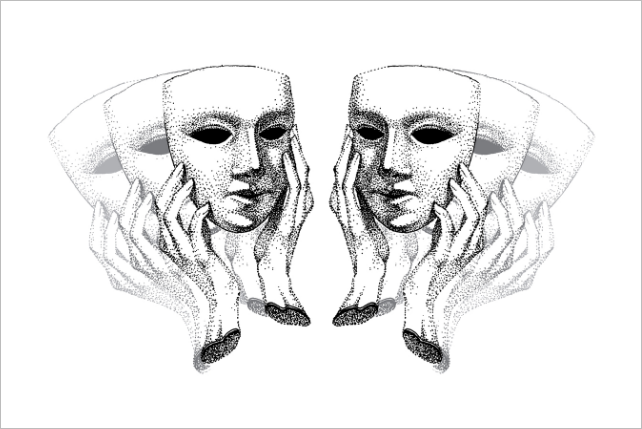
    1. Take off your mask.

    Like me, you might believe that to attract a lover and be worthy of love, you have to pretend to be a perfect partner, through things like making them feel wanted and desired, looking beautiful, and being funny, witty, smart, and interesting all the time.

    All of these tactics might very well appeal to a potential partner. Certainly, it might make them interested enough to get to know you better, and maybe even date you for a while.

    But none of that means it will soften their heart and make them fall into a soul-shaking relationship with you.

    In fact, while I used to think that I needed to pretend that I was something I wasn’t so that I’d be worthy of love, I just kept deterring the other person.

    Why?

    Because while the glitz and glamour are appealing, it also, on a deeper level, left me completely unavailable.

    In the same way, you are pushing away a partner by performing all the time.

    You see, your partner is going to feel as if they have to perform just as well, and while that may be exciting in the beginning, unless the mask comes off, it also gets exhausting very quickly.

    A loving partner will be less concerned about how many degrees you hold or how much you make at your job and more concerned that you’re passionate about what you’re doing.

    A loving partner doesn’t care how many facts you can recite. They may enjoy your company if you’re a great conversationalist, but that won’t necessarily make them feel something for you.

    The way to a partner’s heart is to make them feel safe enough to explore and experience their own authentic self.

    You do that by feeling safe enough to express yourself—without someone else’s permission.

    Because if you don’t communicate that you’re comfortable in your own skin, this partner won’t feel comfortable or safe opening up to you, either.

    And if a person can’t open up to you, warts and all, they can’t fall in love with you. It’s as simple as that.

    When you put on a performance instead of taking off your mask, you unconsciously communicate a fantasy of reality, because that feels safer than vulnerability. And then you energetically and non-verbally tell your partner that you can’t handle their vulnerability, either.

    And isn’t it freeing? You, in all your vulnerability, are the person they want and need in order to be their own, true self.

    2. Get in touch with your own feelings.

    What many of us do when we feel unworthy of love is numb our emotions and pretend we feel something other than we actually do.

    But a loving partner wants to know you’re angry when you’re angry and why you’re angry.

    Guess what happens if you’re acting one way, while feeling something else? That’s right, drama.

    If they think you’re angry, but they are not sure, because you’re trying hard to plaster a smile on your face, say, “I’m fine,” and stuff it down, you’re not really fooling anyone, just confusing them.

    Your energy and your verbal expressions are going to contradict one another, and that is the seed of dramatic conflict.

    And this type of drama is so annoying because you are effectively keeping a partner at bay, and refusing to connect with them, for fear that they wouldn’t like the “real” you.

    But because they can’t access “the real” you, there’s no real glue holding them there, and they wind up leaving you anyway.

    So show them what you feel, while letting go of the fear that they will reject you for doing so. By reconnecting with your emotions, you show up as your authentic self and make it safe for them to love you.

    3. Be open to meeting someone with the same level of consciousness.

    Around the end of August last year, I started dating someone. He wasn’t originally what I would have imagined for myself, but he turned out to be exactly what I need.

    Right from the get-go, things went really well; we talked for hours on end, and I felt an instant connection.

    There were butterflies, yes, but not the kind of gut-twisting, obsessive sensations I have had in the past, which usually means I should run.

    This was more like, “Ah, you fit nicely… and kinda feel like home. What took you so long?”

    He shows up with fresh flowers, texts me “good morning,” and sees the humor in situations like that time my cat got jealous and bit him when he tried to kiss me.

    While before, I would have instantly dismissed this type of relationship as being too easy (and the lack of drama would have shown me that it wasn’t real love), I now see it for what it is:

    A relationship in which partners join together from a place of inspiration, as opposed to a fear-based need to be filled up with the other.

    This is a partner who already has a higher level of consciousness and is looking for purposeful building. There’s no drama, there’s no chasing, and there are no games or acts.

    This is the key to feeling worthy of and receiving love—finding a partner who is open to the same. The criterion for attracting such a partner, however, is that you are ready to meet them.

    I wasn’t ready four years ago. It took me that long to go from believing that relationships had to be a rollercoaster of emotions to opening up to a loving partnership.

    Ultimately, it’s about you finding your authentic self and realizing that this version of you (the real version) is so worthy of love and should be loved. That’s the premise for a relationship that, instead of being soul-sucking and anxiety-ridden, is the perfect space for self-growth and joy.

  • Why It No Longer Matters to Me If My Job Impresses People

    Why It No Longer Matters to Me If My Job Impresses People

    “Do not let the roles you play in life make you forget who you are.” ~Roy T. Bennett

    Wherever I go and meet new people, they ask me, “What do you do?”

    I love talking about what I do because I love what I do, but It’s not what I’ve always done, and it certainly isn’t all of who I am. It’s part of who I am, but there is so much more.

    When we’re young, we’re asked to decide on a career. You know, the question, “What do you want to be when you grow up?” The problem is, does anyone in high school truly know what they want to do for the rest of their lives? I’d venture to say that many high school kids don’t even know who they really are yet.

    When I was growing up, I was a straight-A student, a star athlete, a perfectionist, and an overachiever. I learned at a young age that performing well was my ticket to feeling good about myself. My accomplishments garnered the praise and admiration of many and gave me what I needed to feel good.

    Validation.

    As a senior in high school, it was natural that I chose to go to college for aerospace engineering. I was interested in aviation, but more importantly, when I told other people what I had decided on, they nodded their heads in approval. A smart girl should choose a “smart career,” right?

    Validation and approval drove me forward.

    When I got out of college with a BS in aerospace engineering from the University of Minnesota, I went to work for The Boeing Company in Seattle, Washington. I didn’t love it. Part of it may have been homesickness, or the dreary Seattle weather, but a huge part of it was that the corporate cubicle life was not for me.

    I thought there was something wrong with me. After all, I had worked so hard to reach this point in my life. I should love it, right? Hadn’t I finally arrived?

    I struggled with it so much because on one hand, I dreaded going to work. On the other hand, when I told people what I did for a living, they leaned in and listened a little harder. Even my own father was proud to talk about my engineering career and the fact that I worked for one of the top aerospace companies in the world, but I’ve since moved to less impressive pursuits, he has never once asked me about those endeavors.

    My career looked awesome and interesting and impressive on paper, but I was quietly dying inside.

    My husband and I ended up moving all the way across the country to Savannah, Georgia, where I worked for another top aerospace company—Gulfstream Aerospace. I didn’t really feel any different about my position there, until I transferred into a group called Sales Engineering.

    In this area, I was able to interact and collaborate with sales and marketing to create the technical data they would use to pitch Gulfstream’s fleet to potential customers. I enjoyed the challenge, but I really enjoyed the collaboration with other people that weren’t buried in their computers all day. It was here that I first got a glimpse that I loved connecting with other people.

    When my first child was born, I left the aerospace industry. We had just moved cross-country again to Los Angeles, and it made more sense for me to be a full-time mom since I wasn’t the family breadwinner, and we didn’t absolutely need a second income. Plus, I wasn’t enamored with the whole engineering gig either, so in a sense, it was a way out.

    Quitting the career that I didn’t love was, on one hand, so freeing. But on the other hand, without that thick layer of validation that kept getting piled on every time someone asked me “What do you do for a living?”, I felt naked. I felt inferior. I felt like I was a failure who couldn’t hack it in the real world.

    My identity was wrapped up in my career that looked so good on paper but didn’t feel good in my soul.

    My ex-husband is an attorney, and we’d attend events with lots of other attorneys and highly educated people. At these events, I dreaded the question “So, Kortney, what do you do?”

    My response was always a little timid, almost apologetic.

    “I stay at home with our son.”

    There was typically a slow nod, with a bit of feigned interest, as if they weren’t really sure what more to say about the occupation stay-at-home mom.

    Because I also had a side-gig photography business, I’d quickly add, “and I’m also a photographer.”

    That tended to garner a bit more interest.

    “But I used to be an aerospace engineer,” I’d tack on, in a final effort to gain the nod of approval I so desperately sought.

    Bingo. Alarm bells sounded. The crowd cheered. People were reeled back into something more exciting.

    That good, old familiar friend, validation was back.

    I struggled for a long time to find my identity without all the “stuff” on the outside. It wasn’t until I got divorced and had to figure out how I would financially support myself after my spousal support ran out that I even scratched the surface of “Who am I, really?”

    Who am I without my career, the accomplishments, the external validation?

    All those years, I lived with one foot in the world of wanting to love myself for who I am rather than what I did and one foot in the world of doing more, doing better, doing it ALL.

    I lived in between the worlds of self-validation and external validation. 

    I knew I wanted the former, yet I craved the latter.

    In doing the work of figuring out who I really am, learning to love myself fully, and being able to validate myself without any help from the outside, I realized that I was asking myself the wrong questions all along.

    As a society, we ask the wrong questions.

    Instead of asking our kids, “What do you want to be when you grow up?”, I think we should be asking them, “Who do you want to be?

    I asked my eleven-year-old daughter this, and she looked at me in her quizzical mom-why-are-you-asking-me-such-a-weird-question way and said, “Umm, I just want to be me?”

    Yes!

    Shouldn’t we all just want to be who we are? 

    Instead of pursuing goals that are impressive because they bring us accolades and attention, what if we were to pursue our goals because they lit us up and we were truly passionate about them?

    What if we started asking our kids questions about what lights them up? How do they want to feel? What things do they like to do that make them feel that way?

    Even as adults, we can ask ourselves these questions.

    If you’re in a job that doesn’t feel right, you can ask yourself, “How do I want to feel?

    What’s authentic to you? How do you want to show up in the world? What jobs or careers would allow you to show up that way?

    This is the work I did after my divorce. I’m in a completely different career now, and believe me, as much as I fought going back to a job in the engineering industry, I had to do a lot of work on my thinking about not having a “smart job” like being an engineer. The validation I craved and was so used to was like a drug.

    Through this work, I learned how I want to feel in my life and that guides everything.

    I discovered that I want to feel freedom, ease, joy, and meaning in my life. 

    Going to a cubicle every day didn’t allow me to create those feelings. I want to show up in the world authentically—I want to be able to be a human being who makes mistakes and can share myself with other people. Corporate life didn’t allow me to be that authentic person that I now so deeply love.

    Some of you reading this may have corporate jobs and love them. You may be able to create the feelings you want to feel and show up authentically with that type of career. That’s awesome!

    The goal is to be able to feel the way you want to feel. The goal is to be able to show up in the world in a way that is true to who you are. 

    Because how you show up to do the things you do in the world is what really matters.

  • Why I Never Fit in Anywhere and the One Realization That’s Changed Everything

    Why I Never Fit in Anywhere and the One Realization That’s Changed Everything

    “Don’t force yourself to fit where you don’t belong.” ~Unknown

    When I was young, I was a real daddy’s girl. He was so proud of me and took me everywhere with him.

    When my parents got divorced and my dad moved away to start a new life with a new family, I didn’t understand why he left, as I was still a child. I thought that he didn’t love me anymore. I felt abandoned and rejected. Perhaps if I’d been better behaved, prettier, cleverer then he wouldn’t have left me?

    Until recently, I didn’t realize the impact that this has had on my adult relationships.

    Because I fear abandonment and rejection, I’ve struggled to fit in and make friends.

    I had a relationship with an older man who was very similar to my dad. I hoped that he would provide me with the love and affection that I didn’t get from my father and would heal my wounds. However, while things started off great and I thought I had found the one, since the relationship felt like home and was so familiar, he was actually emotionally unavailable, just like my dad, and unable to commit.

    When he started to pull away, this triggered my insecurity. This caused me to pursue him more, as I desperately wanted this relationship work.

    I tried to change myself into what I thought he wanted. I became clingy and jealous, which only drove him further away. When the relationship finally ended and he found someone else, I couldn’t understand why he could love her but not me. What was wrong with me? It confirmed my greatest fear, that I was unlovable and unwanted.

    This pattern continued to follow me in my relationships, which left me feeling more unloved and rejected.

    So I threw myself into my career. I had done well academically, however, I struggled to fit in and make friends there too.

    I was good at my job, but I didn’t feel valued or appreciated and I was often ignored, excluded, and ostracized by my fellow team members. My workplace became a toxic environment. I was bullied, which led to anxiety and depression, and I couldn’t face going into work. Eventually I was let go, as they said I could no longer do my job.

    Since my identity was tied up with being a successful career woman, when I no longer had a career, I didn’t know who I was. What was my purpose in life now? I was at the halfway stage of my life with no family of my own and no job. I took everything that other people had said and done to me very personally.

    I shut myself away at home. I didn’t go out or socialize. I was on medication for anxiety and depression, and I just wanted to stay in bed. What was the point of getting up? I was worthless, I had no value, no one wanted me, I didn’t fit in anywhere. I couldn’t love myself, as others didn’t love me. I had no self-esteem and no confidence to try to start again.

    I had therapy, read lots of self-help books and articles, and did guided meditations. Although I could relate to everything, I struggled to apply the things I had learned to myself.

    As I spent time alone, listening to relaxing music, I had a lightbulb moment. I couldn’t see straight before then because I was so emotional. However, I am naturally a very logical and analytical person, and good at solving problems, which is why I was good at my job.

    The idea came to me that if I took the emotions out of my issues, then I could see them in a logical and rational way and try to solve them like any other puzzle.

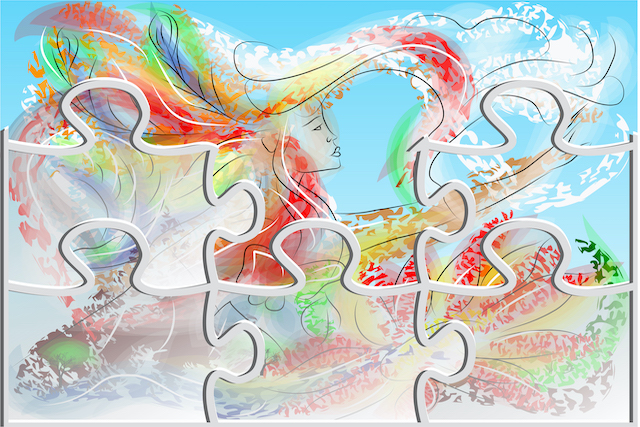
    And then I thought, what if I saw my whole life as a jigsaw puzzle? It’s a perfect analogy, really, since my lifelong struggle has been fitting in.

    Visualizing Our Lives as Jigsaw Puzzles

    Each of us start with just one piece—ourselves.

    When we start the puzzle at birth, it is easiest to join the first two pieces together—ourselves and our family.

    As we grow up, we try to find other pieces that fit—friends, romantic relationships, jobs. We may be lucky and find other pieces that fit perfectly straight away, but more often than not we struggle to find the right pieces, and in our frustration, we may even try to force two pieces together that don’t actually fit. However, if we do this, we find over time that none of the other pieces seem to work together.

    No matter how much time we have already invested in this ill-fitting piece—be it an unhealthy relationship or a job that doesn’t align with our purpose and values—we will eventually realize that we have to accept reality and remove the piece that we tried to force to work. This is the only way to make room for a new piece that will fit perfectly into place. A piece we won’t even try to find if we’re too attached to the one that doesn’t fit.

    This doesn’t mean there’s something wrong with us, or the other piece we tried to force to fit, which means we don’t need to blame ourselves or them. We simply need to recognize we don’t fit together, and then learn the lessons we need to learn to stop repeating the same patterns.

    This also doesn’t mean that we made a mistake with the ill-fitting piece. Every time we try to make the “wrong” things fit, we learn the value of taking our time to find the right piece.

    Sometimes we learn that we need to focus on another area of the puzzle first—if, for example, we realize we need to take a break from relationships so we can build up our self-esteem and learn to love ourselves first.

    And sometimes when we’re having difficulty with one section of the puzzle, like love, we recognize that we need to focus on a different area instead, where it might be easier to find the right pieces—like our career or social life, for example.

    When we connect with like-minded people who have similar hobbies or interests and enjoy our company, we feel better about ourselves and start to realize how great we truly are.

    If we change jobs to something we love, that shows off our strengths and enables us to succeed, this improves our confidence and helps us realize that we’re good enough and we do add value.

    Once we become happier with ourselves and other areas of our life, we’ll send out more positive vibes into the world and attract the right kind of people. And we’ll have enough self-worth to recognize people who are not right for us and not waste our time.

    If we don’t do these things, we may complete the puzzle, with all the elements of our life neatly in place and find that we have a piece left over. That piece is you or me, and it doesn’t fit because it was in the wrong box and never meant for this puzzle.

    That was why we struggled to fit in—we chose things in all areas of our lives that were never right for us. So the problem wasn’t us, it was where we trying to force ourselves to fit.

    It may feel daunting to start over, but when we find the right puzzle we belong to, everything stops feeling like a struggle because we slot easily into place. We will end up with a different picture than we originally imagined, but it will feel much better, because our piece will finally fit.

    Where Am I Now?

    After spending half my life struggling to fit in and complete my jigsaw puzzle, I have realized that I am the piece left over, and it’s now time to start again and find the right puzzle that I belong to. This time, I’m starting with the most foundational pieces first—self-love, self-confidence, self-worth.

    There was never anything wrong with me. I just needed to recognize my patterns so I could stop trying to force things that weren’t right. I know my pieces are out there. And so long as I let go of the wrong ones, I know, in time, I’ll find them.

  • A Life-Changing Insight: You Are Not a Problem to Be Fixed

    A Life-Changing Insight: You Are Not a Problem to Be Fixed

    “I decided that the single most subversive, revolutionary thing I could do was to show up for my life and not be ashamed.” ~Anne Lamott

    I remember one particular clear, cold winter morning as I returned home from a walk. I suddenly realized that I had missed the whole experience.

    The blue, clear sky.

    The lake opening up before me.

    The whisper of the trees that I love so much.

    I was there in body but not embodied. I was totally, completely wrapped up in the thoughts running rampant in my mind. The worries about others, work, the future; about everything I thought I should be doing better and wanted to change about myself… it was exhausting.

    Alive, but not present to my life. Breathing, but my life force was suffocated.

    This was not new. In fact, up until that point I had mostly approached life as something to figure out, tackle, and wrestle to the ground. This included my body, my career, and the people around me. 

    My tentacles of control, far-reaching in pursuit of a better place, said loudly, “What is here now is not acceptable. You are not acceptable.”

    “You can improve. You can figure it out. You can always make it better.”

    But this time, rather than indulging in the content of this particular struggle, I observed the process I was in and realized profoundly that even though the issues of the day changed regularly, the experience of struggle never did.

    And I would continue struggling until I stopped resisting and judging everything and started accepting myself and my life.

    This wasn’t the first time I’d had thoughts like these, but this time there was no “but I still need to change this…” or “I can accept everything except for this thing.” I knew it was 100% or nothing.

    I knew then I only had two choices:

    I could continue to resist reality, which now seemed impossible and exhausting (because it was). Or I could accept myself and the moment and make the best of it.

    “What if there is actually nothing to struggle against? What if I let go of the tug-of-war that I called my life?”

    The choice was before me. The one that comes to people when they have suffered enough and are tired: to put down the arms.

    This doesn’t have to mean accepting unhealthy relationships or situations. It just means we stop living in a constant state of needing things to change in order to accept ourselves and our lives. It means we learn to let things be—and even harder, to let ourselves be.

    Whenever I have a conversation with people who are struggling, I’ve recognized that they have this innate feeling of I should be doing better than this. Or, I should not be feeling like this.

    It might seem obvious that “shoulds” keep us in a contracted position of never-being-enough.

    But I have found that letting them go is not as simple as a quick change of thought.

    It seems like denying ourselves has become the generally accepted and encouraged modus operandi of our culture.

    Denying our feelings.

    Minimizing our pain.

    Hating our body parts.

    This leads to disconnection from the life that is here, the life that is us.

    Self-loathing has become the biggest dis-ease of our time.

    When we are disconnected from who we are in this moment, there is a tension between right here and the idealized self/state.

    This disconnection or gap is a rupture in our life force that presents itself as a physical contraction, a shortness of breath, an inner critic that lashes out harshly and creates a war within. This war contributes to pain, illness, and I’d guess 80% of visits to a medical doctor.

    Even some of the best self-help books promote this gap…

    Don’t think those thoughts.

    Don’t feel those negative feelings.

    Don’t just sit there—you should be doing something to improve yourself and your life

    All of the statements above might seem like wise advice. But we’ve missed the biggest step of all—mending the gap between who we are and who we think we should be so that we don’t feel so disconnected from ourselves.

    Disconnection is the shame that tells you that you’ve got it wrong, that it is not okay to feel or think the way you do in this moment. That you have to beat yourself up so you can improve, be more than you are now, be better.

    That you are a problem to fix.  

    This is the catch-22 of self-help when taken too much like boot camp. Self-help can be helpful, but it can create an antagonistic relationship with our true selves if it doesn’t include a full acceptance of who we are in this moment.

    The belief of “not-enoughness” is at the root of so much physical and emotional pain, and I, for one, have had enough of it.

    What if we allowed ourselves to be, or do, in the knowing that we are okay, that we are doing the best we can, given what we know at this point in time?

    Do you feel the fear-gremlins coming out that tell you that you will lie down on the couch and never get up again? Or perhaps you will never amount to anything or be good enough?

    This is the biggest secret of all: It’s all a lie to keep the consumer culture alive. 

    People who are scared and in scarcity need to consume something outside of themselves to gain fulfillment. But it never really comes because there’s always something new to change or attain.

    It can be so difficult for us humans to accept not only ourselves, but that everything just might be okay in this moment.

    That this feeling is just right. Even if it hurts.

    It’s okay to be right here, right now. Pain is here, and I don’t have to fight it.

    Our relationship with ourselves is the most important relationship we will ever have.

    Because we are truly sacred, no matter how we feel.

    Maybe the only question to ask today is not “What do I need to do to change?” but “How can I love myself, just as I am?”

    Maybe the act of loving ourselves is as simple as taking a breath to regulate our nervous system and come back to the present moment.

    Maybe healing involves not so much changing ourselves but allowing ourselves to be who we are.

    Which is exactly what I did that day when I realized I had missed my whole walk because I was caught up in my mind, worrying about everything I wanted to change. I shifted my focus from the thoughts I was thinking to the feelings in my body. I realized that I was enough in this step, in this breath, and that’s all there is.

    I promise the results of moving into acceptance will feel far better than the shame, disconnection, and cruelty that come from the constant pursuit of self-improvement.

    The truth is…

    You are not a problem to fix.

    You are a human to be held.

    To be held in your own arms and loved into wholeness.

    Take care of your human.

  • How I’m Healing from the Pain of Growing up in a Dysfunctional Family

    How I’m Healing from the Pain of Growing up in a Dysfunctional Family

    “Don’t try to understand everything, because sometimes it’s not meant to be understood, but accepted.” ~Unknown

    As a child, I never had the opportunity to develop a sense of self. I had a father who was a drug addict. A mother who was abused by my father. And later, we had my mom’s possessive and controlling boyfriend. It was tough finding a consistent role model in the mix.

    I was one of four kids and we grew up in a trailer, sharing one bunk bed among us all. As children, we often would brutally fight with each other. We all wanted our own space and sense of self, but there wasn’t enough to go around.

    With our mom working so much, her boyfriend would watch us. He seemed to enjoy punishing us. I remember feeling so afraid. I didn’t want to do anything wrong. I wanted to have his love because it felt like the only way to be safe. I never felt good enough, not to my mom, dad, or the boyfriend.

    Starting in my teen years, codependency started really kicking in, and I wanted my mom for everything. I unknowingly was part of her triangulation between me and my sister. We both craved her love and wanted to have her favoritism.

    As a wild child, my sister was stuck with my mom’s negative self-projections, I received the positive. As the years progressed, these roles flipped, and I suffered a sense of rejection and confusion as to what I had done wrong.

    Life was hard and I couldn’t live with the fear and shame, so I learned to unplug from my feelings. At the same time, these unprocessed feelings would cause outbursts of anger. I started feeling entitled to anger. It felt like life had kicked me so hard as a child, why wasn’t it getting easier? Why was it getting worse?

    My learned dysfunction kept me yearning for connection but fearing it and pushing people away at the same time. I wasn’t capable of trusting others in a healthy way. With each loss, I took on more shame and perceived failure.

    As I struggled through life, I was oblivious to the amounts of shame my family dynamic had me carrying. My mother’s triangulation and manipulation created an environment where she was justified in lashing out with no accountability. Everyone else was to blame for her poor reactions to situations.

    As my mom and sister became a team, I became the problem who needed to learn how to accept and love them unconditionally. There was nothing wrong with them treating other people poorly. It was okay for them to deceitfully hide family secrets (e.g.: Mom drove home drunk from the bar and doesn’t remember getting home), because I wouldn’t agree, so they were justified.

    I felt like I was on an island, broken and unable to figure out what was wrong and how to fix myself because the “rules” of justification changed so swiftly, and always in their favor.

    Having no sense of self and being completely enmeshed with my mom and sister, I felt beyond broken each time I was accused of not being able to love unconditionally. I was worthless and a disgusting human being who was incapable of even a basic emotion that everyone else had.

    It took a lot for me to see that love for my mom was making me feel close only when she was going through tough times, making me part of her someday club (our motto: “someday” will never happen for us).

    My sister learned to use her money to express her love. She would take me to dinner and give me her quality hand-me-down clothes. While I was grateful, it also became justification for her to do crummy things toward me, usually when she had been drinking.

    While sober, if she had a problem, she’d choose to “forgive.” The only problem is that she hadn’t really forgiven me because one night while everyone was having fun, I might get tired or I didn’t think a joke was funny or I looked at her the wrong way, and it would all come flooding out—every stored feeling she had been holding back for days or weeks.

    If either my mom or sister hurt me, the expectation was that I should just get over it. There was no need for them to take accountability because “we are human” and “I am happy with who I am.”

    I wanted to be loved and accepted but couldn’t ever really find my place within my family because the dynamics were so volatile. I was suffocating in the conflicting feelings. I felt angry but ashamed. I was unhappy and felt worthless.

    When I hit bottom and I couldn’t see one thing in my life that gave me worth, I knew that I needed to make changes. I reached out and got help from a therapist and joined a local support group.

    As I am separating from the dysfunctional patterns, the things that have helped me are:

    1. Ask for help.

    Dysfunctional family dynamics often create shame around the idea of talking to others. It’s seen as exposing family secrets and going against the unit. Nobody should suffer due to things out of their control. Reaching out helps you find the compassionate outlet you deserve and need.

    I have been in therapy for about two years now. It has been the only time of my life where I have been able to experience consistent, reliable, and healthy direction. It has supported me in learning how to have self-compassion and make healthy, but tough choices.

    I didn’t want to accept the reality that my mom and sister will likely never truly see me for me. My role as a scapegoat is brutally necessary for the emotional “economics” that occur within my family.

    Therapy helped support me in my choice to find myself outside of my family of origin. There was much pain in going from seeing my family every weekend to now living a life outside of them. It required radical acceptance and the knowledge that I am unable to change anyone but myself.

    I was lucky to have a kind, compassionate, reliable therapist to guide me as I dealt with each of the emotions that came up during this time.

    2. Accept others as they are.

    As a scapegoat in a dysfunctional family unit, I have learned to accept my situation for what it is. I have to set my expectations for what others are capable of giving.

    We have no control over others or their view of the world. All we can do is accept a situation for what it is and assess if it is healthy for us. Once I accepted that my mom and sister do not really see the family dynamic as dysfunctional, I was able to free myself of the anger and need for control. They are blind to the ways they protect themselves emotionally and unwilling to have an open mind about it.

    There is sadness, but I see that the relationship dynamic causes so much pain for me, and I cannot fix this on my own. While I am compassionate toward the pain they must be carrying, I see that I cannot continue a relationship that is built on dysfunctional habits.

    3. Know your worth.

    As an enmeshed individual, my worth was defined by external sources. I wanted my mom, sister, brothers, friends, coworkers, and acquaintances to validate me as a good, worthy person. I desperately needed to feel like others liked me enough to feel I had worth.

    I now know that we all have worth, and it’s our individual responsibility to maintain this worth from within.

    I have a tough inner critic, so having a consistent mindfulness practice has helped me establish my worth. It is hard to find worth when you are caught up in your own head, believing the negative thoughts going through it. Mindfulness helps me turn away from these thoughts and label them as just that, thoughts.

    The more we tune out our negative self-talk, the more we can acknowledge our mistakes and learn from them without sinking into a low and getting down on ourselves. With this brings the awareness that our mistakes do not diminish our worth. Our worth is inherent. A mistake is just a mistake.

    4. Learn what healthy love looks like.

    Our family of origin doesn’t always teach us what healthy love looks and feels like.

    In dysfunctional families, each person loves based on their limited capacity to process their own emotions. When someone has to keep reminding you that you are unconditionally loved, ask yourself, how do I feel right now? For me, I felt hated and restricted to being what was easy for my mom and sister.

    Love should connect you with your inner joy. We all feel down at times and cannot rely on others to make us feel good about ourselves at all times. But I do feel that when someone loves you unconditionally, you shouldn’t feel lost. The joy of this love should be consistently present and help carry you through the tough times (e.g.: disagreements, hurt feelings, etc.).

    When it comes to my mom and sister unconditionally loving me, I have had to accept that they love me the best and only way they know how while hiding from their shame. If they lash out, they are not able to carry the shame and embarrassment of their own actions. They cannot validate my feelings or experience in any way. They need me to carry this responsibility for them. This is not unconditional love.

    As you move through the necessary steps to separate from learned family dysfunction, please remember that you didn’t learn these things by yourself and you will not unlearn them by yourself, nor should you.

    Oftentimes things like depression or anxiety are a hurdle. Building a community is scary but necessary. This can be reaching out to a therapist or searching for support groups in your local community.

    For years I struggled thinking that I could fix what was wrong with me on my own. It wasn’t until I reached out and got help that my mind was able to open up, process traumas, and make lasting changes.

  • How I Saved Myself by Surrendering When Everything Fell Apart

    How I Saved Myself by Surrendering When Everything Fell Apart

    “And here you are, living despite it all.” ~Rupi Kaur

    “I surrender!” I said this mantra out loud as my life was spiraling out of control.

    I had spent a summer in college as a camp counselor separated from my fiancé. He sent me no letters and did not keep in touch. Still, I held on. By the time I came back home, we were broken. I had also realized he was emotionally abusing me. It took that separation to make me see it.

    I realized I had been truly alone in the relationship. I was never lonelier than being with someone who refused to listen to me. A summer of independence brought me a new love of solitude, but it also made me realize I didn’t have a soulmate in him after all.

    I was forced to face that this life wasn’t perfect. I wasn’t perfect. But… I was enough. I needed to believe that to keep moving.

    When I said my mantra of surrendering, I was on a rollercoaster of emotions. I didn’t know where my life was going. The wedding planning ended. He called it off through text. I was left emotional and without closure. I didn’t know what would happen next. I just decided to be curious rather than try to control it.

    I woke up to the fact that I didn’t have to know everything. I had to just trust. This both terrified me and propelled me forward. I didn’t know if things were going to be okay, but I knew I would make meaning out of whatever would happen.

    I wanted to teach youth how to surrender too. I figured that would be my legacy since it had healed me of so much in life.

    I had already applied to graduate school, and I would start at Brandeis very soon. I was worried about being on top of it all while going through this heartbreak. I was a Type A student, president of four clubs and an honors student. I didn’t exactly have time for love back then, but I didn’t realize I had a choice to let my ex go if I wasn’t satisfied. I put too much effort into trying to make it work when it wouldn’t.

    I didn’t see that my effort to make everything work was actually blocking better things from coming my way. In other words, I had to stop holding on so tightly to life. I had to let go. I had to surrender to survive. I had to go with the flow to find my flow. I had to learn how to be happy for no reason other than to simply be.

    When I did that, my whole life opened up for me. I practiced radical acceptance and realized my place in this world mattered. I stopped white-knuckling through my problems and pain. I stopped waiting for love and decided to love myself. I started to see myself as capable and good no matter how others mistreated me. I decided by letting go, I would not give up. I made a promise to myself to always be authentic.

    Life didn’t go as planned. I left Brandeis MAT program for teaching because I realized I didn’t want to be a high school English teacher anymore. It was the hardest decision of my life because I also did not have a backup plan.

    So, I surrendered again. And again and again through it all.

    I surrendered when I found other ways to help youth. I surrendered through a bipolar breakdown and a relapse to the hospital years later. I surrendered when I went on disability and all expectations of my life were changed. I surrendered through bad side effects to meds and awful doctors. I surrendered all through my life because I knew despite how hard things could be, I was still doing good. I was still helping others. I was still waking up each morning appreciating being alive.

    It came down to the simple things. I didn’t need certain labels or popularity. I needed to rest, to do nothing sometimes. To breathe. To just live.

    I saw myself as rising in my own ways.

    I realized I couldn’t look back. Here’s what I held onto instead:

    1. Finding Purpose

    When I let go of my need to control, I became more mindful. I started to think about how I wanted to spend my time. Was it for achievements or authenticity?

    I had nothing, so I had nothing to lose when I left Brandeis. Serendipitously, I had a branding internship the same time a brand manager of a large TV personality discovered me. The internship taught me how to manage my own image and ideas while the manager wanted to simply own me like a puppet master.

    I had a choice. I could live on my own terms or have someone take over my life. I turned down advances from this man. I wasn’t going to fall for the same red flags as I did with my ex-fiancé. I let go; I surrendered.

    I decided to make my own way and live authentically as a person, not a brand, sharing my story along the way. I used my mental health journey to help end stigma and my writing for sharing insights on life.

    I did not let walking away from the brand manager stop my story. Instead, I redefined it for myself. I was enough as I was. I didn’t need anyone to discover who I was meant to be. I would live my life for me.

    My purpose became in proving him wrong, that I could make it on my own. Then, it became for me, to show myself I was worth it. I focused on living in the moment and just following my passions without a plan. That’s what saved me. But it wasn’t the only thing.

    Purpose dawned on me one day while I was simply walking my dog through the woods in my backyard. I listened to birds chirping. I grounded myself by looking up at the blue sky. I touched the bark on the trees. I felt my inner voice beckoning me to love this life as it was, not as I wanted it to be. I didn’t have to do anything. I just had to be in this moment. That’s all life was asking of me.

    It took simplicity to make me realize my purpose wasn’t just a to-do list. It wasn’t fixing everything. It wasn’t mastering every skill. It wasn’t making things work when they wouldn’t.

    I had to separate myself from the “shoulds.” I had to find the gift in what I was going through. In taking the time to do nothing but think, far away from a stressful schedule, I realized that my purpose was to be happy without needing a reason to be. That took a different kind of bravery.

    2. Forgiveness

    I wasn’t able to move on from the injustices of my life very easily. I had anger in me from living under others’ control and abuse. I had loss, which I felt every day, etched into my skin. I knew what it was to be alone. I had settled too often and always saw the best in people.

    I grew up walking on eggshells surrounded by abusers. It was an endless pattern I stopped in my twenties. After my ex-fiancé left me, I found a new type of strength. I realized the only power anyone could ever have over me was the one I consented. No one could steal the core of who I was. No one could take certain things away. No one could define me but me.

    I took my power back through forgiveness. It didn’t happen right away. I meant “I love you” to my ex, but then I realized it was governed in fear. Fear of doing this life on my own.

    Sometimes life makes you continually face the very thing you’ve been avoiding. You keep getting redirected to it even as you resist. You find yourself with the same lessons you needed to learn before.

    There’s a quote that reads “You repeat what you don’t repair.” Well, I was there. I was back there constantly in my anger and hate of those who I thought stole something from me.

    But when I decided to forgive them, I released it. I gave it back to the universe and pulled my heart from the chaos. They didn’t deserve it. It wasn’t for them. It was for me. I had to let them go and surrender so I could heal myself. I forgave myself in the process, too, for not knowing enough, for not seeing the truth.

    My heart wanted to hold onto the anger so that I could do something with it. I soothed it, though, with self-compassion. I made meaning of the events of my life by helping others through similar things.

    That meant I had to say goodbye. Goodbye to those who didn’t know me enough to love me right. Goodbye to the me that was in survival mode and didn’t know I could just let go and live. Goodbye to the dark nights of the soul where I felt like giving up and suicidal ideations crossed my mind. Goodbye to the past. Goodbye to the insecurities. Goodbye to the pain. Goodbye to the worst of it all.

    And then I said it. “I forgive you.” I salvaged myself from the wreckage of the storms I had suffered. I pulled myself out of the ruins of an old life. I realized I was the one who decided my fate. I was the captain of my soul. I was finally free.

    3. The Reason

    I found my way by allowing myself to go on the detour. I realized that I was meant to go down the wrong road so I would be sure of the right one. My road was brilliant, one of authenticity, that uplifted me above all that I had gone through. I was able to look at my life and see what really mattered. I suddenly knew what I was here to do.

    I was here to share my gift. Any insight I could. To love.

    I started volunteering, writing, speaking to youth, and advocating for mental health awareness.

    I stopped living in the stigma of struggling and became open about my story.

    I surrendered to what was happening.

    I stopped fighting every little thing that came my way.

    I didn’t need to know what would happen with the lives I touched and the good things I did along the way. I just had to follow my path hoping others would follow it too, making it a little easier for someone else.

    All I had to do was surrender—be still, quiet my mind, allow rather than resist, let go, and find myself even when losing it all.

    Surrendering isn’t easy. In fact, it’s one of the hardest things we can do. That’s because we want control. But sometimes, surrendering is seeing uncertainty as beautiful. We don’t have to know what lies ahead in order to move forward.

    What will you do when you surrender, stop fighting reality, and allow yourself to live in your life as it is?

    Can you improve a situation, share a kindness, give to a greater cause, become a better you, and build a better world? Can you dream of doing such things? That is the first step to resilience. Focus on the beauty found in the broken situation and in you. Focus on the light you can bring into the darkness.

    It doesn’t take away from the horror of any hardship to believe in yourself and your ability to make change from it. That takes its own grieving time. But during that time, you can’t let it consume you. The tragedy that befell you, the heartbreak that happened, the hurt inside that you can’t let go… they are indeed senseless. Hence, it is imperative you don’t get stuck on asking why, as many do.

    Instead of viewing yourself as a victim, it’s time to be a victor. Overcome the odds. Let what hurts and irks you be the fuel to your fire.

    Hardships do not define us.

    What you have been through, your circumstances, do not define you.

    There will be days where you need to prioritize self-care and forgiveness for who you had to be to get to this point. Maybe you were white-knuckling through the pain in your self-care journey, maybe you did what you did in order to survive, but the good news is that today is a new day for you.

    Hold space for the sacred gift of simply being alive on those days.

    It works like a cycle. You will feel all the emotions on the spectrum, which means you will feel anger and sadness and doubt, but you will also feel joy and love and hope again the longer you hold on, the more patience you practice with yourself.

    A reason not for why this happened but why to go on will come to you.

    That reason is everything.

    When you want to give up, that’s when you say, “I surrender,” which isn’t the same thing. Giving up is shutting down. Surrendering is letting go.

    When you surrender, you don’t need things to work out a certain way. You accept life as it comes, which leads to a breakthrough. When you give up, you breakdown. Surrendering is the sacred step to realizing your full potential. It’s realizing you are your own hero, and you must not stop now.

    When you let go, you realize everything could change tomorrow. All it takes is choosing this very moment and living it. Mindfully surrendering is about releasing your fears and doubts so you can see clearly and letting the light come through.

    Don’t wait for life to change to create peace, joy, and purpose. Choose to make the best of what you have in your life, right now as it is. Surrender. Say the words, and it will change your life.

  • How to Create Happiness Outside of a Relationship and Enjoy More of Your Life

    How to Create Happiness Outside of a Relationship and Enjoy More of Your Life

    “Remember, being happy doesn’t mean you have it all. It simply means you’re thankful for all you have.” ~Unknown

    For many years I was single. But I wasn’t just a regular single, I was a miserable one.

    Rather than enjoying a time in my life when I didn’t have to care about anyone else but myself and using it to devote my full attention to my purpose and passions, I chose to ride the “woe is me” train.

    I would complain about being single daily and covet other women’s “luck” in dating. I would blame every guy I dated for “just not being ready,” or somehow else at fault.

    I didn’t realize I was the common denominator in all my failed relationship attempts.

    I was the one who chose to spend time with these men and ignore the big red flags that would crystalize themselves early on.

    Instead of taking time to patiently vet and reject men that were not good for me, I allowed my desperation to entertain any man that would show interest.

    My inability to find happiness outside of a relationship was ultimately what kept me single.

    The saying you attract what you are” was true in my case. I was miserable single, so I kept attracting miserable relationships. 

    I continued down the same path until I decided that something needed to change.

    I realized that I had outsourced the job of making me happy to the many men that I dated.

    Their presence, their commitment, and their interest in me would determine how happy I was. Unfortunately, due to my questionable taste in romantic partners, that would often mean not so happy. So, I decided it was time to change that.

    That is when things started to shift, and I called in the life and love that I wanted. Here is what I did to find happiness outside of a relationship:

    Dealing with the Absence of a Relationship

    One thing I have learned is that in the absence of a romantic relationship I had to find fulfilling activities that made me happy.

    When you are single you have a lot of time. Time to think about everything you feel is missing.

    I would spend my evenings watching romantic movies on Hallmark wishing my life were like the plotline of the movie.

    And more often than not, all it did was make me more miserable. So, I decided to utilize that free time in the evening in a better way.

    I came up with a beautiful nighttime routine that included coloring, listening to music, and reading a book on spirituality or personal growth.

    I would fill the void with activities that filled me up.

    Same for the morning times. Instead of lying in bed and scrolling through Instagram until all I saw were couples and babies, I started running.

    Not only did I get into the best shape of my life because of it, but I also discovered a new passion for running and working out that quickly turned into a hobby I’m now passionate about.

    By dealing with the absence of a relationship head-on I found activities that made me happy.

    Dealing with the Sadness of Singleness

    The second thing I did to find happiness outside of a relationship was learn to deal with the sadness that singleness often brings with it.

    It’s no secret that being single can suck.

    No matter how often single people are made to believe that being single is a blessing, it can be hard to see it when that blessing seems to last forever.

    What I have learned is that rather than avoiding, suppressing, and denying the sadness, I had to learn to embrace it.

    I needed to allow the ebbs and flows to pan out accordingly. By deeply feeling the sadness and despair, I also enabled myself to feel the joy and excitement that followed after.

    Reminding yourself that no emotion lasts forever, and that you will eventually overcome it, is the light at the end of the tunnel that keeps you going.

    Therefore, you must make it a habit to tune into your inner well-being daily. Here are three ways I do it:

    1. Start your mornings with a meditation practice that centers you and puts you in tune with how you are really feeling.

    2. Start journaling your thoughts to better understand your fears and worries. You can commit a few minutes in the morning or evening to it.

    3. Commit to a daily gratitude exercise. Multiple times throughout the day, stop what you are doing and simply list three to five things you are grateful for. They can be as simple things as your home, furniture, or the body parts that serve you well.

    There are many different habits that you can choose from. The only thing that matters is that you create a safe space and routine that allows you to feel your emotions without judging them.

    This will help you deal with the sadness of singleness.

    Dealing with the Uncertainty of Dating

    The last thing I had to learn in order to find happiness outside of a relationship was how to navigate through the dating space without feeling burned out or discouraged.

    Dating nowadays feels like you are entering the twilight zone. With many different terms and stages describing the act of dating, many people are not sure what they are doing anymore.

    Are you dating, hanging out, hooking up, or maybe just “chilling”?

    If you don’t know, chances are you are stressed by the uncertainty. And that feeling of anxiety sucks.

    It’s a constant ride on a roller coaster of emotions controlled by the other person.

    So, how can you learn to deal with the uncertainty that dating oftentimes brings with it?

    The first step is to increase your self-esteem and remind yourself that your relationship status does not determine your worth.

    When a romantic relationship does not progress the way you want, you may feel discouraged and disappointed. These feelings are valid and should be honored; however, you have to remember that they are only feelings. That means they will pass.

    Instead, use affirmations to build yourself up daily and celebrate all your minor successes, the positive impact you have on the people around you, and how far you’ve come as a person. This will help you remember all the great qualities you bring to a relationship and will be a blessing to the person you are with in the future.

    The second step is to focus on the fun.

    In a world of billions of people, it may take some time to find the one person you would like to spend the rest of your life with, who happens to want the same.

    Uncertainty is part of the dating process. Rather than shying away from it, try to focus on the fun of dating. Meet people without any expectations and instead decide to just have a good time and enjoy their company.

    By doing that, you will naturally feel less anxious, because you are not trying to control your date’s experience, only your own.

    Because of today’s societal pressure to be boo’d up by a certain age, it can often feel depressing when you are not in a committed relationship. Which then leads to unhappiness.

    However, by taking matters into your own hands and deciding to create happiness for yourself, you allow yourself to experience life and live in the present moment.

  • Why We Need to Be Present to Enjoy Our Lives, Not Just Productive

    Why We Need to Be Present to Enjoy Our Lives, Not Just Productive

    “Presence is far more intricate and rewarding an art than productivity. Ours is a culture that measures our worth as human beings by our efficiency, our earnings, our ability to perform this or that. The cult of productivity has its place, but worshipping at its altar daily robs us of the very capacity for joy and wonder that makes life worth living.” ~Maria Popova

    I was high on productivity. I had one full-time job, two part-time jobs, and a side hustle. I was getting everything done. Sounds perfect, right?

    Then I started hating my life.

    I had read enough books and articles to tell me how I was not doing enough. Enough self-help gurus had told me that what I needed to do was max out every single hour I had to be minutely close to being “successful.”

    My co-workers often got intimidated by my jam-packed calendar. I don’t exaggerate when I say that every minute of my life was scheduled. Sheldon-level scheduled, with dedicated “bathroom breaks” and everything.

    I ran three to-do lists: daily, weekly, monthly. This was my way of setting out for maximum efficiency. I said “yes” to my boss so often I had become his favorite. Work-life balance, what’s that?

    Tasks were flying off my list like never before—so many horizontal breakthroughs! I wore this as my badge of honor for a while, this art of getting it all done. And why not? I was rewarded for it in money, praise, promotions, awe.

    But then it didn’t feel so great. Instead, I became downright miserable.

    Why Busyness-Productivity Is A Mirage

    I don’t claim that productivity is bad. Doing fulfilling work by minimizing distractions and getting deep focus is truly rewarding.

    But it is crucial to stop and question why you’re doing what you’re doing. It is necessary to pause and reflect on the value of your tasks and actions. Otherwise, productivity translates to useless busyness.

    When I became this productivity freak, I never stopped to ask if any of the things I was doing were giving my life meaning. I was doing a demanding full-time job that didn’t provide me any purpose. My days became a blur of mindless task completions. My mind, heart, and soul were absent from my work. Any given Monday didn’t look so different from a Tuesday three weeks prior.

    And it wasn’t even like I was happy.

    I was meeting all my deadlines, but I was spending no time with my family. There were enough accolades to prove all my achievements but not enough art to fulfill my soul. I answered every email I received within twenty-four hours, but I hardly focused on long-term self-growth.

    On the outside, my life never looked better. But on the inside, I was worse than I had ever been. Distraction, schedules, irritability, and deadlines were the monsters that ruled my life.

    After a month-long burnout, I hit the problem nail in the head. I knew I needed to move on. But how? I resolved to take a calculated leap of faith. I found a client willing to pay me for my freelancing services for at least two to three months and made a thick emergency fund by cutting out on expenses. Then, I quit the unfulfilling full-time job and gave my heart to work that I truly found meaning in. I stopped making productivity my goal. I opted to choose presence instead.

    Presence > Productivity

    I read Annie Dillard’s, The Writing Life, in which she memorably wrote, “how we spend our days, is of course, how we spend our lives.”

    After reading this book, I realized that productivity would only be fruitful when coupled with presence. I knew then that presence was what would make my rewards meaningful.

    What is presence? Presence is the art of being in the moment, the luxury of pausing, the virtue of stillness. It is being alert, aware, and alive to this moment.

    There’s a reason why our culture runs for productivity instead of presence. Productivity helps us shut away from reality. It keeps us “busy” into a future that is yet to manifest.

    It is so much easier and convenient to take the shield of productivity against the beautiful, buoyant, and sometimes disruptively painful present.

    Performing one task after next gives us an excuse to not fully live, not completely concentrate, not unbiasedly accept.

    I used to be that way—trying to avoid the truth that I was not finding my work meaningful. I wouldn’t accept that this job was emptying me slowly, living in denial of a reality I was living. Was I not getting things done? I was, more than ever before. But was I happy? I had never been more unhappy with my own choices.

    Being productive every minute of every day meant I could avoid the fact that many of my friendships were depleting, toxic, and unhealthy. I was lying to myself that it was all to have a good social life. In reality, I would go out of my way to avoid being alone, to avoid answering the big questions pertaining to my life that can only be answered in solitude.

    But coupling our actions with productivity and presence can have an astounding effect on our lives. It can make every task we do driven with intention, purpose, and meaning. Presence is what helps us reap the internal rewards that come with doing fulfilling work.

    Choosing Presence

    If you are anything like me, choosing presence over productivity can take some practice. Productivity was my normal mode of operation. It was easy; it came naturally. But opting for presence in my actions wasn’t so simple.

    The art of being present and intentional in all my tasks was like writing with my non-dominant left hand. I searched for help and stumbled upon Tim Ferris. He often says to think of your epitaph to cut through all the noise and maze of productivity. It is a way to find out what truly matters to you by getting a super-zoomed out version of your life.

    As morbid as it sounds, that is what I did. I imagined what I would like to carve on my epitaph, and the important stuff came into a laser-sharp focus:

    I needed to write. I needed to make time for solitude, for serendipity, for hobbies. I wanted to create more memories with my family. I wanted to let go of draining friendships and put all my energy into relationships that filled me with fulfillment, meaning, and growth. Taking it one step at a time, I decided to hand in my resignation. I landed my first writing gig in under two weeks.

    And hey, it’s not like I don’t struggle to write with my left hand anymore. But I am growing each day. It takes some practice and effort to make room in your calendar to “be present.” I am learning to be uncomfortable by turning the volume down of “getting things done.”

    I have noticed that it is the minor changes that count. It is taking a little more time to craft that email mindfully. It is that courageous “no” to a project that can help you surpass your quarterly KPIs but take away from your family time. It is choosing to take a soothing fifteen-minute walk break over checking off another mindless to-do list task.

    Presence is a process. It requires the discipline to focus on the present moment when productivity pushes you to see a non-existent future. Presence is your un-busy existence of utterly unadulterated joy. It is your creativity’s cradle. It is your time to just be.

    So do it. Make the hard choice. Live your life with presence to help you find joy in the now instead of pushing toward some destination in the future. None of us really know where the future will bring us, but we can all choose to enjoy the scenery along the way.

  • On Those Hard Days When You Feel Like Nothing You Do Matters

    On Those Hard Days When You Feel Like Nothing You Do Matters

    “Just a reminder in case your mind is playing tricks on you today: You matter. You’re important. You’re loved. Your presence on this earth makes a difference whether you see it or not.” ~Unknown

    Today I woke up feeling like nothing I do matters. I didn’t want to wake up feeling like this, but I did.

    I got myself out of bed, brushed my teeth, and went through the motions until things inside my mind started to feel unbearable.

    The first thing I did was try to reason with myself, tell myself that, of course I matter. I tell everyone else in my life that they matter and they’re enough just as they are. But there is a tiny voice in my mind that feels loud. Just chanting, “You know you’re trash, people are lying to you. You know you do terrible things and have hurt other people. Just give up.”

    It reminds me of every mistake I’ve ever made. It attacks me with memories of my hurting someone with how I worded something or reminds me of someone who blocked me on social media, or just said, “I don’t like her because of xyz.”

    This feels immobilizing. By the time I am done with this thought process I cannot leave the living room chair I am sitting in. I pull a blanket up to my chin, curl up into a small ball, and start crying. “You’re right,” I say to myself. “You win. I should just give up.”

    My mind is spiraling with everything I have ever done that went unnoticed, that no one cared about. The essays I wrote that only a few people read. The points I made that were later recycled and went on to be successful once someone else made those same points that didn’t seem to matter when they came from me. And I have the overwhelming feeling that I deserved the bad reception, because I, too, am bad.

    Never mind that there are dozens of things that I’ve done that were greatly appreciated. That made a difference. That moved someone else enough to say, “This helped me.”

    Never mind that sometimes we can’t control algorithms, SEO, and the like.

    Never mind that sometimes you make a stupid spelling mistake even though you re-read your piece fourteen times. You just didn’t notice it, but people were turned off from the piece because of it.

    That’s the thing, being a mental health advocate, I feel like my whole purpose on some days as I struggle to get by is to hear someone say, “This helped me.” And if I helped no one, then why did I do it?

    But while I was busy worrying about who I have helped and if my helping got noticed, I may have forgotten to help myself.

    All the clichés, the putting on my own oxygen mask first, filling my own cup to fill others, they are reminders that I need on a daily basis, or I risk becoming my own victim.

    And honestly, to me, there is nothing worse than someone who is helping other people just to be a martyr. They continue toiling to help others but neglect themselves so that they can say, “I almost died doing things for other people.”

    Who are you useful to once dead, or even just burned out? The fight for mental health awareness and to end the stigma is long arduous. And if my goal really is to help others, to be there for the long haul, then I must find a reason to also do it for myself.

    That mean voice feels so loud, but suddenly an argument erupts in my mind.

    The other side finally feels empowered to speak because I kept pushing, although mentally exhausted, against the part of me that was convinced I deserve nothing. I told the quieter voice that it was okay if I messed up. That this doesn’t negate everything I have done that has helped someone, and yes, even if that was just one person. Even if it just helped me to get it out there into the universe.

    And really, the main thing is this: Everything we do doesn’t have to matter on a grand scale. It doesn’t have to leave others speechless. It doesn’t have to change the world. Just doing it is something to be proud of.

    Suddenly I feel a small sense of ease. I am tired from arguing with myself. I am tense from sitting in a tight ball with my jaw clenched this whole time. I unravel myself. I release my jaw. I inhale deeply and release more tension as I exhale. I choose to open up my laptop and write about what went on in my mind just now.

    If you’ve ever felt this way, like nothing you do matters and it’s never good enough—like you have to do more or be more so people will notice that you matter and you’re good enough—here’s what I’d like you to know:

    You are allowed to simply live. You are allowed to just be you. You are allowed to just exist and for that to be enough. You are allowed to be content with just breathing on some days. And you are allowed to be proud of yourself for wanting to help others, even if on some days it seems you’ve helped no one but yourself. It’s enough. You’re enough.

  • The 6 Personalities of People-Pleasing and How I Overcame Them

    The 6 Personalities of People-Pleasing and How I Overcame Them

    “The truth is, you’re never going to be able to please everybody, so stop trying. Remember, the sun is going to continue shining even if some people get annoyed by its light shining in their eyes. You have full permission to shine on.” ~Unknown

    I used to be a rebel. I was the girl at the party who would waltz into a room and have everyone in awe, their attention and curiosity caught by my presence. I felt it, they felt it, it was magnetic. I loved it—I had become the girl I wanted to be.

    That was until one night at a party, while I was making a batch of popcorn in the kitchen, someone came up to me and asked, “Why do you need to prove yourself all the time?”

    This question caught me so off guard. I was instantly confused. I was staring into space trying to figure out how I was proving myself all the time. So, I asked exactly how I was doing this.

    It turned out that when someone shared a story about themselves, I would share one of my own, and it came across as bigger and better. This person went on to tell me, “Actually, no one likes it, and it’s totally not necessary to win over your friends.”

    Holy moly. My blood started pumping faster through my veins, my face was burning up, my gut was wrenching at the thought of these people who I called friends not liking me. I thought I had finally found my community of like-minded souls.

    In this exact moment, I made the biggest decision of my life.

    It was time to squash down who I was, again. You see, I was in my mid-twenties, and I finally felt free from my childhood patterns. I was confident. I had friends. I could finally be me—who I was without the filter.

    They needed a toned-down version of me.

    So, I began to hide.

    I would sit in the corner or behind someone else. I wouldn’t share stories of my life adventures. I stopped dressing to impress. I apologized for silly things, and I watched every move I made around these people. It was exhausting, but the fear of them not liking me was crippling.

    Over the years I perfected these new behaviors of how to not be “too much” for the people around me. I went from being a wild, carefree soul to someone who was filled with anxiety in every social scenario.

    These new patterns overflowed into my work, family, relationships, and friendships. I became oversensitive, reactive, and uncomfortable to be around.

    After a decade of self-punishment, I was on a call with someone who I was working with, and they called me out for apologizing for not getting something right, even though it was the first time I had tried what they were teaching.

    Then the words that flew out of my mouth were: I did it again.

    Seriously, here I was, thinking I had it all figured out. I had adapted my behaviors, beliefs, patterns, and values to get through life, all in order to please other people. This was the slap on the face that I needed.

    So, I went on a deep soul journey that involved journaling daily. I took a real good look at myself and what I had created in my life. I began evaluating friendships, my work, the people in my day-to-day life, my family, and my environment.

    I had created a reality where I was no longer happy.

    My life revolved around everyone else’s needs, and I placed them before my own. I had become so aware of people’s energy, reactions, body language, and tone that I felt like I was suffocating.

    And for what?

    To not have friends, to not have people like me, to sacrifice my life for others.

    From that moment forward, I chose me.

    In order to do that, I needed to recognize how I’d formerly denied myself and my feelings so I could become aware of when I was tempted to fall into old patterns.

    Let me share with you the six personality types I lived through for a decade, how they play out in our daily lives, and how I overcame them.

    The Six People-Pleasing Personality Types

    The Approval Seeker

    When I was living in approval-seeking mode, my actions were geared toward praise. I would do anything to be the best employee in my jobs, from working overtime to taking on extra responsibility. I would play by the rules when it came to my family. I would make an effort to be noticed by my friends, all while chasing that sense of belonging.

    Praise was the fuel that kept me going. It reinforced the things I was doing right.

    The remedy to being an approval seeker is self trust, owning my values and my beliefs instead of looking for external validation. I simply started by questioning my motives in my actions.

    If I suspected I was doing something solely or primarily to receive approval, I asked myself, “Would I make this choice if I were being true and fair to myself?”

    The Busy Bee

    As a busy mumma of two, wife, business owner, sister, daughter, and friend, there was a time when I thought I had to keep it all together for everyone around me. I was the person who organized all the parties, Christmas dinners, birthday celebrations, family get-togethers, kids’ school activities, groceries, holidays, and anything else you can think of.

    The people around me saw me as dependable and organized, and they knew that I would do any task to help out. Of course without any fuss because I was being of service to the ones I loved.

    After I spotted a yoga class I really wanted to attend and realized I needed to make time in my schedule, I started to review my weekly routine. I realized I didn’t have to be everything for everyone at all times, which was hard to accept since “acts of service” is one of my love languages. But I knew being less busy was an act of kindness and love for myself.

    The Conflict Avoider

    When people raise their voice or assert their authority to me, I tend to crumble. It looks like I am still standing there, but in my mind, I’m in the fetal position on the floor.

    Speaking up for what I believe in is sometimes easy when I am fueled by passion for topics I love, but there are a few people in my life who turn me back into the conflict avoider in a second.

    In tense situations with these people, I often observe what is about to play out and create an exit strategy. I ask myself, “What do I need to do? Who do I need to be? What do I need to say to get me out of here?”

    When I recognize I’m doing this, I now take a few breaths to ground myself before leaning into the discomfort I’m feeling. I consider how I can stay true to my values and respond in a way that opens the space for discussion.

    The Self-Sacrificer

    This is the most common form of people-pleasing because it’s driven by love. It happens with our nearest and dearest.

    I once had a boyfriend who was into punk music, and slowly, over time, while dating him, I turned into a punk chic. I listened to his music, I wore all black, I tore up my clothes, and I went from blonde to black hair. I would have done anything for his love.

    Self-sacrificing is when we put others’ needs ahead of our own, fitting in with their agendas and adapting to them, yet in this process we lose small pieces of ourselves.

    It’s a personal crime when this happens because it takes years to rediscover all the things we once loved.

    Experimenting is the cure to finding that feeling of pure happiness we once held. I took belly dancing and various yoga classes, went for walks in different places, and challenged myself to try new and old things to see if they lit me up. I also reminded myself that I don’t need to sacrifice my interests and needs for anyone else because, if they truly love me, they’ll want me to honor those things.

    The Apologizer

    Sorry! Oops, sorry. Oh yes, I would apologize for everything from accidentally bumping into someone at the grocery store to taking a long time getting drinks at a bar.

    I eventually realized I apologized all the time because I believed I was at fault in each situation—not just super observant and sensitive to other people, as I’d formerly believed. I blamed myself for all kinds of things, from meeting my needs to taking up space.

    One day I decided to walk the busy city streets with my head held high, no more side-stepping to get out of other people’s way or apologizing for almost bumping into them. I bit my tongue and simply reminded myself that it is okay to have my own agenda, I am not to blame for things that are out of my control, and I have a voice.

    The Sensitive Soul

    Often, I would guard myself against the world, even though I wanted to trust it, because I had a hard time creating emotional boundaries. The word “should” always hung over my head—I should always be available, I should be able to listen whenever someone needs me. But this took a huge toll.

    Everyone would come to me to share their story, offload their junk, and then move on, leaving me with a negative energy load. I would push down my feelings and pretend everything was okay. Also, I felt like I couldn’t share my story with others because they were in a bad mood, feeling sad, or the timing wasn’t right. I was a doormat.

    I needed to address my conditioning in order to stop taking on other people’s problems. Why did my feelings come second to others’? Why were their stories more important than mine? I discovered that I had been putting others on a pedestal and that I needed to dig deep into the “shoulds” and start tackling them one at a time until I was able to speak up and set limits.

    I started people-pleasing because someone told me I was always trying to prove myself, but ironically, that’s what people-pleasing is—trying to prove you’re a good person by doing all the right things so no one will be upset or disappointed. Ultimately, though, we end up disappointing ourselves.

    Since I’ve started challenging these personalities, I’ve slowly offset my need to please. It hasn’t been easy, but I’m now a lot closer to the person I used to be—someone who likes who she is and has nothing to prove to anyone.

    Do any of these personalities sound familiar to you? And how are you going to tackle it?

  • How I Stopped Dismissing Praise and Started Believing Compliments

    How I Stopped Dismissing Praise and Started Believing Compliments

    “I’ve met people who are embattled and dismissive, but when you get to know them, you find that they’re vulnerable—that hauteur or standoffishness is because they’re pedaling furiously underneath.” ~Matthew Macfadyen

    It was impossible to miss the dismissive hand gesture and distasteful look on her face in response to my comment.

    “You ooze empathy,” I had said in all sincerity to my therapist.

    “And what’s it like if I blow off or disregard that compliment?” she countered. Then, as usual, she waited.

    “Ah, it feels terrible,” I sputtered as the lights of insight began to flicker. I was acutely aware of an unpleasant feeling spreading throughout my chest and stomach. I sensed I had just deeply hurt someone’s feelings.

    That experience hung in the air for several moments, providing plenty of time to push the boundaries of awareness.

    Was I really so unaware and quick to disregard compliments? Was that the terrible feeling others experienced when I didn’t acknowledge or subconsciously snubbed what they offered in the way of a compliment or kind word? Was that what it felt like to be on the receiving end of dismissiveness?

    Leaving that session, I began the usual reflection of mulling over all that had transpired and the feedback I’d received. Growing up with minimal encouragement, I was beginning to see it was taking an enormous amount of time for me to recognize that compliments from others were genuine. I tended to be skeptical and often did not actually hear them.

    I hadn’t realized compliments could be accepted at face value and didn’t always come laden with hidden agendas and ulterior motives. I hadn’t thought that compliments were given as a result of merely wanting to offer appreciation. Something great was noticed—something great was acknowledged. Period.

    So where did such a suspicious nature come from?

    As a kid, I didn’t readily trust the motive behind a well-spoken piece of praise, as it often was a double-edged sword for me. I’d receive a compliment from my mom, but it quickly turned into a way for her to talk about how wonderful she was and how the great parts of her trumped mine by leaps and bounds.

    I recall an experience when I was feeling great about interacting with student leaders. I started to share my feeling of pride with my mom and got out a few sentences before she interrupted.  The topic changed to the ways she worked with her students and influenced them. The message I had internalized: sharing doesn’t mean you will receive validation or compliments for what you share.

    After excelling academically, my dad dismissed my master’s degree as “Mickey Mouse garbage.” He rarely acknowledged positive experiences with more than a, “Hmmmmm” or “Oh.” The message I had internalized: sharing doesn’t mean there’s and understanding or appreciation for what you share.

    Without a lot of experiences that offered encouragement, acceptance, or recognition, I lacked a backdrop on which to deal with compliments. My strengths and talents were unacknowledged, and I hadn’t learn to appreciate them. I tended to mistrust sincerity and downplayed positive input.

    With the assistance of an attuned therapist, I started on a journey of learning to trust what was offered to me rather than dismissing it. With a delicate offering of insight, I was able to repair my automatic deflect button and understand others were genuinely recognizing and affirming my strengths when they offered compliments.

    Here are several ways that helped me repair dismissiveness after I became much more aware of my tendency to deflect positivity.

    1. Pay attention to the positive.

    I started to observe anything good around me, challenging myself to see and focus on what was positive instead of indulging our natural negativity bias (the tendency to focus more on the negative, even when the good outweighs the bad).

    I looked for examples of encouraging feedback and genuine compliments that came my way or that were given to others. I kept a gratitude journal, reminding myself of what I appreciated each day. I was training and rewiring my brain to truly see and focus on positivity.

    2. Recognize when my old conditioning is resurfacing and how this may affect someone offering a compliment.

    I consciously challenged myself to believe other people had only good intentions instead of projecting feelings from my childhood experiences with my parents. I challenged any inner suspicious dialogue that came along. And I remembered how good it would make others feel if I allowed myself to feel good when they praised me instead of dismissing what they’d said.

    3. Receive and acknowledge compliments.

    I practiced listening more carefully when I received compliments and risked absorbing and feeling delighted by them, allowing warmth, pride, and happiness to settle internally. I watched for them and I became less inclined to snub what I heard.  I practiced offering an appreciative and gracious “Thank you” instead of allowing my mind to doubt, dispute, deflect, or dismiss the positive feedback.

    A wonderful by-product of working against dismissiveness is that I am more naturally positive and appreciative of others. I spontaneously offer more heartfelt and earnest appreciation, thanks, and compliments to others. I actively look for ways to do that in my everyday interactions and work to express empathy.

    Just recently, having watched a mom interact positively with her young boys in the local park, I risked offering a compliment. “Excuse me. I just wanted to let you know I noticed how wonderfully you interacted with your sons and how happy they seem.”

    The woman was delighted to receive the feedback said how pleasant it was that someone noticed. She then turned to her boys and shared with them what had happened. All four of us felt encouraged!

    I am grateful that I am now much more able to hear, believe, and absorb positive feedback. I make a deliberate effort to relish positivity, and I feel a lot more appreciative of myself and life as a result.

  • My Attraction Experiment: Why I Created a Dating Profile with No Pics

    My Attraction Experiment: Why I Created a Dating Profile with No Pics

    “Being attracted to someone’s way of thinking is a whole different level of attraction.” ~Unknown

    I have been divorced for ten years now and thought it would be fairly easy to find “the one” once I was set free from the ties of the wrong one. To my surprise, it has been harder than I thought it would be. I have found many but not “the one.”

    I have been on Match, Bumble, Plenty of Fish, and blind dates, and even dated a longtime friend to only find myself single going into my fiftieth year on this planet. It has taken me a long time to figure out what I have been doing that has attracted what isn’t right for me.

    I have been in years of therapy, talking out my thoughts and recognizing patterns that don’t serve me. After my marriage, I was in a two-year relationship with a guy who cheated on me. I was in a four-year relationship with a guy who stole a quarter of a million dollars from me, and my fifteen-year marriage was not a friendship.

    With all three partners there was one common denominator: I put a lot of energy into my looks to connect with them. In other words, I wasn’t an innocent party in these crimes of the heart. I got charged when a man was really turned on by me. I was addicted to someone wanting me. I needed to be desired.

    These men were overly visually stimulated and easily physically distracted. They all fixated on my physical and tolerated my mental. I never had a friendship with any of these guys. I had lustship.

    They questioned my deep, soulful emotions. They turned a cheek to my equanimity mindset. They made a face to my immense empathy. They shrugged at my compassion toward others.

    After my last relationship ended, I made an oath to myself. I was going to be celibate and single until I turned fifty. I had been holding onto a really nice bottle of champagne, reserving it for a special occasion. I went to the fridge with a sharpie and wrote, “Drink October 2021.”

    One restless Monday night, I decided to write out who I was and what I was looking for. I started writing with the mindset, “If I were going to go on a dating site . . . this is what I would write” sort of thing.

    As I was writing and reading and editing, I started to really like what I was reading. I thought to myself, “Damn—I am a good writer!”

    I wrote about the good, the bad, and the ugly in a charming, humble way. I was honest to the core about my shortcomings and my endeavors. I left out nothing because I had nothing to lose.

    It became a cathartic experience for me. I rewrote it and reread it until I said to myself, “Damn—I am a really good person!” I got to a place where I wasn’t embarrassed to share the raw truth, yet wasn’t at the total other end thinking, “I don’t give a f*** what you think.” I was in a good place.

    I was proud of myself and wanted to share my story. I felt very accomplished for just being able to put into writing my love life and be able to read it like it was a heartfelt story. It made me smile.

    That Monday night I decided to do an experiment. I got a one-month membership to Match.com and paid extra to only allow people I “liked” to view my profile. I created my profile calling myself “AbbieNormal,” a reference to the hilarious Mel Brooks movie Young Frankenstein.

    I answered all the questions about myself even filled out the random topics Match prompts to help people to get to know you. I typed out the long summary I had created, and when it came time to upload a profile photo, I chose not to. This was the experiment.

    The experiment was to see if any man would be interested in my mind before seeing my body. I was a single woman looking for a single man with a profile that had a novel to read and no photos.

    What guy would read instead of view? What guy would trust without being shown? What guy would take the depth without superficial bait? Who was going to buy the cow without seeing it was a cow?

    There is no doubt that my last guys wouldn’t respond. My ex-husband would think I didn’t post a photo because I was fat. The boyfriend that took my money would think I was some woman trying to get away with cheating on her husband.

    I looked through profiles of over one hundred men and chose about twenty to view my profile, or as Match calls it, “liked” them. I had very little faith that any man would message me. It was an experiment for which I had already fabricated the conclusion.

    My write up started like this, “I have never been single longer than a blink, and I think it’s partially because men are visual creatures. I am taking a gamble with no photos. I would prefer you to read about me and decide if you want to continue than to see me and make my words fit into the pretty little package that I am, emphasis on pretty, not ego :)”

    I went to bed feeling at peace with myself for allowing people to read about the real me, and confident that this experiment would not disrupt my champagne oath. I woke up the next morning, Tuesday, to find three men had messaged me. I was shocked!

    Each one mentioned how refreshing it was to read such an authentic profile. One man did say that a photo would be nice, but no pressure, which I thought that was sweet. Another one mentioned that he too was a big Young Frankenstein fan. He got points for recognizing the reference.

    I wanted to write them back, but apparently on Match you cannot message people unless you put at least one photo up, which is silly because I already gave them money. The site must be owned by men. I was hesitant to post a photo, so I waited another day.

    Wednesday morning one of the three men messaged me again asking to connect. I felt the need to respond so that my intentions didn’t seem like a ruse. I posted a photo and responded to the three men saying the same thing to each one, “Thank you for taking the time to read my profile.”

    On the Wednesday after I posted my photo, I received messages from the rest of the twenty men that I had “liked.” Before keeping track of them became a full-time job, I gave the first three guys my attention. They were my priority.

    Guy 1 – fizzled out after a few texts  :/

    Guy 2 – asked for more photos  :[

    Guy 3 – we texted, talked, and met  🙂

    I did give some time to a handful of the second-round guys that messaged me after the photo went up. One guy didn’t understand how I wasn’t bitter about losing a quarter of a million dollars. Another made a comment that I should post more photos because I am so beautiful. And most of them wanted to meet right away.

    I also kept looking through all the profiles that Match sends daily as their algorithms do their matchmaking. Although I have to say, they always sent me my ex-husband’s profile as a “Super Match,” and he is by far not that.

    The experiment was pretty much over. I had a photo up, and now I was acting like I was dating or something. I needed to focus on my champagne oath and just stop.

    My experiment surprised me.

    I gained a new appreciation for the male species / human race. Who knows what intentions the three guys had when choosing to message me solely on the basis of my words and no photo? I would like to believe that they were genuinely interested in what they read and wanted to ride with faith that there would be a physical attraction. That is my final answer.

    The experiment taught me a lesson.

    I was being hypocritical as I looked at every man’s photos picking out who was going to have access to my profile. As painful as it is to say that I was looking at men’s physical attributes, my attraction always came from what they wrote. I do know without a doubt, if a man “liked” me with no photo and his words moved me, you better believe I would message him back.

    The experiment gave me a new perspective.

    Like I said, I was not innocent in how men viewed me or what type of man I ended up with. I wanted someone to see me for who I really was, but my shell was sparkly and shiny while my center was elaborate and profound.

    I realized I had longed for someone to want, desire, and be turned on by the elaborate and profound and then be happily pleased with the sparkly and shiny.

    For all of my dating life, men wanted me for the sparkly and shiny then tolerated, challenged, and ridiculed the elaborate and profound. The experiment allowed me to feel wanted for who I truly am for just a brief moment, and it was an incredible feeling.

    I will forever remember this experiment as the moment I learned who I really am in terms of a partner. I had been blaming the men or the quality of humans or my poor judge of character, and it wasn’t any of those things. I had to learn who I am to understand who I wanted.

    I bet you are wondering what happened to Guy 3, right? I am still dating him. As for the champagne oath—that I’d be celibate and single until I turned fifty—let’s just say when I told Guy 3 about my oath he said, “That’s not going to happen, you better just drink it.”

  • How Singles Can Come Out Stronger After the Pandemic

    How Singles Can Come Out Stronger After the Pandemic

    “Resilience is all about being able to overcome the unexpected. Sustainability is about survival. The goal of resilience is to thrive.” ~Jamais Cascio

    The pandemic has forced us to avoid people, self-isolate, and keep to ourselves.

    It might seem like you’re in a position where you don’t have many options. You can’t freely hang out with your friends. You can’t have fun like you used to. Your dating and socializing opportunities are limited. These setbacks can bring to the fore feelings of loneliness, deepen the longing for relationships, and highlight your innate desire for connection.

    I know how easy it is to get sucked into a hole of despair, loneliness, and paralysis and to wait for better times to come.

    I am not single now, but my life has forced me to embrace being single in the past. I formerly spent ten years trying to find love online. I created lots of drama, frustration, and pain for myself. I reached the point of emotional exhaustion and needed to rebuild my sense of self and find my own power again. I then went on a dating detox for two years and never looked back.

    During this time, I focused entirely on creating an amazing relationship with myself. I learned how to hold, support, and provide for myself. I learned how to enjoy being single. I embraced feeling lonely and learned how to soothe my uncomfortable emotions.

    All of the methods and techniques I’ve shared below helped me find the inner resources for a better and more fulfilling life as a single.

    As a deep believer in the saying “When life gives you lemons, make lemonade,” I encourage you to turn within to find your resilience. Stop waiting and start thriving now.

    Since finding love might be slightly more difficult right now, use this time to learn more about yourself, deepen your relationship with yourself, and befriend your loneliness.

    Ultimately, we are the architect of our own destiny. We all have the power to decide how we want to feel and what actions we need to take to thrive rather than just survive. If you take these actions, you’ll end up stronger, clearer, and more empowered.

    Here are a few suggestions on how you can use this pandemic to your benefit:

    1. Be gentle with yourself.

    You have valid reasons to be all over the place emotionally right now. One day, things might look bright and easy. On another day, you might feel down and demotivated. Recognize it. Acknowledge it. Have compassion for yourself. Don’t expect too much of yourself. Don’t be too hard on yourself.

    Let’s face it: these are unprecedented times. You need to adjust your expectations of yourself to the current circumstances. It’ll feel hard and challenging at times. Allow it all. Without judgment. It is what it is, and you’re doing your best.

    Take it one day at a time. Have a plan or structure in place every day if that helps you keep going. If the going gets tough, take care of yourself and prioritize your well-being. Through meditation and mindfulness, you can reduce your anxiety and loneliness, find blessings in every day (no matter how boring and limited it may be), and increase your joy and contentment.

    2. Befriend your loneliness.

    Have a date with your loneliness. Let’s call it your “Silence & Solitude Session.” You can do it when you’re having your morning coffee or smoothie, or whenever you feel overwhelmed by loneliness. Just sit down, turn off all distractions (like your phone), and be present with your feelings.

    Find the feeling of loneliness in your body. Feel how warm or cold it is. What color it is. What shape it is. Explore why you feel the way you feel. What triggered this feeling? What is the thought behind this feeling? Does your loneliness have any message for you?

    Treat it like a wave of energy going through your body—energy that wants to be released and transmuted. Like every wave, it comes and goes. Every feeling is transient. No emotion lasts forever. Eventually, they all pass, and much more quickly if you stop resisting and judging them.

    If you prefer to shift your feelings by doing something physical, just drop everything and dance, exercise, or go for a hike. Even a quick cleaning session around the house can quickly change your state by moving the energy. By the end of your exploration, your loneliness won’t have as much power over you.

    When I became intimate with my own loneliness, it didn’t paralyze me as much or feel as scary. I was able to embrace it, release it, and find peace and comfort in solitude.

    3. Take care of your inner child.

    Whenever you feel flat, sad, angry, or frustrated, sit down, close your eyes, and connect with your inner child to help give them what they need.

    You might see them. You might feel them. Get closer to them. Spend a few moments being, chatting, and playing with them.

    When you feel like it’s the right moment, ask them what they need right now. Give them space and wait for the answers. The answers will flow, and you might be surprised by what they are. Then you can reassure them that you’re always there for them and want to fulfill their needs.

    When I did this exercise during a particularly lonely period, I recognized that my inner child needed more fun and connection. She felt lonely because I’d been neglecting her and ignoring her need for play.

    If your inner child also feels smothered by life’s busyness and seriousness, let them out and engage in fun, playful activities. Have a fancy dance party (invite your friends over Zoom!). Have a karaoke session and sing at the top of your lungs. Get dirty with paints or clay. Grab a box of markers and paper and draw how you feel.

    Let them express themselves through creativity. It doesn’t matter what you create or what it looks like in the end. The process of playing and creating will do the healing.

    4. Use social media to create connection, not to numb yourself.

    Limit your social media time and use it with intent. Facetime friends, connect with your family, reach out to friends you haven’t spoken with for years and check out how they’re doing. Be creative. Maybe a cooking session with a friend over Zoom or a dinner with a sibling using WhatsApp.

    These interactions are priceless. They’ll give you a sense of connection and boost your mood. Mindlessly scrolling through FB or Instagram stories won’t. It can create the opposite effect. Often it can make you feel even more isolated and feeling like you don’t belong. It can trigger “comparisonitis”—the feeling that you’re falling behind on your goals/projects when compared to others you see online. It will only bring you down.

    Examine what triggers you to grab your phone, how often, when, and what feelings you try to numb by scrolling through social media without purpose. Then find healthier ways to address your emotions—for example, doing something fun if you’re bored or journaling if you’re feeling down on yourself.

    You’ll stop wasting so much time, and you’ll have more of it to explore new things that bring you joy and pleasure. Perhaps deleting certain apps from your phone is a good idea. Or designating certain times per day for social media rather than doing it whenever you feel like it. Experiment and see what changes in your life.

    5. Spend time in nature.

    You might recognize the healing power of nature but limit yourself to indoor activities because it’s easier, or because it’s cold outside. But even in the colder months, nature can bring you comfort. It can uplift you. It can help you cleanse your energy and emotions. It can inspire you and give you insights, whether it’s a brisk walk in a nearby park or just stepping outside into your garden barefoot.

    Feel the ground, grass, sand, or even snow, depending on what’s available where you are. Look up into the sky. Listen to the trees. Pause for a moment and be present with what is present. Deep breathing while being present will help you oxygenate your body and get the energy flowing.

    If you’re more adventurous, why not travel to a new location and explore something new? Find a forest or national reserve. Pack a sandwich or two and enjoy exploring a new place. Spending a day surrounded by nature will fill your soul up and refresh you mentally. It will move the stagnant energy and bring some new inspiration.

    6. Keep your vision alive.

    I know you needed to put everything on hold, and little is available at the moment. Some of your plans needed to change. Some projects got suspended. But please don’t let your dreams and your vision die inside of you. The pandemic is temporary. You can use the extra time you have to deepen and clarify your dreams and goals or find your purpose.

    Keep drawing your vision of your future in your mind daily. Take a few minutes each day to create your future. Grab your journal or just sit for a moment and reconnect with your dreams. Review your aspirations. Revisit your goals. Check in with yourself and see what’s still important, what you want to let go of, and what new plans you have.

    Here are a few journal prompts to get you going:

    • Has anything changed in terms of your dreams and goals?
    • Do you still want the same things?
    • What do you want?
    • What is not important anymore?
    • What new things do you want to create?

    7. Re-evaluate your relationships.

    Use this time to re-evaluate your relationships, standards, and boundaries.

    If you dare to be honest with yourself and see how you’ve contributed to your mistakes and poor choices in love, you can draw lessons and strength from them—and avoid unnecessary frustration, heartache, and drama in the future.

    Take some time to identify what you want and don’t want in your next relationship and what you don’t want to compromise on. This will help you become the best version of yourself and attract the right kind of partner with your powerful energy and uncompromised standards and values.

    Here are some journaling prompts to help you uncover your strengths and give you more clarity:

    • What have you learned about yourself from your previous relationships?
    • How have you become stronger as a result of your previous relationships?
    • In what way have the previous relationships prepared you for success in your next one?
    • What are you not available for anymore?
    • What will you do differently in your next relationship?

    When I did this exercise while single, I recognized that I was an extreme overgiver and I had no boundaries. No wonder I felt drained after every relationship and needed time to recover. I put some new boundaries in place and balanced my people-pleasing tendencies, and that enabled me to attract true love.

    When you apply the points above, you might improve your relationship with yourself and start enjoying being single more. You’ll also be more ready for successful dating when dating becomes easier. When you get yourself through tough times, you have a new appreciation for yourself, a stronger sense of self, and more clarity about what you’re available and not available for.

    This will, like nothing else, positively affect your future romantic choices, who you date, and who you allow into your life.

    There is some higher purpose to this isolation. Use this time to strengthen yourself so you can be ready for expansion in every area of your life once we’re on the other side of the pandemic.

  • The Surprising Strategy I Used to Stop Bingeing (and Why It Worked)

    The Surprising Strategy I Used to Stop Bingeing (and Why It Worked)

    “Sometimes the thing you’re most afraid of doing, is the very thing that will set you free.” ~Robert Tew

    I recovered from binge eating and bulimia by giving myself permission to binge. Sounds crazy, doesn’t it?

    My decades-long weight and food war started in my teens, immediately after reading my first diet book, about Atkins, to be exact. I spent the following two decades trying to lose weight (only to keep gaining) and struggling with food.

    By my early thirties, I’d finally managed to lose weight, but it hadn’t end the war, it had just started a new one. The war to try to keep the weight off and transform my body even further.

    Thus began the decade of my “fitness journey.” I became an award-winning personal trainer and nutrition wellness coach and even a nationally qualified, champion figure athlete.

    The weight and food war continued through it all.

    I was introduced to clean eating by a trainer I hired before I became one myself. Four days into my first attempt at clean eating, I was bulimic—bingeing out of control then starving myself and over-exercising to try to compensate. Within eight months, I was officially diagnosed.

    Bingeing to the point of feeling like I may die in my sleep became common, and I realized I had two choices: potentially eat myself to death or heal. I chose the latter.

    I sensed that understanding what was driving those behaviors was the key to learning to change it all, so I decided to get busy learning just that.

    And I recognized that meant I had to stop obsessing over (and hating myself for) my food choices. They were not the problem; they were the symptom of whatever was going on in me that was driving those behaviors.

    So I gave myself full permission to eat whatever I wanted, whenever I wanted.

    I even gave myself permission to binge as much as I wanted.

    And I slowly started bingeing less and less. Now it’s been years since I have—the drive is just completely gone.
    I know permission to binge sounds crazy, but has trying to force yourself not to binge or eat “bad things” been working? Is trying to judge, control, criticize, restrict, and shame your way to “eating right” and/or health and happiness working?

    If so, carry on. But if what you’ve been doing hasn’t been working, stay with me while I explain two reasons why permission is so vital, and the helpful versus unhelpful way to practice it.

    Why Is Permission So Vital?

    Permission to eat whatever we want helps reverse two of the biggest reasons we eat self-destructively: restrictions and self-punishment.

    Food restriction (the rules around what we think we should or shouldn’t be eating) caused my cravings, overeating, and even bingeing.

    Science has shown that food scarcity/restriction activates a millennia’s old survival instinct in our brains that triggers cravings, compulsions, and even food obsessions until we “cave.”

    Self-punishment contributes to bingeing because we treat ourselves how we believe we deserve to be treated.

    We’ve been taught that certain foods are good and create “good” bodies, and that certain foods are bad and create “bad” ones. We’re taught that we are what we eat, and to judge weight gain or eating “bad” things as failure, that we are good or bad depending on what we eat and what size we are.

    We punish ourselves by trying to restrict even more, or we go in the other direction and overeat the things we keep telling ourselves we’re not supposed to have, which fuels the cycle.

    How can you want to make nurturing or nourishing choices for yourself when you’re hating, judging, shaming, and criticizing yourself? You can’t.

    That thought, “Oh well, you already screwed up, you may as well eat the rest and start again tomorrow”—that all or nothing thinking, the bingeing, the self-sabotaging—it’s being driven in large part by those two things: restriction and self-punishment.

    Full permission, even to binge, helps start to shift both.

    It stops the feelings of scarcity around certain foods (so they lose their allure), and it helps improve the relationship you have with yourself (so you’re no longer judging and berating yourself for eating “bad things”).

    Now, you may be thinking, but Roni, eating whatever I want got me into this mess. I can’t be trusted to just eat whatever I want.

    Here’s where the biggest lie of all has steered us in such a toxic direction: the idea that our natural compulsion is to “be bad” and eat all that bad stuff is bull.

    We’re not born into bodies that naturally want to eat in ways that make them feel like garbage. We’re not even born into bodies that are “too lazy to exercise.” I call bull on all that too.

    We’re born into bodies that know how to eat and naturally want to move. We’re born into bodies that want to feel good and are actively working to try to keep us healthy 24/7.

    But we’re actively taught to ignore or disconnect from them, and we get so good at ignoring and disconnecting from our bodies’ natural cues that we can’t even hear them anymore.

    We learn patterns of thinking and behaving that get programmed into our brains and end up driving our choices, rather than the natural instincts we were born with.

    It’s not your natural instinct to chow down on a whole bag of potato chips just because they’re there. Nor is it your natural instinct to ignore your body’s cry for some movement. Those are learned behaviors.

    By the time we get to adulthood, the ways we eat, think, and live just become learned patterns of behavior—that can be changed when you stop trying to follow other people’s rules and start understanding how you got where you are.

    When you spend your life stuck in that “on track” versus “off track” cycle you’re completely disconnected from yourself, your body, and what you actually want and need.

    The two things that are driving you and your choices when you live in that place are either:

    1) learned patterns of thoughts and behaviors from old programming (when you’re “off track”)

    or

    2) fear and other people’s rules about what you think you should be doing (when you’re “on track”)

    Neither have anything to do with you—with what you, at your core, actually need or want.

    By giving yourself full permission to eat what you want, when you want (yes, even permission to binge) you’re given space to reconnect with yourself and what’s best for you.

    What You Think Permission Is Vs. What It Actually Is

    There are two ways to do this whole permission thing: the way you think you’re doing it when you’re “off track” and the helpful way.

    Typically, when we “fall off track” or binge, we start “allowing ourselves” all the foods we can’t have when we’re on track, but the whole time we keep telling ourselves it’s okay because when we get back on track, we won’t have it anymore. Then we feel bad and guilty the whole time.

    That’s not permission, it’s a clear example of the food restriction/self-punishment cycle that fuels feeling out of control around food/overeating or bingeing.

    How? It’s restrictive and punishing. We know at some point we won’t be “allowed” to have it anymore—ya know, when we start “being good”—and since we’re already “being bad” we may as well just eat all of it, then we end up not feeling great.

    That’s a food restriction/punishment fueled diet mindset that perpetuates those old patterns.

    True permission means losing all the food rules and judgments. I know it sounds scary and wrong, but it really is key to learning to want to eat in ways that serve you and hearing your body when it tells you what makes you feel your best.

    Begin noticing the things you’re saying to yourself around your food choices and start noticing how the foods you’re eating make you feel after you eat them.

    Do you feel energetic and good when you eat that thing, or do you feel bloaty, lethargic, and sick? How do you want to feel?

    If you’re eating lots of things that are making you feel the latter, just notice that, get curious about why, and most importantly, extend yourself compassion and kindness.

    The next time you’re about to eat something that you know makes you feel terrible, remember how it made you feel last time and ask yourself, do you really want to feel that way right now?

    If you think, I don’t care, ask why? Why do you not care about treating yourself and your body well? Don’t you want to feel good? If you keep hearing, I don’t care, that’s a sign more digging is likely required, but permission is still where you start.

    Notice how often through the day you judge yourself for eating something you think you shouldn’t. How does that judgment affect the choices you make next?

    Remind yourself that what you eat doesn’t determine your worth, and you’re an adult. You’re allowed to eat whatever you want.

    Giving myself permission to eat whatever I wanted, even to binge, was the first step toward a binge-free life because it helped me learn to change the biggest reasons I was bingeing in the first place: destructive thoughts, habits, and behaviors that were caused by food restriction and self-punishment.

    It’s how you start learning to end the food war, to trust yourself and your body, to stop feeling out of control around food, and to start making choices that make you feel your best, because you deserve to feel your best.

  • The Joy and Power of Realizing I Am More Than My Job

    The Joy and Power of Realizing I Am More Than My Job

    “Authenticity is a collection of choices that we have to make every day. It’s about the choice to show up and be real. The choice to be honest. The choice to let our true selves be seen.” ~Brené Brown

    “What do you want to be when you grow up?”

    “It’s so nice to meet you. What do you do?”

    These are the questions we are asked our entire life. When we’re children, everyone always asks about the future. They excitedly ask, “What will you do?” The subtext of this questions is:

    “How will you be productive in society? How will you contribute?”

    Being asked those questions all the time as children turned us into the adults that ask them. We are in the same cycle and do not seem to know to ask instead, “Who are you?”

    For a long time, my focus and self-identity was tied up in what I did. I would tell people, “I am a filmmaker.” When I was young, I knew I wanted to make films. I loved to tell stories. “I want to be a movie director!”

    When I grew up and actually got jobs in Hollywood, I realized that most people are not movie directors. Most people are not even filmmakers. They work in film. It takes many people to make one, but only a handful of people get any recognition or able to consider themselves filmmakers.

    “What do you do?” people would ask. I would struggle to figure out how to explain that I was a production assistant who worked on films. I was basically a glorified secretary, a personal assistant. But I was not a filmmaker.

    I worked on other filmmaker’s films. I personally had not made any art or films for over six years. I was so busy and tired of trying to work in the industry I wanted to work in that I forgot about myself.

    When I could no longer define myself as a filmmaker, I became disillusioned. If I wasn’t one, then what was I? People always got excited when I said I worked on movies. Their eyes would light up, and they would pester me with questions about the famous people I knew or inside secrets.

    They never wanted to know how much sleep I missed or how many friends and family events I sacrificed for the bragging rights of Hollywood. They didn’t want to know what excited me about life or who I was. They only wanted to know “what I did.”

    This discontentment grew. I became angrier and angrier at the film industry as a whole. I felt used. Worthless. The world was nothing but egos and money. I would never be them unless I sold myself and played their game.

    I wasn’t willing to play the game, find the back doors, penny pinch, or be downright cruel. I was beginning to see that the industry was soulless. The art and stories were being dictated by companies that wanted to earn as much as possible.
    The stories were not chosen for their value and need in the world, but by which would make the most money. They profited on these stories and off the handwork and sacrifices of the below-the-line workers that were seen as disposable.

    Celebrities made millions, and I made minimum wage, but I didn’t have the luxury of a free jet ride back home and an apartment for my girlfriend. I was reprimanded for refusing to work on a Saturday after only five hours off.

    Slowly, I began to question if this was who I was. If this “works in the film industry” was really. me. And I felt guilty! I felt like I was being ungrateful. I was working on big movies! How could I not be happy? I had “made it.”

    I could only go up from here. I could get to be the next Stephen Spielberg, the next Tarantino, the next Lucas? Then I worked for one of these types of famous guys. He was just a human. He wasn’t the god I held him up to be. He was flawed.

    Sure, he got the adrenaline rush of making art, but at my expense. I was lucky to have my name in the credits. I wasn’t part of the golden ones, the actors and producers who were the “real” movie.

    If I didn’t want to play the “Hollywood” game I could go independent. But I felt guilty that I called myself a filmmaker when I hadn’t made a film in years! I didn’t even have any desire to even come up with one.

    I had friends who were making films on the weekends. They dedicated every free second to it. All I did was sleep. Then drag myself for dinner or a date and pretend I had a social life before I had to be back at work. I felt guilty and afraid that if left the industry I would be seen as a failure.

    I was afraid that I would be seen as weak or people would think that I couldn’t hack it. The more angst I felt, the more I turned to my unhelpful habit of Googling advice.  There is nothing helpful about hours of reddit and self-help blogs. They are all contradictory.

    This Googling, however, led to some articles with actual facts. This is when I started to read about Americans’ tendency to identify with our jobs. Our self-worth and identity are wrapped up in what we do.

    We say things like, “I am a lawyer.” “I am a physicist.” “I am a teacher.” We don’t say, “I practice law.” “I study physics. “I teach.” We put the emphasis on the job and not the I.

    I started the long, tedious process of separating myself, the me, from the filmmaker and the woman who worked in film. I realized that I was uncomfortable calling myself a filmmaker because I wasn’t one.

    I struggled to define my title to other because I didn’t really believe that it was who I was. I am a woman who enjoys movies and stories. More importantly, I am energized by stories.

    Filmmaking was just a job. The intense zealotry aspect of the film industry had always sat wrong with me. Now I know why. I am not a job. I am more than the work I do.

    Through this process I came to slowly accept that I wasn’t happy with the work I was doing. There was a disconnect between it and the way I saw myself in life. I needed to walk away for a bit and allow myself to heal from the harm I and the toxic industry had infected upon my soul.

    It is not just the film industry that is toxic. American work culture is. We have created an environment where work has to be our passion. Confucius said, “Choose a job you love, and you’ll never have to work a day in your life.” I disagree. Work is work.

    You might enjoy it, but as long as you are giving your time for money you are participating in a business transaction, and it is work. Just accept it as work and accept that you can be a whole person outside of your job. Your job is only a small sliver of the much larger person.

    Our work culture throws around the phrase “We are like a family.” It is encouraged and suggested that your team members and colleagues are family. They aren’t.

    You can get along with them, be friends with them, but by labeling them as family there is a pressure to feel loyal and not let them down. Our alliances are manipulated to be given first and foremost to work. Any time spend doing something for yourself or your actual family is seen as selfish.

    A year after my last film job I still struggle to see myself outside these identities. I am now enrolled in grad school and I want to label myself as a student. But I am not. I am Dia. I study mythology.

    Sometimes I am a storyteller, but that title does not and cannot encompass the whole and vastness that I am as a person.

    Identifying ourselves by our work is like trying to fill a mug with the ocean. At some point the ocean will overpower the mug, and we will be left wet and feeling bad about ourselves.

    The next time you are at a party, after the pandemic, and you meet someone new, maybe don’t ask, “What do you do?” Instead ask, “Who are you?” Create the space to meet the real, whole person; the person who is vast, deep, and full of wonder for the world.