Tag: self-talk

  • The Art of Nurturing Self-Talk: How to Tell Yourself What You Need to Hear

    The Art of Nurturing Self-Talk: How to Tell Yourself What You Need to Hear

    “You will never speak to anyone more than you speak to yourself in your head. Be kind to yourself.” ~Unknown

    Talking to ourselves in a nurturing way can be a challenge if we rarely heard nurturing words in the early formative years of our lives. In fact, if we were often criticized or neglected, we probably learned to criticize and neglect ourselves instead.

    When I was growing up, my mom was a dedicated wife and mother, but she suffered from deep depression, anxiety, and low self-esteem. She didn’t know how to be encouraging or nurturing because she was never nurtured or encouraged by her parents while she was growing up. So her words to me reflected the negativity that she felt about life and herself.

    I have forgiven my mother for all the mistakes she made in my childhood, and, in fact, we ended up extremely close during her last years of life. But that doesn’t mean that there wasn’t work for me to do on myself in order to heal the self-hatred that had been unconsciously passed down.

    Growing up as I did, I struggled with low self-esteem, I was deeply depressed, I found myself in an abusive marriage with my first husband, I depended on other people for approval, and I neglected my dreams, since I didn’t believe in myself.

    Over the years I’ve done a lot of work to heal and have made significant progress in all these areas. I’ve discovered the meaning of unconditional self-love. I’ve learned to set healthy boundaries and accept myself as I am, without needing approval to feel good about myself. And I’ve educated myself so I’m able to handle stress and face my problems in healthier ways.

    Most importantly, I’ve learned to speak to myself in a more loving and nurturing way. In fact, just recently, I learned how to find those words more easily by using the following exercise.

    First, I made a list of all the influential people from my childhood and early adulthood. Then I asked myself, “What loving words did I need or want to hear from each person even if I don’t think I still need to hear those words today.”

    Then, I wrote down everything that I wished I could have heard them tell me from a loving and understanding place in their hearts. And if someone in my life had spoken to me in a loving and supportive way, I wrote those words too.

    Here is the list of influential people from my childhood and adulthood: Mom, Dad, brothers, sister, relatives, neighbors, friends, teachers, coaches, ministers, therapists, doctors, bosses, co-workers, and spouses.

    As I began to make the list of statements that I wish I could have heard from these people, I could feel that these were words that my heart still needed to hear today, but now from myself.

    It’s interesting how appropriate these statements feel even after I switch the person speaking them, to be from me. For example, when I read the statement that I wished I could have heard from my mother, “You are so talented and creative,” and then switch the giver of the statement to be from me, I felt a rise of recognition lift inside of my chest as if I was being seen and heard for the first time.

    When I work on this exercise, I let go of any judgment toward the people on my list because I realize that everyone did as well as they could, considering the stress they were under and the state of mind they were in.

    This exercise is not about them, it’s about me and my healing; it’s about taking the time to listen to the neglected person inside of me and allowing her voice to speak up about what she has needed for so long but has rarely received from others or from herself.

    Then the exercise shifts into being about giving and receiving these words to and from myself, in a loving way, so that I can learn how to nurture myself on a deeper level.

    Here are a few of the statements that I wish I could have heard from my mother in my early years:

    • I cherish you.
    • I want the best for you.
    • You are a good person.
    • I want you to keep growing.
    • You are smart and creative.
    • I see so much good in you.
    • I respect your opinion.
    • I believe you.
    • I trust you.
    • I appreciate how hard you try.
    • I admire you.
    • I am here for you.
    • I appreciate your help.
    • You can depend on me.

    At first, I wrote the statements in a stream of consciousness, without editing. I kept asking myself, “What words did the little girl inside of me need to hear from others when I was so young and vulnerable? What did the young woman inside of me need to hear in order to feel valuable and confident in herself?”

    I allowed myself to take breaks in my writing and return when I felt ready to continue. I found that each time I came back to the exercise, I always thought of something new to write, and as I wrote it, I would feel a sense of relief inside of me.

    Once the names on the list were all addressed, I began to gently edit the statements so that they became more appropriate for my life now. For example, I changed the statement I wrote from my brother, “I am sorry I didn’t play with you,” to read, “I allow myself to play now and have fun.”

    For the sentences that clearly did not fit, I looked to see if they had a message of their own that could be worded in another way.

    Here is an example statement from my P.E. Teacher: “I see your potential to become a strong athlete.” My first response was to delete this sentence since I am no longer involved in sports. But then I chose to rewrite it to read, “I see your potential to grow physically stronger,” which is helpful to me now since I struggle with chronic fatigue syndrome.

    I think there will always be at least a seed of something valuable to work with from each statement you’ve written.

    Once I got into the rhythm of this exercise, it woke up other nurturing thoughts in my mind that I also needed to hear. So I wrote those messages too.

    After I edited all the statements, I kept a master list and then made another copy to work with further. With this new working copy, I removed all the names that I first started with and then combined all of the statement together.

    Next, I wrote beside each statement what kind of statement it was: apology, praise, a question, or a statement of truth. Then I grouped the statements into these four categories.

    Each group has its own healing benefit. For example, the apology statements reflect the areas in my life that I may have felt neglected in. With each apology statement, I ask myself if I still neglect myself in this same area.

    For example, after I read the apology statement “I am sorry I let you down,” I can ask myself, “In what areas of my life do I let myself down now?” Or the apology statement “I am sorry I scared you.” I can ask myself, “Do I scare myself today by the way I speak to myself? Do I worry myself into a state of depression?”

    The group of question statements is a helpful list to use later as a source of inner reflection as it pertains to my life currently.

    Here are some example questions that I wrote on my list:

    • Tell me how you feel?
    • Tell me what is on your mind?
    • Tell me what you dream about?
    • Tell me what you want for your life?
    • Tell me what you believe in?
    • How can I best support you?

    Now with the two groups remaining, the praise statements and statements of truth, I used them to create my master list of nurturing things to tell myself. As I edited the statements, I either wrote them so they were speaking to me or as if I was speaking to myself, depending on what felt better. For example, “You are a precious person to me” or “I am a precious person.”

    Here are some examples of my new nurturing self-talk statements:

    • I care about myself.
    • My health is important to me.
    • I love myself.
    • I believe in myself.
    • I see my future with confidence and trust.
    • I am grateful for my life.
    • I am safe and loved.
    • I am a creative and caring person.
    • I allow myself to grow.
    • I am a smart and resourceful person.
    • I cherish the happy moments in life.
    • I appreciate kindness.
    • Life is beautiful in so many ways.
    • There is always something new to discover.
    • Never give up hope for a better day.
    • My life is guided by love.

    When I finished this exercise of nurturing statements to tell myself, I had a few hundred statements written and some were duplicates, so I chose to only keep the statements that really spoke to me and deleted the others, making it a stronger and more powerful master list.

    Now that I have made my master list, it has become an empowering tool that I can use every day. The more time I take to read and nurture myself with these loving words, the more peaceful and grounded I feel.

    And by speaking to myself more kindly, I am better able to practice unconditional self-love and make healthy choices for myself.

    You can also use this exercise as a way to build your inner sanctuary—a place you can go to in order to find nourishment and rejuvenation. This inner place of refuge will become stronger and more dependable the more you practice loving exercises like this one.

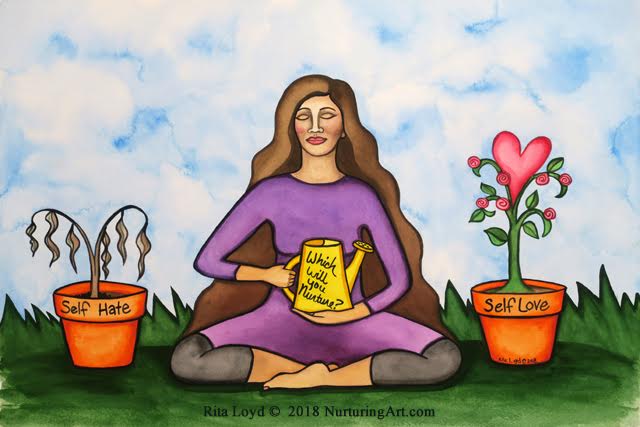
    Artwork by the author, Rita Loyd

  • How Changing My Words Changed My Life for the Better

    How Changing My Words Changed My Life for the Better

    “Our words create our world.” ~Rich Litvin

    I remember when I was about seven years old, shouting spitefully at my mum, ‘’I wish you were dead, I hate you!” Her jaw dropped in disbelief, and I knew my words had hurt her, which made my young heart heavy.

    I remember being fourteen years old asking my first crush, “H-h-hey, do you fancy going to the cinema with me this weekend? To my surprise, she said yes, which taught me there’s never any harm in asking for what you want.

    Later this year, I’ll be standing proudly next to my beautiful almost-wife saying the words, “I do.” With those two simple little words, I’ll convey my love and commitment to her.

    Words are powerful.

    They have the potential to hurt and destroy and to enhance and create.

    Since embracing this truth a few years ago, I’ve become more mindful of the words I use. That is, the words I speak and the words I think.

    Here are four ways I’ve changed my words and as a result changed my life.

    1. Swapping “I’ll try” for “I can, and I will.”

    Back when I felt stuck in life, I was always trying.

    Trying to lose weight.

    Trying to get out of debt.

    Trying to get my life back together.

    It struck me that, in all the areas of my life I was trying to change, I wasn’t having much success.

    I then looked at an area of my life I felt fulfilled in: my social life.

    Partying all weekend every weekend was the perfect escapism I needed.

    Drinking and partying masked my anxiety, making me forget about my money woes temporarily, and gave me the self-confidence I lacked when sober.

    Interestingly, when friends asked me if I would be out at the weekend, I never replied, “I’ll try and make it.”

    No! It was always, “I’ll be there! See you in the club, the first round is on me!”

    Upon recognizing this pattern, I made a new rule for myself: to swap “I’ll try” with “I can or “I will.”

    To no surprise, I started seeing improvements in my life. By saying “I can, and I will,” I somehow felt stronger and in control of my destiny.

    My confidence grew too. I used to say to my gym buddy, “I’ll try to get to the gym on Thursday,” only to cancel last minute (having never really intended to go), and then beat myself up for it.

    Thinking in terms of “I can/I will” gently forced me to be more decisive. I would then say “I will see you there” or “I will let you know by Tuesday.” If Tuesday came around and another commitment was more of a priority, I could communicate this clearly and without feeling bad for cancelling last minute. Switching from “try” to “can/will” caused me to ask, “What do I want to be committed to?”

    The word “try” does still have a place in my vocabulary. I can call a restaurant on a Friday afternoon to try to get a reservation for the evening.

    My rule is simple: I’ll never try to do something that’s in my full control.

    It’s possible I could call the restaurant and they’re fully booked. The outcome is not in my control.

    For anything that is in my control—exercising, writing, waking up early—I now use “I can” or “I will.”

    2. Ask better questions.

    Why am I so stuck?

    When my anxiety, debt, and drinking were at their worst and I finally felt it was time for a change, this question stuck in my head for several days.

    The answers I got were less than helpful…

    Because you’re a loser.

    Because you’ve got no discipline.

    Because life is hard.

    After several days of soul-searching and fed up with my lousy answers, ironically, a better question came to me: What if I’m asking myself the wrong question?

    I closed my eyes and asked my mind to give me a better one.

    What can I do today to move forward a little?

    For the next few months, this became my question of choice. And each day, I moved forward just a little more, focusing on progress over perfection and solutions rather than the problem.

    As Tony Robbins says, “Quality questions create a quality life. Successful people ask better questions, and as a result, they get better answers.”

    3. Saying “I get to” instead of “I have to.”

    Two years ago, I was on a Skype call with a good friend from Canada.

    We connect every now and again and share what we’ve been working on, and it’s always very high-energy and inspiring!

    He shared with me the idea of “I have to” vs “I get to.”

    “Anytime you wish to feel grateful, change your ‘I have to’ statements into ‘I get to’,” he said.

    Like many new ideas I hear, it sounded good at the time but, to be honest, I soon forgot about it.

    A few days passed and I was leaving the house to go meet a student. At the time, I was teaching English to non-native speakers, and every Monday evening I would travel across town to where this guy lived.

    It was quite a hot day and leaving the house, I wasn’t looking forward to the sixty-minute walk. I became aware of the dialogue in my mind…

    “Urgh, I have to walk across town to go teach English.”

    Suddenly, the conversation with my friend came flooding back to me, so I decided to change my train of thought.

    “I get to walk across town to go and teach English.”

    Wow, gratitude hit me hard and in a way I’d never felt before.

    For the first time in a very long time, I felt gratitude for my legs, for the fact that I’m fit and healthy enough to walk!

    Not only that, I felt gratitude for my student, who I got to spend time with each week so I could help him improve his English—a privilege I had overlooked before.

    It’s always important to me to honor how I feel, meaning if I am feeling tired or unmotivated that’s okay. Often, though, changing my “have to” statements to “I get to” is the switch I need to change my perspective and my mood.

    4. Swapping the punisher for the cheerleader

    Perhaps the biggest change I’ve made is shifting my internal voice from a punisher to a cheerleader.

    Like a lot of people, I was painfully strict with myself and overly critical.

    I’d speak to myself harshly whenever I failed.

    When I felt weak I’d judge myself for feeling that way.

    I would beat myself up for always beating myself up!

    Self-compassion was at the heart of making this switch. Speaking to myself in a gentler, more supportive tone. Less dictator and more supportive grandparent.

    With some practice, I began to respond to failure with words of encouragement.

    When I felt weak, I’d offer myself understanding and empathy.

    If I beat myself up, I’d forgive myself and move on.

    I read somewhere that as important as what we say to ourselves inside our heads is how we speak to ourselves, the tone of voice we use. The author encouraged me to imagine the most understanding, compassionate, and gentle voice imaginable and talk to myself in this voice.

    This has been a real game-changer.

    Louise Hay said, “You’ve been criticizing yourself for years and it hasn’t worked. Try approving of yourself and see what happens.”

    I’ve been amazed by what’s happened. Since approving of myself, I’ve relied less on approval from others, which has been liberating, and I’ve given myself full permission to live how I want to live, since approving of myself also means approving of my wants and choices.

    Part of me wishes I had realized the power of my words long before I did.

    Part of me knows I discovered that our words create our world at exactly the right time I was supposed to.

    No matter what age we are or where we are on our journey, I believe, it’s never too late to change our words—and change our world.

  • How to Wake Up Smiling: 5 Daily Habits That Made Me a More Positive Person

    How to Wake Up Smiling: 5 Daily Habits That Made Me a More Positive Person

    “You create your future based on your energy in the present.” ~Unknown

    I’m usually a pretty happy person, but about a year ago—perhaps due to a lack of social connections and laughter—I experienced a few dark months. During those months, I spent most of my waking hours (and probably nights as well) consumed with negative thoughts.

    I woke up feeling angry in the morning, continued having negative thoughts most of the day, and went to bed in that same state of mind.

    Luckily, I didn’t have many opportunities to spread my negativity to others because we were in confinement.

    On one of those moody mornings, I played a video of a spiritual teacher that a friend had recommended listening to while getting ready for the day.

    Halfway through the video, he said, “Humanity is ascending into more loving and conscious states of being. You are becoming more of who you truly are, which is love.”

    At that moment, I caught my eyes in the mirror and stared at my unhappy face.

    “I’m not ascending. I’m descending further and further into the ‘hell’ in my own mind.”

    My negativity was eating me alive, but, strangely, it was so addictive.

    Since it had been escalating for some time (a few months by then) and had acquired a good bit of momentum, I really didn’t know if I’d be able to shift all that negativity into a more positive state of being. I knew that the longer I waited, though, the harder it would be.

    Still looking at my face in the mirror, I noticed the corners of my mouth pointing slightly downward.

    “If I continue like that, I’m going to get grumpy face wrinkles.”

    I made my bed and then went to the kitchen. As the coffee was brewing, I grabbed my laptop and Googled “how to be a more positive person,” and I scribbled down a few ideas that resonated with me.

    Later that day, after mixing and matching advice from different articles, I created what I called my “emotional hygiene routine.”

    It’s a series of simple habits that I committed to doing most days of the week for an entire month (and still continue to do today on most days) and that, over that month, took me out of my depressive state and made me wake up smiling in the morning again.

    I’d like to share them with you.

    1. Fall asleep in the “vortex.”

    One idea I came across in my research on being more positive came from Abraham Hicks:

    “If you go to sleep in the vortex, you wake up in the vortex. If you go to sleep not in the vortex, you wake up not in the vortex.”

    Being in the “vortex” refers to a state of pure positive energy. The idea in that quote is pretty straightforward: go to bed thinking positive thoughts and feeling happy feelings, and you’re more likely to wake up thinking and feeling positive in the morning.

    I knew this had to be true. I knew it because when I went to bed thinking angry thoughts, I usually dreamed that I was unhappy and then woke up grumpy (and exhausted) in the morning.

    So, I decided to try something. As I closed my eyes to sleep at night, I scanned the day from the moment I woke up until the present moment when I was lying in bed, and I tried to recall all the positive things (even tiny things) that had happened that day.

    I could have thought about the delicious mocha latte that I drank that morning, the fact there wasn’t snow on the ground and that I was able to run outside in the afternoon, or a nice comment someone left on one of my videos.

    I spent a few seconds remembering a happy moment before moving on to the next one. After scanning the entire day, I would do it again, trying to find even more subtle positive things, and I did this until I fell asleep.

    This exercise is probably the number one thing that helped me (and still continues to help me) wake up happier in the morning.

    2. Have something to look forward to on the following day.

    Something else that has helped me wake up happier is having something to look forward to every day, even if I have a busy day ahead and have minimal free time available.

    Still to this day, every evening, I schedule at least one activity that brings me joy for the following day. It can be going for a walk with a friend, baking cookies, or watching the sunset. It can also be as simple as wearing my favorite outfit.

    Scheduling one activity that brings me joy for the following day gives my mind something fun to anticipate and puts me in a good mood in the evening.

    And again, how the day ends is a good indicator of how the following day begins.

    3. Absorb uplifting ideas in the evening.

    We all know that what we feed our minds affects our mood. I don’t have a TV and don’t follow the news, but my Facebook feed is often enough to get me irritated. So, I decided to stop scrolling mindlessly on Facebook (or at least do so less often) and consume positive-only content instead.

    For the past few months, first thing in the morning and before going to bed, I’ve been reading a few pages of an inspiring book—usually something spiritual. I just finished reading the entire Earth Life book series by Sanaya Roman, and right now, I’m reading Wishes Fulfilled by Wayne Dyer.

    Reading those kinds of books brings me peace. I can notice a significant difference in my mood and stress level if I just take even fifteen minutes to consume uplifting content in the morning and evening.

    (If you have any book recommendations, you can share them in the comments.)

    4. Make a gratitude list—with a twist.

    After reading in the morning, I write down three to five things I’m grateful for—and why I appreciate each thing.

    I used to write gratitude lists of fifteen-plus items and do it very quickly—almost mindlessly—just to “get it done.” It made the practice sort of mechanical and not very effective.

    I’ve found that writing fewer items on my list and taking the time to dive into the reasons each thing makes me happy intensifies the feelings of gratitude and makes the exercise more profound. I try to do this daily, although I do forget sometimes. When I forget several days in a row, I can feel the difference in my general mood.

    Gratitude is perhaps the lowest-hanging fruit for cultivating a more positive attitude.

    5. Choose your state of being as you open your eyes.

    The last thing that has helped me is a piece of advice from Dr. Daniel Amen, one of the leading brain health experts. In an interview on The School of Greatness Podcast, he talked about the importance of setting a positive intention from the very start of the day to cultivate what he calls “a positivity bias.”

    An affirmation he uses himself and recommends using is: “Today is going to be a great day.”

    When we tell ourselves this in the morning, our unconscious mind then looks for things that are going right to prove that this is true. This isn’t toxic positivity—ignoring or denying the negative. It’s training our brains to see what’s positive instead of focusing on the negative by default.

    I’ve taken the habit of saying this affirmation (or a similar one) just after waking up and before opening my eyes in the morning. It’s a bit like choosing and declaring from the very start of the day what attitude you’ll adopt that day. It’s easy to do, and it sets the tone for the day.

    In the beginning, I didn’t always remember to declare my intention until later in the morning, but it didn’t take long before it became automatic. Now, just remembering to think about my intention (and then mentally saying it) makes me smile as I wake up.

    . . .

    Our lives don’t need to be perfect to wake up smiling in the morning; they just require a conscious effort to develop a positive attitude, which is what the five habits in this article have helped me accomplish.

    I hope they serve you well, too, if you choose to implement them.

  • How My Narcissist Ex Was a Catalyst to My Healing and Self-Love

    How My Narcissist Ex Was a Catalyst to My Healing and Self-Love

    “It’s okay to let go of those who couldn’t love you. Those who didn’t know how to. Those who failed to even try. It’s okay to outgrow them, because that means you filled the empty space in you with self-love instead. You’re outgrowing them because you’re growing into you. And that’s more than okay, that’s something to celebrate.” ~Angelica Moone

    I thought I had married the love of my life. I had never felt a connection so strong before. I was sure he was my soul mate, and I thoroughly believed he was my twin flame—my one and only.

    I can’t even begin to tell you the horror that started to unfold after we got married. The accusations that my beloved other started to hurtle at me. That I didn’t care about him and I didn’t love him enough. He was convinced I was having affairs behind his back, and conspiring against him, and was clearly out to take his money.

    I was not just perplexed by this, I was shattered. How could he not see that I loved him unwaveringly, without question, and that I never even considered having eyes for anyone else? And trying to take his money? That was incredibly bizarre because I discovered, contrary to his initial proclamations, that he hardly had any.

    Yet I didn’t care. I loved him. I tried to love him, and I was convinced that my love would be enough—that he would know that I loved him, and we would soon return to the comfort and the knowing that our love for each other was real, safe, and forever.

    No matter how much I tried to love him, things were spiraling out of control. I couldn’t be five minutes late from the supermarket without suffering his wrath. Life outside of “us” was getting smaller and smaller.

    If I looked out the window, I was thinking the wrong thing or looking at something the wrong way. If I didn’t take his hand when we were together, I was advertising that I was single. Visiting friends or family or working outside of the property became as possible as flying to the moon.

    Eventually it happened: I stopped trying to love us back to unity and fought back. Initially to try to stop the despair that he didn’t trust me, then for my literal sanity, freedom, and autonomy. Without these things I was losing my soul.

    None of it worked. As my attachment to him became more panicked and devastated and I was losing control of my reactions, his abuse accelerated, and then I realized I was coming close to losing my life.

    I had complicated post-traumatic stress disorder. I shook. I sweat. I couldn’t eat. I could barely sleep. Everything and everyone I cared about was turning away from me.

    I had married a narcissist. I didn’t realize it at first, because back then, fifteen years ago, not many people were talking about narcissism.

    I had always believed that narcissists were arrogant people who were “up on themselves.” I had no idea that they were people who presented in our lives offering the love, total acceptance, validation, and “life” that we thought we had wanted our entire life. I had no idea that someone like this could enter my life and they would feel so right to fall in love with.

    The day that the word “narcissist” popped into my head, and I googled it, I nearly fell off my chair. I was ticking every point that was so “him” off a list of traits and behaviors. I was in shock.

    Entitled—tick. Can’t take personal responsibility for wrongdoings—tick. Has hair-trigger reactions to things that most adults don’t get bent out of shape about—tick. Argues in circles in ways that make your head spin—tick. Pathologically lies while looking you straight in the eye—tick … and on and on the list went. I needed to get to the punch line: Could a person like this be fixed? Could they get well from this disease?

    I searched high and low; I turned over every possibility and read all the research I could find. The answer was a flat “no.” Then, believing there is always a solution, I was determined to heal him, to fix our marriage, to return to the dream of the “one and only” that I just knew he must have been.

    It didn’t turn out well. In fact, it turned out terribly. Now I was experiencing things I never believed I could or would: Mental and emotional abuse that had me curled up in a corner. Physical abuse that had me fearing for my life. Financial abuse that was ripping my life to shreds. At times, for self-preservation, I had to escape. Eventually, I left him and relocated.

    But I wasn’t getting better away from him. I was totally unprepared for feeling so haunted. By the fact that he was in the home I had bought, seeing other women and seemingly having a great life while I was so empty, devastated, and traumatized that it hurt to breathe, it hurt to live, and I thought that I was going to die.

    I returned to him countless times. Either because he would contact me and promise to change, or I missed him so much I couldn’t function.

    Every time I returned, it got worse. The makeup periods were briefer, and the explosions more damaging and horrifying. Then, I broke. I had a complete psychotic and adrenal breakdown. I was told I would never heal from it and would need three anti-psychotics to be able to function, but I would never be the same again. I was told I now had permanent brain and nervous system damage.

    Of course, he didn’t care. He did what he had always done when I needed him—he discarded me. It was then that I decided to die. So, I started trying to formulate how to do this in the kindest way for my family and son.

    However, my soul had a different idea for me. A voice in my head kept insisting, “No, there is another way.” I thought it was just my madness speaking. I argued with it, but it wouldn’t let up. In desperation I walked into my bathroom, fell on the mat, put my hands in the air, and shrieked, “Help me, I can’t do this anymore!”

    In that moment the most incredible thing happened. It was like my head parted and the blinding truth entered me. I had never known such clarity in my entire life. Maybe you have to be “out of your mind” to really know the truth?

    The voice in my head told me that my husband was a catalyst. He was never meant to grant me my “self” and my “life”; rather he had come into my life to show me the parts of myself that were unhealed, that I hadn’t healed yet, to generate my true self and true life.

    A whirl of incidents and truths flashed into my mind. The ways I was so hard on myself and was always needing more, saying to myself, “Melanie, I can’t even like you (let alone love you) if you don’t get your to-do list all done, if you don’t lose ten pounds, if you don’t look like this or that … “ and how he had treated me the same—as not good enough, right, or acceptable.

    How I had always kept busy rather than “be” with myself, care, validate, and love myself. How I had terminally self-avoided and self-abandoned my inner being, and how I had yelled at him, “You don’t even know who I really am!” yet had never taken the time to have a real relationship with myself.

    On and on, the realizations came hard and fast. And I knew, he hadn’t treated me how I had treated him; he had treated me how I had really felt about and treated myself.

    I knew that if I let go of him, healed, and came home to my inner self, I would recover. I would save my sanity, life, and soul. I knew I could heal, get better, and do better. I knew that finally my life and love could be real and work.

    I knew this because in this divine intervention experience, I had been thrust into a vision in the future where I was healed and whole, and I had felt it for real. I saw who I was. I saw what I had and most importantly, I felt who I had become.

    He wasn’t the healer of my wounds; he was the messenger of them instead.

    I let go. I turned inward. I healed.

    This I now know at the highest level of truth: A twin flame, as the nemesis who reflects back to us our unhealed parts in intensely painful ways, offers the greatest love of all—the returning home to ourselves. From there my life has blossomed, from this true relationship with myself, life, and others in ways that I could never have previously imagined.

    I am love. I am self-acceptance. I am free.

  • The Power of Reframing: 3 Ways to Feel Better About Life

    The Power of Reframing: 3 Ways to Feel Better About Life

    “Some people could be given an entire field of roses and only see the thorns in it. Others could be given a single weed and only see the wildflower in it. Perception is a key component to gratitude. And gratitude a key component to joy.” ~Amy Weatherly

    I grew up in a deeply negative environment. My parents separated acrimoniously when I was seven, and they were a grim example of how not to do divorce.

    They brought out the worst in each other, and sadly, over time, they also brought out the worst in me. I was depressed as a teen, and had been conditioned to believe that my problems were an unfortunate family trait—one that I had simply to accept and live with.

    And I did, for many years. But of course, I was not happy. And yet I didn’t know enough about the world to understand that my environment and upbringing were very largely to blame.

    I now know that while genetics can account for up to around 40% of the happiness we experience, the rest is within our control.

    I’m aware of this because studies have shown it to be the case. But I know it because I’ve also lived it.

    Deciding to Change My Life

    Over the last ten years, I’ve dramatically changed my life, and I’m the most at peace I’ve ever been.

    When my eldest daughter was a baby, I finally had an important enough reason to want better. I was determined that she would grow up in a fun and positive home. And if I was going to make that a reality, I had to put in the work to make it happen.

    Plus, it had become especially vital at that time since my daughter’s difficult delivery had been traumatic and left me with extreme postnatal anxiety. I was in a very bad place, and I needed to get out of it; I needed, in fact, to get out of my own head. And I didn’t want to rely on medication for that.

    While my husband had already saved me in many ways, the rest was my responsibility—my state of mind, my outlook.

    Desperate but determined, I began an activity that, over time, changed my life.

    While I appreciate that sounds like an exaggeration, it’s really not. Because my life truly has changed. Although it also hasn’t. Allow me to explain…

    The Power of Reframing

    I inadvertently learned how to reframe, and it’s possibly the most profound skill there is for increasing happiness.

    It’s so incredibly powerful because it can change your experience of life—without changing your actual circumstances.

    Here are a few examples of how reframing helped me to feel more positive about my own life…

    A few weeks ago my dad moved, and I planned to visit with my girls during half term to take him a plant.

    We live in the UK, and while the weather is changeable, it’s usually fairly mild. But on the day it so happened to be spectacularly windy. I told my dad we’d make our way and I’d let him know if we couldn’t get there.

    We made it! And after dropping off my dad’s plant, we drove a short way to a restaurant.

    Before we’d even ordered drinks, the winds brought down a pylon and there was a power cut. The kitchen closed, and my young daughters ate crisps for lunch, and I still had to get us safely home.

    But, instead of being mad that the entire day turned into a farce (we encountered fallen trees on the way home!), I was glad I’d made the effort. Most importantly, we were safe, but also it reinforced to my dad that we cared enough to get there despite the challenges.

    Another example is that since Christmas we’ve had one illness after another in our home. First was COVID, and since then we’ve had viruses and two bouts of chicken pox.

    When my eldest succumbed to COVID, I was worried about her, but also on a practical level how I’d get my youngest daughter to school (until my husband also tested positive, at which point I was able to leave the house). The fear that had been silently there for two years had finally caught up with us, and it had the potential to be an enormous source of stress.

    But during the COVID episode—and later with chicken pox too—school mums stepped up without me even asking. I’d never really felt like I’d integrated with the school mum crowd, but as it turned out, I was wrong:

    They totally had my back.

    I felt and continue to feel so incredibly grateful not only for them, but also knowing that I have a support network I did not even realize was there.

    These are just a couple of recent examples which spring to mind, of situations that previously I probably would have experienced negatively and complained about—but I’m now able to reframe to find the silver living.

    So you see, my life is different in terms of how I experience the world, and yet it’s really the very same as it always was. But I feel vastly different.

    I feel at peace.

    And now I want to share my process so others can also learn how to do this for themselves, because it’s basically free therapy, available to everyone, that we can implement alone, and without guidance.

    But how did I do it, without professional help—and without medication?

    How to Tap Into the Benefits of Reframing

    For me, there were really three steps to my journey, which happen to work together in perfect harmony.

    1. Practicing gratitude

    First, I began writing gratitude lists.

    With no comprehension of their value—but with a deep desire to start appreciating the good things in my life, and a desperate hope it was a good starting point. Good enough to help me do better for my daughter.

    I started writing a list of the positive things that had happened each week. Not realizing that this is actually an effective therapeutic exercise, I wasn’t expecting very much to happen.

    But I knew that the fundamental change I wanted to see in my life was more positivity. So I figured the “fake it till you make it” approach might just be beneficial.

    Incredibly, it didn’t just help—it was the turning point of my life to such a degree that it now feels like before and after.

    Writing gratitude lists isn’t difficult. It can be as simple as jotting down three, or five, or ten things you’re thankful for. This can be done when you wake up, to start the day on a positive note, or at the end of each day if you prefer.

    If you have a hectic schedule and can’t find time to do this daily, just be sure to do it regularly.

    And if writing it down seems like too much effort at the end of the day, you could try saying your list of things for the day quietly and privately in your own mind.

    It doesn’t need to a formal practice; it just needs to something you do practice. Because over time, something magical happens…

    2. Positivity

    As time goes by and you continue to acknowledge the good in your life, your default mindset will begin to switch over to a more positive one.

    For me, it was like a spiritual awakening, and I like to use an analogy to describe my experience.

    The idea of rose-tinted glasses is a familiar one for most people. But sometimes they’re actually a blessing. After spending several months practicing gratitude regularly, I felt like I’d removed the only pair of glasses I’d ever known, and the world suddenly looked brighter.

    I also began to appreciate that positivity is often a self-fulfilling prophecy: the harder you look for it, the more you will find.

    And your mood tends to be reflected back to you by others, too. Just as negativity is draining, positive people energize those around them!

    I was recently waxing lyrical to somebody about the positive impacts of gratitude and reframing, but they insisted that offloading onto friends or family is necessary sometimes. I didn’t completely disagree, but I had something important to add:

    By default, increased positivity leads to a decrease in negative experiences, which in turn leads to less often feeling a need to offload. And that’s the magic of this whole concept.

    There’s one final step in my toolkit…

    3. Journaling

    Unfortunately, when you’ve grown up in a negative environment, it can be all too easy to slide back into ingrained behaviors—old habits die hard.

    For that reason, even though I feel very mentally robust these days, I know that if I stop practicing these new skills, it’s almost inevitable that I’ll return to the mindset I developed as a child. (I’ve learned this the hard way.)

    Journaling is my favorite way to stay on track and accountable, because it can easily incorporate each of the above ideas, plus so many more.

    Depending on my mood, I love journaling for its mindfulness, or state of flow, or as a creative outlet. Or all of the above!

    Essentially, these skills each feed into and reinforce one another. And together, they really are life-changing.


  • The Lies We Tell Ourselves About Our Worth and How I’ve Let Them Go

    The Lies We Tell Ourselves About Our Worth and How I’ve Let Them Go

    “You either walk inside your story and own it or you stand outside and hustle for your worthiness.” Brene Brown

    I was shaking and sweating with fear as I stood in front of my graduate professor for the final test of the semester. I was twenty-two years old at the time and felt like a fish out of water in my graduate program. I dreamed of being a professor, studying, and writing, but deep down I thought, “I’m not smart enough. I don’t fit in here.  No one likes me.”

    When my religion professor announced that the final wasn’t a sit-down, bubble-in quiz, but a one-on-one translation, and I’d need to answer questions aloud, I knew I’d fail it epically, and I did. To add oil to the fire, I ran out of the room in tears.

    I failed it before I even started because my fear was so great. My hands were shaking, and soon my teacher would know the truth: I didn’t belong there.

    My professor was incredibly intelligent, and I was intimidated from our first meeting. The way I thought he spoke down to others, probably because his tone, diction, and vocabulary were academic (whether intentional or not), triggered a deep wound.

    Since childhood I had developed a limiting belief: “I am not intelligent.” This followed me wherever I went.

    In school, at work, and in relationships, I constantly trusted others to make decisions and discounted my own opinion. I looked to others for the answers and then compared myself to them. This left me feeling insecure and dependent on others. Not at all the leader I envisioned for myself.

    It was the root of the shame I felt, and I allowed it to mean that I was stupid, I wasn’t worthy, and I would never succeed. My inner critic was loud and eager to prove to me why I was less-than.

    There are a few memories I have from childhood that I can recognize as the start of this limiting belief.

    I remember my first-grade teacher passing back a math worksheet. I received a zero at the top in red letters. I still remember that red marker, the questions, and feeling unworthy. I didn’t understand the questions or why my classmates got ten out of ten, and I was too shy to ask or listen to the answer.

    This happened throughout my schooling. It took me more time than my classmates to understand concepts. I wanted to ask questions but was afraid I would look stupid or that I still wouldn’t understand, so I just avoided traditional learning all together.

    I always looked around and thought, “If they understand it, so should I.” In other words, there is something wrong with me.

    Growing up in the nineties, I was teased for being blonde and ditzy. I was friendly, silly, and loved to laugh, so I was labeled as a stereotype blonde airhead. It hurt my feelings more than I ever let on.

    Even when the teasing was lighthearted and done by friends who loved me, it reinforced my belief that I wasn’t smart or good enough. This belief made me feel small and kept me locked in a cage because no matter what I achieved and how much love I received, I still felt like a failure.

    This limiting belief even made its way into my friendships because I held this insecurity about myself and felt that I could not be my truest self in front of others. I wanted to please my friends by listening, supporting, and championing their dreams rather than risk showing my leadership abilities and the intellectual pursuits I yearned for deep within me.

    Looking back now, I see that I was capable of excelling at school and in relationships, but due to my misconceptions about my worth, it felt safer not to stand out. Drawing attention to myself was too dangerous for my nervous system, which was always in survival mode.

    I preferred to fly under the radar and pass classes without anyone noticing me. I preferred to focus on my friends’ problems and dreams because it felt safer than vulnerably sharing my own.

    I never attended my graduate school graduation, nor did I complete all my finals. I still passed, but I didn’t celebrate my accomplishment.

    In fact, I wanted to write a thesis, but my guidance counselor (a different professor) discouraged me. She told me how much work it would be and that it wasn’t necessary to pass instead of motivating me to challenge myself. Since writing was always important to me, I actually wanted to do it but never spoke up or believed in myself enough to tell her.

    I have heard from many people like me and know that I am one of many sensitive souls that have been discouraged by a teacher. I mistakenly thought my differences made me less capable than others, but I am happy to say that none of these experiences stopped me from moving forward.

    With time and building awareness I took steps to heal these wounds and to change my limiting beliefs about myself.

    Learning about shame is the biggest step you can take to change this for yourself. Whether the shame you carry is from childhood, a traumatic event, struggles with addiction, coming out with your sexuality, or anything else, there is healing to be done here, and you are not alone.

    At the present moment, I don’t allow this feeling of shame to run my life. I am aware of it when it arises and no longer value its protection. I have done the inner work to heal.

    The first step I took was talking to someone about it. Letting it out. Shining a light down upon it. If we want to heal or change anything in our lives, we have to be honest about what we want and what we’re afraid of.

    Once I did that I realized many other people had the same fear and that it wasn’t true.

    It wasn’t true that I wasn’t smart enough. I had evidence that proved this. I’d been accepted to programs; I’d passed classes; I understood challenging ideas. I liked research and writing and was open to feedback in order to improve. I even had a graduate degree.

    I was able to learn new skills in environments that felt safe and supportive to me and my sensitive nervous system. I realized I did better in small groups and with one-on-one support.

    Knowing that didn’t mean the wound was no longer triggered, but it meant that I had the awareness to soothe myself when it was.

    It meant that it hurt, but I didn’t allow it to stop me from moving forward. Instead, I let myself feel the pain while supporting myself and reminding myself of the truth: that I am unlimited and worthy of love, acceptance, and approval.

    Whenever we believe a lie about ourselves it creates major internal pain for us. That pain is an invitation to dig deeper, expose the lie, challenge it, and adopt a new belief that makes us feel proud instead of ashamed.

    The person that I most longed for approval from was myself. I had to be the one that finally accepted my differences without labeling myself as unworthy. I had to love myself even if I felt unsafe or unsure. Once I did that, it was reflected back to me tenfold.

    We all have fears and limiting beliefs and carry the burden of shame within us. These are human qualities, meaning this is a natural challenge shared by all healthy people.

    Instead of hiding them, numbing them, and burying them deep within, share them in a safe space, shine a light on them so the truth can emerge, and take your power back by feeling the emotions while knowing the truth: No matter what lies you’ve told yourself, you are good enough and worthy of love.

  • How Our Self-Talk and Language Can Sabotage or Support Us

    How Our Self-Talk and Language Can Sabotage or Support Us

    “Today I want you to think about all that you are instead of all that you are not.” ~Unknown

    “Love the pinecones!”

    This was a comment from a friend on one of my Facebook photos from a beautiful seaside hike filled with wildflowers and other natural wonders.

    When I responded with “It was a puzzle figuring out how to best photograph them” (not what I originally planned to write), she wrote, “Gregg, that’s such a fun part, isn’t it?” That comment was the brightening of a bulb that had already been going off in my head. It led to deeper self-reflection and awareness around my own self-talk patterns.

    We’ve all heard that how we speak to ourselves has a huge impact on our life. If your self-talk is largely negative, it lowers your self-confidence, drive, creativity, spirit, and enthusiasm for life. In short, it limits your self-expression and access to joy. If your self-talk is compassionate, understanding, and loving, it helps you to move through your life with much greater flow and ease.

    There are the more obvious ways negative language patterns show up, and then there are more hidden, subtle, or unconscious ways. Amongst the more obvious are the habitual ways we berate ourselves or call ourselves names.

    For example, if you are making dinner and just as you finish you knock the whole thing on the floor, how might you respond? It makes total sense to be upset or disappointed, but how does that upset manifest within you?

    Perhaps you think, “Geez, I’m such an idiot!” or “I’m so stupid!” If so, rather than simply expressing your disappointment over the action or result, you are taking one moment in your life and using that to malign yourself at your core.

    Even calling yourself clumsy can become a self-fulfilling prophecy. Maybe you feel it’s actually true. Perhaps others have told you that as well. The thing is, whatever we choose to tell ourselves, whether unkind or gracious, our brain looks for ways to prove those thoughts are true.

    You can acknowledge a mistake, express frustration over an experience, or even decide you want to be more careful in the future, all without casting aspersions on yourself. Name-calling or harsh language directed at ourselves is an example of the more readily visible forms of self-talk. But what about those hidden or unconscious patterns?

    That kind of negative self-talk can be far more insidious and more prevalent than you may suspect. I know it was for me. It’s something I’ve been internally exploring lately and why I was struck with my friend’s comment on my post. Discovering the hidden ways I hold myself small has led to developing more empowering language that serves me on a daily basis.

    Though I was affected by ADD (attention deficit disorder) my whole life, it was not until I was in my forties that I was diagnosed. The first book I read on the topic and perhaps my favorite is called You Mean I’m Not Lazy, Stupid, or Crazy?

    I loved the lessons I got from the book and all that I learned about the workings of my brain. For several years, though, I felt at odds with the title. After all, I reasoned, I never spoke of myself in those pejorative terms. At least not that I was consciously aware of anyway.

    Over time, though, I realized there is a part of my brain that has been actively trying to prove I’m not those things. And if part of my brain is trying to prove I’m not that, then another part must in some way be telling me that I am lazy, crazy, or stupid. That’s when I decided it would be helpful to start consciously examining my unconscious patterns for the voice in my head.

    I’ve noticed my persistent stories of “I don’t know how” or “it will be too hard,” which have been a mantra in my head since childhood. I’ve long been mired in those stories, though they can show up in sneaky ways.  For example, if I see a picture of a place I’ve never been, I have a habit of thinking with melancholy “I’ve never been there” or even feeling jealousy or envy for the photographer.

    While it’s not wrong to have such thoughts, and it makes sense for them to come up from time to time, I noticed I was letting a beautiful photograph put me in a state of dissatisfaction, or even feeling sorry for myself. I was perpetuating limiting patterns of victim stories instead of empowering myself. I decided when I recognized that pattern to play with new thoughts.

    That might involve using that beautiful photograph of a place I’ve never been to remind myself of all the amazing places I have been. Or it might be feeling a sense of joy that such places exist or gratitude that others get to enjoy them.

    Or it could be as simple as thinking, “Oh that looks so interesting.” Or even “How do I get there?” That last one could be said with an air of resignation as a way of holding myself small and complaining, or it could be excitement over the possibility, all depending on how I choose to hold that thought.

    It’s not just the specific words we use but what meanings we ascribe to them that give them their energy and power. I’ve found it invaluable to notice my energy as well as the words I choose.

    With the Facebook exchange about my picture and the puzzle of figuring out how to best photograph the pinecones, my first thought was to write, “I was struggling to figure out how to photograph them.”

    But then I thought, “Why am I saying it that way?” I did not feel in struggle. Why would I want to frame it that way to myself or anyone else? So I altered the wording. That change definitely felt more empowered and certainly less stuck in victim mode. But again, it’s not just the words, but noticing the energy as well.

    Because depending on how I choose to hold it, “a puzzle” could be a game or it could be a chore. I was already leaning toward the more positive aspect but with residue from my initial thought of “struggle.”

    So when my friend chimed in with “Gregg, that’s such a fun part, isn’t it?”, I felt light, happy, and energized. And in all honesty, I initially felt a little bit of embarrassment too. Because it really highlighted for me the heavier energy I had been unconsciously creating over an experience I had thoroughly enjoyed.

    That awareness brought excitement for the deepening realization over the ways I can allow my word patterns to create disappointment and sadness or excitement and joy in my nervous system.

    It’s not just about whether we overtly beat ourselves up but what patterns we use. I’ve had a lot of unconscious patterns that have kept me in the mode of victim of the world rather than the creator of my life.

    It’s an awareness that I am continuing to deepen. As I do, I notice I feel more resilient, get stuck in negative emotions for shorter periods of time, and have more access to joy and aliveness. In an instant I can change how I feel just by the way I speak to and about myself.

    You can create that for yourself as well. Here are a few steps to do so. Outside of step one, they are not in chronological order and may even happen simultaneously.

    1. Start simply by slowing down and noticing your patterns.

    Do you berate yourself? Do you use words that feel untrue or create some kind of internal discord or discomfort that would not otherwise exist, as I had when I was going to use the word “struggle”? If so, explore how you can change those patterns and choose more empowering phrasing.

    This is not about denying that sometimes we do struggle or feel sad or have hard things happen. But you might find that your language actually influences your perception and your feelings about your circumstances. You can view the same situation as an obligation or an opportunity; it all depends on how you choose to see it and talk about it.

    2. Revise your word choice.

    On my journey of monitoring my patterns, I noticed that I’d write things like “I can’t figure out xyz” when, for example, I wrote to a company asking for technical support. The word “can’t” has such a disempowering connotation. So I started changing my word choice to things like, “I would like your help to figure out…” or “I would like to understand how to xyz.” This difference can seem subtle, but the impact on my psyche was immense.

    With the word “can’t” I was literally stating I’m incapable of something, whereas in the other two examples, I’m simply acknowledging information that I lack. Which of those feels more empowering to you?

    The language can seem new and uncomfortable or foreign at first. Perhaps you don’t feel sure how to make the shift. Again, the first step is simply to notice. The more awareness you create, the more your brain will automatically start looking for ways to shift toward your desired outcome.

    In the meantime, if you feel comfortable sharing your journey, you can ask a trusted friend, family member, or coach to point out disempowering language when you use it.

    3. Notice how your word choice affects your energy.

    In the example above about asking for technical support, I noticed how my habit of saying “I can’t figure out how to xyz” was subtly chipping away at my self-confidence. It kept me in a state of frustration and my energy small and insecure.

    Making the change to “I would like to understand how to xyz” felt more expansive. I was declaring a desire to make a change rather than declaring what I was not capable of. That feels more empowering in my nervous system, but still not with the aliveness I’d most desire. Now I’d say something more akin to “I’m learning your system” or “I’m gaining clarity around your system. Please explain to me how to xyz.”

    Sharing in that way, I’m speaking to my growth instead of declaring a deficit. In my body, that last one feels powerful and assertive while still asking for the support I need. What feels most powerful for you?

    4. Be kind and compassionate with yourself.

    Don’t expect perfection. Be compassionate with yourself. If you notice you’re reverting to old patterns, rather than berate yourself, use it as an opportunity to be excited. Because it means you are noticing. As in meditation, the idea is to notice your wandering thoughts and come back. Each time you notice you are creating an opportunity for new and more empowering patterns to flow.

    It can be like learning a foreign language. Because in a sense you are. And just like learning any new language can open up whole new avenues of possibility, this one will as well, releasing shame and self-judgment while brightening and uplifting your world.

    For myself, changing my hidden patterns has helped mitigate the impact of historical victim stories that I’ve held. I feel more empowered, with greater energy to achieve my goals. If you give it a try, I’d love to hear what you are noticing.

  • The Science of Happiness: 9 Feel-Good Tools to Boost Your Mood

    The Science of Happiness: 9 Feel-Good Tools to Boost Your Mood

    “Remember, being happy doesn’t mean you have it all. It simply means you’re thankful for all you have.” ~Unknown

    I remember sitting on the New York City subway, tears streaming down my face, armed with valium and lithium along with other antidepressants that my psych had just prescribed.

    I was desperate, in that cave I had come to know as depression. Dark, hopeless, fearful depression. The cold metal seat of the subway made me feel raw and exposed. I couldn’t function. I couldn’t stop crying. I was panicked that I would be like this forever.

    That was an example of one time in my life. Yeah, I got over it. And there were other episodes of this beast. I gradually became sick and tired of being sick and tired.

    I remember the day. I had been in depression again, and from what seemed like nowhere I started to feel the light of gratitude. I was actually feeling grateful! And it felt so very good! I knew I could start to think and feel differently.

    Then and there I finally vowed to find out how to bring happiness into my life on a consistent basis. Sure, there would be the hard times, but my goal became to live my life in the most positive way I could. I discovered that happiness is an inside job and a process. There is a science to being happier. And I’m here to tell you, it can be done.

    Maybe you’ve never been that down. I hope not. But if you’re feeling low or blue, there is help for you.

    So let’s look at the science of happiness.

    Sonia Lyubormirsky and colleagues have discovered that we can actually raise our happiness levels. According to their research, 50% of our happiness is genetic, hardwired, we are born with a happiness set point. This might explain why your sister is always happy, while you struggle to make it through a day at times. Unfortunately, this set point cannot be changed.

    The next thing to consider: 10% of our happiness is due to life circumstances—our gender, our age, where we grew up, our occupation, significant events in our lives, whether we are married or single, etc.

    For instance, you might think that having more money or having that new car would make you happier, but it only would make you happier up to a point. Then the effect of “hedonic adaptation” takes over. That is the tendency we all have to get used to what we have, causing our happiness levels to go back to the way they were before we got that “new thing.”

    If you’re worried about survival, then having enough money would be critical. But studies show that the rich aren’t any happier than the rest of us. In fact, it’s been reported that they claim they have more headaches and worries. Again, happiness is an inside job.

    Now the good news: 40% of our happiness is left for intentional activity. This is where we have choice. We can change and manage our state of mind. This 40% is where we have control over our happiness levels. We may not be able to change our set point, but we can change our happiness levels! It’s up to us.

    There are many things we can do as intentional habits. We can practice acts of kindness, learn to forgive, connect with others, take care of our bodies (through both physical activity and meditation)—and these are just a few.

    One of the best places to start is with a daily gratitude practice. Write down three things that make you grateful daily. Choose different things each day. Write down why they make you grateful. The why is very important.

    Studies done in corporations like Google have shown this practice increases positivity levels. Make this a daily intentional practice. It may seem corny at first but, hey, science has shown that it works. Guaranteed to change your mindset.

    There is a whole science to happiness, and it consists of daily, (what I like to call), “happiness hygiene habits.” You do these things like you brush your teeth. They keep your happiness levels higher. You choose what works best for you and you make it a daily practice.

    For instance, Harvard Health Publishing has reported that moving your body, be it exercising, walking, dancing, or practicing yoga, has in most cases been as effective as an antidepressant. Low intensity exercise sustained over time spurs the release of proteins called neurotrophic or growth factors, which cause nerve cells to grow and make new connections. The improvement in brain function makes us feel better.

    Back when I was so down, I had an insight and realized that if I wanted to have better days I was going to have to do for myself. I was going to have to understand what helps me change my mindset from negative to positive.

    Happiness isn’t something you go after and then once you get it, you have it for good. It’s an ongoing process of daily maintenance using the tools that the science of happiness has uncovered. 

    Some of these tools:

    1. Setting realistic, achievable, and personally significant goals has given me a purpose.

    My goals become projects that inspire and excite me. I set intrinsic goals versus extrinsic goals. These pursuits make me happier and keep me young. I no longer set goals about money, ego, or power. I value and truly “own” my goals; they are not handed down by what society dictates or what my parents, neighbors, or anyone else externally thinks are worthy

    2. Savoring positive moments has become a real source of joy.

    When I find a sunrise with a glowing moon that is awesome, I hold onto that awe and revel in it. Catch the beauty, savor the positive.

    3. Connecting with people can make a huge difference.

    Reaching out to good friends, (even when I don’t want to) has helped me stay more connected and therefore more content.

    4. Sharing with a close friend what’s going on in my life helps to take the weight off my shoulders and I get to share my secrets.

    You’re only as sick as your secrets. Sharing is caring. Listening to good friends is just as healing.

    5. Practicing random acts of kindness (letting someone go first in a line or writing a “thank you” letter) has shown me compassion.

    These small acts get me thinking along the lines of being of service. Being of service takes the focus off of me and onto others. Where can I make a difference in someone else’s life?

    6. Increasing my spiritual connection has become a source of hope and strength.

    Through meditation, prayer, and contemplation, I have found a connection with the universal source which I tap into daily.

    7. Catching my negative self-talk has been huge in helping me to stay positive.

    Catching negative talk such as: catastrophizing (“This is terrible”), all or nothing thinking (“It always turns out like this”), negative predictions (“My finances will be in ruins”), labeling (“I’m so stupid”) and so on has been a big turnaround.

    Catching these thoughts is not always easy, but I’m on the lookout for them now. I immediately stop myself and switch the thought to a positive, more accurate statement. Our negative thoughts aren’t the truth of the situation; they’re lies and distortions the ego tells us. It’s all in how we perceive it.

    8. Paying attention to the little things helps me maintain a healthy mental space.

    Even something as simple as listening to my music and getting up and dancing will almost always lift my mood.

    9. Finally, living in the moment as much as I can, without bringing the past into it or dooming and glooming about the future has allowed me to be free of torment.

    The “now” is where true peace lies. Present moment awareness is simple but not always easy.

    So all of these actions and more can make up our 40% choice point. We can raise our state of well-being through practice of the happiness hygiene habits. Science has proven that practicing these habits has helped in raising low-level pessimists into low-level optimists.

    Hey, if I can do it, anyone can. And that means you!

  • How a Highly Sensitive Person Can Get Over a Breakup And Move On

    How a Highly Sensitive Person Can Get Over a Breakup And Move On

    “A shoutout to everyone who is trying right now… Trying to do the right thing. Trying to stay open. Trying to keep going. Trying to hold on. Trying to let go. Trying to find their flow. Trying to stay afloat. Trying to meet each new day. Trying to find their balance. Trying to love themselves. Trying new things and new ways. I see you. I’m there too. We’re in this together.” ~S.C. Lourie

    Breakups are devastating, and the pain is real. But if you’re a highly sensitive person (HSP), it can take an extreme toll on your system because HSPs feel everything twice as deeply.

    For the HSP, the pain of a breakup can be completely overwhelming and trigger a heightened emotional state.

    When a relationship ends, it can make you feel insignificant. Regardless of who initiated the ending, you experience a tremendous impact in your life that can drive you into despair, confusion, and rage. Not only do you feel emotionally affected, but you may feel as if you are physically wounded as well.

    My whole world came crashing down when my partner went radio silent. He refused to answer my texts and avoided any form of contact. I felt lost and confused, not knowing what to do or where to turn. Each day felt harder than the day before.

    I knew for months that things were not going well, but I was clinging on to hope that the situation would somehow improve. When my partner left without a word, I knew that was the end. I did not get any closure, not that I require it because I realized it would not make me feel even the least bit better even if I did.

    I’ve heard stories from fellow HSPs who took a long time to get over a breakup, and I didn’t want that same experience for myself. But the pain of dragging my broken heart around and the intense emotional stress were not getting any easier on me.

    A day felt like a month, and I wasn’t sure I could survive until the end of the month because the experience was so devastating. I wanted to get over to the other side quickly and get on with my life.

    These are the steps that helped me recover within a shorter time than I feared it would it take.

    1. Forcing Myself to Get Out

    When the realization that we’d never be together again hit my brain multiple times a day, I lost functionality. My entire system broke down. I could not think clearly or act normally. All I wanted to do was vegetate and cry, which only made the situation worse.

    To reset my brain, I tried to get out of the house as often as I could. My body and brain would fight me. I was already exhausted and feeling hopeless. It took a tremendous amount of willpower to drag myself out of bed. The moment I succeeded, I realized it wasn’t half as bad as I thought it would be. I just had to win the mind game.

    I engaged in simple activities such as dropping in for a cup of coffee at the local café, taking a drive to nowhere, sitting alone watching children play in the park, or just enjoying the sunset. Beauty has a way of distracting us from our thoughts and soothing our nervous system. It drew my mind temporarily away from the problem and provided relief at the moment.

    2. Affirming My Self Worth

    Whenever my mind started reminding me it was over, I blamed myself. I imagined there was something I could have done differently. Or that it was my fault it had happened. I beat myself up and placed the entire burden on my shoulders.

    Knowing there was nothing I could do to reverse the situation, I attempted to tell myself a different story, even though I did not believe it in the beginning. I assured myself I was worthy of love, that I deserved to have someone love me as I was, and I required no validation from others to feel good about myself. I made those affirmations out loud so I could hear myself speak.

    In the beginning, it was a struggle. I would sneer, criticize, or ridicule myself every time I said an affirmation because I did not believe my own words. I persisted between tears and disbelief. Thankfully, it got better over time. Gradually I stopped criticizing myself and what remained were purely affirmations. As I continued to hear myself speak, I gained my own acceptance.

    3. Practicing Self-Compassion

    Research suggests that practicing self-compassion can help us become better adjusted and significantly improve our mental health. But it doesn’t come easily to HSPs.

    We tend to have unlimited compassion for everyone else but struggle to offer the same compassion to ourselves. We often judge ourselves as weak when we’re struggling with emotional pain. But that’s when we need self-compassion the most.

    As I gradually came to terms with reality, I indulged in more positive self-talk. I spoke to myself as I would my best friend. I told myself that I was the main character in my story, and I needed to heal. Despite what was going on, I assured myself I could feel better and rise above the situation.

    I focused on myself, telling myself that I would get out of this episode just fine. I convinced myself that soon, the pain would go away, and the awful feelings would end. Again, in the beginning, there were no significant changes. I persisted and gradually experienced mental clarity that showed me I was on the right path.

    4. Dealing With Relapse

    As I began to heal, I noticed the gap between the time I crumbled and the time I could hold up became further apart. It was not uncommon for me to break down multiple times throughout the day. Sometimes, I managed to get by without crying for an entire day. To me, that was a breakthrough because it showed a marked improvement.

    Some days I unexpectedly suffered a relapse after a period that I thought was an improvement. That took me completely by surprise. Gradually, I accepted that I was still in the process of healing, and that it was normal for my brain to revert to the lingering memory.

    When that happened, I revisited what I practiced earlier—getting out, affirming my self-worth, and practicing self-compassion. Self-talk was a crucial part of my healing process.

    I had to listen to my own words long enough to believe they were true. I had to avoid giving in to the mental chatter about my role in the breakup and my worth.

    We generally act on what we believe about ourselves. If we believe we deserve to hurt, we don’t do the things we need to do to heal.

    Moving On With My Life

    In slightly less than two months, I woke up with no brain fog and was able to go through an entire day without breaking down. I was able to resume my normal activities and focus on the day ahead.

    For me, the whole healing process was a battle of willpower. Some days were tranquil, although most days were difficult. Typically, it was one step forward and two steps backward. Whenever I struggled, I reminded myself that I wanted to heal and feel better. That generally got me on my feet and out of the house.

    A breakup can have a huge impact on a highly sensitive person, since we are more susceptible to stress and extreme anxiety. Although healing takes time and often we have to allow nature to run its course, there is no need to prolong the pain longer than necessary.

    Once you decide you are ready to receive healing and do everything you need to accommodate the process, you can come out of the episode faster and move on with your life.

  • How to Increase Your Sense of Control and Boost Your Resilience

    How to Increase Your Sense of Control and Boost Your Resilience

    “You may encounter many defeats, but you must not be defeated. In fact, it may be necessary to encounter the defeats, so you can know who you are, what you can rise from, how you can still come out of it.” ~Maya Angelou

    When I look back, I am amazed at how differently I dealt with adversity the first few decades of my life.

    Growing up in a stressful home primed me to experience life with caution. Whether it was being afraid of physical harm, loneliness, or failure, I’ve lived my life with an exaggerated fight-flight response to everything. Adversity seemed around every corner, and no one was ever there to save me.

    I developed maladaptive mechanisms to minimize, avoid, or go around the things I was afraid of.

    I became a quiet and obedient kid to avoid my father’s anger.

    I accepted whatever sliver of love my chronically overwhelmed mother was able to give me.

    I settled for the last pick on the team. I quit afterschool theater after I was assaulted on the way home one evening.

    I gave up on art school because my father wanted me to be a teacher.

    I went to a music school as he wanted and quietly accepted my instructor’s abuse.

    On and on, hurt and disappointment became my constant companions, and I learned to just take it. No one seemed to care that I struggled. No one saw me.

    Over time, I learned to accept that the world was just cruel and indifferent to my pain. I learned that I have little control over my circumstances. I learned that I can either fight and fail or stay quiet and survive. I learned helplessness.

    I know now that my childhood wasn’t that unique, but for a kid, it was isolating and debilitating. I thought I was the only one who struggled like this. I felt different, alone, and somehow deficient. I developed low self-esteem and anxiety that soon morphed into this chronic feeling of impending doom.

    I carried that sense of dread and defeat into adulthood. Hypersensitive to stress, I avoided things that would challenge and overwhelm me. I looked to others for permission, approval, and validation. I allowed things without a fight, latched onto any good thing that came my way, and accepted crumbs from others never daring to stand up for myself and ask for more.

    They say that what doesn’t break you makes you stronger but for many—those without a healthy foundation—life’s big and small traumas build up and eventually show up as anxiety, depression, substance abuse, or PTSD. I developed most of these.

    Resilience Can Be Strengthened

    We all respond to adversity differently. Research shows that a loving, emotionally responsive, and supportive environment during childhood fosters psychological resilience throughout life. But even if we didn’t get that strong foundation growing up, we can still build resilience now.

    We can learn to overcome helplessness by increasing our sense of control.

    Finding Peace in the Present Moment

    The most significant practice that allowed me to shift out of state of helplessness and offer me some sense of control was mindfulness.

    Instead of reliving the past—the pain, resentments, and disappointments—or worrying about the future, I could find peace in this moment, right now. I couldn’t change what happened and can’t control what’s to come, but I can decide how I move now. In this very moment, I can control how I respond to life.

    A deep inhale, noticing my child’s smile, the scent of garlic as I cook dinner—I can focus on here and now, fully absorbing life through all my senses, knowing that in this moment I am okay.

    And, if I’m feeling stressed or unsettled, I become curious instead of trying to outrun it. I start paying attention to my body, tracking sensations, observing where I’m feeling tightness, consciously releasing the tension as I breathe in and out. This way, I can help regulate my nervous system and shift the patterns of reactivity. I remind myself to breathe as I ride the wave, trusting the discomfort will eventually pass.

    Learning to Move Through Negative Thoughts

    Once I allowed myself to feel what was going on in my body in times of high stress, I began noticing what I’m thinking and feeling in the midst of turmoil.

    It can be difficult to not get overwhelmed by the negative thought patterns engraved deeply in our minds, patterns we’ve been falling into for decades, without much conscious examination. Looking at those now, I realized how detrimental my mental scripts were to my well-being.

    With the help of my journal, I learned to reframe negative events, bring perspective into my experiences, and focus on what I could learn from them.

    For example, I’ve carried with me this feeling of failure as a young parent. For those first few years, I was living in a constant state of overwhelm, and there was a lot of guilt for not being good enough of a mom, feeling like a fraud and a failure. When I took a step back, I realized there was a multitude of circumstances going against me that made this part of my life extremely difficult, and I was just doing my best.

    I had three children super close together (three under three), which in itself was a Sisyphean task. I had just moved across the country and had no real friends or family to support me. My husband worked long hours, many weekends, often out of state. It was a lot to take on, and I was virtually on my own.

    Looking at this part of my life, I realized I had unrealistic expectations of what it meant to be a good parent. I also realized my perfectionist tendencies and the relentless pressure I put on myself stemmed from my fears of perpetuating generational trauma.

    This way of thinking wasn’t constructive—it was making me miserable. Slowly, I began noticing when these tendencies showed up, and instead of feeding them, I’d just watch them come and go.

    Mindfulness allowed me to move through negative thoughts and memories instead of getting stuck in them. I would observe what was going on inside my mind, breathe through the turbulence offering myself compassion for my struggles, and remind myself that I was doing the best I can. Over time I stopped being so hard on myself, and eventually shifted out of the habit of ruminating for good.

    Enjoying Something That You Do Well

    Spending time doing something that I can do well reminds me how it feels to succeed.

    I have always enjoyed gardening. It is my escape from the hustle and stress of today’s fast-paced world—my garden is my sanctuary.

    Watching my garden transform over the decade from a lot of dirt to where it is today—with all the fruit trees, veggie boxes, shrubs, grasses, and blooming annuals—brings me a sense of accomplishment and fulfillment.

    Finding something that you do well, and practicing it regularly builds confidence, self-esteem, and fortifies a healthy ego. It is imperative to have hobbies that you excel at and can turn to in times of stress or unpredictability.

    Spending Time in Nature

    We live in a world of chronic stress and anxiety. We are always plugged in and on the go, constantly planning, thinking, and doing, all the while feeling disconnected from ourselves and the world around us.

    Modern-day life means living in our heads a lot. To counter that, we need a practice that will ground us and bring us back to balance. And nature is one of the most grounding elements that we have.

    Being in nature down-regulates our nervous system and brings about relaxation. Even a short walk can improve our mood and reduce anxiety. Disconnecting from our daily grind this way—all the responsibilities, worries, and electronics—rebalances our body, mind, and soul. Our problems become less significant and impending. We can exhale, if only for now.

    There are many ways we can ground ourselves in nature this way. Gardening, walking, or even taking care of houseplants can be grounding. I like watering my garden in the evening, repotting plants on Saturdays, and long walks around a lake on Sunday mornings. Find your own natural zen. Soak in nature’s energy as often as you can—it’s healing.

    Caring for and Nourishing Your Body-Mind-Soul

    We can’t be resilient if we are depleted.

    When my kids were little, I barely had time and energy for self-care. I neglected my needs—whether physical, emotional, or mental—just like I was raised to ignore them growing up. Self-neglect is a trauma response, and years went by before I realized I was just perpetuating old wounds.

    As a result, I felt chronically depleted and anxious. Every little mishap or challenge would stress me out, whether it was a kid’s tantrum or packing up for a weekend trip. I was living in a state of chronic overwhelm, emotional dysregulation, and low-grade depression.

    As kids grew older and more independent, my healing turned a corner. I could finally go beyond basic self-care like showers and eating well, and focus on truly nourishing my body, mind, and soul. I now prioritize self-care like my life depends on it because it does.

    Focusing on the basics, I prioritize sleep, movement, and practices that nourish and relax me—long baths, longer walks, healthy food, reading, gardening, music. I rely on boundaries to protect my energy and inner peace. I practice mindfulness and do things with intention. I plan ahead to avoid rushing or multitasking. I fill my own bucket.

    With so much out of our control, caring for ourselves—body, mind, and heart—is the one thing we can do.

    ——

    While challenging times are a given in life and we can’t always change our circumstances, we can have a different relationship with what’s going on outside of us. We can learn to surf the waves if we stay mindful of practices that strengthen resilience. And that is empowering.

  • Where Our Inner Critic Comes from and How to Tame It

    Where Our Inner Critic Comes from and How to Tame It

    “Your inner critic is simply a part of you that needs more self-love.” ~Amy Leigh Mercee

    We all have that critical and judgmental inner voice that tells us we’re not good enough, smart enough, pretty enough, etc.

    It tells us we don’t do anything right. It calls us stupid. It compares us to other people and speaks harshly about ourselves and our bodies. It tells us all the things we did or said “wrong” after communicating or connecting with someone.

    Sometimes it projects criticism outward onto others so we can feel better about ourselves. Other times we try to suppress our inner critic through overachieving, being busy, and accumulating more and more things.

    Sometimes it’s a protective mechanism that’s trying to keep us focused on our self-judgments so we won’t be authentic, because, if we are, we may be rejected and not get the love and acceptance we want.

    But, by doing this, we’re creating even more pain and suffering because we’re disconnecting from and rejecting our own essence.

    Just ignoring the critical voice doesn’t always make it go away. It may initially, but soon enough it will resurface if we haven’t healed/embraced our hurts, traumas, and wounds and shifted our internal patterning, which is where it comes from. 

    Have you ever heard the expression “What we resist persists?” Have you ever told an angry person to “just calm down” or a screaming child to stop crying? Does it work? Not when our energy is in a heightened state.

    Why is someone angry? Why is a child screaming and crying? Because there’s something going on internally that’s creating how they’re behaving. There’s often an unmet need or pain that’s asking for attention.

    Thinking a more positive thought to compensate can sometimes work, but sometimes it just creates an inner debate and mistrust in ourselves because deep inside we don’t believe what we’re saying.

    As children, many of us were taught to suppress those “bad” feelings because if we expressed them, we may have been or were punished. Welcome to the beginning of the critical voice; it’s often a frightened part of us that’s wounded and asking for attention. It wants to be seen, heard, and understood.

    My dad used to get really frustrated with me and constantly told me, “Damn it, Deb, you never do anything right.” Hearing that many times left an imprint in my subconscious. I started living with that interpretation of myself, and the critical voice kept me “in check” with being this way.

    For me, the critical voice was my dad’s voice as well as the deep shame I was feeling for making mistakes and not doing things the “right way.”

    I was holding in suppressed anger, sadness, guilt, unforgiveness, resentment, traumas, and pain that I tried to keep hidden with a smile on my face, but eventually it turned into a shame-based identity.

    My inner voice criticized me whenever I fell short or wasn’t perfect according to society or my family’s expectations.

    Just like when we’re triggered by another person, our critical voice is asking for our attention and guiding us to what needs healing, resolving, forgiving, understanding, compassion, and unconditional love.

    When it comes to the surface, we’re experiencing an automatic regression; it’s a part of us that’s frozen in time. It’s a reflection of our unhealed wounds, which created ideas of not being enough or that something’s wrong with us. Basically, it’s a trance of unworthiness.

    When we’re in a trance of unworthiness, we try to soothe ourselves with addictive behaviors. It’s hard to relax because we think we need to do something to be better and prove ourselves, so not doing anything, resting, isn’t safe.

    When we’re in a trance of unworthiness, it’s hard to be intimate with others. Deep inside we think there’s something wrong with us, so we don’t get close because they may find out and leave. This keeps us from being authentic because we don’t feel okay with who we are.

    Deep down I felt unworthy, unlovable, and undeserving, and the critical voice showed me what I was feeling and believing. I didn’t feel safe in life or in my body. How could I? I was living with so much hurt, pain, and shame inside.

    The critical voice is often stronger for those of us with unhealed wounds and who are hard on ourselves, and it tries to get us with shame and guilt. We’re always looking at ourselves as the “good self” or “bad self,” and if we’re identified with a “bad self,” we’ll act in accordance with that in all areas of our life.

    If we’ve become identified with the critical voice, it’s who we think we are; it just seems normal. And when we start to be more kind and loving, it doesn’t seem right because our identity becomes threatened and our system registers that as danger.

    That happened for me. Eventually I became identified with being a “bad girl” who’s critical and hard on herself, and, even when I started being a little kinder, more compassionate, and more loving, I felt an angst in my body. It wasn’t familiar, and even deeper, it wasn’t okay for me to be this way. My survival was at stake, so I would automatically go back to self-criticizing and judging, without conscious awareness.

    The critical voice didn’t only speak to me harshly; it also told me to do self-abusive things like cutting my wrists and face, starving my body or eating lots of sweets, and exercising for hours like a mad woman to get rid of the food I ate, whether it was a carrot or sweets, because I felt guilty. 

    Even after twenty-three years of going in and out of hospitals and treatment centers, taking medication, and doing traditional therapy, nothing ever changed; the critical voice had a hold on me.

    It was a powerful force, and when I tried to stop it, it would get louder. It thought it was protecting me in a backwards sort of way; if it hurt me first, no one else would be able to do so.

    When people used to say to me, “Debra, you just need to love yourself,” I looked at them like they were crazy. I had no concept of what that even meant because I had no experience of it.

    What I’ve come to see with myself and those I assist in their healing is that the more we keep our deep hurts, traumas, anger, guilt, shame, and pain hidden, the more the critical voice chimes in.

    And, for some, like me, it seems overpowering, so we try to find relief through smoking, drinking, eating, or being busy, and/or we experience severe depression, anxiety, or self-harming.

    When we’re consumed by the critical voice, we’re disconnected from our true essence, and when we’re disconnected from our true essence, the love within, we feel a sense of separation; we don’t feel safe with ourselves or others, and we don’t feel lovable for who we are, as we are.

    This is why many people can change, be happy for a day, but then go back to their critical and/or judgmental ways. Our automatic programming, stemming from our core beliefs, kicks in. It’s just like an addiction, and in a sense it is.

    We can try meditating, deep breathing, and positive thinking, but, unless we address the underlying cause, we’re likely to keep thinking the thoughts our internal patterning dictates. They come from a part of us that doesn’t feel loved or safe.

    So, what do we do when the critical voice comes to visit?

    What do we do when it’s what we’re used to, and it just happens automatically?

    What do we do when we don’t know how to be with ourselves and how we’re feeling in a kind and compassionate way?

    What do we do when we have no concept of what it even means to experience self-love or ease in our bodies?

    First off, please don’t blame yourself for how you’re being. Awareness isn’t about judgment; it’s about kindness, compassion, and love.

    Working with and healing our traumas, where the critical voice was formed, is key in shifting our internal energy patterning. Many people call this inner child healing and/or shadow working. 

    This is a soft and gentle process of moving through the layers of trauma with compassion and love and making peace with our protector parts.

    Through inner child healing, we can shift and transform that “negative” patterning and how the energy is flowing in our body. We can help that part of us that’s frightened, hurting, and maybe feeling separate have a new and true understanding so we can feel loved and safe in our bodies.

    When we pause and take a deep breath when we first hear or sense the critical voice, it allows our nervous systems to reset and helps us come back to the present moment; this allows space for compassion, healing, and investigation.

    Why do I believe that?

    Where did I learn that?

    Is it true?

    How does my higher self see this and me?

    Does the critical voice totally go away? No, it may still chime in; it’s part of being human. But once we realize where it’s coming from and heal/shift that energy pattern, more love can flow through, and we can experience our truth. When we learn how to be our own loving parent and meet the needs our caregivers didn’t meet when we were children, the critical voice often softens.

    Remember, the critical voice is just a scared part of us who really wants attention, love, and a way to feel safe. When we no longer take it personally, when we’re no longer attached to it as our identity, we can offer ourselves compassion, understanding, love, truth, and whatever else we’re needing.

    Life can be messy, and our thoughts can be too. This isn’t about perfection; this is about experiencing a deeper connection with our loving essence.

    There’s a sweet and tender spirit that lives within you. This spirit is your deepest truth. This spirit is the essence of you. You’re naturally lovable, valuable, and worthy. You’re a gift to humanity. So please be kind, gentle, loving, and caring with yourself.

  • On Those Hard Days When You Feel Like Nothing You Do Matters

    On Those Hard Days When You Feel Like Nothing You Do Matters

    “Just a reminder in case your mind is playing tricks on you today: You matter. You’re important. You’re loved. Your presence on this earth makes a difference whether you see it or not.” ~Unknown

    Today I woke up feeling like nothing I do matters. I didn’t want to wake up feeling like this, but I did.

    I got myself out of bed, brushed my teeth, and went through the motions until things inside my mind started to feel unbearable.

    The first thing I did was try to reason with myself, tell myself that, of course I matter. I tell everyone else in my life that they matter and they’re enough just as they are. But there is a tiny voice in my mind that feels loud. Just chanting, “You know you’re trash, people are lying to you. You know you do terrible things and have hurt other people. Just give up.”

    It reminds me of every mistake I’ve ever made. It attacks me with memories of my hurting someone with how I worded something or reminds me of someone who blocked me on social media, or just said, “I don’t like her because of xyz.”

    This feels immobilizing. By the time I am done with this thought process I cannot leave the living room chair I am sitting in. I pull a blanket up to my chin, curl up into a small ball, and start crying. “You’re right,” I say to myself. “You win. I should just give up.”

    My mind is spiraling with everything I have ever done that went unnoticed, that no one cared about. The essays I wrote that only a few people read. The points I made that were later recycled and went on to be successful once someone else made those same points that didn’t seem to matter when they came from me. And I have the overwhelming feeling that I deserved the bad reception, because I, too, am bad.

    Never mind that there are dozens of things that I’ve done that were greatly appreciated. That made a difference. That moved someone else enough to say, “This helped me.”

    Never mind that sometimes we can’t control algorithms, SEO, and the like.

    Never mind that sometimes you make a stupid spelling mistake even though you re-read your piece fourteen times. You just didn’t notice it, but people were turned off from the piece because of it.

    That’s the thing, being a mental health advocate, I feel like my whole purpose on some days as I struggle to get by is to hear someone say, “This helped me.” And if I helped no one, then why did I do it?

    But while I was busy worrying about who I have helped and if my helping got noticed, I may have forgotten to help myself.

    All the clichés, the putting on my own oxygen mask first, filling my own cup to fill others, they are reminders that I need on a daily basis, or I risk becoming my own victim.

    And honestly, to me, there is nothing worse than someone who is helping other people just to be a martyr. They continue toiling to help others but neglect themselves so that they can say, “I almost died doing things for other people.”

    Who are you useful to once dead, or even just burned out? The fight for mental health awareness and to end the stigma is long arduous. And if my goal really is to help others, to be there for the long haul, then I must find a reason to also do it for myself.

    That mean voice feels so loud, but suddenly an argument erupts in my mind.

    The other side finally feels empowered to speak because I kept pushing, although mentally exhausted, against the part of me that was convinced I deserve nothing. I told the quieter voice that it was okay if I messed up. That this doesn’t negate everything I have done that has helped someone, and yes, even if that was just one person. Even if it just helped me to get it out there into the universe.

    And really, the main thing is this: Everything we do doesn’t have to matter on a grand scale. It doesn’t have to leave others speechless. It doesn’t have to change the world. Just doing it is something to be proud of.

    Suddenly I feel a small sense of ease. I am tired from arguing with myself. I am tense from sitting in a tight ball with my jaw clenched this whole time. I unravel myself. I release my jaw. I inhale deeply and release more tension as I exhale. I choose to open up my laptop and write about what went on in my mind just now.

    If you’ve ever felt this way, like nothing you do matters and it’s never good enough—like you have to do more or be more so people will notice that you matter and you’re good enough—here’s what I’d like you to know:

    You are allowed to simply live. You are allowed to just be you. You are allowed to just exist and for that to be enough. You are allowed to be content with just breathing on some days. And you are allowed to be proud of yourself for wanting to help others, even if on some days it seems you’ve helped no one but yourself. It’s enough. You’re enough.

  • One Question for Anyone Who’s Stuck in a Rut: What Do You Believe?

    One Question for Anyone Who’s Stuck in a Rut: What Do You Believe?

    “You become what you believe, not what you think or what you want.” ~Oprah Winfrey

    What do you believe? During the forced stillness of the pandemic environment we’re all living in, this is a question I’ve been faced with more intensely than ever. In particular, I’ve come to question what I believe about myself, and how that impacts every element of my life.

    Coming out of years of self-help for social and general anxiety, a long-standing eating disorder, and several dissatisfying personal relationships, I had to come to question what these external realities reflected back to me. For what you believe about not only your life, but more importantly, yourself, will show up again and again, and yes, again, until you’ve finally addressed the root of the problem.

    In my case, my lack of self-value resulted in many dysfunctions and setbacks in my personal and professional world.

    My deteriorating self-image led to my eating obsessions, a lack of confidence exacerbated anxieties, and the low value I placed on myself was most likely written all over me, judging by the way others showed disrespect toward me in personal relationships.

    Not only was I devaluing who I was, but I also operated from a place of being closed off to others, afraid that if I showed my true self I wouldn’t measure up to their expectations.

    This all came to a head when COVID-19 emerged and led to a global lockdown. Going off of numerous negative relationship experiences, I visited a doctor to discover I had a pelvic floor condition called vaginismus, which results in involuntary vaginal muscle tightening that makes sex and physical exams like pap smears either impossible or extremely painful.

    I spent the next four months going through physical therapy to heal my body from this condition, breaking off a new relationship to focus completely on my own journey. It amazed me how the mind and body go hand-in-hand; my muscle tightening felt like a total embodiment of years of being closed off to others and remaining safely isolated from sharing my true self.

    As I mentioned previously, prior to being diagnosed with vaginismus I’d spent years healing my mental health problems and gaining strength in my career experience.

    After high school, I was lost in my career path for a solid period of time, making lukewarm attempts at artistic endeavors such as acting and modeling, never fully prepared to take a leap and fully immerse myself in any one field.

    Again, this would require a bearing of my true self that would frighten me just to think about. Not only that, it would mean that I had the nerve to believe I was worthy of attempting a profession that’s reserved for an elite group of “special” people, a group I never considered myself to be a part of.

    I did muster up enough courage to move to Los Angeles, however, where I felt I could start a new identity. My Northern California roots felt outdated, and along with some family I sought to better myself with a fresh start.

    One of my first steps toward positive changes was a hostessing gig at a bowling alley, which forced me to get out of my shell and be more social for a change. I still felt very self-conscious, but the more I worked on interacting with customers and coworkers, the more I learned how much I loved people.

    This further developed when, following a chance Intro to Journalism course I took at Pasadena City College in Southern California, I found a new joy that I wasn’t expecting.

    I began to love writing, and not only that, my favorite element of this new career path was interviewing—something I never thought I’d be able to conquer with the severity of my social anxiety, which prevented me from going into grocery stores at its peak

    Deep down, I started to believe that something different could be possible for me. Maybe I could break out of my old mindset and turn into the person I’d always felt I was inside: someone who loved people, longed for and accomplished successful interpersonal relationships, and stood in her power, unapologetically.

    By January of 2020, I had gained a local job news writing in my home base of Burbank and felt optimistic about the future. After the pandemic hit, however, I went through a time of feeling down during isolation. This paired with the vaginismus diagnosis made me become initially quite frustrated.

    “Why is this happening to me?” I wondered. I had done a lot to overcome other personal issues, but now having to do months of diligent, and sometimes extremely painful, physical therapy felt like a punishment that I didn’t deserve.

    After a short bit of contemplation, however, I had a real and sudden shift in perspective. I simply thought, “I’ve been through more than this in the past. I’ll get through it.” I believed I could, and from that moment on dedicated myself to healing not only physically, but emotionally as well.

    Within four months I made enough progress to end in-person physical therapy appointments, I started blog writing and continued with news writing in Burbank, earned a journalism scholarship over the summer, which I contributed toward my studies, and now have just started my own independent journalism writing website.

    The more I believed that I could accomplish my goals, and the more I felt I was worthy of such things, the more I saw everything in the universe work for me, and not against me.

    Today I continue to improve my self-image, and I have a long way to go. But overall, I feel healed from where I once was.

    I’m pursuing my passions, now unashamed to show and share who I truly am.

    I demonstrate a great deal of self-respect in personal relationships, no longer tolerating poor treatment from others who don’t consider my worth.

    My diet and exercise habits are healthier, my vaginismus treatment is complete, and, although I still have to maintain physical therapy exercises, I feel grateful for where I’m at in that regard and in every aspect of my life.

    If you had asked me five years ago, prior to all of this self-improvement, what I believed about myself and my life, I probably would have said I had a promising future ahead, although my actions and interactions continuously showed otherwise.

    This is why I feel I’m at a much more positive place in life at this moment.

    Not only do I propose that I believe positive things about myself, but I now show it through my actions.

    I no longer want respect, I demand it.

    I no longer want to pursue my goals wholeheartedly, I now do it as much as I can every day.

    And not only do I dream of expressing the truth of who I am, I embody it.

    So, if you too feel like you’re stuck in a rut in your life, if you feel that the world isn’t treating you fairly, and if you don’t like what the universe is showing you, then I urge you to ask yourself:

    What do you believe? About yourself? Your worth? Your life? Your potential?

    What do you believe about what you deserve, in relationships and in your career, and what you can accomplish if you try?

    How do those beliefs affect how you show up in the world—the decisions you make, the chances you take, the things you tolerate, and the habits you follow each day?

    What would you do differently if you challenged your beliefs and recognized they’re not facts?

    And what can you do differently today to create a different outcome for tomorrow?

    These are the questions that shape our lives because our beliefs drive our choices, which ultimately determine who we become.

  • How I Reclaimed My Life When I Felt Numb and Unhappy

    How I Reclaimed My Life When I Felt Numb and Unhappy

    “All appears to change when we change.” ~Henri-Frédéric Amiel

    The biggest life-changing moment in my life would have looked unremarkable to an outsider looking in.

    I was at a point in my life (my late twenties) where everything seemed to look good on paper. I had a great job, I was living in downtown Seattle, and I enjoyed the live music scene. Aside from not being in a relationship, I thought I had “arrived.”

    The only problem was, I was miserable, and I barely acknowledged it. A part of me knew that I wasn’t happy, but I tried to run away from that feeling by playing guitar, writing, or watching live music as much as I could.

    My other avoidance tactics were working long hours at my day job or socially drinking at “hip” bars in the city.

    But every time I came home, there I was. Still grappling with my feelings and trying to understand why happiness was so fleeting.

    I had also recently broken up with someone that I cared about but knew was not healthy for me. She was a heavy drinker, and because I tended to just blend in with my partners, my drinking had increased substantially when I was with her, and I felt horrible (physically and emotionally).

    It was a messy ending, and it left me even more confused. I should be so happy. “Why aren’t I?” This nagging thought haunted me for several months.

    Moment of Awareness and Choice

    One afternoon, I came home from work and mindlessly went through my routine. Dropped my bag off by the door. Changed into comfort clothes. Went to the refrigerator and opened a beer.

    I then plopped on the sofa and turned on the television. This was my routine for several mind-numbing months.

    When I reflect back on this moment, I can see that I was absently flipping through every channel available through the cable box. Interested in absolutely nothing. I would take a tug on the beer in one hand without even tasting it while changing channels with the remote in another hand.

    I was literally in a trance and not really processing anything. I was running on autopilot, without any conscious awareness, as channel after channel flipped by.

    And that’s when it happened. It was like the background noise in one part of my mind suddenly became amplified. I could hear thought after thought running through my mind like a CNN news crawl.

    The shocking part, for me, was how negative these thoughts were. “You’re no good. Nobody loves you. You’re a failure. You’ll never find someone who loves you. You’re not worth it.”

    I also had the realization that I’d heard these thoughts before but had chosen to stuff them down or mute the volume through distraction.

    But here they were. Loud and blaring. I was forced to face them once again.

    I was in a state of disbelief for several minutes while some choice expletives escaped my lips.

    Once the shock wore off, there was an overwhelming sense that I had reached a huge fork in the road.

    One choice led to stuffing these thoughts back down to wherever they came from and going back to sucking down a beer mindlessly watching television.

    And then, magically, a second choice came out of nowhere. Stop everything and just sit with these thoughts.

    I remember simply saying, “Huh!” out loud. I never realized that I had choices. I was programmed to run and hide.

    I became aware that this was a prodigious moment for me. I could feel chills run through my entire body.

    The choice was: Go to sleep again or just be present and experience these thoughts.

    Something deep within me knew which path to choose. It was the strongest sense of knowing I had ever experienced. I also knew that if I didn’t get on this train right now, I may be lost forever. It almost felt like a life-or-death decision.

    It was in that moment of choice that I finally gave in. I stopped resisting and avoiding. I chose to sit in the discomfort and not run away and hide anymore.

    The Choice to Pursue “Better”

    As soon as I made the choice to stay and be with these negative thoughts, my body jumped into action. As if someone else was not at the controls.

    In one long, swooping motion, I turned off the television, went over to the kitchen sink, and dumped out the rest of my beer. I then took a deep breath, walked to my living room, and sat cross-legged on the floor.

    I’d never meditated before but had heard of it. I was strongly interested in Buddhism when I was in college but never took the steps to explore what it was all about. I figured there was no better time than now to just try it.

    All I know was, in that moment, I made the firm decision that I was just going to sit and be with my thoughts. No matter how intense of a ride it would be or how crazy just sitting in silence seemed to be.

    I still remember those first moments of being in silence. It was a bittersweet experience. The bitter side was experiencing all of the mean and nasty thoughts running through my mind at full volume. There didn’t seem to be an end to it.

    But there was also a sweetness in the silence that was bathing my experience. There was a peace here that I had never experienced before. It was like being cuddled in a warm bosom, and I soon felt the negative words less scary to be with.

    I can’t remember how long I sat in silence on that first day, but it was at least a couple of hours. I remember opening and closing my eyes several times. I was checking to make sure I was still in my living room.

    It was like figuring out if you can trust wading into a lake you’ve never been to. Slowly, step by step. And certain moments I needed to take open my eyes and just allow myself to feel comfortable before going further.

    There were also moments where I felt “myself” leave my body, which honestly scared the H-E-Double-Hockey-Sticks out of me. It was such a foreign experience. Even though I could feel some sort of a chord holding me to my body, I had never experienced being able to pop out and look down at my cross-legged self below. I was both intrigued and a bit freaked out at the same time.

    But I then started to hear a different voice coming in. A gentler voice.  One assuring me that everything was okay.

    I was guided to just be with the process and that I would eventually get comfortable and not need to pop out of my body. And for the first time in a long time, I started to relax.

    Eventually, I noticed that by letting my thoughts just float through, they would start to fade away until there was just sweet silence, and then more thoughts would come back at a lower volume. I still had no idea what I was doing, but I was feeling better and that was all that mattered.

    I didn’t realize it, but just sitting with my thoughts was making a statement. I was now broadcasting, “I want to learn how to be happy and more loving. I am not going to run away anymore.”

    From that moment on, I came home from work every day and just meditated. I got rid of my cable box and allowed myself to be open to new opportunities. I was guided by a friend to hire a life coach and started to address things in my life that prevented me from experiencing happiness.

    For example, I realized that I’d deadened my ability to tap into emotions because I worked in the aerospace industry, where it was all about facts and data.

    By using my new friend, awareness, I started to identify emotions that I had never really processed, examined, or tried to heal. One particular healing moment was visiting the anger I held from going to an all-boys Catholic high school. I was one of the smallest kids and got picked on from time to time.

    I didn’t even realize how much anger was simmering below the surface. It wasn’t until I was aware of it and then had permission to express my feelings, that I was finally free of my long-held anger about being teased and bullied.

    I also faced the fear I’d developed after being in an airplane crash at nineteen and had a beautiful moment of release with tears flowing like the Nile. It never occurred to me that I held onto to so much trauma and that it was begging to be released.

    The more I became aware of my past and released it, the lighter and happier I naturally became. I caught myself whistling to work one day, something that I hadn’t done in years!

    I also got into Buddhism and energy healing and soaked in all forms of spirituality that interested me. It was a joyous time of learning and trying.

    But ultimately, I knew that just learning was not enough. I needed to practice the ideas of love, healing, and forgiveness in the world.

    “Leveling Up” with Awareness and Choice

    When I look back on that moment where I finally stopped and chose a different way to be in the world, I recognize that was the most defining moment in my life.

    Sure, I have attended many spiritual workshops, retreats, and trainings and have had “mountaintop” experiences. But they never would have happened if I hadn’t made the choice stop and be completely present with my thoughts.

    Our minds are constantly in and out of awareness (awake) and unawareness (asleep). It takes diligence and practice to stay awake and to make loving choices.

    Think about how much of your day you’re actually aware of your thoughts or habits vs. when you are on “automatic pilot” doing tasks or zoning out over social media.

    Here are some ways to remain aware and at choice throughout your day:

    1. Set a goal for the day. Something like: “I want to be aware of my thoughts at work and think lovingly.” Set an hourly reminder on your phone to check in throughout the day.
    2. Put a post-it note with the words “Awareness and Choice” next to your work space or area where you spend most of your time to remind yourself to be present with your internal experience. Place it where you will see it often.
    3. Schedule meditation “dates” throughout your day. See if you can sneak in five five-minute meditations throughout the day. Set reminders if you need to.
    4. Pick someone in your life that you have a hard time being with (especially at work). Have a conversation with that person and watch your thoughts. Choose to see them differently in the moment (as best as you can).
    5. At the end of the day, review the thoughts you had about yourself or others. Go back to times in the day where you were hard on yourself or someone else. Replace those thoughts with ones you would rather have said to yourself.

    Awareness and choice are a powerful duo that can change your life for the better. Both are needed. Awareness is taking in what’s present. Choice is taking steps to move your awareness in your intended direction.

    Look to see where you can benefit from awareness and choice in your life. Then set your compass toward happiness and enjoy the journey!

  • How to Stop Procrastinating When Things Feel Hard or Scary

    How to Stop Procrastinating When Things Feel Hard or Scary

    “You’ve been criticizing yourself for years and it hasn’t worked. Try approving of yourself and see what happens.” ~Louise L. Hay

    I dreamed of starting my own business for years. Ten years, exactly.

    While there are a few reasons it took so long to take the plunge, procrastination is at the top of the list.

    It’s hard work to change careers, uncomfortable to leave a steady paycheck, and nerve-wracking to think of failure.

    Even after spending months and years learning, studying, and getting certified, when it was no longer a matter of having the skills, the uncertainty of success was enough for me to keep kicking the can down the road to start marketing myself.

    I was afraid of failing. I was afraid of not being perfect. I was afraid that people would think I was a joke. And I was afraid that I wasn’t going to be capable of all the work it entailed.

    So I dragged my feet and kept passing my work off to “Future Me.”

    I did this for everything, though.

    “Tomorrow Sandy” can do the dishes. She’ll take care of scheduling that doctor’s appointment. Oh, and sign her up for that tough conversation I need to have with my mom too.

    At one point I recognized that I often procrastinated because I needed everything to be perfect.

    • I wouldn’t work on a craft project or cook a new recipe unless I knew it would come out flawless.
    • Or I would keep tweaking projects at work up to the last second and beyond, at the sacrifice of getting more work done.
    • Or I would agonize over every text and email I sent, often opting not to send any message unless I knew exactly what to say.

    But, as you can see, I’ve come a long way from that version of me.

    I’ve since started my own business (and I’m loving it!), and I’ve pulled my best tools together on paper for how to stop procrastinating—even though I actually procrastinated on writing this post (ironic, I know!).

    Today, I didn’t let my fear of “good enough” hold me back from sharing actual, helpful advice and mindset shifts to get moving and stop staying stuck.

    Because when we’re stuck, we start telling ourselves stories. So that’s where we’ll start, with this story we tell ourselves about why we procrastinate.

    What We Think Procrastination Is

    We have this misconception that procrastination is laziness.

    But procrastination is an active process. You choose to do something else instead of the task that you know you should be doing.

    In contrast, laziness is not caring. It’s apathy, inactivity, and an unwillingness to act. It’s an “I could, I just don’t wanna” kind of attitude.

    But when you’re procrastinating, you feel even more stressed because you do care about getting the task done. You’re just avoiding stress and having difficulty with motivation.

    Because that is why we procrastinate.

    What Procrastination Really Is and Why We Do It

    Procrastination is a stress-avoidance technique. It is an active process to temporarily avoid discomfort.

    We subconsciously are saying, “Present Me is not willing to experience this discomfort, so I will pass it on to Future Me.”

    (We do this as though we’re asking a stranger to do the work for us. Researchers have seen on fMRI that when we think about our future selves, it lights up the same part of the brain as when we think about strangers.)

    The really cool news is that by working toward overcoming your procrastination habit, you’re building your overall resilience to distress.

    That is how I define resilience: a willingness to experience discomfort.

    Examples of Procrastination

    Procrastination is tricky. Sometimes it’s obvious that we’re doing it. Sometimes we don’t quite realize it (like when I had to water the plants right then and there instead of writing this blog post).

    So here are some examples:

    • Scrolling through Instagram instead of getting started on important tasks
    • Putting off work assignments until the last minute
    • Wanting to start a new positive habit (dieting, exercising, or saving money), but repeatedly delaying it while telling yourself that “I’ll start soon
    • Wanting to start a business but wasting time in “research mode” instead of taking action
    • Doing an easy, less important task that “needs to be done” before getting started
    • Waiting until you’re “in the mood” to do the task

    5 Steps to Stop Procrastinating

    Now that we know what it is and why we do it, let’s look at how to stop.

    1. Motivate yourself with kindness instead of criticism.

    What really holds us back from moving forward is the language we use when talking to ourselves.

    Thoughts like:

    • I don’t want to.
    • It will be hard.
    • I don’t know how to do it.
    • It might not come out as good as I want it to.
    • I’ll probably fail.
    • This will be so boring.

    This is what we think that drives us to procrastinate. I mean, really, when you read those thoughts, they just feel so demotivating, right?

    This negative self-talk has a good intent. It is trying to save us from discomfort.

    Unfortunately, it’s achieving the opposite because it adds to the stress by making us feel bad.

    If you speak to yourself with kindness, just as you would a friend, it will feel so much more motivating.

    So think about what you would say to that friend. It might sound like:

    • I get it, it will be uncomfortable, but you’ll be done soon and then you can relax.
    • Once you get started, it will be easier.
    • You can do it!!
    • If it doesn’t come out perfect, at least you’ll have practiced more.
    • If you fail, you’ll have learned so much.

    2. Create a pattern interrupter.

    That negative self-talk has simply become part of your procrastination habit.

    Because that is what procrastination becomes—a habit—and habits are comprised of a cue, a routine, and a reward.

    • The cue is thinking about a task that needs to be done.
    • The routine is to speak that negative self-talk that leads to procrastination.
    • The reward is less stress. (Not no stress, because avoiding the task is still somewhat stressful because we know it eventually needs to be done.)

    In order to break the habit and create a new one, you need to introduce a pattern interrupter.

    Mel Robbins has a great one she calls the 5 Second Rule. When you think “I should do this,” before the negative self-talk starts in, count backwards, “5-4-3-2-1-GO” and move.

    I find this helpful when I’m having a hard time getting out of bed in the morning.

    If I’m having trouble getting motivated to do something difficult like write a post about procrastination, my pattern interrupter is “I can do hard things.” Not only am I interrupting the pattern, I’m motivating myself positively as well.

    If I’m having trouble doing a boring and tedious task like my taxes, I use something like “I’m willing to be uncomfortable now so that Future Me can be at peace.”

    3. Break down the task.

    One of the big drivers of procrastination is overwhelm. Overwhelm happens when we’re looking at a project in full scope, either not knowing where to start or feeling like all the work involved will be too much.

    If the next task at hand is too big, or if you don’t know where to start, your first task really is to either 1) make a list, or 2) figure out the smallest thing you can do first.

    The whole house is a mess? I bet you know where that one sock goes!

    Another example, I had social anxiety and going to the gym was overwhelming to me.

    So I broke it down into:

    • I just need to put gym clothes in my car, that’s it.
    • I just need to drive to the gym. I can turn around if I want once I get there.
    • I just need to walk in the door. I can always leave.
    • I just need to get changed in the locker room I can do that.

    Honestly, I never turned around and went home. Because once I’d taken the small, easy step, the next small easy step was doable.

    Which leads me to the next step…

    4. Just commit to five minutes.

    Studies show that if we commit to five minutes only, 80% of us are likely to continue with the task.

    Five minutes is nothing. You can do anything for five minutes.

    There is an 80% chance you’ll continue working once you put in those five minutes, but even if you don’t, you’re still five minutes closer to your goal.

    And, you’ve taken one more step to breaking the old habit of not starting.

    It’s a big win-win!

    5. Reward yourself or make the task more enjoyable.

    Another problem with looking at a big task in scope instead of the next five minutes is that the reward is too far away or not satisfying enough.

    When you’re trying to lose weight, twenty pounds is weeks and months away.

    Or, when you’re putting off your taxes, if you aren’t expecting a return then the reward is “not going to jail.”

    So bringing in more rewards sooner will fast track creating the new habit of getting started.

    But also, making the task itself more pleasant will make it a less monotonous task.

    • To write this post, I put on my softest bathrobe and grabbed my baby’s tub from when he was an infant to make an Epsom salt foot bath under my desk while I write.
    • I’ll be starting my taxes in the next few weeks, and I already plan to have a glass of wine and super fancy cheese and crackers while I sit down to do them.
    • I save listening to super nostalgic nineties music for when I’m exercising just so that it makes that time extra special and fun.

    What Would Open Up for You If You Stopped Procrastinating?

    We spend so much more time avoiding the discomfort of a task than we do stepping into what it will be like once the task is complete.

    If you were to stop procrastinating, what would open up in your life?

    • Would you start your business because you’re no longer afraid of experiencing any discomfort if you “fail”?
    • Would you simply enjoy life more if you weren’t in a perpetual state of stress because there is a list of things you’re putting off?
    • Would you finally lose weight or get in shape and feel good once you push through being able to get started?

    The Bottom Line

    Procrastination is an active process to temporarily avoid discomfort (it is not laziness!)

    By overcoming your procrastination habit, you are building your emotional resilience.

    Notice the negative, demotivating self-talk and motivate yourself with kindness over criticism.

    Create a pattern interrupter before the negative self-talk starts weighing you down.

    Commit to just five minutes and you’ll either keep going to do more, or you’ll at least be five minutes closer to done.

    Reward yourself or make the task more enjoyable so there is less discomfort to avoid.

  • 3 Negative Inner Voices and How to Challenge Them

    3 Negative Inner Voices and How to Challenge Them

    “Beautify your inner dialogue. Beautify your inner world with love light and compassion. Life will be beautiful.” ~Amit Ray

    There is no better way to feel good about yourself than changing your internal dialogue. Yes, you have the power to change your inner voice. You can choose to speak to yourself in a positive way or a negative way.

    Stop all activity for a moment.

    Be still. Notice what your inner voice is saying. Do you hear anything? If not, ask your inner voice this question: How does it feel to be still?

    Listen.

    Is your inner voice declaring that you are too busy to be chillin’? Or is it supporting you, happy to be playing this hanging-out-and-noticing game?

    Get to know your inner voice.

    Over the next few days stop and listen to your inner dialogue. Especially notice what your inner voice says as you are about to make a decision. Does it say, “I think, I can, I think I can” or does it say, “There is no way, I can’t do that, I can’t do that.”

    Powerful Lessons from a Little Children’s Book

    I hung out with a two-and-a-half-year-old the other day. He wanted to read a book and brought me The Little Engine that Could, by Watty Piper.

    This book was read to me as a child, and I heard the voice in my head chant, “I think I can, I think I can” as I opened the book’s cover. The part I didn’t remember was the lessons of the trains.

    As I read this little children’s book written way back in the 1930’s I felt the power of the lessons and how they apply to my own self-speak today.

    The Little Engine That Could

    The story is about a little train who wants to bring presents over the mountain to children who are patiently and excitedly awaiting their gifts.

    However, on the way to the town, the little engine breaks down. The toys are very upset, and one of them, a funny little clown, sets off to find another train to help them.

    Lessons on Self-Talk from Four Trains

    1. The first train has a Shiny New Engine.

    The Shiny New Engine didn’t want to help the little toy train because he was too special, too proud. He looked down on the little train and said a resounding “NO.”

    I thought of my shiny arrogance that I’d polished for years. I’d told myself I was too special, too important to waste my time and attention on certain tasks and people.

    Even though I’ve worked on this character defect, I know I have some of this self-speak going on inside of me. I noticed it the other night when I went out to dinner with a friend who brought along a friend of hers.

    The woman appeared to be in her sixties with huge fake boobs. She dressed in a tight, sparkly sundress that emphasized her boobs and wore high heels with gold doodads pasted on. She talked about how her love life was filled with younger men who were her “F–k buddies.”

    The moment she said this, I felt superior and stopped listening to what she shared. The next two hours I spent wishing I was at home watching Netflix. My inner voice said she was desperate.

    What did I miss out on? She could have been a kindhearted, fascinating person, even if she dressed provocatively and made choices I wouldn’t make. Where was my compassion or at least my curiosity?

    2. Next comes a Big Engine.

    The Big Engine says he is too important and won’t “pull the likes of you.”

    That got me thinking of my judgments. How do I judge others? Have I missed out on opportunities and connections because my over-inflated ego tells me that I’m too important to get involved with that person or situation?

    My lesson on this came from an Alanon meeting. Well, actually, two separate meetings.

    I rushed into my regular Alanon meeting a bit late and sat down in the only open chair. Once I arranged myself I noticed the man I was sitting next to had a scraggly beard, his clothes looked like they’d been slept in, and he smelled a bit. I scooted as far as I could from him in my chair and held my nose in the air.

    When he shared in the meeting I chose not to listen. My inner voice said, “He has nothing to share that could be of value.” I knew that at the end of the meeting I’d have to hold his hand. My inner voice said, “No way.” So I slipped out right before the closing of the meeting.

    A week later I arrived at my Alanon meeting on time and sat beside a good-looking man in a neat business suit. He piqued my interest. I’d never seen him at a meeting before, and I always appreciated a good-looking, well-groomed man.

    When this good-looking man shared, I listened intently and nodded my head in agreement with much of what he said. My inner voice said “yes” to holding this man’s hand at the end of the meeting. As we grabbed hands, I gave his an extra firm squeeze as my way of saying, “I’m glad you are here.”

    As we released our handhold, I turned to the nice-looking man and said, “My name is Michelle, welcome.” I’ll never forget how he looked at me with his deep blue eyes and asked, “You don’t remember me, do you?” I nodded my head “no,” thinking to myself I’d surely remember him if we’d met before.

    He said, “I was here last week, a bit disheveled, as my best friend who suffered from alcoholism had killed himself. This Alanon meeting was recommended by my therapist to get help and support. I was so distraught I wasn’t eating, sleeping, or taking care of myself. I noticed you wanted nothing to do with me.”

    It dawned on me as he spoke that he was the homeless-looking man from the week before. I turned bright red, mumbled an apology, and ran out of the room.

    I never saw the man again, but I do think of him often and consider him an angel sent to stop me from my “I’m better than” inner voice.

    3. The Rusty Old Engine comes next.

    The Rusty Old Engine sighed and said he could not. He was too tired and weary.

    I personally am not familiar with this inner voice. My inner voice tells me I can do anything and handle most things that come my way, to a fault. But I’ve watched others run this internal narrative. One of them is Jean.

    Jean was a vibrant, gorgeous woman who owned a successful advertising company. When the advertising business began to shift away from print toward the Internet, I watched as she became defeated. She told me she was too old to make the changes she needed to make.

    Her business began to fail, and as it did Jean failed as well. She stopped doing her movement practices, gained weight, and subsequently had two hip replacements. Her financial picture grew dim, and Jean was forced to sell her beautiful condo. She gave up on the life she’d so artfully created for herself over decades.

    I saw Jean a couple of years ago. She was a shell of her former self and shared she felt old and tired.

    4. Lastly comes the Little Blue Engine.

    Chugging merrily along. The dolls and toys didn’t have to ask this train for help. She asks them, “What’s wrong?” As she hears of their plight, she tells them she isn’t very big and has never been over the mountain.

    She thought of what the kids would be missing if this little train didn’t bring the gifts to the boys and girls on the other side. So she said, “I think I can, I think I can.” It was a supreme effort, but she hooked up to the train, began chugging along, and kept going all the way over the mountain by saying to herself over and over again, “I think I can.”

    I know this voice.

    I recently changed my business model from brick and mortar, which I knew I could do, to an online business, which required a supreme effort. I’ve gotten up every morning for over a year chanting, “I think I can.” I’ve put my head down and chugged through twelve-hour days, and you know what? I did it. I made it over that mountain. My online business is going strong.

    Inner Voice Lessons from The Little Engine That Could:

    1. Listen for your arrogant inner voice that tells you that you are better than anyone else. Tell yourself to remain curious and compassionate.
    2. Listen for your inner judgments. Say to yourself, “I’m grateful for the people that I meet; they might teach me something.”
    3. Listen to your inner voice of defeat that tells you that you are too tired. Change that voice to “I’m not handed anything I can’t handle.”
    4. Take the next adventure you encounter and say to yourself, “I think I can. I think I can.”
  • You Don’t Suck at Life: How to Stop Believing Your Inner Bully

    You Don’t Suck at Life: How to Stop Believing Your Inner Bully

    “You’re too fat to wear that tight shirt to the gym.”

    “You’re not smart enough to take the lead on that project at work.”

    “You’re definitely going to screw up the vacation plans.”

    “You’re not good enough, cool enough, likable enough.” 

    “You suck.”

    If we talked like this to anyone, it would be considered bullying.

    And yet we talk to ourselves like this all the time.

    We talk to ourselves in a way we would never talk to people we care about. We take these words to heart and believe them as truth.

    We turn these words into our core belief system, holding ourselves back from growth, fulfillment, and happiness.

    We set high expectations for ourselves, and if we don’t meet them it comes out in unfair, untrue, and flat-out mean judgments.

    We say “treat others the way you’d like to be treated” but don’t follow that advice when it comes to how we treat ourselves.

    I certainly didn’t.

    I was a Grade A self-bully for years.

    Every day when I left work, I’d hear this voice in my head telling me, “They’re going to figure out you’re a fraud and don’t know what you’re doing. Anyone can do this job better than you. They’re going to fire you. You’re an embarrassment.”

    I never had many friends, but when the few I had would invite me out somewhere, I’d think, “They just pity me. They’re only inviting me because they feel obligated. I’m not as pretty as they are and don’t fit in. I never know the right thing to say. I’m going to screw this up.”

    I always imagined how disappointed my parents would be in me if they saw how messy my house was, or what they’d think of me leaving a well-paying job to start my own business, or if they knew that I lost that stock certificate and now had to pay a stupid amount of money to get it replaced. I’d think, “They’ll judge me and think that I’ve failed them, and that I’m not as good as they expected me to be.”

    I told myself how unlikeable I was, and that’s why I didn’t have more friends.

    I told myself how I’d never be successful because I never had any good ideas.

    I told myself how ugly I was. How boring I was. How awkward I was.

    I was constantly putting myself down, partly because I was a perfectionist, and partly because I worried way too much about what other people thought of me and never felt I was good enough to meet their standards.

    But that was the old me.

    I’ve come a long way since then. I slip up on occasion, but I’m much better equipped now to course correct using the steps below.

    Changing my relationship with my inner bully took me a few years of studying, training, and practicing.

    If you’ve been bullying yourself for years, it will likely take you time to change your habit, as well. But these six key strategies will make a lot easier to be kind to yourself.

    Step 1: Say hello.

    When we hear that self-bully talk, we tend to instantly believe it without recognizing what’s going on or questioning it. We see it as truth. We fully experience it.

    The first step to quieting your inner bully is to say hello. That is, mindfully recognize that this is self-bully talk happening. Maybe even personify it by giving it a name or even a gender.

    I like to minimize my inner bully by giving her a silly name: Cupcake.

    When I hear inner talk like “Ugh, you suck at this,” I notice this and say, “Oh, hi Cupcake. Welcome to the party.”

    This allows me to step back from the voice. Just like I do when I’m watching a scary movie and I don’t want to get too scared. I step back and recognize that these are actors on a screen, they are reading scripts, there are cameras and lights pointing at them.

    I go from being fully absorbed in the movie, like I’m in it, to noticing that I’m watching a movie. It’s a subtle but profound shift.

    From this place, we can create space, which enables us to make change in the next step.

    Step 2: Change how you experience your bully.

    We experience thoughts as pictures, sounds, or feelings. Most people experience their inner bully thoughts as sound, like hearing a voice telling them “you suck.”

    Here’s a fun trick to change how you experience your inner bully. Change the sound of the “voice.”

    When I hear that voice telling me that I suck, I say, “Hi Cupcake, what do you have to say again?”

    Then I repeat her words in a funny cartoon voice. Now she sounds like Mickey Mouse and I can’t even take her seriously.

    If you’re a visual type and “you suck” comes to you in a picture—perhaps one of you at a time in your life when you felt like you failed—you can try a different tactic (or both even).

    Since I named her “Cupcake,” I can also picture her as such.

    Now I see a cupcake with a Mickey Mouse voice telling me “you suck.” Which, of course, is adorable and hilarious.

    This helps me step further out of that negative mind frame so I can take the next step. 

    Step 3: Find the positive intent.

    Everything we do has a positive intent. Even when we’re being mean to ourselves.

    When I was telling myself that I was no good at my job, my bully was really trying to push me to do better so I wouldn’t get fired, and trying to protect me from being caught off-guard if that happened. She was also trying to tell me where I still had and opportunity to grow and learn.

    When I find myself procrastinating on a project because my bully is telling me that I’m not going to do a good job anyway, I know she’s just trying to protect me from failure.

    She didn’t choose the most helpful method, but she meant well.

    I can now say, “Thanks, Cupcake. I can take it from here.”

    And then I move onto the next step.

    Step 4: Choose a neutral or positive thought instead.

    Sometimes it can feel like a big leap to go from a negative to a positive. Going from “I’m a failure” to “I’m a success” might feel false to you considering the circumstances.

    In this case, try a neutral thought instead. See how it feels to go from “I’m a failure” to “I’m not a failure at everything.”

    In my case, at work I would often think “I can’t do this.” (This was usually when someone asked me to analyze some data, which wasn’t my strong suit.)

    To get myself out of self-bully mode, I would slightly alter the statement “I can’t do this” by adding “yet.”

    “I can’t do this… yet.”

    Sometimes I could even replace it with “I can do this,” just to try it out and see how it felt. More often than not, it actually felt true. I just hadn’t thought of that idea yet.

    And over time I did get better at analyzing data.

    The point is, you can choose what thoughts to think.

    Step 5: Give yourself permission to be imperfect.

    (Note, this step is only applicable if you identify as a human.)

    Our inner bullies come out of the woodwork when we do something that we consider “imperfect.”

    We don’t look perfect. We didn’t execute something perfectly. We didn’t make the perfect choice.

    The phrase “I’m only human” is another way of saying, by nature, I will make mistakes. Mistakes are allowed. Not only allowed but expected.

    Write yourself a permission slip to be imperfect. Just see how it feels.

    “I, Sandy, give myself permission to write a blog post about self-bullying and not write it perfectly.”

    That felt pretty good. 🙂

    Step 6: Know that you are not alone and can ask for help if you need it.

    Over time, negative self-talk becomes a habit, and as we’ve all experienced, habits are hard to form or break.

    If you’re having trouble breaking your self-bullying habit, even using these steps, you don’t have to go it alone, and you shouldn’t be afraid or ashamed to ask for help.

    Working with a supportive therapist or coach, or even just confiding in a friend, can make a huge difference. An unbiased outsider is able to hear our thoughts, what we’re saying and not saying, and reflect those back to us when we don’t notice them.

    They provide us with support and accountability to keep us on track toward our goals and cheer us on along the way. They ask us tough questions, that we wouldn’t think to ask ourselves.

    They also help remind us that we’re not alone in feeling how we feel. That it’s not only common, but people can see improvement, which is incredibly reassuring. Odds are, everyone you’ve ever met has struggled with this too, and still does on occasion.

    Personally, I reached out for help much later in my own journey because I was embarrassed. My inner bully told me that if I went to someone for help, it meant I was weak. And that they would tell me there’s nothing wrong with me and to suck it up (our inner bullies tend to lie to us).

    I don’t have regrets in my life. Every experience has made me who I am today, and I love who I am. I’m sure the tougher path I took made me stronger along the way.

    But I also think I would have reached freedom from my inner-bully more quickly had I put my ego aside and opened up to someone sooner.

    Know that you are not alone. Everyone feels or has felt the way you do, and like you, they struggle with this at times and see progress at others. So try to be good to yourself—and aim for progress, not perfection.

    Much love and light on your journey, my friend.

  • How 5 Simple Habits Made Me Love My Life More

    How 5 Simple Habits Made Me Love My Life More

    “Good habits are worth being fanatical about.” ~John Irving

    Your habits are directly related to the quality of your life. Good habits lead to joy and fulfillment in your life, while not-so-good habits leave you yearning for your life to be different.

    I think I always knew that, I just wished I took it to heart sooner. Better late than never, right?

    Gretchen Rubin, author of Better Than Before: What I Learned About Making and Breaking Habits, says that “Habits are the invisible architecture of our daily life. We repeat about 40% of our behavior almost daily, so our habits shape our existence, and our future. If we change our habits, we change our lives.”

    I’ve spent far too much time in my life languishing in worries and regrets, wondering why life had to be so hard. I looked for outside sources to come in and save me. No rescuer ever came, at least not one that made a permanent difference.

    I’d always wind up on the same boat: wondering why others seemed so content with the lives they were leading while I continued to have a burning desire for something different—something I really couldn’t even name, though I tried in vain to do so.

    I set big goals and made big plans that I was certain would make all the difference for me. Usually, my big goals and big plans wouldn’t live beyond the next new moon. Even when they did, though, the things that I thought would make me happy didn’t. The things that I thought would bring me peace only annoyed me for their utter lack of peace-creating properties.

    By profession, I’m a strategist. I look at all the many things that contribute to situations being a certain way and explore ways to move the situation toward where I want it to be. Turns out, sometimes you don’t have to overhaul anything; sometimes, small, simple tweaks can make a big difference.

    As the saying goes, it takes large sails to move a large ship, but the captain need only make a small adjustment to the rudder to change the direction. The other part of the saying is there’s no point in adjusting the rudder if the ship is not moving; you won’t go anywhere.

    Your daily habits are the small rudders that can help you move your life in the direction you wish. Choosing good habits day after day is the movement required to experience the positive life changes you’re seeking.

    I like to think of myself as an intelligent person, but what I neglected to see in my own life is that the smallest tweaks done day in and day out have the power to move the mountains I want moved. When my eyes opened to the power of small changes practiced daily, miracles began to unfold in my life.

    Below are some of the simple daily habits I’ve worked to incorporate into my life that are making such a huge difference for me.

    1. Meditation

    Yeah, yeah, I know. Everyone says meditate, but did you ever consider that maybe all those meditation-lovers are offering an you an insider’s tip (pun intended) that in fact is actually priceless?

    I have an overactive mind, as many people do. It loves to tell me about all its worries and warn me of threats that in reality aren’t all that threatening—nothing more than a mouse posing as a monster most of the time.

    My mind loves to relive situations and conversations over and over and over; it’s so tiring! I’ve found that the antidote to my endless chattering mind is daily meditation.

    I don’t do anything complicated. I just sit in a relaxing position, tune into serene instrumental music on Spotify, and focus on my breath. Anytime I notice that my mind is wandering (as it always does), I return my focus to my breath. In times of silence answers seem to arrive to incredibly insightful questions I didn’t even know I should ask.

    2. Kind, loving self-talk

    In the past, my inner dialogue wasn’t all that friendly. In fact, I was my own worst enemy, a relentless bully whose malicious words would leave me disheartened and unable to face the world with any sense of self-worth or confidence.

    I didn’t come by this demeaning self-talk accidentally. Its roots go back to my childhood.

    I grew up in a Roman Catholic home with seven children (another sibling died before I was born) and two overworked, exhausted parents who were flat broke all the time.

    My father struggled with alcohol addiction and mental illness. This, along with my mother’s enabling patterns plus her own low self-esteem and depression issues, defined how the house was run.

    The focus of the entire household was on managing life around dad’s issues.

    Growing up, it seemed to me that nothing I ever did was good enough for my dad, though I tried so very hard to please him. I craved his love and positive attention. He either ignored me or criticized me, and when he criticized me he often did so in the most brutal tone.

    I took to adopting that brutal tone in my inner dialogue and kept up the cruel inner monologues for years and years. I rationalized that I was just keeping my standards high, because who wouldn’t want to have high standards, right? A father would only criticize his daughter to help her improve, right?

    So I kept criticizing myself; it never occurred to me that dad lashed out at me because his whole life seemed like a mess, so by God, the one thing he would have control over was his children.

    There I was as an adult, using unrelenting, vicious self-criticism as a way to be perfect so I could get the love and attention I sorely wanted from the people in my life. It was a strategy that was never going to work; it had to go.

    After examining my bitter, demeaning inner voice, I realized that I would never treat another human being this way, so why was I permitting this type of untenable talk go on inside me? I deserve better—we all do!

    Now when those critical thoughts come up I’m patient with myself without buying into the scolding voice that’s offering up the hypercritical self-assessments.

    I look at the scared girl behind those ugly comments and extend my deepest love to her. You see, while I refuse to allow my inner critic to talk to me in vile ways anymore, I also recognize the only reason I ever talked to myself that way was out of a deep need for belonging and protection. There was a call for love behind those ugly words, and now I simply acknowledge that deep desire for self-love without chastising the hurting girl who was trying to get my attention in the only way she knew how.

    3. Follow the five-second rule

    I love Mel Robbins, and the day I learned about her five-second rule was a very important day in my life. (And I’m not talking whether it’s still safe to eat food that’s only had five seconds of contact on the floor—that’s a whole different discussion!)

    In a nutshell, here is Mel Robbins’ five-second rule, in Mel’s words: The moment you have an instinct to act on a goal you must count five-four-three-two-one and physically move or your brain will stop you.”

    So, you’re not a “morning person” but you have a goal of getting up earlier in the morning? Then the moment your alarm clock goes off, count five-four-three-two-one and jump out of bed. No more hitting the snooze alarm.

    Yes, in the moment of those early morning hours, of course you’d rather stay in that warm comfy bed—who wouldn’t? But staying in bed doesn’t align with your bigger goals, and getting up does. If you move within five seconds, you’ll move toward your bigger goals. If you don’t move and allow your clever mind to talk you into staying in bed for “just a bit more,” you’re sunk.

    If you want to change your life by getting up earlier so you can write that blog you want to write (a-hem, what I’m doing now) or do that exercise you know your body needs, then make those goals your priority over an extra thirty minutes of sleep and use the five-second rule to help you get your body out of bed.

    Adopting the five-second rule is one of the best habits I’ve ever taken up. For the sake of full transparency, I admit I’m not always successful at sticking to the rule, but the more I try, the more I succeed.

    “If your habits don’t line up with your dream, then you need to either change your habits or change your dream.” ~John Maxwell

    4. Feed my mind

    I’ve always considered myself to be a learner, though in actuality I get lazy about learning. It’s hard to improve your life if you’re never giving your brain any new information. Feeding my mind on a regular basis has become a top priority for me.

    My “feeding my mind” goal looks something like this: one retreat a year, one book a month (that I can either read or listen via audio), one podcast a week, and one smart article on something I want to learn about each and every day. I’ve found that starting the process builds momentum; I often crush my minimum goals!

    Feeding my mind in healthy ways also means giving up some unhealthy habits. I’m extremely careful about how much news I watch nowadays. While I don’t want to keep my head in the sand, I find it’s important to limit the number of negative messages I allow into my mind, and news channels are notorious for going over the same disturbing stories again and again. I make time in my days for my extra reading and personal growth activities by getting up earlier and limiting my Netflix and HBO time.

    I’ve also modified my budget so I can afford the audiobooks and retreats I want to buy. My clothing and dining out budget is about half of what it used to be, and it’s a trade-off I’m happy to make.

    The habit of feeding my mind is opening up whole new worlds for me. I can’t tell you how often I’ve read about something and the perfect opportunity comes up for using what I’ve learned in both my professional and personal life. Louis Pasteur said, “Fortune favors the prepared mind,” and I couldn’t agree more!

    5. Do something outside my comfort zone at least once a week

    If I were a more ambitious soul, I might put a “once a day” rule on this habit, but for now once a week works nicely for me. The habit of doing the same things the same way every day is life draining, while the habit of stretching outside your comfort zone regularly is life expanding. I’d rather see my life expand rather than to contract and shrivel, thank you very much.

    Today, I regularly practice being brave—allowing myself to be seen, allowing myself to be vulnerable and unskilled at new things. I don’t tiptoe outside my comfort zone anymore; I’m even willing to take huge leaps.

    I quit a job that I’d been in for twenty-two years without having the next job lined up. I moved 2000 miles from family and friends to live in a beautiful part of the world where I’ve always dreamed of living.

    I now work in freelance, consulting, and coaching roles, which means my income fluctuates a lot. I’m not always certain how much money I’ll earn each month; I could have never tolerated that degree of uncertainty before.

    It’s surprising how much your life can transform in miraculous ways once you’re willing to not be perfect in your own little world but instead actively choose to be imperfect in a world that might judge you. When you take risks that might leave you flat on your back, they also might enable you to soar.

    I’ve found that bravery is rewarded, maybe not always in the moment, but always in time. I encourage you to be brave; it’ll change your life!

  • Be Kind, Retrain Your Mind: 3 Tips to Overcome Negative Self-Talk

    Be Kind, Retrain Your Mind: 3 Tips to Overcome Negative Self-Talk

    “You yourself, as much as anybody in the entire universe, deserve your love and affection.” ~Buddha

    In 1990, in an early encounter between the Dalai Lama, the foremost Tibetan teacher of Buddhism, and Western students, the Dalai Lama was asked a question about how to deal with self-hatred. He was confused and didn’t understand the question. The translator translated the question again, and still the Dalai Lama was confused.

    Finally, the Dalai Lama understood that the question was about how to manage negative feelings about the self. This was a new concept to him: he knew that people had negative feelings about others, but he had not encountered the challenge of self-hatred.

    I wish I could say that I had never encountered the problem of self-hatred, but I’d be lying. Like so many people, even if I didn’t necessarily recognize my self-talk as such, I was inundated with internal negative self-talk.

    My process of coming first to recognize what that voice was up to, then to listen to it with more compassion, and finally, once and for all, to ask it to grow up and step out of the room has been a journey of self-acceptance, growth, and ultimately, freedom.

    Here are three steps to deal with your own inner negative self-talk:

    The first step is to become aware of the negativity of your internal voice. 

    For the first twenty-eight years of my life, I was so familiar with my negative voice that I didn’t even recognize it.

    I’ve been told that people with tinnitus, a constant ringing sound in the ears, grow used to it and learn to live with it so successfully that they’re no longer really even aware the ringing’s there. That was the case with my negative voice: it was a kind of background hum.

    If I did pay attention to it, I was tricked into thinking that its particular message mattered.

    At sixteen, it might have been the enormous, overly sweet corn muffin I’d eaten on the way home from school that was a sign of my failure.

    At twenty-six, it might have been that an essay I wrote hadn’t been accepted for publication; this was a sign, I was sure, that nothing I’d ever write would ever be fully understood.

    It wasn’t until I’d been in therapy for a while and had a real mindfulness practice that I even began to notice the daily hum of background voices and to notice that the particulars of the negative voice I did hear were less important, actually, than the larger pattern it was a part of.

    Any mindfulness practice can help you become more aware of the negative self-talk in your head. You can try guided meditations, deep breathing exercises, or mindful walking, or simply spend time tuning into your senses. When you become conscious of the present moment, it’s easier to recognize what’s going on internally.

    The second step is to listen a little more deeply.

    What was important was not so much what the voice was saying as what was under the voice. Often the negativity was there to distract me from something else.

    Was the corn muffin or the publication rejection really the problem?

    I learned not to take what I said to myself at face value.

    After all, I was often shocked at what was going on inside my own head. I said what to myself? I would never say that to anyone else!

    Though I had a PhD in literature and was a published creative writer, skilled at using language in all kinds of sophisticated ways, often the voice inside my head was stuck only at a toddler level.

    When I was frustrated or upset, rather than slowing down and parsing out what I was really feeling, I’d lash out with simple and ultimately inaccurate phrases, phrases like “I hate myself.”

    The negative statements were largely self-protective, a big blanket over deeper layers of hurt or pain. Often what those negative words were really expressing (even if they didn’t have the appropriate words to do so) was not I’ve done something wrong, but I’m worried, I feel alone, I feel uncertain, I feel lost or scared or hurt. 

    I learned to react to the feelings under that negativity with compassion.

    I came to understand better what situations triggered me and why, in fact, some situations threw me back to being a three-year-old inside again.

    Therapy, mindfulness, writing, and meditation all helped me heal and embrace those wounded parts of myself that were speaking in such negative terms. I learned to listen more carefully to what I was really feeling and to re-parent my inner child.

    I learned to send myself loving-kindness and compassion.

    My inner voice became less likely to be critical, less likely to lash out at myself. I was more able to express more uncomfortable things internally, like I’m feeling really insecure right now.

    Take some time to dig beneath the surface of your negative self-talk. Peel back the layers to find the feelings and fears so you can offer compassion to these fragile parts of yourself.

    When I first started doing this, I felt happier. I had more energy. I was able to communicate better not only to myself but also to others.

    I’d made lots of progress. But to my own regret, sometimes that inner negativity was still more powerful than me.

    I’d lash out at myself with negative self-talk in ways that I couldn’t fully control.

    What was the next step in healing? I meditated more. I listened with more compassion.

    And yet, I still had that negative inner voice that could say some really mean things. If I woke in the middle of the night, the negativity was particularly strong.

    Until one day, I decided I’d had enough.

    The third step is to realize that the inner negative voice really isn’t helpful and to actively disrupt it.

    I want to be clear here: don’t jump over step two. Most of us have not been fully listened to. We need to learn to listen to what is beneath our negative self-talk and not simply silence ourselves.

    But after a while, we understand that our negativity is usually an expression of our hurt. We understand that we can listen to ourselves. And we want to be freed from this negativity; it’s not serving us.

    I also understood that my healthy self no longer believed what the negativity was saying. It just didn’t make sense to talk to myself in ways I would never talk to anyone else.

    And if I had compassion for other people, it didn’t make sense for me not to extend it to myself.

    I came to see my inner dialogue as lagging behind my own development as a person: I was stuck in old habits that I had largely moved beyond.

    So what to do?

    I disrupted the habit.

    Because I had done step one, I could notice the voices when they came up. And because I had done step two, I didn’t feel that I was in denial or perpetuating old patterns of not being listened to.

    So when the negative voice came up, I immediately interrupted it.

    I used and still use an Emotional Freedom Tapping code that takes roughly thirty seconds. EFT is a system in which you tap on particular pressure points on the body. Every time that voice starts in with its negativity, I do that code, either mentally or manually.

    The code activates my mind and memory, and also my body awareness and physical memory.

    You can disrupt your negative voice with a mantra or even by reciting a poem, but bringing the body into the practice helps establish new patterns more quickly.

    The important thing is that when the negative voice comes up, you do/say something else instead of getting caught up in it.

    I realized that I didn’t need to put up with the toddler-style tantrums anymore. I could also establish some boundaries in my own inner life. I could disrupt the tantrum, take the child out of the room, and give her something else to occupy her.

    This system works wonders! I no longer wake up plagued by those negative voices. I have so much more mental and emotional space.

    The Dalai Lama had never heard of self-hatred. For many of us, this may seem surprising; we may even come to feel that we must accept our negative thoughts about ourselves and accept our negative self-talk as something that we just need to learn to embrace with compassion.

    But we can retrain our habits.

    I’d trained as a writer to be skillful about the words I put on the page, and I could also train myself to be more skillful with and not be at the mercy of the words I use internally.

    I learned to use my inner language mindfully and to retrain myself to speak an inner language of love. It’s possible, and it’s deeply rewarding.

    Because when we no longer allow those negative voices to take up our inner space, we can experience more freedom and not only more self-love but also more love for others.

  • Our Words Have Power (So Speak Kindly To and About Yourself)

    Our Words Have Power (So Speak Kindly To and About Yourself)

    “I monitor my self-talk, making sure it is supportive and uplifting for myself and others.” ~ Louise Hay

    Three years ago, I ended up with no work in a foreign country. I was almost depressed, as I didn’t know what to say when people asked questions about my profession. The idea of making no income injected my mind with a wide repertoire of worries, fears, and concerns.

    I was lost and stuck, and the way I was labeling myself at the time felt quite painful: unemployed. Not only did it look like I had a serious problem to deal with, I was starting to feel like I was a problem, myself.

    We all perceive the reality of our experiences filtered through our own lenses, the expectations we set on ourselves and others, and our individual system of belief. To some people, being unemployed is a fact. Not good or bad, normal or abnormal, right or wrong. To me, it held a strong negative connotation. In a world that generally validates our self-worth through what we do for a living, being left with no work made me feel like a total failure.

    Thanks to Wayne Dyer, one of the spiritual teachers who helped me grow into who I am today, I managed to change my perspective and see things in a much different light. Here’s what I remember him saying in an interview on YouTube: “Your only problem is your belief that you have a problem. When you change the way you look at things, the things you look at change.”

    His words spoke to me from the inside out. It came like thunder: a wake-up call that was going to shift my entire experience. The moment I decided to look at the situation from another angle, everything changed.

    I decided to eliminate the word “unemployed” from my vocabulary, and I went for more empowering words instead. I was “job hunting,” and “looking for better employment opportunities” while being “in transition to a new career.”

    Those feelings of frustration and sadness, which came with a deep sense of unworthiness and identity loss, got replaced by a much cleaner space of possibilities, hope, and curiosity for a fresh start.

    By changing my perspective and the language I was using to describe my experience, I stopped feeling like a victim. Things were not imposed on me any longer, and I had power.

    All of a sudden, I could see the bright side of the situation. When I was busy with work, always running somewhere, working overtime to reach goals and fulfill my duties, I so much wanted to get more time. When I was left with no job, I accused life of being unfair. It wasn’t.

    I realized I had all the time in the world—and what a precious gift that was, because time never comes back! I had enough savings to rely on and a supportive husband, as well. And I had a dream to pursue—to do soul work with people and make this world a much better place. One year later, I got certified as a coach.

    Today, I know that was a real blessing in disguise. “Unemployed” was not a weakness, but an opportunity for me to grow professionally and build a new career from scratch.

    I have also learned that failing with anything doesn’t make me a failure, because I am not what I do. Being left with no work was an experience, and it didn’t have to define me or lower my self-worth unless I allowed it to.

    One more time, Wayne Dyer was right: I am a “human being,” not a “human doing.”

    You see, the thoughts we think and the words we speak have tremendous power. Words are a form of energy, and their vibration has a high impact on the way we feel and think; they can either empower us or put us down.

    I invite you to try the following exercise: think of a situation in your life that looks like a problem. Stay for a moment with that and get mindful of how that feels in your body.

    Now, think of the same situation as if that was an issue or a topic for you to brainstorm, reflect, and deal with. Can you see the difference and how much lighter you feel?

    You’ve done nothing else but replacing the word “problem” (which feels like a burden, something heavy for you to carry) with “issue” (much lighter, something that you could find a solution to).

    When I was a child, my mother advised me always to pay attention to my words. “One can kill or save another with only one word,” she said. I didn’t get what she meant at that time, but now I do.

    Looking back on my life, I came to realize I spent many years punishing myself with disempowering words about who I was. Thinking I wasn’t good enough, perceiving myself as a failure when I was making mistakes, taking myself for granted, unable to acknowledge my achievements, as if “anyone could do that” or “it wasn’t anything big or special.”

    “Stupid me!” “I’m not good enough.” “I’ll never get this.” “This is too big for me.” “I am average.” That’s how the voices in my head used to sound.

    Years later, thanks to the beautiful work of Louise Hay, I have learned that being mindful of my self-talk is one of the best forms of self-care and self-respect.

    “You’ve been criticizing yourself for years, and it hasn’t worked. Try approving of yourself and see what happens.“ ~Louise Hay

    I knew I would have never told my best friend what an idiot she was for doing this or saying that. And if she were to consider herself ugly or stupid, I would have never encouraged such an idea. I would have supported her in the best way I could.

    It took me a while to understand how unfair I was to myself: talking to others kindly and showing them compassion while putting myself down every day. Just like everyone else, I was also a person, worthy of being seen and listened to, appreciated, understood, forgiven, respected, acknowledged, nurtured, and loved.

    The day I stopped making myself small with my self-talk, my life transformed, and here’s what I know to be true today:

    I am whatever I believe myself to be. If I think I am smart, beautiful, ugly, or stupid, that’s what my reality becomes. We all get to shape our own story by the way we feel, act, and think.

    Besides that, I don’t have any weaknesses; I only have areas for growth.

    While I am aware of the things I need to work on (do less and be more, become more patient and sometimes calmer, talk less and listen more and so on), the very fact that I have replaced the word “weakness” by “area for growth” is empowering. Like everyone else, I am on a journey called Life, and that’s all about learning.

    My husband and I moved to Mexico a few months ago. We can understand Spanish, but neither of us can speak it. I could see this as a weakness, but I choose not to. This is nothing but an area for growth: we are both going to acquire new skills, expand our knowledge, and grow as individuals. We’ve already started to take lessons.

    The words we use in our everyday life have power. They can either destroy or build relationships with ourselves and other people. Getting mindful of our self-talk is one of the best forms of self-love and self-compassion. Let us choose our words wisely.

    Language shapes our behavior, and each word we use is imbued with multitudes of personal meaning. The right words spoken in the right way can bring us love, money, and respect, while the wrong wordsor even the right words spoken in the wrong waycan lead to a country of war. We must carefully orchestrate our speech if we want to achieve our goals and bring our dreams to fruition.” – Dr. Andrew Newberg, Words Can Change Your Brain

    And now, I would like to hear from you. If there were one single disempowering word for you to eliminate from your vocabulary, what would that be?