Tag: self-rejection

  • The Hidden Link Between Self-Rejection and Social Anxiety

    The Hidden Link Between Self-Rejection and Social Anxiety

    “True belonging only happens when we present our authentic, imperfect selves to the world. Our sense of belonging can never be greater than our level of self-acceptance.” ~Brené Brown

    Last year over lunch, my friend, Jess, confessed something to me that hit me right in my gut because I’d been there too—that exact same lie, that exact same fear.

    Out of nowhere, she blurted out, “I need to cancel.”

    “Cancel what?” I asked.

    She burst into tears. “I RSVPed yes to Jen’s wedding months ago, but it’s this weekend, and I just… I can’t do it.”

    As she sobbed, she confessed she’d already crafted a text message claiming food poisoning. The wedding was for her best friend since college, and she was bailing—not because of an emergency, but because she was terrified of being judged by the other guests.

    My stomach dropped. Not because I was shocked, but because I saw myself in her confession.

    Back in 2012, I’d done exactly the same thing. My cousin, who I’d grown up with—shared a bedroom with during family vacations, passed notes with during boring family dinners—was getting married. And I…just couldn’t make myself go.

    I still get a sick feeling remembering it. Me, twenty-nine years old, sitting fully dressed on my bed at 3:42 p.m., staring at the invitation that had been on my fridge for months. The wedding started at 4:30. It was a twenty-five-minute drive. And I was frozen, literally nauseous with anxiety.

    What if the small talk was unbearable? What if my ex was there with his new girlfriend? What if people noticed I’d put on weight since Christmas? What if, what if, what if…

    I texted my cousin claiming a 102-degree fever. Then I ordered pizza, watched Netflix, and tried to ignore the hollow feeling in my chest.

    Yeah. Easier to stay home where it felt “safe.”

    The Painful Paradox

    Working through my own social anxiety mess, plus helping others with the same struggle over the years, has taught me something that blew my mind when I first realized it:

    We reject ourselves BEFORE anyone else gets the chance.

    Let me explain.

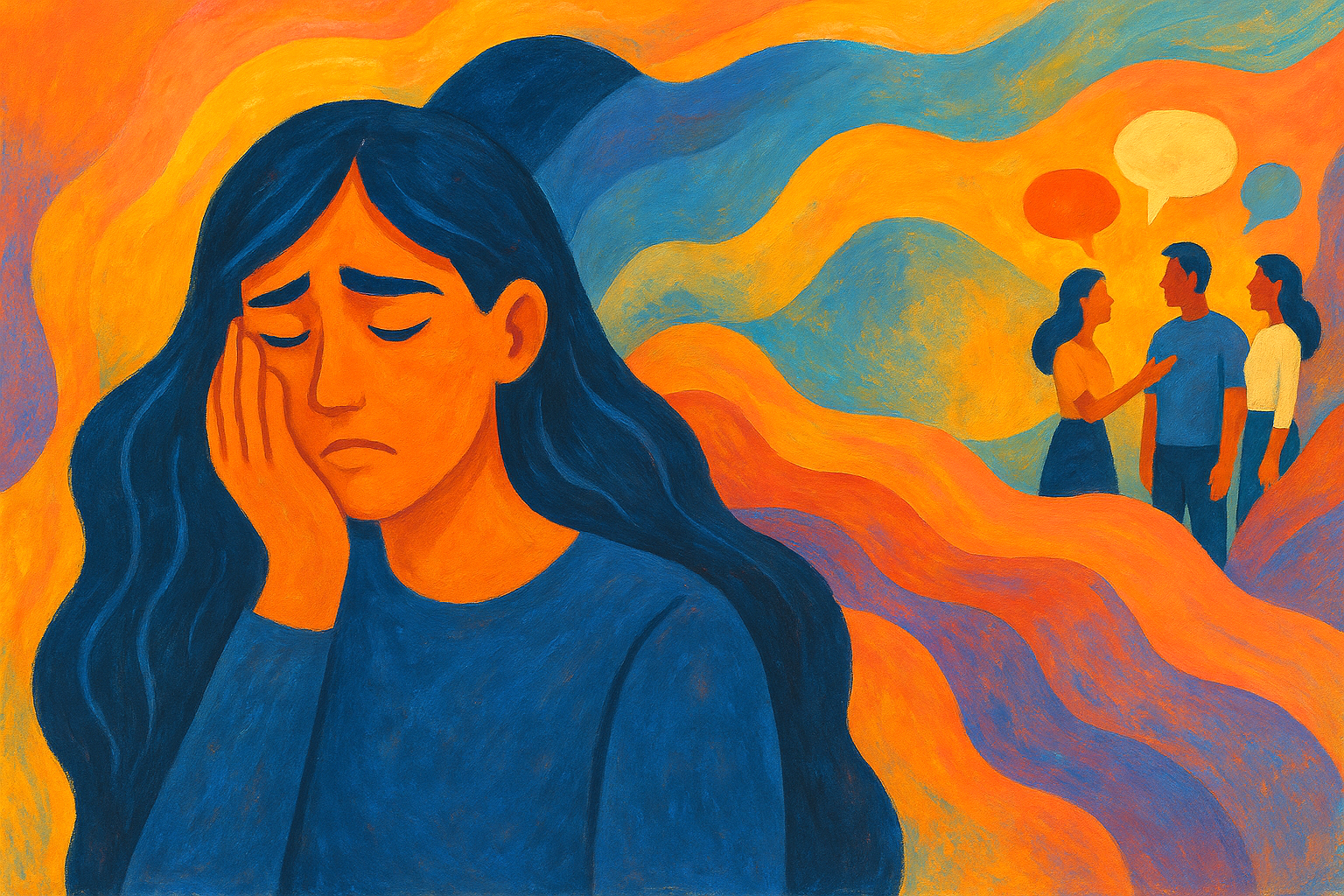
    We think our social anxiety comes from being afraid of other people’s judgment. But that’s not quite it. We’re actually afraid they’ll confirm the crappy things we already think about ourselves.

    When I bailed on that wedding, I wasn’t really worried about what my family would think. I was worried they’d see the “truth” I already believed: that I wasn’t interesting enough, put-together enough, or worthy enough to belong there.

    So instead of risking that pain, I chose a different pain—isolation. I projected my own harsh self-judgment onto everyone else, assuming they’d see me the same way.

    Talk about a messed-up strategy! By “protecting” myself from potential rejection, I guaranteed rejection by rejecting myself first. And worse, I created real-world “evidence” that I didn’t belong, which only fed my insecurities.

    My friend was caught in the same trap. She didn’t actually know she’d be judged at the wedding. But she was so convinced of her own unworthiness that she assumed everyone else would see it too.

    The Lightbulb Moment That Changed Everything

    For most of my life, I brushed off my social anxiety as “just being an introvert.” Convenient label, right? Helped me avoid admitting I was actually terrified.

    Then my friend Kayla—who has zero filter—called me out over coffee.

    “Sandy,” she said, eyeing me over her mug, “you realize you spend like 90% of your energy imagining what people think about you and maybe 10% actually finding out?”

    I almost choked on my latte. Ouch.

    That night, I grabbed an old journal and started tracking my thoughts before social events. Holy crap. I was spending HOURS in mental gymnastics:

    • Rehearsing conversations that might never happen
    • Coming up with witty responses to imagined criticisms
    • Planning defenses to judgments nobody had actually made
    • Obsessing over outfit choices to avoid potential comments

    I’d exhausted myself before even leaving the house! And the worst part? I was playing both roles in these imaginary scenarios—both the harsh judge AND the person being judged.

    Talk about a rigged game.

    So I decided to try something radical. My neighbor was having a dinner party that weekend. Instead of my usual mental prep work, I made myself a promise: just show up as-is. Not as the “entertaining Sandy” or the “impressive Sandy” or any other version. Just… me.

    I won’t lie—I almost bailed three times that day. But I went. And without all the usual self-judgment noise in my head, something weird happened. I actually listened when people talked instead of planning my next clever comment. Conversations felt easier. I laughed more.

    Afterward, my neighbor texted, “Thanks for coming! Loved our talk about your trip to Maine—we should grab coffee sometime.”

    Wait, what? I hadn’t rehearsed the Maine story. That was just me rambling about something I loved. And she… liked it?

    This tiny experience punched a hole in my belief system. Maybe, just maybe, people could like the actual me—not some carefully curated version I thought I needed to be.

    Getting to Know the Real You

    So here’s what I’ve figured out: the way through social anxiety isn’t becoming better at small talk or forcing yourself into uncomfortable situations. It’s about getting to know yourself—the real you under all that fear and protective armor.

    When you actually know and like yourself, other people’s opinions just don’t matter as much. You develop a kind of internal anchor that keeps you steady even when social waters get choppy.

    This journey toward knowing yourself isn’t always Instagram-worthy. It’s messy. But here’s what’s worked for me.

    1. Catch yourself in self-rejection mode.

    Start noticing when you back out of things because you’re afraid of judgment. Ask yourself, “Am I rejecting myself before even giving others a chance to accept me?”

    Last month, I almost skipped a reunion with friends from high school because “no one would remember me anyway.” Classic self-rejection! Naming it helped me pause and reconsider.

    2. Question your core beliefs.

    Where did you get the idea that you’re not enough? Most of us are carrying around beliefs we formed as awkward thirteen-year-olds! Some of mine were:

    • “I’m boring unless I’m entertaining people.”
    • “People only like me when I help them with something.”
    • “If I show my real feelings, people will think I’m too much.”

    Once you identify these beliefs, you can start collecting evidence that challenges them. My friend who missed the wedding realized her core belief was “I don’t belong in celebrations.” We traced it back to an eighth-grade birthday party disaster!

    3. Talk to yourself like you’re not a jerk.

    I used to have a running commentary in my head that I would NEVER say to another human being. “You’re so awkward. Why did you say that? Everyone’s just tolerating you.”

    Learning to speak to myself with basic decency was life-changing. When I feel anxious now, I’ll literally put my hand on my heart and say, “This is hard. Lots of people feel this way. How can I support myself right now?”

    Cheesy? Maybe. But it works.

    4. Baby steps, not cliff jumps.

    Recovery doesn’t mean immediately diving into your scariest social situation. That’s like trying to run a marathon when you’ve never jogged around the block.

    Start small. Maybe it’s:

    • Coffee with one friend instead of a group
    • A thirty-minute appearance at a party with permission to leave
    • A class where the focus isn’t on socializing but on a shared interest

    Each small win builds evidence against your “I don’t belong” belief system.

    5. Create a self-connection practice.

    You need regular check-ins with yourself to quiet the noise of imagined expectations and reconnect with who you really are.

    For me, it’s morning journaling with coffee before anyone else is awake. For my friend, it’s painting terrible watercolors that no one will ever see. Find what helps you hear your own voice clearly.

    Even four minutes of intentional self-connection can begin rebuilding your relationship with yourself. (Trust me, I’ve timed it!)

    My Cousin’s Do-Over

    Life can be weirdly generous sometimes. Three years after I missed my cousin’s first wedding, she got remarried (to the same guy—they’d eloped after family drama with the first ceremony, then decided to have a proper celebration later).

    When the invitation arrived, my palms instantly got sweaty. Here was my chance to do things differently, but the old fear came roaring back.

    This time though, I had new tools. Instead of spiraling into “what-ifs,” I asked myself, “What if I just showed up as myself? What’s the worst that could happen? What’s the best?”

    I felt the fear—it didn’t magically disappear—but I didn’t let it make my decision. I focused on how much I loved my cousin and how I’d regretted missing her first celebration.

    Was the wedding perfect? Nope. I spilled red wine on my dress within the first hour. I got stuck in an awkward conversation about politics with my uncle. I still felt twinges of “I don’t belong here” at times.

    But I stayed. I danced badly to the Cha-Cha Slide. I ate cake.

    And at one point, my cousin grabbed my hands and said, “I’m so glad you made it this time, Sandy.” The genuine joy in her eyes hit me harder than any anxiety ever could.

    Sometimes showing up is enough.

    The Gift of Just Being You

    For most of my life, I thought social anxiety was just “how I was wired”—some unchangeable part of my personality. But turns out, it wasn’t about who I am. It was about how I’d learned to treat myself.

    When I began treating myself with a fraction of the kindness I’d show to a friend, things shifted. Not overnight. Not perfectly. But genuinely.

    The less I needed external validation, the more comfortable I became in my own skin. And weirdly, the more authentic connections I started making.

    Look, I still get nervous before big social events. I still sometimes catch myself falling into the old mental prep work. But now I can laugh at it and gently redirect.

    If you’re someone who tends to hide rather than show up, please hear this:

    • The judgment you’re so afraid of is often coming from YOU first.
    • By rejecting yourself, you deny others the chance to know the real you (and trust me, the real you is actually pretty great).
    • The more you practice showing up authentically, the easier it gets.

    Your presence—your real, unfiltered, sometimes-awkward presence—is worth sharing. Don’t let your harsh inner critic rob the world of your unique perspective and energy.

    Maybe the greatest plot twist in this whole story is this: When I stopped trying so hard to be someone I thought others would accept and started accepting myself instead, I finally found the belonging I’d been searching for all along.

    Funny how that works.
  • How Weight and Food Obsessions Disconnect Us and Why This Is So Harmful

    How Weight and Food Obsessions Disconnect Us and Why This Is So Harmful

    “We are hard-wired to connect with others, it’s what gives purpose and meaning to our lives, and without it, there is suffering.” ~Brené Brown

    I was inducted into diet culture in my early teens and then into the health and fitness industry in my early thirties, when my “fitness journey” had finally really taken off, and I ultimately became a personal trainer and nutrition and wellness coach.

    Once we’ve given enough years of our life to diet culture, many of us begin to recognize the ways that it’s harming us and all the things it’s stealing from us.

    Peace of mind. Self-worth and self-trust. Mental, emotional, and physical health and well-being.

    My grandmother’s cookies.

    The ability to just eat and enjoy food without fear.

    Self-respect.

    Body trust.

    But we don’t notice all the ways “health and fitness” are promoted in our culture and how they do the same thing. And there are so many other things it steals from us that we often don’t think about or notice.

    One of the biggest examples of this for me, and the women I work with, was connection.

    Connection with myself and connection with others.

    I didn’t start losing my ability to connect because of my induction into diet culture. That started earlier as a result of growing up with an abusive, alcoholic father.

    But those industries preyed on it, fueled it, flamed it, and then ran away with it for decades.

    Feeling connected is a core human need. According to Maslow’s hierarchy of needs, love and belonging are right up there after things like food, water, and safety.

    We are hardwired to connect.

    Recent research has suggested that the brain processes the pain of feeling disconnected or rejected the same way it processes physical pain. Nearly every aspect of our health and well-being relies on connection.

    And while it may seem like we’re constantly connected, especially now through things like social media or video calls, it’s not actually the case.

    Loneliness has been on the rise, worldwide.

    Chatting about what food we should or shouldn’t eat; commiserating over how much we hate our bodies, how much weight we gained, the latest diet attempt we just failed; bragging about how we did in the gym, how much weight we lost, how many steps we took, or how “clean” we’re eating—this isn’t connection. It’s not connecting with others, and it’s definitely not connecting with ourselves.

    In fact, those things keep us from being able to connect with ourselves because we’re so focused on controlling external “shoulds.”

    We may form friendships around those things, but they aren’t based on genuine connections.

    Curating the picture-perfect Instagram feed, gathering around mutually hated or demonized “others,” and sharing memes or videos of the latest TikTok trend are also not the same as real, genuine human connections.

    It’s all just filling space with mindless, external distractions.

    It’s not truly allowing ourselves to be raw, real, and vulnerable. To be seen, heard, and valued for who we uniquely are as individuals—not just the perfectly curated image we present to the world but the messy, raw, and real parts we try so hard to hide.

    The parts we fear make us most undeserving of love and belonging.

    I certainly hid behind many of those things. I used them as a cover, as a tool to hide behind. A mask. A role I played, behind which I could feel (somewhat) safely tucked away and protected.

    My “passion for health and fitness” allowed me to play the badass.

    (In reality, I was scared all the time.)

    It allowed me to play the inspirational “success” story.

    (In reality, I was terrified of putting an ounce of weight back on because I desperately craved the praise and validation I was receiving. And it was destroying my mental, emotional, and physical health and well-being).

    The strong, fearless, confident “fitness freak” that could do anything she put her mind to.

    (Which, in reality, hid the fact that I was so scared and emotionally fragile and felt so broken that I needed the physical strength I could build through exercise just to get through the day.)

    I was good at these roles. I loved these roles, at least in the early years.

    Just be what people expected. Be what I’d seen get celebrated in others. Easy, right? Sure, until it isn’t.

    The longer I wore the mask, the more it started to hurt.

    The harder I worked to keep up those appearances, to maintain that external image of perfection through my body and what I was eating, the more damage it was doing.

    Externally, I was doing everything “right.”

    In reality? I ended up a binge eater, bulimic, clinically depressed, and living with generalized anxiety disorder and panic attacks. For many reasons, not the least of which because I was completely disconnected—from myself, my body, and from others.

    I was so focused on trying to be something I thought I was supposed to be, so I’d be liked, admired, impressive, that I lost who I was and what I needed.

    I lost what truly mattered to me and in life.

    I lost the ability to trust myself, to trust others, to let them in and truly see me.

    In fact, I was terrified of being really seen.

    Because I didn’t like myself and I didn’t believe anyone else would either if they knew the real me.

    So I hid behind what my body looked like. My external strength. The image I built.

    Holy cow, it got exhausting. And soul-crushing.

    You simply cannot simultaneously spend your life worried about what other people think about you (or your body), trying to micro-manage and control the image you project, and also be truly connected to yourself and others in any meaningful way. 

    Because in order to keep up those appearances, you have to actively work to hide parts of yourself—large parts of yourself that you’re terrified will be seen if you dare take off the mask.

    If you’re actively hiding parts of yourself, you’re not able to truly feel seen, heard, and valued… because you are hidden away. Locked in some dark, dusty corner of your inner world, and in my case, stuffed down with food.

    After a while, I didn’t even remember who I was. My identity became so wrapped up in who I thought I was (a worthless failure who was completely undeserving of love or acceptance) and who I was trying to be (the perfect, badass inspiration) to hide it, that I was lost.

    And completely disconnected. From myself and others.

    What I wanted or needed didn’t matter because my entire existence was being driven by fear and the disconnection that causes.

    Fear of rejection and abandonment if I stopped playing the role.

    Fear of weight gain and not looking “good enough.” Fear of not being good enough. Fear of what the binge eating was doing to my health. Fear of what would happen if I stopped micro-managing every morsel of food I ate and just trusted myself with food.

    Fear of judgment.

    And every time I turned around, there were diet, “health and wellness” cultures swooping in and stoking those fears.

    Eventually, I recognized that I couldn’t keep it up. I couldn’t keep playing the role. I was too tired, and it had completely broken me. I couldn’t keep caring about trying to be impressive or accepted. I had to start caring about being healthy and at peace with myself.

    In order to do that, I needed to find my way back to myself. I needed to shut out the garbage that was keeping me disconnected and learn how to connect.

    First with myself, because how could I ever truly connect with others if I didn’t even know who I was when I wasn’t playing the role?

    And how could I heal all that weight and food stuff if I stayed in the fear and obsession that kept me so disconnected from myself?

    I couldn’t.

    So I started working on being present with myself, not an easy feat when you don’t much like yourself. But required, nonetheless.

    I started getting curious and practiced connecting with my body, my thoughts, my emotions, my needs… my inner world.

    Who was I, really?

    What really mattered to me in life?

    Forget what I thought I should eat or do… what did I need?

    Was I really put here to spend my life hating myself, obsessing over these things that are destroying me, distrusting myself, and fearing real, meaningful connection with others?

    What if I could find a way to unconditionally accept myself and my body? How would that change the way I treated it and showed up in the world?

    What did I want to eat? Forget what I was “supposed to” eat; what did I want? How were the foods I was eating making me feel? How did I want to feel in my body?

    Forget what it was supposed to look like or weigh; how did I want it to feel to live in? How were my thoughts and conditioned patterns with food and exercise impacting that? Were they helping or harming? How could I learn to change them if they weren’t?

    And I started practicing being more intentional with my thoughts, beliefs, and actions. Intentionally making choices that were loving and kind, that helped me feel better, in general and about myself. Anything that wasn’t helping me live or feel better, and more connected with myself, could have no place in my world anymore.

    Once I started feeling deeply connected with myself and my body, I slowly started working on learning to connect with others.

    That’s still something I find difficult and am learning to do, but I’m still practicing. In baby steps.

    Because what I learned when I started reconnecting with myself was how much living with an alcoholic father impacted me as an adult.

    It taught me that not only is the world scary, but people are. They’re scary and unpredictable. It also created abandonment issues, and it’s where the fear of not being good enough, and the feeling that I needed to play a role to be loved or accepted, had actually begun. No wonder I had so much trouble connecting.

    I share this story because I’ve come to realize that most of us have an underlying fear around not being good enough that started in childhood for one reason or another. And those predatory industries sneak into every corner of our world, capitalizing on our fear with broken promises that do nothing but make things worse.

    The weight and food obsessions are a diversion.

    A socially acceptable, surface-level distraction that keeps us so externally focused and consumed that we spend most of our adult lives not even knowing that we’re disconnected—or that we’re living in fear and we’re just trying to “fix it” by making ourselves feel more socially acceptable.

    All while disconnecting us more and more. From ourselves and others.

    Because we’re hiding behind diversions and masks.

    Well, my mask is finally off.

    Under it, I have belly rolls. I have wrinkles. I have gray hair. I dye it because I prefer dark hair, but sometimes I put it off and rock a solid skunk stripe of gray down the middle of my head.

    Like all bodies, mine changes.

    None of that means I let myself go. It means I let myself just be.

    I’ve overcome a lot of things in my life, but still struggle with some others.

    I screw up a lot, even fail sometimes. Often, actually.

    I’m exceptionally good at some things and full-on suck at even more.

    I can’t do everything myself. Sometimes I need help and support. I’m still not very good at asking for it, but I’m working on it.

    All of that simply means that like you, I’m human. And I cannot connect with myself or anyone else if I’m trying so hard to be impressive that I’m not being real.

    So I don’t anymore.