Tag: self-loathing

  • Bulletproof Self-Love: How to Build an Unshakeable Relationship with Yourself

    Bulletproof Self-Love: How to Build an Unshakeable Relationship with Yourself

    “Before you put yourself down, please consider everything you’ve accomplished to get to this point, every life you’ve touched, and every moment you’ve pushed beyond your fears. You are a champion, a fighter. You are worthy of nothing less than the deepest love you have to share.” ~Scott Stabile

    It seems that we’re being bombarded daily with heart-felt messages to love ourselves more. It’s everywhere—from our Instagram newsfeed to handprinted tote bags to the “You are worthy” mural at your local coffee shop.

    I appreciate the society-wide agreement we seem to have made to remind ourselves to choose self-love.

    But endless commandments like “Put yourself first!” and “Remember your worth!” rarely explain how to actually follow through with it. We talk about self-love and self-worth as though it’s a matter of remembering to floss your teeth at night—as if you can choose better relationships, set healthy boundaries, and take care of your body by just remembering to do so.

    If it doesn’t come easily, loving yourself might feel like walking into a new job with no training and being expected to figure it out without a manual or supervisor. Through no fault of your own, you may not have developed the muscle for self-love and care.

    I know this because I’ve had in-depth conversations with people who flat out told me, “I don’t know how to have compassion for myself.”

    You don’t have an arduous, uphill struggle to feel worthy and self-loving because you lack the inner capacity for it.

    If you know how to feel hand-on-chest, lower-lip-puckered-out sympathy and compassion for others—even if it’s for endangered polar bears—then you have the capacity to cultivate this feeling for yourself. And it’s not your fault if you feel lost on where to begin.

    Working with Your Unloved Parts

    The culprits that thwart your best efforts to practice self-love often come from your shadow—an unconscious receptacle that safeguards all the parts of yourself that’ve been rejected and pushed away. Your shadow deploys a lot of unconscious strategies to make sure you keep sabotaging yourself and avoiding your rejected parts.

    Because laziness was deeply entrenched in my shadow, I learned early in life to cope with my unlovable parts by overworking myself. Every nook and cranny of my calendar was chock full of social outings, chores, hurried “leisure” walks, and things to occupy my mind. I only felt good enough when I was constantly busy, so I developed a wicked good avoidance strategy that kept the inner scarcity just below my level of awareness.

    Eventually, I noticed this endless game of tag between me and the horrific emptiness. I learned to stop pushing it away and instead developed a capacity to be with the sensations it stirred up in my body.

    There are remarkable benefits to working with any fear or disgust you have toward your shadow parts, but a lot of folks run into roadblocks because we’re wired to avoid pain and move toward pleasure.

    When the terror of shadow parts arises in the body, our visceral reaction is often to push it away, lodging it further away into our psyche.

    Neuroscience has also shown us that negative self-talk can actually give you a dopamine hit if it’s what your brain thinks is “correct,” even if the beliefs are negative and sabotaging.

    This leads us to push away our unloved parts and berate them.

    Thankfully, there’s another option.

    Integrate your shadow parts by creating a safe space for them—more specifically, for the uncomfortable emotions that emerge around them. For example, if you habitually feel anxious in social situations because you think of yourself as being awkward, you can practice integrating your “awkward self” by creating space for the disgust or fear associated with it.

    Being with difficult emotions means being with the sensations without feeding them negative thoughts. This actually sends signals of safety to your brain and nervous system that lowers the internal red flags. With continued practice, your brain loses a reason to push the pedal to the metal on stress responses like anxiety, and the uncomfortable sensations begin to subside. This is the true meaning of “facing your fears.”

    When you reach the other side of a difficult emotion, it often feels divinely euphoric and empowering—like you’re walking across the finish line of a marathon. Allowing emotions to pass through your body builds resilience. Every time you practice the art of allowing, it becomes easier to anchor back into your power.

    Practicing Self-Love

    Nurturing your capacity to think self-loving thoughts, be self-loving, and feel the sensations of self-love is also a necessary practice.

    You might be surprised to learn that you could be projecting all your love onto other people. Whether it’s a romantic partner, friend, or tv character, if you shower them with adoration, there’s love inside you, but perhaps it doesn’t feel quite at home. Parts of you might feel deeply flawed or incomplete—whether you’re conscious of it or not—so you’re shoving your love into the hands of someone else instead. Projecting love onto others is a way of defending yourself against inner parts you’ve deemed unlovable. Everyone does this in some form or another.

    The remedy to this situation is taking back those projections and investing time and energy into finding and loving those qualities in yourself.

    We all have a negativity bias in our brains, so we pay more attention to what’s wrong, unsafe, or not good enough about ourselves and the world around us. If this default setting is left unchecked, it leads to major brain ruts—and well, we’ve all met a curmudgeon before!

    If you want to lean into what’s radiantly loveable about yourself, you have to shamelessly focus on what you want to love about yourself. If you’re not sure what that is, then choose something and nurture the hell out of it. Tenacity goes a long way when you want to reverse old patterns.

    Around the time I began learning to face my own inner void, I took myself on a journey of self-love and self-care through embodied sensual movement and pole dancing.

    I call it my divine intervention.

    Seemingly out of nowhere, I instinctively knew one day I wanted to become a pole dancer. Even though I had literally zero background in dancing or physical exercise in general, I realized that I had a dancer’s heart inside of me. As luck would have it, a brand-new studio had just opened up in my city six months earlier.

    I signed up for an assortment of classes, but it was the feminine movement pole dancing class that captivated me. I’d been in a rush my whole life—for no particular reason at any given moment—but this slow-as-honey practice forced me to start paying attention to myself in ways I never had before.

    I invested in myself by taking these classes. It allowed me to stop feeling guilty for being lazy. I didn’t need to overstuff myself with work, relationships, or other outside sources of validation anymore. I learned to slow down, feel my body, and take better care of myself.

    Learning to love yourself and know your worth is like having direct access to your inner authority. The self-doubt, sabotage, and low self-esteem lose their power and you finally get to take the helm. If you’re ready to stop second-guessing and minimizing yourself, here’s how to get started.

    5 Ways to Start Loving Yourself

    1. Expand your capacity to be with your unloved parts.

    Every time you create space for an unloved part, you’re changing the relationship between you and that part. Even if you have lots of deep wounds, your relationship to yourself is always changing. The key to creating safe space for your parts is staying with the sensations of fear or disgust and away from stories. If you allow thoughts of worry or self-judgment to run the show, the unloved parts won’t get reconditioned.

    The best way to do this is to work with emotions in real time. Find a quiet place to breathe through the sensations. Emotions run a lifespan of ninety seconds at most if you don’t retrigger the emotion with negative thoughts.

    2. Open up your nervous system to receive love.

    This is about practicing the art of receiving goodwill and kindness in all forms—positive feedback, compliments, and words of affirmation.

    How often do you fully accept a compliment? How often do you pause to let kind words—whether it’s a thank-you email from a friend or gratitude from a stranger—land in your body? We’re so quick to brush off affirmations, so what if you rewarded yourself by unapologetically receiving them instead? Make a practice of slowing down enough to take it all in. When you do, you’re reinforcing the pathway to connection and self-love in your nervous system.

    3. Affirm yourself with the love you give to others.

    If you already have the capacity to love others, then there’s an existing pathway to self-love. It just needs to be rerouted back to you.

    On a neurological level, if self-love feels like a stranger to you, the neural networks related to your self-image probably have a poor association with the biochemicals related to emotions around love and worthiness. Thankfully, neurons that fire together, wire together!

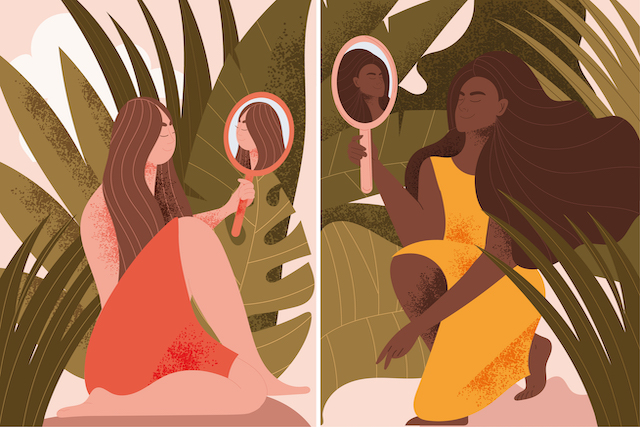
    Try this exercise in front of a mirror. Think of someone you deeply love and would describe as being super “loveable.” Close your eyes, see that person in your head, and think about why you love them so much that you can literally feel the tingly sensations coursing through your body. Then quickly open your eyes and repeat to yourself while looking in the mirror, “I am so loveable” with an extra emphasis on “I.” Make sure to work up the feeling on a visceral level in your body before you open your eyes. You’re “borrowing” the feel-good neurons while activating the self-image neurons to create new neural pathways.

    Have fun with this and change out “loveable” with other qualities you want to feel toward yourself in each round. Repetition matters, so make this a regular practice.

    4. Create actionable self-love.

    If you truly loved yourself in the way you wanted to, what would you do differently? Make a list of specific behaviors you want to change. For each one, ask yourself, “What’s the absolute smallest step I can take to work toward creating this behavior—something so small, I can do it right now?”

    Hint: the smallest step is always smaller than you think. For instance, if you want to ask for the pay raise you deserve, you might think the next smallest step is writing a letter of justification. If you feel head-to-toe inspired to do that right now, by all means, please do! But give yourself permission to start even smaller if the thought of drafting a letter immediately gives you anxiety. The goal is to start building momentum right NOW, so keep the steps super small and easy to do.

    5. “Drop in” to your embodied self-worth.

    You have access to your self-worth any time you want because it’s inherent. There’s nothing you ever need to do to earn it. Even if you’re not sure what it feels like, your worthiness is always there, waiting for you to reconnect to it.

    Getting into your body senses is a fantastic way to find where dignity lives in your body so that you can deepen your relationship with it. Make it a regular practice to take a few minutes to turn inward and “get to know” your non-negotiable worthiness. Where is it located? If it was a color, what color would it be? If it was a shape, what shape would it be? What’s the texture, movement, and sound of your self-worth? Bring it to life and revisit it often. Remember that every good relationship requires nurturing.
  • 8 Signs You’re Carrying Deep Shame and How to Start to Heal

    8 Signs You’re Carrying Deep Shame and How to Start to Heal

    “If you put shame in a petri dish, it needs three ingredients to grow exponentially: secrecy, silence, and judgment. If you put the same amount of shame in the petri dish and douse it with empathy, it can’t survive.” ~Brené Brown

    Did you know that one of the biggest causes of suffering is unacknowledged shame? It makes us believe that there’s something wrong with us and we’re not good enough.

    When we have deep shame inside, instead of being true to ourselves, we “dress to impress” so others will like us, which eventually makes us tired, depressed, and anxious because we’ve become disconnected from our true essence.

    Having shame isn’t the issue; the real issue is resisting or trying to cover it up. The more we try to keep shame hidden, the more we live in limitation and self-protection and experience stress in our system.

    We may experience self-hate and a constant critical inner voice. Those parts of us don’t want to be suppressed, forced to change, or told they’re bad or wrong; they want to be seen, heard, and embraced in unconditional acceptance and love.

    Many of us try to hide our shame because we don’t want to feel that deep pain. And if people look at us in a weird way, criticize, judge, or leave us, then what? We’ll be all alone. Well, that may not be true, but that’s what we may have experienced in the past, and we fear it happening again.

    We may want a new relationship and to be intimate, but a part of us may push it away because we’re afraid that they’ll see that we’re not perfect human beings and leave. Then that would re-affirm the false belief that we’re unlovable or unworthy.

    We may want to share our creativity and/or express ourselves in some way, but we’ve been shamed for doing so in the past, so we stop ourselves because we don’t want to be hurt again.

    We may want to do inner healing, but if we do, we’ll get in touch with the parts of us that are hurting, and feeling those feelings may seem overwhelming because we’re used to suppressing them and they’re attached to past pains or traumas.

    Some of us were shamed for making a mistake in the past, even though making mistakes is part of learning. When we fear making mistakes, we tend to self-sabotage or procrastinate.

    Sometimes we use food, drugs, alcohol, or being busy to try to numb and get away from our painful and shameful feelings.

    Sometimes shame manifests as chronic fatigue, self-criticism, depression, low self-esteem or painful sensations in our body. We may feel self-conscious, anxious, and insecure and have a hard time speaking up or receiving gifts and compliments because we don’t feel worthy of them.

    So what is shame really? It makes us believe that we’re bad, wrong, unlovable, or unworthy. Those ideas stem from not meeting other people’s expectations of how we should be, or from experiences that made us feel embarrassed.

    Because we didn’t know how to cope with or process our feelings at the time, we developed a negative lens through which we now see ourselves and others that dictates what we do and don’t do.

    If we were shamed for or felt shame about something as children, we usually try to find a way to compensate for it as adults. What do I mean?

    As a child, I was teased for being fat and ugly, and I blamed my body for me not having any friends and for my father criticizing and teasing me.

    At age thirteen, my doctor told me to go on a diet. When I lost weight I received compliments and recognition; however, I took it to the extreme, and at age fifteen I became a severe anorexic. No matter how many therapists or treatment centers I went to (which were numerous), I wouldn’t let go of the disordered eating behaviors that I thought kept me safe.

    I developed survival strategies, exercising non-stop and eating very little, so I would never be fat and teased again. However, as much as I tried to protect myself from the shame of being fat, I was now being shamed for how and what I ate and what my body looked like.

    My father told me he was embarrassed to be seen with me, and I was made fun of, criticized, and judged from people on the street, the therapists I was seeing, and the those in charge in the treatment centers I was in.

    So, in a sense, I was being shamed for trying to cope, feel safe, and survive.

    At age fifteen I became obsessed with money to try to compensate for the powerless, shameful feelings I was having.

    Money gave me a fleeting, false sense of power and worthiness. If I wasn’t working and earning money, I felt like a horrible person.

    I was trying to hide my deep shame and feel worthy, valuable, lovable, and safe by controlling my food and weight and how much money I made and saved, but none of that ever made me truly feel okay or healed my deep pain and shame. Deep inside, I was still experiencing depression, anxiety, a critical voice, and self-hate, and I was acting in self-harming and self-depriving ways.  

    When people used to say to me, “Debra, you just need to love yourself,” I thought, “Yeah right, what does that even mean? I don’t deserve to be loved and cared for. I’m bad. I deserve to suffer, to be punished, criticized, and deprived, and to struggle in life.”

    This is what unresolved shame does. It creates a shame-based identity. It runs our subconscious programming, disconnects us from our authenticity, and makes us believe that there’s something wrong with us—that we’re unworthy, unlovable, and not good enough.

    We don’t stop loving the ones who shamed and hurt us; we stop loving ourselves, and we start treating ourselves in the same ways they did. The external rejection becomes our own internal rejection.

    It may be helpful  to understand that people who blame, shame, or criticize us are also hurting and have deep wounds that make them feel as if they’re bad, unworthy, and unlovable. Their inner child is saying, “Please love me” just like ours is.

    When we feel a sense of shame, most often our attention is focused on fixing ourselves to fit into the standards of the world so we can be loved and accepted. By doing so, we often deny how we’re truly feeling and instead look for the “right things” to say and do, which keeps us from living our truth.

    Instead of fixing ourselves to cover up how we’re truly feeling, we need to take the time to understand why we’re feeling, thinking, and acting how we do, which may be coming from past traumas, hurts, and wounds. 

    If we keep our shame hidden, we may feel stuck inside, which makes us feel stuck in our lives because our minds and bodies continue to react automatically from the past painful and unresolved experiences.

    Not sure if you’re carrying deep shame? How much of this is true for you?

    • You’re unable to find inner peace. Deep inside you don’t feel good enough, like there’s something’s wrong with you.
    • You need to be loved and approved of by others in order to love and approve of yourself.
    • You feel insecure and unworthy and constantly compare yourself to others.
    • You see yourself and others through the lens of past painful experiences.
    • You’re afraid to try new things, share your creativity, share how you’re truly feeling, or ask for what you want and need because you don’t feel worthy, or you’re afraid of feeling embarrassed or shamed.
    • You mold yourself to try to fit in with what everyone else is doing instead of following what has true, heartfelt meaning for you.
    • You often feel anxious and afraid, and you have a constant critical inner voice.
    • You try to achieve as a way to prove that you’re worthy, valuable, and lovable.

    Since being shamed makes us want to hide those parts of ourselves that were unacceptable, healing happens when we bring those parts into the light of awareness and embrace them with unconditional acceptance and love.

    Healing starts to happen when we recognize and break free from the trance we’re living in. We do this by going to the root cause(s) of the shame and resolving that unresolved pain with compassion, love, and a new understanding.

    Healing starts to happen when we learn how to be more compassionate with ourselves and instead of saying “Why can’t I just…?” We ask ourselves “What keeps me from…? How can I help that part feel seen, heard, understood, and loved?”

    Healing starts to happen when we begin to uncover, discover, and embrace our natural qualities, talents, and abilities and allow those parts of us to be felt and seen.

    Healing starts to happen when we learn how to speak to and treat ourselves in more kind, compassionate, and loving ways, and also believe that we’re worth it.

    Please remember that healing is a process. Our system is conditioned to be a certain way, and our minds and bodies love to stay with what’s familiar. Working with our tender, hurting parts with love and compassion can help us break out of the trance of past hurt and wounds and experience what true love and inner peace really means.

    So, instead of trying to get rid of the shame or cover it up, embrace the parts you’re ashamed of with unconditional acceptance and love. Let yourself and your inner child know that you are beautiful, valuable, and lovable as you are, even with your wounds and scars.

  • How to Protect Our Kids from a Lifetime of Food, Weight, and Body Image Issues

    How to Protect Our Kids from a Lifetime of Food, Weight, and Body Image Issues

    I went on my first diet when I was around fourteen or so because, as they often do in growing teens, my jeans started getting tight.

    And because I grew up in the same anti-fat culture we all have, I hated myself for it.

    Around the same time, an adult in my life who was always obsessed with “eating healthy” gave me a copy of the new book she was reading outlining the healthiest way to eat.

    It was a book on the Atkins/low-carb diet.

    The author spent the bulk of the book demonizing carbs, explaining in convincing-sounding detail all the science he supposedly had about not only how harmful carbs were but how they were the cause of weight gain.

    Three things happened from reading that book.

    1. I became scared of eating carbs and started trying to eliminate them because, while of course I wanted to be healthy, I was terrified of gaining weight.

    2. Instead of losing the five pounds or so that I wanted to lose, I gained about five pounds and a slow progression of weight gain continued for years. Because the harder I tried to eliminate the carbs, the more I craved and obsessed over them; always eventually caving, eating them, and then hating myself for it and promising to start “being good tomorrow.

    Eventually the caving led to overeating them because “as long as I was being bad anyway, I may as well eat them all and get them out of the house so I won’t be tempted when I start being good again.”

    3. An almost three-decades-long war with my weight, my body, myself, and food began. A war that resulted in a hospitalization in my early thirties, after my first foray into the world of “it’s not a diet; it’s clean, healthy eating,” for bulimia so severe I often felt like I was going to eat myself to death.

    And the whole time, I blamed myself for it. I believed I was stupid, weak, pathetic, a pig who needed to try harder to control myself.

    So I kept trying. For more than half my life I tried, and it almost killed me.

    I’ve been working with women around the whole weight and food thing in one form or another for over fifteen years now. I started sharing my story because after listening to other women describe their histories with food and weight, I realized that my story is not unique.

    Varying degrees of my story are the norm, and they all start in basically the same seemingly innocent ways.

    We want to lose weight or “eat healthier,” so we do what we’re taught we’re supposed to.

    We start a diet or “healthy eating plan” of some sort that tells us what we “should” and “shouldn’t be” eating. This leads to a lifetime of trying to control our intake and our bodies, which results in disordered eating patterns, weight cycling, and self-loathing.

    I regularly hear from women in their seventies or eighties who have spent their entire lives fighting this losing battle with themselves to “eat right” and lose weight.

    In one survey of US women a few years ago, 75% reported disordered eating behaviors or symptoms consistent with eating disorders.

    My recovery didn’t start until I realized a few basic truths.

    First, if I had any hope of healing, I had to figure out what was causing my eating issues. Ultimately, it came down to my conditioning: patterns of thoughts, beliefs, and behaviors that had developed over the course of my life as a result of many different things, not the least of which being:

    1. The stories I had learned to believe about bodies and the people in them: Big ones are bad, unhealthy, undisciplined, and lazy. Small ones are good, healthy, and disciplined, and they work hard.

    These misguided beliefs taught me not only to live in fear of weight gain and the harsh judgment of others if I gained weight, but also to judge myself and my body harshly when I did so. This contributed to not only the decades of weight gain and disordered eating but ultimately the eating disorder.

    2. The stories I’d learned about food: These are the good foods, the healthy foods, the foods you should be eating, and those are the bad foods, the unhealthy ones, the ones that cause all manner of disease, poor health, and weight gain. Those are the foods you have to give up forever, or only allow in moderation.

    These misguided beliefs taught me to live in fear of food and my body becoming unhealthy or fat if I dared to eat the “wrong” thing. This created the never-ending pattern of promising myself I was going to “be good” only to end up craving, caving, hating myself, and starting over that I felt trapped in for so many years.

    3. Disconnection with myself, my body, and my own needs: As long as I was trying to make myself eat or do the things I thought I “should” do in order to control my body and my food intake, I was stuck in my head. Stuck in fear. Disconnected from myself, my body, and even the decision-making part of my brain. Ruminating, promising, obsessing, hating.

    In that state, I had no ability to understand the messages my body was constantly sending me about what it needed, nor did I have any concept that my body was something that could be trusted to tell me that. I saw it as an enemy to be ruled over, controlled, and beaten into submission… rather than the ally, healer, and communicator that it is.

    4. Self-loathing: I didn’t like, love, trust, or value myself, so my entire self-worth and relationship with myself relied on what my body looked like and my need to control how others saw me.

    The second truth I had to realize: if I had any hope of recovering and making peace with myself, my body, and food, I had to change the things that were causing the war.

    That meant giving up the obsession with my weight and eating or looking perfect.

    I had to recognize those things for what they were—distractions that kept me from dealing with the issues that were causing the problems in the first place and were making matters worse.

    So I put all my energy into changing the causes.

    It didn’t happen overnight, but one day I realized I couldn’t remember the last time I’d engaged in compensatory behaviors. The binges were getting fewer and farther between.

    And then I couldn’t remember the last time I binged or even overate, and I couldn’t even imagine ever doing it again.

    It’s been many years since those things were my daily reality, and I’m thrilled to say they simply don’t exist in me anymore because I changed the conditioning that was causing them. I learned to reconnect with and trust my body when it tells me what it needs or wants, and I learned to value myself enough that I cannot imagine treating myself or my body poorly anymore.

    Recovery and peace are blessings that I don’t take for granted for a second and I’m still grateful for every minute of the day.

    But disordered eating and eating disorder recovery are unbelievably difficult, prone to multiple relapses, and many aren’t so lucky.

    This brings me to my main points because the simplest solution to disordered eating or eating disorder recovery is to prevent those things from ever starting in the first place.

    That’s my dream, to save future generations from growing up with the disordered eating patterns/eating disorders and horrible body/self-images that ours has grown up with.

    It starts with us, as parents.

    What I Wish Parents Understood

    Living with disordered eating patterns or an eating disorder is a special kind of hell that I wouldn’t wish on anyone.

    It’s like living with the meanest, most self-destructive monster in your head one can imagine.

    You know the things you’re thinking and the choices you’re making are harming you, you know they’re making you miserable, you’re desperate to stop, and yet… no matter how hard you try, you can’t.

    You feel powerless. Hopeless. Helpless. Trapped.

    Recovery was one of the hardest things I’ve ever done in my life—and I’ve not had an easy life, so that says a lot.

    Given this, it’s my view that in addition to helping those struggling recover, prevention at an early age needs to be a top priority.

    And parents, I’m not trying to place blame, but after fifteen years of hearing women talk about their struggles, I’ve come to realize that we are often a big part of the cause, although not purposely of course.

    We all have our kids’ best interests in mind.

    We want our kids to be the healthiest, most confident versions of themselves, and we’re all doing the best we can to help them get there.

    We want them to maintain healthy bodies and eat nutritious foods. Nobody doubts that we all want the best for our children and are doing our best.

    But the way we’re approaching it is almost guaranteeing that our kids are going to struggle with the same food issues, eating disorders, or a lifetime of disordered eating and failed diet attempts that so many in our generation have.

    They’re learning to fight the same wars we have in the same ways we learned to fight them.

    All the things we typically do to try to help encourage health (restricting “bad” foods, teaching them that some are “good” and some are “bad,” encouraging them to lose weight or even acknowledging their weight) are among the worst things we can do for the health of our children.

    It’s difficult to overstate the damage that weight and food shame does to adults, and that damage is worse in children.

    We also have to remember that they learn from us. If your kids watch you struggle with food and your weight, if they see you tie your mood and your self-worth to your scale, they are going to be at a significantly higher risk for developing an eating disorder or living with those same struggles themselves.

    So this is what I want parents everywhere to know: encouraging weight loss, labeling or restricting their food intake (good vs bad, allowed vs not allowed), discussing weight, restricting foods, and dieting yourself—all of those things that millions of us are doing every single day that diet and healthy eating cultures have taught us is expected or accepted—they’re putting our children at risk.

    Research has shown that the younger girls are when they go on their first diet, the more likely they are to engage in extreme weight control behaviors like vomiting and laxatives (that’s an eating disorder), abusing drugs and alcohol, and becoming overweight by the time they reach their thirties.

    One out of four dieters will develop some type of eating disorder. That’s a number that’s doubled in the last twenty years. And the majority of the rest develop very disordered eating patterns.

    Eating disorders are widely recognized to have the highest mortality rate of all mental illness, while also being among the most underdiagnosed and under/poorly treated.

    Not even to mention the levels of anxiety, depression, and self-loathing that typically come from years of living with disordered eating and battling with our weight.

    There is a better way.

    Encouraging Healthy Choices Without the Risk

    DON’Ts

    Don’t discuss weight, size, or bodies—not yours, not theirs, not anyone else’s.

    Don’t let other people discuss their weight in front of them—not their doctor, not relatives, no one.

    Don’t label foods—no good, no bad, no healthy, no unhealthy… no food labels. At all. Binary food labels can cause shame, create self-punishing behaviors, destroy our relationship with food, and contribute to overeat/binge/restrict cycles that can take years to heal.

    Don’t tell them they are what they eat—our food choices don’t determine our worth.

    Don’t restrict foods—let them eat what they want. Restriction leads to guilt, shame, overeating, or bingeing and fuels disconnection.

    Don’t force exercise or “burning off calories”—encouraging exercise as a means of weight loss is setting them up for trouble.

    DOs

    Do encourage them to consider how their food choices make their body feel. How does that big mac and fries make their body feel when they’re done eating? What about the candy for breakfast? Do they feel good when they’re done eating? Or do they feel sick? Would they rather feel good, or sick? How does skipping a meal make their body feel? Do they want to feel that way? Do they really want to ignore their body’s most basic human needs with restriction? Why?

    Do encourage them to consider why they’re eating. Are they physically hungry? No? Are they emotionally hungry? Teach them the difference and help them learn to accept, honor, and express the emotions they’re trying to feed or soothe rather than ignore or numb them.

    Do teach them the value of understanding the why behind the choices they’re making and how their choices are often a result of their relationship with themselves.

    Do teach them that the relationships they have with themselves, food, and their bodies are the most important relationships they’ll ever have in their lives and to protect and nurture them.

    Do lift them up, teach them to value themselves exactly as they are, for who they are, not what they look like, weigh, or how they eat. Teach them to value and respect others, no matter what size they are.

    Do teach them about self-acceptance, kindness, authenticity, self-compassion, and the power of mindful living.

    Do teach them to appreciate the wonder and magic of their bodies, no matter what size they are. Teach them how to stay present in the moment and in their bodies, so they learn to listen to and trust their own bodies.

    Do teach them humans come in all shapes and sizes—and that no one shape or size is any better than another.

    Teach them that they are enough, exactly as they are, and that neither their bodies nor their food choices define their worth.

    And that will all be way easier if you learn it for yourself first.

  • How Mindfulness Made Me an Empowered Introvert (and How It Can Help You)

    How Mindfulness Made Me an Empowered Introvert (and How It Can Help You)

    “Introverts live in two worlds: We visit the world of people, but solitude and the inner world will always be our home.” ~Jenn Granneman, The Secret Lives of Introverts: Inside Our Hidden World

    Never at any point in my life did I think I was an introvert. I always thought I was just a regular kid flowing with life’s experiences just like everyone else, and there was nothing strange about me.

    That was until I started being told I was too quiet, serious-faced, shy, and a nerd. I liked, and still do like, my own space and doing things by myself or with a very close friend. Spending time at home surfing the web, learning new things, and obsessing over the latest technology has always been my thing.

    I never liked the idea of being around groups of people, attending parties, and socializing for long periods of time because I felt weighed down and lacked energy for such activities.

    I would always feel anxious and self-conscious walking outside, and whenever someone approached and started talking to me, things would end up being awkward no matter how hard I tried to keep a steady conversation going.

    Such was my life. As I kept growing, it became so much of a bother that it started affecting how I perceived myself.

    I became more anxious—stressed about socializing and being outside, making friends, and even expressing myself in serious situations like job interviews.

    I also had a bad temper back then, and whenever I got angry, I turned into this ugly and angry bear that could not be calmed down by anyone. After my moments of anger, regret would slowly creep in, and I would chew myself up for all the mean things I’d said and done to others.

    “This is not the kind of life I want to live to my old age,” I thought to myself. Being the introverted nerd I was, I decided to do deep research and look for permanent solutions to change the situation for the better.

    In the research phase I stumbled upon the practice of mindfulness. The idea of training your mind to remain in the present moment and being aware of your thoughts, feelings, and sensations was kind of interesting to me, and I felt it could work for me.

    So, I took up the responsibility of learning about mindfulness and how I could get started and use it to improve upon myself.

    A few years down the line, after immersing myself in the practice and doing it daily, I have seen much improvement in my life and how I do things, and I couldn’t be prouder of myself.

    I have become more empowered and equipped to handle the aspects of my life that I had problems with before, and I’ve seen good results with them.

    5 Ways Mindfulness Empowered Me as an Introvert

    Here are the five ways mindfulness changed and improved my life for the better.

    1. Mindfulness made me feel comfortable in my introvert skin.

    Initially, I thought the only way my life was going to improve was by training myself to be extroverted.

    I had even created a strategy of how I would slowly become more talkative and vulnerable—how I would force myself to attend more social events, talk to as many people as I could, and tell them everything about my life. Then they would feel I’m being open with them and in turn open up to me, and life would become amazing.

    Looking back, that strategy was designed to help me live a lie. It was supposed to teach me to be everything besides myself, and I’m glad I didn’t get to execute the plan because I discovered mindfulness shortly after considering it.

    After practicing mindfulness for a while, I became aware of my nature as an introvert and how I did things in my life. I noticed that while there were many drawbacks to introversion, there were also many advantages.

    And extroverts face problems that spring from their extroversion just as introverts get criticized for their introversion.

    As an introvert, I often appeared to be boring and quiet, so many people disliked me, but a friend told me that because he was an extrovert, he had many fake friends who hurt him.

    That’s when I discovered no side is better than the other. Introversion and extroversion both had advantages and disadvantages.

    With that realization, I became comfortable being the introvert I was, and I thought to myself, “I’m going to hold onto my nature as an introvert. It may not be perfect, but at least I won’t be living a lie by pretending to be someone I’m not.”

    2. Mindfulness made me more confident.

    Self-acceptance is perhaps the best thing I got from mindfulness because it helped me feel comfortable with who I was, and as a result, my confidence increased.

    I no longer believed that it was bad to be an introvert and instead, focused more on the positive side of it. I also came to learn that extroverts envied me just as I envied them.

    While I thought being an extrovert was cool, I remembered that extroverted friends had once told me they wished they were like me. They thought my quietness gave me a mysterious personality, and being comfortable staying alone for long periods also made me powerful and independent. Remembering this added to my overall confidence and self-acceptance.

    I went from “Man, I wish I was more social and talkative!” to “Man, I love how I’m quiet and comfortable being alone!”

    Also, being aware of the anxious and stressful thoughts and feelings I had when I was among people helped me realize that they were baseless, and they were just that—thoughts and feelings. Things that would keep coming and going.

    They were neither the reality nor the truth.

    I had created exaggerated scenarios in my mind, which made me feel anxious and awkward around people. By simply being aware of them, without doing anything, they became powerless and the social anxiety slowly disappeared from my life.

    3. Mindfulness gave me mental clarity and focus.

    By learning to be aware of my thoughts, sensations, and feelings in the present moment, I had fewer thoughts and was also able to have more control over my feelings. Fewer thoughts, especially the anxiety-inducing thoughts, translated to more mental clarity and focus.

    Instead of having negative thoughts about how other people perceived me when I was interacting with them, or about how awkward I felt talking to them, I became more open and aware of the experience of speaking with people, and began going out more without overthinking it.

    That slight change of approach made it possible for me to look people in the eye when talking to them and keep a normal and steady conversation without someone realizing I was once a “socially disabled” introvert.

    On top of that, the reduction of distracting thoughts and the emotional control I got from the practice helped me improve my level of productivity in my education and work.

    It turns out when you have fewer thoughts to explore, your mind can maintain focus for a long period and your attention span increases.

    4. Mindfulness increased my self-awareness.

    By being constantly mindful throughout the day, I was able to understand myself better. I discovered the specific areas in my life I was good at as well as those I needed to work on.

    For instance, I noticed that when speaking to people, I would think before I spoke. This helped me avoid the embarrassment of saying thoughtless words that would make me look like a fool or hurt the person I was conversing with.

    I also realized that while I was strong with my communication, I lacked when it came to taking action. I took many thoughtless actions, which got me into trouble.

    With the tiny observations I made, and through the reflection of better approaches combined with determined and disciplined effort, I was able to improve and became a better person.

    5. Mindfulness brought me peace and inner harmony.

    Within a couple of years, I went from a socially awkward, constantly anxious, self-loathing person to a self-loving, more confident, mentally and emotionally stable person, which helped me feel more peaceful and in sync with myself.

    I didn’t have to pretend or think and do things from an extrovert’s point of view so that I would be accepted. I accepted myself as I was and discovered how other people love my introverted traits, and this brought me a feeling of satisfaction with myself.

    Moreover, I was free to think and act according to my nature, and that has made everything in my life work in harmony.

    How I Made Mindfulness Work in My Life (And How You Can Too)

    After researching and reading articles, watching videos, and listening to podcasts and teachings on mindfulness, I decided to take action.

    I began with mindfulness meditation because it is the easiest and most rewarding first step to mindfulness. It not only helps you learn how mindfulness feels and how to cultivate it but also trains you to be mindful without much effort.

    It is even more rewarding when you use guided meditations for mindfulness meditation. I worked with guided meditations for a couple of months before I could begin meditating on my own, and I saw good results.

    A guided mindfulness meditation will walk you through your whole experience, with the help of an expert who’ll explain how to relax your mind and body so you can have a fulfilling session.

    It’s simply the best place to start building mindfulness in your life.

    I began meditating for one or two minutes and increased the duration to five minutes, then ten, and then twenty as I felt more at ease with the practice.

    After I got comfortable with meditating, I started incorporating mindfulness into my daily life, practicing while eating, listening and speaking, showering, walking, and working.

    These techniques really improved my level of mindfulness and helped me be more aware of myself. The best approach is to begin incorporating these techniques into your life one by one. Begin with the one you feel is easiest to work with and stick to it for a few weeks. Then take up another technique and do the same until you find it natural to do all of them throughout the day.

    The goal is to do the regular activities more mindfully, and as a result, increase your moments of mindfulness through the day.

    I have seen mindfulness turn my life around as an introvert, and if I was able to become that empowered through it, I believe you can too. I invite you to work closely with mindfulness and see how it can spice up your life.

  • How Weight and Food Obsessions Disconnect Us and Why This Is So Harmful

    How Weight and Food Obsessions Disconnect Us and Why This Is So Harmful

    “We are hard-wired to connect with others, it’s what gives purpose and meaning to our lives, and without it, there is suffering.” ~Brené Brown

    I was inducted into diet culture in my early teens and then into the health and fitness industry in my early thirties, when my “fitness journey” had finally really taken off, and I ultimately became a personal trainer and nutrition and wellness coach.

    Once we’ve given enough years of our life to diet culture, many of us begin to recognize the ways that it’s harming us and all the things it’s stealing from us.

    Peace of mind. Self-worth and self-trust. Mental, emotional, and physical health and well-being.

    My grandmother’s cookies.

    The ability to just eat and enjoy food without fear.

    Self-respect.

    Body trust.

    But we don’t notice all the ways “health and fitness” are promoted in our culture and how they do the same thing. And there are so many other things it steals from us that we often don’t think about or notice.

    One of the biggest examples of this for me, and the women I work with, was connection.

    Connection with myself and connection with others.

    I didn’t start losing my ability to connect because of my induction into diet culture. That started earlier as a result of growing up with an abusive, alcoholic father.

    But those industries preyed on it, fueled it, flamed it, and then ran away with it for decades.

    Feeling connected is a core human need. According to Maslow’s hierarchy of needs, love and belonging are right up there after things like food, water, and safety.

    We are hardwired to connect.

    Recent research has suggested that the brain processes the pain of feeling disconnected or rejected the same way it processes physical pain. Nearly every aspect of our health and well-being relies on connection.

    And while it may seem like we’re constantly connected, especially now through things like social media or video calls, it’s not actually the case.

    Loneliness has been on the rise, worldwide.

    Chatting about what food we should or shouldn’t eat; commiserating over how much we hate our bodies, how much weight we gained, the latest diet attempt we just failed; bragging about how we did in the gym, how much weight we lost, how many steps we took, or how “clean” we’re eating—this isn’t connection. It’s not connecting with others, and it’s definitely not connecting with ourselves.

    In fact, those things keep us from being able to connect with ourselves because we’re so focused on controlling external “shoulds.”

    We may form friendships around those things, but they aren’t based on genuine connections.

    Curating the picture-perfect Instagram feed, gathering around mutually hated or demonized “others,” and sharing memes or videos of the latest TikTok trend are also not the same as real, genuine human connections.

    It’s all just filling space with mindless, external distractions.

    It’s not truly allowing ourselves to be raw, real, and vulnerable. To be seen, heard, and valued for who we uniquely are as individuals—not just the perfectly curated image we present to the world but the messy, raw, and real parts we try so hard to hide.

    The parts we fear make us most undeserving of love and belonging.

    I certainly hid behind many of those things. I used them as a cover, as a tool to hide behind. A mask. A role I played, behind which I could feel (somewhat) safely tucked away and protected.

    My “passion for health and fitness” allowed me to play the badass.

    (In reality, I was scared all the time.)

    It allowed me to play the inspirational “success” story.

    (In reality, I was terrified of putting an ounce of weight back on because I desperately craved the praise and validation I was receiving. And it was destroying my mental, emotional, and physical health and well-being).

    The strong, fearless, confident “fitness freak” that could do anything she put her mind to.

    (Which, in reality, hid the fact that I was so scared and emotionally fragile and felt so broken that I needed the physical strength I could build through exercise just to get through the day.)

    I was good at these roles. I loved these roles, at least in the early years.

    Just be what people expected. Be what I’d seen get celebrated in others. Easy, right? Sure, until it isn’t.

    The longer I wore the mask, the more it started to hurt.

    The harder I worked to keep up those appearances, to maintain that external image of perfection through my body and what I was eating, the more damage it was doing.

    Externally, I was doing everything “right.”

    In reality? I ended up a binge eater, bulimic, clinically depressed, and living with generalized anxiety disorder and panic attacks. For many reasons, not the least of which because I was completely disconnected—from myself, my body, and from others.

    I was so focused on trying to be something I thought I was supposed to be, so I’d be liked, admired, impressive, that I lost who I was and what I needed.

    I lost what truly mattered to me and in life.

    I lost the ability to trust myself, to trust others, to let them in and truly see me.

    In fact, I was terrified of being really seen.

    Because I didn’t like myself and I didn’t believe anyone else would either if they knew the real me.

    So I hid behind what my body looked like. My external strength. The image I built.

    Holy cow, it got exhausting. And soul-crushing.

    You simply cannot simultaneously spend your life worried about what other people think about you (or your body), trying to micro-manage and control the image you project, and also be truly connected to yourself and others in any meaningful way. 

    Because in order to keep up those appearances, you have to actively work to hide parts of yourself—large parts of yourself that you’re terrified will be seen if you dare take off the mask.

    If you’re actively hiding parts of yourself, you’re not able to truly feel seen, heard, and valued… because you are hidden away. Locked in some dark, dusty corner of your inner world, and in my case, stuffed down with food.

    After a while, I didn’t even remember who I was. My identity became so wrapped up in who I thought I was (a worthless failure who was completely undeserving of love or acceptance) and who I was trying to be (the perfect, badass inspiration) to hide it, that I was lost.

    And completely disconnected. From myself and others.

    What I wanted or needed didn’t matter because my entire existence was being driven by fear and the disconnection that causes.

    Fear of rejection and abandonment if I stopped playing the role.

    Fear of weight gain and not looking “good enough.” Fear of not being good enough. Fear of what the binge eating was doing to my health. Fear of what would happen if I stopped micro-managing every morsel of food I ate and just trusted myself with food.

    Fear of judgment.

    And every time I turned around, there were diet, “health and wellness” cultures swooping in and stoking those fears.

    Eventually, I recognized that I couldn’t keep it up. I couldn’t keep playing the role. I was too tired, and it had completely broken me. I couldn’t keep caring about trying to be impressive or accepted. I had to start caring about being healthy and at peace with myself.

    In order to do that, I needed to find my way back to myself. I needed to shut out the garbage that was keeping me disconnected and learn how to connect.

    First with myself, because how could I ever truly connect with others if I didn’t even know who I was when I wasn’t playing the role?

    And how could I heal all that weight and food stuff if I stayed in the fear and obsession that kept me so disconnected from myself?

    I couldn’t.

    So I started working on being present with myself, not an easy feat when you don’t much like yourself. But required, nonetheless.

    I started getting curious and practiced connecting with my body, my thoughts, my emotions, my needs… my inner world.

    Who was I, really?

    What really mattered to me in life?

    Forget what I thought I should eat or do… what did I need?

    Was I really put here to spend my life hating myself, obsessing over these things that are destroying me, distrusting myself, and fearing real, meaningful connection with others?

    What if I could find a way to unconditionally accept myself and my body? How would that change the way I treated it and showed up in the world?

    What did I want to eat? Forget what I was “supposed to” eat; what did I want? How were the foods I was eating making me feel? How did I want to feel in my body?

    Forget what it was supposed to look like or weigh; how did I want it to feel to live in? How were my thoughts and conditioned patterns with food and exercise impacting that? Were they helping or harming? How could I learn to change them if they weren’t?

    And I started practicing being more intentional with my thoughts, beliefs, and actions. Intentionally making choices that were loving and kind, that helped me feel better, in general and about myself. Anything that wasn’t helping me live or feel better, and more connected with myself, could have no place in my world anymore.

    Once I started feeling deeply connected with myself and my body, I slowly started working on learning to connect with others.

    That’s still something I find difficult and am learning to do, but I’m still practicing. In baby steps.

    Because what I learned when I started reconnecting with myself was how much living with an alcoholic father impacted me as an adult.

    It taught me that not only is the world scary, but people are. They’re scary and unpredictable. It also created abandonment issues, and it’s where the fear of not being good enough, and the feeling that I needed to play a role to be loved or accepted, had actually begun. No wonder I had so much trouble connecting.

    I share this story because I’ve come to realize that most of us have an underlying fear around not being good enough that started in childhood for one reason or another. And those predatory industries sneak into every corner of our world, capitalizing on our fear with broken promises that do nothing but make things worse.

    The weight and food obsessions are a diversion.

    A socially acceptable, surface-level distraction that keeps us so externally focused and consumed that we spend most of our adult lives not even knowing that we’re disconnected—or that we’re living in fear and we’re just trying to “fix it” by making ourselves feel more socially acceptable.

    All while disconnecting us more and more. From ourselves and others.

    Because we’re hiding behind diversions and masks.

    Well, my mask is finally off.

    Under it, I have belly rolls. I have wrinkles. I have gray hair. I dye it because I prefer dark hair, but sometimes I put it off and rock a solid skunk stripe of gray down the middle of my head.

    Like all bodies, mine changes.

    None of that means I let myself go. It means I let myself just be.

    I’ve overcome a lot of things in my life, but still struggle with some others.

    I screw up a lot, even fail sometimes. Often, actually.

    I’m exceptionally good at some things and full-on suck at even more.

    I can’t do everything myself. Sometimes I need help and support. I’m still not very good at asking for it, but I’m working on it.

    All of that simply means that like you, I’m human. And I cannot connect with myself or anyone else if I’m trying so hard to be impressive that I’m not being real.

    So I don’t anymore.

  • Where Our Inner Critic Comes from and How to Tame It

    Where Our Inner Critic Comes from and How to Tame It

    “Your inner critic is simply a part of you that needs more self-love.” ~Amy Leigh Mercee

    We all have that critical and judgmental inner voice that tells us we’re not good enough, smart enough, pretty enough, etc.

    It tells us we don’t do anything right. It calls us stupid. It compares us to other people and speaks harshly about ourselves and our bodies. It tells us all the things we did or said “wrong” after communicating or connecting with someone.

    Sometimes it projects criticism outward onto others so we can feel better about ourselves. Other times we try to suppress our inner critic through overachieving, being busy, and accumulating more and more things.

    Sometimes it’s a protective mechanism that’s trying to keep us focused on our self-judgments so we won’t be authentic, because, if we are, we may be rejected and not get the love and acceptance we want.

    But, by doing this, we’re creating even more pain and suffering because we’re disconnecting from and rejecting our own essence.

    Just ignoring the critical voice doesn’t always make it go away. It may initially, but soon enough it will resurface if we haven’t healed/embraced our hurts, traumas, and wounds and shifted our internal patterning, which is where it comes from. 

    Have you ever heard the expression “What we resist persists?” Have you ever told an angry person to “just calm down” or a screaming child to stop crying? Does it work? Not when our energy is in a heightened state.

    Why is someone angry? Why is a child screaming and crying? Because there’s something going on internally that’s creating how they’re behaving. There’s often an unmet need or pain that’s asking for attention.

    Thinking a more positive thought to compensate can sometimes work, but sometimes it just creates an inner debate and mistrust in ourselves because deep inside we don’t believe what we’re saying.

    As children, many of us were taught to suppress those “bad” feelings because if we expressed them, we may have been or were punished. Welcome to the beginning of the critical voice; it’s often a frightened part of us that’s wounded and asking for attention. It wants to be seen, heard, and understood.

    My dad used to get really frustrated with me and constantly told me, “Damn it, Deb, you never do anything right.” Hearing that many times left an imprint in my subconscious. I started living with that interpretation of myself, and the critical voice kept me “in check” with being this way.

    For me, the critical voice was my dad’s voice as well as the deep shame I was feeling for making mistakes and not doing things the “right way.”

    I was holding in suppressed anger, sadness, guilt, unforgiveness, resentment, traumas, and pain that I tried to keep hidden with a smile on my face, but eventually it turned into a shame-based identity.

    My inner voice criticized me whenever I fell short or wasn’t perfect according to society or my family’s expectations.

    Just like when we’re triggered by another person, our critical voice is asking for our attention and guiding us to what needs healing, resolving, forgiving, understanding, compassion, and unconditional love.

    When it comes to the surface, we’re experiencing an automatic regression; it’s a part of us that’s frozen in time. It’s a reflection of our unhealed wounds, which created ideas of not being enough or that something’s wrong with us. Basically, it’s a trance of unworthiness.

    When we’re in a trance of unworthiness, we try to soothe ourselves with addictive behaviors. It’s hard to relax because we think we need to do something to be better and prove ourselves, so not doing anything, resting, isn’t safe.

    When we’re in a trance of unworthiness, it’s hard to be intimate with others. Deep inside we think there’s something wrong with us, so we don’t get close because they may find out and leave. This keeps us from being authentic because we don’t feel okay with who we are.

    Deep down I felt unworthy, unlovable, and undeserving, and the critical voice showed me what I was feeling and believing. I didn’t feel safe in life or in my body. How could I? I was living with so much hurt, pain, and shame inside.

    The critical voice is often stronger for those of us with unhealed wounds and who are hard on ourselves, and it tries to get us with shame and guilt. We’re always looking at ourselves as the “good self” or “bad self,” and if we’re identified with a “bad self,” we’ll act in accordance with that in all areas of our life.

    If we’ve become identified with the critical voice, it’s who we think we are; it just seems normal. And when we start to be more kind and loving, it doesn’t seem right because our identity becomes threatened and our system registers that as danger.

    That happened for me. Eventually I became identified with being a “bad girl” who’s critical and hard on herself, and, even when I started being a little kinder, more compassionate, and more loving, I felt an angst in my body. It wasn’t familiar, and even deeper, it wasn’t okay for me to be this way. My survival was at stake, so I would automatically go back to self-criticizing and judging, without conscious awareness.

    The critical voice didn’t only speak to me harshly; it also told me to do self-abusive things like cutting my wrists and face, starving my body or eating lots of sweets, and exercising for hours like a mad woman to get rid of the food I ate, whether it was a carrot or sweets, because I felt guilty. 

    Even after twenty-three years of going in and out of hospitals and treatment centers, taking medication, and doing traditional therapy, nothing ever changed; the critical voice had a hold on me.

    It was a powerful force, and when I tried to stop it, it would get louder. It thought it was protecting me in a backwards sort of way; if it hurt me first, no one else would be able to do so.

    When people used to say to me, “Debra, you just need to love yourself,” I looked at them like they were crazy. I had no concept of what that even meant because I had no experience of it.

    What I’ve come to see with myself and those I assist in their healing is that the more we keep our deep hurts, traumas, anger, guilt, shame, and pain hidden, the more the critical voice chimes in.

    And, for some, like me, it seems overpowering, so we try to find relief through smoking, drinking, eating, or being busy, and/or we experience severe depression, anxiety, or self-harming.

    When we’re consumed by the critical voice, we’re disconnected from our true essence, and when we’re disconnected from our true essence, the love within, we feel a sense of separation; we don’t feel safe with ourselves or others, and we don’t feel lovable for who we are, as we are.

    This is why many people can change, be happy for a day, but then go back to their critical and/or judgmental ways. Our automatic programming, stemming from our core beliefs, kicks in. It’s just like an addiction, and in a sense it is.

    We can try meditating, deep breathing, and positive thinking, but, unless we address the underlying cause, we’re likely to keep thinking the thoughts our internal patterning dictates. They come from a part of us that doesn’t feel loved or safe.

    So, what do we do when the critical voice comes to visit?

    What do we do when it’s what we’re used to, and it just happens automatically?

    What do we do when we don’t know how to be with ourselves and how we’re feeling in a kind and compassionate way?

    What do we do when we have no concept of what it even means to experience self-love or ease in our bodies?

    First off, please don’t blame yourself for how you’re being. Awareness isn’t about judgment; it’s about kindness, compassion, and love.

    Working with and healing our traumas, where the critical voice was formed, is key in shifting our internal energy patterning. Many people call this inner child healing and/or shadow working. 

    This is a soft and gentle process of moving through the layers of trauma with compassion and love and making peace with our protector parts.

    Through inner child healing, we can shift and transform that “negative” patterning and how the energy is flowing in our body. We can help that part of us that’s frightened, hurting, and maybe feeling separate have a new and true understanding so we can feel loved and safe in our bodies.

    When we pause and take a deep breath when we first hear or sense the critical voice, it allows our nervous systems to reset and helps us come back to the present moment; this allows space for compassion, healing, and investigation.

    Why do I believe that?

    Where did I learn that?

    Is it true?

    How does my higher self see this and me?

    Does the critical voice totally go away? No, it may still chime in; it’s part of being human. But once we realize where it’s coming from and heal/shift that energy pattern, more love can flow through, and we can experience our truth. When we learn how to be our own loving parent and meet the needs our caregivers didn’t meet when we were children, the critical voice often softens.

    Remember, the critical voice is just a scared part of us who really wants attention, love, and a way to feel safe. When we no longer take it personally, when we’re no longer attached to it as our identity, we can offer ourselves compassion, understanding, love, truth, and whatever else we’re needing.

    Life can be messy, and our thoughts can be too. This isn’t about perfection; this is about experiencing a deeper connection with our loving essence.

    There’s a sweet and tender spirit that lives within you. This spirit is your deepest truth. This spirit is the essence of you. You’re naturally lovable, valuable, and worthy. You’re a gift to humanity. So please be kind, gentle, loving, and caring with yourself.

  • I Was a Bulimic Nutritionist, but I’m No Longer Ashamed or Hiding

    I Was a Bulimic Nutritionist, but I’m No Longer Ashamed or Hiding

    “Shame derives its power from being unspeakable.” ~ Brené Brown

    I felt like a hypocrite. I would tell my nutrition clients to eat a salad with vegetables, then I’d go home and scarf down an entire pizza. After guilt and shame set in, I would purge and throw it up.

    I think I became a nutritionist partly so I could better control my relationship with food. If I learned the secrets behind eating I could biohack my way to putting the fork down, losing weight, and finally being happy. This was back when I thought thinness equaled happiness.

    It’s taken me over ten years to recover from an eating disorder. Years filled with perfectionism, shame, and isolation as I untangled that my worth is not tied to my weight. I share my story in hopes that it sparks a deeper dive into your own relationship with food.

    Growing up I was an over-achieving, people-pleasing perfectionist. Which by itself may have been fine but, paired with a sexual trauma I experienced in early University, it was the perfect storm for developing an eating disorder.

    I used food as a coping mechanism for the trauma I’d endured. It was a way to dissociate from having to feel the shame of being assaulted. I assumed it was my fault this terrible thing happened, and while eating as much and as fast as possible, I could numb out from strong emotions.

    For a short period of time, I was worry-free.

    But then inevitably came the guilt and shame—ironic, since I was trying to numb the shame of my assault with food.

    Why did I have to eat so much? Now I’ll gain weight, and if I gain weight no one will like me. Why don’t I have the discipline to control my food? To control myself? I am truly worthless.

    Somehow my brain had built the association between looking a certain way and being accepted, worthy, and even safe. Having a sense of control over what I ate and how I looked made me feel powerful in a way. And maybe subconsciously it gave me a sense that I could also control what happened to me.

    I knew I needed help in University when after purging for the third time one day I had a sharp pain in my chest. Bent over the toilet, clutching my heart, I realized things had gotten out of control.

    Luckily, before I lost my nerve, I set up an appointment with a counselor. And there began my long and twisty road to recovery from bulimia. A word I would rarely utter in the coming years, instead referring to it as my “food issues,” downplaying the severity of my illness. Bulimia was something only celebrities developed, not something a straight-A student like me could encounter.

    Wow, was I ever wrong! Along this journey I’ve met many others like me, and I discovered we had more similarities than differences. We put immense pressure on ourselves to be perfect, had an insane need to control everything, and we all felt deep shame about our behavior. Many others I met had also experienced trauma and used food to soothe.

    In 2008, when I first sought treatment, I worked in secret on my recovery, only talking with a counselor and a doctor. I needed weekly blood tests to ensure my electrolytes were balanced. Turns out purging is very hard on the body, something my lack of tooth enamel will attest to.

    It was years until I told friends and family, and even now many will be shocked reading this article. It was easy to hide from roommates, as I would binge alone in my room and come up with creative reasons to use the bathroom when needed. Sometimes even purging into bags in my room then disposing of it later.

    In 2013, after a few weeks of some particularly painful binging sessions, a doctor told me I had lesions in my throat. I could barely swallow, having to sip smoothies through a straw. And my first thought was:

    Yay, now I’ll definitely lose weight.

    Thankfully, it was followed by a second thought.

    This is dumb. I’m putting my health at serious risk here… to be thin? That makes no sense.

    That’s when I knew I needed to kick my recovery into high gear. I started out-patient treatment in Toronto and attended support groups with others like me. I learned to sort through complicated emotions and release my need for everything to be perfect. In short, I was on a great track.

    But here’s the thing no one tells you about recovery—it’s not linear. I was settling into my career as a nutritionist, my binging episodes reduced, then someone would make an off-hand comment…

    Wow, you cleaned your plate, you must’ve been hungry!

    And boom, I would spiral out and feel compelled to rid myself of the extra calories. Secretly hunched over the toilet once again, knowing I had failed.

    I didn’t think people would trust my nutritional advice if I gained weight. I was also a yoga instructor at this point and convinced students wouldn’t return to my classes if I didn’t have a lean svelte yoga body.

    I continued the ups and downs of recovery for years. Having to choose recovery every single day was exhausting. Over time, the periods between binges got longer.

    For me, there was no silver bullet cure. It was a combination of using mindfulness to sit with difficult emotions and getting a whole lot of therapy to address the trauma. I never thought I’d get to this place, but eventually I learned to see myself as a worthy person—no matter my past, no matter my size.

    I used to think having an eating disorder was a shameful secret. Now I see that struggle as the source of my strength. It takes an incredible amount of courage to address trauma, and working tirelessly on recovery has taught me how to bounce back over and over again.

    I went through the ringer for many years, having to hide many of my behaviors, and thinking my weight was the most interesting part of me. I share my experience as part of the healing process, to take away the shame that hides in the shadows. I hope it encourages you to examine your relationship with food and your body—and how you might also be using food or another substance to avoid dealing with your own traumas.

    We tend to judge what we’re eating and think of food as something to be controlled, but eating disorders aren’t just about food. They’re a reflection of how we judge ourselves and our need to regain control when we feel we’ve had none.

    If we can come out of the shadows and face our pain and shame, we can start to heal, but it might not happen overnight. It might be two steps forward and one step back, sometimes one step forward and two steps back—and that’s okay. People who struggle with eating disorders are often perfectionists, but we need to accept that we can’t be perfect at healing. It’s a process, and as long as we stick with it, we will see progress over time.

    Now that I’ve worked through the pain of my past, I can finally see that food is something to be enjoyed and celebrated, and I too deserve celebrating, no matter my size. I don’t need to be perfect to be worthy. And neither do you.

  • How to Get Through Your Darkest Days: Lessons from Addiction and Loss

    How to Get Through Your Darkest Days: Lessons from Addiction and Loss

    “You are never stronger…than when you land on the other side of despair.” ~Zadie Smith

    In the last years of my twenties, my life completely fell apart.

    I’d moved to Hollywood to become an actor, but after a few years in Tinsel Town things weren’t panning out the way I hoped. My crippling anxiety kept me from going on auditions, extreme insecurity led to binge eating nearly every night, and an inability to truly be myself translated to a flock of fair-weather friends.

    As the decade wound to a close, I stumbled upon the final deadly ingredient in my toxic lifestyle: opiates. A few small pills prescribed for pain unlocked a part of my brain I didn’t know existed: a calm, confident, and numb version of myself that seemed way more manageable than the over-thinking mind-chatter I was used to.

    At first the pills were like a casual indulgence—I’d pop a few before a nerve-wracking audition or first date, the same way other people might have a few drinks before going out on the town. But my casual relationship to opiates was short-lived: soon the pills were no longer reserved for awkward dates or nerve-wracking auditions, and instead necessary for any type of outing or interaction.

    I knew I’d crossed an invisible line when I began to feel sick without a “dose” of medication. The physical pain they’d been prescribed for had long subsided, but they’d created a need that only grew with more use. Soon I became sick if I didn’t take any pills, which is when I began going to any lengths to get more.

    I wanted so much to stop but felt trapped on a terrible ride: I’d wake hating myself for what I’d done the day before, and with deep shame I’d vow earnestly to quit—then afternoon would come and with it, withdrawal symptoms. As my stomach would turn and my head would spin, I’d lose the resolve to stop and begin searching for my next fix. With that fix would come a few hours of relief, followed by another cycle of self-loathing, a vow to quit, and more failure.

    It was a spin cycle that likely would have killed me had life not intervened in ways that at the time felt devastating; in a span of two weeks my “normal” façade collapsed and, with it, most pillars in my life. Like a house of cards toppling, I lost my job, car, relationship, and was evicted from my home.

    It felt like a cliché country song where the singer loses everything, except in those songs that person is usually likeable and innocent—but in my story, I felt like the villain.

    As I watched my entire life crumble around me, I felt no choice other than to return home and seek the shelter of the only person who had always been there for me—my mom.

    The mom who had raised me with morals like honesty, accountability, and kindness, although I hadn’t been living them for a while. The mom who had struggled raising two kids alone, gotten us off food stamps by going to nursing school, and who watched helplessly as I descended into the same cycle of addiction that had taken the life of my father.

    She told me I could stay if I was sober; I vowed to try, though I’d stopped believing my own promises long before.

    In the recovery program I found soon after, there was an oft repeated saying on every wall: “it’s always darkest before the dawn.” If taken literally, it makes you think about how dark the night sky is before dawn breaks… how heavy, looming, and consuming. Before the light returns, it can feel like the darkness will never end.

    That was how my early days sober felt.

    But as I cobbled together a few weeks and then a few months, I began to feel the faintest bit of trust in myself. Through abstinence and therapy, mindfulness and a sober community, the hopelessness that had seemed so all-consuming began to crack open and let in some light.

    I moved out into my own apartment, returned to school to complete a long-sought college degree, and had a waitressing job that I loved. Then, just after I achieved one year sober, I got a phone call from my brother that would change everything.

    “Melissa, you need to come home,” he said, his voice thick with tears. “It’s mom.”

    My stomach dropped as I gripped the phone, suddenly feeling about five years old. I’d find out later it was a heart attack.

    I felt the darkness descend again.

    In the days that followed her death I felt like a dependent child that was unable to care for myself. I dragged myself through brushing my teeth, dressing, and arranging her funeral; it felt like my heart had stopped along with hers.

    The same thought kept circling the drain of my head—how can I live the rest of my life without my mother?

    I couldn’t imagine not having her at my graduation, wedding, or when I became a parent. Her disappearance from my future brought up a dread much worse than that of the previous year— but as I began to settle into my grief, I realized I had a path through this moment, if I were willing to take it.

    The tools I’d forged in sobriety would prove to be useful in the dark days that followed. I share them below as an offering for anyone who travels through a dark night of the soul: simple steps to keep in mind when you can’t see a path forward.

    Take things one day at a time.

    In sobriety, you learn that imagining your whole life without another drink or drug can be so daunting that you just give up and get loaded. So instead of borrowing future worry, you learn to stay in the week, the day, and the moment.

    I didn’t have to know what having a wedding without my mother would be like—I just needed to eat breakfast. I didn’t need to imagine my graduation—I just needed to get myself through one more class. As I pieced my future together one moment at a time, I found that I could handle the emptiness in bite size pieces. I didn’t have to figure it all out—I just had to keep going.

    Allow feelings to come and trust that they will go.

    Much of what I’d been running from as an addict was the discomfort of my feelings. I didn’t want to feel rejection, so I contorted myself to be liked; I didn’t want to feel sadness, so I busied myself with the next activity. In recovery I learned that we can run from feelings all we want, but eventually they catch up to us in some form. Instead of running I’d learned to allow; instead of busying myself I’d been taught to turn toward pain and trust that it wouldn’t last forever.

    Though this was easier said than done, some part of me knew that running from the grief of my mom’s death would only snowball into a freight train later. I’d scream in my car as I seethed with the unfairness of it all; I’d rock with sobs on my couch when the sadness became too much. It wasn’t pretty and it felt terrible, but when I let the grief shake through me. I found that there would always be an end… that at the bottom of my spiral a thread of mercy would appear, and I would be able to go on.

    Tell the truth.

    From a young age, I felt much more comfortable in a mask of smiles and jokes than sharing how I was actually doing at any given moment. Though getting sober had helped me shed layers of the mask, I still found myself trying to likeable, approved-of, and “good.” But as grief zapped my energy and ability to make myself palatable, when people asked how I was doing I started to be honest.

    Sharing the pain I felt after my mom’s death was like standing naked in the middle of the street—I wasn’t used to crying in front of people and didn’t think they’d like me when they found out I wasn’t always “fun and easy going.” But it was exactly this type of vulnerability that allowed true friends to materialize, old connections to deepen, and the support I longed for to appear.

    Allow yourself to be forever changed.

    In recovery from addiction, I began to think of my sobriety date as a second birthday—the start of an actual new life. Though the way my former life had burned to the ground was painful, I welcomed the chance for a new start.

    But when my mom died, I didn’t realize that losing her would again scatter me into a thousand unrecognizable pieces—pieces I kept trying to fit back together but weren’t ever going to be the same, because I wasn’t.

    Once I allowed my life, relationships, and priorities to be changed by my grief, I found a self that was stronger, more resilient, and somehow more tender. I never would have chosen the form of this lesson, but I came through these experiences a more authentic version of myself… an overarching goal of my life.

    *

    It’s now been seven years since my mom’s death, and I’ve been sober for eight. As my journey continues to unfold, I never lose sight of how broken I once was and how dark things seemed. I also know that the struggles of life aren’t over; they’re part of being human and living a full life.

    But something I now keep in mind is that it’s always darkest before the dawn—I know I don’t have to always see the light…

    I just have to keep going.

  • What to Do When You Can’t Seem to Love Yourself

    What to Do When You Can’t Seem to Love Yourself

    “You’ll be amazed at what you attract when you start believing in what you deserve.” ~Unknown

    You just need to love yourself more.

    I’ve heard that advice so many times when I’ve felt rejected, inadequate, and not enough. And instead of that advice helping me, it has just made me feel even more rejected, inadequate, and not enough.

    Don’t get me wrong, I wasn’t angry at the person giving me the advice—I was angry with myself for not being able to love myself unconditionally.

    It’s easier to feel love for yourself when things are going well. When you succeed at something, feel appreciated by someone, or when you feel good about yourself and your life. That’s not when the rubber hits the road. Instead, that happens when things don’t go well. When you fail, mess up, or find yourself with a heart smashed into a thousand pieces.

    It’s in those moments of darkness that love and appreciation for myself have been replaced by judgment, self-loathing, and criticism. That’s when I ‘should’ all over myself.

    It’s in those moments when I’ve been in the company of shame, rejection, and inadequacy that I’ve been told to love myself more. And that’s frankly, much easier said than done.

    Building solid self-esteem is crucial, no doubt about that. But there are different ways to build it. If you also fall into the category of people who struggle with your self-esteem, here’s another approach that truly helped me.

    You Can’t Jump from Inadequacy to Self-Love in an Instant

    In a tough period of my life, I spoke to a therapist. She told me, like so many before her had, to focus on loving myself in those dark moments. When I asked her if she herself was capable of this brilliant advice, her reply was “Oh, I know, it’s actually really hard.

    Something can sound good in theory, but if it’s not doable to put into practice it won’t make any difference. I needed some more concrete advice I could actually use in my daily life.

    For years, I was under the impression that self-love meant loving yourself in all circumstances, no matter what. In times of happiness, success, satisfaction, gratitude, and joy—as well as in moments of darkness, failure, misery, hurt, and feelings of unworthiness.

    Later on, I realized that the step I was asked to take in those moments was too high. I understood that you can’t go from feeling angry, hurt, or inadequate to loving yourself in an instant. That’s like asking someone to walk a long staircase in one giant step. It’s pretty much impossible.

    In my experience, trying to jump too far too fast means setting yourself up for failure. And what does this lead to? Yep, even more frustration, anger, and feelings of inadequacy.

    Don’t get me wrong, it’s great to practice self-love and to tell ourselves “I love you.” But this may only resonate when you are in a somewhat good-feeling place.

    When I’ve tried to fetch too far on the love scale in moments of stress, despair, and frustration it’s made my mind go: “What the h*ck are you talking about?!” Instead of letting those words sink in, my mind has given me a long list of reasons I don’t love myself at that moment.

    And you know what? I’ve realized that’s perfectly okay. Because it’s hard to think thoughts beyond what we feel in a given moment when that emotion is overpowering. If you’re angry, you access angry thoughts. If you’re feeling insecure, you reach thoughts related to insecurity. If you’re feeling hopeful, you have thoughts connected to hopefulness.

    My point is this: We need to go step by step. We can’t expect ourselves to feel self-love, self-appreciation, and self-respect when we’re not even close to feeling these things. Instead, we need to take the next logical step that will help us feel better about ourselves. Then from that place, we can take another step in the right direction.

    Replace Love with Acceptance

    For me, everything changed when I stumbled upon these words: “I’m enough.” According to Marisa Peer, a world-renowned speaker and pioneering hypnotherapist trainer, these three words will actually change your life.

    “In my three decades as a therapist […], I’ve discovered that the root of so many modern problems— smoking, excessive drinking, compulsive shopping, depression, and overeating—come right back to a need to fill the inner emptiness of not feeling enough’ with external things.”

    Although loving ourselves under all conditions would be ideal, it’s not easy. Maybe it’s not even realistic. And what I’ve realized is that we don’t necessarily need to feel love for ourselves at all times. Instead, what we need to reach in those dark moments is a place of acceptance.

    All of our insecurities and, at times, dislike of ourselves, come from a place of not feeling enough. That time I was standing in front of a crowd, sweating and shaking, I didn’t feel competent enough. Those times I’ve questioned myself in meetings and have kept my mouth shut as a result, I haven’t felt smart enough. Those moments when I’ve looked at other people’s pictures and compared myself, I haven’t felt pretty enough.

    When we feel low on self-esteem we don’t feel enough, simple as that.

    And it’s no wonder that many of us don’t feel enough. That’s what the media and advertising keep telling us over and over again. “You need to weigh this much to be sexy.” “You need this jacket to prove that you’re in style.” “You need this car to show people that you’ve made it.” All in all, they take advantage of our insecurities.

    Self-esteem is about your overall sense of self-worth or personal value. And to truly know and feel that you are worthy, you need to feel that you are enough.

    So, to boost your self-esteem, you need to tell yourself these simple but powerful words: “I’m enough.” To remind yourself over and over and over again (because this is how adults learn: by repetition) that you are enough, no matter the circumstances.

    Realizing this was a huge relief to me. There was nothing wrong with me. There was nothing major that needed to “be fixed.” There was no need to dig into my past to figure out where my self-esteem got bruised. Instead, it’s about repeating and telling yourself that you’re enough.

    If you fail at a project and mess up, remind yourself that you are enough.

    If you come late to a meeting and feel bad for making everyone wait for you, tell yourself that, no matter the situation, you are enough.

    If you get rejected, stood up, or are left with a bruised heart, keep reminding yourself that you are enough, that you’ve always been enough, and that you always will be enough.

    Feeling enough is the baseline to strive for when you feel bad. To remind yourself that, no matter what is going on in your life, you are enough. You are smart enough, pretty enough, valuable enough, kind enough, and intelligent enough. You are enough and that is enough.

    Focus on Your Bounce-Back Rate

    What makes us often fail? That’s right, when we set the bar too high. So even if we’ve put it on a reasonable level by going from loving ourselves to knowing that we are enough, we still can’t expect that we’ll feel enough 24/7 (let’s be realistic here).

    So here’s another piece of advice that has helped me come back faster and quicker than before: When you dip into a dark hole, focus not on why you are lacking self-esteem, but on your bounce-back rate.

    How quickly can you go from feeling insecure, inadequate, and shameful to coming back to feeling enough?

    Take count, not on how many times you fall down, but instead on how quickly you manage to come back. When you fall back into negative thoughts and patterns, use it as your signal to shift and to remind yourself that you are enough.

    Remind Yourself of the Three Little Words

    Developing and nurturing your self-esteem and sense of value is crucial in life. It’s the key to giving and receiving love. It’s the doorway to self-love, self-respect, and self-compassion. And it starts with feeling enough, just the way you are.

    So, use the words “I am enough” as your foundation. Keep reminding yourself of this over and over again, until your mind starts believing you. Put up reminders on your phone, notes in your drawers, and write “I’m enough” on your bathroom mirror.

    Simply, set yourself up for success and solid self-esteem by constantly telling your mind that, no matter what is going on in your life, you are enough. “I’m enough” is the small, but very powerful sentence that will boost your self-esteem.

    Whenever you fall back into a dark hole, remind yourself that it’s not about the number of times you fall down, but about your bounce-back rate.

  • If You Hate Your Body and Think You Need to Fix It…

    If You Hate Your Body and Think You Need to Fix It…

    “That girl was fat, and I hate her.”

    One of my clients said this the other day—about herself. Well, her little girl self. And my heart broke.

    One of the very first things I do with clients is encourage them to practice self-compassion and kindness—just extending themselves the same basic human compassion and kindness that they would anyone else.

    Very much the opposite of what most people who struggle with weight and food are used to. After all, when it comes to our weight and food, we’re programmed with messages like “You just have to want it more, be motivated, build your willpower muscle, try harder, work harder, be better…”

    Perhaps to some, it may sound easy or silly, and it’s hard to understand what the hell kindness and compassion have to do with weight and food struggles when we’re so programmed to believe the opposite.

    Just extending yourself some basic human kindness and compassion really does end up being one of the most important things to do when you’ve struggled with weight and food for a long time. It’s also the hardest, and some struggle more than others with this simple concept.

    Personally, I struggled hard with it when I first started trying.

    I hated myself. I hated and was ashamed of every single thing about me, and didn’t think I deserved any kindness or compassion. But I knew that if I ever wanted to change the way I felt about myself, I had to figure out how to find some.

    So, I started picturing a little girl version of myself when I felt like I needed kindness and compassion. If I couldn’t give it to myself, I’d pull up a mental image of her and direct it that way.

    It worked, and it’s a trick I’ve also been using with clients since.

    But the other day, this woman (like many others) said, “Little girl me was fat… and… I… hate her. How am I supposed to give it to her when I hate her too?”

    It broke my heart, but it didn’t surprise me, and as I think about it, it makes me angry. It makes me angry because this beautiful lady wasn’t born hating herself for a little belly roll. She learned to from our stupidly broken society and has carried that belief around with her every single day since.

    From the time we’re old enough to make any kind of sense out of the world around us, we’re taught that fat is the enemy.

    Mothers have been taking their kids to Weight Watchers meetings with them to get publicly shamed for the number on a scale since they were seven or eight. We’ve been warned “Better not eat that, you don’t want to get fat, do you?” as though it was a fate worse than death, while simultaneously being taught that food fixes everything.

    “What’s wrong honey, you’re sad? Here, have a cookie.”

    “Sore throat? Here, have some ice cream.”

    We’ve watched as weight loss, at any cost, has been rewarded. Those who lose it are treated like royalty—showered with praise, attention, and acceptance, while we watch those who gain get whispered about behind their backs for “letting themselves go.” Or worse, they get openly teased and made fun of to their face—often even by friends and family who supposedly love them and claim to do it out of love and concern.

    Our society has programmed us to believe that fat is the enemy and thin people are somehow better than those who are bigger, through millions of micro (and macro) aggressions over the course of our entire lives.

    And here’s what’s happened as a result:

    Tens of millions of people (big and small) are wasting literally their entire lives desperately trying to “fix” their “fat” problem so they feel more acceptable to the current narrative that size and shape determine human worth.

    And when they put on a pound, they hate themselves.

    It’s all so unbelievably toxic, damaging, and counterproductive, and it fuels the exact “problem” our population is obsessed with trying to “fix.” Because the individuals behind the war we’ve waged on fat, go through their entire life hating and rejecting themselves.

    The stories they tell themselves about themselves end up looking a whole lot like this:

    I’m worthless and unlovable if I’m not skinny.
    I’m a failure if I gain weight.
    I’m useless and stupid.
    I ate bad, so I’m bad.
    I’m such an idiot because I let myself go.
    I’m disgusting and don’t deserve to feel good or be treated well (by myself or others).

    You may be thinking, “Good, how else are they going to get motivated to get their shit together and lose the weight!” You may even follow that thought with the typical “I’m just worried about their health” tripe. (If you still believe that weight loss obsessions are in the “best interest” of public health, pop over here and read this piece).

    Think about those words for a moment and consider how they make you feel. Now think about the impact of hearing them running through your head on autoplay, both consciously and unconsciously, tens of thousands of times a day, every single day, for years or even decades.

    We believe the things we tell ourselves. And if we’re telling ourselves that we’re worthless and unlovable and failures because of extra body fat, we believe those things to be true of who we are at our core, what we’re worth, and more importantly, what we deserve in life.

    And we treat ourselves accordingly.

    That woman I spoke of a minute ago? Like tens of millions of us, she struggles to feel anything but hatred for a little girl who she thought was fat. The little girl who doesn’t even physically exist anymore but is built into the fabric of who she is now and how she feels about herself because she carried those stories, feelings, and beliefs into adulthood.

    So did I. And I’d be willing to bet, so have you. Because we all do.

    So, she doesn’t prioritize herself. She does everything for everyone else, while ignoring what her mind and body need until she has no physical or emotional energy left to do anything. And then, when she can’t seem to muster the energy or willpower to force herself into following someone else’s stupid food rules to “fix” her “weight problem,” she hates and berates herself even more, and the cycle just keeps feeding off itself literally forever.

    No one in the history of mankind has ever thought, “I’m such a worthless failure, I think I’ll do something really nurturing and kind for myself and my body today.”

    That’s not how those stories work. That’s not how the shame they create works because we treat ourselves how we believe we deserve to be treated.

    When we associate our happiness and worth with our weight, weight gain makes us feel less worthy. The less worthy we feel, the less health-promoting behaviors we engage in.

    We don’t move our bodies (unless we decide to “lose weight”) because we don’t prioritize their health. We only care about the things we think we have to do as punishment for weight gain and to “whip them back into shape.” Corporal punishment is literally built right into the way we talk about it. But because we’re treating it as punishment, we can’t stick to it.

    We eat and overeat things that make us feel like garbage (and gain weight) on autopilot, as habit, as punishment, as reward, to numb and soothe, to celebrate, to mourn whether our bodies need or want those things—who cares what our bodies want, anyway, right? We’ve spent decades hating, berating, and learning to not trust those.

    That’s why stories matter. That’s what they have to do with weight. That’s why the entire weight loss industry has become such a friggen joke.

    We have got to stop demonizing and prioritizing weight. We have to.

    Instead, we have to shower ourselves with kindness and compassion. If we hate ourselves too much to consider that, we have to shower a younger version of ourselves with it (just keep going to the youngest version you need to, in order to find a version of you feel compassion for). 

    Kindness and compassion are so heavily built into this process because we cannot change self-punishing behaviors until we stop believing we deserve to be punished.

    If you want to change your weight, health, or the relationship you have with your body or food, you have to change the way you feel about yourself, and you cannot do that while berating yourself with stories of being worthless because of what you ate or what the scale says.

    It’ll just never happen.

    We have to stop rejecting parts of ourselves, since rejection writes those stories in the first place, and start working with the way our brains are wired (changing the thoughts and stories that create the beliefs that drive self-destructive habits and behaviors). And we have to tune into our thoughts and the wisdom of our own bodies with kindness and compassion.

    When we stop focusing on weight and weight loss and instead focus on shedding the stories (and beliefs that cause self-destructive choices), then, and only then, are we able to forever shed physical, and more importantly emotional weight they may have created. It eventually just becomes an effortless side effect.

  • Be Kind, Retrain Your Mind: 3 Tips to Overcome Negative Self-Talk

    Be Kind, Retrain Your Mind: 3 Tips to Overcome Negative Self-Talk

    “You yourself, as much as anybody in the entire universe, deserve your love and affection.” ~Buddha

    In 1990, in an early encounter between the Dalai Lama, the foremost Tibetan teacher of Buddhism, and Western students, the Dalai Lama was asked a question about how to deal with self-hatred. He was confused and didn’t understand the question. The translator translated the question again, and still the Dalai Lama was confused.

    Finally, the Dalai Lama understood that the question was about how to manage negative feelings about the self. This was a new concept to him: he knew that people had negative feelings about others, but he had not encountered the challenge of self-hatred.

    I wish I could say that I had never encountered the problem of self-hatred, but I’d be lying. Like so many people, even if I didn’t necessarily recognize my self-talk as such, I was inundated with internal negative self-talk.

    My process of coming first to recognize what that voice was up to, then to listen to it with more compassion, and finally, once and for all, to ask it to grow up and step out of the room has been a journey of self-acceptance, growth, and ultimately, freedom.

    Here are three steps to deal with your own inner negative self-talk:

    The first step is to become aware of the negativity of your internal voice. 

    For the first twenty-eight years of my life, I was so familiar with my negative voice that I didn’t even recognize it.

    I’ve been told that people with tinnitus, a constant ringing sound in the ears, grow used to it and learn to live with it so successfully that they’re no longer really even aware the ringing’s there. That was the case with my negative voice: it was a kind of background hum.

    If I did pay attention to it, I was tricked into thinking that its particular message mattered.

    At sixteen, it might have been the enormous, overly sweet corn muffin I’d eaten on the way home from school that was a sign of my failure.

    At twenty-six, it might have been that an essay I wrote hadn’t been accepted for publication; this was a sign, I was sure, that nothing I’d ever write would ever be fully understood.

    It wasn’t until I’d been in therapy for a while and had a real mindfulness practice that I even began to notice the daily hum of background voices and to notice that the particulars of the negative voice I did hear were less important, actually, than the larger pattern it was a part of.

    Any mindfulness practice can help you become more aware of the negative self-talk in your head. You can try guided meditations, deep breathing exercises, or mindful walking, or simply spend time tuning into your senses. When you become conscious of the present moment, it’s easier to recognize what’s going on internally.

    The second step is to listen a little more deeply.

    What was important was not so much what the voice was saying as what was under the voice. Often the negativity was there to distract me from something else.

    Was the corn muffin or the publication rejection really the problem?

    I learned not to take what I said to myself at face value.

    After all, I was often shocked at what was going on inside my own head. I said what to myself? I would never say that to anyone else!

    Though I had a PhD in literature and was a published creative writer, skilled at using language in all kinds of sophisticated ways, often the voice inside my head was stuck only at a toddler level.

    When I was frustrated or upset, rather than slowing down and parsing out what I was really feeling, I’d lash out with simple and ultimately inaccurate phrases, phrases like “I hate myself.”

    The negative statements were largely self-protective, a big blanket over deeper layers of hurt or pain. Often what those negative words were really expressing (even if they didn’t have the appropriate words to do so) was not I’ve done something wrong, but I’m worried, I feel alone, I feel uncertain, I feel lost or scared or hurt. 

    I learned to react to the feelings under that negativity with compassion.

    I came to understand better what situations triggered me and why, in fact, some situations threw me back to being a three-year-old inside again.

    Therapy, mindfulness, writing, and meditation all helped me heal and embrace those wounded parts of myself that were speaking in such negative terms. I learned to listen more carefully to what I was really feeling and to re-parent my inner child.

    I learned to send myself loving-kindness and compassion.

    My inner voice became less likely to be critical, less likely to lash out at myself. I was more able to express more uncomfortable things internally, like I’m feeling really insecure right now.

    Take some time to dig beneath the surface of your negative self-talk. Peel back the layers to find the feelings and fears so you can offer compassion to these fragile parts of yourself.

    When I first started doing this, I felt happier. I had more energy. I was able to communicate better not only to myself but also to others.

    I’d made lots of progress. But to my own regret, sometimes that inner negativity was still more powerful than me.

    I’d lash out at myself with negative self-talk in ways that I couldn’t fully control.

    What was the next step in healing? I meditated more. I listened with more compassion.

    And yet, I still had that negative inner voice that could say some really mean things. If I woke in the middle of the night, the negativity was particularly strong.

    Until one day, I decided I’d had enough.

    The third step is to realize that the inner negative voice really isn’t helpful and to actively disrupt it.

    I want to be clear here: don’t jump over step two. Most of us have not been fully listened to. We need to learn to listen to what is beneath our negative self-talk and not simply silence ourselves.

    But after a while, we understand that our negativity is usually an expression of our hurt. We understand that we can listen to ourselves. And we want to be freed from this negativity; it’s not serving us.

    I also understood that my healthy self no longer believed what the negativity was saying. It just didn’t make sense to talk to myself in ways I would never talk to anyone else.

    And if I had compassion for other people, it didn’t make sense for me not to extend it to myself.

    I came to see my inner dialogue as lagging behind my own development as a person: I was stuck in old habits that I had largely moved beyond.

    So what to do?

    I disrupted the habit.

    Because I had done step one, I could notice the voices when they came up. And because I had done step two, I didn’t feel that I was in denial or perpetuating old patterns of not being listened to.

    So when the negative voice came up, I immediately interrupted it.

    I used and still use an Emotional Freedom Tapping code that takes roughly thirty seconds. EFT is a system in which you tap on particular pressure points on the body. Every time that voice starts in with its negativity, I do that code, either mentally or manually.

    The code activates my mind and memory, and also my body awareness and physical memory.

    You can disrupt your negative voice with a mantra or even by reciting a poem, but bringing the body into the practice helps establish new patterns more quickly.

    The important thing is that when the negative voice comes up, you do/say something else instead of getting caught up in it.

    I realized that I didn’t need to put up with the toddler-style tantrums anymore. I could also establish some boundaries in my own inner life. I could disrupt the tantrum, take the child out of the room, and give her something else to occupy her.

    This system works wonders! I no longer wake up plagued by those negative voices. I have so much more mental and emotional space.

    The Dalai Lama had never heard of self-hatred. For many of us, this may seem surprising; we may even come to feel that we must accept our negative thoughts about ourselves and accept our negative self-talk as something that we just need to learn to embrace with compassion.

    But we can retrain our habits.

    I’d trained as a writer to be skillful about the words I put on the page, and I could also train myself to be more skillful with and not be at the mercy of the words I use internally.

    I learned to use my inner language mindfully and to retrain myself to speak an inner language of love. It’s possible, and it’s deeply rewarding.

    Because when we no longer allow those negative voices to take up our inner space, we can experience more freedom and not only more self-love but also more love for others.

  • Lessons from a Life Lost Too Soon: Don’t Let Your Inner Critic Destroy You

    Lessons from a Life Lost Too Soon: Don’t Let Your Inner Critic Destroy You

    “What you tell yourself every day will lift you up or tear you down. Choose wisely.” ~Unknown

    It was a story I just couldn’t get out of my head. A young teen had died in a town not far from where I live, a town where I used to live. I knew people who had kids who knew this girl.

    I heard she was a swimmer, bright and popular. At first the talk was about how she’d died. I heard someone surmise that she was killed. Someone else said it was a horrible accident, and of course, there were murmurings that maybe she had done it herself. And then, I heard nothing.

    Months passed and I eventually put the whole incident out of my mind, until I came across an article in our major metro newspaper. The girl’s parents had come forward to share the terrible truth about their beautiful teenage daughter who threw herself off an overpass.

    What could make a girl who seemingly had it all make that terrible choice? Her grades were good, she had friends, she was an athlete, and she had mad robotics skills. No one knew the depth of her suffering, and that’s just how she wanted it.

    At one point, the girl vaguely confessed to a teacher that she was stressed, and the teacher immediately shared this information with her parents. They in turn brought her to therapy, but the therapist never learned the truth or depth of this girl’s suffering. No one did, until it was too late. Not surprisingly, the girl’s parents were completely blindsided when they learned what their daughter had done.

    So how did her parents come to understand what led to this terrible tragedy? And what did they hope to achieve by sharing their daughter’s painful story with the reporter? The answer was in the girl’s journal, excerpts of which were featured in the article.

    The parents had not even been aware that their daughter had kept a journal until after her passing. What they learned upon finding her journal was that for one year prior to her suicide she had written a daily diatribe of the worst, most hateful insults directed at herself. This is something she allowed no one to see—not her closest friends, not her parents, not her therapist, no one.

    As I read through the excerpts, one word kept coming to my mind over and over again. The word was “indoctrination.”

    This girl had utterly been indoctrinating herself as if she had joined a cult, hell bent on getting her to feel nothing but utter contempt for herself.

    The reporter even pointed out that one of the many cruel, self-demeaning excerpts was written on a day when the girl and her robotics team had experienced a triumph at a competition, yet not one utterance of this victory was reflected in her writing. She had convinced herself that she was worthless, and she was not going to allow any evidence to the contrary to challenge that perception.

    Why am I telling you this story? First, let me ask you a question. Do you have a voice inside your head that tells you that you are unworthy, undeserving, ugly, stupid, or any number of other similarly hateful messages? I do. It’s harsh and it’s painful and it’s shameful. It’s the voice of self-abuse, and it can prevent us from enjoying life by shaming us for even our most minor imperfections.

    Those of us who live with this voice, tolerate it. While we know it’s not pleasant, we don’t typically see it as deleterious to our health. We don’t challenge it; we endure it. We sometimes try to drown it out with food or sex or alcohol.

    This girl however, took it to another level. She gave that voice power, she wrote down the toxic words in her head every day and drank them in even as they slowly poisoned her mind into believing that she didn’t deserve to live. That thought, that realization, hit me like a sledge hammer.

    It was at that moment that I asked myself a question. If the words she wrote down, reinforcing every ill-conceived, misguided, self-negating thought she had about herself, had the power to kill her, what would the opposite have done?

    What if every day she’d come home and filled her journal with thoughts of self-compassion, self-forgiveness, and unconditional love and respect? Could the power of those words have saved her life? Could they have defeated her cancerous self-hate such that she’d be alive today to share her amazing journey back from hell with the world? I believe the answer to that question is, yes!

    I can’t bear the thought of this precious girl dying in vain, so in a way, I write this article on her behalf even though I never had the pleasure of meeting her. I feel I owe her a debt of gratitude. She helped me understand the immense power we have to either convince ourselves that we are worthy or that we are worthless.

    We can choose to let self-hatred breed and grow in silence, or we can notice it and challenge it. The funny thing is, I agree with her initial action. I believe that writing down or at least saying our self-deprecating thoughts out loud is a necessary first step for exposing the lies we mistake as truths. We can’t stop there though; we then need to move to self-compassion and take on the difficult task of writing a different narrative.

    Let me just say up front that this will not be easy. In fact, this may seem like a Herculean task. It’s essentially forcing a runaway train to change direction. Reflecting on my own experience of trying to turn the train around, I find that I often fall back into old habits, drifting toward the familiar path of self-hate, but I now understand it is imperative that I stay the course and continue my efforts to change. If I don’t, I will ultimately be consumed by my self-destructive inner dialogue.

    Most of us who grapple with our inner critic never choose to end our life physically, but make no mistake when we allow that voice to take over, we are killing ourselves. What this girl’s story did for me, and what I hope it will do for you, is stop the complacency around self-denigrating self-talk.

    While I still hear my negative thoughts, I don’t feed them. Instead, I spend time every day intentionally focusing on the positive, and when life is hard and I don’t do as well as I’d hoped I would, I do my best to meet myself with love and compassion.

    So, what would happen if you committed to indoctrinating yourself daily with nothing but self-love, self-praise, self-compassion, and gratitude? How might your experience, your outlook, your world change? Your words are powerful. Your choices are powerful. Choose self-kindness. After all, you deserve it.

  • Accept and Value Yourself: 11 Ways to Embrace Who You Are

    Accept and Value Yourself: 11 Ways to Embrace Who You Are

    “You’re imperfect, and you’re wired for struggle, but you are worthy of love and belonging.” ~Brené Brown

    I can’t remember exactly what it was my friend was trying to convince me I could do, but I had an argument to counter every bit of encouragement. There was no shortage to the ways I believed I wasn’t good enough.

    She was trying to help me see myself the way she saw me—as someone smart, capable, and full of potential. I wasn’t buying it.

    I’d been pretending for so long to be a better person than I really believed myself to be. I thought any positive thing another person said about me was just an indication that she was fooled by my illusion. If she could see who I really was, she’d change her mind about me.

    I was tired of trying to convince her that I wasn’t actually as good as I’d been pretending to be. In desperation I finally asked the question I thought would end the conversation. Tears streamed down my face and the muscles in my chest squeezed so tightly that I could hardly choke out the words, “Do you have any idea how much I hate myself?”

    “Yes,” she said, “I do.”

    I was taken aback. I guess I’d expected my revelation to shock her. Apparently I hadn’t been hiding my self-loathing as well as I’d thought.

    Part of me was relieved to know that maybe someone did actually see how much I was hurting. At the same time, I was terrified to discover that anyone could see more of me than I chose to reveal. I didn’t trust that she, or anyone else, could ever really understand.

    Looking back, I think she did understand more than I originally gave her credit for. She may not have known exactly what I was feeling, but she knew what it was to hate oneself. She’d hated herself too.

    While I was filled with self-loathing, my life was focused on keeping others from seeing who I really was. I didn’t like myself and couldn’t see how it was possible for anyone else to like me either. I hid while pretending to be someone I hoped was more loveable.

    I chased after accomplishments to prove to myself and to others that I was worthy of love, but it was never enough. I couldn’t do or be all the things I thought were expected of me. There was always something more to prove.

    For years I thought life would always be that way, but recently I was surprised to realize that I don’t hate myself anymore. Of course, there are still plenty of things about myself I wish were different, but my self-loathing is being replaced by acceptance.

    I didn’t set out specifically to learn how to stop hating myself—I didn’t think that was possible. Instead, I was searching for direction in terms of a career. I was wondering how to make friends.

    I read books and articles, listened to podcasts, and even worked with a life coach with the hope of making myself better. There wasn’t a particular experience or single idea that made the difference. What I found is an array of small practices and simple concepts that are helping me learn to embrace who I am.

    The shift has been gradual enough that I didn’t notice how much I’d changed until I relived the memory of that old conversation. I’m no longer paralyzed by the belief that no matter what I do I’ll never be worthy of love. I’m slowly learning to trust and value myself for who I am, even as I acknowledge that there’s always room for growth.

    1. Allowing myself to be a work in progress

    I’ve put a lot of pressure on myself to always know what I’m doing and never make mistakes. I’ve missed opportunities to try something new because I was so afraid of looking silly. I’ve given up on things I want to do because I couldn’t do them as well as I thought I should.

    Being a beginner is just plain uncomfortable, but we all have to start somewhere. I’m learning that my value doesn’t come from getting everything right the first time. Instead, it’s the mistakes and failures and trying again that help me learn and grow.

    I can be proud of myself for being willing to practice again and again. It’s the baby steps, tiny changes, and consistent willingness to try again that develop the qualities I hope to embody.

    2. Being curious about who I am

    For much of my life, I defined myself by the ways I didn’t measure up to the person I thought others expected me to be. I didn’t know who I was—only who I was not.

    I’ve started shifting my questions. Instead of wondering why I don’t care about what’s supposed to matter to me, I’m discovering what does matter to me. Instead of looking to others for clues about what I should think, I’m asking myself what I actually think.

    I’m learning that being different from someone else doesn’t necessarily mean one of us is wrong. Recognizing that there’s more than one right way to be is freeing me to start exploring my own strengths, personality, values, and preferences.

    3. Letting go of what I can’t control

    I’ve fallen into the trap of believing that if I could just do and say all the right things, then people would like me. I’ve made it my responsibility to try to make sure the people around me are always happy. That’s a lot of pressure.

    The thing is, I can’t control what others think of me or how they experience life. I can only be responsible for my own actions and intentions. I’m learning to focus more of my time and energy on living in a way that reflects my personal values instead of trying to control other people’s perceptions.

    4. Doing things that scare me

    A lot of things scare me. I’ve let my fear hold me back from many things I want to do. I’ve hated myself for being a coward.

    I’m learning that bravery isn’t the absence of fear. Courage isn’t something a person either has or doesn’t. Fear doesn’t just go away if we wait long enough.

    I’d always wanted to waterski, but was afraid of looking silly or getting hurt. I did take a few tumbles while I was learning. To be honest, I still get nervous every time I get behind a boat, but now I’m also anticipating the fun of skimming across the water.

    I want to have deep friendships, but inviting an acquaintance to get together for coffee or introducing myself to someone I admire online feels vulnerable. What if she doesn’t like me? What if I say the wrong thing? The thing is, I don’t always click with everyone I talk to, but through taking the risk to reach out I’ve met some wonderful friends.

    Every time I do something that scares me, I build trust that I’m capable of doing more than I previously believed possible and that a failure isn’t the end. I’m learning to work with my fear instead of letting it define me.

    5. Chatting with my inner critic

    My inner critic can be incessant and quite mean. For the longest time I believed everything she said about me and accepted the way she talked to me.

    Then I started paying attention to what I was actually saying about myself. What if some of the awful things I believed about myself weren’t actually true? How might my life be different if I talked to myself with encouragement instead of criticism?

    One of my favorite ways to question the critical thoughts inside my head and translate them into more helpful language is to write out a dialogue with my inner critic in my journal. In these back and forth conversations, I can uncover what my inner critic is trying to accomplish by being so mean.

    As counterintuitive as it seems, often she’s actually trying to protect me. She tells me I’m awkward and annoying in hopes that I’ll be careful to only say things that are sure to win approval…or even better, that I’ll stay home where there’s no risk of being rejected. She tries to discourage me from sharing my writing anywhere it might be criticized by warning me I’ll never measure up to all the other amazing writers out there.

    When I take the time to understand the motivations beyond my inner critic’s harsh words, I can decide for myself which risks I’m willing to take instead of just believing I’m not good enough. I can also start shifting how I talk to myself by asking her to rephrase her concerns in a kinder way.

    6. Asking myself what I think

    I have a tendency to try to figure out what other people think before deciding what I’ll do or think or say. I’ve made a lot of decisions based on what I believe other people think I should do. When those decisions aren’t a good fit for me, I’m quick to assume it’s an indication that there’s something wrong with me.

    I’m learning that I can consider other people’s opinions without denying my own. Disagreeing doesn’t have to mean I’m wrong. When I take the time to ask myself what I think, I get to know myself better, reinforce my trust in my own value, and choose a life that’s right for me.

    7. Feeling all my emotions

    I used to think certain emotions were wrong to feel. I didn’t believe I had a right to feel angry or sad or hurt. There was always someone who had it worse than me.

    I tried to suppress my feelings, but they’d get stuck inside and lash out in unexpected ways. I hated myself for not being able to control how I felt.

    But there is no quota on feelings. Feeling my emotions doesn’t take away from anyone else’s experience. On the contrary, it increases my compassion for others.

    How I feel doesn’t make me good or bad, but it does give me information about what’s going on inside me. I’m getting curious about what is behind the emotions I’m feeling instead of criticizing myself for feeling them. It’s not my job to control how I feel, it’s my job to choose my response to those feelings.

    8. Making space for fun and joy

    I used to feel guilty when I took time for anything fun. I didn’t think I deserved it. Hard work and sacrifice were the only truly noble uses of time.

    These days I intentionally make space in my schedule to do the things I really enjoy—sewing, experimenting with art supplies, walking in nature. Not only does having fun energize me, it also reminds me that I’m worthy of care. I’m learning so much about myself and how I can create more beauty and connection in this world.

    9. Sharing vulnerably with another person

    Self-hatred prompted me to hide from others. I tried to only show a version of myself that I thought would be accepted. I was terrified I’d be rejected and alone if people knew the truth about me.

    It’s hard to let another person see my fears, disappointments, and hopes. I don’t want anyone to know I make mistakes. It’s painful enough to hate myself—I couldn’t bear the thought of other people hating me too.

    But it’s actually when I’m willing to share my vulnerable parts with another person that I’m reminded I’m not alone. We all have struggles. I can choose to hide mine or give another person an opportunity to support me.

    10. Asking others how they see me

    I have a tendency to assume I know what others think of me…and I tend to assume it’s bad. Making these assumptions keeps me from knowing the truth about how others actually see me. It also denies the support and encouragement they try to give me.

    One of the scariest exercises I’ve done is asking people close to me to share what our relationship means to them, what they see as my strengths, and what qualities they like about me. It feels so presumptuous to ask another person to say something nice about me. What if they think I’m arrogant? What if they can’t think of anything positive to say?

    And yet, in taking that risk, I get a glimpse of myself from another perspective. Sometimes I get stuck filtering my view of myself through all the ways I believe I’m not good enough. I need someone else to point out the parts of myself I just can’t see.

    11. Compiling evidence

    I still often default to focusing on the ways I don’t measure up. Sometimes I need a reminder of the best parts of who I am. I’m continually working to develop a habit of noticing the qualities I value instead of just looking for things to criticize.

    I journal most days and I reserve the last three lines of the page for a set of small lists. I look back over the previous day and list what I am grateful for, evidence that I am loved, and ways that I am good enough. Each day these lists help me practice looking for my worth instead of just all the ways I fall short.

    When I’m feeling low, it’s hard to remember the good things about myself. I keep a small notebook where I record compliments and positive comments others make about me, as well as the things I’m learning to value about myself. I turn back to this notebook when my opinion of myself could use a boost.

    We don’t have to wallow in self-hatred, but leaping straight to self-love can feel impossible. Instead, we can make small shifts and adopt simple practices to help us learn to accept and value who we are right now, even as we continue to change and grow.

    Will you join me? Choose one idea or practice to try this week. Remember, you’re allowed to be a work in progress!

    I’d love to hear how it goes. What are your biggest obstacles to self-acceptance? What has helped you learn to appreciate who you are instead of beating yourself up for something you’re not? Let me know in the comments!

  • Unlearning the Self-Loathing That’s Passed Down by Generations

    Unlearning the Self-Loathing That’s Passed Down by Generations

    “Embrace and love your body. It is the most amazing thing you will ever own.” ~Unknown

    The first time I made myself throw up to feel skinny, I was five years old. My grandmother still loves to tell this story—she thinks it’s funny.

    The story goes like this: I tell my grandmother my stomach feels sick. She rubs my belly. I tell her it still hurts. She asks me if I want to try the “potion.” I say, “Yes.”

    The “potion,” as I realized in an unrelated context in my early twenties, was syrup of Ipecac—a strong vomit inducer. I should mention this was back in the Ukraine. My grandmother uses no such potion now and neither does most of the populace—I hope.

    So, there I go drinking a whole glass. I vomit. Ten minutes later, I’m in front of the mirror, hiking up my dress to look at my stomach, saying, “Don’t I look pretty? Don’t I look thin?”

    My grandmother almost rolls onto the floor laughing. She’s laughing because this little kid pulled the wool over her eyes, because my stomach didn’t really hurt. Because I’d conned her.

    How could this woman, who’s from the old country, who had to share a loaf of bread with nine of her siblings, possibly understand the reasoning or the danger of throwing up your food on purpose?

    Fast forward ten years, I’ve got a full blown eating disorder. I just wonder what my grandmother would have said if she’d have walked in on me, sitting on my bedroom floor, at age fifteen, surfing a pro-mia website, shoving a salt-covered wooden spoon down my throat to see if it made me gag easier.

    Never in a million years would she imagine what I’d been doing and why.

    My mother, however, is a different story. And so am I.

    I remember, when I was about four, my mom dropping me off on my grandmother’s step warning her not to feed me too much. That would have been the worst thing—if I gained weight. My mother took many precautions to make sure this did not happen.

    Of course, my grandmother didn’t listen.

    And so, the precautions turned to problems. My mother’s worst fear had become a reality.

    I still remember the fury with which she scolded me when she found stashed food in my room, the anger in her eyes as she tried grabbed onto my fat and my senses, trying desperately to make me understand—she was trying to help me.

    No one wants a fat girl.

    I remember watching her go on and off diets. I remember watching from around the corner as she put on her makeup, her creams, her mask. I remember the way she’d talk about herself as if she were an old house that she was trying to renovate, although the wood had rotten and fallen through the cracks.

    I found out later much later that, although my one grandmother wouldn’t know a thing about that kind of thinking, my late grandmother, my mom’s mom, was like my mother and me. She had learned the ways of self-loathing.

    It was like something happened to the women on my mom’s side of the family that didn’t happen to my dad’s side, like a program had been downloaded into our heads that said: “No one likes a fat, ugly girl, and you are one.”

    In her TED talk about lexicography, Erin McKean mentions something she calls “The Ham Butt Problem.”

    The Ham Butt Problem goes something like this: a woman’s cooking a ham for her family and she cuts a huge piece of butt off and throws it out. Her son sees her doing it and asks, “Why do you do that?” She answers, “Well, I don’t know, I guess because my mother always did it this way.”

    So, woman calls her mother and asks her, “Mom, why’d you cut the butt off the ham when you made it?” The mother says, “Well, I don’t know, my mother did it this way.” So, both women, full of curiosity now, call grandma and ask her the same question.

    Grandma laughs and says, “My pan was too small.”

    And so, I learned to put on makeup, fret over my blemishes, buy creams for my face, creams for my thighs, and creams for my arms.

    I learned to go on and off diets. I learned to feel ugly all the time, except when I’d put on my mask and protect myself from my horrible, natural appearance. I did what I saw done. I cut the butt off my ham because my mother cut the butt off hers.

    By the time I was twenty-three, I had dyed hair, dyed eyebrows, and a whole closet full of shape-altering clothes. I had problems with addiction, co-dependent relationships, anxiety, and self-hatred so serious that it ended me up hearing voices and feeling suicidal.

    Cutting the butt off my ham almost killed me.

    As I picked up the broken pieces of my life, trying to put them back together, I realized that everything was too broken to glue back together. I had to start over.

    And as I looked at those broken pieces lying there, I realized suddenly that all of the pain and self-destruction I had brewed in my life for almost twenty years had the same source. It was that program—that self-loathing thinking that I’d inherited from at least two generations.

    As I learned to see myself in a different light, I realized the pure ignorance of that kind of thinking. How ungrateful is it to say that nature doesn’t know how to make beauty? Doesn’t nature make sunsets and rainbows and beaches? Nature made me. How could I say that was ugly? Who was I to judge?

    And so, I learned to fall deeply in love with my reflections, not because of my flaws and not despite them, but because this body is a gift, because beauty is the signature of all living thing, because I am a tiny piece of the universe; how can that not be beautiful?

    The more I’ve liberated myself from this programming, the more I’ve looked around at the women in my generation and felt a deep yearning to heal their pain.

    They, too, are carrying the burdens of this cultural programming on their shoulders, never realizing that they’re only suffering because they were taught to suffer. There is no good reason to hate our bodies, no matter how they look.

    There is no reason to spend our lives in this kind of desperate, self-hating pain.

    I think that self-acceptance is the modern-day revolution, because self-loathing is modern-day oppression. I honestly believe that each person who realizes his or her own beauty changes the world.

    I already know I’ve changed the world. I know because, one day, I’ll have a daughter who will watch me looking at myself in the mirror. And when she spies on me from behind the corner, as I once spied on my mother, she will not learn to be upset at her backside and to nitpick at her blemishes. She’ll learn to smile, look in her eyes, and greet her best friend.

    And that, more than anything else, is what really makes a difference.

  • Silencing Your Inner Critic: You Don’t Need to Torture Yourself to Grow

    Silencing Your Inner Critic: You Don’t Need to Torture Yourself to Grow

    Woman in a field

    “You yourself, as much as anyone in the entire universe, deserve your love and affection.” ~Buddha

    I was tortured by self-hatred for most of my life.

    There were aspects of myself that I had a hard time loving. I didn’t like that I am competitive, that I was not a blonde with blue eyes, that I am not good at math or managing money.

    I did everything I could to hide these things. I was over-caring, over-helping, and over-accommodating others.

    I think I did a pretty good job of not being myself. This created additional psychic pain in me. I felt like Picasso who was not allowed to paint or Mozart who was banned from approaching another musical instrument again.

    The funny thing is, I was the one doing it to myself. I was no longer a child under the mercy of my critical, perfectionist parents (who were in pain and unconscious themselves). I had become my parents! I had become my worst critic.

    I wondered, “Why am I so mean to myself? What could I have done in a past life or in this lifetime that could warrant such self-torture?”

    Interestingly enough, even when I tried to conjure up the filthiest, sickest scenario, I had a hard time hating that imaginary person doing the crime.

    I had worked with criminals in a prison. I knew their stories and what they went through. It doesn’t condone their behavior, but I could see the chain of pain and lack of love that was passed on to them, and then from them. I just couldn’t hate them.

    If I couldn’t hate these criminals, why did I hate myself so much? It seemed so illogical.

    Then I remembered reading about the inner critic. I looked into it further and started getting to know this beast. In addition to my inner critic, there were many parts of myself that had helped me survive.

    I had an inner protector, a hermit, a social butterfly, a flirt, and many other parts that served a purpose.

    For example, “The Flirt” was helping me make friends and gain clients and extract the juice out of my relationships by being playful. “The Hermit” knew when I needed to recharge my mental, emotional, and physical bodies. “The Social Butterfly” helped me find and attract communities that met my different needs.

    They all had a job to do, but they needed to be in balance.

    Some of these selves were created out of necessity when I was young and didn’t have enough safety and kindness in my life. But I was no longer that little girl. Some of these selves were such loyal servants that they never left me all my life. I recognized this with gratitude that came out of nowhere.

    Suddenly, instead of hating my inner critic, I felt a sense of compassion for how hard she had been working to keep me safe from rejection, ridicule, abandonment, and many other rational and irrational fears. I decided that I didn’t want her to work so hard anymore. She had done a great job.

    Maybe I was selfish, lazy, negative, arrogant, and bitter. So what? Aren’t all these parts of me and personality traits so human? How many people do I know and love who have some unpleasant or unbalanced qualities or habits? Many. Their qualities do not make me not love them. Those are their quirks.

    So then came the self-inventory.

    Do I make a genuine effort to call myself out on my stuff when I am conscious enough to see it? Yes.

    Do I make an effort to make amends with people I have hurt? Yes.

    Am I someone who genuinely wants to be a balanced individual who serves others? Yes.

    Then what is the problem?

    Does this mean that I was going to let it all go and be a mean, bitter, selfish, codependent woman?

    No.

    How about if I cut myself some slack? How about I practice being gentle with myself and give this poor inner critic a break?

    “I no longer need to torture myself to grow.”

    Oh, that felt good to say it to myself. I took another deep breath to let this new reality/belief set in. I felt freer, and more loving toward all of life.

    I knew that I had to work at sustaining and integrating this new belief. I had, in the past, had big revelations but had taken the wisdom for granted. Then I would slip back to my old behavioral and thought patterns.

    Back then I didn’t understand that our brain needs to integrate new concepts in the same way we learn a new language.

    So I immediately made a plan. It didn’t have to be a perfect plan, but had to be something I could stick to, since I knew that our brain learns by repetition.

    I wrote down affirmations that felt right to my heart. I started a running “What I love about myself” list. I started writing down things I was even shy about. “I love my hair. I love my toes. I love my sense of humor. I love my fragile, sensitive heart.”

    I was finally on paper. And it didn’t look so bad. I started reading it out loud to myself every day, and adding to it.

    My neediness toward people started decreasing. When I made plans to hang out with them, I noticed that my secret need was no longer to be comforted, approved, or supported by them. I was just open to every encounter for what the exchange would bring for everyone involved.

    The shift wasn’t overnight, but I kept at it. The more love I felt for myself and the less I gave my full attention to my inner critic, the happier I became.

    My energy shifted. People were attracted to me as clients and friends. After three months of isolation, I was being invited to parties, camping trips, and concerts. I picked where I wanted to be and who I wanted to be around. I listened to my inner child and followed her nudges.

    These are the steps I followed in learning to love myself:

    1. Get to know your inner critic, its voice, and its intentions.

    Activate your observer self and listen to what it is saying as if you are hearing it on the radio. Recognize that this is an old tape repeating the criticism of society and the people who raised you to ensure your emotional and physical safety. It is running on autopilot.

    2. Take some time to yourself; go deep inside.

    Explore what you could have done to deserve this much self-hate/criticism. Look for an example of a person or situation where you can’t hate someone who’s made a mistake, even if you wanted to.

    Let your brain help you find proof that you don’t deserve your self-criticism. When you find it, you will create a crack in that thought pattern. But that alone is not enough to break it open and get it to release.

    3. Make a realistic plan.

    List three things you can do to raise your self-esteem. These can be as simple as: “I will say ‘I love you’ to myself ten times a day,” or “I will look at myself in the mirror and identify things I like about myself every morning before leaving the house.”

    The trick is that they need to feel doable to you. This is your plan. You are in charge of what you want to do. Make it a joyful and fun one.

    4. Stick with the program.

    I find that I get the best results when I keep track of it. Seeing a day or two of missing my exercises or meditation bothers me and motivates me to get back into it.

    5. Start hanging out with people who make you feel good.

    These are the people who see and experience you as who you really are. Let people who love you reflect the real you back to you. Start hanging out with people who could use cheering up. Reflect back to them how you see them. Practice the balance of receiving and giving.

    6. Know that you have the power to take the reins from this inner critic.

    It has been doing a great job, but it doesn’t need to drive the car anymore. Once you decide this, the rest is pretty much practice and patience.

    My inner critic was so harsh that it was hard for friends to watch me hurt myself that way, but I’ve learned to love myself. You can do it too.

    Photo by MrVertrau

  • How to Start Feeling at Peace with the Way You Look

    How to Start Feeling at Peace with the Way You Look

    The reason we struggle with insecurity is because we compare our behind-the-scenes with everyone else’s highlight reel” ~Steve Furtick

    For as long as I can remember, I’ve had issues with the way I look. Back when I was at school, I stood out, being one of the only Asian students in a small English village. This heightened my awareness of how different I looked in relation to my peers and started my obsession of comparing myself with others.

    It is often stated that adolescence can be a painful period in everyone’s life, and mine was no exception. By the age of thirteen, I suddenly sprouted into a gangly, long-limbed teenager with greasy hair.

    I retreated into my world of loud and angry rock music, pretending not to care about anything but secretly in a spiral of self-hatred and loneliness.

    I’d always assumed I’d naturally grow out of feeling down about my looks, but I have now come to realize that insecurity about one’s appearance should not be underestimated and simply shrugged away as an “adolescent phase.”

    By seventeen my self-hatred had intensified, and I began working in a part-time job to start saving for plastic surgery—the only thing I decided would make me happy about my appearance.

    I became scarily obsessed with how I looked, excusing myself every half hour at work to check my face, and I have countless memories of crying in desperation at my reflection in the bathroom mirror.

    I realize now that all of this clearly foreshadowed an eventual breakdown of some sort, but I was still shocked when it happened. After my first month of college, I was diagnosed with anxiety and depression and left.

    It seemed as though everything was suddenly changing for the worse. Amid all this chaos, my insecurities and anxieties became so overwhelming, I felt unworthy of looking after myself. I ended up suffering from insomnia and lost over fourteen pounds within a month.

    I now see that a shock to the system was needed to make me open my eyes to what I was doing to myself.

    I had hated myself for so long but had repressed my feelings, sure that with time I would suddenly “get better” without actually addressing the real problem.  

    I could blame the media and the narrow perception of beauty it promotes. I could blame all the people that ever made hurtful or thoughtless remarks, in most cases unaware of the anguish they would cause me. But I won’t.

    It all starts with feeling good about who you are. Because I so clearly didn’t, I became a magnet for criticism and negativity from others and allowed it to affect me to my detriment. (more…)