Tag: self-awareness

  • The Hardest Person to Be Honest with Is Yourself

    The Hardest Person to Be Honest with Is Yourself

    “You cannot heal what you refuse to confront.” ~Yasmin Mogahed

    At sixteen, I walked out of my mother’s house with track marks and a half-packed bag. No big fight. No slammed door. Just the silent resignation of someone who couldn’t look his mother in the eye anymore. I wasn’t leaving home—I was bailing on it. On everything.

    I didn’t know the word “addiction.” Well, I knew it; I just didn’t understand it. I didn’t know that the flu I kept getting was withdrawal. I thought I was just weak. A loser. A burnout who couldn’t even use the right way.

    Over the next few years, I would burn through twenty-two treatment centers and detoxes. Not metaphorically. I mean actual beds, actual paperwork, actual roommates, each one thinking they’d seen someone like me before. I gave every counselor the same script:

    I’m ready this time. I just need a reset.

    I’d be out within days. Sometimes hours.

    I wasn’t ready. I wasn’t even close.

    The Real Lie

    You’d think the biggest lie I told was to my family. Or the judges. Or to all those people who loved me even when I gave them nothing back.

    But the worst lies? They were internal.

    I told myself:

    “This is just a phase.”

    “I can stop if I want.”

    “I’m only hurting myself.”

    I convinced myself that survival was the goal. Not growth. Not connection. Just survive the day, or at least numb it out enough that it passed quietly.

    That internal voice doesn’t yell. It whispers. It’s slick. And when you’re lonely, exhausted, and chemically dependent, it becomes your best friend. Your only friend.

    A Moment I Can’t Forget

    One night in my early twenties, I found myself strapped to a hospital bed in Delaware after a suicide attempt that didn’t go as planned. I came to with tubes in my arms, the taste of iron in my mouth, and the sterile white ceiling staring back at me like it knew something I didn’t.

    There was no grand awakening. No movie-scene moment with tears and violins. Just silence, and this strange, unfamiliar feeling: I’m still here.

    Something cracked open that night—not in a way anyone else could see, but in the quiet back room of my own awareness. A voice I’d been ignoring for years—maybe my whole life—started whispering a little louder.

    I didn’t listen to it right away. I moved to Florida not long after, trying to outrun the damage and the shame. Spent nearly a decade bouncing through treatment centers, sober houses, friends’ couches—living on repeat. That voice showed up now and then, like a static signal in the background. But I was still too busy numbing out to really hear it.

    And then one day, years later, something changed. I finally stopped trying to shut it up. I sat still long enough to let it speak.

    The first thing it said wasn’t poetic or profound. It was blunt. Look around. So I did.

    And what I saw hit me like a slow-building wave:

    I was in Arizona. Thousands of miles from my family.

    I had a daughter, two years old, living in another state—barely part of my life.

    I missed everyone. I missed myself. And I was scared.

    That voice didn’t accuse or condemn. It just kept going:

    You’re allowed to want more. You can change. Start now.

    Where I Finally Stopped Running

    I got sober in Arizona on September 26, 2010. But the real work, the soul-level renovation, started in the days and weeks that followed.

    There was no lightning bolt, no sudden surge of motivation. Just a quiet commitment to stop lying to myself.

    Healing came in moments that felt ordinary:

    Brushing my teeth in a sober living house and actually looking in the mirror. Making it to a job on time. Letting someone ask how I was—and answering without deflection.

    I learned that sobriety wasn’t just about quitting substances. It was about telling the truth. Especially to myself.

    I stopped performing. I stopped pretending I was fine. I let myself want better, and then, I started doing the boring, uncomfortable, necessary things that actually create change.

    Arizona, the place I’d originally come to because of a fling, became the ground where I finally planted roots. The place where I learned how to show up—not just for others, but for me.

    What I Know Now (That I Wish I Knew Then)

    We don’t change because someone tells us we should. We change because something inside us starts to believe, however faintly, that we’re capable of more.

    The catch is: You have to stop bullshitting yourself first.

    That means:

    Calling out the voice in your head that wants to keep you small.

    Sitting in discomfort without escaping.

    Letting people in, even when it feels like exposure.

    You don’t have to have it all figured out. Most people don’t. But you do need to get honest about where you’re at, and what that place is costing you.

    Sometimes rock bottom isn’t a single event. It’s the accumulation of tiny self-abandonments that pile up until there’s barely any of you left.

    For Anyone in the Thick of It

    If you’re reading this in the middle of your own mess, I won’t throw platitudes at you. Life isn’t a Hallmark movie, and recovery isn’t a montage.

    But here’s what I can offer:

    You’re not broken. You’re buried.

    There’s still a version of you under the pain, the denial, the self-sabotage. And that version doesn’t need to be created from scratch; it just needs to be remembered.

    You don’t need a plan. You need a moment. One honest, gut-level moment where you stop running. That’s enough to start.

    And yes, it’ll be uncomfortable. But growth always is.

  • How Two Simple Lists Completely Transformed My Life

    How Two Simple Lists Completely Transformed My Life

    “Happiness turned to me and said, ‘It is time. It is time to forgive yourself for all of the things you did not become… Above all else, it is time to believe, with reckless abandon, that you are worthy of me, for I have been waiting for years.” ~Bianca Sparacino

    I didn’t know who I was.

    That realization hit me like a punch to the chest after I ended a decade-long relationship and canceled my wedding six weeks before it was supposed to happen.

    I remember standing in my kitchen one morning, staring at the floor, and thinking, I have no idea what kind of music I actually like.

    That might sound small, but it was the beginning of everything unraveling.

    Because when you don’t know what kind of music you like… you probably don’t know what your values are. Or your opinions. Or your boundaries. Or your identity.

    And in my case, I didn’t.

    My identity had been shaped entirely by other people. I had become an expert in sensing what people wanted me to be—and then being it.

    I did it with romantic partners, with friends, with coworkers. It was like I had this superpower: I could walk into a room, assess the energy, and morph myself into whoever I thought would be the most likable version of me in that context.

    Great for my acting career. Not so great for real life.

    When the relationship ended and I finally found myself alone, I didn’t just feel lost. I felt hollow. I didn’t have a self to come home to. And the loneliness? It was unbearable.

    I entered what I now call my “summer of sadness.”

    At the time, I called it freedom. I drank more than usual. Partied more than usual. I told myself I was finally living. But behind all of it was a deep, silent ache. A confusion. An emotional fog that wouldn’t lift.

    Eventually, the fog turned into something darker: I spiraled into a rock-bottom moment I never saw coming. It was like my soul said, Enough.

    And somewhere in that mess, I grabbed a pen.

    I didn’t know what else to do. I had so much swirling inside me, and nothing made sense. So I sat down with my journal and wrote two lists.

    List One: Who I Am

    This list was hard to write. It wasn’t self-love-y or positive. It was honest.

    I wrote things like:

    • I’m anxious and overthinking constantly.
    • I say yes when I want to say no.
    • I try to be what I think others want me to be.
    • I interrupt people when they are speaking because I want to feel relatable.
    • I feel guilty all the time, and I don’t know why.
    • I don’t trust myself.

    There was no sugarcoating. No judgment either. Just observation.

    I looked at the page and thought, Okay. This is where I’m at.

    Then I flipped the page.

    List Two: Who I Want to Be

    This list felt different. Not dreamy or abstract, but clear.

    I wrote things like:

    • I want to be grounded and calm.
    • I want to be kind, patient, and generous.
    • I want to listen more than I speak.
    • I want to say no without guilt.
    • I want to show up more in love and less in fear.
    • I want to move through the world not feeling like I always need to prove myself.

    Reading them back, I could feel how wildly different those two versions of me were—not just in how I showed up for the world, but in how I treated myself.

    One list was full of fear, defensiveness, and guilt. The other was rooted in confidence, calm, and choice.

    It wasn’t about becoming a brand-new person. It was about becoming more me—the version of me that had been buried under layers of people-pleasing, perfectionism, and performance for years.

    You can’t become who you want to be if you’re not honest about who you are right now. That’s exactly what those two lists gave me—an unfiltered look at both sides of the mirror.

    As I looked at both lists side by side, I didn’t feel shame. I felt clarity.

    The gap between them wasn’t a flaw. It was a direction.

    And I had a choice to make. Keep going as I was—or finally do the work to change.

    Not just for a month. Not just until I felt better. But for real this time.

    The kind of change that’s uncomfortable. The kind that reworks your patterns, rewires your reflexes,
    and asks you to let go of everything that no longer fits.

    That moment became the foundation of my healing journey.

    Awareness First, Then Change

    Let me be clear: I didn’t wake up the next day and magically become that second list.

    What I did was start noticing. I’d walk away from conversations and think, Ah… I interrupted people a lot again. I tried to be funny instead of real. I said yes when I meant no.

    At first, that awareness was frustrating. I wanted to be further along. But eventually, I realized the win is in noticing.

    What helped me most in this part of the process was journaling.

    I began tracking my thoughts, my actions—even entire conversations. I’d ask myself: Was I present today? Or was I in my head? Did I try to prove something? Where did that pattern show up?

    Sometimes I’d set one small focus, like “interrupt less,” and observe that for weeks. I started noticing who I felt the need to impress, when I lost presence, and what kind of people triggered those old habits. I wasn’t trying to fix it all at once—I was learning myself in real time. That awareness, day by day, became the bridge.

    That’s the starting point for every real shift.

    Over time, those small moments of noticing turned into different choices. I started speaking up. Setting boundaries. Sitting with my emotions instead of numbing them. Choosing presence over performance.

    And little by little, I began becoming the person on the second list.

    Not perfectly. Not quickly. But honestly.

    What I Learned from Writing Two Lists

    1. Change starts with radical honesty. You can’t grow if you’re not willing to name where you are.

    2. Self-awareness is a skill, not a switch. It builds slowly. Be patient.

    3. You don’t need to know the whole path. Just the direction is enough.

    4. The goal isn’t perfection. It’s alignment. It’s feeling proud of who you are becoming.

    If you’re in a season of unraveling, I see you. It’s disorienting. It’s uncomfortable. But it might also be the doorway to everything real.

    So grab a pen. Write your lists.

    Not to shame yourself, but to meet yourself.

    That moment of truth might just be the moment that changes everything.

    You don’t have to write your lists perfectly. You don’t even have to know what to do with them right away. Just be honest. Start where you are. Let clarity come before change—and let that be enough for now.

  • Lost, Scared, and Broken: How Self-Awareness Saved My Life

    Lost, Scared, and Broken: How Self-Awareness Saved My Life

    “The first step toward change is awareness. The second step is acceptance.” ~Nathaniel Branden

    I felt lost. I felt broken. I felt scared.

    As I sat alone in that cold, dark jail cell, I felt like I had hit rock bottom.

    My feet chilled against the cold stone floor. The creaky wooden bench, stitched together with narrow strips, tormented me.

    Inmates shouted all around me. Their voices echoed in the dark. It was like the noise of the outside world had finally caught up with the noise inside my head. I just wanted to scream.

    I was sixteen, but I felt as if my life was already over. Shame and regret filled my heart as I wondered: Is this really all there is? Is this the path my life has taken? Who am I becoming?

    For the first time, I faced a truth: I was becoming the person I despised most—my father, a man consumed by addiction and destruction.

    My father’s absence was a constant presence in my life. Only occasionally, when he was off one of his benders and attempting to get clean, was he around. But usually, he would drink a lot of alcohol at the house.

    I hated him. I hated that man so much for the pain that he caused my mom. The sweetest woman that I have ever known in my entire life. She is the person in my life who taught me about true strength and resilience. She is one of the reasons that I know single mothers are some of the most daring and powerful people.

    Despite all the anger and hatred I carried toward him, I was walking the same path, making the same choices.

    I’d started drinking and smoking weed at thirteen, began selling drugs soon after, and was eventually caught with varied substances, lots of cash, and a scale.

    I was becoming no good, like my father. In fact, I was doing the exact same thing I hated him for—causing my poor mom so much pain.

    The weight of that realization was crushing. I felt as though I was drowning in the results of my actions and choices.

    I thought of my mother, a single woman. She did all she could to raise us. She had sacrificed so much for me and my siblings. And here I was, her middle child, sitting in a jail cell as the police smashed our house because they thought I’d been running a big drug operation. I was expelled from not just a school but an entire school district.

    I pictured her at home, staring at the smashed windows and broken-down doors in hurt and disbelief. The shame of that tore at me. I wanted to be the man who made her proud, the man who helped her, not another weight on her shoulders. I had let her down. I had let myself down.

    And at that moment, I knew—I couldn’t keep living this way. Something had to change.

    The Moment That Changed Everything

    In that cold, uncomfortable jail cell, I asked myself: Who am I becoming? Is this the man I want to be? Is this my future? The fear, shame, and regret were suffocating. I had no tools or mentors to help me through them. But even in the darkness, something clicked.

    This was my wake-up call. I had hit rock bottom. I had two choices: continue down this path toward self-destruction or take control of my life. It was now or never.

    When I got out, I made a decision to change. I did everything I had to do. I completed my community service. I attended a wilderness program. They put a group of troubled boys together and had them camp on islands for a month. I followed all the rules.

    It was one of the places where I first learned to face my fears. Because we were climbing a mountain one afternoon, and it was a steep one.

    I had a fear of heights (still do), and I forgot that I had told them this earlier that day or at the start of the program. Honestly, I can’t remember exactly.

    That day, I looked up at the mountain we were told to climb and decided to push through my fears. So I climbed. I was breaking my barriers and overcoming limiting beliefs. One instructor said something I can’t recall any teacher or peer telling me back then.

    “Look at you overcoming your fears, Eddy. I’m proud of you.”

    To be real, I forgot about that moment until now. Writing this blog has brought tears to my eyes.

    None of it was easy. In fact, it was one of the hardest things I’d ever done. It took everything I had. I had to change my habits, face my limiting beliefs, and distance myself from those who wanted to bring me down.

    In fact, one of the hardest things then was that my “friends” abandoned me. None of them were there for me when I got out. None of them reached out to me. Still to this day, I haven’t heard any word from them.

    But it was the only way forward.

    Lessons in Self-Awareness and Reflection

    Looking back, I realize that the moment in the jail cell was the turning point of my life. It was the hardest, most painful experience I’ve ever had. But it opened my eyes to the power of self-awareness and reflection.

    Self-awareness isn’t about acknowledging your mistakes. It’s about knowing your core self. It’s about seeing the patterns in your life that hold you back. Then, you must choose to break those patterns.

    Through self-awareness, I discovered that I had the power to change the course of my life. And that’s what I want to share with you.

    How Self-Awareness Can Change Your Life

    1. Create space for reflection.

    You don’t need to hit rock bottom to start reflecting on your life. Take a few quiet moments in your day. It can be five minutes in the morning or ten minutes before bed. Ask yourself, “Where am I heading?”

    Journaling is an excellent tool for this. It allows you to get your thoughts out of your head and onto the page where you can look at them objectively. Journaling has been the saving grace of my entire life.

    When I lost one of my best friends to pancreatic cancer, I went backpacking and filled a whole journal.

    When I decided to make a big decision and take a risk career-wise, it was through journaling.

    When I had to make a decision or process the pain from a relationship, it was through journaling.

    If journaling feels overwhelming at first, start with one question: What do I need to let go of today? I ask myself this question every morning. Write down the first thing that comes to mind without overthinking it.

    2. Face the truth, even when it hurts.

    Real change starts with honesty. Be brutally honest with yourself. Look at your life—your habits, your choices, your relationships—and ask, “Is this serving me?” This level of honesty is uncomfortable, but it’s the first step toward growth. Growth’s largest leaps stem from stepping out of our comfort zone.

    3. Start small, but be consistent.

    You don’t need to make drastic changes overnight. Instead, focus on making small, meaningful changes in your daily life. Whether it’s improving one habit or letting go of one toxic relationship, these small steps will create lasting change over time.

    I learned this from a mentor of mine and James Clear’s book Atomic Habits. Starting small seems pointless to most of us. That change needs to come in one big, massive swipe. But that’s not how we work as people. That kind of change returns us to our original state.

    My mentor taught me that if we only move a millimeter to the left or right when driving, it will seem like we’re in the same spot at first. But a week, a month, or a year down the road? You will be in a completely different place in life than you would have if you went straight.

    4. Reframe your struggles as opportunities.

    I learned a big lesson: Our failures and mistakes are our biggest chances to grow.

    When you face challenges, ask yourself, “What is this teaching me?” Reframe your failures as lessons and use them to become stronger.

    So often people believe that their pain or the failures they’ve experienced in the past are what’s holding them back when actually it’s their perspective.

    These moments in our lives are actually our breakthrough moments. The moments when what was once a should or sometime later becomes a must.

    Almost all breakthroughs or massive moments of growth in our lives come from these failures, obstacles, or challenges. Whatever word you want to use. Mine had a significant impact.

    That cold, dark jail cell was the lowest point of my life. But it was also the moment that saved me. Through self-awareness and reflection, I was able to take control of my life and change my future.

    For me, the journey started small—taking accountability for my actions, cutting ties with people who held me back, and focusing on one habit at a time. It wasn’t an overnight transformation, and I stumbled many times along the way. But each step, no matter how small, brought me closer to the person I wanted to be.

    You don’t need to have all the answers right now. Take the first step.

    I urge you to embrace your moments of stillness. They may come in peace or struggle. Use them to reflect on your life.

    Don’t wait until you’ve hit rock bottom to ask the hard questions. Take time to reflect on who you are, where you’re heading, and what changes you can make to live a more authentic, fulfilling life.

    Next Step

    If you’re struggling with where you are right now, take a moment today to pause and reflect. Ask yourself, “What can I learn from this? How can I use this to grow?” Embrace the power of self-awareness and start taking small, meaningful steps toward a better future.

    Take it from somebody who has been there—small steps do lead to big changes.

    So, go grab yourself a pen and paper and begin reflecting, reframing, and moving that millimeter in another direction. You’ll be amazed at how much your life will transform.

  • How Pain Can Be a Teacher and Why We Need to Stop Avoiding It

    How Pain Can Be a Teacher and Why We Need to Stop Avoiding It

    “The strongest hearts have the most scars.” ~Unknown

    I always hated pain when growing up. For as long as I can remember I tried to avoid it. Physical pain was uncomfortable, but emotional pain was the real torture. It was sometimes easier to have a fight and stop communicating than to have a challenging conversation.

    Disconnecting emotionally and withdrawing from painful experiences was my de facto subconscious strategy. I still pursued goals and succeeded, but this didn’t feel painful to me because I used my passion and bravado to drive through the long hours and grueling work.

    If I wasn’t avoiding pain, I was in denial. It cost me. Ignoring a painful feeling made me numb all over. Denying an unpleasant emotion made me oblivious to the whole spectrum of sensations.

    Avoiding dentists created more issues and massive bills down the road. Dodging challenging scenarios and boredom cost me passions and hobbies that could have led to a different career or a creative outlet.

    This continued until one day I found myself without busy work and distractions when taking a career break. Not being able to hide behind time fillers, a whole army of emotions and feelings came at once. The bottled-up monster escaped, the dam broke, and the castle fell under attack.

    It was overwhelming and frightening. Remembering from my coaching training that sensory adaptation will kick in at some point, I let it all play out. I meditated for hours observing the emotions rising and falling like an ocean tide. Eventually, the monster deflated and the flood dried out.

    Recognizing that there is an issue is the first step to resolving it. I realized that this was not the way I wanted to continue living. After learning more about mind machinery, I became aware of my behavioral patterns. Enneagram type 7, called Enthusiast or Epicurian, perfectly described how I ran “Me”—motivated by a desire to be happy and avoid discomfort.

    Before that, I accepted my pain avoidance patterns as an unchangeable status quo. I did not see reality in any different way. With time, I learned that pain was not the bogeyman to be afraid of.

    Pain became my teacher, an early alarm that something was not going well, and a motivator. Getting praise and encouragement for good behavior isn’t the only way to learn. Our participation prizes-driven society creates a false sense of entitlement, preventing us from personal growth.

    Teacher pain can fix unproductive behavior or an issue almost instantaneously. As cruel as they can be, these lessons are long remembered and followed sometimes our whole lives. A perfect example of this is how Tony Robbins made his early mark as a quit smoking coach by making clients associate nausea and fear of his booming voice with cigarettes.

    To be clear, I’m not suggesting we should knowingly hurt ourselves or others as a teaching tool; just that we need to stop avoiding pain and discomfort because they can both lead to growth.

    When I became appreciative and respectful of pain, I was able to slow down and learn more about what it taught me.

    Our bodies communicate through sensations. Pain is one of the common languages that the body uses to make us understand in a split second that something isn’t right. It also can speak for both your body and mind, as our emotional and physical circuitry is interconnected. Taking Panadol can ease the pain of social rejection in the same way it can fix your headache.

    It is the language that bonds us with other humans. Shared painful experiences do not need to be explained. They are understood on a deeper level. Compassion is born from the language of pain, as it makes us appreciate what another person is going through.

    What would our lives be like if we never experienced pain? Without an early alarm system, a broken bone would not hurt, eventually causing a deadly infection. A serious illness would go unnoticed until a person perished. Congenital insensitivity to pain is a very rare condition affecting 1 out of 25,000 newborns. It is also very dangerous, and most affected people do not survive their childhood.

    When we strip away pain from its emotionally excruciating quality, it is essentially a sensation. Experienced meditators can attest that knee and back pain during long seated meditation sessions eventually lead to the emotional context fading away, showing pain for what it really is.
    It took time to learn the language of pain. Running out of breath, having sore muscles, or feeling anxiety before a performance is good pain. Sharp pain in joints or feeling of discomfort, leading to a crippling flight-or-fight response, is a different animal.

    Good pain keeps us wanting more of the experience. It motivates incremental growth by forming a habit of seeking that familiar feeling. Its bad cousin will cripple us if left unnoticed or overwhelm us, teaching hopelessness.

    The school of pain can’t be skipped. We can’t call in sick or cheat our way out of it. The teacher pain will keep calling our names until we show up for the lesson. Avoiding it would eventually cost more. It is feeding a bottled-up monster that one day turns into a formidable Godzilla.

    It’s pointless to hide from it. Just like Buddha found out about death, sickness, and old age despite his parents’ best efforts to shield him, we will all have to accept that it is ever-present in our lives.

    Walking a life journey made me realize that sometimes there is no other option but to face pain. As uncomfortable and frightening as it may be, if I don’t square up to the monster, it will never go away.

    The saying “the only way out is through” holds true. The next level of personal growth has to happen through discomfort. Though these victories may be invisible to everyone else, they are uniquely valuable to us.

    It may sound like I’ve mastered the art of facing the uncomfortable and I am no longer concerned about pain. That is not true. The lessons I get from pain are still challenging.

    As much as I don’t want to sit through hard lessons, I’ve learned to respect and heed pain’s presence. Knowing that becoming invincible to it is impossible, I’ve learned to recognize the challenge and see it as a catalyst for growth.

    Anticipating pain keeps me motivated to avoid its visits and learn on my own. I will probably never tolerate pain as some people do. I am probably wired that way. But nature can always be complemented by nurture. Resilience, acceptance, and embracing the suck make it valuable learning.

    In her influential book The Upside of Stress, psychologist Kelly McGonigal challenged conventional thinking that stress kills. The research shows that how we perceive stress can turn a negative into positive. Pain can be seen in the same way.

    We can’t pick and choose which parts of human experience we want to face. As tempting as it is to only eat the cherry on top of life’s cake, this will never make us appreciate life wholly. We need to accept all of it. Without pain, we do not know pleasure. Without the discomfort of ignorance, there is no bliss of knowledge.

  • I Don’t Know Who I Am: How I’m Finding Myself Again After the Abuse

    I Don’t Know Who I Am: How I’m Finding Myself Again After the Abuse

    “When you turn the corner / And you run into yourself / Then you know that you have turned / All the corners that are left.” ~Langston Hughes

    Nearly two years ago I left a long-term controlling and abusive relationship.

    I didn’t know that I was in one. I just knew that I was desperate.

    Abusers take everything away from you. I don’t just mean your money or your home or your children, although they take those as well. I mean everything, including your sense of self.

    Toward the end of the relationship, I wrote in my journal: “I have nothing. Nothing. No future. No family. No home. Nothing. I don’t know what to do any more. There seems to be no hope.”

    When I first left I had nowhere to go. I stayed in a hotel for a while and then moved to a pay-by-the week residence. I genuinely could not see any future for myself at that time.

    When you read about leaving an abusive relationship, there is a lot of information about how hard it is to leave. It takes someone, on average, seven attempts.

    It also can be dangerous to leave. Abusers escalate their behavior when they fear that they are losing their control over you. These are important things to be aware of.

    What nobody seems to talk about, and perhaps there are good reasons why, is how hard it is to recover once all the dust has settled.

    I have spoken to the police and been to court and had some excellent support from a domestic abuse charity. I have been to support groups. I feel like I’ve processed a lot of the abuse and that I am now able to move on from that trauma.

    I have a truly amazing therapist, who recognized the situation I was in even when I was trying to hide it from myself. He helped me escape. I credit him with saving my life.

    I have my own flat now that feels safe. I live in a nice area. I’ve made new friends and I am starting to feel part of the local community.

    But two years on from this relationship, I still don’t know who I am.

    Someone recently asked me what I like to watch on TV. I have no idea. I surrendered all TV-watching decision-making to my ex-partner because he had a tantrum if I put something on that he didn’t like.

    I don’t know what I want to do for a job. Up until recently, I worked in my ex-partner’s field, even though it is a field I know little and care less about, because that’s what he wanted me to do. I don’t know what I care about.

    Why am I telling you this? Because I am certain that I am not alone, but sometimes I feel very alone. And if you out there reading this also feel this terrible confusion about who you are and what you want to do, and you also feel alone, I want to tell you something…

    You are not alone.

    This is normal. This is okay. Not okay in the sense that it’s enjoyable or good, but okay in the sense that it is an understandable consequence of your journey.

    You don’t have to feel like there is something especially wrong with you that you aren’t now skipping through the fields gleefully enjoying your freedom. Hooray! I can do whatever I want!

    This is, I think, what people expect a domestic abuse survivor to do once they’ve gotten away from their partner. It’s what I wanted to do. The idea of finally having the freedom to do what I wanted was so exciting.

    It fell down pretty quickly when I realized I didn’t know what I wanted.

    Other than pancakes. I love making and eating pancakes. Hot pancakes with fresh lemon juice and sugar.

    And therein lies an anchor that you can use to start rebuilding yourself and your life.

    Start with something small.

    When you are rebuilding yourself, it feels like this should be profound. You should find out what your values are. What your aspirations and dreams are.

    This is like running a marathon without having done any training. You can’t start with the massive things. Start with the small things.

    What do you like to eat for breakfast?

    Even that is a big question for me because my ex-partner controlled my eating. I wasn’t always allowed to have breakfast. He didn’t do mornings, and if I woke him up making breakfast, he’d start screaming and threatening suicide.

    One day I discovered by pure chance that I like pancakes. And I am sure of this. This is something small but something solid and real.
    I can use this with other things in my life, to find out whether I like them or not. Do I feel about this the way I feel about pancakes? It sounds ridiculous but it works for me.

    It’s okay to change your mind.

    This is a big one. When your life has been unstable because you’ve been constantly gaslit, and subject to the shifting and changing rules that a controlling person indulges in, you want stability.

    You want things to stay the same. And you think that who you are and what you want should stay the same.

    Pro tip: It doesn’t. Not even for “normal” people. And your mind has been infected with the thoughts and ideas of another person.

    When you ask yourself what you want, sometimes it’s not your voice that replies. You may not recognize this at first. Later, you think, wait, that doesn’t feel right anymore.
    You can change your mind. It’s okay. It’s normal.

    I desperately wanted a cat for months. I bored everyone to tears telling them how much I wanted a cat. I looked up pictures of cats and mooned over cats and planned out names for my cats.

    Now I don’t want a cat. Not that I don’t like cats, I just don’t feel ready to take on the commitment of a pet. And that’s okay.

    Try stuff out.

    Do you really like chocolate, or is it that your ex-partner liked chocolate? How do you know?

    Try it out.

    Do you like to sing? Try that out.

    Maybe you find that you love to sing and you hate chocolate. Great. You’ve learned something about yourself.

    I like pancakes, chocolate, and singing. I do not like marmalade.

    Give yourself time.

    I am eternally thankful that a lady in one of my support groups said, “It took me about six years to start feeling like myself again.” At that point I was about nine months out of the relationship and convinced I was a failure because I still felt completely unstable.

    At this two-year point I catch myself feeling frustrated with myself for not having made more progress. Come on, Lily. Why don’t you know what you want to do with your life yet?

    I don’t know because someone emptied out my mind and filled it with their ideas. And made the consequences for thinking differently from them completely catastrophic. I am still scared to hold the “wrong” opinion, even though these days nobody is going to throw heavy objects if I do.

    My brain was rewired over a long period of time and it’s going to take time for me to fix that. This is okay. It’s not fun. It’s hard work. But it’s okay.

    In the meantime, I am going to sing, make pancakes, and eat chocolate.

  • How I’m Overcoming Codependency and the Need to Prove My Worth

    How I’m Overcoming Codependency and the Need to Prove My Worth

    Everywhere you go, there you are.” ~Unknown

    I have heard this quote many times throughout life, but that was it. I heard it, thought hmm, and moved on. Well, here I am at the age of thirty-nine, and I am really starting to see and understand it.

    I first started noticing this idea showing up over and over again recently, at a time of a change in my career. I went from an ER nurse to an RN in the transfer center. So bedside nursing to office work.

    I noticed one day, as I was sitting in my new, quiet office area looking at the board of the ER in epic (which shows how many patients are currently in the emergency room), there were about ninety-eight patients in a forty-four-bed unit. I felt as if I was actually in the ER. I felt horrible on the inside, and felt sorry for the patients, nurses, doctors, etc.

    Then I thought, What the hell am I doing? I am in an office; I am not down in the ER. If I am going to experience the same feelings in this office as I would have in the ER, then why did I change jobs?

    It was at that moment that I was like Katie, you got to heal this wound. Whatever it is, you got to heal it.

    I took a deep breath and consciously chose not to feel that way. I decided to acknowledge that there were long wait times, that workers were overwhelmed, and that patients may not get the care they needed due to the hospital being saturated.

    In that moment I chose to be thankful that I was not one of them. I chose to feel better. I chose to celebrate that I had stepped out of an environment that was unhealthy for me.

    Another time it happened was when we were working on a stroke transfer. Everyone was rush, rush, rush.

    I felt my face get flushed; my chest tightened. The fear and worry were taking over. I thought to myself, What the hell, Katie. You are doing it again. You are feeling as if you are in an emergency room at the bedside. Calm down. Remember, if you are going to feel the feelings you felt in the ER, you should have just stayed in the ER.

    Once again, I took a deep breath. I reminded myself that I am only one person. I was doing all that I could do, as fast as I could, and that was enough. I reminded myself that I don’t have a magic wand and can’t teleport anyone in an instant. I felt better but was really starting to have an awareness of “Everywhere you go, there you are.”

    This happened again on a day of consistent work in the transfer center. I did try to be creative, do some swapping of patients, but, ultimately, all my work led nowhere.

    As I was sending out my email that shows transfers that were complete, it read “zero.” I had thoughts like Omg, they are going to think I did not do anything today. I did not help the ER at all. They have thirty-three admits, and I got no one moved from the hospital.

    The truth is I did my best. There were things out of my control that inhibited the movement.

    At that moment of frustration, I heard in my head, once again, “Everywhere you go, there you are.”

    I started talking about how I was feeling with one of my friends and coworkers. He asked me if I was familiar with codependency, I’m guessing because he could see the signs in me.

    It made me laugh because codependency is definitely something I am working on overcoming. Everywhere I go, there you are, codependency. It does not just show up in relationships; it shows up in all areas of my life.

    In my work, it showed in how I looked to validate my importance by the number of transfers out of the hospital I made, even though there are so many factors involved in transfers, most of them out of my control.

    In my personal relationships, it showed in how I aimed to please everyone but myself, ultimately to feel worthy based on their approval.

    According to Psychology Today, codependency is “a dysfunctional relationship dynamic where one person assumes the role of the giver, sacrificing their own needs for the sake of others.”

    This, in my opinion, is what’s happening in healthcare. So many healthcare providers give, give, give but only receive a paycheck. That is not sustainable, not satisfying to the individual or their spirit.

    Do you find that you often feel responsible and overly invested in the lives of others, abandoning your feelings, thoughts, and identity; feel guilty for asking for a break or just sitting for a minute; have poor boundaries or no boundaries with your friends, family, coworkers, and clients? If so, it might be a good idea to take the time to reflect and see if you are codependent.

    Self-awareness and understanding what role you play in feeling burned out or dissatisfied can lead to a much more fulfilling life and career.

    Pay attention to your thoughts, emotions, and feelings. They are powerful messengers. Take the time to be curious about your reactions and your triggers. When you replace judgment with curiosity, you create space in your brain to learn.

    As I reflect on my nursing career, I have a feeling that many people, especially in healthcare, struggle with codependency. I think perhaps we create most of our problems from unhealthy patterns developed in childhood.  For example, I learned young to neglect my needs, please other people instead of speaking up for myself, and suppress and deny how I felt.

    So, what was I really feeling in that moment—the moment when I felt guilty that there were no transfers? I was feeling like a letdown. I was feeling like I wasn’t good enough, and why? Old habits are hard to break, but I am thankful now because I have awareness. With awareness I can do better, create new habits, and break old patterns. I can pay attention to what follows me everywhere I go.

    Tomorrow is my last day as an RN. I am stepping out on faith and wanting to create a new life and career for myself.

    I am not expecting all rainbows and sunshine. I am aware now that as I embark on this journey there are going to be thoughts, feelings, and emotions that are going to follow me everywhere I go.

    I am going to have to remind myself not to make choices based on the need for validation. I might get insecure when I get just one like on something I posted on social media, or I might worry that my son won’t like me if I don’t buy him everything he wants.

    But I have to remind myself not to allow views and likes to determine my worth, and I also have to remember it’s more important to set a good example for my kid than to win his approval.

    It all starts with questioning my thoughts and trying to get to the root of my behavior.

    With awareness I can grow, heal, and become the person I am destined to be. Perfectly imperfect.

  • A Powerful Practice for Self-Awareness: How to Avoid Doing Things You’ll Regret

    A Powerful Practice for Self-Awareness: How to Avoid Doing Things You’ll Regret

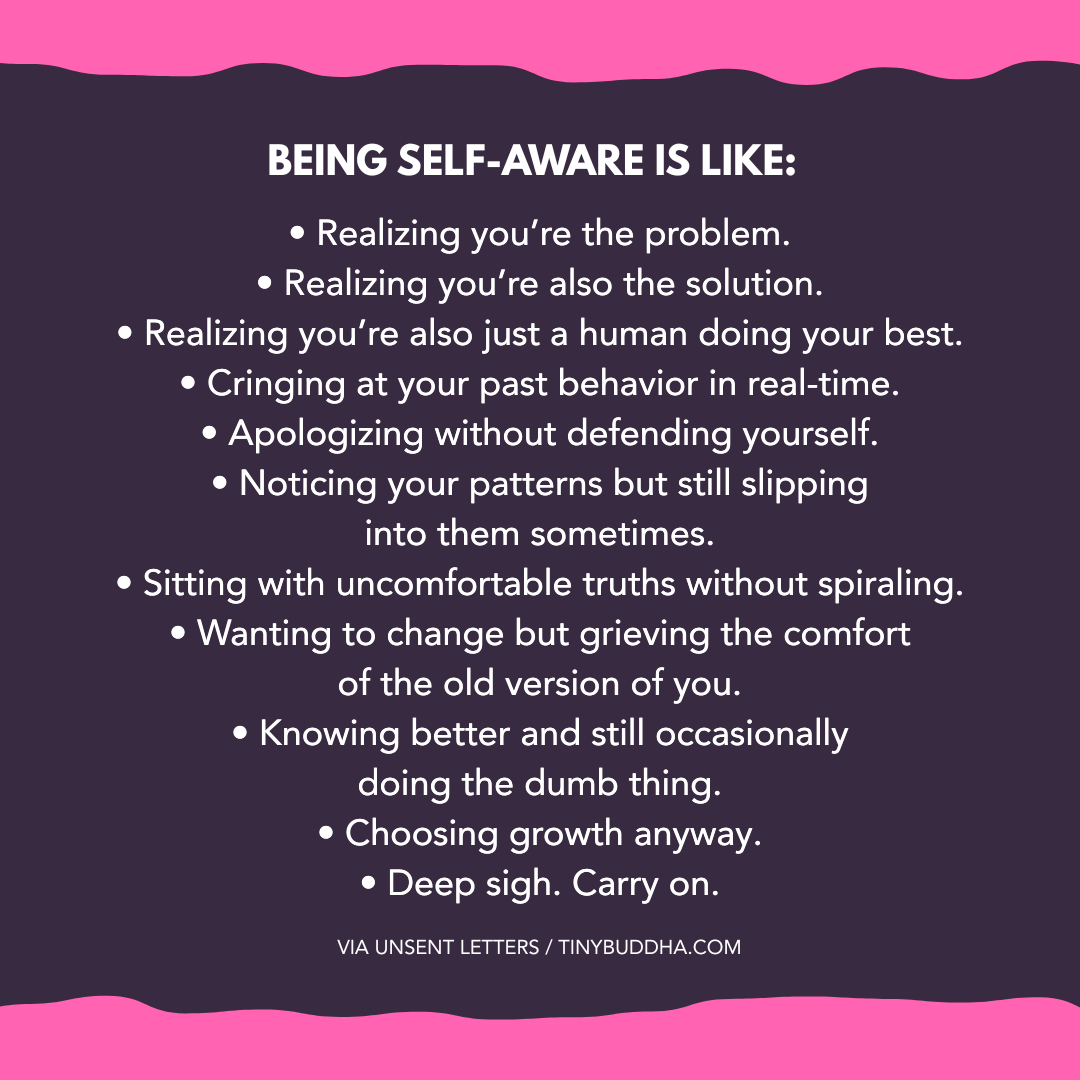
    Self-awareness is arguably the holy grail of inner peace, especially when you’re under pressure. But what is it? How do you achieve it?

    As a teacher of self-awareness, I’ll be the first to admit that it does not always come easy. Given our human instinct to resist whatever challenges us to grow and change, the journey to self-awareness often involves a struggle. I know mine sometimes does.

    To be more self-aware, I’ve had to cultivate a willingness to admit I don’t have it all figured out and that I might not always be right, especially when I feel really strongly that I am. I’ve had to make a point to look at my reality more objectively and admit when the way I’m doing something is just not working for me anymore.

    These admissions never come easily. But I will say that addressing my emotional reactivity has been essential to getting me to a place of greater self-awareness.

    When I was a young mother, I spent years trying to protect my kids from the impact of the dysfunction around them. Outwardly, we looked like the perfect family who had it all. My husband and I were pretty skilled at managing the family’s image, but the real story unfolding inside the four walls of our home was a marriage buckling under the weight of inauthentic emotional reactions like shame, blame, and guilt.

    We lived like this for decades. If you could call it living.

    For the longest time, I let my emotions run the show, relying on what felt like a satisfying reaction rather than reflecting on what was or wasn’t actually working.

    Firing off a sarcastic remark felt like I was being heard.

    Pushing the blame on others felt like a solution.

    Launching impulsively into action felt like the surest and fastest way to get the problem behind me!

    In the heat of the moment, a full-blown emotional reaction felt like it was protecting me. Ironically, all it actually protected me from was self-awareness and the change and personal growth that depend on it!

    Unaware that I was making the choice to act out my reactions, I couldn’t see the lack of wisdom in it. After the dust settled and the smoke cleared, the end result was nearly always the same: a truckload of pain, confusion, and an even bigger mess.

    By the time I mustered the courage to seek a divorce, my children were adults. I knew it was time for a massive change, and I thought my newfound courage would empower me to close the door on the powerful and damaging reactive emotions I had been running on for so long.

    But it wasn’t easy.

    As I gained more and more clarity, it became obvious to me: the reactivity I had acted out during my marriage was still surfacing even after my divorce. As Jon Kabat-Zinn said, “Wherever you go, there you are!” Needless to say, this was a hard fact to face.

    By separating myself from an untenable situation, I thought my shame and guilt would disappear with it. Boy, was I wrong!

    I still had a debilitating fear of uncertainty and faced enormous self-doubt about moving into the world on my own. I struggled with guilt and shame about my past life choices.

    I had been acting out some very specific patterns for decades, and over that long stretch those patterns had become habitual. So, whenever I faced a stressful situation, I fell right back into those same old patterns.

    The hard truth was that, like the deep and gnarled roots of an old tree, these emotional patterns of reactivity weren’t coming out without real effort and determination.

    A New Approach: The Practice

    Eventually, it became clear to me that if I wanted real change in my life, I needed a new approach. And that new approach became the fundamental practice of my program, the Inner Peace Blueprint, backed by a key Harvard study on the benefits of mindfulness.

    Researchers found that when practitioners of mindfulness focused awareness on their physiological state, it led to improved emotional regulation, which led to an empowered sense of self.

    So here is what I did:

    Every time I felt myself getting hijacked by shame, guilt, self-pity, insecurity, or fear, I interrupted those reactions by relaxing my physical tension and focusing on my breathing. This is the most basic technique I used—the practice of posture and breath.

    When I felt I couldn’t trust myself (or others), I would do the practice.

    When insecurity hit me as I imagined being on my own after thirty-six years of marriage, I would do the practice.

    When fear and guilt washed over me as I listened to my children talk about their own reactions to the divorce, I would do the practice.

    Remembering to do the practice took a lot of discipline, which was really not that surprising given the fact I had been reacting emotionally for my entire life, getting stuck in my head and going nowhere fast. My reactions were so familiar to me that they felt like who I was. They had become a deeply ingrained habit and were really hard to break.

    Not challenging this habit, however, was simply no longer an option. And the practice was the best way I could see to get the job done, so I stuck with it. Every time I paused to relax my body and breathe, I experienced myself calming down, even if just a little. Over time, I started to see how all the little bits of calm were adding up to a lot more calm.

    What I Learned About Self-Awareness

    With greater calm, greater self-awareness (which I define as “being able to see what I’m really up to”) came pretty naturally.

    I paid close attention to what I said when I was under pressure and asked myself: “Was it constructive or not?”

    Whenever I did something to get the pressure behind me and “make it stop!” I stopped to evaluate if what I did actually helped. Or did it just dig the hole I was in that much deeper?

    The practice afforded me the self-awareness to stop and consider my emotional state before I opened my mouth. It also gave me the self-awareness to make sure I waited until I was calm and clear about what to do (or not do) before proceeding.

    Today, the practice is still my primary self-awareness tool because it always brings me back to the now-moment. When I can focus my attention on my physical tension and release it through breath, I become more aware of my emotional state and can better regulate what I do and say as a result. This, to me, is the definition of self-empowerment.

    Even when I lose sight of how my reaction is impacting and distorting my perception, behavior, and choices, I can be pretty sure that it is and that staying focused on calming down before I respond is always my best bet.

    This new way of responding to my reactions with the practice helped me break the habit of acting out my reactivity and making things worse as a result. And this is what keeps me on a trajectory toward sustainable, lasting transformation.

  • The Major Aha Moment That Helped Me Stop Fixating on Fixing Myself

    The Major Aha Moment That Helped Me Stop Fixating on Fixing Myself

    “The real difficulty is to overcome how you think about yourself.” ~Maya Angelou

    My newest friend ended our three-month-long friendship on a July day when I’d just returned from a dreadful summer vacation. Her Dear Jane email read, “It’s not you, it’s me.” The lever had been pulled, I was dumped, and I thought, “Ha!” I’d spent the last three months trying to help her fix her problems. I knew she had more problems than me.

    But then an anxious, obsessive thought loop began. What did it really mean? How could it not be about me?

    This wasn’t the first time I’d lost a friend, so of course, I needed to diagnose, dissect, and determine the origin of this unhappy pattern. My anxieties were ramping up, and I needed to fix something before this reoccurred. So I made an appointment with a therapist named Dr. Mary.

    After an hour’s drive through big city traffic, I arrived late and shaken to that first therapy session.

    Within fifteen minutes, Dr. Mary helped me recognize the parallel between my friendships and my relationship with my mother and and pointed out I didn’t have to parent my mom, a lifelong project due to her unsteady mental health. I was disappointed but relieved to find I wasn’t there to fix my mom’s narcissistic behavior. I was there just to fix myself. I paid her the ninety-five out-of-pocket dollars I owed and left feeling slightly better.

    Two weeks later, I drove that same hour for my second therapy session. I was not prepared for what I would take away this time.

    When I brought up my mother again, Dr. Mary asked me why I needed to change my mother. Couldn’t I allow her to just be?

    I was confused. Weren’t my mother issues the cause of everything? “If it’s not one thing, it’s your mother,” my friends and I always joked. And why wouldn’t my mom want to gain from my knowledge, love, and insight?

    Dr. Mary fed this next concept to me slowly. “Maybe you need to fix people so you can feel powerful, and then no one will be paying attention to your flaws. Maybe you want to distract others from seeing how unlovable you think you are.”

    This concept slowly hummed in my head until tears seeped from my face.

    Eventually I found tissues near my couch spot. And then our time was up.

    “Do you have any books you can suggest reading on raising self-esteem?” I asked as I paid her, needing something more to help process this information. “No,” she said, and then she opened the door and let a different version of me out into the world than the me who’d entered.

    As I drove to meet my friend for a lunch date, my mind screamed, “I’m freaking forty-five years old, and I have low self-esteem!!??” Over our Cuban pork sandwiches with mojo sauce, my friend Terry said, “Who doesn’t have low self-esteem?”

    Apparently, my discovery of my buried dysfunction was the new trendy life hiccup I was now living. When had low self-esteem become the in thing?

    My head was filled with angry bees as I journeyed the hour-plus back home. I didn’t feel good enough to be my kid’s parent that night. I fumed over Dr. Mary’s edict about my sentence of low self-esteem and not okay-ness.

    I had worked hard all my adult life on my self-awareness and self-love with therapy, self-help books, and humility! How dare she rob me of my self-definition and my purpose of showing others how to be okay. Who was I supposed to be now?

    A week and many journal pages later, I wanted to be done marinating in my indignation, so I crossed the grassy field to the library, intending to check out any and all books on self-esteem. When I explained what had happened, the librarians agreed that it’s hard to fill your self-esteem cup up if you don’t know what that cup or its contents looks like. Wise souls those women.

    At home, I read and thought and sat with my low self-esteem verdict. And then unexpectedly, I began to feel a new peacefulness. My anxiety was diminishing. Dissipating. Disappearing.

    If I was off the hook to fix the faults I saw in others, I would no longer have to fix the faults I saw in myself. My low self-esteem and anxieties were allowed. I could be just where I was until I was somewhere else. I was in a new place where I was okay with me, you could just be you, and where judgments no longer served a purpose. By naming the inner beast, I had somehow released it too.

    I am still attracted to people who self-admittedly need a little life tune-up, but I don’t obsess over “their” recipe for success or what “they” could do to be fixed. I make every day count toward my own healing.

    Eventually, with the help of medication, my anxiety felt like a phantom limb, a memory of a part of me that was no longer there, though I also need an occasional therapy tune-up.

    All I had to do was admit and own who and where I was to stop fixating on the fixing. If I saw her today, I’d thank Dr. Mary for the gift of my freedom. And I’d mention a couple of very good books on self-esteem I’d read.

  • How to Live Your Dharma (True Purpose): The Path to Soul-Level Fulfillment

    How to Live Your Dharma (True Purpose): The Path to Soul-Level Fulfillment

    “Dharma actually means the life you should be living—in other words, an ideal life awaits you if you are aligned with your Dharma. What is the ideal life? It consists of living as your true self.” ~Deepak Chopra

    From the moment I finished high school until my late twenties, I had “purpose anxiety.”

    I wasn’t just confused and missing a sense of direction in life; my lack of purpose also made me feel inadequate, uninteresting, and lesser than other people.

    I secretly envied those who had cool hobbies, worked jobs they loved, and talked passionately about topics I often didn’t know much about.

    I even resented them for living “the good life” and kept wondering, “Why not me?”

    Until it was my turn.

    What it took to begin embracing my purpose—or dharma, as I prefer to call it—was one thing: love.

    Let me explain.

    The 4 Keys to Living Our Dharma (Purpose)

    The Sanskrit word “dharma” has many meanings and most commonly translates to “life purpose” and “the life we’re meant to live.” I believe there are four main keys to living our dharma.

    1. Cultivating self-worth: the essential first step.

    I was bullied in high school, and as a result, I had very low self-esteem for many years. Looking back, I realize that feeling that low self-worth prevented me from embracing my dharma.

    Why?

    It was because I was too focused on trying to be liked and too worried about what other people thought of me to be in touch with my authentic self. I put all my energy into doing everything I could to look “cool” and be accepted by others rather than what my soul wanted to do, explore, and experience.

    The essential idea is that embracing our dharma requires living authentically. As Deepak Chopra says, “[dharma] consists of living as your true self.”

    The issue is that it can be difficult to express and live your truth when you feel inadequate, unworthy, and perhaps even unlovable. The risk of being rejected seems too high, and it feels unsafe.

    So the first step to living our purpose, I believe, is cultivating radical self-love. It’s a bit of a “chicken and the egg” situation because having a strong sense of purpose increases self-esteem, but low self-esteem makes it hard to embrace our purpose. It’s best to develop both simultaneously.

    Here are a few ideas to cultivate self-love that have helped me:

    The first one is meditation.

    Part of meditation is about allowing ourselves to become aware of and observe our own thinking. When we meditate, we disidentify from our thoughts and get to experience glimpses of who we truly are—of our essence—which is loving and infinitely worthy. As a result, we naturally start loving and accepting ourselves more. Meditation has undoubtedly been the number one thing that has improved my self-esteem.

    Another thing that has helped me is self-care.

    As I said, I didn’t have many friends in high school and spent much of my time alone. So I started going to the gym after school to do something with my time and be around people (even if I didn’t talk to them). Exercising regularly led to eating healthier and taking better care of myself in several other ways.

    I find that self-care is a practical way to cultivate self-love. When you take care of yourself, you show that you care about yourself. Over time, you start genuinely feeling the self-love you are showing yourself and believing it.

    The last (effective but cringy) thing that helped improve my self-esteem is an exercise that a therapist recommended.

    Here’s how it goes: In the evening, stand in front of the mirror and—looking at yourself in the eyes—say, “I love you, [say your name]. I love [say three things you like about yourself], and you deserve all the good things life has to offer.” Try it for thirty days; it may change your life.

    2. Being in touch with and following your inner compass.

    Jack Canfield says, “We are all born with an inner compass that tells us whether or not we’re on the right path to finding our true purpose. That compass is our joy.”

    Often, we seek purpose outside of ourselves, as if it’s some hidden treasure we need to find. But, as Mel Robbins puts it, “You don’t ‘find’ your purpose; you feel it.” What feels good—expansive, joyful, intriguing, exciting, or inspiring—to you?

    That’s an important question because, according to numerous spiritual books I’ve read, those things we enjoy are clues guiding us to our dharma.

    The main difficulty is usually differentiating our true desires from the ego’s “wants” and the desires that come from conditioning. The ego wants to feel important. It’s afraid of not being “good enough,” so it feels the need to prove its worth.

    The “wants” that come from conditioning consist of what our parents and society have told us we “should” do. If we follow those “shoulds,” even though they don’t align with our authentic selves, we risk waking up one day and realizing that we’ve climbed the wrong ladder and lived our life for others instead of ourselves.

    Here’s something that helps me differentiate those desires.

    Make a list of all the things you want to have, do, experience, and become in the next few years.

    For each item on your list, ask yourself why you want it. Is it because you feel the need to prove something or want to feel important or perhaps even superior to others? That’s the ego. Is it because you think that’s what you “should” do? That’s likely conditioning. Is it because it makes you feel alive? That’s your heart.

    To live our dharma, we must follow our heart’s desires—the things we genuinely love. This requires authenticity and courage.

    3. Savoring the experience of being alive.

    Another aspect of dharma is loving life—living with presence and appreciating the experience of being alive. There are a few things I find helpful here:

    The first idea is to keep a “Book of Appreciation,” as Esther Hicks calls it. Every day, take five minutes to journal about what you appreciate about someone, a situation, or something else in your life.

    To savor life, we must also be present. In A New Earth, Eckhart Tolle states that true enjoyment does not depend on the nature of the task but on our state of being—we must aim for a state of deep presence.

    He recommends being mindful when attending to even our most mundane tasks. I also like to go on long walks and observe (with presence) the natural elements around me—like the clouds passing in the sky, the smell of trees after the rain, and the sensation of the sun’s rays on my face.

    And, of course, having a daily gratitude practice is always a winner!

    4. Extending love through joyful service.

    Dharma is also about sharing—extending love. One of the best ways to contribute to the collective is to share our gifts in a way that’s enjoyable to us.

    We all have natural gifts—things that come easier to us than to others. Some people are good at writing, while others are great leaders or excel at analyzing data. Perhaps you like to create, manage, nurture, delight, support, empower, listen, guide, or organize.

    There’s also another, more profound aspect of contribution that comes from being rather than doing. I remember a passage from a book I read many years ago (I can’t remember what book it was) that went something like this:

    “Your contribution [to the collective] is your level of consciousness.”

    A higher consciousness radiates greater love, and one of the best ways to uplift others is by being a loving presence.

    Dharma: The Bottom Line

    Bob Schwartz, the author of Your Soul’s Plan and Your Soul’s Gift, says, “We are here to learn to receive and give love. That’s the bottom line.”

    This involves loving ourselves, others, and life in general, and also following our heart—doing things we genuinely love.

    I don’t know about you, but this perspective on dharma feels good to me. It has freed me from my “purpose anxiety.”

    I hope it can serve you too.

  • 5 Meditation Retreat Practices to Try at Home for a More Mindful Life

    5 Meditation Retreat Practices to Try at Home for a More Mindful Life

    “Meditation is the ultimate mobile device; you can use it anywhere, anytime, unobtrusively.” ~Sharon Salzberg

    It was the fifth night of my first silent retreat, and 100 of us spilled out of the meditation hall into darkness, flashlights swinging as we made our way along the path to our dorms and sleep.

    Suddenly the wind picked up and quiet excitement rippled through the group as we looked up to see a bank of clouds move and reveal a full moon, beaming a bright white light from the night sky. We stopped and stood, some of us for hours, gazing upwards.

    This is a painfully obvious metaphor, I wanted to say to someone.

    Despite my natural cynicism, despite the sleepiness and agitated thinking that had haunted my meditation for days, as I looked up at the moon I thought: In a world this beautiful, how can I not pay attention?

    Days later, when my weeklong retreat ended and I came home, I was reminded that being on a retreat is a lot different from regular life.

    I can’t see the sky let alone the moon from my house, and my time is punctuated by the sound of email notifications instead of gongs. But is it possible to recapture some of the mindfulness you can cultivate on a meditation retreat? Here are five strategies I am trying, and you can try too.

    1. Enjoy a daily meditative meal (or snack).

    On the first day of our retreat one of the teachers gave an inspiring talk just before lunch. Every mealtime is an opportunity to practice, he said. Try smelling each spoonful of food before you put it in your mouth. Put your silverware down between each bite.

    Lunch that day was the longest meal I have ever experienced. We considered each bite of salad, noting the whiff of vinegar in the dressing and the crunch of the greens. I grew to know the subtle flavor of plain brown rice, and the multisensory experience of holding a mug of hot tea to my lips and inhaling the lightly scented steam before sipping.

    It was reinforcing to be in such a large group enjoying meals together so slowly and quietly, but everyday life presents multiple mindful eating opportunities as well.

    Post-retreat, I try for at least one meditative meal. Where I would once wolf down lunch while scrolling through Twitter, I create space to experience the flavor of the food and note the texture. It works for snacks too—you can really taste the salt on your lips from the first bite of a chip. An added bonus: All that chewing is great for digestion.

    2. Ground yourself by walking.

    Much of the retreat schedule can be summed up as “seated meditation followed by walking meditation.” The sitting-walking pattern helps break up the day and ideally prevents us from dozing off on the meditation cushion.

    Slow meditative walking, with its noting of the “lift, move, step” motions of our feet, felt like a close cousin of seated meditation. Normally paced walking in the hills of the retreat center was still more inspiring, as I tried to tune into each step connecting me to the earth.

    At home, where sitting at a desk dominates my awake time, I am incorporating periods of mindful walking—even if it is just down the hall. Between meetings or projects, I get up and feel the floor under my feet with each step, noting the swinging of my arms, and the way the fabric of my pants moves across my legs.

    Longer walks, taking in the sights of the neighborhood without a distracting podcast, is also part of my new routine. With or without the mental noting of “lift, move, step,” walking can effectively bring our minds back into our bodies.

    3. Befriend a tree.

    One retreat teacher encouraged us to select a tree from the surrounding forests and forge a connection with it. We each considered our tree’s solidity, the sap running through it, the wind in its branches bringing constant change, and the co-arising circumstances that led to its growth. It was common to round a path in the woods and come across someone standing looking up at a tree, seated at its roots, or even swaying in rhythm to its movements.

    Back in the city, I can simply sit on my front steps and contemplate the river birch in the yard without alarming my neighbors. I pay attention to the subtle grays and whites of its bark, the way its leaves almost shimmer in the breeze. I have lived with it for years, but this tree is now a brilliant object of meditation in my daily life. Cheesy as it sounds, the tree has become a friend I greet with a smile every morning.

    4. Embrace mindful chores.

    Just like the summer camp I attended as a kid, my retreat required us all to sign up for a job. My work meditation was to chop vegetables in the afternoon. It became a highlight of my day to carefully peel parsnips or work my way through a box of eggplants, guiding the knife into the flesh to create slices then cubes I would eventually see in the evening meal.

    In everyday life, chopping vegetables can feel like a boring imposition, something to rush through between more exciting activities. But when you have been meditating all day the subtle pleasures of chores become clearer.

    I try to invoke some of that mindfulness at home, feeling the weight of the knife in my hand as I chop, and taking the time to focus all my attention on removing the peel from a carrot. Using vegetables as my gateway I am now experimenting with mindful dishwashing. Soap bubbles can be a revelation if you really pay attention.

    5. Take a break from needing to “be” someone.

    When you are on silent retreat, you’re not just quiet, you’re existing anonymously within a large group of people. It was enormously relaxing not needing to “be” someone for a week—and eye-opening to recognize how much effort goes into conjuring up the ideal “me” to present in social situations.

    In not speaking to one another, or even looking each other in the eye, my fellow retreatants and I could co-exist, focusing on our experiences in the moment instead of mentally rehearsing what we would say at dinner.

    I admit to secretly pondering the backstories of my fellow retreatants, and I was certain that people were judging me whenever I forgot to take off my shoes inside or made other newbie mistakes. But overall, our shared silence created much more space to do what we were doing without extra mental labor.

    The relaxation of silent co-existence can be harder to achieve in the regular world, where our work and family lives can hinge on being visible and vocal.

    Taking “non-being” home for me has meant noticing the relaxing qualities of being alone, rather than looking for distractions, and recognizing the temptation to needlessly make an impression in passing interactions as I go about my day. That jokey comment to the barista might be less about being friendly and more about being noticed.

    I’ve also brought a new kind of attention to gathering places like the grocery store or library, asking myself: Can I navigate among people without comparing, judging, fixing, or asserting an ego that demands attention?”

    As Sharon Salzberg so wisely says, we can use meditation anywhere. I had the privilege of dropping out of the daily grind for a weeklong retreat, and literally saw the clouds part for a moment of insight. In the time since returning, however, I see that many of the retreat’s greatest gifts were the less flashy moments—the practices that provide tools for the other fifty-one weeks of the year.

  • The Exhausted Extrovert: How I Stopped Worrying About How People See Me

    The Exhausted Extrovert: How I Stopped Worrying About How People See Me

    “When we allow ourselves to be vulnerable, we are not pretending, we are not hiding—we are simply present with whatever is going on inside us. Ironically, it is this very feeling of authenticity that draws people to us, not the brittle effort of perfectionism.”  ~Maureen Cooper

    Most people in my life would call me an extrovert, and I often refer to myself with that label as well. On the surface, I appear friendly, talkative, and enthusiastic, and those characteristics became part of my identity at an early age. I enjoy being around other people and value my interpersonal relationships.

    I also participate in a variety of social groups and remain connected to friends near and far despite our busy schedules. I have often attributed my love of people to the fact that I am an only child who always wanted to spend more time with kids my own age.

    Despite my friendly nature, I usually felt drained after social interactions, especially when they involved large groups of people. I dreaded small talk, mingling at parties, and attending events where I was the only new person in the group.

    For example, my anxiety was sky high when I met my husband’s large group of close friends for the first time. I felt intimidated because they had all known each other since preschool, which automatically made me feel like an outsider. As a child and young adult, I tended to avoid situations where I felt uncomfortable, preferring to focus on the environments and people that I already knew.

    Even in familiar social situations, I still often came home feeling depleted. I enjoyed myself during these events but required a lot of downtime to fully recover and feel like myself again. This reaction confused me because I thought extroverts craved and felt energized by social interactions. 

    I struggled to classify myself because neither introvert nor extrovert truly matched my personal experience. I often felt torn between wanting to attend social events and worrying that I would feel exhausted afterward. These conflicting desires prompted me to explore the reasons why being social fed and depleted my soul at the same time.

    This journey would hopefully allow me to develop a deeper level of self-awareness and learn how to take better care of myself. As I paid more attention to my thoughts, feelings, and behavior at social events, I noticed that I was hyper focused on how I came across to others. I wanted to be liked, make a good impression, and be viewed as fun.

    I frequently wondered what people genuinely thought of me, including friends that I had known for years. I also worried a great deal about others’ feelings and wanted to make sure that everyone was having a good time. As the host of parties or gatherings, I went out of my way to ensure that the house was spotless, the food options were plentiful, and the environment was comfortable.

    I avoided choosing group activities out of fear that people would not like my decisions and from a desire to be known as the “easy-going, chill friend.” Even when I wasn’t the host, I found myself studying everyone’s reactions to see if they were happy and had their needs met fully. I made it my responsibility to take care of everyone even though no one asked me to be the superhero.

    If someone wasn’t in a good mood or a conflict arose, I immediately intervened to be the peacemaker or crack a joke to lighten the mood. I also did my best to keep the focus and attention away from me. I acted like an interviewer, asking other people endless questions and rarely sharing about my own life.

    I hated any silence within the conversation and would quickly fill it by bringing up a new topic or giving compliments. I began to realize that even my closest friends didn’t know much about me because I was so guarded with them. My fear of boring others, seeming conceited, or talking too much prevented me from being honest and authentic.

    For most of my life, I thought these behaviors were typical and even smart ways to be a good friend. I wanted others to accept me and enjoy being around me, but my ways of accomplishing these goals left me exhausted at the end of the day. Upon realizing how I navigated social interactions, I chose to examine why I needed these techniques and how they affected my view of interpersonal relationships.

    Up until this point, I believed that my behaviors were simply proof of my strong social skills, compassion, and emotional intelligence. I also assumed that most people thought and acted similarly to me because it was so natural and automatic in my life. In reality, my behavior involved coping strategies that I had developed from an early age due to an intense fear of being left out, disliked, and alone.  

    I came to learn that as an empath, I needed to set emotional boundaries to prevent myself from becoming depleted. A healthy empath holds space for another person’s emotions and experiences without making it their responsibility to fix, save, or protect the person. In order to be accepted and liked, I became a chameleon who adapted to any environment, didn’t speak up, and focused on pleasing everyone else at my own expense.

    In doing so, I didn’t allow people to get close or learn about the real me. My outward focus on how everyone else was thinking, feeling, and acting left me exhausted and overwhelmed because I took on their problems as my own. I remained fearful to share my true opinions, make any decisions, or take up space in social settings.

    Fading into the background felt safer, easier, and more comfortable to me, but it didn’t allow me to relax and be fully present. I constantly scanned the environment for any issues, working to please others and control what people thought of me. On top of that, I made it a priority to appear easy, effortless, and relaxed so that no one would see my internal struggles.

    I didn’t want to appear stressed, tired, or unhappy because I could possibly be viewed as “needy” or “too much.” My hypervigilance only intensified when I was around new people because I desperately wanted to make a good first impression and earn their validation. After a social gathering lasting only a few hours, it was no wonder that I felt so drained and needed to recharge.

    I began to realize that while I do love people and enjoy interacting with others, these situations would be more fun if I slowed down, checked in with myself, and focused on being truly present. I needed to practice turning the spotlight on myself for the first time, making choices and doing activities that worked for me. 

    When I allowed other people to manage their own feelings rather than jumping in to fix, save, and protect them, it freed up more time and energy for me. I also allowed myself to open up and engage fully in conversations, sharing small details at first and allowing other people to carry the conversation. These behaviors showed me that it was safe to take up space and let people get to know me.

    Instead of blending in and always going with the flow, I could practice offering my opinion, choosing a restaurant or a movie for the group, and turning down social opportunities when I was tired or uninterested in the outing.

    I knew that I needed to take these steps slowly because they would require courage, and I didn’t want to give up out of overwhelm. I also begin learning to trust that people wouldn’t abandon or reject me for speaking up and setting boundaries.

    And if I did lose friendships or people didn’t love everything about me, I could handle that reality and survive. My mantra became “I am not for everyone, and that is okay.”  

    Since that time, I have made strides toward relaxing, being present, and releasing control, allowing myself to “just be.” Some days and situations are easier than others to practice this new mindset. But now that I have self-awareness and understanding, I can more easily catch myself when I engage in people pleasing behaviors to earn love, praise, and acceptance.

    I pause, take a deep breath, and remember that I am allowed to take up space, that I deserve to have fun and be myself, and that my needs, feelings, and opinions matter. In doing so, I enjoy social interactions, even with new people, more than I ever did. And that has made all the difference for a social butterfly like me.

  • Why It’s Worth the Temporary Discomfort of Sitting with Intense Emotions

    Why It’s Worth the Temporary Discomfort of Sitting with Intense Emotions

    “Whatever you’re feeling, it will eventually pass.”  ~Lori Deschene

    Can you feel an intense emotion, like anger, without acting on it, reacting to it, or trying to get rid of it?

    Can you feel such an intense emotion without needing to justify or explain it—or needing to find someone or something to blame it on?

    After successfully dodging it for two years, I recently caught Covid-19. The physical symptoms were utter misery. But something much more interesting happened while I was unwell.

    The whole experience brought some intense emotions to the surface. Namely, seething anger about something that had nothing to do with the virus.

    In the handful of days that my symptoms were at their worst, I was absolutely livid. And while on some level it made sense that I was angry that getting this sick was both extremely unpleasant and delaying work on a project I was all fired up about, the anger was manifesting with a deeper-rooted blame.

    I grew up in a religious denomination that had a profound effect on my childhood and adolescence. It taught me through debilitating fear, division, and confusion. It ingrained black-and-white rights and wrongs for living, thinking, and being that had never made sufficient sense to me, no one could adequately explain, and were damaging for me on a number of levels.

    In the past couple of years, I worked through its various effects with shadow work, inner child healing, forgiveness, and even quantum energetic healing. Each of these modalities supported me immensely with healing different layers.

    But the emotion of deep anger I harbored clearly hadn’t gone away, and it simply needed to be felt.

    The more we learn to observe and witness our emotions, the more acutely aware we become of where they’re stemming from, and the more we’re able to notice and catch ourselves when we’re associating our emotions with narratives and situations that are not in fact to blame for how we’re feeling.

    Although I’d initially managed to fashion some connection between being unwell and the church I still harbored so much anger toward, I became increasingly aware that there was none. My inclination to blame the church was part of an ongoing pattern. And it was time to break this pattern.

    At the same time, I’d recently become very aware that whenever I’d hear mention of the church or any of its associated beliefs, a brief surge of anger would leap up in me. I was still feeling triggered.

    I was very ready to move beyond these patterns of blame and anger. And getting to that inner peace I so wanted to feel meant addressing this on an emotional level. I realized that what I needed was to actually sit with these feelings so they could be fully acknowledged and allowed to move through me.

    The only person who is ever responsible for your emotions is you. And your emotions are simply powerful feedback. They show up for one of two dominant reasons.

    Either they’re unresolved past emotions that are surfacing because they’re ready to be acknowledged and felt now, or they’re feelings that demonstrate how a situation is resonating for you—in other words, they’re your own inner compass.

    Sadly, although traditions like Buddhism have been teaching us how to develop emotional awareness for thousands of years, we’ve somehow landed on two dominant, ineffective responses.

    Acting on our emotions or trying to brush them under the rug.

    Brushing an emotion under the rug will only keep it trapped inside of you. Meaning it will resurface to bother you as many times as it needs to in the future until you deal with it.

    And the practices of toxic positivity fall under this category. Write a gratitude list and look for the best-feeling thought you can find, they say. In other words, avoid the “negative” emotion for now and let it fester under the surface a little while longer.

    Newsflash: No emotion is negative unless it’s fueling a negative action or reaction. It’s simply feedback pointing you toward growth or clarity.

    Which brings me to the next dominant response we resort to. Acting on the emotion (by yelling at someone, for example) will at least give it an opportunity to release but will most likely create consequences that won’t serve you. We’ve all been there and done that, so no judgment here.

    As I emphasized earlier, the only person who’s ever responsible for your emotions is you. And we tend to act on our emotions by deflecting this responsibility. So we learn, understand, and gain nothing from them.

    So, I sat with the anger. I was fully present with it—by itself, separate from any experience or event that I could possibly associate it with.

    I acknowledged it, felt its full intensity, and breathed through it. I sat with the parts of me that felt this emotion with compassion. I surrendered to letting it move through me.

    Despite having felt the intensity of this anger for a few days, it released fairly quickly when I leaned into it. And when it released, I was able to see pretty clearly why being ill had triggered this anger.

    I’ve also noticed that since this whole experience, the little surges of anger I’d previously felt have gone away. So far I haven’t felt those triggers since, which is a relief.

    Before I go any further, I want to acknowledge that many of us are carrying deep trauma that’s often too painful to even fathom triggering. So have compassion for yourself in whatever you feel, and don’t put off seeking the right support to work through your emotions if you feel you need this.

    Now, this might sound counterintuitive, and it’s incredibly uncomfortable to do at first. But real emotional awareness—and maturity—means sitting with the emotion and feeling its fullness.

    It’s identifying what this emotion is and how it feels. Including where you can feel it physically.

    It’s giving yourself some time and space to focus on really leaning into the emotion and separating it from any narrative or incident it may be associated with. Focusing on the emotion by itself in isolation allows us to process it. Without blame, justification, or self-pity.

    When you can truly feel, acknowledge, and breathe through it, it releases. And when it’s released, you’re able to understand what it represented for you. You grow through it.

    This may take time, but a feeling is only ever there to be felt. And until it is, it will be increasingly vociferous in how it tries to get your attention.

    This can require a lot of courage, especially because too many of us have been conditioned to fear feeling our emotions and believe that we can’t handle them.

    But if you need to cry, cry. If it feels intense, this is where deeply buried stuff is surfacing for release.

    And when you let an emotion move through you, you let it move out of you.

    This doesn’t mean that you’ll never feel another “negative” emotion ever again.

    But it does mean that you’ll understand how to respond to these emotions and allow them to be felt and understood with a lot more compassion.

    And that’s more than worth the temporary discomfort.

  • The Lies We Tell Ourselves About Our Worth and How I’ve Let Them Go

    The Lies We Tell Ourselves About Our Worth and How I’ve Let Them Go

    “You either walk inside your story and own it or you stand outside and hustle for your worthiness.” Brene Brown

    I was shaking and sweating with fear as I stood in front of my graduate professor for the final test of the semester. I was twenty-two years old at the time and felt like a fish out of water in my graduate program. I dreamed of being a professor, studying, and writing, but deep down I thought, “I’m not smart enough. I don’t fit in here.  No one likes me.”

    When my religion professor announced that the final wasn’t a sit-down, bubble-in quiz, but a one-on-one translation, and I’d need to answer questions aloud, I knew I’d fail it epically, and I did. To add oil to the fire, I ran out of the room in tears.

    I failed it before I even started because my fear was so great. My hands were shaking, and soon my teacher would know the truth: I didn’t belong there.

    My professor was incredibly intelligent, and I was intimidated from our first meeting. The way I thought he spoke down to others, probably because his tone, diction, and vocabulary were academic (whether intentional or not), triggered a deep wound.

    Since childhood I had developed a limiting belief: “I am not intelligent.” This followed me wherever I went.

    In school, at work, and in relationships, I constantly trusted others to make decisions and discounted my own opinion. I looked to others for the answers and then compared myself to them. This left me feeling insecure and dependent on others. Not at all the leader I envisioned for myself.

    It was the root of the shame I felt, and I allowed it to mean that I was stupid, I wasn’t worthy, and I would never succeed. My inner critic was loud and eager to prove to me why I was less-than.

    There are a few memories I have from childhood that I can recognize as the start of this limiting belief.

    I remember my first-grade teacher passing back a math worksheet. I received a zero at the top in red letters. I still remember that red marker, the questions, and feeling unworthy. I didn’t understand the questions or why my classmates got ten out of ten, and I was too shy to ask or listen to the answer.

    This happened throughout my schooling. It took me more time than my classmates to understand concepts. I wanted to ask questions but was afraid I would look stupid or that I still wouldn’t understand, so I just avoided traditional learning all together.

    I always looked around and thought, “If they understand it, so should I.” In other words, there is something wrong with me.

    Growing up in the nineties, I was teased for being blonde and ditzy. I was friendly, silly, and loved to laugh, so I was labeled as a stereotype blonde airhead. It hurt my feelings more than I ever let on.

    Even when the teasing was lighthearted and done by friends who loved me, it reinforced my belief that I wasn’t smart or good enough. This belief made me feel small and kept me locked in a cage because no matter what I achieved and how much love I received, I still felt like a failure.

    This limiting belief even made its way into my friendships because I held this insecurity about myself and felt that I could not be my truest self in front of others. I wanted to please my friends by listening, supporting, and championing their dreams rather than risk showing my leadership abilities and the intellectual pursuits I yearned for deep within me.

    Looking back now, I see that I was capable of excelling at school and in relationships, but due to my misconceptions about my worth, it felt safer not to stand out. Drawing attention to myself was too dangerous for my nervous system, which was always in survival mode.

    I preferred to fly under the radar and pass classes without anyone noticing me. I preferred to focus on my friends’ problems and dreams because it felt safer than vulnerably sharing my own.

    I never attended my graduate school graduation, nor did I complete all my finals. I still passed, but I didn’t celebrate my accomplishment.

    In fact, I wanted to write a thesis, but my guidance counselor (a different professor) discouraged me. She told me how much work it would be and that it wasn’t necessary to pass instead of motivating me to challenge myself. Since writing was always important to me, I actually wanted to do it but never spoke up or believed in myself enough to tell her.

    I have heard from many people like me and know that I am one of many sensitive souls that have been discouraged by a teacher. I mistakenly thought my differences made me less capable than others, but I am happy to say that none of these experiences stopped me from moving forward.

    With time and building awareness I took steps to heal these wounds and to change my limiting beliefs about myself.

    Learning about shame is the biggest step you can take to change this for yourself. Whether the shame you carry is from childhood, a traumatic event, struggles with addiction, coming out with your sexuality, or anything else, there is healing to be done here, and you are not alone.

    At the present moment, I don’t allow this feeling of shame to run my life. I am aware of it when it arises and no longer value its protection. I have done the inner work to heal.

    The first step I took was talking to someone about it. Letting it out. Shining a light down upon it. If we want to heal or change anything in our lives, we have to be honest about what we want and what we’re afraid of.

    Once I did that I realized many other people had the same fear and that it wasn’t true.

    It wasn’t true that I wasn’t smart enough. I had evidence that proved this. I’d been accepted to programs; I’d passed classes; I understood challenging ideas. I liked research and writing and was open to feedback in order to improve. I even had a graduate degree.

    I was able to learn new skills in environments that felt safe and supportive to me and my sensitive nervous system. I realized I did better in small groups and with one-on-one support.

    Knowing that didn’t mean the wound was no longer triggered, but it meant that I had the awareness to soothe myself when it was.

    It meant that it hurt, but I didn’t allow it to stop me from moving forward. Instead, I let myself feel the pain while supporting myself and reminding myself of the truth: that I am unlimited and worthy of love, acceptance, and approval.

    Whenever we believe a lie about ourselves it creates major internal pain for us. That pain is an invitation to dig deeper, expose the lie, challenge it, and adopt a new belief that makes us feel proud instead of ashamed.

    The person that I most longed for approval from was myself. I had to be the one that finally accepted my differences without labeling myself as unworthy. I had to love myself even if I felt unsafe or unsure. Once I did that, it was reflected back to me tenfold.

    We all have fears and limiting beliefs and carry the burden of shame within us. These are human qualities, meaning this is a natural challenge shared by all healthy people.

    Instead of hiding them, numbing them, and burying them deep within, share them in a safe space, shine a light on them so the truth can emerge, and take your power back by feeling the emotions while knowing the truth: No matter what lies you’ve told yourself, you are good enough and worthy of love.

  • How Our Self-Talk and Language Can Sabotage or Support Us

    How Our Self-Talk and Language Can Sabotage or Support Us

    “Today I want you to think about all that you are instead of all that you are not.” ~Unknown

    “Love the pinecones!”

    This was a comment from a friend on one of my Facebook photos from a beautiful seaside hike filled with wildflowers and other natural wonders.

    When I responded with “It was a puzzle figuring out how to best photograph them” (not what I originally planned to write), she wrote, “Gregg, that’s such a fun part, isn’t it?” That comment was the brightening of a bulb that had already been going off in my head. It led to deeper self-reflection and awareness around my own self-talk patterns.

    We’ve all heard that how we speak to ourselves has a huge impact on our life. If your self-talk is largely negative, it lowers your self-confidence, drive, creativity, spirit, and enthusiasm for life. In short, it limits your self-expression and access to joy. If your self-talk is compassionate, understanding, and loving, it helps you to move through your life with much greater flow and ease.

    There are the more obvious ways negative language patterns show up, and then there are more hidden, subtle, or unconscious ways. Amongst the more obvious are the habitual ways we berate ourselves or call ourselves names.

    For example, if you are making dinner and just as you finish you knock the whole thing on the floor, how might you respond? It makes total sense to be upset or disappointed, but how does that upset manifest within you?

    Perhaps you think, “Geez, I’m such an idiot!” or “I’m so stupid!” If so, rather than simply expressing your disappointment over the action or result, you are taking one moment in your life and using that to malign yourself at your core.

    Even calling yourself clumsy can become a self-fulfilling prophecy. Maybe you feel it’s actually true. Perhaps others have told you that as well. The thing is, whatever we choose to tell ourselves, whether unkind or gracious, our brain looks for ways to prove those thoughts are true.

    You can acknowledge a mistake, express frustration over an experience, or even decide you want to be more careful in the future, all without casting aspersions on yourself. Name-calling or harsh language directed at ourselves is an example of the more readily visible forms of self-talk. But what about those hidden or unconscious patterns?

    That kind of negative self-talk can be far more insidious and more prevalent than you may suspect. I know it was for me. It’s something I’ve been internally exploring lately and why I was struck with my friend’s comment on my post. Discovering the hidden ways I hold myself small has led to developing more empowering language that serves me on a daily basis.

    Though I was affected by ADD (attention deficit disorder) my whole life, it was not until I was in my forties that I was diagnosed. The first book I read on the topic and perhaps my favorite is called You Mean I’m Not Lazy, Stupid, or Crazy?

    I loved the lessons I got from the book and all that I learned about the workings of my brain. For several years, though, I felt at odds with the title. After all, I reasoned, I never spoke of myself in those pejorative terms. At least not that I was consciously aware of anyway.

    Over time, though, I realized there is a part of my brain that has been actively trying to prove I’m not those things. And if part of my brain is trying to prove I’m not that, then another part must in some way be telling me that I am lazy, crazy, or stupid. That’s when I decided it would be helpful to start consciously examining my unconscious patterns for the voice in my head.

    I’ve noticed my persistent stories of “I don’t know how” or “it will be too hard,” which have been a mantra in my head since childhood. I’ve long been mired in those stories, though they can show up in sneaky ways.  For example, if I see a picture of a place I’ve never been, I have a habit of thinking with melancholy “I’ve never been there” or even feeling jealousy or envy for the photographer.

    While it’s not wrong to have such thoughts, and it makes sense for them to come up from time to time, I noticed I was letting a beautiful photograph put me in a state of dissatisfaction, or even feeling sorry for myself. I was perpetuating limiting patterns of victim stories instead of empowering myself. I decided when I recognized that pattern to play with new thoughts.

    That might involve using that beautiful photograph of a place I’ve never been to remind myself of all the amazing places I have been. Or it might be feeling a sense of joy that such places exist or gratitude that others get to enjoy them.

    Or it could be as simple as thinking, “Oh that looks so interesting.” Or even “How do I get there?” That last one could be said with an air of resignation as a way of holding myself small and complaining, or it could be excitement over the possibility, all depending on how I choose to hold that thought.

    It’s not just the specific words we use but what meanings we ascribe to them that give them their energy and power. I’ve found it invaluable to notice my energy as well as the words I choose.

    With the Facebook exchange about my picture and the puzzle of figuring out how to best photograph the pinecones, my first thought was to write, “I was struggling to figure out how to photograph them.”

    But then I thought, “Why am I saying it that way?” I did not feel in struggle. Why would I want to frame it that way to myself or anyone else? So I altered the wording. That change definitely felt more empowered and certainly less stuck in victim mode. But again, it’s not just the words, but noticing the energy as well.

    Because depending on how I choose to hold it, “a puzzle” could be a game or it could be a chore. I was already leaning toward the more positive aspect but with residue from my initial thought of “struggle.”

    So when my friend chimed in with “Gregg, that’s such a fun part, isn’t it?”, I felt light, happy, and energized. And in all honesty, I initially felt a little bit of embarrassment too. Because it really highlighted for me the heavier energy I had been unconsciously creating over an experience I had thoroughly enjoyed.

    That awareness brought excitement for the deepening realization over the ways I can allow my word patterns to create disappointment and sadness or excitement and joy in my nervous system.

    It’s not just about whether we overtly beat ourselves up but what patterns we use. I’ve had a lot of unconscious patterns that have kept me in the mode of victim of the world rather than the creator of my life.

    It’s an awareness that I am continuing to deepen. As I do, I notice I feel more resilient, get stuck in negative emotions for shorter periods of time, and have more access to joy and aliveness. In an instant I can change how I feel just by the way I speak to and about myself.

    You can create that for yourself as well. Here are a few steps to do so. Outside of step one, they are not in chronological order and may even happen simultaneously.

    1. Start simply by slowing down and noticing your patterns.

    Do you berate yourself? Do you use words that feel untrue or create some kind of internal discord or discomfort that would not otherwise exist, as I had when I was going to use the word “struggle”? If so, explore how you can change those patterns and choose more empowering phrasing.

    This is not about denying that sometimes we do struggle or feel sad or have hard things happen. But you might find that your language actually influences your perception and your feelings about your circumstances. You can view the same situation as an obligation or an opportunity; it all depends on how you choose to see it and talk about it.

    2. Revise your word choice.

    On my journey of monitoring my patterns, I noticed that I’d write things like “I can’t figure out xyz” when, for example, I wrote to a company asking for technical support. The word “can’t” has such a disempowering connotation. So I started changing my word choice to things like, “I would like your help to figure out…” or “I would like to understand how to xyz.” This difference can seem subtle, but the impact on my psyche was immense.

    With the word “can’t” I was literally stating I’m incapable of something, whereas in the other two examples, I’m simply acknowledging information that I lack. Which of those feels more empowering to you?

    The language can seem new and uncomfortable or foreign at first. Perhaps you don’t feel sure how to make the shift. Again, the first step is simply to notice. The more awareness you create, the more your brain will automatically start looking for ways to shift toward your desired outcome.

    In the meantime, if you feel comfortable sharing your journey, you can ask a trusted friend, family member, or coach to point out disempowering language when you use it.

    3. Notice how your word choice affects your energy.

    In the example above about asking for technical support, I noticed how my habit of saying “I can’t figure out how to xyz” was subtly chipping away at my self-confidence. It kept me in a state of frustration and my energy small and insecure.

    Making the change to “I would like to understand how to xyz” felt more expansive. I was declaring a desire to make a change rather than declaring what I was not capable of. That feels more empowering in my nervous system, but still not with the aliveness I’d most desire. Now I’d say something more akin to “I’m learning your system” or “I’m gaining clarity around your system. Please explain to me how to xyz.”

    Sharing in that way, I’m speaking to my growth instead of declaring a deficit. In my body, that last one feels powerful and assertive while still asking for the support I need. What feels most powerful for you?

    4. Be kind and compassionate with yourself.

    Don’t expect perfection. Be compassionate with yourself. If you notice you’re reverting to old patterns, rather than berate yourself, use it as an opportunity to be excited. Because it means you are noticing. As in meditation, the idea is to notice your wandering thoughts and come back. Each time you notice you are creating an opportunity for new and more empowering patterns to flow.

    It can be like learning a foreign language. Because in a sense you are. And just like learning any new language can open up whole new avenues of possibility, this one will as well, releasing shame and self-judgment while brightening and uplifting your world.

    For myself, changing my hidden patterns has helped mitigate the impact of historical victim stories that I’ve held. I feel more empowered, with greater energy to achieve my goals. If you give it a try, I’d love to hear what you are noticing.

  • Rethinking Masculinity: Why I Want More Than Bachelor Parties and Football

    Rethinking Masculinity: Why I Want More Than Bachelor Parties and Football

    “Patriarchy is the expression of the immature masculine. It is the expression of Boy psychology, and, in part, the shadow—or crazy—side of masculinity. It expresses the stunted masculine, fixated at immature levels.” ~ Robert Moore & Doug Gillette

    Seventy eggs, packs of bacon, and multiple types of beer filled the fridge. On the counter lay handles of liquor and energy drinks. The dining table was lined with snacks galore: chips, Cheese-its, popcorn, Oreos, Doritos, and dozens of Fireball nips.

    I’ve been to many bachelor parties, and it’s not surprising that health is never a priority. Yet this time, things felt different, or at least they should have. Most of the men present were fathers approaching forty. Everyone was married, had highly respectable careers, and lived in nice homes across the US.

    It was clear that this weekend wouldn’t be a free-for-all of strip clubs. We no longer had the beer guzzling metabolism of our twenties or the naivete of our youth. But if not late-night revelry, what would it be? Accepting that we were older and in a much different place in life seemed to be in tension with what this weekend was supposed to be all about.

    The expectations, unspoken and unexamined, were looming over each of us. We were supposed to act as if we were decades younger back in college. The story we were unconsciously telling ourselves was that honoring a man’s last single days was to be full of drinking and debauchery.

    We didn’t come here to be emotionally vulnerable and eat salads. We came together to get rowdy.

    The question on my mind is whether there is space in our current paradigm of masculinity to do both?

    * As grown men, do we have to revert to childish ways of interacting?

    * Do we have to reduce ourselves to the lowest common denominator of health and wellness to have fun together?

    * Are there not other ways of being together that better fit our present realities as mature, adults?

    Still more questions drifted through my mind:

    * Can we take a responsible approach to caring for our body and still make room to party?

    * Can we find a balance between celebrating our friend’s last days of being single without making marriage out to be a ball and chain?

    * Can we eat salads together and still be “manly enough”?

    I believe we can do all of these things, but first we need to unravel some deeply held social norms about how men are supposed to interact together in groups.

    The Undiscussed Rules of Bachelor Parties

    The unspoken rule of bachelor parties is that there are no rules. Go wild. Get f*cked up. Have as much fun as possible because you’re about to lose all your freedom. Or at least that’s how the story goes.

    But where did this story come from?

    How did all of us guys end up with this template of bachelor parties as a drug-fueled escape from responsibility?

    What’s more, how did we end up with this notion of marriage as impending shackles or the stereotype of men running away from long-term relationships?

    Movies?

    Media?

    Watching older generations go through their failed marriages and broken relationships?

    Probably all of the above and more.

    The stereotypes of men acting like boys is a sad reflection of our present reality. We have strayed from the mythic stories of men as responsible, powerful actors in the world and settled on a version of manhood that seems woefully incomplete. 

    Perhaps the most noteworthy archetype framing masculinity is that of a hero’s journey. It is the quintessential growing-up quest where men discover their strength through adventure and adversity. Endless movies from Star Wars to Harry Potter rift upon this classic template of human development.

    Yet what is notably missing from all these sagas is the hero as a family man, caring for himself and his world responsibly as an adult. We are obsessed with heroic journeys and completely unenthusiastic about domestic life.

    I get one makes for a much better motion picture, but it is this void in our present mythology that leaves men hanging on boyish and incomplete ideas of what it means to be a mature man. How does the hero turned father integrate into society, build a family, connect with other men, and take responsibility for doing good in the world?

    If the hero’s journey is the fundamental process by which a boy becomes a man, the question of how to actually enact manhood remains.

    This void is exacerbated when groups of men come together. The expectation is that of unhealthy behavior. The bachelor party is just one manifestation of this—groups of men acting like teenage boys… hedonistic, rebellious, and immature.

    Yet the world doesn’t need more rowdy teenagers. It needs strong, healthy men. Men, it’s time we grow the f*ck up. The problem as I see it, is that we don’t know how.

    No Models, No Vision, No Manhood

    When I look around for good templates on how to spend time together, all I see is sports, fraternities, and bachelor parties. There is nothing inherently wrong with any of these, but as the only models for men to exist together, they leave a lot to be desired.

    Sports teams and bachelor parties may be suitable for the single twenty-something, but where are the role models for men trying to be a good husband or trying to make ends meet?

    I want more meaning and depth than our current cultural templates afford. I want to hang out with other men in a way that calls upon our higher qualities, not our lower ones.

    Yet I fear that the little boy in me so badly wants to be accepted by the other guys that I will continue to squeeze myself into outdated beliefs and unhealthy ideals that have me ripping shots of fireball just feel accepted—the policing of the proverbial “man box.”

    As men we must deconstruct this box and give ourselves permission to act differently. This includes

    * Learning to have drink without being irresponsible to our body, our friends, or our partners.

    * Learning to talk about our feelings as much as we talk about football.

    * Allowing ourselves to strive professionally without feeling like our self-worth is dependent on our ability to provide.

    * Feeling comfortable sharing our struggles with other men, so we don’t unconsciously accept that suffering alone is an inevitable part of being a man.

    Creating New Templates for Men to Be Together

    Loneliness is an epidemic. And for men, the feeling that you’ve got to “man up” and deal with all of life’s challenges on your own is a legacy of patriarchy that needs to be released.

    We need each other. More importantly, we need to learn how to be together in a relationship without feeling like beer and sports are the only way.

    Can you imagine a world where men hang out and actually come out stronger, healthier, and more sound in mind and body?

    I can. It’s not only possible, it is necessary.

    I can imagine the eye rolling among some guys. “That’s why there’s men’s groups. Don’t take away my bachelor parties or Sunday football.”

    To be clear, I’m not at all against bachelor parties. The “wild and free” mindset makes sense as a time-bounded final hurrah.

    I’m not advocating for less fun. I’m advocating for more opportunities for men (and women) to gather in a way that challenges the scripts and roles that have kept us prisoners to immature ways of interacting. 

    The current social pressure not only makes it difficult for men to be emotionally available, it also squashes so many of the joyful parts of our inner child—the playfulness, adventure, and energy of boyhood. It’s keeping us from our embodied selves.

    But we need to grow and integrate that into new rites of passage that allow men to avoid blindly accepting patriarchal norms.

    I don’t want to have to hide my softer, more vulnerable parts. I believe we can discuss how our social conditioning as men impacts our body and mind alongside discussing our fantasy picks and favorite cars. There’s room for it all if we can let go of outdated notions about how men can spend time together.

    If we can help each other evolve into a more integrated expression of what it means to be a healthy man, everyone will benefit—the boys who are coming of age, the men who are struggling to find their place in the world, and the partners who deserve men that are nurturing and generative, not hostile and destructive.

    Learning to be a better man, together.

  • How Shifting Your Attention Can Be the Cure for Anxiety

    How Shifting Your Attention Can Be the Cure for Anxiety

    “Anxiety was born in the very same moment as mankind. And since we will never be able to master it, we will have to learn to live with it—just as we have learned to live with storms.” ~Paulo Coelho

    “Am I focusing too much on my anxiety?”

    This very question weighed heavily on my mind as I found myself in yet another bout of anxiety. I was playing professional baseball at the time, and I just couldn’t seem to free myself from the constant and unending worrisome thoughts racing through my head.

    A lot of these thoughts centered around how I would perform the next game. What my teammates were thinking of me, whether they saw me as a valuable part of the team. I often thought about why I was playing baseball and if I was wasting my time.

    All of these worries did nothing but lead to further thoughts, centering around much of the same, leading to a terrible cycle.

    This was not the first time I realized the presence of anxiety in my life. It has been something I’ve dealt with for as long as I can remember.

    In college, I even worked with a sport psychologist who taught me coping mechanisms to alleviate the anxiety I felt surrounding baseball.

    We addressed my self-talk, with him generating a routine I could use the night before games. He also focused heavily on process goals. As focusing on the process, rather than the outcome, is a major way to reduce anxious thinking.

    After completing a master’s in psychology and beginning work as a mental performance coach, I felt as though I had a solid understanding of how to cope with anxiety. Why was it then that I once again found myself in its grasp?

    Well, the truth is, no matter how strong you build your mind and how much work you put in, anxiety will still find its way into your life. Some time or another, those pesky worrisome thoughts will enter your head.

    What matters is how long you allow those thoughts to stick around. And what’s interesting is, sometimes the more we try to rid ourselves of anxiety, the more we invite it to stay.

    That is the mistake I made, and why, after all my years of work and learning, I found myself faced with great difficulty.

    Energy Flows Where Attention Goes

    Have you ever heard this saying before?

    I’ve heard different interpretations of its meaning, but one I really resonate with is, wherever we place our attention will be amplified.

    This means the more we focus on our anxiety, the greater the strength we give it.

    So if we want to not feel anxious, one of the worst things we can do is try to not feel anxious.

    When I recognized I was giving my anxiety too much attention, I realized what needed to happen instead. The decision I made involved the same techniques I’m going to show you later in the article.

    For now, I want to address just a little bit about why we focus so much on anxiety in the first place.

    Can’t I Just Will It Away?

    I’m the first to admit to having fallen into this type of thinking in the past.

    Whenever I would grow overly anxious before a game or experience anxiety in my daily life (which was all too often), my natural response was to try and force the anxiety out.

    But that only worsened the problem. I remember feeling the anxiety actually grow within the more I tried to get it out.

    So why do we continue to believe we can rid ourselves of anxiety through focusing on it?

    The main reason is due to the fact we are anxious people in the first place. Do you know how hard it is to stop thinking about something? Especially when that which has captured your attention is as powerful an emotion as anxiety.

    So, one, the easiest option is to grow anxious over the anxiety, thus focusing on trying to will it away. Two, anxiety is a scary feeling. Having uncontrollable thoughts that lead to a dizzying feeling of dread is not fun.

    As a result, we try to get rid of it as quickly as we can. Removing our attention from the anxiety and trusting in some other technique does not feel as safe as simply focusing on how terribly we feel and hoping the anxiety will go away.

    But as I already said, giving too much attention to our anxiety only makes it worse. So, what can we do instead? The answer lies in attention, the shifting of attention that is.

    The Power of Shifting Your Attention

    Since we know where we place our attention is where our energy will be directed, a shift in focus can drastically improve our mental state.

    When I questioned whether I was focusing too much on my anxiety, it became clear to me that I was obsessing over why I experienced it, where it came from, and how I could get rid of it.

    So, I decided to make a switch and instead, give my attention to how I wanted to feel. This meant focusing on ways to feel confident, relaxed, and so on.

    Do you see the major difference? Understanding that everything is heightened based on how much attention we give it, you realize it’s only hurting you further to focus on what you don’t want.

    Once you accept the anxiety you feel, it’s now time to turn your attention onto how you wish to feel instead. Always focus on things in the affirmative rather than the negative. Pay attention to how you want to feel, not how you don’t want to feel.

    To become more relaxed and confident I employed the use of meditation and visualization.

    Using Meditation and Visualization to Train Focus

    I sit for mindfulness meditation twice a day and just relish in the moment.

    I have found the practice so powerful in training my mind to focus on the present moment. Not only has it taught me to give attention to feeling relaxed and calm, but the more present I am, the less anxiety I feel.

    That’s because anxiety, by definition, is a child of the future. To feel anxious means you are worried about what may happen or something not happening the way you wish.

    To practice mindfulness meditation, simply follow these steps:

    1. Get into a comfortable position with your back straight. I prefer sitting on my knees, but feel free to sit in a chair if that’s more comfortable.

    2. Set your timer. You do not want to be wondering if you’ve meditated long enough. Give yourself five to ten minutes if you’re a beginner. Choose a calming alarm, as you don’t want to be startled out of your mindful state.

    3. Close your eyes and begin breathing deeply and rhythmically. Focus on your breath and as your mind wanders, simply return your focus, without judgment. Thoughts will keep coming. The goal isn’t to stop them. It’s to allow and observe them, then let them pass.

    I also use mindfulness is during the day. Whenever I feel anxious, I’ll pause and take a few breaths to center myself in the present.

    I usually add some count breathing into this—breathing in for a count of five and out for ten.

    Visualization has been an equally powerful tool in training my mind to manage worrisome thoughts.

    After my meditation is complete and I’m relaxed, I visualize myself full of confidence, calm, and relaxed in different scenarios where I typically feel anxious.

    Once again, I am not seeing myself as not anxious, but rather as the way I wish to be.

    Usually, I’ll decide on one situation each day and visualize it in detail—what’s going on in my environment, who’s around me, what they’re doing. This allows me to mentally practice facing these situations with ease.

    Throughout the day, whenever I feel anxious, I bring this image back into my mind, reminding myself to operate off my ideal vision of myself rather than my past conditioning.

    These techniques have been tremendously helpful in shifting my attention off anxiety. And the less attention I give to feeling anxious, the less hold anxiety has on my life.

    If you are struggling with anxiety, I encourage you to ask yourself the same question I did, “Am I focusing too much on my anxiety?” You might be surprised by how your anxiety eases when you stop giving it so much attention.

  • Toxic Masculinity and the Harmful Standards We’re All Expected to Meet

    Toxic Masculinity and the Harmful Standards We’re All Expected to Meet

    Recently I woke up uncharacteristically early for a Saturday to meet a friend and her baby for coffee. I am embarrassed to say that by “uncharacteristically early” I mean 8:30am, which is not that early. I get it.

    As I walked by two chipper twenty-something-year-old girls in skintight leggings either in route to or on their way back from a workout class, I found my mind reeling.

    Why is it that I see so many more women in New York City whenever I wake up early on the weekends? Why do they seem so much more productive than men?

    I first noticed this trend when I graduated from college. I would be out way too late at a local watering hole and overhear a couple girlfriends talking about their plans to wake up in six hours and meet for a workout class. My only plans for the next day were to sleep in till noon and order a bagel (with scallion cream cheese, obviously).

    Reflecting today, I noticed that this tiny, little behavioral difference is so emblematic of society’s varying expectations of men and women.

    Toxic masculinity has bred men to be the life of the party. Drink hard. Smoke cigarettes. Do drugs. Be indomitable. This behavior always necessitates sleeping in to recover afterward and lower productivity.

    For women, on the other hand, there is more of an emphasis on looks, composure, and output. Essentially, on being perfect.

    This may sound misogynistic, backward, and antiquated, but unfortunately, these expectations still affect our society, though they are slowly changing. And the result is not very positive for men or women.

    Women often burn the candle at both ends, affecting their stress levels and happiness, while men try to be tough and unbridled, which often leads in behaviors that are severely damaging to physical and mental health. In fact, toxic masculinity is often linked to why men have a shorter life expectancy than women.

    Looking at these two women this morning, I felt a twinge of envy. I wish I was more of a morning person. I wish I took my fitness so seriously. I wish I was more productive. But I suspected I was zeroing in on the perceived positive side effects of the expectations of women.

    Perhaps these girls were extremely tired from the night before and trying to please everyone and do it all and look beautiful and never complain. Or, perhaps, they did not go out and genuinely are morning people. Perhaps this is simply their way of practicing self-care. Why must I try to define them?

    Nevertheless, I did feel envious. I am still unlearning habits formed at an early age.

    In high school, when I was closeted and trying to fit in, I found one of the easiest ways to do so was to drink. Even more, I would be rewarded for drinking heavily. It was a demonstration of my masculinity. Even worse, the escapism that this provided me from the haunting mental occupation with my sexuality made alcohol even more seductive and compounded the drinking. The habit was forming, the instructions clear. I should drink a lot. The benefits are endless.

    What they don’t talk about is the anxiety and laziness that is birthed from a lifestyle of partying to prove something. Most of my twenties, I would waste my weekends and leisure time imbibing like it was the night before the apocalypse, then feeling sad the next few days. I was stuck in this cycle.

    It took getting cancer to become more reflective on these feelings of depression, due in large part to drinking, to cut alcohol out of my life. And the difference is major. My productivity has skyrocketed. (Though, I still decidedly am not a morning person).

    Seeing these thin, legging-clad women bright and early brought me back to my twenties. Reminded me of this toxicity that I am unlearning. Reminded me that I have made changes, and that it is okay not to live up to the standards someone else put on me. But this morning also reminded me that women have it no easier in terms of what society asks of them. The grass is always greener.

    We all need to come to the middle and find some balance. These expectations on everyone are too much. We all need to define what is meaningful for ourselves—this should not be up to society.

    Who knew Lululemon could trigger me so much?

  • How I Stopped Worrying All the Time and Started Feeling Good About Life

    How I Stopped Worrying All the Time and Started Feeling Good About Life

    “We don’t see things as they are. We see things as we are.” ~Anais Nin

    When I was young, I used to stare out into the big, blue sky and ask, “Is this really the right place?” “Did they drop me off on the wrong planet?” I wondered.

    It felt like I didn’t fit in or belong. Things seemed so much easier for others. They moved forward with ease even when something was painful, while I felt an arrow pierce my heart every time a loved one was in pain, or a difficult situation arose.

    When I looked around, I saw so much suffering. Being incredibly sensitive, I did more than watch, I jumped right in the suffering. At the time, I judged myself vehemently for being emotional. I didn’t know that about 20% of the population is highly sensitive and that it’s a trait filled with gifts as well as deep feelings.

    Quietly observing my surroundings, I watched with teary eyes as my family struggled. I felt with deep-rooted sensitivity when my mom felt afraid. I watched the news and thought, “Look at all the horrible things happening out there.” Everything I saw and felt reflected back to me what I decided was true as a child: the world isn’t a safe or good place.

    It was during these early years that I developed a habit of worrying about my loved ones and the world. For me, life was a tornado of worst-case scenarios, and the what-ifs consumed me.

    I didn’t realize at the time that thinking was my way out of feeling my feelings. The pain felt so earth-shattering that I never let it touch me. Instead, I tried to control situations with my thoughts. I didn’t wait and see how things would unfold; I began making negative conclusions so that I could feel safe. If I already knew it was bad, I wouldn’t be shocked when horrible things happened.

    I took on the role of helper to save others. They were in so much pain. I believed that if they weren’t suffering, I wouldn’t suffer and could finally live. I believed I was more powerful because I could hold their pain, connect to it, and help them.

    Since I was in a constant state of overwhelm, my nervous system was on overdrive to protect me from all the thoughts and perceptions I’d adopted about life. Years later, I was diagnosed with Hashimoto’s Disease and saw firsthand the way years of stressing, living in my head, and avoiding my emotions impacted my health.

    A turning point came for me when I realized that all this suffering was my own doing. After receiving painful news about a family member, I had a breakthrough. My reaction to the news was filled with so much pain and fear that I sensed it wasn’t about the circumstances at all.

    It was about me. I had created a life that revolved around fixing others. Needing to help them so that I could feel safe. Believing that the pain I felt was because of them, their hardships, and this dark world we live in.

    The truth was, I was in a lot of pain that had nothing to do with them. I put on my super woman cape with the hope of saving others because it was easier than focusing on myself.

    At the time, I had no idea who I was or what I wanted. I’d been hiding behind the mask of “perfect helper” so I didn’t have to acknowledge that I was struggling with my identity and purpose and commit to the work of discovering and embracing my true self.

    With this sudden awareness, I realized there must be a different way of looking at life. I let my guard down enough to feel, and the emotion erupted through me like a volcano.

    I looked a little deeper and saw that beneath the murky, dark water of my emotions there was a golden door, and the only way into that door was swimming through the water. I used the deep-rooted love I felt for everyone around me and sent it inwards, to the one that needed it most, myself.

    I did this by hiring my first life coach. It was the first time I’d ever invested in myself for the sole purpose of loving and caring for myself. It wasn’t to change the way I looked, to earn more money, to gain a relationship; it was for my heart and soul. To speak up, to be heard, to receive love, and to shine a light on the tangled web I held inside of me.

    I knew that life could be filled with laughter, joy, and confidence if I started focusing more on my own issues and needs than everyone else’s. I was ready to take the weight of the world off my shoulders. I began imagining my life as exciting, filled with adventures, romance, and most of all peace of mind!

    When I turned on the light inside, I discovered I had a deep-rooted belief that my life was in my hands, I held the reins, and I knew wholeheartedly that anything I wanted was possible.

    I recognized that my worries and fears were within me too, and that meant I had the power to shift them.

    That golden door began to feel closer each day as I empowered myself with love and awareness, swam through the waters of pain, and challenged two limiting beliefs—that I needed approval from others to be safe and needed to appear perfect and strong to be worthy.

    I learned that my body was constantly on guard trying to protect me from my worries. Our bodies can’t tell the difference between actual danger and perceived danger. Since I was constantly thinking negative and fearful thoughts, my nervous system perceived danger and was ramped up in case I needed to fight. As I practiced breathwork, yoga, and physical exercise, my nervous system calmed and neutralized.

    Instead of fighting to give up my addictions to worry and anxiety, I began to add in self-love, compassion, and acceptance. I sat with my feelings and invited them to tea. It was scary and shaky but with time and support, I trusted that my life experiences were happening for me and not to me.

    There would always be unknowns in life. Rather than fear or control them, I began to embrace them and accept that whatever was happening was for the highest good. In fact, all the difficulties I encountered became the catalyst for reconnecting with my true self. Rather than see life as good or bad, I removed the label and saw it as all as part of one whole experience.

    The trust and love weren’t hard to find, they were within me. Just as everything is within you right now. The difference was my focus and perspective—instead of leaning on fear and worry and trying to fix and change the world, I began to slow down and let go of the illusion of control.

    Putting myself first and seeing myself meant looking at the broken pieces along with the whole and saying I love it all! I accept it all! I trust it all!

    When I think about life now and the planet my soul dropped onto, I am in awe and wonder of the beauty and magic I see all around me. It is in my daughter’s bright eyes, the warm hug of friend, the sound of the waves crashing on the beach. I now can see what was hidden from me when I was in constant fear.

    The boundless love I have given myself has created a sense of safety that enables me to experience life with far less fear and worry.

    I know that no matter what happens in life, I have my own back. I am listening to my needs and honoring what is present by loving myself through the difficulties that may arise instead of judging or hiding from myself.

    The first step to any great change is awareness. When you meet your awareness with loving arms, magic can happen.

    If you too feel overwhelmed by all the pain around you and think you need to control it to be safe, shift your focus back to yourself. Trust that both the dark and light serve a purpose—for all of us—so you don’t need to save or fix anyone else. You just need to take care of yourself, honor your own needs, and trust that no matter what happens, with the strength of your own self-love, you can handle it.

  • How to Better Manage Stress So Little Things Don’t Set You Off

    How to Better Manage Stress So Little Things Don’t Set You Off

    “It’s not stress that kills us, it’s our reaction to it.” ~Hans Selye

    I was driving home from work, minding my own business, when a car cut in front of me.

    Pretty common in Sydney traffic, right? Normally, I would just brush it off.

    But not today. For some reason I couldn’t explain, that simple event set me off. I got so irritated that I pressed both my hands on the horn and started shouting at the other driver—who just gave me the finger and continued on his merry way.

    That’s when I lost it. How dare he do something like this?

    I was determined to get even. To teach him a lesson.

    I was so immersed in rage that I almost caused an accident just to prove a point.

    Not my proudest moment, I know.

    Have you ever been through something like this? Something trivial suddenly escalating to a new level of crazy?

    Well, the other day I witnessed my neighbor screaming from his balcony at a dude passing by, just because he had gangster rap blasting out of a speaker. Okay, I can understand that you don’t agree with his musical preferences, but is this a reason to pick a fight with a stranger?

    Or, one Christmas Eve at a crowded parking lot of the local supermarket, I had a lady lash out at me for touching her car door with mine, when I was trying to hop in while holding a couple of grocery bags. I had to use all my self-control not to jump down her throat.

    I guess this sort of things happen to all of us. You know, you lose your cool and end up shouting at your kids in the food court of the shopping center. Or, you snap at your partner for loading the dishwasher the “wrong way.”

    It is as if we all have a Mr. Hyde waiting to come out.

    But why does this happen? And most importantly, how can we control the impulse to kill someone?

    The thing is that the “event” in itself is never the root cause of a rage fit. It is just the last drop on a very full cup.

    For instance, the day of my road rage episode, I was going home from a day that didn’t go as planned. While driving, I was ruminating on the things that didn’t work and I was already on edge.

    So, when the other driver cut me off, it just unleashed something that was already in the making. And if it wasn’t this event, it would have been something else.

    I was simply stressed out and unable to be my best self.

    And you know what? All of us are continually exposed to stressors. From our worries and anxieties, relationship conflicts, existential crises, and poor lifestyle choices to background noises, overstimulation, and information overload.

    Which means that our cups are constantly full. And if we don’t deal with it, we’ll always be one drop away from overflow.

    But is it realistic to think that you can completely eliminate stress from your life?

    Heck no. This type of expectation would only create more stress. You’d be stressing about not getting stressed.

    So what can we actually do to live better?

    Well, you have two options: you can empty your cup on regular basis, or you can upgrade your cup size (if you work on both, even better).

    Emptying your cup is what is known as stress-relief strategies. Those are the things you do on regular basis to blow off steam, like going for a jog or taking a bubble bath.

    These activities help you take your mind off your problems, creating space for your body to calm down. During this time, your body shifts from “fight or flight” to “rest and digest” mode, which is necessary to replenish your energy and recover from stress.

    But the key word here is REGULAR.

    Because these strategies are not likely to work when you are already bursting at the seams (you know what I mean if you ever tried meditating when you had a lot in your mind).

    Nope. They need to be part of your daily self-care routine. My suggestion is to create the habit of blocking off space in your calendar for a little “me time.”

    I know what you’re thinking. “Are you kidding? I don’t have time for that.”

    Seriously, self-care is not a luxury. It is a necessity. For your sanity, and the safety of others around you.

    Now, there will be times in which you may not be able to relax even after a whole hour of deep tissue massage. Those are the times you get restless, lose sleep, and can’t function properly. That’s why you need to build a bigger cup (or a bucket) so that you’re better able to tolerate potential stressors.

    Upgrading your cup simply means investing time in building mindset skills. Skills to help you manage stress, deal better with adversity, and become a problem solver. As a result, you’ll be able to take more on without going cuckoo.

    It’s like developing a superpower.

    How? Here’s a little framework that can help you respond more wisely to stressful situations and minimize unnecessary stress.

    1. Becoming aware

    Awareness means noticing (without judgment) what is going on in your mind and body. It’s learning to identify emotions and feelings, thought patterns, and responses (how you react when something happens).

    This way you’ll be able to discover what sets you off and put a stop on knee-jerk reactions that you may have on autopilot.

    For instance, noticing that you get irritated when you feel disrespected, which leads to an acid remark from your part. Awareness gives you the opportunity to pause and choose a better way to respond.

    2. Practicing mental hygiene

    Mental hygiene means going through our mental rules and deciding on what is useful and what only causes us stress.

    The mind creates mental rules based on array of past experiences. The thing is that these mental rules end up defining how you’ll respond to an event in the future. That’s how we get stuck in vicious cycles.

    We create rules about how things “should” be done, how people “should” act, how they “should” respond in certain situations, how the world “should” work… With so many ideas of how things should be, we end up living in defense mode, constantly fighting against everything our mind judges as “wrong.”

    To move on, you’ll need to learn to let go.

    For example, I made a rule in my head that said that things needed to be neat all the time after growing up with a neat father. This was totally fine while I lived on my own. But when I moved in with my partner, it became a constant source of attrition. My Mr. Hyde often came out when my partner’s behaviors went against my internal rules. So, I decided to let go of this rule in order to have a peaceful home life.

    3. Rewriting the rules

    The truth is that all beliefs serve a purpose. They are the code of conduct that guides our behaviors. So when we decide to get rid of a rule, we need to make sure that the unconscious need behind is being met in another way.

    For instance, to be able to let go of the rule I mentioned above, I had to ask myself why it was so important to have things organized. With a little bit of soul searching, I came to realize that when my environment was neat and orderly, I could process thoughts and emotions more efficiently, which meant that I felt more in control of my life. This helped me put things into perspective and develop new guidelines.

    Now, I allow myself to make things neat, but I don’t obsess about it anymore. That means that I don’t get upset when my husband leaves a dirty sock here and there. I just remind myself that having a peaceful environment is more important. And I developed other ways to feel in control of my mind and body like adopting a meditation practice and building an exercise routine.

    So now I ask you, how full is your cup? And most importantly, what can you do to prevent spillage?

    If this’s all very new to you, you could start by creating a self-care routine that helps you empty your cup on regular basis. And if you already have one, then work on upgrading your cup. This way you’ll be less likely to explode over little things.

    Oh, and don’t get put off if you have slip-ups. Keep in mind that stress management is a skill that gets better (and easier) with practice.