Tag: scary
-
An Exercise That May Help You Make a Big, Scary Life Change
“Change your thoughts and you can change your world.” ~Norman Vincent Peale
Making a major life change, such as changing careers or moving to a new state, can be really scary.
Even if our hearts are pulling us in one direction, we may still be plagued with doubt, fear, and anxious thoughts, such as: How do I know if I’m making the right decision? What will my family think if I do this? Will I regret this?
Even after we make the change, doubts and worries can still linger.
In 2016, I was on the brink of a major life change. At the time, I was enrolled in a doctorate program in psychology. I had always dreamed of getting my doctorate. But after two semesters in the program, I realized the path I was on was making me miserable. While my advisor was passionate about his research, I didn’t feel anything close to passion.
I came to realize I wasn’t in graduate school for the right reasons. I wasn’t there because I wanted to contribute to the field. What I wanted was to win the support and approval of my family.
Once I realized that, I knew pursuing a doctorate wasn’t the right path for me. However, even though my intuition was screaming at me to leave, I didn’t trust those feelings. I fought with myself. I kept coming up with rational reasons for staying: I worked so hard to get here. I should be here. I’m smart enough to be here—I even passed the comprehensive exams in only my third semester!
But no matter how hard my rational self struggled to sway me, my inner voice kept reminding me how unhappy and unfulfilled I was.
I vacillated between leaving and staying. Deep down, I knew what I wanted to do. But I was terrified. My self-worth had always been linked to academic achievements. Without my status as a graduate student, I worried I’d feel worthless. Plus, what would my family and professors think if I left?
Soon the pull of my intuition became too strong to ignore. I decided to leave my program. While my husband was very supportive of my decision, my family was not supportive—just as I feared. I tried to reassure myself. I continually reminded myself that I had left for the right reasons: to prioritize my happiness and pursue a more fulfilling life path.
But the doubts and negative self-talk lingered. I started to believe that I was a failure, a loser. My family even said as much. A former professor was also disappointed with me.
I became so wrapped up in my doubts and negative self-talk that I lost sight of the reasons why I left in the first place.
Then serendipity hit.
For some time, I had a side project in writing uplifting letters to strangers. I would write positive messages and leave them in places I thought would be helpful, such as inside self-help books at used bookstores.
One day, while writing a letter, I suddenly got the idea to write a letter to myself, a letter reminding myself that in leaving graduate school, I was doing what was right for me—being true to myself and prioritizing my happiness.
“Dear You,” I began. I spent the next hour crafting a letter to myself. I wrote as if I were a compassionate friend writing to myself.
In the first paragraph, I briefly acknowledged my doubts and feelings.
Next, I told myself to stop being so hard on myself—I had left graduate school to do what was right for me and my happiness.
Then I wrote about why I knew graduate school was the wrong path for me. I recalled how happy I was before starting graduate school, and that my happiness rapidly declined since pursuing this path. I reminded myself that I was now free to let happiness back into my life. In the end, the letter ran to just under one thousand words.
After particularly hard days, I would read the letter. What I found was remarkable: the letter instantaneously swept away all of the self-critical thoughts I had about leaving graduate school. It broke the pattern of my thinking negatively about myself and made me see, in my own words, why what I had done was right.
Each time I finished the letter, I would be confident about my decision again and proud of my choice.
But then, a day or two later, something would trigger me to feel badly again. The negative thoughts and fears and doubts would return. In the evening, I’d read the letter again and feel confident once more.
Clearly, reading the letter was helpful in boosting my mood and confidence in the moment. So I thought: What if I started reading the letter every day? Would it help me feel better about my decision in the long-term? And so I started reading the letter every morning. It was often one of the first things I did after I woke up. In the beginning, I read it several times a day.
Reading the letter every day proved to be powerful. Within a couple of weeks, I noticed that the things that had triggered me to feel badly, no longer had that effect. Instead, when confronted with these triggers, I found myself automatically thinking about the sentiments I had expressed in my letter.
After a month of reading the letter every single day, my thought patterns had completely changed. No longer did I think less of myself for leaving my graduate program. Instead, I felt proud.
In leaving my doctorate program, I had done what was right for me. I had listened to my intuition and bravely made a move toward pursuing a more fulfilling path. Sure, I was more than capable of being in graduate school and finishing the program, but it wasn’t the right path for me, and that was okay.
And my letter had helped me stay on the path that was right for me.
Are you facing a major life change and struggling with doubt, fear, or negative self-talk? If so, writing a letter to yourself and reading it consistently may be helpful in transforming your thoughts.
Tips on Writing a Letter to Yourself
1. Acknowledge your current thoughts and feelings.
In the first paragraph, you might start off by acknowledging your current feelings or thoughts. For example, I started off my letter by writing, “I know you may be doubting yourself right now…” Reading this made me feel comforted and soothed, as if I were reading a letter from a friend who completely understood where I was coming from.
2. If you’re having trouble coming up with reassuring thoughts to include in your letter, talk over your situation with a supportive friend.
I talked over my situation constantly with my husband. I thought that my being sad to let go of my program was evidence that I was about to make the wrong decision. But he reminded me that it was normal to feel that way; after all it was a dream I had held for so long. It made sense that it would be a little sad to let that go, even if I knew it wasn’t right for me. This sentiment made its way into my letter.
3. Make it conversational.
I found my letter more impactful when it was written in a conversational way. Don’t worry so much about spelling or grammar. It doesn’t need to read like an essay.
4. Use positive words.
In her studies of the subconscious mind, Dr. Sherry Buffington found that the subconscious can only understand words that produce a mental image or picture. Words such as don’t, not, and no do not form an image or picture. Therefore, the subconscious doesn’t recognize them.
For example, when you write, “You are not weak,” your subconscious only recognizes you and weak, and interprets this statement as, “You are weak.” Yikes! That’s not at all what you meant! If you use positive words, your subconscious will recognize the words and interpret the statement correctly. In this example, if you write, “You are strong,” your subconscious sees exactly as you intend: “You are strong.”
5. Make it accessible.
I wrote the letter in a Google Doc, which is stored within my Google Drive. That way I could access it easily on my phone. This might be helpful for you, or you may prefer a handwritten letter instead. Ultimately, you want to choose a method that will allow you easy access every day.
6. Be open to revision.
I know that my letter is just right when I feel comforted and soothed when reading it. If a sentence or paragraph doesn’t have the right effect, you may need to revise it a little.
7. Read it every single day!
For the letter to help you stay the course, it’s important to read it every day—for as long as you need to.
—
Making a big life change can trigger a lot of fear, doubt, and negative self-talk. These overwhelming feelings and thoughts can become so habitual that you can feel stuck and unable to break free from them.
Writing an empathetic, empowering letter to yourself can remind you why making a life change is so important to your happiness and well-being. And reading it regularly can help reprogram your thought patterns and keep you on the right track.
-
Walking Through Fire: Change Can Be Scary, But It’s Worth It
“What matters most is how well you walk through the fire.” ~Charles Bukowski
I used to be scared to walk through the fire.
I was scared to do deeply unsettling, terrifying, hard things.
I was scared to face my biggest fears and struggles head on.
And for the greater part of my twenties, I did everything I could to avoid the heat.
In particular, there was one fire that scared me to my core.
As I graduated college, I was the happiest I’d ever been: I’d met my very best friends, traveled to small, colonial Mexican towns, studied meaningful subjects, and earned top grades. I was a natural student—alive and excited as I learned new languages, read interesting books, and idolized my professors. I was energetic, excited, and passionate; I’d created purpose—layers and layers of purpose—in every part of my college experience.
Naturally, I was scared to death to graduate.
Would I feel this fulfilled ever again? Would I be able to learn like this, so unabashedly, so completely, so happily, ever again? Would I meet remarkable people like this ever again?
I’d finally gotten everything figured out—purpose, happiness, friendships—and I had to start all over again. Start a new life.
As we were packing up, getting ready to leave, a friend’s words stuck with me: “This has been the most amazing four years. But don’t worry, we’ll find this again. The best is yet to come.”
My heart sank. I didn’t believe him.
With a heart full of dread, a mind full of doubt, and no clear path ahead, I graduated from college. I had to. But I vowed that I would always be my vibrant, college self—that the “real world” would never change me. That I would never grow up to be boring and dull. That I would avoid the pain of moving on for as long as possible.
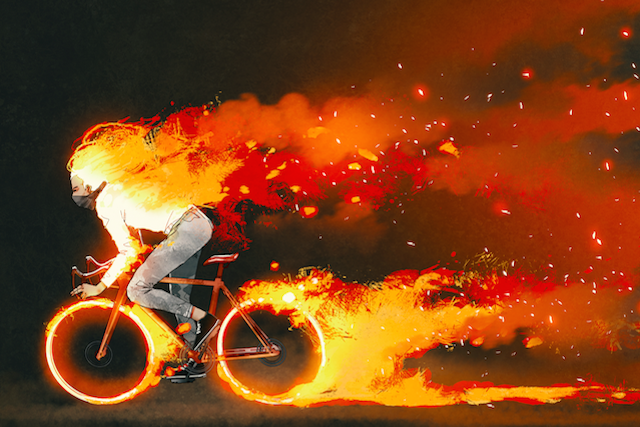
That next chapter of my life—becoming an adult, diving into a job, paving a career path, making new friends, moving out, settling down, becoming more responsible—was a big, blazing, hissing fire, probably the biggest I’d ever seen. God, it looked so scary.
Instead of walking through that scary fire, instead of moving forward, I did nothing. I stayed exactly where I was, pain-free.
I went back to my old college campus almost every weekend. I drove to different cities all over the east coast to visit my college friends. I half-assed a few corporate jobs. I partied heavily and frequently, like a college student on a never-ending spring break. I spent all my money like I had no future. I lived at my parents’ house, with no plans of moving out or moving on.
As my friends were settling down and changing, walking through their own fires, I called them “lame” and “boring.” “At least I’m still my fun, college self,” I thought. I was the same old me and always would be—the life of the party.
But that fire never stopped blazing in front of me. It was always waiting for me, taunting me, daring me to walk through it. “Turn the page.” “Grow.” “Be someone different.”
As the years passed, six of them in a row, I was too afraid to even look at the fire. Even though it was getting harder and harder to ignore, I just couldn’t imagine how painful it would be to walk through it. To change, to grow.
So I turned away from it. Instead, I drank a lot. I ate even more. I settled into dangerous routines—partying every weekend, sleeping a few hours, and eating takeout every night.
I was waking up in the middle of the night, panting and gasping for air. I started to lose interest in all of my TV shows, my job, my social events, my health, and my family. I was living in a messy house with clothes everywhere. I was gaining weight uncontrollably—almost sixty pounds in a few years. I was at the doctor almost every week with sinus and coughing problems. I had no money, no credit, no motivation. Honestly, I was exhausted. Every day, I’d ask myself, “Is this it? Is this all there is to life?”
The fire continued to burn more brightly than it ever had. But, for the first time, I wasn’t so afraid to look at it, to examine it more closely. Huh. That was weird, it didn’t look as scary as it used to.
“Could I survive walking through it?” I wondered. I could almost hear it tell me, “You’re already in pain. Walking through the fire can’t be any worse than this.”
So I had two choices: continue being the woman who clung to her college glory, her outgrown, empty life, or be the one who walked through the fire.
So I did it. I finally walked in.
And it wasn’t easy. As expected, it was painful as all hell.
I started saving every penny. I quit my nine-to-five job—the one that had financed my drinking and partying—to take a trip to South America, where I was forced to sit with my scary thoughts.
I said no to all of my social obligations—all of the weddings, the happy hours, the club hopping, the after parties—and wondered if my friends hated me.
I started cooking at home, and my cooking was terrible.
I dusted off my laptop and worked from home, doing data entry projects and transcription jobs, even though I desperately wanted to nap.
I started a savings account when all I wanted to do was splurge at a restaurant and have a few beers.
I went to bed early, even though I dreaded nighttime. I meditated. I cried. I scrubbed my house, from top to bottom, for hours at a time. I took long, soul-searching walks. I wrote in a journal with furious intensity. I had heart-to-hearts with my sister that ended with both of us in even more tears.
Yeah, it was painful. The fire was changing and transforming me, just like I knew it would.
But then, the pain started to subside.
Glennon Doyle, my favorite writer, talks about walking through fires like this one. In the Big Magic podcast, she says that she actually runs toward fires, because they will (1) either warm you to your very core or (2) burn you up, creating a new, better person that walks out the other side.
My fire did both.
After the pain, I started to feel, well…warm. Like when I ate my first successful meal—my homemade meat sauce—and sat in a clean room for the first time in forever. When I hugged my journal after I wrote “I love me” in it. When I meditated with a world-renowned, enlightened guru. When I sat in front of beautiful fountains, lost in thought, in a Chilean park. When I snuggled up in my PJs, on a Saturday night, and watched the Disney Channel.
At the same time, my fire burned me the hell up. It did. The old me, the one that I had preserved for years, was gone. I wasn’t the same people-pleaser anymore. I wasn’t the “partier” anymore. I wasn’t the tired, exhausted, sad girl anymore.
In her place was a stronger woman—someone more spiritual, direct, and in tune with her feelings.
I became a better friend, because setting boundaries had actually made me more loving, patient, and understanding with others.
I became creative—a painter, a writer, and a planner.
I became a goal-setter, and someone who could actually accomplish those goals.
I became a person who will never run away from her fires again, because they’re life-changing and worth it, every time.
So this is what I say to you.
Run toward your fire. Don’t look back.
Yes, the flames will hurt. But the most beautiful moments in life are not easy. They’re painful. They’re challenging.
The pain of growth is better than numbness.
You deserve to grow. You’re meant to grow.
Let that fire warm you up, or change you, or both.
The more fires you run toward, the warmer, stronger, and more loving you will become. You can do this.
To walking into the fire! Onward!
-
How to Cultivate Hope When the World Feels Dark and Scary
“Everything you can imagine is real.” ~Pablo Picasso
The world is so broken. We are broken. We all need healing.
Recent events worldwide are terrifying and sad. This cold and dark time of year is a challenge for many.
Some of us feel every little thing. We feel everyone’s pain. We are empaths who care for every person, every animal, and the whole world.
Many of my loved ones and friends are like this. My partner’s father recalls that on a trip to a large city nearby (my partner was eight), they saw people living on the street and asking for change. The little eight-year-old wanted to give all of his tiny savings away. Obviously, it wasn’t much, and it wouldn’t make much impact on the poverty in the city.
It can feel hopeless. We feel like we will never have enough resources and time to give. We know we can’t solve everyone’s problems. But we want to. And if we don’t, we feel the pain of our perceived failures.
If you’re anything like me, you might struggle to balance the urge to do so much or to just give up altogether. How can we nurture our hopefulness in these uncertain days?
Remember that people act out when they are in pain.
It’s a common negative thinking trap to make things all-or-nothing. If someone does something that hurts us, we can tend to believe that they are all “bad.” We distance ourselves from them in our minds to prove we aren’t like that.
It’s tough to recognize someone’s humanity in these situations, but we need to if we are going to keep our hope alive. People often lash out, spread hate, or act selfishly when they are hurt. They are feeling a deep, broken part of themselves and trying to compensate by making others feel bad too.
I’m not saying that their behavior should be tolerated. They should absolutely be held accountable for their behavior. At the same time, they are human and are still valuable.
Remind yourself that they are people, too, and probably feeling deep pain. This goes for the more extreme cases, but also for the other parent at your child’s school or your boss or politicians.
I feel hope when I remember this. The world is not full of evil people but hurt people who need love. Recognizing the humanity of others is a beautiful challenge for us to work on. This is an ongoing, lifelong practice.
Respond with love when you can.
Everyone seems exhausted these days. The weight of the world is on all of our shoulders. Whether it’s due to collective or personal struggles, people may be a little more irritable or inpatient with you.
Try your best to respond with kindness. It’s not about you. Someone may be acting immaturely or being a little rude, but if you can, try to let it go.
Visualize their insults rolling off of you, like water off of a duck’s back. Or use a technique I learned from a book, Radical Acceptance: Recognize that they are trying to pass their bad mood to you, and kindly say “no, thank you.” Do not accept their gift.
I usually feel better if I have responded to something in a caring way. Of course, we don’t always react as our best selves. You might be the one who is acting a bit rude sometimes, so try to respond to yourself with love about that too.
Be a someone.
My grandmother used to say, “Don’t say someone should do that. Be a someone.” Action can help combat our lack of motivation and hope. If you find yourself thinking that someone should do something, try asking yourself: What can I do?
You can start small and very simply. One day a few months ago, I was in the midst of a personal crisis, and I sat crying on the curb of the road. A kind stranger approached me and gently asked if there was anything they could do.
I said an honest no. They responded by standing close by with their hand on my shoulder for a few minutes, then saying a few encouraging words and continuing on.
This small gesture made me feel much less alone in that moment. There are many small things we can do, depending on our ability. If you feel up to it, don’t just walk by; be the someone who stops.
Repeat after me: Magic is real.
I keep a quote by Picasso on my desk that reads, “Everything you can imagine is real.” When I am losing my hope, this reminds me that the world I want to live in, the one I can imagine, is real. It can be real because we create our world.
It’s empowering to recognize the magic we have within us that no one can take away. There is something inside you that no one can take away and you will always have. Remind yourself of your inherent value and hold on to your magic.
Everything you can imagine is real and possible. There are so many people working to build a kinder and more loving world. I recognize their magic and I affirm that magic in myself.
Hope image via Shutterstock
-

How to Find Your Path When Life Suddenly Changes
“Never fear shadows. They simply mean there’s a light shining somewhere nearby.” ~Ruth E. Renkel
As an ocean lover, I frequently visit the shore, even during the winter. Encouraged by a day with blue skies and forecasted temperatures above freezing, I hopped in the car and headed for the coast.
The beautiful view of the ocean is the best part of the six-mile walk I intended to do. However, as I neared the coast, I noticed a thickening layer of fog. By the time I parked, the fog had completely blocked my view of the sun and everything at a distance beyond fifty feet.
Because of the thick fog, the ocean appeared to be a backyard pool. I told myself that maybe the fog would burn off, and I started moving in the usual direction through this low-lying cloud.
The beginning of my walk was freezing, and my steps, uncertain. I was eager to see where I was going, but couldn’t.
That’s when I remembered the last time I had felt something similar, but I hadn’t been at the beach then. I was at the lawyer’s office signing the papers that officially declared the end of my marriage. Back then, my future had been covered in a fog of uncertainty.
I didn’t know what to do then, but now, I know. And because I’m aware that you might be facing or will face a dramatic life change, I’d like to share what I learned as I came out of the fog.
Everyone deals with life changes.
We might get laid off during employee appreciation week, hear our romantic partner proclaim out of the blue that he or she is leaving us, or be diagnosed with a disease we thought happened to “other people.”
Regardless of the nature of the change, we must feel comforted in the realization that we are not alone. Human existence can be described as a continuous stream of changes.
When life suddenly changes, it’s a normal reaction to feel confused and disoriented.
After the shock has worn off, we might feel as though we don’t know where to go or even who we are. All we might be able to see is our current unfortunate life situation.
The fog might take a while to dissipate.
When we go through a challenge, we might not see what options are available to us for days, weeks, months, and even years. Sometimes the uncertainty, or the anger, or the pain seems to last forever.
We can choose to keep moving even if clarity hasn’t arrived yet.
Instead of being paralyzed by the uncertainty, we can decide to continue being the best we can be, connecting with people and taking care of ourselves while the answers come to us.
Even when everything seems confusing and scary, happiness is still within reach.
It might be hard to see ourselves being successful, loved, or healthy again, but if we trust that happiness is there, waiting for us, we’ll be able to gather the strength we need to keep going.
Clarity arrives gradually.
We must keep in mind that each step we take is leading us out of the fog and closer to what is supposed to enter our life so we can reach our ultimate goal. We must be patient with ourselves and with the unfolding of events as we go on.
Once we reach clarity, everything makes sense.
All the pieces of the puzzle fall into place to tell us that there was a meaning in what happened to us. We understand that we wouldn’t be where we are had we not gone through the change or challenge.
That day at the beach, the fog eventually lifted. The blue skies and puffy white clouds I had seen when I left home were in full view, the shining sun felt warm on my face, and there, clearly defined, was the majestic, beautiful ocean landscape I had intended to see.
I climbed on a large boulder and stared at the ocean, knowing I had made the right decision by not giving up on this walk, and also by not giving up on my life when my efforts to save my marriage didn’t pan out.
The road to clarity and purpose was arduous and longer than I expected. When I thought I had reached my final destination, another change or another challenge would pop up.
I wasn’t consciously aware that I was creating a new life, and I didn’t realize that the process of creation includes multiple tests, adjustments, and setbacks.
But I continued listening to my intuition and reaching out to help others who were in a similar situation. I continued spending time in nature, consuming healthful foods, and being active. I continued my labor of creation through writing and art.
By engaging in activities that added meaning to my life, I connected with my purpose, and now this purpose is as clear as a cloudless sky: I intend to help people realize their magnificence. Clarity allowed me to regain control of my destiny.
When clarity arrives in your life, you too will feel empowered.
You’ll feel confident.
You’ll understand the lesson.
You’ll be home.
And best of all, next time life throws you a curve ball, you’ll know what to do. You’ll know that the fog will eventually lift, and that all you need to do is to keep going.
-
Accepting Uncertainty: We Can Be Happy Without All the Answers
“The quality of your life is in direct proportion to the amount of uncertainty you can comfortably deal with.” ~Tony Robbins
I’ve recently begun to feel as though I am at a crossroads in my career and, as a result, have been feeling very uncomfortable.
I love what I do, working with clients and mentoring new therapists; however, I’m also a mom to two little ones and am feeling the ache of the impermanence of their childhood. This has left me wanting to spend more time at home with them and, therefore, possibly working less.
If you would have asked me when I was twenty-five years old, I knew with absolute certainty that I would never want to be a stay-at-home mom.
In fact, most of my life has been colored by a laser-sharp determination and an absolute knowing of what my next step was going to be. I’m a bit of a perfectionist and a lot of a control freak!
Today, I’m sitting in a much different place; today, I’m sitting in uncertainty. I don’t know what the next step will be for me.
There are so many unknowns at this point: do I want to work or do I want to stay home, what other options do I have, where can my practice grow from here, where can I grow from here, and so on. My automatic response to this uncertainty is to obsess endlessly until I figure it out.
However, what I’ve come to realize is that all of my ideas of “knowing” actually block me from the truth more than they reveal it.
Uncertainty makes us feel vulnerable and so we try and escape it any way that we can.
We convince ourselves that we are fortune tellers and can therefore see the future. We make ourselves crazy, spinning our minds through the same handful of scenarios we come up with, over and over again, never feeling any closer to some sort of resolution.
However, it seems a great paradox of life that it is actually through embracing the uncertainty that we thrive. Our lives are greatly determined by what we do when we get uncertain.
Without uncertainty, we might never grow because we would never be pushed beyond our comfort zones.
Many of us have experienced staying in a soul-sucking job or an unhealthy relationship because the uncertainty of leaving those situations created more anxiety than the certainty of staying in those unhappy situations.
Many people do not end up following their true passions because it is seemingly impractical, or because there is a large degree of perceived uncertainty associated with following that path.
There are no guarantees when we step into the unknown. But it is in these periods of discomfort that life’s most important adventures can arise.
Making peace with uncertainty requires courage, faith, and trust that you will in fact be taken care of, that no matter what happens, you’ll find a way through it, that you don’t have to have all of the answers today.
Contrary to popular ideas, not knowing exactly what will happen next in our lives is okay. In fact, it is actually liberating.
The ability to let go, not know, and not try to totally control what will happen next is a necessary skill for living happy, joyous, and free.
Most spiritual practices ask us to consider the possibility that there is a power greater than ourselves at work and, therefore, it is okay to let go of the reins sometimes.
I have found it easier to let go in many circumstances when I’m able to recognize that I’m not the only force at play, that there are circumstances far beyond my control that are impacting life and what the future holds.
If we fixate on “solving” problems, we tend to get tunnel-visioned and we walk around with blinders on, failing to see the possibilities.
We can’t embrace a new uncertain future when we are fully attached to our old lives or an idea of how we think something should be.
I have found that when I am in that anxious, fearful state, where I’m trying figure it all out on my own, that noise in my head that is trying to control everything will often drown out my intuition.
When we accept that things are unknown, that we don’t have all of the answers, we can see that teachings are always available if we are paying attention. When we trust, let go, and embrace the uncertainty, that noise in our own minds subsides.
Ironically, the quietness created by letting go of the need to know then allows contact with our own intuition, and we actually get clearer direction from within our own hearts and we can feel more certain about this direction.
I’ve heard it said that the furthest distance in the universe is from the head to the heart, but it is in stillness that we find this path. It is in the quiet space that we can get out of our heads and connect more deeply with ourselves, thereby allowing ourselves to be open to the possibilities when they arrive.
I have found meditation to be an incredibly useful tool to facilitate this connection. Carving out time in my day specifically for getting quiet and getting still has allowed me to find some peace with the fact that, for today, I don’t have all the answers of what’s going to happen next.
I’m able to set mindful intentions for myself to remain present and aware throughout my day, within the context that I am proceeding onto a new path in my life. With fearful dialogue in my head quieted, this skill is enhanced and I am open to new possibilities.
I will continue learning to listen to my heart, which let’s me know that I am okay even though I don’t have all of the answers.
And you are too.
-
Small Steps to Help You Act in Spite of Your Fear
“I learned that courage was not the absence of fear, but the triumph over it.” ~Nelson Mandela
My dog, Elvis, is a sweetheart and a scaredy cat. When our vet found him, he was roaming free with a wire collar embedded in his neck and a raging case of mange. It took her thirty minutes to chase him down and three months to nurse him back to health.
When we first adopted him, he was afraid of everything: bikes, strollers, loud noises, sprinklers, and people. The only things he was never wary of were other dogs. Through a lot of patience and love, Elvis has come a long way. He is no longer afraid of people or bikes, but he still hates sprinklers and he’s always on guard.
This past spring I took Elvis on a walk at a local state park. It was a beautiful day, sunny, high 70’s with a light breeze. We had a great time traipsing through the woods. When we came around the corner at the bottom of a hill, the river sat gleaming in the sun before us. Elvis stopped, sat, and refused to get any closer.
I knew he needed to get his bearings, so I paused and let him absorb what lay before him. I spoke gently to him and tried to persuade him to keep going.
He dug his paws in and started to maneuver his shoulders into this Houdini twist that allows him to slip out of his harness. I stopped and we turned around. Because of his fear, Elvis never got to see or smell all the wonderful sights and aromas awaiting him at the river’s edge.
People are like that too. We traipse happily along in our routines, always doing and experiencing the familiar.
As soon as we have an opportunity to expand our horizons, to see a new place, meet a new person, or accept a new job, our fear kicks in and we stop. We hold back; it’s too scary.
We don’t know what lies before us. All we know is it looks big and scary, and we fear all the unknowns. If we could just take that leap, act on faith, and move forward despite our fear we would learn (just as Elvis would have) that while it is new terrain, it is still dirt and grass. (more…)