Tag: right

  • What Happened When I Stopped Expecting Perfection from Myself

    What Happened When I Stopped Expecting Perfection from Myself

    “There is no amount of self-improvement that can make up for a lack of self-acceptance.” ~Robert Holden

    Six years ago, I forgot it was picture day at my daughter’s school. She left the house in a sweatshirt with a faint, unidentifiable stain and hair still bent from yesterday’s ponytail.

    The photographer probably spent less than ten seconds on her photo, but I spent hours replaying the morning in my head, imagining her years later looking at that picture and believing her mother had not tried hard enough.

    It’s strange how small moments can lodge themselves in memory. Even now, when life is smooth, that picture sometimes drifts back. The difference is that I no longer treat it as proof that I am careless or unloving. I see it as a reminder that no one gets it all right, no matter how hard they try.

    I tend to hold on to my “failures” long after everyone else has let them go. My daughter has never mentioned that photo, and one day, if she becomes a mother, she might discover that small imperfections are not proof of neglect. They can be a kind of grace.

    For most of my life, I thought being a good person meant being relentlessly self-critical. I stayed up too late worrying over things no one else noticed, like an unanswered text or a dusty shelf before company arrived. Sometimes I replayed conversations until I found the exact moment I could have been warmer or wiser.

    The list was endless, and my self-worth seemed to hinge on how perfectly I performed in every role. Somewhere along the way, I started expecting myself to already know how to do everything right. But this is the first time I have lived this exact day, with this exact set of challenges and choices.

    It is the first time parenting a child this age. The first time navigating friendships in this season. The first time balancing today’s responsibilities with today’s emotions.

    The shift came on a day when nothing seemed to go my way. I missed an appointment I had no excuse for missing, realized too late that I had forgotten to order my friend’s birthday gift, and then managed to burn dinner. None of it was catastrophic, but the weight of these small failures began to gather, as they always did, into a heaviness in my chest.

    I could feel myself leaning toward the familiar spiral of self-reproach when I happened to glance across the room and see my daughter. And in that instant, a thought surfaced: What if I spoke to myself the way I would speak to her if she had made these same mistakes?

    I knew exactly what I would say. I would remind her that being human means sometimes getting it wrong. I would tell her that one day’s mistakes do not erase years of love.

    I would make sure she knew she was still good, still worthy, and still enough. So I tried saying it to myself, out loud. “We all make mistakes.”

    The words felt clumsy, almost unnatural, like I was finally trying to speak the language I had only just begun to learn. But something inside softened just enough for me to take a breath and let the day end without carrying all its weight into tomorrow.

    Self-compassion has not made me careless. It has made me steadier. When I stop spending my energy on shame, I have more of it for the people and priorities that matter.

    Research confirms this truth. Self-compassion is not about lowering standards. It is about building the emotional safety that allows us to keep showing up without fear.

    And here is what I have learned about actually practicing it. Self-compassion is not a single thought or mantra. It’s a habit, one you build the same way you would strength or endurance.

    It begins with noticing the voice in your head when you make a mistake. Most of us have an internal commentator that sounds less like a mentor and more like a drill sergeant. The work is in catching that voice in the act and then, without forcing a smile or pretending you are not disappointed, speaking to yourself like someone you love.

    Sometimes that means literally saying the words out loud so you can hear the tone. Sometimes it means pausing long enough to remember you are still learning. Sometimes it means choosing kindness even when shame feels easier.

    It also helps to remember what self-compassion is not. It is not excusing harmful behavior or ignoring areas where we want to grow. It is acknowledging that growth happens more easily in a climate of patience than in one of punishment.

    The science supports this. When we practice self-kindness, our stress response begins to quiet, and our nervous system has a chance to settle. This does not just feel better in the moment; it makes it easier to think clearly and choose our next step.

    I’ve noticed other changes as well. Self-compassion makes me braver. When I’m not terrified of berating myself if I fall short, I am more willing to try something new.

    I take risks in conversations. I admit when I do not know something. I start things without obsessing over how they’ll end, and when mistakes inevitably happen, I don’t have to waste days recovering from my own criticism.

    Sometimes self-compassion is quiet, like putting your phone down when you begin to spiral through mental replays. Sometimes it is active, like deciding to stop apologizing for being human. Sometimes it is physical, like unclenching your jaw or placing a hand on your chest as you breathe.

    Over time, these small gestures add up. They rewire the way you respond to yourself, replacing the reflex of blame with the reflex of care.

    We are all walking into each day for the first time. Of course we will miss a detail or lose our patience. Of course we will get things wrong.

    But when we meet ourselves with kindness instead of condemnation, we remind ourselves that love, whether for others or for ourselves, has never depended on perfection.

    And that lesson will last far longer than any perfect picture.

  • What You Need to Know If Decisions Stress You Out

    What You Need to Know If Decisions Stress You Out

    “There are no right or wrong decisions, only choices.” ~Sanhita Baruah

    When I was younger, everything felt simple. Not necessarily easy, but simple in the sense that there was always a next step. A clear direction. A right way to do things.

    If I studied, I’d pass the test. If I practiced, I’d get better at my sport. If I followed the rules, I’d stay on track. Life moved forward in a straight line, like climbing the rungs of a ladder—one foot after the other, up and up and up.

    I didn’t question this structure because it was all I knew. And honestly? It was comforting. The certainty of it all. The feeling that as long as I did what I was supposed to, things would work out. Teachers handed out syllabi at the start of the year, neatly mapping out what was coming. Coaches had game plans. Parents had advice. Even when things got hard, there was always a framework. A way forward.

    I think about how movies portray childhood memories—colors cranked up to impossible brightness, the world rich and saturated, full of warmth. Because when you’re a kid, things feel solid. The rules make sense. The paths are laid out. You don’t realize how much of your life is being decided for you, and in a strange way, that makes things feel safe.

    Then, at some point, it all disappears. The structure. The guideposts. The sense of certainty. And suddenly, life stretches out in front of you like a blank map, and you’re holding the pen, unsure of what to draw.

    That moment—the moment you realize no one is handing you the next step anymore—is terrifying. Because if there’s no clear “right” choice, what’s stopping you from making the wrong one?

    There wasn’t a single moment when it all changed. It happened gradually, like the end of a song fading out until you realize there’s no music playing anymore.

    At first, I kept waiting for the structure to return. I thought maybe adulthood had its own version of lesson plans and progress reports, that someone—anyone—would step in and hand me a checklist of what to do next. But that never happened. Instead, I was met with an unsettling quiet.

    No more automatic next steps. No more guarantees.

    And with that silence came an unexpected weight.

    I started second-guessing everything. Not just the big, obvious life decisions, but the small, everyday ones too.

    Was I supposed to stay where I was or move? Take this job or hold out for something better? Was I wasting time? Making the wrong choices? Shouldn’t I know what to do?

    I realized then that I had spent years assuming every decision had a right answer. That life was a series of multiple-choice questions, and if I just looked hard enough, I’d find the correct one. But now, it felt like I was staring at a blank page, trying to write in pen, afraid of messing it up.

    No one told me how heavy uncertainty could be.

    And the worst part? I started believing that not knowing meant I was failing. That if I wasn’t moving in a clear direction, I must be doing something wrong. I looked around at other people—some who seemed so sure of their path—and wondered why I couldn’t feel that same clarity.

    But then I asked myself: What if they’re just as unsure as I am?

    What if we’re all just making it up as we go?

    For so long, I thought the goal was to figure out the right path. To make the right choices. To avoid the wrong ones at all costs. But lately, I’ve started wondering: What if there isn’t a right choice? What if there’s just… a choice?

    That question should feel freeing, but for a long time, it paralyzed me.

    I became so obsessed with making the “right” move that I stopped moving altogether. Every option felt like a risk. If I picked wrong, I’d waste time, waste effort, maybe even waste years. What if I chased the wrong career? Moved to the wrong city? Invested in something that wouldn’t pay off? Every path had its unknowns, and instead of picking one, I stood still, overthinking every possibility.

    And the longer I stood still, the harder it became to take any action at all.

    I convinced myself that not deciding was better than making the wrong decision. That staying in place was safer than stepping in the wrong direction. But that’s the thing about waiting—nothing changes. The fear doesn’t go away. The answers don’t magically appear. You just sit in the same uncertainty, hoping for clarity that never fully comes.

    At some point, I had to ask myself: What if the only way forward is to move, even if I’m not sure? What if the worst outcome isn’t choosing wrong, but never choosing at all?

    So maybe the next thing isn’t the “right” thing. Maybe it’s just something. A step. A choice. A movement.

    And maybe that’s enough.

    At some point, I realized that life wasn’t black and white—but it also wasn’t gray. Gray implies balance, a predictable mix of extremes. Something stable. But that’s not what life feels like. Life is more like an off-white—uncertain, shifting, something that looks different depending on the light.

    I used to think uncertainty was something to fix. A problem to solve. But what if uncertainty isn’t the enemy? What if it’s just part of being alive?

    The truth is, I don’t know if I’ll ever feel 100% certain about anything. And maybe that’s okay. Maybe I don’t need to know. Maybe the point isn’t to eliminate doubt but to learn how to exist alongside it. To accept that I can move forward without having every answer.

    Some days, that’s easier said than done. On those days, I remind myself:

    • Not knowing doesn’t mean I’m lost. Just because I don’t see the full path doesn’t mean I’m not on one.
    • No decision is final. Even if something doesn’t work out, I can pivot. I can start over. I can change my mind.
    • Other people don’t have it all figured out either. Some just got better at pretending.
    • Waiting for clarity won’t bring clarity. The only way to figure out what works is to try something. Anything.

    I used to think confidence meant being sure of everything. Now, I think it means being okay with uncertainty.

    Life is never going to be neat or obvious. It’s never going to fit into clear categories of right and wrong. But maybe that’s the beauty of it—maybe life is meant to be lived in the off-white.

    I think back to all the times I agonized over a decision, convinced that one wrong move would ruin everything. I stressed, I overanalyzed, I played out every worst-case scenario in my head. And yet, when I look back now, most of those choices—whether they turned out “right” or not—don’t carry the same weight they once did.

    Some of the things I worried about didn’t matter at all. Other things didn’t go how I expected, but they still led me somewhere meaningful. And the most surprising part? Some of my so-called “mistakes” ended up being the best things that ever happened to me.

    At the time, I didn’t see it that way. At the time, I was convinced I had taken a wrong turn. But looking back, I can see that every decision—good, bad, uncertain—shaped me.

    The job I took because I thought I had to? It taught me what I didn’t want.

    The opportunity I turned down out of fear? It made me realize I needed to be braver.

    What I once saw as missteps were actually just steps—part of the path, part of the process.

    I wonder what choices I’m agonizing over right now that, in a few years, I’ll see differently. I wonder if I’ll laugh at how much I overthought things, how I was so afraid of getting it wrong when, in the end, everything was just unfolding the way it needed to.

    It makes me think: If I’m going to look back someday and see that everything worked out one way or another, then why not trust that now? Why not let go of some of the pressure?

    Maybe I don’t need to know if I’m making the perfect decision. Maybe I just need to make a decision and trust that I’ll figure the rest out along the way.

    I used to believe that one day, I’d wake up and just know. That clarity would arrive like a neatly wrapped package—here’s your answer, here’s your direction, here’s the certainty you’ve been waiting for.

    But that day never came.

    And I don’t think it ever will.

    Because life doesn’t work like that. There’s no singular moment where everything clicks into place. No guarantee that the path we’re on is the one we were “meant” to take. No cosmic confirmation that we’re doing this whole life thing correctly.

    And maybe that’s not a bad thing.

    Maybe the goal isn’t to have everything figured out. Maybe the goal is to get comfortable not knowing. To make peace with the ambiguity instead of fighting it. To stop treating life like a problem to solve and start seeing it as something to experience.

    So what if I don’t know what’s next? So what if I don’t have a perfect plan? I’m still here. I’m still moving. I’m still learning.

    And maybe that’s enough. Maybe I’m enough. Right now. In the middle of the uncertainty. In the middle of the mess. In the middle of the off-white.

  • How I Found Peace After Feeling Disregarded and Disrespected

    How I Found Peace After Feeling Disregarded and Disrespected

    “Self-care is also not arguing with people who are committed to misunderstanding you.” ~Ayishat A. Akanbi⠀

    It was an early evening in late June of 2020. My housemate and I were eating sushi in our backyard while crickets tuned up for their nightly symphony around us.

    To our right loomed a voluminous green tree, imposing in height but with a texture (furry and cuddly like a Sesame Street character) that made it seem friendly.

    I could’ve really used a friendly creature right then.

    Hours earlier we’d found out that our housemate—who’d contracted COVID while on vacation with a fourth housemate—would be returning home the following day.

    I’d expressed my discomfort with this, in no uncertain terms; however, my housemates had dismissed me and maintained their plans to return home regardless.

    I considered my options. One would be to stay at home. Even if my housemates didn’t transmit the virus, the CDC had advised (when sharing a house with a COVID positive person) to quarantine. I’d pause my life for two weeks, foregoing my income (as a freelance Spanish interpreter my assignments had not yet been moved to Zoom) while living with the anxiety of potentially contracting the virus.

    *This was pre-vaccine, when knowledge of COVID and its long-term effects was minimal. People (younger ones included) were dying from the illness daily. I was experiencing mysterious health symptoms at the time, so my health felt especially fragile. Months later I’d discover the cause to have been Celiac disease.

    Option two would be to stay at motels. I’d spend some of my savings while continuing to pay rent on the apartment I was leaving behind—but my health would be spared. I’d also be able to continue working, which would help to cover these costs.

    I was leaning toward the latter and expressed my line of thinking to my housemate as we ate our meal out back.

    There was more nuance to the interaction than I’m able to capture here, but basically, the news of the uninvited COVID house guest hadn’t fazed this housemate, and she seemed visibly annoyed that their decision was causing me anxiety.

    Here was the gist of our exchange:

    “You could catch COVID from one of the hotel maids,” she said. “Hotels aren’t safe.”

    “Less safe than sharing a house with a COVID positive person?” I challenged.

    Sensing my frustration and incredulousness, her face hardened. “I don’t want to talk about this anymore,” she said firmly, her tone suddenly icy and sharp.

    A butterfly had just landed on my chopsticks. To keep calm, I focused my eyes on its gently fluttering orange wings. I continued focusing on them while my housemate stood up, picked up her sushi debris, and walked back toward the house.

    **

    After packing my belongings, leaving the house, and relocating, my emotions fluctuated throughout the week. An internal tug-of-war of, “Just accept the decision they made and let it go / No don’t, your needs and feelings are valid and that wasn’t okay,” played out various times.

    I’d have understood if either housemate had contracted COVID at work or the supermarket, or under any other circumstance that falls largely outside of one’s control. Or if they’d already been home, I would never have asked them to leave.

    That they’d gotten sick in another county though, despite CDC’s strong desperate plea for people to refrain from traveling—and had then knowingly brought it home—made all the difference.

    I brought these concerns up again during a video call with my housemates after I’d been gone for five days, only to be dismissed once more. My housemates suggested that if I didn’t like it, then maybe I should find another place to live (no matter that I’d been living there before them and had even chosen them as housemates).

    After our call ended, the room around me spun as I sat there processing that nowhere in my housemates’shared consciousness had there seemed to be any acknowledgment of my reality or validation of my perspective.

    Moving out indeed seemed like the most sensical and emotionally healthy option.

    I’d left a few weeks earlier feeling like I was fleeing a burning building. While gone, I realized that the fire would have continued blazing had I continued living with them—long after my housemate recovered and COVID ceased being a threat.

    It would be because my trust and emotional safety were broken for me now. When in place, these things provide light and warmth. When they’re broken, that light turns into flames. I felt like my options would have been to armor up indefinitely, or to leave the burning house behind.

    Certain issues (when small enough) can be swept under the carpet. Some are mere annoyances best handled by simply letting go. I’d done that with some of my housemates’ prior behaviors that had bothered me.

    But this one felt too big to fit.

    **

    The day I returned to the house to pack up my belongings, I thought about how different things had been just a few months prior. How at the start of shelter in place, the four of us seemed to be getting along—becoming, if not friends, at the very least friendlier.

    How abruptly things had taken a turn.

    The emotionally stressful situation brought to light two important lessons for me.

    One was that we each have to be our own best protectors.

    My housemates had described their decision to come home as a boundary, which I suppose it technically was (in my opinion, a harmful and inconsiderate one). They were entitled to return, and I couldn’t physically stop them.

    And while they had a right to that boundary, I had a right to decide I wasn’t safe with people who’d feel okay with setting such a boundary despite the stated impact it would have on a person they were coexisting with. I had a right to decide that their boundary was incompatible with my receiving the care, respect, and consideration that I both need and provide in return.

    If others are disrespecting us or disregarding our well-being, we can decide our hearts aren’t safe with them. We can remove them from their reach.

    If they’re uninterested in considering your perspective, don’t try harder to explain it in a way they’ll understand. They don’t deserve the ego boost of having you chase their acceptance.

    We can’t and won’t change others’ behavior. We can only care for our own selves.

    I try now to spend less time attempting to prove the validity of my perspective to people who simply don’t want to hear it. I try to spend more time making decisions that are healthy for my mind, body, and spirit.

    More time on surrounding myself with people around whom I don’t even feel tempted to over-explain—because their care and consideration for me keep that impulse from activating to begin with.

    We all deserve people like this in our lives. But in order for them to surround us, we must remove ourselves from situations that are harming us.

    The second lesson I took was that people who harm us don’t deserve our time or mental energy.

    Following what happened, there was so much I wanted to say. There were comments I thought my former housemates deserved to hear. There were character evaluations I felt tempted to launch their way.

    Ultimately, though, I saved my energy, communicating only about practical matters such as getting back my deposit (which they initially attempted to withhold from me).

    After finding a new living situation, I poured my efforts into friendships; into long phone conversations and Zoom calls.

    I immersed myself in my interpreting work.

    I cooked healthy meals that nourished me.

    I pet the sweet cats who wandered through my backyard.

    I wrote, spent time with my nephew, processed what had happened with a therapist, devoured books, and did my best to heal from the emotional pain that the whole situation and its bitter ending had caused me.

    I also paid attention to moments of goodness—recalling how the morning I left for the motel, I’d approached my car, bags in hand, to find the back window shattered. The glass littering the surrounding pavement felt symbolic of what was happening with my living situation.

    A neighbor had asked if I needed help. Mask on, he came out with a broom and dustpan. He helped me sweep up the glass. Spikes of it still hung from the back window. We broke them off together so that I wouldn’t be driving around with the shards.

    A small audience of neighbors beheld the scene. Kids watched the glass shatter and land against the seats of my car. They watched it rain down onto the pavement.

    In short, I redirected energy I would have spent on vengeful thoughts onto improving my life.

    I want my energy. I want my equanimity and mental stillness. I don’t believe they deserve the satisfaction of taking those things from me.

    Because as Carolina de Robertis put it in her novel The President and the Frog:

    “Rancor and revenge could keep you mired in the past, a swamp of which he wished to be free; [her character] couldn’t afford that sort of thing, there was too much to do in the here and now.”

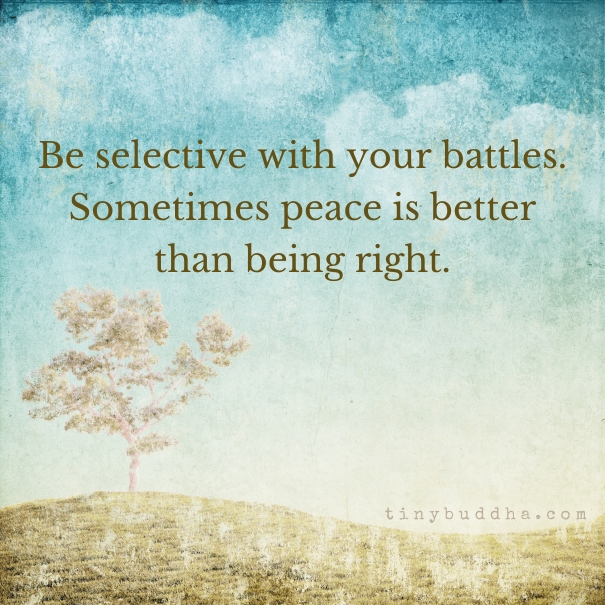
    Sometimes it’s better to choose peace over righteousness. Above all, it’s your own heart and mind that most stand to benefit.

  • We Can Choose Different Ways Without One of Us Being Wrong

    We Can Choose Different Ways Without One of Us Being Wrong

    “You have your way. I have my way. As for the right way, the correct way, and the only way, it does not exist.” ~Friedrich Wilhelm Nietzsche

    Many of us are committed to a journey of change and personal growth. While these are traits to be admired and celebrated, they can also have a darker side. We can become a little militant and dogmatic when we’re on our journeys.

    As we focus on our attempts to make changes in our own lives, our views can start to narrow and become very black and white. We become so tuned into what we are doing that we forget there’s more than one way to do just about anything.

    We seek out others that agree with us to back up ‘our views.’ This may be part of our primal wiring to be part of a collective. We seek a tribe.

    Being part of a tribe can be intoxicating. Being with people that share our passion is exciting. It’s great to have a common goal or view and be able to talk about our passions with others that really get it. We’re all in this together.

    Being in a tribe can also distort our perspective. Only seeing and hearing a biased view. Ironically, we can lose objectivity as we seek clarity. Becoming more rigid as we search for methods and hacks.

    Or maybe we enjoy citing this study or that to ‘prove’ our point. Using science (bad science oftentimes) as our weapon of choice to make ourselves feel and sound knowledgeable.

    Both these traits can lead to us becoming dogmatic, thinking our way is the only way.

    A Personal Example or Two

    I notice this habit of falling back on dogma for a good reason—I do it myself.

    An example would be my approach to exercise.

    I choose to keep myself strong with my own bodyweight (calisthenics). The ability to use one’s own body through space is impressive to me and I feel it’s the ultimate expression of strength. Not everyone shares this view of course. Many others enjoy hoisting large amounts of iron or swinging a kettlebell.

    As I have deepened my own practice of bodyweight training and enjoyed the benefits it brings, I have also found myself judging the way others exercise at times. Shaking my head at people in the gym I perceive to be doing something silly or dangerous.

    Another favorite, quoting from a famous fitness authority or studies to hammer home a point, perhaps how repeated loading of the spine with weights can have negative connotations. Or how balancing on a bosu ball has little carryover to anything other than balancing on a bosu ball.

    Why do I do this? I’ve chosen my route, why do I feel the need to judge the way others choose to exercise? I’m certainly no expert.

    Another example would be my journey into simplicity and applying 80/20 principles to my life. Several years ago I realized I was accumulating more in my life. More things that didn’t really matter to me or speak to me on a spiritual level. Life felt more complicated than I wanted it to be.

    In response, I started to make some changes. It’s a journey I’ve documented previously on Tiny Buddha. The upshot of these changes has been that the quality of my own life has improved significantly. There is more focus and clarity in my life.

    Along the way, as I’ve traveled further down the rabbit hole of simplicity, I find myself casting a weary eye at others oftentimes. Judging them for complicating things, or not grasping the power in simple, or for not saying no to commitments they have no capacity to keep.

    None of this is useful to them, none of it is useful for my internal energy. Yet, still I have to fight this pull to judge. Justifying it somehow as me now knowing better. How arrogant and self-righteous this all sounds as I write the words, and for good reason—it is.

    Your Journey is Your Journey

    No need to complicate things. Personal journeys should be personal. Let’s be clear, we’re not in competition and even if we are, it’s with ourselves.

    You can call yourself a minimalist if you like, but owning less than your neighbor doesn’t automatically make you a better person.

    You can call yourself a mindfulness advocate and commit to daily meditation, but not everyone needs a formal meditative practice to be mindful. Equally, not everyone with a daily meditative practice is mindful.

    You can choose to strengthen your body by lifting your own body if you like, but it’s fine if someone else chooses to push weights or rocks instead.

    You can choose to follow a Paleo diet without bashing vegans, or vice versa. People can, and do, thrive on many diets as the Blue Zones around the world already prove.

    You can choose to follow a religion that calls to you, but you can do that without damning someone else who follows a different faith.

    You can choose to do all of this quietly in your own way. Or you can choose to share what you are doing with others in the hope of inspiring them to join you, or support you on your journey. If you share, let’s drop any degree of superiority or smugness. No need to hide behind dogma or use it as a weapon to fire at others.

    Follow your passions in life, embrace them, and really enjoy them, but be aware that others are just as passionate about their passions. Leave the dogma behind and remember, there are many routes to the top of any mountain.

    Note: This post is as much a reminder to myself as it is to you. I hope to rid myself of this affliction to hide behind dogma at times. If you notice me doing it, please feel free to remind me of these words. 😉

  • How Our Egos Create Drama in Our Relationships (And How to Avoid It)

    How Our Egos Create Drama in Our Relationships (And How to Avoid It)

    “The ego is the false self-born out of fear and defensiveness.” ~John O’Donohue

    I started a new relationship in December 2015, then moved countries to be with my Swedish partner in August, 2016.

    The last year has been life changing in the best possible ways. I’ve learned so much about myself, things I didn’t have the courage to acknowledge before.

    But it hasn’t all been a bed of roses—some of the insights I’ve gleaned haven’t been that comfortable to see.

    We met on an intensive spiritual retreat in India. We’ve both spent many years working on ourselves and our issues, so it’s fair to say we’re both awake and aware. But this has not guaranteed an easy ride or a challenge-free relationship.

    We both still have to work hard on the problems that come up, affecting us both individually and as a couple.

    When our disagreements or arguments erupt, it is often over the smallest things, which seem so important at the time. A prime example is when my partner asks me to do something without saying “please” (something that’s common in Sweden.)

    Such a minor failing has the power to seriously irritate me, causing our argument to blow up out of all proportion—sending one or either of us into fits of temper tantrums that can end with one or both of us brooding and not speaking to the other.

    Although we’re both aware how childishly we’re behaving and can see our over-reactions, we are nevertheless at a loss to stop or change this process. Why? Because of our egos!

    For the first time in my life I am seeing, experiencing, and understanding the ego play that takes place in every conflict I have. These insights are allowing me to unravel the true nature of my ego and its workings.

    If I were to describe my ego, I would compare it to an irritable, barely containable caged monster on the one hand and an irate, screaming five-year-old on the other. And just like a child that doesn’t get her own way, she’s constantly throwing tantrums.

    These tantrums take the form of anger, hurt, fear, defensiveness, exaggeration, frustration, self-preservation, insecurity, self-pity, and tears—all mixed with large quantities of drama.

    In the heat of an argument, my five-year-old ego is very quick to feel hurt, so she reacts by jumping, stamping her feet, cursing, and defending herself. Then, just as quickly, the caged monster surfaces, rearing up like an angry giant, sword and shield in hand, ready to inflict hurt in return.

    I literally see my ego self rising up like a dark shadowy character, looming menacingly above my head.

    Of course I know this ego play doesn’t solve anything—it only serves to trigger my partner’s own ego defense games. Suddenly we’re both wounded five-year-olds, shouting and throwing ugly insults back and forth at each other.

    Then, invariably, we have to argue about who started it and which one of us is right.

    As you can imagine, these ego battles take up a lot of energy and are very stressful, not to mention emotionally draining.

    I notice that when I’m in this heightened state of drama, my ability for logical thinking goes out of the window. I lose all connection to my grown-up self and I feel the adult receding, regressing me back to an insecure child.

    I see myself adopting the same body language and survival strategies I used when I got into disputes with my mother during childhood.

    Looking back, it’s obvious to me that my current over-reactions have a lot to do with how I was brought up. My mother was a strict matriarch with black and white views—grey areas didn’t exist in her world. She was always right and everyone else wrong, and there was no room for argument.

    If I ever dared to argue, I would be quickly silenced with a barrage of cutting words or physical blows that would leave me hurt, feeling powerless and seething for hours. My voice was quashed, my will controlled, and I felt small and stifled.

    As a child, I didn’t have the awareness to recognize the surge of my ego during these altercations with my mother, when my very existence felt under threat. But of course, every part of me screamed silently in protest, including my ego.

    Now, as a so-called mature fifty-year-old adult, it’s quite disconcerting to visibly witness my conditioned responses popping to the surface during heated conflicts, especially when some part of me feels threatened.

    These responses haven’t altered or evolved at all since my childhood. Sometimes it feels like I’ve never really grown up.

    I still discover myself seething in the same helpless way to emotional triggers and feeling the same powerlessness when my will is challenged or when I feel controlled, as I often do during conflicts with my partner.

    My ego rears up in anger and defense in exactly the way it did when I was a child.

    And yet, even in the most extreme spells of ego drama, I’m sometimes able to take a step back from my hurt, stealing a momentary pause from the heat of my frustration.

    These short breaks allow my anger to calm, giving space for my ego to stand down. Then I’m able to recognize the reasons for my exaggerated reactions, understanding that a part of me was feeling threatened.

    I’ve observed that my biggest over-reactions occur when my partner threatens what I deem important; for example, the time and money I spend on my spiritual activities.

    In these brief moments of lucidity, the ego is fully exposed with technicolor clarity. In this instant, the cause of our argument, which seemed so important just a few minutes before, completely loses its power and dissolves, rendering the whole situation funny and somewhat ridiculous.

    My ego’s true nature is laid bare during these points of pure seeing.

    It’s utterly clear to me that my ego simply functions to protect the parts of myself I feel I must defend, secure, or guard, like my will, my way of expression, my beliefs and moral values.

    My ego jumps up in defense of these values because of the importance I’ve given them, effectively giving my ego permission to react whenever these values feel challenged.

    Amazingly, the truth is, these morals can only exert power over me if I allow them to. I can equally decide not to give them any power at all, which should gradually stop my ego’s need to defend them.

    I know it will take time to break this pattern of over-reactions to emotional triggers, since my conditioned responses are almost automatic now. However, in conflict situations, if in one time out of ten I don’t react, it will certainly make a difference to my life and relationships, won’t it?

    What a liberation that will be!

    For years I’ve unknowingly been trapped in the same ego cycle of trigger/reaction, trigger/reaction that developed when I was a child.

    Now, with the benefit of being able to witness my ego play in action, I no longer feel a prisoner of its games. For the first time in life, I am learning to choose whether or not to react.

    These other insights around my ego are helping to improve my partner relationship, as well as the relationships with family and friends.

    The ego wants to blame others.

    We have all become so accustomed to blaming other people and circumstances that we are often not even conscious that we’re doing it.

    On the surface, it’s much easier to blame others, because it removes the burden of accountability from us and places it firmly at the feet of the other. However, although blaming others appears to be a quick-fix solution, in all honesty, it isn’t.

    Believe it or not, blaming others takes away our control of the situation and passes it onto the other. It prevents us from seeing the whole truth of the issue and blocks us from fully understanding ourselves, which can keep us stuck in the same obstructive patterns of behavior.

    For years I blamed my mother for everything that was wrong in my life. I blamed her for not being there for me, for not supporting my dreams, and for not being the parent I expected her to be. Spending so much time and energy blaming her, I wasn’t able to see my own part in the situation.

    When I finally had the courage to stop blaming my mother, it came as quite a shock to me to realize that I was equally responsible for the things I was unhappy with.

    It’s clear to me that my ego’s fear of admitting culpability kept me in blame mode.

    I naturally progressed onto blaming my partner, because my ego makes it difficult for me to accept my part in a conflict that I am at least partly responsible for. So it’s no surprise our arguments escalate as they do.

    Ultimately, we must all strive to accept responsibility for every action we take, even the ones we’re ashamed of. The more we’re able to do this, the stronger we become and the weaker our egos will be, gradually loosening the grip they have on us.

    The ego covers up.

    Another thing I can say about the ego is that it will do anything to cover up its mistakes, especially when it sees it’s wrong. Its attempts to cover up increase when caught red-handed, behaving just like a child caught with his hand in the cookie jar.

    I remember when I was a child, even when I was caught in the act, I would do everything I could to cover up my mistake, trying my best to deny the blatant truth.

    Maybe my actions as a child could be excused, but sadly, my behavior as an adult hasn’t improved—I still find myself fighting to deny the truth when I’m unexpectedly caught off guard. Like when my partner surprises me, by correctly guessing the trivial cause of my upset.

    My ego hates being so easily called out, so it must cover up and defend.

    One of the hardest things for any of us to do is to admit we are wrong, because when we own up to being wrong, it automatically makes the other right.

    And being wrong is something our egos cannot bear. As a result, we find it difficult to say sorry or to ask for forgiveness, which exacerbates our conflicts.

    I’m also recognizing that our inability to admit our wrongdoing keeps us stuck in our defensive positions, which allows our egos to fool us into fighting, justifying, and defending every point of view—a complete drain of our energy.

    I’ve noticed, however, that when I see the truth and can openly admit it to my partner, surprisingly, rather than separating us, the admission brings us closer together, healing some of the hurt we created during our conflict.

    So admitting that we are wrong need not be a negative experience, but can instead empower us, lessening some of the control our egos have on us.

    The ego wants to hurt back.

    For me, one of the worst things in the world is the pain of feeling hurt, as I imagine is true for most of us.

    Sometimes, the hurt we feel paralyzes us and we’re unable to fight back, but at other times, the only thing we can think of is how we can hurt the other person back.

    Our egos trick us into believing that hurting the other will alleviate the pain we’re feeling.

    I’ve realized that in all conflict situations, it is actually our egos that feel hurt. Again because some value or aspect of the image we have internally built up of ourselves is being challenged, threatened, or undermined in one way or another.

    I’m ashamed to say that on many occasions, both in my childhood and adulthood, my ego has wanted nothing more than to inflict as much pain on others as possible, as a way of lessening some of the hurt it was feeling.

    But retaliation is not the answer; it only adds more fuel to the fires of our egos.

    Maybe I can be forgiven for saying that in my childhood, hurting others was an unconscious reaction to my own feelings of hurt. And in the recent past when I was still unawake, hurting someone who hurt me was my natural course of action. But now, with my increasing awareness, knowingly hurting another is not something I can condone.

    In the heat of ego fights between me and my partner, when my ego rears up ready to defend itself, it’s hard, but I am becoming more and more able to check myself before I go over the line with insults I know will cause my partner pain. Even when I feel he has crossed the line with me, I can still consciously stop myself from going too far.

    I consider this a huge triumph over my ego, and something I’m proud of.

    Every time I can stop myself from blindly over-reacting to a perceived threat to my values and can become an observer of my ego and its games, I know I’m taking a step in the right direction.

    The more conscious we can all become of our ego play in action, the more freedom we will gain from our egos. Then, over time and with consistent effort, positive changes to our life journeys and relationships are inevitable.

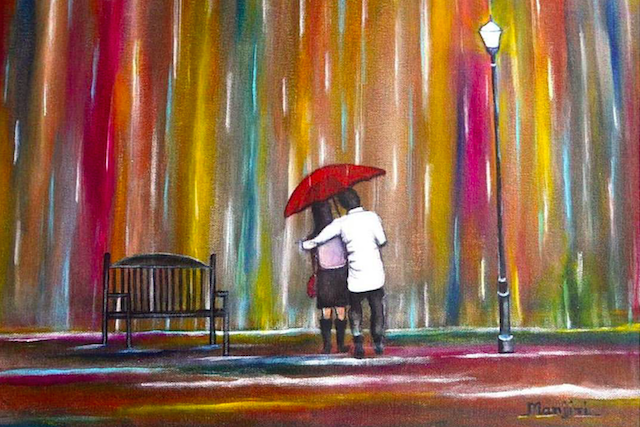
    Artwork by artbymanjiri, CC 2.0
  • 3 Things We Can All Do to Create Stronger, Happier Relationships

    3 Things We Can All Do to Create Stronger, Happier Relationships

    “Love is the absence of judgment.” ~Dalai Lama

    I used to be one of those moms.

    Let me explain.

    I was a single mom for literally my daughter’s entire childhood. That’s okay—I was a control freak, so it really suited me. I got to make all the decisions. Perfect!

    And it was… for me. Not so much for my daughter, but then in those days I was only focused on getting through the day and paying the bills.

    We coped. I made the rules, set the boundaries, and expected her to tow the line.

    Which she mostly did, although sometimes begrudgingly. But then, that’s normal behavior for kids, isn’t it?

    Well, I thought so.

    It’ll come as no great shock, then, I’m sure, when I tell you that she was very eager to escape the clutches of my control-freak-ness and be independent.

    And so post-studies she eagerly shifted into her new role of a young adult seeking employment. This was a milestone. The start of her new career—woohoo!

    The job market was tough, but we remained cautiously optimistic.

    Something would come up. Wouldn’t it? Eventually?

    And then she dyed her hair purple.

    Yup. Purple.

    Being one of “those moms,” my reaction was, with hindsight, completely predictable.

    “HOW WILL YOU FIND A JOB WITH PURPLE HAIR?!” I shrieked, as we moms do.

    She calmly looked me in the eye and said, “This is me expressing who I am, and if any potential employer has a problem with that, then I don’t want to work for them!”

    What could I say. She had a point

    And in fact, she went on to get the very first job that she interviewed for.

    At one of the oldest and most respected academic institutions in our country.

    In one of the most conservative departments.

    After being interviewed by a panel of five academics.

    With her purple hair.

    Now, I’m not too big to admit that I learned a lot from this particular event. Maybe not immediately, but it was one of those times (and there were many) when the parent/child role most definitely reversed.

    And I couldn’t be more grateful.

    Here’s what I learned:

    1. Recognize and identify your filters.

    We view life through the filters we’ve accrued from our life experience. Sadly, this often dulls or taints our experience of life.

    In this case, I saw my daughter as a child, someone incapable of knowing what was best for her. Viewed through this filter, she needed my guidance and opinion, as I believed all children did. After all, as the wise and experienced parent, don’t we always know better?

    Apparently not.

    We see what we want to see, what we’re used to seeing, what we choose to see, not necessarily what is actually in front of us.

    I currently live in a country where there’s a large third world element. And with that comes a lot of roadside hawkers. And I mean a lot!

    Growing up, I was cautioned to avoid them, told they were dangerous, made to look the other way.

    They were pushy, loud, and not to be trusted. So I was told.

    Who was I to argue? Surely my parents knew better.

    And so, for a long time, I avoided them, labeled them as bad, and pretended they weren’t there.

    As I grew older (and wiser), I started to notice them in a different way.

    These people are excited about their wares, enthusiastically trying to entice passers-by, and happy to negotiate very vociferously!

    They are energetic and eager. Friendly and interesting.

    And mostly, they were simply fellow humans trying to make a living.

    A different perspective. A different filter.

    2. Stop judging. Find freedom in being neutral.

    It’s human nature to charge every event in our lives as positive or negative.

    Something is always right or wrong, isn’t it?

    So surely having purple hair when your seeking employment in a tight marketplace is wrong, then. Right?

    Have you ever tried to observe an event as simply neutral? It’s as easy as acknowledging that it simply is what it is—no judgment needed.

    No emotional attachment. No expectation.

    And you get to appreciate the value of the event.

    Being neutral allows you to find how the event can work for you. It allows us to see a bigger perspective. And opportunity.

    I often wonder how different my daughter and my relationship would have been in her younger years if I’d had the awareness then that I have now.

    I remember once in her teenage years when she wanted to share some frustration she felt about a specific teacher with me. I listened with my “mom/adult” filter firmly in place, then decided she was wrong (naturally) and proceeded to deliver my (assumed) much needed opinion on the topic. That’s what she wanted, wasn’t it?

    No, it wasn’t, not at all.

    Not surprisingly, she didn’t share much with me after that.

    She wasn’t looking for judgment. Or my opinion. She was simply looking for someone to hear her.

    If I’d listened with neutrality I could have been that someone.

    3. Get curious about others.

    What’s right for me may be wrong for you. That’s a fact and its part of being human.

    I had a specific idea of what my daughter’s life should be—how it should unfold, where her path should lead—entirely from my perspective.

    I had never really been curious about what she liked, enjoyed, or found interesting.

    Surely if she just followed my lead, life would unfold easily for her. Wouldn’t it?

    She’d shown interest in music, other cultures, and cooking. I noticed, but that’s not the same as being really curious.

    Many moons ago I had a friend who cultivated medical marijuana oil for use with horses.

    I know, I also had wide eyes when she told me, along with a whole lot of judgment. I mean, marijuana is illegal (in our country)! How could she?!

    I somewhat reluctantly listened to her explanation/justification, full of judgment initially.

    And then I noticed how passionately she spoke about her love of horses.

    I noticed her conviction to helping them as naturally as possible.

    Then I thought about the risk she was taking by cultivating this oil. There was no financial gain for her—it was simply an act of love.

    It wasn’t for me to condone or criticize her actions. That’s not my business.

    Yet by being curious, I now understand her actions and see the beauty in her passion and love for her horses, whatever that may lead to.

    Embracing and respecting each other’s choices fosters tolerance and understanding.

    Not only that, but if we really observe those around us with curiosity instead of scorn, we expand our own experience. And isn’t that what life is really about?

    My daughter is now a few years into her career at the same institution.

    And she’s evolved. Her hair is now a medley of colors. (My own rainbow child!)

    And it’s beautiful.

    She’s happy. I’m happy.

    We understand each other. And respect each other. I listen to her with immense curiosity regarding her opinions, even though mine often differ.

    We don’t need to be right. We need to be happy.

    When we drop our resistance, our happiness emerges.

    It’s always there. No exceptions.

  • Relinquishing Control of Others: 5 Ways It Serves You

    Relinquishing Control of Others: 5 Ways It Serves You

    Letting Go

    “Selfishness is not living your life as you wish to live it. Selfishness is wanting others to live their lives as you wish them to.” ~Oscar Wilde

    My mother is a huge control freak. I am told she got it from my grandmother, who basically ran everyone’s life.

    Regardless, growing up, I noticed that she really struggled with relinquishing control of what we were all doing with our lives.

    It was partly out of love because she just wanted what was best for us, and partly because she feels a sense of panic when she doesn’t know what’s going to happen if the person chooses to go in a different direction than she envisions as the “right” one.

    I inherited my own need to be in control of everything and everyone from her. It took me a long time to learn how to surrender to what was and let go. Not just of the things happening in my own life, but what others close to me were doing.

    I know that when I am outside of somebody else’s personal situation I have much more perspective because I’m not emotionally invested in their drama the way they are. At least, I think I’m not.

    See, that’s the big fallacy! I have come to realize that I do actually get emotionally invested, and I hold onto an expectation that the person will take my advice and do what I so clearly think is the right thing for them.

    Let’s be real—do we really know what the right thing to do is for another person?

    I recently had a great conversation with a close friend of mine who is incredibly advanced on his spiritual path. We were discussing a mutual friend of ours who is currently in a relationship with a woman we know is absolutely wrong for him.

    We have pointed out all the warning signs we see. He has also admitted that he sees them himself and senses them, but still he cannot walk away from the relationship.

    I was expressing my sadness and frustration over my friend not taking my advice or hearing me. I said, “What else can I say to him so he gets that this is a huge mistake?”

    My friend calmly replied, “You’ve said everything you need to. Now you need to relinquish control over the situation and allow his soul to have the experience it wants to have. Maybe his soul needs to have a horrible, destructive relationship to get him to the next level of his learning.”

    Wow. Why hadn’t I seen that?

    It is true that we don’t know the journey that each person is on. And we need to allow the people in our lives to make choices that feel right to them—because what is right for us may not be right for another person.

    When I started to relinquish control over what everyone in my life was doing, I started to feel a huge shift in my energy.

    I realized that by just “holding space” for people, which, according to Heather Plett, means “being willing to walk alongside another person in whatever journey they’re on without judging them or trying to impact the outcome,” I was able to be of better service to them, and in turn allow them to follow their own path.

    Letting go of others’ decisions and any expectations we have of them has a number other benefits. Some of the ones I found were great motivators for me.

    1. You have more energy to focus on yourself.

    What a difference I felt when I stopped obsessing and worrying over every single friend’s problem and trying to figure out how to fix it for them.

    I didn’t realize how draining it was for me to take on everyone else’s “stuff.” When I started to let go of what other people were doing to fix their own problems, I found I had way more energy to focus on me.

    2. It can be more empowering to just listen rather than “fix.”

    People don’t always need us to “fix” things. What they need when they come to talk to us is to feel heard. Nobody likes to be told what to do.

    Releasing control of what the people in my own life decided to do enabled me to be a better listener since I was spending less time thinking of ways to “fix” their problem.

    3. We develop trust.

    When we can surrender to what is, allow things to unfold, and realize that every experience serves a purpose, we start to trust that whatever happens may really be for the best.

    Relinquishing control and allowing things to play out without our interference can reveal some surprising outcomes that we never could have planned and ultimately be the best for everyone involved.

    4. It strengthens our relationships with others.

    When my mother started to release her tight grip on everything I did, we became closer. I understood how difficult this was for her to do, and I had a lot of respect for her.

    By not telling people what to do all the time, we are essentially saying to them, “I trust you to make the best decision for you.” This really strengthens our relationships with them when they believe there is a mutual trust and respect for their judgment and choices.

    5. We learn something new when we watch how others do things.

    I always thought I had all the answers. Clearly not since my life has been in shambles many times over. There is so much we can learn from others when we observe the way they do things. The next time we find ourselves in a similar situation, we may find that their way was the better way.

    When we reflect on all of the reasons it serves us to let go of controlling others, it’s a great excuse to allow the people in our live to follow their own path. Whether it’s the right path or the wrong path is not for us to decide. It’s simply their path.

    Letting go image via Shutterstock

  • Love Challenge #233: My Way Isn’t Right

    Love Challenge #233: My Way Isn’t Right

    Love Challenge #233

    We’d all be so much happier, and we’d get along a lot better, if we accepted that everyone does things differently!

    (This challenge comes from the upcoming book Tiny Buddha’s 365 Tiny Love Challenges. Pre-order before October 6th and get $300+ in free bonus gifts!)

  • There’s More Right in the World Than You Might Think

    There’s More Right in the World Than You Might Think

    Good News

    “When you turn on the television … you run the risk of ingesting harmful things, such as violence, despair, or fear.” ~Thich Nhat Hanh

    I passed the rack of newspapers on my way into story time at the library, ignoring the latest headlines. Murder, mayhem, war, disaster—it all calls like a siren at sea. My pace picks up as I turn the other direction.

    My two-year old charge, whom I affectionately call Little Man P, is captivated by the animated librarian. She impresses me with her liveliness and ease in handling a room full of kiddos. It is clear she loves her work and those that come to story time.

    After everyone else left, she lingered to talk with me and Little Man P. He’s shy and bashful, but loves attention. Since he insists in going out in his superman outfit, he certainly gets noticed.

    I’ve enjoyed caregiving most for Little Man P because he has reminded me how to have fun and use my imagination.

    There’s hardly a moment he isn’t asking me to tell him a story. He’s more interested in elephants that can climb trees and fire hydrants that can talk than he is in anything else. I tell the librarian how my imagination has come alive since I’ve been babysitting him.

    With this comment, she seizes the opportunity to plug a special kids program coming up that weekend at the library. Unfortunately, I wasn’t going to be available to attend. I explained I would be spending a few nights staying with an elderly woman at risk of falling whose husband had to be out of town for a funeral.

    I shared with her what I consider to be the greatest downside to working with the older end of the age spectrum. Many, if not all, of my clients are really into the news. I can pretty much count on a newspaper at the table and the television turned on.

    Rather than participating in a fun and imaginative weekend program, Id be stuck listening to CNN running 24/7 in the background. I complained about this with my new librarian friend, commenting how difficult it is to hear all the bad news in the world.

    She shook her head sympathetically and muttered an agreement. I went on to express my frustration with the news media for mainly reporting what’s wrong in the world. I asked her, “Don’t you think there are just as many good things going on in the world?”

    She agreed, but then said: “Yes, but it seems things are getting worse every day.”

    I felt the familiar flare of passion rise up when a topic really pushes one of my buttons.

    I passionately exclaimed, “People only think that because that’s all they hear about on the news! Isn’t it just as likely there are an equal amount of miracles happening every day, or good Samaritans doing heroic deeds that we don’t hear about?”

    I think my enthusiasm must have turned her off, as she made a rapid exit after my outburst. Our conversation, however, reminded me of why I have such a ban against reading or watching the news. My desire to know what’s right in the world instead was ignited.

    Although not everyone agrees with the belief that we focus on is what we create, chances are if you’ve ever thought about buying a certain kind of car, you’ve experienced suddenly seeing that kind of car everywhere.

    This phenomena is referred to as frequency illusion. Our minds sift out all the other data we are receiving and starts to see more of something we have just noticed or learned. It is amazing how we will begin seeing things previously unnoticed based on where our thoughts and focus are directed.

    I’ll concede, simply watching or hearing about murder, terrorism, or the bad economy isn’t necessarily going to mean we see more of those things as we go about our day to day lives. However, it does increase the likelihood we start living a more fearful life.

    As such, we might notice the unusual looking man at the grocery store. Then, when he pulls out behind us in the parking lot, we worry he is following us. Or perhaps we become suspicious of the neighbors who just moved next door because of their race or religious orientation.

    Similar to “frequency illusion” is the experience of “selective attention.”

    Numerous studies demonstrate when our attention is occupied with one thing, we often fail to notice other things right before our eyes. In one study, few people noticed a woman with an umbrella cross the field while they were counting how many times a football got passed from one player to another.

    Likewise, if we are preoccupied with the strange looking man in aisle two of the grocery store, we might not notice the cashier pull money out of her own pocket to help the customer in front of us who didn’t have enough to pay for their groceries. Or see the young man help the elderly woman carry her groceries to the car.

    Constant bombardment of all the horrible things happening in our world can only lead to greater and greater distress and mistrust.

    What we need instead is more hope, faith, and love. In an information age where what happens on the other side of the world is known immediately everywhere, why does the media report mostly on what’s going wrong?

    Imagine a primary news channel devoted predominately to the announcement of miracles or to reporting various good deeds.

    What if we were constantly seeing pictures of people helping each other, babies being saved by the latest in modern medicine, or politicians shaking hands in agreement over important issues?

    What if we were to hear stories about the rising inner peace movement, or new and innovative programs to assist the elderly, sick or disabled?

    Is it possible we would all smile a bit broader and greet strangers with a warm hello?

    Perhaps we would feel encouraged to do our own generous act of kindness or join an existing worthy cause.

    Would not knowing about some of the things we hear about on the daily news make a huge difference to us in our day-to-day lives?

    How can we possibly know if things are getting better or worse when we aren’t given even a 50/50 accounting?
    Steven Pinker, in his 2011 book, The Better Angels of Our Nature: Why Violence Has Declined, argues things actually are getting better. He asserts violence has been in decline, despite the ceaseless news about war, crime, and terrorism.

    We just can’t see it because no one is focused on what’s right it the world.

    Since I’ve stopped watching the news and reading the paper, my life is happier and more fulfilling.

    If there is something really important happening in the world, I will hear about it elsewhere. If there is some action I can take to make things better, I will do it. But most the time, I’m quite content to live in my bubble, smiling at people and extending kindness to strangers.

    Good news image via Shutterstock

  • How to Help Yourself by Owning Your “Bad” Qualities

    How to Help Yourself by Owning Your “Bad” Qualities

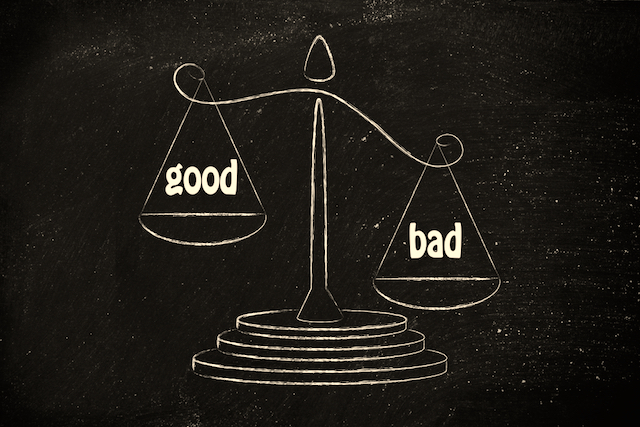
    Good and Bad Scale

    “Nothing is either good or bad, but thinking makes it so.” ~William Shakespeare

    Like many women, I feared my own voice.

    I feared what would happen if I acknowledged my feelings and I feared what would happen if I expressed them.

    Above all, I feared that people would leave me if I ever communicated as my true self.

    In my family and culture, feelings are things that are best when denied. I was taught they are a liability that, if embraced, would lead to fights, pain, and loneliness. I was encouraged to ignore, avoid, and push them down into the recesses of my mind.

    Not surprisingly, by thirteen I developed severe depression, resulting in poor coping mechanisms, a reliance on medication, and a suicide attempt.

    The need to express myself was natural and necessary, but my belief that it was wrong prevented me from ever owning my voice. Instead, I communicated in unhealthy ways:

    • I had angry outbursts.
    • I played the martyr.

    And while I tried to suppress and control this side of me, it came out in waves of anger and hurt. Through decades of transformation, I now understand that many of my behaviors were based on my belief that things are either all good or all bad.

    So how did I unlearn this belief and learn to express my true voice?

    By learning how I played the game of black and white.

    When we’re young, we’re taught that certain aspects of our personality are bad or wrong, while others are good and useful. And like most things we learned as kids, we need to unlearn them.

    In order to fit in, feel loved, and gain acceptance we disown the “bad” qualities we believe we have and try to express ones that are seen as “good.”

    This polarized thinking forces us to see the world in terms of black and white, right and wrong, or good and evil. And in this game of black and white, the only rule is that white must always win.

    Unfortunately, the world isn’t that simple. Most things exist on a frustrating spectrum of grey.

    Fortunately, we can learn to re-own these repressed qualities and transform them into qualities that benefit us and others.

    For example:

    • Owning our anger can lead to self-love, if this enables us to set boundaries to take better care of ourselves.
    • Owning our self-expression can lead to genuine connection, if this enables us to get in touch with and communicate our true wants and needs.
    • Owning our apathy can lead us to a passionate career, if this enables us to redirect our energy and quiet our fear of failure.

    Here’s How:

    The first step to seeing how you play the game of black and white is to determine which traits you’ve put into each category.

    What qualities in others make you angry? Often the aspects of others that trigger us are the things we don’t like about ourselves. These are frequently the areas that we need to work on the most.

    For example, when other people stated their boundaries, I previously felt threatened because I wasn’t comfortable setting my own. This taught me that I needed to address this issue in my own life in order to feel whole and attract other people with healthy boundaries.

    To begin, list several “bad” qualities. These are the traits that go in your “black” pile (i.e.: lazy, late, disorganized, loud).

    What qualities do you think of as good, desirable, and appropriate? These are the qualities that we are praised for or that we value in ourselves or others. List several “positive” qualities. These are the traits that go in your “white” pile (i.e.: honest, flexible, driven).

    Next, determine how the game manifests in your life.

    In what ways do you play the game so that “white” must win? What have been the consequences? For example, in believing that silencing my voice is good, I’ve been in unhealthy relationships, had angry outbursts, and felt depressed.

    If you were to give the disowned trait a voice, what would it say? For example: mine would tell me that it’s safe to be the real me.

    Finally, embrace the trait as neither good, nor bad, simply a part of you.

    If you were to re-own that trait, how could it benefit you? Often, qualities we view as “bad” are harsh criticisms or expressions of our own fears.

    For example, I often find that I am frustrated when I perceive someone to be lazy. This, however, is merely triggering my own fear that I am not doing enough. Owning this trait allows me to see that there are times when I should relax.

    Owning it taught me that I don’t need to overwork in order to prove that I am worthy. Owning my lazy side would allow me to live a more balanced life and cultivate self-love.

    Creating awareness around how you play the game of black and white will give you the freedom to consciously choose your behaviors instead of going on autopilot.

    It will allow you to stop stumbling through life and begin navigating it on your own terms. You don’t need to accept your false beliefs when you have the power to change them.

    Isn’t it time you mastered your life?

    Good and bad image via Shutterstock

  • How to Know If You’re with the Right Person

    How to Know If You’re with the Right Person

    Couple Silhouette

    “Our lives improve only when we take chances and the first and most difficult risk we can take is to be honest with ourselves.” ~Walter Anderson

    I’m not actually interested in telling you if you’re with the right person. I’m interested in you discovering who you really are. If you’re not in the right relationship, you probably shouldn’t try so hard to make it “work.” Sometimes the right thing to do is walk away.

    But the big gap here is in the knowing. The knowing if it’s right or not. The truth is that you don’t actually need somebody else to tell you what the truth is. In fact, that’s the last thing you need.

    What you really need is to uncover your own truth so you can live according to it.

    If you’re not sure if your partner is for you, then you’re living in your head. You’re ignoring your truth—the deep part of yourself that is screaming at you to leave or to stop fighting or to open your heart. Whatever your truth is, it’s inside you and it’s dying to be heard.

    Relationships are tough. I totally get it. The songs of heartbreak tell the stories of our human weakness, and I’ve cried to many of them.

    The deeper untold story is that we’ve lost ourselves. We don’t live in a world where we’re taught to look inward to resolve ourselves. We look outward to fulfill ourselves, a feat that leaves us defeated time after time.

    I have discovered that when you live according to the deeper truth within yourself, you become happy in circumstances you never thought you would have been happy in.

    Maybe you’re single or divorced or childless or on a new career path or living in a new town; you’re somewhere, and you thought you’d be somewhere else.

    You thought that trying to control the outcome would result in your happiness. The irony is that the things we think are right for ourselves are often the things that are holding us back from discovering what is actually right for ourselves.

    I once shared a depth of love with a man in a way I’d never experienced before. Circumstances beyond our control ended the relationship. We did a back and forth thing—a few times. Then we really let it go; we both believed it was over.

    After months without words we reconnected and discovered that the profound love between us still remained. But there was a deeper truth we each recognized within ourselves. Even though we shared this beautiful connection, love, and respect for one another, we wanted different things.

    I wanted to experience depths of intimacy that he didn’t feel capable of at that time. So we parted ways once again. Respectfully. Gracefully. With love. And it doesn’t mean it was easy. But it was right, and we weren’t confused about it because we both knew ourselves.

    You see, the love that we’ve become accustomed to is not actually love. Our desire to possess another doesn’t come from love; it comes from fear. And that fear comes from a lack of confidence, a lack of self-love. 

    The desire to control things and manipulate them to satisfy our ideal outcome does not come from love. It comes from the fear of letting go, the fear that things aren’t going to turn out the way you want them to.

    Maybe you’ve misinterpreted your fear for love. You give it to your other in desperation. It’s missing the genuine gift of heart, the fully embracing warmth of love that is timeless and boundless.

    Love knows you do not own another, and rooted in this love you do not want another to ever be your possession. What you want for them is the greatest life offers up to us. You want for them to be whole, to feel love, to be honored by themselves.

    True love wants movement. It wants to share and rejoice. It expresses diversely. We don’t all mesh in the same way. We’re not all for each other.

    So how do you know if you’re with the right person? The answer is that you have to know yourself. Sorry, but this is the hard work of love. 

    It starts with you. This is your job: Know yourself. Be happy with yourself. Love yourself.

    It’s not your job to give what you don’t have or to take on the impossible burden of fixing someone else.

    When you lose yourself in another, when you confuse their problems for your own, when you deny another the freedom of pursuing their soul’s journey, you do a great disservice to two incredible human beings.

    Only when you know yourself will you be able to know if someone else is right for you.

    When you know what it feels like to be in tune with your core, your essence, your spirit, your whatever-you-want-to-call-it, your soul will scream out YES! or NO! when you’re with another person.

    Your soul will respond ferociously.

    It’s already screaming now.

    The question is: Are you listening?

    Couple silhouette via Shutterstock

  • From Conflict to Compassion: Put Love Above Winning

    From Conflict to Compassion: Put Love Above Winning

    Angry Couple

    “Let go of your attachment to being right and suddenly your mind is more open.” ~Ralph Marston

    When we face a conflict we face an opportunity to learn from pain. It’s like putting your hand against a hot burner on the stove. The burn warns that you have to do something differently.

    You pull your hand back reflexively and you don’t touch the stove again. You’ve learned. As with the hot stove, if we get the lesson that is in front of us, we don’t need to keep repeating that particular pain.

    Inconveniently, our natural inclination when we feel the sting of conflict is to outsource the blame, making it impossible to get the lesson and move on.

    This is such a strong tendency that many of us live in a constant or re-occurring experience with conflict. We have conflicts with our co-workers, our boss, our neighbors, the guy in front of us in line at the coffee shop, our partners, children, and parents.

    It’s the same story running over and over. In its most basic form, the story is:

    I have been wronged by someone who does not see my value. They are self-centered and are not considering my point of view

    Oddly enough, that is also the story we are acting out. We are refusing to see the others’ point of view; maybe because it puts our own sense of self at risk.

    Who am I if I let go of my passionate perspective and wholly understand the others’ point of view? Will the world walk all over me if I don’t stand up for my rights?

    Fundamentally, this fear is about a loss of ego. My outrage at my neighbor because he continually lets his dog out at 5:30AM to bark is rooted in a desire to be right: to have my experience in the world validated.

    Of course, the pre-dawn barking disturbs my sleep. I don’t want to discount that impact. But if this were an event that I chose or knew I couldn’t control, I would accept it.

    For example, if I opted to live somewhere beautiful knowing that there would be a 5:30 siren every day, I would manage that in my life with earplugs or a different sleep pattern and not feel indignant about it. But when I feel disregarded by the neighbor, I experience the pain of conflict.

    When I am upset with my partner because he doesn’t do enough housework, it’s not because I’m in pain from doing too much housework. I’m in pain because I’m afraid he won’t see my value; that he will take me for granted and not recognize my worth. That is a fear of losing ego.

    What can we do with this need to win in order to be seen? This very need is central to our primary drivers and yet runs contrary to our best interests.

    As Leo Tolstoy wrote to Gandhi in 1908 in A Letter to a Hindu:

    “On the one side there is the consciousness of the beneficence of the law of love, and on the other the existing order of life which has for centuries occasioned an empty, anxious, restless, and troubled mode of life, conflicting as it does with the law of love and built on the use of violence. This contradiction must be faced.”

    It seems as though our very civilization is built on this tension between winning and loving.

    Tolstoy, optimistic about the resolution of this tension, believed love would rule eventually, if humans just got to the business of recognizing it and putting it at the forefront.

    I’m certainly not going to disagree with that lovely thought, but working with people in interpersonal conflict for many years has taught me that this is no small request.

    It’s all well and good to point a finger at terrorists or fundamentalists or the target du jour. It’s easy to see they need to lay down their arms and love one another.

    But when it comes to the feud with the neighbor, the lack of recognition from the boss, the unjust lawsuit, the cheating spouse, or any of the other truly personal forms of conflict in our day-to-day lives, we take umbrage.

    For those matters, it seems critical that we receive acknowledgement of our unique experience.

    I’m learning that transcending this desire for rightness requires that we build a pathway out and that we cultivate that pathway, tend it, and keep it free of stumbling blocks.

    Here are four not-so-simple steps to tend that path:

    Grow compassion.

    Let go of your perspective long enough to feel another person’s pain. Practice this every day with small matters like the person cutting in front of you in line, and increase to your miserable neighbor or needy mother. When you are annoyed by the screaming child on the plane, imagine what that parent must be feeling.

    Release the need to be right.

    Consider the notion that there is no right in this situation, just two perspectives. We tend to think that our perspective is the truth, but recognizing that our “rightness” is tied to our biased perspective helps get us past our ego.

    Take responsibility for yourself.

    Keep an eye out for what you bring to the situation that adds to the chaos. Overextending or having unclear expectations or boundaries can be as damaging as blaming or digging in your heals.

    Accept what is.

    When you’re in conflict with a person whose behaviors are unacceptable to you, you need to take care of yourself and let go of the desire for the other person to be different. You can’t change that person, but you can change your relationship. Staying engaged and wanting them to be better is like putting a hand back on the stove and wanting it to be cool.

    The opportunity to grow in conflict comes when we accept the other person’s limitations and take care of ourselves without feeling indignant, bitter, or self-righteous. If we can do that, we can broaden that path through the pain toward compassion.

    This post has been updated since it was first published. Angry couple image via Shutterstock