Tag: rich

  • How to Find the Gold When Everything Falls Away

    How to Find the Gold When Everything Falls Away

    “To stay with that shakiness—to stay with a broken heart, with a rumbling stomach, with the feeling of hopelessness—that is the path of true awakening. Sticking with that uncertainty, getting the knack of relaxing in the midst of chaos, learning not to panic—that is the spiritual path.” ~Pema Chödrön

    Sixteen years ago, when everything familiar fell away, I felt desperate for spiritual answers. I bartered with a woman who called herself a quantum healer. When I explained I didn’t have enough money to cover rent, bills, and food, she scoffed, “Well, you have to have money to be spiritual.”

    Say what, now?

    In our culture, this myth is pervasive, yet we only have to look at the life of the Buddha (or Jesus or Muhammad) to see that’s untrue. The Buddha left a life of wealth and privilege in order to awaken.

    What this woman probably meant was that people need money to attend retreats in exotic locales, or to purchase expensive courses on manifestation, or to hire coaches who promise them seven-figure incomes.

    To awaken to our true nature requires nothing. It doesn’t even require a teacher, because life is the teacher.

    For many of us, spiritual growth is propelled by a falling away of everything familiar, including income. Admittedly, it’s difficult to focus on spiritual growth when we’re hungry or facing other survival challenges. The paradox is that these can be a crash course in awakening if we allow them to be.

    In my experience, these challenges are designed to humble our egos and show us that all our doing and egoic effort aren’t going to work; only surrender can. Begging and taking a victim stance (historically, one of my areas of specialty) doesn’t work either.

    The Jedi trick is to find peace despite all this, to discover the freedom of emptiness, or, as it’s called in Christianity, “the peace that surpasses all understanding.”

    Prioritize Inner Peace

    “If you get the inside right, the outside will fall into place.” ~Eckhart Tolle

    One year, despite sending 200+ emails, I couldn’t find work. If I hadn’t felt so frustrated, the sheer volume would have made it comical.

    Then, after listening to many, many hours of Eckhart Tolle’s talks, I decided to stop trying so hard. I began practicing a fierce form of presence, staying only on the razor’s edge of this very moment, because to consider anything other than the present moment brought panic.

    I prayed and meditated near-constantly, which helped me become aware of even the smallest signs of grace: seeing the first cherry blossom on a tree, making eye contact with a starling, or receiving a free baguette from a local baker. Each of those moments—and thousands more—brought inexplicable joy.

    In those moments, I felt deeply connected to the network of life. I’d believed I needed a baseline of money to feel inner peace, yet without money, I’d found inner peace anyway.

    The moments that brought up immense fear in our relative world became expansive in the absolute. When I fully accepted and inhabited each moment, life showed me the next step. And the next.

    Life isn’t quid pro quo. Capitalism is. Whatever we put out always comes back, though not always in the same form.

    How to Find the Gold When Everything Falls Away

    Cultivate joy with a giving practice.

    In 2014, amidst a round of financial challenges, I heard about the 29-day Giving Challenge, based on Cami Walker’s book 29 Gifts: How a Month of Giving Can Change Your Life. The book is based on instructions she received from a medicine woman named Mbali Creazzo. The idea is to give something away freely every day for 29 days—and also to pay attention to what flows in.

    These gifts don’t have to be material, though it helps to give what you would like to receive. Because I was hungry and behind on rent and bills, for me, that was money.

    One day, I was able to purchase a $10 gift card for the local grocery store, and I gave it to a woman I saw frequently on the street. Other times, when I was down to less than $5, I left a dollar coin on a wall where children love to climb.

    Being broke had made me feel less than human. Recognizing that I could help someone feel seen and valued again, even briefly, was a revelation. Knowing that a child would find that dollar made me smile all day.

    Giving became, and remains, the most euphoric practice I’ve ever had. This isn’t virtue-signaling or bragging; it completely transformed my life, or rather, the way I experience life.

    We all need something, and we all have something others need. That’s the definition of interdependence.

    Many times, I gave patience, directions, or thanks. Other times, when I could afford it—and this is still one of my favorites—I would leave a chocolate bar on a public bench with a note that read, “Please accept this random act of chocolate.”

    Other times, I wrote notes on Post-its with words I needed to hear and placed them in public areas. Things like “You are loved” or “You make a difference in the world.” Writing each of these gave me a hit of dopamine and helped me feel more like a part of the world rather than forgotten.

    Try community giving.

    For several years, I bartered with an independent coffee shop to be able to eat one meal a day.

    Inspired by an Italian trend called caffé sospeso, we created a practice of “suspended coffee.” If a customer was financially able, they could pay ahead for someone else’s coffee. If someone wanted a coffee but couldn’t afford it, they could request a “suspended coffee.”

    Being able to co-create a giving practice that benefited everyone in the community made me giddy.

    At the same coffee shop, baked goods were typically thrown out after two days. I began taking bags of leftover muffins, scones, and banana bread to a local soup kitchen, where they were a treat for guests more often served soup and stale bread.

    On holiday weekends, instead of throwing out food, we gave whatever pre-made salads remained, as well as day-old baked goods, to people in transitional housing.

    I was flat broke and trying to pay off a five-figure debt, $10 at a time. These giving practices evoked such joy in me that my anxiety about money all but disappeared (okay, mostly). And when that happened, life stepped in to support me.

    Be open to receiving.

    What does it mean to be open to receiving? A complete lack of resistance to what is. Many people feel resistant to receiving financial help because there’s a myth in the dominant culture that accumulated wealth equals an individual’s value, and not having money makes someone ‘less than.’ Those are both false human constructs.

    It’s important not to give in order to receive, nor to give because you believe you have to. Those cancel out the energy of giving. If you can give freely, though, miracles unfold.

    For me, these ranged from a neighbor who spontaneously offered me money to cover rent to an acquaintance who gave me the cash back from her credit card so I could pay down more of the five-figure debt. I saw clearly that flow is always at work in the world. And I stopped feeling ashamed about receiving.

    Giving helps me see what I do have: people who care about me, a roof over my head, a meal that day. It gets me out of my head and my ‘poor me’ stories.

    To my delight, giving helped me rediscover the feeling of oneness, emptiness, or “the peace that passes all understanding.” Because I felt so peaceful, I felt less resistant to my own situation, and that allowed the situation to change.

    We think of items and money as “ours,” but really, we’re just stewards. Indigenous cultures have known for millennia what we settler-descendants need to learn: What we have is to be shared with others, not hoarded.

    Money Can Make Us Forget

    Once income began flowing in, I was mortified to discover how easily I slid back into wanting to keep what I had (after all, I rationalized, it wasn’t much). I began grasping again and believing in the collective delusion of stability. Awareness—access to the experience of emptiness, oneness, or the “kingdom of heaven”—shrank.

    My ego had been so thoroughly humbled, even fractured, during the broke times that it grasped at anything that could help it rebuild a sense of identity—which is antithetical to emptiness and peace.

    It’s not just me. Sociologist Paul Piff, Ph.D., of the University of California, Irvine, ran a game-based experiment in which he found that “rich” players hoarded their fake wealth far more than “poor” players, who tended to be more generous. This aligns with research that demonstrates that, on average, wealthier people donate less than their less-affluent counterparts.

    By maintaining a giving practice, I can reconnect with that expansive feeling of joy at being able to meet someone else’s need, whether that’s a friend, a stranger, or some random child walking along a wall who finds a dollar coin.

    It’s a Process and a Practice

    The gold in the title of this post refers to awareness. That is the experience that all spiritual teachings point toward (and which no words can capture).

    When things fall away, life is inviting us to awaken. As long as we resist what is, the doorway remains closed. When we prioritize inner peace and then generosity, miracles can happen.

    After nearly three years of bartering with the coffee shop, I was offered a contract—out of the blue—that helped me pay off the five-figure debt within six months. This was unusual, though not unheard of.

    More typically for me, and probably for many, when we give from what we have, smaller amounts begin to come in that enable small payments or a few days of groceries. It doesn’t always come back as money. Receiving food by bartering with the coffee shop was a complete gift to me. Be open to different ways of receiving.

    It’s not easy when things fall away, but it is an opening. If we can learn to prioritize inner peace, let go of our egos, and become part of the flow, we can find peace and even happiness greater than we ever imagined.

    If you’re hungry and broke, the apps Too Good to Go (US/Canada), FlashFood (US/Canada), and OLIO (global) may be able to help.

  • Getting More Out of Life When You Have Less Money

    Getting More Out of Life When You Have Less Money

    Couple Walking

    “The real measure of your wealth is how much you’d be worth if you lost all your money.” ~Unknown

    When we find ourselves not having “enough,” times may be rough; however, this is only our first glance, our perceived perception.

    Not all who have little are poor. None who live simply fit into the status quo. And none of us deserves to be judged for what we do or do not own.

    Poverty lines are a general measure of separating the classes, but they fail to feel emotions, see our genuine qualities, or tell the stories of our lives.

    They quantify our income, encourage us to strive for more, but more of what? More money to engage in better opportunities? More cash to buy more stuff?

    Numbers have a tendency to lose their meaning when they don’t add up—a well-paying job with no time for family is no better or worse than barely scraping by without savings, yet having no debt.

    There are many lessons to be learned from being poor. If you have ever been on your last coin, or more than once, chances are good that you may have experienced an enlightened state of being.

    Voluntarily choosing to live with less is quite different than being born into poverty, yet the paths overlap and intersect on so many levels.

    Searching for the silver lining of a free fall into a greatly reduced income, of which my husband and I caught the winds of almost a decade ago, we discovered the concepts of minimalism and simplicity.

    At first I was terrified at the aspect of living off of so little money, coming from a consumer culture that defines worth in terms of income. However, rationality quickly stepped in after that initial panic, and feelings of being lost without monetary stability were replaced by a desire to live well within our means.

    There was no denying the change of mindset that was rapidly taking place.

    We made a tiny handful of money (way below poverty measures) that allowed us to go to the grocery store a couple of times a month for food; the rest we had to acquire for ourselves in other ways—learning to forage, trading, growing…

    Every coin we made went toward nourishing our bodies, because good health is the most important aspect of survival.

    When we couldn’t afford electricity for eight months, we lit the kitchen with a few beeswax candles. When they burnt out we went to bed early, only to wake up with the sun.

    Employment was nowhere to be found in the countryside. We had no Internet connection and it seemed that life was on standby. Months and years went by, and it was hard. We didn’t buy anything we couldn’t afford, we didn’t want what we couldn’t attain, and all the while we didn’t complain.

    The last part confused a lot of people. We didn’t complain because we accepted the situation we were in, and rather than fight it, we decided to learn from it.

    It is possible to live well, well below the poverty line. Much of it depends on your state of mind, part of it comes from where you enter the phase of living with less; but wherever life takes you, lessons are waiting to be found:

    1. You may already have enough.

    In our past we had acquired all the things we needed for survival, and then some. Clothes “out of fashion,” but definitely not out of use. Pots, pans, dishes, music, games. Though we didn’t have the ability to buy things anew, we certainly did not go without. 

    When you have little, you may still have more than you realize at first glance. Set possessions aside and focus on life that surrounds you. Friends, family, your health—foster those intangible, yet all important connections.

    Most importantly, make peace with patience. Slowly moves the world without flowing cash or access to the Internet, and it still remains a beautiful place to be.

    2. Less time with electronic gadgets leaves you more room for people.

    Physical relationships are the ones that foster real laughter, genuine love, and lasting memories. Conversations flourish in the absence of technology.

    We can relearn to have meaningful discussions without a cell phone on the table; they only serve as a distraction at the dinner table and attest to our shortening attention spans.

    3. Solitude gives you time to delve into your emotions.

    It gives you time to think about life. Inner reflection is hard to focus on when we are busy day and night, so get un-busy and make more time for dreaming, questioning, and contemplating. Find quiet activities to let your mind expand to new horizons; you have the time.

    4. Nature provides us with much beauty, energy, and inspiration.

    No money for a concert? Great! Go listen to the night song of crickets in summertime, listen to frogs bellow, listen to birds or running water. Hike, walk, bike—get out of your four corners and find freedom in the “wild.” 

    5. Self-reliance will foster an unending sense of independence.

    Spend time reading books; volunteer your time to learn and teach new skills, meeting new people and creating opportunities for advancement as you go about daily life. See the connections, and feel what is important for your personal growth.

    Rather than feel guilty that we couldn’t afford to eat out, we chose to develop our cooking skills and embrace the art of slow food. We grew vegetables in the garden to preserve for winter, we baked our own pies and pastries, we relished in our growing confidence of all matters related to providing for oneself.

    In eight years one can acquire immense knowledge, and our wealth grows with our ever-increasing set of useful skills (from knitting to felting to cobbing to shoe making) that we can apply over many aspects of life.

    6. Happiness cannot be bought.

    It can be grown, cultivated, tended, nurtured, but you won’t find it on a store shelf or a screen. Happiness comes when you are at peace with who you are, right in this moment—with your job or lack of it, with your salary or lack of it, with your friends or lack of them, with your wants fulfilled or lack of that.

    Struggles can bring out the worst or the best in us! Living with less money than “ideal” is certainly a challenge and if we haven’t been there ourselves, we certainly know someone who has been financially in need. You can be rich and poor or poor and rich, depending on where you place your values.

    Wanting less speaks volumes about your personality. It has nothing to do with charts and graphs that society creates, but it has everything to do with you—the way you treat yourself and the much-deserved attention you give to others around you.

    The next time you take a pay cut, voluntarily or not, remember the advantages of more time, more meaningful experiences, and a whole lot less stuff to store along the way. You are not defined by your past; you and your thoughts are the future. Learn, let go, and move on.

    You can live with much less than you ever thought possible and find many uplifting winds to carry you on your way.

    Photo by Tony Alter

  • 6 Lessons from a Poor Childhood That Lead to a Rich Life

    6 Lessons from a Poor Childhood That Lead to a Rich Life

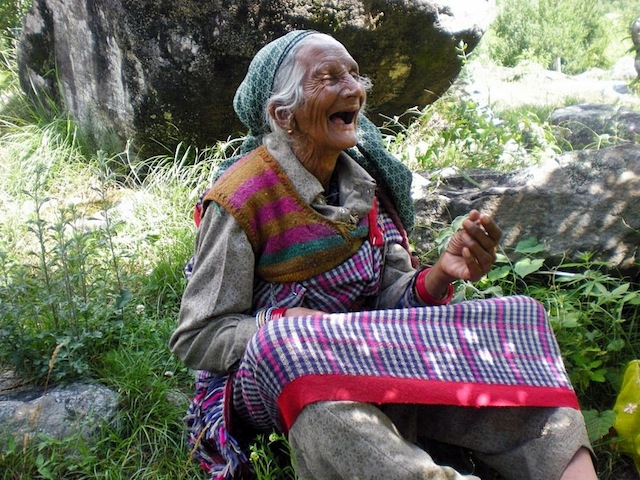
    Happy Old Woman

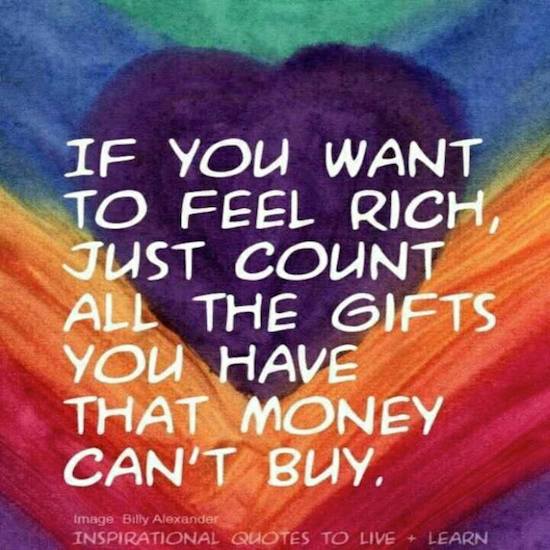
    “If you want to feel rich, just count the things you have that money can’t buy.” ~Proverb

    I grew up on a farm with a father that was a hired hand and a mother that took care of the elderly.

    I had six siblings and was the fifth in line. We had little money, but I always felt loved, not deprived. In many ways I was a rich person.

    When I was four years old I lived in a two-room house, with two bedrooms built on within the year.

    We had no real kitchen (it was just a room), no running water or indoor bathroom, no TV or telephone. (No, I did not grow up with the dinosaurs). We did have electric lights.

    What did I learn by growing up in these conditions?

    1. I learned to share.

    There were four of us girls and we all slept in the same bedroom—two in one bed and two in another (both twin beds). You name it, and we shared.

    2. I learned to take good care of what little I had and be grateful.

    We each had one pair of shoes, very few clothes, and one toy for Christmas, so we took good care of what little we had and did not take it for granted. For birthdays, there was a cake baked and our present was getting to lick the bowl for the cake and icing.

    3. I learned to use my imagination.

    With very few toys we had to make your own. We walked on tall tomato cans with strips of rubber attached to hold them on our feet. We played with old tires and five gallon barrels by rolling them on their side. And stilts, we made ourselves.

    4. I learned to eat until I was not hungry any more rather that when I was stuffed.

    Food was limited, but balanced. We each got our share because my mother cut it up equally among us. (I never knew you could scoop ice cream out of the carton until I grew up, because my mother always cut a half gallon of ice cream into 10 equal pieces and that 10th piece was cut into 10 more pieces. (My father got the extra piece.)

    I have never had a problem with weight, and this is because of the good eating habits and appreciation for the food we had.

    5. I learned that it was the people that made a home, not the size of a house.

    We may not have had much, but we had each other. We had each other to talk to, play with, and laugh with. (Sometimes to fight with.)

    6. I learned to work together.

    When you live in a small space you have to work as a team. You learn good working skills and what hard work is.

    We earned money by working in the fields for the farmers, helping irrigate when it came to watering the crops, and keeping the four rooms of our house picked up, so there was room to walk.

    As I look back on my childhood and the values it fostered, I realize I was a very lucky child. Yes, things are much better and easier now, but I know what to appreciate and what’s important to be happy.

    It’s the people you share your life with—the memories you build and laughter you share.

    Things are not what make you happy. It’s living in the moment and living everyday with love in your heart.

    I only buy what I need, which controls the clutter. I have food, shelter, and water, air to breathe, and people to love that love me.

    I appreciate what I already have to add comfort to my life. I take good care of my furniture, appliances, and the little things that make life more comfortable and easier.

    We have the choice to change our life if we want. With hard work and a dream anything is possible. Obstacles can always be overcome. We learn from them and keep moving forward.

    True happiness does not come with a price tag. Happiness is something we choose with our own attitude and gratitude.

    I look at people today and all the material things they acquire, thinking they are going to find happiness, but happiness cannot be bought.

    It’s in our attitude. The love in our heart. The people we know and love. The memories life brings.

    When death is knocking at our door, what will be important is the way we loved and the memories we leave for the people left behind. They’re not going to remember the house you lived in or the beautiful things you may have had.

    People will remember the laughter they shared with you, the long talks, lessons they may have learned from you, and most important, the love that was shared.

    In the end it is who we were, how we touched other’s lives, and the love we gave and received that is going to count and be remembered.

    Are you building those kinds of memories? Are people going to smile and laugh when they think of how you touched their life someday?

    Photo by T Sundrup