Tag: rescue

  • When Love Isn’t Enough: How I Found Healing After Emotional Abuse

    When Love Isn’t Enough: How I Found Healing After Emotional Abuse

    “You can’t save someone who isn’t willing to participate in their own rescue.” ~Unknown

    You and I have been doing the work. Talking. Writing. Processing.

    Everything I’m focused on right now—in my healing, in my spirit, in my writing—is love. Becoming love. Living in love. Returning to love.

    And yet, there’s a chapter of my life that continues to whisper to me: Why wasn’t love enough?

    I spent nine years in a relationship that left me anxious, confused, and small. I was always on edge. Walking on eggshells, never knowing whether I’d be met with affection or fury. He could be charming one moment and cruel the next. A Jekyll-and-Hyde personality I came to normalize.

    I stayed longer than I like to admit because I believed, deep down, that my love could heal him. If I just loved harder, more purely, more selflessly, maybe I could soften his edges. Diminish the rage. Make him whole.

    But no matter how hard I tried, it didn’t work.

    He still raged. He still criticized. He still looked at me like I was the problem.

    Eventually, I had to face a truth I never wanted to admit: Love, at least mine alone, wasn’t enough to change him.

    The Lie We’re Told About Love

    So many of us are raised on the idea that love conquers all. That it’s our job to be patient, forgiving, and understanding. That if we just hold space long enough, people will change. Heal. Transform.

    But here’s what I’ve learned the hard way:

    • Love only transforms when both people are willing participants in healing.
    • Love cannot live where there is no safety.
    • It cannot grow in an environment ruled by control or fear.
    • And it cannot thrive when one person is constantly shrinking just to survive.

    The Roadblocks to Leaving

    Leaving was complicated. We didn’t live in a bubble. There were family, friends, colleagues, and the church, each with strong opinions.

    “God hates divorce.” That was the message drilled into me. Sometimes in whispers. Sometimes in shouts.

    In the church, women are told to submit. But submission, to me, always meant a mutual dance. A respectful exchange of give and take, compromise, and safety. Not suppression. Years later, I finally heard the words “submission without suppression,” and something clicked.

    Another moment of clarity came when I heard: God cares more about the human in the relationship than He does about the institution of marriage. That truth was liberating. It helped me accept that even if I wasn’t being physically abused, I was still being harmed in ways that mattered.

    At the time, I thought I was in a crisis of faith. But my soul knew better: it wasn’t faith that was broken. It was people. My spirit whispered that the path forward wasn’t in saving the marriage.

    It was in saving myself.

    The Cost of Leaving

    Leaving wasn’t just about walking away from one man. It meant losing entire circles of connection.

    My ex’s family had been part of my daily rhythm with shared meals, holiday gatherings, and weekend adventures. That familiar pattern disappeared overnight.

    Even friendships I thought were my own slipped away. Some didn’t understand my choice. Others quietly withdrew, perhaps uncomfortable with divorce itself, or perhaps with me choosing a new path. I’ll never know for sure.

    The losses were painful. I had to sit with the ache, mourn the empty spaces, grieve the old circle. But slowly I began to see: some people are only meant to walk with us for a season. Growth means outgrowing certain spaces and opening to new ones.

    Healing came with the release of those no longer meant for me, so I could make room for the ones who were.

    What I Know Now

    It took years—and therapy, journaling, truth-telling, and self-forgiveness—to admit that I wasn’t weak for staying. I was loving. I was loyal. I was trying.

    But the love I gave wasn’t being received. It wasn’t reciprocated. And it wasn’t respected.

    Here’s the radical truth I finally embraced:

    My love was never the problem. It was real. It was whole. It was enough.

    But it could never replace the work someone else refused to do.

    Leaving Comes in Bursts and Choices

    Leaving doesn’t happen all at once. It comes in bursts and choices.

    There was the physical leaving, which involved moving out of our home and subletting a college apartment that no thirty-six-year-old should have to reside in.

    And then came the months of separation and eventually divorce—difficult conversations, compromises, and grief. Along the way, a new friendship was strengthening and shifting.

    From the day I met Jim, I was drawn in by his smile, his laugh, his kindness. Over time, a deep trust and mutual respect developed. As the distance between my ex and me grew, Jim and I grew closer. We came to a crossroads, another choice.

    The New Love I Choose

    When I first left, I clung to the idea of remaining friends with my ex. Coffee together. Kind words. Civility. But I quickly realized two things: first, that wasn’t in his nature. And second, it wasn’t fair to Jim.

    Jim listened patiently as my ex talked about “winning me back.” Then, with kindness and clarity, Jim said, “You need to choose, because I’m not going to stay in limbo while you figure things out.”

    It wasn’t an ultimatum meant to control me. It was a boundary meant to protect his heart. And in that moment, I felt the difference between destructive love and healthy love.

    Healthy love stands firm without hostility. It respects both people. It asks for clarity, not chaos.

    Today, my life looks radically different. I’m in a partnership built on respect, kindness, trust, and healing.
    A relationship where I feel safe, seen, and loved without having to earn it.

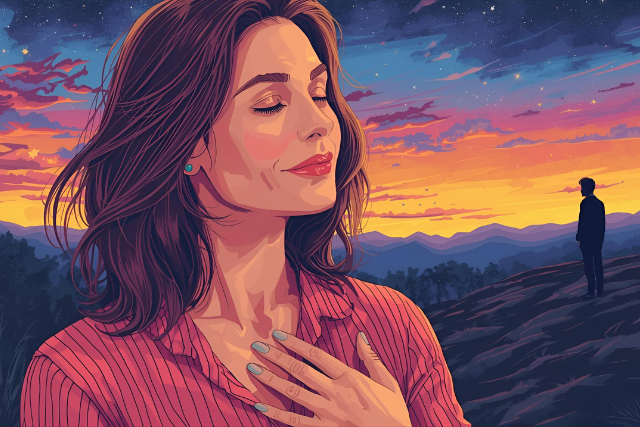
    And yet, sometimes I still look back. Not with longing but with tenderness for the woman who stayed.

    The woman who tried. Who hoped. Who believed love could fix what was broken.

    To her, I say:

    You were doing your best with what you knew at the time. It’s okay that you thought love could be enough. It’s okay that you tried. And it’s beautiful that you eventually walked away.

    If You’re There Now

    If you’re in a relationship where love feels like walking on eggshells, where you’re exhausted from trying to be “enough,” hear this:

    • You don’t have to fix anyone.
    • You don’t have to stay to prove your love.
    • You are not the reason they’re angry, critical, or cruel.

    You are allowed to leave in the name of love. Especially the love you owe yourself.

    And if you’re in the messy middle, give yourself grace. Know this: it’s okay to love again and still feel trauma. To still get triggered. To mourn, rage, regret.

    It’s okay to cry, even when you’ve moved on and built a healthier life. Tears are part of release, part of healing, part of love finding its way back to you.
  • What I Do Now Instead of Trying to Rescue People

    What I Do Now Instead of Trying to Rescue People

    “A leader leads by example whether he intends to or not.” ~Unknown

    This past year has been a journey—one that cracked me open in ways I never expected.

    It began with life-changing news: I was pregnant with my third child. In August, I welcomed my baby, and as I held that tiny, precious life in my arms, the weight of reality crashed over me. Something had to give. I could not keep moving at the same relentless pace, endlessly pouring myself into others, holding their pain as if it were my own, and giving until there was nothing left. If I continued like this, I would become a shell of myself—a zombie mom, moving through life on vibrate mode, disconnected, exhausted, and lost.

    For years, I had been the person everyone leaned on. The healer, the fixer, the one who never said no. As a therapist, it felt natural to care deeply, to hold space, and to offer whatever I had to those in need. I became so adept at giving that I forgot how to hold anything back for myself.

    I thought that was love. I thought that was worthiness—being the person who could carry it all. But with another baby on the way, I finally saw the truth: If I didn’t change, I would be consumed. I couldn’t keep running on empty, sacrificing myself at every turn, and still be the mother my children deserved. I couldn’t be lost to burnout and depletion.

    So, I made a promise to myself. I would protect my energy. I would honor my own needs. I would stop trying to be a savior.

    “I am not a savior; I am a leader.” This became my mantra, my anchor in moments of doubt and old patterns.

    It reminded me that my worth wasn’t tied to how much I gave or how many burdens I carried. Real healing wasn’t about sacrificing myself; it was about guiding and empowering others—without losing who I was in the process.

    But breaking free of old habits isn’t easy. The reflex to jump in, to rescue, to absorb others’ pain is deeply ingrained. It’s part of who I’ve been for so long that choosing differently feels unnatural, even selfish at times.

    Recently, a friend reached out in distress. Every instinct screamed at me to drop everything and save her. That’s what I always did—rush in, fix it, try to make everything better, even if it meant leaving myself drained and overwhelmed.

    But this time, I paused. I took a breath. I reminded myself: “I am not a savior.” So, instead of absorbing her crisis, I encouraged her to lean on other supports and tap into her own resources. I stayed present, but I didn’t make myself the solution.

    And let me tell you, it was hard. Guilt clawed at me. Doubt whispered that I was abandoning her, that I was failing her. I felt my inner child—the one who learned love was earned through fixing—screaming that I was making a mistake.

    There were moments when it felt like I might break. Watching her struggle triggered every fear and insecurity I carried. But then something remarkable happened—she found her way. She leaned on others, drew on her own resilience, and overcame the challenge.

    By stepping back, I hadn’t let her down—I had lifted her up. I had given her the space to find her strength, to be her own hero. And in doing so, I had freed myself from carrying a burden that was never truly mine to hold.

    The realization left me breathless. By not being the rescuer, I had broken a cycle—a cycle that kept me drained and others dependent. I had shown up in a different way, and it felt terrifyingly unfamiliar but profoundly right.

    I felt pride, relief, and a deep, aching grief. I grieved for all the times I had sacrificed myself, believing it was the only way to be worthy. I grieved for the younger me who thought love could only be earned through self-sacrifice. But I also felt hope—hope that I could lead with compassion and strength without losing myself.

    This journey isn’t easy. The pull to rescue, to absorb, to fix is always there, whispering that I need to be more, to do more. But I’m learning to listen to a different voice—the one that tells me my needs matter too. That I am worthy of care and boundaries. That I can lead without sacrificing myself.

    As I hold my new baby and navigate life with three children, I know there will be times when I slip. Times when I fall back into old patterns, when guilt gnaws at me, and when I feel the weight of everyone else’s needs pressing down. But I’m committed to choosing differently. I refuse to become the zombie mom, lost in everyone else’s expectations and needs. I deserve more. My children deserve more.

    When I protect my energy and honor my needs, I become the mother I want to be. I show up with love, patience, and presence. I am not a savior. I am a leader. And when I choose to break these cycles, I give others permission to do the same. I create space for those around me to find their strength. I lead by example—not by sacrificing myself, but by showing what it means to love deeply without losing who you are.

    So, I keep going. I choose myself, even when it feels hard. I break old patterns, even when it hurts. Because I deserve to be whole. I deserve to be honored. And those I care for deserve a version of me who leads with strength, compassion, and presence—not a shadow of who I used to be. I am not a savior. I am a leader. And that, for the first time in a long time, feels like more than enough.

  • I’m Kelly and I’m a Heroine Addict: Why I Get My Fix from Fixing People

    I’m Kelly and I’m a Heroine Addict: Why I Get My Fix from Fixing People

    “Self-will means believing that you alone have all the answers. Letting go of self-will means becoming willing to hold still, be open, and wait for guidance for yourself.”―Robin Norwood, Author of Women Who Love Too Much

    My drug of choice is not the kind of heroin one shoots in their veins. My drug is the kind of heroine that ends with an e—the feminine version of hero.

    When I help someone, and they are grateful for the gifts I offer, my brain fizzes with a cocktail of oxytocin, serotonin, and dopamine, resulting in a “helper’s high” I ride through town like a homecoming queen on a float, waving a gloved hand, blowing air kisses at admiring fans.

    There is no accident these two words, heroin and heroine, look and sound so much alike because they strangely have more in common than you might think: They are both highly addictive, both more destructive than the user realizes, and both leave a trail of collateral damage.

    According to the twelve steps, we stand a chance at recovery only if we can admit we are powerless over our addiction and that our lives have thus become unmanageable… so this is my coming out party. I figure by making this public declaration, I won’t be as tempted to sneak back to my old ways.

    My painful revelation was delivered to me on a cinematic silver platter, while driving with someone incredibly close to me—let’s call her Chloe. She was desperate to find a place to live… that is until I’d swooped in on my noble steed, found her a hidden gem of an apartment, vouched for her, and landed her the deal of the century.

    Instead of being met with the gratitude I expected (and secretly craved), I was devastated by her volcanic rage. She spewed, causing me to nearly drive off the road.

    What crime did I commit, you ask? The week earlier, she had called me, and I had the audacity not to hear my phone ring. In fury, she screamed about how I had set her up to need me, depend on me, and think of me as her savior. And then, when she needed me most, my phone’s ringer was off, leaving her alone to flail in pain, cursing the water I once walked upon.

    In my defense, I never (consciously) promised Chloe I’d be her forever rescuer. Little acts of service became the gateway drug to more elaborate feats that took immense effort and a toll on my own life. I somehow imagined one day I’d receive a smiling postcard from her, telling me my services were no longer required because of how brilliantly her life turned out (thanks to me)… but that hasn’t happened (yet).

    How did I co-create such an epic fail?

    Hitting rock bottom with my “disease to please” sent me on a search-and-rescue mission of my past to discover the genesis of my addiction. My detective work led me, surprise, back to childhood.

    As the eldest of five, I was awarded points from my well-meaning parents for doing big-sisterly things, such as treating my siblings like they were my babies, teaching them to tie their shoes, showing them how to swing a softball bat, and how to combat bullies.

    I was raised believing it was my job to take care of them, and I proudly accepted that mantle. It empowered me; it made me feel important.

    But what I didn’t realize was that while I was getting puffed up like the Goodyear blimp with praise, soaring higher with every pat on my back, some of the victims of my heroism were becoming progressively weakened. It was as if my efforts sent the unconscious message that they were broken and crippled and, without me, incompetent.

    As I struggled to more deeply understand my heroine addiction, I sought the counsel of a friend who said, “Your struggle is a microcosm of a global issue. For example, the US has funneled over 500 billion dollars to Sub-Saharan Africa (to mitigate starvation and famine), only to make the situation worse when they pulled out.” He continued, “In spite of good intentions, if the giving is a handout, not a hand up (giving fish instead of teaching how to fish), it’s unsustainable, exacerbating—not curing—the problem it set out to fix.”

    Even though I extended my support without conscious strategy or agenda, I hurt people more than I helped.

    So, what is the solution?

    It isn’t as simple as no longer helping people. It’s like being an overeater who can’t just swear off food. If I had an actual heroin addiction, my job would be to cease injecting the drug in my arm. But even Abraham Maslow taught that service is near the top of his hierarchy of needs, and I’ve certainly been a grateful receiver of people’s kindnesses.

    This is clearly one of life’s “can’t live with it, can’t live without it” conundrums. Perhaps I just have to figure out how to do “service” differently.

    So, as a newly sober heroine addict (an energy vampire cloaked behind a superhero cape), convulsing in withdrawals as I seek to live on the razor’s edge between serving and savior-ing, here are my marching orders, thus far. Just for today (and hopefully every day after), I will:

    1. Fire myself from the job I unwittingly accepted (too enthusiastically) as a little girl: to be everyone’s big sister.

    2. Admit I have a problem and that I am powerless over saving, fixing, and controlling people.

    3. Give up the belief that I know best on how others should live their lives.

    4. Refrain from getting my fix by fixing people, searching for God in all the wrong places.

    5. Make ruthless compassion my replacement addiction, in the way heroin addicts safely detox using methadone or suboxone.

    Ruthless compassion, by the way, is the unwillingness to see another as broken or inadequate, but instead as innately whole and complete, regardless of what they’ve been through or what they believe to be true about themselves.

    6. Practice “For Fun and For Free”—this twelve-step motto is about only giving to others from surplus bandwidth (time, money, and energy) unless it’s a true emergency.

    7. Tattoo my brain with my new personal prayer (a mashup of The Serenity Prayer and the lyrics to Kenny Roger’s “The Gambler”):

    God grant me the serenity…
    to know when to hold ‘em,
    when to fold ‘em,
    when to walk away
    and when to run.

    If you relate to my story, I hope this will help you with your hero or heroine addiction. But if it doesn’t, that’s okay. Because, through the lens of my new Ruthless Compassion sunglasses, I see you are more than capable of finding your own answers, thankfully without any excess do-gooding from me.

  • Why I Never Let Anyone Support Me Until the Day I Almost Died

    Why I Never Let Anyone Support Me Until the Day I Almost Died

    “Why don’t you get up and make the coffee, while I stay in my sleeping bag and plan our ascent route?” I half-heartedly ask my climbing partner Hank.

    He just looks at me with that unassuming, “give-me-a-break Val Jon” look of his. It’s three o’clock in the morning, cold, dark, and damp, and neither of us wants to leave the comfort of our tent. But we’re committed to this climb, so we don our parkas and gloves and confront the bitter cold.

    In silence, Hank and I gather up our gear and join the rest of our climb team assembled at base camp, which is located at eleven thousand feet.

    Thirty-three climbers in all have come together for this extraordinary ice climb to the summit of Mount Shasta in Northern California. During our team meeting, we decide to make our ascent via “Avalanche Gulch,” a treacherous glacier route up a steep icy slope. This particular route is shorter than others, but it’s also notorious for its deep crevasses and unstable blue fractures, so one wrong move could mean sudden death.

    Ice climbing requires crampons for the boots and ice axes for leverage and braking. Ropes, carabiners, and belays are reserved for near-vertical climbs, which we may or may not need for this particular ascent route.

    For those unfamiliar with ice climbing, braking is used when a climber loses their footing on steep slopes. It’s done by grabbing the ax with both hands, flipping onto one’s side, and plunging the sharp metal tong into the ice.

    A firmly planted ax serves as an anchor and stabilizes the fallen climber’s position until they can regain their footing. Everyone on the team has practiced the braking procedure many times over along with other vital safety and life-saving protocols.

    As the full moon casts a bluish glow over the ice, we begin our ascent to the summit. At about twelve thousand feet, we come upon a massive fissure running horizontally across the steep glacier face. We traverse around its left edge and cross back about thirty feet above it. Climbing to the slope’s center, we zig-zag our way up to gain altitude and distance from the crevasse.

    Traversing around crevasses is a treacherous activity. If one climber slips, the entire group could be pulled into the abyss. For this reason, we are untethered and climbing independently. We are, however, organized into small teams of six to provide each other support if needed.

    All goes well as we gain altitude above the crevasse, until one fateful moment when the crampon on my left boot suddenly pops loose and I lose my footing.

    Tumbling headfirst downhill, I instinctively grab my ice ax with both hands and prepare to stop. Landing hard on my back, however, my ax bounces loose from my hands and I slide uncontrollably down the steep slope towards the crevasse.

    In a moment of frozen terror, my life flashes before my eyes and I am going to die! Then suddenly my flailing body slams into something solid, knocking the wind out of me.

    Stunned and disoriented on my back with my head pointed downhill, I’m unable to get a bearing on how close to the edge I’ve come and how close to death I am.

    Looking up, I see a blur of movement and shifting dark images. Clearing the snow and ice off my glacier glasses, I realize Hank and my fellow climbers have formed a human net, catching me just a few yards before I careened over the edge of the crevasse!

    I’m in shock, numb, and completely speechless. I’m also totally embarrassed and feeling extremely vulnerable. I’ve spent years being a strong and independent man, priding myself on not needing the help of anyone. Needing help always seemed like a sign of weakness to me, so this emergency situation is deeply disturbing.

    “We’ve got you, VJ! Hold on buddy, we’re not gonna let you fall!” I fidget around trying to stand myself up and respond, “Thanks guys, I can take it from here.” “Lay still, you’re pushing us back towards the edge!” Hank barks at me. “No, really, I’m okay guys, I’ve got this.” There was no way I was going to be the weakest link in this chain! This time, however, a number of my team members replied, “No you don’t have it VJ, you need to stop right now or you’re going to kill us all!”

    That message got in. The reality of killing my fellow climbers so I can stay in control is just too much for me to bear. The humbling realization shatters my macho control mechanism and I suddenly relax into letting them help me.

    As they reattach my gear, stand me up and reassure me with pats on the back, I realize it’s nearly impossible for anyone to support me. Experiencing them caring for me this way is both wonderful and wrenching.

    My chest tightens and tears come to my eyes as I realize how many times in my life I’ve not let others help or support me. I would always say, “No problem, I can do it myself.” I didn’t want to burden anyone or put anyone out.

    The deeper truth, however, is that if I let someone support me, I would be obligated to them in the future. The result might be that they could then somehow control me the way my father controlled me as a child.

    Looking into the caring faces of my fellow climbers, I suddenly see superimposed images of my mother, sister, and little brother, my friends, and exes who I’ve shunned and alienated with my stubborn macho independence

    I reflect on the pain and frustration that not being able to help me must have caused all these people in my life. So many opportunities I have had to accept the support of those who love and care for me, but no, I have to be strong and independent.

    How selfish and arrogant of me to rob them of the opportunity to contribute to my life! And how easy it would be for me to slide into humiliation over this display of narcissism.

    Standing here among those who just risked their lives to save mine, I realize I have a choice; I can dramatize my humiliation and hide behind my rugged individualism, or I can humbly open myself to their care and support.

    I choose to set humiliation aside and open with humility, and as I do, a wave of emotion fills me. For the first time in my life, as far back as I can remember, I’m able to see that accepting help from others is not a sign of weakness, it’s an act of humility.

    I also realize that rather than being a burden to people when I’m in need, it allows them to feel useful and to make a difference by offering their support and care. There’s no doubt that my fellow climbers are ecstatic about having just saved my life; I can see the joy and exhilaration on their faces.

    Still surrounded by a human net of care, I thank each member of my team for saving my life, and I apologize for placing them in additional danger. Each one of them nods in recognition, and nearly everyone assures me that having the chance to help save my life was far more important to them than blaming me for being a bit heedless.

    As I allow myself to be vulnerable and let their care in, my defensive armor melts, then drops away. We resume our ascent, and tears fill my glacier glasses as I reflect on the experience of my life being saved by this remarkable group of friends.

    How strange and new this is for me. I don’t need to see out of my glasses because I have the full support of those behind me as well as those in front to help me along if I need it.

    I’ve always been the one to give support to others, but now I can receive support as well. I breathe into this new awareness and suddenly have a profound realization that has remained with me for years.

    As I exhale, it’s synonymous with the movement of giving support, and as I inhale, it’s synonymous with the movement of receiving support. Engaging in both inhaling and exhaling doesn’t mean I’m weak, it means I’m human.

    Without further incident, we all ascend to the 14,179-foot summit of Mt. Shasta where a crystalline blue sky embraces the curve of the earth. The summit perch looks like a small crater and is no more than about twenty feet in diameter. Its outer rim is composed of a ring of rocky crags with one high point that signifies the very pinnacle of the mountain.

    Shining, sunburned faces grinning from ear to ear sit together in a blissful exchange of laughter and tears.

    After celebrating our joint accomplishment, we begin the ritual of reading and signing the register book stowed atop most climbable mountains in the world. The one at the summit of Mt. Shasta is contained inside a green metal canister under the Western crag.

    Each member of the team, like those before us, takes the opportunity with the book. After finishing, Hank hands it to me. As the last to see the register, I flip through its yellowed pages and my eyes fall on a passage written by a climber on October 23rd, 1972. I’ll never forget the inscription:

    “Father, I dedicate this climb to you. I’m standing at the top of Mount Shasta today because of the love, support, and encouragement you gave me as I was growing up. It’s because of your commitment and love that I was able to make it to the summit today. And although you lost your legs in the Korean War and have never been able to stand beside me. Father, I want you to know that today I stand on the top of this mountain for both of us. I love you with all my heart and all my soul, your son John.”

    How beautiful this dedication is! I take in the grandeur of the Earth’s curve from this high summit, close the book, and clutch it firmly to my chest. A wave of inspiration fills me, and I feel deep abiding compassion for all the world’s fathers, sons, mothers, and daughters . . . and I am challenged to act upon the humility that was moving so deeply within me.

    You see, up until this very moment I’ve coveted a deep wound in my psyche. As a boy, I was violently abused by my father, and as a result, I cut myself off from him in my early twenties vowing to never speak with him again.

    But now I am faced with a choice . . . should I maintain my position and continue to empower all the reasons why I should not reach out to him? Or should I humble myself and take a chance by reconnecting after all these years? It is here, within these deeply challenging life choices, that we both test the authenticity of our inspirations and discover what we are truly devoted to.

    I made my choice, and not only did I resurrect my relationship with my father, I affirmed that there is nothing more important to me than living with an open heart and honoring the humility I was gifted with high atop the summit of humility.

  • How to Stop Rescuing Other People to Feel Good About Yourself

    How to Stop Rescuing Other People to Feel Good About Yourself

    “If your compassion does not include yourself, it is incomplete.” ~Jack Kornfield

    It seemed like the natural thing to do.

    A middle-aged man had dropped his keys near me. I jumped up, hopped over, picked the keys up, and gave them back to him.

    Not so unusual, except I had a badly twisted ankle after slipping on a walking holiday and needed to rest it while the pain and swelling went down. I struggled back to my seat, wincing.

    It was a small incident but symbolic of my rescuing, codependent, instinctive habits at the time. If something needed doing, I would be the one to do it. If there were a problem around, I’d jump to fix it.

    Of course, I could have just called out to the man and pointed at his keys from where I was sitting. But I felt like I had to do it myself.

    I thought that’s what ‘being good’ was. And the harder something was for me, the more ‘good’ I thought I was being.

    When Trying Harder Makes It Worse

    It was part of a whole guilt-driven people-pleasing pattern. Other people’s appreciation gave me brief relief from feeling bad about myself. It was a temporary pass into being okay.

    Over the years came relationship breakdowns, career misfires, and increasing anxiety and insecurity.

    Whenever there was a problem in a relationship, I considered it my job to fix it. Though my intentions were good, this actually created a sense of separation. Instead of being in the relationship, I became more like a mechanic looking at it from the outside.

    As for work, I took on so much that it left me stressed and created a distance from my colleagues. I thought they were acting coolly toward me because I wasn’t doing enough, but the opposite was actually true—I was doing too much.

    I didn’t recognize at the time how my actions were affecting the balance of my relationships. I couldn’t understand why I kept failing.

    I’d always been taught that if I wasn’t succeeding, the answer was to try harder, but the harder I tried, the worse it got.

    So I tried therapy. Naturally I tried to be the best therapy client.

    I did all my homework, read all the books, and often turned up with ‘helpful’ notes for the therapist. Of course that didn’t work either.

    Learning about what I was doing wrong made it worse. Now I had a whole new set of things to beat myself up about. I was even failing at therapy!

    I was pointing in the wrong direction, so going further just got me more lost.

    Seeing Through New Eyes

    “The real difficulty is to overcome how you think about yourself.” ~Maya Angelou

    The turning point was realizing my cruelty. My kindness to others had blinded me to how cruel I was being to myself. Trying harder and beating myself up for where I was failing was just more cruelty.

    However much I did, no gold star was ever going to come from outside to officially certify I was “enough.” If I was to become a truly kind person, I needed to start learning to be kind to myself.

    It was hard. I had to stop constantly being the most helpful person around. But in my mind, at least, that’s who I was. My profession, my relationships, and my identity were all based on that. If I wasn’t that, what was left?

    I was like an addict in withdrawal. Without the regular feel-good boosts of appreciation from others, I had to face all the difficult feelings I’d had about myself for as long as I could remember—the guilt, fear, and insecurity I’d developed when I was a sensitive kid who felt like he didn’t belong and always thought he had something to compensate for, atone for, or prove.

    But at least I was now pointing in the right direction, so every step was progress.

    Each week was a little better than the last. Spotting when I was being too self-critical and learning to be kinder. Holding back from fixing a problem someone could easily fix for themselves.

    For example, unless my partner specifically asked me to help solve a problem for her, I learned to empathize, encourage, and support her so she could work it out for herself.

    Stepping back meant some things didn’t get done, took longer, or went wrong. But sometimes they went better than if I’d tried to fix them. Who knew? And sometimes the person asking decided it wasn’t important after all.

    More importantly, though, by learning to hold back, I was allowing others the space to develop while weaning myself off the quick, feel-good boosts I got from helping others.

    Of course, this didn’t happen overnight. Changing deep patterns takes time. But each small change sets you up for the next one. It’s a gradual positive, self-reinforcing cycle.

    So what did I learn?

    Be Your Own Best Friend

    If people tell you that you are your own worst enemy, how about becoming your own best friend?

    Many of us are better friends to others than we are to ourselves. We’re kinder, more supportive, and more willing to stand up for their needs.

    You’ve heard the “golden rule”: “Treat others how you would like to be treated.” That holds true the other way too. Treat yourself how you would treat a good friend.

    If you wouldn’t say something to a good friend, don’t say it to yourself.

    If you wouldn’t ask a friend to put up with something, don’t put up with it yourself.

    You’re as much a part of nature as they are and just as important. Plus, looking after yourself is your job!

    Make Friends With Your Flaws

    You’re not perfect.

    Big news: No one else is either.

    Even bigger news: You don’t have to be. Thinking you have to be perfect is part of the problem.

    You don’t have to make up for simply existing. You don’t have to be gooder than good.

    No one can give you the gold star that certifies you as “enough.” And you can’t get it through your accomplishments, how good you have been, or how many people you have helped today. You have to learn to give it to yourself. It’s your basic pass for being part of nature.

    This doesn’t mean you’re perfect. You’re not. It means making friends with your flaws.

    Support Yourself

    There’s a humorous office sign that reads, “The beatings will continue until morale improves!” We laugh at the sign, but many of us carry an idea that the harsher we are to ourselves, the more likely we are to change.

    The opposite is true. Research shows that people who are compassionate toward themselves are better able to take on feedback, grow, and change. They find it easier to adapt because they’re already comfortable with themselves.

    They’re less fragile because their whole sense of identity isn’t on the line. They know that what they did isn’t who they are. They can open up, connect, and learn.

    Self-compassion doesn’t mean glossing over your failures or challenges. It means supporting yourself while you’re putting them right.

    Stop Putting Yourself Last

    You’re not so special that you need to be last.

    This isn’t about becoming selfish. It’s about balance. You’re as deserving of love and good things as anyone else. Not more. Not less.

    You might need to learn how to be more assertive. That could be difficult at first. Support yourself while you’re learning.

    Be Patient

    It isn’t always easy. It takes time. But once you’re pointing in the right direction, you’ll start feeling better each week. And as you feel better about yourself, you’ll feel less of a need to be everyone else’s hero in order to receive their appreciation and validation. And you’ll become as good a friend to yourself as you are to everyone else.

    **This post was originally published in December, 2018.