Tag: relaxing

  • Feeling Depleted? How to Overcome Your Internal Barriers to Resting

    Feeling Depleted? How to Overcome Your Internal Barriers to Resting

    “Rest is not necessarily a cessation of all activity but a means of going inward, going deeper. Rest is what allows us to go beneath the surface, if we make the time for it. Rest gives us the gift of perspective, and rest invites us into new ways of being and showing up in the world.” ~Ashely Neese

    I was probably about sixteen when my dad and I were driving down Main Street in our small town at about 1 or 2 o’clock in the afternoon.

    As my dad looked out the passenger seat window, he noticed a man out on an afternoon run. For most people, this wouldn’t be a topic to even give another thought to; however, to my dad, this was unimaginable.

    He turned, looked at me, and said, “What in the world do you think he’s doing?”

    My dad couldn’t comprehend that someone might be out midday enjoying themselves, doing something other than working.

    I’ve thought a lot about that day since, because it was the moment when I began to recognize where my view of rest, productivity, and my personal worth collided.

    All my father has ever known is work. This past year, he has suffered multiple heart attacks, and yet he still scoffs at the idea of rest.

    Work was where my dad learned early on to escape from his dysfunctional upbringing. Work was where he could hide from my mother’s constant nagging.

    Work was where my father felt he was enough.

    Growing up in this environment, work, productivity, and striving became deeply embedded in my nervous system. Productivity and proving myself were how I felt appreciated, seen, enough, and worthy.

    I never consciously thought about these things or said them out loud, but they showed up in subtle ways, like in my relationship with time. I never believed there was enough time, which caused me to feel behind, rushed, and internally chaotic.

    Until the past couple of years, I never knew what it was like to not live in urgency mode. I was trapped in a familiar anxious nervous system, which robbed me of the rest and renewal that my body desperately craved.

    Living in survival mode kept me rushing, busy, and frenetic, avoiding the deeper work that was required for me to slow down and create the space that I craved.

    My conditioning led me to believe:

    • If I wasn’t productive, I wasn’t worthy.
    • If I wasn’t producing, I was lazy.
    • If I wasn’t hustling, I would fall behind.

    These are what I call my COWs. My CONDITIONS OF WORTH.  

    It was as if I was codependent with the outside world, believing that everyone outside of me depended on me, and if I didn’t follow through and perform, please, and be productive, I wasn’t ‘good.’ All of this combined kept my nervous system heightened, causing me to live in a state of urgency. And urgency makes it impossible to rest.

    Between fried adrenals, constant anxiety, and extreme fatigue, I eventually had to succumb to the idea that rest might be the medicine I needed. I’ve worked with a lot of extraordinary modalities through my healing journey, but rest was a topic I had always resisted.

    I believed that rest was wrong, and in order to be good, I had to keep pushing and proving and make something of myself. Rest felt disobedient. Slowing down and becoming still brought up too much discomfort, so even though rest was the medicine I needed, I resisted.

    Maybe this resonates with you too. You know deep down that you need to rest, but the messaging you’ve received along the way is that rest will render you useless. With this belief system driving our lives, of course we resist rest. We are taught from early on to value speed, productivity, career, money, material things, competition, and financial success.

    Slowing down and noticing my COWs was life-changing for me, especially when it came to rest.

    Your COWs may sound a bit like this:

    • I don’t have time to rest.
    • It’s selfish to prioritize resting.
    • Rest has to look a certain way.
    • In order to rest, I have to get x, y, and z done first.
    • I am not good at resting.
    • I’ll rest once everything is checked off my to-do list.
    • I don’t have the support I need.
    • I will start resting tomorrow.
    • My mind is too active; I’m easily distracted.
    • I have too many urgent things to do.
    • My family and career depend on me; it’s just not possible for me to rest.

    Maybe your COWs are listed here, or maybe they sound like something different, but it’s worth giving your COWs (also called limiting beliefs) some thought.

    Ask yourself: What was I taught about rest? What do I believe about rest? Who, if anyone, modeled or practiced self-care or rest for me? What message did I receive about the worth of rest?

    While our COWs might seem ‘bad’ for us and things to be eradicated, I invite you to consider that COWs can be a portal to know ourselves better and heal.

    Bringing our COWs to the surface gives us a choice about how we are going to heal them and work through them. When we’re unaware of our COWs, the choices we make around rest are restricted to whatever our beliefs allow, making it challenging to rest.

    Examining our COWs around rest leads us to deep inquiry so that we can empower ourselves to slowly choose a better rhythm for our lives.

    We are a culture that is tired to the bone. Rest offers us a restorative healing balm for anxiety, exhaustion, overexertion, and illness. Rest is a potent medicine, as essential to the body as water. When we’re dehydrated, we’re miserable. And we feel the same when we are unrested.

    Urgency does not have to be our baseline. We can choose differently. We can untangle ourselves from the faulty programming of our culture, systems, and upbringings when it comes to rest. We can learn to slow down. We can learn to embody presence and ease. We can learn to rest.

    Rest still doesn’t come easily for me. At times, I fight it, wanting to get more done at a faster pace. That old, familiar rush of adrenaline feels familiar to my system, and yet deep in my bones, I know that urgency isn’t sustainable. Urgency is coming from a part of me that longs to be seen as worthy, good, loved, and enough.

    Softness, slowness, groundedness, and presence are the gifts that rest offers me. Life happens fast enough as it is, and when I’m unrested, I miss so much.

    My invitation is to begin exploring your relationship with rest. While it might seem simple or not worthwhile, I promise, it is some of the deepest and most rewarding work you will ever do.

  • The Beauty of Doing Nothing: Why I’ve Embraced Being Unproductive

    The Beauty of Doing Nothing: Why I’ve Embraced Being Unproductive

    “Every good cause is worth some inefficiency.” ~Paul Samuelson

    I made a mess yesterday. The mess is still there. Who knows when the mess will disappear.

    The mess provided me with one of those sense-pleasing plates of food that lingers in the mind long after the last bite. The kind that makes you wonder if there is a rhyme and reason to our world after all. A plate of food so delectable it provided a raison for my être. (If only for a little while.)

    But this story is not about the art of nourishing oneself. It is about dirty dishes and unfolded laundry. And also a little about unfulfilled potential and the beauty of living in the maybe.

    You see, I have been living rather inefficiently lately. To-do lists have been decorating the inside of my recycling bin. I’ve been measuring my progress by the amount of naps taken, and I have forgone the opportunity to expand my productivity. Because productivity requires focused effort. And lately, effort has been spilling left and right, wasted a little here and a little there.

    I’ve consciously decided to use my time frivolously, dipping in and out of idleness like a bag of crispy treats.

    This newfound way of organizing my days still feels very fresh and raw to me. It comes after years of optimizing every aspect of my life. Formerly, I neatly arranged my life into one-hour timeslots in an attempt to mold a perfect career, body, and even perfect relationships. I tracked my success with a meticulous timesheet. And success I had (or so I thought).

    I was ticking off one accomplishment after the other and always strived to be, do, and have more. Although strenuous, the method worked. Until one day, it didn’t.

    About two years ago I woke up and nothing worked anymore. My body had decided to no longer cooperate with my frantic behavior. It had simply been worked too hard for too long, and it had nothing left to give.

    Stubborn as I was, I treated my worn-out body like a new project. I took every vitamin in the book, quit sugar, quit gluten—basically quite everything tasty—did #yogaeverydamnday, went on social media detoxes, and hopped from one alternative healer to the next.

    Nothing helped, and I became increasingly desperate. I had developed stubborn back pains, anxiety-inducing tinnitus, and crippling insomnia. My concoction of remedies did pretty much nothing for me. My will to live plummeted with each misshapen step to health.

    And then a little (and at the same time big) miracle happened.

    I decided to simply let go. I surrendered to the sleepy eyes and the fuzzy brain and the profound, yet inexplicable sadness inside of me. I let go of trying to make it go away.

    I tossed my strict diet and exercise regimes in the bin. I didn’t meditate anymore at times when I would rather sleep, or spend money on health practitioners at times when I would rather spend money on a movie ticket.

    I simply let go and accepted my current reality. I gave in to the impermanence of life and accepted that I could no longer do what I was once able to do. In return, I have received a gloriously inefficient approach to life and a deep sense of the present moment.

    Let me illustrate what this means with a typical Saturday in my current life:

    6.30 AM – I wake up in accordance with my natural body clock. I vow to no longer wake up so early on weekends.

    9.00 AM – I am still in bed.

    9.15 AM – I get up and make myself a simple porridge. I proceed to eat this for the next hour and a half. The porridge gets cold halfway through. I vow to eat a little quicker next time.

    11.45 AM – I proceed to alternate between reading my book and dosing off for short periods of time.

    2.00 PM – I have a short lunch and contrast this with a long stroll in the park afterward.

    4:00 PM – I make an attempt to write, but mainly just stare at a blank piece of paper. I vow to stare at a blank piece of paper more often.

    5 PM – I start preparing a meal. I don’t use a recipe, but the dish is surprisingly tasty. I vow to use fewer recipes going forward.

    7.00 PM – I pick up my book but decide to do a mindful stretch instead.

    9.00 PM – I wanted to do a meditation before bed, but the stretching has lulled me into a sleep-like state. After a day of doing nothing much at all—especially not the dishes—I go to bed early.

    I vow to do the dishes tomorrow. Or perhaps the day after tomorrow. (I have no intention of keeping any of my vows.)

    I know there are still so many runs to be ran, works to be worked on, and loves to be loved.

    But lately all the runs and the works and the loves have had to wait. Wait in order to make room for all the nothings I have been neglecting for too long. The nothings that have been patiently accumulating in my mind and are now pouring out with urgency.

    Nothing has been more important than those nothings and the inefficiencies that come along with them. There are, of course, still occasional runs and works and loves. But mainly a lot of naps.

    When life doesn’t move forward it moves backward, they say. But was life really that backward, back in the day? What I mean to say is that it seems silly to me. To run around and produce all of the greatness. Greatness that allows us to be seen, and heard, and held, and kept. By our friends and our lovers, our colleagues and our neighbors. Yet is it good to be great? Or is it greater to just be? Like a two-year-old child. Like back in the day.

    The neighbors’ grass might be greener, but I wonder if they have time to lie on it.

    To look at the clouds passing by. To feel the breeze on their cheeks and hear the birds in their ears. To dream about the life they’ve lived so far. The life to come. And the life better left for another round. The neighbors might have cleaned their dishes, but I doubt their naps are as glorious as mine.

    Perhaps tomorrow I will be productive again. After all, balance is key. But not today.

    Because today, I risk wasting my time for a chance at feeling alive.

  • A Relaxing Yoga Practice for People with High Stress and Low Energy

    A Relaxing Yoga Practice for People with High Stress and Low Energy

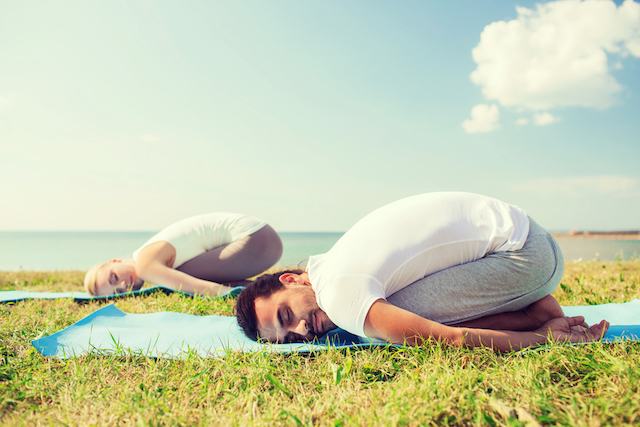
    Childs Pose

    “We must always change, renew, rejuvenate ourselves; otherwise we harden.” ~Goethe

    Nine years ago after I had my twins, I was eager to get back into a routine of a weekly yoga class and daily home practice. However, I didn’t account for the soul-sapping fatigue I felt as a new sleep-deprived mum!

    I simply did not have the energy or ability to leave the house for a satisfying active class. And truly, I did not want to venture far from my precious babes.

    That’s when I discovered a soothing style of yoga that met me exactly where I was. I could do it at home, using equipment that I already had, and it made me feel refreshed and pampered.

    I fell in love with restorative yoga—a deliciously yummy practice where I could gently move my tired body, but with the support of comfortable props to help me feel completely supported, beautifully nurtured, and best of all, deeply rested.

    As soon as my babes slept, I would clear the floor, gather some props, and sink into a few slow, rejuvenating poses.

    As an avid yoga practitioner and instructor, I had a variety of specialty yoga props at hand—cork blocks, bolsters, and blankets. However, not wanting to miss my chance for some downtime, I would often improvise with whatever lay around, grabbing sofa cushions and towels to use as a bolster, a stack of small books wrapped in a pillowcase for a block, and a clean sock to place over my eyes.

    Even if I could spend just five minutes in a pose every other day this time became invaluable. It was time just for me. With every melting moment I could feel some of the resentment from having so little time to myself slip away. I would emerge rested and (mostly!) ready to begin again, feeling great at having moved my body.

    Restorative yoga is the super chilled-out member of the yoga family. This slow, passive practice combines the elements of time, warmth, comfort, support, and soft light to create a sequence accessible to most bodies and trigger the body’s natural healing responses.

    Just as an active yoga practice, a good restorative sequence aims to mobilize the spine, moving it backward, forward, laterally, and in a twisting motion.

    What make restorative yoga poses different to its more vigorous cousins are the longer holds (five to thirty minutes) and the use of props to cradle and hold the body in position.

    There’s no physical effort required; instead, blankets, pillows, bolsters, and blocks serve as a nurturing landing pad into which tired, achy bodies can dissolve.

    The longer timings and supports encourage tight muscles to let go and mental tensions to ease. Warmth is also important; as the body relaxes it cools down, so it’s a good idea to cover up with a blanket in the poses. Soft lighting also encourages relaxation. Draping an eye-pillow or washcloth over the eyes can further soften tensions around the eyes and reduce visual stimulation.

    When we’re relaxed, the parasympathetic branch of the nervous system switches on and begins the job of healing and restoring the body. In this rest-and-digest mode, the heart and respiration rates slow, busy thoughts subside, and a wonderful pause descends over body and mind.

    This delivers a much needed mini-break from the usual busy-ness of life, where the sympathetic or fight-and-flight mode of the nervous system can be habitually stuck in overdrive. Too much time here can cause stress, which could lead to negative states such as anxiety, sleeplessness, or adrenal fatigue.

    Ready to sample a restorative a pose or two?

    Start by gathering your props. Here’s what you’ll need, plus some “DIY” tips to make your own!

    Mat – A yoga mat is helpful, as it provides a non-slip surface, but it’s not essential. Substitute with a towel, blanket, or a carpeted floor space.

    Block – Store-bought yoga blocks can be made from solid cork, bamboo, wood, or foam and measure 9″ long x 6″ wide x 4″ thick. Make your own by making a stack of books to approximate this size, then secure with rubber bands or wrap in a pillowcase.

    Bolster – Bolsters are long, oval, or round firm pillows measuring about 26″ long, 7″ wide and 3″ high. DIY by folding a firm blanket or two into this shape, or substitute sofa cushions.

    Blankets and towels – use what you have around the house.

    Roll – roll up a bath towel, blanket, or space yoga mat until it’s around 31″ long and 6″ in diameter.

    Eye-pillow – these block the light and provide a subtle, soothing weight over the eyes to promote relaxation and sense withdrawal. A folded washcloth works well.

    Constructive Rest Pose

    A great place to start, this basic pose rests the spine, head, and limbs symmetrically. The neutral position invites us to check in with breath, body, and mind before moving on to more poses.

    What to do: Lie down on your back, with the head and neck supported by a folded towel or blanket. Bend the legs, space the feet hip-width apart, and ground the feet into the mat. Rest the arms beside you, an even distance from the mid-line, palms facing up. Let the head be heavy; relax the eyes, face, and neck.

    Descend the shoulders and allow your weight to drop into the floor. Notice how your body feels; notice the activity of the mind, notice the emotions, notice the breath. Stay five minutes or more. To come up, hug the knees to chest, roll to the side and press yourself up to a seat.

    Upper Back Booster

    This refreshing backbend helps to counter rounded shoulders and a slumped chest. It lifts the heart and encourages full, easy breathing. The entire front body receives a nice stretch.

    What to do: Place a roll across your mat. Take constructive rest pose again, this time with the roll underneath the nipple-line. Do any wriggling and adjusting till you feel comfortable, with a sense of lift at the chest. Straighten the legs, if desired.

    Stay five minutes or more, then remove the roll and revisit constructive rest pose again for a few moments. Hopefully, you feel like you have a brand-new back! Exit the pose as for Constructive Rest Pose.

    Legs Up the Wall

    Try this pose for a full body/mind refresh. The reversed blood-flow from toes to torso particularly benefits tired legs and the back is positioned nicely for rest and length.

    What to do: Clear some space and sit side-on to a wall. Take the outer shoulder to the floor, then gently roll onto your back and swing your extended legs up the wall.

    Rest your head on a pillow/folded blanket for extra comfort, and cover your eyes if you like. Stay for five minutes or longer. When ready to come out, bend the knees to chest, roll to the side and press up to a seated position. Observe how you feel.

    Child’s Pose

    This is a beautifully grounding, nurturing pose perfect to counter busy-ness and over-stimulation. It also helps to soothe a cranky lower back.

    What to do: Rest one end of your bolster on your block. Kneel at the other end with the bolster between the knees. Bend from the hips, fold forward slowly, and lay your whole front body along the length of the bolster. Turn your head to rest on one cheek.

    Place your hands and forearms either side of the bolster. After a few minutes, rest on the other cheek and stay in the pose for an even amount of time.

    When you are ready to come up, ground your hands either side of your bolster and slowly lift up. Come to a seat and see how you feel.

    Savasana – Corpse Pose

    This is a simple way to complete your practice and allows the mind and body to soak up all the goodness from your sequence. You can also take this pose anytime as a stand-alone pick-me-up.

    What to do: Rest your entire back-body along the mat. Insert a bolster or roll under the knees to take any pressure from the lower back, and a position a support under the head and neck.

    Pop an eye-pillow or cloth over the eyes, and cover up with a blanket to keep warm. Once warm and comfortable, make a commitment to be still. Give yourself permission to let go of physical tensions and mental chatter. Simply rest and enjoy the gift of relaxation. Stay in Savasana for ten minutes or more.

    When you are well-rested and calm your whole family will feel it too!

    Child’s pose image via Shutterstock

  • How Doing Nothing Helps You Get More Done

    How Doing Nothing Helps You Get More Done

    “The time to relax is when you don’t have time for it.” ~Sydney J. Harris

    Have you ever been “insanely busy”?

    That’s been my world for the last two weeks. Not only have I been writing posts for my websites and creating meditation products for my subscribers, I’ve also been busy planning the end of year music events at the school where I work.

    During this time I discovered something that helped me stay on top of things and keep my productivity high: I started making appointments to do nothing. Sometimes I scheduled this time at work, sometimes at home. 

    If I’m struggling to write posts, articles, or plan music workshops, I find that allowing myself time to do nothing and let my mind unravel brings many benefits. The main ones are creating new ideas and finding solutions to problems that have been unsolved for a while.

    Doing nothing feels like the complete opposite of being productive, but after you’ve tried it you will see how effective it can be. Why do you think Google adopts a company policy that has an emphasis on allowing their staff so much free time?

    A lot of people say that they are too busy to do nothing. Yet those same people will happily invest hours in front of the television, or spend plenty of time fretting and worrying about something without allowing themselves the pleasure to just be.

    I’ve noticed that an hour slumped in front of the TV feels very different than one hour sitting in the park.

    Actually, doing nothing can be a great investment into your personal well-being and something worth making time for.

    It doesn’t take a huge change in your lifestyle—perhaps just a change in your thinking—and once you experience the benefits you will be more likely to make it a regular part of your schedule.

    I have two preferred methods for doing nothing, and they can both be of great benefit.

    The first way is to forget feeling guilty and to just take the time to zone out. Unplug from the internet for a while, stare out of the window, or just into space, and luxuriate in a special time of doing nothing. (more…)