Tag: regrets

  • Lessons from Death and Awakening to an Authentic Life

    Lessons from Death and Awakening to an Authentic Life

    “Life doesn’t owe us anything. We only owe ourselves, to make the most of the life we are living, of the time we have left, and to live in gratitude.” ~Bronnie Ware

    Today, I’d like to tell a story about death.

    It’s a word that tends to shift the energy in a room, isn’t it? People tense up, lean back, or grow silent. Death is often seen as morbid, something to avoid or fear. But I’ve come to see it differently. The more we speak about death with openness and reverence, the less heavy and frightening it feels.

    My earliest experiences of death were when my grandparents passed away. I remember the moment my parents told us about one of my grandfather’s deaths. The atmosphere was so tense, so thick with unspoken grief. I was five or six and wanted to laugh. It wasn’t disrespect or indifference—I now realize it was my body’s way of releasing the unbearable tension in the room.

    But the most profound experience of death came when my mother passed away. I was twenty-six. Almost twenty years ago. She had cancer.

    I spent long, quiet days with her in that stark, clinical hospital room. I vividly remember the stairs—climbing them one at a time, deliberately slow, as if dragging my feet might delay the inevitable. Each step felt heavy, as though I could somehow resist the truth waiting on that floor.

    I remember not knowing what to say or do, especially as she told me, “It’s hard.”

    I think she held back her tears for my sake, just as I held back mine for hers.

    Part of us denied the truth. Part of us clung to hope. And part of us knew the inevitable was coming.

    Looking back, I wish we had cried together. I wish we had allowed ourselves to fully feel the grief, the sadness, the heaviness of it all. Instead, we put on brave faces, trying to protect each other. But what were we protecting? We were both struggling.

    If I knew then what I know now, I would have approached her final days differently. I would have offered her a soft space to breathe, to release, to let go of the grasping. I would have guided her into that transition with love, reminding her she was returning to the beautiful energy of the universe, back to the souls she loved.

    I would have told her I loved her. Many times over those last few weeks together.

    I carried the weight of guilt for years, particularly over not being with her in the exact moment she passed. She transitioned in the middle of the night while my sister and I were sleeping at home.

    But now, I choose to believe she wasn’t alone. Perhaps she was supported by the unseen forces in the soul field, her guides, and her loved ones on the other side. No one knows what happens after we die, but I find this thought comforting.

    I’ve come to believe we need to talk about death—not to dwell on it but to embrace its truth. Death is part of life. It’s a cycle—a beginning, a middle, and an end.

    When I returned to Florida after her passing, I was in shock. Everything felt different, small compared to the immensity of what I had just experienced. Parties and drinking no longer appealed to me. My relationship felt empty, and I couldn’t even remember why I was in it. My job felt meaningless.

    Death had brought to my attention a way deeper understanding of impermanence, driving a quiet urgency to reevaluate my life. Not a frantic urgency but a deep realization that life is short. Life is precious. That realization was life-affirming.

    Each breath matters. Each moment matters. It made me ask:

    • Where am I spending my energy?
    • With whom?
    • What am I serving?
    • What am I contributing to this world?

    This questioning was the beginning of my expansion. It wasn’t linear—there were steps forward and plenty backward—but it set me on a path toward alignment with my evolving truth.

    I believe we must live with an awareness of death. Not just intellectually but deeply, in our bones. When we truly embody the knowledge that we will die—perhaps even today—it reshapes how we live.

    Buddhist teachings encourage meditating on death, imagining one’s own passing. It’s not morbid; it’s clarifying. If you knew you might die today, how would you live?

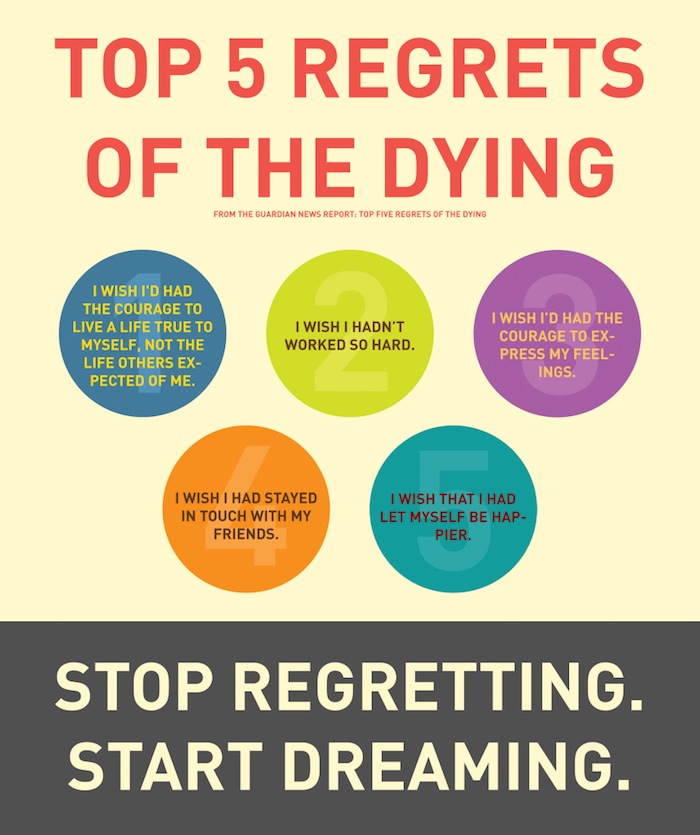
    In The Top Five Regrets of the Dying, Bronnie Ware shares wisdom from her years as a palliative care nurse. These are the most common regrets she heard:

    1. “I wish I’d had the courage to live a life true to myself, not the life others expected of me.”

    2. “I wish I hadn’t worked so hard.”

    3. “I wish I’d had the courage to express my feelings.”

    4. “I wish I had stayed in touch with my friends.”

    5. “I wish I had let myself be happier.”

    These resonate deeply with me. When my mother passed, I unknowingly began a journey to align my life with these truths. I’ll admit I’m still working on the five of them. Life has a way of distracting us from what matters most.

    But this is my reminder to myself—and to you—as we near the end of the year:

    Slow down. Take a step back. Reflect on how far you’ve come and where you want to go next.

    My wish for you is to reflect on this. Let the thought of your mortality infuse your life with intention—not pressure, but clarity. Maybe you’ll realize that what matters most is spending time with loved ones. Maybe it’s pursuing a dream, letting go of a grudge, or simply savoring the gift of being alive.

  • Guidance for Growth: How to Forgive and Live Without Regrets

    Guidance for Growth: How to Forgive and Live Without Regrets

    “New beginnings are often disguised as painful endings.” ~Lao Tzu

    Once believed to be conflict-free, our relationship disintegrated on a fateful evening in May 2007, revealing the facade of our supposed happiness. We always said, “We’ll be all right because we never fight.” Well, that belief shattered on my dad’s fifty-fourth birthday. What was supposed to be a dinner with my parents turned into a nightmare and marked the beginning of a harrowing ordeal.

    My then-husband, bleeding from a head wound after a visit with a friend, turned our evening into chaos. As I attempted to bandage him, unease set in, quickly escalating after we returned home. A heated argument led me to leave defiantly, only for him to react violently, breaking a chair in his rush to stop me.

    Our confrontation spilled onto the porch, where I suffered a head injury requiring sixteen staples after a fall caused by him. Despite my attempts to escape, he overpowered me, taking my keys and phone. The ensuing drive was a frenzied blur of speed and violence, ending with me jumping from the moving car for my safety after being punched in the face three times.

    The night culminated at my father-in-law’s house, who, while dismayed, reluctantly intervened. I eventually found myself in the emergency room, a grim closure to a day marked by undiagnosed sociopathy and substance abuse.

    The agonizing events of that evening marked a shocking departure from what I had known of our relationship, standing as the sole instance of violence in what otherwise appeared to be a peaceful union. His sudden outburst of aggression revealed the hidden depths of troubling behavior, a reality rooted in psychological complexities I was painfully unaware of until later on.

    Ironically, my role as a wedding coordinator for an upscale hotel chain made the situation even more surreal. Less than a year after exchanging vows of love and commitment, I found myself concealing bruises—stark, physical reminders of betrayal—while facilitating celebrations of love for others.

    This contrast between my work life and personal experience not only deepened my resolve to seek healing but also highlighted my resilience in facing life’s unpredictable challenges, further motivating my journey toward healing and empowerment.

    The Awakening: Realizing the Need for Change

    That evening blindsided me. Until that day, violence had been absent from our life together, making the ordeal not only a physical but a psychological shock as well. It was this abrupt confrontation with violence that compelled me to reassess everything I believed about our relationship.

    In the immediate aftermath, the pressing need for safety and healing took precedence over everything except understanding why. Reflecting on that night, I realized it wasn’t about recognizing a pattern of escalation but understanding how profoundly this single event altered my life and perception.

    A Year of Transformation…and Loss

    In the months following that dreadful night, I began a journey toward healing and self-discovery, and just as I started to find my footing, another wave of grief hit with the passing of my mom less than a year later. This “double whammy” of loss and trauma tested my resilience to its limits!

    My mom’s passing not only compounded the emotional turmoil but also served as a poignant yet factual reminder of life’s fragility and the importance of healing and growth. It forced me to confront my grief head-on, integrating this pain into my journey of recovery.

    In contemplating the night of domestic violence and then the passing of my mom, I realized that the path to healing is not linear but a mosaic of our experiences—each piece, no matter how painful, contributes to the whole of who we are.

    The lessons learned in the shadow of loss and violence illuminated the strength within me, guiding me toward a deeper understanding of forgiveness and living without regret.

    The Path to Healing: Embracing A New Beginning 

    My healing journey began with the unwavering support of family and friends, whose presence became my sanctuary. Recognizing the depth of my trauma, I sought professional help, engaging in therapy sessions that offered a safe space to unravel and confront my experiences. That led me to the doors of Domestic Violence Intervention Services (DVIS), where counseling sessions became a cornerstone of my recovery, providing me with the tools and understanding needed to rebuild my sense of self.

    To navigate the mental distress and anxiety that clouded my days, I began taking (albeit for a short time) an antidepressant to stabilize my emotions. My quest for understanding led me to the pages of The Sociopath Next Door by Martha Stout, which shed light on the perplexing behaviors of my then-husband. Her book offered clarity on the nature of sociopathy and its impact on our lives.

    Seeking answers to deeper, existential questions, particularly the “death” of my mom at the young age of fifty-four, I dove deep into Everything Happens for a Reason by Mira Kirshenbaum. Her book offered much-needed perspectives on why things happen in my search for meaning in the face of inexplicable loss.

    Journaling became a tool for reflection, a way to pour out my thoughts and start seeing my experiences as the seeds of a spiritual awakening. This introspection led me to explore self-discovery systems, such as numerology, which opened new avenues of understanding and self-awareness.

    A pivotal moment in my healing was attending a spirit fair, where a medium conveyed a message from my mom just two months after she passed! This emotional yet enlightening encounter provided immense comfort and an intense motivation to keep moving forward, a powerful reminder of her enduring presence and guidance in my journey toward a new beginning.

    The Power of Forgiveness

    Forgiving my then-husband, and perhaps more challengingly, myself, was not an act of forgetting but a conscious decision to release the hold the anger and resentment had on my heart. After discovering, through James Van Praagh, that forgiveness is a gift we give ourselves, forgiving us both became crucial to my healing journey because it allowed me to reclaim my peace and move forward without the heavy chains of past grievances.

    The Strength in No Regrets

    Embracing a life without regret has always been my philosophy, but this ordeal deepened its meaning. It taught me to actively seek lessons in every challenge, make peace with the past, and approach the future optimistically. This mindset has empowered me to live more purposefully, reminding me of the strength of facing life with an open heart and a fearless spirit.

    Guidance for Growth: Steps to Heal and Thrive

    Learning to forgive and live without regret are transformative practices that can change your life. Here are some ways that I found useful that may help you in your journey:

    Cultivating Forgiveness:

    Take time to reflect on your situation so you can confront your feelings directly.

    Just as I had to face the reality of my then-husband’s undiagnosed mental health issues and the violence it led to, taking time to reflect on how deeply this affected me was my first step toward healing. Similarly, acknowledging the hurt it caused you and allowing yourself to feel it fully is crucial in your journey toward forgiveness.

    Try to see your situation from the other person’s perspective.

    Understanding the role of sociopathy in my then-husband’s actions didn’t excuse them but helped me to see the situation from a broader perspective. While it’s challenging, especially in cases of abuse or betrayal, attempting to understand the ‘why’ behind someone’s actions can be a step toward releasing anger.

    Write a letter to the person you’re forgiving (you don’t have to send it) expressing how their actions affected you and consciously decide to let go of the burdens that hold you back.

    After I wrote mine and wished him well, I burned it during a full moon ceremony.

    Choose yourself and recognize that holding onto anger and resentment only binds you to the past and the person who hurt you.

    By choosing to forgive, you’re choosing your own peace, freedom, and well-being over remaining tethered to painful emotions and those who’ve harmed you. Forgiveness is an act of self-love and self-preservation that allows you to reclaim your power and move forward with grace and strength.

     Living Without Regret:

    Recognize what’s within your control and let go of what isn’t.  

    While I miss my mom more than I can say, I’ve come to see her passing as a pivotal influence that has molded me into the person I am today. This kind of acceptance is key to living without regret and moving forward in peace.

    Take responsibility for your choices and learn from your mistakes without letting them define you.

    I reminded myself that while I experienced violence, I was not a victim of it. Choosing to seek help after leaving the relationship was a crucial and empowering decision that led me to where I am now. Acknowledging that each decision, including reaching out to DVIS, played a role in my journey reinforces the importance of owning our choices for a regret-free life.

    View every experience as a learning opportunity.

    The day I found myself concealing bruises at work taught me about the stark realities of appearances versus truth. Every challenge offers a lesson, so ask yourself, “What can I learn from this?” to transform regrets into lessons for growth.

    Practice mindfulness.

    Both journaling and receiving an angel message from my mom taught me the importance of being present and finding peace in the NOW. Being mindful can help reduce dwelling on past mistakes or worrying about the future.

    Keep a gratitude journal and regularly write down things you’re thankful for to shift your focus from what’s missing or what could have been to an appreciation for what is.

    I know how grateful I was for the support of family and friends, professional guidance, and moments of peace that helped shift my perspective from loss to appreciation, a practice I recommend to anyone navigating their healing journey.

    Engage in activities that bring you joy and fulfillment, leaving little room for regret.

    Closing Thoughts…

    As you turn the pages of your own life, remember that every challenge is an opportunity for growth, every setback a chance to rise stronger. Let my experiences shared here remind you that you are not alone in your struggles and that within you lies an unbreakable spirit capable of overcoming any obstacle.

    Embrace each day with hope and courage, knowing that in the heart of adversity lies the seed of your greatest strength. Let it grow, let it shine, and let it guide you to your most empowered self.

  • Finding Happiness When Your Big Dreams Didn’t Come True

    Finding Happiness When Your Big Dreams Didn’t Come True

    “Everyone who gives up a serious childhood dream—of becoming an artist, a doctor, an engineer, an athlete—lives the rest of their life with a sense of loss, with nagging what-ifs.” ~Glenn Kurtz

    Childhood dreams are a funny thing, aren’t they?

    Our adolescent years are filled with nearly unlimited imagination of what we can achieve growing up. Some people become doctors, presidents, and professional athletes, so why can’t we? It just depends on hard work and occasional lucky breaks to get where you want.

    Reality slowly starts to set in as you grow into your teenage and adult years. Maybe those ambitions are a lot tougher than I thought they’d be. Perhaps I was delusional more than anything.

    Is it all bad, though? Even if we were unrealistic, our dreams and even delusions fed our motivations and made life more fun. Dreaming of going to space or playing at Yankee Stadium is integral to our creativity, so it’s essential not to regret everything.

    What I do regret are the things that were more in my control.

    When you’re a kid, seeing married couples in real life and on the silver screen is natural. As we enter our teenage years, we think dating and marriage will be easy as a natural part of life. It may come easily to some, but it’s become as complicated as quantum physics to me.

    Getting two people on the same page about love and relationships is an uphill battle, to say the least. Even if you get married, the odds of divorce are relatively high. About 44% of American marriages end in divorce, and past relationships have opened my eyes as to why this happens.

    Not every couple can be like Pam and Jim from The Office or Monica and Chandler from Friends. As I’ve learned, putting your love in somebody else’s hands is a tall task. More often than not, you’ll find yourself heartbroken.

    My first real relationship was smooth for a few months until the mask started to slip. Bottling up feelings and avoiding communication create a recipe for disaster. The next go-round would be better after I learned my lesson, right?

    If only I weren’t so naive.

    The next serious relationship wouldn’t come until a couple of years later. While it went better than the first time, the person I tried to love was far too hot and cold. I didn’t have time for someone personifying a Katy Perry song.

    The third time could have been the charm, but I ran into yet another situation of poor communication. After a while, I started to wonder if I was the problem. What responsibility did I bear in my failed relationships?

    The childhood version of me thought love was supposed to be easy, but it’s far from a linear process. You must be ready to deal with the ups and downs to sustain a long-term relationship with someone.

    I’ve learned a little more about life and myself with each failed relationship. Additionally, I compare how I view relationships now and how I saw them as a teenager.

    In high school, I was desperate for love and attention. I had never had a long-lasting relationship until college, so I longed for that feeling.

    So, what’s changed? The difference between now and high school is I have learned to love myself.

    You can’t love another person until you love yourself, which has been a hard pill to swallow. However, I am better off with this mantra because now I’m more confident and perfectly fine being alone.

    Now, over a decade has passed since that first relationship, and I’ve had plenty more experience. Some good, some bad, and some painful to even revisit. Still, I’ve yet to find “the one” that the younger me dreamed was out there.

    Will that relationship ever come? I’ll survive either way because I’ve prepared myself with love and care. While it may sound selfish, I’ve realized I am the most important person in my life—nobody can take that away from me.

    I love myself by eating a mostly healthy diet, focusing on my fitness, and surrounding myself with supportive family and friends. What more could I reasonably ask for?

    Another childhood delusion I’ve dealt with in adulthood is my dream of wealth. Just like our experience with relationships, we see people with extravagant lifestyles in real life and in media. Even if we didn’t get that in childhood, we aspire to work hard and live like rich people someday.

    Why can’t I be the one on House Hunters looking at million-dollar homes? In my younger years, I envisioned yearly trips to France, Japan, Disney World, and everywhere in between.

    It’s another case where reality hits you in the face as you age. You can dream of wealth, but it’ll stay in your subconscious. You’ll need to win Powerball a few times to be Bill Gates-rich.

    Money is nice because it gives you more freedom to do things and accomplish your goals. However, I’ve realized it’s not everything. Money doesn’t make me happy—I can take responsibility for that.

    To be clear, I wouldn’t mind winning the lottery or hitting the jackpot at the casino occasionally. However, there’s so much more to my life than an impressive bank statement.

    I have a career with short and long-term goals I want to accomplish. My professional growth could and hopefully will lead to more money, but dollar signs aren’t my primary concern.

    I’ve learned that money comes and goes in life, but your happiness shouln’t depend on it. I make a living doing something I genuinely enjoy, and as long as I can pay the bills doing so, that’s enough for me. I embrace my working life and relish sharing my thoughts with others.

    You know what makes me happy? Instead of aspiring for more money, I take pride in being smart with the money I have while enjoying life and experiences with my friends.

    Who needs a multimillion-dollar mansion with spiral staircases and gold spoons? Having a smaller home with people who care about you is invaluable.

    Another fixation I had in childhood was my aspiration to be a professional athlete.

    I knew football and baseball weren’t for me at an early age. I didn’t need a scout to tell me that after watching my games, but basketball was different for me.

    I got my first hoop in fourth grade, which helped me fall in love with the game. Basketball was a sport I could play by myself and train to be just like the pros. 

    Growing up, I thought I could be the next Dirk Nowitzki or Kevin Garnett. Their ability to score from inside and outside the paint inspired me to work on my game in the driveway.

    However, reality quickly set in when I got to middle school. A lot of kids were much taller, faster, and stronger than I was then. The intimidation overwhelmed me and prevented me from trying to make the team.

    I don’t regret not trying because life took me in different directions once I got to high school. Juggling basketball would not have been wise for my academic priorities back then. Plus, my fitness made me nowhere near ready to run up and down the court for two hours.

    Regardless, I quickly threw cold water on any hopes of playing professional basketball because the odds of making it are so low. Even if I’d somehow been the star of my high school team, I would’ve had to get a spot on a college team or international league, too. That’s not an easy task.

    Then, if you’re lucky enough to play college basketball, you can forget about going pro unless you have other-worldly talent. Research shows only 2% of college athletes make the pros, and I didn’t want to try out for my middle school team.

    Nowadays, I get my basketball fill by playing in a local YMCA league with some friends. We take the game seriously, but we play for the love of the sport—not because we think we deserve spots on NBA rosters.

    Basketball is one of the hobbies I use to keep myself going, and I’ll admit, I’ve legitimately gotten good. Do I still pretend I’m going one-on-one with professional players? Yes, but I’m now well aware of reality.

    Speaking of hobbies, let’s talk about music. Many of us dreamed of winning American Idol when we were young and thought we had a chance.

    Your voice may sound incredible when singing in the shower, but how do you sound on a microphone in front of thousands watching?

    As a kid, I thought I could be a legitimate music artist. Learning to play instruments in high school certainly fueled the dream, though at times I let my imagination run ahead of me.

    I used recording software in high school to produce a song I had written. It was far from something you’d see at a professional label, but I tried to make it work. When I played it back, I was proud of what I’d created.

    Ultimately, what started as a hobby never became a career, but I’m okay with that. I enjoy what I do and am satisfied by creating for the fun of it.

    I daydreamed of Radio City Music Hall, Madison Square Garden and Shea Stadium concerts. For now, I’ll entertain the imaginary audience in my shower and the small crowds on karaoke night.

    As a child, you think the world is your oyster. Your imagination runs wild with how far you believe life will take you.

    I dreamed of hitting buzzer-beating shots and falling in love with the first person I found. However, it’s not that easy.

    The good thing is we can still get a lot out of life if we find things we truly enjoy. I love my job, hobbies, family, and friends, and that’s good enough for me.

    The adult version of me has realistic goals, both short and long-term. I get my happiness by caring for myself and doing what I need to find satisfaction in life.

    While playing professional basketball would’ve been nice, my only regret is not learning to love myself earlier. Now, I protect my peace and live a happier life.

  • How to Find Peace When Your Mind Is Restless

    How to Find Peace When Your Mind Is Restless

    “Within you, there is a stillness and a sanctuary to which you can retreat at any time and be yourself.” ~Hermann Hesse

    When I work with people who are suffering from anxiety, fear, grief, or other challenging issues, I like to take them through a simple exercise I call “The Noticing Exercise.”

    It’s my first port of call when helping people break free from mind-created suffering.

    It’s amazing how quickly, and effortlessly, people can move from suffering to peace, simply through shifting their focus to being aware of the present moment—noticing the sensation of the body touching the chair, the ribs expanding on the in breath, or the sounds in the room.

    Even deeply troubled individuals can experience peace the very first time they try this simple meditation.

    How is this possible?

    It is because peace is already there inside all of us. It’s an integral part of who we are. When the mind’s activity subsides, even for a moment, peace is what remains.

    The ocean provides a good analogy.

    At the surface, the water is constantly in motion. It never stops, even for a moment. But when you drop down into the depths, there is stillness and peace.

    It’s exactly the same with the mind.

    On the surface level, the mind is always active but, in the depths of our being, there is a natural peace and stillness that is unchanging… always present, always available. Being part of our essential nature, it can never leave us.

    Although this inherent peace is always there, it goes unnoticed in most people through the deep-seated habit of giving our exclusive attention to the surface movements of the mind.

    We are so pre-occupied with what’s going on at the surface that we simply fail to notice what’s happening in the depths of our experience.

    And, of course, there is nothing ‘wrong’ with any of this.

    Spending our days lost in thinking is the human condition. It’s what we all do.

    Being swept away by the restless waters of the mind is perfectly normal, particularly when we are faced with intense patterns such as anxiety, trauma, or grief. And yet, the fact remains that, despite appearances, there is a peace inside every one of us that is untouched by what’s going on at the surface, however intense it may be.

    Withdraw your attention from the mind, even for a moment, and it’s there.

    You don’t have to create it; just recognize what has always been there.

    Peace doesn’t leave you. You leave peace.

    Stress, anxiety, and unhappiness exist primarily in the form of thoughts.

    If you are able to become fully present in the moment, thoughts subside, and stress and anxiety are replaced by peace and stillness.

    Of course, most people will pick up their painful stories again as soon as the meditation comes to an end, but the fact they were able to be free of their suffering, even temporarily, provides us with clues for finding a more permanent solution.

    With practice, anyone can learn to withdraw their attention from the mind for longer periods of time and thereby extend the periods of peace.

    Have You Been Barking Up the Wrong Tree?

    Most people are looking for peace where it can never be found—not lasting peace anyway.

    It’s a bit like losing your keys in the house and looking for them in the garden.

    You’re never going to find them… because they are not there.

    Most people I help have been searching for peace through the path of self-improvement, often for years.

    And it makes total sense.

    If my mind is causing me trouble, then the obvious solution is to try to fix it—to ‘work on myself’ and try to convert all my anxious and unhappy thoughts and feelings into pleasant, happy ones. Try to create a new, improved version of myself.

    But, if you’ve been down this path for any length of time, as I have, you’ll know that fundamentally changing the mind is not so easy.

    The problem with this approach is encapsulated in the following quote from the Indian spiritual teacher, Nisargadatta:

    “There is no such thing as peace of mind. Mind means disturbance; restlessness itself is mind.”

    Like the surface of the ocean, the mind is constantly in motion. It is restless by nature.

    And, although there may well be fleeting moments of peace here and there, they will inevitably be followed by moments of agitation and disturbance.

    Restlessness is the nature of the mind. Trying to make it calm and peaceful is like trying to iron the surface of the ocean. It’s simply never going to happen.

    Making Peace with The Mind Just as It Is

    To find a solution that actually works, we must first understand the true cause of suffering. It’s not what most folks think.

    People believe, as I did for years, that the anxious, stressful, or fearful thoughts themselves are the primary cause of suffering.

    They believe that:

    • the mind is broken and needs to be fixed.
    • anxiety, fear, confusion, etc. are inherently bad or wrong.
    • there’s something wrong with them for having these thoughts.
    • they can’t experience peace or happiness until they are gone.

    These beliefs are the main reason people suffer.

    As the Jesuit priest Anthony de Mello said:

    “There’s only one cause of unhappiness; the false beliefs you have in your head, beliefs so common, so widespread, that it never occurs to you to question them.”

    What if, instead of spending years trying to fix the content of the mind, we focused instead on making peace with the mind, just as it is?

    What if, rather than fighting and resisting fear, sadness, envy, or confusion, you were able to accept them as natural expressions of the human condition?

    What would happen to your anxiety if you didn’t see anything ‘wrong’ with it?

    Or your sadness if you didn’t mind it being there?

    They may still feel unpleasant but, in the absence of resistance, they’d lose their power to affect your peace.

    We can wrap our non-peace in the peace of acceptance.

    You Don’t Need to Have a Peaceful Mind to Experience Peace 

    On the path of self-improvement, the goal is to find peace of mind.

    But this approach is unlikely to succeed simply because the mind is restless by nature.

    Here’s the truth:

    You can’t stop bothersome thoughts from arising, but you can stop bothering about them.

    One of my teachers used to say, “You suffer because you are open for business.”

    You entertain your thoughts and invite them in for tea—engage with them, ruminate over them, wallow in them, play them over and over in your head—and create suffering for yourself as a result.

    You don’t need to have a peaceful mind to experience peace.

    You need to stop giving your thoughts so much attention and importance.

    If you are able to accept whatever appears in your head, whether pleasant or unpleasant, with an attitude of non-judgmental acceptance, you will always be at peace.

    Acceptance is like kryptonite to the mind. It loses its power to disturb your peace.

    The Two Types of Peace

    There are two types of peace.

    There is the feeling of peace, which is a temporary respite from feeling restless or agitated. Like all feelings, it comes and goes, like clouds passing across the sky.

    Then there is the peace that exists in the depths of your being; the backdrop of peace that is unchanging, ever-present, and has nothing to do with what is going on in your head.

    Even in the midst of the most turbulent storm at sea, in the depths, the ocean remains calm and unmoving.

    There is a peace inside every one of us that remains untouched by the movements on the surface, no matter how intense.

    And it’s not difficult to find. How could it be if it’s already who you are?

    You don’t need to fix or change anything about yourself to experience what is ever-present inside you.

    You just need to dive below the surface and discover what is always there.

    The peace you are looking for is with you always. But you’ll never find it on the level of the mind.

  • 10 Deathbed Regrets You Can Avoid by Making Changes Now

    10 Deathbed Regrets You Can Avoid by Making Changes Now

    Woman with Umbrella

    “While I thought that I was learning how to live, I have been learning how to die.” ~Leonardo Da Vinci

    It’s terrifying, isn’t it?

    There you are—days, hours, maybe minutes remain in your life. You lie there helpless, searching for the strength to say your last goodbyes.

    You look back on your life. All the things you wish you’d done differently.

    As you continue to reminisce an overwhelming emotion comes rushing in, an emotion many are familiar with.

    Regret.

    You set the standards high for yourself. But now that it’s all said and done, more was always said than done.

    There’s no greater fear than leaving this world with our most important goals unfinished. Yet, with never ending hopes and dreams are we destined to live an incomplete life of mediocrity?

    Perhaps it doesn’t have to be that way.

    A New Perspective & Why You Should Burn Your Bucket List

    It’s human nature to desire more. No matter how much we accomplish, we’re wired to create new objectives to pursue.

    For most of my upbringing, I was obsessed with bucket lists. Mine had over 100 things I wanted to do. Anytime I managed to cross one off the list, I’d add ten more.

    The process was never ending and doomed for failure.

    During this time my grandfather passed away. It happened so fast I never got to say goodbye. It was my first experience of how quickly life comes and goes.

    I started thinking about when my time would come. Would it matter what my bucket list looked like on my deathbed?

    So I threw it out. Instead of thinking of what I wanted to do with my life, I started focusing on things I didn’t want to say about myself when it was time for me to go.

    That I was greedy, angry, or rude. That I didn’t care about others, or even myself.

    Death is scary. We can’t change that. But we have a chance to live fully right now—and we can do that by ensuring we don’t have to say these things at the end.

    1. I didn’t take care of my body.

    Your time will come much faster if you don’t take care of yourself.

    Smoking, excessive drinking, compulsive eating, sitting for too long—all these add up over time. Continuing bad habits encourages rapid aging and brings you closer to your final days.

    You can buy another car, a new house, and find another job, but you only get one body.

    If you want an abundance of breathtaking moments, you need a body that’s ready for the long haul.

    2. I let anger get the best of me.

    Anger is a natural emotion. We all experience it, and at times it’s perfectly justifiable. But we do ourselves a disservice if we let anger control us and sabotage our relationships.

    One of the best ways to address anger is to empathize with others and to understand why they did what they did.

    Being proactive and reflecting on the times you’re angry helps you to get to the root of what’s bothering you, allowing you to move on and go back to being happy.

    3. I spent my entire life in my comfort zone.

    There’s no bigger waste of your time than doing the same thing over and over waiting for something exciting to happen.

    Nothing exciting will happen if you don’t get out there and make something happen.

    Escaping the confinement of comfort is a struggle for anyone at first.

    But when you’re looking at your life as a whole, you’ll be proud if you don’t have to say the most unease you felt was choosing what to watch on Netflix to waste the night away.

    4. I spent too much time around toxic people.

    There comes a time when you must face the reality that not everyone you spend your time with is actually benefitting your well-being.

    People change, family members bring you down, and certain people just aren’t fun to be around.

    If you want to make the most of your time, it’s essential you minimize your time with people who drain you emotionally, disrespect you, or otherwise treat your poorly.

    If you think it’s rude to dismiss someone, look at it this way: When you stop spending time with people who aren’t positive additions to your life, you open yourself up to relationships with people who will uplift and support you.

    5. I didn’t stay in touch with family and friends.

    The other end of the spectrum is the people we love.

    Humans are biologically social creatures. We’re meant to be around others, especially the ones we care about most. There’s no sense in fighting the nature of humans because you’re too busy at the office.

    If this doesn’t seem pressing to you now, know that it may one day feel that way, when they’re gone and you realize you didn’t show them how much you loved them.

    6. I didn’t give as much as I took.

    It’s easy to forget that nothing tangible comes with us after we die.

    Once we’re gone, that’s it. Whatever you have gets left behind. So why do we spend valuable years of our lives taking rather than giving?

    Money is always the first to come to mind. I’m not suggesting we give it all away, but I’ve never met someone who was proud to say that all they did with their life was pad their bank account.

    Life is about giving and sharing experiences. The more you give, the happier you’ll be.

    7. I thought I knew everything.

    People often assume that after graduating from high school or college, they know everything.

    But the truth is when you stop learning, you stop growing.

    Since the beginning of our existence humans have been explorers, venturing to the corners of the world and into space to discover more about life.

    Constant learning allows us to discover new things about ourselves and the world, and our experiences teach us things that could never be taught in a classroom.

    Looking at the bigger picture, we don’t know anything. And that’s exactly what makes life so exciting.

    8. I never made any mistakes.

    It seems counterintuitive to wish for failure, but our mistakes are what allow us to grow.

    The point isn’t to make as many mistakes as possible, but to learn from our mistakes.

    Every great revelation, invention, or revolution started with hundreds of mistakes before it, until one miracle made it all worth it.

    It’s not so much mistakes that matter, but having the courage to make them.

    9. I hated my job.

    Accepting the nine to five and secure paycheck. Two weeks vacation for fifty weeks of slavery. Accumulating debt on house loans, car payments, and credit cards. Add on the responsibility of supporting your family, and it may seem you’ll be trapped forever.

    If you don’t enjoy your job now, that’s okay; many feel the same. But if by the time you lay on your deathbed you still hate it and never left, that’s a problem.

    You won’t want to look back and say you took the easy route and played it safe, accepting that you were never supposed to do anything meaningful with your life.

    Leaving a job is scary, especially when raising a family. It doesn’t mean you should quit today, but implementing an exit plan toward a career you actually do enjoy will relieve yourself from years of misery.

    10. I spent my entire life trying to be someone else.

    It’s become the norm to follow the crowd, adapt to the trends, and accept what everyone else is doing and join in.

    By doing this you never encounter the person you really are because you’ve been camouflaged by the identity of society.

    Taking time to understand yourself is life changing. It allows you to gather a clear picture of what you want to accomplish during your short time on Earth.

    You learn the things you love about yourself and things you might want to change. And most important, you understand what makes you unique and how your uniqueness can help you leave the world a better place than you found it.

    One Last Thing

    In the end, you’ll likely reflect on the things you didn’t do. As I said before, it’s human nature.

    But avoiding certain things, such as not taking care of myself and living in my comfort zone, has brought more happiness to my life than a bucket list ever could.

    It doesn’t matter if you swim with sharks, travel to every country, and take the first ride of space tourism; what matters is how you live your life, how well you take care of yourself, and how well you take care of others.

    This is your life, and you only get one. There’s no right or wrong way to live it.

    What matters is that you do.

    Woman with umbrella image via Shutterstock

  • Walk Toward Your Dreams: If Not Now, When?

    Walk Toward Your Dreams: If Not Now, When?

    Walking

    “Do not wait until the conditions are perfect to begin. Beginning makes the conditions perfect.” ~Alan Cohen

    Last year I was suddenly made redundant along with half of my colleagues, as our company was being taken over. It was swift and severe. It was also a blessing.

    I didn’t want to work for the new company whose values conflicted with my own. And I had been wavering on making a decision about my career.

    Now I was being forced to decide but I just wasn’t sure what I wanted to do. At least, that’s what I told myself. Fear makes us do that sometimes, to keep us where we are, safe within our comfort zone.

    A friend reminded me to return to my dreams. On the basis of de-cluttering, Practical Me, that part of me that likes to keep me safe, put my vision board on the top shelf of my wardrobe, where it was safely out of sight and out of mind. I took it back down and spread it out on my bed.

    In the top left corner were pictures of the ocean and scuba diving. I had just spent a week diving around the island of Komodo in Indonesia.

    Beneath it were pictures of walking trails and Italy representing my dream to walk the Via Francigena, an ancient pilgrimage route of 2,053 kilometres, from Canterbury in southern England through France, Switzerland, and Italy, ending in Saint Peter’s Square in Rome.

    After walking a small section through Tuscany a couple of years earlier, I dreamed of walking the whole way one day, sometime in the future. I hadn’t planned on walking it now but then I hadn’t planned on being made redundant either.

    I sat on my bed looking at my vision board with this dream staring back up at me. With no job and needing to move house in the next couple of months, and a small redundancy payment in the bank, now was the perfect time for this dream to be lived.

    That’s when the whispers started. You know them. The ones that give you every possible reason why you can’t do something, to stop you moving forward, to keep you “safe” exactly where you are right now:

    You didn’t plan on doing it this year.

    You haven’t saved for it. The redundancy payment won’t cover it all. You will have to spend your savings. You will end up broke. 

    It will be long and hard. You don’t even know anything about long distance walking or hiking. Maybe you won’t make it. What a waste of money.

    And the loudest…

    Why on earth would you want to walk 2,000 kilometres? What’s the point?

    Logically, there was no reason to walk that far, especially these days when I could fly or take a train or bus or drive. Except as much as I was scared, the idea excited me.

    Then I heard the words of my good friend and yoga teacher, Joey. Whenever I hesitated to go into a posture or resisted going a little deeper, Joey always looked at me and said matter-of-factly, “If not now, when?”

    If not now, when?

    Yes, but I didn’t plan on doing it this year.

    If not now, when?

    I don’t know—maybe in a few years when I’ve accrued some long service leave or I have retired, or maybe never because it’s just a dream to be dreamed and not lived.

    As I was having this argument with myself, my mind jumped many years into the future.

    I was as an old woman with short silver hair, lying on my deathbed and looking back at my life, specifically looking back at all the things I didn’t dare to do. As soon as the words, “I wish I had” left my mouth, I knew this would be one of them.

    I don’t want to die regretting the things I wanted to do but was too scared to try. And I knew that if I didn’t attempt to walk it now, I might never have the perfect opportunity.

    I may not have the freedom and time to undertake such a long adventure until who knows when, maybe decades away when I’m older and my body less able, maybe never.

    I decided to walk. Scared and excited, I prepared myself as best I could. Ten weeks later I had packed up my life in Melbourne and was in Canterbury taking my first steps to Rome.

    For seventy-five days I walked entirely on my own. Then ten days away from Rome I met Peter and Paulius (yes true story their names really were Peter and Paul just like the Apostles). Eighty-five days after I left Canterbury, I walked into Saint Peter’s Square with Peter and Paul.

    Some of those fearful whispers were right. I didn’t know what I was doing and I was an inexperienced hiker, but I learned what I could before I left and the rest I learned as I walked.

    I depleted my savings; however, I didn’t end up broke.

    There was a risk I might not make it all the way, especially within the ninety day Schengen visa restriction, but I decided it was a risk worth taking. Where there’s a will, there’s a way. I made it.

    It was long and hard, one of the most challenging things I have ever done in my life physically, mentally, emotionally, and spiritually. I discovered the extent of my own determination and resilience and found the answer to the question I had long been seeking—the purpose of my life.

    In realizing this dream, I have been able to take steps toward living another dream: to write and publish a book. I have written about my journey and am in the process of getting it published.

    Stepping toward our dreams and into the unknown can be scary. It’s just that part of ourselves that wants to keep us safe and free of shame, where there is a risk of failure. It’s okay to feel scared and it’s normal, but we don’t have to let it have the last word and control us.

    Take a deep breath into your belly, feel into your heart, and ask yourself, if not now, when? What answer do you feel in your body? Is your fear nervous or excited? Is your desire greater than your fear?

    Is now the right time for you to take that step? Maybe the answer is no, not right now. That’s okay. We don’t need to force things; everything can unfold in its own time.

    How will you feel at the end of your life if you don’t give your dream a go? Will you be regretful, sad, or disappointed in yourself? If your answer is yes, then use those feelings to propel you through your fear and take that first step towards living your dream—starting now.

    Walking image via Shutterstock

  • Wisdom from a 6-Year-Old About Living Without Regrets

    Wisdom from a 6-Year-Old About Living Without Regrets

    Are you living the life you’ll want to see when you reflect back at ninety years old? Studies show that the biggest regret from elderly people on their deathbed is not what they did; it’s what they didn’t do: the risks they never took.

  • Living for Yourself So You Won’t Die Full of Regrets

    Living for Yourself So You Won’t Die Full of Regrets

    Happy Man Jumping

    “One day your life will flash before your eyes. Make sure it’s worth watching.” ~Unknown

    A mother was walking down the street with her two little sons. A man stopped to admire them and he asked, “You must be so proud of them! How old are they?” The mother answered, “Who? The doctor or the lawyer?”

    A few days ago I heard this joke and, despite its purpose, it just made me feel sad. I was one of those children who, when turned into adults, never explored their passions and never went for their dreams.

    I loved writing. I mean I could write for hours without feeling tired or hungry.

    I was so happy to express myself through my poetry. Fast-forward fifteen years: I was working as a finance manager in a top multinational company. I woke up one day and I just couldn’t move. I mean literally, I couldn’t leave the bed, I was so unhappy.

    Thinking about it, I was just like the upgraded version of my mother, who had been working all her life as an accountant in a small company.

    Don’t get me wrong; I love my mother. I love her so much that I could do anything just to see her happy, including embracing a career that I do not love, just to make her feel that I will be safe. Because I will be, right? What’s not safe about a management job that pays so well?

    But if this career is supposed to make me feel safe, why am I feeling like I am losing the most important battle of my life?

    Been there, done that. Hopefully, I am one of those who, in the end, managed to find themselves again. Unfortunately, I had to watch my father dying full of regrets just to be able to finally do this.

    So, what about you? If the joke above resonated with you in a not-so-funny way, you may want to consider this:

    Understand your story.

    Who were you as a child? What did you enjoy doing? Did you stop doing the things you enjoyed? When? Why? What have you learned about working from the people who had some authority in your life (parents, grandparents, brother, sister, teachers you admired)?

    Own your story.

    It is what it is and you can’t change the past. Allow yourself to be angry for a moment. Acknowledge your feelings. It’s okay; just don’t get stuck at being angry.

    Negative emotions will not help you or anyone else. Turn them into forgiveness. And then be grateful. People are dying each day being full of regrets; they don’t have any time left to change anything about their lives, but you do. You still do.

    Make a plan for yourself.

    Make it a daily/weekly routine to get in touch with your true self. What is your definition of being happy? Are you happy? Spend ten minutes each day, whenever you have the time, thinking about the things you really enjoyed. Is there a way to bring them back into your current life? How? When? Schedule it.

    In most cases, you don’t have to change your whole career, or even your current job. You just have to incorporate more things you love into your life.

    Make it happen: stick to the plan like it’s your most important project right now.

    It won’t be easy. Of course, you have your very limited free time and your responsibilities, kids to take care of, or you’re just traveling a lot. Still, you are your most important asset. And unless you are going to take responsibility for your happiness, no one else is going to. Furthermore, what do you want your kids to learn from you about life?

    Finally, please get yourself out of the “when vehicle.”

    When you’ll get that raise, when you’ll buy that bigger house, after you’re back from that wonderful trip, once your kids are going to leave for college… life happens to us while we are waiting for some distant event to take place.

    Smell the roses that are now growing in your small garden. You’ll feel instantly better. And that’s a promise.

    Happy man jumping image via Shutterstock

  • 5 Ways to Seize the Moment and Live Without Regrets

    5 Ways to Seize the Moment and Live Without Regrets

    The Jubilant Man

    “Accept your past without regret, handle your present with confidence, and face your future without fear.” ~Unknown

    Samara is my colleague at work. She is one of the most pleasant ladies I know. She always has a smile and an encouraging word to give.

    She really is the kind of woman you want to speak to on the days you feel like life has dealt you a bad hand, because she always has something comforting to say. As we got closer, I confided more and more in her about the challenges I was going through in my life.

    I envisioned that her life must be perfect since she has such inner strength.

    But I was wrong.

    One day I noticed she had a sad countenance. That was strange because Samara was like sunshine itself. However, her sad countenance did not last, and before long she had her signature smile back on.

    But I was not deceived. I knew that deep inside her, she was experiencing some pain, so I asked her what was wrong.

    At first, she smiled and said that all was well. But I insisted that she confide in me. She looked me in the eyes, thanked me for caring, and then dropped the bombshell.

    “My six-year-old daughter has been in a critical condition for the past six months because of my carelessness. I saw her yesterday and her situation seems to have worsened. I think she is going to die.”

    For a second, I could not speak. I was in shock.

    “I am so sorry,” I managed to stammer, trying not to let her see how shaken I was by the shocking statement I had just heard.

    She explained to me that six months ago, she had stopped at a supermarket to get a few things. And because she was in a hurry, she had left her daughter in the car with the engine running. Her daughter had managed to engage the gear and the car had sped into the road, right into an oncoming trailer, and she had been seriously injured.

    The tears rolled down my face as she narrated this horrific story to me.

    She assured me that she had managed to forgive herself and had replaced regrets with gratitude for the six years she spent with her daughter.

    I recalled with a sense of embarrassment all the fuss I sometimes make over little things that, in light of what I’d just heard from Samara, now seem really insignificant.

    My marriage was not working out the way I wanted it to and everyday I lived with regret that I married my husband. I made a career change, which has turned out to be a very poor decision, and I have not been able to forgive myself.

    I realized that I spend too much of my time dwelling on all the mistakes I have made in the past. I spend too much time regretting things that I have no power to change. I spend too much time wishing things were different. I spend too much time beating myself up over what I’ve done.

    Over the years after that encounter, I determined to live a more positive life, free of regrets. Here are five ways I’ve learned to do that:

    1. Live your life with purpose.

    I realized that my career was doing badly because I did not have a career plan. I just drifted through my days without something to look forward to, so my life lacked momentum.

    Determine to live a life of focus. Today, take a stand on one thing you want to achieve in your life and draw up a plan to accomplish it.

    2. Stop making excuses.

    I blamed everybody else for the way my life turned out. I blamed my husband for the failure of my marriage and I blamed my boss for not promoting me.

    I am responsible for my life and not anybody else. Instead of making excuses, I need to take responsibility.

    It doesn’t matter what the obstacles in your life are. You can achieve almost anything if you put your mind to it. Helen Keller and Jon Morrow are examples of people who achieved excellence despite physical disabilities.

    Look within yourself. There is something waiting to be birthed. Find what that something is and do it, without excuses.

    3. Choose not to be a victim.

    At a point, I thought I had made such a mess of my life that there was no point trying to put things right. So I gave up trying. I mulled over my mistakes every day and went deeper into regrets.

    None of this helped me. I only started making progress when I embraced my mistakes, determined not to make them again, and resumed chasing my dreams.

    Life is not fair for any one of us. There will be storms and you will make mistakes. But be determined to get up as many times as life pushes you down. Forgive yourself, learn the lessons, and go on working toward your goals.

    The more time you spend feeling sorry for yourself, the less time you have to pursue the life of your dreams.

    4. Stop comparing yourself to others.

    I could not stop comparing myself to others. Everybody seemed to be happier than me, their marriages seemed to be faring better, and I seemed to be the only person with a less than fulfilling career.

    This made me feel even worse. I wondered what others were doing that I was not. Their progress in life seemed to dampen my spirit.

    Over time, I realized that comparing yourself with others is one of the greatest mistakes anybody can make. No matter who you are or where you find yourself in life, always remember that you have your own unique path to walk.

    Never compare yourself, your struggles, and your journey to anyone else, for that would only distract you from your own.

    We are all different. Forget about others and focus on fulfilling your own life dreams.

    5. Take action now.

    After I drew up a career plan for myself, I still lacked the courage to follow my plan. I wasted a lot of time because I was afraid that I would fail and I did not have to courage to start. So I continued to push things off.

    It’s funny how so many people seem to think that tomorrow is better than today for getting things done. We put off those things that are important to us and we lie to ourselves by saying that we will do them later.

    Whatever you need to do, do it now! Today is the tomorrow you planned for yesterday, so start today.

    My chat with Samara that day was a wake up call. I promised myself that day that I would not waste any more precious moments of my life regretting. I have been able to do that and have discovered inner peace in the process.

    So I urge you to do the same. Don’t waste any more time on regrets. Learn the lesson and move on. There’s still a lot of life in you. Go out there and live it!

    Photo by Benson Kua

  • The Story So Far: Your Life Is How You Interpret It

    The Story So Far: Your Life Is How You Interpret It

    “Though no one can go back and make a brand new start, anyone can start from now and make a brand new ending.” ~Carl Bard

    My life has been a long string of failures.

    The earliest I can remember is having my teeth knocked out when my grandpa braked too hard at a stoplight on our way to a church Easter pageant. I was supposed to be singing a solo, the part of the “little gray lamb,” and I did it—performing while clutching a bloodstained washcloth wrapped around ice cubes to hold to my front gums in between verses.

    Dumb kid. Should’ve worn a seatbelt.

    In sixth grade I was chosen to represent my school at the Planet Bowl at the Zeigfield Theatre in New York. I came within one warning of disqualification and yet won the competition, earning a microscope for my school and getting my picture in the paper with former Mayor Abe Beam.

    Talk about a self-centered attention seeker.

    In high school I played leading roles in musicals, composed and arranged pieces performed with my fellow students, won state-level First honors in both drama and music. I also lettered in cross country and swimming, was a national merit semi-finalist, and won a rotary scholarship.

    What an unrealistic artsy-fartsy nerd.

    I was an honor student in college, before withdrawing to join the Marines. There I tied for top scores in the School of Infantry, getting a meritorious mast. I raised one, two, and then two more daughters, working every job I could find, from short-order cook to multimedia producer to feed them, house them, clothe them, and help them turn into the remarkable young women they are now.

    What a waste. A white guy during the dot-com boom couldn’t do better than flipping burgers and pancakes? Pathetic.

    That’s the story I’ve told myself, over and over.

    I could list more triumphs, more successes, more things that I attempted and achieved, but the number of things I didn’t achieve always vastly outnumbers them.

    Either in comparison to what others have accomplished or simply in comparison to that evil little voice of “you should’ve” in the back of my head, no matter what I pull up and show, there is always a version of the story of my life where even my failures could’ve been better.

    In some ways it could be argued that this has been beneficial. I am always trying to please that voice, and it leads me to try hard, try again, and try different approaches until I find something that works.

    I got inspired by Homer’s Odysseus, whose epithet “polyteknos” literally means “man of many ways.” That dissatisfaction with the things I’ve done has led to more and more varied and unusual accomplishments in various areas, taken me around the world teaching, learning, and connecting with remarkable people.

    But always accompanied by that voice in my head, saying: If yer so smart, why ain’t you rich? Or in better shape, or more prolific a writer, or more attentive a father, or, or, or.

    Forty-three years of this, give or take. And finally, in about the past year, I’m slowly coming to realize something about this epic tale of my life.

    The should’ve’s always seem bigger than the did’s because of the stories I’ve been telling myself about them. They have no more substance than the shadow of a cloud passing over a mountain, yet they change my entire perception of what happened.

    What if I could change that? What if I could set out to tell a different story? What happens then?

    Carl Bard is right: I can’t change what has happened, but I can look at it differently, a process popularly known as reframing.

    Suddenly my parents’ divorce is what gave me three half-sisters and a half-brother. My withdrawal from college took me out of an environment toxic to my young questioning mind. The injuries to my knees that led to a discharge from the Corps let me raise my kids without the trauma of Gulf War I.

    Every mishap, mistake, misunderstanding, and misspent moment led directly to the person I am now.

    Is that person a success? Is that person a failure? Like Schrodinger’s Cat, the fact is that I am both and neither until I choose the lens through which to look at myself. Between the reflection in the mirror and my brain, the filters of experience change the feelings attached to every event and deed.

    Sometimes the mountains are in sunlight, sometimes shadow. The mountains remain, nonetheless. They can be obstacles or they can be panoramic beauty. Either way, they will inspire the story within.

    You write about the mountain and the valley and the river and all the rest of your life’s metaphorical landscape. You also rewrite that story, every day. Not only how it ends, but also how you remember it.

    There is magic in hindsight, and there is forgiveness in perspective, if you choose to accept either.

    Best of all, there is inspiration in the knowledge that the path led you to now, where you have the power to decide what will happen next.

    If you asked me, right now, what the biggest accomplishment of my life has been, it’s a no-brainer. It’s a tie between making my three-year-old grandson Harvey laugh and making my other grandson, one-year-old Victor, smile. Nothing else in my entire life has felt as worthwhile. Not. One. Thing.

    There is no way the little gray lamb, the musician, the Marine, or any other me’s could have known or planned for that. And that’s okay; I am eternally grateful for the part they played in making my life’s great work possible.

    Slowly I’m learning not to worry about writing the ending of my story or editing the beginning. I’m learning to do what is most important, every day: The story, so far.

    Photo by Bev Goodwin

  • 20 Ways to Let Go of Regrets

    20 Ways to Let Go of Regrets

    “Every new day is another chance to change your life.” ~Unknown

    You know the moment. It happens right after you realize you did something you wish you didn’t do. Maybe you broke someone’s trust and now the guilt is overwhelming you. Maybe you compromised your job in some way and now you’re terrified your world will come crashing down.

    Regardless of what you did, you can feel your anxiety like a stack of red hot bowling balls surgically implanted in your stomach. (Dramatic? Yes. Regret is rarely reasonable!)

    It’s that dreaded “Good God! Oh no! What was I thinking? Why me?” moment when you think one of two things:

    • I did something I shouldn’t have and I might not be able to fix it.
    • I did something I shouldn’t have, so I’m going to lose something important.

    Both of those things might be true. In fact, they often are. Actions do have consequences. We do lose things—all through life. Nothing is permanent, not even the most secure relationship. But none of this has to be catastrophic.

    Sometimes losing one thing opens you up to something else. It might be a lesson that helps you be more effective and happier in the future, or it could be a new possibility you never even thought to seek (like that dream you put off to work the job you just lost).

    Or maybe it won’t benefit you in any discernible way right away. Let’s call a spade a spade—maybe you’ll wish you went a different way, grieve what you lost, and then eventually let it go and move on.

    The point is you will eventually let go and move on.

    And because you’re a strong, smart, capable person, you’ll find ways to make this new direction meaningful for you. To make up for what you lost by gaining something equally important in the aftermath, whether it’s a new understanding of your strengths, a new idea of who you want to be, or a new opportunity to try again a little wiser. (more…)

  • 40 Ways to Live Life Without Regrets

    40 Ways to Live Life Without Regrets

    Man and the Moon

    “The saddest summary of life contains three descriptions: could have, might have, and should have.” ~ Unknown

    We all have something stored in our memory banks of the past that we wish we could have done differently, or something we wish we didn’t do.

    As we get older we learn and grow, but that doesn’t mean we have to regret what we did before we learned how to do things differently. If we didn’t go through those experiences, we might not have grown into the strong and knowledgeable people we are today.

    What I’m proposing is that we get rid of the negative thoughts—the could haves, might haves, and should haves—and start living a life that won’t make us feel regretful. Not even at an older, wiser age.

    Here is a list of things you can do to practice living life with no regrets:

    1. Realize that it’s okay to make mistakes. Just make sure to learn from them, forgive yourself, and move on.

    2. Make your health and wellness a top priority and always take care of yourself so you’re ready to take care of others.

    3. Follow your own path, not one that others want you to follow.

    4. Find the humor in life and laugh like there is no tomorrow.

    5. Relax and move with the flow of life by being unafraid of change.

    6. Be adventurous by trying new things and taking more risks.

    7. Have more intellectual curiosity and embrace creativity.

    8. Try to find happiness with as many different people as you can.

    9. Think for yourself instead of letting other people’s opinions influence you too much.

    10. Try not to judge people before you get to know them.

    11. Be thankful for what you have now instead of thinking about what you don’t have.

    12. Wish well upon everyone equally and try to admire without envy.

    13. Share your happiness with others instead of hoarding it all for yourself.

    14. Don’t try to change someone—love who they are now.

    15. Enjoy the journey, not just the destination.

    16. Know that happiness is bigger than any bank account.

    17. Control negative thoughts so that they don’t contribute to the outcome of your life.

    18. Use your energy wisely because spending energy complaining, worrying, or being impatient is just wasted energy.

    19. Be bold. Find the courage to change things that should be changed and accept that there are some things that cannot be changed.

    20. Love your work. If you don’t currently love what you do, figure out what you would love and take the first step toward that life.

    21. Turn your discontent into a mystery and enjoy trying to solve it.

    22. Face problems from different angles in order to find solutions.

    23. Gain independence by realizing that on this earth we are all dependent upon each other.

    24. Change your perspective by taking on a wider view of things.

    25. Don’t waste time trying to bring disagreeable people around to liking you.

    26. Become the person you would like to spend the rest of your life with.

    27. Be honest with yourself and others by saying what you mean and meaning what you say.

    28. Treat people with respect and compassion.

    29. Live in the now by loving the present and being aware of your thoughts and actions. Think happy thoughts and speak powerful words.

    30. Try not to put things off until later.

    31. Never hold grudges.

    32. Face your fears head on and try to do the things that you think you cannot do.

    33. Spend time with people who make you happy while also not depending on other people for your own happiness.

    34. Stand up for yourself and others and don’t let anyone or anything hold you back.

    35. Be yourself and love who you are now.

    36. Be a participant in life rather than an observer.

    37. Do the things that you love to do as much as you can.

    38. Write out a list of goals and achieve them by doing them step by step. Don’t give up when things get difficult.

    39. Do something every day that makes you feel proud of yourself—commit random acts of kindness whenever you get the chance.

    40. And always keep on moving forward.

    I know it seems like a rather large list of things to take on, but you can accomplish a lot on this list by doing just one thing. For example, right now as I’m typing this I’m putting into practice at least eighteen things.

    Put these things into practice and see where life takes you, without regrets. And please comment below. I’d love to read your thoughts on this.

    Man and the moon image via Shutterstock