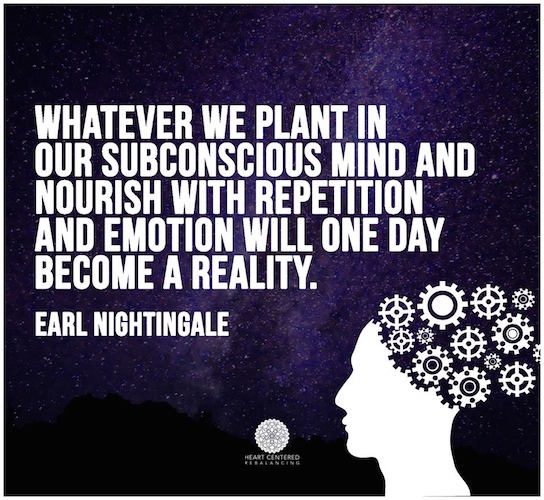
Source: Heart Centered Rebalancing

“All that we are is the result of what we have thought. The mind is everything. What we think we become.” ~Buddha
Have you ever heard the phrase “your thoughts create your reality”? Have you ever wondered what this means?
Go back to your childhood and recall a time when you got into trouble. I am sure you have at least one of these memories. This doesn’t have to be a major event. It can just be a time where you were scolded for knocking over your drink.
Now remember your parents’ reaction. Were they angry or frustrated? Did they yell or give you an annoyed look? Did they send you to your room?
How did it make you feel? Most likely you felt like you did something really bad or that you were bad.
This feeling, multiplied by all your other similar experiences, created a belief within you. Through this belief you probably, without your knowledge, created a reality of being bad or not good enough.
Now fast forward to the present and watch these memories from a new perspective. Have your friends join in. What are your thoughts now? What reactions do they have?
Through different eyes, through different perspectives, we see and experience different realities.
Here is a personal experience of mine. I was maybe six or seven, and my family and I were sitting around the kitchen table frosting cookies. This was an annual event at our house. We had all the colors of the rainbow of sugary, spreadable, delectable frosting.
I was using the green frosting, spreading it oh so carefully on my cookie. When I was finished with the green I set the knife back into the frosting bowl. The knife, not secure in its vessel, tipped backward, sliding gracefully out of the bowl with a loud and splattering of green onto the linoleum floor.
I don’t remember exactly what my mother said but I do remember her being upset, and I remember feeling like I really messed up and ruined things for my mother and the rest of my family.
This experience, along with other similar childhood situations, created a belief that if I did something wrong I would make someone angry or ruin a situation—essentially, I would be bad.
So what did I do? Whatever I could to not elicit a reaction, including staying silent.
Now we are going to fast-forward to the present. I can look back at this situation with new eyes. I didn’t do anything wrong. I didn’t ruin the situation, and my mother wasn’t mad at me or even angry.
The knife was too heavy and long for the shallow bowl, which caused it to tip. It was beyond my control.
My mother’s reaction was one of frustration not because of green frosting on her easily moppable floor, but probably because she had a long day taking care of four kids and a house and was stuck in an unhappy marriage.
Similar scenarios often happen to us as adults. I am a natural introvert. Walls are my friend.
In a crowd of people I usually remain in the shadows, merely observing the happenings around me. In my observations I will notice groups of people maybe glancing in my direction while continuing to talk.
My thoughts then go into super sensitive mode and create stories of being talked about. My thoughts go on an imaginative ride of insults and attacks, all on me, by those people across the way.
Now I feel attacked. I am no longer having fun. I no longer want to be where I am.
My thoughts created a false reality out of nothing. My thoughts had no basis in fact, yet they created a reality for me, true or not.
Perspective can change the reality of any situation. Really, what is reality but an experience? And if everyone has a different experience from a different perspective, then doesn’t that mean there isn’t just one reality? That reality results from the arbitrary thoughts of many people?
If we can acknowledge that each person’s thoughts and memories of a same experience are different, then can’t we admit that our thoughts of our experience are no more valid than the next person’s?
If we have formed opinions about ourselves through the eyes of our thoughts and we have concluded that thoughts have no basis in truth, then aren’t our opinions of ourselves based solely on our thoughts, not truth?
Is it possible to re-look at our thoughts and see them as just thoughts formed from different perspectives of memories?
Are you willing to redefine your opinion that you’re not good enough with re-formed thoughts of being more than enough?
Can you choose to see your thoughts as the controlling factor of your self-worth?
If you can acknowledge that they are arbitrary thoughts, then the reality formed by said arbitrary thoughts are no more valid than a stranger’s thoughts about you.
From here on out choose your thoughts wisely, because in some way they will be your reality.
Insecure man image via Shutterstock
“To wish you were someone else is to waste the person you are.” ~Sven Goran Eriksson
How many times a day do you use the word “should” in reference to yourself or other people? I don’t know about you, but I used to use it a lot.
The word “should” has become a fixture in our everyday dialogue. We use it in conversation with others, as a way of motivating ourselves or keeping ourselves in check, and to express a myriad of feelings, including frustration, guilt, and regret.
As I’ve become more interested in my internal dialogue and how it affects the way I feel about myself, show up in the world, and live my life, I’ve started to realize just how insidious the word “should” can be.
Although I used to “should” myself about a variety of things, many times each day, I realized that telling myself I should be doing more or being more wasn’t actually helping me do more or be more, and it left me feeling like I wasn’t enough as I was.
Equally, I realized that when I told other people they should or shouldn’t do something, I wasn’t respecting their ability to make the best decisions for themselves. That didn’t fit with my personal philosophy (that people are free to do what they want as long as they’re not harming others), and I knew I wasn’t being the best friend or partner while I was using “should”-based vocabulary.
Since I had these realizations, I’ve been on a quest to replace my “should” with alternative vocabulary that is healthier and more accepting—both of myself and of other people. The longer I’m on this quest, the more I realize the damage the word “should” does to our self-relationship and our relationships with others. Here is what I’ve discovered so far:
When we use the word “should,” we’re not accepting reality. We’re talking about things that we wish were so, but aren’t (or vice versa). Whenever I used the word “should” when talking to myself, it was motivated by a lack of self-acceptance rather than encouragement.
As Dr. Shad Helmstetter explains in his book What to Say When You Talk to Yourself, when we tell ourselves that we “should” be doing something, we’re implicitly reinforcing the idea that we’re not doing it.
If we say to ourselves “I should really meditate more often,” the unspoken follow-up to that sentence is “…but I don’t.
Equally, if we say, “I should really be exercising this morning,” the unspoken ending to that sentence is “…but I’m not.”
In the long-term, when we tell ourselves or other people that we should or they should be doing something (as well-meaning as we might be), we’re reinforcing the negative, and the fact that we or they are not doing it.
I won’t pretend that removing the word “should” from my vocabulary has been easy, or that I’ve arrived and currently inhabit a “should”-free existence. I used to use the word “should” a lot and, in truth, I think it’s something I’ll have to keep an eye on for the rest of my life.
For now, however, I’ve found some alternatives helpful in overcoming my habit of “should”-ing myself and other people.
Instead of telling myself I “should” be doing more of something, I try to focus on why I want to do that particular thing.
Instead of saying “I should do more yoga,” I remind myself of why I want to do this: “I feel great when I do yoga a few times each week,” “I enjoy feeling myself relax and stretch out when I do yoga,” or “I feel a greater sense of self-connection when I make time to connect my body and my breathing in yoga.”
One of the biggest things I used to “should” myself about was being on time. I struggled to turn up on time for work, appointments, meeting up with friends, and pretty much anything that was due to start at a set time. It was a constant battle with myself and, of course, telling myself “You should be on time” or “You shouldn’t be late” did nothing to change my tardiness.
Instead, I started reframing this from the perspective of my values. I started telling myself “It’s really important to me to be on time,” or “I want to live with integrity and do what I say I’m going to do, when I say I’m going to do it.”
I used to think that I shouldn’t feel angry or jealous. I had heard they were “unhealthy” feelings to experience and had the belief that there was something wrong with me for feeling that way. No matter how much I told myself that I shouldn’t feel these things, however, they didn’t go away.
Now, I focus on accepting my experience. Instead of telling myself “I shouldn’t be feeling/thinking _____,” I take a step back and say, “Okay, I’m feeling/thinking _____. I wonder why that’s happening now?”
Removing the word “should” from your vocabulary will take time, patience, and practice. But it is possible, and it comes with great rewards. Replacing “should” with more helpful dialogue will lead to a kinder relationship with yourself, and better relationships with the people around you too.
Photo by Hartwig HKD

“You have your way. I have my way. As for the right way, the correct way, and the only way, it does not exist.” ~Friedrich Nietzsche
This morning, I found my wife desperately trying to make her printer work after having set herself one hour to get some good work done. I told her she should use my printer and concentrate on more important things. Surely her printing goal was to get the document in hand, not to spend her one precious hour fighting the machine?
When our argument had died down (yes, it really did get that far!) and after I had finished my morning meditation, I realized that I had once again committed my favorite error: mixing up reality and perception and not calling things by their proper name.
In my mind, she was wasting her time and unlikely to get her any good results. I had told her so and that’s where we started arguing.
To call things by their proper name is all about seeing and expressing the difference between reality and perception. I had been swept away by my own perceptions. And by imposing them on my wife, I was not only disrespecting the reality of the situation, but also the woman I live with and love.
If I had stopped to think, I would have realized that the reality was very different to what I had thought and said: My wife was using the majority of her one work hour trying to solve a printing issue. Full stop. Who said she was desperate and stupid, and should use my printer and focus on more important things?
When we are caught up in our own egos and forget to distinguish between our own perception and the factual reality of things, all sorts of bad consequences can arise.
We blame others for our own reactions, we see neutral things as right or wrong, and we judge others as not befitting our own standards. It is true that I would have spent my one working hour differently, but who am I to impose this on my wife?
Having made my post-meditation promise to call things by their proper name, I realized as the morning went on that I was doing the opposite all the time: The weather was beautiful, the baby horse was cute, the kids were too noisy. I couldn’t say “no” to my client, I had too many emails and lunch was over-cooked.
So I am going to stick at my challenge and see if I can spot the moments when I mix up perception and reality.
If I succeed, I believe I will gain more self-knowledge about the way I am operating and the way I am judging my experiences. I believe that this will in turn give me more chances to really choose how I behave, how I communicate, and how I react to the world.
If this post means anything to you and you are inspired to pick up the challenge, here is my prescription:
(For example: “That’s not good” and “ you can’t…”) It’s often easier to see in others than yourself, and observing others is a good place to start.
With a little time, you will become more aware of your own preferences and their impact on how you operate day-to-day.
For example: “There is a baby horse that I find nice to look at.” This will make you sound less judgmental and maybe keep you out of a few arguments!
These are often nothing more than indicators of your own perception, and things might work out better for you if you don’t impose them on other people.
—
When Confucius said “the beginning of wisdom is to call things by their proper name” I believe he meant to say that humans have a tendency to associate the truth with their own point-of-view. I did this with my wife without even realizing.
If you take up this challenge yourself, be patient with yourself and others and see if you can call things by their proper name. It may bring you more happiness, more honesty, and maybe even a little self-knowledge.
Photo by Sean McGrath